The Fifth Poem from Jason Ryan Morton’s Book, ‘Diverging Paths’

Here is Poem #5 from Diverging Paths, a book of poetry and prose by my Facebook friend, Jason Ryan Morton, whose work I’ve looked at many times before. As always, I’ll put the words of his poem in italics to distinguish them from mine. Here’s the poem:

My illusion of good, 
And my illusion of evil, 
Differ for the cause, 
I can’t believe I used to believe 
In these flaws, 

I want my sanity, 
My mind resentful of humanity, 
Returned to me, 
Behind the backdrop, 
Of falling profanity, 

Profane, 
In the domain, 
Of the choice of everything versus nothing,

And now, for my analysis.

This poem can be seen to represent the shift from what Melanie Klein called the paranoid-schizoid position to the depressive position. The first position is one of splitting our experience of others (our internal objects, the people we know and who inhabit our thoughts) into absolute good and absolute bad; the second position is one of reconciling the bad and good experienced in others, of allowing oneself to see in others a combination of good and bad.

Thus through psychological splitting, one sees an “illusion of good” and an “illusion of evil.” When one has achieved reparation, though, one finds the flaws of the previous, split thinking, so utterly wrong that one cannot believe one once believed the dichotomous thinking was true. The evolution, growth, and maturing of the personality requires an acknowledgement of the grey area in everyone, not just the ‘black’ or ‘white.’

When one splits objects into ‘black’ or ‘white,’ that splitting affects us internally. We try to project the bad parts, but we can’t, for they are a part of us. So, if “I want my sanity,” however “my mind [may be] resentful of humanity,” I must do this reconciling of the ‘black’ and ‘white’ into the grey that all of humanity really is. This is the only way my sanity will be “returned to me.”

“Behind the backdrop” is the unconscious mind, which is a repository of all the repressed hurt and trauma “of falling profanity,” all those hurtful words and verbal abuse that one has been subjected to all of one’s life. The splitting and projecting of the bad of others is a defence mechanism against such hurt.

But one cannot always go around seeking refuge in the illusions of splitting, which is “profane, in the domain,” an unspiritual place where illusion masquerades as truth, instead of the spiritual place of reconciled oneness, where contradictions are resolved, and the choppy fragmentation of splitting is replaced by a flowing of ups and downs.

“The choice of everything versus nothing,” caused by splitting, must be replaced by an embrace of everything and nothing, a confrontation with trauma in order to heal it; then one can have one’s sanity returned.

Analysis of ‘La Notte’

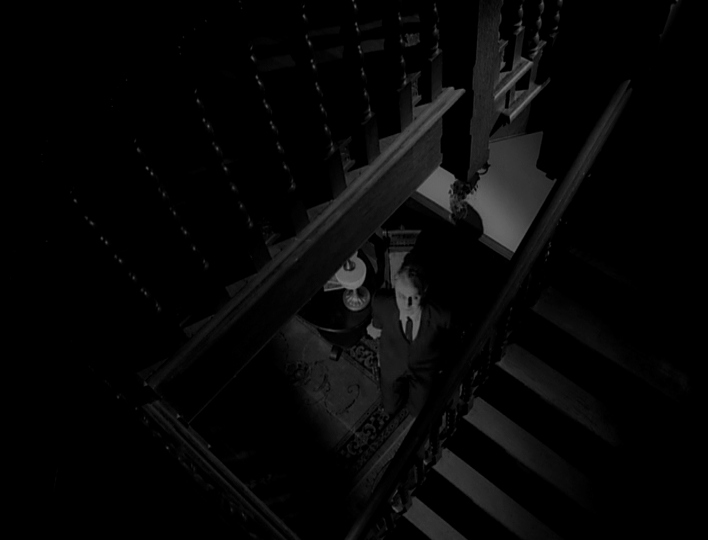
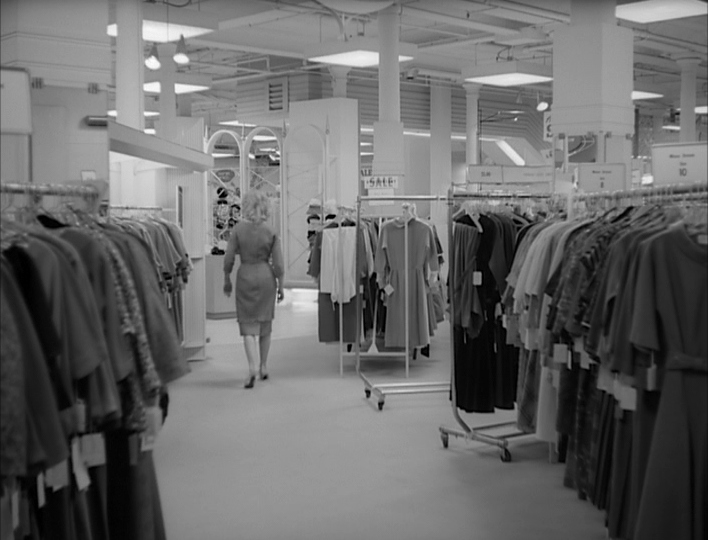
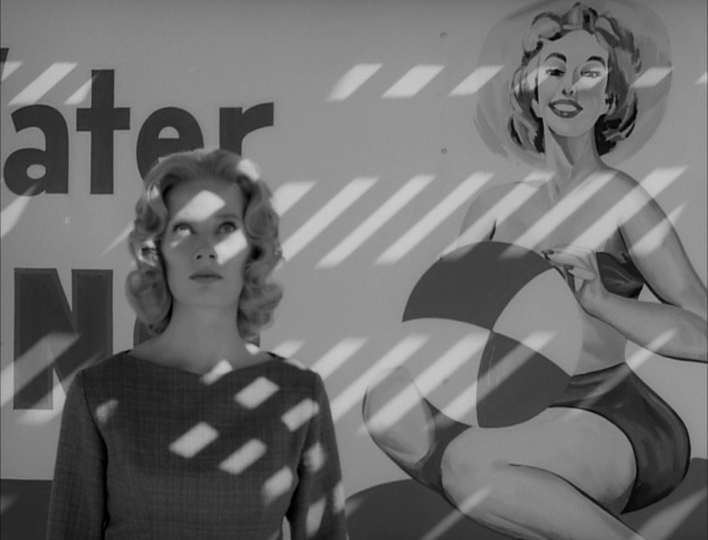
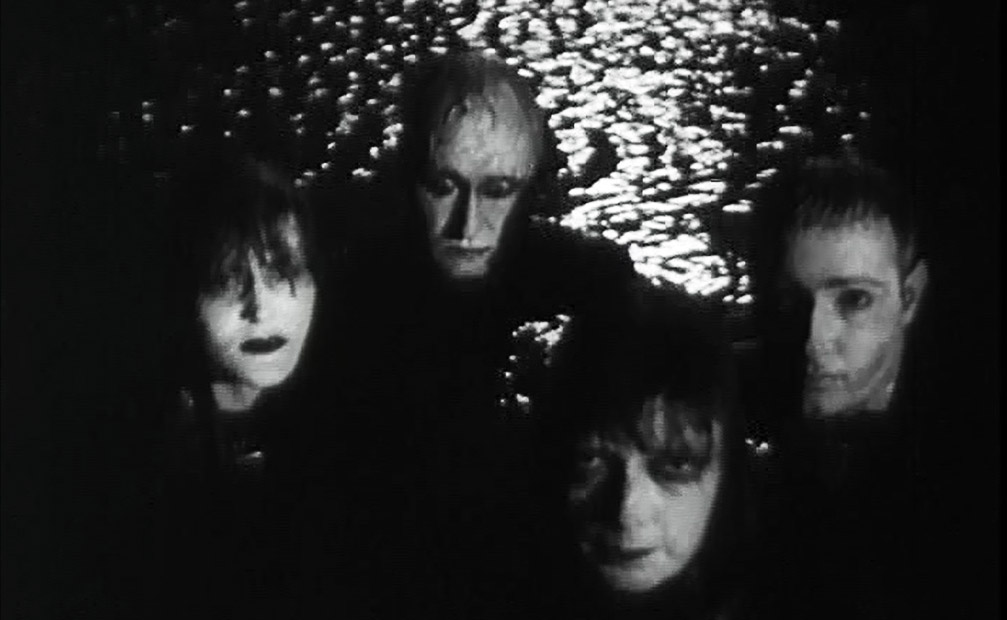
La Notte (‘The Night’) is a 1961 Italian film by Michelangelo Antonioni, written by him, Ennio Flaiano, and Tonino Guerra. It stars Marcello Mastroianni, Jeanne Moreau, and Monica Vitti. Filmed on location in Milan, it is about the disintegrating relationship of a man and his wife, as both of them are tempted into having extramarital affairs.

The second film of a trilogy (the first being L’Avventura, and the third being L’Eclisse), La Notte continues Antonioni’s abandoning of traditional plots in favour of visual composition. The film was acclaimed for its exploration of modernist themes of alienation; it received the Golden Bear at the Berlin International Film Festival, a first for an Italian film, and it also won the David di Donatello award for Best Director in 1961. It’s one of Stanley Kubrick‘s ten favourite films.

Here is a link to quotes, in English translation, from the film.

When the opening credits are showing, we see a shot of a building up close, one much taller than the other buildings of the city either in the background or in the reflection of the skyscraper’s windows. The camera is slowly moving downwards.

Since La Notte is about a married couple growing alienated from each other, and we know that the essence of alienation is an inability to communicate with and understand other people, then this descending camera shot of a skyscraper suggests the Tower of Babel, meant to reach up to heaven. But God (Elohim) says, “Go to, let us go down, and there confound their language, that they may not understand one another’s speech.” (Genesis 11:7). And indeed, after the credits are finished showing, we see the beginning stages of the breakdown in communication between writer Giovanni Pontano (Mastroianni) and his frustrated wife, Lidia (Moreau).

Subtle associations in moments in the film with key moments in the primeval Biblical narrative can be found afterwards, too, though largely in reverse order to that of the early chapters of Genesis. I’ll return to these other associations soon enough.

Giovanni and Lidia enter a hospital where their good friend, fellow writer Tommaso Garani (played by Bernhard Wicki), is a seriously ill, dying patient in need of morphine to ease his pain. In this pitiful state, Tommaso personifies the Pontanos’ ailing marriage.

Before the couple go into his room, they’re accosted by a pretty but emotionally unstable young woman who complains of the telephone in her room not working (symbolic of already failing communication). She will later make sexual advances on Giovanni after Lidia has left the hospital in tears over the wretched state Tommaso is in. There is a clear link between seeing their dying friend and this young woman, for temptations to adultery are among the things that are slowly tearing this marriage apart.

The theme of stifled communication is developed in Giovanni’s repeated self-deprecatory remarks about his fading abilities as a writer. The ability to use language is crucial to a writer, of course, but also key to having healthy relationships, especially in a marriage. Language is a central part of Lacan‘s Symbolic Order, brought into being through the prohibition of Oedipal indulgence via the Nom, or Non! du père, and bringing the child out of his narcissistic, dyadic relationship with mother and into the world of society, culture, and shared customs. Giovanni’s indulgence with pretty girls like this wild woman in the hospital, and later with Valentina Gherardini (Vitti), is a regression to a self-centred, childish state, a retreat from society (coupled with his fading ability to write, to use language) that will wreak havoc with his marriage.

The funny thing with Lidia, as far as Giovanni’s temptations with both women are concerned, is that she isn’t jealous. She’s just disgusted with him. It’s a clear sign that the love has died in their marriage. This is why we see her walking off from him, going off alone so many times.

First, she has to go off alone at the hospital, after empathizing with the pain of Tommaso, the personification of her marriage to Giovanni. Then, at the promotion of his new book, La Stagione (“The Season”), she walks off again. Finally, at the Gherardinis’ party, she’s often alone.

She’s sometimes tempted by other men, directly or indirectly, as Giovanni is by young women. During her walk-off from his book promotion, after which he goes home surprised to find her not there (and turns off a recording of an English lesson, the translation of English vocabulary into Italian; his turning off of the recording is symbolically another indication of the ending of language, and therefore, of communication), she encounters some people and things that can at least symbolize, or be associated with, thoughts of her being with other men.

At one point, Giovanni lies down and naps for a bit. Lidia walks along a sidewalk with short stone posts that are phallic in shape; she touches one or two of them, and passes by an old woman who would seem to be a reflection on her own aging…and fear of further aging.

Later, having been driven around in a cab (her riding with a male driver other than her husband suggestive of an adultery fantasy), she encounters a gang of boys, two of whom get into a fistfight. Though she naturally abhors the sight of violence, and promptly stops the fight, one suspects that she–being a woman raised in a traditional society–would find two virile young men fighting to be erotically stimulating, at least on an unconscious level.

After that, she sees rockets being fired into the sky. The sight strongly suggests ejaculating phalli. Such images of virility, something that seems conspicuously lacking in mild-mannered Giovanni, suggests the root of her problems with him: he seems impotent (an at least psychological inadequacy, if not a physical one), and only able to get it up with young women. In fact, even with the wild woman in the hospital, he doesn’t seem to be aroused.

Early during her walk, she comes to the run-down buildings of some poor people and finds a child crying. Though she, as a bourgeois, is not of the poor child’s class, she nonetheless sympathizes; and her wish to comfort the child suggests her frustration at never getting to be a mother. Indeed, we know of no sons or daughters from the Pontanos.

Giovanni wakes from his nap in an agitated state, suggesting he’s just dreamt what she experienced alone outside. It’s another example, as I’ve noted in Blowup and The Passenger, of Antonioni verging on, though not quite lapsing into, the surreal, the borderline between reality and dream, or fantasy. In any case, Giovanni’s worst nightmare is being realized: she’s falling out of love with him and having adulterous thoughts of her own.

She telephones him and has him pick her up in a place where they used to live, a reminiscence of a happier time when they were still in love. In response to his worries, she says it’s “nothing”…as in Much Ado About…When he arrives, he notes a train track now covered in vegetation; he remembers when the train was once used. Back in the time when they’d lived there, their love was going places, like that train. Now, their love goes nowhere…like that train.

When they get home, she takes a bath. The scene is interesting in that it was originally censored for giving us one or two brief flashes of Moreau’s breasts. (Other scenes in the film, such as the wild woman’s seduction of Giovanni, including her undressing after their kiss, as well as his and Lidia’s rolling around in the dirt kissing at the end, and one of two ladies walking together saying ‘whore’–or ‘tart,’ depending on the translation–at the Gherardinis’ party, were also censored.) Giovanni shows no sexual interest in his naked wife, adding to her frustrations.

Night is approaching, their marriage’s ‘dark night of the soul,’ so to speak, and Lidia doesn’t want to sit around at home. They’ll go to the Gherardinis’ party, but first to a night club. She shows herself off to him in a new black dress, but he shows minimal interest, disappointing her once again.

At the night club, they watch a striptease/equilibrist perform while balancing a wine glass. The juxtaposition of Giovanni and Lidia watching a woman being undressed (by her husband?) with her balancing of a glass half-filled with wine, which she later drinks, vaguely suggests Genesis 9:20-22, when Noah got drunk and naked in his tent, and Ham saw him. Ham thus is cursed.

The shame in the scene in the film, though, is in how the erotic dancing does nothing to inspire passion in Giovanni, a passion that he could direct at Lidia. As he says to her, “I no longer have inspirations, only recollections.” She is thus once again frustrated. Their marriage is cursed.

They arrive at the Gherardinis’ party, where the lady of the house (played by costume designer Gitt Magrini, who incidentally also played Jeanne’s mother in Last Tango in Paris) greets them.

Her husband is a curious sort: he would seem to be a socialist’s fantasy of what a boss ought to be like. Mr. Gherardini (played by Vincenzo Corbella) speaks of not being interested in making profits, but rather producing things to be remembered. He imagines that Giovanni writes out of necessity. He also offers Giovanni a job, to write the history of Gherardini’s company. Giovanni probably won’t accept the job offer: after all, as a bourgeois with a servant in his home, Giovanni would seem out of place working for a ‘socialist.’

Still, he might consider taking the job after all…if he can get closer to the Gherardinis’ pretty daughter, Valentina. Giovanni Pontano’s philandering with young women suggests that his surname is a pun on puttana, or more aptly, ‘puttano,’ a male whore.

He begins his pursuit of Valentina by playing a game she’s devised, that of sliding her compact across a floor of checkered tiles with the aim of it landing on one specified tile, to win points. By participating in this game, Giovanni is demonstrating what a ‘playa‘ he is.

He is so careless and foolish that just after the end of their game, he kisses her…and Lidia sees him do it! This is shortly after she’s learned, from having telephoned the hospital, that Tommaso has just died. She isn’t jealous of her husband with Valentina because she knows her marriage is dead.

Soon after, it starts to rain. This heavy rain can be compared to the forty days and forty nights of rain of the Great Flood. Now, the placement of the rain in the time sequence of the film is one of the few instances that don’t coordinate with the reversed time sequence I mentioned above about the major events of the early chapters of Genesis. Still, the Biblical parallels are enough to make my point about Giovanni’s and Lidia’s marriage: it’s going backward, not progressing.

The cause of the wickedness of the world leading up to the Great Flood, as described in Genesis 6:1-4, was the sons of God mating with the daughters of men, a forbidden mixture of the human and divine worlds that brought chaos to God’s ordered creation. The ‘sons of God’ of La Notte are Giovanni and Roberto (played by Giorgio Negro), who show a sexual interest in, respectively, Valentina and Lidia, the ‘daughters of men’; and the former pair pursues the latter pair before, during, and after the rain, which doesn’t quite correspond with the reverse order of the analogous events in the Bible. Still, I say the correspondences are close enough.

At first, many of the guests at the party use the rain to elevate their hilarity and fun–a number of people jump in the swimming pool, reinforcing the association with the Flood; ultimately, however, the rain causes certain crucial guests to split up and go their own ways, a breaking up of the universal socializing and communicating that is the essence of the Symbolic. Giovanni and Valentina become a dyad, and so do Lidia and Roberto.

These two dyads, metaphorical mirrors looking into each others’ eyes and reflecting each others’ egoism, are experiencing what Lacan called the Imaginary. The desire one member of each dyad has for the other is a wish to be at one with the ideal-I that is experienced in the reflected faces of their metaphorical mirrors. The one desires to be the desire of the other, or to be recognized by the other. Giovanni wants the youth and vitality of Valentina, since he’s losing his own virility with age. Lidia hopes to be a sexy, desirable woman for Roberto, since she cannot be such a woman for her husband.

So both husband and wife have regressed from engagement with the Other (society in general, mingling with many people instead of just focusing on one) to engagement with the other (just one other person, making a dyad with him or her, a transference of the mother/son or father/daughter, Oedipal pairing). These narcissistic duos, reflecting each other like mirrors, are a regression from the adult world of the Symbolic to the infantile Imaginary, and thus constitute a breaking down of communication.

Now, it isn’t so easy to regress into the secondary narcissism of the revisited Imaginary without the danger of lapsing into the terrifying chaos of the Real, which is what the Deluge-like rainfall symbolizes. Narcissism is a defence against psychological fragmentation, a falling-apart of the self and a psychotic break with reality.

Lidia is in Roberto’s car during the heavy rainfall; they are in ‘Noah’s ark,’ so to speak. We see them through the car windows, chatting with and smiling at each other, enjoying one another’s company; but we don’t hear a word they’re saying. Inside the car is the narcissistic dyad of the Imaginary; outside the car, out in the rain–like the forty days and forty nights of rain that killed everyone on Earth–is the traumatic, undifferentiated horror of the Real, what cannot be symbolized with language.

This scene in the film reminds me of what Slavoj Zižek once said about the inside and outside of a car as it relates symbolically to the Real. In Looking Awry, he commented on a passage in Robert Heinlein‘s Unpleasant Profession of Jonathan Hoag. A couple are in a car driving home, but are told under no circumstances, no matter what they see, to open the windows of their car. They witness, during their drive, a child hit by a car, and naturally feel the urge to roll down a window, just a bit, to tell a patrolman about the accident. Instead of seeing all that they’ve seen through the closed windows, though, they see through the opening “Nothing but a grey and formless mist, pulsing slowly as if with inchoate life.” (Zižek, page 14)

So what is this “grey and formless mist, pulsing slowly as if with inchoate life,” Zižek asks, “if not the Lacanian real, the pulsing of the presymbolic substance in its abhorrent vitality? But what is crucial for us here is the place from which this real erupts: the very borderline separating the outside from the inside, materialized in this case by the windowpane…To those sitting inside a car, outside reality appears slightly distant, the other side of a barrier or screen materialized by the glass. We perceive external reality, the world outside the car, as ‘another reality,’ another mode of reality, not immediately continuous with the reality inside the car. The proof of this discontinuity is the uneasy feeling that overwhelms us when we suddenly roll down the windowpane and allow external reality to strike us with the proximity of its material presence…But when we are safely inside the car, behind the closed windows, the external objects are, so to speak, transposed into another mode. They appear to be fundamentally ‘unreal,’ as if their reality has been suspended, put in parenthesis–in short, they appear as a kind of cinematic reality projected onto the screen of the windowpane. It is precisely this phenomenological experience of the barrier separating inside from outside, this feeling that the outside is ultimately ‘fictional,’ that produces the horrifying effect of the final scene in Heinlein’s novel. It is as if, for a moment, the ‘projection’ of the outside reality had stopped working, as if, for a moment, we had been confronted with the formless grey, with the emptiness of the screen…” (Zižek, pages 14-15)

In La Notte, however, it isn’t seeing out from the inside, from the narcissistic veil of illusion out onto the harsh reality of outside, but the other way around. From the Real that is outside, one looks inside to see two people experiencing the illusion. It is just like Noah’s family and the pairs of animals, experiencing the comfort of the illusion of life, as opposed to the chaos and destruction of the Flood going on outside, killing everyone and every land animal, a return to the tohu-wa-bohu of primordial Chaos. Accordingly, Lidia can enjoy the feeling of being courted by Robert; but when they park the car and get out, and he continues his pursuit of her, she snaps out of it and realizes she cannot cheat on her husband. She has had a taste of the Real, standing out in the rain for a moment, and her narcissistic illusions have been shattered.

She cannot cheat on Giovanni, even though she knows he hasn’t been faithful to her; this is partly because of the patriarchal double standard that indulges a husband’s affairs, but not a wife’s. Also, she cannot cheat on him simply because she’s much more responsible and adult than he is. We’ve seen her smile and watch the jazz band play up close, admiring these attractive, talented men. She has gotten in the car with Roberto. But she never fully acts on her temptations as Giovanni does. She won’t even kiss Roberto.

When Giovanni and Valentina are alone in the house, she plays a tape recording she’s made of what seems affectedly poetic TV dialogue; she feels embarrassed about it, for she asks him to promise not to make fun of her for having recorded it. After playing it, he wants to hear it again, but when she rewinds it, she also erases it, considering the recording to be “drivel.” Once again, La Notte shows how the removal of language and communication vitiates relationships.

When Lidia and Roberto return, she and Giovanni have to confront each other’s temptations to adultery. Giovanni is offended at something Roberto says to him with challenging eyes, that in democracy we “take things as they come”; it would seem more reasonable to assume he’s more annoyed at Roberto being alone with his wife (i.e., free to take her as she comes) than at what he has said. As mentioned above, though, Lidia denies any feelings of jealousy over her husband’s interest in Valentina, even though he’s made no attempt to hide that interest.

Instead, she feels as if she wants to die, for she knows she doesn’t love Giovanni anymore. Like Tommaso, her marriage is dead. The Cain of her husband’s concupiscence has made her no longer able…or, Abel?…to love him anymore. Giovanni, his eyes wandering in the land of Nod, knowing those other than his wife, has murdered her love, just as Cain killed his brother.

The morning has come, and it’s time to leave the party. Giovanni and Lidia decide to walk through Mr. Gherardini’s golf course. She finally tells Giovanni about Tommaso’s death; he’s annoyed that she didn’t mention it earlier, but he was playing (i.e., the game with Valentina with her compact slid across the checkered tiles–trying to seduce her). With the mention of Tommaso’s death comes her final confrontation with Giovanni about the end of her love for him…and vice versa.

She reads him an impassioned love letter she’s had in her purse. Though he’s visibly moved by the letter’s contents, he has forgotten that he, in fact, wrote it long ago, back when he still truly loved her. His obliviousness to what he wrote proves his love, too, has died–how his ineptitude with language has ruined their relationship.

He won’t accept this painful truth, though, so he makes unwanted sexual advances on her. They’ve been sitting by a group of trees, him rolling on top of her in the dirt. This moment is comparable to Adam and Eve in the Garden of Eden.

His pitiful attempt at lovemaking reminds us of St. Augustine‘s interpretation of original sin, coming from concupiscence, or involuntary desire, which has been plaguing their marriage from the beginning. His uncontrolled arousal was directed at women other than Lidia; this same involuntary arousal was no longer directed at her, so when he tries to make love with her there, it’s fake, and she knows it (i.e., she knows he hasn’t got an erection–he’s impotent). He’d wished, in his love letter, for his love for her to be immortal, but not even his memory of the letter was immortal. Small wonder she, too, has looked outside their marriage for love.

His attempt at lovemaking is so fake that it should be obvious even to him that his love for her died long ago. He knows, as if from eating the…here, bitter…fruit of the Tree of Knowledge, that their love is dead. Only his narcissism would push him to hide his shame by pretending to feel desire for her, paradoxically related to the shame that made Adam and Eve want to hide their genital arousal by covering it with fig leaf aprons.

They roll in the dirt of his concupiscence, for Giovanni, like Adam, is dust, and like their marriage, to dust shall he return. From the Tower of Babel of the opening credits, to the…Edenic?…ending of the film, their marriage has gone backwards, not forwards.

This ‘Edenic’ ending is not a return to the lost paradise, for Giovanni and Lidia remain in their fallen state; they know their love is dead–they aren’t the naïve, unknowing naked pair before having eaten the forbidden fruit. Fully clothed, they’re like Adam and Eve only after God has clothed them in animal skins.

Now, it isn’t that sex per se is dirty, as Augustine conceived it; it’s that desire isn’t controlled–it’s misdirected. Sex itself didn’t bring about the Fall of Man; God told Adam and Eve to be fruitful and multiply. Childless Giovanni and Lidia were never fruitful. Desire brought about the fall of, respectively, both the naked and the clothed couples of the Bible and La Notte. The Buddhists agree that it’s desire that is the root of human suffering, and the Pontanos’ misdirected desire has been causing their suffering throughout the dark night of their marriage.

Slavoj Zižek, Looking Awry: An Introduction to Jacques Lacan through Popular Culture, OCTOBER Books, London, 1991

The Fourth Poem from Jason Ryan Morton’s Book, ‘Diverging Paths’

Here is another poem by my Facebook friend, Jason Ryan Morton, whose work I’ve looked at so many times before. This is Poem Four from Diverging Paths. As usual, I’ll be putting his words in italics to distinguish them from mine:

Disillusioned
I face my personal hell, 
I am the illusion, 
Of a man you know well,
 

Time is a distance, 
Scattered betrayers, 
Crucify me, 
With the intrepid 
Definitions of reality, 

You are the only being, 
That I could care less if I see, 
When I realize I am not me, 
But a fool looking to the sky for substance and 
meaning,

And now, for my analysis.

I don’t believe the poet is speaking in his own voice here. Instead, this is a person confronted with his own phoniness. He’s lived with a False Self for much of his life, but at some point he cannot maintain his illusions. His “personal hell” is the realization that he can no longer pretend illusion is reality.

The pain of this realization is a kind of narcissistic injury, so it’s easier to blame his woe on “scattered betrayers” who “crucify” him, rather than take the responsibility for himself. Making his pain into something as grandiose as to be compared with Christ’s Passion, he can try to hold on to some sense of illusory greatness. Try, but not succeed.

The “definitions of reality” are “intrepid” because the truth is that fearless in how it hurts us without remorse. The person to whom he speaks is someone much better; he “could care less” if he sees this person, which is better than not caring less, so this person is of at least some value to him, in his otherwise empty life.

It is the ideals that he looks up to, symbolized by a heaven that supposedly has “substance and meaning,” that are what make up his not being himself. It is the narcissist’s tendency to idealize someone else, and to want to emulate that idealization, that creates the False Self; for the idealization is a false person, too. So the person to whom he addresses his identity crisis is, presumably, that idealized person, who is now not so ideal, hence he “could care less” to see him or her.

This loss of someone to idealize is the essence of his “disillusioned” state, for the idealized other is a face mirroring back one’s own narcissistic, illusory self. Note also the continuous use of commas, especially at the end, suggesting that this is an ongoing, unending pain. For though “time is a distance,” that distance in time from the original injury to one’s ego will never erase the pain entirely.

Analysis of ‘The Passenger’

The Passenger (Italian–Professione: reporter) is a 1975 drama directed by Michelangelo Antonioni and written by him, Mark Peploe, and Peter Wollen. The film stars Jack Nicholson and Maria Schneider, with Ian Hendry, Jenny Runacre, and Steven Berkoff.

The Passenger competed for the Palme d’Or at the Cannes Film Festival. It’s been widely praised for its camerawork and its acting. Roger Ebert originally didn’t like it, but he revised his review in 2005, calling it a perceptive look at identity, alienation, and the human desire to escape oneself.

As of this blog post, the film has a rating of 88% on Rotten Tomatoes.

A link to quotes from the film can be found here.

One thing I found striking about The Passenger is how it can be compared and contrasted with Last Tango in Paris, and I’m not merely talking about how, in both films, Schneider plays opposite one of the greatest Hollywood male actors, playing his character’s love interest. In Tango, Paul (Brando) is also trying to escape from his painful past, and in a totally unrealistic way, by meeting with Jeanne (Schneider), not wanting to know her name or anything about her life, and her not knowing anything about him or his name.

The apartment in which Paul and Jeanne have their anonymous affair is an oasis from the pain of his past, which included not only the adultery of his wife, Rosa, but also her suicide. In The Passenger, David Locke (Nicholson) has an affair with the girl (Schneider), whose name we never learn, by the way; his wife, Rachel (Runacre), is having an affair with a man named Stephen (Berkoff), yet it is Locke who commits, so to speak, suicide by having the world believe he’s dead while he takes on a dead man’s identity.

Reality and the past catch up with Paul in the end; he is shot and killed. The same happens to Locke. Neither man can sustain his fantasy world for long.

References to French colonialism in Africa are made, if indirectly, in both films: in The Passenger, it is Chad; in Tango, it is Algeria. Related to this is the liberal hypocrisy of Jeanne and her fiancé wanting to name their children after communist revolutionaries (Fidel or Rosa), while she has such a love and admiration for her father–a colonel in Algeria in the 1950s whom revolutionaries like Frantz Fanon would have fought–that she won’t have Paul say anything bad about the colonel. In The Passenger, Locke is a liberal reporter who poses as a gun-runner for a Chadian liberation movement with Marxist leanings (one like FROLINAT), but all he does is take the money, without any concern for making sure that the Chadian rebels get their weapons.

The theme of duality pervades both films; see my analysis of Tango (link above) to find a discussion of duality in that film. In The Passenger, apart from the man/woman duality of the main characters that is also in Tango, there are the dualities of past vs present, the First and Third Worlds, the two Davids (Locke and Robertson, the latter played by Charles Mulvehill), and perhaps the most important duality of all, which is personified by the two Davids: liberal vs revolutionary.

We are meant to understand that Locke and Robertson are sufficiently similar looking for the one man to be possibly confused with the other (even if Nicholson and Mulvehill don’t look all that alike). Perhaps the African staff in their Chadian hotel consider all white men to look the same.

The similarity in these men’s looks is significant when we remember their political affiliations. Just as the identity of one David is swapped for that of the other, and just as one David is confused with the other, so is the liberal far too often confused with the radical leftist revolutionary, and the need to beware of such confusions is the political message that Antonioni was trying to impart here.

While being a ‘left-leaning liberal’ actually meant something (if not much) back in the 1970s, as opposed to the fact that it’s meant absolutely nothing since at least the 1990s (Bernie Sanders, AOC, et al are useless at opposing imperialism, and that’s speaking kindly of them), any real leftist knows that those 70s liberals’ activism was woefully inadequate at best, and at worst, an indirect aid to anticommunism. This is why Mao wrote “Combat Liberalism.” This is why Lenin didn’t trust the liberals. This is what Parenti meant when he distinguished the liberal analysis from that of the radical. And this is why even a moderate leftist like Phil Ochs satirized liberalism.

The real meaning of the film’s title (not the European one, mind you) is fully realized when seen in this political distinction between liberal and leftist. A passenger just sits passively while others do the work of moving. Locke is the (metaphorical) passenger, not the girl riding in his car, as many assume of the renaming of the film. Liberal opportunists are passengers: they go with the flow, blowing to the left…or to the right! depending on which way the political wind of the time happens to be blowing. The radical Marxist revolutionary, on the other hand, is the driver of the car, the steerer of the ship, one of its oarsmen, or the pilot of the airplane. The leftist actively brings about social and political changes; the liberal just goes along for the ride.

Conservatives–either out of stupidity and ignorance, or disingenuously out of a wish to exploit people’s confusion–like to conflate the liberal with the socialist. They’ll make idiotic claims like ‘hippies are communists,’ or assert that Biden and Harris are bringing about ‘toxic socialism,’ when the Democratic Party had already swung over to the political right back during the Clinton years (even Carter, with Brzezinski squirting his anticommunist poison in Carter’s ears, was hardly ‘left-leaning’ in any meaningful sense).

Locke personifies what I’ve characterized as the liberal mindset. His id would have him indulge in all kinds of pleasures: taking a huge wad of money (without even trying to supply the weapons he’s being paid for) and traveling around Europe (Munich and Barcelona), buying colourful clothes, and enjoying the charms of the girl. His ego would keep him safe from being found out by his BBC associate, producer Martin Knight (Hendry), Rachel, or the Chadian dictator’s secret police, those who kill him in the end. His superego, however, has him in an existential crisis wherein he’d report on the Chadian civil war in a manner sympathetic to the Marxist rebels, but Knight and the establishment media would have him keep his sense of “detachment,” have him remain ‘neutral’ and ‘objective’ (translation: leaving the colonialist status quo unchallenged).

As a passenger, all Locke wants to do is keep moving: it doesn’t matter where he’s going, since he’s directionless, as long as he’s moving. His feeling stuck in “God-forsaken” Chad, his truck stuck in a sand dune, is symbolic of his existential crisis. Where can he go with his life as an establishment liberal reporter? He wants to feel as though he’s going somewhere, making some kind of advancement in his life. Not necessarily really going anywhere in particular, just feeling as if he’s moving. And that’s what makes him different from men like Robertson.

In the hot desert of Chad, he feels himself to be in a hopeless situation. He can’t find the guerrillas he wants to interview, to get a perspective opposing that of the dictator. He has recorded largely only the biased and dishonest point of view of the country’s ruling class; he’d might as well be supporting them. Here we see the existential crisis of the liberal who would be a revolutionary…if only he had the guts.

He feels dead in terms of the meaning of his life; it’s fitting that his truck is stuck in the desert sands. This sand is like the dust from which Adam sprang, and to which Locke will return when he dies (Genesis 3: 19; Ecclesiastes 3:20). All is vanity, the absurdist vanity of living in a meaningless world in which his only end will be death.

So when he finally returns to his hotel, exhausted and crestfallen, and he finds Robertson lying dead on his bed, Locke decides to die himself, by taking on Robertson’s identity. Adios a la pasada for Locke.

Though the past and present are bitterly opposed for Locke, there is nonetheless a link between the two that he can’t break, and this inability of his is foreshadowed in the scene when he’s switching his and Robertson’s passport photos. Locke has recorded a conversation between himself and Robertson, which he plays back while switching the photos.

The tape recording isn’t the only link with the past, though. In one of Antonioni’s famous long takes, we see bare-chested Locke at the table with the passports as the tape plays; he looks over to the side and the camera moves away from him to where the balcony shows a living Robertson and…Locke in a shirt! There is no cut in this camera shot. Antonioni has fused the present with the past in a manner bordering on the surreal; he had experimented with the border between the real and unreal, between certainty and uncertainty, in Blowup. The shot immediately after the balcony one, also without a cut, shows the flashback with Robertson return to the present with bare-chested Locke changing the passport photos. He’d cut himself off from his past, but not even the camera will cut away from it.

Earlier, Locke is sitting on Robertson’s bed, looking at the face of the corpse up close. This dead man, whose life was so different from the dead-end one that Locke wants to escape, is someone he now idealizes. He looks at the face, of this similar-looking man, as one would see oneself in a mirror; recall how Lacan spoke of seeing one’s ideal-I in a mirror, that perfect, unified image one sees, as opposed to the fragmented self one feels oneself to be.

Locke feels just this inadequacy compared to his dead twin; he feels even less alive than Robertson. Soon after, he finds Robertson’s pistol–not only representative of the dead man’s revolutionary leanings, but also a phallic manhood that Locke lacks. This ineffectual liberal now feels all the more inadequate.

But he can fake being a revolutionary, like those liberals who wear Che Guevara T-shirts and vote Democrat?

In trading Robertson’s identity for his own, Locke is establishing a narcissistic False Self and projecting his hated True Self onto Robertson’s corpse. Taking the pistol, Locke no longer feels psychologically castrated. Ironically, Robertson has said he’s in Chad “on business,” as if he were a bourgeois, when it is Locke who is the bourgeois, swapping identities with the revolutionary.

Antonioni’s films give great importance to location, including architecture, and The Passenger is no exception. In this film, we find a recurring motif of architecture, including churches or at least buildings whose names are associated with religion, like the Plaza de la Iglesia and the Hotel de la Gloria. Then, of course, there are the buildings of Gaudí, seen when Locke meets the girl, a student of architecture who knows Gaudí’s work.

Gaudí’s earlier career involved making buildings for bourgeois clients, though religiosity preoccupied his thoughts in his later life, through his focus on the Sagrada Família. The significance of these changes in Gaudí’s work for The Passenger is in how they can be said to parallel the change in Locke’s: his existential crisis, his search for meaning, can find a symbol in Gaudí’s search for God.

Now, none of this is to say that Locke’s search for meaning is anywhere near as noble or lofty as Gaudí’s; but in Locke’s narcissistic imagination, in his False Self as ‘gun-running revolutionary,’ he’d like to think of his search as comparable to a spiritual quest. Linked with this would-be quest is his meeting of the girl, who as a kind of guardian angel to him in her pressing of him to continue showing up for every meeting in Robertson’s little appointment book, is like a reincarnation of Robertson. When one considers Locke’s sexual relationship with the girl, that she can be seen as Robertson come back is in how, when Locke looked at his corpse up close, his face was so close to dead Robertson’s as to imply a wish to kiss him; after all, Robertson is his ideal-I, just as the girl, as his lover, is in a sense his other self.

While wearing that fake moustache in England, symbolic of a mask for his False Self, Locke sees the girl and will later remember her, as if it were fate bringing them together. In Munich, he is paid for papers with gun illustrations, in a church, of all places, one in which one can see the Stations of the Cross in the background. Since The Passenger is, in effect, the film documenting Locke’s life that Knight and the BBC would be making for their ‘deceased’ colleague, all these associations with spirituality and revolutionary heroism would seem to indicate that this ‘documentary film’ is an idealizing of his flawed life, in true narcissistic fashion.

He, of course, isn’t helping any revolutionary cause, nor has he found God. Like Paul in Last Tango in Paris, Locke is being completely irresponsible, throwing away his wife and his past, taking the rebels’ money without providing anything more than pictures of weapons, and having an affair with the girl. Like that fire he burns in his yard in his home in England (one of the flashback scenes) with Rachel wondering what he’s doing, Locke wants only to destroy the old, not build the new. What’s he running away from? Look back with the girl and see the road that Locke’s car has driven on: he’s in constant motion, getting away from the past, but with no discernible future or destination.

He can try to destroy the past, to run away from it, and (like Paul) try to live in a fantasy world, but he won’t succeed. Hitherto unfaithful Rachel becomes guilt-ridden over his ‘death,’ and wants Knight to contact the Robertson she understands to be alive. When Knight fails to find him in Barcelona, Rachel is all the more driven to find this mysterious man.

She isn’t the only one searching for “Robertson.” So are the secret police of the Chadian dictator, who–as Rachel learns at the Chadian embassy when she collects Locke’s things–wants to stop the illegal sale of guns to rebels in his country. Rachel is unwittingly helping these men find “Robertson,” whom she soon learns is really Locke. Incidentally, one of the secret police is a white man, presumably French (we hear him speaking to the girl in French at the Hotel de la Gloria when his associate is off to shoot Locke), strongly implying French neocolonial involvement in the Chadian Civil War, to root out the Marxists.

[As a side note, the Wikipedia article for The Passenger refers to the two men who follow and kill Locke as working with the rebels: on this assumption, the white one beats the crap out of Achebe (played by Ambroise Bia) because the rebels are mad that he gave the money to the wrong man. I disagree with this interpretation. I don’t think the rebels would react that violently to one of their comrades for what was an honest mistake, and would kill the thief of their money rather than angrily demand he give at least what he hasn’t spent back to them…and beat the crap out of him. Agents working for the Chadian dictator, on the other hand, would be that violent. Besides, I have the authority of Theodore Price, whose article on the movie includes references to the complete, uncut script, and who calls the men Chadian secret police.]

The film begins among the sands of Chad, a dictatorship persecuting the leftist resistance within it. The film ends in Spain, at a hotel surrounded in dust. Though Antonioni is too subtle a director to point this out, the viewer who knows his history will be aware that the Spain when The Passenger is set (1973) was also a dictatorship, that of Franco, who had leftists holed up and ‘reeducated’ in concentration camps, and who died the year of the film’s release, after which Spain only slowly crawled back into the realm of liberal democracy. The film thus, like music, has a kind of ABA structure: from dusty dictatorship to pretty democracy, and back again.

Before the penultimate scene with his death, Locke tells the girl a story about a blind man who regained his sight. The man was “elated” at first to be able to see, but he was soon disillusioned when he saw so much “dirt” and “ugliness” in the world. When blind, he easily crossed the road with a walking stick; with his sight, he became afraid even to leave his room. In three years, he killed himself.

This story seems to reflect, though one isn’t sure if Locke realizes it, that through those changes we make in our lives, we think we’re liberating ourselves, but we are only putting ourselves in different chains. Locke thought his trading identities with Robertson would free him from his past, but the pursuits of Knight and Rachel have proven that he’s escaped from nothing.

The girl leaves him in the hotel room and walks around on the dusty ground outside, as if to continue her work as his guardian angel, to be able to return if he needs her. The famous penultimate scene of his death, curious in being a long take largely without him in it, deserves special attention, obviously; I’d also like to give my personal interpretation of it.

Antonioni said that we don’t see Locke when he is killed because he was already dead when he chose no longer to be Locke. I’d like to expand on that idea by saying that, instead of seeing him, we see a POV shot of his spirit, even before the shooting, looking out onto the dusty square where the girl is walking about. His spirit approaches the bars on the window and passes outside; he has freed himself from the prison of a human body. Locke is rid of the lock on the door of his caged existence. Like Gaudí, he has found God, in a way, in the Hotel de la Gloria, its very name suggestive of religiosity.

Just as pious Gaudí was killed by a tram, so have vehicles arriving at Locke’s hotel brought his death: the car of the Chadian secret police, who followed Rachel to find him, her own vehicle with the police arriving too late. Locke is dead lying on the bed of his hotel room, as Robertson was found dead; both men have died thus in countries that are dusty dictatorships–ABA structure.

For dust Locke is, and unto dust shall he return.

His murder by the Chadian secret police is interesting in how he, having only received money, but having never provided weapons to the rebels, is actually innocent of being any kind of danger to the dictator of Chad. Pilate, learning from Jesus that His Kingdom “is not of this world” (John 18:36), also concluded that the man to be crucified was innocent of any revolutionary crime against the Roman Empire. Locke is thus a Christ figure, his holy spirit, as it were, slowly floating out of that room, through those bars, and out into the dusty square. In this way, Locke’s death is also comparable to that of the mystic architect.

Now, this making of Locke into a Christ figure is to be seen from the point of view of fascist, imperialist dictatorships. Men like Franco justified their authoritarian rule by claiming that they were saving their country from ‘satanic’ Marxism and preserving its Christian traditions. In this way, Christ-like Locke, like a good liberal who only pretends to be a revolutionary, is doing the Lord’s good work, keeping the strongmen in power by doing nothing to threaten their hold on it.

When Rachel finds her husband’s body on that bed with a bullet in him, she says she “never knew him,” echoing Peter’s denial of Christ three times before the cock crowed (Luke 22:34). This is the perfect ending to Locke’s ‘documentary,’ for in his narcissistic imagination, he’s died a martyr, and yet his spirit will always be with us.

This martyr-like status, of course, is just part and parcel of Locke’s narcissistic False Self. He couldn’t really be Robertson to save his life…literally. Locke deals in “words, images”; Robertson deals in “concrete things,” so the people understand him straightaway. Locke thus personifies Hegelian idealism, while Robertson personifies Marxian materialism.

Locke’s existential search for meaning is just a Camus-like absurdist one: Locke has tried to escape his liberal past by merely posing as a revolutionary; and like Sisyphus’ futile rolling up of that rock, Locke has failed miserably. We defy the Fates and attempt to give our lives value, and we’re happy in the attempt, as Camus says Sisyphus is, and as Locke briefly has been (think of that scene of him in the cable car in Spain, when he pokes his upper half out the window and stretches his arms out over the water…he feels as free as a bird); but the certainty of death assures us of the ultimate futility of our attempt.

So the lesson we must learn from The Passenger is, do we as leftists want to be engagé revolutionaries in the driver’s seat, or do we want to be mere liberal passengers, going along for the ride, hoping to share in the glory, but doing none of the heavy lifting? Certainly, when Antonioni filmed Chung Kuo, Cina, the Chinese Communists hated it, regarding him as a mere liberal, pandering passenger. Deeply hurt by this reaction, he made his 1975 masterpiece in response.

Now, what will we do in today’s neoliberal hell? Shall we try to throw away our pasts and live in a fantasy world, à la Paul and Jeanne in Last Tango in Paris? Shall we carry Robertson’s pistol around, feeling tough with it, but be too scared to use it? Shall we try to take the easy way out and avoid our painful reality? As Robertson warns us, “the world doesn’t work that way.”

‘Complete,’ a New Poem by Jason Ryan Morton

Here’s a new poem by my Facebook friend, Jason Ryan Morton, whose work I’ve looked at many times before. This one is another one with a happier theme–love. Again, I’ll put his words in italics to distinguish them from mine. Here’s the poem:

I ran into the mirror
Fell right through
Woke up without eyes
But could see you
You were brighter than the moon
You smiled I swooned
Kissed your lips with my finger tips
I wrote our love sonnet
Upon your flesh
Awoke with a Memory
And a belief
That today we may be strangers
We will meet one day
And we shall be
Complete

And now, for my analysis.

Note the relationship between running into a mirror and seeing the person he loves. When we see a mirror, we see ourselves, of course; but mirrors can be metaphorical, too. The mirror in the Lacanian sense can be a metaphor for the face of another looking back at you, an idealized version of yourself, or an idealized parent looking back at you, mirroring your love back to you.

The Oedipal relationship with the idealized parent gets transferred onto someone that one later falls in love with. The poet “fell right through” (i.e., in love) and “could see” his love “without eyes,” because as we know, love is blind. His love was “brighter than the moon,” the same moon that was envious of her maid, the sun Juliet, for being far fairer than she (Romeo and Juliet, Act II, scene ii, lines 2-10).

Another indirect reference to Shakespeare can be found in the poet having written their “love sonnet.” They “will meet one day/And…shall be/Complete.” This is the lifelong drive to attain the idealized state of the object seen in the mirror (the “Memory” from one’s first childhood experience of looking into the mirror and establishing a sense of self…a repressed, unconscious memory), to try to be as perfect as the image one sees on the other side, with whom one feels a stranger. To have one’s love, projected into and embodied in that other person.

Analysis of ‘Déserts’

I: Introduction

Déserts is a 1950-1954 piece by avant-garde composer Edgard Varèse, scored for fourteen winds (brass and woodwinds), five percussion players (including tympani, xylophone, snare drum, and woodblocks), one piano, and magnetic tape. Deserts, according to Varèse, refer to “not only physical deserts of sand, sea, mountains, and snow, outer space, deserted city streets… but also distant inner space… where man is alone in a world of mystery and essential solitude.”

He elaborated by saying that what he meant by deserts are these: “All those that people traverse or may traverse: physical deserts, on the earth, in the sea, in the sky, of sand, of snow, of interstellar spaces or of great cities, but also those of the human spirit, of that distant inner space no telescope can reach, where one is alone.”

The piece was originally meant to be the soundtrack to a modernist film that was never finished, a film of images of the deserts of the Earth, the underwater sea, and outer space, but most importantly, the deserts of the human mind: his loneliness and alienation, especially after the terrors of the decade that preceded Déserts‘s composition: concentration camps, the dropping of the atomic bomb on Japan, etc.

The piece is divided into seven sections, an alternation of four “Episodes” of music performed live by the ensemble of winds, piano, and percussion, with one of three “Interpolations” of magnetic tape recordings coming between each pair of “Episodes.” So Déserts is structured thus:

1st Episode
1st Interpolation of Organized Sound
2nd Episode
2nd Interpolation
3rd Episode
3rd Interpolation
4th Episode

Déserts is one of Varèse’s most radical pieces of music (and that says a lot, given the already experimental nature of the music he’d already composed before the 1950s). For in this piece, he introduces the use of pre-recorded sounds, a result of an anonymous gift of a tape recorder, which revived his musical inspiration, allowing him to compose music that would further advance its frontiers and experimental potential.

Until the 1950s, Varèse had been frustrated with the limitations of the technology of the time to produce the kind of new music he’d wanted to create. He was tiring of using the instruments of the orchestra, particularly the string section, which he’d used only sparingly (Amériques, Arcana, Offrandes, or the double bass in Octandre). The use of two ondes Martenots (or theremins, depending on the version) in Ecuatorial was something of an advance, but he needed more.

Hence, when Varèse should have been at the height of his creative powers, he actually composed very little, that is, in the 1940s. There was an ambitious idea, Etude pour Espace, that was never finished (<this arrangement of part of Espace was done in 2009). There was the Dance for Burgess (i.e., for Burgess Meredith), and Tuning Up (which was only sketched by Varèse, and completed by Chou Wen-chung in 1998).

But the totally new sound possibilities given to him through the tape recorder gift brought Varèse back. He regained his Muse, and created not only Déserts, but also Poème electronique in 1957-1958, for magnetic tape exclusively.

To understand Déserts, one must understand Varèse’s music in general, and for the uninitiated, such a general understanding is especially urgent, given how daunting this music will sound when heard for the first time. Frank Zappa was one of Varèse’s biggest and most famous fans, and he himself (also a composer and conductor of orchestral music) admitted that he couldn’t give “any structural insights or academic suppositions” as to how Varèse’s music works or why he liked it. As a teen, Zappa liked it simply for how ‘weird’ it sounded. Varèse’s music, Zappa says, is “completely unique.” If a fan like Zappa couldn’t explain Varèse’s music, the uninitiated will need insights far more desperately.

So I’ll try my best to give those insights myself.

II: Varèse’s Musical Language

To begin by painting with large brushstrokes, Varèse’s music is characterized by huge, dissonant sonorities and an extensive use of percussion, which isn’t generally used to punctuate rhythm, but rather to exploit and explore all the varieties of timbre it can provide. The dissonant sonorities are usually given through stentorian horns and shrill, sustained notes on woodwinds.

Varèse radically redefined music to mean “organized sound,” with a foreword-looking disregard for traditional notions of flowing, lyrical melodies, tonality, classical forms (sonata-allegro, binary, ternary, rondo, etc.), rhythm, or conventional groupings of instruments. Those huge, dissonant sonorities that I described above have come to be termed “sound masses.”

These sound masses of loud, dissonant brass and woodwinds tend to be contrasted with softer sections of individual, or small groupings of, percussion instruments (snare drum rolls, the quick tapping back and forth between differently pitched wood blocks, etc.) or solo woodwinds (flute, piccolo, or clarinet) playing long, sustained notes before the next loud, dissonant outburst. This shifting, from the softer passages of individual instruments to the large, loud groupings of horns and woodwinds, has been compared to natural processes of crystallization.

Varèse had an interest in science, and this interest naturally had an influence on how he chose to structure his compositions. So in the softer passages, the individual sounds can be likened to atoms and molecules; and the large, dissonant sound masses can be likened to the solids, the crystals formed out of those atoms and molecules. Smaller groupings of instruments can be seen to represent the middle phases of the solidifying process.

Varèse conceived of music as “sound as living matter.” So when we hear the crystallization of his sound masses, we can think of them as his intention to create living beings, so to speak. We should remember this when we look into Déserts specifically, a work about deserts of the mind, of people who are alone.

The basic parameters of Varèse’s music are duration, intensity, frequency, and timbre (sometimes space is considered, as in Espace, though the full exploitation of spatial effects in music has been the domain of such successors of Varèse as Karlheinz Stockhausen: listen to a live performance of Gruppen to get my point). For Varèse, these four parameters are all given equal importance.

Duration for Varèse isn’t subservient to traditional notions of rhythm or metre. One doesn’t usually tap one’s foot to Varèse. Instead, duration is more about holding notes at varying, sustained lengths. A note may be held, or repeated in short dots of sound, over a period of many seconds, rather than played to a beat–be this the regular beat of conventional music, or the asymmetric rhythms of, say, Stravinsky. As with the other three parameters, Varèse’s use of duration is generally divorced from conventional notions of ‘expressivity,’ which is not to say that his music lacks expressiveness, but rather that Varèse expresses himself in an entirely different way from the expression of the past.

Intensity for Varèse is his use of soft and loud dynamics. Interestingly, changes in dynamics on an instrument also result in changes in that instrument’s timbre. Don’t assume Varèse never toyed with the interrelation between intensity and timbre.

Frequency for Varèse is much more than just pitch. Sounds can be anything from the lowest to the highest frequencies, not necessarily with definite pitches. Sounds are made up of complex wave forms with multiple frequencies (i.e., the fundamental and overtone series), not just a single wave form. So in frequency, just as in intensity, we can find an overlap with timbre, something Varèse was deeply interested in exploiting to the maximum.

But frequency in terms of pitch alone in Varèse’s music leaves plenty to elaborate on. There is melody in Varèse–not nearly as much as in the music of his contemporaries, much less than that of those before him–but there is some. Varèse’s use of melody is unconventional, of course, using wide leaps and such dissonant intervals as minor 9ths, major 7ths, and minor 2nds. He also sometimes made use of the idée fixe, as in Arcana and Amériques.

Harmonically, Varèse’s music is obviously not tonal. It isn’t necessarily always atonal, either, though. There are ever-so-brief occasions when a melody or harmonic combination may seem tonic…then a cluster of dissonances will remind us we’re listening to Varèse. Consider the opening clarinet melody in Intégrales, which sounds like the 3rd, 7th, and upper tonic notes of a dominant 7th chord; then dissonances in the brass and woodwinds quickly dispel the aural illusion.

The fact is that Varèse didn’t conform to any harmonic system, traditional or non-traditional: not tonality, not Schoenberg‘s twelve-tone system, not Bartók‘s axis system, not Messiaen‘s modes of limited transposition, not the polytonality of Stravinsky or Milhaud–nothing remotely like any of these. Varèse seemed to be content to let the notes fall in any old way, because he’d always been more interested in frequency as an expression of timbre than of pitch. His use of sirens, as representations of a continuum pitch beyond twelve-tone equal temperament, should help us better to know how to think about his choices of pitch, rather than any use of scales or chords.

And finally, we come to what was perhaps Varèse’s favourite musical parameter, timbre. His fascination with timbre is why he used such an extensive number of percussion instruments in his works. Recall that one of Varèse’s most famous pieces, Ionisation, is to be played only by percussionists; these instruments are supplemented by such noisemakers as high and low sirens, two anvils, and a whip. Piano is also used, but not in its conventional, melodic way: it’s used as just another percussion instrument.

In his Densité 21,5 for solo platinum flute, again, though we hear monophonic melody throughout, the focus is on intensity and timbre. He was exploiting all the sound possibilities to be produced on the instrument, including tapping effects on the low finger keys about a third of the way into the piece.

Finally, as can be heard in Poème électronique and the three interpolations of organized sound in Déserts, Varèse uses electronically altered sound recordings on tape as an example of his love of exploiting timbre to maximum effect. Always remember that for Varèse, music is the organization of sound. Don’t listen for pretty, lyrical melodies (though that sort of thing can appear from time to time in his work–there is, after all, that one early work of his, written in a Romantic idiom, that he didn’t destroy, Un grand sommeil noir for voice and piano); listen instead for fascinating and imaginative manipulations of sound.

III: Déserts

Varèse’s discussion, in the above quotes, of deserts on the earth, in the sky, of sand, of snow, of interstellar space, etc., all seem to be metaphors for the deserts of the lonely human mind. On some level, this being alone could be manifested in the solitude of hermits and mystics; but the connotations of deserts suggest emptiness, lifelessness, purposeless stasis, and a sadness from being alone. The mystic’s solitude could be seen as an attempt to escape that sadness.

I will attempt, in my personal interpretation of Déserts, to find symbolism for this loneliness, as well as for mystical attempts to attain peace, in the musical structure of the piece. To begin with, note how there is no integration of the ensemble playing with the three interpolations of musique concrète. Such a division between these two ways of producing organized sound symbolically suggests a mutual alienation between people…and there’s nothing like alienation to provoke feelings of loneliness.

Déserts is probably Varèse’s most radical example of experimental music, of a break from almost every conceivable notion of tradition in music. Apart from the by-now-typical unorthodox instrumentation (no string section, extensive percussion as an integral part of the soundscape), as well as the introduction of tape recordings, he breaks even further with tradition here.

There is virtually no melody in this piece, except for a few ever so brief moments of rising and falling notes, including the lead-ups to those discordant fanfares, as Samuel Andreyev so aptly calls them. If melody is musical line, that is, curvy contours of notes going up and down in diatonic or chromatic steps or leaps, then the musical lines in Déserts were mostly drawn with a ruler, so to speak. We constantly get notes sustained or repeated in one pitch. Once again, his main interest is exploring timbre, durations, and intensities, not musical themes in the conventional sense.

Granted, there are a number of moments in the piece when we hear a woodwind or brass instrument play an alternation of notes a half-step from each other, going up and down several times (for example, the B-flat clarinet in bar 205). There are also two moments, in bars 45-46 and later in bars 50-58, when notes of an octatonic scale are heard in two separate transitions: first, G, B-flat, C-sharp, D, B-natural, and F; then, A-flat, G, and B-flat. But such moments as these are far more the exception than the rule in Déserts.

So, with single notes sustained or repeated on individual instruments making up most of the thematic material (except for the percussion sections and the fanfares, which will be dealt with later), we can see in each of these individual notes a symbol of aloneness.

Added to these lonely notes is a number of mirror chords, that is, chords whose notes reflect the same intervallic relationships among them. One example occurs in the first twenty bars of Déserts: in the bass clef, there is a stack of perfect fifths–D, A, and E; then, in the treble clef, there’s another stack of perfect fifths–F, C, and G. These six notes are static, unmoving during the beginning, except for the later addition of a B-flat, a B-natural, and a C-sharp. The diatonic mirror chord–opening the piece with Fs and Gs in the tubular bells (or chimes), xylophone, piano, piccolo, and B-flat clarinet, and later adding the other notes–symbolizes the lonely person looking in a mirror, seeing only himself instead of looking at others.

IV: Conscious vs Unconscious Varèse

Now, Varèse’s musical philosophy was such that one didn’t need to compose pieces with traditional notions of melody, harmony, rhythm, or conventional orchestration to move one’s listeners emotionally. Nonetheless, there’s the listener’s perspective on the matter as well as that of the composer, and the latter cannot realistically be expected to be oblivious to the attitude of the former.

Varèse may have consciously been dismissive of the idea that only conventional musical arrangements will move the listener in the desired, intended way; but there’s conscious intent and unconscious intent, too. Varèse may have been consciously unruffled by the vehemently negative reactions to his works when premiered before conservative audiences (and Déserts received one of those sadly typical responses); but this doesn’t mean he wasn’t at least unconsciously affected by that negativity.

There must have been something in his unconscious mind reacting with a ‘screw you’ attitude to the rejections he was getting from his audiences during those early performances of his work. Such mutual feelings of alienation between composer and audience, however unconscious and repressed for him, must have come out in its culmination in Déserts, through its extreme experimentation, even by Varèse’s standards, in its paucity of melody and gentle lyricism. He as an avant-gardist must have been in a mental desert of his own, which influenced how he wrote the piece.

Those sound masses of loud, dissonant fanfares are his crystallizations of “sound as living matter.” They are the children he’s sired, so to speak. They come into being between the quieter sections (for the most part), and therefore each sound mass, as a ‘living being,’ stands alone, in solitude, in a state of loneliness, surrounded by relative quiet on either side in musical time, a relative silence suggesting desolation. The fanfares are loud, dissonant sound masses because, experiencing the birth trauma of their crystallization, they’re screaming in pain. Existence is pain, as the Buddha observed.

Varèse surely didn’t consciously have this meaning for the sound masses; they’re just ‘organized sounds.’ Indeed, he once said that his music doesn’t tell any kind of story or have any kind of programmatic meaning; it’s just his music. Still, my interpretation, or something at least similar to it, surely is what the listener is imagining when hearing the sound masses in Déserts. Varèse, having grown accustomed to violent reactions against his musical experimentation, must have been sensitive to, and been anticipating, such reactions. All the same, he persisted in composing as he did, not just for the sake of experimenting, as he consciously conceived it, but as I suspect, unconsciously as an act of defiance against his conservative critics. This must, at least in part, have been what he meant when he famously said, “the present day composer refuses to die.”

V: Mystical Varèse

The quieter sections for percussion, especially those at the end of the third and fourth episodes, give a most vivid sense of loneliness and isolation, the deserts of desolation. On the other hand, there are also moments that seem to allude to a sense of mystical solitude, an urge to rise to a higher spiritual plane of existence. This surely is what the All Music Guide means when it says of Déserts, “The orchestra part expresses the gradual advance of mankind toward spiritual sunlight.” I’ve noticed several passages that suggest such an interpretation.

First, there are the opening tubular bells in F and G. They suggest church bells, ringing to summon the faithful but lonely to enter and receive edification. Then, there’s the association one can make of those horn fanfares with the arrival of the nobility. Their dissonance suggests pain, as I mentioned above, yet pain and suffering are also ennobling.

Finally, there’s the slow, gradual ascent of the following notes (mentioned in this video at about 12:05), buried in the first mirror chord mentioned above and the first two fanfares: C-sharp, D, E-flat, E-natural, F, F-sharp, and G. The burying of these rising notes symbolizes the mystery of spiritual ascent. In fact, the video linked above also mentions (at about 11:45) this chromatic rising as within the second fanfare, whose pitches are also all rising together.

Added to this idea of rising spiritually is how certain instrumentation, especially at the beginning, all play the same notes (if in different octaves), and at the same time, or at similar times. I’m thinking of the opening F and G notes in the tubular bells, xylophone, piano, B-flat clarinet and piccolo. Later, in bars 48-49 (see 15:26 of this video), we hear trombones and tympani playing major third intervals together (D-flat and F) in 5/4 time. This playing of the same notes by different instruments, when understood in relation to the notion of spiritual ascendance, can be seen to symbolize compassion and sympathy, which Schopenhauer deemed to be the basis of all morality.

VI: the Interpolations

The three musique concrète sections make use of sounds derived from factory noises and percussion instruments. The electronic alterations of these sounds seem to consist of a heavy use of reverb, echo, and distortion.

The sounds can be described, for the most part, as abrasive, percussive, and glissading. All three interpolations have at least a few manifestations of all three of these kinds of sounds, while the first has predominantly abrasive sounds, the second has more of the percussive kind than the other two sounds, and the third has more glissandi than the other two. A considerable number of abrasive sounds can be heard in all three interpolations, even if that sound isn’t always dominant.

That many of the sounds are derived from factory noises is thematically significant, given the context that Déserts is about the ‘deserts of the mind,’ a world of being alone. I mentioned alienation above, which is an especially modern problem considering the experience of workers in the world of industrial capitalism. Think of all those lonely, alienated workers in factories: hearing factory noises in Déserts is thus poignantly appropriate.

The abrasiveness of the sounds in all three interpolations, especially the first, is also significant in terms of what it can be seen to symbolize. The scratching, scraping, screeching metallic sounds evoke the harsh life of the factory worker, compounding his lonely misery. Such observations make me understand Varèse’s use of dissonance as more than just a transcending of the limitations of conventional harmony: the discords of the instrumental music shriek pain, just as these scraping sounds do in the interpolations.

The abrasive sounds are drawn out and sustained; when the instruments return in the second episode, we hear an abundance of sustained, dissonant combinations of notes played on the woodwinds and brass. So the second episode begins with a continuation of sustained, harsh sounds; this continuation of sustained harshness from the first interpolation to the second episode suggests the emotional effect of factory life on all the lonely people, whom I’ve described above as being symbolized by the crystallizations of loud, screaming fanfares of brass and woodwinds. Indeed, the loudness is sustained for quite a while in the first half of the second episode, before a substantial moment of relative quiet. That pain from factory life persists in one’s mind.

The second interpolation starts with much of the abrasive sound of the first, before the percussive sounds predominate. These sounds, presumably electronically altered xylophone and wood blocks, among other instruments, suggest again the toil of the workers hammering nails, anvils, etc. So we have a continuation of the theme of the plight of the lonely worker. These hammering sounds are carried on in the beginning of the third episode by the percussionists, with loud banging on the tympani, then later tapping on the xylophone.

The third interpolation seems, to a great extent, to be a fusion of the abrasive, percussive, and glissading sound effects, these last of the three coming more into prominence later on. The electronically altered glissandi seem like screams and wails of pain and suffering, the pain of the factory worker who is alienated from his work, from his coworkers, and from his species-essence. The very use of the then-new technology of magnetic tape, to produce harsh sound effects, is itself symbolic of how new technology can be, and often is, used to cause suffering, as in factories, with bombs, and modern surveillance.

VII: Conclusion

The fourth and final episode has a few more screams of fanfare pain in between moments of relative quiet, those quiet moments representing, as I mentioned above, isolating spaces between each crystallization of a lonely person shouting in agony. This continuation of ‘screams’ from the third interpolation and the fourth episode again suggests the emotional effect of factory life on the workers.

The piece ends with a long passage of quiet, using soft, sustained notes in the woodwinds and brass with intervals reminding us of the opening ninths and fifths in the first episode. These similarities between the beginning and ending of Déserts mean that the work has come full circle: the attempt to overcome the static, purposeless, lonely life through mysticism and religiosity seems to have failed (i.e., no chiming tubular bells are to be heard at the end–no ‘church’ to give guidance to the lonely).

This sustained softness, of relative silence, emphasizes the sense of aloneness, the empty deserts of the mind. Varèse composed Déserts not long after the devastation of WWII, so its horrors would not have been far from his thoughts. During this time, he complained about the conformist, conservative, money-oriented world he was living in.

These themes of loneliness, emptiness, and alienation make Déserts an especially relevant piece of music for our times in the 2020s, when we’re all being made to wear masks, practice social distancing, endure lockdowns, receive vaccinations that many fear haven’t been sufficiently tested, and–as many suspect–aren’t effective against new variants, and to risk losing our work and our homes. Whether one supports or is opposed to these new measures is irrelevant to my point, which is that the controversy is dividing us and alienating us from each other even more. Late stage capitalism is a desert all of its own.

May music like Déserts, Varèse’s appeal for a purer world, inspire us all to end our loneliness, and come back together as a global, human community.

Analysis of ‘Rope’

I: Introduction

Rope is a 1948 thriller film produced (with Sidney Bernstein) and directed by Alfred Hitchcock, adapted by Hume Cronyn and with a screenplay by Arthur Laurents. It is based on the 1929 Patrick Hamilton play of the same name (called Rope’s End in American productions), the play in turn having been inspired by the Leopold and Loeb murder case of 1924.

The film stars James Stewart, John Dall, and Farley Granger. It’s the first of Hitchcock’s Technicolor films, and is notable for taking place in real time and being edited to seem a single, continuous shot through the use of long takes. It’s also the second, after Lifeboat, of his “limited setting” films, since Rope takes place entirely inside an apartment (the outside showing only during the beginning credits and through windows throughout the rest of the film).

Contemporary reviews of the film were mixed, it did poorly at the box office, and neither Hitchcock nor Stewart were happy with the results of the real time experiment. The film’s reputation has improved over the decades, though, and it has, as of this writing, a score of 94% on Rotten Tomatoes (based on 49 reviews), with this consensus: “As formally audacious as it is narratively brilliant, Rope connects a powerful ensemble in service of a darkly satisfying crime thriller from a master of the genre.”

Quotes from the film can be found here.

II: Getting a Grip on the Rope

The symbolism of rope, and of rope’s end, ought to be discussed first. The continuous length of rope suggests the continuance of life, just like the real time continuity of the film. Still, the rope must come to its end, rather like the thread of life spun by Clotho, of the Fates, and cut by Atropos.

Similarly, though the film tries to simulate the effect of one seamless take of eighty minutes, back in 1948, takes couldn’t be any longer than ten minutes; so such tricks as having actors’ backs, or those of furniture, block the screen to allow unnoticed switches of reels, were necessary. Also, several cuts are unmasked, as at 19:45, 34:34, 51:56, and 1:09:51. So, there’s the continuity of Rope, as well as the Rope’s End cuts.

The symbolism thus is of life juxtaposed against death, for the ‘life’ of the party that carries on through most of the film coincides with the knowledge that there’s a dead man’s body hiding in a large antique wooden chest, on which dinner is served. Rope, of course, is also the murder weapon.

Hamilton’s play is also continuous in action, adhering to the three unities of place (one setting: the apartment), of time (that of the evening’s party, and no other), and of action (only the one plot of the party and the secret murder). Even this continuous action, though, is divided by the curtain fall at the end of each act: Rope‘s continuity is cut at Rope’s End.

Hamilton’s is what one would call a “well-made play,” whose characteristics are combined with the classical unities mentioned above; this form that it’s in is also symbolic of the elitist thinking of the murderers, who fancy themselves ‘well-made men.’ They are Wyndham Brandon and Charles “Granno” Granillo in the play, but respectively renamed Brandon Shaw (Dall) and Phillip Morgan (Granger) in the film.

These well-to-do young men would end a man’s life to clear the way for the lives of “superior” men like themselves. They use rope as an executioner would, and as Rupert Cadell (Stewart in the film) says at the end of the play, they’ll hang (i.e., by rope–perfect karma) for their crime (Stewart’s Cadell says they’ll die).

Apart from the paradoxical life/death symbolism, the rope can also represent a link between words and deeds. As Slavoj Zižek explains, ‘By means of a prohibition of montage, Rope enacts a psychotic passage à l’acte (the “rope” from the title of the film is, of course, ultimately the “rope” connecting “words” and “acts,” i.e., it marks the moment at which the symbolic, so to speak, falls into the real…the homosexual, murderous couple take words “literally,” they pass from them immediately to “deeds,” realizing the professor’s [James Stewart’s] pseudo-Nietzschean theories that concern precisely the absence of prohibition–to “superhumans,” everything is permitted).’ (Ziźek, page 42)

Another symbolism for the rope is to be understood in light of how the murder of David Kentley (played by Dick Hogan; in Hamilton’s play, the victim is named Ronald Kentley) is, metaphorically speaking, an act of gay sex. In this context, Kentley’s head and neck are the phallus, and the rope is–pardon my crudity, Dear Reader–the tightening sphincter.

This all ties in with the next topic of discussion.

III: Of Homosexuals and Homicide

With the prudish Production Code at the height of its authority and power in the late 1940s, one would think it would have been extremely difficult, if not impossible, to include any gay innuendo in a film. Nonetheless, Hitchcock managed to pull it off with Rope, as he would later do in Strangers On a Train.

Though Hitchcock was a bourgeois liberal, he actually had quite a progressive attitude towards homosexuality for people of the time, and he was intrigued with the idea of suggesting that not only the two young killers, but also Cadell, were gay. Hitchcock often pushed the censors as far as he could (recall the kissing scene in Notorious between Cary Grant and Ingrid Bergman, and how close we seem to come to seeing Janet Leigh naked in the shower scene in Psycho); so it would have been irresistible to him to drop many, many hints that the two young killers in Rope are a couple.

Not only are the characters gay, but so were the actors: Dall (closeted) and bisexual Granger. In fact, even the scriptwriter, Laurents, was gay…and he often wondered if Stewart knew that the character he was playing was gay. So Hitchcock had no bigotry towards LGBT people (recall that Anthony Perkins was also bisexual).

These characters in the film are gay because Brandon and Granno are hinted at being gay in Hamilton’s play, too. This is so because, in turn, Leopold and Loeb were actually gay lovers. Hamilton was a socialist, as Hitchcock was socially liberal, so both playwright and auteur would have wanted to address homosexuality in their productions of this story.

Now, the film begins with the strangling of (or symbolic sex with) David, who gives off quite an…orgasmic…scream. The lights are off, the curtains drawn in the middle of a sunny day outside; after all, we generally prefer to screw in the dark, don’t we? Especially if it’s in the socially taboo form of gay sex, something especially taboo before the second half of the twentieth century.

Phillip/Granno wants to keep the lights off and the curtains drawn for a while longer, since he’s the weaker-willed of the killers. Brandon fittingly lights a cigarette. Both are panting. They put Kentley’s body in the wooden chest, on which Brandon would proudly have dinner served.

After handling a phallic champagne bottle, Phillip asks Brandon how he felt doing “it,” a euphemism at the time for homosexual sex, but also of course referring to the murder, since the latter sin is symbolic of the former in Rope. Brandon answers that when David’s body went “limp” [!], he felt “tremendously exhilarated.” Now, how should we think about associating gay sex with murder?

The Legion of Decency–a group of Catholics working in association with the Hays Code, and watching every film of the time like a hawk to see if anything even suggestive of lewdness was there, and thus needing to be censored, boycotted, or banned–surely must have sniffed out the homosexual innuendo in Rope. Still, they approved of it. I suspect that they allowed Rope to go past the censors because, in their Catholic bigotry, they were happy to present to the public a film that associates homosexuality with homicide, a morality tale to deter the Christian flock from ever practicing…it.

But surely neither Hitchcock nor Laurents wanted to promote such an idea, did they? This seems to be where the good gay character, Rupert Cadell, comes in. Now, with Jimmy Stewart’s box office draw and charm as a movie star, the homosexuality of his character had to be toned down. The scenes in which Brandon and Cadell discuss “strangling chickens,” though, would be enough of a hint at Cadell being as gay as the killers.

The association of homosexuality with murder also hints, however subtly, that Cadell is either gay or at least philosophically approving of homosexuality. His defence of murder can thus be seen as a code for defending homosexuality. He is a liberal defending something deemed a sin by society; but like many a liberal hypocrite, he’s disgusted and horrified when presented with a graphic presentation of the act, as we see symbolized by Kentley’s murder, at the end of Rope.

The association of homosexuality with murder, in a way, can be seen historically in the homophobic fear–a totally irrational fear given the low percentage of the world’s gay people (as can be seen, for example, in these statistics of LGBT people in the US)–that tolerance of such sexual practices (anal and oral sex, mutual masturbation, or…choking chickens!) would result in a society producing far fewer children than an exclusively heterosexual, monogamous one. Such “murderers of [their] own posterity” as gays and perpetual bachelors were seen to be detrimental to the survival of any society (Farrell, pages 73-74).

Now, empires, in their political strength, have been somewhat more tolerant of homosexuality; but the Abrahamic religions started out as persecuted minorities, in whom a quick population increase was desperately wanted. Hence the homophobic passages unfortunately immortalized in the Bible (Leviticus 20:13) and the Koran (Al-Nisa, verse 16), meant to discourage gay sexuality, or similar scriptural passages condemning any sexual acts that didn’t result in children protected through the institution of heterosexual marriage.

Small wonder the Nazis condemned homosexuality as contributing to ‘race suicide,’ and put gay men in concentration camps. There was, however, Ernst Röhm, head of the SA, and a practicing homosexual. His sexuality was known, and Hitler grudgingly tolerated him for a while, because Röhm was so highly placed in the NSDAP; but when Hitler had come to power and needed to wipe out anyone who was deemed a threat to him, Röhm’s homosexuality was conveniently used as part of the rationale for having him killed.

A discussion of Nazi ‘superiority’ over homosexual ‘inferiority’ thus ties in with the next topic.

IV: From Untermenschen to Übermenschen

One of Hitchcock’s main purposes in making Rope was to discredit the Nazi notion of the ‘superior Aryan.’ We can see an irony in having two gay men, considered ‘inferior’ not only by Nazis but also by conservative society in general, who fancy themselves examples of the Nietzschean Superman. Röhm would have seen himself racially thus, too, as would his gay deputy, Edmund Heines.

[It’s interesting to note in passing that some have speculated that Nietzsche was gay. Also, one should recall how his younger sister, Elisabeth Förster-Nietzsche, edited his writing to make his notion of the Superman seem proto-Nazi.]

To get back to Hitchcock’s intentions for the film, though, and his commendable use of Rope as a condemnation of Nazi thinking, on the other hand one mustn’t forget his reactionary stance as a bourgeois liberal, who during the late 1940s would naturally have been eager to distance himself from fascism as much as he could. All the same, consider in this connection what Stalin once said about liberals and their ilk: “Social-Democracy is objectively the moderate wing of fascism.” Nazis are to be crushed, not merely distanced from; and Western liberals were using unpunished ex-Nazis to help them fight the Cold War, starting right around the time that Rope was made.

Connected to all of this is a passage about homosexuals in Freud’s Introductory Lectures on Psychoanalysis: ‘homosexuals or inverts…are men and women who otherwise have reached an irreproachably high standard of mental growth and development, intellectually and ethically, and are only afflicted with this one fateful peculiarity. Through the mouths of their scientific spokesmen they lay claim to be a special variety of the human race, a “third sex,” as they call it, standing with equal rights alongside the other two. We may perhaps have an opportunity of critically examining these claims. They are not, of course, as they would gladly maintain, the “elect” of mankind; they contain in their ranks at least as many inferior and worthless individuals as are to be found among those differently constituted sexually.’ (Freud, pages 313-314)

I bring up this quote because Hitchcock was known to have been heavily influenced by Freud and psychoanalysis, and gay Brandon’s and Phillip’s preoccupation with Nietzschean ‘superiority’ causes me to wonder if Hitchcock ever read the above-quoted book by Freud, its ideas influencing him in his making of Rope.

In any case, Brandon’s (especially) and Phillip’s/Granno’s sense of superiority doesn’t stem from their homosexuality, but rather from malignant narcissism, in which we see a huge overlapping of extreme narcissistic and psychopathic (ASPD) personality traits. Though the two may have felt narcissistic injury from being regarded by society as ‘sex perverts,’ and therefore wish to assert their ‘superiority’ by displaying the courage to kill, the thrill factor in killing Kentley seems to indicate the psychopathic side to Brandon’s personality, an impatience with boredom.

Now, Phillip/Granno, being the weaker-willed of the two killers, and lacking Brandon’s ability to tolerate stress (even though it is Phillip who does the actual strangling of Kentley!), is racked with guilt and stress throughout the film. While this guilt is surely a factor in his outburst, denying he’s ever strangled a chicken, this denial seems more connected with the implication, as stated above, that he’s gay rather than a killer. In other words, his lie that he’s never strangled a chicken seems to be his narcissistic rage at being implicitly labelled ‘queer.’

The narcissism of the two young killers can be linked to something else, in fact, something far more significant than being gay or wishing to emulate the philosophy of Nietzsche: it’s their elevated social class that gives them a false sense of superiority to most other people.

This ties in with the next point.

V: The Übermenschlichkeit of Capital

Brandon and Phillip/Granno, just like their real-life inspirations, Leopold and Loeb, are spoiled, well-to-do kids from affluent families. They’re preppy students living in a penthouse apartment in Manhattan, wearing nice suits, drinking fine champagne, and inviting similarly upper-middle-class friends to their evening party. They also have a servant in their employ, played by Edith Evanson.

Their smug belief in their supposed superiority is therefore symbolic of the narcissism of capital in general. Capitalist imperialists, like those in the British Empire, and now the US, have justified their plundering of the world–killing millions in Africa, the Middle East, Latin America, and Southeast Asia (whether directly or indirectly)–by imagining their stock and civilization to be superior to all the brown people they’ve brutalized. Killing a fellow preppy like Kentley doesn’t deflate my argument, for those white imperialists, the Nazis, killed such whites as Jews and Slavs in their racist hubris, too.

Cadell’s ‘defence’ of murder is meant to be heard as a sardonic take on the hypocrisies of bourgeois society, not as a green light for Brandon and Phillip/Granno to kill. Cadell’s words, like Sade‘s glorification of the most heinous of crimes, are cloaked in irony. Cadell points out, in Hamilton’s play, that war is murder on a mass scale, and thoroughly approved of by patriotic society. Similarly, Hamilton’s Cadell approves of theft because society already condones capitalists’ theft of the poor through their ownership of private property: in this observation, he refers to Proudhon‘s notion that property is theft. Hamilton the socialist would have wanted to make this point to his audience, in the hopes of promoting progressive social change. In these ways, Cadell’s approval of crime is the opposite of capitalist Brandon’s relishing in crime.

…and the notion of narcissistic, bourgeois hypocrisy ties in with the final topic.

VI: Opening the Chest

Another part of narcissism is presenting a False Self to the world, a hiding of one’s True Self. Brandon’s and Phillip’s/Granno’s pretensions to superiority are an example of the False Self, while the concealment of their crime in the chest symbolizes the hiding of the True Self.

Since the crime is also symbolic of gay sex, the two killers are presenting themselves publicly as straight, ‘respectable’ members of society with their innocuous, high-class party. Phillip’s vehement yet dishonest denial of having ever strangled a chicken is an example of such pretending. Cadell, who knows better, and who is growing increasingly suspicious of his two young hosts, cross-examines Phillip, so to speak, while the latter is playing the piano. Cadell has witnessed the…choking of chickens…and knows Phillip has lied in his denial of committing the act. This cross-examination happens while Phillip has been playing, over and over again, the first of Francis Poulenc‘s Trois mouvements perpétuels. (Poulenc, incidentally, was also gay.)

The harmonic construction of the piano piece is a perfect parallel to the growing tension in the movie. It starts off with a pretty, light tune, the ideal sort of musical setting to a party with such people as the father (played by Sir Cedric Hardwicke), girlfriend (played by Joan Chandler), and friend (played by Douglas Dick) of the murder victim, none of whom of course know of the murder. But as the piano piece carries on, it grows–however subtly–more and more dissonant, something paralleled in the unease that the guests are feeling over Kentley’s never showing up for the party. Though Phillip never plays the first movement to the end, anyone who has heard it knows it ends at the height of inconclusive dissonance, just as the film ends at the height of tension and uncertainty for the two killers.

Now, Phillip has been revealing his guilty True Self through such parapraxes as breaking a wine glass in his bloodied hand and letting out nervous outbursts; his heavy drinking is also facilitating his disclosing of guilt. Brandon, on the other hand, enjoys suggesting that he’s guilty of murder, for he fancies himself above the common man’s hypocritical pretences of virtue.

In these ways, just as Rope demonstrates the dialectical relationships between life and death, continuity and breaks in it, ‘inferiority’ and ‘superiority,’ and pride (Brandon) vs. shame (Phillip), so does it demonstrate the dialectical opposition between hiding one’s True Self behind a mask of one’s False Self on the one hand, and on the other, removing the False Self mask to reveal the True Self, be such a removal through parapraxes or through the criminal’s vanity, his proud wish to display his murder to the world.

Just as the murder symbolizes gay sex, so does hiding the body symbolize hiding one’s homosexuality, while Brandon’s unconscious wish to have his mentor, Cadell, know of the crime represents a wish to come out of the closet…or come out of the casket, as is the case here…Brandon’s defiant wish to tell the world that homosexuality is no crime.

In keeping with the gay interpretation, though, we find that liberal Cadell, in his condemnation of the two young men’s symbolic gay sex act, is a hypocrite himself. He has philosophically condoned the act a mere 40 minutes before this condemnation, an unmasking of his own False Self. He thanks Brandon for this unmasking, just as Brandon has wished to be unmasked, too.

At the same time, though, in keeping with the capitalist/imperialist interpretation (particularly in Hamilton’s play), Cadell redeems himself by, first of all, frankly acknowledging his own guilt in killing in war and stealing in his ownership of private property, and second of all, condemning Brandon’s and Granno’s murdering of Kentley (an excess Cadell would never lower himself to), all out of a narcissistic fancying of themselves as superior.

Cadell’s redemption, however, is only partial: for as a liberal (as Hitchcock was), he is symbolically condemning the excesses of fascist delusions of superiority used to justify killing, while maintaining the bourgeois liberal class structure of society out of which fascism arises in times of crisis…just as Cadell’s verbal approval of murder inspired these two bad boys’ achievement of murder.

The rope that links the teacher and his pupils doesn’t end here, doesn’t get cut off, through the difference between word and deed. The continuity between the former and the latter is as smooth as Hitchcock’s deft camera tricks hiding the cuts between long takes.

Analysis of ‘Blowup’

Blowup is a 1966 mystery thriller film directed by Michelangelo Antonioni, with a screenplay by him and Tonino Guerra, and dialogue by Edward Bond, based on the short story “Las babas del diablo” (1959), by Julio Cortázar. It is Antonioni’s first entirely English language film.

The film stars David Hemmings, with Vanessa Redgrave, Sarah Miles, John Castle, and Peter Bowles. A performance by the Yardbirds is featured towards the end, while the non-diegetic music was composed by Herbie Hancock.

Blowup won the Palme d’Or at the Cannes Film Festival. The partial nudity and sexual content of the film defied the prudish Production Code of Hollywood, while its critical and box office success helped bring about the Code’s demise. Blowup influenced such films as The Conversation and Blow Out. Sight and Sound ranked the film #144 in its poll of the world’s greatest films.

A link to quotes from the film can be found here.

To understand this enigmatic film, it helps to get acquainted with Cortázar’s enigmatic short story. The English translation, by Paul Blackburn, is also titled “Blow-up,” but the Spanish title means “The Drool of the Devil,” which refers not only to an older man in a car who seems to have lecherous designs on a teenage boy (more on that later), but also to the transient, evanescent existence of the drool, or spittle–“angel-spittle…devil-spit,” as Blackburn translates it at the bottom of page 109 (page 7 of the PDF, link above). This notion of transience, of evanescence, impermanence, the ephemeral, will be a dominant theme in both the short story and the film.

The narrator of the short story, French-Chilean translator/amateur photographer Roberto Michel–the filmic equivalent being London fashion photographer Thomas (Hemmings)–begins by struggling, in a state of great mental agitation, with how to tell his story. He’s even indecisive about whether to narrate it in the first or third person: he ends up alternating between the two throughout.

This switching back and forth between the first and third person narratives suggests a state of depersonalization, which is fitting given how traumatizing he finds the events following his taking of a picture of a teenage boy and his elder seductress (in a park on the Île Saint-Louis); his blowing up of the photo traumatizes Michel so much that he has a psychotic break with reality.

Indeed, several days after taking the photo, Michel blows it up in his room to scrutinize a detail of it, then he has a hallucination of the moving leaves of a tree in the photo’s background, of the woman’s hands moving, and of a man stepping into the picture. Michel speculates, to his horror, that this man is a pederast who has used the woman to help him seduce the boy, who has run away in terror as soon as the photo is taken. Michel’s photo shoot has saved the boy from the intended sexual abuse, apparently, but Michel has also lost his mind in the process of figuring out what (he thinks) has happened.

Michel’s loss of his grip on reality is the basis for understanding what happens in the film with Thomas, and his belief that his taking of photographs of a young woman (Redgrave) and her elder male lover in a London park–obviously the film’s equivalent of the short story’s boy and seductress–has prevented, or at least delayed, a murder (the gunman hiding in the bushes being the film’s equivalent of the pederast). Just as Michel, in his mental instability, is an unreliable (first or third) person narrator, so is Thomas’s perception of the details of his blown-up photos (and his account of his trip to the park at night, where he sees the dead body of the woman’s elder lover) unreliable.

Michel, prior to his taking of the picture of the woman and boy, is fully confident in his perception of visual reality; by the time he’s seen the blown-up photo, he’s lost that confidence. At the beginning of the film, Thomas is not only confident in his abilities as a photographer and in his visual perceptiveness, but he’s outright cocky and egotistical; by the end of the film, he has failed in his search for a deeper meaning in his photography, he’s become disillusioned with reality in general, and his dissolving into the green grass background represents the dissolution of his ego (more on that later).

So, if Michel has saved the boy from being raped by the pederast, why is he so upset over what he has seen? A hint can be found, I think, in his extensive, meditative description of the boy on pages 105-106 (page 5 of this PDF). Michel says “the boy was well enough dressed”; “it was pleasant to see the fingers of the gloves sticking out of his jacket pocket” (Could the glove fingers be phallic symbols?). The boy’s face, in profile, was “a terrified bird, a Fra Filippo angel, rice pudding with milk” (this last metaphor seeming to describe a creamy smooth cheek). The boy is “an adolescent who wants to take up judo,” suggesting he has a good body, or is at least working to build a good body. His home has “romantic landscapes on the walls”; he’s “mama’s hope…looking like dad.” Then there’s “the pornographic magazine folded four ways”.

From quotes such as these we can glean that Michel has revealed, through Freudian slips in the erotic connotations and imagery of his word choices, that it is he who has pederastic desires for the boy. As for the man in the car, who knows for sure what he is doing or thinking; perhaps, at the worst, he wants to watch the woman (his wife?) make love with the boy. Who knows? Does it even matter?

Considering Michel’s mental instability and hallucinating, we can have no doubt that he’s an unreliable narrator, so his belief that the man in the car is a pederast is on, at best, flimsy ground, if not outright baseless fantasy. Michel’s way of mitigating his guilty lust, therefore, is to project it onto the man; such an explanation would account for his mental breakdown (I’m not alone in the speculative opinion that he has repressed homosexual feelings), for even the hallucinatory projection wouldn’t eradicate the guilt from Michel’s unconscious completely. Repressed feelings always reappear in conscious thought, though in such unrecognized forms as projection and Freudian slips.

And just as Michel projects his guilty thoughts onto the man in his blown-up photo, so does Thomas on the imagined gunman in all of his blown-up photos, too. Thomas fantasizes that a gunman hiding in the bushes wants to shoot the woman’s elderly lover, but it is Thomas who has been shooting them…though with a camera instead of a gun.

We see photos of the woman looking apprehensively at Thomas, looking right into his camera, and of her looking in profile at the bushes, where the supposed gunman is; but I believe this second photo, and those that more explicitly show the gunman, are figments of Thomas’s imagination, at least in terms of how he interprets the meaning of those grainy, imprecise splotches of black and white in his photo blow-ups. He is projecting his intrusion, on the lovers’ privacy, onto the imagined gunman, as a way to mitigate his own guilty trespassing.

Now, why has Thomas–who until now hasn’t cared about how disrespectfully he’s treated his (generally female) models–suddenly become troubled about the situation with this woman in the park? Because unlike all those submissive “birds” who take shit from him all the time (i.e., his bossing them around, his objectifying of them, his inconsiderate tardiness for a shoot with Veruschka or his leaving a group of models in the lurch with their eyes closed), this woman complains of his unfair treatment of her. She demands to be treated with more respect; she fights for her rights. Unlike the models he dehumanizes, she demands, as a feminist would, to be treated like a human being, and this touches him.

Michel, at least unconsciously, treats the boy–Michel’s “angel…with his tousled hair” (page 113, or page 9 of the PDF–link above)–as an object, then his guilty conscience causes him to have a psychotic episode. Thomas objectifies the woman in the park, making her one of his models without her permission; and her assertion of her rights forces him to rethink his own relationship with the world…and with reality.

So Michel’s psychotic break with reality, based on a projection of his pederastic guilt onto the man in the car, is paralleled in the film with Thomas’s faltering sense of reality, based on a projection of his guilt onto an imagined gunman. This faltering sense of reality becomes the thematic basis for Antonioni’s film.

While Michel’s break with reality is blatant, with his hallucinations of his photo blow-up turning into a movie of sorts of a pederast’s attempt at a seduction, Thomas’s break with reality is far more subtle. Indeed, Antonioni’s film lies on the cusp between reality and non-reality. We don’t see anything surreal or hallucinatory, but we see realities that contradict–or at least seem to contradict–each other.

The theme of transience–of evanescence and impermanence, that short-lived spittle–is apparent in many forms throughout Blowup. The film begins with the credits against a background of the grass of the London park, Maryon Park in Charlton, to be exact; with Antonioni having had the grass painted a more vivid green, he’s given the park an Edenic quality (more on that later).

We see a car passing by, overflowing with boisterous people dressed as mimes. We will see them again, with that green grass, at the end, making the film come full circle.

Thomas appears leaving a flophouse with a group of impoverished men. He being as filthy and dishevelled as they are, we assume he’s as destitute as they are, since we don’t yet know anything about him, including the camera he has hidden in a crumpled-up paper bag.

Soon, though, we see him driving a nice-looking car after having sneaked away from the poor men. He isn’t destitute at all, with that fine automobile: we’ve seen the first of many examples of shifting, transient realities, or evanescent perceptions of them.

He arrives late for a photo shoot with Veruschka, as noted above, and he couldn’t care less about how annoyed and inconvenienced she is for having been kept waiting for so long. All that matters to Thomas is himself, not any of these “bitches.”

When he’s taking pictures of her, he gets closeups of her lying supine on the floor while he’s on top of her. Their positions, combined with his enthusiasm and excitement at her inspiring poses (as well as with his kissing of her a couple of times, and her outfit, which reveals along the side openings that she’s naked under it), means that this photo session is symbolic of, if not almost literally, him fucking her.

An important point must be made in connection with this juxtaposition of closeup camera shots and of his virtual shooting in orgasm. The taking of a photograph is a capturing of a millisecond moment, to be preserved in a permanent form…that is, one intended to be permanent, one desired to be permanent.

Buddhism teaches us that nothing is permanent, and that attachment to things, none of which can last forever, leads to suffering. Thomas the self-centred, sexist egotist, in practically screwing his model (including in the figurative sense of having made her wait an hour), is bursting with desire for her and for all the photos he’s taking, those evanescent moments he’s so attached to.

Still, he wants something more from his art than just taking pictures of (in his opinion) vapid fashion models. He wants to find a greater meaning. So he leaves a group of them–whom he’s been barking orders at and told to keep their eyes closed while they wait for him to return, which will be never–to wander off to an antiques shop…then, to that park.

Just as he treats his models like commodities (and fetishizes them accordingly, as described above), so does Thomas fetishize literal commodities, be they the use-values that his painter friend, Bill (Castle), paints and only later makes sense of what he’s painted (and won’t sell to Thomas), or the exchange values he finds, like the propellor, in the antiques shop. Just as he’s into his own ego, so is he into things; this craving, this attachment to what is perceived as having a state of permanent fixity–be they things or his own ego–is what he must overcome to rid himself of his unhappiness and emptiness.

He goes up into that park that he’ll later describe to Ron (Bowles) as “very peaceful, very still.” Indeed, there’s something symbolic of the Garden of Eden in this place, with not only its trees and pre-Fall serenity, but also the two frolicking lovers, who in this context correspond to Adam and Eve.

Such a scenario would make Thomas into Yahweh, “walking in the garden in the cool of the day” (Genesis 3: 8) with his camera to intrude on the lovers. They hear his sound, and the woman is especially apprehensive, as if caught naked and wishing to hide as Adam and Eve did. The imagined gunman in the bushes is thus the devilish serpent, linking him with the devilish ‘pederast,’ and his spit, in Cortázar’s story.

Thomas has ruined paradise for the lovers, in his egotistical wish to steal their moment for his new collection of photos. Her complaining of his taking their pictures without their permission–to the point of following him to his home and continuing, with great agitation and even an offer of her body to him, to get the photos back–has planted the seed in his mind that his ill treatment of people, especially of women, is a judgement on him. In his egotism, he’d rather project his guilt than confront it.

This is why his projection of that guilt onto an imagined gunman is so important to him. This woman, Jane, has presented herself to him as a complete human being, as more than just one of those “birds,” his models. He realizes there’s a real person in that attractive body, with wants and needs just like him.

Everyone else is just somebody he uses to advance his career whichever way he can advance it; but Jane shows agency–she doesn’t just passively react to him and his whims, she moves right into his personal space and demands her rights be respected. He doesn’t normally experience this sort of thing, so she’s pulled him out of his solipsism. He has to acknowledge the existence of other people.

To give another example of the ephemeral in his presentation of the truth, Thomas–as he gets to know Jane in his home–speaks of a person on the phone as his wife. Then he admits to lying about that, saying they only have some kids out of wedlock. Then he admits this is a lie, too, but that she’s easy to live with…then he admits she isn’t easy to live with, and he doesn’t live with her. The ‘truth’ keeps changing, and changing, and changing. He has no qualms about lying to her at first, but her humanity is forcing him to admit to his lies.

Why she is so anxious to get the photos from him is never revealed–recall that his belief that a murder has been committed, that she’s supposedly trying to conceal, is just his interpretation of the sin committed. In fact, her dalliance with the elder lover, the one believed to be murdered, could simply be an affair she doesn’t want displayed in Thomas’s photos. After all, she tells him she doesn’t live alone. At her age, she thus is presumably married, and the man in the park is her paramour.

So once she’s left his home with the (wrong) negatives and he has received from her the (wrong) name and phone number he wants so he can contact her again (Note how their attempts at connection are vitiated by their dishonesty with each other, a symptom of alienation!), he goes to examine the park photos. He marks one of them, something he wants to see enlarged, and he blows up the photo.

This blowup leads to the enlargement of several photos, with which he constructs, in his mind, the narrative of someone hiding in the bushes. The details of these black-and-white photos are vague, blurry, and grainy, so the image of a man’s head and hand (supposedly holding a gun and pointing it at Jane’s lover) is far from certain.

The central point of Blowup is how huge the disparity is between reality and our perception of it. Thomas is trying to glean a hidden reality from split-second images forever caught in a state of fixity; but reality is never fixed or frozen…it is fluid, ever-shifting and changing. Those white spots that, to him, look like a man’s head and hand could actually just be the light reflecting off the leaves of the bushes.

When we see Jane’s photo in profile, her seeming to look in agitation at the bushes where the ‘gunman’ is hiding, for all we know, she could have just swung her head around for any old reason, and the photo just caught her head in that split-second position as a pure coincidence. Or that particular photo could be a figment of Thomas’s imagination, a mental duplicate of the real photo of her looking directly at his camera, at him, agitated that he’s taking pictures of her and her lover without their consent.

Thomas’s experience of Jane as a real, flesh-and-blood human being, and not a model (despite his attempts to make her into one), has caused him to feel a kind of remorse that has made his unconscious create another man in the bushes (recall that Thomas was in the bushes, too, as he took a few pictures) on whom he can project his guilt. He thinks his blowups are uncovering a deeper truth, but actually they’re making him stray further and further away from the truth.

Consider how those vague splotches of white, the ‘hand’ in particular, are further enlarged to reveal, in precise detail, a hand holding a pistol with a silencer on it, aiming it at Jane’s lover. How do we go from a blurry splotch of white, only vaguely suggesting a hand, to so exact an image of a hand holding a gun? The enlarged splotch should become only a larger one; no details can be revealed from it…that is, except in Thomas’s overactive imagination.

Thomas fails to understand from all of this that no photograph can capture an ever-flowing and ever-changing reality; a photo can only represent it, give an impression of it. Such an understanding is the basis of impressionist art: painters such as Monet knew that no painting could ever capture a scene in all truthfulness because of how such things as the wind blowing at leaves changes their position, or how light reflects off of things differently from second to second because of such changes in position. So Monet could only paint ‘impressions‘ of natural scenes–hence the blurry look of his and other impressionist works. Thomas’s wish to capture truth in a state of fixity is the basis of his deluded sense of reality, a delusion grounded in desire and attachment.

Speaking of Thomas’s desire, two teenage girls, aspiring models to whom he earlier wouldn’t give the time of day, suddenly appear at his door, hoping he’ll do a photo shoot of them. While Jane, in her pressing to have him acknowledge her rights, has affected him somewhat, he’s still largely the same self-centred man who uses girls for his pleasure, then kicks them out of his home as soon as he’s had his fun with them.

In his narcissism, he’s imagined that he saved the life of whoever the ‘gunman’ intended to kill; now, in his continuing narcissism, he’s going to enjoy these two teenage “birds” with little, if any, thought as to whether they are willing to give themselves to him (apart from a wish to further their modelling careers).

Since his sense of reality has begun to fade with his shaky, fantasied grasp of the meaning of the photos, we can easily assume that his romp with the two girls–on that large piece of purple construction paper, symbolic of a bedsheet–is distorted by his narcissistic wish to believe they want to have sex with him as much as he does with them. It’s far from likely that the sex was consensual, especially if the girls are underage. Consider how frightened the topless blonde is when he makes sexual advances on her; he thinks she’s playing hard to get…I don’t think so. She and the other girl switch from fear to giggles far too fast for it to be believable; I think he’s imagining the giggles, which may have been more like screams.

Still, just before he kicks them out, having blamed them for tiring him out, he sees something new in one of the photos, something suggesting he failed to protect the victim of the shooting of the ‘gunman,’ thus deflating his narcissistic fantasy that his impromptu photo shoot has made him a hero. Since Jane’s protestations against Thomas have led him to see a disturbing projection of his guilt, has his sexual encounter with the girls–bordering on, if not lapsing into, the realm of rape–provoked further unconscious guilt in him, which he’s now projecting onto the ‘gunman’ having succeeded in killing Jane’s lover?

In Cortázar’s story, Michel’s break with reality comes from, in my interpretation, a projection of his pederastic desire for the teen boy onto the man in the car. In Antonioni’s film, I see a parallel process going on with Thomas’s taking advantage of the teen girls, then finding his own grip on reality slipping further, all because of his projected, unconscious guilt. His phallic camera took shots of Jane and her elderly lover, his literal phallus took shots inside the girls, and now he projects his shots onto the phallic pistol of the imagined gunman.

Indeed, Thomas returns to the park that night, and he sees the corpse of Jane’s lover lying supine on the grass by a bush. I believe Thomas has imagined the body: I find it unlikely that the man was shot dead in the morning (presumably when Jane was trying to retrieve the camera from Thomas at the stairs of the park, our not hearing the gunshot being due to the silencer on the pistol), and that the body lay there all day, never noticed until Thomas finds it in the dark. (The park, lacking lampposts, would be much darker than what we see, which is because of the lighting of the film crew.) The darkness thus has facilitated his hallucination.

He goes back home after hearing a twig snap nearby (either imagined by him, or caused by something completely other than, presumably, the ‘gunman’ trying to sneak up on him); then he visits Bill’s home, where he sees him making love with Patricia (Miles). The juxtaposition of sex with killing is curiously recurrent in this film: just as Adam and Eve eating the forbidden fruit can be seen as symbolic of sex, and this leading to them losing their immortality, so do sexual encounters lead to some sense of death, or are at least associated with death, in Blowup. Certainly, Thomas’s sense of reality is dying, with all of this sex going on. Desire in an impermanent world leads to suffering, or the death of happiness.

He returns home, only to find it burgled: all of his enlarged photos (save the closeup of the ‘corpse’ by the bush), as well as his negatives, have been stolen. Presumably Jane, who’s realized he cheated her in giving her the wrong negatives, has sent someone to burgle his home, in my interpretation, to conceal her affair with the elder man, but in Thomas’s, to remove evidence of the murder she’s implicated in.

Thomas feels an attachment to his interpretation (i.e., that the splotch of light by the bush in the enlarged photo is the dead body of Jane’s lover), so the theft of his proof of the ‘murder’ is the frustration of that desire, the denial of indulging his attachment, which leads to suffering in the Buddhist sense. His grip on the reality he is so used to is slipping. Slavoj Zižek writes, “the body is, according to the code of the detective novel, the object of desire par excellence, the cause that starts the interpretive desire of the detective…” (Zižek, page 143)

Patricia, who noticed Thomas watching her when Bill was on top of her, comes to his home to ask him why he went to Bill’s home. In this scene, Thomas tells her about his conviction that a murder was committed in the park. He speaks to her with uncharacteristic respect: all other women, no more beautiful than she is, are called “love” or “bird” by him, or are barked at by him. He is so shaken by his interpretation of the photos, as depicting a murder, that they have transformed him.

They have transformed him, of course, because he has transformed them. In chapter one of Transformations: Change from Learning to Growth, WR Bion discusses such things as, on the one hand, a field of poppies or a psychoanalytic session, and on the other hand, a painting of the field of poppies or the therapist’s interpretation of the analytic session. The first two things are the actual experiences, the realizations; the second two are representations of those experiences or realizations. Going from realization to representation is what Bion called transformations, which is an effective way of thinking about what Thomas has done with the park incident (realization) with his photos and subsequent blowing up of them (representations). He has transformed what happened into what he merely thinks happened.

He thinks that by blowing up and analyzing the photos, he’s coming closer to the truth, but really he’s straying further and further away from it. In Cortázar’s story, Michel acknowledges he’s imposing his own ‘truth’ onto his photos (page 103, page 4 of the PDF: “the photographer always worked as a permutation of his personal way of seeing the world as other than the camera insidiously imposed upon it”; later, on page 107, page 6 of the PDF, “Strange how the scene…was taking on a disquieting aura. I thought it was I imposing it, and that my photo, if I shot it, would reconstitute things in their true stupidity.”). Thomas is, little by little, coming to the understanding that he’s been imposing himself on his ‘reality.’

He shows Patricia the one photo left behind, a vague, grainy closeup of what he sees as a head and upper torso lying on the grass by the bush. She says it looks like one of Bill’s paintings, and, recall, Bill himself doesn’t know what he’s looking at as he paints them, but only later finds meaning in them. Thomas, in imagining his photos have depicted a murder, is doing the exact same retrospective interpreting as Bill.

Thomas’s faltering sense of reality isn’t making him act wildly, like a madman, as is the case with Michel; rather, Thomas seems merely crestfallen as he realizes how wrong he’s been. Still, he tries to get proof elsewhere. He drives out to find Ron, but he first spots a woman who seems to be Jane outside a club where the Yardbirds are playing, so he goes in. (Incidentally, ‘Jane’ is standing by a sign that says “Permutit,” presumably for a hair salon, but the fortuitous choice of a name for the sign is associable with permutation, what reality in Blowup is all about.) He doesn’t find her in the club, but the gig is itself interesting to comment on.

The Yardbirds are performing their high-energy rendition of “Train Kept A-Rollin’” (actually renamed “Stroll On” in the film, with new lyrics by singer Keith Relf, because they couldn’t get the legal rights to the original lyrics), but the audience is watching the performance standing still, not at all bopping to the beat; one would think that, instead of watching a rock band, they were contemplating a Jackson Pollock painting in the MoMA. Only two people are seen dancing to the song.

It is only when Jeff Beck–frustrated that he’s getting buzzing noises from his amp (which exposes the Yardbirds’ music-making as the illusion that it is…and this film is all about exposing illusions)–smashes his guitar Pete Townshend-style and throws the broken-off neck into the audience, that the audience finally comes to life and grabs at it. The fetishizing of a commodity is of more appeal than actual music-making.

Since I have written about how Blowup presents reality as an ever-shifting phenomenon, as opposed to how we perceive it, or want to perceive it, as being in a state of fixity, it seems apposite to discuss the evolution of “Train Kept A-Rollin'” in this light. The song started out as a jump blues tune by Tiny Bradshaw in 1951, with lyrics based on “Cow-Cow Boogie,” from 1942. In 1956, Johnny Burnette and his band did a guitar-riff driven version, with an early example of deliberately distorted guitar. Next came the Yardbirds’ version, opening with Beck’s guitar imitating a train whistle and Relf singing two superimposed vocal tracks; in the film, we see Jimmy Page and Beck giving the song a powerful dual lead guitar sound. Their version would become the standard way of playing the song, later emulated by early Led Zeppelin (“the New Yardbirds“), Aerosmith (who begin the song at a slower tempo before speeding it up), and Mötörhead. Like reality in Blowup, this is a song that always changes.

Thomas finds Ron in a house where a party is going on and everyone is smoking marijuana. Perceptions of reality are once again being altered. Thomas wants to have Ron go with him to the park to see the body and take a picture of it, but Ron is far too stoned to be of any help. Veruschka is at the party, smoking dope with everyone else; she was supposed to be in Paris, yet she says, “I am in Paris.” One can be high on much stronger dope than pot, and still be aware of what city one is actually in. Thomas hearing her say she’s in the wrong city, and country, is not due to her being stoned: it’s another manifestation of his ever-weakening grip on reality.

Ron asks again what Thomas has seen in the park, and the answer, the penultimate word of the film, is “Nothing.” Thomas says this, knowing it’s pointless getting Ron to help him, but also because Thomas is slowly realizing he’s been making a big thing out of nothing.

Nothing can also be interpreted as “no thing” (no fixed state of being), wu, or sunyata, the nirvana-like void from which everything comes. Thomas’s realization that all that he’s been groping for is nothing, there is no corpse in the park (as he indeed discovers the next morning), and so there is no deeper meaning in the photos he took there, has led not only to his sad disillusion over the whole thing, but also his liberation from those illusions. In losing the corpse, he loses his attachment to it.

That deeper meaning he’s been trying to get out of his art has resulted in an absurdist failure. One cannot capture reality in a fixed form: it always shifts, changes, and therefore loses its original contextual meaning. Back in that Edenic, nirvana-like park, Thomas is beginning to accept this disappointing truth. Reality is impermanent, just like the impermanence of the ego. He’s also being humbled.

The carefree mimes have accepted absurdist, empty reality from the start, but they ‘play the game’ of life all the same. They don’t need rackets or a tennis ball: they’ll just pretend, as all of us should do in life, provided we all understand that it’s just an illusion. One can be happy in absurdity, as Camus observed.

As Thomas watches the mimed tennis match, he smirks and gradually accepts that things like rackets and tennis balls are a part of the maya of the universe, an illusion, because nothing has any sense of permanence.

When the ‘ball’ is knocked out of the court, and one of the mime players gestures to him to retrieve it, he does so, with an acceptance of the illusion that is life, but also with a new understanding that one should help others. He’s stepping out of his egoistic shell.

The mimes resume their game, which we no longer see, but now hear. Yes, we hear rackets hitting a ball. Once again, reality has shifted, this time from seeing to hearing. He smirks again, then frowns. Pleasure is fleeting.

We see a far shot of him on the grass, going over to pick up his camera. Hancock’s jazz soundtrack begins again, just as at the beginning of the film, which has come full circle, like a spinning of that huge propellor.

With Thomas’s acceptance of the fluidity of reality, including the fluidity and impermanence of his own ego, he attains a kind of nirvana. Hence the dissolving of his body into the Edenic green background, just before the end title.

Thomas, like Michel, tried to capture reality in a fixed, photographed state. Michel went mad and tried to pacify himself with visions of clouds and birds passing by. Thomas has come to accept what he can’t capture, because reality, like the train, kept a-rollin’.

‘The Last Breath,’ a Poem by Rusty Rebar

‘The Last Breath’ is a poem by Rusty Rebar, a Facebook friend of mine. I gave it a quick read the day before and found it full of meaning, which I’d like to examine below. First, here’s his poem (I’m setting it in italics to distinguish his writing from mine, as always):

the last breath

1.
the way a door slammed
rattles the whole house
or how the wrong word
scorches an open heart
shoes without soles
a torn pair of pants


a moment that breaks
every second after
& you seemingly unable
to put it back together
the terror hidden in
a corner of your fears

like a shy thief lurking
afraid to risk capture
but happy to hurt you
wounds inflicted on
you powerless to stop
what keeps happening

2.
pain an offering then
a solace for all that is
no surprise whatsoever
you sit with your demons
in front of the television
mesmerized by action

quick millionaires running
around in their underwear
tights or pajamas depending
joyful endorphins popping
fulfilling safe anticipations
same play — played night

& day — over & over
spinning endless tomorrows
out of imaginary yesterdays
& what is wrong with that
a world of wonderful rules
& magically infinite chances

bread & circus the holy
flesh of brainwash — firm
faith in the glory of private
property & money as the
measure of all things held
tighter when you have neither

3.
with drugs — the effect
wears off — larger doses
needed to deaden nerves
& block the bad feelings
get back to work before
the rent check comes due

escape from a prison
inside the mind impossible
the illusion of freedom ends
& you find yourself back
in your dark lonely cell
more trapped than ever

luckily — your story also
ends — there is no such thing
as forever & no problem
death cannot solve — best
treasure what you do remember
the last breath of a lost friend

And now, for my analysis.

We have three sets of verses, the first set of which centres around pain, broken or torn things, things with holes in them. The second set centres around forms of escape from the pain: television, the American Dream, bread and circuses, distractions. The third set centres around how the forms of escape, including drugs, don’t work–one cannot escape from one’s prison, since one has to go back to work before the rent is due. Still, there is one last escape…death.

So the three verse sets can be seen as the thesis (pain), negation (escape from the pain), and sublation (return to, and ultimate escape from, the pain). It’s the dialectic, but a very physical one, a materialistic one. Marx is turning Hegel right-side up.

The first set of verses is full of the imagery of violence: slammed doors, verbal abuse, the torn pants and the soleless shoes of a soulless world that doesn’t care for the poor. Moments that break, and you can’t put them back together. Thieves are afraid to get caught, but happy to hurt you: this is a world of alienation. We feel powerless to stop the pain.

The second set of verses deals with what Klein and Winnicott called the manic defence, or any attempt to avoid dealing with the painful, depressive sides of life, and to plunge instead into the manic, or exciting, sides of life (drugs, porn, etc.). One sits a mesmerized zombie in front of the idiot box, following the latest media nonsense, or one tries to identify with the rich, fantasizing that one day, the American Dream will come true for oneself…when of course there’s a snowball’s chance in hell of that ever happening.

One sees millionaires in the media dancing around in their underwear, because only they have the financial freedom to act as inanely as they like. Perhaps they’re wandering about in their pyjamas, like Hef. This empty worship of wealth goes on day after day, a hiding away from one’s secret sorrows. Those sorrows, however unacknowledged, go on “spinning endless tomorrows…”–reminding us of Macbeth‘s “Tomorrow, and tomorrow, and tomorrow” speech (Act V, Scene v)–“…out of imaginary yesterdays,” reminding us in turn of Macbeth’s words “And all our yesterdays have lighted fools/The way to dusty death.”

Life is as meaningless for us today, with our “faith in the glory of private/property” (note the enjambment between the two words, indicating how split a concept that one is, as is so much of our psychological fragmentation, symbolized by all the other examples of enjambment in this poem), as it was for the Scottish tyrant of Shakespeare’s play. One believes in such empty capitalistic concepts especially when one doesn’t benefit from the wealth of the 1%.

The third set of verses deals with the coming down, as it were, from the high one felt in the escape of the second set. One now feels even worse than before, unable to escape the reality one keeps coming back to. Still, there’s one last escape…death. “To die, to sleep,/No more…” (Act III, Scene i) Unlike the Dane, though, we in today’s secular world don’t generally worry about “the dread of something after death, —/The undiscovered country,” so “the last breath of a lost friend,” death, is a soft breeze on our faces, and gives us hope in our despair…the hope of despair.

Analysis of ‘Vertigo’

Vertigo is a 1958 psychological thriller produced and directed by Alfred Hitchcock. The screenplay was written by Alec Coppel and Samuel Taylor, based on the 1954 novel D’entre les morts, by Boileau-Narcejac. The film stars James Stewart, Kim Novak, and Barbara Bel Geddes, with Tom Helmore and Henry Jones.

The film was shot on location in the city of San FranciscoCalifornia, as well as Mission San Juan BautistaBig Basin Redwoods State Park, Cypress Point on 17-Mile Drive, and Paramount Studios. It’s the first film to use the dolly zoom, distorting perspective to create the disorientation of the vertiginous acrophobia of police detective John “Scottie” Ferguson (Stewart); hence, the in-camera effect is often called “the Vertigo effect.”

While Vertigo originally received mixed reviews, it’s now considered one of Hitchcock’s best films, as well as one of the best films ever made. The American Film Institute ranked Vertigo #9 in 2007 (up from #61 in 1998) in “AFI’s 100 Years…100 Movies.”

A link to quotes from the film can be found here.

Apart from changing the setting of the novel from WWII France to late Fifties San Francisco (as well as, accordingly, changing the characters’ French names to English ones), comparatively few changes were made in this Hitchcock adaptation from its source material (in contrast with the many changes made in Psycho, Rear Window, and especially The Birds). Marjorie “Midge” Wood (Bel Geddes) was invented for the film by scriptwriter Taylor; she has no equivalent in the novel. The opening scene, with Scottie and another cop chasing a perp on rooftops, Scottie almost falling and the other cop actually falling to his death–thus establishing Scottie’s acrophobia–was added to the beginning of the story; whereas in the novel, the trauma causing the protagonist’s acrophobia is explained in a flashback. Apart from such changes as these, though, the film follows the novel’s plot quite faithfully.

What triggers Scottie’s vertigo is, of course, looking down from great heights to abysmal depths below, reminding him of not only his close brush with death hanging from that rooftop (his survival of which is never explained), but also the death of the cop he feels responsible for. Looking down causes him vertigo.

He experiences another kind of vertigo, if you will, from looking up…in a largely metaphorical sense, mind you. He is so captivated by the beauty of Madeleine (Novak), the supposed wife of his old acquaintance, Gavin Elster (Helmore), that ‘looking up’ at her–on the pedestal he’s placed her–is causing him to see a distorted, disorienting, and dizzying sight of another sort. Looking up causes him vertigo.

When he speaks to Midge about his proposed attempt to cure his acrophobia by facing it incrementally–and literally step by step, using a step-ladder–he says as he goes up each step, “I look up, I look down.” Now, his method using the step-ladder fails, but he will ultimately succeed in curing his acrophobia by looking up at Madeleine/Judy as she ascends the bell tower stairs above him, then by looking down at the stairs below when he’s almost at the top with her. Of course, this cure comes at a terrible cost–the loss of her life.

Elster takes advantage of Scottie’s phobia by using it to help him do the opposite of putting a woman up on a pedestal–to discard the wife Elster doesn’t love, the real Madeleine. Elster’s discarding of his wife, to the point of killing her, parallels the discarding of Carlotta Valdes by her husband, which lead to her own death, by her own hand, after grieving over not only this discarding, but her separation from their child.

In the identifying of Carlotta with Madeleine/Judy, which is the identifying of discarded, loathed wives with the woman Scottie has put up on a pedestal, we see the dialectical relationship between the despised and the adored, she who is looked down upon with she who is looked up to. The discarded wife, thought to be Scottie’s love, is literally looked down on after Elster has thrown her from the top of the bell tower, right after Scottie has looked up at Madeleine/Judy while following her up the bell tower stairs. And the movie ends with him looking down at dead Judy after her fall.

The duality of this dialectical unity-in-contradiction is expressed in the two-part structure of the plot, these two parts having many parallels. Each part begins with Scottie being freshly traumatized after having seen a death from falling. Judy is made to impersonate Madeleine, first by Elster, then by Scottie, who is twice obsessively in love with her.

Judy is twice going mad. The first time, it’s a combination of feigned madness–in her acting job as Madeleine possessed of the ghost of suicidal Carlotta–with her real torment from being in love with Scottie while being forced to deceive him. The second time, she’s in love with him while being forced by him to play, once again, the very role that has deceived and hurt him, causing her to be racked with guilt.

There’s his being in the restaurant with the red walls, seeing her walking out with Elster; then after the ‘suicide,’ he’s in the restaurant again, seeing a woman who looks like her, walking out with another man. He follows her green car to her home; then after the ‘suicide,’ he sees her car, but it’s been sold to another woman. He sees “Madeleine” in the museum looking at the Carlotta portrait; then, after the ‘suicide,’ he goes there again, only to see a different woman looking at the portrait. Finally, there’s the faked suicide and real murder of Elster’s wife, and the real, if accidental, falling death of Madeleine/Judy.

The opening credits, with their titles and visuals designed by Saul Bass, establish the film’s central themes. A closeup of eyes and vertiginous spirals link the obsessive gaze with dizziness. “I look up, I look down.” Regardless of if one sees the idealized or the despised/dreaded, one cannot see straight–one has vertigo.

Two things are significant about Midge, both of which we learn from the first scene between her and Scottie: they used to be engaged (until she broke it off), and she designs brassieres, one of which Scottie takes a close, fascinated look at. These details are significant in how we learn, soon enough, that Midge is maternal in her relationship with Scottie. The implied Oedipal symbolism here indicates once again the influence of psychoanalysis on Hitchcock.

Midge’s calling-off of the engagement, presumably long before the beginning of the film, is symbolically like the dissolution of a boy’s Oedipus complex, his original looking up in adoration at his mother, coupled with his looking down in horror and guilt at the unconsciously wished-for death of his father, triggered in Scottie’s case by his looking down at the death of the cop, an authority figure associated with one’s father.

Without Midge as his symbolic mother/lover, Scottie needs a replacement for his objet petit a, and that new love object becomes Madeleine. Now recall that the objet petit a is the unattainable object cause of desire, a desire coming from the lack of being able to obtain the original love-object, Mother. Because this love-object is unattainable, Scottie can’t have her even though Madeleine loves him back…for she isn’t really Madeleine, she’s just Judy. “Madeleine” is an idea, not a real woman.

Judy never is who she really is; she’s only what men want her to be–an impossible ideal who is, paradoxically, also tossed aside and therefore despised. When Scottie first sees her in that restaurant, her pretending to be Elster’s wife, he sees only an image of her, not the real her. The walls of the restaurant are a vivid red; her dress is a contrastingly vivid green. Red is the colour of dangerous passions (think of, for example, the red lightsabers of the Sith), while green is the colour of life (i.e., plants, etc.). The passion of red leads to death, making it the symbolic opposite of green for our purposes–Thanatos vs Eros.

We see her get up and walk out of the restaurant, framed by a doorway; she’s thus a portrait in a picture, like Carlotta Valdes. As an image, she’s being idealized. We see, just before she and Elster go outside, their mirror reflection; as Lacan pointed out about the mirror stage, the specular image is the unitary, idealized version of oneself, as opposed to the chaotic, fragmentary reality of the person being reflected in the mirror. Scottie sees Madeleine’s idealization in the mirror instead of Judy; he also sees Elster’s idealization as an old friend instead of the villain he really is.

Just as Judy isn’t really Madeleine, Madeleine isn’t really Carlotta, whose ghost is imagined to be inside Madeleine’s body. Carlotta, recall, was a mother who lost her husband and child, then killed herself out of grief. Once despised, looked down on by her husband, now Carlotta (in that museum portrait) is looked up to by “Madeleine.”

And just as Judy is required to imitate the looks of Madeleine (the grey suit, the white pair pinned up), so is “Madeleine” required to imitate the looks of Carlotta (the swirl of hair in the back, as seen in the portrait). She’s bought a bouquet of flowers (which could be seen as symbolic of the vulva) identical to those seen in the picture, in which Carlotta holds the flowers in her lap.

Carlotta was suicidal, so Judy as Madeleine must appear suicidal, too, hence her jumping in San Francisco Bay at Fort Point. Scottie’s rescuing her shifts his obsessive fascination with her beauty towards falling in love with her as a person, for he sees in her a fellow sufferer. His love is not merely physical: his compassion for her, seeing her pain, makes him see himself in her, as if she were a mirror.

The specular image that Lacan wrote about doesn’t have to be a literal mirror reflection; it can be, for example, the smiling face of a baby’s mother looking down at it. Since Madeleine/Judy is the objet petit a replacing Scottie’s original mother transference in Midge, when he looks into the sad eyes of his love, he’s seeing a metaphorical mirror of the pain in his own eyes. That the pain Judy’s expressing in her eyes is an acting job means that Scottie isn’t seeing straight: her feigned pain is his vertigo.

He takes her to Muir Woods, where they see the huge sequoia sempervirens trees; he translates the second Latin word as “always green, ever living.” She notes how so many people have lived and died while these trees have continued to live for thousands of years. Recall her green dress, the colour of life, worn in the restaurant scene; just as the destructive passion of red on the walls contrasts with her green dress, so does the awesome green eternity of the trees, which Scottie and Madeleine both look up to, contrast with her sudden running to the ocean in another (supposed) suicide attempt.

These ‘suicides’ always involve her going down–down into the water of San Francisco Bay, down from the bell tower. Suicide resulted from Carlotta being looked down on by her husband, so Madeleine’s ‘suicides,’ an imitation of Carlotta’s, also involve going down, because Madeleine, supposedly possessed of Carlotta’s spirit, also feels looked down on, in spite of Scottie’s idealizing of her, his looking up at her. Hence, the dialectical unity of looking up and down at her.

Despised Carlotta was a mother. Now, maternal Midge has thoughts of winning Scottie back (accordingly, we see her in a red top, the colour of her passion for him); her plain Jane looks, however, are no competition for the mesmerizing charms of Madeleine/Judy, so when Midge paints an imitation Carlotta portrait with her face replacing the original, Scottie is so unimpressed, he leaves the apartment. The tall man has looked down on the picture on the easel, and looked down on her, who is seated at the time.

As spurned a ‘mother’ as Carlotta was, Midge berates herself for her foolish move. She may be the ideal mate for Scottie, in that her wholesomeness is grounded in reality…as opposed to the fantasy world surrounding Madeleine/Judy; but Midge as Oedipal transference is passé for him.

Scottie’s vertigo, his dizzying distortion of reality coming from his looking up and down, is symbolic of his schizoid relationship with his objects, or other people. WRD Fairbairn wrote about what he called the “basic schizoid position,” which stems from a failure–varying in intensity from person to person–to establish stable object relationships grounded in reality. Such a failure is the basis of Scottie’s problems.

His relationship with Midge would be one between what Fairbairn called the Central Ego (Scottie) and the Ideal Object (Midge); she’s ‘ideal’ in the sense that she’s someone he can relate to in the real world, and such a healthy relationship is thus the best, or ideal, kind. His faux relationship with “Madeleine” is one between Fairbairn’s Libidinal Ego (Scottie) and the Exciting Object (“Madeleine”)–it’s thrilling, but it’s just a fantasy. His relationship with those who fall to their deaths is one between Fairbairn’s Anti-libidinal Ego (Scottie) and the Rejecting Object (the cop, Elster’s wife, and Judy); Scottie looks down on them, he dreads them, he’d erase their memory from his mind if he could.

Another example of Scottie’s anti-libidinal relationship with the world is in the ordeal he goes through with the coroner (Jones), whose insensitive assessment of Scottie’s weakness, his acrophobia having prevented him from saving “Madeleine,” just rubs salt on his wounds. The coroner is another Rejecting Object because he, in his looking down on Scottie, reminds him of the harsh reality he tries to avoid by having Judy dress up as his Exciting Object, “Madeleine.”

Madeleine is dead in two senses: Elster has literally murdered his wife; and she’s dead in the sense that, as an idealization that no living woman in the real world could ever measure up to, she cannot live in the flesh. Judy, however, does exist in the real world, and she just wants to be able to live as her real self.

Small wonder we see her in that green dress in the restaurant, in a green car when Scottie is tailing her in his, and in a green outfit when Scottie talks to her in her apartment. Green is the colour of life (remember those sequoias), and she just wants to live; even when she’s impersonating Madeleine, her green dress and green car represent her wish to feel alive as herself to at least some extent.

He, of course, wants to live, too; hence we see him in a green sweater in his apartment after he’s rescued “Madeleine” from San Francisco Bay. He feels alive when he’s finally met her, because having seen the combination of her beauty and her pain (she’s wearing his red bathrobe, since she’s the object of his passions, and she’ll come to return that passion to him), he’s fallen in love with her.

His love, however, is that dangerous red passion that leads to death. Later, his obsessive wish to have Judy conform precisely to Madeleine’s looks is fully achieved to Bernard Hermann‘s music, which at that point reminds one of Wagner‘s Liebestod, or “love death.” Scottie and Judy are Tristan and Isolde, two lovers who cannot be together in the living world of reality. Their love is a vertiginous swirl.

More must be said of Hermann’s brilliant music. During the opening credits, the prelude, with its swirling arpeggios of an E-flat minor/major 7th chord (the ‘primal cell’ as described on page 4 of this PDF: ascending and descending E-flat, G-flat, B-flat, D–with an added 6th, C) in the strings, winds, and harp, playing in contrary motion, is a perfect sonic counterpart to Saul Bass’s vertiginous swirl coming out of the eye closeup. But back to the symbolism of the story.

The dialectical relationship between the idolized and the despised/dreaded can be vividly expressed through the symbolism of the ouroboros that I’ve used in a number of previous posts. The serpent, coiled into a circle and biting its tail, represents a circular continuum with the opposite extremes meeting where the head bites the tail, and the coiled middle represents every intermediate point between the extremes.

Scottie brings Judy closer and closer to his ideal of Madeleine, bringing her up along the coiled serpent’s body towards its head, the idolized ideal. Once we’ve reached the perfected ideal (the ouroboros’ biting head), a green light shines in the room from the sign outside Judy’s apartment, glowing on both Scottie and Judy (who’s now fully dressed as Madeleine in the grey suit and with her white hair pinned at the back). That green of life shows that Scottie’s life has returned to him, for he has his “Madeleine” back.

Later, though, when he sees Judy in the black dress and they’re about to go out to dinner, he sees her wearing that distinctive red necklace that “Madeleine” and Carlotta once wore. Judy has made herself to be even more like Madeleine…too much like her. Now he shifts further along the circular continuum of the coiled body of the ouroboros; he’s passed the biting head of the Madeleine ideal over to the bitten tail of despised Judy, for now he knows that she more than merely resembles “Madeleine”…she is “Madeleine”!

She is despised because Scottie has figured out that Judy is a mere actress who helped Elster deceive him into falling in love with her, to distract him while Elster murders the real Madeleine, making everyone think her death was a suicide.

In Looking Awry, Slavoj Zižek makes some interesting points about the dialectical relationship between the idealized “Madeleine” and the despised Judy: ‘Recall the way Judy, the girl resembling “Madeleine,” is presented when the hero runs into her for the first time. She is a common redhead with thick makeup who moves in a coarse, ungracious way–a real contrast to the fragile and refined Madeleine. The hero puts all his effort into transforming Judy into a new “Madeleine,” into producing a sublime object, when, all of a sudden, he becomes aware that “Madeleine” herself was Judy, this common girl. The point of such a reversal is not that an earthly woman can never fully conform to the sublime ideal; on the contrary, it is the sublime object herself (“Madeleine”) that loses her power of fascination.” (Zižek, page 85)

Later on, Zižek says, ‘True, Judy finally gives herself to Scottie, but–to paraphrase Lacan–this gift of her person “is changed inexplicably into a gift of shit”: she becomes a common woman, repulsive even. This produces the radical ambiguity of the film’s final shot in which Scottie looks down from the brink of the bell tower into the abyss that has just engulfed Judy.’ (Zižek, page 86)

How is Scottie able to recognize the necklace? He has such a vivid recollection of it, originally Carlotta’s, that he recalls it in a nightmare he’s had shortly after the coroner’s judgement of the “suicide.” He dreams of Carlotta standing with Estler, as if she, rather than Madeleine, were his wife. Since Carlotta, the despised and rejected mother, has been linked with similarly rejected, maternal Midge, we can see in Carlotta another Oedipal transference in Scottie’s unconscious. This in turn makes Estler an Oedipally-hated father transference, since he as the villain is the one who has caused all this pain for Scottie.

The habanera rhythm of the music heard in the museum scene, when both “Madeleine” and Scottie were looking at Carlotta’s portrait, is now heard during the nightmare scene with far more dissonant, tense music. We see a flashing of red, the colour of destructive passion, during much of this nightmare. The bouquet of flowers, symbol of Carlotta’s vulva, is seen to break apart into fragments of petals, symbolizing an unconscious desire to possess the mother transference sexually, even to violate her. This wish-fulfillment cannot come without a punishment, that of the castrating father-transference (Estler, in this context); hence Scottie sees not “Madeleine” fall to her death from the bell tower, but himself! He wakes in a sweaty terror because he imagines he has projected the punishment he’s deserved onto her.

Recall how I said that he falls in love with “Madeleine” because he sees his own pain in her. Seeing himself fall to his death instead of seeing her do so in his dream is another unconscious wish-fulfillment. He can only live–that is, be green with life–if she lives.

Still, he continues to project his pain onto her as Judy, a kind of repetition compulsion, a merging of Thanatos with Eros. Just as he feels responsible for the death of the falling cop, he feels responsible–due to his acrophobia–for her death, the death he feels he should have suffered, as in his nightmare. Yet he drives Judy to her death, not just through her fall at the end of the movie, but also through his refusal to let Judy live as herself, by making her live only as the dead idealization of “Madeleine.”

The idealized woman, “Madeleine,” exists right on the cusp where ideal sits next to despised, shunned, dreaded–that is, next to Carlotta and Judy. Carlotta the mother was supposedly possessing the body of “Madeleine,” pushing her to kill herself. This mother is the objet petit a, the object-cause of Scottie’s desire, a vividly red (i.e., the necklace), dangerous, destructive passion that kills the green of life.

Zižek writes, ‘The elevation of an ordinary, earthly woman to the sublime object always entails mortal danger for the miserable creature charged with embodying the Thing, since “Woman does not exist.”‘ (Zižek, page 84) Later, he writes, ‘The ideal love-object lives on the brink of death, her life itself is overshadowed by imminent death–she is marked by some hidden curse or suicidal madness, or she has some disease that befits the frail woman.’ (page 85)

That cusp between ideal and despised is the dialectical point on the circular continuum of the ouroboros where its head bites its tail, where one extreme opposite phases into the other. At that cusp is the Oedipally desired mother, Carlotta, who is transferred onto “Madeleine,” the unattainable objet petit a. Just as the mother, Carlotta, brought about the death–as is supposed–of Madeleine, so does another ‘mother,’ an elderly nun (associable, at least, with Mother Superior), cause the death of Judy-as-Madeleine by appearing suddenly from the shadows, startling Judy, and making her fall.

Scottie looked up to her as “Madeleine”; he literally looked up to Judy as he angrily made her ascend the stairs, handling her as aggressively as Estler held the real Madeleine before throwing her from the bell tower to her death. Now Scottie looks down ruefully at the girl he despised not only for not being his ideal Madeleine, but also, paradoxically, for being Madeleine, all-too-Madeleine.

I look up, I look down. I look up, I look down.

Slavoj Zižek, Looking Awry: an Introduction to Jacques Lacan through Popular Culture, Cambridge, MIT Press, 1992