

A
few
of a
reac-
tion-
ary's
atoms
might
cause
him all
to go on
a slow &
sure, long
slide down
a steep and
treacherous hill, eventually leading to vicious fascism.
Category: poetry
Arc de Triomphe
Can the people get rid of the roi, and then not be left with an emperor?
Our so
gay Parisian
streets are all
littered with so
many rioters. It's
all to end Macron
market supremacy
and have freedom,
equality, fraternity.
Fascist police have
been beating them
down to the ground.
Can the people rise
up in triumph, without falling again, as they did by the end of the 1790s?
7 on 1
W
h
a
t
made
t
h
e
m
t
h
i
n
k
they
h
a
d
t
h
e
r
i
g
h
t
to do
t
h
a
t
t
o
a
g
i
r
l
drunk
&
d
r
u
g
g
e
d?
T
h
e
b
o
y
s
have
b
e
e
n
f
r
e
e
t
o
w
a
l
k
the
c
a
m
p
u
s
a
n
d
l
a
u
g
h
about
t
h
e
r
a
p
e,
While she lies here on the floor, naked and abandoned.
Rostrum
Bibi spoke at the UN General Assembly,
but no one was there to listen.
He shouldn’t have been there,
for others don’t speak because
of him. While Israel exists, its
neighbours can’t be there to be
heard. Zion shouldn’t be there,
so its neighbours can be there to be alive.
Microphones
You
who
use
the
mic
to
s
i
n
g
,
d
o
n
‘
t
y
o
u
b
e
n
e
u
t
r
a
l
.
Rightward singing
is neutral singing in
t
h
i
s
s
t
i
n
k
i
n
g
w
o
r
l
d
.
To fight the right,
sing to the left, as
M
a
c
k
l
m
o
r
e
d
o
e
s
,
n
o
t
E
d
.
May
you
use
the
mic
for
us
w
h
o
h
a
v
e
n
o
m
i
c
t
o
s
i
n
g
o
u
r
p
a
i
n
.
Gloria
G-L-O-
R-I-A Gloria
worked for the CIA.
Gloria don’t make me
feel alright. Gloria move
the left to the right. R-E
-S-P-E-C-T…just for
the bourgeoisie.
Gloria
put
a stake deep in
her
he-
art.
Analysis of ‘Birds of Fire’
I: Introduction
Birds of Fire is a 1973 studio album by the jazz rock fusion band, the Mahavishnu Orchestra, their second, and the last that the original line-up would release, before British guitarist/leader John McLaughlin dissolved the band and got all new members. Birds of Fire is considered, along with the band’s 1971 debut, The Inner Mounting Flame, to be one of their greatest albums.
The original line-up of the Mahavishnu Orchestra was a truly international band, with–as I said above, McLaughlin from England, American electric violinist Jerry Goodman (formerly of The Flock), Czech keyboardist Jan Hammer, Irish bassist Rick Laird, and Panamanian-American drummer Billy Cobham. Bassist Tony Levin would have been McLaughlin’s first choice to be in the band, but he didn’t get it because of a missed telephone call, which his mother-in-law received, mishearing the message and telling him, “Some guy, Murray Vishnu, asked about joining his orchestra.”
The music of the Mahavishnu Orchestra, apart from being a fusion of rock instrumentation and rhythms with the harmonic sophistication and improvisation of jazz, is characterized as also incorporating elements from Indian and Western classical music (e.g., Goodman’s classical violin technique, as well as how the ornamentation in McLaughlin’s guitar solos imitates such ornamentation in Indian music). Furthermore, the music is known for its flashy, virtuosic playing, complicated riffs, and odd and irregular time signatures–all hallmarks of 1970s jazz fusion.
II: Why ‘Mahavishnu’?
The name of the band was derived from the name that McLaughlin’s then-guru, the Indian spiritual leader Sri Chinmoy, gave him. “Maha” in Sanskrit means “great,” and “Vishnu” is from the Hindu god of preservation. So “Mahavishnu Orchestra” is a fancy, ostentatious way of saying “the John McLaughlin Band.”
On the one hand, the name of the band sounds like something from Eastern philosophy–typically about a renunciation of the ego while on a quest to attain peace of mind and enlightenment. On the other hand, though, the name of the band sounds rather pretentious, especially since the band shows off its technical skill in a manner that, to put it mildly, raises suspicions of inflated egos. With these observations, we come to the central contradiction of the band.
There’s a tension between the philosophical renunciation of the ego and its glorification. This tension can be seen and heard as a recurring motif, if you will, throughout Birds of Fire, just as it could also be heard throughout The Inner Mounting Flame, their live album, Between Nothingness and Eternity, and The Lost Trident Sessions, released in 1999 and including three tracks heard on the live album.
A number of tensions led to the break-up of the original band, including the pressures of sudden fame, exhaustion, and a lack of communication. Another source of irritation to McLaughlin’s bandmates was how sole songwriting credit was always given to him, an ironic thing given how he was supposed to be on a spiritual path with Chinmoy that promoted “love, devotion, and surrender” (a kind of Bhakti Yoga) as well as “self-transcendence.” A follower of Chinmoy is supposed to renounce those negative qualities that prevent union with the Divine.
Chinmoy’s teachings were influenced, of course, by Hinduism, hence McLaughlin’s name of “Mahavishnu.” Union with the Divine is, essentially, union of Atman with Brahman as a result of renouncing the ego. The guitar player had to abstain from recreational drugs and alcohol, live a celibate lifestyle, and adopt a vegetarian diet. McLaughlin also had to keep his hair short because it was Chinmoy’s wish for him to do so. His teachings did, however, show tolerance for and inclusiveness of other religious and spiritual traditions.
Speaking of other spiritual traditions, the tension between indulging and denying the ego in the Mahavishnu Orchestra philosophy can be associated with Mahayana Buddhism’s dialectical unifying of nirvana and samsara. Also, incidentally, Chinmoy himself was often accused of leading a cult, and of sexual misconduct, even sexual abuse. McLaughlin would stop following Chinmoy by the mid-1970s.
Here is a link to the entire album.
III: Birds of Fire
The title of the album and the first track is inspired by the fourth line of “Revelation,” a poem by Chinmoy seen on the back cover of the album. It is about the soul’s joyful realization of the Divine, Atman coming to be at one with Brahman.
Brahman is referred to in the poem as “God” (which should not be confused with the God of monotheism, for Brahman is of pantheism; “God” here isn’t separate from creation, but is at one with it); Brahman is also called “the Infinite,” “the One,” “Him,” “the Supreme,” and “Immortality.” (And for McLaughlin, “music is the face of God,” which should help us understand how the music we hear on the album is intimately linked with his spirituality.)
“His secret Play” would refer to lila, where creation is an outcome of the playful nature of the Divine. “Ignorance Dream” would be the result of the illusion of maya, and the poet has passed beyond it, therefore, he will “sob” and “grieve” no more.
His soul is “above the toil of life…a Bird of Fire winging the Infinite.” If the poet’s soul has achieved enlightenment and moksha, though, why would it be “a Bird of Fire“? Shouldn’t fire be associated with egoistic desire, that which is blown out in nirvana, and so the very antithesis of the bliss of enlightenment?
This contradiction parallels what I said above about the tension between the renunciation of the ego and its overindulgence (the five musicians showing off their virtuosity, McLaughlin getting sole credit for writing all of the music, the premature break-up of the original line-up when they should have been at the very height of their powers, and even Chinmoy’s sexual misconduct). It’s the dialectical unity of nirvana and samsara.
That the Atman is a bird of fire, a being burning with desire, reflects the spiritual conflict and difficulty of attaining enlightenment. One often has a habit of thinking of religion, spirituality, and philosophy as being things of mere sentimentality, a quick and easy way of ending one’s pain with simple, black-and-white solutions. Placing oneself seriously on that path, though, would make it clear very quickly that nothing could be farther from the truth. It is a path constantly beset with temptation to go astray.
Understanding such difficulties is how we can find the dialectical Aufhebung between the need to renounce the desires of the ego and to overindulge them. This is the bird of fire of Atman, “winging the Infinite” of Brahman.
So, “Birds of Fire” can refer to all five members of the Mahavishnu Orchestra, showing off their virtuosity and playing with all of their fiery passion. For Goodman, Hammer, Laird, and Cobham were struggling through life no less than McLaughlin was, and we can hear that struggle in the music.
In a review of Birds of Fire for All About Jazz in 2002, Walter Kolosky wrote that the title track “is a fusion classic. John McLaughlin scares the hell out of his guitar…” The opening track will “frighten a musical neophyte…it’s guaranteed to send him or her fleeing.” One would think those seeking enlightenment would prefer listening to peaceful, New Age music. Birds of Fire, and the title track in particular, are the diametrical opposite of such easy listening.
The opening title track begins with Cobham banging a gong a number of times. McLaughlin comes in playing arpeggios, each ascending in fast groups of five, five, five, and three. These dense arpeggiated chords are in A♭ and B♭, played first with distortion, then clean, on a twelve-string electric guitar. Note that McLaughlin was known for playing double-neck guitars onstage with the band, a twelve-string and a six-string, the latter for playing leads.
The bass and violin come in next, doubling each other octaves apart with this line: A♭, A♭, G♭-E♭-A♭, A♭, G♭-E♭-G♭-A♭-B♭, B♭, A♭-F-B♭, B♭, A♭-F-A♭-B♭. Cobham has still been hitting the gong, but he soon also comes in on the drums.
This riff they’ve been playing, still with the twelve-string guitar arpeggios in the background, is in 9/8 time, which could be subdivided 4+5 or 3+3+3, depending on the players (i.e., Cobham is playing it 3+3+3). McLaughlin and Goodman are doubling each other with a fiery, high-pitched lead, McLaughlin now playing his six-string in unison with Goodman.
After that, McLaughlin goes into a blistering solo, with his six-string using distortion. This playing he’s doing is what Kolosky above must have meant by saying that “McLaughlin scares the hell out of his guitar with his melodic convulsions.” “Birds of Fire” is clearly not the music of the quietened mind of the enlightened. This, if anything, is the music of the spiritually troubled, perhaps beginning a quest for peace of mind out of sheer desperation from having experienced in full the horrors of the world.
After McLaughlin’s solo, he and Goodman return to that lead they’d played together. They end the lead with fast ascending and descending triplets, then go into a bridge in 3/4 with a shuffle rhythm at a slightly slower tempo. Again, McLaughlin and Goodman are doubling each other, playing a lead in unisons. It’s in B at first, then it modulates elsewhere; it also switches to a bar in 4/4 before returning to the main riff in 9/8.
Now, Jan Hammer does a solo on the synth. Part of his solo imitates, to an extent, those arpeggios McLaughlin played on the twelve-string. Then they return to the high-pitched lead played on the violin and six-string, and back to the bridge, then back to the main riff in 9/8.
As the main riff is fading out with McLaughlin doubling the bass and violin line I described towards the beginning of the track, Goodman adds a few high-pitched violin licks.
IV: Miles Beyond (Miles Davis)
As I said above, every track on this album is credited solely to McLaughlin, including this one, though the title sometimes includes “Miles Davis” in parentheses as I gave it above, and this may give off the mistaken impression that the Mahavishnu Orchestra here is doing a cover of an old Miles Davis piece of music. No: the hyphenated “Miles Davis” is just meant as a dedication to McLaughlin’s former bandleader (the closest you’ll come to a Miles Davis track of this title is “Miles Ahead,” from the 1957 album of the same name, and it sounds completely different from the second track on Birds of Fire).
McLaughlin played with Davis on the albums In a Silent Way, Bitches Brew, Live-Evil, On the Corner, Big Fun, and A Tribute to Jack Johnson. On Bitches Brew, there’s even a four-minute track named “John McLaughlin,” on which he plays guitar licks over Chick Corea and Joe Zawinul playing electric piano variations on a riff, in C, essentially of B♭-A-G-F-G…F-G♭-G♭/G♮.
Of course, Bitches Brew, released in 1970, is considered one of the seminal albums ushering in the jazz fusion genre, and apart from including McLaughlin, Corea, and Zawinul among its musicians, the album’s musical innovations spawned several jazz fusion bands in the 1970s alongside the Mahavishnu Orchestra, including Corea’s Return to Forever and Zawinul’s Weather Report. What’s more, Lenny White of Return to Forever played drums on Bitches Brew, as did Cobham on “Feio”; and Wayne Shorter of Weather Report played soprano sax on the album, as did Weather Report percussionists Don Alias and Airto Moreira.
Anyway, “Miles Beyond” opens in G major with Jan Hammer improvising the track’s main riff on the Fender Rhodes electric piano. It’s chords of G major, F major, then going up to the subdominant with chords of B♭major, B♮major, and C major, then back to the B♭ major and to the tonic with F major, G♭major, and resolving back to G♮ major. The music is in 6/4 time, subdivided 4+2.
If one were to regard the tracks of the album as chapters to a narrative about McLaughlin’s “pilgrim’s progress,” so to speak, of a spiritual journey from sin and ignorance to the peace and enlightenment of Chinmoy’s teachings, then this track would find McLaughlin ‘miles beyond’ the spiritually troubled beginnings of that quest as understood on “Birds of Fire.” Still, the tension and passion felt here on “Miles Beyond” means he still has “miles to go before [he] sleep[s].”
After that electric piano opening, with Goodman softly playing the tonic on the violin in the background, Laird and Cobham come in, Laird playing the same basic riff of F-G♭, G♮, F…B♭-B♮, C, B♭, etc., with Hammer still improvising on the Fender Rhodes. Then McLaughlin and Goodman come in, playing F, C, E♭, B♭, A♭, the former playing these as power chords.
Now, McLaughlin and Goodman are playing the main riff with the rest of the band, with McLaughlin’s power chords, and it’s two bars, one in 4/4, and the other in 5/4. Then the guitar plays a lead, doubled on the violin, and it’s in 9/4 time (3+3+3); this is heard three times, then the passage is finished off with two bars in 4/4.
Next, Goodman does a violin solo, but in pizzicato. As I’ve seen him do in a video of a performance of another piece of Mahavishnu music, he is presumably doing this pizzicato solo not by holding the violin under his chin, but rather as if it were a small guitar or a ukulele. He does some impressively fast licks–using pull-offs–in the middle of the solo. The rest of the band is silent, except for Hammer, who is giving Goodman a very soft Fender Rhodes accompaniment.
After Goodman’s solo, the rest of the band comes back in full force, with McLaughlin playing those power chords again. As this is going on, Cobham throws in some fast, powerful drumming. Then at the climax of the track, McLaughlin does a fiery solo, his plucking of the notes like bullets fired out of a machine gun. He may be “Miles Beyond” the spiritual turbulence he experienced in “Birds of Fire,” but the passion of his playing here shows that he, as I said above, still has a long way to go before attaining the peace of enlightenment.
The track ends with McLaughlin and Goodman playing that doubled lead in 9/4, then the two bars in 4/4.
V: Celestial Terrestrial Commuters
This is one of the very best tracks, if not the very best one, on the entire album. It is pure fire. I still remember the first time I heard it as a teen on the vinyl I’d bought and played on the family’s stereo in our living room. I was thrilled and energized.
If by “celestial,” we mean the heavens of nirvana, and by “terrestrial,” we mean the earth in all of its sin, desire, and attachment, then the “commuters” are either going back and forth between sin and enlightenment, or they’re leaving enlightenment altogether and commuting back to the samsara of attachment. Given the wildly passionate wailing of the musicians here, we’re clearly far away from the peace of nirvana.
Cobham begins the track by hitting the crash cymbals and drums to punctuate the irregular rhythm we’ll hear for most of the song. This rhythm is a 19-beat cycle of sixteenth notes, which I’d notate as alternating bars of 3/4 (or 6/8) and 7/16. It could otherwise be thought of as bars of 4/4, but with an additional three sixteenth notes at the end of each bar.
The track is in G, a kind of expanded tonality of G major and G minor, with a Mixolydian/Dorian feel (i.e., with the flat 7th). The guitar and violin start with ascending lines, eighth notes of G (open G on the guitar), D, B, G, E, C♯, a sixteenth rest, then G-F-D-G-E-C♯ in sixteenth notes. This riff is heard twice, then the guitar and violin double each other with a high-pitched lead, while that ascending lead I just described is now played by Hammer on the Fender Rhodes.
In terms of its harmonic progression, it starts at the tonic, in G, then moves up to the supertonic, in A, then back down to the G tonic. While back in the tonic, instead of twice hearing the 19-beat cycle I described above as alternating 3/4 (6/8) and 7/16, we hear–after one time of that cycle–an 18-beat cycle I’d notate as a bar of 4/4, then of 5/4 (this is just one time, then we’re back to the 19-beat cycle). This in turn leads to a move up a tritone to C♯, then down a minor third to B♭, and back to the tonic in G, with the guitar and violin playing the ascending lines from the beginning.
Next, Hammer plays a mind-blowing solo on the synth, backed up by Laird and Cobham. McLaughlin and Goodman come back with the ascending riff, and Hammer finishes off with a few more tasty synth licks.
Now it’s time for McLaughlin and Goodman to trade licks back and forth…and boy, do those two ever wail! At one point, while in G, McLaughlin plays a standard blues-rock lick of bending notes from C to D, a G, and a bend from F to G, these are done twice; I call it a standard lick, but McLaughlin’s execution of it, in the context of the music, is face-melting!
After a violin lick, McLaughlin comes back with a quick quintet of descending sixteenth notes–the first, a C bent up from B♭, then B♭-G-F-D; these are played three times, then four more descending sixteenth notes lead back to more violin licks. While in C♯, Goodman plays and arpeggiated C♯ major chord. Then after a final, high-pitched lead from McLaughlin in B♭, we cone back to G major, with both McLaughlin and Goodman playing licks at the same time.
Now, still in G major, the guitar and violin are playing a lead mostly of Ds, Bs, and F, first in the 19-beat cycle, then in the two bars of 4/4 and 5/4 with some descending notes. Then Hammer does a synth lick in A. Back to the Ds, Bs, and F lead, then another synth lick in C♯ and B♭.
The lead of Ds, Bs, and F is done again, but this time, all in the 19-beat cycle, and then McLaughlin and Goodman return to the doubled, high-pitched lead heard before the first synth solo. Hammer helps out playing some of the lead on the synth.
The song ends with a variation on the ascending lead, done to a different chord progression, and with an added three sixteenth notes, ending on a high C.
VI: Sapphire Bullets of Pure Love
This track, not even thirty seconds long, was just a spontaneous soundcheck improvisation that was included on the album as a kind of interlude, almost psychedelic-sounding, between “Celestial Terrestrial Commuters” and “Thousand Island Park.” The band was just testing out their equipment.
So, unlike McLaughlin’s other compositions for the band, this short oddity carries no grand philosophical or spiritual meaning. The title, nonetheless, is intriguing in how it can be related to the broader theme on the album as I’ve described it. Bullets cause harm, and are lethal, but these ones are of pure love. They’re also made of sapphire, a precious gemstone.
“Sapphire” can also be heard to pun on fire. So in the title we can hear the dialectical tension, once again, between the fire of passion and the pure love of the devotion in Chinmoy’s Bhakti-yoga-style of spirituality. The spiritual struggle is a valuable one, like a sapphire, for it is only through such a struggle that one can eventually become enlightened, always dodging those bullets, so like the love arrows of Eros, provoking fiery sensual desire.
VII: Thousand Island Park
This track, like “A Lotus on Irish Streams” on The Inner Mounting Flame, is the acoustic piece on Birds of Fire. But whereas the former piece was played by a trio of McLaughlin, Goodman, and Hammer (on piano), the latter is played by a trio of McLaughlin, Hammer, and Laird (on double bass).
The piece is mostly a showcase of McLaughlin’s acoustic guitar playing skills, with Hammer’s piano right hand largely doubling the written acoustic guitar melodies (though not in exact time with McLaughlin, as the piece is, to a great extent, of a free rhythm), and with Laird mostly playing root notes.
As a more sedate, peaceful piece of music, “Thousand Island Park” can be heard as a moment of considerable spiritual progress from the passion heard on the previous tracks…miles beyond “Miles Beyond.” While Thousand Island Park is, of course, a real place in New York State, there are interesting connotations to be heard in the title of McLaughlin’s piece, understood from the point of view of the grand philosophical and spiritual meaning of his music in the Mahavishnu Orchestra. Nirvana was compared by the Buddhists to an island (dipa) in the Sutta Nipata, a place of refuge from decay and death. How much more peaceful would a thousand of such islands be!
Furthermore, according to the Lalitavistara Sūtra, Queen Maya gave birth to the Buddha in a tranquil grove or garden in Lumbini, his birthplace often described as a beautiful park. So symbolically speaking, one could speak of such a place as the birth, or beginning, of a spiritual quest for enlightenment. Chinmoy did not, of course, teach Buddhism, but his spiritual teachings were similar enough to justify a comparison with Buddhist symbolism; and besides, he also taught respect and tolerance of other religions, wanting to promote interfaith harmony and seeing all religions as one; so there shouldn’t be anything discordant about discussing Buddhist ideas in an analysis of the Chinmoy influence on McLaughlin and his music.
The piece begins with McLaughlin playing a high B♭, doubled by Hammer and with Laird playing a G♭ above middle C. McLaughlin and Hammer are mostly descending melodically as Laird plays an E♭, a D♭, an A♭, and a G♭, then resolving to F.
Hammer improvises on the piano in F Mixolydian as McLaughlin plays fast ascending arpeggios in F major and E♭major. Then the two return to a written melody, doubling each other as Laird’s double bass descends by step from E♭ to D♭and C (below middle C); the acoustic guitar and piano melody here is mostly a repeat of G♮, D♭, B♭G-F (3x), then it goes down to F, D♭, and C.
Then the bass goes to D♭, with the guitar and piano rising to a high C. As the guitar and piano continue their doubled melody, the double bass goes up to an E♭, a G♭, and A♭, and a B♭. Then the guitar and piano improvise over a D super Locrian scale.
Then the guitar and piano play another written, doubled melody in C. As they’re playing this, the double bass is going up from the C to a D♭, an E♭, and up to the G♭ above middle C, where the guitar and piano are at the B♭; this is where the melody now matches that of the very beginning of the track as I described above, resolving to F as before.
Now, McLaughlin is soloing in F Phrygian, as Hammer backs him with piano chords, and Laird is playing mostly low Fs as a kind of drone, with the occasional G♭or D♭. This is another showcase of McLaughlin’s shredding skills on the acoustic guitar, demonstrating the truth of what it says in The Rolling Stone Encyclopedia of Rock and Roll, in its entry for the Mahavishnu Orchestra: that when it comes to McLaughlin’s playing, “even those players who could match McLaughlin’s speed couldn’t approach his lyricism.” (Warren, Romanowski, page 598)
After this improvisation, there’s a return to the G♮, D♭, B♭, G♮-F (3x) theme, followed by some fast ascending and descending runs on the guitar and piano. Then there’s a repeat of the melody with the rising bass line, going from D♭to E♭, G♭, A♭, and B♭, and from there, we hear more improvising on the guitar and piano, much of which involves McLaughlin playing a fast descending and ascending line of D down to B♭(the tonic), and back to the D, then an E♭and an F (perfect fifth in relation to the tonic), but often we hear him play this line with a G♭(augmented fifth) instead of that final F. Hammer plays variations on these descensions and ascensions alongside McLaughlin.
The track ends with the guitar/piano theme starting in C, with the bass ascending to D♭, E♭, and G♭ above middle C as described above, and finally resolving in F major.
VIII: Hope
This two-minute track ends Side One of the LP. It’s in seven, mostly subdivided 4+3, but just after the first hearing of the 4+3 subdivision, it changes to 3+4 just the one time (that is, for the whole theme, all of which is repeated over and over throughout the two minutes). Because of this switch, the listener may be deceived into thinking he or she is hearing a bar of 6/4 instead.
It’s odd that a track with such dark, ominous music should be called “Hope.” It must be remembered, though, that hope is experienced in a dialectical way, with the lingering fear that that hope will be frustrated or crushed.
Such hope mixed with fear ties in well with the tension between renouncing ego and overindulging in it, with the hope of attaining nirvana as against the frustration of staying trapped in samsara. It’s fitting, thus, that this track would be in the middle of the album, representing the halfway point of McLaughlin’s spiritual journey; he’s made progress in “Thousand Island Park,” and so he has “Hope” for moksha, but he still has a long way to go, where he’ll still be beset with many temptations and setbacks.
The bass line starts on F and goes up to G, A♭, and down to E, then up to A, and then there’s a chromatic ascension of A-B♭-B♮-C, C♯, D♯, and E. Over this ascension is a theme, heard primarily on the violin, of an arpeggiated D♭major chord (with an added sixth on the violin that is sustained ’til the end of the chord progression) in second inversion, heard over the F in the bass. Then there’s B♭ and E♭ over the bass G, and G and D over the bass A♭: these notes are all heard during the “6/4” moment; then there are A♭, D, and G over the low E. After this comes a D♯ major chord, arpeggiated in second inversion, with the A in the bass.
Then, the bass chromatic ascension of A, B♭, B♮, and C is heard, with the arpeggiated D♭ major chord in second inversion. Then there’s C♯ in the bass, over which is heard an arpeggiated E♭ major chord (second inversion). Next, there’s the D♯ in the bass, with an E♮ major chord in second inversion; and finally, the E in the bass, with a G♭ major chord in second inversion.
This whole progression repeats as such throughout the track, though later, when the chromatic ascension is heard in the bass with the D♭ major chord and added sixth, the violin plays a high A♭and an F, slid up to and sustained ’til the end of the progression. You can also hear Hammer’s acoustic and electric piano in the background.
IX: One Word
This ten-minute track, beginning Side Two of the LP, derived its title–as well as one brief guitar line with ascending triplets, a pair of quarter notes and two pairs of eighth notes–from a song written by McLaughlin when he was playing in Tony Williams Lifetime, with Williams (drums), Larry Young (organ), and Jack Bruce (bass and vocals). The song was recorded in 1970, with a lyric.
“One Word” refers to a sense of oneness with everything in the world: “One with the sun, one with the moon, one with the star…”, etc. So this oneness ties in with the general theme of Birds of Fire–the spiritual aspiration to transcend the limitations of the ego to be as one with Brahman.
The Tony Williams Lifetime version of the song, under four minutes long and appearing as a bonus track on the 1970 album Turn It Over, is actually much closer to the final track on Side Two of Birds of Fire, the two-minute “Resolution.” The melody that Bruce sings, along with the chordal backing, is more or less identical with that track, making me wonder why McLaughlin didn’t name it “One Word” instead of “Resolution.”
Are we meant to believe that the ten-minute instrumental represents an aspiration to that oneness, while “Resolution” represents its attainment? That the Mahavishnu Orchestra’s “One Word” is merely the aspiration, rather than the attainment, of oneness with Brahman is evident when we consider the frantic passion of the quintet’s playing, especially during the fast intro.
Indeed, while the aspiration may involve a renunciation of the ego, we don’t hear a more obvious expression of overindulgence in the ego than on this ten-minute track. All five members do solos on this one; as McLaughlin, Hammer, and Goodman take turns doing licks in the middle section of the track, they clearly seem to be in competition with each other…which of them is the most virtuosic, inventive, and awe-inspiring in his playing?
Cobham, starting off the track with a long drum roll crescendo on the snare, plays at a particularly frenetic pace when the rest of the band comes in. They start by playing a G♯ and a C♯–that is, the guitar, violin, and bass–setting off Cobham to be wildly drumming at lightning speed. This continues, with more single tones on the guitar (doubled by the violin and bass), which punctuate specific points in that sea of Cobham’s frantic drumming. Then the music softens, and they’re playing in G.
Both McLaughlin and Hammer are matching Cobham’s speed, the former demonstrating his lyricism as well, and the latter playing arpeggios and other ornaments on the Fender Rhodes. After McLaughlin plays a series of fast Gs hammered on from F, with Hammer improvising chords, McLaughlin plays those triplets I mentioned above, those from the Tony Williams Lifetime version: these are an arpeggio of G major (quarter notes), one of D major and one of F major (eighth notes), one of C major (quarter notes), one of D major, of B major, and of A major (eighth notes), then a low open E. All of the arpeggiated chords are in root position. Note how, with the additional eight-note A major arpeggio, this is a new variation on the old Tony Williams Lifetime version, making the whole thing a bar of 4/4, then one in 5/4.
McLaughlin ends that section with an A major chord; then Cobham slows down the tempo to a funky groove, and still in A, Laird begins a long bass solo. He is the only member of the band not doing anything flashy or virtuosic; he’s just keeping the groove going, serving the music and helping the rest of the band build up to the climactic trading of licks to be heard–in this order–by McLaughlin, Hammer (on synth), and Goodman, whose violin adds a wah-wah pedal.
These three musicians’ playing epitomize a notion that can be summed up in two simple, but in-your-face words: fucking WAILING!!! Each player’s turn to play is, at first, four bars of 4/4 (2x), then two bars (2x), then one bar (3x), then half a bar (3x), then all three are wailing at the same time for several bars.
Next comes Cobham’s solo. At first, he just keeps the funky groove going, then he does some fast rolls back and forth on the snare and tom-toms. An interesting lick comes soon after: kicking the bass drum, followed by triplets on the snare, over and over; first, it’s a syncopated 4/4, then it’s a 6/8 and 5/4, a 6/8 and 4/4, another 6/8 and 5/4, then he varies the lick to other irregular rhythms. He climaxes the solo with, largely, drum rolls on the snare and a kicking of two bass drums. He ends the solo with the frantic drumming of the beginning of the track, and the band comes back in, all in A.
The ultimate climax of the track comes with a fiery riff of groups of high notes, in twice-descending A minor pentatonic notes in 7/4, and jumping groups of pentatonic notes in 11/8; the bars of 7/4 and 11/8 alternate. Laird is backing the riff with notes of A, G, G♭, and G♮. McLaughlin ends the track with those guitar triplets I’ve already described, then ends with an A major chord.
X: Sanctuary
Once again, we have a title for the track that seems to be in contradiction with the tone and mood of the music. While a sanctuary is a place of safety, peace, and refuge, the music we hear on this track is dark, gloomy, mournful, and even despairing. Such a contradiction, however, fits in with the recurring theme of Birds of Fire.
There is, on the one hand, the aspiration to attain the peace and spiritual sanctuary of nirvana, of moksha; and yet, with the constant temptation to overindulge the ego, a temptation that’s all too often given in to, there is also the profound sadness, the despair, of a constant frustration of such spiritual aspirations. So “Sanctuary” once again demonstrates the album’s theme of a tension between the wish to renounce the ego and the desire to overindulge it.
The track opens with a soft, low bass note of E. It’s in 9/8 time, sometimes subdivided 5+4, sometimes 3+3+3. The former subdivision is heard with the low E in the bass, and a soft guitar line of G and an F that’s a minor 7th above the G, then a G♯ and the F, then an A♯ with the F, then the G♯ and F, and a G♮and F. In the first five beats of the 5+4, the E is on the first beat, and G, G♯, A♯, and G♮ on the third beat, and F on the fourth beat. In the next four beats of the 5+4, the G, G♯, A♯, G♯, and G♮ happen on the second beat, while the E and F occur on the same beats as before. All of these notes suggest an octatonic scale rising by alternating half-steps (e.g., E to F) and whole steps (e.g., F to G).
As for the 3+3+3 subdivision, it is heard in the lead played on the guitar and doubled on the violin, while the other guitar part described above is now played on the Fender Rhodes. The lead is in F Aeolian (or F natural minor scale), mostly made up of dotted quarter notes, though with some ornaments, ascending and descending in steps.
Then the music gets louder, moving up to C, the lead guitar and violin doing the same 3+3+3 subdivision, but in the Phrygian mode, with mostly dotted quarter notes and some ornaments as before, ascending and descending mostly by steps. The Fender Rhodes is doing a variation on the 5+4 subdivision theme, but with notes of a low C in the bass and with upper notes of C and B♭; then a low A in the bass, and with upper notes of C♯ and B♭, then a low F♯ in the bass, and with upper notes of D♯ and B♭; then back down with the A, C♯ and B♭, then C, C and B♭; then this whole progression is repeated, but with a playing of the last F♯, D♯, and B♭heard twice.
After this, we return to the beginning progression with the E in the bass, but Hammer plays a synth solo, which continues through the change to the progression with the bass notes in C, A, F♯, and A. The track returns twice to the progression and theme with E in the bass (with the C, A, F♯, and A part one more time in between, too), and it ends with the last chord in F major.
XI: Open Country Joy
This track has a ternary form, opening with the feeling of an idyllic setting of being out in the country and enjoying the peacefulness of nature. Then the middle section contrasts that joy with a sense of the stress of living in the hectic, bustling city. Then there’s a return to the idyllic setting of the beginning.
Such a contrast between rural and urban atmospheres ties in again, in a symbolic sense, with the tension recurring throughout the album of nirvana and samsara, of the peace that comes from renouncing the ego (the country joy), and the pain that results from an overindulgence in the ego (the stress of the city). Fittingly, it is during the ‘city’ middle section that the flashier soloing is heard (overindulgence of the ego), while during the country sections, we hear simpler, more modest playing, including triadic chord progressions rather than the more usual harmonic sophistication associated with jazz.
Indeed, the beginning chord progression is in D major, with variations on chords in D major, C major, and G major, McLaughlin embellishing the chords with such ornaments, here and there on his 12-string, as suspension 9ths and 4ths, etc. You can also hear Hammer doing some licks on the Fender Rhodes.
Goodman comes in with a violin melody, ascending by step from the tonic D up to A, then up again by step from there to E above the D an octave higher; then he goes essentially down by step back to the A. The chord progression at this point is D major, C major, B minor, and to A major, then G major, F♯ minor and to E minor, then back to the dominant A major. There is a repeat of this progression, but it resolves in the end on a B major chord.
There’s a brief silence, then we’re brought abruptly into the ‘city’ section, also in B. There’s a flashy, fast flurry of notes, a largely descending pentatonic run played on the guitar (six-string) and violin, with Cobham’s fast drumming in the background. Then McLaughlin, Goodman, and Hammer (on the synth) take turns soloing, each solo interrupted by either the fast pentatonic run just described, or another, similar one. During his second violin solo, Goodman adds the wah-wah pedal. This taking of turns soloing happens twice, then we return to the ‘country.’
Goodman incorporates a bit of country-music-style fiddling during his solo in this final section. The track ends as the first ‘country’ section did, with a B major chord.
XII: Resolution
This two-minute track that ends the album is, as I said above, a brief instrumental version of the beginning and ending parts of that song, “One Word,” by Tony Williams Lifetime. Instead of the melody being sung, as it was by Jack Bruce, it is played by the violin and guitar, doubling each other again, in B♭Dorian/Aeolian/Phrygian with a guitar chordal backing. It’s all in 4/4 time.
The melodic contour is made up of three-note descents by step down to major or minor thirds, then ascending leaps by perfect or augmented fourths, or by perfect fifths, as it is at the end. The contour rises by pitch and dynamics to reach a climax at the end of the track.
The chords McLaughlin plays are an A major triad over a B♭ bass note, then a B major 7th/B♭, then a B♭minor, and E♭major over a B♭bass, and similar such variations. These dissonant chords build tension in the music, making “Resolution” a rather odd choice for a title.
Indeed, we’re not hearing a resolution in harmony, nor does it seem like a resolution of spiritual aspirations. Perhaps this is why the lyric of the original song, with its ideal of oneness with everything, is excluded (McLaughlin could have simply found a singer to do a guest vocal on the album).
Or maybe the whole point of “Resolution” isn’t that it’s a resolution of the spiritual problem of ego, but that it’s about having the sense of resolve to keep on trying to overcome the desires and lusts of the ego.
XIII: Conclusion
Such an interpretation of the final track, of course, ties in with the general theme I’ve emphasized about Birds of Fire. To attain oneness with Brahman, moksha, nirvana, isn’t a state of sentimentality, in which all of one’s pain is magically removed, once and for all time. It’s an ongoing process, a never-ending struggle.
This interpretation can explain how music with such mystical subject matter can also have so much tension and passion in it, as opposed to relaxing New Age music. The Mahavishnu Orchestra’s album truly exemplifies the meaning of what it is to be “a Bird of Fire winging the Infinite.”
Gallows
Ben-Gvir is having gallows built to hang all those he hates.
r
o
p
e
put
around
necks
of
Palestinians,
but not any of
those terrorists
on his side will
be killed. One
day, it will be
he and his ilk
who will feel
the fibres of
choking rope
cutting
off his
air. The
wrath of
the world
is waiting
for satisfaction.
Knitting
There’s a needle on the left,…and on the right, a needle, too!
Which one will knit a fabric for a new society,
and which will only reinforce the old one?
The tricoteuses knit to build what’s new;
the nit-wits on the right will rip it up.
The ladies knitting near the blade
all hope to see hacked heads
of princes, not of paupers.
Analysis of ‘Thrak,’ ‘The ConstruKction of Light,’ and ‘The Power to Believe’
I: Introduction
Thrak (1995), The ConstruKction of Light (2000), and The Power to Believe (2003) are the last three studio albums by the progressive rock band, King Crimson. These lineups of the band were getting to be less British and more American since the half-British, half-American lineup of the 1980s: on Thrak, the 80s King Crimson (guitarist/bandleader Robert Fripp, guitarist/singer/lyricist Adrian Belew, bassist/Stick-player/back-up singer Tony Levin, and drummer Bill Bruford) would be augmented by two more Americans, Stick-player/Warr guitarist/bassist Trey Gunn (one of Fripp’s Guitar Craft students) and drummer Pat Mastelotto (previously of Mr. Mister). This sextet would thus be the short-lived “double trio.” After Thrak, Levin and Bruford left the band, Levin returning in the Crimson of the 2010s.
The three albums were generally well-received by critics, though somewhat less so for The ConstruKction of Light, with Fripp himself unhappy with the album; indeed, his own negative assessment of this album is comparable to his feelings about Lizard. For my part, though I prefer the 80s and John Wetton eras of King Crimson, of these three last albums, I’d probably say I prefer ConstruKction over Thrak and (slightly) over Power.
As with the 80s King Crimson, these last three albums show the band reflecting much of the musical climate of the time. The 80s KC incorporated such elements as new wave and minimalism; the 1990s and 2000s KC had more of a heavy, distorted guitar-driven sound that one might associate with grunge, an attempt at a return to the “flying brick wall” sound of the Wetton/Bruford years of such albums as Red, though I’d say not as successfully or powerfully.
Here is a link to the lyrics for the Thrak album, a link to the lyrics for The Construkction of Light, and a link to the lyrics for The Power to Believe. And here are links to the complete albums of Thrak, ConstruKction, and Power (with bonus tracks).
Now, apart from a wish to scrape the bottom of the Crimson barrel here, so to speak (i.e., I’ve done analyses of all of the other albums, which you can find here, if you’re interested, Dear Reader), I am lumping all three of these last albums together into one big analysis because I hear them as yet another trilogy–this time, one suggestive of Dante‘s Divine Comedy. Thrak corresponds to hell, ConstruKction to purgatory, and Power to heaven. “Heaven” vs “hell,” mind you, shouldn’t be taken in a strictly literal sense here; I speak of this opposition in a more dialectical, ironic way. To allude to another classic Christian epic poem, recall Satan’s words in Paradise Lost: “Better to reign in hell, than serve in heaven.”
Indeed, the dystopian picture for the cover design for Power (featuring a detail from Fin de Siècle, a painting by P J Crook, whose work is on a number of more recent King Crimson album covers) hardly looks like paradise, and the loud guitar of Thrak sounds like Satanic fun. Do we prefer an ‘ideal’ world that cannot be, but which is forced on us by such authoritarian forces as the Church or the neoliberal market fundamentalists of today, or will we settle for a messier world of infernal fun, one that hurts a lot, but is freer? Is the whole point that there’s a mix of heaven and hell in everything? Let’s find out.
II: Thrak
Here is the one and only album with the “double trio” of the mid-1990s: two guitarists, two drummers, and two Stick-men (while Levin doesn’t play any Stick on Thrak, leaving that all to Gunn, on the Vroom Vroom live album, we can hear both of them playing Stick together).
VROOM
The first track, an instrumental, opens with one of several passages in which Fripp plays, of all things, a Mellotron. For a band so forward-looking with regards to technology, especially in the 80s (i.e., guitar synthesizers, the Chapman Stick, and electronic drums), why is he, in the 90s, regressing to such an obsolete keyboard, particularly one that had caused him such frustrations when it came to tuning it?
Still, here we are, with the Mellotron strings-tapes opening the track, so reminiscent of the old King Crimson sound of 1969-1974. According to an interview, Fripp explained that the Mellotron used on Thrak, mixed in with Belew’s playing of a guitar synthesizer, was meant “as a homeopathic link from the past.”
“Homeopathic” is an interesting choice of worlds, given the context of “Vroom” on the “hell” album, as I consider Thrak to be. Homeopathy is the pseudoscientific idea that a substance causing symptoms of a disease in healthy people can cure similar symptoms in sick people–“like cures like.” Put in the context of Thrak, the ‘hell’ of a Mellotron can bring about a ‘heaven’ in “Vroom,” or, ‘better to be cured in hell, than sick in heaven.’
“Vroom” was originally recorded and released in 1994, without the Mellotron opening, as part of an EP of the same name. So that version of the instrumental, if you will, didn’t have the ‘hellish’ element: it’s just pure rocking fun.
Indeed, let’s consider how one goes to hell, doing such dangerous things as riding fast on motorbikes: vroom, vroom! It’s wild, uncontrollable desire that leads to sin, and the wages of sin is death. Think of outlaw motorcycle gangs like Hell’s Angels.
Now we can begin to discuss the fun, main riffs of this instrumental. After the Mellotron passage, the heavy part opens with a descending guitar lead in two bars of 6/8, then one of 5/8, then there’s a driving riff in 4/4, in G.
In the bass and Stick, we hear G-G-A♯-B, G-G-F-F♯. The guitars play riffs reminiscent of the main ones in “Red,” in the climactic part of “Fracture,” and the main riff in Fripp’s “Breathless,” those piercing major thirds. It goes down to a dark E, then after a bit of a repeat of the beginning riff (without the drop to E), we come to a bit of a lull.
Fripp is playing softer, arpeggiated chords in 7/8 (subdivided 3+4), with Levin accompanying him by playing melodies up higher on the bass. Then there’s a return to the heavy main riff. Then back to the lull in 7/8. Then with a return to the opening 6/8 and 5/8 guitar lead, “Vroom” segues into…
Coda: Marine 475
Marine 475 was a Lloyd’s of London insurance syndicate of which the owners of Crimson’s and Fripp’s former label, EG records, were members–Sam Alder and Mark Fenwick. A vessel insured under Marine 475 was the Exxon Valdez, which hit a reef in Prince William Sound, Alaska in 1989, spilling 260,000 barrels of crude oil in one of the costliest maritime disasters ever.
Alder and Fenwick, in danger of financial ruin because of the disaster, decided to stop payment of royalties to EG artists like Fripp. A lengthy legal dispute followed going through much of the 1990s, and ending with the collapse of EG (the KC catalogue would then be bought by Fripp and reissued on his Discipline Global Mobile label–DGM).
The numbers spoken in this instrumental, provided by Fripp, are other Lloyd’s syndicates.
What we have in this coda is the hell of capitalism, in more ways than one. As we’ve seen, Marine 475 was associated with both the Exxon Valdez oil spill, an example of one of the environmental consequences–intended or not–of capitalism, and the exploitative, dishonest business practices of EG management (complained of by Fripp) being yet another example of the inevitable consequences the capitalist profit motive. One of the main goals Fripp had in establishing DGM was to bring music into the world without the values of the market, which include exploitation, deceit, theft, and greed.
So, fittingly, the music of this coda essentially involves a chromatic descent…a descent into the hell of capitalism.
Dinosaur
Belew is singing about his past experiences as a singer and musician in bands playing ‘dinosaur rock,’ a term typically used to describe progressive rock and other 1970s bands. Like the dinosaurs, these bands once ‘ruled the world,’ then they all died off–either breaking up because audiences, sick and tired of their ‘overblown, pretentious’ style and preferring the fresh, simpler sounds of punk and new wave (i.e., a return to three- and four-minute pop songs), weren’t listening to them anymore; or the ‘dinosaur bands’ tried adapting to the new musical trends by switching to a simple pop sound (think of Genesis as a trio, or 90125-era Yes), because these bands had to do so in order to survive.
Ironically, it was Fripp himself who first used the word dinosaur to describe the bands who were emulating the very musical style that he himself helped create. When he broke up King Crimson, all of a sudden on the completion of Red in 1974, he lamented having created a monster (to switch from the dinosaur metaphor to a Frankenstein one), and thus didn’t want to be part of a music scene that he correctly saw as doomed to destruction. He would later gladly embrace new wave and its shorter pop songs in the late 70s, producing and/or adding guitar lines to albums by Talking Heads, Blondie, Daryl Hall, Peter Gabriel, the Roches, and David Bowie.
So the wages of prog rock sin is death, too, a consignment to musical hell, and that’s how we can understand the lyric to “Dinosaur.” The song fittingly begins with that old fossil of a keyboard instrument, the Mellotron. The band comes in, playing a chord progression of E7, C7, E♭maj. 7th, and G.
“Long ago,” that is, back in the 1970s and thus “in a different age” from our more ‘sensible’ and ‘enlightened’ one today (or even as of the mid-1990s), when Belew “was just a dumb young guy,” the music of the dinosaurs reigned supreme. Actually, Belew made his professional start with much of the later, simpler music, playing with–after Frank Zappa—David Bowie and Talking Heads before the resurrection of King Crimson in the 1980s.
Also, it must be understood that Belew has a musical split personality: part of him does avant-garde, experimental music with all those animal and industrial sounds emanating from his guitar; the other part of him likes to write pop songs. We have examples of the former part of his musical personality in songs like “Dig Me”; examples of the latter part are in songs like “Heartbeat” and “Man With an Open Heart,” as well as in the pop songs of The Bears, in “Genius of Love,” by Tom Tom Club (a song he cowrote), and in Belew’s solo albums, such as Inner Revolution. Evidently, as with Fripp, Belew isn’t as much of a dinosaur as he calls himself.
Indeed, the song “Dinosaur” is largely a pop song itself, quite unlike the prog ‘excess’ of the self-deprecating title of the song. Nonetheless, to get back to the lyric, Belew calls himself a prog “idiot savant,” that is, clever with the unusual time signatures, sophisticated harmonies, and experimental soundscapes of prog, but too dumb, apparently, just to write a straightforward pop song and communicate simple, human feelings (something utterly disproven already in the given examples of the previous paragraph). So calling himself “a dinosaur” and “something like a monument” is clearly meant to be taken with a generous grain of salt.
Now, “somebody’s been digging [his] bones,” because the dead prog rock dinosaurs’ fossils are all underground…down there in musical hell. The “idiot savant” prog rocker excels in ignorance, as I said above, excelling at demonstrating technical skill with his instrument, but ignorant of using that skill in the service of music. His “naïveté and pride” come from thinking that playing music is just about showing off, glorifying one’s ego. “Any clever predator” would be a music critic panning the latest ‘self-indulgent’ prog album.
“It’s a wonder [he’s] not yet extinct,” being in a prog band in the mid-1990s. He’s “made [his] fossil bed,” down in the dirt, underground in hell, and he’s tossing and turning, suffering the torments of the damned.
Walking on Air
A song with a title like “Walking on Air” sounds, if anything, like a song about heaven rather than hell. Remember, though, that just as I said above that ‘hell’ is often ironic on Thrak, so can ‘heaven’ be.
Indeed, the line “and the sheltering sky” should be a hint at that irony, if you’re aware enough. The words are an obvious reference to the instrumental on Side Two of Discipline, which is in turn a reference to the novel by Paul Bowles. Now, as I explained in my analysis of that instrumental, what Bowles meant by “the sheltering sky” was that it “hides the night and nothingness behind it; the sky shelters us beneath from the horror that lies above.” ‘Heaven’ hides hell.
Under the surface peace and tranquility of the music lies a melancholy, as heard in Belew’s switch to falsetto when he sings, “come alive, in your eyes,” or in the chords in A minor when he sings, “you don’t have to care.”
To walk on air is to feel extremely happy or excited, yet this music is calm and sedate, suggesting that any excitement or euphoria is of a surface kind only. Heavenly happiness is an illusion. The ‘peace’ of heaven is a reward for servitude to divine or Church authority; hence, “Better to reign in hell, than serve in heaven.” It is in this context that we must understand this song lyric.
FDR once said, “A radical is a man with both feet firmly planted–in the air.” “Walking on air” thus can mean that one is living in a fantasy world of radical idealism, imagining the attainment of a perfect, utopian world without any grasp on reality. Being in the depths of despair and hopelessness, which hell symbolizes here, can result in a delirious state of mind that has delusions of peace and bliss, the mind’s attempt to escape the horrors of reality, using that sheltering sky to hide those horrors. Some people turn to religion as a crutch, as part of that escape attempt into radical idealism. (I’ll deal with ‘heaven’ as symbolic of such ideals of perfection when I analyze The Power to Believe.)
“I,” “standing by your side,” can be read to be God’s voice (or that of the Church), reassuring His flock that He’ll protect them and take care of them. This is a reward for their obedience. Note how Adam and Eve were thrown out of Eden for disobeying and eating the forbidden fruit. Protection has a cost.
Recall, in this connection, Tom, the chimney sweeper of William Blake‘s poem. This little boy is one of many, exploited in child labour in early nineteenth century England. He has a dream of being freed, with other sooty boys, by an angel; and they run in a plain and “rise upon clouds”…rather like Belew’s singing of being “under cover of the fading clouds” of “the sheltering sky.” So if Tom is a good boy, he’ll “have God for his father, and never want joy.” Tom can now be a good, obedient child slave, for the Church authorities have ensured his obedience.
Thus, “walking on air” is hanging out in heaven, experiencing only a superficial happiness while being oblivious of one’s own servitude. Recall what Marx said: “Religion is the sigh of the oppressed creature, the heart of a heartless world, and the soul of soulless conditions. It is the opium of the people.” Religion gives you a heavenly high, to help you forget the hell of the real world around you.
B’Boom
The tense fade-in opening to this instrumental, right after the blissful ending of “Walking on Air,” suggests that the peace of the preceding track has had its illusions removed. The drums come in, playing first in a triple metre, then switching to other metres. The drummers are beating the illusion of peace out of the listener, bringing us back to hell.
This track is clearly a showcase of the drumming abilities of Bruford and Mastelotto, the b’booming on the snare and tom-toms. Since Thrak is the double-trio album, and ever since Belew became a part of King Crimson, double-guitar interplay has been a virtual requirement in the band’s music, we should expect a similar interplay between both drummers and both bassists.
It’s interesting in this respect to compare Thrak with Larks’ Tongues in Aspic, the other King Crimson studio album to have two drummers. First, percussionist Jamie Muir was the master and mentor of Bruford, whose fast paradiddles were deemed “crap” by Muir; while this assessment initially hurt Bruford’s feelings, it ultimately liberated him from playing drumming clichés and helped him to find his own musical voice. Now, on Thrak, Bruford is in Muir’s role vis-à-vis Mastelotto, who became the new ‘Bruford,’ learning from a master to find his own voice, which will be heard on the next two KC studio albums.
THRAK
Fripp has defined King Crimson’s onomatopoeic neologism, “thrak,” as a sudden and precise impact, or the sound of many guitars hitting a chord at once. It can also mean a harsh, heavy crashing noise, like wood or metal breaking.
Such definitions are helpful in describing what one hears when one listens to the title track, a dark, almost violent instrumental. In this title, then, we have an evocation of hell in both its horrifying and ‘fun’ aspects.
It begins in aggressive 5/4 time, with stress on the first and fourth beats. The bass, played by Levin on an electric double bass put through distortion, does a line starting with the tonic (in C), going up to a minor third, then up to the tritone, and going back down by the same intervals to the tonic. In general, the bass line is moving around the notes of the octatonic scale, allowing for an extensive use of the tritone.
The Church identified the tritone as the diabolus in musica, or the “devil in music,” because of its dissonance and (what were felt to be its) uncomfortably ambiguous qualities. Thus, the extensive use of the tritone in the title track of Thrak fits in well with the album’s theme of hell as I’ve identified it.
The middle section tones the intensity down a bit while retaining the dark tone of the instrumental. We hear some guitar synthesizer soundscapes as well as some soloing by Belew and Fripp, the latter of whom does some of his signature dissonant arpeggios, again with a lot of tritone in them (by “signature dissonant arpeggios,” I refer to Fripp’s idiosyncratic guitar work in such music as the middle section and opening, respectively, of “Larks’ Tongues in Aspic,” Parts I and III).
A good live version of “Thrak,” performed at the Warfield Theatre in 1995, can be heard here. It has an extended middle section with more guitar soloing: Belew’s guitar (synthesizer, I assume) imitates a piano, sounding rather like some of that dissonant playing Keith Tippett did on In the Wake of Poseidon. Later, Belew applies a drill to his guitar strings.
There’s a return to the original 5/4 riff to end the instrumental off.
Inner Garden I
This is no Garden of Eden that Belew is singing about. Indeed, the song begins with some mournful guitar arpeggios in 6/8 time and in E♭ minor, which then modulate to other keys.
He sings of autumn coming “in her garden,” that is, bringing (what at least seems to be) an end to the vegetation and life of the plants there. Death…desolation…hell. Autumn has “come to paint the trees with emptiness, and no pardon.”
“She begins to cry” and “doesn’t know why.” “The words…fall through the air” “like the leaves on the ground.” Before, we were “walking on air” in a seeming paradise of bliss, but in this ‘fall,’ this autumn, this paradise lost, we realize that that Garden of Eden was an illusion, propped up by obedience.
Now all that’s left is loneliness and desolation, “her soliloquy, ‘Don’t leave me alone’.” As TS Eliot said in Act I, scene 3 of his play, The Cocktail Party, “Hell is oneself/Hell is alone, the other figures in it/Merely projections. There is nothing to escape from/And nothing to escape to. One is always alone.”
This viewpoint seems the exact opposite of that of Jean-Paul Sartre in his play, No Exit, in which it is famously said that “Hell is other…”
People
By “Hell is other people” (“l’enfer, c’est les autres”), Sartre wasn’t saying that we should all be recluses and avoid human company altogether. He meant that we are condemned to defining ourselves solely through the distorting judgements of other people. Other people are thus bad mirrors of ourselves, making us look ugly; this idea can be seen, in fact, as a dialectical contrast to Eliot’s idea of “other figures” as being “Merely projections” of ourselves, and just as there’s “no exit” from Hell in Sartre’s play, with its Huis clos, or “shut door,” so is there “nothing to escape from” or “to” in Eliot’s play.
Such an understanding of people can help us get a grip on what Belew is singing about in “People.” Musically, it’s a bluesy groove in D minor, “the saddest of all keys,” according to Nigel Tufnel of Spinal Tap. Sad as hell.
In the first two lines of the opening verse, we hear of how “people flee” from responsibility over what they’ve done. Belew puns on the animals people eat, “fish” and “beef,” the second word also meaning that people complain. People are “armed to the teeth,” too, connecting the killing of animals for food with (at least the potential of) killing each other.
People, for good or ill, are everywhere, from “the bottom of the sea” to men “walking on the moon.” We’re “in tombs” and “in igloos.” We “are the main spring, turning the world around,” that is, we think the whole world is all just about us…and that just might be why we’re destroying it, with billionaires today thinking of colonizing space instead of using their wealth to clean up our planet,…we’re “spinning this world upside-down.”
People get heated up in the sun, as the second verse tells us, and we tire in our passions as we destroy ourselves with cigarettes or drugs. We entertain ourselves with rock music and such sports as bowling and boxing…indeed, it’s fun to watch two men hitting each other.
We want others to do things for us in this judgemental hell of other people: we want them to “watch” us and “face” us, speaking favourbly of us, we hope. We’d have people “dress” us and “baby” us, “phone” us and “wire” us…as long as we still have people’s attention. It’s OK even to “bug” us or “fire” us…as long as we have that coveted attention.
There’s a repeat of “Face me, Fire me, Baby me,” to emphasize how we’re all in the thrall of other people’s attention and evaluations, this hell that is other people. There’s a repeat of the chorus, that “people are the main spring,” etc.
With some guitar soloing and polyrhythmic drumming (presumably by Bruford), the song fades out with a repeated progression of D minor, E7, and F.
Radio I
This brief instrumental is a soundscape, devised presumably on Fripp’s guitar synthesizer. Its eerie quality suggests the musical hell that people like Fripp must experience with the pressure to produce radio-friendly pop songs, not allowing musicians like him to have the freedom to experiment. So the experimental nature of this instrumental suggests his defiance of the record companies that continue on their quest for profits: “Better to reign in hell, than serve in heaven.”
One Time
This is another melancholy song, in 6/4 time and in C minor.
“One eye goes laughing,” Belew sings, while the other “goes crying” through life’s tests and hardships. “One hand is tied,” one feels oneself falling behind, and one is dying “in one breath.”
Belew is waiting for hope to return in this hell, “for the sun to come up…for the showers to stop.” He is waiting and hoping for something good to happen, for a change–“one time” for something good. It won’t happen, though: not even once.
The whole point of hell is not just that bad things happen there, but that there’s no hope of anything good ever happening again, not even “one time.” One may hope and hope, but those hopes are always frustrated. That’s why it says, at the entrance of Dante’s hell, “Abandon all hope, ye who enter here.” (Inferno, Canto 3, Verse 9, line 9)
Radio II
This instrumental is another brief soundscape, like the last one, having, as far as I’m concerned, the same meaning.
Inner Garden II
In the first “Inner Garden,” it was the autumn that came into her inner garden, bringing with it melancholy and a feeling as if life was ending. In this second one, it’s Rome that “now comes to sit” there, an image of Italian romance.
Instead of lamenting the present sadness, we remember good old memories, for in hell, happy memories are the only good that we have left.
So the imagery is all of pleasant things: “her room with a view,” “love made a bed of happiness,” “sweet is the voice…that speaks sotto voce,” and there’s “the golden air to quiet the day”–but these are all just memories “from far away.” None of these are enjoyed now.
So there’s no doubt of my interpretation, note how we hear Belew singing against the same lugubrious musical background, with those same mournful guitar arpeggios that we heard in “Inner Garden I.”
Sex Sleep Eat Drink Dream
One of the things that lead us all to a hellish existence is the repetitive life cycle of only satisfying basic human physical drives, as the title and refrain of this song imply. There’s no more to life than that, apparently. That sex, eating, and drinking are some of these drives is so obvious that they needn’t further elaboration.
That sleeping and dreaming are included deserves a closer look. So many of us are asleep, as it were, in our mindless pursuit of physical pleasures like sex and food. It’s so bad now that speaking of being “woke” has actually become a pejorative. In our metaphorical sleep, we dream of a greatness we don’t want to put the work into making a reality.
On a deeper level, though, “sleep” and “dream” can be linked to Hamlet‘s soliloquy, “To die, to sleep,–/No more…To sleep, perchance to dream:–aye, there’s the rub.” (III, i) If death is like sleep, then dreaming is like the afterlife; and as Hamlet has been contemplating suicide (“To be, or not to be”), which is a sin, then the only dreams he’ll have are the nightmares of hell.
My point is that in linking together all of these–sex, sleep, eat, drink, dream–we can see how, as the Buddhists observe, desire leads to suffering. Now we can get a handle on what this song means.
The song starts with a basic guitar riff in E, suggesting the dull, cyclical routine of life, going through the motions to get one’s physical needs and desires satisfied, yet without there being any kind of deeper meaning. To quote Hamlet again, in Act IV, Scene iv, when the Danish prince says, in another soliloquy,
What is a man,
If his chief good and market of his time
Be but to sleep and feed? A beast, no more.
Sure He that made us with such large discourse,
Looking before and after, gave us not
That capability and godlike reason
To fust in us unused.
Belew sings of being “primal” and “tribal,” as if being closer to animal than human–not to disparage tribal societies, but to point out how we, in our ‘modern’ world are, if anything, the real primitive ones, who for all of our modern technology and its supposedly liberating conveniences, are stuck in a mindset of fulfilling only basic physical needs, when we should be able to do much better.
Belew lists off a number of foods: “apple, egg, vegetable, eel,” an example of our preoccupation with just eating, rather than thinking. He has “a new canoe but it does not have a wheel.” This primitive modern man bought a boat, as if it were a status symbol to be shown off in his neighbourhood, but it’s his preoccupation with face, with impressing others, that makes him so backward in his thinking that he’s as “primal” as those who haven’t even invented the wheel yet. He has an “animal Oldsmobile mind.” His obsession with social status is based on his fear of the hell of other people’s judgements of him.
He’s “sitting in the fireplace” of a hell of overstimulation and preoccupation with physical drives, “burning up [his] time.” He’s an “animal” watching an “empty TV,” since there’s nothing but media garbage on it and capitalists trying to sell him stuff.
“Primal tribal chemical digital night” sounds like he wants to go out dancing in the clubs (listening to DJ music like that of the Chemical Brothers?); he has “to get dressed to go out of [his] mind,” that is, dress well for the clubs, take drugs like ecstasy, and flail around like a crazy person on the dance floor.
Speaking of crazy, at two points in the song, it breaks away from the original, laid-back groove I mentioned above, and the music gets chaotic and dissonant, with wild drumming by (presumably) Bruford that’s played much faster than the tempo of the rest of the band. One is reminded of Bruford’s wild bashing of the drums on “Indiscipline.” This chaos we hear is the chaos of hell and of unbridled passions.
VROOM VROOM
After another Mellotron opening, the track begins with a guitar line in 3/4 time, then there’s an aggressive guitar riff reminding us of the one in “VROOM,” the one that, in turn, reminded us of the main guitar riff in instrumentals like “Red.”
Speaking of “Red,” “VROOM VROOM” incorporates a variation on the middle section from “Red”; you might recall, from my analysis of Red, that I considered the main theme of that album to be of illusion, or a distortion of reality, like the danger/distortion levels seen in red when recording something too loud. I’ll return to the significance of this distortion idea later.
The instrumental ends with that opening guitar line of “VROOM” in triple meter, this time doing an extension of it.
VROOM VROOM Coda
This instrumental sounds fittingly like a variation on “Coda: Marine 475,” though instead of hearing the spoken numbers, we hear a lot of guitar noise by (presumably) Belew.
“Guitar noise” is an apt description here, because just like the onomatopoeic titles of “VROOM,” “THRAK,” and “B’Boom,” what we have here is inarticulate sound instead of communication through language. What Jacques Lacan called The Real, an order in which experience cannot be symbolized or expressed in language, is a traumatic world of non-differentiation, one that cannot be emotionally processed, and so it is quite a hell of its own. The distortion of “Red” that I mentioned above in “VROOM VROOM” is thus symbolically such a distortion of communication, like onomatopoeic noise-words.
III: The ConstruKction of Light
With this album, we go from hell to purgatory, which is a kind of temporary hell, purging one of sin and getting one ready for heaven. As such, it is the dialectical Aufhebung of heaven and hell, a midpoint between hopeless suffering and salvation.
In the late 1990s, Bruford and Levin left the band, so that with Fripp, Belew, Gunn, and Mastelotto remaining, Fripp was the sole Englishman among three Americans. The double trio was thus purged, if you will, making a new “double duo” (Was the 1980s King Crimson also a “double duo”? What about the band of Starless and Bible Black?).
With none of the music on TCoL ever performed live prior to the recording of the album, Fripp felt that TCoL failed to convey the power of the music, and so he was unhappy with it. A substantial reworking of the album was done in 2019, called The ReconstruKction of Light, with Mastelotto’s original all-electronic drums replaced with a predominantly acoustic kit.
The album has received mixed reviews: AllMusic largely disliked it, whereas eclipsed considered it one of the 150 best progressive rock albums ever made, and the reviewer on Audiophile Review said the 2019 version was a vast improvement, particularly with better dynamics and the new live drum track from Mastelotto. The ‘purgatory’ album was thus purged of what some deemed a disappointment.
ProzaKc Blues
Belew electronically altered his voice for this track, using a pitch shifter and distortion to make his vocals lower and grittier, like one of those old bluesmen from back in the day. The effect is rather comical.
As the song title implies, the musical structure is more or less 12-bar-blues, but with the usual King Crimson perversions of the form: the tonic in E, the subdominant in A, back to the tonic E, then twice with C7 and the dominant B7, and it’s all in 6/4 time. The guitar riff is single tones of E, E-G-E-B♭-E, E-G-E-B♭-E-B♮-E-G-A-B♭-E, etc.
Prozac, of course, is an antidepressant used for treating such clinical problems as major depressive disorder, among others. So just as purgatory purges one of sin to make one ready for heaven, so does Prozac ‘purge,’ if you will, one of one’s clinical depression, anxiety, OCD, panic disorder, etc. Yet also, just as purgatory’s process of purging the soul of sin is fraught with pain, so does Prozac give Belew the blues, as he sings.
The first verse gives us a parody of that cliché blues line of “I woke up this morning.” Belew the bluesman is “in a cloud of despair.” Now, despair is a sin that, in losing one’s faith in God, can lead to suicide (recall Hamlet’s suicidal ideation above), which in turn sends one straight to hell.
Belew complains about a loss of hair in the next few lines of the first verse, this being a real problem for him that he has attributed to the stress of being in King Crimson. He goes to his physician, who tells him that, apart from his excessive “Elephant Talk chit-chat,” he recommends that Belew get “a bottle of Prozac” for his depression.
The depression Belew is complaining about is clearly linked with his experiences in King Crimson, as the references to hair loss and “Elephant Talk” indicate, and there are other such references elsewhere in the song. These include how “the world…is a circus full of freaks and clowns,” in which we should recall “Cirkus,” the first track off of Lizard, in my analysis of which I discussed as being all about the experience of working in King Crimson. Indeed, the k and c in “Cirkus,” like the K and c in ProzaKc Blues,” “FraKctured,” and “ConstruKction of Light,” are the k and c of King Crimson.
When Belew sings of “a man who has everything,” this would seem to be an ironic reference to how King Crimson (and Fripp in particular) have had all the praise and respect musicians could ever want…though getting far less in terms of money or popularity. As for “giving[ing] him back his edge,” one might hear an attempt at that in the 1990s and 2000s King Crimson opting for a heavier sound, like that of the Wetton era (which seems to be reminisced about on tracks like “Larks’ Tongues in Aspic, Pt. IV” and “FraKctured”), rather than their lighter, 1980s sound.
“Can you make him want to sing?” sounds like a reference to the 1980s Crimson, when Belew tended–instead of singing–to do a lot of spoken word, as heard in songs like “Elephant Talk,” “Indiscipline,” “Thela Hun Ginjeet,” “Neurotica,” and “Dig Me.”
In the final verse, Belew sings of having “shaved off my head,” which could be him considering doing what Levin started to do around the late 1970s, accepting defeat for his own hair loss; the combination of his shaved head and his mustache by the 1980s would result, of course, in the iconic Tony Levin look he has had ever since.
Belew “went to see the gatekeeper who was standing by heaven’s door,” which is where you would go if you’ve had all your sin purged away in purgatory; hence, the gatekeeper tells Belew he’d better have “brought a good supply of…” what else? but Purgatory Prozac.
The ConstruKction of Light
This track, having the same title as that of the album, establishes and presents us clearly with the purgatory theme, if fittingly interpreted. The light is being constructed, built, created, out of the darkness. Note that the cover design of the album is almost all black, with a rectangle of partial blue light against a black background…a little bit of hope in hopelessness. The construction of light here is thus only beginning.
One is reminded here of a few lines in Book II of Milton‘s Paradise Lost: “Long is the way/And hard, that out of hell leads up to light.” (lines 432-433) Satan speaks not specifically of purgatory here, but one can imagine the experience of purgatory to be about the same as in his description.
Musically, we’re hearing essentially the octatonic scale, with a lot of the minor thirds of a diminished 7th chord, particularly in the interlocking guitar lines of Fripp and Belew. The first part of “TCoL” is instrumental, starting with Gunn and Mastelotto playing in 7/4, then in 6/8. After that, the guitar comes in, which bears a resemblance to the ‘gamelan‘ guitar style of the 80s Crimson, though it’s often slower and with a hocket effect of single notes traded back and forth between Fripp and Belew.
As the interlocking guitars are playing, Gunn and Mastelotto are repeating their parts in 7/4 and 6/8, in polymetre to what Fripp and Belew are doing, which is sometimes in 5/8. Other time changes occur during this instrumental section, which include triple metre, a 4/4 moment subdivided 3+3+2, and a bit of 5/4 just before Belew comes in singing.
Andrew Keeling’s analysis of the album points out a movement from pessimism to objectivity and ambiguity towards final optimism in “Coda: I Have a Dream.” Such a conception of the entire album’s theme dovetails well with my ‘purgatory’ interpretation–crawling out of hell, leading up to a gradual construction of light.
In the second part of “TCoL,” the choruses that Belew sings are all lists of single words, ones of either positive meanings (e.g., “day, sky, beauty…joy, love…” etc.) or negative ones (“Pain…die, lack…empty…hate…ache…hurt…rage…anger…dark…”). This combination of positive and negative again suggests the Aufhebung of heaven and hell that purgatory can be thought of as, an in-between point where pain is temporarily felt to prepare the imperfect soul for the joy of heaven, a slow movement from pessimism to optimism.
Hell is perceived as total separation from God, and hence, hopelessness. Heaven is eternal union with God, to be enjoyed forever. In the in-between of purgatory, God’s existence is questioned by the suffering, imperfect soul, as is the basic worth of the doubter also questioned. We can hear Belew singing of such feelings in the first verse, after the first list of positive and negative words. Heaven, seen through the eyes of the doubter suffering in the temporary hell of purgatory, is perceived as merely “a hole in the sky.”
Along with a doubt of God’s existence and of oneself (“if God is dead, what am I?”) comes doubt of one’s own abilities and talents, just as one may doubt the genius of artists like Andy Warhol (the ‘gods’ of culture), deeming them instead to be frauds and con men, cheaply achieving fame without putting in the proper effort themselves.
The surreal line of “a speck of lint on the penis of an alien buried in gelatin beneath the sands of Venus” on the surface means the planet that the alien once visited. Since surrealism expresses unconscious thought processes, however, one could, via free association, link this line with the goddess Venus, having been born after the castration of Uranus, whose severed genitals were thrown into the sea, her arising from the foam of the genitals. The “speck of lint” is “buried in gelatin,” which could in turn be associated with an ejaculation, as could the foam. “The sands of Venus” could be the shore she walks on after leaving the sea on the giant scallop shell as seen in the painting by Botticelli, an artist more universally declared great than Warhol ever was.
After his castration and usurpation, the sky-god Uranus must have felt as worthless as the singer, and also like an alien, one from up in the sky and beyond in space, alienated from the heaven and earth, Gaea, that he once ruled. He’s a god who is dead, to all practical purposes, as the sky-father God of the Bible is to many skeptics of today. “Sky,” recall, is one of the words in the lists of positive and negative ones I mentioned above. Uranus’ usurpation, a reaction against his tyrannical rule of heaven that included hiding his and Gaea’s children–the Titans, Cyclopes, and Hecatoncheires—inside her, in Tartarus (Hell), because he hated them. So, freeing the children from hell, which eventually would lead to the Titanomachy, is in a sense like coming from the hopelessness of hell to painful yet hopeful purgatory, with the purging of Uranus from the heavens.
In the second verse, after the second list of positive and negative words, we contemplate how dinosaurs evolved into birds. Remember the song, “Dinosaur,” in this connection, and thus how King Crimson evolved from a dinosaur prog rock band into its 1980s quasi-new wave form, with Belew the bird, who “can speak” (i.e., those spoken-word moments in the songs of that era, which also included the seagull sounds in “Matte Kudasai”). King Crimson freed Fripp from prog rock hell and brought him into a purgatory of hope for his band, where there would still be tensions–a kind of Titanomachy of giant prog dinosaurs that, when the recording of “Requiem” on Beat was being done, included a spat between Fripp and Belew resulting temporarily in the near end of the band–and so things would be better than hell, but still painful.
“Should it be implausible that a man might supervise the construction of light?” Must we not believe in hope, if there is hope for King Crimson? If Fripp’s band can have hope, surely anyone can! “The construction of light” could be associated with Prometheus giving man fire, to give man hope against the tyrannical gods, who put Prometheus through a hell of his own, with an eagle sent to eat his nightly regenerating liver every day while he was chained to a rock in the Caucasus mountains. He suffers an eternity of hellish torment, so man, though still suffering on earth, can at least have a purgatory of hope through the use of fire.
Into the Frying Pan
Now, I’ve written here of “hope” in purgatory, in that while one suffers there, it is only temporary, to purge one of sin so one can be ready for heaven. None of this, however, is to trivialize or minimize the suffering in purgatory…only to say that it isn’t as bad as hell–it isn’t hopeless.
Recall in this connection how the Ghost of Hamlet’s father couldn’t describe the torments of purgatory to his son, that they would make his hair stand on end if he’d heard of them. Falling into the frying pan isn’t as bad as falling out of it and into the fire of hell, but it’s plenty bad anyway.
The song begins with Fripp and Belew playing leads, one of ascending notes and the other of descending ones; these start and end at octaves (on C), the intervals closing together to reach a unison in the middle (on F♯), then expanding to the second octave at the end. The singing begins in C major, largely in 4/4 time.
Belew sings of “the jaws of life” (as opposed to the jaws of death, leading to hell), which is another name for hydraulic rescue tools, used by emergency rescue personnel to aid in getting accident victims out of their crashed vehicles, or to rescue people from other small spaces. These tools thus could be seen as a metaphor for purgatory, rescuing the sinner from hell by purging him of his venial sins.
“They chew you up and spit you right back into the frying pan.” Just because purgatory rescues you from hell, preparing you for heaven, doesn’t mean it won’t be painful in itself.
“Life unwinds round and round, up and down; you think you’re fine, but then you’re right back in the frying pan.” The ups and downs of life make us think we’re fine one moment (one of the ups), then we’re down again. Purgatory relieves us of the fires of hell, but purgatory’s frying pan burns us plenty as well.
Those ups and downs are well represented by those ascending and descending guitar leads: paradoxically, purgatory is an ascent from hell, leading eventually to heaven, but at the same time, the pain felt in purgatory feels like a descent into hell.
We hear two solos, first by Fripp, then by Belew. Belew sings again about “the jaws of life” and how “life unwinds,” etc. After more soloing by Belew, with his signature use of the whammy bar, the song ends with a guitar synthesizer soundscape, presumably by Fripp.
FraKctured
This instrumental was originally going to be called “Larks’ Tongues in Aspic, Part V,” but it began to sound more like a variation on “Fracture,” the last track off of Starless and Bible Black, hence the name change.
To be fractured is bad, of course, but not as bad as completely broken. So fracture is to purgatory as completely broken is to hell. The first requires the break to be healed in purgatory; the second is a break that is total separation from God.
We hear more of the interlocking guitar parts of the sort that we heard in “TCoL.” Then Fripp awes us with more of his super-fast cross-picking technique, as he demonstrated in that amazing middle section of “Fracture,” that moto perpetuo moment that lasted for about three minutes.
Much of this fast picking is in 7/8 time, Fripp playing very fast sixteenth notes. There is relief in one gentle section of both Fripp and Belew playing slower and softer, in 5/4, in the middle of the instrumental. FraKctured ends with them playing another interlocking part in 5/4, a variation on one we heard at the beginning.
The World’s My Oyster Soup Kitchen Floor Wax Museum
If the world is your oyster, you have endless opportunities, complete freedom to go anywhere, and the power to achieve whatever you want to. Like finding a pearl in any oyster, the world holds great rewards if you seek them.
Sounds rather like heaven, doesn’t it?
Except that the world here is actually a bowl of oyster soup, a soup kitchen, a kitchen floor, floor wax, and a wax museum. We’ve descended from the oyster of joy, freedom, opportunity, and power, to merely some (maybe) tasty soup, then to a place where the hungry and homeless may enjoy the charity of free meals, then down low to a kitchen floor, one made of wax, and finally, to a wax museum. This last one might remind us of that classic old Vincent Price horror film, House of Wax (there is the hope, though, of being saved from the villainous, disfigured Professor Henry Jarrod [Price], just as there’s hope of heaven when in purgatory).
So this series of free associations in the song title can feel like a descent from the heaven the Catholic receives from having been redeemed by Christ, yet having also died with some of his venial sins not confessed and absolved in time, he must go to purgatory for final purification. When Belew sings “get pissed,” and “get it up,” for example, his vulgar language can be heard as a lesser, venial sin, one that won’t break his friendship with God, so if he were to die immediately after saying the bad words, it would only be purgatory that he’d have to suffer.
On the other hand, the way Belew arranged the lyric of this song–with lists of words that pair up with each other, each to make different associated meanings, as in the song title and refrain mentioned above, but also in lines like “Hat bandana graham cracker jackhammer in a nail file suit your self-service man” (i.e., hat-band, bandana, anagram, graham cracker, Cracker Jack, jackhammer, hammer in a nail, nail file, file a lawsuit, suit yourself, self-service, and serviceman)–suggests the psychoanalytic idea of free association.
During psychotherapy, the patient (or analysand) is allowed to speak freely about anything he or she likes, while the therapist (or psychoanalyst) associates, or links up, all the themes that recur in the strands of everything the patient is talking about. In time, the therapist gains insights into the unconscious workings of the patient’s thoughts, and in the therapist’s interpretation of those thoughts, helps the patient to understand him- or herself better, which is a revealing of repressed feelings and traumas. This understanding will lead, in turn, to psychological healing. Hence, free association, as a way of processing trauma, is linked to what has been called “the talking cure.”
So the pairs or groupings of words that Belew is singing, and how they can represent the idea of free association and the talking cure, can thus be linked in turn to the idea of purgatory, since the purging of sin to prepare one for heaven can be compared to the therapeutic purging of repressed traumas to allow a patient to be free to live a healthy life. The patient must confront his or her repressed pain–in Jungian terms, that would be called doing Shadow work–in order to be healed and get better, just like enduring the temporary hell of purgatory to be ready for heaven.
Musically, the song is ambiguous as to whether it’s in G, as the opening guitar riff seems clearly to indicate, or in E, especially when the bass comes in. There’s also a lot of B♭, to give off an overall effect of a diminished triad (E, G, B♭), which in turn can give off octatonic scale associations. Such musical ambiguity is linked with the ambiguity of feelings in the ‘in-between-heaven-and-hell’ state of purgatory.
Belew coughs a couple of times in the song: once at the beginning, and another time before his guitar solo. He needs some cough medicine; the analysand needs a psychoanalyst; the sinner needs salvation. As Jesus said, “They that be whole need not a physician, but they that are sick.” (Matthew 9:12)
“The world’s mine oyster” is from Shakespeare’s comedy, The Merry Wives of Windsor. (Accordingly, it’s fitting that Belew should sing of “Shakespeare fishing gear” in the fourth line of the first verse.) In the play, Pistol says the famous expression in response to Falstaff‘s refusal to lend him a penny. Pistol intends, thus, to use his sword to open the Falstaff-oyster and take the pearl-money that he needs, while Falstaff remains adamant about not lending him any money.
So Pistol, in his willingness to threaten Falstaff with physical violence to get the money he needs, is demonstrating his sinfulness. The “fishing gear” Belew sings of also involves taking by force the fish for food, killing them. When you consider the free association word linking, this force gets all the more violent, with Shakespeare, spearfishing, and fishing gear.
Later on in the song, the lyric makes references to other, older King Crimson songs, as we’ve already seen to be a recurring feature of TCoL. There’s “…happy as a lark’s tongue in cheek” (happy as a lark, larks’ tongues in aspic, and tongue-in-cheek). There’s also “…kitchen door frame by frame (including door frame). And “back talk” was heard after the B-words verse of “Elephant Talk.”
Belew’s ramblings about earlier King Crimson songs in his free associating sounds like him trying to give himself talk therapy as a cure for the traumas and neuroses he suffered in the “absolutely terrifying place” of hellish King Crimson. His talk therapy is thus his purgatory, leading to heaven.
Larks’ Tongues in Aspic, Pt. IV
As I explained in my discussion of parts I, II, and III of the Larks’ Tongues suite in my analyses of the two albums they appear on (links above, in the second paragraph of the introduction), larks’ tongues were an ancient Roman delicacy and a symbol of their wealth. Such preoccupations with wealth and status are examples of the deadly sins of greed and pride, mortal sins that might land the unrepentant in hell. If a Roman Catholic, on the other hand, redeemed by Christ, still indulged in the lesser kind of greed and pride that eating larks’ tongues in aspic might have symbolized, he might end up in purgatory instead.
Now, the Coda to part IV, “I Have a Dream,” suggests the hope of getting out of the fires of purgatory, since the sinfulness Belew sings of there is far worse than the killing of larks to eat their rare, difficult-to-get tongues. I’ll be discussing that sinfulness in detail when I get to the coda below.
Part IV is similar in a number of ways to part II, not least of which for its heavier, more guitar-driven sound. Indeed, the hard-rocking, interlocking rhythm guitar parts that Belew and Fripp play here in E, with a tritone of B♭, remind us of Fripp’s 5/4 to 4/4 riff of stacked perfect fourths in G, as heard at the beginning of part II. In part IV, we have stacked minor thirds, though not all heard simultaneously, instead (E, G, and B♭, as detailed below).
Of course, that tritone of E and B♭, “the devil in music,” reminds us that we’re under the influence of the Evil One, and therefore a cleansing of sin in purgatory, at the very least, will be necessary.
The first section of this instrumental begins with chords in C, B♭, B, over which a guitar lead of E, F♯, D, E, D, E, C, D, A…then it goes into that rhythm guitar riff in E with the tritone B♭. G chords are also thrown into the mix of Es and B♭s, creating that diminished triad, octatonic effect we got from “TCoL,” and the interlocking E/B♭tritones with the Gs are syncopated, the two guitars almost competing with each other.
There are some ascending guitar leads, doubled by Gunn on the Warr guitar, that remind us of the arpeggios of G-D-G♯ (2x), D♭-G♮, and its further development by Fripp, in part II, which in turn was a slower variation of the fast, dissonant arpeggios he plays in the middle of part I (see my discussions of parts I and II for clarification if you don’t get my meaning here, Dear Reader–links for those analyses are above).
After the guitar leads with Gunn’s Warr guitar, the main guitar riff modulates to G, with more of the B♭, but syncopated against the Gs, as the Gs had been to the Es before. Another set of ascending leads, with Fripp and Belew ending with a harmonized major 6th, lead back to the riff in E. Ascending, harmonized guitar leads bring us up to G again. Another set of ascending, harmonized guitar leads–mostly rising in groups of three, but also a couple of groups of two–brings us to harmonized leads in 5/4 that resolve on F♯…then we return to the riff in E.
Since what I’ve written is already very long (and I haven’t even gotten to The Power to Believe yet!), I fear that continuing my analysis of part IV in the same amount of detail will get to be tedious, so I’ll just point out a few highlights here before skipping to the coda.
Mastelotto does some interesting polyrhythms as the instrumental progresses. We hear a guitar riff of perfect fifth power chords that yo-yo a whole tone apart from each up and down (while Gunn is playing something dark and eerie in the background on his Warr guitar); this riff then goes up a minor third to do the same thing there, then back down to the original position, then up a major third, up a minor third from there, down a minor second, up a minor second, down a major second, and ending with those harmonized guitar leads in 5/4.
In the next section, Fripp does his fast cross-picking to Belew’s heavy power chords in the background; Fripp will be doubled by Gunn on the Warr guitar towards the end of this passage. Next, a variation on that yo-yoing riff will be heard, but in major thirds this time, rather than power chord perfect fifths. This section ends with an extended variation on the beginning guitar lead of going up a whole step, down a major third, up a whole step twice, down a major third, etc. (Recall the opening E, F♯, D, E, D, E, C, D, A.)
Next, it’s Belew’s turn to solo, with his so recognizable use of the whammy bar. The mood sustained has been mercilessly dark…purgatory.
Coda: I Have a Dream
The coda musically involves chromatic descensions along four semitones before key changes, each of which go up a semitone to start off the next four-semitone chromatic descension. The feeling the listener gets is of going, step by step, down a stairway to hell, but with one step up in hesitation for each four steps down.
After hearing this for a while as an instrumental, we finally hear Belew sing. He brings up many of the horrors of the twentieth century, mostly those of the latter half, but also a mention of the Holocaust and Hiroshima. He mentions the Kennedy assassinations (JFK and Robert), the AIDS epidemic and the fear surrounding it in the 1980s, the Oklahoma and World Trade Center bombings of the 1990s, apartheid in South Africa, the Vietnam War, the deaths of Princess Diana and John Lennon, and the Columbine shootings.
After mentioning all of these horrors, like suffering in the fires of purgatory, Belew ends on a note of hope, alluding to MLK Jr.’s famous “I have a dream” speech and to Neil Armstrong’s comment on setting foot on the moon: “one giant leap for mankind” to get us out of the purgatory of our hateful world and into a heaven of equality and human progress.
Heaven and Earth
This instrumental, from ProjeKct X, has a title that, in a way, encapsulates the dialectical opposition whose Aufhebung, as mentioned above, is purgatory, since life on our Earth can be a hell all of its own, as the verse Belew sang in “Coda” demonstrates.
It opens with some guitar synth soundscapes. As one hears this opening music, one imagines looking up at the sky and seeing the clouds, those of heaven. One might connect such an image with how, at the very end of Dante‘s Inferno, Canto XXXIV, Dante and his guide, Virgil, leave hell and “make [their] way back into the bright world” to see “some of those things/of beauty Heaven bears. It was from there/that [they] emerged, to see–once more–the stars.” (Dante, lines 134, 137-139)
Next in the music, the rest of the band comes in, with Mastelotto’s drums propelling a beat that gives off the effect of being in transit…from Earth up to heaven, as I hear it. We are leaving the purgatory of TCoL and moving up to the heaven of The Power to Believe.
To add an apt quote from Dante’s Purgatorio, Canto XXV, “these spirits…[in purgatory] are burned by fire: this is/the care and this the nourishment with which/one has to heal the final wound of all.” (Dante, lines 136-139)
Towards the end of the instrumental, the drum propulsion ends, leaving us with more celestial guitar synth soundscapes. We’re arriving at the clouds of heaven, with some leads by Fripp as a soundtrack. One more quote from Dante is fitting here, this one from the very end, Canto XXXIII, of Purgatorio: “[Dante] was/pure and prepared to climb to the stars.” (lines 144-145)
IV: The Power to Believe
This is King Crimson’s very last studio album. It also marks the second time, after the three 1980s albums, that there has been the exact same lineup of musicians on consecutive KC albums, only with Gunn and Mastelotto instead of Levin and Bruford. TPtB was met with generally favourable reviews, with some critical praise for the album’s heavier sound (its original title was to be Nuovo Metal). It was preceded by the 2002 EP, Happy with What You Have to Be Happy With.
The Power to Believe I: A Cappella
This track is the first of a four-part suite that is spread throughout the album. The lyric and title are derived from a song Belew wrote for his 1996 solo album, Op Zop Too Wah, a song called “All Her Love Is Mine.”
The love he sings of doesn’t seem like that of a man in love with a woman: it’s much more spiritual, eternal. She seems to be God, as in the contemporary sense of ‘God is a woman.’
Instead of how his solo song has a full band and his twangy, whammy-bar guitar leads, this version is, as its title indicates, a cappella. His voice is electronically altered, with some reverb and echo; one is reminded of Greg Lake‘s solo voice on “Peace–A Beginning” and “Peace–An End,” from In the Wake of Poseidon. Peace: how fitting for heaven.
Apart from “she” as ‘God is a woman,” “she” could also be heard as Dante’s Beatrice, his guide through Paradiso, and symbolizing Christian grace or revelation. After all, “she carries [Belew] through days of apathy,” like a spiritual guide. “She washes over [him],” the way the blood of Christ washes away one’s sins.
“She saved [his] life, in a manner of speaking” sounds a tad ironic, as if the salvation isn’t absolute, or if it has strings attached to it, such as the requirement “to serve in heaven,” as opposed the preference Milton’s Satan has, which is “to reign in hell.” Recall what I said early on in this analysis, that neither hellish torment nor heavenly bliss is purely so.
In Canto I of Dante’s Paradiso, he sees Beatrice during a sunrise, which “brought morning there…almost/all of that hemisphere was white–while ours/was dark–when I saw Beatrice turn round/and left, that she might see the sun…” (Dante, lines 44-47). She is guiding him from the darkness to the light.
So when Belew sings “she saved my life…when she gave me back the power to believe,” this can be heard as a conferring of salvation by grace through faith (Ephesians 2:8). One might recall those lines from “Amazing Grace”: “How precious did that grace appear/The hour I first believed.”
Level V
This instrumental, significantly as I see it, is the only one of the “Larks’ Tongues in Aspic” pentalogy not to have “Larks’ Tongues in Aspic” in its title. As I explained in my analyses of the other four (links above), there is a sin to be observed in killing larks for their rare tongues to be put in food as a sign of the wealth of the ancient Roman ruling class. So the lack of larks’ tongues in the title of this track can be seen to represent a lack of sin, the natural result of it having been purged in purgatory.
“Level V” could also be seen as representing Mars, the fifth of the concentric spheres surrounding the Earth (along with the Moon, Mercury, Venus, and the Sun) as Dante understood them–in a universe then conceived to be geocentric–when Beatrice guided him up through heaven. Since Mars is the Roman god of war, this can help us understand why the music sounds so dark and tense in this instrumental, even though we’re supposed to be in a heavenly state here.
In Cantos XV to XVIII of Paradiso, Beatrice guides Dante through Mars, the home of the warriors of the Faith, who include Joshua, Judas Maccabeus, Charlemagne, Roland, and Godfrey of Bouillon. So the tension in the music of “Level V” can be understood to represent this violent defending of the faith, as when God’s angels fought Satan and his rebel angels, the latter then losing and falling into hell. Onward, Christian soldiers…
One thing to keep in mind, in connection with this notion of “warriors of the Faith,” is that TPtB was released in 2003, two years after 9/11 and the same year that the US, under the Bush administration, invaded Iraq. Despite the denials of Bush et al that the ‘War on Terror’ wasn’t a holy war against Islam, many insist justifiably that it was, given not only the imperialist motives behind these wars in Afghanistan and Iraq, and later in Libya, Syria, and now Iran, but also Bush’s rhetoric, which included saying, “Either you are with us, or you are with the terrorists,” that Iraq, Iran, and North Korea constitute an “axis of evil,” and most significantly, the ‘War on Terror’ was a “crusade.” (Recall Paradiso‘s reference to Godfrey of Bouillon, who was a preeminent leader of the First Crusade.)
The point is that when I speak of Thrak, TCoL, and TPtB as respectively representing hell, purgatory, and heaven, I don’t mean these ideas to be taken literally. ‘Hell’ represents hopelessness on the one hand, and defiant desire and sinning on the other; ‘purgatory’ represents suffering with the hope that it will soon end; and ‘heaven’ represents an ideal of perfection, too lofty to be attained, and not an actual state of perfect bliss (or at least not necessarily so).
TPtB, therefore, in the post-9/11 world can be heard to represent the authoritarian capitalist/imperialist desire to impose its definition of ‘heaven’ (as a neocon imperialist/neoliberal “free market” paradise) on the world. Hence, the dystopian album cover.
I assume by now, Dear Reader, that you’re getting sick and tired of my literary and political digressions, and you’d like me to get back to a discussion of the album, “Level V” in particular. I will do that now.
The instrumental opens with a high-pitched guitar lead that reminds us of the beginning of “Larks’ Tongues in Aspic, Part IV.” It’s a descending line of G♯, G♮, F, E, E♭, D, D♭. Then we hear the main riff, which is lower notes on the guitar playing G, B♭, D♭, and down to E; the E alternating with an upper C. The other guitar is playing the lines a parallel fifth above. Then they play the same nots as indicated in unison, then back to the fifths. This riff is in seven, subdivided 4+3.
Next, a set of ascending leads is also done in seven, but subdivided 3+4. Then it returns to the main riff. At one point, the parallel fifth lead is played an octave higher. Next, the riff is played in a different key, B, with other variations on the riff, but still in seven.
This seven (if you’ll indulge me yet again), could symbolize the seventh day of Creation, when God rested after finishing His work, as the Christian too will rest eternally in heaven, as St. Augustine allegorized Genesis, Chapter One, in his Confessions, Book XIII, 3-38. (Augustine, pages 346-347) So, the Christian soldiers will rest after their ‘work’ (i.e., killing all the ‘infidels’) is done. How heavenly.
There’s a section in the middle, about two minutes into the instrumental, in which we hear Fripp and Belew playing interlocking guitar lines that remind us of the same thing going on in “TCoL,” with a similar, diminished seventh chord, octatonic feel. Remember how this feel is filled up with the tritone, “the devil in music,” just like the main riff, with its G, B♭, D♭, and E below the G, the first and third notes of these, as well as the second and fourth of them, being tritones of each other.
So, with “the devil in music” existing in “heaven,” we see the dialectics of the Divine Comedy. One cannot have a sense of angels without a sense of devils, too. Those who would push on us their ideal of heaven must impress on us the danger of losing paradise to ‘infidels.’ Hence the ‘warriors of the Faith’ on Mars, the “Level V” of Dante’s Purgatorio, those who have fought in the Crusades and other battles against the infidel, and now are at rest in Augustine’s eternal Sabbath.
There’s a restatement of the opening, descending guitar lead, but it’s in five, and it’s lower pitched, in a different key. Then we hear aggressive power chords in seven. The chords are hocketed between Fripp and Belew, similar to the syncopating hocketing between them in the main riff of the first section of “Larks’ Tongues in Aspic, Part IV.” This is alternated with some fast ascending runs by Fripp. After these alternations are some more interlocking guitar leads, but descending this time.
Then there’s a return to the main riff, but in E. Belew solos over it, with his trusty whammy bar. The riff is first in E, then in G, then back to E, then in B, then there’s a return to the power chord riff, all while Belew is soloing. Then we come back to the main riff in E.
The instrumental ends with a return to the ascending leads, those subdivided 3+4.
Eyes Wide Open
This is a song about missed opportunities, and the need to keep one’s “eyes wide open” in order not to miss any new opportunities. The repeated line “here comes another day” and variations on that recall Scarlett O’Hara‘s famous line at the end of Gone With the Wind. Though she is weeping in near-despair over Rhett Butler‘s leaving her, she regains hope at the end and says, “Tomorrow is another day,” that is, another chance to get him back.
So keeping one’s eyes wide open for new opportunities, after the disappointments and frustrations of the lost opportunities of the past, is how one keeps one’s sense of hope, and hope, along with faith and love, is one of the three things that last forever (1 Corinthians 13:13).
Keeping one’s eyes wide open also means, of course, always seeing. And according to the song “Amazing Grace,” when one didn’t believe, one “was blind, but now, [one] see[s],” being a believer. As such, one has the faith to acquire grace, to be saved, and to enter…heaven. The opportunity to receive that grace is always there during life, if one sees it.
So in the first verse, Belew sings of present opportunities, “a knock on the door” (Matthew 7:7). In the second verse, he sings of past opportunities missed. So in the chorus, he’s learned his lesson, and he’s keeping his “eyes wide open all the time, ’cause you never know what you might see.”
The song opens with guitar synth soundscapes from Fripp, and some guitar picking by Belew. Then they’re playing in C♯ minor. When Belew is singing the verses, the key switches to C♮minor. For the chorus, they go back up to C♯ minor. There’s a feeling, when they go down a semitone to natural, of disappointment; when they go up a semitone to sharp, there’s a feeling of realization and renewed hope.
The band is playing mostly in 4/4 time, but at the ends of the second, fourth, and eighth lines of each verse, there’s a bar of 3/4 instead. At the end of the sixth lines, there’s an additional bar of 2/4. The choruses are all in 4/4.
So God is like Rhett Butler, and the sinner is Scarlett O’Hara, the latter having missed opportunities to keep him (in turn, like the Prodigal Son, except Rhett’s leaving her, instead of vice versa), then keeping her eyes wide open for “another day.”
Elektrik
This track is largely instrumental, except for some barely audible or intelligible voices. It opens with guitar synth imitations of oboes playing these intervals: a perfect fifth (C and F, the latter being the tonic), and a minor third, A, below the C, altogether making an F first-inversion major triad; next, a minor third of D♭ and E; the C, F, and A again, but followed by a major third of A♭ and C; the C, F, and A again, followed by a major second of D and E, then the C, F, and A, with the A♭and C again. After hearing the intervals simultaneously, and with descending arpeggios (an augmented triad of A, F, and D♭, a minor triad of A, F, and D♮, and A, F, and E♭), we hear them in succession, then all simultaneously again.
Then, the whole band comes in, with regular guitars playing interlocking lines based on notes from the whole tone scale, with lots of major thirds. These are transposed many times to different keys, but all parallel and based on the whole tone scale. The music here is in seven.
As for the voices heard, I cannot make them out, so I’ll have to rely on what the Genius lyrics website says, as well as a comment from somebody on Reddit (“Waking-Hallow”). The ideas expressed on the “Elektrik” page on Genius, and the idea of the Reddit comment, could be said to be opposing, or complementary, ones.
The Genius page ideas include “At the center of learning…increase the complexity…there’s a tradition of ours,” and “there’s no times” (or should it be, “there’s no time_”?). One gets a sense in these words the complexity and stress of modern life, the noise of the contemporary world, what the title “Elektrik” seems to be referring to.
Such an experience is hardly heavenly, to be sure; but as I said above, we must see “heaven” in a dialectical way, and understand what it is as well as what it is not. Heaven is an ideal, not an actual place of perfect bliss. The sheltering sky protects us from the horrors of real life.
Contrast the Genius lyric page’s idea with what the Reddit comment says: “Silence is an echo of the presence of God” (quoted with my corrections). Instead of the complexity and tension of our world here, there’s the peace, bliss, and silence of God’s presence, in heaven…the abstract ideal, as opposed to reality.
So when we hear that opening “oboe,” it can represent the silence of God, whereas the rest of the instrumental, with its whole-tone-scale guitar interlocking, can represent our tense, modern, electric reality.
Approaching two minutes into the instrumental, the time switches to 4/4, and Fripp and Belew are playing hocketed guitar lines, echoing pairs of notes a major third apart from each other. After that, there’s a return to the main riff idea in seven, then more of the 4/4 guitar hocketing.
Next, there’s a brief section with groupings of 3/4 (mostly 3x) and 2/4 (2x) as Fripp and Belew play more pairings of major thirds. This alternates with softer passages that are a variation on the hocketing idea, but the guitars sound as if volume pedals are being used (or is it guitar synth?), and they’re playing to a 4/4 beat subdivided 3+3+2, with a final 3+3 at the end of each phrase.
After this comes a brief heavy passage in 4/4, at a slower pace, but still with the major third intervals on the guitars. After variations on the main riff in seven, as well as the 3/4 and 2/4 part, the instrumental finally ends with a reprise of the “oboe” passage.
Facts of Life
The intro of this song is an ethereal guitar synth soundscape. One imagines clouds passing overhead: “the sheltering sky” is about to bring on a storm. The instrumental intro ends with some guitar and drum pounding…representative of thunder?…then we go into the song proper.
The song opens with a heavy rock riff and Belew singing in a raspy low voice. “Six billion ants crawling on a plate” are the world’s population, which it was approximately, around the year TPtB was released, in 2003. That the world is represented by a plate could be a reference to the old belief that the Earth is flat, something still believed by some eccentrics in our modern world. The plate therefore is a reflection of man’s foolish beliefs.
Recall Captain Beefheart’s song, “Ant Man Bee”:
All the ants in God’s garden
They can’t get along
War still runnin’ on
It’s that one lump sugar
That they won’t leave each other ‘lone
“None of them give back as much as they take,” Belew sings of the ‘ant-men,’ just as Beefheart did. Man has foolish beliefs, and he tries to hoard as much as he can for himself, without helping others much, if at all (which is especially true of the ruling class today). “Doesn’t mean you should, just because you can.”
The “ants” verse is in E, with alternating bars of 5/4 and 6/4 and mostly ascending guitar leads for each bar. After that verse, the key switches to A, and they’re now playing in 4/4. For the “Doesn’t mean you should…” verse, we’re back to the alternating 5/4 and 6/4 riff, but it’s in C.
“Like Abraham and Ishmael fighting over sand” is a reference to the modern Middle East conflict, with Abraham personifying Israel–since the Jews consider themselves descended from him, their patriarch–and Ishmael personifying the Arabs, who believe themselves to have descended from him. You’ll note in this line the implied liberal stance that ‘There’s bad on both sides’ of the Palestine/Israeli conflict, when it should be clear, especially since the events of October of 2023, which is the far guiltier, if not exclusively guilty, side.
The chorus of “That is a fact of life,” sung twice, is in F. The notion of the “facts of life,” as they relate to the theme of heaven in TPtB, can thus also be related to the concept–in the religions and philosophies of India–known as dharma. Dharma is, on the one hand, the cosmic law or ultimate reality of life, and on the other hand, the understanding of one’s social duties and moral responsibilities. So when one knows the facts of life, one should act accordingly, and with the proper effort and faith, one should thus reach heaven.
At least, theoretically, such is the ideal to be understood.
“Some of us build, and some of us teach,” the good ones, presumably. “And some of us kill what some of us eat.”–the bad ones, especially in the eyes of vegetarians. “That is a fact of life,” that we must be able to differentiate between the good people and the evil ones, to separate the sheep from the goats (Matthew 25:32). To know good from evil is a necessary condition for getting to heaven, a part of dharma.
“Nobody knows what happens when you die,” Belew sings in the final verse. “Believe what you want; it doesn’t mean you’re right.” Indeed, one’s religious beliefs won’t guarantee one’s virtue (Matthew 7:21; also, James 2:14-26).
Please note, Dear Reader, that though I am referencing a lot of Scripture in this analysis, and echoing a lot of Christian doctrine, please don’t mistake my words for ‘preaching.’ In saying these things, I am merely exploring the themes I hear in these three albums of hell, purgatory, and heaven, and what the three realms symbolize as I see them. I’m not ‘defending the faith”; I’m merely analyzing it. As for my own, personal thoughts on the Christ myth…
The Power to Believe II
This track has the same lyric as the a cappella first part, so refer back to my analysis of that for its interpretation. To sum up its meaning in a more succinct manner, the lyric is about an idealized notion of salvation and heaven.
The track begins with more guitar synth soundscapes, evoking the ethereal heights of heaven and its clouds. A guitar (synth?) lead, presumably by Belew because there seems to be whammy bar involved, plays an exotic tune. Mastelotto is playing around with electronic drums.
Gunn comes in with a fretless Warr guitar line that is largely in 7/8 time, though with a few rhythmic tricks here and there. The music is in C minor.
After this section, Mastelotto sets his electronic drums to sound like one of those metallophones heard in gamelan music. Once again, King Crimson is alluding back to its 1980s incarnation. This is a beautiful passage, and though Brufurd will always be my favourite Crimson drummer, Mastelotto here has come into his own, showing himself to be Bruford’s worthy heir.
The exotic, otherworldly quality of this music, which includes Belew’s singing of the lyric, perfectly evokes the ideal of heaven, as well as the melancholy felt of never being able to attain it; this is the sheltering sky that hides the horrifying nothingness behind a meaningless ideal of perfection.
The track ends with leads from Fripp, backed by a return to the Gunn Warr guitar line and the ethereal guitar synth soundscapes.
Dangerous Curves
The title of this instrumental track is derived from how the structure of the music is perceived to be winding and turning, as if one is driving up a treacherous mountain road. Since the way to heaven is supposed to be straight and narrow (Matthew 7: 13-14), the twists, turns, and curves that life puts on that road are what is so dangerous–temptations to sin.
Again, we’re talking about an ideal of perfection, as opposed to that reality that one cannot attain such perfection. It is the authoritarian nature of the Church that has such high standards and pressures its flock to come as close as humanly possible to such ideals, punishing them with guilt when the fail…hence, the “dangerous curves,” which incidentally could also refer to the curves of a beautiful woman, tempting a man to sin (Matthew 5:28).
The instrumental opens softly with a guitar synth soundscape, in a gradual crescendo, again evoking the cloudy heavenly heights. Mastelotto comes in with the electronic drums again. They’re playing in a triple metre.
While the ethereal soundscapes continue to be heard, the other guitar is playing consistent, palm-muted phrases of unchanging notes. Such playing suggests the heavenly aspirant’s wish to stay on the straight path and avoid the “dangerous curves” of sin. The triple metre, in this connection, could be heard as symbolic of the Trinity.
After the music reaches a climax, it ends with a loud, dissonant, distorted guitar chord. “Long is the way/And hard, that out of hell leads up to light.”
Happy With What You Have to Be Happy With
This is a song about the process of writing a pop song. As such, there’s a lot of deliberate repetition in the verses, particularly in the chorus. This is meant as a satirical jab at how pop songs are crafted, made to be simple, easily processed, and digestible for the public.
Such preoccupation with simplicity and repetition is, of course, anathema to the very principles of progressive rock. What’s more, far from sounding like a pop song, the musical style is heavy metal; accordingly, Belew sings “through a distortion box.”
Such ironies wouldn’t have been lost on King Crimson, or on Belew in particular, who as I said above, has a musical split personality–sometimes playing prog, other times playing pop. Since he was with Crimson for so long, that prog/pop dichotomy rubbed off on the rest of the band, too, of course. Recall Fripp’s comment about the contrasts between Sides One and Two on Three of a Perfect Pair: “The left side is accessible, the right side excessive.”
The heavy metal aspect is also a self-reference to how King Crimson’s music moved more in a prog metal direction since the 1990s double trio era, as well as to the prog metal leanings of the band during the Wetton years (i.e., Red). This move of the 90s and 2000s KC was also a reaction to the more grunge-oriented music of the time, an attempt to make Crimson relevant then, as the band had done in the 1980s, with the new wave and minimalist influences.
Always, there’s this tension between wanting to go one’s own way musically and to experiment–prog–and needing to make the music conform to trends–pop. Even in Red‘s move toward prog metal, though, Fripp was moving then-in-vogue prog away from the lush, dainty sound of other bands of the genre (Yes, Genesis, etc.)
Sometimes, you have to be “happy with what you have,” and accept the simplicity of pop as against ambitious prog (as many prog bands had to do in the late 1970s, after punk and new wave took over). And sometimes, you have to be “happy with what you have,” and accept the moderate happiness of human life (when it can be happy), as against wanting the ideals of heaven.
The Power to Believe III
The only things Belew sings on this track are “She carries me,” and “She saved my life.” The track begins with him singing the first of these. After that line, there’s a guitar synth soundscape, suggestive again of the ethereal heavens.
So in this version of “The Power to Believe,” we don’t get the ironic qualifier of “in a manner of speaking” after “She saved my life.” It’s as if he’s just been saved and carried by ‘her,’ that is, ‘God as a woman’ or his spirit-guide, Beatrice–whichever.
Instead of the ironic qualification, though, we get eerie music, with a pounding bass motif from Gunn and Mastelotto. Fripp will add to the eerie atmosphere with some of his signature, sustained guitar leads. Mastelotto will rattle on the tom-toms and, towards the end, play a beat with a sped-up and slowed-down tempo, suggesting a sense of instability in heaven.
All of this suggests a salvation only for those willing to “serve in heaven,” like the chimney sweeper in Blake’s poem. So there’s an implied threat of losing that salvation if disobedience is at all suspected.
The Power to Believe IV: Coda
This one opens with yet another guitar synth soundscape. We hear Belew sing the entire four-line verse of the a cappella first part, with the soundscape continuing in the background. So we have that ethereal, celestial atmosphere throughout, as if Belew has finally found true salvation.
There seems to be no conflict, no fear of punishment, “…in a manner of speaking.” Just as Winston Smith loved Big Brother, so does Belew love God here, or so it would seem.
V: Conclusion
As I’ve said previously, notions of ‘hell,’ ‘purgatory,’ and ‘heaven’ are meant to be taken neither literally nor as absolute, fixed states of being here. Rather, they are metaphorical and dialectical, ironic.
Hell, in a manner of speaking, is defiant despair, as well as a willingness to be “happy with what you have to be happy with.” So, thrak away with that rebellious guitar noise, and reign in hell.
Purgatory, in a manner of speaking, is suffering with a hope of ending that suffering; so be “happy with what you have to be happy with.” Carry on constructing the light.
Heaven, in a manner of speaking, is a servile safety. So be “happy with what you have to be happy with,” and recognize that “the power to believe,” the faith that grants us grace, is only a limited power.


#/media/File:JohnMcLaughlin.jpg)

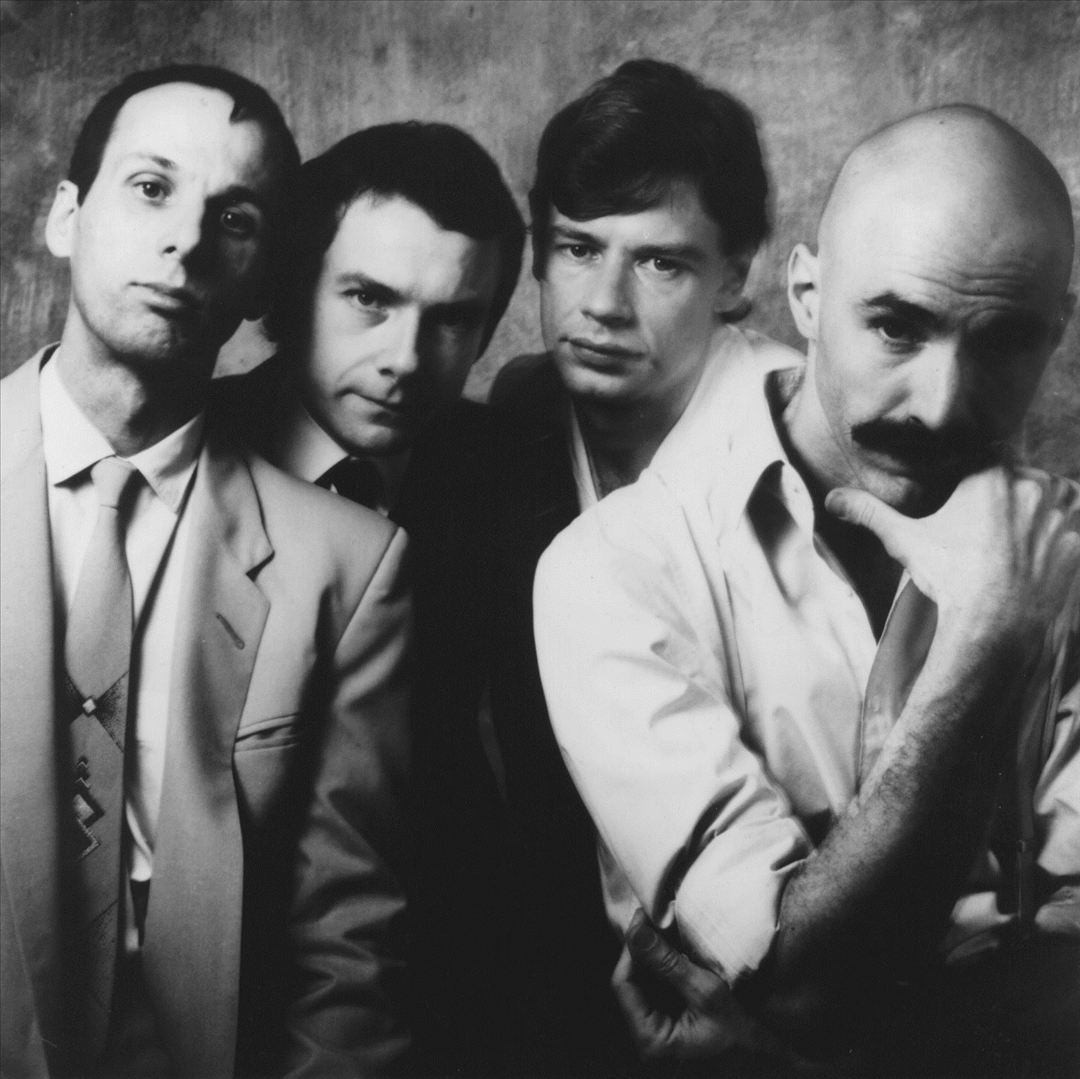
You must be logged in to post a comment.