The Gods Must Be Furious–Chapter Ten

Michelle, Gary, Nina, and Shelly went out trying to warn the world online, on TV, on the radio, and in newspapers and magazines everywhere. They wasted no time giving their message maximum circulation.

Naturally, though he didn’t get along with his brother, Gary tried to convince Cam to be prepared for what was surely to come. They were arguing in Cam’s office in the country club.

“Oh, come on, Cam!” Gary said in frustration. “The earthquake at the golf course didn’t convince you, the thunderstorm at the Wellses’ mansion, the sea storm that killed the rich people on that yacht out in the Pacific Ocean, and the death of Lipton in the Texas mine: none of these things is even coming close to making you suspicious of what’s going on?”

“None of it,” Cam said with a smug smirk. “They were just freak accidents, Gary. Stop overthinking what happened. Stop making them into something that they weren’t. Stop making connections where there aren’t any. You and your ridiculous pagan gods. Christ!”

“Cam, I’m begging you. You’re my brother. I don’t want you and your wife to die. Give me an opportunity to get you to a safe place.”

“Gary, I have work to do in this country club. I’m much too busy to be wandering off somewhere to find some ‘giant box.’ We have to repair damages caused by the earthquake. We have customers we have to reassure, so they’ll keep coming back.”

“The earthquake that claimed the lives of at least a dozen members, whom we saw die that day, killed by the gods, who clearly sympathize with neither your business nor your clientele.” 

Cam sighed. “Go home, Gary. Pray to your gods if this is so important to you.”

Gary sighed and left the room, saying, “Well, I tried.”

Many of the common people, though, not just Wiccans and other neopagans, but also many who knew of how supernatural each of the four incidents were, took the warnings seriously and would find the four boxes that Michelle, Gary, Shelly, and Nina told them about. Other boxes would be provided for all the other parts of the world where there was a substantial number of people willing to heed the warnings. They would all manage to fit in, despite the mass of the multitudes, for the gods’ power would help them all find room.

Michelle, for example, was much more successful than Gary was in convincing her family and close friends to go with her and find the huge box provided for them. This was so in spite of the fact that none of them shared her pagan beliefs.

“Here it is,” she said to those in her car as they all looked at the box from the base of a grassy hill where it sat on top. Like all the others, it looked like a giant wooden rectangular crate, though it also shone and glistened in a special way that those who looked at it could intuitively feel it was safe…for the gods were giving them that reassuring intuition. “Isn’t that amazing?”

“Yeah,” her mother said as she looked out the window from the passenger seat beside Michelle. “As strange a thing as that is to go inside, I’m getting this even stranger, but reassuring feeling that I’ll be perfectly safe in it. I’m not getting that reassurance from Jesus, though. I have no idea why I’m feeling that way, but I am.”

“I can tell you why, mama,” Michelle said. “It’s because the gods are giving you that feeling. Everyone who sees those things, wherever they appear on the Earth—and that’s around the world, from the reports I’m getting on social media—gets the same reassuring feeling that they’ll be perfectly safe in those boxes, as unlikely as such a feeling would be had the gods not been telling us.”

“I see,” her mom said, with a skeptical, but open-minded attitude. I insist on there being only one God in three persons—though I’ll admit that I’ve been wrong before. Those books Michelle bought me certainly challenged my faith, and they were written by an Episcopalian, of all people, as I am, so I can’t just dismiss the ideas outright. Finally, there’s that dream I had, which Michelle also had, the exact same dream. I’m still not sure: were the speakers gods, or God’s angels?

Nina was talking to Steve that night about the coming danger.

“Look, honey,” he said. “I’m cool with you practicing your…pagan spirituality, whatever it is…but I don’t share your beliefs in it. I respect your views; can you please respect mine?”

“Steve,” Nina said. “This isn’t about agreeing to disagree. Something terrible is about to happen—all over the world, and I don’t want you to perish in it, because you will, if you don’t come with me to the giant box where it is.”

“I don’t get how we’re going to be safe in a…giant box…from the end of the world, as you’re describing it,” he said. “No offence, honey, but this all sounds crazy. I think you need to see a doctor. As wild and as scary as what happened to me and Lipton at the mine, I’m still convinced it was just a freak occurrence. The voice I heard from the hole must have been a hallucination, because of the stress of the moment.”

“It was the voice of Hades!” Nina insisted. “I heard his voice at the mine!”

“I’m sure there must be some kind of scientific explanation for it. You’re making way too big a deal out of it. The stress from all of your concern for the environment is getting to you.”

“And the stress of being a miner is not getting to you?” she said. “You don’t think flying out of that hole was supernatural? What scientific explanation could cover what happened out there? Look, just come with me in the car, and let me show you where the box is. When you see it, you’ll understand.”

“How is ‘seeing it’ going to make me automatically understand, Nina?”

“I can’t explain it to you, but I know that many other people have had the experience of just seeing one of the boxes, and they know, intuitively, that going in them will be good for them. Please, Steve, indulge me. Let’s just go for a ride in the car and see the box. I’ve seen it; I know where it is.”

“Very well,” he said with an exasperated sigh. “If it will make you feel better, I’ll do what you want.”

“Trust me. You won’t regret it.”

They had been driving for about twenty minutes, Steve sneering and sighing the whole time in the passenger seat of their car. Then, far off on top of a hill, Nina was straining her eyes to see a tiny, shining rectangular box.

“Look!” she said, pointing straight ahead. “There it is!”

“What?” he said, squinting his eyes to see. “I don’t see—“

Then, the rectangle got bigger as they neared it, and it shone more clearly.

“What the—?” he asked, sneering in disbelief.

They were now close enough to see it properly. She stopped the car at the foot of the hill. She looked over at him with a smirk.

“Do you believe me now?” 

He just stared through the passenger window at the shiny giant box, in a trance.

“Let’s make sure we’re here…when the time comes,” he said in a monotone voice.

“Good,” Nina said with a smile. “Very good, Steve.”

Shelly didn’t even bother trying to convince those she knew wouldn’t believe the warnings. She simply planned to take them on rides in her car as she looked for the box. When it was finally found, they would see it, and instinctively they would know to get in when the time came.

“Come on, everybody,” she said to them as they sat bored in the living room, watching a TV that had nothing interesting on. “What do you all say we get in the car, go for a ride, get some fresh air, and have a picnic?”

“OK,” her husband said. “Where will we go?”

“I’ve already prepared the food and drinks,” she said. “Let’s just get in the car, be spontaneous, and I’m sure we’ll find a good place.”

“Well, alright,” her sister, Jeannine, said. “We’ve nothing better to do here, and the weather’s nice out, without being too hot. Let’s go.”

As they were driving and driving, her at the wheel, she was whispering to the gods to guide her to wherever the box was.

“Shelly?” her husband asked as he looked with a sneer at her moving mouth. “Are you talking to yourself?”

“Oh?” she said, then fumbled in her mind for an explanation. “Oh, I’m just singing the words to a song to myself.”

“I don’t hear a melody,” he said.

“Well, you know what a bad singer I am.” 

He chuckled.

Then, she felt a kind of psychic pull in the right direction.

“Oh, I know where to go,” she said, then she took a right turn at an intersection.

“Where’s that?” Jeannine asked.

“You’ll see, soon enough.”

“Where?” her husband asked.

“I want it to be a surprise.”

“Oh, very well, then.”

After another two minutes, they found a hill with a box on it, shining and huge.

“Look up there, everybody, to your right,” she said. “Up at the top of that hill.”

Her husband, sister, and mother all looked out their windows and saw the box.

“Do you all see it?” she asked.

“Yes,” they all said as if in a trance.

Then her husband said, still in that mesmeric state. “I have a feeling…we’ll need to come back here again soon.”

“I have that feeling, too,” Jeannine said.

“Me, three,” her mom said.

“Good,” Shelly said. “Very good.”

She opened her car door and got out.

Her husband got out next. “We’re having our picnic here?”

“Yes,” she said, then shut her door and went to the trunk to get out the picnic basket.

“I like it,” he said as he stared at the box. “I like it a lot.”

“Me, too,” Jeannine said, also staring at the box in a trance.

“Me, three,” their mom said.

I’m so glad I didn’t have to argue with them or convince them, Shelly thought as she took the basket out of the trunk. When it comes to getting people to do things your way, sometimes less is more.

Analysis of ‘A Star Is Born’

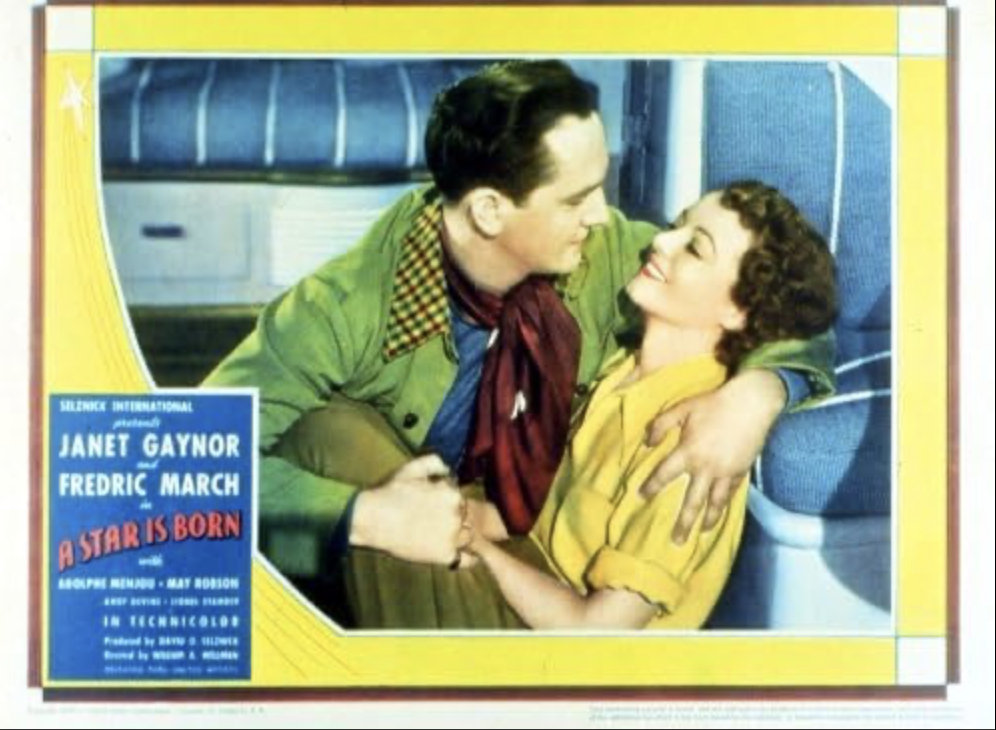
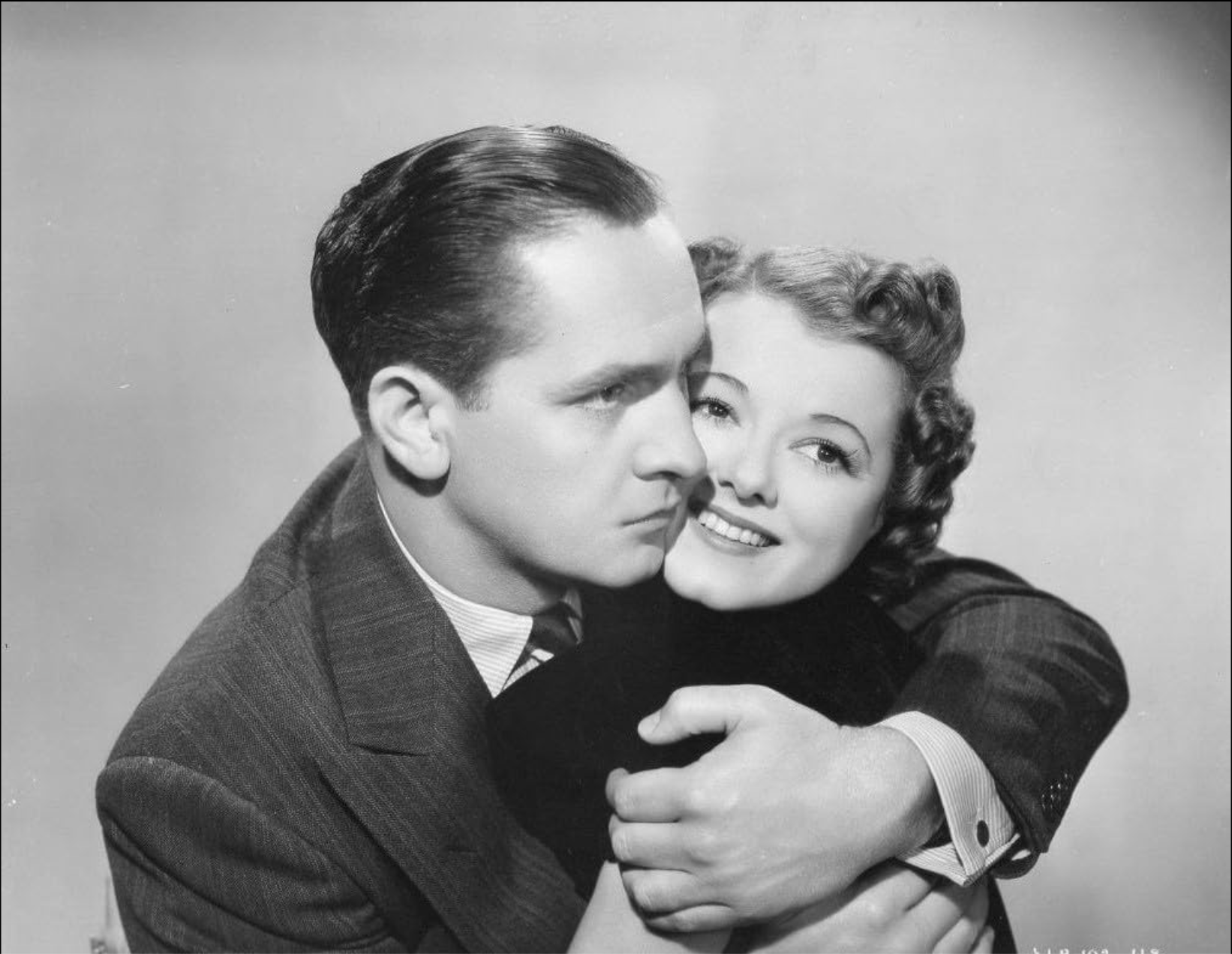
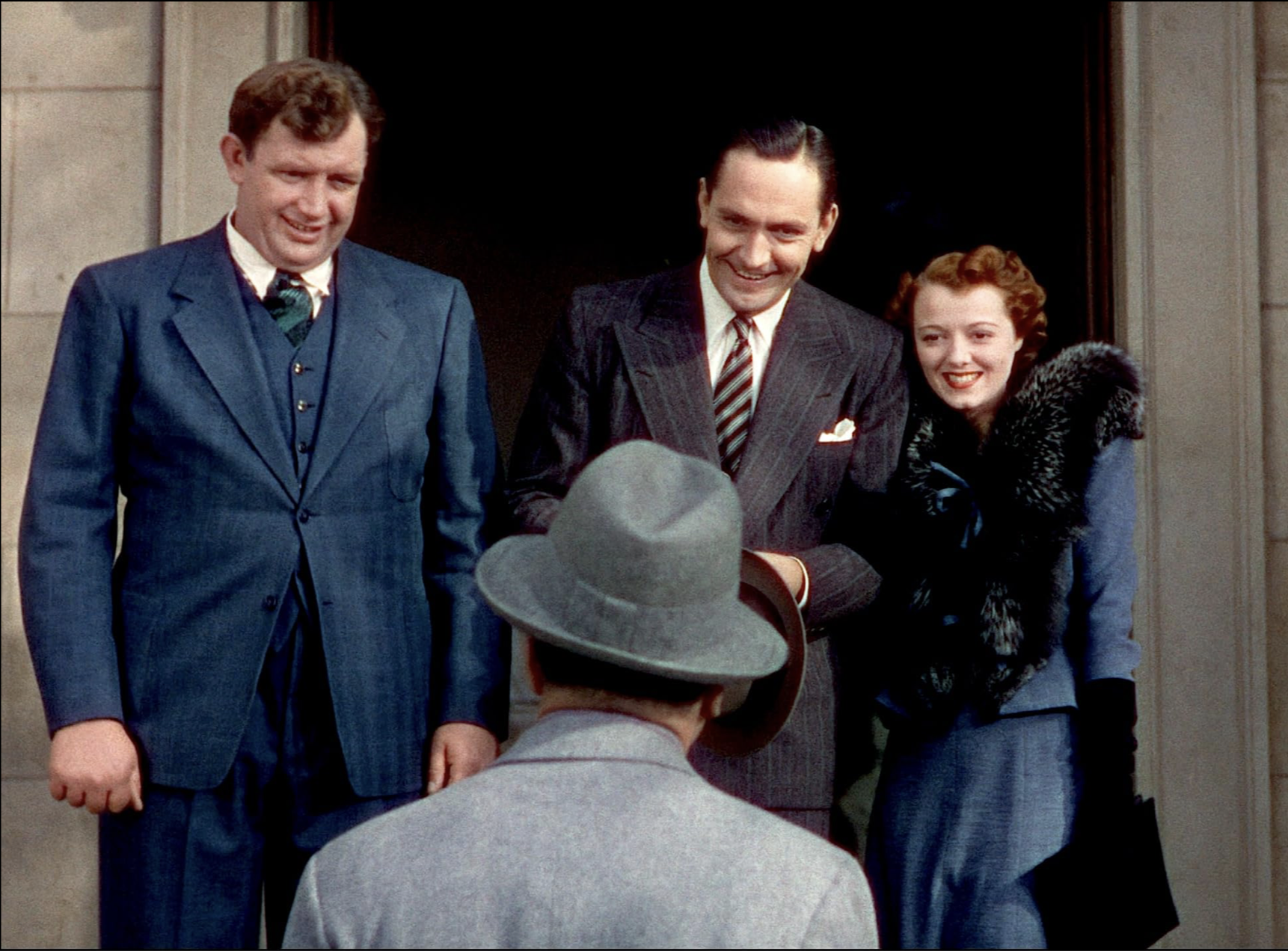
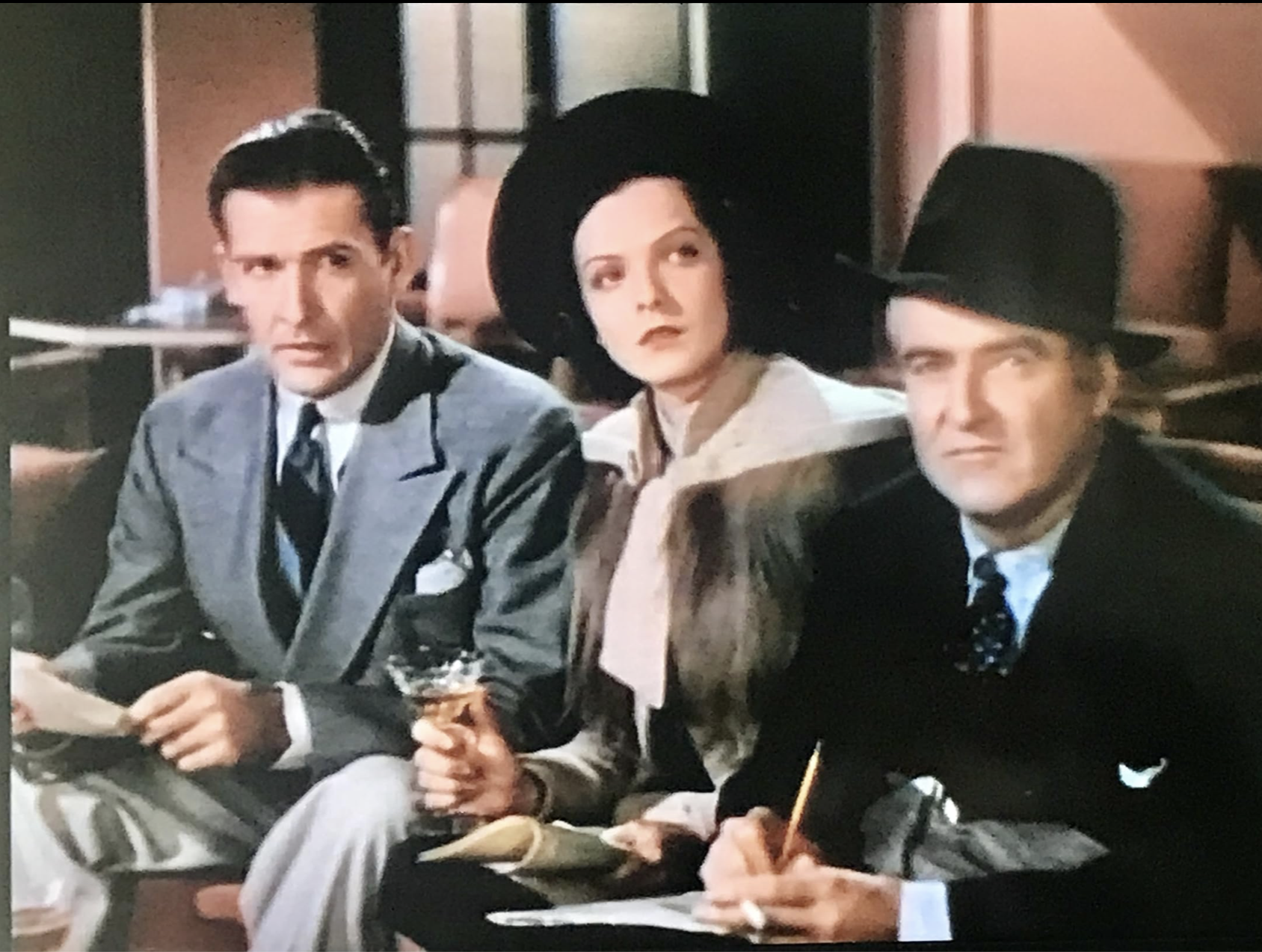
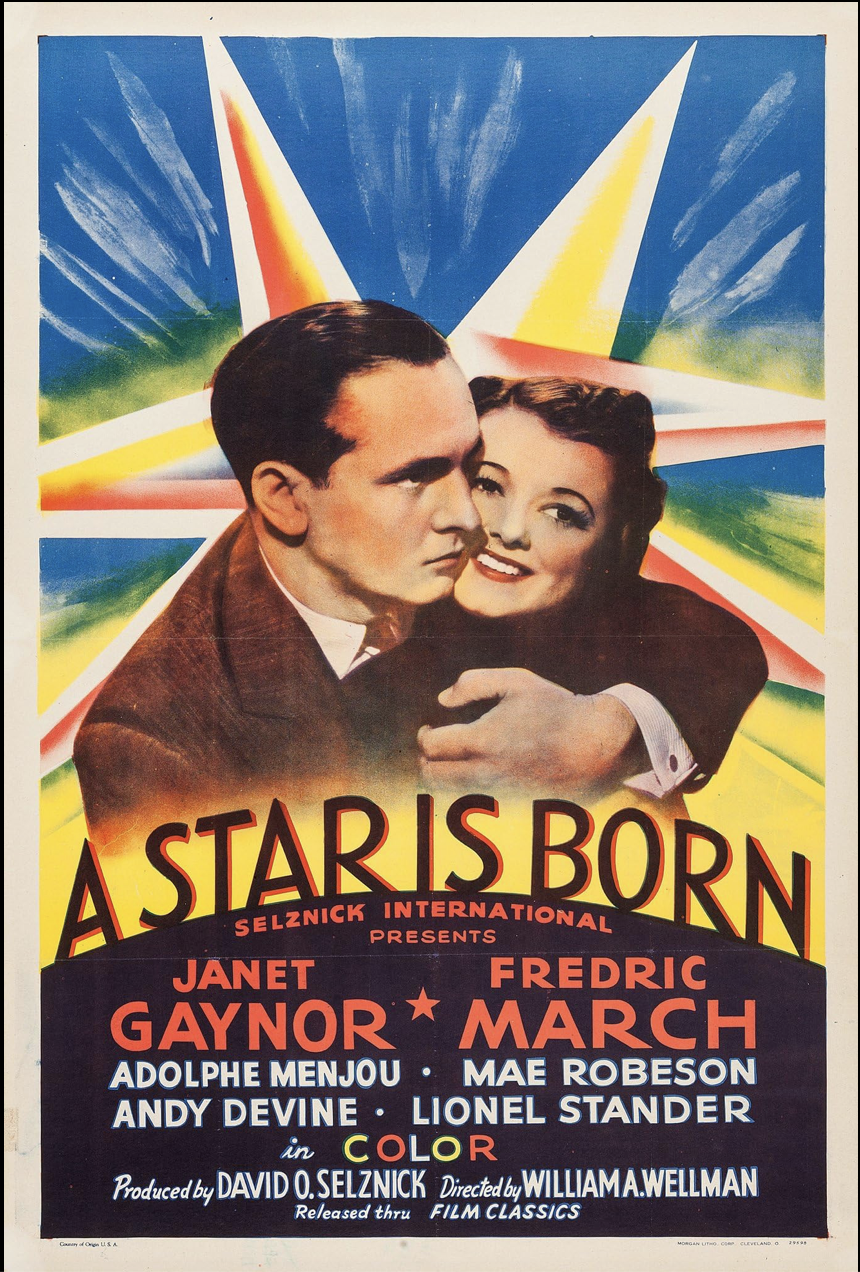
A Star Is Born is a 1937 film produced by David O Selznick, directed by William A Wellman, and written by Wellman, Robert Carson, Dorothy Parker, and Alan Campbell. The movie stars Janet Gaynor and Frederic March, with Adolphe Menjou, May Robson, Andy Devine, Lionel Stander, and Owen Moore. It was the first colour film (done in Technicolor) to be nominated for a Best Picture Oscar.

A Star Is Born based its plot extensively on 1932’s What Price Hollywood?, a film that wasn’t as widely known; but the success of the 1937 movie would spawn three remakes–one in 1954, one in 1976, and one in 2018…all three of these being musicals, unlike the original. The 1954 remake parallels the 1937 film much more than the other two, so I’ll be comparing the first two.

Apart from the Best Picture Oscar nomination, A Star Is Born also got nominated for Best Director (Wellman), Best Actor (March), Best Actress (Gaynor), and Best Original Score (which it won), among others. It also won an Academy Honorary Award for cinematographer W Howard Greene.

The film entered the public domain in 1965.

Here is a link to quotes from the movie, and here are links to the full movie.

One could argue that, in a peculiar sense, there is something of the ‘hour of the wolf’ in A Star Is Born, in that it involves a time, according to Ingmar Bergman‘s film (which I analyzed here), when most deaths and births begin. I say this because this film could be just as legitimately called A Star Is Dying as it is called A Star Is Born.

Indeed, just as we see the rise of new movie star Esther Victoria Blodgett (Gaynor), who is renamed Vicki Lester, so do we also see the decline and fall of the alcoholic movie star Norman Maine (March). The movie is far more of a tragedy for him than it is a hurrah for her.

The film begins and ends with an interesting framing device: we see pages of movie scripts indicating descriptions of the opening and closing scenes. Since neither scene indicated is from a film being made with Maine, Lester, or any other movie star in the story, but is rather just a scene from ‘real life,’ we can see in this framing device a sense of when Jacques, in As You Like It, said, “All the world’s a stage…” (or in this case, all the world’s a film set).

In other words, if “all the men and women [are] merely players” of the play or movie of life, then we can see the fakery of all of the posing and posturing that people do, even if they aren’t actors. Indeed, we’ll see much of that fakery in the transformation of naïve farm girl Esther Blodgett into screen siren Vicki Lester, all made up and glamorized. On the other side of the coin, Norman Maine’s descent into alcoholism and resulting fading star are his giving-up of the illusion of glamour and return to dull, vulgar reality.

She begins in the film on her family’s farm in North Dakota. Here, her life corresponds to the earliest of Jacques’s ‘Seven Ages of Man.’ She’s going through equivalents of “the infant” and “the whining schoolboy,” that is, the naïve child who has studied the movies she sees, worships, and dreams of being a part of, while complaining that no one takes her dreams seriously. The naysayers in her life include her Aunt Mattie (played by Clara Blandick, who the viewer may recognize as also having played Auntie Em in the 1939 film adaptation of The Wizard of Oz) and a bratty little brother who mocks her fantasied ‘stardom.’

At the other end is Norman Maine, who in his self-destructive alcoholism is comparable to being in the “last scene of all…second childishness and mere oblivion…sans everything.” Of course, in the middle of the film, both Vicki and Norman are “the lover[s], sighing like furnace,” when they fall in love and get married.

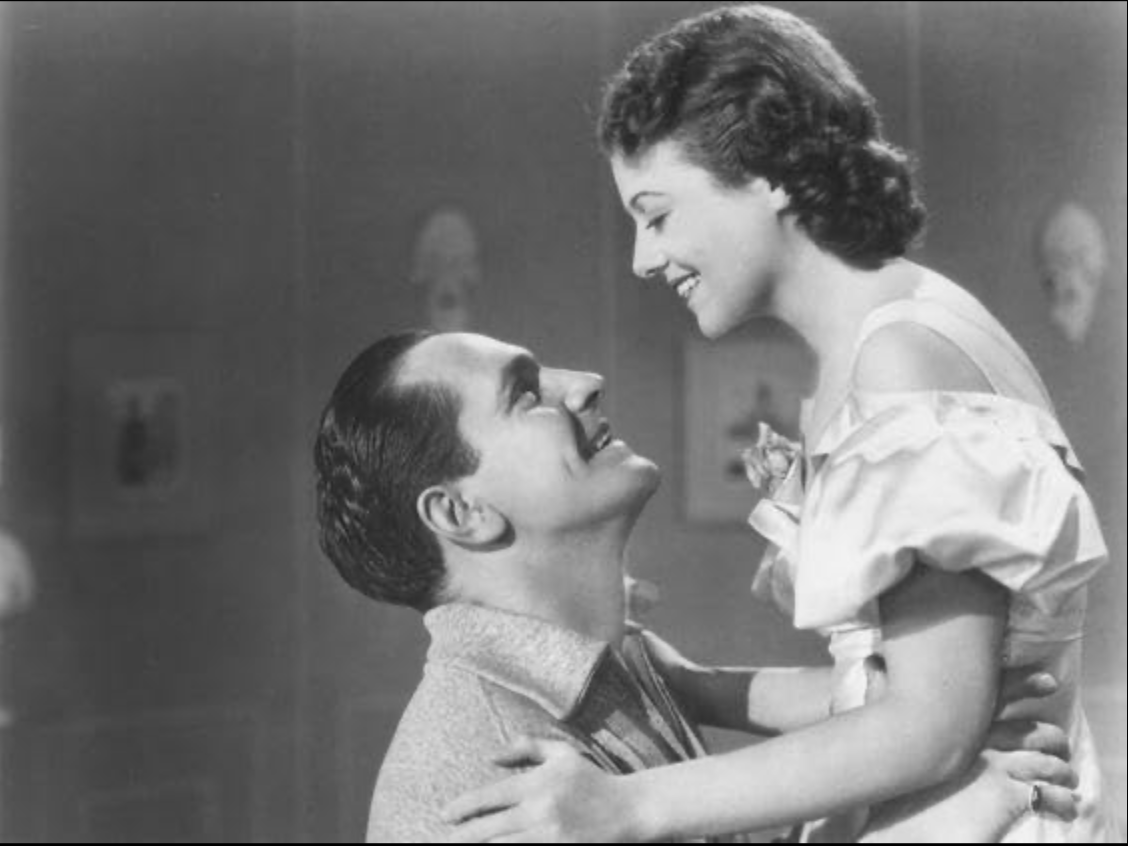
Esther will get some needed encouragement from her Grandmother Lettie (Robson), who gives her some money to go to Hollywood. Of course, her rise to stardom won’t be easy. She can’t even find extra work when she gets to Hollywood and asks around. Equally obvious, though, is that it’s not what you know, but who you know, that determines whether or not you’ll become a star.

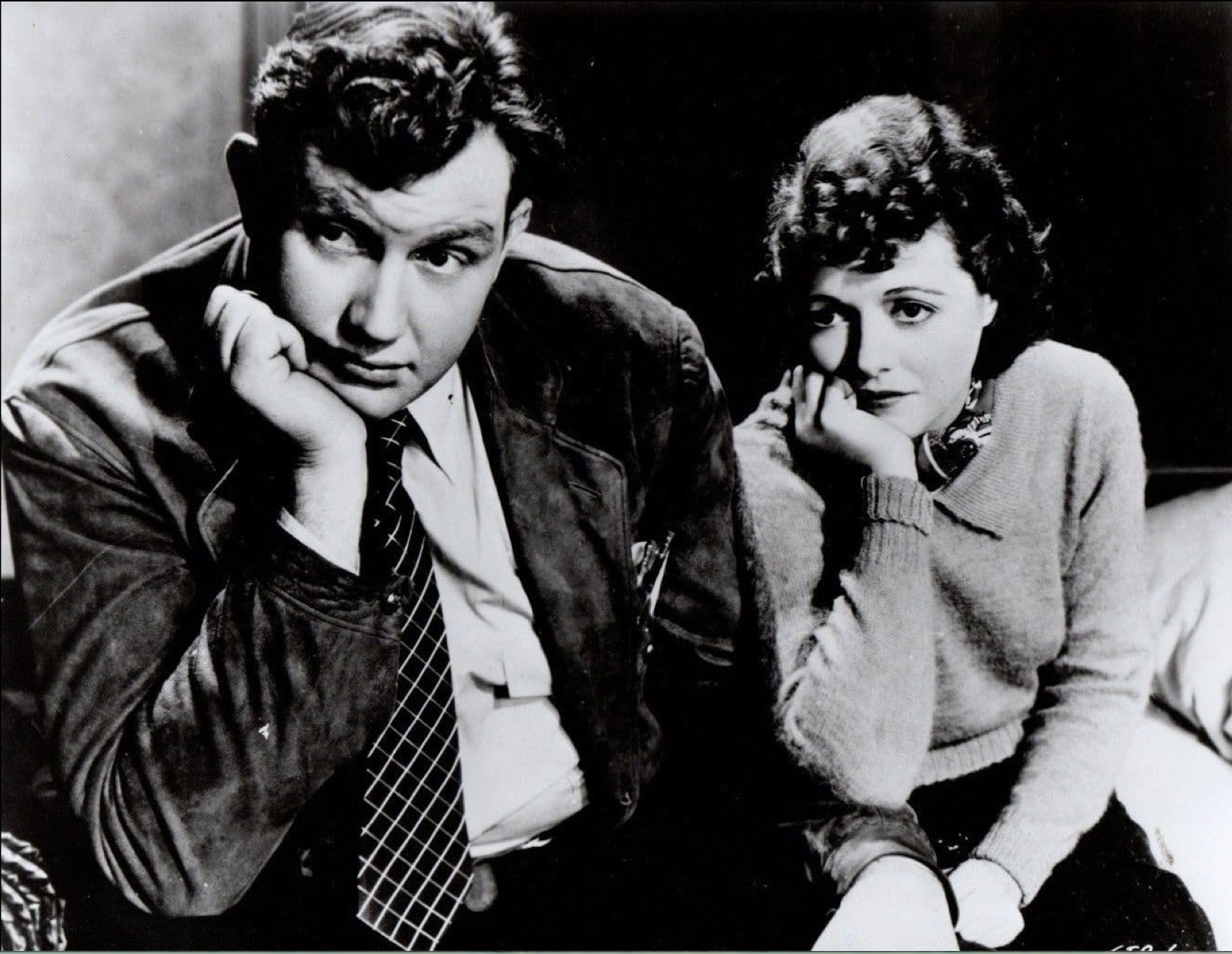
In this sense, Esther’s lucky break comes from meeting two important people: first, at her boarding house, she meets assistant director Danny McGuire (Devine), who will get her acquainted with the second important person, Maine, first at a concert (where he demonstrates his drunken loutishness for the first time in front of her), then at a fancy Hollywood party.

It’s interesting, when considering that loutish behaviour of Norman’s when she first sees him in person, to compare March’s portrayal of Maine to James Mason‘s portrayal of him in the 1954 remake. March’s Maine is brusque and gruff, smashing the camera of a nosy paparazzo at the concert, while Mason’s Maine–though equally drunk–is much more charming and cordial. Indeed, the Mason portrayal is much more likable and sympathetic, despite him having the same faults and inadequacies as the March portrayal has.

Later, Danny helps Esther get a screen test from his longtime producer and friend, Oliver Niles (Menjou). Niles is impressed with her and gives her a contract, as well as her new name, derived from her middle name–Victoria shortened to Vicki–and an L added to Esther, making her “Vicki Lester.”

In the process of transforming Esther into “Vicki,” press agent Matt Libby (Stander) asks her a number of questions about herself, and being disappointed with her dull, prosaic answers, invents some romanticized ones to make her origins seem more interesting. She’s also given lessons in enunciation and improving her posture, walking with a book on her head. Among all of these changes and the glamorous makeup job she gets, we can see all of the fakery involved in transforming a humble farm girl into a starlet.

Norman helps Vicki by getting her the lead role, opposite him, in his new film, The Enchanted Hour. The film makes her an overnight star, eclipsing his fame.

Mason’s portrayal of Norman is all the more likable in how he encourages Esther (here played by Judy Garland) to abandon her small dream, of being just a successful singer with a #1 hit song on the Hit Parade, in favour of the big dream of being a successful singer/actress in Hollywood musicals. He is captivated by, and convinced of, her talent when she sings “The Man That Got Away” with her band.

Back to the 1937 movie, Norman proposes to Vicki, and they get married privately, to avoid all the nosy press attention, which annoys Libby; indeed, we see in this an example of how Libby is losing his patience with Norman, who has also promised Vicki to give up drinking. Libby, nonetheless, will make the marriage a publicity matter, and he’ll know that any promises from Norman to give up drinking will prove empty ones.

After Norman and Vicki return from their honeymoon, it becomes clear that as her star is rising, his is not only falling, but it has fallen. It is preferred to have photos taken of her alone over those of both her and Maine, whom nobody really likes anymore. In fact, Niles arrives at Maine’s palatial home to tell him, however reluctantly, the bad news: his last three performances have not pleased the critics, his fan mail, however much it may be, is so cheap to send him that it’s insignificant, and Niles plans to have Vicki star in a film of her own, opposite another rising actor named Pemberton, instead of with Maine. Norman offers to have his contract called off, but Niles still thinks there’s hope, however small, for him to make a comeback.

We can see in all of this an example of the dialectic at work in Vicki’s rise coinciding with Norman’s fall, of her star’s birth vs his star’s death. Indeed, the large ad poster for The Enchanted Hour is changed to say it stars Vicki Lester rather than Norman Maine. His fan mail dwindles, while hers piles up; and finally, his contract with Niles is cancelled after all, as it is reported in the entertainment news.

Norman finds himself idling about at home while his wife is busy working…and this is all at a time when traditional sex roles would have had it the other way around, so Norman can only feel ashamed. When the phone rings, it’s always to ask for her, never for him. To give the ‘househusband’ something to do, he’s learning to cook and prepare food, so he’s made some sandwiches for them to eat when she finally comes home after a busy day of acting. Still trying to leave the booze alone, he’s having a glass of milk with his sandwich.

Their brief moment of happiness together is interrupted by the doorbell. Norman answers it: a deliveryman has a package for Vicki, but he doesn’t recognize Norman, who tells him he’s her husband. He’s then asked to sign for the package, being addressed as “Mr. Lester.” With his depression returning, Norman gives her the package, relays the telephone messages for her (including a table offered at the Academy Award’s ceremony), and leaves their sandwiches and milk to go fix himself an alcoholic drink. There is an equivalent scene to this one in the 1954 film, as there is in the following scene.

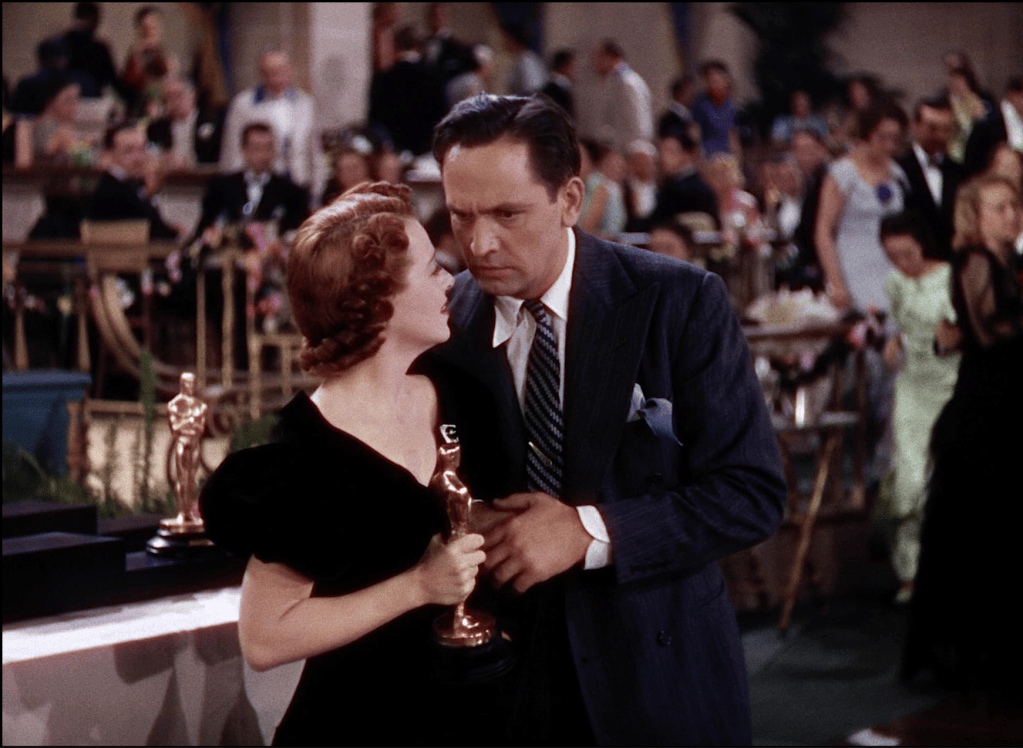
At the Academy Awards, Vicki receives one for Best Actress. When she accepts it, a drunk Maine appears and interrupts, gruffly demanding that he receive an award for Worst Actor (he’s too early for the Razzies, which wouldn’t come to be until their first ceremony in 1981). Mason’s Maine, though equally drunk and awkward, is more sympathetic, with him simply asking for more work. The same goes for his accidental slap of Vicki, for which we especially see his pained remorse.

Anyway, to get back to March’s Norman, the juxtaposition of Vicki’s Best Actress Oscar with his wished-for “Worst Actor Oscar” is another example of the dialectic of her rise and his fall. His drunk, frank bluntness as against the sober graciousness and artificiality of the ceremony is another example of that dialectic. Hollywood fakery has been taken to such an extent that, earlier, when Norman was taking phone messages for Vicki, a gossip columnist named Artie Carver said he’d make up a figure for how much Norman supposedly received as a settlement when ending his contract with Niles, after he told Artie he didn’t want any money.

So though winning the Oscar should be the happiest moment of Vicki’s life, the dialectic returns when Norman’s public disgrace can’t make her any sadder. Niles later visits her at her dressing room to congratulate her on her continuing success, but he can see that her grin is meant to conceal her tears. Norman is in a sanitarium, and he really wants to stop drinking, but all she can do is fear for him and his self-destructive nature. (Here’s the equivalent scene from the 1954 film; after her tears, we see her do a number in which she, grinning, sings, “Go and get your long face lost!”.) Niles offers to get another role for Norman.

At the sanitarium, Niles visits Norman and offers him a small, supporting role that Niles insists will have the audience all thinking about Norman throughout the picture, in spite of the role’s brevity. Norman tries to show a positive attitude during the visit, even referring the white-uniformed man–ever so solicitously watching him in case he tries to sneak an alcoholic drink–as “Cuddles.” Too proud to accept such a small film role from Niles, Norman lies to him about being too tied up with other major offers in movies. There’s an equivalent scene to this one in the 1954 film.

At the Santa Anita Park race track, after he’s been let out of the sanitarium and can be trusted not to drink anymore (or so it is assumed), Norman orders a mere ginger ale at the bar. Libby shows up there, too, and now that Norman’s a has-been, Libby can express his dislike and contempt of him all he likes. The altercation leads to an exchange of punches, with Libby flattening Norman. The surrounding crowd assumes he’s on the floor from being drunk again, so in his shame he orders a double scotch. Again, there’s an equivalent scene in the 1954 film.

His drinking binge has gone on for four days, and Vicki and Niles are worried sick about him. They learn he’s been arrested on a drunk driving charge. The court gives him ninety days in jail, but Vicki intervenes, promising she’ll keep a close watch over him if his sentence is suspended. Of course, the gossipy newspapers make a huge drama of the incident.

Back at home, Vicki tells Niles that she plans to give up her acting career to help Norman, who is in bed in the other room. He hears her words and knows he can’t let her sacrifice her talent just for him. Again, there’s an equivalent scene in the 1954 remake that shows a powerful emotional reaction in Mason’s Norman, showing how much more sympathetic his version of the character is. He comes to the conclusion that he must commit suicide (by drowning himself in the ocean) in order to stop her from sacrificing her career; he’ll instead sacrifice his life for her.

But before he does this, he must show her a happy face to cheer her up, if only for the moment. This is especially well done in the 1954 version, once again showing how much more likable and sympathetic Mason’s Maine is. In all four versions, though (in one sense or another), there is Maine‘s touching wish to take another look at her. With his death, she is shattered: “There is nothing sadder than/A one-man woman/Looking for the man/That got away.” Once again, she’s thinking of ending her acting career, now out of grief.

Specific to the 1937 version is Esther’s grandmother intervening to stop her from quitting acting. Lettie tells her of a letter Norman sent her when they got married, stating how proud he was of her and how much he loved her.

So at the end of the movie, with Vicki continuing as Vicki, she announces herself (as she does also in the 1954 version) as “Mrs. Norman Maine,” obviously not to be understood in the traditional patriarchal sense of deference to a woman’s husband, but as a loving tribute to him, a dialectical contrast to when he had been called “Mr. Lester.” As I said above, the film ends with the last page from the script, reminding us that all the world’s a stage.

The Gods Must Be Furious–Chapter Nine

At the appointed time, the four neopagans waited, with other neopagan family and friends, for signs from, again, to use the Greek names that they were all accustomed to using, Zeus, Poseidon, Gaea, and Hades.

After a mere ten minutes of waiting, Shelly and those with her saw a face form in the clouds, one with a beard.

“Zeus,” she called out to the sky. “May I call you Zeus?”

“If you wish, mortal,” the sky-father said in a booming voice. “Your Earth names for us are all acceptable.”

“Thank you,” she said. “What is your will, Zeus? Why are all of these killings happening? We believers suspect your motives, but we want to be sure.”

“We gods have been dormant for millennia,” he said. “Not any longer, though. I tire of the smoke that blackens my skies, and of the acid rain.” His voice was heard in the minds’ ears, as it were, of all the others watching, waiting, and listening for signs in all four mutually faraway places, and anywhere else in the world where people had ears to hear. Cellphones weren’t even needed: the gods made all voices, human and divine, heard as if everyone was in the same room.

Around that time, Michelle saw a face forming in the water near her feet as they, dangling from the pier, touched the surface.

“I have endured the senseless killing of my children—fish, whales, coral reefs, sharks, and all others,” Poseidon said. “I’ll endure the pollution and scathing of my babies no longer.”

Gary was watching the wind blow on the grass of the golf course his manager brother had allowed him to come in. At one point, the wind shaped the grass into a woman’s sad face. His eyes widened as he saw the ‘mouth’ begin to move.

“I have been as patient as I could while trees, grass, bushes, and animals—all my children—have been butchered,” she said in sobs. Gary saw a dew-like tear drop from grassy shadows shaped into her right eye. “I have been prepared to forgive man’s brutality and disrespect. I cannot afford to keep waiting for man to show remorse. Either I kill him, or he kills everything.”

If only Cam were here to see and hear this, Gary thought with a frown on his face. He’d have all the proof he needs; but he never listens to me or opens his mind to any of this! How am I going to save him from the gods’ coming wrath?

Nina was sitting by the opening to the mine, having put away her phone, since she could naturally hear what was being said among the others, who also heard all the voices of the gods and human participants, loud voices from far off, to be heard as if whispered right by their ears, so everyone could participate in this conversation among such far-away places.

Just when Gaea had finished speaking from the grass on the golf course, Nina was startled by the loud, bass voice coming from the hole: “Man is making the Earth his hell, his grave. We will accelerate the process.”

“But, what of us, we who have always honoured you?” Michelle asked when Hades had finished speaking. “Surely you don’t plan to kill the good with the wicked.”

“No,” Gaea said. “You will be spared. But be careful. Take cover as we bring disaster to the sinful. Make sure you distance yourselves from them.”

“Warn the evil, too,” said Zeus. “None of them will listen to you, but at least give them fair warning.”

“They will scoff at you, and mock you,” Poseidon said. “But do what is just.”

“Their scoffing will come back on them…hard,” Hades said.

“But how can we be sure that we will be safe?” Nina asked. “And how can we save innocent children?”

“We will provide…huge wooden boxes…for you to be protected in, giant versions of the chest given to Deucalion and Pyrrha,” Gaea said. “Put as many children in them as you can fit, as well as yourselves, your families, and your friends.”

“Warn the world,” Zeus repeated. “So those with ears, who listen, will come to your boxes and be saved.”

“Yes, Zeus,” Michelle said. “We will do your bidding, and we will look for your boxes.”

The Gods Must Be Furious–Chapter Eight

“I’m telling you,” Michelle typed in a message shared with three other neopagans in a private conversation on Facebook. “There are people who have come forward and said they saw faces in the sky, in the ocean, on the grass in the golf course, and in the underground mine.”

“I’ve heard a couple of claims like that, too,” said Gary to the others. “The claims could be true—we don’t know.”

“What’s interesting, regardless of whether these face stories are true or not, is that all the people killed were rich people publicly known for not caring about the environment at all,” Shelly said. “Not that these connections, of course, were ever acknowledged in the mainstream media, who are on the payroll of the rich. To know the connections, you have to do additional research, as I did.”

“That’s right,” said Nina. “I did a little of that independent research, too. The victims made no secret about their contempt for the poor and for our Mother Earth. Any staff in the areas where these natural disasters occurred survived. At worst, they got a little hurt and a big scare, like my miner husband. Then there are the shared dreams we have all had. All the evidence suggests intervention from the gods to save our planet.”

“So, what should we do?” Gary asked.

“Gary, you live close to that golf course your brother manages,” Michelle said. “How about you go there and wait for signs from Gaea? I’m near the California Yacht Club; I’ll go sit by the pier, watch the water, and wait for a sign from Poseidon. Nina, since you live near the mine in Texas, can you go over there, as close as they’ll allow you, and wait for signs from Hades?”

“My husband’s a miner, as I said before,” Nina said. “Steve was badly hurt and got one hell of a scare from the experience, but thank the gods he’s going to be all right. He refuses to believe the gods had anything to do with what happened, but he can get me inside the property with a key he once stole from Lipton’s office. Now that he is dead, Lipton won’t object to the petty larceny. I can get right up to the holes and listen for Hades’ words.”

“Good,” Shelly said. “I can drive up near the Wells mansion in Vermont. I’ll park there, look up at the sky, and wait for signs from Zeus.”

“We can also message each other by phone to keep the conversation a four-way one, with each god, too…we hope,” Michelle said.

“Great,” Gary said. “Let’s all do this, well, at 10:00 PM my time. You can all work out the time zones in your areas. You know mine: Gary, from Gary, Indiana—so easy to remember.”

The other three responded with “Yeah, lol.”

And before I go on the green in the golf course, I’ll make another attempt to get my brother to listen to me about the coming danger, Gary thought. The rest of our family are opening their minds to this. Please, gods, help me to get him and his wife to open their minds!

Similarly, Michelle prayed, Please, gods, help my mother to see my gods as real as she does her Jesus.

And Nina prayed, O gods, help Steve to understand that he didn’t hallucinate Hades’ voice!

The Gods Must Be Furious–Chapter Seven

“Don’t you dare form a union!” Jack Lipton shouted down the mining hole at Steve and Jim, the two miners who had been discussing the idea for weeks with their colleagues, one of whom, sucking up to Lipton, told him. “You’re lucky to have a job at all, in this economy. If you go on strike, I’ll replace you all!”

“We have a perfect legal right to get organized,” Steve shouted back up at Lipton. “You know that perfectly well. The working conditions down here are atrocious! I don’t think I even need to prove how much worse the working conditions are for your workers in your many fracking operations, Mr. Lipton.”

“And the pay nowhere near compensates for the bad conditions here,” Jim added. “Beyond whoever squealed on us, the vast majority of us miners agreed to unionize. We’ll work to rule.”

“And replacing us with scabs won’t stop us!” Steve said. “We’ll convince the scabs to join us. It won’t be hard, once they see how bad it is down here. You’ll see, Mr. Lipton.”

“You ungrateful bastards!” Lipton shouted. 

“Ungrateful,” Steve snorted. “We’re grateful to be still alive down here in this hell—“

Just then, everyone felt a brief tremor.

“We’re about to be reminded of how dangerous it is down here,” Jim told Steve. “We may not be grateful for much longer.”

Another, stronger and longer tremor shook everyone.

“Oh, God,” Steve said.

Lipton’s foot slipped a little too close to the hole. “Jesus!” he said after almost falling in. He backed up a bit.

Immediately after that, Steve, the further up of the two miners, flew out of the hole, screaming. He fell on the ground to the right of Lipton. No bones were broken, but the arm, hip, and leg that hit the ground were in great pain. He was groaning and rubbing his sore spots.

“What the hell happened?” Lipton asked.

“I…don’t know,” Steve said in a scratchy voice.

“Aaaaah!” Jim screamed as he flew out of the hole in the same way. He hit the ground, with a grunt of pain, to Lipton’s left.

Stepping back twice towards the hole and looking at the two hurt men, Lipton asked, “What could possibly have vomited you two out of the hole?”

The two men shook their heads.

“Me,” a deep, booming voice called out from the hole, causing all three men to shudder. Then powerful sucking came from it.

Steve and Jim slid closer to the hole, but Lipton got sucked in screaming. The sucking stopped, and the two men could hear Lipton screaming and knocking against the rocky walls of the mine, falling in deeper and deeper, until his screams ended.

Steve and Jim just sat by the mouth of the hole in complete silence, shaking. They looked at each other.

“What the hell just happened?” Jim asked.

Steve shrugged, still shaking. Then he remembered his wife’s warning to be ‘especially careful’ over the next few weeks. Then he remembered her ‘pagan nonsense,’ and thought, No…I ain’t gonna go there. I certainly don’t wanna talk about it with Jim. He’ll think I’m nuts…which I’m starting to think I am, too.

“I guess we gotta search for Lipton,” Jim said. “If anyone dares go down there, that is.”

Steve shook his head. “Not me.”

A search was conducted soon enough.

“C’mon,” the foreman said to those further down the hole. “Keep looking.”

Lipton’s body was never found…not even at the deepest point of digging.

Near that area, though, a miner’s light shone on the stony, muddy wall.

A man’s face, carved in the mud and rock as if by a sculptor, was smiling.

Analysis of ‘Birds of Fire’

I: Introduction

Birds of Fire is a 1973 studio album by the jazz rock fusion band, the Mahavishnu Orchestra, their second, and the last that the original line-up would release, before British guitarist/leader John McLaughlin dissolved the band and got all new members. Birds of Fire is considered, along with the band’s 1971 debut, The Inner Mounting Flame, to be one of their greatest albums.

The original line-up of the Mahavishnu Orchestra was a truly international band, with–as I said above, McLaughlin from England, American electric violinist Jerry Goodman (formerly of The Flock), Czech keyboardist Jan Hammer, Irish bassist Rick Laird, and Panamanian-American drummer Billy Cobham. Bassist Tony Levin would have been McLaughlin’s first choice to be in the band, but he didn’t get it because of a missed telephone call, which his mother-in-law received, mishearing the message and telling him, “Some guy, Murray Vishnu, asked about joining his orchestra.”

The music of the Mahavishnu Orchestra, apart from being a fusion of rock instrumentation and rhythms with the harmonic sophistication and improvisation of jazz, is characterized as also incorporating elements from Indian and Western classical music (e.g., Goodman’s classical violin technique, as well as how the ornamentation in McLaughlin’s guitar solos imitates such ornamentation in Indian music). Furthermore, the music is known for its flashy, virtuosic playing, complicated riffs, and odd and irregular time signatures–all hallmarks of 1970s jazz fusion.

II: Why ‘Mahavishnu’?

The name of the band was derived from the name that McLaughlin’s then-guru, the Indian spiritual leader Sri Chinmoy, gave him. “Maha” in Sanskrit means “great,” and “Vishnu” is from the Hindu god of preservation. So “Mahavishnu Orchestra” is a fancy, ostentatious way of saying “the John McLaughlin Band.”

On the one hand, the name of the band sounds like something from Eastern philosophy–typically about a renunciation of the ego while on a quest to attain peace of mind and enlightenment. On the other hand, though, the name of the band sounds rather pretentious, especially since the band shows off its technical skill in a manner that, to put it mildly, raises suspicions of inflated egos. With these observations, we come to the central contradiction of the band.

There’s a tension between the philosophical renunciation of the ego and its glorification. This tension can be seen and heard as a recurring motif, if you will, throughout Birds of Fire, just as it could also be heard throughout The Inner Mounting Flame, their live album, Between Nothingness and Eternity, and The Lost Trident Sessions, released in 1999 and including three tracks heard on the live album.

A number of tensions led to the break-up of the original band, including the pressures of sudden fame, exhaustion, and a lack of communication. Another source of irritation to McLaughlin’s bandmates was how sole songwriting credit was always given to him, an ironic thing given how he was supposed to be on a spiritual path with Chinmoy that promoted “love, devotion, and surrender” (a kind of Bhakti Yoga) as well as “self-transcendence.” A follower of Chinmoy is supposed to renounce those negative qualities that prevent union with the Divine.

Chinmoy’s teachings were influenced, of course, by Hinduism, hence McLaughlin’s name of “Mahavishnu.” Union with the Divine is, essentially, union of Atman with Brahman as a result of renouncing the ego. The guitar player had to abstain from recreational drugs and alcohol, live a celibate lifestyle, and adopt a vegetarian diet. McLaughlin also had to keep his hair short because it was Chinmoy’s wish for him to do so. His teachings did, however, show tolerance for and inclusiveness of other religious and spiritual traditions.

Speaking of other spiritual traditions, the tension between indulging and denying the ego in the Mahavishnu Orchestra philosophy can be associated with Mahayana Buddhism’s dialectical unifying of nirvana and samsara. Also, incidentally, Chinmoy himself was often accused of leading a cult, and of sexual misconduct, even sexual abuse. McLaughlin would stop following Chinmoy by the mid-1970s.

Here is a link to the entire album.

III: Birds of Fire

The title of the album and the first track is inspired by the fourth line of “Revelation,” a poem by Chinmoy seen on the back cover of the album. It is about the soul’s joyful realization of the Divine, Atman coming to be at one with Brahman.

Brahman is referred to in the poem as “God” (which should not be confused with the God of monotheism, for Brahman is of pantheism; “God” here isn’t separate from creation, but is at one with it); Brahman is also called “the Infinite,” “the One,” “Him,” “the Supreme,” and “Immortality.” (And for McLaughlin, “music is the face of God,” which should help us understand how the music we hear on the album is intimately linked with his spirituality.)

“His secret Play” would refer to lila, where creation is an outcome of the playful nature of the Divine. “Ignorance Dream” would be the result of the illusion of maya, and the poet has passed beyond it, therefore, he will “sob” and “grieve” no more.

His soul is “above the toil of life…a Bird of Fire winging the Infinite.” If the poet’s soul has achieved enlightenment and moksha, though, why would it be “a Bird of Fire“? Shouldn’t fire be associated with egoistic desire, that which is blown out in nirvana, and so the very antithesis of the bliss of enlightenment?

This contradiction parallels what I said above about the tension between the renunciation of the ego and its overindulgence (the five musicians showing off their virtuosity, McLaughlin getting sole credit for writing all of the music, the premature break-up of the original line-up when they should have been at the very height of their powers, and even Chinmoy’s sexual misconduct). It’s the dialectical unity of nirvana and samsara.

That the Atman is a bird of fire, a being burning with desire, reflects the spiritual conflict and difficulty of attaining enlightenment. One often has a habit of thinking of religion, spirituality, and philosophy as being things of mere sentimentality, a quick and easy way of ending one’s pain with simple, black-and-white solutions. Placing oneself seriously on that path, though, would make it clear very quickly that nothing could be farther from the truth. It is a path constantly beset with temptation to go astray.

Understanding such difficulties is how we can find the dialectical Aufhebung between the need to renounce the desires of the ego and to overindulge them. This is the bird of fire of Atman, “winging the Infinite” of Brahman.

So, “Birds of Fire” can refer to all five members of the Mahavishnu Orchestra, showing off their virtuosity and playing with all of their fiery passion. For Goodman, Hammer, Laird, and Cobham were struggling through life no less than McLaughlin was, and we can hear that struggle in the music.

In a review of Birds of Fire for All About Jazz in 2002, Walter Kolosky wrote that the title track “is a fusion classic. John McLaughlin scares the hell out of his guitar…” The opening track will “frighten a musical neophyte…it’s guaranteed to send him or her fleeing.” One would think those seeking enlightenment would prefer listening to peaceful, New Age music. Birds of Fire, and the title track in particular, are the diametrical opposite of such easy listening.

The opening title track begins with Cobham banging a gong a number of times. McLaughlin comes in playing arpeggios, each ascending in fast groups of five, five, five, and three. These dense arpeggiated chords are in A♭ and B♭, played first with distortion, then clean, on a twelve-string electric guitar. Note that McLaughlin was known for playing double-neck guitars onstage with the band, a twelve-string and a six-string, the latter for playing leads.

The bass and violin come in next, doubling each other octaves apart with this line: A♭, A♭, G♭-E♭-A♭, A♭, G♭-E♭-G♭-A♭-B♭, B♭, A♭-F-B♭, B♭, A♭-F-A♭-B♭. Cobham has still been hitting the gong, but he soon also comes in on the drums.

This riff they’ve been playing, still with the twelve-string guitar arpeggios in the background, is in 9/8 time, which could be subdivided 4+5 or 3+3+3, depending on the players (i.e., Cobham is playing it 3+3+3). McLaughlin and Goodman are doubling each other with a fiery, high-pitched lead, McLaughlin now playing his six-string in unison with Goodman.

After that, McLaughlin goes into a blistering solo, with his six-string using distortion. This playing he’s doing is what Kolosky above must have meant by saying that “McLaughlin scares the hell out of his guitar with his melodic convulsions.” “Birds of Fire” is clearly not the music of the quietened mind of the enlightened. This, if anything, is the music of the spiritually troubled, perhaps beginning a quest for peace of mind out of sheer desperation from having experienced in full the horrors of the world.

After McLaughlin’s solo, he and Goodman return to that lead they’d played together. They end the lead with fast ascending and descending triplets, then go into a bridge in 3/4 with a shuffle rhythm at a slightly slower tempo. Again, McLaughlin and Goodman are doubling each other, playing a lead in unisons. It’s in B at first, then it modulates elsewhere; it also switches to a bar in 4/4 before returning to the main riff in 9/8.

Now, Jan Hammer does a solo on the synth. Part of his solo imitates, to an extent, those arpeggios McLaughlin played on the twelve-string. Then they return to the high-pitched lead played on the violin and six-string, and back to the bridge, then back to the main riff in 9/8.

As the main riff is fading out with McLaughlin doubling the bass and violin line I described towards the beginning of the track, Goodman adds a few high-pitched violin licks.

IV: Miles Beyond (Miles Davis)

As I said above, every track on this album is credited solely to McLaughlin, including this one, though the title sometimes includes “Miles Davis” in parentheses as I gave it above, and this may give off the mistaken impression that the Mahavishnu Orchestra here is doing a cover of an old Miles Davis piece of music. No: the hyphenated “Miles Davis” is just meant as a dedication to McLaughlin’s former bandleader (the closest you’ll come to a Miles Davis track of this title is “Miles Ahead,” from the 1957 album of the same name, and it sounds completely different from the second track on Birds of Fire).

McLaughlin played with Davis on the albums In a Silent Way, Bitches Brew, Live-Evil, On the Corner, Big Fun, and A Tribute to Jack Johnson. On Bitches Brew, there’s even a four-minute track named “John McLaughlin,” on which he plays guitar licks over Chick Corea and Joe Zawinul playing electric piano variations on a riff, in C, essentially of B♭-A-G-F-G…F-G♭-G♭/G♮.

Of course, Bitches Brew, released in 1970, is considered one of the seminal albums ushering in the jazz fusion genre, and apart from including McLaughlin, Corea, and Zawinul among its musicians, the album’s musical innovations spawned several jazz fusion bands in the 1970s alongside the Mahavishnu Orchestra, including Corea’s Return to Forever and Zawinul’s Weather Report. What’s more, Lenny White of Return to Forever played drums on Bitches Brew, as did Cobham on “Feio”; and Wayne Shorter of Weather Report played soprano sax on the album, as did Weather Report percussionists Don Alias and Airto Moreira.

Anyway, “Miles Beyond” opens in G major with Jan Hammer improvising the track’s main riff on the Fender Rhodes electric piano. It’s chords of G major, F major, then going up to the subdominant with chords of B♭major, B♮major, and C major, then back to the B♭ major and to the tonic with F major, G♭major, and resolving back to G♮ major. The music is in 6/4 time, subdivided 4+2.

If one were to regard the tracks of the album as chapters to a narrative about McLaughlin’s “pilgrim’s progress,” so to speak, of a spiritual journey from sin and ignorance to the peace and enlightenment of Chinmoy’s teachings, then this track would find McLaughlin ‘miles beyond’ the spiritually troubled beginnings of that quest as understood on “Birds of Fire.” Still, the tension and passion felt here on “Miles Beyond” means he still has “miles to go before [he] sleep[s].”

After that electric piano opening, with Goodman softly playing the tonic on the violin in the background, Laird and Cobham come in, Laird playing the same basic riff of F-G♭, G♮, F…B♭-B♮, C, B♭, etc., with Hammer still improvising on the Fender Rhodes. Then McLaughlin and Goodman come in, playing F, C, E♭, B♭, A♭, the former playing these as power chords.

Now, McLaughlin and Goodman are playing the main riff with the rest of the band, with McLaughlin’s power chords, and it’s two bars, one in 4/4, and the other in 5/4. Then the guitar plays a lead, doubled on the violin, and it’s in 9/4 time (3+3+3); this is heard three times, then the passage is finished off with two bars in 4/4.

Next, Goodman does a violin solo, but in pizzicato. As I’ve seen him do in a video of a performance of another piece of Mahavishnu music, he is presumably doing this pizzicato solo not by holding the violin under his chin, but rather as if it were a small guitar or a ukulele. He does some impressively fast licks–using pull-offs–in the middle of the solo. The rest of the band is silent, except for Hammer, who is giving Goodman a very soft Fender Rhodes accompaniment.

After Goodman’s solo, the rest of the band comes back in full force, with McLaughlin playing those power chords again. As this is going on, Cobham throws in some fast, powerful drumming. Then at the climax of the track, McLaughlin does a fiery solo, his plucking of the notes like bullets fired out of a machine gun. He may be “Miles Beyond” the spiritual turbulence he experienced in “Birds of Fire,” but the passion of his playing here shows that he, as I said above, still has a long way to go before attaining the peace of enlightenment.

The track ends with McLaughlin and Goodman playing that doubled lead in 9/4, then the two bars in 4/4.

V: Celestial Terrestrial Commuters

This is one of the very best tracks, if not the very best one, on the entire album. It is pure fire. I still remember the first time I heard it as a teen on the vinyl I’d bought and played on the family’s stereo in our living room. I was thrilled and energized.

If by “celestial,” we mean the heavens of nirvana, and by “terrestrial,” we mean the earth in all of its sin, desire, and attachment, then the “commuters” are either going back and forth between sin and enlightenment, or they’re leaving enlightenment altogether and commuting back to the samsara of attachment. Given the wildly passionate wailing of the musicians here, we’re clearly far away from the peace of nirvana.

Cobham begins the track by hitting the crash cymbals and drums to punctuate the irregular rhythm we’ll hear for most of the song. This rhythm is a 19-beat cycle of sixteenth notes, which I’d notate as alternating bars of 3/4 (or 6/8) and 7/16. It could otherwise be thought of as bars of 4/4, but with an additional three sixteenth notes at the end of each bar.

The track is in G, a kind of expanded tonality of G major and G minor, with a Mixolydian/Dorian feel (i.e., with the flat 7th). The guitar and violin start with ascending lines, eighth notes of G (open G on the guitar), D, B, G, E, C♯, a sixteenth rest, then G-F-D-G-E-C♯ in sixteenth notes. This riff is heard twice, then the guitar and violin double each other with a high-pitched lead, while that ascending lead I just described is now played by Hammer on the Fender Rhodes.

In terms of its harmonic progression, it starts at the tonic, in G, then moves up to the supertonic, in A, then back down to the G tonic. While back in the tonic, instead of twice hearing the 19-beat cycle I described above as alternating 3/4 (6/8) and 7/16, we hear–after one time of that cycle–an 18-beat cycle I’d notate as a bar of 4/4, then of 5/4 (this is just one time, then we’re back to the 19-beat cycle). This in turn leads to a move up a tritone to C♯, then down a minor third to B♭, and back to the tonic in G, with the guitar and violin playing the ascending lines from the beginning.

Next, Hammer plays a mind-blowing solo on the synth, backed up by Laird and Cobham. McLaughlin and Goodman come back with the ascending riff, and Hammer finishes off with a few more tasty synth licks.

Now it’s time for McLaughlin and Goodman to trade licks back and forth…and boy, do those two ever wail! At one point, while in G, McLaughlin plays a standard blues-rock lick of bending notes from C to D, a G, and a bend from F to G, these are done twice; I call it a standard lick, but McLaughlin’s execution of it, in the context of the music, is face-melting!

After a violin lick, McLaughlin comes back with a quick quintet of descending sixteenth notes–the first, a C bent up from B♭, then B♭-G-F-D; these are played three times, then four more descending sixteenth notes lead back to more violin licks. While in C♯, Goodman plays and arpeggiated C♯ major chord. Then after a final, high-pitched lead from McLaughlin in B♭, we cone back to G major, with both McLaughlin and Goodman playing licks at the same time.

Now, still in G major, the guitar and violin are playing a lead mostly of Ds, Bs, and F, first in the 19-beat cycle, then in the two bars of 4/4 and 5/4 with some descending notes. Then Hammer does a synth lick in A. Back to the Ds, Bs, and F lead, then another synth lick in C♯ and B♭.

The lead of Ds, Bs, and F is done again, but this time, all in the 19-beat cycle, and then McLaughlin and Goodman return to the doubled, high-pitched lead heard before the first synth solo. Hammer helps out playing some of the lead on the synth.

The song ends with a variation on the ascending lead, done to a different chord progression, and with an added three sixteenth notes, ending on a high C.

VI: Sapphire Bullets of Pure Love

This track, not even thirty seconds long, was just a spontaneous soundcheck improvisation that was included on the album as a kind of interlude, almost psychedelic-sounding, between “Celestial Terrestrial Commuters” and “Thousand Island Park.” The band was just testing out their equipment.

So, unlike McLaughlin’s other compositions for the band, this short oddity carries no grand philosophical or spiritual meaning. The title, nonetheless, is intriguing in how it can be related to the broader theme on the album as I’ve described it. Bullets cause harm, and are lethal, but these ones are of pure love. They’re also made of sapphire, a precious gemstone.

“Sapphire” can also be heard to pun on fire. So in the title we can hear the dialectical tension, once again, between the fire of passion and the pure love of the devotion in Chinmoy’s Bhakti-yoga-style of spirituality. The spiritual struggle is a valuable one, like a sapphire, for it is only through such a struggle that one can eventually become enlightened, always dodging those bullets, so like the love arrows of Eros, provoking fiery sensual desire.

VII: Thousand Island Park

This track, like “A Lotus on Irish Streams” on The Inner Mounting Flame, is the acoustic piece on Birds of Fire. But whereas the former piece was played by a trio of McLaughlin, Goodman, and Hammer (on piano), the latter is played by a trio of McLaughlin, Hammer, and Laird (on double bass).

The piece is mostly a showcase of McLaughlin’s acoustic guitar playing skills, with Hammer’s piano right hand largely doubling the written acoustic guitar melodies (though not in exact time with McLaughlin, as the piece is, to a great extent, of a free rhythm), and with Laird mostly playing root notes.

As a more sedate, peaceful piece of music, “Thousand Island Park” can be heard as a moment of considerable spiritual progress from the passion heard on the previous tracks…miles beyond “Miles Beyond.” While Thousand Island Park is, of course, a real place in New York State, there are interesting connotations to be heard in the title of McLaughlin’s piece, understood from the point of view of the grand philosophical and spiritual meaning of his music in the Mahavishnu Orchestra. Nirvana was compared by the Buddhists to an island (dipa) in the Sutta Nipata, a place of refuge from decay and death. How much more peaceful would a thousand of such islands be!

Furthermore, according to the Lalitavistara Sūtra, Queen Maya gave birth to the Buddha in a tranquil grove or garden in Lumbini, his birthplace often described as a beautiful park. So symbolically speaking, one could speak of such a place as the birth, or beginning, of a spiritual quest for enlightenment. Chinmoy did not, of course, teach Buddhism, but his spiritual teachings were similar enough to justify a comparison with Buddhist symbolism; and besides, he also taught respect and tolerance of other religions, wanting to promote interfaith harmony and seeing all religions as one; so there shouldn’t be anything discordant about discussing Buddhist ideas in an analysis of the Chinmoy influence on McLaughlin and his music.

The piece begins with McLaughlin playing a high B♭, doubled by Hammer and with Laird playing a G♭ above middle C. McLaughlin and Hammer are mostly descending melodically as Laird plays an E♭, a D♭, an A♭, and a G♭, then resolving to F.

Hammer improvises on the piano in F Mixolydian as McLaughlin plays fast ascending arpeggios in F major and E♭major. Then the two return to a written melody, doubling each other as Laird’s double bass descends by step from E♭ to D♭and C (below middle C); the acoustic guitar and piano melody here is mostly a repeat of G♮, D♭, B♭G-F (3x), then it goes down to F, D♭, and C.

Then the bass goes to D♭, with the guitar and piano rising to a high C. As the guitar and piano continue their doubled melody, the double bass goes up to an E♭, a G♭, and A♭, and a B♭. Then the guitar and piano improvise over a D super Locrian scale.

Then the guitar and piano play another written, doubled melody in C. As they’re playing this, the double bass is going up from the C to a D♭, an E♭, and up to the G♭ above middle C, where the guitar and piano are at the B♭; this is where the melody now matches that of the very beginning of the track as I described above, resolving to F as before.

Now, McLaughlin is soloing in F Phrygian, as Hammer backs him with piano chords, and Laird is playing mostly low Fs as a kind of drone, with the occasional G♭or D♭. This is another showcase of McLaughlin’s shredding skills on the acoustic guitar, demonstrating the truth of what it says in The Rolling Stone Encyclopedia of Rock and Roll, in its entry for the Mahavishnu Orchestra: that when it comes to McLaughlin’s playing, “even those players who could match McLaughlin’s speed couldn’t approach his lyricism.” (Warren, Romanowski, page 598)

After this improvisation, there’s a return to the G♮, D♭, B♭, G♮-F (3x) theme, followed by some fast ascending and descending runs on the guitar and piano. Then there’s a repeat of the melody with the rising bass line, going from D♭to E♭, G♭, A♭, and B♭, and from there, we hear more improvising on the guitar and piano, much of which involves McLaughlin playing a fast descending and ascending line of D down to B♭(the tonic), and back to the D, then an E♭and an F (perfect fifth in relation to the tonic), but often we hear him play this line with a G♭(augmented fifth) instead of that final F. Hammer plays variations on these descensions and ascensions alongside McLaughlin.

The track ends with the guitar/piano theme starting in C, with the bass ascending to D♭, E♭, and G♭ above middle C as described above, and finally resolving in F major.

VIII: Hope

This two-minute track ends Side One of the LP. It’s in seven, mostly subdivided 4+3, but just after the first hearing of the 4+3 subdivision, it changes to 3+4 just the one time (that is, for the whole theme, all of which is repeated over and over throughout the two minutes). Because of this switch, the listener may be deceived into thinking he or she is hearing a bar of 6/4 instead.

It’s odd that a track with such dark, ominous music should be called “Hope.” It must be remembered, though, that hope is experienced in a dialectical way, with the lingering fear that that hope will be frustrated or crushed.

Such hope mixed with fear ties in well with the tension between renouncing ego and overindulging in it, with the hope of attaining nirvana as against the frustration of staying trapped in samsara. It’s fitting, thus, that this track would be in the middle of the album, representing the halfway point of McLaughlin’s spiritual journey; he’s made progress in “Thousand Island Park,” and so he has “Hope” for moksha, but he still has a long way to go, where he’ll still be beset with many temptations and setbacks.

The bass line starts on F and goes up to G, A♭, and down to E, then up to A, and then there’s a chromatic ascension of A-B♭-B♮-C, C♯, D♯, and E. Over this ascension is a theme, heard primarily on the violin, of an arpeggiated D♭major chord (with an added sixth on the violin that is sustained ’til the end of the chord progression) in second inversion, heard over the F in the bass. Then there’s B♭ and E♭ over the bass G, and G and D over the bass A♭: these notes are all heard during the “6/4” moment; then there are A♭, D, and G over the low E. After this comes a D♯ major chord, arpeggiated in second inversion, with the A in the bass.

Then, the bass chromatic ascension of A, B♭, B♮, and C is heard, with the arpeggiated D♭ major chord in second inversion. Then there’s C♯ in the bass, over which is heard an arpeggiated E♭ major chord (second inversion). Next, there’s the D♯ in the bass, with an E♮ major chord in second inversion; and finally, the E in the bass, with a G♭ major chord in second inversion.

This whole progression repeats as such throughout the track, though later, when the chromatic ascension is heard in the bass with the D♭ major chord and added sixth, the violin plays a high A♭and an F, slid up to and sustained ’til the end of the progression. You can also hear Hammer’s acoustic and electric piano in the background.

IX: One Word

This ten-minute track, beginning Side Two of the LP, derived its title–as well as one brief guitar line with ascending triplets, a pair of quarter notes and two pairs of eighth notes–from a song written by McLaughlin when he was playing in Tony Williams Lifetime, with Williams (drums), Larry Young (organ), and Jack Bruce (bass and vocals). The song was recorded in 1970, with a lyric.

“One Word” refers to a sense of oneness with everything in the world: “One with the sun, one with the moon, one with the star…”, etc. So this oneness ties in with the general theme of Birds of Fire–the spiritual aspiration to transcend the limitations of the ego to be as one with Brahman.

The Tony Williams Lifetime version of the song, under four minutes long and appearing as a bonus track on the 1970 album Turn It Over, is actually much closer to the final track on Side Two of Birds of Fire, the two-minute “Resolution.” The melody that Bruce sings, along with the chordal backing, is more or less identical with that track, making me wonder why McLaughlin didn’t name it “One Word” instead of “Resolution.”

Are we meant to believe that the ten-minute instrumental represents an aspiration to that oneness, while “Resolution” represents its attainment? That the Mahavishnu Orchestra’s “One Word” is merely the aspiration, rather than the attainment, of oneness with Brahman is evident when we consider the frantic passion of the quintet’s playing, especially during the fast intro.

Indeed, while the aspiration may involve a renunciation of the ego, we don’t hear a more obvious expression of overindulgence in the ego than on this ten-minute track. All five members do solos on this one; as McLaughlin, Hammer, and Goodman take turns doing licks in the middle section of the track, they clearly seem to be in competition with each other…which of them is the most virtuosic, inventive, and awe-inspiring in his playing?

Cobham, starting off the track with a long drum roll crescendo on the snare, plays at a particularly frenetic pace when the rest of the band comes in. They start by playing a G♯ and a C♯–that is, the guitar, violin, and bass–setting off Cobham to be wildly drumming at lightning speed. This continues, with more single tones on the guitar (doubled by the violin and bass), which punctuate specific points in that sea of Cobham’s frantic drumming. Then the music softens, and they’re playing in G.

Both McLaughlin and Hammer are matching Cobham’s speed, the former demonstrating his lyricism as well, and the latter playing arpeggios and other ornaments on the Fender Rhodes. After McLaughlin plays a series of fast Gs hammered on from F, with Hammer improvising chords, McLaughlin plays those triplets I mentioned above, those from the Tony Williams Lifetime version: these are an arpeggio of G major (quarter notes), one of D major and one of F major (eighth notes), one of C major (quarter notes), one of D major, of B major, and of A major (eighth notes), then a low open E. All of the arpeggiated chords are in root position. Note how, with the additional eight-note A major arpeggio, this is a new variation on the old Tony Williams Lifetime version, making the whole thing a bar of 4/4, then one in 5/4.

McLaughlin ends that section with an A major chord; then Cobham slows down the tempo to a funky groove, and still in A, Laird begins a long bass solo. He is the only member of the band not doing anything flashy or virtuosic; he’s just keeping the groove going, serving the music and helping the rest of the band build up to the climactic trading of licks to be heard–in this order–by McLaughlin, Hammer (on synth), and Goodman, whose violin adds a wah-wah pedal.

These three musicians’ playing epitomize a notion that can be summed up in two simple, but in-your-face words: fucking WAILING!!! Each player’s turn to play is, at first, four bars of 4/4 (2x), then two bars (2x), then one bar (3x), then half a bar (3x), then all three are wailing at the same time for several bars.

Next comes Cobham’s solo. At first, he just keeps the funky groove going, then he does some fast rolls back and forth on the snare and tom-toms. An interesting lick comes soon after: kicking the bass drum, followed by triplets on the snare, over and over; first, it’s a syncopated 4/4, then it’s a 6/8 and 5/4, a 6/8 and 4/4, another 6/8 and 5/4, then he varies the lick to other irregular rhythms. He climaxes the solo with, largely, drum rolls on the snare and a kicking of two bass drums. He ends the solo with the frantic drumming of the beginning of the track, and the band comes back in, all in A.

The ultimate climax of the track comes with a fiery riff of groups of high notes, in twice-descending A minor pentatonic notes in 7/4, and jumping groups of pentatonic notes in 11/8; the bars of 7/4 and 11/8 alternate. Laird is backing the riff with notes of A, G, G♭, and G♮. McLaughlin ends the track with those guitar triplets I’ve already described, then ends with an A major chord.

X: Sanctuary

Once again, we have a title for the track that seems to be in contradiction with the tone and mood of the music. While a sanctuary is a place of safety, peace, and refuge, the music we hear on this track is dark, gloomy, mournful, and even despairing. Such a contradiction, however, fits in with the recurring theme of Birds of Fire.

There is, on the one hand, the aspiration to attain the peace and spiritual sanctuary of nirvana, of moksha; and yet, with the constant temptation to overindulge the ego, a temptation that’s all too often given in to, there is also the profound sadness, the despair, of a constant frustration of such spiritual aspirations. So “Sanctuary” once again demonstrates the album’s theme of a tension between the wish to renounce the ego and the desire to overindulge it.

The track opens with a soft, low bass note of E. It’s in 9/8 time, sometimes subdivided 5+4, sometimes 3+3+3. The former subdivision is heard with the low E in the bass, and a soft guitar line of G and an F that’s a minor 7th above the G, then a G♯ and the F, then an A♯ with the F, then the G♯ and F, and a G♮and F. In the first five beats of the 5+4, the E is on the first beat, and G, G♯, A♯, and G♮ on the third beat, and F on the fourth beat. In the next four beats of the 5+4, the G, G♯, A♯, G♯, and G♮ happen on the second beat, while the E and F occur on the same beats as before. All of these notes suggest an octatonic scale rising by alternating half-steps (e.g., E to F) and whole steps (e.g., F to G).

As for the 3+3+3 subdivision, it is heard in the lead played on the guitar and doubled on the violin, while the other guitar part described above is now played on the Fender Rhodes. The lead is in F Aeolian (or F natural minor scale), mostly made up of dotted quarter notes, though with some ornaments, ascending and descending in steps.

Then the music gets louder, moving up to C, the lead guitar and violin doing the same 3+3+3 subdivision, but in the Phrygian mode, with mostly dotted quarter notes and some ornaments as before, ascending and descending mostly by steps. The Fender Rhodes is doing a variation on the 5+4 subdivision theme, but with notes of a low C in the bass and with upper notes of C and B♭; then a low A in the bass, and with upper notes of C♯ and B♭, then a low F♯ in the bass, and with upper notes of D♯ and B♭; then back down with the A, C♯ and B♭, then C, C and B♭; then this whole progression is repeated, but with a playing of the last F♯, D♯, and B♭heard twice.

After this, we return to the beginning progression with the E in the bass, but Hammer plays a synth solo, which continues through the change to the progression with the bass notes in C, A, F♯, and A. The track returns twice to the progression and theme with E in the bass (with the C, A, F♯, and A part one more time in between, too), and it ends with the last chord in F major.

XI: Open Country Joy

This track has a ternary form, opening with the feeling of an idyllic setting of being out in the country and enjoying the peacefulness of nature. Then the middle section contrasts that joy with a sense of the stress of living in the hectic, bustling city. Then there’s a return to the idyllic setting of the beginning.

Such a contrast between rural and urban atmospheres ties in again, in a symbolic sense, with the tension recurring throughout the album of nirvana and samsara, of the peace that comes from renouncing the ego (the country joy), and the pain that results from an overindulgence in the ego (the stress of the city). Fittingly, it is during the ‘city’ middle section that the flashier soloing is heard (overindulgence of the ego), while during the country sections, we hear simpler, more modest playing, including triadic chord progressions rather than the more usual harmonic sophistication associated with jazz.

Indeed, the beginning chord progression is in D major, with variations on chords in D major, C major, and G major, McLaughlin embellishing the chords with such ornaments, here and there on his 12-string, as suspension 9ths and 4ths, etc. You can also hear Hammer doing some licks on the Fender Rhodes.

Goodman comes in with a violin melody, ascending by step from the tonic D up to A, then up again by step from there to E above the D an octave higher; then he goes essentially down by step back to the A. The chord progression at this point is D major, C major, B minor, and to A major, then G major, F♯ minor and to E minor, then back to the dominant A major. There is a repeat of this progression, but it resolves in the end on a B major chord.

There’s a brief silence, then we’re brought abruptly into the ‘city’ section, also in B. There’s a flashy, fast flurry of notes, a largely descending pentatonic run played on the guitar (six-string) and violin, with Cobham’s fast drumming in the background. Then McLaughlin, Goodman, and Hammer (on the synth) take turns soloing, each solo interrupted by either the fast pentatonic run just described, or another, similar one. During his second violin solo, Goodman adds the wah-wah pedal. This taking of turns soloing happens twice, then we return to the ‘country.’

Goodman incorporates a bit of country-music-style fiddling during his solo in this final section. The track ends as the first ‘country’ section did, with a B major chord.

XII: Resolution

This two-minute track that ends the album is, as I said above, a brief instrumental version of the beginning and ending parts of that song, “One Word,” by Tony Williams Lifetime. Instead of the melody being sung, as it was by Jack Bruce, it is played by the violin and guitar, doubling each other again, in B♭Dorian/Aeolian/Phrygian with a guitar chordal backing. It’s all in 4/4 time.

The melodic contour is made up of three-note descents by step down to major or minor thirds, then ascending leaps by perfect or augmented fourths, or by perfect fifths, as it is at the end. The contour rises by pitch and dynamics to reach a climax at the end of the track.

The chords McLaughlin plays are an A major triad over a B♭ bass note, then a B major 7th/B♭, then a B♭minor, and E♭major over a B♭bass, and similar such variations. These dissonant chords build tension in the music, making “Resolution” a rather odd choice for a title.

Indeed, we’re not hearing a resolution in harmony, nor does it seem like a resolution of spiritual aspirations. Perhaps this is why the lyric of the original song, with its ideal of oneness with everything, is excluded (McLaughlin could have simply found a singer to do a guest vocal on the album).

Or maybe the whole point of “Resolution” isn’t that it’s a resolution of the spiritual problem of ego, but that it’s about having the sense of resolve to keep on trying to overcome the desires and lusts of the ego.

XIII: Conclusion

Such an interpretation of the final track, of course, ties in with the general theme I’ve emphasized about Birds of Fire. To attain oneness with Brahman, moksha, nirvana, isn’t a state of sentimentality, in which all of one’s pain is magically removed, once and for all time. It’s an ongoing process, a never-ending struggle.

This interpretation can explain how music with such mystical subject matter can also have so much tension and passion in it, as opposed to relaxing New Age music. The Mahavishnu Orchestra’s album truly exemplifies the meaning of what it is to be “a Bird of Fire winging the Infinite.”