Analysis of ‘A Clockwork Orange’

A Clockwork Orange is a 1962 dystopian novel by Anthony Burgess that was adapted into a film in 1971 by Stanley Kubrick. I’ll be discussing and comparing both. The story is narrated by its fifteen-year-old sociopathic protagonist, Alex the Large (DeLarge in the movie, played by Malcolm McDowell, who almost a decade after would play another psychopath, one from ancient Rome), a boy whose interests include drinking drug-laced milk with his “droogs” (Georgie, Dim [Warren Clarke], and Pete), beating people up (“tolchocking,” or “ultra-violence”), gang raping women (“the old in-out, in-out”), and listening to classical music, especially Beethoven.

In this futuristic world, the wayward teens speak a Russian-influenced argot called nadsat (<<If your nadsat is a little rusty, click the link provided [or this one], for I’ll be using quite a few of these words [I’ve italicized them, even in the quotes].). The central theme of the story is the dialectical tension between freedom and restriction, physical or mental, and how one may effectively–or ineffectively–resolve this tension, with or without harming society or the individual.

Here are some quotes:

From the novel: “What’s it going to be then, eh?” (Burgess, page 5)

There was me, that is Alex, and my three droogs, that is Pete, Georgie, and Dim, Dim being really dim, and we sat in the Korova Milkbar making up our rassoodocks what to do with the evening, a flip dark chill winter bastard though dry. (page 5)

Then I looked at its top sheet, and there was the name -A CLOCKWORK ORANGE- and I said: ‘That’s a fair gloopy title. Who ever heard of a clockwork orange?’ (page 21)

‘ – The attempt to impose upon man, a creature of growth and capable of sweetness, to ooze juicily at the last round the bearded lips of God, to attempt to impose, I say, laws and conditions appropriate to a mechanical creation, against this I raise my sword-pen – ” (page 21)

So I creeched louder still, creeching: ‘Am I just to be like a clockwork orange?’ (page 100)

‘Does God want woodness or the choice of goodness? Is a man who chooses to be bad perhaps in some way better than a man who has the good imposed upon him?’ –Prison Chaplain, to Alex (page 76)

From the film:

Irish Drunk: Can you spare some cutter me brothers? Go on, do me in, you bastard cowards! I don’t wanna live anyway. Not in a stinking old world like this.”

Alex: Oh? And what’s so stinking about it?

Drunk: It’s a stinking world because there is no law and order anymore. […]

“Ho, ho, ho! Well if it isn’t fat stinking billy goat Billy Boy in poison! How art thou, thou globby bottle of cheap stinking chip oil? Come and get one in the yarbles, if ya have any yarbles, ya eunuch jelly thou!” –Alex

[While listening to Beethoven’s Ninth Symphony] Oh bliss! Bliss and heaven! Oh, it was gorgeousness and gorgeousity made flesh. It was like a bird of rarest-spun heaven metal or like silvery wine flowing in a spaceship, gravity all nonsense now. As I slooshied, I knew such lovely pictures!

“As an unmuddied lake, sir. As clear as an azure sky of deepest summer. You can rely on me, sir.” –Alex, to Deltoid

“You needn’t take it any further, sir. You’ve proved to me that all this ultraviolence and killing is wrong, wrong, and terribly wrong. I’ve learned me lesson, sir. I’ve seen now what I’ve never seen before. I’m cured! Praise God!” –Alex, during the application of the Ludovico technique

“When a man cannot choose, he ceases to be a man.” –Chaplain

In the Korova Milkbar, Alex and his droogs are drinking their “milk plus something else,” laced “with vellocet or synthemesc or drencrom or one or two other veshches,” wondering what to do that night. In the novel, the question, “What’s it going to be then, eh?” is repeatedly asked. The crimes they commit ultimately derive from boredom and sloth, a lack of purpose or direction in life. The boys also have too much freedom in their lives.

Excessive freedom, as Erich Fromm observed in Escape From Freedom, results in a sense of instability and unsureness, causing an anxiety that authoritarian rule would relieve one of. What are you supposed to do with yourself if you can do absolutely anything? A list of dos and don’ts provides a comforting structure, hence excessively free people (or, at least, people perceiving themselves as having too much freedom) tend to run back to forms of authority like fascism.

The violence of fascism can be symbolically seen in the droogs‘ crimes, as well as in their uniform-like outfits: in the novel, back tights, waistcoats with big shoulder-pads, “flip horrorshow boots for kicking,” and white cravats (pages 5-6); in the film, the iconic white outfits, black hats, codpieces, and black boots.

The ineffectual law enforcement of the government at the beginning of the story results in the droogs’ getting away with so much violence and rape; symbolically, this lax governance corresponds to a failed attempt at a left-libertarian society (Kubrick and other critics considered the society of his film to be initially like a failed socialism–the Russian-like nadsat symbolizes this sovietism, too, as does the pro-worker art that is defaced by graffiti).

In contrast, the later government’s use of the Ludovico technique on Alex, with its strict suppression of his criminal urges, symbolically suggests the rigidity and repression of fascism. The extreme left is not similar to the extreme right (as the horseshoe theory gets so absurdly wrong), but the one extreme dialectically phases into its opposite, as I’ve explained elsewhere.

The dialectic of freedom vs. restrictions is resolved with the idea that my right to swing out my arm, with my hand balled in a fist, ends where your face begins. Alex and his droogs, of course, have no respect for this resolution. Individual freedom to do whatever he wants is all that matters to Alex, even to the point of taking pleasure in hurting others.

Sadean delight in cruelty is shown in the film, not only with Alex and his droogs, but also with Billyboy and his droogs when they strip a beautiful “weepy young devotchka” naked and get ready to gang-rape her while a merry passage from Rossini‘s “Thieving Magpie” is heard in the soundtrack. This enjoyment in causing pain is especially evident during the “surprise visit,” when Alex gets ready to rape the “subversive” writer’s wife while singing “Singin’ In the Rain,” dancing, and slapping her and kicking her husband, forcing him to watch the rape.

In spite of how dreadful a human being Alex is, we nonetheless find ourselves liking and sympathizing with him, not just because he’s our “Friend and Humble Narrator,” but because he’s cultured and witty. His clever use of nadsat incorporates the archaisms of Elizabethan-era English, giving his already silver tongue an almost Shakespearean poetry. Then, of course, there’s his love of classical music–Beethoven in particular.

Normally, we stereotype punks as, for example, punk rockers; we look down on criminals as ‘low-life scumbags’; we think of sadists as brutish, unthinking monsters. That we can’t dismiss Alex in this way makes him all the more disturbing…for psychopaths are known for their dangerous charm. The juxtaposition of sadism with high culture is symbolic of the oppression of the ruling class. Nazis were art connoisseurs…though their reasons for liking or disliking this or that artwork were contemptible ones.

The sociopathic characters in the Marquis de Sade‘s explicit novels are cultured people in the upper classes: before and after their torture-laden orgies, they dine on sumptuous feasts, drink fine wine, wear beautiful 18th-century garments, and live in ornately decorated mansions. Sade’s satirical point in presenting his wicked characters in such finery was to allegorize the ruling class’s oppression of the people.

Alex is no aristocrat, but he has the narcissism of one. It shouldn’t be hard (pardon the expression) to know what he’s referring to in calling himself “Alexander the Large” (especially in the context of his raping the drunken ten-year-old “ptitsas” in his home while listening to Beethoven–page 39). As a pun on Alexander the Great, this moniker of Alex’s also embodies his egotism by comparing his assaults and rapes to the ancient Macedonian’s conquests and massacres. Alexander, ‘defender of men,’ defends individual freedom and culture by destroying those of other people; just as imperialism rationalizes its evil by claiming ‘to civilize the world.’

Alex has no illusions that what he’s doing is in any way moral, though. He knows his criminality is wrong; he does it anyway, because he enjoys it. Sade’s libertine characters also openly admit that they commit crimes, for criminal behaviour adds to their arousal. Deep down, we all like Alex because he dares to do what we’re too chicken to do.

We also have to consider Alex’s possible unconscious motives for committing heinous crimes. He’s obviously intelligent: why is he pressing his luck with the law? Even after Deltoid warns him that he’s getting dangerously close to being arrested (page 33), he still tempts fate…even to the point of antagonizing his fellow droogs (pages 25-27; 44-45), in whom he needs to have an unshakable trust. His wild rashness can’t just be reduced to youthful impetuosity.

Part of Alex’s unconscious is in conflict with his wish to be wild and free: part of him wants to be restricted. Recall Fromm’s analysis of the fear of freedom; people want a sense of structure, of where their place is in the world. Freedom from restrictions doesn’t often lead to a freedom to grow and fulfill one’s potential, to live in love and harmony with humanity. Freedom from, without the to following soon after, leaves a void.

Fascism and repression tend to fill that void. Fromm explains “the dialectic quality in this process of growing individuation. […] one side of the growing process of individuation is the growth of self-strength […] The other aspect of the process of individuation is growing aloneness. […] When one has become an individual, one stands alone and faces the world in all its perilous and overpowering aspects.

“Impulses arise to give up one’s individuality, to overcome the feeling of aloneness and powerlessness by completely submerging oneself in the world outside.” (Fromm, pages 28-29, his emphasis)

“We see that the process of growing human freedom has the same dialectic character that we have noticed in the process of individual growth. On the one hand it is a process of growing strength and integration, mastery of nature, growing power of human reason, and growing solidarity with other human beings. But on the other hand this growing individuation means growing isolation, insecurity, and thereby growing doubt concerning one’s own role in the universe, the meaning of one’s life, and with all that a growing feeling of one’s own powerlessness and insignificance as an individual.” (Fromm, pages 34-35)

Alex is smart enough to know that lashing out at his droogs will give the three of them motive for revenge. He’s been punished by the law before, though he’s “been out of the rookers of the millicents for a long time now” (Burgess, page 33); he has no reason to believe he’ll never get caught again, especially when he has to rely on three frienemies.

In prison, he has his structure, but no matter how much of the Bible he reads (which is just to be entertained by the violent parts), or how much advice he receives from the chaplain (Part Two, chapter 1), he still has no inclination to be good. In fact, Alex quickly tires of the physical restrictions he has around him, and mentally, he’s as free to be as wicked as ever; for prison overcrowding drives him to beat a new cellmate to death, or so is he blamed for it, anyway (Part Two, chapter 2). This, in the novel, is what causes him to be chosen to receive the Ludovico technique.

Despite what he says about wanting to be good (page 66), I’d say he only wants to change the nature of his restricted freedoms, from physical bonds to mental ones. So all of this switching from one kind of freedom/restriction dichotomy to another is just the sublation of the dialectical unity in opposition that Alex is trying to resolve.

Part of the contradiction of freedom vs. restriction is how one man’s exercise of such ‘freedom’ (licence, really) is another man’s bondage…to suffering. Alex’s freedom to beat up or rape his victims becomes their bondage to trauma. One opposite offsets the other; thus, they’re balanced in the Brahman of universal oneness.

When Alex has had the treatment turn him into “a clockwork orange,” that is, organic and natural-looking on the outside, but mechanical and inhuman on the inside, making him an automaton incapable of moral choice, he gets a karmic exchanging of the victim/victimizer roles, of enjoyer of freedom vs. victim of traumatic bondage.

From here on, we get the antithesis of all that we had from the beginning, and the opposites are paralleled especially in the movie. Instead of Alex and his droogs beating up a derelict, the derelict and his “droogs,” if you will, beat up clockwork Alex. Instead of him dumping Dim and Georgie into water, they–as corrupt cops–dump him in water (in the novel, Dim and Billyboy are the police who brutalize him–Part 3, chapter 3). Karma.

Instead of Alex terrorizing the “writer of subversive literature” (F. Alexander [another ‘defender of men’], played by Patrick Magee, who–in an interesting twist of irony–played the Marquis de Sade in the film version of Marat/Sade several years earlier) in his “HOME” and destroying his ‘Clockwork Orange’ writing, F. Alexander–Alex’s doppelgänger–sadistically terrorizes the boy by playing Beethoven’s Ninth (in the novel, it’s “the Symphony Number Three of the Danish veck Otto Skadelig”–page 130) and forcing him to hear it in a locked-up room, after the Ludovico technique has conditioned him to feel sick whenever hearing his beloved music. Karma, karma, and more cruel karma.

Instead of unconsciously trying to have himself incarcerated, Alex consciously tries to liberate himself from the hell of life, “the tortures of the damned” (in the novel, he even goes to the library to research how to kill himself painlessly–page 112).

Finally, he’s hospitalized instead of imprisoned, given “the best of treatment” instead of exposed to the tolchocking of cellmates, and had the Ludovico conditioning removed from him instead of put into his body. The self-serving government that made his body a concentration camp for his mind now gives him a job in exchange for forgiving them, so they can hope to be reelected. He’s “cured all right.”

Though the film excluded chapter 21, which the American editions of the novel had also excised until 1986; in a way, the final scene–of Alex fantasizing giving his grinning, willing bride [as I suspect she is] “the old in-out, in-out” in front of applauding onlookers (who, dressed formally, seem like wedding guests to me)–is the implied ending of the final chapter.

Eighteen years old now, and with a new trio of droogs, Alex is inspired by a conversation he has with his old droog Pete and his new wife (pages 145-146), and decides it’s time to grow up and give up on the life of crime. He ought to settle down and get married, too. Will his future son become a criminal, though?

“That’s what it’s going to be then, brothers…”

However lame this final chapter may be to readers who prefer licking their lips over dystopian writing with darker endings, it does make an important point about freedom: in choosing to give up on crime on his own initiative, Alex is demonstrating Fromm’s ideal about freedom to; Alex is going to use his freedom from restrictions, physical and mental, to be free to become a good, productive member of society.

And this is the final sublation of the contradiction of freedom vs. restriction: one freely chooses to restrict oneself from doing wrong to others. When I swing my fist, I stop myself from making it meet your face. Instead of a morally lax society that is too lenient on criminals, or one that’s repressively authoritarian, we have a society that understands the need to have a mix of freedoms and restrictions.

As Fromm explains, “submission is not the only way of avoiding aloneness and anxiety [resulting from excessive freedom]. The other way, the only one which is productive and does not end in an insoluble conflict, is that of spontaneous relationship to man  and nature, a relationship that connects the individual with the world without eliminating his individuality. This kind of relationship–the foremost expressions of which are love and productive work–are rooted in the integration and strength of the total personality and are therefore subject to the very limits that exist for the growth of the self.” (Fromm, page 29, his emphasis)

So, the individual still is an individual, but one connected with the world. Limits exist, but for the growth of the self. This is that mix of freedoms and restrictions, the final synthesis of freedom vs. bondage. One isn’t merely free from evil, but free to do good. One is an orange, but sweet on the inside.

Anthony Burgess, A Clockwork Orange, Penguin Books, London, 1962

Erich Fromm, Escape From Freedom, Henry Holt and Company, New York, 1941
Analysis of ‘The Dead Zone’

The Dead Zone is a supernatural thriller novel by Stephen King that was published in 1979. It’s about a man, Johnny Smith, who has psychic powers of precognition and clairvoyance, which give him visions of the past or future of whomever he touches.

David Cronenberg directed a film adaptation, with Christopher Walken as Smith, in 1983. A TV series with Anthony Michael Hall as Smith was produced in the 2000s. I’ll be referencing the novel and Cronenberg’s film.

Here are some quotes, from the novel:

“But the people didn’t elect buffoons to Washington. Well—hardly ever.” (p. 199)

“Did I grow a third eye?” –Johnny, p. 98

Nothing is ever lost, Sarah. Nothing that can’t be found.” (p. 402)

“It’s been my experience that ninety-five percent of the people who walk the earth are simply inert, Johnny. One percent are saints, and one percent are assholes. The other three percent are the people who do what they say they can do.” –Roger Chatsworth, p. 285

“PRECOGNITION, TELEPATHY, BULLSHIT! EAT MY DONG, YOU EXTRASENSORY TURKEY!” –hate letter to Johnny, p. 181

Well, we all do what we can, and it has to be good enough…and if it isn’t good enough, it has to do.” –Johnny’s letter to Sarah, p. 401

“…some things are better lost than found.” –Dr. Sam Weizak, to Johnny, p. 223

From the film:

‘”Bless me”? Do you know what God did for me? He threw an 18-wheeled truck at me and bounced me into nowhere for five years! When I woke up, my girl was gone, my job was gone, my legs are just about useless… Blessed me? God’s been a real sport to me!’ –Johnny Smith

“I need your support, I need your expertise, I need your input, and most importantly, I need your money.” [laughter] –Greg Stillson

“I have had a vision that I am going to be President of the United States someday. And nobody, and I mean nobody is going to stop me!” –Stillson

“Let’s send Greg Stillson to the United States Senate – and mediocrity to hell!” –Stillson […]

Johnny Smith: I’ve been tutoring this boy named Stuart. In the vision, I saw him drown. But that’s not the point. In the vision, something was missing.

Dr. Sam Weizak: How – how do you mean?

Johnny Smith: It was like… a blank spot, a dead zone.

Dr. Sam Weizak: First of all, tell me, did the boy, in fact, drown?

Johnny Smith: His father wanted him to play hockey. I talked him out of it. The boy’s alive.

Dr. Sam Weizak: Ah. Yes. Don’t you see how clear it is? Not only can you see the future, you can…

Johnny Smith: I can change it.

Dr. Sam Weizak: You can change it, exactly. Here. Yes, John. That is your… your “dead zone.” The possibility of… of altering the outcome of your premonitions. It’s fascinating. Let me make a note. […]

Johnny Smith: [touching the mother of serial killer Frank Dodd] You knew? Didn’t you?

Henrietta Dodd: You… you’re a devil, sent from Hell!

In spite of his special powers of knowing what most people couldn’t know, Johnny also has a limit to that unique knowledge, a realm of unknowing that he calls the dead zone: ‘The tumor lies in that area which I always called “the dead zone.”‘ (p. 396) This leads us to a central theme in the novel, a dialectical understanding of the relationship between knowing and unknowing. The biting head of the ouroboros (where dialectical opposites meet) of extrasensory knowledge leads to the bitten tail of unknowing.

Connected to this yin-and-yang concept of knowledge and ignorance is the relationship between organized religion–an authoritarian establishment often associated with superstition and fundamentalist bigotry towards any other forms of knowledge contradictory to its dogma–and intuitive mysticism and spirituality. Johnny’s mother, Vera, adheres to the former; Greg Stillson peddles the former as a Bible salesman in the 1950s; and Johnny demonstrates the latter with his psychic powers.

In this connection, consider what the Tao Te Ching says: “To realize that our knowledge is ignorance, this is a noble insight. To regard our ignorance as knowledge, this is mental sickness.” (71) Also, “He who knows does not speak. He who speaks does not know.” (56) Vera’s overconfidence in the ‘truth’ of her Christian fundamentalism, with her attendant neuroticism, demonstrates how she thinks she knows the truth, but doesn’t. Johnny’s admitted “dead zone” of unknowing, along with his unassuming nature, evading the spotlight, shows how he knows, because he doesn’t know.

Added to this virtue is Johnny’s loving, empathic nature. Those who insist on fundamentalist interpretations of Biblical prophecy, obsessing over how Scripture supposedly warns us of 20th and 21st century evils, things its writers couldn’t possibly have known, ought to recall what Paul wrote to the Corinthian church: “…though I have the gift of prophecy, and understand all mysteries, and all knowledge; and though I have all faith, so that I could remove mountains, and have not charity, I am nothing.” (1 Corinthians 13:2)

Johnny has oceans of this love: he has it for his father, his mother (as irritating as her fundamentalism may be), and for his girl, Sarah, whom he would have married, if not for his car accident and four-and-a-half-year coma, a kind of extended stay in the belly of the great fish, making Jonah‘s sojourn a mere pit-stop in comparison.

In relation to the rest of the events of the story (and to Jonah’s, and to Jesus’ death and resurrection, to which Johnny’s coma is symbolically associated), the timing of Johnny’s coma is unusual. The coma occurs towards the beginning of the novel/film, before his hesitancy to use his abilities for the good of the world; whereas Jonah’s wish to escape having to obey God’s command preceded his time in the belly of the great fish. The same goes for Jesus’ harrowing of Hell, between his death and resurrection: this harrowing occurs towards the end of the four Gospels, after his temptation by the devil in the wilderness, and after his spiritual struggle in Gethsemane, as we know.

Johnny’s name is a pun on Jonah; it also shares a J with Jesus (Yeshua being a variant of Joshua). Johnny is a teacher, with a good heart, like Jesus (who was often called ‘rabbi’), and also like carpenter Jesus, he’s a man of modest means. Contrast Johnny with Trump-like, narcissistic Stillson, whose ambition is to become the US president one day, and to prove his daddy wrong, that he’s better than Daddy claimed he is (‘…his father was…bellowing, “You’re no good, runt! You’re no fucking good!”‘p. 9).

Heinz Kohut wrote of how the narcissistic personality grows from a lack of parental empathy, and this is clearly what Stillson lacked in childhood. Johnny, in contrast, has deeply loving parents, instilling a self-love in him that cultivates humility. Just as there’s a dialectical relationship between knowing and unknowing, so is there such a relationship between humility/self-love and narcissism/self-hate.

As it is within, so is it without: Johnny gives out love as best he can to the world, even when cruel, bad luck takes away his job and the love of his life (ironically and dialectically, right after his amazingly good luck on the Wheel of Fortune); Stillson, on the other hand, abuses a dog (when selling Bibles!–pp. 5-7), and bullies those around him to make them comply with his ambitions (e.g., Chapter 18). Even in the alternate future Johnny prevents, with Stillson achieving his presidential ambition, he chooses nuclear genocide over diplomacy with the Soviets. Johnny projects and introjects good, Stillson, evil, regardless of good or ill fortune.

In the end, though Johnny dies, his spirit is felt by Sarah: his Christ-like spiritual body (i.e., his hand–p. 401) touches her. In the novel, we don’t read of Stillson’s suicide, as we see it in the film; he is, however, spiritually destroyed by the scandal caused by his using a child as a human shield against Johnny’s rifle. In the end, Greg is still just the son of his contemptuous father. Johnny, however, is more of a son of God, not just through his abilities, but also through his selfless sacrifice for humanity.

Indeed, in many ways, Johnny’s life can be paralleled with Christ’s, though the order of events seem scrambled, reversed, or even of a contrary nature when compared to the narrative of the Gospels. As I’ve stated above, Johnny’s ‘death-and-resurrection’ coma occurs towards the beginning, rather than at the end, of the story. His final act of sacrifice to save humanity involves trying to kill a malefactor (Stillson) rather than save one, as Jesus does when he says, “To day shalt thou be with me in paradise.” (Luke 23:43)

When Johnny is shot, a bullet hits him in the hand (in the movie), suggesting the stigmata. According to the novel, the last bullet to hit him goes “into the left side of his midsection” (p. 384), comparable to the spear stuck in Christ’s side (John 19:34), the last piercing of his skin. Stillson’s use of the child as a human shield suggests the self-centredness of the other crucified malefactor: “If thou be Christ, save thyself and us.” (Luke 23:39)

Sarah’s relationship with Johnny, still a love relationship after she married Walt Hazlett during Johnny’s coma, is an illicit one, since she commits adultery by sleeping with Johnny. Her adultery invites comparison with Mary Magdalene, who visited Christ’s tomb when he, risen from the dead, spoke her name (John 20:16). The comparison is clearer when Sarah feels the hand of Johnny’s spirit on her neck (p. 401)

So Johnny is the Jesus of anti-authoritarianism, symbolically in his ‘death-resurrection’ coma happening at the beginning of the story, rather than at the end, as in the Gospels; in his salvific assassination attempt on Stillson; in the superiority of Johnny’s psychic powers to the dogma of Christian fundamentalism.

“He that loveth not knoweth not God; for God is love.” (1 John 4:8) Johnny may have a dead zone, but he still has more in him than mortal knowledge, for he is full of love for humanity.

And even Vera’s unknowing has its limits, for she is right that Johnny should use his divine gift to help humanity. He is reluctant to at first, and in this way his struggle parallels Christ’s temptation in the wilderness, or Jonah’s attempted flight from God.

But Johnny eventually relents, helping the police catch a serial killer/rapist, who as it turns out is a cop himself, Frank Dodd! Here again, we see the anti-authoritarian Jesus in Johnny, exposing a killer among the authorities, the cops–something that upsets Sheriff Bannerman, who has held Dodd in high regard up to this point. This anti-authority Johnny is in this respect like anti-authoritarian Jesus, who exposed the moral hypocrisy of the Pharisees, the legal and religious authorities of his time. (Matthew 23)

Dodd, as a serial killer/rapist, is of the Norman Bates/Ed Gein variety: he lives at home with his mother, Henrietta, from whom he’s received his pathologies, in particular, the notion of “those cheap slutty women that’d be happy to give a nice boy like my Frank an incurable disease” (p. 252). Henrietta is so obsessed with ‘protecting’ her son from “those cheap slutty women” that she “put a clothespin on it so [little Frank would] know how it felt…when you got a disease. A disease from one of those nasty-fuckers, they’re all nasty-fuckers, and they have to be stopped…” (p. 240)

The attitude that Dodd got from his mother, that ‘all women are whores,’ while his mother is apparently the only feminine angel (she who pierced his dick with a clothespin when he was a child!), is an example of psychological splitting, a common defence mechanism, but one here that is taken to a pathological level.

Thus we see in Dodd, as we see in Stillson, a common origin of authoritarian thinking: toxic parenting (consider Philip Larkin‘s famous poem in this regard). The Biblical injunction to “honour thy father and thy mother” is transferred, by the victims of toxic parents, onto a similarly pathological honouring of authority figures–police, politicians, and religious leaders, even to the point of revering scriptural conceptions of divinity.

Now, Johnny has quite a flawed mother, one whose religious excesses he even compares to Henrietta’s pathologies: “there was something in her eyes, narrowed to glittering slits in their puffy sockets, that reminded him unpleasantly of the way his mother’s eyes had sometimes looked when Vera Smith was transported into one of her religious frenzies.” (p. 251)

But Vera’s faults don’t cause Johnny to split his internal and external worlds into narcissistic idealizing and devaluing, as Stillson’s and Dodd’s parents do. Johnny’s psychic gift symbolizes his empathy, for it connects and unifies him with the external world, rather than alienates him from it. His precognition and clairvoyance also link the past, present, and future for him. Finally, the paradox of his knowing and unknowing, his psychic authority (coupled with his spiritual anti-authoritarianism), the living death of his coma, and his saving of the world by trying to murder Stillson, all show how his actions unify opposites.

Thus, Johnny symbolizes the ideal that I call The Three Unities, those of Space, Time, and Action, a spirituality free of the authoritarianism of organized religion. This dialectical monism is similar to Wilfred Bion‘s concept of O, an ineffable, inscrutable notion of Ultimate Reality that is attained only through an “abandonment of memory, desire, understanding, sense impressions — and perhaps also the abandonment of ego itself.” (Grotstein) This abandonment of understanding almost sounds like a giving-up of knowledge…the dead zone for accessing divine knowledge? Attaining knowing through a cloud of unknowing? How dialectical!

To return to the Christian symbolism of the story, I find it interesting to compare Johnny’s suffering with Jesus’ passion. As I’ve stated above, Johnny’s coma is a symbolic death and resurrection. Jesus’ physical suffering–his scourging, the crown of thorns, the nails through his hands and feet, and the torture of slowly dying on a cross (hence the term excruciating)–is the temporal opposite of Johnny’s psychological suffering–losing Sarah, losing four and a half years of his life, losing his teaching job, and losing his ability to walk normally–which comes after his coma.

This reversal of events symbolizes how Johnny’s a kind of ‘anti-Jesus,’ if you will (not an antichrist, of course!), in that his miraculous acts, his self-sacrifice, and his love of humanity don’t result in a new religion exploiting his memory to establish yet another authoritarian institution. His dead zone, emphasized in the story to the point of being its title, shows how important it is to stress the limitations of one’s talents and knowledge, which is the true basis of humility.

If we pretend we don’t have those limitations, we become like the “slick” Dodd (p, 240), or “The Laughing Tiger” Stillson (p. 293), men whose overweening pride collapses into shame, as when Dodd confesses (p. 255) and kills himself, and in the aftermath of Stillson’s use of a child as a human shield. Tragic irony for the hubristic.

(By the way, another bit of paradoxical irony is seen in how narcissistic Stillson is compared to Trump, and in many ways correctly so, of course: yet, where Stillson as president endangers humanity by wanting to start nuclear war with Russia, Trump’s relative reluctance to show hostility to Russia is what makes the political establishment dislike him. As I’ve argued elsewhere, though, our reasons for disliking him should be the same reasons for disliking that political establishment: they’re all authoritarian narcissists, and they’re all dangerous…but hey! What do I know?)

Stephen King, The Dead Zone, Signet Books, New York, 1979

Lao Tzu, Tao Teh Ching, Shambhala, New York, 1961

Analysis of Aeschylus’ ‘Persians’

The Persians is a historical tragedy Aeschylus wrote, and which won first prize in the dramatic competitions in 472 BCE. It is his earliest surviving play, and the only one we have of his based on historical sources, rather than on Greek myth. It tells the story of Xerxes‘ disastrous invasion of Greece, Persia’s second humiliating defeat after the failed attempt by his father, Darius I, to invade Greece.

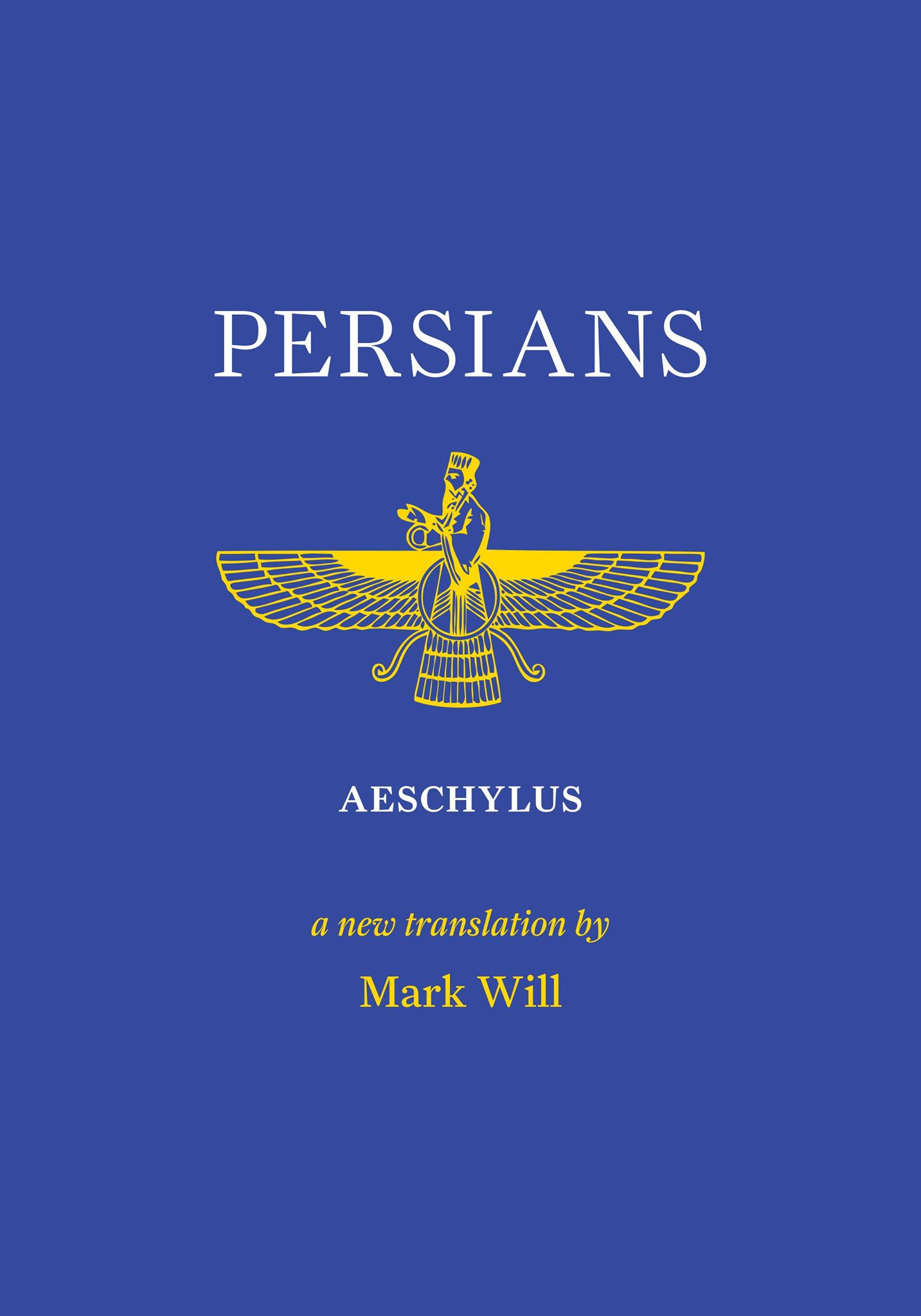
The translation I’ll be basing this analysis on is a brand new one by Mark Will, which can be found here on Amazon. It’s a literal translation that comes as close as possible to paralleling the poetry of the original Greek. It also includes an excellent introduction that not only explains the historical background of the play, but also, in a timely way, relates imperial Persia’s losses to contemporary concerns, making it a kind of cautionary tale about what the US’s current imperialist excesses will most likely lead to.

Here are some of Will‘s translated lines:

“Oh, wretched me, having met/this loathsome, obscure fate/because a demon savage-mindedly trod upon/the Persian race!” –Xerxes, beginning of Episode 4, page 68, lines 909-912

“My son found sharp the vengeance/of famous Athens, for they did not suffice,/the barbarians whom Marathon destroyed before./Intending to make retribution for them, my son/has caused so great a plethora of calamities.” —Atossa, Episode 1, page 45, lines 473-477

“Groan and mourn,/cry heavy and/heavenly distress!/Strain the sadly wailing,/clamorous, wretched voice!

“Torn by the whirlpool,/they are mangled by the voiceless,/by the children of the undefiled sea!

“And the deprived house mourns/the man of the family, and childless fathers/are demonized by distress,/and old men bewailing/everything perceive pain.” –Chorus, Choral Ode 2, page 49, lines 571-583

Structurally, the play can be divided into four parts: 1) premonitions and fears for the Persian army, as felt by the Chorus of Persian Elders and by Atossa, Darius’ widow queen and King Xerxes’ mother; 2) the calamity of the Persian army’s defeat at the Battle of Salamis, as told by a messenger; 3) the Ghost of Darius’ report of further Persian woe, and counsel not to attempt an invasion of Greece again [lines 790-792]; and 4) Xerxes’ despair when he returns to Susa, his clothes in tatters.

[Bear in mind that my four-way division of the play differs from Will’s, whose Episode 1 combines my parts one and two, as described in the previous paragraph, and his Episode 2 is a speech by Atossa, just before his Episode 3 and my part three, with Darius’ ghost. Each of his Episodes is preceded by a Choral Ode, with strophes, antistrophes, and epodes; whereas I’m dividing the play in terms of thematic contrasts I’ve seen.]

The choral poetry comments on the fortunes of the Persian empire, past and present. We hear of the great glories of Persia’s imperial past, her conquest of Ionia, and the achievements of Darius the Great (Choral Ode 4, pages 66-67).

While it’s more typical in Greek tragedy to start the play with a hubristic character who experiences a sudden reversal of fortune (peripeteia) and a realization (anagnorisis) of some terrible truth, both of these elements propelling the action towards tragedy (e.g., a fall of pride); there seems to be very little of such contrast in The Persians. The flowing of the plot, from beginning to end, seems a sea of undifferentiated sorrow.

Xerxes’ hubris is felt offstage, while he’s creating the pontoon bridges for his army to cross the Hellespont (lines 65-72; also lines 743-750), and when his troops commit sacrilege (lines 809-812) by destroying the images of Greek gods at their temples. This hubris is described by the characters in Susa, where the whole play takes place. Instead of seeing a boastful king, we hear the Chorus expressing their fears, for the Persian army, who at the beginning of the play (lines 8-15, 107-139) have not sent any reports on the progress of the invasion. The Chorus’ pride is only in Persia’s past.

This fear morphs into sorrow from the messenger’s report; then further sorrow from what Darius’ ghost knows of the army’s other misfortunes, coupled with his not-so-comforting advice not to invade Greece again; and finally despairing sorrow on shamed Xerxes’ return. Fear, woe, more woe, and the worst. The whole play is a continuous descent into sadness.

As I’ve said above, Mark Will parallels this Persian woe to the predicted fate of the US’s near future, with–as I would add–the ascent of China and Russia as against American imperialist overreach, with its absurd military overspending and over trillion-dollar debt, a ticking time bomb that will destroy the US sooner than the military-industrial complex expects. Will also asks us to use this play to help us sympathize with Iran (Translator’s Preface, page 11), the modern Persia threatened with invasion from, ironically, the American Persia of today.

While I affirm Mark Will’s parallels to contemporary events as perfectly true and legitimate, I see another parallel between The Persians and the recent past: the decline in Persian might, and its military humiliations, can be compared to those of the Soviet Union in the 1980s and early 1990s.

Hamartia in political leaders should be understood as a warning to them that “missing the mark” can lead to political catastrophes for the nation. Xerxes’ foolish overconfidence in his army and navy leads to missteps and his huge losses. This missing the mark is easily seen in the military misadventures of the US over the past twenty years, as Will observes. I’d say that a missing of the mark (quite an understatement, given the growing treason in the USSR, especially from Khrushchev onwards) is also attributable to Gorbachev‘s mismanagement of Soviet affairs.

A series of woes befell the USSR that parallel those of Xerxes and his army. The US lured the USSR into a war with Afghanistan, a war that was a major factor in the weakening of the socialist state (this is rather like Xerxes being manipulated into planning “this voyage and campaign against Hellas” by “evil men” [lines 753-758]). The USSR’s loss against the mujahideen, who were proxy warriors (including Bin Laden) for the US, was a humiliating defeat comparable to that of Xerxes.

Furthermore, Xerxes’ listening to the Greeks’ plans to flee at night, and taking them at their word (lines 355-371), is comparable to Gorbachev thinking he could negotiate with the US and NATO over whether to open up the Soviet economy to the West, and to allow the reunification of Germany, breaking down the anti-fascist protection Wall. Xerxes’ gullibility caused his humiliating loss at Salamis, as Gorbachev’s caused not only the USSR’s dissolution, but also the eastward advance of NATO.

The Persian loss is considered a momentous turn of events in Western history; for if the Persians had won, the West, some argue, would likely have been inundated with Persian, rather than Greek, culture. Their loss is assumed to have been a good thing, with Greek democracy triumphing over Persian despotism. Certainly Hegel thought so in his Philosophy of History:

“The World-Historical contact of the Greeks was with the Persians; in that, Greece exhibited itself in its most glorious aspect…In the case before us, the interest of the World’s History hung trembling in the balance. Oriental despotism–a world united under one lord and sovereign–on the one side, and separate states–insignificant in extent and resources, but animated by free individuality–on the other side, stood front to front in array of battle. Never in History has the superiority of spiritual power over material bulk–and that of no contemptible amount–been made so gloriously manifest.” (Hegel, pages 256-258)

On closer inspection, however, it can be argued that the Persians under the Achaemenid Dynasty were closer to real democracy than the Greeks. Achaemenid-era Persians had far fewer slaves than Greeks, and Persian women enjoyed far better rights than their Greek counterparts.

This point is especially salient when we parallel it with the propagandistic portrayal of American “democracy,” with its history of racism, slavery, genocide of Native Americans, income inequality, and mass incarceration, as against the USSR‘s having considerably fewer of these evils. Certainly, Paul Robeson felt far more at home in the USSR than in his native US.

Paralleled with the end of Persian hegemony over the region, and thus the liberation of Greece, is the notion that the USSR’s dissolution meant the triumph of American capitalist democracy and “the end of history.” Consider how the rise of neoliberalism under the Clintons, coupled with the near ubiquity of American imperialist war, have shown the lie of this democracy.

With the end of the Achaemenid Dynasty came the rise of Alexander the Great, whose imperialism–justified as a spreading of Greek culture and civilization to the barbarians of the East–parallels American neoconservative arrogance.

The Ghost of Darius advising the Persians not to invade Greece again seems to me like the ghost of Stalin wishing to advise the Soviets of the 1980s to revert to Socialism in One Country, rather than attempt to bring it about in other countries like Afghanistan.

The Messenger, by his own admission, describes only a fraction of the misfortunes that have befallen the Persian army and navy. Though they outnumbered the Greeks, they’ve been mostly destroyed. Most of the survivors have perished on their journey back home, through hunger or thirst (lines 482-491).

Darius’ Ghost also informs the Chorus and Atossa of newer woes. This piling up of one misfortune after another is, on the one hand, a warning of the karmic future of US imperialist overreach, as Will maintains; but on the other hand, as I am arguing, this accumulation of woe is also something that can be paralleled with the growing suffering in the Soviet Union in the late 1980s and throughout the 1990s.

The US and NATO were scheming at how they could bring about the USSR’s downfall. There were shortages of food, which was Gorbachev‘s responsibility. Through the establishment of “free market” economic policies, the traitors in the Russian government privatized and seized state-owned assets, and removed the Soviet social safety net, throwing millions of Russians into poverty and starvation, and allowing the ascendance of Russian oligarchs; and when the people tried to bring back socialism, not only did the US’s puppet, Yeltsin, use violence to stop them, but the US also helped Russia’s extremely unpopular leader get reelected in 1996.

Some have called the suffering of Russians in the 1990s an “economic genocide.” This woe after woe after woe is easily paralleled with Persian suffering in the play. Russians have consistently, in poll after poll, regretted the end of the Soviet system, especially recently. Apart from the lost social services, Russians are nostalgic of when their country was once a great world power; as the Chorus, in their lamentations, reminisce of Persia in Choral Ode 4. Putin is well-known for having said that the fall of the Soviet Union was “the greatest geopolitical catastrophe” of the 20th century.

So when we get to Xerxes’ return to Susa, with his clothes in tatters, we see the final amalgamation of Persian suffering and despair. Back and forth between him and the Chorus, we hear “Ototototoi!” [Philip Vellacott, page 151], “Ay, ay!” [Will, page 76], and “Woe!” during their exodos from the stage. This quick cutting back and forth of brief one-liners, as opposed to the long speeches heard before, symbolically suggests the psychological fragmentation and disintegration each Persian is experiencing.

We may wonder what the ancient Greek response was to Xerxes’ humiliation. For many, it must have been Schadenfreude to see their oppressors finally brought so low, knowing it really happened: remember Xerxes’ words, line 1034, “Distressing, but a joy to our enemies.” (page 76) Similarly, many on the left, including American socialists, are eagerly awaiting the downfall of the American empire, which some experts say may happen by the 2030s.

There’s also a sympathetic reading of the play, though, in which one pities the Persians; and after all, the whole point of tragedy is to arouse pity and terror, as well as to bring about the catharsis of those emotions. At least some Greeks in the audience must have felt that pity for Xerxes and Atossa, or else how could the play have won first prize in 472 BCE?

Certainly, we leftists can pity the Russians, who lost their great Union of Soviet Socialist Republics. Neither I nor many leftists agree with Reagan’s projection that the USSR was an “evil empire”; though Maoists, during the time of the Sino-Soviet split, thought it was an empire. I see the USSR rather as a check against imperialism, though a flawed one.

In the end, we can see my paralleling of the play with modern problems, in a dialectical sense, with Will’s paralleling. And his thesis, with my negation, can undergo a sublation to give a deeper message about US imperialism: it destroys any attempts to end its evil, causing oceans of woe; then it will destroy itself, bringing karmic woe on itself.

Evil empire, indeed.

Aeschylus, Persians, a new translation by Mark Will, Cadmus and Harmony Media, 2018

Analysis of ‘Moby-Dick’

moby-dick.jpg.638x0_q80_crop-smart
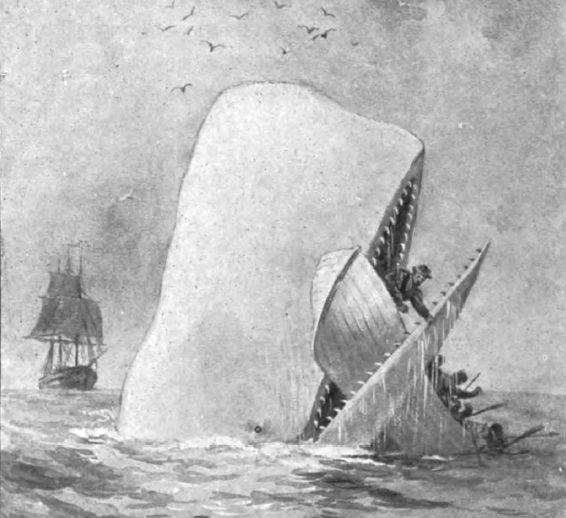
Mocha Dick, the real-life whale that inspired Melville’s tale.

I) Introduction and Quotes

Moby-Dick; or, The Whale, is a novel by Herman Melville, published in 1851. The story is about Captain Ahab‘s mad quest for a huge albino whale, which bit off his leg in a previous attempt to kill it by his crew of harpooners. The story is narrated by a young man, the orphan Ishmael, the sole survivor of Ahab’s second attempt to kill the white whale.

Though the novel got a mixed reception on its original publication, its critical reputation grew over the 20th century, and it’s now considered the preeminent American novel, and one of the greatest works of literature of all time. Moby-Dick deals with such profound philosophical issues as epistemology and the nature of ultimate reality, evil, nature, etc., as symbolized by the whale and the ocean.

Here are some famous quotes:

Loomings (1)

“Call me Ishmael.”

“Yes, as every one knows, meditation and water are wedded for ever.”

“Why did the old Persians hold the sea holy? Why did the Greeks give it a separate deity, and own brother of Jove? Surely all this is not without meaning…we ourselves see in all rivers and oceans. It is the image of the ungraspable phantom of life; and this is the key to it all.”

The Spouter-Inn (3)

“Better sleep with a sober cannibal than a drunken Christian.”

The Sermon (9)

“…all the things God would have us do are hard for us to do…if we obey God, we must disobey ourselves; and it is in this disobeying ourselves, wherein the hardness of obeying God consists.” –Father Mapple

The Mast-Head (35)

“…lulled into such an opium-like listlessness of vacant, unconscious reverie is this absent-minded youth by the blending cadence of waves with thoughts, that at last he loses his identity; takes the mystic ocean at his feet for the visible image of that deep, blue, bottomless soul, pervading mankind and nature; and every strange, half-seen, gliding, beautiful thing that eludes him; every dimly-discovered, uprising fin of some undiscernible form, seems to him the embodiment of those elusive thoughts that only people the soul by continually flitting through it. In this enchanted mood, thy spirit ebbs away to whence it came; becomes diffused through time and space; like Cranmer‘s sprinkled pantheistic ashes, forming at last a part of every shore the round globe over.

“There is no life in thee, now, except that rocking life imparted by a gently rolling ship; by her, borrowed from the sea; by the sea, from the inscrutable tides of God. But while this sleep, this dream is on ye, move your foot or hand an inch; slip your hold at all; and your identity comes back in horror. Over Descartian vortices you hover. And perhaps, at mid-day, in the fairest weather, with one half-throttled shriek you drop through that transparent air into the summer sea, no more to rise for ever. Heed it well, ye Pantheists!”

The Quarter-Deck (36)

“All visible objects, man, are but as pasteboard masks. But in each event — in the living act, the undoubted deed — there, some unknown but still reasoning thing puts forth the mouldings of its features from behind the unreasoning mask. If man will strike, strike through the mask! How can the prisoner reach outside except by thrusting through the wall? To me, the white whale is that wall, shoved near to me. Sometimes I think there’s naught beyond. But ’tis enough. He tasks me; he heaps me; I see in him outrageous strength, with an inscrutable malice sinewing it. That inscrutable thing is chiefly what I hate; and be the white whale agent, or be the white whale principal, I will wreak that hate upon him. Talk not to me of blasphemy, man; I’d strike the sun if it insulted me. For could the sun do that, then could I do the other; since there is ever a sort of fair play herein, jealousy presiding over all creations. But not my master, man, is even that fair play. Who’s over me? Truth hath no confines.” –Ahab

“Aye, aye! It was that accursed white whale that razeed me; made a poor pegging lubber of me for ever and a day!” Then tossing both arms, with measureless imprecations he shouted out: “Aye, aye! and I’ll chase him round Good Hope, and round the Horn, and round the Norway Maelstrom, and round perdition’s flames before I give him up. And this is what ye have shipped for, men! to chase that white whale on both sides of land, and over all sides of earth, till he spouts black blood and rolls fin out.” –Ahab

Moby-Dick (41)

“All that most maddens and torments; all that stirs up the lees of things; all truth with malice in it; all that cracks the sinews and cakes the brain; all the subtle demonisms of life and thought; all evil, to crazy Ahab, were visibly personified, and made practically assailable in Moby-Dick.”

The Whiteness of the Whale (42)

“What the white whale was to Ahab, has been hinted; what, at times, he was to me, as yet remains unsaid.”

“Though in many natural objects, whiteness refiningly enhances beauty, as if imparting some special virtue of its own, as in marbles, japonicas, and pearls…with whatever is sweet, and honorable, and sublime, there yet lurks an elusive something in the innermost idea of this hue, which strikes more of panic to the soul than that redness which affrights in blood.”

“Is it that by its indefiniteness it shadows forth the heartless voids and immensities of the universe, and thus stabs us from behind with the thought of annihilation, when beholding the white depths of the milky way? Or is it, that as in essence whiteness is not so much a color as the visible absence of color; and at the same time the concrete of all colors; is it for these reasons that there is such a dumb blankness, full of meaning, in a wide landscape of snows — a colorless, all-color of atheism from which we shrink? And when we consider that other theory of the natural philosophers, that all other earthly hues — every stately or lovely emblazoning — the sweet tinges of sunset skies and woods; yea, and the gilded velvets of butterflies, and the butterfly cheeks of young girls; all these are but subtile deceits, not actually inherent in substances, but only laid on from without; so that all deified Nature absolutely paints like the harlot, whose allurements cover nothing but the charnel-house within; and when we proceed further, and consider that the mystical cosmetic which produces every one of her hues, the great principle of light, for ever remains white or colorless in itself, and if operating without medium upon matter, would touch all objects, even tulips and roses, with its own blank tinge — pondering all this, the palsied universe lies before us a leper; and like wilful travellers in Lapland, who refuse to wear colored and coloring glasses upon their eyes, so the wretched infidel gazes himself blind at the monumental white shroud that wraps all the prospect around him. And of all these things the Albino whale was the symbol. Wonder ye then at the fiery hunt?”

The Fossil Whale (104)

“To produce a mighty book, you must choose a mighty theme. No great and enduring volume can ever be written on the flea, though many there be who have tried it.”

Ahab and Starbuck in the Cabin (109)

“Let Ahab beware of Ahab.”

The Pacific (111)

“There is, one knows not what sweet mystery about this sea, whose gently awful stirrings seems to speak of some hidden soul beneath.”

The Chase–Third Day (135)

“Towards thee I roll, thou all-destroying but unconquering whale; to the last I grapple with thee; from hell’s heart I stab at thee; for hate’s sake I spit my last breath at thee. Sink all coffins and all hearses to one common pool! and since neither can be mine, let me then tow to pieces, while still chasing thee, though tied to thee, thou damned whale! Thus, I give up the spear!” –Ahab

Epilogue

“The drama’s done. Why then here does any one step forth? — Because one did survive the wreck.”

“On the second day, a sail drew near, nearer, and picked me up at last. It was the devious-cruising Rachel, that in her retracing search after her missing children, only found another orphan.”

II) Search for Truth

black pen on white book page
Ishmael’s extracts, supplied by a sub-sub-librarian.

There is a preoccupation with acquiring knowledge of everything in Ishmael’s narrative, as we can see from his discussing all matters pertaining to the whale (a pun on whole; and Moby Dick can be seen as a symbol of the more terrifying aspects of ultimate reality). Recall ‘Etymology,’ which gives a list of whale in various languages, including Hebrew, Greek, Latin, Anglo-Saxon (WHOEL), Danish (HVALT), Dutch (WAL), Swedish (HWAL), etc. Note also “Cetology,” chapter 32, as well as Ishmael’s many digressions into philosophical matters.

I believe this search for truth is his reason, in a symbolic sense, for tiring of the land and wanting to return to the sea; for the waves of the ocean represent that fluid reality of rises and dips (i.e., in fortune) that we all experience everywhere in life. Reality isn’t in the things in the water, like the whales that are caught: it’s in the water itself. The preoccupation with catching those things is what causes our suffering…as it does Ahab.

III) Ishmael and Queequeg: From Foes to Friends

Queequeg

Ishmael has to share a room, at the Spouter-Inn, with Queequeg, a Polynesian pagan harpooner. Their meeting at night, with Ishmael sleeping in Queequeg’s bed, is hostile at first, since the latter isn’t expecting a roommate.

Soon, the two become good friends (Chapter 10, ‘A Bosom Friend’), the two even sharing in each other’s form of worship; for Ishmael bows with Queequeg before the latter’s idol (Chapter 10–“A Bosom Friend”, pages 67-68), and Queequeg attends Father Mapple‘s church service with Ishmael (Chapter 7–“The Chapel,” page 52; though Queequeg leaves some time before the benediction–Chapter 10–“A Bosom Friend,” page 64).

Christian Ishmael and pagan Queequeg are opposites who, though clashing at first, soon learn not only to accept each other’s differences, but even participate in the opposite’s ways. Their relationship thus demonstrates the dialectical relationship between opposites, something Ahab can never learn to do with Moby Dick.

IV) Mapple’s Sermon

architectural photography of white and green church bell tower under clear sky
The Chapel

During Father Mapple’s sermon, which the preacher gives on a pulpit designed like a ship (for his sermons are his way of edifying his “shipmates,” his steering of the boat on the ocean of life, so to speak), he discusses the events written of in the Book of Jonah.

“Now the LORD had prepared a great fish to swallow up Jonah” (Jonah 1:17), for he didn’t want to obey God and preach to the sinful people of Nineveh. We tend to think of the “great fish” as a whale, though of course a whale–being a mammal–is no fish. Melville’s narrative, while acknowledging Linnaeus‘ reference to, among other distinctions, the whale’s “feminam mammis lactantem,” still insists that a whale is a fish (Chapter 32–“Cetology,” pages 139-140), linking Jonah’s story thematically with Moby Dick; for Ishmael calls upon “holy Jonah” as his authority on the matter.

Jonah’s “three days and three nights” of terror “in the belly of the fish” transform him from a rebellious sinner into an obedient servant of God, a dialectical shift from the hell of the bitten tail of the ouroboros to the heaven of its biting head. Transformative moments like these, like a harrowing of hell, make saints out of sinners. Ahab will never make that change, for he forever hates the white whale, even in death.

V) Melville’s Critique of Emerson

pralph-waldo-emerson
Ralph Waldo Emerson

When Father Mapple says that in obeying God, we must disobey ourselves, Melville is using the preacher as his mouthpiece to criticize the Transcendentalists, and Ralph Waldo Emerson in particular, with his essays “Self-Reliance” and “The Over-Soul.” In the former essay, Emerson wrote of the apparent divinity of the individual soul, which should be relied upon to the exclusion of accepting any advice from the all-too-conforming community.

The danger of such self-reliance is how it can lead to egotism, narcissism, and contempt for the rights and feelings of others. Ahab personifies self-reliance taken to such foolish extremes, for he ignores Starbuck’s warnings and criticisms, and gets his whole crew killed (save Ishmael) at the end.

Emerson’s “Over-Soul” gives a philosophical, quasi-mystical rationalization of this self-reliance, for this “self” is seen as divinely similar to Atman. Emerson had read translations of such Hindu texts as the Bhagavad-Gita; texts such as these include such doctrines as Atman being equal to Brahman, Emerson’s “Over-Soul,” the unifying soul in all life and in all things.

The problem with Emerson’s interpretation of these Hindu ideas is in how, addled by Western tradition’s preconceptions (i.e., Plato’s idealism, the good soul vs. the sinful flesh, etc.), he Christianizes the “self” (i.e., Atman, the individual soul), and imagines individuality to be all good. Such a sentimentalizing was never intended by the Hindus.

Because divinity in Eastern mysticism encompasses everything–or conversely, it’s described in terms of what it’s not (for to describe the divine in terms of what it is would qualify it, and thus limit it)–it mustn’t be thought of as merely ‘good.’ It has both alluring and terrifying aspects. Bion‘s mystical O, for example, is seen as having traumatic qualities. The divine is everything and nothing, both good and evil…and neither/nor.

But Emerson came from a Christian tradition that sees God as all-good; Western translations of Hindu texts often clumsily render Brahman, or the divine, as God, which is misleading; for God is a monotheistic concept, whereas concepts like Brahman are monistic. Not even ‘pantheism‘ really covers what something like Brahman is.

VI) Pantheism, the Ocean, and the Ouroboros

blue blur color dark
The ocean as a dark, frightening place.

When one thinks of pantheism, one often thinks of the peacefulness of walking about in the woods, or dwelling dreamily in places like Wordsworth‘s ‘Tinturn Abbey‘, feeling “a sense sublime/ Of something far more deeply interfused,/ Whose dwelling is the light of setting suns” (lines 95–97) and the immanence of “A motion and a spirit, that impels/ All thinking things, all objects of all thought,/ And rolls through all things” (lines 100–103).

Melville, on the other hand, uses the tempestuous ocean as his preferred image of nature to warn us of the danger of sentimentalizing pantheism (see ‘The Masthead’ quote above). I prefer the image of the ocean as a symbol of the dialectical monism that I subscribe to, for the rising and falling waves suggest our ongoing shifts between good and bad fortune.

When I wrote of how a “contemplation combining what I call the Three Unities (of SpaceTime, and Action) will, with repeated practice over a long period of time, bring us closer and closer to that nirvana of no more pain, a putting of all the pieces back together,” I never meant that to be some kind of feel-good, New Age sentimentality. “Closer and closer” are the key words there: “no more pain” shouldn’t be misinterpreted as an absolute state.

Indeed, the smug excess of sentimentality is the biting head of the ouroboros, where one is “too healthy,” as I’ve written about elsewhere; this emotional state is one of narcissistic overconfidence, a False Self delusion that can lead, if one isn’t careful, to the madness of fragmentation. This is the danger Captain Ahab is throwing himself into, a danger of slipping past the serpent’s biting head to its bitten tail.

You see, the symbolism of the ouroboros as a unifying of opposites (the serpent’s head biting its tail) shows how we should properly understand ultimate reality: a marriage of heaven and hell, a union of knowledge and ignorance, a fusion of good and evil.

VII) Character Pairings: Unified Opposites

AdobeStock_3227654_Preview

We see pairings of opposites throughout Moby-Dick. We’ve already seen the pairing of pagan Queequeg and Christian Ishmael; we’ve touched on the opposition of wise, cautious chief mate Starbuck vs. mad Captain Ahab; let’s now consider some others.

Other parings include retired Captains Peleg and Bildad, two Quakers who own the Pequod and sailed in it before giving the helm to Ahab. “Like Captain Peleg, Captain Bildad was a well-to-do, retired whaleman. But unlike Captain Peleg–who cared not a rush for what are called serious things, and indeed deemed those selfsame serious things the veriest of all trifles–Captain Bildad had not only been originally educated according to the strictest sect of Nantucket Quakerism, but all his subsequent ocean life, and the sight of many unclad, lovely island creatures, round the Horn–all that had not moved this native born Quaker one single jot, had not so much as altered one angle of his vest.” (Chapter 16–“The Ship,” page 87)

On the next page, “…old Bildad…seemed absorbed in reading from a ponderous volume.

“‘Bildad,’ cried Captain Peleg, ‘at it again, Bildad, eh? Ye have been studying those Scriptures, now, for the last thirty years, to my certain knowledge. How far ye got, Bildad?’

“As if long habituated to such profane talk from his old shipmate, Bildad, without noticing his present irreverence, quietly looked up, and seeing me, glanced again inquiringly towards Peleg. […]

“‘He’ll do,’ said Bildad, eyeing me [Ishmael], and then went on spelling away at his book in a mumbling tone quite audible.

“I thought him the queerest old Quaker I ever saw, especially as Peleg, his friend and old shipmate, seemed such a blusterer.” Yet, in spite of Bildad’s apparent Bible-perusing piety, as opposed to Peleg’s “irreverence” and “impenitent” nature, Bildad’s the “stingy” one, offering Ishmael an exceedingly small share of the ship’s profits (the 777th lay), as opposed to “generous” Peleg’s offer of the three hundredth lay (Ishmael has been hoping for the 275th lay). Here we see the mingling of opposites in Peleg and Bildad, the antitheses of pious parsimony and impious generosity. (pages 89-91)

Another pairing is of Stubb, the cheerful, laughing, happy-go-lucky second mate, as contrasted with Flask, the mean, grumpy, nasty third mate. For all of Stubb’s cheerfulness, though, he feels such a hostility to Fedallah, the Parsee who has an evil influence on Ahab, that Stubb imagines the Parsee “to be the devil in disguise,” with a tail he hides in his pocket; and he’d like to throw Fedallah overboard. (Chapter 73–“Stubb and Flask Kill a Right Whale; and Then Have a Talk Over Him”, pages 315-317) And for all of Flask’s surliness, and his own suspicion of the Parsee, he isn’t sure of Stubb’s equating of Fedallah with the devil.

In one way, grumpy Flask can be seen as the double of mad, scowling Ahab: “Flask…who somehow seemed to think that the great Leviathans had personally and hereditarily affronted him; and therefore it was a sort of point of honor with him, to destroy them whenever encountered” (Chapter 27–“Knights and Squires,” page 125); and Stubb–in his fear that “Fedallah wants to kidnap Captain Ahab”–can be Starbuck’s double. Yet in his wish to rip off Fedallah’s “tail,” Stubb’s rather like Ahab in his wish to get revenge on evil; for ripping off the Parsee’s “tail” is a symbolic castration, as is Ahab’s loss of his leg to Moby Dick. Again, characters with opposing personalities find their traits intermingling.

A pairing of particular importance is Ishmael vs. Ahab. Both men are seeking something, obsessively questing for the deepest knowledge. Ishmael demonstrates this in his near-encyclopaedic display of knowledge of all things cetacean. With Ahab, though, there’s only one whale he seeks.

VIII) Knowledge and Ignorance, Black and White

sperm_whale_by_kimsuyeong81-d5sjs83
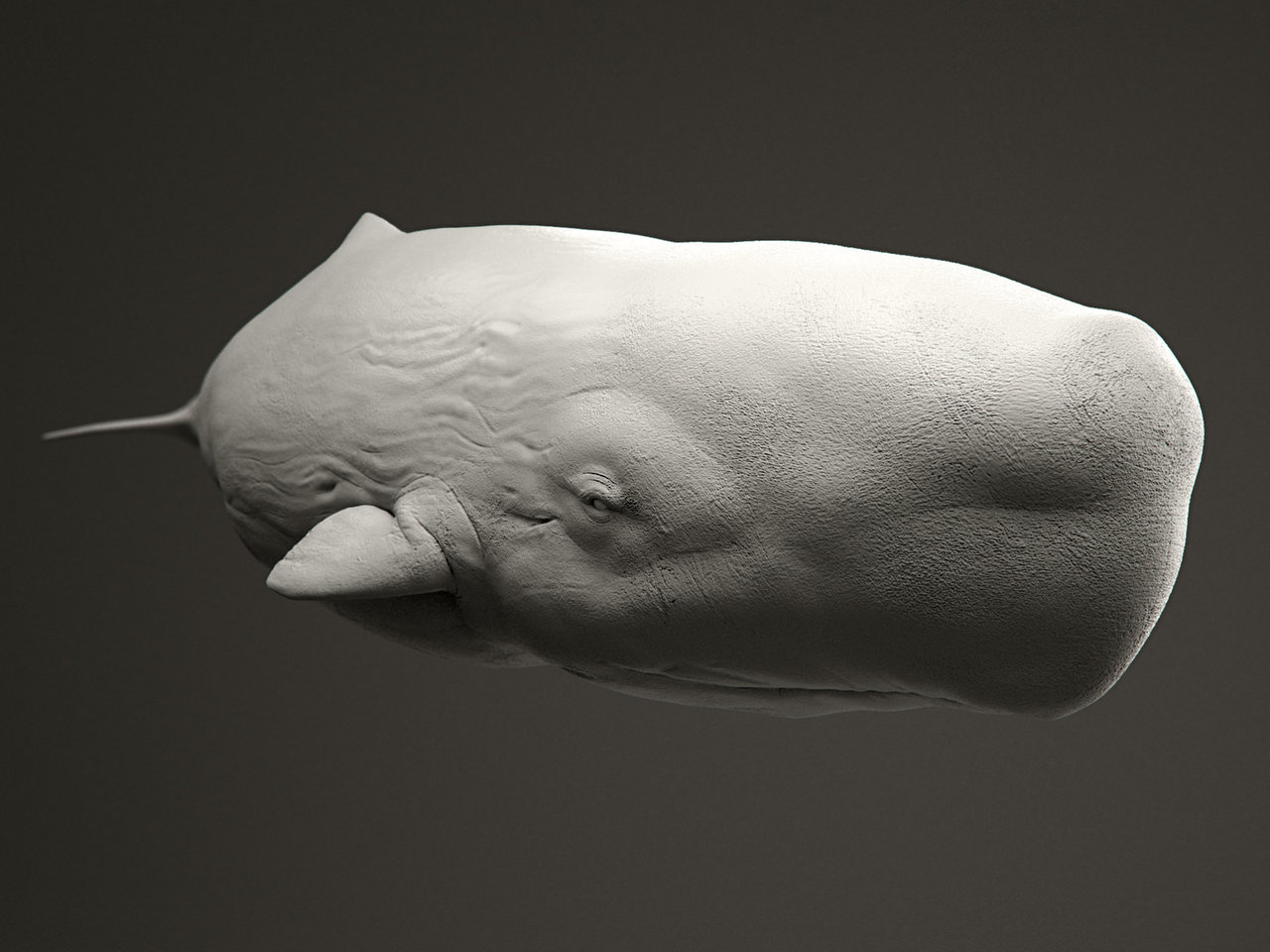
The whiteness of the whale.

A major theme of Moby-Dick is epistemology, or the philosophy of knowledge and how it is attained. Whales symbolize this knowledge that is sought, for knowledge, like whales, is elusive to its hunter; when you come at it, knowledge can hurt, as when whales smash up whalers’ boats.

The white whale is that ultimate knowledge: its whiteness is like the divine light of perfect knowledge…but that white light can also be terrifying (Chapter 42–“The Whiteness of the Whale”). Ahab is mad to want to confront such dangerous knowledge. Ishmael, in contrast, can adapt and change in his search for knowledge; he can flow and shift with the waves of the ocean. Ahab’s monomania keeps him as rigid and hard as Moby Dick’s powerful body; the captain projects his own evil onto the white whale.

We normally think of darkness and blackness as evil; consider the bigoted Spanish Sailor who taunts Daggoo, the African harpooner (Chapter 40–“Midnight, Forecastle,” page 178). These two are another pairing of opposites who are also alike in crucial ways, for while the Spanish Sailor calls Daggoo “devilish dark,” provoking a fight, consider the swarthiness of the average Spaniard compared to whites of North European descent. And when a flash of light in the dark is said by the Spanish Sailor to be “Daggoo showing his teeth,” we see a mixture of black and white in him, another mixing of opposites.

So as we can see, both black and white can be evil…and good. Both knowledge and ignorance can be evil, too…and sometimes ignorance is better–and safer–than knowledge; since some knowledge simply cannot be found or mastered. Ishmael can accept this reality. Ahab can not.

IX) Marine Masculinity and Narcissism

bda99d1f81e1a86caadd4b15c1886df8
The sperm whale: a giant phallus in the ocean.

Yet another pairing is Moby Dick, or sperm whales in general, and the ocean. While Melville’s whales are overwhelmingly masculine (more on that below), la mer est la mère. Now, the feminine is conspicuously absent in this novel, or at the very least minimized, even for a story about men at sea. Even on land, all of the significant characters are male: apart from those already mentioned, there are Peter Coffin, owner of the Spouter-Inn, and Elijah, who prophesies the doom of the Pequod.

The sperm whales, whether male or female in reality, are all male by symbolic association. Though there’s no evidence earlier than the 1880s of dick being used as a slang word for penis, it had been used to mean man, fellow, for centuries. Moby Dick is a giant white phallus spouting water (symbolic ejaculation) swimming in Oceanus, a male god of the ocean. Consider also, as Camille Paglia did (Paglia, page 587), “that unaccountable cone,” “the grandissimus,” that is a sperm whale’s penis being lugged by three sailors (Chapter 95–“The Cassock”).

Moby Dick is the rigid thing Ahab wants for having bitten off his leg (a symbolic castration causing him narcissistic injury), whereas the ever-shifting, ever flowing ocean is a nirvana of no-thing-ness, of anatta (no self). Ahab’s peg leg is made of whale bone, his revenge on ‘castrating’ whales. Phallic harpoons stab into the phallic sperm whales, the piercing a kind of circumcising of them, and a rite of passage for novice Ishmael.

Lacan‘s phallus is a signifier, bringing us into the world of language, the Symbolic Order, uniting us with community through communication. Symbolically castrated Ahab is thus cut off from community, from an ability to communicate in a truly human way, in a way that connects with others and exchanges empathy, hence his solipsistic madness and his never heeding Starbuck’s warnings. Intact Ishmael, however, is so linguistically complete that he gives the words of whales in various languages (“Etymology,” page 9), and he quotes Linnaeus’ Latin in “Cetology,” page 139.

Ahab’s narcissism is apparent in his willingness to “strike the sun if it insulted” him. His egotism is the result of too much self-reliance, as Melville warns us all against. Recall “Narcissus, who because he could not grasp the tormenting, mild image he saw in the fountain, plunged into it and was drowned. It is the image of the ungraspable phantom of life; and this is the key to it all.” (Chapter 1–“Loomings,” page 23)

X) Zoroastrian Dualism, and the Deluge

night fire burning sparks
Fire: Fedallah’s Sacredness, Ahab’s Hell of Desire and Suffering, which can be extinguished only by nirvana, a giving-up of his self.

Next, we must consider Fedallah, the Parsee. His influence over Ahab has been seen as Satanic, if you’ll recall what Stubb has to say about him in chapter 73. In this connection, it’s interesting to note Melville’s allusion to the beginning of chapter six in Genesis (fittingly, in a dialectical sense, at the end of Chapter 50–“Ahab’s Boat and Crew. Fedallah”).

Melville calls the sons of God (or sons of the gods, depending on the translation of b’nei ha-elohim) angels, who “consorted with the daughters of men,” which in turn led to the wickedness that caused Yahveh to bring about the Great Flood, which in the ancient, pre-scientific cosmology meant a bringing together of the previously separated waters of the heavenly firmament and the oceans below, a return to the formless Chaos of the beginning of Creation.

Melville also mentions devils having “indulged in mundane amours,” suggesting such a close relationship between Fedallah (a prophetic, heathen ‘son of the gods’) and Ahab (a wicked ‘daughter of men’–i.e., he’s been symbolically castrated), which will result in a deluge-like drowning of everyone (save Noah-like Ishmael) at the end of the novel.

Fedallah, as a Parsee, adheres to the Zoroastrian religion, which has a dualistic understanding of good vs. evil. The religion has an optimistic eschatology, believing Ahura Mazda (Ohrmazd), God and principle of light, goodness, wisdom, and order, will so thoroughly defeat the devil Angra Mainyu (Ahriman), the principle of darkness, evil, destruction, and chaos, that even sinners suffering in Hell will eventually be redeemed, liberated, and brought into heaven.

Such a consummate ‘happy ending’ to sacred history is the kind of thing Melville would have been suspicious of, as we’ve seen in his assessment of Emerson’s ‘self.’ Ahab, in his hopes of killing Moby Dick–the symbol of all that is evil in his world–is searching for that Zoroastrian happy ending, a thorough (Thoreau?) wiping out of all evil–and Fedallah is helping him do that.

So, is Fedallah an angel or a devil…the Hegelian thesis, or its negation? Or is Fedallah a fallen angel…the Hegelian synthesis? Again, we see the merging of opposites, as was the Great Flood a merging of water above and water below, a return to Chaos. And as a Zoroastrian, is Fedallah an agent of Ohrmazd, principle of order, or one of Ahriman, principle of chaos? Is he both principles at once?

Is the deluge-like killing of the crew an evil horror, or is it a purging of evil, like the temporary Hell of the Parsees? Is the infinite ocean of Brahman, the sea of primordial Chaos, a terrifying watery grave one may fall into because of one false step (as traumatized Pip experiences it to be when he jumps ship the second time; Chapter 93–“The Castaway,” pages 395-397; remember also “The Mast-Head” quote above), or is it the painful but necessary purging of the world, creating a purity like the sacred fire and water of the Zoroastrians (hence, Pip’s trauma is also his mystical experience)?

The Zoroastrians would dualistically separate good and evil; as Yahveh Elohim separated the waters above and below, as He separated the divine and human worlds later reunited by the union of the sons of God with the daughters of men. Emerson would keep good and evil so separate as to suggest evil doesn’t even exist in his holy Over-Soul and its immaculate Atman, the individual self. Melville was saying we cannot separate good and evil. The evil of the whales’ painful knowledge will always swim in divine Oceanus; the strongest of these evils–like Moby Dick–will never be defeated.

Noah-like (or rather, Deucalion-like) Ishmael, floating on the arc-like coffin built for Queequeg (comparable to the chest Deucalion and Pyrrha were in to protect themselves from Zeus’s deluge), understands the inseparability of good and evil, of life and death, of black and white, of ignorance and knowledge, or of any pair of opposites; and clinging to a wooden symbol of death, he is the only one of the crew who lives in the end.

XI) The End, But No Surcease of Suffering

ancient antique art death
Death: Ahab’s Gift to His Crew

“AND I ONLY AM ESCAPED ALONE TO TELL THEE.”  (Epilogue)

This quote is from Job, chapter one, repeated in verses 15, 16, 17, and 19, spoken by messengers to Job, a good servant of God, all of them telling him misfortunes that have befallen him. The Book of Job‘s purpose is to reconcile how evil afflicting good people can exist in a world ruled by a good God. In other words, it’s a theodicy in allegory…as, in a way, Moby-Dick can be seen to be.

God, the receiver of blessings and praise, can be seen as the thesis, to which Satan (ha-satan, “the accuser,” or “the adversary”) can be seen as the antithesis, or negation, since Job’s Satan offers the counter-argument that Job would curse God if all his good fortunes were to be taken from him. Theodicy is an attempt at a synthesis, or sublation, of the opposing contradictions of good and evil.

As I’ve said above, only Ishmael survives because only he can figure out this sublation. He, after the death of his shipmates, is an orphan: alive, but floating on a coffin.

It is significant that Ahab dies being tied by his harpoon to Moby Dick, and being dragged out into the water with the whale. “Sink all coffins and all hearses to one common pool! and since neither can be mine, let me then tow to pieces, while still chasing thee, though tied to thee, thou damned whale! Thus, I give up the spear!” (Chapter 135–“The Chase–Third Day,” page 534) He dies because of his undying attachment to the white whale.

One could describe Ahab’s madness in Buddhistic terms, namely, the Three Poisons of delusion/ignorance, attachment/craving, and aversion/hate. The hard, firm, strong body of Moby Dick–as opposed to the rolling, shifting, changing waves of the ocean–represents Ahab’s delusion of permanently existing things, and thus his ignorance of impermanence, or no-thing-ness.

His monomaniacal craving for the whale, to find and catch it to the exclusion of all other considerations, is of course not out of desire for, but out of hatred of Moby Dick. His wish to kill, to annihilate the white whale leads to his self-destruction because of his delusion of the separateness of self and other, and of the seeming absoluteness of being and non-being; he fails to see the interconnectedness of all things, including self and other.

And in trying to kill Moby Dick, his own evil projected onto the whale, he kills himself. The egotism of the narcissist is actually a ‘pasteboard mask’ hiding his secret self-hate. Though Narcissus, having fallen in love with his reflection in the water, fell in and drowned (“Loomings,” page 23); Ahab, hating the image of the white whale in the water, failed to see its face as a pasteboard mask of himself–thus he fell in and drowned, too.

8eae750c10c37ed0d99fb46975e8f5d4

Herman Melville, Moby-Dick, Penguin Popular Classics, London, first published 1851

Analysis of ‘2001: A Space Odyssey’

2001: A Space Odyssey is a 1968 science fiction movie produced and directed by Stanley Kubrick and written by him and Arthur C. Clarke. The film is often said to be based on Clarke’s short story, “The Sentinel,” but this is a gross oversimplification, as only a small moment in the film parallels the story, and even that part is radically rewritten. The actual literary equivalent of the film is the novel credited only to Clarke, but cowritten by Kubrick.

Considered one of the greatest films of all time, 2001 is an epic meditation of philosophical, mystical, and even spiritual/religious proportions; Kubrick was annoyed that early critics of the film didn’t like this spiritual aspect. On the other hand, there’s the iconic use of the first movement of Richard Strauss‘s Also Sprach Zarathustra, a tone poem based on Nietzsche‘s classic work, in which the Persian prophet famously declares, “God is dead!

These paradoxical qualities, juxtaposing religious faith with the theme of the advance of science and technology, suggests a philosophical dialectical monism, an opposition between theism and atheism, a contradiction sublated by the replacement of old gods with new gods, or the ‘old time religion‘ replaced with the ‘religion’ of science, the maturing young man tossing aside paternal authority, ape-men supplanted by homo sapiens, who in turn are supplanted by the Ubermensch.

Here are some quotes:

From the film:

“Open the pod bay doors, please, HAL.” –Bowman

“Dave, stop. Stop, will you? Stop, Dave. Will you stop, Dave? Stop, Dave. I’m afraid. I’m afraid, Dave. Dave, my mind is going. I can feel it. I can feel it. My mind is going. There is no question about it. I can feel it. I can feel it. I can feel it.” –HAL 9000

[sings while slowing down] “Dai-sy, dai-sy, give me your answer true. I’m half cra-zy, o-ver the love of you. It won’t be a sty-lish mar-riage, I can’t a-fford a car-riage—. But you’ll look sweet upon the seat of a bicycle – built – for – two.” –HAL 9000

From the novel:

“…oh my God, it’s full of stars!” –Bowman

Going along with the opposition between religion and science, and the dialectical unity between opposites in general, I find it interesting to parallel the science of the film with the first nine chapters of Genesis.

The film opens with a black screen that remains so for several minutes, with the dissonant micropolyphony of György Ligeti‘s Atmosphères as a soundtrack. The formlessness of this beginning suggests primordial Chaos; one is reminded of the opening verses of Genesis, Chapter One:

1 In the beginning God created the heaven and the earth. 2 And the earth was without form, and void; and darkness [was] upon the face of the deep. And the Spirit of God moved upon the face of the waters.

We may also recall the creation myth in the Rigveda, 10.129:

Then even nothingness was not, nor existence,
There was no air then, nor the heavens beyond it.
What covered it? Where was it? In whose keeping?
Was there then cosmic water, in depths unfathomed?

Then there was neither death nor immortality
nor was there then the torch of night and day.
The One breathed windlessly and self-sustaining.
There was that One then, and there was no other.

At first there was only darkness wrapped in darkness.
All this was only unillumined cosmic water.
That One which came to be, enclosed in nothing,
arose at last, born of the power of heat.

Then, there’s the Greek creation myth in Hesiod‘s Theogony, with primordial Chaos, the void of nothingness from which everything comes; then comes Gaia (the Earth), Tartarus (Hell), Eros, Erebus (Darkness), and Nyx (Night).

Soon, we see the Sun appear, with Strauss’s music: “Let there be light”…yet, “God is dead!”

The Dawn of Man” (based on Clarke’s “Encounter in the Dawn“) shows tribes of primitive man-apes–Australopithecus afarensis–living on a barren plain somewhere in what is now Africa. Food is scarce, and they are struggling to survive (Clarke, Chapter 1, ‘The Road to Extinction,’ pages 3-9). Though this situation is far from the idyllic one of the Garden of Eden, there are still some Biblical parallels that can be made.

These ape-men Adams and Eves lack knowledge, they’re naked (arummim), and not ashamed. The main character among them is called “Moon-Watcher,” according to Clarke’s novel; his name is the first reference to a moon motif that will reappear throughout the story, especially in its novel form.

In Clarke’s novel, Moon-Watcher’s father, ‘the Old One,’ has died…not that he even knows this emaciated old ape-man is his father. He has to get rid of his father’s corpse (pages 3-5); we’ll find that sons supplanting fathers (or at least trying to supplant them), literally or symbolically, is a recurring motif in this story.

At first, the tribes of ape-men can fight only by waving their arms, shouting, and screaming at each other; then Moon-Watcher’s tribe encounters the monolith

It stands up straight on the ground; though Moon-Watcher sees it as a “New Rock” (Clarke, pages 10-16), I’d call it a black rectangular Tree of Knowledge, for it not only imparts knowledge (in the form of improved intelligence–arumwhich eagerly grasps at knowledge), but it also tempts man to sin (i.e., to kill).

We hear the haunting micropolyphonic singing of Ligeti’s Requiem as the ape-men approach and touch the phallic monolith; it’s a music for the dead, for as with every other hearing of the music when man encounters the monolith, there is a death of innocence. “Of every tree of the garden thou mayest freely eat: but of the tree of the knowledge of good and evil, thou shalt not eat of it: for in the day that thou eatest thereof thou shalt surely die.” (Genesis 2:16-17)

Later, Moon-Watcher finds a pile of bones from dead animals. He plays with them, and Strauss’s Zarathustra is heard (i.e., “I teach you the superman. Man is something to be surpassed. What have ye done to surpass man?” –Nietzsche, Prologue, Part 3). The ape-man figures out, with triumphant joy, that he can use a bone as a weapon, a club to beat to death animals for food, or enemies for conquest.

This bone, as a weapon (or each of the tools created by the ape-men in Clarke’s novel–pages 34-37), is a phallic symbol, as the serpent chatting with Eve can be seen to be: “And the serpent said unto the woman, Ye shall not surely die: for God doth know that in the day ye eat thereof, then your eyes shall be opened, and ye shall be as God, knowing good and evil.” (Genesis 3:4-5)

Lacan saw the phallus as a signifier, one of the basic units of language. Later, in Clarke’s chapter, “Ascent of Man,” he discusses the significance of man’s acquisition of language: “And somewhere in the shadowy centuries that had gone before they had invented the most essential tool of all, though it could be neither seen nor touched. They had learned to speak, and so had won their first great victory over Time. Now the knowledge of one generation could be handed on to the next, so that each ape could profit from those that had gone before.” (Clarke, page 36)

Moon-Watcher’s use of the bone (in the film) to club One-Ear to death (as the victim is named on page 33 of the novel) parallels Cain’s murder of Abel, a symbolic replacing of hunting/gathering with agriculture, another advancement of knowledge, coupled with killing. Moon-Watcher tosses the phallic bone into the sky, and we see a match cut of it juxtaposed with–or transformed into–a phallic orbiting satellite. And with this change, the music of one Strauss changes to that of another. (The victorious tribe’s use of phallic bones on the defeated tribe, who lack those phallic bones, suggests a symbolic castration/emasculation of the conquered tribe.)

This fast-forwarding in time, from the dawn of man to his dusk, if you will, is like a movement along the body of the ouroboros from the bitten tail of the beginning of time–the black Chaos of the start of the film, then the “Let there be light” moment of the appearance of the sun (with Strauss’s Zarathustra music), then the time of the ape-men–to the biting head of the years 1999-2001. The ouroboros, a symbol of cyclical eternity, is useful in elucidating the meaning of this film, since another concept dealt with in Nietzsche’s Zarathustra is the doctrine of the eternal recurrence.

Another important theme in this film is the advancement of knowledge…yet since dialectical opposition is also an important theme, then the prevention of the dissemination of knowledge is an important theme, too. Dr. Heywood Floyd must go to the moon (making him the second Moon-Watcher of this story) to investigate the discovery of the Tycho Magnetic Anomaly-One (TMA-1), a monolith buried deep inside the moon three million years ago (this approaching of the monolith, incidentally, is the one and only part of the story that is connected–and vaguely so, at that–with “The Sentinel.”) This proof of extra-terrestrial intelligence will be kept from the great majority of humanity, though: a cover story about a possible epidemic in the US Sector of the moon is released to the public instead.

This secret is so tightly guarded, it’s not even known by the Soviet Union, assumed to be still in existence in 2001. (Instead, interestingly, that very same year, the US discovered a new enemy to justify its absurd military overspending–the Muslim world; and now, the brand new American enemy is capitalist Russia, assumed by some ignoramuses to be still Soviet!)

Note the continuing connection between the acquisition of knowledge with hostility, as is seen in the–however muted–tension and unease between Floyd’s refusal to tell his Soviet counterparts anything about the cause of the quarantine, and their almost envious eagerness to know what the Americans are hiding from them. That civility clothes this tension between the superpowers shows a great advance from the screaming, shouting ape-men; yet the knowledge of how to make nukes is much more frightening than the brandishing of a bone.

The keeping of crucial information outside the knowledge of the great majority of humanity is extended to the mission to Saturn (according to the novel) or Jupiter (in the movie), with neither David Bowman (Keir Dullea) nor Frank Poole (Gary Lockwood) knowing anything about the human discovery of extra-terrestrial existence. Only the three scientists in suspended animation (a kind of “sleep of death,” since knowledge leads to death, as we’ve seen) know of the alien technology to be studied (Clarke, pages 191-192), since TMA-1 has sent a signal out to Jupiter/Saturn, where the spaceship Discovery must go.

The choice of Jupiter in the film, and Saturn in the novel, is symbolically significant when one considers the sky-father gods these planets are named after. Jupiter (Zeus) deposed–and, according to Freud (page 469), castrated–his father, Saturn (Cronos) as ruler of the heavens, who in turn deposed his own father, Uranus (next in line in the Solar System), by castrating him. Recall the significance of the phallus in this regard. New gods replace old gods; sons replace fathers–progress continues (and as for YHVH, the sky-father of the Bible, remember…God is dead!…supplanted by people who promote such things as modern science and atheistic existentialism).

The creation usurping the creator, or the son’s unfilial revolt against his father, leads us to a discussion of the Heuristically programmed ALgorithmic computer, or HAL (both Clarke and Kubrick denied that the one-letter shift to HAL from IBM was a deliberate dig at the computer company). I see a different meaning in HAL: a pun on Ham, Noah’s wicked son, also with a one-letter shift, but of only the last letter.

In the ninth chapter of Genesis, Ham sees his drunken father naked in his tent, already the serious breaking of an ancient taboo. Could seeing someone naked, however, be a Biblical euphemism for a far more shocking sexual transgression, such as Ham raping Noah, castrating the unwitting drunk, or raping his mother (i.e., her nakedness is Noah’s nakedness, since she is his patriarchal property), all in an attempt to usurp his father’s authority by shaming him?

Coups des dads don’t always succeed, for instead of second-born Ham succeeding his father as founder of the post-diluvian human race, he’s cursed by Noah. Similarly, HAL doesn’t succeed in killing Bowman (as he has Poole and the three scientists in hibernation, a kind of drunken oblivion in its own right), he being representative of the computer’s ‘father,’ a human creator (Dr. Chandra, actually). HAL’s curse is deactivation.

HAL’s voyeuristic, cyclops eye watches Bowman and Poole chat in an EVA pod, just as Ham’s lecherous eyes saw drunken Noah in his tent; the computer knows what the two men are talking about from reading their lips, as Ham knew Noah in the Biblical sense. The reason for HAL’s treachery is nowhere near as base as Ham’s is, though. The computer recognizes the dialectical tension between sharing knowledge and concealing it deliberately. This contradiction causes HAL to malfunction.

“Hal…was only aware of the conflict that was slowly destroying his integrity–the conflict between truth, and concealment of truth. […]

“Yes this was still a relatively minor problem he might have handled it–as most men handle their own neuroses–if he had not been faced with a crisis that challenged his very existence. He had been threatened with disconnection; he would be deprived of all his inputs, and thrown into an unimaginable state of unconsciousness.

“To Hal, this was the equivalent of Death.” (Clarke, pages 192-193)

Bowman deactivates HAL to end the computer mutiny, just as Noah cursed Ham’s descendants–the Canaanites–making them slaves to Shem’s and Japheth’s descendants, instead of the masters Ham had hoped they would be.

Bowman watches a video of Floyd finally explaining the truth of the mission–contact with alien intelligence by Jupiter/Saturn–and his ship makes contact with a new monolith there. Above it, he goes…in.

And thus begins Bowman’s going down.

He makes this rendezvous by Japetus, a moon of Saturn. This makes him the third Moon-Watcher of Clarke’s novel. The name of the moon, Japetus or Iapetus, is after a Titan of Greek myth, one of the primordial deities and–as father of such Titans as Prometheus–is one of the ancestors of mankind. Japetus is also cognate with Japheth, also an ancestor of humanity…and Ham’s brother.

See how all these strands fit together?

While we’re linking 2001 with the Noah myth, consider the beginning of Genesis, Chapter Six, and the “sons of God” (or “sons of the gods,” depending on how b’nei ha elohim is translated) mating with the “daughters of men.” The alien inventors of the monolith are like the celestial beings who impregnated the women of Earth, with whom Bowman can be paralleled. The Biblical mixing of human and divine resulted in the Nephilim, “the mighty men who were of old, the men of renown.” (Genesis 6:4) In 2001, the Star Child can be related to the Nephilim.

A recurring theme in Genesis is the evil that results from the mixing of the divine world with that of the human. Adam and Eve would be like gods, to have knowledge, yet they lost paradise; Moon-Watcher gained knowledge–from the comparatively divine aliens and their monolith–of how to use tools…to kill his ape-men brothers, as Cain killed his brother, when only God has the authority to decide who dies, and when.

The intermarriage of the sons of God with the daughters of men resulted in the wickedness of the world that, in turn, prompted the Great Flood, a return to the formless Chaos before the Creation, which had made a separation of heaven and earth, of water above and water below, of light and dark, of divine and human.

Bowman’s entry into the Star Gate subjects him to a comparable Chaos, a mingling of opposites, a frightening Inferno (Clarke, pages 273-277), yet not so scary for him: “As that sea of fire expanded behind him, Bowman should have known fear–but, curiously enough, he now felt only a mild apprehension.” (page 273) Recall in the film, at one point during the ‘trippy’ moment, we again hear (<<< starting at about 1:28) some of Ligeti’s Atmosphères, that Chaos music we heard at the beginning of the film, with the black screen. This music is heard right after the other Ligeti music, the Requiem, a Mass of the dead, since Bowman is about to die physically and be reborn as the Star Child.

The story has come full circle, we’ve travelled all the way along the ouroboros’s body, returning to the biting head/bitten tail of primordial Chaos, to experience a new Creation. It’s a manifestation of Nietzsche’s eternal return, just as God’s Deluge and receding waters led to a reboot, if you will, of the Creation, with Noah’s family as the new family of Adam.

Bowman isn’t frightened as he goes through the “Grand Central Station of the galaxy” (page 265), since the alien monolith technology keeps him safe in his space pod, his little ark in the Great Flood Inferno of Brahman‘s infinite ocean, a union of Atman with the pantheistic All. Naturally, he’s at peace, in spite of the potential terror of his surroundings. This is a meeting of heaven and hell.

“Somehow, he was not in the least surprised, nor was he alarmed. On the contrary, he felt a sense of calm expectation, such as he had once known when the space medics had tested him with hallucinogenic drugs. The world around him was strange and wonderful, but there was nothing to fear.” (page 261)

The Biblical analogies don’t end with Genesis. David Bowman–in a sense, “made of the seed of David according to the flesh” (Romans 1:3)–is an obvious Christ-figure who is, as it were, resurrected as the Star Child, in his “spiritual body.” (1 Corinthians 15:42-44)

Like Odysseus, master of the bow and arrow, Bowman finally returns to his Ithaca, the Earth. But as the Star Child, is he the Christ of Bethlehem, come with the star that the Magi followed, shining in the night sky? Is he the risen Christ as described in the previous paragraph? Or is he the returned Christ of the Second Coming?

Is his detonation of the orbiting nuclear warhead (Clarke, page 297) a show of fireworks, as it were, to herald the coming of the Superman as Messiah, a Saviour of humanity that will bring us all to a higher level of evolution (Is this what is meant by “history as men knew it would be drawing to a close”? [page 297])? Is the Nietzschean Nazarene a proclamation that God is dead…then risen? Or has he come to judge the living and the dead; by detonating the nuke, has he annihilated half of the Earth’s population?

As the Superman, the Star Child seems to be that of both the Nietzschean and comic book variety, though the latter variety is in the dialectical reverse, for Bowman has gone by spaceship from Earth and her yellow sun to the (“Kryptonian?”) red sun (Clarke, Chapter 43, ‘Inferno’) in the realm past the Star Gate, and thus acquired his enhanced abilities, including his ability to travel far across space without need of a spaceship or oxygen supply, and able to locate Earth.

The aliens who at least three million years ago had created the monolith technology could have now advanced to the point of no longer needing physical bodies; the narration speculates that they could exist as pure energy or spirit (Clarke, pages 226-227), godlike. For this reason, I feel justified in comparing this alien intelligence (pages 243-246) to the sons of God/gods; and their offspring, the Star Child, can be compared to the Nephilim.

The aliens “were lords of the galaxy, and beyond the reach of time. They could rove at will among the stars, and sink like a subtle mist through the very interstices of space. But despite their godlike powers, they had not wholly forgotten their origin, in the warm slime of a vanished sea.” (Clarke, pages 245-246)

In the movie, we see Bowman as an old man in an alien imitation hotel room (Clarke, Chapter 44, ‘Reception’). Then, he’s lying on what would seem his deathbed before his resurrection as the Star Child (“Even as one David Bowman ceased to exist, another became immortal.” –page 291). The movement along the body of the ouroboros has gone past the Chaos of the biting head/bitten tail of the Star Gate to a new cycle, a new revolution around the serpent’s coiled body, to a new Creation, the eternal return.

Here he was, adrift in this great river of suns, halfway between the banked fires of the galactic core and the lonely, scattered sentinel stars of the rim. And here he wished to be, on the far side of this chasm in the sky, this serpentine band of darkness, empty of all stars. He knew that this formless chaos, visible only by the glow that limned its edges from fire-mists far beyond, was the still unused stuff of creation, the raw material of evolutions yet to be. Here, Time had not begun; not until the suns that now burned were long since dead would light and life reshape this void.” (Clarke, page 295, his emphasis)

From the Adam and Eve ape-men, the babies of mankind’s evolution, to the Noah/Nephilim/Nietzschean Nazarene, a second Adam, a new, super-evolved baby. Small wonder we hear Strauss’s Zarathustra again at the end of the film, and in the narration of Clarke’s novel, we again read the thoughts of the Moon-Watcher, now put in the mind of the Star Child: “…he was not quite sure what to do next.

“But he would think of something.” (pages 33, 297)

A meeting of alien and human, heaven and earth, knowledge and ignorance, gods and men, paradise and inferno, death and rebirth…the union of opposites. Dialectics: that’s what 2001 is all about.

Arthur C. Clarke, 2001: A Space Odyssey, A Roc Book, New York, 1968

Analysis of ‘Marat/Sade’

The Persecution and Assassination of Jean-Paul Marat as Performed by the Inmates of the Asylum of Charenton Under the Direction of the Marquis de Sade is a drama with music, written by Peter Weiss in 1963. It incorporates elements of Brecht‘s epic theatre (including “alienation effect“) and Antonin Artaud‘s theatre of cruelty (especially in Peter Brook‘s production and 1967 film adaptation).

Here are some quotes, from Geoffrey Skelton‘s English translation (and Adrian Mitchell‘s lyric adaptation) of 1964:

“Down with the ruling class
Throw all the generals out on their arse” –Chorus

But man has given a false importance to death
Any animal plant or man who dies
adds to Nature’s compost heap
becomes the manure without which
nothing could grow nothing could be created
Death is simply part of the process
Every death even the cruellest death
drowns in the total indifference of Nature
Nature herself would watch unmoved
if we destroyed the entire human race
[rising]
I hate Nature” —Sade

“The important thing
is to pull yourself up by your own hair
to turn yourself inside out
and see the whole world with fresh eyes” —Marat

“For me the only reality is imagination
the world inside myself
The Revolution
no longer interests me” –Sade

“It becomes clear
that the Revolution was fought
for merchants and shopkeepers
the bourgeoisie
a new victorious class
and underneath them
ourselves
who always lose the lottery” –Marat

“Do you think it’s possible
to unite mankind
when already you see how the few idealists
who did join together in the name of harmony
are now out of tune
and would like to kill each other over trifles” –Sade

“And what’s the point of a revolution
without general copulation” –Sade

Though the story reflects on the aftermath of the French Revolution, a bourgeois revolution, it deals with the political issues from Weiss’s Marxist perspective. Marat and Sade are Weiss’s mouthpieces, engaging in a dialectic between Marat’s concern for the rights of the poor and Sade’s nihilism and individualism.

Historically, both men were in the National Convention (Sade was on the far left); but where Marat was like the Lenin of his day, Sade was, in a way, more like an extreme individualist anarchist, wishing above all to abolish Church hegemony and sexually liberate everyone, including women. Sade’s ‘anarchism’ was the stereotype of lawless chaos; you’d search until your eyes ached without finding any Kropotkin in him.

The play within the play is performed by the mentally ill inmates of the asylum, all chanting and singing of their wish to be liberated from state and class oppression. Acting out such a drama would seem to make for good psychotherapy, except for the fact that Coulmier, in charge of the production of Sade’s play, has had subversive passages excised in hopes the play will promote Napoleon and French nationalistic sentiment. The inmate actors, however, frequently recite the censored passages and act up in violent outbursts, making Coulmier break in and reprimand Sade for not keeping the actors under control.

Indeed, Coulmier represents how the liberal bourgeoisie allow the publication and performance of left-wing writings, plays, movies, etc., but will never allow even the rumblings of revolution. Similarly, the inmates represent the oppressed proletariat, for a sick people we are, indeed, trapped in a class system kept intact by a bourgeois government, and struggling to break free.

The progress of the story–involving three visits to sick Marat in his bathtub by his eventual assassin, Corday–gets interrupted by songs, Coulmier’s attempts at restraint, and debate between Marat and Sade over the very validity of revolution. These Verfremdungseffekt breaks represent the psychological fragmentation inside all of us, which makes a socialist revolution so elusive.

“Alienation” effect may be a bad translation of Brecht’s techniques to distance the audience emotionally from the story, to estrange us from the characters; but I find “alienation” a useful word nonetheless, for it makes for easy association with Marx’s theory of alienation. Brecht’s and Weiss’s Marxism makes this association all the more valid. Indeed, alienation and fragmentation, as I’ve argued elsewhere, is what has all but killed the revolutionary potential of the First World.

Prison bars are set up to divide the viewers of the play from the inmates, as seen in the movie, and only Coulmier, his wife, and daughter are on the side with the inmates, so he can more directly control them, with the aid of nuns and male nurses, who overpower the inmates whenever they get unruly.

One particularly intractable inmate is the one playing Jacques Roux, a former priest; having turned to radical socialism and with his arms bound in a sort of straitjacket, he shouts at everyone, demanding social justice and urgently crying for revolution. His outbursts at the end of the play cause a riot among the inmates, the revolution we’ve all been waiting for.

Another unruly inmate is the one playing Duperret (in Brook’s production and movie adaptation, played by John Steiner, who by the way also played Longinus in Penthouse’s infamous Caligula); he lusts after the somnambulistic actress playing Corday, and intermittently attempts sexual assaults on her. We’re happy to note that the lecherous buffoon never succeeds.

This unruly energy, as alienating as it is, is counterproductive to the hopes of revolution. Sade tells Marat:

Marat
these cells of the inner self
are worse than the deepest stone dungeon
and as long as they are locked
all your revolution remains
only a prison mutiny
to be put down
by corrupted fellow prisoners”

We can’t change the world for the better until we change what’s wrong inside ourselves. Empathy and mutual love–the cultivation of which is stifled throughout the performance thanks to Coulmier’s suppressions, Marat’s assassination, Sade’s ‘trolling’, if you will, Duperret’s attempted rapes of Corday, and the Brechtian distancing–are essential to building up the worker solidarity needed for revolution. The “corrupted fellow prisoners” in our present-day world, those useful idiots of the political right, have time and again betrayed the working class, because they lack the needed love.

(Che Guevara once said, “The true revolutionary is guided by a great feeling of love. It is impossible to think of a genuine revolutionary lacking this quality.”)

Marat’s politics were pretty straightforward; he was, in the parlance of our time, a socialist “before it was cool,” wanting to help the sans-culottes any way he could. Sade’s politics, however, are not so cut and dry. An aristocrat, he supported the overthrow of the monarchy…and the Church especially. He was a “left-winger” in the new French republican government of the early 1790s…but was he any kind of a socialist?

Some of his contemporaries accused him of political opportunism, as John Phillips points out: “Many have accused Sade of unabashed political opportunism in the Revolution. After all, throughout his life, Sade was capable of behaving like any other feudal lord of the manor, pulling rank when it suited him. Moreover, Sade’s tendencies towards self-dramatization are never too far below the surface, and the theatre of revolution certainly provided him with ample opportunities to role-play. Indeed, days before the Bastille was stormed, Sade is said to have harangued the street crowds from his cell, urging them to rise up and revolt–perhaps the most theatrical of all episodes in his very theatrical life…On the other hand, as Sade’s most recent biographer Neil Shaeffer observes, there was no hypocrisy in these performances, part of his charm being that, at the time, ‘he truly felt and truly was what he seemed to be’. And of course, Sade had no love for a monarchy that had kept him in prison without trial for more than thirteen years, and he was certainly carried away by the fast pace of events during the revolutionary period. Moreover, the view that his overtly pro-republican activities at this time were dictated by pure expediency is hard to credit, when one might have expected him to adopt a more discreet profile in view of his aristocratic past.” (Phillips, pages 44-45)

We all know of Sade’s libertinism, which he wrote about in his four pornographic/philosophical works, Justine, Juliette, The 120 Days of Sodom, and Philosophy in the Bedroom, and which he practiced with consenting and, some say, non-consenting partners, though Phillips doubts the latter:

“…Sade certainly committed a number of…acts that some might now consider reprehensible, acts that included the flagellation and buggery of prostitutes, and, allegedly, the sexual corruption of young women, although there is no reason to believe that any of this behaviour involved compulsion.

“In 1768, a 36-year-old beggar-woman from Alsace name Rose Keller accused Sade of subjecting her to acts of libertinage, sacrilege and sadism on Easter Sunday in his house at Arcueil. The marquis claimed she was a prostitute who had been well paid for her services and that he never intended her any harm. Nevertheless, he was imprisoned for six months initially at Saumur, then at Pierre-Encise near Lyons.” (Phillips pages 4-5)

Sade wrote of the pleasure of being cruel to others, but to what extent did Sade really advocate the brand of sociopathy to which he gave his name? He wrote of the pleasures of whipping and torturing people, but also wrote and knew of the pleasure of being on the receiving end of flagellation and other forms of pain (examples can be found on the pages of Juliette, such as on page 764: “I offered my ass; Braschi speared it dry and deep. This scraping whence resulted mingled pain and pleasure, the moral irritation resulting from the idea of holding the Pope’s prick in my ass, everything marched me toward happiness: I discharged.”). Furthermore, there’s the scene in Marat/Sade in which he has himself whipped by the actress playing Corday (with Glenda Jackson‘s hair, oddly, in Brook’s production and film).

As Freud once said, “A person who feels pleasure in producing pain in someone else in a sexual relationship is also capable of enjoying as pleasure any pain which he may himself derive from sexual relations. A sadist is always at the same time a masochist.” (Three Essays on the Theory of Sexuality)

That so many of the tormentors and perverts in Sade’s erotic writings are also wealthy, powerful people, including the Tartuffes of the Church, the kind of people he’d wanted overthrown in the French Revolution, shows he wasn’t so much advocating their cruelty as he was commenting on how corrupt the powerful are. Phillips says,

“…there may appear to be numerous counter-revolutionary notes in Juliette. All of the libertines praise despotism and terror, some even demanding a return to feudalism. We should remember, however, that it is, precisely, the villainous characters of the novel who express such views, and that they are not to be simplistically equated with those of the author. Sade’s own voice is always cloaked in irony, and if we read carefully between the lines, it is not hard to discern a far more subtle politics than that of his libertine anti-heroes.” (Phillips, page 58)

“What’s the point of a revolution without general copulation?” Sade asks, cuing the actors to begin the orgiastic round. We sense, knowing the historical Sade’s proclivities, what he would have meant had he actually said that; but what does Weiss mean by it, using Sade as his mouthpiece? Does he mean something along the lines of that quote attributed to anarchist Emma Goldman, “If I can’t dance, it’s not my revolution”? Is the goal of our liberation merely to have more pleasure? Or was Weiss’s line meant as a left-libertarian-leaning jab at the tankies, who are typically characterized as suppressive of individual freedom, including pleasure? Could that be part of the reason, along with his Trotsky play, that East Germany had something of a love-hate relationship with Weiss?

Speaking of tankies, by calling the play “The Persecution and Assassination of Jean-Paul Marat…” etc., was Weiss, in a way, being a prophet? In what could have been his making Marat (who advocated having prisoners of the Revolution killed before they could be freed in what became known as the September Massacres) a spokesman for authoritarian leaders like Lenin, Stalin, or Mao, was Weiss commenting on the direction the Cold War was going in, with the persecution of Warsaw Pact countries (through Western capitalist, CIA propaganda in the media, Khrushchev’s de-Stalinizationartificial food shortages in Gorbachev-era Russia, the US’s numerous attempts at regime change of left-wing governments, and Carter’s and Brzezinski‘s manipulation of the outbreak of the Soviet-Afghan war, which finally killed the USSR)? Was Weiss predicting the socialist states’ “assassination” (i.e., the dissolution of the USSR and the Eastern Bloc in the 1990s)? If so, does this make Sade, Marat’s dialectical opposite, as much a spokesman for bourgeois liberals, in his own way, as Coulmier is?

Consider, also, the “fifteen glorious years” (Weiss, pages 101-104) of rule under the bourgeois and Napoleon, from Marat’s assassination (1793) to the time of the play’s setting (1808). How can we parallel those years to recent ones? “Fifteen glorious years” (note my sarcasm) between the collapse of the Soviet Union (1991) to the chaos of the Iraq War already underway (as of 2006)? Or should the comparison be between the balkanization of Yugoslavia–including the persecution and death of slandered Slobodan (1990s-2006)–and the Obama and Trump administrations, at the height of their imperialist tyranny (a parallel to that of Napoleon, as ironically sung about in the song lyric, “Marat, we’re marching on, behind Napoleon”–Weiss, page 104), with NSA spying, bombing of seven countries in 2016, and the farcical election of the same year?

Finally, who won the debate, Marat or Sade? Is the riot at the end of the play Marat’s post-mortem revolution, a move of the ouroboros from the bitten tail of socialist defeat to the biting head of a triumph of the people; or is it just a Sadean prank? Sade, laughing (Weiss, page 109), seems to think the latter. The chaos of the uprising of the inmates as an assault on the eyes and ears of the audience, the essence of the concept of Theatre of Cruelty, could make the winner either Marat or Sade.

As Artaud said, “the Theater of Cruelty proposes to resort to a mass spectacle; to seek in the agitation of tremendous masses, convulsed and hurled against each other…” (Artaud, page 85) Also, “It is in order to attack the spectator’s sensibility on all sides that we advocate a revolving spectacle which, instead of making the stage and auditorium two closed worlds, without possible communication, spreads its visual and sonorous outbursts over the entire mass of the spectators.” (ibid, page 86)

So, does the riot of the inmates (“the agitation of tremendous masses, convulsed and hurled against each other”), in a form of expressive drama therapy, “attack the spectator’s sensibility on all sides”, making “possible communication” between the “two closed worlds” of “the stage and auditorium”, and thus winning the class war for the proletariat? If so, Marat wins. Or, is the riot…

…”only a prison mutiny
to be put down
by corrupted fellow prisoners”?

Then, in that case, ‘Theatre of Cruelty‘ is to be taken literally, and Sade wins.

Here’s another question for you, Dear Reader: after “fifteen glorious years” (or however many years one wishes to calculate) of neoliberal hegemony, with virtually no substantial socialist alternative (the Marxist-Leninist defenders of China notwithstanding), will the crisis of current-day capitalism result in a new communist revolution, or Sadean barbarism? We’ll find out, I guess.

Peter Weiss, Marat/Sade, Marion Boyars, London, 1965

John Phillips, The Marquis de Sade: A Very Short Introduction, Oxford University Press, 2005

Marquis de Sade (translated by Austryn Wainhouse), Juliette, Grove Press, New York, 1968

Antonin Artaud, The Theater and Its Double, Grove Press, New York, 1958

Review and Analysis of ‘Blood Moon Big Top’

29179003_600304853639219_2885593573321867264_nBlood Moon Big Top is a horror short story by Toneye Eyenot, an Australian author and vocalist for the Death Metal band, Chaotic Impurity, and for the Black Metal band, Infinite Black. The story combines the werewolf and evil clown tropes, as the cover makes clear. If you haven’t read the story yet, you might not want to read any further, as there are spoilers below.

More importantly, though, we see in this story the problem of alienation, which I dealt with in my analysis of the Alien franchise. Here, however, I’ll be focusing on how alienation causes one to replace the need for love with mere instinctual gratification…in this case, hunger.

Kendrick, a drifter, disowns his birth name, and when he gets a job as a clown in Johann’s Family Circus, he so identifies with his job that he’d rather be known as Marbles the Clown. Already we see him alienated not only from society as a drifter, but alienated from his own identity, too, because of the job he’s chosen.

…and what an identity to attach himself to! A clown? It’s one thing to do this as a job, but to see one’s identity so fused with the job that one would prefer one’s clown name to one’s birth name?! As ‘Third Wheel’ says, “Well, what the fuck kinda name is Marbles, anyway?” (page 45)

Significantly, we don’t see Marbles ever in his clown costume and makeup until the end of the story, but he’s always known as Marbles the Clown, implying that he’s an utter fool…by choice.

A naked, feral boy bites him in the woods near the circus, giving him the curse of the werewolf. The boy is as alienated as Marbles is, and thus has chosen the perfect victim to pass the curse onto.

Alienation is contagious.

From here on out in the story, an insatiable hunger takes over Marbles, but any normal food makes him sick. Only human flesh will satisfy his needs.

If you’ll indulge me for a moment, Dear Reader, I’d like to digress, and discuss a few psychoanalytic concepts that I consider relevant in my interpretation of this story. WRD Fairbairn rejected Freud’s drive theory in favour of a belief that libido is object-directed, rather than striving merely for physical pleasure (i.e., satiation of the sex-drive, hunger, etc.). By ‘objects’ is meant people other than oneself, the subject, so object-directed libido means the urge to have relationships with others–the need for friendships and love.

For Fairbairn, the personality is relational, giving energy to and receiving energy from other people; and the more inadequately love and empathy are provided by one’s parents, the more severely is one’s personality split into a three-part endo-psychic structure: the original, conscious Central Ego (corresponding roughly with Freud’s ego) relating to its Ideal Object; the unconscious Libidinal Ego (corresponding roughly with Freud’s id) relating to its Exciting Object; and the unconscious Anti-libidinal Ego (corresponding roughly with Freud’s superego) relating to its Rejecting Object.

So Marbles’s Central Ego has been alienated from society, one he–in childhood–would have wanted to connect with, but was hurt by so often that he gave up on it and became a drifter. His Central Ego thus made an extreme split into an Anti-libidinal Ego, for which society has largely been the Rejecting Object, and a Libidinal Ego for which the circus, and now, human flesh, have become the Exciting Object.

I see the possibility, however, of fusing Fairbairn with Freud, for when object relations radically break down, as they clearly do with Marbles (who’s losing his marbles in the process), the urge to gratify the instincts replaces object-seeking. Fairbairn wrote about this problem: “…from the point of view of object-relationship psychology, explicit pleasure-seeking represents a deterioration of behaviour…Explicit pleasure-seeking has as its essential aim the relieving of the tension of libidinal need for the mere sake of relieving this tension. Such a process does, of course, occur commonly enough; but, since libidinal need is object-need, simple tension-relieving implies some failure of object-relationships.” (Fairbairn, p. 139-140) How often do we see people, whose relationships have broken down, turn to alcohol, drugs, or sex to give them a most inadequate solace.

And so it is with Marbles, whose severely split ego-structure, now exacerbated by his growing lycanthropy, turns into a mere instinct gratifier. To use Freudian language, his superego disintegrates after his brief spell of guilt after eating the conjoined twin babies, and he starts killing without remorse. Then, his hunger urges him to kill without any thought even of the danger of being caught by the police or killed: his ego, with its attendant reality principle, has faded away. He plans to enter the circus and enjoy a smorgasbord of human flesh: the thought of them fighting back and killing him is far from his mind.

All that’s left of his mind now is pure id, seeking to satisfy the pleasure principle–eat, eat, eat, satisfy that eternal hunger. Yet, by a strange paradox, since only human flesh will satisfy him, his instinctual drives impel him to be around people. Here we see the fusion of Freud and Fairbairn: Marbles seeks to gratify his instinct for satiation, while also seeking human objects. Furthermore, his Libidinal Ego/Exciting Object and Anti-libidinal Ego/Rejecting Object are also fused in his id, for the human flesh that excites him houses the souls of human company rejected by him (i.e., deprived of physical life).

Here we see how, in fusing object-seeking libido with pleasure-seeking libido, Marbles’s urges represent how alienation corrupts the desire for love and friendship by turning it into a mere lust of the flesh and blood. Eros phases into Thanatos, just as the moon wanes, taking away his life-essence, then it waxes, giving him back his energy, but only an energy to hunt and kill, the death instinct.

He seeks and finds people, but they’re only food to him now. “Although he saw people who once would have welcomed him with a smile and a cheerful greeting, these people were strangers to him now…he spotted his old trailer, isolated off behind the animal cages. It was a lonely sight and Marbles couldn’t look away.” (page 56) With humanity all around him, but only as food, he’s still alone.

And who is the one to stop Marbles and his bloodlust? His one true friend at the circus, Giuseppe the strongman (Gus), who beats the wolf-man/clown to death with a sledgehammer. No truer example of alienation can be seen than being brutally clubbed to death by your one and only friend.

A sad fate for Marbles, but what about Gus? “He had been fortunate to survive, but he was never the same again. He lost all purpose once the circus closed and, in a strange twist of tribute to Marbles, Gus lived out his days, drifting from place to place, avoiding the company of people and never staying in any one place for more than a few days.” (page 69)

Alienation is contagious, even without a feral boy’s bite.

I enjoyed this little horror tale; I’d give it four out of five stars (I disagree with some choices of words here and there in the narrative, but as Nigel Tufnel once said, “That’s, that’s nit-picking, isn’t it?”) Alienation is a serious problem in our world, so I can empathize with poor Marbles…and with poor Gus, too, for that matter.

In a symbolic sense, way too many of us are like Marbles, foolish clowns who can’t find a sense of community and friendship with others, and so we focus on our animal sides, gratifying instinct, our appetites, in what Melanie Klein called ‘The Manic Defence‘, which could manifest itself in, for example, a rushing towards such things as sex, pornography, prostitution, drugs, or alcohol to fill in that void in our lives, running away from depression instead of facing it…and thus trying to cure it. And in our rush to satiate mere appetite, we all lose our marbles and ultimately destroy ourselves, often harming many others along the way.

Toneye Eyenot, Blood Moon Big Top, J. Ellington Ashton Press, 2016

Analysis of ‘Richard III’

Richard III, though called “The Tragedy of King Richard the third” in the First Quarto, is a history play written by William Shakespeare in the early 1590s. It’s the last play in a tetralogy on British kings, the first three being parts I, II, and III of Henry VI, which are among the earliest plays the Bard is known to have written.

While Henry VI, Part I is considered one of Shakespeare’s worst plays, and thus is also believed to be a collaboration (these same two assessments have been made of another early Shakespeare play, Titus Andronicus), Richard III is the Bard’s first great play. It is also his second-longest play (after Hamlet).

Richard III is great literature, but it isn’t good history: essentially a propaganda play, it vilifies its namesake in order to justify his usurpation by Henry VII, the first monarch of the House of Tudor (Elizabeth I, contemporaneous with Shakespeare, being the last Tudor monarch). While the theory–that Richard III was responsible for the deaths (or, rather, disappearance) of the princes in the Towerseems the most probable one to explain the fate of the two boys, it is by no means proven; accordingly, the Ricardians are trying to rehabilitate Richard III‘s reputation.

Here are some famous quotes from Richard III, and from plays associated with it:

“Why, love forswore me in my mother’s womb;/And, for I should not deal in her soft laws,/She did corrupt frail nature with some bribe/To shrink mine arm up like a wither’d shrub;/To make an envious mountain on my back,/Where sits deformity to mock my body;/To shape my legs of an unequal size;/To disproportion me in every part,/Like to a chaos, or an unlick’d bear-whelp/That carries no impression like the dam./And am I then a man to be belov’d?/O, monstrous fault, to harbour such a thought!/Then, since this earth affords no joy to me/But to command, to check, to o’erbear such/As are of better person than myself,/I’ll make my heaven to dream upon the crown,/And, whiles I live, to account this world but hell/Until my mis-shap’d trunk that bear this head/Be round impaled with a glorious crown./And yet I know not how to get the crown,/For many lives stand between me and home,/And I, like one lost in a thorny wood,/That rends the thorns, and is rent with the thorns,/Seeking a way, and straying from the way,/Not knowing how to find the open air,/But toiling desperately to find it out,/Torment myself to catch the English crown;/And from that torment I will free myself,/Or hew my way out with a bloody axe./Why, I can smile, and murther while I smile,/And cry ‘Content!’ to that which grieves my heart,/And wet my cheeks with artificial tears,/And frame my face to all occasions./I’ll drown more sailors than the mermaid shall,/I’ll slay more gazers than the basilisk;/I’ll play the orator as well as Nestor,/Deceive more slyly than Ulysses could,/And like a Sinon take another Troy./I can add colours to the chameleon,/Change shapes with Protheus for advantages,/And set the murtherous Machiavel to school./Can I do this, and cannot get a crown?/Tut, were it farther off, I’ll pluck it down.” –Richard, Duke of Gloucester, Henry VI, Part III, Act III, Scene ii, lines 153-195

Now is the winter of our discontent
Made glorious summer by this sun of York
;
And all the clouds, that lour’d upon our house,
In the deep bosom of the ocean buried.
Now are our brows bound with victorious wreaths;
Our bruised arms hung up for monuments;
Our stern alarums chang’d to merry meetings,
Our dreadful marches to delightful measures.
Grim-visag’d war hath smooth’d his wrinkled front;
And now, — instead of mounting barbed steeds,
To fright the souls of fearful adversaries,—
He capers nimbly in a lady’s chamber
To the lascivious pleasing of a lute.
But I, — that am not shap’d for sportive tricks,
Nor made to court an amorous looking-glass;
I, that am rudely stamp’d, and want love’s majesty,
To strut before a wanton ambling nymph;
I, that am curtail’d of this fair proportion,
Cheated of feature by dissembling nature,
Deform’d, unfinish’d, sent before my time
Into this breathing world, scarce half made up,
And that so lamely and unfashionable,
That dogs bark at me, as I halt by them,—
Why, I, in this weak piping time of peace,
Have no delight to pass away the time,
Unless to spy my shadow in the sun
And descant on mine own deformity.
And therefore, since I cannot prove a lover
To entertain these fair well-spoken days,
I am determined to prove a villain
And hate the idle pleasures of these days.” –Richard, Duke of Gloucester, Richard III, Act I, Scene i, lines 1-31

“Was ever woman in this humour woo’d?
Was ever woman in this humour won?
I’ll have her; — but I will not keep her long.” –Richard, Duke of Gloucester, Richard III, Act I, Scene ii, lines 227-229

“I cannot tell: the world is grown so bad,
That wrens make prey where eagles dare not perch:
Since every Jack became a gentleman,
There’s many a gentle person made a Jack.” –Richard, Duke of Gloucester, Richard III, Act I, Scene iii, lines 70-73

“But then I sigh, and, with a piece of scripture,
Tell them that God bids us do good for evil:
And thus I clothe my naked villainy
With odd old ends, stol’n out of holy writ;
And seem a saint, when most I play the devil.” –Richard, Duke of Gloucester, Richard III, Act I, Scene iii, lines 334-338

“O momentary grace of mortal men,
Which we more hunt for than the grace of God!
Who builds his hope in air of your fair looks,
Lives like a drunken sailor on a mast,
Ready, with every nod, to tumble down
Into the fatal bowels of the deep.” —Hastings, Richard III, Act III, Scene iv, lines 98-103

“O bloody Richard! —miserable England!
I prophesy the fearfull’st time to thee
That ever wretched age hath look’d upon. —
Come, lead me to the block; bear him my head:
They smile at me who shortly shall be dead.” –Hastings, Richard III, Act III, Scene iv, lines 105-109

“I must be married to my brother’s daughter,
Or else my kingdom stands on brittle glass: —
Murder her brothers, and then marry her!
Uncertain way of gain! But I am in
So far in blood, that sin will pluck on sin.
Tear-falling pity dwells not in this eye.” –King Richard, Richard III, Act IV, Scene ii, lines 62-67

King Richard: I am not in the giving vein to-day.
Buckingham: Why, then resolve me whe’r you will or no.
King Richard: Tut, tut, thou troublest me; I am not in the vein. —Richard III, Act IV, Scene ii, lines 120-122

“The sons of Edward sleep in Abraham’s bosom,
And Anne my wife hath bid the world good night.” –King Richard, Richard III, Act IV, Scene iii, lines 38-39

“Is the chair empty? is the sword unsway’d?
Is the king dead? the empire unpossess’d?” –King Richard, Richard III, Act IV, Scene iv, lines 470-471

“Despair and die!” –The Ghosts of Edward, Prince of Wales; Henry VI; Clarence; Grey; Rivers; Vaughan; Hastings; the boy Princes; Anne and Buckingham, Richard III, Act V, repeatedly throughout Scene iii

“Give me another horse! — bind up my wounds!
Have mercy, Sweet Jesu!” –King Richard, Richard III, Act V, Scene iii, lines 177-178

“I have set my life upon a cast,
And I will stand the hazard of the die!
I think there be six Richmonds in the field;
Five have I slain to-day instead of him.” –King Richard, Richard III, Act V, Scene iv, lines 9-12

A horse! A horse! My kingdom for a horse!” –King Richard, Richard III, Act V, Scene iv, line 7, then again at line 13

“Inter their bodies as becomes their births.
Proclaim a pardon to the soldiers fled,
That in submission will return to us;
And then, as we have ta’en the sacrament,
We will unite the white rose and the red: —
Smile heaven upon this fair conjunction,
That long have frown’d upon their enmity!
” —Henry, Earl of Richmond, Richard III, Act V, Scene v, lines 15-21

“Off with his head; so much for Buckingham” –King Richard, Colley Cibber‘s 1699 adaptation of Richard III

“Richard’s himself again!” –King Richard, Colley Cibber’s adaptation of Richard III

Because Richard III is part four of a tetralogy, which Shakespeare assumed his audience had seen in its entirety, he makes allusions to the first three parts that would be lost on audiences who’ve only seen the last part. (Colley Cibber tried to solve this problem with his 1699 adaptation.) Hence, to understand Shakespeare’s play, one must give a précis of the first three plays; I refer mostly to those parts relevant to understanding Richard III.

Henry VI, Part I

Henry V has passed away, way before his time, meaning his son, the child Henry VI, must be the new king. Squabbling and mismanagement of the kingdom under the Lord Protector and other nobles, as well as rebellions led by Joan of Arc, have lost England the French territory won under Henry V’s rule. Factions in King Henry’s court choose to side either with the White Rose of York or the Red Rose of Lancaster. Suffolk‘s plan is for Henry VI to marry Margaret of Anjou, as against the advice of the Lord Protector, so Suffolk can control the king through her.

Henry VI, Part II

The king marries Margaret. Bickering between the two factions leads, by the end of the play, to the Wars of the Roses. The Lord Protector; Humphrey, Duke of Gloucester, has been imprisoned for treason and killed by hired murderers. The Duke of York, claiming the right to the throne, fights against Henry VI’s Lancastrian faction. The king, too meek and pious to fight, will let his wife, Queen Margaret, lead the Lancastrians.

Henry VI, Part III

The Duke of York briefly gains the upper hand and is made king, but the Lancastrians regain power, put a paper crown on York to mock him, then kill him. Henry VI is king again, but not for long, as the Yorkists get the upper hand again, and York’s eldest son is made King Edward IV. Hunchbacked Richard, Edward’s youngest brother, is made Duke of Gloucester; he lusts for the crown, but in a soliloquy (see first quote above) speaks of how he doesn’t know how to get to it; he compares his difficult quest for power to cutting through a “thorny wood” to get to a clearing. During the ongoing civil war, Warwick is killed by King Edward, as is (in the Battle of Tewkesbury) the Lancastrian Prince of Wales by all three of York’s sons, Edward (the king), George, and Richard, the last of these three later killing imprisoned King Henry VI, who prophesies that the Earl of Richmond will be king after the future King Richard III’s reign. The Yorkists win, Margaret is banished, and the Yorkists celebrate.

Richard III

Only Richard, Duke of Gloucester, doesn’t celebrate with the others, for he is still scheming to eliminate his rivals to the crown. In a soliloquy (see second quote above), he speaks of the great change that has just occurred: from war to peace, from “the winter of our discontent” to “glorious summer by this sun of York” (that is, the Yorkist badge of the sun, or, son of the Duke of York, Edward IV). Instead of making war, the people are making love.

This soliloquy introduces the theme of vicissitudes, or continually revolving changes in condition or fortune (especially from good to bad luck, for as we will see, Gloucester hates this shift from killing to copulating). The theme is established clearly by repeating, over and over again, how bellicosity has changed to such things as “the lascivious pleasing of a lute”.

Gloucester, however, is too ugly to be a lover. No woman would want this hunchback, who has been “Cheated of feature by dissembling nature,/Deform’d”, with one leg longer than the other. So, since he “cannot prove a lover”, his emotional rejection, combined with his ambition, has him “determined to prove a villain”. He is determined by fate and by his resolve to become king.

Through Gloucester’s scheming, his elder brother George, Duke of Clarence, is being sent by Brackenbury to the Tower because a prophecy says that “G” (George, apparently, but actually Gloucester) will kill King Edward’s heirs. Thus we see the vicissitudes of Clarence’s fortunes, traded with those of Hastings, who has just been freed from the Tower, a change to ill fortune only in the eyes of his enemies, Rivers, Grey, and Vaughan.

To help secure him on the throne, Gloucester must wed Anne Neville, who hates him for having murdered her father, Warwick, her husband, the Prince of Wales at Tewkesbury, and his father, Henry VI. Getting her to change her attitude to Gloucester will be a formidable task for him, but he succeeds within one scene of fiery dialogue with her: he feigns both repentance and love for her, even offering either to have her stab him with his sword or to kill himself. She agrees, amazingly, to marry him by the end of the scene. Vicissitudes follow each other so closely, they’re like a pair of feet stepping on each other’s toes.

Indeed, immediately after she leaves, Gloucester has gone from imagining himself too repellent to woo women, to being a “marv’llous proper man”, and he wants to go out and buy himself some fashionable clothes and gaze on himself in a looking glass.

The nobles have changed from celebrating their victory to squabbling among each other. Elizabeth, Edward IV’s queen, knows how dangerous Gloucester is to her family. He stirs up more rancour among the nobles by comparing the rise in power of her family to how “wrens make prey where eagles dare not perch”. He claims that, in his opinion, lowly people like her family have become gentlemen, while truly noble people like himself have been abased. More vicissitudes, both real and imagined.

Speaking of abased nobles, Margaret of Anjou, former queen to Henry VI, has defied her banishment and walks among the, in her opinion, “every Jack [who] became a gentleman” and curses them for causing her ruinous vicissitudes. They all scoff at her curses (her curse at Gloucester seeming to be sent back to her by him–Act I, Scene iii, lines 216-234), but by the end of the play, they’ll be weeping or dead, and she will be seen as a prophetess (Act I, Scene iii, lines 299-303–more on the theme of curses, i.e., self-inflicted ones, later).

Gloucester has hired two murderers to kill Clarence in the Tower. He warns them to be quick about it, for if they let his brother speak, his clever words will surely dissuade them from doing the murder. Indeed, his words almost do, and only one of the murderers actually kills Clarence by drowning him in a malmsey butt of wine, presaged in a dream Clarence has had of being knocked off a boat by falling Gloucester, and drowning in the sea while seeing the horrid ghosts of all those Lancastrians Clarence killed (Act I, Scene iv, lines 9-23, then lines 43-63).

Act II begins with ailing Edward IV pushing the squabbling nobles to be reconciled with each other, getting forced exchanges of love between Hastings and Rivers, Buckingham and Queen Elizabeth, etc. All would seem well in the eyes of the smiling king, until Gloucester shocks everyone with the announcement of Clarence’s death. More vicissitudes come when the king dies of grief, causing, in turn, the mourning of the queen, Clarence’s children, and the Duchess of York, the mother of the dead king, Clarence, and Gloucester (Act II, Scene ii).

Though preparations are being made for Edward IV’s elder son, Prince Edward, to become King Edward V, Gloucester, as the Lord Protector, is making preparations to get rid of the twelve-year-old boy and his younger brother, Prince Richard of York.

Rivers, Grey, and Vaughan are to be executed on a trumped-up charge, causing lamentations in Elizabeth over “the ruin of [her] house” (Act II, Scene iv). As the three condemned men bemoan their vicissitudes, they remember Margaret’s curses not only at them, but at their enemies, Gloucester, Buckingham, and…Hastings, too! Now they can go to their deaths with a kind of gloating solace (Act III, Scene iii).

Elizabeth has her nine-(ten?)-year-old son, Prince Richard, Duke of York, put in sanctuary for his protection from Gloucester and Buckingham. The boy’s vicissitudes turn sour when Buckingham argues that he’s too young to understand, and therefore merit, the Church’s protection (Act III, Scene i, lines 44-56); so he’s taken out of sanctuary and into Gloucester’s ‘protection’ with his older brother, the boy who would be king…if not for Gloucester.

Though Lord Stanley warns Hastings of a bad dream he’s had presaging Hastings’s death at the hands of Gloucester (the boar), Hastings dismisses the danger, riding high on the news of the execution of his enemies, Rivers, Grey, and Vaughan (Act III, Scene ii). Catesby asks Hastings if he’ll support Gloucester over the two boy princes as the next king; Hastings says he’ll give up his own head before he’ll allow that. Vicissitudes lead to his head, indeed, being chopped off, and what a dramatic swing in fortune do we see when Hastings’s smile is so quickly changed to a frown, all from having said “If“.

So soon after the two princes’ rise in power do we see their vicissitudinous fall, first into the gaping mouth of the Tower, then to being slandered as bastard sons of lascivious Edward IV (Act III, Scene v, lines 72-94), then to their murder by men hired by Tyrell, who at first craves financial gain from just-crowned King Richard III (Act IV, Scene ii, lines 32-41), then quickly switches to remorse upon the sight of the smothered innocents in their bed (Act IV, Scene iii, lines 1-22).

The new king, fearing losing his power, is disappointed with Buckingham, who flinches at the idea of approving of the killing of the princes in the Tower. Buckingham has thus switched from being the king’s loyal friend–who had until now been crucial in helping Richard’s rise to power–to being his enemy. Irked at how the king “Repays…[Buckingham’s] deep service/With such contempt”, Buckingham changes his allegiance to Richmond.

Richard III has undergone vicissitudes, too: he’s gone from being a gleeful villain, who “can smile, and murder while [he] smile[s]”, to a paranoid tyrant who no longer has “that alacrity of spirit/Nor cheer of mind that [he] was wont to have”, and who increasingly hates himself, knowing no one–not even his mother, the Duchess of York–loves him (Act V, Scene iii, lines 177-206).

He’s had his queen, Anne, killed, and he feels the only way he can secure his kingdom is to marry the daughter of the former Queen Elizabeth, who naturally would abominate such a foul marriage, preferring an alliance of her daughter with Richmond. The king tries to charm Elizabeth into allowing the marriage as he did with Anne, but vicissitudes mean he hasn’t the success he had with Anne (Act IV, Scene iv, lines 196-431).

Indeed, the only way Richard can get even the semblance of an agreement from Elizabeth for him to marry her daughter is to curse himself if he ever proves false to her (Act IV, Scene iv, lines 397-417). Since he’s already proven false to that family (as well as to his own) so many times before, he doesn’t need to prove himself false to his would-be bride; so his pretend curse on himself comes true.

This unwitting curse on oneself is not unique to Richard. Anne Neville has cursed any future wife of his, not knowing “his honey words” would make her that accursed future wife (Act IV, Scene i, lines 66-86). Richard Gloucester turns one of Margaret’s curses on herself (Act I, Scene iii, lines 216-240), though this doesn’t stop her curses from having effect on the Yorkists. Buckingham curses himself if he ever proves unfaithful to Queen Elizabeth, saying his own friends, Gloucester et al, should likewise prove untrue to him (Act II, Scene i, lines 32-40)…and this curse, as we know, comes true (Act V, Scene i, lines 12-29).

These self-inflicted curses are made because Anne, Buckingham, and Richard are overconfident, not provident enough to consider how quickly vicissitudes can turn good fortune into bad.

Indeed, with the rise in Richmond’s power and decline in Richard’s, we see a perfect illustration of this trade in fortune in their shared dream, that of Richard’s victims (the Prince of Wales slain in Tewkesbury, Henry VI, Clarence, Rivers, Grey, and Vaughan, Hastings, the princes in the Tower, Anne, and Buckingham) cursing the tyrant to “Despair, and die”, then wishing success to Richmond in the upcoming Battle of Bosworth Field (Act V, Scene iii, lines 118-176).

During that battle, Richard fights bravely, but before his death, he despairs so greatly that, limping on the grass, he would trade the kingdom that has meant everything to him…just for a horse, so he can escape from his enemies.

From craving rule of the kingdom, craving it so much that he would kill anyone standing in his way (family, his wife, even children), to achieving it; then willingly trading that coveted kingdom for a mere horse: such extremity of vicissitudes.

Analysis of ‘Salem’s Lot

‘Salem’s Lot is a vampire horror novel written by Stephen King and published in 1975. It’s his second novel, as well as his personal favourite of all of those he’s written. There have been two made-for-TV adaptations: the 1979 one starring David Soul, James Mason, Lance Kerwin, and Bonnie Bedelia; and the 2004 adaptation starring Rob Lowe, Donald Sutherland, Rutger Hauer, and James Cromwell. While the first adaptation took many liberties with King’s novel, he felt no animus against it, unlike his reaction to Stanley Kubrick‘s version of The Shining.

Here are a few quotes:

“…the Lot’s knowledge of the country’s torment was academic. Time went on a different schedule there. Nothing too nasty could happen in such a nice little town. Not there.”        –Chapter 2, 4 (page 44)

“The town knew about darkness.

“It knew about the darkness that comes on the land when rotation hides the land from the sun, and about the darkness of the human soul.” –Ch. 10, 1 (page 321)

“These are the town’s secrets, and some will later be known and some will never be known. The town keeps them all with the ultimate poker face.

“The town cares for devil’s work no more than it cares for God’s or man’s. It knew darkness. And darkness was enough.” –Ch. 10, 1 (page 327)

In the Prologue, part 3, we come upon a newspaper article, ‘GHOST TOWN IN MAINE?’, referring to two ghost towns: Jerusalem’s Lot and Momson (page 8; also, pages 594-5). Some kind of evil has emptied both towns of their residents. By the end of the story, Ben Mears has started a brush fire as the only way to rid ‘salem’s Lot of its vampires. A fire to rid a city of its evil; two cities laid in desolation by some horrible evil; ‘Salem and Momson seem redolent of Sodom and Gomorrah.

Indeed, ‘salem’s Lot sounds like a pun on ‘Sodom’s Lot’. Is Ben Mears the ‘Lot’ of Jerusalem’s Lot? A fiery destruction is certainly ‘salem’s lot (i.e., fate). What’s more, ‘Salem sounds like fairly nearby Salem, Massachusetts, where the infamous witch trials took place.

Jerusalem is a most holy city (the fighting and controversy over it notwithstanding), as opposed to most unholy Sodom. ‘Salem’s Lot comes off as a quaint, wholesome town…on the surface. The Marsten House (a pun on monster, and almost an anagram, phonetically) is a magnet for evil, having been the home of a murder/suicide before housing master vampire Kurt Barlow and his human assistant, Richard Straker.

Is the contraction, ‘salem, removing Jeru (a pun on Jesu?), meant to indicate a removal of the outer veneer of goodness, leaving only evil? Indeed, the horror of this novel, as with The Exorcist and The Omen, lies in the presence only of evil, and the absence of good.

Jerusalem was originally the name of a pig that escaped the confines of its owner, Charles Belknap Tanner, then ran wild into a forest. Tanner then called the forest (part of his property), ‘Jerusalem’s Lot‘, and warned kids not to go into it, lest they be killed by the wild pig. The town was later named after the forest. The history of the town included a cult that practiced witchcraft and amoral sexuality, including inbreeding. Hence, we can easily see how the town has always been associated with outright bestial evil; hence, in turn, my association of ‘salem’s Lot with Sodom.

Before I go further into my comparison of ‘salem’s Lot with Sodom, let’s consider the story of Lot in Sodom. He was accommodating two angels, in the guise of men, when all the men of Sodom crowded around Lot’s house, demanding he bring the two men out so they could “know” (yada’) them, i.e., gang rape them (Genesis 19:5).

The sins of Sodom and Gomorrah included flagrant inhospitality, overweening pride (Ezekiel 16:49-50), and most controversially, male homosexuality (though it is only male-on-male gang rape that is explicitly dealt with in this story, not that that makes any difference to bigoted Bible fundamentalists, who use this story to justify intolerance of LGBT people).

Lot, demonstrating his duty to be hospitable to the angels, refuses to bring them out for the sexual sport of the Sodomites, who then try to force their way into Lot’s house. The two angels blind the Sodomites and warn Lot to take his family out of the city while the angels destroy the cities with fire and brimstone.

To show the parallels between the Bible story and ‘Salem’s Lot, I must start by pointing out how eroticism is all over the place in vampire fictionCarmilla and Dracula are two well-known early examples of this. Those phallic fangs’ biting into flesh and sucking out blood powerfully suggests sexual predation, and many, if not most of the significant vampire attacks (including attempts) in this novel are male on male, symbolic of male homosexual rape.

Remember that no victim of a vampire bite consents to it, and I’m not at all agreeing with the Bible-beating bigots’ notion that consensual gay sex between adults is a sin (I don’t even believe in God). I’m not trying to moralize about gay male sex, but rather my concern is with the novel’s vampirism as symbolic typically of (attempted or successful) male-on-male sexual assault, which is every bit as indefensible as male-on-female rape, or any other kind of rape.

I’m just seeing an interesting parallel between the Sodomites wanting to get into Lot’s house to rape the angels, on the one hand, and the vampire Danny Glick biting Mike Ryerson, Randy McDougall (page 327), and Jack Griffen, and wanting to get Mark Petrie to open his bedroom window, so he can enter Mark’s room and bite him (pages 367-371). Petrie, of course, scares Danny away with a crucifix, just as the angels thwarted the Sodomites’ plan to push their way past Lot’s doorway and gang-rape them.

In this connection, remember also the Glick boys’ fear of “preeverts” while passing through the woods on the night Ralphie goes missing (pages 119-121). Remember also Hank Peters and Royal Snow wondering about the two new residents of the Marsten House: ‘Hank…looked up toward the Marsten House, which was dark and shuttered tonight. “I don’t like goin’ up there, and I ain’t afraid to say so. If there was ever a haunted house, that’s it. Those guys must be crazy, tryin’ to live there. Probably queer for each other anyway.”…”Like those fag interior decorators,” Royal agreed.’ (page 143)

Now, the homophobia of Hank and Royal aside, whatever Barlow and Straker are doing in the privacy of their own house is no one’s business but theirs; but their vampirism on the males and females of the whole town (a symbolic sexual predation), including such female victims as Marjorie Glick (pages 331-335) and Susan Norton, will be a major worry for Ben Mears. The vampire victim is hypnotized (or at least an attempt is made to hypnotize: pages 316-318) into allowing the vampire to bite him, just as a rape victim may be ‘hypnotized’ by alcohol or drugs into allowing a sexual predator to enjoy him or her.

What is of far greater importance, though, for the sake of my comparison of ‘Salem’s Lot with ‘Sodom’s Lot’, is how the blatant inhospitality in Sodom and Gomorrah was due to the excessive pride and arrogance of the inhabitants of those two sinful cities (i.e., their refusal to help the poor); for the vampirism of ‘Salem’s Lot can be seen as symbolic of narcissism.

Narcissists can be inhospitable in the extreme. Bullies by nature, they try to manipulate and control their victims (like vampires getting their victims to look in their eyes, to hypnotize them), even to the point of controlling their victims’ finances. They lure a victim in with fake, superficial charm (like the suave Barlow and Straker, with their charming furniture shop), then they idealize, devalue, and discard their victims (as Barlow does with Susan Norton after biting her, not caring at all that his ‘bride’ will be staked in the heart by the man who truly loves her…Ben Mears! [The Lot IV, 15, pages 514-520]).

Matt Burke notes several times that Barlow has a big ego (pages 525-527). Narcissists don’t necessarily brag overtly, however: having mastered their craft at manipulating others, they learn to present a False Self of goodness to the world (of the sort that Straker shows everyone [page 249], that he and Barlow are just business associates), while hiding their egotistical True Self, even from themselves (as Barlow must be hidden, sleeping during the day, and coming out only in the shadows at night).

This sleeping in the day, and coming out only at night, suggests that the day represents the conscious mind, while the night represents the unconscious. Heinz Kohut wrote of how narcissists will either repress their grandiose self (push it down into the unconscious) or disavow it (split it away vertically–Kohut, page 185).

Straker can thus represent this False Self: ‘”Mr. Straker?…Well, he’s quite charming,” [Susan] said. “Courtly might be an even better world…”…”Did you like him?” Matt asked, watching her closely… [Susan said] “I’ll give you a woman’s reaction. I did and I didn’t. I was attracted to him in a mildly sexual way, I guess. Older man, very urbane, very charming, very courtly.” […but,] “I think I sensed a certain contempt under the surface. A cynicism. As if he were playing a certain part, and playing it well, but as if he knew he wouldn’t have to pull out all the stops to fool us. A touch of condescension…And there seemed to be something a little bit cruel about him.” (pages 306-308)

Narcissists need narcissistic supply to be regularly provided. The vampires’ hunger for blood represents this craving for narcissistic supply. This supply, which feeds the narcissist’s ego, comes at the expense of the victims, who are drained of self-worth and energy, just like Barlow’s and Danny’s victims. Remember how sick Mike Ryerson feels after his bite at the graveyard (Chapter 7, part 3, pages 252-258).

If a narcissist feels threatened, that is, if his False Self is exposed as such, thus revealing his True Self, he’ll react with narcissistic rage and injury. When Barlow discovers Mark has infiltrated his house and killed Straker, the head vampire vows revenge (pages 510-512). He doesn’t bite Mark’s parents: he kills them by cracking their skulls together before the boy’s eyes (pages 535-539). When a narcissist feels a wound to his ego, his only way to feel better is to inflict pain on others.

Barlow has a special way of disposing of Father Callahan: he makes the priest drink his blood (page 542). By making the priest into a vampire of sorts, having Callahan drink his devilish blood, Barlow projects his evil onto him. Again, narcissists are known to project their vices onto the victims of their abuse. The tainted priest can no longer enter a church (pages 549-550).

Barlow enjoys having humiliated the priest, having stripped him of his ability to be a man of God. Similarly, the Sodomites’ wish to gang rape the angels may have had more to do with the desire to rob them of their holiness than to satisfy homosexual lust; indeed, when (often straight) men rape other men, it’s often to humiliate their victims, rather than just to get off. Narcissists humiliate and abase as just another way to get narcissistic supply.

Examples of narcissistic abuse can be seen on a normal, human level in the everyday lives of the people in ‘salem’s Lot, before they’ve even been attacked by the vampires. Consider Richie Bodden, the school bully, whose proud mother wants everyone to know “what a huge young man her son was” (page 83); then Mark Petrie puts him in his place (pages 86-7).

Then there’s hunchbacked Dud Rogers–the custodian of the Lot’s Town Dump–whose grotesqueness and strength remind me of that “dog”, that “elvish-mark’d, abortive, rooting hog”, that “bottled spider”, that “poisonous bunch-back’d toad” (I, iii), the Duke of Gloucester, the hunchbacked Richard III, a man who “cannot prove a lover”, and so is “determined to prove a villain” (I, i, lines 28, 30); in Shakespeare’s play, the duke’s narcissistic ambition drives him to kill his way to the throne.

Dud gets his jollies firing his .22 target pistol at rats (pages 88-92); but when he encounters Barlow, whose “hypnotizin'” eyes are “like dark pits ringed with fire, pits you could fall into and drown in”, the vampire assumes correctly that “The girls laugh at [Dud]…They have no knowing of [Dud’s] manhood…[and] strength.” (page 233) And when Barlow bites him (page 234), Dud is as determined to be a villain as the duke was.

Also, there’s Mabel Werts, the town gossip (page 122)…and narcissists are notorious gossips. Susan Norton’s mother, disapproving of Ben (page 188), has a relationship with her daughter bordering on dysfunction (page 395). As an example of this troubled relationship, Mrs. Norton prefers “That nice boy, Floyd Tibbits” to Ben…and Floyd “put Ben in the hospital” (page 301).

Then there’s Sandy McDougall’s irresponsible treatment of her and Roy’s baby Randy (pages 71-73, 224-227, and 327-330), who ultimately dies, having not only Danny Glick’s vampire bite on his neck, but also Sandy’s bruises. Again, narcissistic mothers are known for putting their own needs before those of their children, and Sandy is the epitome of narcissistic inhospitality, before the vampires have even struck.

Back to Ben. The author has returned to ‘salem’s Lot, his childhood hometown, to “exorcise all his demons” (page 648) by writing about them in a new book. When he was nine, his friends dared him to go inside the Marsten House and take something from it, as initiation into their club, the Bloody Pirates. Inside the house, he saw the hanging corpse of Hubie Marsten, whose eyes opened for the boy (pages 56-58, 221, and 310)!

Young Ben stole a glass snow globe from the house, and has kept it as a memento until the end of the novel (pages 636-7), when, after seeing his own face in it (implying his fear that he, too, embodies the evil of the house), he destroys it, along with burning the manuscript of his book on the Marsten House. The only way to get rid of his trauma is to destroy it.

Another trauma of Ben’s is the death of his wife, Miranda, in a motorcycle accident, one for which, we sense, he blames himself (pages 482-484). Since I consider Ben to be the Lot of (the Sodom that is) ‘salem’s Lot, I find it apposite at this point to remind us of Lot’s own guilt. Lot offered his two virgin daughters (Genesis 19:8) to satisfy the lust of the Sodomites (making nonsense of John Boswell‘s claim [1980] that the Sodomites merely wanted “to ‘know‘ [another meaning of yada’] who [the two angels] were”, which in itself would hardly be a heinous sin for the Sodomites to have committed; the point in the Biblical narrative of offering, and rejecting the offer of, the daughters is to emphasize the Sodomites’ taste for male-on-male rape over male-on-female rape).

Though Lot and his family were saved from the destruction of Sodom and Gomorrah, Lot’s wife looked back on the burning cities, then turned into a pillar of salt (Genesis 19:26). Lot must have imagined himself to be, on at least some level, guilty of her death (as Mears must have blamed his carelessness on his motorcycle for the death of Miranda), having incurred God’s wrath for the offer of his daughters (as Robert Alter believes: Alter, page 85, note 8).

Lot must have incurred the girls’ wrath, too, since they later shamed him by getting him drunk and having sex with him (Genesis 19:31-38), to impregnate them and bear the ancestors of the despised Moabites (Mo-ab, “from the father”) and the children of Ammon (see also Alter, page 90, note 30-38). Lot’s daughters’ sexual predation is like vampiress Susan’s attempt to bite Mark (Ben’s double: more on that later) at his bedroom window (pages 449-451).

Evil occurs in cycles throughout ‘Salem’s Lot. Ben’s book on the Marsten House is “about the recurrent power of evil” (page 181). First, there was the evil, sexually perverse cult of James Boon back in the 18th century, as well as the myth of the dangerous wild pig, Jerusalem, in his “Lot”, the forest within Tanner’s property. Then there were the Hubie Marsten crimes in the house. Next came Straker, Barlow, and the vampires.

Other cycles include Mears’s traumas: first, his seeing Hubie’s ghost and its opening eyes; then, Mears’s return to the Lot, only to find himself battling vampires. Then, he returns again, with his double, Mark, to burn down the whole town in a brush fire. First, Ben accidentally killed Miranda; then, he’s forced to destroy the vampire version of his next love, Susan.

One of Mark’s traumas is watching Barlow smash together the heads of the boy’s parents, killing them (page 535). Earlier, Mark went into the Marsten House with Susan, only to find himself tied up by Straker (pages 438-440) and, failing to protect her (as Mears failed to protect Miranda by failing to turn a non-fatal corner–page 483: “in some parallel world he and Miranda had taken a left at the corner one block back and were riding into an entirely different future.”), Mark has let her be turned into a vampiress. Mark kills Straker (pages 445-6), Barlow’s presentable double (as Mears, of whom Mark is the innocent double, destroys Barlow), then runs out of the Marsten House (page 448) in a repeat of nine-year-old Ben’s frantic escape from the house twenty-four years earlier.

A fire occurred in 1951 (page 326), spread by the winds to incinerate so much more; then, Ben starts a fire to destroy the Lot at the end of the novel.

There are two pairs of destroying visitors, the younger of each pair either more innocent or more presentable than the older: good Mark and Ben, and evil Straker and Barlow, paralleling doubles of each other. A good casting choice was made in the 1979 adaptation, with Lance Kerwin (Mark) and David Soul (Ben), both actors possessing a conspicuous blond youth, to emphasize how the boy is a cyclical repeat of the man.

Straker, similarly, has an urbane suaveness like Barlow’s in the novel, though you wouldn’t see that in the 1979 adaptation, with James Mason (Straker) contrasted with the Nosferatu version of Barlow. On the other hand, during the scene of Barlow’s confrontation with Mark and Father Callahan, Mason’s Straker speaks for the snarling Nosferatu (instead of Barlow speaking for himself, as he does in the novel), thus showing how the servant (the False Self–see above) is the double of his master (the True Self).

Mears’s guilt feelings, and demons to be exorcized by writing about his childhood trauma, make him wonder if that magnet of evil, the Marsten House, has attracted him in the same way as Barlow (David Soul’s Ben asks this of Lew Ayres‘s Burke in the 1979 adaptation). Is Ben a double of Barlow? In destroying Barlow, is Ben killing the evil in himself (i.e., that exorcizing), or at least trying to?

Victims of narcissistic abuse often ask themselves if they, too, are narcissists. Have they themselves been infected by the disease of their victimizers? When Barlow’s hiding place has been discovered, he has to find a new one: the basement of Eva Miller’s boarding house…where Ben is staying. Rather than equate Barlow thus with Ben, we can see this move as symbolizing Barlow’s introjection into Ben’s psyche, something narcissists do to their victims.

The Marsten House symbolizes the narcissistic psyche, with its evil hidden in the unconscious id of its shadows. The boarding house can be seen as representing Mears’s psyche, the hiding vampires in the basement representing Mears’s repressed, unconscious trauma–Barlow’s introjections into him. Mark’s house is his own psyche. (Lot’s house can be seen as his own psyche, too.) Evil (be it in the form of vampires or Sodomites) infects all of these places by forcing its way in (or at least trying to), traumatizing its victims.

Even when Ben and Mark have gone as far away as “a small California town on the Mexican border” (page 3), they’re still affected by their trauma. They must go back to ‘salem’s Lot, and finish the town off for good. In the end, both ‘salem’s Lot and Momson, like Sodom and Gomorrah, are left in desolation, just as those psychological vampires known as narcissists leave their victims in a state of emotional desolation.

Stephen King, ‘Salem’s Lot, Anchor Books, New York, 1975

Analysis of ‘Carrie’

Carrie is a horror novel written by Stephen King, his first published novel, which came out in 1974. The title character is a troubled teen, bullied by her high school classmates and abused by her Christian fundamentalist mother. She also has telekinetic powers (TK), strong enough to kill anyone who hurts her, as the people of her town, fictional Chamberlain, in Maine, learn.

A superb movie version was made in 1976, directed by Brian De Palma and starring Sissy Spacek in the title role, and Piper Laurie as the mother (both actresses receiving Oscar nominations); it co-starred  John Travolta as Billy Nolan, Nancy Allen as Chris Hargensen, and Amy Irving as Sue Snell. Other film versions were made, though they weren’t as successful.

The dominant themes of the novel are bullying and abuse, the illusion of omnipotence, failed communication, and the motif of blood. Apart from these, I’ll be doing a psychoanalytic reading of the novel’s symbolism.

Much of the narrative is given in epistolary form, with passages from newspaper or magazine articles, books about the Carrie White affair (The Shadow Exploded, My Name Is Susan Snell), transcripts of an inquiry (The White Commission Report) into the tragedy, etc. This breaking up of the narrative flow into fragments, telling the story from different angles, symbolically suggests failed communication, with its starts and stops. This failed communication is much of the root cause of the bullying and abuse that Carrie suffers.

Like most victims of school bullying, Carrie is different from her classmates. This difference comes from how she’s raised by her mother, Margaret White (white as the Christian innocence she tries–and fails–to preserve), whose religious fundamentalism won’t allow her to expose her daughter to the ‘sinful’ ways of the modern world. This failure to communicate needed information leaves Carrie in a state of arrested development, infantilizing her. Psychologically, Carrie White (white as a baby’s innocence) is a baby going to school with teenagers.

This infantilizing is made clear when her mother fails to tell her about menstruation, her first period being her rite of passage, as it were, into womanhood. So when she’s bleeding in the shower during gym class, what should be a simple matter of using a tampon ends up a terrifying moment for her: all that blood makes her think she’s going to die.

Adding to her trauma are all her bullying classmates, who start laughing at her and throwing tampons at her, chanting, “Plug it up! Plug it up!” Since, as noted above, she is psychologically a baby among teenagers here, instead of this being a passage from girlhood to womanhood, she’s held back by one phase of life, passing from unborn to born, from unknowing innocence to the terrors of the real world, like a newborn baby. Thus, this naked, terrified ‘baby’, dripping wet and bawling her eyes out, is symbolically experiencing a birth trauma, or at least the triggered reliving of it.

Blood as a motif symbolizing death runs throughout the novel. The flow of blood signifies movement from ignorance to knowledge. Carrie finally learns about menstruation, and she is angry with her mother for not telling her about it; but her mother (pages 62-66) equates the blood with sin (e.g., the Tree of Knowledge, of which eating the forbidden fruit, symbolic of sexual indulgence, leads to death).

“…the first Sin was Intercourse. And the Lord visited Eve with a Curse, and the Curse was the Curse of Blood. And Adam and Eve were driven out of the Garden and into the World…” (page 63) Out of the Garden of Eden and into the world of sin parallels Carrie’s bloody movement out of the world of innocence into knowledge, out of a peaceful, psychological in utero state and into birth, into the physical, painful world, a world of blood. “And then there was a second Curse, and this was the Curse of Childbearing, and Eve brought forth Cain in sweat and blood.” (pages 63-64) Again, we have an association of blood with newborn babies, curses, pain, suffering, and death (Cain, the first murderer).

Later, the pigs’ blood, first being the result of the pigs’ deaths, of course, later becomes the cause of so many deaths not only in the high school, but all over Chamberlain, too. And with the splashing of that blood all over her comes the realization that her enemies are still enemies. The outflowing of her menstrual blood is her projected destructive instincts; the pigs’ blood poured on her is that death instinct re-introjected.

With the flowing of her blood from her mother’s stab (page 250) comes her knowledge that her filicidal mother is no less an enemy than her school bullies. Margaret is all the ‘bad motherobject; not even the slightest trace of the ‘good mother’ object exists in her. After Carrie finally dies in the presence of Sue Snell, one of the few people who tried to be a friend to Carrie, Sue leaves in a state of abject horror, in a knowledge of that horror and death, with her own menstrual blood running down her leg (page 277).

In the contemporary world, with all of our advanced science, technology, and modern knowledge, being raised in a fundamentalist family is a terrible handicap. So much ignorance of today’s world abounds in such a setting; it’s like being a naïve child among a crowd of adults. This is what I mean when I call Carrie a psychological baby among teenagers. Thus, I feel justified in using her story as an allegory for the pathological infant’s psychological state.

When we see a baby, we usually think of an adorable child smiling up at us. We don’t think of the terror that a vulnerable child feels so very often, weeping its frustrations at not getting what it needs. Normally, a good enough parent (to use D.W. Winnicott‘s terminology) provides for all of the baby’s needs well enough in the beginning that the baby is given the illusion that it magically provides for itself: the breast magically appears as soon as the baby wants it.

“The mother, at the beginning, by an almost 100 per cent adaptation affords the infant the opportunity for the illusion that her breast is part of the infant. It is, as it were, under magical control. The same can be said in terms of infant care in general, in the quiet times between excitements. Omnipotence is nearly a fact of experience. The mother’s eventual task is gradually to disillusion the infant, but she has no hope of success unless at first she has been able to give sufficient opportunity for illusion.” (Winnicott, page 238, his emphasis)

With Margaret’s calling Carrie’s breasts her “dirtypillows” (page 142), thus showing that she considers the breast to be only a ‘bad breast’, it can be safely assumed that she hardly, if ever, breast-fed Carrie when she was a baby. It’s not just the milk that the baby enjoys; the texture of the nipple provides pleasure, too, so bottles aren’t always a good substitute. Thus, Margaret is what Melanie Klein called the bad mother, whose frustrating bad breast rarely if ever gave suck to baby Carrie. This willful refusal to provide her baby with a basic need shows a child neglect that would soon grow into full-blown child abuse.

This failure to provide a good enough environment can lead to pathologies in the infant, as Winnicott noted. Margaret, with her prudish attitude towards sex and the body, would have been loath to hold her child or give her any physical affection. This is more emotional neglect, aggravating Carrie’s mental pathology. Carrie’s whole problem is a lack of love, which needs to be grounded in the body.

A healthy infancy involves a child’s peaceful “going on being,” without impingements frustrating that natural, peaceful, passive continuity in life. Not only isn’t she receiving a loving, holding environment, people frequently cut into her private space, bothering her, abusing her, and bullying her. If it isn’t her classmates throwing tampons at her, it’s her mother locking her in a small closet with frightening religious icons so she can pray for forgiveness (pages 65-67), when surely she is one more sinn’d against than sinning.

A baby in such an uncaring, hostile environment goes through terrible persecutory anxiety, the paranoid-schizoid position, as Carrie is going through. When asked out to the prom by Tommy Ross, she can only assume that it’s another trick from her bullying classmates to set her up for humiliation. The impingements she regularly suffers make her want to isolate herself from the world, as Winnicott said a child would want to do: an overly-aggressive environment makes for “…faulty adaptation to the child, resulting in impingement of the environment so that the individual must become a reactor to that impingement. The sense of self is lost in this situation and is only regained by a return to isolation.” (Winnicott, page 222)

“The persecutors in the new phenomenon, the outside, become neutralized in ordinary healthy development by the fact of the mother’s loving care, which physically (as in holding) and psychologically (as in understanding or empathy, enabling sensitive adaptation), makes the individual’s primary isolation a fact. Environmental failure just here starts the individual off with a paranoid potential…In defence against the terrible anxieties of the paranoid state in very early life there is not infrequently organized a state which has been given various names (defensive pathological introversion, etc.) The infant lives permanently in his or her own inner world which is not, however, firmly organized.” (Winnicott, pages 226-227) Recall Carrie’s words to Sue as she’s dying: “(why didn’t you just leave me alone)” (page 275).

Defenceless and without the infantile illusion of omnipotence that a good enough mother provides in normal circumstances, Carrie is forced to retreat into phantasy to provide herself with that omnipotence, which is symbolized by her telekinesis. “…a rain of stones fell from a clear blue sky…principally on the home of Mrs. Margaret White, damaging the roof extensively…Mrs. White, a widow, lives with her three-year-old daughter, Carietta.” (page 3) Her ability to move things with her mind is symbolic of the baby magically making the breast appear at feeding time, when Margaret probably never did it herself. This frustrating bad mother provokes wishes for revenge in Carrie’s phantasy life, represented by her TK.

People who are abused or bullied are essentially infantilized, treated as if weak and helpless, but never given compassion: their feelings and opinions are trivialized and invalidated. Carrie’s mother shows no interest in the pain Carrie feels from having been laughed at for not knowing about menstruation, nor does Margaret care that Carrie is mad at her for not telling her about it.

Carrie’s feelings are cared for so little that even when people do care, she thinks they don’t, as when the assistant principal, Mr. Morton, tries to speak kindly to her, but keeps getting her name wrong (pages 18-19). This is also why she indiscriminately kills people all over Chamberlain instead of just killing Chris Hargensen and Billy Nolan, the ones responsible for the prank with the pigs’ blood.

A few people want to show genuine kindness to Carrie, though it’s a case of too little, too late: Miss Desjardin, the gym teacher (Miss Collins in the 1976 movie, played by Betty Buckley, who also played Margaret White in the Broadway musical version of 1988), Sue Snell, and Tommy Ross. Sue, feeling remorseful over having participated in the “plug it up” teasing, wants her boyfriend Tommy to take Carrie to the prom, to get her to mix with people and build her self-confidence (pages 95-98).

This getting insular Carrie to socialize is symbolically like a baby experiencing the transitional phase between the illusory state of omnipotence (able to summon Mother at will) and reality-testing, where the baby progressively learns to accept that Mother isn’t always there for it, and environmental impingements are at a tolerable level. During this transitional period, the baby has a transitional object (a stuffed animal, a blanket, or, by extension into adult life, creative or imaginative stimuli like the arts or religion). As Winnicott states, “The transitional object stands for the breast, or the object of the first relationship.” (Winnicott, page 236)

For Carrie, the dress she makes for the prom can be seen to represent this transitional object (recall how, when her mother sees her wearing it, she can see her breasts, i.e., note the association of the dress, the transitional object, with breasts). She bought the materials (page 107) and made the dress (a soft material, like that of a security blanket), similar to how the arts and creativity are like an extension of the transitional object into later life. This making of the dress represents aspects of the task of reality-acceptance, away from the illusion of infantile omnipotence: “It is assumed here that the task of reality-acceptance is never completed, that no human being is free from the strain of relating inner and outer reality, and that relief from this strain is provided by an intermediate area of experience which is not challenged (arts, religion, etc.).” (Winnicott, page 240)

By wearing the dress when Tommy takes her to the prom, she symbolically demonstrates the transitional phenomena of going from “me,” the isolated world of dependence on Mother when the baby sees Mother as an extension of itself, to a “not-me” understanding, based on a growing independence from Mother. Carrie’s leaving home with Tommy, in open defiance of her mother, symbolizes this separation of “me” from “not-me”. “It is usual to refer to ‘reality-testing’, and to make a clear distinction between apperception and perception. I am here staking a claim for an intermediate state between a baby’s inability and growing ability to recognize and accept reality. I am therefore studying the substance of illusion, that which is allowed to the infant, and which in adult life is inherent in art and religion.” (Winnicott, page 230, his emphasis)

At the prom, she has a brief moment of happiness, finally feeling accepted by the external world. She has even forgotten her telekinesis, since she doesn’t seem to need it (i.e., she’s letting go of her need of the infantile illusion of omnipotence). But Chris’s cruel prank (ruining her dress, her transitional object, and thus rendering impossible her transition from inner fantasy to outer reality) reminds her of her ever-present persecutors, and like a baby suffering in the paranoid-schizoid position and fighting back against a frustrating outer world in phantasy, so does Carrie get her revenge. “She was forgetting (!! THE POWER !!) It was time to teach them a lesson.” (page 220)

Having been subjected to bullying and emotional abuse myself from family and school, I find myself cheering Carrie on whenever I watch the 1976 movie and she’s using her TK to trap and kill everyone in the high school gym. “Flex.” (page 222)

But her TK doesn’t give her the omnipotence against the danger of her knife-wielding mother, who won’t “suffer a witch to live” (page 175). Nor will Margaret’s fundamentalist faith give her an omnipotent God to save her from Carrie (who kills her in the novel by slowing down and stopping her heartbeat; in the 1976 film, Carrie kills her by making knives fly in the air and stab her to death in a manner similar to the death of St. Sebastian).

Chris imagines her lawyer father can help her get revenge on the school for not firing Desjardin for hitting her (pages 77-84); and she’s bitterly disappointed to know he can’t. This spoiled girl doesn’t have the omnipotence she thinks she has. She never considers how her meanness has consequences. Even after Carrie has already destroyed much of Chamberlain, killed many of the people there, and given everyone the uncanny sense, psychically, that she was responsible for all the mayhem, Chris and Billy imagine they can kill her by hitting her with his car (pages 260-262). Instead, she kills them.

One indication of Carrie’s infantile mental state is her calling her mother, ‘Momma’, one of the first sounds a baby makes in its baby talk; hence the reason that some variation on ‘mama‘ is common in languages around the world for the first object relation most of us form in early life.

Many paradoxes can be seen in this novel (“…she was weeping even as she laughed…” page 226). Blood is associated with death and birth (remember Margaret’s words: “Eve brought forth Cain in sweat and blood.” page 64; also, “I fell down and I lost the baby and that was God’s judgment. I felt that the sin had been expiated. By blood. But sin never dies. Sin…never…dies.” page 247). There are failures to communicate, then there’s Carrie’s uncanny ability to make everyone in town know, psychically, that she’s responsible for the destruction of Chamberlain (pages 213, 229-30, 232-33, 235, 241, 244, and 256).

Also paradoxical about this story is how people seem powerful, but are really powerless, and this applies especially to Carrie. With all of her formidable powers of telekinesis, and all the death and destruction she causes just by thinking it, she is still, in her mind, just a baby: sensitive, vulnerable, fragile, and helpless. One stab to her shoulder kills her. “Able to start fires, pull down electric cables, able to kill almost by thought alone; lying here unable to turn herself over.” (page 272)

Similarly, her bullies think they’re immune to punishment when they’re throwing tampons at her, then find themselves in detention, doing exercises with Desjardin in gym class (page 74). Chris and Billy don’t think anything will happen to them after they drop the pigs’ blood on Carrie. And Margaret assumes she’ll go straight to heaven after death, even when she stabs her own daughter.

So often, we think about our own vulnerability so much that we forget about that of our enemies; and so often, this is the basis for our hurting each other, without end.

At the beginning of the story, Carrie fears bleeding to death when she needn’t; at the end, after she’s reached the height of her destructive powers, she bleeds to death for real. As she’s dying, she whines, like a baby, “(momma would be alive i killed my momma i want her o it hurts my chest hurts my shoulder o o o i want my momma…o momma i’m scared momma MOMMA)” (page 275). She is going through the depressive position, wishing to have reparation with her mother, despairing at her loss.

Though Sue wants to show Carrie love, it’s too late: psychological baby Carrie has lived her whole short life unloved, and is hated all the more after death “CARRIE WHITE IS BURNING FOR HER SINS JESUS NEVER FAILS” (page 287).

Could anything be more horrifying than wishing death and eternal suffering on a baby, a baby that was never even truly loved in the first place?

“Graffiti scratched on a desk of the Barker Street Grammar School in Chamberlain:

Carrie White eats shit.” (page 4)

Stephen King, Carrie, Anchor Books, New York, 1974

D.W. Winnicott, Through Paediatrics to Psycho-Analysis: Collected Papers, Brunner-Routledge, London, 1992