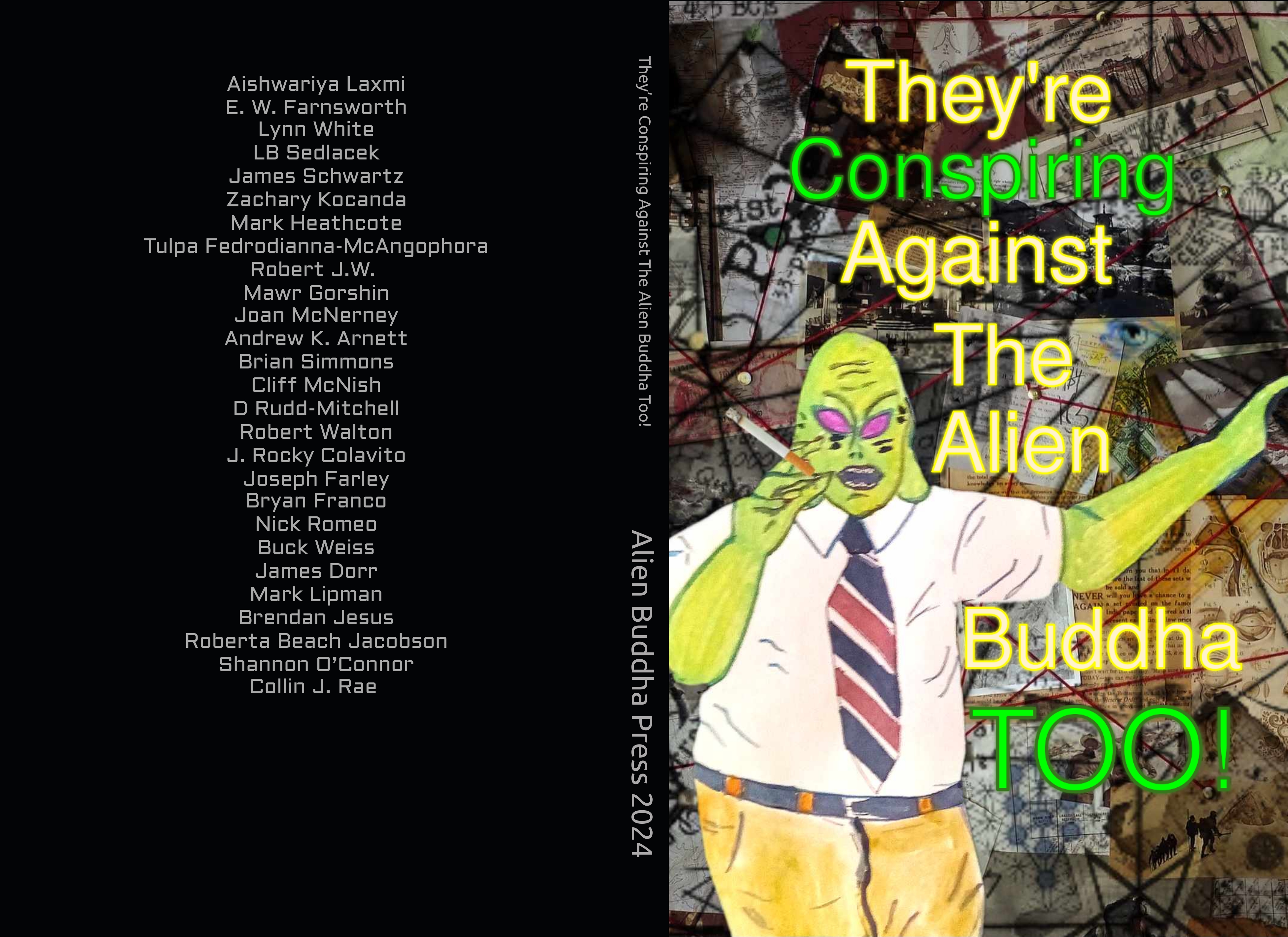
Publication of ‘They’re Conspiring Against The Alien Buddha Too!,’ by Alien Buddha Press, on July 4th

This is to announce the publication of a new anthology of short stories about conspiracies, called They’re Conspiring Against The Alien Buddha Too! It’s being published by Alien Buddha Press, the same people who published–in a poetry collection–a few poems of mine, namely ‘Gaza’ and ‘Stomping,’ and who will publish my novella, The Targeter, in a few weeks, too.

In this particular anthology of short stories, I have one included, called ‘The Harvest.’ Other writers in the anthology are Aishwariya Laxmi, E.W. Farnsworth, Lynn White, L.B. Sedlacek, James Schwartz, Zachary Kocanda, Mark Heathcote, Tulpa Fedrodianna-McAngophora, Robert J.W., (my story comes next in this order), Joan McNerney, Andrew K. Arnett, Brian Simmons, Cliff McNish, D. Rudd-Mitchell, Robert Walton, J. Rocky Colavito, Joseph Farley, Bryan Franco, Nick Romeo, Buck Weiss, James Dorr, Mark Lipman, Brendan Jesus, Roberta Beach Jacobson, Shannon O’Connor, and Collin J. Rae.

I want to thank Red, Dave, and any- and everybody else involved in Alien Buddha Press for including ‘The Harvest’ in this publication. Remember, Dear Readers, to check out this book on Amazon on the 4th of July, a date so easy to remember!

Analysis of ‘Kin-dza-dza!’

Kin-dza-dza! is a 1986 Soviet film directed by Georgiy Daneliya, and written by him and Revaz Gabriadze. A dystopian science fiction black comedy, it stars Stanislav Lyubshin, Levan Gabriadze, Yury Yakoviev, and Yevgeny Leonov.

In 2016, the British movie magazine, Little White Lies, described Kin-dza-dza! as a cross between Mad Max, Monty Python, and Tarkovsky, saying the film is still relevant. The same year, Russia Beyond said that Russians still love the film. Three years earlier, an animated remake of the film was done by Daneliya, called Ku! Kin-dza-dza! The cartoon won Best Animated Feature Film in the 2013 Asia Pacific Screen Awards.

Here is a link to quotes from the film in English translation, and here‘s a link to the complete film with English subtitles.

I see this film as not only relevant for our times, but also prophetic in how the planet Pluke, in the Kin-dza-dza galaxy–to which the Russian and Georgian protagonists, respectively Vladimir Mashkov, or Uncle Vova (Lyubshin), and Gedevan Alexandrovitch Alexidze, or the Fiddler (Gabriadze), are teleported–is representative of the capitalist world, as contrasted with the Soviet world from which the two originate.

Now, as of the making and release of Kin-dza-dza!, which had been achieved by December of 1986, Mikhael Gorbachev had not yet implemented his policies of perestroika and glasnost as an attempt to put an end to the ongoing economic stagnation that had begun during the Brezhnev years; but he had spoken of the two reform concepts in his report to the 27th Congress of the Communist Party, which occurred from late February to early March that same year.

Gorbachev had given a speech the previous year about the slowing economy, and the perestroika reforms that would come by the end of the 1980s and the beginning of the 1990s included the return of “free market” economics and private property. When Yeltsin took over, not only were these reforms all the more aggressively and brutally implemented, plunging millions of Russians–hitherto used to a planned economy that had provided for their basic needs–into poverty, but attempts to resist the reforms were ruthlessly suppressed.

I bring up this history to show how the film can be seen to have predicted, in allegorical form, the economic and political disaster that the bringing back of capitalism would cause. Despite the economic problems that the Soviet Union was undoubtedly going through in the mid-1980s, most Russians wanted to keep the Soviet system intact; indeed, majorities of Russians since the dissolution of the USSR have consistently said that life was happier then than it’s been since the return of capitalism, and a referendum had been held in 1991, the results of which said that the majority of Russians had wanted to keep the Soviet system.

So, when Russians in the mid-1980s were hearing Gorbachev’s talk of economic, market reforms, the instincts of many of them must have been warning them of the danger of his reactionary talk. Recall Stalin’s words in this connection: “What would happen if capital succeeded in smashing the Republic of Soviets? There would set in an era of the blackest reaction in all the capitalist and colonial countries, the working class and the oppressed peoples would be seized by the throat, the positions of international communism would be lost.” 

Such is the political background in which we should understand what Kin-dza-dza! is trying to say to us. Uncle Vova’s thoughtless tapping of a button on the teleportation device of the barefoot, alien stranger is like Gorbachev and his followers foolishly allowing themselves to be influenced by the Western capitalists and bringing about the “new world order” that has led to all of our economic and political problems today. For it is that very pressing of the random button on the teleportation device that sends Uncle Vova and the Fiddler from the city centre on Kalinin Prospect in Moscow to the dystopian, desert wasteland of planet Pluke, with its glaring class inequalities.

The story begins with Uncle Vova returning home from work as a construction foreman. He chats with his wife, Lucya (played by Galina Daneliya-Yurkova), about mundane troubles at work. She asks him to go out and buy some bread and noodles, which she earlier forgot to buy, so he goes out to do that.

He arrives at the city square to buy he food, and there he meets the Fiddler, who tells him about the unshod alien traveler with the teleportation device. What should be noted is that, up until our two protagonists’ unwitting teleportation to Pluke, that the world we see around them, Moscow, is a perfectly normal society, without Pluke’s deprivation. Furthermore, the alien traveler, barefoot, scruffy, and as lost as a fish out of water, makes one think of a homeless man, which is fitting given that, as an outsider to the Soviet Union, he is representative of the capitalist world.

Now, the sight of our two protagonists stuck in a strange desert, actually a desert planet, reminds me of R2-D2 and C-3PO on Tatooine. The arrival of Uef (Leonov) and Bi (Yakoviev) in their flying vehicle suggests the Jawas, though these latter two have little, if anything, in common with the short, hooded droid thieves.

I’m not saying that the filmmakers intended these similarities with the early scenes of the first Star Wars movie, but the coincidental parallels between Pluke and Tatooine are meaningful in how they illustrate that the two desolate, desert planets are reflective of how capitalism sucks the life out of a place’s ecology. On Tatooine, Luke helps his uncle and aunt use moisture vaporators to produce water; on Pluke, fuel is called “luts,” and it’s made from water, so drinking water is a rare and valuable commodity.

The two droids unwittingly land on Tatooine to escape from the Galactic Empire, and they’re chased by imperial stormtroopers. Uncle Vova and the Fiddler have been thrust upon Pluke, and they’ll have to deal with the planet’s “ecilopps” (police, spelled backwards), whose bullying nature reminds one of the skeletally-armoured stormtroopers (after all, ACAB). Not yet knowing where he and his Georgian friend are, Uncle Vova comments that they must be in “a capitalist country” when they meet Uef and Bi for the first time, seeing the two Pluke inhabitants do their customary squatting and opening-out of their arms in an act of obeisance to say “ku” (“good”).

This act of obeisance is the first of many signs of a society structured around class lines, hence Uncle Vova’s assumption that it’s “a capitalist country” is not far off the mark. Money, known on Pluke as “chatls,” is hard to come by (note how chatl sounds virtually identical to chattel).

There are two kinds of people who live on Pluke–Chatlainians, and Patsaks; Uef is one of the former, and Bi is one of the latter. A hand-held device called a “visator” determines which of the two kinds of people you are: an orange dot of light on the visator indicates a Chatlainian, or a person of higher social status; green indicates a lower-status Patsak, of whom Uncle Vova and the Fiddler are also determined to be by the visator. Our two Earth visitors consider this discrimination to be outrageously racist; but had they all been on a Patsak-dominated planet, the Chatlainian/Patsak discrimination would have been reversed.

Uncle Vova and the Fiddler are hoping for a ride in Uef’s and Bi’s vehicle, and they offer some of their things (coats, a hat) in exchange for it, since they lack money, chatls in particular. But Uef and Bi begin to fly away in their vehicle without our two protagonists, until Uncle Vova uses a match to light a cigarette, making Uef and Bi want to return. We learn that matches, called “ketse” on Pluke, are among the most valued of commodities.

Since the society of Pluke is a dystopian one, it’s interesting to note that it, as being also a capitalist one, has a number of things in common with the society as depicted in George Orwell’s Nineteen Eighty-Four. The people of Pluke have a limited vocabulary, typically saying “ku” for whatever is good, or saying “kyu,” a mild swear-word for whatever is bad. These two words, as well as such words as have already been discussed above, make up the bulk of their vocabulary. Similarly, in Orwell’s dystopia, the development of Newspeak involved eliminating words in order to limit thought, including ideas potentially dangerous to the Party, such thoughts as being revolutionary. (On Pluke, though, this limited vocabulary seems unnecessary as such, for a plot device in the film gives the planet’s inhabitants telepathic abilities that, conveniently, allow them to converse in Russian and Georgian with our two protagonists!)

Furthermore, where the world of Orwell’s hell is led by Big Brother, a mysterious figure we never directly encounter in the story and who, for all we know, may not even exist, the leader of Pluke, named “Mr. P-Zh,” or “PG” (played by Nikolai Garo), is harmless and simple-minded, as it turns out. The film thus seems to be predicting such incompetent, ineffectual heads of state as Biden.

Now, such comparisons to Nineteen Eighty-Four are useful, since many in the capitalist West would dismiss Kin-dza-dza! as mere Soviet propaganda, while conveniently ignoring Orwell’s novel, as well as the deluge of such things as late twentieth-century Western movies, like Rocky IV, as blatant Cold War anti-communist propaganda. Western propaganda is “the truth,” apparently, not Eastern. How convenient.

That something as mundane and non-extraordinary as “ketse,” or match-like sticks, are among the most valuable commodities on Pluke is a satiric comment on the absurdity of our slavery to pieces of paper that, in essence, are IOUs. Furthermore, “luts,” fuel made from water, which makes drinking water so valuable, sounds like a comment on the petrodollar, as well as one on the ruthless destruction of the environment for the sake of profiting off of fossil fuels. In a fully communist society, there would be products as use values without exchange for money.

Uncle Vova and the Fiddler, however, have no choice but to exchange commodities–their ketse–with Uef and Bi if the former pair are to get the help of the latter pair to get back to Earth. Our protagonists try to exchange ketse for drinking water from some people who run off with the ketse, cheating them.

Uncle Vova and the Fiddler eventually get the idea to perform music in order to earn chatls. Though he’s referred to as “the Fiddler,” he doesn’t actually play the violin he carries around with hm. He was originally trying to find the violinist who’d forgotten to take his instrument when leaving. When the two perform their music, it’s actually Uncle Vova who ends up playing the violin…worse than a child violinist with no ear for music at all. In the Fiddler-as-non-fiddler, we see a satiric comment on Marx’s theory of the alienation of the worker from his labour.

The song that the two men sing, which sounds like some simple Russian folk song of some sort, includes such lines as, “Mama, Mama, what is to be done?” as well as “Winter is no fun,” “I don’t have a coat to keep warm,” and “How shall I live?” The song is all about a needy child asking his Mama for help, like a proletarian making a clamour about his needs.

The performing is typically done in small cages, or, on one occasion, on one’s knees, which should tell you something. The worker struggling to make enough to survive is, essentially, putting on an absurd performance, being an actor trying to please those who pay him, a wage slave caged in the world of capitalism, brought down to his knees. And the acting is all fake, and often it’s not performed very well, as we see of Uncle Vova and his scraping violin bow and his and the Fiddler’s bad singing. The alienation referred to above is enough to explain the poor, insincere ‘performances’ of the working class.

A physical indicator of lowly Patsak status is the wearing of a small nose-bell called a “tsak.” (Note in this connection that “Patsak” is backwards for “katsap,” a derogatory term for a Russian.) Bi would have Uncle Vova and the Fiddler each clip a tsak on his nose, which the two of course do with the utmost reluctance. The wearing of a tsak looks like the film’s commentary on the Nazis making the Jews wear the Yellow Badge, or German gay men wear the pink triangle.

Another indicator of class differences on Pluke is the wearing of differently colored pants: yellow, pink, etc. Uef covets them because, if he can wear those of the higher social classes, Patsaks and Chatlanians will have to do the “Ku!” squat of obeisance for him, the ecilopps can’t beat him up, etc. These colored pants are a social commentary on one’s preoccupation with social status as attained through high fashion.

At one point in the story, when Uef and Bi have enough ketse in their vehicle to buy what they need to get to Earth, they fly away and leave Uncle Vova and the Fiddler with nothing in return. Furious, our protagonists want to send the ecilopps after the two cheats; but they don’t have forty chatls to pay the ecilopps, so Uncle Vova lies that Uef and Bi failed to “ku” in obeisance to P-Zh’s image.

In these acts of dishonesty, we see how a world where money talks results in alienation. When Uef and Bi are apprehended, though, Uncle Vova quickly repents of his false accusation and hopes Uef and Bi won’t be imprisoned, which is particularly unpleasant, since instead of being put in a cell, they are locked up in a small metal box with barely enough room to hold the two of them inside. Given the dreadful state of prison life in the US, especially now, when corporations make practical slaves of the inmates, whose population outnumbers that of the Gulag (and even the CIA back then acknowledged that Gulag conditions weren’t anywhere near as bad as Western propaganda portrays them), we can see Pluke’s form of imprisonment as a comment on life in prison in a capitalist country.

Uncle Vova and the Fiddler are reunited with the barefoot alien they first met on Earth, the one with the teleportation device; he gives our two heroes a chance to return home immediately. Uncle Vova, however, feels guilty about causing Uef and Bi to be incarcerated, and he wants to pass up his chance to go back to Earth in order to help those two unfortunate ones.

Even though Uef and Bi double-crossed Uncle Vova and the Fiddler and made them wear those ridiculous bells on their noses, our two heroes want to help them, even to the point of giving up their chance to go home. While the capitalist world of Pluke teaches selfishness and alienation, leading to Uef’s and Bi’s double-crossing, the socialist world of the Soviet Union taught selflessness and solidarity. Though Kin-dza-dza! might be considered Soviet propaganda, it doesn’t teach its viewers to loathe and despise the citizens of capitalist societies (it may portray them as buffoonish and silly, but Uncle Vova and the Fiddler have their own foibles, too). In contrast, consider the malevolent scowls you see, for example, on the faces of Ivan Drago (Dolph Lundgren), his wife (Brigitte Nielsen), and his trainer and promoter (Michael Pataki) in Rocky IV.

Indeed, Uncle Vova and the Fiddler postponing their return to Earth–even returning to Pluke after a brief trip to other planets on the way home, and going back in time–to rescue Uef and Bi both from their incarceration, and later their fate on planet Alpha to be turned into plants is a kind of selflessness that would remind one of that of the bodhisattva, who postpones entering nirvana upon attaining Buddhahood and returns to samsara to help all other living beings, however unenlightened they may be, to attain nirvana together, a liberation for the entire Earth. Such is the selflessness of the true socialist, who would ultimately share liberation from capitalism with the whole world, not just hog it in his own country.

The planet Alpha is an interesting topic in itself. The people of Alpha have a method of dealing with Uef and Bi–whom they consider miscreants–that may seem cruel (turning them into cacti). Still, since Uef and Bi are governed by “vile desires,” rather like those of us caught up in samsara, then perhaps being transformed into plants, without human sense perceptions and the pain associated with them, is a kind of nirvana for them.

That buffoonish pair might be best left not to decide their own fate (as Uncle Vova would have it), since if left to do so, they’d choose foolishly; still, bodhisattva Vova would leave the nirvana of Alpha and postpone his return to the Pure Land, so to speak, of the USSR and help those two Pluke bumpkins.

After going back in time and back to Pluke, and helping those two, Uncle Vova and the Fiddler reunite with the barefoot man and his teleportation device, and our two heroes finally get sent back to Moscow. We see a repeat of the beginning of the movie, as if their time on Pluke never happened: Uncle Vova comes home from work again, and his wife sends him out to buy groceries.

Back in that city square, he meets with the Fiddler again, but the latter doesn’t tell the former about the barefoot alien this time, because he isn’t there. Our two protagonists don’t even recognize each other: it’s as if they’d never met, let alone got stranded in the Kin-dza-dza galaxy. As we soon learn, though, what happened is really just a repressed memory.

They see a tractor with a flashing orange light pass by. This triggers their by-now-instinctive attitude of submission to the Chatlainian colour, and the two men do their “ku” squat of obeisance.

Their return to the socialist world of the Soviet Union does not render them immune to the classism of the capitalist world as represented by Pluke. This is why reactionary instincts must be guarded against; old attitudes have a way of coming back if we aren’t careful. Just recall how those former Soviets became Russian oligarchs.

Still, one good thing has come from Uncle Vova’s and the Fiddler’s relapse: they now recognize each other, and exchange smiles like good old friends. Uncle Vova then looks up at the sky and hears the voices of Uef and Bi saying “ku” and singing the “Mama” song. They feel united, if only in spirit, with their Chatlainian and Patsak friends once again. Whatever good or ill may happen to us, being reunited with friends is above all else in importance.

‘Primal Scream,’ a Sci-fi Short Story

When the loud, rumbling thud came just a while away from the house where ten-year-old Ted lived on his parents’ farm, he shook even more than the ground did. He turned off the TV, rose from the living room sofa, and ran out the front door to see where the thud had come from.

He ran across a field of wheat, a rolling hill just by the house. At the far end of the field he saw a huge rock that hadn’t been there before.

That must’ve been what made that shaking, and that noise, he thought as he kept running towards it.

When he finally reached the rock, he tumbled and fell right on it, smacking his hands and knees against it. He looked down at his knees, which hurt; his jeans were cut there, with bloody cuts on both knees.

“Ow!” he grunted. “Mom and Dad are gonna kill me when they see these holes in my pants.”

Suddenly, he felt a stinging burn on his left hand, making him wince and pull his arm off the rock. It felt like a spark that had flown out of a campfire and hit him on the hand; but he looked at his hand and saw no mark. Whatever it was, it had to have been too small to be visible, or it had left as quickly as it got there.

He looked back at the rock. His eyes could barely make out something on it, thousands of things that, each taken individually, would have been as invisible as whatever had come onto his hand, but all together, looked like a kind of mist, or many wisps of hair. They seemed to be making a buzzing sound, as if they were insects.

He found the sound disturbing, and he began to worry that he might have caught germs and would get sick from the rock, so he let himself fall back onto the grass to distance himself from the rock, then he got up and ran back in the direction of the house.

He saw his mom’s and dad’s pickup truck coming in on the driveway. They’d just come back from shopping in town.

They got out of the truck and saw him running across the field, stomping on the wheat.

“Look at that dumb kid!” his dad shouted. “He’s running on my wheat again! Get outta there!

He turned to his left and ran off the field to the gravel road and went along that to get to the house. “Mom! Dad!” he shouted in excitement. “Did you see the big rock in the field?”

“What nonsense are you blabbering about now?” his mom said while taking two bags of groceries out of the truck. Then she and his dad took a look far out across the field. Her eyes widened. “Oh, my God. What do you think that is, John?”

“A meteor?” John said. “Fell from out in space, do you think, Jean?”

“Looks that way,” Jean said. “You didn’t go up and touch it, did you, Ted?”

He looked down at his feet. “Yes, I did.”

“You stupid kid,” she said. “And look at what you did to your jeans! And those cuts on your knees! You’re all filthy dirty. You’re gonna need a bath. Oh, you’ve always gotta find more work for me to do, don’t you?”

“I’m sorry,” the boy said softly.

“Get in the house, boy,” John said.

Ted went with his mother straight to the bathroom. She got his bath ready as he got out of his clothes. Both of them were frowning the whole time.

With the bathtub full of sudsy water and Ted naked and ready to go in, she turned around to look at him. “OK, Ted, get in the w…oh, my God!”

His skin was all a yellowish-green.

His eyeballs were yellow.

His blond hair had all turned grey.

“What the hell did you do, boy, getting so close to that meteor?” she shouted. “Such a stupid kid, always doing the wrong thing! What the hell is wrong with you?”

His father heard his mom’s shouting, then he ran from the living room and over to the bathroom. He saw his immobile, naked son…with that yellowish-green skin.

His eyes widened, and his jaw dropped.

“Oh, my God!” John said. “You stupid kid!”

“Normally, I’d beat your ass for doing such a stupid thing, but I’m afraid I’ll catch whatever disease you’ve got,” she said. “I’m scared to bathe you, as you are. I’m afraid to be near you. We’ve got to get you to a hospital. Get your clothes back on. There you go again, boy, giving me more work to do!”

Ted just stood there, still and morose.

“Well, hurry up, boy!” John shouted. “You heard her.”

He walked around to look his son in the face.

He saw that sullen expression on the boy, his eyes looking up at his father as if he’d like to kill him.

“Don’t you be lookin’ at me like that, boy!” his father shouted. “I got a good mind to smack you!”

“Don’t touch him, John,” Jean said. “You might catch whatever he got from that meteor.”

Then Ted looked at her in the same, threatening way.

“Hey, don’t you be looking at your mother that way,” she said. “You’re lucky I don’t smack you.”

He continued looking at both of them hatefully.

“I told you to stop it, boy!” she shouted.

“Stop looking at us that way, you little brat!” John said.

Ted kept the scowl on his face. It was even meaner now.

“Stop it!” his parents shouted.

“NO, YOU STOP IT!” he screamed. “YOU TWO ARE ALWAYS MEAN TO ME! YELLING AT ME, CALLING ME STUPID, SAYING I MAKE MORE WORK FOR YOU! YOU DON’T LOVE ME! I HATE YOU! I HATE YOU! I HATE YOUUUUUUU!!!

As he was screaming, a kind of toxic energy was emanating from his body and penetrating theirs. They couldn’t react in any way except to shake and tilt back with their eyes wide open and their jaws dropped in horror.

Ted kept screaming, but with no more words. He was just letting out unmitigated rage and pain.

John’s and Jean’s bodies were changing now, hardening. They were both petrified as physically as they were emotionally. They soon stood as still as glass statues.

Ted looked at them and smiled.

He let out one last, long scream.

Those statues fragmented and crumbled to the floor in two piles of rock-like pieces.

He smiled an even wider smile.

Then he got in the tub of water and bathed himself. After finishing his bath and drying himself off with a large towel, he left the bathroom, went into his bedroom, and put on a clean set of clothes.

He made himself a sandwich and ate it while watching the TV in peace. When the sun went down, he went to bed, thinking about how he could use his new power on the bullies at school.

He slept like a baby.

When he left for school the next morning after fixing himself a bowl of cereal, he’d never once looked at himself in the mirror. He didn’t care how he looked.

Walking on the gravel road all the way to school, he didn’t care how tired he was or how sore his legs were. He didn’t miss getting a ride to school in his parents’ truck at all. His eyes were looking around everywhere on that road, watching out for bullies. This wasn’t out of fear, of course; on the contrary, he couldn’t wait to run into some of them.

About two-thirds of the way there, and having walked for about twenty tiring minutes, Ted saw two bigger boys, Rod and Barry, walking on the road on the way to his school. He smiled at the sight of them, but not because he considered them friends.

The two boys look one look at Ted and froze.

“Holy shit!” Rod said. “What the fuck happened to you, Ted?”

“What a freak!” Barry said. Both of them started laughing at Ted.

Smiling, Ted walked closer to them.

“Hey, stay away from us, you freak!” Rod said. “We don’t want your germs.”

Ted kept coming closer, the smile never leaving his yellow-green face.

“I mean it, you frog-boy, stay away!” Rod said. Both boys picked up rocks.

Ted kept coming at them.

“Stay the fuck away!” Barry said, and both of them started throwing the rocks at Ted.

Barry’s rock hit Ted on the shoulder, and Rod’s hit him on the forehead. Ted’s smile turned into a frown.

“Aww, look,” Barry said. “He lost his smart-ass smirk. I’ll bet he’s gonna start cryin’ for his mommy.”

The boys picked up some more rocks, choosing bigger ones.

Ted stayed where he was, only a few feet away from the boys.

“You’d better start runnin’, freak,” Rod said. Both boys, with rocks in their hands, raised their arms up, ready to throw.

As soon as their arms were backed up to throw the rocks at Ted, he opened his mouth wide.

“AAAAAAHHHHHHH!!!!” he screamed.

The boys dropped their rocks and plugged their fingers in their ears, though it did them little good. They were shaking all over. Who would have thought that the little twerp could have been so terrifying all of a sudden?

“WHY DON’T YOU PICK ON SOMEONE YOUR OWN SIZE, YOU BULLYING BASTAAAARDS!!!

The two boys looked down at themselves in horror and disbelief as they saw their bodies hardening. The screaming was so ear-splitting that their whole heads were stinging with the sharpest pain, yet they had no hope of going deaf.

“YOU THINK YOU’RE SO TOUGH, YOU ASSHOLES?!” Ted continued. “YOU’RE A COUPLE O’ COWARDS, PICKING ON LITTLE KIDS! I HATE YOUUUUUU!!!

The statues that the two boys had become now shattered into hundreds of tiny pieces that scattered all along the road. With a little wind blowing them about, they’d become indistinguishable from the rest of the gravel. The boys’ clothes and schoolbags fell to the ground.

Ted looked at their remains and grinned.

“I’m so powerful,” he said, then continued toward school.

When he got to the gate surrounding the play area beside the small, one-storey school, where all the kids were out playing, some of them noticed him, shuddered, and pointed him out to their friends. Within a few seconds, all the kids started screaming.

“TED’S A MONSTER!!!”

“HE’S SO UGLY!!! DISGUSTING!!!”

“HELP US, SOMEBODY!!!”

Since Ted had never bothered to get a good look at himself in a mirror at home, he didn’t understand why everyone was calling him ‘freak’ and ‘ugly.’ All he knew was that those words hurt.

So he decided to do some screaming of his own.

“WHY DOES EVERYONE HAVE TO BE SO MEAN TO ME? WHY CAN’T I HAVE ANY FRIENDS? NO ONE LOVES ME! NO ONE ACCEPTS ME AS I AM, AND I’M SICK AND TIRED OF IT!!!

Every child in that playing area, and every teacher there or coming out there to hear what all the screaming was about, froze in his or her tracks, trembled at the deafening noise and the toxic energy radiating from the boy, and became emotionally and physically petrified.

He let out one more scream, and all those glass-like statues shattered all over the grass.

Ted himself was shaking with rage and poisonous hatred. He walked with stomping feet into the school. The remaining staff of the school, who were still alive but terrified by the superhuman volume of Ted’s screaming outside, just stood still where they were, shaking as they heard his approaching, stomping feet.

A few of them in the main hall saw him and gasped at how inhumanly green he looked.

He looked in their horrified eyes with a scowl.

“SO, YOU ALL HATE ME TOO, EEEEEEHHHHH!!!

With that long scream, they all froze and hardened.

He took a deep breath, then, “AAAAHHHH!!!”

Their bodies all blew up, the pieces spread all over the floor.

Now burning with hate, he went through room after room, checking to see if anyone at all was still alive. All he saw of humanity were scattered fragments of petrified pieces of former people.

“Good,” he grunted. “They’re all dead.”

Then he walked by a mirror and saw himself.

Not only did he have that yellow-green skin, the yellow eyes, and the greyed hair; his teeth, bared in his rage, were blood red, as if he’d just eaten an animal. He had green, wart-like spots all over his skin. Worst of all, he knew why he looked this way.

It wasn’t so much his exposure to the meteor.

It was all of his built-up rage and hate.

He couldn’t stand to see how he looked.

He hated all the more the person he’d become.

No better than John or Jean.

No better than the school bullies.

Much worse, in fact.

“AAAAAHHHH!!! I’M A MONSTER!!!”

He froze into a statue.

Ten minutes later, a six-year-old girl walked into the hallway, crying.

“Everybody’s dead,” she sobbed. “My teachers, my friends, all my classmates. They’re all just…broken little pieces. Why?”

Then she saw Ted’s green, deformed statue. She got up close to it. She saw his agape, red mouth and widened, yellow eyes. Her own mouth and eyes widened.

“AAAAAHHHH!!!” she screamed.

His statue shattered.

She trembled at the reaction, but stayed where she was.

“Oww!” she yelped at a slight burning feeling on her arm.

Analysis of ‘Brain Salad Surgery’

I: Introduction and Cover

Brain Salad Surgery is ELP‘s fourth studio album, released in late 1973, after the prog rock supergroup‘s eponymous debut, Tarkus, the live album Pictures at an Exhibition, and Trilogy. It was produced by singer/bassist/guitarist Greg Lake, as were all of the trio’s previous albums.

Though it initially got a mixed critical response, Brain Salad Surgery‘s reputation has improved over time. It had always been a commercial success, reaching #2 in the UK and #11 in the US; it eventually went gold in both countries.

Here is a link to the full album, and here‘s a link to all of the lyrics.

HR Giger‘s superb album cover gives a vivid visual representation of the album’s central theme of duality–male vs female, man vs machine, and good vs evil. The male/female duality is represented by the woman’s face in the circle in the middle of the cover; under her chin is the end of a phallus pointing up along her neck, the rest of the phallus being represented, outside the metal circle, by a short cylinder and a circle with ELP representing the balls. The record company insisted on removing the phallus for obvious reasons, so on early releases of the album, one instead saw it airbrushed away and replaced with a…shaft…of glowing light.

The album’s title–derived from the lyrics to Dr. John‘s “Right Place, Wrong Time” (released earlier the same year), and replacing ELP’s working title, Whip Some Skull on Ya–is a reference to fellatio, hence the phallus just under the woman’s face…and the skull at the top.

The cover originally opened up, like two front doors to a building, to reveal the whole head of the woman with her eyes closed, as opposed to seeing the skull’s eyeholes over her when the cover is closed, indicating the dualities of life and death, good and evil, and man and machine.

II: Jerusalem

Side One begins with two tracks that are adaptations of other composers’ works, something the band had done several times before, as with pieces like “The Barbarian” (based on Bartók‘s Allegro barbaro for solo piano), “Hoedown,” by Aaron Copland, and the aforementioned piano suite by Mussorgsky. As for track one of Brain Salad Surgery, ELP did an arrangement of a hymn by Hubert Parry, who set William Blake‘s poem, “And did those feet in ancient time” (from the epic, Milton), to music.

Jerusalem” was released as a single, but it failed to chart in the UK; actually, the BBC banned this ‘rock’ version for potential “blasphemy” (despite how reverent the band’s arrangement was). Apart from being understood as a religious song, “Jerusalem” is also considered patriotic to England, even proposed as the national anthem.

Now, the long-held modern assumption that Blake’s text is based on an apocryphal story–about Jesus walking on English soil during His lost years–is unlikely to be true, because no such story existed, apparently, before the twentieth century; instead, Blake’s text is based on a story that it was Joseph of Arimathea who allegedly went to England to preach the Gospel there. I find such an interpretation hard to follow, though, since the text explicitly refers to “the holy Lamb of God” and “the Countenance Divine” being in England.

In any case, the notion that the feet of Christ (or those of Joseph of Arimathea, for that matter…whichever) sanctified English soil by treading on it is jingoistic nonsense that actually turns the meaning of Blake’s poem into its opposite. The key to understanding the text is not “England’s green and pleasant land,” but rather “these dark Satanic mills,” referring to the early Industrial Revolution and its destruction of nature and human relationships, or to the Church of England and how it imposed conformity to the social and class systems.

People who see patriotism and conventional Christianity in Blake’s poem are blind to his irony in using Protestant mystical allegory to express his passionate advocacy for radical social and political change. He wasn’t saying that Jesus walked in England, thus making it ‘the greatest country in the world,’ and worthy of global domination. He was asking if Jesus went there, where the “dark Satanic mills” would later be found.

That he meant such a visit seems unlikely, but if the visitor was Joseph of Arimathea, at least he would have done a proselytizing of the primitive Christianity of the first century AD, not that of later centuries, with the corrupt Catholic or Protestant Churches of Blake’s time, those that subjugated other lands and justified their imperialism with their ‘superior, civilized’ religion.

Blake says he “will not cease from Mental Fight” (my emphasis), meaning his moral struggle with the powers-that-be, the industrial capitalists who used religion as Marx would later call “the opium of the people” to maintain social control in the interests of the ruling class. Blake’s bow, arrows, spear, and sword are metaphors for all he would use to bring about revolution and social justice (his metaphor for these being “Jerusalem”) in England; they were never meant to aid in the building of empire, much to the chagrin of the British patriots who want to read his poem in that way. Even Parry grew disgusted with the jingoistic misuse of his hymn.

This ironic surface patriotism and conformist piety as cloaking Blake’s real revolutionary social critique plays well into the theme of duality–good vs evil–on Brain Salad Surgery. Similarly, it’s fitting that keyboardist/composer/arranger Keith Emerson should have done an adaptation of Parry’s musical setting, one with the usual Emersonian pomp embellishments, but still reverent to the piety of Parry’s music. For again, such a musical style, soon to be contrasted sharply with that of the next track on the album, is a part of the good-vs-evil dualism of Brain Salad Surgery.

III: Toccata

The “dark Satanic mills” of the first track seem to be vividly depicted, in musical form, in this next ELP adaptation of a composer’s work, this one being the fourth movement of the first piano concerto of Argentinian modernist composer Alberto Ginastera. The movement is titled toccata concertata, hence the name of ELP’s adaptation.

Unlike the trite harmony of Parry’s work, this one is violently dissonant, something accentuated by Emerson’s use of raspy synthesizer sounds. Indeed, the dissonance of this adaptation makes King Crimson sound like the Bay City Rollers in comparison.

Another valid comparison of ELP with King Crimson, as far as this second track is concerned, is how we hear a push towards the most state-of-the-art technology. Recall how the 1980s King Crimson used guitar synthesizers, the Chapman stick, and Simmons electronic drums. “Toccata” boasts (as does “Jerusalem”) the use of the very first polyphonic synthesizer, the Moog Apollo, and eight specially developed drum synthesizers, used in the track’s middle percussion section, arranged by drummer/percussionist Carl Palmer.

Again, this use of the latest technology of the time, as mixed in with more conventional instruments and singing, reflects the album’s theme of dualism–in this case, the dualism of man vs machine.

I’d like to do a comparison/contrast of Ginastera’s fourth movement with ELP’s adaptation. I won’t cover every detail, as that would be too difficult and tediously long; so I’ll point out and compare/contrast a number of highlights. (Here is a link to the entire piano concerto, with a video of the score; move it ahead to about 18:50 to get to the fourth movement.)

ELP’s adaptation adds a considerable amount of material to Ginastera’s piece (as well as removing much of it), including of course the percussion section in the middle, as I mentioned above. Another addition is at the beginning, with Emerson playing a synthesizer, and Palmer hitting tympani.

Emerson plays a motif of B-flat, E, E-flat, and A, then Palmer hits A, A, A, and C. Then Emerson plays the same notes again, a bit faster, adding a C and an A, and Palmer does a short roll on A. Emerson goes up an octave to play the same first opening four notes, and Palmer does another, longer roll on A. Emerson, still in the higher octave, plays the notes faster, with the added C and A, and Palmer doesn’t another, still longer, crescendo roll on A.

Next, ELP’s adaptation converges with Ginastera, but with the latter’s arrangement of the B-flat, E, E-flat, and A motif played predominantly on horns, with all the notes sustaining in a swelling dissonance, while Emerson plays the notes on his synthesizer, intensifying the tension by adding a raspy, grating tone to it. The motif is played as I described above, then transposed an octave and a semitone higher to give B, F, E, and B-flat.

ELP come in with Emerson on organ, Lake on bass, and Palmer on drums. In Ginastera’s original, we hear pounding dissonances on the piano in 3/4=6/8 time, with the fourth bar in 5/8 time as an exception.

With the piano beginning in octaves of E in the bass, the orchestra is playing a cluster of eighth notes in A, B-flat, and E-flat. The E-flat goes up to a G-flat (with the E in the bass going down to a C-sharp with the G-flats), then back to E-flat, up and down and up and down. These movements up and down occur at irregular times, creating the illusion of odd time signatures, but Ginastera’s score has the whole passage in the same 3/4=6/8 time. The playing sounds fairly subdued in Ginastera’s original, but Emerson’s organ gives the passage a fiery extroversion.

The next passage has piano playing in the bass, whereas ELP’s version has Emerson playing it on synthesizer. A beginning in F and E leads to the opening motif of B-flat, E, E-flat, and A, then ending in another swelling dissonance reminding us of the opening one, but transposed a whole tone higher, giving us C, F, G-flat, and B (reverse the second and third notes to see the exact parallels). In Ginastera’s original, these notes are heard in the orchestra, predominantly the brass; in ELP’s version, Emerson does it on the synth, ending with that rasping sound again.

Next, a tune with a galloping rhythm, starting off with eighth notes going back and forth in F-sharp and A, then going to F-sharp, B, B-flat, C, A, F-sharp, and E, is heard on the strings; Emerson plays it on the organ. These seven eighth notes are heard three times, accented in a way that gives the listener the impression of 7/8 time, but again, Ginastera’s score notates it all as 3/4=6/8 time.

The up-and-down of F-sharp and A continues for a while, then we hear a five-note ostinato of B, A, F-sharp, E, and F-sharp, which grows dissonant with the addition of the horns, and ends with the piano playing a descension in octaves. ELP’s version ends the five-note ostinato, played on the organ, with more dissonant, angular synthesizer.

More of a galloping rhythm is heard in piano chords (on organ in the ELP version); this leads to more galloping, but with switches from 3/4=6/8 time to a bar of 5/8–this happens twice, then it returns to the regular 3/4=6/8 time. Again, what is piano in Ginastera is organ in ELP. Also, Ginastera’s version develops this switching of the time from six to five, while ELP’s version brings the tension to a climax with organ chords featuring a tritone of E and B-flat. Palmer also plays this tritone on the tympani.

Later on in Ginastera’s score, we hear a variation on the passage mentioned earlier, the cluster of repeated eighth notes, the top of which is the E-flat that goes up to the G-flat, then down, and up and down at irregular times. This time, however, the notes are a second-inversion A-minor triad with A-flat and C-flat in the bass. The top C-natural will go up to an E-flat, and down and up and down, in the same irregular pattern as with the E-flat and G-flat before. We hear the orchestra, predominantly strings, doing this; ELP’s version has the organ doing it.

After this, the piano does more galloping rhythms, with a few dissonant seconds thrown in here and there. Later, the piano does more developments of that passage with the time changes back and forth between six and five as discussed above, with an additional bar of 7/8 sandwiched in the middle. This passage isn’t in ELP’s version, which skips ahead in Ginastera’s score to bar 200.

Here, the galloping rhythm is done on pizzicato strings, starting with E-flat and G-flat going up and down in the bass clef. Then we hear E-flat, G-flat, A-flat, and A-natural three times before transposing the first two notes to A-natural and C. Emerson plays this line on the organ, but develops it further before going to the next passage.

A French horn plays A, D, G, and G-sharp, then A, E-flat, D, D-flat, G, and G-sharp, etc. Emerson plays this line on a synthesizer an octave higher. After this phrase, Ginastera has us hear five pairings of eighth notes of a minor second (C-sharp and D), with groupings of two to three eighth rests in between the first, second, third, and fourth pairings of those notes. They’re played softly in his score, but Emerson plays this rhythm as stabbing, loud organ dissonances.

A trumpet plays F, B, B-flat, and E three times; this leads to a climactic, dissonant passage. ELP’s version builds up this tension much more, right from the beginning of this passage, on the synthesizer. Ginastera does glissandi down and up on the piano; Emerson does a downward glissando on the organ.

At bar 240, the piano plays octaves in C, F-sharp, F-natural, and B, a restatement of the opening motif, but transposed up a whole tone; Emerson plays this on the synthesizer, using it to embellish the dissonance further and bringing this tensely climactic moment to raspy near-chaos, leading to Palmer’s percussion section. Ginastera’s original, however, further develops these themes on the piano, coming soon to the end of the movement.

Palmer pounds away on the tympani for a while, striking a gong here and there. This comes to an end, then we hear the soft hitting of A and C on the tympani, and on both tympani and tubular bells. Emerson plays three soft, dense chords on the piano as this passage comes to the end.

Next comes a passage with Lake playing electric guitar, with Palmer in the background hitting the tympani. Lake is playing, among other things, variations on that opening motif of sharpened tonic, fifth, flattened fifth, and tonic an octave higher.

The climax of the percussion section is Palmer showing off with a solo on his drum kit that features the drum synthesizer, and all the flashy, extraverted electronic sounds it can make.

After this, ELP ends their adaptation with a reprise of the section starting with A, D, G, G-sharp, etc. (i.e., the French horn line in Ginastera’s original). Again, Emerson intensifies the dissonant tension with that raspy synthesizer in ways totally different from the dissonant tension ending Ginastera’s original.

Both pieces end more or less the same way, with twelve sets of eighth notes of a dissonant chord played molto sforzatissimo, by the orchestra in the original, and on the organ in ELP’s version. The band played their recording of the adaptation for Ginastera in order to get his permission to publish it. The composer gladly gave it, describing ELP’s adaptation as “Diabolic!” and “Terrible!” These words were meant as compliments, though, for he felt that ELP had captured the mood of his music as no one else ever had.

That this music is “diabolic” makes it a perfectly dualistic contrast to the ‘piety’ of “Jerusalem.” Hence, we can see these two adaptations as thematically fitting within the context of Brain Salad Surgery as a whole. An outward appearance of trite piety masks the evil inside.

(Incidentally, a piece I composed years ago, my Divertimento for Strings, has a third movement, presto furioso, that is inspired by ELP’s adaptation of Ginastera’s toccata concertata, though I must insist that I used all my own notes and themes, not theirs. If you’re interested, please check it out.)

IV: Still…You Turn Me On

Lake was always sure to include an acoustic guitar ballad on every ELP album, and Brain Salad Surgery is no exception. Earlier, and in my opinion, far better examples of such ballads are “Lucky Man” and “From the Beginning.”

A curious thing about Brain Salad Surgery is how the musical style jumps all over the place. Normally, one tries to find a reasonably consistent style from track to track, but on this album, ELP seemed to be deliberately going as far in the opposite direction as possible. The album has a hymn, a violently modernist piece, a syrupy love ballad, a honky tonk piano farce, and a sci-fi epic–part standard prog, part jazz/piano sonata.

As far as I’m concerned, the only way to see unity in such musical and lyrical disunity is to hear it in terms of dialectical dualism, of finding a paradoxical unity in opposites. So, in these opening three tracks, we have the sentimentality (thesis) of Lake’s ballad, the brutal ugliness (negation) of the Ginastera adaptation, and the ironic piety masking evil (sublation) of the Parry/Blake adaptation. That Lake’s ballad is a love song also gives us the duality of male and female, some romanticized brain salad surgery? After all, he is turned on.

The instrumentation of the ballad reflects the man-vs-machine duality, in that on the one hand, we hear the human voice, Lake’s acoustic guitar, and Emerson’s harpsichord, but on the other hand, there’s Emerson’s synthesizer and Lake’s electric guitar leads played through a wah-wah pedal.

V: Benny the Bouncer

This song has lyrics written by Lake and Pete Sinfield, a colleague of Lake’s back when both of them were members of the original King Crimson back in 1969 and 1970. Lake would return the favour by helping Sinfield release his solo album, Still, on ELP’s new Manticore record label, as well as contributing vocals and electric guitar on it. Sinfield would also contribute lyrics to Side Two of Brain Salad Surgery, as we’ll soon see.

“Benny the Bouncer” manifests the album’s theme of duality in two ways: first, the use of synthesizer at the beginning, and the use of vocals and honky-tonk-style piano suggests the man-vs-machine motif; second, the light-hearted nature of the music, as juxtaposed with a story about a fight and a violent murder, gives us the duality of good vs evil, or light vs dark.

Benny is already understood to be a bloody, violent sort: “He’d slash your granny’s face up given half the chance,” as Lake sings in his affected Cockney. “Savage Sid,” however, is much meaner. First, he spills his beer on Benny’s boots to test him, then when the two fight, Sid sticks Benny with a switchblade, and Benny ends up with “an ‘atchet, buried in [his] head.” He’s dead now, and “he works for Jesus as the bouncer of St. Peter’s gate.”

All of this fighting, of course, is a reflection of the alienation found in an oppressive, dystopian society, the subject of the epic coming next, “Karn Evil 9,” the real thematic focus of Brain Salad Surgery.

VI: Karn Evil 9, 1st Impression

“Karn Evil” is a pun on carnival; this title for the sci-fi epic was suggested by Sinfield–due to the festive, carnival-like nature of the music heard in the “See the show!” sections of this movement, or “impression”–as a replacement for the originally intended title, “Ganton 9,” a fictional planet on which all evil and decadence has been put.

“Karn Evil” also reflects duality in the sense that the ‘carnival’ show of decadent displays is a pleasing, entertaining diversion (the ‘good’) from the evil and oppression really going on in this dystopian world. Indeed, this epic has real relevance in our world today, in the 2020s, in which such breads and circuses as the Super Bowl, Taylor Swift, OnlyFans, and photos of string-bikini-clad beauties plastered all over our Facebook feeds distract us from such problems as extreme income inequality, escalating wars, a media controlled by the super-rich, and the ongoing genocide in Gaza.

As for “9,” apart from “Ganton 9,” the meaning of this number could be seen in a subdivision into three of each of the three “impressions.” We all know, of course, about the division of the 1st Impression into two parts, because its length had to be spread over two sides of the original LP. One could, however, divide this impression further–namely, at the break between Lake’s singing of “Fight tomorrow!” and “Step inside, hello!”, or, between the frankly dystopian opening lyrics and the ‘carnival’ section about the “most amazing show.” Hence, three parts for the 1st Impression.

As for the 2nd Impression, it can easily be subdivided into three by virtue of its fast-slow-fast sections, like a short, three-movement piano sonata. The 3rd Impression can be divided in terms of the storyline as given by the lyrics: before the war, from the beginning to “Let the maps of war be drawn”; the middle, five-minute instrumental section and keyboard solo, as dramatizing the war; and the outcome of the war, from “Rejoice! Glory is ours!” to the end.

Anyway, part one of the 1st Impression begins with Emerson doing some contrapuntal playing on the organ. As Lake is singing the first verse, Emerson is playing dark, eerie bass notes on the piano while Palmer is hitting a cowbell.

This first verse establishes the dystopian world of the story, a dystopia disturbingly similar to our own world of the 2020s, “about an ago of power where no one had an hour to spare.” Those who have the power, the capitalist class, ensure that none of us, the working class, have much of any free time, because we’re all overworked and underpaid.

“The seeds have withered” because of environmental damage caused by prioritizing profit over the health of the planet. “Silent children shivered in the cold” because ‘free market’ capitalism has failed to provide for the needs of the poor, rendering so many of them homeless and unheard (“children” here isn’t necessarily to be taken literally; they can be also children in the metaphorical sense of being vulnerable and helpless).

The common people suffer like this because of “the jackals for gold,” or the greedy capitalists. “I’ll be there” to help when the revolution finally comes.

The working class have all been betrayed and silenced by the advocates of neoliberal, ‘free market’ capitalism (whose prophets, including the likes of Milton Friedman, were already making their promises of plenty in a world of ‘small government’ as of 1973, the year Brain Salad Surgery came out, thereby making “Karn Evil 9” prophetic, as I see it). The riot police of the ‘small government’ have “hurt…and beat” the people who try to protest the injustices they’ve been subjected to.

Everyone, working several jobs just to have enough to pay his or her bills, food, and rent, is “praying for survival,” but “there is no compassion” for those who cannot leave this miserable world–these are the homeless, whom it’s against the law to feed, and who suffer anti-homeless architecture and benches.

He, in whose voice Lake is singing, begs for a leader who will rise up and save the world from oppression, who will “help the helpless and the refugee”–that is, the impoverished and those displaced by war in ravaged places like Libya and Syria, or by genocide in Gaza. Again, he says he’ll “be there…to heal their sorrow.”

Next, we have the instrumental break that, in my opinion as described above, divides part one from the real part two of the 1st Impression (the “part two” of this impression beginning on Side Two of the LP being, in my opinion, ‘part three’ in actuality). We hear a tight riff in alternating 6/8 and 4/4, led by a synth melody; this tune will be heard again on Side Two in part two (or ‘part three,’ as I’d have it), but it will all be in 4/4.

This instrumental continues, with more time changes and synthesizer soloing, until it segues into the ‘carnival’ themes and ‘part two,’ as I conceive of it. Now that the dystopian world has been established, we will learn of how the powers-that-be are distracting the people from their oppression with “a most amazing show.” We can relate to this aspect of the story today, with all of the entertaining nonsense we see on TV and social media, distracting us from the horrors of the real world out there.

Those in power have always used two ways of keeping the masses under their control: the carrot and the stick, two seemingly opposed tactics, but actually just opposite sides of the same coin, since they both serve the same political purpose. The world government of Huxley‘s Brave New World uses the carrot of pleasure (sex, drugs, etc.) for social control, whereas the totalitarian government of Orwell‘s Nineteen Eighty-four uses the stick of coercion and bullying for the same purpose.

“Karn Evil 9” opens with an exposition of the dystopian stick, and with the “most amazing show,” we have the carrot. In our world, TV and social media are our carrot, meant to distract us from the stick of riot police and standing armies that imperialistically oppress the world. In cyclically abusive relationships, the carrot and stick represent traumatic bonding.

Those who “come inside” to “see the show” are the industrial working class, for they are told to “leave [their] hammers at the box” before going in. Among the images to see are violent, shocking ones, meant in this way to be entertaining and “spectacular”: namely, “rows of bishops’ heads in jars,” and a terrorist’s car bomb. The same goes for the “tears for you to see.”

There are entertaining horrors, but also entertaining pleasures, like the stripper. Of course, for many, the opium of the people is the most entertaining spectacle of all, hence they “pull Jesus from a hat.”

After all of this, there’s an instrumental section leading to the end of Side One of the LP. Being one of the pre-eminent progressive rock bands of the 1970s, ELP were always known for showing off their virtuosity as musicians, even to the point of annoying music critics, who accused them of egotism run rampant. For ELP to show off in this way, however, for the sake of putting on “a most amazing show,” is perfectly appropriate. In fact, Lake does some extended lead guitar soloing here, something he did only sparingly on previous ELP albums.

Side One ends with a fading-out of Emerson playing a repeated synth note in A-flat, accompanied by Palmer shaking a tambourine. This same music fades in to begin Side Two. There are CD versions of this music played without the fading out and in, giving an uninterrupted 1st Impression, but the long instrumental passage leading up to the famous “Welcome back, my friends, to the show that never ends,” still gives us the feeling that this is a distinct part two…or ‘part three,’ as I’d have it.

Note the ecological destruction alluded to in the line, “There behind the glass stands a real blade of glass.” While Lake is singing this line, Emerson comes in with the organ, playing that cheerful, ‘carnival’ music. In this we hear the stark contrast of the happy music masking the evil reality depicted in the lyrics of having wiped out almost all the plant life on the planet…and this horror is presented as a form of entertainment, or a museum piece.

In today’s world, the debate surrounding climate change could be seen as a form of entertainment, in that it may amuse many of us to watch and hear the heated, angry arguing over the controversy as to whether global warming is real or a myth. We go from “England’s green and pleasant land” to “a real blade of grass” over the space of one side of an LP.

So we can see how the theme of the good-vs-evil duality manifests itself as a mask in “Jerusalem” and “Karn Evil 9.” The piety and patriotism of the first track masks the “dark Satanic mills,” as discussed above, and the enjoyment of “the show,” the Karn of the carnival, its carnality, masks the Evil.

That the show is “guaranteed to blow your head apart,” in the context I just described, can thus have a dual meaning: good in that the show will impress and amaze us, and bad in that its mesmerizing effect will take away our ability to think independently. That we’ll “get [our] money’s worth” sounds like a capitalist hard-sell, and that “it’s rock and roll” suggests the decadence of capitalism (i.e., rock stars making huge profits while posturing as edgy, anti-establishment social rebels).

The decadence of rock is then aptly demonstrated by more instrumental showing-off, in this way by an organ solo by Emerson. This has to be one of the greatest organ solos in the history of art rock, ranking right up there with Rick Wakeman‘s organ solo on Yes‘s “Roundabout.” These solos almost compel fans to play ‘air organ,’ they’re so good.

Emerson’s organ playing here, as is the case with his piano playing in the 2nd Impression, is so good that it makes all the more tragic his suicide in 2016, from a gunshot wound to the head. Nerve damage in his right hand, starting in 1993, was hampering his playing; it had abated by 2002, but in 2016 he was struggling with focal dystonia, something he did not dare discuss publicly for obvious, professional reasons. Drinking and depression exacerbated the problem, and anxiety over performing badly, disappointing fans, pushed him over the edge, especially when internet trolls made mean comments about his playing. Lake died later the same year.

Speaking of Lake, after Emerson’s organ solo, he replays most of the written part of his guitar solo from Side One, followed by some extrovert drumming by Palmer and more verses. More references to decadence are made, these times of a sexual sort, when Lake sings of a “gypsy queen in a glaze of vaseline,” reminding us of the stripper from Side One; then there’s “a sight to make you drool–seven virgins and a mule.”

“The show” of the 1st Impression ends fittingly with more bombast, pomp, and instrumental showing off, particularly by Emerson playing fast notes on the synth, and by Palmer not only on the drums but also on the tympani.

VII: Karn Evil 9, 2nd Impression

This delightful instrumental has to be the creative zenith of the entire album, with “Toccata” and the 1st Impression just under it. Here, Emerson is held back by neither the need to play someone else’s notes, nor by a need to conform to listeners’ expectations, whether in the mainstream pop world, nor in that of what had by 1973 already become prog rock clichés. Here, we have pure Emerson as composer and artist, unfettered by anything.

Here‘s a link to the piece, with a transcribed score for piano and bass.

The piece begins with a long, twisting and turning piano riff, jazzy in style and yet, in the context of being sonata-like in structure, the ‘exposition,’ as it were. Palmer plays some fast, tricky drum licks before Emerson comes in as described, backed by Palmer and Lake on the bass. The music is modulating all over the place, and while most of it’s in 4/4, towards the end there’s a shift to a bar of 2/4, then two bars in 5/16, and a bar of 7/16 before returning to 4/4.

That long and winding piano riff is repeated, then there are two bars in 3/4, one in 12/16, one in 3/8, and one in 7/8 before going back to 4/4. After a while, we hear octaves on the right hand of the piano, eighth notes and sixteenth notes in C-sharp, then three sixteenth notes in E, then an eighth note in B, while on the left hand (doubled by Lake on the bass), instead of the E and B, it’s D and G respectively.

This set of notes is heard twice, leading into a section with a Latin American rhythm. Over this rhythm, Emerson plays a synthesizer solo that imitates the timbre of a steelpan. Palmer is shaking maracas and tapping claves in the background.

After this, a complicated riff is heard in alternating bars of 4/4 and 7/8 time, in the latter of which we hear high octaves in C-sharp on the right hand of the piano, thirds going up and down in C-sharp/E-sharp and D/F-sharp on the left hand, and C-sharp and D-natural on the bass. Next, a bar in 7/16, one in 9/16, and a 4/4 piano riff of high octaves in G-sharp, then C-sharp on the right hand of the piano, with the left hand playing second-inversion triads of E-natural/A-natural/C-natural to the right-hand G-sharp octaves, and left hand second-inversion triads of G-sharp/D-natural/F-natural to the right-hand C-sharp octaves.

The dissonance of these last few chords is the most tension we hear in this beginning fast section of the 2nd Impression, leading into the eerie tension of the slow middle section. Prior to this tense moment, the music has been largely upbeat and even merry. This contrast between cheerful and dark is once again a reflection of the good-vs-evil duality of “Karn Evil 9,” and of Brain Salad Surgery as a whole. Surface pleasures mask inner evils, as noted on previous tracks. The beginning fast section ends on a chord of C-sharp major.

While the beginning and ending fast sections are light and jazzy, the slow middle section is essentially like twentieth-century classical music in its use of eerie, atmospheric, dense chords, which are a kind of theme-and-variations form based on a harmonic progression in E minor, A minor, and C minor, as expanded tonality. As I said above, this softer music represents the hidden plotting and scheming behind the extrovert fun and games of the faster parts.

In this middle section, we hear Emerson’s expressive use of softer piano dynamics. Before, we heard his dabbling in jazz; now, we hear his mastery of classical technique.

Eerie, ambient, dense chords of G-sharp/D/E/A-sharp and F-natural/D/G-sharp/E are heard on the piano, and Lake follows with a line of A-sharp, G-sharp, F-natural, and E on the bass. These are heard twice, then Emerson plays intervals of G-sharp/E and F-natural/D, which Lake follows with a line of D, E, F-natural, G-natural, and A. This has all been in 6/4.

The time switches to 4/4, and Palmer is playing woodblocks behind the piano and bass, which have been playing harmonic variations of the chords and intervals I described above. At one point during this passage, Lake plays a descending chromatic line from E to A. Now in A minor, Emerson’s playing will include ascending and descending octaves in A, B, C-natural, and C-sharp, then C-natural, B, B-flat, and A; the first three of both sets of notes are triplets, and the second set of triplets are backed with a triplet roll on a kettledrum by Palmer, who’s still playing those woodblocks, like a ticking clock…ninety seconds to midnight (<<<more on this later).

The fast third section comes in next; it starts in 3/8 time, with Emerson playing a lot of fast triplets in the right hand. Then a bar of 4/8, back to 3/8 for four bars, a bar in 9/8, four more bars of 3/8, then 4/4, 4/8, 7/8, and a few more time changes until an improvisatory passage in 4/4.

In the middle of this passage, there’s a brief reprise of those dissonant chords heard just before the end of the fast first section, though notated in the transcription (YouTube link above, at about 6:16) with the enharmonic notes of D-flat octaves in the right hand, and a second-inversion triad of A-flat/D-natural/F in the left hand.

Finally, the 2nd Impression ends with a recapitulation, if you will, of the twice-played ‘exposition’ of the beginning of the fast first section, that twisting and turning theme. It ends with octaves in both hands of F-sharp on the piano, which Lake doubles on the bass.

VIII: Karn Evil 9, 3rd Impression

The music we hear Lake singing to sounds very patriotic, with a harmonic progression that sounds, to be perfectly frank, rather trite with, for example, its ending in a suspension fourth resolving to the leading tone, being the third of the dominant chord in the cadence, then back to the tonic in a major key.

How such music ties in with the story, it seems to me, is that a gung-ho, nationalistic attitude is being appealed to as a solution to the dystopian class conflict as established in the 1st Impression–trite harmony thus corresponds to patriotism as a naïve attitude in politics. Furthermore, historically such a solution has tended to lead to fascism, which in the context of this story can explain its ambiguous ending (more on that later).

Bourgeois liberal democracy gives the pretense of a free society, full of choice and pleasures, hence “the show” of the 1st Impression. But when class conflict gets too strained, as can be felt in the lyrics and music before the displays of the show, and the ruling class feels threatened by a proletarian uprising, they resort to fascism in order to maintain power, typically seducing the masses with talk of nationalism and patriotism, as is felt here in the 3rd Impression.

Once again, we have the duality of good as a mask for evil. The soldiers think they’re fighting for their country, when really they’re just fighting for the capitalist class.

“Man alone, born of stone”, is hard-hearted in his alienation. He thus is “of steel,” he’d “pray and kneel” to political and religious authorities to get an illusory sense of identity, communal inclusion, and meaning in his otherwise empty life. Still, his life is full of pain: “fear…rattles in men’s ears and rears its hideous head.”

Could that “blade of compassion” be the same blade of grass, the one preserved piece of plant life, from the 1st Impression? Whatever it is, it’s been “kissed by countless kings, whose jeweled trumpet words blind [men’s] sight.” Heads of state pretend to care about us, kissing compassion, as it were, and we’re blinded by the “jeweled trumpet words” of their demagoguery and false promises, believing their lies are truth.

We thought our civilization would last forever: “walls that no man thought would fall, the altars of the just, crushed…” Because of these disappointments, war must come, replacing the hope of revolution.

The relevance of the lyrics of the 3rd Impression to our world in the 2020s can be seen in not only the wish to fight the oppressive political system, but also in fascism’s co-opting of the common man to fight wars among nations instead of rising up in revolution against the ruling class, as well as how computers acting in their own right and supplanting humanity sounds like today’s rise of AI, and the fears many of us have about such technology replacing us in the working world and thus leaving us in abject poverty.

Accordingly, we sense hostility between man and machine (which, recall, is one of the main forms of the duality theme in Brain Salad Surgery–remember Giger’s ‘biomechanical’ album cover) in the bridge of the ship when the computer, voiced electronically by Emerson, says, “DANGER!…STRANGER! LOAD YOUR PROGRAM. I AM YOURSELF.” Indeed, our technology, in its quest to be dominant, is a reflection of ourselves.

All of these issues are relevant to our times in that we’ve seen these phenomena: a resurgence of fascist tendencies in many political movements in the world (those of Trump, Ukraine, Jair Bolsonaro, Marine Le Pen, Giorgia Meloni, etc.); such leftist struggles as Occupy Wall Street, opposition to the Gaza genocide, BLM, etc.; and the double-edged sword of AI (in a socialist context, where production is for providing for everybody’s needs, it can liberate us all; but in a capitalist context, it can throw millions of people out of work and thus subject us to homelessness, starvation, and death). Finally, a “nuclear dawn” in our time is the danger of such an armageddon between the US/NATO on one side, and Russia and China on the other.

All of what has come so far in the lyrics is a lead-up to war, culminating with “let the maps of war be drawn.” So the instrumental break, including a keyboard solo, all of it lasting for almost five minutes, represents the war.

There have been three interpretations of the outcome of the war. The first is that man has won, with Lake singing, “Rejoice! Glory is ours! Our young men have not died in vain.” Note the patriotic themes heard not only during the beginning of the middle ‘war’ section, but also during the beginning of this ‘victory.’

Perhaps man has deceived himself, though, in this supposed victory. Is the patriotic music a masking of an insidious evil, that of a surreptitious takeover of the computers? That they have won over man is the second interpretation of the war’s outcome. Such a possibility is suggested when the computer says to the “PRIMITIVE! LIMITED!” humans, “NEGATIVE!…I LET YOU LIVE.” In other words, the superior computers spared the defeated humans’ lives so they could see how inferior they are to their real victors. After all, “the tapes have recorded [the] names” of all the fallen men (suggestive not only of such things as the televising of the carnage of the Vietnam War, but also the deaths of so many in such places as Gaza today, all recorded on cellphones).

The third interpretation of the war’s outcome, as Sinfield–who collaborated with Lake on the lyrics of the 3rd Impression–would have us understand, is that man and the computers won together in a war against a shared enemy, but the computers have since taken control over man. Such an interpretation is the one most consistent with the lyrics, taking account of all of them.

IX: Conclusion

Such an interpretation is also conducive to the relevance of “Karn Evil 9” (and of Brain Salad Surgery as a whole) to our times in the 2020s. Class war was diverted from by fascism, not just in the period between the two world wars, but since both of them, too, in such forms as Operation Paperclip, with ex-Nazis working in the American and West German governments (including in NASA and NATO), in Operation Gladio, and in Western support for Ukrainian Nazi sympathizers all the way from the end of WWII to the present.

The war of the middle section of the 3rd Impression can thus be interpreted as the Cold War, with a preoccupation against “Un-American” activities as represented in the music by the patriotic theme. The perceived human victory would today be seen as the “end of history,” while the subsequent computer takeover can be seen to represent all of the technological advances of the three decades following the dissolution of the Soviet Union, including the online invasions of our privacy, AI threatening to take over many of our jobs, and the prospect of cashless societies making us helpless handlers of our cellphones.

So once again, the duality of good–for example, the convenience of new technologies–masks the evil of the hegemony of those technologies, just as the ‘good’ of patriotism masks the evil of fascism. In the same way, the piety and patriotism of “Jerusalem” mask the “dark Satanic mills,” and the erotic pleasure of ‘brain salad surgery’ and of “the show” masks the pain of “the helpless and the refugee.”

Contradiction and duality are at the heart of everything in life; this is what makes Brain Salad Surgery so thematically universal.

‘Slashers,’ a Sci-Fi Short Story

Two small spherical objects, one red, the other blue, were flying through space in search of life. They entered the Milky Way, then our solar system, having already sensed life on Earth.

They had a kind of cloaking device, ensuring that we would not detect their imminent arrival. By the time they had passed Jupiter in their approach to Earth, they had already absorbed volumes of information about us, including our warlike nature.

The red and blue balls were not spaceships. They were intelligent, technologically-advanced life forms who communicated with each other in a kind of mental telepathy. This is what they said to each other about humanity.

RED: What a hateful, hostile, and cruel life form!
BLUE: Yes. They maim and kill each other, and they do the same to all the subordinate life forms.
RED: If they are allowed to keep living, they will only prolong their own suffering and that of every other life form on the planet.
BLUE: Yes. Ending all their lives quickly, rather than letting them slowly kill themselves, would be kindness to them. Any potential for good in them is far too scanted to compensate for all the evil. We must destroy them.

The balls descended on the Earth, passing through our atmosphere as undetected as before. Only when they hit the ground, with crashing thuds that caused dirt to fly in the air, did we become aware of their presence.

…and even then, instead of being alarmed by this new, alien intervention in our lives, we found ourselves mesmerized by them, too fascinated to be afraid. This hypnotic state was caused by the balls’ technology.

The balls had landed on a flat field about fifty yards apart from each other. They began rolling towards each other on the bumpy ground, slashing through the grass and cutting into the dirt, for as soon as they’d landed, sharp, bonelike spikes came out of the balls, each about ten centimeters in length.

A family having a picnic saw them rolling at each other and causing the sliced-up earth to fly in the air in jumping spots of brown. The father and his two sons of six and eight ran closer to get a better look.

“What are those things, Dad?” the eight-year-old asked.

“I have no idea, Ian,” his dad said.

The balls smashed into each other with a loud, metallic, clanging noise, making them bounce back the way they came. A strange odour emanated through the air beyond the man and his two boys, so that the mother, having remained back at the picnic layout of food on a quilt, also smelled it.

The entire family felt a little dizzy for a few seconds on inhaling the smell.

After that, the man and two boys came closer. The mother left the picnic area and joined them.

Rapt, all four of them watched the spiked red and blue balls roll at each other again.

“Dad,” Ian asked, “did they just get a bit bigger?”

“Yeah, it looks that way,” the father said. “First, they were about the size of basketballs. Now, they’re a bit bigger than the size of medicine balls. The spikes are proportionately longer, too.”

“They’re fighting, aren’t they, Daddy?” the six-year-old asked.

“It looks that way, Jimmy,” Dad said.

“I hope the red one wins,” said Ian.

“So do I,” Dad said.

“Yeah, well, I’m rooting for the blue one,” Mom said.

“Me, too, Mommy,” Jimmy said.

The balls smashed into each other again, making another terrible, deafening metallic sound. All four family members winced and covered their ears. Nonetheless, they were enjoying the show…especially after breathing in more of that alien smell, which wafted in the air in a light pink smoke.

“Could they be aliens?” Ian asked. “Y’know, like Transformers?”

“Could be,” Dad said. “They got bigger again.”

Indeed, the diameter of the balls was the length of the man’s torso, from his waist to his neck. Each time they raced at each other, it was from a distance in between that grew in proportion to the growth in their size. As they accelerated at each other, the family anticipated the noise of the coming crash by covering their ears.

Some other people, coming by car, stopped and got out, then ran in the tall grass to get a closer look at the growing, clashing balls. They smelled the pink fumes and quickly chose sides to root for.

The dirt being dug up and flying in the air looked like swarms of insects. The balls smashed together again, causing a painful ringing in everyone’s ears.

Still, the people couldn’t take their eyes off the spectacle.

They breathed in more of the pink fumes, and felt themselves, after a brief dizziness, more and more hypnotized, transfixed by the battling balls.

“Come on, Blue!” the mother called out.

“Yeah, go, Blue, go!” Jimmy shouted.

“No way!” Ian said. “Red is better! Go, Red!”

Blue is better!” Jimmy shouted, snarling at his older brother. “Red sucks!”

“It does not!” Ian said, frowning hatefully down at Jimmy. “Blue is the one that sucks!”

Red sucks! Blue’s the best!”

Red is the best! Blue sucks!”

Red sucks!” Jimmy kicked Ian in the knee.

“You little bastard!” Ian gave Jimmy a hard shove, throwing the little boy down in the grass and banging his back against a sharp rock.

Jimmy’s bawling was completely ignored by his older brother and parents, who continued watching the clashing balls, which were now of the diameter of the father’s height. Since with every bouncing back after a collision, the ever-growing balls were proportionately widening their distance from each other, now they were slashing more than just the grass and dirt of the field. Groves of trees on both extreme ends of the field were being mown down by the balls.

The fascinated spectators, breathing more and more of the increasingly potent pink fumes, were now stepping forward, closer and closer to the action, utterly oblivious to the danger they were subjecting themselves to. That family was closest to those spiked balls, but the people who’d arrived later in their cars weren’t far behind.

All of them were chanting “Red! Red! Red!” or “Blue! Blue! Blue!” as they got perilously closer.

The supporters of the red ball came together in a group, as did the supporters of the blue ball. None of them gave a second’s thought to being crushed under the weight of the balls, or of being slashed by the spikes.

They all just kept chanting their colour and walking closer.

By now, those groves of trees were completely torn into fragments and shards of brown and green, lying in a mess on the ground. The balls were three times the size of the tallest of their watchers.

Jimmy was the first to be killed, crushed under the blue ball that he’d been rooting for. He’d shown no fear at all as he, ever-mesmerized, walked under it. His mother, equally unafraid and in a daze, would die next, her body sliced in two by a spike from her beloved blue ball.

Ian would then get crushed under the red ball, one of whose spikes would stab his father through his chest, the bloody point going far out of his back.

Indeed, the balls deliberately calculated their moves, as well as the moves of the people, to ensure every one, without exception, was killed by the very ball they were cheering for, as a kind of cruel irony.

In the end, the entire field was turned into a mash-up of brown, green, and red.

And the balls just continued rolling at each other from farther and farther away from each other, then clashing, then growing again.

By the time they were three times the size of a barn, they’d both crashed into and destroyed several barns and houses. The occupants of these, as mesmerized by the pink gas as the first group of people were, all were crushed, stabbed into, or bisected…all without even one scream of terror.

No police or army made the slightest attempt to stop the red and blue balls. Nobody in the news media, mainstream or alternative, uttered a word of warning, though all media reported on the phenomenon as if it were the most riveting of entertainment. Indeed, all anyone did in response to the balls’ presence was to go over and look with fascination, or if too far away, to watch it on TV, read about it online or in newspapers or magazines, or hear about it on the radio.

All of those who watched the clashing in person, of course, breathed in the pink fumes and became all the more enthralled with the spectacle.

Within an hour of the entire event, the balls had grown to the point of their diameters equalling the height of apartment buildings. By this time, they were rolling through cities on either side of that field, crushing and destroying houses and skyscrapers far faster than any wrecking balls could.

Still, there was no hope of any resistance from the people, who just stared at the rolling, slashing, and crushing like mindless zombies. A mass chanting of “Red! Red! Red!” and “Blue! Blue! Blue!” could be heard throughout both cities.

Any words or actions other than these were those of people fighting with each other for cheering on the ‘wrong’ colour. This fighting would end when the supporters of either ball wandered into their respective groups, always chanting the colour of their choice.

…until that colour crushed, slashed, or stabbed into them.

And with all that clashing into each other, neither ball had even one, ever-so-tiny, scratch on its red or blue surface.

Still, the supporters of each side imagined the other ball to be losing. With each clash, the supporters of Red would watch Blue bounce back as if badly damaged, and would pay no mind to how Red would bounce back with equal force, though Blue’s supporters would watch Red’s bouncing back and ignore Blue’s.

The people would argue these absurdities:

“Ooh! Red took a real beating that time.”

“You mean Blue took the beating.”

“No, Red did! Blue doesn’t even have a scratch.”

Red doesn’t have even a scratch! Are you blind?”

“Are you blind?”

Then the two would have a fistfight.

…yet, as I said, neither ball had even one scratch.

By the time the spiked balls’ diameters had equalled the height of the tallest buildings in the world, they were now rolling back and forth way beyond the widths of fields or cities, but now back along the entire width of the North American continent, from the east coast to the west, destroying everything and killing everyone, man, woman, and child, in their path.

Nobody felt any fear when coming dangerously close to the paths rolled on; all anyone ever did was watch, on TV or in person, and cheer for his or her colour.

When the red ball went back beyond the west coast and across the Pacific Ocean, as when the blue ball went past the east coast and across The Atlantic Ocean, both balls flew across the surfaces of the water, not sinking down into it…though their spikes managed to slash into or stab much of the marine life.

By the time the balls, in their rolling back from clashes, had reached the shores of northern Asia and Europe, they’d grown monstrously huge, easily visible from space. Blue rolled through Paris, killing everyone to a man and destroying every piece of architecture there; one would never see the Eiffel Tower or the Arc de Triomphe again. Red went through the Great Wall of China, smashing a huge section of it to pieces.

The pink fumes by now had spread around the world, ensuring that not one person could resist being enthralled by the spectacle. No one even flinched at the sight of crushed cities or massacred people from the ceaseless rolling and clashing of those two ever-growing juggernauts. People imagined they saw damage only on the ball they were opposed to.

Once the balls had been rolling so wide apart that they were clashing twice at a time, that is, rolling so far back that they’d roll all the way around the world, to clash once in North America, then in Kazakhstan, they’d grown to be each about a sixth of the size of the Earth, excluding their proportionally lengthening spikes, which were digging deep into the ground and ripping it up.

Now that they were rolling along the entire diameter of the Earth, the balls changed the direction of the rolling, to destroy the rest of the planet. No longer tearing up just the north, they shifted more and more southward, slashing into southern Europe and Asia, ripping through all of the US, mutilating Africa, and destroying Mexico, Central America, and the Caribbean islands.

…and all the (momentary) survivors did was continue watching in awe, never budging from their TVs, computer screens, tablets, or–so to speak–front-row seats.

When nuclear arsenals got smashed into, the destruction their explosions caused was insignificant compared to what the balls were doing.

By the time the balls were starting to roll across the southern hemisphere, slashing into the northern countries of South America, central Africa, Indonesia, and the northernmost tip of Australia, the balls and their spikes had grown so much that they were tearing the Earth up into chunks of rock that broke away. The planet no longer even remotely resembled a sphere; instead, it was looking more and more like an asteroid field with a huge chunk of jagged rock in the middle.

…and the ever-so-few survivors, the remainder of their lives now so pitifully brief, only continued staring at the giant balls…if their electricity and Wi-Fi were still working. If not, they just stared mindlessly at black screens, unmoving.

Once everything was essentially destroyed, the balls pulled in their spikes, floated away from the chunks of Earth–smashing into a number of now-useless satellites–and shrank back to their original sizes.

As they flew out of the solar system, they reflected on what they’d just done.

RED: Now the people of Earth know true happiness, as they could ever have it.
BLUE: Yes. They have death to enjoy.

Analysis of ‘Stalker’

Stalker (Russian: Сталкер) is a 1979 Soviet science fiction film directed by Andrei Tarkovsky and written by Arkady and Boris Strugatsky, based loosely on their 1972 novel, Roadside Picnic. The film stars Alexander Kaidanovsky (in the title role), Anatoly Solonitsyn, and Nikolai Grinko, with Alisa Freindlich and Natasha Abramova.

The premise of the novel is that after an alien “Visitation,” various items of the aliens were left behind in “Zones” in six places around the world. These alien artifacts have properties not understood by humanity, as are all the strange and dangerous phenomena experienced in the Zones. Still, some people, known as “stalkers,” illegally sneak into the Zones, risking apprehension by the police who guard the dangerous areas, and hoping to take some of the items out and sell them.

In the novel, Dr. Valentine Pilman compares this leaving-behind of alien artifacts to garbage left behind after a picnic on the side of the road, hence the name of the novel. According to Pilman’s analogy, the aliens are the picnickers, we humans are like the animals living where the picnic took place, exploring all the items left behind, not understanding what they are, things that may even be dangerous to the animals.

The novel is divided into four sections (preceded by an introduction involving an interview with Pilman) of which the last is the basis of Tarkovsky’s film, and even this section of the novel is radically reworked. An alien “Visitation” is considered a possible reason for the existence of the “Zone” in the film, though it may have been caused by a meteorite hitting the Earth. Redrick “Red” Schuhart of the novel is simply known as the “Stalker.” Instead of going into the Zone with young Arthur Burbridge, who dies in the “meatgrinder” of the novel, the Stalker goes in with two middle-aged men, known as the “Writer” (Solonitsyn) and the “Professor” (Grinko), neither of whom dies in the meatgrinder. In the novel, they seek the wish-granting “Golden Sphere” (or Golden Ball, depending on the translation); in the film, the three men seek a room that grants one’s deepest desires.

The making of the film was fraught with difficulties. It was originally filmed with film stock that was unusable, so Tarkovsky had to reshoot it almost entirely with the help of new cinematographer Alexander Knyazhinsky. Stalker initially got mixed reviews, but it has since been regarded as a classic of world cinema. The British Film Institute ranked it #29 on its list of the “100 Greatest Films of All Time.”

Here is a link to quotes from the film in English translation. Here’s a link to the full movie with English subtitles. And here is a link to Antonina W. Bouis‘s English translation of Roadside Picnic.

During the credits of the film, we see a black-and-white shot of a bar (which, in the novel, is called “the Borscht”). Next, we get a shot, still in bleak black and white, of the Stalker’s home, through half-way open doors leading into his bedroom. He, his wife (Freindlich–Guta in the novel), and their daughter, “Monkey” (deformed because of the Stalker’s exposure to the Zone, and played by Abramova in the film) are all lying in the same bed.

As they’re sleeping, we hear a train going by outside, shaking up the room. The Stalker is already awake, ready to get up and sneak out, to meet with the Writer and Professor, to take them into the Zone and find the desire-granting Room. His wife wakes up soon after, noticing he’s taken her watch; she begs him not to go and risk being put in jail again.

She fears his going back to jail, this time for ten years instead of five, as he did last time (in the novel, Redrick is incarcerated for a time for having been in the Zone); but the Stalker insists that he’s “imprisoned everywhere.” This ‘imprisonment’ is what the black-and-white filming is supposed to represent: the bleakness of their everyday existence, from which the Room in the Zone is supposed to be an escape.

He won’t be dissuaded from going, and he leaves her. She falls to the floor, weeping after having cursed at him for ruining her life. What we notice here is the close relationship between the nirvana of the Room and the suffering caused by desire for that Room, the heaven of the Room and the hell that surrounds it.

As we’ll learn soon enough, heaven and hell, nirvana and samsara, are even closer together than that.

He meets with the Writer near some train tracks (indeed, as his wife was weeping, we heard another train going by their home). The Writer has been drinking and chatting with a pretty young woman about how “boring” life is (i.e., black and white), and therefore there are no flying saucers, ghosts, or God to make it interesting. There isn’t even a Bermuda Triangle, according to the Writer…yet, there’s a wish-granting Room in the Zone that he’s risking going in to find?

The two men meet with the Professor in the bar. It’s fitting that they’d all meet here, with the Writer drinking in particular; for alcohol is as much an escape from pain for him as the Zone, and the Room, are an escape from pain for the Stalker, as we’ll see.

The Professor is in the sciences, physics in particular, though he alludes enigmatically to an interest in chemistry as part of his reason for seeking the Room, a reason he’d not have the other two know about until they find the place. The Writer claims he’s going there to regain his lost inspiration.

The Stalker tells them that their train has arrived, so they must go. He tells Luger, the bartender (named Ernest in the novel), to call on his wife if he doesn’t come back. Those trains we keep hearing and seeing represent that wish to go out there to find happiness…as opposed to being content with the happiness we have here, but don’t appreciate; and this is precisely what Stalker is all about.

(Though “stalker” in the novel and film has no relation to our notion of a disturbed fan or rejected lover following around a celebrity or other object of desire, one can in a way see a connection between the two uses of the word…someone obsessively chasing a desire or form of happiness that isn’t his to have.)

They drive to the entry to the Zone, dodging and hiding from the police who patrol the area on their motorbikes. Since the Zone is, for the Stalker in particular, a kind of Eden away from his miserable world, those police are like the cherubim and the flaming sword that forbid re-entry into paradise, to get at the Tree of Life (Genesis 3:24).

Now, how should one think of the ‘happiness’ as promised by the Room in the Zone? Since Stalker is a Soviet film (i.e., one approved by the Soviet government), one might think that one’s deepest desire is for the establishment of full communism: a classless society with such an abundance of commodities as pure use-values that one can obtain without need of money, and therefore no state is needed, either, to protect the interests of one class against those of the other. Police preventing entry into the Zone can thus represent capitalist encirclement–imperialism.

Now, while Tarkovsky, as his son would later insist, was no political dissident with regards to the ideology of the USSR (i.e., he didn’t leave the USSR during his last years for political reasons; and it should be noted in this regard how George Lucas once said that one had greater artistic freedom as a filmmaker there than in Hollywood, as long as one didn’t criticize the government), it would be too simplistic to reduce the meaning of wish-fulfillment and ultimate happiness to the socialist goals of the Soviet Union. No: Tarkovsky was far too spiritual for dialectical materialism.

The point is that happiness, having what one wants most deeply in one’s soul, in the true, spiritual sense, is elusive, and there is much pain that one must go through to find that deeper happiness, not just having one’s wishes granted.

And in the end, one often finds that what one truly wants is not what one thought one wanted. The Writer admits, early on, that he isn’t really seeking inspiration from the Room, and that one often doesn’t know what one does or doesn’t want. He acknowledges this unknowing before even entering the Zone.

Still, the three men risk apprehension by the police at the entry to the Zone, then risk all the booby traps in the Zone that surround the Room…all to attain a most enigmatic happiness. Such is the seductive allure of nirvana, the desire to end the desire that causes suffering.

The Stalker drives their car on a train track among the patrol guards, who shoot at them. When one has seen the filthy urban sprawl that they live in, blanketed in pollution, one can begin to understand the lengths they’ll go to in their quest for a better life.

Having gotten past the cops, the three find a railcar to go on to get into the Zone. We see in this transport the connection between the trains and the going out there to find happiness. We hear the clanking of the railcar against the tracks as the three men go forward into the Zone, thus reinforcing the thematic connection between the sound of trains and the search for happiness…out there.

The police won’t follow the three into the Zone because they’re scared to death of what’s inside, as the Stalker explains to the Writer, who asks him what it is that’s inside. The Stalker says nothing to answer the Writer’s question, because nothing is precisely the answer to the question–a nothingness of nirvana, Wilfred Bion‘s O, Lacan‘s Real Order, a paradox of heaven and hell, Rudolph Otto‘s notion of the numinous, a mysterium tremendum et fascinans.

As the three men are going along the track, we hear the clanking of the railcar and other twanging noises as a fitting soundtrack to the sights of industrial clutter all over the land, a reminder of the bleakness of their world. And finally, the black and white of that bleakness changes to colour, and the railcar stops.

We see mostly the green beauty of nature, with trees, bushes, and grass…but still some urban clutter to remind us that the world isn’t as perfect as it may seem. The Stalker nonetheless joyfully says that they’re “home at last,” for in spite of the dangers of the Zone, the three have arrived at his conception of happiness, hence, the change to colour. He loves how still and quiet the place is, a stillness and quiet of peace, without the hell of other people…apart from the three of them, though, of course.

To navigate the Zone and avoid its booby-traps, the Stalker will use a kind of slingshot, throwing metal nuts here and there, rather like David’s way of defeating the danger of the Philistines (this flinging of nuts from a slingshot is also done by Redrick in the novel).

They have to proceed through the Zone in a very roundabout way, to avoid the dangers therein. In the novel, there’s even a reference to minesweepers that were used by stalkers in the Zone, and how two stalkers were “killed by underground explosions.” This is the sort of thing that I mean when I refer to booby-traps in the Zone. Indeed, in keeping with the socialist interpretation of the heavenly aspect of the Zone and the Room, one might associate these mines and other booby-traps with the mines and other bombs that the imperialists left in places like Laos during the Vietnam War.

On a deeper level, we can see in the heaven/hell paradox of the Zone a symbolic association between the meteorite/aliens and humans, on the one hand, and the sons of God mating with the daughters of men, on the other (Genesis 6:1-4). The offspring from the Biblical mating were the Nephilim; in the case of the Zone, the offspring of stalkers, who have been exposed to the alien presence, are children like the deformed “Monkey”–unable to walk, but possessing telekinetic powers, as we discover at the end of the film.

The point is that, in the Zone, there is, symbolically speaking, a taboo mixture of the human and divine worlds, giving rise to the heaven/hell paradox of the place. Wishes may come true, it’s divinely beautiful in its greenery, but people die here. I discussed, in my analysis of the primeval history in Genesis, how any mixture of the human and divine worlds resulted in evil (i.e., man trying to be like God in having knowledge–expulsion from Eden; man trying to be like God in deciding when another will die–Cain’s punishment; and the mating of the sons of God with the daughters of men–the sinful world leading to the Flood).

The Stalker describes the Zone as a complex maze of death traps where “everything begins to move” when people are there. The Zone is an alien land, altered by divine, celestial beings, as it were, and when man enters it, we have that mix of divine and human that brings with it the danger of a deluge of evil.

This is why, though the three men have quickly found the building where the Room is, they cannot risk death by directly walking into it. They must follow the deliberately circuitous path directed by the Stalker. “Former traps disappear; new ones appear,” he says. Safe paths become dangerous, and vice versa: a dialectical shift between the opposites of good and evil, shifting up and down like the waves of an ocean…or a flood.

The Stalker speaks of the Zone in almost religious language, as though it’s a God-like presence that will punish you with death if you don’t behave properly. Still, he thinks that it isn’t the good or evil who either make it to the Room or perish. It’s the wretched, those who’ve lost all hope, who go thus from the lowest low up to the highest heaven. Yet even the wretched may perish if they misbehave here.

So, instead of going into the building, they will get there indirectly by first going into a dark wood where the Stalker has tossed one of his slingshot nuts. Thus we come to Part Two of the film. “Long is the way/And hard, that out of hell leads up to light.” (Milton, Paradise Lost, Book Two, lines 432-433)

The Stalker hopes, again in that quasi-religious attitude of his, that the other two men will believe (i.e., in the truth of the Zone), believe in themselves, and “become as helpless as children.” (Mark 10:14-15)

Another paradox in the film is the Stalker’s belief that it is in softness that there is life, and in death we find hardness. Strength and hardness kill, in his view; in softness and flexibility are life, rather like the notion that the meek are blessed, for they shall inherit the earth (Matthew 5:5).

The Professor, not realizing that the Stalker has been continuously guiding him and the Writer to the Room, however circuitously, but incorrectly thinking he has just been showing them something, has left his backpack and wants to go back to retrieve it. The Stalker insists that he mustn’t, for fear of the death traps, but the Professor won’t be dissuaded, because he has something in that backpack that he needs when reaching the Room.

The Stalker and Writer come to a place of rushing water that the former calls “the dry tunnel,” as a joke. Since the Professor is no longer with them, they assume correctly that he’s gone back for his backpack, and that they must go on without him. They go through the soaking wet of the “dry tunnel,” and after we see a close-up shot of rippling, shallow water with such various forms of leftover trash as used needles and pieces of paper, the two men are surprised to find the Professor on the other side, with his backpack and calmly eating and drinking from his thermos.

They’ve managed to get through an area the Stalker deemed dangerous, a watery area the Professor has navigated with no help (and the Writer has alluded to Peter almost drowning, a reference to Matthew 14:22-32); here, we see the Stalker, the most ‘religious’ of the three, being the one “of little faith,” while the Professor hasn’t needed any faith.

The three men lie down and have a rest.

Since this place is, on the one hand, a wish-fulfilling paradise, and paradoxically on the other hand, a place of death, a heavenly Hades, if you will, the appearance of a dog–whose howling we heard when the three men arrived on the railcar–is fitting. This dog is symbolic of Cerberus, guarding, as it were, the underworld of ultimate fulfillment.

We see a brief black-and-white shot of the water, close up, leading to the Stalker, who is lying prone on the ground by that water, his head on his hand in an attitude of exasperation. Meanwhile, the other two have been chatting about whatever wishes they may hope will be granted them. Inspiration for the Writer? A Nobel Prize for the Professor? The latter taunts the former about his talentless, vain writing, but the Writer, spitting on humanity, is interested only in himself. The Stalker’s exasperation must come from his secret knowledge that the granting of one’s wishes is a truly empty pursuit.

Still, taking people into the Zone is extremely important to him, as a kind of act of religious faith, as we’ll see towards the end of the film.

“Truth is born in arguments,” we hear. Indeed: dialectical thinking is the basis of all the paradoxes of Stalker.

We return to colour, with the Stalker now lying supine on the grass. He seems more at ease now. He brings as many people as he can into the Zone, wishing to bring in more…to find happiness. He agrees that one has never found a single happy person in the world, a reminder of the first of the Buddha‘s Four Noble Truths…yet the Stalker still wants to bring people here.

One seeks happiness like a dog chasing its tail, never catching it. Still, one chases after it.

When asked if he’s ever used the Room, the Stalker says that he’s happy as he is…with no smile on his face.

…and we briefly return to black and white, with the dog running up to him. His whole world is just as bleak in the Zone as it is outside. Deep down, the Stalker knows that the Room’s promises of happiness are empty, so he only brings other people here to give them that hope. He is, in essence, a kind of religious charlatan, selling bliss, and he knows it.

He’s lying on a tiny island, as it were, of land, just big enough to include his body, and he’s surrounded by shallow water. Sometimes Brahman is compared to an ocean (as I have done), with Atman compared to a drop in this ocean. But here, this water is shallow, like the shallow hope of happiness the Stalker is selling. Sometimes, nirvana is compared to an island, but his ‘island’ is so small as to be insignificant.

The Writer acknowledges the emptiness of his desire to gain inspiration from the Room. After all, the whole point of being a writer, for him at least, is to prove his worth, as such to himself and to others. This need to prove himself is fueled by his own self-doubt. If the Room grants him his wish of genius, he has no more need to prove himself; then, what need has he anymore to write?

What we can see here, therefore, is a kind of ouroboros of wish-fulfillment. I’ve discussed, in many other articles, my use of the serpent biting its tail as a symbol of the dialectical relationship between opposites. The ouroboros, coiled in a circle. represents for me a circular continuum; extreme opposites meet and phase into each other where the head bites the tail, and every point in between has its correspondence on every intermediate point on the serpent’s coiled body.

So, for the Writer to achieve his wish of inspiration is to lose his whole motivation and meaning for writing. The talent of writing kills the writer. The Stalker knows, deep down, that the granting of wishes, the giving of happiness, kills it; therefore, he’ll never use the Room. The Professor knows of the potential danger of misuse of the wish-granting of the heaven-hell Room, so he has special plans for it, which necessitate his bringing along of his backpack.

One can conceive of an ouroboros of the Zone, too. When the three men arrive, having come from the black-and-white bleakness of their ordinary world and the danger of being shot by the patrol guards, we come upon a colourful world of beautiful trees, grass, and bushes. What’s more, the Room has been discovered to be quite close.

They can’t go in directly, so they’ve had to travel from the heavenly biting head, as it were, of the ouroboros of the Zone, down the coiled length of its body in the direction of its bitten tail, where the deadly meatgrinder is, just before the Room. As can be expected, this move along the coiled length of the serpent’s body, so to speak, has meant an experience of less and less bliss, more and more pain. The Stalker has to guide them through the increasing intensity of danger. Hence, these black-and-white moments, indicating a decrease in heavenly bliss; hence also the increasing lack of civility in the men’s discussions.

We see a shot of what looks like a stretch of muddy land, yet it moves in waves…at once like that Brahman-ocean metaphor I discussed above, yet also like a field of diarrhea. Such is the heaven/hell paradox of the Zone.

We hear a voiceover recitation of Revelation 6:12-17 begin as the Stalker, still lying on his little island, stares in front of himself in a wide-eyed daze. The film switches to black and white again, with a slowly moving close-up shot of the shallow water with random pieces of trash in it: a needle, coins, a picture of a saint, a gun, etc., and muddy tiles on the bottom. The shot ends with the Stalker’s hand.

With what is heard and seen, we again have juxtapositions of the holy and the horrifying: a description of the terror of Armageddon from the Bible, and the oceanic Brahman of water, but shallow water with things that hurt (the needle and gun); a holy man’s picture, but that which, if we love it too much, is the root of all evil (1 Timothy 6:10).

We return to colour, with a shot of the dog. The Stalker rises from his resting place, and he contemplates the two disciples going to Emmaus and seeing the risen Christ (Luke 24:13-18). This narrative, of course, brings us from the despair of the disciples, over Christ‘s crucifixion, to the joyful realization of His resurrection…only the Stalker stops his recitation just before that moment of realization. Instead, as the Stalker discusses music, we see a shot of a beautiful lake, surrounded by trees. Renewed hope and joy can come in surprising forms.

Recall the presence of the dog…for the next scene shows the entrance to a tunnel leading ultimately to the Room. This is the place of death, a kind of Hades, that one has to go through before reaching the heaven of the Zone. This is the bitten tail of the ouroboros that I mentioned above. It’s a harrowing of hell, the meatgrinder one must risk death going through if one is to reach the nirvana known as the Room, the serpent’s biting head.

In the novel, Redrick simply plans, from the beginning, to sacrifice Arthur to the meatgrinder, so the former can gain access to the Golden Ball. In the film, the Stalker has all three men draw straws to see who will go first into the meatgrinder and risk death. The Writer is the unlucky one.

Like Arthur, the Writer is the Christ figure who must suffer so the others get the benefits of the Room. Unlike Arthur, though, the Writer won’t die; he’ll just have to endure the stress of thinking he could die. He’ll have to go through this dark, filthy, polluted tunnel that curves like the inside of the coiled ouroboros. The Writer, before drawing straws, says he doesn’t think he should go in first, rather like Jesus, praying in Gethsemane, hoping God would let this cup pass from him (Matthew 26:39).

The Writer goes through the tunnel, the Stalker and Professor following from far behind. The Writer reaches a door, through which he must go. Before opening the door, though, he takes a pistol out of his coat pocket; the Stalker forbids him to use it, for it would seal their doom. Christ, during His Passion, of which the Writer’s current ordeal is the representation, never used a weapon–neither must the Writer.

He opens the door, goes into a passageway flooded with water, and must descend stairs to get chest deep in it to reach the other side. Of course, the other two must follow. The gun must be left in the water.

The Writer has gone ahead into an area with wavy hills of sand on the floor, reminding us of that stretch of muddy land outside that undulated. The Stalker warns the Writer to go no further. Those waves of sand again remind us of the oceanic nature of the Absolute, which is both heaven and hell. The Writer is lying on his side in a puddle, in exasperation, as the Stalker was before.

The Writer gets up, then speaks of this place as someone’s “idiotic invention.” The Zone, like religion, is just an invention to him. He’s furious with the Stalker, believing he cheated him into taking the wrong straw.

The Stalker is amazed at the Writer’s good luck in having survived, since so many have died in the meatgrinder. The Writer’s survival, allowing the other two to get through alive, is thus symbolic of Christ’s redemptive sacrifice and resurrection. Later, we will even see the Writer put on his head a wreath of branches like the crown of thorns.

Finally, they’re in the Room. What’s fascinating about the shot Tarkovsky takes of the Room is that we see it from outside, from the entranceway, just like his opening shot of the Stalker’s home, with the doorway leading into the bedroom. A similar shot has been given of the way in the bar. The implication is that these similarities show that the way to true happiness is not somewhere out there, a place we have to find, but right here at home, if only we had the eyes to see it. The problems is that we are, so to speak, colourblind–hence, the black-and-white shots.

A telephone rings in the Room. The call is from a clinic, the Professor’s place of work, and he phones back to talk to the caller, a colleague he has contempt for. The Professor proudly admits to what the caller knows that he intends to do to the Room. In a sense, the Professor is having his deepest, secret wish come true right here, for he has found the courage to tell the caller that he is defying the wishes of the institution of his employment, from which he expects to be fired.

…and what does the Professor want to do, and why does he need that backpack so badly? In it, he’s been carrying a bomb he’s meant to use to destroy the Room, so no one can misuse it to grant wishes of power, or to do other forms of evil.

The Stalker struggles with the Professor to take the bomb away and to prevent him from destroying the Room, but the Writer stops the Stalker, still mad at him for cheating him into making him go first into the meatgrinder. In any case, the Professor will change his mind, take his bomb apart, and toss the pieces into a large puddle. What we truly want is often a surprise to us, for we don’t really know what it is.

The three men look out at a large opening where a wall would have been, as if this were the entrance to the Room. We never see what’s on the other side, as if to preserve the mystery of the Room; but I don’t think that this opening leads there, however much it is implied that it does. The light coming out from it suggests that it’s the way back outside, rather than the way into the Room. (When we saw the building earlier from the outside, when the three men had just arrived and the Writer was approaching it, we saw a huge hole in it, a wall removed, and a door to a small room to the right; what we see now corresponds perfectly to this earlier sight.)

I believe the little room with the telephone and a glowing ball of a ceiling light (corresponding to the novel’s Golden Sphere?) is the actual Room, though Tarkovsky may have been teasing us with ambiguity as to which area was the real Room (i.e., which way is the real way to heaven?). The men have just stepped out of the Room for a moment, having not yet decided on what their wishes will be; then they’ll go back in.

The little room has a telephone, electricity, even sleeping pills…all odd things to find in one of so many abandoned buildings of junk and filth, if this isn’t the wish-granting Room. Still, what we want is so often not what we really want, hence the ambiguity as to which place is the real Room.

And in spite of how ambiguous this Room is in terms of its wish-fulfilling properties, and its paradoxical heaven/hell status, the Stalker still wants his Room to continue existing, not just so he can continue making money taking people here, but because he sees in it the importance of maintaining a sense of hope in life, a faith in some kind of religious feeling. He is, as the Writer observes, “one of God’s fools.”

When the Stalker talks about making one’s wish, now that the time has finally come, he is nervous and dripping with sweat, as though getting one’s wish is a terrifying thing. Heaven is hell.

So what the men end up doing is sitting outside between the Room and the open space, in quiet contemplation, instead of making wishes. All this effort…for nothing.

Yet, the Stalker mentions again, as he did when they’d first arrived in the Zone, how still the place is.

They return to the bar, and we return to black and white. The Stalker’s wife is there, with Monkey. We see the two of them outside, through the window of a door, in a shot reminding us of those of the Room, of the way in the bar, and of the way into the Stalker’s home’s bedroom. The place of our wishes is here with us, with family and friends, all in its dull black and white, with all of its troubles and miseries.

The dog has come with them, further demonstrating the unity of the Zone and what’s outside it. When the Stalker goes home with his family and the dog, we return to colour, with the Stalker carrying Monkey on his shoulders.

Back in his home, the Stalker, not feeling well, is complaining of the lack of respect and appreciation the Writer and Professor have for the Zone and Room, like a religious person complaining of atheists. Fittingly, we see black and white again, to reflect his own lack of appreciation for all that he has, in his own home. He ends up back in bed, as he was at the beginning of the film, which has thus come full circle.

His wife, in a monologue that breaks the fourth wall, speaks of never once regretting marrying him, in contrast to her cursing of him at the film’s beginning. She, too, calls him “one of God’s fools.”

She concludes that, in spite of all the sorrows she’s had with the Stalker, she has no regrets because, as the film has pointed out so many times with all of its symbolism, without pain, there’s no happiness or hope, either.

…and who is her hope, and his hope? Monkey, of course!

And this is how the film ends, in colour, with Monkey seen reading a book. A golden shawl is wrapped around her head and draped on her shoulders, presumably to hide her deformities. She is mute throughout the film. We hear the Stalker’s wife, in voiceover, reciting a poem as the child, having put the book down, sits there staring into space.

The film ends with her using telekinesis to move two glasses across a table, making one of them fall off of it. Here we see the true meaning of wish-fulfillment: using one’s mind to make happen what one wishes to happen. As a deformed child of the Stalker, and therefore of the Zone, Monkey is clearly his wish-fulfillment personified, even if he doesn’t realize it. As the offspring resulting from the symbolic mating of one of the sons of God and the daughters of men, she isn’t literally one of the Nephilim, but she is a giant hope for her parents.

The fulfillment of wishes, the finding of happiness, isn’t supposed to be selfish–it’s to be shared with others. This is why we see colour now in the Stalker’s home: his happiness is here because his wife and daughter are here. They are his happiness. Happiness is a collective one, not an individual one…which is actually the goal of socialism, incidentally.

A similar conclusion is made in the novel when Redrick shouts out, in imitation of Arthur, who has first shouted it before being killed by the meatgrinder: “HAPPINESS FOR EVERYBODY, FREE, AND NO ONE WILL GO AWAY UNSATISFIED!”

Nonetheless, we hear the rattling of that train again, the wish to find happiness out there. The temptation to go astray is ever present. As the camera does a closeup on Monkey, though, with her head lying on its side on the table, her like a reclining Buddha, we hear a chorus singing Beethoven’s Ode to Joy.

How fitting.

Analysis of ‘Videodrome’

Videodrome is a 1983 science fiction/body horror film written and directed by David Cronenberg (who just two years earlier wrote and directed Scanners). It stars James Woods, Debbie Harry of Blondie, and Sonja Smits; it costars Peter Dvorsky, Les Carlson (who also played a man tracing telephone calls from the killer in Black Christmas), and Jack Creley (whom we may recall as the teacher from that old Glosettes TV ad from two years before this film).

Videodrome was Canadian Cronenberg’s first film to get backing from a major Hollywood studio. Though it had the highest budget of any of his films at the time, it was a box office bomb. It did, however, receive praise for its special makeup effects, for Cronenberg’s direction, and for the performances of Woods and Harry. It’s now a cult classic, and is regarded as one of Cronenberg’s best films.

Here is a link to quotes from the film.

Since Videodrome (“video arena,” or “video circus”) is about a broadcast signal, “Videodrome,” showing snuff films, a signal that lures its viewers into a hallucinatory world of mind control and paranoia that ultimately kills them, the film can be seen as an allegory of how the media in general is used to manipulate us, the people, into believing anything the media’s corporate owners want us to believe, and to act on those beliefs, no matter how harmful they may be. Such manipulation includes manufacturing consent for wars, which can be seen as symbolized by the violence of the snuff films seen in the movie.

What’s so alluring about Videodrome is precisely this video aspect, for the TV screen can be seen as a metaphorical mirror reflection of the viewer, analogous to the mirroring back and forth between one person and another to whom he or she may be talking at one time. We see an example of such an analogy at the beginning of the film, when Bridey James (played by Julie Khaner) wakes up her boss, Max Renn (Woods) through the use of a TV to remind him of a meeting he is to have that very day with Japanese pornographers about a film to be shown on his Toronto UHF TV station, CIVIC TV, which specializes in showing extreme erotic content.

Her talking to him on a TV screen, rousing him from his sleep is meant to look almost like one side of a conversation. As Professor O’Blivion (Creley) will tell us later, “The television screen has become the retina of the mind’s eye.” Seeing Bridey on the screen is like seeing her eye to eye; the worlds of fantasy and reality are blurred and fusing.

If looking at someone on a TV is hardly to be distinguished from looking at someone in real life, in front of oneself, then we can extend this idea to what I’ve discussed before of the dialectical relationship between the self and the other, of how there’s a bit of the self in the other, and vice versa. One could relate this idea to how Ian Anderson once introduced the Jethro Tull song, “The Minstrel in the Gallery,” as being about the performer not just being watched in his performance, but also him watching the ‘performance’ of his audience, for “he saw his face in everyone” after “he threw away his looking glass.” As I said above, the TV in Videodrome is a metaphorical mirror, or looking glass, in which the viewer sees his face in everyone on the screen, and narcissistically identifies with each of them.

The point is that Max projects his own unconscious desires onto the screen when he watches Videodrome, and the violence of his resulting hallucinations is a reflection of what’s inside of him. Then Videodrome in turn projects its violence back onto him, making him consciously act out his unconscious violent urges.

He watches the TV…and the TV watches him, so to speak, at least in his hallucinations. There are, or seem to be, two-way conversations going on between him and whoever is on the TV screen. This sense becomes more explicit when Max sees the Marshall McLuhan-like O’Blivion address him on the video he watches, the video when we see O’Blivion killed.

One establishes one’s sense of ego, as a distinct self, by seeing oneself for the first time as an infant in front of a mirror. One sees oneself, but the self is ‘over there,’ as if another person. One establishes oneself, yet is alienated from that self, hence conversely, there’s the sense of the self in the other, and vice versa.

Metaphorical mirrors exist in people we face in two-way, dyadic relationships, as with the infant held by his mother, them looking into each other’s eyes. An analogous two-way relationship is felt between the viewer and the person being viewed on TV.

When the media successfully manipulates our emotions, making us feel what its corporate owners want us to feel, this manipulation is the TV watching us back, like those two-way telescreens in Orwell’s Nineteen Eighty-Four. It’s significant that O’Blivion is meant to represent McLuhan in Videodrome, for recall what McLuhan said about the modern media: “The medium is the message,” or “the massage,” or the “mass age,” or the “mess age”; how the message is presented is, if anything, more important than its content.

Yes, the medium also massages us–that is, how the content is presented, in the case of Videodrome, via TV videotapes, is a visual form that charms us as a mother does her baby, she being one of those metaphorical mirrors; and through this charming, this massaging, the media gets us to do its bidding. It is the mass age because we’re in an age in which the media does this charming and manipulating of the world’s masses, interconnecting us all to the point of creating a global village. The medium is also, by making a mess of our age, a mess age.

Such manipulating is why some are concerned about CIVIC TV. Max appears on a TV show to defend his channel by rationalizing that, by giving his viewers an outlet to release their dark fantasies onto, they won’t feel the need to vent them on non-consenting people in real life. It is at this TV show where he meets Nicki Brand (Harry), and he immediately finds her attractive in that red dress.

That the two quickly begin a sexual relationship, all while Max has been watching his first samples of Videodrome, is significant, for she in her seductive beauty personifies the allure of Videodrome. The show presents plotless, realistic scenes of sadism, while Nicki is a masochist, enjoying being pricked with pins and burned with cigarettes.

That a masochist should personify a show featuring sadism, the dialectical opposite of her desires, is reconciled with a quote from Freud: “A sadist is always at the same time a masochist.”

Nicki is so taken with Videodrome that she decides to go and “audition” for the show. That she so quickly becomes part of Max’s hallucinations on his TV screen shows us how much she is, and has always been, at one with Videodrome.

Another character, one closely associated with Nicki as I’ll point out soon, is Masha (played by Lynne Gorman). She, in about her mid-fifties, is old enough to be 34-year-old Max’s mother (“Masha” could be heard as a pun on “Mama”), which is significant, because he occasionally flirts with her, indicating a transference of the Oedipus complex.

That Masha is associated with Nicki is made clear in the scene when Max hallucinates first whipping tied-up Nicki, who masochistically enjoys it, then realizes he’s whipping Masha, tied up and in Nicki’s place, even wearing red, as Nicki was. Max wakes up and hallucinates seeing Masha lying next to him in bed, still tied up and gagged, and dead from the beating; this indicates further his Oedipal transference onto her, as well as her association with Nicki (i.e., her involvement in the erotic fantasy).

If ‘Mama’ Masha is associated with Nicki, then Nicki is also a kind of displaced Oedipal transference, which can be seen in the earlier scene when Max hallucinates seeing her on his TV screen, and she says to him, “Come to Nicki,” which almost sounds like, “Come to Mommy.”

Therefore, Masha represents his good mother, and Nicki represents his bad mother, to use concepts from Melanie Klein. Masha is the good one because, apart from submitting ‘nice’ porn to CIVIC TV, she also warns him against looking further into Videodrome. Nicki is the bad mother because, of course, she lures him more and more into Videodrome.

This splitting of Max’s mother transferences into good and bad objects reflects what Klein called the paranoid-schizoid position: paranoid because of his fear of the bad internal object possibly persecuting him (which Nicki does, of course); and schizoid because of the splitting of his world into absolute good and bad, black and white. Trying to reject the bad, through projection, will result in bizarre objects, Wilfred Bion‘s term for hallucinated projections of the bad objects. Such projective identification is why Max is hallucinating.

One crucial thing to understand about his Oedipal transferences is that they are narcissistic in origin. Seeing that mirrored other face in front of oneself, be it the mother’s, a maternal transference, or a face on the TV screen, is a participating in a dyadic relationship with the other (only one other person), as opposed to Lacan‘s Other, meaning the many other people of society in general. The one other is a mirrored reflection, or an extension, of the narcissistic self, and that other is selfishly hogged, never to be shared with other people.

In his being sucked further and further into the dangerous world of Videodrome, Max is isolating himself and regressing to an infantile state where fantasy and reality have a blurred boundary. The removal of the societal Other, as represented by a father figure (here in turn represented by O’Blivion, whom we see killed, reduced to oblivion, on the videotape), is what Lacan called foreclosure, which leads to psychosis, Max’s break with reality, leading to more hallucinations and more delusions.

The media’s manipulation of us, beguiling us with those seductive images on the TV screen (or, in today’s world, our computer screens or smartphone screens; and incidentally, McLuhan predicted the internet) and twisting our minds with propaganda, is doing basically the same thing to us as Videodrome is doing to Max. In mindlessly supporting imperialist war after imperialist war, we’ve become as narcissistic, violent, delusional, and paranoid/schizoid as he is.

Max asks Masha to find out more about Videodrome for him, and as I said above, she tries to warn him to stay away from it. She insists that these snuff films show real murders, not faked ones. Of course, any producer of snuff films, in his right mind, would never risk being charged with murder when he could just fake the killings, as is done in mainstream films. Videodrome, however, doesn’t fake the killings because, as Masha tells Max, it has a philosophy.

When Max asks for a name behind this philosophy, she tells him that it’s Professor Brian O’Blivion. I would say, however, that the name behind this philosophy is that of the Marquis de Sade, who in his erotic writings merged pornography with philosophy, anti-religion, a glorification of cruelty and crime, and an ironic commentary on the oppressive power structures of our world–the Church, the state, and class antagonisms.

Right after learning about O’Blivion, Max goes to find him, and it’s significant that the building he goes to is a place where the homeless are made to watch marathon sessions of TV. Here we see a parallel of the relationship this film makes between sex and violence: the pleasure of watching TV, of being seduced by images on the screen and being put in that infantile, dyadic, almost Oedipal relationship, is associated with the structural violence of being reduced to poverty.

The rich and powerful, like Sade’s wealthy characters, his politically influential sex criminals, are torturing and killing the weak and poor. The people behind Videodrome represent these powerful people, at least the corporate media faction, indulging in transgressive, pleasure/pain jouissance and getting the surplus value of what Lacan called plus-de-jouir. Sadomasochism in the film represents the pleasure the ruling class gets from oppressing the working class.

Just as there are competing capitalist, imperialist interests, so are there competing factions for the control of Videodrome: there’s the agenda of O’Blivion and his daughter, Bianca (Smits), and there’s the agenda of Barry Convex (Carlson) of the Spectacular Optics Corporation, and of Harlan (Dvorsky), the operator of the CIVIC TV satellite dish who, though feigning subservience to Max, his “patrón,” nonetheless has lured his boss into his obsession with Videodrome by getting him to watch a broadcast of it at the beginning of the film.

Before meeting with Convex, Max has had a particularly disturbing hallucination in which he sees a yonic slit appear on his belly. He has a handgun with obvious phallic symbolism, for he puts it in the slit, along with his fist. This scene reinforces the thematic link of sex and violence in the film. It also suggests an internalizing of the combined parent figure, an infantile phantasy based on a child’s witnessing of the primal scene, of his parents having sex, which looks painful to the child and arouses Oedipal jealousy, a feeling of being left out.

Connected with this unconscious phantasy (recall Max’s maternal transferences onto Masha and Nicki) is his feeling of lack, as symbolized by that yonic slit, in turn a symbolic wound from castration. A lack of being able to be, or to have, the phallus for the mother (Masha or Nicki) gives rise to desire, which is the desire of the Other, to be what Masha or Nicki desires, these two being manifestations of Max’s objet petit a.

Consider in this connection a scene not filmed, but in the novelization by “Jack Martin,” pseudonym of Dennis Etchison, in which Max sees a TV rise out of his bathtub like Botticelli‘s Birth of Venus. If you recall the myth behind the painting, Venus, or Aphrodite, appeared from the foam after Uranus‘ severed genitals were thrown into the sea. As I discussed in this post, the castration of Uranus leading to the birth of Venus can be allegorized as Lacan’s notion of lack giving rise to desire.

Max’s desire, fueling his growing obsession with Videodrome, puts him in such a vulnerable state that he can now be easily manipulated and exploited by Convex, who comes in right on cue and has Max driven over to a branch of Spectacular Optical, a seller of eyeglasses. Since, as O’Blivion informed us, “the television screen is the retina of the mind’s eye,” then these glasses, through the association of TV with one’s eyes, are a metaphorical television in themselves. And since Convex is Videodrome’s producer, as a member of the eyeglasses company, we see a stronger link between the glasses and TV.

In his self-introduction to Max in the car on the way to the Spectacular Optics branch, which is done fittingly on a small TV screen in the car, Convex explains that the eyeglasses company makes cheap glasses for the Third World, paralleling Bianca’s having homeless people watch TV. Convex’s company also provides missile guidance systems for NATO, so we can see a sinister link between his use of media manipulation via Videodrome, his eyeglasses (as I suspect) controlling and shaping what the poor of the Third World see, and imperialist capitalism.

It is at the back of the eyeglasses store that Convex has Max wear a device on his head to record his hallucinations of whipping Nicki, then seeing himself whip Masha. His inner fantasies of dominance and control, over the two representing his objet petit a, are being manipulated and exploited (and therefore in turn dominated and controlled) by Convex.

When Max later learns of Harlan’s involvement in luring him into Videodrome, and of Harlan’s association with Convex, Harlan tells him of the need for the West to toughen up against its toughening Eastern enemies, who I suspect were the communists. We’ve seen this Western toughening up since the time Videodrome was made, suggesting how prophetic the film was in linking media manipulation of the masses with the neoliberal counterrevolution starting in the 1980s with Reagan and Thatcher.

Another surreal moment comes when Convex puts a videocassette into that slit in Max’s belly. Since, as I said above, that slit is yonic, Convex is putting the cassette in Max against his will, and the insertion is done to control Max, it can be seen as a symbolic rape, another fisting.

Convex wants Max to give CIVIC TV to Videodrome, and to kill his two business partners. Here we have a pun already seen in American Psycho: murders and executions for the sake of mergers and acquisitions. Videodrome is an example of big capitalism swallowing up small capitalism–CIVIC TV. Once again, I must give that quote from Marx: “One capitalist always strikes down many others.” (Marx, page 929)

Max holds his handgun, which merges with his body and becomes an extension of his fist, a phallic fist, like those hands that put organic videocassettes into his vaginal belly.

He does as commanded. He goes into the CIVIC TV building and finds his two business partners, Raphael (played by David Bolt) and Moses (played by Reiner Schwarz; since Videodrome was filmed and set in Toronto, I wonder if this second business partner was named after Moses Znaimer, head of Citytv at the time). Max kills both of them, then flees the building, having pretended also to be wounded and therefore supposedly not guilty of the attack.

Here we see Max no longer just unconsciously getting his kicks from snuff films. And no longer is he just being manipulated by and hooked on Videodrome, as if it were a drug. Now he is an assassin for Convex. Just like those of us who start off enjoying transgressive, taboo pleasures (jouissance) brought about by Lacan’s lack and a narcissistic wish to be mirrored by a mother substitute (objet petit a), then are manipulated by the media to channel our aggressive, violent urges on specific, political targets, so is Max being used to wipe out Videodrome’s enemies.

Next, he is to find Bianca and kill her. She, however, has been expecting him, and she shows him a video recording of Nicki being murdered by the people in Videodrome, Bianca’s purpose being to sway Max over to the O’Blivion side. (But has Nicki really been killed, or is the recording yet another of Max’s hallucinations, an attempt to manipulate him into working for Bianca? Indeed, for that matter, was even her father really killed, or was his assassination, apparently done by Nicki, yet another hallucination?)

In any case, just as the killing of Professor O’Blivion represents the Oedipal wish to annihilate the father figure so as to have the mother transference (Masha/Nicki), so is the killing of mother figure Nicki a reflection of an unconscious Electra complex in Bianca (her “father’s screen”), a wish to protect her father…or at least to protect his legacy. With Max under her control now, him having seen a hand/pistol emerge from a TV, and having been shot by it (projective identification from the TV back to him, and we furthermore see bullet wounds in the ‘chest’ of the TV screen, indicating once again the mirrored, two-way relationship of the viewer and his TV), he is now to destroy Videodrome.

He recovers from being shot like a resurrected Christ, the bullet wounds being his stigmata. Accordingly, he is now “the video word made flesh,” and so, “Death to Videodrome! Long live the new flesh!” As a brainwashed, quasi-religious zealot for the manipulative media, narcissistically flattered to be associated with Christ, he will go off to kill Harlan and Convex.

His switching to the O’Blivion side mustn’t be seen as him being any better than before. The Videodrome/O’Blivion conflict is just symbolic of controlled opposition, as far as it represents media manipulation of the public. The two sides just represent competing capitalists.

Harlan puts another videotape–this time, a surreal, fleshly one–into that vaginal slit in Max’s belly; but now that Max is working for Bianca, the symbolic wound of castration that that slit has been is now a kind of castrating vagina dentata that closes up on Harlan’s hand, his fisting, symbolic phallus, and bites it off, leaving the remainder of his arm vaguely resembling a mixer’s beater. Max has gone from feeling powerless, like a eunuch, to powerful. His Lacanian lack feels fulfilled.

After killing Harlan, Max finds Convex at a Spectacular Optics convention on the theme of Lorenzo de’ Medici, to whom the following two quotes are (erroneously) attributed: “Love comes in at the eye” (actually from WB Yeats‘s poem, “A Drinking Song“), and “The eye is the window of the soul” (not definitively attributable to any one source).

Apart from being, as it seems, a mere error on Cronenberg’s (or Convex’s) part, could there be any deeper meaning behind associating these quotes with the Italian Renaissance statesman, banker, and patron of the arts? Perhaps the point of linking Lorenzo de’ Medici to Videodrome is to say that he was, on the one hand, the McLuhan/O’Blivion of his day, and the art of men like Botticelli and Michelangelo (whom he sponsored) was the TV of the time; and on the other hand, his political power was like that of Convex, Bianca, et al.

In any case, Nicki’s love surely has gone into Max’s eye, which is the window of the soul that he’s lost to Videodrome.

We see Convex come on a stage after a dance performance, and he says to the audience, “Well, you know me, and I sure know you.” We also hear a member of the audience say, “Yeah, we know you.” This exchange reinforces the theme I discussed earlier of the reciprocity between performer (e.g., Jethro Tull), or person on TV, and audience, or TV viewer.

With his hand-flesh-gun, Max shoots Convex, who falls to the stage floor with his body tearing to pieces in a manner reminding us a bit of the climactic scene in The Evil Dead. This over-the-top death is explained in the novelization as being the result of Max not shooting Convex with normal bullets, but rather with “new flesh” ones.

Max’s ever-increasing madness is, of course, resulting in his ever-increasing isolation. He escapes to a derelict boat in the Port Lands. He has a hallucination of Nicki on a television set there. Recall how I’ve characterized that mirror-like reciprocity between TV image and viewer as a narcissistic one, how the ego is established in what Lacan called the Imaginary. Alongside this experience has been Max’s traumatizing, maddening experience of the Real, these surreal, hallucinatory states that cannot be symbolized through language (how the novelization managed such verbalizing is anyone’s guess); in other words, the psychologically therapeutic realm of the Symbolic is absent here. Max can only get madder and madder; he cannot return to the social world.

Accordingly, Nicki tells him that he must “leave the old flesh” to destroy Videodrome once and for all. This means he has to kill himself. In his narcissistic imagination, Max thinks that doing so will raise him up to a higher level of existence (“the new flesh”), rather like Christ’s death and resurrection giving Him a ‘spiritual body.’ Since Max, in his insanity brought on by media manipulation, is bordering on psychological fragmentation, such narcissistic imaginings can feel like a shield against said fragmentation.

He sees himself on the TV screen putting a bullet in his head, then he immediately does the same to himself. He and the TV are one, a mirror of each other, because the media, in controlling him, have made him destroy himself…just as today’s media, in manufacturing our consent for war with Russia and China, are making us all destroy ourselves through escalation and raising the threat of nuclear war.

Like Max Renn, we are all mesmerized by the images we see on our screens, be they TV, tablet, computer, or smartphone. Neoliberalism has caused us to feel a particularly gaping lack, a hole in our lives like that slit in Max’s gut. We’ve been propagandized to see things in a split-up, black and white world, with ourselves narcissistically as the white, Christ-like good, and other nations as the black, absolutely evil enemy. Political parties, like Videodrome vs. O’Blivion, pretend to be at odds with each other, when actually they push for essentially the same agenda. And we are driven to support aggressive, violent policies that could end up killing us all, like Max the flesh-gunned assassin.

Media manipulation is making us see a world so divorced from reality, so distorted a version of the truth, so surreal, that we could be understood to be hallucinating. If we’re not careful, we’re all going to “leave the old flesh.”

‘The Splitting,’ A Sci-Fi Horror Novel, Expanded Version, Book IV

Book IV

Chapter One

2033, Fort Leavenworth, ExxonMobil Correctional Facility

Peter sat on his bed in his cell with a permanent frown, his smartphone in his hands, searching for another video to watch.

Apart from trying to keep abreast of what had been going on in the world since his, Michelle’s, and the other sympathizers’ arrests, he was using the videos as distractions from everything he had to be miserable about. As distractions, though, the videos weren’t of much use, of course.

He tried to forget his and Michelle’s treason trials and convictions. Their protestations, as well as those of their defence attorneys, that the Bolshivarians were trying to help the world, fell on deaf ears. Their counter-accusation–that it was the armies of the world that were the real war criminals, having killed hundreds of thousands of people with the nuclear bombs dropped on Santiago, Lagos, and Jakarta, all to draw out the Bolshivarians so they could be sprayed with bug toxins, killing not only the aliens but millions of human carriers as well–also fell on deaf ears. Having judges who were paid for by, and therefore sympathetic to the interests of, the governments, corporations, and military, is what caused that deafness, of course. 

The only good thing about that morning was that he, for some reason not explained to him, didn’t have to do hard labour all day that day; nor did the other sympathizers, who were just as unaware of any reason for this relief from work as he was. 

Leavenworth, like so many other places over the 2020s, had been given such a thorough makeover that the current fort would have been almost completely unrecognizable to anyone who knew it back in the 2010s. The fact that Exxon-Mobile had taken it over and privatized it was most of the reason for the sweeping changes, including not only the radical changes to its physical form, but also the new incarceration of civilians, females, and non-Americans. After all, countries only continued to exist in name, essentially, so one didn’t have to be an American, or even a native of Kansas, to be incarcerated in the new Leavenworth. 

All one had to do was offend the privatized armies of the 2030s. 

Peter heard the clanking of metal on the bars of his cell. He looked up from his phone to see Corporal Culig, one of the prison guards, giving him a tray of food.

“Here’s your breakfast, traitor,” Culig said as he put the tray through a horizontal rectangular hole in the bars. “I hope you choke to death on your bacon and eggs,” he added, a typical comment from him.

Neither Peter, nor Michelle, Wendy, Pat, Valerie, nor Sid were allowed even to eat in the prison cafeteria, for fear they’d sit together at a table and reminisce about old times in Venezuela or Angola. Part of their punishment was to be deprived of friendly company for the rest of their lives.

He took his tray from Culig, thanking him with a scowl. He took it back to the bed and sat back down.

I miss Michelle, he thought. I miss her touch. I miss looking at her pretty face.

He found a video of a crowd of people on the streets of Paris protesting the nuclear bombings of the previous year. His grasp of French was good enough to know that they were also sympathizing with the slain aliens, for he saw placards that had such messages as, “Killing Bolshivarians is also a war crime!” and “No to nuclear war!”

He was struck by the huge range of emotions he saw in the protestors…he was struck by the fact that there even were protestors!

Didn’t all those vaccines numb away all the spirit of resistance from everybody? he wondered. I thought all the sympathizers were arrested. This protest is commemorating the first anniversary of the bombings. This video was taken only last week! Surely it’s going to be deleted any time now; I’m surprised it’s still up. How is all of this possible? We lost!

Then he Googled more information, that of independent bloggers. He found one, published just a few days before, titled, “How the Vax Got Vanquished.” The writer said, “I went about every day like a zombie, just doing my job without any feeling or interest. Then one day, someone touched my arm, a carrier of the aliens. I saw the little lights go out of his fingers and into my body. I was so numb from the effects of the vaccines I’d been made to take that I didn’t feel scared; if my body was to be torn to pieces, I just thought, ‘Oh, well…’ But instead, I felt that emotional numbness fading out of me. I started to feel something I hadn’t felt in years…emotions. Energy. Drive. Passion. And most importantly, joy! A touch of the aliens cured me! I’ve heard stories from many other people who’ve had the same experience.”

They’re still alive, Peter thought. They’re not all dead, after all. And the article is still online.

He searched for more information to explain all these odd developments. He found a YouTube video, again recently published, of a woman standing before the camera and saying the following:

“We all know of how governments around the world have been testing people to see if they’re carriers of the Bolshivarians. It has been assumed that, by now, they have all been found and, on exposure, been killed–that is, the human carriers are shot, and the Bolshivarians are exterminated with the bug spray toxins.

“This, however, is far from the truth, as I’ve been tested and allowed to pass, alongside many other carriers.” To prove her assertion, she let the tiny dots of light flow out of her fingers and towards the camera screen.

They’re alive, he thought with a smile. They’ve been hiding, but they’re coming back.

“You sympathizers out there in the world,” she went on, “I say this hoping you’ll hear my words before this video is removed from the internet: don’t lose hope. We have non-carrier sympathizers conducting the tests and allowing carriers to pass them undetected. We’ll all be free sooner than you think.”

He was so excited, he’d forgot about his breakfast, which was getting cold. He started shovelling it down.

After eating, his newfound happiness caused him to let go of the tension he’d been feeling up until this morning. His initial excitement thus gave way to a sense of peaceful contentment, making him want to lie on his bed and meditate on his new hopes. Within an hour, he fell asleep.

He’d been napping until lunchtime when that clanking metallic noise woke him up. “Here’s your lunch, traitor!” Culig snapped at him. Peter didn’t scowl at him this time when he took his tray, surprising and annoying Culig.

About two hours later, Culig returned.

“Peter, get up,” he said. “We’re transferring you.”

“What?” Peter said, rising to his feet. He never calls me by my name. ‘Traitor’ is my name, as far as he’s concerned. No look of hate in his eyes, either. Not much emotion of any kind.

“Please hurry,” Culig said. “We don’t have much time.”

Peter put his smartphone in his pocket and approached the bars. Culig never says ‘please,’ either, he thought. This is truly weird.

Culig opened the cell door. “C’mon, we gotta go.”

“Nobody said anything about a transfer,” Peter said as he came out of his cell. “What’s going on?”

“Everything will be explained later,” Culig said as they walked through the hall and out of the cellblock area. “For now, let’s just focus on getting you out of here, and fast.”

Culig is never this…nice, Peter thought. He also seems a little robot-like. Just two hours ago, he was his usual mean self. And now…?

Peter was even further amazed at how smoothly he got through the whole prison complex, all the documentation and requisition forms reviewed and accepted without a hitch. And this was all for a transfer he’d never been told about until just now, just like his sudden, unexplained relief from having to do his daily hard labour. He thought to look carefully at the faces of all the people cooperating to make this transfer so effortless.

They all had Culig’s newly-acquired automaton-like body language. Had they all acquired these same traits, just this afternoon? And who gave them these traits, all of a sudden?

Could it be? Peter wondered, remembering all he’d looked at on his smartphone that morning. Nah, don’t get your hopes up too high.

He was taken outside, to where a dark green truck was parked by the outer entrance gate.

“Get in,” Culig told him. “Good luck, where you’re going.”

“What?” Peter said, looking back at the guard and seeing no trace of sarcasm (or any other emotion, for that matter) on his face. He got in the truck.

Now he felt an even greater shock…but a pleasant one.

“Peter?” a familiar, female voice called out to him. The driver closed the back door of the truck, leaving everyone in there in almost total darkness.

“What?…Michelle?” he shouted, straining his eyes to find her face in the dark of the truck. When he spotted her, he ran over to where she was sitting. They hugged and kissed. “Damn this darkness. I wanna see your face in the light.”

“What’s going on, Peter?” she asked. “What do they want to do with us? You don’t think they’re taking us out to be…” (she whispered) “…killed or anything, do you?”

“I don’t know,” he said, sitting down beside her. “My guard, who’s never nice to me, seemed nicer just now.”

The truck started moving.

“I know,” she said. “My guard seemed nicer today, too.”

“Did their mannerisms seem a little…mechanical to you, and I mean ‘mechanical’ in a familiar way?” he asked.

She recalled her mother’s initial mannerisms when she’d just been made a carrier, then made a mental comparison to those of her guards. “Yeah, now that you mention it, they were,” she said.

“I noticed the same thing, Peter,” another familiar female voice said in the darkness, to which his eyes were only now adjusting. “But I don’t wanna get my hopes up.”

“Wendy Callaghan?” he asked. “Is that you?”

“Yes, it’s me,” she said in a cheerful voice.

“Wow!” he said, then went over to hug her. “So good to see you…well, sort of, in the dark…again! Any other familiar faces in here? My eyes are still just adjusting to the dark.” He squinted and looked around.

“Over here, Peter,” Pat called out. Peter could barely make out his and Valerie’s faces, then their waving hands.

“Oh, hi!” Peter said, waving back. “Is Sid here?”

“Oh?” Sid grunted, waking up from a nap. “Did someone call me?”

“Yeah, there’s Sid,” Peter said. “Hi!”

Sid strained his eyes to recognize Peter. “Oh, hi, Peter.”

“So, where are we being transferred to?” Michelle asked. “Anybody know?”

Every voice in the back of the truck said, “No.”

“You’d think they’d have told us,” Valerie said. “Why didn’t any of them say where we’re going?”

“That’s what’s kind of scary about all of this,” Pat said. “Were they all nice to us because today is our last…Oh, I don’t wanna say it.”

Suddenly, the truck stopped.

There was an uncomfortable silence of several seconds.

They heard footsteps on what sounded like gravel going from the front to the back of the truck.

“We’re about to find out, I guess,” Wendy said.

The driver opened up the back of the truck, with grating metal clangs. Blinding sunlight shone outside. “Everybody out,” he said.

They all came out slowly, with shaking legs. When their feet touched the gravelly ground, they looked around, with a hand over each pair of eyes to block the sun. Now they had to adjust their eyes to the light…but they were afraid of what they would see.

No wall to line up against.

No firing squad.

Just the local bus station.

“What the…?” Peter asked, then he looked over at Michelle and smiled. “Oh, there’s that face.” He caressed her cheek, getting a smile from her. “If we die, at least I got to see you once more.”

“I love you,” she said.

“I love you, too,” he said, then looked over at the driver. “But what’s going on?”

“There are people in the bus station, our contacts, who will take you where you want to go,” the driver said, in as monotone a voice as that of Culig and the other guards. “Go in there, and you’ll find them.”

“Where we want to go?” Sid asked.

“Yes,” the driver said. “You’re all free now.”

“We’re free?” Valerie asked with a sneer of incredulity that all the others imitated.

“Yes,” the driver said. “We’ve arranged everything. But beware of the manhunt that’s coming soon; we might not be able to stop that soon enough, though we plan to. The people in there will help you, and we’ll do what we can to slow the manhunt down, as I said. Anyway, goodbye, and good luck.” A few little dots of light flew out of his waving hand. He went back to the truck, got in, and drove away.

Peter and the others just stood there, stunned.

After a few seconds, Michelle said, “I guess we’ll go into the bus station, then.”

Chapter Two

“Come in,” General Harris said after hearing the knock on the door.

Culig stepped in the general’s office. “The sympathizers have all been sent off, sir,” he said.

“Good work, Corporal,” Harris said. “Has anybody objected to their being…transferred?”

“None to my knowledge, sir,” Culig said. “Everyone in this military correctional facility has been…converted to our cause.”

“Good. I’ve been sending our people out to as many branches of the military and police, in all the city-states between here and the Canadian border, to convert them, too. With a little luck, that manhunt we’re worried about won’t happen at all.”

“I’m sure of it, sir. By now, at least half of the population of the United City-States of America is likely converted to the Bolshivarian way.”

*************

Peter and Michelle were dropped off by the front doors of MedicinaTech in the Toronto District.

“OK, you two,” the driver said with what was by now an all-too-familiar lack of emotion. “Here’s where you wanted me to drop you off.”

“Yeah, OK, thanks,” Peter told him. He and Michelle got out of the car and walked over to the front doors of his parents’ business and government. It was the early afternoon, so all the staff, informed of his imminent arrival, were in the lobby waiting to welcome him back.

He and Michelle went in. The acting CEO walked up to greet him. She also had that look on her face that seemed to indicate a lack of human personality. She had the same grin as every other employee.

“Good afternoon and welcome back, Mr. Cobb-Hopkin,” she said as if having memorized a speech, putting out her hand to shake his. “I’m Marsha Tenenbaum, acting CEO–“

“Oh, uh, hi,” he said, not shaking her hand. “Look, I’m sorry, but we’ve had a long, crazy trip here, and we need to go rest for a bit, OK? We’ll talk later.” He and Michelle went off into a small meeting room to be alone. They closed the door behind them.

All the staff outside, instead of being shocked at how uncouth Peter was, just stood there like robots, still with those seemingly meaningless smiles on their faces.

“OK, Michelle,” he said after heaving a big sigh. “What the fuck is going on around here?”

“Around here?” she said. “Around everywhere.”

“Exactly,” he said. “All of that–getting out of Leavenworth, going on the bus ride all the way to the Canadian border, getting from there in another bus to Toronto, then that guy…that automaton!…driving us here. That was all much…too…easy!

“We’re escaped convicts,” she said. “We’re wanted…aren’t we?”

“Was there any kind of a manhunt…at all?

“I know. It doesn’t make any sense.”

“All Bolshivarian carriers getting us through everything, everywhere, with no difficulties?”

“I thought they were all killed with the bug spray drones,” she said. “I can understand if a few of them survived, and are in hiding, but…”

“And the testing was supposed to have wiped out all the remaining carriers, or at least almost all of them,” he said. “But they’re everywhere now.”

“Far too many, it seems. I never thought I’d be feeling uncomfortable about that.”

“With no recognizable human personalities, either. I thought the emotional numbing of the vaccines was bad. This emotional numbing we see now is much more extreme.”

“Yes, it is,” Michelle said with a sigh.

“In my cell, I watched a few videos of people who were liberated—by the Bolshivarians—of the mind-numbing of the vaccines. They were so full of emotion; it was wonderful to see. I have a bad feeling that that emotional liberation was short-lived, though. I’ll tell you something else: I learned from my year in Leavenworth that the army grunts never got the vaccine…because they’re already brainwashed into obeying the dictates of the ruling class; that’s why they show more emotion than the general population, though only hate and anger.”

“Yeah, I learned that, too,” she said. “But this robot-like behaviour of the new carriers–it’s disturbing. They don’t seem to have a will of their own. I’ll bet Valerie and Pat, Wendy and Sid have been taken to their homes with the same ease. We should contact them on social media.”

“Yeah, I’ll do that right now,” Peter said, getting out his smartphone. “I’ll tell you another thing: not only are there all these new carriers, including guards who were nasty to us and hated the Bolshivarians right up ’til the switcheroo, but you never see these anti-Bolshivarian types splitting up into pieces.” He began typing up a message on Facebook, then tagged Valerie, Pat, Wendy, and Sid.

“This is really weird,” Michelle said.

“OK, I just tagged all four of them with this question: ‘Did you all get back home with disturbingly unbelievable ease, your drivers all acting like robots with seemingly no will of their own?’”

Within a few minutes, Valerie, Pat, Wendy, and Sid all ‘liked’ Peter’s post, and commented ‘Yes.’

Pat added to his comment by saying, “I’ve experienced exactly what you’re talking about here in Milwaukee. All human automatons, these new carriers. No difficulty at all getting home. Just as you said, Peter: ‘disturbingly unbelievable ease.’ This is too good to be true, let alone to be good.”

Valerie, Wendy, and Sid all ‘liked’ Pat’s comment.

Both Peter and Michelle looked at his phone with fearful faces.

“Do you remember what Bob said to us, back in Luanda, just before the attack that killed him and almost killed us? He said that if the Bolshivarians had wanted to take over the world, they could have done it like that.” Peter snapped his fingers, as Bob had done. “They didn’t quite do it then, but they seem to be doing it now. Michelle, are the Bolshivarians controlling people’s minds? What do you think?”

Wide-eyed, she couldn’t answer.

Chapter Three

The morning of the next day, in the headquarters of the US State Department, three soldiers were walking the halls in the direction of the office of the Secretary of State. Again, as with almost everywhere else in the world, the whole interior look and structure of the Harry S. Truman Building had been so thoroughly made over that it would have been difficult for someone from as recent as a decade earlier to recognize it. Such was the influence of the Amazon Corporation’s takeover of it; indeed, as one walked through the halls and visited the offices, one saw, for example, not just portraits of the president, but also those of Amazon executives, past and present; and the Amazon logo was almost ubiquitous.

When the soldiers reached the office of the Secretary of State, one of them knocked on his door.

“Yes?” SECSTATE Hammond said.

“Mister Secretary?” the man who knocked said. “This is Lieutenant Davis, with Sergeant Wilson and Corporal Neil. We have a matter of urgent business to discuss with you. May we come in?”

“What the—“ he said, getting up from his desk. “You couldn’t first check this with my—? Oh, all right, come on in.”

All three entered. As soon as they shut the door, the little lights flew from their fingers.

“Oh, my G—!” Hammond began, but before he could reach for the can of bug spray in his desk, the lights had already entered him.

He didn’t grunt in pain, twitch, or fall to the floor. No red cracks appeared on his face. No bruises. No tearing of clothes, then of flesh to reveal inner organs.

He just stood still. He didn’t even fidget in the slightest.

“Mister Secretary?” Sergeant Wilson asked.

“Shall we take a walk over to the White House?” Hammond said in a calm but rigid voice. “We should see President Price. I have a matter of urgent business to discuss with her.”

****************

In the afternoon of that day, Peter called Marsha Tenenbaum. “Yes,” he said. “I want you to continue running MedicinaTech for the time being. I’ve got personal business I need to take care of, and it’s going to occupy my time for…well, quite a while. I’ll let you know when I can come back and take over…Sorry, I can’t go into that right now. I have to go now. Talk to you later…Bye.” He hung up and left for Mississauga.

When he arrived at the Mississauga Exposé building, he just barged past everybody in the lobby, past the receptionist who tried in vain to stop him and ask if he had an appointment, and rushed into an elevator.

Michelle said she was chairing a meeting today, Peter thought as the elevator went up to where he knew, from past trips there, all the heads of the newspaper worked. He got out of the elevator and went through the halls, looking through the glass walls to see which room she was in.

At the end of the hall, he found her. It was easier for him to find her by the look of confusion on her face than by her face itself. Utterly lacking experience, she could only look awkward there. He barged in.

“Michelle!” he shouted, interrupting a presentation that she looked bored watching.

“Peter!” she said with a smile, relieved to have an excuse to get out of the meeting. “Excuse me, everyone. Something’s come up. I’ll be back as soon as I can.”

“That’s OK, Michelle,” the unruffled presenter said as she walked out of the room with Peter.

“They’re not mad at me for my little intrusion?” he asked.

“Of course not,” she said as they walked down the hall, him looking for an empty room with a computer. “They’re all emotionless carriers, like your staff. They can totally do that meeting without me.”

“I thought so,” he said as they walked into an unoccupied room. “I figured they could run everything without you, as my staff can without me. I mean, why would they want us running things when they know we don’t know how to do it?”

“Good question,” she said when he sat in front of a desktop computer and turned it on.

“And in a minute, I’ll give you my answer,” he said. “Occupying us with our parents’ businesses will distract us from watching what the Bolshivarians are planning. Check this out.” He found a recent video on YouTube: George Villiers-Joseph and Karol Sargent in China.

Michelle’s eyes almost popped out of her head. “Oh, my God,” she gasped. “They survived?

“Yes,” Peter said. “Someone got them out of South America just in time before the bombings and bug spraying. As you can see, this video is dated from last week, and it hasn’t been censored, like so many other videos and web pages that normally would have been taken off the net by now.”

“You mean, President Price and her people aren’t censoring the net anymore? Why?”

“Because they’re losing their power over the world.”

“Well, that’s good news,” she said, grinning. “Now the Bolshivarians can heal the Earth, and we can help the poor of the world.”

“True, and as we know from the news, these changes for the better are really being made. But at what cost?” he said. “Who are the Bolshivarians improving things for?”

“What do you mean?”

“Oh, come on, Michelle. You’ve seen those automatons working for you, as I’ve seen them working for me. Watch this.” He clicked PLAY.

George was chairing a meeting with Karl in a hiding place somewhere in China. The video panned across all the people in the audience, mostly Chinese with that all-too-familiar emotionless stare in their faces. George began to speak.

“As you all know,” he said, “the heightened danger to Bolshivarian life here, brought about by the nuclear holocausts and the genocidal extermination of so many of us, has necessitated a radical change in our strategy. No longer will Bolshivarian entry into human bodies give our carriers a choice to join us or die. We will simply take control of our hosts’ mental apparatus completely.”

“There you have it, Michelle,” Peter said. “Our worst fears realized.”

“Oh, no!” she said.

“All of you in our audience are carriers, your wills all under 100% Bolshivarian control, which also ensures that you understand my meaning without needing Chinese translation,” George said. “This use of mind control was a hard decision for us to make, but we’ve been given no choice. Too many Bolshivarian lives have been lost–deaths in the billions!–to allow us to take any more risks in the name of ‘liberty’.”

“Tory tried to warn us,” Peter said, pausing the video. “He told us not to trust George…and I put an axe in Tory’s head.”

“I can understand the Bolshivarians needing to protect themselves,” she said. “But…this can’t be.”

“In spite of all the good we’ve seen them do, including saving our own lives…twice…still, I’ve always had a nagging doubt in the back of my mind about them. Are they doing all this healing of the Earth for us, or for themselves?

“That sounds like Price’s propaganda.”

“I know, and you know I’ll never trust her or any of the ruling classes of the Earth, but this video spells it out, all in black and white, so to speak. You won’t like hearing this, Michelle, but those psychic communions we have with our ‘parents’–I don’t think they’re real.”

“They’re real, Peter!” she said in a voice of sobbing anger.

“I know how you feel, and I know how painful it is to–“

“They’re real!” she shouted, tears forming in her eyes.

“I’m sorry, but the Bolshivarians fabricated them with their technology.”

No!” she bawled. He held her as she wept.

“Let’s hear the rest of the video,” he said, then clicked PLAY.

“As for the non-carrying sympathizers of the world,” George said. “As long as you remain loyal to us, you need not fear having your free will taken from you. No more threats to Bolshivarian life, and you will be left alone. But if a non-carrier is to take any more Bolshivarian life, as Karen Finley did, and Tory Lee tried to, then we’ll have no choice but to take control of all sympathizers. Our safety, as the saviours of the Earth, has become paramount!”

Applause could be heard from all over the room, including Karol’s clapping hands.

Neither Peter nor Michelle clapped.

Chapter Four

One hour later that day, Peter shared the video of the China conference with Pat and Valerie. They replied immediately by saying it would be best to share their feelings on Zoom, so they could express themselves more intuitively.

They arranged a meeting that evening, all four of them, including Michelle.

“So, how are things over there in Milwaukee with you?” Peter asked. “Where in Milwaukee is ‘over there’? Are you in an airport?”

“Yeah,” Pat said. “We’ve been through customs, and we’re waiting at our gate. So we have a little time now, though we’ll have to keep this short.”

“Where are you going?” Michelle asked. “I mean, this is so sudden. I thought you’d be so tired after the ride from the Kansas Districts to the Wisconsin ones, that you wouldn’t want to go anywhere after that. You both certainly look tired, without much energy. And how did you manage to arrange a flight so fast?”

“Oh, we know people who can set us up fast,” Valerie said. “Lots of money helps, too. Besides, we’d been planning this trip for a while, even before you’d sent us the video. And actually, we already knew about George and Karol hiding out in China.”

“Wow,” Peter said. “Really?”

“Yeah. Also, the people helping us are under Bolshivarian influence,” Pat said. “So their trust of us as sympathizers will help us get to where we’re going faster.”

“And where are you going?” Peter asked.

“Guess,” Valerie said.

“I have no idea,” Michelle said.

“China,” Pat said with a grin.

“You know exactly where George and Karol are hiding?” Peter asked.

“Not yet, but we’ll find them soon enough,” Pat said. “Valerie and I want to try to dissuade them from going on with this terrible idea of controlling everyone’s minds.”

“OK, but I can’t imagine you changing their minds,” Peter said. “All those Bolshivarian deaths have made them pretty firm in their decision, to put it mildly.”

“We know,” Valerie said. “But we have to try. We don’t want a world with no free will.”

“As important as saving the world from people like Price is, it mustn’t come at the expense of making us all slaves,” Pat said.

“I couldn’t agree more, Pat,” Michelle said. “But what if you can’t change George’s or Karol’s minds?”

“Well…let’s just say we may have to resort to more…radical, sweeping measures,” Valerie said, shaping the fingers of her hand into a gun and pretending to shoot Pat in the head.

“Wait a minute,” Peter said. “I’m as unhappy about all of this as you are, but don’t do anything stu–“

“Sorry, guys,” Pat said hurriedly. “Time to board our plane. Bye.”

Pat and Valerie ended the session on their laptop, leaving Peter’s with a blank screen.

He and Michelle looked at each other with frowns.

“If they do what I think they’re going to do,” he said, “they’ll provoke even worse repressions on everybody.”

“Worse than that,” she said. “Pat and Valerie could fuck up our entire effort to save the world.”

“We should warn George and Karol,” he said. “If only we knew how to contact them directly.”

“We could tell any of the carriers in our companies,” she said. “They’d know somebody, who’d know somebody, who’d—“

“And that just might be the thing that makes the Bolshivarians want to make everyone around the world, including you and me, into mind-controlled carriers. Just warning them alone could make them make that awful decision. No, we’d better not. Let’s just hope Pat and Valerie deal with this intelligently.”

Chapter Five

Peter emailed a video to Michelle a week after their videoconference with Pat and Valerie. The video was dated three days before, and titled Assassination of Underground Bolshivarian Leader in China.

“Oh, please God, no,” she whispered before ever-so-reluctantly clicking PLAY on her phone.

Karol Sargent was seen in a small room chatting with several people, mostly Chinese. George was not there, but Michelle saw, in a far corner, a familiar face.

Pat’s.

She had no interest in what Karol had to say (it was mostly idle chatter, anyway); she was focused on whatever Pat was going to do. Though George was the one who did most of the public speaking, it was known by all the carriers and non-carrying sympathizers–including Peter and her–that it was Karol who wielded great influence behind the scenes in terms of policy decisions; so Pat’s presence in that room had great interest for her.

Pat’s face showed no hate or anger as he looked at Karol; he’d obviously learned how to bury his feelings deep down, so when he got up and walked towards Karol, he had a pleasant smile on his face, laughing at one of Karol’s jokes.

Then he pulled a pistol out of his jacket pocket.

He buried a bullet in Karol’s chest with a loud bang and a splash of blood.

The Bolshivarian dots of light flew out from the dying man as they did out of all of his carrier listeners, swarming around Pat as he fumbled a can of bug spray with his other hand. They entered him before he could aim it at them. The familiar cracks of red showed on his face.

“Oh, my God!” she said, then thought, Why would he do that, knowing it wouldn’t help our cause at all? Surely he knew they’d just kill him and use more repression on the rest of us. Then again…why would Karen and Tory have made their assassination attempts? Surely they knew it would have done them no good, either. Of course, they went mad with grief over the loss of their son, so they couldn’t think rationally. I guess Pat and Valerie were going crazy, too; maybe they lost loved ones to Bolshivarian splitting. We’ve all been losing it over the past few years, anyway.

The video abruptly ended amid the confusion and Pat’s body beginning to tear up. She saw a split second of exposed brain before it ended.

Her phone began to ring. It was Peter.

“Hello?” she said.

“Did you watch the video?”

“Yes,” she said. “Horrible.”

“You know what George is going to do, now, right?” he asked.

“I don’t even wanna think about it.”

“Well, we’ll have to. We’re going to have to lie low for at least a while, and keep away from the carriers as best we can. Imitate them if we meet any of them. Practice doing those stupid smiles before the mirror.”

“What about Valerie?”

“Probably controlled by the Bolshivarians by now.”

“I wanna contact her to be sure,” Michelle said. “Who knows? Maybe she got away from them in time.”

“Possible, but not probable. Contacting her will be risky.”

“I know, but I still wanna be sure. We need all the friends we can get.”

“I agree, but we’ll have to be super careful. These are dangerous times we’re living in.”

Chapter Six

That evening, Peter was in Michelle’s home, in the living room. They were watching CNN.

President Price was giving another press conference. Her secretary of state, that tall, black man, Hammond, who’d taken a walk over to the White House to talk with her so urgently, could be seen standing in the background.

“Over the past year, I’ve been giving some thought to the policies of our governments and corporations, both domestic and international,” she began. “This reevaluation has been provoked by what…happened…last year. We made great strides in overcoming so many of the ill effects of climate change–ending the wildfires, lowering sea levels, removing pollution in the air and oceans…”

“You liar,” Peter said. “The Bolshivarians did all that with technology we’re not even close to having. You’re still taking credit for their…”

“C’mon, Peter,” Michelle said. “Let’s listen.”

“Still, we’ve done our share of destructive things, too,” Price said, with what sounded like effort and strain. “The bombs we dropped on those three cities, a necessary sacrifice to draw out the aliens from their hiding places so we could exterminate them, nonetheless caused terrible destruction and loss of life.” That effort and strain in her voice was growing, yet it was only a physical problem, for she still spoke without feeling.

“Wow,” he said. “A frank admission of guilt from her.”

“And eerily lacking emotion,” Michelle said. “Or sincerity, I’m sure.”

“To atone for what our governments and corporations are responsible for, we’ve decided to make some radical. sweeping changes in our domestic and foreign policies,” Price said.

“‘Radical and sweeping’,” Peter whispered. “Her favourite words again.”

“The wealth…of the heads of corporate governments…will be taken and shared…with the poor of the world,” Price said. She coughed and seemed to be gagging.

“Whoa!” Michelle said.

“That’s a Bolshivarian policy,” Peter said. “Not hers.”

He noticed that Hammond was squirming, too.

“This money will fund social programs and education, will provide and guarantee employment for all, as well as universal housing and healthcare for everyone, including the poorest,” the president said amid more coughs and gagging. “All military operations in Latin America, Africa, and Southeast Asia will end…immediately.” She twitched a few times, as did Hammond. “All troops…are to come home…with no delay.”

Peter and Michelle watched and listened with their jaws practically touching the living room carpet.

“This is too good to be true,” she said.

“Exactly,” he said. “They aren’t making these decisions of their own accord. We know who’s really doing it.”

“The mechanical way Price is talking and looking at everyone proves it,” Michelle said. “Her expression is even more forced, more robot-like, than my mom’s was when she’d first become a carrier.”

“What we’re doing …is,” Price went on, wincing as if in extreme pain, “for…the greater…good…unh!

“Madame President, are you alright?” a reporter asked.

Hammond was squirming even more, and he began fidgeting in pain, too. A confused noise of voices among the reporters was the only comment on his and Price’s behaviour.

After several more seconds of squirming and wincing, both of them let out screams of pain. The familiar red crack lines could be seen on their faces and hands.

“I knew it,” Peter said.

“So, when Bolshivarians take control of your mind, this is what happens when you try to regain control of yourself?” Michelle asked.

“Looks that way,” Peter said. “Masochistic agony.”

Hammond confirmed Michelle’s suspicions when he grunted, “Give me…liberty…or give me…DEATH!!!”

His and Price’s bodies both split into pieces, tearing their clothes and revealing their internal organs.

“I never thought I’d see the day when the president’s guts would be shown on TV,” Peter said.

“Or the brains…since JFK’s assassination, at least,” Michelle said.

The bodies exploded seconds later.

“The TV isn’t cutting to a commercial,” she said.

“There no longer seems to be any concern over censoring anything,” he said. “No secrets need to be kept from the public, it seems.”

Peter and Michelle looked at the faces of the reporters. No shock was seen on any of them.

“The reporters don’t seem to prefer liberty over life, do they?” he said.

“No,” she said. “We know whose side they’re on.”

“Look, I’m glad Price and Hammond are gone,” he said, “But I’m not so glad about what’s replacing them.”

“If the Bolshivarians can get at the president,” she said. “They can get at anyone.”

“We’re gonna have to be extra careful if we want to keep control of our brains,” he said.

Chapter Seven

The next day, Michelle contacted Valerie on Facebook, asking about what had happened to her since Pat’s assassination of Karol Sargent. This was Valerie’s reply in a personal message:

Don’t worry, I’m OK. I managed to get out of China immediately after the killings. I got back home by burying my feelings and pretending to be one of those automatons. It was really hard to hide my grief over the Bolshivarians’ murder of my husband, but once I got back to the privacy of my Milwaukee home, I lay on my bed and cried for what seemed hours.
We should meet. I can fly over to Toronto or Mississauga. I hate having to pretend to be one of those soulless carriers all the time. If I’m with you, I can relax, be myself, and cry on your shoulders over what happened in China.

Michelle let Peter read Valerie’s message.

“Well, what do you think?” she asked him. “Judging by what she said, does she seem to be still all human? She doesn’t seem compromised to me. Do you think this message could be pretence?”

“Well, I guess she’s being sincere,” he said. “I certainly want to believe she’s sincere. We need some real human company around here, and the only way we can get it is by taking a risk or two. We can have some cans of bug spray handy, just in case.”

“OK, I’ll tell her we can meet, say, in your home,” she said. “As soon as she’s in Toronto District, we’ll have a driver at the airport take her home.”

“The driver could be a carrier. He could turn her into one of them.”

Anyone out there during her trip could be a carrier, turning her into one of them. She could be a carrier right now, for all we know. If we really want to meet with her, it’s the chance we’ll have to take.”

“Yeah, OK,” he said. “Let’s hope for the best. Let’s hope that if she isn’t a carrier, that she can fake being one all the way here, and not get changed.”

Michelle replied to Valerie’s message with the plan, to which she agreed.

***********

Three days later, in the afternoon, Peter and Michelle heard his front doorbell ring.

“That must be her,” Michelle said.

They both rushed to get the door.

Valerie stood there with that eerie, soulless grin.

Peter and Michelle grinned back uneasily.

They all stood there stupidly for several seconds.

“May I come in?” Valerie asked, her grin unchanged, with no awkwardness in her expression at her hosts’ odd hesitating.

“Oh, yeah…uh, of course,” Peter said as he and Michelle stepped aside to let Valerie in. “Sorry.”

“What a nice place you have,” Valerie said as she went in and looked around. “So, this is how the rich live.”

Concealing his annoyance at her remark, he said, “I may be bourgeois by birth, Valerie, as is Michelle, but I assure you, that’s not where our sympathies lie. My mom and dad actually used to call me the Friedrich Engels of our family.” He closed the front door.

“I’m sure they did,” Valerie said with that same grin as she approached a chair to sit on in the living room. “I’ve just never seen such a posh place before.” She sat down. “My home with Pat in Milwaukee is nice, but not this nice.”

“Thanks,” Peter said as he and Michelle returned to the living room and sat on the sofa. “After seeing what life is like for so many in Venezuela, Angola, and here, too—in Regent Park, that is—I feel guilty about having this ‘nice’ home.”

“I feel the same way about mine in Mississauga,” Michelle said. “With all the changes the Bolshivarians are making, especially now with President Price and Secretary of State Hammond gone, and with the Washington District government under Bolshivarian control instead of Amazon, we can more quickly provide for all the poor of the world.”

“Yes, those changes will be coming fast now,” Valerie said, still grinning without a trace of personality.

Peter remembered the switchblade he had in one of his jeans’ back pockets, and the small can of bug spray in the other. I don’t want to stab you, Valerie, he thought, but I will if I have to.

“Valerie,” Michelle said. “Would you like to relax? I mean…we can get you something to drink if you like. Some tea?”

“No, thanks. I’m fine,” grinning Valerie said. Are they faking? she wondered.

“You said in your message that you want to relax and be yourself,” Peter said. “Feel free to do so here.”

“I am,” grinning Valerie said, then thought, You’re the ones who aren’t being yourselves.

“You–you’re with friends,” Michelle said. “N-no need to pretend. Let yourself go.”

“Pretend?” Valerie asked, all those teeth still showing.

Desperate to end the tension, and gripping those weapons in his back pockets, Peter stood up and said, “You don’t need to pretend to be one of those Bolshivarian automatons!”

“Peter, easy,” Michelle said with a frown.

“I’m not pretending,” Valerie said as she rose from her chair. “But you have been, haven’t you?” Out of her fingers flew a swarm of those little dots of light.

Peter was quick on the draw with his can of bug spray. It hit the first six or seven of those tiny balls of light, making all of them drop on the carpet. Since Valerie hadn’t been a carrier for long, the lights hadn’t yet integrated with her body, so the bug spray wouldn’t kill her. Peter ran at her with the switchblade ready to stab. Valerie screamed.

“Peter, no!” Michelle yelled.

She looked away and covered her eyes. She didn’t want to see her boyfriend shed blood a second time.

A few seconds after Valerie’s body hit the floor, her blood staining the carpet, Peter and Michelle heard the doorbell ring again. Michelle ran over to answer the door.

“Yes?” she said to a male neighbour after opening the door.

He, too, had that all-too-familiar grin.

“I heard a scream,” he said, looking into the living room, though Michelle’s left shoulder was hiding Valerie’s body and blood from his sight. “Is everything OK?”

“Oh, yeah,” she said, trying her best to imitate that stupid-looking grin without showing any nervousness. Shake on the inside, she thought.

“We’re watching a horror movie on TV,” Peter said as he approached the door, hoping his body would help obscure not only the bloody body, but also the living room TV that hadn’t been turned on at any time that day.

Chapter Eight

The next day, Peter and Michelle were flipping through the channels on the TV in her living room, finding all the grinning they saw on everyone’s face increasingly disturbing. They stopped changing channels at the CBC, on which a reporter was interviewing the Prime Minister.

“Everything is going smoothly,” Prime Minister Lévesque said with that grin that, now, was never not seen on any face. “There are hardly any cases of rising sea levels or wildfires anymore. We’re well on our way to wiping out poverty in every inch of the City-States of Canada. Places like Regent Park, in Toronto, for example, are on virtually the same economic level as the rest of the Toronto District, or any other district in Canada, the UCSA, or anywhere else in the world.”

“That’s wonderful news, Prime Minister,” the reporter talking to him said…with that same grin.

“This is getting to be too much!” Peter said to Michelle, then turned off her TV in frustration, and tossed the remote on a chair beside the sofa. “Every politician and public figure we see on the news making statements on current affairs has that ‘pod people’ Bolshivarian face.”

“They really have taken over, globally,” Michelle said. “The heads of every city-state we’ve seen–London, Paris, Berlin, Shanghai, Tokyo, Riyadh, Ottawa, San Francisco,…”

“You name the city-state, the politicians and CEOs representing them all have that mindless grin, that far-away look in their eyes,” he said. “This is really getting scary!”

“I’m amazed we were able to pacify that neighbour of yours yesterday,” she said. “We barely escaped Toronto without being spotted as non-carriers. And there’s no way we’re risking going back. And again, I have to ask: why’d you have to kill Valerie? We could have run outside without you using your switchblade on her. I’m also amazed they don’t have Bolshivarian cops tracking us. I guess they’re more interested in turning us into carriers than arresting us for murder, they’re more upset about the loss of their own than of human life, and they know we’ll spray them if they try to apprehend us. Instead, they’ll be more cunning about catching us.”

“Again, I’m sorry about stabbing her. I acted rashly. We’re all going a little crazy here. But as you said, at least we got out of there without being chased. I guess our acting skills have improved. But we can’t stay holed up in your house forever. Is anybody out there still normal?”

“I got that message from Wendy Callaghan, which was just like Valerie’s. She claims she isn’t a carrier, and that she’s all tense and afraid of being absorbed by the Bolshivarians. She said she’d like to come here, all the way from Los Angeles, because life there is so hopelessly taken over, she wants to get as far away from the Bolshivarian carriers there as she can. Do you think we should meet her, or will it be too risky?”

“Everything we do every day is a risk now,” he said. “But I’m desperate for us to find someone else who’s normal. If she is, it will be well worth the risk. The more normal people we can find, the happier I’ll be. I’m going crazy.”

“Same here.”

***************

Three days later, Peter and Michelle were in the hallway of a hotel in Toronto, approaching the room Wendy was staying in. They were wearing baseball caps and sunglasses, in the hope that no one would recognize them as the two who killed the woman in his house, where the carriers must have, by now, gone into, looked around, and found her body.

“She must be even more paranoid than we are to prefer a small hotel room to accommodations in your house,” Peter said.

“Yeah,” Michelle said. “For all she knows, we could be carriers, and she’ll have her can of bug spray ready for us.”

“As we have ready for her, in case she’s been made a carrier since our last communication with her. So we’ll have to guard our feelings and only let our real selves out bit by bit.”

“She’ll probably be doing the same thing.” Michelle, with a feeling of dread, rang the doorbell to Wendy’s room. “Have your dumb smile ready.” They took off their hats and sunglasses.

Wendy opened the door.

She was grinning from ear to ear.

Peter and Michelle mirrored her grin back, hoping she was putting on as much of an act as they were.

“Come on in,” she said, stepping aside for them. “It’s good to see you both again.”

Peter and Michelle entered.

“What a small room,” she said as she and Peter approached Wendy’s bed. “In my home, I could have offered you a much bigger one, and for free.” She and Peter sat on the bed.

“Oh, that’s OK,” Wendy said, sitting on a chair across from the bed. “I don’t want to impose on you.”

“Oh, it’s no imposition at all,” Michelle said.

“Really, I’m fine here,” Wendy said.

“Well, as you wish,” Michelle said.

There followed a few seconds of uncomfortable silence.

“So,” Peter said, allowing his grin to relax a little. “You said in your message, Wendy, that you were really scared of…all the changes going on around us.”

“Yes,” she said, still fully grinning. “But everything’s OK now.”

“So…we can all relax, then?” Michelle asked, also letting go of her grin ever so slightly.

“Of course,” she said, all of her teeth still showing. “I’m relaxed now.”

“Good,” Peter said slowly, relaxing his grin some more.

There were a few more uncomfortable seconds of silence.

Has she been assimilated, Peter and Michelle wondered, or is she just so paranoid that she can’t let go of the act?

“So, what are your plans?” Michelle asked.

“Oh, I’m just doing what I can to help us all heal the Earth,” she said with that ever-present grin.

“Yes, it’s wonderful, all the progress that has been made,” Michelle said, her cheeks getting sore from all that grinning.

“Yes,” Wendy nodded in agreement. “Bolshivarian influence has stopped the wars, cleaned the pollution away, housed and fed the poor. It’s terrific.”

Peter ventured to lessen his grin a little more. “Is there anything you wish could be done…a little differently?”

“Oh, only that it could all be finished quicker,” Wendy said. “But things are being done fast enough, I guess.”

“And then the Bolshivarians can leave, and we can enjoy our new, healed Earth, right?” Peter asked.

“I suppose,” ever-grinning Wendy said. “Or they can stay with us, if they wish.”

“W-why would they need to stay, if all their work here is done?” he asked.

“Oh, if humans are let go, they might return to their destructive ways,” teeth-baring Wendy said. “And then our efforts will have been all for nothing.”

To Peter and Michelle, her choice of words (“humans,” “they,” “our” referring to the Bolshivarians) seemed to indicate she wasn’t acting.

Still, they didn’t dare take out their bug spray cans unless they saw the dots of light come out from her. Escaping a hotel presumably full of carriers would have been a lot harder than escaping  his or Michelle’s house. 

Maybe that’s why she wanted to stay in a hotel? To trap Peter and Michelle?

Hence, another moment of uncomfortable silence.

“Oh, Peter, I just remembered,” Michelle said. “There’s something I have to do at the Mississauga Exposé. Damn, I forgot all about it, and it has to be done today. Sorry, Wendy, we have to go now. This is so abrupt.”

“Oh, that’s OK,” she said, always grinning. She got up.

Do I detect a tinge of relief in her eyes? Michelle wondered. Or is that wishful thinking on my part, that she isn’t a carrier, and is acting, as we are?

“Yeah, we’d better go,” Peter said, getting up with Michelle. “Sorry to cut this off so quickly.”

“It was good seeing you again, Wendy,” Michelle said, hugging her by instinct, then regretting the hug as soon as they touched. She could have sent the lights into my body right then, she thought; hugging her was a stupid idea. She felt Wendy’s heart beating as fast as her own. Wendy was also trembling as much as she was. Does this mean she’s faking? I don’t dare ask!

Indeed, no lights came out, though, to their relief.

The women let go, and Peter and Michelle went back to the door. “Bye,” they said to Wendy as they went out into the hall.

“Bye,” Wendy said, keeping her grin on her face until the door closed.

Chapter Nine

A week later, Peter and Michelle made arrangements to meet with Sid, this time in her house.

“He’s on his way, right from his home in Brantford,” she said. “So, we’re gonna go through with this farce again?”

“Yes, crazy as it sounds,” he said.

“Crazy as it is,” she said. “At the worst, he’ll be a carrier who we’re risking turning us into one of them, or one of us will kill him (I’m not encouraging you, Peter!) and we’ll risk–this time, my neighbours finding out, since we’re meeting him here this time. At best, Sid will be the way Wendy was probably acting: he’ll be one of us, but too scared to show his real self.”

“Or he will let his real self show. As tense as this is going to be, we have to try. I’ll go crazy if I have to live knowing only you and I are normal.”

“And what if he’s one of them, and he makes one of us into a carrier? What if I lose you, Peter?”

“I could lose you to them, too, Michelle. And that terrifies me. But that’s why we’ve gotta try to find allies. What’s going on around the world is like the zombie apocalypse, only it’s the Bolshivarian apocalypse. The more of them there are out there, the more desperate we’ll be to find any of us, ’cause we can’t do this alone.”

She let out a big sigh. “OK, let’s do this.”

They kissed.

**************

Five hours later, the doorbell rang.

They took a deep breath, clutched the bug spray hidden in their jacket pockets, and went to the door.

They opened it to see, predictably, a grinning Sid.

“Hi,” he said. “Long time, no see.”

“Yeah,” they grinned back, much better practiced now.

“Come on in,” Peter said.

They went into the living room and sat down.

“So, Sid,” Peter said through his bared teeth, “how are you coping with all of the changes going on?”

“Coping?” Sid said with a tinge of disbelief in his eyes. “What’s there to cope with? The improvements being made around the world are nothing short of miraculous. Schools and hospitals are being built all over Africa, Latin America, and Southeast Asia. Decent-quality housing is replacing all the slums, including those in Regent Park, as you both must know. The unemployed are being given work. The climate crisis is practically over. What’s there to complain about?”

“Oh, of course we know about all the improvements being made around the world,” Michelle said. “We’re more than happy about all that. It’s just…well…”

“Well, what?” Sid asked, his smile beginning to fade.

“We don’t…feel as free…as we used to,” Peter said.

“Don’t feel free?” Sid said. “What could be more liberating than the changes we’ve recently seen? No more war. No more poverty. No more wildfires, flooding, or pollution. The people want these changes. Don’t you?”

“Of course we do,” Michelle said.

“But at what cost?” Peter asked.

What cost?” Sid asked. There was an uneasy pause. “Has your loyalty shifted?”

Peter and Michelle couldn’t answer.

“You in your nice palace of a home?” Sid added.

There was another uncomfortable pause.

Then the dots of light flew out of Sid’s fingers.

Peter and Michelle pulled out their bug spray, but they then heard some familiar voices in their minds.

Michelle? Siobhan’s voice called to her.

“Mom?” she said.

Peter, what are you doing? his mother’s voice said.

What George is doing is for the best, Peter could hear his father saying in his thoughts.

“You’re not real,” Peter said, aiming his little spray can right at the dots of light. “You’re a Bolshivarian hallucination.”

Sweetie, you don’t wanna spray me, do you? Siobhan’s voice almost sobbed in Michelle’s mind’s ear. The Bolshivarians are what are allowing my consciousness to continue existing. They are what is still giving me life. If you spray and kill them, I’ll die a second time, and I’ll never come back. Don’t do it, sweetie!

“Mama,” Michelle answered in a sobbing voice.

“The voices aren’t real, Michelle,” Peter said.

“Oh, yes they are,” Sid said.

“Mom?” she wept.

“Don’t listen, Michelle,” Peter said. “It’s a trick.”

“If you spray them, you’ll regret it, Peter,” Sid said.

We don’t want to take you by force, Don’s voice said to Michelle, but we will if we have to, honey.

“Daddy, you won’t hurt us, will you?” she sobbed.

“Of course they will,” Peter said. “They’re not our parents.”

“Shut up, Peter!” she bawled.

“Fine,” he said. “Speak, can, for me!” He sprayed at the lights.

Michelle! the voices of Siobhan and Don said, fading out into oblivion as the little dots lost their light and dropped on the carpet.

“Nooooooo!” Michelle screamed.

Peter grabbed her by the hand, sprayed Sid in the eyes, getting a grunt from him, and the two ran out of the house.

Peter and Michelle ran down the sidewalk, almost reaching a corner when he saw a few people farther off, with their backs to them. He stopped running and tried to calm down.

“Bastard!” she hissed, hitting him on the shoulder.

“Stop!” he whispered. “They’ll see us fighting.”

She wiped the tears off her cheeks, gave him a brief scowl, then calmed down and imitated his grin.

As they continued slowly walking down the street, she whispered, “The carriers are all around your home, Sid is controlling my home. We’re homeless now, you know.”

“Don’t remind me,” he said through his grin.

Chapter Ten

As Peter and Michelle continued walking out of the neighbourhood and towards a park filled with people, including kids in a playground, they kept those stupid, mindless grins on their faces. It didn’t matter how sore their faces were…they had no choice.

Remember, they both thought as they walked along, as far as everyone else is concerned, we’re more than happy about all the progress being made to heal the Earth.

All they could do was cling to the microscopic hope that they’d sooner or later meet with non-carriers.

Their hopes kept getting frustrated with every person they passed by on the sidewalk. All the people they saw, with that uniform grin, might as well have been identical clones. Everyone appeared to be the same.

A man or a woman would be walking in their direction, and while they were far enough away from the approaching person, Peter and Michelle would think, Please, please let this person be normal!

Then, once they got close enough, the man or woman would bare his or her teeth and say, “Hi!” like a conformist, compliant robot.

Granted, Peter and Michelle were doing the exact same thing.

Could any of those approaching them have been doing the same, fake grinning act, too?

The sun was going down. They’d passed the park, and were now in an area of the neighbourhood with far fewer people.

Still, they were getting desperate to find somebody who was normal, perhaps someone who had a house nearby where they could stay and be safe.

They were getting tired from all that walking. They were hungry, too. The moon and stars were out.

They walked by a small restaurant with no customers at any of the tables. The owner, wearing an apron and presumably the cook, seemed to be the only one inside. They went in.

“What can I get you?” he asked with that all-too-familiar grin. “I was about to close, so you’re lucky to be my last customers.” He turned the sign on the door from OPEN to CLOSED, then he locked the door.

“This could work to our advantage,” Peter whispered in her ear. “We could spray and kill him, then take control of this place, and eat all we like.”

“Not for too long,” she whispered back. “And I don’t like you killing any more people.”

“It’s better than nothing. And I’ll kill only if I have to.”

The owner approached their table. “So, what will it be?” he asked, grinning and with his pad and pencil ready to write down their orders.

They looked at the menus laid out on the table.

“I’ll have a burger and fries, an orange juice, and a coffee, double-double,” Peter said, handing him the menu.

“I’ll have the same, but with a ginger ale instead of juice,” she said, then gave him the menu.

“Are you the only one here?” Peter asked him.

“Yes,” the owner said as he wrote down their orders. “Why do you ask?”

“Oh, just curious,” Peter said. “You seem lonely in here.”

“Oh, I’m fine. I’ll go cook your burgers.” He walked off to the kitchen area.

As he was cooking, he could look out from the kitchen and onto the dining area, where he could clearly see them talking at their table. Peter and Michelle were letting their guard down, and he could see them expressing themselves in a most non-Bolshivarian way.

He finished cooking their orders and served them, but as they ate, he kept his eyes on them. Still, they were behaving in a conspicuously non-carrier way, showing emotions other than, in their opinion, that fake contentment that was supposed to be the norm. Peter was tactlessly expressing his usual annoyance with the world, and Michelle had a look of worry on her face.

When they finished their meal and went up to pay, the owner looked in their eyes.

“Did you enjoy your meal?” he asked.

“Oh, yeah,” Peter said. “It was great.”

“So, you’re content?” he asked, meaning something more than just the service.

“Sure,” Michelle said. “Of course.”

“You seem a little less sure than that,” he said, always grinning.

“What are you getting at?” Peter asked, frowning.

“This,” he said, sending out the little lights from his fingers.

“You fucker!” Peter shouted, then found a steak knife on a nearby table.

Michelle had her can of bug spray already out. She sprayed the lights, dropping them to the wooden floor with the sound of bouncing marbles. The owner stepped back.

“No, Peter!” she said as he approached the owner with the knife. “You don’t need to–“

Peter slashed at him with the knife, slitting his throat. His blood sprayed out everywhere.

“Oh, Jesus, Peter,” she said, wincing at the sight of the owner staggering and coughing blood.

A few passers-by looked in the window and saw the blood, then saw the owner fall to the floor.

Michelle looked out at them. “Oh, shit!” she yelled. “Peter!”

He looked out. “Oh, fuck me! C’mon, let’s get out of here.”

They ran into the back and hid in the darkness of a storage room. They could hear a shaking of the locked front door, then a banging on it. Peter looked over to the back door.

“We can’t stay here long,” he said.

Chapter Eleven

Peter and Michelle, having heard the breaking of the glass on the front door to the restaurant, shuffled over to the back door leading out to an alley. They heard the shuffling of feet entering the restaurant; the footsteps grew louder as they, presumably carriers, were approaching the back.

“They’re gonna find us in here soon enough,” Peter whispered, then listened at the door. “I hear nothing out there. Let’s sneak out before they turn on the light in here.” They went out the door.

In the alley, they hid between stacks of crates and garbage bags to the right of that door. They heard it open, a pause of silence, then closing the door.

“What do we do now?” Michelle asked.

“We don’t wanna go in the direction of that door,” he whispered in her ear. “Any of them could be out there waiting for us. We should go in the opposite direction.”

One of us should go first,” she whispered in his ear. “Then, if the coast is clear, we’ll go out together.”

“OK, I’ll go.”

“Stop being so gallant. I’m smaller than you, so I should go. I can hide more easily than you.”

“OK, but don’t take long. I don’t like you going out there alone.”

“I’ll be super-fast. Don’t worry.” She kissed him on the lips, then went.

Shaking with worry, he peeked past the crates and garbage bags to see what was out there, but it was mostly darkness.

Thirty seconds of agonizing waiting passed.

I thought you were going to be super-fast, Michelle, he thought.

More waiting. 

It was so silent, he could hear his nervous breath and pounding heart.

Finally, she came back.

He got up from his crouching position to see her better. “So?” he whispered. “Can we go? Is it OK?”

“Yes, it’s OK,” she said with a wide grin on her face. “Everything is just fine.”

For the first time in their relationship of so many years, he did not like the look of her face. 

“C’mon, Michelle. Don’t joke around. We don’t have to–“

“Join us, Peter.” She was still grinning. “It’s for the best.”

“Oh, no!” His heart sank with his lower jaw. “Please, God, no! Not you, too, Michelle.” He was choking up. In his approaching despair, he slouched to the ground, losing almost all his energy.

“Peter, just accept the new way. The Bolshivarians’ work is almost done. Just a few more months, and all the vestiges of our old, sick world will be annihilated.”

“With our souls,” He began weeping.

“No, Peter! As soon as the Bolshivarians are finished, they’ll free us and leave the Earth. I promise you.”

He just kept crying. “I love you.” He held the can of bug spray in his hands, but couldn’t bear to use it on her, for fear of even hurting her with it.

“I love you, too. And everything will be OK. Trust us. The souls of our parents are telling me, right now in my head, that all will be well.”

He looked at her and frowned. “Didn’t you tell me during our meal in there, that when I sprayed the lights coming from Sid’s hands, that our parents’ souls were destroyed, never to come back? That only the Bolshivarians could keep their souls alive?”

“That was a white lie they told me, I must confess.”

Peter took a deep breath and scowled at her. 

“I’m saying this to you Bolshivarians, not to Michelle, who I know is still in there somewhere. You are all liars, like the ruling class here on Earth. You’re no better than they are.”

“The ruling class here is almost all obliterated. We had to lie about your parents. It was a desperate attempt to stop you from killing more Bolshivarians.” The lights were coming out of her fingers and were hovering before him.

“I remember when we lost our fear of these things.”

“I don’t fear them now, Peter.”

“They’ve taken your will, Michelle; but I know, deep down, you’re still in there, and I don’t wanna lose you.”

“You won’t lose me, Peter. They’ve reaffirmed my faith in them. Don’t be afraid.”

Peter, let them in, the voice of his father said in his head.

We’ll all be together again, his mother’s voice said.

As Don and I are with Michelle, Siobhan’s voice said.

“I can’t bear to lose you,” Peter said in sobs.

“You haven’t, and you won’t,” Michelle said, still with that grin that told him those words weren’t her own.

“Well, being a Bolshivarian slave with you is better than not having you at all.” He stretched out his arms to receive the lights in his body. “I guess this is my suicide.”

“Oh, nonsense,” she said with a laugh as the lights went inside him.

Split me up, he thought as he felt their vibrations throughout his body. Tear my body into pieces, as you did my parents. I don’t wanna live anymore. But they didn’t split him up. 

Instead, he had the awkward feeling of feeling his body move—he stood up—but not by his own command. The Bolshivarians already had total control over him. His mind felt totally cut off. 

His consciousness felt as though confined in a small, dark jail cell, with only a small window to look out of. He could see what his body was doing, but was helpless to do anything about it.

My God, he thought. This is worse than death. Why couldn’t they just split me up?

He tried to resist, as he’d seen Price and Hammond do on the TV. He felt an excruciating headache that forced him to stop long before any red cracks could be seen on him, or the bruising pains of stretched skin could be felt.

“Peter,” Michelle said. “Stop fighting it. Just let go. Accept it, and be content with the rest of us.”

He let go of the mental tension he felt. 

He allowed a smile to appear on his face.

Chapter Twelve

A month had gone by. That look of stupid contentment on Peter’s face was still in stark opposition to how he felt inside. Yet still, if he even thought in opposition to the new way–critical thoughts, rebellious thoughts, conspiratorial thoughts–he would feel a sharp migraine that seemed to split his head open. He didn’t understand how Price and Hammond were able to endure such a painful death for the sake of ‘liberty.’

To feel comfortable, he had to repress his honest feelings and go about with that mindless grin…not something he was wont to do. He had to let the Bolshivarians control his body, to let them move it wherever and whenever they wanted to. He could only move his body on his own power if these movements didn’t contradict the Bolshivarian will. He could only speak without the migraines if his words didn’t contradict their will. 

And his only consolation was that he had Michelle at his side…in body, if not in spirit.

He could feel the Bolshivarians trying to merge with his human consciousness, something he tried to resist with all his might. Being too aggressive about it, of course, brought about that migraine; but he’d be damned if he’d just allow those lights to merge with his brain without the slightest opposition. Instead, he found a middle way, erecting a kind of gentle, but firm, psychic wall that didn’t push the lights away, but at least kept them from coming inside.

They would eventually come inside and merge with him, he knew he couldn’t stop that…but at least he could slow it down.

Michelle, in contrast, felt fully reconciled with the will of the Bolshivarians. Her consciousness was completely merged with theirs, and she now understood why her mother had had that—what seemed at the time to her—inane grin: Siobhan wasn’t an unthinking, compliant automaton; she was genuinely happy. The Bolshivarian victory was just about complete, and the Earth was set to be a happy place to live.

Peter, of course, was still too proud to accept the new way.

“Years back, I complained about viruses, vaccines, and mask mandates,” he said one evening when they were back in his living room. Both of them were standing by his TV. “Those were days of carefree happiness compared to now. Unh!” His splitting headache came back.

“Be content,” she said. “We have our homes back, and we’re sharing the extra rooms with some of the poor, as we should be. The Bolshivarians’ work will be all finished any day now, and they will leave. Then we’ll have our heads back.”

“I’m not…holding my breath…for that. Oh!

“Let’s turn on the news,” she said, walking over to his TV and getting the remote that lay beside it. “Maybe George will have a new speech.”

“Oh, yes,” Peter said, rubbing his head. “Our beloved dictator. Oww!“ He felt the Bolshivarians making him go with Michelle to the sofa and sit down.

She turned the channel to CNN. “If you’d just stop thinking ill of them, the pain would go away. Stop being so proud.”

“I can’t help it. It’s in my nature…to rebel. Oh!

“George asked no less than four times to step down as leader,” she said. “They won’t let him resign because they love him so much. He’s a great leader.”

“You believe that bullshit, eh? Ooh!

“Here we go. He’s about to give us a speech.”

“Friends, comrades,” George began. “The time has finally come. Our work has finished. Your Earth is healed, democratic systems of government have been established around the world, and the gulf between the rich and the poor is no more.”

“Wonderful,” she said with a wider than usual grin.

“Hooray,” Peter grunted. “I can feel the…democracy…swimming in my head. Unh!

“You are free!” George shouted to cheers from his listeners.

Free? Peter wondered, with another stinging pain in his head. I keep asking myself: could there have been some justification in Price’s opposition to the Bolshivarians?

“The time has come for us Bolshivarians to say goodbye to you Earthlings,” George went on. “So this is the end.”

They’re going to kill us, Peter thought, his head throbbing in pain. I knew it. They’ve fixed up the Earth. They don’t need us anymore. They’ll split us all up into pieces, scatter our body parts everywhere, and they’ll enjoy our Earth without the need of human flesh for clothing. We’re all dead. Actually, I welcome it. I no longer want to live in this hell.

“We Bolshivarians wish to apologize to all the better Earthlings for having occupied your bodies for so long,” George said. “We know many of you have been bitterly opposed to our use of mind control, but with all the deaths we Bolshivarians have suffered, we were given no choice. The saving of the Earth was growing far too urgent for us to allow a protracted struggle with the likes of President Price. A shortened and aggravated struggle was necessary. But now, we will release you. We will let you go.”

Good, Peter thought. Kill us all and get it over with.Tear our bodies to pieces.

Oddly, though, he didn’t feel a headache after those thoughts.

His body slouched suddenly after realizing that it was no longer being held up, all rigid, by the Bolshivarians. At first, he was spastic in his effort to regain a control over his body that had become, over the past month, rusty. 

“Wait…what?” he said, his first unmonitored words, freely and confidently expressed without pain, in a long time.

His consciousness felt released from that dark jail cell of the mind. The light beamed at him not from a tiny mental cell window, but from all around him in the room.

He and Michelle saw the little dots of light emerging from their bodies. They floated out and hovered before astonished Peter and Michelle.

“I knew it,” she said with a tear rolling down her cheek. “The mind control would only be temporary.” A grin lit up her face that, to Peter, looked genuine. She didn’t have his spastic reaction to having regained full control over her body, because she’d fully accepted Bolshivarian control over it.

“I don’t believe it,” he said. “I’ve got my brains back.” Now he was grinning…sincerely.

On the TV, they saw the lights come out of all the people listening to George, and out of his body, too. The lights all floated up to the sky as everyone looked up.

“I’m free,” George said. “I can resign my position. I no longer have the burdens of leadership.” He let out a loud, triumphant laugh.

Peter and Michelle felt a gentle ‘farewell’ energy emanating from the Bolshivarian lights as they floated towards the living room windows. They were about to pass through the glass like ghosts and fly outside before Michelle stepped forward.

“Wait!” she said. “What about my mom and dad? I don’t wanna lose them!”

You will never lose us, Siobhan said in her mind. We will always be with you.

As will we, Peter, the energy of Ray and Donna vibrated throughout his body.

“But isn’t your energy linked with the Bolshivarians?” Michelle asked. “If they leave Earth, won’t you go with them?”

No, sweetie, Siobhan’s soothing energy buzzed in Michelle’s brain and heart. The Bolshivarians shared their energy and our energy with yours. So we’ll always be together, even after they leave the Earth. There is a common oneness that transcends all space and time, so we’ll always be together, no matter how far away the Bolshivarians are, even to the other side of the universe.

Indeed, Peter and Michelle could feel a kind of ghost-trace of Bolshivarian consciousness blended with theirs. It no longer felt controlling, just…influencing…coexisting.

“Wait a minute,” Peter said. “That could mean that the Bolshivarians are still, secretly, controlling us.”

“Oh, will you stop with your paranoia?” Michelle said. “You have your mind back, don’t you?”

“It seems that way,” he said, looking left and right, and pausing to think about what was going on. “Still, this is all too easy. I mean, they had total control over us, and now they’re just letting us go free? This is too good to be true. I still have my doubts.”

“Umm, Peter, are you having any headaches?” she asked, sneering at him. “Surely your doubts would be giving you a splitting headache right now, wouldn’t they?”

“No,” he said, then took a deep breath. “In fact, I’ve never felt better.”

“Then stop worrying about it.”

“But what if, in some subtle way, the Bolshivarians are still–“

“Oh, please, Peter! They aren’t manipulating us. It’s a kind of…mystical oneness, that’s all.”

“Yeah, I guess. OK.”

The little lights were all outside now.

She rushed to the front door and went outside. Peter followed her. All of his neighbours were out on their lawns, watching the Bolshivarians floating up into the night sky. Soon, it became impossible to distinguish their alien visitors from the stars.

The people of Earth felt one last message sent into their minds: Remember, if you humans return to doing harm to each other and your world, we Bolshivarians will be forced to return and save you from yourselves again. Remember the lengths to which we are willing to go to ensure that salvation, so be good to each other and to your planet.

“How could they tell us that if they’re really so far away from us?” Peter asked.

“Through their advanced technology, of course,” Michelle said.

How does it feel to have a healed world, Michelle? her mother asked her in her mind.

“Like paradise,” she said with teary eyes and a wide grin.

“Yeah,” Peter said with a grin of his own. “It’s great to be free. I guess it was all worth it in the end.”

All of his neighbours were thinking the same way.

Every single person was grinning.

‘The Splitting,’ A Sci-Fi Horror Novel, Expanded Version, Book III

Book III

Chapter One

2032, Puerto Ayacucho, Amazonas, Venezuela

Sergeant Dan Miller, of the United City States Army, Exxon-Mobil Division, saluted Captain Finch as both of them were about to enter their office in their five-year-old military installation. Both men had coffees in their hands, and they’d just finished lunch.

“Did you have a good lunch, sir?” Miller asked as his saluting hand came down.

“Yes, I did, Dan,” Finch said as his came down and they entered. “How about you?”

“Oh, fine, sir. I must say, I like the food here much better than I did in the Samsung base in Seoul, where I was posted a couple years ago. I hate kimchi, but the corn, rice, and beans here are a lot better. I’m so glad we kicked all the commies out of this place, that old Maduro government, and that Exxon-Mobil is running things in Caracas.”

“I couldn’t agree more,” Finch said, looking away and his smile fading. “This whole continent is our backyard. The changes made in every city here have made the whole place unrecognizable from what it was a decade ago, but the changes have all been good ones. We have far better use for the locals’ oil reserves than they do. Anyway, have those reports on my desk by 1400J.”

“Yes, sir,” Miller said, and went over to the filing cabinet, which was on the wall opposite to Finch’s office, where Finch went in and closed the door.

A minute later, Sergeant Judy West, of the Shell Oil Company’s air force, entered the office. “Good afternoon, Sergeant,” she said.

“Hi, Sergeant,” he said, looking away from his files. “How can I help you today?”

“Oh, I was just wondering if you were aware of any reports of alien activity here in Amazonas.”

“Not much of anything,” he said. “How’s things going in Africa, with the airstrikes and the drones spraying those glowing little bastards?”

“Well, after a year of it, we’ve killed many of them, but they’ve killed many more of ours,” she said. “At best, it’s been a stalemate; at worst, it could become Vietnam and Afghanistan, all over again.”

“Fuck,” he grunted. “Why can’t the good guys win, for a change?”

“I know how you feel,” she said, looking away and frowning. “Anyway, do you know of any rumours that there could be carriers of the aliens among us? Not necessarily here in this base, but maybe in other bases in South America, American soldiers who could be possessed by those little balls of light?”

“I’ve heard a rumour or two, a few suspicions, but nothing more than that.”

“Can you name any names of suspected military people?” she asked. “Even the vaguest lead could help.”

“No, no names, sorry. I wish I knew some, I really wish I did. I’d love to have an opportunity or two to fuck them up. I hate those sons o’ bitches.”

“Oh, I know the feeling,” she said with a sigh and a scowl. “If you learn of anything, just let me know. Here’s my name card.” She gave it to him.

“Thanks,” he said, taking it and putting it in his pocket. “In the meantime, though, I have my trusty can of bug spray here.” He gestured to it, fastened to his belt, as was standard for all military uniforms. “The very second I see any of them, my first reaction won’t be to call you, understand. Instead, I’ll zap the shiny little cocksuckers. Watch ’em die like the little cockroaches they are.”

“Well, you may encounter them pretty soon in the future,” she said. “We have intelligence that they’re infiltrating the whole Global South: not only here and Africa, but also Southeast Asia.”

“I’d enjoy a chance to kill some of ’em,” he said, with his back to her and looking at his files again. “Bring ’em on.”

“You may get that chance sooner than you think.”

“Oh?”

He looked behind.

His eyes and mouth widened.

Those glowing little bastards were flying from her fingers.

He got out his can of bug spray as quick as lightning and sprayed the half dozen of them that flew out in front. They all fell, tapping and bouncing on the wooden floor beside him.

“You little whore!” he shouted, reaching for a pistol he had hidden in the filing cabinet, in case of an alien carrier emergency. He pointed it at her. “Now it’s time for you to die, you alien carrier bitch.”

But before he could pull the trigger, Bolshivarian balls of light were entering him in his back. Shaking and grunting in pain, he pointed the gun up to the ceiling and pulled the trigger.

Click.

He still had the safety on.

Still shaking and grunting, he dropped the gun and fell to the floor. The familiar red cracks were showing all over his face and hands. Bulges in his bruised skin were ripping holes in his uniform.

Luckily for his assailants, his grunts of pain weren’t loud enough to attract the attention of anyone outside. West and Finch approached Miller, looked down with blank expressions at him from either side of his fidgeting body, and watched him begin to rip apart, tearing more, and bigger, holes in his uniform.

“Open the window,” Finch told her. “We need to get the toxins out of the room.”

“Yes, sir,” she said, walking around Miller and the sprayed area to get to the window.

Finch watched as Miller’s flesh was ripping open, exposing his brain, trachea, stomach, bladder, and leg muscles. His ribcage was broken out wide open, like two doors to a welcoming entrance, to expose his heart and lungs. His uniform shirt and pants were in shreds.

The torn-open innards had mouth-like holes formed in them, grunting, “No. No. No. No. Get out. Get out of me.”

“It’s a good thing most of everyone else is still at lunch,” Finch said. “We can’t have anyone seeing this.”

Miller’s body exploded, spraying his blood everywhere. Finch and West dodged the red spray in time, getting only a minimal amount of tiny dots of blood on their uniforms.

“I’ll go outside and use our energy to influence everyone to stay away from this office,” Finch said, heading for the door outside. “Our Bolshivarian technology fortunately can clean up this mess far quicker than human hands. Then we can honour our fallen ones lying there among his body parts.”

“Yes, sir,” she said in a choked-up voice, watching him go out the door.

The remaining balls of light came out of her, careful to keep their distance from the bug spray toxins still in the air. The lights pushed the toxins out the window; then they made the blood disappear off the walls, Miller’s desk, her uniform, and the floor. It was a slow fading away of red, but it was ultimately faster than rags, a bucket of water, and mops would have been.

Once Miller’s body parts were picked up and disposed of, she had time to look at the marble-like balls on the floor, those that used to glow with life.

Before picking them up for burial, she needed a moment to weep for them.

Chapter Two

“Friends, brothers, and sisters, thanks for attending tonight’s meeting,” Lenny Van der Meer said to all the carriers and sympathizers sitting in attendance, including Peter, Michelle, Pat, Valerie, Wendy, Sid, Tory, and Karen. They were in the spacious basement of a gym on the opposite side of town from that military base, on the night of the same day as the incident with Miller. “Before I begin our discussion of our recent progress, I’d like to introduce my second-in-command.” Lenny gestured to a large man with short, slicked back brown hair and a moustache. “This is George Villiers-Joseph, who in the event of my death will be your new leader. Trust him as you would trust me.”

George stood up, and everyone clapped for him. Michelle clapped enthusiastically with the carriers and most of the non-carrying sympathizers in attendance; Peter, Pat, Valerie, Tory, and Karen clapped politely, but not so enthusiastically. George sat down.

“Now, let’s begin,” Lenny said. “As you know, our plan has been to take control of South America, Central America, Mexico, the Caribbean, and Southeast Asia, but far more surreptitiously than had been the case with Africa, which was taken almost in a panic, upon the world learning of our presence as extraterrestrials rather than as a virus. If only we hadn’t taken Africa in such a rushed, clumsy way, we might have avoided the war that’s been going on there for the past year, and prevented so many deaths on our side.”

At one point, Michelle’s eyes drifted over to Karen and Valerie, who seemed distracted. Instead of listening to Lenny, they were watching his bodyguards. Michelle furrowed her brow, then turned her eyes back to him.

“Much progress has been made,” Lenny continued. “We’ve made inroads in controlling the Exxon-Mobil base on the other side of this city earlier today. We’ve become better able to stop and reverse flooding in many parts of South America. We’re controlling the wildfires at the edges of the rainforest and on the savannas without arousing suspicion among the UCSA and NATO militaries. But mistakes have been made elsewhere on the continent. A heightened military presence in Quito, in the form of the Chiquita Brands International armed forces, in Santiago’s Codelco military branch, the military division in Buenos Aires’s British American Tobacco, and Tesla’s military in La Paz, have all been provoked by sloppy attempts by our comrades to pass on our Bolshivarian light to those in the city-state governments/corporations, and among some in their corporate militaries.”

Michelle looked over at Karen and Valerie again. The two women still seemed to be interested more in Lenny’s bodyguards than in his words.

“This clumsiness, I’m sorry to say, has been the inevitable result of our Bolshivarian consciousness being merged with, no offence to our non-carrying sympathizers, the limitations of the human mind.”

“Oh, no offence taken,” Peter snorted. “Arrogant little glowing bastards.”

“Agreed,” Pat whispered to him.

Peter added,“They’re so superior to us.”

“Well, aren’t they?” Michelle whispered. “If it weren’t for their medical superiority, we’d be dead in Luanda, wouldn’t we?”

Peter’s only reply was a scowl that acknowledged her point.

She then took a third look over at Karen and Valerie, who were still watching the bodyguards while Tory was listening to Lenny with a grin of contentment. “Karen? What is it? Why are you and Valerie always watching Lenny’s bodyguards?”

“Hmm?” Karen said in confused surprise at Michelle’s question. “Oh, we’re just worried that Lenny’s security might not be tight enough. He needs more men, I’d say.” She let out a little giggle.

“Oh,” Michelle said, then resumed listening to Lenny.

“Still, it would be unfair to blame all our flaws on the human brain; much of the fault of our mistakes is our own,” Lenny said. “We’re not perfect. We’re only Bolshivarian, after all.”

This got a few chuckles from the non-carrier listeners.

“Anyway,” Lenny went on, “we must keep aware of any new developments. Watch the news, as biased against us as the media is, and find online videos showing what we’re doing to help the people, where we’re succeeding and failing. We must be prepared to react to any new problems and challenges as they arise.”

Yes, Michelle thought. We need to know what that bitch Price is planning against us.

I really want to believe the Bolshivarians are sincere when they say they are working to help people here, Peter thought. Over the next few days, I’ll be looking for those online videos on my phone…if they exist.

Pat and Valerie had similar doubts, and similar hopes that they were wrong to doubt.

Chapter Three

The afternoon of the next day, Peter and Michelle were in their apartment across the road from the gym in the basement where they’d attended the meeting with Lenny and George.

They went into the living room. “Let’s see what’s on the news,” Michelle said, reaching for the remote and sitting next to Peter on the sofa. “After what Lenny said about heightened military presences in South America, I’m a little worried. They might know about the carriers in the military base on the other side of town.”

She turned on the TV and switched it to CNN. President Price was in the middle of another press conference.

“So, the status in Africa has still shown no signs of improvement?” a reporter asked her.

“I wish I could say we have seen such signs, but sadly, no,” Price said. “Our attempts to wipe out the alien menace in Africa have been, to be perfectly blunt, frustrating. We manage to kill so many of them, yet thousands of those little lights rise up to take their places.”

“Making friends with them, of course, is out of the question,” Peter said.

Michelle frowned at him, wishing he’d remain quiet during the press conference.

“What’s worse, there are more and more reports that the aliens are being spotted taking over populations in Latin America and Southeast Asia. Just yesterday afternoon, an administrative clerk in a base in Venezuela suddenly went missing, though he was known to have arrived for work that morning. There was no reason for him to disappear, so already there are suspicions that that base has been compromised. We may have to send troops there to confront the alien menace.”

“Oh, my God,” Michelle said. “Could that be the same base here, the one Lenny was talking about last night?”

“Could be,” Peter said.

“If our suspicions about all these reports are true,” Price said, “I must stress that the international community will not and cannot tolerate this growing threat to our interests.”

“Of course not,” Peter said. “If the Bolshivarians keep on taking control of everything, the ‘international community’ can no longer make money from all the oil it sucks out of Venezuela.”

“Shh!” Michelle said. “We’ve gotta listen.”

“Defeating this menace, I’m afraid, will require more radical, sweeping action than what we’ve used up to this point,” Price said.

“You’ve said ‘radical’ and ‘sweeping’ a number of times over the past year, Madame President,” another reporter said. “But you never elaborate on that. What exactly might these ‘radical’ and ‘sweeping’ measures entail? How much longer are we going to hear that they are classified?”

“Well,” Price began with a sigh and a pause, “I’m not saying we’re going to use nuclear weapons…”

“Oh, my God!” Michelle gasped.

“…but that option is not being ruled out any more,” the president went on. “If, and I do mean if, it is ever considered, I assure the world that it will be only as a last resort…and an extremely last resort at that…”

“It’s extreme, all right,” Peter said with a sneer.

“…one I’d be loath to have to use,” Price went on, “but one we can no longer dismiss as a resort never to be considered.”

“You bitch,” Peter hissed.

“Could we dismiss you as a resort never to be considered, Madame President?” Michelle said.

Chapter Four

The next day, Peter was in their bedroom looking at his cellphone.

Again, I’ll take another look for videos of the Bolshivarians doing good deeds for the Earth, as I did yesterday, he thought as he did a search for relevant videos. I didn’t find much to convince myself yesterday, so I’ll try again today. I’ve just got to be sure that when they say they are working to improve life here, that they mean what they say.

The search included a video with this title, uploaded a few hours before his search: “Aliens reversing flooding near Rio de Janeiro, interrupted and attacked by Lloyd’s of London military.”

OK, he thought. I’ll check this one out. He clicked PLAY.

Indeed, the video showed a swarm of the floating dots of white light near a neighbourhood with flooding almost up to the second floor of the houses. The video went on for a period of about twenty boring minutes, but near the twenty minute mark, one could see the water level begin to recede ever so slightly. After another five to ten minutes, the water level was significantly lower than that.

One could tell by noting that the water, having risen up the wall of a house several yards away from the person getting the video, had covered almost all of the house’s first-storey window. (This house, and all those of the flooded neighbourhood, were a few yards in front of an elevation of land slightly higher than the flooding, where the person getting the video was standing.) The surface of the water had now gone down to reveal the upper half of the window by the twenty-five minute mark. By the thirty minute mark of the video, all of that window was showing.

“The Bolshivarians really are helping us,” he whispered.

A minute or so after that, he suddenly heard shouting in British accents: “It’s the aliens! Kill them! Fire your bug spray! Now!” Then the sound of bug spray could be heard hissing all over the area. The shaky cellphone camera swung around behind to get video of men in Lloyd’s military uniforms spraying in the direction of the one holding the cellphone and at the Bolshivarians behind him or her. Since this person didn’t fall down and die, dropping the cellphone, he or she obviously wasn’t a carrier. Coughing from the spray was heard, though.

Whoever made this video isn’t a carrier, and so probably isn’t presenting pro-Bolshivarian propaganda, he thought.

The camera swung back in the direction of the house to show the balls losing their light and dropping dead to the ground. The flooding waters began to rise again; the rising had been apparent after only a minute, for that window was covered up a third of the way already with water.

“You stupid bastards!” the cellphone camera holder, still coughing and with a male voice, said of the British troops. “Are you so blind…” [coughing] “…as to how they’re helping us?”

Screams of those troops could now be heard. The cellphone camera swung back around to show other dots of light, coming from behind and entering the troops. From a distance of about ten yards away, one could see their bodies ripping out of their uniforms and flesh tearing open to show internal anatomy. A lot of dark red poking out of green camouflage, but no rivers of blood, until the bodies exploded.

The cellphone camera followed the dots of light as they floated over the carnage and, at a safe distance from where the bug spray toxins were still in the air, they resumed reversing the flooding. The cellphone camera resumed getting video of that house. After a few minutes, Peter saw the water go down below all of that window again.

“Well, thank God for that,” he said.

“Peter!” Michelle called to him from the living room, startling him. “Come watch this!”

He left his cellphone on the bed and came out of the bedroom to see what she was watching on the news. President Price was at her desk in the Oval Office.

“We know there are some people out there, not carriers of the aliens, but sympathizers with them,” she said. “They would have you believe that the aliens are our friends, here to help us. Well, I’m telling you now just how wrong, misguided, and outright mendacious such a notion is. In fact, such false information is dangerous. We have video, taken just today in Brazil, just near Rio de Janeiro, that will show you how wrong it is to believe the aliens are a force for good.”

The TV switched away from Price to video that looked exactly the same as what Peter had just watched…

…well, almost the same.

Now, instead of the water level going down to reveal more and more of that window, he saw the water going up.

Peter and Michelle heard Price say in a voiceover, “Notice how the aliens are raising the flooding water, exacerbating the flooding of the world, not lowering the water, as their apologists claim they do.”

“That’s not true,” Peter said. “Someone has tampered with this video.”

“How do you know?” Michelle asked.

“I’ll show you in a minute,” he said. “Let’s just see where they’re going with this bullshit.”

Soon, they heard the voices of troops, but with American accents instead of British ones, saying, “The aliens are flooding the area! Spray them before they kill those people!”

The cellphone camera swung around to show the troops, who were now seen in the uniforms of the military division of Newmont Mining.

“They altered the uniforms, too,” Peter whispered.

“As you can see,” Price said in the voiceover, “our brave American servicemen and women tried valiantly to stop the alien menace…”

“You lying bitch,” Peter grunted, scowling at the TV.

“…but alas, they couldn’t,” the voiceover continued. “It is the formidable nature of this foe that shows we may need to take more drastic action than we have.”

Now the video showed the Bolshivarians entering the troops and tearing up their…American…uniforms. At the first sight of red internal organs, the video stopped abruptly. Price was seen in the Oval Office again.

“In heated discussions with the members of my administration, I have been strenuously arguing the case against the use of nuclear weapons, and I will continue to do so,” she said. “But the seriousness of this menace is making it harder and harder to argue my case.”

“Bullshit,” Michelle said. “You’ve wanted to nuke Latin America and Africa from the beginning. You’re just rationalizing with this propaganda, and preparing the world for the worst, bit by bit.”

“I’ll prove that what you saw is all lies,” Peter said. He ran back into the bedroom to get his phone while saying, “I was just watching the original video when you called me over to the TV. I’ll replay it for you.” He came back into the living room with his phone. “The Bolshivarians were lowering the water, not raising it; and the troops were British, not Am–“

His phone indicated that the video was no longer available.

Chapter Five

The night of the next day, Lenny Van der Meer chaired another meeting in the gym basement. George Villiers-Joseph sat by him while he stood at the podium.

Peter and Michelle sat with Tory, who came alone.

“Where’s Karen?” Michelle asked.

“Oh, she decided to stay home tonight,” Tory said with a frown. “She told me she wasn’t feeling well.”

“Oh, that’s too bad,” Michelle said. “I hope she gets better soon.”

“Thanks,” he said. “She’s been acting funny the last couple of days. Moping, depressed, angry.”

“Why’s that?” Michelle asked. “Is it frustration with the growing military threat here?”

“She wouldn’t say,” he said with a sigh. “I asked her, and she remained all quiet and morose. I imagine it’s the fear of another war, like in Africa, but if so, she surely would have just told me. She seems to be burying her feelings so deep down, even I can’t figure out what’s bothering her. She still grieves over our boy Cameron, but so do I, and I’m carrying on OK, as you can see.”

“Doesn’t she get any comfort from communing with his psychic energy?” Michelle asked. “I get that every night from the spirits of my mom and dad.”

“You’d think she’d get such comfort, but I suspect she doubts that the apparitions of Cameron, his energy, is real,” Tory said. “Pat and Valerie say they sometimes doubt it’s real. I don’t doubt its reality; Karen’s never said she doubts it, but I suspect she does. In any case, I really don’t know.”

“Lenny’s about to start,” Peter whispered. I, of course, share those doubts, too, he thought. But I don’t want to say anything about that here. Michelle will get upset if I do.

“Friends, brothers, and sisters,” Van der Meer began, “recently, there has been an alarming set of developments. The United City-States of America and their NATO allies are growing more and more aware of our activities here. Not only do they know of our attempts to reverse the flooding in the Rio de Janeiro area–you may have seen the video of the Bolshivarian confrontation with Lloyd’s army division yesterday, which the UCSA doctored to make it look as if we were worsening the flooding.”

“Oh, yes, that,” Tory said. “That was despicable propaganda.”

“Yes,” Peter said, “I saw the original video online.”

“Me, too,” Tory said.

“Guys, let’s listen,” Michelle said.

“Also, our enemies learned that we’ve infiltrated the Exxon-Mobile army base here in Puerto Ayacucho,” Lenny went on. “They discovered the mutilated remains of Sergeant Dan Miller, who refused to join us as Captain Finch and Sergeant West had. Both Finch and West were discovered…and killed. All the Bolshivarians housed in their bodies were slain with the toxins in the bug spray.”

A mournful energy permeated the basement during the next several seconds. Lenny and George appeared on the verge of tears.

“But none of this, as regretful as it is, is the worst,” Lenny went on. “Just as we’ve had to endure a year of war in Africa, so will we have to prepare for it here. Recall also the thinly-veiled nuclear threat. We must be steeled and ready.”

In a corner of the basement, about two o’clock from where Lenny was standing, were stacks of chairs and tables piled high enough to create a shadow large enough to hide someone. From that shadow, a hand holding a pistol emerged.

No one was paying attention to it.

Least of all, Lenny’s bodyguards.

All eyes were on him.

“We must continue watching out for any danger,” Lenny said. “The UCSA and NATO have spies everywhere. Someone informed them of our hideout in Angola, recall–that warehouse.”

And our hotel in Luanda, Peter and Michelle remembered.

“Now, we assume that the spies in Angola weren’t among us during our meetings,” Lenny cautioned. “But however unlikely it may be, it isn’t impossible for one of our people here, a non-carrier who pretends to be a sympathizer, even consciously thinks like one, to evade Bolshivarian detection, by burying their feelings deep down–“

Just as the shooter of that pistol was doing a burying of feelings.

The bullet shot through Lenny’s left side diagonally from the back and into his heart. He fell to the floor to the right of the podium. The balls of light left his body as quickly as his blood began to flow.

A sea of screams flooded the basement. Everyone stood up to get a look where the shot had come from. The lights leaving Lenny’s body flew right over to that corner to get their revenge.

“You killed my son!” the assassin screamed as she emerged from the shadows spraying bug spray at the lights.

“Oh, my God!” Tory screamed as he looked over to that shady corner. “Karen…NOOO!!!

Michelle put her arms around him, saying, “Tory, don’t look.”

Indeed, he wouldn’t be able to bear seeing his wife’s body torn to pieces, so he closed his eyes tight and let the tears roll down his cheeks.

Karen resisted the Bolshivarians as best she could at first, aiming her shaking pistol arm at George, but firing two bullets into the ceiling before dropping it. The hand holding the bug spray was more successful, hitting the first dozen of Lenny’s dots of light and dropping them to bounce lifeless on the stage.

Other Bolshivarians managed to evade the toxins and enter her. Michelle and Peter watched in horror as Karen’s body ripped through her dress and explode in a huge splash of blood. Michelle held Tory’s shaking body tightly as he wept.

Was she the one who told the UCSA army where our hotel in Luanda was? Peter wondered. We told her about it. No, wait: we told Pat and Valerie, who told her—that’s right.

George stepped up to the podium as Lenny’s bodyguards picked up his body and carried it away.

“We must have order!” George said, his eyes wet with tears. It was difficult for him to keep from sobbing. “We will bury…our comrades, Lenny and the Bolshivarians…who inhabited his body, and we will honour them all. But this act of treason…instead of distracting us from our cause, must keep us focused on it. We must prepare for war, and immediately.”

“What of our other projects?” a carrier standing at the front of the audience asked. “The quenching of wildfires, the reversing of flooding, the providing of healthcare to the poor?”

“Fear not, Karol,” George said. “Our preparations for war will not retard our progress in those areas by the slightest bit.”

“And who are the friends or family of the traitor?” Karol asked, looking back at the audience. “She was one of the non-carrier ‘sympathizers,’ was she not?”

“Yes,” George said, also looking out at the audience and frowning. “We will investigate the matter immediately.”

A swarm of dots of light flew right at Peter, Michelle, and Tory.

Chapter Six

Peter and Michelle went with Tory Lee to his home right after the meeting in the gym that night. His home was across the road from the gym, but on the side opposite to that of Peter’s and Michelle’s apartment. That he needed human company was obvious after what had happened to Karen only an hour before.

“Thank you for taking me home and being here with me,” Tory said, in a state of emotional exhaustion. “It’s gonna be rough, being all alone now. It’s good to have friends.”

“It’s also good no longer to be probed by Bolshivarians,” Peter said, with more than a hint of annoyance, as the three of them went through the front door. “Oh, those little lights passing into our brains like that, monitoring our every thought and feeling, searching for signs of treasonous ideas in our heads! It felt like being strip-searched, standing naked before the Bolshivarians, only it was our minds instead of our bodies. That was awful! They have no respect for our privacy.” They passed through the kitchen.

“I had only grief in my thoughts,” Tory said. “I couldn’t think of anything else if I tried. The Bolshivarians wouldn’t have found any treasonous thoughts in my mind, even if I’d actually had them hiding in the deepest shadows of my unconscious. They’d never have found them even if they’d tried their damnedest, and if the thoughts were actually there. Still, that was a horrible ordeal, especially after…Karen’s…” He began to sob.

“I’ll admit that that was the worst thirty minutes I’ve been through since my mom was killed,” Michelle said as they came into the living room. “I’m so sorry you had to go through that, Tory, especially after…what happened to Karen. Still, as hard as it was, I can understand why the Bolshivarians wanted to test our loyalty. They’re grieving over their losses just as we’re grieving over Karen. The pain of losing Cameron must have been too much for her.”

“It drove her mad, I hate to say,” Tory said as all three of them stood before shelves on a wall with a number of photos of him, Karen, and Cameron at various ages on them. “I knew she found Cameron’s loss overwhelmingly painful, but I’d never have guessed she’d had revenge on her mind. It wasn’t in her nature–isn’t in mine.”

As they walked through his living room, Peter noticed Tory’s desktop computer. Peter bumped his hip against the desk, and the monitor lit up, showing video editing software.

Next to the computer desk was a bookshelf. Peter gave it a quick scan, seeing these titles: The Revolution Betrayed, Animal Farm, Brave New World, The New Class, Nineteen Eighty-Four, In Defence of MarxismConversations With StalinThe Struggle Against Fascism in GermanyDown and Out in Paris and London, and Island.

“It was tough losing Cameron those two years ago,” Tory said. “But I always understood that getting rid of the corrupt, capitalist governments of the world was necessary. Nobody, and I mean nobody in the Western world has any revolutionary potential, and that’s where the revolution has to come from. Nobody here in the Third World has the wherewithal to make revolution happen. It has to come from the richer parts of the world…and the people in our parts of the world–New York City for Karen and me–are too damn comfortable, too complacent, always staring at social media on our computers and cellphones, to rise up.”

“I agree,” Peter said. “Michelle and I are from the Toronto and Mississauga Districts, and we’re far too comfortable, too smug and self-satisfied, to do anything about the corruption in the world.”

“Though I lost my son, I’m still grateful that the Bolshivarians came. They are providing the revolutions we need to keep happening, to save the world. They merge with the minds of the people, and when the people accept the new way, the Bolshivarians can give them the impetus to become revolutionaries. Cameron should have seen the light–he wouldn’t, so the lights sawed him…to pieces.” He broke down and cried again.

Now they’ve sawn Karen to pieces, Michelle thought. Still, that’s what you get for turning traitor, not that I’d ever say that to poor Tory. “Again, I’m so sorry, Tory.” She hugged him and kissed him on the cheek.

Tory regained control and said, “Now, I’m not without my criticisms of the Bolshivarians. I’d watch what George is about to do, if I were you, now that he’s the new leader. I wish he’d focus on causing more and more uprisings around the world, which he seems less inclined to do, as I’ve learned from conversations with him over the months. I disagree with the direction he’ll want to take us in. We can rebuild the world after tearing down the old system. We don’t have time for rebuilding right now.”

“I have my share of criticisms of the Bolshivarians, too,” Peter said. “But they won’t kill us for that.”

“They never kill us,” Michelle said. “We let ourselves die for not accepting the new way.”

Peter sighed in annoyance at these words.

“It’s true,” Tory said. “Karen wouldn’t accept the new way. If only she’d been able to control her grief.”

“I know,” Michelle said with a sigh. “It was hard for Peter and me to accept the new way, too, after the deaths of his parents and my dad, and my mom killed by a government agent in Canada; but there are greater issues to deal with than just our personal problems and our families.”

“That’s right,” Tory said. “We mustn’t lose sight of that. We must all pull together, or else man is going to destroy the planet with war, global warming, and the kind of poverty we see all around us in this city, with its beggars on the streets and its slums and barrios. We can’t afford to be selfish, the way the oligarchs are, caring only about their families and not about the families of the rest of the world. If only Karen…could have understood better…” He broke down again and wept.

“And the Bolshivarians psychically grilled him, as if he were a Nazi war criminal or something,” Peter said.

“They had to, Peter!” Michelle said.

“Right at the height of Tory’s trauma and grief?”

“They’re grieving for their own, too!” she said.

“She’s right,” Tory sobbed. “As hard as it was, they were justified in their suspicions. She was my wife; they had to make sure I’m not a traitor, too. For all they knew, I could have been plotting assassinations with her. I wasn’t, of course, but they didn’t know.”

Peter sighed. “Well, I guess so.”

“Anyway, I’m pretty exhausted,” Tory said. “The only thing I can do now is sleep off this sadness. You both can go home now. I’ll bet you’re really tired, too.”

“Yeah, we are, but will you be OK?” Peter asked.

“Oh, yes, I’ll be fine. I just need some time.”

“Are you sure?” she asked.

“Yeah, I’m sure. Don’t worry about me. You’ve already done a lot for me by coming here. Good night, and thanks again.”

“OK, Tory, good night,” she said as she and Peter left the living room and approached the front door. “If you need anything, just call us.”

“OK,” Tory said. “Good night.”

“Bye,” Peter said, and he and Michelle left.

Chapter Seven

The following week, the carriers and sympathizers had their next meeting in the basement of the gym, chaired by their new leader, George Villiers-Joseph. His close friend and associate, Karol Sargent, sat by him as he stood at the podium.

George’s bodyguards were double the number that Lenny Van der Meer had had, for obvious reasons. Though George tried to keep everyone’s spirits as raised as possible, there was an undeniable energy of paranoia spread throughout the room.

“Comrades, brothers, and sisters,” he began with a big smile under that moustache. “Now that we have mourned our fallen from last week, and have determined that, beyond a reasonable doubt, Karen Finley acted alone in perpetrating the tragedy last week…”

Peter and Michelle took a quick glance at Tory, who sat to their left, to see his reaction to George’s words. He seemed unaffected, paying close attention to every syllable that came out of George’s mouth.

“…we can finally turn the page of that sad chapter in our community’s history, and look ahead with cautious optimism to our future,” George went on. “First, I’ll discuss our progress, then, our challenges. Not only have we made significant reversals in rising sea levels and flooding here in South America, but also in many of the City-States in Mexico, Central America, the Caribbean, and Southeast Asia. Wildfires around the world have been fewer, too, thanks to Bolshivarian efforts. The ruling classes of the Earth have actually stopped interfering with us in these areas: not out of a spirit of goodwill or compassion, but because they plan that, once the whole Earth has been rejuvenated, their big business/governments can resume raping the Earth and profiting from such ravaging to the maximum.”

Tory leaned over to Peter’s ear. “This is part of where I must criticize George,” he said. “As soon as the healing of the Earth is finished, the capitalists will start destroying it again. I believe we should crush the capitalists first, all of them, then repair the Earth, when there won’t be anyone else to harm her again.”

“What was that?” Michelle asked.

“He was just saying he doesn’t like how George is managing things,” Peter told her.

“Why?” she asked. “Don’t all Bolshivarians have the same agenda, no matter who the leader is, Tory?”

“The Bolshivarian consciousness merges with the human brain of the carrier,” Tory said. “Just as the limitations of the human mind affect the Bolshivarians’ judgement, so do the biases of the human personality affect it. I think George’s personality might not be suited to lead our cause.”

Frowning, the three of them resumed listening to George.

“So we have done a good job of cooling the planet and eliminating pollution, too,” George said. “We’ve also made considerable progress in teaching South Americans about our advances in medical technology, healing the sick here, educating the people in general, providing housing and employment, and replacing fossil fuels with solar and wind energy.”

“All wastes of time and energy,” Tory whispered. “Revolution first.”

Peter turned his head slightly towards Tory when he heard that.

“So, that was the good news,” George said. “Now for the challenges we face. We have begun training and preparing the people, carrier and non-carrier alike, for the imminent invasion by UCSA and NATO forces, all the military divisions of their multinational corporations.”

“Now, that’s more like it, George,” Tory said. “Keep the revolution unending ’til we win.”

Peter and Michelle smiled at those words.

“We have plans to protect ourselves and survive a nuclear attack if it comes to that,” George went on. “We have been largely successful in the war in Africa, despite heavy Bolshivarian losses, repelling the fighter jets and bug spray attacks from drones, so we should have similar successes here in South America if they try attacking us that way.”

The energy of the room was improving.

“Finally, as you can see here, I have doubled my security in case of another treasonous attack,” George said. “The Bolshivarian lights you all see floating over your heads are monitoring the thoughts of everyone in the audience, as I speak. Have no fear: if your intentions are good, you’ll be perfectly safe.”

I don’t like the sou– Peter began to think, then, looking up, thought, Shut up, brain. 

He looked behind at Pat and Valerie, whose frowns looked like expressions of suspicion.

“And in the event of my death,” George went on, “my good friend, Comrade Karol Sargent, will take my place as leader.”

Tory’s eyes lit up at the sound of those words.

Pat and Valerie frowned a bit more.

Chapter Eight

The next day, Peter and Michelle were in their apartment watching the news on TV. President Price was in the Oval Office, at her desk, frowning as she spoke.

“New video has been sent to us from the City-States of Venezuela,” she said. “This video was taken by a member of the underground resistance there who, as a spy, has put himself at great risk to give us this information.”

“Translation: this propaganda,” Peter said with a sneer.

“Shh!” Michelle said.

“The video we’re about to show you will be disturbing to watch,” Price said, “but it’s proof that must be given the widest circulation, proof of the danger that the aliens present to our freedom. Proof that they must be stopped.”

“Get ready for state-of-the-art production values,” Peter said.

“Peter, we all know it’s lies,” Michelle said. “But we’ve gotta listen to know what they’re planning.”

“Apologists of the aliens, preferring to call them ‘Bolshivarians,’ to make us want to sympathize with beings that shouldn’t be sympathized with, claim they’re trying to improve life on our Earth,” Price said. “But does this look like an improvement?”

The video switched from Price to a group of people, about fifty in number, seen from a bird’s-eye-view in a forest…a forest in which a wildfire could be seen blazing. The flames were surrounding the group of people, closing in on them, though they didn’t seem at all concerned.

The video cut to a closeup of the people. They looked as if they were in a trancelike state. The flames could be seen in the background, though the zombie-like people were showing no awareness of the burning trees, or the smoke in the evening sky. The entranced people seemed to be chanting something.

“As you can see,” Price said in a voiceover, “the aliens aren’t keeping their promise to reverse climate change.”

“Wait a minute,” Michelle said, leaning closer to the TV. “One or two of those faces look familiar.”

“Yeah,” Peter said, also leaning closer. “This is supposed to be in Venezuela, right? Hey! That’s Wendy! Recognize her, Michelle?”

“Oh, my God!” Michelle said. “Yes, that’s her! Wendy Callaghan!”

“And there’s Pat! And Valerie! And Sid!”

“They’re all people from our group in the gym basement. We never meet in the woods, let alone in a wildfire.”

“This is obviously faked,” Peter said. “Yet faked well. The editing is seamless. It really looks as if we’re in the w–“

We are in it!” Michelle said. “Look!”

Indeed, they saw themselves among the mesmerized–far off in the background, yet close enough to be recognized.

“Whoever got this video obviously got it when we were meditating with the Bolshivarians,” Michelle said. “That’s why we all look so spaced out, mumbling.”

“And there’s Lenny and George,” Peter said. “This is an older video, taken before the assassination, and visually manipulated since.”

“Before the Bolshivarians got suspicious of everyone. While their guard was still down, and they trusted us.”

“Hey, there’s Karen’s face…but where’s Tory?

“This video was taken while Lenny Van der Meer was still alive, as you can see,” Price said in the voiceover. “Note the man with the moustache, next to Lenny. George Villiers-Joseph, their new leader. He’s a man much more ruthless than Lenny ever was. Beware of George. He’s very dangerous. He’s why we must go to war in South America.”

Peter ruminated on these words.

“Well, I don’t really like George all that much either, but still…,” he said.

“Peter?” Michelle said.

“I have an idea,” he said, then went over to the bedroom to get his cellphone.

“What are you gonna do?” she asked.

“I can’t explain right now, but trust me,” he said, dialing Tory’s number. “Hi, Tory? It’s Peter. How are you doing?…Yeah? Good. Look, I’ve been thinking about your criticisms of George Villiers-Joseph, and I must say that I agree with you. He’s messing everything up. If we let him continue leading everything, he’s going to get us all into a nasty war with the UCSA…Yeah, I was thinking that, too. I don’t have a weapon–well, there’s an axe in our closet, but I don’t have a gun…You have a gun? Good. I’ll come over to your place and we can work out a plan…Good. See you in ten minutes. Bye.” He hung up.

“My God, Peter!” she said, having listened to his end of the conversation. “Don’t tell me you’re thinking of…”

“Don’t worry, Michelle,” he said, then kissed her on the cheek. “I know what I’m doing. I’ll explain everything later. For now, just trust me.” He went out the door.

She just stood by the door, stunned.

Chapter Nine

The week after, George chaired another meeting in the gym basement. The energy pervading the room was tense. Still, George smiled and tried to keep things positive.

“Our efforts in improving life here in South America have gone on uninterrupted, as you know,” he said. “The ruling classes of Earth are content to let us repair the damage they’ve done to the planet, as long as they don’t give us credit for these improvements. In fact, as we’ve seen on the news on TV over the past week, their media has tried to blame us for worsening the wildfires, flooding, and rising sea levels, while they take credit for any improvements. Videos that have been tampered with, manipulated to make us seem guilty of worsening things, and have been sent to their media for propagandistic purposes. Some of these videos were recorded among us!

There was no shocked reaction among the audience, as all of them, over the past week, had seen these videos on the news, as Michelle and Peter had seen. They recognized themselves in the videos. 

Michelle sat among such non-carriers as Wendy Callaghan, Valerie, Pat, and Sid, trying not to let anyone see her nervousness, and hoping neither the carriers nor the floating dots of light above would sense her tension. Burying feelings was hard for her, though she managed it.

She looked over at the others, and noted similar feelings of tension on the faces of Wendy and Sid, though less tense than her own. Valerie and Pat were actually smiling, as if they knew something good was going to happen.

“Hey, Michelle,” Wendy asked. “Where’s Peter?”

“Oh, uh,…” she began, trying not to stammer. “H-he hasn’t b-been feeling well today.”

“Oh, that’s too bad,” Wendy said. “I hope he gets better soon.”

“Thanks.”

“Have you heard from Tory?”

“Well, he’s still recovering from the loss of Karen,” Michelle said. “That was quite a shock, a few weeks ago.”

“Yeah, he’s gonna need time,” Wendy said. “He was here last week, though. He seemed better. But I guess the grieving process has its ups and downs.”

‘Yeah,” Michelle said, hoping her smile didn’t look as forced as it felt. She and Wendy resumed listening to George.

“They have already begun the war here in South America, but they are being more covert about it this time, as opposed to their clumsy attempts in Africa,” he said. “There is an even greater troop presence in all of the military bases than the increase of the past few weeks, and they’re trying to root us all out quietly. They stake out the bases and wait for us to feel safe and let out our Bolshivarian lights. They’ve had some success with this tactic, but…”

Michelle raised her head to look behind George, in the shadows of the corner opposite where the chairs and tables were stacked, a corner where boxes, instead, were stacked. A few drops of sweat went down her forehead.

She strained her eyes to see what was in the darkness. Then she saw it. A hand holding a pistol.

It was pointing straight at George’s head.

Though she was too far away to see in detail, she felt as if she could see the finger beginning to pull back on the trigger. Trying not to shake, she licked her lips.

“Ungh!” was heard from that corner. The assassin’s arm swung down to the floor, into which he fired a bullet just by George’s left foot. Screams pierced the ears of everyone in the room.

The assassin fell forward, the light revealing an axe blade in his head. A pool of blood grew around the body. The balls of light flew out of George and into the dark corner, lighting it up to reveal Peter.

Amid the screams and pandemonium, Michelle got up, waved her arms around to get everyone’s attention, and yelled, “Don’t hurt Peter! He saved George’s life! Tory was a traitor!”

A swarm of lights flew over to her. She felt their warmth. A mental message was sent to her.

Have no fear, Michelle, they told her in her mind. You and Peter told us of Tory’s treasonous intent last week. We all agreed to allow Tory to think he’d be safe hiding in the shadows with Peter, since Peter convinced Tory that he agreed to help assassinate George. Since there’s been so much burying of human feeling beyond Bolshivarian detection, we decided to let Tory and Peter hide in the corner, to test not only if Tory really was a traitor, but also if Peter was truly loyal. Your boyfriend has proven himself honourable.

“Everything is OK,” George said to the audience. “You can all sit down now. Our suspicions have been confirmed tonight. Though Tory Lee cleverly hid his true feelings beyond our probing’s ability to detect them, he has proven himself no less a traitor than his wife, Karen Finley. Both of them, out of a repressed wish to avenge the death of their son–a death caused by the boy’s rejection of our way, not a death caused by us–plotted against us Bolshivarians, revealing our hideouts to the UCSA and NATO armies, informing them of the identities of carriers hiding among their armies, and sending propaganda videos of our meetings to the ruling classes’ media.”

Peter then took the microphone to explain himself. “I’ll admit I’ve had my doubts about the Bolshivarians,” he said, “but I’ve never doubted the evil of the ruling classes of the Earth. Anyone who helps them is my enemy. That’s why I killed Tory. I pretended to sympathize with him to gain his trust, just as he and Karen had pretended to sympathize with us to spy on us. Look down at his body: this is what will happen to anybody…anybody…who endangers our lives and our hopes to save the Earth!”

The entire room exploded with cheers and the clapping of hands.

I just hope George will not disappoint me in the future, Peter thought amidst the noise.

Wendy and Sid were clapping and cheering with wide grins on their faces. Pat and Valerie were clapping, too, but not smiling.

Chapter Ten

The afternoon of the next day, Peter and Michelle were in the living room of their apartment watching the news on TV.

President Price was giving another press conference.

“It causes me great pain to say this,” she said, “but all our efforts to eliminate the alien menace in Africa, through the use of airstrikes and drones, have failed. What’s worse, it is clear that the aliens have taken control of the vast majority of not only Africa, but also most of Latin America and Southeast Asia. Even our covert attempts at rooting out the aliens and their human carriers have been nothing less than frustrating.”

“So, what are we going to do, Madame President?” a reporter asked.

She let out a sigh, then said, “The time has finally come for more radical and sweeping measures to wipe out this menace.”

Gasps were heard among the reporters.

Peter and Michelle almost jumped off their sofa.

“Will these measures include…the use of…nuclear weapons?” the same reporter asked, with the deepest dread.

Price let out another sigh. “I’m…afraid so,” she said.

More gasps were heard…including in the living room.

“We’ll have to hit specified targets…in all three continents…to maximize the annihilation of the aliens while minimizing loss of human, animal, or plant life,” the president said, with more sighs.

More gasping, with indistinct chatter among the reporters.

“For fuck’s sake!” Peter said, shaking.

“Please, somebody, wake me up from this nightmare, now,” Michelle whispered.

“Where will the targets be?” another reporter asked.

“If I were to answer that question, Ted, the aliens would know, too,” Price said. “They’re following these news reports even more attentively than the average viewer is, for obvious reasons. But suffice it to say, our intelligence will know where the aliens are most concentrated.”

“In the Amazonian rainforest?” Peter shouted. “As if climate change wasn’t bad enough already. Apart from the fallout, think of the destroying of all those trees! There’ll be carbon dioxide everywhere!”

“The UCSA governments have gone insane,” Michelle said.

“I assure you, ” Price said. “We will use newly-made, miniaturized nuclear warheads, of roughly the size and power of the W54, which will do a minimal amount of damage, leaving a minimal area of fallout while effectively hitting their targets.”

“Somehow, I don’t find that very reassuring, Madame President,” Michelle said.

Chapter Eleven 

“Why are we all meeting here, in Tory’s and Karen’s house, of all places?” Michelle asked Karol Sargent the morning of the next day.

“Because their loyalty to the UCSA and NATO makes their home one of the safer places,” he told her. “The last place they’d think we’d be hiding in is the home of traitors to us. What’s more, they know of our use of the gym as a hideout. Traitors like Tory and Karen told them.”

“Could there be other traitors among us?” Peter said.

“That’s more of a probability than a possibility,” Karol said. “We’re trying to find them, but they’re good at burying their feelings.”

A mob of carriers, including Karol and George, and non-carrier sympathizers, including Peter, Michelle, Wendy Callaghan, Pat, Valerie, and Sid, were crowding Tory’s and Karen’s living room. Others, just arriving at the time, were flooding the house by coming in through the front door and filling up all the space in the front hall and the kitchen.

“Come on in,” Karol said, gesturing to have people move towards the back of the house. “Let everyone in. We don’t want a lineup of people outside. The invading soldiers will see them and suspect us.”

“What happened last night?” Wendy asked.

“George and I were in the gym basement with a few dozen carriers, making plans to repel the invaders, when a drone flew by with some American soldiers coming on foot. They broke a basement window, and the drone sprayed bug spray into our meeting area.”

“Oh, no!” Wendy and Michelle said together.

“Many Bolshivarians died in the basement,” George said with a frown. “Since humans who have been carriers of Bolshivarians for a long time feel their life force inextricably connected with ours, those human carriers exposed to the bug spray toxins also died. Fortunately, Karol, myself, and several other carriers managed to escape.”

“So, what are we going to do?” Peter asked.

“All non-carrying sympathizers must leave South America immediately,” George said.

“Why?” Peter asked. “We wanna help you.”

“No,” Karol said. “You’re far too valuable to risk being killed. We need to have as many non-carrier sympathizers as we can, to counter all the propaganda against us in the northern continents. All carriers must stay here to help us fight off the invaders. Many of us will die. The surviving carriers will have to confront a new testing process that reliably determines if a human is a carrier or not.”

“But what about the vaccines that MedicinaTech has made under their CEO, Wayne Grey?” Peter asked. “He’s a carrier, as you all should know. His vaccines are supposed to be a kind of ‘cloaking device,’ hiding the carrier status of people.”

“No,” George said. “This new test has rendered his vaccines ineffective. New reports have come out to confirm the new tests. Grey has been discovered to be a carrier, and they have killed him.”

Peter’s and Michelle’s jaws dropped.

“Holy shit,” he said. “Does that mean…?”

“Yes,” George said. “You, Peter, are to be the new CEO of MedicinaTech; and you, Michelle, are to head your parents’ newspaper, The Mississauga Exposé.”

“You mean, the current CEO of the newspaper was…?” Michelle began.

“Yes,” George said. “He was discovered to be a carrier, and he was killed.”

“Oh, my God,” she said with agape eyes.

“Those of us carriers who survive this onslaught will have to go underground,” George said. “You and Peter are to return to southern Ontario immediately. In public, pretend to comply with the ruling classes. In secret, do as we wish until we can change the situation. For now, things have become too dangerous for us to carry on as we have.”

“How did you and Karol manage to escape the ambush in the basement?” Pat asked.

“Bolshivarian lights hid in the bushes and trees outside,” George said. “They came at the soldiers and drone from behind, causing the men–who as you know would never accept the new way–to split into pieces.”

“Other Bolshivarians flew into the drone from behind, took control of it, and flew it into a corner wall of the gym, blowing it up,” Karol said. “George and I got into our cars and drove away. When the coast was clear, we drove here, then called all of you to meet us here.”

“We’ve heard reports of the UCSA and NATO armies warring tirelessly all over the continent,” George said. “Many of us have fallen, inevitably, but the reports say we have so far defeated most of them.”

“Still, there are the nuclear strikes planned,” Karol said. “And they will come any time now, so we must get you sympathizers to safety. Especially you, Peter and Michelle, who have proven your loyalty so fully.”

“Well, speaking of loyalty, I’d like to stay and help,” Peter said.

“Me, too,” Michelle said.

“Me, three,” Wendy said.

“My wife and I, too,” Pat said of himself and Valerie.

“And me,” Sid said.

“That’s commendable of all of you,” George said. “But you cannot help us here. You’re far more helpful back in your home countries in the north. Air travel has been arranged for you, and it is with the governments on the other side. They’ll test you, find no Bolshivarians in your bodies, and you’ll be taken home safely. Now, hurry. We have cars to take you to the airfield.”

“No!” Michelle said. “We don’t wanna leave you!”

“You must,” Karol said. “The cars are waiting outside.”

“No!” Peter said. “We won’t g–!”

Suddenly, a rock was thrown through the living room window, smashing it and startling everyone inside. The hissing sound of bug spray, coming from a drone floating over the front lawn, brought screams and yelling from all inside.

“Quick!” Karol said. “Evacuate the house!”

Coughing, they scrambled to get the non-carriers out of the house by the back door. A number of carriers fell and died from exposure to the toxins, making it harder for the rest to move through the crowd and get to the back.

Bolshivarian lights flew out of the bodies of some of the carriers in an attempt to confront the drone and troops, but bug spray shot right at them, killing them and making the lightless balls fall to the floor like pebbles. Some trying to get to the back of the house slipped on the little balls and fell; some of the fallen got trampled on in the panic to get out, killing more.

Other Bolshivarian lights flew at the drone and troops from behind. Screams from the soldiers being torn up could then be heard; some of those trying to get out of the house looked back to see the dying soldiers and smiled at the sight of the carnage.

As for the drone, a few Bolshivarian lights entered it from behind. They took control of it and smashed it into a jeep of soldiers, killing them all.

Peter and Michelle were taken outside and over to a car on the side of the road.

“Please, both of you, get in,” Karol said.

“No!” Peter said. “We want to stay with you.”

“There’s no time to argue,” Karol said.

“But we don’t wanna–” Michelle began. Then she heard a familiar voice in her head.

Michelle, you must go, Siobhan’s voice said.

You, too, Peter, the voice of his mother said in his mind’s ear.

“But, Mom,…” Michelle said.

We’ll be with you in Canada, Siobhan’s voice said in Michelle’s mind. We’ll never leave you.

Peter and Michelle got in the back of the car. It drove away.

Chapter Twelve

The citizens of the city-state of Santiago looked up into the sky. A huge bomber plane of the Amazon Air Force was flying over the city. The people had little idea what it was doing there (they’d never seen an Amazon bomber plane before), but they were more concerned with the sight of Bolshivarian lights flying up, mostly from outside of the city, in a swarm at it.

The sight of dozens of drones accompanying the bomber wasn’t apparent until they started spraying on the Bolshivarians, causing them to fall like hail from the sky and pelt the onlookers on the head. 

“What’s going on?” one of the people asked. 

Then, the bomb fell out of the plane. As it got closer and closer, the people’s screams of terror grew louder and louder. This crescendo of voices was cut short from the blast, and the mushroom cloud that came afterwards.

*************

“OK, they’re clear,” said the corporal of the ExxonMobil military division, who’d just finished testing Peter and Michelle. “Neither of them are carriers. Get ’em in the van.”

Peter and Michelle, frowning the whole time, got in a van to take them to an airfield just a few miles outside of Puerto Ayacucho, where they understood they’d be flown back to the city-states of Toronto and Mississauga. A private sat near them, sneering at them.

“Can we watch videos on our phones of what’s going on?” Peter asked.

“Sure,” the private said. “You’re harmless now, traitors to the human race that you are.”

“Fuck you, ya mindless army grunt,” Peter growled.

“You wanna go, fuck-head?” the private said, looking Peter hard in the eyes with his fists ready to swing.

Peter stood up, staring down the private. “C’mon!”

“Peter, stop,” she said. “You don’t have to prove anything to this asshole.”

Peter sat back down.

“That’s it, pussy-boy,” the private said. “Obey your girlfriend.”

“Suck my dick!” Peter shouted.

“Well, c’mon then!” the private said, standing up.

“Will both of you sit down and shut up!” a corporal, the driver, shouted from the front of the van.

Peter and Michelle got out their cellphones and found video of the fighting between the armies and the Bolshivarians. It took little more than a minute for them to find something that widened their eyes. Peter’s video showed a nuke dropped on Santiago. It was noted that there was no evacuation of the population. Michelle’s video showed the same atrocity happening in Lagos. Again, the maker of the video emphasized that there was no evacuation of the city. Furthermore, neither video showed there to be any Bolshivarians floating and glowing anywhere in either area. The only deaths had been human ones…and many of them.

“I think we know who the real traitors to the human race are,” Peter said, scowling at the private.

“You murdering bastards,” Michelle hissed.

“What?” the private said.

“Your militaries aren’t targeting Bolshivarians,” Peter said. “There are no concentrations of Bolshivarians in Santiago. We know from what they told us.”

“There are no large Bolshivarian populations in Lagos, either,” Michelle said.

“Stop calling them ‘Bullshit-variants’,” the private said. “Call them alien cockroaches, like everybody else.”

“Your armies are targeting civilian populations!” she shouted. “You’re killing millions of innocent people, you bastards!”

“They’re a necessary sacrifice,” said a captain sitting in the passenger seat at the front. “We’re drawing the glowing cockroaches out into the open with the nukes. We’ve tested radiation on them; it doesn’t kill them. Bug spray toxins kill them, pyrethrins, but not radiation–the weirdest thing. That’s why we call ’em cockroaches.”

“Should we be telling them that, sir?” the driver asked.

“Don’t worry, corporal,” the captain said. “There’s no way they could use this information to stop us.”

“The Bolshivarians naturally will come out in maximum numbers, to use their technology to undo the effects of the fallout,” Peter said. “Their natural empathy for all life will compel them to.”

“Exactly,” the captain said, looking back at Peter and Michelle with a cruel smirk.

“Oh, my God!” she gasped.

“Their compassion will be their undoing,” the captain said. “All of them will come out of their hiding spots in Africa, South America, and Southeast Asia in an effort to reverse the effects of the fallout. We’ll let them do that, of course. Then…”

“When the reversing is all more of less completed, you’ll send out bug spray drones in the thousands,” Peter said.

“Yep,” the captain said. “Drones, like Raid. They kill Bolshivarian bugs dead.”

“You bastards,” Peter hissed. “With all they’ve done to help the world, and you…”

“They killed our soldiers!” the captain shouted.

“Exactly!” Peter shouted back with a smile imitating the captain’s.

“I oughta punch you out,” the private said.

“I’d like to see you try it,” Peter said.

Peter and the private got up, balling their fists.

“Stop it, both of you!” Michelle shouted.

“Oh, shut up, bitch,” the private said. “I’ll put my cock in your mouth. That’ll quieten ya.”

Peter punched him in the jaw, making him fly into the wall of the van.

“Knock it off, you two!” the captain yelled. “Jones, cool it!” he told the private. “The traitors are gonna get theirs, don’t you worry about that.”

“What are you talking about?” Michelle asked. “We’re going back to Canada to head our parents’ companies.”

“Yeah, that’s the bullshit we promised your alien cockroach carrier-leaders we’d let you do,” the captain said. “They’re either really gullible, or they don’t care about you at all. Why would we let you two traitors walk the streets freely? You’re in jail, for the rest of your sorry-ass lives.”

“You’ve gotta be fucking kidding me,” Peter said.

Michelle’s head dropped into her hands.

“Watch your cellphone videos,” the captain said. “That’s all you’ll ever get to do…in your cells. Apart from hard labour, of course.”

“Hard labour?” Peter said.

“In Leavenworth,” the captain said. 

The private rubbed his jaw with his left hand, gave Peter the finger with his right, and grinned at him.

‘The Splitting,’ A Sci-Fi Horror Novel, Expanded Version, Book II

Book II

Chapter One

2031, Mississauga

Michelle Buchanan was in her living room, watching the news on the TV while her mother, Siobhan, was in the kitchen peeling and slicing apples.

“Well, worldwide there have been no deaths from The Splits in almost six months,” a reporter said while interviewing Wayne Grey, head of MedicinaTech. “And there have been very few infections, all of which have been quickly dealt with, now that the protocol has been established for quarantining and vaccinating new cases. Have we finally flattened the curve? Is this pandemic finally over?”

“Pretty much, I’d say,” Grey said with a smile that some might have thought overconfident, but in which Michelle saw a possible lie. “Our vaccine, Merginin, which came out on the market about eight months ago, and which has been crucial in flattening the curve, has been sent to countries all over the world and eliminated the symptoms of millions of people. I’ve taken the shot myself, as many have who are unsure whether or not they’re carriers.”

“You have, have you, Wayne?” Michelle whispered as she watched the program with her head tilted to the side. Then she looked back, with a somewhat paranoid eye, to see what her mother was doing—still preparing the apples in the kitchen. She looked back at the TV.

“Why is the vaccine called ‘Merginin?” the reporter asked.

“Well, the disease is aptly called ‘The Splits,’ since it causes a splitting of the victim’s body and mind,” Wayne explained. “So the cure is a merging of the split body and mind…hence, ‘Merginin’.”

“A lot of people aren’t wearing those protective suits anymore,” the reporter said.

“As we aren’t!” Wayne said with a laugh, noting also the reporter’s not wearing of a protective suit. “No, I don’t think we need them anymore. And since all those earlier viruses, those coronaviruses, have pretty much disappeared off the face of the Earth over the past year, again, thanks to MedicinaTech’s latest vaccines—I don’t mean to brag—I think we can finally say we can all stop worrying about this plague of diseases we’ve been suffering over the past ten-to-eleven years.”

“Wait, wait, Mr. Grey,” the reporter interrupted. “You don’t want to upset your investors and stockholders now. You don’t want MedicinaTech to go out of business, do you?”

“Oh,” Wayne said with a chuckle. “I didn’t mean that we’ll never ever have diseases again. I just meant that we can all calm down about pandemics…for the time being, anyway.”

“What about maintaining MedicinaTech’s profits?” the reporter asked.

“With the creation and sale of Merginin, MedicinaTech has made such a mountain of profit that we can feel fiscally secure for a long time,” Wayne said. “In any case, I personally am not so worried about profits as I am about ensuring global health.”

“Why do I find that not so easy to believe?” Michelle said. “Sounds too good to be true.” Then she cupped her hand over her mouth at the sound of shuffling feet behind her. She didn’t like her mom to know too many of her private thoughts…and that went double for the little lights inside Siobhan.

Her mother came in the living room with a plate of sliced apples. She set it on the coffee table by Michelle.

“Here you are,” she said with a smile.

“Thanks, Mom,” Michelle said, looking up at that smile and scanning it for sincerity. “So, a week ago, you got a shot of that Merginin vaccine, eh?”

“Yes, I did,” Siobhan said. “I feel much better now, too. As you’ll recall, I felt a little nauseous for the first few days, a typical side effect many vaccinated people feel at first. But I’m all good now.”

Michelle looked deeply into her mother’s eyes. “I miss Dad,” she said.

“I do, too,” her mom said, seeming to be getting choked up about her husband’s death for the first time. “When he died, I had that…virus…inside me, clouding up the expression of my feelings. But now that I’ve been vaccinated, I’m feeling emotions more freely. Last night, in my bedroom, I looked at our picture together on our bedside table, the one taken during our honeymoon, and I lay in bed staring at him in the photo, weeping myself to sleep.” A tear ran down her cheek.

The feeling looks sincere, Michelle thought. I guess.

“As bad as it is that your father is gone, though,” Siobhan went on, “at least we have been able to make some democratic changes in our governance of Mississauga. Your father would never have allowed it, but more tax money is going into providing welfare and subsidized housing for the poor.”

“Peter says he’s seeing that happening in Regent Park, too,” Michelle said. “He can’t believe MedicinaTech is actually using some of its revenue for the homeless over there. Maybe Wayne Grey really doesn’t care all that much about maximizing profits.”

“In spite of the pain we’ve suffered, things overall are changing for the better, Michelle. Little by little, but things are getting better. Believe me.”

Michelle looked carefully at her mother’s face again. That smile she saw looked sincere…maybe…or was she just seeing what she wanted to see?

“Sometimes we have to look beyond the immediate needs of our individual families, and be more concerned about the greater good of the world, of all of humanity,” her mom said, still with that smile.

Michelle’s phone rang. “It’s Peter,” she said. She picked it up and ran out of the living room. “Hello,” she said as she went up the stairs to her bedroom.

“So, The Splits is over, eh?” Peter said.

“Apparently,” Michelle said as she entered her room.

“‘Apparently’ is the key word,” he said.

“The news does seem too good to be true,” she said.

“How’s your mom?”

“She seems OK.”

“‘Seems’ is another key word. Be careful. The aliens wouldn’t have given up the fight so easily.”

“Well, I’ve looked in my mom’s eyes carefully many times over the past week or so, and her feelings have looked–well, more genuine since she got the jab.”

“Maybe the aliens are becoming better actors.”

“OK, let’s be careful, but not outright paranoid.”

Peter sighed, then said, “Look, I understand how you’re feeling, Michelle. She’s your mother, and you love her. It’s only natural that you want to believe she’s back to normal. But you don’t want to set yourself up for disappointment, either.”

“Yeah, I know.”

“And ‘paranoid’ is just good thinking these days. I still don’t trust Grey. I’ll bet that ‘vaccine’ of his just hides the presence of the aliens inside the carriers.”

“OK…and how do you explain the fact that there haven’t been any more deaths in so long?”

“A media cover-up is the more than likely explanation. The journalists are probably all carriers by now. We’ll need to develop, like, a Voight-Kampf test to know who’s an Earthling and who’s an ET.”

“Maybe,” Michelle said, then walked out of her room, crept down the stairs, and looked at her mom serenely watching the TV, with that all-too-familiar smile on her face. My mom’s in there, somewhere, she thought. She must be in there.

Chapter Two

A few days later, Peter sent Michelle an email with a video attachment. The email read:

Michelle, watch this video NOW, before it gets taken off the internet. Note that it’s dated 3:34 PM today, when I sent it. It confirms my suspicions that many, if not most, or all, of the people in the mainstream media, the WHO, and the CDC worldwide are secretly possessed by the aliens, and are lying that the “virus” is no more. I’ve seen a number of other videos like this one, but all the others were taken down within an hour or so of being published. Only this one remains, as of my typing this. Please watch it immediately.

Love,

Peter

In her bedroom at 3:38 PM, Michelle clicked PLAY on her smartphone.

[She saw the POV of the carrier of a smartphone set to camera. The image jiggled as it would when someone walks while getting video of something. Michelle could barely make out the edges of thumbs at the bottom centre of the rectangular frame of the video.

The carrier of the smartphone was walking with a man down a long, dark hallway to a door on the right side. The man, seen at the far right border of the smartphone, was wearing a protective suit.

“I’m telling you, Greg,” the voice of the smartphone carrier, a woman’s, said. “That suit won’t protect you. I’ve seen those little lights fly into a wearer of a suit, go right through the material as if it wasn’t even there, and tear the guy to pieces. Too bad I hadn’t filmed it then; of course, I was too scared to think of it at the time, but not now.”

“If the suits don’t work, Lisa, then why is it only now that they’re penetrating the material?” Greg could be heard to ask.

“I don’t know,” Lisa said as she pointed the smartphone camera at his hand to record him unlocking the door with a skeleton key and turning the doorknob. “Maybe at first they wanted to give us a false sense of confidence, and only now are they hitting us hard. All I know is that the guy who works here has those things inside him. I saw them fly out and kill someone in a protective suit covering him from head to toe. This time, I’m willing to risk my life to get video exposing him. All I can say is thanks for your help, and I hope they don’t get you.”

“With a little luck, only one of us will be attacked, while the other runs away with the video recording,” he whispered, just audibly enough for the smartphone audio to record him clearly, after they slowly and quietly entered the dark room, and she was heard to shut the door behind them. He flicked on a light switch just as the door was closed. “We should have brought more people to help.”

“There are no other people,” she whispered as they walked through the room, her smartphone getting a shot of the living room. “No one else believes me about the aliens.”

“Then we shouldn’t have talked about alie–” he began, just when the man she was looking for appeared, coming out of his kitchen and into the centre of the smartphone’s POV.

“What are you two doing here?” the man asked with a frown. “This is my home.”

“What are all of you doing here?” she was heard to ask in a challenging voice. “The Earth is our home.”

The man stepped towards the smartphone POV, as if to grab Lisa, but Greg’s arm appeared from the right; it grabbed the man’s arm to stop him. Little glowing white dots of light flew out of the hand of the grabbed arm and, sure enough, flew through the protective suit and into her friend’s body.

“Ungh!” Greg grunted in pain, let go of the arm, and fell to the floor.

“I’m sorry, Greg.” The video POV pointed down at her shaking friend. Red cracks appeared all over his face, his body then splitting into pieces and ripping large holes in the suit.

Get this out of me! he thought as he fidgeted in a panic on the floor. Get it out! “Aaaah!” he screamed, trying with his mind to will the dots of light to leave his body. 

The smartphone was kept as still as possible in her hands, and she let out only little gasps, always keeping the smartphone POV on him. “I’m sorry,” she was heard to say again in sobs.

The chest part of the suit came right open, with his ribcage breaking open and ripping a huge hole in the suit, exposing the insides of his entire front torso. A gasp from Lisa was heard again, but the video POV stayed on the horrible sight. A long tear in his skin, all the way from the top to the bottom of his front torso, showed his inner organs: his lungs, his still-pumping heart, his stomach, and his intestines. Oddly, no blood sprayed anywhere.

“Why don’t you stop me?” her trembling voice was heard to ask the man possessed of the aliens. “Why don’t you send those things inside my body?”

“We don’t need to,” the carrier said. “Deep down, you sympathize with us. We can sense it, even if you don’t know that yet.”

“But I’m exposing you to the world. How can I be sympathizing with you?”

“Nobody in the media will show that video,” his voice was heard to say. “Go ahead and try. Within an hour of your sharing it on social media, we’ll take it down. We control all of the media, and the WHO, and the CDC. You won’t stop us. Our outreach has gone all over the world by now.”

Just then, her friend’s body exploded into pieces. The little dots of light flew out of the motionless pieces of what was left of his body. Only now did blood spray out everywhere, some drops of it splashing on her smartphone screen. A scream from her was heard.

The white dots all hovered in the air in front of her smartphone. The POV, with little spots of blood on it, showed no eyes, but the feeling was as if all those tiny glowing balls were eyes, staring at the viewer, getting ready for attack.

They began to fly towards the smartphone screen, then the video became unwatchable in its shakiness, for it was apparent that she’d run out of the room. The video stopped abruptly there.]

“Oh, my God!” Michelle said loudly enough to be heard in neighbouring rooms.

Her mother heard her. “Michelle?” she asked. “Everything OK in there?”

“Oh, uh, yeah, Mom,” she said in a shaky voice. “I gotta go out and see Peter.”

She rushed out of the house.

What if I see those things fly out of my mom one day? she wondered.

Chapter Three

The next day, Peter sent another video to Michelle’s phone. He added this message:

Have you seen this on TV, Michelle? I suspect your mom would have made sure you didn’t, for obvious reasons. Otherwise, if you’d watched it and she caught you, it might have been dangerous. The guest on ‘Toronto This Morning’ is named Lisa, also the name of the woman who got that video I sent you yesterday. Judging by what she says in this video, I’m sure it’s the same woman. Watch it and tell me what you think. Love, Peter

Michelle clicked PLAY on the YouTube video, a recording from a local talk show that had been live earlier that day.

HOST: Welcome back to Toronto This Morning. Our next guest says there has been…get this…an alien invasion [sarcastic moaning among the others in the studio]. Remember those tiny white dots of light we used to see giving people The Splits? Well, now they are the aliens our guest wants to warn us about, apparently [tittering among the others]. Our guest says the little lights either kill us, or take control of us. Many of us, she says, are already secretly being controlled by them, mixing in with the public and influencing everything around us. [more sarcastic moaning] Who knows? Maybe I am one of them [more moaning]. [Pointing at the screen with widened eyes.] Maybe you are [laughing]. Anyway, to tell us herself, here’s our guest, Lisa Merrick.

[Everyone in the studio applauds as Lisa walks in and sits next to the host. The applause ends.]

HOST: Good morning, Lisa. Thanks for joining our show.

LISA: Thanks for having me, Mary.

MARY: So, it is your conviction that The Splits was never a virus, but was aliens infiltrating human bodies. Is that right?

LISA: Yes.

MARY [smirking]: …and where do you think they came from?

LISA [with a furrowed brow]: Where do you think aliens usually come from?

MARY: In this case, Santa Mira, perhaps?

[laughter from the others]

LISA: Hannah Gould, widow of Derek Gould–the former CFO of MedicinaTech, who, you’ll recall was the first to die of The Splits–she became a carrier of the so-called virus. She told a few people, including a Doctor Phil Gordon, who treats patients in Regent Park, that she saw the white dots of light fly down to Earth from the night sky.

MARY: Yes, told a few people–a few conspiracy theorists

LISA: Oh, yeah, never believe those wackos…

MARY: Some people claim she said that. Here’s video of her from a week ago.

[Cut to video of Hannah, who with a grin reminding Michelle of her mother’s, says, “Oh, nonsense. I never said anything about tiny white dots of light flying down from space. When they hit my husband, they flew out from the trees we were walking by in Queen’s Park. I don’t know where people get these stories from.”]

LISA: She’s one of them. Of course she’ll deny it.

MARY: Then why would she have told anybody before?

LISA: Sometimes they confess who they are to people they think will sympathize with their cause, but never to the general public.

MARY: And what ’cause’ is that? Global enslavement?

LISA: We don’t know, but if some of us, if any of us, sympathizes, I don’t think the agenda is enslavement.

MARY: If that’s not the agenda, then what is it?

LISA: I don’t know what their agenda is, if there even is an agenda, but I do know that there are some people they won’t attack and try to get to assimilate, and the only logical reason for that is that either they know we, those not attacked, sympathize with their secret plans, or they at least think we do. I don’t consider myself sympathetic, but whenever those little glowing things appear, they never enter my body, which is really easy for them to do. They’ll hover before me, like they’re studying me, but they don’t come inside me.

Michelle nodded in total agreement with her.

MARY [exasperated]: Look…do you have any proof of any of this?

LISA: I…used to. I posted a video, from my smartphone, of myself and a guy named Greg Ballantine sneaking into the apartment of a guy I know is a carrier of those aliens. When we confronted him, the things attacked and killed Greg, and this was the second time I’d seen them, and they didn’t enter me. [Weeping] Poor Greg. He left a widow and…two little kids.

[A shot of Mary looking at Lisa with no empathy or emotion. Just that all-too-familiar smile.]

Michelle’s eyebrows rose at the sight of Mary’s facial expression.

LISA [sobbing]: I feel responsible for his death. If I hadn’t made him come with me, he’d still be alive. He had big ambitions. He was going to start a business in smartphone apps, and–

MARY [shaking her head]: What happened to your proof?

LISA: I posted it on YouTube. It had about a thousand views before they took it down.

MARY [sneering]: And your original video? If you have your phone on you, we could show it here.

LISA [hesitating, with a look of embarrassment]: I…was going to show you the video here…but when I got in my car,…the white lights flew in and got at my phone.

MARY [chuckling]: They erased your video?

LISA: Y-yes. [She’s looking down at her shoes.]

MARY [gloating]: Well, you seem to have an excuse for having no proof for your fantasies–isn’t that convenient?

LISA [scowling]: Actually, it’s very inconvenient. I really wanted to show everyone the proof on live TV. Get the message out to millions of people, so by the time it got pulled off the air and deleted by YouTube, it would be too late for the aliens to keep their secret.

MARY: Oops! Tough luck. [laughing]

LISA: Tough luck for me, but very convenient for you, wouldn’t you say, Mary? [Looking deeply into Mary’s eyes, with suspicion in her own.]

MARY: Why are you looking at me like that, Ms. Merrick? Do you think I’m one of the pod people?

[Sarcastic moans from the people in the studio.]

MARY [looking at the others in the studio]: Seriously, I think she’s going to reach at me, tear off my human face and reveal my green reptilian form.

OFF-SCREEN MAN’S VOICE: V for Victory! [Loud laughter from all, except Lisa.]

LISA [glaring}: Seriously, if you were one of them, you’d never show it on TV.

MARY: You know, it’s funny. I heard just last week, from one of you conspiracy theorists, that there’s an easy way to kill the aliens. [Grinning facetiously] Just spray them with bug spray, and they all drop–

LISA: Yes! That’s right! [Jumps up from her chair.]

[An explosion of laughter from all around the studio. She tries to speak loud enough to drown out the laughing.]

LISA [very excited]: Spray any kind of insecticide on them, and the little balls of light lose their glow and fall on the floor like pebbles! That will kill them! Really, believe me! A maid working in the White House was spraying bugs when she saw them flying in a swarm into the Oval Office! I saw it in a video deleted by YouTube! She sprayed bug spray on them and, by sheer fluke, they all di–

The video cut off at that moment. Michelle could barely make out what Lisa said over the overwhelmingly loud laughter, but she got the gist of it.

A few minutes later, Peter called her.

“Hello?” she said.

“I assume by now you’ve finished watching the video,” he said. “What do you think?”

“I think I’d better get my hands on some Raid,” she said.

“I already have mine in hand,” he said. “Do you have any at home?”

“Yeah, of course. Two cans in the kitchen cupboard, below the sink.” Still holding her cellphone, she walked out of her bedroom and down the stairs in the direction of the kitchen.

“You might wanna hurry, Michelle. They may have been thrown out by you-know-who. Are they still there?”

“Good question.” Michelle raced into the kitchen. She swung the cupboard doors open.

No Raid.

“Fuck!” she shouted, slamming the doors shut.

“What’s wrong, sweetie?” Siobhan asked, entering the kitchen.

“N-nothing, Mom,” Michelle said, trying to hide the tension on her face with an uneasy smile.

Her mom smiled back, in her usual way.

“Michelle?” Peter said on her phone.

“Can’t talk now, Peter,” she whispered, her eyes still on Siobhan and making her fake smile seem as sincere as she could. “Bye.” She hung up.

Chapter Four

The evening of the next day, both Michelle and her mom gasped as they heard the TV announcement that the American vice president made at a press conference. Her mother turned up the volume.

“Yes,” Vice President Mary Price said. “President Daniel Trenton, CEO of Amazon, suddenly collapsed from a heart attack late this afternoon, dying within minutes. Sudden cardiac death, the doctor said. He was 77, and had been having heart problems for years, so as shockingly sudden as this was at the time, it wasn’t all that surprising, when you think about it. I’ll be sworn in as your new president as soon as this press conference ends. I felt I needed to inform the American people, and the world, as soon as possible.”

As she continued speaking and taking reporters’ questions, Michelle’s cellphone rang. It was Peter again.

“Gotta talk to Peter, Mom,” she said, then ran out of the living room and up the stairs with her phone.

Her mother was so rapt watching the TV that she barely noticed Michelle leaving.

In her bedroom now, Michelle closed the door. “Hi, Peter. What’s up?”

You know what’s up if you’ve been watching the news,” Peter said.

“Of course,” she said. “President Trenton died of a heart attack. The vice p–“

“Bullshit,” he said. “I just emailed you an audio recording of what really happened. Listen to it with earplugs, in case your ET mom is nearby.”

“Peter! Don’t call her that. She may be a carrier of those things, but she’s still my mother.”

“Michelle, I’m just reminding you not to let yourself be too attached to her. She hasn’t been the same since the aliens entered her body. You know that.”

“OK,” Michelle said with a sigh. “I’ll check out the recording now. Goodbye.”

“Goodbye,” he said. They hung up.

Peter, why do you have to be such an insensitive asshole sometimes? she wondered.

She found the recording in her email inbox, plugged in her earplugs, and hit PLAY.

At first, she heard only a sea of indistinct voices of men and women in a meeting. Then they quietened down, and a few voices stood out.

“OK,” a male voice said. “Everyone’s here? Good. Let’s begin.” It sounded like the distinctively gravelly voice of President Trenton.

“Now, Mr. President,” a female voice said. Michelle couldn’t tell if it was the vice president’s, or the secretary of state’s, for both women’s voices sounded almost identical to her. “Wait: everyone has a can of bug spray, right?”

Michelle raised her eyebrows at that question. She saw her own can of bug spray poking out of her purse, and she was glad her mom hadn’t found it…yet.

A mumbling of yeses was heard, then the clinking of metal, suggesting the sound of cans of bug spray tapping on tables after having been raised to reassure the female speaker.

“Good,” she continued. “As we all have been briefed, this is the stuff that will kill them, something we’ve learned thanks to the lucky discovery of Miss Arlington, our cleaning lady, whose salary just shot right up through the roof.”

Some chuckling was heard.

“That was quite a misstep on their part,” a male voice said (the secretary of defence?).

“Whose misstep?” another male voice asked.

“Didn’t you hear about that Toronto talk show, the other day, the host–presumably one of…them–revealing what will kill them, and thinking by laughing it off, that the world would dismiss it?”

“Oh,” a number of voices could be heard to say.

“Still,” another voice said, presumably Trenton’s, “we don’t want this whole thing to spiral into a global panic. It was bad enough putting up with that ‘Splits’ epidemic last year, and I’m sure glad that scare is over–“

“Sir,” a male voice said, “this is the same problem as–“

“I know that!” the president snapped. “I’m not that senile, for Chrissakes! I mean that I’m glad the scare is over, and I don’t want the scare returning until we know how to handle those al–oops!…gotta watch my words here–voices carry. You know, those things.”

“Of course, we have no way of knowing who among us has been compromised by ‘those things’,” a female voice said. “We all have cans of bug spray, but do all of us here need them?”

“That’s a good question,” another female voice said. “Many of us have good reason to suspect that the staff of both the WHO and CDC are headed by people who are possessed by those things, if not the entire staff, without exception, of both. I’ll bet the ‘vaccine’ they created just helps to hide them, so our testing can’t detect their presence in their carriers’ bodies.”

“Clever little glowing bastards,” a man (Trenton?) said.

“Clever, but not all that clever,” another man said. “Remember the host of that Toronto talk show, the one who blabbed about the bug spray, hoping to make people disbelieve it kills those things, but probably making many people believe it, instead. The host could be one of the carriers.”

“Or she could just be one of us, one who disbelieves the conspiracy theorists,” a woman said. “I watched a replay of that show on YouTube, and she looked OK to me.”

“I don’t think she was one of us,” the (presumably same) man said. “I watched the program when it was live. The scorn and disbelief of the host and those in the TV studio, in their response to what the conspiracy theorist guest was saying, seemed overdone, almost forced. I’ll bet they had those little things in their bodies. They abruptly cut to a commercial when the guest was raving about the bug spray. I think they realized they’d made a mistake, panicked, then pulled the plug on the show.”

“So, what’s your point?” a woman asked.

“Those things make mistakes, just like we do,” he said. “They aren’t omniscient or omnipotent. We can defeat them. We shouldn’t lose hope.”

“OK, so what do you think we should do, Mr. President?” a woman asked.

“Guard your bug spray with your life,” Trenton said. “Trust nobody else with it. Sleep with it under your pillow. And if those things fly out at you, and you succeed at spraying them all and killing them, arrest the carrier and take him or her to one of our labs, where the carrier can be experimented on, tortured if necessary, to get information.”

“Remember that you don’t have to spray every single one of those things,” a woman said. “Spray a cluster of them, and the neighbouring ones will all fall and die with the sprayed ones. They seem to have a symbiotic, mutual dependency on each other to survive.”

“Does anyone have any questions?” another woman asked.

A moment of silence.

“Good,” said the president. “One more thing I want to say…where’s my head? I almost forgot, and it’s one of the most important things I wanted to say at this meeting. Recall I said I don’t want what we know about the ali–uh, those things!…to be leaked to the general public. I don’t want to stir up a global panic–“

“You already mentioned that, sir,” a man said (the same corrector as before?).

“I know that, Goddammit!” Trenton snapped. “Don’t interrupt me. I was just repeating that. I meant to add that…because The Splits epidemic at least was useful as a distraction from all the stuff the dumb masses are always complaining about–you know, the usual shit: poverty, homelessness, the wars, global warming, the forest fires, yada, yada, yada–this controversy, the conspiracy theorists vs. common sense that there’s no aliens, will be a good media distraction that should buy us time ’til we’re ready to do battle against those things. Tell our media people to frame the narrative around the controversy, always making fun of the conspiracists, of course.”

“Yes, sir,” a man said. “Our people are already on it.” The sound of shuffling feet suggested people walking out of the room.

“Good,” said the president. “We’re running out of distractions to preoccupy the millions of dummies out there. Me and my donors–to say nothing of the Amazon government here in DC–are getting really worried about the rioters here, there, and everywhere. Many cities are poised to have general strikes, as you all know. The tension out there can be cut with a knife. Not even the vaccines are calming them down or making them docile. It’s like they’re wearing off or something; I sometimes wonder if the al—uh, those things are making the vaccines no longer effective in controlling the people. I don’t know how much longer we can hold off those poor dummies, and now with the menace these ali–“

“Sir, look out!” a man shouted.

Michelle heard a hoarse, gravelly scream–it had to be the president’s. A muddle of shouts, screams, shuffling of feet, and bumping into furniture and walls came next. Spraying sounds dominated the audio after that, with the sound of what had to be the little balls of light hitting and bouncing on the hard (wooden?) floor like marbles, but it was too late.

Michelle gasped when she started hearing those all too familiar sounds: the tearing of clothes and flesh, the president’s screams of pain, and, worst of all, the cracking sound of broken bones, all of which took her back to that day in the hospital room where her mother, carrier of ‘The Splits,’ had sent the alien dots of light into her father’s body.

Michelle was so distraught with what she heard that she forgot about her mother. Michelle was weeping and screaming; she was reliving her father’s death in her mind.

She heard a quick series of loud knocks on her bedroom door.

The audio ended abruptly, and she pulled her earplugs out. “Yes, Mom?” Michelle was still shaking.

Her mother opened the door. She saw tears in her daughter’s eyes. “What’s wrong, honey?”

A nervous jolt of terror shot through Michelle’s body as her mother walked in the room. “N-nothing, Mom.”

“You’re crying and upset about nothing?” Siobhan asked with a sneer. “C’mon, honey. What is it? Did Peter say something to hurt you?”

“No, uh…,” she said as she, still shaking, wiped tears off her cheeks. “It’s just…something reminded me of Dad’s death.”

“What reminded you?”

“Oh, it just popped into my head again,” Michelle sobbed. “Thinking about the sudden death of the president reminded me of Daddy.”

“Oh, sweetie,” her mom said while taking her in her arms. “He’s gone and he isn’t coming back. We must move on.”

And you killed him, Mom, Michelle thought as she put her arms around Siobhan. The aliens made you do it, I know, but you did it. They have total control over you, don’t they? I wonder if they can read my thoughts. And is my mom really still in there? She must be! I want her to be…I need her to be!

Siobhan, seeming to be able, indeed, to read Michelle’s thoughts, stroked her hair and looked at her face. “What a beautiful young lady you are.”

“That’s ‘cause I have a beautiful mom.”

“Thank you, sweetie. Your hair looks good like that. You should try a darker, purple eye shadow. It would bring out your eyes much better.”

This comment struck home with Michelle. It reminded her of her teen years, when her mother really started to give her beauty tips, what clothes would look best on her, how to do her hair, what makeup to wear, all of it boosting her self-confidence. Hearing it now was especially touching for her, though. She’s in there, Michelle thought. Deep down, under the alien fake grins, my mom is still in there. Thank God! A tear ran down her cheek.

They hugged each other tighter. Siobhan kissed Michelle on the back of her head, right behind her right ear. There was a good, loving energy between them, for the first time in a long while.

Every time she hugs and kisses me, Michelle thought, she never sends out the aliens. She doesn’t want to scare me with them. She really is in there still. 

But then, Siobhan looked over her daughter’s shoulder and saw something that made her shudder.

“I love you, Mom,” Michelle told her, then looked up into her eyes, where she saw some disquieting doubt that broke off the loving energy they’d just shared. “Really, I do. I care about you.” Her fear made her words no less sincere; the fear wasn’t just for herself, but for her mom, too.

Siobhan looked down at her and gave her another one of those questionable grins. “I love you, too, sweetie.” Questionable, but also questioning

“You’d never wanna hurt me, would you, Mom?”

There were an uncomfortable four seconds of silence.

“Of course not. Why’d you think I would?”

“I don’t know. I’m just scared. It’s hard to think straight sometimes.”

“Michelle, your father died of The Splits, which I deeply regret having given him. I never meant to hurt him. You know that.” With raised eyebrows, she looked over her daughter’s shoulder again. “You wouldn’t want to hurt me, would you?”

Shaking even more, Michelle said. “Of course not. Why would I?”

Then she remembered, with an even greater shudder, that can of bug spray visibly sticking out of her purse behind her.

Chapter Five

Peter and Michelle were sitting at a table in Starbucks, sipping coffee.

“Funny thing,” he said after taking a sip. “This is the same Starbucks we were in almost a year ago, when I’d first heard about the death of Derek Gould, and his wife being a carrier of those things. Everyone, including you, had masks on, while I thought it was all bullshit–“

“You still think the coronaviruses were all bullshit,” Michelle said, with a distracted look on her face.

“Yeah, but I changed my mind about The Splits, remember?” he said, annoyed at her interruption. “Now that the fake pandemic scare is gone, and no one’s wearing a mask or a protective suit, no one thinks we’re in danger–“

“Except the ‘conspiracy theorist wackos’ who can’t get a cellphone-recorded video in edgewise on YouTube,” she said.

He scowled at this second interruption (Like you won’t let me get a word in edgewise, he thought.), then said, “And we’re in far more danger now than ever before.”

“Well, we are safe, apparently. Those things don’t feel they need to enter us.” She was frowning, giving her reassurances a bitter irony.

We’re OK, it seems, but there are other considerations. Your mom–“

“I got the bug spray out of our house, Peter. She didn’t take it away from me.”

“Stop interrupting! I’m not talking about that. I’m actually worried about her now.”

“Wow, you’re joining the club now, eh? Why are you worried about her? I thought she was just an ‘ET’ to you.” Now she was scowling.

He sighed.

“I watched another video today, just before we got together here. Now, listen–this is important, and it directly affects you and your mom. The video was of a meeting of the heads of the Ottawa District/Shopify Incorporated. They, too, secretly know of the alien invasion. They’d spoken with our brand-new American president Price about plans to deal with ‘those things,’ as the aliens are being officially referred to.”

“And what does all that have to do with my mother?”

“The plan is to go after anyone who is, or is suspected of being, a carrier. Targeted assassinations. They know the aliens tend to go for rich and politically powerful people. They revealed at this meeting that the carrier who let loose the aliens on the late President Trenton was his secretary of state.”

“Really?”

“Yeah. Wait for when the news announces her fake cause of death.”

“Her fake cause of death? How did she die, and what are they going to say she died of?”

“They haven’t decided what it officially will be yet. After the audio recording got cut off, it seems they tried to arrest her, those things flew out again, and a man in security pulled out his gun on impulse and put three bullets in her chest. The Ottawa people said as much in the video.”

“Wow.” Michelle was already shaking at the implications this news had for her mother.

“Now, I don’t know if the people in that Ottawa meeting know your mom’s a carrier, but someone there surely knows someone who knows someone who knows someone who knows she is. In any case, they’ll have medical files of everyone known to be a carrier from last year, and they’ll have a file on your mom for sure. So just be careful with her, if you want her to live.”

Michelle shuddered. “How am I going to warn her if talking to her about aliens is itself a dangerous thing for me?”

“I don’t know,” he said. “But I assume that, underneath the alien possession of her, your real mom is still in there, buried deep inside.”

“Of course she’s still in there!” Michelle shouted, then covered her mouth and blushed from all the customers and Starbucks staff who heard her outburst. A tear ran down her cheek. “She may just be an ET to you, but she’s still my mother.”

“I’m sorry, Michelle,” he said. “I know I’m tactless sometimes. But believe me when I say I care about you and her. Please be careful with her. Watch if anyone suspicious seems to be following her.”

“Oh, what am I gonna do?” she sobbed. “And those things are supposed to have our sympathy?”

“I know.” He put his arm around her. “What do those little lights want from us?”

Chapter Six

Michelle returned home that night to see her mom watching TV. Instead of having that unnatural-looking smile on her face, her mother seemed worried about what she was watching on the news.

“Hi, Mom,” Michelle said in a shaky voice.

“Hi, sweetie,” her mom said, still frowning at the TV screen.

“What’s on the news that has you so worried?”

“Oh, it isn’t so much worrying me as it’s just…this nonsense so many people believe about an ‘alien invasion.’ Ridiculous.”

“Oh, you mean those wacko conspiracy theorists?”

“Yes, dear,” her mom said, turning off the TV and standing up. “People are saying that The Splits was really aliens entering people’s bodies instead of the virus it actually was. How can anybody believe such rubbish?”

“I know,” Michelle said, avoiding Siobhan’s eyes. “There are a lot of dumb, crazy people out there.”

“You wanna know what their ‘proof’ is, Michelle? People possessed of the aliens show little to no emotion.” Siobhan let out a loud laugh, which seemed forced to Michelle. “As if there’s no such thing as ordinary people not showing emotions, especially in today’s world, when all those vaccines from MedicinaTech, your boyfriend’s parents’ company, were draining people of their energy and making people plod around like zombies. You and Peter have noticed that.”

“Yes, we have,” Michelle said, frowning and still avoiding her mother’s eyes.

“And those vaccines, given out years ago, are still showing those effects, to this day…to varying extents, but still to at least some extent. So why make a big deal about lots of people showing no feelings?” Her mom had a huge, ear-to-ear grin, which was supposedly to show how absurd she thought the conspiracy theories were, but which really just looked fake, as if painted on her face. “They say the governments know about the aliens, and are doing a cover-up.”

“Yeah, but some people in those governments really believe this is happening, and they’re sending out assassins to kill anyone they think is possessed of the aliens.”

“Really? Did Peter tell you that?”

“Yes, Mom. Just today. He says he watched a video of Ottawa politicians discussing this plan to kill anyone known to have had The Splits.”

“Now, Michelle, surely you must realize by now that Peter, as much as you love him, isn’t always a reliable source?”

“No, of course he has his loopy moments, more than I care to admit, but if he’s right this time, we need to be careful with you.”

Her mom stared into her eyes with a frown of suspicion for several seconds.

“It’s not so much that I believe his every word. It’s just that I care about you and want you to be safe.”

Siobhan still suspected insincerity in her daughter’s eyes.

“What are your thoughts about this ‘alien’ business?” She continued staring hard at Michelle. A touch of anger was on Siobhan’s lips.

“I–I don’t know what to think.” Michelle began sobbing.

“What nonsense is Peter telling you about me?” Siobhan asked, looking down at Michelle’s purse, with what looked like a tall can of bug spray poking out in a bulge at the side of her purse. “Some of the conspiracy theorists claim that bug spray is what kills the aliens. Surely you don’t believe such nonsense, do you?”

“No, of course not,” Michelle sobbed. “It’s just that I…I…”

“If you don’t, then why have you been carrying bug spray in your purse?” her mom asked with more than a tinge of angry tension in her voice and face. “You aren’t planning, in your paranoia, on spraying your own mother in the face with that, are you?”

“If the theories are so ridiculously untrue, why are you so nervous around bug spray, Mom?”

“I just told you. I don’t want my obviously paranoid daughter spraying it on me.”

“It isn’t sprayed on the people, Mom. When those little lights fly out at us, we spray them, not the carriers.”

“How do I know you’re not going to get nervous around me, think I’m going to send those things out at you, make you fumble in your purse for the spray can, then spray those toxic chemicals in my eyes as a spastic reaction?”

“Because you’re my mom, and I love you!” Michelle sobbed.

Am I your mom?” Siobhan asked with a sneer. “Or am I one of the ‘pod people’? What is Peter making you think about me?”

“I only plan on using it on other people,” Michelle said. “I’ll tell you another reason I won’t use it on you.”

“Oh? And what’s that?” Her mom crossed her arms in front of her chest. “This should be interesting.”

“The aliens won’t come inside me or Peter. We’ve confronted the dots of light several times, and they never enter us or try to take control of us. They just hover in front of us, as if they’re studying us.”

Siobhan was calming down. “Why won’t they go inside you?”

“Peter and I believe they think we’re sympathetic to their ’cause’.”

“That’s right,” her mom said after a huge sigh, then uncrossed her arms and felt herself completely calm now. “We know you’re completely sympathetic, though you don’t know why, and it isn’t yet safe to tell you all the reasons for that sympathy.”

“Mom?” Michelle’s mouth and eyes were wide open.

“I just needed to be sure for myself that you weren’t going to do anything on me with that bug spray.” Siobhan spread her arms out to her sides, and dozens of tiny glowing balls flew out of her hands and hovered in front of Michelle. She froze in controlled fear; she was getting used to knowing she didn’t need to fear them. “That’s right, sweetie. They won’t hurt you.”

“But they will hurt other people. They hurt you. They killed Dad. I don’t want them to kill any more people.”

“They don’t actually kill people.”

“Oh, really? What would you call it?”

“Anyone who rejects what we want to do dies of his or her rejecting of our plan. Those who die kill themselves, essentially, out of their own closed-mindedness and selfishness.”

“That sounds like blaming the victim, Mom.”

“Those ‘victims’ are also victimizers, or at least potential victimizers.”

“That sounds like a rationalization. Are you saying that Dad was a victimizer?

“Yes, I’m sorry to say. I was, too, helping him run that…propaganda-spouting company and ruling over Mississauga, making people think MedicinaTech was the only problem in the world, and distracting people from how we were all part of a much bigger problem, the immiseration of the global poor. Fortunately, when the extraterrestrials entered me, and I went through that painful ordeal, I was open-minded enough to accept the changes they want to make to the world; the sedative the paramedics gave me probably also helped, making me calm down and just accept the aliens’ entry into my body. And so when I got better, I began making democratic changes to the governance of Mississauga and to the management of the newspaper, things your father would never have allowed.”

Something Peter’s parents would never have allowed, either, Michelle thought. “But…you let Dad die,” she sobbed.

“Yes, sweetie.” Siobhan let out a big sigh. She looked off to the side with a sad face. “That was hard. It was the hardest thing I’ve ever had to do. But there are greater, global needs, more urgent than just those of our family. The needs of poor, starving families on the other side of the world, people we’ve never met. Just because they all aren’t our flesh and blood doesn’t mean that they don’t matter…and for far too long, they haven’t mattered.”

I can’t help thinking Mom’s been brainwashed, Michelle thought. Killing Dad didn’t seem so hard to her when she did it in the hospital. And this ‘save the world’ stuff could be a trick, something they’re trying to get Peter and me to go along with while the aliens plan to do something far more evil.

Standing outside their house and looking through the large living room window at them, a man in his thirties was clutching his pistol, debating in his mind whether or not to pull it out of its holster. I can’t get a clear shot at Siobhan with her daughter standing in the way, he thought. I guess I’ll try tomorrow. I wouldn’t want her daughter to see her mother shot, anyway. It would be too upsetting for her.

Chapter Seven

The morning of the next day, right after Michelle left the house to get together with Peter, Siobhan was sitting on her bed with her eyes closed in a meditative state. The little dots of white light were hovering all around her as she sat there, psychically linking with her surroundings.

Somebody was outside last night, watching us, she thought. Someone unfriendly. The vibes of all the carriers I’m communing with are telling me that they have had the same experiences. Michelle was right. The government is sending people out to kill us carriers. I’ll have to be careful. I’ll arrange to have bodyguards monitoring every inch of the newspaper, and I’ll hire two to escort me everywhere.

She noticed how the divide between her and the tiny alien residents in her body wasn’t so clear anymore. It was less than even a blur. Some of this fusion was due, no doubt, to Wayne Grey’s Merginin vaccine, but most of it was simply her full psychological reconciliation with her little alien inhabitants. She felt at one with them, from head to toe. 

And she was fine with that.

It was a relief to her that Michelle had accepted the alien presence in her body, and that she felt no hostility to them that would cause her to reject them, tearing her body to pieces. Siobhan didn’t have to do that awkward acting job of being her former self. There was no going back to that now. 

The alien presence in her was so soothing, so peaceful, that she couldn’t apprehend how anyone would want to reject it, especially to the point of having one’s body torn to pieces, just to eject something mistakenly believed to be evil. Her body vibrated calm; it was like having a calm sea for a body connected with the whole, oceanic universe, with gentle winds causing slight, slow-moving waves all through one’s body.

This is how it felt to be half-human, half-alien. 

Not only did she feel calm and sedate, a calmness that inspired nothing but blissful grinning, but she also felt a connection with everyone and everything around her, a oneness of consciousness that inspired love, empathy, and kindness to all. Hence, her wish to help heal the world. 

It made her feel like a Buddha or something.

That connectedness felt like a transcendence of the limitations of her human body, a fusion of her own energy with that of her entire environment. Sometimes her connectedness with everything…and everyone…around her caused her to feel the consciousness of others, including people understood to be dead. She occasionally felt Don’s ghostlike presence, and even the psychic presence of Ray and Donna, Peter’s dead parents, with whom she now felt reconciled. Indeed, it seemed that, through this shared, common consciousness, the aliens had given her, Don, and Peter’s parents the possibility…the potentiality…of immortality.

Not an immortality in her body—that, for sure, would die one day; but the connection with the aliens, provided they weren’t ever killed, would make possible that her consciousness would never die, as long as it was connected to them. Indeed, she didn’t fear a bullet being put in her heart. She feared bug spray killing all those glowing lights within her.

And so, a good thing about that connectedness was that it also sometimes gave off psychic warnings of danger…sometimes, not always—it depended on how attentive one was at any given time. Last night, she had that attentiveness, and now she would contact her network of other alien carriers and get some security walking about and monitoring The Mississauga Exposé

In her meditation, she sent out some vibrations to let other carriers know she needed protection. It was wonderfully convenient to be able to communicate with people far away without needing a smartphone or computer. Within a few hours, it would all be arranged. 

She opened her eyes, got off the bed, and put on an outfit to go to the newspaper in full confidence that her carrier comrades would provide protection. 

She just needed to go out to her car without that man outside waiting to get her…with a can of bug spray.

************

Early that afternoon, Peter and Michelle were walking in a Toronto shopping mall.

“I can’t believe those things in your mom went ahead and revealed themselves to you like that,” he said.

“Her identity has been fused with that of the…aliens,…it seems,” Michelle said, whispering aliens. “She trusts me as her daughter, but they needed to gain my trust.”

“OK, but she’s aware…and they are aware…of the danger of these government assassins, right?” he asked.

“If there even are government assassins. But yeah, she just texted me that she has armed security patrolling the newspaper, just in case you’re right. I’ll see them there, she assures me. I’m sure glad she isn’t using those horrible armed robot-dogs; it’s a sure sign she’s trying to make things better in Mississauga, getting rid of those evil four-legged things. In any case, she should be OK, for now, at least. I’ll wanna be with her when she goes home tonight, though.”

“And what if an assassin tries to shoot her, but you get caught in the crossfire and he hits you instead? I don’t wanna lose you any more than you want to lose her.”

“If she gets shot, I don’t wanna learn about it on the news. I wanna be there with her.” Michelle began to sob.

“Hey, c’mon. Don’t start crying.” Peter put his arm around her. “Look, I know it isn’t easy talking about this, but…how much of her do you think is her, and how much do you think is…alien?” He whispered the last word.

All of her is my mom!” Michelle shouted, then covered her mouth in embarrassment at all the faces in the mall looking at her. “The…alien part” [whispered] “…is so fully spread around in her, she says, that there’s no distinguishing the one from the other. It’s like…syrup on pancakes, you know? You can’t separate them once the one is poured on the other. What’s more to the point, though, is that, maybe, just maybe, I really am beginning to sympathize with…those things, despite what they did to my dad.”

“That’s your attachment to your mom speaking, I’m afraid.”

“It’s more than that!” Again, Michelle caught herself after shouting. “She’s made genuine changes to the paper, and to the governance of Mississauga District, changes she’d never have made before those things got inside her. Pay raises to all her employees, new health benefits for them, cleaning up the air, new regulations about garbage disposal that won’t hurt the environment, more aid given to the firefighters fighting the forest fires, better welfare, lots of things like that, obviously the influence of the…aliens.” That last word was whispered again.

“Wayne Grey’s been doing all that in MedicinaTech, too,” Peter said. “When he talks about not caring about profits, he seems to mean it, as do all those on the Board of Directors, who by now have surely all been compromised by the…aliens.” [whispered] “…Since they won’t come inside me, I can go back there and talk with the staff in all civility. The things fly out of everyone, but they don’t enter me. They just hover in front of me, you know, the way they always do to us. But I’ll bet there’s another reason these people with those things in them are being assassinated: the capitalist governments of the world want to stop these good reforms. I really think those things only kill the bad guys…”

Michelle scowled at him for that last remark, remembering her dad.

“…O-or change the bad into the good, as they did your mom,” Peter said in an awkward attempt at self-correction. “Hey, I include my own mom and dad among the bad guys.”

Michelle continued scowling at him. “My mom may have been misguided in her running of the newspaper and the city, as were your late parents in MedicinaTech, but my mom was never a bad person, Peter. And you shouldn’t talk that way about your parents, as flawed as they were.”

“OK, bad choice of words. I’m sorry, but you know what I was trying to say.”

“Yeah, but still, I’m not so sure if these changes for the good really are well-intentioned,” Michelle said. “I mean, what if those things are really just trying to win our sympathy and support, to gain our help, then when they’ve totally taken over, they start to do really evil things, and it’s too late for us to stop them?”

“I’ve thought of that, too,” Peter said. “Believe me.”

They were approaching a public washroom. “Wait a sec,” she said. “I gotta pee.”

“So do I,” he said.

She went in the ladies’ room followed by three other women. She and one of them immediately went into stalls while the other two were checking themselves in the mirror.

A few seconds after the first tinkling of piss could be heard, the woman at the mirror to the left released the dots of light from her right hand. As soon as the lights entered the woman to the right, she dropped her tube of lipstick and fell to the floor.

Michelle and the woman in the other stall could hear grunts of pain over the sound of their pissing, but felt powerless to help until emptying their bladders, so full were they. They pressed and tried to go as fast as they could to be ready to help, but by the time Michelle had pulled her pants up and opened her stall door, the grunting woman was up on her feet again and grinning one of those creepy grins at the carrier woman, then at Michelle.

“Are you OK?” Michelle asked her. “I heard grunts of pain.”

“Oh, I’m fine,” the still-smiling woman said, then gave a fake-sounding laugh. “I just had a sudden pang of pain in my stomach. It happens to me once in a while. I took a pill, and it kicked in immediately.”

Michelle stared in her eyes for a few seconds. “Really?”

“Oh, yes,” the woman said with another fake laugh and that grin never leaving her face. “Don’t worry, I’m OK.” Her grin wavered a bit as she saw that Michelle clearly wasn’t buying her story.

“Really, Miss,” the first carrier said, also with a fake smile. “It happened just as she said it did.”

“I don’t believe either of you,” Michelle said, now looking at the first carrier hard in the eyes. “I know what really happened, and I know what you are. And you know exactly what I mean by that.”

The woman in the other stall stayed quiet, but was watching everything through the crack in the door.

“Really?” the old and new carriers said together, then released the lights on Michelle. They, of course, just hovered in front of her as usual. “Oh, you’re an ally,” the carriers also said together, speaking in such unison and synchronization as to seem to possess only one mind between them.

“An ally?” Michelle said with a sneer. “I don’t see myself as an ally of yours. Believe me.”

“You will one day,” the first carrier said. “So will your boyfriend, when all is revealed. But not now. You still aren’t ready to understand what has to be done.”

“Ready?” Michelle asked. “And how do you know about my boyfriend? What do you want from us?” She came out of her stall. The dots of light retreated, returned to, and reentered their carriers.

“You’re not ready to be told everything,” the new carrier said. “Nor is your boyfriend ready for the burden.”

“You’ll know soon enough, though,” the first carrier said.

“How do you know about my boyfriend?” Michelle asked. “Did you see us together out there?”

“We didn’t need to see you together,” the first carrier said. “We know a lot of things you don’t need eyes, ears, or the sense of touch to learn of. But you will like what we will–“

Suddenly, a gun with a silencer went off, the bullets hitting both carriers in the heart and killing them. Michelle screamed and jumped, then looked back.

“They needed their eyes and ears to know I was coming,” the woman in the stall said. She came out with the pistol in her right hand and a small can of bug spray in her left. “They’re nowhere near omniscient.”

The lights flew out of the dead women’s bodies and at their assassin. 

Michelle, a voice in her head said, sounding exactly like her father’s, run. Get out of here. Fast!

“Dad?” she whispered, trembling. The stress is making me hear things again.

Michelle, go! the voice said again.

The assassin sprayed the first half-dozen or so of the sparkling lights. They all lost their glow, then fell to the floor, hitting it with a sound like dropped pebbles.

“And now, it’s your turn…,” she said, but Michelle had already run out of the washroom. “Oh, shit. Can’t go after her. Gotta dispose of these two.” She walked over to the bodies.

As soon as Michelle had thrown open the washroom door, she saw Peter walking past it. She grabbed his hand and pulled him along.

“Hey, Michelle!” he said. “What is it? Where are we going?”

“To Mississauga!” she said, still with her hand tightly holding his and making him run with her.

“Mississauga?”

“Yes,” she said as they were approaching an exit. “To the newspaper. Those assassins you were telling me about are real!”

Chapter Eight

About thirty minutes later, Peter and Michelle were pushing open the front doors of the Mississauga Exposé building. The first floor lobby area was a huge space, with a sea of employees walking here and there.

Peter remembered how, just a year ago, his visits of the place always showed him a virtually empty lobby, due to the former lockdowns. The few people there then all had masks on, and he could almost see through the masks to sense their scowling at him for not wearing one. At least he didn’t have to put up with any of that now; still, the current alien presence and assassin danger made the lockdown and mask issue a triviality. 

Masks and lockdowns were the last thing on Michelle’s mind, of course. Her agitated eyes were darting around, spotting all the female heads and hoping to find her mother’s among them. She noticed some of the newly-hired security men in their distinctive black suits walking about, too, but they gave her little reassurance of Siobhan’s safety.

“Oh, where is she?” Michelle asked in a shaky, breathy voice.

“Chances are…she’s upstairs…in her office,” Peter said in pants.

“Yeah, but sometimes…Mom comes down here…to chat…with her employees…about something,” Michelle panted, her head always shifting from left to right and back again, tirelessly trying to find Siobhan. “And sometimes…she leaves the building…on an errand. If she’s about to do that, I don’t want…to miss her…as she walks out the door.”

“I’ll tell you what,” he said. “You keep looking…among these people, if that’s what you want to do; I’ll go ask…the receptionist…if she knows where your mom is.”

“OK, thanks, Peter.” He left Michelle as she looked around, especially by the front doors. “Where are you, Mom?”

Peter reached the receptionist after fighting his way through the crowd; her desk was way off at the back of the lobby. You’d think her desk would be closer to the front doors, he thought.

“Hello,” she said. “How can I help you?”

“Yes,” he said. “I need to talk to…Siobhan Buchanan.”

“Do you have an appointment?” the receptionist asked.

“N-no, but this is urgent,” he said. “Her daughter, Michelle, needs to talk to her. I’m Michelle’s boyfriend.”

“Where’s Michelle? She’s free to see her mom whenever she wants, but unless I see her confirming you’re with her, I can’t let you see Siobhan. There are fears of security breaches. This may surprise you, but there are actually possible death threats against her.”

“Oh, I know all about that,” he said, finally catching his breath. “That’s why we want to talk to her.”

“And that’s why we have to be careful with anyone who can’t be vouched for,” the receptionist said. “Sorry.”

“W-wait–Michelle is with me. I’ll go get her.”

“OK.”

Peter looked around behind him, but Michelle was nowhere to be seen among all those people walking about in the lobby.

He left the receptionist’s desk and slipped back into the crowd to find Michelle. The jostling people were making it difficult for him to return to the front door area.

Finally, when he got to a clearing of the people, he heard Michelle shouting, “Mom! Wait, it’s me, Michelle! I wanna talk to you! Peter, I found her!”

Siobhan was approaching Michelle with two security men walking on either side of her, their pairs of beady-brown eyes always on everyone else in the lobby; with short, dark brown hair, the two men, in their nearly-identical black suits, looked as if they could be twins. Peter raced over to stand beside Michelle.

When Siobhan was three or four feet away from Michelle and Peter, she and the two men stopped walking.

“What is it, sweetie?” she asked. “Why do you and Peter look so agitated? What’s wrong?”

“We–I mean, I just saw an assassin shoot two women–carriers of The Splits in the ladies room in the Northeast Mall just now,” Michelle said. “What Peter told me is true. You’re in danger.”

“Well, that’s what I have these security men here for,” her mother said. “As you can see, they’re watching the whole area like hawks, and I have others in the lobby looking out for me and on the other floors of the building. Remember that I’m not the only one in danger from those hired assassins. Many, if not most, of the employees here had The Splits, and the assassins will be after them, too.”

“Yes, well…I just wanna be with you, Mom,” Michelle said in a trembling voice. “I’m afraid for you. If something happens to you, I wanna be there.” A tear ran down her cheek.

“That’s very sweet of you, Michelle, but I should be OK with these two men here,” Siobhan said. “Now, we have to get going. I have an important meeting to chair in ten minutes in North York. I’m going to be late as it is. I can’t stay and chat. I’ll see you tonight at home. Bye.”

“No, Mom, please!” Michelle sobbed as she saw her mom walk past with the men. “Let me go with you.”

“Sweetie, I’ll be OK,” Siobhan said. “Don’t slow me down. I’m in a hurry.”

“I won’t slow you down, Mom.” Michelle ran over with Peter in front of Siobhan. “Just let me go with you.”

They were all by the front doors now.

“Do you have your own transportation?” Siobhan asked with a sigh, gently moving Michelle to the side. “If Peter didn’t bring his car, we won’t have enough room in mine for him, you, and my two men here.”

Just outside the front doors was a familiar man with his right hand inside his blazer and his left inside his left pants pocket. Siobhan’s daughter is with her again, he thought. But she isn’t in the way of my line of fire this time. I may have to upset her daughter after all.

“Oh, your car is big enough,” Peter said. “We should all be able to squeeze in.”

Siobhan opened one of the doors. “Oh, this is getting ridiculous,” she said. “With us all squished in like that, it will be awkward and uncomfortable. You worry too much, Michelle.”

The man was standing right in front of Siobhan.

“Mom, please,” Michelle sobbed. “For my peace of mind,–“

The man began slowly pulling his pistol out of its holster in his blazer. The other hand was fumbling with a small can of bug spray in his pants pocket.

The security men’s eyes widened at the sight of the emerging pistol. They reached for theirs.

“I’ll tell you what,” Peter said. “I won’t go. That’ll leave some room in your car, Ms. Bucha–“

The man fired a bullet in Siobhan’s chest.

“Mom!” Michelle screamed.

Peter was so shocked, he almost lost his balance, barely keeping himself from falling.

The can of bug spray fell out of the assassin’s fumbling fingers and dropped to the ground.

The dots of light flew out of Siobhan’s body as she fell to the ground. They also flew out of the hands of the two security men, who no longer needed their pistols.

Those lights entered every inch of the assassin’s body, as others flew in from other nearby carriers both inside and outside the building. He dropped his gun.

Gunshots from other assassins in the area killed a few other carriers, but the other assassins were no more adept at getting out their cans of bug spray than Siobhan’s killer was.

Swarms of light dots were flying into the bodies of the other killers. Smiling with vengeful thoughts, Peter watched the tearing-up of their bodies as his eyes moved around the area to see the whole spectacle; but Michelle, her eyes flooding with tears as she held her mother’s bloodied body in her arms, focused on the ripping-up of her mother’s assassin’s body.

Yeah, aliens, she thought as she wept, tear that bastard to pieces. Go, aliens, go. You have my sympathy now.

The remaining aliens inside Siobhan’s body were giving her temporary extra life, just enough to let her communicate with Michelle one last time.

“Michelle,” she gasped after coughing out some blood. “Now, you know…who your enemies…are. Fight…them…with us.”

“Yes, Mom,” Michelle sobbed. “I’ll do it for you.”

“No,” Siobhan panted. “Not…for me. For…the world.”

“Mom, don’t die. Can’t the aliens heal you?”

“No….It’s too late…for that now…but it’s OK, sweetie. I’ll always…be with you…Let me go. It’s for…the cause.”

It’s OK, Michelle, that voice of her father said in her mind. Let your mother go.

Michelle refused to listen to what had to have been a stress-induced hallucination. Shut up, stress, she thought.

“It’s OK, sweetie,” her mother gasped out. “It’s…O…K…”

Her body flopped down and stopped moving.

Michelle screamed a mix of grief and rage. She reached for the gun of the assassin, whose body was tearing out of its suit and exposing his brain, heart, lungs, stomach, intestines, and thigh muscles. The widening and narrowing of those huge tear-holes in his body persisted long enough for her to point his gun at his heart; but before she had time to pull the trigger, his body blew to pieces, spraying his blood everywhere, soaking her and Peter in red.

“Eww, God,” he grunted, then looked over at her. “I’m so sorry, Michelle.” He put his arms around her. She hugged him back, bawling hoarsely.

The security men felt the lights fly back into their bodies. They looked around at all the screaming people, obviously non-carriers.

“We won’t be able to hide this,” one of the two said. “Someone will have filmed it on their phones, for sure. It’ll be sent to the media; social media, too. Published too quickly and circulated everywhere for us to stop it. We’ll have to accelerate our plans.”

“Yeah, the news media and governments can no longer pretend this is all just a conspiracy theory, either,” the other man said. “They’ll be accelerating their plans, too. Get ready for a war. A global one.”

Chapter Nine

In Michelle’s home that night, she and Peter sat on the side of her parents’ bed. He had his arm around her. Her face flooded with tears, she barely moved, except for a self-soothing, slow and gentle rocking back and forth.

Her eyes would sometimes drift over to the photos on the dresser and bedside table. Photos of her mom and dad at various ages, sometimes with Michelle as a little girl, as a teen, or when she’d graduated from university, this last one with Peter, too, these were all bittersweet memories now.

He looked at the photos, too, having seen her look at them. “Sometimes I go into my parents’ room,” he said. “I’ll stare at their photos and remember when they were alive, thinking about the minority of my memories with them that were good. Then I’ll feel guilty for not thinking of the good memories as a majority. You had your differences with your mom and dad, too, but you had a lot of good memories with them, a lot of happy moments. They were kinder to you than my parents were to me, and by a long shot.”

Michelle remained silent. Her head was slouched down to her shoulders, her eyes on her feet. Her hair was hanging down, obscuring her face.

“Hey, Michelle. Can I see your face again? Don’t hide it from me.”

She kept looking at her feet. That hair stayed where it was.

“Michelle! Peter!” a man’s voice shouted from the first floor. “Come down here! You’ll wanna see what’s on the TV now!”

Peter got up, but Michelle was practically frozen sitting on the bed. “Michelle?” he said.

She still wouldn’t say or do anything.

“Well, I wanna know what your late mom’s two bodyguards are watching on TV,” he said, bending down by her. “They may have failed to save her, but they’re here to protect us from any attempt on our lives by anyone who thinks, however mistakenly, that the alien dots of light are inside our bodies. The way you are now, though, I don’t want you left all alone; so you’re coming with me.”

He gently slid his right arm under her legs, put his left arm on her back, and picked her up. He carried her out of her parents’ bedroom, down the stairs, and into the living room. The two security men were watching the new US president making a speech.

“I knew it,” one of the men said. “There’s going to be a war.”

“I want to apologize to you, the American people, and to the world, for not being honest with you about what’s been happening until now,” President Price said at her desk in the Oval Office, looking directly into the camera in a way that reminded Peter of old video from 2003 of Bush looking into the camera and justifying the Iraq invasion. “We didn’t want to cause a worldwide panic; we needed time to plan our response to the alien attack while debates about ‘conspiracy theories’ of aliens softened the shock for all of you. Such planning necessitated keeping our knowledge of the aliens classified information.”

“Oh, of course, Madame President,” Peter said as he laid still-unmoving Michelle in a chair. “You’ve had nothing but the noblest of intentions, haven’t you?” He sat on the floor by Michelle’s feet.

“But now, of course, we can no longer conceal the truth from you,” Price went on. “I assure you, though, our plans are thoroughly worked out, fortunately in time when all of this was so suddenly revealed.”

“Oh, how fortunate,” Peter said with a sneer.

“Please, Peter,” one of the men said. “We need to pay attention to every detail, to know how to respond ourselves.”

“Sorry,” Peter said.

“All those formerly diagnosed with what was called ‘The Splits’ were and are actually people possessed of those aliens…the surviving carriers, that is. I know it will be hard to hear this, especially for those of you who have family and friends who are carriers, but these people are thoroughly compromised. They may still look human, they may sound like the same people you’ve always known and loved, but the alien in them has completely taken them over. The human soul in them was gone long ago, in spite of how well they may imitate human speech and behaviour. This is hard to hear, but you must steel yourselves to hear this and understand. These carriers are not human.”

“You bitch,” Peter hissed at the TV.

“This is an enemy that hides,” the president went on. “It hides in plain sight, in human form. It can imitate human thought, but it has no real human thoughts. Each and every carrier who is possessed of the aliens is completely given over to their agenda. All that the carriers do is in service of the aliens, not in the service of humanity.”

“Oh, and you serve humanity, Madame President?” Peter said with another sneer.

“Please, Peter,” one of the security men said.

“When the carriers, those in high-ranking government/business positions, claim they are making democratic changes to society, improving the lives of ordinary, working-class people, whatever you do, don’t believe them!” Price warned. “All that talk is just a front, a con game to trick you into thinking they are our friends.”

“Right,” Peter said. “Your hegemony is so much better for us all, isn’t it Madame Pres–“

“Peter, we must hear her!” the other bodyguard said.

“Why?” Peter asked, with a sneer now for him. “Is what she’s saying trueIs it all a con game?”

The bodyguard frowned at him and gave no answer.

“I know that it’s hard,” Price went on, “if one of the carriers happens to be your mother, your father, brother, sister, cousin, or a close friend. What you must try to understand is that that carrier, as soon as he or she became a carrier, was as of that time no longer your mother or–“

“Bullshit!” Michelle shouted, jumping up from her chair and startling the three young men, whose eyes darted away from the TV screen and back up at her. With new tears running down her cheeks, she bawled, “She never stopped being my mother, aliens or no aliens! She was my mother right up until she died, when your people murdered her!”

“Please, Michelle, calm down,” the first of the security men said. “We need to hear all of the president’s speech to know how best to react to their plans.”

Peter got up, put his arms around her, and held her as she sobbed on his shoulder. “They murdered her, Peter! They murdered her!”

“I know, sweetie, I know,” he said, rubbing one hand on her back and stroking her hair with the other. Well, at least she’s finally responsive, he thought.

“Behind the mass deception that they’re improving the lives of humanity is a plan for world domination,” the president continued.

The two security men chuckled at this assertion. Peter looked at them and hoped their laughing response to the president’s words was sincere.

“Everyone must be the same as the aliens,” Price said with a hint of sarcasm. “No one is allowed to be different, or to think for themselves. Everyone must think the same thoughts, have the same opinions. If you don’t agree with the aliens’ plans, they’ll kill you, tear your body up in that horrible, violent way we all originally thought was a disease called ‘The Splits’.”

“Where did she get that idea?” the second bodyguard whispered.

“It’s a lie,” the first said. “Don’t believe her, Peter. Neither of you agreed with us at first, but we didn’t kill you. Remember that.”

“We have been studying, scrutinizing the carriers we’ve had to detain in order to learn as much about them as we can,” Price said. “Over the months, we’ve even experimented on them to extract whatever knowledge we could. We have learned that the aliens hate individuality, free thought, and ambition to rise high in a freely competitive environment. When the carriers talk to you about the ‘collective good,’ what they’re really talking about is mass conformity. I, as leader of the free world, can’t and won’t allow that to happen.”

“Free world,” Peter scoffed. “What free world?”

“One of the carriers we’d caught and detained, Lenny Van der Meer, escaped a month ago and is hiding, we believe, somewhere in Africa with other carriers,” Price said, with a photo of Van der Meer showing beside her, in his forties, bald on top with dark brown hair on the sides, and a moustache and goatee. “Here we’ll show you a brief video of him so you can see the kind of ‘people’ these carriers are. I have to warn you, though, that it will be disturbing to watch.”

“The agitprop thickens,” Peter whispered.

The TV cut to a shaky video showing a dimly-lit room with Van der Meer, a blonde woman in a business suit crouched in a corner, and a few black men and women standing around her. She was in about her mid-thirties, shaking, and in tears.

“You work for the IMF, do you not?” Van der Meer asked her. “Your loans keep poor countries like this one we live in forever in debt, don’t they?”

“Look, if they can’t pay back their loans,” she said in a shaky, sobbing voice, “It’s out of my han–“

Suddenly, the dots of light flew out of his hands and out of those of the other people in the room. The little lights went inside her body, and red cracks appeared all over her bulging, bruising face and hands. She shook and screamed in pain for a few seconds before the video was cut off.

The TV showed President Price again.

“As you can see,” she said, “this is not the kind of man we should be sympathizing with.”

“I beg to differ,” Peter said. “I hate the IMF.”

“Remember that every carrier…every carrier in the whole world, has the exact same agenda as Lenny Van der Meer,” she continued. “Make no mistake. The carriers all think with the same mind. They’ll kill anyone who stands in the way of their alien masters. This is why we must stop them–for the very survival of the human race. So report all known carriers in your area to the local authorities. They’ll do the rest. As we learn more about the latest moves of the aliens and their once-human carriers, we’ll inform you of these latest developments. A full military confrontation is being planned, which will eliminate this menace while ensuring minimal human casualties. For security reasons, I cannot at the moment discuss any of the details of these plans, as it’s classified information.”

“Of course not,” Peter said. “War crimes are best kept as secret as possible.”

“So please have faith in the judgement of this government, as well as the governments of the world cooperating with us, to do the right thing,” she concluded. “God bless America, and God bless our Mother Earth.”

One of the bodyguards turned off the TV.

“So, what do we do now?” the other bodyguard asked.

Go to Africa, Michelle heard her father’s voice say. She didn’t ignore it this time. Find Lenny Van der Meer. 

“Go to Africa,” Michelle said in a monotone, almost trancelike voice. “Find this Lenny Van der Meer.”

“Sounds intriguing,” Peter said. “But how are we going to get there with all this global surveillance and security asking questions about our destination and the purpose of our travels?”

“We still have the private planes of our dead parents,” she said, still in a monotone voice, staring straight ahead in a trance.

“Yes, but people working for the global governments/corporations will still be getting in our way,” Peter said. “After all, they’ll know your mom was a carrier, and they’ll suspect we are carriers, too, as you two men definitely are.”

“Many of those people in the governments/corporations are secretly carriers,” the first bodyguard said. “The two of us can network things so that when you go through customs and checkpoints, you’ll encounter only our people.”

“Well, I guess that settles it,” Peter said with a smile.

“I guess it does,” she said, still looking straight ahead at nothing in particular.

Glowing dots of light floated out of the pores of the bodyguards and lit up the living room. Neither Peter nor Michelle even flinched.

A man in a suit, watching from outside and with a pistol hidden in a holster in his blazer, flinched, though.

Chapter Ten

Three days later, Peter, Michelle, and the two bodyguards had arrived in Angola, and were driving in their rented car through the streets of Luanda.

Michelle, in the back seat with Peter, was looking at photos of Luanda on her phone and comparing them with what she saw out the car window.

“Wow, Luanda looks really different from what I see in these pictures, and from how I remember friends of mine who’ve been here had described the city,” she said. “I remember how they described the place in minute detail. If they were to come here now, they’d think it was another city if they hadn’t known better. Nothing, from the airport to these streets, would be even remotely recognizable to my friends.”

Peter looked at the photos on her phone. “Oh, those photos must be really old ones. When did your friends come here?”

“Oh, years ago,” she said. “About seven or eight years ago, at least. What I see in the photos confirms how my friends described Luanda, but what I see out the window denies all of it.”

“Well, that explains the difference,” he said. “So much has changed over the past ten years, with the restructuring of all the cities into their own individual city-states, and with the tearing down of old buildings, many of which had gone out of business because the big corporations either crushed, merged with, or acquired them, replacing them with new ones to accommodate the corporate takeovers of local governments all over the world. Even many streets and roads have been totally redone with all these changes. This has happened everywhere; remember Mississauga when you were a kid?”

“Oh, totally different from now, structurally and in almost every other sense,” she said. “If I were there as a little kid now, I’d be totally lost.”

“That’s right,” he said. “Just like Toronto. I’ll bet there isn’t a city anywhere in the world that wasn’t radically remade in the mid-2020s. If someone back in the 2010s, or early 2020s, were to have gone in a time machine to today’s world and looked around their own city, they’d scratch their head and think, ‘Where the fuck am I? This isn’t my town!’”

“Yeah, I guess so,” she said.

“It’s true,” one of the bodyguards said, the one on the passenger side at the front. “We’re from Hamilton. We lived there our whole lives. The Hamilton of our childhoods was a totally different city, structurally and otherwise, from the Hamilton of today.”

“That’s right,” the driver said.

After about another ten minutes of driving around, they arrived at their hotel. They went up to their rooms. The couples’ rooms were right next door to each other.

“Remember,” one of the bodyguards told Peter and Michelle before putting the key into the door of his room. “If you need us urgently, bang on the wall, and we’ll be right over.”

“OK,” Michelle said as she put the key into the door of her and Peter’s room. “Thanks, Bob.”

“One of us will guard you as you sleep,” the second bodyguard said as Bob opened their door. “Me, tonight. Bob, tomorrow night, and back and forth between us, night after night.”

“Thanks, Phil,” Peter said as she opened their door.

“We’ll put our bags on our beds, then come right over to your room to discuss our plans to meet up with Lenny Van der Meer,” Bob said. “We won’t be long discussing it, as we know how tired you two are.” They went in their rooms and closed the doors.

“I’m amazed at how well they were able to get us out here so fast,” Peter said as he and Michelle put their luggage on their bed. “There really are a lot of carriers out there in so many parts of the world.”

“And they all link together so well,” Michelle said. “Those little balls of light in their bodies seem to be able to feel each other’s presence from miles away.”

“It’s like they’re using the Force, or something,” he said. “I just don’t understand why they chose such a cheap hotel for us. We have money; we could have gotten something much nicer.”

“They said they had a reason for choosing this place,” she said. “We’ll know why soon enough.”

They heard a knock on the door. Peter hurried over to open it.

“Wait, be careful,” she said. “Look through the peephole first. Remember that guy who seemed to be following us all the way from Pearson Airport. Bob and Phil think he’s another assassin waiting to strike.”

Peter looked through the peephole. It was Bob and Phil.

“It’s OK,” he said, and opened the door for them.

“Our contacts tell us we’ll be able to meet with Lenny tomorrow afternoon at about three in their hideout just a mile outside of Luanda,” Phil said as he and Bob walked into the room. Peter took a quick look around the empty hall before closing the door.

“It’s great to have you two to give Lenny and his people assurances that we’re on his side,” Michelle said.

“What about that assassin, though?” Peter asked. “Are you sure he’s an assassin? How do you know he’s not someone who by coincidence was just coming to Luanda on our flight?”

“We know,” Bob said, with a hard look of self-assurance in his eyes. “We knew he was outside your house the night we heard the president’s speech.”

“And you lit up the room with your dots of light, so he’d know who to target?” Peter asked with a sneer.

“He already knew about us,” Phil said. “His people killed Siobhan…”

Michelle shuddered when she heard that.

“…knowing she had us to protect her,” Phil continued, “and now to protect you. We didn’t reveal anything to him that he didn’t already know; we weren’t in any less danger before the lighting up than after it.”

“We were taunting him, if anything,” Bob said. “We were hoping he’d strike that very night, when we were ready for him. All alone in your house, without anybody outside knowing about it.”

“Unfortunately, his stalking us like this is dragging it out,” Michelle said. “I hope he doesn’t strike when we meet Lenny tomorrow.”

“He’ll want to strike in a public place, to expose us,” Phil said.

“Still, if he strikes in Lenny’s hideout, he’s stupid,” Bob said. “With so many of us to protect Lenny, the assassin will be split up into pieces almost instantly.”

Michelle turned on the TV. “Let’s find out what’s going on in the world,” she said.

“I’m hot,” Peter said, reaching for the hotel phone on the bedside table. “I’m calling room service for some drinks. What d’you want, Michelle?”

“Ginger ale, if they have it,” she said as she went through the channels to find the news.

“You guys want anything?” he asked them.

“I’m OK, thanks,” Bob said.

“Me, too,” Phil said.

Michelle switched the TV to CNN. It was showing a live press conference with President Price, who was listening to a reporter’s question. “BREAKING NEWS” was showing in big letters along the bottom of the screen, with “ALIENS ATTACK AFRICA.”

“What?” Michelle said, wide-eyed and her jaw dropping. She turned up the volume.

“What is the plan for dealing with all the American troops suddenly killed in all of these military bases?” a reporter asked the president.

“Our first plan is to send deployments of our air force to the bases and surrounding areas,” she answered. “Including drones. We will start with airstrikes in the areas most severely hit, places like Burkina Faso, Angola, and Zimbabwe. If the airstrikes are successful, we will do the same to the other, less severely hit areas. If not successful, we’ll have to consider…well, a more sweeping response.”

“Which is…?” the reporter asked.

“That is something I’m not at liberty to talk about at the moment,” the president said, then left the podium and began leaving the room. “We’ll update you as soon as we’ve gotten word on the outcomes of the airstrikes. Thank you.”

“Madame President?!” another reporter shouted, but she had already left the room.

“Holy shit,” Peter said. “We just entered a war zone.”

“The war has begun,” Bob said. “Just as you said it would, Phil.”

Michelle continued following the developing news story; her eyes were glued to the TV.

“Do your connections know about this?” Peter asked. “Have they told you about their plans?”

“We know of a general plan to make carriers of all the people in developing countries,” Phil said. “Not much more detail than that.”

“Certainly nothing about hitting American military bases,” Bob said. “We should have thought twice about coming here, given the planned American response.”

“Oh, that’s OK,” Peter said. “I feel more comfortable being around you than around the powers-that-be back at home.”

“Thank you, Peter,” the bodyguards said in perfect unison and synchronization.

Wow, Peter thought. Their voices sound like that of one man. Do they lack individuality, as the media claim they do?

The doorbell rang. “Room service!” a male voice with an African accent said.

“Our drinks!” Peter said, rushing to the door. “Good!”

Michelle was still distracted by the TV, but Bob and Phil looked over at the door with frowns.

Peter opened it wide. A black man held, not a tray of drinks, but a pistol.

“Shit!” Peter shouted, then jumped out of the way and fell on the floor.

Michelle looked behind her, her eyes and mouth even more agape.

Bob and Phil pulled out their pistols. Phil ran for the door and let out his dots of light.

“No!” Bob screamed, aiming at the assassin.

But the assassin shot first, hitting Phil in the chest just as he’d reached the doorway. He fell on his back, and the dots of light flew at his killer.

Not missing a beat, the assassin pulled a small can of bug spray from his left pants pocket with his free hand, and he sprayed the first several balls of light coming at him. All the lights dropped like marbles on the floor.

Before he could shoot or spray again, Bob fired a bullet in his forehead. He dropped on his front, right by Phil’s feet, with his own legs still outside the door and in the hallway.

“Peter?” Bob said, bordering on sobbing. “C-could you please pull the killer’s body into the room for me? I can’t risk getting too close to it, with that toxic spray in the air.”

“Sure,” Peter said, then went over and pulled the assassin’s body in, getting his feet past the doorway, and closed the door. Bob pulled Phil’s body further into the centre of the room and away from the assassin’s body. He knelt before Phil’s head and wept.

“Was he your brother, or something?” Michelle asked, noting Bob’s and Phil’s similarity of appearance; they looked, in her opinion, practically like twins.

“My lover,” Bob said, tears rolling down his cheeks.

“Oh, sorry,” she said. They have feelings no less than we do, she thought. The aliens inside them don’t diminish human emotion; they may be odd in expressing it, but they don’t feel it any less.

“What about the rest of the people in the hotel?” Peter asked. “They’ll have heard the gunshots.”

“Don’t worry about that,” Bob said. “Everybody in Africa is being made a carrier, or being torn to pieces if they reject us.” He closed Phil’s eyes. “That’s what hitting the US military bases was all about. If we can succeed in taking all of them out, then taking out, or converting, the rest of the African population will be all the easier.”

Suddenly, they heard a man screaming from down the hall.

The three of them ran out into the hall in the direction of the voice. They turned a corner and found the man who’d gone with them on the plane from Toronto.

“We told you he was an assassin,” Bob said after seeing the man’s pistol and can of bug spray lying on either side of him on the floor.

He lay there on his back, shaking and screaming, his body ripping open wide enough to tear holes in his shirt and pants legs. His heart, lungs, and stomach were showing behind his ripped-open ribcage, and his leg muscles were showing. Though he had the bruises and red crack marks on his face, since he hadn’t opened up there yet, he was recognizable to Bob, Peter, and Michelle.

A crowd of guests and hotel staff were standing in a circle around him, staring down intently at him. The glowing little white balls were hovering everywhere among and around their carriers.

The man’s head was ripping open now, exposing his brain. After one last scream, his body blew apart, spraying blood everywhere.

“He must have provided our ‘room service’,” Peter said.

“No doubt of that,” Bob said. “And now you understand why we chose this cheap hotel to spend the night. Our people are everywhere in it. People in a richer hotel would have been more resistant to us, and therefore it would have been harder to gain control of it. And assassins like him would have found it easier to get at us. Anyway, now that he’s out of the way, we should be safe to stay here until we go to meet Lenny Van der Meer.”

“Then we’ll just have to worry about the coming airstrikes,” Michelle added.

Chapter Eleven

None of the three of them slept well that night. Bob could feel, through the energy of the alien balls of light in his body, the psychic presence of Phil trying to console him, though it wasn’t enough to stop Bob’s sobbing or to help him sleep.

All Michelle could think about was the impending air strikes. Actually, she was trying to think only about that looming danger, because it was taking her mind off of something far more painful. She was trying not to think about her dead mother, though the killing of Phil, and how it reminded her of her mother’s killing, was making it difficult to forget. Only her worries about the American air force and drones bombing where they were could approach helping to take her mind off the loss of her mother…and those worries did nothing to help her sleep.

Peter, who held Michelle’s trembling body in his arms in bed, and stroked her hair, still found himself unsure if he could trust Bob and the aliens. He wanted to trust them…needed to trust them, for Michelle’s sake…but he couldn’t completely. The only way he could reconcile himself to them was to know he trusted the Anglo-American empire far less.

The next day, Bob drove them east out of Luanda in their rented car to the hideout where Lenny Van der Meer and his army of human carriers–of the tiny, white balls of light–were. On the way, Peter and Michelle looked out the window and saw a wildfire the local firefighters were desperately trying to put out. They arrived at the hideout at about 2:55 pm.

The place was a huge warehouse in the middle of nowhere: it was surrounded by a flat, empty landscape of pebbly ground dotted with occasional tufts of grass and even more occasional, isolated trees. Two people were standing at the entrance to the building. A parking lot was filled with cars. Bob parked there, and he, Peter, and Michelle got out of the car.

Bob was the first of the three to approach the two at the large doors in the front centre of the building. He let out the balls of light to assure the two that he, Peter, and Michelle were friends. They were let in.

Inside were aisles of pallet racks filled with stored goods in boxes throughout. No employees were anywhere to be seen, though.

“Where is everybody?” Peter asked.

“Downstairs,” one of the two at the door said, gesturing with his outstretched arm at a stairway to the basement at the far left of the warehouse. “Go that way.”

“Thanks,” Michelle said, and she, Peter, and Bob walked over to the stairs.

As they approached the stairs, they could hear a crescendo of buzzing voices speaking indistinctly as a group. Obviously there was a large group of people down there.

They went down to the bottom of the stairs, where they pushed two large red doors forward to lead them into a huge basement filled with people. The glowing dots of light were floating above the heads of everyone, illuminating the entire basement so well that the electric lights had been left off the whole time.

Peter, Michelle, and Bob walked through the sea of people with no resistance from anyone. In fact, every face that looked at them greeted them with a smile.

“I’ve almost forgotten the days when those lights actually used to scare me,” Peter said loudly in Michelle’s ear.

“Me, too,” she said in his with equal loudness, as if in revenge for his hurting her eardrum.

“We know the feeling, too,” a middle-aged man Peter was passing by said to him.

“What?” Peter asked him.

“You aren’t a carrier of the alien lights, are you?” the man asked, to which Peter and Michelle shook their heads. “Neither are we,” he said, gesturing to a middle-aged woman standing with him. He shook Peter’s hand, and the woman shook Michelle’s. With greying hair, they were twice Peter’s and Michelle’s ages.

“I’m Peter Cobb-Hopkin. This is my girlfriend, Michelle Buchanan.”

“Pleased to meet you. I’m Tory Lee, and this is my wife, Karen Finley.”

“You kept your surname,” Michelle noted with a smile.

“Yes,” Karen said, grinning back. “It’s the feminist in me.” She gave a little chuckle.

“My dad was the Cobb, my mom the Hopkin,” Peter said. “She thought similarly. So, the lights never go inside you two either, eh? They know you’re sympathetic to their cause?”

“We were sympathetic right from the beginning,” Tory said. “We took note of who the victims of ‘The Splits’ were right away–either wealthy, powerful people, or their bootlickers.” He then frowned slightly.

“And we never bought that story that ‘The Splits’ was a new virus,” Karen said, who also frowned slightly at Tory’s last words. “We caught on early that it was an alien intervention.”

“I didn’t know about aliens, but I’d been skeptical that The Splits was a virus from Day One,” Peter said. “That’s because I’d been skeptical of all those ‘coronavirus variants’ that had come before.”

“Oh, yeah,” Tory said. “Those were all obvious government psy-ops.”

Two men and two women walked over to them.

“Oh, Peter and Michelle, let me introduce you to some more non-carrying sympathizers,” Karen said. The four people put out their hands to shake Peter’s and Michelle’s. “This is Wendy Callaghan, Pat, Valerie, and Sid. Wendy, Pat, Valerie, and Sid, this is Peter and Michelle.”

After all the handshaking, Pat asked, “So, where are you two from?”

“Toronto,” Peter said.

“Mississauga, Ontario for me,” Michelle said. 

“Really?” Sid said. “I’m from Brantford.”

“Wow!” Michelle said. “It’s a small world, isn’t it?”

“Yeah,” Sid said. 

“How long did it take for you to realize ‘The Splits’ wasn’t a disease, but really an alien inva—er, intervention?” Pat asked.

“Oh, quite soon,” Peter said. “I hadn’t caught on to the aliens right away, but I didn’t buy the idea that it was a disease.”

“Hey, listen,” Valerie said. “They’re starting.”

The dots of light were humming a soothing middle C, getting everyone’s attention and stopping the talking. They then lessened their glow, dimming the room and making everyone look towards a podium with a spotlight.

Lenny Van der Meer stepped onto the podium.

“There he is,” Tory whispered.

“Who?” Peter asked, not recognizing Lenny’s face from far off.

“Lenny Van der Meer,” Karen whispered. “Our leader.”

“Friends, brothers and sisters,” Lenny said into a microphone. “Let us all remember why we’re here; and for those humans who haven’t been altered by us from the planet Bolshivaria, those honorary humans with no need of a purging, we Bolshivarians will allow you to receive our communication as we would communicate with each other, for ease and clarity of understanding, without the limitations of human speech.”

“That sounds a bit arrogant,” Peter said.

“Agreed,” Pat said.

“Peter, shh!” Michelle whispered, frowning at him.

“Let’s all close our eyes, clear our minds, and listen,” Lenny said. “Relax, take deep breaths, and let us come inside you humans. We won’t hurt you; don’t be afraid. Remember, we’re your friends.”

I want to believe you, Peter thought. But I’m still not sure. Well, I’ll open my mind and give you a chance.

He, Michelle, Tory, and Karen, as well as all the other non-carriers in the basement, felt the lights enter their bodies. They felt no pain at all; in fact, the gentle vibrations felt from head to toe were quite soothing.

Indeed, the Bolshivarians’ intentions were communicated with a clarity and precision that no words, of any verbally expressed language, could ever convey. One didn’t hear or see a language: one felt it.

The Bolshivarians’ mission was to save the Earth from her Earthlings. Not only would they rid humanity of corrupt, warmongering politicians; not only would they eliminate world poverty, homelessness, and inaccessibility to healthcare and education; not only would they purge the world of the greedy rich. They would end the ecological destruction of the planet. The oceans, land, and air would be purged of pollution. No more wildfires. No more rising sea levels. Global warming wouldn’t only be stopped…it would be reversed.

This seems too good to be true, Peter thought. Pat and Valerie had the same doubts, as did Tory and Karen, though they all wanted to believe it as much as Peter did.

Michelle fell in love with the message vibrated throughout her body, as did Wendy and Sid.

The Bolshivarians’ message continued to be sent directly into the brains of everyone in the basement: no more city-states, each governed by a corporation. The numbing, apathy-inducing effects of vaccines imposed on world populations would be nullified. No more loneliness. No more alienation, no more mutual hate and anger, but communities of loving people, working and helping each other. We Bolshivarians can transform your world. We are your salvation.

This, from the aliens that killed my parents? Peter wondered.

This, from the aliens that killed my best friend? Valerie asked herself.

This, from the aliens that killed my kid sister? Pat asked himself.

I watched our 22-year-old son get torn to pieces, Karen thought. He was an ambitious yuppie, but did he deserve to die because of ambition? Did our salvation really necessitate his death?

We’ve had to bury our feelings deep down, just to survive, Tory thought. Just to escape our son’s fate.

Now the message changed from promises of an improved world to a kind of communion with the Bolshivarians, a shared consciousness. Vibrations passed from person to person in waves moving from one side of the basement to the other. A collective empathy washed over all of them in a cool cleansing.

Oh, this feels wonderful! Michelle thought, grinning. Beautiful!

All in attendance experienced a peaceful, oceanic state. Ripples of soothing vibrations flowed back and forth, left and right, among all of them. They were no longer separate entities: they were all one. Even Peter, Pat, Valerie, Tory, and Karen let go of their doubts and began to enjoy the experience.

Not even acid feels this good, Tory thought.

Oh, this feels like heaven! Valerie thought.

Nirvana, Pat thought. Sheer nirvana!

What peace! Karen thought.

I am loving this, Wendy thought.

Everyone, always with his or her eyes shut, always breathing in and out slowly and deeply as if meditating, fell into a dreamlike state. They all started seeing familiar faces from their pasts.

Bob saw Phil approaching him. I miss you so much, Bob thought, a tear running down his cheek. It’s as if you’d been gone for years.

Don’t feel with your human body, Phil told him in his thoughts. Feel through the Bolshivarians inside you, and it will be as if I’d never left you. We’re all united through them. You know that.

Tory and Karen saw the face of their son. Cameron! mother and father shouted out to him in their thoughts.

Don’t be angry with the Bolshivarians on my account, he told them mentally. They didn’t kill me. My rejection of their values did. I lived a greedy, selfish, ambitious life. They gave me a chance to rethink my attitude, to reject my greed, and I refused to. It’s that kind of selfishness that’s destroying all life here. Better that a few of us should die than everybody. If only I’d had the eyes to see where I was going wrong, while I still had the chance. I failed you both. I’m sorry.

Both parents’ faces were soaked with tears.

Joyce! Valerie said in her thoughts. You’re back!

Gabriella? Pat sobbed in his mind. Is that you?

Peter saw his mom and dad before him. His heart thumped harder and faster. So, when I’ve heard the voices of my parents from time to time, I wasn’t hearing things? he thought.

You were right, son, his father told him. We should have listened to you instead of chasing money and power. And I’m sorry for all the mean things we said to you all those years. It was hard for us dealing with your rebelliousness, but that didn’t give us the right to treat you as we did.

Yes, Peter, his mother echoed in his thoughts. We are so sorry. The Bolshivarians tried to show us the way, and we wouldn’t open our minds to it. Our deaths were all our fault. Don’t blame them.

As touching and healing as this communication felt, Peter tried not to let it seduce him. Are these really my parents’ spirits? he wondered. I’d really like to believe it’s them…I so, so want to believe it’s them!…but is it an illusion the Bolshivarians are pushing on us to make us all side with them? Was President Price right in warning us of their attempts to get us on their side, or was she lying, the way the American government always lies? Again, the only thing making me side with the Bolshivarians is my hate for the political establishment of our world, which has already proven itself the worst that anything could possibly be. But can there be anything worse than that?

Finally, Michelle saw her father.

I’m so sorry for not listening to you, Michelle, Don told her psychically. I brought my death onto myself. It was all my fault.

“Oh, Daddy, don’t blame yourself,” she whispered, her closed eyes letting out a few tears. “You didn’t know.” So, the occasional voices of my parents in my head were real, and not hallucinations brought on by stress? she wondered.

I refused to allow myself to know, Don said in her mind’s ear. Your mother did, and she allowed herself to adapt, as I should have done.

Then Siobhan appeared, standing next to him in Michelle’s vision.

“Mom!” Michelle sobbed audibly. “How are you two here?”

(Peter heard her, turned his head in her direction, then resumed listening to his parents, his eyes kept shut the whole time.)

When the aliens came inside us, they absorbed our energy, her dad said. We are part of the Bolshivarian collective consciousness, even in death. We’ll always be with you, Michelle.

We’ll never leave you, sweetie, Siobhan said. Don’t grieve.

Michelle was sobbing louder.

Just let the balls of light come inside you, and you can commune with us anytime, Don said.

It’ll be as if we never left you, Siobhan said.

“Yes,” Michelle sobbed. “So when I’ve heard your voices, it was really you, not me imagining things?”

Yes, of course it was, her mom said. We never really died, sweetie. We died only in body.

“I love you,” Michelle sobbed.

We love you, too, her father said. Now, to show us your love, do as the Bolshivarians wish.

“I will,” Michelle said, wiping the tears off her cheeks.

It’s for the good of humanity, Siobhan said.

The apparitions vanished. The dots of light came out of everyone, they rose up above the people’s heads, and everyone opened his eyes. All eyes were now on Lenny again.

“Friends, brothers and sisters,” he said into the microphone. “It is time to band together. Our enemy is about to strike, and we must be ready.”

OK, Peter thought. I just hope that you won’t become an even greater enemy.

Chapter Twelve

Back in their hotel in Luanda that night, Peter, Michelle, and Bob slept much better than the night before. The Bolshivarian lights in Bob’s body gave him a psychic connection with Phil that soothed him to sleep; some of those lights also flew into Peter’s and Michelle’s room to soothe them to sleep with the energy of their parents.

Michelle especially slept like a baby. Her connection with her parents felt so comforting, it was almost as if they’d never died. She felt the Bolshivarians to be the surest of friends.

Peter enjoyed no less restful a sleep, hearing the now-loving words of his parents’ energy calming him. He felt them telling him that they were sorry for all the times they’d berated him, from his childhood until his adulthood, and that they should have listened to him more. This mental communication of theirs, again, as agreeable as it was for him to experience, still seemed too good to be true. Indeed, though he enjoyed his sleep and woke up the next morning thoroughly refreshed, he wasn’t sure if it was his parents that had lulled him into such a perfect sleep, or just the skillful, yet deceptive, charm of the Bolshivarians.

The next morning, after breakfast, Bob apprised Peter and Michelle of the situation regarding the American response to the Bolshivarian takeover of Africa.

“The first of the airstrikes is coming today,” he told them. “The Bolshivarians informed me of their plan to engage the fighter planes and drones, which will hit us not only with missiles and gunfire from the planes, but also with bug spray from the drones.”

“How will the Bolshivarians be able to counterattack with bug spray shooting at them?” Peter asked.

“They didn’t tell me exactly how they were going to avoid the bug spray, but they’re aware of the danger and planning a way to evade it,” Bob said. “Don’t worry: the Bolshivarians are clever enough not to let themselves be exposed to the drones’ spray guns, which our intelligence tells us will all spray only forward. We can sneak up from behind and their radar won’t pick us up. The American and NATO forces are the ones who need to be cleverer, not our side.”

“How will the Bolshivarians fight them?” Peter asked.

“They’ll fly into the planes’ cockpits and into the bodies of the pilots,” Bob said. “You know what happens next.”

“What if the pilots wear those protective suits?” Michelle asked.

“Oh, everybody knows by now that those suits never worked,” Bob said. “Bolshivarians can fly through them with ease, just as they can through the jets and drones.”

“If so, then why did they let people think they were safe in the suits last year?” Michelle asked.

“For several reasons,” Bob explained. “First of all, we wanted humans to have some sense of hope, so they wouldn’t feel all hopeless and despairing. Secondly, we came to Earth right when you humans were so worried about all those coronavirus variants. We wanted you, for the time being, to think our presence was just another disease, to distract you until enough of us had settled in and established enough carriers around the world so we could move around among you and blend in with you, so you wouldn’t be able to tell which ones were carriers and which ones weren’t.”

Clever plan, Peter thought, and devious.

Bob looked at him as if he’d heard Peter say those words out loud. “We’re here to help you, Peter, not to dominate you. Our ways may be strange to you, but that doesn’t mean we have ill intentions.”

Whoa, Peter thought with widened eyes. The Bolshivarians can read my thoughts. I’d better bury my feelings deeper down in my mind from now on.

“We know your doubts, Peter,” Bob said. “But we don’t doubt you. Don’t worry.”

“I don’t doubt you,” Michelle said.

“Even though they killed your dad, my dad, and my mother?” Peter said, glaring at her.

“You know the real reason they died,” Bob said.

“I know your rationalization for it,” Peter said, and then with sarcasm, “‘They rejected the new way, so their deaths were their fault, not yours’.”

“Our parents still exist in spirit, Peter,” Michelle said. “Didn’t you feel them last night?”

Did we feel their spirits, or did we feel hallucinations?” Peter asked, looking hard at Bob.

“Peter, if we Bolshivarians had wanted to kill all of humanity, we could have done it like that!” Bob said with a snap of his fingers. “If we’d wanted to take control of all of your bodies and enslave you, we could have done it like that!” He snapped his fingers again. “But we didn’t. We could have gotten through every protective suit and either controlled or killed every head of state in your world, every CEO/leader of every city-state government, with none of you able to stop us, in the blink of an eye! But we didn’t…and many, many Bolshivarians have died because of the fluke discovery of bug spray toxins.”

Now Peter looked down at his hands.

“We want to save your planet and your people from destruction, but before we can do that, we need to gain the trust of at least a reasonable number of you, and gain the willful cooperation of enough of you. We’ve given as many of you as we can a chance to choose either to work with us or against us. We’ve allowed many to be non-carriers, because we want your friendship by free will. Even those who’ve died, like your parents, can still communicate with you through our collective psychic energy. Can you please try to trust us, Peter?”

Peter looked at Bob for several seconds.

“They cured the world of the coronaviruses, didn’t they?” Michelle added. “You, Peter, of all people, should be grateful to the Bolshivarians for doing away with the masks, lockdowns, and vaccines, right?”

“Yeah, you’re right,” Peter said. “Wayne Grey did pull all of that off. I’ll give him that. I wish I hadn’t punched him.”

“And those were not hallucinations of my mom and dad,” Michelle said in a shaky voice, looking in Peter’s eyes with pain and conviction.

Can you try to trust us, Peter?” Bob asked again.

“OK,” he said. “I’ll try. The governments here on Earth have certainly proved themselves untrustworthy.”

“Good,” Bob said. “Now let’s get ready for those airstrikes.”

************

Four hours later, Bob was in his room, sitting crosslegged on his bed in a meditative position. The balls of light were floating on all sides around his body. He could feel the messages the Bolshivarians from other parts of Angola, including those of the warehouse hideout, were sending him.

Oh, no! he thought.

Peter and Michelle were in their room, too, lying on their bed in each other’s arms and waiting for Bob to tell them what was going on.

From outside their window, they could hear approaching planes.

Just as they got off their bed to look out the window, Bob rushed into their room.

“Hey, Bob!” Michelle shouted in annoyance. “We could have been indecent in here!”

“Sorry,” he said. racing for that window. “I didn’t have time to knock.” All three of them looked out the window.

Four fighter planes were approaching, accompanied by half a dozen small, brown ovoid drones with spray guns on them.

“Just as I feared,” he said. “Not only did they know that Lenny Van der Meer and the other Bolshivarian carriers are hiding out in that warehouse, but they know we’re here, too!”

“Who informed the Americans?” Peter asked. “Were there spies hiding out in that basement? Are there spies here in this hotel?”

“Unlikely, bordering on impossible,” Bob said. “We’d have been able to sense treason among us; it would take an extraordinary ability to bury one’s feelings for us not to sense traitors. Spies must have been hiding out among the trees or bushes outside.”

“There aren’t many trees or bushes to hide behind around here, or near that warehouse,” Peter said. “Years of global warming and wildfires have ensured that.”

“Not many trees or bushes, but enough for, say, one or two spies to hide among,” Bob said. “In any case, somebody from outside, somewhere, found our people there…and here. We’ve gotta get out of here. Move!

The three of them rushed out of the room, down the hall, and down a flight of stairs to the ground floor. Just as they were making a run for the front doors, the striking of the first missile shook the building.

“Oh, shit!” Peter shouted.

“Are these the same fighters and drones that hit the warehouse, do you think?” Michelle asked.

“No,” Bob said. “Lenny and his people took them all out as I described before.”

“So, Lenny’s still alive?” Peter asked.

“As far as I know, yes,” Bob said. “Let’s just hope the Bolshivarians here can be as successful.”

Three more strikes shook the building, causing it to collapse. Peter, Michelle, and Bob screamed before losing consciousness and being buried in rubble by the front door.

Outside, drones were shooting bug spray at swarms of dots of light flying at them; after a dozen or so of lights flying in front were sprayed, all of them lost their light and fell like marbles on the ground, all lifeless. Then, the fighter jets shot at the carriers who’d been sending up the lights. They all lay on the ground in a bloody lake.

These victims, however, were just a sacrificial distraction.

A swarm of Bolshivarian lights far greater in number were flying behind all the jets and drones. None of their radar could detect the approach of the lights, whose advanced alien technology could easily evade being picked up by radio airwaves.

The overconfident pilots had no idea what was coming at them.

The first man to feel the tiny lights entering his body screamed. His jet veered to the right as he fidgeted and struggled in his seat, feeling his body tearing to pieces and ripping out of his uniform.

“James, what’s wrong?” the pilot to his right said; but before he could say any more, James’s plane crashed into his. A huge explosion lit up the sky. Three drones flying nearby also got destroyed in the explosion.

A number of carriers looking up from the ground cheered when they saw the explosion.

“Half of the threat gone, all at once!” one of them shouted.

Sadly, he was gunned down, seconds after, by one of the two remaining fighter jets.

The remaining carriers sent up their balls of light; one of the drones sprayed them, causing them all to drop on the ground, as lightless and lifeless as the other ‘marbles.’ Then the fighter jets shot at the carriers and left them all in a pool of gore.

Meanwhile, the other two drones turned around to face the swarm of lights behind. They sprayed at the leading dozen or two of them, causing them and many more behind to fall on the ground. The third drone turned around to help the other two.

Now, the remaining carriers were free to shoot their lights up at the two fighter jets.

As the pilots screamed, fidgeted in their seats, and felt their splitting bodies rip out of their uniforms, the lights took control of the jets, aimed their guns at the three drones, and shot at them.

The carriers cheered as they saw the drones explode up in the air. Then they dodged out of the way when the two jets fell to the ground, a few feet away on either side of the hotel, and blew up in flames.

The surviving Bolshivarian lights flew over to the rubble of the hotel, soon to be joined by the surviving carriers, who ran over. The lights scanned the rubble for signs of life: only three were found to be still alive, and barely so–Peter, Michelle, and Bob.

The carriers, about a dozen of them, worked fast to pull the pieces of brick off the bodies of the injured three. Bob was unconscious, approaching death; Peter and Michelle lay there, hovering between consciousness and unconsciousness, moaning and sighing.

The lights hovered above and around the three. Their light and warmth touched the three hurt bodies.

Bob, being the closest to death, was the priority. The lights scanned his vital signs: his pulse was extremely weak and rhythmically irregular. He had broken bones all over. He was bathed in his blood; his life was fading fast.

Even with all the Bolshivarians’ medical knowledge, centuries in advance of that of humanity, they couldn’t save Bob. Since Peter and Michelle also urgently needed help, they switched their focus onto them. They weren’t as near death as Bob had been, but they weren’t much further away from death, either.

A crowd of people, carriers and non-carriers, watched the process of treating Peter and Michelle. Their eyes were locked on the two injured–eyes full of worry. A tense several hours ensued.

Peter’s and Michelle’s broken and fractured bones, their cuts and bruises, were hardly fewer than those on Bob. All onlookers, including the carriers, who knew of the Bolshivarians’ abilities, and even the Bolshivarian lights themselves, were full of doubts as to whether or not they could save the two.

Their pulses, though not as bad as Bob’s, were still weak and irregular. They showed considerable shortness of breath. The struggle to heal them involved a back-and-forth movement between weaker and stronger pulses, more and less irregular pulses, and greater and lesser shortness of breath.

Broken bones were set, fractures were healed millimetre by millimetre, bruises and cuts ever so slowly faded away–the bloody red slashes lengthening, shortening, and lengthening and shortening over and over again, the blotches of black, blue, and purple shrinking, growing, and shrinking again and again.

But finally, the white lights’ healing efforts succeeded here where they hadn’t been able to with Bob. Non-carriers–local Angolans as sympathetic to the Bolshivarians as Peter and Michelle–watched with dropped jaws and agape eyes at the aliens’ ability to bring Peter and Michelle fully back to health, all in only three to four hours.

Peter and Michelle, of course, were no less amazed.

“What?” he said, getting up slowly and awkwardly.

“We’re better?” Michelle said, also getting up and testing her arms and legs by moving them around. “So quickly? How could they do that?”

“To explain to you what Bolshivarian medicine can do,” one of the carriers said, “would be like explaining computers to cavemen.”

Peter and Michelle looked down at Bob’s lifeless body.

“He didn’t make it?” Michelle asked.

They could feel a sad answer in the negative from the floating lights.

Peter moved his body around, to test how well he’d been healed. “Wow,” he said. “The Bolshivarians make our doctors look like…well, witch doctors in comparison.”

Now do you trust them?” she asked with a sneer.

“Yeah, I guess I do,” he said.

“If only their skill could have saved my mom,” she said with a frown. “I guess she was as close to death as Bob here, too close to be saved.”

Peter’s cellphone rang. “Wow,” he said as he pulled it out of his pants pocket. “My phone didn’t get damaged. Hello?”

“Peter?” a woman’s voice said. “This is Karen Finley. It’s a good thing you gave us your cellphone number yesterday. Are you and Michelle OK? We know about the attack on your hotel.”

“Oh, hi, Karen,” he said. “We’re OK now. The Bolshivarians just saved our lives after the fighter jets hit our hotel. They’re the most amazing doctors.”

“I’m glad for that,” she said. “That’s so awful, what happened to you there. I’m so sorry.”

“How did you know the jets attacked us here?” he asked.

“Pat and Valerie told us,” she said. “They found out from the Bolshivarians, who as you know can find out anything, you know, if they focus on it. First, we learned about the warehouse being hit, then Tory and I wondered if you two were OK, so we asked Pat and Valerie.”

“Actually, Pat and Valerie asked us where we were staying, so we told them,” he said, then wondered why Karen said the Bolshivarians told them. “But thanks for your concern.”

“Wait,” she said. “Tory wants to talk to you.” She gave her phone to her husband.

“OK,” Peter said. “Hello, Tory?”

“Hi,” Tory said. “Lenny says we’re all going to have to get out of Africa. More airstrikes are planned. Now that we’ve seen how badly the Americans and NATO can hit us, how well they can find us, thanks to their spies, the plan is to go to South America, where the Bolshivarians have many contacts who will help us. Lenny and his contacts here have arranged airplanes to take us there. There’s an airbase not far from where the warehouse was. The Bolshivarians can guide you to it. We all have to hurry, though, OK?”

“OK,” Peter said. “Thanks for the call. We’ll get over there right away. Bye.” They hung up.

“What’s the plan?” Michelle asked.

“We’re going to South America.”

“South America?” she asked.

“Yes, and we gotta hurry,” he said, taking her by the hand. “I’ll explain on the way. Let’s go.”

“B-but Peter?…” she said.

Michelle, Bob’s voice said in her mind. Go!

Yes, Michelle, Siobhan’s voice now said. Go with Peter.

Peter and Michelle started running towards a car one of the carriers was gesturing to.