Analysis of ‘The Old Man and the Sea’

The Old Man and the Sea is a 1952 novella by Ernest Hemingway. He wrote it between December 1950 and February 1951, but published it in September 1952. It was the last major fictional work he published in his lifetime.

The novella was highly anticipated and released to record sales. Initial critical reception was highly positive, though its reputation has been more varied and somewhat less enthusiastic since, with a number of critics deeming it inferior to Hemingway’s earlier works.

Nonetheless, TOMATS has continued to be popular, as a book in English lessons around the world, according to Jeffrey Meyers‘s Hemingway: A Biography–1985). The Big Read, a 2003 BBC survey of the UK’s 200 “best-loved novels,” ranked TOMATS at #173.

Hemingway was directly involved in the 1958 film adaptation of the novella, with Spencer Tracy as Santiago, but Hemingway ended up disliking the film. He won the Pulitzer Prize for Fiction in 1953 for TOMATS, the first time he’d ever received the award. Even Fulgencio Batista, the new dictator of Cuba (the setting for the novella), gave Hemingway a Medal of Honor for the novella; though Hemingway disapproved of the new regime, he did accept the medal.

TOMATS got its highest recognition in 1954, when it won Hemingway the Nobel Prize in Literature. The Swedish Academy praised the novella for its “powerful, style-making mastery of the art of modern narration.”

Here are some quotes from the novella.

John Killinger in the 1960s connected TOMATS with Albert Camus, Jean-Paul Sartre, and Friedrich Nietzsche, that is, with philosophical existentialism and absurdism. I find such connections to be apt, given these philosophies’ focus on the meaninglessness of life in a world without God, and the absurdity of trying so hard to achieve something, only to fail, then to realize that one must nonetheless keep trying, in spite of one’s efforts’ futility.

We see this absurdism in Santiago’s painstaking efforts to catch the huge marlin, only to have it eaten down to the bone by sharks. Still, after this great disappointment, which in turn has come after an 84-day losing streak of never catching any fish, he as a fisherman must keep trying to catch fish in the future. Santiago thus is like Sisyphus, doomed to roll a boulder up a hill, only to have it roll back down and have to roll it up again, over and over, throughout eternity.

Another way to look at TOMATS is to do a comparison and contrast of the novella with such literary works as Moby-Dick and Life of Pi (which I will get into later on). Santiago thus corresponds with Captain Ahab, though their personalities are practically diametrical opposites: the former, a humble Cuban fisherman, is linked to St. James the Apostle, whose Spanish name is Santiago; mad, monomaniacal Ahab the whaler, on the other hand, is linked by name to the wicked King of Israel who introduced the worship of Baal to the ancient Hebrews and caused his kingdom to lapse into decadence.

In this analogy, the giant marlin corresponds, of course, to the white whale, though again the two are opposites in crucial ways. Santiago kills the marlin, as opposed to Captain Ahab being killed by Moby Dick. Santiago lashes the killed marlin to his skiff, whereas Captain Ahab is tangled in the line of the harpoon he’s thrown at the whale, tying him to the whale and being taken out to sea with it, dying as it swims away.

So in these ways, TOMATS is Moby-Dick in miniature and the anti-Moby-Dick, if you will, the two books being a kind of Hegelian dialectic of each other.

TOMATS is a miniature Moby-Dick not just in terms of literal size, that of the books and that of the marine animals…or of the boats and bodies of water in which the two stories are set, for that matter. Moby-Dick has a grand theme about seeking out the truth, symbolized by the white whale, while putting oneself in danger of self-destruction if one carries this quest too far, as Ahab does (see my blog post, link above, for details). TOMATS has a theme of searching for meaning and purpose, as symbolized by the marlin, yet failing to get that meaning (all Santiago has to show for his catch is the marlin’s skeleton, lashed to his skiff).

Santiago’s wounded pride is also a miniature of Ahab’s. The whale’s having bitten off Ahab’s leg, a symbolic castration, is a narcissistic injury infuriating the captain so much that he’s obsessed with finding the whale, sailing all over the world with his crew in the Pequod to find it and get his…revenge…on an animal?

Santiago, on the other hand, is merely saddened by his bad luck streak of eighty-four days of not catching any fish, gaining the bad reputation in his Cuban fisherman’s community as salao (very unlucky). He doesn’t sail out to the ends of the earth, as Ahab does, in the hopes of catching something to restore his sinking reputation. He merely sails further out into the Gulf Stream. In fact, after encountering the many difficulties he’s had in catching the marlin and having sharks bite off chunks of it, he regrets his having gone out so far; Ahab, even in dying, never regrets his lust for revenge.

As for the “anti-Moby-Dick” aspects of TOMATS, recall Ahab’s undying hate of the whale, as contrasted with Santiago’s love of the marlin, calling it his “brother” and feeling appreciation, respect, and compassion for it. Since Santiago (Spanish for St. James, recall, who was originally a fisherman himself, incidentally) can also be linked with Jesus, with the cuts and injuries Santiago gets in his struggles to reel in the marlin being compared by some critics to Christ’s wounds during His Passion and crucifixion, then his love of the marlin can also be linked with Christ’s words on the Cross about those who put Him up there: “Father, forgive them, for they know not what they do.” (Luke 23:34)

Another example of how TOMATS is Moby-Dick in miniature is in how the latter uses grandiose diction, whereas the former uses simple diction and shorter sentences. Instead of there being complex symbolism coupled with a deep analysis of that symbolism, as happens in Moby-Dick with its “Etymology,” “Cetology,” and “The Whiteness of the Whale,” in TOMATS we have a simpler symbolism with no breaks from the narrative that go off into tangents. Whereas Moby-Dick is a deluge of allusions and references to all kinds of literature, there’s very little of that in TOMATS.

Manolin, the boy who helps Santiago and would do anything for him, sympathizing with him to the point of weeping for him at the end when he sees the old man’s disappointment with the skeletal remains of the marlin lashed to the skiff, is again in stark contrast to Starbuck, who says all he can to discourage Ahab from going through with his self-destructive lust for…revenge?…against the white whale. In these characters’ opposing natures, we again can see how TOMATS is the anti-Moby-Dick, or rather that Moby-Dick could be renamed The Madman and the Sea.

To go into other aspects of TOMATS, Manolin and Santiago have a conversation, during which the old man says that eighty-five is a lucky number (superstitious nonsense, of course), and he fancies that he’ll bring in a fish “over a thousand pounds”, to which the boy, unlike Starbuck, gives no objections. Then they discuss what the newspaper will say about American baseball.

For a poor fishing community in Cuba, the only interesting baseball teams would be the American ones, like the Yankees, the Detroit Tigers, the Cincinnati Reds, the Chicago White Sox, or the Cleveland Indians. Santiago’s hero is Joe DiMaggio (whose father was a fisherman, as Santiago later notes–page 105). This looking to the US for role models instead of those inside one’s own country is symbolic and reflective of the influence of US imperialism, including its cultural forms.

Though Batista’s US-backed government wasn’t yet in power as of Hemingway’s writing of the novella, the resentment among many Cubans against US imperialism was already keenly felt, and it would have led to the nationalist and anti-imperialist Orthodox Party and Authentic Party leading in the polls in 1952, with Batista’s United Action coalition running a distant third. He had to take power in a coup that year in order to preserve an American political and economic hegemony that many Cubans had already been tiring of.

Hemingway, as a leftist who recognized the huge debt the world owed the Soviet Union for defeating the Nazis, would consciously or unconsciously have added this detail of Cubans worshipping American baseball players as an example of American cultural hegemony over Cuba, the cultural superstructure over the base of social relations that manifests internationally through imperialism. I’ve already mentioned Hemingway’s disapproval of Batista’s regime. Santiago’s painstaking efforts to catch the giant marlin, ultimately ending in failure, also reflects the reality of the doomed attempts of the poor to improve their lot in society, a reality underscored by how living in a Third World country under the boot of US imperialism will ensure that such attempts at improvement are, at best, no more than mere millimetres away from being absolutely impossible.

On pages 29-30, Santiago contemplates whether to think of the sea as feminine (la mar) or masculine (el mar). When the sea is understood to be feminine, she is loved by the fishermen, even when they are mad at her for withholding her bounty. If the sea is seen as masculine, though, then the fishermen regard him as a contestant or as an enemy. These fishermen tend to use buoys as floats for their lines, and they have motorboats–that is, they have the conveniences of modern technology that Santiago lacks. Still, in his humble simplicity and disadvantage, he still has more love for her than they have for him.

Just as I observed in my analysis of Moby-Dick (link above), the sea or ocean is symbolic of the unifying oneness of Brahman, a dialectical monism in which the water’s crests and troughs represent duality within the unity of the ocean as a totality. Sometimes the sea gives, and sometimes it takes away. Like Job, Santiago can accept this reality.

The marine life in TOMATS, like the white whale as I discussed it in that analysis, represent all of the things–as fixed entities that don’t seem to go through the endless flux and change of the sea–that are either desired, objects of attachment like the marlin, or are hated and dreaded, like the sharks that eat up the marlin.

As the Buddhists understand, these things have a way of tricking us into thinking that they have a permanence, when they are no more permanent than the constantly moving sea. The absurdism of Santiago’s trying to catch and keep the marlin is in his futile hope that it will be there with him, intact, all the way back on his trip to the shore.

Remember that while there are opposing tendencies between TOMATS and Moby-Dick, there are also parallels. One example is when Santiago, on having realized that the marlin has taken the bait, expresses his determination to keep struggling, even to the death, until he catches it. ‘”Fish,” he said softly, aloud, “I’ll stay with you until I am dead.”‘ (page 52) This is just like Ahab’s words on having harpooned the whale: “to the last I grapple with thee.” Santiago will harpoon the marlin, too.

Still, with this parallel, there is also the dialectical negation, as I mentioned above, of Santiago’s professed love of the marlin: ‘”Fish,” he said, “I love you and respect you very much.”‘ This is to be contrasted with Ahab’s words: “from hell’s heart I stab at thee; for hate’s sake I spit my last breath at thee.” But in the end there’s a sublation of both Santiago’s and Ahab’s attitude in these words of the former: “But I will kill you dead before this day ends.” (page 54) One harpooner loves his prey, the other hates his prey–both are determined to kill their prey.

The comparisons between the suffering of Santiago and that of Jesus are exemplified with the injuries to the hands of the former, a fisher of the marlin, and the hands of the latter, a fisher of men (Matthew 4:19). Santiago “felt the line carefully with his right hand and noticed his hand was bleeding.” (pages 55-56) The cut on his hand is like one of the stigmata. The absurdism of his suffering is that it’s all in vain, as if Christ hadn’t risen, making Church teaching and faith also in vain (1 Corinthians 15:14).

Moby-Dick isn’t the only book with a narrative of someone at sea and having deep religious, mystical, and philosophical themes that can be compared to those of TOMATS: another such novel is Life of Pi (The Young Man and the Sea, if you will), a book I plan to do an analysis of in about a month or so after this writing is published. One such a comparison is in how alone Santiago feels, so far away from the shore in his skiff (pages 60-61). The sight of ducks flying reminds him, however, that one is never alone at sea.

Pi is in a lifeboat with Richard Parker, a Bengal tiger, and though he insists that his tense relationship with the animal has saved his life by giving it purpose, he’s still starving for human company. Santiago may imagine that the flying ducks are giving him company, and that the marlin is his “brother,” but he’s still alone enough to wish he had Manolin with him. Ahab has a whole crew of harpooners to help him, but in his madness, he’s alienating all of his colleagues and thus making himself all alone at sea.

The point is that in all three stories’ cases, the ocean represents that formless void from which everything comes–Brahman, primordial Chaos, tohu-wa-bohu, Bion‘s O, Lacan‘s Real, or the Jungian collective unconscious and its Shadow, call it what you will. The marine animals swimming about in it–whales, marlins, flying fish, etc.–represent all those things we are attached to, and which cause us pain and suffering when we cannot get them. The quest for them must be undertaken alone, regardless of whether we choose to go on the quest, as Ahab and Santiago do, or if we’re thrown into the quest against our will, as happens to Pi.

The lone man’s confrontation with the briny Absolute is symbolic of Jung’s notion of Individuation. It’s a necessary spiritual quest fraught with danger, including the possibility of losing one’s mind, as almost happened to Jung himself. Santiago suffers terribly, with his stigmata-like cuts and overexertions, and ultimately in vain, like the absurdist Sisyphus rolling up the rock again and again; but he keeps his sanity, thanks to his abiding humility.

On the other hand, Ahab, in his narcissism and bloated self-concept, is doomed not only to death but also to an unquenchable madness in his attempt at this Individuation. Pi’s experience seems similar to Jung’s: he has a humility similar to Santiago’s, but the intense trauma that Pi goes through (the loss of his entire family, the ongoing fear of being killed and eaten by the tiger, no human contact or sight of land for what seems months, near starvation, etc.) brings him dangerously close to madness.

To take my point further, a confrontation with the Absolute, with Brahman, with ‘God’–whichever–is an attempt to reach heaven by unavoidably going through hell first, as I discussed in my analysis of Allen Ginsberg‘s “Howl,” and as Christ‘s Passion and harrowing of hell, properly interpreted, are an allegory of. Attaining divine blessedness isn’t a walk in the park; it shouldn’t and mustn’t be sentimentalized. To overcome suffering and enter nirvana, one must accept and embrace suffering.

Another point of comparison with all three books is how the animal objects of desire, hate, or dread are all male, at least symbolically so, as opposed to the essentially feminine sea–la mer est la mère, or la mar, as Santiago calls her. Moby Dick, a sperm whale, spouts masculinity like an ejaculation. Santiago’s marlin (a pun on man, with the added rli?) has a phallic “sword…as long as a baseball bat and tapered like a rapier” (page 62). Pi’s unlikely marine companion, Richard Parker, has a name to reinforce his masculinity in our minds. These animals, in their…phallic?…solidity, make for a decidedly male contrast to the feminine sea, whose waves flow like a dancing woman’s curves, and whose liquidity is like a mother’s milk, or like a pregnant woman’s amniotic fluid, released when her “water breaks.”

Parallel to this masculine/feminine opposition is that of the fire of desire, hate, or dread versus the calmly moving waves of nirvana’s water. The hard, unbending solidity of desire, hate, or dread is the samsara that the flowing ease of nirvana is antithetical to. There are things we desire, and want to keep; there are things we hate and dread, and thus wish to keep away. Neither the wanted nor the unwanted, however, can be kept or kept away; both must be allowed to flow in and flow out, as the oceanic waves of Brahman do. Still, there are storms at sea, which Santiago dreads in the hurricane months (page 61), the hell one must go through, as Pi does, before reaching heaven.

On page 63, Santiago has discovered that the marlin “is two feet longer than the skiff,” hence his need to lash the fish to the side of the boat after he’s reeled it in and killed it. This will be a tiring task.

When Santiago decides to pray “ten Our Fathers and ten Hail Marys” (pages 64-65), though he admits that he isn’t religious, we come to another point of comparison among TOMATS, Moby-Dick, and Life of Pi: to believe, or not to believe. Santiago is essentially the agnostic–he will “say his prayers mechanically” (page 65), not able to remember all the words and thus saying them fast so they’ll come out automatically. He makes an attempt at faith without making a commitment to it.

In his unswerving wickedness and vanity, Captain Ahab is a kind of anti-theist: his irreligiousness is horrifying to pious Starbuck. As for Pi, though in his maritime ordeal his faith is tested and he thus experiences temporary doubt, he manages to go to hell and back and, finally back on land in North America, he finds his faith restored and even stronger. Ahab’s impiousness, on the other hand, leads to his destruction.

Santiago’s use of prayer as a crutch, in contrast to both Pi and Ahab, results in his raised and ultimately frustrated hopes. Pi is willing to accept atheists for at least being committed to believing that there’s no God (Martel, pages 37-38), and while Pi would assuredly abominate the impiety of Ahab, it is especially the doubters, those committed neither to belief nor unbelief, like Santiago, with whom Pi is irritated. Santiago’s catching and losing of the marlin would seem to be his just desserts for his all-too-half-hearted prayers.

On page 66, Santiago wishes a flying fish will come on board that night, since they are “excellent to eat raw” and he wouldn’t have to cut one up. Within the same thought, he concludes with “Christ, I did not know [the marlin] was so big.” I find it significant that Santiago would speak of a fish and Christ (even if just swearing) in the same breath.

Recall that the fish is a Christian symbol, Ichthys, a Greek acronym for Iēsous Chrīstos Theoû Yἱός Sōtér, or “Jesus Christ, God’s Son, Saviour.” That the fish in question is a flying fish reinforces such symbolic associations as Christ ascending to heaven or walking on water.

The multi-religious Pi is plagued with guilt over his killing of a flying fish (Martel, page 245). He feels “as guilty as Cain.” One might also think of Judas Iscariot’s guilt over betraying another fish, Christ, then killing himself (Acts 11:18).

In Moby-Dick, though Ishmael acknowledges that whales are, of course, mammals, he stubbornly insists on calling them “fish” in the “Cetology” chapter, using Jonah (who was swallowed by “a great fish”, which Ishmael identifies with a whale) as his trustworthy source. For the sake of the symbolic association, I’ll go along with Ishmael’s mischievous scholarship here, and thus relate this killing of fish with Ahab’s bloody lust for revenge.

In these three men’s respective attitudes toward the…fish?…we can see a parallel symbolic attitude toward religion, God, and Christ. In Ahab’s hatred of Moby Dick, we see anti-theist impiety. In Pi’s repentant feelings for the flying fish he’s killed, we see his earnest religiosity. In Santiago’s wish to kill and eat a flying fish, we see not Ahab’s malice, but just a sense of how religion has its uses.

Santiago is so tired from his efforts to reel in the giant, powerful marlin that he wishes he could sleep (page 66). He must save all his strength; this is why he wants to eat a flying fish. He wants to kill the marlin “in all his greatness and his glory”–how like the greatness and glory of God on the Cross, the Christ-like fish.

He wishes both he and the fish could sleep…like being asleep in Christ (1 Corinthians 15, 1 Thessalonians 4:13-14). He would dream of the lions, as he’s done before and will do again, at the end of the story, after his disappointment with the marlin. “Why are the lions the main thing that is left?” he wonders.

Well, as with the fish, the lion is also a symbol of Christ, the lion of Judah (Revelation 5:5). You might also recall Aslan in C.S. Lewis‘s Lion, the Witch, and the Wardrobe, published just two years before TOMATS. Santiago, being of little faith, can only dream of Christian ideas, and can pray only mechanically, not remembering all the words. His determination to catch the marlin is only physical and faithless, hence his absurdist failure.

Examples of injuries that Santiago suffers, those which can be symbolically associated with Christ’s Passion, include a cut the old man gets below his eye (page 52). Such a cut may remind us of the crown of thorns. When he rests against the wood of the bow just after he gets that cut, we’re reminded of Christ resting against the wood of the rood.

Later, on page 66, he advises himself once again to “Rest gently now against the wood and think of nothing.” Just as with dreaming of the Christ-like lions, resting against the Cross-like wood is symbolically a leaning on the crutch of the Church, but, being without thought, it’s a mentally lazy, passive reliance on faith without putting the kind of commitment to that faith that Pi would put into it. Hence, Santiago fails in the end. The mini-tragedy here is in how Santiago suffers like Christ, but that suffering is all in absurdist vain.

A little later on, Santiago switches from one hero (Christ) to another (DiMaggio). On pages 67-68, he thinks of the Big Leagues (Gran Ligas), the New York Yankees and “the Tigres of Detroit.” Just as religion is the opium of the people, so is the hero worship of American pop culture, so fully appropriated by the Cubans that Santiago even mixes a bit of Spanish into the baseball league and its teams. These idols of his have a way of distracting people like him from what they should be focusing on: overcoming imperialist hegemony. Pressing on the wood and not thinking is just a distraction, just as wanting to be “worthy of the great DiMaggio who does all things perfectly” is (page 68).

DiMaggio “does all things perfectly” just as Christ does, for our “Heavenly Father is perfect.” (Matthew 5:48) Would “the great DiMaggio…stay with a fish as long as [Santiago] will stay with this one?” (page 68) Just as people often ask, ‘What would Jesus do?’ in any difficult situation, so does Santiago ask, ‘What would DiMaggio do?’ in this difficulty of catching the marlin. DiMaggio is like Christ, because for Santiago, it’s all about worshipping an idealization rather than fully using one’s own agency.

During his sleep the night before he went out in his skiff on his eighty-fifth ‘lucky’ day, he dreamed of “lions on the beach.” (page 25) He dreams of them again (page 81). In his dream, “he rested his chin on the wood of the bows…” As we can see, the lions and wood are reinforcing the Christian symbolism, and in his passive, dreaming state, this Christianity truly is the opium of the people, a drug to take one’s mind off of one’s suffering.

As he continues struggling with the marlin later on, Santiago says, “God, help me endure. I’ll say a hundred Our Fathers and a hundred Hail Marys. But I cannot say them now.” (page 87) He speaks as though he’d make a deal with God in order to catch the marlin, but faith doesn’t work that way. One doesn’t believe as thanks for getting what one wants, and one’s faith isn’t supposed to be dependent on whether or not one has good fortune. He won’t even pray now. Small wonder he fails in the end.

When, on page 92, Santiago says, “Do you have to kill me too?” in response to the marlin’s making the catch so difficult, and he thinks, “You are killing me, fish…But you have a right to. Never have I seen a greater, or more beautiful, or a calmer or more noble thing than you, brother. Come on and kill me. I do not care who kills who”, we see yet more comparison and contrast with Ahab, who would be killed by the whale, and even willingly, yet Santiago sees the marlin as his brother and doesn’t hate it, as Ahab hates Moby Dick.

Once Santiago has finally caught the marlin, he imagines “the great DiMaggio would be proud of [him] today” (page 97), since the culturally imperialist object of his worship is on a level with that other opium of the people, Christ…though Santiago never gets around to praying those ten Our Fathers and ten Hail Marys.

With the marlin lashed to the side of the skiff, Santiago wonders if he’s bringing it in, or vice versa (page 99). It’s rather like Ahab caught in his harpoon and stuck to the side of the whale as it swims away. Still, Santiago and the marlin are brothers, not mortal enemies, as are Ahab and the white whale.

After killing the first shark to bite at the marlin, Santiago implicitly imagines his use of his harpoon with which to brain the shark to death as being like DiMaggio hitting a ball with a baseball bat (pages 103-104). It makes him feel as if he were identified with his hero, an imitator of him, almost like an imitator of Christ (1 Corinthians 11:1).

Santiago believes it’s a sin not to hope (pages 104-105), just as he who doubts is damned (Romans 14:23). Of course, killing the marlin may have been a sin (page 105); but since everything is a sin in Santiago’s mind, in a Godless world, he feels he shouldn’t think of sin. He can assuage his guilt, however, by reminding himself that DiMaggio’s father was a fisherman. He feels guilt that he killed the marlin out of pride, though, not just because it’s his work, so he can’t stop thinking about sin.

So when two sharks come after the marlin, he must feel as though the eating away of it is his punishment (page 107). Indeed, he is “feeling the nail go through his hands and into the wood”, like Christ on the Cross.

Back on shore and with Manolin, who has been weeping over the disappointing sight of the marlin’s mere skeleton lashed to the side of the skiff, Santiago can at least enjoy the pleasure of having another human being to talk to (page 124), as opposed to his loneliness at sea. The boy wants to fish with the old man again, regardless of how unlucky he is. After all, companionship is more important than success at fishing.

Santiago’s inability to bring the marlin onshore intact is related to his shaky faith in God, but his weak faith is not his fault. In the mundane banality of an absurdist universe–as opposed to the grandiose, pantheist divinity of Pi’s universe on the one extreme, or the melodrama of Ahab’s Satanic drive to self-destruction on the other–there is no God and there is thus no meaning in the world. The absurdity of life, as seen in Sisyphus happily rolling the boulder up the hill again and again, is in making attempts to find meaning where there is none, just like Santiago’s half-assed attempts, if any, to pray to God. We try and fail, then try and fail again, just like praying over and over, with no answer from a God that’s dead.

Yet we keep trying all the same, as Santiago will keep on trying to catch a fish.

Ernest Hemingway, The Old Man and the Sea, New York, Scribner, 1952

The Tanah–Translator’s Introduction

[The following is the first of many posts about a fictitious discovery of ancient manuscripts of a religious text of narratives and magic spells. Its purpose for my readers and me is to provide a cosmology and mythography on which I am basing much, if not most, of my fiction–short stories and novels. If anyone is interested in reading this fiction, he or she can use these blog posts as references to explain the nature of the magic and universe in my fiction.]

The manuscripts translated here were discovered in archaeological digs in northeastern Europe ten years before this writing. My colleagues and I have since been at work deciphering and translating this ancient text, a laborious, painstaking task that is still far from finished. These manuscripts, fragments full of lacunae, constitute only a portion of what has been unearthed; the translation of more texts is still underway, and ongoing digs just southwest of the Baltic region are expected to yield still more texts. This current publication is meant only as a taste of what is to come.

The manuscripts were found among the ruins, relics, and skeletons of an ancient Slavonic tribe; the writings are dated at about the first century CE. We say the tribe was Slavonic, but the language is far removed from that. In fact, the written script is unlike any known anywhere on Earth; one of our translating team even joked that The Tanah, as these writings are collectively known, is the product of extraterrestrials!

Now, the language seems outlandish, but the cultural attitudes expressed in that language reveal The Tanah‘s undoubtedly terrestrial origins. As one reads through its chapters and verses, one discovers the usual ancient, pre-scientific assumptions and prejudices, which skew and limit the expression of The Tanah‘s otherwise formidable wisdom.

The writers of The Tanah assume, for instance, that women’s main use of its spells should be to augment their physical beauty, help them find a husband, and acquire power and influence through ‘feminine wiles.’ Since its spells are of a paradoxical, dialectical nature, women are advised to use them to gain power through taking on a ‘submissive role.’ Curious.

Still, a surprising thing about The Tanah is that, in spite of these ancient presumptions about the world (a flat Earth in a geocentric universe, the chauvinistic belief in the superiority and centrality of the tribe owning The Tanah), there are also ideas about the world that, interpreted metaphorically, seem uncannily to anticipate certain insights in modern physics.

Examples of such scientific anticipations include what the texts call “Cao,” the undulating, unifying oneness of the entire universe, and the “Pluries,” the same atomic unifying reality that Cao is, but expressed in the form of an endless shower of particles, coming down like rain, hail, snow–some kind of precipitation. Since The Tanah is all to be read as allegory and metaphor, rather than as literal history, Cao and the Pluries could be understood to symbolize particle/wave duality.

Now, despite all of this apparent predicting of scientific ideas millennia ahead of their time, the texts are still essentially poetry, using the most vivid and striking imagery. Our translation does the best it can here, but as with any, much is inevitably lost in translation. There are nuances and multiple meanings in so many of the words of the original language that their ‘equivalents’ in English–or in any language, for that matter–can never bring out. Indeed, to cover all of those extra meanings of each word would require commentaries several times the size of the original texts and their translations.

The word “Cao” alone means so many things at once. “Oneness,” “infinity,” “universe,” “sea,” “ocean,” “waves,” “fundamental,” “void,” “chasm,” “nothing,” “everything,” and “all,” among many others. Similarly, “Pluries” can mean “particles,” “atoms,” “rain,” “precipitation,” “tears,” “snow,” “hail,” “sand,” “dust,” “ants,” “germs,” “plurality,” etc. The language these texts is written in is a most eccentric, idiosyncratic one. In reading any image used in the poetry and narratives, one must pause a moment and consider every possible association to be made with said image, just to begin to grasp the meaning of it in its fullness and totality.

If the reader finds it jarring to know that “Cao” can mean “nothing” and “everything” at the same time, he or she should bear in mind that this mystical concept has dialectical, yin-and-yang-like qualities. The imagery of the waves of the ocean that are associated with Cao suggest a dialectical shifting up and down, back and forth, between all the pairs of opposites, including every level between those crests and troughs, thus to embrace all things in the universe. This is an everything so comprehensive that it even includes nothing.

Cao represents that everything as understood as a oneness, whereas the Pluries represent everything as a plurality. Attempts at etymologies of these two mystical words suggest that “Cao” may be cognate with a composite of Greek Chaos and the Chinese Tao, though this latter derivation seems a bit of a stretch, given how far removed geographically Chinese culture and language were from where these texts were found, as well as the fact that “Tao” is modern Mandarin, not ancient Chinese. Still, Cao has both the mystical properties of Chaos and the Tao, so while the associations are probably just coincidental, they’re also fortuitous and appropriate.

Similarly, a speculative etymology of “Pluries” implies that the word is cognate with a combination of the Latin pluere, from which we also get the French word pleuvoir (“rain”), and the Latin pluralis, plures, and pluria (“plural”). Again, though, as with our speculative derivations of “Cao,” the surety of these etymologies is rather shaky and limited, given the geographic region from which we’ve found these texts. One would expect a Slavonic tribe to use a language more directly connected with actual Slavic roots. Then again, what is so fascinating about these texts is how mysterious they are: is this language an alien one after all? The written script is unlike any found on this Earth, as mentioned above.

So anyway, Cao and the Pluries are the source of all creation in the universe, as a unity and as a plurality. Not only does the natural world come from these two sources, but the supernatural, and all of magic, derive from them, too, hence the inclusion of many spells, which invoke Cao and the Pluries, and their creative power.

Cao and the Pluries aren’t the only ‘deities’ (if that’s what they are to be called) that are invoked in the many magic spells of The Tanah. Four particularly important ‘deities,’ or rather ‘basic forces,’ which is a better translation of dvami, are what the manuscripts call the “Crims” (krimso). These are the four elements: Priff (water, the first and most natural element to emerge from the watery Cao and Pluries), Nevil (fire, the first spark of passion and desire [Hador], causing the light of day [Dis] to emerge from the darkness of night [Noct]), Weleb (air, a thinning and diluting of all matter to near nothingness), and Drofurb (earth/stone, a return to the condensing of matter, yet going beyond liquid to a freezing [Calt] and solidifying of it).

Note how the Crims can be paired into dialectical opposites, with Priff and Weleb, then Nevil and Drofurb. The first two are everything (i.e., near Cao) and nothing (or near nothing). The latter two are the heat of desire vs. the cool of calmness. These two pairs of opposites move from the one to the other, then back again, like the crests and troughs of the universal ocean that is Cao itself, dialectical shifts from one extreme to the other.

The ensuing narratives also demonstrate a cyclical, dialectical shift from one extreme to its opposite, then back again, with every intermediate point expressed, too, in a shifting back and forth between opposites of many, varying manifestations. A journey out of slavery and into freedom, a mass exodus of a people out of an oppressive nation in which the masters pursue the slaves, reminds one of the Moses story.

A discussion of how to use the spells ethically versus unethically comes next. One must exercise discipline and responsibility in using the magic, for good, knowledge, and enlightenment; warnings are given against using the spells for selfish ends.

Again, in The Preaching and Proverbs, it is advised to use restraint and to be responsible in applying the magic. There is an urgent sense that warnings must be given repeatedly in The Tanah against using the magic for evil, since the writers correctly anticipate their warnings to go unheeded most of the time.

I find it fortuitous that the name of this collection of manuscripts sounds, however unintentionally and unwittingly, like a double pun, first on the Tanakh, or Hebrew Bible, with its laws and injunctions as to its moral use, and second on the Buddhist concept, given in the Pali tongue, as taņhā (“thirst,” “desire”). There’s no reason to see an etymology of tanah coming from such divergent languages, of course; but imagining such wordplay in the two words seems apt, in spite of such an improbable intention, given The Tanah‘s dialectical shifts back and forth between ethical and unethical uses.

The Lyrics are a series of verses that are magical incantations for the purpose of achieving a vast array of fulfillments of personal desires and wishes. Many of them involve causing harm to people in various ways, such as capturing souls and imprisoning them in jars, or when releasing them, they become ravenous beasts. Others involve various ways of taking control of people’s bodies, or taking a soul out of one body and putting it into another. Since such spells can be, and typically are, used in abusive ways, it is easy to see why so much is said elsewhere in The Tanah about refraining from the temptation to use these spells.

The Amores are a series of spells meant to aid the user who is in love, or who lusts after another…or many others. These spells aid in such things as maintaining youthful beauty, shaping one’s body into a more pleasing form, ensuring pleasant body odours in all the crevices of the body, preventing pregnancy or the transmission of venereal diseases, and using mind control to manipulate a love object into loving one back.

Again, warnings are repeatedly made in The Tanah to be at least extremely careful in the use of these spells, if not to refrain from ever using them, since in the use of any of them, not only is there the risk of harming the object of the spell, there’s the risk of harming the user of the spells, too, in the form of bad karma.

One way the spells work is through achieving one goal by way of its opposite. The spells thus exploit the dialectical unity of opposites. So, for example, if a woman wishes to have absolute control over a man she loves, she can do so by, ironically, being excessively submissive to him. This tactic has been used many times throughout history according to The Tanah, usually by women, and the beauty of this use of the spells is that they won’t work karmically against the user, since he or she has already exploited that opposite that would otherwise come eventually to plague the user.

The key to understanding not just the magic spells, but the entire philosophy, mythology, and cosmology of The Tanah as a whole, is to grasp that the whole universe must maintain a sense of balance. If things shift one way, they must shift the other way sooner or later. Those who fail to understand this sense of balance are typically those who misuse the spells for selfish ends. The shifting out of, and then back into, balance by means of opposing directions is the basis of understanding the Troughs and Crests of history, dealt with in the section of The Tanah called “The Future.”

Troughs, when the waves of Cao are at their lowest, represent the bad times of history. Crests, Cao’s waves when at their highest, are history’s good times. The next two books, having these titles, deal with these prophecies of good and bad.

Since the good prophecies are grouped together, as are the bad prophecies, rather than arranging them as alternating with each other, it is difficult to know which prophecy–good or bad–represents the end of the world. And since, as has been noted above, these prophecies exist in the form of allegorical tales rather than straightforward narrative prose, it is even more difficult to tell if the tale representing the apocalypse is a happy or unhappy one.

There is also a group of apocryphal texts, ones of uncertain authority, but which have been considered wise and instructive for the responsible practitioner of magic. These are also allegorical tales.

Now, as a closing note, a discussion of the verse styles should be given, if only in passing, since only a thorough study of the ancient language, beyond the scope of this translation and commentary, can do justice to the goldmine of literary, poetic beauty of the writing, as well as the multiple and nuanced meanings that are sadly lost in translation, as noted above.

Indeed, our English translation inevitably obscures, for example, the muscular metric rhythms, which can only ever so occasionally be approximated in the English, though we’ve tried our best. As for the imagery, we’ve managed, more often than not, to be able to bring out its structured use, with regular patterns of thesis/negation/sublation, usually given in a wavelike pattern of t-s-n-s-t…and so on in the same way.

As for whether or not the user of the magic spells needs to worry about their potentially adverse effects, well, we translators haven’t seen such effects…not yet, anyway.

Garrison Mauer, PhD, Professor of Religious Studies, McMaster University, Hamilton, Ontario, December 2024

Leftist Fundamentals

Photo by AXP Photography on Pexels.com

I: Introduction

We leftists tend to be our own worst enemies, far more so in many ways than the ruling class are. Instead of banding together in solidarity and planning how to overthrow the ruling class, we far too often would much rather bicker and argue over relatively minor issues of doctrine or political analysis.

We tend to forget, it seems, that the ruling class are far more united in the implementation of their agenda than we are. Sure, liberals currently are all in a dither over the recent reelection of Trump, wringing their hands and acting as though the world is about to come to an end, just as they did in November of 2016. I’d say, however, that all of this rending of garments is more of a media melodrama, meant to distract us all from how it’s more the political system is just continuing down the same neoliberal trajectory it’s been going along for the past forty years than it is some kind of imminent Night of the Long Knives.

We know the media is manipulating us, yet we don’t know. Each new outrage that gets thrust into our faces, be it the latest Israeli atrocity, updates on the Ukraine war, or Project 2025, is presented to us in a way meant to rile our anger, though not to unite us–rather, to get us to fight with each other over the ‘correct’ way to interpret what’s happening. The ruling classes laugh at us as we fight each other instead of fighting them, because the attempt to get ego gratification over ‘winning’ an argument with another leftist is far easier than setting aside our petty differences and fighting the real enemy.

None of this is to say, however, that there are no legitimate differences of opinion among leftists that can be safely disregarded. Unity on these fundamental points, the subject of this article, must be respected if we’re to move ahead and organize to overthrow the capitalist class. As for the petty issues so often bickered about, those can be dealt with once the revolution has been successfully achieved, and a socialist society is being built.

Photo by Ehsan Haque on Pexels.com

II: The Fundamentals

The following are the basic points we leftists should all agree on. There may be variation on how to interpret what these points exactly mean, or how they should be put into practice, but here they are, and they are not negotiable:

The complete replacement of capitalism with a state-planned, socialist economy. No social-democratic compromises with the market, please. We’ve tried that before, with the welfare capitalism of the post-war period, 1945-1973; when attempts like this are made, so that capitalism is ‘more comfortable’ for the working class, it’s only a matter of time before the ruling class gets sick and tired of paying higher taxes and negotiating with unions. Then they start seducing the public with the allure of ‘small government’ and the ‘free market,’ which will lead us right back down the Reaganite/Thatcherite path to the neoliberal nightmare we’re in now.

The only scenario in which a socialist state can tolerate a market economy is when a developing country needs to pull itself out of poverty by building up its productive forces, as countries like China and Vietnam have done. Once these productive forces have been fully built up, though, the left-wing factions of their communist parties should regain their preeminent influence, and guide the nation beyond the primary stage of socialism.

Now, I know any anarchists reading this will wince at my advocating a socialist state. As a former anarchist myself, I can understand how they feel. My suggestion to them is to use dialectical reasoning to resolve the contradiction between having and not having a state. A sublating of this contradiction would be to have the kind of state that withers away. I also recommend reading this.

Stalin was committed to the idea of advancing socialism to the point of a centralized state eventually dying out…when it would be possible to do so (not when there was the threat of a Nazi invasion, and not when the Americans had the atomic bomb). The obstacle to such an end goal was not his ‘tyrannical lust for power,’ contrary to imperialist propaganda (Stalin asked to resign from his position as General Secretary of the Soviet Union no less than four times, but was refused, contrary to the myth that he was a dictator with absolute power; for further reading of a defence of state socialism, anarchists can go here); that obstacle was imperialism’s relentless attempts at sabotaging socialism. This leads me to my next point.

Photo by Travel Photographer on Pexels.com

Commitment to opposing imperialism in all of its forms. The wish to free ourselves from capitalist exploitation must not be limited to the Anglo/American/NATO-allied countries of the First World. The entire globe must be liberated. No one is free until all of us are free.

The modern stage of capitalism, coming to reach a zenith from around the mid-to-late-19th century in such forms as the Scramble for Africa, has been imperialism. This consists of, as Lenin observed, the concentration of production and monopolies, the new role of the banks, finance capital, the export of capital to other countries, the division of the world among the capitalist powers, and competition between the great powers over which will dominate and be the greatest exploiter of the world.

A crucial element of imperialism is colonialism. One starts with the idea that one supposedly has the right to move into the land where someone else–the indigenous community–has lived for many, many generations, if not centuries, then supposedly has the right to take over and kick the indigenous population out. If they don’t like that, one can simply kill them. This is the basis of the imperial problem: that one can steal the land from those who lived there first.

This is the settler-colonialist foundation of the US, Canada, Australia, New Zealand, Israel, and many other countries. From this dubious foundation, the settler-colonialist imagines he has the right to go into other sovereign states and steal their natural resources to enrich himself from them. So from settler-colonialism, one proceeds to imperialism.

Just as the boss imagines he has the right to exploit his workers and steal the fruits of their labour to enrich himself, so does the imperialist, a natural outgrowth from the settler-colonialist, imagine he has the right to exploit the indigenous peoples and steal their natural resources. He can achieve this exploitation and theft militarily or through neocolonialism–an indirect control of the dependent country by such methods as financial obligation through international borrowing (think of the IMF and the World Bank).

Other forms of imperialist control include interfering with the political process of the dependent countries by fomenting coups d’état to remove democratically-elected heads of state to replace them with leaders who will be puppets of the empire. There are many examples of this slimy tactic: Iran, 1953; Guatemala, 1954; Chile, 1973; and Ukraine, 2014 are just a few examples.

Yet another form of imperial control is the manufacturing of consent for war to further the interests of empire; this manufacturing of consent is achieved through the deceitful media that works for empire, which leads to the next point.

Photo by Leon Huang on Pexels.com

One must recognize imperialist propaganda for what it is, never trust it, and always oppose it.

The managers of empire are relentless in their efforts to teach us who they want us to love, who they want us to hate, who to despise, and what we’re supposed to dismiss as ideas thrown into the dustbin of history. Hence, TINA and the “end of history.”

Imperial propagandists are fond of telling us of those heads of state regarded as ‘evil dictators’ who must be removed from power for the sake of preserving ‘freedom and democracy.’ Examples of such undesirables from the recent and more remote past include Stalin, Mao, Milosevic, Saddam, Gaddafi, Assad, Yanukovych, the Kims, Putin, Xi Jinping, etc.

This is not to say that all of the names above are completely beyond reproach. It is just that we should not feel antipathy towards them merely because the Anglo/American/NATO-allied empire says they are all bad men. For whatever wrongdoing these men are…or are not!…guilty of, the Western empire is guilty of much more wrongdoing.

A detailed discussion of the sins of capitalism is beyond the scope of this article, but if you want to delve deeper into that, Dear Reader, you can look at this and this, the latter being something I wrote back in my then-naïve anarchist phase, but scroll down to the fourth section, marked “Capitalist Crimes.”

The point to be made here is that the Western imperialists always need to have an enemy, a political scapegoat on whom they can project all of their vices. Starting around seventy-five years ago (as of the publication of this article, of course), that enemy was communism, which the imperialists were desperate to discredit out of a fear of leftist revolution.

The last great taboo to be broken in leftist thinking is the defence of Stalin, who–thanks to decades of having our heads pounded in with anti-communist propaganda–is portrayed as a kind of left-wing version of Hitler. The idea is as absurd as it is offensive, given that Stalin’s leadership of the Red Army–who did most of the work fighting off the Wehrmacht, with a sacrifice of about 27 million Soviets–was crucial in defeating the Nazis. One is normally called a hero for doing that.

Apart from the fact that the deaths under Stalin are wildly exaggerated and taken out of context (and imperialist propaganda is so pervasive that only Marxist-Leninist sources will offer a different perspective), one should consider how even in recent years, large percentages of Russians, who haven’t lived under a socialist government in decades, still have a high regard for Stalin and look back on the Soviet years with nostalgia. If people are worried about the admiration of dictators, they should worry about all the people out there who still admire Hitler.

But more importantly, what is the real reason Stalin is so vilified? The fact is, his leadership demonstrated that one really can stand up to the imperialists, successfully fight off a vicious fascist invasion, and build socialism in one’s country (i.e., provide free education, healthcare, housing, full employment, etc.). He took a backward society made up mostly of illiterate peasant farmers and transformed it into a modern, industrialized, nuclear-armed superpower by the time of his death. This all was achieved within the space of about twenty-five years. That is nothing short of impressive. The capitalist West felt nothing short of threatened.

The Western media couldn’t let such achievements be spread around freely, inspiring Western leftists to want to bring about socialism in their respective countries. So a propaganda Blitzkrieg had to be unleashed all over the capitalist West, terrifying people with a narrative that communism not only ‘doesn’t work,’ but also leads to brutal totalitarian dictatorships, even though the CIA secretly knew that the Gulag was nowhere near as bad as the media were claiming it was.

Of course, the western propagandists had a lot of help from ‘dissident leftists,’ like George Orwell, Milovan Djilas, Noam Chomsky, Leon Trotsky, Mikhail Gorbachev, and Nikita Khrushchev, the last of whom denounced Stalin and his ‘cult of personality’ in a secret speech in 1956. Such traitors as these have given us leftists the “unkindest cut of all.”

After the counterrevolution was complete by the early 1990s, and the imperialists as the only superpower could do anything they wanted to any other country with impunity, it was time to look for a new enemy to draw attention away from the discontents felt in the imperial core, and in the 2000s, that enemy became Islamic terrorism. Though there was considerable opposition to the Bush administration’s decision to invade Iraq in 2003 to steal from the country, the notion of regime change to remove ‘brutal dictators’ and further the cause of ‘freedom and democracy’ has been the accepted rationale–thanks to the corporate media–for all the banging of the war drums since.

Of course, having Democrats in the White House has made it a lot easier to manufacture consent among liberals, hence the Obama administration’s destabilizing (with France’s help) of Libya–with virtually no protest from those who’d protested Bush’s invasion of Iraq–to remove Gaddafi, all because–apart from Sarkozy’s financial entanglements–the Libyan leader wanted to establish an African currency, based on gold, that would free Africa from being chained to the IMF and World Bank, something the Western imperialists would never abide.

Then the imperialists went after Assad, their real reason being, again, to steal their oil, while using the media to lie to us about Assad ‘gassing his people’ and other such nonsense. They‘re still stealing Syrian oil (and wheat), by the way.

Yanukovych wanted to partner with Russia to help Ukraine deal with its financial problems without having to be dependent on the IMF, but such a decision was unacceptable to the West, hence his ouster, to be replaced with a government and military including Russophobic Neo-Nazis. This anti-Russian attitude leads us to the next enemy of the empire.

Russia is reviled not because ‘Putin helped Trump win’ in 2016, a baseless accusation that just fueled the fire and helped manufacture consent for the needlessly bellicose attitude that has led to this awful war in Ukraine, taking away billions of dollars that could be used to help the American poor and fix their country’s crumbling infrastructure. The recent Russophobia and Sinophobia are really because Russia and China, as objects of American hate, are getting stronger (i.e., the BRICS alliance) while the Western empire is deservedly dying.

Still, the Western media, mostly owned by the top oligarchs and, as capitalists, have interests fully entwined with those of imperialism, have convinced a huge swathe of the Western population into believing that Russia and China are our latest enemies, as well as Iran, North Korea, Venezuela, etc. For us to believe such nonsense is, of course, far more convenient than to believe the far more uncomfortable truth, that it’s our leaders, both conservative and liberal, who are the problem.

Photo by Nico Becker on Pexels.com

We must stop hating only one half of the ruling class. It’s the entire system–DNC and GOP, Tory and Labour, Tory and Liberal, etc.–that must be opposed. We must give up on such things as Trump Derangement Syndrome. It’s so ridiculous–and hypocritical–that liberals are up in arms whenever Trump does something admittedly awful, such as rounding up ‘illegals,’ putting them in cages via ICE, and kicking them out of the country, but when Obama or Biden did more or less the same thing, liberals largely ignore or rationalize the problem.

On the other side of the coin, Biden and Harris are rightly despised for their support of Israel and its ‘right to self-defence’ (translation: its apartheid, genocidal policies), but little thought is given to the fact that Trump will be every bit as supportive of those policies when he comes back into office in 2025.

Enough of the black-and-white thinking! In the larger scheme of politics, the ideological differences between conservative and liberal are petty. Both sides are capitalist and imperialist: that’s what matters, not the minutiae that they disagree about. That their squabbles are mere right-wing infighting is especially true in a neoliberal world in which income inequality is at an extreme, homelessness is an epidemic in many parts of the world, most mainstream politicians, conservative or liberal, support the US/NATO proxy war of helping Ukrainian Nazis to fight Russians, thereby provoking the danger of a possibly nuclear WWIII, and most of these politicians support Zionism.

We cannot expect real change when we get upset if a party representing one side of the capitalist class, the side we don’t personally like, wins, but we rest on our laurels when the party representing the side we do like wins. The entire system must be dismantled. The only way to achieve this dismantling is through revolution, not through voting, which is meaningless and only perpetuates the system.

As Mao said, “Revolution is not a dinner party.” Revolution isn’t ‘nice.’ It is violent, it is forceful, it is difficult, and it requires planning and organization. People like voting because it is easy; the ruling class likes voting because it takes the people’s minds off of revolution.

A true left-wing revolution, as opposed to mere liberal, social-democrat reforms, will guarantee such things as these:

–the means of production are controlled by the workers
private property is abolished
–commodities are produced to provide for everyone
elimination of class differences, leading to
–…no more centralized state monopoly on power, and…
–…no more money (i.e., replaced with a gift economy)
–an end to imperialism and all the wars it causes
–an end to the huge gap between the rich and the poor
–an end to global hunger in the Third World
–free universal health care 
–free education for all, up to university, ending illiteracy
–housing for all
–equal rights for women, people of colour, LGBT people, disabled people
–employment for all, with decent remuneration and hours
–a social safety net in case of job loss

Conservatives abominate such changes. Liberals speak of gradual, gentle nudging in the left-wing direction without ever really delivering. When some progress has been made in the leftist direction, the right-wingers complain, liberals tend–in varying degrees–to cave in, and we move back in the rightist direction, as we have for the past thirty to forty years. Small wonder Stalin once said, “Social-Democracy is objectively the moderate wing of fascism.”

Does that quote sound too extreme to you, Dear Reader? Consider how the Social Democratic Party of Germany opposed the failed communist German Revolution of 1918-1919, favoring instead the Weimar Republic, upon whose foundation it took only a decade and a half thereafter to lapse into Nazism. Consider how the Democratic Party, about five years after the dissolution of the USSR, gutted welfare, created the Telecommunications Act of 1996 (merging the American media into six corporations), and interfered with the 1996 Russian election to keep pro-US Yeltsin in power. Finally, there’s of course the Biden administration’s pouring of money into Ukraine.

Photo by Alexander Popovkin on Pexels.com

III: Conclusion

That list you saw a couple of paragraphs ago–those are the leftist fundamentals, right there. I just had to expand on some of them, and make a few more important points to show how indispensable these ideas are to eliminate capitalism and imperialism once and for all.

The point is that once a revolution has been achieved, that isn’t the end of the struggle. The forces of reaction will do everything in their power to restore capitalism, and we have to have a strong defence against that. This is why a socialist state is needed: not only to implement the transition (the dictatorship of the proletariat, or a workers’ state–true democracy) from capitalism to full communism, but also to protect the gains of the revolution; otherwise, our efforts will all be in vain.

Whenever a socialist state was either weak or non-existent, the revolution was short-lived. The Paris Commune and the Spanish Revolution of 1936 are noteworthy examples of such nobly lofty, but ultimately failed, revolutions.

In today’s perilous times, we can’t afford to be soft leftists (translation: liberals); we have to be HARD leftists, always wary of backsliding into liberalism. That means that in today’s imperialist stage of late capitalism, we can’t stop at being Marxists: we have to be Marxist-Leninists.

To be this way, we must advocate a state-planned socialist economy; we must oppose all forms of imperialism, but especially in its current Anglo-American-NATO form as the contemporary, primary contradiction (though if, in the future, any of the emerging powers from BRICS grow to be substantially imperialist, they must then be opposed, too); we mustn’t trust the mainstream, corporate media and its pro-empire propaganda; and we must oppose the entire system of capitalism/imperialism, not just get upset if, for example, the GOP wins, but be content if the Democrats win (or vice versa).

There are no quick and easy answers. Our enemies are far too well-equipped militarily, and far too adept at using the media and modern tech to play mind-games on us and surveil us, to keep us compliant. We must similarly undergo training–that is, our young and able-bodied comrades–and we must learn to organize and plant seeds of revolution in the minds of as many fence-sitters out there as we can. This latter is what I try to do here on this blog.

Let’s do it, comrades.

When Tech Is Dreck

Photo by Pixabay on Pexels.com

As a Canadian expatriate having lived in Taiwan for the past 28 years (as of the publication of this post), I have seen many instances of the locals’ fetishization of the latest in technology. They typically link high-tech with ‘convenience,’ which of course is its ostensible raison d’être.

One time, perhaps about fifteen to twenty years ago, I was a guest teacher in a class of high school English students. I was doing lectures on topics based on newspaper articles chosen by the regular teacher of the class. She typically chose articles on the topics of science and technology, since her students were probably mostly going to go into STEM fields.

Such choices of topics were fine with me, but at one point I suggested news articles based on current events in politics, which I thought would not only be far more interesting to the students, but also an important way to immerse the kids in the goings-on of other countries, as well as getting them to be more aware of the major political issues affecting the world. After all, I had noticed something of an island mentality among far too many of the locals, a tendency to be insular and show no interest in the world beyond Japan, South Korea, and mainland China.

That teacher was adamantly opposed to the idea of current events as lecture topics. I found her opposition utterly baffling. Apart from suggesting she get someone other than me to do the lectures for the class (for my apparent belabouring of the change in subject matter…!), she gave the following as her reasons: classrooms in general avoid discussions of current events, for such avoidance is “common sense.” It’s sensible to avoid the topic, because everybody else avoids it.

???

A discussion of political issues in class, far from being inappropriate, could be made into practical English conversation practice, in the form of debates in which students can be put into teams and argue the various points of view, regardless of whether or not they actually hold such points of view. But no: making students in any way politically literate was a no-no. We just stuck to topics on technology.

As an English teacher here, I’ve noticed over the years that kids in the Taiwanese education system are generally geared towards careers in engineering, computers, semiconductor and cellphone manufacturing, and that sort of thing. It’s about getting them to have jobs in high tech in order to make lots of money, in other words. One is totally indoctrinated into the capitalist system, never to question it. After all, TINA.

Now, my political leanings as of those years hadn’t yet drifted to the left (so I wasn’t trying to impose my personal political opinions on the kids), but the education system here shows no desire whatsoever to instill any kind of political consciousness in the kids, be it right-wing, left-wing, or centrist. As a result, all that’s left for the kids to espouse is the default worldview: neoliberalism, treated as if it were the universal truth, an ideological ‘end of history,’ in which prostrating oneself to the mercies of the all-mighty market is the only way to live. It isn’t even an ideology: it’s just ‘the truth.’

Photo by Pixabay on Pexels.com

Further Taiwanese fetishizing of high-tech can be seen with the locals willingly buying things with their smartphones instead of using cash. Oh, boy–we have another excuse to play with our phones! It’s so convenient! Oh, really? Standing there, fumbling around with your phone, clicking things, making mistakes here and there, then clicking on them again…somehow, this fiddling around is more convenient than taking cash out of your wallet, giving it to the cashier, taking your paid-for items and change, then promptly leaving the store?

Using smartphones instead of cash to pay for things is leading to the idea of a future cashless society, something many of us have a legitimate fear of. Paying digitally increases our dependence on the internet. What if there’s an outage? What if we’re hacked? What if we, for some reason, get locked out of our accounts and cannot buy food or other necessities? What if our being locked out of them is because we’ve expressed an opinion that the snooping government doesn’t like?

In this imagined, and very possible, future scenario, we can see the duality of a fetishization of technology vs. a total lack of engagement with what’s happening in the world politically. But the problem doesn’t end with digital payment.

The latest technological trend, of course, has been AI, and in recent months I’ve seen the TV news here in Taiwan awash with stories on Jensen Huang and his company, in my opinion aptly named Nvidia (Invidia, a Latin word from which we get envy, means ‘looking at (someone) with the evil eye, with hostility.’). The locals are treating Huang like a celebrity, not least of all because he’s Taiwanese-American, but also, of course, because of their ongoing fetishization of the newest in technology.

Now, AI can be a good or a bad thing, depending on how it’s used. Put another way, AI can be used to do all of our work, which, depending on which economic system we have, can be a good or a bad thing.

If we have an economic system in which commodities and services are provided to fulfill everyone’s needs, then AI will be the great liberator of all of humanity. That is, if everyone around the Earth was provided with and guaranteed access to food, housing, education, healthcare, and all other forms of wherewithal, we’d never have to work again to survive. We could all actually enjoy life.

But, in our current economic system, in which commodities and services are here to maximize profits, with no consideration given to the needs of the poor, then AI taking our jobs away from us would be an absolute nightmare. I see no indications of our current economic system changing from a capitalist one to a socialist one any time in the foreseeable future. The shift from the US/NATO alliance to a BRICS one will still be largely of countries with a capitalist economic system.

It’s been argued that old jobs lost to AI can, in some cases, be replaced with new jobs operating the AI. Not everybody losing the old jobs, however, will have the ability, the desire, or the finances to be trained to do the new jobs. As an English teacher here in Taiwan, I’m very worried that, in the next few years, I’ll be replaced by a robot in at least some, if not most or even all, of my classes; and since the beginning of all the Covid hysteria, I’ve been chronically underemployed as it is.

Photo by luis gomes on Pexels.com

Furthermore, AI can be used in aid of surveillance by the government and corporations, eroding our right to privacy. It was bad enough to know what Edward Snowden revealed about the NSA’s snooping around with our cellphone calls and email messages years ago. What is Facebook, but a large profile of each and every person’s likes and dislikes, political opinions, geographic location, friends and family, etc.? Then there’s surveillance through such things as Google. Our constant use of smartphones makes it easy to track us. AI is only going to make this monitoring easier, more meticulous, and more thorough.

Big Broadband is watching you. All of this surveillance, being expanded into such things as smart TVs, smart cars, and smart cities, is eerily Orwellian. Indeed, that smart TVs have cameras installed in them, so the watcher becomes the watched, reminds me of the telescreens in Nineteen Eighty-four. Now, while Orwell’s dystopia was meant as a satire of totalitarianism, and of Stalin in particular, we shouldn’t be so dull-witted as to think that any of this oppressive new technology is in the service of socialism–quite the contrary.

First of all, contrary to the alarmist right-wing nonsense we hear in the media (including the verbal flatulence we hear from the puckered mouth of Trump), our society is not being inundated with Marxist ideology. If anything, Marxism is moribund. The only Marxist-Leninist governments in the world currently are Cuba, North Korea, and (arguably) China, Vietnam, and Laos.

What the far-right idiotically calls ‘extremist, far-left, Marxist’ politicians are typically just liberals. A genuine communist would push for revolution to help the poor, not vote Democrat. Leftists are anti-Zionist, unlike any politician in the mainstream. Etc., etc.

But more to the point is that all this high-tech surveillance is in the service of capitalism and imperialism, not socialism. Right-wingers have to get over this cretinous idea that if the government does something, it’s automatically socialist, and that any form of political corruption is also socialist. There is such a thing as capitalist government, and it’s every bit as capable of being huge, bloated, and bureaucratic as a socialist state can be.

The kind of government we find in the vast majority of countries in the world are those supportive of the neoliberal ‘free market.’ Their governments intervene in and regulate the economy in ways that help the big corporations, which are capitalist‘corporatism’ is needless verbiage used by right-wing libertarians to deflect responsibility away from themselves for having supported an economic system that has been, especially over the past 45 years, an unmitigated disaster.

Anyway, the state will use all of this AI surveillance, as well as the eventual disappearance of cash, to seek out and punish anyone who tries to make the people rise up in revolution and attempt to overthrow the capitalist system that continues to make the rich richer and the poor poorer. Much censorship of Facebook and Twitter posts is for those who, for example, protest the ongoing genocide of the Palestinians. Support for Israel is extremely important to the Western empire and the maintenance of the so-called ‘rules-based international order.’ Some have argued that the liberation of Palestine will lead to a toppling of the capitalist/imperialist system. We who want that liberation are thus seen as a threat to the system: as AI surveillance and cashless societies flourish, we will surely be punished with far more than mere censorship.

The surveillance serves the interests of the bourgeois state because, of course, it also serves the very interests of the bourgeoisie itself. Most of us have surely seen by now that any time we show an interest in this or that product online, similar ones pop up in ads on our devices when we, for example, are scrolling on Facebook. Big Business is watching you.

Photo by panumas nikhomkhai on Pexels.com

At the beginning of this article, I wrote specifically of the Taiwanese fetishizing of technology not to suggest that only the locals where I live have this problem, but rather that seeing specifically the locals’ adoration of AI et al is just something I see right before my eyes. There’s little doubt in my mind that there’s at least a comparable, if not sometimes even greater, fetishizing of high-tech elsewhere, all over the world. As a symptom of a very global neoliberalism, fetishization of technology is a manifestation of what Marx called the fetishization of the commodity.

The worship of things, as opposed to acknowledging their origins in the workers’ production process, that is, focusing on things instead of on people, is what keeps us all, whether here in Taiwan (i.e., lectures on tech instead of on the current events that affect us all) or anywhere else in the world, under the spell of the ruling class. It’s one of many ways they keep us under their control.

There’s the brute force, surveillance, and gaslighting as depicted in Nineteen Eighty-four that is used to keep their power over us secure and intact; there is also the seducing and distracting of us with pleasure, as depicted in Huxley‘s Brave New World, with drugs and sexual indulgence. In our world, those drugs can be literal narcotics or the metaphorical opium of the people–religion. The sexual indulgence can come in the forms of internet porn, OnlyFans, or those countless photos of curvaceous beauties in string bikinis we see as we scroll down our Facebook feeds. The ruling class keeps us in check through bullying (militarized police, imperialist invasions, coups d’état), high-tech surveillance, propaganda, or addictions to pleasure.

I tried to allegorize all these issues in several short stories I’ve written over the past several months. In particular, these include “The Harvest,” “The Portal,” and “Neville.”

In “The Harvest,” reptilian aliens come to Earth and take over a town guised as doctors and nurses who take advantage of sick people and drug them so they can harvest all their organs. In “The Portal,” a young woman–while high on acid–stumbles into a portal that takes her to…a spaceship, or an alien planet?…where she discovers that aliens are working with human collaborators to conquer the Earth as part of an alien agenda of imperialism and colonization, enlisting the help of powerful human organizations like DARPA, with such forms of oppressive technology as robot dogs. In “Neville,” aliens invade Earth by impregnating women (through great sex!), having them give birth to half-alien children–all identical-looking and unusually large, growing fast–who hog all the food, starving the rest of humanity.

In these stories, I was using the invading aliens as personifications of imperialists who kill and plunder the Third World for resources. The use of drugs and sex in the stories was meant to represent how the ruling class uses these forms of pleasure to distract and control us.

Caitlin Johnstone made a comment that I assume to be a passage from one of her many articles, which I cannot for the life of me find so I can link it here. But to paraphrase the essence of what she said, it was that, while the potential for abuse of all of this new technology (digital payments, AI taking our jobs, surveillance through AI, smart TVs, cars, and cities, etc.) should be cause for alarm, the greatest form of control the ruling class has is through the control of our narratives via propaganda. Propaganda is a modern form of manipulative know-how.

Part of our liberation from all of these oppressive forces will be through the transforming of our narratives from ones that keep our eyes shut–dreaming all the time, as it were–to waking us all up. Addictions to pleasure–the drugs of religion or the literal ones, pics and video of beautiful nude or seminude women, video games, Hollywood movies (with CIA approval!), etc.–keep us asleep. Waking us all up, though, threatens the ruling class. Perhaps that’s why the political right speaks disparagingly about being ‘woke’? So, apparently, it is smarter to remain asleep?

Photo by Junior Teixeira on Pexels.com

On my blog, Infinite Ocean, I try to weave new narratives that can raise people’s political consciousness to lead to our liberation. I do this in the form of political articles like this one as well as, whenever applicable, my analyses of literature, film, and music.

We need new, liberating narratives. We need to find ways to take this new tech and use it for our benefit, not that of the ruling class. Most of all, we have to stop fetishizing tech and other commodities at the expense of the people; we need to start caring about the welfare of our communities, for while the ruling class are few, WE ARE MANY. If we take control of tech–to liberate us from work instead of depriving us of it, or having its pile-up of garbage destroy our Earth–then tech will no longer be dreck.

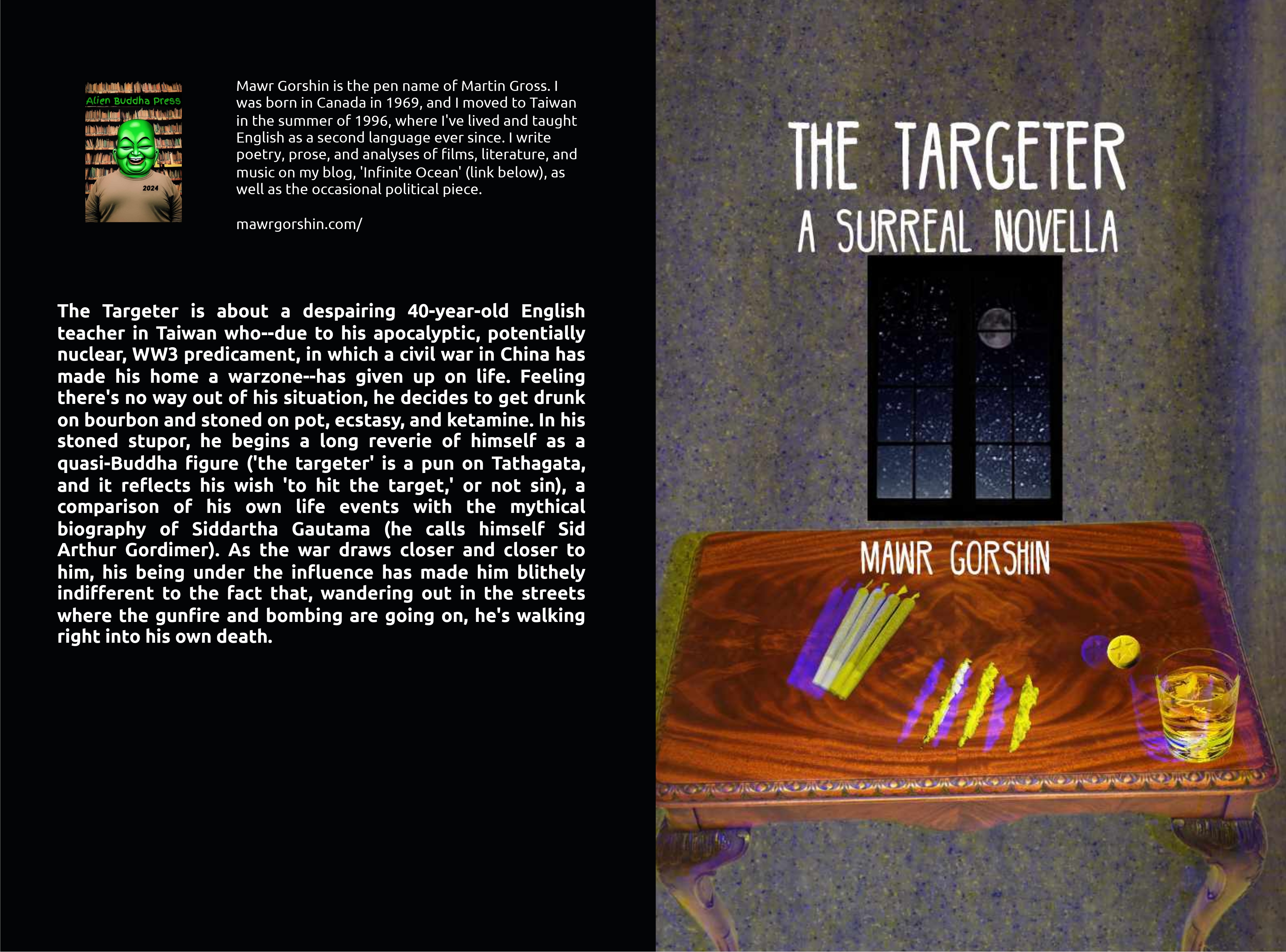
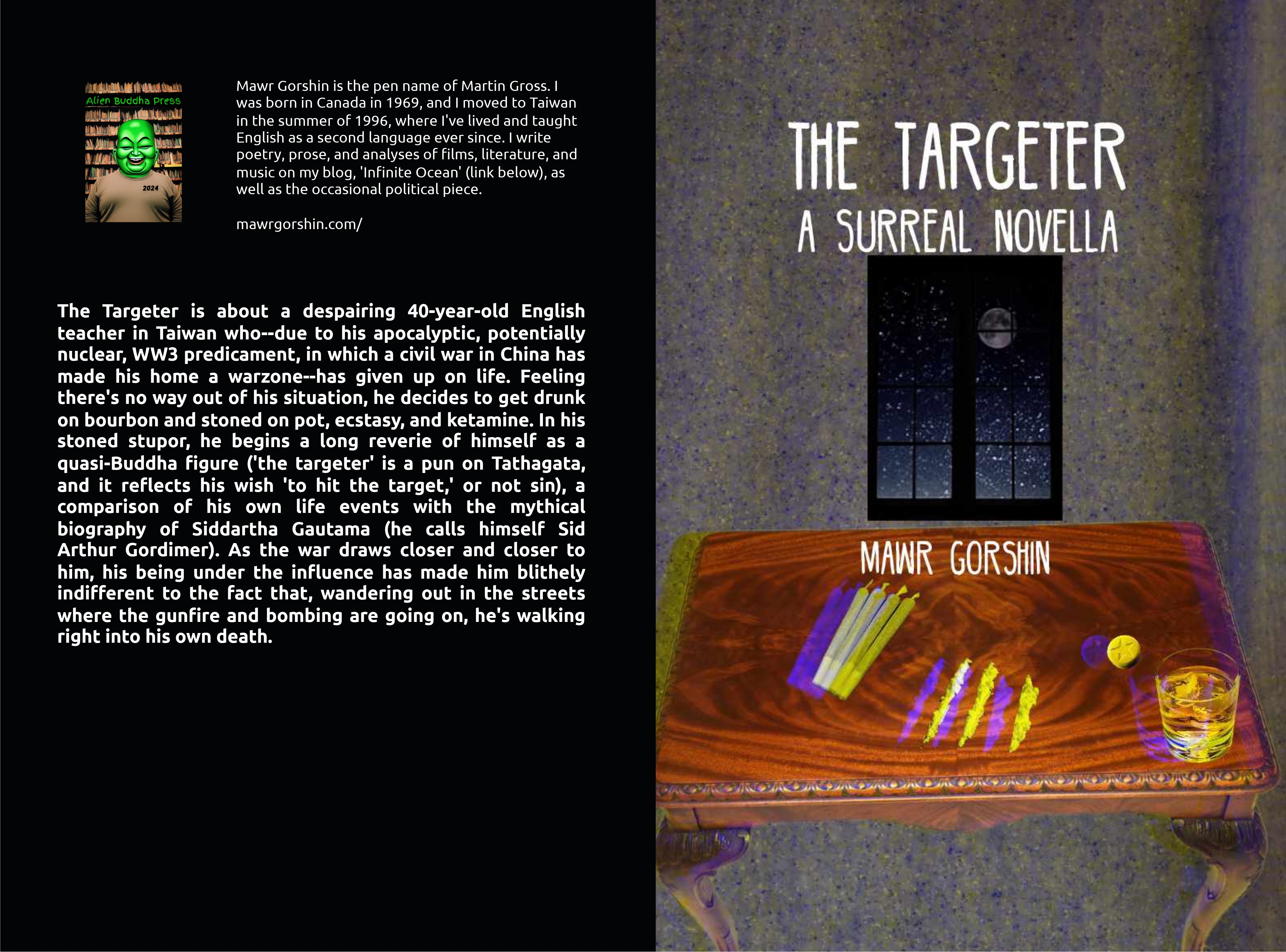
A Positive Review of ‘The Targeter,’ My Surreal Novella, by Dennis Riches

My friend, Dennis Riches, whose writing I have reblogged a number of times here, has written up a wonderful review on Amazon of my novella, The Targeter, and rated it five stars! It’s the only review as of the publication of this post, but hey, it’s a start! Baby steps, right?

Here’s what he said: ‘5.0 out of 5 stars An excellent short tale that encompasses the personal, the political and the spiritual. (Reviewed in the United States on August 3, 2024)

‘It is difficult to know how to describe and categorize this work. Is it a long poem or a short story? Is it fantasy or realistic fiction? Is the narrator a fictional character, or is this just a slightly fictionalized auto-biography—one rendered as a surrealistic reflection on a life and a family, and on all life at this point in history where nuclear catastrophe looms over us? Is it a Christian-Buddhist prayer or a political treatise? Perhaps it’s the author’s way of telling us, “Just say no to drugs”? Read it and contemplate all these questions to light your own path.’

I can’t say enough times how grateful I am for Dennis’s endorsement of my book! Thank you so much, Dennis, and I’ll be waiting for your next blog article! 🙂

‘SPOTLIGHT: The Targeter: a Surreal Novella by Mawr Gorshin,’ from the Alien Buddha Press Blog

Please don’t forget to check out my new novella, The Targeter, published by AlienBuddha Press! Here you’ll find an excerpt from the novella, describing how the protagonist, stoned out of his mind, is having a reverie in which he imagines himself experiencing a divine birth comparable to the mythical birth of the Buddha. Here’s a link to the Amazon page, where the paperback costs a mere US$14.46.

Publication of ‘The Targeter,’ a Surreal Novella, by Alien Buddha Press, on July 14th

This is my new novella, originally published chapter by chapter here on my blog, but now you can gain access to all the chapters easily without searching my blog’s archives.

It will be released on July 14th on Amazon. It’s a quick read, only 111 pages, including the ‘about the author’ page.

It’s about a despairing 40-year-old English teacher in Taiwan who–due to his apocalyptic, potentially nuclear, WW3 predicament, in which a civil war in China has made his home a warzone–has given up on life. Feeling there’s no way out of his situation, he decides to get drunk on bourbon and stoned on pot, ecstasy, and ketamine. In his stoned stupor, he begins a long reverie of himself as a quasi-Buddha figure (‘the targeter’ is a pun on Tathāgata, and it reflects his wish ‘to hit the target,’ or not sin), a comparison of his own life events with the mythical biography of Siddartha Gautama (he calls himself Sid Arthur Gordimer). As the war draws closer and closer to him, his being under the influence has made him blithely indifferent to the fact that, wandering out in the streets where the gunfire and bombing are going on, he’s walking right into his own death.

I want to thank the publishers of Alien Buddha Press for putting my short book in print!

Analysis of ‘Barfly’

Barfly is a 1987 film directed by Barbet Schroeder and written by Charles Bukowski, who also does a cameo. It stars Mickey Rourke and Faye Dunaway, with Alice Krige, Frank Stallone, Jack Nance (whom you might remember from Eraserhead), and JC Quinn.

Barfly is a semi-autobiographical film with Henry Chinaski (Rourke) as a fictionalized version of young Bukowski. The film was entered into the 1987 Cannes Film Festival, where it competed for the Palme D’or. Dunaway was nominated for a Golden Globe for Best Actress in a Drama. Barfly was also nominated for two Independent Spirit Awards: Best Actor for Rourke, and Best Cinematography for Robby Müller.

Here’s a link to quotes from the film, and here’s a link to the whole film.

Destitute LA alcoholic/writer Henry Chinaski exemplifies the Dionysian lifestyle, and it goes way beyond the obvious link with drinking. To understand the extent to which Henry embodies Dionysus, we must understand everything the wine god represents beyond just wine: dancing and pleasure, or partying, and irrationality and chaos, including passion, emotions, and instincts.

More important than even these, though, to consider how Nietzsche discussed Dionysus in The Birth of Tragedy, the god represents disorder, intoxication, emotion, ecstasy, and unity, as opposed to the Apollonian principle of individuation. What does wine itself represent, when emptied from the bottle or wine glass and poured into one’s mouth? It represents a dissolution of boundaries (i.e., the bottle or wine glass that gives shape and boundaries to the drink), and in entering the drinker’s body, the wine becomes one with the drinker. The intoxication from the alcoholic drink causes blurred vision and slurred speech–more dissolution of boundaries, more non-differentiation.

Thus, in Henry, we have not only a drunk, but also a law-breaker and a brawler…that is, one who doesn’t respect societal boundaries. His fists cross boundaries to hit the face and body of Eddie (Stallone), the “unoriginal, macho…ladies’ man” bartender he so despises. Henry’s hands cross boundaries to steal a sandwich right out of the hands of a man who’s just paid him to fetch the sandwich, or to break into a neighbour’s apartment to steal his food and wine.

Henry, as a writer, is the Dionysian artist whom Nietzsche saw as having “identified himself with the primal unity, its pain and contradiction” (Nietzsche, page 49). In total unity of everything, there is no ego, no self, no individuation, and no boundary between self and other. The contradiction of identifying self with other is painful, because the ego one is attached to is an illusion, whereas the fragmented existence is the only reality, like that of mutilated Zagreus.

Henry is much like Zagreus after that first fight with Eddie in the alley behind the bar. He’s lying all bloody on the ground, practically left for dead. Later, after being hit several times on the head with a purse held by angry Wanda (Dunaway), he looks at his bloody head in the bathroom mirror and recites improvised poetry, which includes the word, “euphoria.” He’s seeing his Lacanian ideal-I in the reflection, seeing his suffering Zagreus-self as a role model to live up to.

Getting drunk is, as we all know, an escape from all the suffering of the world, a manic defence against life’s depressing realities. Bukowski once described drinking as a kind of slow suicide; it’s a pleasure that ends the pain of life by throwing oneself into death, or at least trying to.

Freud wrote of two opposing ways of achieving pleasure, either through Eros, the life instincts that include libido, or through the death drive (called Thanatos by Freud’s followers), since death brings the organism back into a state of total rest, just as the achievement of libidinal pleasure tries to do. “To die, to sleep, no more,” as Hamlet said.

Similarly, just as the Hindus and Buddhists hope to achieve moksha or nirvana through a dissolution of the self (be that in the form of Atman realizing its identity with Brahman, or in the form of realizing, as the Lacanians do, that the ego is an illusion, that there never was a self to begin with–anattā), so do Dionysian types like Bukowski, Henry, and Wanda attempt a kind of ego death, but through drink, and through all things considered sinful or self-destructive.

In other posts, I have written of the ouroboros as symbolizing the dialectical unity of opposites. The serpent’s biting head is one extreme opposite, and the bitten tail is the other; every intermediate point is corresponded on the relevant place on the serpent’s coiled body, which represents a circular continuum. Thus, heaven or nirvana can be seen at the biting head, for example, and hell can be the bitten tail. The normal spiritual quest goes to the head away from the tail, that is, along the length of the coiled body towards the head; the Dionysian, in contrast, gets to the biting head by passing across the bitten tail. People like Henry are trying to get to heaven by passing through hell first, as Christ did.

This perverse pilgrim’s progress of Henry’s explains why he is content to be left beaten to a pulp in an alley at night, helped by no one. It explains how he can look at his bloody head in a mirror and say, “euphoria,” how he can think that people who never go crazy must lead “truly horrible lives,” that “nobody who could write worth a damn could ever write in peace,” and that “endurance is more important that truth.”

Wanda as a drinker is going through the same pilgrim’s progress. After some heavy drinking one night at home, she is lying in bed and imagining she’s dying. She imagines an angel has come to take her away. She’s saying this to Henry as some beautiful Mahler, the andante moderato third movement from the sixth symphony, is playing. Henry is so convinced she’s dying that he calls some paramedics, who correctly conclude that she’s just drunk.

The point is that with each experience of suffering, the Dionysian pushes himself further, into even greater suffering, a move further towards the ouroboros’ bitten tail in the hopes of finally passing it and reaching the head of paradise. ‘Tis a consummation devoutly to be wished.

After being beaten by Eddie several times, Henry keeps coming back for more. He’ll do occasional jobs here and there, since he’s got to have at least a little money to live…and pay for drinks, of course!…but he is loath to get a regular job and join “unoriginal” society. (He’ll only try to get one for Wanda’s sake.) He’s been in jail twelve times, but he keeps breaking laws at every opportunity.

Now, one shouldn’t confuse his coarseness for a lack of culture. He’s a talented writer of poetry and prose, so talented that his writing has touched publisher Tully Sorenson (Krige), whose wealth and intervention in Henry’s life represent where Apollonian order intersects with Dionysian wildness. He listens to classical music, Mahler and Mozart in particular. He hates movies (as did Bukowski, who really needed a financial incentive to write the script for Schroeder’s film!), but he likes Schopenhauer, whose philosophical pessimism, by the way, is a Buddhistic opposition to existence.

His aspiration towards ego death is in such an advanced state that when Tully, on meeting him face-to-face for the first time in his frequented watering hole, asks him who he is–“the eternal question”–and he gives her the eternal answer…he doesn’t know.

Tully’s intervention into his life represents not only the intersection of the Apollonian with the Dionysian: it also represents the intrusion of capitalism into the world of the lumpenproletariat, which Henry so perfectly personifies. She is a wealthy book publisher, wearing fashionable clothes, living in a beautiful, large home, and–let’s face it–hoping to turn a profit off of his talent. Having a basic sense of class consciousness, though, he can’t accept her world, “a cage with golden bars.”

His class consciousness, knowing that “nobody suffers like the poor,” doesn’t mean Henry’s at all motivated to help organize anything like a worker’s revolution. Men like him are why Marx and Engels didn’t see any potential in the lumpenproletariat. Like so many of the poor, Henry feels incapable of pulling himself out of poverty, let alone doing so for the working class in general; hence the wish to escape his misery through drink.

Instead of supporting a vanguard-led revolution, he simply lives as an anarchist would in an otherwise capitalist world. He does what he likes, and has no respect for authority. His stealing of food, as is Wanda’s stealing of corn, is a kind of putting into practice the socialist ideal, “from each according to his ability, to each according to his needs.” The same can be said of Wanda’s living off of Wilbur’s charity.

Henry’s meeting of Wanda in the bar where we see the Bukowski cameo is serendipitous, for in this meeting we’ll see the beginning of a relationship that will mitigate his misanthropy. His leaving of his dump of an apartment to live in hers, in a way, can also be associated with his Dionysian lifestyle, since as a chthonic god (i.e., of the underworld or of agriculture…recall that corn Wanda wants!), the wine god can also be associated with matrilineal and matrilocal forms of social organization.

Indeed, Henry’s anger at Wanda over her cheating on him isn’t based on some patrilineal notion that he ‘owns’ her: he explicitly acknowledges not owning her. He simply cannot stand that she’s slept with Eddie, of all men!

Henry’s jealousy of her over Eddie, paralleled with her jealousy of him over Tully, has as a coincidence how, when either of them is cheated on, the other has gone off to look for a job. Henry, after coming back to the bar from his job interview, tells Jim (Quinn) that he hates how society tells us we all have to do something, or to be somebody–i.e., to have a job and form one’s identity around it. Similarly, when upon meeting Wanda, Henry asks her what she does, she says, “I drink,” instead of saying a job title. So in betraying themselves to the capitalist system by trying to get jobs, they end up betraying each other sexually.

During Henry’s job interview–with a woman with beautiful, pantyhose-covered legs he ogles and gets a “hard-on” from–he answers “none” to questions about hobbies, religion, education, and even his sex. Once again, he’s demonstrating his Dionysian dissolution of identity…as well as his satyr-like lust.

After Wanda has beaten and bloodied his head with her purse and stormed out of her apartment, he gets back at her by throwing her clothes out the window, once again demonstrating his Dionysian disregard for people’s boundaries.

His Lacanian lack of an ego, combined with his lack of respect for boundaries and his embrace of violence, indicates his experience of the undifferentiated, traumatic, and nonverbal world of the Real. His writing of poetry and prose, however, bring him back to the verbal, social, and cultural world of the Symbolic, as does his making of money from that writing, through Tully’s cashed cheque of $500, which allows him to buy rounds of drinks at the bar to win “all [his] friends,” who will surely give him emotional support for his next fight with Eddie. His moment of “euphoria” in front of Wanda’s bathroom mirror, idealizing himself as an eternal fighter, a Dionysus, is Henry’s experience of the narcissistic Imaginary.

There are other Dionysian personalities in Wanda’s apartment building, mind you, than just her and Henry. Wanda’s next-door neighbours are an old man and woman, the former of whom, it seems, is physically abusing the latter. Henry notes, in near-Buddhistic fashion upon hearing the nastiness next door, that hatred is the only thing that lasts.

Still, even a Dionysian like Henry has a sense of gallantry, and after being fed up with the disturbing fighting he’s been hearing through the wall, decides he wants to help the poor old woman over there, right when he’s finally met and chatted with Tully. He breaks down the neighbours’ door to confront the old man over his vicious treatment of his woman. As it turns out, though, she likes being hurt by her man! It’s a kind of sadomasochistic kink that they’re into, another Dionysian embrace of violence and transgressing of boundaries.

It doesn’t take long for Tully to realize that her Apollonian world is incompatible with Henry’s. Not only can’t she convince him to be “a non-drunk,” and not only can’t she compete as a drinker with him, but she is horrified with his violent nature, gutting the old man with his knife, and driving his car into and pushing the car of two “unoriginal,” publicly kissing lovebirds into an intersection. Henry sees another Eddie in that man, and wants to trespass beyond his boundaries.

It’s an amusing example of projection when rich Tully, annoyed with Henry’s confrontational attitude toward two “romantic” lovebirds in their car, that she calls him “a spoiled asshole” (my emphasis). It’s even more amusing when Henry says that she “hired a dick [Nance] to find an asshole,” my favourite line in the whole film!

One cannot have Dionysus without Maenads, and Henry has one in Wanda. Her jealous fury over Tully having slept with him causes her to have violent designs on the rich, wealthy publisher.

Indeed, Tully’s disapproval of Henry’s wild dipsomania, and her wish to take him out of that unruly world and into her tame, Apollonian one, makes her into a kind of female Pentheus, the king whose banning of Dionysian worship caused him to be lured into the wine god’s sylvan milieu and torn to pieces by the Maenads, as is presented in Euripides‘ tragedy, The Bacchae.

Similarly, Tully feels pulled into Henry’s world, in spite of her opposition to it, and as soon as Wanda smells the perfumed proof of Tully’s closeness to Henry, the hostilities between the two women begin. This tension is building just as that between Henry and Eddie is being rekindled, the latter being annoyed over the former’s tardiness in paying for all the drinks he’s offering everyone in the bar to buy their friendship and backing in the two men’s upcoming fight.

Wanda grabs Tully by the hair and pulls her, screaming, off her barstool, just like a maniacal Maenad. Tully fights back as best she can, even biting Wanda’s hand; but her bourgeois sense of decorum just can’t let her endure in a fight, so she knows she has no hope of taming Henry. She leaves Dionysus in his world, and she returns to that of Apollo.

Now, this ‘catfight‘ won’t be the only entertainment of the night, since Eddie is hungry for revenge after his humiliating loss the last time. Henry is all too happy to oblige, of course, and the film ends with the eternal recurrence of Dionysian violence with which Barfly began.

After all, hatred’s the only thing that lasts, isn’t it?

The Ouroboros of Music

Introduction

I’ve written a number of articles on how the ouroboros, normally a symbol of eternity expressed in endless cycles, can also be used to represent the dialectically unified relationship between opposites. The serpent, coiled into a circle and biting its tail, can represent a continuum that, instead of being conceived as a straight line with both extremes at distant, opposite ends, can also be coiled into a circle, with the opposite ends meeting, where the serpent’s head bites its tail.

I believe that this close relationship between opposite extremes, the one phasing into the other, or the one being an immediate reaction to the other, can be applied universally. I’ve tried to demonstrate this universality with a number of examples, usually Marxist ones, as with dialectical materialism, capitalism, neoliberalism, the workers’ state, and the tendency of the rate of profit to fall.

As for (largely) non-Marxist topics, I’ve also attempted to apply my ouroboros symbolism to more-or-less mystical ideas, to psychoanalysis, and to philosophy. Now, I’d like to try to apply it to music.

What I’m about to attempt here will surely be far from exhaustive, but what follows are, I believe, some quite significant aspects of music, some important parameters of it. These include consonance vs dissonance, dynamics, planned structures vs non-planned ones, rhythm vs arrhythmicality, and simplicity vs complexity as alternating in different periods in music history. I’ll be examining examples from classical music, jazz, and rock. I’ll be discussing the psychological effects of such music more than the actual physical properties of the sounds.

Now, before we begin, I want to state at the outset that I am no trained musicologist or historian of music, so take my opinions here with a generous grain of salt. Just so you know, however, that I’m not a complete musical ignoramus, either, I have demonstrated what musical knowledge I do have, for what it’s worth, in these analyses: on two Gentle Giant albums, three Pink Floyd albums, one by King Crimson, one by Van Der Graaf Generator, one by the Who, by Jethro Tull, by Rush, and by Frank Zappa. I’ve also analyzed works by a number of modern classical composters, including Richard Strauss, Béla Bartók, Charles Ives, Arnold Schoenberg, Alban Berg, Igor Stravinsky, and Edgard Varèse.

Finally, I’ve also composed and recorded (though not always very well) my own music, including mostly modernist classical compositions using Finale software, and pop songs on which I sang and played all of the instruments. For good or ill, all of these will give you an idea of what I know…and don’t know…when it comes to music.

But enough of this. Let’s get started.

Consonance vs Dissonance

As Schoenberg says in his Harmonielehre, one should not think of consonance and dissonance as dichotomous opposites, but rather as on a continuum from most familiar harmony to least familiar harmony: “the distinction between them is only a matter of degree, not of kind. They are no more opposites than two and ten are opposites, as the frequency numbers indeed show; and the expressions ‘consonance’ and ‘dissonance’, which signify an antithesis, are false. It all simply depends on the growing ability of the analyzing ear to familiarize itself with the remote overtones, thereby expanding the conception of what is euphonious, suitable for art, so that it embraces the whole natural phenomenon.” (Schoenberg, p. 21)

The difference, only a relative one, between consonance and dissonance is especially apparent in the contemplation of the overtone series, wherein the first overtones after the fundamental are the octave, the perfect fifth, the perfect fourth, the major third, the minor third,…and only by our reaching of the eighth and ninth harmonics do we come to major seconds, then by the fifteenth and sixteenth harmonics, we get a minor second, the harmonics in between these being microtonal.

So as Schoenberg points out, the only dissonances to be designated as such are the major and minor seconds, and their inversions, the minor and major sevenths respectively, and the major and minor ninths, which are just the seconds plus an octave, as well as the diminished and augmented fourths and fifths, etc. (Schoenberg, p. 22)

Unisons and octaves are, of course, perfect consonances, as are perfect fifths and perfect fourths (this latter particularly if the upper tone is perceived as the tonic). Note how the tense major seconds and their inversions, the minor sevenths, as well as the sharply dissonant minor seconds and their inversions, the major sevenths, are just a step or half-step away from unisons and octaves respectively. In these, we have a basic example of the ouroboros of music, a shift from the bitten tail of extreme dissonance to the biting head of perfect consonance.

A parallel thing happens with respect to the dissonant next-door neighbours of perfect fifths and fourths. The tritone, regarded as strongly dissonant, is only a half-step flat of a perfect fifth, or a half-step sharp of a perfect fourth. Major, and especially minor, sixths are also only a step or half-step above a perfect fifth. Again, perfect consonance and extreme dissonance meet where the ouroboros’ teeth bite its tail.

Unlike the harsh use of dissonance in twentieth-century classical music, the traditional use of dissonance in the art music of previous centuries always kept it subservient to consonance; harmonic tension had to be resolved, and fairly quickly, too. Most people intuitively feel that this subservient role is justified, since we usually can tolerate only so much harshness. This subservience also acknowledges the universal nature of the ouroboros of music: to hear the full range of musical expression, one must pass from the bitten tail to the biting head.

The seventh degree of the major (or melodic or harmonic minor) scale is called the leading tone because, traditionally, one cannot just stop on that note. This tone leads us back to the tonic: it “will bring us back to do,” as Julie Andrews once sang. Incidentally, there’s also a descending, or upper, leading tone, going from a flat second to the tonic. According to Allen Forte, the strongest melodic or harmonic progressions are by half-step, or as I would call it, the ouroboros of shifting from extreme dissonance to the proximate, perfect consonance.

Suspensions and retardations are more examples of shifting from dissonance to consonance, sometimes from extreme dissonance to perfect consonance, as in the 4-3 and 9-8 suspensions by a half-step, or the 7-8 retardation, also by half-step. Again, it’s these stepwise, short distances from dissonance to consonance that demonstrates the ouroboros-like proximity of the harmonic extremes.

A way to intensify dissonance before resolution is to add a minor seventh on top of the leading tone, in the context of a dominant seventh chord. Thus, a tritone, from the third degree of the (Mixolydian) scale (leading tone) to the seventh degree, becomes a major third in the resolution with mere half-step movements in the intervals’ notes closer to (or farther away from, if they’re inverted) each other (or, if the dominant seventh chord resolves to a minor tonic chord, the minor seventh moves by a full step to the minor third of the tonic chord; either way, the movements from dissonance to consonance are only slight). Further, sustained harmonic tension can be created through secondary dominants leading up to the final resolution.

Now, so far I’ve only discussed the relationship of dissonance with consonance largely in the context of diatonic harmony (that is, except for my brief reference to the descending leading tone). The chromaticism of the music of the Romantic period intensifies dissonance all the more (listen to Wagner‘s Tristan und Isolde for a noteworthy example); since this music is still traditionally tonal, though, its necessary resolution to consonance further brings out the ouroboros of extreme dissonance, the bitten tail, to peaceful consonance, the biting head.

The pushing of this dissonant chromaticism takes tonality to its limits in the music of Richard Strauss (i.e., Salome and Elektra) and Gustav Mahler. Then, we get post-Romantic, Impressionist composers like Debussy and Erik Satie, who often sidestep tonality while refraining from harshness. Examples of such sidestepping include Debussy’s use of the whole-tone scale in such compositions as Prélude à l’après-midi d’un faune, and the use of quartal harmony in Satie’s Fils des étoiles.

Matters get even more dissonant, though still rooted in tonality, if in a vague, expanded sense, in Bartók‘s music, as early as such pieces as his first string quartet. His use of axes of symmetry were meant to prove to Schoenberg that one could treat all twelve semitones equally, yet remain tonal. Note how the extreme chromaticism of that string quartet mentioned above resolves with a closing chord, at the end of the final movement, on A, with fifths (E) and ninths (B). Now, such a chord is quite consonant…by Bartók’s standards.

Stravinsky‘s experiments with polytonality, as well as his use, from time to time, of the octatonic scale, in such compositions as The Rite of Spring are nonetheless still basically tonal, and they end in at least relatively consonant harmonic resolution. The same can be said of much of Ives‘s music, in spite of the many clashing independent parts. Dissonance generally is resolved, if imperfectly…a kind of hovering between the bitten tail and the biting head of the ouroboros.

It’s when we come to the Second Viennese School that we have the “emancipation of the dissonance.” Not satisfied with the use of the whole-tone scale and quartal harmony in his Chamber Symphony No. 1, Schoenberg wanted to treat all twelve semitones as equals. His experiments with atonality led to a need to structure the apparent melodic and harmonic chaos with his twelve-note system. Though I have a deep appreciation for this kind of music, unfortunately, most listeners have untrained ears, and therefore they find it virtually impossible to distinguish the tone rows used in it. One often cannot even make sense of the unresolved dissonance; to the average listener, this music sounds as if it has no beginning, middle, or end. One languishes, it seems, at the bitten tail of discord.

The ‘chaotic’ sense of modernist dissonance is more apparent in such music as George Antheil‘s Ballet Mécanique, much of the music of Varèse and Messiaen (this latter’s especially since the 1940s), and Stockhausen works like Gruppen and Kontakte. As a result, the classical avant-garde has been unpopular, and the average listener drifted away from it and towards jazz and rock ‘n’ roll.

Though these two popular forms started out with harmony that’s simple enough to follow, they, too, grew more dissonant over time. Examples in jazz start out with the altered and extended chords played by Thelonius Monk; dissonance later intensified with the avant-garde and free jazz of players like Cecil Taylor, with his flurries of tone clusters on the piano, or Ornette Coleman‘s improvising in no recognizable key.

Rock music grew more harmonically adventurous first with the Beatles, who proved that pop can embrace a whole world of harmony beyond twelve-bar blues and clichéd progressions like I-vi-ii-V. This experimentation continued in the psychedelic era, with Frank Zappa‘s music, and ultimately with progressive rock in the 1970s, with bands like King Crimson and Gentle Giant in particular daring to play harsh dissonances. In all of these examples, we can see a cyclical movement all the way around the body of the ouroboros of music, from the bitten tail of extreme dissonance to the biting head of simple harmony, then along the serpent’s coiled body back towards the tail–that is, more and more harmonic adventurousness in both jazz and rock.

Sometimes, the extreme dissonance of modernism in postwar classical music simply leads to, largely if not absolutely, an abandonment of sounds of definite pitch, as can be heard in such examples of music exclusively for percussion as Varèse’s Ionisation, John Cage‘s Constructions, Stockhausen’s Zyklus and Mikrophonie I and II, and Iannis Xenakis‘s Psappha. After hearing a litany of screaming cacophony, the sound of pitchless instruments can feel restful in comparison, a shift from the serpent’s bitten tail to its biting head.

Dynamics

As far as going from one extreme of dynamics to the other, from absolute silence–the serpent’s bitten tail–to deafening loudness–the biting head–is concerned, we find ourselves starting and ending with the postwar avant-garde. That is to say, we can start with Cage’s ‘silent’ works, his 4’33” and his 0’00”, and end with examples of danger music, which sometimes uses sounds so loud that they may risk deafening the listener and/or performer. Loudness leads to silence.

Less extreme manifestations of this sort of thing can be found in dance clubs and rock concerts, in which the booming music may not cause permanent, profound deafness, but it may weaken one’s hearing, requiring one, for example, to turn up the volume to an extreme loudness, just to be able to hear the talking on the TV with reasonable clarity.

Extreme loudness, the serpent’s head, leads to the silence of the hearing impaired, the tail, then to extreme loudness again, turning up the volume as a movement along the serpent’s coiled body from its tail back to its head.

From Planned Sounds to Non-planned Ones

The dialectical relationship between what is planned in music and what isn’t manifests itself in many forms. Though music is notated, there’s also plenty of room for interpreting how exactly to play those notes from performance to performance, even in precisely notated classical music or film scores.

Part of the great skill of jazz musicians is to be able to improvise, to invent melodies on the spot during a live performance. If they play a wrong note, it’s advisable to play it loud, to give off the illusory impression that they “meant to do that.”

As for soloing in rock music, the playing is largely prepared and practiced, with a little wiggle room for impromptu variations on a few notes here and there. Zappa noted this general tendency among rock guitarists while contrasting it with his own, totally improvised playing, not knowing at all what notes he would play until the very moment he began the solo onstage, fully aware of the risk of making the occasional mistake in front of his fans.

Such is the yin-and-yang relationship between planned and unplanned music along the coiled body of the ouroboros. As far as the area of the meeting extremes is concerned, where the head bites the tail, we can return to the postwar avant-garde. On the one hand, there is total organization in the form of total serialism in the 1950s music of composers like Boulez and Stockhausen, as well as the player piano music of Conlon Nancarrow; on the other, there’s the aleatoric music of composers like Cage, the extreme of which is noted in the aforementioned ‘compositions,’ 4’33” and 0’00”.

Rhythm vs Arrhythmicality

The basic units of rhythm can be broken down to twos and threes, resulting in simple duple or triple times, then compound times. Common time can be subdivided into twos and threes, such as eighth notes of 3 + 3 + 2, or sixteenth notes of 3 + 3 + 3 + 3 + 2 + 2, or into other syncopations. We follow the beat hypnotically, not needing to think about it.

Next, we have odd time signatures, such as 7/8, 5/4, 11/8, or 13/8, as commonly heard in progressive rock and jazz-rock fusion. Then, to make rhythm even more irregular, we can have constantly changing time signatures, as we hear in The Rite of Spring. Now, instead of being hypnotized by the beat, we have to think about it and figure out all of the changes in order to follow and understand the music. Unconscious listening has thus changed to conscious listening.

Matters get even more complicated when we throw in irregular subdivisions of the beat, beyond triplets and going into quintuplets, septuplets, etc. An extreme example can be heard in that opening set of seventeen rising diatonic notes played at extreme speed on the clarinet from Gershwin‘s Rhapsody in Blue. The legato notes are played so fast that they sound like a glissando. We pay no attention to the rhythmic values of these notes, because quite simply, we can’t.

Then there’s the serialism of rhythm, or ‘modalizing’ of it, as heard in pieces like Messiaen’s Mode des valeurs et intensités,” the second of his Quatre Etudes de rythme, for piano. The accents and durations of the notes are completely divorced from conventional notions of ‘expressivity,’ but they must be played exactly and figured out by the listener (following the music with the score in hand, no doubt!) in order to understand what is being heard. The same basic understanding of how to hear the accents, durations, etc., of total serialist compositions is to be kept in mind when listening to such music by Boulez, Stockhausen, etc.

Rhythmic irregularity, though precisely planned, as noted in the above-mentioned music by Messiaen, Boulez, and Stockhausen (as well as in the player piano music of Nancarrow), next shifts to a total lack of perceived rhythmic pulse, as in free jazz and the avant-garde experiments of Cecil Taylor. Taylor’s Units would play seemingly endless flurries of atonal phrases backed by drum rolls and arhythmic licks (notably by Andrew Cyrille). One doesn’t tap one’s foot to this music, yet perhaps one will sway one’s head and shoulders in circles to it.

As a result of these extremes, one goes back, from consciously working out a planned but extremely complex rhythm, to unconsciously listening to arrhytmicality. The ouroboros of music has come full circle once again.

Historical Cycles of Simplicity and Complexity

We can find these cyclical moments in the history of Western music at a number of times, especially in the modern era, but I’ll point out a few, when music rose in complexity to an extreme that was eventually felt to be excessive (the biting head of the ouroboros), and then there was a reaction against it, a return to simplicity (the serpent’s bitten tail).

In early Western music, we had monophony, as has mostly been the case in traditional forms of music in the rest of the world. From the monophonic singing of the old Church modes in Gregorian Chant (which used melisma to add sophistication and musical interest), complexity began in the use of organum (perfect fourths and fifths sung parallel to the original melody), which was the beginning stage leading to polyphony. When parallel melody was felt to be rather ‘primitive’ sounding, an interest in creating independent, but harmonious, melodic lines began.

Now, the fascination with experimenting with polyphony, which included polyphonic settings of sacred texts, led to increasingly complex music. Consider the wildly experimental, expressive, and chromatic music of Gesualdo in the late Renaissance period as a noteworthy example.

The Church became concerned with all of this growing complexity in its sacred music, since it became difficult to make out the religious texts sung in all of those intricate vocal lines. (The fact that secular tunes were being mixed into religious music didn’t ease the minds of Church authorities, either.) So there was an urge, at the time of the Counter-reformation and the Council of Trent, to simplify sacred music and tone down all of the tangled vocal polyphony. Such composers as Palestrina were considered ideal in the simplicity of their sacred music.

Homophony, beginning in sacred music, came to replace polyphony as the dominant form in European art music, the simplicity of one melody over a chordal accompaniment being preferred over the complexity of many independent melodic lines heard all at once. Small wonder JS Bach’s music, with its contrapuntal intricacy, wasn’t appreciated during his life, but rather the homophonic music of his sons, Johann Christian Bach and CPE Bach, was preferred back then.

By the Romantic period, the strict adherence to classical forms, such as the sonata form, binary form, minuet and trio, and rondo was beginning to be felt to be too limiting, and so 19th century composers were using these forms in looser and looser ways. Combining this growing freedom with more emotional expressivity and chromaticism, Romantic-era music was getting more complex.

By the 20th century, these movements towards more and more freedom, expressivity, and chromaticism was making music so eccentric, complex, and dissonant that it was beginning to alienate audiences. Some composers, like Stravinsky and Hindemith, were already toning down their modernism by resorting to neoclassicism, finding musical inspiration in the more remote past, though still presenting it with a quirky, modernist slant.

Postwar avant-garde classical music, such as the aforementioned total serialism and aleatoric music of the 1950s, as well as such developments as the micropolyphony of Ligeti, was also alienating listeners with what was perceived as its excessive complexity. And so by the 1960s, a new kind of music began: minimalism, with its simple, repetitive melodies as composed by such musicians as Steve Reich, Philip Glass, and Terry Riley.

In jazz, the complicated riffs of jazz-rock fusion in the early-to-mid 1970s were soon replaced by such leanings as simple, often Latin American, styles. One might think of how the jazz-fusion of groups like the Mahavishnu Orchestra and Return to Forever, with their flashy, virtuosic solos and tricky time changes, was a hot thing in the beginning, but then got simplified by the late 70s. Similarly, the popular Latin American simplicity of mid-to-late 70s Weather Report replaced the band’s originally intense experimentation early in the decade.

The peak of progressive rock experimentation had come by the mid-70s; then punk rock and new wave came along, and their popularity forced the prog dinosaurs to simplify their sound by the late 70s, as can be heard in the shift in musical style by bands like Genesis, Gentle Giant, Jethro Tull, and even UK (consider the difference between their first and second studio albums, from original drummer Bill Bruford‘s subtle use of dauntingly tricky meters to Terry Bozzio‘s more extroverted, but simpler, harder-hitting style). Yes’s 90125 was also essentially a pop album (as was Big Generator), with only the instrumental passage at the beginning of “Changes,” written by Alan White, sounding like prog, with its shifting from a bar each of 4/4 to 6/8, then from a bar of 4/4 to two bars of 6/8.

Asia, though being a prog supergroup with members like John Wetton, Steve Howe, and Carl Palmer, were essentially known for playing pop songs, such as their hit single, “Heat of the Moment.” The 80s King Crimson, like JS Bach in his own day, were a band born too late, as it were: the complexity of their music required too much intelligence for the average listener to appreciate, so they could only be a short-lived cult band. Still, even they wrote a few songs that could be deemed more or less radio-friendly, like the funky “Elephant Talk” and “Sleepless,” and the pop-oriented “Heartbeat.” King Crimson were the exception that proved the rule, as far as 80s pop was concerned.

Since the simplification of 80s pop and rock, some examples of a return to complexity (to an extent) have existed, i.e., the odd time signatures that Soundgarden liked to play in the 1990s, among other examples. But mainstream rock since then has simplified again, with a few exceptions here and there, along with the hybrid prog/metal of groups like Dream Theater.

Conclusion

I hope the examples I’ve shown have demonstrated how the dialectical relationship between opposites, as I symbolize with the ouroboros, can be applied to a number of aspects of music and music history: consonance vs dissonance, loudness vs softness, rhythm vs non-rhythm, and simplicity vs complexity in music history.

The wave-like, or serpentine, motion between opposites is, I believe, one of the keys to understanding all of life…rather like listening to…the music of the spheres, if you will.

Analysis of ‘My Dinner with Andre’

My Dinner with Andre is a 1981 film directed by Louis Malle. It was written by André Gregory and Wallace (‘Wally’) Shawn, who also star in it, playing fictionalized versions of themselves having a discussion at dinner in Café des Artistes in Manhattan, the topics including experimental theatre, the nature of theatre and of life, and Andre’s spiritual experiences.

Just as Andre and Wally are based on the actors who play them, Andre’s experiences as described in the movie are based on the real-life experiences of Gregory from the mid- to late 1970s: his growing misgivings about the theatre, the fear of a trend towards fascism in the US (he and Shawn are Jews), his trip to Poland to work with Jerzy Grotowski on experimental theatre before private audiences, and his years spent with spiritual communities like Findhorn.

The film has received universal acclaim, with a 92% approval rating on Rotten Tomatoes, based on 25 reviews. Gene Siskel and Roger Ebert praised it highly on Sneak Previews, which kept the film in theaters for a year.

Here is a link to quotes from the film, and here is a link to the full movie.

A fascinating irony about this film, brilliantly made fun of at the end of Waiting for Guffman, with Corky’s “My Dinner with Andre action figures” [!], is that the bulk of the film is just these two men sitting at a table in a restaurant chatting…and yet Andre is discussing these out-of-this-world experiences in remote places like Poland, Tibet, India, the Sahara, and Scotland. Andre is advocating going out there and experiencing real life in all of its mystical ecstasy, hallucinatory madness, and tear-inducing trauma…yet he and Wally are just sitting in a restaurant in New York, chatting the whole time, never leaving the city.

Since both men are playwrights and actors, in real life as well as in the film, we see a blurred distinction between the acting world and the real world, reminding us of Jacques‘s famous speech in As You Like It: “All the world’s a stage…” Andre’s ‘sermon,’ if you will, spoken during this ‘last supper’ with Wally, is that we need to break free of the phoniness, the ‘theatre,’ of our boring routines and experience real life. Andre’s dropping out of the New York theatrical scene to travel the world is thus symbolic of such a break with the numbing routine of ordinary life.

Wally, his dialectical opposite, defends this routine, though. The film begins with him on his way to meet Andre at the restaurant, walking the streets of New York, getting on a graffiti-covered subway, and thinking about all of his day-to-day troubles as a struggling playwright, barely making ends meet. He only reluctantly is going to meet Andre, having not seen his old colleague in years, and having heard dauntingly bizarre stories of what the theatre drop-out has been doing.

Wally lived an easy life as a kid in a rich family, always thinking about art; but now, he’s 36, and only thinking about money. As the pragmatic realist of the two men, Wally is preoccupied with the material issues of life. Andre, having much more money and thus able to travel the world, is more preoccupied with abstract, idealistic things.

Wally would rather his girlfriend, Debbie, cook his dinner than eat with Andre. Instead, she has to be a breadwinner for them, as a waitress, rather than ‘play the role’ of housewife. In the dull routine of his life, the phony existence of his that’s symbolized by his work as a dramatist, he’s so conformist as to have his girlfriend cook for him instead of him cooking for himself.

In his private thoughts, a soliloquy given in voiceover as he’s on the subway, he remembers Andre’s “amazing work…with his company, the Manhattan Project (the actual name of the real André Gregory’s theatrical company). When we consider Andre’s misgivings about the role of theatre in modern life, how he, in his discussion at dinner with Wally, talks about how fake our interactions are with others, how like actors pretending and not living real life, we can see how fitting it is that Andre named his company after the research undertaking that resulted in the first of those very weapons that can wipe out all life on the Earth.

The notion of Andre suddenly dropping out of the theatre, traveling the world, and ‘talking with trees,’ when he never used to want to leave his home and family, suggests to Wally that “something terrible had happened to Andre,” as opposed to what Andre will insist were deep, mystical, enlightening experiences.

Just before entering the restaurant, Wally puts on a tie: all actors must put on their costumes before walking onstage. Given Andre’s problems, Wally wonders if he is supposed to play the role of doctor, of psychiatrist, for his apparently ill former colleague.

It’s interesting that the chosen restaurant is called the Café des Artistes, where two men of the theatre will engage in a theatrical dialogue of their own, with Wally doing an acting job of pretending to be interested in whatever Andre has to say. Wally waits for him to arrive at the bar.

Wally has heard a recent story of Andre being seen sobbing because he’d seen a scene from Autumn Sonata, in which Ingrid Bergman‘s character says, “I could always live in my art, but never in my life.” These words touched Andre so keenly because this has precisely been his problem as a dramatist: his whole life has been only fakery, acting, pretending; it has never been a real life. All the world’s a stage…

Andre arrives, sees Wally, and gives him a warm hug and a big smile. Wally, the actor, puts on his fake smile for Andre, says Andre looks “terrific,” though Andre insists that he feels terrible. (Falsely saying an ailing or profoundly unhappy person looks “terrific,” a phoniness that infuriates Andre, will be dealt with again later.) Fittingly, Wally notes that he’s “really in the theatre” at this moment.

Early on in their conversation, Andre mentions Grotowski, his old theatrical mentor who’d also dropped out of the theatre. Their table is ready, and they can go sit down: the rest of the film, minus Wally’s taxi ride home at the end, is just them sitting at their table chatting, for about an hour and forty minutes out of the total hour and fifty-one minutes.) Kids, get out Corky’s action figures and have some fun!

Since Wally is feeling very nervous about having to socialize with Andre for the whole duration of this dinner, he figures the best way he can get through it all is to ask him questions. He’s sometimes thought of himself as a private investigator, as a detective: once again, Wally is finding himself an actor playing roles instead of just being himself. He still has that fittingly fake smile on his face. They order their meals, Wally hardly understanding the French on the menu, while Andre orders expertly…even though Wally has always known Andre to be quite ascetic in his eating habits. Maybe Andre is being a bit of an actor here, too.

Though at first reluctant to talk about what he’s been doing for the past five years, Andre finally opens up about it. First, he discusses going to Poland to be with Grotowski and a group of Polish actors in a forest there. None of these actors could speak English.

As the leader of a group of people who couldn’t understand a word he was saying, and vice versa, Andre had no frame of reference by which he could communicate with them or organize the improvisational theatrical events. Out in a forest, they were far away from modern civilization and all of the things that Andre had been coming to dislike. The actors would act on impulse, doing anything that came to mind…but they, as improvisors, weren’t trying to embody any kind of character from a play. They were being themselves.

They weren’t speaking from a script. They weren’t pretending to be someone else. They weren’t being fake, or following a plan. They were being real, as natural as their green setting. Andre was seeing real life in action, a breaking-free from the routines of New York.

Andre speaks of Grotowski’s “beehives,” paratheatrical events that involved simple interactive exchanges and unstructured work that Andre was fascinated with. Grotowski made Andre lead a beehive, which made Andre very nervous, since he didn’t know what to do to organize an event with a huge number of Polish strangers. But that was the point: there was to be no organization at all. The group of people ended up singing a beautiful song of St. Francis, a song these people didn’t even know how to sing.

Now, Grotowski’s beehives–in real life, that is–generally weren’t successful as attempts to blur the line between performer and audience, to bring about genuine creative spontaneity; the participants mostly gave stock emotional reactions, causing stereotypical, clichéd performances. Andre’s beehive, however, seems to have been a glorious success with this St. Francis song, sung over and over again.

There were no costumes or makeup for the performance, but it was a performance all the same. The beehive was, as it were, a sublation of the opposites of performance and non-performed, spontaneous, natural action. People were singing the song and dancing an impromptu dance; it built into a group trance, something Andre compares to one of Hitler’s Nuremberg rallies (this being one of a number of references in the film to Naziism), so we see how trance can be heavenly or hellish.

Nonetheless, all of this improvisational work in Poland has been like an enlightening, mystical experience for Andre, a discovery that theatrical performances can still be genuinely felt, as long as they maintain this level of spontaneity. Life, like drama, can be real if unscripted, free of routine.

An example of one of the wonderful experiences he had with the Polish improvisers was seeing two of them fall in love. This, during an improvisation about being on an airplane with a bad motor, and therefore fear among the passengers that they might die. Here, we see the heaven and the hell of the mystical state felt in trance-like improvisation, the fusion of acting with real life.

These two lovers, having left the group to be alone in the forest, understood the real meaning of these unstructured improvisations: it was all about really living.

On the last day of the improvisations in the forest in Poland, the group arranged a christening, a baptism for Andre. It was a simple ceremony, with flowers, candles and torches set up all over a castle in “a miracle of light.” Again, this was a spontaneous act, yet also a ceremony, a fusion of the planned with the impulsive act, a dialectic of theatre and life. A man and a woman played the roles of Andre’s godfather and godmother. He was named Yendrosh, and it really felt like a new name for him; it could be said that Andre felt reborn.

He says that this experience in the forest was the first time in his life that he’d ever felt truly alive. Again, such a mystical experience has both a heavenly and a hellish aspect to it; such spiritual feelings are not a mere sentimental removal of all of one’s pain. In Andre’s feeling of being truly alive, there’s also the frightening realization of the opposite of that state…death. He will later discuss an experience he had during Halloween of almost dying that is the dialectical opposite of this experience in the Polish forest. The mystical feeling of being connected to everything means also being connected to death.

Andre’s next major topic of discussion is The Little Prince, and certain feelings of synchronicity associated with Antoine de Saint-Exupéry‘s book. Andre discusses a trip to the Sahara with a Japanese monk (whom Andre imagines to embody the little prince) to work on a play based on the book. Analogous to Andre’s travels around the world, the little prince also leaves his tiny planet to visit a number of other planets, including Earth, where he meets a pilot who’s crash-landed in the Sahara, far from civilization…rather like the Polish forest. So if Kozan, the Japanese monk, is the little prince, in this context, does this make Andre the pilot?

A recurring criticism in The Little Prince is that of adults; the little prince considers them to be very strange. Andre’s experience in the Polish forest, with the unstructured improvisations, was that it made everyone like children at play again, something he found to be wonderful. The little prince’s nobility is in his childlike state: he’s a prince because he’s little. Andre and the improvisers were truly alive because they were children again.

Other parallels between My Dinner with Andre and The Little Prince can be found, thus further justifying Andre’s discussion of the book in the movie. Both stories involve two males, the one telling the other about his travels to many places, meeting interesting and even strange people. Wally thus is the pilot, and Andre in this context is the little prince. Wally at first dreads having to have dinner with Andre, worrying about his own personal, financial problems; the pilot is at first annoyed with the little prince wanting him to draw a sheep for him, when he urgently needs to repair his plane. Just as the little prince cares for the flower that he’s left behind on his little planet, and is fearful of her dying, so does Andre care about his wife, Chiquita, and his two kids, Nicolas and Marina, and he grieves bitterly over his mother’s death.

One major difference between the two stories, though, is that while in The Little Prince, the two friends meet in a desert, the pilot having a limited supply of drinking water, in My Dinner with Andre, the two friends are eating in a fine restaurant, with Andre ultimately treating Wally. This opposition of famine and feast, however, can be interpreted dialectically, as can the film’s other oppositions: theatre vs life, routine vs spontaneity, ecstasy vs agony, staying in the same place vs going out there into the world.

Andre’s noting of the oft-repeated word “tame” in The Little Prince is also worthy of commentary. The little prince tames his flower, the fox, and by implication, the pilot, making them all his friends. Andre tamed his Polish improvisers, making them all his friends, too. We all need taming, so we can be each other’s friends. In the act of spontaneously experiencing real life in those improvisations, the group of people collectively experiences a mystical, ecstatic oneness, inspiring mutual love.

In any case, nothing productive came from the trip to the Sahara with Kozan, so Andre, still acting on impulse (a habit he no doubt picked up from the Polish improvisations), brought the Japanese monk with him to New York to stay with him and his family. Kozan ended up staying with them for six months, taking over, since Andre, always wanting to travel to places like Tibet and India, wasn’t being much of a father.

It was as though Kozan and Andre were trading places. The monk taught the family about meditation, Asia, and his monastery, but he also began wearing Gucci shoes under his robes, as well as eating beef. Just as Andre had been neglecting his children, Kozan came off as not liking them, either. His taking over was like him being the new father…the implication being that Andre, wanting to go to Tibet, getting into meditation, and having these mystical experiences, was turning into a kind of Buddhist. In these two men we see another instance of the unity of all things, the blurred boundary between self and other.

Andre speaks of a hallucination he had in a Catholic Church on Christmas Eve: he saw a six-foot-eight apparition, half-man, half-bull, with blue skin and violets coming out of its eyelids! It remained for the whole Mass. Andre couldn’t erase the monster’s presence from his mind. With enlightenment also comes madness, paradoxically–that mixture of heaven and hell. And indeed, he did feel some enlightenment with this madness that wouldn’t go away, for Andre felt that the creature was there to comfort him, that even though he wasn’t being productive as a dramatist, all was okay, just a part of the journey. Hang in there, Andre, for the bad luck would soon change to good.

Around when Kozan left, Andre got this odd idea of getting a flag, and he ended up getting one with a Tibetan swastika on it. Though, of course, it was nothing at all like the Nazi swastika, one cannot help making the association, and so when he took the flag home, his wife and daughter found it intolerable to look at. Again, we see in this flag associations of extreme opposites: the ancient, Tibetan meaning of the swastika, a symbol of divinity and spirituality; and the Nazi meaning, linked with virulent racial hatred.

After this, he went to India in the hopes of finding great spiritual enlightenment, but he left the place disappointed, feeling his experiences were no better than those of a tourist. After that, he went to Findhorn in Scotland, and found far better spiritual inspiration among the people there and their plants. He tells Wally of having run in the forest there, in a state “where laughter and tears seem to merge.” He was also having lots of wild hallucinations at the time: once again, enlightenment meets madness, heaven meets hell in the realm of mysticism. Indeed, Andre alludes to William Blake, who wrote The Marriage of Heaven and Hell.

In the fall, after these experiences, he had his last wild one, on Long Island. This was the hellish one to contrast with the heavenly one he had in the Polish forest. It was during Halloween. He and the other participants were made to write out their last will and testament. After this, he had to wear a blindfold and run through a field. Then he was taken to a basement and made to get naked. He was so scared, he was thinking about Nazi death camps and secret police.

The participants of this Halloween event took photos of him, naked and blindfolded; he was made to run naked in a forest, still blindfolded, and taken on a stretcher through forests and lowered into the ground. It was one of six graves, each eight feet deep! Wood and dirt were put on him, and a sheet was put over his head, all to make him feel buried alive. He was left in there for about a half-hour, though he didn’t know how long he’d been left there…then he was “resurrected,” as it were.

The blindfold was taken off, and they had him run through fields until he came to “a great circle of fire” with music and wine, “and everyone danced until dawn.” So his first experience in the Polish forest was the ecstatic, nirvana-like one that he wanted in some way to relive as best he could in places like the Sahara, India, Findhorn, and this Halloween event…but this last one was so traumatizing that Andre didn’t want to do these things anymore. Still, in all of it, he was really living.

The extremes of these experiences, going to heaven and back, and later to hell and back, are rather like going all the way along the coiled body of the ouroboros, as I’ve described it and used as a symbol of the dialectical relationship of opposites, something I’ve written about in so many other blog posts. The biting head represents one extreme, and the bitten tail represents the opposite extreme, them both meeting at the bite, of course, while the rest of the serpent’s coiled body symbolizes all the intermediate points on a circular continuum.

When Andre, so disillusioned as he was with the state of the theatre in New York in the mid-1970s, left it to experience the blissful spontaneity of the beehives in the Polish forest, he moved up the serpent’s coiled body from the back half, near the tail, to the biting head. He loved it, like a cocaine high, and he tried to sustain that high, tried to stay as close to the serpent’s biting head (if you’ll indulge me in my mixed metaphor, Dear Reader!) as he could.

It is a reality in life, though, that the initial ecstasy of the ‘religious experience’ will wear off over time, and one will come back down to a middling experience, one around the halfway point between the head and the tail. Still, Andre felt the urge to return to that point of extremity, but he went the other way during the Halloween event…he went to the bitten tail, where a kind of harrowing of hell led back to the biting head, the circle of fire, the wine and the dancing–heaven.

This going all the way around the circular continuum that I’d have the ouroboros symbolize is the essence of what Andre would deem living real life. It isn’t a sentimental place where one never feels pain again…on the contrary, one can feel torturous pain as well as profound joy. All of it, all the same, is experiencing life to the fullest.

Wally, on the other hand, prefers life in the comfortable, safe area in the middle of the coiled body of the ouroboros–not too happy, but not too scary, either. Hence, towards the end of the movie, he vehemently defends his enjoyment of simple pleasures: coffee, an electric blanket to keep himself warm in winter, writing his plays, and being satisfied with just staying in New York.

The extremes that Andre has gone through have made him feel as though he’s guilty of some kind of delusion of grandeur, and thus he’s a terrible person, as bad as someone like Albert Speer, the Nazi architect and Minister of Armaments and War Production. Andre compares himself to the man because he imagines himself, like Speer, to be guilty of narcissistically thinking himself above the normal rules of human conduct, that they don’t apply to him.

Since Andre has seen a lot of death around him over the past several years, he knows that when you die, you do it alone. None of your life’s achievements matter anymore. Dying alone feels like facing judgement before God, as it were; so Andre is feeling guilt over the excesses he’s been experiencing. Were they any less theatre than the plays he’s done? Were those events he participated in any less phony than his plays? The trauma of the live burial, combined with the deaths and hospitalizations in his family (a family he left behind, he abandoned, to travel the world) must have gotten to him.

His mother died, other family members have had medical problems…and he had left these important people in his life in a Buddha-like quest for enlightenment in India, Tibet, etc. Far from attaining his desired spiritual growth, Andre was indulging in some kind of self-absorbed solipsism–if anything, a spiritual degeneration…or so he feels, at least.

In his feeling that he was fooling himself in this spiritual quest, we see another example of the dialectical relationship between good and evil, heaven and hell, saint and (Nazi-like) sinner. He starts complaining about some talkative Norwegian director, telling story after story, and sounding pompous. Yet what has Andre been doing this whole time, if not talking and talking endlessly, telling story after story, while Wally patiently listens? Just as with Kozan, this Norwegian is another double for Andre, another case of the blurred boundary between self and other, further proof of the oneness of everything.

The Norwegian gabbed about his mother constantly, and Andre found him so intolerable that he politely asked his garrulous guest to leave. Recall that, around this time, Andre’s mother died. He wept, since this guest had been a good friend of his for some time. Then after the man left, Andre saw a man on the TV win at some sporting event, “smiling malevolently at his friends,” and Andre judged the guy harshly…then he realized he was projecting his own bad qualities onto him.

Just as he’d projected his own chattiness onto the Norwegian.

At a show on Billie Holliday, Andre was similarly judgmental of some businessmen-types, then again realized he was no better–just projecting his own vices onto them. When Andre’s speaking at this point in his discussion with Wally, his words are all shot out rapid-fire, like bullets from a machine gun. He is in quite an extreme, turbulent emotional state. He hates the theatrical phoniness of the world, yet he feels himself to be no less theatrical or phony!

And Wally, the whole time, is just listening to Andre pouring out his thoughts in an endless torrent, listening as if he was Andre’s psychoanalyst, making the occasional comment or interpretation, trying to figure out just what is troubling him.

Andre, in his highly emotional state, feels the world is getting worse and worse. Few people seem aware of how bad things are. He recently met a number of people who said he looked ‘wonderful’ (i.e., his physical appearance), when he really felt awful; recall that Wally, when he first saw Andre in the restaurant, said he looked “terrific,” yet he’s really been feeling awful.

Only when Andre met a woman, whose aging, beloved aunt was in hospital for a cataract and was crippled from a fall from her poorly-prepared bed (therefore the woman was very upset for her aunt), did he find in her someone who, in her own pain, could clearly see how awful he felt! Only those of us in deep pain, roused from the torpor of our comfort zones, can see “with complete clarity.” The rest of the complacent world cannot, because they’re living in a kind of insane dream world.

Andre’s observations here tie in with what he was talking about before, with the Halloween event, and how I interpreted it above, in terms of my ouroboros symbolism. His having gone to hell and back, from the trauma of the serpent’s bitten tail to the enlightenment of its biting head, is like this woman’s pain for her aunt’s sake giving her the empathic insight to see Andre’s pain for what it really is.

Wally can empathize with Andre, too, for he can understand that those who thought Andre looked “wonderful” couldn’t see the real him–they only saw what they wanted to see, being in their insane dream world. Andre discusses his dying mother in the hospital, and how infuriated he felt with a doctor who saw her and said it was so “wonderful how she’s coming along.” Andre felt she looked as awful as any survivor of Auschwitz or Dachau. Again, this doctor was in a complacent dream world.

This idea of Andre’s, that most people are in some kind of fog, in a trance, a dream world, also ties in with the idea explored above about how life is like theatre, a display of false emotions and scripted words, planned routine, lacking spontaneity and genuine creativity. As Wally is growing more sympathetic with what Andre is saying, we can see Wally going from just politely agreeing with him, acting out a role of his own, waking from his own dream world, to offering some experiences of his own of this kind of inappropriate communication, from friends whose words are ultimately hostile to him.

Social convention, Wally observes, requires one to express oneself indirectly, resulting in awkward, inappropriate word choices. This is the phony theatre of life that Andre has been trying to escape from. In fact, the hostile words of Wally’s friends were in the context of a theatrical performance in which there were serious problems with Wally’s costuming, a cat suit he’d be uncomfortable wearing onstage, making him hear everything wrong. His friends, colleagues in the performance, were pointing these problems out in a taunting way, as if to laugh at him and make him feel humiliated onstage in front of a presumably large audience. Here is an example of how My Dinner with Andre uses theatre as a metaphor for life.

Wally, in his having not yet woken from his own torpor from the societal dream world, hadn’t known what to think about his colleagues’ taunting words. Over the course of his listening to Andre’s recounting of his extreme experiences, though, Wally is beginning to wake up to the kind of world we’re all living in.

Andre and Wally continue to discuss how bizarre people’s topics of conversation can be, such as the death of Mary Jo Kopechne–and laughing about it. This joking about macabre things is a reflection of social alienation and a lack of consciousness…it’s also another example of people performing, in the theatre of life, rather than being themselves. Hence, Grotowski left the theatre, as Andre attempted to.

People, in these public performances, know exactly how they ought to act and present themselves, yet privately, they don’t know who they are or what they should be doing, what Marx called alienation from one’s species essence. We focus on goals and plans, the structure of the performance of the theatre of life, but none of those goals and plans have anything to do with reality. Life becomes habitual, dream-like, and meaningless.

Very rarely do things happen in a spontaneous way anymore, since if they did, people would be too disoriented by the shock to deal with it, as happened when Brando rejected his Godfather Oscar, having Sacheen Littlefeather decline it on his behalf as a protest against Hollywood’s negative portrayal of Native Americans. Andre insists that if we’re always living by habit, those planned performances in the theatre of life, then we’re not really living.

In Sanskrit, he says, the root of their verb for “to be” is the same as “to grow,” or “to make grow.” To exist in a meaningful sense, we must grow and help other people and things grow.

Andre then discusses a mathematician associated with Findhorn who refused to have any kind of imaginary or dream life, yet who saw, in the gardens of Edinburgh, a faun! A man who insisted on having only a direct perception of reality, apparently saw a mythological creature! Again, the boundary between fantasy and reality has been blurred. All is one. The extreme insistence on experiencing only direct reality, the serpent’s biting head, can lead to the experience of fantasy, the bitten tail.

We’re so stuck in our states of habit that we lose consciousness of what we’re doing or saying, ignoring such things as the taste of our food or the macabre things we laugh about, and thus we enter that dream world that Andre dreads so much. Wally, enjoying the comfort of his electric blanket or the taste of the food he’s eating in the restaurant, has far less of such a dread.

Andre, not liking such technological advances as electric blankets, feels that the comforts provided by these things lull us into a dangerous comfort that blinds us to direct perception of reality. When, lacking the electric blanket, you feel the discomfort of the cold of winter, not only are you aware of your own discomfort, you’re also aware of the discomfort of your cold partner lying beside you, and you feel compassion for him or her. Schopenhauer noted how the hell of suffering leads to the heaven of compassionate love, as I observed here.

Andre complains about how we treat one another in our semi-conscious state, and Wally agrees that this is a problem. Some of this alienation is due to class differences, and some of it, as Wally observes, is based on being focused only on our experiences in our own part of the world, ignoring what’s outside of it.

Though Wally admits that he ignores large parts of the world, like Africa, which are not relevant to his immediate place in it, he enjoys writing plays that he feels connect him with some sense of reality. He agrees with Andre that the theatre (a metaphor for real life, remember) is in terrible shape, yet at least a few years ago, people acknowledged what bad shape it was in. Now, it’s so bad that people can’t even see what’s wrong with it.

Andre, too, understands that the theatre, if done well, can bring the audience face to face with reality. He tells Wally about a production he did of The Bacchae when, at the point of the dismemberment of Pentheus, he’d wanted to have a head…a real one…passed around the audience. The actress playing Agave, for obvious reasons, refused to do this. Andre wants a kind of theatre that shocks people out of their dream-state, but contemporary theatre lulls people further to sleep by just presenting things all too close to everyday life, so close to it that people don’t notice what’s wrong.

Still, Wally, who is becoming more and more engaged in the conversation, insists that one shouldn’t need to escape all the way to Mount Everest to experience the fullness of life. Surely, one can experience that fullness just from a trip to the local cigar store, provided one’s consciousness is sufficiently sharpened. Surely one can still write meaningful, realistic plays today, too! All of reality, human experience, is uniform on a deeper, mystical level…all is one, so where one experiences it is irrelevant.

Andre agrees with Wally’s argument in principle, but most people are blind to this uniformity of truth. Most cannot see that nirvana and samsara are the same, as the Mahayana Buddhists see these opposite states of being. This blindness of most people has become more and more serious in recent years, as Andre has come to understand.

Now, Andre comes to an extremely important point, perhaps the most important one of the entire film. This inability of most people to see the nirvana in samsara, the hidden Mount Everest, so to speak, inside the ordinary cigar store, comes from a boredom, an apathy to life that in turn comes from a self-perpetuating kind of brainwashing.

…and with this brainwashing, things start to get scary.

This self-induced brainwashing, this conditioning not to care about what’s going on around us, was started “by a world totalitarian government based on money.” Now, I suspect that most people who hear Andre’s words at this point focus on “world totalitarian government” (which it surely is), but pay far less attention to “based on money” (a.k.a. capitalism).

So many people in recent years have been lulled into believing in the popular NWO conspiracy theory, which tends to be a far-right-wing conspiracy theory (though admittedly, some leftists believe in a version of it). They imagine that its centre of evil is in the government-as-such, rather than in the love of money, and the power that comes from owning billions of US dollars.

The far-right ideologues that believe in the coming totalitarian ‘One-World-Government’ also think it is a kind of socialism, since, apparently socialism is ‘anything a government does,’ rather than how I explained it here and here. But Andre isn’t talking about a left-wing world government; he’s talking about fascism (recall all of his references to Naziism in the movie). Our current world government is in Washington, DC, NATO is an extension of it, and American military bases can be found all over the world.

The totalitarianism we need to fear isn’t communism; it’s capitalist imperialism, which has plundered the Third World for resources in a big way since at least the years of the Scramble for Africa. Meanwhile, those of us living in the imperial core, like Wally, have wandered about apathetic to the problem, because if we did wake up to it, and began to care, the powers-that-be would feel threatened. Those powers have an investment in keeping us all asleep.

Andre tells Wally of a man who no longer reads newspapers or watches TV, to escape the brainwashing. He speaks of another, a man from Findhorn in his eighties who’s trying to save the trees, who goes everywhere with a backpack because he could end up anywhere tomorrow. This old man told Andre that New Yorkers never leave the city, even if they say they really want to. He told Andre that the reason for this staying in New York is because they’re psychologically imprisoned there; the Big Apple has become a kind of concentration camp that the inmates have built for themselves. Their pride in what they’ve built (symbolic of nationalism?) keeps them imprisoned in the city.

Andre says that he and Chiquita have had the same, growing fear that they need to get out of this Auschwitz that they’re living in…except that every city, in every country around the world, is growing into its own Auschwitz. There’s nowhere to escape to anymore. In this predicament, we see the sublation of the dialectic of Andre’s wanderlust and globetrotting on the one hand, and Wally’s preference to stay in New York on the other, all encapsulated in a film the bulk of which is just two men chatting at a dinner table, going nowhere else.

Andre then states his belief that the 1960s were the last decade “of the human being, before he was extinguished.” For him, this moment being 1981, when the movie was made, is the beginning of “the rest of the future, that from now on, they [the people, that is] will simply be all these robots walking around, feeling nothing, thinking nothing, and there’ll be nothing left almost to remind them that there once was a species called a human being, with feelings and thoughts…”

It’s significant that this beginning of “the rest of the future,” especially now, understood by us in hindsight, should be the early 1980s, with the beginning of the ‘Reagan Revolution.’ Recall that this “world totalitarian government” is “based on money,” that is, it’s a capitalist government…and Reagan and Thatcher were the ones who inaugurated the neoliberal, “free market” version of capitalism in the 1980s.

As I’ve argued many times, right-wing libertarian ‘small government’ is a con game, which, by cutting taxes for the rich and deregulating businesses so capitalists can maximize profits, allows the wealthy to become super-wealthy and thus buy all the political parties in order to control them better. When the common people try to resist, this capitalist government becomes more authoritarian…fascist, even.

Back in the 1960s, political leftism was still a formidable force, pushing liberals to the left, if only relatively so. Now, after all the ill effects of Reaganite neoliberalism have set in, liberals are so far to the right, without even realizing it, that they’re banging the war drums against Russia and supporting Ukrainian Nazis!

Technology has numbed us with smartphones, tablets, and social media to the point where we scroll and scroll while ignoring those sitting next to us. Andre is being prophetic about these social ills we now have, and his fears of a resurgence of fascism, way back in the 1980s, when the ideology was still latent, were also foretold by Frank Zappa, who was scoffed at for it…and yet what Reagan began has become much more apparent in the 2020s, with such things as the overturning of Roe vs Wade and the authoritarian measures used to deal with the pandemic.

Now, Andre has some hope that we can “preserve the light” through these new dark ages. Pockets of resistance are popping up here and there with organizations like Findhorn, the kind of thing Andre was trying to do with his spontaneous beehives. He wants a new language, one of the heart, as there was in the Polish forest, where language wasn’t needed. He wants us all to have a “sense of being united to all things,” because all is one.

After hearing all these wacky things that Andre has been going on and on about, Wally offers his thoughts about it all. As Andre’s dialectical opposite, Wally isn’t concerned with deep, spiritual issues or political conspiracies; he’s just trying to survive. He is living on the plain, ordinary, surface level of material existence.

Accordingly, Wally derives happiness from simple things: being with his girlfriend, Debbie, drinking coffee, and reading Charleton Heston’s autobiography. He gains intellectual satisfaction from writing plays and reading those of other playwrights, as well as reading reviews of those plays. Simple stuff.

He has a notebook with lists of errands and everyday responsibilities–his routine to which he adheres, all antithetical stuff to Andre’s hyper-spontaneous philosophy of life. Wally can’t imagine there being anything more than his simple, hum-drum life. Why can’t we just be happy with what we have? he wonders.

The dialectical opposition between Andre and Wally is that the former is hovering–to use my ouroboros symbolism again–around where the serpent is biting its tail, at the extremes, while the latter is in the moderate middle of the serpent’s coiled body. Ironically, both Andre and Wally are, each in his own way, experiencing a verson of both opposites together: Andre has had heaven and hell thrust in his face in a vivid, shocking way, while Wally has had both in the sense of being in the middle of them, a dull experience of half of the one and half of the other. This is the unity of their opposition to each other, further proof that all is one.

Wally also rejects Andre’s synchronicity, affirming modern science over a belief in heavenly-ordained coincidences. Wally can understand the temptation to believe in synchronicity, but his rational mind cannot accept a belief in omens or portents of the future.

Now, Andre and Wally don’t completely disagree: Andre acknowledges that total belief in omens can be abused in order to avoid responsibility for one’s own actions. The occasional agreement of dialectical opposites is their sublation, a manifestation of their unity in opposition. Such unity is a further example of how My Dinner with Andre uses dialectical opposites to show how all is one.

Andre acknowledges that the kind of spirituality he’s been exploring can grow authoritarian, even fascistic; but science, too, if held in too high an esteem, can also be perceived as a kind of “magical force” capable of solving anything. He sees a destructiveness in science that people are reacting against.

The two men agree that both religious feeling and a credulous acceptance of science, taken to excesses, can be equally bad for humanity. So again, we see the dialectical opposites in Andre and Wally being sublated.

Wally observes that the whole purpose of Andre’s workshops was to strip away all purposefulness in order to experience “pure being,” which seems Zen-like. Not doing any particular thing, a state of ‘no-thing-ness.’ Wally objects to such a project, feeling instead that one shouldn’t have moments of not trying to do anything. It’s in our basic human nature to have purpose, he argues.

Andre notes that the idea of doing nothing, of just being, seems to frighten Wally, to make him nervous, which Wally deems a perfectly understandable emotion to have in such a situation. Andre considers it equally absurd, and deadening, to find oneself always needing to have something to do, a neurotic need that, incidentally, has only grown exponentially worse in our neoliberal era.

One should only do things if one really feels the passion to do them; but if one does things mechanically, as Andre says, one isn’t really living. One is just acting out roles in the phony theatre of life. In relationships, in marriage, this can be a problem, too; we often only play the roles of partner, husband, wife…the love is gone.

An irony about Andre’s own relationship with his wife and kids, after a day of being annoyed with them, was that a contemplation of what it would be like to leave them all, to abandon them, led to the realization that he all the more wanted to stay with them. However one chooses to do it, by going to the Sahara or just staying at home, Andre insists that we must, at some point in our lives, “cut out the noise,” stop performing, and listen to what’s inside ourselves, the silence.

Wally admits to disliking “those quiet moments”: they scare him. Perhaps they’re like doing Shadow Work, “the fear of unconscious impulses.” He’d feel exposed and vulnerable to failure. Andre can understand Wally’s fears: feeling emotions as intensely as Andre’s been feeling them can be overwhelming…but one can also be filled with overjoyed enthusiasm, a true lust for life.

All the patrons except Andre and Wally have left. The restaurant is about to close. Andre pays for the whole meal, so Wally can treat himself to a cab ride home.

The first of Satie‘s Trois Gymnopédies is heard on the piano. It’s a fitting piece of music to end the movie with, firstly because the title means “three nude dances,” symbolic of how Andre threw himself into the world ‘naked,’ as it were, vulnerable and unprotected from the abrasiveness of his surroundings; secondly, because the opening back-and-forth of the G-major 7th and D-major 7th chords suggests a symbolism of that unity-in-opposition as personified in Andre and Wally.

As Wally’s going home in the cab, he looks out the window and remembers all the places he’s been to at some point in his life. He’s feeling a mystical union with New York. Andre’s words have touched him. He knows that all is one.

…and he didn’t even need to leave the city to realize that unity.