Analysis of ‘It,’ Part III

Here are links to Parts I and II, if you haven’t seen them yet.

XI: Georgie’s Room and the House on Neibolt Street

Officer Nell won’t get the boys in trouble if they tear down the dam (page 424). In his intervention, we can see more duality of good and bad. It’s good that he put an end to the unsanitary dam, but the building of the dam, as I said towards the end of Part II, was a symbolic controlling of their fears and of the turbulent unconscious, and so tearing it down is a symbolic taking-away of that controlling and mastery of fear.

Also, Stan is about to talk about his scary experience of It, but Officer Nell’s interruption stops Stan from benefitting from the same talk therapy that Bill, Ben, and Eddie have just enjoyed. Perhaps the lack of that talk therapy at that time has contributed to a bottling up of pain that ultimately leads to Stan’s suicide.

In Eddie’s case, knowing of the filth in the dammed-up water has only reinforced his fear of germs and his aversion to the dark world down under, symbolic of the unconscious and the Shadow. He’s never fully faced these fears, and so when he finally does face them in the climax, his still-relative weakness contributes to his death, in spite of how brave he eventually becomes.

Adult Richie is driving into Derry, and he has his own flashbacks about his childhood experiences there. These include the dam in the Barrens that Mr. Nell wanted torn down, as well as his being in Bill’s house, in Georgie’s room to see the photo album, going to the cinema to see horror films (including the Wolf-man), and an experience with Bill at the house on Neibolt Street.

When Richie and Bill are about to go into the Denbrough house, there’s a moment of contemplation about Bill’s troubled relationship with his parents, a sense that they preferred Georgie over him (page 429). The love he received seemed to be only because Georgie was also there, and now that Georgie is dead, the love for Bill is dead, too.

This favouring of Georgie is the basis of Bill’s sibling jealousy, and with his little brother’s death, Bill feels that he’s to blame for it, since he’d have had unconscious desires to get rid of the little boy. Bill knows he was less than an ideal brother to George, and they’d had plenty of fights.

On the day George dies, Bill is too sick to have a fight with his brother. Significantly, he was dreaming about a…turtle…(page 429) which he later forgets about. In the unconscious world of his dreams, Bill sees an image of the good crawling thing, while also in his unconscious, there’s the wish of a bad crawling thing to take away the brother who’s been stealing his parents’ love from him. Hence, Bill’s guilt. Hence, also, the dialectical relationship between the good crawling thing and the bad one.

An interesting choice of words is used to describe Bill’s and Richie’s entrance into the former’s house: they go in “like ghosts” (page 431). They’re about to experience the ghost of Georgie (or so it seems to them), but they themselves are the real ghosts, apparently. The point is that the experience of the supernatural, of Pennywise in the form of Georgie’s movie-like photos, is a projection of the two boys’ own Shadows, Bill’s in particular, due to his guilt over George’s death.

When the two boys look at one of the photos, Bill puts his fingers on the picture, whose image looks alive, like a movie, and his fingers go into the picture. Inside, the tips of his fingers are slashed, Richie yanks Bill’s arm away to get his fingers out of the photo, and they’re bloody and in pain. This injury parallels the ripping-off of George’s arm (pages 439-440).

And just as Georgie’s torn-off arm is a symbolic castration, so are Bill’s lacerated fingers. The experience is a reinforcing of Bill’s guilt over the unconscious jealous wish to be rid of George. The symbolic castration, the Lacanian interpretation of which I gave in Part I, represents Bill’s traumatic leaving of the narcissistic Imaginary, where he’d have his parents focusing all on him, and entering the social, linguistic world of the Symbolic, where he’s just one of many people sharing attention with each other. And as I said Part I, his stuttering–a difficulty with language–represents a difficulty fitting in with society, a difficulty entering the Symbolic, hence, Bill’s being in the Losers Club.

Richie, Ben, and Beverly going to watch horror movies at the cinema, and running into Henry Bowers and his gang, fits together with Richie’s and Bill’s scary experience at the house on Neibolt Street in one crucial way…the werewolf.

One of the films the three Losers watch together is I Was a Teenage Werewolf. When Henry is bullying the Losers, he’s only twelve, but as an adolescent, he’s close enough to being an early teen. He can be associated with the teen werewolf in a number of other ways, apart from his viciousness.

It’s noted that the “Teenage Werewolf was somehow scarier […]…perhaps because he also seemed a little sad. What had happened wasn’t his own fault.” (page 461) He “turned into the werewolf [because he] was full of anger and bad feelings…Henry Bowers was just overflowing with bad feelings…” (pages 461-462). Henry is abused by his drunken, PTSD-afflicted father, Butch, so we can see how bullying begets bullying.

We later learn, in the twelfth chapter, “Three Uninvited Guests,” that Henry, blamed for Pennywise’s killings in the late 1950s and convicted for the murder of his father, is–as an adult–in a mental hospital, where he hears voices “coming from the moon…A ghost moon.” (page 791) In this, we can see more associations between Henry and the Teenage Werewolf.

Since Henry and his gang go after Richie, Ben, and Beverly after they all watch the horror movies at the cinema, which of course include the werewolf one, we can see how this ties in with Richie’s and Bill’s experience at the house on Neibolt Street.

When Pennywise presents himself to the kids, it’s in the form of their greatest fears, whatever pushes their emotional buttons the hardest. In Eddie’s case, what crawled out of the cellar window of the house on Neibolt Street was a hobo leper, a personification of disease, something his mother has conditioned him to be terrified of. In Richie’s case, what appears there is the teenage werewolf.

This form is what terrifies Richie because it is associated with his encounter with Henry Bowers, the real teenage werewolf, as it were, who not only terrorizes the Losers, but who will also go lunatic in the lunatic asylum when he’s an adult. As I’ve said previously, Pennywise is the killer in the abstract, metaphorical sense: It personifies trauma. Henry is blamed for all the killings of the late 1950s in Derry, and I’d say perhaps he really is the killer in the physical sense, with Pennywise’s presence in the killings as an allegorical concept. After all, Henry is psychopathic enough to be the real killer. The situation is similar to the gay-bashing killing of Adrian Mellon: the homophobes killed him, while Pennywise was simply present when it happened.

And once again, some good accompanies all of this bad in how Richie and Bill experience the horror in Georgie’s bedroom and on Neibolt Street together. They can validate each other’s trauma and strengthen each other by bonding together over it. Watching the horror films together is also a bonding over trauma, if only in a symbolic sense.

XII: Cleaning Up

We next come to Beverly’s story, and how she is on her way to Derry after fighting her way out of the clutches of her abusive husband, Tom Rogan. I mentioned previously how her relationship with this man is a repeat, as object relations theory explains, of her relationship with her abusive father, Al, just as Eddie’s relationship with his obese, overprotective wife is a repeat of his relationship with his obese, overprotective mother.

In the parallels between Tom and Al vis-à-vis Bev, we ought to ponder how her relationship with her husband is, by definition, obviously sexual; and so just as Eddie’s relationships with his wife and mother are, in one sense or another, sexual (i.e., Oedipal with his mother), so are there disturbing implications about Beverly and her abusive father. While it’s understood that Al’s physically abusive with her, and we never come across explicit evidence of sexual abuse, there are a number of passages that suggest that the abuse is more than must physical and psychological.

All abuse, whether physical, sexual, or psychological, is a form of psychological abuse, because all abuse, at its core, is about the abuser’s wish to have power and control over the victim. It shouldn’t be all that surprising that a father wishing to dominate his daughter, especially a father that ‘worries’ about her being with boys, would want to exercise that dominance sexually, even if on only one or two occasions. When it comes to rape, one time is enough to be traumatizing.

In his chapter-by-chapter review of It, Gabe Rodriguez agrees with me that “it’s implied that [Al] has lust for his daughter”. His ‘worrying’ about her with other boys implies sexual jealousy, just like Humbert Humbert with Lolita. We may not see examples of sexual abuse between Al and Bev because such trauma is so deeply repressed, and so painful, that it never resurfaces as such in her memories.

One thing to remember about repression, though, is that it does return to consciousness, though in an unrecognizable form. Bill’s unconscious wish to eliminate Georgie comes back in the form of moving photos. Eddie’s fear of sickness resurfaces in the form of the leper. Richie’s fear of Henry returns as the teenage werewolf. And the trauma of repressed memories of sexual abuse for Bev could conceivably return in the form of a bloody sinkhole (pages 509-512)

The drain in the bathroom sink in Bev’s home can easily be understood as a yonic symbol (with its “slightly fishy smell”–page 510). Voices calling out for help from it can be understood, symbolically speaking, as projections of Beverly’s own wish to cry for help. Blood spraying out of the sinkhole (page 512) could represent menstrual blood (after all, soon after this incident, Bev sees herself in the same bathroom mirror and notices the growth of her breasts–she’s approaching womanhood–page 519), or it could be the blood of torn vaginal walls after one of her father’s painful intrusions. In this indirect sense, then, the bloody sink could be a resurfacing of the repressed trauma of a sexual assault, too painful to be remembered explicitly.

There are a number of passages suggesting Al’s sexual abuse of Beverly. Here’s an example: “He did not drink, he did not smoke, he did not chase after women. I got all the women I need at home, he said on occasion, and when he said it a peculiar secretive smile would cross his face…They take care of me, and when they need it, I take care of them.” (page 513, King’s emphasis)

Of course, with abuse also comes traumatic bonding, as is the case when Al shows Bev love and affection. When he hugs her, she feels her love for him, knowing he hits her only when she ‘deserves’ it. (page 516) The cycle of abuse, involving a swinging pendulum of nice and nasty, creates confusion in the victim’s mind: is being hit a form of love? Is the sexual abuse a form of love? The abusive father can manipulate his daughter’s Oedipal feelings for him in these physical and sexual forms of abuse, reinforcing his control through her love of him.

Since, apart from the other Losers, no one other than Bev sees the blood in the bathroom sink, she uses the fake story of having seen a spider crawling about there (page 523). Given what we know of Its actual appearance, the choice of a spider is an interesting one to hide what she’s actually seen. Once again, unconscious trauma resurfaces in different forms.

Another hint of sexual abuse comes when Bev’s mother, Elfrida, asks her if her father ever touches her (page 523). The little girl acts surprised at the question, but “God, her father touched her every day.” (page 523, King’s emphasis) Bev is haunted by the question for a while, as it reappears in King’s idiosyncratic use of parenthetical interruptions in the narrative: “(does he ever touch you)” and “(does he)” (page 523, King’s emphasis)

Recall that Al certainly does “(worry an awful lot)” about Bev with other boys, and this is because he’s projecting his lust onto them, and projection is one of the commonest defence mechanisms. That her mother calls his punitive anger “blue devil” should give you a good idea why blue (second meaning given here) is the colour.

Bev has sexual experiences with all the Losers. That she does this in the ‘innocent’ late 1950s is surprising enough; that she does this as a preteen is, at least, bordering on shocking, if not lapsing into that. That she may have endured sexual abuse from her father, the resulting trauma of which would give her a kind of ‘slut’ complex, would thoroughly explain why she gives herself to all of the boys so easily and so young…in the 1950s. If a girl is made to believe she’s a slut through rape, she may act that way, out of no fault of her own.

Because of Al’s suspicions of her with other boys, he demands that she take her pants off so he can check if she’s still a virgin (page 1173). Examining if she’s still “intact” or not, of course, is just an excuse for him to get her pants off. That alone is too terrifying for the little girl to bear. When his hands are on her, they are “gentle. And that was somehow scariest of all.” (page 1176) Small wonder she runs away from him afterward.

To get back to the part of the story with the bloody sink, though, we learn that not only do the other Losers believe Beverly about the blood, since only they see it other than her, but they also help her clean it up, hence the name of Chapter 9. Once again, in the form of the kids’ solidarity and mutual validation of Bev, we can see goodness mixed in with all of the bad, that duality that pervades It in so many different forms, as well as in the traumatic bonding of Al with Bev. Showing her love and affection is good in and of itself, but his use of those positive feelings to manipulate and control her is all the more evil.

With the solidarity and validation the boys give Beverly, now Stan can finally tell them of his scary experience of It at the Standpipe (pages 542-553). After he tells them of his experience, and of fending off It by calling out the names of various birds from his bird-book 9page 553), he muses about what is worse than being frightened–being offended (page 557).

This sense of being offended gives us a clue as to why Stan is the one who kills himself. “You can live with fear…Maybe not forever, but for a long, long time. It’s offense you maybe can’t live with…” (page 558, King’s emphasis). The supernatural events offend a sane person’s sense of order, in Stan’s thinking. These things are shocking because they are so inexplicable; they’re traumatic because one can’t process the experiences. Stan is contemplating the indescribable, ineffable, undifferentiated world of Lacan’s Real. He can’t bear to endure it again as an adult, so he kills himself in his bathtub.

XIII: Derry: the Second Interlude

In “Derry: the Second Interlude,” Mike recalls the fire at the Black Spot in 1930. The Black Spot was a nightclub essentially for black soldiers from a nearby army base. It was burned down by the Maine Legion of White Decency, a secret society of white supremacists like the Ku Klux Klan (page 576).

Mike asks his father, William, about the historical background of the fire, and while the obvious racism behind the motive to burn the Black Spot isn’t to be denied, his father insists that there was more to the fire than just prejudice against blacks. In William’s opinion, “the Legion of White Decency was just another seed” (page 577), and it seemed to him “that bad things, hurtful things, do right well in the soil of this town,” Derry (page 578). What’s implied here with the “seed” planted in the “soil” is that William intuits the presence of Pennywise.

What’s linked to the racism behind the Black Spot fire is the racism of Henry Bowers and his father, Butch, against specifically the Hanlon family. Apart from hurling the usual racial slurs at Mike, we learn that Henry–at the age of ten and thus already demonstrating his psychopathy–killed Mike’s dog, Mr. Chips. Butch, who as Mike’s father observes, “was never right after he came back from the Pacific” (page 582), took a lot of his pain out on blacks and “nigger lovers,” and even killed a number of William’s chickens (page 583). Both fathers were farmers, but since Will Hanlon’s farm was more successful, Butch envied him, feeling humiliated that a black farmer had outdone him.

A similar envy could be seen in the white racists’ reaction to the fixing-up of the Black Spot, a bunch of blacks transforming the originally filthy dump of a place into a successful night club (page 594). The plan to fix up the place was suggested by Pfc. Dick Hallorann, also a character from The Shining.

Dick’s “shining” abilities helped him to save Will and several other club goers from the fire, going “back toward the bandstand…toward the fire” (page 602). He’s called crazy for wanting to go that way, but this is another interesting incidence of that duality of good mixed with bad that pervades It, just as when adult Bill with catatonic Audra on his bike, Silver, snaps her out of it only by risking death with her as they race around at the end of the novel. Dick similarly saves Will and the others by facing the fire, then going out a window (page 603).

Outside the burning nightclub, Will saw something disturbingly unusual, yet he hesitates to tell his son what it was. Mike senses correctly what it was by synchronicity, and while afraid to have his suspicions confirmed, he must know the truth, just as Lot’s wife had to see the burning pair of sinful cities, a sight that killed her (pages 608-609).

His father saw a giant bird, the same bird Mike saw four years earlier (page 609). Naturally, Mike gets a chill from the revelation of this synchronicity. We also learn that the bird didn’t hover. “It floated.” (page 609) There were also “big bunches of balloons tied to each wing,” an obvious reference to Pennywise.

Because Mike is convinced that “It’s come again” (page 609), he’s written everything down “in a kind of frenzy” page 610), his desperate attempt to use writing therapy to soothe his relapse into his old childhood traumas. Though he’s worn himself out with writing all night, and even slept with his notebook and pen on the table there in front of him, he wakes up “feeling free, somehow…purged of that old story” (page 610).

Since It attacks people based on their fears (Bill’s guilt over Georgie, Richie’s Henry/werewolf association, Bev’s bloody sink/damaged yoni association, Eddie’s fear of sickness and leper perverts), we can see why Mike shudders at the thought of the big bird, and how his father saw the same unsettling sight. We eventually learn of Mike’s instinctive fear of birds from an incident when he was a baby of only six months old, and a crow was pecking at him (page 1318). As for his father’s experience of the big bird, perhaps it was linked to the killing of his chickens. After all, both that killing and the deaths from the Black Spot fire were race-related.

And just to complete Mike’s relapse into his old trauma state in the mid-1980s, he sees a balloon tied to his reading lamp, filled with helium. A picture of his face is on it, with blood pouring out from where his eyes are supposed to be. The crow got at him after all, apparently. (page 610)

XIV: The Reunion

The adult Losers are all in Derry, and they meet with Mike in a Chinese restaurant for dinner. Ben tells of how he lost the weight as an adolescent and kept it off. Richie’s trash-mouth goes off constantly, and the others say “Beep-beep” to him as a kinder, gentler way to tell him to shut up. Fortune cookies are served for dessert, and they’ll make quite a spectacle soon enough.

Since everyone remembers the childhood events only very vaguely still, Mike suggests they all break up and go to whichever places in Derry they remember best (except the Barrens, which I imagine might bring up unconscious traumas they won’t yet be ready to deal with)…in order to jog their memories.

Finally, they get around to eating the fortune cookies. Since Richie uses humour to deal with his trauma, he jokes about reading a fortune that says he’ll “SOON BE EATEN UP BY A LARGE MONSTER. HAVE A NICE DAY.” (page 682) Instead of getting another “Beep-beep” from the others, they all laugh. A bit of appropriate humor can definitely ease the tension a bit.

Bill is the first, however, to realize that breaking open their cookies to read their fortunes is a bad idea. Nobody has gone for a fortune cookie until Mike passes around the bowl of them. Everyone, at least unconsciously, knows that his fortune in Derry cannot be a good one, hence the delay in touching the cookies. When Beverly grimaces upon opening hers, Bill realizes that, in spite of everyone’s huge lacunae of forgotten traumatic memories in Derry, “Somehow, some part of us still remembers…everything.” (page 683) No memory is forgotten: it’s all just repressed, pushed back into the unconscious.

Beverly sees blood spurting up from her fortune cookie, an obvious reference to the bloody sinkhole incident. Note the choice of words in the description on page 683 (my emphasis): the blood was “a bright red that sank in [the white tablecloth] and then spread out in grasping pink fingers.” Those “grasping pink fingers” could have only been Al’s.

Eddie sees “a huge bug…pushing its way out of his fortune cookie” (page 683), this bug being an obvious reference to his fear of germs, of bugs. Bill notices it, and understands it to be “some sort of terribly mutated cricket.” Notions of disease or mutation always link with the fear of not being healthy, of not being normal. Not being normal means being vulnerable to bullying (as a Loser), just like being vulnerable to disease.

Richie sees an eye in his fortune cookie. He’s staring at it “in a kind of sickened leer” (page 683). The “human eyeball stared with glazed intensity” right back at him. Since Richie is a DJ and a comedian (of sorts), he’s going to be sensitive to what his audience thinks of him as a performer. Any eyes looking at him with criticisms, ranging everywhere from the most trivial “Beep-beep” to the most scathing of them, will be difficult for him to deal with. Also, that staring eye is a projection of his own leers, of his own staring, a reminder that Trashmouth is quite the critic himself.

Ben sees teeth in his fortune cookie, and his instinctive reaction is to throw the cookie across the table (page 684). The teeth must have triggered in his unconscious his childhood overeating habits; the teeth are a mocking mirror reflecting his former size. Their biting nature, the way “they rattled together,” may have also prompted memories of Henry’s digging knife.

Bill never opens his fortune cookie: he’s too busy trying to stop Beverly from screaming at the sight of the insect from Eddie’s cookie. Bill does, however, “see its sides moving slowly in and out–bulge and relax…” (page 684). Could those movements be from a winking eye, by chance? “It had swelled like some unimaginable boil which was filling with pus. And still it pulsed slowly in and out.” (page 686) Is it a tiny heart?

As for Eddie’s insect, it looks as if it’s dying. As an association with disease and dying, the cricket looking that way is a fitting finishing touch to Eddie’s fears.

Bill knows they must all calm down to avoid making a scene, since Rose, their server, will soon be back and, not seeing any of the supernatural frights, will think they’re all crazy.

After Rose is finished asking how their meal was, Bill finally gets an idea as to what is in his cookie. He sees “a leg poking blindly out of his fortune cookie,” scraping at his plate (page 686). A leg is a limb: seeing this, and none of the rest of the tiny body, isn’t all that much dissimilar to the arm of a little boy that’s separated from the rest of his body.

Then Richie looks at Bill’s cookie and sees “a great grayish-black fly…slowly birthing itself from the collapsing remains of his cookie.” (page 686) It’s as though, through the association of bugs and disease, that Richie, Bill, and Eddie are sharing the same fear, giving each other mutual validation of that fear.

As Bill remarks after Rose leaves, it’s “a mutant fly” (page 687), further reinforcing the associations with Eddie’s experience of the “mutated cricket.” As members of the Losers Club, they all feel like mutants of a sort–sick, odd, different, and thus vulnerable to the bullying of people like Henry. Bill recalls, through this fly in the cookie the old short story of “The Fly,” later made into a movie. “The story scared the bejesus out of [Bill]” (page 687). The scientist in that story, with his head and hand swapped with those of a fly, felt similarly alienated from the world as the Losers do.

The fly from the cookie grows into the size of a sparrow, Bill covers it with his napkin, and Bev needs to leave the room to throw up. The fears are inside all of them, and they need to get these fears out of themselves, which is what her vomiting represents. A growing bug is Bill’s growing fear, also an idea he has for a new horror novel: writing about the fear gets it out of him, too.

Speaking of getting out, Mike rightfully advises them all to leave the restaurant right away. Bill knows It is up to Its old tricks, using the Losers’ inner fears to scare them all out of Derry.

XV: Walking Tours

As Ben is on his way to the old library, he’s going over childhood memories, having them come back to him at first in fragments. The silver dollar. Chüd (page 692). What did these things mean, though?

In the library now, he applies for a library card. He starts hearing a voice–only he can hear it. The only thing the woman making his library card notices that’s strange is his behaviour, including his perspiration (page 702).

As she’s off to type up the information on his card, he looks up and sees Pennywise on top of a staircase (page 703), “looking down at him…[with] a killer’s grin.” Ben knows he can’t react to what only he sees and hears there, for fear that everyone else in the library will think he’s crazy. This, of course is perfectly true, for Pennywise, properly understood, is a monster not of the physical world, but of the mind. It’s trauma personified.

Pennywise keeps calling Ben to go up the stairs to meet It face to face, but Ben knows he’ll want to face the clown by going down into the darkness, the unconscious of the sewers, where It “won’t want to see me…We’re going to kill you.” (page 704, King’s emphasis)

Naturally, Pennywise knows what Ben’s thinking (about killing him), because Pennywise is in Ben’s thoughts. The clown is taunting Ben in Richie’s “Pickaninny Voice,” warning him to get out of Derry while he still can (page 704).

It’s worthwhile to consider why King chose to have It present Itself primarily as a clown, of all forms. Apart from what we know that children often find clowns frightening, there’s also the fact that clowns are supposed to be funny. Since so much of the Losers’ childhood trauma is based on having suffered bullying (hence, their collective name), we should consider the juxtaposition of a source of terror with one of humour.

Apart from terrorizing his victim, a bully will commonly use humour in his belittling of his victim. Henry calling young, overweight Ben “Tits” (a reference, of course, to his ‘boy-boobs’) is meant to elicit laughter from the rest of Bowers’s gang. Bullies fancy themselves comedians, making fun of their victims. Narcissistic, emotionally abusive parents are also clowns, properly understood.

On top of this, Pennywise does an imitation of Richie, of all people, a guy who fancies himself a clown, of sorts. It’s mocking one of Ben’s friends, which can make Ben empathize with Richie; but also, since the clown is doing Richie’s Pickaninny Voice, a stereotype of black people, this mockery can also be understood as belittling a friend of both Ben’s and Richie’s…Mike.

Part of the reason the Losers keep saying “Beep-beep” to shut Richie up is because his inappropriate, trash-mouth humour reminds them, on at least an unconscious level, of the taunting humour of bullies like Henry. Richie’s humour also used to provoke Henry himself back when they were all kids, so his big mouth was potentially dangerous for them.

Pennywise mocking Richie before Ben, thus, is like holding a mirror up to his face, telling one of the Losers that, in a way, they’re just as bad as It. After all, he wants to kill It, doesn’t he? It even accuses Ben of killing the children in Its screaming, taunting voice (page 702), a clear case of projection on Its part.

Eddie’s wandering around Derry leads him to the Tracker Brothers’ Truck Depot. These brothers, two life-long bachelors named Phil and Tony, also had an immaculately clean, white mid-Victorian house. One would think that Eddie’s mom would accept her little boy going into such a clean house, but she assumed such a spotless house kept so clean by two unmarried men had to have been the home of homosexuals (page 712).

As for the Truck Depot, it was the filthy opposite of their house. The back of the building was used for playing baseball, and kids were invited to play there (page 713). Eddie, for obvious reasons, would never have been allowed by his mom to play baseball there.

The hypochondria and fear of germs his mom imposed on him is clearly a form of emotional abuse. Even two men living in a spotless house, actually just brothers, are assumed to be a pair of filthy “queers.” Nothing could possibly be clean enough for her.

Eddie walks out across the area where they used to play baseball, all the way to the fence, beyond which “the ground slipped down, aggressively green,” to the Barrens (page 720).

He contemplates what he feels is a misnomer for this area of land down there. There’s nothing barren about the Barrens. It’s quite the opposite, actually. If anything, it ought to be called “the Wilderness,” or “the Jungle,” especially now, since “the Barrens were more junglelike than ever” (page 720).

To make matters worse, Eddie feels that the name “Barrens” sounds ominous and sinister. “Barrens” implies a desert, a place of lifelessness. The “stretch of such tangled and virulent growth” implies an abundance of life, and the choice of the word virulent brings back Eddie’s fear of germs and disease. So the dialectical opposites of virulent and barren are sublated with the idea of disease bringing on death, Eddie’s greatest fear.

Furthermore, barren reminds Eddie of how all the Losers are childless, as Mike noted in the Chinese restaurant. In spite of how successful all of them turned out in terms of their careers, they were all ‘the barren ones,’ the Barrens. As kids, they all hung out in a place that would become their namesake, Eddie realizes.

As he’s turning away, he sees a cement cylinder, the kind of thing Ben used to call “Morlock holes.” (page 721) Going in there was going into the sewers, the hell of the unconscious mind, the land of repressed trauma, where all the filth and germs are.

Memories of the Barrens, as well as Henry Bowers’s gang chasing them in there, make Eddie want to leave, to be home with Myra, his new mama. And just then, he hears the voice of It. It tells him to catch a baseball tossed over the fence; he catches the ball so well, it’s as if he were an experienced baseball player (page 721). This ability at, and participation in, a game his neurotic mother forbade him to play should frighten him.

As soon as he catches the ball, it turns into a ball of string that’s unraveling (page 722). He realizes that It is with him when he sees the string going over the top of the fence “like a strand of spiderweb.”

The voice that’s calling out to him to play ball is that of Belch Huggins, who was murdered in the tunnels of Derry back in August of the late 50s. Belch was with Henry’s gang at the time, chasing the Losers in the sewers. Now, adult Eddie sees Belch coming out of the Barrens area to meet him on the other side of the fence.

When they meet, Belch offers Eddie a blowjob, just like the leper crawling from the cellar window in the house at 29 Neibolt Street. And sure enough, Eddie sees Belch transformed into that leper.

What Eddie sees here is a number of parallels reflecting his fear of germs and, ultimately, his domineering mother’s disapproval. Belch crawling out of the Barrens, one symbol of the unconscious, parallels the leper crawling out of the cellar, another such symbol. The filthy house at Neibolt Street parallels, on the one hand, the filthy Truck Depot, and on the other, the all-too-clean house of the Tracker Brothers, those life-long bachelors assumed by Eddie’s ignorant mother to be filthy “queers.” These men play ball with boys, just as the leper wants to ‘play ball’ with Eddie in another sense.

After continuing to be terrorized by It in other forms, Eddie finds the scariest one to be that of Patrick Hockstetter, one of the Bowers gang. What’s especially scary about Patrick is how sociopathic and solipsistic he was when alive. We will eventually learn how disturbed Patrick was in the chapter titled, “Another One of the Missing: The Death of Patrick Hockstetter” (pages 1045-1090), in which we learn of him murdering his baby brother at the age of five, his hobby of killing flies, collecting them in his pencil case, and presenting them to the other kids on the playground. He’s also seen by Beverly to be jerking off Henry in the Barrens.

Patrick’s killing, collecting, and displaying flies can be linked to Eddie’s and Bill’s fortune cookies, and seeing bugs crawling out of them. As one of Henry’s gang of bullies, Patrick also bugs the Losers. Though it was Beverly, rather than Eddie, who saw Patrick giving Henry a handjob, the association with homosexuality also links thematically with adult Eddie’s overall experience there at the Tracker Brothers’ Truck Depot.

All of these triggers of Eddie’s fear of filth and germs, including seeing a message on a balloon saying, “ASTHMA MEDICINE CAUSES LUNG CANCER!” (page 725), make him run and run from the Truck Depot area (page 726). He collapses where some kids see him and, thinking he’s a wino with a weird disease and may even be the child-killer, keep away from him. It has projected Its pathologies onto Eddie, just as It did onto Ben in the library.

Beverly is walking down Main Street, thinking about Ben’s three-line love poem to her, and how she, as a child, hid it in her lower bedroom drawer, among her underwear, so her father would never find it and suspect she was being naughty with boys. Imagining him still alive and still living in Derry, she wants to find the old apartment house they lived in and visit him.

As abusive as Al was to her, she is convinced that he has loved her. In this understanding, we can see how she has been able to reconcile what Melanie Klein would have called the good father and the bad father, a mental reconciliation called the depressive position. Her love of Bill, back in 1958, was a transference of her Oedipal love of her dad, since the authority Bill projected had a paternal quality, yet Bill, unlike Al, listened to her (page 727).

She finds the old apartment house, 127 Lower Main Street (page 729), and rings the doorbell a couple times (page 731), thinking about Ben’s poem again, and wondering if she’d begun menstruating at eleven, around the time her breasts had begun growing…also around the time she’d seen the blood in the sinkhole (see above).

Al doesn’t answer the door. Instead, it’s an old woman. She tells Beverly that her father, Alvin Marsh, died five years ago (page 732). The old woman’s name is Mrs. Kersh, a name Beverly’s misread on the mailbox for the first floor, where her father lived. This misreading represents how Bev has equated the old woman with her dad in her mind…and equated her with her mom, too.

This equating is significant, given how we just explored the good and bad father in Al, and how we’ll see the good and bad mother as represented in Mrs. Marsh…er, Kersh. For just as Al both ‘loved’ and abused Bev, so did Elfrida, as dead now (cancer) as Al, both ‘love’ and look the other way (for the most part, at least) whenever he abused their daughter. Put another way, Bev’s encounter here with Mrs. Kersh is a transference of Elfrida onto this old woman.

For the moment, we’re seeing the good mother transference in Mrs. Kersh as she shows hospitality to Beverly. Soon enough, though, the bad mother will come out.

Very little did Mrs. Kersh know Al (page 733), as she tells Bev in a manner like the inverted syntax of Yoda, who knew Anakin, who was also sometimes the good father, sometimes the abusive, bad one, cutting off Luke’s hand. Elfrida also little knew Al, from her looking away when he did…what he did…to her.

Mrs. Kersh, as the good mother transference, invites Beverly in and makes some tea for them. The changes made to her old home make it feel safe because it is almost all different (page 733). She tells Mrs. Kersh that she loves what’s been done with the place (page 736), but she’s sure she saw Marsh under the doorbell, not Kersh.

Beverly begins to observe other strange things about this old woman. She’s sure Mrs. Kersh’s teeth were white when they first met…now she sees yellow teeth (pages 736-737). Her eyes and hair have changed, too…uglier. Bev hopes Mrs. Kersh won’t see a negative reaction on her face.

The old woman mentions her father, calling him Robert “Bob” Gray, then Pennywise the Dancing Clown (page 737). Laughing, she has some black teeth now. The good mother transference is turning into the bad mother, a witch, and Beverly is feeling like Gretel in her home (page 739).

The witch says, “Oh, my fadder and I are one” (page 738), recalling John 10:30. The Biblical quote is meant to be understood as a good thing, of course. She, however, is one with Pennywise (the devil of this cosmology, remember), or more accurately, with Bev’s father. Put another way, the good and bad mother are one, the good and bad father are one, and mother and father are one.

Bev runs for the door, while the cackling witch is warning of what will happen to her and her friends if they stay in Derry. As she’s running out, she looks back and sees her father in the witch’s dress (page 740). He says to her what’s been implied over and over again in the childhood flashbacks: “I beat you because I wanted to FUCK you, Bevvie…” The bad witch mother is the bad rapist father. Her mother’s emotional neglect was every bit as abusive, in its own way, as her father’s terrorizing was.

Outside, Beverly looks back again and sees Al in Pennywise’s clothes, instead of the witch’s dress (page 740). It’s holding a child’s severed leg, reminding us of Georgie’s arm. Pennywise is equated with Al because the former is the personification of the trauma caused by the latter.

To sum up the situation with the good and bad mothers and fathers, as well as their transferences, they are all another manifestation of the duality of good and bad as I have mentioned as appearing here and there throughout the novel in various forms.

Richie is walking along Outer Canal Street, remembering a time when he was a kid and Henry’s gang was chasing him (page 743). He’s also trying to convince himself that what he and the others saw in the fortune cookies was just a group hallucination. After all, Rose didn’t see anything, just as Bev’s parents hadn’t seen any blood in the bathroom sink.

Richie remembers when, as a kid, he was the class clown, and that now, he has resumed that role (page 744). This remembering can be linked back to when Ben, in the library, saw Pennywise doing Richie’s Pickaninny Voice, accusing Ben of killing the children, and implying that the Losers are, in their own way, as bad as It is (see above). Richie’s a clown, as is Pennywise. They are mirrors held up to each other.

Just as Pennywise, personifying the Losers’ trauma, is a projection of theirs outward, so does Pennywise project his evil right back onto them. Abusers often project their vices onto their victims, as Al did his lechery onto little Beverly, and since the Losers are the novel’s protagonists, this projection of evil back and forth between them and Pennywise is another example of that dialectical duality appearing and reappearing at so many points in the novel.

Richie comes to City Center and sees the huge statue of Paul Bunyan there (page 746). He finds it idiotic and as cheerfully vulgar as he found its size overwhelming as a child. When it was built, there were those who thought it would be a great tourist attraction, while others thought it would be horrible, garish, and gauche (page 747). Since some find clowns amusing and entertaining, while others find them evil and scary, the giant Paul Bunyan statue, with its axe, can be seen as a double of Pennywise.

The association of these two is strengthened when we remember Richie, as a kid, having run away from Henry’s gang, who’d chased him from school until they lost him in Freese’s Department Store, then the exhausted boy was on one of the benches in front of the statue (page 748). The chase was provoked by Richie’s trash-mouth reaction to Henry slipping and falling on a wet floor at school.

As he was resting, he saw a message advertising a concert with performers like Jerry Lee Lewis, The Penguins, and Gene Vincent and the Blue Caps. Though the ad says it’s “WHOLESOME ENTERTAINMENT” (page 752), the boy’s mom wouldn’t have thought so, meaning there was no chance of little Richie seeing the show. Recall that, as a DJ, Richie has always found this kind of entertainment to be right up his alley. Since he’s something of a showman himself, he can identify with rock ‘n’ roll stars, which will be most significant a little later in this section of the chapter.

Adult Richie, by the Paul Bunyan statue again, is delighted to see a new ad for a rock show, this time with Judas Priest and Iron Maiden (page 754). He contemplates how the statue’s appearance has changed over the years. The grin on its face no longer looks cheery, and now we begin to see how Paul Bunyan is a double of Pennywise (page 756).

The statue starts to speak.

Like the giant in “Jack and the Beanstalk” (recall how many references to children’s stories there are in It), Paul’s statue says he’ll eat Richie up if he doesn’t give back his hen, harp, and bags of gold (page 756).

Richie rolls off the bench he’s been sitting on, and Paul’s axe slashes the bench (page 757). So, being terrorized by giant Paul Bunyan is like being chased by Henry Bowers’s gang all over again. In these connections between the school bullies, the statue, and Pennywise, we see how the third of these threats is just a psychological terror, causing the hallucinations that Richie’s convinced he saw in the Chinese restaurant, and reviving his old childhood traumas.

The mental associations are iconic (Bunyan/Pennywise, both by turns comic and scary) and localized (City Center, near where the bullies chased Richie). After the statue is no longer terrorizing him, just as when he knew he was safe from the bullies, Richie sees the ad for the rock shows again. Now, though, it’s all for dead rock starts, including the three who died in the famous plane crash of February, 1959…and the show is dedicated to Richie. “YOU’RE DEAD TOO!” it tells him (page 762), associating Richie as a performer with them.

The associations between Paul Bunyan and Pennywise are made complete when Richie looks up at the statue and sees the clown instead of the lumberjack (page 763). After the two exchange taunts, Pennywise alludes to Matthew 7:5 (page 764), about removing the beam from one’s own eye before removing the mote from someone else’s eye. This would be a comment on the giving and receiving of projections of evil as discussed above. The idea will be further developed below.

Richie finds himself speaking in a new, stereotyped black man’s voice, one he’d never done before, in an attempt to threaten Pennywise (pages 764-765) Apart from him again using his sense of humour and theatricality as a manic defence against his trauma, his use of this voice seems to be a mirrored parody of Pennywise having done the Pickaninny voice to Ben in the library. Then Richie begins to run like hell.

Pennywise’s voice thunders after him, saying, “We’ve got the eye down here, Richie…[…] give a great big hi to our great big eye!” (page 765) We’re reminded of the eye Richie saw in his fortune cookie. There’s also the removing of motes or beams from one’s eye alluded to here.

Richie looks back, and seeing neither Paul nor the clown, he now sees a giant statue of Buddy Holly, one of the three killed on “the day the music died.” (page 765) Also, like Richie, Buddy wore glasses, acceptable for a rock ‘n’ roll star back in the 1950s, but nerdy by 1980s standards. Richie is being mirrored and identified with Buddy in these two ways: a loser of life, and a just-plain Loser. Richie’s aspired to be a giant among performers, yet will he also die as such?

To complete the Richie/Buddy/nerd link, Richie sees tape on Buddy’s glasses (page 766). More associations can be made here: adhesive tape on glasses implies ones that aren’t very good for seeing through, which in turn implies impaired eyesight, like the mote or beam in one’s eyes. Someone idolizing pop star ‘giants’ or other such performers isn’t using his eyes very well, either. Visual hallucinations, such as seeing an eye in a fortune cookie, is certainly not seeing well.

He finally sees that Paul Bunyan the giant statue is back to normal, with its axe back over its shoulder; but his eyes are suddenly in agonizing pain. Even when the hallucinations of a living Paul Bunyan, Pennywise, and Buddy Holly are gone, his eyes are still doing him wrong. Richie even almost jabs his forefingers into his eyes (page 766). It’s as if, unconsciously, he wants to blind himself, so he won’t ever see traumatizing things again.

His contact lenses are hurting his eyes. They’re like the mote and beam he has to get out of his eyes. He blinks to get them out, and he–aided by a nearby high school girl–searches the sidewalk for almost fifteen minutes trying to find them (page 767).

Bill is walking up Witcham Street, and he pauses by the drain where George was killed (page 767). He won’t see Pennywise this afternoon, but he will see a ghost. He peers into the drain, wanting to confront the clown that killed his little brother, even threatening that he and the Losers will go down there and get It.

He gets no answer from It, but a boy of about ten with a skateboard approaches, wondering why Bill is talking into the sewer. Though the boy at first would seem to think that Bill is crazy, it turns out that he, too, has heard scary voices from the sewers (page 768).

In a sense, this boy could be said to be the ‘ghost’ that Bill sees, though as we learn later in this section, ‘seeing a ghost’ actually comes from a tongue-twister poem. Still, this boy could be the ‘ghost’ in the sense that he reminds Bill of Georgie. Bill has a kind of George transference for the boy, causing him to feel affection for him (page 773).

That the boy says he shouldn’t be talking to strangers, because of the recent spate of killings, further establishes the link between him and George in Bill’s mind. Bill would like to try out the boy’s skateboard, but realizing he’ll just crash and hurt himself, he wisely changes his mind (he’s almost forty years old, and unlike the two handsome actors who play adult Bill in the TV miniseries and the 2019 film, he’s bald).

Wanting to go on the skateboard, with the risk of crashing, anticipates his final ride on his old bike, Silver, with Audra. Further linking the skateboard to the bike is how Bill is going to find Silver later in this very section.

He learns about a shop called Secondhand Rose, Secondhand Clothes, a filthy, dingy place, and here is where he finds Silver, in the window (page 778). When he’s about to ask the owner of the shop about the bike, those tongue-twisting old lines suddenly pop up in his head: “He thrusts his fists against the posts and still insists he sees the ghosts.” (page 779) Seeing old Silver is also rather like seeing a ghost for Bill, so this must be a major factor in reviving the memory of this old rhyming couplet.

When Bill was a kid, he used to recite this rhyme as part of his speech therapy for ridding himself of his stammer. What’s curious about the words is how they include the idea of ‘seeing ghosts,’ something that should have always been triggering for little Bill…yet they helped cure his stutter.

In a similar vein, racing on the bike with Audra, as dangerous as it was, snaps her out of her catatonia. Perhaps a crash on the boy’s skateboard would have been good for Bill, too.

The point is that It is all about facing one’s fears in order to cure one’s trauma. One has to get hurt to get rid of hurt. This is what the duality of good and evil in the novel–its interconnected, dialectical nature–ultimately means.

We learn, incidentally, that the proprietor is gay, reminding us of Adrian Mellon and his murder (page 781). Bill buys the bike for twenty bucks, he calls Mike and asks if it will be OK to take the bike over to Mike’s garage so he can store it there. Mike agrees to it, and Bill takes it over there.

Mike is helping Bill fix up the bike, and at one point, a deck of playing cards (for attaching to the bike’s wheel) that Mike has just opened has two aces of spades; these two cards are also the only ones, after having scattered the deck all over the floor, to land face up (pages 788-789).

The ace of spades can symbolize many things, both positive and negative, but for the sake of this novel, it would seem that the negative meanings have far greater importance. It’s been called the Death Card, being associated with imminent death, bad fortune, disaster, hatred, war, and even the end of the world…which should remind us of the flooding in Derry, twice, and the…apocalyptic…rock fight. So the two cards are an omen.

There are two aces of spades seen in this deck because the Losers have to deal with It twice. That the card has both positive and negative symbolism also ties in with the theme of good and bad duality. It’s bad to face the terror of It, but it’s also good to do so in order to defeat It.

After attaching the playing cards to the bike’s rear wheel, then eating burgers that Mike has cooked for them, Bill brings up the rhyming couplet. Bill has written it down on a business card, and he’s had Mike read it, asking him if it means anything to him (pages 789-790). Mike remembers that Bill, as a kid, used to mumble the couplet to himself in an attempt to cure his stammer. Bill struggled with saying it properly back then, but he did at least once succeed.

He’s now frustrated that he can’t remember the precise moment when he successfully said it. We have here a case of repressed memory–which would normally be a repressed trauma–yet it’s also a move out of the traumatic, unutterable world of the Real and into the verbal, social world of the Symbolic.

“The ghosts”–representative of Bill’s trauma (i.e., Georgie’s ghost)–is fittingly at the end of the couplet. The saying of these words, presumably after having said all of the preceding ones without a stutter, would thus represent a fully successful recitation, progress–at the very least–in curing himself of his stutter. Saying that last word is symbolic of facing his fears, verbalizing his trauma.

His inability to remember his childhood success–that is, when it actually happened–means he can no longer make the moment real for himself, hence his hard banging of his fists on the picnic table in frustration (page 790). The forgetting is an unconscious resistance; sometimes we know when we need to face a trauma, but our unconscious forbids the confrontation out of how unbearable the pain will be. Still, the forgetting is frustrating because we know that we must confront the pain in order to be cured of it.

In this we once again note the good/bad duality. It’s good that the forgetting/resistance spares us the pain, but it’s also good to face the pain to be cured of it, and it’s bad to be denied that cure because of the forgetting.

Part IV is coming soon.

Stephen King, It, New York, Pocket Books, 1986
Analysis of ‘It,’ Part I

I: Introduction

It is a 1986 horror novel by Stephen King. The story is told in a kind of non-linear narrative, alternating between two time periods separated by a 27-year interim: the late 1950s, when the protagonists are kids, and the mid-1980s, when they are adults with established careers, many of them married.

King conceived of the story back in 1978, and he started work on it in 1981, finishing it in 1985. The titular antagonist was originally meant to be a troll as in “Three Billy Goats Gruff,” but inhabiting the city’s sewer system instead of living under a bridge.

It won the British Fantasy Award in 1987, and it was nominated for the Locus and World Fantasy Awards the same year. Two major adaptations of the novel have been made: a two-part TV miniseries in 1990 starred Tim Curry, Richard Thomas, John Ritter, Tim Reid, and Annette O’Toole; and two films–It and It Chapter Two–came out in 2017 and 2019 respectively, starring Jessica Chastain, James McAvoy, and Bill Skarsgård, among many others.

As in many of King’s novels, novellas, and short stories, It is set in Maine (him being a native of Durham), in particular, in the fictional town of Derry, a place that seems pleasant and normal on the surface, but underneath (literally!), there are hidden evils. In the sewer system, and even in the cellar of the Denbrough house, there is the symbolism of hell, the unconscious, and Jung‘s Collective Shadow.

II: General Thoughts

It is a novel of such massive, epic scope that I cannot be expected to do justice to all of its oh, so many aspects, but I’ll deal with as much of it as I can, and I’m dividing it up into parts so that its admittedly tedious length can be bearable. The page numbers I’m using to quote or reference scenes are based on this edition.

I’ll start by mentioning the more obvious themes of the novel, including childhood trauma brought on by bullying, family abuse, and ethnic and racial prejudice. With this trauma comes repressed memory causing a total forgetting of all that happened in Derry, both when the protagonists (“the Losers Club“) were kids and immediately after having killed It once and for all. Connected to this forgetting is, in turn, the collective looking-the-other-way that the residents of Derry always do whenever something evil happens.

On another level, one hardly dealt with beyond brief nods to it in the two movies, and not dealt with at all in the TV miniseries, is the dualistic cosmology of It. While It, in Its typical form of Pennywise the Dancing Clown, is the principle of darkness, evil, and chaos, the principle of light, good, and order is represented in the form of a giant turtle named Maturin, which was little doubt influenced by various myths about the world being supported on the back of a giant turtle.

So Maturin, having vomited out and thus created the universe, is like God to Pennywise’s Satan. Maturin would be maturing, putting away the childish things of clownish Pennywise, just as the Losers’ quest to defeat Pennywise and thus face their fears ridding themselves of their traumas, is their own putting away of childish things.

III: After the Flood (1957)

To keep the Biblical allusions coming, the story begins with a rainstorm in Derry, and in the neighbourhood where Bill and George Denbrough live, little Georgie wants to play with a paper boat–made by his big brother Bill–his little ark in the Great Flood. “By that time, many people in Derry had begun to make nervous jokes about arks.” (page 4)

To finish making the paper boat for George, Bill-being too sick in bed with a fever to get it himself–wants George to go down to the cellar and get the paraffin. The cellar–which as I said above, is as symbolic of hell, the unconscious, and the Collective Shadow as is the sewage system–is terrifying to the little boy.

The smell of the cellar is awful, made worse by the flood (page 9)–recall the Great Flood allusion made above, and connect this all with the apocalyptic deluge ending of the novel. Down there, Georgie sees an old can of Turtle Wax; he stares at it in a daze for almost half a minute (pages 9 and 10). Naturally: in such a devilish dungeon, the frightened little boy would want to bond with Pennywise’s angelic opposite.

Though annoyed and impatient with his little brother’s fear of the cellar, Bill nonetheless loves him, and shows that love by making the paper boat as well as he can for little Georgie’s enjoyment. The little boy goes out in the rain in his raincoat with the boat, innocently unaware of how the Great Flood allusions are foreshadowing of his imminent, violent death.

When the paper boat slips into the storm drain, he’s so preoccupied with getting it back that he doesn’t seem anywhere near as scared of the dark underground as he was of the cellar. And instead of seeing the God-like turtle, he meets Satanic Pennywise, who like the Big Bad Wolf to Little Red Riding Hood, puts on the charm for Little Yellow Rain-Slicker. (Note in this connection that, in Charles Perrault‘s version of the children’s tale, she is eaten up by the Big Bad Wolf [symbolic of a child molester], and that’s the end of her–she simply dies, just like Georgie.)

In this iconic scene, which is probably the first that comes to mind when anyone thinks of It, just before Pennywise bites off Georgie’s arm and leaves him to bleed to death, he says, “Everything down here floats,” after saying, “when you’re down here with me, you’ll float, too” (page 18). Everything floats like a balloon filled with air; every dead soul floats down in Hades, the air of its spirit wandering aimlessly and hopelessly.

The violent tearing-off of Georgie’s arm is a symbolic castration of the sort, given his age (six), that represents, in Lacanian terms, the traumatic shift from the comfort of the dyadic, Oedipal, mother-to-son relationship to one with the larger society, as personified by the intervention of a third party, the father. Properly understood, the Oedipus complex in its expanded sense is a universal, narcissistic trauma, in which the child must learn to give up the dyadic, one-on-one relationship with one parent (traditionally, the mother), a relationship in which the child wants to hog the one parent all to him- or herself, and the child must accept sharing this parent, as well as all other people, with the world.

This giving-up of the one parent who’s done everything for you to share him or her with others, who has been conceived as an extension of oneself, and going from other to Other, to use Lacanian terms, is too difficult for some to do, as Georgie’s death can be seen to symbolize (i.e., he leaves his house, goes out into society, and he gets killed). This stage in life is a shift from the dyadic, narcissistic Imaginary (represented by seeing oneself in a mirror, or looking in the loving eyes of one’s smiling mother, whose face is a metaphorical mirror) to the social, cultural, and linguistic norms of the Symbolic, the entering of people other than one’s Oedipally-desired parent into one’s life, forcing one to interact with many people.

This is a traumatic change in a child’s life. The difficulty of accepting the social world of the Symbolic, wit its shared language and customs, can result in a clumsy adjustment to it, as symbolized by Bill’s stammer. His trauma over his little brother’s death stems from guilt over having failed to protect Georgie, which in turn can be seen to have stemmed from an unconscious wish to remove Georgie, so Bill can have his mom and dad to himself.

This trauma of entering society, sharing those you love with others, and dealing with nasty people is dealt with and developed in many different forms throughout the novel. Bill is bullied for his stutter; Beverly Marsh is bullied for being a girl who hangs out with a bunch of boys (i.e., she’s slut-shamed); Stanley Uris, a Jew, has to deal with antisemitic prejudice; Mike Hanlon has to put up with, among other things, being called a “nigger”; Ben Hanscom as a kid is bullied for being fat; Eddie Kaspbrak is picked on for being weak, an asthmatic hypochondriac, and having an overprotective mother; and Richie Tozier is bullied for his loudmouthed antics and his often inappropriately-timed attempts at humour (being a “four-eyes” doesn’t help him, either).

IV: After the Festival (1984)

Another example of the nastiness of entering society, as opposed to staying only with the one you love, is when, in 1984, Adrian Mellon and his partner, Don Hagarty, are harassed by a group of homophobic punks, the situation escalating to Adrian’s murder, him being thrown off a bridge. While the group of punks clearly parallels Henry Bowers’s gang of bullies who terrorize the Losers in the late 1950s, with Adrian’s death is also the presence of Pennywise (pages 23-24).

The point is that, on the literal level of It, Pennywise is the killer, but on the symbolic level, he personifies trauma and the frequent inability to overcome that trauma. It’s especially difficult for little kids to do so, and that’s why Pennywise typically kills children. When King created It as appearing usually in the form of a clown, it was because he concluded that children fear clowns “more than anything else in the world.” It feeds on people’s fears.

One way we could think of calling the monster “It” is as a pun on id, that part of us that desires, wants, and craves, typically to the point that is socially unacceptable or wrong. It craves the kids as food, satisfying Its hunger on them.

Now, of course, to say that It is merely a personification of the id is a grotesque, even absurd oversimplification, since there’s obviously so much more to It than animalistic desire. Still, seeing “It” as a pun on id is helpful in that it orients us in the right direction as to understand what the monster in the sewers really symbolizes. The id is completely repressed and in the unconscious…not partially–fully. Those sewers are the unconscious. They represent repressed memory; this is why the Losers forget everything that happened in Derry when they were kids…all except Mike, who never left the town, and has worked there as a librarian right up to the 1980s part of the story.

So when It has finished Its 27-odd-year hibernation, It resumes Its preying on kids in the town, the way repressed traumas keep coming back to the surface in some form or another. No matter how hard we try to hold the traumas back, they keep resurfacing, coming back up from the dark, smelly sewers of our minds.

V: Six Phone Calls (1985)

And so, remembering the promise that all of the members of the Losers Club made when they were kids after defeating It in the late 1950s–that if It came back to terrorize Derry again–that they would all come back to Derry, too, and kill It once and for all, Mike starts calling up all of his old friends to tell them about the problem.

Even as adults, some people cannot handle facing their old trauma head on, so when Stan Uris receives his phone call from Mike, instead of packing his things and heading back to Derry to keep his promise, he goes into his bathroom ostensibly to take a bath, but gets razorblades, and “slits his inner forearms open from wrist to the crook of the elbow” (page 76). With his blood, he uses his finger to write IT “on the blue tiles above the tub” (page 76).

Before Stan even receives the call from Mike, there is a long section describing how his life has been since the late 1950s, and sandwiched in between many of these events is a brief reference to those scary days, a kind of God-is-dead moment of despair, foreshadowing Stan’s suicide “The turtle couldn’t help us.” (page 62, King’s emphasis)

The Losers each have different ways of hanging onto their traumas. We’ve seen how Stan has hung onto his so much that he’d rather kill himself than face them again. Mike has hung onto his by being the only Loser to stay in Derry and to research the history of Pennywise; his writing down and journaling of events is his way of processing his traumas.

Bill processes his traumas by writing about them in the form of horror novels; he’s so focused on depicting the traumas vividly that he’s developed a talent at it and become a successful author, even married to a movie actress, Audra.

Other Losers have ways of hanging onto their traumas in a way best described through object relations theory, that is, how one’s early childhood relationships (e.g., with one’s parents) become repeated in later relationships. We see these repeated patterns in Eddie and Beverly.

Eddie’s mother is obese and overprotective of him, instilling an intense hypochondria and fear of germs in him. His choice of a wife, Myra, is similar in both her physicality and personality. Eddie “looked from Mother to Myra and back again to Mother.
“They could have been sisters. The resemblance was that close.” (page 118)

Beverly’s father, Alvin Marsh, is abusive and controlling, always ‘worrying about her,’ and suspecting she’s been fooling around with boys. She ends up marrying Tom Rogan, also an abusive, controlling man. Eddie and Beverly continue in dysfunctional relationships because they know no other way to relate to people. Someone like Tom preys on emotionally vulnerable women like Beverly, and he was able to spot her vulnerabilities easily: “But she was weak…weak somehow. It was as if she was sending out radio signals which only he could receive.” (page 137)

Richie Tozier has always dealt with his trauma through his joking around, a defence mechanism for coping with the terror around him by psychologically running away from it and reaching the opposite, happy side. In this way, his humour is a kind of manic defence, an avoidance of pain and sadness by putting on a happy, excited front. Connected to this avoidance of reality through frivolity is his vast array of fake Voices, which are the wearing of a False Self to hide his True Self. Though not on a pathologically narcissistic level for Richie, this fakery of his is narcissism on a small scale, a defence against the psychological fragmentation that could result if his childhood traumas, exacerbated by Pennywise, were to push him over the edge.

When Mike phones Richie to come back to Derry, the latter is again doing one of his Voices, not one of the comical ones he does on the radio as a DJ, “but a warm, rich, confident Voice. An I’m-All-Right Voice. It sounded great, but it was a lie. Just like all the other Voices were lies.” (page 77) So Richie has hung onto his trauma through this ongoing comic routine, and through the use of these fake Voices.

The record collection he has as a DJ, the vaults of records, his collection of Golden Oldies, were also a cover for something much darker. “They’re not records but dead bodies. You buried them deep but […] the ground is spitting them up to the surface. You’re not Rich ‘Records’ Tozier down there; down there you’re just Richie ‘Four-Eyes’ Tozier […] Those aren’t doors, and they’re not opening. Those are crypts, Richie. (pages 82-83)

As the memories come back to him, Richie remembers Henry Bowers chasing him, “and he felt more crypts cracking open inside of him.” (page 84)

Ben seems to have been doing the opposite of hanging onto his childhood traumas. He lost his weight with proud determination and kept it off, all the way to the mid-1980s, when he’s received his phone call from Mike…and this is why he needs to get drunk at the local bar before going back to Derry.

While Ben is doing heavy drinking instead of overeating as he did as a kid, the association of childhood trauma and ingesting a form of food is still here, for psychological purposes. There’s also a dialectical relationship between his so complete amnesia over his childhood in Derry that he doesn’t even know of the amnesia (page 104), and hanging onto the trauma, as we saw in the marital choices of Eddie and Beverly, or in Bill’s relapsed stammer.

Part II is coming soon.

Stephen King, It, New York, Pocket Books, 1986
My Short Story, ‘The Harvest,’ Is Now Published in This Alien Buddha Press Anthology

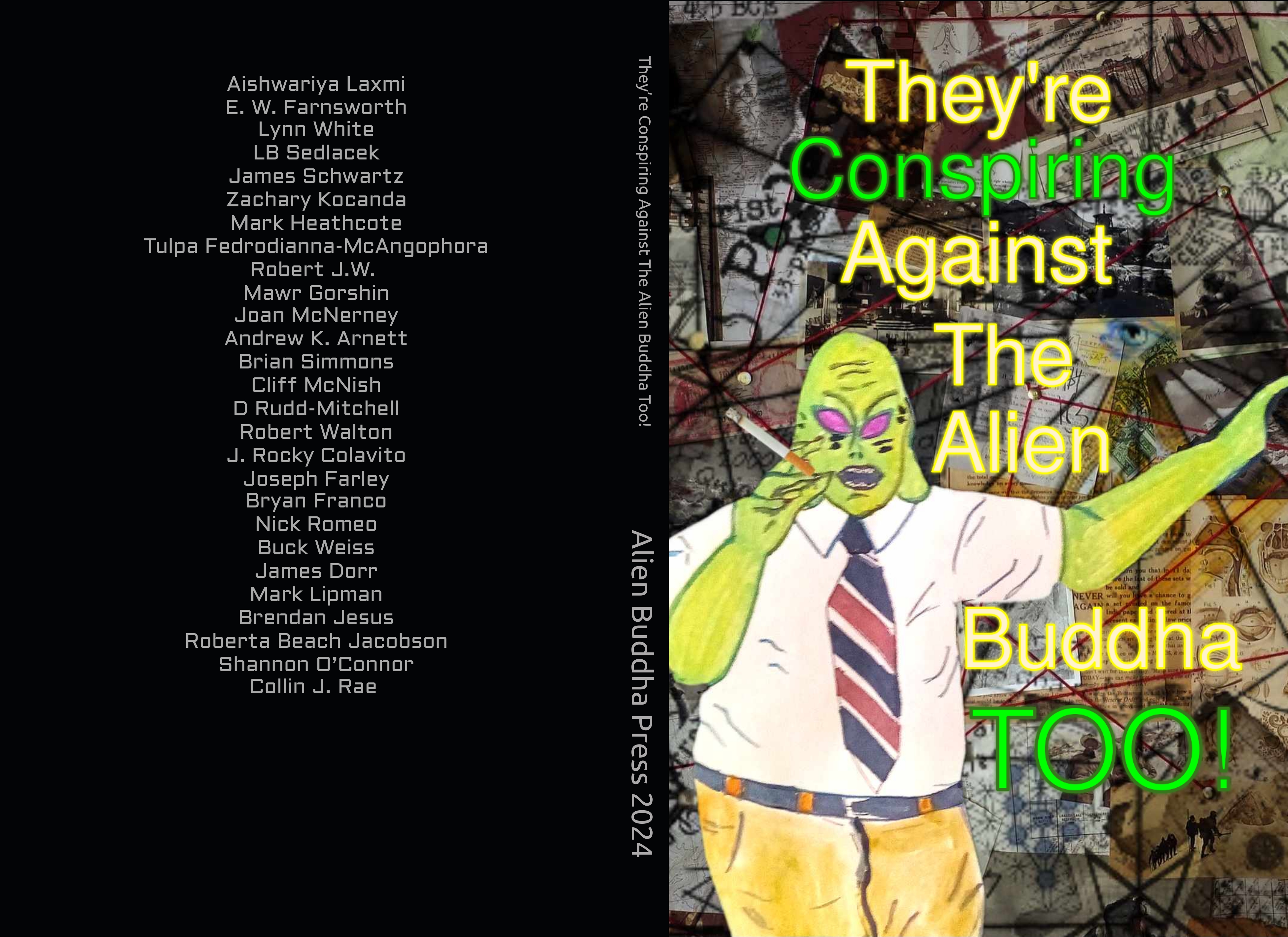
They’re Conspiring Against the Alien Buddha Too! is now published on Amazon, and here’s a link to it. My short story, ‘The Harvest,’ is on page 52 in the anthology. The paperback is $16.99.

Other writers who have written great stories and poetry for the anthology are Aishwariya Laxmi, E.W. Farnsworth, Lynn White, L.B. Sedlacek, James Schwartz, Zachary Kocanda, Mark Heathcote, Tulpa Fedrodianna-McAngophora, Robert J.W., (my story comes next in this order), Joan McNerney, Andrew K. Arnett, Brian Simmons, Cliff McNish, D. Rudd-Mitchell, Robert Walton, J. Rocky Colavito, Joseph Farley, Bryan Franco, Nick Romeo, Buck Weiss, James Dorr, Mark Lipman, Brendan Jesus, Roberta Beach Jacobson, Shannon O’Connor, and Collin J. Rae.

Please go check out this great anthology, now that it’s out!

Publication of ‘They’re Conspiring Against The Alien Buddha Too!,’ by Alien Buddha Press, on July 4th

This is to announce the publication of a new anthology of short stories about conspiracies, called They’re Conspiring Against The Alien Buddha Too! It’s being published by Alien Buddha Press, the same people who published–in a poetry collection–a few poems of mine, namely ‘Gaza’ and ‘Stomping,’ and who will publish my novella, The Targeter, in a few weeks, too.

In this particular anthology of short stories, I have one included, called ‘The Harvest.’ Other writers in the anthology are Aishwariya Laxmi, E.W. Farnsworth, Lynn White, L.B. Sedlacek, James Schwartz, Zachary Kocanda, Mark Heathcote, Tulpa Fedrodianna-McAngophora, Robert J.W., (my story comes next in this order), Joan McNerney, Andrew K. Arnett, Brian Simmons, Cliff McNish, D. Rudd-Mitchell, Robert Walton, J. Rocky Colavito, Joseph Farley, Bryan Franco, Nick Romeo, Buck Weiss, James Dorr, Mark Lipman, Brendan Jesus, Roberta Beach Jacobson, Shannon O’Connor, and Collin J. Rae.

I want to thank Red, Dave, and any- and everybody else involved in Alien Buddha Press for including ‘The Harvest’ in this publication. Remember, Dear Readers, to check out this book on Amazon on the 4th of July, a date so easy to remember!

Analysis of ‘Kin-dza-dza!’

Kin-dza-dza! is a 1986 Soviet film directed by Georgiy Daneliya, and written by him and Revaz Gabriadze. A dystopian science fiction black comedy, it stars Stanislav Lyubshin, Levan Gabriadze, Yury Yakoviev, and Yevgeny Leonov.

In 2016, the British movie magazine, Little White Lies, described Kin-dza-dza! as a cross between Mad Max, Monty Python, and Tarkovsky, saying the film is still relevant. The same year, Russia Beyond said that Russians still love the film. Three years earlier, an animated remake of the film was done by Daneliya, called Ku! Kin-dza-dza! The cartoon won Best Animated Feature Film in the 2013 Asia Pacific Screen Awards.

Here is a link to quotes from the film in English translation, and here‘s a link to the complete film with English subtitles.

I see this film as not only relevant for our times, but also prophetic in how the planet Pluke, in the Kin-dza-dza galaxy–to which the Russian and Georgian protagonists, respectively Vladimir Mashkov, or Uncle Vova (Lyubshin), and Gedevan Alexandrovitch Alexidze, or the Fiddler (Gabriadze), are teleported–is representative of the capitalist world, as contrasted with the Soviet world from which the two originate.

Now, as of the making and release of Kin-dza-dza!, which had been achieved by December of 1986, Mikhael Gorbachev had not yet implemented his policies of perestroika and glasnost as an attempt to put an end to the ongoing economic stagnation that had begun during the Brezhnev years; but he had spoken of the two reform concepts in his report to the 27th Congress of the Communist Party, which occurred from late February to early March that same year.

Gorbachev had given a speech the previous year about the slowing economy, and the perestroika reforms that would come by the end of the 1980s and the beginning of the 1990s included the return of “free market” economics and private property. When Yeltsin took over, not only were these reforms all the more aggressively and brutally implemented, plunging millions of Russians–hitherto used to a planned economy that had provided for their basic needs–into poverty, but attempts to resist the reforms were ruthlessly suppressed.

I bring up this history to show how the film can be seen to have predicted, in allegorical form, the economic and political disaster that the bringing back of capitalism would cause. Despite the economic problems that the Soviet Union was undoubtedly going through in the mid-1980s, most Russians wanted to keep the Soviet system intact; indeed, majorities of Russians since the dissolution of the USSR have consistently said that life was happier then than it’s been since the return of capitalism, and a referendum had been held in 1991, the results of which said that the majority of Russians had wanted to keep the Soviet system.

So, when Russians in the mid-1980s were hearing Gorbachev’s talk of economic, market reforms, the instincts of many of them must have been warning them of the danger of his reactionary talk. Recall Stalin’s words in this connection: “What would happen if capital succeeded in smashing the Republic of Soviets? There would set in an era of the blackest reaction in all the capitalist and colonial countries, the working class and the oppressed peoples would be seized by the throat, the positions of international communism would be lost.” 

Such is the political background in which we should understand what Kin-dza-dza! is trying to say to us. Uncle Vova’s thoughtless tapping of a button on the teleportation device of the barefoot, alien stranger is like Gorbachev and his followers foolishly allowing themselves to be influenced by the Western capitalists and bringing about the “new world order” that has led to all of our economic and political problems today. For it is that very pressing of the random button on the teleportation device that sends Uncle Vova and the Fiddler from the city centre on Kalinin Prospect in Moscow to the dystopian, desert wasteland of planet Pluke, with its glaring class inequalities.

The story begins with Uncle Vova returning home from work as a construction foreman. He chats with his wife, Lucya (played by Galina Daneliya-Yurkova), about mundane troubles at work. She asks him to go out and buy some bread and noodles, which she earlier forgot to buy, so he goes out to do that.

He arrives at the city square to buy he food, and there he meets the Fiddler, who tells him about the unshod alien traveler with the teleportation device. What should be noted is that, up until our two protagonists’ unwitting teleportation to Pluke, that the world we see around them, Moscow, is a perfectly normal society, without Pluke’s deprivation. Furthermore, the alien traveler, barefoot, scruffy, and as lost as a fish out of water, makes one think of a homeless man, which is fitting given that, as an outsider to the Soviet Union, he is representative of the capitalist world.

Now, the sight of our two protagonists stuck in a strange desert, actually a desert planet, reminds me of R2-D2 and C-3PO on Tatooine. The arrival of Uef (Leonov) and Bi (Yakoviev) in their flying vehicle suggests the Jawas, though these latter two have little, if anything, in common with the short, hooded droid thieves.

I’m not saying that the filmmakers intended these similarities with the early scenes of the first Star Wars movie, but the coincidental parallels between Pluke and Tatooine are meaningful in how they illustrate that the two desolate, desert planets are reflective of how capitalism sucks the life out of a place’s ecology. On Tatooine, Luke helps his uncle and aunt use moisture vaporators to produce water; on Pluke, fuel is called “luts,” and it’s made from water, so drinking water is a rare and valuable commodity.

The two droids unwittingly land on Tatooine to escape from the Galactic Empire, and they’re chased by imperial stormtroopers. Uncle Vova and the Fiddler have been thrust upon Pluke, and they’ll have to deal with the planet’s “ecilopps” (police, spelled backwards), whose bullying nature reminds one of the skeletally-armoured stormtroopers (after all, ACAB). Not yet knowing where he and his Georgian friend are, Uncle Vova comments that they must be in “a capitalist country” when they meet Uef and Bi for the first time, seeing the two Pluke inhabitants do their customary squatting and opening-out of their arms in an act of obeisance to say “ku” (“good”).

This act of obeisance is the first of many signs of a society structured around class lines, hence Uncle Vova’s assumption that it’s “a capitalist country” is not far off the mark. Money, known on Pluke as “chatls,” is hard to come by (note how chatl sounds virtually identical to chattel).

There are two kinds of people who live on Pluke–Chatlainians, and Patsaks; Uef is one of the former, and Bi is one of the latter. A hand-held device called a “visator” determines which of the two kinds of people you are: an orange dot of light on the visator indicates a Chatlainian, or a person of higher social status; green indicates a lower-status Patsak, of whom Uncle Vova and the Fiddler are also determined to be by the visator. Our two Earth visitors consider this discrimination to be outrageously racist; but had they all been on a Patsak-dominated planet, the Chatlainian/Patsak discrimination would have been reversed.

Uncle Vova and the Fiddler are hoping for a ride in Uef’s and Bi’s vehicle, and they offer some of their things (coats, a hat) in exchange for it, since they lack money, chatls in particular. But Uef and Bi begin to fly away in their vehicle without our two protagonists, until Uncle Vova uses a match to light a cigarette, making Uef and Bi want to return. We learn that matches, called “ketse” on Pluke, are among the most valued of commodities.

Since the society of Pluke is a dystopian one, it’s interesting to note that it, as being also a capitalist one, has a number of things in common with the society as depicted in George Orwell’s Nineteen Eighty-Four. The people of Pluke have a limited vocabulary, typically saying “ku” for whatever is good, or saying “kyu,” a mild swear-word for whatever is bad. These two words, as well as such words as have already been discussed above, make up the bulk of their vocabulary. Similarly, in Orwell’s dystopia, the development of Newspeak involved eliminating words in order to limit thought, including ideas potentially dangerous to the Party, such thoughts as being revolutionary. (On Pluke, though, this limited vocabulary seems unnecessary as such, for a plot device in the film gives the planet’s inhabitants telepathic abilities that, conveniently, allow them to converse in Russian and Georgian with our two protagonists!)

Furthermore, where the world of Orwell’s hell is led by Big Brother, a mysterious figure we never directly encounter in the story and who, for all we know, may not even exist, the leader of Pluke, named “Mr. P-Zh,” or “PG” (played by Nikolai Garo), is harmless and simple-minded, as it turns out. The film thus seems to be predicting such incompetent, ineffectual heads of state as Biden.

Now, such comparisons to Nineteen Eighty-Four are useful, since many in the capitalist West would dismiss Kin-dza-dza! as mere Soviet propaganda, while conveniently ignoring Orwell’s novel, as well as the deluge of such things as late twentieth-century Western movies, like Rocky IV, as blatant Cold War anti-communist propaganda. Western propaganda is “the truth,” apparently, not Eastern. How convenient.

That something as mundane and non-extraordinary as “ketse,” or match-like sticks, are among the most valuable commodities on Pluke is a satiric comment on the absurdity of our slavery to pieces of paper that, in essence, are IOUs. Furthermore, “luts,” fuel made from water, which makes drinking water so valuable, sounds like a comment on the petrodollar, as well as one on the ruthless destruction of the environment for the sake of profiting off of fossil fuels. In a fully communist society, there would be products as use values without exchange for money.

Uncle Vova and the Fiddler, however, have no choice but to exchange commodities–their ketse–with Uef and Bi if the former pair are to get the help of the latter pair to get back to Earth. Our protagonists try to exchange ketse for drinking water from some people who run off with the ketse, cheating them.

Uncle Vova and the Fiddler eventually get the idea to perform music in order to earn chatls. Though he’s referred to as “the Fiddler,” he doesn’t actually play the violin he carries around with hm. He was originally trying to find the violinist who’d forgotten to take his instrument when leaving. When the two perform their music, it’s actually Uncle Vova who ends up playing the violin…worse than a child violinist with no ear for music at all. In the Fiddler-as-non-fiddler, we see a satiric comment on Marx’s theory of the alienation of the worker from his labour.

The song that the two men sing, which sounds like some simple Russian folk song of some sort, includes such lines as, “Mama, Mama, what is to be done?” as well as “Winter is no fun,” “I don’t have a coat to keep warm,” and “How shall I live?” The song is all about a needy child asking his Mama for help, like a proletarian making a clamour about his needs.

The performing is typically done in small cages, or, on one occasion, on one’s knees, which should tell you something. The worker struggling to make enough to survive is, essentially, putting on an absurd performance, being an actor trying to please those who pay him, a wage slave caged in the world of capitalism, brought down to his knees. And the acting is all fake, and often it’s not performed very well, as we see of Uncle Vova and his scraping violin bow and his and the Fiddler’s bad singing. The alienation referred to above is enough to explain the poor, insincere ‘performances’ of the working class.

A physical indicator of lowly Patsak status is the wearing of a small nose-bell called a “tsak.” (Note in this connection that “Patsak” is backwards for “katsap,” a derogatory term for a Russian.) Bi would have Uncle Vova and the Fiddler each clip a tsak on his nose, which the two of course do with the utmost reluctance. The wearing of a tsak looks like the film’s commentary on the Nazis making the Jews wear the Yellow Badge, or German gay men wear the pink triangle.

Another indicator of class differences on Pluke is the wearing of differently colored pants: yellow, pink, etc. Uef covets them because, if he can wear those of the higher social classes, Patsaks and Chatlanians will have to do the “Ku!” squat of obeisance for him, the ecilopps can’t beat him up, etc. These colored pants are a social commentary on one’s preoccupation with social status as attained through high fashion.

At one point in the story, when Uef and Bi have enough ketse in their vehicle to buy what they need to get to Earth, they fly away and leave Uncle Vova and the Fiddler with nothing in return. Furious, our protagonists want to send the ecilopps after the two cheats; but they don’t have forty chatls to pay the ecilopps, so Uncle Vova lies that Uef and Bi failed to “ku” in obeisance to P-Zh’s image.

In these acts of dishonesty, we see how a world where money talks results in alienation. When Uef and Bi are apprehended, though, Uncle Vova quickly repents of his false accusation and hopes Uef and Bi won’t be imprisoned, which is particularly unpleasant, since instead of being put in a cell, they are locked up in a small metal box with barely enough room to hold the two of them inside. Given the dreadful state of prison life in the US, especially now, when corporations make practical slaves of the inmates, whose population outnumbers that of the Gulag (and even the CIA back then acknowledged that Gulag conditions weren’t anywhere near as bad as Western propaganda portrays them), we can see Pluke’s form of imprisonment as a comment on life in prison in a capitalist country.

Uncle Vova and the Fiddler are reunited with the barefoot alien they first met on Earth, the one with the teleportation device; he gives our two heroes a chance to return home immediately. Uncle Vova, however, feels guilty about causing Uef and Bi to be incarcerated, and he wants to pass up his chance to go back to Earth in order to help those two unfortunate ones.

Even though Uef and Bi double-crossed Uncle Vova and the Fiddler and made them wear those ridiculous bells on their noses, our two heroes want to help them, even to the point of giving up their chance to go home. While the capitalist world of Pluke teaches selfishness and alienation, leading to Uef’s and Bi’s double-crossing, the socialist world of the Soviet Union taught selflessness and solidarity. Though Kin-dza-dza! might be considered Soviet propaganda, it doesn’t teach its viewers to loathe and despise the citizens of capitalist societies (it may portray them as buffoonish and silly, but Uncle Vova and the Fiddler have their own foibles, too). In contrast, consider the malevolent scowls you see, for example, on the faces of Ivan Drago (Dolph Lundgren), his wife (Brigitte Nielsen), and his trainer and promoter (Michael Pataki) in Rocky IV.

Indeed, Uncle Vova and the Fiddler postponing their return to Earth–even returning to Pluke after a brief trip to other planets on the way home, and going back in time–to rescue Uef and Bi both from their incarceration, and later their fate on planet Alpha to be turned into plants is a kind of selflessness that would remind one of that of the bodhisattva, who postpones entering nirvana upon attaining Buddhahood and returns to samsara to help all other living beings, however unenlightened they may be, to attain nirvana together, a liberation for the entire Earth. Such is the selflessness of the true socialist, who would ultimately share liberation from capitalism with the whole world, not just hog it in his own country.

The planet Alpha is an interesting topic in itself. The people of Alpha have a method of dealing with Uef and Bi–whom they consider miscreants–that may seem cruel (turning them into cacti). Still, since Uef and Bi are governed by “vile desires,” rather like those of us caught up in samsara, then perhaps being transformed into plants, without human sense perceptions and the pain associated with them, is a kind of nirvana for them.

That buffoonish pair might be best left not to decide their own fate (as Uncle Vova would have it), since if left to do so, they’d choose foolishly; still, bodhisattva Vova would leave the nirvana of Alpha and postpone his return to the Pure Land, so to speak, of the USSR and help those two Pluke bumpkins.

After going back in time and back to Pluke, and helping those two, Uncle Vova and the Fiddler reunite with the barefoot man and his teleportation device, and our two heroes finally get sent back to Moscow. We see a repeat of the beginning of the movie, as if their time on Pluke never happened: Uncle Vova comes home from work again, and his wife sends him out to buy groceries.

Back in that city square, he meets with the Fiddler again, but the latter doesn’t tell the former about the barefoot alien this time, because he isn’t there. Our two protagonists don’t even recognize each other: it’s as if they’d never met, let alone got stranded in the Kin-dza-dza galaxy. As we soon learn, though, what happened is really just a repressed memory.

They see a tractor with a flashing orange light pass by. This triggers their by-now-instinctive attitude of submission to the Chatlainian colour, and the two men do their “ku” squat of obeisance.

Their return to the socialist world of the Soviet Union does not render them immune to the classism of the capitalist world as represented by Pluke. This is why reactionary instincts must be guarded against; old attitudes have a way of coming back if we aren’t careful. Just recall how those former Soviets became Russian oligarchs.

Still, one good thing has come from Uncle Vova’s and the Fiddler’s relapse: they now recognize each other, and exchange smiles like good old friends. Uncle Vova then looks up at the sky and hears the voices of Uef and Bi saying “ku” and singing the “Mama” song. They feel united, if only in spirit, with their Chatlainian and Patsak friends once again. Whatever good or ill may happen to us, being reunited with friends is above all else in importance.

‘Primal Scream,’ a Sci-fi Short Story

When the loud, rumbling thud came just a while away from the house where ten-year-old Ted lived on his parents’ farm, he shook even more than the ground did. He turned off the TV, rose from the living room sofa, and ran out the front door to see where the thud had come from.

He ran across a field of wheat, a rolling hill just by the house. At the far end of the field he saw a huge rock that hadn’t been there before.

That must’ve been what made that shaking, and that noise, he thought as he kept running towards it.

When he finally reached the rock, he tumbled and fell right on it, smacking his hands and knees against it. He looked down at his knees, which hurt; his jeans were cut there, with bloody cuts on both knees.

“Ow!” he grunted. “Mom and Dad are gonna kill me when they see these holes in my pants.”

Suddenly, he felt a stinging burn on his left hand, making him wince and pull his arm off the rock. It felt like a spark that had flown out of a campfire and hit him on the hand; but he looked at his hand and saw no mark. Whatever it was, it had to have been too small to be visible, or it had left as quickly as it got there.

He looked back at the rock. His eyes could barely make out something on it, thousands of things that, each taken individually, would have been as invisible as whatever had come onto his hand, but all together, looked like a kind of mist, or many wisps of hair. They seemed to be making a buzzing sound, as if they were insects.

He found the sound disturbing, and he began to worry that he might have caught germs and would get sick from the rock, so he let himself fall back onto the grass to distance himself from the rock, then he got up and ran back in the direction of the house.

He saw his mom’s and dad’s pickup truck coming in on the driveway. They’d just come back from shopping in town.

They got out of the truck and saw him running across the field, stomping on the wheat.

“Look at that dumb kid!” his dad shouted. “He’s running on my wheat again! Get outta there!

He turned to his left and ran off the field to the gravel road and went along that to get to the house. “Mom! Dad!” he shouted in excitement. “Did you see the big rock in the field?”

“What nonsense are you blabbering about now?” his mom said while taking two bags of groceries out of the truck. Then she and his dad took a look far out across the field. Her eyes widened. “Oh, my God. What do you think that is, John?”

“A meteor?” John said. “Fell from out in space, do you think, Jean?”

“Looks that way,” Jean said. “You didn’t go up and touch it, did you, Ted?”

He looked down at his feet. “Yes, I did.”

“You stupid kid,” she said. “And look at what you did to your jeans! And those cuts on your knees! You’re all filthy dirty. You’re gonna need a bath. Oh, you’ve always gotta find more work for me to do, don’t you?”

“I’m sorry,” the boy said softly.

“Get in the house, boy,” John said.

Ted went with his mother straight to the bathroom. She got his bath ready as he got out of his clothes. Both of them were frowning the whole time.

With the bathtub full of sudsy water and Ted naked and ready to go in, she turned around to look at him. “OK, Ted, get in the w…oh, my God!”

His skin was all a yellowish-green.

His eyeballs were yellow.

His blond hair had all turned grey.

“What the hell did you do, boy, getting so close to that meteor?” she shouted. “Such a stupid kid, always doing the wrong thing! What the hell is wrong with you?”

His father heard his mom’s shouting, then he ran from the living room and over to the bathroom. He saw his immobile, naked son…with that yellowish-green skin.

His eyes widened, and his jaw dropped.

“Oh, my God!” John said. “You stupid kid!”

“Normally, I’d beat your ass for doing such a stupid thing, but I’m afraid I’ll catch whatever disease you’ve got,” she said. “I’m scared to bathe you, as you are. I’m afraid to be near you. We’ve got to get you to a hospital. Get your clothes back on. There you go again, boy, giving me more work to do!”

Ted just stood there, still and morose.

“Well, hurry up, boy!” John shouted. “You heard her.”

He walked around to look his son in the face.

He saw that sullen expression on the boy, his eyes looking up at his father as if he’d like to kill him.

“Don’t you be lookin’ at me like that, boy!” his father shouted. “I got a good mind to smack you!”

“Don’t touch him, John,” Jean said. “You might catch whatever he got from that meteor.”

Then Ted looked at her in the same, threatening way.

“Hey, don’t you be looking at your mother that way,” she said. “You’re lucky I don’t smack you.”

He continued looking at both of them hatefully.

“I told you to stop it, boy!” she shouted.

“Stop looking at us that way, you little brat!” John said.

Ted kept the scowl on his face. It was even meaner now.

“Stop it!” his parents shouted.

“NO, YOU STOP IT!” he screamed. “YOU TWO ARE ALWAYS MEAN TO ME! YELLING AT ME, CALLING ME STUPID, SAYING I MAKE MORE WORK FOR YOU! YOU DON’T LOVE ME! I HATE YOU! I HATE YOU! I HATE YOUUUUUUU!!!

As he was screaming, a kind of toxic energy was emanating from his body and penetrating theirs. They couldn’t react in any way except to shake and tilt back with their eyes wide open and their jaws dropped in horror.

Ted kept screaming, but with no more words. He was just letting out unmitigated rage and pain.

John’s and Jean’s bodies were changing now, hardening. They were both petrified as physically as they were emotionally. They soon stood as still as glass statues.

Ted looked at them and smiled.

He let out one last, long scream.

Those statues fragmented and crumbled to the floor in two piles of rock-like pieces.

He smiled an even wider smile.

Then he got in the tub of water and bathed himself. After finishing his bath and drying himself off with a large towel, he left the bathroom, went into his bedroom, and put on a clean set of clothes.

He made himself a sandwich and ate it while watching the TV in peace. When the sun went down, he went to bed, thinking about how he could use his new power on the bullies at school.

He slept like a baby.

When he left for school the next morning after fixing himself a bowl of cereal, he’d never once looked at himself in the mirror. He didn’t care how he looked.

Walking on the gravel road all the way to school, he didn’t care how tired he was or how sore his legs were. He didn’t miss getting a ride to school in his parents’ truck at all. His eyes were looking around everywhere on that road, watching out for bullies. This wasn’t out of fear, of course; on the contrary, he couldn’t wait to run into some of them.

About two-thirds of the way there, and having walked for about twenty tiring minutes, Ted saw two bigger boys, Rod and Barry, walking on the road on the way to his school. He smiled at the sight of them, but not because he considered them friends.

The two boys look one look at Ted and froze.

“Holy shit!” Rod said. “What the fuck happened to you, Ted?”

“What a freak!” Barry said. Both of them started laughing at Ted.

Smiling, Ted walked closer to them.

“Hey, stay away from us, you freak!” Rod said. “We don’t want your germs.”

Ted kept coming closer, the smile never leaving his yellow-green face.

“I mean it, you frog-boy, stay away!” Rod said. Both boys picked up rocks.

Ted kept coming at them.

“Stay the fuck away!” Barry said, and both of them started throwing the rocks at Ted.

Barry’s rock hit Ted on the shoulder, and Rod’s hit him on the forehead. Ted’s smile turned into a frown.

“Aww, look,” Barry said. “He lost his smart-ass smirk. I’ll bet he’s gonna start cryin’ for his mommy.”

The boys picked up some more rocks, choosing bigger ones.

Ted stayed where he was, only a few feet away from the boys.

“You’d better start runnin’, freak,” Rod said. Both boys, with rocks in their hands, raised their arms up, ready to throw.

As soon as their arms were backed up to throw the rocks at Ted, he opened his mouth wide.

“AAAAAAHHHHHHH!!!!” he screamed.

The boys dropped their rocks and plugged their fingers in their ears, though it did them little good. They were shaking all over. Who would have thought that the little twerp could have been so terrifying all of a sudden?

“WHY DON’T YOU PICK ON SOMEONE YOUR OWN SIZE, YOU BULLYING BASTAAAARDS!!!

The two boys looked down at themselves in horror and disbelief as they saw their bodies hardening. The screaming was so ear-splitting that their whole heads were stinging with the sharpest pain, yet they had no hope of going deaf.

“YOU THINK YOU’RE SO TOUGH, YOU ASSHOLES?!” Ted continued. “YOU’RE A COUPLE O’ COWARDS, PICKING ON LITTLE KIDS! I HATE YOUUUUUU!!!

The statues that the two boys had become now shattered into hundreds of tiny pieces that scattered all along the road. With a little wind blowing them about, they’d become indistinguishable from the rest of the gravel. The boys’ clothes and schoolbags fell to the ground.

Ted looked at their remains and grinned.

“I’m so powerful,” he said, then continued toward school.

When he got to the gate surrounding the play area beside the small, one-storey school, where all the kids were out playing, some of them noticed him, shuddered, and pointed him out to their friends. Within a few seconds, all the kids started screaming.

“TED’S A MONSTER!!!”

“HE’S SO UGLY!!! DISGUSTING!!!”

“HELP US, SOMEBODY!!!”

Since Ted had never bothered to get a good look at himself in a mirror at home, he didn’t understand why everyone was calling him ‘freak’ and ‘ugly.’ All he knew was that those words hurt.

So he decided to do some screaming of his own.

“WHY DOES EVERYONE HAVE TO BE SO MEAN TO ME? WHY CAN’T I HAVE ANY FRIENDS? NO ONE LOVES ME! NO ONE ACCEPTS ME AS I AM, AND I’M SICK AND TIRED OF IT!!!

Every child in that playing area, and every teacher there or coming out there to hear what all the screaming was about, froze in his or her tracks, trembled at the deafening noise and the toxic energy radiating from the boy, and became emotionally and physically petrified.

He let out one more scream, and all those glass-like statues shattered all over the grass.

Ted himself was shaking with rage and poisonous hatred. He walked with stomping feet into the school. The remaining staff of the school, who were still alive but terrified by the superhuman volume of Ted’s screaming outside, just stood still where they were, shaking as they heard his approaching, stomping feet.

A few of them in the main hall saw him and gasped at how inhumanly green he looked.

He looked in their horrified eyes with a scowl.

“SO, YOU ALL HATE ME TOO, EEEEEEHHHHH!!!

With that long scream, they all froze and hardened.

He took a deep breath, then, “AAAAHHHH!!!”

Their bodies all blew up, the pieces spread all over the floor.

Now burning with hate, he went through room after room, checking to see if anyone at all was still alive. All he saw of humanity were scattered fragments of petrified pieces of former people.

“Good,” he grunted. “They’re all dead.”

Then he walked by a mirror and saw himself.

Not only did he have that yellow-green skin, the yellow eyes, and the greyed hair; his teeth, bared in his rage, were blood red, as if he’d just eaten an animal. He had green, wart-like spots all over his skin. Worst of all, he knew why he looked this way.

It wasn’t so much his exposure to the meteor.

It was all of his built-up rage and hate.

He couldn’t stand to see how he looked.

He hated all the more the person he’d become.

No better than John or Jean.

No better than the school bullies.

Much worse, in fact.

“AAAAAHHHH!!! I’M A MONSTER!!!”

He froze into a statue.

Ten minutes later, a six-year-old girl walked into the hallway, crying.

“Everybody’s dead,” she sobbed. “My teachers, my friends, all my classmates. They’re all just…broken little pieces. Why?”

Then she saw Ted’s green, deformed statue. She got up close to it. She saw his agape, red mouth and widened, yellow eyes. Her own mouth and eyes widened.

“AAAAAHHHH!!!” she screamed.

His statue shattered.

She trembled at the reaction, but stayed where she was.

“Oww!” she yelped at a slight burning feeling on her arm.

Analysis of ‘Brain Salad Surgery’

I: Introduction and Cover

Brain Salad Surgery is ELP‘s fourth studio album, released in late 1973, after the prog rock supergroup‘s eponymous debut, Tarkus, the live album Pictures at an Exhibition, and Trilogy. It was produced by singer/bassist/guitarist Greg Lake, as were all of the trio’s previous albums.

Though it initially got a mixed critical response, Brain Salad Surgery‘s reputation has improved over time. It had always been a commercial success, reaching #2 in the UK and #11 in the US; it eventually went gold in both countries.

Here is a link to the full album, and here‘s a link to all of the lyrics.

HR Giger‘s superb album cover gives a vivid visual representation of the album’s central theme of duality–male vs female, man vs machine, and good vs evil. The male/female duality is represented by the woman’s face in the circle in the middle of the cover; under her chin is the end of a phallus pointing up along her neck, the rest of the phallus being represented, outside the metal circle, by a short cylinder and a circle with ELP representing the balls. The record company insisted on removing the phallus for obvious reasons, so on early releases of the album, one instead saw it airbrushed away and replaced with a…shaft…of glowing light.

The album’s title–derived from the lyrics to Dr. John‘s “Right Place, Wrong Time” (released earlier the same year), and replacing ELP’s working title, Whip Some Skull on Ya–is a reference to fellatio, hence the phallus just under the woman’s face…and the skull at the top.

The cover originally opened up, like two front doors to a building, to reveal the whole head of the woman with her eyes closed, as opposed to seeing the skull’s eyeholes over her when the cover is closed, indicating the dualities of life and death, good and evil, and man and machine.

II: Jerusalem

Side One begins with two tracks that are adaptations of other composers’ works, something the band had done several times before, as with pieces like “The Barbarian” (based on Bartók‘s Allegro barbaro for solo piano), “Hoedown,” by Aaron Copland, and the aforementioned piano suite by Mussorgsky. As for track one of Brain Salad Surgery, ELP did an arrangement of a hymn by Hubert Parry, who set William Blake‘s poem, “And did those feet in ancient time” (from the epic, Milton), to music.

Jerusalem” was released as a single, but it failed to chart in the UK; actually, the BBC banned this ‘rock’ version for potential “blasphemy” (despite how reverent the band’s arrangement was). Apart from being understood as a religious song, “Jerusalem” is also considered patriotic to England, even proposed as the national anthem.

Now, the long-held modern assumption that Blake’s text is based on an apocryphal story–about Jesus walking on English soil during His lost years–is unlikely to be true, because no such story existed, apparently, before the twentieth century; instead, Blake’s text is based on a story that it was Joseph of Arimathea who allegedly went to England to preach the Gospel there. I find such an interpretation hard to follow, though, since the text explicitly refers to “the holy Lamb of God” and “the Countenance Divine” being in England.

In any case, the notion that the feet of Christ (or those of Joseph of Arimathea, for that matter…whichever) sanctified English soil by treading on it is jingoistic nonsense that actually turns the meaning of Blake’s poem into its opposite. The key to understanding the text is not “England’s green and pleasant land,” but rather “these dark Satanic mills,” referring to the early Industrial Revolution and its destruction of nature and human relationships, or to the Church of England and how it imposed conformity to the social and class systems.

People who see patriotism and conventional Christianity in Blake’s poem are blind to his irony in using Protestant mystical allegory to express his passionate advocacy for radical social and political change. He wasn’t saying that Jesus walked in England, thus making it ‘the greatest country in the world,’ and worthy of global domination. He was asking if Jesus went there, where the “dark Satanic mills” would later be found.

That he meant such a visit seems unlikely, but if the visitor was Joseph of Arimathea, at least he would have done a proselytizing of the primitive Christianity of the first century AD, not that of later centuries, with the corrupt Catholic or Protestant Churches of Blake’s time, those that subjugated other lands and justified their imperialism with their ‘superior, civilized’ religion.

Blake says he “will not cease from Mental Fight” (my emphasis), meaning his moral struggle with the powers-that-be, the industrial capitalists who used religion as Marx would later call “the opium of the people” to maintain social control in the interests of the ruling class. Blake’s bow, arrows, spear, and sword are metaphors for all he would use to bring about revolution and social justice (his metaphor for these being “Jerusalem”) in England; they were never meant to aid in the building of empire, much to the chagrin of the British patriots who want to read his poem in that way. Even Parry grew disgusted with the jingoistic misuse of his hymn.

This ironic surface patriotism and conformist piety as cloaking Blake’s real revolutionary social critique plays well into the theme of duality–good vs evil–on Brain Salad Surgery. Similarly, it’s fitting that keyboardist/composer/arranger Keith Emerson should have done an adaptation of Parry’s musical setting, one with the usual Emersonian pomp embellishments, but still reverent to the piety of Parry’s music. For again, such a musical style, soon to be contrasted sharply with that of the next track on the album, is a part of the good-vs-evil dualism of Brain Salad Surgery.

III: Toccata

The “dark Satanic mills” of the first track seem to be vividly depicted, in musical form, in this next ELP adaptation of a composer’s work, this one being the fourth movement of the first piano concerto of Argentinian modernist composer Alberto Ginastera. The movement is titled toccata concertata, hence the name of ELP’s adaptation.

Unlike the trite harmony of Parry’s work, this one is violently dissonant, something accentuated by Emerson’s use of raspy synthesizer sounds. Indeed, the dissonance of this adaptation makes King Crimson sound like the Bay City Rollers in comparison.

Another valid comparison of ELP with King Crimson, as far as this second track is concerned, is how we hear a push towards the most state-of-the-art technology. Recall how the 1980s King Crimson used guitar synthesizers, the Chapman stick, and Simmons electronic drums. “Toccata” boasts (as does “Jerusalem”) the use of the very first polyphonic synthesizer, the Moog Apollo, and eight specially developed drum synthesizers, used in the track’s middle percussion section, arranged by drummer/percussionist Carl Palmer.

Again, this use of the latest technology of the time, as mixed in with more conventional instruments and singing, reflects the album’s theme of dualism–in this case, the dualism of man vs machine.

I’d like to do a comparison/contrast of Ginastera’s fourth movement with ELP’s adaptation. I won’t cover every detail, as that would be too difficult and tediously long; so I’ll point out and compare/contrast a number of highlights. (Here is a link to the entire piano concerto, with a video of the score; move it ahead to about 18:50 to get to the fourth movement.)

ELP’s adaptation adds a considerable amount of material to Ginastera’s piece (as well as removing much of it), including of course the percussion section in the middle, as I mentioned above. Another addition is at the beginning, with Emerson playing a synthesizer, and Palmer hitting tympani.

Emerson plays a motif of B-flat, E, E-flat, and A, then Palmer hits A, A, A, and C. Then Emerson plays the same notes again, a bit faster, adding a C and an A, and Palmer does a short roll on A. Emerson goes up an octave to play the same first opening four notes, and Palmer does another, longer roll on A. Emerson, still in the higher octave, plays the notes faster, with the added C and A, and Palmer doesn’t another, still longer, crescendo roll on A.

Next, ELP’s adaptation converges with Ginastera, but with the latter’s arrangement of the B-flat, E, E-flat, and A motif played predominantly on horns, with all the notes sustaining in a swelling dissonance, while Emerson plays the notes on his synthesizer, intensifying the tension by adding a raspy, grating tone to it. The motif is played as I described above, then transposed an octave and a semitone higher to give B, F, E, and B-flat.

ELP come in with Emerson on organ, Lake on bass, and Palmer on drums. In Ginastera’s original, we hear pounding dissonances on the piano in 3/4=6/8 time, with the fourth bar in 5/8 time as an exception.

With the piano beginning in octaves of E in the bass, the orchestra is playing a cluster of eighth notes in A, B-flat, and E-flat. The E-flat goes up to a G-flat (with the E in the bass going down to a C-sharp with the G-flats), then back to E-flat, up and down and up and down. These movements up and down occur at irregular times, creating the illusion of odd time signatures, but Ginastera’s score has the whole passage in the same 3/4=6/8 time. The playing sounds fairly subdued in Ginastera’s original, but Emerson’s organ gives the passage a fiery extroversion.

The next passage has piano playing in the bass, whereas ELP’s version has Emerson playing it on synthesizer. A beginning in F and E leads to the opening motif of B-flat, E, E-flat, and A, then ending in another swelling dissonance reminding us of the opening one, but transposed a whole tone higher, giving us C, F, G-flat, and B (reverse the second and third notes to see the exact parallels). In Ginastera’s original, these notes are heard in the orchestra, predominantly the brass; in ELP’s version, Emerson does it on the synth, ending with that rasping sound again.

Next, a tune with a galloping rhythm, starting off with eighth notes going back and forth in F-sharp and A, then going to F-sharp, B, B-flat, C, A, F-sharp, and E, is heard on the strings; Emerson plays it on the organ. These seven eighth notes are heard three times, accented in a way that gives the listener the impression of 7/8 time, but again, Ginastera’s score notates it all as 3/4=6/8 time.

The up-and-down of F-sharp and A continues for a while, then we hear a five-note ostinato of B, A, F-sharp, E, and F-sharp, which grows dissonant with the addition of the horns, and ends with the piano playing a descension in octaves. ELP’s version ends the five-note ostinato, played on the organ, with more dissonant, angular synthesizer.

More of a galloping rhythm is heard in piano chords (on organ in the ELP version); this leads to more galloping, but with switches from 3/4=6/8 time to a bar of 5/8–this happens twice, then it returns to the regular 3/4=6/8 time. Again, what is piano in Ginastera is organ in ELP. Also, Ginastera’s version develops this switching of the time from six to five, while ELP’s version brings the tension to a climax with organ chords featuring a tritone of E and B-flat. Palmer also plays this tritone on the tympani.

Later on in Ginastera’s score, we hear a variation on the passage mentioned earlier, the cluster of repeated eighth notes, the top of which is the E-flat that goes up to the G-flat, then down, and up and down at irregular times. This time, however, the notes are a second-inversion A-minor triad with A-flat and C-flat in the bass. The top C-natural will go up to an E-flat, and down and up and down, in the same irregular pattern as with the E-flat and G-flat before. We hear the orchestra, predominantly strings, doing this; ELP’s version has the organ doing it.

After this, the piano does more galloping rhythms, with a few dissonant seconds thrown in here and there. Later, the piano does more developments of that passage with the time changes back and forth between six and five as discussed above, with an additional bar of 7/8 sandwiched in the middle. This passage isn’t in ELP’s version, which skips ahead in Ginastera’s score to bar 200.

Here, the galloping rhythm is done on pizzicato strings, starting with E-flat and G-flat going up and down in the bass clef. Then we hear E-flat, G-flat, A-flat, and A-natural three times before transposing the first two notes to A-natural and C. Emerson plays this line on the organ, but develops it further before going to the next passage.

A French horn plays A, D, G, and G-sharp, then A, E-flat, D, D-flat, G, and G-sharp, etc. Emerson plays this line on a synthesizer an octave higher. After this phrase, Ginastera has us hear five pairings of eighth notes of a minor second (C-sharp and D), with groupings of two to three eighth rests in between the first, second, third, and fourth pairings of those notes. They’re played softly in his score, but Emerson plays this rhythm as stabbing, loud organ dissonances.

A trumpet plays F, B, B-flat, and E three times; this leads to a climactic, dissonant passage. ELP’s version builds up this tension much more, right from the beginning of this passage, on the synthesizer. Ginastera does glissandi down and up on the piano; Emerson does a downward glissando on the organ.

At bar 240, the piano plays octaves in C, F-sharp, F-natural, and B, a restatement of the opening motif, but transposed up a whole tone; Emerson plays this on the synthesizer, using it to embellish the dissonance further and bringing this tensely climactic moment to raspy near-chaos, leading to Palmer’s percussion section. Ginastera’s original, however, further develops these themes on the piano, coming soon to the end of the movement.

Palmer pounds away on the tympani for a while, striking a gong here and there. This comes to an end, then we hear the soft hitting of A and C on the tympani, and on both tympani and tubular bells. Emerson plays three soft, dense chords on the piano as this passage comes to the end.

Next comes a passage with Lake playing electric guitar, with Palmer in the background hitting the tympani. Lake is playing, among other things, variations on that opening motif of sharpened tonic, fifth, flattened fifth, and tonic an octave higher.

The climax of the percussion section is Palmer showing off with a solo on his drum kit that features the drum synthesizer, and all the flashy, extraverted electronic sounds it can make.

After this, ELP ends their adaptation with a reprise of the section starting with A, D, G, G-sharp, etc. (i.e., the French horn line in Ginastera’s original). Again, Emerson intensifies the dissonant tension with that raspy synthesizer in ways totally different from the dissonant tension ending Ginastera’s original.

Both pieces end more or less the same way, with twelve sets of eighth notes of a dissonant chord played molto sforzatissimo, by the orchestra in the original, and on the organ in ELP’s version. The band played their recording of the adaptation for Ginastera in order to get his permission to publish it. The composer gladly gave it, describing ELP’s adaptation as “Diabolic!” and “Terrible!” These words were meant as compliments, though, for he felt that ELP had captured the mood of his music as no one else ever had.

That this music is “diabolic” makes it a perfectly dualistic contrast to the ‘piety’ of “Jerusalem.” Hence, we can see these two adaptations as thematically fitting within the context of Brain Salad Surgery as a whole. An outward appearance of trite piety masks the evil inside.

(Incidentally, a piece I composed years ago, my Divertimento for Strings, has a third movement, presto furioso, that is inspired by ELP’s adaptation of Ginastera’s toccata concertata, though I must insist that I used all my own notes and themes, not theirs. If you’re interested, please check it out.)

IV: Still…You Turn Me On

Lake was always sure to include an acoustic guitar ballad on every ELP album, and Brain Salad Surgery is no exception. Earlier, and in my opinion, far better examples of such ballads are “Lucky Man” and “From the Beginning.”

A curious thing about Brain Salad Surgery is how the musical style jumps all over the place. Normally, one tries to find a reasonably consistent style from track to track, but on this album, ELP seemed to be deliberately going as far in the opposite direction as possible. The album has a hymn, a violently modernist piece, a syrupy love ballad, a honky tonk piano farce, and a sci-fi epic–part standard prog, part jazz/piano sonata.

As far as I’m concerned, the only way to see unity in such musical and lyrical disunity is to hear it in terms of dialectical dualism, of finding a paradoxical unity in opposites. So, in these opening three tracks, we have the sentimentality (thesis) of Lake’s ballad, the brutal ugliness (negation) of the Ginastera adaptation, and the ironic piety masking evil (sublation) of the Parry/Blake adaptation. That Lake’s ballad is a love song also gives us the duality of male and female, some romanticized brain salad surgery? After all, he is turned on.

The instrumentation of the ballad reflects the man-vs-machine duality, in that on the one hand, we hear the human voice, Lake’s acoustic guitar, and Emerson’s harpsichord, but on the other hand, there’s Emerson’s synthesizer and Lake’s electric guitar leads played through a wah-wah pedal.

V: Benny the Bouncer

This song has lyrics written by Lake and Pete Sinfield, a colleague of Lake’s back when both of them were members of the original King Crimson back in 1969 and 1970. Lake would return the favour by helping Sinfield release his solo album, Still, on ELP’s new Manticore record label, as well as contributing vocals and electric guitar on it. Sinfield would also contribute lyrics to Side Two of Brain Salad Surgery, as we’ll soon see.

“Benny the Bouncer” manifests the album’s theme of duality in two ways: first, the use of synthesizer at the beginning, and the use of vocals and honky-tonk-style piano suggests the man-vs-machine motif; second, the light-hearted nature of the music, as juxtaposed with a story about a fight and a violent murder, gives us the duality of good vs evil, or light vs dark.

Benny is already understood to be a bloody, violent sort: “He’d slash your granny’s face up given half the chance,” as Lake sings in his affected Cockney. “Savage Sid,” however, is much meaner. First, he spills his beer on Benny’s boots to test him, then when the two fight, Sid sticks Benny with a switchblade, and Benny ends up with “an ‘atchet, buried in [his] head.” He’s dead now, and “he works for Jesus as the bouncer of St. Peter’s gate.”

All of this fighting, of course, is a reflection of the alienation found in an oppressive, dystopian society, the subject of the epic coming next, “Karn Evil 9,” the real thematic focus of Brain Salad Surgery.

VI: Karn Evil 9, 1st Impression

“Karn Evil” is a pun on carnival; this title for the sci-fi epic was suggested by Sinfield–due to the festive, carnival-like nature of the music heard in the “See the show!” sections of this movement, or “impression”–as a replacement for the originally intended title, “Ganton 9,” a fictional planet on which all evil and decadence has been put.

“Karn Evil” also reflects duality in the sense that the ‘carnival’ show of decadent displays is a pleasing, entertaining diversion (the ‘good’) from the evil and oppression really going on in this dystopian world. Indeed, this epic has real relevance in our world today, in the 2020s, in which such breads and circuses as the Super Bowl, Taylor Swift, OnlyFans, and photos of string-bikini-clad beauties plastered all over our Facebook feeds distract us from such problems as extreme income inequality, escalating wars, a media controlled by the super-rich, and the ongoing genocide in Gaza.

As for “9,” apart from “Ganton 9,” the meaning of this number could be seen in a subdivision into three of each of the three “impressions.” We all know, of course, about the division of the 1st Impression into two parts, because its length had to be spread over two sides of the original LP. One could, however, divide this impression further–namely, at the break between Lake’s singing of “Fight tomorrow!” and “Step inside, hello!”, or, between the frankly dystopian opening lyrics and the ‘carnival’ section about the “most amazing show.” Hence, three parts for the 1st Impression.

As for the 2nd Impression, it can easily be subdivided into three by virtue of its fast-slow-fast sections, like a short, three-movement piano sonata. The 3rd Impression can be divided in terms of the storyline as given by the lyrics: before the war, from the beginning to “Let the maps of war be drawn”; the middle, five-minute instrumental section and keyboard solo, as dramatizing the war; and the outcome of the war, from “Rejoice! Glory is ours!” to the end.

Anyway, part one of the 1st Impression begins with Emerson doing some contrapuntal playing on the organ. As Lake is singing the first verse, Emerson is playing dark, eerie bass notes on the piano while Palmer is hitting a cowbell.

This first verse establishes the dystopian world of the story, a dystopia disturbingly similar to our own world of the 2020s, “about an ago of power where no one had an hour to spare.” Those who have the power, the capitalist class, ensure that none of us, the working class, have much of any free time, because we’re all overworked and underpaid.

“The seeds have withered” because of environmental damage caused by prioritizing profit over the health of the planet. “Silent children shivered in the cold” because ‘free market’ capitalism has failed to provide for the needs of the poor, rendering so many of them homeless and unheard (“children” here isn’t necessarily to be taken literally; they can be also children in the metaphorical sense of being vulnerable and helpless).

The common people suffer like this because of “the jackals for gold,” or the greedy capitalists. “I’ll be there” to help when the revolution finally comes.

The working class have all been betrayed and silenced by the advocates of neoliberal, ‘free market’ capitalism (whose prophets, including the likes of Milton Friedman, were already making their promises of plenty in a world of ‘small government’ as of 1973, the year Brain Salad Surgery came out, thereby making “Karn Evil 9” prophetic, as I see it). The riot police of the ‘small government’ have “hurt…and beat” the people who try to protest the injustices they’ve been subjected to.

Everyone, working several jobs just to have enough to pay his or her bills, food, and rent, is “praying for survival,” but “there is no compassion” for those who cannot leave this miserable world–these are the homeless, whom it’s against the law to feed, and who suffer anti-homeless architecture and benches.

He, in whose voice Lake is singing, begs for a leader who will rise up and save the world from oppression, who will “help the helpless and the refugee”–that is, the impoverished and those displaced by war in ravaged places like Libya and Syria, or by genocide in Gaza. Again, he says he’ll “be there…to heal their sorrow.”

Next, we have the instrumental break that, in my opinion as described above, divides part one from the real part two of the 1st Impression (the “part two” of this impression beginning on Side Two of the LP being, in my opinion, ‘part three’ in actuality). We hear a tight riff in alternating 6/8 and 4/4, led by a synth melody; this tune will be heard again on Side Two in part two (or ‘part three,’ as I’d have it), but it will all be in 4/4.

This instrumental continues, with more time changes and synthesizer soloing, until it segues into the ‘carnival’ themes and ‘part two,’ as I conceive of it. Now that the dystopian world has been established, we will learn of how the powers-that-be are distracting the people from their oppression with “a most amazing show.” We can relate to this aspect of the story today, with all of the entertaining nonsense we see on TV and social media, distracting us from the horrors of the real world out there.

Those in power have always used two ways of keeping the masses under their control: the carrot and the stick, two seemingly opposed tactics, but actually just opposite sides of the same coin, since they both serve the same political purpose. The world government of Huxley‘s Brave New World uses the carrot of pleasure (sex, drugs, etc.) for social control, whereas the totalitarian government of Orwell‘s Nineteen Eighty-four uses the stick of coercion and bullying for the same purpose.

“Karn Evil 9” opens with an exposition of the dystopian stick, and with the “most amazing show,” we have the carrot. In our world, TV and social media are our carrot, meant to distract us from the stick of riot police and standing armies that imperialistically oppress the world. In cyclically abusive relationships, the carrot and stick represent traumatic bonding.

Those who “come inside” to “see the show” are the industrial working class, for they are told to “leave [their] hammers at the box” before going in. Among the images to see are violent, shocking ones, meant in this way to be entertaining and “spectacular”: namely, “rows of bishops’ heads in jars,” and a terrorist’s car bomb. The same goes for the “tears for you to see.”

There are entertaining horrors, but also entertaining pleasures, like the stripper. Of course, for many, the opium of the people is the most entertaining spectacle of all, hence they “pull Jesus from a hat.”

After all of this, there’s an instrumental section leading to the end of Side One of the LP. Being one of the pre-eminent progressive rock bands of the 1970s, ELP were always known for showing off their virtuosity as musicians, even to the point of annoying music critics, who accused them of egotism run rampant. For ELP to show off in this way, however, for the sake of putting on “a most amazing show,” is perfectly appropriate. In fact, Lake does some extended lead guitar soloing here, something he did only sparingly on previous ELP albums.

Side One ends with a fading-out of Emerson playing a repeated synth note in A-flat, accompanied by Palmer shaking a tambourine. This same music fades in to begin Side Two. There are CD versions of this music played without the fading out and in, giving an uninterrupted 1st Impression, but the long instrumental passage leading up to the famous “Welcome back, my friends, to the show that never ends,” still gives us the feeling that this is a distinct part two…or ‘part three,’ as I’d have it.

Note the ecological destruction alluded to in the line, “There behind the glass stands a real blade of glass.” While Lake is singing this line, Emerson comes in with the organ, playing that cheerful, ‘carnival’ music. In this we hear the stark contrast of the happy music masking the evil reality depicted in the lyrics of having wiped out almost all the plant life on the planet…and this horror is presented as a form of entertainment, or a museum piece.

In today’s world, the debate surrounding climate change could be seen as a form of entertainment, in that it may amuse many of us to watch and hear the heated, angry arguing over the controversy as to whether global warming is real or a myth. We go from “England’s green and pleasant land” to “a real blade of grass” over the space of one side of an LP.

So we can see how the theme of the good-vs-evil duality manifests itself as a mask in “Jerusalem” and “Karn Evil 9.” The piety and patriotism of the first track masks the “dark Satanic mills,” as discussed above, and the enjoyment of “the show,” the Karn of the carnival, its carnality, masks the Evil.

That the show is “guaranteed to blow your head apart,” in the context I just described, can thus have a dual meaning: good in that the show will impress and amaze us, and bad in that its mesmerizing effect will take away our ability to think independently. That we’ll “get [our] money’s worth” sounds like a capitalist hard-sell, and that “it’s rock and roll” suggests the decadence of capitalism (i.e., rock stars making huge profits while posturing as edgy, anti-establishment social rebels).

The decadence of rock is then aptly demonstrated by more instrumental showing-off, in this way by an organ solo by Emerson. This has to be one of the greatest organ solos in the history of art rock, ranking right up there with Rick Wakeman‘s organ solo on Yes‘s “Roundabout.” These solos almost compel fans to play ‘air organ,’ they’re so good.

Emerson’s organ playing here, as is the case with his piano playing in the 2nd Impression, is so good that it makes all the more tragic his suicide in 2016, from a gunshot wound to the head. Nerve damage in his right hand, starting in 1993, was hampering his playing; it had abated by 2002, but in 2016 he was struggling with focal dystonia, something he did not dare discuss publicly for obvious, professional reasons. Drinking and depression exacerbated the problem, and anxiety over performing badly, disappointing fans, pushed him over the edge, especially when internet trolls made mean comments about his playing. Lake died later the same year.

Speaking of Lake, after Emerson’s organ solo, he replays most of the written part of his guitar solo from Side One, followed by some extrovert drumming by Palmer and more verses. More references to decadence are made, these times of a sexual sort, when Lake sings of a “gypsy queen in a glaze of vaseline,” reminding us of the stripper from Side One; then there’s “a sight to make you drool–seven virgins and a mule.”

“The show” of the 1st Impression ends fittingly with more bombast, pomp, and instrumental showing off, particularly by Emerson playing fast notes on the synth, and by Palmer not only on the drums but also on the tympani.

VII: Karn Evil 9, 2nd Impression

This delightful instrumental has to be the creative zenith of the entire album, with “Toccata” and the 1st Impression just under it. Here, Emerson is held back by neither the need to play someone else’s notes, nor by a need to conform to listeners’ expectations, whether in the mainstream pop world, nor in that of what had by 1973 already become prog rock clichés. Here, we have pure Emerson as composer and artist, unfettered by anything.

Here‘s a link to the piece, with a transcribed score for piano and bass.

The piece begins with a long, twisting and turning piano riff, jazzy in style and yet, in the context of being sonata-like in structure, the ‘exposition,’ as it were. Palmer plays some fast, tricky drum licks before Emerson comes in as described, backed by Palmer and Lake on the bass. The music is modulating all over the place, and while most of it’s in 4/4, towards the end there’s a shift to a bar of 2/4, then two bars in 5/16, and a bar of 7/16 before returning to 4/4.

That long and winding piano riff is repeated, then there are two bars in 3/4, one in 12/16, one in 3/8, and one in 7/8 before going back to 4/4. After a while, we hear octaves on the right hand of the piano, eighth notes and sixteenth notes in C-sharp, then three sixteenth notes in E, then an eighth note in B, while on the left hand (doubled by Lake on the bass), instead of the E and B, it’s D and G respectively.

This set of notes is heard twice, leading into a section with a Latin American rhythm. Over this rhythm, Emerson plays a synthesizer solo that imitates the timbre of a steelpan. Palmer is shaking maracas and tapping claves in the background.

After this, a complicated riff is heard in alternating bars of 4/4 and 7/8 time, in the latter of which we hear high octaves in C-sharp on the right hand of the piano, thirds going up and down in C-sharp/E-sharp and D/F-sharp on the left hand, and C-sharp and D-natural on the bass. Next, a bar in 7/16, one in 9/16, and a 4/4 piano riff of high octaves in G-sharp, then C-sharp on the right hand of the piano, with the left hand playing second-inversion triads of E-natural/A-natural/C-natural to the right-hand G-sharp octaves, and left hand second-inversion triads of G-sharp/D-natural/F-natural to the right-hand C-sharp octaves.

The dissonance of these last few chords is the most tension we hear in this beginning fast section of the 2nd Impression, leading into the eerie tension of the slow middle section. Prior to this tense moment, the music has been largely upbeat and even merry. This contrast between cheerful and dark is once again a reflection of the good-vs-evil duality of “Karn Evil 9,” and of Brain Salad Surgery as a whole. Surface pleasures mask inner evils, as noted on previous tracks. The beginning fast section ends on a chord of C-sharp major.

While the beginning and ending fast sections are light and jazzy, the slow middle section is essentially like twentieth-century classical music in its use of eerie, atmospheric, dense chords, which are a kind of theme-and-variations form based on a harmonic progression in E minor, A minor, and C minor, as expanded tonality. As I said above, this softer music represents the hidden plotting and scheming behind the extrovert fun and games of the faster parts.

In this middle section, we hear Emerson’s expressive use of softer piano dynamics. Before, we heard his dabbling in jazz; now, we hear his mastery of classical technique.

Eerie, ambient, dense chords of G-sharp/D/E/A-sharp and F-natural/D/G-sharp/E are heard on the piano, and Lake follows with a line of A-sharp, G-sharp, F-natural, and E on the bass. These are heard twice, then Emerson plays intervals of G-sharp/E and F-natural/D, which Lake follows with a line of D, E, F-natural, G-natural, and A. This has all been in 6/4.

The time switches to 4/4, and Palmer is playing woodblocks behind the piano and bass, which have been playing harmonic variations of the chords and intervals I described above. At one point during this passage, Lake plays a descending chromatic line from E to A. Now in A minor, Emerson’s playing will include ascending and descending octaves in A, B, C-natural, and C-sharp, then C-natural, B, B-flat, and A; the first three of both sets of notes are triplets, and the second set of triplets are backed with a triplet roll on a kettledrum by Palmer, who’s still playing those woodblocks, like a ticking clock…ninety seconds to midnight (<<<more on this later).

The fast third section comes in next; it starts in 3/8 time, with Emerson playing a lot of fast triplets in the right hand. Then a bar of 4/8, back to 3/8 for four bars, a bar in 9/8, four more bars of 3/8, then 4/4, 4/8, 7/8, and a few more time changes until an improvisatory passage in 4/4.

In the middle of this passage, there’s a brief reprise of those dissonant chords heard just before the end of the fast first section, though notated in the transcription (YouTube link above, at about 6:16) with the enharmonic notes of D-flat octaves in the right hand, and a second-inversion triad of A-flat/D-natural/F in the left hand.

Finally, the 2nd Impression ends with a recapitulation, if you will, of the twice-played ‘exposition’ of the beginning of the fast first section, that twisting and turning theme. It ends with octaves in both hands of F-sharp on the piano, which Lake doubles on the bass.

VIII: Karn Evil 9, 3rd Impression

The music we hear Lake singing to sounds very patriotic, with a harmonic progression that sounds, to be perfectly frank, rather trite with, for example, its ending in a suspension fourth resolving to the leading tone, being the third of the dominant chord in the cadence, then back to the tonic in a major key.

How such music ties in with the story, it seems to me, is that a gung-ho, nationalistic attitude is being appealed to as a solution to the dystopian class conflict as established in the 1st Impression–trite harmony thus corresponds to patriotism as a naïve attitude in politics. Furthermore, historically such a solution has tended to lead to fascism, which in the context of this story can explain its ambiguous ending (more on that later).

Bourgeois liberal democracy gives the pretense of a free society, full of choice and pleasures, hence “the show” of the 1st Impression. But when class conflict gets too strained, as can be felt in the lyrics and music before the displays of the show, and the ruling class feels threatened by a proletarian uprising, they resort to fascism in order to maintain power, typically seducing the masses with talk of nationalism and patriotism, as is felt here in the 3rd Impression.

Once again, we have the duality of good as a mask for evil. The soldiers think they’re fighting for their country, when really they’re just fighting for the capitalist class.

“Man alone, born of stone”, is hard-hearted in his alienation. He thus is “of steel,” he’d “pray and kneel” to political and religious authorities to get an illusory sense of identity, communal inclusion, and meaning in his otherwise empty life. Still, his life is full of pain: “fear…rattles in men’s ears and rears its hideous head.”

Could that “blade of compassion” be the same blade of grass, the one preserved piece of plant life, from the 1st Impression? Whatever it is, it’s been “kissed by countless kings, whose jeweled trumpet words blind [men’s] sight.” Heads of state pretend to care about us, kissing compassion, as it were, and we’re blinded by the “jeweled trumpet words” of their demagoguery and false promises, believing their lies are truth.

We thought our civilization would last forever: “walls that no man thought would fall, the altars of the just, crushed…” Because of these disappointments, war must come, replacing the hope of revolution.

The relevance of the lyrics of the 3rd Impression to our world in the 2020s can be seen in not only the wish to fight the oppressive political system, but also in fascism’s co-opting of the common man to fight wars among nations instead of rising up in revolution against the ruling class, as well as how computers acting in their own right and supplanting humanity sounds like today’s rise of AI, and the fears many of us have about such technology replacing us in the working world and thus leaving us in abject poverty.

Accordingly, we sense hostility between man and machine (which, recall, is one of the main forms of the duality theme in Brain Salad Surgery–remember Giger’s ‘biomechanical’ album cover) in the bridge of the ship when the computer, voiced electronically by Emerson, says, “DANGER!…STRANGER! LOAD YOUR PROGRAM. I AM YOURSELF.” Indeed, our technology, in its quest to be dominant, is a reflection of ourselves.

All of these issues are relevant to our times in that we’ve seen these phenomena: a resurgence of fascist tendencies in many political movements in the world (those of Trump, Ukraine, Jair Bolsonaro, Marine Le Pen, Giorgia Meloni, etc.); such leftist struggles as Occupy Wall Street, opposition to the Gaza genocide, BLM, etc.; and the double-edged sword of AI (in a socialist context, where production is for providing for everybody’s needs, it can liberate us all; but in a capitalist context, it can throw millions of people out of work and thus subject us to homelessness, starvation, and death). Finally, a “nuclear dawn” in our time is the danger of such an armageddon between the US/NATO on one side, and Russia and China on the other.

All of what has come so far in the lyrics is a lead-up to war, culminating with “let the maps of war be drawn.” So the instrumental break, including a keyboard solo, all of it lasting for almost five minutes, represents the war.

There have been three interpretations of the outcome of the war. The first is that man has won, with Lake singing, “Rejoice! Glory is ours! Our young men have not died in vain.” Note the patriotic themes heard not only during the beginning of the middle ‘war’ section, but also during the beginning of this ‘victory.’

Perhaps man has deceived himself, though, in this supposed victory. Is the patriotic music a masking of an insidious evil, that of a surreptitious takeover of the computers? That they have won over man is the second interpretation of the war’s outcome. Such a possibility is suggested when the computer says to the “PRIMITIVE! LIMITED!” humans, “NEGATIVE!…I LET YOU LIVE.” In other words, the superior computers spared the defeated humans’ lives so they could see how inferior they are to their real victors. After all, “the tapes have recorded [the] names” of all the fallen men (suggestive not only of such things as the televising of the carnage of the Vietnam War, but also the deaths of so many in such places as Gaza today, all recorded on cellphones).

The third interpretation of the war’s outcome, as Sinfield–who collaborated with Lake on the lyrics of the 3rd Impression–would have us understand, is that man and the computers won together in a war against a shared enemy, but the computers have since taken control over man. Such an interpretation is the one most consistent with the lyrics, taking account of all of them.

IX: Conclusion

Such an interpretation is also conducive to the relevance of “Karn Evil 9” (and of Brain Salad Surgery as a whole) to our times in the 2020s. Class war was diverted from by fascism, not just in the period between the two world wars, but since both of them, too, in such forms as Operation Paperclip, with ex-Nazis working in the American and West German governments (including in NASA and NATO), in Operation Gladio, and in Western support for Ukrainian Nazi sympathizers all the way from the end of WWII to the present.

The war of the middle section of the 3rd Impression can thus be interpreted as the Cold War, with a preoccupation against “Un-American” activities as represented in the music by the patriotic theme. The perceived human victory would today be seen as the “end of history,” while the subsequent computer takeover can be seen to represent all of the technological advances of the three decades following the dissolution of the Soviet Union, including the online invasions of our privacy, AI threatening to take over many of our jobs, and the prospect of cashless societies making us helpless handlers of our cellphones.

So once again, the duality of good–for example, the convenience of new technologies–masks the evil of the hegemony of those technologies, just as the ‘good’ of patriotism masks the evil of fascism. In the same way, the piety and patriotism of “Jerusalem” mask the “dark Satanic mills,” and the erotic pleasure of ‘brain salad surgery’ and of “the show” masks the pain of “the helpless and the refugee.”

Contradiction and duality are at the heart of everything in life; this is what makes Brain Salad Surgery so thematically universal.

‘Slashers,’ a Sci-Fi Short Story

Two small spherical objects, one red, the other blue, were flying through space in search of life. They entered the Milky Way, then our solar system, having already sensed life on Earth.

They had a kind of cloaking device, ensuring that we would not detect their imminent arrival. By the time they had passed Jupiter in their approach to Earth, they had already absorbed volumes of information about us, including our warlike nature.

The red and blue balls were not spaceships. They were intelligent, technologically-advanced life forms who communicated with each other in a kind of mental telepathy. This is what they said to each other about humanity.

RED: What a hateful, hostile, and cruel life form!
BLUE: Yes. They maim and kill each other, and they do the same to all the subordinate life forms.
RED: If they are allowed to keep living, they will only prolong their own suffering and that of every other life form on the planet.
BLUE: Yes. Ending all their lives quickly, rather than letting them slowly kill themselves, would be kindness to them. Any potential for good in them is far too scanted to compensate for all the evil. We must destroy them.

The balls descended on the Earth, passing through our atmosphere as undetected as before. Only when they hit the ground, with crashing thuds that caused dirt to fly in the air, did we become aware of their presence.

…and even then, instead of being alarmed by this new, alien intervention in our lives, we found ourselves mesmerized by them, too fascinated to be afraid. This hypnotic state was caused by the balls’ technology.

The balls had landed on a flat field about fifty yards apart from each other. They began rolling towards each other on the bumpy ground, slashing through the grass and cutting into the dirt, for as soon as they’d landed, sharp, bonelike spikes came out of the balls, each about ten centimeters in length.

A family having a picnic saw them rolling at each other and causing the sliced-up earth to fly in the air in jumping spots of brown. The father and his two sons of six and eight ran closer to get a better look.

“What are those things, Dad?” the eight-year-old asked.

“I have no idea, Ian,” his dad said.

The balls smashed into each other with a loud, metallic, clanging noise, making them bounce back the way they came. A strange odour emanated through the air beyond the man and his two boys, so that the mother, having remained back at the picnic layout of food on a quilt, also smelled it.

The entire family felt a little dizzy for a few seconds on inhaling the smell.

After that, the man and two boys came closer. The mother left the picnic area and joined them.

Rapt, all four of them watched the spiked red and blue balls roll at each other again.

“Dad,” Ian asked, “did they just get a bit bigger?”

“Yeah, it looks that way,” the father said. “First, they were about the size of basketballs. Now, they’re a bit bigger than the size of medicine balls. The spikes are proportionately longer, too.”

“They’re fighting, aren’t they, Daddy?” the six-year-old asked.

“It looks that way, Jimmy,” Dad said.

“I hope the red one wins,” said Ian.

“So do I,” Dad said.

“Yeah, well, I’m rooting for the blue one,” Mom said.

“Me, too, Mommy,” Jimmy said.

The balls smashed into each other again, making another terrible, deafening metallic sound. All four family members winced and covered their ears. Nonetheless, they were enjoying the show…especially after breathing in more of that alien smell, which wafted in the air in a light pink smoke.

“Could they be aliens?” Ian asked. “Y’know, like Transformers?”

“Could be,” Dad said. “They got bigger again.”

Indeed, the diameter of the balls was the length of the man’s torso, from his waist to his neck. Each time they raced at each other, it was from a distance in between that grew in proportion to the growth in their size. As they accelerated at each other, the family anticipated the noise of the coming crash by covering their ears.

Some other people, coming by car, stopped and got out, then ran in the tall grass to get a closer look at the growing, clashing balls. They smelled the pink fumes and quickly chose sides to root for.

The dirt being dug up and flying in the air looked like swarms of insects. The balls smashed together again, causing a painful ringing in everyone’s ears.

Still, the people couldn’t take their eyes off the spectacle.

They breathed in more of the pink fumes, and felt themselves, after a brief dizziness, more and more hypnotized, transfixed by the battling balls.

“Come on, Blue!” the mother called out.

“Yeah, go, Blue, go!” Jimmy shouted.

“No way!” Ian said. “Red is better! Go, Red!”

Blue is better!” Jimmy shouted, snarling at his older brother. “Red sucks!”

“It does not!” Ian said, frowning hatefully down at Jimmy. “Blue is the one that sucks!”

Red sucks! Blue’s the best!”

Red is the best! Blue sucks!”

Red sucks!” Jimmy kicked Ian in the knee.

“You little bastard!” Ian gave Jimmy a hard shove, throwing the little boy down in the grass and banging his back against a sharp rock.

Jimmy’s bawling was completely ignored by his older brother and parents, who continued watching the clashing balls, which were now of the diameter of the father’s height. Since with every bouncing back after a collision, the ever-growing balls were proportionately widening their distance from each other, now they were slashing more than just the grass and dirt of the field. Groves of trees on both extreme ends of the field were being mown down by the balls.

The fascinated spectators, breathing more and more of the increasingly potent pink fumes, were now stepping forward, closer and closer to the action, utterly oblivious to the danger they were subjecting themselves to. That family was closest to those spiked balls, but the people who’d arrived later in their cars weren’t far behind.

All of them were chanting “Red! Red! Red!” or “Blue! Blue! Blue!” as they got perilously closer.

The supporters of the red ball came together in a group, as did the supporters of the blue ball. None of them gave a second’s thought to being crushed under the weight of the balls, or of being slashed by the spikes.

They all just kept chanting their colour and walking closer.

By now, those groves of trees were completely torn into fragments and shards of brown and green, lying in a mess on the ground. The balls were three times the size of the tallest of their watchers.

Jimmy was the first to be killed, crushed under the blue ball that he’d been rooting for. He’d shown no fear at all as he, ever-mesmerized, walked under it. His mother, equally unafraid and in a daze, would die next, her body sliced in two by a spike from her beloved blue ball.

Ian would then get crushed under the red ball, one of whose spikes would stab his father through his chest, the bloody point going far out of his back.

Indeed, the balls deliberately calculated their moves, as well as the moves of the people, to ensure every one, without exception, was killed by the very ball they were cheering for, as a kind of cruel irony.

In the end, the entire field was turned into a mash-up of brown, green, and red.

And the balls just continued rolling at each other from farther and farther away from each other, then clashing, then growing again.

By the time they were three times the size of a barn, they’d both crashed into and destroyed several barns and houses. The occupants of these, as mesmerized by the pink gas as the first group of people were, all were crushed, stabbed into, or bisected…all without even one scream of terror.

No police or army made the slightest attempt to stop the red and blue balls. Nobody in the news media, mainstream or alternative, uttered a word of warning, though all media reported on the phenomenon as if it were the most riveting of entertainment. Indeed, all anyone did in response to the balls’ presence was to go over and look with fascination, or if too far away, to watch it on TV, read about it online or in newspapers or magazines, or hear about it on the radio.

All of those who watched the clashing in person, of course, breathed in the pink fumes and became all the more enthralled with the spectacle.

Within an hour of the entire event, the balls had grown to the point of their diameters equalling the height of apartment buildings. By this time, they were rolling through cities on either side of that field, crushing and destroying houses and skyscrapers far faster than any wrecking balls could.

Still, there was no hope of any resistance from the people, who just stared at the rolling, slashing, and crushing like mindless zombies. A mass chanting of “Red! Red! Red!” and “Blue! Blue! Blue!” could be heard throughout both cities.

Any words or actions other than these were those of people fighting with each other for cheering on the ‘wrong’ colour. This fighting would end when the supporters of either ball wandered into their respective groups, always chanting the colour of their choice.

…until that colour crushed, slashed, or stabbed into them.

And with all that clashing into each other, neither ball had even one, ever-so-tiny, scratch on its red or blue surface.

Still, the supporters of each side imagined the other ball to be losing. With each clash, the supporters of Red would watch Blue bounce back as if badly damaged, and would pay no mind to how Red would bounce back with equal force, though Blue’s supporters would watch Red’s bouncing back and ignore Blue’s.

The people would argue these absurdities:

“Ooh! Red took a real beating that time.”

“You mean Blue took the beating.”

“No, Red did! Blue doesn’t even have a scratch.”

Red doesn’t have even a scratch! Are you blind?”

“Are you blind?”

Then the two would have a fistfight.

…yet, as I said, neither ball had even one scratch.

By the time the spiked balls’ diameters had equalled the height of the tallest buildings in the world, they were now rolling back and forth way beyond the widths of fields or cities, but now back along the entire width of the North American continent, from the east coast to the west, destroying everything and killing everyone, man, woman, and child, in their path.

Nobody felt any fear when coming dangerously close to the paths rolled on; all anyone ever did was watch, on TV or in person, and cheer for his or her colour.

When the red ball went back beyond the west coast and across the Pacific Ocean, as when the blue ball went past the east coast and across The Atlantic Ocean, both balls flew across the surfaces of the water, not sinking down into it…though their spikes managed to slash into or stab much of the marine life.

By the time the balls, in their rolling back from clashes, had reached the shores of northern Asia and Europe, they’d grown monstrously huge, easily visible from space. Blue rolled through Paris, killing everyone to a man and destroying every piece of architecture there; one would never see the Eiffel Tower or the Arc de Triomphe again. Red went through the Great Wall of China, smashing a huge section of it to pieces.

The pink fumes by now had spread around the world, ensuring that not one person could resist being enthralled by the spectacle. No one even flinched at the sight of crushed cities or massacred people from the ceaseless rolling and clashing of those two ever-growing juggernauts. People imagined they saw damage only on the ball they were opposed to.

Once the balls had been rolling so wide apart that they were clashing twice at a time, that is, rolling so far back that they’d roll all the way around the world, to clash once in North America, then in Kazakhstan, they’d grown to be each about a sixth of the size of the Earth, excluding their proportionally lengthening spikes, which were digging deep into the ground and ripping it up.

Now that they were rolling along the entire diameter of the Earth, the balls changed the direction of the rolling, to destroy the rest of the planet. No longer tearing up just the north, they shifted more and more southward, slashing into southern Europe and Asia, ripping through all of the US, mutilating Africa, and destroying Mexico, Central America, and the Caribbean islands.

…and all the (momentary) survivors did was continue watching in awe, never budging from their TVs, computer screens, tablets, or–so to speak–front-row seats.

When nuclear arsenals got smashed into, the destruction their explosions caused was insignificant compared to what the balls were doing.

By the time the balls were starting to roll across the southern hemisphere, slashing into the northern countries of South America, central Africa, Indonesia, and the northernmost tip of Australia, the balls and their spikes had grown so much that they were tearing the Earth up into chunks of rock that broke away. The planet no longer even remotely resembled a sphere; instead, it was looking more and more like an asteroid field with a huge chunk of jagged rock in the middle.

…and the ever-so-few survivors, the remainder of their lives now so pitifully brief, only continued staring at the giant balls…if their electricity and Wi-Fi were still working. If not, they just stared mindlessly at black screens, unmoving.

Once everything was essentially destroyed, the balls pulled in their spikes, floated away from the chunks of Earth–smashing into a number of now-useless satellites–and shrank back to their original sizes.

As they flew out of the solar system, they reflected on what they’d just done.

RED: Now the people of Earth know true happiness, as they could ever have it.
BLUE: Yes. They have death to enjoy.

Analysis of ‘Stalker’

Stalker (Russian: Сталкер) is a 1979 Soviet science fiction film directed by Andrei Tarkovsky and written by Arkady and Boris Strugatsky, based loosely on their 1972 novel, Roadside Picnic. The film stars Alexander Kaidanovsky (in the title role), Anatoly Solonitsyn, and Nikolai Grinko, with Alisa Freindlich and Natasha Abramova.

The premise of the novel is that after an alien “Visitation,” various items of the aliens were left behind in “Zones” in six places around the world. These alien artifacts have properties not understood by humanity, as are all the strange and dangerous phenomena experienced in the Zones. Still, some people, known as “stalkers,” illegally sneak into the Zones, risking apprehension by the police who guard the dangerous areas, and hoping to take some of the items out and sell them.

In the novel, Dr. Valentine Pilman compares this leaving-behind of alien artifacts to garbage left behind after a picnic on the side of the road, hence the name of the novel. According to Pilman’s analogy, the aliens are the picnickers, we humans are like the animals living where the picnic took place, exploring all the items left behind, not understanding what they are, things that may even be dangerous to the animals.

The novel is divided into four sections (preceded by an introduction involving an interview with Pilman) of which the last is the basis of Tarkovsky’s film, and even this section of the novel is radically reworked. An alien “Visitation” is considered a possible reason for the existence of the “Zone” in the film, though it may have been caused by a meteorite hitting the Earth. Redrick “Red” Schuhart of the novel is simply known as the “Stalker.” Instead of going into the Zone with young Arthur Burbridge, who dies in the “meatgrinder” of the novel, the Stalker goes in with two middle-aged men, known as the “Writer” (Solonitsyn) and the “Professor” (Grinko), neither of whom dies in the meatgrinder. In the novel, they seek the wish-granting “Golden Sphere” (or Golden Ball, depending on the translation); in the film, the three men seek a room that grants one’s deepest desires.

The making of the film was fraught with difficulties. It was originally filmed with film stock that was unusable, so Tarkovsky had to reshoot it almost entirely with the help of new cinematographer Alexander Knyazhinsky. Stalker initially got mixed reviews, but it has since been regarded as a classic of world cinema. The British Film Institute ranked it #29 on its list of the “100 Greatest Films of All Time.”

Here is a link to quotes from the film in English translation. Here’s a link to the full movie with English subtitles. And here is a link to Antonina W. Bouis‘s English translation of Roadside Picnic.

During the credits of the film, we see a black-and-white shot of a bar (which, in the novel, is called “the Borscht”). Next, we get a shot, still in bleak black and white, of the Stalker’s home, through half-way open doors leading into his bedroom. He, his wife (Freindlich–Guta in the novel), and their daughter, “Monkey” (deformed because of the Stalker’s exposure to the Zone, and played by Abramova in the film) are all lying in the same bed.

As they’re sleeping, we hear a train going by outside, shaking up the room. The Stalker is already awake, ready to get up and sneak out, to meet with the Writer and Professor, to take them into the Zone and find the desire-granting Room. His wife wakes up soon after, noticing he’s taken her watch; she begs him not to go and risk being put in jail again.

She fears his going back to jail, this time for ten years instead of five, as he did last time (in the novel, Redrick is incarcerated for a time for having been in the Zone); but the Stalker insists that he’s “imprisoned everywhere.” This ‘imprisonment’ is what the black-and-white filming is supposed to represent: the bleakness of their everyday existence, from which the Room in the Zone is supposed to be an escape.

He won’t be dissuaded from going, and he leaves her. She falls to the floor, weeping after having cursed at him for ruining her life. What we notice here is the close relationship between the nirvana of the Room and the suffering caused by desire for that Room, the heaven of the Room and the hell that surrounds it.

As we’ll learn soon enough, heaven and hell, nirvana and samsara, are even closer together than that.

He meets with the Writer near some train tracks (indeed, as his wife was weeping, we heard another train going by their home). The Writer has been drinking and chatting with a pretty young woman about how “boring” life is (i.e., black and white), and therefore there are no flying saucers, ghosts, or God to make it interesting. There isn’t even a Bermuda Triangle, according to the Writer…yet, there’s a wish-granting Room in the Zone that he’s risking going in to find?

The two men meet with the Professor in the bar. It’s fitting that they’d all meet here, with the Writer drinking in particular; for alcohol is as much an escape from pain for him as the Zone, and the Room, are an escape from pain for the Stalker, as we’ll see.

The Professor is in the sciences, physics in particular, though he alludes enigmatically to an interest in chemistry as part of his reason for seeking the Room, a reason he’d not have the other two know about until they find the place. The Writer claims he’s going there to regain his lost inspiration.

The Stalker tells them that their train has arrived, so they must go. He tells Luger, the bartender (named Ernest in the novel), to call on his wife if he doesn’t come back. Those trains we keep hearing and seeing represent that wish to go out there to find happiness…as opposed to being content with the happiness we have here, but don’t appreciate; and this is precisely what Stalker is all about.

(Though “stalker” in the novel and film has no relation to our notion of a disturbed fan or rejected lover following around a celebrity or other object of desire, one can in a way see a connection between the two uses of the word…someone obsessively chasing a desire or form of happiness that isn’t his to have.)

They drive to the entry to the Zone, dodging and hiding from the police who patrol the area on their motorbikes. Since the Zone is, for the Stalker in particular, a kind of Eden away from his miserable world, those police are like the cherubim and the flaming sword that forbid re-entry into paradise, to get at the Tree of Life (Genesis 3:24).

Now, how should one think of the ‘happiness’ as promised by the Room in the Zone? Since Stalker is a Soviet film (i.e., one approved by the Soviet government), one might think that one’s deepest desire is for the establishment of full communism: a classless society with such an abundance of commodities as pure use-values that one can obtain without need of money, and therefore no state is needed, either, to protect the interests of one class against those of the other. Police preventing entry into the Zone can thus represent capitalist encirclement–imperialism.

Now, while Tarkovsky, as his son would later insist, was no political dissident with regards to the ideology of the USSR (i.e., he didn’t leave the USSR during his last years for political reasons; and it should be noted in this regard how George Lucas once said that one had greater artistic freedom as a filmmaker there than in Hollywood, as long as one didn’t criticize the government), it would be too simplistic to reduce the meaning of wish-fulfillment and ultimate happiness to the socialist goals of the Soviet Union. No: Tarkovsky was far too spiritual for dialectical materialism.

The point is that happiness, having what one wants most deeply in one’s soul, in the true, spiritual sense, is elusive, and there is much pain that one must go through to find that deeper happiness, not just having one’s wishes granted.

And in the end, one often finds that what one truly wants is not what one thought one wanted. The Writer admits, early on, that he isn’t really seeking inspiration from the Room, and that one often doesn’t know what one does or doesn’t want. He acknowledges this unknowing before even entering the Zone.

Still, the three men risk apprehension by the police at the entry to the Zone, then risk all the booby traps in the Zone that surround the Room…all to attain a most enigmatic happiness. Such is the seductive allure of nirvana, the desire to end the desire that causes suffering.

The Stalker drives their car on a train track among the patrol guards, who shoot at them. When one has seen the filthy urban sprawl that they live in, blanketed in pollution, one can begin to understand the lengths they’ll go to in their quest for a better life.

Having gotten past the cops, the three find a railcar to go on to get into the Zone. We see in this transport the connection between the trains and the going out there to find happiness. We hear the clanking of the railcar against the tracks as the three men go forward into the Zone, thus reinforcing the thematic connection between the sound of trains and the search for happiness…out there.

The police won’t follow the three into the Zone because they’re scared to death of what’s inside, as the Stalker explains to the Writer, who asks him what it is that’s inside. The Stalker says nothing to answer the Writer’s question, because nothing is precisely the answer to the question–a nothingness of nirvana, Wilfred Bion‘s O, Lacan‘s Real Order, a paradox of heaven and hell, Rudolph Otto‘s notion of the numinous, a mysterium tremendum et fascinans.

As the three men are going along the track, we hear the clanking of the railcar and other twanging noises as a fitting soundtrack to the sights of industrial clutter all over the land, a reminder of the bleakness of their world. And finally, the black and white of that bleakness changes to colour, and the railcar stops.

We see mostly the green beauty of nature, with trees, bushes, and grass…but still some urban clutter to remind us that the world isn’t as perfect as it may seem. The Stalker nonetheless joyfully says that they’re “home at last,” for in spite of the dangers of the Zone, the three have arrived at his conception of happiness, hence, the change to colour. He loves how still and quiet the place is, a stillness and quiet of peace, without the hell of other people…apart from the three of them, though, of course.

To navigate the Zone and avoid its booby-traps, the Stalker will use a kind of slingshot, throwing metal nuts here and there, rather like David’s way of defeating the danger of the Philistines (this flinging of nuts from a slingshot is also done by Redrick in the novel).

They have to proceed through the Zone in a very roundabout way, to avoid the dangers therein. In the novel, there’s even a reference to minesweepers that were used by stalkers in the Zone, and how two stalkers were “killed by underground explosions.” This is the sort of thing that I mean when I refer to booby-traps in the Zone. Indeed, in keeping with the socialist interpretation of the heavenly aspect of the Zone and the Room, one might associate these mines and other booby-traps with the mines and other bombs that the imperialists left in places like Laos during the Vietnam War.

On a deeper level, we can see in the heaven/hell paradox of the Zone a symbolic association between the meteorite/aliens and humans, on the one hand, and the sons of God mating with the daughters of men, on the other (Genesis 6:1-4). The offspring from the Biblical mating were the Nephilim; in the case of the Zone, the offspring of stalkers, who have been exposed to the alien presence, are children like the deformed “Monkey”–unable to walk, but possessing telekinetic powers, as we discover at the end of the film.

The point is that, in the Zone, there is, symbolically speaking, a taboo mixture of the human and divine worlds, giving rise to the heaven/hell paradox of the place. Wishes may come true, it’s divinely beautiful in its greenery, but people die here. I discussed, in my analysis of the primeval history in Genesis, how any mixture of the human and divine worlds resulted in evil (i.e., man trying to be like God in having knowledge–expulsion from Eden; man trying to be like God in deciding when another will die–Cain’s punishment; and the mating of the sons of God with the daughters of men–the sinful world leading to the Flood).

The Stalker describes the Zone as a complex maze of death traps where “everything begins to move” when people are there. The Zone is an alien land, altered by divine, celestial beings, as it were, and when man enters it, we have that mix of divine and human that brings with it the danger of a deluge of evil.

This is why, though the three men have quickly found the building where the Room is, they cannot risk death by directly walking into it. They must follow the deliberately circuitous path directed by the Stalker. “Former traps disappear; new ones appear,” he says. Safe paths become dangerous, and vice versa: a dialectical shift between the opposites of good and evil, shifting up and down like the waves of an ocean…or a flood.

The Stalker speaks of the Zone in almost religious language, as though it’s a God-like presence that will punish you with death if you don’t behave properly. Still, he thinks that it isn’t the good or evil who either make it to the Room or perish. It’s the wretched, those who’ve lost all hope, who go thus from the lowest low up to the highest heaven. Yet even the wretched may perish if they misbehave here.

So, instead of going into the building, they will get there indirectly by first going into a dark wood where the Stalker has tossed one of his slingshot nuts. Thus we come to Part Two of the film. “Long is the way/And hard, that out of hell leads up to light.” (Milton, Paradise Lost, Book Two, lines 432-433)

The Stalker hopes, again in that quasi-religious attitude of his, that the other two men will believe (i.e., in the truth of the Zone), believe in themselves, and “become as helpless as children.” (Mark 10:14-15)

Another paradox in the film is the Stalker’s belief that it is in softness that there is life, and in death we find hardness. Strength and hardness kill, in his view; in softness and flexibility are life, rather like the notion that the meek are blessed, for they shall inherit the earth (Matthew 5:5).

The Professor, not realizing that the Stalker has been continuously guiding him and the Writer to the Room, however circuitously, but incorrectly thinking he has just been showing them something, has left his backpack and wants to go back to retrieve it. The Stalker insists that he mustn’t, for fear of the death traps, but the Professor won’t be dissuaded, because he has something in that backpack that he needs when reaching the Room.

The Stalker and Writer come to a place of rushing water that the former calls “the dry tunnel,” as a joke. Since the Professor is no longer with them, they assume correctly that he’s gone back for his backpack, and that they must go on without him. They go through the soaking wet of the “dry tunnel,” and after we see a close-up shot of rippling, shallow water with such various forms of leftover trash as used needles and pieces of paper, the two men are surprised to find the Professor on the other side, with his backpack and calmly eating and drinking from his thermos.

They’ve managed to get through an area the Stalker deemed dangerous, a watery area the Professor has navigated with no help (and the Writer has alluded to Peter almost drowning, a reference to Matthew 14:22-32); here, we see the Stalker, the most ‘religious’ of the three, being the one “of little faith,” while the Professor hasn’t needed any faith.

The three men lie down and have a rest.

Since this place is, on the one hand, a wish-fulfilling paradise, and paradoxically on the other hand, a place of death, a heavenly Hades, if you will, the appearance of a dog–whose howling we heard when the three men arrived on the railcar–is fitting. This dog is symbolic of Cerberus, guarding, as it were, the underworld of ultimate fulfillment.

We see a brief black-and-white shot of the water, close up, leading to the Stalker, who is lying prone on the ground by that water, his head on his hand in an attitude of exasperation. Meanwhile, the other two have been chatting about whatever wishes they may hope will be granted them. Inspiration for the Writer? A Nobel Prize for the Professor? The latter taunts the former about his talentless, vain writing, but the Writer, spitting on humanity, is interested only in himself. The Stalker’s exasperation must come from his secret knowledge that the granting of one’s wishes is a truly empty pursuit.

Still, taking people into the Zone is extremely important to him, as a kind of act of religious faith, as we’ll see towards the end of the film.

“Truth is born in arguments,” we hear. Indeed: dialectical thinking is the basis of all the paradoxes of Stalker.

We return to colour, with the Stalker now lying supine on the grass. He seems more at ease now. He brings as many people as he can into the Zone, wishing to bring in more…to find happiness. He agrees that one has never found a single happy person in the world, a reminder of the first of the Buddha‘s Four Noble Truths…yet the Stalker still wants to bring people here.

One seeks happiness like a dog chasing its tail, never catching it. Still, one chases after it.

When asked if he’s ever used the Room, the Stalker says that he’s happy as he is…with no smile on his face.

…and we briefly return to black and white, with the dog running up to him. His whole world is just as bleak in the Zone as it is outside. Deep down, the Stalker knows that the Room’s promises of happiness are empty, so he only brings other people here to give them that hope. He is, in essence, a kind of religious charlatan, selling bliss, and he knows it.

He’s lying on a tiny island, as it were, of land, just big enough to include his body, and he’s surrounded by shallow water. Sometimes Brahman is compared to an ocean (as I have done), with Atman compared to a drop in this ocean. But here, this water is shallow, like the shallow hope of happiness the Stalker is selling. Sometimes, nirvana is compared to an island, but his ‘island’ is so small as to be insignificant.

The Writer acknowledges the emptiness of his desire to gain inspiration from the Room. After all, the whole point of being a writer, for him at least, is to prove his worth, as such to himself and to others. This need to prove himself is fueled by his own self-doubt. If the Room grants him his wish of genius, he has no more need to prove himself; then, what need has he anymore to write?

What we can see here, therefore, is a kind of ouroboros of wish-fulfillment. I’ve discussed, in many other articles, my use of the serpent biting its tail as a symbol of the dialectical relationship between opposites. The ouroboros, coiled in a circle. represents for me a circular continuum; extreme opposites meet and phase into each other where the head bites the tail, and every point in between has its correspondence on every intermediate point on the serpent’s coiled body.

So, for the Writer to achieve his wish of inspiration is to lose his whole motivation and meaning for writing. The talent of writing kills the writer. The Stalker knows, deep down, that the granting of wishes, the giving of happiness, kills it; therefore, he’ll never use the Room. The Professor knows of the potential danger of misuse of the wish-granting of the heaven-hell Room, so he has special plans for it, which necessitate his bringing along of his backpack.

One can conceive of an ouroboros of the Zone, too. When the three men arrive, having come from the black-and-white bleakness of their ordinary world and the danger of being shot by the patrol guards, we come upon a colourful world of beautiful trees, grass, and bushes. What’s more, the Room has been discovered to be quite close.

They can’t go in directly, so they’ve had to travel from the heavenly biting head, as it were, of the ouroboros of the Zone, down the coiled length of its body in the direction of its bitten tail, where the deadly meatgrinder is, just before the Room. As can be expected, this move along the coiled length of the serpent’s body, so to speak, has meant an experience of less and less bliss, more and more pain. The Stalker has to guide them through the increasing intensity of danger. Hence, these black-and-white moments, indicating a decrease in heavenly bliss; hence also the increasing lack of civility in the men’s discussions.

We see a shot of what looks like a stretch of muddy land, yet it moves in waves…at once like that Brahman-ocean metaphor I discussed above, yet also like a field of diarrhea. Such is the heaven/hell paradox of the Zone.

We hear a voiceover recitation of Revelation 6:12-17 begin as the Stalker, still lying on his little island, stares in front of himself in a wide-eyed daze. The film switches to black and white again, with a slowly moving close-up shot of the shallow water with random pieces of trash in it: a needle, coins, a picture of a saint, a gun, etc., and muddy tiles on the bottom. The shot ends with the Stalker’s hand.

With what is heard and seen, we again have juxtapositions of the holy and the horrifying: a description of the terror of Armageddon from the Bible, and the oceanic Brahman of water, but shallow water with things that hurt (the needle and gun); a holy man’s picture, but that which, if we love it too much, is the root of all evil (1 Timothy 6:10).

We return to colour, with a shot of the dog. The Stalker rises from his resting place, and he contemplates the two disciples going to Emmaus and seeing the risen Christ (Luke 24:13-18). This narrative, of course, brings us from the despair of the disciples, over Christ‘s crucifixion, to the joyful realization of His resurrection…only the Stalker stops his recitation just before that moment of realization. Instead, as the Stalker discusses music, we see a shot of a beautiful lake, surrounded by trees. Renewed hope and joy can come in surprising forms.

Recall the presence of the dog…for the next scene shows the entrance to a tunnel leading ultimately to the Room. This is the place of death, a kind of Hades, that one has to go through before reaching the heaven of the Zone. This is the bitten tail of the ouroboros that I mentioned above. It’s a harrowing of hell, the meatgrinder one must risk death going through if one is to reach the nirvana known as the Room, the serpent’s biting head.

In the novel, Redrick simply plans, from the beginning, to sacrifice Arthur to the meatgrinder, so the former can gain access to the Golden Ball. In the film, the Stalker has all three men draw straws to see who will go first into the meatgrinder and risk death. The Writer is the unlucky one.

Like Arthur, the Writer is the Christ figure who must suffer so the others get the benefits of the Room. Unlike Arthur, though, the Writer won’t die; he’ll just have to endure the stress of thinking he could die. He’ll have to go through this dark, filthy, polluted tunnel that curves like the inside of the coiled ouroboros. The Writer, before drawing straws, says he doesn’t think he should go in first, rather like Jesus, praying in Gethsemane, hoping God would let this cup pass from him (Matthew 26:39).

The Writer goes through the tunnel, the Stalker and Professor following from far behind. The Writer reaches a door, through which he must go. Before opening the door, though, he takes a pistol out of his coat pocket; the Stalker forbids him to use it, for it would seal their doom. Christ, during His Passion, of which the Writer’s current ordeal is the representation, never used a weapon–neither must the Writer.

He opens the door, goes into a passageway flooded with water, and must descend stairs to get chest deep in it to reach the other side. Of course, the other two must follow. The gun must be left in the water.

The Writer has gone ahead into an area with wavy hills of sand on the floor, reminding us of that stretch of muddy land outside that undulated. The Stalker warns the Writer to go no further. Those waves of sand again remind us of the oceanic nature of the Absolute, which is both heaven and hell. The Writer is lying on his side in a puddle, in exasperation, as the Stalker was before.

The Writer gets up, then speaks of this place as someone’s “idiotic invention.” The Zone, like religion, is just an invention to him. He’s furious with the Stalker, believing he cheated him into taking the wrong straw.

The Stalker is amazed at the Writer’s good luck in having survived, since so many have died in the meatgrinder. The Writer’s survival, allowing the other two to get through alive, is thus symbolic of Christ’s redemptive sacrifice and resurrection. Later, we will even see the Writer put on his head a wreath of branches like the crown of thorns.

Finally, they’re in the Room. What’s fascinating about the shot Tarkovsky takes of the Room is that we see it from outside, from the entranceway, just like his opening shot of the Stalker’s home, with the doorway leading into the bedroom. A similar shot has been given of the way in the bar. The implication is that these similarities show that the way to true happiness is not somewhere out there, a place we have to find, but right here at home, if only we had the eyes to see it. The problems is that we are, so to speak, colourblind–hence, the black-and-white shots.

A telephone rings in the Room. The call is from a clinic, the Professor’s place of work, and he phones back to talk to the caller, a colleague he has contempt for. The Professor proudly admits to what the caller knows that he intends to do to the Room. In a sense, the Professor is having his deepest, secret wish come true right here, for he has found the courage to tell the caller that he is defying the wishes of the institution of his employment, from which he expects to be fired.

…and what does the Professor want to do, and why does he need that backpack so badly? In it, he’s been carrying a bomb he’s meant to use to destroy the Room, so no one can misuse it to grant wishes of power, or to do other forms of evil.

The Stalker struggles with the Professor to take the bomb away and to prevent him from destroying the Room, but the Writer stops the Stalker, still mad at him for cheating him into making him go first into the meatgrinder. In any case, the Professor will change his mind, take his bomb apart, and toss the pieces into a large puddle. What we truly want is often a surprise to us, for we don’t really know what it is.

The three men look out at a large opening where a wall would have been, as if this were the entrance to the Room. We never see what’s on the other side, as if to preserve the mystery of the Room; but I don’t think that this opening leads there, however much it is implied that it does. The light coming out from it suggests that it’s the way back outside, rather than the way into the Room. (When we saw the building earlier from the outside, when the three men had just arrived and the Writer was approaching it, we saw a huge hole in it, a wall removed, and a door to a small room to the right; what we see now corresponds perfectly to this earlier sight.)

I believe the little room with the telephone and a glowing ball of a ceiling light (corresponding to the novel’s Golden Sphere?) is the actual Room, though Tarkovsky may have been teasing us with ambiguity as to which area was the real Room (i.e., which way is the real way to heaven?). The men have just stepped out of the Room for a moment, having not yet decided on what their wishes will be; then they’ll go back in.

The little room has a telephone, electricity, even sleeping pills…all odd things to find in one of so many abandoned buildings of junk and filth, if this isn’t the wish-granting Room. Still, what we want is so often not what we really want, hence the ambiguity as to which place is the real Room.

And in spite of how ambiguous this Room is in terms of its wish-fulfilling properties, and its paradoxical heaven/hell status, the Stalker still wants his Room to continue existing, not just so he can continue making money taking people here, but because he sees in it the importance of maintaining a sense of hope in life, a faith in some kind of religious feeling. He is, as the Writer observes, “one of God’s fools.”

When the Stalker talks about making one’s wish, now that the time has finally come, he is nervous and dripping with sweat, as though getting one’s wish is a terrifying thing. Heaven is hell.

So what the men end up doing is sitting outside between the Room and the open space, in quiet contemplation, instead of making wishes. All this effort…for nothing.

Yet, the Stalker mentions again, as he did when they’d first arrived in the Zone, how still the place is.

They return to the bar, and we return to black and white. The Stalker’s wife is there, with Monkey. We see the two of them outside, through the window of a door, in a shot reminding us of those of the Room, of the way in the bar, and of the way into the Stalker’s home’s bedroom. The place of our wishes is here with us, with family and friends, all in its dull black and white, with all of its troubles and miseries.

The dog has come with them, further demonstrating the unity of the Zone and what’s outside it. When the Stalker goes home with his family and the dog, we return to colour, with the Stalker carrying Monkey on his shoulders.

Back in his home, the Stalker, not feeling well, is complaining of the lack of respect and appreciation the Writer and Professor have for the Zone and Room, like a religious person complaining of atheists. Fittingly, we see black and white again, to reflect his own lack of appreciation for all that he has, in his own home. He ends up back in bed, as he was at the beginning of the film, which has thus come full circle.

His wife, in a monologue that breaks the fourth wall, speaks of never once regretting marrying him, in contrast to her cursing of him at the film’s beginning. She, too, calls him “one of God’s fools.”

She concludes that, in spite of all the sorrows she’s had with the Stalker, she has no regrets because, as the film has pointed out so many times with all of its symbolism, without pain, there’s no happiness or hope, either.

…and who is her hope, and his hope? Monkey, of course!

And this is how the film ends, in colour, with Monkey seen reading a book. A golden shawl is wrapped around her head and draped on her shoulders, presumably to hide her deformities. She is mute throughout the film. We hear the Stalker’s wife, in voiceover, reciting a poem as the child, having put the book down, sits there staring into space.

The film ends with her using telekinesis to move two glasses across a table, making one of them fall off of it. Here we see the true meaning of wish-fulfillment: using one’s mind to make happen what one wishes to happen. As a deformed child of the Stalker, and therefore of the Zone, Monkey is clearly his wish-fulfillment personified, even if he doesn’t realize it. As the offspring resulting from the symbolic mating of one of the sons of God and the daughters of men, she isn’t literally one of the Nephilim, but she is a giant hope for her parents.

The fulfillment of wishes, the finding of happiness, isn’t supposed to be selfish–it’s to be shared with others. This is why we see colour now in the Stalker’s home: his happiness is here because his wife and daughter are here. They are his happiness. Happiness is a collective one, not an individual one…which is actually the goal of socialism, incidentally.

A similar conclusion is made in the novel when Redrick shouts out, in imitation of Arthur, who has first shouted it before being killed by the meatgrinder: “HAPPINESS FOR EVERYBODY, FREE, AND NO ONE WILL GO AWAY UNSATISFIED!”

Nonetheless, we hear the rattling of that train again, the wish to find happiness out there. The temptation to go astray is ever present. As the camera does a closeup on Monkey, though, with her head lying on its side on the table, her like a reclining Buddha, we hear a chorus singing Beethoven’s Ode to Joy.

How fitting.

Analysis of ‘Videodrome’

Videodrome is a 1983 science fiction/body horror film written and directed by David Cronenberg (who just two years earlier wrote and directed Scanners). It stars James Woods, Debbie Harry of Blondie, and Sonja Smits; it costars Peter Dvorsky, Les Carlson (who also played a man tracing telephone calls from the killer in Black Christmas), and Jack Creley (whom we may recall as the teacher from that old Glosettes TV ad from two years before this film).

Videodrome was Canadian Cronenberg’s first film to get backing from a major Hollywood studio. Though it had the highest budget of any of his films at the time, it was a box office bomb. It did, however, receive praise for its special makeup effects, for Cronenberg’s direction, and for the performances of Woods and Harry. It’s now a cult classic, and is regarded as one of Cronenberg’s best films.

Here is a link to quotes from the film.

Since Videodrome (“video arena,” or “video circus”) is about a broadcast signal, “Videodrome,” showing snuff films, a signal that lures its viewers into a hallucinatory world of mind control and paranoia that ultimately kills them, the film can be seen as an allegory of how the media in general is used to manipulate us, the people, into believing anything the media’s corporate owners want us to believe, and to act on those beliefs, no matter how harmful they may be. Such manipulation includes manufacturing consent for wars, which can be seen as symbolized by the violence of the snuff films seen in the movie.

What’s so alluring about Videodrome is precisely this video aspect, for the TV screen can be seen as a metaphorical mirror reflection of the viewer, analogous to the mirroring back and forth between one person and another to whom he or she may be talking at one time. We see an example of such an analogy at the beginning of the film, when Bridey James (played by Julie Khaner) wakes up her boss, Max Renn (Woods) through the use of a TV to remind him of a meeting he is to have that very day with Japanese pornographers about a film to be shown on his Toronto UHF TV station, CIVIC TV, which specializes in showing extreme erotic content.

Her talking to him on a TV screen, rousing him from his sleep is meant to look almost like one side of a conversation. As Professor O’Blivion (Creley) will tell us later, “The television screen has become the retina of the mind’s eye.” Seeing Bridey on the screen is like seeing her eye to eye; the worlds of fantasy and reality are blurred and fusing.

If looking at someone on a TV is hardly to be distinguished from looking at someone in real life, in front of oneself, then we can extend this idea to what I’ve discussed before of the dialectical relationship between the self and the other, of how there’s a bit of the self in the other, and vice versa. One could relate this idea to how Ian Anderson once introduced the Jethro Tull song, “The Minstrel in the Gallery,” as being about the performer not just being watched in his performance, but also him watching the ‘performance’ of his audience, for “he saw his face in everyone” after “he threw away his looking glass.” As I said above, the TV in Videodrome is a metaphorical mirror, or looking glass, in which the viewer sees his face in everyone on the screen, and narcissistically identifies with each of them.

The point is that Max projects his own unconscious desires onto the screen when he watches Videodrome, and the violence of his resulting hallucinations is a reflection of what’s inside of him. Then Videodrome in turn projects its violence back onto him, making him consciously act out his unconscious violent urges.

He watches the TV…and the TV watches him, so to speak, at least in his hallucinations. There are, or seem to be, two-way conversations going on between him and whoever is on the TV screen. This sense becomes more explicit when Max sees the Marshall McLuhan-like O’Blivion address him on the video he watches, the video when we see O’Blivion killed.

One establishes one’s sense of ego, as a distinct self, by seeing oneself for the first time as an infant in front of a mirror. One sees oneself, but the self is ‘over there,’ as if another person. One establishes oneself, yet is alienated from that self, hence conversely, there’s the sense of the self in the other, and vice versa.

Metaphorical mirrors exist in people we face in two-way, dyadic relationships, as with the infant held by his mother, them looking into each other’s eyes. An analogous two-way relationship is felt between the viewer and the person being viewed on TV.

When the media successfully manipulates our emotions, making us feel what its corporate owners want us to feel, this manipulation is the TV watching us back, like those two-way telescreens in Orwell’s Nineteen Eighty-Four. It’s significant that O’Blivion is meant to represent McLuhan in Videodrome, for recall what McLuhan said about the modern media: “The medium is the message,” or “the massage,” or the “mass age,” or the “mess age”; how the message is presented is, if anything, more important than its content.

Yes, the medium also massages us–that is, how the content is presented, in the case of Videodrome, via TV videotapes, is a visual form that charms us as a mother does her baby, she being one of those metaphorical mirrors; and through this charming, this massaging, the media gets us to do its bidding. It is the mass age because we’re in an age in which the media does this charming and manipulating of the world’s masses, interconnecting us all to the point of creating a global village. The medium is also, by making a mess of our age, a mess age.

Such manipulating is why some are concerned about CIVIC TV. Max appears on a TV show to defend his channel by rationalizing that, by giving his viewers an outlet to release their dark fantasies onto, they won’t feel the need to vent them on non-consenting people in real life. It is at this TV show where he meets Nicki Brand (Harry), and he immediately finds her attractive in that red dress.

That the two quickly begin a sexual relationship, all while Max has been watching his first samples of Videodrome, is significant, for she in her seductive beauty personifies the allure of Videodrome. The show presents plotless, realistic scenes of sadism, while Nicki is a masochist, enjoying being pricked with pins and burned with cigarettes.

That a masochist should personify a show featuring sadism, the dialectical opposite of her desires, is reconciled with a quote from Freud: “A sadist is always at the same time a masochist.”

Nicki is so taken with Videodrome that she decides to go and “audition” for the show. That she so quickly becomes part of Max’s hallucinations on his TV screen shows us how much she is, and has always been, at one with Videodrome.

Another character, one closely associated with Nicki as I’ll point out soon, is Masha (played by Lynne Gorman). She, in about her mid-fifties, is old enough to be 34-year-old Max’s mother (“Masha” could be heard as a pun on “Mama”), which is significant, because he occasionally flirts with her, indicating a transference of the Oedipus complex.

That Masha is associated with Nicki is made clear in the scene when Max hallucinates first whipping tied-up Nicki, who masochistically enjoys it, then realizes he’s whipping Masha, tied up and in Nicki’s place, even wearing red, as Nicki was. Max wakes up and hallucinates seeing Masha lying next to him in bed, still tied up and gagged, and dead from the beating; this indicates further his Oedipal transference onto her, as well as her association with Nicki (i.e., her involvement in the erotic fantasy).

If ‘Mama’ Masha is associated with Nicki, then Nicki is also a kind of displaced Oedipal transference, which can be seen in the earlier scene when Max hallucinates seeing her on his TV screen, and she says to him, “Come to Nicki,” which almost sounds like, “Come to Mommy.”

Therefore, Masha represents his good mother, and Nicki represents his bad mother, to use concepts from Melanie Klein. Masha is the good one because, apart from submitting ‘nice’ porn to CIVIC TV, she also warns him against looking further into Videodrome. Nicki is the bad mother because, of course, she lures him more and more into Videodrome.

This splitting of Max’s mother transferences into good and bad objects reflects what Klein called the paranoid-schizoid position: paranoid because of his fear of the bad internal object possibly persecuting him (which Nicki does, of course); and schizoid because of the splitting of his world into absolute good and bad, black and white. Trying to reject the bad, through projection, will result in bizarre objects, Wilfred Bion‘s term for hallucinated projections of the bad objects. Such projective identification is why Max is hallucinating.

One crucial thing to understand about his Oedipal transferences is that they are narcissistic in origin. Seeing that mirrored other face in front of oneself, be it the mother’s, a maternal transference, or a face on the TV screen, is a participating in a dyadic relationship with the other (only one other person), as opposed to Lacan‘s Other, meaning the many other people of society in general. The one other is a mirrored reflection, or an extension, of the narcissistic self, and that other is selfishly hogged, never to be shared with other people.

In his being sucked further and further into the dangerous world of Videodrome, Max is isolating himself and regressing to an infantile state where fantasy and reality have a blurred boundary. The removal of the societal Other, as represented by a father figure (here in turn represented by O’Blivion, whom we see killed, reduced to oblivion, on the videotape), is what Lacan called foreclosure, which leads to psychosis, Max’s break with reality, leading to more hallucinations and more delusions.

The media’s manipulation of us, beguiling us with those seductive images on the TV screen (or, in today’s world, our computer screens or smartphone screens; and incidentally, McLuhan predicted the internet) and twisting our minds with propaganda, is doing basically the same thing to us as Videodrome is doing to Max. In mindlessly supporting imperialist war after imperialist war, we’ve become as narcissistic, violent, delusional, and paranoid/schizoid as he is.

Max asks Masha to find out more about Videodrome for him, and as I said above, she tries to warn him to stay away from it. She insists that these snuff films show real murders, not faked ones. Of course, any producer of snuff films, in his right mind, would never risk being charged with murder when he could just fake the killings, as is done in mainstream films. Videodrome, however, doesn’t fake the killings because, as Masha tells Max, it has a philosophy.

When Max asks for a name behind this philosophy, she tells him that it’s Professor Brian O’Blivion. I would say, however, that the name behind this philosophy is that of the Marquis de Sade, who in his erotic writings merged pornography with philosophy, anti-religion, a glorification of cruelty and crime, and an ironic commentary on the oppressive power structures of our world–the Church, the state, and class antagonisms.

Right after learning about O’Blivion, Max goes to find him, and it’s significant that the building he goes to is a place where the homeless are made to watch marathon sessions of TV. Here we see a parallel of the relationship this film makes between sex and violence: the pleasure of watching TV, of being seduced by images on the screen and being put in that infantile, dyadic, almost Oedipal relationship, is associated with the structural violence of being reduced to poverty.

The rich and powerful, like Sade’s wealthy characters, his politically influential sex criminals, are torturing and killing the weak and poor. The people behind Videodrome represent these powerful people, at least the corporate media faction, indulging in transgressive, pleasure/pain jouissance and getting the surplus value of what Lacan called plus-de-jouir. Sadomasochism in the film represents the pleasure the ruling class gets from oppressing the working class.

Just as there are competing capitalist, imperialist interests, so are there competing factions for the control of Videodrome: there’s the agenda of O’Blivion and his daughter, Bianca (Smits), and there’s the agenda of Barry Convex (Carlson) of the Spectacular Optics Corporation, and of Harlan (Dvorsky), the operator of the CIVIC TV satellite dish who, though feigning subservience to Max, his “patrón,” nonetheless has lured his boss into his obsession with Videodrome by getting him to watch a broadcast of it at the beginning of the film.

Before meeting with Convex, Max has had a particularly disturbing hallucination in which he sees a yonic slit appear on his belly. He has a handgun with obvious phallic symbolism, for he puts it in the slit, along with his fist. This scene reinforces the thematic link of sex and violence in the film. It also suggests an internalizing of the combined parent figure, an infantile phantasy based on a child’s witnessing of the primal scene, of his parents having sex, which looks painful to the child and arouses Oedipal jealousy, a feeling of being left out.

Connected with this unconscious phantasy (recall Max’s maternal transferences onto Masha and Nicki) is his feeling of lack, as symbolized by that yonic slit, in turn a symbolic wound from castration. A lack of being able to be, or to have, the phallus for the mother (Masha or Nicki) gives rise to desire, which is the desire of the Other, to be what Masha or Nicki desires, these two being manifestations of Max’s objet petit a.

Consider in this connection a scene not filmed, but in the novelization by “Jack Martin,” pseudonym of Dennis Etchison, in which Max sees a TV rise out of his bathtub like Botticelli‘s Birth of Venus. If you recall the myth behind the painting, Venus, or Aphrodite, appeared from the foam after Uranus‘ severed genitals were thrown into the sea. As I discussed in this post, the castration of Uranus leading to the birth of Venus can be allegorized as Lacan’s notion of lack giving rise to desire.

Max’s desire, fueling his growing obsession with Videodrome, puts him in such a vulnerable state that he can now be easily manipulated and exploited by Convex, who comes in right on cue and has Max driven over to a branch of Spectacular Optical, a seller of eyeglasses. Since, as O’Blivion informed us, “the television screen is the retina of the mind’s eye,” then these glasses, through the association of TV with one’s eyes, are a metaphorical television in themselves. And since Convex is Videodrome’s producer, as a member of the eyeglasses company, we see a stronger link between the glasses and TV.

In his self-introduction to Max in the car on the way to the Spectacular Optics branch, which is done fittingly on a small TV screen in the car, Convex explains that the eyeglasses company makes cheap glasses for the Third World, paralleling Bianca’s having homeless people watch TV. Convex’s company also provides missile guidance systems for NATO, so we can see a sinister link between his use of media manipulation via Videodrome, his eyeglasses (as I suspect) controlling and shaping what the poor of the Third World see, and imperialist capitalism.

It is at the back of the eyeglasses store that Convex has Max wear a device on his head to record his hallucinations of whipping Nicki, then seeing himself whip Masha. His inner fantasies of dominance and control, over the two representing his objet petit a, are being manipulated and exploited (and therefore in turn dominated and controlled) by Convex.

When Max later learns of Harlan’s involvement in luring him into Videodrome, and of Harlan’s association with Convex, Harlan tells him of the need for the West to toughen up against its toughening Eastern enemies, who I suspect were the communists. We’ve seen this Western toughening up since the time Videodrome was made, suggesting how prophetic the film was in linking media manipulation of the masses with the neoliberal counterrevolution starting in the 1980s with Reagan and Thatcher.

Another surreal moment comes when Convex puts a videocassette into that slit in Max’s belly. Since, as I said above, that slit is yonic, Convex is putting the cassette in Max against his will, and the insertion is done to control Max, it can be seen as a symbolic rape, another fisting.

Convex wants Max to give CIVIC TV to Videodrome, and to kill his two business partners. Here we have a pun already seen in American Psycho: murders and executions for the sake of mergers and acquisitions. Videodrome is an example of big capitalism swallowing up small capitalism–CIVIC TV. Once again, I must give that quote from Marx: “One capitalist always strikes down many others.” (Marx, page 929)

Max holds his handgun, which merges with his body and becomes an extension of his fist, a phallic fist, like those hands that put organic videocassettes into his vaginal belly.

He does as commanded. He goes into the CIVIC TV building and finds his two business partners, Raphael (played by David Bolt) and Moses (played by Reiner Schwarz; since Videodrome was filmed and set in Toronto, I wonder if this second business partner was named after Moses Znaimer, head of Citytv at the time). Max kills both of them, then flees the building, having pretended also to be wounded and therefore supposedly not guilty of the attack.

Here we see Max no longer just unconsciously getting his kicks from snuff films. And no longer is he just being manipulated by and hooked on Videodrome, as if it were a drug. Now he is an assassin for Convex. Just like those of us who start off enjoying transgressive, taboo pleasures (jouissance) brought about by Lacan’s lack and a narcissistic wish to be mirrored by a mother substitute (objet petit a), then are manipulated by the media to channel our aggressive, violent urges on specific, political targets, so is Max being used to wipe out Videodrome’s enemies.

Next, he is to find Bianca and kill her. She, however, has been expecting him, and she shows him a video recording of Nicki being murdered by the people in Videodrome, Bianca’s purpose being to sway Max over to the O’Blivion side. (But has Nicki really been killed, or is the recording yet another of Max’s hallucinations, an attempt to manipulate him into working for Bianca? Indeed, for that matter, was even her father really killed, or was his assassination, apparently done by Nicki, yet another hallucination?)

In any case, just as the killing of Professor O’Blivion represents the Oedipal wish to annihilate the father figure so as to have the mother transference (Masha/Nicki), so is the killing of mother figure Nicki a reflection of an unconscious Electra complex in Bianca (her “father’s screen”), a wish to protect her father…or at least to protect his legacy. With Max under her control now, him having seen a hand/pistol emerge from a TV, and having been shot by it (projective identification from the TV back to him, and we furthermore see bullet wounds in the ‘chest’ of the TV screen, indicating once again the mirrored, two-way relationship of the viewer and his TV), he is now to destroy Videodrome.

He recovers from being shot like a resurrected Christ, the bullet wounds being his stigmata. Accordingly, he is now “the video word made flesh,” and so, “Death to Videodrome! Long live the new flesh!” As a brainwashed, quasi-religious zealot for the manipulative media, narcissistically flattered to be associated with Christ, he will go off to kill Harlan and Convex.

His switching to the O’Blivion side mustn’t be seen as him being any better than before. The Videodrome/O’Blivion conflict is just symbolic of controlled opposition, as far as it represents media manipulation of the public. The two sides just represent competing capitalists.

Harlan puts another videotape–this time, a surreal, fleshly one–into that vaginal slit in Max’s belly; but now that Max is working for Bianca, the symbolic wound of castration that that slit has been is now a kind of castrating vagina dentata that closes up on Harlan’s hand, his fisting, symbolic phallus, and bites it off, leaving the remainder of his arm vaguely resembling a mixer’s beater. Max has gone from feeling powerless, like a eunuch, to powerful. His Lacanian lack feels fulfilled.

After killing Harlan, Max finds Convex at a Spectacular Optics convention on the theme of Lorenzo de’ Medici, to whom the following two quotes are (erroneously) attributed: “Love comes in at the eye” (actually from WB Yeats‘s poem, “A Drinking Song“), and “The eye is the window of the soul” (not definitively attributable to any one source).

Apart from being, as it seems, a mere error on Cronenberg’s (or Convex’s) part, could there be any deeper meaning behind associating these quotes with the Italian Renaissance statesman, banker, and patron of the arts? Perhaps the point of linking Lorenzo de’ Medici to Videodrome is to say that he was, on the one hand, the McLuhan/O’Blivion of his day, and the art of men like Botticelli and Michelangelo (whom he sponsored) was the TV of the time; and on the other hand, his political power was like that of Convex, Bianca, et al.

In any case, Nicki’s love surely has gone into Max’s eye, which is the window of the soul that he’s lost to Videodrome.

We see Convex come on a stage after a dance performance, and he says to the audience, “Well, you know me, and I sure know you.” We also hear a member of the audience say, “Yeah, we know you.” This exchange reinforces the theme I discussed earlier of the reciprocity between performer (e.g., Jethro Tull), or person on TV, and audience, or TV viewer.

With his hand-flesh-gun, Max shoots Convex, who falls to the stage floor with his body tearing to pieces in a manner reminding us a bit of the climactic scene in The Evil Dead. This over-the-top death is explained in the novelization as being the result of Max not shooting Convex with normal bullets, but rather with “new flesh” ones.

Max’s ever-increasing madness is, of course, resulting in his ever-increasing isolation. He escapes to a derelict boat in the Port Lands. He has a hallucination of Nicki on a television set there. Recall how I’ve characterized that mirror-like reciprocity between TV image and viewer as a narcissistic one, how the ego is established in what Lacan called the Imaginary. Alongside this experience has been Max’s traumatizing, maddening experience of the Real, these surreal, hallucinatory states that cannot be symbolized through language (how the novelization managed such verbalizing is anyone’s guess); in other words, the psychologically therapeutic realm of the Symbolic is absent here. Max can only get madder and madder; he cannot return to the social world.

Accordingly, Nicki tells him that he must “leave the old flesh” to destroy Videodrome once and for all. This means he has to kill himself. In his narcissistic imagination, Max thinks that doing so will raise him up to a higher level of existence (“the new flesh”), rather like Christ’s death and resurrection giving Him a ‘spiritual body.’ Since Max, in his insanity brought on by media manipulation, is bordering on psychological fragmentation, such narcissistic imaginings can feel like a shield against said fragmentation.

He sees himself on the TV screen putting a bullet in his head, then he immediately does the same to himself. He and the TV are one, a mirror of each other, because the media, in controlling him, have made him destroy himself…just as today’s media, in manufacturing our consent for war with Russia and China, are making us all destroy ourselves through escalation and raising the threat of nuclear war.

Like Max Renn, we are all mesmerized by the images we see on our screens, be they TV, tablet, computer, or smartphone. Neoliberalism has caused us to feel a particularly gaping lack, a hole in our lives like that slit in Max’s gut. We’ve been propagandized to see things in a split-up, black and white world, with ourselves narcissistically as the white, Christ-like good, and other nations as the black, absolutely evil enemy. Political parties, like Videodrome vs. O’Blivion, pretend to be at odds with each other, when actually they push for essentially the same agenda. And we are driven to support aggressive, violent policies that could end up killing us all, like Max the flesh-gunned assassin.

Media manipulation is making us see a world so divorced from reality, so distorted a version of the truth, so surreal, that we could be understood to be hallucinating. If we’re not careful, we’re all going to “leave the old flesh.”