Analysis of ‘Howl’

I: Introduction

“Howl” is a poem by Allen Ginsberg, written in 1954-1955 and dedicated to Carl Solomon, hence it’s also known as “Howl for Carl Solomon.” It was published in Ginsberg’s 1956 collection, Howl and Other Poems.

“Howl” is considered one of the great works of American literature. Ginsberg being one of the writers of the Beat Generation, “Howl” reflects the lifestyle and preoccupations of those writers–Jack Kerouac, William S. Burroughs, Neal Cassady (“N.C., secret hero of these poems”; also, “holy Kerouac […] holy Burroughs holy Cassady”), etc.

The preoccupations of the Beat Generation writers included such subculture practices (as of the conservative 1950s, mind you) as drug use, homosexuality, free love, interest in non-Western religions, etc. Such practices are described with brutal, uncensored frankness in “Howl,” hence the poem was the focus of an obscenity trial in 1957.

Here is a link to the entire poem, and here is an annotated version of it (without the ‘footnote’).

The very title of the poem, one that gives vivid description to so much suffering, must be–on at least an unconscious level–an allusion to the final scene in King Lear, when the grieving king enters, carrying his freshly executed daughter, Cordelia. He calls out “Howl, howl, howl, howl! O, you are men of stones!” As in “Howl,” King Lear demonstrates, as I argued in my analysis of the play, that in the midst of so much suffering and loss, one can also gain something: Lear loses everything, but he also gains self-knowledge. Similarly, “the best minds of [Ginsberg’s] generation” suffered much and engaged in much self-destruction, but they also searched for forms of spiritual enlightenment, as I’ll demonstrate below. By the ‘footnote‘ section of the poem, we’ll find Ginsberg gaining that “Holy!” enlightenment.

II: Part I of the Poem

Now, “the best minds of [Ginsberg’s] generation” were those Beat Generation writers and their socially non-conforming ilk, engaging in all the wild behaviour we associate with them–doing drugs, having promiscuous sex, etc. As a result, they have been “destroyed by madness,” and have been “starving hysterical naked.”

“Naked” could be a reference to illicit sex, but it more likely refers to a lack of possessions in general, as the word is used in Hamlet, Act IV, Scene vii (in which Hamlet writes, in a letter to Claudius, “I am set naked on your kingdom.”). After all, these “best minds” are “starving hysterical naked.” Their wildness comes in large part because of their poverty, the cause of which, in turn, is an issue I’ll delve into in more detail later.

These drug addicts are going “through the negro streets at dawn looking for an angry fix”, yet in spite of their Dionysian sinfulness, they’re also “angelheaded hipsters burning for the ancient heavenly connection”. They seem to be offering their own idiosyncratic interpretation of Luther’s injunction to “sin boldly.”

Indeed, there is a duality permeating these pages, cataloguing on the one hand sin, obscenity, and excess, and on the other, a search for spirituality and salvation. They are in “poverty and tatters […] high […] smoking” and “contemplating jazz,” for this music was an important soundtrack to the lives of the Beats, as one can note many times reading Kerouac’s On the Road. Yet they also “bared their brains to Heaven under the El and saw Mohammedan angels…”

The El is the elevated train in New York, but it’s also a Hebrew name for God. Note also that the words “Mohammedan” and “negro” were being used here before they were considered unacceptable. Ginsberg’s reference to the Muslim faith is one of many examples of the Beats taking spiritual inspiration from non-Western sources. Some Beats having hung out in Tangiers (in the International Zone in particular) can, in part, be seen as an example of this influence.

The use of “who” beginning many of the long lines of this first part of “Howl” is paralleled with the refrains of “Moloch” in Part Two, “I’m with you in Rockland” in Part Three, and “Holy” in the ‘footnote.’ “Who” reminds us that the subject of Part One, an almost interminable sentence, is Ginsberg’s beatnik friends. The refrains of the other three parts also, of course, remind us of their respective subjects, an explanation of which will come when I get to those parts below.

Special attention should be given to Ginsberg’s use of long lines, something he derived from Walt Whitman, whose non-conforming behaviour (including homosexuality) could make him a kind of Beat Generation poet of the 19th century. One could compare these long lines to the sometimes lengthy verses of the Bible, giving Whitman’s and Ginsberg’s poetry a near-sacred feel, in spite of (or perhaps because of) its sensuality (recall in this connection the sensuality of the Song of Solomon… could the dedication to Carl Solomon be linked to this Biblical association?).

Long lines are oceanic, inclusive, requiring deep breaths to take in everything before expressing everything. They are universal because the poetry of Whitman and Ginsberg is universal: these two men are bards of Brahman, seeing holiness in everything (read Ginsberg’s “footnote” to see what I mean). The two poets embrace all religious traditions, like Pi, but they also reject the limitations of any one religious tradition or dogma. These long lines, in including everything but eschewing the rigidity of traditional short and exact metres, exemplify the same paradox in poetry.

In “Blake-like tragedy”, we find another example of a spiritual non-conformist in whom Ginsberg found inspiration. I discussed William Blake‘s unconventional approach to Christianity in the “Jerusalem” section of this analysis of an ELP album.

Ginsberg was once “expelled from the academies for crazy […] obscene odes…”, that is, he was kicked out of Columbia University for writing obscenities on his dorm room window. His friends “got busted in their pubic beards returning through Laredo with a belt of marijuana for New York,” that is, they were caught in Laredo with weed stashed in their underwear.

They “ate fire” and “drank turpentine in Paradise Alley…”, referring to the ingesting of toxic substances (drugs and alcohol) in a slum in New York City, full of run-down hotels, brothels, and dope dealers. Nonetheless, in a poem, Paradise Alley also has heavenly associations, and thus in this line we have another juxtaposition of the sinful with the spiritual.

Those readers who may have difficulty reconciling my close associating of sin with mysticism should take into account the idea of the dialectical unity of opposites, an idea I’ve symbolized with the image of the ouroboros in a number of blog articles. Two extreme opposites meet, or phase into each other, where the serpent’s head bites its tail, and all intermediate points are found in their respective places along the middle of the ouroboros’ body, coiled into a circular continuum.

Applied to “Howl,” this means that the harshest Hell phases into the highest Heaven and vice versa. One cannot understand this idea while adhering to traditional Christian dogma and its literal reading of an eternity in either Heaven or Hell. My interpretation of the ‘afterlife’ is metaphorical. In our moments of darkest despair, we often see the light and come out the other side (“It’s always darkest before the dawn.”); this is what Christ‘s Passion, harrowing of Hell, and Resurrection symbolize. Note also that those who rise to the highest points of pride tend to fall, as Satan and the rebel angels did. Finally, keep in mind the BeatitudesMatthew 5:4 and 5:11-12 in particular.

This Heaven/Hell dialectic can be seen in the four parts of “Howl.” This first part is the Hell thesis, with the second, “Moloch” part representing the Satanic cause of that Hell; the “Rockland” third part is the Purgatory sublation (though therapy in an insane asylum must be judged to be a remarkably ill-conceived purging of sin), and the “footnote” is the antithesis Heaven that stands in opposition to this present first part.

In this way, we can see “Howl” as Ginsberg’s modern Beat rendition of Dante‘s Divine Comedy. And just as Dante’s Inferno is the most famous first part of his epic poem, so is the infernal first part of “Howl” the most famous part, with its emphasis on human suffering. Similarly, Pasolini‘s Salò, with its sections divided up into Circles of Manias, Shit, and Blood–like Dante’s nine circles of Hell–is also focused on suffering, sin, and sexual perversity.

To come back to the last line discussed before my dialectical digression, and to link both discussions, this inferno part makes fitting reference, in this line, to the paradiso of Paradise Alley and the purgatorio of the “purgatoried […] torsos”. These torsos may be purged of sin through the ingesting of alcohol and drugs, or through sex (“pubic beards”, “torsos”, and “cock and endless balls”).

Just as there’s a dialectical unity of Heaven and Hell (i.e., one must go through Hell to reach Heaven, as Jesus did, the passing through the ouroboros’ bitten tail to get to its biting head), so is there also a dialectical unity of sin and sainthood (i.e., one uses drugs or sexual ecstasy to have mystical visions or spiritual ecstasy). The fires of Hell are those of desire, in samsāra; blowing out the flame leads to nirvana. The Mahayana Buddhist tradition, however, sees a unity between samsara and nirvana–the fire is the absence of fire…Heaven is Hell. The Beats, in their excesses, understand these paradoxes.

Part of those Dionysian excesses are, as mentioned above, the alcohol and drug abuse (“peyote” and “wine drunkenness over the rooftops”). Similarly, the Beats were “chained […] to subways for the endless ride from Battery to holy Bronx on benzedrine“, that is, they were so high on the benzedrine that they were frozen from doing anything while on their endless joyride on the subway, “chained” to it, all the way from Battery to the Bronx. Note how the Bronx is “holy”: in their sinful indulgence on drugs, the beatniks attain sainthood in the Bronx.

At Fugazzi’s…Bar and Grill, at 305, 6th Ave. in New York City?…they are “listening to the crack of doom on the hydrogen jukebox”. In Macbeth, “the crack of doom” is the end of the world, and a “hydrogen jukebox” suggests the hydrogen bombs that had been created, recently as of the writing of “Howl,” a bomb whose destructive power, greater than the original atomic bomb, can bring us even closer to “the crack of doom.”

Ginsberg and company, however, are getting wasted listening to music–jazz, presumably, on the jukebox. They are creating their own armageddon of drunken self-destruction. That end of the world, though, is followed by the Kingdom of God: the beatniks, in their rejection of the conservative values of the nuclear family, are getting nuclear bombed drunk; and the hellish fires of “the crack of doom,” the ouroboros’ bitten tail, will be passed through to attain the heavenly Kingdom of God, the serpent’s biting head.

The dialectic is manifested once again in how this “lost battalion of platonic conversationalists” are “jumping down the stoops off fire escapes off windowsills off Empire State…” Since sorrows “come not single spies but in battalions,” it’s easy to see them leading to despair and suicide. Yet the beatniks would express platonic ideals in philosophical discussion, an Apollonian trait; of course, in true Dionysian fashion, they would also jump off of buildings to their deaths to escape the egoistic experience for that of the oneness of Brahman.

Thus, the juxtaposition of jumping suicides with platonic conversation is a case of “whole intellects disgorged […] for seven days and nights”…the seven days and nights of Biblical creation, ending in a day and night of rest–that Heaven of intellectual bliss? It’s fitting to include the Sabbath–“meat for the Synagogue”, since Ginsberg was Jewish.

Indeed, the Beats return from debauchery to spirituality in not only the Synagogue, but also “Zen New Jersey”, “suffering Eastern sweats and Tangerian bone-grindings and migraines of China under drunk withdrawal”. We’re reminded of the Opium Wars, the victimizing of China under Western imperialism, and maybe the jumping “off Empire State” is Ginsberg’s rejection of that very imperialism.

These hipsters “studied Plotinus Poe St. John of the Cross telepathy and bop kabbalah because the cosmos instinctively vibrated at their feet in Kansas”. Plotinus was a neoplatonist who believed that all of reality is based on “the One,” a basic, ineffable state beyond being and non-being, the creative source of the universe and the teleological end of all things. St. John of the Cross was a Spanish mystic and poet who wrote The Dark Night of the Soul, both a poem and a commentary on it that describe a phase of passive purification in the mystical development of one’s spirit.

What’s interesting here is how Ginsberg sandwiches, between these two writers of spiritual, philosophical matters, Edgar Allan Poe, also a great writer, but one whose death at the relatively young age forty was the self-destructive result of alcoholism, drug abuse, and/or suicide, his last moments having been in a delirious, agitated state with hallucinations.

Though St. John of the Cross hadn’t intended this meaning, “the dark night of the soul” has the modern meaning of ‘a crisis in faith,’ or ‘an extremely difficult or painful period in one’s life.’ The combining of these three writers in the above-quoted line in “Howl” suggests a dialectical thesis, negation, and sublation of them respectively: the wisdom of philosophy (Plotinus), the destructiveness of the Dionysian way (Poe), and a combination of passive mystical purification with a spiritual crisis and a painful time in life (St. John of the Cross).

Such an interpretation dovetails well with the Heaven and Hell, saintly sinner theme I’ve been discussing as running all the way through Ginsberg’s poem. The juxtaposition “bop kabbalah” continues that theme, with “bop” representing the contemporary jazz that he and his beatnik pals were grooving to while drunk or stoned, and “kabbalah” representing Jewish mysticism, a fitting form of it for Ginsberg.

This “bop kabbalah” dialectic is further developed in how “the cosmos instinctively vibrated at their feet in Kansas,” since Kansas was the Mecca of jazz and bebop for hipsters at the time; and a ‘vibrating cosmos’ suggests the oceanic waves of Brahman, or Plotinus’ One. The hipsters were also going “through the streets of Idaho seeking visionary Indian angels…”, even more of a juxtaposition of the common and the cosmic.

They’d be “seeking jazz or sex or soup”, and they would “converse about America and Eternity”. These hipsters led bohemian lives, but also wanted to know the rest of the world, so by “America” it is not meant to be only the US but also Latin America–the Mayan ruins of Mexico. To escape the evil of American capitalism, Ginsberg “took ship to Africa”. These are examples of the Beats immersing themselves in the wisdom of other cultures. The protesting of capitalism is part of the basis of the Beats’ destructive Dionysian non-conformity; hence, they “burned cigarette holes in their arms”.

Note how the Beats’ protesting of “the narcotic tobacco haze of capitalism”, having “distributed Supercommunist pamphlets” would have been done in 1950s America, at a time of welfare capitalism, higher taxes for the rich, and strong unions. Imagine the passion the Beats would have had distributing “Supercommunist pamphlets” in today’s neoliberal nightmare of a world!

They “bit detectives in the neck”, those protectors of private property and the capitalist system. Recall how Marx compared capitalists to vampires, as Malcolm X called them bloodsuckers; Ginsberg’s vampire-like Beats biting cops’ necks is indulging in amusing irony here. After all, he insists that the Beats’ non-conforming sexuality and intoxication are “committing no crime”. They “howled on their knees in the subway […] waving genitals…”

More obscenity and saintliness are merged when Ginsberg says they “let themselves be fucked in the ass by saintly motorcyclists and screamed with joy.” This line in particular got him in trouble with the law, though in the end, “Howl” was ruled to have “redeeming social importance.” Similarly, the Beats “blew and were blown by those human seraphim”, and “balled in the morning in the evening […] scattering their semen freely…”

When a “blond and naked angel came to pierce them with a sword”, we see an allusion to The Ecstasy of St. Teresa, a fusion of sexual ecstasy with spiritual ecstasy.

Now, “the three old shrews of fate” who have taken away the Beats’ boy lovers are the Moirai. These can be seen to personify the kind of conformist, nuclear family that the Beats are rebelling against. Each shrew is one-eyed, for in her conformity, she cannot see fully. One is “of the heterosexual dollar”, a slave to the capitalist, patriarchal family, and in her complaining of her lot in life, she seems shrewish. One shrew “winks out of the womb”, since by limiting her life to that of a career mother, she also sees little. The last shrew “does nothing but sit on her ass and snip the […] threads of the craftsman’s loom”; she is Atropos, who in cutting the thread ends people’s lives, yet in limiting herself to doing traditional women’s work, she’s ending her own life, too.

The Beats “copulated ecstatic and insatiate […] and ended […] with a vision of ultimate cunt and come eluding the last gyzym of consciousness”. Here again, we see Ginsberg uniting the sexual with the “ecstatic” spiritual: in “ultimate cunt”, we have a fusion of the final with the beginning of life; similarly, “come” and “gyzym” would begin life, yet here we have “the last” of it. The end is dialectically the beginning–the Alpha and the Omega, the eternal, cyclical ouroboros.

Such heterosexual Beats as “N.C.”, or Neal Cassady, “sweetened the snatches of a million girls”. He “went out whoring through Colorado in myriad stolen night-cars”. Indeed, a reading of On the Road will reveal how Cassady (i.e., Dean Moriarty) did exactly this.

When it says that the Beats “ate the lamb stew of the imagination”, since there’s so much juxtaposition of sensuality with spirituality in “Howl,” I suspect that “lamb” here refers at least in part to the Lamb of God. Ginsberg may have been Jewish, but as a Beat poet, he would have been interested in religious and spiritual traditions outside of his own. The ‘eating of the lamb stew of the imagination’ would thus be yet another example of “Howl” fusing the sensual and the spiritual.

The Beats were “under the tubercular sky surrounded by orange crates of theology,” yet another example of such fusions, as is “rocking and rolling over lofty incantations”. They “threw their watches off the roof to cast their ballot for Eternity outside of Time,” indicating a preference of the transcendent over the mundane; yet they’ve also engaged in suicidal acts, indicating the despair that bars one from entry to Heaven. Such suicidal acts include “cut[ting] their wrists three times successfully unsuccessfully,” as well as having “jumped off the Brooklyn Bridge this actually happened”.

Some Beats were “burned alive in their innocent flannel suits”, an apparent allusion to The Man in the Gray Flannel Suit, by Sloan Wilson, another Beat book. One Beat, Bill Cannastra, was with those “who sang out of their windows in despair, fell out of the subway window”: Cannastra died drunkenly trying to exit a moving subway car.

Some “danced on broken wineglasses barefoot”. Some went “journeying to each other’s hotrod Golgotha jail-solitude watch or Birmingham jazz incantation”. Again, we see a merging of the sensual (“wineglasses,” “jazz,” “hotrod”) and the spiritual (i.e., the Christian imagery of “Golgotha”), as well as a fusion of salvation (Christ’s crucifixion at Golgotha, the place of the skull) and condemnation (“jail”).

The Beats hoped, in their travels, “to find out if I had a vision or you had a vision or he had a vision to find out Eternity”. They were often in Denver, as Kerouac and Cassady were (represented by Sal Paradise and Dean Moriarty, respectively) in On the Road. All of the drinking and partying therein is Dionysian mysticism, if properly understood.

For in spite of how antithetical this drunken partying may seem to the spiritual life, the Beats also “fell on their knees in hopeless cathedrals praying for each other’s salvation”. The cathedrals were “hopeless” because there’s no salvation in conventional, orthodox religion.

So instead, they “retired to Mexico to cultivate a habit, or Rocky Mount to tender Buddha or Tangiers to boys […] or Harvard to Narcissus…” Alternative forms of spirituality may have been Buddhism (consider Kerouac and The Dharma Bums), or the dialectical opposite of spirituality, indulgence in drugs or pederasty, or a generally narcissistic attitude. In any case, the “hopeless cathedrals” would never have sufficed for the Beats.

Just as there’s a fine line between Heaven and Hell as described in “Howl,” so is there a fine line between genius and madness here. Ginsberg has celebrated the inspired creative genius of Kerouac, Cassady, Burroughs…himself in this very poem…and others. Ginsberg has demonstrated many of the acts of madness of the Beats. Now we must examine the attempts ‘to cure’ madness.

Now, what must be emphasized here is that it’s not so much about curing mental illness as it is about taking non-conforming individuals and making them conform. Recall that at this time, the mid-20th century, homosexuality was considered a form of mental illness. The proposed cures for these ‘pathologies’ were such things as lobotomy, “Metrazol electricity hydrotherapy psychotherapy occupational therapy pingpong…”

Recall that “Howl” is dedicated to Carl Solomon, who voluntarily institutionalized himself, “presented [himself] on the granite steps of the madhouse…” Solomon, mental institutions (what Ginsberg calls “Rockland”), and pingpong will return in Part Three of this poem.

The psychotherapy in these mental institutions will include such fashionably Freudian ideas as the Oedipus complex, as we can see in Ginsberg’s line about “mother finally ******”. The ultimate narcissistic fantasy, about sexual union with the mother, Lacan‘s objet petit a, has to have a four-letter word censored, for a change in this poem, since it’s a gratification too great for even Ginsberg to discuss directly: “ah, Carl, while you are not safe I am not safe…”

Still, while mired not only in madness but, worse, also in the prisons of psychiatry–those cuckoo nests–these incarcerated Beats can still experience the divine. They have “dreamt and made incarnate gaps in Time and Space […] trapped the archangel of the soul […] jumping with sensation of Pater Omnipotens Aeterna Deus…”

This connection with the divine is achieved through the use of language, a kind of talking cure, entry into the cultural/linguistic world of Lacan‘s Symbolic, as expressed in Ginsberg’s poetry and the prose of Beats like Kerouac and Burroughs. They’ll use “elemental verbs and set the noun and dash of consciousness […] to recreate the syntax and measure of poor human prose…”

The Beats are thus a combination of “the madman bum and angel beat in Time,” a marriage of Heaven and Hell (recall the “Blake-like tragedy” above), the best and the worst, “speechless and intelligent and shaking with shame,…” They “blew the suffering of America’s naked mind for love into an eli eli lamma lamma sabachthani saxophone cry…” In this, we see how the Beats combine jazz sax partying with suffering, despair, Lamb-of-God salvation and love.

“Howl” describes the individual experiences of men like Cannastra, Cassady, Kerouac, Solomon, and Ginsberg as if all the Beats had experienced them collectively, since in their solidarity of non-conformity, they felt the Dionysian unity, Plotinus’ One, Brahman’s nirvana. Ginsberg will feel that solidarity with Solomon in Part Three, but first,…

III: Part II of the Poem

Note how Moloch is described as a “sphinx of cement and aluminum” who “bashed open [the Beats’] skulls and ate up their brains and imagination”. Moloch, an ancient Canaanite god depicted in the Bible and understood to have been one requiring child sacrifice, is a Satanic figure in “Howl,” the Devil responsible for the Inferno of Ginsberg’s Divine Comedy here. But what does this Satanic figure in turn represent?

The “sphinx of cement and aluminum” that is also “Filth! Ugliness! Ashcans and unobtainable dollars” is modern-day industrial capitalism. Children are sacrificed to this Moloch, this Mammon of money, by having their skulls bashed open and their brains and imagination eaten. In our education systems, children’s energy, individuality, and creativity are all stifled and replaced with obedience and conformity, that energy redirected towards making money for the Man, never for the people, for whom it’s “unobtainable.”

The “Solitude” of Moloch is alienation, the lack of togetherness among people, which has been replaced by cold-blooded competition. This had led to “Children screaming under the stairways!”

In this second part–instead of the preceding part’s long lines ending in commas, which suggested an ongoing problem seemingly without end, the hopelessness of eternal infernal punishment–we have lines ending in exclamation points, to express the rage Ginsberg feels against an economic system to which we all feel we’ve had to sell our souls. Small wonder the non-conforming Beat writers were going mad in a drunken, Dionysian frenzy.

Moloch is an “incomprehensible prison!” It’s a “soulless jailhouse and Congress of sorrows! Moloch whose buildings are judgment! Moloch the vast stone of war! Moloch the stunned governments!” Ginsberg recognizes, as so many right-wing libertarians fail to do (or are dishonest about not recognizing), that capitalism very much requires a state and a Congress to make laws that protect private property. Government only does socialist stuff when it’s a workers’ state, not the dictatorship of the bourgeoisie, as the US has always been.

These “buildings [of] judgment” that are “the vast stone of war” are symbols of the modern, industrial world. The capitalist government has far too little funding for the poor, for education, for healthcare or for affordable housing, but it has plenty of money for the military. The Moloch government is “stunned” because it’s confused over who should have access to this tax revenue.

The evil industry of capitalism “is pure machinery!” It’s “blood is running money!” Since capitalism in our modern world spills into imperialism, as Lenin pointed out, then it’s easy to see how money can be linked with blood, death, and human suffering in war. Moloch’s “fingers are ten armies!” These are the armies of the Americans who, already in the 1950s, were occupying South Korea, making their women into prostitutes for the enjoyment of the GIs, and making their men fight their brothers and sisters in the north. Moloch’s “ear is a smoking bomb”, like those dropped all over North Korea.

The specifically modern, industrial nature of the capitalism that Ginsberg is excoriating here is found in such lines as this: “Moloch whose skyscrapers stand in the longs streets like endless Jehovahs! Moloch whose factories dream and croak in the fog! Moloch whose smoke-stacks and antennae crown the cities!”

These skyscrapers will be office buildings, places of business, the nerve centres of capitalism. Just as Moloch and Mammon are false gods, so are the “endless Jehovahs” a heathenizing of the Biblical God by pluralizing Him. The irony mustn’t have been lost on Jewish Ginsberg to know that Elohim can be the one God of the Bible as well as the many gods of paganism. Indeed, Judeo-Christianity has often been used to justify capitalism, imperialism, and settler-colonialism.

Moloch’s “love is endless oil and stone!” Note the endless coveting of oil in the Middle East. This would have been evident to Ginsberg as early as 1953, when the coup d’état in Iran happened to protect British oil interests in the region. The indictment against capitalism continues in these words: “Moloch whose soul is electricity and banks!”

Note also that Moloch’s “poverty is the specter of genius!” By “genius,” we can easily read Communism, since European poverty in the mid-19th century inspired the spectre that was haunting the continent.

“Moloch in whom I sit lonely! Moloch in whom I dream Angels! Crazy in Moloch! Cocksucker in Moloch! Lacklove and manless in Moloch!” Again, Ginsberg addresses the problem of alienation caused by capitalism. He also explains in this long line how one resolves the contradiction between sinning and the pursuit of salvation. One “dream[s of] Angels” in a desperate attempt to escape Moloch’s inferno. Still, that very desperation, in finding the escape so impossible, causes one to go “Crazy in Moloch!”

Conservative society’s moralistic condemnation of homosexuality, something gay Ginsberg would have been more than usually sensitive to, reduced his form of sexual expression to mere pornographic language, hence “Cocksucker in Moloch!” Recall Senator Joseph McCarthy‘s vulgar homophobia when he said, back at a time when such language would have been far more shocking, “If you want to be against McCarthy, boys, you’ve got to be either a Communist or a cocksucker.” Of course, the taboo against homosexuality was so aggravated at the time that it would have been so much more difficult for LGBT people like Ginsberg to find love, hence “Lacklove and manless in Moloch!”

“Moloch…entered [his] soul early!” It brainwashed him as a child into thinking he needed to conform to the ways of a capitalist, heterosexual society. He’d later have to work to unlearn all of that poisonous conditioning. “Moloch…frightened [him] out of [his] natural ecstasy!” He had to “abandon” Moloch.

Moloch is an industrial capitalist world of “Robot apartments!” (Imagine how much more robotic they’re becoming now, in our world of smart cities, with AI surveillance.) The “blind capitals! demonic industries!…invincible madhouses!” [to be dealt with in the next part] “granite cocks! monstrous bombs!” are those of a capitalist state, far more totalitarian than a socialist one could ever be.

“They broke their backs lifting Moloch to heaven!” Those phallic skyscrapers are “granite cocks!” Moloch is “lifting the city to Heaven”, with these skyscrapers as Towers of Babel: this tireless, slavelike construction has confused our language, making us incapable of communicating with or understanding each other, more capitalist alienation.

The pain and Hell of Moloch’s Inferno, though, is also in close proximity, as I described above, with the Heaven, the Paradiso, to which the Beats were trying to escape. Hence, “Visions! omens! hallucinations! miracles! ecstasies!” One has mystical experiences of bliss and psychotic breaks from reality at the same time. One thus also has “Dreams! adorations! illuminations! religions! the whole boatload of sensitive bullshit!” One has “Breakthroughs!…flips and crucifixions!…Highs! Epiphanies! Despairs!…suicides!…Mad generation!”

Though this is the Hell of Moloch, there is also “Real holy laughter…!…the holy yells!” The “Howl! Howl! Howl!” of Hell leads to holiness, that passing from the bitten tail of the ouroboros to its biting head. To reach the very best, one must pass through the absolute worst.

Still, some tried to purge the Beats through the dubious mental institutions, and this is where we must go next…

IV: Part III of the Poem

This part of “Howl” is most directly addressed to Carl Solomon, to whom, recall, the entire poem is dedicated–this ‘Song of Solomon,’ if you will. Ginsberg met Solomon in a mental hospital in 1949; he calls it “Rockland” in the poem, though it was actually Columbia Presbyterian Psychological Institute. In fact, among Solomon’s many complaints about Ginsberg and “Howl” was his vehement insistence that he was “never in Rockland” and that this third part of the poem “garbles history completely.”

As much of a fabrication as “Rockland” is, though, we can indulge Ginsberg in a little poetic license. After all, “Rockland” has a much better literary ring to it than “Columbia Presbyterian Psychological Institute,” or “New York State Psychiatric Institute,” or even “Pilgrim Psychiatric Center,” this latter being another psychiatric hospital to which Solomon was admitted.

In any case, maybe the point isn’t so much about Ginsberg being literally, physically with Solomon in the correctly-named mental institution, but rather that the poet was with Solomon in spirit, in solidarity with him, in a metaphorically therapeutic state of being, a true purging of Solomon’s sin and pain, which Ginsberg called “Rockland.” As such, this ‘mental hospital,’ as it were, is the Purgatorio that the actual hospital could never have been. The actual hospital would have just pushed conformity onto Solomon. The solidarity of Ginsberg and the other Beats, being with Solomon “in Rockland,” is the real cure.

So as I see it, the refrain “I’m with you in Rockland” means that Ginsberg was in solidarity with Solomon in his process of mental convalescence, a far better healer than the best shrinks in his actual loony bin. Ginsberg’s love and friendship, as that of all the other Beats, is a therapy to make that of his doctors and nurses seem like wretched Ratcheds in comparison. This part of “Howl” is the Purgatorio because of the Beats, not because of the therapists.

Solomon is “madder than” Ginsberg is, in both senses: more insane, and so voluntarily in a mental institution that the poet is only visiting; and angrier, because of the conformist society he was so at odds with that he chose to be put in the institution.

Solomon “imitate[s] the shade of [Ginsberg’s] mother”, who also had mental health issues, and so Ginsberg’s love for her inspired his empathy for Solomon. Similar empathy can be seen between Ginsberg, Solomon, and all the other Beats, since they were all “great writers on the same dreadful typewriter”–the Beats tended to type, rather than write, their literary works. Recall the caustic words of Truman Capote about the Beats: It “isn’t writing at all–it’s typing.”

Recall how the first part of “Howl” had its lines ending in commas, making it one interminable sentence with only breaths to break it up. The second part had its thoughts ending in a plethora of exclamation marks…endless screaming about the agonies that Satanic Moloch was inflicting on all the Beats. In this third part, however, there are neither commas nor exclamation marks. No periods, parentheses, or dashes, either. There’s no punctuation at all, unless you count the apostrophe in “I’m”. This lack of an indication of pauses suggests a kind of rapid-fire speaking, a frantic dumping-out of words, a therapeutic release of feelings that have been pent up for far too long. Such expression is a true purging of pain.

Now, in direct contrast to this verbal purging, this Symbolic expression of the undifferentiated, ineffable Real, Solomon suffered from the staff of the mental hospitals and their bogus therapy. The “nurses [are] the harpies of the Bronx”. He would “scream in a straitjacket that [he was] losing the game of the actual pingpong of the abyss.” I assume that a pingpong table was provided in Solomon’s hospital, in an abortive attempt to allow the patients to enjoy themselves.

He would “bang on the catatonic piano”, trying and failing to express himself artistically on instruments presumably also provided by the hospital. The immobility of catatonia, a perfect metaphor for the lifelessness of the patients, results in discords ‘banged on the piano’ instead of flowing, expressive music.

One’s innocent soul “should never die ungodly in an armed madhouse […] where fifty more shocks will never return your soul to its body”. This, of course, is a reference to the particularly egregious practice of electroshock treatments for the mentally ill. Ginsberg felt that shock therapy robbed Solomon of his soul. This practice is critiqued in Ken Kesey‘s One Flew Over the Cuckoo’s Nest.

Solomon would “accuse [his] doctors of insanity”, given such truly psychopathic practices as described in the previous paragraph. Indeed, this Purgatorio of Ginsberg’s poem, set in a mental institution, is ironic in how the opposite of purgatory occurs here, where a restoration to mental health is expected, while the friendship and solidarity Ginsberg has with Solomon is the real cure.

Ginsberg and Solomon, both Jews, would “plot the Hebrew socialist revolution against the fascist national Golgotha”, the American political establishment of the 1950s that was right-wing and, ironically, Christian. American imperialism crushes revolutionaries just as Roman imperialism crucified Christ. The Rockland “comrades [will be] all together singing the final stanzas of the Internationale.”

The American government, whose FBI and CIA were monitoring men like Ginsberg in the 1950s for their subversive activities, “coughs all night and won’t let [them] sleep”.

Their “souls’ airplanes” will “drop angelic bombs”, and the “imaginary walls” of the hospital will “collapse”. The “skinny legions” thus can “run outside […] O victory forget your underwear we’re free”. As I said above, the true healing from mental illness will come outside of the mental institutions, not inside them. Without underwear, the freed inmates will be naked, allowed to be their true selves, with no need to cover up who they really are.

Solomon thus will go “on the highway across America in tears to the door of [Ginsberg’s] cottage”. This cottage will be the locale of restoration to mental health that the loony bins could never be. His cottage will be the real purgatory, cleansing all the Beats of their sins and readying them for Heaven, for Ginsberg’s Paradiso, which is…

V: Footnote to Howl

Allegedly, Ginsberg stated in the Dedication that he took the title for the poem from Kerouac. I still believe, however, that the title for “Howl” was inspired, whether in the conscious or unconscious of Ginsberg or Kerouac, by Lear’s repeated cry of “Howl!” over Cordelia’s death.

I insist on this allusion in part because of how the “footnote” begins, with its uttering of “Holy!” fifteen times. On the one hand, “Holy!” can be heard as a pun on “Howl!” On the other hand, “Holy!” is the dialectical opposite of “Howl!” It is yet another instance of the Heaven/Hell dialectic that permeates the entire poem.

This repetition of “Holy!” implies the repetition of the title, just as Lear repeated the word four times.

Like the second part, the ‘footnote’ ends each statement with an exclamation point. The second part, with its Satanic Moloch, is like the Centre of Hell in its Ninth Circle, as depicted by Dante in his Inferno. This area is the worst part of Hell, where Satan is trapped waist-deep in ice, his three faces’ mouths feasting on Brutus, Cassius, and Judas Iscariot.

My point is that the same punctuation is used in the very worst and best places in “Howl.” Here is where the bitten tail of the ouroboros, where Satan’s mouths are feasting, leads immediately to the serpent’s biting head of Heaven, Ginsberg’s Paradiso. The exclamation points represent screams of horror in the “Moloch” part, and screams of joy in this “Holy!” footnote.

“Everything is holy!” to Ginsberg. “The world is holy! The soul is holy!” As a convert to Buddhism, following such Mahayana forms as Tibetan Buddhism, Ginsberg would have understood the unity of samsara and nirvana. So while all life is suffering, or the duhkha of samsara, it’s all manifestations of Buddha-consciousness, too, or “Holy!” Once again, Heaven and Hell are unified.

Even the ‘sinful’ or dirty parts of the body are holy: “The tongue and cock and hand and asshole holy!” Furthermore, “everybody’s holy! everywhere is holy!”

“The bum’s as holy as the seraphim! the madman is holy as you my soul are holy!” People from the lowest ranks of society to the highest orders of angels are of equal worth, the greatest worth…holy!

The typewriter may have been “dreadful” back in the third part of “Howl,” but here it’s holy, as “the poem is holy”. Of course, the Beats are holy, including Ginsberg himself, Solomon, Kerouac, Burroughs, and Cassady, “the unknown buggered and suffering beggars holy the hideous human angels!”

Ginsberg must also acknowledge the sanctity of his “mother in the insane asylum!” He similarly praises the sanctity of “the groaning saxophone!…the bop apocalypse! Holy the jazzbands marijuana hipsters peace peyote pipes and drums!”

While he condemned the skyscrapers of Moloch in the second part, here he sees them as holy, as well as the solitude of alienation he called evil earlier. The “mysterious rivers of tears under the streets!” are also holy. What is painful is also divine. Heaven and Hell are one. So the “lone juggernaut,” a Hindu god whose worship was once believed in the West to involve religious fanatics throwing themselves before its idol’s chariot, to be crushed under its wheels, is actually holy and good.

“Holy the vast lamb of the middleclass!” The petite bourgeoisie of 1950s American would still have been predominantly Christian, of the Lamb of God, and thus disapproving of Ginsberg’s homosexuality, but he deems them holy nonetheless, as he does “the crazy shepherds of rebellion!” And since Jesus was “the good Shepherd,” we can see in these “shepherds of rebellion” another paradox of conformist Christian with rebellious Beats.

He praises as holy many cities of the world, including New York, San Francisco, Paris, Tangiers, Moscow, and Istanbul, reinforcing the sense of a pantheistic universe.

Ginsberg, as a gay activist and socialist, was somewhat disenchanted with, for example, the social conservatism he saw in Cuba and its persecution of homosexuals in the mid-1960s, as well as with China, who turned against him as a “troublemaker,” and with Czechoslovakia’s arresting him for drug use. Because of these kinds of disappointments (these above examples having happened long after the writing and publication of “Howl,” of course, but still illustrative of the general kind of disillusion he must have already felt toward the, for him, insufficiently progressive Third International), he spoke of a “fifth International” as holy.

Note also “holy the Angel in Moloch!” Once again, we see the dialectic of Heaven and Hell, of angels and devils, and of nirvana and samsara. Similarly, the sea and the desert are holy, visions and hallucinations are holy, miracles and the abyss are holy, and “forgiveness! mercy! charity! faith!…suffering! magnanimity!” are holy.

Finally, the “intelligent kindness of the soul!” is holy.

VI: Conclusion

What makes “Howl” a great work of literature, like any great literature, is its embrace of the All. The dialectical unity of opposites is a kind of shorthand for expressing the universal in its infinite complexity. Such merisms as “the heavens and the earth” or “good and evil” are unions of opposites as a quick way of including everything between them, like the eternity of the cyclical ouroboros. The unified Heaven and Hell of “Howl” thus include everything between them, too.

Howling is holy, and vice versa.

A Positive Review of ‘The Targeter,’ My Surreal Novella, by Dennis Riches

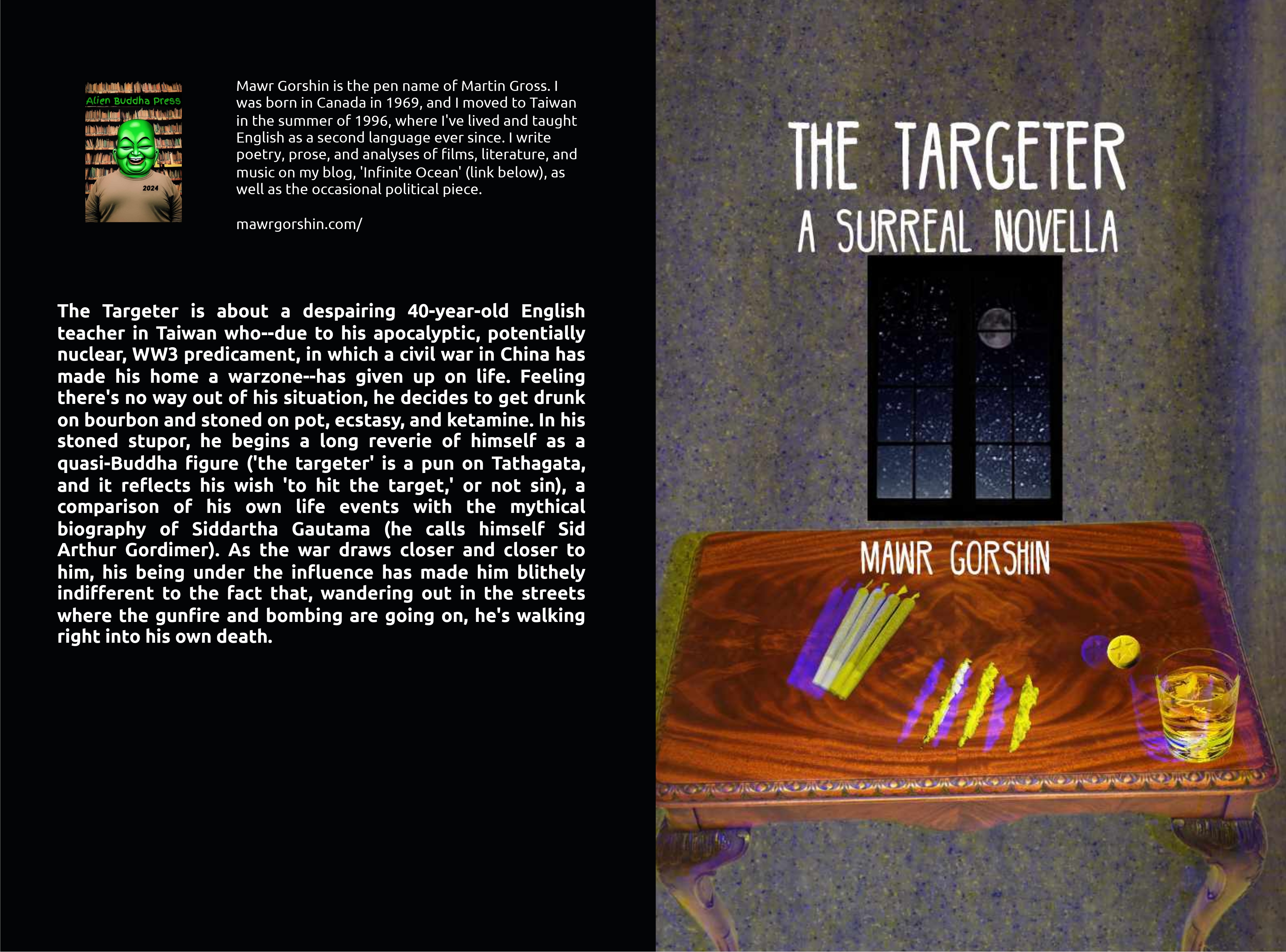
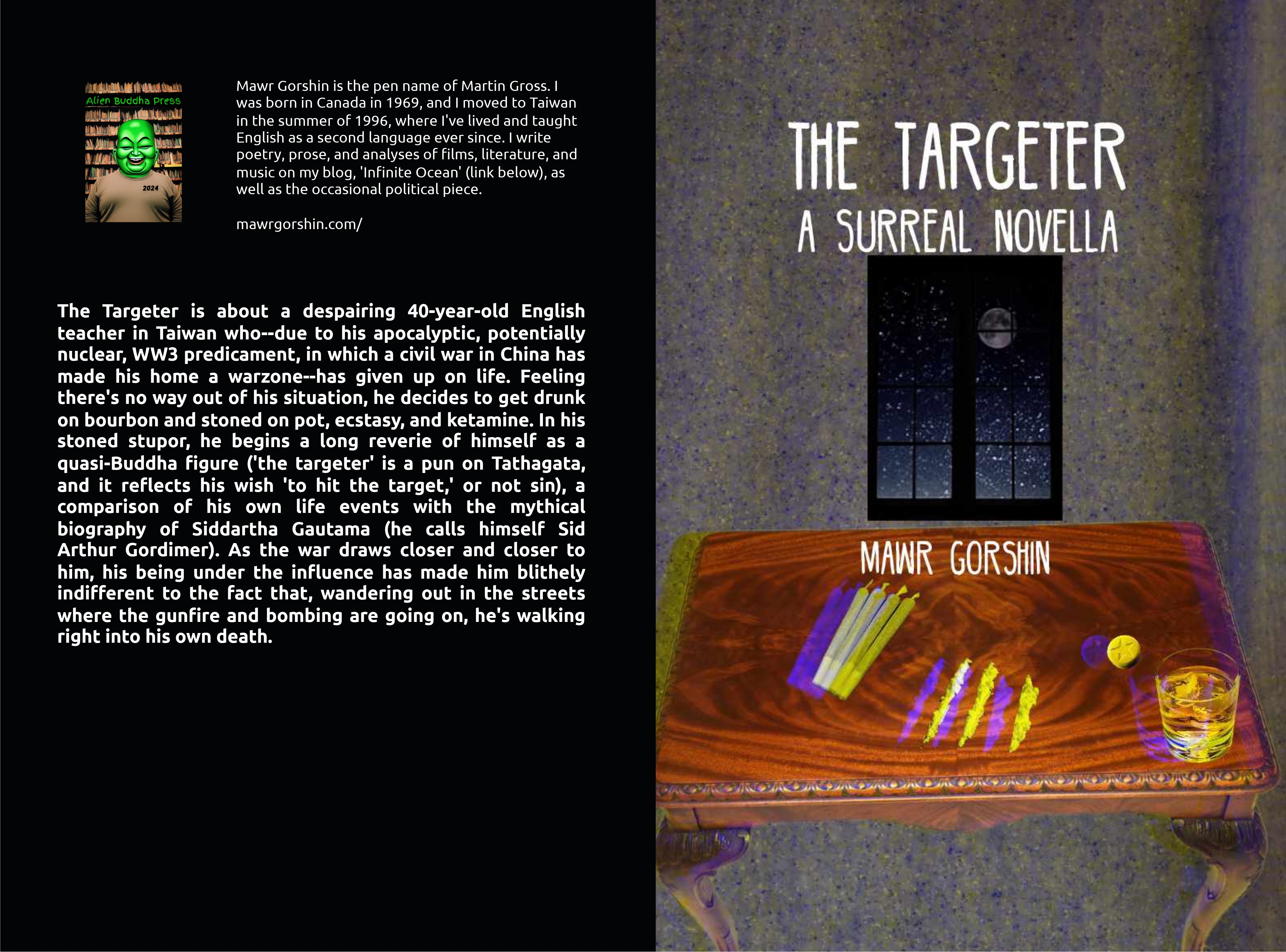
My friend, Dennis Riches, whose writing I have reblogged a number of times here, has written up a wonderful review on Amazon of my novella, The Targeter, and rated it five stars! It’s the only review as of the publication of this post, but hey, it’s a start! Baby steps, right?

Here’s what he said: ‘5.0 out of 5 stars An excellent short tale that encompasses the personal, the political and the spiritual. (Reviewed in the United States on August 3, 2024)

‘It is difficult to know how to describe and categorize this work. Is it a long poem or a short story? Is it fantasy or realistic fiction? Is the narrator a fictional character, or is this just a slightly fictionalized auto-biography—one rendered as a surrealistic reflection on a life and a family, and on all life at this point in history where nuclear catastrophe looms over us? Is it a Christian-Buddhist prayer or a political treatise? Perhaps it’s the author’s way of telling us, “Just say no to drugs”? Read it and contemplate all these questions to light your own path.’

I can’t say enough times how grateful I am for Dennis’s endorsement of my book! Thank you so much, Dennis, and I’ll be waiting for your next blog article! 🙂

‘SPOTLIGHT: The Targeter: a Surreal Novella by Mawr Gorshin,’ from the Alien Buddha Press Blog

Please don’t forget to check out my new novella, The Targeter, published by AlienBuddha Press! Here you’ll find an excerpt from the novella, describing how the protagonist, stoned out of his mind, is having a reverie in which he imagines himself experiencing a divine birth comparable to the mythical birth of the Buddha. Here’s a link to the Amazon page, where the paperback costs a mere US$14.46.

My Novella, ‘The Targeter,’ Is Now Available on Amazon

My surreal novella, The Targeter, is now published on Amazon. It’s a quick read, only 111 pages, including the ‘about the author’ page. It’s also only US$14.55. Here’s the link to the Amazon page.

The novella is about a despairing 40-year-old English teacher from the West but living as an expat in Taiwan who–due to his apocalyptic, potentially nuclear, WW3 predicament, in which a civil war in China has made his home a warzone–has given up on life. Feeling there’s no way out of his situation (he’s estranged from his Western family), he decides to get drunk on bourbon and stoned on pot, ecstasy, and ketamine. In his stoned stupor, he begins a long reverie of himself as a quasi-Buddha figure (‘the targeter’ is a pun on Tathāgata, and it reflects his wish ‘to hit the target,’ or not sin), a comparison of his own life events with the mythical biography of Siddartha Gautama (he calls himself Sid Arthur Gordimer). As the war draws closer and closer to him, his being under the influence has made him blithely indifferent to the fact that, wandering out in the streets where the gunfire and bombing are going on, he’s walking right into his own death.

I wish again to thank the publishers of Alien Buddha Press for putting my short book in print!

Publication of ‘The Targeter,’ a Surreal Novella, by Alien Buddha Press, on July 14th

This is my new novella, originally published chapter by chapter here on my blog, but now you can gain access to all the chapters easily without searching my blog’s archives.

It will be released on July 14th on Amazon. It’s a quick read, only 111 pages, including the ‘about the author’ page.

It’s about a despairing 40-year-old English teacher in Taiwan who–due to his apocalyptic, potentially nuclear, WW3 predicament, in which a civil war in China has made his home a warzone–has given up on life. Feeling there’s no way out of his situation, he decides to get drunk on bourbon and stoned on pot, ecstasy, and ketamine. In his stoned stupor, he begins a long reverie of himself as a quasi-Buddha figure (‘the targeter’ is a pun on Tathāgata, and it reflects his wish ‘to hit the target,’ or not sin), a comparison of his own life events with the mythical biography of Siddartha Gautama (he calls himself Sid Arthur Gordimer). As the war draws closer and closer to him, his being under the influence has made him blithely indifferent to the fact that, wandering out in the streets where the gunfire and bombing are going on, he’s walking right into his own death.

I want to thank the publishers of Alien Buddha Press for putting my short book in print!

Analysis of ‘In the Wake of Poseidon’

I: Introduction

In the Wake of Poseidon is King Crimson‘s second studio album, released in 1970. It came into being during a period of great instability in the band, since founding members Ian McDonald (alto sax, flute, clarinet, Mellotron, vibraphone, and backing vocals) and drummer Michael Giles quit after the band’s American tour. To make matters worse, lead singer/bassist Greg Lake would also leave, during the recording sessions of Poseidon, to cofound ELP.

Though the album was well-received by critics upon its release, citing the execution and production quality as better than its predecessor, Poseidon has since been regarded as something of a mere copy of In the Court of the Crimson King. Indeed, apart from “Peace–A Beginning,” all the tracks from Side One of Poseidon are parallels of those on Side One of the first album. Furthermore, on Side Two of Poseidon, towards the end of “The Devil’s Triangle,” there’s a clip from the title track of the previous album, the “Ah…ah, ah-ah, ah, ah-ah” vocals.

Still, in spite of what would seem legitimate criticisms of this reworking of the first album in the way guitarist/leader Robert Fripp would have had it, I’ve always preferred Poseidon to Crimson King: I find this second album to be bolder and more colourful than the first (though I consider the lyrics of the first album to be preferable overall to the obscurantism of those of the second). In an attempt to rationalize this ‘redoing’ of the first album, I’d say that Poseidon can be seen as the ‘epitaph,’ if you will, of Crimson King, a kind of ‘lament’ over the demise of the great original lineup.

Here is a link to all the album’s lyrics, and here is a link to all the tracks from the album, including the shorter single version of “Cat Food,” “Groon” (the B-side of the “Cat Food” single), and Greg Lake’s guide-vocal version of “Cadence and Cascade”.

Apart from the links to the first album that I’ve noted above, the second album has other links to the original lineup. Giles was retained as a ‘guest drummer’ for Poseidon, and two of its tracks are based on music the original band played live: “Pictures of a City” is based on “A Man, a City,” and “The Devil’s Triangle” is based on “Mars,” an instrumental improvisation based in turn on “Mars, the Bringer of War,” from Gustav Holst‘s The Planets.

In fact, as noted above, Lake even recorded a ‘guide vocal’ for “Cadence and Cascade” in an uncharacteristically unexpressive voice; not to bad-mouth replacement singer Gordon Haskell for his excellent performance on the recording used on Poseidon, but if Lake was available to sing the track, why didn’t he do so with his usual expressivity, then Haskell could have debuted on bass and vocals for Lizard?

Many of the themes of the first album are repeated here on the second: the horrors of war, modern alienation, capitalism, political corruption, and fear of the end of the world. The theme of modern alienation is in abundant supply in “Pictures of a City,” this album’s counterpart to “21st Century Schizoid Man.”

But as a sharp contrast to all of this negativity, remaining original members Fripp and lyricist Peter Sinfield gave us a trilogy of tracks on the ideal of peace. Of course, this ideal can never be realized if the issues of the preceding paragraph are not dealt with, but it’s good to be reminded of peace as a goal worth striving for, on three occasions spread out over the course of the album.

II: Peace–A Beginning

“Peace–A Beginning” opens with heavy reverb that will die out slowly over the course of the short track. Lake is singing a cappella in C minor. The four-line verse he sings makes references, however indirectly, to the four elements: air (“the wind”), fire (“lit by the flame”), earth (“the mountain”), and water (“the ocean” and “the river”); these are all identified with a personified peace.

Such basic, fundamental elements point in the direction of unity and permanence, which is fitting, given that peace will “never end.” It’s also fitting that there are two references to water, rather than just one; one of these is the ocean, appropriate for an album called In the Wake of Poseidon, the title track of which will deal more with the four elements.

When Lake sings the last word, we can hear Fripp softly play four notes on his guitar: A, F-sharp, C, and A-sharp. Then we go into the next song.

III: Pictures of a City

Since this song is Poseidon‘s equivalent of “21st Century Schizoid Man,” it’s fitting that we hear saxophones in it, played by McDonald’s replacement, saxist/flautist Mel Collins. His jazzy playing of the saxes reinforces the contemporary urban feel of the song. The band is playing in G minor, in a kind of twelve-bar blues before the first verse.

Rather than present any kind of narrative, Sinfield just gives us a series of urban images, true to the title of the song, as well as the sounds of the city, and the feelings that result from such sights and sounds.

“Concrete” gives us a “cold face,” leaving us “stark sharp” and “glass eyed,” lacking expression. Such are the alienating effects of modern urban life: removed from nature, with the city’s polluted air, fire breathing out smoke from cars’ exhaust pipes, earth covered up and suffocated, if you will, under concrete, and water made filthy through sewage, we’re also disconnected from community. The contaminating of the four elements means there can be no peace.

There’s a considerable amount of internal rhyme and assonance in these verses: “face cased,” “stark sharp,” “bright light scream beam,” “neon wheel,” “spice ice dance chance,” “mouth dry tongue tied.”

The third line of the first verse vividly portrays the problems of driving in the big city: road rage, screeching brakes, the honking of horns, and car accidents. Never mind wars between nations–one often finds oneself in a kind of war just by driving in a busy city.

The white of “red white green white” suggests light, like that of the “neon wheel.” Note the red and green of traffic lights, fittingly mentioned right after the “brake and squeal” of impatient drivers. Note also the absence of the yellow traffic light: one hurries up and waits, but never drives slowly.

After the first verse, we return to the jazzy twelve-bar blues riff of the harmonized saxes and guitar. City life sure can give you the blues.

Much of the imagery of the second verse, especially its first line, suggests how urban alienation leads to a desperate attempt to connect with others by looking for love in all the wrong places: “Dream flesh love chase perfumed skin.” There are other “tinseled sin[s]” going on, though. There’s the “greased hand” of political corruption and bribery. One’s teeth one ought to hide so the people we’re cheating don’t know of one’s wicked motives. “Pasteboard time slot sweat and spin” suggests the daily grind of the nine-to-five job, or wage slavery under capitalism.

This verse ends with Fripp playing a chromatic ascension of high notes going up to A-sharp, which leads into “42nd at Treadmills,” the fast middle-section equivalent of “Mirrors,” from “21st Century Schizoid Man.” Since this song is about the immorality of the city, I can interpret “Treadmill” in terms of its old use as a punishment for prisoners in the UK and US of the 19th century, used to exert labour from them, an effective metaphor for wage slavery. “42nd” suggests a doubling of the evil of “21st” from the original song.

Like “Mirrors,” “42nd at Treadmill” is essentially in a 12-bar blues structure (a cycle of four bars of the tonic chord, two of the subdominant chord, two of the tonic again, two of the dominant chord, and two again of the tonic). In fact, much of this section is simply a sped-up version of the 12-bar blues riff heard before each of the first two verses.

After this comes a soft, slow variation on the 12-bar blues structure, suggesting the night time and everyone having gone to sleep…though since this song was initially inspired by New York City, ‘the city that never sleeps,’ during King Crimson’s American tour of late 1969 and early 1970, perhaps we should imagine people tossing and turning in their beds, especially at this section’s dissonant ending, which suggests the morning and therefore the need to wake up and face yet another grueling work day.

With the final verse, instead of getting images of city life, we get what is largely the effect of city life on its residents–the alienation, brokenness, and blindness of those without political or class consciousness. Blinded by drunkenness and aimless partying, these people can’t communicate or see their reality for what it is. They’re doomed in an industrialized, urban hell.

The song ends with that chromatic ascension of high notes on Fripp’s guitar, but this time ending on B and introducing a chaotic, dissonant ending like the one for “21st Century Schizoid Man,” though I find this one to be far darker, and therefore better, than the first one. Also, you can hear in this one Fripp’s signature screaming guitar phrases, in which he quickly strums dissonant, high-pitched chords like the splintery ones you hear on “Sailor’s Tale.”

IV: Cadence and Cascade

This song is Poseidon’s equivalent to “I Talk to the Wind.” It features Fripp’s lyrical acoustic guitar playing, Haskell’s lead vocal as mentioned above, and some lovely flute solos by Collins. The song is in E major, Fripp opening with combinations of single notes, strums, and arpeggios in the tonic chord, an A-major chord, an E-major 7th chord, and A major again.

Haskell’s singing introduces two groupies, Cadence and Cascade, and the man they’re interested in, Jade, who depending on the interpretation of Sinfield’s lyric is variously portrayed as, for example, a singer, or a Silk Road merchant trading goods from the Far East. The names “Cadence and Cascade” suggest the two women’s beauty (more on the meanings of their names later); “Jade” suggests his wealth.

The women worship him for his wealth, power, and fame, but grow disappointed with him as they get to know him better: “As his veil fell aside…They found him just a man.” His phony appeal is comparable to that of a prostitute: “Sad paper courtesan.”

In the world of traditional sex roles, which still largely existed in the West as of 1970, women found their only option for gaining wealth and social status was through a man, so when they met a rich and powerful man, they idealized him…only to find later that he is just as faulty as any other man of modest means. Masculinity is an ideal that is rarely, if ever, even approached, let alone attained.

The bridge opens with Fripp playing one of his “devices,” a celeste, with an ascension of notes: B, C-sharp, E, F-sharp, and G-sharp; this is heard over an A major seventh chord, then with the switch to an A minor seventh chord, we hear celeste notes of G-sharp, A, B, C, and D, E, and F-sharp. We also hear Keith Tippett‘s jazzy piano in the background.

The verse of the bridge has Haskell singing about the lovemaking between the groupies and Jade, their worshipping of his wealth (“sequin,” and “velvet-gloved hand”) and fame (“Cascade kissed his name”). In a larger sense, the groupies’ worship of Jade can represent the idolatry of famous people in general, and the simping for billionaires. This applies to men and women, as worshippers and worshipped.

After the first flute solo, we hear a refrain of the “sad paper courtesan” verse, except that Cadence and Cascade now “knew [Jade] just a man” (my emphasis). The groupies have left him behind in their disappointment in him.

One of the biggest problems in our world is that, because of the worship of fame, wealth, status, and power, people keep aspiring to it, instead of sharing everything so that the basic needs of everyone are met. We aim for these heights, then in disappointment we fall…which leads me to my next point.

Apart from the groupies’ names suggesting their beauty, “Cadence and Cascade”–something Haskell sings several times leading into Collins’s second flute solo–are also words coming from the Latin world cadere, meaning “to fall.” There’s the musical cadence of resolving a harmonic progression back to the tonic, and a cascade is a waterfall (the element of water again, as jade is associated with the element of earth). Both meanings suggest musical or natural beauty, or the beauty of a woman’s cascade of long, wavy hair flowing down to her shoulders. There’s also the fall of the girls’ disappointment on knowing Jade is “just a man.”

V: In the Wake of Poseidon (including “Libra’s Theme”)

This track reworks the first album in two ways: the title, of course, parallels that of the last song on Side Two of the first album; more properly, though, this song is a reworking of “Epitaph,” the last song on Side One of the first album.

Sinfield apparently rewrote the lyric to this song about twenty-five times to make it tie in with the cover art, which therefore should be discussed now. I’ll describe each of the dozen faces not as they appear on the outer album cover–which shows a painting called The 12 Archetypes, or The 12 Faces of Humankind, by Tammo de Jongh–but in order of appearance as Sinfield brings them up in his lyric.

The Observer, a bald old man with spectacles up above his brow and his hand on his chin, looks pensive and scientifically-minded. His elements are Air and Earth. The opening lines, “Plato’s spawn cold ivied eyes/Snare truth in bone and globe,” refer to him. He represents Western science in the service of cold-blooded imperialism, taking over the globe and, exploiting it, reducing all indigenous resistance to skulls and bones.

The Joker, a harlequin painted in reds and yellows and smiling in a triangular hat, is the subject of the next two lines of the first verse. His elements being Fire and Air, he’d “coin pointless games/Sneer jokes in parrot’s robe.” His sardonic humor points out our everyday foibles and political corruption, but it’s “pointless” in how it does nothing to solve our problems.

The Actress is next. She’s Egyptian, with long pearl earrings and necklaces, and with tears running down her cheeks. Her elements are Water and Fire. She is represented in the lines, “Dame Scarlet Queen/Sheds sudden theatre rain.” She weeps for the sins of the world, as does…

…The Enchantress, her long dark hair going across her face. She has Water and Earth as her elements. She “knows every human pain.”

As I said above, the title track is especially concerned with the four elements, two of which are associated with each of the twelve archetypes, as we’ve seen and will continue to see. All four are also heard twice in the next verse, a bridge between the first and third verses, this latter continuing to depict the twelve archetypal faces.

Though the elements are associated with peace, as we saw in “Peace–A Beginning,” the “World [is] on the scales,” with war and destruction on one scale, balanced on the other with peace and its four elements. This “Balance of change” means the world is teetering “on the scales” between peace and war. Which side will win? Which will outweigh the other? Will it be the side that wants peace and justice for everyone, or will it be the side of the imperialistic warmongers, whose recklessness is pushing us all ever closer to nuclear armageddon?

This song, and therefore the entire album, has as much relevance for us today as it did back in 1970, with its Cold War fears of nuclear annihilation between the US/NATO and the USSR. We’re experiencing a new, and utterly needless, new Cold War between the Western, NATO-allied powers on one side, and Russia, China, the DPRK, and Iran on the other. Between the two sides are thousands of nuclear weapons, and no attempt at détente is even being considered.

To return to the archetypes, the next one is The Patriarch, an old philosopher with long white hair and a beard. He’s frowning, with a furrowed brow. Surrounding him are such shapes as flowers and snowflakes. His elements are Air and Water. Referring to him are the lines, “Bishop’s kings spin judgement’s blade/Scratch ‘Faith’ on nameless graves.” The Church controls the heads of state–The Patriarch being one of these stern religious leaders–and it pushes the kings to fight ‘holy’ wars. (One might think of the Archbishop of Canterbury and Bishop of Ely persuading Henry V to invade France.)

The Old Woman would “hoard ash and sand.” She has a wrinkled, sad face, and her hair is wrapped in white. Her elements are Earth and Air. Such women are “Harvest hags,” peasant farmers, whom we associate with the working class, yet these peasants are betraying the fellow proletarians in that they “rack rope and chain for slaves,” the next archetype to be discussed.

The Slave, a black African with earrings and a nose-ring, has Earth and Fire as her elements. The slaves “fear fermented words,” that is, they’re scared of revolution, and like the kulaks who hoarded grain during the famine in the USSR in the early 1930s, they “rear to spoil the feast.” This lack of solidarity among the poor is what allows the rich to stay in power.

The Fool, the laughing man to the centre-left of the front cover of the album, with the pink face, the blond beard, and the flowers in his hair, is “the mad man [who] smiles/To him it matters least.” In his foolish, delusional state, he doesn’t care about the corruption in the world, because like The Slave and the Old Woman, he has no class consciousness. His elements are Fire and Water.

After this verse is an instrumental passage that includes the (Libra’s?) theme (“Air, fire, earth, and water”), only it’s played by Fripp on the Mellotron instead of sung by Lake. I suspect that part of the reason this song is called “In the Wake of Poseidon” is that the god of sea and earthquakes best represents all four elements: the earth and water aspects hardly need to be elaborated on; air can be included in its being blown as wind over the sea, making waves, and Poseidon is known for his fiery temper–consider how he treated Odysseus after he blinded the god’s cyclopean son, Polyphemus. I’m assuming this section is “Libra’s Theme,” given our “world on the scales.”

To go back to the archetypal faces, the next one is The Warrior, wearing a steel helmet and a full black beard, and baring his teeth, ready to fight. His elements are Fire and Earth, and he’s represented in these lines: “Heroes’ hands drain stones for blood/To whet the scaling knife.” The weapons of war wound not only bodies, but the Earth as well.

Next comes The Logician, a wizard with dark hair and a long dark beard. He’s holding a wand in one hand while the other is held up high. There are stars all around him, presumably the magic from one of his spells. He’s represented with the lines, “Magi blind with visions light/Net death in dread of life.” He represents the theologian or philosopher who is ‘blinded by the light’ of his own dogma, preferring death and the peace of a presumed heaven over the pain of living here.

The naïve sheep of these religious shepherds are represented in The Child, a girl with long blonde hair and a face of sweet innocence. The necklace she’s wearing has a white key on it. Her elements are Water and Air, and these lines represent her in the song: “Their children kneel in Jesus’ till/They learn the price of nails.” To enter the Kingdom of Heaven, one must be as a child (Luke 18:17); hence, the key on The Child’s necklace (Matthew 16:19). Still, learning “the price of nails” means learning either to submit to the powers-that-be, whether they’re religious or political, or to suffer as Jesus did for defying them.

And the last archetype is The Mother Earth, or Mother Nature. We see her lying asleep in the grass in left profile, with dark skin and flowers and butterflies all around her. Her elements are Earth and Water, and the last two lines of the song refer to her: “Whilst all around our Mother Earth/Waits balanced on the scales.” Our Earth sits passively as mankind decides the fate of all living creatures who have her as their home: nuclear war, or peace? A healthy planet, or ecocide? Our collective fate is being weighed in the balance, “on the scales,” by psychopathic leaders who care about wealth and maintaining their power, and not about us.

To understand the deeper meaning of archetypes, one must look into analytical psychology, Jung‘s offshoot from Freudian psychoanalysis. Jungian psychology has a grounding in such psychoanalytical concepts as the unconscious and repression, but unlike Freud the atheist, Jung developed an interest in myth, mysticism, and religion far beyond just their psychological symbolism. As a result, he broke with Freud, who would later speak derisively of Jung as one who would “aspire to be a prophet” (Freud, page 280).

The archetypes are characters that reside in the collective unconscious, that aspect of the unconscious we all share and that has been inherited throughout human history. These include the Sage (which can find its equivalent in the song and album cover as The Patriarch), Innocent (The Child), Hero (Warrior), Magician (Logician), Jester (Joker), and Creator or Caregiver (The Mother Earth). The point is that we have all of these characters, hidden deep down in our unconscious; they influence how we think and interact in the world. To this extent, they control us, and therefore control mankind’s collective fate.

In this song, we can see how unhappy these twelve are, or how manipulative (or manipulated) they are. They’re in the depths of the ocean of the collective unconscious, so “the wake of Poseidon” is, literally speaking, the making conscious all of these characters that reside deep within the sea-god’s realm. If we can make their sorrow conscious, we can integrate them, become whole and healthy, then work to save our planet from ecocide and nuclear annihilation. Hence, the deep relevance of this song back in 1970 and, even more, today.

VI: Peace–A Theme

This is a short instrumental for solo acoustic guitar, about a minute long, in A major.

Fripp plays the melody Lake sang a cappella on “Peace–A Beginning,” as well as the bridge melody (“Searching for…, etc.) that we will hear on “Peace–An End.” Fripp opens with a strum of an open A major chord with an added sixth.

From this chord, he embellishes the melody Lake sang before with an appoggiatura: he does a hammer-on and a pull-off as part of the continuing melody with E, F-sharp, E, and D-flat. Then, he strums a D-flat minor 7th chord, and single notes D-flat and E, then a hammer-on to F-sharp, and a strum of a D-major 7th chord, the E, D-flat, and an A major chord, with a high note of D-flat.

Next, he strums the D-major 7th chord, and plays the above appoggiatura with the E, F-sharp, E, and D-flat. Then, there’s the strum of the D-flat minor 7th chord again, then a strum of an E dominant 9th chord, then a strum of a D major 6/9 chord, and an ending of the melody that includes another appoggiatura, a hammer-on and pull-off of F-sharp, A, F-sharp, and E, then the D-major 7th chord again.

All of the above is repeated, then we come to the bridge (“Searching for…,” etc., in “Peace–An End”). Fripp strums an A-major chord, then an A chord with a major second instead of a major third, then the A major six chord again. Then he plays arpeggiated chords of D-flat suspension 4th and a D-flat major. Next, a melody of F-sharp, A, B, D-sharp, E, D-sharp, B, G-sharp, and F-sharp is played over chords of D-major 7th, D-flat minor, and D-major 7th again.

After an E suspension 4th chord and an E major chord in the dominant, Fripp repeats the bridge section as described in the previous paragraph, but he ends the piece with a strum of an A 6/9 chord, only without a third, and with the sixth in the bass; then he softly hits an E-flat, a flattened fifth for A major.

VII: Cat Food

This song is another example of King Crimson doing a perverse variation on the 12-bar blues structure, with Tippett mixing in dissonant tone clusters with his more usual jazzy piano playing, and with the usual 4/4 time getting bars of 6/8 thrown in between from time to time. The song is in E minor.

The song is satirizing capitalism and consumerism, and all of the maddening effects these have on people, hence the piano discords. A woman shopping in a supermarket wants to talk to the manager, presumably to make a complaint. “Grooning to the muzak” sounds like an ironic comment on Fripp’s instrumental with drummer Michael Giles and his bassist brother, Peter (who plays all the bass parts on this album instead of Lake), “Groon,” Side B to the “Cat Food” single. Groon is a pun on groan, a complaining sound.

The blatantly atonal “Groon,” truly an acquired taste for most listeners, is a piece of avant-garde jazz that sounds like a Cecil Taylor improvisation, but with Fripp’s guitar replacing Taylor’s piano. The supermarket shopper, however, is annoyed with the muzak, or ‘elevator music,’ which is annoying at the other extreme: it’s music so bland, so ‘nice,’ and so conventional that it desperately needs a little dissonance to make it half-way interesting to listen to. The contrast between “Groon” and muzak is also the contrast between music as experimental art and music as sellable commodity.

She lays out her goods, as if to complain about them to the manager. They’re all “conveniently frozen,” so she can “come back for more” as soon as she’s finished with them. This is convenient for capitalists, who can make more money when she comes back. Ironically, this ‘convenience’ is what she has to complain about.

Next, the woman shopper is cooking at home, whipping up “a chemical brew/Croaking to a neighbour as she polishes a sabre.” The “chemical brew” suggests some kind of processed food from the supermarket, superficially tasty, but ultimately bad for you. Just as she ‘grooned’ to the muzak, now she ‘croaks’ in complaint to a neighbour, suggesting the social alienation that comes from the same source as the fetishized commodities that she’s bought–capitalism. The ‘sabre’ she polishes is presumably her cooking knife, but calling it a sabre evokes the idea that it’s used for killing rather than feeding.

She “knows how to flavour a stew,” but her meal is “poisoned especially for you,” because as I said above, this processed food, in its “tin,” is bad for you. “Hurri Curri” sounds like a brand name of cat food, or its particular flavour. It’s also a pun on hara kari, a form of ritual suicide, given how willingly eating such innutritious, processed food, this ‘hurried curry,’ this instant food, is bad for you.

Because the capitalist system is focused more on profit than on providing a nutritious product, we get the blues from it, hence the song’s 12-bar structure. The alienation from capitalism causes mental health problems, too, hence the piano dissonances, Lake’s mad cackling at the end of this second verse, and “your mother’s quite insane,” in the repeated bridge verse.

“Cat food…again?” sounds like a complaint about eating the same old crap over and over again. Cat food, with its unpleasant smell and even more unpleasant contents, is a metaphor for all the unhealthy junk food we all eat at least once in a while, enriching its producers.

“A fable on the label” of so many of these food products, stuffed in cans, suggests the lie that they’re full of vitamins, minerals, and other nutritious ingredients, when actually the processing and artificial colours, additives, and preservatives ruin the said nutrients, in all likelihood. It’s “drowning in miracle sauce,” meaning that the sauce, however superficially tasty it may be, is killing the nutrients by drowning them. With all of this understanding, the last two lines of the song should be self-explanatory.

The song ends with improvising over the 12-bar blues structure, with its alternating of a few bars of 4/4 with one in 6/8. Michael Giles does a few great drum licks here, as Tippett does with his colourful, jazzy piano.

VIII: The Devil’s Triangle

As I said above, this piece evolved out of “Mars,” the instrumental improvisation that the original King Crimson lineup played in their live shows, based in turn on the first movement of Holst’s The Planets. For this reason, I see the resulting studio version as still thematically linked to the horrors of war, and it’s therefore fitting to have it immediately precede “Peace–An End,” for dialectical purposes as I’ll explain later.

The piece includes three sections, titled “Merday Morn,” “Hand of Sceiron,” and “Garden of Worm.” The first part gives partial writing credit to McDonald, but not the last part, which includes the clip from “The Court of the Crimson King,” which he wrote with Sinfield.

Merday Morn” opens with a long, slow fade-in: the listener may get impatient waiting to hear any music. It’s as if the music were the sun slowly rising over the watery horizon of the ocean, the beginning of the ‘day of the sea,’ hence the name of this section. We sense that Poseidon is waking up, hence the album’s title, taken literally.

Recall that ‘the Devil’s Triangle’ is another name for the Bermuda Triangle, the legend surrounding the place–the three corners of which are Bermuda, Miami, and Puerto Rico–being that ships and airplanes entering it mysteriously disappear. One senses the fiery wrath of the sea-god here, and why the music is so spooky.

In the entire piece, we have all four elements represented: in “Merday Morn,” the sea obviously represents water, and the rising sun represents fire (as well as Poseidon’s fiery wrath); in “Hand of Sceiron,” air is represented at the end of the section by the sound of strong winds, as if ships are entering a storm; and “Garden of Worm” suggests the element of earth, symbolic of a grave for the dead in sunken ships at the bottom of the ocean, the ground of the seabed.

When we finally start hearing the music, we hear Michael Giles playing a martial beat in 5/4, accompanied by his brother, Peter, on the bass. Fripp is providing melody and harmony on the Mellotron, at first with string section tape, then, when the music starts to get tense, he uses brass section tape. To add to the tension, we’ll hear him play a lot of tritone intervals, which are fitting as the diabolus in musica.

“Hand of Sceiron” begins with a foghorn sound, suggesting that ships are approaching a dangerous area at sea. Along with the tritones heard on the Mellotron, we hear lots more dissonance on, for example, Tippett’s piano. This section ends, as noted above, with those winds. Sceiron refers to violent winds in a myth from an area described in Book IX, Chapter One (section 4) of Strabo‘s Geographica. A ticking metronome sounds like a clock that is ticking towards the end of one’s life.

Of course, the tension is raised to a climax in the “Garden of Worm” section, with its faster tempo and heightened dissonance. Independent layers of sound are put together: the 5/4 martial beat heard on the drums, with the bass in 4/4 playing descending fifths, and dissonance in the Mellotron and piano tone clusters. It all descends into chaos, including, by way of xenochrony, a brief passage for string section, and the clip from “The Court of the Crimson King.” It all ends with flurries of flute notes and a soft, arpeggiated resolution in E major on Fripp’s acoustic guitar.

So, what does all of this music mean? What does a ship entering the Bermuda Triangle and going missing there, all the passengers presumed dead, signify? The piece’s link with “Mars,” with the martial beat (though different from Holst’s original rhythm, because Holst’s estate did not give Fripp permission to use it), suggests the symbolism of war, too. But what do a ship lost in a sea storm, and soldiers killed or missing in action in a war, symbolize in “The Devil’s Triangle,” and In the Wake of Poseidon as a whole?

Recall the archetypes from the title track and the album cover, and how these reside in the collective unconscious. In the wake of Poseidon means ‘as a(n unpleasant) consequence of the sea-god.’ The realm of Poseidon, the ocean, is symbolic of the unconscious, both personal and collective. So as a consequence of confronting Poseidon and his tempestuous ways, we awaken the unconscious and discover those unpleasant parts of ourselves that we want to reject, repress, or project onto other people. To confront them is to confront what Jung called the Shadow. This is a scary, but necessary and enlightening experience.

“The Devil’s Triangle” begins in silence, and with a slow fade-in, because such a beginning represents not only the unawareness of unconscious conflicts, but also the unwillingness to learn of them, the resistance against them. As the music gets more and more dissonant, one is becoming more and more aware of the unpleasant, rejected parts of the Shadow.

The social problems dealt with in the other songs–urban alienation and decadence in “Pictures of a City,” hero-worship of wealth and celebrity in “Cadence and Cascade,” and capitalist consumerism in “Cat Food”–have their psychological roots in these unconscious, repressed conflicts. The way to end the conflicts and attain peace of mind is not to avoid them, by sailing around the Bermuda Triangle of the psyche, but to go through it and risk the dangers therein.

And dangerous it is. Jung warned of these risks when attempting to do what he called individuation through Shadow work, dream interpretation, and Active Imagination. One is advised, when doing this inner work, to have someone monitoring you, ideally a fully-trained therapist specializing in Jungian psychology. Otherwise, one risks navigating the treacherous waters of repressed traumas, leading to psychological fragmentation, a psychotic break with reality (what Lacan called The Real), which is what the “Garden of Worm” section represents.

The significant thing, though, that happens if you can make it through the maelstrom symbolized by the ending of “The Devil’s Triangle” (as Jung apparently did by bravely facing the demons of his own unconscious), and can integrate the darker aspects of your mind with the lighter ones, you can come out the other side and find peace and bliss, as symbolized by the pretty flurry of flute notes and Fripp’s acoustic guitar ending.

(Such psychological integration includes a man confronting his anima, as represented by the six female faces on the album cover and described in the title track, and a woman confronting her animus, the six male archetypes on the cover and in the title track. In this connection, the sea can be masculine, Poseidon, or feminine, Thalassa. La mer est la mère.)

I’ve written many times about my personal interpretation of the symbolism of the ouroboros, as representing the dialectical relationship between opposites as the meeting ends (the serpent’s head and tail) of a circular continuum (the serpent’s coiled body) including all intermediate points between the extremes. We can hear this oneness in contradiction in “The Devil’s Triangle” in how the music starts in peaceful silence, then the music comes in and gets increasingly dissonant, a move from the serpent’s biting head, down its coiled body towards its bitten tail. At the tail of extreme chaos and pain, we cross over to the head and back to peace and bliss, leading thus to…

IX: Peace–An End

One interesting thing about the “Peace” trilogy is how this last one is musically in ternary form (ABA), while “Peace–A Theme” is in binary form (AABB), and “Peace–A Beginning” is just the A theme heard twice. It’s as though peace begins as just a germinating idea, then it develops, and now it is complete, after having gone through the necessary hell of “The Devil’s Triangle.”

Furthermore, the first part is essentially a cappella, the second just an acoustic guitar solo, and this last part has both Lake and Fripp. It is musically thus the Hegelian dialectic triad of thesis (“Beginning”), negation (“Theme”), and sublation (“End”), this last part not only being complete, but also a resolution of the contradiction of the previous two parts. In fact, the first two parts ended without perfect resolutions: the A, F-sharp, C, and A-sharp on Fripp’s guitar ending “Beginning”; the A 6-9 chord with the sixth in the bass and the E-flat ending “Theme.”

Only now do we have a truly peaceful resolution in E major, with Lake’s last sung note, on “war,” being a D-flat, a major sixth in relation to the tonic, and so it’s reasonably consonant. It suggests, in combination with “war,” a somewhat tenuous peace–since when is perfect peace ever realized, anyway?–but it’s peace all the same, and therefore a fitting end to the album.

Two of the four elements are mentioned in the first line of the first verse–water and air (“sea” and “wind”). Water will again be mentioned in the first line of the last verse, too–“stream.” The reference to “dawn on a day without end” suggests earth and fire, in that we imagine the sun peeking over the horizon, that is, over the land, hills, and mountains in the morning. The fire of the sun will shine on an eternal day, too.

Because the four elements are so fundamentally what make up everything as we imagine it here, they bring us closer to the blissful oneness of Brahman, and therefore to peace, nirvana. Those twelve archetypal faces are each associated with two of the elements; and since attaining psychological peace, as I described it above–with my ouroboros symbolism–involves confronting the twelve archetypes in the Shadow of the ocean of the unconscious, then peace is in this way also associated with the elements.

A bird sings as you smile because it is pleased with your happiness–it is your friend. Peace causes a foe to love you as a friend; we must take those troublesome archetypes of the unconscious and make them our friends–this is how we change war into peace. We bring love to a child, like the sweet, innocent girl on the cover with the white key on her necklace. She has the key to heaven, remember, because one has to be as a child to enter heaven, the realm of peace.

You search for your friends, but can’t find them, because you foolishly don’t realize how close they are to you, like the nirvana and Buddhahood that the lost vagabond son of the parable doesn’t realize he already has, personified by his father. You search for yourself everywhere outside, but you don’t realize that you have to do the inner work, as described in my interpretation of “The Devil’s Triangle,” to find yourself within, in the twelve archetypes, the four elements, and the Atman that is already one with the oceanic feeling of Brahman.

The heart is what empathy flows from, so that’s why peace is a stream from there. Breadth, that is, the width of tolerance and open-mindedness, is the dawn, or beginning, of peace.

The fire of the sun will burn forever for peace, that is, without end; yet peace is also the end, ironically, like death, of the war. The war people would have had in mind back in 1970 was, of course, the Vietnam War, wishing it would end.

There are other wars, though, besides literal ones, that need to end. There’s the emotional war of psychological conflict, as dramatized in “The Devil’s Triangle” and the title track. The Jungian inner work described above to integrate the light and dark parts of the psyche, the conscious and unconscious, to bring about inner peace, can be compared to the Buddhist’s quest for nirvana.

Nirvana literally refers to the blowing out of a flame representing desire, and therefore suffering also. Nirvana is the resulting peace from having extinguished the fire of the delusion of a permanent ego. Yet Sinfield’s lyric, of peace as the dawn of a day without end, implies a permanently burning fire, while peace is also the end…and nirvana is the end of suffering.

How can we reconcile this contradiction, of a permanent fire and its extinguishment as both meaning peace? We can do so as the Mahayana tradition of Buddhism does, by equating nirvana with samsara, the cycle of reincarnation. We did so before with the dialectical interpretation of attaining peace by first going through the Devil’s Triangle, by passing first through hell to get to heaven. Similarly, the bodhisattva first swears off nirvana until he’s helped all living creatures to get there, hence they all travel there on the Great Vehicle, that boat that must weather Poseidon’s storm at sea.

Note how Lake’s singing on “Peace–An End” brings back the reverb at the end, just as “Peace–A Beginning” started with reverb. This beginning and ending reverb thus gives us a sense that the album has come full circle, like the cyclical eternity that the ouroboros originally symbolized. In this sense, we can see how peace never ends, even in a world full of suffering. Nirvana is samsara because we can only have peace and happiness by accepting the inevitability of pain.

X: Conclusion

Based on the interpretation I’ve given above, I must say that In the Wake of Poseidon, though not exactly a masterpiece, deserves better than being dismissed as a mere copy, or sequel, of In the Court of the Crimson King. To be sure, much of the second album does rework the first, but there are other things going on that shouldn’t be ignored.

Side Two of Poseidon is essentially new (the xenochrony notwithstanding). The first album presented the problems of the world; the second album expands on the discussion of those problems, and it also proposes a solution. Most importantly of all, In the Wake of Poseidon presents a kind of Jungian odyssey through hell to get to heaven, giving it a kind of universality of human experience that makes it an album that doesn’t just live in the shadow of its predecessor, but exists in its own right.

Analysis of ‘Repo Man’

Repo Man is a 1984 film written and directed by Alex Cox, starring Emilio Estevez and Harry Dean Stanton, with Tracey Walter, Olivia Brash, Sy Richardson, Vonetta McGee, Fox Harris, and Dick Rude. Michael Nesmith of the Monkees was executive producer, and Iggy Pop wrote the Repo Man theme; he also sings the song during the end credits.

A satire on American life under the Reagan administration, on consumerism, and on the Atomic Age, Repo Man had a troubled initial release because Universal Pictures doubted the film’s commercial viability. It nonetheless received widespread acclaim, was considered one of the best films of 1984, and is now a cult film.

Here’s a link to quotes from the film, here’s a link to the script (including outtakes), and here’s a link to a rather poor quality video of the complete film (i.e., the image being in the bottom-right corner, it’s being sped up, with all the sound in a higher pitch).

After seeing, during the opening credits, a shifting road map of Los Alamos, Santa Fe, Albuquerque, and finally to California, we’re in the Mojave Desert, with J. Frank Parnell (Harris) driving a ’64 Chevy Malibu. A cop on a bike pulls him over and wants to know what’s in the trunk of the Malibu. Parnell tries to warn him not to look in there, but the cop insists. He opens the trunk, a bright light shines out of it, and he screams as he’s being disintegrated from the mysterious thing in there, leaving only his flaming boots. Parnell drives away.

Later in the film, we learn from Leila (Barash) that aliens are what is in the trunk; they’re emitting the radiation that killed the cop. A question that should be obvious to ask is this: what business were the contents of the car to the cop? What right had he (I couldn’t care less about his badge) to stick his nose in Parnell’s personal business?

Now, aliens are heavenly beings, if you will. This fact, combined with the sinfulness of LA (where the bulk of Repo Man takes place), as well as the vaporizing of anyone who opens the trunk and exposes the ‘heavenly beings,’ makes me think of the Biblical story of Lot in Sodom. Such an association probably sounds far-fetched to you, Dear Reader, but please hear me out.

To get our bearings, I’ll start by saying that the aliens are like the angels God sent to destroy Sodom, which LA represents here. Granted, the aliens don’t destroy LA in the movie, they just kill a few people nosy enough to look in the trunk; but they do shake things up for a lot of people in and around the city. The radiation emitted by the aliens can be associated with the radiation from nuclear explosions, which can wipe out cities, as happened in Japan. These associations are close enough for me, since as was mentioned above, one of the satirical targets of Repo Man is the Atomic Age.

One of the major sins of Sodom and Gomorrah was inhospitality. The Sodomites surrounded Lot’s house when they knew he was accommodating the visiting angels. The Sodomites demanded he send out the angels so they could “know” them. (Gang rape, regardless of sexual orientation, can only be evil.) Knowing his duty to be hospitable to the angels, Lot couldn’t send them out. When the Sodomites tried to force their way into the house, the angels blinded them, which can be associated with the aliens vaporizing the intruding cop.

My point in bringing up the story of Lot in Sodom is that one of the central themes of Repo Man is impingement, encroachment, or imposing oneself on another’s personal space, just as the men of Sodom tried to impinge on Lot’s home and the guests to whom he was giving hospitality. If you impinge on others, they’ll impinge back on you, as the angels did when the Sodomites tried to break into Lot’s house and rape the visiting men.

The scene in the supermarket–where Otto (Estevez) and Kevin (played by Zander Schloss, bassist for the Circle Jerks, who appear later in the film as a nightclub band) are working as stock clerks facing cans–is full of impingement. Kevin, a geek who is annoyingly sycophantic to the whole capitalist system, is singing, of all things, a 7-Up jingle right next to Otto, irritating him. The last thing punk rocker Otto needs to hear is an advertisement for a soft drink while he’s doing monotonous wage slave work.

Otto impinges back on Kevin by sticking a price tag on his glasses. Then, to annoy Otto further, his boss, Mr. Humphries (played by Charles Hopkins), comes over to nag him about not only being habitually late for work, but also for not spacing the cans properly. He gives Otto an implicit warning of getting fired by mentioning how, in the bad economy of the time, one must be careful about the quality of one’s work. Luis, an armed security guard, gets in Otto’s face for not listening to his boss, then Otto curses at him, shoves chuckling Kevin into the pile of cans they’ve been facing, flips off Humphries and Luis, and walks out.

Incidentally, all the cans, cereal boxes, and other things sold in the supermarket are generically labelled and designed, as if either made by one company with no regard for visual style, or to indicate that it doesn’t matter who the makers of the commodities are. The satirical point being made here is about consumerism as an escape from eroding democratic freedoms in the Reagan era, which inaugurated the “free market” policies that have resulted in the neoliberalism that plagues us all today.

I’m reminded of what George Carlin would, in later decades, complain about: the illusory freedom of choice (i.e., lots of different brands and flavours to choose from) for consumers instead of meaningful, democratic freedom of political choice (viable political parties other than the GOP and DNC, ones that offer a genuine left-wing alternative). Seeing generic, no-name brands in the supermarket exposes the lie of consumerism as ‘freedom of choice.’

Kevin’s gloating over Otto losing his job, as well as his sucking-up to his boss, does him no good, because Humphries in his rage fires the “worm” too. Kissing the asses of capitalists is no guarantee of advancement.

More impinging is going on in the next scene, though it’s consensual–slamdancing to punk rock–at a party that night in the back of a warehouse. There, Otto meets Duke (Rude), a fellow punk who just got out of jail. The Circle Jerks song “Coup D’état” is heard. There’s a suggestion in this atmosphere of an anarchist wish for violent revolution, though it’s only a fantasy.

In the next scene, Otto is in bed with Debbi (played by Jennifer Balgobin) in Kevin’s house, where the party has moved. She asks him to go get her a beer from the kitchen, an interesting reversal of sex roles, especially seen in light of how she’s about the cheat on him with Archie (played by Miguel Sandoval) and Duke.

The partiers are living in a freely anarchist manner, while nothing is being done about the capitalist-based problems of the outside world, in the rest of LA and in the world in general. We don’t solve our problems by escaping the world and getting wasted, but far too many of us do this anyway. “Institutionalized,” a song by Suicidal Tendencies about teenage disaffection and alienation (a fitting subject for these punks), is heard from downstairs.

Speaking of disaffection and alienation, Otto is next seen alone outside in the early morning, in a vacant lot drinking a beer. He recites some of the lyrics from “TV Party,” by Black Flag. They’re lyrics about not wanting to think about anything important, about only wanting to watch the idiot box and drinking beer. Otto vaguely senses the futility of mindlessly partying instead of, say, organizing and advocating for social change.

Later, when it’s light out, Otto is still walking around outside, now in some neighbourhood. Bud (Stanton) is driving by in his car and offers Otto ten bucks, which sounds to Otto like he’s soliciting for gay sex, which of course would be more impingement. (Note how Otto’s homophobic response could be linked to the homophobic tone in the Bible story.) Bud actually wants Otto to help him repossess a car in the neighbourhood.

Repossessing someone’s car has to be one of the extreme forms of impingement, as well as the opposite of hospitality, which involves giving, not taking. Sticking one’s nose into someone else’s business, going into his or her personal space, and taking a vital personal possession of his or hers are among the worst forms of impingement.

Repossession of cars also makes for a vividly illustrative metaphor for the Reagan revolution, which was, in effect, a repossessing of so many of the working-class gains of the postwar period up to the 1970s. The Reagan years saw dramatic cuts in domestic spending, a steep increase in the number of homeless people, union-busting, and a number of other policies that resulted in the widening gap between the rich and the poor, policies continued and exacerbated by all succeeding US presidents.

Otto repos the car for Bud as requested, unaware that what he’s doing is a repo, and he takes it to the “Helping Hand Acceptance Corporation,” a misnomer for a repo organization so ridiculously bizarre as to be outright Orwellian doublethink. Indeed, proponents of the Reagan agenda similarly regard its rolling back of government benefits for the poor as a ‘liberating’ of the people from the ‘shackles’ of ‘big government,’ all while jacking up military spending to the point of leaving the American government with a deficit.

When Otto realizes the people in this business are repo men, a truly despicable, thankless job, he expresses his contempt for them by taking the can of beer they’ve given him and spilling it all over the floor–impingement on their property. Instead of being mad at him, Bud and Oly (played by Tom Finnegan) say he’s “all right,” meaning Otto has the kind of confrontational, impinging personality that makes for an ideal repo man. Still, he doesn’t want to do the job.

A government agent named Rogersz (played by Susan Barnes)–she has a metal hand–is leading a group of people who are investigating how the cop got killed in the desert. They will now try to find the Malibu, which is to become the MacGuffin of Repo Man, the car that will be the ultimate repossession.

Otto and Kevin are going through a newspaper, job-hunting and sitting by an unemployment office. Still deluding himself that if he works hard and plays the capitalist game, Kevin can become “manager in two years, King! God!” after dedicating himself as a fry cook. Otto isn’t so optimistic, though. He’s had a dream in which he and Kevin were 65-year-old bellhops in a “sleazy shithole motel” in Miami. It looked painfully real to Otto.

Since job prospects don’t look too good for him, Otto goes home (he lives in the garage, incidentally: see the outtakes [link above] at about 9:00) and asks his parents for a thousand dollars promised to him if he finishes school, so he can go to Europe. His mom and dad are stoners sitting on the couch sharing a joint and watching TV. The show they’re watching is of a televangelist, Reverend Larry, to whom they’ve given the thousand dollars to sell Bibles to El Salvador.

To make money, Otto will have to become a repo man. You’ve gotta love the “free market.”

The televangelist, of course, is a real character in himself, and a reflection of the Reagan years in many ways. Apart from the fact that Reagan himself was a conservative Christian, his preaching of ‘small government’ was a ploy to lower spending on the poor in order to increase spending to further the interests of the rich (e.g., increasing military spending for the sake of US imperialism), that is, big capitalist government! Similarly, the reverend tells his viewers, largely lower to middle-class people in need of ‘spiritual answers,’ to give him their money.

Also like Reagan, the reverend wants us all to “destroy the twin evils of godless communism abroad and liberal humanism at home.” Note how the religious right, calling these ideologies “twin evils,” is either too ignorant or outright lying when they don’t see the huge difference between communism and liberalism.

It’s safe to assume that Otto’s stoner parents used to be hippies back when he was a baby. Hippies are liberals, by the way, not communists. A common complaint we on the left have is when liberals backslide toward the right, as Otto’s parents have done by going beyond smoking marijuana to enjoying the opium of the people, a subject I explored in my analysis of Drugstore Cowboy.

Note how Otto’s parents aid US imperialism by selling Bibles to El Salvador instead of helping the country be free of the American empire. Religion is a drug used to help people forget their oppression. TV, of course, can also be a drug in itself, a kind of distraction from one’s everyday troubles, just as the partying punks did as observed above. In the outtakes (link above, at about 12:34), we can see cobwebs enveloping Otto’s mom and dad as they’re on the couch watching the idiot box, just as Black Flag sing about in their song.

In his having no choice but to do a despicable job in order to make the money he needs, Otto demonstrates the lack of meaningful freedom in a capitalist society. And just as the punks have their beer and partying, and Otto’s parents have their marijuana and religion as manic defences against the misery of the world, repo men have speed and booze for the same kind of escape.

This escape will be necessary for Otto, since as part of his selling of his soul to do this new job, he’ll take Bud’s advice and “dress like a detective…dress kind of square,” so people will think Otto is a cop. So much for being a punk rocker. Since one imagines punk rockers have at least anarchist tendencies, we can see how this tendency can backslide into liberalism, then to even more reactionary thinking, as Otto’s choice to become a repo man can be seen to symbolize.

As he and Otto are snorting amphetamine in a car in an alley, Bud sees some people outside and tells Otto he hates “ordinary fucking people.” This is because ordinary people always try to avoid tense situations, whereas repo men are always “getting into tense situations.” Such an attitude, glorifying an aggravating of alienation, sounds suspiciously to me like neoliberalism romanticizing confrontation for the sake of furthering capitalist interests; it’s somehow ‘cool,’ ‘rebellious,’ and ‘edgy’ to be a repo man, rather it simply being an asshole.

Bud and Otto go into a store to buy six packs of beer (generically labelled “drink”) while Bud is still talking about “tense situations” with people with knives or guns. They leave the store, and speaking of tense situations involving guns, we learn that Duke, Archie, and Debbi have been hiding behind the counter, where Bud bought the beer, the whole time. The three punks are holding guns on the cashier, about to rifle the cash register.

We’ll notice as we go through the rest of the film that whenever we see Otto and Bud in a store buying drinks, the three punk rock thieves will also be there. Repo men and thieves are thus being associated with each other. This juxtaposition sends the message to us that repossession, properly understood, is stealing. Bud himself admits this earlier when he’s explaining to Otto how much money you can make when you “rip [off]” a car. Making money by stealing: this is also known as capitalism.

In an outtake (link above, at about 6:42), we see Bud trying to repo a car from a man named Arthur Pakman. Bud gives him his name card, which curiously has the name “I.G. Farben” on it. This is the name of a German chemical and pharmaceutical conglomerate that became a donor and major contractor to the Nazi government, relying on slave labour from the concentration camps; one of its subsidiaries supplied Zyklon B. That a repo man would have such a name on his name card is an obvious satirical comment on the corrupt Sodom and Gomorrah that is capitalist society, the fascism that hides behind its ‘freedom.’

More impingement occurs when Bud and Otto are driving around a concrete riverbed, and they encounter the Rodriguez brothers (played by Del Zamora and Eddie Velez) in their car, one of them flipping Bud off. They get into a car chase for a while, and Bud and Otto end up stuck in a puddle. Annoyed, Bud says he and Otto ought to go off and get drinks. Otto is amused at how “intense” the car chase was; Bud says that a repo man’s life is always intense.

Duke, Archie (with a paper bag on his head), and Debbi have just finished robbing the store that Otto and Bud are about to enter; the thieves have impinged on the store. They run out, and Archie knocks into a waist-high pole by the door, hurting himself in the balls…more impingement.

Next, Otto and Lite (Richardson) are driving up to Miss Magruder’s car, stopped at a traffic light, and get ready to repo it. Lite gives him a bag with a dead rat in it to throw into her car to upset and distract her, then Otto can get the car. He throws the rat on the seat just beside her; she sprays mace in his face and drives off when the light turns green. He who lives by impingement shall die by impingement, or get blinded by it, as the men of Sodom were.

After that, Otto and Bud drive over to repo a Cadillac owned by a millionaire named Peason, who is in a laundromat talking to two kids about the laundry, and how he wants it arranged. He has an unsurprisingly condescending attitude toward the kids. When Otto rips off the car, Peason runs out of the laundromat, and the kids toss his clothes outside while laughing at him. It’s hard to sympathize with a rich guy who can’t be bothered to make the payments on his Cadillac.

As he’s driving around in the Cadillac, Otto sees Leila running on the sidewalk. She’s attractive, so naturally he slows down to talk to her. He wants to offer her a ride, but she’s distracted him from his driving, so he drives his car into a pile of garbage on the side of the road (impingement), angering an old lady who nags him to clean it up; he ignores her, of course, Leila gets in the car, and he drives off.

It’s here where we learn that Parnell has been driving around with aliens in his trunk. She shows Otto a photo “of four dead aliens.” He laughs in disbelief at her story. Since she’s being chased by government men associated with Rogersz in their own car, Leila has ducked down and hidden herself from them; she’s afraid they’ll kill her over the aliens. She explains to Otto that Parnell has smuggled the aliens from an air force base in his Malibu. She needs to find him before Rogersz et al do.

In this sense, Leila and Parnell are like Lot and his family, and the government people are like the men of Sodom, so to speak. Otto drops Leila off at her place of work, “The United Fruitcake Outlet,” which sounds like a flippant pun on the United Fruit Company. Apart from the aliens being associated with the angels in the Lot in Sodom story, their deadly radiation implies an association with Soviet nuclear weapons, a capability that the American government would like to be about to take from them, as would any capitalists, such as the United Fruit Company, who spearheaded a coup against the leftist Guatemalan government in 1954 (remember the selling of Bibles to El Salvador in this connection).

It’s easy to see Rogersz’s government agents as the bad guys here, but one shouldn’t assume that Leila’s ‘fruitcake’ group of people are any more sympathetic just because she becomes Otto’s girlfriend…or something (Leila and Parnell aren’t the good guys, just as Lot’s family aren’t all that good, either, as we learn in Genesis 19–Lot offering his daughters for the sexual sport of the Sodomites, his daughters getting him drunk and committing incest with him, etc.). Recall how later Leila helps Agent Rogersz torture him by electric shock to get information as to where the Malibu is. At the end of the film, he leaves Leila to go in the car with Miller (Walter); she asks Otto about her “relationship” with him, and when he blows her off, she angrily says she’s glad she helped Rogersz torture him.

There isn’t really anyone in Repo Man who can be called a ‘good guy’ in a more or less pure sense. As I said, the LA of this film is a modern-day Sodom, a corrupt, impinging, inhospitable place. Even the aliens in the Malibu’s trunk, whom I’ve associated with the Biblical angels on the one hand, and with the USSR on the other (radiation>>Atomic Age>>Soviet nuclear weapons), aren’t to be considered the ‘good guys,’ given that this film is a product of Hollywood liberalism, which has no more sympathy for leftist anti-capitalism than conservatives do.

Accordingly, everyone in the film, those from the far-right to the left-of-centre of the political spectrum, wants to get his hands on the Malibu. Thus Agent Rogersz and Leila wanting to find it is simply symbolic of competing capitalists/imperialists wanting to thwart the Soviet accumulation of nuclear power, as represented by the radiation in the trunk of the Malibu. To repo the Malibu, one will get the unusually high reward of $20,000.

After repossessing a red car, Lite and Otto are driving around in it, and at one point, Lite mentions a book he once found when he swiped a Maserati in Beverly Hills. The book is called Dioretix: the Science of Matter over Mind. “That book will change your life,” Lite tells Otto. It is obviously a parody of L. Ron Hubbard‘s 1950 book, Dianetcs, and therefore a satirical stab at self-help books and pseudoscience in general. (Matter over mind? Not vice versa?)

In the next scene, we see Otto with Miller in a vacant lot. Otto is holding his copy of Dioretix and is about to toss it into a burning garbage can. Miller goes into a big spiel about how many things that seem to be coincidences are really interconnected in some secret, profound, mystical way; it sounds like Jung‘s notion of synchronicity, but Miller’s use of a plate of shrimp as an example of how it works sounds idiotic.

It seems as though Miller has been reading Dioretix, too. His absurd attempts at philosophical profundity give Otto the impression that he must have done way too much LSD over the years. Still, Miller seems like more of a Dostoyevskyan idiot, for though Miller expresses his opinions with ludicrous examples, he seems to have his instincts in the right places, for at the end of the movie, he gets into the Malibu, his gut correctly telling him that it’s an alien vehicle, a spaceship that goes up into the night sky, then into space, and…who knows?…may well even travel time, as he imagines flying saucers and time machines to be one and the same thing. He is a working-class man with a spark of intelligence never properly developed because of a lack of money for higher education.

When it’s learned from the repo men that the reward for finding the Malibu is $20,000 (and it’s speculated that the large amount of money offered for the car is due to it containing drugs, rather than celestial beings, symbolically linking the drug speculation to the “opium of the people”), Otto calls Leila about the car to arouse her interest. He, however, is aroused by her body, and when he arrives at The United Fruitcake Outlet, he tries to get sex from her…or at least a blowjob. Angered by his impinging on her at work, she slaps him…twice. He who leers with impingement shall get slapped with impingement.

But now that so many people are licking their lips over that $20,000, Bud is imagining a life of financial security without needing to work anymore. He insists to Lite that he can achieve this security with $20,000 because he has good credit.

In the next scene, he’s driving with Otto and telling him about how important credit is: it’s “a sacred trust,” what the American “free society is founded on.” (That’s funny: I thought American ‘freedom’ was founded on black slavery and the genocide of the Native Americans, but I digress…) This “sacred trust,” combined with getting the coveted money, is what Bud imagines is the capitalist ‘liberation’ he has within his reach.

He compares this dutiful payment of bills and debts favourably to how the Soviets don’t “give a damn about their bills.” When Otto implies that not needing to pay bills in the USSR is a better deal, Bud (recall his IG Farben name card from the outtake) takes umbrage at such an implication and wonders if Otto is a “commie.” So many Americans are brainwashed about what ‘freedom’ is under capitalism to such an extent that it’s inconceivable to them how not needing to pay bills is one of the most liberating things possible.

Now, Bud doesn’t want to sound too right-wing, so while he won’t tolerate any “commies” in his car, he doesn’t want any Christians in it, either. Such an odd appendage to his hatred of the left can only be explained, in my opinion, as an ego defence anticipating an accusation of far-right thinking, or an attempt to seem centrist and liberal. One ought, however, to take into account the “fish hook theory,” which illustrates how liberalism and centrism are actually closer to fascism (remember again Bud’s IG Farben name card) than communism ever was, in spite of what that nonsensical horseshoe theory says.

Parnell drives over to a gas station, where Kevin has a new job. The nerdy boy still kisses capitalist ass, doing the phony friendly-to costumers attitude and hoping it will lead to advancement. He approaches Parnell and offers a vacuum of the Malibu, but the sweaty old man wants to find junk food from vending machines, imagining such food to be healthy. Kevin offers to check Parnell’s trunk, and luckily for him, he ends up not doing so.

He does the same ass-kissing routine for the Rodriguez brothers, who recognize the nearby Malibu and swipe it while Parnell is gone and Kevin is looking for a non-existent box of matches for the brothers in the gas station office.

In someone’s home, Otto tries, instead of outright repossessing the car of a sweet middle-aged black lady named Mrs. Parks (interesting choice for a name on Cox’s part!), to get her to pay the rest of what she owes for it. Her musician son and his bandmates, all huge guys, come home and, learning Otto is a repo man, beat him up outside. Oh, the karma of impingement…

Otto returns to the lot at Helping Hand, and Miller bandages up his wounds. Plettschner, a cop played by Richard Foronjy, interestingly has the same first name as Otto but is practically the opposite in personality or likability. He gets in Otto’s face by saying he isn’t cut out to be a repo man, getting a “fuck you” reply, which just gets the already obnoxious cop angry, so he brags about all of his ‘achievements’ as a veteran and as a prison guard, whereas Otto is just a “punk” and a “little scumbag.” ACAB.

The Rodriguez brothers carelessly lose the Malibu, which is literally and figuratively hot (from the radiation), to Duke, Archie, and Debbi, who see their chance and steal it while it’s unattended. Otto and Lite try to repo a car, but the owner shoots at them. Lite takes out a pistol of blanks and shoots back, telling terrified Otto to get in the car and repo it. As we can see, this juxtaposition of swiping cars shows how repo men are hardly any different from any ordinary car thief. Otto is increasingly realizing that repo men, with their guns and intense lives, are crazy.

Leila is talking to Parnell on public phones, but a car with Rogersz’s agents smashes into her phone booth just after she’s gotten out; they chase and catch her, put her in their car, and take her away. Rogersz is in a van, looking at Leila on a monitor and questioning her about the Malibu. When Leila mentions the aliens in the trunk, Rogersz asks her if she’s ever thought of working for the CIA, Leila having already said she is in no way averse to torturing people. As we can see, the sides these two women work for aren’t all that opposed to each other.

Next, there’s a party in the Helping Hand yard. The staff ask Otto who beat him up, but he doesn’t want to talk about it. Marlene (McGee) asks Plettschner why he won’t go after Otto’s attackers, but the cop says he’s on his coffee break. ACAB. Bud says that repo men should get their revenge on Otto’s attackers without the need of cops. “Just like John Wayne,” Marlene says, sneering at the men, who insist that the Duke is the greatest of American men.

Miller rains on the parade of the repo men’s worshipping of this epitome of American machismo by calling John Wayne “a fag” who wears dresses. (One might recall, in this connection, the scene in Midnight Cowboy when Ratso Rizzo [Dustin Hoffman] tells Joe Buck [Jon Voight] that dressing like a cowboy in New York makes him look like a gay prostitute; Buck, shocked, says, “John Wayne? You wanna tell me he’s a fag?”)

The importance of this scene isn’t about the homophobia (though homophobia links this scene with the homophobia in the Lot in Sodom story, as discussed above). It’s a satiric jab at conventional masculine roles, something further developed when Oly says lots of straight men like to watch their friends fuck, as do Oly and tough-guy Plettschner…apparently.

The repo men insist that Otto tell them who beat him up, and he lies and says that it was his old boss, Humphries, who gets beaten up that night at his home. It’s hard to sympathize with a petit bourgeois capitalist, all the same.

Leila has Otto meet up with Rogersz in a bar to discuss the Malibu and the aliens in the trunk. The two women stress the urgency of finding the car. Recall how the aliens, via the radiation, represent the Soviet power that the women, in turn representing capitalist and state interests, want to get their hands on.

While this is all going on, significantly, the Circle Jerks are performing in the pub as a nightclub band. They’re playing a lame and square acoustic version (this must be deliberate) of their punk song, “When the Shit Hits the Fan.” It’s easy to see why Otto would say, “I can’t believe I used to like these guys.” Recall that the bassist of the Circle Jerks is playing Kevin the nerd.

The song, as you can glean from the lyric, is about economic hard times that hit the poor the hardest. It is an ironic take on the Reaganite way of seeing the problem: “blame the government for hard times”; “let’s leech off the state/gee, the money’s really great,” thanks to “welfare checks,” and “free loaves of bread.” However, thanks to Reagan, “social security has run out on you and me,” meaning that it’s the capitalist government, not a ‘socialist’ one (something the US has never had, by the way), that we should blame.

So when we see the Circle Jerks having changed from a punk band into a lame night club one, the transformation parallels what’s happened to Otto (from punk rocker to repo man), to his parents (from hippies to supporters of a televangelist), and to Leila (from avoiding the government to working for them). All of these transformations allegorize the Reaganite metamorphosis of a welfare capitalist society, one where there’s at least the hope of evolving into a more left-leaning one, into a nakedly neoliberal capitalist society, the worst of which we have now in the 2020s.

Small wonder when Duke, Archie, and Debbi enter the bar and see Otto, they speak derisively to the repo man, annoyed that he’s too busy with work to hang out with his punk friends. Though Otto’s choice of work is a bad one, no other money-making opportunities have been opened to him. As the Circle Jerks sing, “We just get by however we can/We all gotta duck when the shit hits the fan.”

Of course, the trio of punk thieves aren’t all that much better. Committing petty crimes hardly improves society. Debbi thinks Agent Rogerzs’s metal arm is fascinating: it merely symbolizes how the system has dehumanized her and made her part of ‘the machine,’ as it were. The three punks, in their own way, have degenerated from their would-be revolutionary ideals, as have Otto, his parents, Leila, and this fictionalized version of the Circle Jerks.

The three thieves leave the bar and find Parnell trying to retrieve his Malibu. They feel he’s impinging on him, not realizing he was originally impinged on, first by the thieving Rodriguez brothers, and then by these three. Their sticking their noses into his business is no different, in principle, to the cop’s having done so at the beginning of the film, so fittingly, Archie suffers the same fate as the cop. Duke and Debbi run off in terror, and Parnell gets his car back.

The Rodriguez brothers are driving along and see Parnell in the Malibu. They claim to be “special deputies” and tell him to pull over. This pretence of authority to justify taking away a man’s car is how we can see no substantive difference between cops, repo men, and car thieves. Might makes right in the end.

This mutual identity is especially apparent when the repo men, in Bud’s car, find the Rodriguez brothers and Parnell in the Malibu, then start vying over who will get the coveted car, which soon drives off. Bud et al get into a violent altercation with the Rodriguez brothers. Swinging a baseball bat at the two, Bud would like to repo their car, but they insist they’ve paid it off.

Because Bud hit one of the brothers with the bat, they’re suing Helping Hand “for malicious damages,” and Bud has lost his job in a nasty falling-out with Oly. He is next seen in a car with Otto. They’re driving in a neighbourhood with a bunch of homeless people. Bud has just lost his job, but he still has no sympathy for them; he’s internalized the Reaganite attitude that the destitute have somehow ‘chosen’ their lot, and they’re leeching off the welfare system. Bud doesn’t understand that, as an unemployed man, he’s closer to being one of the homeless than he is to being the ‘made man’ he thinks the repoing of the Malibu will make him.

Otto is so disgusted with Bud’s attitude that he gets out of the car and walks down the neighbourhood with the homeless, people who truly deserve our sympathy. People in radiation suits carry off a dead body and put it in a car trunk…rather like those melting aliens.

Otto then sees the Malibu. His sympathy for the poor dissolves, he has dollar signs in his eyes, and he runs after the car. Parnell lets Otto in the car, and they drive together. Parnell is actually dying right there as he’s driving, from his exposure to the radiation in the trunk with the aliens. His ability even to focus and follow a conversation is clearly impaired when, during his conversation with Otto, he mishears the boy saying he represents the Helping Hand Acceptance Corporation, hearing instead radiation, something impinging on Parnell’s brain.

Parnell claims, in his obvious, growing mental instability, that any talk of radiation being bad for you is “pernicious nonsense.” Then he speaks glowingly of lobotomies, a friend of his and he himself each having apparently had one. Soon, he slumps over the steering wheel and dies. Otto gets him out of the Malibu and drives it to the Helping Hand repo yard.

It seems that Otto’s going to get the $20,000 for the Malibu, so at a party at Miller’s that night, the wives of several repo men, including Oly’s, are all over Otto…”like flies on shit.” Someone, however, has broken into the yard and taken the Malibu. Otto goes walking outside; Bud drives by, and Otto gets in the car. They’ll go to that liquor store to get some drinks again.

Duke and Debbi are in a car just outside the store. He’s talking, in all absurdity, about how they ought to settle down, get a house, and have a baby, since “everybody does it,” and it “seems like the thing to do.” Here we see yet another example of initially rebellious attitudes degenerating into mere social conformity–from rebel to liberal. She can hear how ridiculous he sounds, and so they just go into the store to rob it.

Otto and Bud are in the store, and a gunfight ensues. Debbi shoots, and her bullet grazes the side of Bud’s head. Duke is mortally wounded. As he’s dying, he does a melodramatic speech about how ‘tragic’ his demise is, and that it’s society’s fault that he became a criminal, but he’s a white suburban (implying at least middle class) punk. He who lives by impingement, dies by it.

Since the Malibu is missing, the agents are trying to find it. Marlene and Otto want to stop the agents from getting it, but Plettschner, dick that he is, tries to stop her and Otto from stopping the agents. Otto throws scalding hot coffee on the cop’s face (serves him right–ACAB), and Otto and Marlene run out the door; but he’s caught by the agents.

Leila and Rogersz torture Otto to get information about the Malibu. Leila is still a little conflicted about hurting her apparent boyfriend, but Rogersz rationalizes torturing him with a typical psychopathic projection: “no one is innocent,” apparently. Marlene and the Rodriguez brothers break into the room where Otto’s being held and get him out of there. Rogersz is fine with this, since it will lead her to wherever the Malibu is.

The search for the car continues, and even the reverend is interested in it, which shouldn’t be at all surprising. Considering what the Malibu, which is glowing now, represents as I’ve described above, it’s easy to see how commie-hating religion fits in with the capitalist state as personified by Leila and Rogersz, respectively.

Eventually, the car is found in the Helping Hand lot, angelically glowing with Bud at the wheel. It’s raining ice cubes, a kind of dialectical opposite of raining fire and brimstone over Sodom. This is fitting, if we equate the Malibu with Lot’s house, and equate everyone gathering to get at the car with the men of Sodom surrounding Lot’s house.

Otto goes up to Bud and tries to make a deal over what percentage of the reward money each of them will get for the car. Someone from a helicopter above warns Bud to get out of the Malibu. He gets out, but he’s brandishing a pistol. He’s shot from someone in the helicopter, but before he dies, Bud quotes Emiliano Zapata, in all irony, given Bud’s established opposition to revolutionary ideas: “I would rather die on my feet than live on my knees.”

The agents get close to the car, but sense “a strange, eerie kind of force field” surrounding it. Another agent approaching the Malibu catches fire. The reverend comes near the car holding a large Bible; he’s flanked by others in religious garb, as he himself is dressed, and Rogersz is with him, even calling him “your holiness,” implying a link between the state and religion that the ruling class would keep intact. A bolt of lightning from the car zaps the Bible in his hands, causing him to expose the phoniness of his “holiness” by saying “holy sheep-shit!” The Church is every bit as corrupt and sinful as everyone else in LA, the modern Sodom.

The force-field, the fire, and the bolt of lightning coming from the car thus all parallel the angels (i.e., the aliens in the trunk) striking the men of Sodom intruding into Lot’s house (i.e., the Malibu) with blindness.

So who is worthy of getting into the Malibu and driving it (even though he can’t drive)? Miller is, and he waves at Otto to join him inside for a ride. Miller, recall, is the Dostoyevskyan idiot whose innocence and lack of interest in the $20,000 makes him worthy. Now, Otto, spurning Leila and her association with capitalism (the United Fruitcake Outlet) and the state (Rogersz and the agents), as well as his tiring of the repo man job, is now also worthy of being in the car and enjoying its true benefits.

The aliens take the car up into the sky. Just as Lot and his daughters escaped the sin of Sodom, Otto and Miller fly up in the car into space and freedom from the sin of LA and the rest of the world.

Analysis of ‘Brain Salad Surgery’

I: Introduction and Cover

Brain Salad Surgery is ELP‘s fourth studio album, released in late 1973, after the prog rock supergroup‘s eponymous debut, Tarkus, the live album Pictures at an Exhibition, and Trilogy. It was produced by singer/bassist/guitarist Greg Lake, as were all of the trio’s previous albums.

Though it initially got a mixed critical response, Brain Salad Surgery‘s reputation has improved over time. It had always been a commercial success, reaching #2 in the UK and #11 in the US; it eventually went gold in both countries.

Here is a link to the full album, and here‘s a link to all of the lyrics.

HR Giger‘s superb album cover gives a vivid visual representation of the album’s central theme of duality–male vs female, man vs machine, and good vs evil. The male/female duality is represented by the woman’s face in the circle in the middle of the cover; under her chin is the end of a phallus pointing up along her neck, the rest of the phallus being represented, outside the metal circle, by a short cylinder and a circle with ELP representing the balls. The record company insisted on removing the phallus for obvious reasons, so on early releases of the album, one instead saw it airbrushed away and replaced with a…shaft…of glowing light.

The album’s title–derived from the lyrics to Dr. John‘s “Right Place, Wrong Time” (released earlier the same year), and replacing ELP’s working title, Whip Some Skull on Ya–is a reference to fellatio, hence the phallus just under the woman’s face…and the skull at the top.

The cover originally opened up, like two front doors to a building, to reveal the whole head of the woman with her eyes closed, as opposed to seeing the skull’s eyeholes over her when the cover is closed, indicating the dualities of life and death, good and evil, and man and machine.

II: Jerusalem

Side One begins with two tracks that are adaptations of other composers’ works, something the band had done several times before, as with pieces like “The Barbarian” (based on Bartók‘s Allegro barbaro for solo piano), “Hoedown,” by Aaron Copland, and the aforementioned piano suite by Mussorgsky. As for track one of Brain Salad Surgery, ELP did an arrangement of a hymn by Hubert Parry, who set William Blake‘s poem, “And did those feet in ancient time” (from the epic, Milton), to music.

Jerusalem” was released as a single, but it failed to chart in the UK; actually, the BBC banned this ‘rock’ version for potential “blasphemy” (despite how reverent the band’s arrangement was). Apart from being understood as a religious song, “Jerusalem” is also considered patriotic to England, even proposed as the national anthem.

Now, the long-held modern assumption that Blake’s text is based on an apocryphal story–about Jesus walking on English soil during His lost years–is unlikely to be true, because no such story existed, apparently, before the twentieth century; instead, Blake’s text is based on a story that it was Joseph of Arimathea who allegedly went to England to preach the Gospel there. I find such an interpretation hard to follow, though, since the text explicitly refers to “the holy Lamb of God” and “the Countenance Divine” being in England.

In any case, the notion that the feet of Christ (or those of Joseph of Arimathea, for that matter…whichever) sanctified English soil by treading on it is jingoistic nonsense that actually turns the meaning of Blake’s poem into its opposite. The key to understanding the text is not “England’s green and pleasant land,” but rather “these dark Satanic mills,” referring to the early Industrial Revolution and its destruction of nature and human relationships, or to the Church of England and how it imposed conformity to the social and class systems.

People who see patriotism and conventional Christianity in Blake’s poem are blind to his irony in using Protestant mystical allegory to express his passionate advocacy for radical social and political change. He wasn’t saying that Jesus walked in England, thus making it ‘the greatest country in the world,’ and worthy of global domination. He was asking if Jesus went there, where the “dark Satanic mills” would later be found.

That he meant such a visit seems unlikely, but if the visitor was Joseph of Arimathea, at least he would have done a proselytizing of the primitive Christianity of the first century AD, not that of later centuries, with the corrupt Catholic or Protestant Churches of Blake’s time, those that subjugated other lands and justified their imperialism with their ‘superior, civilized’ religion.

Blake says he “will not cease from Mental Fight” (my emphasis), meaning his moral struggle with the powers-that-be, the industrial capitalists who used religion as Marx would later call “the opium of the people” to maintain social control in the interests of the ruling class. Blake’s bow, arrows, spear, and sword are metaphors for all he would use to bring about revolution and social justice (his metaphor for these being “Jerusalem”) in England; they were never meant to aid in the building of empire, much to the chagrin of the British patriots who want to read his poem in that way. Even Parry grew disgusted with the jingoistic misuse of his hymn.

This ironic surface patriotism and conformist piety as cloaking Blake’s real revolutionary social critique plays well into the theme of duality–good vs evil–on Brain Salad Surgery. Similarly, it’s fitting that keyboardist/composer/arranger Keith Emerson should have done an adaptation of Parry’s musical setting, one with the usual Emersonian pomp embellishments, but still reverent to the piety of Parry’s music. For again, such a musical style, soon to be contrasted sharply with that of the next track on the album, is a part of the good-vs-evil dualism of Brain Salad Surgery.

III: Toccata

The “dark Satanic mills” of the first track seem to be vividly depicted, in musical form, in this next ELP adaptation of a composer’s work, this one being the fourth movement of the first piano concerto of Argentinian modernist composer Alberto Ginastera. The movement is titled toccata concertata, hence the name of ELP’s adaptation.

Unlike the trite harmony of Parry’s work, this one is violently dissonant, something accentuated by Emerson’s use of raspy synthesizer sounds. Indeed, the dissonance of this adaptation makes King Crimson sound like the Bay City Rollers in comparison.

Another valid comparison of ELP with King Crimson, as far as this second track is concerned, is how we hear a push towards the most state-of-the-art technology. Recall how the 1980s King Crimson used guitar synthesizers, the Chapman stick, and Simmons electronic drums. “Toccata” boasts (as does “Jerusalem”) the use of the very first polyphonic synthesizer, the Moog Apollo, and eight specially developed drum synthesizers, used in the track’s middle percussion section, arranged by drummer/percussionist Carl Palmer.

Again, this use of the latest technology of the time, as mixed in with more conventional instruments and singing, reflects the album’s theme of dualism–in this case, the dualism of man vs machine.

I’d like to do a comparison/contrast of Ginastera’s fourth movement with ELP’s adaptation. I won’t cover every detail, as that would be too difficult and tediously long; so I’ll point out and compare/contrast a number of highlights. (Here is a link to the entire piano concerto, with a video of the score; move it ahead to about 18:50 to get to the fourth movement.)

ELP’s adaptation adds a considerable amount of material to Ginastera’s piece (as well as removing much of it), including of course the percussion section in the middle, as I mentioned above. Another addition is at the beginning, with Emerson playing a synthesizer, and Palmer hitting tympani.

Emerson plays a motif of B-flat, E, E-flat, and A, then Palmer hits A, A, A, and C. Then Emerson plays the same notes again, a bit faster, adding a C and an A, and Palmer does a short roll on A. Emerson goes up an octave to play the same first opening four notes, and Palmer does another, longer roll on A. Emerson, still in the higher octave, plays the notes faster, with the added C and A, and Palmer doesn’t another, still longer, crescendo roll on A.

Next, ELP’s adaptation converges with Ginastera, but with the latter’s arrangement of the B-flat, E, E-flat, and A motif played predominantly on horns, with all the notes sustaining in a swelling dissonance, while Emerson plays the notes on his synthesizer, intensifying the tension by adding a raspy, grating tone to it. The motif is played as I described above, then transposed an octave and a semitone higher to give B, F, E, and B-flat.

ELP come in with Emerson on organ, Lake on bass, and Palmer on drums. In Ginastera’s original, we hear pounding dissonances on the piano in 3/4=6/8 time, with the fourth bar in 5/8 time as an exception.

With the piano beginning in octaves of E in the bass, the orchestra is playing a cluster of eighth notes in A, B-flat, and E-flat. The E-flat goes up to a G-flat (with the E in the bass going down to a C-sharp with the G-flats), then back to E-flat, up and down and up and down. These movements up and down occur at irregular times, creating the illusion of odd time signatures, but Ginastera’s score has the whole passage in the same 3/4=6/8 time. The playing sounds fairly subdued in Ginastera’s original, but Emerson’s organ gives the passage a fiery extroversion.

The next passage has piano playing in the bass, whereas ELP’s version has Emerson playing it on synthesizer. A beginning in F and E leads to the opening motif of B-flat, E, E-flat, and A, then ending in another swelling dissonance reminding us of the opening one, but transposed a whole tone higher, giving us C, F, G-flat, and B (reverse the second and third notes to see the exact parallels). In Ginastera’s original, these notes are heard in the orchestra, predominantly the brass; in ELP’s version, Emerson does it on the synth, ending with that rasping sound again.

Next, a tune with a galloping rhythm, starting off with eighth notes going back and forth in F-sharp and A, then going to F-sharp, B, B-flat, C, A, F-sharp, and E, is heard on the strings; Emerson plays it on the organ. These seven eighth notes are heard three times, accented in a way that gives the listener the impression of 7/8 time, but again, Ginastera’s score notates it all as 3/4=6/8 time.

The up-and-down of F-sharp and A continues for a while, then we hear a five-note ostinato of B, A, F-sharp, E, and F-sharp, which grows dissonant with the addition of the horns, and ends with the piano playing a descension in octaves. ELP’s version ends the five-note ostinato, played on the organ, with more dissonant, angular synthesizer.

More of a galloping rhythm is heard in piano chords (on organ in the ELP version); this leads to more galloping, but with switches from 3/4=6/8 time to a bar of 5/8–this happens twice, then it returns to the regular 3/4=6/8 time. Again, what is piano in Ginastera is organ in ELP. Also, Ginastera’s version develops this switching of the time from six to five, while ELP’s version brings the tension to a climax with organ chords featuring a tritone of E and B-flat. Palmer also plays this tritone on the tympani.

Later on in Ginastera’s score, we hear a variation on the passage mentioned earlier, the cluster of repeated eighth notes, the top of which is the E-flat that goes up to the G-flat, then down, and up and down at irregular times. This time, however, the notes are a second-inversion A-minor triad with A-flat and C-flat in the bass. The top C-natural will go up to an E-flat, and down and up and down, in the same irregular pattern as with the E-flat and G-flat before. We hear the orchestra, predominantly strings, doing this; ELP’s version has the organ doing it.

After this, the piano does more galloping rhythms, with a few dissonant seconds thrown in here and there. Later, the piano does more developments of that passage with the time changes back and forth between six and five as discussed above, with an additional bar of 7/8 sandwiched in the middle. This passage isn’t in ELP’s version, which skips ahead in Ginastera’s score to bar 200.

Here, the galloping rhythm is done on pizzicato strings, starting with E-flat and G-flat going up and down in the bass clef. Then we hear E-flat, G-flat, A-flat, and A-natural three times before transposing the first two notes to A-natural and C. Emerson plays this line on the organ, but develops it further before going to the next passage.

A French horn plays A, D, G, and G-sharp, then A, E-flat, D, D-flat, G, and G-sharp, etc. Emerson plays this line on a synthesizer an octave higher. After this phrase, Ginastera has us hear five pairings of eighth notes of a minor second (C-sharp and D), with groupings of two to three eighth rests in between the first, second, third, and fourth pairings of those notes. They’re played softly in his score, but Emerson plays this rhythm as stabbing, loud organ dissonances.

A trumpet plays F, B, B-flat, and E three times; this leads to a climactic, dissonant passage. ELP’s version builds up this tension much more, right from the beginning of this passage, on the synthesizer. Ginastera does glissandi down and up on the piano; Emerson does a downward glissando on the organ.

At bar 240, the piano plays octaves in C, F-sharp, F-natural, and B, a restatement of the opening motif, but transposed up a whole tone; Emerson plays this on the synthesizer, using it to embellish the dissonance further and bringing this tensely climactic moment to raspy near-chaos, leading to Palmer’s percussion section. Ginastera’s original, however, further develops these themes on the piano, coming soon to the end of the movement.

Palmer pounds away on the tympani for a while, striking a gong here and there. This comes to an end, then we hear the soft hitting of A and C on the tympani, and on both tympani and tubular bells. Emerson plays three soft, dense chords on the piano as this passage comes to the end.

Next comes a passage with Lake playing electric guitar, with Palmer in the background hitting the tympani. Lake is playing, among other things, variations on that opening motif of sharpened tonic, fifth, flattened fifth, and tonic an octave higher.

The climax of the percussion section is Palmer showing off with a solo on his drum kit that features the drum synthesizer, and all the flashy, extraverted electronic sounds it can make.

After this, ELP ends their adaptation with a reprise of the section starting with A, D, G, G-sharp, etc. (i.e., the French horn line in Ginastera’s original). Again, Emerson intensifies the dissonant tension with that raspy synthesizer in ways totally different from the dissonant tension ending Ginastera’s original.

Both pieces end more or less the same way, with twelve sets of eighth notes of a dissonant chord played molto sforzatissimo, by the orchestra in the original, and on the organ in ELP’s version. The band played their recording of the adaptation for Ginastera in order to get his permission to publish it. The composer gladly gave it, describing ELP’s adaptation as “Diabolic!” and “Terrible!” These words were meant as compliments, though, for he felt that ELP had captured the mood of his music as no one else ever had.

That this music is “diabolic” makes it a perfectly dualistic contrast to the ‘piety’ of “Jerusalem.” Hence, we can see these two adaptations as thematically fitting within the context of Brain Salad Surgery as a whole. An outward appearance of trite piety masks the evil inside.

(Incidentally, a piece I composed years ago, my Divertimento for Strings, has a third movement, presto furioso, that is inspired by ELP’s adaptation of Ginastera’s toccata concertata, though I must insist that I used all my own notes and themes, not theirs. If you’re interested, please check it out.)

IV: Still…You Turn Me On

Lake was always sure to include an acoustic guitar ballad on every ELP album, and Brain Salad Surgery is no exception. Earlier, and in my opinion, far better examples of such ballads are “Lucky Man” and “From the Beginning.”

A curious thing about Brain Salad Surgery is how the musical style jumps all over the place. Normally, one tries to find a reasonably consistent style from track to track, but on this album, ELP seemed to be deliberately going as far in the opposite direction as possible. The album has a hymn, a violently modernist piece, a syrupy love ballad, a honky tonk piano farce, and a sci-fi epic–part standard prog, part jazz/piano sonata.

As far as I’m concerned, the only way to see unity in such musical and lyrical disunity is to hear it in terms of dialectical dualism, of finding a paradoxical unity in opposites. So, in these opening three tracks, we have the sentimentality (thesis) of Lake’s ballad, the brutal ugliness (negation) of the Ginastera adaptation, and the ironic piety masking evil (sublation) of the Parry/Blake adaptation. That Lake’s ballad is a love song also gives us the duality of male and female, some romanticized brain salad surgery? After all, he is turned on.

The instrumentation of the ballad reflects the man-vs-machine duality, in that on the one hand, we hear the human voice, Lake’s acoustic guitar, and Emerson’s harpsichord, but on the other hand, there’s Emerson’s synthesizer and Lake’s electric guitar leads played through a wah-wah pedal.

V: Benny the Bouncer

This song has lyrics written by Lake and Pete Sinfield, a colleague of Lake’s back when both of them were members of the original King Crimson back in 1969 and 1970. Lake would return the favour by helping Sinfield release his solo album, Still, on ELP’s new Manticore record label, as well as contributing vocals and electric guitar on it. Sinfield would also contribute lyrics to Side Two of Brain Salad Surgery, as we’ll soon see.

“Benny the Bouncer” manifests the album’s theme of duality in two ways: first, the use of synthesizer at the beginning, and the use of vocals and honky-tonk-style piano suggests the man-vs-machine motif; second, the light-hearted nature of the music, as juxtaposed with a story about a fight and a violent murder, gives us the duality of good vs evil, or light vs dark.

Benny is already understood to be a bloody, violent sort: “He’d slash your granny’s face up given half the chance,” as Lake sings in his affected Cockney. “Savage Sid,” however, is much meaner. First, he spills his beer on Benny’s boots to test him, then when the two fight, Sid sticks Benny with a switchblade, and Benny ends up with “an ‘atchet, buried in [his] head.” He’s dead now, and “he works for Jesus as the bouncer of St. Peter’s gate.”

All of this fighting, of course, is a reflection of the alienation found in an oppressive, dystopian society, the subject of the epic coming next, “Karn Evil 9,” the real thematic focus of Brain Salad Surgery.

VI: Karn Evil 9, 1st Impression

“Karn Evil” is a pun on carnival; this title for the sci-fi epic was suggested by Sinfield–due to the festive, carnival-like nature of the music heard in the “See the show!” sections of this movement, or “impression”–as a replacement for the originally intended title, “Ganton 9,” a fictional planet on which all evil and decadence has been put.

“Karn Evil” also reflects duality in the sense that the ‘carnival’ show of decadent displays is a pleasing, entertaining diversion (the ‘good’) from the evil and oppression really going on in this dystopian world. Indeed, this epic has real relevance in our world today, in the 2020s, in which such breads and circuses as the Super Bowl, Taylor Swift, OnlyFans, and photos of string-bikini-clad beauties plastered all over our Facebook feeds distract us from such problems as extreme income inequality, escalating wars, a media controlled by the super-rich, and the ongoing genocide in Gaza.

As for “9,” apart from “Ganton 9,” the meaning of this number could be seen in a subdivision into three of each of the three “impressions.” We all know, of course, about the division of the 1st Impression into two parts, because its length had to be spread over two sides of the original LP. One could, however, divide this impression further–namely, at the break between Lake’s singing of “Fight tomorrow!” and “Step inside, hello!”, or, between the frankly dystopian opening lyrics and the ‘carnival’ section about the “most amazing show.” Hence, three parts for the 1st Impression.

As for the 2nd Impression, it can easily be subdivided into three by virtue of its fast-slow-fast sections, like a short, three-movement piano sonata. The 3rd Impression can be divided in terms of the storyline as given by the lyrics: before the war, from the beginning to “Let the maps of war be drawn”; the middle, five-minute instrumental section and keyboard solo, as dramatizing the war; and the outcome of the war, from “Rejoice! Glory is ours!” to the end.

Anyway, part one of the 1st Impression begins with Emerson doing some contrapuntal playing on the organ. As Lake is singing the first verse, Emerson is playing dark, eerie bass notes on the piano while Palmer is hitting a cowbell.

This first verse establishes the dystopian world of the story, a dystopia disturbingly similar to our own world of the 2020s, “about an ago of power where no one had an hour to spare.” Those who have the power, the capitalist class, ensure that none of us, the working class, have much of any free time, because we’re all overworked and underpaid.

“The seeds have withered” because of environmental damage caused by prioritizing profit over the health of the planet. “Silent children shivered in the cold” because ‘free market’ capitalism has failed to provide for the needs of the poor, rendering so many of them homeless and unheard (“children” here isn’t necessarily to be taken literally; they can be also children in the metaphorical sense of being vulnerable and helpless).

The common people suffer like this because of “the jackals for gold,” or the greedy capitalists. “I’ll be there” to help when the revolution finally comes.

The working class have all been betrayed and silenced by the advocates of neoliberal, ‘free market’ capitalism (whose prophets, including the likes of Milton Friedman, were already making their promises of plenty in a world of ‘small government’ as of 1973, the year Brain Salad Surgery came out, thereby making “Karn Evil 9” prophetic, as I see it). The riot police of the ‘small government’ have “hurt…and beat” the people who try to protest the injustices they’ve been subjected to.

Everyone, working several jobs just to have enough to pay his or her bills, food, and rent, is “praying for survival,” but “there is no compassion” for those who cannot leave this miserable world–these are the homeless, whom it’s against the law to feed, and who suffer anti-homeless architecture and benches.

He, in whose voice Lake is singing, begs for a leader who will rise up and save the world from oppression, who will “help the helpless and the refugee”–that is, the impoverished and those displaced by war in ravaged places like Libya and Syria, or by genocide in Gaza. Again, he says he’ll “be there…to heal their sorrow.”

Next, we have the instrumental break that, in my opinion as described above, divides part one from the real part two of the 1st Impression (the “part two” of this impression beginning on Side Two of the LP being, in my opinion, ‘part three’ in actuality). We hear a tight riff in alternating 6/8 and 4/4, led by a synth melody; this tune will be heard again on Side Two in part two (or ‘part three,’ as I’d have it), but it will all be in 4/4.

This instrumental continues, with more time changes and synthesizer soloing, until it segues into the ‘carnival’ themes and ‘part two,’ as I conceive of it. Now that the dystopian world has been established, we will learn of how the powers-that-be are distracting the people from their oppression with “a most amazing show.” We can relate to this aspect of the story today, with all of the entertaining nonsense we see on TV and social media, distracting us from the horrors of the real world out there.

Those in power have always used two ways of keeping the masses under their control: the carrot and the stick, two seemingly opposed tactics, but actually just opposite sides of the same coin, since they both serve the same political purpose. The world government of Huxley‘s Brave New World uses the carrot of pleasure (sex, drugs, etc.) for social control, whereas the totalitarian government of Orwell‘s Nineteen Eighty-four uses the stick of coercion and bullying for the same purpose.

“Karn Evil 9” opens with an exposition of the dystopian stick, and with the “most amazing show,” we have the carrot. In our world, TV and social media are our carrot, meant to distract us from the stick of riot police and standing armies that imperialistically oppress the world. In cyclically abusive relationships, the carrot and stick represent traumatic bonding.

Those who “come inside” to “see the show” are the industrial working class, for they are told to “leave [their] hammers at the box” before going in. Among the images to see are violent, shocking ones, meant in this way to be entertaining and “spectacular”: namely, “rows of bishops’ heads in jars,” and a terrorist’s car bomb. The same goes for the “tears for you to see.”

There are entertaining horrors, but also entertaining pleasures, like the stripper. Of course, for many, the opium of the people is the most entertaining spectacle of all, hence they “pull Jesus from a hat.”

After all of this, there’s an instrumental section leading to the end of Side One of the LP. Being one of the pre-eminent progressive rock bands of the 1970s, ELP were always known for showing off their virtuosity as musicians, even to the point of annoying music critics, who accused them of egotism run rampant. For ELP to show off in this way, however, for the sake of putting on “a most amazing show,” is perfectly appropriate. In fact, Lake does some extended lead guitar soloing here, something he did only sparingly on previous ELP albums.

Side One ends with a fading-out of Emerson playing a repeated synth note in A-flat, accompanied by Palmer shaking a tambourine. This same music fades in to begin Side Two. There are CD versions of this music played without the fading out and in, giving an uninterrupted 1st Impression, but the long instrumental passage leading up to the famous “Welcome back, my friends, to the show that never ends,” still gives us the feeling that this is a distinct part two…or ‘part three,’ as I’d have it.

Note the ecological destruction alluded to in the line, “There behind the glass stands a real blade of glass.” While Lake is singing this line, Emerson comes in with the organ, playing that cheerful, ‘carnival’ music. In this we hear the stark contrast of the happy music masking the evil reality depicted in the lyrics of having wiped out almost all the plant life on the planet…and this horror is presented as a form of entertainment, or a museum piece.

In today’s world, the debate surrounding climate change could be seen as a form of entertainment, in that it may amuse many of us to watch and hear the heated, angry arguing over the controversy as to whether global warming is real or a myth. We go from “England’s green and pleasant land” to “a real blade of grass” over the space of one side of an LP.

So we can see how the theme of the good-vs-evil duality manifests itself as a mask in “Jerusalem” and “Karn Evil 9.” The piety and patriotism of the first track masks the “dark Satanic mills,” as discussed above, and the enjoyment of “the show,” the Karn of the carnival, its carnality, masks the Evil.

That the show is “guaranteed to blow your head apart,” in the context I just described, can thus have a dual meaning: good in that the show will impress and amaze us, and bad in that its mesmerizing effect will take away our ability to think independently. That we’ll “get [our] money’s worth” sounds like a capitalist hard-sell, and that “it’s rock and roll” suggests the decadence of capitalism (i.e., rock stars making huge profits while posturing as edgy, anti-establishment social rebels).

The decadence of rock is then aptly demonstrated by more instrumental showing-off, in this way by an organ solo by Emerson. This has to be one of the greatest organ solos in the history of art rock, ranking right up there with Rick Wakeman‘s organ solo on Yes‘s “Roundabout.” These solos almost compel fans to play ‘air organ,’ they’re so good.

Emerson’s organ playing here, as is the case with his piano playing in the 2nd Impression, is so good that it makes all the more tragic his suicide in 2016, from a gunshot wound to the head. Nerve damage in his right hand, starting in 1993, was hampering his playing; it had abated by 2002, but in 2016 he was struggling with focal dystonia, something he did not dare discuss publicly for obvious, professional reasons. Drinking and depression exacerbated the problem, and anxiety over performing badly, disappointing fans, pushed him over the edge, especially when internet trolls made mean comments about his playing. Lake died later the same year.

Speaking of Lake, after Emerson’s organ solo, he replays most of the written part of his guitar solo from Side One, followed by some extrovert drumming by Palmer and more verses. More references to decadence are made, these times of a sexual sort, when Lake sings of a “gypsy queen in a glaze of vaseline,” reminding us of the stripper from Side One; then there’s “a sight to make you drool–seven virgins and a mule.”

“The show” of the 1st Impression ends fittingly with more bombast, pomp, and instrumental showing off, particularly by Emerson playing fast notes on the synth, and by Palmer not only on the drums but also on the tympani.

VII: Karn Evil 9, 2nd Impression

This delightful instrumental has to be the creative zenith of the entire album, with “Toccata” and the 1st Impression just under it. Here, Emerson is held back by neither the need to play someone else’s notes, nor by a need to conform to listeners’ expectations, whether in the mainstream pop world, nor in that of what had by 1973 already become prog rock clichés. Here, we have pure Emerson as composer and artist, unfettered by anything.

Here‘s a link to the piece, with a transcribed score for piano and bass.

The piece begins with a long, twisting and turning piano riff, jazzy in style and yet, in the context of being sonata-like in structure, the ‘exposition,’ as it were. Palmer plays some fast, tricky drum licks before Emerson comes in as described, backed by Palmer and Lake on the bass. The music is modulating all over the place, and while most of it’s in 4/4, towards the end there’s a shift to a bar of 2/4, then two bars in 5/16, and a bar of 7/16 before returning to 4/4.

That long and winding piano riff is repeated, then there are two bars in 3/4, one in 12/16, one in 3/8, and one in 7/8 before going back to 4/4. After a while, we hear octaves on the right hand of the piano, eighth notes and sixteenth notes in C-sharp, then three sixteenth notes in E, then an eighth note in B, while on the left hand (doubled by Lake on the bass), instead of the E and B, it’s D and G respectively.

This set of notes is heard twice, leading into a section with a Latin American rhythm. Over this rhythm, Emerson plays a synthesizer solo that imitates the timbre of a steelpan. Palmer is shaking maracas and tapping claves in the background.

After this, a complicated riff is heard in alternating bars of 4/4 and 7/8 time, in the latter of which we hear high octaves in C-sharp on the right hand of the piano, thirds going up and down in C-sharp/E-sharp and D/F-sharp on the left hand, and C-sharp and D-natural on the bass. Next, a bar in 7/16, one in 9/16, and a 4/4 piano riff of high octaves in G-sharp, then C-sharp on the right hand of the piano, with the left hand playing second-inversion triads of E-natural/A-natural/C-natural to the right-hand G-sharp octaves, and left hand second-inversion triads of G-sharp/D-natural/F-natural to the right-hand C-sharp octaves.

The dissonance of these last few chords is the most tension we hear in this beginning fast section of the 2nd Impression, leading into the eerie tension of the slow middle section. Prior to this tense moment, the music has been largely upbeat and even merry. This contrast between cheerful and dark is once again a reflection of the good-vs-evil duality of “Karn Evil 9,” and of Brain Salad Surgery as a whole. Surface pleasures mask inner evils, as noted on previous tracks. The beginning fast section ends on a chord of C-sharp major.

While the beginning and ending fast sections are light and jazzy, the slow middle section is essentially like twentieth-century classical music in its use of eerie, atmospheric, dense chords, which are a kind of theme-and-variations form based on a harmonic progression in E minor, A minor, and C minor, as expanded tonality. As I said above, this softer music represents the hidden plotting and scheming behind the extrovert fun and games of the faster parts.

In this middle section, we hear Emerson’s expressive use of softer piano dynamics. Before, we heard his dabbling in jazz; now, we hear his mastery of classical technique.

Eerie, ambient, dense chords of G-sharp/D/E/A-sharp and F-natural/D/G-sharp/E are heard on the piano, and Lake follows with a line of A-sharp, G-sharp, F-natural, and E on the bass. These are heard twice, then Emerson plays intervals of G-sharp/E and F-natural/D, which Lake follows with a line of D, E, F-natural, G-natural, and A. This has all been in 6/4.

The time switches to 4/4, and Palmer is playing woodblocks behind the piano and bass, which have been playing harmonic variations of the chords and intervals I described above. At one point during this passage, Lake plays a descending chromatic line from E to A. Now in A minor, Emerson’s playing will include ascending and descending octaves in A, B, C-natural, and C-sharp, then C-natural, B, B-flat, and A; the first three of both sets of notes are triplets, and the second set of triplets are backed with a triplet roll on a kettledrum by Palmer, who’s still playing those woodblocks, like a ticking clock…ninety seconds to midnight (<<<more on this later).

The fast third section comes in next; it starts in 3/8 time, with Emerson playing a lot of fast triplets in the right hand. Then a bar of 4/8, back to 3/8 for four bars, a bar in 9/8, four more bars of 3/8, then 4/4, 4/8, 7/8, and a few more time changes until an improvisatory passage in 4/4.

In the middle of this passage, there’s a brief reprise of those dissonant chords heard just before the end of the fast first section, though notated in the transcription (YouTube link above, at about 6:16) with the enharmonic notes of D-flat octaves in the right hand, and a second-inversion triad of A-flat/D-natural/F in the left hand.

Finally, the 2nd Impression ends with a recapitulation, if you will, of the twice-played ‘exposition’ of the beginning of the fast first section, that twisting and turning theme. It ends with octaves in both hands of F-sharp on the piano, which Lake doubles on the bass.

VIII: Karn Evil 9, 3rd Impression

The music we hear Lake singing to sounds very patriotic, with a harmonic progression that sounds, to be perfectly frank, rather trite with, for example, its ending in a suspension fourth resolving to the leading tone, being the third of the dominant chord in the cadence, then back to the tonic in a major key.

How such music ties in with the story, it seems to me, is that a gung-ho, nationalistic attitude is being appealed to as a solution to the dystopian class conflict as established in the 1st Impression–trite harmony thus corresponds to patriotism as a naïve attitude in politics. Furthermore, historically such a solution has tended to lead to fascism, which in the context of this story can explain its ambiguous ending (more on that later).

Bourgeois liberal democracy gives the pretense of a free society, full of choice and pleasures, hence “the show” of the 1st Impression. But when class conflict gets too strained, as can be felt in the lyrics and music before the displays of the show, and the ruling class feels threatened by a proletarian uprising, they resort to fascism in order to maintain power, typically seducing the masses with talk of nationalism and patriotism, as is felt here in the 3rd Impression.

Once again, we have the duality of good as a mask for evil. The soldiers think they’re fighting for their country, when really they’re just fighting for the capitalist class.

“Man alone, born of stone”, is hard-hearted in his alienation. He thus is “of steel,” he’d “pray and kneel” to political and religious authorities to get an illusory sense of identity, communal inclusion, and meaning in his otherwise empty life. Still, his life is full of pain: “fear…rattles in men’s ears and rears its hideous head.”

Could that “blade of compassion” be the same blade of grass, the one preserved piece of plant life, from the 1st Impression? Whatever it is, it’s been “kissed by countless kings, whose jeweled trumpet words blind [men’s] sight.” Heads of state pretend to care about us, kissing compassion, as it were, and we’re blinded by the “jeweled trumpet words” of their demagoguery and false promises, believing their lies are truth.

We thought our civilization would last forever: “walls that no man thought would fall, the altars of the just, crushed…” Because of these disappointments, war must come, replacing the hope of revolution.

The relevance of the lyrics of the 3rd Impression to our world in the 2020s can be seen in not only the wish to fight the oppressive political system, but also in fascism’s co-opting of the common man to fight wars among nations instead of rising up in revolution against the ruling class, as well as how computers acting in their own right and supplanting humanity sounds like today’s rise of AI, and the fears many of us have about such technology replacing us in the working world and thus leaving us in abject poverty.

Accordingly, we sense hostility between man and machine (which, recall, is one of the main forms of the duality theme in Brain Salad Surgery–remember Giger’s ‘biomechanical’ album cover) in the bridge of the ship when the computer, voiced electronically by Emerson, says, “DANGER!…STRANGER! LOAD YOUR PROGRAM. I AM YOURSELF.” Indeed, our technology, in its quest to be dominant, is a reflection of ourselves.

All of these issues are relevant to our times in that we’ve seen these phenomena: a resurgence of fascist tendencies in many political movements in the world (those of Trump, Ukraine, Jair Bolsonaro, Marine Le Pen, Giorgia Meloni, etc.); such leftist struggles as Occupy Wall Street, opposition to the Gaza genocide, BLM, etc.; and the double-edged sword of AI (in a socialist context, where production is for providing for everybody’s needs, it can liberate us all; but in a capitalist context, it can throw millions of people out of work and thus subject us to homelessness, starvation, and death). Finally, a “nuclear dawn” in our time is the danger of such an armageddon between the US/NATO on one side, and Russia and China on the other.

All of what has come so far in the lyrics is a lead-up to war, culminating with “let the maps of war be drawn.” So the instrumental break, including a keyboard solo, all of it lasting for almost five minutes, represents the war.

There have been three interpretations of the outcome of the war. The first is that man has won, with Lake singing, “Rejoice! Glory is ours! Our young men have not died in vain.” Note the patriotic themes heard not only during the beginning of the middle ‘war’ section, but also during the beginning of this ‘victory.’

Perhaps man has deceived himself, though, in this supposed victory. Is the patriotic music a masking of an insidious evil, that of a surreptitious takeover of the computers? That they have won over man is the second interpretation of the war’s outcome. Such a possibility is suggested when the computer says to the “PRIMITIVE! LIMITED!” humans, “NEGATIVE!…I LET YOU LIVE.” In other words, the superior computers spared the defeated humans’ lives so they could see how inferior they are to their real victors. After all, “the tapes have recorded [the] names” of all the fallen men (suggestive not only of such things as the televising of the carnage of the Vietnam War, but also the deaths of so many in such places as Gaza today, all recorded on cellphones).

The third interpretation of the war’s outcome, as Sinfield–who collaborated with Lake on the lyrics of the 3rd Impression–would have us understand, is that man and the computers won together in a war against a shared enemy, but the computers have since taken control over man. Such an interpretation is the one most consistent with the lyrics, taking account of all of them.

IX: Conclusion

Such an interpretation is also conducive to the relevance of “Karn Evil 9” (and of Brain Salad Surgery as a whole) to our times in the 2020s. Class war was diverted from by fascism, not just in the period between the two world wars, but since both of them, too, in such forms as Operation Paperclip, with ex-Nazis working in the American and West German governments (including in NASA and NATO), in Operation Gladio, and in Western support for Ukrainian Nazi sympathizers all the way from the end of WWII to the present.

The war of the middle section of the 3rd Impression can thus be interpreted as the Cold War, with a preoccupation against “Un-American” activities as represented in the music by the patriotic theme. The perceived human victory would today be seen as the “end of history,” while the subsequent computer takeover can be seen to represent all of the technological advances of the three decades following the dissolution of the Soviet Union, including the online invasions of our privacy, AI threatening to take over many of our jobs, and the prospect of cashless societies making us helpless handlers of our cellphones.

So once again, the duality of good–for example, the convenience of new technologies–masks the evil of the hegemony of those technologies, just as the ‘good’ of patriotism masks the evil of fascism. In the same way, the piety and patriotism of “Jerusalem” mask the “dark Satanic mills,” and the erotic pleasure of ‘brain salad surgery’ and of “the show” masks the pain of “the helpless and the refugee.”

Contradiction and duality are at the heart of everything in life; this is what makes Brain Salad Surgery so thematically universal.

Analysis of ‘The Brood’

The Brood is a 1979 Canadian horror film written and directed by David Cronenberg. It stars Oliver Reed, Art Hindle, and Samantha Eggar, with Henry Beckman, Nuala Fitzgerald, Susan Hogan, Cindy Hinds, Gary McKeehan, and Nicholas Campbell.

It was a profitable film, grossing over five million dollars. Positively received by critics, The Brood became a cult film in later decades. Academics have shown a scholarly interest in the film for such themes as mental illness and parenthood.

The Chicago Film Critics Association named it the 88th scariest film of all time in 2006.

Here‘s a link to quotes from the film, and here‘s a link to the complete film.

Cronenberg’s inspiration for The Brood was his own acrimonious divorce and bitter child custody battle over his and his ex-wife’s daughter. In fact, Hindle and Eggar were cast as Frank and Nola Carveth because of their physical resemblances to Cronenberg and his ex-wife.

Another inspiration for the film was Kramer vs. Kramer, though The Brood is meant to be a correction of the optimistic ending of a marriage in the American drama that came out the same year. In spite of the science fiction element (“psychoplasmics”) of The Brood, Cronenberg described it as “more realistic” than Kramer vs. Kramer, and he called it “the most classic horror film [he’d] done” in retrospect.

Of course, divorce causes serious emotional trauma in the children caught in the middle of their parents’ fighting, and the link between The Brood‘s themes of mental illness, parenthood, and separation lead to another key theme in the film: child abuse–not just physical, but also emotional. I’m reminded of that poem by Philip Larkin, for in many ways, that’s what The Brood is all about.

Parental abuse, however, isn’t the only kind of abuse to be explored in this film. The ways in which psychotherapy can be abusive, intentionally or not, are also an issue here. And when one considers the ramifications of transference, an abusive psychiatrist, psychologist, or psychoanalyst can be just like an abusive parent, as we see in the film’s opening scene.

Dr. Hal Raglan (Reed), a psychotherapist, is demonstrating to a group of people something he calls “psychoplasmics,” a form of therapy he’s devised to get his patients to release suppressed emotional trauma by making it appear as physiological changes to their bodies. His audience watches him facilitate a father transference in a patient, Mike (McKeehan), who has abandonment issues with his biological father.

Raglan speaks cruelly to him, like an authoritarian father, calling Mike weak and feminine for not looking him in the eyes. His harsh words are meant to bring out Mike’s psychological pain, as part of the therapy, but it just looks as though Raglan is retraumatizing him. Indeed, the last thing that those spots seen all over Mike’s chest and face look like are signs of healing.

Nonetheless, at least one of the members of the audience is amazed at the results of psychoplasmics, and thinks Raglan is a genius. Frank Carveth is less impressed, and he’ll be furious when he sees marks all over the body of his daughter, Candice (Hinds), concluding that Raglan is a fraud and that his ex-wife, Nola, has physically abused their daughter.

That demonstration, with the lights turned down low and Raglan and Mike on a stage embracing at the end, looks more like a theatre performance than real therapy. The doctor switching from abusive words to hugging Mike, in fact, looks like traumatic bonding.

In these contradictions, we see the anti-psychiatric critique in The Brood. Psychotherapy is supposed to help the mentally ill, not make them worse. One could consider this film to be an allegory on religion, too, with Raglan’s therapeutic innovations as the beginnings of a new cult, conning people into following him and paying him for a salvation that is nothing of the sort.

Indeed, Nola has been receiving Raglan’s therapy for her own mental health issues, and she’s getting worse rather than better. Frank wants to stop his ex from seeing their little girl, to protect her from further physical abuse, but Raglan won’t have it, since he feels that Nola’s seeing Candice regularly is crucial to her recovery. Frank threatens to sue Raglan.

Now, what is “psychoplasmics” as a form of therapy, really, in its essence? Symbolically speaking, it’s projection, and projective identification. The patient tries to push his or her pain outward, to get it out of him- or herself, hence the markings on the patient’s body.

The problem is that through projection and projective identification, the pain that is pushed out tends to be put into other people, and this is what is personified by the brood of deformed, killer kids that Nola parthenogenetically produces. “They fill you with the faults they had/And add some extra, just for you,” as Larkin says in his poem.

The thing about projection and projective identification is that, as ego defence mechanisms, they act as a kind of amateurish therapy for the self, a self-soothing. If people have hurt you, by projecting that pain onto others (often not the ones who initially hurt you), you can relieve yourself of it, then carry on your life in a reasonably functional way. You kid yourself into thinking you’ve removed the pain from yourself and passed it on to somebody else (“Man hands on misery to man”), though that pain is still rooted in the unconscious.

This passing on of pain is what Nola is doing by creating the brood and having them kill for her. First, we see Raglan do a therapy session with her, in which he takes on the role of Candice to bring out the source of the abuse the little girl suffered. At first, Nola naturally denies it, even going to the point of claiming that “Mummies don’t hurt their own children.”

This, of course, is utter nonsense coming from Nola’s mouth. The ideal mother would never hurt her own child, certainly not intentionally…”They may not mean to, but they do.” Many mothers and fathers out there at least don’t deliberately hurt their children…but some do. Nola’s certainly aware of the knowingly hurtful ones, for as Raglan carries on with his therapy with her, the repressed pain comes to the surface, and she admits that “bad mummies…fucked-up mummies” sometimes hurt their kids (“But they were fucked up in their turn”).

Raglan gets her to admit that her own mother physically abused her. He now takes on the role of her mother, repeating her denials of mothers ever committing abuse in order to provoke more of a surfacing of Nola’s pain. And just as with Mike, he has her physically manifest her pain…but it doesn’t appear as mere marks on her skin. It comes out as the brood.

The fact is that Nola’s trauma is far more severe than Mike’s ever was. He suffers abandonment issues, which are surely terrible, but she as a child was beaten, scratched, and thrown down the stairs. Her alcoholic mother, Juliana Kelly (Fitzgerald), is as much in denial of what she did to little Nola as Nola is of what she did to Candice…through the brood, mind you, as we will learn.

These parental denials add a new dimension to the abuse, a psychological dimension called gaslighting. The victim’s refusal to acknowledge the pain she’s been through–as we see initially in Nola and in Candice’s quiet non-reactions to any violence–is a coping mechanism: an attempt to remove the pain by pretending it isn’t there.

But Nola, having felt the pain resurface, can find only one way to get rid of it now, and that’s through projecting it into the brood, one of whom goes over to Juliana’s house, where Candice also is. The evil, deformed child attacks and kills Candice’s grandma, and Candice, seeing the bloody corpse in the kitchen, gives no emotional response, but just goes up to her room to sleep, and forgets about the whole thing.

And just as Juliana would deny any knowledge of how little Nola got all those bumps on her body, Candice seems to know nothing of how Juliana got her injuries. The police psychologist, Dr. Birkin (played by Reiner Schwarz), has examined Candice, and he can tell that she has repressed trauma that must be dealt with. Taking Birkin’s advice, Frank tries to get his daughter to talk about what happened, but she stays quiet.

In another therapy session with Raglan, Nola has a father transference with him, complaining of her fears that Frank is taking Candice away from her. Raglan, taking on the father role, defends Frank’s actions as protective of their daughter; he claims that in a similar way, Nola’s father did his best to protect her, which provokes her into denying that protection, which truly never happened. As a codependent, alcoholic ex-husband to Juliana, Barton Kelly (Beckman), sat back and allowed Juliana’s abuse of Nola to happen.

When parents look away and ignore abuse, pretending it never happened, just as the abuser denies it, and even the victim pretends it never happened, all of this denial enables the abuse. When the victim does this, it’s wrongheaded but understandable, as confronting and trying to process the pain feels almost impossible; but when abusers, flying monkeys, and codependent enablers let the abuse slip by without judgement, they are in many ways as guilty as the abuser is.

Interestingly, as Nola is tearfully telling Raglan (as her father transference) that he looked away and never protected her from Juliana, he turns his back on her and looks the other way. At one point in the scene, he, in the role of ‘loving father,’ kisses her on the cheek and calls her ‘sweetheart.’ He, as a psychiatrist, is being as emotionally abusive to her as her father was, in however indirect that way Barton was (and Raglan is). In fact, that kiss also suggests he has a sexual interest in Nola, who is an attractive woman.

Frank takes photos of Candice’s bruised back as evidence to be used in a court case against Raglan and Nola. He also receives a visit from Barton, who’s happy to see his granddaughter, but saddened to know the cycle of intergenerational family abuse has resurfaced.

To get more evidence against Raglan, Frank sees Jan Hartog (played by Robert A. Silverman), who has also received psychoplasmics therapy and has lymphosarcoma on the front of his neck. Hartog knows he can’t prove in court that Raglan’s methods caused his cancerous condition, but he hopes that even a losing court case will hurt Raglan’s business by giving him bad publicity. Frank’s hoping for more convincing evidence for the court case.

Barton drives over to see Raglan about telling Nola of her mother’s murder, but Raglan doesn’t want her father to contact her, claiming that her isolation is key to her therapy. Isolating someone is, of course, a kind of emotional abuse, reminding us that therapists can be as bad as abusers, especially ones with Raglan’s narcissistic tendencies, i.e., his apparent god complex, which is something I’ll elaborate on later.

Barton is infuriated with Raglan’s refusal to let him see Nola, so he gets drunk that night in his old house with Juliana. Meanwhile, Frank is having dinner with Candice’s teacher, Ruth Mayer (Hogan), and there’s a potential romantic interest between the two, since she could be a new mother to the little girl. Nola will find out, though, and her rage against her non-protective father, and her jealousy of Ruth, will get both objects of Nola’s rage killed by the brood.

Now, before Barton is killed by one of the brood, as I said above, he gets drunk and ruminates sadly over his failed family in his old house, the one he lived in with Juliana. He talks on the phone with Frank, and he’s on the verge of tears.

The word brood has two significant meanings as far as this film is concerned. As a noun, brood refers, of course, to the group of deformed killer children that Nola produces out of her rage. As a verb, to brood is to ruminate sulkily about whatever is making you unhappy, as Barton does before he’s killed, and as Nola does in her rages that produce the brood.

While Frank is gone to get Barton before he does something foolish in his drunken depression, leaving his dinner date, Ruth, in his home, Nola phones Frank, with Ruth receiving the call and inflaming Nola’s jealousy…and causing her to brood in her own right. Just before Barton is beaten to death, he looks at his brood-killer and sees Nola’s face on it. Of course he does: the brood are all her projections.

When Frank arrives at Juliana’s house and finds Barton dead, the killer child tries to kill him, too, but it soon ‘runs out of gas,’ so to speak, and dies. The child’s body is examined, and we learn that it is sexless, having no genitals. It also has no navel, and therefore wasn’t born the natural, human way. It’s toothless and colourblind, too.

One should consider the implications, from a psychoanalytic viewpoint, of it apparently seeing only in black and white. Since these brood children are fueled by a murderous rage, and are projections of Nola’s mental instability, we can understand their black-and-white vision as representative of black-and-white thinking, or psychological splitting.

The brood’s murderous rage comes from seeing the world as either all white (i.e., all good, as in Nola and Candice) or as all black (as all bad, or those to be killed). There is no grey in-between for them. Such is the mental state of what Melanie Klein called the paranoid-schizoid position (PS): paranoid, because of the paranoid fear that comes from contemplating a retaliation from the hated object; schizoid, because of the splitting of objects into absolute good and bad ones. All babies experience PS at first, but soon enough will acknowledge people as a grey mixture of good and bad, resulting in the mental state called the depressive position (D). The brood can never integrate the black with the white, so instead of experiencing D, they’re always in PS.

In this permanently split state, the brood can never be fully human, hence their lack of teeth, genitals, and retinas in their eyes; their physical deformity (including cleft lips) is symbolic of this human incompleteness. Furthermore, their tongues are too thick and inflexible for proper speech; all they can do to communicate is to grunt and scream without any articulation.

This inability to form words means that the brood cannot participate in society and culture–they have no sense of what Lacan called the Symbolic. Their violent world is that of the Real, an undifferentiated, traumatic, inexpressible world.

Nola’s mental instability is at such a severe state that she splits off and projects her hostility in personified forms that are symbolically comparable to what Bion called bizarre objects, projections that take on a life of their own.

When Raglan learns of the killing of Barton, and that the killer was obviously one of the brood, he realizes that, through psychoplasmics, he’s created a monster…or many monsters. In spite of his narcissistic tendencies, he isn’t all bad, for he’s feeling a pang of conscience.

That pang, nonetheless, isn’t inspiring him to make the best of moral choices, for he tells Chris (Campbell) to have all of his patients, save Nola, removed from his institute. This will feel like he’s abandoning these patients, especially Mike, as Chris tells Raglan. And while it’s true that Nola’s care needs special focus, Raglan’s form of therapy is the last thing she needs; the fact is, he still wants her for himself, so his narcissism wins out.

Frank learns through Hartog about Mike being sent out of Raglan’s institute, and that Nola, “the queen bee,” is the only one Raglan is interested in. She doesn’t even have to pay for the therapy, because Raglan can use her to prove how ‘effective’ psychoplasmics is at projecting pain outward. He, of course, isn’t really going to cure her: the creation of the brood is feeding his god complex.

Mike is now desperate for a father substitute, having been abandoned by his real father and now by Raglan. Mike wants Frank to be his new ‘daddy,’ and he’ll do anything for Frank in exchange for that. Mike will spy on and try to find out what Raglan’s doing with Nola.

To get an idea of how ‘effective’ the projections are in removing pain from oneself, we see after the killing of Ruth how at peace Nola is from waking from a restful sleep. The removing of that pain, however, is only temporary, for she’ll continue to be raging, jealous, and possessive of Candice, who’s been taken, by the pair of brood-children who killed Ruth, back to her.

Frank learns from Mike that Raglan has the brood under Nola’s care in a work shed at the institute, and he surmises that Candice, who’s been missing since the killing of Ruth, must be with Nola. So he rushes over in his car to the institute. He confronts Raglan in front of the work shed, the latter having a gun, and he learns that she is the brood’s mother, and that it was the brood that beat Candice at the beginning of the movie.

And here is where Raglan’s god complex comes in. Even though he can be implicated in the killings of Juliana, Barton, and Ruth, since it’s his psychoplasmics that created the brood in the first place, he won’t use his gun to shoot the killer kids, except in self-defence, as he does to some of them at the film’s climax. Deep down, he loves the brood, because he’s their father, if indirectly. He’s proud of his creations.

Raglan, in this sense, is like God the Father, though he’s more like the inferior Demiurge, creator of what’s physical (i.e., the skin markings, the brood). He’s an evil god, or at least an inferior one, and Nola is an evil Mary, giving virgin births to evil Jesuses, as it were, who kill rather than give life, then die themselves soon afterwards.

So in this sense, The Brood is not just a statement against failed parenting and bad psychiatry; it’s also symbolically a critique of religion’s failed attempts at healing and guiding people. “They fuck you up, your mum and dad”: this includes therapists as parental transferences, priests (the Fathers in church), the Mother of God, and God the Father…whether they mean to, or not.

Interestingly, the first verse of Larkin’s poem was recited by a judge during an acrimonious divorce/child custody case in 2009, reminding us of that of Cronenberg and his ex-wife, which in turn inspired this film. The misery man hands down to man, incidentally, reminds me of Exodus 20:5, in its relation to a wrathful, jealous father-God.

Raglan, in an attempt at redeeming himself somewhat, offers to fetch Candice from the room where she is to sleep with the brood, as long as Frank can go in the work shed and speak to Nola in a conciliatory way, to keep her calm so the brood won’t be enraged and attack Raglan and Candice. The plan works at first, until Nola reveals her external womb, created through psychoplasmics, which produces brood-babies. Frank cannot hide his shock and disgust at her ripping open the womb, taking a bloody baby out of it, and licking the blood off of it.

Offended at Frank’s disgust, Nola is enraged, and the brood attacks Raglan, who uses his gun to shoot a few of them before the rest kill him. In her jealous possessiveness of their daughter, Nola tells Frank she’ll kill Candice before letting him take her from Nola. This forces Frank to choke Nola to death, since he knows otherwise that the brood will kill Candice through Nola’s rage; but with her death, the brood dies, too.

In Frank’s killing of Nola, since the two characters represent, and the actors even resembled, Cronenberg and his ex-wife, we can see just how much bitterness the writer/director must have felt toward her, enough to include a scene that is, in effect, a wish-fulfillment. I’m reminded of Phil Collins’s “In the Air Tonight,” a song about the drummer/singer’s own bitter divorce–these lines in particular: “if you told me you were drowning, I would not lend a hand.”

Frank fetches Candice, takes her to his car, and drives away. The movie ends with a shot of her arm, which has two of the kind of lesions Nola had as a child, which her mom noticed on her. Now, whether Juliana was telling the truth about Nola’s lesions as being there irrespective of the mother’s abuse of her daughter, or if she was lying and in denial about having caused the lesions, they are certainly at least symbolic of the passing on of intergenerational abuse.

The sins of Juliana’s and Barton’s generation are being punished in not only Nola’s but also Candice’s generation. “Man hands on misery to man.” Even outside the realm of family abuse, the sins of the baby boomers and those before them are being punished in generations X, Y, and Z. The brood, in their deformities, incompleteness, and violence, are surely personifications of this problem.