
We used to roam and run freely across the fields,
eat bread, and drink, and dance with family
and then, they started creeping in
with their tanks and guns
Now, we have walls
around our fields
Instead,
blood
All
of
us
bro-
ken
in
pie-
ces
in
a

In The Ouroboros of Dialectical Materialism, I discussed how the ouroboros, a serpent coiled into a circle and biting its tail, can be an effective symbol of the relationship between opposites. The biting head represents one extreme, the bitten tail is the opposite extreme, and every point along the length of the snake’s body symbolizes a different point on the circular continuum, somewhere between the extremes.
In that other post, I discussed how the ouroboros can represent the class struggle in history and at the present. I mentioned how there is a tendency to shift counter-clockwise from the tail of communism to the liberal centre at the bottom of the serpentine coil, then to the right-libertarian front half of the serpent’s body, and ultimately to the fascist snake’s head. Since that counter-clockwise movement is in the interests of the capitalist class, we’ll now be exploring why the bourgeoisie is compelled to move in that direction, as well as what causes the clockwise movements that the ruling class must counteract.
The most basic dialectical opposition in capitalism, as Marx noted in Capital, Volume One, is the commodity, which is a use-value and an exchange-value. Seen as only a use-value, a commodity will gradually depreciate in value as it is used repeatedly over time, thus causing a clockwise movement from the head of the serpent to its tail; once its worth is reduced to nothing, it has to be replaced with a new use-value commodity, a movement from the bitten tail to the biting head. If, however, a commodity is to become an exchange-value, efforts must be made to improve and preserve its quality, thus making it saleable.
Here’s where the capitalist steps in. He ensures that the commodity’s quality moves counter-clockwise on the serpent’s body, moving towards the biting head. He does this through the application of abstract labour, as opposed to the concrete labour that produces mere use-values. This counter-clockwise movement, achieved through socially necessary labour time and effort, creates value by combining use-and exchange-value, pushing up to the biting head and past it to do another revolution past the bitten tail and counter-clockwise along the serpent’s body; for new units of the said commodity, or other new commodities in general, start the counter-clockwise cycle all over again.
This is why the labour theory of value (LTV) is so crucial to Marxian economics. Granted, many economists reject the LTV, but since they aren’t Marxists, it’s safe to assume that many, if not most (or, possibly, even all!) of them are working, on some level at least, in the interests of the minority bourgeoisie; so if they want to accuse us Marxists of bias, we can respond by saying theirs is a case of the pot calling the kettle black.
With successfully-achieved value, the capitalist has a business to run. His products are on the shelves of his store, and customers gaze on them with awe, then perhaps buy them. They see the finished product, as if its value were a magically produced presence, a spirit inhabiting an idol. This adoration of the finished commodity, ignoring the process of how it was made, is rather like contemplating Athena sprung fully-grown from the forehead of Zeus, complete with her armour, helmet, shield, and sword; and just as one may not have seen pregnant Metis swallowed whole by her Olympian lover, the consumer doesn’t see all the work put into the manufacturing of the commodity. The employees of the sated capitalist are hidden in his bloated belly, as it were.
Now we must examine the fortunes of the new businessman. There are several obstacles and dangers that he must overcome in his quest to make money, those forces that cause a clockwise movement from the biting head of success to the bitten tail of a bitter going-out-of-business. These include being outdone by the competition, the tendency of the rate of profit to fall (TRPF), workers’ demands for better pay and enforcement of safety standards, shorter hours, etc., and other potential problems.
Now the capitalist must find ways to minimize costs. There’s little he can do about the cost of constant capital (the means of production), but there’s much he can do to lower the cost of variable capital (i.e., minimizing his workers’ wages), as well as demand maximum hours of work from his employees, to maximize production and profit, a counter-clockwise movement towards the serpent’s head. As for the workers’ struggle to move things clockwise, read my condensed history of that here.
When the capitalist’s business succeeds to the point of going past the serpent’s head and into a new revolution counter-clockwise towards the head again, we see the circulation, reproduction, and expansion of capital discussed in volume two of Marx’s Capital: in other words, we encounter the reinvestment of some of the accumulated capital into even more commodity production, or, in the best of circumstances, the opening of new stores of the business.
If the expansion doesn’t happen in this way, then perhaps an entrepreneur will see the potential of a business, buy it off the original owner(s), and grow it into a business empire, all in accordance with the entrepreneur’s ambitious vision. This is how one store selling coffee beans in Seattle in the early 1970s grew into a worldwide gourmet coffee empire. It’s also how one burger joint in San Bernardino, California in the 1940s grew into an international fast food empire. So many counter-clockwise revolutions along the body of the ouroboros (granted, I’m oversimplifying here, for the sake of brevity; the ups and downs of these businesses’ fortunes will be expressed in the back-and-forth movement along the length of the ouroboros, too–like the swaying of a pendulum; but the general trend towards successful business empires is still clearly visible over time, and, succeed or fail, this trend is the aspiration of capitalists, the very reason to get into business in the first place).
Next, we must examine the ouroboros of the economic cycle. When business is booming, as it was in the Roaring Twenties and (to an extent) in the early-to-mid 2000s, speculators get overconfident and act as though the good times will last forever. Deregulation will continue in order to maximize profit, as a countermeasure against the TRPF. This will result in such things as overproduction and the housing-bubble recklessness that is believed to have come from Bill Clinton’s repeal of the Glass-Steagall legislation, and all of this will lead to economic crises: the counter-clockwise movement of the snake’s head of prosperity ends up passing over to the bitten tail of recession.
The movement out of the hind part of the serpent (recession) back to the front half (economic health) will be faster or slower in accordance with the severity of the given crisis. Hence the interminable length of recovery from both the Great Depression and the 2008 financial crisis. Marx predicted, in volume three of Capital, that one day, the crisis will be too great to recover from, and we’ll either have, as Rosa Luxemburg called it, socialism, or barbarism; one has a gut feeling that day may be soon upon us.
In the meantime, the capitalist class finds new ways to stave off that apocalypse. The days of free competition, the laissez-faire of the nineteenth century, pushed things to the limit by the first decade or two of the twentieth century, a counter-clockwise move past the biting head of the ouroboros and the beginning of capitalist imperialism, as Lenin noted: hence the competition for control of the largest portions of the colonized world in World War I.
Markets were drying up in the local countries, and so capitalists had to seek out markets in other countries, including underdeveloped countries. The merging of banks with industrial cartels resulted in finance capitalism (to provide capital, via investment, in the underdeveloped countries), which in turn led to the division of the world among monopolist business companies and the great powers. An example of this, the scramble for Africa, had already been going on in the latter half of the nineteenth century and in the early twentieth; hence, the counter-clockwise movement past the biting head (in the local success of capitalism) through another revolution from tail to head again (in the quest for profit abroad, through imperialism).
Today, this imperialism is in an exacerbated state, what with outsourcing, NAFTA, and sweatshops in the Third World. The proletariat in Africa, Latin America, and Southeast Asia are suffering what the English working class had endured in the nineteenth century. Third World attempts at resistance against imperialism, as with Ho Chi Minh and the Vietnamese communists, are more clockwise shifts towards the tail of the ouroboros.
The exploitation of the working class in the poorer countries is only the tip of the iceberg, though. Imperialist war is the far greater evil of our day, along with coup after coup, which the US has been guilty of ever since the end of World War II. There was the Iranian coup in 1953, in which the CIA helped MI6 overthrow the democratically-elected Mohammad Mosaddegh, who’d wanted to nationalize Iranian oil to provide for his people, thus limiting the profits of the AIOC and making a clockwise movement away from the serpent’s head. Other coups were those in Guatemala in 1954 (after Arbenz’s policies ran afoul of the United Fruit Company) and in Chile in 1973, when Allende had wanted to nationalize industry.
The sweetest words to touch the tongues of US imperialists are these: regime change. By the late 1990s, a variation on this idea appeared: “humanitarian war”…what an abuse of paradoxes! Once the Soviet Union and the Eastern Bloc had catastrophically fallen, the West, lying that NATO wouldn’t advance “one inch eastward”, in this regard set its sights on its first prey: Yugoslavia. Consider the destruction and suffering the NATO bombings caused the people in Serbia–not just those who died, but also those exposed to the carcinogenic depleted uranium from the NATO bombs–all to pin a bogus charge of genocide on Slobodan Milosevic. Now, a huge US military base sits in Kosovo, the NATO headquarters for KFOR’s Multinational Battle Group East (MNBG-E).
Combine this Balkanization atrocity with the ruining of Russia in the 1990s, and we see the movement that US/NATO imperialism made, counter-clockwise (as in counterrevolution) past the biting head to the bitten tail, and around again, in preparation for the next set of conquests, all in the name of neoconservatism and neoliberalism, and all for the sake of the multinational corporations.
Note how the counter-clockwise movement around the ouroboros is a like a spiral, an upward spiral from the point of view of the capitalist class; but for everyone else, regardless of whether the lower classes can see it or not, it’s a downward spiral.
The US had armed the mujahideen in Afghanistan in the 1980s to bleed the USSR dry, and in the process, armed men like Osama bin Laden. Then, just before the USSR collapsed (and, with the-then collaboration of the weakening USSR with US interests in the Persian Gulf War, anticipating US unipolarity?), George HW Bush declared a “new world order”, not the NWO of the conspiracy theorists, but a neoliberal one, for no formidable leftist resistance would again exist; US/NATO imperialism could do anything it wanted to!
Military bases in Saudi Arabia, as well as such things as the US support of Israel’s oppression of the Palestinians and the crushing economic sanctions on Saddam’s Iraq in the 1990s, meant that imperialism’s having armed bin Laden would bite the US in the ass one day–September 11th, 2001, to be exact. The biting head of imperial conquest would result in the bitten tail of American humiliation, the double emasculation of New York’s skyline.
At first, the US received some global sympathy, so there was some support of the US invasion of Afghanistan a month after the terrorist attacks; but it wouldn’t take long for the US to squander the sympathy she’d garnered. Dubya’s invasion of Iraq, done under protest of most of the international community (except for America’s obliging lapdog, the UK), pushed the movement past the biting head of victory (long-desired regime change) to the bitten tail of international opprobrium.
The years have gone by, though, and the world has grown desensitized to the expansion of Bush-style imperialism; it helped having a charming black Democrat to do it for eight years, of course. For this reason, the ouroboros has felt another counter-clockwise revolution…or two, or three…from its tail to its head, with little, if any, protest from bourgeois liberals. Because of how much Trump is justifiably despised, George W Bush has been unjustifiably forgiven.
Now, with Trump’s appointment of Pompeo and Bolton, we can only assume that more war-mongering is in the near future. The rise in strength of Russia and China (add to that their beneficial acts and investments [though, in China’s case, this investment can be a double-edged sword, admittedly], to contrast with the meanness of the US ruling class), as well as Iran’s getting in the way of the US’s wish to control the oil market, means the US is worried about more clockwise movements to limit her profits (as well as an end to her empire). The ruling class is hoping that more imperialist conquests will ensure more profits for Raytheon, Lockheed-Martin, et al, while they all turn a blind eye to the destruction and loss of innocent life they’re causing.
Bickering between the Dems and GOP continues to blind Americans, and western liberals in general, to the real problem: the juggernaut of capitalist accumulation, the cycles of the ouroboros of capital that never stop going round and round, a counter-clockwise reaction, making us all go backwards, as against real human progress.
So, how can we break these cycles? How can we end the alienation that causes this bickering? How can we get people to recognize the value of human labour, the process of making commodities that goes along the length of the ouroboros to create value, rather than contemplate only the value of the finished product (commodity fetishism)? How can we keep people mindful of the need to change from a profit-motive mindset to one geared towards production for the sake of providing for everyone?
Can we do this before the escalations of this current Cold War result in nuclear war? The counter-clockwise clock of the ouroboros of capital is ticking. The current time appears to be two minutes past midnight.
Marxism is based on the idea of historical materialism, that everything in our world is properly understood in terms of its material basis. Any people in their history have had the kind of culture and belief systems they have because of the prevailing material conditions in their world (Eagleton, pages 128-159).
Are they a wealthy nation, prospering, and with most of their people doing well, as in the Scandinavian countries? Then it’s likely they’ll be mostly a gentle, tolerant people. Are they a poor people, oppressed by Western imperialism, like those in the Islamic world (peoples often much more liberal and modern before war and imperialism tear their worlds apart)? Their religion, for example, will probably have more militant members (though even with that, still a small minority of all believers) than there are in developed countries. Are they a First World country, but with terrible wealth inequality, as in the US or the UK? Well, there will be lots of discontent, plus lots of division over what is considered the hated establishment, as well as a lazy, complacent attitude towards revolution.
Another important factor in Marxism is dialectics, not the idealist version of Hegel and Zižek, but the materialist version of Marx and Lenin. As Mao said, everything is made up of conflicting contradictions; furthermore, there is a yin and yang-like unity with all contradictions. One cannot have one thing without contemplating or observing its opposite.
How can we interpret the relationship between one opposite and the other? In ‘On Contradiction,’ Mao gave some good examples of that relationship. For example: “…at every stage in the development of a process, there is only one principal contradiction which plays the leading role.” (Mao, page 157) Also, ‘Why is it that “the human mind should take these opposites not as dead, rigid, but as living, conditional, mobile, transforming themselves into one another”? Because that is just how things are in objective reality. The fact is that the unity or identity of opposites in objective things is not dead or rigid, but is living, conditional, mobile, temporary and relative; in given conditions, every contradictory aspect transforms itself into its opposite. Reflected in man’s thinking, this becomes the Marxist world outlook of materialist dialectics.’ (Mao, page 166)
I would like to offer my own ideas of how all contradictions relate to each other, as well as give examples from history as to how my ideas have manifested themselves. I mean the below ideas as only a guideline as to how the events of history can be seen, though, not as a prescription of how these things must be seen every time. The following is only a contribution to dialectical materialism; it’s not meant as any kind of dogma. Anyway, here’s my idea: I see opposites as on the ends of a continuum that is coiled into a circle, like the ouroboros, normally a symbol of eternity. For me, it symbolizes the dialectic.
Imagine, at the top of this coiled continuum, the snake’s head biting its tail. There we have the two extreme opposites meeting. At the bottom, the middle of the snake’s body, is the moderate, middle point between the extremes; and of course, everywhere on the snakes’s body approaching the head is a movement toward the one extreme, and movement toward the tail is an approaching of the other extreme.
To give a simple example, imagine the ouroboros as the political spectrum, the head as Fascism and the tail as Communism. Do not confuse this with the horseshoe theory: the biting head and bitten tail are not to be understood as similar, but as one opposite phasing into the other as a result of the aggravation of class struggle.
When the Russian Revolution shook up the world, and (failed) attempts at Communist revolution happened in Germany, Hungary, and Italy from about 1918 to the early 1920s, the capitalist class got nervous, and Fascism arose to divert the working class’s attention from class issues to scapegoating such targets as foreigners, Jews, Communists, etc. Hence, broadly speaking, Communism led to a Fascist reaction–the serpent’s bitten tail to its biting head.
In the particular case of Germany during the 1920s, though, the move from an attempt at Communism to the rise of Naziism went in the other direction, since the progressive policies of the Weimar Republic, though irritatingly insufficient for the far left, were enough to bring Germany from the tail to the bottom middle of the ouroboros’s body. Then, the Nazis manipulated their way into power through the very democratic process they would soon destroy from within. From the bottom middle, Germany slid up to the serpent’s head.
Then, the rise of Fascism in Italy, Naziism in Germany, and imperialism in Japan led to the USSR’s crushing of Naziism and the defeat of imperial Japan by such efforts as the protracted war in China, the victors there being a coalition of Chiang Kai Shek’s Nationalists and Mao Zedong’s Communists, the latter ultimately ousting the former from China in 1949 and establishing Communist China. Similarly in Eastern Europe, the Soviet Union’s victory over Nazi Germany led to the creation of the Eastern Bloc. Fascism led to a Communist reaction–head to tail.
Now, consider the middle of the tail, to which most ‘liberal democracies’ gravitate. Here, we’ve usually seen a moderate level of social liberalism mixed with a ‘free market’: in other words, the class structure of the bourgeoisie is firmly intact, while lip service–and usually not much more than that–is paid to acknowledging the rights and needs of people of colour, LGBT people, and to attaining equality of the sexes (hence, the ‘ideal’ of being ‘socially liberal’ and ‘fiscally conservative’). The swaying between Democrats and Republicans in US elections reflect this swinging of the pendulum from ‘moderate left’ to ‘moderate right’. This is a sliding back and forth along the middle of the serpent’s body at the coil’s bottom…indeed, it is the lowest of the low, for it is a terrible state of affairs where little substantive change ever happens. As awful as the threat of Fascism is, at least–theoretically–it could prompt real change, one hopes, in the form of a socialist reaction to it, as it did in the bloody aftermath of WWII.
Most people prefer the moderatism of that middle of the serpent’s body, where things are ‘stable’. People are scared of instability, and thus are willing to endure a number of injustices as long as their whole familiar world doesn’t get torn apart before their horrified eyes. The capitalist class thrives on our complacency.
The Cold War era brought about an interesting development, though, where we found ourselves in the area of the back half of the serpent’s body: not quite at the bitten tail, but in that hind area, approaching the bitten end. The Soviet Union, the Eastern Bloc, Mao‘s China, Castro’s Cuba, North Korea, and North Vietnam together posed a formidable threat to the capitalist West, so much so that even they made a number of left-leaning concessions to their citizens–higher taxes for the rich (high enough, at least, to curb greed), a welfare state, strong unions, and the like, coupled with Keynesian economics–in spite of their long-standing imperialism.
The ruling class soon grew weary of all this growing social justice, and they recruited the aid of right-wing economists like Milton Friedman, who advocated a return to classical liberalism and the ‘virtues’ of the so-called ‘free market’. The seductive appeal of that hack writer, Ayn Rand, was also used. (The Canadian rock band, Rush, whose otherwise brilliant music was progressive only in the musical sense, fell under her Siren song back in the 1970s; to be fair to drummer/lyricist Neil Peart, though, he later saw the error of his youth, and has since renounced Rand’s ‘virtue of selfishness’.)
When even Keynesian economics couldn’t fix the economic crises of the mid-1970s, the stage was set to ‘relax’ government influence over the market economies of the West, starting with Carter. Then, Reagan and Thatcher came along with their talk of ‘smaller’ government (translation: a strengthening of the dictatorship of the bourgeoisie, through a weakening of unions, plotting–if not yet succeeding–to cut social welfare, and cutting the taxes of the 1%). We began moving from the hind half of the serpent to the front half…and we’ve been inching closer to the head ever since.
Right-libertarians, imagining they understand economics far better than they actually do, are living in a fool’s paradise if they think that unfettered capitalism will lead to a horn of plenty for everyone. Unregulated capitalism produces less growth, it rarely makes poor countries rich (Chang, pages 62-73), and it doesn’t reduce government interference in the world (consider the bloated US military budget, all in the service of capitalist imperialism); it merely gives the rich more power over everyone, by allowing them to keep the money (profits) that they steal from their overworked, underpaid workers, who increasingly have been in outsourced operations in Third World countries.
The notion of the ‘free market’ as creating a level playing field, where all businesses, big or small, can compete fairly, is a chimera. Capitalists eat each other up all the time, without apology. As Karl Marx said, “…as soon as the capitalist mode of production stands on its own feet, the further socialization of labour and the further transformation of the soil and other means of production into socially exploited and therefore communal means of production takes on a new form. What is now to be expropriated is not the self-employed worker, but the capitalist who exploits a large number of workers.
“This expropriation is accomplished through the action of the immanent laws of capitalist production itself, through the centralization of capitals. One capitalist always strikes down many others.” (Marx, Capital, Volume One, pages 928-929).
Capitalism is competition, but it isn’t a sport: there are no rules, and regulation-hating right-libertarians should know this better than everyone else. The purpose of rules is to create fairness, and to keep monopolistic capitalism from destroying itself via its own contradictions; capitalists hate regulations, because they hate fairness, and they refuse to contemplate the consequences of their own rapaciousness. Capitalists cheat all the time.
The only law in capitalism is the need for endless accumulation. Regulations limit profits and accumulation, hence right-libertarians feel ‘fettered’ by rules. They speak of the ‘freedom’ that capitalism supposedly brings, but their ‘freedom’ is really just licence, and it’s used for selfish ends. Talk to the labourers in sweatshops in Third World countries, people who slave away for minuscule amounts of money, about the ‘freedom’ of capitalism.
The whole point of capitalist competition is that somebody wins, and everyone else loses. In capitalism, the winners keep a maximum of wealth and profits (thanks to all those tax cuts), and this extra money is used to buy political power. It is naïve to assume that most of this wealth will be reinvested to grow their businesses and strengthen the economy. We know from such scandals as the Panama Papers and the Paradise Papers that huge amounts of this wealth are put into offshore bank accounts, not that many of us didn’t already know about that.
Much of the money is also used to buy political influence: just watch how those two ‘libertarians’, the Koch brothers, have been wooing (and bankrolling) right-wing causes for decades. It’s not about ‘less’ government; it’s about more bourgeois government. The ‘less’ government myth is a lie to suck in the petite bourgeoisie.
Right-libertarians’ fantasy about a return to the simpler capitalism of 19th century laissez-faire, without all these foreign wars, the cronyism, and government favouritism to the multinational corporations, is also anachronistic. The deregulation of the 1990s and 2000s, ironically (and dialectically), led to the cronyism of today–the bitten tail of the ‘free market’ leading to the biting head of the Big Government that we now have. There will be no movement back in the other direction.
Imperialism, with its monopolies, finance capital, and corrupt banks, is a natural outgrowth of its opposite, the free competition of the 19th century, a move from the serpent’s tail to its head. Imperialism is not only the ineluctable reality of today’s late-stage capitalism, but has been that reality for the past one hundred years or so. Lenin wrote about it, and he would be horrified to see how much imperialism (i.e., US imperialism) has metastasized by now.
Other examples of the ouroboros of dialectical, historical materialism can be seen in the shifting from feudalism to capitalism, then from the latter into socialism. Consider the terrible state of poverty in late feudal France and China, which was one of the factors that led to their bourgeois revolutions in 1789 and 1911 respectively. Extreme want and powerlessness (the bitten tail), as well as the contradiction between the aristocracy and the rising bourgeoisie, led to a seizing of power (the biting head).
Similarly, the want of the Parisian workers at the end of the Franco-Prussian War led to the proletariat protecting themselves with cannons and declaring the Paris Commune (Marx/Lenin, pages 47-48). The threat that this thrilling proletarian experiment posed to the European bourgeoisie led, in turn, to a brutal suppression two months later. From tail to head, then back to tail again.
Decades later, the repressive tsarist autocracy was pushing the Russian proletariat ever closer to the biting head of the serpent; then a kind of reprieve happened with the abdication of Tsar Nicholas II and the creation of the Provisional Government in early 1917. But the new state’s refusal to pull out of the most-unpopular First World War pushed things along the length of the tail all the way back to the head again, with angry demonstrations that summer, and the seizing of power by Lenin and the Soviets in November (New Style). From biting head to bitten tail.
The capitalist class never tolerates a communist revolution, regardless of whether the ruling class is in the form of the relatively progressive Weimar Republic, Mussolini’s Fascists, or the White Army, the last of these having invaded Russia in 1918 and starting the Russian Civil War. The pressure this put on the Bolsheviks forced them to go to the authoritarian measures they went to (i.e., top-down decision-making, instead of Soviet egalitarianism).
Let’s superimpose the ouroboros–with the biting head to the right of the bitten tail, and both extremes at the top, as we conceived of it earlier in this essay–on top of the four-way political compass, not only with the self-explanatory left and right, but with the top representing authoritarianism and bottom indicating libertarianism. Thus, the top left box would be for the Marxist-Leninists, the bottom left the anarchists, the bottom right the ‘free market’ fetishists (including the ‘anarcho’-capitalists), and the top right everything from the Trump-lovers to the idolizers of the likes of Pinochet, Franco, Mussolini, and Hitler. The neo-con, neoliberal Clintons, Obamas, and Bushes would be near the bottom-middle-right.
Another reality must be considered before we go on: there is a natural tendency to slide counter-clockwise, from the tail, along the middle of the body, and up towards the head of the serpent. We saw how free competition led to imperialism a century ago (then to the rise of Fascism); then how the post-war combination of Keynesian economics with a strong welfare state gave way to the ‘free market’ and deregulation, which in turn has led to the aggravated imperialism of the ‘war on terror’, as well as to Trump and the rise of the alt-right. It all goes round and round, a cycle of increasing suffering.
Capitalist accumulation leads to exacerbated class conflict and internal crises, which in turn lead to more right-wing authoritarianism and imperialism, as noted above. This problem, exacerbated by the capitalist class’s machinations (i.e., their attempted or successful coups of socialist states, or of those otherwise opposed to US interests; their sabotage, spying, and propagandizing against leftist governments, too), means that countries like the USSR, the Eastern Bloc, Mao’s China, and the DPRK were and are forced to take a hard line against reactionaries and revisionists.
In the language of the ouroboros, this means one must aggressively counteract that tendency to slide counter-clockwise from the tail around to the head, a kind of vomiting up of the snake’s past. Revisionism is regurgitation of capitalist hegemony. To keep socialist society on the left side, one must push back clockwise and keep it in the top left, to be safe, for as long as capitalism continues to exist.
Such is the true meaning of the aggravation of class struggle under socialism; such was the real intention of Stalin, Mao, and the Kim dynasty. Doing things the left-libertarian way would have resulted in a swaying to the right, and thus a wasted communist revolution. Stalin’s and Mao’s ‘excesses’, on the other hand, meant a swaying from the tail to the bottom left corner–in other words, a success.
Only once all capitalism has been wiped off the face of the earth can the Marxist-Leninist states relax their control over everything. Then the state can wither away, and we’ll naturally incline toward the middle-to-hind area of the serpent, the libertarian bottom left.
To create a world where all production is for the sake of providing for everyone, we have to do more than just remove the political and economic obstacles (the ruling class and their bourgeois state): we also have to wean ourselves from old, bad habits, i.e., production for profit, exploiting labourers, hoarding food, etc. If these bad habits aren’t broken, the libertarian left of the hind half of the serpent will slide towards the ‘libertarian’ right of unfettered capitalism, the front half of the serpent.
Stalin’s push for rapid industrialization, collectivization, ruthless punishing of grain-hoarding kulaks, execution of traitors, spies, and other enemies within the USSR, as well as defeating the Nazis and building up of a nuclear arsenal, were all needed measures to keep the USSR from slipping from the hind area of the ouroboros to the front half. The same can be said of Mao’s Cultural Revolution and the DPRK’s development of nukes, a perfectly reasonable reaction to the US bombing of the Korean Peninsula, Iraq, and Libya.
The fact that, ultimately, both Russia and China backslid into capitalism doesn’t invalidate Stalin’s and Mao’s efforts: it proves, all the more, the urgent necessity of those efforts. More of that effort was needed, not less.
The error of liberalism is assuming that an easy-going acceptance of the moderate bottom middle of the ouroboros will result in the world staying there. Nothing stands still forever; all things flow. Our material conditions won’t stay in the bottom middle: they will slide from there to the front half of the serpent, and continue to slide up to the head, as they have for the past forty years. It’s easy to see how Reagan, the Bushes, and Trump have contributed to this trend, but many remain willfully ignorant as to how Carter, the Clintons, and Obama have contributed to it.
The ‘free market’ policies began under Carter, who–under Brzezinski‘s influence–also provoked the Soviet invasion of Afghanistan, which was a major factor leading to the USSR’s weakening and collapse (to say nothing of the provocation of contemporary Islamic terrorism). I have, in previous posts, gone over many of the egregious things the Clintons did: NAFTA, the Welfare Reform Act of 1996, repealing the Glass-Steagall legislation, the Telecommunications Act (and its consequences), etc., and right-wingers claim the Clintons are ‘left-leaning’! That ‘socialist’ Obama not only continued Dubya’s evils, but expanded them; small wonder liberals are nostalgic about Bush Jr. these days.
And look at our world today, with Fascist tendencies taking root again, and Trump’s excesses are just the tip of the iceberg. Consider the UKIP’s influence on Brexit, the neo-Nazis in the Ukraine, Fascism in Austria, the Front national almost winning in the French elections, Golden Dawn in Greece, nostalgia for Franco in Spain, and the far-right marching in Poland.
We can go in either of two directions to fix these evils, and neither will be pleasant. We could go insane with accelerationism to the right, leading to a violent reaction against extreme Fascism, which–assuming a left-wing victory–we would hope in turn will lead to Marxism-Leninism (from the serpent’s head to its tail); but will we be able to live with the horrors we’ll have allowed to happen? Or we could engage in a kind of protracted war against the bourgeoisie, an adapting of Mao’s tactics (those against imperial Japan in the 1930s) to our present struggle against neoliberalism (go along the length of the ouroboros from its head to its tail); but will we have the stomach and the patience to see it through?
We have a tough choice ahead of us, don’t we?
Terry Eagleton, Why Marx Was Right, Yale University Press, New Haven, 2011
Mao Zedong, Selected Works of Mao Zedong, Marx-Engels-Lenin Institute, 2014
Karl Marx [Ben Fowkes , Capital, Volume I, Penguin Classics, London, 1990
Ha-Joon Chang, 23 Things They Don’t Tell You About Capitalism, Penguin Books, London, 2010
Karl Marx, Vladimir Lenin, The Civil War in France: The Paris Commune, International Publishers, New York, 2008
The Omen is a 1976 supernatural horror film written by David Seltzer (who also wrote the novelization), directed by Richard Donner, and starring Gregory Peck, Lee Remick, David Warner, and Harvey Stephens. It is about a (secretly-adopted) five-year-old who, it turns out, is the Antichrist. Considered one of the scariest movies ever made, it spawned two not-so-well-received sequels, then an even worse-received made-for-TV attempt at a revival of the franchise, and finally, a competent but tepid remake of the original movie.
The soundtrack of the original trilogy, by Jerry Goldsmith, garnered especial praise, particularly with its use of the choral singing of a kind of Satanic (but ungrammatical) Latin liturgy. “Ave Satani” was nominated for the 1976 Best Original Song.
Here are some famous quotes:
| Latin (as in the soundtrack) | Correct Latin | English translation |
|---|---|---|
| sanguis bibimus | sanguinem bibimus | We drink the blood |
| corpus edimus | corpus edimus | We eat the body |
| tolle corpus Satani | tolle corpus Satanae | Raise the body of Satan |
| ave, ave Versus Christus! | avē, avē Antichriste! | Hail, Hail Antichrist! |
| ave Satani! | avē Satana! | Hail Satan! |
“I don’t know if we’ve got the heir to the Thorn millions here or Jesus Christ Himself.” –Keith Jennings
“Look at me, Damien! It’s all for you!” –young nanny, before hanging herself (Considered one of the scariest moments in horror movie history)
“Have no fear, little one. I am here to protect thee.” –Mrs. Baylock, to Damien
“When the Jews return to Zion / And a comet rips the sky / And the Holy Roman Empire rises, / Then You and I must die. / From the eternal sea he rises, / Creating armies on either shore, / Turning man against his brother / ‘Til man exists no more.” –Father Brennan
“Here is wisdom. Let him that hath understanding count the number of the beast; for it is the number of a man; and his number is 666.” Book of Revelation Chapter 13 Verse 18 (last title card)
The focus for understanding this movie shouldn’t be on the Devil, demons, or spiritual/Biblical issues, but rather the material and political concerns that the religious elements symbolize.
A Brief Digression…
The Biblical Antichrist was, most likely, Nero–the most powerful man in the Graeco-Roman world at the time when the members of the early Church were writing the New Testament manuscripts–a man who persecuted Christians and was believed to be still alive when the Revelation was written. (For more information, see Mays, general ed., the commentary on Revelation chapter 13, page 1197.)
Even the early Church fathers could “count the Number of the Beast,” and with gematria calculated 666 through Aramaic, using Hebrew letters to render (the Greek version of his name as) Neron Kesar, or Nron Qsr in transliterated Hebrew:
| Resh (ר) | Samekh (ס) | Qoph (ק) | Nun (נ) | Vav (ו) | Resh (ר) | Nun (נ) | Sum |
| 200 | 60 | 100 | 50 | 6 | 200 | 50 | 666 |
If you remove the Nun final, of numerical value 50, to spell Nro Qsr (‘Nero Caesar’), you get 616, an alternative version of the Number of the Beast, as given in some of the early manuscripts of the Revelation, which were acknowledged even by Irenaeus, though he preferred 666, and considered 616 to be a textual error.
Then, there was Robert Graves‘s idiosyncratic method of arriving at Nero (or Domitian, who was persecuting Christians around when the Revelation was written), as is found in The White Goddess, pages 342-348: DOMITIANUS [or DOMITIUS] CAESAR LEGATOS XTI [i.e., ‘Christi’] VILITER [or VIOLENTER] INTERFECIT. (i.e., DCLXVI, or 666) “Domitian [or Lucius Domitius Ahenobarbus >>> Nero] Caesar basely [or violently] killed the envoys of Christ.”
One shouldn’t need to point out the validity of the preterist interpretation of Revelation, as over the futurist one, except that today’s Christian fundamentalist religious kooks like to link current problems with the Revelation’s cryptic verses.
There are so many interesting reasons why the futurist approach to interpreting the Book of Revelation is so tenacious and popular, though, in spite of how ludicrous it really is. One reason involves how self-absorbed futurists are in thinking everything in the Bible is about their world (in, for example, the US today), rather than about events in the Mediterranean and Middle East from about 1,920-1,950 years ago, when the Revelation was actually written (i.e., written about what the writers were concerned about at the time). I believe another reason for futurism’s popularity is a psychological one, based on an impatient need to believe God will come down and right the wrongs one is suffering right now, including punishing all those modernists who laugh at and scorn the fundamentalists.
…Back to The Omen
I’d rather treat The Omen as an allegory of today’s political world in different ways than the fundamentalists do with the Books of Daniel and Revelation. The Latin text of “Ave Satani”, sung at the beginning of the movie and repeated throughout it, parodies the receiving of the Eucharist. Note the materialist focus: “We drink blood, we eat flesh, raise the body of Satan–hail!” It’s all about the body, not the spirit.
This Satanic parody of the Church represents the connection of the Church with evil (i.e., Church corruption). Such a connection continues with Father Spiletto and the nuns in the Italian hospital giving Robert Thorn (Peck) the baby Damien in place of his dead baby son, whom the priests and nuns have murdered. Spiletto tells Thorn, “God has given you a son.” (Seltzer, page 14)
The implied identifying of God with Satan should tell you something about the Church as understood in this movie. The fact that Fathers Spiletto and Brennan (the latter is Tassone in Seltzer’s novel), as well as Mrs. Baylock (B’aalock, as she’s also called in the novel), are Satanists shows the corruption in the Church (Seltzer, pages 130-131).
One key to understanding the political, materialist meaning of the movie is the poem Brennan/Tassone recites to Thorn (Seltzer, page 140): the Jews have returned to Zion (the creation of the state of Israel); the Holy Roman Empire rising is understood to be the Treaty of Rome and the establishment of the European Common Market, which would evolve eventually into the EU, which, as a capitalist entity, cannot be a good thing; for the EU in turn has gone hand in hand with US/NATO imperialism. (Speaking of US/NATO imperialism, one connection of the CIA with western Europe has been Gladio, a ‘stay-behind‘ organization in Italy that arose during the Cold War to help defend against possible attacks from the Warsaw Pact, but also could have been responsible for many terror attacks in Europe.)
From the eternal sea, the Antichrist rises (‘he’ representing all that is evil in “the Eternal Sea”, the world of politics. “The Sea that constantly rages with the turmoil and revolution…The Devil’s child will rise from the world of politics.” (Seltzer, page 188) This child will be “creating armies on either shore”, like the buildup of NATO, its armies on one side of the North Atlantic Ocean, and the US army on the other side.
Now consider how, over thirty-five years since the original Omen trilogy was filmed, those “armies on either shore” are even bigger, more numerously manned, and more powerful than ever, with no more substantial ‘communist threat’ for the US/NATO to worry about. Yet we are in a new Cold War with Russia, with a NATO buildup on the Russian border. These tensions–along with the threat of war with North Korea, Iran, and China, and all of this added to the unending “War on Terror” that has destroyed lives in Afghanistan, Iraq, Libya, and Syria–could very well lead to WWIII.
“Turning man against his brother/’Til man exists no more.”
Seltzer’s story is a true omen.
I argue that this movie is a political story, using Biblical prophesy as an allegory for a real warning of what will happen if we don’t change the direction our world is going in. It isn’t a religious prophesy; it’s an artistic prediction based on the material conditions of our world, the spiritual and supernatural being mere metaphors.
Consider Father Brennan’s entreaty to Robert Thorn when they meet in Thorn’s office: Brennan emphasizes drinking Christ’s blood and eating His flesh; the priest means for Thorn to take Communion, of course, but note the implications of emphasizing it in graphic language that sounds like cannibalism. Sanguis bibimus, corpus edimus. This is a materialist salvation, the doctrine of the Real Presence, in stark contrast to the non-denominational emphasis on salvation by grace through faith, and the symbolic interpretation of the Eucharist, which are much more spiritual. Similarly, Brennan speaks of wanting to save Thorn, so Christ will forgive him: this is salvation by good works (material action), instead of by faith (spirituality).
So the battle between Christ and Antichrist in this movie is a material battle, not a spiritual one. The material battle between contradictions, one that has occurred throughout not just Biblical history, but history in general, is the basis of dialectical materialism. Marx said, “the history of all hitherto existing society is the history of class struggles”. According to Mao Zedong, everything is made up of contradictions, and Lenin pointed out the paradoxical unity of contradictions.
Note the association I implied, in the paragraph preceding the last one, between Satanist and Christian cannibalism (bearing in mind how Romans from Nero’s reign and onward persecuted Christians because of, among other things, the pagans’ too-literal interpretation of “…eat; this is my body…Drink,…This is my blood.”). Then remember Spiletto telling Thorn that God, rather than the Devil, gave him a son. Then there’s Jennings the photographer (Warner), who–at Damien’s fifth birthday party–says he’s not sure if they have “the heir to the Thorn millions here or Jesus Christ Himself.” Are God and the Devil being, in a sense, equated in this film?
Brennan’s death is just outside a church, where one would think he’d have at least some protection from God: a lightning rod from the top of the church falls and impales him. This is during a brief thunderstorm, suggesting that a sky-father-god (a pagan one, like Zeus), in concert with the invisible demons chanting, “Versus Christus! Ave, Satani!”, has caused the priest’s death. Is the sky-father punishing Brennan for abandoning Christ, or Satan? Is it revenge for successively abandoning both?
Six is the number of the Devil, for it is incomplete, whereas seven is complete–hence the seven daggers of Megiddo, which Carl Bugenhagen gives Thorn to kill Damien. There were six days of physical Creation, and a holy, or spiritual, seventh day of rest–the Jewish Sabbath (Friday evening to Saturday night), or the Lord’s Day (Sunday). Six days of Creation without a day of rest suggest the Demiurge rather than the Biblical God; the Demiurge fashioned the physical world, and the physical is associated with evil, as opposed to the crucially missing spiritual world. In an evil world of class war (masters vs. slaves, as in the ancient world of Nero and the other Caesars; feudal lords vs. peasant serfs; and the bourgeoisie vs. the proletariat), the poor work and work, never resting (i.e., no Sabbath day). Did the Demiurge kill Brennan?
What makes this movie so horrifying is the seeming absence of the good, Christian God: Damien (Stephens) is given plenty of help, but what spiritual forces help those humans who recognize the boy’s evil? Killing Damien requires the use of the seven daggers; there is no sense of Christ doing battle with the Antichrist in this movie. As in The Exorcist, this is a world of only devils and no angels, of only Satan and no God, of only matter and no spirit.
The three sixes represent the diabolical Trinity: Devil, Antichrist, and false prophet. The Demiurge, though seen as benevolent according to Plato’s Timaeus, is pervasively seen as malevolent in Gnosticism, and thus could be equated with the Devil in this film; and the Demiurge is associated with physicality in how He created the material world. Damien (a pun on ‘demon’) is most physical, born of a jackal, and the dagger that extinguishes his physical life is, according to Bugenhagen, the most important one. The Holy Spirit’s Satanic counterpart is the false prophet, again, a physical being. The Omen‘s world is essentially material.
The materialism of conflicting opposites is symbolically clear in the gory, violent nature of each death. Thorn’s biological son, a newborn baby, is killed with blows to the head with a rock (Seltzer, page 133), smashing a hole in his skull. Damien’s first nanny hangs herself with a loving smile for the boy. Brennan is impaled. The fetus in Kathy’s womb is ‘aborted‘ by Damien making her fall from a balcony. Thorn and Jennings are attacked by Rottweilers in the cemetery, Thorn injuring his arm on a spike on the gate. Kathy (Remick) is thrown from a hospital window by Mrs. Baylock. Jennings is decapitated by a sheet of glass. None of this is overtly supernatural; but it’s all ever so materialistic.
In Seltzer’s novelization, more attention is given to the political issues allegorized with all the Biblical imagery. Thorn’s wish to postpone his trip to Saudi Arabia, just before Brennan/Tassone (Seltzer, pages 78-79) meets him in his office, is expanded on. His staff have worked hard to make the arrangements, and they are annoyed with the ambassador’s sudden changing of his mind. They remind Thorn of how important the US’s relationship is with the Saudis (all that oil!–see also page 107: “…the Arabs, with their oil, were now too powerful for anyone to stand against.”), and a postponement (or outright cancellation) would be seen as an insult.
The importance of the US/Saudi political relationship has become even more evident since the release of the movie; consider how Saudi Arabia, exporter of Wahhabism and home to 15 of the 19 men who hijacked the airplanes that crashed into the World Trade Centre and Pentagon, is never fought with in the “War on Terror”. Instead, the US and UK have sold the Saudis billions worth in weapons, and thus with the UK have aided the Saudis in the war in Yemen.
Elsewhere in Seltzer’s novel, Jeremy Thorn (as he’s called in the novel, not Robert) is giving a speech on the issue of world poverty, and a communist heckles him, asking why he doesn’t give of his own enormous wealth to feed the poor (pages 112-115). Liberal-leaning Thorn can’t help but agree with the communist (page 122), though he’d never want to be called a ‘commie’ by the press. Here we see the real, materialist basis of evil and political corruption symbolized by the rise of the Antichrist and his war with God: the material contradictions between the ruling class and the poor–capitalism.
As capital is accumulated, there is a fear that the tendency of the rate of profit to fall will endanger the survival of one’s business; therefore, business must expand, and markets must be sought out in foreign countries when the ability for capital to be accumulated in one’s own country dries up. Accumulating capital in foreign countries (which includes getting cheap, non-unionized labour) leads to imperialism, hence all this warmongering in the Middle East…for oil. The Biblical fundamentalists (who tend to be apologists for capitalism), instead of trying to prove that the Revelation’s prophesies are of things in today’s world, would do well to focus on such verses as this: “The love of money is the root of all evil.” (1 Timothy 6:10)
And as for those pro-Trump idiots who think that that lecherous narcissist is in any way religious: “It is easier for a camel to go through the eye of a needle, than for a rich man to enter into the Kingdom of God.” (Mark 10:25) Finally, consider what, according to Matthew 25:31-46, Jesus considers to be true Christian behaviour.
Being a good Christian ought to be about helping the poor, downtrodden, and unfortunate, rather than engaging in speculative nonsense about relating Biblical prophesy to today’s world; yet, in the opinion of far too many conservative Christians, helping the poor and disadvantaged is mere “socialism,” the ‘tyranny’ of the state (as if there were no such thing as unaccountable corporate tyranny). They speak of ‘voluntarily‘ helping the poor, but one wonders how often these people actually give this voluntary help, when they often propagandize against such moderate leftism as social democracy.
The conspiracy of devils in The Omen is symbolic of the machinations of the bourgeoisie and the state that protects their interests; in the real world, we needn’t (nor, in the case of the more bigoted manifestations, should we) believe in ‘Illuminati, NWO, Jewish, or Masonic conspiracies’ to see the great evil in the world today, and throughout history. Ignore the spiritual claptrap, and look at the material conditions of the world: whoever has the money, has the power; and whoever hasn’t money is powerless. The conspiracy theorists, again, all too often apologists for capitalism, distract us from the material contradictions that Christian dualism (God vs. Satan, good vs. evil, spirit vs. flesh) represents in the movie.
To give yet another example of the unity of opposites given allegorically in the film and novelization, consider what’s written on the headstones of the graves of the jackal and Thorn’s practically still-born baby son, “Bambino [Scianna in the movie] Santoya…In Morte et in Nate Amplexrantur Generationes…In death…and birth…generations embrace.” (Seltzer, page 203) Death and birth unite in the embrace of generations (just before being killed herself [pages 132-133], the jackal gave birth to baby Damien in the same moment as Thorn’s newborn baby was murdered), as do God and Satan unite, the flesh and spirit unite, and good and evil unite. All material contradictions embrace, and are one.
In the novel, when Thorn meets Bugenhagen in Megiddo (associated with the word “Armageddon”), it’s pointed out that there have been many apocalypses in history (page 241); so the current one with Damien is merely the latest one (remember when Nero was the Antichrist, and it was believed that Nero would return, as Jesus is expected by Christians to return, even though He said all the events leading to and including the end of the world would pass by within His listeners’ own generation in the first century!).
The evil dealt with in The Omen is a banal, earthly one, not the grandiose one of the Revelation. Still, our mundane, materialist evil is a serious one that could lead to the end of all life here (i.e., global warming, often denied, ironically, by fundamentalist Christians and conspiracy theorists who fear a One-World Government, rather than warily watch the rapacious late-stage capitalism of the real globalists, the sovereignty-defying multinational corporations that, with the help of the bourgeois state, are quite possibly pushing us all [outside of mere fear-mongering to sell weapons and create jobs in the US military] to the nuclear brink of World War Three).
Damien’s birth is supernatural, but also most physical, as was Christ’s birth. Remember that The Omen‘s Satanism parodies every Christian dogma (Three sixes as a parody of the Trinity; the jackal’s name is Maria Scianna–Maria Avedici Santora in the novel [page 203]; “Ave Satani” parodies “Ave Maria” and the rite of Communion, etc.).
The Orthodox Church rejected as heresy Gnosticism’s insistence on Christ being pure spirit for soteriological reasons; for Christ to die for our sins, He had to be God and man, to have a body, his literal, physical blood washing away our sins. The Church is materialist; Satanism is materialist; the war between the two is materialist.
Dialectical materialism and class war: that’s the moral war that The Omen, however allegorically, is warning us about.
David Seltzer, The Omen, Signet, New York, 1976
Robert Graves, The White Goddess, Faber and Faber, London, 1948
James L. Mays, general editor, HarperCollins Bible Commentary, Harper, San Francisco, 1988
I: Introduction
With the 100th anniversary of the Bolshevik takeover of the Russian government having just passed, I would like to share my thoughts on the relationship between the state, capitalism, and communism. There is a lot of propaganda floating around that treats the state and capitalism as mutually-exclusive opposites, and on the other hand, that treats the state and communism (and/or socialism in general) as so synonymous that they would seem indistinguishable.
I hope to cut through all this propaganda, and to explain the true relationship between these three, one that neither dichotomizes nor identifies any of the three in an absolute sense. Rather, capitalism is entirely enclosed within the state (contrary to the fantasies of the right-libertarians), that is to say, the bourgeois state; and there is some overlap between other aspects of the state (i.e., the proletarian state) and the socialist transition from capitalism to full communism, which involves–through the complete annihilation of capitalism–the replacement of class differences with the notion, “from each according to his (or her) ability, to each according to his or her need”, the withering away of the state, and the replacement of money with a gift economy.
What I’m saying now does not contradict what I’ve said elsewhere about the state and capitalism always being together; rather, what I’m saying now clarifies and refines what I said before. For me, the ultimate goal is still anarcho-communism, but I have grown more patient in my wish for all the world to achieve this goal.
II: Getting from A to Z
I still regard the transitional phase between capitalism and stateless communism to be the state capitalism complained about by George Orwell and Milovan Djilas; I just consider state capitalism to be necessary, and thus a good thing (or at least a necessary evil), an unavoidable part of the transition between today’s neoliberal nightmare and the socialist dream. To get from hell to heaven, one must pass through purgatory.
Anarchists typically complain of the ‘back-stabbing’ of Bolsheviks during such difficult times as the Kronstadt Rebellion, Lenin’s turning against Makhno, and Stalin’s meagre helping of the Republicans during the Spanish Civil War. Many anarchists fail to grasp that, for the revolution to succeed, it must be global, not just local; at the same time, local victories must be defended in the most organized way possible, and not have their defence diluted in the name of disorganized and weak ‘permanent revolutions’.
Revolution can’t and won’t be achieved all in one fell swoop; there will be many small revolutions whose gains must be protected while other revolutions are attempted elsewhere. And the danger of counter-revolution mustn’t be trivialized: much, if not most, of the ‘oppression’ of the Soviet Union in the 1920s and 1930s can be attributed to the difficulties and pressures caused during the aftermath of the Russian Civil War of 1918-1921, rather than to Lenin’s supposed ambition.
It is not only wrong-headed, but absurd, to think that we can go from A, a neoliberal capitalism led by an idiot man-child in the Oval Office, to B, full communism, with every business fully collectivized, no more money, and no more state. To achieve our goals, we can’t just go from A to B, but from A to Z, with every intermediate step of B, C, D, etc., fully considered, planned, and worked through. The B of Lenin’s New Economic Policy (NEP), openly acknowledged by him as ‘state capitalism’ (as stated in ‘On Cooperation’, Tucker, pp. 707-713), or the B of China’s “Socialism with Chinese Characteristics“, must be acknowledged. (I just wish the CPC would move on to C, D, and E some time soon [contrary to those leftists who think it has moved on]: even Job’s patience had limits.)
In the cases of such socialist states as the USSR and Cuba, though, that movement to C, D, E, F, and quite a few steps beyond, definitely happened. In the 1930s, Stalin moved past the NEP and collectivized agriculture, which, granted, was fraught with such problems as the selfish hoarding of the kulaks (and selfishness is regarded with bizarre admiration by right-libertarians), especially troublesome during bad harvests (a peasant resistance that was from a much smaller part of the population than is usually assumed), forcing the Stalinist regime to suppress them as ruthlessly as it did. In industrializing the Soviet Union, however, and protecting it from such counter-revolutionaries as the Nazis (whom his Red Army defeated, and thus he deserves the lion’s share of praise for saving the world from fascism), as well as building a nuclear arsenal to defend the USSR against that other genocidal monster, the US war machine, he transformed Russia from a backward, agrarian society into a superpower in a matter of a few decades–no mean feat.
The USSR and Cuba created free healthcare, free education, and other social services. They also aided national liberation movements in Third World countries around the world. Similar benefits could be found in other socialist states, such as those in the Eastern Bloc, North Korea, and China during Mao’s rule. We may see states in these countries, and a not-yet-fully developed communism, but by any reasonable measure, their efforts showed remarkable progress towards Z.
Cuba, a Third World country with a US-imposed economic embargo stifling its growth for over fifty years, has almost 100% literacy and superbly-trained doctors that often go to other poor countries to help the sick there. Impressive.
Contrast these achievements with the truly backward movement of the US over the past thirty years. Reagan (as well as Thatcher in the UK) started our neoliberal nightmare with union-busting, deregulation, and tax cuts to the rich. Bill Clinton gave some crippling blows with the Welfare Reform Act of 1996, which essentially took away the social safety net; and his repeal of the Glass-Steagall Act is believed by many to have lead to the 2008 financial crisis, in the aftermath of which George W. Bush and Obama helped only the super-rich.
Today, consider all of Trump’s cuts to education (and poor quality US education/student performance is nothing new), the arts, etc., while the already bloated US military budget got a further bloating, thanks to support not only from the GOP, but the Democrats, too! Then there’s Trump’s brilliant (<<<sarcasm) idea to have, for every one new regulation, deregulation of two things…not that it’s a particularly workable idea, of course.
As if the situation weren’t bad enough, we have right-libertarians who delude themselves that our current neoliberal mess is somehow not at all capitalist, merely because of the existence of a state and some regulations; therefore, the solution is apparently to deregulate all the more! These right-wing ideologues fail to see how the “free market” creates the monopolies that result in the very crony capitalism they imagine to be the opposite of ‘true’ capitalism; thus capitalism can enlarge the state, rather than exist as its antithesis. They achieve this ideological sleight-of-hand by imagining that the state exists more or less in one form–some variation on socialism–rather than acknowledge how the state can serve the rich, or serve the people.
III: The Bourgeois State vs. the Proletarian State
In The State and Revolution, which opened my eyes and my mind to Leninism in ways nothing else could, Lenin clearly distinguished two kinds of government, either of which involves one class dominating the other. The wealthy and powerful will use the state to rule over the workers, or vice versa. The wealthy will never annihilate the workers, because they need workers to provide their wealth; but the workers could eventually obliterate the bourgeoisie, which would result in the withering away of the state. Anarchists must be patient in waiting for this end result.
Only a worker’s state is a socialist one: all others are properly understood to be variations on the bourgeois state. The neoliberal American state, as well as all those countries that bow to US interests (including Canada, South Korea, Taiwan, Japan, the countries of the EU, the UK, and the puppet governments in Brazil, etc.), are all bourgeois states. The social democrat states of the Nordic model are market economies with some concessions to the people (i.e., strong unions, welfare, free education, and universal healthcare), but are still bourgeois. And fascist, or quasi-fascist, states like Italy under Mussolini, Nazi Germany, Francoist Spain, and Chile under Pinochet, were bourgeois, not socialist.
What must be emphasized is not whether there is a state or not, but rather whose interests are served by that state: the rich, or the people? Countries with free healthcare and education, near 100% employment and nearly 0% homeless are clearly head and shoulders above countries whose states contribute to wealth inequality, and finance war and corporate welfare instead of healthcare, education, and a social safety net for the poor.
When the poor are oppressed, I feel every sympathy for them; when capitalists in socialist states are taxed appropriately, so the poor are provided for, I feel no sympathy for the ‘poor rich’. The issue of taxation is the next point I need to address.
IV: Two Needful Considerations Regarding Taxes
We often hear right-libertarians complain, “Taxation is theft!”, while giving no consideration to how the overworking and underpaying of workers, imperialism’s rape of other countries’ land and resources, and underfunding of taxpayers’ needed social services are all theft.
The petite bourgeoisie screams as loudly as does the moyenne/grande/haute bourgeoisie about lowering taxes, but it’s the latter who largely benefit from those tax cuts. It never occurs to those lower-to-middle class right-wingers that they get a return on their taxes through those social programs…provided they’re provided.
Whether taxes are a good or a bad thing depends on two important considerations: who is being taxed, the lower, or upper classes; and how is the tax revenue being spent. If there’s progressive taxation, taxing the wealthiest the most, the middle classes far less, and the lower middle to working classes hardly at all to not at all, you have a valid case for taxes. If the tax revenue is spent on such things as education, free healthcare, and unemployment insurance, even those in the middle classes get a return on their taxes, for they may benefit from those social services as well as the poor.
Contrast this validation of taxes against the system in the US. The middle classes pay a moderate level of taxes, and the moderately rich pay high taxes, while the super-rich pay far less in taxes than they should pay. (While the US’s taxation is kind-of-sort-of progressive, with the huge, egregious exception of the super-rich as pointed out above, in the UK, the tax system is the inverse opposite of progressive. On top of that, consider the income tax evasion of the super-rich worldwide, as well as their non-declaring of income.)
To make matters worse, way too much of US tax revenue goes into the military, while healthcare, education, and other social services are left in a totally ineffectual state. Obamacare was portrayed as ‘socialism’ in the mainstream media, when it was anything but. The neoliberal cuts to such vital things as welfare and social services that started with Reagan continued from Clinton to Bush (whose tax cuts for the rich hardly created jobs or boosted the economy), to Obama, and finally to Trump; at the same time, the military budget increased and increased, up till the gargantuan increase supported by both Republicans and Democrats. Such insanely high military spending, hardly a good use of tax revenue, does result in a bloating of the state, but it’s a bloating of the bourgeois state, not the proletarian state.
Taxation in a workers’ state would be the opposite of the US way of doing things. The only qualification to this contrast would be a sizeable amount of tax revenue going to the military (in defence against counter-revolution, as North Korea has been doing, not for the sake of imperialism), and even this budget would be Lilliputian compared to the US military budget. This need to defend against counter-revolution is part of the justification for a temporary, transitional state, something anarchists must be patient about, and this leads me to my next point.
V: The Dictatorship of the Proletariat
One cannot establish socialism without a plan. All efforts to establish communism in one fell swoop have resulted ultimately in failure. As thrilling as the Paris Commune was, it lasted a mere two months’ time before it was brutally suppressed. Theorists like Marx and Lenin discussed what they thought were the fatal errors made by the Communards (not seizing control of the bank, not taking the fight to Versailles to secure their gains–Marx/Lenin, p. 97), and proposed ways to improve on future revolutions.
This learning from one’s mistakes, developing newer and better theory to raise the chances of success in future revolutions, is the basis of scientific socialism. There is often a poverty of theory in anarchism that results in sloppy acts of rebellion (e.g., Black Bloc members randomly destroying property in protest at G8 or G20 summits, etc.) instead of planning effectively.
We want direct action that brings results, not adolescent acts of defiance that ultimately do nothing to change the system. Was Makhno’s anarcho-communist experiment a valid one, or was it an exercise in thuggish banditry, one that ironically had all the authoritarianism it claimed to be opposed to? Is this latter possibility the real reason Leninist authoritarianism suppressed Makhno? Whichever is the correct interpretation of events, his anarchist experiment didn’t last–that we know for sure.
Anarchist Catalonia was another thrilling experiment during the Spanish Revolution of 1936-1939; but even Madrid’s socialist government wasn’t strong enough to fight off Franco’s fascists. I wish Stalin had given more help to the Spanish Republicans instead of fretting over the anarchists, or whether Trotskyists were, among them. Franco’s victory assuredly encouraged Hitler and Mussolini (who’d helped the Spanish Nationalists) to carry on their warmongering…and we all know what that led to.
But let’s contrast these failures with the successes of the 70-year existence of the USSR, with Cuba, with the Eastern Bloc, and with North Korea. The Soviet Union fought off a counter-revolution from 1918-1921, then fought off internal, treasonous dangers during the 1930s (revisionism that continued to exist right to the dissolution of the USSR), and finally did the lion’s share of fighting off and defeating the Nazis. Cuba foiled the Bay of Pigs invasion, and has successfully dealt with an embargo for over fifty years. The CIA and Cuban exiles tried to kill Castro over 600 times. The Eastern Bloc, gained after the defeat of fascism, lasted roughly forty-five years, in spite of all the West’s attempts to thwart it at the time. And North Korea, having been bombed to the Stone Age during the Korean War, lost 20% of their population, and traumatized to this day, rose from the ashes, is, relatively speaking, a thriving country (in spite of how Western propaganda portrays it as a basket case), and has created a nuclear deterrent to make the US think twice before ever bombing it again.
While the Soviet Union and Eastern Bloc ultimately crumbled, they made the anarchist attempts look like still births in comparison. These are clear examples of how to bring about and protect a socialist revolution, Cuba and North Korea even more so. Consider also North Vietnam’s humbling of the US, while the latter’s cowardly napalm campaign only proves what murderers their army were and are.
Only a well-protected revolution can guarantee that transitional process of going from A (capitalism in its most brutal, naked form–i.e., today’s) to Z (full communism, with the withering away of the state, production to provide for everyone instead of just for profit, and the end of the use of money). The withering away of the state requires a temporary, transitional workers’ state to make the dream of socialist anarchy possible. Dialectics: a) an unregulated (or minimally-regulated) capitalist state, as we have over most of the world today, b) a regulated workers’ state, and c) stateless communism.
To bring about the final resolution of present-day contradictions, anarchists must be patient. Mao Zedong, who in his youth had anarchist tendencies (i.e., he’d been influenced by the ideas of Peter Kropotkin) before embracing Marxism-Leninism, said that the Chinese dictatorship of the proletariat would take one hundred years before the state finally withered away: now that is patient anarchism. (Marx and Engels were also patient anarchists; so were even Lenin and Stalin, properly understood. These four theoreticians simply accepted the exigencies of the time, namely, that a protracted period of class struggle to wipe out all traces of capitalism had to come first before full anarchist communism could come into being.)
One hopes that the current Chinese dictatorship would switch to that of the proletariat sooner rather than later, though, especially with the prediction that the hegemony of the American empire will have crumbled by the 2030s, and that China will be among those superpowers, like Russia, that supplant it (or at least they will all coexist), and that leaders like Xi Jinping will do more than just talk the Marxist talk. Then, who knows? Maybe…just maybe, the Chinese state really will wither away by 2049.
VI: The Aftermath of the USSR’s Catastrophic Collapse
When the Soviet Union dissolved in 1991, the Western media portrayed it as a triumph of liberal democracy over totalitarianism. The Cold War was over! No more need to worry about nuclear war, because Russia and Eastern Europe were to join the capitalist world. It was seen as the “end of history”. Communism was seen as discredited.
The invalidating of communism was seen as further proved when we saw the economic turmoil Russia had been plunged into, for the Soviet planned economy was blamed for the debacle of the 1990s; but a more careful analysis will show that matters were more complicated…and more sinister…than met the eye.
Oligarchs rose up in Russia, buying up state property and assets under Boris Yeltsin’s incompetent, alcoholic leadership, and causing terrible wealth inequality, while the socialist safety net of the USSR was no longer there for the unfortunate to fall back on. Capitalism, not socialism, is what ruined Russia.
George Soros helped with this switch-around, and while he has been a vocal critic of the excesses of “free market” capitalism, his ‘left-leaning’ should be taken with a generous dose of salt: he’s a billionaire, so you should consider where his real class loyalties lie.
When the USSR collapsed, along with the end of the Warsaw Pact and the reunification of Germany, Moscow was promised that NATO would not expand or move eastward. Anyone who has been following politics for the past 25 years knows what a broken promise (translation–blatant lie) that was: NATO troops are currently lined up along the Russian border, after unsubstantiated stories of ‘Russian threats to the Baltic region’ started popping up in the media during the 2016 US election campaign. It should be clear who the real aggressors are.
The first signs of the US/NATO’s broken promise came with the Balkanization of the former Yugoslavia. The Serbs, Croats, Bosnians, etc. lived there in relative peace under the Titoist system. After the collapse of the Eastern Bloc, though, the IMF, the World Bank, Germany, the US, and NATO worked to undermine Slobodan Milošević’s efforts to maintain socialism by stirring up the old ethnic hatreds and blaming the killing on him, fabricating a charge of genocide (of which he was exonerated by the ICTY). Then came the US/NATO ‘humanitarian war’.
After NATO claimed the former Yugoslavia for US imperialism, they went after most of the other former Warsaw Pact members. An attempt was made to include Georgia (which was encouraged by the US to fight with South Ossetia, a country friendly with Russia) in NATO back in 2008, angering Russia and leading ultimately to the Russo-Georgian War. US imperialism interfered in the democratic process in Ukraine, getting rid of pro-Russia Viktor Yanukovych and replacing him with a government that includes neo-Nazis! In Russia herself, the US interfered with the democratic process by manipulating the 1996 Russian election to re-elect the hugely unpopular Yeltsin against what would have been a shoo-in re-election of the Communist Party.
…and US politicians complain about supposed Russian interference in the 2016 US election, an accusation they have never been able to prove.
What must be borne in mind is that the Soviet system, for all its flaws, was an effective counterweight against the depredations of Western imperialism. The Western welfare state of the prosperous 1945-1973 world was influenced by socialism, and was an attempt to stave off the ‘communist threat’. The USSR was frequently involved in helping national liberation movements in the Third World. With the Soviets gone, the US/NATO knows there’s been nobody significant standing in their way…at least not until Vladimir Putin pulled Russia out of the abyss Yeltsin helped put her in, and not until China began rising as a major global economic power.
Small wonder the US has been so hostile to these two countries lately!
Throughout her history, the US has been a warmongering nation, starting with the Revolutionary War, then the massacres of Native Americans, the taking of a huge chunk of Mexican territory, her imperialist bullying of the Philippines, the needless nuking of Japan, and the bombing of North Korea. But the so-called War on Terror takes the cake: look at what US imperialism has done to Afghanistan, Iraq, Libya, Syria, Somalia, and Niger. Iran, North Korea, Russia, and even China are next on the list.
With all this killing in mind, we need to explore all the killing that communists have been accused of.
VII: A Re-examining of the Communist Death Count
Communists, admittedly, aren’t innocent of excesses when it comes to bloodshed. Millions died under their watch…but how many millions was it, really? And is there a context behind this killing that must be scrutinized to get at the real meaning behind it?
Mainstream sources tend to give figures of around 100 million dead due to communist repressions. But where do they get these gargantuan figures from?
While there is lots of documented evidence, including mass graves, photographs, etc., of the victims of the Holocaust (with six million Jews and five million non-Jews murdered by the SS), nothing in the Soviet archives indicates tens of millions killed during Stalin’s purges; actually, about 800,000 people were executed between 1921 and 1953. At worst, about 2-3 million died in the Gulag, while 20-40% of Gulag prisoners were released each year from the 1920s to the 1950s.
As for the ‘tens of millions’ supposedly killed under Mao’s initially problem-laden (i.e., bad harvests), but eventually successful Great Leap Forward, those exaggerated statistics are based on manipulations of censuses and death-rate figures from the 1953-1964 period. Right-wing writers like Robert Conquest, Jung Chang and Jon Halliday (authors of Mao: The Unknown Story), and Stéphane Courtois, editor of The Black Book of Communism, who seemed obsessed with arriving at a total of 100 million killed by Communists, are all responsible for these error-laden, anti-communist smears. (Of course, Deng Xiaoping helped with the anti-Mao slanders in order to further his reactionary agenda of reintroducing the market in the 1980s.)
Among this demonization is the nonsense surrounding the Holodomor, which was really little more than a famine in the Ukraine; but the political right insists on portraying the tragedy as a ‘communist Holocaust’, a supposedly deliberate murder of Ukrainians. (The same largely goes for the Great Leap Forward.)
Linked to this kind of anti-Soviet propaganda is how the ‘Forest Brothers’, an Estonian, Latvian, and Lithuanian anti-Soviet resistance guerrilla movement linked to Nazi Germany back in the mid-1940s, are being celebrated as heroes in a short film (as contemporary anti-Russian propaganda) published and promoted by none other than NATO! Only that puppet of US imperialism would be low enough to vilify Communists while lionizing pro-fascist Jew killers.
The far-left is often more or less equated with the far-right in the horseshoe theory, something I once believed in years ago, but now realize is hopelessly wrong. The points of comparison between fascism and Communism are, at best, superficial: their authoritarianism, collectivism, and propensity to resort to violence all serve totally different objectives. Fascists use these three to strengthen their respective nations at the expense of other nations, races, or ethnic groups; Communists use the three to emancipate the global proletariat from capitalism, of which fascism is an aggravated version.
One group commonly associated with Communism, but who would more accurately be described as a kind of Asian nationalism, were the Khmer Rouge. The atrocities perpetrated under Pol Pot‘s rule of Cambodia are, contrary to popular opinion, not to be associated with Communism.
The Khmer Rouge’s ideology had, at best, a mere smattering of Marxism; deserving of far more focus was their xenophobia and ultra-nationalism. Rarely was Marxism-Leninism discussed among them, according to Nate Thayer; only Nuon Chea referred to the ideology, once, as a guiding party principle, of all the senior or other party members of the CPK, in all the interviews Thayer had with them from the 1980s to the 1990s.
They were opposed to modernization, something so crucial to socialists–as the one true way of ensuring the productive forces can provide for everyone–that even critics of Communism like Milovan Djilas acknowledged the need for industrialization in socialist states (see Djilas, The New Class, pages 15-18). Pol Pot’s ideal, in contrast, was ‘primitive communism’; this, combined with the US bombings of Cambodia, which caused a frantic desperation to produce food directly, meant that urban dwellers were forced into farming in the rural areas, which led to famine and starvation.
The Khmer Rouge, far from being the comrades of socialist Vietnam, fought them (the USSR supported Vietnam, while the Khmer Rouge were supported by the US and China [under the rule of “Communist” Deng Xiaoping]). Normally, there is at least a reasonable level of solidarity between socialist states. If the Khmer Rouge were Communists, they were pretty strange ones.
Most importantly, though, to come back to a discussion of the genuine Communists, the deaths under Stalin and Mao must be understood within the context of class war, or the aggravation of class struggle under socialism. There was, and is, always the fear of re-establishing capitalism within socialist states (consider what Maduro’s and Kim Jong-un’s governments have been going through to see my point); and the neoliberal nightmare of today, with the exacerbated state of imperialism and neocolonialism rampant in the Third World, shows how justified those socialist fears are of the “free market” insidiously creeping back into our world.
Stalin inherited from Lenin a USSR that had not so long ago fought off the White Army in the Russian Civil War of 1918-1921. Added to that, Russia was an agrarian society, backward and lacking in modern industrialization. He also knew of the threat of the capitalists around the world (including revisionists within his own country!) were looming like a shadow over everything he’d tried to build.
Speaking of threats, several years into the implementation of the first of his three Five-Year Plans to industrialize the USSR, Stalin had to deal with an especially formidable foe: Hitler, who hated Communists and considered them a Jewish conspiracy. And the Nazis weren’t across the ocean, but right next door to Russia. Stalin had no choice but to speed up the industrialization of the Soviet Union, including working the Gulag labourers like slaves, in time to be ready to withstand a Nazi invasion. Attempts were made to stall Hitler, such as the Molotov-Ribbentrop Pact, to buy time until the Red Army would be ready to face the SS.
Nazi Germany invaded in June 1941, and such battles as that of Stalingrad were among the bloodiest in military history. Far too few people in the West appreciate the huge sacrifice the Soviet Union made to rid the world of the Nazi menace: between 20-30 million Soviet Russians died, including 3.3 million POWs who were brutalized, given inadequate (if any) clothing–including in winter, and starved in Nazi concentration camps. We always hear of the heroism of the US and the UK who fought for our freedom in WWII, but their sacrifice was dwarfed by that of socialist Eastern Europe. The Red Army, who fought their way right into Berlin, making Hitler put a gun to his head, were the real heroes of WWII.
The Great Patriotic War was one of those few times one could truly speak of soldiers fighting for our freedoms. So many other wars have been thus rationalized, but usually they have only been imperialist competitions for land and resources, as WWI was. It is truly nauseating to hear anyone try to justify the current “War on Terror” as a fight for freedom, when the exact opposite has been fought for.
If there’s any one thing that shows Stalin as being in no way comparable to Hitler, it is his defeat of Nazi Germany. It is obscene how people, right-wingers in particular, try either to equate these two men, or to make Stalin seem worse, typically by basing their dubious assessment on not only grotesquely bloated statistics of those who died under Stalin (a ‘dictator’ who tried to resign multiple times, but couldn’t, because his people loved him too much to let him go [many Russians still love him, by the way]), but also minimized statistics of the victims of Nazi murder.
The SS brutalized and killed Jews, Roma, gay men, and the mentally and physically disabled because they hated them. Communists killed their political enemies, as did Nazis, of course, but consider the nature of those respective political enemies. Those who opposed Nazism were people of conscience, those who cared about the human rights of Jews, Roma, gays, women, and the mentally and physically disabled; many of these people of conscience were leftists, the first ones put in Nazi concentration camps. Communists’ political enemies were capitalists and traitors (those executed) and those leftists with otherwise reactionary views, the impatient leftists (typically those just put in the Gulag and then released).
All these political enemies of Communism were a danger to a political and economic system dedicated to human rights, equality, and anti-imperialism. Enemies of Nazi Germany were enemies of racism and imperialism. It shouldn’t be necessary to re-educate people on these matters, but fascist tendencies have been rising lately.
There is no denying that there were excesses during the Stalin era, some impatient leftists who suffered a far worse fate than the punishment they deserved; but Stalin’s wrongs were far fewer than those of Hitler. Part of the false moral equivalency of these two men is the fault of groups like the Alt-right; part of it is the fault of neoliberal capitalists who are doing everything in their power to prevent a resurgence of socialism.
If there is any moral equivalence to be made with Hitler, it’s the kind of people who financed him…capitalists, who have been responsible for the deaths of far greater numbers than even the highest estimates given of those killed under Communism.
VIII: Conclusion
We leftists have a lot of work to do in fixing what is wrong with our world today; but fixing those problems won’t come about by dreaming of utopia without planning and doing the hard work of going from A to Z. In a transitional socialist state, do you fear state terror, surveillance, militarized police, prison slave-labour, an all-powerful oligarchy? Does the US not already have all those things right now? If you fear things going wrong in a Marxist-Leninist system, I must ask you: do you think things could be any worse than they are now?
Now here’s a question that needs some kind of answer: have I, one who has called himself an ‘anarcho-communist’, and a ‘libertarian Marxist,’ become a tankie? I hesitate to label myself with that term, if for no other reason than because I find any such labels limiting (and the same goes for ‘anarcho-communist’ and ‘libertarian Marxist’, to be fair.)
I’ve done a number of ‘political compass’ tests, with slightly differing results, but here’s one I did for the sake of this article: take it however you will. Here’s another:
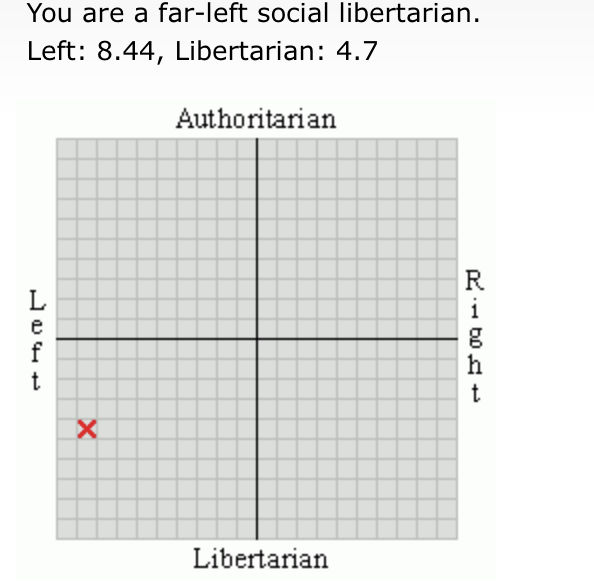
In any case, I consider myself, however contradictory this may sound, to be a libertarian-leaning Marxist with moderate ‘tank’ sympathies. I very much believe in the idea of the dictatorship of the proletariat, and I see the need for some kind of vanguard to lead and educate the working class, though I’m not sure I’d define such concepts in as particular a way as the average Marxist-Leninist would. I prefer at least some elasticity in their application.
For me, anarchy is an aspiration, though, not an immediately realizable state (pardon the pun). So, to make the kind of progress towards a point when the state will no longer be needed, because no class war will exist anymore, we’ll have to be patient anarchists.
Robert C. Tucker, The Lenin Anthology, W.W. Norton and Company, New York, 1975
Milovan Djilas, The New Class: An Analysis of the Communist System, Harvest/HBJ Book, New York, 1957
Karl Marx & V. I. Lenin, The Civil War in France: The Paris Commune, International Publishers, New York, 2008
I have a short story, called ‘The Manic Defence,’ published in Trumpocalypse: Where Dystopian Fantasy Meets Reality, a horror/political satire anthology by Horrified Press, published in paperback on the Lulu website. The book is to be released today, April 30th!
My story is a surreal political allegory, expressing political ideas I wrote of concretely in this recent post. There are lots of great writers in the book, too, including Alex S. Johnson, Pippa Bailey (and Leanna Locker), Jeffrey Penn May, Rhys Hughes, Bill McCormick, G.K. Murphy, Mathias Jansson, Emery LeeAnn, S.L. Koch, Christina Engela, Joey Burneez, Mandy White, Dino Parenti, B. Michael Stevens, Raven Dane, Kevin Henry, Jeff Stevenson, Samantha L. Nocera, Norbert Gora, and Florence Ann Marlowe. It’s on sale for $11.91. Go check it out! (The below picture is not mine: it’s by an amazing artist named Stephen Cooney.)
[NOTE: I was originally intending to publish this just after the November elections of 2016, assuming that Hillary Clinton was a shoo-in. Since Trump won instead, I’ve had to make considerable revisions of this post, not only to accommodate the surprise outcome, but also to take into account what a ‘Trump presidency’ would be like. In terms of all the horrible things we were expecting him to do, he certainly ‘didn’t disappoint’. Nonetheless, as unhappy as I am that he is president, I’m also glad she isn’t. This post, though critical of both of them, will focus on why she should never be president, and so much of it focuses on issues from 2016 rather than those of the Trump administration, which is touched on only a bit.]
I expected, a year or so ago, that Hillary Clinton would win not only the Democratic primaries, but in November 2016, too: I was wrong about the second prediction. According to polling data over the months, from various media sources, she was consistently winning against Donald Trump the great majority of the time, but he got it in the end.
Hillary seemed to have this election in the bag right from the beginning; you need only have knowledge of her record as a politician over the decades, allied with who her husband is, to know that she is working for The Big Club, as George Carlin called it in a famous rant. Yet, she still managed to lose. Well, she never had her husband’s charm…
All of the candidates, of course, were and are working for The Big Club, in varying extents and with only mildly varying political agendas, in both mainstream American political parties (what makes Trump ideologically similar to the others is far more important than what makes him different). Not even Bernie Sanders is as committed to ending the rule of the Big Club as he would seem to be, as proven by how he sold his soul to the Democratic devil. The Big Club, needless to say, is the capitalist class…but of all the candidates, Hillary was the most qualified, and the ruling class wanted to ensure that she got the job, just as any boss hires the best one for the job. They never wanted Trump to represent their interests, but this dissident member of the ruling class won, anyway, as surreal as that is.
The new president may have been elected, but she was selected, for it had all been rigged for her up until the end…but even that rigging wasn’t good enough. All the bias in Hillary’s favour among those in the DNC had already been known for months by Sanders and Jill Stein supporters before Wikileaks publicized the DNC e-mails in July 2016. People with eyes to see and ears to hear saw the proof all over the place in the mainstream media, in what was not reported every bit as much as what was reported: glowing op-eds about Hillary’s experience and competence, as against a dearth of coverage about Sanders or Stein, except to say they were both a lost cause from the beginning; about how pro-Hillary Google ensured that pro-Hillary searches were accessible, while searches critical of her were not.
Other evidence of pro-Hillary bias can be seen in how ‘Correct’ the Record (begun in late 2013 by ex-conservative [!] David Brock) paid trolls to harass and annoy online critics of her; a former Facebook friend of mine, who was doing exactly this kind of intensive, constant trolling of many anti-Hillary posts I’d put up, got so cocky when I posted an article on the paid trolling issue as to ask where he could sign up, for allegedly Bernie’s supporters had been doing it first. I should have responded by saying I thought he already was signed up, and knowing how much more money was in the Clinton campaign than in that of Sanders and Stein put together (as to make the claim, ‘Sanders’s trolls started it,’ sound ludicrous), I figured that if my former friend was a paid troll (as opposed to being merely one of Hillary’s useful idiots), he was probably getting so much money by being an asshole that he didn’t need to have a real job. In today’s sluggish economy, caused by the neoliberal agenda that the Clinton family helped establish, combined with neoliberal-caused wealth inequality, it is quite plausible that trolling at least contributes to a comfortable income for those without other options.
The Wikileaks e-mail exposures (claimed, without proof, by a desperate and embarrassed Democratic Party, to have been fabricated) may not have explicitly shown a plan to rig the DNC primary elections, but they did show a sufficient bias in favour of Hillary over Sanders. A suggestion to propagate evidence of possible atheism in Sanders may not have been used, but the bias against him in those e-mails disproves the impartiality that is supposed to exist in the party towards potential candidates. Sanders could have won if there hadn’t been the bias and election fraud during the Democratic primaries, and he certainly could have beaten Trump, unlike Hillary.
The reasons for the DNC’s preference of Hillary are obvious: she has the big money behind her. (Consider her connections with billionaires like George Soros. She also accepted a huge amount of money from UBS.) Sanders, though much more popular at the time, never had the needed huge number of Super PACs, because he wants to help the poor. No wealthy donor is going to support such a politician.
One rationalization Hillary supporters have given for the bias against Sanders is that he’s been an independent politician for most of his career, had only recently joined the Dems, then proceeded to hit Hillary and the DNC with criticisms of party corruption. Why would the butt-hurt DNC want to support this upstart outsider who had just joined their club, only to bash their favoured candidate? Who was he to judge her?
Well, maybe that was the whole point, Dear Dems. Your party is corrupt, right to the core. You’re supposed to be the left-leaning party, as contrasted with the right-wing Republicans. (Or, at least, the Democrats had been the left-leaning party, starting from their 1930s move to the left, until they were moved back to the right by…who were they…the Clintons?) The corruption of the Dems required an outsider to come in and expose what has been going on since the 1990s. It’s exactly the establishment within the Democratic Party that must be exposed for the pro-capitalist frauds that they are, so naturally, those servants of The Big Club are going to be biased against Sanders; but that doesn’t justify the bias.
In popular imagination, Bill Clinton (born William Jefferson Blythe III) is a hero among ‘left-leaning’ liberals. Actually, he and his wife are more conservative than Reagan was (not to say that Ronny didn’t want to be more right-wing, of course). Bill signed and ratified NAFTA (after George HW Bush tried to), which helped take jobs away from unionized workers in the U.S. and kept Mexican poverty about the same over the years, with hardly any economic growth, and with Mexico’s increased dependence on the U.S., Mexico was hit especially hard by the 2008 economic crisis. With this, and all the other crimes and interventions of U.S. imperialism in Central America over the past hundred years, it’s no wonder so many Latin Americans keep trying to get into the U.S. Poverty has forced them to search for decent-paying work in America.
When I touched on Bill Clinton’s contributions to the nefarious growth of neoliberalism in this essay, I was barely scratching the surface. His and Hillary’s betrayal of the left began long before they got into the White House; but when he got in, he did a number of other shameful things, supported by Hillary, during his two terms, including the Crime Bill of 1994, the Welfare Reform Act of 1996, and the Telecommunications Act of 1996.
The first of these heinous forms of legislation resulted in the lopsided levels of incarceration for blacks and other minorities, whom Hillary callously called “superpredators.” The welfare reform destroyed the social safety net. The telecommunications act helped with the merging and acquisitions of so many media sources that now almost all of the US media are controlled by only six corporations (who, of course, decide what political agenda to promote); small wonder so many of us, finding the mainstream media utterly untrustworthy, now flock to alternative sources, including even Russian media, so derided by the establishment Western media, for obvious reasons.
Bill Clinton repealed the Glass-Steagall Act in 1999, which many commentators believe was a major factor leading to the financial crisis of 2008, since it allowed financialization of the economy to go on without let or hindrance.
During his two terms, Bill Clinton also helped US imperialism ruin Russia with Boris Yeltsin by destroying the country’s social safety net. This led to what some have called the economic genocide of Russia. And the demise of the USSR made it easy for the US to extend its global hegemony.
With this background in mind, we must now see why having the Clintons back in the White House, continuing their machinations, was such a dangerous, frightening prospect, and why, in spite of how obviously awful Trump is, we should be glad they didn’t get back in. The military-industrial complex’s habit of removing regimes that go against the interests of the capitalist class has been going on for a much longer time than when the Clintons came onto the scene (consider the CIA’s helping MI6 to oust Mohammad Mosaddegh and bring back the Shah of Iran from exile in 1953, or the CIA’s helping to replace the democratically elected socialist, Salvador Allende, with the capitalist dictator Augusto Pinochet); but the notion of waging “humanitarian wars” against “brutal dictators” really came into its own with the false charge of genocide against socialist Slobodan Milošević, against whom it was recently judged that there was no evidence linking him with the deaths in Yugoslavia in the 1990s. This ousting of “brutal dictators” didn’t start with George W. Bush’s invasion of Iraq in 2003; it was continued by him, but popularized by that ‘sensitive liberal,’ Bill Clinton, in the late 1990s.
Now we can put Hillary’s hawkishness in its proper context. Her support of the Iraq War wasn’t just a fearful reaction to the September 11th attacks; her later recanting of that support was a reaction to that war’s unpopularity, in anticipation of her hopes of becoming president in 2008. Given her continuing hawkishness since then, I find it easy to believe that her ‘regret’ over voting for the Iraq War was anything but genuine.
As Secretary of State under Barack Obama, who is as undeserving of a Nobel Peace Prize as anyone can be, Hillary talked him into bombing the Hell out of Libya, resulting in the brutal sodomizing and murder of Muammar Gaddafi, benevolent as far as dictators go, whose government had been providing a host of social programs, including free education, free health care, free electricity, and even interest-free loans. Libya, thanks to the NATO intervention, became a failed state and a haven for terrorists. Hillary boasts of this achievement, instead of being contrite. She’s friends with Henry Kissinger, remember.
She has always supported an aggressive foreign policy against the already besieged and aggrieved Syria, arming “moderate” rebels as well as ISIS, all for the purpose of removing another “brutal dictator,” Bashar al-Assad. How many more Syrian children must be traumatized or killed, just so the U.S. can install a gas pipeline in Syria?
Of course, Russia has been doing airstrikes on Syria, but with the intention of helping the Syrian government stop ISIS (which US imperialism in the region has helped to create, and with Hillary Clinton’s help, allowed its Arab allies to fund), not helping the terrorists. And because of this thwarting of the US’s plans to extend its global hegemony (among other reasons), Vladimir Putin has become the latest “brutal dictator” whom the US and NATO must stop.
It has come to this: the deep state in the U.S. is actually, seriously planning to go to war with Russia, a country as armed to the teeth with nukes as the U.S. is. Does the hubris of U.S. imperialism have no limits? Haven’t the misadventures of the American army (and NATO) in Afghanistan, Iraq, Libya, and Syria proven the limits of their strength? And now they have NATO troops lined up along the Eastern borders of Poland, Estonia, Lithuania, and Latvia, doing war-games and preparing for a confrontation with Russia.
The U.S. Navy has also had navy vessels and aircraft in the South China Sea, ready to face China, another growing challenger to U.S. hegemony (Steve Bannon, of course, has predicted war with China). This anti-China and anti-Russian attitude is nothing new from Hillary, of course, but it should be equally obvious that not all of this is solely the Clintons’ fault, either: Obama had been pursuing much of this, because The Big Club want it; hence all the anti-Russian and anti-Chinese propaganda in the U.S. corporate media, including the speculative fantasy that the Russians were behind the Wikileaks hack of the DNC e-mails (US intelligence insiders seem a likelier source of the leaks), as well as the claims that Trump, Sanders, and Stein are, or have been, all puppets of Vladimir Putin. Then, of course, there’s the ridiculous, unsubstantiated claim that Russia manipulated the election to put Trump in the White House.
My criticism of Hillary will lead many to assume that I’m a supporter of Sanders, or Stein, or that right-libertarian Gary Johnson, or–worst of all–Donald Trump. I don’t like any of them. Sanders is at best a mere social democrat, who would help Americans get lots of free stuff while allowing a certain measure of U.S. imperialism to continue unchecked; at worst, he’s a pawn of the system, bullied or bribed into supporting Hillary instead of fighting for his “revolution” to the bitter end. Stein is a nice lady whose heart is, or seems to be, in the right place, but how she plans to implement her radical changes, especially when opposed by the Big Club, remains a mystery. I don’t support Johnson because I’m a left-libertarian, and we shouldn’t need him to legalize weed.
As for Trump, opposing him is all too easy. His charmless, tactless campaign showed what he really is: a lecherous buffoon, a cartoon character. He has a cult of dedicated bigots and simpletons following him, and we’ve always known that lots of Americans are like that (although, to be fair, others among his supporters are better than that; but despite their legitimate feelings of disenfranchisement, they still have the misguided notion that he, a billionaire narcissist, actually cares about them); still, more than enough Americans, including the super-rich, won’t want to let him stay in the Oval Office too long. Most importantly, I’m convinced of the idea, often dismissed as a conspiracy theory of disgruntled Republicans, that Trump was originally a Clinton plant; but later, when he saw how popular he’d become, his narcissism took over, and he didn’t want to be her plant anymore (or, maybe, he secretly still wanted to?).
You don’t have to be a partisan of the GOP to believe that Trump could have originally intended to run a phoney campaign to help his friends, the Clintons, make all Republicans seem extreme, and ensure that the Clintons easily return to the White House (though the plan ultimately failed). You just need to understand the nature of The Big Club, who are now using the mainstream media to get rid of him by demonizing him.
In any case, the political goalposts keep getting moved further and further to the right, with the GOP goalpost coming closer and closer to Attila-the-Hun right-wing, and the DNC goalpost being more and more neoliberal right-wing…with the illusion of the Dems still being ‘progressive’ relative to the GOP. The extreme goalpost isn’t so much what we need to worry about, since Trump will probably be removed from the White House by the Big Club sooner or later, either through their attempts to impeach him (and replace him with the much more establishment-oriented Pence) by accusing him of being a ‘Putin stooge’, or by defeating him in 2020, or they’ll ‘remove’ his agenda by bullying him into following theirs, or he’ll simply quit the job out of frustration at his unpopularity and the stress of the job; it’s the neoliberal goalpost that is the problem, and Trump is helping that one stay in place forever, in his own, twisted way.
Trump and the Clintons have been friends for years. The Clintons attended Trump’s wedding with Melania in 2005. Bill and Trump play golf together. Bill has played golf at Trump’s golf course for years; Bill, Hillary, Chelsea, and Marc Mezvinsky all played there together once. Chelsea is friends with Ivanka; their husbands introduced the young women to each other, because the young men were already friends! It’s a big club, and we’re not in it! Then, there was that mysterious phone call Bill gave the Donald, just before he announced his bid for the Republican nomination.
Let’s compare Hillary’s history with Trump’s political positions. She, too, has spoken of building a barrier to keep Mexicans out of America. Trump put a ‘temporary’ ban on Muslims? His executive order merely continued and developed something Obama had started in late 2015; furthermore, Obama and Hillary have bombed Muslims (as Trump is doing now in Syria)! Obama was the deporter-in-chief, as well as a bomber of Muslims, so how much worse can Trump be? Trump wants to outlaw burning the US flag; Hillary Clinton backed proposed legislation to do the same thing in 2005. He may have spoken of wanting to ‘drain the swamp’ of Clinton-oriented corruption, but now that he’s president, he’s appointing the same kind of neo-con, neoliberal, pro-banker people who supported the Democrats.
People were afraid when Trump asked why we can’t use nuclear weapons, while Hillary and Obama were and are content to expand NATO along Russia’s border, with troops there, ready to do war with a nuclear-armed superpower. Hillary hasn’t been any less averse to using nukes, either. Trump is actually less hawkish towards Russia, yet we’re all afraid of his itchy finger on the button, instead of hers. He is an awful president, but that’s because there’s never really been a good president. His election isn’t Russia’s fault: it’s the US’s.
Now, Trump was accused of not paying his taxes (which, it turns out, he has payed them); now, avoiding paying one’s fair share is typical of any capitalist billionaire. The Clintons haven’t been much better with that kind of thing, though, with their not-so-charitable foundation. And if Trump is no friend to women, neither is Hillary. To all of those who were so ecstatically hoping to shout, “First woman president! First woman president!” in November 2016: it isn’t the women at the top who matter (there already are lots of women at the top…not so much female politicians, of course, but I mean those women in the families of the ruling class); it’s the women at the bottom who do…working women in the US who would have got no help from Hillary had she become president, women in the Middle East who have had her bombs raining over them, women apparel workers in Haiti whose wages were kept down by her and the then-State Department, etc.
None of this is meant to be a defence of Trump, who as I’ve said above, has been as awful a president as we had all predicted he would be. His bigotry, rudeness, needless increase of spending on the military–side by side with cuts in such areas as the arts, education, the HHS, and the EPA–are all inexcusable. Then there’s his continuation of the ‘War on Terror’. These are also typical moves to expect from The Big Club. Trump’s privatizing of education has parallels in the Obama administration, too.
But as bad as Trump is, none of this means that Hillary would have been any better. The 2016 voting in California and New York State showed election fraud (note how easily hacked electronic voting booths are, how computers can be used to rig elections); the mainstream media favoured Hillary; the FBI director, who was on her payroll, twice wouldn’t indict her for the e-mail scandals; she paid trolls to intimidate her critics; and she got a personal friend to make an ass of himself, and was promoting him to the hilt through the corporate media so she, because of the fear of him being elected, would be ensured a victory, though her plan failed. But because she’s a “liberal progressive” Democrat, she couldn’t have been an authoritarian dictator, or someone working for the plutocrats? And just as everyone is rightly worried that President Trump is showing fascist tendencies, the mainstream media is trying to silence alternative media as ‘fake news’ or ‘Russian propaganda’. This is the new version of book-burning, and both the mainstream GOP and the Dems are supporting the idea.
Hillary and Kaine aren’t progressive in the slightest, if the word ‘progressive’ actually means anything. The notion of the Democratic Party as ‘left-leaning’ is a lie. The Republican Party isn’t the only repugnant party. Don’t ‘correct’ the record on Hillary, consider her record. Here’s a hint: a number of neocons and Republicans were either supporting her, or had at least considered supporting her. Being a ‘liberal’ Democrat is nowhere near left enough. The ‘Third Way’ is what brought the Democrats and the Labour Party to the right. Imperialism with the Dems is the same as it ever has been with the GOP. Democrats have been no less war-mongering than Republicans, for both parties serve the same capitalist masters. The US really has two Republican parties: the neoliberal Republicans (Hillary ‘Democrats’), and the Attila-the-Hun Republicans (President Trump).
So, what can we do? Anyone with a modicum of common sense will know that The Big Club won’t allow anyone to legislate them out of their wealth. Such is the nature of so-called liberal democracy, which is really the dictatorship of the bourgeoisie. And a soft Left won’t suffice in fixing this problem; ‘libertarian socialist’ Noam Chomsky has seriously disappointed me in supporting a Hillary vote to prevent Trump from winning in swing states.
What we need is a revolutionary dictatorship of the proletariat. And what is the dictatorship of the proletariat? It means various things to different leftists, of course. For Marx, it was exemplified in the short-lived but exhilarating Paris Commune. For others, it was the USSR, it’s Castro’s Cuba, or North Korea, and socialist Eastern Europe during the Cold War. That’s not how I, leaning towards a more libertarian left, would prefer it. But in any case, it’s about having a worker-ruled society that is protected from a resurgence of capitalism through an arming of the workers. This is real democracy, a worker-ruled society, democracy from the bottom-up, for a change. This is to be achieved by any means necessary, and necessarily involving force.
I personally don’t like violence; my advocacy of violence comes not out of personal preference, but out of a lack of viable alternatives. The only thing that will fix America, and by extension, the world, is a bloody, violent revolution. Lots of Americans own guns, thereby making them physically equipped (to an extent, at least) to carry out this uprising. Sadly, too many of these people fetishize capitalism, and therefore won’t want to make the necessary political changes. They’ll simply replace Trump’s right-wing government with a neoliberal one in ‘left-wing’ garb (think of those Hillary supporters who don’t accept the Trump victory), or with a right-libertarian one.
Leftists will have to arm themselves; they’ll also have to get over their differences. A divided Left is an impotent Left. Now is not the time to debate on Facebook whether Bakunin or Marx, Kropotkin or Lenin, Makhno or Mao, or Trotsky or Stalin had the right ideas. Nor is it the time to debate how many died under communism in order to invalidate those forms of leftism we don’t particularly like. Now is the time to organize and plan a revolution. Online communication will have to be kept to a minimum, for fear of all that internet spying. In-person meetings will have to be made at the local level, off the radar.
Sadly, we in the First World have next to no revolutionary potential: we stare at our phones like zombies, eat unhealthy food, and get far too little exercise. We need to be in a state of desperation to be in a revolutionary situation. I try not to be as pessimistic as Jason Unruhe about First World revolutionary potential; it’s not that I think he’s wrong, but if he’s right, why are any of us leftists still spreading the message? Are we just ego-tripping? The Third World may be desperate enough to be in a revolutionary situation, but they lack the wherewithal to prepare an uprising; they can barely feed their families.
Our situation is urgent: the Big Club, with or without Trump, is sure not only to continue to exacerbate the problems of income inequality, environmental dangers (i.e., fracking), and imperialist wars, including a possible nuclear confrontation with Russia or war with China; they will use a mass media the DNC largely controls to divert the masses’ attention from the real issues.
The Big Club must be torn down, not just because of our yearning for justice, but for the sake of our very survival. It’s either socialism, or barbarism. Since the people make up a much bigger club than the capitalist club, we all need to come together. We have nothing to lose but our chains.
The choice is ours…for we have no other choice.
Gaslight is a 1944 thriller film starring Ingrid Bergman, Charles Boyer, and Joseph Cotten, and co-starring Angela Lansbury and Dame May Whitty. It was directed by George Cukor, and based on the 1938 stage play Gas Light, written by Patrick Hamilton. Another movie version was done in 1940, adhering more closely to the original play; but when MGM did the 1944 remake so soon after this first film, they wanted to have all existing prints of it destroyed. Fortunately, the original film wasn’t ever destroyed, but this 1944 version still eclipsed it.
Bergman won her first Academy Award for Best Actress with this movie, while Boyer was nominated for Best Actor, and Angela Lansbury was nominated for Best Supporting Actress. The film was also nominated for Best Picture, and it won Best Art Direction. The film got a total of seven Oscar nominations.
It is from this film that the term ‘gaslighting‘ originated, for the villain, Gregory Anton (Boyer), uses this very tactic–tricking his wife, Paula (Bergman), into doubting her own perception, memory, and sanity by staging bizarre scenarios for her–in an elaborate scheme to drive her mad, have her committed to an insane asylum, then take possession of her old London house, originally owned by her aunt, Alice Alquist, whom he murdered years before.
Normally, emotional abuse is used on a victim for the purpose of having power and control over him or her; but Gregory, or Sergius Bauer, to use his real name, only wants to get rid of Paula so he can freely search about that old house, to find the coveted items he killed Alquist to steal–her jewels.
In one scene, he speaks of his great lust for precious jewels (about a half-hour into the movie). In another scene, we see him in the attic, searching furiously for those jewels, using a knife to hack through the cushion of the back of an old chair in a desperate hope to find them (about an hour and a half into the movie). This ruthless searching for treasure, violating other people’s property in the process, reminds us of the plunder of the Third World for resources, diamonds, etc., by Western imperialists. Remember that, just as an emotional abuser often controls his victim’s finances, imperialism deliberately stifles the economic growth of Africa, Asia, and Latin America.
Since Patrick Hamilton had communist sympathies, especially in the late 1930s, when he wrote Gas Light, I feel at least some justification in making a leftist allegory out of this movie.
Gregory, who–as I see it–represents bourgeois imperialism, tricks Paula, who represents both the proletariat and those ‘brutal dictators’ that imperialism wants to remove, into thinking she is a forgetful kleptomaniac. He does this by deliberately moving items when she isn’t looking, then claiming she took them and forgot she had. He reveals her ‘forgotten thefts’ with a cruel frown, causing her to be frightened and hysterical.
When he leaves her alone in the house, ostensibly to go out somewhere and work on composing classical music, but actually to sneak up into the attic from the back to search for the jewels, she notices the gaslight dimming in the rooms. This frightens her, for she has no idea who is causing it to dim. The servants honestly deny any knowledge of the gaslight dimming (just as the average worker doesn’t know of the ruling class’s tricks), and Gregory pretends not to know either; for it is he who is dimming it–hence the term ‘gaslighting’.
Always claiming Paula is ill, Gregory never lets her out of the house to be sociable, like a typical emotional abuser. (Symbolically, this isolation is also like how imperialism economically isolates such countries as Cuba by imposing embargoes on them, to bring an end to the regimes of those ‘brutal dictators’.) The servants believe she’s ill, too, and are cool towards her, upsetting her all the more. Of course, it is Gregory who has made the servants believe she’s ill, through triangulation; just as the corporate mainstream media tricks us into thinking ‘brutal dictators’ like Milosevic, Saddam Hussein, Gaddafi, et al, are madmen who must be removed from power.
By the climax of the film, Paula has been manipulated so thoroughly that she plods about, eyes half shut, as if she’s half-asleep, just like the average Western citizen, brainwashed and distracted by media nonsense. She believes her mind is going, that all she sees and hears is just a dream, as her cruel husband has convinced her.
I have elsewhere gone into detail about the nature and effects of emotional abuse, as well as about narcissism; hence my political interpretation of this film, instead of just elaborating on psychological abuse again. I feel a political interpretation is useful and necessary, because I see political gaslighting going on everywhere, all the time.
The media tricks Americans, for example, into thinking that one political party is evil, while the other is good, or at least has the potential for good, once the ‘good’ political party has been cleansed of corruption; when in reality, both political parties are working for the plutocrats, as are the media.
We are tricked into forgetting the imperialist crimes of previous years and decades, and even made to think that the Western imperialists are among the victims, rather than the victimizers. Here we see the microcosm of the narcissist, seeing himself as the victim and projecting his guilt outward, expanded into the macrocosm of the imperialists, who blame Muslims for terrorism instead of taking responsibility for US or NATO bombings of, or proxy wars in, places like Libya, Syria, Kosovo, or Iraq. Like Gregory, capitalists are murderers.
Gregory accuses Paula of stealing and forgetting her thefts, when in fact he is the thief (and a murderer). Similarly, the capitalist class excoriates socialists and social democrats for ‘stealing’ the money of the wealthy (through progressive income taxes), when in fact it’s the capitalists who originally stole from the workers (by overworking and underpaying them). Furthermore, the Western media has propagandized against socialist states like the USSR, calling them ‘totalitarian dictatorships’, when currently America has by far the highest incarceration rate of any country in the world, and polls have consistently shown that a majority of Russians prefer the USSR to their current state of affairs. All of this media deception can be called political gaslighting.
Gregory leaves Paula alone, and the gaslight dims, frightening her; then he denies this dimming. This is symbolic of capitalism’s alienating of workers, leaving them in a darkness of misery, then denying that the capitalist system is responsible for these problems. The servants go along with Gregory’s thinking, just as so many workers, police officers, and soldiers refuse to resist the system.
Scotland Yard Inspector Brian Cameron (Cotten), who revives the case of Paula’s murdered aunt, Alice Alquist, after the police have considered it unsolvable, admired Alquist’s singing; this admiration arouses his empathy for Paula, and he puts the pieces together and saves her. Now he is a policeman, and therefore an unlikely hero in any anti-capitalist allegory; but because he’s the only inspector among the British police still interested in this case, out of his empathy for Paula, his authority can be seen to represent one other than that of the establishment; in other words, instead of being seen as representing a policeman for the bourgeoisie, Cameron can be seen allegorically as a member of the militsiya. (Furthermore, in the 1940 film version, there’s a scene in which the inspector–originally named Rough–invites a group of poor street urchins into a pastry shop to buy them something to eat [about 21 minutes or so into the film], suggesting his sympathy for the poor. Recall in this context Hamilton’s communist sympathies around the time of the writing of his play.) His fighting with and subduing of Gregory can thus represent the vanguard of a revolution against the imperialist bourgeoisie.
I admit that my allegorizing here isn’t as smooth as that of my previous analyses, but I feel it’s necessary to make a link between gaslighting in relationships and that of politics; for I see the latter as an extension of the former, an extension that mustn’t be overlooked. Now, if my emphasis on contemporary imperialism seems odd when allegorizing a story written so many decades earlier, consider how much older capitalist imperialism really is: equally disturbing examples of it can be seen in Churchill’s disparaging of Muslims and the Indians he allowed to starve to death in the Bengal Famine; or in the late Victorian Holocausts of the late 19th century.
Emotional abuse in families, extending to other relationships, is a lot more common than most people realize. In the US, it has been found to be almost universal. America is a country where authoritarianism, disguising itself as ‘liberty‘ (check out the gaslighting there!), is also rampant; religious fundamentalism, an intrusive state, mass incarceration, police brutality, and neoliberal capitalism being the most notable manifestations. It isn’t a wide leap of logic to go from American dysfunctional families to this authoritarianism, then to imperialism: it’s all about power imbalances.
A useful link between family abuse and the authoritarian political establishment, given from the perspective of a prickly American cop, is in this disturbing video (a scene from the TV series Southland), in which a truant pre-teen boy with a ‘bleeding-heart liberal’ attitude is lectured that “discipline is not child abuse”–this after his mother has hit him with a belt two or three times for truancy. To some, this may seem like a mild punishment in itself, but many families have wildly different interpretations of what ‘mild punishment’ is, especially as regards hitting a boy with a belt. Consider the end of this scene in Goodfellas, again, ‘punishment’ for truancy.
The point is that there is always a ’cause’ for the abuser to fly off the handle and assault the victim either verbally, physically, or even sexually. This ’cause’ does not justify an abusive reaction, which is then minimized as “discipline” or ‘punishment’.
Similarly, and by extension, Western imperialists always have ’causes’ for their bombings of other countries, typically vilifying the leaders of those countries by calling them ‘brutal dictators’. To be sure, the dictators of the world have more than their share of flaws; but for the West to be judging them, given all the corruption that favours the rich and powerful in the West, is really the pot calling the kettle black. The corporate-owned media, ever in the service of imperialism, engages in gaslighting by giving us biased accounts of what is happening in, for example, Kosovo, Iraq, Libya, Syria, and now Russia, so we will see the bombings as ‘humanitarian’, a truly obscene series of lies.
Once the bombing campaign is over and the victimized country is subjugated (if not more or less destroyed), the ‘brutal dictator’ is removed or killed, and the imperialists take over, just as Gregory tries to remove Paula, then take ownership of her home so he can finally search freely for the jewels, which could be seen to represent the oil and other resources of the conquered countries.
Remember how Iraq was regarded sympathetically by America during the Iran/Iraq War, then the US turned on Saddam Hussein in the 1990s? Or how Osama bin Laden and the mujahideen had the sympathy of the US when repelling the USSR from Afghanistan (we all know what happened after that)? Remember how the West briefly warmed up to Gaddafi during the 2000s…then in 2011…? Or how Syria was an intermittent ally until the 2010s? Gregory’s attitude to Paula can be seen to symbolize this kind of political relationship. At first, the victims have their uses; then they’re devalued and discarded.
In order to solve the problems of political oppression around the world, we must first solve the problems of our own social relations. This must begin with the family, the foundation of all social relations.
To optimize family relations, parents must be as sensitive as they can to the emotional development of their children, starting right from the first months of infancy. Attachment theory explains the different ways a child learns how to connect with primary caregivers, then with other people; this includes unhealthy forms of attachment. When these forms of attachment are unhealthy, the child grows up with these bad object relations, which become the blueprint for all future relationships.
This leaves such a person vulnerable to the schemes of psychopaths like Gregory. Paula’s childhood trauma, of having seen the dead body of her strangled aunt, would represent the kind of ruptured attachment, or bad object relation, that has led to her being susceptible to the charms of Gregory, who idealized her during their courtship, devalued her during their married life in London, and almost discarded her into a mental institution, but for the intervention of Inspector Cameron.
Just as we must be warned of the idealize/devalue/discard tactics of psychopaths, sociopaths, or narcissists, we must also do the necessary healing work if we’ve already been traumatized by them, be they our ex-boyfriends, ex-girlfriends, ex-husbands, ex-wives, or bullying parents. The healing work includes learning about toxic people, engaging in self-care and self-compassion, meditation, cathartic writing about one’s own problems, and joining communities (including online ones) of other survivors, to give them support as well as receive it from them.
When the needed emotional health is either established, through good parenting (not ‘perfect’ parenting, but the good enough parenting that DW Winnicott advocated), maintained, by being wary of the fake idealizing of potential toxic boyfriends or girlfriends, or restored after surviving an ordeal of emotional abuse, then people can organize into communities, and develop the solidarity needed to combat the greatest emotional abusers of them all–the capitalist class and their stooge governments, their political flying monkeys.
As for the Cluster B individuals themselves, psychiatrists must work tirelessly to discover a cure for each of those pathologies, whether those pathologies be genetically based, physiologically based, or caused by trauma.
We as a people need to learn what love really is: not just a pretty-sounding word, not empty sentimentality, but a genuine connection between people, a connection brought about not by stern moralizing or authoritarian forms of religion, but by empathy…the empathy Inspector Cameron felt for Paula, because of how she reminded him of her aunt.
Only through empathy can we hope to build a better world, one in which bosses don’t rule over workers by overworking and underpaying them, and by gaslighting them into thinking they are worthless if they can’t help bosses make a profit; a world where all racial, ethnic and religious groups are treated as equals, and gaslighting isn’t used to make people equate blacks with criminals or Muslims with terrorists; where the sexes are regarded as equals, and gaslighting isn’t used to make women feel worthless if they don’t provide pleasure, or to make men feel worthless if they don’t provide money; where LGBT people are given dignity, and gaslighting isn’t used to make them seem perverted.
To fix the world, we must start with the family, the foundation of society.
Brave New World is a novel written by Aldous Huxley and published in 1932. Like George Orwell‘s Nineteen Eighty-Four, it is a dystopian novel about a future world tightly controlled by a totalitarian government. There is, however, a crucial difference between these two dystopias: Orwell’s Hell is a totalitarianism predicated on brute force, surveillance, and a manipulation of logic called doublethink; Huxley’s tyranny is more like a Heaven, or a Spenserian Bower of Bliss, predicated on a mindless pursuit of pleasure (promiscuous sex, getting high on soma, and watching ‘feelies’, this last being comparable to the 4DX experience in movies) to distract people from questioning the world around them.
At the same time, there are similarities between these two tyrannies: both involve intolerance of nonconformity, though where Orwell’s thought-criminals are tortured and killed, Huxley’s are simply exiled; and both systems of power do their utmost to erase history to ensure that their citizens never get a taste of an alternative culture, which might lead to a dangerous wish to rise up against the current regime. “‘When the individual feels, the community reels,’ Lenina pronounced.” (Chapter 6)
As with my analysis of Nineteen Eighty-Four, I can’t resist comparing Huxley’s dystopia with our world today. Indeed, in Brave New World Revisited, Huxley himself compared the world of his ‘fable’, as he called it, to the world he saw around him in the late 1950s, and found it disturbingly close in many ways to his fictitious world. He also contrasted his predictions to those of Orwell’s: “It is worth remembering that, in 1984, the members of the Party are compelled to conform to a sexual ethic of more than Puritan severity. In Brave New World, on the other hand, all are permitted to indulge their sexual impulses without let or hindrance.” (page 34)
Neil Postman, in his book Amusing Ourselves to Death, also made a comparison of Huxley’s novel with our world over thirty years ago, feeling that the America of the 1980s was far more like Huxley’s heavenly Hell than Orwell’s more blatant one. The whole idea of Postman’s book was how the once serious discussion of politics, which involved lengthy speeches, detailed analyses of the issues, and fierce debates, all by a literate public, has degenerated into mere TV entertainment. We are not so much bludgeoned by fascistic cops as we’re lulled to sleep with amusement. If Postman were alive today, he would see how much more correct, and prophetic, his analysis was by watching the clownish likes of Donald Trump on TV.
In my opinion, today’s world is about half Orwellian and half Huxleyan. For my comparison of Nineteen Eighty-Four with our world, please go here. And now, for my comparison of our world with that of Brave New World.
One thing to remember about Huxley’s novel is that it is a satiric exaggeration of the early 1930s (and, by extension, today’s world). We haven’t done away with families, procreation, pregnancy, parenthood, and monogamy, as has been done in World State society, but in many ways we are already well on our way to abolishing such things (and, recall above, that Huxley in Brave New World Revisited also believed that in the late 1950s our world was coming closer to such a state of affairs than he’d originally imagined). Western divorce rates are absurdly high, many people are opting out of marriage completely, artificial insemination has existed for decades, and in spite of the fear of STDs, or of men taking advantage of drunk or stoned women, one-night stands in Western countries are as common as the common cold.
As Huxley says in Brave New World Revisited: “The society described in Brave New World is a world-state in which war has been eliminated and where the first aim of the rulers is at all cost to keep their subjects from making trouble. This they achieve by (among other methods) legalizing a degree of sexual freedom (made possible by the abolition of the family) that practically guarantees the Brave New Worlders against any form of destructive (or creative) emotional tension.” (page 34)
A few words need to be said about Huxley’s World State when compared with today’s political world. The notion of an oppressive, global government is the subject of a popular conspiracy theory that sells lots of books and makes lots of money for right-wing kooks like Alex Jones. Needless to say, I don’t subscribe to such nonsense. I once read the beginning of a webpage about the ‘NWO‘ in which the writer claimed there are two ways to interpret all the phenomena of history: they’re either accidents–coincidences; or they’re all planned (i.e., conspiratorial). The belief in this false dichotomy among ‘truthers’ and the like was confirmed whenever I read their use of the term ‘coincidence theorist’ as a straw-man against any doubters of their paranoid ideas.
What’s especially interesting about these conspiracy theorists is how many of them are either right-libertarians or religious fundamentalists (Christian or Muslim). They fancy themselves anti-authoritarian, but they’re in total denial of the hierarchy and authoritarianism inherent in capitalism and religion. They won’t trust the mainstream media, but they don’t mind referring to it when it criticizes ‘socialist’ Big Government. And while we’re on the topic of conspiratorial thinking, since there has been, from the Reagan and Thatcher years to the present, a push towards greater and greater deregulation and tax cuts for the rich–which, as I’ve argued elsewhere, leads ironically to bigger rather than smaller government–it doesn’t seem an ill-founded suspicion to think that the rich oligarchy is more than happy to promote these conspiracy theories. After all, they criticize only the state, while leaving ‘free market’ capitalism and religion well alone. And if the elite is so incredibly powerful, we can’t do anything about it…so don’t bother trying. The capitalists have already won. They would love us to be so pessimistic.
As I see it, a more accurate contemporary parallel to the World State is globalization. The so-called ‘free market’ doesn’t pulverize the state, as the right-libertarians would have us think: it merely privatizes the state. World governments are increasingly being run by capitalists, as such shady deals as the TPP show; multinational corporations can use the TPP to sue any government that makes regulations that limit their profits. To know who has the power, follow where the money is going…and capitalism is all about making as much money as possible.
The state is just the bouncer of the World Casino, if you will; and who is the state’s boss, if he isn’t a capitalist? Huxley’s satire is as much a critique of capitalism as it is of the state. Indeed, in the 1946 Foreword to Brave New World (page xliii), he described his ideal society as being economically Georgist (which can be considered a variant on left-libertarianism) and politically ‘Kropotkinesque’, and it was he who thus introduced me to anarcho-communism.
References to capitalism in Brave New World include the World State’s class system, with people like Mustapha Mond, one of ten World Controllers composing the ruling class. Then there are Alpha-plus people like Helmholtz Watson and Bernard Marx, beneath whom are upper-middle-class Betas, then the Gammas, Deltas, and Epsilons, the equivalents of such groups as the petite bourgeoisie and the working classes who are conditioned into being content to stay in their respective castes and/or do menial labour. Note that there is nothing even remotely socialist about such a world, since socialism aims to create a classless, worker-ruled society.
Elsewhere, capitalism in Huxley’s world is seen in the World State’s promotion of consumerism, a constant buying and fetishizing of commodities (“Ending is better than mending. The more stitches, the less riches.”–Chapter 3). Indeed, with the World State’s requiring of its citizens to engage in promiscuous sex (“Every one belongs to every one else.”–Chapter 3), we see even a commodifying of people. In the Hatcheries, where babies, including cloned ones, are mass-produced instead of born the natural way, we see human commodification taken to a satirical extreme.
Speaking of mass production, a worship of Henry Ford has replaced that of Christ; there is even a regular singing of ‘Solidarity Hymns’ to Ford (Chapter 5, part 2). The crucifix is replaced by a T (i.e., the Ford Model T), and A.D. is replaced with A.F., “After Ford,” a new dating system beginning with the year that the first Model T was produced. Ford is honoured because of his development of assembly-line production, which represents the capitalist ideal in World State society. He is so godlike to the World State that expressions like “O, Lord, Lord, Lord,” and “Thank the Lord” are replaced with “O, Ford, Ford, Ford,” and “Thank Ford!” World State citizens worship capitalism just as today’s free market fundamentalists do, with their God-like ‘invisible hand,’ which allegedly guides consumers to making wise decisions in buying products. (I wonder how many of them are aware that such things as their coffee, chocolate, and diamonds are often produced through slave labour in the Third World.) World State citizens, just like so many of today’s conspiracy theorists (who are so above all those unthinking ‘sheeple’), worship capitalism as a religion.
Now, how are the citizens conditioned to be content with their lot, wherever it may be in the caste system? One way is through hypnopaedic conditioning: as children are sleeping, they hear recordings that subliminally teach them to conform. This is comparable to how we passively, thoughtlessly watch TV and accept every entertaining image, as if we were sleeping. TV, movies, and popular music these days are all mindless nonsense, or they bombard us with propaganda, either that of divisive political correctness, or of materialist pleasure (overt sexuality, the ‘He who dies with the most toys wins’ would-be philosophy, etc.). The CIA started influencing world media with Operation Mockingbird back in the 1950s, and it is doubtful if they ever stopped; one of the most influential feminists of the 1970s, 80s, and 90s, Gloria Steinem, who helped in the shift from second wave to third wave and radical ‘Marxist’ feminism, had CIA connections.
Another way the World State controls the people is through a drug called soma, which gives people a high to help them forget their troubles (“A gramme is better than a damn.”–Chapter 3). This is like how disruptive children in the US are constantly given psychiatric drugs to treat conditions like ADHD or ODD. Pharma for profit, rather than for actually helping people. Elsewhere, people enjoy coffee and nicotine to keep them contented workers, and alcohol to make those workers forget their problems over the weekend. Sure, narcotics are illegal (the gradual legalizing of marijuana notwithstanding), but the prison-for-profit industry in America is all too happy to incarcerate drug addicts and traffickers (consider what a failure the ‘War on Drugs’ has been).
Then there’s all that sugary, fattening food we enjoy: our very own soma. Combining that with the dumbing-down of our society, consider what Huxley had to say in Brave New World Revisited: “And now let us consider the case of the rich, industrialized and democratic society, in which, owing to the random but effective practice of dysgenics, IQs and physical vigour are on the decline. For how long can such a society maintain its traditions of individual liberty and democratic government? Fifty or a hundred years from now our children will learn the answer to this question.” (page 21) Indeed, I think we have.
Of course, all these attempts to make the people conform don’t always succeed. Bernard Marx is unhappy because he is too small in physical stature. Lenina is criticized for not being polygamous enough. Helmholtz is too smart and creative a writer for the World State’s insistence on superficial slogans (for example,”A gramme in time saves nine.”–Chapter 6). Still, all three of them are conditioned enough either to want to fit in (Bernard, Lenina), or at least to accept the contrived World State morality (Helmholtz). Even Mustapha Mond owns forbidden literature, and has read it, and though he as a youth had a dangerously inquisitive mind (in scientific matters), he accepts and defends the need to keep conformity as an indispensable part of life, for the sake of social stability.
Another non-conformist, who nonetheless aches to fit into World State society, is Linda, mother of John the Savage. She is branded a whore both in the World State for accidentally getting pregnant (during a visit to a reservation in New Mexico), and in the reservation, where a conservative sexual morality condemns her for sleeping with the aboriginal women’s husbands.
These people are like most of us, who try to conform either to conservative or to liberal forms of morality, but fail to do so, to varying extents. We’re all trapped in a world of pursuing pleasure and social status.
Then there’s the greatest non-conformist of them all–John the Savage. Given the prejudices of conservative Westerners, there is an amusing irony in labelling John–a white man born to World State citizens (Linda and Thomas, the Director of Hatcheries and Conditioning), but raised among aboriginals in the New Mexico reservation–a ‘savage’. Added to that irony is how his conservative morality, including such traditional values as monogamy, piety in family and religion, and a love of classic literature (John constantly quotes Shakespeare), is regarded as uncivilized among the people of the World State. Is this not like the scorn left-leaning liberals have for what they deem to be backward conservative ideas?
While I personally don’t believe in God, I don’t feel the need to stick my tongue out at religious people; as long as they keep their faith to themselves, I’ll tolerate it. Still, many of the New Atheists use their disdain for religion to justify Western imperialism in the Middle East. I’m no defender of anti-woman, anti-LGBT sharia law, but the American invasions of Iraq, Libya, and Syria have exacerbated the problem of Muslim extremism rather than diminished it.
This issue leads to my next point. Though John is a white man born out of wedlock and raised among aboriginals, I find it interesting to compare him to today’s Muslims living in the secular West. Like Muslims in America, Canada, and Europe, John is a fish out of water who has great difficulty adjusting to life in the World State. In chapters 8 and 15, John quotes Miranda in The Tempest, who, when she first sees people not from the island she’s been raised on, says, “O wonder!/How many goodly creatures are there here!/How beauteous mankind is! O brave new world/That has such people in’t.” But quickly, the novelty of the World State wears off, and John comes to despise this new world around him, as many alienated Muslims in the West must feel.
In the World State, notions of marriage, family, and religious tradition are laughed at and even abominated. In our world, such people as radical feminists on the one side (far more influential in the media than many care to admit) and MGTOWs on the other consider straight marriage to be a trap for their respective sex, a life-ruining decision to be avoided. Because of high divorce rates, Western families way too often are broken. And since religious authoritarianism has caused much more pain than given the comfort and black-and-white assurances it so dubiously promises, many in the West feel more than justified in criticizing religion, if not outright lampooning it.
John, however, believes that marriage, family, and religion fill our lives with a meaning that soma, consumerism, and promiscuous sex cannot. Muslims feel the same way, and just as John takes umbrage at Helmholtz’s laughing at Shakespeare’s writing of mothers and marriage (Chapter 12), or Mustapha Mond’s invalidating of religion (Chapter 17) or the values embodied in the literary classics (Chapter 16), so does the Muslim take offence at the stereotyping of his faith as being, essentially, violent fanaticism.
While we sympathize with John’s alienation, we shouldn’t idealize his alternative to the World State’s philosophy of happiness, either. His self-flagellations and over-reliance on Shakespearian poetry to give him meaning lapse into absurdity. The same can be said of the endless conflict between his desire for Lenina and his prudish refusal to satisfy that desire: consider his melodramatic reaction when she makes sexual advances on him, quoting Othello and calling her an “impudent strumpet!” (Chapter 13) Compare these absurdities to the Muslim insistence that the Arabic poetry of the Koran, for all of its undeniable beauty, is the eternal word of Allah rather than man-made dogma and religious laws created to help 7th-century Arabic tribes cope with the socio-economic and political pressures of their time. The Christian fundamentalist has similar problems with his ‘infallible’ Bible, as does the Mormon with his clumsily–written appendix to the ‘Word of God’.
Again, I can empathize with the isolated Muslim in the Western world, with his people in the Middle East routinely being killed by drone strikes, with countries like Afghanistan, Iraq, Libya, and Syria needlessly torn apart by Western imperialists (Iran likely to be the next victim), alongside Israel’s endless persecution of the Palestinians, and the media’s constant blackening of his religion. On the other side, freedom of speech, including the freedom to criticize all religions, must be respected. There are no straightforward answers to these problems.
John is right, however, to try to destroy all the soma (Chapter 15). Too many of us indulge in various forms of substance abuse instead of dealing with our problems directly. While smoking marijuana from time to time may be acceptable, it should be legal, and it’s certainly a lot of fun, many people ‘medicate’ themselves with it every day; and research has shown that there is a link–though a by-no-means straightforward one–between constant marijuana use and schizophrenia. Avoiding pain may be preferable to enduring it, but experiencing pain is part of being human; and people like Lenina and Linda are like living corpses when on soma. Indeed, the death of John’s mother (Chapter 14) from excessive soma use is what throws him over the edge.
Bernard and Helmholtz are exiled to far-away islands, these being almost pleasant punishments in Huxley’s dystopia. Indeed, they’re a far cry from Room 101. But John exiles himself, as it were, by leaving the cities and living in an abandoned ‘air-lighthouse‘ (Chapter 18). The nosy World State media and sight-seers, ever fascinated with this ‘savage’, follow him and do news stories of him beating himself. This is comparable to how the American media (mostly controlled by only six corporations) focus on Muslim extremism instead of Muslim acts of kindness and charity (or Muslim condemnation of Islamic extremism), to feed anti-Muslim sentiment and fuel more imperialist aggression in the Middle East, as well as to distract Westerners from many contemporary examples of capitalist corruption, like the Panama Papers.
John just wants to be left alone, just as Muslims want the US military bases out of the Middle East. Lenina wants him, and tries to seduce him again, just as Muslim men must be tempted by all those ‘half-naked’ Western women. Finally, John lashes out at Lenina, shouting “Kill it, kill it, kill it…” This could be compared to the scurrilous behaviour of what seems to have been mostly North African men (mostly not refugees) towards German women during New Year’s Eve, 2015-2016.
John’s attack on Lenina leads to an orgy with the other World State citizens present, in which he participates, to his shame. Overwhelmed with self-hate for having given in to his desire, John hangs himself. His despair is comparable to how many suicide bombers must feel. After all, however one may criticize the world John has been raised in, the World State is clearly much more at fault. The parallels of these two worlds with, respectively, the Muslim and modern Western worlds, should be obvious.
Aldous Huxley, Brave New World, Vintage, London, 2007 (first published in Great Britain by Chatto and Windus, 1932)
Aldous Huxley, Brave New World Revisited, Vintage, London, 2004 (first published in Great Britain by Chatto and Windus, 1959)
The Godfather is a trilogy of films by Francis Ford Coppola, written by him and Mario Puzo, based on Puzo’s 1969 novel. As a trio of crime dramas, its depiction of the mafia is understood to symbolize general corruption in American politics, though I will be carrying my analysis far beyond just that. I will be focusing on the first two films, generally considered to be two of the greatest films ever made; while Part III, being good only in parts (and I don’t think mine is a minority opinion), will be touched on more lightly. I’ll also discuss parts of Puzo’s novel.
In general, the social, political, and economic critiques in The Godfather are those of hierarchy and authority. Mafia families represent competing capitalists, and the Corleone family in particular represents the traditional patriarchal family. Mafia Don Vito Andolini, who would change his surname to Corleone (‘Lionheart’), the name of the town in Sicily where he was born, has “all the judges and politicians in his pocket,” as so many US billionaires do in today’s neoliberal world. Here we see the source of corruption in American politics, or the politics of any other country: capitalism’s use of the state to protect its interests.
Here are some famous quotes from all three movies:
“Bonasera, Bonasera. What have I ever done to make you treat me so disrespectfully? If you’d come to me in friendship, then that scum that ruined your daughter would be suffering this very day. And if by chance an honest man like yourself should make enemies, then they would become my enemies. And then they would fear you.” –Don Corleone
“I’m going to make him an offer he can’t refuse.” –Don Corleone (ranked #2 in American Film Institute’s list of the top 100 movie quotations.)
“It’s a Sicilian message. It means Luca Brasi sleeps with the fishes.” —Tessio
“Leave the gun, take the cannoli.” –Clemenza
“It’s not personal, Sonny. It’s strictly business.” –Michael
“Times have changed. It’s not like the old days when we could do anything we want. A refusal is not the act of a friend. Don Corleone had all the judges and the politicians in New York, and he must share them. He must let us draw the water from the well. Certainly, he can present a bill for such services. After all, we are not Communists.” –Don Barzini
“Only, don’t tell me you’re innocent, because it insults my intelligence. It makes me very angry.” –Michael, to Carlo
“There are many things my father taught me here in this room. He taught me: keep your friends close, but your enemies closer.” —Michael (the bolded portion is ranked #58 in the American Film Institute’s list of the top 100 movie quotations )
“If I could only live to see it, to be there with you. What I wouldn’t give for twenty more years! Here we are, protected, free to make our profits without Kefauver, the goddamn Justice Department and the F.B.I. ninety miles away, in partnership with a friendly government. Ninety miles! It’s nothing! Just one small step, looking for a man who wants to be President of the United States, and having the cash to make it possible. Michael, we’re bigger than U.S. Steel.” –Hyman Roth
“I know it was you, Fredo. You broke my heart. You broke my heart!” –Michael
“Fredo, you’re nothing to me now. You’re not a brother. You’re not a friend. I don’t wanna know you or what you do. I don’t wanna see you at the hotels. I don’t want you near my house. When you see our mother, I want to know a day in advance, so I won’t be there. You understand?” –Michael
“Oh, Michael. Michael, you are blind. It wasn’t a miscarriage. It was an abortion. An abortion, Michael! Just like our marriage is an abortion. Something that’s unholy and evil. I didn’t want your son, Michael! I wouldn’t bring another one of your sons into this world! It was an abortion, Michael! It was a son, Michael! A son! And I had it killed because this must all end! I know now that it’s over. I knew it then. There would be no way, Michael… no way you could ever forgive me, not with this Sicilian thing that’s been going on for 2,000 years!” –Kay
“Tom, you know you surprise me. If anything in this life is certain, if history has taught us anything, it’s that you can kill anyone.” –Michael
“No, I don’t hate you, Michael. I dread you.” –Kay
“Finance is a gun. Politics is knowing when to pull the trigger.” –Don Lucchesi
“Just when I thought I was out, they pull me back in.” –Michael
“Your sins are terrible, and it is just that you suffer. Your life could be redeemed, but I know you do not believe that. You will not change.” –Cardinal Lamberto, to Michael
The first movie begins with Amerigo Bonasera, an undertaker whose daughter has been beaten by two men who attempted to rape her. Though he begins by saying, “I believe in America” (i.e., ‘the land of the free’), he quickly learns how corrupt the judges are when one of them gives her attackers a suspended sentence, allowing them to go free that very day. Now that he knows that might makes right in America as much as it does everywhere else, he comes to the mafia for ‘justice’, to have them killed.
This corruption of justice is similar to how social services offered by the state decline in effectiveness due to corruption or insufficient funding from taxes, then (as Noam Chomsky once pointed out) we go to the private sector for these services, which are given only for a price, as Don Vito will expect a favour in return one day from Bonasera for beating up his daughter’s attackers. After all, Vito is only a moderate mafioso/capitalist, who knows that killing the “scum that ruined [Bonasera’s] daughter” isn’t justice, since she’s still alive.
Bonasera, in his naïveté about how the mafia does things, assumes he can simply pay Vito to have his soldiers murder her two attackers. Having unwittingly insulted Vito, Bonasera learns the importance of getting Vito’s “friendship”, which leads to the beating up of the two men “as a gift on [Vito’s] daughter’s wedding day.” This friendship shows the hypocrisy in the Corleone family, in how they try to pass themselves off as decent people, always keeping up appearances, the way the bourgeoisie does in general.
The juxtaposition of Bonasera’s failed attempts at protecting his daughter with the wedding day of Vito’s daughter Connie, is an interesting one. In the traditional patriarchal family, a girl’s marrying into another family involves her father giving her away to her husband-to-be, an old protector being replaced by a new one. Throughout most of this scene, Vito is so busy granting requests that he can rarely, if ever, leave his office and participate in the wedding party outside. After all, no Sicilian can refuse a request on his daughter’s wedding day, symbolizing the honour and love he has for her.
Here we see the contradictions inherent in the patriarchal family: the overzealousness with which ‘our girls’ must be protected leads to a failure to protect them; Vito’s symbolic honouring of his daughter by granting all wishes on her wedding day leads to his hardly ever being with her until the end of the party, a symbolic failure to protect. Similarly, he does nothing to help Connie when her husband Carlo beats her later, rationalizing (in the novel, Book IV, Chapter 16, page 238) that she should submit to Carlo’s authority, and saying the rest of the family shouldn’t interfere with her and Carlo’s private business (an attitude Vito’s wife, Carmela, agrees with).
Bonasera has been very lax in his protection of his daughter, allowing her to stay out late drinking with the two men who assault her; but the failure to protect Connie, coupled with overzealous protectiveness, is symptomatic of the failure of the Corleone family to protect themselves in general, as we’ll explore later.
The corruption that the mafia represents extends to Hollywood, where movie producer Jack Woltz is intimidated into giving a role to Johnny Fontane, a singer/actor the producer hates for having made him look bad. The corruption Woltz represents is seen in his lecherous taste in underage girls, one of whom we learn has been in his bedroom when consigliere Tom Hagen has visited (this lechery is evident in the novel, Book I, Chapter 1, pages 62-63, and in one deleted scene in the movie).
All of the mafia families represent competing capitalists, but Don Corleone is only a moderate capitalist, wanting nothing to do with the heroin business Virgil Sollozzo wants to bring into New York. The Tattaglia family, as well as that of Barzini, wanting Corleone to share his political and police protection so they can get in on the new heroin business, represents the expansion and accumulation of capital, and its growing evil.
The conflict of interests between the Five Families, with Corleone’s on one side and the other four opposing him, represents the contradictions inherent in capitalism. The war that erupts between the Corleone and Tattaglia families symbolizes those contradictions escalating into an economic crisis, for indeed, as the war continues, Tom warns Sonny, who is acting Don while Vito’s in hospital, that business is suffering. Similarly, Clemenza tells Michael that these wars have to happen every (five or) ten years or so…the same time period that, sans Keynesian state interventions, usually comes between economic crises. The violence and killings can thus be seen to symbolize the suffering caused by capitalism’s instability.
Capitalists typically deny malicious intent, as do these gangsters. Sollozzo tells Hagen,”I don’t like violence, Tom. I’m a businessman. Blood is a big expense.” Sonny, Tom, and Michael all repeat the mantra that this mob violence is nothing personal–it’s just business…when Michael’s wish to kill Sollozzo for trying to have his father killed, as well as the corrupt cop McCluskey for breaking his jaw, is clearly personal (see also the novel, Book I, Chapter 11, page 145).
Indeed, bringing Michael into “the family business”, when he was originally intended by Vito to be a senator or governor in the “legitimate”, respectable part of society, shows how capitalism seeps into everything, a corruption we’ll continue to see spreading through the rest of this movie/novel and its sequels.
Michael goes into hiding in Sicily, where he wishes to see the town of Corleone, to get a sense of his family roots. Here we see beautiful countryside as well as simple town life, a pleasant contrast to the harsh modern life of New York City. This idyllic life suggests how the world was before capitalism grew into the monster it is today.
Still, there are dangers in Sicily that Michael must be wary of. Apart from all the deaths from local vendettas, the Italian-American mafia is trying to find and kill him in revenge for Sollozzo and McCluskey. This symbolizes how capitalism, in an earlier stage of development, is creeping into rustic Sicilian life, as it had in the enclosures of the Commons in 18th-century England. On the other hand, a deleted scene in the movie shows a group of communists marching about Sicily, hoping to recruit new members. Fleeting references to communism appear here and there in the first two movies, like a spectre haunting Europe, America, and Cuba. The class war is growing.
Meanwhile, back in America, Sonny learns that Carlo, sore that he’s being excluded from the family business, has beaten up Connie. Though Sonny has previously been warned not to interfere by his mother, echoing Vito’s insensitivity to Carlo’s increasing abusiveness, the hothead beats up Carlo, warning he’ll kill him if he ever hurts Connie again. The intensity of the beating that Sonny gives Carlo shows the dangers of zealous over-protection, since violence only begets more violence. Indeed, Carlo plots with Barzini to have Sonny gunned down, and beats up Connie to lure Sonny to his death.
Vito, still the moderate gangster, wants no revenge, but instead arranges a meeting of the Five Families to end the war. Barzini and Tattaglia complain about Vito’s refusal to cooperate in the new heroin business, which would have resulted in giving the other families police protection. But we learn that “times have changed”, and police and politicians now can be bought to ensure safety from prison in the new drug business. At one point, Barzini reminds us that the mafia “are not communists.” Of course not: mafia are capitalists…and capitalists are mafia; that’s what The Godfather is all about.
One significant part of the class conflict caused by such systems as capitalism is racism. Earlier, Sonny mentioned how “Niggers are having a good time with [Corleone] policy banks in Harlem”. During the meeting of the Five Families, Don Stracchi says his men leave the drug trafficking among “the dark people, the coloureds. They’re animals, anyway, so let them lose their souls.” The others at the meeting seem to agree to this arrangement, and ‘peace’ is achieved between Corleone and Tattaglia.
Michael returns to America, and is now the new Don of the Corleone family, Vito having retired. Michael meets Kay, his old American girlfriend, and asks her to marry him. While he gives an empty promise that the Corleone family will be “completely legitimate” one day, he also tells her the cynical reality that senators do have men killed, just as the mafia does. Of course they do: politicians do much of the dirty work of capitalists, because the state works for capitalism…even though right-libertarians promise that a laissez-faire form of capitalism will purify the market of state corruption. But instead, when Michael has the other heads of the Five Families all killed, and he becomes the sole mafia head in New York, we see symbolically how laissez-faire, in wiping out competition (thanks to the tax cuts and deregulation that give large corporations an unfair advantage over small businesses), leads to the very crony capitalism, or monopoly capitalism, it claims it will eradicate. (For a thorough discussion on how that happens, look here.)
The killing of all those men happens in a particularly chilling way: Michael is standing as godfather to Carlo’s and Connie’s baby, telling the priest in the cathedral that he does “renounce Satan”, and that he believes in God the Father, Jesus, His Son, and the Holy Spirit! ‘Godfather’ is a perfect name for this movie, as well as for Vito and Michael, for it exemplifies the authoritarian nature of the mafia, of capitalism, of religion, and of the traditional patriarchal family, all in one fell swoop. This scene, in which Michael ruthlessly pretends to be a good Christian while knowing full well that a bunch of people are about to be brutally murdered (Stracchi, shot in an elevator by Clemenza; Moe Greene with a bullet in his eye; Cuneo, shot by Cicci in a revolving door; Barzini, shot by Al Neri-who’s dressed as a cop [in the novel, he’s a former cop who used to beat people with a large flashlight–Book VIII, Chapter 30, pages 413-414]; and Tattaglia, shot in bed with one of his prostitutes, by Rocco Lompone), starkly shows the hypocrisy of the bourgeoisie in its pretence of virtue.
To top everything off, when Michael tells Carlo these men were all killed by his orders, he tells Carlo that he has “settled all family business.” Just like a capitalist. And having promised he won’t make Connie a widow, Michael has Carlo garrotted by Clemenza.
With the Corleone move to Las Vegas, hence the killing of Moe Greene, we see how capitalism expands and accumulates, wiping out the competition. First, there was the Genco Olive Oil business in New York; now, there’s the gambling business in Nevada.
Though one would imagine Connie to be grateful to her brother for ridding her of her abusive, adulterous husband, she’s in tears and furious with Michael. When she tells Kay about the murders of the other heads of the Five Families, saying, “That’s your husband! That’s your husband!”, frowning Kay asks him if it’s true. He lies and denies it, of course, and the first movie ends with her frowning, suspecting the lie. An outtake shows Kay in church lighting candles, and the novel ends with her praying for Michael.
Part II begins with Vito Andolini as a nine-year-old boy in Corleone, Sicily. His whole family gets killed by the local mafia, whose chieftain is Don Ciccio, and he must leave before they find and kill him. He emigrates to New York.
The smaller mafia of Corleone, like the family Vito establishes in New York, can be seen to represent the early stages of capitalism. The scenes that follow his rise (also in Puzo’s novel, Book III, Chapter 14) alternate with scenes of the continued story of Michael as Don of his father’s family. These contrasting scenes symbolize capitalism’s seemingly benevolent beginnings and ugly maturation.
In late 1950s Nevada, we see Michael’s growing business empire. We also see more of the pretence of respectability in the party celebrating his son’s First Communion at Lake Tahoe. Michael meets with Senator Pat Geary about getting a gaming licence. In a combination of prejudice against Italians and a disgust with mafia corruption (though he’s no better), the senator wants an exorbitant bribe for the licence; he also bluntly insults Michael’s family to his face. Michael, always one to defend his family and their honour, insists that the hypocrisy of his business and Geary’s government doesn’t apply to his wife and children. Their innocence is always protected: that’s why the family business is never discussed around them…even though they know full well that Michael’s business is anything but innocent.
Geary’s wish “to squeeze” Michael could be seen to represent the agenda of left-leaning or social democratic governments, which tax capitalists as much as possible. Indeed, the post-war world seen in The Godfather, Parts I and II, and continuing up till the 1970s, saw the rich being taxed much more than they are today. Geary’s later hypocritical praise of Italian-Americans during Michael’s trial can be seen to indicate the phoney, would-be egalitarianism promoted by the politically correct aspects of the left, always expressing sympathy for the darker-complexioned, but typically leaving the Third World in the lurch.
When Geary is caught in a Fredo-run whorehouse with a bloodily murdered prostitute (apparently killed by Al Neri to blackmail Geary into helping the Corleone family), he is assured by Tom Hagen that he is safe. From then on, Geary is fully on Michael’s side. Here we see a symbolic indication of how the capitalist class can get even ‘left-leaning’ politicians to represent right-wing interests, as would happen increasingly with the Clintons and the Democratic Party in America, and with Tony Blair in the Labour Party in the UK.
Meanwhile, we have the usual capitalist contradictions symbolized in the competing families of Michael, Pentangeli, and Hyman Roth, as well as the Rosato Brothers. Racism and capitalism tend to go hand in hand, hence Pentangeli’s antisemitic attitude towards Roth and his use of racial slurs against blacks and Hispanics.
When an attempt is made on Michael’s life, in his and Kay’s bedroom, he quickly crawls over to her, covering her body with his. Here we see one of the main purposes of sex roles: the male obligation to protect women, the nucleus of matriarchy within every cell of the traditional patriarchal family (the dialectic of the sexes), which is seen elsewhere in Michael’s preoccupation with whether or not the unborn child in Kay’s womb is a boy.
We see the spread of capitalism represented in the presence of mafia families in Nevada (Corleone), New York (young Vito and Pentangeli), Florida (Roth), Sicily (Ciccio), and Cuba, where Michael and Roth meet with Fulgencio Batista, who felt no discomfort allowing foreign capitalists, including the American mafia, to exploit his impoverished people. Interestingly, this visit to Cuba happens when Fidel Castro’s communists take over.
On the night when the Cuban Revolution prevails, around midnight on New Year’s Eve/Day in 1959, all the capitalists, including Michael and his older brother Fredo, must get off the island. Music (<<at 2:30) reminiscent of an early section of Stravinsky’s Rite of Spring (a ballet about a human sacrifice) is heard, suggesting the brutality of the material conditions necessary to bring about revolution: the brutality of the extreme contradictions of capitalism that cause the whole system to come tumbling down.
And indeed, brutal contradictions reach even to the extent of the Corleone’s family’s integrity, for Michael has learned who the traitor in his family is, the one who made a secret deal with Roth and Johnny Ola–Fredo. This indicates one of the main themes of Part II: betrayal.
Pentangeli feels betrayed by Michael, since Michael’s business dealings with “that Jew” Roth undermine Pentangeli’s ability to deal with the Rosato Brothers; Roth feels betrayed by Michael, his business partner, when he’s learned that Michael gave the order to kill Moe Greene, a fellow Jewish gangster. Michael feels betrayed not only by Fredo, but by Kay when she tells him the unborn male child in her womb didn’t die of a miscarriage, but was aborted (the look of rage on Al Pacino’s face here is, in my opinion, some of his very best acting). Michael ultimately betrays his whole family by having Fredo killed by Al Neri, who mercifully allows him first to do a ‘Hail, Mary’ prayer.
Once again we see, in the Corleones’ overzealous wish to protect the family, they end up killing their own.
Kay aborts the son out of a wish to end the mob violence; Michael has Fredo killed out of a wish to punish and therefore deter treason. This self-destructive cycle of violence and revenge can represent the contradictions of capitalism: the excessive lust for profits (a wish to protect oneself financially) creates huge wealth inequality and imperialist wars (symbolized by all the mafia violence), resulting in the poor not being able to buy much of anything, stopping the circulation of money and commodity exchange, and leading to financial crises.
Going back to the story of young Vito, he must deal with Don Fanucci, The Black Hand, who can be seen to represent either a competing capitalist or the feudalism that preceded capitalism. There was never any feudalism in American history (apart from British hegemony over the early American settlers, provoking the American Revolution), of course, but we’re discussing the language of symbol here. Vito’s killing of Fanucci (who, like feudal lords’ taxing of their vassals and peasants, wants a cut of Vito’s money in exchange for his ‘protection’) can thus be compared to bourgeois uprisings like the French Revolution in 1789, or the one that brought about the Republic of China in 1911.
As Vito’s mafia family rises in power, including the creation of his Genco Olive Oil Company in the 1920s, we see his benevolence towards an old lady whose landlord wants to evict her. This kindness and growth in power are comparable to the generosity that the bourgeoisie claims to have; they justify their class privileges by pointing out the raised standard of living they create (while neglecting to mention how they alone enjoy the vast majority of the benefits of that economic growth); they also talk about donating to charity, instead of trying to change society’s material conditions, such that charity becomes no longer necessary.
Estes Kefauver’s investigations into the mafia in the 1950s are reflected in Michael’s trial. The state’s attempt to put him in jail can be compared to the postwar period in American history when greater state regulation, including higher taxes for the rich, reduced income inequality and produced a large middle class. But Michael manages to beat Questadt, who is working for Roth, by implying a threat to the life of Pentangeli’s brother (who has just flown in from Sicily) if Pentangeli testifies against Michael. Symbolically, this shows that, even when capitalism is regulated by the state (or because it is regulated, because of competing interests–i.e., Roth), it is still corrupt to the core. Nothing can reform it.
In spite of this ever-present capitalist corruption, some communists have acknowledged the necessity of a capitalist stage superseding feudalism, before the world is ready for socialism. The temporary period of young Vito’s benevolent bourgeois rule can be seen in this light; but by the time Michael takes over, the oppressiveness of capitalism can no longer be ignored.
In Part III, we see Michael about twenty years after the end of Part II, racked with guilt and trying to redeem himself by going completely legitimate at last, after years of failing to keep this promise to Kay, whom he’s divorced. His wish to control International Immobiliare, a real estate holding company known as “the world’s biggest landlord”, must have no mafia connections at all. To his dismay, he learns that those involved in Immobiliare, such as Lucchesi, are either mafiosi or are connected with them…including the Vatican. A cigarette-smoking archbishop named Gilday, who attempts to swindle Michael out of his money, symbolizes Church corruption.
Elsewhere, Michael meets a good man of God, Cardinal Lamberto, who receives Michael’s tearful confession; though, like Hamlet’s uncle Claudius, Michael cannot repent, since to do so necessitates giving up his money and power, as well as being incarcerated for his crimes. Lamberto is Pope for a brief time, then a plot by Archbishop Gilday, Lucchesi, and Keinszig results in him being served poisoned tea.
Michael’s gifts to charities, as generous as they are, also cannot redeem him. Kay watches his show of goodwill, and is disgusted at the hypocrisy she sees. She actually prefers him as a common hood; his pretence as an ‘honest’ businessman makes him even more dangerous now. As we can see, all attempts to reform and legitimize capitalism fail, for it is inherently criminal. It always has been, and it always will be.
And again, try as Michael might, he cannot protect his family from danger; he tries to get out of the mafia, and they pull him back in. He wants Vincent Mancini to stay away from his daughter Mary, Vincent’s cousin, for her safety, but she is shot and killed. Finally, Michael dies alone in the garden of a Sicilian villa as an old man. The self-destruction of capitalism and authoritarianism is complete.
Mario Puzo, The Godfather, Signet Fiction, New York, 1969 (30th anniversary edition)


You must be logged in to post a comment.