Analysis of ‘Close to the Edge’

I: Introduction

Close to the Edge is the fifth album by Yes, released in 1972. This is the second Yes album to have a cover design by Roger Dean, the first one being Fragile, CTTE‘s predecessor. (These two also apply to classically-trained keyboardist Rick Wakeman, who replaced original keyboardist Tony Kaye, who unlike Wakeman, was reluctant to expand his keyboards beyond the organ and piano, and thus, he was fired.) CTTE is also the first album to have the distinct Yes logo.

It’s also the first Yes album to have a side-long track, the title track, with two tracks of about ten and nine minutes each on Side Two, “And You and I,” and “Siberian Khatru,” respectively. This was the topmost height of the band’s musical experimentation, in the opinion of their then-drummer, Bill Bruford, and for this reason (among others), CTTE was the last Yes album to have him on drums (the later Union period notwithstanding…and quasi-Yes Anderson, Bruford, Wakeman, Howe, for that matter). Bruford left Yes upon finishing the recording of CTTE to join King Crimson.

This was the third Yes album to feature the pyrotechnics of guitarist Steve Howe (after The Yes Album and Fragile), who replaced original Yes guitarist Peter Banks shortly after finishing their second album, Time and a Word. Banks was fired after conflicts in the band escalated with the addition of orchestral arrangements to a number of the songs on the album; Banks didn’t like how these arrangements drowned out much of his guitar contributions to the music.

The lyrics of CTTE‘s title track were inspired by Herman Hesse‘s novel, Siddhartha. Similar religious, mystic, and spiritual themes can be found on the two tracks on Side Two, so they can be seen to be connected to Siddhartha, too, if in a looser sense.

Singer Jon Anderson, who read Siddhartha and wrote most of the lyrics of CTTE (with some lyrical contributions by guitarist Steve Howe) as a reflection of the novel’s mysticism, has also admitted to having done acid back in the late 1960s, as part of the profound influence of the Beatles on him. Some who do acid have a positive, ‘religious’ experience from the trip; others have bad trips and can develop serious mental health problems. I think it’s safe to assume that Anderson had the former kind of trips, as is evidenced in the happy, even sentimental nature of so much of Yes’s music.

The creation of side-long, epic songs would continue and be developed further on Yes’s next studio album, Tales from Topographic Oceans, a double album with four side-long tracks, and with Alan White on drums to replace Bruford. Since Bruford had found the making of CTTE laborious, one of his reasons for quitting, I suspect that, with the release of TFTO, he had no regrets about quitting, despite the fact that Yes, with such hits as “I’ve Seen All Good People” from The Yes Album and “Roundabout” from Fragile, was much more commercially successful than King Crimson, whose more eccentric, complex, and dissonant music has forbidden hit singles.

Here is a link to all the lyrics on the album.

II: Siddhartha

Though I’ve wanted to do an analysis of a Yes album for quite some time now, and my analyses of music have depended to a great extent on programmatic content, I’ve been inhibited from doing one on Yes for a simple reason–Jon Anderson’s lyrics.

His lyrics tend to focus more on their sound and feeling than on their meaning, so trying to make sense of them can be frustrating. In the case of CTTE, though, we have Siddhartha as the lyrics’ inspiration, so I have something to work with here.

Before going into the lyrics, it will be sensible to give a synopsis of Hesse’s novel, to give us a foundation on which to build an understanding and interpretation of the lyrics.

Though the title character shares the first name of Siddhartha Gautama, Hesse’s book is not a fictionalized account of the Buddha’s life. The protagonist’s story, however, parallels much of the life of the man whose first name he shares.

Siddhartha is the son of a Brahmin, and he wishes to leave his family to further his quest for spiritual enlightenment; in this, we see a parallel with Gautama’s leaving his family to seek enlightenment. Siddhartha becomes a Samana, practicing austerity and being a homeless mendicant. He is joined by his good friend, Govinda.

Eventually, the two meet Gautama, and they are most impressed with his teachings. While Govinda decides to join Gautama as a Buddhist monk, Siddhartha decides not to, instead preferring to find his own way to enlightenment, without the words of a teacher.

Soon after, he decides, against his nature, to be involved in the ways of the world, to experience sensuality. He sees a beautiful courtesan named…get this…Kamala [!], and he falls in love with her. To have her, though, he has to make money, wear fine clothes, etc.–pretty unusual for a homeless, begging ascetic, but he does it, having met a local businessman named Kamaswami and working for him.

He makes the money, gets the fine clothes and a home, and learns the ways of love with Kamala. Though at first, Siddhartha is detached from material pleasures, he grows to like them, and therefore falls into sin.

Eventually, it dawns on him that he is living a meaningless life, and that he has lost his way. He goes by a river, the same one he crossed with the help of a ferryman whom he would pay later when he acquired money. This river, by the way, is the one referred to repeatedly in the title track of the album.

Full of despair and self-loathing, Siddhartha is contemplating suicide by jumping in the river. He is “close to the edge.” Just when is about to jump in, though, he falls into a meditative sleep and hears the holy word, Om.

He wakes up inspired, and decides to resume his quest for enlightenment by living next to this spiritually inspirational river. He’s “close to the edge” of nirvana.

As a side note, it will be useful now to consider the multiple meanings of ‘close to the edge,’ as well as their larger implications. These meanings are, paradoxically, both negative and positive.

First, Siddhartha was close to the edge of life and death, in his despair and wish to drown himself in the river. In fact, the title of the album was Bruford’s idea, reflecting the state of the band at the time. He hated how difficult it was to make the album, with all of the “endless debate” over how to arrange the parts for each instrument, and he didn’t get along with bassist/back-up vocalist Chris Squire, who was typically late for bad practice. Finally, as an aside, one might also consider, perhaps by way of synchronicity, the Grandmaster Flash and the Furious Five rap song, “The Message,” about inner-city poverty, being lured into a life of crime, and committing suicide in one’s jail cell; the song has the line, “Don’t push me, ’cause I’m close to the edge.” As we can see, ‘close to the edge’ can be seen in a negative light in many ways.

After his despair, Siddhartha was close to the edge in a good way, for to be close to the divine, inspirational water of the river is like being close to nirvana, as I mentioned above. Nirvana is the cessation of suffering, and the loss of an ego in favour of selflessness, something with which Siddhartha is particularly preoccupied towards the beginning of the novel. In nirvana, the cycle of reincarnation (samsara) ends, which in a way is a kind of death. Though the novel is set in ancient India and Nepal, the German-Swiss author would surely have had Charon in mind, at least unconsciously, when he had a ferryman take Siddhartha across this river of life/death/nirvana.

The point is that, as I’ve discussed in other posts, far from being absolute, mutually-exclusive opposites, what we call ‘heaven’ and ‘hell’ are really two states of being that are dialectically close to each other. Heaven and hell, or nirvana and samsara (as the Mahayana Buddhists also see them), are examples of opposites that are actually unified.

In many posts, I have used the ouroboros as a symbol of the dialectical unity of opposites. The serpent’s biting head and bitten tail represent, as I see them, two extreme opposites that meet at the bite, and the serpent’s coiled body represents a circular continuum of every point between the two extremes.

So we can see in Siddhartha’s life a movement from the serious wish to be at one with Brahman (at the ouroboros’ head) to his indulgence in sensual pleasures, his suicidal despair, and upon hearing Om, he revives his commitment to attaining enlightenment by staying close to the edge of the river. He first moves down from the serpent’s head by leaving his Brahmin father and family, then slips further down the serpent’s coiled body by rejecting the teachings of all spiritual leaders, even those of the Buddha, whom he avowedly admires. He approaches the serpent’s tail when indulging in worldly pleasures, feels the bite of the tail in his despair, and comes back, through the bite, to the head in his resumed commitment to achieving enlightenment.

So anyway, to get back to the story, Siddhartha decides to become a ferryman, just like the one who helped him across the river before; in fact, this first one teaches him how to do the job and has him live in his humble abode. Siddhartha is happy for a while doing this job.

Soon, he is reacquainted with Kamala (who is now a Buddhist) and her son (remember, many years have gone by since his first meeting with her), who we learn is also Siddhartha’s son. She has learned that the Buddha is dying, and she wants to see him. Now, young Siddhartha is used to the rich, privileged life, and so the boy is annoyed to have to go on a pilgrimage to see a dying man who means nothing to him.

A snake bites Kamala, and now she is dying, too. Old Siddhartha does his best to take care of her, but indeed, she dies, and now their boy is under his guardianship, though the spoiled boy has no appreciation for this father he never knew before.

Siddhartha is as patient as he can be with the bad-tempered boy, having grown quite attached to his discovered flesh and blood, as irascible as young Siddhartha is. Eventually, the boy, in a fit of temper, expresses his contempt for old Siddhartha and leaves him, causing his father great sadness and distress over the boy’s safety going out into the world all alone.

His ferryman friend tries to convince him to be patient and let the boy go, stressing that the lad must find his own way in life, just as his father has had to do, but old Siddhartha can’t just let the boy go. He goes after him, trying to find him, but not succeeding.

He goes into another state of extreme sadness. The attachment that is causing him great pain now, however, is far more profound than the last one, because this is an attachment to another human being, the fear of losing love, not attachment to mere worldly pleasures. One would think that his selfless love of the boy, including his patient tolerance of the brat’s constant verbal abuse and slight regard of him, would all be good karma for Siddhartha…but it’s still attachment.

So while the ferryman is trying to comfort him, Siddhartha is in his saddest state since his contemplation of drowning himself in the river. But once again, he hears that sacred word…Om.

In this sequence of Siddhartha becoming a ferryman, seeing Kamala and their son, her dying, his taking care of the ungrateful boy (which significantly includes him leaving his ferryman duties and distancing himself from the holy river–a kind of Ganges for him, if you will), him losing the boy, going into a depression, and then finally being spiritually rejuvenated from hearing Om again, we see another movement from the bliss felt at the ouroboros’ head, going down its coiled body and experiencing increasing misfortune, thence to the bitten tail of extreme sorrow, and upon hearing Om again, crossing the tail back to the serpent’s biting head, back to bliss.

Such is the growth, through pain, of samsara.

Or, as Jon Anderson sings, “I get up, I get down.”

This Om that Siddhartha experiences is part of the ferryman’s form of consoling him, by getting him to let his son go and listen closely instead to the many sounds of the river. In his listening to the river, Siddhartha also remembers that he, too, left his Brahmin father and similarly broke his heart.

Hearing all the river’s sounds, Siddhartha also experiences all the joys and pains of people in the world. He feels himself at one with them. An amalgamation of all of these sounds is Om. He experiences the cosmic unity of everything–Brahman, enlightenment.

Now that the ferryman can see that he’s taught Siddhartha all there is to be taught–not through empty words, but through the fullness of experience as expressed in the holy water of the river–he knows he can leave Siddhartha, who is now whole. The ferryman goes off into the woods, never to be seen by Siddhartha again.

Siddhartha, now radiant with happiness, is once again met by his old friend Govinda, who has heard of the great wisdom of this ferryman whom he at first doesn’t recognize as Siddhartha (remember, many years have passed, and both of them are old men now). This reunion is another cyclical repetition in Siddhartha’s life, for just after his contemplation of suicide and hearing of Om by the river, Govinda had appeared and watched sleeping Siddhartha to ensure he was safe. Once again, the old friends are reunited when Siddhartha has experienced great spiritual edification.

Now, it is Govinda who, after so many years of soul-searching, feels unfulfilled, even after having learned from the Buddha’s wisdom. Siddhartha tells his friend again of his belief that teachers are of little help, since words and thoughts help us little. Each concept has its opposite in dialectical relationship with it (recall my ouroboros symbolism above): in wisdom, there is folly, in happiness, misery; etc. The key is to experience life in all of its fluid movement, to know the unity in life’s diversity, and to love the world, in spite of how painful it so often is.

Govinda, steeped in Buddhist teaching, has difficulty understanding what his friend is trying to tell him. So Siddhartha, in a cyclical variation of what the ferryman had him do, tells Govinda to bend down to him and kiss him on the forehead. When Govinda does this, he has essentially the same mystical experience of the river, of the universal unity of all souls in the world, all their joys and sorrows. Enlightenment cannot be taught: it must be experienced. Time is a human construct–there is only now. These are the experiences I’ve described as The Three Unities.

Govinda is overwhelmed and awed by what his friend has had him experience. He bows in veneration before radiating, enlightened Siddhartha.

III: Close to the Edge

Now that we know Hesse’s story, we can begin to understand the lyrics of this album. They may seem like a word salad, but then again, words can never express the infinite.

i) The Solid Time of Change

The eighteen-minute suite opens with the gentle sounds of nature: running water, birds chirping, and wind chimes, all sounds from ‘environmental tapes’ collected by Jon Anderson. These sounds suggest that peaceful place Siddhartha sits at, beside the river.

The first minute and twenty seconds or so of the title track inspired the opening of my Symphony in One Movement (in case you’re interested), though where my piece is full of joy and happiness, when the band comes in after the nature sounds, it’s all tension.

They’re playing in a compound duple meter, with Steve Howe playing a lead of hammer-on minor seconds that go down and up in four octaves (“I get up, I get down” being implied in this tone painting.). Squire’s bass is doing an ascending D harmonic minor scale, though he’s playing it from E to upper E.

The tension of this music suggests the spiritual struggle that Siddhartha has been going through as he sits by the river, full of despair, first, over his fall into sin after his indulgence in worldly pleasures, and second, his depression after losing his abrasive son. Note that ‘Close to the Edge’ does not retell Siddhartha in musical form: it merely reflects the themes and feelings of the novel, picking moments here and there from the story and putting them, as it were, under a magnifying glass.

In the middle of this tense musical jam played by Howe, Squire, Bruford, and Wakeman (very fast notes on a synthesizer), there are three brief vocalizations from Anderson, Squire, and Howe that interrupt the instrumental tension. Though we don’t hear them chant Om, the vocalizing can be interpreted as representing the sacred word, just as Siddhartha hears it, and feels his pain soothed by it.

After the third of the vocalizations, we hear a more serene theme, still in the compound duple, with Howe playing a lead that will be a recurring motif at various points in the suite, and a motif given considerable variation, too. Essentially, the motif is made up of notes of a fourth, third, root, second, third, root, second, third, root, second, then four fifths, but inverted, below the root. Then, Howe plays a fourth, fifth, root, seventh, fourth, fifth, third, and second. Normally, the third is a major third; at one point, though Howe replaces this with a minor third, and the fifth is flattened.

Next, we come to the first of the lyrics, sung with vocal harmonies, the band playing in 3/4. Actually, most of this song is in 3/4 (as is “And You and I,” too), except for such passages as the 6/8 mentioned above, the “I Get Up, I Get Down” movement, largely in 4/4, and other sections, some of which I’ll point out soon enough. This predominance of 3/4 symbolically suggests such ideas as the Hindu TrimurtiBrahma, Vishnu, and Shiva, or beginning, middle, and end (Om as divided into A-U-M), as well as the Hegelian dialectic, typically conceived of in three parts: thesis, negation, and sublation, this last of which reconciles the duality of opposites, finding a unity in them…and recall, Siddhartha finds peace in that ultimate, reconciling unity.

The “seasoned witch” calling you “from the depths of your disgrace,” could be seen as Kamala, who initially tempted Siddhartha away from his life of austerity, bewitching him into preferring a life of sensual pleasures. She did, however, later become a Buddhist around the time that he realized how empty a life of worldly indulgence is. He came out of the depths of his disgrace, that descent into sin, around the time she did. As sensuality personified, Kamala is also samsara personified, and the Mahayana Buddhists, as I mentioned above, equate samsara with nirvana. So her pulling him into sin, paradoxically and dialectically, was also her pulling him out of sin, from the depths of his disgrace.

The liver has been seen in the past to be the seat of the emotions and of the soul: recall the tearing-away of Prometheus‘ liver by an eagle or vulture every day as punishment for giving fire to man. So rearranging one’s liver “to the solid mental grace” is a readjustment of one’s spirit and emotional life (liver as that which lives) to a higher state of enlightened being, what Christians would call grace, which is “solid” in the sense of being unshakeable. In this connection, calling the first movement of the title track “The Solid Time of Change” is paradoxical in calling change a solid thing, for the one constant in life is change.

The music that comes from afar is, from our Western perspective, Eastern music, specifically that of India, where so much of Siddhartha is set.

To “taste the fruit of man…losing all” sounds like Adam having the fruit of the Tree of Knowledge and losing Paradise. Something comparable has happened to Siddhartha in his meeting of Kamala, the Eve of this story who directs him away from his search for nirvana and towards a world of sin, of sensual pleasures. This interpretation ties in with the opening line about the “seasoned witch” who, in leading him astray, has paradoxically also led him back “from the depths of [his] disgrace” to the road of enlightenment, as I described above. The Tree of Knowledge leads to sin, but knowledge is also enlightenment. Sin bravely.

Now, “assessing points to nowhere” sounds like considering paths that will get us lost, as Siddhartha has done in being with Kamala, getting involved in money-making, wearing fine clothes (as opposed to being a naked mendicant, as Adam was naked and blissfully ignorant of that in Eden), and being attached to a son who despises him. This being lost can lead to being found again, as happens to Siddhartha.

The tiniest, most insignificant of things can edify us as much as the greatest of things can, as Siddhartha learns, such things as “a dewdrop” and “the music of the sun.” This getting lost and being found, being equally enlightened by the smallest and the greatest of things, these examples are all part of the course we choose to run on to find nirvana.

And how do we know we’re near nirvana?

When we’re “down at the edge, round by the corner…close to the edge, down by a river,” the river that Siddhartha has found. When we get there is “not right away”: we must be patient and have faith that we’ll get there eventually.

During the next verse, we can hear Wakeman playing a one-note ostinato of sorts on his synthesizer; it sounds like the dashes and dots of the Morse Code. Someone on the Genius lyrics website tried, with what seems little success by his own admission, to figure out a specific message from the Morse Code. Is it “Abraxas,” or something close to that? Is it a message in Latin? I don’t think it matters whether there’s an actual message Wakeman is playing or not. As I see it, it’s sufficient to hear the musical idea as representative of the idea of a mysterious message: it’s the message of how to obtain liberation from the physical miseries of the world, and for most of us, it shouldn’t be surprising that that message is indecipherable.

Going “around the changes of the summer,” the time of the heat of passion, one is coming to recognize and accept the reality of change. “To call the colour of the sky” is to recognize heaven as symbolic of nirvana. To find “a moment clothed in mornings faster than we see” is to see the beginning of the appearance of the light in a night of darkness, to receive edification faster than most do.

With such edification, one understands that one no longer needs to worry. One can leave the changes, those that are so upsetting, much, much farther behind oneself. “We relieve the tension” and “find out the master’s name,” a name that represents the spiritual mastery in enlightenment.

We return to the chorus–with alternating bars of 3/4 and 4/4–that includes the words of the name of the title track, with some new ones. “Seasons will pass you by,” heard in the first of two bars of 5/4, are representative of all the cyclical changes we inevitably face in life, musically represented by the time changes we’re hearing here. Then, “I get up, I get down,” in the second bar of 5/4 (and one bar in 3/8), represents how these cyclical changes will one time make us happy, another time unhappy. Note also the tone-painting in the singing high on the word up, then singing descending notes on down.

“Now that you find, now that you’re whole,” heard in the second of two bars in 7/8, is that moment of enlightenment. Still, this moment is transitory, as it has been for Siddhartha on a number of occasions in Hesse’s novel. This sense of the transitory in spiritual edification is apparent in the music, too, for the tension returns in the next movement of the title track.

ii) Total Mass Retain

As Steve Howe is strumming his chords and Jon Anderson is singing in the familiar 3/4 themes, Bruford and Squire are doing a cross-rhythm in 4/4. With a thick, meaty bass tone, Squire is playing C, B, then G, A; next, he plays G, F-sharp, then D, E, and two strongly accented Es, an octave lower on the off-beat, after that.

Siddhartha’s eyes are “convinced, eclipsed” because once one is convinced of the truth of an idea, one can become attached to it, instead of going with the flow and being open to newer ideas. Hence, one’s eyes are eclipsed by what had once convinced them. (Note also the “Eclipse” section of “And You and I” on Side Two–a lot of imagery recurs on this album.)

“The younger moon” sounds like a new moon beginning its waxing phase, therefore going from total black to a growing light “attained with love.” This slow movement to the light with love suggests the beginning of spiritual edification (compare this to the “morning” imagery found elsewhere); “it changed as almost strained” because of the difficulty and pain involved in overcoming one’s ignorance, while being rewarded with “clear manna from above”: enlightenment.

Siddhartha “crucified [his] hate,” that is, felt the pain of sacrificing his animal nature–including hostile feelings–to grow spiritually and hold the world within his hand, that is, to know Brahman in Atman, and to know the mysteries of life, “the reasons we don’t understand.”

This and the next verse are separated by a brief keyboard part by Wakeman in 6/8.

The next verse expresses Anderson’s intense anti-war feelings. Here the Bruford/Squire cross-rhythm in 4/4, as against Howe and Anderson in 3/4, musically brings out the sense of conflict and tension associated with war. And since I already explained above what the three in 3/4 symbolizes, we can know how the four in 4/4 represents the ongoing contradiction and duality of clashing opposites (i.e., 2 + 2). The “armoured movers” [who] “approached to overlook the sea” are the hellish warmongers coming ‘close to the edge’ where the heavenly sea of nirvana is, since the holy water of the river will eventually empty into the sea and ocean. And heaven and hell, or nirvana and samsara, are dialectically close to each other.

Remember that this tension and the imagery of war happen just before a tense return of the “close by a river, close to the edge” verse. To be close to the edge can be both a positive and a negative experience, as discussed above. To be close to heaven is also to be close to hell, depending on one’s situation, and depending on one’s willingness or unwillingness to give up one’s ego. It’s that area of the ouroboros where the serpent’s head bites its tail: does one bite the tail, and be a spiritual victor, attaining liberation from the miseries of the world, or does one receive the bite at the tail, and experience those miseries at their worst, falling into madness and despair?

Jungian Shadow Work can bring one close to the edge: if done well, it can heal one of trauma and bring the darkness into the light; if done poorly, it can cause one to fall into madness, as Jung himself almost experienced.

In the next verse, the music gets more uplifting and cheerful, as Anderson sings of how “the journey takes you all the way.” However the ups and downs of life may be, one should be patient and just go along for the ride, faithful that one will eventually reach the goal. The reality of this goal will be a total mystery, unlike “any reality that you’ve ever seen and known.”

One goes “halfway into the void,” close to that no-thing-ness of nirvana that can’t be verbalized, only experienced, as Siddhartha has learned. “We hear the total mass retain,” one of CTTE‘s lyrics that especially perplexed and irritated Bruford.

So, what does ‘total mass retain’ mean? Anderson explained what he meant to the magazine Sounds in 1973: he related the concept to his deep sadness over all the wars and destruction of the planet he saw all around him at the time (imagine how much worse he must feel now, as of my publication of this post!). For him, ‘total mass retain’ is common sense in knowing what’s right and wrong.

‘Total mass retain,’ or conservation of mass, is also a concept in physics, wherein any system closed to all transfers of matter and energy, the mass of the system must remain constant over time. It’s implied that mass cannot be created or destroyed, though it may be rearranged in space, or the entities associated with it may be changed in form.

I suspect that Anderson was using the physics concept as a metaphor for how everything in the universe is one, constant, in its essence. Even if things change form or are moved around, at the atomic or monadic level, all is one and eternal–Brahman. With this mystical understanding of cosmic reality, the moral imperative to avoid things like war and environmental degradation should be common sense.

Next, we get the “close to the end, down by a river” refrain, and with a repeat of “I get up, I get down,” there’s a segue in 4/4 played by Squire and Howe, while Wakeman is playing that 6/8 motif on the…pipe organ…as it sounds to my ear–that motif I described above, played originally by Howe to end the beginning instrumental section.

iii) I Get Up, I Get Down

This movement begins with a beautiful, peaceful passage with Wakeman playing Mellotron (string section tapes) and Howe playing an electric sitar. The sounds evoke an atmosphere of nature, suggestive of Siddhartha sitting by the edge of the river. We’ve gone from the tension of the second movement to the peace of this one. Again, this is a reflection of how ‘close to the edge’ can mean close to heaven, nirvana, or close to hell, the worst of samsara, hence the name of this movement.

Squire and Howe sing of a “lady sadly looking,” one “in her white lace.” I suspect that this is Kamala. The white lace sounds like the kind of sexy clothing a courtesan might wear…perhaps not an Indian, or Nepalese, courtesan, but the association with courtesans in general is sufficient. She’s sadly looking, because in her decision to become a Buddhist, she is repenting of her former sensual life. “She’d take the blame for the crucifixion of her own domain,” meaning she’ll accept responsibility for her sins, the crucifixion being a metaphor for her atonement.

“The crucifixion of her own domain” could also mean the ecological destruction of the Earth, of which she, symbolically, is the goddess. I said above that Kamala personifies samsara, this physical life of pain and suffering, but also of worldly pleasures, that Siddhartha fell into. In this sense, we can link the lady to both Kamala and to our Mother Earth.

Anderson sings “I get up, I get down” again, while Squire and Howe vocalize “Ah” in the background at high pitches. Later, we’ll hear Wakeman playing a pipe organ. I remember when I used to listen to this album on vinyl as a teenager in the 1980s, and my older sister, whom I’ll call J., and who had nothing but contempt for Yes, used to make ignorant comments about it being “choir music.” This section of the title track must have inspired her to call it that.

She also used to call Yes’s music “depressing.” Wrong again, J.: if you’re going to make any kind of criticism of the music, it’s too happy, sentimental. That’s why I prefer King Crimson over Yes–I like music that’s darker. But I digress…

Anderson sings “Two million people barely satisfy,” suggesting how few of the billions of people on the Earth feel any substantial happiness–presumably the wealthy, who don’t feel the struggle to survive under the unsure material conditions of the poor. This pain is what is suggested by the Buddhist concept of duhkha: suffering is universal because poverty is, especially in Third World countries like ancient India and Nepal. The rich don’t satisfy the needs of the poor, either, of course.

“Watch one woman cry ‘Too late’,” sounds like Kamala when the venomous snake has bitten her, and she knows she’s going to die. In the next verse, Anderson sings of how much better honesty is than deceit. Overall, one must accept the painful realities of life, of getting up and getting down, how we’ll be happy one moment, and sad the next.

“In charge of who is there, in charge of me” sounds like a questioning of those in power and authority, and does their authority have legitimacy? People look on blindly at that authority, fooled into thinking it’s legitimate, and yet they say then can see the way. This is the difference between honesty and deceit as discussed above, and it’s part of why suffering is so universal.

“The truth is written all along the page”…of a scripture in the Pali Canon, perhaps. Still, words cannot fully grasp the experience that enlightenment teaches, as Siddhartha learns, so one has to wonder when one will be ready to receive that experience, to “come of age for you”, Brahman.

Normally, Anderson sings “I get up, I get down” with the descending pitches on down, as I described above, and as fitting with the tone painting. On a few occasions during this passage, though, he sings down with higher pitches, contradicting the meaning of that tone painting…but only superficially so. Remember how part of the meaning of Siddhartha is how nirvana is equated with samsara, that an ending of suffering is contingent on accepting suffering.

So, to get down, in this context, is to get up. This is how the “seasoned witch,” Kamala, in pulling Siddhartha down into sin, is also pulling him up “from the depths of [his] disgrace.”

Anderson’s singing of the refrain is answered with Wakeman on the pipe organ, giving us a churchy feeling suggestive of spiritual edification.

Another refrain of “I get up, I get down,” and another pipe organ passage by Wakeman leads to him adding some flamboyant synthesizer playing. This, in turn. leads to the band coming back in full force with a fast, tense restatement of that 6/8 motif I described above as originally played on Howe’s lead guitar, then on Wakeman’s organ leading into the I Get Up, I Get Down movement, and now played on his synthesizer as we reach the fourth and last movement of the title track. The tension of this music reminds us of the tense beginning jam in 6/8, and recalls Siddhartha’s spiritual struggle in general.

iv) Seasons of Man

We return to the 3/4 music of the first two movements, but before the singing is resumed, Wakeman does a solo on the Hammond organ.

The harmonized vocals, as heard in the verses of the first movement, return. “The time between the notes” can be related to “space between the focus.” It’s not the things themselves that matter, but what’s between them, so to speak, that does. To discover the mystery, we must go beyond the things we see and hear around us, beyond what we normally focus on, and find the empty spaces, the rhythm of the universe, in order to “ascend knowledge of love.”

While this verse is being sung, Squire is playing the C, B, and G, A notes, then G, F-sharp, and D and E, but this time without the two accented Es an octave lower, and without Bruford’s 4/4 cross-rhythm. So the bass line is in 3/4 with the rest of the band, musically suggesting a reconciling of elements, an advancement toward enlightenment.

Still, one must be careful not to succumb to hubris in one’s spiritual ascent, for “A constant vogue of triumphs dislocate man.” The shift up to the biting head of the ouroboros, where spiritual victory, nirvana, heaven, are, can easily lead to a slipping past that triumph back into the hell, the samsara, the sin, of the bitten tail.

“The man who showed his outstretched arm to space” is apparently based on a dream Anderson had of being on a mountain with a man who was pointing and saying, “That’s the whole human experience.” I can see the man in his dream as easily related to Siddhartha, who is saying essentially the same thing to Govinda at the end of Hesse’s novel. And Anderson, “knowing all about the place,” has achieved enlightenment.

“The silence of the valley,” which is “viewed” and not heard, must mean the valley’s peacefulness, for I can imagine Siddhartha’s river flowing nearby. “To witness cycles only of the past” might remind us of how the Buddha, meditating under the Bodhi tree and approaching enlightenment, had a vision of his past lives, as well as visions of samsara in general.

These cycles are the “seasons of man,” how we get up and down, experiencing fortune and misfortune, the seasons that pass us by and that we must accept if we want to overcome suffering. “Now that it’s all over and done…now that you’re whole,” you’re enlightened.

The sidelong suite ends–in a state of full bliss and happiness, all while repeating “I get up, I get down”–with an acceptance of the ups and downs of life, an acceptance of samsara in nirvana and vice versa. We return to the sounds of nature, of the river, that we heard at the beginning of the suite, a going full circle that implies a cyclical quality of going back and forth between samsara and nirvana, similar to what Siddhartha has experienced.

IV: And You And I

i) Cord of Life

Side Two of the album begins with Howe saying “OK” to producer Eddy Offord, then playing a flurry of acoustic guitar natural harmonics. He then plays something plaintive in E minor on a 12-string acoustic guitar before strumming a happy progression in D-major in 3/4, musically suggesting the recurring theme of the album that there must be sadness before happiness. Note that Howe’s D-major progression gets up and gets down, again and again. Wakeman accompanies Howe with a solo on a Minimoog. In the background, you can hear six hits on Bruford’s bass drum (accompanied by Squire hitting a low D on his bass) and Bruford’s tapping of a triangle.

Over the music, we hear Anderson singing a melody that ascends a fourth, goes down a third, and repeats these ups and downs four more times. This up-and-down ascent will be a melodic motif used on and off throughout the song. Since the two songs on Side Two are also related with Siddhartha, we can hear this motif, ascending by fourths and descending by thirds, as part of the album’s “I get up, I get down” theme of spiritual progress: there are difficulties–the downs, but with patience, one will ultimately reach the top, to reach “the man who showed his outstretched arm to space.”

I suspect that that man is the same one who “conceived a moment’s answers to the dream,” the one who’s solved the mysteries of the dream of life, since he’s “sensing all the themes.”

“The spiral aim” seems to be another way of describing the goal of reaching enlightenment, with its ups and down, its progress and setbacks expressed in the form of a cyclical spiral that ultimately still takes us to the top, like a spiral staircase. “A movement regained and regarded both the same” sounds like those good and bad moves between samsara and nirvana, seen as the same thing, as I’ve discussed several times already.

A refrain heard many times in this song is “All complete in the sight of seeds of life with you.” The understanding that samsara is an indispensable part of nirvana, that the alleviation of suffering necessitates, paradoxically, the acceptance of suffering, is what makes us “all complete”: we see the “seeds of life,” its birth, and the Buddha taught that birth is pain, life is pain, etc. and we are complete “with you.”

So who is the you in “and you and I”?

Is this you singular, or plural?

Are these ‘you and I’ people Govinda (or Kamala) and Siddhartha?

Or are they all of humanity and Siddhartha? Brahman and (Siddhartha’s) Atman?

The repetition of and you and I reinforces the sense of interconnectedness between the self and other, of friendship and love.

There’s a sense of Brahman’s monadic unity underlying all the surface differences in the next two lines. “Changed only for a sight of sound” would represent the surface differences of the senses; “the space agreed” would thus correspond to the invisible, underlying unity, a unity “between the picture of time,” time being a human construct that the mystic must learn to transcend. The unity is “behind the face of need,” of the desire that leads to suffering.

“Coming quickly to terms of all expression laid” is an understanding of what’s expressed outside of oneself, which results in a greater mutual understanding of self and other. The “emotion” that’s “revealed” out there, in Brahman as expressed to Atman, is “the ocean maid,” a metaphor to give us a sense of the beauty of the Absolute. My blog’s name, Infinite Ocean, is a metaphor for that Absolute, Brahman-like reality of subatomic unity underneath the surface differences experienced through the senses.

These surface differences are all too often the cause of so many of our troubles. “Coins and crosses” are money and religion, the Church in particular; we “never know their fruitless worth,” or their uselessness in giving us true happiness. Anderson explained, in an interview with Rock History Music.com, that the lines of this verse were his favourite in the song. He felt that we, being spiritual, should follow our own spiritual instincts and therefore we don’t need organized religion or the corrupting influence of money.

“Cords are broken,” each cord of life, I take it, and are “locked inside the Mother Earth.” Because of illusory maya, we are swayed by money and religion, and so we’re alienated from each other and the natural environment.

These problems won’t hide, that is, their ill effects will surface and trouble us, but “they won’t tell you,” either, for they won’t speak to those who don’t listen. We’re “watching [all of] the world,” that is, caught up in all the surface, worldly pleasures, but not paying attention to what’s truly important.

Musically, this verse has switched from 3/4 to 4/4. Recall how, when analyzing the title track, I interpreted the three beats of each bar as representing the mystical three of the Trimurti, and of the resolution of Hegel’s dialectic. I also mentioned how the Squire/Bruford cross-rhythm in 4/4 represents an ongoing conflict, a clash of duality (2 + 2) that leaves the dialectic unresolved. Since this verse comments on the problems of the world, as opposed to the blissful mysticism of the preceding verse, it’s fitting that this verse should be in 4/4.

To go back to the mysticism, we hear Anderson sing “and you and I climb over the sea to the valley.” The sea, a vast body of water like an ocean, is a metaphor for Brahman, as I’ve described above. The holy water of Siddhartha’s river, in the valley, empties out in the seas and oceans, so going “over the sea to the valley” represents the attainment of enlightenment, nirvana, as opposed to being distracted by “coins and crosses,” and all of the problems that they give us.

Reaching out “for reasons to call” is a calling out to the Divine, to be connected with it.

ii) Eclipse

The next movement is mostly instrumental, based on a theme Bruford composed, his only compositional contribution to the album. Normally, drummers don’t contribute much to the songwriting of a band, being focused on the beat rather than melody or harmony. I’ve discussed a number of Bruford’s complaints about working in Yes, but one thing he was deeply grateful for was the band’s encouraging him, in their democratic spirit, to contribute compositional ideas, which he did on a number of occasions over the period of the first five Yes albums we hear him play drums on. These contributions gave him the confidence to keep writing music, and as a result, we have Bruford’s jazz-fusion solo albums of the late 1970s and 1980, the best of which was his first, Feels Good to Me, an inviting demonstration not just of his chops as a drummer, but of his compositional ability as well.

The title of this movement, ‘Eclipse,’ fits with the theme of the relationship between light and darkness, nirvana and samsara. Just as the moon blocks out the sun’s light…temporarily…so does the light of truth, or the truth of nirvana and enlightenment, get blocked out by the lunacy, as it were, of samsara and desire…yet this blockage can also be temporary if we have the patience to wait for the opportunity to be enlightened again. Hence the verse we hear at the end of this movement, a repeat of the spiritually edifying lines of the first movement. Now, what I’ve said holds true if it’s a solar eclipse.

But what if it’s a lunar eclipse, with a ‘blood moon’? If so, that could tie this movement in with the last one–“Apocalypse.” The notion of the horrors of the end of the world doesn’t have to be taken literally, the way the Biblical fundamentalists would have it. An allegorical interpretation of the apocalypse preceding the Kingdom of Heaven would tie in with what I was saying before, about a confrontation with the hellish bitten tail of the ouroboros leading to a crossing past it to reach its dialectical opposite, the biting head of heaven, nirvana. Recall Siddhartha’s despair by the river before hearing Om.

This movement ends with a return to that plaintive music in E minor on Howe’s 12-string acoustic guitar. This soon switches to him playing something happy in E major, beginning the next movement. Again, to reach happiness, we must first go through a period of sadness.

iii) The Preacher, the Teacher

“Sad preacher nailed upon the coloured door of time” brings up two images simultaneously: Christ nailed on the Cross, and Luther’s 95 Theses nailed to the door of the Castle Church in Wittenberg, Germany. Sadness and happiness are once again being dialectically juxtaposed: the pain of the Crucifixion leading to salvation for all, and the tension of Luther’s confrontation with, and his excommunication from, the Catholic Church, leading to the Protestant Reformation and the curbing of those Church abuses (Indulgences, etc.). Luther will later be referenced in “Siberian Khatru.”

The juxtaposition of sadness and happiness is also reflected in the relationship between this verse and the music. Anderson is singing this verse in that ascending line heard in the first movement, going up by fourths and down by thirds, all with Howe’s happy chords in E major in the background. We’ve also returned to 3/4, the three of the Trimurti and Hegel’s triadic dialectic.

“Insane teacher be there, reminded of the rhyme.” These criticisms of the “sad preacher” and “insane teacher” remind us of Siddhartha’s attitude toward spiritual teachers, that however wise their words may be, it’s better to be edified by direct personal experience of enlightenment. The words of Christ, Luther, and the Buddha all pale in comparison with that direct experience. Their words may remind us of the rhyme, of the cyclical repetitions of good and bad experiences, but feeling that rhyme in one’s heart is far more edifying.

Speaking of bad preachers and teachers, we should consider something else. In spite of all of those demagogues out there who try to manufacture consent for more wars by vilifying this or that political leader whom they feel is somehow threatening their status as global hegemony, “There’ll be no mutant enemy, we shall certify.” The “political ends,” in the form of the demagogues’ propaganda, “will die.” Instead of listening to their garbage, try the experience of enlightenment, as sent into your Atman from Brahman; so, “Reach out as forward tastes begin to enter you.”

Siddhartha “listened hard” to his teachers among the Brahmins and among the Samanas, “but could not see,” that is, he could not receive the needed edification from the preachers of organized religion. He had to find the truth himself, not from words. The tempo of life would change within him and outside of him, from his own direct experience of it.

However much training the preacher received, he ended up losing his name, or his potential for greatness, since all he learned were someone else’s wise words, not edification from his own experience. The teacher, in his travels, just wanted the same verbal wisdom of the preacher. He ended up no wiser.

“In the end,” though, “we’ll agree,” that is, come to a state of harmony with the Absolute, for we’ll receive a higher wisdom than that of mere words, and merging with Brahman thus, “we’ll immortalize.” “…the truth of the man maturing in his eyes” sounds like the man of Anderson’s dream, the man on the mountain “who showed his outstretched arm to space,” telling Anderson “that’s the whole human experience.” Recall that I related this man and Anderson to Siddhartha and Govinda respectively, the former edifying the latter.

After this, we have repeats of lines I interpreted the meaning of above: “All complete in the sight…,” “Coming quickly to terms…,” etc., until we get to a new line, sung to the up-by-fourths, down-by-thirds melodic ascent: “A clearer future, morning, evening, nights with you.” As one approaches the “clearer future” of enlightenment “with you,” that is, Siddhartha with his companion in Govinda or Kamala, or Atman with his companion in Brahman, one sees the coming of the morning light and the darkness of night–the juxtaposition of nirvana and samsara, heaven and hell, bliss and pain. One must accept the bad with the good to alleviate suffering fully.

I get up, I get down.

There’s a return to the music derived from the Bruford theme, the “Eclipse” music, which will fittingly segue into the final movement, “Apocalypse,” fittingly for the reasons I discussed above. Interesting additions to the music this time around include Wakeman playing chromatic descensions on the piano. These descensions musically suggest, once again, the idea that one must descend into hell, like Christ‘s harrowing of it, before experiencing the heights of heaven.

I get up, I get down.

iv) Apocalypse

And after the hell of the apocalypse comes the bliss of the Kingdom of Heaven, nirvana after the suffering of samsara. So Anderson sings a happy tune in B major, accompanied by Howe’s guitar.

That repetition of “and you and I” reinforces the sense of the unity and interconnectedness between oneself and one’s friends (i.e., Siddhartha with Govinda/Kamala), or between Atman and Brahman. These united souls “climb, crossing the shapes of the morning,” that is, they come up to the morning light of bliss and nirvana. They also “reach over the sun for the river,” or, they go past the sun’s light to touch the greater enlightenment that Siddhartha’s river provides.

They “climb clearer towards the movement”: with greater clarity, they rise to an understanding that, as Heraclitus observed, “everything flows,” the wave-like movements of the infinite ocean of Brahman, which brings us to the last line. They “called over valleys of endless seas.”

The climbing and reaching over is the getting up. The going “over valleys of endless seas,” instead of climbing the mountain (where the man with his outstretched arm is), is a descent to valleys and to sea level, the getting down. The spiritual journey isn’t about always rising and invariably getting better. Because we’re human, we’ll always fall, then get up again.

I get up, I get down.

V: Siberian Khatru

“Khatru,” according to Jon Anderson, means “as you wish” in the Yemeni dialect of Arabic. It’s been said that the lyrics of the song are about “unity among different cultures,” and perhaps that’s how we should take “as you wish” to mean: whatever culture you happen to have been raised in, express your truth in whatever way feels right to you.

Siddhartha, as we learned from reading his life story, found the truth in a way that suited him: not through words and teachings, but through lived experience. Now, the words of the Brahmins, Samanas, and Buddhists all pointed to the same truth, hence “unity among different cultures,” but Siddhartha had to feel that truth, not hear the clumsy, inadequate expression of that truth through mere words.

The song begins with Steve Howe strumming a jaunty tune on his electric guitar. Then the rest of the band comes in, with Wakeman playing a theme on the Mellotron, and Squire and Bruford backing him up with three bars of 4/4 and one in 3/4. This is all played again, then on the third playing of it, Howe joins in with a motif we’ll hear in a number of forms on and off throughout the rest of the song: a pull-off from a third to a second, then the root and a hammer-on back to the second, and a fifth, then the motif goes back to the beginning with the pull-off from the third to the second, and the whole motif is heard again and again, including a move up an octave, then up another octave.

Then we change key, and the main riff–which incorporates that motif–is heard, the riff that introduces the vocals. Wakeman’s organ is playing a parallel harmony line to Howe’s guitar riff. Anderson, Squire, and Howe are singing in Yes’s signature three-part vocal harmony.

“Sing, bird of prey/Beauty begins at the foot of you.” They sing of the beauty of a bird that kills other animals to survive. Once again, we hear of that juxtaposition of heaven and hell, of nirvana and samsara, of bliss and suffering that Siddhartha had to learn and accept as the truth of living. From the perspective of the individual ego, this feels intolerably painful; but from the divine, pantheistic point of view, Brahman is doing all of this hurting to itself–this is what the ouroboros, biting its own tail, represents. If “you believe the manner” of this, you’ll understand and accept this reality.

This paradoxical idea is developed in the next line, “Gold, stainless nail.” One is reminded of those nails that went through Christ’s hands and feet. They’re gold because, from a Christian’s point of view, they lead to man’s salvation, hence they’re “Torn through the distance of man,” that is, his sinful distance from God. From a mystic’s point of view, though, they’re gold–through the pain they cause–because it’s pain that teaches us to give up our attachment to pleasure.

These people, be they Christians or mystics of any religion, “regard the summit,” that is, the highest point of spiritual attainment; they get up, trying to reach that summit, just as they get down, experiencing pain. Note that the summit is the top of the mountain–I assume it’s the same one where the man with his outstretched arm is. Note also that all three of these songs’ lyrics share similar imagery, since they’re all in some sense or another related to Siddhartha.

Recall what I said about Heraclitus’ dictum that “everything flows,” that is, “goes through the motion”…even a cold, desolate place like Siberia. That flow of everything moves “as you wish,” you in this context being Brahman. So even those places that seem stern, rigid, and unbending in their nature, like Eastern Russia, are part of that cosmic motion. It’s interesting to point out in this connection that towards the end of this song, Yes will play some music with stabbing, irregular rhythms reminiscent of Igor Stravinsky, a Russian composer.

“Hold out the morning that comes into view,” that is, experience the dawning light of spiritual illumination. And with that, we’re reminded of Siddhartha’s holy “River running right on over my head.” As I said, these songs’ lyrics share a lot of similar imagery, the recurring themes and motifs that unify the whole album.

Next we hear, in septuple time, that guitar motif I mentioned above, along with Squire playing roots, fifths, and roots an octave higher on the bass, first as G, D, G, up and down, then as B, F-sharp, B, up and down. Then the main riff in G major comes back, with Bruford shaking a tambourine.

“How does she sing?” seems to be referring back to that singing bird of prey of the first verse. The “cold, reigning king” sounds like an evil one, but his “secrets…produce the movement” that Heraclitus described. So just like the killer bird that sings and is beautiful, the king in his coldness (like Siberia) “goes through the motion.” We have to take the bad with the good to embrace Brahman, the All, the Absolute.

The chorus about Siberia is repeated, followed by other random images, including a “blue tail,” a kind of thrush found in places like Finland and Siberia, and “Luther, in time.” Recall, in “And You and I,” the “sad preacher nailed upon the coloured door…” as a reference to the nailing of Luther’s 95 Theses to the door of the church in Wittenberg. This song is about unity among cultures, so any reference to those who have brought up tensions between different religious factions, for example, would be a challenge to such unity.

There were tensions between the Catholics and Protestants, of course, and despite the efforts of some Lutherans to have a dialogue with the Eastern Orthodox Church (the Greek Orthodox Church in particular, but we can, for the sake of this song, make associations with the Russian Orthodox Church, too), there were changes in church teaching and policy of the Lutherans that the Orthodox rejected. So in the quest of unity among different religious factions, one gets up, one gets down. Perhaps Luther, in time, would find the unity…not in his lifetime, of course, but would Lutherans in our future, maybe?

After the verse referencing Luther, we hear Howe playing a tune on the electric sitar, once again relating this music to that of India, Siddhartha‘s setting. Then we hear Wakeman playing a harpsichord, with Squire accompanying him on the bass: together, the two almost sound like a basso continuo in Baroque music. Bruford joins the two on the drums, then Howe starts playing glissandi on a steel guitar.

After all of this, Anderson’s singing resumes, with reprises of “Hold down the window,” etc. After this, he sings two new lines, including “Green leaves reveal the heart-spoken Khatru.” So, we have here an image of the beauty of nature telling us, from her heart, just what we wish to hear. This all ties in with the holy river Siddhartha sits by: to be close to the Divine, be surrounded in nature. Speaking of “as you wish,” one is also reminded of that scene in As You Like It, in which Duke Senior speaks of how edifying it is to be in nature. The green colour of the album cover and Roger Dean’s picture of watery cliffs in the inner sleeve also tie in with the idea of nature’s beauty.

After Anderson has sung these lines, we hear Howe playing that guitar motif I described above, with Squire playing those roots, fifths, and roots an octave above; and Wakeman is playing atmospheric flute tapes on his Mellotron. The band coms back in the the main riff, though it’s varied at the end with a descending pentatonic/blues line. Bruford is shaking the tambourine again.

In their three-part vocal harmonies again, Anderson, Squire, and Howe are singing repeats of lines like “Gold, stainless nail…” etc., and “Cold, reigning king…” etc., but with two new lines: “Shelter the women that sing/As they produce their movement.” One would hope that that otherwise bad king would have a good moment, for a change, and help the women contribute to the cosmic flow of everything. After all, since one must take the bad with the good–these opposites being dialectically unified–then we can expect a bad king to be a good one from time to time, too, for the same reason.

Next, we have sung reprises of lines about the “river running right on over…,” as well as “blue tail,” and “Luther, in time.” We also have other, new random images, like “Sun-tower, asking…June cast, moon fast/As one changes…” as well as “Christian changer/Called out, saviour.”

Is the tower of light asking us to grow and be edified? Is the “June cast, moon fast” an example of what Anderson said is a relating “to the dreams of clear summer days”? Of course, “one changes” as everything else that flows. The “Christian changer” sounds like Protestant reformer Luther being referenced again as the “called-out saviour” of the corrupt Church. He would change the ways of the Church, as all things change.

After these lines, Bruford hits a gong to bring back that Mellotron theme from just after the guitar intro to the song, with the three bars of 4/4 and one of 3/4. Howe comes in with that motif I described above, but this time with an effect pedal to change his guitar tone.

We next come to the ‘Stravinsky’ section I mentioned above. In particular, it sounds influenced by The Rite of Spring. To be even more particular, I think the stabbing, irregular rhythms Yes came up with–accentuated in Bruford’s drums and in the vocalizing of Anderson, Squire, and Howe, the latter of whom is playing that guitar motif throughout in the background–were inspired by rhythms of such a sort in “Augurs of Spring” and “Ritual of Abduction,” from the first half of Stravinsky’s work.

Since, as I discussed in my article on Stravinsky’s ballet (link above), in the sometimes kind, sometimes cruel duality of nature, especially during the sections of the ballet that I suspect influenced this section of “Siberian Khatru,” we can see how that duality reinforces the themes of CTTE as a whole. I get up, I get down.

After this section, we return–with another hitting of the gong by Bruford–to the Mellotron theme in three bars of 4/4 and one of 3/4. Howe does a guitar solo over this, and the song fades out.

VI: Conclusion

Though Yes’s music in general tends toward the sentimental and overly-happy–in my opinion, at least–the lyrics should be interpreted as a kind of happiness-in-pain. One alleviates suffering by accepting it as an indispensable part of life. “Sweet are the uses of adversity,” as Duke Senior says in As You Like It, the Shakespearean Khatru.

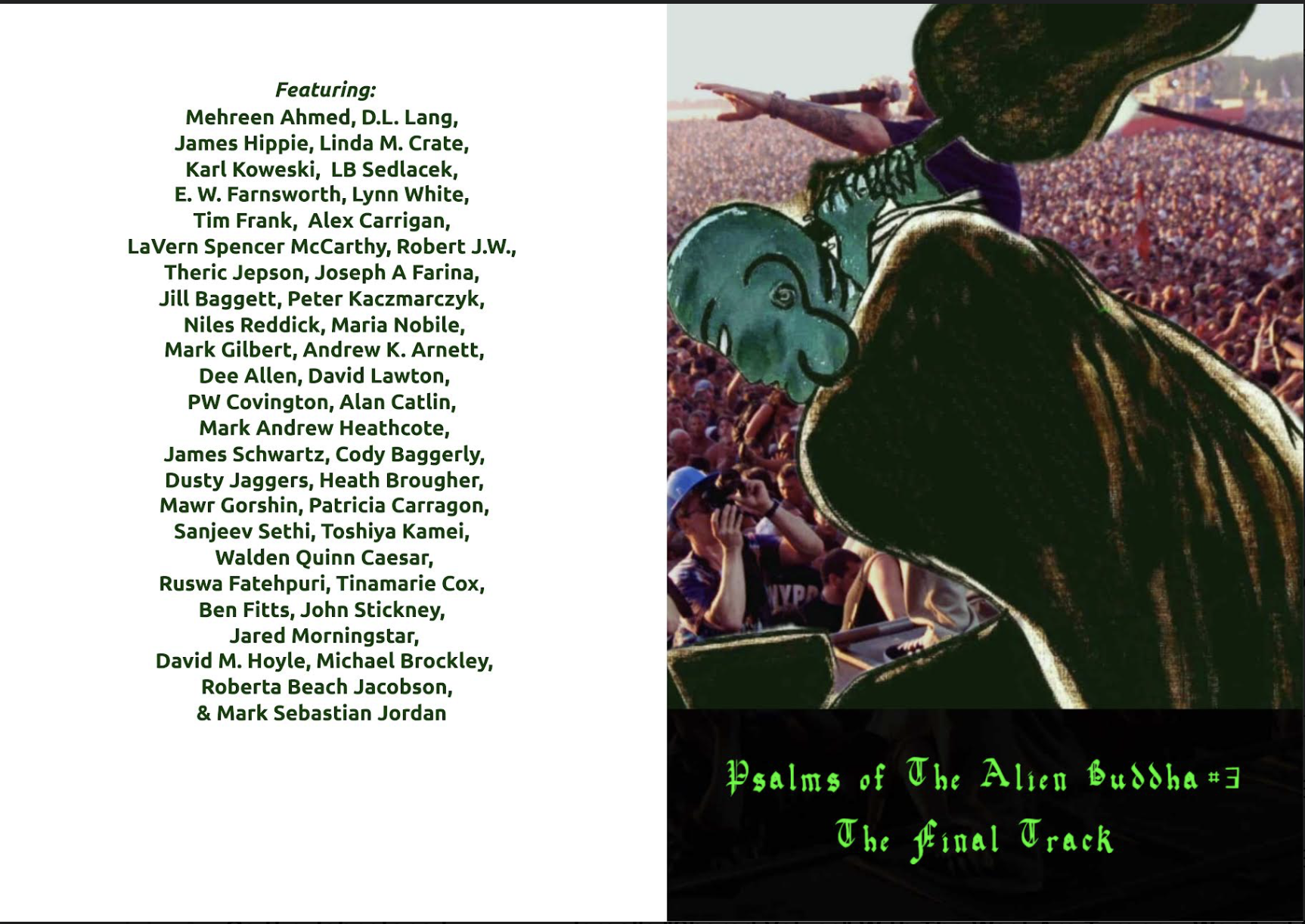
My Short Story, ‘Sing, Sing, Sing,’ in the Anthology, ‘Psalms of the Alien Buddha #3, The Final Track

Psalms of the Alien Buddha #3, the Final Track is a new anthology of poetry and prose published by Alien Buddha Press. I have a horror short story in it, called “Sing, Sing, Sing.”

The story is about two eighteen-year-old girls in a high school jazz band who love a jazz clarinetist, Woody, who is almost ten years older than them, and who is creepy enough to want to fool around with them. The first of these two girls, Claire, is jealous of Hedda, the second girl, for stealing Woody, and Claire wants to get revenge on Hedda. Claire also knows how to use magic, so that will be how she achieves her revenge. Now, when she achieves her revenge, will all be well with her, or will she have to deal with some bad karma because of it?

Of course, there are many other talented writers of prose and poetry in this anthology. I’m hoping you can read all their names on the back cover presented above. The paperback is now available on Amazon for $14.99. Go check it out: I’m sure you’ll love it!

‘Symptom of the Universe: A Horror Tribute to Black Sabbath,’ an Upcoming Anthology I Have a Short Story to be Published In

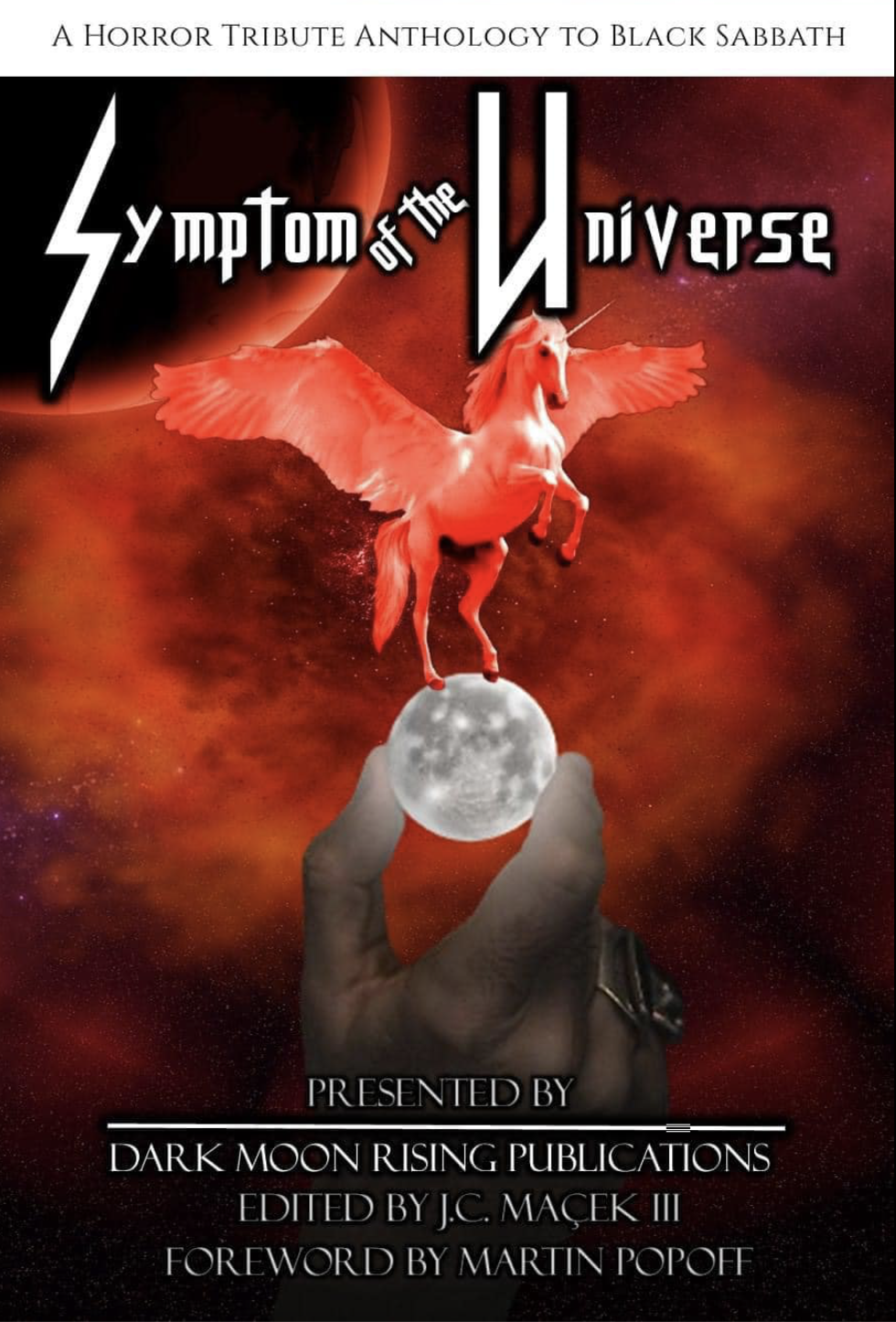
Symptom of the Universe: A Horror Tribute to Black Sabbath is the name of a new anthology of horror short stories, presented by Dark Moon Rising Publications, edited by J.C. Macek III, and with a foreword by Martin Popoff, the Canadian music journalist and critic. As the title implies, the stories are all inspired by Black Sabbath songs.

My story is named “NIB,” so you shouldn’t have a problem figuring out which song my story is inspired by (though it makes references to a whole lot of other Sabbath songs, albums, covers, etc). It begins with this line: “My drug dealer’s in love with me.” I hope that will pique your curiosity about where the story will be heading…a wild, surreal, and disturbing ride through the mind of a traumatized drug addict whose latest trip is more than just that–a paranoid nightmare that might involve witchcraft, and just might kill him.

The book will be published on September 18th. It’s available for preorder on Amazon.

Here, apart from me, are the names of all the talented authors to be included in the anthology: Rob Tannahill, David L. Tamarin, J. Rocky Colavito, Neil Sanzari, Sidney Williams, Don Webb, John Claude Smith, Rhys Hughes, Edward Morris, Tom Folske, Duane Pesice, Tom Lucas, J.C. Macek III, Gail Ice, Rhys Hughes again, J.C. Macek III again, Daniel E. Lambert, Bert Edens, Shayne Keen, Scott Couturier, Thom Erb, Stewart Giles, Jayaprakash Satyamurthy, J.C. Macek III yet again, Emmy Viane, Tom Folske again, Jason R. Frei, Thomas R. Clark, Keith Keesler and J.C. Macek III, Melissa Howard Corrigan, John Reti, J.C. Macek III, Ezekiel Kincaid, Kasey Hill, J.C. Macek III again, John Sowder, Tony Millington, and Neil Kelly. Note that several authors contributed more than one story, and a few stories are collaborations.

I really hope you’ll go out and buy yourself a copy of this new anthology. It’s a charity anthology, with all the proceeds going to the Dio Cancer Fund. It’s also going to be a really great set of stories. I’m sure it’ll knock your socks off!

Analysis of ‘In the Wake of Poseidon’

I: Introduction

In the Wake of Poseidon is King Crimson‘s second studio album, released in 1970. It came into being during a period of great instability in the band, since founding members Ian McDonald (alto sax, flute, clarinet, Mellotron, vibraphone, and backing vocals) and drummer Michael Giles quit after the band’s American tour. To make matters worse, lead singer/bassist Greg Lake would also leave, during the recording sessions of Poseidon, to cofound ELP.

Though the album was well-received by critics upon its release, citing the execution and production quality as better than its predecessor, Poseidon has since been regarded as something of a mere copy of In the Court of the Crimson King. Indeed, apart from “Peace–A Beginning,” all the tracks from Side One of Poseidon are parallels of those on Side One of the first album. Furthermore, on Side Two of Poseidon, towards the end of “The Devil’s Triangle,” there’s a clip from the title track of the previous album, the “Ah…ah, ah-ah, ah, ah-ah” vocals.

Still, in spite of what would seem legitimate criticisms of this reworking of the first album in the way guitarist/leader Robert Fripp would have had it, I’ve always preferred Poseidon to Crimson King: I find this second album to be bolder and more colourful than the first (though I consider the lyrics of the first album to be preferable overall to the obscurantism of those of the second). In an attempt to rationalize this ‘redoing’ of the first album, I’d say that Poseidon can be seen as the ‘epitaph,’ if you will, of Crimson King, a kind of ‘lament’ over the demise of the great original lineup.

Here is a link to all the album’s lyrics, and here is a link to all the tracks from the album, including the shorter single version of “Cat Food,” “Groon” (the B-side of the “Cat Food” single), and Greg Lake’s guide-vocal version of “Cadence and Cascade”.

Apart from the links to the first album that I’ve noted above, the second album has other links to the original lineup. Giles was retained as a ‘guest drummer’ for Poseidon, and two of its tracks are based on music the original band played live: “Pictures of a City” is based on “A Man, a City,” and “The Devil’s Triangle” is based on “Mars,” an instrumental improvisation based in turn on “Mars, the Bringer of War,” from Gustav Holst‘s The Planets.

In fact, as noted above, Lake even recorded a ‘guide vocal’ for “Cadence and Cascade” in an uncharacteristically unexpressive voice; not to bad-mouth replacement singer Gordon Haskell for his excellent performance on the recording used on Poseidon, but if Lake was available to sing the track, why didn’t he do so with his usual expressivity, then Haskell could have debuted on bass and vocals for Lizard?

Many of the themes of the first album are repeated here on the second: the horrors of war, modern alienation, capitalism, political corruption, and fear of the end of the world. The theme of modern alienation is in abundant supply in “Pictures of a City,” this album’s counterpart to “21st Century Schizoid Man.”

But as a sharp contrast to all of this negativity, remaining original members Fripp and lyricist Peter Sinfield gave us a trilogy of tracks on the ideal of peace. Of course, this ideal can never be realized if the issues of the preceding paragraph are not dealt with, but it’s good to be reminded of peace as a goal worth striving for, on three occasions spread out over the course of the album.

II: Peace–A Beginning

“Peace–A Beginning” opens with heavy reverb that will die out slowly over the course of the short track. Lake is singing a cappella in C minor. The four-line verse he sings makes references, however indirectly, to the four elements: air (“the wind”), fire (“lit by the flame”), earth (“the mountain”), and water (“the ocean” and “the river”); these are all identified with a personified peace.

Such basic, fundamental elements point in the direction of unity and permanence, which is fitting, given that peace will “never end.” It’s also fitting that there are two references to water, rather than just one; one of these is the ocean, appropriate for an album called In the Wake of Poseidon, the title track of which will deal more with the four elements.

When Lake sings the last word, we can hear Fripp softly play four notes on his guitar: A, F-sharp, C, and A-sharp. Then we go into the next song.

III: Pictures of a City

Since this song is Poseidon‘s equivalent of “21st Century Schizoid Man,” it’s fitting that we hear saxophones in it, played by McDonald’s replacement, saxist/flautist Mel Collins. His jazzy playing of the saxes reinforces the contemporary urban feel of the song. The band is playing in G minor, in a kind of twelve-bar blues before the first verse.

Rather than present any kind of narrative, Sinfield just gives us a series of urban images, true to the title of the song, as well as the sounds of the city, and the feelings that result from such sights and sounds.

“Concrete” gives us a “cold face,” leaving us “stark sharp” and “glass eyed,” lacking expression. Such are the alienating effects of modern urban life: removed from nature, with the city’s polluted air, fire breathing out smoke from cars’ exhaust pipes, earth covered up and suffocated, if you will, under concrete, and water made filthy through sewage, we’re also disconnected from community. The contaminating of the four elements means there can be no peace.

There’s a considerable amount of internal rhyme and assonance in these verses: “face cased,” “stark sharp,” “bright light scream beam,” “neon wheel,” “spice ice dance chance,” “mouth dry tongue tied.”

The third line of the first verse vividly portrays the problems of driving in the big city: road rage, screeching brakes, the honking of horns, and car accidents. Never mind wars between nations–one often finds oneself in a kind of war just by driving in a busy city.

The white of “red white green white” suggests light, like that of the “neon wheel.” Note the red and green of traffic lights, fittingly mentioned right after the “brake and squeal” of impatient drivers. Note also the absence of the yellow traffic light: one hurries up and waits, but never drives slowly.

After the first verse, we return to the jazzy twelve-bar blues riff of the harmonized saxes and guitar. City life sure can give you the blues.

Much of the imagery of the second verse, especially its first line, suggests how urban alienation leads to a desperate attempt to connect with others by looking for love in all the wrong places: “Dream flesh love chase perfumed skin.” There are other “tinseled sin[s]” going on, though. There’s the “greased hand” of political corruption and bribery. One’s teeth one ought to hide so the people we’re cheating don’t know of one’s wicked motives. “Pasteboard time slot sweat and spin” suggests the daily grind of the nine-to-five job, or wage slavery under capitalism.

This verse ends with Fripp playing a chromatic ascension of high notes going up to A-sharp, which leads into “42nd at Treadmills,” the fast middle-section equivalent of “Mirrors,” from “21st Century Schizoid Man.” Since this song is about the immorality of the city, I can interpret “Treadmill” in terms of its old use as a punishment for prisoners in the UK and US of the 19th century, used to exert labour from them, an effective metaphor for wage slavery. “42nd” suggests a doubling of the evil of “21st” from the original song.

Like “Mirrors,” “42nd at Treadmill” is essentially in a 12-bar blues structure (a cycle of four bars of the tonic chord, two of the subdominant chord, two of the tonic again, two of the dominant chord, and two again of the tonic). In fact, much of this section is simply a sped-up version of the 12-bar blues riff heard before each of the first two verses.

After this comes a soft, slow variation on the 12-bar blues structure, suggesting the night time and everyone having gone to sleep…though since this song was initially inspired by New York City, ‘the city that never sleeps,’ during King Crimson’s American tour of late 1969 and early 1970, perhaps we should imagine people tossing and turning in their beds, especially at this section’s dissonant ending, which suggests the morning and therefore the need to wake up and face yet another grueling work day.

With the final verse, instead of getting images of city life, we get what is largely the effect of city life on its residents–the alienation, brokenness, and blindness of those without political or class consciousness. Blinded by drunkenness and aimless partying, these people can’t communicate or see their reality for what it is. They’re doomed in an industrialized, urban hell.

The song ends with that chromatic ascension of high notes on Fripp’s guitar, but this time ending on B and introducing a chaotic, dissonant ending like the one for “21st Century Schizoid Man,” though I find this one to be far darker, and therefore better, than the first one. Also, you can hear in this one Fripp’s signature screaming guitar phrases, in which he quickly strums dissonant, high-pitched chords like the splintery ones you hear on “Sailor’s Tale.”

IV: Cadence and Cascade

This song is Poseidon’s equivalent to “I Talk to the Wind.” It features Fripp’s lyrical acoustic guitar playing, Haskell’s lead vocal as mentioned above, and some lovely flute solos by Collins. The song is in E major, Fripp opening with combinations of single notes, strums, and arpeggios in the tonic chord, an A-major chord, an E-major 7th chord, and A major again.

Haskell’s singing introduces two groupies, Cadence and Cascade, and the man they’re interested in, Jade, who depending on the interpretation of Sinfield’s lyric is variously portrayed as, for example, a singer, or a Silk Road merchant trading goods from the Far East. The names “Cadence and Cascade” suggest the two women’s beauty (more on the meanings of their names later); “Jade” suggests his wealth.

The women worship him for his wealth, power, and fame, but grow disappointed with him as they get to know him better: “As his veil fell aside…They found him just a man.” His phony appeal is comparable to that of a prostitute: “Sad paper courtesan.”

In the world of traditional sex roles, which still largely existed in the West as of 1970, women found their only option for gaining wealth and social status was through a man, so when they met a rich and powerful man, they idealized him…only to find later that he is just as faulty as any other man of modest means. Masculinity is an ideal that is rarely, if ever, even approached, let alone attained.

The bridge opens with Fripp playing one of his “devices,” a celeste, with an ascension of notes: B, C-sharp, E, F-sharp, and G-sharp; this is heard over an A major seventh chord, then with the switch to an A minor seventh chord, we hear celeste notes of G-sharp, A, B, C, and D, E, and F-sharp. We also hear Keith Tippett‘s jazzy piano in the background.

The verse of the bridge has Haskell singing about the lovemaking between the groupies and Jade, their worshipping of his wealth (“sequin,” and “velvet-gloved hand”) and fame (“Cascade kissed his name”). In a larger sense, the groupies’ worship of Jade can represent the idolatry of famous people in general, and the simping for billionaires. This applies to men and women, as worshippers and worshipped.

After the first flute solo, we hear a refrain of the “sad paper courtesan” verse, except that Cadence and Cascade now “knew [Jade] just a man” (my emphasis). The groupies have left him behind in their disappointment in him.

One of the biggest problems in our world is that, because of the worship of fame, wealth, status, and power, people keep aspiring to it, instead of sharing everything so that the basic needs of everyone are met. We aim for these heights, then in disappointment we fall…which leads me to my next point.

Apart from the groupies’ names suggesting their beauty, “Cadence and Cascade”–something Haskell sings several times leading into Collins’s second flute solo–are also words coming from the Latin world cadere, meaning “to fall.” There’s the musical cadence of resolving a harmonic progression back to the tonic, and a cascade is a waterfall (the element of water again, as jade is associated with the element of earth). Both meanings suggest musical or natural beauty, or the beauty of a woman’s cascade of long, wavy hair flowing down to her shoulders. There’s also the fall of the girls’ disappointment on knowing Jade is “just a man.”

V: In the Wake of Poseidon (including “Libra’s Theme”)

This track reworks the first album in two ways: the title, of course, parallels that of the last song on Side Two of the first album; more properly, though, this song is a reworking of “Epitaph,” the last song on Side One of the first album.

Sinfield apparently rewrote the lyric to this song about twenty-five times to make it tie in with the cover art, which therefore should be discussed now. I’ll describe each of the dozen faces not as they appear on the outer album cover–which shows a painting called The 12 Archetypes, or The 12 Faces of Humankind, by Tammo de Jongh–but in order of appearance as Sinfield brings them up in his lyric.

The Observer, a bald old man with spectacles up above his brow and his hand on his chin, looks pensive and scientifically-minded. His elements are Air and Earth. The opening lines, “Plato’s spawn cold ivied eyes/Snare truth in bone and globe,” refer to him. He represents Western science in the service of cold-blooded imperialism, taking over the globe and, exploiting it, reducing all indigenous resistance to skulls and bones.

The Joker, a harlequin painted in reds and yellows and smiling in a triangular hat, is the subject of the next two lines of the first verse. His elements being Fire and Air, he’d “coin pointless games/Sneer jokes in parrot’s robe.” His sardonic humor points out our everyday foibles and political corruption, but it’s “pointless” in how it does nothing to solve our problems.

The Actress is next. She’s Egyptian, with long pearl earrings and necklaces, and with tears running down her cheeks. Her elements are Water and Fire. She is represented in the lines, “Dame Scarlet Queen/Sheds sudden theatre rain.” She weeps for the sins of the world, as does…

…The Enchantress, her long dark hair going across her face. She has Water and Earth as her elements. She “knows every human pain.”

As I said above, the title track is especially concerned with the four elements, two of which are associated with each of the twelve archetypes, as we’ve seen and will continue to see. All four are also heard twice in the next verse, a bridge between the first and third verses, this latter continuing to depict the twelve archetypal faces.

Though the elements are associated with peace, as we saw in “Peace–A Beginning,” the “World [is] on the scales,” with war and destruction on one scale, balanced on the other with peace and its four elements. This “Balance of change” means the world is teetering “on the scales” between peace and war. Which side will win? Which will outweigh the other? Will it be the side that wants peace and justice for everyone, or will it be the side of the imperialistic warmongers, whose recklessness is pushing us all ever closer to nuclear armageddon?

This song, and therefore the entire album, has as much relevance for us today as it did back in 1970, with its Cold War fears of nuclear annihilation between the US/NATO and the USSR. We’re experiencing a new, and utterly needless, new Cold War between the Western, NATO-allied powers on one side, and Russia, China, the DPRK, and Iran on the other. Between the two sides are thousands of nuclear weapons, and no attempt at détente is even being considered.

To return to the archetypes, the next one is The Patriarch, an old philosopher with long white hair and a beard. He’s frowning, with a furrowed brow. Surrounding him are such shapes as flowers and snowflakes. His elements are Air and Water. Referring to him are the lines, “Bishop’s kings spin judgement’s blade/Scratch ‘Faith’ on nameless graves.” The Church controls the heads of state–The Patriarch being one of these stern religious leaders–and it pushes the kings to fight ‘holy’ wars. (One might think of the Archbishop of Canterbury and Bishop of Ely persuading Henry V to invade France.)

The Old Woman would “hoard ash and sand.” She has a wrinkled, sad face, and her hair is wrapped in white. Her elements are Earth and Air. Such women are “Harvest hags,” peasant farmers, whom we associate with the working class, yet these peasants are betraying the fellow proletarians in that they “rack rope and chain for slaves,” the next archetype to be discussed.

The Slave, a black African with earrings and a nose-ring, has Earth and Fire as her elements. The slaves “fear fermented words,” that is, they’re scared of revolution, and like the kulaks who hoarded grain during the famine in the USSR in the early 1930s, they “rear to spoil the feast.” This lack of solidarity among the poor is what allows the rich to stay in power.

The Fool, the laughing man to the centre-left of the front cover of the album, with the pink face, the blond beard, and the flowers in his hair, is “the mad man [who] smiles/To him it matters least.” In his foolish, delusional state, he doesn’t care about the corruption in the world, because like The Slave and the Old Woman, he has no class consciousness. His elements are Fire and Water.

After this verse is an instrumental passage that includes the (Libra’s?) theme (“Air, fire, earth, and water”), only it’s played by Fripp on the Mellotron instead of sung by Lake. I suspect that part of the reason this song is called “In the Wake of Poseidon” is that the god of sea and earthquakes best represents all four elements: the earth and water aspects hardly need to be elaborated on; air can be included in its being blown as wind over the sea, making waves, and Poseidon is known for his fiery temper–consider how he treated Odysseus after he blinded the god’s cyclopean son, Polyphemus. I’m assuming this section is “Libra’s Theme,” given our “world on the scales.”

To go back to the archetypal faces, the next one is The Warrior, wearing a steel helmet and a full black beard, and baring his teeth, ready to fight. His elements are Fire and Earth, and he’s represented in these lines: “Heroes’ hands drain stones for blood/To whet the scaling knife.” The weapons of war wound not only bodies, but the Earth as well.

Next comes The Logician, a wizard with dark hair and a long dark beard. He’s holding a wand in one hand while the other is held up high. There are stars all around him, presumably the magic from one of his spells. He’s represented with the lines, “Magi blind with visions light/Net death in dread of life.” He represents the theologian or philosopher who is ‘blinded by the light’ of his own dogma, preferring death and the peace of a presumed heaven over the pain of living here.

The naïve sheep of these religious shepherds are represented in The Child, a girl with long blonde hair and a face of sweet innocence. The necklace she’s wearing has a white key on it. Her elements are Water and Air, and these lines represent her in the song: “Their children kneel in Jesus’ till/They learn the price of nails.” To enter the Kingdom of Heaven, one must be as a child (Luke 18:17); hence, the key on The Child’s necklace (Matthew 16:19). Still, learning “the price of nails” means learning either to submit to the powers-that-be, whether they’re religious or political, or to suffer as Jesus did for defying them.

And the last archetype is The Mother Earth, or Mother Nature. We see her lying asleep in the grass in left profile, with dark skin and flowers and butterflies all around her. Her elements are Earth and Water, and the last two lines of the song refer to her: “Whilst all around our Mother Earth/Waits balanced on the scales.” Our Earth sits passively as mankind decides the fate of all living creatures who have her as their home: nuclear war, or peace? A healthy planet, or ecocide? Our collective fate is being weighed in the balance, “on the scales,” by psychopathic leaders who care about wealth and maintaining their power, and not about us.

To understand the deeper meaning of archetypes, one must look into analytical psychology, Jung‘s offshoot from Freudian psychoanalysis. Jungian psychology has a grounding in such psychoanalytical concepts as the unconscious and repression, but unlike Freud the atheist, Jung developed an interest in myth, mysticism, and religion far beyond just their psychological symbolism. As a result, he broke with Freud, who would later speak derisively of Jung as one who would “aspire to be a prophet” (Freud, page 280).

The archetypes are characters that reside in the collective unconscious, that aspect of the unconscious we all share and that has been inherited throughout human history. These include the Sage (which can find its equivalent in the song and album cover as The Patriarch), Innocent (The Child), Hero (Warrior), Magician (Logician), Jester (Joker), and Creator or Caregiver (The Mother Earth). The point is that we have all of these characters, hidden deep down in our unconscious; they influence how we think and interact in the world. To this extent, they control us, and therefore control mankind’s collective fate.

In this song, we can see how unhappy these twelve are, or how manipulative (or manipulated) they are. They’re in the depths of the ocean of the collective unconscious, so “the wake of Poseidon” is, literally speaking, the making conscious all of these characters that reside deep within the sea-god’s realm. If we can make their sorrow conscious, we can integrate them, become whole and healthy, then work to save our planet from ecocide and nuclear annihilation. Hence, the deep relevance of this song back in 1970 and, even more, today.

VI: Peace–A Theme

This is a short instrumental for solo acoustic guitar, about a minute long, in A major.

Fripp plays the melody Lake sang a cappella on “Peace–A Beginning,” as well as the bridge melody (“Searching for…, etc.) that we will hear on “Peace–An End.” Fripp opens with a strum of an open A major chord with an added sixth.

From this chord, he embellishes the melody Lake sang before with an appoggiatura: he does a hammer-on and a pull-off as part of the continuing melody with E, F-sharp, E, and D-flat. Then, he strums a D-flat minor 7th chord, and single notes D-flat and E, then a hammer-on to F-sharp, and a strum of a D-major 7th chord, the E, D-flat, and an A major chord, with a high note of D-flat.

Next, he strums the D-major 7th chord, and plays the above appoggiatura with the E, F-sharp, E, and D-flat. Then, there’s the strum of the D-flat minor 7th chord again, then a strum of an E dominant 9th chord, then a strum of a D major 6/9 chord, and an ending of the melody that includes another appoggiatura, a hammer-on and pull-off of F-sharp, A, F-sharp, and E, then the D-major 7th chord again.

All of the above is repeated, then we come to the bridge (“Searching for…,” etc., in “Peace–An End”). Fripp strums an A-major chord, then an A chord with a major second instead of a major third, then the A major six chord again. Then he plays arpeggiated chords of D-flat suspension 4th and a D-flat major. Next, a melody of F-sharp, A, B, D-sharp, E, D-sharp, B, G-sharp, and F-sharp is played over chords of D-major 7th, D-flat minor, and D-major 7th again.

After an E suspension 4th chord and an E major chord in the dominant, Fripp repeats the bridge section as described in the previous paragraph, but he ends the piece with a strum of an A 6/9 chord, only without a third, and with the sixth in the bass; then he softly hits an E-flat, a flattened fifth for A major.

VII: Cat Food

This song is another example of King Crimson doing a perverse variation on the 12-bar blues structure, with Tippett mixing in dissonant tone clusters with his more usual jazzy piano playing, and with the usual 4/4 time getting bars of 6/8 thrown in between from time to time. The song is in E minor.

The song is satirizing capitalism and consumerism, and all of the maddening effects these have on people, hence the piano discords. A woman shopping in a supermarket wants to talk to the manager, presumably to make a complaint. “Grooning to the muzak” sounds like an ironic comment on Fripp’s instrumental with drummer Michael Giles and his bassist brother, Peter (who plays all the bass parts on this album instead of Lake), “Groon,” Side B to the “Cat Food” single. Groon is a pun on groan, a complaining sound.

The blatantly atonal “Groon,” truly an acquired taste for most listeners, is a piece of avant-garde jazz that sounds like a Cecil Taylor improvisation, but with Fripp’s guitar replacing Taylor’s piano. The supermarket shopper, however, is annoyed with the muzak, or ‘elevator music,’ which is annoying at the other extreme: it’s music so bland, so ‘nice,’ and so conventional that it desperately needs a little dissonance to make it half-way interesting to listen to. The contrast between “Groon” and muzak is also the contrast between music as experimental art and music as sellable commodity.

She lays out her goods, as if to complain about them to the manager. They’re all “conveniently frozen,” so she can “come back for more” as soon as she’s finished with them. This is convenient for capitalists, who can make more money when she comes back. Ironically, this ‘convenience’ is what she has to complain about.

Next, the woman shopper is cooking at home, whipping up “a chemical brew/Croaking to a neighbour as she polishes a sabre.” The “chemical brew” suggests some kind of processed food from the supermarket, superficially tasty, but ultimately bad for you. Just as she ‘grooned’ to the muzak, now she ‘croaks’ in complaint to a neighbour, suggesting the social alienation that comes from the same source as the fetishized commodities that she’s bought–capitalism. The ‘sabre’ she polishes is presumably her cooking knife, but calling it a sabre evokes the idea that it’s used for killing rather than feeding.

She “knows how to flavour a stew,” but her meal is “poisoned especially for you,” because as I said above, this processed food, in its “tin,” is bad for you. “Hurri Curri” sounds like a brand name of cat food, or its particular flavour. It’s also a pun on hara kari, a form of ritual suicide, given how willingly eating such innutritious, processed food, this ‘hurried curry,’ this instant food, is bad for you.

Because the capitalist system is focused more on profit than on providing a nutritious product, we get the blues from it, hence the song’s 12-bar structure. The alienation from capitalism causes mental health problems, too, hence the piano dissonances, Lake’s mad cackling at the end of this second verse, and “your mother’s quite insane,” in the repeated bridge verse.

“Cat food…again?” sounds like a complaint about eating the same old crap over and over again. Cat food, with its unpleasant smell and even more unpleasant contents, is a metaphor for all the unhealthy junk food we all eat at least once in a while, enriching its producers.

“A fable on the label” of so many of these food products, stuffed in cans, suggests the lie that they’re full of vitamins, minerals, and other nutritious ingredients, when actually the processing and artificial colours, additives, and preservatives ruin the said nutrients, in all likelihood. It’s “drowning in miracle sauce,” meaning that the sauce, however superficially tasty it may be, is killing the nutrients by drowning them. With all of this understanding, the last two lines of the song should be self-explanatory.

The song ends with improvising over the 12-bar blues structure, with its alternating of a few bars of 4/4 with one in 6/8. Michael Giles does a few great drum licks here, as Tippett does with his colourful, jazzy piano.

VIII: The Devil’s Triangle

As I said above, this piece evolved out of “Mars,” the instrumental improvisation that the original King Crimson lineup played in their live shows, based in turn on the first movement of Holst’s The Planets. For this reason, I see the resulting studio version as still thematically linked to the horrors of war, and it’s therefore fitting to have it immediately precede “Peace–An End,” for dialectical purposes as I’ll explain later.

The piece includes three sections, titled “Merday Morn,” “Hand of Sceiron,” and “Garden of Worm.” The first part gives partial writing credit to McDonald, but not the last part, which includes the clip from “The Court of the Crimson King,” which he wrote with Sinfield.

Merday Morn” opens with a long, slow fade-in: the listener may get impatient waiting to hear any music. It’s as if the music were the sun slowly rising over the watery horizon of the ocean, the beginning of the ‘day of the sea,’ hence the name of this section. We sense that Poseidon is waking up, hence the album’s title, taken literally.

Recall that ‘the Devil’s Triangle’ is another name for the Bermuda Triangle, the legend surrounding the place–the three corners of which are Bermuda, Miami, and Puerto Rico–being that ships and airplanes entering it mysteriously disappear. One senses the fiery wrath of the sea-god here, and why the music is so spooky.

In the entire piece, we have all four elements represented: in “Merday Morn,” the sea obviously represents water, and the rising sun represents fire (as well as Poseidon’s fiery wrath); in “Hand of Sceiron,” air is represented at the end of the section by the sound of strong winds, as if ships are entering a storm; and “Garden of Worm” suggests the element of earth, symbolic of a grave for the dead in sunken ships at the bottom of the ocean, the ground of the seabed.

When we finally start hearing the music, we hear Michael Giles playing a martial beat in 5/4, accompanied by his brother, Peter, on the bass. Fripp is providing melody and harmony on the Mellotron, at first with string section tape, then, when the music starts to get tense, he uses brass section tape. To add to the tension, we’ll hear him play a lot of tritone intervals, which are fitting as the diabolus in musica.

“Hand of Sceiron” begins with a foghorn sound, suggesting that ships are approaching a dangerous area at sea. Along with the tritones heard on the Mellotron, we hear lots more dissonance on, for example, Tippett’s piano. This section ends, as noted above, with those winds. Sceiron refers to violent winds in a myth from an area described in Book IX, Chapter One (section 4) of Strabo‘s Geographica. A ticking metronome sounds like a clock that is ticking towards the end of one’s life.

Of course, the tension is raised to a climax in the “Garden of Worm” section, with its faster tempo and heightened dissonance. Independent layers of sound are put together: the 5/4 martial beat heard on the drums, with the bass in 4/4 playing descending fifths, and dissonance in the Mellotron and piano tone clusters. It all descends into chaos, including, by way of xenochrony, a brief passage for string section, and the clip from “The Court of the Crimson King.” It all ends with flurries of flute notes and a soft, arpeggiated resolution in E major on Fripp’s acoustic guitar.

So, what does all of this music mean? What does a ship entering the Bermuda Triangle and going missing there, all the passengers presumed dead, signify? The piece’s link with “Mars,” with the martial beat (though different from Holst’s original rhythm, because Holst’s estate did not give Fripp permission to use it), suggests the symbolism of war, too. But what do a ship lost in a sea storm, and soldiers killed or missing in action in a war, symbolize in “The Devil’s Triangle,” and In the Wake of Poseidon as a whole?

Recall the archetypes from the title track and the album cover, and how these reside in the collective unconscious. In the wake of Poseidon means ‘as a(n unpleasant) consequence of the sea-god.’ The realm of Poseidon, the ocean, is symbolic of the unconscious, both personal and collective. So as a consequence of confronting Poseidon and his tempestuous ways, we awaken the unconscious and discover those unpleasant parts of ourselves that we want to reject, repress, or project onto other people. To confront them is to confront what Jung called the Shadow. This is a scary, but necessary and enlightening experience.

“The Devil’s Triangle” begins in silence, and with a slow fade-in, because such a beginning represents not only the unawareness of unconscious conflicts, but also the unwillingness to learn of them, the resistance against them. As the music gets more and more dissonant, one is becoming more and more aware of the unpleasant, rejected parts of the Shadow.

The social problems dealt with in the other songs–urban alienation and decadence in “Pictures of a City,” hero-worship of wealth and celebrity in “Cadence and Cascade,” and capitalist consumerism in “Cat Food”–have their psychological roots in these unconscious, repressed conflicts. The way to end the conflicts and attain peace of mind is not to avoid them, by sailing around the Bermuda Triangle of the psyche, but to go through it and risk the dangers therein.

And dangerous it is. Jung warned of these risks when attempting to do what he called individuation through Shadow work, dream interpretation, and Active Imagination. One is advised, when doing this inner work, to have someone monitoring you, ideally a fully-trained therapist specializing in Jungian psychology. Otherwise, one risks navigating the treacherous waters of repressed traumas, leading to psychological fragmentation, a psychotic break with reality (what Lacan called The Real), which is what the “Garden of Worm” section represents.

The significant thing, though, that happens if you can make it through the maelstrom symbolized by the ending of “The Devil’s Triangle” (as Jung apparently did by bravely facing the demons of his own unconscious), and can integrate the darker aspects of your mind with the lighter ones, you can come out the other side and find peace and bliss, as symbolized by the pretty flurry of flute notes and Fripp’s acoustic guitar ending.

(Such psychological integration includes a man confronting his anima, as represented by the six female faces on the album cover and described in the title track, and a woman confronting her animus, the six male archetypes on the cover and in the title track. In this connection, the sea can be masculine, Poseidon, or feminine, Thalassa. La mer est la mère.)

I’ve written many times about my personal interpretation of the symbolism of the ouroboros, as representing the dialectical relationship between opposites as the meeting ends (the serpent’s head and tail) of a circular continuum (the serpent’s coiled body) including all intermediate points between the extremes. We can hear this oneness in contradiction in “The Devil’s Triangle” in how the music starts in peaceful silence, then the music comes in and gets increasingly dissonant, a move from the serpent’s biting head, down its coiled body towards its bitten tail. At the tail of extreme chaos and pain, we cross over to the head and back to peace and bliss, leading thus to…

IX: Peace–An End

One interesting thing about the “Peace” trilogy is how this last one is musically in ternary form (ABA), while “Peace–A Theme” is in binary form (AABB), and “Peace–A Beginning” is just the A theme heard twice. It’s as though peace begins as just a germinating idea, then it develops, and now it is complete, after having gone through the necessary hell of “The Devil’s Triangle.”

Furthermore, the first part is essentially a cappella, the second just an acoustic guitar solo, and this last part has both Lake and Fripp. It is musically thus the Hegelian dialectic triad of thesis (“Beginning”), negation (“Theme”), and sublation (“End”), this last part not only being complete, but also a resolution of the contradiction of the previous two parts. In fact, the first two parts ended without perfect resolutions: the A, F-sharp, C, and A-sharp on Fripp’s guitar ending “Beginning”; the A 6-9 chord with the sixth in the bass and the E-flat ending “Theme.”

Only now do we have a truly peaceful resolution in E major, with Lake’s last sung note, on “war,” being a D-flat, a major sixth in relation to the tonic, and so it’s reasonably consonant. It suggests, in combination with “war,” a somewhat tenuous peace–since when is perfect peace ever realized, anyway?–but it’s peace all the same, and therefore a fitting end to the album.

Two of the four elements are mentioned in the first line of the first verse–water and air (“sea” and “wind”). Water will again be mentioned in the first line of the last verse, too–“stream.” The reference to “dawn on a day without end” suggests earth and fire, in that we imagine the sun peeking over the horizon, that is, over the land, hills, and mountains in the morning. The fire of the sun will shine on an eternal day, too.

Because the four elements are so fundamentally what make up everything as we imagine it here, they bring us closer to the blissful oneness of Brahman, and therefore to peace, nirvana. Those twelve archetypal faces are each associated with two of the elements; and since attaining psychological peace, as I described it above–with my ouroboros symbolism–involves confronting the twelve archetypes in the Shadow of the ocean of the unconscious, then peace is in this way also associated with the elements.

A bird sings as you smile because it is pleased with your happiness–it is your friend. Peace causes a foe to love you as a friend; we must take those troublesome archetypes of the unconscious and make them our friends–this is how we change war into peace. We bring love to a child, like the sweet, innocent girl on the cover with the white key on her necklace. She has the key to heaven, remember, because one has to be as a child to enter heaven, the realm of peace.

You search for your friends, but can’t find them, because you foolishly don’t realize how close they are to you, like the nirvana and Buddhahood that the lost vagabond son of the parable doesn’t realize he already has, personified by his father. You search for yourself everywhere outside, but you don’t realize that you have to do the inner work, as described in my interpretation of “The Devil’s Triangle,” to find yourself within, in the twelve archetypes, the four elements, and the Atman that is already one with the oceanic feeling of Brahman.

The heart is what empathy flows from, so that’s why peace is a stream from there. Breadth, that is, the width of tolerance and open-mindedness, is the dawn, or beginning, of peace.

The fire of the sun will burn forever for peace, that is, without end; yet peace is also the end, ironically, like death, of the war. The war people would have had in mind back in 1970 was, of course, the Vietnam War, wishing it would end.

There are other wars, though, besides literal ones, that need to end. There’s the emotional war of psychological conflict, as dramatized in “The Devil’s Triangle” and the title track. The Jungian inner work described above to integrate the light and dark parts of the psyche, the conscious and unconscious, to bring about inner peace, can be compared to the Buddhist’s quest for nirvana.

Nirvana literally refers to the blowing out of a flame representing desire, and therefore suffering also. Nirvana is the resulting peace from having extinguished the fire of the delusion of a permanent ego. Yet Sinfield’s lyric, of peace as the dawn of a day without end, implies a permanently burning fire, while peace is also the end…and nirvana is the end of suffering.

How can we reconcile this contradiction, of a permanent fire and its extinguishment as both meaning peace? We can do so as the Mahayana tradition of Buddhism does, by equating nirvana with samsara, the cycle of reincarnation. We did so before with the dialectical interpretation of attaining peace by first going through the Devil’s Triangle, by passing first through hell to get to heaven. Similarly, the bodhisattva first swears off nirvana until he’s helped all living creatures to get there, hence they all travel there on the Great Vehicle, that boat that must weather Poseidon’s storm at sea.

Note how Lake’s singing on “Peace–An End” brings back the reverb at the end, just as “Peace–A Beginning” started with reverb. This beginning and ending reverb thus gives us a sense that the album has come full circle, like the cyclical eternity that the ouroboros originally symbolized. In this sense, we can see how peace never ends, even in a world full of suffering. Nirvana is samsara because we can only have peace and happiness by accepting the inevitability of pain.

X: Conclusion

Based on the interpretation I’ve given above, I must say that In the Wake of Poseidon, though not exactly a masterpiece, deserves better than being dismissed as a mere copy, or sequel, of In the Court of the Crimson King. To be sure, much of the second album does rework the first, but there are other things going on that shouldn’t be ignored.

Side Two of Poseidon is essentially new (the xenochrony notwithstanding). The first album presented the problems of the world; the second album expands on the discussion of those problems, and it also proposes a solution. Most importantly of all, In the Wake of Poseidon presents a kind of Jungian odyssey through hell to get to heaven, giving it a kind of universality of human experience that makes it an album that doesn’t just live in the shadow of its predecessor, but exists in its own right.

Analysis of ‘Brain Salad Surgery’

I: Introduction and Cover

Brain Salad Surgery is ELP‘s fourth studio album, released in late 1973, after the prog rock supergroup‘s eponymous debut, Tarkus, the live album Pictures at an Exhibition, and Trilogy. It was produced by singer/bassist/guitarist Greg Lake, as were all of the trio’s previous albums.

Though it initially got a mixed critical response, Brain Salad Surgery‘s reputation has improved over time. It had always been a commercial success, reaching #2 in the UK and #11 in the US; it eventually went gold in both countries.

Here is a link to the full album, and here‘s a link to all of the lyrics.

HR Giger‘s superb album cover gives a vivid visual representation of the album’s central theme of duality–male vs female, man vs machine, and good vs evil. The male/female duality is represented by the woman’s face in the circle in the middle of the cover; under her chin is the end of a phallus pointing up along her neck, the rest of the phallus being represented, outside the metal circle, by a short cylinder and a circle with ELP representing the balls. The record company insisted on removing the phallus for obvious reasons, so on early releases of the album, one instead saw it airbrushed away and replaced with a…shaft…of glowing light.

The album’s title–derived from the lyrics to Dr. John‘s “Right Place, Wrong Time” (released earlier the same year), and replacing ELP’s working title, Whip Some Skull on Ya–is a reference to fellatio, hence the phallus just under the woman’s face…and the skull at the top.

The cover originally opened up, like two front doors to a building, to reveal the whole head of the woman with her eyes closed, as opposed to seeing the skull’s eyeholes over her when the cover is closed, indicating the dualities of life and death, good and evil, and man and machine.

II: Jerusalem

Side One begins with two tracks that are adaptations of other composers’ works, something the band had done several times before, as with pieces like “The Barbarian” (based on Bartók‘s Allegro barbaro for solo piano), “Hoedown,” by Aaron Copland, and the aforementioned piano suite by Mussorgsky. As for track one of Brain Salad Surgery, ELP did an arrangement of a hymn by Hubert Parry, who set William Blake‘s poem, “And did those feet in ancient time” (from the epic, Milton), to music.

Jerusalem” was released as a single, but it failed to chart in the UK; actually, the BBC banned this ‘rock’ version for potential “blasphemy” (despite how reverent the band’s arrangement was). Apart from being understood as a religious song, “Jerusalem” is also considered patriotic to England, even proposed as the national anthem.

Now, the long-held modern assumption that Blake’s text is based on an apocryphal story–about Jesus walking on English soil during His lost years–is unlikely to be true, because no such story existed, apparently, before the twentieth century; instead, Blake’s text is based on a story that it was Joseph of Arimathea who allegedly went to England to preach the Gospel there. I find such an interpretation hard to follow, though, since the text explicitly refers to “the holy Lamb of God” and “the Countenance Divine” being in England.

In any case, the notion that the feet of Christ (or those of Joseph of Arimathea, for that matter…whichever) sanctified English soil by treading on it is jingoistic nonsense that actually turns the meaning of Blake’s poem into its opposite. The key to understanding the text is not “England’s green and pleasant land,” but rather “these dark Satanic mills,” referring to the early Industrial Revolution and its destruction of nature and human relationships, or to the Church of England and how it imposed conformity to the social and class systems.

People who see patriotism and conventional Christianity in Blake’s poem are blind to his irony in using Protestant mystical allegory to express his passionate advocacy for radical social and political change. He wasn’t saying that Jesus walked in England, thus making it ‘the greatest country in the world,’ and worthy of global domination. He was asking if Jesus went there, where the “dark Satanic mills” would later be found.

That he meant such a visit seems unlikely, but if the visitor was Joseph of Arimathea, at least he would have done a proselytizing of the primitive Christianity of the first century AD, not that of later centuries, with the corrupt Catholic or Protestant Churches of Blake’s time, those that subjugated other lands and justified their imperialism with their ‘superior, civilized’ religion.

Blake says he “will not cease from Mental Fight” (my emphasis), meaning his moral struggle with the powers-that-be, the industrial capitalists who used religion as Marx would later call “the opium of the people” to maintain social control in the interests of the ruling class. Blake’s bow, arrows, spear, and sword are metaphors for all he would use to bring about revolution and social justice (his metaphor for these being “Jerusalem”) in England; they were never meant to aid in the building of empire, much to the chagrin of the British patriots who want to read his poem in that way. Even Parry grew disgusted with the jingoistic misuse of his hymn.

This ironic surface patriotism and conformist piety as cloaking Blake’s real revolutionary social critique plays well into the theme of duality–good vs evil–on Brain Salad Surgery. Similarly, it’s fitting that keyboardist/composer/arranger Keith Emerson should have done an adaptation of Parry’s musical setting, one with the usual Emersonian pomp embellishments, but still reverent to the piety of Parry’s music. For again, such a musical style, soon to be contrasted sharply with that of the next track on the album, is a part of the good-vs-evil dualism of Brain Salad Surgery.

III: Toccata

The “dark Satanic mills” of the first track seem to be vividly depicted, in musical form, in this next ELP adaptation of a composer’s work, this one being the fourth movement of the first piano concerto of Argentinian modernist composer Alberto Ginastera. The movement is titled toccata concertata, hence the name of ELP’s adaptation.

Unlike the trite harmony of Parry’s work, this one is violently dissonant, something accentuated by Emerson’s use of raspy synthesizer sounds. Indeed, the dissonance of this adaptation makes King Crimson sound like the Bay City Rollers in comparison.

Another valid comparison of ELP with King Crimson, as far as this second track is concerned, is how we hear a push towards the most state-of-the-art technology. Recall how the 1980s King Crimson used guitar synthesizers, the Chapman stick, and Simmons electronic drums. “Toccata” boasts (as does “Jerusalem”) the use of the very first polyphonic synthesizer, the Moog Apollo, and eight specially developed drum synthesizers, used in the track’s middle percussion section, arranged by drummer/percussionist Carl Palmer.

Again, this use of the latest technology of the time, as mixed in with more conventional instruments and singing, reflects the album’s theme of dualism–in this case, the dualism of man vs machine.

I’d like to do a comparison/contrast of Ginastera’s fourth movement with ELP’s adaptation. I won’t cover every detail, as that would be too difficult and tediously long; so I’ll point out and compare/contrast a number of highlights. (Here is a link to the entire piano concerto, with a video of the score; move it ahead to about 18:50 to get to the fourth movement.)

ELP’s adaptation adds a considerable amount of material to Ginastera’s piece (as well as removing much of it), including of course the percussion section in the middle, as I mentioned above. Another addition is at the beginning, with Emerson playing a synthesizer, and Palmer hitting tympani.

Emerson plays a motif of B-flat, E, E-flat, and A, then Palmer hits A, A, A, and C. Then Emerson plays the same notes again, a bit faster, adding a C and an A, and Palmer does a short roll on A. Emerson goes up an octave to play the same first opening four notes, and Palmer does another, longer roll on A. Emerson, still in the higher octave, plays the notes faster, with the added C and A, and Palmer doesn’t another, still longer, crescendo roll on A.

Next, ELP’s adaptation converges with Ginastera, but with the latter’s arrangement of the B-flat, E, E-flat, and A motif played predominantly on horns, with all the notes sustaining in a swelling dissonance, while Emerson plays the notes on his synthesizer, intensifying the tension by adding a raspy, grating tone to it. The motif is played as I described above, then transposed an octave and a semitone higher to give B, F, E, and B-flat.

ELP come in with Emerson on organ, Lake on bass, and Palmer on drums. In Ginastera’s original, we hear pounding dissonances on the piano in 3/4=6/8 time, with the fourth bar in 5/8 time as an exception.

With the piano beginning in octaves of E in the bass, the orchestra is playing a cluster of eighth notes in A, B-flat, and E-flat. The E-flat goes up to a G-flat (with the E in the bass going down to a C-sharp with the G-flats), then back to E-flat, up and down and up and down. These movements up and down occur at irregular times, creating the illusion of odd time signatures, but Ginastera’s score has the whole passage in the same 3/4=6/8 time. The playing sounds fairly subdued in Ginastera’s original, but Emerson’s organ gives the passage a fiery extroversion.

The next passage has piano playing in the bass, whereas ELP’s version has Emerson playing it on synthesizer. A beginning in F and E leads to the opening motif of B-flat, E, E-flat, and A, then ending in another swelling dissonance reminding us of the opening one, but transposed a whole tone higher, giving us C, F, G-flat, and B (reverse the second and third notes to see the exact parallels). In Ginastera’s original, these notes are heard in the orchestra, predominantly the brass; in ELP’s version, Emerson does it on the synth, ending with that rasping sound again.

Next, a tune with a galloping rhythm, starting off with eighth notes going back and forth in F-sharp and A, then going to F-sharp, B, B-flat, C, A, F-sharp, and E, is heard on the strings; Emerson plays it on the organ. These seven eighth notes are heard three times, accented in a way that gives the listener the impression of 7/8 time, but again, Ginastera’s score notates it all as 3/4=6/8 time.

The up-and-down of F-sharp and A continues for a while, then we hear a five-note ostinato of B, A, F-sharp, E, and F-sharp, which grows dissonant with the addition of the horns, and ends with the piano playing a descension in octaves. ELP’s version ends the five-note ostinato, played on the organ, with more dissonant, angular synthesizer.

More of a galloping rhythm is heard in piano chords (on organ in the ELP version); this leads to more galloping, but with switches from 3/4=6/8 time to a bar of 5/8–this happens twice, then it returns to the regular 3/4=6/8 time. Again, what is piano in Ginastera is organ in ELP. Also, Ginastera’s version develops this switching of the time from six to five, while ELP’s version brings the tension to a climax with organ chords featuring a tritone of E and B-flat. Palmer also plays this tritone on the tympani.

Later on in Ginastera’s score, we hear a variation on the passage mentioned earlier, the cluster of repeated eighth notes, the top of which is the E-flat that goes up to the G-flat, then down, and up and down at irregular times. This time, however, the notes are a second-inversion A-minor triad with A-flat and C-flat in the bass. The top C-natural will go up to an E-flat, and down and up and down, in the same irregular pattern as with the E-flat and G-flat before. We hear the orchestra, predominantly strings, doing this; ELP’s version has the organ doing it.

After this, the piano does more galloping rhythms, with a few dissonant seconds thrown in here and there. Later, the piano does more developments of that passage with the time changes back and forth between six and five as discussed above, with an additional bar of 7/8 sandwiched in the middle. This passage isn’t in ELP’s version, which skips ahead in Ginastera’s score to bar 200.

Here, the galloping rhythm is done on pizzicato strings, starting with E-flat and G-flat going up and down in the bass clef. Then we hear E-flat, G-flat, A-flat, and A-natural three times before transposing the first two notes to A-natural and C. Emerson plays this line on the organ, but develops it further before going to the next passage.

A French horn plays A, D, G, and G-sharp, then A, E-flat, D, D-flat, G, and G-sharp, etc. Emerson plays this line on a synthesizer an octave higher. After this phrase, Ginastera has us hear five pairings of eighth notes of a minor second (C-sharp and D), with groupings of two to three eighth rests in between the first, second, third, and fourth pairings of those notes. They’re played softly in his score, but Emerson plays this rhythm as stabbing, loud organ dissonances.

A trumpet plays F, B, B-flat, and E three times; this leads to a climactic, dissonant passage. ELP’s version builds up this tension much more, right from the beginning of this passage, on the synthesizer. Ginastera does glissandi down and up on the piano; Emerson does a downward glissando on the organ.

At bar 240, the piano plays octaves in C, F-sharp, F-natural, and B, a restatement of the opening motif, but transposed up a whole tone; Emerson plays this on the synthesizer, using it to embellish the dissonance further and bringing this tensely climactic moment to raspy near-chaos, leading to Palmer’s percussion section. Ginastera’s original, however, further develops these themes on the piano, coming soon to the end of the movement.

Palmer pounds away on the tympani for a while, striking a gong here and there. This comes to an end, then we hear the soft hitting of A and C on the tympani, and on both tympani and tubular bells. Emerson plays three soft, dense chords on the piano as this passage comes to the end.

Next comes a passage with Lake playing electric guitar, with Palmer in the background hitting the tympani. Lake is playing, among other things, variations on that opening motif of sharpened tonic, fifth, flattened fifth, and tonic an octave higher.

The climax of the percussion section is Palmer showing off with a solo on his drum kit that features the drum synthesizer, and all the flashy, extraverted electronic sounds it can make.

After this, ELP ends their adaptation with a reprise of the section starting with A, D, G, G-sharp, etc. (i.e., the French horn line in Ginastera’s original). Again, Emerson intensifies the dissonant tension with that raspy synthesizer in ways totally different from the dissonant tension ending Ginastera’s original.

Both pieces end more or less the same way, with twelve sets of eighth notes of a dissonant chord played molto sforzatissimo, by the orchestra in the original, and on the organ in ELP’s version. The band played their recording of the adaptation for Ginastera in order to get his permission to publish it. The composer gladly gave it, describing ELP’s adaptation as “Diabolic!” and “Terrible!” These words were meant as compliments, though, for he felt that ELP had captured the mood of his music as no one else ever had.

That this music is “diabolic” makes it a perfectly dualistic contrast to the ‘piety’ of “Jerusalem.” Hence, we can see these two adaptations as thematically fitting within the context of Brain Salad Surgery as a whole. An outward appearance of trite piety masks the evil inside.

(Incidentally, a piece I composed years ago, my Divertimento for Strings, has a third movement, presto furioso, that is inspired by ELP’s adaptation of Ginastera’s toccata concertata, though I must insist that I used all my own notes and themes, not theirs. If you’re interested, please check it out.)

IV: Still…You Turn Me On

Lake was always sure to include an acoustic guitar ballad on every ELP album, and Brain Salad Surgery is no exception. Earlier, and in my opinion, far better examples of such ballads are “Lucky Man” and “From the Beginning.”

A curious thing about Brain Salad Surgery is how the musical style jumps all over the place. Normally, one tries to find a reasonably consistent style from track to track, but on this album, ELP seemed to be deliberately going as far in the opposite direction as possible. The album has a hymn, a violently modernist piece, a syrupy love ballad, a honky tonk piano farce, and a sci-fi epic–part standard prog, part jazz/piano sonata.

As far as I’m concerned, the only way to see unity in such musical and lyrical disunity is to hear it in terms of dialectical dualism, of finding a paradoxical unity in opposites. So, in these opening three tracks, we have the sentimentality (thesis) of Lake’s ballad, the brutal ugliness (negation) of the Ginastera adaptation, and the ironic piety masking evil (sublation) of the Parry/Blake adaptation. That Lake’s ballad is a love song also gives us the duality of male and female, some romanticized brain salad surgery? After all, he is turned on.

The instrumentation of the ballad reflects the man-vs-machine duality, in that on the one hand, we hear the human voice, Lake’s acoustic guitar, and Emerson’s harpsichord, but on the other hand, there’s Emerson’s synthesizer and Lake’s electric guitar leads played through a wah-wah pedal.

V: Benny the Bouncer

This song has lyrics written by Lake and Pete Sinfield, a colleague of Lake’s back when both of them were members of the original King Crimson back in 1969 and 1970. Lake would return the favour by helping Sinfield release his solo album, Still, on ELP’s new Manticore record label, as well as contributing vocals and electric guitar on it. Sinfield would also contribute lyrics to Side Two of Brain Salad Surgery, as we’ll soon see.

“Benny the Bouncer” manifests the album’s theme of duality in two ways: first, the use of synthesizer at the beginning, and the use of vocals and honky-tonk-style piano suggests the man-vs-machine motif; second, the light-hearted nature of the music, as juxtaposed with a story about a fight and a violent murder, gives us the duality of good vs evil, or light vs dark.

Benny is already understood to be a bloody, violent sort: “He’d slash your granny’s face up given half the chance,” as Lake sings in his affected Cockney. “Savage Sid,” however, is much meaner. First, he spills his beer on Benny’s boots to test him, then when the two fight, Sid sticks Benny with a switchblade, and Benny ends up with “an ‘atchet, buried in [his] head.” He’s dead now, and “he works for Jesus as the bouncer of St. Peter’s gate.”

All of this fighting, of course, is a reflection of the alienation found in an oppressive, dystopian society, the subject of the epic coming next, “Karn Evil 9,” the real thematic focus of Brain Salad Surgery.

VI: Karn Evil 9, 1st Impression

“Karn Evil” is a pun on carnival; this title for the sci-fi epic was suggested by Sinfield–due to the festive, carnival-like nature of the music heard in the “See the show!” sections of this movement, or “impression”–as a replacement for the originally intended title, “Ganton 9,” a fictional planet on which all evil and decadence has been put.

“Karn Evil” also reflects duality in the sense that the ‘carnival’ show of decadent displays is a pleasing, entertaining diversion (the ‘good’) from the evil and oppression really going on in this dystopian world. Indeed, this epic has real relevance in our world today, in the 2020s, in which such breads and circuses as the Super Bowl, Taylor Swift, OnlyFans, and photos of string-bikini-clad beauties plastered all over our Facebook feeds distract us from such problems as extreme income inequality, escalating wars, a media controlled by the super-rich, and the ongoing genocide in Gaza.

As for “9,” apart from “Ganton 9,” the meaning of this number could be seen in a subdivision into three of each of the three “impressions.” We all know, of course, about the division of the 1st Impression into two parts, because its length had to be spread over two sides of the original LP. One could, however, divide this impression further–namely, at the break between Lake’s singing of “Fight tomorrow!” and “Step inside, hello!”, or, between the frankly dystopian opening lyrics and the ‘carnival’ section about the “most amazing show.” Hence, three parts for the 1st Impression.

As for the 2nd Impression, it can easily be subdivided into three by virtue of its fast-slow-fast sections, like a short, three-movement piano sonata. The 3rd Impression can be divided in terms of the storyline as given by the lyrics: before the war, from the beginning to “Let the maps of war be drawn”; the middle, five-minute instrumental section and keyboard solo, as dramatizing the war; and the outcome of the war, from “Rejoice! Glory is ours!” to the end.

Anyway, part one of the 1st Impression begins with Emerson doing some contrapuntal playing on the organ. As Lake is singing the first verse, Emerson is playing dark, eerie bass notes on the piano while Palmer is hitting a cowbell.

This first verse establishes the dystopian world of the story, a dystopia disturbingly similar to our own world of the 2020s, “about an ago of power where no one had an hour to spare.” Those who have the power, the capitalist class, ensure that none of us, the working class, have much of any free time, because we’re all overworked and underpaid.

“The seeds have withered” because of environmental damage caused by prioritizing profit over the health of the planet. “Silent children shivered in the cold” because ‘free market’ capitalism has failed to provide for the needs of the poor, rendering so many of them homeless and unheard (“children” here isn’t necessarily to be taken literally; they can be also children in the metaphorical sense of being vulnerable and helpless).

The common people suffer like this because of “the jackals for gold,” or the greedy capitalists. “I’ll be there” to help when the revolution finally comes.

The working class have all been betrayed and silenced by the advocates of neoliberal, ‘free market’ capitalism (whose prophets, including the likes of Milton Friedman, were already making their promises of plenty in a world of ‘small government’ as of 1973, the year Brain Salad Surgery came out, thereby making “Karn Evil 9” prophetic, as I see it). The riot police of the ‘small government’ have “hurt…and beat” the people who try to protest the injustices they’ve been subjected to.

Everyone, working several jobs just to have enough to pay his or her bills, food, and rent, is “praying for survival,” but “there is no compassion” for those who cannot leave this miserable world–these are the homeless, whom it’s against the law to feed, and who suffer anti-homeless architecture and benches.

He, in whose voice Lake is singing, begs for a leader who will rise up and save the world from oppression, who will “help the helpless and the refugee”–that is, the impoverished and those displaced by war in ravaged places like Libya and Syria, or by genocide in Gaza. Again, he says he’ll “be there…to heal their sorrow.”

Next, we have the instrumental break that, in my opinion as described above, divides part one from the real part two of the 1st Impression (the “part two” of this impression beginning on Side Two of the LP being, in my opinion, ‘part three’ in actuality). We hear a tight riff in alternating 6/8 and 4/4, led by a synth melody; this tune will be heard again on Side Two in part two (or ‘part three,’ as I’d have it), but it will all be in 4/4.

This instrumental continues, with more time changes and synthesizer soloing, until it segues into the ‘carnival’ themes and ‘part two,’ as I conceive of it. Now that the dystopian world has been established, we will learn of how the powers-that-be are distracting the people from their oppression with “a most amazing show.” We can relate to this aspect of the story today, with all of the entertaining nonsense we see on TV and social media, distracting us from the horrors of the real world out there.

Those in power have always used two ways of keeping the masses under their control: the carrot and the stick, two seemingly opposed tactics, but actually just opposite sides of the same coin, since they both serve the same political purpose. The world government of Huxley‘s Brave New World uses the carrot of pleasure (sex, drugs, etc.) for social control, whereas the totalitarian government of Orwell‘s Nineteen Eighty-four uses the stick of coercion and bullying for the same purpose.

“Karn Evil 9” opens with an exposition of the dystopian stick, and with the “most amazing show,” we have the carrot. In our world, TV and social media are our carrot, meant to distract us from the stick of riot police and standing armies that imperialistically oppress the world. In cyclically abusive relationships, the carrot and stick represent traumatic bonding.

Those who “come inside” to “see the show” are the industrial working class, for they are told to “leave [their] hammers at the box” before going in. Among the images to see are violent, shocking ones, meant in this way to be entertaining and “spectacular”: namely, “rows of bishops’ heads in jars,” and a terrorist’s car bomb. The same goes for the “tears for you to see.”

There are entertaining horrors, but also entertaining pleasures, like the stripper. Of course, for many, the opium of the people is the most entertaining spectacle of all, hence they “pull Jesus from a hat.”

After all of this, there’s an instrumental section leading to the end of Side One of the LP. Being one of the pre-eminent progressive rock bands of the 1970s, ELP were always known for showing off their virtuosity as musicians, even to the point of annoying music critics, who accused them of egotism run rampant. For ELP to show off in this way, however, for the sake of putting on “a most amazing show,” is perfectly appropriate. In fact, Lake does some extended lead guitar soloing here, something he did only sparingly on previous ELP albums.

Side One ends with a fading-out of Emerson playing a repeated synth note in A-flat, accompanied by Palmer shaking a tambourine. This same music fades in to begin Side Two. There are CD versions of this music played without the fading out and in, giving an uninterrupted 1st Impression, but the long instrumental passage leading up to the famous “Welcome back, my friends, to the show that never ends,” still gives us the feeling that this is a distinct part two…or ‘part three,’ as I’d have it.

Note the ecological destruction alluded to in the line, “There behind the glass stands a real blade of glass.” While Lake is singing this line, Emerson comes in with the organ, playing that cheerful, ‘carnival’ music. In this we hear the stark contrast of the happy music masking the evil reality depicted in the lyrics of having wiped out almost all the plant life on the planet…and this horror is presented as a form of entertainment, or a museum piece.

In today’s world, the debate surrounding climate change could be seen as a form of entertainment, in that it may amuse many of us to watch and hear the heated, angry arguing over the controversy as to whether global warming is real or a myth. We go from “England’s green and pleasant land” to “a real blade of grass” over the space of one side of an LP.

So we can see how the theme of the good-vs-evil duality manifests itself as a mask in “Jerusalem” and “Karn Evil 9.” The piety and patriotism of the first track masks the “dark Satanic mills,” as discussed above, and the enjoyment of “the show,” the Karn of the carnival, its carnality, masks the Evil.

That the show is “guaranteed to blow your head apart,” in the context I just described, can thus have a dual meaning: good in that the show will impress and amaze us, and bad in that its mesmerizing effect will take away our ability to think independently. That we’ll “get [our] money’s worth” sounds like a capitalist hard-sell, and that “it’s rock and roll” suggests the decadence of capitalism (i.e., rock stars making huge profits while posturing as edgy, anti-establishment social rebels).

The decadence of rock is then aptly demonstrated by more instrumental showing-off, in this way by an organ solo by Emerson. This has to be one of the greatest organ solos in the history of art rock, ranking right up there with Rick Wakeman‘s organ solo on Yes‘s “Roundabout.” These solos almost compel fans to play ‘air organ,’ they’re so good.

Emerson’s organ playing here, as is the case with his piano playing in the 2nd Impression, is so good that it makes all the more tragic his suicide in 2016, from a gunshot wound to the head. Nerve damage in his right hand, starting in 1993, was hampering his playing; it had abated by 2002, but in 2016 he was struggling with focal dystonia, something he did not dare discuss publicly for obvious, professional reasons. Drinking and depression exacerbated the problem, and anxiety over performing badly, disappointing fans, pushed him over the edge, especially when internet trolls made mean comments about his playing. Lake died later the same year.

Speaking of Lake, after Emerson’s organ solo, he replays most of the written part of his guitar solo from Side One, followed by some extrovert drumming by Palmer and more verses. More references to decadence are made, these times of a sexual sort, when Lake sings of a “gypsy queen in a glaze of vaseline,” reminding us of the stripper from Side One; then there’s “a sight to make you drool–seven virgins and a mule.”

“The show” of the 1st Impression ends fittingly with more bombast, pomp, and instrumental showing off, particularly by Emerson playing fast notes on the synth, and by Palmer not only on the drums but also on the tympani.

VII: Karn Evil 9, 2nd Impression

This delightful instrumental has to be the creative zenith of the entire album, with “Toccata” and the 1st Impression just under it. Here, Emerson is held back by neither the need to play someone else’s notes, nor by a need to conform to listeners’ expectations, whether in the mainstream pop world, nor in that of what had by 1973 already become prog rock clichés. Here, we have pure Emerson as composer and artist, unfettered by anything.

Here‘s a link to the piece, with a transcribed score for piano and bass.

The piece begins with a long, twisting and turning piano riff, jazzy in style and yet, in the context of being sonata-like in structure, the ‘exposition,’ as it were. Palmer plays some fast, tricky drum licks before Emerson comes in as described, backed by Palmer and Lake on the bass. The music is modulating all over the place, and while most of it’s in 4/4, towards the end there’s a shift to a bar of 2/4, then two bars in 5/16, and a bar of 7/16 before returning to 4/4.

That long and winding piano riff is repeated, then there are two bars in 3/4, one in 12/16, one in 3/8, and one in 7/8 before going back to 4/4. After a while, we hear octaves on the right hand of the piano, eighth notes and sixteenth notes in C-sharp, then three sixteenth notes in E, then an eighth note in B, while on the left hand (doubled by Lake on the bass), instead of the E and B, it’s D and G respectively.

This set of notes is heard twice, leading into a section with a Latin American rhythm. Over this rhythm, Emerson plays a synthesizer solo that imitates the timbre of a steelpan. Palmer is shaking maracas and tapping claves in the background.

After this, a complicated riff is heard in alternating bars of 4/4 and 7/8 time, in the latter of which we hear high octaves in C-sharp on the right hand of the piano, thirds going up and down in C-sharp/E-sharp and D/F-sharp on the left hand, and C-sharp and D-natural on the bass. Next, a bar in 7/16, one in 9/16, and a 4/4 piano riff of high octaves in G-sharp, then C-sharp on the right hand of the piano, with the left hand playing second-inversion triads of E-natural/A-natural/C-natural to the right-hand G-sharp octaves, and left hand second-inversion triads of G-sharp/D-natural/F-natural to the right-hand C-sharp octaves.

The dissonance of these last few chords is the most tension we hear in this beginning fast section of the 2nd Impression, leading into the eerie tension of the slow middle section. Prior to this tense moment, the music has been largely upbeat and even merry. This contrast between cheerful and dark is once again a reflection of the good-vs-evil duality of “Karn Evil 9,” and of Brain Salad Surgery as a whole. Surface pleasures mask inner evils, as noted on previous tracks. The beginning fast section ends on a chord of C-sharp major.

While the beginning and ending fast sections are light and jazzy, the slow middle section is essentially like twentieth-century classical music in its use of eerie, atmospheric, dense chords, which are a kind of theme-and-variations form based on a harmonic progression in E minor, A minor, and C minor, as expanded tonality. As I said above, this softer music represents the hidden plotting and scheming behind the extrovert fun and games of the faster parts.

In this middle section, we hear Emerson’s expressive use of softer piano dynamics. Before, we heard his dabbling in jazz; now, we hear his mastery of classical technique.

Eerie, ambient, dense chords of G-sharp/D/E/A-sharp and F-natural/D/G-sharp/E are heard on the piano, and Lake follows with a line of A-sharp, G-sharp, F-natural, and E on the bass. These are heard twice, then Emerson plays intervals of G-sharp/E and F-natural/D, which Lake follows with a line of D, E, F-natural, G-natural, and A. This has all been in 6/4.

The time switches to 4/4, and Palmer is playing woodblocks behind the piano and bass, which have been playing harmonic variations of the chords and intervals I described above. At one point during this passage, Lake plays a descending chromatic line from E to A. Now in A minor, Emerson’s playing will include ascending and descending octaves in A, B, C-natural, and C-sharp, then C-natural, B, B-flat, and A; the first three of both sets of notes are triplets, and the second set of triplets are backed with a triplet roll on a kettledrum by Palmer, who’s still playing those woodblocks, like a ticking clock…ninety seconds to midnight (<<<more on this later).

The fast third section comes in next; it starts in 3/8 time, with Emerson playing a lot of fast triplets in the right hand. Then a bar of 4/8, back to 3/8 for four bars, a bar in 9/8, four more bars of 3/8, then 4/4, 4/8, 7/8, and a few more time changes until an improvisatory passage in 4/4.

In the middle of this passage, there’s a brief reprise of those dissonant chords heard just before the end of the fast first section, though notated in the transcription (YouTube link above, at about 6:16) with the enharmonic notes of D-flat octaves in the right hand, and a second-inversion triad of A-flat/D-natural/F in the left hand.

Finally, the 2nd Impression ends with a recapitulation, if you will, of the twice-played ‘exposition’ of the beginning of the fast first section, that twisting and turning theme. It ends with octaves in both hands of F-sharp on the piano, which Lake doubles on the bass.

VIII: Karn Evil 9, 3rd Impression

The music we hear Lake singing to sounds very patriotic, with a harmonic progression that sounds, to be perfectly frank, rather trite with, for example, its ending in a suspension fourth resolving to the leading tone, being the third of the dominant chord in the cadence, then back to the tonic in a major key.

How such music ties in with the story, it seems to me, is that a gung-ho, nationalistic attitude is being appealed to as a solution to the dystopian class conflict as established in the 1st Impression–trite harmony thus corresponds to patriotism as a naïve attitude in politics. Furthermore, historically such a solution has tended to lead to fascism, which in the context of this story can explain its ambiguous ending (more on that later).

Bourgeois liberal democracy gives the pretense of a free society, full of choice and pleasures, hence “the show” of the 1st Impression. But when class conflict gets too strained, as can be felt in the lyrics and music before the displays of the show, and the ruling class feels threatened by a proletarian uprising, they resort to fascism in order to maintain power, typically seducing the masses with talk of nationalism and patriotism, as is felt here in the 3rd Impression.

Once again, we have the duality of good as a mask for evil. The soldiers think they’re fighting for their country, when really they’re just fighting for the capitalist class.

“Man alone, born of stone”, is hard-hearted in his alienation. He thus is “of steel,” he’d “pray and kneel” to political and religious authorities to get an illusory sense of identity, communal inclusion, and meaning in his otherwise empty life. Still, his life is full of pain: “fear…rattles in men’s ears and rears its hideous head.”

Could that “blade of compassion” be the same blade of grass, the one preserved piece of plant life, from the 1st Impression? Whatever it is, it’s been “kissed by countless kings, whose jeweled trumpet words blind [men’s] sight.” Heads of state pretend to care about us, kissing compassion, as it were, and we’re blinded by the “jeweled trumpet words” of their demagoguery and false promises, believing their lies are truth.

We thought our civilization would last forever: “walls that no man thought would fall, the altars of the just, crushed…” Because of these disappointments, war must come, replacing the hope of revolution.

The relevance of the lyrics of the 3rd Impression to our world in the 2020s can be seen in not only the wish to fight the oppressive political system, but also in fascism’s co-opting of the common man to fight wars among nations instead of rising up in revolution against the ruling class, as well as how computers acting in their own right and supplanting humanity sounds like today’s rise of AI, and the fears many of us have about such technology replacing us in the working world and thus leaving us in abject poverty.

Accordingly, we sense hostility between man and machine (which, recall, is one of the main forms of the duality theme in Brain Salad Surgery–remember Giger’s ‘biomechanical’ album cover) in the bridge of the ship when the computer, voiced electronically by Emerson, says, “DANGER!…STRANGER! LOAD YOUR PROGRAM. I AM YOURSELF.” Indeed, our technology, in its quest to be dominant, is a reflection of ourselves.

All of these issues are relevant to our times in that we’ve seen these phenomena: a resurgence of fascist tendencies in many political movements in the world (those of Trump, Ukraine, Jair Bolsonaro, Marine Le Pen, Giorgia Meloni, etc.); such leftist struggles as Occupy Wall Street, opposition to the Gaza genocide, BLM, etc.; and the double-edged sword of AI (in a socialist context, where production is for providing for everybody’s needs, it can liberate us all; but in a capitalist context, it can throw millions of people out of work and thus subject us to homelessness, starvation, and death). Finally, a “nuclear dawn” in our time is the danger of such an armageddon between the US/NATO on one side, and Russia and China on the other.

All of what has come so far in the lyrics is a lead-up to war, culminating with “let the maps of war be drawn.” So the instrumental break, including a keyboard solo, all of it lasting for almost five minutes, represents the war.

There have been three interpretations of the outcome of the war. The first is that man has won, with Lake singing, “Rejoice! Glory is ours! Our young men have not died in vain.” Note the patriotic themes heard not only during the beginning of the middle ‘war’ section, but also during the beginning of this ‘victory.’

Perhaps man has deceived himself, though, in this supposed victory. Is the patriotic music a masking of an insidious evil, that of a surreptitious takeover of the computers? That they have won over man is the second interpretation of the war’s outcome. Such a possibility is suggested when the computer says to the “PRIMITIVE! LIMITED!” humans, “NEGATIVE!…I LET YOU LIVE.” In other words, the superior computers spared the defeated humans’ lives so they could see how inferior they are to their real victors. After all, “the tapes have recorded [the] names” of all the fallen men (suggestive not only of such things as the televising of the carnage of the Vietnam War, but also the deaths of so many in such places as Gaza today, all recorded on cellphones).

The third interpretation of the war’s outcome, as Sinfield–who collaborated with Lake on the lyrics of the 3rd Impression–would have us understand, is that man and the computers won together in a war against a shared enemy, but the computers have since taken control over man. Such an interpretation is the one most consistent with the lyrics, taking account of all of them.

IX: Conclusion

Such an interpretation is also conducive to the relevance of “Karn Evil 9” (and of Brain Salad Surgery as a whole) to our times in the 2020s. Class war was diverted from by fascism, not just in the period between the two world wars, but since both of them, too, in such forms as Operation Paperclip, with ex-Nazis working in the American and West German governments (including in NASA and NATO), in Operation Gladio, and in Western support for Ukrainian Nazi sympathizers all the way from the end of WWII to the present.

The war of the middle section of the 3rd Impression can thus be interpreted as the Cold War, with a preoccupation against “Un-American” activities as represented in the music by the patriotic theme. The perceived human victory would today be seen as the “end of history,” while the subsequent computer takeover can be seen to represent all of the technological advances of the three decades following the dissolution of the Soviet Union, including the online invasions of our privacy, AI threatening to take over many of our jobs, and the prospect of cashless societies making us helpless handlers of our cellphones.

So once again, the duality of good–for example, the convenience of new technologies–masks the evil of the hegemony of those technologies, just as the ‘good’ of patriotism masks the evil of fascism. In the same way, the piety and patriotism of “Jerusalem” mask the “dark Satanic mills,” and the erotic pleasure of ‘brain salad surgery’ and of “the show” masks the pain of “the helpless and the refugee.”

Contradiction and duality are at the heart of everything in life; this is what makes Brain Salad Surgery so thematically universal.

Analysis of ‘Foxtrot’

I: Introduction/Album Cover

Foxtrot is the fourth album by Genesis, having come out in 1972. It is the second of their albums with drummer/singer Phil Collins and lead guitarist Steve Hackett; it’s also their last album to have the cover artwork of Paul Whitehead (who also did the cover for Van der Graaf Generator‘s album, Pawn Hearts), as the band didn’t like the cover.

The most striking image we see on the surreal cover is that of a woman in a red dress with a fox’s head, or a “foxy lady,” hence the title of the album–also Whitehead’s idea. Singer Peter Gabriel, being the oh, so theatrical frontman that he was for Genesis as a progressive rock band at the time, dressed up in a red dress and fox’s head for the album’s tour. The rest of the band at first were uncomfortable with Gabriel’s ‘crossdressing,’ but when his showmanship gave the band lots of press attention, they were more accepting of it.

The ‘foxy lady’ is standing on a piece of ice floating on the water near a shore. If we look at the back cover, we’ll see four fox hunters on horses looking at her. Whitehead meant them to represent the Four Horsemen of the Apocalypse, since the end of the world is a major theme of the album–not just the “Apocalypse in 9/8” at the climax of the side-long epic “Supper’s Ready,” but also the aftermath of that as the subject of “Watcher of the Skies” opening Side One. One of the riders has an alien’s head, suggesting the alien watcher of the skies looking down on our world’s demise.

Fox hunters eyeing the foxy lady suggests male lechery. Note again her floating on that plate of ice on the water. She could be seen as personifying our Mother Earth. Let’s juxtapose this interpretation with the four fox hunters of the Apocalypse. The “foxtrot” of these four lustful men, going after the Earth, is destroying her. Global warming, along with rising sea levels, caused by such things as ocean heating and Antarctic ice loss, was a growing concern in the scientific community already by the beginning of the 1970s, around when Foxtrot was conceived.

An allusion to the cover design of the band’s previous album, Nursery Cryme, can be seen in a detail on the back cover of Foxtrot. The macabre croquet game (with decapitated heads instead of balls) depicted on the front cover of Nursery Cryme, reflecting the British upper class and implying their oppression of the working class, is thus linked with how the ruling class today is harming the environment for the sake of profit, which in turn is bringing about the end of the world for all of us. The profit motive, of course, is a major theme of “Get ‘Em Out by Friday.”

One of the horsemen, as I mentioned above, is an alien, implying his disconnect from humanity, symbolic of the social estrangement caused by capitalism. Another horseman has a monkey’s head, implying the foolishness of recklessly exploiting and raping the Earth out of a desire to maximize profit. Another horseman has a handkerchief to his face: he’s weeping, implying remorse over the wrongs done to the Earth. The last horseman has an unusually long nose, implying that he’s a lying Pinocchio, disingenuously claiming he’s doing no harm to the Earth, like the climate change deniers. His mendacity can be linked to that of the “Guaranteed Eternal Sanctuary Man” (GESM).

Here‘s a link to the album’s lyrics, here‘s a link to a large image of the whole cover, and here‘s a link to all the music on the album.

II:Watcher of the Skies

Watcher of the Skies” opens with a dark passage that keyboardist Tony Banks plays on a Mellotron he’d just bought from King Crimson, whose leader, Robert Fripp, would have wanted to get rid of on account of its tuning problems. The two opening major chords we hear in the song, a B-major seventh/F-sharp and a C-sharp/F-sharp, sounded especially good to Banks on this Mellotron, though, in spite of its faults; in fact, those chords sounded better on this instrument than on later Mellotrons Banks used. These two chords will be heard during the bridges between verses in the song, too.

Soon after these two opening chords, we hear Banks play cadences including Neapolitan chords: a first-inversion C-sharp major chord going into a cadence with G major and C major, this latter chord being the Neapolitan chord leading to an F-sharp major and a B minor added sixth. Soon after that, he does an ascension of minor chords in G-sharp, A-sharp, and C, then to G-sharp minor again, going down to chords in F-sharp major, E major, up to A major, and back down to G-sharp minor, then down to an F-diminished chord. This more-or-less descending progression will be heard again towards the end of the song.

The opening two chords return, and the rest of the band comes in, with Collins doing a kind of “Morse code” rhythm on the drums, a rhythm also played in a one-note staccato motif in F-sharp by Hackett and bassist Mike Rutherford. This main riff is said to be played in 6/4 time, though I’d notate it as an alternating 4/4 and 2/4, since 6/4 is a compound duple subdivided three plus three.

The progression resolves to F-sharp major, and Gabriel begins singing, with Banks accompanying him on organ, and that staccato motif is heard not as one note, but as C-sharp, F-sharp (9x), then octaves of F-sharp. The line “watcher of the skies” comes from John Keats‘s 1817 poem, “On First Looking into Chapman’s Homer.”

Now, the new world that Keats, as a watcher of the skies, has seen upon reading George Chapman‘s brilliant translation of Homer‘s poetry (the Iliad, the Odyssey, and the Batrachomyomachia) is an exciting discovery, a happy one. In contrast, the alien watcher of the skies that Gabriel sings of sees the remains of a most unfortunate world, a world we have destroyed. We have brought about our own apocalypse, a theme to be explored later.

“Now [our] reign has come to end/Has life again destroyed life?” Our foolishness in doing so is described as if it’s a form of childishness, for perhaps we “play elsewhere” now. Could we be capable of more than our mere “childhood games?” In the lizard’s shedding of its tail, the end of this civilization could bring the birth of a new one.

After this bridge, we have a verse in F-sharp major again, but with Gabriel stomping on the pedal of a bass drum to double that of Collins’s drum kit. Gabriel is also shaking a tambourine as he sings of how one shouldn’t judge a humanity already dead. After all, they’re unable to defend themselves against the reproaches they’re sure to get.

After this verse, we hear Rutherford play a bass riff, to the tight accompaniment of Collins’s drums, in one bar of 4/4 time, then Hackett does a lead in a bar of 7/16, then one in 4/4 with triplets; then we’re back to the alternating 4/4 and 2/4, with Banks playing those two opening chords again on the organ.

With this next bridge, Gabriel seems to be singing his “parting counsel” to us at the present moment, warning us that our journey isn’t done. Our ship may be sturdy, that is, the Western empire and the liberal order of the 1970s may feel as though it’s safe and secure, but the sea has “no mercy” (at the time, there were fears of nuclear war and the USSR), and would we “survive on the ocean of being”?

As of now, that old Cold War is no longer a problem, but that doesn’t matter, since there’s a new Cold War happening right now, giving this old song new relevance fifty years later. Our “thoughts turn to the stars,” sadly: “this is [our] fate alone.” Towards the end of the song, that “Morse Code” rhythm in alternating 4/4 and 2/4 gets expanded to two bars of 4/4; then the song ends with that descending keyboard progression I discussed that occurred during the Mellotron opening.

III: Time Table

Time Table” is solely Banks’s song, musically and lyrically, and it’s centred around piano progressions. It opens with him playing two melodic lines in largely parallel motion on the piano.

Gabriel sings of the medieval world in a manner similar to how that world is portrayed in Rush‘s song, “A Farewell to Kings.” It’s depicted as a noble era from which we in the modern world have sadly declined. As with the Rush album, whose themes also include an idealizing of the past, though, we have to wonder if Banks is in earnest, or if he’s being ironic.

I’m betting on the latter. His references to “legends born” strongly implies that he’s perfectly aware that the ‘nobility’ of medieval times was a fiction. The key to seeing the irony is in these lines: “It seems because through time and space/Though names may change each face retains the mask it wore,” followed by a cloyingly mawkish melody in E major on what sounds like one of those old 18th century fortepianos. We hear a train of tinklingly high Bs before going down a fifth to E, then F-sharp, G-sharp, and a B an octave lower. The melody then modulates to F-sharp major before going to the next verse. The mawkishness of this tune, sounding as it does, as if it’s being played on such an old piano, reinforces the theme of a foolishly idealized past.

The point of the song is that, though this “carved oak table” from the past–where kings and queens once sat–is now dusty and of “musty smells” where “only the rats hold sway,” those times of the past had their faults, too. Times may change, but the masks people wear remain the same.

So many idealize the past as some ‘Golden Age’ from which we today have fallen. Surely the feudal era, with its impoverished vast majority, its religious superstition, and royal authoritarianism, is no improvement on our capitalist modern world, as bad as it admittedly is.

IV: Get ‘Em Out by Friday

…and speaking of capitalism, we now come to the next song, “Get ‘Em Out by Friday.” In the first song, we encountered the end of the world from an alien’s perspective. Each of the following songs in its own way seems to explain one of many factors leading to humanity’s demise.

A traditionalist, ultraconservative demonizing of progress through praising an idealized past (“Time Table”) at the expense of the present, instead of looking ahead to the future in an attempt to improve the quality of our lives, is one of those destructive factors. Capitalism was an improvement on feudalism; it was even revolutionary several centuries ago. It isn’t revolutionary now, though, and that’s where the problems dealt with in “Get ‘Em Out by Friday” come in…as a matter of landlords.

The song begins with a spirited passage in 6/8 and in the key of A major. Banks does a quick, ascending organ run of sixteenth notes from G-sharp to C-sharp. Then the progression goes down to E major, then up to the relative minor in F-sharp, and we hear that ascending organ run of sixteenth notes again.

Then it goes to the mediant in C-sharp minor, then to the subdominant in D major, with Hackett playing an ascension, in thirds, of alternating quarter and eighth notes starting on F-sharp and A, and ending with tied and dotted half notes in E and G-natural, then a parallel ascension from B and D to whole notes in A and C-sharp, with a change to 4/4 time. Variations of these two ascensions will be heard later in the song, one example being in a theme in Mrs. Barrow‘s verse with these lines: “I don’t know why, it seemed so funny/Seeing as how they’d take more money.”

Now the key is A-natural minor, and we hear Banks playing eighth-note triads on the organ; first, a bar in 7/4, then back to 4/4. The rhythm is in triplets.

Gabriel begins singing in the harsh voice of ruthless businessman John Pebble, of Styx Enterprises. He orders Mark Hall, “The Winkler,” to evict all the tenants in properties in Harlow that Styx has recently bought. In the Cockney accent of The Winkler, Gabriel sings to Mrs. Barrow, a tenant, that she must move out.

In The Winkler, we see an example of a crucial element not only in capitalism, but in all systems of power: the servile obedience of underlings to their masters’ laws and edicts. The systems of oppression that we all suffer under wouldn’t exist if the common people, like The Winkler, would simply refuse to do their bosses’ bidding. We’ll come back to this servility in my discussion of the next song, “Can-Utility and the Coastliners.”

Gabriel sings in Mrs. Barrow’s voice of her shock and dismay at the greed of her evictors, while plaintive music is played on 12-string guitar and Mellotron (flute tape). She’s willing to “pay double the rent,” but this isn’t enough for the new owners of the property, who know it’s “good money gone if [they] let them stay.” Under capitalism, it isn’t enough to make money–profits have to be maximized.

To her even greater shock, Mrs. Barrow learns, upon moving to “Harlow New Town,” the new area where Pebble et al want her and the other evictees to live, that they want to raise the rent. This, surely, will allow Styx to get back the four hundred pounds they gave the evictees to goad them into moving, plus get a lot more money, over time.

After a brief solo by Hackett of sobbing guitar leads over Banks’s organ triads, we come to an instrumental interlude meant to represent the passage of time over about forty years. The main motif of this passage is five notes played on the bass and organ: E D E D F-sharp. Soon after, we hear E D E D F-natural. This motive is harmonized on the Mellotron (flute tape again) and Gabriel’s flute.

When Gabriel’s singing returns, we’ve gone from 1972 to 2012, which I find most interesting from our point of view living now. The social commentary and prophetic nature of Gabriel’s lyric (inspired by his own landlord troubles of the time) are even more prescient, in a metaphorical sense as I’ll explain below, than he must have imagined.

One should bear in mind just how much the world has actually changed since the writing of this lyric, just before the 1973-1975 recession marking the end of Keynesian state intervention in failing economies and of the beginning of the end of welfare capitalism, and the dawn of neoliberalism and the “free market,” which in turn has metastasized into the horror it became by the 2010s.

Note how “Genetic Control” announces that there will be a restriction on tenants’ height to four feet. The directors of Genetic Control have been buying up all the properties recently sold, and with shorter tenants, “they can fit twice as many in the same building site,” thus doubling the money made in Pebble’s company, no longer Styx Enterprises, but now “United Blacksprings International” (sounds like BlackRock to me). Under capitalism, successful businesses grow into giant, multinational corporations.

We’ve all been made “shorter in height,” thanks to the depredations of contemporary neoliberalism. Capitalism makes the 99% small so the 1% can tower over us all. The cramming in of “twice as many in the same building site” reminds me of the terrible living conditions of the working class in 19th century England and elsewhere. See also Marx, pages 816-818.

Incidentally, Pebble has been knighted. When a rich, exploitative capitalist becomes Sir John De Pebble, we can see how foolish it is to idealize the era of kings, queens, and knights (à la “Time Table”).

“Satin Peter of Rock Development Ltd.”, an obvious pun on the saint, announces the coming of a capitalist heaven on Earth “with land in your hand.” Remember this religious imagery when we come to “The Guaranteed Eternal Sanctuary Man” in “Supper’s Ready.”

V: Can-Utility and the Coastliners

“Can-Utility and the Coastliners” opens with 12-string acoustic guitars–as integral a part of the early Genesis sound as the Mellotron was of the early King Crimson sound–and Collins hitting a triangle. “Can-Utility” is a pun on Canute, an old king of England, Denmark, and Norway back in the 11th century. Surrounded by flatterers, the king showed them he had no extraordinary powers by sitting on his throne at the shore and commanding the tide to stop coming in, which of course it didn’t.

The song is mostly Hackett’s, with some musical contributions from Banks and Rutherford. Hackett’s lyric demonstrates how foolish blind deference and obsequiousness to authority is. As I said of The Winkler, this thoughtless obeying of orders is what gives evil leaders their power. Luckily for Canute’s flatterers, he was not that kind of king; he just wanted his flatterers to realize how foolish their ass-kissing was.

The song begins, as I said above, with 12-string acoustic guitars, playing arpeggios of B major, C-sharp minor seventh, and F-sharp seventh added flat ninth chords, and a strummed B major chord. Then the song goes to D major, and Gabriel begins singing.

He sings of a history book telling Canute’s story. The book is by the sea, just as Canute was, and its pages get “washed by the waves,” just as the king was. We hear a chord progression of D major, A major, G major, and A major as Gabriel sings of the shadow of a cloud looking down on those pages “as eyes of the past.” Just as a king should not be deified, or made into a cult of personality, neither should history or tradition be so revered uncritically.

We hear those major chords in D, A, G, A again when the king commands the waves to “halt at [his] feet.” With the same music, the king makes the same judgement about the foolishness of obsequiousness as those “eyes of the past” that looked down on the pages that praised a king’s modesty…or was it a false modesty? After all, some have claimed that the king vainly commanded those waves to stop because he really did think he could stop them. Either way, the point is made clear about excessive praise of power and authority.

Rutherford hits a low D on his bass pedal synthesizer and Collins comes in on the drums as Gabriel begins to sing of a coming storm near the king’s throne on the shoreline. We hear those D, A, G, A major chords again with words of flattery to the king. Hackett plays a lead of nine notes through a volume pedal as a segue to 12-string acoustic guitar playing in D minor.

Collins bangs in with the drums again during this instrumental passage, with vigorous 12-string acoustic guitar strumming, Rutherford pounding his foot on that D on the bass pedals, and Banks playing a dark theme on the Mellotron. The music seems to be depicting the waves splashing against Canute’s feet and his throne, humbling him and his flatterers.

One senses that maybe the king, deep down, was hoping the waves would obey him when Gabriel sings “he forced a smile even though his hopes lay dashed where offerings fell.” This leads to another instrumental passage, beginning with a chord progression of D minor, G major, C major, and A major. Gabriel plays an oboe melody over this progression.

While we hear the oboe, Rutherford puts his 12-string acoustic guitar aside, and no longer needing the bass pedals, picks up his bass guitar. The key changes to F-sharp major, and he’s playing fast notes in E and going from there to hammer-ons in F-sharp. Banks is playing arpeggios on the organ, first in one bar of 5/4, then back to 4/4, where the time stays largely the same, except for the occasional time change to a bar in 5/4 again, then to a bar of 3/4. During this time, Hackett does a solo, the first few notes using the volume pedal again.

The key switches to C major, and Gabriel resumes singing over alternating C and F major chords. The king’s modesty sure seems to be false (as far as Hackett’s lyric is concerned, at least), for he hopes that–as the tide soaks him–at least his former flatterers won’t laugh at him.

Well, they do eventually laugh, his face turns red with humiliation, and he dies. Sic semper tyrannus?

The song ends with some tricky riffs, perhaps musically suggestive of the awkwardness of the king’s situation. The 4/4 switches to a bar of 6/4 with an ascension of C-D-E-G-C-D-E, then down an octave to an eighth note in E before going back to a bar of 4/4, and a G in a tied whole note. Then a bar of 5/4 with the G from the previous bar as the first of six eighth notes, the others being a G an octave higher, then E, F, E, and C, and ending with a C an octave lower after a quarter and an eighth rest. Then alternating 6/4 and 4/4, and Gabriel singing about the king’s red face and his death. That’s the end of Side One.

VI: Horizons and Supper’s Ready

Side Two begins with another Hackett composition, a short solo for six-stringed acoustic guitar called “Horizons.” It’s a beautiful piece in G major, featuring a clever use of bell-like harmonics.

After that, we come to the great Genesis epic, “Supper’s Ready.” It’s 23 minutes long, and divided into seven parts, the first of which is called “Lover’s Leap,” based on an experience late at night that Gabriel had with his wife, Jill, in their London flat. Hackett claimed that there was some drug use, and that Jill began speaking in a completely different voice at one point, something reflected in Gabriel’s lyric, “I swear I saw your face change; it didn’t seem quite right.” He made a makeshift cross from household items, and she reacted violently. Obviously, it was a bad trip.

A later incident that inspired some of this part’s lyric was when Gabriel looked out the window and saw seven shrouded men walking across the lawn to his parents’ house. These disturbing experiences would evolve into an epic story about good vs evil, including a journey through various scenes from the Book of Revelation, whose apocalypse ties in thematically with the end-of-the-world scenario of “Watcher of the Skies.” We’ve already dealt with such forms of evil as greed in “Get ‘Em Out by Friday.” (1 Timothy 6:10)

The song begins on an A minor chord with an added 6th, with Gabriel and Collins coming in immediately, singing an octave apart from each other, while Hackett, Rutherford, and Banks are all playing arpeggiated chords on 12-string acoustic guitars. As I said above, this dulcet, harpsichord-like sound of three acoustic guitars together was a staple of the early Genesis sound, something they’d already established on such songs as “Stagnation” from Trespass and “The Musical Box” on Nursery Cryme.

As the band was developing the first part of “Supper’s Ready,” though, they didn’t want to repeat themselves too much, so they made sure to have their epic go in different musical directions, as we’ll hear later in a piano arrangement by Gabriel that would become “Willow Farm,” as well as an instrumental passage by Banks, Rutherford, and Collins that would become “Apocalypse in 9/8.”

Behind the vocals and acoustic guitars, we hear Collins strike a triangle again, and–on the studio version–Rutherford playing a cello. The importance of “Lover’s Leap,” from a lyrical and thematic standpoint, is how the love of the husband and wife at the beginning of the epic establishes the good against which the evil will be later contrasted.

Now, I understand–from the programme notes Gabriel wrote for concertgoers to give further explanation of what’s going on in the story–that the two lovers are supposed to be experiencing all the events of the plot together. Still, I feel that there’s a huge contradiction between the notes and when Gabriel sings, twice, “I’ve been so far from here, far from your warm [loving] arms. It’s good to feel you again”/[alternatively] “Now I’m back again.” These lines are heard toward the end of “Lover’s Leap,” and again at the beginning of “As Sure As Eggs is Eggs (Aching Men’s Feet),” with the variations as given above.

Why would the husband sing this if he’s been with his “babe” the whole time? I tend to think of Gabriel’s lyrics as more canonical and authoritative than his programme notes, which he could have written while stoned, for all we know. Note also the line “A distance falls around our bodies.” He summed up the story as “a personal journey,” suggesting that we’re meant to think of him “walking through scenes from Revelation in the Bible” alone, not with Jill.

Then again, maybe Jill is with him throughout the song, but only in a metaphorical sense. That is, he misses her, and she misses him, so they imagine themselves together as a kind of dream-like wish-fulfillment. Perhaps this is what’s being implied in the programme notes when they say that in the “Lover’s Leap” section, that they are “transformed in the bodies of another male and female.” Perhaps this, indeed, is what is meant by lover’s leap: it’s a leap of faith that, one day after the apocalypse, they’ll be together again. So they dream, perhaps in a drug-induced stupor, that they’ve been together the whole time, but seeing each other in the bodies of a different man and woman.

If my interpretation–that the lovers are apart from the end of “Lover’s Leap” to “As Sure As Eggs is Eggs”–is true, then I can see “Supper’s Ready” as allusive not only to the Bible, but also, in a subtle sense, to scenes from Odysseus‘ leaving of Ithaca to fight the Trojan War, to his odyssey to get back home–he and his wife, Penelope, missing each other’s touch for twenty years. I’m thinking in particular of the way the story is related in the 1997 TV miniseries starring Armand Assante (Odysseus) and Greta Scacchi (Penelope). In this sense, Gabriel’s watcher of the skies really is reading Chapman’s Homer.

The lovers’ bodies transformed into those of a different male and female, and yet together as such throughout the middle of “Supper’s Ready,” can thus be paralleled in The Odyssey to how, on the one hand, Odysseus sleeps with Circe and Calypso, and Penelope is troubled by a horde of obnoxious suitors on the other.

The seven shrouded men moving across the lawn could be paralleled with Menelaus, Agamemnon et al calling Odysseus to join them in retrieving Helen of Troy. It’s interesting how the seventh shrouded man in the front has “a cross held high in hand,” which seems like a projection of the makeshift cross Gabriel had, the one that upset Jill so much. I’m sure Penelope was deeply upset about her husband being taken from her by the suitors of Helen to go to war for so many years.

After all the verses of “Lover’s Leap” have been sung, we hear Banks play a solo on the Hohner Pianet while the 12-string acoustic guitars are playing in D minor. A harmonized tune is played by Hackett on his electric guitar using the volume pedal and Rutherford on the cello. After that, Gabriel comes in with a brief flute melody.

The song soon segues into “The Guaranteed Eternal Sanctuary Man,” and we’re back in A minor, which in turn will soon become A major. A humble farmer simply looking after his farm is contrasted with a religious fraud, “who looks after the fire.” The farmer reminds me of Candide, who must cultivate his garden and not be distracted with philosophical and theological nonsense, while the “fireman” reminds me not only of how Pangloss has the opposite philosophical and theological attitude, but also of what a religious hypocrite Tartuffe is.

Religious frauds like the GESM are, of course, part of the evil of the world, promising heaven with their cure-all opium of the people, yet pulling us all into holy (and far-from-holy) wars, just as the GESM will do with his followers, who will do battle against “all those without an up-to-date ‘Eternal Life Licence‘,” as the programme notes tell us. This war, of course, is the subject of the next part, “Ikhnaton and Itsacon and Their Band of Merry Men.” This war also parallels the Trojan War, as I would have it.

“Ikhnaton” is Akhenaten, a pharaoh from 14th century BCE Egypt, not far in time or space from the Trojan War. We all know what the promise of heaven from the GESM is: it’s a con. The “band of merry men” sound like those of Robin Hood; yet the name must be ironic, for while those of Robin Hood stole from the rich to give to the poor, those of the GESM steal to enrich himself.

This section is in D major, with Banks playing arpeggios on the organ, Rutherford quickly strumming a 12-string acoustic guitar, and Hackett tapping arpeggios in harmony with some more played by Banks on the organ. Just as Odysseus and the Greeks win the Trojan War, so does the GESM’s and the husband’s side win in our story. Thus ends this section, and we come to part IV, “How Dare I Be So Beautiful?”

It’s a soft passage in which Gabriel sings about the aftermath of the war and climbing up a pile of corpses. At the top, though, they (the survivors of the battle, or him and his wife, however you wish to interpret “we”) find “a plateau of green grass and green trees full of life.” It’s so surreal that they would find life up at the top of a mountain of death. Is this the GESM’s definition of heaven, after what he’d imagine to be a ‘life and death’ struggle with evil?

The husband’s journey through good vs evil and the apocalypse was also influenced by The Pilgrim’s Progress, which is also about a man, Christian, traveling from his hometown, the “City of Destruction,” or this world, to the “Celestial City,” or heaven, atop Mount Zion.

The husband sees “a young figure…by a pool.” Having “been stamped ‘Human Bacon’ by some butchery tool” sounds like his war injuries, or some other kind of wound. Narcissism’s origins are in some injury, or abuse, and we can see he has this kind of problem.

“He is you”…who? The husband’s wife? I suspect it’s the GESM, for he comes off as having narcissistic traits, given how he’s made for himself a cult of personality. “Babe” seems too sweet to have such vices as these.

The narcissism of powerful leaders is an evil that causes wars like the one just ended. The egotism of “this lad” causes him to turn into a flower, while his servile followers “watch in reverence.” And speaking of flowers, we then come to “Willow Farm.”

A willow, of course, is a tree or shrub–a plant. When willow leaves and bark are used medicinally, one doesn’t generally think about narcotics; when one considers the surreal lyric of “Willow Farm,” though, one may find it easy to think of willow as a kind of euphemism for drugs. So “Willow Farm” could be seen as a code for, say, cannabis farm.

Gabriel’s lyric playfully maximizes rhyme and wordplay, suggesting the imaginative flights of fancy of the stoned. I bring this up because this section of “Supper’s Ready” parallels that of The Odyssey dealing with the lotus eaters. Odysseus and his crew come to an island whose inhabitants eat lotus fruits and flowers, which have a narcotic quality, causing their eaters to sleep in peaceful apathy. This happens to Odysseus’ men, and he has to get them all back on his ship and sail away, for if he doesn’t, they’ll all stay there and never go home.

This lolling about is one of the evils that the husband must struggle against if he is to get back home and be with “Babe” again. So many of us, rather than band together in solidarity and fight the injustices of the world, prefer to sit around and smoke dope, lying about and doing nothing. In terms of the Seven Deadly Sins, this would be sloth.

In the lotus-land of Willow Farm, “everyone’s happy to be here.” If you go there, “open your eyes, it’s full of surprise [drug trip], everyone lies [tells lies, or lies down? I suspect the latter] like the fox on the rocks [inspiring the foxy lady on the cover, though I still insist she’s standing on a flat block of ice] and the musical box [reminding us of the first track on Nursery Cryme].”

Among the examples of surreal imagery in this lyric are “Winston Churchill dressed in drag [since this is not meant to be a reference to transgenderism, I’m delighted to hear that horrible man mocked], he used to be a British flag, plastic bag, what a drag.” Many bad things or people used to be good ones, or at least they were once perceived to be good. “The frog was a prince, the price was a brick, the brick was an egg, the egg was a bird.”

Such surreal imagery reinforces the idea that what’s being experienced in Willow Farm is a drug trip, or lotus-eating. Accordingly, the people are “as happy as fish, and gorgeous as geese, and wonderfully clean in the morning.” They’ve “got everything, [they’re] growing everything,” like good dope dealers.

In this stoned state, one never gets anywhere. As in the homunculus argument, one tries to explain a concept in terms of the concept itself, hence “mum to mud to mad to dad,” then “dad to dam to dum to mum.” One comes right back to where one started. Those in Willow Farm are thus like the lotus-eaters, high as kites and going nowhere.

However much the husband may yearn for his wife (“Mama, I want you now!”), just as Odysseus did among the lotus-eaters…or when with Circe or Calypso, for that matter…he’s stuck where he is and can’t get home (“like it or not…you’re under the soil…yes, deep in the soil…”).

Being seeds in the soil means that the husband and his fellow survivors of the war are underground, which can be associated with the Underworld, where Odysseus goes to learn from Tiresias how to sail safely back to Ithaca. “Willow Farm” segues into a soft instrumental passage during which Gabriel plays flute over guitar accompaniment in A minor. At the end of this is a marching snare drum with a trumpet-like restating of the GESM theme (“I know a fireman who looks after the fire.”). The martial nature of this restated theme reinforces the link between religious hypocrisy and war.

And now we come to the climactic “Apocalypse in 9/8 (Co-Starring the Delicious Talents of Gabbie Ratchet)”. Gabbie Ratchet refers to the Hounds of Hell; they’re also known as Gabriel’s Hounds. It’s called 9/8 time, but a compound triple should be subdivided three plus three plus three, not four plus five, as it is here.

The repeated riff, over which Banks improvises an organ solo, is eighth notes of E E F-sharp E B E E E F-sharp, heard on the guitar and bass, and briefly at one point on Gabriel’s flute. It was originally conceived as an organ improvisation with no defined time signature.

The lyrics are full of imagery from the Book of Revelation: “Magog” (20: 7-8, when Satan, released from his prison, assembles the nations of the Earth [including Magog] for battle); “Dragons coming out of the sea” (13:1), bringing “down the fire from the skies” (13:13); “666” (13:18), and “and the seven trumpets blowing” (8:2 and 6).

Now, the Revelation in the New Testament was referring, however poetically and cryptically, to events in the Graeco-Roman world in the latter half of the first century (i.e., Nero was the Antichrist); but Gabriel’s lyrics are bringing these ideas into the modern world, to a time when there were great fears of nuclear war between the US and the USSR. Since we’re in a new Cold War now, with the US/NATO empire on one side and Russia and China on the other, all nuclear-armed, the warnings of “Supper’s Ready” are all the more relevant today.

Indeed, it really does feel as if we’re coming dangerously close to the end of the world, not only because of this new Cold War, which is being expanded, it seems, to include the Middle East as struggles by Yemen to disrupt the Gaza genocide are being frustrated by the American empire (Israeli settler-colonialism in Palestine is a kind of “Get ‘Em Out by Friday” in its own right), but also by global warming (recall the foxy lady on the block of ice of Foxtrot‘s cover).

Those of us who want justice feel caught between Scylla and Charybdis: if we intervene in an attempt to bring about revolution, the fascist police can shoot us down; if we sit back and do nothing like the stoned lotus-eaters, letting the imperialists have their way (their all-too-obedient police and military being the Winklers and Canute-flatterers of our day), we’ll all die. Speaking of Scylla and Charybdis, the apocalypse of “Supper’s Ready” could be compared to the unavoidable danger and death faced by Odysseus and his crew, six of whom die.

Towards the end of “Apocalypse in 9/8,” after Banks’s organ solo and Gabriel’s singing of the second verse, Banks comes in with the Mellotron and plays a descending melodic line of high E, E-flat, D, and C. Then the song segues into the seventh and last part, “Sure As Eggs Is Eggs (Aching Men’s Feet),” with a reprise of the “and it’s ‘Hey babe, with your guardian eyes so blue'” section of “Lover’s Leap.” Just as Odysseus finally returns to Ithaca and into Penelope’s arms, so does the husband finally return (as I insist, in my interpretation of Gabriel’s lyrics, happens) to his wife.

Note how passionately Gabriel sings of how far away, and for so long, he’s been from her “loving arms.” This doesn’t sound like a man whose woman has been with him the whole time, as the programme notes would have us believe. Collins hits some tubular bells for even greater dramatic effect: first, a first-inversion B major triad, then B, B-flat, A-flat, G-flat, E. One might think of church bells, since a happy ending after the apocalypse can only be the attainment of heaven.

Just as the lovers could be likened to Odysseus and Penelope, in the context of all the Biblical imagery in Gabriel’s lyrics, the couple could also be likened to the Christian bride (the Church) and the groom (Christ), as the lovers of the Song of Songs are often allegorized. Recall also the influence of The Pilgrim’s Progress, as I mentioned above.

And with the “angel standing in the sun…crying with a loud voice, ‘This is the supper of the mighty God'” (Revelation 19:17), we come to the inspiration for the title of this side-long epic. (One might also think of Psalm 23:5.)

But what does all of this Christian symbolism mean? Note how the music of this last section is, ironically, the same as that of “The Guaranteed Eternal Sanctuary Man,” but much more passionate, climactic, and sincere. In these two sections of “Supper’s Ready,” we have a contrast between the religious hypocrisy of the GESM and the heartfelt love and genuine spirituality of “As Sure As Eggs Is Eggs.”

There’s a big difference between those capitalists, settler-colonialists, and imperialists who claim to have Christian motives for their evil acts, those who “invest in the church for [their] heaven,” and those whose love is as real as that of the husband and wife of this epic. There’s a big difference between toadying up to authority (people like The Winkler and Canute’s flatterers), and a genuine love of God (“lord of lords, king of kings”).

VII: Conclusion

So, what does the concept of Foxtrot as an album all mean? The destruction of all human life is observed by an alien, and we can see a number of the causes of that destruction. The idealizing of the past, as justifying conservative, reactionary attitudes, which undermine efforts at progressive change; the greedy control of land and wealth, whose ill effects range from landlords evicting tenants to settler-colonialists and imperialists taking land away from the indigenous peoples of the world; servile obsequiousness to authority, to narcissists, and to religious hypocrites, who manipulate us all into supporting wars that ultimately lead to the annihilation of the human race. And instead of doing anything about it, so many of us would rather lie about and smoke dope.

And what would be a cure to these ills? Yet another thing that the lovers of “Supper’s Ready” could represent is our communal relationship with each other. The husband and wife, thus, are the self and other. Their separation, as I interpret it to be during the middle of the story, and expressed as such at both the beginning and the end of the epic story (“I’ve been so far from here, far from your warm/loving arms.”), can represent social alienation in general, another well-known symptom of capitalism, or any form of class conflict.

So the cure of the ills that will destroy our world includes a restoration of that communal love, whose solidarity will end alienation, and with that, end war, greed, servility, slothful intoxication, and the wrong-headed idealization of the past. For it is to the future that we must look to make a better world, “to take [us] to the New Jerusalem.”

Analysis of ‘Le Marteau sans maître’

I: Introduction

Le Marteau sans maître (“The Hammer Without a Master”) is a chamber cantata composed by Pierre Boulez from 1953 to 1955. It sets surrealist poetry by René Char to music for contralto and six instrumentalists. It is one of Boulez’s most famous and influential compositions.

He was already known as a composer of total serialist pieces. Originally, Le Marteau was a six-movement piece in 1953 and 1954, but in the following year he revised the order of the movements and interpolated three new ones. He would make further revisions to Le Marteau in 1957, since he always felt that his compositions were works “in progress.”

Four of the nine movements have the text of three poems by Char sung, one of them sung a second time, while the remaining five are instrumental ‘commentaries,’ as it were, of the poems. The poetic subjects of the movements are not each grouped together by poem; instead, they alternate with each other.

The first cycle, “L’Artisanat furieux” (“Furious Craftsmanship”), is made up of movements I (‘before’), III, and VII (‘after’). The second cycle, “Bourreaux de solitude” (“Hangmen of Solitude”), is comprised of movements II (commentary I), IV (commentary II), VI, and VIII (commentary III). The third cycle, “Bel Edifice et les pressentiments” (“Stately Building and Presentiments”), is made up of movements V (first version) and IX (again).

The instruments heard are alto flute, vibraphone, guitar, viola, xylorimba, tambourine, bongos, frame drum, finger cymbals, agogô, triangle, maracas, claves, small tam-tam, low gong, very deep tam-tam, and large suspended cymbal. The combinations of these instruments vary with each movement, just as the instrumental variations are from movement to movement in Pierrot lunaire, the Arnold Schoenberg composition that greatly influenced Le Marteau.

This link includes the text in the original French and in English translation. Here are links to recordings of the piece, with the score, and a live performance of it.

II: The Text

As I said above, the text is made up of three surrealist poems by René Char. Since the jarring, unnerving, non-rational images of surrealist art and literature are meant to give expression to the feelings of the unconscious mind, I will interpret the meaning of Char’s clashing, illogical imagery using free association, a psychoanalytic method meant to help bring out unconscious meaning. That is, I’ll be associating common themes among the freely expressed images Char used in his poems.

“Furious Craftsmanship” is the wildly striking hammer of the artisan who creates without any sense of conscious control, that is, a hammer without a master, as it would seem. Such an idea would seem to sum up the entire composition, a wild, uncontrolled expression of feeling, or one controlled unconsciously, by a master of whom we know nothing, as if he didn’t even exist.

“The red caravan on the edge of the nail” parallels “the head on the point of my knife.” With the caravan paralleling the head, we can see the violence, the furious craftsmanship, of the imagery, especially with the “corpse in the basket” immediately following the caravan on the nail’s edge.

The verse is full of incongruous images of one thing far too big for the other: a caravan on the edge of a nail? a corpse in a basket? work horses in a horseshoe? In these surrealist images, we see a reversal of the normal order of things; what is large is inside what is small.

This reversal of order suggests a desire for revolution, something keenly felt by many around the time of 1934, when Char wrote these poems (note also that Char was later part of the French Resistance against Nazi occupation in 1940). Surrealism was understood to be a revolutionary movement, as leader André Breton explicitly said it was; it was associated back then with communism and anarchism. Now, it would be more than a stretch to say that Boulez had any such ideological sympathies, but he certainly wanted to make complete breaks with musical traditions, and he was interested in many of the radical movements of the time; his choice of Char’s poetry was certainly a reflection of this radicalism.

Certainly one aspect of revolution–violence–is evident in this poetry. The head on the point of the knife is apparently a Peruvian one. The image “knife Peru” suggests the violence of Incan human sacrifice, in which boys and girls were chosen to be killed by strangulation, a blow to the head (there’s that ‘hammer without a master,’ or one held by a ‘furious artisan’ of sorts), suffocation, or being buried alive. None of this killing involves the use of a knife, but the “knife Peru” is sufficient in its association with sacrificial violence.

More violent associations are to be made in the second poem, “Hangmen of Solitude,” or lonely executioners. “The step has gone away, the walker has fallen silent,” indeed, if the trapdoor of the gallows has fallen, and the condemned is hanged. His body swings like a “Pendulum.” He has fallen silent “on the dial of imitation,” because to imitate is not to express one’s own ideas, but rather those of others.

I suspect that the notion of imitating others being tantamount to being silent must have resonated with Boulez, since he was known to feel disdain for any musician continuing any traditions, anything done before, hence his insistence on breaking with the musical past. To him, the older music was just “on the dial of imitation,” nothing new, tantamount to silence.

His haughty attitude toward the music of the past was not limited to the likes of Mozart or Beethoven. The music of even his own teacher, Olivier Messiaen, which is more than often enough plenty avant-garde, was the object of his contempt. Boulez called Messiaen’s Trois petites liturgies de la présence divine “brothel music,” and he said the Turangalîla-Symphonie made him vomit.

So any kind of imitation was anathema to Boulez. In the third Char poem used in Le Marteau, we find the line, “Man the imitated illusion,” which must have affected Boulez similarly to “the dial of imitation.” All of this being said, though, one must find it curious, and perhaps a tad hypocritical, of Boulez to be so fiercely judgmental of “imitation,” when one considers how he stuck to serialist techniques for so much of his career as a composer, instead of quickly shifting away from them in search of other avenues of experimental expression. His early-acquired aptitudes in mathematics must have been what sustained his interest in serialism for so long.

Back to the poem. Apart from its association with the swinging body of the hanged condemned man, “The Pendulum” can also be seen as an upside-down hammer–which normally would move in an overhand arc down to what it would hit–instead moving in an ‘underhand’ arc, if you will. The pendulum is thus like an arm, throwing in an underhand motion its load of reflex, or instinctive, granite.

In any case, that pendulum–whether representing the swinging body of a man hanged, or an upside-down hammer swinging up to hit, perhaps, a head, like those of the child sacrificial victims of the Incas whom I mentioned in my discussion of the previous poem–is just another symbol of violence in these poems. Boulez would condemn to either a metaphorical hanging, a blow to the head, or a knifing, all those musical imitators, those who won’t try to produce something truly new in music.

Now that “instinctive load of granite” that’s thrown by the pendulum could be of the material used to build the “Stately Building” of the third poem, where we’re heading now.

Could the words “I hear marching in my legs” be those of the condemned, hanged man…that is, his spirit after having been killed? “The dead sea waves overhead” suggest a drowning man looking up at them. The “child” on “the wild seaside pier” seems to be looking down at the drowning “Man the imitated illusion,” because the child, with his “pure eyes,” is alive, above the water, in being natural and original, not imitating anyone, as the drowned, hanged, or sacrificed ones do. The child, in his wild naïveté, has not yet been corrupted by an illusory society of imitation.

Perhaps the condemned hear marching in their legs because they refuse to admit they lack the originality that Boulez insists they must have to justify their existence. The condemned imagine they have the needed originality, so they must still be alive; and yet, those “Pure eyes in the woods,” the natural world where creativity is real, original, and not a mere imitation of past art, “are searching in tears for a habitable head,” that is, those pure eyes weep over how difficult it is to find an original head worthy of living in.

Those judgmental hangmen are truly in solitude, lonely executioners, for they can find no kindred spirits who want to join them in their avant-garde experimentation. Small wonder Boulez had fallings-out with not only Messiaen, but also fellow avant-gardists John Cage and Karlheinz Stockhausen. Boulez must have had many presentiments about the beautiful buildings his peers were making around him–never experimental enough for his so lofty standards.

III: The Music

I’ll start by making some general observations.

Just as both the surrealist text and the serialist music of Le Marteau are unconventional, so is the choice of instrumentation. Boulez’s choice of vibraphone, xylorimba, guitar, and percussion suggest anything but Western classical tradition. Rather, they suggest African and Far Eastern music: the vibraphone is like the Balinese gendèr; the xylorimba, the African balaphone; and the guitar, the Japanese koto. None of this is to imply, however, that Boulez was trying to imitate these musical styles.

Now, this mixing of East and West implies that Le Marteau has a universal quality to it; that paradoxically, while its experimental post-war modernism may be alienating to many in the audience, this implicit mixture of European and non-European cultures makes it a music for everyone.

Tied to this idea of universality in the choice of instruments is how the voice and instruments also comprise a continuum of sonorities. This continuum ranges from the fluid, legato sound of the voice and alto flute, on the one side, to the staccato, percussive sounds of the xylorimba and drums, on the other side.

This continuum could be heard thus: the voice and alto flute (breath); then the viola, which coupled with the flute represent monody; then the guitar, coupled with the viola when played pizzicato, provide plucked strings; then we have the long resonances given by the guitar and vibraphone; and the struck keys of the vibraphone and xylorimba mesh with the striking of the frame drum and bongos. This continuum of one extreme of sound to the other, with every intermediate sound, thus represents another kind of musical universality in that it includes, in a sense, every kind of sound.

The “Furious Craftsmanship” cycle, or movements I, III, and VII, uses this tone row, according to Lev Koblyakov: 3 5 2 1 10 11 9 0 8 4 7 6, though Ulrich Mosch argues that this sequence is really the inversion of the basic set. In any case, this tone row is grouped into five sets according to five rotations of the pattern 2-4-2-1-3 (one must recall Boulez’s mathematical predisposition); so the first rotation would be 3 5-2 1 10 11-9 0-8-4 7 6, for example. The other groupings of the row would then be 4-2-1-3-2, 2-1-3-2-4, 1-3-2-4-2, and 3-2-4-2-1, with the second rotation being 3 5 2 1-10 11-9-0 8 4-7 6, for example.

In the “Hangmen of Solitude” cycle, that is, movements II, IV, VI, and VIII, Boulez associates particular pitches with particular durations, as Steven D. Winick observed. So C gets a sixteenth note, C-sharp gets an eighth note, D gets a dotted eighth note, etc.; in other words, as the pitch rises by a half-step, so does the associated duration increase by a sixteenth note.

As if all of this weren’t complicated enough, Boulez occasionally swaps the durations of a couple pitches, this being an example of his wish to employ what is called “local indiscipline,” which allows for some freedom and flexibility, or “a freedom to choose, to decide and to reject,” as Boulez himself said. As a result of such complexities and variations, it can be virtually impossible for the listener to decipher all of these serializations.

Along with coordinating serialized pitches and durations, he also assigns dynamics and attacks similarly. Starting on D, with its dotted eighth note, Boulez groups pairs of rising chromatic pitches six times (D and D-sharp, E and F, F-sharp and G, etc.), and he assigns a dynamic to each pair, from pp to ff.

What’s more, the first note within a pair gets a particular attack–legato for p and pp, accent for mf and mp, and sforzando for f and ff. Yet again, while these are largely discernible enough to be understood as deliberate, he complicates matters further with his use of “local indiscipline.”

The ninth and final movement is in a number of ways an amalgam of the previous movements. It’s broken up into three large sections, the first of which includes variations of quotations from the central movements of all three cycles (III, V, and VII, but in reverse order), as well as repeating the text from the fifth movement. Also, all of IX’s tempi are taken from previous movements.

IV: Conclusion

So, while all of this music is so meticulously planned, to the untrained ear, it sounds like an atonal, arrhythmic chaos of dissonance. There is a dialectical relationship between this precise planning and the ‘chaos’ that it seems like. As in all of total serialism, the arrangement of pitches, durations, dynamics, attacks, accents, etc., is all completely divorced from conventional notions of ‘expressivity.’ One cannot tap one’s toe to this music; it’s hard to hum the wide leaps that the contralto does in the piece. Yet Le Marteau is among Boulez’s most acclaimed works, and is considered a landmark of postwar twentieth-century music. People have connected with it, in spite of itself.

The music, in its impossible complexity, its planning to the minutest, most mathematical detail, and its seeming randomness, makes it a perfect counterpart to the text, with its surreal expression of the unconscious mind. Like the unconscious, the music is a mystery that takes a long time to unravel. How the unconscious expresses itself, hiding in plain sight and coming out in such forms as seemingly nonsensical dreams and parapraxes, seems random and meaningless; but a skilled, patient psychoanalyst can go through all of these seemingly inexplicable expressions and find meaning in them, just as a music analyst can find order in Le Marteau.

This is why I say that the music of Le Marteau is symbolic of the unconscious mind, verbally expressed, like the talking cure, through the three Char poems. In Lacanian language, the music represents the inexpressible, undifferentiated, traumatic world of the Real, while the text represents the verbalized world of the Symbolic.

Boulez, in so painstakingly working out the character of every note (pitch, duration, dynamic, attack, instrumentation, etc.), is in a musical sense making the unconscious conscious. Unlike all the other composers he had such disdain for, those who were, in his opinion, just mindlessly following in the clichéd footsteps of their previous followers of even more clichéd music, Boulez broke with tradition and with unconscious instinct (i.e., the tapping of the toes, the humming of a flowing melody). He would have nothing to do with “the dial of imitation”; he would have no society with “Man the imitated illusion,” for in his opinion, the imitation of previous art is the illusion of art.

The irony of the mallets hitting the keys of the vibraphone and xylorimba, and of the sticks hitting the drums in his piece–those ‘hammers without masters’ striking irregular rhythms (indeed, a casual look at the score will reveal changes in time signature with almost every, if not absolutely every, bar)–is that each tap is planned with fussy attention to detail. Those hammers really are with masters.

Analysis of ‘This Is Spinal Tap’

This Is Spinal Tap: A Rockumentary by Martin Di Bergi is a mockumentary film co-written and directed by Rob Reiner (who plays Di Bergi), his feature directorial debut. It stars him, Christopher Guest, Michael McKean, and Harry Shearer, with Tony Hendra, RJ Parnell, David Kaff, June Chadwick, and a host of celebrities playing small parts throughout the film. Most of the film is improvised by all of the actors, though only Reiner, Guest, McKean, and Shearer are credited with ‘writing the script.’

As a satire on rock musicians and the industry, This Is Spinal Tap was released to critical acclaim, but initially found only moderate commercial success. After being released on VHS, though, it found greater success and a cult following. Many media sources now place it among the best and funniest films ever made.

Here is a link to quotes from the film, and here is a link to the whole film.

While the foibles of confused, often stoned musicians, as well as incompetent management, are obviously major sources of humour throughout the film, perhaps the most important satirical target is the tension between artistic integrity and creativity on the one hand, and the mechanics of the profit-driven music business on the other. Put another way, capitalism kills art.

A hint at the contradiction is given away right at the beginning of the film, when Di Bergi introduces himself as a filmmaker who makes “a lot of commercials,” then he gives a brief description of an inane ad he filmed, hoping you’ll know which one he’s talking about. This comment in a sense parallels what’s to come, for the fictional hard rock band Spinal Tap would like to be regarded as legitimate artists, in spite of the often vulgar subject matter of their songs, which seem merely to copy whatever the musical clichés of the time happen to be. They’d even like a substantial amount of the American audience simply to know who they are, yet they’re “currently residing in the ‘Where are they now?’ file.”

Speaking of clichés, we get an example of one in humour a few times during these beginning minutes of the film. I’m referring to the Rule of Three in comedy: list three items, the last of which is the surprising, absurd punchline. Di Bergi was impressed with Spinal Tap’s “exuberance, their raw power, and their punctuality.” Then he says he “wanted to capture the sights, the sounds, the smells” of a touring rock band, After that, we hear from some fans why they like Spinal Tap: their music gives a female fan “a lot of energy”; a male fan says, “The metal’s deep”; and a potential groupie, it’s safe to assume, says she likes “the way they dress, the leather.”

It’s noteworthy that Di Bergi says that the US tour we see Spinal Tap on in this rockumentary is their first in almost six years to promote their new album, Smell the Glove, for that long gap in touring is surely among the main reasons, if not the main reason, for waning American interest in the band’s music. Consistent touring and playing of concerts is crucial for promoting a band and maintaining interest in them.

In direct contrast, the success of Rush in the late 1970s and early 80s has been attributed to diligent touring, in spite of the limited radio airplay their long songs got (George-Warren, Romanowski, Pareles, p. 847).

An omen of what’s to come during Spinal Tap’s disastrous American tour is when their limo driver (played by Bruno Kirby) is to pick them up from the airport, and he’s holding a sign saying, “Spinal Pap.” Later, when driving the band around, he tells Di Bergi that the band’s success is “a fad” and “a passing thing.”

The first song we see them play onstage is “Tonight I’m Gonna Rock You Tonight.” The second verse, after the refrain, deals with wanting to have sex with an underage girl. The references to her being “just four feet” tall, and still having her “baby teeth” I prefer not to take literally for obvious reasons; I assume it’s just comic hyperbole.

Apart from the outrageousness of this naughty humor, I see the blatant sexual references in this song, in “Big Bottom,” and in “Sex Farm” as, apart from the obvious groupie adoration, a comment on how pandering to rock fans’ lewd desires cheapens one’s art in an attempt at increasing the band’s popularity and boosting sales. (I wonder, incidentally, if the singer wanting to get his hands on the underage girl is an oblique reference to stars like Jimmy Page having baby groupies like Lori Maddox, or the singer of the Knack‘s having his teen Sharona.) The irony in all of this pandering is how the business end of Spinal Tap is failing…as, perhaps, it should be.

A satirical crack at how rock performers all too often copy others, in a cheap attempt at a quick leap to success, is when singer/rhythm guitarist David St. Hubbins (McKean) formed a band with lead guitarist Nigel Tufnel (Guest) back in the mid-1960s called The Originals, but who had to change their name–upon learning of another local band with the same name–to “The New Originals.” A Canadian band, back in 1965, released a cover of “Shakin’ All Over” with the band’s name given as “Guess Who?” in the hopes that they’d be associated with the British Invasion (one might think of The Who, whose popularity blossomed the year before), and therefore boost the band’s career.

Eventually, David’s and Nigel’s band would be called The Thamesmen, which sounds derivative of The Merseybeats. One song from this period seems to sum up the whole tension between making music and needing to sell a product: “Gimme Some Money,” or GSM for short. The song is an obvious parody of the 12-bar blues-based rock ‘n’ roll songs of the mid-60s (à la Yardbirds, etc.).

The Thamesmen’s drummer at the time was “Stumpy” Pepys (played by Ed Begley Jr.), who died in a bizarre gardening accident that the police deemed “best left unsolved,” as Nigel says. This death introduces an, indeed, bizarre series of drummers’ deaths that makes one wonder if the other members of the band are guilty of foul play.

Their next drummer, “Stumpy Joe,” died from choking on vomit (someone else’s?). This joke seems to be inspired by John Bonham’s death by choking on vomit (Jimi Hendrix died similarly). Drummer Peter “James” Bond died, apparently, by spontaneous combustion onstage during a festival at the Isle of Lucy (Was Desi Arnaz there, by chance?). Their current drummer, Mick Shrimpton (Parnell), will explode onstage, too.

My speculation that Tap are secret suspects in these deaths is satirically based on how certain bands, like the Beatles and Genesis, had to go through a number of drummers to find the right one, then the band could go on and succeed. It could be argued that bands like the Beatles and Genesis were great bands right from the start, only they needed better drummers. Genesis went through three drummers (Chris Stewart, John Silver, and John Mayhew, these first and third drummers being fired) before settling on Phil Collins, who of course was crucial in building the band’s cult following during its prog rock phase, then–when he later replaced Peter Gabriel as lead singer–first hired Bill Bruford as touring drummer before settling on Chester Thompson, and the band switched to simple pop and became superstars.

Pete Best, surely the most unlucky man in rock music history, may have gotten a raw deal when he was fired just before the Beatles’ meteoric rise to superstardom, but Ringo Starr was clearly a far better drummer. The killing off of Spinal Tap drummers, while the band is struggling to cement their success, seems to symbolize this revolving door of drummers prior to a band’s striking it big commercially. Best must have felt ‘killed’ by the Beatles when he was fired.

Though Tap is soldiering on in their American tour, playing songs like “Big Bottom” (musically represented by a lot of bottom–David, Nigel, and regular bassist Derek Smalls [Shearer] all playing bass, keyboardist Viv Savage [Kaff] playing synth bass, and Shrimpton hitting a preponderance of tom-toms), the business end is having difficulties. Gigs are being cancelled, and Smell the Glove‘s release is being delayed over its controversial cover.

Bobbi Flekman (played by Fran Drescher), artist relations for Polymer Records, complains to Tap’s manager, Ian Faith (Hendra), about the cover, which shows the sexual degradation of a naked woman on all fours, with a dog collar on her neck and a glove shoved in her face to smell. Neither Ian nor the band can understand what is so offensive about the cover, since they–addled by their sex, drugs, and rock-and-roll hedonistic lifestyle–cannot fathom the idea that women are actually autonomous human beings with hearts and feelings.

Flekman argues that the Beatles were able to release a top-selling album with a cover that was nothing but white. (What’s ignored here, of course, is that The White Album, like any Beatles album, is guaranteed good music, unlike the sleazy nonsense that Tap produces, something trashed by the music critics.)

Next, Flekman discusses the cover with Ian and the band from a business angle. Both Sears and Kmart won’t sell the album because of the cover. Now, the issue isn’t so much the sexism of the cover, but rather how hard it will be to sell the album when so many conservative stores won’t sell one with a “sexy” cover. She argues that they could have pressed the stores to take the album if Tap’s previous work had been more successful. Sexism wouldn’t matter so much if sales were better, apparently. (Of course, the herpes sores on the lips of David, Nigel, and Derek suggest that the three lads have been made to smell the ‘glove,’ as it were, of a certain female.)

In any case, Smell the Glove ends up being The Black Album, though without an interesting cover, be it a sleazy one or not, it is doomed to poor sales. Apparently, a sexist/sexy album cover would have resulted in better sales after all, and that’s part of the satirical point of the movie. Good sales are valued more than good art. “Death sells,” as Ian says in his defence of the ridiculously nondescript death-black cover, but sex sells far better.

Attempts by Spinal Tap to incorporate high art into their music are vitiated by their tasteless expression of lust and their pandering to the lowest common denominator. Examples of this incompatible merging of high and low include Nigel’s pretty piano trilogy in D-minor called “Lick My Love-Pump,” the inexplicable quotation, on Nigel’s lead guitar, from the minuet in Luigi Boccherini‘s String Quintet in E Major in the otherwise meat-and-potatoes hard rock song, “Heavy Duty,” and the pompous way “Rock and Roll Creation” and “Stonehenge” incorporate elements bordering on, if not lapsing into, prog rock (e.g., changes in time signature, guitar leads with an arpeggiated diminished 7th chord…for that ‘classical’ effect, etc.).

As far as the lyrics of Tap’s songs are concerned, Derek’s ludicrous characterization of David and Nigel as “poets,” like Byron or Shelley, would be more accurately described, in the comic achievement of Guest, McKean, Shearer, and Reiner, as brilliantly cretinous. In a similar vein, Derek absurdly praises “Sex Farm” as taking “a sophisticated view of the idea of sex…on a farm.” All of this, on the musical and lyrical level, satirizes the contradictions between aspiring to higher forms of art and pandering to vulgar tastes for the sake of making more money.

Connected with this satire of the incompatibility of higher art with vulgar tastes–the incongruity of artistic freedom with churning out a product that sells–is the contradiction between musicians who have an obvious spark of talent and drug users’ dimwittedness. Note Nigel wanting to demonstrate a guitar’s sustain without even plucking a note; or his belief that the number eleven is what makes an amp louder than ten; and–upon realizing that making a woman the sexual submissive, rather than doing so with the boys in the band, is what was so offensive about the original Smell the Glove cover–Nigel’s and David’s musing of the “fine line between stupid and clever.” In spite of Bill Hicks‘s insistence that great music was made by people really high on drugs, I don’t think I’m being controversial in saying that drugs’ overuse doesn’t help with normal mental functioning–remember what happened to Syd.

David’s girlfriend, Jeanine Pettibone (Chadwick), comes to see him, and Nigel’s nose is out of joint. Ian won’t be happy with what he sees as her meddling, either. Her arrival, which coincides with that of Smell the Glove, or The Black Album, is significant, for her involvement is a parody of Yoko Ono’s involvement with the Beatles, right around the time when The White Album came out, from which John Lennon said, “the break-up of the Beatles can be heard on that album.” The unfair blame put on Ono for the break-up of the Beatles is parodied and paralleled by the sexist animosity Nigel and Ian shower on Jeanine, since Tap comes dangerously close to breaking up themselves.

Tap’s cheap pandering to whatever the musical trends of the time happen to be is reflected in the chameleonic changes in their style over the years with both the Thamesmen and Tap. After their mid-60s blues-rock pastiche, “Gimme Some Money,” the Thamesmen switched to psychedelic rock with “Cups and Cakes,” reminiscent of songs like Strawberry Alarm Clock‘s “Incense and Peppermints” and the Beatles’ “Penny Lane.”

When Nigel and David changed the band’s name to Spinal Tap, the pandering to current trends continued with “(Listen to the) Flower People,” just in time for the Summer of Love. And just as Black Sabbath shifted away from the peace-and-love hippie scene, preferring dark, Satanic themes, so did Tap replace its hippie audience with a heavy metal fanbase, as can be heard in the Tony Iommi style of the evil tritone chord progression opening “Rock and Roll Creation,” over which Nigel adds Iommi-style blues licks.

Though the fictional discography of Tap would date the album, The Gospel According to Spinal Tap (or Rock ‘n’ Roll Creation, with its cover design parodying Led Zeppelin’s Physical Graffiti), in 1977, when punk rock’s and new wave’s return to simple, three-to-four minute songs made the more pompous arrangements of the early 70s anachronistic, I for that reason would date the album back about five years earlier.

Similarly, I’d date “Big Bottom” about ten years after the given release date of 1970, and “Tonight I’m Gonna Rock You Tonight” at least five to seven years later than the given 1974 date (after all, a song with similarly controversial subject matter, by the musically talented but despicable Ted Nugent, came out–“Jailbait“–in 1981). The release of “Sex Farm” in 1980 sounds about right, since its lyrics’ lewd subject matter sounds like a parody of AC/DC’s cock rock lyrics.

All of this pandering to the popular tastes of the time, a dumbing-down intensified with the tasteless lewdness of the lyrics, reinforces the film’s satirical targeting of music for money, a sacrificing of art on the gold altar of capitalism.

The cheap appealing to sexuality continues with our understanding that there are “armadillos” in the tight trousers of David, Nigel, and Derek…though in the embarrassing airport metal detector scene, we seem to know why Derek’s surname is what it is. Just as Tap’s artistic aspirations and pretensions are phony, so is their swaggering sex appeal.

Indeed, the band’s career is less about art than it is about partying, as we can see on the face of Viv Savage during Tap’s performance of “Heavy Duty.” (Seriously, moviegoers must be wondering how to get in contact with the wasted keyboardist’s drug dealer–Viv’s obviously on really good shit! Is his dealer still alive? Hope springs eternal!)

Problems at the business end continue when a planned album signing of Smell the Glove in a record store results in no fans showing up. Ineffectual Polymer Records promoter Artie Fufkin (played by Paul Shaffer) blames himself, but the problem goes far beyond him and even Tap’s similarly incompetent manager. The satirical point behind the film is that a band so dedicated to pandering, instead of to music as art, doesn’t deserve to be successful.

The comedy of This Is Spinal Tap hits so close to home–“It’s funny ’cause it’s true!”–that a number of rock stars (e.g., Steven Tyler) who saw the film failed to see the humour in it. Being lost backstage at a gig, and being unable to find the stage, is a common problem for rockers, which should be easy to understand when one considers how a band goes to so many different gigs, all for such brief times, that they can’t be expected to know the–I can imagine–often labyrinthine structure of the halls in these buildings.

Just as John Lennon allowed Yoko Ono to give her input during the Beatles’ recording sessions, thus angering the other three through Lennon’s breaking of the rule of not allowing girlfriends or wives in, so does David allow Jeanine to interfere, thus annoying Nigel and Ian. Her absurd idea of putting makeup on the band members’ faces, to represent their astrological signs, is an obvious sendup of Kiss.

The very song, “Stonehenge,” is a great poking of fun at the growing “Englishness” of pop and rock since the British Invasion, as is the American comedy trio of Guest, McKean, and Shearer doing British accents (just as, on the other side of the coin, it was common for British rockers to be “fake Americans”. That would explain Nigel’s pronunciation of “semi” and Derek’s “zipper”. Jeanine says “airplane” and not “aeroplane”, and pronounces exit ‘egg-sit’ instead of the British ‘ex-it’).

This mocking of British pomposity is augmented not only through the inclusion of a Stonehenge monument onstage, but its careless measurement of 18 inches instead of the correct 18 feet. Nigel’s playing of a mandolin towards the end of the disastrous performance–with the miniature monument in danger of being trampled by a nearby dancing dwarf–adds to the pomposity in its implied parody of folk rock moments by bands like Jethro Tull.

Another example of Spinal Tap aiming for high artistry, but failing hilariously, is in Nigel’s guitar solos. The example given shows him ‘shredding‘ with his left and right hands so badly out of sync, it’s as if the distance between them were as wide as that of the Grand Canyon. Even more absurd is the self-indulgent noise he makes, a parody of Jimmy Page’s bowed guitar (see here, starting at about 11:30, for an example), not with a bow, but with a violin!

Ian’s quitting Tap can be compared with the death of Brian Epstein, since with these managers out of the picture, the bands they were holding together would then begin to fall apart, as we see when Nigel suddenly quits out of frustration at the Air Force base gig.

Ian’s and Nigel’s misogynistic attitude towards Jeanine’s growing involvement in the band’s affairs is topped by David’s saying that her help won’t be compensated for with any remuneration, an interesting irony considering how henpecked he is by his girlfriend.

More satiric examples of rock’s pretentious attempts at high art come with Tap’s performance of “Jazz Odyssey” in front of a festival crowd, who have no patience to hear a tedious and poorly-planned improvisational jam. Later, when it really seems as though Tap is soon to end, David and Derek discuss a few ‘high art’ projects they haven’t had time to do because of their full-time commitment to the band: a musical based on Jack the Ripper (Saucy Jack), and David’s acoustic guitar pieces played with the London Philharmonic. It’s easy to see how they “envy” themselves with such absurd ideas that will never get off the ground.

With the band’s future seeming moribund, Nigel reappears before the next gig with news from Ian that “Sex Farm” is on the charts in Japan. When no one else will have Tap, Japan will save them. So Nigel is back in the band, and they all fly to the Far East.

During a resulting concert there, we see a few examples of racist and sexist humour, the kind one wouldn’t think filmmakers would be able to get away with today. First, Japanese fans in the audience are all seen moving their arms, with pointed fingers, in the air to the beat, suggesting the Asian stereotype of mass conformity. After this, we see at the show that Ian has returned as manager, and Jeanine is sitting with a book and keeping her mouth shut as he stands by her, watching with his cricket bat, as if ready to whack her with it if she dares open her mouth.

I’m guessing that–apart from there being plenty of shots of the Japanese fans enjoying the show most individualistically after the stereotyped shot, and apart from our understanding that Ian is no less incompetent a manager than Jeanine (though as a professional, he shouldn’t be, while her inexperience makes her mistakes perfectly understandable)–the racism and sexism are deflated elsewhere in the film through its acknowledgement of these issues as serious problems (i.e., the original cover design for Smell the Glove, and Di Bergi asking if Tap’s music, with its mostly white audience, is racist…not so if Tap is now big in Japan!).

Another example of the film’s satirizing of capitalism’s degenerative effect on art is David’s purchasing of a set of tapes called The Namesake Series, on which famous people with the same surnames as those of famous authors read their books. The reciters get increasingly absurd in their incongruity with the writers they’re reading (i.e., McLean Stevenson reading Robert Louis Stevenson, and Julius Erving reading Washington Irving).

As the end credits are rolling, Di Bergi asks each member of Tap what he’d do if he wasn’t in rock-and-roll. Derek says he’d work with children (Doesn’t he already?). David says he’d be “a full-time dreamer.” Shrimpton is fine without rock-and-roll, as long as there are still sex and drugs in his life. Viv Savage says he’d “get stupid” and make a fool of himself in public. Nigel says he’d sell hats.

Note how none of them say they’d take their creative instincts into other avenues of expression. (In contrast, when Captain Beefheart and Grace Slick retired from music, they focused on the visual arts.) Without rock-and-roll, and their attempts to pander to vulgar tastes to make money off of it, these five guys would either have a regular, mundane job selling a product or service (I assume Derek would become a grade school teacher), or just be a wasted slacker or a rake.

These seem to be the options that a capitalist society offers the working class: as an artist, be a panderer; otherwise, do a dull nine-to-five job (if you like the hours), or be a ‘loser.’

The market is so free, isn’t it?

Analysis of ‘Halloween’

Halloween is a 1978 horror film directed by John Carpenter and written by him and producer Debra Hill (he also composed the film’s music). It stars Donald Pleasance and Jamie Lee Curtis in her film debut, with PJ Soles and Nancy Loomis.

Grossing $70 million, Halloween became one of the most profitable independent films of all time. Carpenter’s direction and score were particularly praised. The film, along with Psycho and Black Christmas, helped establish the slasher film genre; it’s considered one of the best horror movies ever made.

The franchise that resulted from the 1978 film is made up of thirteen films whose extensive backstory for antagonist Michael Myers sometimes diverges from previous installments. There are also a novelization, a video game, and comics based on Halloween.

Here is a link to quotes from the film.

Carpenter’s score is indeed an achievement in its own right. Apart from the eerie, atmospheric main theme in 5/4 time, subdivided into eighth notes of 3+3+2+2 and played mainly on the piano, we often hear tense minor seconds and parallelism in the harmonic progressions. Not bad for a filmmaker who dabbles in music and, by his own admission, can’t read music.

We hear the main theme as the credits are shown with a jack-o’-lantern. What must be remembered about the origins of Halloween is that there was a belief that during Samhain, on which Halloween was based, evil spirits walked the Earth, and such things as jack-o’-lanterns, bonfires, and the wearing of scary costumes were meant to ward off ghosts. Today, these things are done only for fun and so we can see in the film that the people in the fictional town of Haddonfield, Illinois are not protected from evil spirits.

Yes, an evil spirit is how we should conceive of The Shape (played by Nick Castle), that is, the shape that the evil spirit takes in the body of Michael Myers. Carpenter himself has described the killer as “almost a supernatural force…an evil force” that is “unkillable.” For me, that’s close enough to Myers being possessed by an evil spirit.

Halloween was strongly influenced by Bob Clark‘s Black Christmas, by the idea of a serial killer acting without any apparent motive. In fact, Carpenter’s film is almost a sequel to Clark’s film, since Carpenter asked Clark what he would do if he were to make a sequel to Black Christmas. Clark had no intention whatsoever of continuing that story, but he said that if he did, Billy would have escaped from the mental institution he’d inevitably have been locked up in, he’d have returned to the neighbourhood that he’d originally terrorized, and he’d have resumed the killing…but on Halloween instead of Christmas.

We should keep the relationship between these two films in mind when we watch the opening shot of Halloween, with the camera approaching the white Myers’s house on Halloween night in 1963. Similar shots are seen at the beginning of Black Christmas, with the POV of Billy coming to the house of the sorority where he’ll enter through the attic window and begin killing the girls living there.

The shot of Billy’s POV is somewhat shaky, suggesting his body movements; but the camera approaching the Myers’s house, being as I imagine it to represent the POV of a disembodied spirit, moves more or less smoothly for that very reason. The evil spirit enters the house, reminiscent of Billy’s bodily entrance, and once inside, a light is turned on in a dark room, presumably little Michael’s doing, and we see his hand go into a kitchen drawer and pull out a knife. At this point, I’d say the evil spirit has just entered his body.

For this reason, I’d insist that possessed Michael is otherwise an innocent six-year-old boy. Seriously, there’s no reason for him to pick up a knife and stab his naked older sister, Judith, to death. Why would a boy so young have already developed such extreme, violent, psychopathic traits? Though Michael is generally expressionless, when we see his father remove the mask on the boy’s face, he seems remorsefully sad over the murder he’s been forced to commit.

To get back to his expressionlessness, though, we learn from Dr. Samuel Loomis (Pleasance) that Myers hasn’t spoken a word since that night. His face is devoid of any human feeling. Of course: what emotions would an evil spirit have?

Now, this lack of the use of language, combined with his relentless killing and the trauma that it causes the survivors, makes Myers the very personification of Lacan‘s notion of the Real. It’s a traumatic, undifferentiated world that cannot be verbalized; recall that Myers generally kills only at night, when the differentiation between things is obscured under the cover of darkness.

Some imagine that, because Myers’s victims tend to indulge in such naughty pleasures as marijuana and premarital sex, that Halloween, like the Friday the 13th movies, is a kind of puritanical morality play (one might recall that scene in Scream when Randy Meeks [played by Jamie Kennedy] insists that one mustn’t sin if one is to survive a slasher movie). Carpenter has strenuously denied any attempt to moralize against the partying of teens, and I agree.

Myers is “purely and simply…evil,” according to Dr. Loomis. If so, why would he kill sinning kids in a ‘morality play’? Laurie Strode (Curtis) smokes pot in one scene: shouldn’t she deserve to be killed, too, by Meeks’s analysis? And what sin does the German Shepherd commit (apart from some barking that annoys Annie Brackett [Nancy Loomis]) that it deserves to be killed no less than the teenagers? Myers kills because he is evil, not his victims.

The one murder we know of Myers committing in the daytime is of a mechanic, and he takes the man’s coveralls and wears them, along with a white, expressionless mask. Thus, he has his iconic look, his ‘Halloween costume,’ as it were.

Just as Black Christmas subverts and does evil parodies of Christmas traditions (see my analysis, link above), so does Halloween parody traditions of its holiday. As I mentioned above, the wearing of costumes was originally meant to ward off evil spirits; whereas Myers’s ‘costume’ seems to make him more complete as an evil spirit incarnate, and a killer. Recall six-year-old Myers’s clown costume when he killed his sister.

His mask is of particular interest. The one used for the film has the contours of the face of William Shatner, an actor known…and loved…for his, well, emotive performances, a quite ironic fact given that the mask renders Myers with a coldly emotionless face, one without any expression.

Though it’s just a mask, like the clown mask he wears as a little kid, one that by no means gives him any anonymity, it seems to give him a special power as a killer, a special evil, if only in a symbolic sense. When the mask comes off, as just before the six-year-old is to be sent to the sanitarium, and when Laurie takes it off his face, he seems to have lost his ability to kill. When it’s back on his face, though, and Loomis shoots him and he falls out the window and onto the lawn, he soon gets up, ready to kill again in the first sequel.

As when the mask is taken off the face of six-year-old Michael, when Laurie takes it off his face at the end of the movie, we see a sad expression on him, suggesting the real, remorseful Michael who is being forced to kill by the evil spirit possessing him. The power of the mask seems to come from how it hides feeling through its expressionlessness.

This understanding leads us to a discussion of where the evil in Halloween comes from. The mask’s lack of expression is linked to a general lack of social connection in Haddonfield. Myers always kills; he never talks, and we generally never see his face. As a personification of the inexpressible Real, Myers won’t enter the social and cultural world of the Symbolic, Lacan’s world of language, customs, and traditions…including those of Halloween.

Not to defend the superstitious beliefs surrounding Samhain and Halloween, but one virtue of tradition is that it has a way of binding communities together. The idea of warding off evil spirits, in the context of this film, can be seen to symbolize the more general idea of communities protecting each other. Older societies, though believing in a lot of religious nonsense, as well as bigoted, chauvinistic nonsense, at least had a basic sense of togetherness, motivating them to be more protective and loving towards each other.

In contrast, modern society, though better educated in scientific matters and thus more open-minded and freer–all undeniably good and indispensable advances–is nonetheless plagued by alienation and self-centeredness. As a result, we see in Haddonfield a number of examples of parental neglect–with babysitters looking after kids…and often enough, the babysitters themselves are neglectful of the kids.

Annie Brackett–with her wandering off to wash her clothes, and her plans to hook up with her boyfriend, Paul, leaving Lindsey Wallace (played by Kyle Richards), the little girl she’s supposed to be babysitting, alone to watch The Thing from Another World (a film Carpenter would do a remake of several years after Halloween) on TV–isn’t the only one neglectful babysitter of the movie. So was Judith, who instead of watching over her little brother was making love with her boyfriend just before she was murdered.

Laurie can be said to be the surviving babysitter for moral reasons in that she is the one babysitter who is properly doing her job–watching over little Tommy Doyle (played by Brian Andrews) as well as Lindsey. Note that Tommy correctly identifies Myers as “the bogeyman.” It’s fitting that one of the three boys who bully Tommy at school, mocking him for his fear of the bogeyman, runs into Myers immediately after. The bogeyman is believed to punish children for bad behaviour; those teen babysitters who neglect their work are also ‘punished’ by Myers.

The bullies, supposedly too old to have childish fears of things like the bogeyman, nonetheless go to the Myers’s house on Halloween night, one of them being dared to go inside. The notion that a house where a murder has been committed has become haunted with the ghosts of the victims is a popular belief in small towns like Haddonfield, hence its inclusion in the film. The three ‘tough’ little boys are easily scared away by Loomis’s imitation of an angry spook hiding behind a bush near the house.

Even with these three boys, though, why aren’t they at home? Why aren’t their parents watching out for them? It’s this kind of neglect that leads to so much family dysfunction, which in turn results in the traumatic basis for so many mental disorders, which in turn, often enough, results in criminally insane behaviour, such as what we see in Michael Myers. Hence the evil in Halloween is the result of societal neglect and alienation.

Further proof that Myers must be possessed of a demon is in his unexplained ability to drive a car. All that Loomis can jokingly say is that, maybe, someone in the mental hospital gave Myers driving lessons. Only an evil spirit, with its supernatural abilities, could steer a car in the body of someone locked away since he was six.

While it’s still light out, Myers is driving around the neighbourhood of his boyhood, surveying his prey in Annie, Lynda Van Der Klok (Soles), and especially Laurie, who is the most disturbed of them by the presence of the man in the white mask. She’ll see him briefly for one moment, look away in worry, then look back to see he’s gone. We see, in how this stalking leads to the murders, that it’s the alienation between Myers and the girls that is the basis of the evil.

Mute Myers can’t communicate with them, neither verbally nor in gestures, and that mask ensures no facial expression of feeling. He just stands and stares, with neither the ability nor the willingness to connect with others. Exiled from the social realm of the Symbolic, Myers can only wait for the night to obscure the distinction between things so he can embody the traumatizing, inexpressible Real, and kill people.

His one, concrete (pardon the pun) act of communication is to steal the headstone from Judith’s grave and to place it at the head of the bed on which he’s laid Annie’s corpse, to give Laurie an especially bad scare before he attacks her. In Halloween II, Carpenter ret-conned her character to be Judith’s and Michael’s younger sister, adopted into another family, hence her new surname, Strode. Carpenter would regret this change; Quentin Tarantino rejects it altogether.

The idea that Myers is obsessed with killing his sisters is rather absurd. He kills more or less indiscriminately, though there’s an emphasis on babysitters as victims (Judith, Annie, and Laurie; bear in mind that I have little interest in the contradictory sequels, and therefore their wider variety of victims) because, as I’ve argued above, Myers has found them to be negligent in caring for kids.

The evil spirit entering the body of little Michael can be seen to symbolize the violent effect of the childhood trauma of feeling neglected and abandoned, felt to be a kind of betrayal from not only his parents leaving him at home to have dinner (or whatever it was that they were doing instead of watching over him), but also from his older sister, who was more interested in making love with her boyfriend than in taking care of him.

This isn’t to say that parents are never to be allowed occasionally to leave their kids with a babysitter to enjoy an evening together as a couple; nor is it to say that babysitters can’t occasionally relax and do a few enjoyable things while minding the kids. And of course, I’m not saying that these people deserve to be murdered for negligence! I’m saying that the laxity we see in Myers’s parents and in his sister on that fateful Halloween night in 1963 is symbolic of the kind of neglect that can lead to trauma in children, which in turn can lead to mental illness and violence.

Laurie, as I said above, is the only babysitter showing a proper concern for others’ well-being, so she manages to survive. Myers, in the traumatic state he’s in, symbolized by the evil spirit possessing him, can’t distinguish between good and bad babysitters (or good and bad people in general), so he tries to kill her anyway.

The other one seriously concerned about human life, Dr. Loomis, tried for years to connect with expressionless Myers, but couldn’t get through, because the damage had already been done, symbolized by the demonic possession. Loomis saw “the devil’s eyes” in little Michael. This disturbing look on the boy’s face was inspired by Carpenter’s having visited a mental institution in Kentucky, where he saw, among the most extreme cases, an adolescent boy with a blank, “schizophrenic stare.” Hence, the evil in Myers represents extreme mental illness.

Note that not only were Myers’s parents and sister neglectful, nor was only Annie neglectful of little Lindsey, but also Annie’s father, Sheriff Leigh Brackett (played by Charles Cyphers), isn’t all that motivated to find and stop Myers. He doesn’t even seem to notice the marijuana smoke in his daughter’s car when she and Laurie have been smoking up in it. His lack of sufficient vigilance leads up to his daughter’s murder.

Myers’s being possessed by an evil spirit, as well as his ‘Halloween costume,’ can be seen to symbolize something else–his alienation from himself. Trauma changes us, it causes a distortion of what we originally, really were. Whether the demon entered little Michael’s body outside the house, with the boy standing there and looking through the windows before entering, or if it entered the house, found and entered his body in a dark room before he turned on the light and got the knife, ultimately doesn’t matter. A little boy was left alone in the dark, left uncared for, and in his sensitive state, he found it emotionally overwhelming. The resulting trauma made him take on a false persona, that of a costumed, possessed killer, and the real Michael has hidden behind that false self ever since.

Of the many things that Friday the 13th ripped off from Halloween was making explicit what is implied in the latter and vastly superior film: negligent childcare leads to madness and murder. Unlike the Friday the 13th films, which are orgies of gore, Halloween shows next to no blood at all; the filmmakers wisely knew that the key to making a horror film genuinely scary is to maximize suspense and use lots of darkness and an eerie atmosphere (i.e., Carpenter’s music). [As a side note, I find it amusing that, though I originally intended to finish and publish this analysis just before Halloween, I ended up publishing it on Friday the 13th!]

Note how the two houses where the babysitting is going on, and where Myers is lurking, are facing each other across the street. The houses are like a head looking at itself in the mirror, and someone looking at himself in a mirror is in itself a Lacanian metaphor for the narcissist admiring himself and using others (metaphorical mirror reflections) as a means of furthering his self-interest, as Annie does when taking Lindsey Wallace across the road and having Laurie watch her while Annie drives off to get her boyfriend, Paul. Myers kills her in her car.

Similarly, Lynda and her boyfriend, Bob, arrive at the Wallace house expecting Annie and Paul to be there so all four of them can party there together. Finding themselves alone and not knowing that Annie’s just been murdered, Lynda and Bob make love and drink beer, them being no less self-centered than Annie.

Lynda is especially self-centered and narcissistic, wanting Bob to get her a beer from the fridge, then, after Myers has killed Bob and disguises himself as his victim with his glasses and a white sheet for a cheesy ghost costume, she flashes her breasts for ‘Bob.’ She expects him to mirror her narcissism back to her with a compliment on her beautiful body, and of course, Myers stays mute, because he personifies the non-verbal Real, while Lynda exemplifies the narcissistic, mirroring Imaginary.

There is a dangerous proximity between the trauma of the Real and the narcissism of the Imaginary, since the one dialectically phases into the other, as I see it. Narcissism is often a protective façade against the fragmentation that leads to psychotic breaks with reality. I suspect that six-year-old Michael was so neglected, so ignored by his family, that he traumatically found verbal communication to be pointless, and so he replaced it with ‘communicating’ through stabs of the knife, symbolically a kind of projective identification, in Bion‘s sense of primitive, pre-verbal communication, the stab wound being the yonic container (a receiving of Myers’s pain), and the knife being the phallic contained (the non-verbal expression and projection of his pain).

Since the Wallace house is where the narcissistic, self-centered behaviour occurs, this is also where the murders occur, for as I said above, traumatizing fragmentation (the Real) is dangerously close to narcissism (the Imaginary); it is only in the social, verbally-expressive realm of the Symbolic that mental health resides, hence Laurie is in the house across the street, the Doyle house, where responsible babysitting is going on. Unlike Annie and Lynda, Laurie is concerned for Others–not just one other person as a mirrored, narcissistic extension of herself. So when she hears Lynda dying on the phone, Laurie naturally wants to cross the street to find out what’s going on in the Wallace house.

She finds Annie’s corpse on the bed Lynda and Bob were making love in, with Judith’s headstone there, Myers’s way of telling Laurie that his sister is, if you will, the archetypal negligent caregiver. Jamie Lee Curtis demonstrates her scream-queen credentials here, and Laurie takes on the role of the final girl. Myers’s knife slash on her arm is, again, his non-verbal communication as projective identification, negative containment (Bion, pages 97-99), a kind of containment that does the opposite of soothing, resulting in a nameless dread. Six-year-old Myers, not having received the proper soothing of his anxieties because of negligent parenting, felt this nameless dread, an inexpressible fear of annihilation, and he has been trying to project that fear onto others in his murders.

All of Laurie’s and Dr. Loomis’s attempts to kill Myers fail because, apart from my interpretation that an evil spirit is animating his body regardless of how many bullet holes and stab wounds it has, evil never dies. Since Halloween is derived from Samhain, a festival when the souls of the dead come back to walk the Earth, it marks the beginning of winter, the darker half of the year, with the dying of the sun god, who will be reborn in midwinter.

Just as pagan myths of dying and resurrecting gods reflect such cycles as the changes of the seasons of the year, so does trauma have a way of being repressed and forgotten about temporarily, then returning, often in an unrecognized form. Myers killing his sister, being put away in the sanitarium, and “the night he came home” wearing a mask, can be seen to represent the original trauma, its repression, and its disguised return, just like the coming of fall, then winter, spring, summer,…and the return of the fall.

His obsessive, relentless killing can be seen as representative of Freud‘s notion of the death drive and the compulsion to repeat a traumatic experience. Hence, he personifies evil, which never dies.

…and an undying evil, as demonstrated in the inexplicable disappearance of Myers’s body on the lawn after having been shot point blank by Dr. Loomis, is what makes Halloween such a scary movie, even sans sang.

The Ouroboros of Music

Introduction

I’ve written a number of articles on how the ouroboros, normally a symbol of eternity expressed in endless cycles, can also be used to represent the dialectically unified relationship between opposites. The serpent, coiled into a circle and biting its tail, can represent a continuum that, instead of being conceived as a straight line with both extremes at distant, opposite ends, can also be coiled into a circle, with the opposite ends meeting, where the serpent’s head bites its tail.

I believe that this close relationship between opposite extremes, the one phasing into the other, or the one being an immediate reaction to the other, can be applied universally. I’ve tried to demonstrate this universality with a number of examples, usually Marxist ones, as with dialectical materialism, capitalism, neoliberalism, the workers’ state, and the tendency of the rate of profit to fall.

As for (largely) non-Marxist topics, I’ve also attempted to apply my ouroboros symbolism to more-or-less mystical ideas, to psychoanalysis, and to philosophy. Now, I’d like to try to apply it to music.

What I’m about to attempt here will surely be far from exhaustive, but what follows are, I believe, some quite significant aspects of music, some important parameters of it. These include consonance vs dissonance, dynamics, planned structures vs non-planned ones, rhythm vs arrhythmicality, and simplicity vs complexity as alternating in different periods in music history. I’ll be examining examples from classical music, jazz, and rock. I’ll be discussing the psychological effects of such music more than the actual physical properties of the sounds.

Now, before we begin, I want to state at the outset that I am no trained musicologist or historian of music, so take my opinions here with a generous grain of salt. Just so you know, however, that I’m not a complete musical ignoramus, either, I have demonstrated what musical knowledge I do have, for what it’s worth, in these analyses: on two Gentle Giant albums, three Pink Floyd albums, one by King Crimson, one by Van Der Graaf Generator, one by the Who, by Jethro Tull, by Rush, and by Frank Zappa. I’ve also analyzed works by a number of modern classical composters, including Richard Strauss, Béla Bartók, Charles Ives, Arnold Schoenberg, Alban Berg, Igor Stravinsky, and Edgard Varèse.

Finally, I’ve also composed and recorded (though not always very well) my own music, including mostly modernist classical compositions using Finale software, and pop songs on which I sang and played all of the instruments. For good or ill, all of these will give you an idea of what I know…and don’t know…when it comes to music.

But enough of this. Let’s get started.

Consonance vs Dissonance

As Schoenberg says in his Harmonielehre, one should not think of consonance and dissonance as dichotomous opposites, but rather as on a continuum from most familiar harmony to least familiar harmony: “the distinction between them is only a matter of degree, not of kind. They are no more opposites than two and ten are opposites, as the frequency numbers indeed show; and the expressions ‘consonance’ and ‘dissonance’, which signify an antithesis, are false. It all simply depends on the growing ability of the analyzing ear to familiarize itself with the remote overtones, thereby expanding the conception of what is euphonious, suitable for art, so that it embraces the whole natural phenomenon.” (Schoenberg, p. 21)

The difference, only a relative one, between consonance and dissonance is especially apparent in the contemplation of the overtone series, wherein the first overtones after the fundamental are the octave, the perfect fifth, the perfect fourth, the major third, the minor third,…and only by our reaching of the eighth and ninth harmonics do we come to major seconds, then by the fifteenth and sixteenth harmonics, we get a minor second, the harmonics in between these being microtonal.

So as Schoenberg points out, the only dissonances to be designated as such are the major and minor seconds, and their inversions, the minor and major sevenths respectively, and the major and minor ninths, which are just the seconds plus an octave, as well as the diminished and augmented fourths and fifths, etc. (Schoenberg, p. 22)

Unisons and octaves are, of course, perfect consonances, as are perfect fifths and perfect fourths (this latter particularly if the upper tone is perceived as the tonic). Note how the tense major seconds and their inversions, the minor sevenths, as well as the sharply dissonant minor seconds and their inversions, the major sevenths, are just a step or half-step away from unisons and octaves respectively. In these, we have a basic example of the ouroboros of music, a shift from the bitten tail of extreme dissonance to the biting head of perfect consonance.

A parallel thing happens with respect to the dissonant next-door neighbours of perfect fifths and fourths. The tritone, regarded as strongly dissonant, is only a half-step flat of a perfect fifth, or a half-step sharp of a perfect fourth. Major, and especially minor, sixths are also only a step or half-step above a perfect fifth. Again, perfect consonance and extreme dissonance meet where the ouroboros’ teeth bite its tail.

Unlike the harsh use of dissonance in twentieth-century classical music, the traditional use of dissonance in the art music of previous centuries always kept it subservient to consonance; harmonic tension had to be resolved, and fairly quickly, too. Most people intuitively feel that this subservient role is justified, since we usually can tolerate only so much harshness. This subservience also acknowledges the universal nature of the ouroboros of music: to hear the full range of musical expression, one must pass from the bitten tail to the biting head.

The seventh degree of the major (or melodic or harmonic minor) scale is called the leading tone because, traditionally, one cannot just stop on that note. This tone leads us back to the tonic: it “will bring us back to do,” as Julie Andrews once sang. Incidentally, there’s also a descending, or upper, leading tone, going from a flat second to the tonic. According to Allen Forte, the strongest melodic or harmonic progressions are by half-step, or as I would call it, the ouroboros of shifting from extreme dissonance to the proximate, perfect consonance.

Suspensions and retardations are more examples of shifting from dissonance to consonance, sometimes from extreme dissonance to perfect consonance, as in the 4-3 and 9-8 suspensions by a half-step, or the 7-8 retardation, also by half-step. Again, it’s these stepwise, short distances from dissonance to consonance that demonstrates the ouroboros-like proximity of the harmonic extremes.

A way to intensify dissonance before resolution is to add a minor seventh on top of the leading tone, in the context of a dominant seventh chord. Thus, a tritone, from the third degree of the (Mixolydian) scale (leading tone) to the seventh degree, becomes a major third in the resolution with mere half-step movements in the intervals’ notes closer to (or farther away from, if they’re inverted) each other (or, if the dominant seventh chord resolves to a minor tonic chord, the minor seventh moves by a full step to the minor third of the tonic chord; either way, the movements from dissonance to consonance are only slight). Further, sustained harmonic tension can be created through secondary dominants leading up to the final resolution.

Now, so far I’ve only discussed the relationship of dissonance with consonance largely in the context of diatonic harmony (that is, except for my brief reference to the descending leading tone). The chromaticism of the music of the Romantic period intensifies dissonance all the more (listen to Wagner‘s Tristan und Isolde for a noteworthy example); since this music is still traditionally tonal, though, its necessary resolution to consonance further brings out the ouroboros of extreme dissonance, the bitten tail, to peaceful consonance, the biting head.

The pushing of this dissonant chromaticism takes tonality to its limits in the music of Richard Strauss (i.e., Salome and Elektra) and Gustav Mahler. Then, we get post-Romantic, Impressionist composers like Debussy and Erik Satie, who often sidestep tonality while refraining from harshness. Examples of such sidestepping include Debussy’s use of the whole-tone scale in such compositions as Prélude à l’après-midi d’un faune, and the use of quartal harmony in Satie’s Fils des étoiles.

Matters get even more dissonant, though still rooted in tonality, if in a vague, expanded sense, in Bartók‘s music, as early as such pieces as his first string quartet. His use of axes of symmetry were meant to prove to Schoenberg that one could treat all twelve semitones equally, yet remain tonal. Note how the extreme chromaticism of that string quartet mentioned above resolves with a closing chord, at the end of the final movement, on A, with fifths (E) and ninths (B). Now, such a chord is quite consonant…by Bartók’s standards.

Stravinsky‘s experiments with polytonality, as well as his use, from time to time, of the octatonic scale, in such compositions as The Rite of Spring are nonetheless still basically tonal, and they end in at least relatively consonant harmonic resolution. The same can be said of much of Ives‘s music, in spite of the many clashing independent parts. Dissonance generally is resolved, if imperfectly…a kind of hovering between the bitten tail and the biting head of the ouroboros.

It’s when we come to the Second Viennese School that we have the “emancipation of the dissonance.” Not satisfied with the use of the whole-tone scale and quartal harmony in his Chamber Symphony No. 1, Schoenberg wanted to treat all twelve semitones as equals. His experiments with atonality led to a need to structure the apparent melodic and harmonic chaos with his twelve-note system. Though I have a deep appreciation for this kind of music, unfortunately, most listeners have untrained ears, and therefore they find it virtually impossible to distinguish the tone rows used in it. One often cannot even make sense of the unresolved dissonance; to the average listener, this music sounds as if it has no beginning, middle, or end. One languishes, it seems, at the bitten tail of discord.

The ‘chaotic’ sense of modernist dissonance is more apparent in such music as George Antheil‘s Ballet Mécanique, much of the music of Varèse and Messiaen (this latter’s especially since the 1940s), and Stockhausen works like Gruppen and Kontakte. As a result, the classical avant-garde has been unpopular, and the average listener drifted away from it and towards jazz and rock ‘n’ roll.

Though these two popular forms started out with harmony that’s simple enough to follow, they, too, grew more dissonant over time. Examples in jazz start out with the altered and extended chords played by Thelonius Monk; dissonance later intensified with the avant-garde and free jazz of players like Cecil Taylor, with his flurries of tone clusters on the piano, or Ornette Coleman‘s improvising in no recognizable key.

Rock music grew more harmonically adventurous first with the Beatles, who proved that pop can embrace a whole world of harmony beyond twelve-bar blues and clichéd progressions like I-vi-ii-V. This experimentation continued in the psychedelic era, with Frank Zappa‘s music, and ultimately with progressive rock in the 1970s, with bands like King Crimson and Gentle Giant in particular daring to play harsh dissonances. In all of these examples, we can see a cyclical movement all the way around the body of the ouroboros of music, from the bitten tail of extreme dissonance to the biting head of simple harmony, then along the serpent’s coiled body back towards the tail–that is, more and more harmonic adventurousness in both jazz and rock.

Sometimes, the extreme dissonance of modernism in postwar classical music simply leads to, largely if not absolutely, an abandonment of sounds of definite pitch, as can be heard in such examples of music exclusively for percussion as Varèse’s Ionisation, John Cage‘s Constructions, Stockhausen’s Zyklus and Mikrophonie I and II, and Iannis Xenakis‘s Psappha. After hearing a litany of screaming cacophony, the sound of pitchless instruments can feel restful in comparison, a shift from the serpent’s bitten tail to its biting head.

Dynamics

As far as going from one extreme of dynamics to the other, from absolute silence–the serpent’s bitten tail–to deafening loudness–the biting head–is concerned, we find ourselves starting and ending with the postwar avant-garde. That is to say, we can start with Cage’s ‘silent’ works, his 4’33” and his 0’00”, and end with examples of danger music, which sometimes uses sounds so loud that they may risk deafening the listener and/or performer. Loudness leads to silence.

Less extreme manifestations of this sort of thing can be found in dance clubs and rock concerts, in which the booming music may not cause permanent, profound deafness, but it may weaken one’s hearing, requiring one, for example, to turn up the volume to an extreme loudness, just to be able to hear the talking on the TV with reasonable clarity.

Extreme loudness, the serpent’s head, leads to the silence of the hearing impaired, the tail, then to extreme loudness again, turning up the volume as a movement along the serpent’s coiled body from its tail back to its head.

From Planned Sounds to Non-planned Ones

The dialectical relationship between what is planned in music and what isn’t manifests itself in many forms. Though music is notated, there’s also plenty of room for interpreting how exactly to play those notes from performance to performance, even in precisely notated classical music or film scores.

Part of the great skill of jazz musicians is to be able to improvise, to invent melodies on the spot during a live performance. If they play a wrong note, it’s advisable to play it loud, to give off the illusory impression that they “meant to do that.”

As for soloing in rock music, the playing is largely prepared and practiced, with a little wiggle room for impromptu variations on a few notes here and there. Zappa noted this general tendency among rock guitarists while contrasting it with his own, totally improvised playing, not knowing at all what notes he would play until the very moment he began the solo onstage, fully aware of the risk of making the occasional mistake in front of his fans.

Such is the yin-and-yang relationship between planned and unplanned music along the coiled body of the ouroboros. As far as the area of the meeting extremes is concerned, where the head bites the tail, we can return to the postwar avant-garde. On the one hand, there is total organization in the form of total serialism in the 1950s music of composers like Boulez and Stockhausen, as well as the player piano music of Conlon Nancarrow; on the other, there’s the aleatoric music of composers like Cage, the extreme of which is noted in the aforementioned ‘compositions,’ 4’33” and 0’00”.

Rhythm vs Arrhythmicality

The basic units of rhythm can be broken down to twos and threes, resulting in simple duple or triple times, then compound times. Common time can be subdivided into twos and threes, such as eighth notes of 3 + 3 + 2, or sixteenth notes of 3 + 3 + 3 + 3 + 2 + 2, or into other syncopations. We follow the beat hypnotically, not needing to think about it.

Next, we have odd time signatures, such as 7/8, 5/4, 11/8, or 13/8, as commonly heard in progressive rock and jazz-rock fusion. Then, to make rhythm even more irregular, we can have constantly changing time signatures, as we hear in The Rite of Spring. Now, instead of being hypnotized by the beat, we have to think about it and figure out all of the changes in order to follow and understand the music. Unconscious listening has thus changed to conscious listening.

Matters get even more complicated when we throw in irregular subdivisions of the beat, beyond triplets and going into quintuplets, septuplets, etc. An extreme example can be heard in that opening set of seventeen rising diatonic notes played at extreme speed on the clarinet from Gershwin‘s Rhapsody in Blue. The legato notes are played so fast that they sound like a glissando. We pay no attention to the rhythmic values of these notes, because quite simply, we can’t.

Then there’s the serialism of rhythm, or ‘modalizing’ of it, as heard in pieces like Messiaen’s Mode des valeurs et intensités,” the second of his Quatre Etudes de rythme, for piano. The accents and durations of the notes are completely divorced from conventional notions of ‘expressivity,’ but they must be played exactly and figured out by the listener (following the music with the score in hand, no doubt!) in order to understand what is being heard. The same basic understanding of how to hear the accents, durations, etc., of total serialist compositions is to be kept in mind when listening to such music by Boulez, Stockhausen, etc.

Rhythmic irregularity, though precisely planned, as noted in the above-mentioned music by Messiaen, Boulez, and Stockhausen (as well as in the player piano music of Nancarrow), next shifts to a total lack of perceived rhythmic pulse, as in free jazz and the avant-garde experiments of Cecil Taylor. Taylor’s Units would play seemingly endless flurries of atonal phrases backed by drum rolls and arhythmic licks (notably by Andrew Cyrille). One doesn’t tap one’s foot to this music, yet perhaps one will sway one’s head and shoulders in circles to it.

As a result of these extremes, one goes back, from consciously working out a planned but extremely complex rhythm, to unconsciously listening to arrhytmicality. The ouroboros of music has come full circle once again.

Historical Cycles of Simplicity and Complexity

We can find these cyclical moments in the history of Western music at a number of times, especially in the modern era, but I’ll point out a few, when music rose in complexity to an extreme that was eventually felt to be excessive (the biting head of the ouroboros), and then there was a reaction against it, a return to simplicity (the serpent’s bitten tail).

In early Western music, we had monophony, as has mostly been the case in traditional forms of music in the rest of the world. From the monophonic singing of the old Church modes in Gregorian Chant (which used melisma to add sophistication and musical interest), complexity began in the use of organum (perfect fourths and fifths sung parallel to the original melody), which was the beginning stage leading to polyphony. When parallel melody was felt to be rather ‘primitive’ sounding, an interest in creating independent, but harmonious, melodic lines began.

Now, the fascination with experimenting with polyphony, which included polyphonic settings of sacred texts, led to increasingly complex music. Consider the wildly experimental, expressive, and chromatic music of Gesualdo in the late Renaissance period as a noteworthy example.

The Church became concerned with all of this growing complexity in its sacred music, since it became difficult to make out the religious texts sung in all of those intricate vocal lines. (The fact that secular tunes were being mixed into religious music didn’t ease the minds of Church authorities, either.) So there was an urge, at the time of the Counter-reformation and the Council of Trent, to simplify sacred music and tone down all of the tangled vocal polyphony. Such composers as Palestrina were considered ideal in the simplicity of their sacred music.

Homophony, beginning in sacred music, came to replace polyphony as the dominant form in European art music, the simplicity of one melody over a chordal accompaniment being preferred over the complexity of many independent melodic lines heard all at once. Small wonder JS Bach’s music, with its contrapuntal intricacy, wasn’t appreciated during his life, but rather the homophonic music of his sons, Johann Christian Bach and CPE Bach, was preferred back then.

By the Romantic period, the strict adherence to classical forms, such as the sonata form, binary form, minuet and trio, and rondo was beginning to be felt to be too limiting, and so 19th century composers were using these forms in looser and looser ways. Combining this growing freedom with more emotional expressivity and chromaticism, Romantic-era music was getting more complex.

By the 20th century, these movements towards more and more freedom, expressivity, and chromaticism was making music so eccentric, complex, and dissonant that it was beginning to alienate audiences. Some composers, like Stravinsky and Hindemith, were already toning down their modernism by resorting to neoclassicism, finding musical inspiration in the more remote past, though still presenting it with a quirky, modernist slant.

Postwar avant-garde classical music, such as the aforementioned total serialism and aleatoric music of the 1950s, as well as such developments as the micropolyphony of Ligeti, was also alienating listeners with what was perceived as its excessive complexity. And so by the 1960s, a new kind of music began: minimalism, with its simple, repetitive melodies as composed by such musicians as Steve Reich, Philip Glass, and Terry Riley.

In jazz, the complicated riffs of jazz-rock fusion in the early-to-mid 1970s were soon replaced by such leanings as simple, often Latin American, styles. One might think of how the jazz-fusion of groups like the Mahavishnu Orchestra and Return to Forever, with their flashy, virtuosic solos and tricky time changes, was a hot thing in the beginning, but then got simplified by the late 70s. Similarly, the popular Latin American simplicity of mid-to-late 70s Weather Report replaced the band’s originally intense experimentation early in the decade.

The peak of progressive rock experimentation had come by the mid-70s; then punk rock and new wave came along, and their popularity forced the prog dinosaurs to simplify their sound by the late 70s, as can be heard in the shift in musical style by bands like Genesis, Gentle Giant, Jethro Tull, and even UK (consider the difference between their first and second studio albums, from original drummer Bill Bruford‘s subtle use of dauntingly tricky meters to Terry Bozzio‘s more extroverted, but simpler, harder-hitting style). Yes’s 90125 was also essentially a pop album (as was Big Generator), with only the instrumental passage at the beginning of “Changes,” written by Alan White, sounding like prog, with its shifting from a bar each of 4/4 to 6/8, then from a bar of 4/4 to two bars of 6/8.

Asia, though being a prog supergroup with members like John Wetton, Steve Howe, and Carl Palmer, were essentially known for playing pop songs, such as their hit single, “Heat of the Moment.” The 80s King Crimson, like JS Bach in his own day, were a band born too late, as it were: the complexity of their music required too much intelligence for the average listener to appreciate, so they could only be a short-lived cult band. Still, even they wrote a few songs that could be deemed more or less radio-friendly, like the funky “Elephant Talk” and “Sleepless,” and the pop-oriented “Heartbeat.” King Crimson were the exception that proved the rule, as far as 80s pop was concerned.

Since the simplification of 80s pop and rock, some examples of a return to complexity (to an extent) have existed, i.e., the odd time signatures that Soundgarden liked to play in the 1990s, among other examples. But mainstream rock since then has simplified again, with a few exceptions here and there, along with the hybrid prog/metal of groups like Dream Theater.

Conclusion

I hope the examples I’ve shown have demonstrated how the dialectical relationship between opposites, as I symbolize with the ouroboros, can be applied to a number of aspects of music and music history: consonance vs dissonance, loudness vs softness, rhythm vs non-rhythm, and simplicity vs complexity in music history.

The wave-like, or serpentine, motion between opposites is, I believe, one of the keys to understanding all of life…rather like listening to…the music of the spheres, if you will.