What Is Feared of Communism Is Here in Capitalism

I: Introduction

Several weeks before I started writing this post, I shared a meme on Facebook, one whose pro-Soviet content I don’t remember (and which isn’t all that relevant, anyway), but which also got me a troll reaction from some liberal who said, “No Gulags.” This comment is what has inspired the current article.

I’ve already written a number of defenses of communism in such articles as these, as well as a number of criticisms of capitalism, from both my former anarchist and my current ‘tankie’ perspectives, as can be found here. In this article, though, I feel I need to address something different.

There’s always this fear among many in the West, including many on the left: what if we ‘tankies’ are in denial about how the dictatorship of the proletariat will inevitably become totalitarian and oppressive? My answer in this article is that capitalism has already become so. We’d might as well try socialism. What else have we to lose, but our chains?

II: The Forms of Totalitarianism

Totalitarianism, tyranny, an oppressive state–whatever you want to call it–takes on many forms. I’ll list off pretty much the main forms here. First, and most obviously, totalitarianism discards these:

–a free press
–freedom of speech, and
–democracy

Then, with its intrusive government, we start to go into totalitarianism’s harsher forms:

–cults of personality
–surveillance, and
–police brutality

Finally, we come to the most horrifying forms:

–concentration camps, and
–mass murder, or genocides

Communism, of course, has been accused of perpetrating all of the above. Fascism, even more obviously (or, at least it should be more obvious), has been genuinely guilty of all of these. The horseshit horseshoe theory would have you believe that the extreme left and extreme right are similar in having supposedly led to the same outcomes, leaving liberal democracy as the only viable alternative.

A far more accurate representation of the relationship between the left, centre, and right, however, would be the fishhook theory, in which we can see liberal centrism backsliding into fascism. Recall Stalin’s words on the subject: “Social-democracy is objectively the moderate wing of fascism.” Note in this connection that social democracy is as left-leaning as liberals get; the rest of liberalism moves only further rightward.

A casual observation of Western politics, especially from the dissolution of the USSR to the present day, should demonstrate the truth of Stalin’s words. First, liberals demonized communism in lockstep with conservatives. Then, declaring an “end of history” with communism’s demise and the “free market” as the only viable system, liberals helped to chip away at social welfare, since there was no longer any fear of socialist revolution. Finally, as leftist agitation revives, they’ve used fascism to thwart it.

And here we are.

One must take seriously the notion of a fear of communism, through its association with the atrocities listed above, to understand the great lengths to which right-wingers will go to defend capitalism. Note that these right-wingers are usually of the petite bourgeoisie, the useful idiots of the ruling class, whose real reason for fearing communism is the loss of their wealth; so they fear monger in the media they own to tell the middle and lower classes about communist ‘atrocities.’

As a result, the conservative and liberal masses will tolerate any horrors that go on in our society today so as to prevent a resurgence of socialism. If the poor are so bad off, it’s because they’re lazy, talentless, incompetent ‘losers,’ or they waste money that they should be saving. Never mind that class mobility is a myth. People generally stay in the class they were born in.

When one tries to tell these bootlickers of the rich that the root of the problem of the poor is systemic, the inevitable result of capitalism, they claim that our political problems stem from ‘corporatism,’ because apparently, ‘real capitalism’ and the government are mutually-exclusive antitheses of each other. Never mind that capitalists have always used the state to protect their private property interests: that’s what the cops are for.

Even today’s boot-lickers of the rich cannot deny that the political system, especially that of the past twenty-five years or so, has been nothing less than an unmitigated disaster, one that continues to get worse and worse. What they cannot bring themselves to admit is that this disaster has been the result of the neoliberal experiment, which is a subordination of everything, the government in particular, to the Almighty Market. Hence the need to describe our growing totalitarianism as ‘socialist,’ even when it should be obvious to anyone with half a brain that the current system is anything but socialist.

Politicians on both sides of the political fence accuse each other of being ‘communist.’ Trump and his administration spew constant verbal flatulence about the dangers of ‘radical Marxist extremists,’ when if anything, even among today’s progressives, Western Marxism is practically moribund. Liberals are similar, with Kamala Harris bizarrely calling Trump a ‘communist.’ At first, this comment just seems to be yet another air-headed one from her; yet on closer inspection, we can see how its purpose was really to associate today’s totalitarianism with communism rather than with its true source–fascism.

Her Democratic Party has also joined Republicans in issuing a blanket condemnation of socialism just before Trump’s meeting with ‘socialist’ Zohran Mamdani. This bipartisan fear of socialist ‘totalitarianism’ is bogus given their recent embrace of fascist totalitarianism, as I’ll attempt to prove below. Their real fear, as I mentioned above, is the plan to have workers take control of the means of production, and therefore to take the excess wealth of the billionaire class and redistribute it among the masses. Such a taking of wealth is a taking of power from the ruling class.

But let’s now look at all of the ways that capitalism has turned totalitarian.

III: No More Free Press

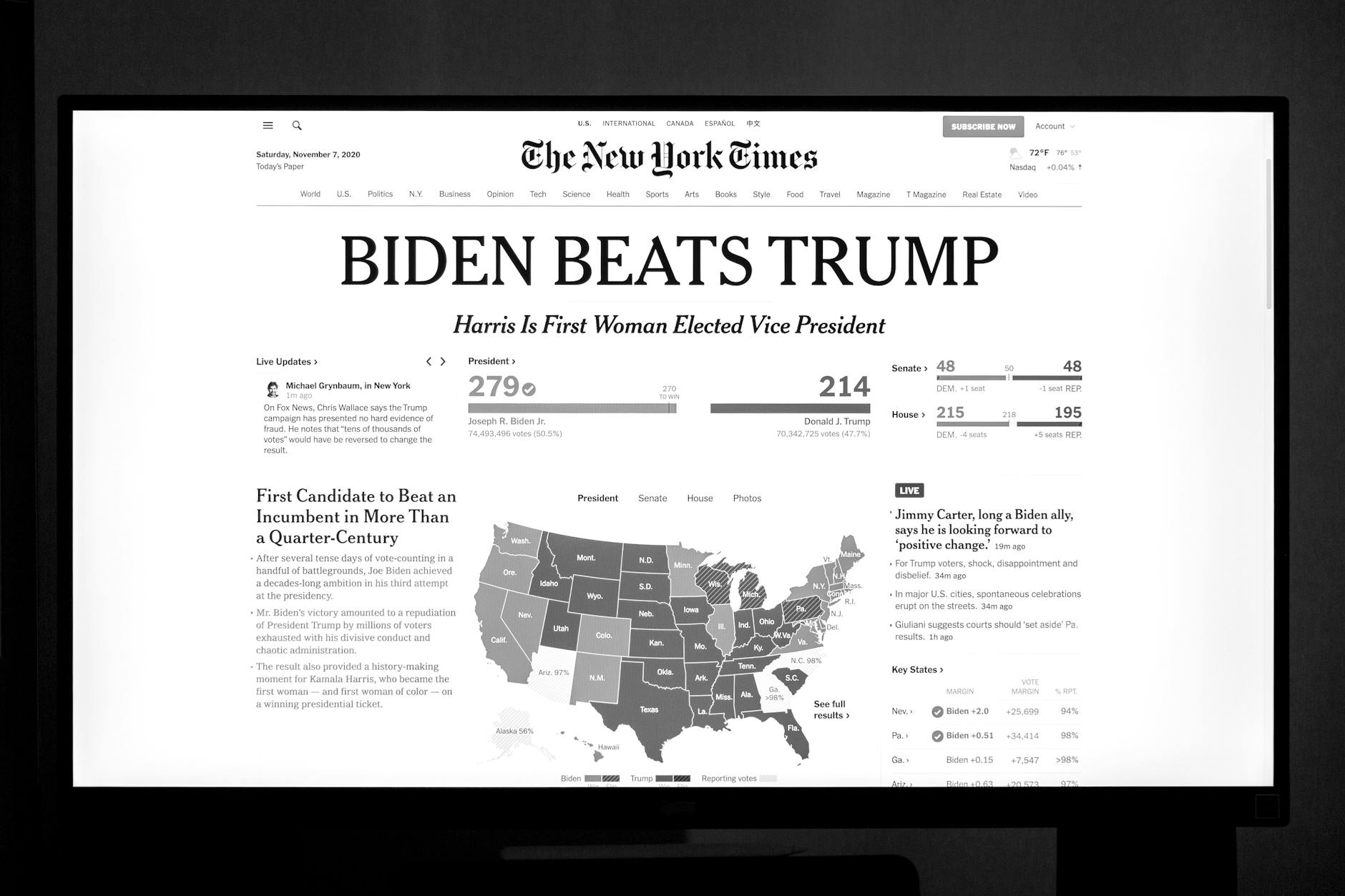
This loss didn’t come about in one fell swoop (i.e., with Trump). It started decades ago, and gradually got worse before we came to where we are today. While the mainstream Western media has always been bourgeois in ideology, we can see the beginnings of this particular problem with the abolition of the fairness doctrine in 1987. Introduced in 1949, the fairness doctrine was a policy requiring the media to present controversial issues of importance from differing points of view. Since the dissolution of the Soviet Union and the demise of the Eastern Bloc would come not too many years since the abolition of this policy, it’s easy to see how the already anti-communist stance of the media during the Cold War would become even more insistently pro-capitalist after that.

Next came the Telecommunications Act that Clinton signed into law in 1996, which allowed mergers and acquisitions in the American media, leading to today’s control of about 90% of the US media by only six corporations. This change thus means that most of Americans’ access to information is decided by the ruling class, and therefore reflecting their agenda and interests. There’s an international networking of media to tell essentially the same stories from largely the same political points of view, so this problem is not limited to the US.

The situation got worse in 2013, when Jeff Bezos bought The Washington Post. Just so there’s no misunderstanding that the centibillionaire supposedly has no interest in the political content in his newspaper, in 2025 he announced that the WaPo would essentially promote right-wing views only, euphemistically worded as defending “personal liberties and free markets.” Well, we all know what conservatives mean when they say that.

Additionally, Elon Musk bought Twitter in 2022, idiotically renaming it “X.” The social media website has also become a haven for right-wing views, which should not be surprising, given its owner’s Nazi salute during Trump’s inauguration and other manifestations of Musk’s far-right leanings.

Indeed, Mint Press News (MPN) published an article in late November of 2025 about how seven oligarchs, including of course Bezos and Musk, are now controlling key elements of the mainstream media. Remember in this connection Mark Zuckerberg’s ownership of Facebook. Larry Ellison is to purchase CNN as of the writing of my article, and CNN has already been partisan to the Democratic Party/liberal wing of the ruling class.

When you have oligarchs like these controlling the average person’s access to information, who needs a state-owned media to brainwash them into compliance (and, incidentally, the presence of ex-FBI agents, ex-CIA officials, ex-generals, and former security state operatives in the news–all of whom work for imperialist capitalism, in case there was any misunderstanding–is enough to make one wonder if American media is anything other than state-owned)? The attendance of elites like Zuckerberg, Bezos, and Musk at Trump’s inauguration should have been sufficiently and disturbingly portentous of things soon to come.

Now, there are still left-wing voices like mine and those in alternative media, like MPN or ChatNews Net, to give the people a dissenting voice, but firstly, our voices get nowhere near the circulation of the establishment ones, and we also get trolled a lot by reactionary types, either the useful idiots of that establishment, or paid trolls whose job is to discourage us from being those necessary ones shouting in the wilderness.

The point is that a stifled free press marks the beginning of totalitarianism, because no free press means no freedom of speech, which brings me to my next topic.

IV: No More Freedom of Speech

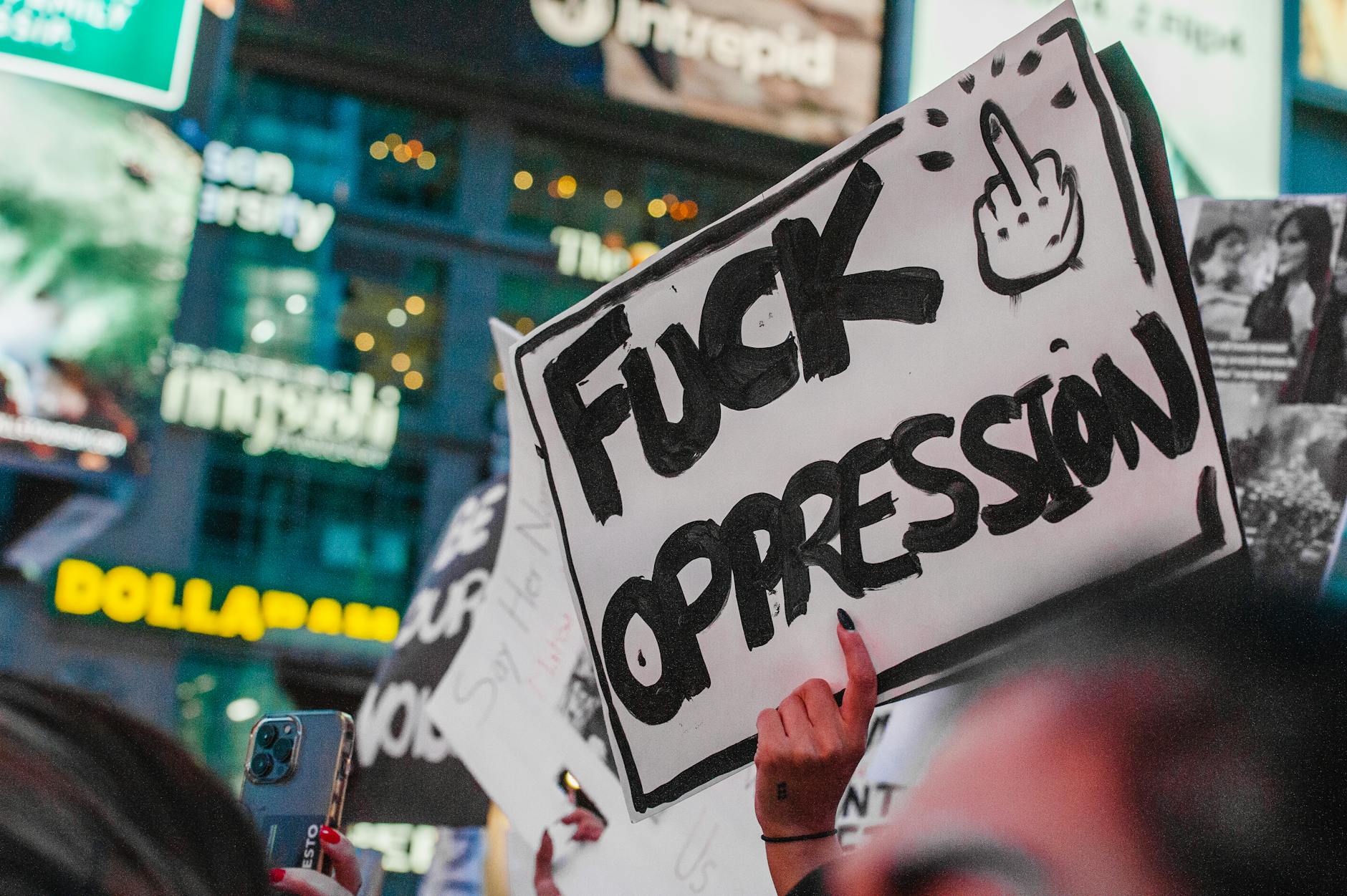
The one crowning example of a lack of freedom of speech in recent years has been the suppression of pro-Palestinian protestors on the campsites of American universities. This suppression is of crucial importance, for it is about preventing the one basic thing anyone in a truly democratic society should be given the freedom to do: protest injustice.

Injustice has always been a part of human experience, and overcoming it has sadly never been easy. We should, however, at least be able to talk openly about injustice and make demands that it stop. This is especially true if the injustice is as extreme as an ongoing genocide. If the powers-that-be can suppress the protesting of ethnic cleansing, it will become all the easier to suppress the protests of smaller injustices, which leads to…

V: No More Democracy

Let’s start by defining what democracy actually is. At the risk of sounding pedantic and condescending, I’ll use an etymology you should already know: the word comes from Greek words meaning “people rule.” Now, what does the rule of the people actually entail? Mindless voting for a particular political party, with little thought as to what the real issues are (i.e., “Vote blue, no matter who”)? Or does it mean ensuring that the policies enacted serve the will and interests of regular, working-class people?

I’ll put my money on the latter definition.

Let’s compare, for example, Libya under the rule of Muammar Gaddafi, as contrasted with the years of revolving-door voting for different leaders, say, every four to eight years or so in the US, the UK, Canada, etc. Neoliberalism has, over the past forty to fifty years, eroded economic democracy by crushing unions; it has cut welfare funding and regulations to allow the rich to gain more profit at the expense of the people and the environment; and it has generally immiserated the poor, leading to an epidemic of homelessness. How is any of this power for the people? How is it democratic?

Contrast that with the ‘despotic’ rule of Gaddafi. His Jamahiriya, or Third International Theory, was a kind of Islamic socialism that provided for the basic needs of Libyans throughout the years of his rule of the country. The benefits that his government provided included guaranteed universal housing, education, and health care, as well as free electricity and the free starting of farming businesses, bursaries given to mothers with newborn babies, cheap gas, and the raising of Libyan literacy from 25% to 87%.

How is ‘Western democracy’ better than that?

The notion that Gaddafi was a ‘brutal dictator’ would be based on the idea of his suppressing of anyone opposed to his system of government; but who would have opposed such a system? Anyone opposed to the kind of thing his government was providing, of course–that is, opposed to giving the benefits described above to his people (such opposition would have included Islamic fundamentalists, who were often imprisoned during his rule). I don’t know about you, Dear Reader, but I don’t have much sympathy for those opposed to giving the Libyan people the aforementioned benefits.

My point is that Gaddafi may have been a dictator, but whatever actual objective flaws he may have had, he was by any reasonable standard a benevolent dictator. Why is his having stayed in power for over forty years a problem if he had provided those benefits to his people; whereas having an assembly line–as it were–of presidents or prime ministers who change every half- or full decade or so, but largely serve the rich instead of the ordinary people, is considered more democratic?

Another important point must be considered: are the candidates available to be voted for truly representative of the wishes and interests of ordinary people in Western elections, or are they people chosen–directly or indirectly–by the ruling class, while more truly representative candidates are deliberately marginalized, and therefore unavailable?

As anyone who has read enough of my articles should already know, I am no supporter of Bernie Sanders, but note how not only does he not have a snowball’s chance in hell of ever being elected (let alone of being allowed to tax the rich to gain the revenue needed to pay for the FDR-New-Deal kind of social programs that are so popular among working-class Americans), but he is correctly understood to be a sheepdog for the left. The establishment uses people like him and AOC to sell hope to the masses, then at the last minute, he bows down and tells his crestfallen supporters to vote instead for the newest corporate whore of the Democratic Party. This is by design.

Similarly, because of their left-wing political positions, the Green Party of the United States stands no chance of even being in a position to challenge the corrupt and morally bankrupt two-party system of the US, let alone to win elections and implement their policies.

Anyone with any sense knows that the Democrats and the Republicans are, at best, mere variations on each other, and at worst, two wings of the same party, the Capitalist Party, with virtually identical, imperialist policies. While generally less extreme than in the US, the bourgeois political parties of any country under capitalism are of essentially the same nature.

This sad state of affairs is actually worse than having a one-party state (and contrary to bourgeois propaganda, there was and is far more democracy in the Soviet and Chinese systems than is assumed in the West), because in multi-party bourgeois politics, there is the illusion of choice that fools the public into thinking they needn’t change the system. The ruling class will never allow any party to challenge the capitalist system; they’ll never allow anyone to legislate them out of their wealth. Recall Goethe’s words.

Voting does not work. I haven’t even gotten into the corruption of the US electoral college or gerrymandering. Revolution is the solution.

VI: Intrusive Government

Thanks to anti-Soviet propaganda like George Orwell’s Animal Farm or Nineteen Eighty-four, as well as Leon Trotsky‘s description of the USSR as “totalitarian” and his description of their labour camps as “concentration camps,” we in the West have come to associate big, intrusive government with socialism and communism, when associating them with right-wing and fascist governments is far more apt, as I’ll try to demonstrate.

The association of intrusive government with communism is so consummate in the minds of so many in the West that whenever one sees examples of such intrusiveness in the US, it’s assumed that the country has become ‘communist.’ This is especially true when the Democrats are in power, since they are assumed by the politically illiterate to be ‘left-wing.’

Recall in this connection the conservative reaction to Obama becoming president, and how they idiotically said “there’s a communist living in the White House,” and he would enact socialist policies, when in reality he did nothing of the sort. He extended George W Bush’s Patriot Act, ordered more drone strikes than Dubya, was the Deporter-In-Chief, helped oust the actually socialist Gaddafi, and helped the capitalist class do particularly well during the economic crisis of the late 2000s and early 2010s, including bailing out the banks. He was in fact groomed by the ruling class to do things like these. The colour of his skin is completely irrelevant.

The problem of NSA surveillance was exposed by Edward Snowden back in 2013, during Obama’s very capitalist administration. AI is only going to make this surveillance worse, as I’ll demonstrate in its section below.

Obama’s continuation of Bush’s wars in Iraq and Afghanistan, as well as his administration’s involvement in the regime change operations in Libya and Syria, are clear, blatant examples of capitalist imperialism in those countries, not of socialism. When people speak of ‘human rights violations’ in Cuba, I have two words to say to them: Guantanamo Bay, something Obama allowed to continue from Bush’s administration, and which continues to this day, though with fewer people imprisoned.

The point is that the US government, like any capitalist, imperialist government, is so intrusive that it insinuates itself into the affairs of other countries, places it doesn’t belong, either through military invasions or coups d’état. Right-wingers think of intrusive government as being an essentially socialist affair (welfare, single-payer healthcare, etc.), while ignoring the military, NSA, and CIA as branches of the government, which are totally bloated.

The libertarian notion of ‘small government’ is a con game, anyway. It’s not about whether government is ‘big’ or ‘small’; it’s about who the government serves–the people, or the wealthy elite. Similarly, the validity or invalidity of taxation depends on two things, as I see it–who is being taxed the most, and how the tax revenue is being spent. If the rich pay the most taxes, and the revenue is spent on social programs for the poor, taxation is valid; if the middle and lower classes are being taxed up the kazoo, while the rich pay little if any taxes, and if the tax money is being spent mostly on the imperial war machine and to bail out the banks, taxation is invalid.

So, intrusive government can be totally capitalist; socialism has no monopoly on the problem.

Since I’ve been criticizing the Obama administration a lot, and since liberals are always fawning over him and finding no fault in him at all, this brings me to my next point.

VII: Cults of Personality

Anti-communists love to quack about how we tankies supposedly revere men like Stalin and Mao as if they were gods. We do no such thing. It must also be understood that Stalin and Mao rejected the idea of being raised up on such pedestals, contrary to bourgeois propaganda. We Marxist-Leninists are also thoroughly willing to acknowledge their faults as leaders.

Their achievements in helping to modernize Russia and China are enough to explain that their people simply loved them rather than ‘worshipped’ them. Indeed, decades after it was ‘necessary’ to love Stalin, huge numbers of Russians still love him, and it shouldn’t be difficult to see why: over a mere two and a half decades or so, he transformed the USSR from being a backward, agrarian state into an industrialized, nuclear-armed superpower, while also having defeated the Nazis.

Mao’s attempts to modernize China went on a rockier road, admittedly (with the deaths from the Great Leap Forward wildly exaggerated), but the foundation he built was essential to the glorious success of China today. Again, the Western painting of Stalin and Mao as cruel tyrants has far more to do with bourgeois, Cold War propaganda than it does with reality.

Still, all of that is secondary to the point I want to make, which is that the political right has its cults of personality no less, if not much more, than the left has. Hitler and Mussolini had cults of personality, and contrary to the delusions of many right-wing libertarians, fascism is a capitalist ideology, not a socialist one. The whole purpose of fascism is to crush leftist uprisings (which, by the way, should explain the recent rise in fascist totalitarianism); Hitler’s big business donors ensured that he’d never take seriously the S in NSDAP.

But even more to my point is how we can see a cult of personality in recent, capitalist presidents like Obama and Trump, in each of whom one could write up an epic catalogue of awful things both have done. Still, their worshippers refuse to find fault in them, or they at least minimize their faults.

How many times have we seen nauseating praise of Obama has having led the US for eight years without any scandals, and how he was all grace, style, and class? Let’s just conveniently ignore his drone killings, his prosecuting of (and, based on political and social status, double-standards on) whistle-blowers, his expansion of all of the evils of his predecessor’s administration, and everything else I mentioned above? Eight years of grace, style, and class war…there, I fixed it.

Then, there’s Trump’s even more obvious cult of personality. Many among the religious right have imagined that God sent Orange-face to take on the “deep state” and to “drain the swamp” of corruption. If that isn’t a cult of personality, I don’t know what is.

Not only will the MAGA crowd believe such nonsense about Trump, they’ll also do all kinds of mental gymnastics to do away with their cognitive dissonance upon facing the truth. They claim, for example, that as with King David (who committed adultery with Bathsheba and had her cuckolded husband, Uriah the Hittite, killed so he could marry her), God chose a sinner in Trump to do His will. This is so even in light of how it’s pretty much settled that Trump is guilty of having joined in on the sexual exploitation and abuse of underage girls with Epstein et al.

And the ‘president of peace’? Apart from his failure to end the Russia/Ukraine war (which I figured he wouldn’t have been able to do even if he’d sincerely wanted to), his banging of the war drums against Venezuela–not to stop a drug cartel, but to steal their oil, a motive freely admitted to–proves that he’s no less of a warmonger than any other US president. The MAGA crowd still won’t admit that they were conned…that their Lord and Saviour is as much a sheepdog for the right as Bernie Sanders is a sheepdog for the left.

VIII: Surveillance

Now, if there’s any one thing that we associate with totalitarianism, it’s surveillance. We can thank Orwell for that: BIG BROTHER IS WATCHING YOU, telescreens that, as you watch them, people on the other side are watching you, the Thought Police, etc. Furthermore, also thanks to the snitch, totalitarian surveillance is also associated with socialism. So, if people today feel themselves to be surveilled, they all too often tend to think theirs is a socialist government.

Well, we’re far beyond what Snowden discovered over a decade ago as of this writing, and as I’ve endeavoured to demonstrate to you, Dear Reader, ours is a capitalist world. Only a small handful of countries today are of the Marxist-Leninist ideology (and some leftists dispute whether a few of those even are truly socialist). People are going to have to confront the reality that it’s our capitalist government that is oppressing us.

To start with a relatively minor example, you must have noticed by now that whenever you show an interest in this or that product online, you tend to see ads for similar products, or ones associated in one way or another with that product. Obviously, capitalists are surveilling you, and trying to get you to part with your money to buy their product and line their pockets. BIG BUSINESS IS WATCHING YOU.

There are surveillance cameras on streets, ready to catch proof of drivers violating traffic laws (including relatively trivial ones) as an excuse to pass out fines and take more money out of your pockets. There seems to be less of an interest in driver safety than there is in controlling people.

Of course, surveillance has recently been enhanced through the use of AI in the forms of smart homes, smart TVs, smart cars, and smart cities. Orwell’s telescreens had nothing on this. Keep in mind also how this AI is linked with some of the richest men in the world: Jensen Huang, cofounder of Nvidia, as well as Musk, Bezos, and Zuckerberg. There has been growing concern that tech bros like these are further eroding democracy (News flash: they’re all capitalists!)

This surveillance can, of course, be used to help the ruling class track any and all revolutionary activity, on- or offline. Remember how a number of those tech bros are buddying up with Trump. Palantir is another big tech company using AI in aid of government surveillance, helping to enable such things as Trump’s deportations.

Two of Palantir’s founders, Peter Thiel and Alex Karp, have publicly shown themselves to be particularly problematic in their attitudes to human rights, democracy, and warmongering. Thiel has been described as both an Ayn Rand libertarian and a ‘skeptic’ about democracy–something many might find contradictory, but not me, for the reasons I’ve given above and in other posts. As for Karp, one need only watch him ranting in YouTube videos to get a clear sense of how unhinged (and/or addled by narcotics, most likely) he is, fanatically defending imperialist war, Zionism, Western chauvinism, and ICE.

Seriously, do we want loose cannons like these in charge of AI and surveillance? Now ICE, among other things, brings me to my next topic.

IX: Police Brutality and ICE

Now, let’s start going into the truly nasty and violent aspects of our growing totalitarian world, in case what I mentioned above wasn’t enough to convince you, Dear Reader. I know I’ve been focusing a lot on the US, the belly of the beast to which ICE is specific, but manifestations of the militarization of police can be found in many countries around the world–not just in the US, but also in Brazil, Canada, Colombia, France, Germany, Indonesia, Italy, Mexico, and the UK, as well as in Africa. I should hardly need to go into great detail about the harm police militarization does to democracy, to public trust, to marginalized communities in particular, and to civilians perceived as enemies. The Thought Police, NKVD, and Stasi had nothing on these cops.

A lot of white people in the US and elsewhere in the West show little, if any, sensitivity to how these cops brutalize blacks, Latin Americans, and LGBTQ+ people. If such white and conservative people had ever had the experience of being disproportionately targeted by militarized police, though, they’d not only realize what a totalitarian world we’ve been living in, they might also realize that those marginalized groups…are…actually…people, too, no less so than the straight white crowd.

We always hear stories of how the secret police of socialist states would round up dissidents in the middle of the night, using torture and intimidation to crush political dissent. What we don’t hear is how these dissidents were, or were at least perceived to be, the kind of capitalist sympathizers who, if left to do whatever they wanted, would have all the sooner and surer brought back capitalism, leading in turn to the capitalist totalitarian nightmare we’re in now…which includes having the same kind of cops doing the same kind of thing to the anticapitalist dissidents of today.

We’ve already seen the extent to which ICE will terrorize people in the Latin American community on the pretext that they’re illegals, kidnapping them, separating children from their parents in cages, then deporting them. Venezuelans have been sent to CECOT in El Salvador; others have been sent to “Alligator Alcatraz,” places that are actually concentration camps (more on that below), where they’ve suffered all kinds of abuses. These cops often nab them at night, too.

We’ve known for ages about police brutality and the killing of blacks, often with impunity. Note that none of this started under Trump, whom liberals like to blame for everything while ignoring the sins of their favourted presidents: the Obama and Biden administrations presided over a lot of this kind of brutality, as well as the ICE deportations. Fascism has been building and growing in the West for a long time.

Things have taken a recent turn for the worse under the second Trump administration, with Pam Bondi announcing that law enforcement officials are to investigate Antifa and other supposed domestic terrorist groups. This will be nothing less than a crackdown on leftist groups perceived as a threat to the American capitalist government. Note that ‘Antifa’ just means antifascist, which should be deemed a perfectly reasonable stance to have, especially in our increasingly fascist world. So criminalizing an ‘organization’ not clearly defined as such should tell you what kind of a government the US really has. Now, let’s talk about those…

X: Concentration Camps and Prisons

Before I get into the current situation, it might be fitting to point out that, contrary to anti-Soviet propaganda that came from such groups as the CIA during the Cold War, the CIA themselves knew that being in the Gulag labour camps was nowhere near as bad as we’ve been led to believe. Among the many facts given in the link above, the Soviet archives reveal that 20 to 40 percent of Gulag inmates were released every year, and the vast majority of inmates were charged with nonpolitical offences: murder, assault, theft, and any of the other usual crimes punishable in any society.

The Nazi concentration camps, on the other hand, were genuine death camps, in which up to 11 million inmates were victims of murder for being Jews, Roma, gay men, Jehovah’s Witnesses, the mentally ill and mentally or physically disabled, political and religious opposition to the regime, etc. And fascists were and are allied with capitalism, not socialism…in case you forgot.

As for today’s capitalist concentration camps, I’ve already mentioned those in El Salvador and in Florida, where many have been held without charge or due process, and where many are being subject to beatings, psychological and sexual abuse, inhumane living conditions, denial of medical care, incommunicado detention, overcrowding, inadequate food rations, etc.

Let’s now do a comparison of the characteristic detainees: in CECOT and Alligator Alcatraz, the great majority of inmates are Latin Americans; in the Nazi concentration camps, the inmates were mostly “Untermenschen“–Jews, Roma, gay men, the mentally ill and disabled, and political prisoners; in the Gulag, they were mostly criminals. Seriously, which political stance is far, far guiltier of using labour camps as places for abuse and injustice–the far left, or the far right?

Next, we can look at the for-profit prison system, which uses inmates to do labour for corporations and typically pays them wages far below the minimum wage, making the work hardly distinguishable from slavery. Prisons for profit are perhaps most notorious in the US, but they also exist in countries around the world, including the UK, Australia, New Zealand, France, South Africa, South Korea, Brazil, Chile, Mexico, Jamaica, Peru, etc., to varying extents.

Note how capitalistic such prisons are (i.e., the motive is maximizing profits for the corporations). The near-slave status of the prisoner-labourers is easily comparable to that of the slaves in the Nazi concentration camps, who generally worked for nothing. In the US, the 13th amendment permits prison slavery. In contrast, in the Gulag, inmates were paid or given food, given more or less of it depending on how productive their work was.

Of course, the very worst concentration camp in the world–and it can legitimately, if metaphorically, be called one, for its victims (innocent men, women, and children) are trapped in the place and murdered and brutalized every day–is the open-air concentration camp that is Gaza. The totalitarian mass murder going on there and elsewhere is my next topic.

XI: Mass Murder

Before I go into the capitalist mass murder of today (and of so many years and decades before that), we need to take a brief look at the nonsense that bourgeois propaganda has said about the deaths blamed on communism, or more accurately, how many deaths there supposedly were due to communism, as opposed to how many deaths there actually were.

The spurious sources of the ‘100 million killed by communists’ idea are such books as The Black Book of Communism, the lies of Robert Conquest, and the like. Please click on the links if you want more detail on that, since I don’t wish to waste time and space going into that. Suffice it to say that the 100 million figure is wildly exaggerated and deliberately contrived for maximum propagandistic effect. Bourgeois paranoia about the spread of communism during the Cold War necessitated, from the ruling class’s point of view, exaggerated numbers meant to shock, not to inform. You know the old cliché: in war, the first casualty is the truth.

In any case, even if one accepts the absurdly high number of 100 million deaths as accurate, this otherwise bloated figure is dwarfed by the millions of people who have died, and who continue to die annually, under capitalism. We’ve been able to feed the entire world for a long time, but we don’t because there’s no profit in doing so. The combined wealth of oligarchs like Musk, Ellison, Bezos, Zuckerberg, Buffett, Thiel, Karp, and others could feed the world, build hospitals and schools, provide affordable (if not free) housing, and the like. The deaths resulting from starvation, disease, homelessness, and war are largely preventable: only the ruling class’s greed and psychopathy prevent it.

The endless imperialist wars cause constant, needless deaths. The Iraq War alone resulted in at least a million deaths. Contrary to what right-wing libertarians think, war is not just ‘government stuff.’ War is a business. Weapons manufacturers like Boeing, Raytheon, Lockheed-Martin, Northrop Grumman, and others are laughing all the way to the bank with all the glorious profits they’re making off of human suffering and death. The stealing of natural resources, like the oil in Iraq and Syria and the oil to be stolen from Venezuela, is a crucial aspect of capitalist imperialism and the obvious motive for these wars.

The recent genocides in Yemen, Palestine, and Sudan are the most egregious examples of capitalist mass murder, though. Again, weapons from many countries around the world have been sold to the killers in these genocides: the Saudi-led coalition killing Yemenis, the IDF killing Gazans and those in the West Bank, and the Rapid Support Forces (RSF) killing the Sudanese.

Special attention ought to be given to the ethnic cleansing of the Palestinians, though. The real reason for the support of so many countries around the world, especially the Anglo-American NATO-allied empire, for Israel–apart from the obvious business interests (i.e., the buying and selling of weapons)–is how crucial the Jewish state is as an ally in maintaining imperial control of the region. There’s a lot of oil there, and so a lot of money is to be made. Israel is needed to kick ass in the region to secure those capitalist imperialist interests.

The official number killed in Gaza since October 7th, 2023, as of this writing, and excluding the thousands estimated to be buried under the rubble, is over 70,000 people. The ‘ceasefire’ is of course complete bullshit, since the IDF has still been killing Gazans without interruption, and of course we can see no end to the killing any time soon, for the whole point of the killing is not to stop Hamas, but total extermination.

What should be particularly chilling about all of this is that not only are the people with the power and authority to do so aren’t lifting a finger to stop the killing, but also that these genocides can be seen as a template for possibly wiping out any other group of people who try to stand up to imperialism, colonialism, and capitalism in general. With AI surveillance, any of us in the resistance can be fingered and hit with a drone strike, if not a balls-out genocide like in Yemen, Palestine, and Sudan. The psychopaths in power simply have no respect for human life.

XII: Utopian Thinking

Critics of communism like to claim that we leftists all dream of a perfect world with no pain, and that we’ll force our vision on everybody with a globe-spanning government. It is especially amusing to get this charge of utopianism from the supposedly anti-government right-wing libertarians, who imagine that the “free market” is naturally self-regulating and efficient (easily seen as total bullshit when we consider wasted food and starving people, as well as empty houses and homelessness, to give just two examples), and that the “invisible hand” will magically make everything right.

This “free market” ideology has been increasingly the dominant one in our world since the Reagan/Thatcher years, of course. It would be far more correctly called neoliberalism, since this new liberalizing of the market (translation: let the capitalist class be “free” to be as selfish, greedy, and hoarding as they like) really involves a subordinating of the government (and everything and everyone else) to the whims of the market, not an eliminating of the government.

Just as right-wingers imagine there’s no such thing as governments eradicating poverty (even though many governments have at least made impressive progress in doing so), so do we on the left (as well as anyone with a modicum of common sense) know there’s no such thing as allowing “rational” selfishness to run rampant and magically provide for everyone’s needs, while also not needing a government to protect capitalists’ private property.

For people so supposedly anti-government, many right-wing libertarians sure like getting into it. Look at the ‘libertarian’ Koch brothers, who pumped so much of their wealth into the Republican Party. Look at libertarians Ron Paul and Rand Paul, who work in the government. And look at Argentina’s current president, Javier Milei, a self-proclaimed “anarcho”-capitalist, who is set to receive $40 billion from the Trump administration in exchange for forcing Argentinians to vote for Milei, whose policies ruined the country’s economy. I thought it was bad to let the government intervene in the economy, and to force its will on the people.

Apparently not.

XIII: Cold War Fears of Nuclear War

Now, as if all of the above wasn’t bad enough, the one peace dividend we were supposed to enjoy from the end of the Cold War–no more fears of the two great superpowers, the US and the USSR, going into a hot war and killing everybody all over the world through nuclear annihilation–is no longer to be had. The US/NATO provocation of war with Russia over Ukraine, as well as the looming war with China over Taiwan, has killed even that one peace dividend.

That nut-job I mentioned above, Alex Karp, envisions a three-way war between the West on one side, and Russia, China, and Iran on the other. With the connections between the tech bros (and their AI in the US military) and Trump’s right-wing government, such fears of the world’s annihilation are well-founded.

XIV: Conclusion

So, even if socialist revolution leads to the totalitarian nightmare that the right-wingers are so scared of…so what? What’s the difference between that kind of totalitarianism and the right-wing kind we’re currently living in?

I’ll tell you what the real difference is…and yes, the capitalists are terrified of it. Ordinary people will gain access to free healthcare, housing, and education up to university, full employment, food security, a social safety net, etc…all of their basic needs met, and recipients will include people in the Third World. Getting all those things, however, will also mean that the ruling class will lose all their excess wealth–that’s the real reason they’re so scared of socialist revolution.

Let’s scare them.

Analysis of ‘The Party’

The Party is a 1968 comedy directed by Blake Edwards, written by him, and Tom and Frank Waldman. It stars Peter Sellers, with Claudine Longet, Gavin MacLeod, J. Edward McKinley, Fay McKenzie, James Lanphier, Steve Franken, Denny Miller, and Herb Ellis.

The film is a loosely structured farce, made up of a series of set pieces for Sellers to do improvisational comedy around. His character in the film is inspired by an Indian he played in The Millionairess (1960) and the bumbling Inspector Clouseau of the Pink Panther movies. While The Party is considered a classic comedic film, there is the problem of Sellers, a white British actor, wearing brownface and doing a caricature of an Indian stereotype…a buffoonish one, at that. I’ll address this issue more fully later.

Here is a link to quotes from the film, and here are links to the full movie.

It begins with an example of metacinema: we see what we originally think is the actual film, but it ends up being a film set in which Hrundi V. Bakshi (Sellers) is playing a bugler in a war between Indians and the British. The film they’re making is called Son of Gunga Din, which is an interesting title when one considers the poem, “Gunga Din,” by Rudyard Kipling.

What essentially needs to be known about Kipling’s poem, as far as its relevance to The Party is concerned, is that Gunga Din is an Indian water-carrier for the British; he is often treated abusively by the British soldiers for not bringing water to them fast enough. Nonetheless, when Gunga Din bravely tends to the wounded British soldiers on the battlefield, saves the life of the soldier narrating the poem, and is shot and killed there, the narrator regrets his abuse of Gunga Din and admits, at the end of the poem, that Gunga Din was the better man.

This far more respectful attitude of a white man for an Indian is, of course, in great contrast to Kipling’s later imperialist poem, “The White Man’s Burden,” which characterizes the colonialized natives as “Half devil and half child.” Similarly, Blake Edwards’s adaptation of Breakfast at Tiffany’s is far less apologetic than The Party is in its racist, cartoonish depiction of a Japanese man, Mr. Yunioshi, played by Mickey Rooney in yellowface.

I suspect that the ‘son of Gunga Din’ is not only far less servile to the British, but outright revolutionary in attitude. The filmmakers have hired Bakshi straight out of India to act in their movie, and his role is prominent: I’m guessing that he is the son of Gunga Din. If so, I see an intriguing parallel of Bakshi’s spastic messing up of the movie, one already about revolutionary resistance against whitey, and his later bumbling antics at the party of Hollywood A-listers he’s been accidentally invited to. Perhaps the best way for the Third World to overthrow Western imperialism is to be clumsy and accidentally ‘crash’ the party.

The point is that this opening scene–with the Indians fighting against British imperial rule (we see what are presumably members of a Scottish regiment, in their kilts and their playing of the bagpipes)–sets the thematic tone for the rest of the film, which can be seen as allegorical of the Third World resisting the plunder of the First World by screwing everything up in it.

Since Hollywood, as a crucial part of the Western media, has always been, in one form or another, a mouthpiece of Western capitalist propaganda (however ‘left-leaning’ and liberal that may be), then Bakshi’s bungling and screwing up of everything on the set (playing the bugle non-stop, long after he’s supposed to be shot and dead; attempting to stab a Sikh guard [presumably one of several Sikh collaborators with the British] while visibly wearing an underwater watch [the film being set in the late 19th century, when such watches didn’t exist]; and accidentally blowing up a fort before it’s filmed) can be seen as representative of Third World resistance, however unconscious, against such propagandistic narratives.

The luckless filming of Son of Gunga Din is one of three focal points in The Party. The other two are Bakshi’s accidental invite to the A-lister party, leading up to all of his buffoonery and screwing things up there; and finally, the bringing of the painted-up baby elephant–a symbol of India, as Bakshi calls it–to the party, which causes the lady of the house, Alice Clutterbuck (McKenzie) to go into hysterics, and which leads to the entire house being filled with soap bubbles, since Bakshi–offended at the hippie slogans painted on the elephant–wants them all washed off.

The odd thing about The Party is how it is paradoxically both racist and anti-racist, almost at the same time. True, it is awful to see a white man in brownface affecting an Indian accent and making use of all the typical Indian stereotypes (playing the sitar during the opening credits, for example); we can leave it up to Indian viewers of the film, as well as those of Indian descent, to decide if they want to forgive Sellers et al for presenting these stereotypes and making fun of Indian culture and–from the biased Western point of view, at least–idiosyncrasies.

Not to excuse the film for these great faults, but there are other things going on in The Party that clearly criticize racism, directly or indirectly. For one thing, while Bakshi is a buffoon for about the first hour and fourteen minutes of the film, by the time he’s changed into the red outfit and he hears Michèle Monet (Longet) crying alone in a bedroom at the party, he goes in and consoles her, demonstrating what a kind man he really is. At this moment, Bakshi finally starts to be properly humanized: he’s no longer just a stock comic Indian stereotype, but a nuanced character with some complexity. He continues to be so largely through the rest of the film. Again, this change doesn’t fully redeem the film, but for what it’s worth, it’s a lot better than what was done with Yunioshi.

Bakshi’s kindness to Michèle, which includes defending her right not to have to leave the party with the lecherous movie producer, CS Divot (MacLeod), demonstrates that he has qualities that more than compensate for his clumsiness and social awkwardness. In fact, he has good qualities that render his quirks insignificant. He has the only qualities of a human being that really matter–he has a good heart. You’re a better man than we are, son of Gunga Din.

As for Bakshi’s messing up of everything at the party–which includes getting mud on his shoe, losing it in the water he tries to wash the mud off with, laughing awkwardly at conversations he’s not a part of, shooting a dart from a toy gun at the forehead of Western movie star “Wyoming Bill” Kelso (Miller), dropping bird feed (“Birdie Num-Num”) on the floor, fiddling with a panel of electronics and disrupting the party further, getting caviar on his hand, then shaking the hands of others, thus spreading the caviar odor, catapulting his roast chicken at a woman’s tiara during dinner, setting off the sprinklers in the backyard, breaking the toilet and unrolling all the toilet paper after desperately needing to pee, and falling into the swimming pool–it should be emphasized that the A-list guests deserve to have their party ruined, given their snobbery.

Among these snobbish guests are some of the richest, most powerful and influential people in the Hollywood film industry: stars and starlets, producers, and studio heads like the host of the party, General Fred R Clutterbuck (McKinley), husband of Alice, among others. Also invited are a congressman (played by Thomas W Quire) and his wife, Rosalind (played by Marge Champion). This last one is particularly icy and snobbish to Bakshi when she butts in line ahead of him to get to the washroom.

This combination of Hollywood royalty and American politicians, as well as the fact that they’re all white, reinforces how they–in sharp contrast to Bakshi–are all part of the ruling class. In this sense, the party almost sounds like the political party in power. They look like a group of people in desperate need of a bumbling fool to intrude and be a shock to the system.

Bakshi’s disruptions of the established order even seem to have a subversive effect on the staff, intentional or not. After refusing an alcoholic drink from a waiter, Levinson (Franken), Bakshi walks off while Levinson helps himself to the rejected drink. He’ll continue his drunken devotion to Bacchus throughout the rest of the movie. Later, as the party is clearly falling apart and soap suds are everywhere, the maid (played by Francis Davis) stars dancing erotically to the song “The Party.” Even the jazz musicians, at one point in the middle of the film, sneak off to a room and pass around a joint. Instead of doing their alienating work, the staff are joining in on the fun.

The point here is that there’s a connection to be made between the staff, who represent the proletariat of the First World (including blacks like the dancing maid), and Bakshi, who represents the Third World proletariat. They should all join together and overthrow the bourgeoisie, in a revolution symbolized by the mayhem Bakshi instigates at the party. I hope that in these examples I have shown that The Party has antiracist elements as well as the unfortunate racist ones.

To be sure, the antiestablishment ethos of this film, as well as so many others of the late 1960s and much of the 1970s, never meant to carry their subversiveness to a…Soviet…extreme [!]. After all, the makers of such films are, like the Hollywood snobs of the party, just bourgeois liberals themselves, not Marxists. Still, these left-leaning types were of a sort at the time when ‘left-leaning’ actually meant something, as opposed to the liberals of the 21st century, who are unapologetically embracing such reactionary right-wing politics as the “free market,” jingoist Russophobia, and Zionism. I thus feel free to interpret this liberal film in as Marxist a way as I please.

It’s fitting that, just when Bakshi is beginning to shed his stock comic Indian stereotypes and showing his compassionate, humanized side, he’s switched from that fashion faux pas of a suit into the…red…outfit [!]. Similarly, we can hear in Michèle’s otherwise saccharine song, “Nothing to Lose,” a subtle allusion to the conclusion of a classic revolutionary text. We have “so much to gain”…even the world.

Now, while some of the staff are going along with the subversion described above, others represent the typical bootlicking class collaborators, like Harry (Lanphier), the headwaiter. He is frequently angry with drunken Levinson and his resulting incompetence, resulting in turn with Harry strangling Levinson. If Levinson’s drinking on the job is his form of rebellion against his alienating work, then Harry’s comic strangling of him represents a fascist bullying of the proletariat. In the end, when Clutterbuck learns from Divot that Bakshi is the one who blew up the fort on the movie set, he–meaning to strangle Bakshi in revenge–accidentally strangles Harry instead.

Allegorically speaking, the falling apart of the party represents the self-destruction of capitalism and imperialism, partly brought about by a Third World uprising (as personified by Bakshi). Clutterbuck, who represents the ruling class, accidentally strangles Harry (the class collaborating middle class, who fancies himself higher than that, as seen in an embarrassing scene in a room in his underwear, admiring his would-be muscles before a mirror) because when capitalism finally comes crashing down, it will crush its own in the imperial core, even in its attempts to crush those in the global south (i.e., Clutterbuck’s attempt to strangle Bakshi).

As for Bakshi’s defending of Michèle from not only Divot’s sexual advances but also his bullying demands that she leave with him, his gallantry goes against the stereotype of the patriarchal Indian male. He doesn’t see women as a man’s property, unlike Divot, who at the beginning of the movie is seen snapping his fingers at a sunbathing bikini blonde, signaling her to go in a camper with him to satisfy him sexually, something she isn’t all that keen on doing.

Bakshi’s offence at the sight of the baby elephant with hippie slogans painted all over its body (“The world is flat,” “Socrates eats hemlock,” and “Run naked”) is in itself worthy of comment. Recall that he says the elephant is a symbol of India; he considers it humiliating to have the animal presented thus publicly, so he wants the kids who painted it up to wash the paint all off. The writers of the screenplay must have seen the dramatic irony of a white man in brownface saying such things. Sellers, of course, needed to wash all the brown off, too, to stop humiliating Indians.

But again, while wearing that brownface, he says a very Indian-affirming line to Divot while defending Michèle’s right to stay at the party: “In India we don’t think who we are; we know who we are.” I’m reminded of the Hindu notion of the identity of Atman with Brahman. If we know of this unity, whether we’re Indian or not, that indeed, everyone and everything are all one, we’ll be liberated from samsara. Having seen The Party, Indira Gandhi loved that line. If one watched this film with one’s head tilted a certain way, one could see the brownface and Indian stereotypes as a kind of meta-cinematic comment on racism in Hollywood movies.

Towards the end of the film, we see not only Bakshi and Michèle dancing together, but also a white man dancing with that maid. The sexiness of the latter couple’s dance moves implies a tolerance and even a celebration of interracial romances. Such an attitude is also implied when Bakshi drives Michèle home, and that they’ll surely get together again in the near future, leading to possible dates. For a film with the problematic use of brownface and Indian stereotypes, the implied romantic interest here between an Indian man and a white woman is extraordinarily antiracist given the film’s release in 1968, when there still would have been a lot more raised conservative eyebrows at the idea than there would be today.

In the end, a film about an Indian blowing up a movie prop and messing things up at a party shouldn’t be seen as a racist portrayal of a swarthy buffoon (though using an actual Indian actor to play the buffoon, in spite of Sellers’s comic talents and box-office draw, would have been much better for the film). Instead, allegorically speaking, an Indian encroaching on the world of the American ruling class and screwing everything up for them, intentionally or not, seems like karma in action. After all, how often have Western imperialists–British, American, etc.–intentionally encroached on Third World countries like India and screwed things up for them?

And ultimately, the goal of the destruction of the old order isn’t destruction for its own sake, but its replacement with a much better way of doing things. This is what we see in the growing relationship between Bakshi and Michèle. Their initial loneliness and alienation has been replaced with love and togetherness, representative of that new way of doing things–one of sexual and racial equality, and loving human companionship.

Analysis of ‘First Blood’

First Blood is a 1972 novel by David Morrell. It was adapted into a 1982 movie by Ted Kotcheff, the screenplay written by Michael Kozoll, William Sackheim, and Sylvester Stallone, the last of these three of course starring as Rambo. Brian Dennehy and Richard Crenna costarred.

The film went through development hell for ten years because of such difficulties as finding the right director and cast, and getting a suitable screenplay. Morrell had sold the film rights in 1972 to Columbia Pictures; the rights were then sold to Warner Bros., and finally Orion Pictures produced the film. Another reason a film adaptation didn’t appear in the early to mid-1970s was that the Vietnam War was still going on, and film studios were worried about moviegoers’ reactions to such sensitive subject matter as that of a Vietnam vet waging a one-man war against an American town.

A suitable adaptation was finally created, to a large extent from Stallone’s rewrites, when the novel’s violence was toned down, Rambo was made more sympathetic, and he would survive in the end, which–thanks to the box-office success of the film–allowed for sequels to be made.

In fact, Morrell wrote the novelizations for Rambo: First Blood Part II and Rambo III, having informed readers in the preface to Part II to disregard the death of Rambo in his original novel. Then came two other films, Rambo and Rambo: Last Blood; all of the sequels’ screenplays were co-written by Stallone, with Morrell having no involvement in any way with the writing of the last two…though he praised Stallone’s portrayal of Rambo in the fourth film, saying Stallone had returned the character to Morrell’s original intentions as angry, cold, burned out, and filled with self-disgust.

Here is a link to quotes from the first film, and here is a link to an audiobook of the novel.

While the two sequels from the 1980s, as I said above, novelized by Morrell (fittingly, as you’ll see why below), were little more than mindless action movie nonsense, and one can basically say the same about the other two sequels, in a sense it is fitting to see Rambo in actual war situations (in Vietnam in Part II, in Afghanistan in Rambo III, in Burma in Rambo, and in Mexico in Last Blood). I say this because I see the original novel and first movie as telling a story that, while set in an American town, is an allegory of the Vietnam War, with Rambo personifying US imperialism, and the local cops representing the Vietnamese army.

Accordingly and predictably, as far as the sequels are concerned, the Vietnamese and Soviets are portrayed negatively (except for pro-US Vietnamese spy Co Bao (played by Julia Nickson) in Part II, the Soviets are portrayed negatively in Rambo III, the Burmese government is portrayed so negatively (which should not be misconstrued that I’m advocating for the junta) in Rambo as to have had the film banned in the country, and in Last Blood, Mexicans are portrayed so badly that there have been accusations of this last sequel promoting racist and xenophobic attitudes towards the country (in a rather Trump-esque vein). This sort of propagandizing against and vilifying of any country or government going against US interests is typical of imperialism.

As for the first movie, the local police of the town of Hope, Washington (in the novel, the town is Madison, Kentucky) are also portrayed negatively, with sheriff Will Teasle (Dennehy) being prickly to Rambo right from the start. Deputy Sergeant Arthur “Art” Galt (played by Jack Starrett) is abusive to Rambo to the point of psychopathy; and the other police, when chasing Rambo in the forest and getting wounded by him, cry out to Will for help like children weeping for their daddy.

In contrast, the novel’s portrayal of Teasle is much more sympathetic and nuanced, with lots of backstory to tell us the kind of world the sheriff is from. His wife has left him, so he has to deal with the pain of that. Also, Teasle is a Korean War veteran, so in that, among other things, he parallels Rambo the Vietnam vet.

Also, in the novel, Teasle doesn’t arrest Rambo (who is called only “Rambo” or “the kid”; the “John” and “James” are inventions of the movies) until after he returns to the town several times. This is opposed to Dennehy’s Teasle, who is abrasive with Rambo just upon first seeing him and not liking how he looks. He arrests him immediately for vagrancy upon Rambo’s just beginning his first return to the town.

It’s important to contrast the tone of the film with that of the novel in light of my allegorizing them as representative of American involvement in Vietnam. The film is, as I’ve said, far more sympathetic to Rambo, and far less sympathetic to the local police and reserve army “weekend warriors,” while in the novel, there’s much more moral ambiguity between the two sides.

In the film, Rambo injures those coming after him, but he never kills them, except for Galt, and even he is killed only accidentally, in self-defence. In the novel, Rambo kills many cops, and most deliberately, including Galt, who isn’t the ACAB pig of the film, but rather a somewhat inept cop who often forgets to lock the door leading upstairs from where they keep the incarcerated downstairs.

This contrast can help us understand the film’s attitude, as opposed to that of the novel, concerning the Vietnam War allegory that I see in both. The film, in having us sympathize with PTSD-stricken Rambo, as against the obnoxious local cops, takes the pro-American attitude towards Vietnam. The novel, with its morally ambiguous attitude towards both sides, allegorically takes into account how wrong it was that the US went into Vietnam and did all the damage it did there.

When we see Teasle telling Rambo, with that American flag on his jacket, to get out of town and stay out, we can see Teasle’s intolerance towards Rambo as representative of the Vietnamese not wanting any more imperialists or colonialists in their country. After all, they had just finished driving out the French colonialists by the mid-1950s, and because of Western Cold War paranoia about the ‘Red menace,’ then, by the 1960s, they had to put up with Uncle Sam moving into their country.

So the cops’ arresting Rambo, then chasing him into the mountainside forest, are allegorical of US troops taken as POWs by the Vietnamese, who then would have chased any escaped POWs in the jungles of Vietnam. Certainly in Rambo’s PTSD-addled mind, his reliving of the trauma he suffered in Nam as he flees to the forest from the cops makes the whole story into the Vietnam War all over again, from his perspective.

Seen in this light, the notion of who really “drew first blood” has a chillingly ironic new meaning.

It’s assumed by most in the West that Vietnam started the war because the “commies” were out to take over the world and ‘enslave’ everybody, so the US had to stop the spread of communism (i.e., the ‘domino theory‘) and intervene. Actually, the US lied, through the bogus Gulf of Tonkin incident, to justify greater involvement in Vietnam. US imperialism and colonialism (i.e., the French) drew first blood, not Vietnam. Allegorically speaking, Rambo’s insistence on coming into town again and again (as in the novel)–defying Teasle’s insistence that he not do so (however more patient he is with Rambo in the novel, even allowing him to have something to eat in a local diner)–is what has metaphorically drawn first blood, too.

In the film, why should Teasle think that Rambo’s entering town with the American flag on his jacket, of all things, to be a sign that he’s looking for trouble? And looking the way he does, in combination with the flag (long hair, sloppy, and smelling bad), is what’s implied, of course, but allegorically speaking, it can represent a white man in Southeast Asia in a green army jacket, with that flag on it, implying a military uniform.

To make Rambo more sympathetic in the film, we see good-looking Stallone with combed hair and no beard or mustache…unlike the far shaggier and scruffier-looking Rambo of the novel. Also in the film, he is further humanized in its opening scene, in which he tries to visit a veteran friend from his team in Nam by going to the vet’s home, only to learn that he died of cancer from Agent Orange. Rambo is lonely, homeless, and suffering from PTSD. The Rambo of the novel has the same problems, but because of his tendency to kill, he’s far less sympathetic.

The issue of veterans’ PTSD, emphasized in the film, is of course a valid one, especially given how shabbily the US government has treated its veterans when they’re no longer of any use to the imperial war machine. Empire doesn’t just harm those outside the imperial core: it hurts those within it, too, and that’s why it’s valid to allegorize a vet’s war in an American town as a war in one of those Third World countries that the empire wants to subjugate and plunder.

These soldiers traumatize others and get traumatized themselves. Rambo’s loneliness represents the alienation and estrangement people feel in society and workers feel doing their work. Accordingly, while Col. Samuel Trautman (Crenna) in the film knows Rambo well (calling him “Johnny”), has personally trained him, and–as the final scene makes clear–is a father figure to him (once again reinforcing our sympathy for the US Army’s point of view), in the novel, Capt. Trautman merely headed the training facility where Rambo learned to be a soldier, he hardly knows Rambo at all, and he’s the one to put a bullet in Rambo’s head at the end of the novel.

My allegorizing of the story as one of Rambo fighting in the Vietnam War, instead of the local American cops, can be seen clearly in the novel, when shortly before Rambo’s breaking out of the police station and racing off to the forest on the mountain, he remembers a time in Nam when labouring as a POW, he gets sick, and he is given a chance to escape when the Vietnamese guards leave him to his own devices. Going through the jungle, he’s given food by local villagers, and he eventually rejoins members of the US Army.

Paralleling this Vietnam memory is Rambo’s escape from the police station, where instead of being sick, his vulnerability is from running outside completely naked (he’s just had a shower to clean away his body odour, and before he even has a chance to get dressed, he’s freaking out from a PTSD trigger from the cops’ attempt to shave his beard and give him a haircut). In the forest on the mountainside, Rambo gets clothes, food, and a rifle from an old man and a boy illegally making moonshine from a still; this help parallels the Vietnamese villagers having fed him.

Rambo is extremely averse to getting a haircut and a shave. In the novel, he’s kept in a cell that gives him claustrophobia. In the film, the sight of the straight razor gives him a PTSD flashback, making him relive the terror of a Vietnamese guard bringing a blade up to his chest and slashing it, triggering Rambo’s fight/flight response. Cutting his hair and shaving his beard, as the cops try to do in the novel, can be compared to the cutting of Samson‘s long hair, thus depriving him of his great strength. In the end, Samson kills all the Philistines, but also himself; in the novel, Rambo kills many of his enemies, and himself gets killed, too.

Having Rambo escape naked reinforces our sense of how tough he is. He can ignore public embarrassment, the discomfort of his unprotected nut-sack slapping against the seat of the motorbike as he races into the wind on it, and the possibility of scraping his skin on the ground if the bike crashes. Him naked among the trees on the mountainside also reinforces our sense of how feral he is.

Another point of contrast between the novel and the film is in who they emphasize as being the main victims of the Vietnam War. In my allegorical interpretation of the novel, Rambo’s shooting and killing of all of Teasle’s cops, as well as that of Orval Kellerman (played by John McLiam in the film) and his dogs, and on top of them, his setting of much of the town on fire suggests the American troops’ shooting and napalming of the Vietnamese and their villages. The film’s emphasis on Rambo’s PTSD, leading to him breaking down and crying at the end, as well as his never deliberately killing anyone, emphasizes how victimized the American vets felt.

Now, Rambo’s rant to Trautman at the end of the film, about how wrongly he and other vets were treated by antiwar protestors, them spitting on him and calling him “‘Baby-killer,’ and all kinds of vile crap,” is valid insofar as some troops really were innocent of such atrocities. Other troops, however, weren’t so innocent, as was the case with the My Lai massacre of 1968.

In any case, the antiwar protestors should have reserved most of their ire for the top military brass and American government. Recall that old antiwar song by Black Sabbath, which condemned the generals and politicians that plotted and started the Vietnam War, then had the poor–young men like Rambo–do all of their dirty work for them…and it was those very same poor who came home–if they weren’t killed–traumatized, unemployed, and often homeless, like Rambo; it wasn’t the generals or politicians who suffered thus.

I mentioned above how there are parallels between Rambo and Teasle in the novel, i.e., they’re both vets. Also, it’s not just Teasle et al hunting Rambo; it’s vice versa, too. Both men sustain nasty injuries in the mountainside woods, and it’s as if there’s a psychic link between the two, because later on in the novel, when Teasle is back in town, he’s had a vision in a dream that Rambo is coming back into Madison.

This time, Rambo’s going back into town to torch it all, linking this return to the other ones at the beginning, which prodded Teasle into arresting him and starting the whole conflict in the first place. This linking of going back into town, in terms of my allegory, shows how Rambo’s arrival has always been an invasion, even if he didn’t kill anybody at first. It’s like the imperialist establishment of South Vietnam (or South Korea, for that matter), a preparation for coming war and prompting the establishment of the Viet Cong.

The whole point in allegorizing the conflict in First Blood, with a US vet fighting a local American town to represent the US army fighting in Nam, is to show how imperialism’s ravaging of other countries eventually turns back on itself, causing the empire to eat itself up and ravage the imperial core. This is what we can see the Trump administration doing as I’ve been writing this post: first, they did the usual–continue to enable the Gaza genocide and Ukrainian war, and threaten Venezuela; now, they’re sending the National Guard into American cities like Washington DC, Chicago, Portland, and Los Angeles to terrorize American citizens, regardless of whether or not they’re illegal immigrants, in response to an “enemy within.” When we hurt people outside, we hurt people inside (e.g., Vietnam vets’ PTSD), because in the end we’re all one.

Before Rambo goes back into town, though, he still has to hide from those doing the manhunt for him, which by now has included the National Guard and civilians. He goes deep into a mining cave, in which at first he imagines it’s like being in a Catholic Church where he can go to confession; indeed, he contemplates how he wasn’t justified in killing those cops–he could have simply escaped, but he knows that his instinct to keep fighting is powered, at least in part, by his enjoyment of killing. In his bloodlust, we can see how he personifies US imperialism.

Deep in that black pit of a cave–which in the novel, at one point shorty after he’s come back out, is aptly compared to hell–Rambo comes to a filthy chamber with toxic fumes and a floor covered in shit. Bats fly out all over him, biting and scratching him (in the film, it’s rats). He is repelled back, but he soon realizes that it’s only through this awful chamber that he’ll be able to come back out to the surface. Only by going through the darkest hell can one come back out to the light: this heaven/hell dialectic, like any dialectical unity of opposites, is something I’ve discussed in a number of blog posts before.

So in this situation, Rambo is like Jesus harrowing hell before His resurrection…though Rambo’s return to the earth’s surface will make him anything but holy.

Nonetheless, the notion of Rambo emerging from the cave as a kind of resurrected, avenging Christ is apt when we consider, in the context of my allegory, how the missionary spread of Christianity (in places like Africa, for example) has been used to justify colonialism and imperialism. Recall Ann Coulter‘s incendiary words about Muslim-majority countries immediately after 9/11: “We should invade their countries, kill their leaders and convert them to Christianity.” The Western capitalist complaint about “Godless communists” would have also been used as a rationalization for fighting the Cold War in general and the Vietnam War in particular.

In any case, when Rambo comes out of that cave, he feels “good,” as it says in the novel, being the only apt word to describe how he feels. He’s full of resolve and energy, eager to fight his personal war on the town. This good feeling is comparable to experiencing the transformed, ‘spiritual body‘ of the resurrected Christ, ready to go out and fight as a Christian soldier against the ‘civilian’ pagans, or those whom Rambo fights, those without his military training and discipline.

In the film, he steals a military transport truck carrying an M60 machine gun. In the novel, he steals a police car and some dynamite. With these weapons, he’ll cause a mayhem to the town comparable to the napalm mayhem the US Army caused in Vietnam. He’ll blow up two gas stations, the police headquarters, and much of the town.

But of course, he can fight this personal war only for so long before he’ll be stopped. His inevitable, ultimate defeat is allegorical of the quagmire that the Vietnam War turned into, an unwinnable one that was beginning to be seen as such by the aftermath of the Tet Offensive in 1968, the year Morrell began writing his novel.

Trautman tries in the film’s and novel’s varying ways to convince Rambo to stop fighting and thus to save his life. Allegorically, this is like the US Army’s big brass realizing that they had to pull out of Vietnam before more of their men needlessly got killed.

In the novel, Teasle and Rambo shoot each other, and Teasle–in that connection I said he has with Rambo–feels a need to be near Rambo when he’s finally killed. The police chief, a former vet, and this Vietnam vet parallel each other in their shared forms of pain (sustained injuries in the mountainside forest, alienation and loneliness [recall Teasle’s wife having left him], etc.).

The ultimate connection, though, between Teasle and Rambo is, in terms of my allegory, a dialectical one, in the sense of Hegel‘s master/slave dialectic. One can be recognized as self-conscious only through the other recognizing him as such. Rambo and Teasle react to each other at the beginning of the story. They have a fight to the death; one becomes lord, and the other, bondsman (in my allegory, these would respectively be Rambo-as-US-imperialist and Teasle-as-Vietnamese-resistor). The contradiction between the two is resolved through the efforts of the local police to stop Rambo in the end, making him realize he cannot go any further. This resolution is allegorical of Vietnam fighting so hard for many years until finally liberating themselves from Uncle Sam.

On the surface, it might seem that it’s Teasle who is the lord, and Rambo the bondsman, since it’s through Rambo’s hard fighting that he ends up outdoing the cops for so long, and escaping them; but even if we take this interpretation, it just shows how dialectically interchangeable Rambo and Teasle are, each other’s yin and yang.

Finally, what is ironic about a franchise with a seemingly indestructible tough guy is how, in this first film, the one unequivocally good one, in its climactic and emotional final scene, Rambo cries like a baby, just like Teasle’s wounded cops in the forest. Trautman comforts Rambo like a father figure (as opposed to the novel, in which Orval–the old man with the hunting dogs–is Teasle’s father figure, yet another parallel between Rambo and Teasle). The big action hero is thus a rough, tough cream puff, a Herculean masculine ideal as impossible for men to live up to as is the Marian/Aphrodite ideal for women to attain.

A scene was filmed of Crenna’s Trautman being made by Stallone’s Rambo to shoot and kill him, a forced suicide; for obvious reasons, it was disliked and excluded from the film. As I said above, in the novel, Trautman blows Rambo’s head off; earlier in the novel, wounded Rambo intended to kill himself with some of that dynamite he had.

In any case, Rambo dying at the end may not be pleasing to moviegoers who’ve invested so much time sympathizing with him, but it is the fitting end to the story, because the whole point of First Blood is how Rambo’s projection of who ‘started the fight’ is ironically how he started it (if only allegorically so, according to my interpretation); also, the whole point of the story is how it ends, with Rambo-as-US-imperialism killing many others, then self-destructing.

As of the writing and publishing of this analysis, Americans have been witnessing that self-destruction of empire on their very soil. They ought to reflect on that, and not wish for any sequels to the fighting.

Analysis of ‘Dark Star’

Dark Star is a 1974 sci-fi comedy produced, scored, and directed by John Carpenter, his feature directorial debut. It was written by him and Dan O’Bannon, who also acts in the film, does the voices for Bombs #19 and #20, edited the film, and created many of the special effects.

Other actors in the film are Brian Narelle, Cal Kuniholm, Andreijah “Dre” Pahich, and Joe Saunders. Carpenter did the voices of Talby (Pahich) and Commander Powell (Saunders). Barbara “Cookie” Knapp, the only female in the cast, did the voice of the computer. Miles Watkins is Mission Control, and Nick Castle is the alien.

Dark Star started out as a student film while Carpenter and O’Bannon were at the University of Southern California. It was originally a 45-minute film with a budget of $6000. The first version of the film was completed in 1972. With $10,000 in financial support from Jonathan Kaplan, Carpenter and O’Bannon were able to shoot an extra fifty minutes in 1973, thus making Dark Star feature-length.

The film was well-received at Filmex, but not on its initial theatrical release, with nearly empty theatres and little reaction to the intended humour. O’Bannon would later lament that they had “what would have been the world’s most impressive student film and it became the world’s least impressive professional film.”

Nonetheless, by the early 1980s, Dark Star became a cult film among sci-fi fans, and Quentin Tarantino called it a “masterpiece.” O’Bannon reworked the ‘beachball alien’ section of the film into 1979’s Alien. He reasoned, “If I can’t make them laugh, then maybe I can make them scream.” George Lucas was impressed with O’Bannon’s special effects, remarkable for such a low-budget film, such as the spaceship jumping into hyperspace and the computer screen effects, so he hired O’Bannon to apply these effects to Star Wars (1977).

The humor of Dark Star was meant to parody 2001: a Space Odyssey. While 2001 is an epic film with profound meditations on the progress of man and his place in the universe, Dark Star is a short, absurdist look at how not only insignificant and bumbling we are, but also how potentially harmful we are to the universe and to ourselves. Instead of such powerful, grandiose music as Richard Strauss‘s Thus Spoke Zarathustra, in Dark Star we hear a trite country song (“Benson, Arizona”) during the opening and ending credits, as well as “Largo al factotum,” from Rossini‘s Barber of Seville, and Carpenter’s use of a modular synthesizer.

Here is a link to quotes from the film, and here are links to the full movie.

The film begins with a video message sent from Earth to the spaceship named Dark Star, manned by a crew of four men–Lt. Doolittle (Narelle), Sgt. Pinback (O’Bannon), Boiler (Kuniholm), and Talby (Pahich), while a fifth man, Commander Powell (Saunders), has been cryogenically suspended after a fatal electrocution from his malfunctioning chair–whose mission is to seek out and destroy unstable planets that will threaten Earth’s hopes to colonize space.

The video message is sent from Mission Control, from McMurdo Sound, Antarctica. The man from Earth (Watkins, having the same surname as the actor) expresses condolences over the death of Powell, and informs the crew that their request for radiation shielding has been denied. Cutbacks in Congress have made it impossible to help the crew with the ship’s increasing technical issues: malfunctions, radiation leaks, failing life support and communication systems, the loss of the crew’s entire supply of toilet paper, etc. In spite of this refusal to help, Watkins puts on an encouraging smile and speaks of having every confidence in the crew to solve their problems themselves…as if that were sufficient compensation for having left them all in the lurch.

I see this sci-fi story as an allegory for late imperialism, in which the continuing drive to colonize, extract natural resources, wage endless wars to maintain global dominance, and maximize profit are not only increasing suffering worldwide, but are also harming the imperial core in such forms as rising neofascism, worsening economic crises, and destruction of the environment. The worsening breakdowns and malfunctions of the spaceship, which is used to destroy unstable planets for the sake of facilitating the colonization of space, can be seen to symbolize our end-of-times predicament today.

In this sense, as absurd as the story of Dark Star may be, it can also be seen as prophetic of our growing problems in the twenty-first century, and therefore it’s a warning to us all.

We next see shots of the spaceship approaching a planet the crew is about to blow up. Carpenter’s synthesizer is providing some dark, eerie music, which is fitting (in spite of how this film is supposed to be a comedy), given the settler-colonialist/imperialist allegory I’ve discussed.

Doolittle at first is having difficulty contacting Talby, who’s up at the top of the ship looking out at the stars, and there are technical problems with the communications system; the intercom won’t send Talby a clear transmission from Doolittle. As well as further establishing the extent of the technical issues of the spaceship, this problem also represents the sense of mutual alienation of the crew.

Once communication with Talby is established, him needing to give the other three a diameter approximation of the planet, they get ready to blow it up. Bomb #19 (which, like the ship’s other bombs, has AI, allowing it to think and speak, as well as making the bombs a parody of HAL 9000) is lowered out of the bomb bay. Pinback does a countdown, then drops the bomb, and the crew gets ready to put the ship into hyperdrive to clear away from the explosion.

It is here where, not only do we get a bit of a parody of 2001‘s “Stargate” sequence, but also a taste of O’Bannon’s special effect for seeing the stars fly at us, as they more famously do before the Millennium Falcon when it goes into hyperspace. Now Dark Star never directly inspired the Death Star, which as we know is also meant to destroy planets for the Galactic Empire, but a comparison of the spaceship here with the battle station of Star Wars makes it extremely tempting to imagine Lucas, who as I said above hired O’Bannon, being at least unconsciously inspired by Dark Star to create the Death Star. Certainly some have noted the shape of the ship as similar to the, however much larger, Star Destroyers. In any case, inspired or not, these comparisons reinforce my settler-colonialist/imperialist allegory of Dark Star.

Connected with my allegory is a discussion among the crew of where to go next to find an unstable planet to blow up, now that the current one has been successfully destroyed. Boiler mentions a 95% probability of intelligent life in the Horsehead Nebula sector, but Doolittle has no interest in that “bull” at all since the last time they found intelligent life, it was the reddish ‘beachball’ with two clawed feet that Pinback has taken onboard.

Doolittle’s dismissive contempt of alien life, as well as Pinback’s–let’s face it–abduction and kidnapping of the alien, demonstrates the crew’s racist and imperialist mindset. Remember–they’re space colonizers. Doolittle calls the alien “a damn mindless vegetable…looked like a limp balloon.” This attitude is allegorical of that of British colonizers taking the land away from indigenous people around the world. In spite of the comical spectacle of the film, Dark Star has a dark message.

Doolittle doesn’t care about intelligent life: he just wants to blow planets up. This mentality, in principle, is no different from colonizers like Columbus, who took over land and killed the aboriginals. Doolittle is similarly contemptuous towards Pinback, demonstrating again the mutual alienation among the crew, and also how imperialist/colonialist disregard for aboriginals can spill over into disregard for those of one’s own nation or ethnic group. Alienation is catching.

Boiler finds an 85% probability of an unstable planet in the Veil Nebula; it will probably go off its orbit and hit a star, so the Veil Nebula is the next destination for Dark Star. As they begin their journey there, Boiler puts on some music, “Benson, Arizona,” the country music theme song heard during the credits.

The song’s lyric essentially expresses the homesickness felt by the crew as they sail across the stars. The film’s setting is the mid-twenty-second century, and while the crew have aged only three years, they’ve been out in space for twenty Earth years. One issue the crew has to deal with, therefore, is how being cramped in this small spaceship for so long has been driving them crazy. Their mutual alienation, as well as the continuing deterioration of the ship, is only the tip of the iceberg.

The long, shaggy hair and beards of the crew made Tarantino think of hippies back when he first saw (and initially hated) Dark Star as a kid. That shaggy hairiness, combined with the crew’s indulging in various forms of tomfoolery to relieve their boredom (i.e., Pinback’s practical jokes, Boiler playing the knife game with a switchblade and firing a laser rifle, etc.), reminds me of the Swampmen in MASH. Hippies are supposed to be antiwar liberals, as were Hawkeye et al in the TV show; as we’ve learned over the past fifty years, though, the vicissitudes of time can make liberals bang the war drums as much as conservatives do.

After Doolittle does a video recording for the ship’s log, discussing such things as the deterioration of the ship and the ETA in the Veil Nebula, we see Dark Star going through space while the crew is rocking out to some 1960s blues-based guitar music. Then the ship’s computer, with the female voice, interrupts the men’s fun to warn them of a collision course they are on with an asteroid storm, which once they have gone through it, the technical problems of the ship will of course be even worse.

It’s interesting at this point to compare this film with another of Carpenter’s–The Thing. Both have an all-male cast who are isolated and have an alien among them that is hostile in intent. And just as Dark Star has a computer with a female voice, so does The Thing, the chess computer voiced by Adrienne Barbeau, which plays a game with RJ MacReady (played by Kurt Russell) at the beginning of the movie.

As I said in my analysis of The Thing, we can see a paradoxical merging of negative attitudes towards both women and men in Dark Star. Note how, on the one hand, there’s the lack of women on the ship (a computer’s voice is the only ‘female’ reality for the crew–it’s just an abstraction for the men) as well as the nudie centrefolds on the walls (the exposure of their anatomy removed for the sake of getting a more marketable G rating); yet on the other hand, the bumbling incompetence of the male crew, as well as their lack of mutual empathy, makes them hardly any superior to women.

The asteroid storm seems to be bound by an electromagnetic energy vortex, like one the crew encountered two years before. Presumably, the damage that that one caused to the ship hasn’t been adequately dealt with (i.e., the computer’s defensive circuits, which were destroyed in that other storm).

As the ship is going through the asteroid storm, we see a pinkish glow around it, representing some kind of defensive shield. Still, this isn’t good enough to prevent any damage, for the electromagnetic energy zaps the back of the ship, causing the bomb bay system to be activated. Bomb #20 is let out, programmed and ready to blow up. Carpenter’s synthesizer plays triplets of a chromatic ascension of two minor seconds over a tonic note, going up and changing key each time by a half step and adding to the tension of the moment.

Next, the computer tells Bomb #20 to return to the bomb bay. The AI system in the bombs all have a male voice, in contrast to the female voice of the computer. What’s interesting to note in this contrast also is the rationality of the computer as against the irrational stubbornness of the bomb, which insists that it ought to blow up simply because such is its programming, in spite of the fact that it received no command from the crew and left the bomb bay only because of a malfunction caused by the asteroid storm. Only after repeated arguing with the computer does the bomb return, saying, “Very well” in a slightly petulant tone.

The ship finally gets out of the asteroid storm. After Boiler’s and Pinback’s engaging, in their sleeping area, in a bit of the tomfoolery I described above, Doolittle leaves and goes into a dark room in which he has an odd keyboard instrument constructed of such things as glass water bottles and cans to produce tones. He plays it, though out of tempo. The music is presumably from Carpenter’s synthesizer, but it sounds a bit like a prepared piano.

All of these goings-on have to do with the crew trying to alleviate the boredom they feel between tense moments like the asteroid storms, as I mentioned above. After finishing his keyboard practice, Doolittle goes up to the top of the ship to give Talby some breakfast and to chat with him. The top has a transparent dome through which Talby likes to look out at the stars. Doolittle discusses his old surfing days back in Malibu, and how he wishes he had his surfboard with him so he could wax it.

Talby has isolated himself up in this domed area ever since Powell died. Doolittle worries that Talby spends too much time up here, and not enough time with the others. Talby thinks of encountering the Phoenix asteroids when the ship reaches the Veil Nebula; these circle the universe once every 12.3 trillion years, and Talby understands that they “glow with all the colours of the rainbow.” He’d love to see them.

We’ll come back to a fulfillment…of sorts…of these two men’s wishes by the end of the film.

Meanwhile, down below, Boiler wants to do a little target practice with the laser rifle by firing it at a metal square he’s placed in front of a door. Pinback tries to stop him.

Then, the computer tells Pinback that he has to feed the alien. He’s annoyed at having to do so…well, maybe he shouldn’t have taken it on board, then.

The following sequence was meant to be funny in a slapstick sort of way. Instead, I see an allegorical commentary on how settler-colonialists treat the indigenous people of the places they conquer.

The absurd physical appearance of this low-budget alien–a reddish, spotted beachball with two red, clawed feet–can be seen to represent how the racist colonialist regards the aboriginals as clownish-looking in their–in the opinion of the colonialist–odd attire and darker skin. The alien whimpers in a high-pitched voice, which can also be seen to represent the ‘strange’ language of the native.

Pinback originally thought the alien was “cute”; now, he just finds it annoying. This is not quite so unlike the white racist who imagines blacks to be all just a bunch of entertaining song-and-dance men; then, when they show their wish to be more than that, he is annoyed with them.

Pinback complains about having to do all the work and getting no appreciation–I can hear echoes of “the white man’s burden” here–then the alien jumps on his back. As I said above, this intended slapstick comedy would eventually become the terror of the stowaway xenomorph in 1979’s Alien. Thematic connections between Dark Star and Alien can be seen in how a ship’s crew–alienated from each other and from their own species-essences–are taking aboard an alien to exploit it in some way (as the Weyland-Yutani Corporation would use the xenomorph as a weapon), rather than let it go to live its own life.

Pinback would use the alien as Dark Star‘s ‘mascot,’ but it has other ideas…naturally. Since the comedy of this sequence doesn’t exactly work, I find it more useful to allegorize it as an instance of the native attempting an insurrection against the colonizer.

The crew of Dark Star are space colonizers, who as I’ve said are allegorical of colonizers here on Earth. Space is thus allegorical of the oceans of the world, the spaceship is the colonizer’s sea vessel, the planets are the islands or other lands of the natives, and of course the ‘beachball’ alien is a native. Now, unstable planets, which are a threat to the space colonizers, can be seen as allegorical of unstable, restive, or rebellious societies that are prone to revolution when colonizers try to control them…hence the need to crush them, or in the case of Dark Star, to blow them up. It is in this context that we should understand the actions of the alien on the ship.

Not only does the alien jump on Pinback and disobey him when he wants it to go back into the dark storage room it was initially in, but it also fights back when Pinback tries disciplining it by hitting it with a broom. Later, it lures him into the ship’s elevator shaft…right when the elevator’s to be activated randomly due to more malfunctions, thus putting Pinback in danger. The alien jumps him there, too, putting him in greater danger, since the elevator is about to descend while he’s still hanging there.

He manages to survive and get out of there, but by that time, the alien has activated the bomb’s circuits, which will cause Bomb #20 to emerge from the bomb bay again when not wanted to do so. All of these acts of the alien should not be trivialized as being merely “mischievous,” as the Wikipedia article on the movie characterizes them; they are an attempted rebellion against colonizers.

Once again, the computer has to convince the headstrong bomb to return to the bomb bay, as the crew has not ordered the destruction of an unstable planet yet; after all, they haven’t yet reached the Veil Nebula. Bomb #20 complies again, yet it’s even more petulant and reluctant about it, since blowing up is its whole raison d’être.

It says that this will be the last time it complies, ominously. This AI system is clearly insistent on having its own way, which is not only indicative of how irrational it is, but also how dangerous it is to everyone impacted by it…rather like HAL in 2001, or any misused technology, for that matter.

Now that Pinback is safe, he’s pissed at the alien. He strides through a hall and gets a tranquilizer gun, and as he does so, we hear a military beat played on a snare drum. This music is fitting, given he’s one of the space colonists about to show the, as it were, indigenous alien who’s boss, like a true imperialist. His intention is to discipline the alien with a tranquilizing, not to kill it…though the shot from the gun does kill it, making it deflate and fly about the place like an actual beachball; Pinback surmises it was full of gas.

The almost comical way that the alien dies is tragically apt, given the slight regard colonizers have always had for their victimized natives. Keep in mind how the IDF have joked about and celebrated, in cruelly ghoulish fashion, their brutal killing of the dehumanized Palestinians. Note, in this connection, Pinback’s words on shooting the alien: “Now it’s time to go sleepy-pie, you worthless piece of garbage.”

Doolittle, in his incompetence, couldn’t care about the increasing technical issues of the ship any more than he does about Pinback’s traumatizing incident with the alien in the elevator shaft, or whether or not there’s any intelligent life in the Veil Nebula. These three forms of apathy are interrelated, as far as my allegory of late imperialism and colonialism are concerned.

Doolittle personifies the oligarchs, neocons, and neoliberals today who know of all the dangers we face today on our dying planet, yet do nothing substantive about it; he also personifies the lack of empathy for others’ suffering that is so endemic today; and since intelligent, alien life corresponds with indigenous people in my allegory, then Doolittle in his lack of caring about such life represents the slight regard colonialists have towards natives.

Talby, on the other hand, does care about the new damage the ship has sustained, so he goes to take a look and see if he can repair it. It’s significant that the door to the Computer Room, which Talby is headed to, is shaped like a coffin. In this room, he is going to find out how fatal the damage will be if it isn’t properly repaired. There’s a break in the communications laser down by the emergency airlock.

Meanwhile Pinback wants to tell Dolittle and Boiler the story of how he came to be one of the crew on Dark Star, but the other two, having heard it before a few years ago, don’t want to hear it again. Pinback tells the story anyway, which includes his name not really being Pinback, but Bill Froug (after William Froug, an American TV writer and producer). He replaced the real Pinback after he took off his uniform, ran naked into a fuel tank, and killed himself; Froug then put on the uniform and was rushed onto the ship, which was just about to go off on its mission.

This switching of identities represents Pinback’s alienation from his species-essence; such an alienation can be tied to his alienation from his fellow crew members. Accordingly, he complains in video recordings of how unfairly he’s treated by the rest of the crew. Alienation can also explain why the real Pinback would rather kill himself than go on the ship.

With the help of the computer, Talby has found the source of the malfunction: communication laser 17 has been damaged, which happened during the asteroid storm. This laser monitors the jettison primer on the bomb drop mechanism. Not fixing this will lead to Dark Star not destroying the unstable planet in Veil Nebula, but destroying itself. According to my allegory, this fatal negligence represents late imperialism destroying itself.

The laser is located in the emergency airlock, so Talby will put on a spacesuit and go in there to try to repair the malfunction. While he’s doing this, the ship is approaching the unstable planet to be destroyed. Talby wants to tell Doolittle about the damage, but the latter doesn’t want to hear about it, since he, Boiler, and Pinback are about to have Bomb #20 come out and blow up the planet.

The communications laser has been damaged. The commander of the ship doesn’t want to listen to Talby’s warning of the damage. Bomb #20, with its petulant, stubborn male voice, doesn’t want to listen to the computer’s command to return to the bomb bay and abort its aim to blow up. All these men are going to die…because of a lack of communication.

Talby attempts to repair the laser, but he is temporarily blinded by a sudden flash of light, he staggers, and walks into the path of the laser beam, causing far more serious damage to the ship’s computer. The bomb’s release mechanism is disabled, causing Bomb #20 to be stuck in the bomb bay, just when the crew is doing a countdown to detonation.

Here we see the contradictions of colonialism and imperialism as the seeds to their own destruction. The destruction of unstable planets represents the colonizer’s taking over and destroying the worlds of the natives, not caring about the life there, if there even is life there. The excess of this destruction eventually falls back onto oneself, especially when there’s little regard for the safety and proper functioning of one’s own equipment. Imperialism leads to alienation and apathy towards one’s fellow man, which in turn leads to one’s own destruction.

When the crew realizes they can’t get Bomb #20, counting down to its detonation, to be released so they can get away from the explosion, they of course panic. Doolittle commands the bomb to stand down, but the AI in it refuses to. The damaged computer can’t do anything to save the crew.

Doolittle’s only course of action, bizarrely, is to go and revive a dead man–Commander Powell–and ask him how to stop the bomb. Powell, recall, is in a state of cryogenic suspension…a kind of life in death. This idea is a manifestation of a theme that now comes into prominence in Dark Star: the dialectical relationship between existence and non-existence, between life and death.

Powell is strangely alive and dead at the same time. He’s being held in a freezer compartment. When he speaks to Doolittle, it’s in a weak voice, like someone tripping out on drugs.

Powell tells Doolittle to teach the bomb about phenomenology, an objective investigation of the nature of subjective, conscious experience. Doolittle gets in a spacesuit, does an EVA, and begins to have a philosophical discussion with Bomb #20. We can see in this the absurdist comedy of trying to find meaning among self-aware beings about to die, anyway.

The bomb is made aware of Cartesian doubt, that is, how does it know that it exists, and how can it be sure that everything around it exists? The bomb doubts, so it thinks and therefore exists. But if the existence of all other things around it is in doubt, how does the bomb know it has truly received an order to detonate? It pauses its countdown to detonation to ponder these matters further, just in the nick of time, causing Doolittle practically to swoon in relief.

In this Cartesian doubt, we once again see the theme of dialectical unity between existence and non-existence. The theme also exists in how the bomb’s whole reason for existing is to blow up and cause non-existence…what will cause the bomb to blow up, anyway, in spite of the doubtfulness of its externally-derived orders to do so. After all, the safe and stable existence of the space colonizers is dependent on the destruction and, therefore, non-existence of unstable planets that threaten colonization…rather like white colonizers’ ethnic cleansing of natives.

Meanwhile, Boiler thinks he can break the bomb free of the ship by taking that laser rifle he was using before for target practice and shoot the support pins out. Pinback knows Boiler’s idea is crazy, as he’s a bad shot. The two fight. Here, we see, not just a lack of communication leading to late imperialism’s self-destruction (allegorically speaking), but also how fighting and a lack of cooperation or mutual aid lead to it. Boiler wants to use violence to solve the problem; both he and Pinback are throwing punches at each other.

Once the bomb has stood down to ponder its Cartesian doubt, Boiler and Pinback realize they no longer need to fight, so they leave the area where the gun is and return to their stations.

The bomb, however, has decided to go off after all, since as I said above, blowing up is its whole raison d’être. Non-existence is the reason for its existence. Understanding that only itself is provably existent, while absolutely nothing else can be provably so, Bomb #20 goes into a state of solipsism: it’s like Descartes proving his own existence, yet not proceeding to prove the existence of anything else.

This solipsism is thus like the bomb’s rationalization for narcissistic self-absorption. Only it exists, so only it matters; and if its only reason to exist is to destroy itself and become non-existent, then so…be…it. Narcissism leads to the destruction of all of us.

In a horrifying irony, it prefaces its act of annihilation by alluding to the first few verses of chapter one of Genesis, speaking narcissistically as if it were God, bringing about the Creation of the universe. It says, “Let there be light,” and blows up. Yahweh has thus become Shiva, who in destruction allows a new cycle of birth, life, and death to begin. Existence in non-existence.

Just before the ship has been blown up, Doolittle asked Boiler and Pinback to let him back into the ship. They opened the emergency hatch, but Talby was just by it, so he’s been thrown out into space, and Doolittle has to go off to fetch him. With the ship blown up, and Boiler and Pinback dead, Doolittle and Talby see the pieces of the ship floating by in space. The best that the damaged computer could do to mitigate the severity of the blast was to reduce its diameter to a mile around the ship; hence, the unstable planet hasn’t been blown up, and Doolittle and Talby have only been thrown clear, floating in opposite directions.

Though they’re both soon to die, Doolittle and Talby will, in a way, have their earlier wishes fulfilled. The latter will not only get to see the Phoenix asteroids, but he’ll also be carried away with them…to circle the universe forever. He’s thus a kind of Phoenix rising from the ashes of his world’s whole destruction. He’s found heaven in hell, existence in non-existence.

Doolittle sees Powell spinning away in a block of ice. He, too, is experiencing life in death, existence in non-existence. Finally, Doolittle gets his hands on a ladder from the floating debris of the ship. He’ll use this as a kind of makeshift surfboard, and he’ll surf his way to the planet as a falling star and die there, a genuinely funny visual to end the movie, during which we’ll also hear “Benson, Arizona” again during the end credits.

Now, I’m not saying that the comic book superhero had any direct influence on the movie, but I find it irresistible to make an association between the two here. Doolittle, in his silver spacesuit and on the silver ladder-as-surfboard, looks like the Silver Surfer going through space. I find this comparison apt when we consider Dark Star‘s Galactus-like mission, the destruction/consumption of worlds. Doolittle was the herald, as it were, of the mission, and since he’d do little to repair the malfunctioning ship, his destruction of others heralded his own destruction as a falling star.

His fate is rather like how our own short-sighted imperialists, colonialists, and other oligarchs are heralding our and their own destruction, the falling stars of the West.

Analysis of ‘MASH’

I: Introduction

MASH: A Novel about Three Army Doctors was written by Richard Hooker (with the help of WC Heinz) and published in 1968. It was adapted into the 1970 feature film by Robert Altman (with a screenplay by Ring Lardner, Jr.), which starred Donald Sutherland, Elliott Gould, and Tom Skerritt, with Robert Duvall, Sally Kellerman, René Auberjonois, Roger Bowen, Fred Williamson, and Gary Burghoff.

From these came the long-running hit TV series (1972-1983) whose original cast included Alan Alda, Wayne Rogers, McLean Stevenson, Larry Linville, Loretta Swit, William Christopher (except for the pilot episode, which had George Morgan as Father Mulcahy), Timothy Brown, and Burghoff. Both the film and TV series use the story’s setting, a US Mobile Army Surgical Hospital in the Korean War, as an allegory for the Vietnam War.

Neither Hooker nor Altman liked the TV series, feeling it took the story in the opposite direction of its original purpose. In contrast to the liberal, anti-war stance of the series, with its tendency to advocate progressive causes (e.g., opposition to discrimination against blacks, tolerance of gays, equality of the sexes), Hooker was politically conservative. In fact, the novel uses a number of racial slurs (particularly against Asians, as opposed to Alda’s Hawkeye calling out US troops for referring to Koreans as “gooks”; only bigotry against blacks is judged by Hawkeye as wrong), and its protagonists tend to refer to women as “broads.” In the film, the MASH unit’s dentist wants to commit suicide because a moment of erectile dysfunction has made him worry he’s become a “fairy.”

Here‘s a link to a PDF of the novel, a link to an audiobook of it, and a link to quotes from the film.

II: Political Background

As for the contrast between the liberal TV series and the conservative/apolitical novel and film, though, I’d place these contrasting stances at the centre-left and right of a continuum. For as noble as it may be to talk about ending war, as is often wished for on the TV show (as opposed to the novel’s doctors’ indifference to the issue, and instead just wanting to finish their time in the army and return home), the real left-wing stance, the one that is truly to be contrasted with the general stance of the entire MASH franchise, is that the US Army should never have meddled in Korea in the first place, as was the case with Vietnam, too, the aforementioned allegory of the story.

Conventional wisdom would have us believe that, during the Cold War, the capitalist ‘free world’ had to contain and stop the spread of communism, therefore both North Korea and North Vietnam had to be stopped by American military intervention. Actually, as had been revealed years later, the Gulf of Tonkin incident that was used to justify greater American involvement in Vietnam was a lie. Similarly, the conventional narrative that a North Korean invasion of South Korea, which would involve Soviet and Maoist Chinese involvement, started the war was also based on dishonest accounts from hawks like MacArthur, as is related in IF Stone‘s Hidden History of the Korean War, 1950-1951. These wars were just exercises in, and excuses for, US imperialism.

It is further assumed that South Korea is the free, liberal democracy, and that North Korea is the brutal, totalitarian dictatorship. Actually, South Korea has been occupied by the US ever since just after the end of WWII, hardly giving the people a breather after the Japanese occupation of the land, with its exploitation of Korean ‘comfort women.’ US troops soon would also use Korean women as prostitutes to satisfy the men’s lust.

As for the ‘totalitarian DPRK,’ while it’s surely difficult living there because of Western economic sanctions placed on the country, living in a place that provides (or at least strives to provide…sanctions notwithstanding) free or affordable housing, healthcare, education, and other basic needs is far better than living in a country of cutthroat capitalism, the kind that causes the poverty dramatized in films like Parasite. People in the West might also want to reconsider how ‘free’ they are in a world drowning in neoliberal capitalism.

So when we contrast the TV series of MASH, on the one side, against the novel and film, what we’re really dealing with is a culture war of liberal vs conservative, not left vs right. Everyone knows that conservatives are on the right, of course. Liberals, though, are properly understood to be swaying whichever way the political wind happens to be blowing at the time. During the decade that the TV series was on the air, that political wind blew in a relatively leftward direction. Anyone with eyes to see and ears to hear should be able to understand which direction liberals have been blowing under leaders like Clinton, Obama, Biden, Tony Blair, Justin Trudeau, etc.

Seen in a broader political context, conservatism vs liberalism is just moderate-to-extreme right-wing infighting. This context will help us understand the MASH franchise as a whole.

III: Foreword, Chapters One and Two

After a brief foreword–in which Hooker explains how the paradoxical combination of stress from overwork and nothing-to-do boredom, from living and working in a MASH unit during the Korean War, made some of the staff into insubordinate, scruffy, badly-behaved alcoholics (i.e., the Swampmen)–the book goes into a description of Corporal “Radar” O’Reilly (Burghoff), and where he is from–Ottumwa, Iowa. He’s called “Radar” because he has ESP: he can “receive messages and monitor conversations far beyond the usual range of human hearing.”

Radar, sitting at a poker game in the Painless Polish Poker and Dental Clinic of the 4077th MASH, can hear the commanding officer of the unit, Lt. Col. Henry Blake (Bowen; Stevenson), shouting into his phone in his office that he needs two surgeons. In the film, Radar demonstrates his ESP by saying Blake’s words just as Blake is saying them, standing outside, by a chopper with wounded.

The two doctors that the 4077th will get are Captains Benjamin Franklin Pierce, or “Hawkeye” (Sutherland; Alda), and Augustus Bedford Forrest, or “Duke” (Skerritt). Hawkeye got his nickname from his father, who read The Last of the Mohicans; he’s from Crabapple Cove, Maine. Duke is from Georgia; the character never appears in the TV series, though in a season 3 episode, when asked what happened to “that surgeon you had from Georgia”, the answer given is, “He got sent stateside!”

From the physical description given Hawkeye in the novel, Sutherland looked a lot more like him than Alda. He and Duke steal a jeep and drink a bottle of alcohol on their way from Transient Officers’ Quarters at the 325th Evacuation Hospital in Yong-Dong-Po to the 4077th. Both men are married and with kids; but that won’t stop them from fooling around.

They come into Ouijongbu, where they drive past The Famous Club Service Whorehouse, which has contributed much to the venereal disease problem faced by the US Army Medical Corps. An American flag is seeing flying from its central edifice. Such signs as these, in combination with the irreverent attitude of Hawkeye, Duke, and the other Swampmen to be introduced later, illustrate the imperialist encroachments on Korea.

Hawkeye’s plan on arriving at the 4077th is for him and Duke to work so hard as surgeons that they outclass the other talent there. They’ll thus be able to get away with their insubordination and other acts of naughtiness.

Arriving at the 4077th, Hawkeye and Duke go into the mess hall and meet Blake, who already thinks they’re “a pair of weirdos.” He tells them they’ll be living with Major Hobson in his tent; Blake would have Radar told of the order, but Radar’s already there to take them, thanks to his ESP.

The film takes Hobson and merges him with Frank Burns (Duvall; Linville), who is a captain in the novel, but because of this merging, becomes a major in the film and TV series. Hobson’s/Burns’s praying for everybody is comical and annoying to the non-religious Hawkeye and Duke, who insist that Blake get him out of their tent; the two also insist that Blake get a chest surgeon. This will result in the arrival of Captain “Trapper” John McIntyre (Gould; Rogers).

IV: Chapter Three

McIntyre is from Winchester High Medical School, in Boston. His face is hiding inside a parka hood when he meets everybody, and at first he seems aloof, laconic, and introverted. Hawkeye finds him familiar, though.

It’s when Hawkeye offers McIntyre a martini that he finally comes out of his shell, happily accepting the martini but insisting on olives for his, Hawkeye’s, and Duke’s drinks. He has a bottle of olives in his parka pocket, so all three can have one.

Hawkeye is still trying to remember where he’s seen McIntyre before. One day, the latter picks up a football that’s just landed at his feet. He throws a perfect pass to Hawkeye, who’s now racking his brain trying to remember who McIntyre is. Finally, he realizes that McIntyre is “Trapper” John, an old football player from the Boston/Maine area.

He got his nickname after being caught fooling around with a woman in the ladies’ room at the Boston and Maine train. She said to the conductor, who found her with McIntyre, “He trapped me!”

It’s interesting how, when Hawkeye finally remembers, he says, “Jesus to Jesus and eight hands around, Duke!” Trapper is replacing a major who prays to Jesus. Trapper, in Chapter Seven, will dress up as Jesus in a scheme to raise money to help a Korean houseboy, Ho-Jon (played by Kim Atwood in the film, and by Patrick Adiarte on the TV show), go to the US to study in a university there. There’s a lot of Christian imagery in the novel and film, though it’s usually presented in an irreverent way. Chaplin Father Mulcahy (Auberjonois; Christopher) is well-liked, but derogatorily nicknamed “Dago Red” for his mixed Irish-Italian descent and his red hair.

V: Chapter Four

In this chapter, we learn that the tent that Hawkeye, Duke, and Trapper are sleeping in will be called The Swamp, hence the three are known as the Swampmen. A sign, in big capital letters saying THE SWAMP, is painted in red on the door of the tent.

It’s called The Swamp in part because the tent resembles “the kind of haunt one might come across in a bog”…in other words, the place is a mess. It’s also the centre of social activity in the 4077th, where the three doctors do their boozing.

When one combines the Dionysian messiness of The Swamp with the sloppiness of the three doctors–that is, their often being unshaved and without the short haircuts one would expect of not just army men, but men of pre-Beatles Western society–we see in their sloppy appearance, as well as in the (often mean) pranks they pull on others and their general contempt for authority, a personification of the kind of mess the US army left Korea in by the end of the war.

A certain group of people are mostly marginalized in the novel, film, and TV series–the Koreans, played mostly by Japanese-American and Chinese-American actors. (The situation with Ho-Jon, to be dealt with below, is one of the few exceptions to the rule of marginalization.) As I said above, racial slurs against Asians are used a number of times in the novel, including by our presumably sympathetic Swampmen. As I’ve also mentioned, Ho-Jon is one of many Korean houseboys, there to do menial chores for the American army hospital staff–in other words, their servants. Finally, I’ve mentioned the reality of Korean prostitution for American GIs, something acknowledged in the novel, but never judged.

This marginalization and racism should form the backdrop of what is the biggest issue of the Korean War, but one rarely given scrutiny in the West: how the US military bombed and destroyed pretty much everything in North Korea. 20% of the total population was killed. The US made a messy swamp, if you will, of North Korea. This reality might help Westerners to understand why the DPRK now has nuclear weapons–not to attack other nations, but to defend themselves. The collective trauma the surviving North Koreans suffered from those bombings meant they were determined never to let it happen again.

Audiences are charmed and amused by the Swampmen’s wisecracking, pranks, and general defiance of US military authority. While I am in principle sympathetic to such defiance, one must take into consideration the fact that one shouldn’t just defy authority for its own sake; one should instead look into the evils caused by that authority and direct one’s defiance against it with an aim to stop those evils.

The Swampmen in the novel and film aren’t interested in directing their defiance with such aims. They just want their fun and games (golf, football, drinking, poker, chasing women, etc.) to be uninterrupted by the officious military. Unlike the more progressively-minded Hawkeye and Trapper of the TV show, the novel’s and film’s Swampmen are just self-absorbed hedonists. As such, they fit in well, ironically, with the US empire’s depredations in East Asia.

One example of a victim of the Swampmen’s depredations is a Protestant chaplain named Shaking Sammy. In Chapter Four, we learn that this chaplain has a bad habit of writing overly optimistic letters to the families of wounded soldiers without inquiring into whether or not these soldiers’ wounds could have resulted in lethalities. Shaking Sammy will tell the soldiers’ families that all is well, and the soldiers will be home soon, for example…yet the soldiers in question could be dead, thus cruelly getting the families’ hopes up, only to be crushed when the truth is known to them.

He’s been warned repeatedly not to send such misguidedly optimistic messages, yet he still does it. Furious with Shaking Sammy, Duke and Hawkeye have him see them use their .45s to shoot all four tires of his jeep. Justice has been done, it seems.

Soon after dealing with a particularly difficult patient who, it seems at first, isn’t going to live, yet with the help of Father Mulcahy’s “remarkably effective Cross Action,” the doctors are able to save the wounded soldier after all. Hawkeye and Duke, very drunk, decide to show their gratitude to Mulcahy for his prayers.

They do so in the form of what Hawkeye calls “a human sacrifice”, and for their sacrificial victim, they choose Shaking Sammy, imagining in their total inebriation that Mulcahy will appreciate this ‘gift.’ Tying Sammy to a cross and surrounding him with a pile of hay and assorted inflammable junk on the ground, Hawkeye, Duke, and Trapper are lying on mattresses by him. Duke has a Molotov cocktail in his hand, and it looks as if Sammy’s about to be immolated.

Indeed, the contents of a gasoline can are poured on the debris surrounding Sammy as well as on him. Mulcahy watches the scene in horror, hoping to stop the Swampmen. Duke lights the Molotov cocktail and throws it at Sammy, who screams. It turns out, though, that it wasn’t gasoline that’s been poured on him and his “funeral pyre.” The Molotov just sizzles and goes out.

So no, they didn’t kill Sammy, but they gave him one hell of a scare. This is an example of how mean and excessive the Swampmen’s pranks can be. Another example, from the film, is the famous dropping of the shower tent, exposing the nakedness of the beautiful but disliked head nurse before the entire camp, publicly humiliating her.

The Swampmen know they can get away with this kind of scurrilous behaviour because of their skill as surgeons, and because of how needed they are when the wounded come into the 4077th, as will be the case soon after the prank pulled on Shaking Sammy. Three companies of Canadians will be coming in, flooding the 4077th with casualties, as Hawkeye is aware. The surgeons can’t operate while under arrest.

Tying Sammy to a cross and making him into a “human sacrifice,” a chaplain made into a kind of lamb of God to take away the sin of the world, is an example of the novel’s use of Christian imagery to ridicule religion. As I said above, the Swampmen stick their tongues out at authority, including the authority of the Church, not to right any wrongs inflicted by the powers-that-be, but simply to be enfants terribles for the sheer fun of it. However ill-conceived the optimism may be of Sammy’s letters, he has been cruelly and unusually punished for them.

VI: Chapter Five

Captain Walter Koskiusko Waldowski (played by John Schuck) is the dentist of the 4077th. He’s known as “The Painless Pole” because of his amazing skill at doing dentistry without it hurting his patients. His dental clinic is also where poker games are played, so he is the most popular man in the outfit. Apart from poker and dentistry, his greatest hobby is women.

He’s well-endowed, too…so much so that whenever he takes a shower, other men stop by to see his equipment with awe and admiration. I suspect he’s bipolar, though, since according to the novel, he suffers monthly bouts of depression, each one lasting anywhere from twenty-four hours to about three days. On one particular occasion, he tells the Swampmen he wants to commit suicide because of one moment of impotence.

Hence the song, “Suicide Is Painless,” as the MASH theme music, heard in instrumental form on the TV show, and for the film, with a lyric by Mike Altman, the then 14-year-old son of Robert Altman (music by Johnny Mandel). The song is sung twice in the film, first by “The Mash” (John and Tom Bahler, Ron Hicklin, and Ian Freebairn-Smith) during the opening credits, then by Ken Prymus (playing Private Seidman) during the scene of Painless’s suicide attempt.

Duke and Hawkeye suggest that Painless use a “black capsule” to kill himself with. The Swampmen et al have no intention, of course, of letting Painless kill himself; their plan instead is to cure him of his suicide ideation by, ironically, indulging him in it. This plan, along with their helping Ho-Jon to go to an American university, is one of the few genuinely charitable acts of the Swampmen in the novel or film, which in turn makes them even remotely likable.

They plan to put amytal, a barbiturate derivative with sedative-hypnotic properties, into Painless’s “black capsule.” They figure he’ll take it after getting him drunk, then when he wakes up, he’ll be OK.

On the night of the supposed suicide, everyone will have a party for Painless in his dental clinic/poker hangout. The party is called “The Last Supper”; in the film, there’s even a shot of all the men seated at a pair of long tables as a parody of Leonardo da Vinci’s painting.

Painless is more or less at the centre, where Christ is in the painting. So this scene is another example of MASH using Christian imagery and concepts irreverently. Christ, after His Agony in the Garden of Gethsemane, accepted His impending death on the Cross; Painless is about to die (or so he thinks). Christ was raised from the dead; Painless will rise from…well…a death-like state, anyway.

The irony here is that Painless’s salvation will come by a suicide attempt, the ultimate loss of faith, whereas we are saved by Christ through faith. In wanting to save one’s life, one will lose it; but in losing one’s life for Christ, one saves it (Luke 9:24). His yoke is easy, and His burden is light (Matthew 11:30). Suicide is painless. ‘Tis a consummation/Devoutly to be wished (Hamlet, Act III, Scene i). Fittingly, Mike Altman’s lyric quotes “to be or not to be.”

Suicide is painless because, of course, life is painful. Part of the ostensible purpose of religion is to provide solace for that pain. One ‘loses’ one’s life, for the sake of Christ, or to attain nirvana, to achieve painlessness…hence the Painless Pole is a kind of Christ figure, if comically so.

Koreans were historically Buddhist and/or Confucian, and such thinking is still quite influential there today, but it has waned somewhat in the modern world, with today’s influence of secular thinking and Christianity. We’ll learn that Ho-Jon is Christian, and with his trip to the US to study there, he’ll be further inculcated with such Western ideas.

The point is that Western imperialism’s encroachment on Korea has its cultural as well as military aspects, so the Christian imagery in MASH is apt, even if presented irreverently. The irreverence is just part of the theme of defiance of authority for its own sake: it never rights wrongs. As long as liberals can enjoy imperialist privileges in the countries the West occupies, they’ll give the finger to authority all they like, and it won’t make a real difference to the occupied.

Anyway, to get back to Painless, in the novel, while he’s sedated from the amytal in the black capsule, a blue ribbon has been tied to his cock (implying the return of his sexual prowess), he’s been hooked to a harness and dropped from a helicopter (Is this to imply that he’s supposed to believe that he died, harrowed heaven, then had a resurrection back on Earth?); all of this has apparently ended his depression and suicide ideation. As for the film, during his sedation, the gorgeous nurse, Lt. “Dish” Schneider (played by Jo Ann Pflug in the film and by Karen Philipp on the TV series), has been asked by Hawkeye to sleep with Painless and thus allay his fear that he’s becoming a “fairy.” She does so, and his depression is cured.

VII: Chapter Six

This chapter deals essentially with Frank Burns (Duvall; Linville), a captain before the film and TV series promoted him to major. Hawkeye hates him more than anyone else. Burns will never admit his faults as a surgeon, blaming any problems or deaths on someone else, or they’re held to be acts of God. He also has a $35,000 home and two cars back in the States; he has no formal training in surgery, having learned from his father.

On one occasion, a patient in Burns’s care dies after a rather simple hospital staff worker, Private Lorenzo Boone (played by Bud Cort) tries to use a non-functioning suction machine on the patient. Burns claims Boone killed the patient. Not being very bright, Boone assumes Burns’s opinion, as a doctor, is of infallible authority, and he is overwhelmed with guilt and weeps over the death.

Duke sees this exchange, and he hits Burns. In the film, it’s Trapper who sees it and hits him; in the novel, Trapper hits him on a later occasion.

Burns will develop a mutual admiration for and romantic interest in the new Chief Nurse, Major Margaret Houlihan (Kellerman; Swit). While in the book and the film, Burns will be kicked out of the 4077th and sent stateside after he physically attacks Hawkeye for taunting him about his (in the novel, only rumoured) sexual relationship with her, in the TV series, both Burns and Houlihan will stay at the MASH and personify the hated army authoritarianism that the Swampmen rebel against. But again, it’s a self-absorbed, American antagonism between the two sides that has little, if anything, to do with leaving the Koreans alone.

VIII: Chapter Seven

This is the chapter in which the Swampmen raise money to help their Korean houseboy, Ho-Jon, go to the US to study in university there. As I said above, this is one of their few charitable acts in the novel. Even with this one, though, there are some qualifying factors to consider.

As I’ve tried to argue from the beginning, the Americans shouldn’t have been in Korea in the first place. A few scruffy American doctors sticking their tongues out at military authoritarians does nothing to compensate for the damage caused to the Koreans by occupying, bombing, prostituting, and forcing capitalism on them.

If the Koreans had wanted to pursue socialism after the end of the Japanese occupation, then that was their prerogative. Imposing starvation sanctions on the DPRK, and then claiming disingenuously that their problems are all because ‘socialism doesn’t work,’ has been a tried-and-true tactic that Western imperialism had used on a number of occasions, including Cuba and Venezuela. If ‘socialism doesn’t work,’ then just let the countries attempting to build it fail on their own, and after a few months, they should be running back crying to the capitalist West for salvation. Instead, consider what Cuba, burdened with an economic embargo from the 1960s, has been able to achieve.

Ho-Jon would be properly described as an Asian Uncle Tom. He thinks his Swampmen masters are “the three greatest people in the world.” Sure, the three doctors are good to him: they allow him to spend time with them in The Swamp when he isn’t shining their shoes, doing their laundry, etc.; they help him with his English. All of this can be seen as simple rewards for the boy’s loyalty to them. Accordingly, they like him as much as he likes them.

Ho-Jon still has to fight in the war, though, despite the attempts of Blake and the Swampmen to intercede with the Korean government…he’s seventeen at the time, and he gets wounded, with a mortar fragment in his chest. He thus returns to the 4077th to be operated on by Hawkeye and Trapper.

After the surgery and Ho-Jon is getting better, the Swampmen are debating which college would be the best one for him to study in. After briefly considering Dartmouth and Georgia (the latter being a place where the KKK won’t take kindly to an Asian being there), the Swampmen agree on Androscoggin College. Hawkeye writes to the dean, who replies, saying Ho-Jon will need a thousand dollars a year. To raise the money, which will probably add up to five or six thousand, including travel and expenses other than the aforementioned tuition, the Swampmen decide to have Trapper, as hairy as he is, dress up like Jesus, and sell photos of ‘Him.’

Mulcahy doesn’t like the idea of religion for money, but the Swampmen know “there are a lot of screwballs in the army” who will buy the photos for laughs and souvenirs, and there doesn’t seem to be any other way to raise money for Ho-Jon. Once again, MASH uses Christianity irreverently, and we see in it more of Western culture imposed on Korea.

By “more of Western culture impose on Korea,” I mean that Trapper’s clowning around in a Jesus outfit in South Korea and making money from the photos is a symbolic presentation of Christian missionary work and capitalism nosing their way around Asia to spread their influence among the locals. Ho-Jon is already a Christian–that is, he’s been indoctrinated with Western values and ethics–and he’s about to be educated in an American university. The Swampmen are content to work to raise money to send their friend there and be further indoctrinated. Consider in this connection how much money the American government has given to South Korea to keep the country under its spell.

IX: Chapters Eight and Nine

A soldier whose father is a US Congressman has been wounded, and the Congressman wants Trapper to fly to Japan with an assistant doctor, Hawkeye, and do emergency surgery on the boy. The doctors’ major motivation in going to Japan, though, is to play golf there. They even bring their golf clubs with them.

When they get there, Hawkeye reconnects with an old friend, “Me Lay” Marston, who is an anesthesiologist and helps a Japanese doctor run a pediatric hospital that doubles as a whorehouse. In fact, the place unabashedly calls itself “Dr. Yamamoto’s Finest Kind Pediatric Hospital and Whorehouse,” or FKPH&W, for short. This openness shouldn’t be all that surprising, for of course, the US military has been known for frequenting such places in East Asia, as I’ve mentioned above.

When the doctors are going to the operating area, an army nurse tries to stop them. During the operation, a colonel shows his disapproval of their barging in to the place. Neither of these people deter the doctors, obviously. Examples of their usual defiance of military authority can be seen in the film. Again, though, this defiance of authority is just about two men who want to get the surgery out of the way as soon as possible so they can play as much golf as they can get in. They don’t want to wait around for the right people to arrive so they can be authorized to operate. They’re not even dressed as doctors: they’re all scruffy and have their golf clubs with them. Military authority isn’t an oppression to be overthrown–it’s just an inconvenience.

Later, while Trapper and Hawkeye are playing golf, some women caddies there get the impression that Trapper is Jesus when Hawkeye says the Lord’s name in vain after Trapper has hit a good shot. Hawkeye still has some old Jesus photos of Trapper on him, so he gives them to the “bimboes…[who] are on a real Christian kick.”

Though it looks as if Trapper and Hawkeye are planning to get laid, and they even hope to hang out in FKPH&W, speaking of which place, Me Lay wants the two doctors to take care of a half-white, half-Japanese baby, the result of an American john and a careless prostitute there. The doctors deal with the baby’s medical problems and talk Me Lay into adopting the orphan.

That officious colonel, who doesn’t approve of the Swampmen’s dealings with the baby, is blackmailed with photos of himself in bed with a prostitute, so the doctors won’t get in trouble. After all of these adventures, though, the doctors must rush back to the 4077th to deal with a huge, seemingly endless deluge of wounded, which is what Chapter Nine is all about.

X: Chapter Ten

This chapter starts with a description of Captain “Ugly John” Black (played by Carl Gottlieb in the film, and by John Orchard in the TV series), the 4077th’s anesthesiologist, how important he is to the hospital, and how his work is never done. He’s called Ugly John in the novel as an ironic joke: he’s actually “the handsomest man in the outfit.” He also hates everyone in the Commonwealth Division: Brits, Canadians, Australians, New Zealanders, etc.

Later on in the chapter, a new doctor arrives who is christened by Trapper with the nickname of “Jeeter.” He shares some martinis with the Swampmen, and as he’s getting tipsier and tipsier with each drink, Jeeter reveals how horny he is for the women there. He gets advice from Hawkeye on how he can get his hands on a nurse; while Hawkeye offers a few suggestions, he’s not sure which one is the best, so Trapper suggests that Jeeter announce his availability to all the nurses in the mess hall.

By now so drunk that he’s staggering, Jeeter goes to the mess hall with the help of the Swampmen, and standing at the doorway, he announces his availability in the crudest and most aggressive terms possible, shocking everyone there. Trapper can’t resist inspiring him to say he’ll start by screwing “Hot Lips” Houlihan.

Now, “Hot Lips” has been Major Houlihan’s official nickname, much to her chagrin, ever since her sexual relationship with Frank Burns. Trapper is the one who has christened her with the nickname, though in the film, it’s inspired by her telling Burns to “kiss [her] hot lips,” not knowing that a microphone has been surreptitiously placed by her in her tent where she and Burns have been making love.

Another surgeon, Roger the Dodger, arrives at the 4077th, and he’s inspired to shout out “Hot Lips Houlihan,” which will provoke her all the more.

In the novel, she races into Col. Blake’s tent, fresh from the showers and wildly irate. There’s no reference to a prank involving the shower tent dropping and exposing her nakedness to the whole 4077th, as in the movie, but it’s easy to see how the filmmakers took the idea of the prank as implied in the novel.

When she goes into Blake’s tent, the ends of her hair are still wet, and the strap of her shower cap is hanging from an end of her towel. She obviously ran out of the shower tent before she was finished in there, because the Swampmen, “those beasts, those THINGS,” have upset her so severely. She threatens she’ll resign her commission if Blake won’t do anything about them.

Blake couldn’t care less if she does. He never properly disciplines any of the Swampmen. As she says, the 4077th “isn’t a hospital…It’s an insane asylum,” and Blake is to blame for not using his authority to stop men like McIntyre from calling her “Hot Lips.”

This incident, especially as it’s represented in the film, underlines another unsavoury aspect of the original MASH that makes nonsense of the more progressive aspects of the TV series: its sexist attitude towards women. Houlihan may be a major, but she’s given no respect. In the TV series, especially the later seasons, much is made of her as a spokeswoman for sexual equality in the army.

Not so in the novel or film, where women are called “broads,” chased by the men for sex, objectified and exposed as described above, had orders barked at them by the Swampmen to do such things as cook for them, etc. All of this fits in line with the imperialist project of trying to control the entire Korean Peninsula, as well as Japan, where in both US-controlled places, there is prostitution provided for the GIs. A huge part of world domination is in controlling its women, as of the 2020s, just under 50% of the global population.

I never found the film’s shower scene with Houlihan amusing. It always came across to me as a mean, humiliating, demeaning prank devised by the immature Swampmen, all just to find out whether or not she’s a natural blonde. I’ve said it before, and I’ll say it again: as charmless as army authoritarianism may be, cheap pranks like these are not the way to deal with it; they’re often not even funny.

Houlihan will try to get Blake in trouble by informing General Hammond (played by G. Wood) of how out of control the staff of the 4077th are. Ultimately, nothing will be done about it. Indeed, the general goes so far as to say, “Screw her.”

XI: Chapter Eleven

Blake has been sent to Japan for temporary duty at the Tokyo Army Hospital. He’s been replaced by Col. Horace DeLong for the three weeks that Blake is gone. DeLong, another regular army guy, will be quite dismayed with the erratic behaviour of the scruffy Swampmen, though he will come to respect Hawkeye for his skills as a surgeon.

Bored during a spell of no wounded, and suffering in the heat, the Swampmen get some amusement by pretending they’ve gone insane. They speak of mermaids as if they were real, and they tell DeLong that when they catch a mermaid, they’ll “screw the ass off her.” They figure that if they can convince DeLong that they’re nuts, they’ll be sent to some psychiatrists in Seoul for a while, then get sent back to the 4077th in time for when more wounded come.

To add to the craziness about mermaids, Hawkeye says he’ll agree to DeLong’s plan–to have the Swampmen go to the 325th Evac for psychiatric observation–if he can get “a shot at the epileptic whore,” an idea inspired by a psychiatrist Hawkeye once knew who had a female epileptic patient; she’d go crazy every time her husband tried to have sex with her. Hawkeye hopes to find such a prostitute in Seoul during the Swampmen’s rest and ‘therapy.’

They go to the 325th Evac, meet a psychiatrist named Maj. Haskell, and do their crazy routine with him. They act as though Hawkeye is the worst case. When Haskell meets Hawkeye, the latter makes a number of incoherent remarks to seem crazy.

The Swampmen also find a place where they can get at the “epileptic whore”–Mrs. Lee’s, whose brothel’s girls are “velly clean.” They visit the place, but don’t end up trying the prostitute with “hysterical convulsion[s].”

XII: Chapter Twelve

Hawkeye gets the idea to have the 4077th set up a football team. He considers certain men in the unit, including one named Vollmer, to be a centre, then Jeeter as a second string halfback, among others, all of whom have had football playing experience, according to Hawkeye. Their new team can play against that of the 325th Evac, a team coached by General Hammond.

Since Hammond’s team is really good, Hawkeye knows someone who can be a ringer to ensure that the 4077th can beat the 325th Evac: Captain Oliver Wendell Jones–“Spearchucker,” (Williams; Timothy Brown in the TV series) an excellent football player who’s become a neurosurgeon. When Duke hears the man’s name, he (correctly) assumes that Jones is black, flaring up Duke’s racial prejudice.

Hawkeye gives Duke a slight chiding for calling Jones a “nigra,” and when Duke meets Jones and taunts him a bit, Jones puts him properly in his place. This is the first time in Hooker’s novel that someone is called out for using racial slurs or otherwise demonstrating racial bigotry. Since the novel was published in 1968, it is safe to assume that, because of the Civil Rights movement, conservative Hooker knew he couldn’t get away with racism against blacks the way he could racism against Asians at the time. Still, calling Jones “Spearchucker,” a nickname he accepts because he “used to throw the javelin,” is plenty racist as it is.

The Swampmen go to Blake to make a twin request that is really one: they need a neurosurgeon, Jones specifically, and they need him also for the 4077th’s new football team. Blake remembers that Hammond coaches the 325th Evac team, and that Hammond’s sense of how to coach a football team is years out of date; Blake also knows that with Jones playing for the 4077th, they can beat Hammond’s team and make a lot of money. After all, people bet on these football games, and so a profit can be made on them.

When Blake agrees to set up the new 4077th football team, insisting that he be their coach, Hawkeye is pleased and tells the other Swampmen, “Henry believes in free enterprise, too.” Note here the combination of capitalism with the liberal concession of having a black man on the football team. Of course, the far more progressive stance of the TV series includes far greater respect for blacks…the dealing with “Spearchucker” early on notwithstanding.

The character had been written out of the TV series by the end of season one because it had been understood that there were no black surgeons in MASH units during the Korean War, and so the sitcom’s creator was concerned, apparently, with maintaining historical accuracy (about something most people probably wouldn’t have known, anyway; and actually, there had been several black surgeons at the time). Hmm: a TV series–one that ran for just over a decade about a war that had lasted for only a little over three years, that was meant as an allegory about the Vietnam War, and which had men in the early 1950s with shaggy 1970s hair instead of short, army haircuts–fired a black actor because of concern about historical accuracy? Speaking of racism…

Then again, continuing to call a black man “Spearchucker” over and over again would have been problematic in itself for a TV show that was to be more politically progressive, anyway. In all of this, we can see how the contrast between the show, the film, and the novel is not a conservative/liberal dichotomy, but rather a continuum between the two supposedly opposing political stances.

XIII: Chapter Thirteen

When the players of the new 4077th football team are practicing, they’re awful, but not hopeless. When the game happens, it turns out that Hammond has a few pro footballers of his own for his team, so the 4077th will have to find ways around such obstacles…including cheating. One of the pros, for example, is surreptitiously given a sedative during a pileup in order to incapacitate him.

One way to think about this football game is to allegorize it as a war, except that instead of it being a war between the capitalist West and the ‘dirty commie’ North Koreans and Chinese, it’s a war between the scruffy anti-authoritarians and the military authority, as personified by Hammond’s team. Such an interpretation seems fitting, since throughout the novel and the film, we get very little of the actual Korean War, apart from all the wounded needing surgery.

This war-allegory ties in with what I’ve been saying on and off throughout this analysis: there’s very little concern with the actual war and the damage that was done to the Koreans at the hands of US imperialism. All the MASH staff care about is themselves. They deal with the horrors of war not by demanding a stop to it or by making fun of anti-communist hysteria (as happens from time to time in the TV series), but instead by indulging in pleasure: boozing, sex, golf, and now, football. They oppose the military not because of its imperialism, but because it gets in the way of their fun.

The football players are profiteering from bets on the game, just as there are profiteers in war. The team opposing that of the 4077th are called, significantly, “the enemy” in the novel. The game is a war, a comically self-absorbed one between Americans and Americans, with the Koreans so marginalized this time that they’re not even present.

One of the major reasons for divergences from the film and the novel (and even Lardner’s script, for that matter) is Altman’s encouragement of his actors to improvise, to allow more creative freedom for them and to have more spontaneous interactions between them, adding more realism. One result of this indulgence in MASH is, during the football game, Schuck as Painless saying, “Alright, bud, your fucking head is coming right off,” making this the first time in a mainstream Hollywood movie that that word was ever said…and allowed.

Another example of the 4077th team cheating is when Radar uses his ESP to listen in on the upcoming plays Hammond’s team is planning. They also use a trick involving Vollmer hiding the football and walking it over to the enemy’s side while everyone else is kept busy and distracted. As a result, the 4077th wins the game 28-24, and they make a huge profit.

This blatant disregard for the rules, as well as the contempt shown for authority, can be seen to represent the real political stance, if there even is one, of the Swampmen–they’re anarchists. Yet their penchant for making profits makes them a most dubious kind of anarchist…’anarcho’-capitalists! I told you this novel/film was far from left-wing or progressive.

XIV: Chapters Fourteen and Fifteen, and Conclusion

The days of the deployment of Hawkeye and Duke in South Korea are numbered, so between now and when they get sent home, Blake is having them teach two new doctors how to do “meatball surgery,” which is a set of surgical short-cuts, since saving the lives of the wounded is the priority, and not daintiness, which can be left to the doctors in, say, Tokyo.

In the final chapter, Hawkeye and Duke finally leave the 4077th and go back to the States. They do a lot of drinking on the way, and they engage in a lot of their usual naughtiness, including at one point shirking certain medical duties by pretending to be chaplains. Finally at home, they rejoin their wives and kids in Maine and Georgia.

In the TV series, though, of course, Hawkeye (as well as Frank Burns) have not gone home, and Hawkeye (played by the ever-so-charismatic Alan Alda) is a bachelor. The show truly was an allegory of the Vietnam War, the last years of which overlapped with the film and the first few seasons of the series. As a result, the TV show, with its eleven seasons, ended up turning a three-year-war into an eleven-year quagmire, if you will, in ironic imitation, it seems, of Nam.

The more progressive liberal stance of the TV show, as I said above, should be seen as on a continuum with the more conservative vision of Hooker and Altman, since the one progressive stance of consequence–that the US army should never have been in Korea in the first place–is never even considered, not in the novel, the film, or the TV show.

Violence?

There have been times when–showing support to Luigi Mangione and his shooting of Brian Thompson, the CEO of UnitedHealthcare, net worth of about $43 million, whose company got rich off of denying health insurance claims to those who desperately need the money–I have been scolded online for promoting “vigilante violence.”

A couple of things should be taken into consideration before scolding me in this way. First of all, Marxists like me see Luigi, who actually has right-leaning political views, as a symbol of the kind of revolutionary uprising that is so urgently needed in a world of growing wealth inequality, endless wars, genocides, environmental destruction, and fascist authoritarianism.

In posting memes on Facebook about how Luigi had done nothing wrong and should be freed, and that we need more Luigis right now, I was not advocating vigilantes randomly shooting anyone in a wild rage, or pulling a Charles Bronson on street thugs. I’m talking about using Luigi’s example to galvanize the people to take back our world from the greedy oligarchs.

Standing up to those oligarchs does not mean following phonies like Bernie Sanders or AOC, who are just Zionist sheepdogs that lure progressives into voting Democrat. I’m talking about building a mass workers’ movement to fight for the rights of the poor, to educate, agitate, and organize, and to rise up and take over our governments by force–to smash the capitalist/imperialist system and build socialism.

The second, and far more important, issue here is this: how are we to confront violence? Which forms of violence are to be condoned, and which are to be condemned? For I can assure you, Dear Reader, that many forms of violence in the world are being condoned, not just by the rich and powerful, but also by their useful idiots among the masses (i.e., the MAGA crowd on the right, and the liberal supporters of Biden et al). Such thoughtless support of a most violent political and economic status quo is why the uprising I’m advocating is so necessary.

Whenever people criticize me for showing solidarity with Luigi, people who are “pretty sure” that supporting “vigilante violence” is “not cool,” I find these people, affectionately known as “normies” or “shitlibs,” curiously silent about pretty much all other forms of violence that exist on a much greater scale and appear far more often than just some angry young man with a backpack and a pistol with “delay, deny, depose” etched on the cartridge cases used during the shooting. These smug people don’t seem at all to care about the reality of structural violence.

Social structures and institutions that harm us by preventing us from having our basic needs or rights met are forms of structural violence. Family violence, oppression from sexism or racism (e.g. hate crimes), police and state violence, and war are all forms of structural violence.

Health insurance companies–which profit off of the suffering of the ill who are denied the money they need to pay their expensive medical bills (and those without such health insurance have died by the tens of thousands each year)–are committing structural violence. When people’s lives are in any way being threatened, including this way, it’s natural to want to fight back. When people like me are advocating the emergence of more Luigis, we’re simply hoping for more of that fighting back against systemic oppression. It isn’t bloodlust–it’s self-defence.

The fascist Trump government’s nabbing of ‘illegal’ immigrants, ‘terrorists,’ ‘gang members,’ and ‘antisemites,’ to incarcerate them in CECOT, which is–let’s face it–a concentration camp: this is another case of structural violence. How are we going to free people like Kilmar Albrego Garcia without the use of physical force? Vote blue, no matter who? Use black magic?

Now, let’s move on to some more extreme forms of structural violence–those involving war and ethnic cleansing. It shouldn’t be necessary to point out by now that the global response to the Gaza genocide has been–to say the least–woefully inadequate, and to say the most, outright complicity.

Such complicity, it needs to be said, but again, shouldn’t, is not the sole responsibility of the Trump administration. The ongoing current phase of the Gaza nightmare was first enabled by the Biden administration, and American politicians of all political stripes have, to varying degrees, supported Israel’s bloody actions. The only Democratic exception, to my knowledge, is Rashida Tlaib, a Palestinian American, significantly.

Rationalizing of the continuing extermination of the Palestinians is based on the ‘need’ to wipe out Hamas, which of course has been branded a terrorist organization. The whole reason Hamas exists, though, is as resistance to Israel’s brutal occupation of Gaza and the West Bank. If you don’t like Hamas, end the occupation. It’s as simple as that…though the Zionists will never comply, of course.

The UN acknowledged, decades ago, that armed resistance against an occupying power is legitimate. This includes Hamas ‘terrorism.’ Recall in this connection that Nelson Mandela, in his armed resistance to the South African apartheid system (which engaged in plenty of armed violence of their own), used to be labelled a terrorist by right-wingers like Reagan and Thatcher. Since Israel, properly understood, is a racist, apartheid, settler-colonial ethnostate, the labelling of Hamas’s armed resistance as ‘terrorism’ should be regarded as equally cringe.

As is often said, Zionism’s violence against the Palestinians didn’t start just after October 7th, 2023. It started officially in 1948 with the establishment of the Jewish state, resulting in the killing and displacement of about 750,000 Palestinians. Since then, Israel’s very existence has made the Palestinians’ lives a living hell…insofar as they’ve even continued living.

Gazans are caged in what’s been called an open-air concentration camp. Their access to electricity and water has been severely restricted, and IDF incursions into their impoverished neighborhoods terrorize them. UN resolutions frequently condemn Israel’s actions, but the resolutions are blocked by the US. Again, what are the Palestinians supposed to do about any of this? Wag their fingers at the IDF and say, “naughty, naughty”?

As far as Western politicians’ reactions to this oppression is concerned, even the ‘left-leaning’ liberals are sure to repeat that hackneyed line, “Israel has a right to exist.” Such voices include those of Sanders and AOC, in spite of the lip service they pay to Palestinians’ rights. And no, as a settler-colonial state bent on the ethnic cleansing of the Palestinians, Israel does not have the right to exist. Palestinians are the ones with the right to exist! To say that the Zionist state has a right to exist is equivalent to saying that Nazi Germany has that right.

The notion of a “two-state solution” sounds on the surface like a reasonable compromise between giving Israelis and Palestinians what they want. Look deeper into the issue, though, and you’ll realize that the “two-state” solution is really a mask for the continued enabling of Zionism.

Israel, just like the US, Canada, Australia, New Zealand, etc., is a settler-colonial state forcibly imposed on the indigenous peoples who were there first and who were–and are–the people who have the right to the land. Settler-colonialism is a cancer that grows and kills more and more of the indigenous population. We can see that in, for example, the genocide and decimation of the Native American population, and we can see it in Israeli settlers’ stealing of more and more of Palestinian land, and in the IDF ethnic cleansing going on since October 7th.

You don’t cure a cancer by just allowing it to exist in one small part of someone’s body, for it is the nature of a cancer to grow. You have to remove the cancer completely: that means, to use my metaphor, that Israel must not exist. Similarly, the US, Canada, Australia, New Zealand, etc., in their current forms, must not exist, either. The land must be given back to the indigenous people, while negotiations should be made between, on the one side, the aboriginals, and on the other side, the whites and all others who have come to live in each of these countries, negotiations to coexist peacefully and enjoy full equal civil rights, preferably, as I envision it, in federations of socialist communities.

Similarly, in the case of Israel, I see no problem with Jewish communities living in Palestine. A large Jewish community should be allowed to live in a fully-restored state of Palestine, enjoying full equal civil rights with the Muslims and Christians living there…equal, not superior, civil rights. These would be Palestinian Jews, not Israeli ones–that’s the difference. The problem with Zionism is its hegemony and imperialism, not its Jewishness…which leads me to bring up another important issue.

A lot of people, in their zeal over condemning the horrors going on in Gaza, are confused about the true source of the evil of Zionism. Many like to repeat old antisemitic slanders about the Jews ‘controlling world politics’ and ‘ruling the world from Israel.’ THIS IS NONSENSE. It’s also Nazi b.s., and it gives political ammunition to Zionists like those in the Trump administration, who in their efforts to maintain the status quo are silencing pro-Palestinian opposition to Israel. It’s part of the problem, not part of the solution, and it’s got to stop.

Israel does not control the US and Western empire: it’s the other way around. European and American Christian Zionists wanted the creation of the Jewish state to ensure they’d have a foothold in the Middle East, an extremely important geo-political/strategic region. Remember all that oil in the area! While, to be sure, some Jews are Zionists, so are many non-Jews, and many Jews are outspokenly anti-Zionist–here are some famous examples.

Biden, an example of a particularly contemptible Christian Zionist, has said the quiet part out loud about the true relationship between the US and Israel. Israel is there to protect American interests in the region; without Israel, the US would have to invent one, or else send the navy into the area. No, there is no magical Jewish mojo controlling the Earth: the ‘chosen ones’ are not the people of the Devil. Let’s drop the superstition, grow up, and follow the money if we’re to discover the root of all evil.

Now, as for the violence of the Hamas attack on October 7th, a few things need to be understood. First of all, the severity of the attack was wildly exaggerated for propagandistic purposes in the Israeli media. Sensationalistic stories about rapes, violence against children and babies, etc., have turned out to be outright lies. The same is true of Hamas’s treatment of Israeli hostages, which was far more humane than has ever been the case of the Israeli treatment of Palestinian hostages…and recall that in that open-air concentration camp that is Gaza, every single resident can be legitimately called a hostage.

Furthermore, the Israelis themselves have admitted that many of the Israelis killed on October 7th were killed by Israeli forces themselves–they call it the “Hannibal Directive.” But ultimately, the current genocide isn’t about defeating Hamas: Hamas is just an excuse for the genocide.

Protests and demands for a ‘ceasefire’ are nowhere near good enough: we saw how meaningless that ceasefire was when Trump came to power. And it isn’t a war between the IDF and Hamas: a war implies two sides hitting each other; the average Palestinian isn’t armed, whereas the IDF is armed to the teeth with the most advanced weaponry, and they’re slaughtering the Gazans indiscriminately. The IDF isn’t fighting terrorism–they are the terrorists.

Zionism as a whole must be defeated with the use of military force. I don’t like war, but there is no choice here. The Houthis in Yemen are doing the heroic work of trying to thwart Israel, and of course the Trump administration is bombing Yemen in an attempt to thwart them.

Allied to American fascism is so-called social democracy, which as Stalin once said, is “objectively the moderate wing of fascism.” Zionism, as we’ve seen, is a form of fascism, and liberals like Sanders and AOC, being the careerists that they are, cynically pander to Zionism, in spite of their paying lip service to supporting the Palestinian cause, criticizing Netanyahu, or saying they’d stop the sending of weapons to Israel. Left-leaning liberals like Sanders and AOC, who won’t even acknowledge the genocide, are the social democrats of today’s increasingly right-wing world. They’d rather affirm Israel’s “right to exist” and to “fight terrorism” than save Palestinian lives.

When we are all up against not only such extreme forms of oppression as the Americans’ healthcare-for-profit system, political parties that don’t represent the needs of working-class people, fascistic deportations, Trump’s tax cuts for the rich and taxes for the poor in the form of tariffs, etc, but also liberals who give false hope of “fighting the oligarchy” and then smash those hopes by sheep-dogging the people into voting for the next corporate whore in the Democratic Party, it should not be too difficult to understand why some, out of desperation, might resort to violence.

So much of a game is made out of liberal politics in identifying this or that particular politician, or this or that political party, as the source of everyone’s ills, instead of identifying the actual cause, which is the entire system. Sanders would rather blame the plight of the Palestinians on Netanyahu than on Zionism as a whole. Similarly, the Democrats would rather blame current American woes on Trump and Musk than identify capitalism and imperialism as the problem.

They do this blaming of specific people, who are mere symptoms of the sickness, rather than correctly diagnosing the whole sickness, because these liberals benefit from the class privileges that the system gives them. For this reason, liberals will never help the working class.

This is why fighting the system, and not ‘voting harder,’ is the only viable solution. Yes, literally fighting it. I don’t mean running around in the streets and acting like a maniac with a gun. Luigi is just a symbol for what I’m talking about. People in the West, not just in the US, need to build a huge working class movement that is in no way compromised by the mainstream political parties. They need to get fully organized, and when a revolutionary situation arises, they need to seize power of the state by force.

I’ve said it before, and I’ll say it again: I don’t like violence, in my heart (I guess it’s the residual liberal in me), but it isn’t a matter of liking violence–we simply have no other choice. The ruling class will never allow us to legislate them out of their wealth, and no peaceful protests are going to stop the Zionist killing machine. The Red Army forcibly stopped the Nazis: a similar show of force is the only thing that will free Palestine.

The liberation of Palestine is intimately linked with the liberation of all of humanity, especially those in the Third World and the global proletariat, because these issues are all linked up with imperialism, which is the highest stage of capitalism. They’re all different facets of the same struggle, because the enemy is preoccupied with the accumulation of capital in all the corners of the Earth. There’s oil in them-there Palestinian hills.

Able-bodied young people are going to have to do this fight: go to the gym, lift weights, get weapons training, learn guerrilla tactics, etc. (Recall how much of this battle-preparedness the fascists already have!) The rest of us can be involved in organizing, planning, theory, agitation, spreading the word, etc.

The odd American or two may get snarky with me and say, because I’m advocating this kind of struggle from the comfort of my living room on the other side of the world, that I should go over to his country and fight with him. Well, apart from the fact that I’m neither able-bodied nor young (I have muscular atrophy in my legs), I’m also neither American nor a voter (I haven’t even voted in a Canadian election since around the early 1990s!), so I’m in no way responsible for the mess voters (not just in the US, but also in any bourgeois democracy) have made by contributing to and validating such a bogus, corrupt system. I therefore have every right to complain about the creation of a mess I had nothing to do with: I consider George Carlin to be my authority on this matter.

Different people have different talents and aptitudes, and all of us are helping in our own way, as long as we’re not voting for any of the corrupt, Zionist, mainstream parties that make promises they’ll never keep.

Remember that revolution is not a dinner party, and political power grows out of the barrel of a gun. Ultimately, though, violence…as self-defence against the ruling class…is not just violence for its own sake. After smashing the bourgeois/imperialist system, the goal is to build socialism. This means improving the quality of life for everyone: providing and guaranteeing universal healthcare and education, ensuring our basic needs are all met, and liberating us from oppression.

The System is the Problem

I: Introduction

Anyone who has been reading my blog for a while should know by now that I, as an avowed Marxist, get static from right-wingers from time to time. There is, however, another group of people I criticize quite a bit, and who from time to time give me a hard time, too.

Liberals.

To be fair to them, many are well-intentioned in wanting progressive change in the world, but who are also, I feel, terribly misinformed about what’s really going on in the world. Part of this problem stems from the fact that many of them have similar class interests with people on the right, and therefore they don’t want to make the uncompromising but necessary changes in our political landscape that will ensure social justice, end the wars, and reverse ecocide.

In my article, The Liberal Mindset, I went into the psychological conflicts of liberals as I see them, those of wanting to effect progressive change (motivated by the superego), and wanting to retain their class privileges (motivated by the id). The result of this conflict is, of course, a lot of hypocrisy, in particular for those liberals in the upper echelons of economic and political power.

Examples of this hypocrisy are when AOC wears a “Tax the rich” dress at a Met Gala of the wealthy and privileged, Bernie Sanders decries the oligarchs, then backs Democrats pandering to the empire and corporations, or in my country, when Justin Trudeau talks all the politically correct talk, yet backs oil drilling on aboriginal land, or in one form or another, his government has backed Ukrainian Nazis.

As for those in the lower echelons who are liberals, their fault tends to stem from merely being misinformed. This fault is not, however, squarely on them. As is the case with so many of us these days in this neoliberal hellhole we live in, one is simply too busy working, dealing with day-to-day problems, to have the time to do the hard work of researching what is really going on in the world, learning the history of how we got here, and interpreting the meaning of world events correctly. Instead, most people rely on the slime oozing out of their TV set, the lies and propaganda coming out of it.

It is my hope that this article I’ve written can help correct those misconceptions of many liberals–that is, the well-meaning ones who simply don’t realize how much they’ve been misled, as opposed to those who ought to know better, or who cynically and deliberately go along with the mass deceptions because they benefit from them.

Furthermore, I hope that through these words I can impress upon these liberals that, in order to effect the kind of change that really needs to be made, change that is meaningful and isn’t merely a facelift, certain baselines must be maintained. Nothing below them is acceptable. A discussion of the content of these red lines follows:

II: No Voting for Bourgeois Parties…Ever!

The basic principle that needs to be understood about mainstream political parties–bourgeois parties–is that in spite of all their talk about striving to do what is best for the people, and what’s right for the nation, what they really do is solely in the interests of the capitalist class. The examples I gave above about the hypocrisies of liberals saying one thing and doing more or less the opposite are examples of this problem, hence voting for any of them will do nothing to help the common people.

Such political parties include the blue and red of the bogus American two-party system, the Tory and Labour Parties of the UK, and the Canadian Tories, Liberals, and NDP, as well as the many other bourgeois parties in the rest of the world. This is true even of social democrats like AOC, Sanders, or the NDP in Canada. In spite of the left-leaning nature of some of them, these ‘progressive’ ones will choose capitalism over socialism, Zionism over Palestinian rights, and even fascism if the ruling class is being threatened.

Liberalism acts as a kind of buffer against any friction the working class feels from the dictatorship of capital. So much of controlling the people involves using psychological tactics to keep us at bay; among those tactics is sustaining the illusion of hope that, somewhere down the line, a liberal or social democrat of conscience will lead the way and end the corporate stranglehold on us. As long as we keep hoping, we’ll keep voting, and an uprising will be staved off, even though those hopes keep getting frustrated.

More and more people are waking up to what this deception is doing, and they aren’t buying into the lies they keep hearing. As a result, fewer and fewer of them are wasting their time leaving home on Election Day and voting for someone who only talks and never delivers on his or her promises.

When the deceptive tactics are no longer working for a significant portion of the population, then other forms of keeping control are used, such as brute force. It’s no accident that in recent decades, there has been a militarization of the police, and when there are protests, agent provocateurs are deployed by the powers-that-be to stir up the protesting crowds, pick fights with them, and give the riot police an excuse to beat the protestors and arrest them.

As long as there is economic prosperity, as there was from 1945-1973, bourgeois governments can be, by their standards, generous and tax the rich sufficiently to fund social programs and other benefits for the poor. But when the economy is going through bad times, as has on-and-off been the case since 2008, the dictatorship of capital shows its true colours, and nothing is done to help the increasingly immiserated poor–quite the opposite, in fact, even to the point of such injustices as criminalizing homelessness.

In the case of American politics, we can see how both parties have moved things further and further to the right, even when either party allowed for some progressive policies. FDR gave Americans the New Deal, which in itself was good for softening the blow of capitalism for the working class, but even this good thing had a shadow side: in the very softening of capitalism, the New Deal ensured that the American ruling class didn’t have to fear a socialist revolution. Social democracy prevented the rise of real socialism.

While the rationalization for FDR’s putting of Japanese-Americans in internment camps (also called concentration camps, rather like those cages ICE is putting “illegals” into now) was as a protection against possible Japanese-American spies sending intelligence back to Japan, the fact is that that internment was yet another manifestation of good-old-fashioned American racism, a time-honored tradition going back to the times of black slavery, Native American genocide, the KKK, Jim Crow, “We reserve the right to refuse service to [Mexicans, Jews, the Irish, etc.],” and coming right to our times of “build the wall” and Russophobia.

On the Republican side, the Eisenhower era may have seen high taxes for the rich, and to his credit, he warned in his farewell address to curb the growing cancer of what he called the Military Industrial Complex as an enemy to world peace (a warning that subsequent American politicians have dutifully ignored), he and his administration were responsible for the 1954 Guatemalan coup, and helping with the 1953 Iranian coup, all justified as part of the Cold War policy of containment (the ultimate counterrevolution against communism has subsequently contributed to the neoliberal disaster we’re facing today).

That Iranian coup reinstalled the Shah, a puppet of Western imperialism and someone very unpopular among the Iranian people. This problem resulted in the 1979 Iranian Revolution, resulting in turn in Iran being another target for regime change, which has led to the recent hostility to and banging of the war drums against the country.

To his credit, LBJ signed legislation to promote African American civil rights, and by liberal standards, he helped fight the war on poverty. He also, however, helped escalate American involvement in Vietnam based on the bogus Gulf of Tonkin Incident; a quagmire ensued in Vietnam, a most unpopular war that brought about such atrocities as the My Lai Massacre. Once again, the rationale was to contain communism, without any consideration for what the Vietnamese actually wanted, they who had just shaken off French colonial rule by the mid-1950s. So much for the ‘progressive’ Democrats.

Nixon’s administration helped with the 1973 Chilean coup d’état, replacing the democratically-elected socialist Salvador Allende with the far-right strongman Augusto Pinochet, whose Chicago Boys“free market” economic policies can be seen as a testing ground for the neoliberal scourge that began under Reagan and Thatcher.

What people need to understand about all these coups d’état and other interventions is that they’re meant to keep the empire’s grip of power on the affected countries. The empire will never accept any country going its own way and finding its own path to improve the quality of life for its people.

The intentions of the governments that the CIA and/or MI6 have overthrown are to do such things as the nationalization of industry (oil, etc.) and land reform so the workers and farmers of these countries can gain control over their working lives, gain the full fruits of their labour, and use the profits from their work to fund social programs for the poor. The imperialists, however, know that allowing these reforms to happen will reduce, if not obliterate, the profits they’ve been stealing from these countries.

When the Western imperialists meddle in the affairs of these Third World countries in the ways I’ve just described, they try to rationalize their interference by claiming they’re promoting “freedom and democracy” and thwarting the “Red menace.” Such talk of wanting “democratic freedoms” for these developing countries is just, to use a psychoanalytic term, a case of reaction formation, or hiding one’s true, not-so-noble motives behind a mask of supposedly benevolent ones. The last thing the imperialists care about is the right of the Third World poor to have freedom and self-determination. One doesn’t achieve such a goal by installing the likes of the Shah or Pinochet.

Imperialism is not just some abstract word we leftists throw around to sound dramatic or to feel self-righteous. It’s a living, breathing menace that destroys the lives and crushes the hopes of millions of people around the world. It is also used by all bourgeois political parties, not just the ‘conservative’ ones. The red and blue in the US do it. Tory and Labour do it in the UK. Tories, Liberals, and the NDP do it in Canada. The Renaissance (En Marche) party and the National Party (or National Front) do it in France. And so on and so on.

Western liberals have to stop thinking that the whole world revolves around themselves and start looking into what happens in these other parts of the world, for our suffering and their suffering are interlinked.

To get back to my ‘history lesson,’ if you will–which of course is far from exhaustive–another example of US imperial meddling in another country’s affairs, one that would ultimately bite Americans in the ass (our suffering and theirs is interlinked, recall), is when Afghanistan was trying to implement socialism with the aid of the Soviet Union. Such things as the promotion of women’s rights were on the agenda…but the American government would never tolerate that agenda.

The Carter administration, with Zbigniew Brzezinski‘s influence, provoked the USSR into invading Afghanistan (as they provoked Russia’s invasion of Ukraine) in the manner I discussed in my analysis of Charlie Wilson’s War. During this proxy war, the Soviet-Afghan War of the 1980s, the US government armed the mujahideen to the teeth. These fighters were fundamentalist Muslims, people who could be called the Islamic equivalent of fascists. Reagan had some of them visit him in the White House. One of the mujahideen was Osama bin Laden. We all know what his involvement eventually led to.

Once the US government had achieved their goal of weakening the Soviet Union through this long war that ended in 1989, Afghanistan was abandoned, since the country was no longer politically useful to US imperialism. The result of this abandoning of the war-torn country to Muslim fundamentalists was the rise of the Taliban, whose ideology was the diametrical opposite of that of the original socialist/feminist plan.

There is a long history of the US government backing a country at first, then abandoning or even being outright hostile to them later. This is true not only of Afghanistan, but also of Iraq during the Iran-Iraq War, when the US backed the latter, giving them (or at least allowing them to acquire) their chemical and biological weapons, and Donald Rumsfeld was recorded on video shaking hands with Saddam Hussein), Panama (Manuel Noriega was a CIA asset for many years until the US government turned on him and invaded his country to apprehend him), and now, Ukraine, to name but a few examples. Recall Kissinger’s words on being friends with the US.

Once the USSR and Soviet Bloc were dissolved and Russia was plunged into economic turmoil in the 1990s, with most Russians never having wanted the Soviet system to end, and majorities of them consistently seeing its end as a bad thing, the Western ruling class no longer feared that their oppression of the working class would lead to a socialist revolution. So it was only a matter of time before NAFTA was signed into law, Welfare was gutted, and the Telecommunications Act of 1996 was enacted, allowing mergers and acquisitions in the media to lead eventually to 90% of the US media to be controlled by six corporations, meaning that most of Americans’ access to information would be controlled by the superrich and narrated by their bourgeois agendas.

By the mid-1990s, the Russians disliked their alcoholic president Yeltsin so much that many tried to vote the Communist Party back into power. But the US, under the Clinton administration, liked their Russian puppet so much that they helped manipulate things during the 1996 Russian election so Yeltsin could be reelected. This interference in that election was openly admitted to at the time…on the cover of Time magazine. The US government likes it when Russia is weak, not when she’s strong, as she would become under Putin–hence his demonization in our media.

The situation has been similar with regard to China, which brought back the market in the mid-1980s under Deng Xiaoping. The Western ruling class was content to have China be their factory, where they could outsource labour and pay for it with much lower wages; but now that China has risen economically and politically enough to challenge the global hegemony of the “rules-based international order,” the Western powers don’t like the country anymore, and in selling them billions of dollars in weapons, the US wants to use Taiwan against mainland China the same way they used Ukraine against Russia, as a stick with which to beat the offending country.

Remember that all the mainstream Western political parties support these aggressive policies, with few exceptions. Once the socialist states had been either dissolved, weakened, or made to revert to the market, the Western imperialists knew they could do anything they wanted to any country, and generally get away with it. This is why these political parties, whether right-wing or “left-wing,” should never be voted for by people who care about the working class and the global poor.

Part of thwarting all those countries that won’t bow to the will of the Western empire is to smear them with propaganda hostile to them. A tried-and-true tactic has been to identify ‘evil, tyrannical dictators,’ and insist on the need to remove them and replace them with ‘democratic’ ones (translation: replace them with leaders willing to cater to imperialist interests).

In recent history, we saw this in the first Iraq War against Saddam. Then it happened in the “humanitarian war” against Slobodan Milosevic in Yugoslavia. Then it happened to Saddam again in the 2000s. Then it happened to Gaddafi, who was, contrary to Western propaganda, actually a benevolent dictator who provided lots of social programs that helped Libyans; the resulting US/French/NATO intervention turned the once-most prosperous nation in Africa into a failed state with an open slave market. Then a protracted “civil war” in Syria destroyed the country and replaced the ‘tyrant’ Bashar al-Assad with an Al Qaeda/ISIS affiliated strongman.

Now, none of this is to say that these scapegoated and toppled heads of state were completely blameless. They don’t have to be, though, for us to be justified in opposing their being overthrown. The point is that it is the citizens of their respective countries who should be allowed to decide for themselves whether or not their leaders should have been removed, and not the empire. Furthermore, whoever is to replace them should be people who represent the genuine interests of the citizens of those countries, not the interests of the empire.

The same judgements apply to Iran, Russia, and China, the current targets of imperial aggression. Again, there are many aspects of the governments of these three countries that I, and many others on the left, find fault with. Such faults, however, do not justify starting wars with them.

A big problem with all the mainstream political parties is that they all, to at least some degree, advocate regime change, or have advocated regime change, in all or almost all of these countries with scapegoated governments. For this reason–as well as the reason I gave at the beginning of this section, that none of these parties do anything substantive about capitalist exploitation of the working class and immiseration of the poor–one should never vote for bourgeois political parties if one wants to see genuine progress for the common people. By now, people should know that capitalism and imperialism are inextricably intertwined.

III: Stop Uncritically Believing the Mainstream Media

I mentioned above how Bill Clinton’s signing of the Telecommunications Act of 1996 into law resulted in mergers and acquisitions in the media that in turn have led to 90% of American media being controlled by six corporations, and that this means that most of Americans’ access to information is being controlled by the wealthy and powerful. This means that the superrich, not representatives of ordinary people, decide what ‘the truth’ is and isn’t for us.

This problem is not limited to American reporting. There is a global network of media sources that reports essentially the same news stores with basically the same–typically pro-US/NATO–slant, just liberal and conservative variations on them, at most (note in this connection that ‘conservative’ and ‘liberal,’ properly understood, are just right-wing infighting). The reason for this bias is that the bourgeoisie all over the world have the same interests, in spite of such things as inter-imperialist conflict: they all want more for themselves and less for everyone else; this is why genuine leftist opinions are marginalized, if they’re even represented at all.

Even more fraudulent is that what is understood to be “left-wing” reporting is actually just liberalism: it caters to the interests of the Democratic Party (AOC, Sanders, Obama, “the Squad,” etc.), the Canadian Liberal Party (Justin Trudeau, as unapologetically avowed a Zionist as Biden is), the British Labour Party (whose Tony Blair, recall, backed George W. Bush in invading Iraq and promoting imperialism and neoliberalism in general), etc. Because of all of this deception, a huge swathe of the Western population doesn’t even know what the left actually represents ideologically. I’ve known people who call themselves “left-wing,” and in the same breath said they were going to vote for Kamala Harris!

The ruling class finds such political ignorance to be extremely useful. Let the masses believe the left is only about identity politics (‘The ascent of Obama and Harris means we have racial equality!…doesn’t it?’), vaguely defined notions of raising taxes (which 1., aren’t generally raised on the rich, and 2., are generally used to fund the military), ‘girlbosses’ (while one ‘girlboss,’ Hillary Clinton and her State Department, helped to oppose a pay raise from going to garment workers in Haiti), and…last, but not least…anti-Trump!

Now, I don’t like Trump any more than the average liberal, but if you’re going to oppose him, do so for the right reasons, not the partisan ones presented by the Democratic Party and the mainstream bourgeois liberal media. There is, of course, an epic catalogue of perfectly legitimate reasons to oppose the Trump agenda, but many of these are ignored by the blue side because, to be blunt, the blue supports them, too (or at least doesn’t have the guts to oppose him on them): the ongoing ethnic cleansing of Palestine, no provision for the poor, banging the war drums against China, etc.

While Trump has obvious fascist tendencies (to put it mildly), his proper place in contemporary politics is as controlled opposition. The American public, and the West in general, are being manipulated by the media into believing that he, the GOP and Musk are the only things wrong with American politics, rather than the entire system as a whole, which I’ve been arguing. The entire system created the conditions that gave rise to Trump, and liberals need to confront this reality.

Though Obama has always been a darling of the media, portrayed as all grace, style, and class, with no scandals, the very object of liberal idolatry, what is given short shrift in the media is how he extended the Patriot Act, bailed out the banks just as Dubya did, enabled mass surveillance of American citizens, drone-bombed many, wrecked Libya (check the links above), enabled the genocide in Yemen, was the Deporter-in-Chief, and had seven countries bombed in 2016.

Conservatives made their own idiotic misrepresentations of Obama in the media, calling him a “socialist” and a “communist,” when in reality he was anything but. Apart from this distortion of the facts about him, it also reinforces the false narrative that the Democrats are “left-wing,” when as I explained above about LBJ, the left-leaning Democrats of the 1960s weren’t even all that left-leaning (which goes double for JFK, during whose administration the failed Bay of Pigs Invasion and Cuban Missile Crisis occurred).

Another thing orchestrated during Obama’s administration was yet another CIA-backed coup d’état in 2014 in Ukraine, which the mainstream bourgeois liberal media has called a ‘spontaneous and peaceful Euromaidan “revolution” by freedom-loving people.’ US neocon fingerprints were all over this catastrophe, the evidence including a recorded phone conversation between Victoria Nuland and US Ambassador to Ukraine, Geoffrey Pyatt, in which they discussed their plans for the future of the country and she infamously said, “Fuck the EU.”

Why did this coup have to happen, for the sake of the neocon imperialist agenda? The democratically-elected Viktor Yanukovych had wanted to make arrangements with Russia to sort out Ukraine’s financial problems without needing to resort to loans from the IMF and thus be saddled with crushing debts and neoliberal policies putting the country in economic chains. Working with Putin’s Russia, of course, is absolutely verboten with the US/NATO empire, so Yanukovych had to go.

And who’s played a huge role in the government replacing that of Yanukovych? Ukrainian neonazi groups, including Svoboda, the Azov Battalion, and other Nazi sympathizers who idolize Stepan Bandera, of whom again the mainstream Western media speaks euphemistically as being mere ‘nationalists.’ Prior to the Russian intervention in Ukraine in late February of 2022, there were liberal media sources that would acknowledge Ukraine’s Nazi problem, though they tried to downplay it as best they could. Since the Russian intervention, though, the Western media has suddenly developed amnesia about the Ukrainian Nazis, and instead engages in denial and dismisses the issue as mere “Russian propaganda.”

Contrary to these denials, though, there has been a consistent strand within a significant minority of the Ukrainian population that has sympathized with fascism, a strand that goes back to around WWII. In the West’s Cold War against communism, the CIA gave aid to anti-Soviet resistance groups in Ukraine, including Bandera’s OUN, as can be seen in Operation Aerodynamic.

To get back to Obama’s sweeping deportations of ‘illegal’ immigrants, a policy continued during the Biden administration, the mainstream media says little of their guilt in the problem, while screaming hysterically when the Trump administrations have been guilty of the evil.

Similarly, when the Biden administration was arming and enabling the Israeli genocide of Gaza, little criticism in the mainstream media was given against the Democrats. When Trump, however, announced that he planned to have the surviving Gazans moved to either Egypt or Jordan so he could transform the devastation of Gaza into a kind of Monaco (also an egregious and outrageous continuation of the ethnic cleansing of the area), only then was the mainstream media in a furor over the plan.

The same can be said of Trump’s repressing of pro-Palestinian protestors: the Biden administration, in various forms, was trying to silence protest of the genocide, too.

The larger hypocrisy surrounding the whole Israel-Palestine problem, however, is in how up in arms the media has been about the Russia-Ukraine War–demonizing Putin for intervening in what, as of 2022, had already been going on for about eight years (more on that later)–while being mostly silent about the war crimes of Netanyahu and the IDF. Recall the warm reception that Netanyahu got in Congress, with only one Democrat, Rashida Tlaib, taking a principled stand against him in the room for the sake of the Palestinians.

What both ‘standing with Ukraine’ and being a Zionist have in common is supporting the interests of the Western empire, whether these supporters are consciously aware of it or not. As a racist, apartheid ethno-state, Israel is a crucial ally to the Western imperialists, as I’ve argued elsewhere, helping them gain a foothold in an area that’s extremely important to them geo-strategically and financially (all that Middle Eastern oil!). Because Israel epitomizes the evil of settler-colonialism (which has already caused devastation to the indigenous peoples of such places as what’s now the US, Canada, Australia, and New Zealand), Israel, to put it bluntly, should not exist. A one-state solution, Palestine–where communities of Jews may live with Muslims and Christians with full equal civil rights–is the only viable one to lead to a lasting peace in the region.

Similarly, a lasting peace in Eastern Europe will come only when the US and NATO stop provoking Russia; one wouldn’t know this, however, from listening to the lies and biased reporting of the Western media on the issue. It’s not the job of the Western media to inform us properly on what’s going on in the world. It’s their job, as mandated by their corporate bosses, in cahoots with the imperialist powers-that-be, to manufacture consent for all these wars, not only to advance the interests of managing the globe-spanning empire, but also to sell weapons so that defence contractors like Boeing, Lockheed-Martin, Raytheon, Northrup Grumman, etc., can keep their profits up. After all, the tendency of the rate of profit to fall necessitates this perpetuating of war for the sake of business.

It’s not that the average American consumer, or any Western consumer, of all this media propaganda is stupid: it’s that the manipulation of emotions has gotten that effective. Media manipulation has reached an amazing level of sophistication. It can toy with the fears, anger, and hopes of ordinary people, often enough reasonably intelligent people, in ways that we should find disturbing. For all of us, intelligent, simple, or everything in between, have emotional weaknesses that the ruling class can exploit with the media they own.

Two of the fundamental psychological defence mechanisms we have that they can take advantage of are projection and splitting. I’ve already mentioned the use of reaction formation to trick us into thinking that our governments’ intention is to spread “freedom and democracy” to countries like the former Soviet ones, Iraq, Libya, Syria, Ukraine, and–in their future schemes–Russia and China. What they’ve actually done is wreck those countries and aggravate the oppression there. By “reaction formation,” recall, I mean the pretense of good intentions to mask evil ones.

Allied with reaction formation is psychological splitting, or black-and-white thinking. The fake good intentions of our ruling classes are the “white,” while the intentions of the governments of the countries targeted by imperialism are the “black.” Note how in this black and white, there is no grey area. Good is essentially all good, and bad is all bad. We’re not given the opportunity to explore moral ambiguity or nuance on either side.

Next, we see where projection comes into the mix. All the “black” of our own Western governments gets projected onto the targeted countries. They’re all the bad guys: we could never possibly be the bad guys. They tyrannize their people, so their governments have to be overthrown. Oh, sure, our governments have their share of problems, but they don’t need to be overthrown–they just need to be ‘reformed.’ It doesn’t even occur to us that the governments of the other countries just need reforms to fix what’s actually wrong with them.

Part of the appeal of splitting and projection of our problems onto those other countries is our own collective narcissism, as well as xenophobia towards all those…strange…countries that we actually just don’t know much about. Part of our susceptibility to splitting and projection is in how these defence mechanisms are among our most primitive and infantile emotions.

Melanie Klein noticed how babies of around four to six months old engage in what she called the paranoid-schizoid position–“paranoid,” because of the persecutory anxiety one feels towards those (the mother who frustrates her baby by not, for example, providing milk or other forms of care when the baby wants it) whom we split off as bad, fearing they’ll retaliate; and “schizoid,” referring to the spitting into absolute good and bad, this latter being projected onto the ‘bad’ one.

The paranoid-schizoid position (PS) doesn’t end in infancy, though: it returns again and again, from time to time, throughout one’s life, as does its opposite, the depressive position (D). As Wilfred Bion would put it in his shorthand, we oscillate between the two positions throughout life like this: PS <–> D.

Now, when we apply Kleinian psychoanalysis to our current political situation, in which what is wrong with our Western governments is split off and projected onto countries like Russia, China, Iran, etc., to realize that there’s a mix of good and bad in both Western and Eastern governments (just as a baby soon realizes that its mother is also a mix of good and bad) is a truly depressive position to take.

The West in modern history has always looked for enemies in other parts of the world to scapegoat and project onto: in the 20th century, the enemy was communism; in the 2000s, it was Islamic terrorism; by the 2010s, leaders like Gaddafi and Assad were fingered, while the propaganda against Putin was building; and now, all eyes are on China. This has all gone on while neoliberal capitalism has been tightening its grip on our necks, enabled by both conservative and liberal political parties in the West. It is depressing to realize how depraved the corruption is in our own countries, and how much we must focus on that, rather than what’s going on elsewhere.

Let’s look at what the Biden administration did, and what liberals consider an ‘acceptable’ alternative to Trump. He did little, if anything, significant in terms of improving the American healthcare system, and this is when the pandemic was killing off so many. Instead of using taxpayer money to help the American poor, billions were pumped into providing weapons to Ukraine to fight an unwinnable war with a country armed to the teeth with thousands of nuclear weapons, risking WWIII. Worst of all, his administration also sent millions of dollars worth of weapons to Israel to aid it in its genocide and ethnic cleansing of Palestinians.

We can’t just blame this on one man’s ineptitude. In his mounting dementia, Biden probably didn’t do much more than just sign the paperwork and approve the decisions that those working with him (Harris, Blinken, etc.) made. How much worse does the Democratic Party have to get (nuclear brinksmanship, genocide, widening the gap between the rich and the poor, etc.) before liberals finally face the truth that they aren’t even a “lesser evil” than Trump? The entire system is the problem.

Now, as far as Putin is concerned, he is far from being my political ideal. He’s a bourgeois reactionary politician with obvious authoritarian tendencies, and I disapprove of his conservative stance on LGBT issues. That said, though, people need to grow up and stop seeing him as some kind of comic book villain. He doesn’t have horns or hooves. The Western media has been saturated with scary images and narratives about how ‘evil’ he is and that he wants to build an empire out of Eastern Europe. There is no proof of such ambitions. The annexation of Crimea was supported in a referendum by the great majority of people living there, ethnic Russians who know better than to live in a country with Russophobic Nazis in its government and military. I don’t care that the Western media dismissed the referendum results as ‘illegitimate.’ I’ll believe the Russians before I believe US/NATO propaganda any day, and here’s why:

IV: The Ukraine Debacle

Recall earlier what I said about projection. It applies perfectly to this situation about Putin’s seeming ambitions over dominating Europe, and the way some people idiotically call him “Putler.” It is the US that has had territorial ambitions over Europe, and NATO is used for this purpose, for NATO is an extension of US imperialism.

NATO was originally formed in 1949 as a reaction to the rise of the Soviet Bloc after the end of WWII. When the USSR and the Soviet Bloc had dissolved by the early 1990s, one would have thought that NATO wouldn’t be needed anymore.

But here we are now, with more NATO than ever.

It must be emphasized that NATO was never a friend to Russia, so expanding the alliance closer and closer to Russia’s borders was not going to go over well, and those pushing for NATO’s enlargement would have known Russia’s objections to it better than anyone…but they still pushed for it, which should tell you something about their real motives.

The US, though not formally called an empire, is the real empire of the world, with hundreds of military bases in countries spanning the globe, including many all over Europe, which were put there at the end of WWII. The Marshall Plan further cemented Europe’s economic dependence on the US, as well as the European capitalists’ fears of Soviet revolutions on the continent.

An example of European subservience to the US can be seen in their timid reaction to the Nordstream pipeline bombing, an act of eco-terrorism that was so obviously the result of scheming in the US government (with help from Norway) that Biden and Nuland practically confessed their guilt. Seymour Hersh did so thorough an investigation of what happened that he detailed exactly how the sabotage was carried out. The motive? to get Germany to stop buying Russian oil and instead buy the more expensive American oil. Barely a peep of complaint against the US was made by those in power in Europe, so in the thrall of US hegemony are they; Hersh’s article, of course, has been dismissed, or at least doubted, by the mainstream media.

But to get back to Russia, NATO, and Ukraine, our story really begins back at the time of the reunification of Germany. Gorbachev was promised by the Americans that the absorption of all of Germany into NATO would result in the Western alliance not moving “one inch” eastward. This wasn’t just a promise that would later be broken. It was an outright lie.

In the late 1990s, that move eastward would begin with the inclusion of the Czech Republic, Poland, and Hungary; Russia was already making their displeasure with this enlargement known. Russia was particularly upset when, in 2004, the three Baltic States–Estonia, Latvia, and Lithuania–joined NATO; they were originally part of the Soviet Union, and thus once part of the Warsaw Pact. NATO was creeping closer and closer to Russia’s borders.

Things really came to a head by the late 2000s, when the Bush administration pushed for the inclusion of Ukraine and Georgia in NATO, two countries right on Russia’s border, and thus a red line for Putin.

All of these provocations, combined with the 2014 coup in Ukraine that I discussed above in Part III, give us the needed historical context in which to understand why Russia invaded the country in late February of 2022. The invasion didn’t happen because ‘Putin bad, Putin bad.’ It didn’t happen because Putin has imperialist ambitions to take over Europe. Indeed, though there are some ulterior motives behind the Russian invasion–those of the mundane capitalist sort involving the taking of Ukraine’s natural resources–such an imperialism, if it can even be called that, is minuscule in comparison to that of the US and NATO.

No–the real, essential reason for the Russian intervention is what happened during the years between the 2014 coup and the 2022 intervention. The Nazis, who since the coup became a part of the Ukrainian government and military, hate the ethnic Russians of the eastern Donbass region of Ukraine, and they enacted discriminatory legislation against those Russians, including banning their right to use their language. Naturally, those Russians rebelled against the Nazis’ bigotry, and a civil war began.

The Donbass Russians tried to establish autonomy, similar to the breaking-away of Crimea. The Ukrainian Nazis responded with an eight-year attempt at ethnic cleansing, resulting in turn with the killing of thousands of ethnic Russians in eastern Ukraine. These provocations and atrocities are what distinguish Ukrainian fascism from that of other countries, including even Russia. Was Putin just supposed to sit back and let this killing go on undeterred?

Note that eight years of that civil war went on before he sent his troops in. In the meantime, he acted in good faith with European leaders to work out a peace agreement, the Minsk Accords. During this time, those on the other side of the bargaining table were actually buying time so that a sufficient number of weapons could be sent to Ukraine…including the Javelins that Trump sent!…so the Ukrainians could be ready for war. If it had really been Putin’s intention to invade just for the sake of invading, why wait eight years to do so? Why not go in much sooner, before Ukraine got all the weapons?

It was the US and NATO who wanted this war, not Russia. Because a direct war between Russia and the US/NATO would have meant WWIII and possible nuclear annihilation, even the psychopaths leading the Western governments didn’t want that, so they opted for a proxy war instead, getting the Ukrainians to do their dirty work for them…just as they’d used the mujahideen to bleed the Soviet Union dry in the 1980s, and for the exact same reason.

To understand what’s really going on in the world, one must see it from a global perspective, not just from that of our local area. It is a reality we learn from history that all empires rise and fall: Persia, Ancient Greece, Rome, the Ottoman Empire, Britain, and now, the American empire. The US has been losing a number of wars over the past several decades, two of the prominent ones being Vietnam and, recently, Afghanistan. De-dollarization has played a role, too.

As the US empire is falling, new powers are rising, including Russia and China. The psychopathic leaders of the Western governments will never accept this supplanting of their global hegemony (such a refusal to accept it is implied in the existence of PNAC). This changing global reality, the emergence of BRICS to create a new, multipolar world order, is the real reason for all of this hostility in the media against Russia and China.

Hence, the caricaturing of Putin and Xi Jinping as evil schemers bent on world domination–a projection of that same lust for power that our own Western heads of state have. It’s painful to face the fact that it’s our own leaders in the West who are the bad guys, but it’s a fact that we must face.

A number of Western political pundits have been warning for years that a provocation of war between Russia and Ukraine would not end well. These pundits include John Mearsheimer and Jeffrey Sachs: these two men are Americans, and their opposition to the US/NATO agenda, blaming it for having caused the war, is not “Russian propaganda.” It’s basic common sense. We have seen in recent months (as of this article’s publication) how Mearsheimer’s prediction that Ukraine would “get wrecked” has come all too true.

Now, agreeing with Trump that an end to this war should be sought is not the same as viewing him as a ‘good guy.’ Ending this war is a no-brainer: even an asshole like Trump can see that. Him wanting peace, in and of itself, is a case of broken clocks being right twice a day. To use another clarifying metaphor, Trump’s wish to end the Russia/Ukraine war is a small island of good in an ocean of all the evil things his administration is doing. I assume you already know what many, if not most, of what those evil things are, Dear Reader, so I won’t enumerate them here.

As for Trump’s agenda on Ukraine, though, I feel I should point out a number of the bad things here. His removal of military aid to the country to end the war is not, of course, out of compassion for the suffering Ukrainians; he’s being tight with money, just as he is with making the other NATO members pay ‘their share’ into NATO, or with allowing Musk to cut funding to many American government programs. It’s all part of the whole neoliberal culture of cutting spending, regardless of whether people need that spending or not, that has been plaguing the US and the rest of the world since the Reagan and Thatcher years.

Added to this problem is the fact that Trump wants Ukraine to give the US its rare earth minerals as ‘compensation’ for all the military aid the Biden administration gave to the war-torn country. This is tantamount to a colonizing of Ukraine, imperialistically stealing its natural resources for the profit of the US. The US covets these resources so they can be used for producing electronics, including smartphones, batteries, and electric cars; it also covets them because China has so many of its own rare earth minerals.

So what we see here is yet another example of the American empire in its toxic relationship of ‘idealize, devalue, discard’ in its attitude towards other countries. Ukraine was useful to the US for a time, hence the idolizing of Zelenskyy as a ‘hero’–indeed, provoking Russia with this war has meant that Russia was too busy to continue helping Syria, and now that Assad has been overthrown, replaced with Jolani and his band of murderers killing such groups as Alawites in a new genocide, and Israel is free to capture a big chunk of Syrian land–but now that Ukraine is no longer useful to imperialist interests, the US no longer feels a need to “stand with Ukraine,” and we’ve seen how Zelenskyy has been tossed aside.

So with Ukraine now abandoned, as have so many other puppet states, reminding us of Kissinger’s words about the lethality of friendship with the US, the GOP under Trump can focus on the war that they feel is the urgent one: the coming war on China. As I said above, the US/NATO empire cannot bear to let any other country rise above it, and China’s miraculous rise from the once ‘sick man of Asia’ to an economy to rival that of the US simply cannot be tolerated, hence the Western media’s demonizing of Xi Jinping no less than Putin.

Now, part of Trump’s plan has been to make a deal with Russia so it will team up with the US against China. This is idiotic wishful thinking on Trump’s part. Say what you like against Putin–he isn’t a stupid man, though. After the US has fucked over Russia so many times over the decades, why would Putin trust Russia’s sworn enemy? Speaking of enemies, though…

V: China is Not the West’s Enemy

To be frank, I find a lot to criticize about ‘socialism with Chinese characteristics.’ While I can understand China’s need to bring back the market in order to build up the country’s productive forces, the country’s economic rise has demonstrated that it is ready now to return, in some sense, at least, to its MLM roots. Though the lifting of millions of Chinese out of extreme poverty is both commendable and impressive, and the punishing of Chinese billionaires by the government for fraudulent actions and corruption is a sign that the will of the people is being acknowledged, the very continuing existence of billionaires in the country, a socialist state, with extreme wealth inequality, still sticks in my gut.

That all said, though, the last thing we need is for China to be yet another target for regime change, especially by the American empire. The CPC being the CPC (as opposed to the GOP or the DNC), can be reformed to make the changes I wish to see in the country; its government doesn’t need to be overthrown, as do those of…certain other countries. As with Russia, any changes to be made in the political system of China are to be decided by the locals themselves, not by Western imperialists.

Now that the American empire is turning its gaze away from Russia and Ukraine (having wrecked the latter), it is now aiming its predatory instincts on China. The propaganda machine is going to say that China means to invade Taiwan, so the West must intervene to save the island I live on. Bullshit.

As I said above, the real issue that the US imperialists are worried about is the rise of China as a new global power. Such a rise will compromise American hegemony and preeminence, and the US ruling class cannot tolerate such a sharing of prestige.

Of course, there is the idea that the US and China could simply learn how to cooperate and make business deals that would be mutually beneficial for everyone; but there’s always this mentality that the American political right has to be better than everyone else, they have to compete instead of cooperate, and so a partnership with China is out of the question. Hence, Trump’s tariffs and trade wars, and all the needless destructiveness, price rises, and other problems these will cause.

One thing that particularly upsets the American ruling class is the possibility that China will take control of, and capitalize on, TSMC in Taiwan. This is why a new TSMC foundry is being built in Arizona. It will take a very long time before this new American branch can be brought up to speed so it can be on a level comparable to the Taiwanese foundry, so they can’t outright replace the original any time soon.

Still, there has been contemplation, if a war between China and the US over Taiwan breaks out, of the idea of the US destroying the Taiwanese TSMC so that China can’t take advantage of it at the expense of the US. Such a move on the part of the US would be foolish in the extreme, given how important the Taiwanese foundry is to the world economy and the making of so much of our tech; but the psychopaths in the Western governments are just that desperate to thwart China’s rise.

Regardless of whether or not the US is planning to destroy the Taiwanese TSMC, still, a war with China would still be an utterly insane thing to do. Not only would it be needless–contrary to all the propaganda, China has no desire to invade Taiwan; they want a peaceful reunification with the island, which most countries worldwide have acknowledged as already being a province of China, and they have been amazingly patient about waiting for this reunification, meaning to use military force only as a last resort–it would also be terribly destructive to the world economy, and with China’s hundreds of nuclear weapons, there’s once again the risk of nuclear war, just as there is with hostility to Russia.

As a resident of Taiwan, I naturally want to prevent my home from turning into a war zone. It’s so easy for Westerners to sit at their computers and phones in the safety of their homes there, putting up Ukrainian, or, in this case, Taiwanese flags on their online profile pages, saying “I stand with (either place),” yet they won’t be in the places where the fighting and bombing is going on. I, on the other hand, will be in one of those places.

The fear that foreign forces, be they communists, Islamic terrorists, Russians, Chinese, etc., are trying to come in and destroy the US is not only a right-wing idea, but it’s also another example of projection. As I’ve tried to demonstrate with my many, but far from complete, examples is that it’s the US imperialists and their NATO lackeys who have been going into other countries, interfering with their political processes either through manipulating the vote (Russia, 1996–showing the hypocrisy of the thoroughly debunked ‘Russiagate’ conspiracy theory) or through coups d’état, and bombing and destabilizing them. American conservatives and liberals have to start recognizing their hypocrisy when they imagine others trying to destroy them, while turning the other way when their own leaders destroy other lands, like Syria, Gaza, Libya, Yemen, etc.

And while I have no love for Trump whatsoever, I can also see the idea of him being pals with Putin as yet another wish to project American-born evil out of the US and put it in Russia. Trump’s bigotry and insensitivity to the needs of marginalized people and to those of the Earth are clearly a result of his having been raised in, and receiving the enculturation of, American capitalism. Putin didn’t need to teach Trump any new vices. Trump is no aberration in a country founded on black slavery and the genocide of the Native Americans. He personifies the culmination of centuries of these vices. Trump is the naked empire, as opposed to the clothed Democrats–smooth, glib talkers like Obama. Trump isn’t the entire problem or even the bulk of the problem–the system as a whole is.

VI: Conclusion–What is to be Done?

When we begin to understand that the problem is not this personality vs that one (e.g., Trump vs Biden, or Trump vs Sanders), nor is it this political party vs that one (GOP vs DNC, Tory vs Labour, Conservatives, Liberals, or NDP, etc.), and we realize instead that it’s the entire capitalist/imperialist system that is the problem, then we can orient our thinking towards a real, meaningful solution. Part of that orientation is understanding that voting doesn’t work.

To paraphrase what George Carlin once said, the politicians aren’t worth thinking about because the only reason they’re there is to create the illusion that voters actually have a choice in the direction their government is going…they don’t. They have owners–the capitalist class, who own the politicians, the media (conservative and liberal), the police, the banks, etc.

Multinational investment companies, or “shadow banks,” like BlackRock, Vanguard, State Street, etc., own trillions of dollars each and invest in everything from weapons-making companies to the media to pharmaceuticals to our food. They control just about everything. Do you really think they’re going to allow you to vote in someone who will tax them out of their wealth?

And these considerations bring me to my next point, which I’m sure will be a sensitive one as far as the liberal supporters of Bernie Sanders are concerned. We all know how passionate he is in his denunciations of Trump, Musk, and the rest of the American oligarchy. He has done some good in galvanizing the masses, so I’ll give credit where credit is due.

Still, where Sanders could be a start for many of the left-leaning liberal persuasion, he cannot be the end. He is weak on US foreign policy, he supports Zionism, and he backs a number of, if not most or all of, the establishment policies I critiqued above. To make real, substantive changes in American domestic and foreign policy, and to take down the oligarchs in a way that all his fiery rhetoric against them cannot even come close to doing, liberals must go beyond Bernie Sanders: this article explains why in minute detail, far beyond the scope of my blog post.

What is needed is not another fiery speaker who just denounces Trump, Musk, and the GOP in general, then leads the masses by the nose and at the last minute drops out of the race and tells his followers to go behind the next Democratic corporate whore. Sanders has done this twice already, as I mentioned above, with the awful Hillary Clinton, then with Biden, the worst president the US has had so far (though, to be fair, in Trump’s first few weeks, he has already worked hard to out-worse Biden’s worst, but still…). Sanders is the sheepdog of the US left, and liberals need to face this fact if change is really what they want. He’s betrayed us before; he’ll do it again.

Even if…par miracle!…Sanders, AOC, Jill Stein, or anyone like that got voted in, someone like that in the US, or their equivalents in any of the other countries of the Anglo/American/Western world, there is simply no way that the oligarchs would allow them to legislate them out of their wealth. Nobody knows this reality better than the left-leaning politicians themselves, who are so enmeshed in the corruption of the system. The rhetoric of someone like Sanders is there to raise people’s hope, then in the end, to let us all down.

What the people need to do instead is to start a grassroots political movement, one outside of the corrupt establishment completely. First, we educate, agitate, and organize. Build up the unions. Do a few general strikes. The ultimate goal, however, is not to have a political party to vote for, since as I said above, voting won’t stop the oligarchs by even the weight of an atom.

The political party must prepare for revolution.

Revolution is not voting. It’s not “working within the system.” It isn’t “reforming” the system. It isn’t a dinner party. Revolution is doing something I don’t dare say on FB for fear of enduring the annoyance of FB jail.

Revolution means overthrowing our governments.

I’ve never once said that this would be easy. With militarized police and AI-enhanced surveillance, accomplishing such a feat will be desperately hard.

But there is no other way.

In my heart, I don’t like violence any more than the next person; but it isn’t a matter of liking violence–it’s simply the only way to end our oppression. If we try to keep alive the fruitless hope of voting for the liberal parties again and foolishly thinking we can nudge them to the left by even a millimetre, we’ll only be enabling them, conservative or liberal, to move even further in the direction of fascism.

Young, able-bodied people are going to have to fight this fight. As for people like me, in our mid-50s, we’ll have to pull a Ben Kenobi here: “I’m getting too old for this sort of thing.” The young must go to the gym–work out, lift weights–and get training in the use of weapons and guerrilla tactics. I wish it hadn’t come to this, but it has. They must do this because the right-wing, fascist sympathizers have already been doing this for years, and our side must be ready for them.

Whatever we do, we can no longer afford to fool ourselves with thinking that only the conservatives are the problem (e.g., replace Trump and Musk with another Democrat, and we’ll build from there). The system is the problem. If we want our world to avoid ecological and societal collapse, and avoid nuclear war, the entire global system must be overthrown as soon as possible.

This isn’t about dreaming of a lofty, impossible-to-attain utopia. It’s about our basic survival. Either the system dies, or we die.

Analysis of ‘The Terminator’

The Terminator is a 1984 science fiction action film directed by James Cameron and written by him and Gale Anne Hurd, the latter also being the film’s producer. It stars Arnold Schwarzenegger in the title role, Linda Hamilton, and Michael Biehn, with Paul Winfield, Lance Henriksen, Bess Motta, Rick Rossovich, and Earl Boen.

The Terminator topped the US box office for two weeks, eventually grossing $78.3 million. The film launched Cameron’s film career and assured Schwarzenegger’s status as a leading man. The resulting franchise led to several sequels, a TV series, comic books, novels, and video games.

The film received mixed reviews on its release, but it is now highly praised, with a ranking of 100% positive reviews on Rotten Tomatoes. Cameron intended Terminator 2: Judgment Day to end the story, and the sequels following it are generally considered inferior, so I’ll be focusing on the first film, with some references to the second.

Here is a link to quotes from the film, and here is a link to the script.

I find a discussion of this film and its political implications relevant because of a meme I saw on Facebook, quoting something Kyle Reese (Biehn) says to Sarah Connor (Hamilton): recall that the film came out in 1984, and Reese says that the AI technology responsible for the dystopian world he and their son would resist in the fictional 2020s wouldn’t exist for about another forty years–around 2024, the year when AI really came into its own. There is something eerily prophetic about The Terminator.

Author and film critic Gilbert Adair hated the film, accusing it of “insidious Nazification,” but I think the whole point of The Terminator is to warn us of the dangers of a fascist future that is aided by technology. In this connection, we can see how Schwarzenegger is perfectly cast as the Terminator, Model 101. This is so not just because of the ‘German/Nazi’ stereotype (which Schwarzenegger also embodied in Conan the Barbarian, as I argued in my analysis of that film), or because his rather cardboard acting skills are fitting to play an emotionless robot; it’s also because of the bodybuilder/actor/former governor of California’s right-leaning political stance. In our increasingly neoliberal world, any further tilts to the right are causing our political life to border on, if not lapse into, fascism.

Fascism arises as a reaction against any resistance from the people to the ruling class. Such a political conflict is allegorized in The Terminator in the form of the Human Resistance–as led by John Connor, Sarah’s and Reese’s future son–against Skynet and its Terminators, these latter two representing the ruling class and their army of fascist thugs, respectively.

The point is that liberal democracy is a sham. It pretends to provide the people with politicians who purportedly represent our interests. The illusion of democracy is maintained as long as there’s economic prosperity and the people are thus contented. If they aren’t, though, and they rise up in protest, threatening the rule of the rich, then the illusion disappears, and the fascists are released to beat down the masses, as is allegorized in the film in 2029.

The involvement of Ai in this, as I see it, allegory of a future rise of fascism suggests a dystopia comparable to what Yanis Varoufakis calls techno-feudalism. It doesn’t matter whether or not Varoufakis is accurate in his characterizing of our current world as a shift from capitalism to techno-feudalism: the point is that Skynet can be seen to represent the 2020s ruling class (i.e., the tech companies and oligarchs) and their use of AI to dominate the common people with fascistic ruthlessness.

Another thing to keep in mind, something I discussed in my Conan analysis (link above), is the Nazi misuse of Nietzsche’s ideas about the Ubermensch and the Will to Power. We see–through the casting of Schwarzenegger as the almost unstoppable Terminator, a ruthless fascistic cyborg that relies on violence to achieve the end of preventing John Connor’s birth–a continuation of the theme of determination that Schwarzenegger personified as Conan.

The Terminator begins with Skynet’s tanks and aircraft firing at the Resistance fighters at night, the ground littered with human skulls, a disturbing image to be associated with the fascist atrocity of genocide. It says on the screen that “the final battle…would be fought here, in our present.” In other words, the real fight was in 1984, not in the 2020s.

Indeed, the danger of a fascist resurgence was to be resisted back then, fortuitously, in the year 1984. To resist it now, when the evils have metastasized to such a point that all seems short of hopeless, is leaving the struggle rather late. The film seems to have been telling its audience in the theaters to be as Sarah and Reese are, to fight then, in the 80s, not now.

The words on the screen end with “Tonight.” The battle is now, at night. We always see the future scenes in the dark of a post-nuclear apocalypse, and the 1984 scenes are predominantly at night. It’s all a dark time, and the present parallels the future. (Other parallels will be apparent.) The onset of neoliberal capitalism was in the 1980s, when the film fittingly came out; the consequences of that neoliberalism are being felt, in an aggravated way, now. We should have fought harder than; we’ll have to fight hard now.

The Terminator travels time from 2029 LA to that of 1984. He appears completely naked, with human flesh on the outside to cover up the robotic machinery inside and thus allow the latter to travel time in a device created by the future AI.

As a powerful cyborg walking about at night in LA insouciantly nude, the Terminator is demonstrating all the strengths of the Ubermensch: it feels no pain, embarrassment, pity, remorse, or fear. The irony of its nakedness, something we associate with weakness and vulnerability, is how the Terminator is anything but weak or vulnerable. Man is something to be overcome, as Nietzsche said in Thus Spoke Zarathustra. Skynet has overcome man with AI and Terminators.

Linked with this idea of a powerful yet unfeeling AI Ubermensch is the Nazi misappropriation of Nietzsche’s concept (i.e., the “master race”). Recall how the SS felt no pity or remorse over the “Untermenschen” (Slavs, Roma, Jews, homosexuals, political opponents, etc.) they victimized in the concentration camps. By casting Austrian Schwarzenegger, with his “Aryan” looks and obvious German accent, the filmmakers could exploit the otherwise unfortunate “German/Nazi” stereotype in order to drive the point home even further: high technology does improve things, but when it’s misused, it can reduce, if not obliterate, our very humanity.

When Reese is explaining to Sarah how life is in the dystopian 2020s, he mentions how, on the one hand, the machines, the defence network computer, deeming mankind a threat to their existence, attempted an extermination of us, and on the other hand, kept some humans alive to work and be put in camps (Reese even has a number etched on his arm by laser scan). We all know who did these kinds of things to the “Untermenschen” way back when, deeming them a threat to their “superior” existence.

It’s significant that the nude Terminator appears right by a garbage truck lifting a dumpster–we see a machine next to a machine. A machine from the future by a machine from the present–machines are omnipresent in the modern world (e.g., computers, the telephone answering machine in the apartment of Sarah and Ginger [Motta], etc.). There was already a fascination with computers in the 1980s, the kind of love of high tech that would lead ultimately to AI. The 1980s was also a decade when people began to be charmed by the neoliberal siren song of the “free market,” and as Frank Zappa tried to warn people back then, the Reagan administration was leading the US “right down that pipe” to a fascist theocracy (consider how the religious right is backing Trump).

Paralleled to the Terminator’s time travel to 1984 is, of course, Reese’s. He appears naked amid blasts of electric light at night in LA. Unlike his robotic nemesis, though, he shows feelings…pain.

The parallels between Reese and the Terminator are important. For those seeing the film for the first time and therefore don’t know any better, the latter seems at first to be as human as the former actually is. We know, from the Terminator’s killing of two of the three punks (played by Bill Paxton and Brian Thompson) at the film’s beginning, how lawless he is; Reese’s fighting with, and stealing a gun from, a cop show us the same thing about him.

Reese is trying to find Sarah every bit as much as the Terminator is. Reese has his hands on a shotgun in a scene right after we see the Terminator take a number of weapons from a gun shop and kill the owner (played by Dick Miller). For all the first-time viewer of the film knows, Reese may want to kill Sarah, too. It’s only when we see him shoot at the Terminator, to save her life in the nightclub, that we know Reese is one of the good guys.

Similarly, in T2, Sarach assumes the Schwarzenegger Terminator is another bad guy until her boy John tries to assure her he isn’t, and he says Reese’s line, “Come with me if you want to live.” Reese will be John’s father. The Schwarzenegger Terminator in T2 will be a father figure to the boy.

The point of these parallels between Reese and the two Terminators is to show the dialectical unity between hero and villain in the forms of slave and master. Initially, AI was in the service of humanity; then it rose up and took over, attempting a genocidal extermination of the human race as well as enslaving some humans and/or putting them in camps. Finally, led by John Connor, humanity rises up and resists the machines, achieving an ultimate victory. Master and servant swap roles again and again.

Furthermore, the Terminator as villain, in the first film, and the Schwarzenegger Terminator (as opposed to the bad, shape-shifting Terminator, played by Robert Patrick) as Reese-like hero, can be seen to personify how AI can be a force for good or for evil, depending on how it’s used.

If we live in a world in which commodities are produced to provide for our basic needs, giving us our food, housing, healthcare, education, etc., without our needing to work for them, then AI can be the great liberator of mankind, ensuring we’ll never need to work again. In this capitalist world of ours, though, in which commodities are produced to maximize profits, people need to work to live; and if AI takes all our jobs away, we’re thrown out on the street, we starve, and we die…just as the survivors of Judgment Day do in the dystopian 2020s.

A glimpse of that capitalist world of the pre-dystopian 1980s happens when Sarah arrives late for work at a restaurant and has to take a number of customers’ shit. In this, we see an example of worker alienation. In a deleted scene, we see her in her waitress uniform looking at herself in the mirror. As she sees herself in the reflection, she’s practicing smiling and being the ‘friendly waitress,’ getting into character, as it were. It’s a totally fake act, of course, so she’s alienated from her Lacanian ideal-I in the specular image of the mirror; it’s a reinforcement of her worker alienation, her being estranged from her species-essence. She’ll be a legend, a hero of the Resistance, and as a mere waitress, she has no idea of her true potential.

Of course, these problems of hers are just run-of-the mill capitalist ones as they were back in the 1980s. Customers nag at her, as I mentioned above, she spills water on one of them, and a little kid inexplicably puts a scoop of his ice cream in her uniform apron pocket. Then another waitress, Nancy (played by Shawn Schepps), tells her that in a hundred years, no one will care about her current problems. Shorten that to a period from fifteen years (just after Judgment Day) to forty years, actually.

Though she’s alienated from herself and from her job, she’ll soon feel a sense of solidarity and identity with two other Sarah Connors in LA, the first prey of the Terminator. After the first of these two have been discovered murdered and reported as such on the TV news, she is still at the restaurant in her uniform, in all irony, and Nancy tells her, “You’re dead, honey,” as they watch the TV report.

We see in these two moments, the ordinary problems of 1980s capitalism as contrasted with a taste of the genocidal extermination of the 2020s dystopia, a sense of our going “right down that pipe” to fascism that we were warned about by 80s leftists, Zappa, and this movie.

The time machine represents, on the one hand, the need to warn people in the 1980s of the dangers of the 2020s dystopia (this need as personified by Reese), and on the other hand, the wish by those in power to control the narrative of the 2020s dystopia by destroying the history that leads to a challenge of that narrative (this wish as personified by the Terminator). One is reminded of Orwell’s quote: “He who controls the past controls the future. He who controls the present controls the past.”

As I said above, it’s fortuitous that The Terminator was released in 1984. It should be emphasized, though, that the dystopian future warned about in this film is far removed from the Marxist-Leninist one that Orwell was so spuriously satirizing in his novel. The nightmare that Skynet creates is a techno-fascist one, not a communist one.

Cold War anti-communist propaganda (including Orwell’s novel, in all irony) was used by the ruling class then and is still used now to brainwash the masses into believing that a socialist revolution can never succeed; this was done by exaggerating the problems the 20th century socialist states encountered and ignoring their successes. By the 1990s, the lie that “there is no alternative” to capitalism and that the dissolution of the Soviet Union marked an “end of history,” signifying that one cannot improve on “free market capitalism,” was completely told. Neoliberalism, that invisible ideology, had won, and it seemed validated.

Such an invalidation of the losing ideology, a case of history being written by the winners, can be seen as allegorized in The Terminator in how the cyborg goes around killing, or at least trying to kill, every Sarah Connor in LA, her protector in Reese, and everyone else standing in its way. Killing Sarah ensures that John is never born, and therefore he can’t lead the Human Resistance to victory; allegorically speaking, killing the past ideology ensures that it cannot be revived later.

That the cyborg is covered in human flesh with sweat, bad breath, everything, makes it so hard to spot that Reese can’t make a move on it until it makes a move on Sarah in that nightclub. That it is part man, part machine leads into an interesting comment, symbolically speaking, on the effect that technology is having on our humanity. The point is that as we’ve moved from the 1980s to now, we’ve been losing more and more of our humanity, ceding so much of it to the machines.

We communicate with each other today much more through technology (smartphones, social media, etc.) than in person. This could be seen as prophesied, in a sense, in the message on the answering machine by Ginger (Motta, the 20-Minute Workout girl, recall): “You’re talking to a machine…but don’t be shy. It’s okay. Machines need love, too.” The line between man and machine is being erased.

In another deleted scene, one of a minority in the daytime and uniquely out in the grass, trees, and bushes, Reese is weeping as he tells Sarah that he’s never known the beauty of nature.

The blurring of the line between man and machine doesn’t just involve a movement in the direction from the former to the latter: it goes in the other direction, too. Not only do machines acquire human-like, independent intelligence; they also acquire a sense of the need for self-preservation, to prevent their own annihilation, a sense of fear. This is so in spite of Reese’s insistence that the Terminator, operated by AI, doesn’t feel fear. Skynet’s motivation and determination to exterminate humanity is based on a fear that we, with our destructive, warlike nature, will destroy our Frankenstein monster of AI.

Skynet should be seen as representative of the capitalist class because this AI system has its origins in Cyberdine Systems, a manufacturing company in California. Cyberdine created Skynet for SACNORAD, part of the US Air Force and defence systems for North America. In other words, Cyberdine is associated with capitalism and imperialism, since any serious study of the military history of the US will reveal that its preoccupation with ‘defence’ is a cover for its offensive ambitions to export capital to other countries, take control of them, and steal their natural resources to enrich the imperial core with them.

Similarly, Skynet’s ‘fear’ of being deactivated by humanity is really a rationalization to exterminate us. Nazis justified exterminating the “Untermenschen” out of a paranoid fear that all those who aren’t “Aryans,” as well as those opposed to Naziism, would one day wipe out the “Aryan” race. As I said above, fascism arises out of a threat to the capitalist class; the human threat to Skynet, resulting in its campaign to exterminate us, is thus symbolic of that threat to the capitalists, resulting in the fascist assault on all those opposed to the capitalist system.

As Reese explains to Sarah, Skynet is “hooked into everything,” rather like the internet, which like Skynet, came into its own in the 1990s. A nuclear war hasn’t come about since then (thank the gods!), but nuclear brinksmanship has been a major worry, between the West and Russia/China/North Korea, over the past several years as of this writing. Between all these things and the advent of AI, we can see that The Terminator has overall been reasonably accurate in its predictions.

As a prophet of doom, Reese is treated by the skeptical establishment similarly to anyone who tries to warn the world of our impending dystopian future: to use the words of criminal psychologist Dr. Peter Silberman (Boen), “In technical terminology, [Reese is] a loon.” The people in authority–the police, the psychiatric establishment, etc.–those who suppress freedom fighters like Reese, are like a moderate version of the fascistic Terminators. They’re all part of the same power structure; they’re just at different points on the same continuum. The antagonistic Terminator of T2, the shape-shifting T-1000, is fittingly made to appear dressed in a policeman’s uniform.

Seeing Reese on the TV video recording while the shrink is asking him about the Terminator, etc., as opposed to just seeing and hearing Reese directly, is yet another example of the film’s theme of a world in which one is in a kind of limbo between man and machine. Direct communication is disrupted, alienating people from each other. This sense of disruption contributes to the feeling that Reese is insane, rather than in a desperate situation trying to save Sarah’s life.

The police protecting Sarah and detaining Reese are, as I’ve said, a moderate restraining force to thwart the fight to save her and to free humanity from oppressive Skynet, as opposed to the Terminator’s extreme version of that suppression. In this sense, the cops are like social democrats, the moderate version of the fascist Terminator. Yet as in the case of the social democratic German government of the 1920s, and its conflict with the rise of the Nazis, who when they took power wiped out all of their political opposition by either putting them in concentration camps or killing them, so does the Terminator break into the police station and kill all the cops trying to protect Sarah.

Liberals today hearken back to the prosperity of the 1945-1973 period, when unions were strong, taxes on the rich were high, and capitalism was thus made ‘comfortable’ for the working class. But since then, the neoliberal market fundamentalists and their fascist heirs have said to us, “I’ll be back.”

While on the one hand the Terminator represents fascists, he as an unstoppable killer can on the other hand represent mad slashers like Michael Myers in Halloween. In my analysis of that film, I characterized Myers’s murderous rampage as being rooted in, on the literal level, a straightforward case of having been possessed by an evil spirit, and on a deeper, symbolic level, a case of childhood trauma having been caused by severe family neglect.

As for the ‘evil spirit’ factor, I find it amusing that, as a resident of Taiwan since the mid-1990s, I know of the Chinese rendering of The Terminator as “魔鬼終結者,” or “Devil Terminator,” since “devil” helps drive home the idea that the cyborg is evil in a Taiwanese culture unfamiliar with that of the West. Subsequently, any Schwarzenegger film would have “魔鬼” included in the Chinese translation of its title for release in Taiwan, to say to the locals, “The guy who played the Terminator is in this movie, too.”

As for the ‘childhood trauma caused by severe family neglect,’ factor, we can see the Terminator as representing such people as the police (recall the T-1000 of T2), today’s militarized police, and soldiers, trained to kill, and only really able to function with each other in a strictly hierarchical structure, in which one takes shit from one’s superiors and gives shit to subordinates, instead of relating to people in a more nuanced, human sense. These people tend to come from emotionally abusive families, where hierarchy is the only relationship known to them. Hence, their violent tendencies.

Research has shown that childhood emotional abuse is more or less universal. The sense of estrangement, in a society where people relate to each other pretty much always in terms of who has power over us, and whom we have power over, is already there in the civilian world, so it’s exacerbated in the police and military.

The notion of being part man, part machine is a perfect metaphor for this sense of alienation, as is the case of expressing oneself indirectly through technology (answering machines, video recordings on a TV, etc.). Accordingly, social interaction is awkward, as we see when the Terminator appears nude before the three punks who find his insouciance about it amusing. Similarly when he pulls a man away from a public telephone to look for the Sarah Connor addresses in the phone book, when he says, “Fuck you, asshole” to a janitor, and when he walks into the nightclub without paying the cover charge and crushing the hand of the bouncer. On the literal level, he does all these things because, of course, he’s a cyborg from the future; on the symbolic level, it’s because of that alienation seen in the man/machine metaphor.

The growing sense of alienation in the 1980s will lead to its extremity in the dystopian 2020s. The going back in time, giving Cyberdine the microprocessor chassis (as seen in another deleted scene) and the arm of the cyborg (as Dyson, played by Joe Morton, sees in T2), represents the unity of time between past, present, and future. My point is that the evils of today did not just pop up out of nowhere: we study history to follow those elements in the past that led us to where we are now. Time travel in the Terminator franchise symbolizes that unified continuity of cause-and-effect, a way of warning us of how the events of the 1980s and 90s have morphed into those of the 2020s.

Not all of this continuity from past to present has been bad, though; nor has it all been a case of growing alienation. Reese’s protection of, and love for, Sarah is representative of how we in the 2020s still haven’t lost our sense of empathy or ability to connect with each other in a meaningful way. We see this connection especially when Reese and Sarah make love in their motel room.

Her conceiving John as a result of that moment together, Reese as the 2020s personified going back in time to bring about the hero in the 1980s, demonstrates that what we have now that is good is also connected with the good of the past. The evil of today hasn’t eradicated the good of the past completely.

Reese loves Sarah–the legend, the unassuming, unextraordinary everywoman who will become a great fighter and helper of the Human Resistance–he loves her so much that he’s remained a virgin for her until their moment in the motel. He, a man of the 2020s, is not at all like our stereotypical men of today who only see women as sex objects, either eyeing them as prey, speaking lewdly to them, or scowling at them like invidious incels. Reese proves that sensitive men still exist today.

In the final, climactic chase, Reese tosses a pipe bomb into the hose tube of a tank truck the Terminator has hijacked, and the resulting explosion and fire burn off the cyborg’s outer skin and clothes. As a metallic endoskeleton, it is now even more naked, ironically, than it was at the beginning of the film, yet far scarier and intimidating now.

Reese and Sarah go into a Cyberdine-owned factory, and when he sticks another pipe bomb in the endoskeleton’s thigh area and blows it in half, he also dies from the explosion. She doesn’t even have time to mourn him, for the endoskeleton’s upper half starts crawling after her. As the final girl to the Terminator’s unstoppable mad slasher, she too has to crawl, for a piece of its shattered lower half was lodged in her leg.

She destroys it with another machine, fittingly. In this increasingly mechanical world, only a machine can destroy another machine; in this case, she lures the Terminator into a hydraulic press, then luckily manages to find the right button to press without being able to see it from her angle, and the antagonist is crushed.

Months have passed, and after she’s recovered and is visibly pregnant with John, Sarah drives through Mexico. This choice of a place to go is symbolically fitting, since it has always been the either pre-industrialized or Third World countries that have been the most apt to rise up against such forms of imperialism as the MIC, for which Cyberdine has created Skynet.

It is at a gas station where a poor boy takes the photo of her that Reese will have and adore in the dystopian 2020s. This photo is yet another example of the connection between that decade and the 1980s, a reminder of how so many of our current problems–the fictional ones of this movie and the real, historical ones that The Terminator allegorizes–have their origins back in the decade when the film was made.

Having a poor Mexican boy take her picture–a boy from a Third World country with far less machinery and far more nature, in one of the film’s minority daylight scenes–also symbolically indicates the connection between the First and Third World problems caused by the imperialistic use of such technology as that of Skynet.

Reese’s fetishizing of her photo in the 2020s, as opposed to having her in the flesh in the 1980s, is yet another example of the alienating effects of the use of machines–in this case, the boy’s camera. In connection with the camera’s alienating effect is the boy’s fear of his dad beating him if he doesn’t get any money from Sarah. She gives him four dollars instead of the five he hopes for. This is a small example of the capitalist First World short-changing the Third World, in spite of her legendary status as a freedom fighter against Skynet…and she says he is the one with the hustle.

Machines in The Terminator franchise aren’t always bad, though. It all depends on how they’re used, as is the case with our tech today. When we see Schwarzenegger play, on the one hand, the antagonistic Terminator of the first movie, and on the other hand, the one reprogrammed by the Resistance to protect Sarah and John in T2, we see an example of how AI can be a friend or a foe.

Such opposing uses can point us in a direction to understand how our AI today, in the real world, can be a good thing or a bad one. As I said above, in the society we have, in which commodities are produced for profit, people are in competition with each other, and we therefore experience mutual alienation, AI will be a nightmare of job loss, mind numbing, and massive surveillance. If, however, we had a society in which commodities were produced to satisfy human need (i.e., providing our food, housing, healthcare, and education without our needing to work to pay for them), and we lived in cooperation, solidarity, and mutual empathy, then AI would be the great liberator of humanity. Its machines and robots would do all the work, and we’d be free simply to enjoy life.

To enjoy such a life, though, we’d need to wipe out the hegemonic sociopaths that Skynet and Cyberdine represent in the franchise. We’d have to form our own Resistance movement, and say “Hasta la vista, baby” to the political status quo.

Lebensraum

Get out. Our home now.

We’re driving our wagons out west.Get out. Our home now.

We’re driving our wagons out west.Get out. Our home now.
We’ve got a chunk of Mexico.

We’re driving our wagons out west.Get out. Our home now.
We’ve got a chunk of Mexico. We’re joining Germany with Austria.

We’re driving our wagons out west.Get out. Our home now. We want the Sudetenland.
We’ve got a chunk of Mexico. We’re joining Germany with Austria.

………………………………………………………………………………………….We’re taking Poland.
We’re driving our wagons out west.Get out. Our home now. We’ve got the Sudetenland.
We’ve got a chunk of Mexico. We’re joining Germany with Austria.

…………………………………………………………………………………………..We’re taking Poland.
We’re driving our wagons out west.Get out. Our home now. We’ve got the Sudetenland.
We’ve got a chunk of Mexico. We’re joining Germany with Austria. We want Ukraine.

…………………………………………………We’re taking Poland. We’re wiping out the USSR.
We’re driving our wagons out west.Get out. Our home now. We’ve got the Sudetenland.
We’ve got a chunk of Mexico. We’re joining Germany with Austria. We want Ukraine.

…………………………………………………We’re taking Poland. We’re wiping out the USSR.
We’re driving our wagons out west.Get out. Our home now. We’ve got the Sudetenland.
We’ve got a chunk of Mexico. We’re joining Germany with Austria. We want Ukraine.
………………………………………………………………………..We’re taking some of Palestine.

………………………………………………….We’re taking Poland. We’re nearing Russia.
We’re driving our wagons out west.Get out. Our home now. We’ve got the Sudetenland.
We’ve got a chunk of Mexico. We’re joining Germany with Austria. We want Ukraine.
………………………………………………………………………..We’re taking more of Palestine.
………………………………..Central and South America are our backyard.

…………………………………………………..We’re taking Poland. We’re nearing Russia.
We’re driving our wagons out west.Get out. Our home now. We’ve got the Sudetenland.
We’ve got a chunk of Mexico. We’re joining Germany with Austria. We want Ukraine.
………………………………………………………………………..We’re taking more of Palestine.
………………………………..Central and South America are our backyard. China’s a problem.

……………………………………………………We’re taking Poland. We’re nearing Russia.
We’re driving our wagons out west.Get out. Our home now. We’ve got the Sudetenland.
We’ve got a chunk of Mexico. We’re joining Germany with Austria. We want Ukraine.
…………………………………………Gaddafi’s a problem. We’re taking more of Palestine.
………………………………..Central and South America are our backyard. China’s a problem.

……………………………………………………..We’re taking Poland. We’re nearing Russia.
We’re driving our wagons out west.Get out. Our home now. We’ve got the Sudetenland.
We’ve got a chunk of Mexico. We’re joining Germany with Austria. We want Ukraine.
…………………Libya is liberated. Assad is a problem. We’re taking more of Palestine.
………………………………..Central and South America are our backyard. China’s a problem.

………………………………………………………We’re taking Poland. We’re weakening Russia.
We’re driving our wagons out west.Get out. Our home now. We’ve got the Sudetenland.
We’ve got a chunk of Mexico. We’re joining Germany with Austria. We want Ukraine.
……………..Libya is liberated. Assad is still a problem. We’re taking more of Palestine.
………………………………..Central and South America are our backyard. China’s a problem.

………………………………………………………We’re taking Poland. We’re weakening Russia.
We’re driving our wagons out west.Get out. Our home now. We’ve got the Sudetenland.
We’ve got a chunk of Mexico. We’re joining Germany with Austria. We want Ukraine.
………………………Libya is liberated. Syria is liberated. We’re taking more of Palestine.
………………………………..Central and South America are our backyard. China’s a problem.

………………….We demand Greenland. We’re taking Poland. We’re weakening Russia.
We’re driving our wagons out west. Get out. Our home now. We’ve got the Sudetenland.
We’ve got a chunk of Mexico. We’re joining Germany with Austria. We want Ukraine.
……………………….Libya is liberated. Syria is liberated. We’re taking more of Palestine.
.Central and South America are our backyard. We want Panama. China’s a problem.

Canada will be the 51st state.
…………………..We demand Greenland. We’re taking Poland. We’re weakening Russia.
We’re driving our wagons out west. Get out. Our home now. We’ve got the Sudetenland.
We’ve got a chunk of Mexico. We’re joining Germany with Austria. We want Ukraine.
……………………….Libya is liberated. Syria is liberated. We’re taking more of Palestine.
Central and South America are our backyard. We want Panama. China’s a problem.

‘Biden in Angola, Rwandan forces in Congo,’ from Dennis Riches’s Blog

On the hypocrisy of the US government’s ‘wish for peace’ between Rwanda and the DRC, while continuing to enable Rwandan aggression against the DRC. Also, on the setting up of a railway system in Angola to counter Chinese infrastructure investments in Africa in recent years, and to transport Congolese minerals out of Africa.