The Third World Is the First Priority

Introduction

An odd thing often happens whenever I post a meme on Facebook to raise awareness–and, I hope, concern–about suffering in the Third World. Comments are often made to the effect of distracting people from the issue raised. When the Ice Bucket Challenge was a trend last year, I posted memes criticizing the frivolous waste of water, and reminding First Worlders of how difficult it is for people in Africa to get access to potable water.

People responded with the usual snark, like advising saving water while showering, or saying it’s bad to guilt-trip people who are trying to ‘make a difference’ by raising awareness about ALS. The notion that people can save water by just donating money to the cause, without making soaking-wet buffoons of themselves, apparently was too difficult for them to grasp. But of course, that was all beside the point: raising sympathy for Third World suffering isn’t about making people feel guilty for dumping freezing cold water on themselves; nor is it about distracting us from other charitable work. The reverse, on the other hand, seems very true to me. Criticizing the memes’ criticism of the Ice Bucket Challenge seems to shame those who would raise sympathy for the Third World, and to distract us from focusing on how we can try to end the suffering of people in developing countries.

Another meme I posted was of two emaciated Africans, a mother giving her child water to drink. The caption read, “So, you think you have problems?” Here’s another one with the same in-your-face message.

Some may say this kind of caption is tactless and poorly-worded, but I still consider its message valid, for as I interpreted the meme, it was referring to these kinds of problems. One response I received was from someone who obviously reads too much right-wing propaganda. He spouted the usual ignorant nonsense: “They [i.e., the poor in the Third World] should stop breeding!” That these people earn so little a day they’re forced to reproduce just to help them survive (i.e., to have their sons and daughters raise money as child labourers for their families) was lost on this guy, as was the reality of Western imperialists exploiting Africa for resources. He blamed their woes on their local, corrupt governments, ignoring how those dictators are simply the puppets of Western imperialism.

Now, I expect such twaddle from conservatives. Far more depressing it is, however, when fellow Leftists and anarchists deflect us from the needed focus on the plight of the poor in developing countries. Comments I received on one of the anarchist pages I manage on FB included a statement to the effect that one shouldn’t guilt-trip others about being preoccupied with things like “crippling depression” by making them seem insignificant compared with Third World suffering.

To assess this comment fairly, the person in question acknowledged the seriousness of poverty in the developing world: also, it would be wrong to reduce to nothingness such problems as depression, the plight of LGBT people, etc., just because many of these sufferers live in the First World. That said, however, the purpose of the post was not to make those people feel guilty: it was to tell all of us in the West, regardless of how large or small our problems may be, to put our suffering in perspective.

A Brief Digression, If You’ll Indulge Me

Perhaps my mentioning the following won’t convince the reader that I don’t have a dismissive attitude towards depression or the troubles that transgender people go through; but recently I found myself having lengthy conversations with two FB friends of mine, one from Iceland who was struggling with a chronic depression, the other having bravely revealed to me that she is a trans-woman. The time I spent listening to these two women tell me what was troubling them, and the effort I made to encourage them certainly deepened my friendship with them.

The Icelandic woman, actually quite a photogenic model, was unhappy because she felt she hadn’t done much with her life; she told me she has repeatedly had these self-doubts over quite a long period of time. I reminded her of the many impressive modelling photo shoots I’ve seen of her, and of her beautiful daughter, I’m guessing about 8 or 9, someone my sad friend can only be proud of as a mother. Judging by her more recent posts, she seems much happier now. I don’t know how much my little pep talk helped in this overall recovery, but by the end of our IM chat, her spirits seemed much raised.

As for my second friend, her problems seem much more serious. She suffered terrible physical and emotional abuse from her religiously conservative guardian, hardly any kind of a father, who insisted she was a ‘boy’.

Since then, she–quite a talented guitarist and singer, whose music I’d gladly share here for you to enjoy, except that I don’t want to expose her identity to trolling from bigoted cyberbullies–has been in the middle of sexual reassignment surgery, and hasn’t enough money to finish it. She is extremely unhappy because she wants to move to France, but her passport says she’s ‘male,’ and she can’t get the authorities to change the sex on the page. She’s already too feminine-looking, in physical appearance and mannerisms, to fake looking like a man while going through customs.

While my chats with her have hardly brought a solution to her problems within reach, they have certainly made us become closer friends; they have also helped me appreciate the unique problems that transgender people go through day to day.

Perspective

Now that I have acknowledged such issues as regrettably affect many in the developed world, let’s have some real perspective. Let us begin by considering this: did my meme’s critics consider that some people in the Third World are transgender, too? That many there also suffer from crippling depression? I assure my readers that the impoverished have much more to be depressed about than, say, people in G8 countries. And women’s oppression? Consider women in the Third World, suffering such problems as genital mutilation, honour beatings, denial of education, and the like. With regard to issues concerning the sexes, what do people in the First World tend to complain about? Men sitting on NYC subways with their legs spread too wide! (I plan to deal with issues of this sort in my next blog entry; its complexity is beyond the scope of this essay.)

But let’s consider some real problems, those suffered in developing countries. People starving to death by the millions each year (especially children under five), when we produce enough food to feed the whole world, easily–food that often goes to waste in G8 countries. Consider the inaccessibility of potable water in, for example, much of Africa. Consider how children are forced to work instead of going to school, just so their families have enough money–barely enough–to live on? We in our well-lit, air-conditioned rooms tend to forget this. Again, my purpose in saying all of this is not to ‘shame’ First Worlders (after all, I’m one of them): it is to provide perspective on our problems. And maybe to teach us a little humility.

Consider Third Worlders, including children, those who are lured into lives of slavery, for example, those in Ivory Coast who make chocolate or coffee for us as we sit in comfort in such places as Starbucks, which, though it doesn’t (to my knowledge) have slave labour produce its coffee, does exploit child coffee growers in the Third World to produce their coffee cheaply. Women and girls who are forced into prostitution. Imagine the sexual, physical, and emotional abuse they are subjected to; I was subjected to emotional abuse and gas-lighting by a bullying bourgeois family when I was young; but I realize that the poor in African, southeast Asian, and Latin American countries suffer far worse when they’re subjected to the same abuse, and they haven’t the money or wherewithal to escape as I had. I don’t shame myself when I realize their greater suffering–I enlighten myself with that realization.

Consider the lack of medicine in the Third World: AIDS victims in Africa who die out of a lack of antiretroviral drugs. How many die of diseases, perfectly curable diseases, provided one has access to proper medical care, mind you? With the trillion dollars that the US spends building up its military to kill people, imagine how all that money could be spent to save people. Because we must remember that all this pillaging of the Third World is done to ensure our comfort in the First World, a comfort that allows us to delude ourselves into thinking that a ‘shaming’ meme causes a suffering worthier of our attention than a suffering caused by poverty, malnutrition, and disease. Apparently, ‘shaming’ is a worse fate than death.

Indeed, another ‘comment’ made about that second FB meme, one made on both of my anarchist pages, was made by someone who actually had the presumptuous arrogance to say that such memes “invariably” are made to shame people, and that such memes’ distraction from other forms of oppression are a form of oppression in themselves. That’s extraordinary: raising awareness of poverty in the world is “invariably” a form of oppression, rather than an attempt to fight it. (Seriously: the commenter used the word “invariably”.) Frankly, I must say that the kind of self-absorption the commenter showed, pitted against the plight of millions of starving people, is genuinely deserving of a good shaming. But that’s none of my business…

To be sure, there are all kinds of suffering and oppression in the world, all problems that need remedying as soon as possible. But some problems are clearly more urgent than others, and those people who simply point out this reality don’t deserve to be shamed for saying so, let alone have their perspective ignored. When (I hope when, and not if) a socialist revolution finally happens, regardless of it being one of libertarian socialism (as I’d prefer) or of the Leninist variety, our comrades’ first priority will be to get food, medicine, and proper educational institutions to all developing countries. They need these things as soon as possible. They. Are. Dying.

We must also remember that, while helping those in the Third World is a must, leaving the Third World alone is, too. Western imperialism is what caused the Third World: all the plundering and exploitation of cheap labour is what caused their poverty in the first place. Some like to blame the victim (like that right-wing dolt I referred to earlier), and claim their problem is just their own supposed backwardness. Nothing could be farther from the truth: their people thrived and did well before the white man came along and ruined everything for them. One of the best ways we can help them is by getting out of their countries, and letting them develop for themselves.

I’m no Third-Worldist or Maoist, and I hope my all-too-easy conflating of concepts like Third World, developing countries, First World, and developed countries (or G8 countries, for that matter) doesn’t irritate the reader too much. If my terminology isn’t too precise, I hope that doesn’t distract too much from the general message.

We must always be mindful of the fact that, though we in the West are irked by the hegemony of the 1%, we First Worlders are the 1% of the world. Our global privilege, all at the Third World’s expense, has made us so comfortable and complacent that our own revolutionary potential is severely crippled, if not virtually nonexistent. The wars that imperialism fights may benefit the super-rich most of all, but we in the developed countries also benefit, if to a lesser extent, from the looting of natural resources from the Third World. Even the poor and the starving in, for example, America, though admittedly in a terrible plight, aren’t anywhere near as bad off as those in the least developed countries of the world. Informing us of this isn’t shaming: it’s an opening of our eyes, and a turning them away from our navels.

Hi! Thanks for visiting my blog!

My blog is called ‘Infinite Ocean’ because–apart from my dialectical monist philosophy, which I hope can help people heal from alienation, C-PTSD and the other effects of narcissistic and emotional abuse–I have a (potentially) infinite number of subjects to write about. I have eclectic interests, so I write on a variety of subjects. Here is a brief explanation of all that I do.

Now, Dear Reader, beware: while I write a lot about such topics as narcissistic abuse, I want to emphasize that I am no expert. I have no formal training in psychiatry or psychology whatsoever; I merely dabble in psychoanalysis, and even that comes only from reading a lot–I’ve never been trained in that field. I say this to prevent any misunderstandings about the efficacy of what I have to say in an attempt to help people heal from psychological trauma; indeed, I myself am healing, and so my writing is just my personal journey, my attempt to heal myself. So feel free to accept or reject whatever I write about here in terms of its worth as advice.

One of the annoyances of doing research is how difficult it is to find appropriate source material from a Google search. Sometimes, the sources I give links to that back up my arguments are passages that are, unfortunately, hard to find within a sea of text. What can I say? I try my best with what little I have; so please, if you choose to read what I write, take it with a generous dose of salt, and if you have serious issues of psychological trauma, seek a qualified expert. My scribblings are no substitute: they’re just me pouring out my feelings, and if they–for what they’re worth–can give you validation or inspiration of some kind, then they’ve done what I meant for them to do, no more.

In addition to the above, I write about anarchism, socialism, libertarian-leaning Marxism, and psychoanalysis, as well as writing literary and film analyses (again, with the same lacunae of authority as there are in my writings on narcissistic abuse). I also write fiction–horror and erotic horror, mostly. Here are links to some of my short stories, as well as to works-in-progress. Here are some poems I’ve written.

Then, there are a few novels I’ve written and self-published on Amazon. (If you’re a sufferer of complex trauma and find horror triggering, I’ll more than understand if you want to skip past the next few paragraphs.)

My Kindle e-book, Sweet, is about a woman who has a disturbing habit: she likes to have men get her pregnant, then a few months after the baby is born, she kills it, cooks it, and eats it. Her latest lover wants to be involved with their baby’s life–how will he stop the mother from ending its life?

…and here are links to my other two Kindle e-books, Vamps, and Wolfgang.

Vamps is a vampire erotic horror novel, about three groups of vampiress strippers/prostitutes who lure lustful men in, then suck…their blood. Vampire hunters, however, are out to get them, and have been exposing them to the lethal sunlight. Someone is helping the hunters find the vamps…is it one of the vamps?

Wolfgang is about a German billionaire who happens to be a werewolf. Racked with guilt over his killings (particularly those of his own parents), he has a young prostitute whip and beat him, in sort of an S & M style, in an attempt to assuage his guilt. She has her own agenda (a lycanthrope fetish!), though, as does his butler (to use the billionaire’s money in ways the butler deems fit). A love triangle develops between the three: who will get control of the money, which two will remain lovers, and who will be the next werewolf?

My next erotic horror novel, Creeps, is a work-in-progress as of the writing of this update. It’s about a prostitution ring that uses small tech put inside worm-like ‘creeps’ that slither into the body, so the tech can take control of the bodies of the people forced into “consenting” prostitution. Two people, a young man and his older sister, discover that a woman friend of theirs is trapped in one of the legalized brothels, and they have to figure out a way to get her out of there. If the mafia ring (protected by a corrupt government) catches the woman’s two friends, though, creeps may be used on them to keep them quiet…permanently.

Anyway, I hope you have fun looking around at all of the different topics I’ve been writing about, and I hope you find some that interest you enough to make you want to follow me. Cheers!

The ‘Right’ Definition of Socialism?

[NOTE TO READER: Though I personally am an anarchist, the following is a defence of socialism in general.  In particular, while I mention social democracy and anarchism, my focus is on defending communism against right-wing bias.  My criticisms are mostly of neoliberalism, but in general I am writing here against all forms of capitalism.]

Introduction

Several months before the time of this writing, on a Facebook page for debates, a question was asked: what is the definition of socialism?  The answer I gave was that the means of production are to be put into the hands of the workers, as opposed to being owned privately or by the state.  I felt that this was about as objective a definition as one could come up with: I still do.

Then I started getting trolled by someone who is obviously stridently anti-socialist.  (For the sake of discretion, I’ll refrain from revealing his name.)  So much for objectivity in the discussion.  The usual straw-man arguments were used, including the use of force to try to realize the unrealizable: utopia ‘at the point of a gun’.

Apparently, the anti-socialist troll wasn’t aware of the existence of democratic socialism, let alone its remarkable success in such places as Scandinavia (in Sweden, they’re actually experimenting with the idea of a six-hour workday).  Still, imagine his response had I brought that up.  He would probably have responded by saying the capitalists there are being ‘forced’ into paying high taxes–a kind of government robbery.  The notion that overworked, underpaid workers are being robbed of the full fruits of their labour presumably doesn’t exist as a concept to him, nor that the taxes just give back what was taken from the poor.

Anyway, I responded to his cliche critiques by sharing a YouTube video called Why You’re Wrong About Communism.  Perhaps this video, with its rather brief, seven-minute defence of what’s considered a more extreme form of socialism, wasn’t the best choice for a rejoinder.  [The communist speaker, Jesse Myerson, gives a fuller treatment of his argument in this Salon article, Why you’re wrong about communism: 7 huge misconceptions about it (and capitalism).]  Still, to anyone who is reasonably knowledgeable about labour issues, the video was a fair response.

This was my troll friend’s word-for-word response to the video:

First there is a difference between capitalism as it is today and free market capitalism.
The capitalism that we have today is a top down government directed sort, which moves money and power to the elite, same as communism. The proletariat are merely the worker bees for the elite.
“THE TYRANNY OF WORK”, What an ass. You don’t work you don’t eat. If enough people stop working how there will be enough of anything for anybody. They can fire you, you can also quit, I don’t hear anyone raising arms to protect the employer about that.
What a stupid, stupid man, such a dreamer, how do you make it function so that there is enough supply for everyone. Answer a top down, government controlled police state. Orwell was right, “If you want a vision of the future, imagine a boot stamping on a human face…FOREVER.
His demeanor belies his belief is nothing more than a dream.
Communism is the dream the eventually becomes the nightmare.

The ironic thing about what the troll said is that, as recent as about two years ago, I would have eagerly agreed with him, more or less 100%.  I have, however, since learned more about labour issues and therefore now understand that whatever is ‘impressive’ about his argument is only superficially so.  Looked at with greater scrutiny, his response shows appalling straw-manning and ignorance, to say nothing of its callousness toward the plight of the poor.

My response to his argument, given below point for point, was not posted on the Facebook page for him to read (nor do I wish it to be) for several reasons: first, it is too long, and would read like a rant (for indeed, there are so many weaknesses in his logic that such a lengthy response is unavoidable); second, he is obviously so biased against my position that he’ll never listen or open his mind to it (right-wing propaganda will do that); and finally, his kind of opinionated, obnoxious attitude (“what an ass…What a stupid, stupid man…”) is something I have little patience for, and what follows below would assuredly just be answered with more of his aggressive, closed-minded rudeness and straw-man arguments.  Thus, I write this response for those willing to listen and open their minds.

My Response:

I–The Free Market

By contrasting “free market” capitalism against “capitalism as it is today”, namely, “a top down government directed sort”, he is suggesting a number of utterly absurd ideas: the free market isn’t a top-down sort of capitalism, it doesn’t involve government at all (or involves only a minimal amount of government intervention), and what we have today isn’t laissez-faire capitalism.

He also, fantastically, more or less equates the crony capitalism of the Obama administration with communism, showing his obvious ignorance of even the most basic of Marxist ideas (it’s always amusing to know that those most hostile to socialism are those totally ignorant of its most elementary ideas).  Socialist governments do not redistribute wealth and power to the rich, unless they’re so corrupt as no longer to deserve to be called socialist; they redistribute it to the poor–the point should be obvious.  What we have today in America is the exact opposite of communism, in almost every conceivable way.  More on that later.

Communism is a system involving a classless, stateless, and money-less society; socialism, according to the definition given by Marxist theory, is the transition between capitalism and communism, using a socialist state (the ‘dictatorship of the proletariat‘) to effect that transition.  This transition is what socialist states like the USSR and China under Mao tried to achieve.  Anarcho-communists like me, on the other hand, want full communism immediately after the proletarian revolution, with no transitional state in between.

This stateless preference is, as I see it, for two reasons: first, because the state capitalism of socialist states tends to be self-perpetuating rather than effecting a real transition to full communism (the state becomes the new capitalists); either this self-perpetuation occurs, or we have a relapse into capitalism (i.e., Russia in the 1990s, or China from Deng Xiaoping onward).  The second reason for preferring no transitional state is to avoid the kind of totalitarianism my trolling friend is so terrified of, but can’t imagine existing in the free market, which I must examine now.

The so-called ‘free market’ is something fetishized by many Americans (including my American troll friend), more than a few British, and sporadically others (i.e., Stefan Molyneux in Canada), people who either allow themselves to be taken in by right-wing propaganda, or try to con others with it.  These people imagine that an unregulated, or at least minimally regulated, economy will result in prosperity for all.  In their world (as well as that of the conspiracy theorists), government is apparently the only evil to be vanquished.  Capitalism, on the other hand, is perfectly OK and should be left alone.  Minimized taxation, ‘freedom’ to pay lower wages, and reduced benefits for workers will result in maximized profits (of course!), which will in turn result in maximized reinvestment, creating more jobs.  The wealth of the rich will therefore ‘trickle down’ to the poor. (Notice how, apparently, ‘trickle down‘ economics is in no way connected to a “top down” sort of capitalism.)

This idea is not merely ridiculously untrue; it is an outright lie.  Wealth inequality is now reaching levels comparable in many ways to those of the 19th century, largely because of neoliberal policies advocated in the 1970s and begun during the Reagan and Thatcher years.  We aren’t lacking in laissez-faire capitalism: we’ve been drowning in it for over thirty years now.  Only readers of right-wing propaganda would have missed that fact.  I once did, because I used to read conservative agit-prop; I, indeed, was once a right-libertarian, much like my troll friend seems to be–but like Will Moyer, I’m not anymore.

[NOTE TO READER: My use below of a book by economist Ha-Joon Chang–who advocates a ‘reformed’ capitalist economy with extensive government regulation of a sort essentially like the kind advocated by mainstream liberals or social democrats–must not be misconstrued as an endorsement of such suggestions for a solution to our present economic woes.  I want absolutely no compromises with capitalism.  I use Chang’s book only to show the hopeless flaws of free market capitalism, for his book gives a devastating critique of it.  He himself considers capitalism to be “the worst economic system except for all the others.” (his emphasis)  So, like Keynes, who allegedly once said capitalism is, “the astonishing belief that the nastiest motives of the nastiest men somehow or other work for the best results in the best of all possible worlds,” Chang can be seen as an example of how even some capitalists admit that capitalism is a terrible system.]

23 Things They Don’t Tell You About Capitalism, by Ha-Joon Chang (Penguin Books, 2010), is a timely book that thoroughly examines how the free market is not only responsible for all the appalling wealth inequality we’ve been suffering, but is also ineffective in improving the economy–the one rationale for adopting laissez-faire.  The one virtue it supposedly has, which its advocates claim will compensate for wealth inequality, even that virtue is lacking.

To keep the economy going, people need to have money to buy things; they can’t do that if the vast majority are so poor that they can barely subsist.  During the mid-twentieth century, the so-called ‘Golden Age of Capitalism’ (between 1950 and 1973), when the economy enjoyed the highest-ever growth rates in most of the rich capitalist countries (Chang, page 142), unions were strong, there was rapid growth in progressive taxation and social welfare spending, and wages were higher.  The free market had nothing to do with this prosperity.

What Chang’s book shows (page 145) is how, with the rise of neoliberalism from the 80s to the present, economic growth in the top capitalist economies has actually slowed.  The free market is clearly bad for the economy, and bad all around.  It is clear to all thinking people that laissez faire benefits the rich, and only the rich.  It’s also easy to see that free market advocates, who routinely dupe ‘anarcho’-capitalists with their anti-government (and only anti-government) rhetoric, are not only wrong, they’re outright lying.

It is so sad to know that many people are still deceived by these lies, to this day, even after the 2008 economic crisis (which prompted Chang’s book).  To say that a freer market, or a non-governmental, absolutely free market (of the sort that the ‘anarcho’-capitalists propose), is the solution to the world’s ills makes as much sense as saying that Naziism would have benefitted the world had it been allowed to run its course, with no resistance at all!

There are, of course, some examples of badly planned economies in socialist countries: for example, the Soviet-type planned economy, with its systemic undersupply, anti-innovation bias, and low quality of goods, among many other problems; and the disastrous Great Leap Forward of Maoist China.  Social Democrats in northern European countries, however, have proven much more capable (see Chang, pages 104-105, to learn how Norway, Luxemburg, Switzerland, Denmark, Iceland, Ireland, and Sweden all had higher per capita incomes, in US dollars, than the US in 2007.  Remember that these countries are largely social democratic).

Just as there are different kinds of capitalism, there are also different kinds of socialism, as opposed to the troll’s straw-man characterization of them by painting them all with the same brush.  Now, which ideology’s differences are more significant, and which more negligible–those of socialism, or those of capitalism?  These differences we will now explore.

The troll’s notion of a “top down government directed sort” of capitalism is crony capitalism, or ‘corporatism’, where certain big, powerful corporations are given preferential treatment over other businesses, such as Mom and Pop ones–in other words, favouritism through government regulation.  I assume he imagines that the ‘free market’ will result in a level playing field in which all businesses compete equally.  Then happiness and harmony will reign.  Speaking of utopian dreaming…

Since capitalism requires a state to protect private property, and since capitalism’s driving motive is always gain–no matter who among the poor gets hurt, then it is easy to see how capitalism quickly degenerates into cronyism.  If the state can benefit certain companies against others–for a price–by regulating in the formers’ favour, then those richer companies will gladly forsake fairness to make even greater profits.  With capitalism, the key word is profit, not freedom.

Also, as Chang explains in his book, there is no such thing as an objectively defined ‘free market’ (pages 1-10).  What some consider necessary regulations, others consider hindrances to the free market.  Some regulations are ‘invisible’, as it were, and taken for granted, but are absolutely necessary to hold a capitalist society together.

Capitalism requires state protection of private property just to exist (I’m sorry to disillusion the ‘anarcho’-capitalists, but if they had their way, the capitalists would become the state, more or less immediately), and where there’s a state, there will always be regulations of one kind or another.  That is part of the state’s raison d’être.

So the question shouldn’t be whether there should be government regulation at all, or none at all, but rather how much–or how little–regulation there should be.  Put another way, how far shall we take deregulation, if government–and government alone–is such an evil bogeyman?  Shall we, for example, legalize child labour, or even child pornography, just for the sake of the free market?  What about slavery, when human trafficking already exists in a huge way, if illegally?  Won’t decriminalizing those moral monstrosities maximize profits and boost the economy?  It is ‘job creation’, after all, isn’t it?

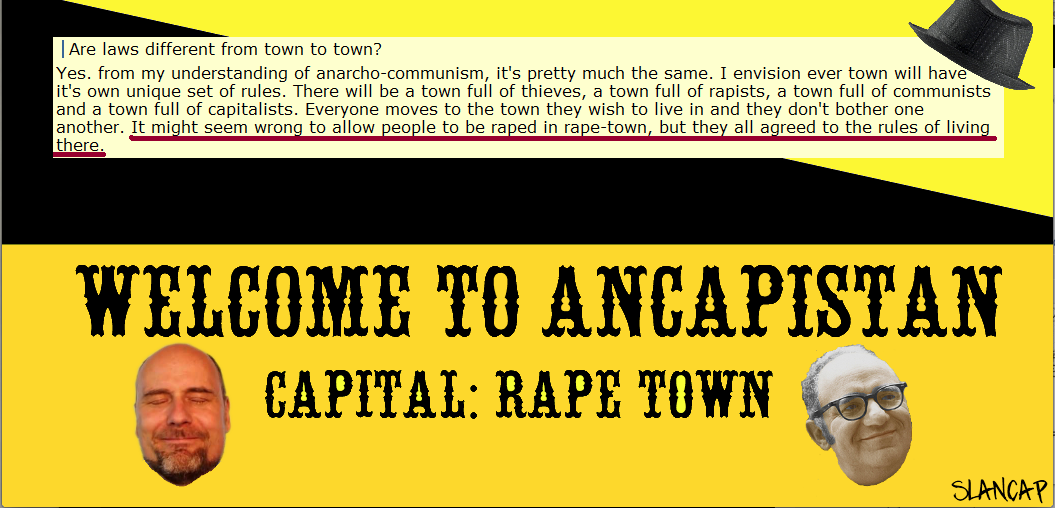
Just to give you an idea of how scary some ‘anarcho’-capitalists envision a stateless capitalist society, remarks were made on a page called ‘AnCap 101’ on Reddit.com: on the comments page answering the questions of ‘Left Anarchist here, can somebody give me some answers?’.  Scroll down to where it says “Are laws different from town to town?”  Thanks to SLANCAP for bringing this to my attention:

Unsaved Preview Document

Here we see how the free market is a dream that eventually turns into a nightmare.

When free market advocates promote deregulation, they aren’t talking about ending government oppression (quite the opposite, as we’ll see): they just want to hog as much money to their avaricious selves as they can.  They wish to annihilate only those aspects of government that they find inconvenient, i.e., socialism.

II–The Tyranny of Work

The next thing my free marketeer friend took issue with was the notion of “the tyranny of work”, as described by Jesse Myerson in the YouTube video.  The quintessential trolling tactic for stifling dissent and ‘winning’ an argument cheaply–through rudeness and emotion instead of through a carefully constructed counter-argument–is epitomized in this cocky retort: “What an ass…what a stupid, stupid man, such a dreamer…”

What can I say, but that I love the smell of ad hominem attacks in the morning.  To the troll, I suppose it smells like victory.

When Myerson spoke of involuntary employment and involuntary unemployment, and of the need to liberate ourselves from that, he wasn’t advocating a world where people don’t have to work at all.  He spoke of coupling the idea of a guaranteed minimal income with guaranteed work, so under socialism we wouldn’t have droves of people living in total idleness, while everything is being produced for them like magic.  Myerson’s idea could be compared to what is being experimented with in Sweden, with the six-hour work-day.

Myerson was advocating a more flexible lifestyle where, of course, people work, but they don’t have to find themselves so chained to their job that they can’t even leave it alone on weekends (e.g. the boss calling you on your smartphone over and over again when you’re trying to enjoy a relaxing weekend with your family).

No socialist in his or her right mind imagines that communism will create a perfect society where we never have any problems.  The way I’ve heard some right-libertarians [i.e., Molyneux] speak, on the other hand, of how free market competition–free of government interference–will naturally cause us [via ‘the invisible hand’] to drift away from buying the products of any companies that we suspect are, for example, racist or exploitative, sounds a lot more utopian…and stupid…to me.

As Myerson says in his Salon article: “For me, communism is an aspiration, not an immediately achievable state.”  Most socialists and communists agree that our ideal is ultimately something far off in the future, when better conditions (i.e., better technology, a post-scarcity economy) will finally be available for the society we want.

The troll imagines that if one doesn’t like one’s job, one can simply quit; and since no one is “raising arms to protect the employer about that”, the bosses are presumably the ones to be pitied in such a situation.

Given the miserable state of the economy over the past six years since the 2008 economic crisis, out of which the world is still only slowly crawling, and may crawl back into if we’re unlucky, the troll’s cockiness–about workers simply quitting undesirable jobs–is bizarre in the extreme.  Is he not aware of how difficult it is to find decent work right now…in his own country, America?

One does not simply quit one’s job during a bad economy, when replacement jobs are scarce.  Even during a strong economy, if one has a limited skill set, quitting a job exposes one to the risk of not finding an adequate replacement, and therefore to the risk of homelessness and starvation.  Socialists knew this reality during the 19th century; socialists know this now; we’ve always known this.

Millions of people in such G8 countries as the US, the UK, and Russia–where the free market is in full swing–are living on subsistence wages; if they even can make ends meet (which they frequently can’t), they can only barely eke it out.  These are people, real people, not just “worker bees for the elite”.

These people do not just work eight-hour, five-day-a-week shifts; they are frequently over-worked and underpaid.  Those working for the current sorry excuse for a minimum wage, far below what they need to earn to survive, are forced to take on extra jobs just to make ends meet.  Then there are those working in sweatshops in the Third World, a world I suspect my troll friend doesn’t know even exists.

Many people in the world work ten or twelve-hour days, if not more, and often on weekends, too–without compensation.  I see engineers in Taiwan, where I’ve lived for almost two decades now, who are experiencing this ongoing problem.  Quitting at best leads to another such miserable job; at worst, quitting leads to starvation, homelessness, and death.

My free marketeer friend is probably thinking about straightforward jobs in the First World, like working in a bookstore; he probably never thinks of how the smartphone or computer he uses to type his anti-socialist rants was put together by overworked, underpaid Chinese, or southeast Asians, in sweatshops, those “worker bees” who barely make enough money to feed their families, and are terrified of being fired.

No one rushes to protect the rights of the employer who must replace workers who quit because, often enough, there are others from the reserve army of labour, eager to take the quitters’ place (an eagerness that comes only out of desperation to find a job).  My parents owned a pancake restaurant back in the 80s, and whenever an employee quit (which was not infrequent), getting a replacement was admittedly a pain.  But to compare that inconvenience to the plight of workers under capitalism is a sick joke.

That plight, as I described above, is essentially what Myerson meant by “the tyranny of work”, or what other socialists call wage slavery.  Capitalists like the troll only scoff at that tyranny, though: they care more about the tyranny of Stalinism and Maoism (more accurately, they gleefully point it out to make straw man arguments and generalizations about all socialism, in order to invalidate it).  Now I must come to my next point.

III–The Sins of State Socialism

Anyone who has done at least a cursory learning of the history of communism has read about the atrocities of the various socialist governments, especially those of Stalin, Mao Zedong, and Pol Pot.  Estimates of the total death toll range from 85 million to 100 million, as the political right portrays it.

It is beyond the scope of this article to do a detailed analysis of what happened during, for example, the collectivization of the USSR during the late 20s and early 30s, and such events as the Great Leap Forward, the Cultural Revolution, and the Killing Fields.  For Maoist and Stalinist perspectives on these events (largely not my views), you can look at Raymond Lotta Takes on Lies about Mao’s Great Leap Forward.  Also, you can read this article in the Monthly Review: Did Mao Really Kill Millions in the Great Leap Forward?  A video by Jason Unruhe (Maoist Rebel News) deals with Stalinism: On The Alleged Deaths in Stalin’s USSR.  Here’s Unruhe’s perspective on the Cultural Revolution.  Here’s more on the Cultural Revolution.  Finally, there’s Unruhe’s video, Truth about Pol Pot and Maoism.

Back to my main argument.

It is not at all my wish to whitewash, trivialize, or rationalize away the deaths that did occur during the above-mentioned regimes, which make up the bulk of the death toll attributed to communism.  For me, socialism is about human rights and justice, the opposite of totalitarianism. Still, there was a lot of ugliness that occurred during those years.

Victims were executed, overworked in labour camps (a chilling irony for a movement dedicated to ending the tyranny of work), or starved to death (though generally as a result of unintended consequences).  These sad chapters in the history of socialism will always embarrass the Left, with the added feature of right-wing propaganda and its Schadenfreude over that embarrassment.

While admitting that terrible things happened, we must nonetheless put these tragedies in perspective, not to excuse them in the least, but to give them a context for better understanding what happened and knowing the world they came from.  Such an understanding will not only show that such evil is neither exclusive nor essential to socialism, it will also, I believe, improve our chances of not repeating those horrors.

First, we must consider the perpetrators; let’s start with Stalin.  He was hardly a garden variety communist: he was a paranoid psychopath, not much different from the despots who preceded him in feudal history.  Many of his victims, by the way, were dedicated communists; Stalin had whole communist parties executed during the Great Purge.  A lack of psychopathy in him would have been a huge improvement, undoubtedly.

Stalin grew up in a Russia inured to tsarist tyranny; autocratic authoritarianism was a norm against which there was hardly an egalitarian alternative to emulate.  Knowing this, we shouldn’t be too surprised that his rule would be gripped with the same fear of losing power as the tsars of the past had.  Any suspicion of treason or counter-revolution would thus inevitably lead to many killings.  The problem is that Stalin, in killing communists as well as wealthy kulaks, took his suspicions way too far.

Furthermore, he deviated from Marxism/Leninism in such striking ways that, in the opinion of many on the Left, he wasn’t a real communist.  (In anticipation of being accused of the ‘no true Scotsman’ fallacy, I will say that yes, I do believe real socialism did exist at one time at least: among the Catalonian anarcho-syndicalists of the Spanish Revolution of 1936; incidentally, Stalin–in his paranoia of the spread of Trotskyism, as well as in his belief that Spain had first to go through a capitalist phase before embracing socialism–betrayed the Spanish communists, hence their defeat by Franco and the forces of Fascism.)

Among the non-communist elements of Stalinism were his use of American private enterprises (such as the Ford Motor Company) to industrialize Russia, under strict state supervision; once the firms had finished their stints, they left, and the USSR took over.  In the opinion of many on the Left, what Stalin and, earlier, Lenin were doing wasn’t real communism–it was a kind of state capitalism.

The most notably non-communist element of Stalinism, however, was the notion of ‘Socialism in One Country‘.  This idea–involving focusing on socialism only in the Soviet Union, while the rest of the world had first to be industrialized and subjected to a capitalist phase before embracing socialism–runs totally against the socialist idea of promoting proletarian revolutions around the world.

Small wonder that the much more genuinely communist Leon Trotsky (the lesser of the Bolshevik evils, in my opinion)–with his notion of ‘Permanent Revolution’ contrasting with Stalinism, as well as Trotskyism’s somewhat more democratic nature–was defeated and even murdered with a blow to the head from an ice ax, held in the hand of a Soviet agent.

Whether Stalinism is genuinely communist or not is a major point of contention among the various factions of the Left: what is of little doubt is that psychopaths’ jealous love of power, a Machiavellian trait, is far from being an exclusively socialist vice.

It is interesting to note that, despite Hitler’s fanatical hatred of communists, he considered the Stalinist Russia of the 1930s to be strikingly similar to the Nazi way of doing things (thanks in no small part to Stalin’s purging the Communist Party of Jews like Trotsky, of course).  Mussolini, too, spoke well of Stalin’s ‘Slavic Fascism’.  The similarity to Naziism is not hard to see: totalitarianism, state capitalism, focusing on one’s own country rather than on internationalism, and the purging of political dissidents and Jews were all hallmarks of Naziism.

Contrary to what some right-libertarians like to believe, though, Naziism and Fascism were not socialist–certainly not in practice.  (Years back, I read Jonah Goldberg’s book Liberal Fascism, and even then wasn’t convinced of his arguments, back when I was sympathetic to conservative ideas.)  The National Socialist German Workers Party may have had left-leaning members in Joseph Goebbels, Ernst Roehm, and Otto and Gregor Strasser, but all left-wing elements were purged from the Nazi Party as soon as Hitler came to power.  With the backing of big business in Germany, Hitler naturally moved the Nazis to the far right; indeed, the first people to be put in the concentration camps were communists, social democrats, anarchists, and other leftists.  National Socialism was capitalist in practice, and that’s what really matters.  Indeed, capitalists on many occasions in history have used Fascism to further their agenda.

And who played a crucial role in defeating Nazi Germany at the end of World War II, thus ending the rising death toll in the concentration camps (which included the deaths of 3.3 million Soviet POWs)?  Stalin’s Red Army, strengthened by the rapid industrialization of his three Five Year Plans!

This leads us to another indispensable point: the good that Stalin did.  His modernization of Russia helped bring the country from a backward, agrarian one to a superpower in a matter of decades (so much for the stereotype of communists who never work).  America, in contrast, took much longer to grow as strong as it did.  Naziism similarly strengthened Germany economically, industrially, and even environmentally, but Hitler’s reckless pursuit of lebensraum, which caused WWII, made this strengthening so short-lived as to be negligible in the face of Nazi atrocities.  Stalin’s successes offset his evils far better, if imperfectly.

As for Chairman Mao, much of the failures and deaths that resulted from his rule can be explained by bad harvests in the late 1950s and early 60s, and by power struggles between his leftist faction and the rightist faction led by Liu Shaoqi and Deng Xiaoping, who made the implementation of Mao’s plans very difficult to say the least.  The death toll, though probably exaggerated by right-wing propaganda, was surely in the tens of millions at least.  That said, we must ask: were the catastrophes of the Great Leap Forward and the Cultural Revolution the fault of communism per se, or of the particular rule of one idealistic but failed leader?

Regardless of whether one chooses to judge these failures as harshly as the Right does, or to mitigate them as many on the Left do, one thing cannot, and must not, be denied (though conservatives always deny it): capitalism’s death toll, by the most conservative of estimates, is at least ten times higher than the highest estimates of the communist death toll.

Now for some real perspective.

IV–Capitalist Crimes

If socialist governments have caused famines, so has capitalism–ultimately, on a much larger scale, in spite of what Steven Rosefielde, author of Red Holocaust, thinks.  An important aspect of capitalism is imperialism; Lenin pointed this out in his essay, “Imperialism: the Final Stage of Capitalism”, as well as in his efforts to get socialists to oppose WWI.  In order to find fresh, new markets, the capitalist must go out to other countries, plunder their resources, and exploit local labour.  America has always done this, as did the British and other European empires in the last few centuries.

In Late Victorian Holocausts, Mike Davis shows how laissez faire and Malthusianism exacerbated food shortages caused by El Nino in the Third World, resulting in famines that killed 30 million to 60 million locals in such countries as India, China, Brazil, Ethiopia, Korea, Vietnam, and the Philippines, back in the late 19th century.  Capitalists gave food only to those with money.  Here’s the free market: a dream for the rich, which turned into a nightmare for the poor.

Also, there was the Bengal Famine of 1943, in which 1.5 to 4 million people died of starvation, malnutrition, or disease.  This happened during the last years of the British Raj, when British authorities refused to help, assuming hoarding was the cause.  Churchill had food diverted from the locals to British troops and Greek civilians.

On top of these and other famines caused by imperialism, millions die of starvation every year, when enough food can be produced to feed the whole world.  This starvation is preventable, and has been preventable, for decades at least; yet food producers don’t want to reduce profits, so the food goes only to people with money.  Ergo, capitalism causes starvation.

(It has been noted in several online sources that there’s enough food produced to feed the whole world, but instead it just gets wasted in the First World.  Here is a Wikipedia source: scroll down to where it says ‘Starvation Statistics’; here’s another source; as I said, there are many other online sources confirming this fact.  This should answer my troll’s question of how it is possible to provide for everybody.  He thinks socialism will result in scarcity, through people living in idleness; but it’s actually capitalism, with its private property, that creates an artificial scarcity.  He says, “You don’t work you don’t eat”, but many work, or try to work, and still don’t eat…or don’t eat enough, anyway.  He may think only a government controlled socialist police state can provide for everybody, and that, apparently, only socialist governments are police states; but many of us on the Left realize that many laissez faire governments have been authoritarian police states: the Pinochet government, the Franco regime, and the US under Bush [with his tax cuts for the rich], and Obama, who may have talked the socialist talk, but is anything but a socialist.  Anyone who thinks Obama is a communist or socialist is clearly, visibly stupid.)

If one calculated the preventable deaths of starvation of the past twenty or thirty years alone, one would already have a death toll much higher than the highest estimates of those who died under communist rule, be they of famine or of execution.  According to this site, over 7.5 million people died of hunger in 2013.  The total number of hungry people gets lower year by year, so in other words, the total number of deaths would have only been higher before 2013.  Check this link (scroll to the bottom) to see how many children have died of hunger over the 1990s.

These are not, however, the only deaths directly or indirectly attributable to capitalism.

We have to consider the many imperialist wars fought over the years, wars exploited by capitalists through various forms of war profiteering.  These profiteers include international arms dealers, scientific researchers (corporations and the state profit from the demand for military technology modernization), commodity dealers (who take advantage of shortages, thereby setting higher prices and getting higher revenues), politicians (who take bribes from corporations involved with war production), civilian contractors (think of Bechtel, KBR, Blackwater, and Haliburton, who’ve supplied coalition forces in the Iraq War and were accused of overcharging for their services), and black marketeers, among others.

Indeed, in his book War Is a Racket (1935), Major General Smedley D. Butler drew on his experiences as a career military officer to explain how business interests commercially benefit from war through war profiteering.  This problem is an old one that’s lasted for decades and decades, thus indicting capitalism further.

With that knowledge, let’s look at some more statistics.  In World War Two, 50 million to 85 million people died.  The number of Iraqi deaths due to the 2003 US invasion are over 1.4 million.  Add to these all the other capitalist imperialist wars after the Russian Revolution, as well as all the deaths from starvation mentioned above, and you already have a much higher total than the 100 million estimate for the victims of communism.

Let’s add to this all the deaths from tobacco; according to the WHO, 100 million people died of tobacco over the course of the 20th century, and 5.4 million deaths in 2004.  Also, according to the Surgeon General’s report of 2014, 20 million people died of smoking over the past 50 years.  This is after a clear link was made between smoking and cancer in 1950 in the UK.  Unfortunately, the tobacco industry seems to think too much about its own profits to care about those addicted to their products.

In other health-related news, since the creation of anti-retroviral drugs for AIDS, the drugs have been denied to millions of AIDS sufferers in Africa, because Big Pharma cares more about profits than people.  10 million Africans died between 1997 and 2003 because they did not get the needed drugs.

We must also consider the cost of capitalism on the environment, something for which there are sources all over the internet and in volumes of books to back up this dire fact (and remember the consensus in the scientific community on global warming); but alas, capitalists experience nothing but cognitive dissonance and denial about these facts.  Despicable.

If executions disturb my troll friend’s sense of morality, he might want to consider how the CIA-backed Suharto regime killed 500,000 to 1 million communists in the mid 1960s.

Now these are only a selection of the many millions of deaths attributable either directly or indirectly to capitalism.  There are also millions more, prior to the 20th century.  I’ve already mentioned the ‘Late Victorian Holocausts’.  There was also the Atlantic slave trade, in which about 10 million blacks died over the course of four centuries; they died of disease on the boat ride across the ocean.  This was all so the plantation owners of the South could profit off of blacks’ totally unpaid, backbreaking labour.

Then there was the killing off (through disease or massacres) of as many as 100 million aboriginals due to European settlement of North and South America between 1492 and 1900.  Capitalism has to expand in order to develop new markets.  Anyone who gets in the way, dies.

Finally, there have been all the strikers and unionists who have suffered violence and deaths over the years (remember how strong unions strengthen productivity, a fact the free marketeers ignore).  One example was the Banana Massacre of 1928 in Colombia, in which 2,000 to 3,000 workers were killed.  Anti-union violence in general can be read about here.   Here we see capitalism growing out of the barrel of a gun.  If socialism uses force, capitalism does so even more.

(Now, any capitalist reading this may doubt whether these deaths I’ve described can justifiably be all attributed solely to capitalism, as opposed to other factors.  Such critics may want to remember that while they can make excuses for these deaths, and in attributing non-capitalist factors to many of the deaths, they can thus reduce the total, Leftists can play the exact same reduction game with the 85 million to 100 million death count blamed on communism.)

V–Ignorance Is Strength

Of course, no anti-socialist diatribe can be complete without quoting George Orwell out of context.  (It is indeed nauseating how the Right misuses Orwell to advance their agenda.)  Since the anti-socialist troll wasn’t letter perfect in his quote, I’ll correct it here: “If you want a picture of the future, imagine a boot stamping on a human face, forever.”

Yes, I’ve read Nineteen Eighty-four, too (twice, actually; I’ve even lectured on the novel).  I’ve read (and lectured on) Animal Farm more than once, too.  I’ve also read another of Orwell’s works: Homage to Catalonia.  In that non-fiction book, Orwell recounts his experiences fighting against the Fascists during the Spanish Civil War.  When he got to Spain, he was quite impressed by what he saw–a town where socialism was being practiced:

“It was the first time that I had ever been in a town where the working class was in the saddle.  Practically every building of any size had been seized by the workers and was draped with red flags or with the red and black flag of the Anarchists…Every shop and cafe had an inscription saying that it had been collectivized…There was much in it that I did not understand, in some ways I did not even like it, but I recognized it immediately as a state of affairs worth fighting for.”

When Orwell wrote Animal Farm and Nineteen Eighty-four, he wasn’t attacking socialism per se, which he ardently supported.  He was attacking Stalinism, Fascism, and totalitarianism in general, which he had just experienced in a big way not only during the Spanish Civil War (see above for Stalin’s betrayal of the Spanish leftists), but also saw during World War Two, with the onslaught of Nazi Germany.  Orwell was a believer in democratic socialism, which has always existed alongside communism.  Yes, my free marketeer friends, there actually is something called democratic socialism.  Now I’m no supporter of social democracy any more than I am of state communism; but the very existence of social democracy should ultimately show how wrong-headed my right-wing friend’s understanding of socialist ‘totalitarianism’ is.

Furthermore, if it’s government that is the real evil, and if that troll insists that socialism always equals government, then I have one word to say to him: anarchism.  This form of socialism is the one I espouse, and like Orwell, I too am impressed with the anarcho-syndicalist socialism I’ve read about during the Spanish Revolution.

As an anarchist, I’m opposed to all forms of authoritarianism.  I oppose the authoritarianism of government (the tyrannical sort, or the pampering sort social democrats offer, often at the expense of the Third World).  I oppose the authority of vanguardism (hence, even if the Right is correct to damn Stalinist and Maoist communism as harshly as they do, it makes little difference to me).  I oppose the illegitimate authority of one sex or racial group over another, and that of any privileged group over another, especially that of bosses!

I believe that the means of production should be held firmly in the hands of the workers, neither in those of private owners, nor in those of the state.  And that brings me back to my definition of socialism: it isn’t totalitarian tyranny, it isn’t about extensive government intrusion in our lives, and it isn’t any more about forcing one’s agenda on the populace than capitalism is.  It’s about social justice.  It’s about sharing.  It isn’t the right-wing definition of socialism, but it is, by any reasonable standard of objectivity, the right definition of socialism.

(If you liked what you just read, please sign up for my free newsletter.  A link to it is at the side of this page.)