Analysis of ‘The Godfather’

The Godfather is a trilogy of films by Francis Ford Coppola, written by him and Mario Puzo, based on Puzo’s 1969 novel. As a trio of crime dramas, its depiction of the mafia is understood to symbolize general corruption in American politics, though I will be carrying my analysis far beyond just that. I will be focusing on the first two films, generally considered to be two of the greatest films ever made; while Part III, being good only in parts (and I don’t think mine is a minority opinion), will be touched on more lightly. I’ll also discuss parts of Puzo’s novel.

In general, the social, political, and economic critiques in The Godfather are those of hierarchy and authority. Mafia families represent competing capitalists, and the Corleone family in particular represents the traditional patriarchal family. Mafia Don Vito Andolini, who would change his surname to Corleone (‘Lionheart’), the name of the town in Sicily where he was born, has “all the judges and politicians in his pocket,” as so many US billionaires do in today’s neoliberal world. Here we see the source of corruption in American politics, or the politics of any other country: capitalism’s use of the state to protect its interests.

Here are some famous quotes from all three movies:

Part I

“Bonasera, Bonasera. What have I ever done to make you treat me so disrespectfully? If you’d come to me in friendship, then that scum that ruined your daughter would be suffering this very day. And if by chance an honest man like yourself should make enemies, then they would become my enemies. And then they would fear you.” –Don Corleone

“I’m going to make him an offer he can’t refuse.” –Don Corleone (ranked #2 in American Film Institute’s list of the top 100 movie quotations.)

“It’s a Sicilian message. It means Luca Brasi sleeps with the fishes.” —Tessio

“Leave the gun, take the cannoli.” –Clemenza

“It’s not personal, Sonny. It’s strictly business.” –Michael

“Times have changed. It’s not like the old days when we could do anything we want. A refusal is not the act of a friend. Don Corleone had all the judges and the politicians in New York, and he must share them. He must let us draw the water from the well. Certainly, he can present a bill for such services. After all, we are not Communists.” –Don Barzini

“Only, don’t tell me you’re innocent, because it insults my intelligence. It makes me very angry.” –Michael, to Carlo

Part II

“There are many things my father taught me here in this room. He taught me: keep your friends close, but your enemies closer.” —Michael (the bolded portion is ranked #58 in the American Film Institute’s list of the top 100 movie quotations )

“If I could only live to see it, to be there with you. What I wouldn’t give for twenty more years! Here we are, protected, free to make our profits without Kefauver, the goddamn Justice Department and the F.B.I. ninety miles away, in partnership with a friendly government. Ninety miles! It’s nothing! Just one small step, looking for a man who wants to be President of the United States, and having the cash to make it possible. Michael, we’re bigger than U.S. Steel.” –Hyman Roth

“I know it was you, Fredo. You broke my heart. You broke my heart!” –Michael

“Fredo, you’re nothing to me now. You’re not a brother. You’re not a friend. I don’t wanna know you or what you do. I don’t wanna see you at the hotels. I don’t want you near my house. When you see our mother, I want to know a day in advance, so I won’t be there. You understand?” –Michael

“Oh, Michael. Michael, you are blind. It wasn’t a miscarriage. It was an abortion. An abortion, Michael! Just like our marriage is an abortion. Something that’s unholy and evil. I didn’t want your son, Michael! I wouldn’t bring another one of your sons into this world! It was an abortion, Michael! It was a son, Michael! A son! And I had it killed because this must all end! I know now that it’s over. I knew it then. There would be no way, Michael… no way you could ever forgive me, not with this Sicilian thing that’s been going on for 2,000 years!” –Kay

“Tom, you know you surprise me. If anything in this life is certain, if history has taught us anything, it’s that you can kill anyone.” –Michael

Part III

“No, I don’t hate you, Michael. I dread you.” –Kay

“Finance is a gun. Politics is knowing when to pull the trigger.” –Don Lucchesi

“Just when I thought I was out, they pull me back in.” –Michael

“Your sins are terrible, and it is just that you suffer. Your life could be redeemed, but I know you do not believe that. You will not change.” –Cardinal Lamberto, to Michael

The first movie begins with Amerigo Bonasera, an undertaker whose daughter has been beaten by two men who attempted to rape her. Though he begins by saying, “I believe in America” (i.e., ‘the land of the free’), he quickly learns how corrupt the judges are when one of them gives her attackers a suspended sentence, allowing them to go free that very day. Now that he knows that might makes right in America as much as it does everywhere else, he comes to the mafia for ‘justice’, to have them killed.

This corruption of justice is similar to how social services offered by the state decline in effectiveness due to corruption or insufficient funding from taxes, then (as Noam Chomsky once pointed out) we go to the private sector for these services, which are given only for a price, as Don Vito will expect a favour in return one day from Bonasera for beating up his daughter’s attackers. After all, Vito is only a moderate mafioso/capitalist, who knows that killing the “scum that ruined [Bonasera’s] daughter” isn’t justice, since she’s still alive.

Bonasera, in his naïveté about how the mafia does things, assumes he can simply pay Vito to have his soldiers murder her two attackers. Having unwittingly insulted Vito, Bonasera learns the importance of getting Vito’s “friendship”, which leads to the beating up of the two men “as a gift on [Vito’s] daughter’s wedding day.” This friendship shows the hypocrisy in the Corleone family, in how they try to pass themselves off as decent people, always keeping up appearances, the way the bourgeoisie does in general.

The juxtaposition of Bonasera’s failed attempts at protecting his daughter with the wedding day of Vito’s daughter Connie, is an interesting one. In the traditional patriarchal family, a girl’s marrying into another family involves her father giving her away to her husband-to-be, an old protector being replaced by a new one. Throughout most of this scene, Vito is so busy granting requests that he can rarely, if ever, leave his office and participate in the wedding party outside. After all, no Sicilian can refuse a request on his daughter’s wedding day, symbolizing the honour and love he has for her.

Here we see the contradictions inherent in the patriarchal family: the overzealousness with which ‘our girls’ must be protected leads to a failure to protect them; Vito’s symbolic honouring of his daughter by granting all wishes on her wedding day leads to his hardly ever being with her until the end of the party, a symbolic failure to protect. Similarly, he does nothing to help Connie when her husband Carlo beats her later, rationalizing (in the novel, Book IV, Chapter 16, page 238) that she should submit to Carlo’s authority, and saying the rest of the family shouldn’t interfere with her and Carlo’s private business (an attitude Vito’s wife, Carmela, agrees with).

Bonasera has been very lax in his protection of his daughter, allowing her to stay out late drinking with the two men who assault her; but the failure to protect Connie, coupled with overzealous protectiveness, is symptomatic of the failure of the Corleone family to protect themselves in general, as we’ll explore later.

The corruption that the mafia represents extends to Hollywood, where movie producer Jack Woltz is intimidated into giving a role to Johnny Fontane, a singer/actor the producer hates for having made him look bad. The corruption Woltz represents is seen in his lecherous taste in underage girls, one of whom we learn has been in his bedroom when consigliere Tom Hagen has visited (this lechery is evident in the novel, Book I, Chapter 1, pages 62-63, and in one deleted scene in the movie).

All of the mafia families represent competing capitalists, but Don Corleone is only a moderate capitalist, wanting nothing to do with the heroin business Virgil Sollozzo wants to bring into New York. The Tattaglia family, as well as that of Barzini, wanting Corleone to share his political and police protection so they can get in on the new heroin business, represents the expansion and accumulation of capital, and its growing evil.

The conflict of interests between the Five Families, with Corleone’s on one side and the other four opposing him, represents the contradictions inherent in capitalism. The war that erupts between the Corleone and Tattaglia families symbolizes those contradictions escalating into an economic crisis, for indeed, as the war continues, Tom warns Sonny, who is acting Don while Vito’s in hospital, that business is suffering. Similarly, Clemenza tells Michael that these wars have to happen every (five or) ten years or so…the same time period that, sans Keynesian state interventions, usually comes between economic crises. The violence and killings can thus be seen to symbolize the suffering caused by capitalism’s instability.

Capitalists typically deny malicious intent, as do these gangsters. Sollozzo tells Hagen,”I don’t like violence, Tom. I’m a businessman. Blood is a big expense.” Sonny, Tom, and Michael all repeat the mantra that this mob violence is nothing personal–it’s just business…when Michael’s wish to kill Sollozzo for trying to have his father killed, as well as the corrupt cop McCluskey for breaking his jaw, is clearly personal (see also the novel, Book I, Chapter 11, page 145).

Indeed, bringing Michael into “the family business”, when he was originally intended by Vito to be a senator or governor in the “legitimate”, respectable part of society, shows how capitalism seeps into everything, a corruption we’ll continue to see spreading through the rest of this movie/novel and its sequels.

Michael goes into hiding in Sicily, where he wishes to see the town of Corleone, to get a sense of his family roots. Here we see beautiful countryside as well as simple town life, a pleasant contrast to the harsh modern life of New York City. This idyllic life suggests how the world was before capitalism grew into the monster it is today.

Still, there are dangers in Sicily that Michael must be wary of. Apart from all the deaths from local vendettas, the Italian-American mafia is trying to find and kill him in revenge for Sollozzo and McCluskey. This symbolizes how capitalism, in an earlier stage of development, is creeping into rustic Sicilian life, as it had in the enclosures of the Commons in 18th-century England. On the other hand, a deleted scene in the movie shows a group of communists marching about Sicily, hoping to recruit new members. Fleeting references to communism appear here and there in the first two movies, like a spectre haunting Europe, America, and Cuba. The class war is growing.

Meanwhile, back in America, Sonny learns that Carlo, sore that he’s being excluded from the family business, has beaten up Connie. Though Sonny has previously been warned not to interfere by his mother, echoing Vito’s insensitivity to Carlo’s increasing abusiveness, the hothead beats up Carlo, warning he’ll kill him if he ever hurts Connie again. The intensity of the beating that Sonny gives Carlo shows the dangers of zealous over-protection, since violence only begets more violence. Indeed, Carlo plots with Barzini to have Sonny gunned down, and beats up Connie to lure Sonny to his death.

Vito, still the moderate gangster, wants no revenge, but instead arranges a meeting of the Five Families to end the war. Barzini and Tattaglia complain about Vito’s refusal to cooperate in the new heroin business, which would have resulted in giving the other families police protection. But we learn that “times have changed”, and police and politicians now can be bought to ensure safety from prison in the new drug business. At one point, Barzini reminds us that the mafia “are not communists.” Of course not: mafia are capitalists…and capitalists are mafia; that’s what The Godfather is all about.

One significant part of the class conflict caused by such systems as capitalism is racism. Earlier, Sonny mentioned how “Niggers are having a good time with [Corleone] policy banks in Harlem”. During the meeting of the Five Families, Don Stracchi says his men leave the drug trafficking among “the dark people, the coloureds. They’re animals, anyway, so let them lose their souls.” The others at the meeting seem to agree to this arrangement, and ‘peace’ is achieved between Corleone and Tattaglia.

Michael returns to America, and is now the new Don of the Corleone family, Vito having retired. Michael meets Kay, his old American girlfriend, and asks her to marry him. While he gives an empty promise that the Corleone family will be “completely legitimate” one day, he also tells her the cynical reality that senators do have men killed, just as the mafia does. Of course they do: politicians do much of the dirty work of capitalists, because the state works for capitalism…even though right-libertarians promise that a laissez-faire form of capitalism will purify the market of state corruption. But instead, when Michael has the other heads of the Five Families all killed, and he becomes the sole mafia head in New York, we see symbolically how laissez-faire, in wiping out competition (thanks to the tax cuts and deregulation that give large corporations an unfair advantage over small businesses), leads to the very crony capitalism, or monopoly capitalism, it claims it will eradicate. (For a thorough discussion on how that happens, look here.)

The killing of all those men happens in a particularly chilling way: Michael is standing as godfather to Carlo’s and Connie’s baby, telling the priest in the cathedral that he does “renounce Satan”, and that he believes in God the Father, Jesus, His Son, and the Holy Spirit! ‘Godfather’ is a perfect name for this movie, as well as for Vito and Michael, for it exemplifies the authoritarian nature of the mafia, of capitalism, of religion, and of the traditional patriarchal family, all in one fell swoop. This scene, in which Michael ruthlessly pretends to be a good Christian while knowing full well that a bunch of people are about to be brutally murdered (Stracchi, shot in an elevator by Clemenza; Moe Greene with a bullet in his eye; Cuneo, shot by Cicci in a revolving door; Barzini, shot by Al Neri-who’s dressed as a cop [in the novel, he’s a former cop who used to beat people with a large flashlight–Book VIII, Chapter 30, pages 413-414]; and Tattaglia, shot in bed with one of his prostitutes, by Rocco Lompone), starkly shows the hypocrisy of the bourgeoisie in its pretence of virtue.

To top everything off, when Michael tells Carlo these men were all killed by his orders, he tells Carlo that he has “settled all family business.” Just like a capitalist. And having promised he won’t make Connie a widow, Michael has Carlo garrotted by Clemenza.

With the Corleone move to Las Vegas, hence the killing of Moe Greene, we see how capitalism expands and accumulates, wiping out the competition. First, there was the Genco Olive Oil business in New York; now, there’s the gambling business in Nevada.

Though one would imagine Connie to be grateful to her brother for ridding her of her abusive, adulterous husband, she’s in tears and furious with Michael. When she tells Kay about the murders of the other heads of the Five Families, saying, “That’s your husband! That’s your husband!”, frowning Kay asks him if it’s true. He lies and denies it, of course, and the first movie ends with her frowning, suspecting the lie. An outtake shows Kay in church lighting candles, and the novel ends with her praying for Michael.

Part II begins with Vito Andolini as a nine-year-old boy in Corleone, Sicily. His whole family gets killed by the local mafia, whose chieftain is Don Ciccio, and he must leave before they find and kill him. He emigrates to New York.

The smaller mafia of Corleone, like the family Vito establishes in New York, can be seen to represent the early stages of capitalism. The scenes that follow his rise (also in Puzo’s novel, Book III, Chapter 14) alternate with scenes of the continued story of Michael as Don of his father’s family. These contrasting scenes symbolize capitalism’s seemingly benevolent beginnings and ugly maturation.

In late 1950s Nevada, we see Michael’s growing business empire. We also see more of the pretence of respectability in the party celebrating his son’s First Communion at Lake Tahoe. Michael meets with Senator Pat Geary about getting a gaming licence. In a combination of prejudice against Italians and a disgust with mafia corruption (though he’s no better), the senator wants an exorbitant bribe for the licence; he also bluntly insults Michael’s family to his face. Michael, always one to defend his family and their honour, insists that the hypocrisy of his business and Geary’s government doesn’t apply to his wife and children. Their innocence is always protected: that’s why the family business is never discussed around them…even though they know full well that Michael’s business is anything but innocent.

Geary’s wish “to squeeze” Michael could be seen to represent the agenda of left-leaning or social democratic governments, which tax capitalists as much as possible. Indeed, the post-war world seen in The Godfather, Parts I and II, and continuing up till the 1970s, saw the rich being taxed much more than they are today. Geary’s later hypocritical praise of Italian-Americans during Michael’s trial can be seen to indicate the phoney, would-be egalitarianism promoted by the politically correct aspects of the left, always expressing sympathy for the darker-complexioned, but typically leaving the Third World in the lurch.

When Geary is caught in a Fredo-run whorehouse with a bloodily murdered prostitute (apparently killed by Al Neri to blackmail Geary into helping the Corleone family), he is assured by Tom Hagen that he is safe. From then on, Geary is fully on Michael’s side. Here we see a symbolic indication of how the capitalist class can get even ‘left-leaning’ politicians to represent right-wing interests, as would happen increasingly with the Clintons and the Democratic Party in America, and with Tony Blair in the Labour Party in the UK.

Meanwhile, we have the usual capitalist contradictions symbolized in the competing families of Michael, Pentangeli, and Hyman Roth, as well as the Rosato Brothers. Racism and capitalism tend to go hand in hand, hence Pentangeli’s antisemitic attitude towards Roth and his use of racial slurs against blacks and Hispanics.

When an attempt is made on Michael’s life, in his and Kay’s bedroom, he quickly crawls over to her, covering her body with his. Here we see one of the main purposes of sex roles: the male obligation to protect women, the nucleus of matriarchy within every cell of the traditional patriarchal family (the dialectic of the sexes), which is seen elsewhere in Michael’s preoccupation with whether or not the unborn child in Kay’s womb is a boy.

We see the spread of capitalism represented in the presence of mafia families in Nevada (Corleone), New York (young Vito and Pentangeli), Florida (Roth), Sicily (Ciccio), and Cuba, where Michael and Roth meet with Fulgencio Batista, who felt no discomfort allowing foreign capitalists, including the American mafia, to exploit his impoverished people. Interestingly, this visit to Cuba happens when Fidel Castro’s communists take over.

On the night when the Cuban Revolution prevails, around midnight on New Year’s Eve/Day in 1959, all the capitalists, including Michael and his older brother Fredo, must get off the island. Music (<<at 2:30) reminiscent of an early section of Stravinsky’s Rite of Spring (a ballet about a human sacrifice) is heard, suggesting the brutality of the material conditions necessary to bring about revolution: the brutality of the extreme contradictions of capitalism that cause the whole system to come tumbling down.

And indeed, brutal contradictions reach even to the extent of the Corleone’s family’s integrity, for Michael has learned who the traitor in his family is, the one who made a secret deal with Roth and Johnny Ola–Fredo. This indicates one of the main themes of Part II: betrayal.

Pentangeli feels betrayed by Michael, since Michael’s business dealings with “that Jew” Roth undermine Pentangeli’s ability to deal with the Rosato Brothers; Roth feels betrayed by Michael, his business partner, when he’s learned that Michael gave the order to kill Moe Greene, a fellow Jewish gangster. Michael feels betrayed not only by Fredo, but by Kay when she tells him the unborn male child in her womb didn’t die of a miscarriage, but was aborted (the look of rage on Al Pacino’s face here is, in my opinion, some of his very best acting). Michael ultimately betrays his whole family by having Fredo killed by Al Neri, who mercifully allows him first to do a ‘Hail, Mary’ prayer.

Once again we see, in the Corleones’ overzealous wish to protect the family, they end up killing their own.

Kay aborts the son out of a wish to end the mob violence; Michael has Fredo killed out of a wish to punish and therefore deter treason. This self-destructive cycle of violence and revenge can represent the contradictions of capitalism: the excessive lust for profits (a wish to protect oneself financially) creates huge wealth inequality and imperialist wars (symbolized by all the mafia violence), resulting in the poor not being able to buy much of anything, stopping the circulation of money and commodity exchange, and leading to financial crises.

Going back to the story of young Vito, he must deal with Don Fanucci, The Black Hand, who can be seen to represent either a competing capitalist or the feudalism that preceded capitalism. There was never any feudalism in American history (apart from British hegemony over the early American settlers, provoking the American Revolution), of course, but we’re discussing the language of symbol here. Vito’s killing of Fanucci (who, like feudal lords’ taxing of their vassals and peasants, wants a cut of Vito’s money in exchange for his ‘protection’) can thus be compared to bourgeois uprisings like the French Revolution in 1789, or the one that brought about the Republic of China in 1911.

As Vito’s mafia family rises in power, including the creation of his Genco Olive Oil Company in the 1920s, we see his benevolence towards an old lady whose landlord wants to evict her. This kindness and growth in power are comparable to the generosity that the bourgeoisie claims to have; they justify their class privileges by pointing out the raised standard of living they create (while neglecting to mention how they alone enjoy the vast majority of the benefits of that economic growth); they also talk about donating to charity, instead of trying to change society’s material conditions, such that charity becomes no longer necessary.

Estes Kefauver’s investigations into the mafia in the 1950s are reflected in Michael’s trial. The state’s attempt to put him in jail can be compared to the postwar period in American history when greater state regulation, including higher taxes for the rich, reduced income inequality and produced a large middle class. But Michael manages to beat Questadt, who is working for Roth, by implying a threat to the life of Pentangeli’s brother (who has just flown in from Sicily) if Pentangeli testifies against Michael. Symbolically, this shows that, even when capitalism is regulated by the state (or because it is regulated, because of competing interests–i.e., Roth), it is still corrupt to the core. Nothing can reform it.

In spite of this ever-present capitalist corruption, some communists have acknowledged the necessity of a capitalist stage superseding feudalism, before the world is ready for socialism. The temporary period of young Vito’s benevolent bourgeois rule can be seen in this light; but by the time Michael takes over, the oppressiveness of capitalism can no longer be ignored.

In Part III, we see Michael about twenty years after the end of Part II, racked with guilt and trying to redeem himself by going completely legitimate at last, after years of failing to keep this promise to Kay, whom he’s divorced. His wish to control International Immobiliare, a real estate holding company known as “the world’s biggest landlord”, must have no mafia connections at all. To his dismay, he learns that those involved in Immobiliare, such as Lucchesi, are either mafiosi or are connected with them…including the Vatican. A cigarette-smoking archbishop named Gilday, who attempts to swindle Michael out of his money, symbolizes Church corruption.

Elsewhere, Michael meets a good man of God, Cardinal Lamberto, who receives Michael’s tearful confession; though, like Hamlet’s uncle Claudius, Michael cannot repent, since to do so necessitates giving up his money and power, as well as being incarcerated for his crimes. Lamberto is Pope for a brief time, then a plot by Archbishop Gilday, Lucchesi, and Keinszig results in him being served poisoned tea.

Michael’s gifts to charities, as generous as they are, also cannot redeem him. Kay watches his show of goodwill, and is disgusted at the hypocrisy she sees. She actually prefers him as a common hood; his pretence as an ‘honest’ businessman makes him even more dangerous now. As we can see, all attempts to reform and legitimize capitalism fail, for it is inherently criminal. It always has been, and it always will be.

And again, try as Michael might, he cannot protect his family from danger; he tries to get out of the mafia, and they pull him back in. He wants Vincent Mancini to stay away from his daughter Mary, Vincent’s cousin, for her safety, but she is shot and killed. Finally, Michael dies alone in the garden of a Sicilian villa as an old man. The self-destruction of capitalism and authoritarianism is complete.

Mario Puzo, The Godfather, Signet Fiction, New York, 1969 (30th anniversary edition)

Neoliberalism’s Unwitting Dupes

Introduction

About half a year before the beginning preparations for this essay, I published another called The ‘Right’ Definition of Socialism?  I received a generally positive response to it (from the few who actually read it); about the only criticisms I got from it at the time were my clumsy conflating of the terms ‘social democracy’ and ‘democratic socialism,’ as well as my far-too-facile description of the Nordic model as socialist (social democratic was what I meant), when the Scandinavian countries’ political and economic systems would be more accurately described as hybrids of capitalism with strong welfare states.  Oh, well: no blogger is perfect.

I did get one other criticism, though.  It came from a free marketeer who, in a brief rant, called my arguments “silly”; apparently fond of that word, he used it several times in the paragraph he typed.  From what I gather, he’d read only to the passage where I said, “we’ve been drowning in [laissez-faire] for over thirty years,” and decided that what I’d been arguing was so “silly” that he didn’t need to read any further, where I would eventually explain what I meant, namely, that the ‘free market’ has been increasingly dominating world politics and economics since the 70s and 80s.  No criticism of what I said later was ever mentioned.  So, he probably read about one-fifth of my essay, and felt he knew my entire argument just from having read that much.  Hmm…

What was the basis of his judgement that my line of argument was “silly”?  As any ‘anarcho’-capitalist will tell us, it is “impossible” (his word, I must emphasize) for the free market and the state to coexist; bear in mind that later in my essay, I not only explained how they can coexist, but also must coexist.  He addressed none of that section in his rant, hence my very safe assumption that he never read that far (unless his cognitive dissonance conveniently blotted out that part from his memory).

He then accused my writing style of having been full of “histrionics”: now I’m aware that I’d used exclamation marks and italics occasionally, but I’m not aware that my arguing had involved histrionics (just as I suspect he wasn’t aware of his own histrionics in his rant against me).  I’ll leave it to you, dear reader, to judge whether my writing of that essay, as well as this one, is a flurry of “histrionics”.

He finished off his rant by dropping a number of names of writers for me to read, and therefore enlighten my terribly uninformed mind.  I’m afraid I never bothered to commit those names to memory, so I suppose I’ll never enjoy that enlightenment (perhaps if he’d simply told me what insights those writers had for me, instead of just giving me a reading list, I would have been more convinced of his point of view, one that, frankly, was even more weakly argued than the one I’d got from the Facebook troll who inspired my last essay).  Therefore, still shrouded in ignorance, I will respond to his position in this essay.  After all, the following arguments, already largely dealt with in my previous essay, obviously must be given with more emphasis and elaboration to cut through all that cognitive dissonance.

I: Not a Laughing Matter

It is easy to laugh at right-libertarians and their naive, ill-informed opinions, but there’s actually a danger with so many people thinking the ‘free market’, with its ever-increasing deregulation and ending of provisions for the poor and disadvantaged, is the solution to contemporary problems.  More chimeric still is the idea that the free market will end crony capitalism instead of intensifying it.  This delusion of free marketeers only adds to the neoliberal agenda.

On Facebook pages like Still Laughing at ‘Anarcho’-Capitalism (SLANCAP) and Ancap vs. Ancom Debate, anarcho-communists (an-coms) and anarcho-syndicalists like me, indeed, laugh at the ideology of ‘anarcho’-capitalists (an-caps), who really should just call themselves capitalists or free marketeers, since, as I explained in my previous essay, and will again explain below (for such is an-caps’ adamant refusal to listen that these explanations must be ever repeated), anarchism and capitalism cannot coexist.

Now, Martin Luther used to propose laughing at the Devil to make him go away; but the advocacy of capitalism is a kind of ‘devil’ we leftists cannot get rid of merely by laughing at it, as the admins of SLANCAP have observed of every annoying an-cap troll on that page.

However clownish my comrades and I may find the free marketeers’ feeble attempts at logic, churned out like so many fetishized commodities, we must remember that those fools are really the useful idiots of the very cronies they claim to be opposed to, as I will try to prove.  It doesn’t matter how well we can out-argue them: they are unwittingly helping the mindless capitalism that is destroying everything.

II: The Relationship Between the State and Capitalism

An-caps dream about a stateless capitalist society, but anyone with a brain knows such an idea is beyond utopian.  Capitalists need the state, its laws, and police enforcement to protect private property.  This isn’t rocket science: it’s common sense, and it is why many socialists are also, like me, anarchists…the genuine kind.

On the other side of the coin, if the state seizes control of the means of production (nationalization), instead of the workers taking control (as we anarcho-communists would have it), capitalism still wouldn’t disappear.  Instead, the state would simply become the new capitalists.  The socialist state might use government revenue generously and create universal healthcare and education, as well as other welfare programs to help the poor, but the state would still be the new boss.  Indeed, Milovan Dilas’s New Class theory is all about how the bureaucratized Soviet Union created a new ruling class (the Nomenklatura) in spite of its promise to create a classless society.  Similarly, countries with mixed economies can each be seen as a kind of state capitalism, with their mix of private and state control of the means of production.

So as we can see, the state and capitalism are always together in some form or another.  They are eternal lovers, and so to get rid of the one, we must get rid of the other.  Both Romeo and Juliet must die.  Even Marxist-Leninists, in a way, imply an acknowledgement of this reality in their theorizing.  Once all capitalist societies around the world are annihilated, all the transitional socialist states–set up to replace the dictatorship of the bourgeoisie with that of the proletariat–will become superfluous.  The state won’t be abolished, Marx and Engels say, it will die out.  It will wither away.  No more capitalism, so no more state.

The common explanation given by the average an-cap to explain our current–and ongoing–political and economic woes is to claim that the cause isn’t capitalism per se, but rather ‘crony capitalism,’ or ‘corporatism.’  To leftists, such verbiage is redundant.  Now for the an-cap, the solution isn’t to eradicate capitalism, but to ‘purity’ it somehow.  As the free marketeer sees it, the current incarnation of capitalism is controlled by the state, and therefore corrupted.  What he cannot see is that he has the problem upside-down: it is capitalism that is directing the state; this is how things have been ever since capitalism emerged and began replacing feudalism several centuries ago.

An-caps imagine that the solution to our problems is to have free market capitalism, something they bizarrely think has never truly existed.  Supposedly, if the state exists, and with it taxes, regulation of the economy, and the like, then ‘real’ capitalism never has existed.  This is a would-be clever evasion of responsibility for all the havoc capitalism has caused around the world, except for the fact that no leftist is buying such a disingenuous excuse.

Of course, every benefit of the modern world that we enjoy–every convenience, our smartphones, our computers, and all our other forms of the latest technology–is the creation of a capitalism that ‘has never existed,’ rather than made by over-worked, underpaid factory workers; so we socialists are hypocrites, apparently, for making use of such technology (the fact that socialists need to participate in this economic system in order just to survive, apparently, is no excuse).  But I digress…

More to the point, though: why should we believe that the solution to our woes is an intensification of the same neoliberalism we’ve already been increasingly enduring for the past thirty-five to forty years?  Now we must understand what the ‘free market’ really is.

III: What Is the Free Market?

An-caps subscribe to a predictably simple-minded definition of the free market, and therefore of capitalism in general: the total absence of a state, leaving businesses to buy and sell freely, and to compete fairly, without any government favouritism.  We would thus have a level playing field, where employers and employees make ‘voluntary’ agreements: bosses can pay their workers as little as they like, and make them work as long a set of hours as they wish.  Workers would be content in this Never-never land, or if not, they would be ‘free’ to quit and perhaps start their own businesses…though how they would get such an opportunity, with such small scraps of a salary, is never explained.  Still, we’re expected to buy into this idea uncritically and think, What joy!  What bliss!  Indeed, I can see Julie Andrews now, twirling in an Austrian (!) field, singing, “The hills are alive with the sound of markets!”  (I hope my histrionics aren’t irritating you too much, dear reader.)

What makes this definition so ridiculously obtuse is not so much its Randian utopianism, but also its dichotomous absolutism, with black capitalism on one side and white centralized government on the other.  The truth is that the free market and regulation exist on a continuum of varying shades of grey: sometimes more regulation, sometimes less.

Furthermore, it isn’t a matter regulation per se: regulation is a matter of which things ‘ought’ to be regulated, and which not.  Is it regulation for the sake of workers’ rights?  Is it regulation to stop businesses from harming the environment?  Or, as in the case of regulating against monopolies, is it regulation for the sake of fairness in the market?  That latter kind of regulation can prevent the crony capitalism that an-caps claim only an absolutely free market can prevent.

What must be emphasized, ultimately, is that there is no one objective definition of the free market.  With varying extents of regulation or deregulation appealing to different capitalists’ or socialists’ needs, how could there be only one?

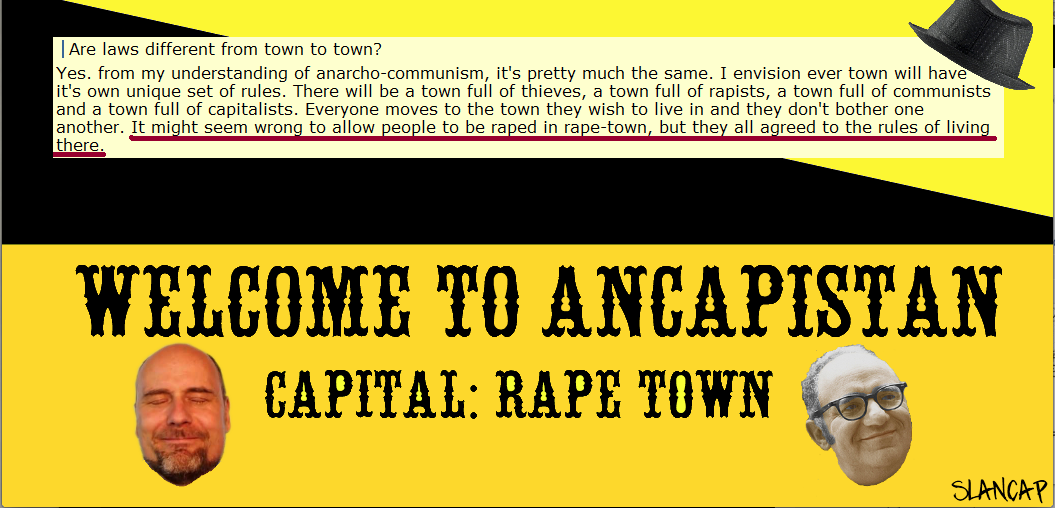
I don’t subscribe to this writer’s proposed solutions to our economic problems by any stretch of the imagination, but as Ha-Joon Chang relates in his book 23 Things They Don’t Tell You About Capitalism, regulations are like the invisible strings holding up kung fu fighters in movies: we don’t see them, but they’re still there (see pages 3-6, Penguin Books, London, 2010).  Many of the laws that we consider humane today, such as those against child labour, were considered unjust from the point of view of free market advocates in the 19th century.  Do an-caps want to return to that kind of barbarism?  Judging by the not only callous but outright bizarre comments made by an-caps about allowing rape or murder in a stateless society, it doesn’t seem too much of a stretch to assume that many of them do want such a return (In my previous essay, The ‘Right’ Definition of Socialism?, scroll down to the SLANCAP meme to see what I’m getting at.).

Unlike the regulations analogous to the invisible strings of movie kung fu fighters, though, there are other regulatory strings that are more like the strings on UFOs in low budget movies: strings obvious to most people, but always missed by an-caps, those Ed Woods of politics.  How would a stateless capitalist society be able to protect the capitalists’ private property?  Regardless of one’s attitude towards the validity or invalidity of ‘property rights,’ surely common sense would cause even advocates of private property to realize that a state, its laws, and police would all be necessary to keep the capitalist system intact.

IV: The Free Market and the State Must Coexist

An-caps make all kinds of absurd counterarguments in their vain attempts to invalidate this simple fact, ranging from weird ideas like getting their guns and firing at all thieves trying to break in and seize their property (I wonder if the an-caps plan to take amphetamines and stay awake 24/7 so they’re always on guard.  Will their employees do it for them?  How do the an-caps know their hired guards won’t turn on them?), to employing security services of some kind (privatized police, in other words).  With this latter idea, the ‘free market’ will ensure, apparently, that ‘rational self-interest’ will motivate these competing businesses of capitalist cops to do a much better job of protecting property rights than state police, with its monopoly on force and, therefore, lesser incentive to do a better job.  We pay the cops, and they curb crime.  This might work…if you’re rich.

How are the poor supposed to get protection with such a system, when their pay is so low (no more state-enforced minimum wage, not even a shitty one) they can barely even support themselves?  This question remains unanswered.  And what of the benefits of privatized police for the rich?  How will that pan out?  This should not be too difficult to figure out.  These hypothetical security services will either be each preferred by each of the many competing companies, making them essentially the soldiers of rival mafias, or the most successful of them will be the shared police force of all Big Business in Ancapistan, the less successful police companies being merged with and/or acquired by the top one.  Laws will evolve, giving structure and justification for the new system…and voila!  We have a free market STATE.

Police in their present incarnation are already contemptible as it is.  In fact, they’ve always been contemptible.  They’re bullies with bullets.  Can one even begin to imagine how thuggish they would be in Ancapistan?

Here’s the thing about an-caps: the particularly stupid ones clearly haven’t carefully thought through how their utopia will be; the more intelligent (and thus more disingenuous) ones secretly know that it was never their intention to pulverize the state–they merely want to privatize it.  Put another way, they want to do what successful right-libertarians have already largely done.  They want to be the cronies of their own corporatism.

That ‘real’ capitalism would result in a level playing field, with perfectly fair competition, is false both to capitalism and to human nature.  The very competitive nature of capitalism not only makes rival businesses want to come out on top–using any sleazy method they can possibly come up with, including taking advantage of state favouritism–but also compels those businesses to do so.  Companies not only want to win in competition, they need to win; and considering all the difficulties a company may have in achieving a victory, it isn’t surprising that many would use quick, easy ways to get that victory, including government regulation in their favour at the expense of their rivals.

Still, an-caps can’t imagine how their idealized conception of ‘true capitalism’ could possibly have a state propping it up.  Of course, they have it all arse-backwards, as they do so many things.  They imagine that the state has capitalism in chains.  And of course, these chains are generally some variety of an abhorrent tyranny called socialism!

Apparently, not only communism, social democracy, and anarchism (the real kind, mind you) are examples of the socialist despotism of the state (Gosh: anarchism, too?), but, according to right-libertarians, so are Fascism, Nazism (whose National Socialist German Worker’s Party is a name taken too much at face value), and, bizarrely, the Obama administration.  Ergo, the state and capitalism must be mutually exclusive.  Bollocks.

V: The Free Market and the State Can Coexist

Firstly, the state is frequently oppressive, enough for anarchists like me to oppose it, but it isn’t always so in an absolute sense.  Some are clearly worse than others.  While Salvador Allende’s vision of a socialist Chilean state is far from my own ideals, I would have preferred it over Augusto Pinochet’s free market, authoritarian nightmare any day.  The worst states are generally right-wing monstrosities, like his, Hitler’s, Franco’s, or the Bushes’.  The best states may be socialist, or quasi-socialist, but are unreliable, as the hopes of creating a just society tend to degenerate into bureaucracies that either result in some kind of Stalinism, or create a Nomenklatura New Class.

Secondly, socialism needs to be clearly defined, and free of right-wing propaganda.  Socialism advocates a worker-ruled society.  Some socialists advocate using the state to make a transition from capitalism to classlessness (either through a revolutionary vanguard, as the Leninists would have it, or through gradual nonviolent voting, as the social democrats would have it).  Others, like me, want a revolution, then complete anarchy immediately afterwards.  We all want liberation; we don’t want anything redolent of tyranny.

Many right-libertarians subscribe to the ideas discussed in Jonah Goldberg’s book, Liberal Fascism, which contends that there is much that was left-wing in Mussolini’s Fascism, and in Nazi Germany, and much that has been fascist in the American Left.  Goldberg’s weakly-argued thesis was actually meant as a kind of devil’s advocate rejoinder to the Left’s frequent labeling of conservatives in general as ‘fascists’.  Now, admittedly, the Left does tend to use the label of ‘fascist’ too…liberally…to describe our ideological enemies.  Fascism does refer to a more specific ideology than the popular use of the term does.

But to describe socialism as synonymous with fascism is patently absurd.  Painting all conservatives with the same fascist brush may be a stretch, but to paint all leftists with it, even those of the authoritarian variety, is just plain wrong.  There have been times when demagogues like Joseph Goebells spoke the language of socialism, and fascism in theory may mix elements of left and right; but this all must be put in its proper political context.

Fascists were essentially political opportunists.  In the 20s, Hitler indeed railed against capitalism (as well as communism) to steal as much of the vote of the Left as he could, and gained the following of left-leaning men like Goebells, Ernst Rohm, and the Strassers.  But when he came to power, and had the backing of Big Business, he moved the German state decisively to the Right, and purged the Nazi Party of all left-leaning members, including Rohm and the Strassers, during the Night of the Long Knives.  The only remaining left-leaning Nazi, Goebells, was deeply saddened to see only the Nationalist agenda fulfilled, but not the Socialist aspect.  Rohm and the Strassers were similarly disappointed: hence their assassinations.  And the first people to be put into the concentration caps were socialists: communists, anarchists, and social democrats.  If Nazis were socialists, they were pretty strange ones.

Predictably, Fascist Italy and Nazi Germany backed the right-wing coalition of Nationalists led by Francisco Franco during the Spanish Civil War of 1936-1939; this coalition combined Catholics, monarchists and the fascist Falange party, all of whom felt it was their mission to ‘save’ Spain from the influence of new, modern ideas like…socialism!  When the Francoists won, all communists and anarchists were brutally repressed.

Since Fascism is supposed to be a Third Position between capitalism and communism (the closest it really comes to being socialist, which isn’t saying much), the Falangists were opposed to free market reforms.  But in 1959, Spain was forced to adopt such reforms because it was facing near bankruptcy, and while there was economic liberalization of a sort that right-libertarians love (the Spanish Miracle), all other aspects of Francoist repression and state brutality remained intact.  The free market and an oppressive state went hand in hand.

Francoist Spain isn’t an isolated case of the free market and a tyrannical government existing side by side.  Another noteworthy example is when the democratically elected Chilean socialist government of Salvador Allende was toppled by a CIA-backed coup that brought the brutally authoritarian Augusto Pinochet to power in 1973…the other September 11th.  Pinochet’s political opponents suffered terribly: between 1,200 and 3,200 people were killed, up to 80,000 people were put in concentration camps, and as many as 30,000 were tortured while he was in power.  Through the influence of the Chicago Boys, Pinochet’s government (1973-1990) also introduced free market reforms, which resulted in the so-calledMiracle of Chile,’ but also created terrible economic inequality: wages decreased by 8%, budgets for education, health, and housing decreased by over 20% on average, and trade unions were restricted.  In 1988, 48% of Chileans lived below the poverty line, and a referendum paved the way for the reestablishment of democracy in 1990.

Finally, we must look at how Reagan’s and Thatcher’s economic reforms show the growth of the free market in the context of the state.  The four pillars of ‘Reaganomics‘ were a reduction in the growth of government spending, reductions in taxes, less government regulation, and a tightening of the money supply to reduce inflation.  He wanted a return to the free market economics that had preceded FDR’s New Deal and Keynesian economics.  As a result, there was a rise in homelessness during Reagan’s first term and a sharp rise in it just after his second had ended.

Free market ideas grew under the administrations of George W. Bush, Clinton (aspects of his administration, anyway–i.e., NAFTA, the Welfare Reform Bill of 1996, and the subsequent budget compromise of 1997), and Obama (the so-called ‘socialist’), in spite of (rather because of) Big Government.  Bear in mind NAFTA, which had its roots in the free trade agreement between the US and Canada in 1988, then came into full form, including Mexico, in 1994.  This sort of thing has ballooned into globalization, in which worldwide free trade benefits only the wealthy in all countries.  Indeed, free trade is really just thinly-disguised capitalist imperialism.

Thatcher similarly introduced free market reforms in the UK, restraining government spending and giving tax cuts to the rich.  Tony Blair and Gordon Brown largely continued these policies despite being of the Labour Party; indeed, the name of that party seems historically to have been little more than just a name.  This kind of catering to the capitalist class is the essence of the neoliberal agenda, and an-caps are willfully blind to all the evil it causes.

These free market reforms have also been made, to give a few examples, in Australia under Bob Hawke and Paul Keating in the 1980s and 90s; also, in New Zealand under Finance Minister Roger Douglas since 1984, continuing in the early 90s with Ruth Richardson; and in Japan under Koizumi from 2001 to 2006.  Also, free market influences came in the 1990s in the form of the Washington Consensus, forged by the World Bank and the IMF; free market ideology is also espoused in prominent media such as the Financial Times and The Economist.  There were a few moderately Keynesian changes in the 2000s, but things have nonetheless remained largely laissez-faire.

What again must be emphasized is that free market ideals like deregulation and tax cuts don’t have to be absolutes in order to exist in essence.  These laissez-faire ideas can, however, increase incrementally over the years, as they most obviously have.  Only someone who is either ignorant of history, or unwilling to have his or her an-cap biases challenged by simply doing some reading to see the abundant proof, would not be aware of the monster that laissez-faire has grown into over the past three or four decades.

The problem with an-caps is their absurd notion that the free market can only exist with absolutely no state.  No credible proof is ever given that such a state of affairs must be: it is ‘true’ merely because an-caps say it is true.  This sort of thing is the essence of religious dogma.  One must accept the idea of stateless capitalism on faith.  The idea cannot be tested or falsified, because it is only theoretical.  Like ‘praxeology,’ there is no empiricism used to verify its validity.

To anyone with a modicum of common sense, however, the free market, as opposed to heavy regulation and high taxes, exists on a continuum from a minarchist black to a Keynesian dark grey, then a social democratic light grey, then a Marxist white, if you will.  Minarchism, or capitalism with minimal state involvement, is the closest an-caps will ever come to realizing their chimerical dream…and even the realization of as little as that is highly doubtful.  For what is minimized in ‘minarchy’ isn’t the state’s monopoly on force per se, but socialist safety nets for the poor.

VI: As the Free Market Expands, the State Expands

Capitalism is all about growth and expansion: that’s why it’s called capitalism.  The capitalist is ever trying to acquire more and more capital.  Commodities are sold as exchange values, profits are made, there is reinvestment, and more factories, more branches of businesses, and more commodities are produced and sold, starting the cycle all over again.  This cycle goes round and round, and there are no limits to capital’s growth, or at least there mustn’t be any limits.

With this increase in the amount of private property, there must be a proportionate growth in the state apparatus to defend the capitalists’ gains.  Not that I agree ideologically with Lenin, but he was right to point out that imperialism is the highest stage of capitalism.  When capitalists have run out of markets in their own countries, they must seek out new markets in other countries.  This is the basis of modern-day imperialism.  It isn’t the state all by itself that causes all these horrible wars; it is the corporations, for which the state is a whore, that cause them.

Capitalist countries create, or propose to create, free trade deals like NAFTA, TTIP, and TPP to do such things as procure cheap labour from Third World countries.  Wars are fought because there are profits to be made off of them.  Small wonder America has military bases in countries all over the world: this is the state in the service of capitalism.

So, we have all this economic liberalization all over the world, laissez-faire capitalism with a fully intact state, and that state is expanding into the size of a monster in a Japanese kaiju film.  Hence the perpetual ‘War on Terror,’ NSA spying, and militarized police brutality in America.

VII: So, What Can An-Caps Hope For?

An-caps need to understand that unfettered capitalism is the problem, not the solution.  The free market is not the ‘liberating’ utopia they think it is.  Laissez-faire doesn’t free us from the state’s monopoly on force, it brings the state into existence, more and more.  They imagine that it’s a choice of either the free market or the state, so if one is opposed to capitalism, one must be a ‘statist.’  I don’t know how many times we an-coms have held our heads in our hands in sorrow from hearing such a ridiculous false dichotomy.

Though I consider a Keynesian-style mixed economy to be preferable to the grotesque income inequality caused by the free market, that is only because anything is preferable to laissez-faire.  An-caps seem to forget that the high standard of living enjoyed in the First World during the Golden Age of Capitalism in the mid-twentieth century was to a great extent due to Keynesian capitalism, not the free market variety.

That said, I don’t ultimately want Keynesianism, either, because it allows the ruling class to stave off revolution by throwing a few bones at the poor.  I worry that if Keynesianism is revived, and the wolf of the working class is kept at bay for a few decades, another economic crisis, like those of the 1970s, could bring the free marketeers back, reviving the neoliberal nightmare for ensuing decades.  For, regardless of whether Keynesian or laissez-faire, capitalism is still capitalism, resulting in wealth inequality and economic crises.  I want liberation from that roller-coaster forever, and I see anarchism as the cure.

Here’s what the an-caps miss: capitalism is an inherently unstable system, given to frequent economic crises or recessions, over and over again.  It may cause a rise in the standard of living, but this is enjoyed largely by the ruling class; those underneath get very little.

Also, the tyranny the an-caps fear of communism is largely the fault of state socialists (i.e., Leninists), who frequently went after other communists (i.e., anarchists, Trotskyists, etc.) as rapaciously as they did after capitalists.  The Bolsheviks didn’t just kill the tsar’s family and capitalists during the Russian Revolution and Civil War of 1918-1921: they also went after Nestor Makhno’s anarcho-communists.  The Bolsheviks also put down the anarchist Kronstadt Rebellion in 1921.  Finally, there was Stalin’s Great Purge in the 1930s, again killing off or imprisoning large numbers of communists, as well as pro-capitalist reactionaries.  Almost all the crimes of communism can be attributed to Marxist-Leninists, Stalinists, Maoists, and the like.  Extra-judicial shootings by the anarcho-syndicalist CNT/FAI during the Spanish Civil War resulted in a much smaller death count, and those were far more justified: after all, they were fighting fascists, who were guilty of much greater brutality when they won.

We anarchists do not advocate a transitional state to smooth over the shift from capitalism to communism: Leninists do.  We do not want a vanguard to lead us, as we consider such a thing too authoritarian, leading to the tyranny an-caps fear.  We want a revolution, but we don’t want anyone having power over us, financially or politically.

An-caps claim that, in the victory of anarchy (by their definition), they will allow an-coms and anarcho-syndicalists to coexist with them; but we see how disingenuous this claim is, considering how compulsively capitalism grows, trying to snatch up everything around it in its quest for more and more profit.  Whenever large groups of people live together, there will always be some element of making others conform, to some extent at least, to the community standards approved of by consensus; but anarchism at least strives for an egalitarianism (no racism, no sexism, no homophobia or transphobia, or any other forms of discrimination) that most an-caps couldn’t care less about.  We are the ones who want fairness and freedom, not them.

Still, if the an-caps are so terrified of the advent of Stalinism, and they want to debate with those who genuinely advocate authoritarian socialism, my suggestion to them is this: take it up with the tankies, not with anarchists.  People like Jason Unruhe (Maoist Rebel News) will go to the mattresses defending Stalin, Mao Zedong, or even North Korea.  Go debate with people like him; I promise you a lively discussion.  (I may have used some material from Unruhe, since I find his critiques of capitalism and the like useful for my purposes, but don’t be mistaken: I don’t agree with half of his ideas about implementing socialism.)

Don’t equate us anarchists with Leninists, though.  Stop painting all socialists with the same brush.  Put an end to your closed-mindedness and actually learn a few things about socialism; such an education will effect a much-needed cure to your prejudices.  Socialism is not ‘gummint, gummint, gummint.’  Socialism is worker control, sometimes attempted through the aid of the state, sometimes not, as is the case with anarchism.

And capitalism will not lead to the horn of plenty you an-caps think it will.  Capitalism is, in fact, a tyranny all its own.  Apart from overworking and underpaying workers in countries around the world, especially those in sweatshops in the Third World, capitalism–particularly the free market variety–has either directly or indirectly caused the deaths of at least ten times as many people as the highest estimates given to communism.  (For a fuller examination of this, please see my previous essay, The ‘Right’ Definition of Socialism?, under the sub-heading, ‘IV–Capitalist Crimes‘.)  The number of people, especially children, who’ve starved to death, in the Third World in particular, over the past twenty to thirty years–all preventable deaths, given how we can easily produce enough food to feed the whole world, but don’t because of the profit motive–is already a higher statistic than the highest estimate of deaths blamed on communism.

So my suggestion to an-caps is that if they really hate the state that much, they should rethink their support for ‘property rights,’ and understand that as long as private property (not personal property, which will remain as such under communism) continues to exist, so will the need for a state.  Abolish private property, and the state will either ‘wither away,’ or be abolished, too.

Here’s a secret: I used to be an an-cap (for about half a year or so), then I came to realize that private property had to be abolished in order to smash the state, and I opened my mind to the socialist criticism of capitalism.  I went from right to left (I’m not the only former an-cap, either), and I haven’t regretted it.  I suggest you an-caps consider doing the same: then you’ll be real anarchists.

The notion that the state and ‘true’ capitalism are incompatible is complete nonsense.  A state must exist to protect private property, and deregulation and tax cuts needn’t exist in an absolute sense, though there can always be fewer regulations (or fewer of the sort that are inconvenient to the more successful of capitalists, anyway) and more tax cuts for the rich.  Capitalism is always about more for us and less for everyone else.

Working for free is actually something some capitalists want to encourage.  Evil.  What will be next, I wonder: legalized human trafficking?  You see, here’s the thing that capitalists simply don’t want to admit–they’re selfish.  An-caps may want to be the bosses pushing for free labour, but I don’t think they’ll want to be the workers in such a situation.

Right-libertarians will never abolish the state, but they can keep on shrinking it, or more accurately, shrink those aspects of the state that serve the poor, while the other aspects of the state–those needed to protect private property at home and abroad (i.e., those of imperialism)–get more and more bloated.

An-caps say they’re anti-state.  How adorable: so do the Koch brothers, two of capitalism’s cronies who have been contributing to (right-) libertarian think-tanks and campaigns ever since the late 1970s.  Charles Koch actually co-founded the Cato Institute with Edward H. Crane and Murray Rothbard in 1977!  David H. Koch was a (right-) libertarian vice-presidential candidate in 1980.  They have advocated doing away with such things as Social Security and public schools, and lobbied against universal health care and climate change legislation.  They also fund and support organizations that contribute to Republican candidates.  David even supported Mitt Romney in 2012.

So all of this ‘anti-state’ but pro-capitalist thinking not only keeps the state alive and well, but it also reinforces the insidious neoliberal agenda.  We anarchists may find a lot to laugh at in the ideology of an-caps, but their support of the status quo and its intensification is no laughing matter.

Hi! Thanks for visiting my blog!

My blog is called ‘Infinite Ocean’ because–apart from my dialectical monist philosophy, which I hope can help people heal from alienation, C-PTSD and the other effects of narcissistic and emotional abuse–I have a (potentially) infinite number of subjects to write about. I have eclectic interests, so I write on a variety of subjects. Here is a brief explanation of all that I do.

Now, Dear Reader, beware: while I write a lot about such topics as narcissistic abuse, I want to emphasize that I am no expert. I have no formal training in psychiatry or psychology whatsoever; I merely dabble in psychoanalysis, and even that comes only from reading a lot–I’ve never been trained in that field. I say this to prevent any misunderstandings about the efficacy of what I have to say in an attempt to help people heal from psychological trauma; indeed, I myself am healing, and so my writing is just my personal journey, my attempt to heal myself. So feel free to accept or reject whatever I write about here in terms of its worth as advice.

One of the annoyances of doing research is how difficult it is to find appropriate source material from a Google search. Sometimes, the sources I give links to that back up my arguments are passages that are, unfortunately, hard to find within a sea of text. What can I say? I try my best with what little I have; so please, if you choose to read what I write, take it with a generous dose of salt, and if you have serious issues of psychological trauma, seek a qualified expert. My scribblings are no substitute: they’re just me pouring out my feelings, and if they–for what they’re worth–can give you validation or inspiration of some kind, then they’ve done what I meant for them to do, no more.

In addition to the above, I write about anarchism, socialism, libertarian-leaning Marxism, and psychoanalysis, as well as writing literary and film analyses (again, with the same lacunae of authority as there are in my writings on narcissistic abuse). I also write fiction–horror and erotic horror, mostly. Here are links to some of my short stories, as well as to works-in-progress. Here are some poems I’ve written.

Then, there are a few novels I’ve written and self-published on Amazon. (If you’re a sufferer of complex trauma and find horror triggering, I’ll more than understand if you want to skip past the next few paragraphs.)

My Kindle e-book, Sweet, is about a woman who has a disturbing habit: she likes to have men get her pregnant, then a few months after the baby is born, she kills it, cooks it, and eats it. Her latest lover wants to be involved with their baby’s life–how will he stop the mother from ending its life?

…and here are links to my other two Kindle e-books, Vamps, and Wolfgang.

Vamps is a vampire erotic horror novel, about three groups of vampiress strippers/prostitutes who lure lustful men in, then suck…their blood. Vampire hunters, however, are out to get them, and have been exposing them to the lethal sunlight. Someone is helping the hunters find the vamps…is it one of the vamps?

Wolfgang is about a German billionaire who happens to be a werewolf. Racked with guilt over his killings (particularly those of his own parents), he has a young prostitute whip and beat him, in sort of an S & M style, in an attempt to assuage his guilt. She has her own agenda (a lycanthrope fetish!), though, as does his butler (to use the billionaire’s money in ways the butler deems fit). A love triangle develops between the three: who will get control of the money, which two will remain lovers, and who will be the next werewolf?

My next erotic horror novel, Creeps, is a work-in-progress as of the writing of this update. It’s about a prostitution ring that uses small tech put inside worm-like ‘creeps’ that slither into the body, so the tech can take control of the bodies of the people forced into “consenting” prostitution. Two people, a young man and his older sister, discover that a woman friend of theirs is trapped in one of the legalized brothels, and they have to figure out a way to get her out of there. If the mafia ring (protected by a corrupt government) catches the woman’s two friends, though, creeps may be used on them to keep them quiet…permanently.

Anyway, I hope you have fun looking around at all of the different topics I’ve been writing about, and I hope you find some that interest you enough to make you want to follow me. Cheers!

The ‘Right’ Definition of Socialism?

[NOTE TO READER: Though I personally am an anarchist, the following is a defence of socialism in general.  In particular, while I mention social democracy and anarchism, my focus is on defending communism against right-wing bias.  My criticisms are mostly of neoliberalism, but in general I am writing here against all forms of capitalism.]

Introduction

Several months before the time of this writing, on a Facebook page for debates, a question was asked: what is the definition of socialism?  The answer I gave was that the means of production are to be put into the hands of the workers, as opposed to being owned privately or by the state.  I felt that this was about as objective a definition as one could come up with: I still do.

Then I started getting trolled by someone who is obviously stridently anti-socialist.  (For the sake of discretion, I’ll refrain from revealing his name.)  So much for objectivity in the discussion.  The usual straw-man arguments were used, including the use of force to try to realize the unrealizable: utopia ‘at the point of a gun’.

Apparently, the anti-socialist troll wasn’t aware of the existence of democratic socialism, let alone its remarkable success in such places as Scandinavia (in Sweden, they’re actually experimenting with the idea of a six-hour workday).  Still, imagine his response had I brought that up.  He would probably have responded by saying the capitalists there are being ‘forced’ into paying high taxes–a kind of government robbery.  The notion that overworked, underpaid workers are being robbed of the full fruits of their labour presumably doesn’t exist as a concept to him, nor that the taxes just give back what was taken from the poor.

Anyway, I responded to his cliche critiques by sharing a YouTube video called Why You’re Wrong About Communism.  Perhaps this video, with its rather brief, seven-minute defence of what’s considered a more extreme form of socialism, wasn’t the best choice for a rejoinder.  [The communist speaker, Jesse Myerson, gives a fuller treatment of his argument in this Salon article, Why you’re wrong about communism: 7 huge misconceptions about it (and capitalism).]  Still, to anyone who is reasonably knowledgeable about labour issues, the video was a fair response.

This was my troll friend’s word-for-word response to the video:

First there is a difference between capitalism as it is today and free market capitalism.
The capitalism that we have today is a top down government directed sort, which moves money and power to the elite, same as communism. The proletariat are merely the worker bees for the elite.
“THE TYRANNY OF WORK”, What an ass. You don’t work you don’t eat. If enough people stop working how there will be enough of anything for anybody. They can fire you, you can also quit, I don’t hear anyone raising arms to protect the employer about that.
What a stupid, stupid man, such a dreamer, how do you make it function so that there is enough supply for everyone. Answer a top down, government controlled police state. Orwell was right, “If you want a vision of the future, imagine a boot stamping on a human face…FOREVER.
His demeanor belies his belief is nothing more than a dream.
Communism is the dream the eventually becomes the nightmare.

The ironic thing about what the troll said is that, as recent as about two years ago, I would have eagerly agreed with him, more or less 100%.  I have, however, since learned more about labour issues and therefore now understand that whatever is ‘impressive’ about his argument is only superficially so.  Looked at with greater scrutiny, his response shows appalling straw-manning and ignorance, to say nothing of its callousness toward the plight of the poor.

My response to his argument, given below point for point, was not posted on the Facebook page for him to read (nor do I wish it to be) for several reasons: first, it is too long, and would read like a rant (for indeed, there are so many weaknesses in his logic that such a lengthy response is unavoidable); second, he is obviously so biased against my position that he’ll never listen or open his mind to it (right-wing propaganda will do that); and finally, his kind of opinionated, obnoxious attitude (“what an ass…What a stupid, stupid man…”) is something I have little patience for, and what follows below would assuredly just be answered with more of his aggressive, closed-minded rudeness and straw-man arguments.  Thus, I write this response for those willing to listen and open their minds.

My Response:

I–The Free Market

By contrasting “free market” capitalism against “capitalism as it is today”, namely, “a top down government directed sort”, he is suggesting a number of utterly absurd ideas: the free market isn’t a top-down sort of capitalism, it doesn’t involve government at all (or involves only a minimal amount of government intervention), and what we have today isn’t laissez-faire capitalism.

He also, fantastically, more or less equates the crony capitalism of the Obama administration with communism, showing his obvious ignorance of even the most basic of Marxist ideas (it’s always amusing to know that those most hostile to socialism are those totally ignorant of its most elementary ideas).  Socialist governments do not redistribute wealth and power to the rich, unless they’re so corrupt as no longer to deserve to be called socialist; they redistribute it to the poor–the point should be obvious.  What we have today in America is the exact opposite of communism, in almost every conceivable way.  More on that later.

Communism is a system involving a classless, stateless, and money-less society; socialism, according to the definition given by Marxist theory, is the transition between capitalism and communism, using a socialist state (the ‘dictatorship of the proletariat‘) to effect that transition.  This transition is what socialist states like the USSR and China under Mao tried to achieve.  Anarcho-communists like me, on the other hand, want full communism immediately after the proletarian revolution, with no transitional state in between.

This stateless preference is, as I see it, for two reasons: first, because the state capitalism of socialist states tends to be self-perpetuating rather than effecting a real transition to full communism (the state becomes the new capitalists); either this self-perpetuation occurs, or we have a relapse into capitalism (i.e., Russia in the 1990s, or China from Deng Xiaoping onward).  The second reason for preferring no transitional state is to avoid the kind of totalitarianism my trolling friend is so terrified of, but can’t imagine existing in the free market, which I must examine now.

The so-called ‘free market’ is something fetishized by many Americans (including my American troll friend), more than a few British, and sporadically others (i.e., Stefan Molyneux in Canada), people who either allow themselves to be taken in by right-wing propaganda, or try to con others with it.  These people imagine that an unregulated, or at least minimally regulated, economy will result in prosperity for all.  In their world (as well as that of the conspiracy theorists), government is apparently the only evil to be vanquished.  Capitalism, on the other hand, is perfectly OK and should be left alone.  Minimized taxation, ‘freedom’ to pay lower wages, and reduced benefits for workers will result in maximized profits (of course!), which will in turn result in maximized reinvestment, creating more jobs.  The wealth of the rich will therefore ‘trickle down’ to the poor. (Notice how, apparently, ‘trickle down‘ economics is in no way connected to a “top down” sort of capitalism.)

This idea is not merely ridiculously untrue; it is an outright lie.  Wealth inequality is now reaching levels comparable in many ways to those of the 19th century, largely because of neoliberal policies advocated in the 1970s and begun during the Reagan and Thatcher years.  We aren’t lacking in laissez-faire capitalism: we’ve been drowning in it for over thirty years now.  Only readers of right-wing propaganda would have missed that fact.  I once did, because I used to read conservative agit-prop; I, indeed, was once a right-libertarian, much like my troll friend seems to be–but like Will Moyer, I’m not anymore.

[NOTE TO READER: My use below of a book by economist Ha-Joon Chang–who advocates a ‘reformed’ capitalist economy with extensive government regulation of a sort essentially like the kind advocated by mainstream liberals or social democrats–must not be misconstrued as an endorsement of such suggestions for a solution to our present economic woes.  I want absolutely no compromises with capitalism.  I use Chang’s book only to show the hopeless flaws of free market capitalism, for his book gives a devastating critique of it.  He himself considers capitalism to be “the worst economic system except for all the others.” (his emphasis)  So, like Keynes, who allegedly once said capitalism is, “the astonishing belief that the nastiest motives of the nastiest men somehow or other work for the best results in the best of all possible worlds,” Chang can be seen as an example of how even some capitalists admit that capitalism is a terrible system.]

23 Things They Don’t Tell You About Capitalism, by Ha-Joon Chang (Penguin Books, 2010), is a timely book that thoroughly examines how the free market is not only responsible for all the appalling wealth inequality we’ve been suffering, but is also ineffective in improving the economy–the one rationale for adopting laissez-faire.  The one virtue it supposedly has, which its advocates claim will compensate for wealth inequality, even that virtue is lacking.

To keep the economy going, people need to have money to buy things; they can’t do that if the vast majority are so poor that they can barely subsist.  During the mid-twentieth century, the so-called ‘Golden Age of Capitalism’ (between 1950 and 1973), when the economy enjoyed the highest-ever growth rates in most of the rich capitalist countries (Chang, page 142), unions were strong, there was rapid growth in progressive taxation and social welfare spending, and wages were higher.  The free market had nothing to do with this prosperity.

What Chang’s book shows (page 145) is how, with the rise of neoliberalism from the 80s to the present, economic growth in the top capitalist economies has actually slowed.  The free market is clearly bad for the economy, and bad all around.  It is clear to all thinking people that laissez faire benefits the rich, and only the rich.  It’s also easy to see that free market advocates, who routinely dupe ‘anarcho’-capitalists with their anti-government (and only anti-government) rhetoric, are not only wrong, they’re outright lying.

It is so sad to know that many people are still deceived by these lies, to this day, even after the 2008 economic crisis (which prompted Chang’s book).  To say that a freer market, or a non-governmental, absolutely free market (of the sort that the ‘anarcho’-capitalists propose), is the solution to the world’s ills makes as much sense as saying that Naziism would have benefitted the world had it been allowed to run its course, with no resistance at all!

There are, of course, some examples of badly planned economies in socialist countries: for example, the Soviet-type planned economy, with its systemic undersupply, anti-innovation bias, and low quality of goods, among many other problems; and the disastrous Great Leap Forward of Maoist China.  Social Democrats in northern European countries, however, have proven much more capable (see Chang, pages 104-105, to learn how Norway, Luxemburg, Switzerland, Denmark, Iceland, Ireland, and Sweden all had higher per capita incomes, in US dollars, than the US in 2007.  Remember that these countries are largely social democratic).

Just as there are different kinds of capitalism, there are also different kinds of socialism, as opposed to the troll’s straw-man characterization of them by painting them all with the same brush.  Now, which ideology’s differences are more significant, and which more negligible–those of socialism, or those of capitalism?  These differences we will now explore.

The troll’s notion of a “top down government directed sort” of capitalism is crony capitalism, or ‘corporatism’, where certain big, powerful corporations are given preferential treatment over other businesses, such as Mom and Pop ones–in other words, favouritism through government regulation.  I assume he imagines that the ‘free market’ will result in a level playing field in which all businesses compete equally.  Then happiness and harmony will reign.  Speaking of utopian dreaming…

Since capitalism requires a state to protect private property, and since capitalism’s driving motive is always gain–no matter who among the poor gets hurt, then it is easy to see how capitalism quickly degenerates into cronyism.  If the state can benefit certain companies against others–for a price–by regulating in the formers’ favour, then those richer companies will gladly forsake fairness to make even greater profits.  With capitalism, the key word is profit, not freedom.

Also, as Chang explains in his book, there is no such thing as an objectively defined ‘free market’ (pages 1-10).  What some consider necessary regulations, others consider hindrances to the free market.  Some regulations are ‘invisible’, as it were, and taken for granted, but are absolutely necessary to hold a capitalist society together.

Capitalism requires state protection of private property just to exist (I’m sorry to disillusion the ‘anarcho’-capitalists, but if they had their way, the capitalists would become the state, more or less immediately), and where there’s a state, there will always be regulations of one kind or another.  That is part of the state’s raison d’être.

So the question shouldn’t be whether there should be government regulation at all, or none at all, but rather how much–or how little–regulation there should be.  Put another way, how far shall we take deregulation, if government–and government alone–is such an evil bogeyman?  Shall we, for example, legalize child labour, or even child pornography, just for the sake of the free market?  What about slavery, when human trafficking already exists in a huge way, if illegally?  Won’t decriminalizing those moral monstrosities maximize profits and boost the economy?  It is ‘job creation’, after all, isn’t it?

Just to give you an idea of how scary some ‘anarcho’-capitalists envision a stateless capitalist society, remarks were made on a page called ‘AnCap 101’ on Reddit.com: on the comments page answering the questions of ‘Left Anarchist here, can somebody give me some answers?’.  Scroll down to where it says “Are laws different from town to town?”  Thanks to SLANCAP for bringing this to my attention:

Unsaved Preview Document

Here we see how the free market is a dream that eventually turns into a nightmare.

When free market advocates promote deregulation, they aren’t talking about ending government oppression (quite the opposite, as we’ll see): they just want to hog as much money to their avaricious selves as they can.  They wish to annihilate only those aspects of government that they find inconvenient, i.e., socialism.

II–The Tyranny of Work

The next thing my free marketeer friend took issue with was the notion of “the tyranny of work”, as described by Jesse Myerson in the YouTube video.  The quintessential trolling tactic for stifling dissent and ‘winning’ an argument cheaply–through rudeness and emotion instead of through a carefully constructed counter-argument–is epitomized in this cocky retort: “What an ass…what a stupid, stupid man, such a dreamer…”

What can I say, but that I love the smell of ad hominem attacks in the morning.  To the troll, I suppose it smells like victory.

When Myerson spoke of involuntary employment and involuntary unemployment, and of the need to liberate ourselves from that, he wasn’t advocating a world where people don’t have to work at all.  He spoke of coupling the idea of a guaranteed minimal income with guaranteed work, so under socialism we wouldn’t have droves of people living in total idleness, while everything is being produced for them like magic.  Myerson’s idea could be compared to what is being experimented with in Sweden, with the six-hour work-day.

Myerson was advocating a more flexible lifestyle where, of course, people work, but they don’t have to find themselves so chained to their job that they can’t even leave it alone on weekends (e.g. the boss calling you on your smartphone over and over again when you’re trying to enjoy a relaxing weekend with your family).

No socialist in his or her right mind imagines that communism will create a perfect society where we never have any problems.  The way I’ve heard some right-libertarians [i.e., Molyneux] speak, on the other hand, of how free market competition–free of government interference–will naturally cause us [via ‘the invisible hand’] to drift away from buying the products of any companies that we suspect are, for example, racist or exploitative, sounds a lot more utopian…and stupid…to me.

As Myerson says in his Salon article: “For me, communism is an aspiration, not an immediately achievable state.”  Most socialists and communists agree that our ideal is ultimately something far off in the future, when better conditions (i.e., better technology, a post-scarcity economy) will finally be available for the society we want.

The troll imagines that if one doesn’t like one’s job, one can simply quit; and since no one is “raising arms to protect the employer about that”, the bosses are presumably the ones to be pitied in such a situation.

Given the miserable state of the economy over the past six years since the 2008 economic crisis, out of which the world is still only slowly crawling, and may crawl back into if we’re unlucky, the troll’s cockiness–about workers simply quitting undesirable jobs–is bizarre in the extreme.  Is he not aware of how difficult it is to find decent work right now…in his own country, America?

One does not simply quit one’s job during a bad economy, when replacement jobs are scarce.  Even during a strong economy, if one has a limited skill set, quitting a job exposes one to the risk of not finding an adequate replacement, and therefore to the risk of homelessness and starvation.  Socialists knew this reality during the 19th century; socialists know this now; we’ve always known this.

Millions of people in such G8 countries as the US, the UK, and Russia–where the free market is in full swing–are living on subsistence wages; if they even can make ends meet (which they frequently can’t), they can only barely eke it out.  These are people, real people, not just “worker bees for the elite”.

These people do not just work eight-hour, five-day-a-week shifts; they are frequently over-worked and underpaid.  Those working for the current sorry excuse for a minimum wage, far below what they need to earn to survive, are forced to take on extra jobs just to make ends meet.  Then there are those working in sweatshops in the Third World, a world I suspect my troll friend doesn’t know even exists.

Many people in the world work ten or twelve-hour days, if not more, and often on weekends, too–without compensation.  I see engineers in Taiwan, where I’ve lived for almost two decades now, who are experiencing this ongoing problem.  Quitting at best leads to another such miserable job; at worst, quitting leads to starvation, homelessness, and death.

My free marketeer friend is probably thinking about straightforward jobs in the First World, like working in a bookstore; he probably never thinks of how the smartphone or computer he uses to type his anti-socialist rants was put together by overworked, underpaid Chinese, or southeast Asians, in sweatshops, those “worker bees” who barely make enough money to feed their families, and are terrified of being fired.

No one rushes to protect the rights of the employer who must replace workers who quit because, often enough, there are others from the reserve army of labour, eager to take the quitters’ place (an eagerness that comes only out of desperation to find a job).  My parents owned a pancake restaurant back in the 80s, and whenever an employee quit (which was not infrequent), getting a replacement was admittedly a pain.  But to compare that inconvenience to the plight of workers under capitalism is a sick joke.

That plight, as I described above, is essentially what Myerson meant by “the tyranny of work”, or what other socialists call wage slavery.  Capitalists like the troll only scoff at that tyranny, though: they care more about the tyranny of Stalinism and Maoism (more accurately, they gleefully point it out to make straw man arguments and generalizations about all socialism, in order to invalidate it).  Now I must come to my next point.

III–The Sins of State Socialism

Anyone who has done at least a cursory learning of the history of communism has read about the atrocities of the various socialist governments, especially those of Stalin, Mao Zedong, and Pol Pot.  Estimates of the total death toll range from 85 million to 100 million, as the political right portrays it.

It is beyond the scope of this article to do a detailed analysis of what happened during, for example, the collectivization of the USSR during the late 20s and early 30s, and such events as the Great Leap Forward, the Cultural Revolution, and the Killing Fields.  For Maoist and Stalinist perspectives on these events (largely not my views), you can look at Raymond Lotta Takes on Lies about Mao’s Great Leap Forward.  Also, you can read this article in the Monthly Review: Did Mao Really Kill Millions in the Great Leap Forward?  A video by Jason Unruhe (Maoist Rebel News) deals with Stalinism: On The Alleged Deaths in Stalin’s USSR.  Here’s Unruhe’s perspective on the Cultural Revolution.  Here’s more on the Cultural Revolution.  Finally, there’s Unruhe’s video, Truth about Pol Pot and Maoism.

Back to my main argument.

It is not at all my wish to whitewash, trivialize, or rationalize away the deaths that did occur during the above-mentioned regimes, which make up the bulk of the death toll attributed to communism.  For me, socialism is about human rights and justice, the opposite of totalitarianism. Still, there was a lot of ugliness that occurred during those years.

Victims were executed, overworked in labour camps (a chilling irony for a movement dedicated to ending the tyranny of work), or starved to death (though generally as a result of unintended consequences).  These sad chapters in the history of socialism will always embarrass the Left, with the added feature of right-wing propaganda and its Schadenfreude over that embarrassment.

While admitting that terrible things happened, we must nonetheless put these tragedies in perspective, not to excuse them in the least, but to give them a context for better understanding what happened and knowing the world they came from.  Such an understanding will not only show that such evil is neither exclusive nor essential to socialism, it will also, I believe, improve our chances of not repeating those horrors.

First, we must consider the perpetrators; let’s start with Stalin.  He was hardly a garden variety communist: he was a paranoid psychopath, not much different from the despots who preceded him in feudal history.  Many of his victims, by the way, were dedicated communists; Stalin had whole communist parties executed during the Great Purge.  A lack of psychopathy in him would have been a huge improvement, undoubtedly.

Stalin grew up in a Russia inured to tsarist tyranny; autocratic authoritarianism was a norm against which there was hardly an egalitarian alternative to emulate.  Knowing this, we shouldn’t be too surprised that his rule would be gripped with the same fear of losing power as the tsars of the past had.  Any suspicion of treason or counter-revolution would thus inevitably lead to many killings.  The problem is that Stalin, in killing communists as well as wealthy kulaks, took his suspicions way too far.

Furthermore, he deviated from Marxism/Leninism in such striking ways that, in the opinion of many on the Left, he wasn’t a real communist.  (In anticipation of being accused of the ‘no true Scotsman’ fallacy, I will say that yes, I do believe real socialism did exist at one time at least: among the Catalonian anarcho-syndicalists of the Spanish Revolution of 1936; incidentally, Stalin–in his paranoia of the spread of Trotskyism, as well as in his belief that Spain had first to go through a capitalist phase before embracing socialism–betrayed the Spanish communists, hence their defeat by Franco and the forces of Fascism.)

Among the non-communist elements of Stalinism were his use of American private enterprises (such as the Ford Motor Company) to industrialize Russia, under strict state supervision; once the firms had finished their stints, they left, and the USSR took over.  In the opinion of many on the Left, what Stalin and, earlier, Lenin were doing wasn’t real communism–it was a kind of state capitalism.

The most notably non-communist element of Stalinism, however, was the notion of ‘Socialism in One Country‘.  This idea–involving focusing on socialism only in the Soviet Union, while the rest of the world had first to be industrialized and subjected to a capitalist phase before embracing socialism–runs totally against the socialist idea of promoting proletarian revolutions around the world.

Small wonder that the much more genuinely communist Leon Trotsky (the lesser of the Bolshevik evils, in my opinion)–with his notion of ‘Permanent Revolution’ contrasting with Stalinism, as well as Trotskyism’s somewhat more democratic nature–was defeated and even murdered with a blow to the head from an ice ax, held in the hand of a Soviet agent.

Whether Stalinism is genuinely communist or not is a major point of contention among the various factions of the Left: what is of little doubt is that psychopaths’ jealous love of power, a Machiavellian trait, is far from being an exclusively socialist vice.

It is interesting to note that, despite Hitler’s fanatical hatred of communists, he considered the Stalinist Russia of the 1930s to be strikingly similar to the Nazi way of doing things (thanks in no small part to Stalin’s purging the Communist Party of Jews like Trotsky, of course).  Mussolini, too, spoke well of Stalin’s ‘Slavic Fascism’.  The similarity to Naziism is not hard to see: totalitarianism, state capitalism, focusing on one’s own country rather than on internationalism, and the purging of political dissidents and Jews were all hallmarks of Naziism.

Contrary to what some right-libertarians like to believe, though, Naziism and Fascism were not socialist–certainly not in practice.  (Years back, I read Jonah Goldberg’s book Liberal Fascism, and even then wasn’t convinced of his arguments, back when I was sympathetic to conservative ideas.)  The National Socialist German Workers Party may have had left-leaning members in Joseph Goebbels, Ernst Roehm, and Otto and Gregor Strasser, but all left-wing elements were purged from the Nazi Party as soon as Hitler came to power.  With the backing of big business in Germany, Hitler naturally moved the Nazis to the far right; indeed, the first people to be put in the concentration camps were communists, social democrats, anarchists, and other leftists.  National Socialism was capitalist in practice, and that’s what really matters.  Indeed, capitalists on many occasions in history have used Fascism to further their agenda.

And who played a crucial role in defeating Nazi Germany at the end of World War II, thus ending the rising death toll in the concentration camps (which included the deaths of 3.3 million Soviet POWs)?  Stalin’s Red Army, strengthened by the rapid industrialization of his three Five Year Plans!

This leads us to another indispensable point: the good that Stalin did.  His modernization of Russia helped bring the country from a backward, agrarian one to a superpower in a matter of decades (so much for the stereotype of communists who never work).  America, in contrast, took much longer to grow as strong as it did.  Naziism similarly strengthened Germany economically, industrially, and even environmentally, but Hitler’s reckless pursuit of lebensraum, which caused WWII, made this strengthening so short-lived as to be negligible in the face of Nazi atrocities.  Stalin’s successes offset his evils far better, if imperfectly.

As for Chairman Mao, much of the failures and deaths that resulted from his rule can be explained by bad harvests in the late 1950s and early 60s, and by power struggles between his leftist faction and the rightist faction led by Liu Shaoqi and Deng Xiaoping, who made the implementation of Mao’s plans very difficult to say the least.  The death toll, though probably exaggerated by right-wing propaganda, was surely in the tens of millions at least.  That said, we must ask: were the catastrophes of the Great Leap Forward and the Cultural Revolution the fault of communism per se, or of the particular rule of one idealistic but failed leader?

Regardless of whether one chooses to judge these failures as harshly as the Right does, or to mitigate them as many on the Left do, one thing cannot, and must not, be denied (though conservatives always deny it): capitalism’s death toll, by the most conservative of estimates, is at least ten times higher than the highest estimates of the communist death toll.

Now for some real perspective.

IV–Capitalist Crimes

If socialist governments have caused famines, so has capitalism–ultimately, on a much larger scale, in spite of what Steven Rosefielde, author of Red Holocaust, thinks.  An important aspect of capitalism is imperialism; Lenin pointed this out in his essay, “Imperialism: the Final Stage of Capitalism”, as well as in his efforts to get socialists to oppose WWI.  In order to find fresh, new markets, the capitalist must go out to other countries, plunder their resources, and exploit local labour.  America has always done this, as did the British and other European empires in the last few centuries.

In Late Victorian Holocausts, Mike Davis shows how laissez faire and Malthusianism exacerbated food shortages caused by El Nino in the Third World, resulting in famines that killed 30 million to 60 million locals in such countries as India, China, Brazil, Ethiopia, Korea, Vietnam, and the Philippines, back in the late 19th century.  Capitalists gave food only to those with money.  Here’s the free market: a dream for the rich, which turned into a nightmare for the poor.

Also, there was the Bengal Famine of 1943, in which 1.5 to 4 million people died of starvation, malnutrition, or disease.  This happened during the last years of the British Raj, when British authorities refused to help, assuming hoarding was the cause.  Churchill had food diverted from the locals to British troops and Greek civilians.

On top of these and other famines caused by imperialism, millions die of starvation every year, when enough food can be produced to feed the whole world.  This starvation is preventable, and has been preventable, for decades at least; yet food producers don’t want to reduce profits, so the food goes only to people with money.  Ergo, capitalism causes starvation.

(It has been noted in several online sources that there’s enough food produced to feed the whole world, but instead it just gets wasted in the First World.  Here is a Wikipedia source: scroll down to where it says ‘Starvation Statistics’; here’s another source; as I said, there are many other online sources confirming this fact.  This should answer my troll’s question of how it is possible to provide for everybody.  He thinks socialism will result in scarcity, through people living in idleness; but it’s actually capitalism, with its private property, that creates an artificial scarcity.  He says, “You don’t work you don’t eat”, but many work, or try to work, and still don’t eat…or don’t eat enough, anyway.  He may think only a government controlled socialist police state can provide for everybody, and that, apparently, only socialist governments are police states; but many of us on the Left realize that many laissez faire governments have been authoritarian police states: the Pinochet government, the Franco regime, and the US under Bush [with his tax cuts for the rich], and Obama, who may have talked the socialist talk, but is anything but a socialist.  Anyone who thinks Obama is a communist or socialist is clearly, visibly stupid.)

If one calculated the preventable deaths of starvation of the past twenty or thirty years alone, one would already have a death toll much higher than the highest estimates of those who died under communist rule, be they of famine or of execution.  According to this site, over 7.5 million people died of hunger in 2013.  The total number of hungry people gets lower year by year, so in other words, the total number of deaths would have only been higher before 2013.  Check this link (scroll to the bottom) to see how many children have died of hunger over the 1990s.

These are not, however, the only deaths directly or indirectly attributable to capitalism.

We have to consider the many imperialist wars fought over the years, wars exploited by capitalists through various forms of war profiteering.  These profiteers include international arms dealers, scientific researchers (corporations and the state profit from the demand for military technology modernization), commodity dealers (who take advantage of shortages, thereby setting higher prices and getting higher revenues), politicians (who take bribes from corporations involved with war production), civilian contractors (think of Bechtel, KBR, Blackwater, and Haliburton, who’ve supplied coalition forces in the Iraq War and were accused of overcharging for their services), and black marketeers, among others.

Indeed, in his book War Is a Racket (1935), Major General Smedley D. Butler drew on his experiences as a career military officer to explain how business interests commercially benefit from war through war profiteering.  This problem is an old one that’s lasted for decades and decades, thus indicting capitalism further.

With that knowledge, let’s look at some more statistics.  In World War Two, 50 million to 85 million people died.  The number of Iraqi deaths due to the 2003 US invasion are over 1.4 million.  Add to these all the other capitalist imperialist wars after the Russian Revolution, as well as all the deaths from starvation mentioned above, and you already have a much higher total than the 100 million estimate for the victims of communism.

Let’s add to this all the deaths from tobacco; according to the WHO, 100 million people died of tobacco over the course of the 20th century, and 5.4 million deaths in 2004.  Also, according to the Surgeon General’s report of 2014, 20 million people died of smoking over the past 50 years.  This is after a clear link was made between smoking and cancer in 1950 in the UK.  Unfortunately, the tobacco industry seems to think too much about its own profits to care about those addicted to their products.

In other health-related news, since the creation of anti-retroviral drugs for AIDS, the drugs have been denied to millions of AIDS sufferers in Africa, because Big Pharma cares more about profits than people.  10 million Africans died between 1997 and 2003 because they did not get the needed drugs.

We must also consider the cost of capitalism on the environment, something for which there are sources all over the internet and in volumes of books to back up this dire fact (and remember the consensus in the scientific community on global warming); but alas, capitalists experience nothing but cognitive dissonance and denial about these facts.  Despicable.

If executions disturb my troll friend’s sense of morality, he might want to consider how the CIA-backed Suharto regime killed 500,000 to 1 million communists in the mid 1960s.

Now these are only a selection of the many millions of deaths attributable either directly or indirectly to capitalism.  There are also millions more, prior to the 20th century.  I’ve already mentioned the ‘Late Victorian Holocausts’.  There was also the Atlantic slave trade, in which about 10 million blacks died over the course of four centuries; they died of disease on the boat ride across the ocean.  This was all so the plantation owners of the South could profit off of blacks’ totally unpaid, backbreaking labour.

Then there was the killing off (through disease or massacres) of as many as 100 million aboriginals due to European settlement of North and South America between 1492 and 1900.  Capitalism has to expand in order to develop new markets.  Anyone who gets in the way, dies.

Finally, there have been all the strikers and unionists who have suffered violence and deaths over the years (remember how strong unions strengthen productivity, a fact the free marketeers ignore).  One example was the Banana Massacre of 1928 in Colombia, in which 2,000 to 3,000 workers were killed.  Anti-union violence in general can be read about here.   Here we see capitalism growing out of the barrel of a gun.  If socialism uses force, capitalism does so even more.

(Now, any capitalist reading this may doubt whether these deaths I’ve described can justifiably be all attributed solely to capitalism, as opposed to other factors.  Such critics may want to remember that while they can make excuses for these deaths, and in attributing non-capitalist factors to many of the deaths, they can thus reduce the total, Leftists can play the exact same reduction game with the 85 million to 100 million death count blamed on communism.)

V–Ignorance Is Strength

Of course, no anti-socialist diatribe can be complete without quoting George Orwell out of context.  (It is indeed nauseating how the Right misuses Orwell to advance their agenda.)  Since the anti-socialist troll wasn’t letter perfect in his quote, I’ll correct it here: “If you want a picture of the future, imagine a boot stamping on a human face, forever.”

Yes, I’ve read Nineteen Eighty-four, too (twice, actually; I’ve even lectured on the novel).  I’ve read (and lectured on) Animal Farm more than once, too.  I’ve also read another of Orwell’s works: Homage to Catalonia.  In that non-fiction book, Orwell recounts his experiences fighting against the Fascists during the Spanish Civil War.  When he got to Spain, he was quite impressed by what he saw–a town where socialism was being practiced:

“It was the first time that I had ever been in a town where the working class was in the saddle.  Practically every building of any size had been seized by the workers and was draped with red flags or with the red and black flag of the Anarchists…Every shop and cafe had an inscription saying that it had been collectivized…There was much in it that I did not understand, in some ways I did not even like it, but I recognized it immediately as a state of affairs worth fighting for.”

When Orwell wrote Animal Farm and Nineteen Eighty-four, he wasn’t attacking socialism per se, which he ardently supported.  He was attacking Stalinism, Fascism, and totalitarianism in general, which he had just experienced in a big way not only during the Spanish Civil War (see above for Stalin’s betrayal of the Spanish leftists), but also saw during World War Two, with the onslaught of Nazi Germany.  Orwell was a believer in democratic socialism, which has always existed alongside communism.  Yes, my free marketeer friends, there actually is something called democratic socialism.  Now I’m no supporter of social democracy any more than I am of state communism; but the very existence of social democracy should ultimately show how wrong-headed my right-wing friend’s understanding of socialist ‘totalitarianism’ is.

Furthermore, if it’s government that is the real evil, and if that troll insists that socialism always equals government, then I have one word to say to him: anarchism.  This form of socialism is the one I espouse, and like Orwell, I too am impressed with the anarcho-syndicalist socialism I’ve read about during the Spanish Revolution.

As an anarchist, I’m opposed to all forms of authoritarianism.  I oppose the authoritarianism of government (the tyrannical sort, or the pampering sort social democrats offer, often at the expense of the Third World).  I oppose the authority of vanguardism (hence, even if the Right is correct to damn Stalinist and Maoist communism as harshly as they do, it makes little difference to me).  I oppose the illegitimate authority of one sex or racial group over another, and that of any privileged group over another, especially that of bosses!

I believe that the means of production should be held firmly in the hands of the workers, neither in those of private owners, nor in those of the state.  And that brings me back to my definition of socialism: it isn’t totalitarian tyranny, it isn’t about extensive government intrusion in our lives, and it isn’t any more about forcing one’s agenda on the populace than capitalism is.  It’s about social justice.  It’s about sharing.  It isn’t the right-wing definition of socialism, but it is, by any reasonable standard of objectivity, the right definition of socialism.

(If you liked what you just read, please sign up for my free newsletter.  A link to it is at the side of this page.)