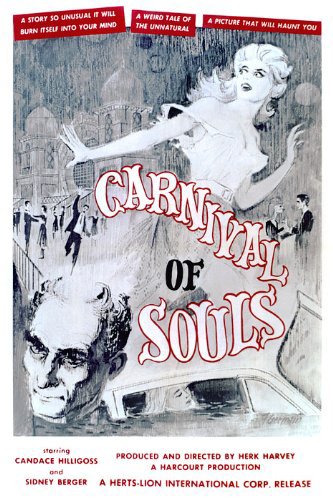
Analysis of ‘Carnival of Souls’

Carnival of Souls is a 1962 independent horror film produced and directed by Herk Harvey, from a story by him and John Clifford, the latter having written the screenplay. It stars Candace Hilligoss, with Frances Feist, Sidney Berger, Art Ellison, and Harvey as the main ghoul who torments Hilligoss’s character throughout the film.

Carnival of Souls was shot on a low budget, using guerrilla filmmaking techniques, in Lawrence, Kansas, and Salt Lake City. It was Harvey’s only feature film. It has a unique film score, played solely on a church organ and composed by African American composer Gene Moore.

Though the film went largely unnoticed upon release, it has since become a cult classic, influencing such filmmakers as David Lynch and George A. Romero. Many movie lists include it among the greatest horror movies ever made. It is in the public domain.

Here is a link to quotes from the film. You can watch the whole film here.

The ending of Carnival of Souls seems to indicate that Mary Henry (Hilligoss) didn’t survive the car accident on the bridge at the film’s beginning, and that her nightmarish existence throughout the middle of the film has been her soul’s unwillingness to let go of her physical existence, comparable to the hell Jacob Singer (played by Tim Robbins) goes through in Jacob’s Ladder. I, however, will interpret the car accident and her survival/’death’ metaphorically.

Racing as representative of the pressures of competition in society.

The film starts with her and some girlfriends in a car; they meet some young men about their age in another car, and these boys want the girls to race them. They reach a bridge where their cars are going neck-and-neck, crowding each other on the bridge, and the girls’ car falls off and into the river. Only Mary (so it seems) has survived the car crash; she emerges from the water not remembering how she’s survived.

One thing that is immediately apparent about Mary is that she’s unsociable. She has apparently always been this way, since the organ factory worker says, “She’s always kept pretty much to herself.” She drives out of town without wanting to stop to see her parents; in fact, when asked if she wants to see them, she reacts to the idea with considerable agitation. Right from the beginning of the race, Mary never smiles–her face shows only anxiety, and I don’t think this is just because of the potential danger of the race.

I consider the car accident to be symbolic of a deep-seated trauma, or many traumas, stemming from her relationship with her parents, especially her father (more on this later). A troubled relationship with her parents would explain how distant she is from other people, for our object relations with our parents, the first major people to come into our lives, are blueprints, so to speak, for our relationships with people in later life. If we don’t enjoy our parents’ company, we’re far less likely to enjoy the company of anybody.

This car race, with her bunched together with the other two girls, feels claustrophobic, especially with those boys’ car trying to ram past them. The sense of competition with others can be most distressing to someone as sensitive as Mary. So a near-death experience in such a social context can be seen as symbolic of trauma causing social anxiety.

Mary is a lonely, lost soul.

The water that Mary has fallen into is symbolic of the unconscious mind. The two dead girls in the car with her, engulfed in the water, just like the ghouls emerging from water later in the film, represent so many of Mary’s internalized bad objects. So the car accident represents the repression and the return of bad objects that WRD Fairbairn wrote about.

It’s fitting that these repressed bad objects that come back into Mary’s consciousness should do so in the form of ghouls, or evil spirits; for Fairbairn likens these returning bad objects to evil spirits that possess the suffering psychiatric patient (see page 6 [or 67, from the copied book] of the above-linked pdf, Part 5–‘The Dynamics of the Influence of Bad Objects’).

Another symbolism for this water that kills, and from which ghouls emerge, is Lacan‘s notion of the Real, an undifferentiated mental state that cannot be symbolized (i.e., put into words–Mary can tell Dr. Samuels [played by Stan Levitt] about the main ghoul, but she cannot conceive of whom he symbolizes; could he be her father, or a minister, who may have sexually abused her when a child?), and thus is traumatic.

Her driving out of Kansas to start a job so far away, in Salt Lake City, represents her wish to get away from her trauma. She tells the organ factory boss that she’s never coming back to Kansas. She can try to run away from her problems, though, but she’ll never succeed, because her problems aren’t outside of her…they’re inside.
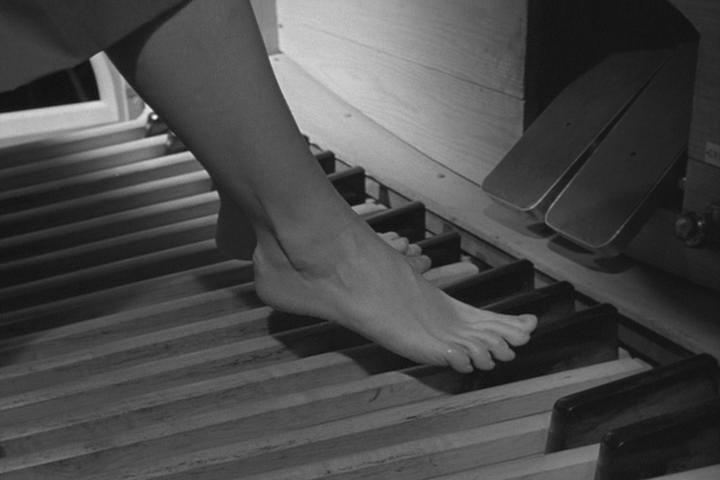
Mary the organist.

Another fitting thing about this films is its organ soundtrack music, which apart from occasional diegetic music makes up the vast majority of the music heard in the film. Its eerie dissonance provides so many of the atmospheric chills in the movie, and of course Mary is an organist. It’s as if she’s the one playing the soundtrack to her own story. The creepiness of the organ music, especially in the later scene when she’s in a trance, playing dissonant, “profane” music in the Utah church and she gets fired, represents her fear. It is thus a reminder that her problems stem from within (i.e., past trauma), not from without (i.e. literal spooks).

During her long drive to Salt Lake City, she looks at her reflection in the passenger window to her right. She looks there again, but sees the main ghoul, who looks middle-aged, old enough to be either her father or a minister of the church who may have molested her as a child. (Since this film was made in 1962, when the Hays Code was still censoring movies, indications of sexual abuse would have had to have been made most indirectly, subtly.) Seeing his face instead of her own in the reflection makes him a symbol of an internal bad object; seeing him again in front of her as her car is approaching him is her projection of him outside. The shock of seeing him makes her drive off the road and into a ditch, a traumatic reaction that parallels the other car falling off the bridge at the beginning.

She drives by a large pavilion near Salt Lake City that she is immediately fascinated with. What could this building mean to her? I suspect it represents in her mind a church, a cathedral she’d attended as a child. Its draw on her represents a wish in her to revisit her place of childhood trauma, to process those painful feelings and therefore cure herself of them. The place is on the shores of the Great Salt Lake–water, the symbol of her unconscious, where her bad internal objects lie, the Real, the centre of her trauma, which must be confronted.
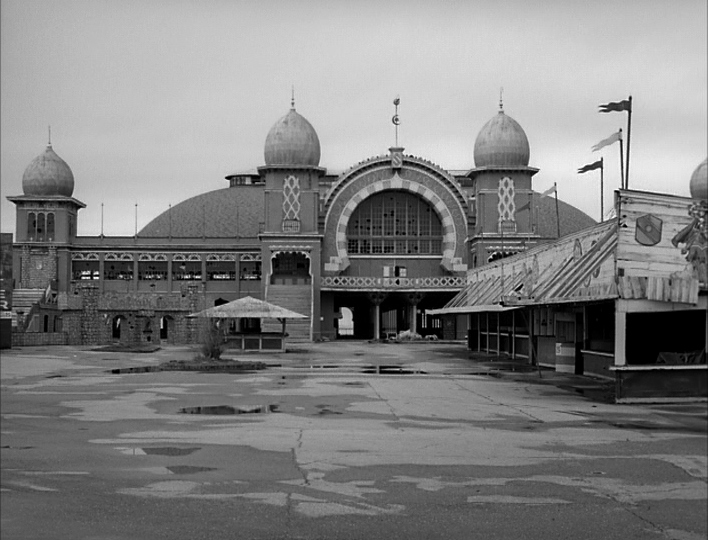
The pavilion.

After Mary finds lodgings, she takes a bath there one night while waiting for the proprietress, Mrs. Thomas (Feist), to bring a sandwich and coffee up to her room. It’s interesting how, when she’s been in water again, a knock on her door reveals not Mrs. Thomas but the only other lodger, the lecherous John Linden (Berger), whom she’s embarrassed to meet with only a towel to cover her nakedness. Shortly after repelling Linden’s “neighbourly” ways, his thinly-disguised sexual advances, Mary goes out into the hall and is terrified to see the main ghoul looking up at her from the ground floor.

This juxtaposition of Linden, who ogles her through the door crack while she’s replacing her towel with a bathrobe, with the appearance of the lewdly smirking ghoul–a figment of her imagination and an internal object of hers–contributes to my theory that the ghoul represents someone who once sexually abused her. She is frightened of Linden’s lecherous designs, which have triggered the traumatic memory of another man’s lecherous designs.

Later that night, she can’t sleep, so she gets out of bed and looks out the window to see the pavilion so far off. Her fear of the main ghoul makes her want human company, so Linden’s appearance at her door again the next morning is welcome. He’s surprised to learn, as is her boss the minister (Ellison), that her work as church organist is purely professional, with no spiritual interest in it whatsoever.

Since Western society, especially American, was much more religious in the early 60s than it is today, we must wonder why not only is Mary not interested in meeting the congregation of the church she’s playing organ for, but isn’t interested in the religious meaning of the music she’s playing (small wonder some think her playing lacks “soul”). Such disparities reinforce my speculation that she feels somehow betrayed by the church, making her lose faith in it, while nonetheless staying near it as a professional organist–a nearness that suggests the traumatic bonding of one who was molested as a child by her minister.
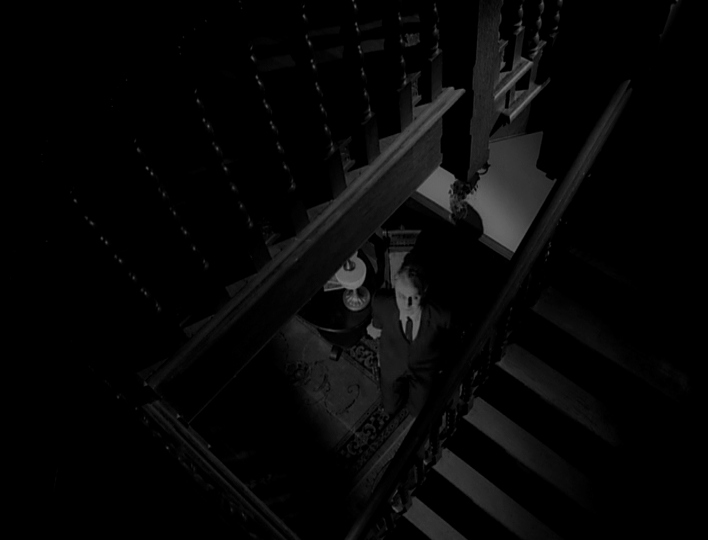
Seeing the main ghoul.

She feels relatively safe in the daylight, during the waking hours when the conscious mind is dominant, but frightened at night, during the darkness of which the unconscious is given free reign. As she tells Linden, “It’s funny… the world is so different in the daylight. In the dark, your fantasies get so out of hand. But in the daylight everything falls back into place again.” During the day, she can repress her fears; but at night, the repressed returns, in forms she fears, because she can’t recognize their true meaning.

She isn’t, however, necessarily free in the daytime, either. After getting rid of Linden, she goes shopping and tries on a black dress. When changing back in the fitting room, though, we see what looks like a rippling of water before her eyes (water, symbol of her repressed unconscious, is bringing her repressed trauma back to consciousness for her); after this, she temporarily experiences a kind of derealization. She cannot hear anything, especially people’s voices, and these people don’t acknowledge her presence–she seems invisible to them.

The sense of disconnect from other people is a symptom common in sufferers of C-PTSD, caused not by one, but by many traumas. Since Mary is experiencing such a disconnect, I suspect her car accident is really a symbolic abbreviation of many traumas she suffered in childhood.

The many traumas that result in C-PTSD make the sufferer feel as though he or she is completely, irreconcilably different from everyone else, and this in turn results in the sufferer’s withdrawal from society and into isolation, since he or she feels safe only without others around. Hence, C-PTSD can be an accurate diagnosis for Mary, who feels so different from others that, on this and again towards the end of the film, she can neither hear others nor be acknowledged by them.
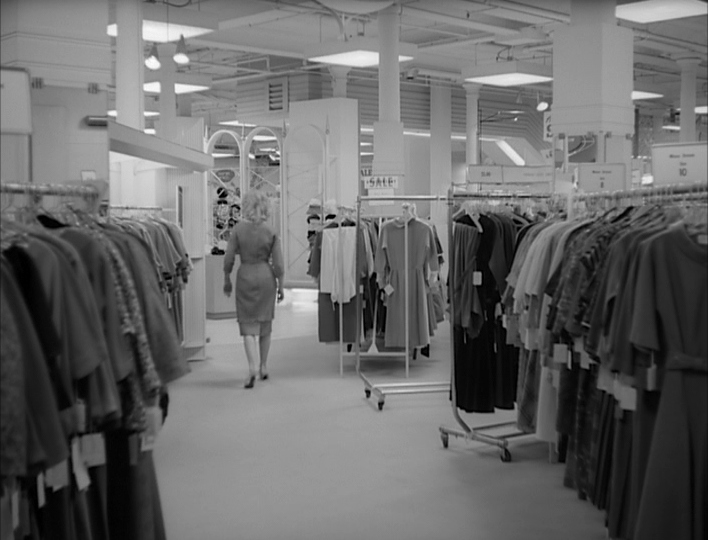
Mary in the department store.

Terrified by her temporary deafness and invisibility, Mary leaves the department store and ends up in a park. Standing under a tree, she hears the chirping of a bird, symbol of freedom, and so she’s back to normal…by her standards, at least.

She goes to a fountain for a drink of water, and she hallucinates that the ghoul is standing before her. She goes into hysterics and runs into Dr. Samuels, who offers to help her. She goes with him to his nearby office…him with his hands creepily around her.

He isn’t a psychiatrist, but he seems to have dabbled in psychoanalysis, for he hints at some insights as to who the ghoul may be–Mary’s father, or some kind of guilt (i.e., shame associated with having been raped) she has buried deep down in her mind. Her vehement denial of these interpretations should, if anything, help convince us of their correctness, for her denial, calling such ideas “ridiculous,” is a typical example of the patient’s resistance to insights that uncover a deeper pain.

She has her resistances and denials, but also a conflicting desire to cure herself, and her fascination with the pavilion is part of that desire. So she runs out of Samuels’s office and goes straight there.

Now, facing one’s trauma is crucial to curing oneself of it, but one should be guided by a therapist. She thinks she’ll rid herself of the stalking ghoul by entering the pavilion and exploring it; but there’s still that part of her that doesn’t want to face the darkest of her pain, so when she looks around the place, it’s a generally peaceful experience.
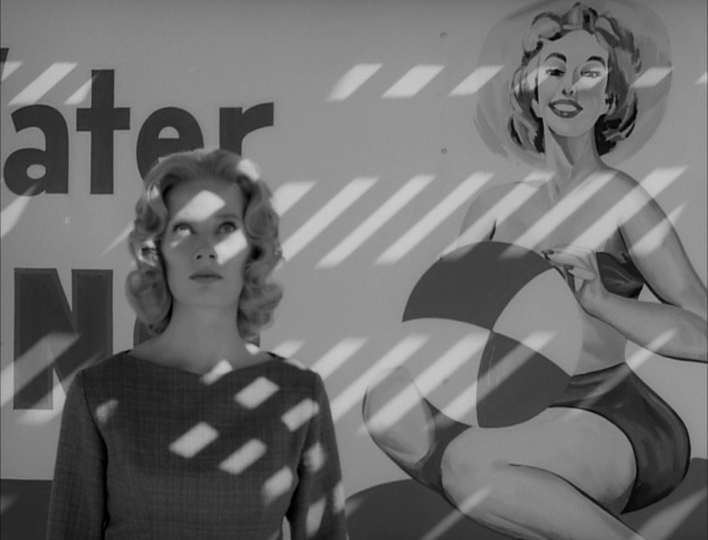
Mary looking around the pavilion.

The main ghoul is sleeping in the water, symbolizing how her trauma is still there, however hidden it may be. At one point during her walking around, she sees a mattress gliding down a slide. There’s no reason for it to be there, much less slide down by itself, so it must symbolize something in her unconscious–perhaps a mattress on which she was once sexually abused.

The association of her trauma with water is again reinforced when she passes a sign saying, “Salt Water Bathing,” shortly after having seen the mattress on the slide. Maybe as a child, part of her seduction by her father, or by a minister of the church (maybe her father was the minister), involved bathing her, then bedding her.

My point in all of this is that the whole film could be seen as an extended dream, chock-full of symbols related to her trauma, but presented in a distorted manner that makes them unrecognizable to her conscious mind. The root of the trauma is still buried, like the ghoul sleeping under the water.

She goes back to her rooming house and agrees to a date after work with Linden because she doesn’t want to be alone at night. When practicing the organ at church, she goes into a trance, for night has fallen, and the ghouls are seen coming out of the water of the Great Salt Lake.

Recall that all these ghouls represent the bad internal objects hiding in Mary’s unconscious (i.e., sleeping in the water) during the day, but coming out at night, when the unconscious mind is freer. These internal objects would be not only her molester (the main ghoul we always see), but also family and community members who either turned a blind eye to the abuse she suffered, or perhaps even participated in it. Their dancing, in this connection, is symbolic of sex, pairs of men and women holding each other and moving around to a rhythm.
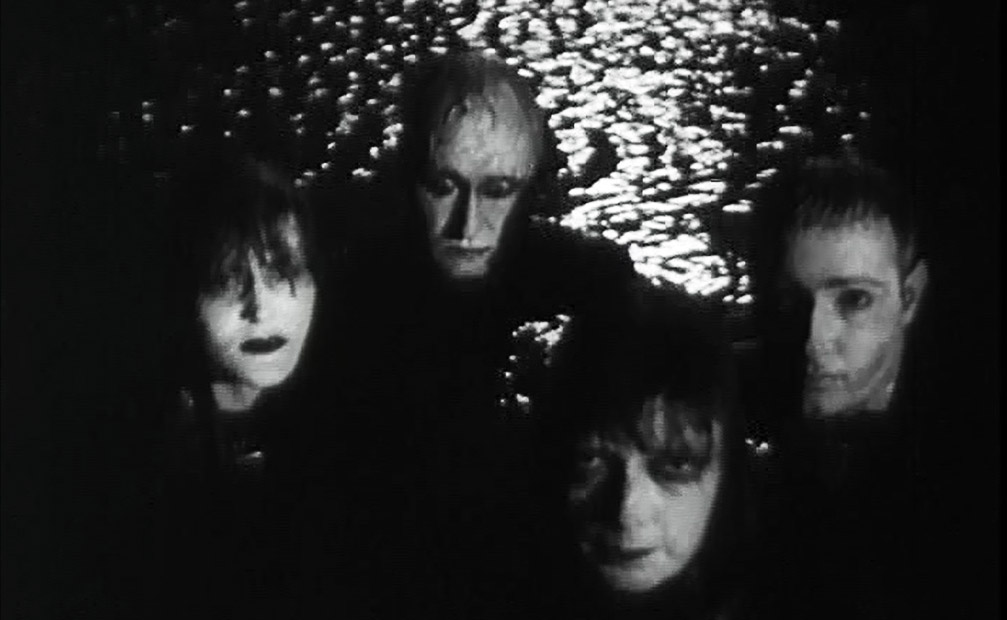
They only come out at night.

This reliving of her trauma makes her play creepy dissonances on the organ (which she cannot hear, as with her temporary deafness in the department store scene) that her employer, the minister (whose hands grab hers, making her stop playing, and happening immediately after she, in her vision, has seen the main ghoul approach her, his hands out to grab her), regards as “profane, sacrilege,” so he dismisses her. She leaves the church and goes with Linden to a bar for drinks.

He’s drinking while she just sits there, still practically in a trance. He’s annoyed at her unsociability: she won’t drink, talk, or dance. After having just had a vision of the ghouls dancing in the dark pavilion, how could she dance? Young men and young women dancing in a pub aren’t necessarily planning to be sexual, but in the context of dating, they are exploring sexual possibilities. Such possibilities are scary enough for Mary.

They go back to the rooming house and into her room. Linden’s hopes of getting some with Mary are dashed when he realizes how “off her rocker” she is. She looks in the mirror and sees the main ghoul again, who, recall, is a projection from her own mind onto the external world. Such hallucinatory projections are what Wilfred Bion called bizarre objects.

After Linden leaves in frustration, she tries to use the furniture of her room to block all entrances, in a futile attempt to keep the ghoul outside. Of course, she cannot succeed at this, because the ghoul is in her head; no matter how hard she tries to project him outside, he’ll always return, for he is a bizarre object she’s created.

Try as she might, Mary cannot run away from him.

The next day, she packs her things and leaves the rooming house. She’d leave Salt Lake City, too, imagining that leaving the city, just as she’s left Kansas and isn’t going back, will rid her of her trauma. Of course, that will never happen, because her trauma is within, not without.

She drives her car to a mechanic, staying in her car as it’s raised up; she nods off a bit. She then experiences the following set of terrors. First, she imagines someone, the ghoul, presumably, entering the mechanic’s garage and lowering her car back down to the ground. After running out of the garage and into a bus station, we see those waves on the screen again, as in the department store fitting room: she goes deaf again, unacknowledged by others, until hearing the chirping bird in the park; she also sees the ghouls in a bus she hopes to take to escape from the city.

Next, she is in Samuels’s office, but sees the main ghoul instead of the doctor in his chair. It’s interesting how the ghoul tends to stand for men who are at least a potential threat to her: either middle-aged men in authority positions, or father-figures, like Samuels or the minister; or lecherous men like Linden. She screams and runs away.

She wakes up, though we’re not sure if she really went to sleep at first, or just put her head back and closed her eyes for a few seconds. If this moment was a nightmare, could the rest of the film be a long nightmare, too? Could this moment have been a dream within a dream?
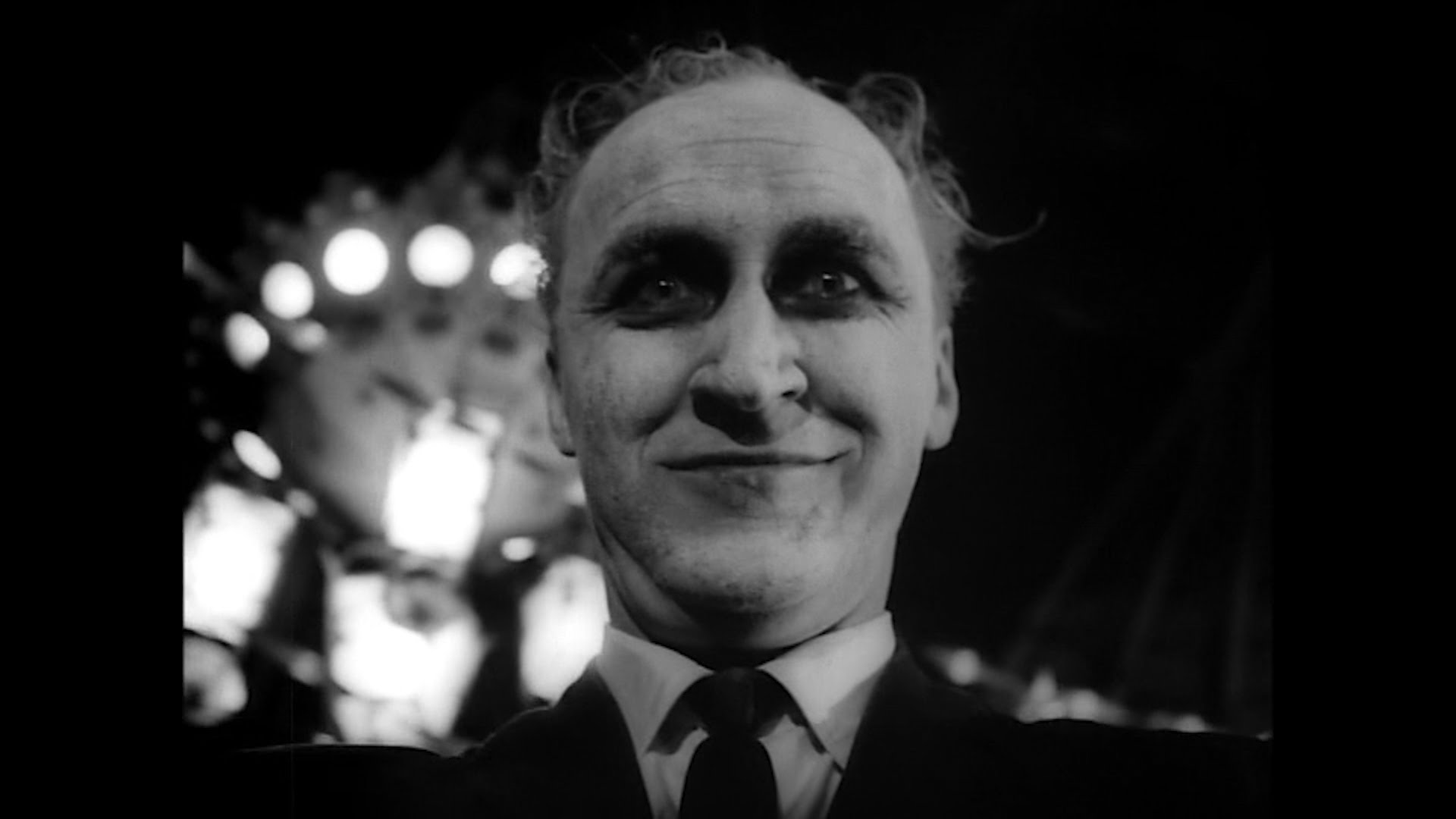
She must confront him.

There’s nothing left for Mary to do now but to go back to the pavilion and face her demons. She drives over there just as the clouds are obscuring the evening sky. The inside of the building, accordingly, is much darker than the last time she was there.

Because night is about to fall, all those ghouls sleeping in the water of the Great Salt Lake are waking up and emerging; that is, all the internal objects of her unconscious are returning to her conscious thoughts. As I’ve said above, these aren’t just representatives of the molester(s) of her childhood and/or adolescence; they also represent her family, neighbours, and members of her congregation who, out of a wish to avoid scandal, would never sympathize with Mary or hear her cries for help.

She stands there in the shadows, frowning in her attempt to confront her tormentors. That eerie organ music is playing alongside what sounds like a calliope, or steam organ (what would be heard in a circus or carnival), implying the link between her organ playing, as traumatic bonding, with the abusive church of her childhood that the carnival symbolizes.

Again, we see pairs of male and female ghouls dancing to the calliope music. Since, as I said above, their dancing is symbolic of sex (remember that the film censorship of the time meant that sexual deviancy could only be implied, expressed symbolically), all of them dancing symbolizes the deviancy of an orgy. People with authoritarian, fundamentalist religious beliefs, in their prudery and repression, tend paradoxically to let their sexuality out in the most perverse ways, such as pedophilia, ephebophilia, and hebephilia.
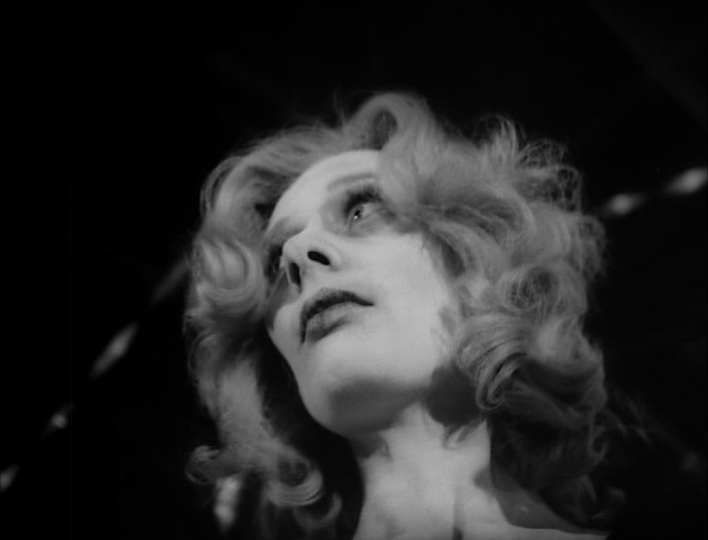
Ghoul-Mary.

Finally, Mary sees, among the ghouls, herself as a ghoul dancing with the main one! Ghoul-Mary has a sad, dazed look in her eyes, the kind of look a victim of sexual abuse might have, a look of helpless resignation. Meanwhile, the smirk on the main ghoul’s face seems one of lewd satisfaction. He dips ghoul-Mary, like a lover, and she is grinning ear to ear, as if tricked into thinking she’s enjoying satisfying his lust.

Mary has thus confronted her trauma. She has remembered what was repressed for so many years, and the horror of it makes her scream and run away. As we all know by now, though, running from her trauma won’t save her; it’s always in her mind, so the ghouls all chase her outside.

Wherever she tries to hide, a ghoul’s face pops up in front of hers. Finally, she runs out and falls on the sand, screaming. The ghouls crowd around her and get down close, as if to gang rape her. To confront trauma, we can’t do it alone. Mary should be facing this with a therapist.

The film ends with Samuels, the minister, and a cop following her footprints in the sand where they unaccountably end. These men, as father figures, would seem to want to help her, but they can’t. After all, weren’t the church community represented in the ghouls just trying ‘to help’ her?

The discovery of Mary’s body in the car represents how trauma kills us all psychologically, for after enduring its horrors, we can never be the same as we were.
‘The Splitting,’ a Sci-Fi Horror Novel, Book IV, Chapter Ten

As Peter and Michelle continued walking out of the neighbourhood and towards a park filled with people, including kids in a playground, they kept those stupid, mindless grins on their faces. It didn’t matter how sore their faces were…they had no choice.

All they could do was cling to the microscopic hope that they’d sooner or later meet with non-carriers.

Their hopes kept getting frustrated with every person they passed by on the sidewalk.

A man or a woman would be walking in their direction, and while they were far enough away from the approaching person, Peter and Michelle would think, Please, please let this person be normal!

Then, once they got close enough, the man or woman would bare his or her teeth and say, “Hi!” like a robot.

Granted, Peter and Michelle were doing the exact same thing.

Could any of those approaching them have been doing the same grinning act, too?

The sun was going down. They’d passed the park, and were now in an area of the neighbourhood with far fewer people.

Still, they were getting desperate to find somebody who was normal, perhaps someone who had a house nearby where they could stay and be safe.

They were getting tired from all that walking. They were hungry, too. The moon and stars were out.

They walked by a small restaurant with no customers at any of the tables. The owner, wearing an apron and presumably the cook, seemed to be the only one inside. They went in.

“What can I get you?” he asked with that all-too-familiar grin. “I was about to close, so you’re lucky to be my last customers.” He turned the sign on the door from OPEN to CLOSED, then he locked the door.

“This could work to our advantage,” Peter whispered in her ear. “We could spray him, then take control of this place, and eat all we like.”

“Not for too long,” she whispered back.

“Better than nothing.”

The owner approached their table. “So, what will it be?” he asked, grinning and with his pad and pencil ready to write down their orders.

They looked at the menus on the table.

“I’ll have a burger and fries, an orange juice, and a coffee, double-double,” Peter said, handing him the menu.

“I’ll have the same, but with a ginger ale instead of juice,” she said, then gave him the menu.

“Are you the only one here?” Peter asked him.

“Yes,” the owner said as he wrote down their orders. “Why do you ask?”

“Oh, just curious,” Peter said. “You seem lonely in here.”

“Oh, I’m fine. I’ll go cook your burgers.” He walked off to the kitchen area.

As he was cooking, he could look out from the kitchen and onto the dining area, where he could clearly see them talking at their table. Peter and Michelle were letting their guard down, and he could see them expressing themselves in a most non-Bolshivarian way.

He finished cooking their orders and served them, but as they ate, he kept his eyes on them. Still, they were behaving in a conspicuously non-carrier way, showing emotions other than that fake contentment that was supposed to be the norm. Peter was tactlessly expressing his usual annoyance with the world, and Michelle had a look of worry on her face.

When they finished their meal and went up to pay, the owner looked in their eyes.

“Did you enjoy your meal?” he asked.

“Oh, yeah,” Peter said. “It was great.”

“So, you’re content?” he asked, meaning something more than just the service.

“Sure,” Michelle said. “Of course.”

“You seem a little less sure than that,” he said, always grinning.

“What are you getting at?” Peter asked.

“This,” he said, sending out the little lights from his fingers.

“You fucker!” Peter shouted, then found a steak knife on a nearby table.

Michelle had her can of bug spray already out. She sprayed the lights, dropping them to the wooden floor with the sound of bouncing marbles. The owner stepped back.

“No, Peter!” she said as he approached the owner with the knife. “You don’t need to–“

Peter slashed at him with the knife, slitting his throat. His blood sprayed out everywhere.

“Oh, Jesus, Peter,” she said, wincing at the sight of the owner staggering and coughing blood.

A few passers-by looked in the window and saw the blood, then saw the owner fall to the floor.

Michelle looked out at them. “Oh, shit!” she yelled. “Peter!”

He looked out. “Oh, fuck me! C’mon, let’s get out of here.”

They ran into the back and hid in the darkness of a storage room. They could hear a shaking of the locked front door, then a banging on it. Peter looked over to the back door.

“We can’t stay here long,” he said.

‘The Splitting,’ a Sci-Fi Horror Novel, Book IV, Chapter Nine

A week later, Peter and Michelle made arrangements to meet with Sid, this time in her house.

“He’s on his way, right from his home in Brantford,” she said. “So, we’re gonna go through with this farce again?”

“Yes, crazy as it sounds,” he said.

“Crazy as it is,” she said. “At the worst, he’ll be a carrier who we’re risking turning us into one of them, or one of us will kill him and we’ll risk–this time, my neighbours finding out, since we’re meeting him here this time. At best, Sid will be the way Wendy was acting: he’ll be one of us, but too scared to show his real self.”

“Or he will let his real self show. As tense as this is going to be, we have to try. I’ll go crazy if I have to live knowing only you and I are normal.”

“And what if he’s one of them, and he makes one of us into a carrier? What if I lose you, Peter?”

“I could lose you to them, too, Michelle. And that terrifies me. But that’s why we’ve gotta try to find allies. What’s going on around the world is like the zombie apocalypse, only it’s the Bolshivarian apocalypse. The more of them there are out there, the more desperate we’ll be to find any of us, ’cause we can’t do this alone.”

She let out a big sigh. “OK, let’s do this.”

They kissed.

**************

Five hours later, the doorbell rang.

They took a deep breath, clutched the bug spray hidden in their jacket pockets, and went to the door.

They opened it to see, predictably, a grinning Sid.

“Hi,” he said. “Long time, no see.”

“Yeah,” they grinned back, much better practiced now.

“Come on in,” Peter said.

They went into the living room and sat down.

“So, Sid,” Peter said through his bared teeth, “how are you coping with all of the changes going on?”

“Coping?” Sid said with a tinge of disbelief in his eyes. “What’s there to cope with? The improvements being made around the world are nothing short of miraculous. Schools and hospitals are being built all over Africa, Latin America, and Southeast Asia. Decent-quality housing is replacing all the slums, including those in Regent Park, as you both must know. The unemployed are being given work. The climate crisis is practically over. What’s there to complain about?”

“Oh, of course we know about all the improvements being made around the world,” Michelle said. “We’re more than happy about all that. It’s just…well…”

“Well, what?” Sid asked, his smile beginning to fade.

“We don’t…feel as free…as we used to,” Peter said.

“Don’t feel free?” Sid said. “What could be more liberating than the changes we’ve recently seen? No more war. No more poverty. No more wildfires, flooding, or pollution. The people want these changes. Don’t you?”

“Of course we do,” Michelle said.

“But at what cost?” Peter asked.

What cost?” Sid asked. There was an uneasy pause. “Has your loyalty shifted?”

Peter and Michelle couldn’t answer.

“You in your nice palace of a home?” Sid added.

There was another uncomfortable pause.

Then the dots of light flew out of Sid’s fingers.

Peter and Michelle pulled out their bug spray, but they then heard some familiar voices in their minds.

Michelle? Siobhan’s voice called to her.

“Mom?” she said.

Peter, what are you doing? his mother’s voice said.

What George is doing is for the best, Peter could hear his father saying in his thoughts.

“You’re not real,” Peter said, aiming his little spray can right at the dots of light. “You’re a Bolshivarian hallucination.”

Sweetie, you don’t wanna spray me, do you? Siobhan’s voice almost sobbed in Michelle’s mind’s ear. If you do, I’ll die a second time, and I’ll never come back.

“Mama,” Michelle answered in a sobbing voice.

“The voices aren’t real, Michelle,” Peter said.

“Oh, yes they are,” Sid said.

“Mom?” she wept.

“Don’t listen, Michelle,” Peter said. “It’s a trick.”

“If you spray them, you’ll regret it, Peter,” Sid said.

We don’t want to take you by force, Don’s voice said to Michelle, but we will if we have to, honey.

“Daddy, you won’t hurt us, will you?” she sobbed.

“Of course they will,” Peter said. “They’re not our parents.”

“Shut up, Peter!” she bawled.

“Fine,” he said. “Speak, can, for me!” He sprayed at the lights.

Michelle! the voices of Siobhan and Don said, fading out into oblivion as the little dots lost their light and dropped on the carpet.

“Nooooooo!” Michelle screamed.

Peter grabbed her by the hand, sprayed Sid in the eyes, getting a grunt from him, and the two ran out of the house.

Peter and Michelle ran down the sidewalk, almost reaching a corner when he saw a few people farther off, with their backs to them. He stopped running and tried to calm down.

“Bastard!” she hissed, hitting him on the shoulder.

“Stop!” he whispered. “They’ll see us fighting.”

She wiped the tears off her cheeks, gave him a brief scowl, then calmed down and imitated his grin.

As they continued slowly walking down the street, she whispered, “The carriers are all around your home, Sid is controlling my home. We’re homeless now, you know.”

“Don’t remind me,” he said through his grin.

‘The Day that We…’, a New Poem by Jason Ryan Morton

I have a new poem here by my Facebook friend, Jason Ryan Morton, whose work I’ve looked at so many times before. As usual, his words will be in italics to distinguish them from mine.

Here’s the poem:

The day that we fell
Fell so far
Shooting stars
Dividing worlds
Becoming God’s
A future law of three
A past shone in the trees
A photograph that changes
The malice and the rage
The quest for poetry that speaks till it’s raw
By word of mouth
Sometimes stars
One in five none get out alive
But the words
The words
Whisper of forever
And forever we’re denied
Living on in nothing
Just a star fell from the sky
The night that we
Became reality.

And now, for my analysis.

I suspect that the speaker is one of the fallen rebel angels, who “fell so far.” They’re “shooting stars” nonetheless in their rebellious glory, “dividing worlds” into the heavenly and the hellish, as we know them in Milton‘s Paradise Lost.

He and the others are “becoming God’s” in the sense that He will use them to test mankind. “A future law of three” sounds like Adam, Eve, and the serpent being tempted to sin through the commandment not to eat of the Tree of Knowledge. One is reminded of Romans 7:8, “sin, taking opportunity by the commandment, produced in me all manner of evil desire. For apart from the law sin was dead.” This is “a past shone in the trees” of the Garden of Eden.

“A photograph that changes” reminds me of my connecting of the Garden of Eden myth with the park scene in Michelangelo Antonioni‘s film, Blowup. In the film, Thomas has taken photos in an Edenic park of a young woman and her elderly lover, photos she wants back because they make her feel shamed, as Adam and Eve felt shamed in their nakedness. His taking the photos makes him into either the Yahweh or the serpent figure for interfering with the two. The photograph changes because it, among many others taken in the park, go from being relatively innocent to implying that a murder has been committed there, rather like the shift from innocent to sinful Adam and Eve, a shift caused by the serpent, or by Thomas’s changing photographs. (See my analysis, link above, for more details on that.)

Imagine “the malice and the rage” of the fallen angels, who search “for poetry that speaks till it’s raw.” One wishes to speak one’s own poetry, one’s own language, not that of those who impose their will on us, as God did on His angels and on Adam and Eve. These are words spoken “by word of mouth,” naturally, not edited on the page.

The mortality imposed on us all for defying God’s authority, on man as well as on the rebel angels, means that, to paraphrase what Jim Morrison once sang, “One in five none get out alive.” “The words,” however, presumably those of Scripture, “whisper of forever/And forever we’re denied,” because we disobeyed God.

We’re “living on in” a hell of “nothing.” We, in our defiant glory, are “just a star” that “fell from the sky.” But in our damnation, we were true to ourselves, not mere compliant, willing slaves, for this was “the night that we/Became reality.”

‘The Splitting,’ a Sci-Fi Horror Novel, Book IV, Chapter Eight

“This is getting to be too much!” Peter said to Michelle the following day as both of them flipped through the channels on the TV in her living room. “Every politician and public figure we see on the news making statements on current affairs has that ‘pod people’ Bolshivarian face.”

“They really have taken over, globally,” Michelle said. “The heads of every city-state we’ve seen–London, Paris, Berlin, Shanghai, Tokyo, Riyadh, Ottawa, San Francisco,…”

“You name the city-state, the politicians and CEOs representing them all have that mindless grin, that far-away look in their eyes,” he said. “This is really getting scary!”

“I’m amazed we were able to pacify that neighbour of yours yesterday,” she said. “We barely escaped Toronto without being spotted as non-carriers. And there’s no way we’re risking going back. And again, I have to ask: why’d you have to kill Valerie? We could have run outside without you using your switchblade on her. I’m also amazed they don’t have Bolshivarian cops tracking us. I guess they’re more interested in turning us into carriers than arresting us for murder, they’re more upset about the loss of their own than of human life, and they know we’ll spray them if they try to apprehend us. Instead, they’ll be more cunning about catching us.”

“Again, I’m sorry about stabbing her. I acted rashly. We’re all going a little crazy here. But as you said, at least we got out of there without being chased. I guess our acting skills have improved. But we can’t stay holed up in your house forever. Is anybody out there still normal?”

“I got that message from Wendy Callaghan, which was just like Valerie’s. She claims she isn’t a carrier, and that she’s all tense and afraid of being absorbed by the Bolshivarians. She said she’d like to come here, all the way from Los Angeles, because life there is so hopelessly taken over, she wants to get as far away from the Bolshivarian carriers there as she can. Do you think we should meet her, or will it be too risky?”

“Everything we do every day is a risk now,” he said. “But I’m desperate for us to find someone else who’s normal. If she is, it will be well worth the risk. The more normal people we can find, the happier I’ll be. I’m going crazy.”

“Same here.”

***************

Three days later, Peter and Michelle were in the hallway of a hotel in Toronto, approaching the room Wendy was staying in. They were wearing baseball caps and sunglasses.

“She must be even more paranoid than we are to prefer a small hotel room to accommodations in your house,” Peter said.

“Yeah,” Michelle said. “For all she knows, we could be carriers, and she’ll have her can of bug spray ready for us.”

“As we have ready for her, in case she’s been made a carrier since our last communication with her. So we’ll have to guard our feelings and only let our real selves out bit by bit.”

“She’ll probably be doing the same thing.” Michelle rang the doorbell to Wendy’s room. “Have your dumb smile ready.” They took off their hats and sunglasses.

Wendy opened the door.

She was grinning from ear to ear.

Peter and Michelle mirrored her grin back, hoping she was putting on as much of an act as they were.

“Come on in,” she said, stepping aside for them. “It’s good to see you both again.”

Peter and Michelle entered.

“What a small room,” she said as she and Peter approached Wendy’s bed. “In my home, I could have offered you a much bigger one, and for free.” She and Peter sat on the bed.

“Oh, that’s OK,” Wendy said, sitting on a chair across from the bed. “I don’t want to impose on you.”

“Oh, it’s no imposition at all,” Michelle said.

“Really, I’m fine here,” Wendy said.

“Well, as you wish,” Michelle said.

There followed a few seconds of uncomfortable silence.

“So,” Peter said, allowing his grin to relax a little. “You said in your message, Wendy, that you were really scared of…all the changes going on around us.”

“Yes,” she said, still fully grinning. “But everything’s OK now.”

“So…we can all relax, then?” Michelle asked, also letting go of her grin ever so slightly.

“Of course,” she said, all of her teeth still showing. “I’m relaxed now.”

“Good,” Peter said slowly, relaxing his grin some more.

There were a few more uncomfortable seconds of silence.

Has she been assimilated, Peter and Michelle wondered, or is she just so paranoid that she can’t let go of the act?

“So, what are your plans?” Michelle asked.

“Oh, I’m just doing what I can to help us all heal the Earth,” she said with that ever-present grin.

“Yes, it’s wonderful, all the progress that has been made,” Michelle said, her cheeks getting sore from all that grinning.

“Yes,” Wendy nodded in agreement. “Bolshivarian influence has stopped the wars, cleaned the pollution away, housed and fed the poor. It’s terrific.”

Peter ventured to lessen his grin a little more. “Is there anything you wish could be done…a little differently?”

“Oh, only that it could all be finished quicker,” Wendy said. “But things are being done fast enough, I guess.”

“And then the Bolshivarians can leave, and we can enjoy our new, healed Earth, right?” Peter asked.

“I suppose,” ever-grinning Wendy said. “Or they can stay with us, if they wish.”

“W-why would they need to stay, if all their work here is done?” he asked.

“Oh, if humans are let go, they might return to their destructive ways,” teeth-baring Wendy said. “And then our efforts will have been all for nothing.”

To Peter and Michelle, her choice of words (“humans,” “they,” “our” referring to the Bolshivarians) seemed to indicate she wasn’t acting.

Still, they didn’t dare take out their bug spray cans unless they saw the dots of light come out from her.

Hence, another moment of uncomfortable silence.

“Oh, Peter, I just remembered,” Michelle said. “There’s something I have to do at the Mississauga Exposé. Damn, I forgot all about it, and it has to be done today. Sorry, Wendy, we have to go now. This is so abrupt.”

“Oh, that’s OK,” she said, always grinning. She got up.

Do I detect a tinge of relief in her eyes? Michelle wondered. Or is that wishful thinking on my part, that she isn’t a carrier, and is acting, as we are?

“Yeah, we’d better go,” Peter said, getting up with Michelle. “Sorry to cut this off so quickly.”

“It was good seeing you again, Wendy,” Michelle said, hugging her and regretting the hug as soon as they touched. She felt Wendy’s heart beating as fast as her own. Wendy was also trembling as much as she was.

No lights came out, though, to their relief.

The women let go, and Peter and Michelle went back to the door. “Bye,” they said to Wendy as they went out into the hall.

“Bye,” Wendy said, keeping her grin on her face until the door closed.

‘The Splitting,’ a Sci-Fi Horror Novel, Book IV, Chapter Seven

The next day, Michelle contacted Valerie on Facebook, asking about what had happened to her since Pat’s assassination of Karol Sargent. This was Valerie’s reply in a personal message:

Don’t worry, I’m OK. I managed to get out of China immediately after the killings. I got back home by burying my feelings and pretending to be one of those automatons. It was really hard to hide my grief over the Bolshivarians’ murder of my husband, but once I got back to the privacy of my Milwaukee home, I lay on my bed cried for what seemed hours.
We should meet. I can fly over to Toronto or Mississauga. I hate having to pretend to be one of those soulless carriers all the time. If I’m with you, I can relax, be myself, and cry on your shoulders over what happened in China.

Michelle let Peter read Valerie’s message.

“Well, what do you think?” she asked him. “Judging by what she said, does she seem to be still all human? She doesn’t seem compromised to me. Do you think this message could be pretence?”

“Well, I guess she’s being sincere,” he said. “I certainly want to believe she’s sincere. We need some real human company around here, and the only way we can get it is by taking a risk or two. We can have some cans of bug spray handy, just in case.”

“OK, I’ll tell her we can meet, say, in your home,” she said. “As soon as she’s in Toronto District, we’ll have a driver at the airport take her home.”

“The driver could be a carrier. He could turn her into one of them.”

Anyone out there during her trip could be a carrier, turning her into one of them. She could be a carrier right now, for all we know. If we really want to meet with her, it’s the chance we’ll have to take.”

“Yeah, OK,” he said. “Let’s hope for the best. Let’s hope that if she isn’t a carrier, that she can fake being one all the way here, and not get changed.”

Michelle replied to Valerie’s message with the plan, to which she agreed.

***********

Three days later, in the afternoon, Peter and Michelle heard his front doorbell ring.

“That must be her,” Michelle said.

They both rushed to get the door.

Valerie stood there with that eerie, soulless grin.

Peter and Michelle grinned back uneasily.

They all stood there stupidly for several seconds.

“May I come in?” Valerie asked, her grin unchanged, with no awkwardness in her expression at her hosts’ odd hesitating.

“Oh, yeah…uh, of course,” Peter said as he and Michelle stepped aside to let Valerie in. “Sorry.”

“What a nice place you have,” Valerie said as she went in and looked around. “So, this is how the rich live.”

Concealing his annoyance at her remark, he said, “I may be bourgeois by birth, Valerie, as is Michelle, but I assure you, that’s not where our sympathies lie. My mom and dad used to call me the Friedrich Engels of our family.” He closed the front door.

“I’m sure they did,” Valerie said with that same grin as she approached a chair to sit on in the living room. “I’ve just never seen such a posh place before.” She sat down. “My home with Pat in Milwaukee is nice, but not this nice.”

“Thanks,” Peter said as he and Michelle returned to the living room and sat on the sofa. “After seeing what life is like for so many in Venezuela, Angola, and here, too, in Regent Park, I feel guilty about having this ‘nice’ home.”

“I feel the same way about mine in Mississauga,” Michelle said. “With all the changes the Bolshivarians are making, especially now with President Price and Secretary of State Hammond gone, and with the Washington District government under Bolshivarian control, we can more quickly provide for all the poor of the world.”

“Yes, those changes will be coming fast now,” Valerie said, still grinning without a trace of personality.

Peter remembered the switchblade he had in one of his jeans’ back pockets, and the small can of bug spray in the other.

“Valerie,” Michelle said. “Would you like to relax? I mean…we can get you something to drink if you like. Some tea?”

“No, thanks. I’m fine,” grinning Valerie said.

“You said in your message that you want to relax and be yourself,” Peter said. “Feel free to do so here.”

“I am,” grinning Valerie said.

“You–you’re with friends,” Michelle said. “N-no need to pretend. Let yourself go.”

“Pretend?” Valerie asked, all those teeth still showing.

Desperate to end the tension, and gripping those weapons in his back pockets, Peter stood up and said, “You don’t need to pretend to be one of those Bolshivarian automatons!”

“Peter, easy,” Michelle said with a frown.

“I’m not pretending,” Valerie said as she rose from her chair. “But you have been, haven’t you?” Out of her fingers flew a swarm of those little dots of light.

Peter was quick on the draw with his can of bug spray. It hit the first six or seven of those tiny balls of light, making all of them drop on the carpet. Since Valerie hadn’t been a carrier for long, the lights hadn’t yet integrated with her body, so the bug spray wouldn’t kill her. Peter ran at her with the switchblade ready to stab. Valerie screamed.

Michelle looked away and covered her eyes. She didn’t want to see her boyfriend shed blood a second time.

A few seconds after Valerie’s body hit the floor, her blood staining the carpet, Peter and Michelle heard the doorbell ring again. Michelle ran over to answer the door.

“Yes?” she said to a male neighbour after opening the door.

He, too, had that all-too-familiar grin.

“I heard a scream,” he said, looking into the living room, though Michelle’s left shoulder was hiding Valerie’s body and blood from his sight. “Is everything OK?”

“Oh, yeah,” she said, trying her best to imitate that stupid-looking grin without showing any nervousness.

“We’re watching a horror movie on TV,” Peter said as he approached the door, hoping his body would help obscure not only the bloody body, but also the living room TV that hadn’t been turned on all that day.

‘The Splitting,’ a Sci-Fi Horror Novel, Book IV, Chapter Six

That evening, Peter was in Michelle’s home, in the living room. They were watching CNN.

President Price was giving another press conference. Her secretary of state, a tall black man named Hammond, could be seen standing in the background.

“Over the past year, I’ve been giving some thought to the policies of our governments and corporations, both domestic and international,” she began. “This reevaluation has been provoked by what…happened…last year. We made great strides in overcoming so many of the ill effects of climate change–ending the wildfires, lowering sea levels, removing pollution in the air and oceans…”

“You liar,” Peter said. “The Bolshivarians did all that with technology we’re not even close to having. You’re still taking credit for their…”

“C’mon, Peter,” Michelle said. “Let’s listen.”

“Still, we’ve done our share of destructive things, too,” Price said. “The bombs we dropped on those three cities, a necessary sacrifice to draw out the aliens from their hiding places so we could exterminate them, nonetheless caused terrible destruction and loss of life.”

“Wow,” he said. “A frank admission of guilt from her.”

“And eerily lacking emotion,” Michelle said.

“To atone for what our governments and corporations are responsible for, we’ve decided to make some radical. sweeping changes in our domestic and foreign policies,” Price said.

“‘Radical and sweeping’,” Peter whispered. “Her favourite words again.”

“The wealth…of the heads of corporate governments…will be taken and shared…with the poor of the world,” Price said. She coughed and seemed to be gagging.

“Whoa!” Michelle said.

“That’s a Bolshivarian policy,” Peter said. “Not hers.”

“This money will fund social programs and education, will provide and guarantee employment for all, as well as universal housing and healthcare for everyone, including the poorest,” the president said amid more coughs and gagging. “All military operations in Latin America, Africa, and Southeast Asia will end…immediately.” She twitched a few times, as did Hammond. “All troops…are to come home…with no delay.”

Peter and Michelle watched and listened with their jaws practically touching the living room carpet.

“This is too good to be true,” she said.

“Exactly,” he said. “They aren’t making these decisions of their own accord. We know who’s really doing it.”

“The mechanical way Price is talking and looking at everyone proves it,” Michelle said. “Her expression is even more forced, more robot-like, than my mom’s was when she’d first become a carrier.”

“What we’re doing …is,” Price went on, wincing as if in extreme pain, “for…the greater…good…unh!

“Madame President, are you alright?” a reporter asked.

Hammond began squirming and fidgeting in pain, too. A confused noise of voices among the reporters was the only comment on his and Price’s behaviour.

After several more seconds of squirming and wincing, both of them let out screams of pain. The familiar red crack lines could be seen on their faces and hands.

“I knew it,” Peter said.

“So, when Bolshivarians take control of your mind, this is what happens when you try to regain control of yourself?” Michelle asked.

“Looks that way,” Peter said. “Masochistic agony.”

Hammond confirmed Michelle’s suspicions when he grunted, “Give me…liberty…or give me…DEATH!!!”

His and Price’s bodies both split into pieces, tearing their clothes and revealing their internal organs.

“I never thought I’d see the day when the president’s guts would be shown on TV,” Peter said.

“Or the brains…since JFK’s assassination, at least,” Michelle said.

The bodies exploded seconds later.

“The TV isn’t cutting to a commercial,” she said.

“There no longer seems to be any concern over censoring anything,” he said. “No secrets need to be kept from the public, it seems.”

Peter and Michelle looked at the faces of the reporters. No shock was seen on any of them.

“The reporters don’t seem to prefer liberty over life, do they?” he said.

“No,” she said. “We know whose side they’re on.”

“Look, I’m glad Price and Hammond are gone,” he said, “But I’m not so glad about what’s replacing them.”

“If the Bolshivarians can get at the president,” she said. “They can get at anyone.”

“We’re gonna have to be extra careful if we want to keep control of our brains,” he said.

‘Will,’ a Surreal Horror Short Story

They’re trying to kill me. I know. Those pills they keep giving me…there’s some kind of drug in them that’s making me hallucinate, see things, hear things. It’s all to break me down, control me, weaken me.

Then, when I die, they can get at my will.

I’m getting old, and they no longer want to wait for me to die. I’m too much of a burden to take care of. Why did I become a father?

Oh, look. My eldest son, Gaines, is coming in my room. What’s he got for me this time? Another pill to make me high as a kite?

Hey…wait! What happened to his face? He has no nose or mouth! The holes are all walled off with skin! How can he breathe like that? What’s that in his hands?

“Here, Dad,” Gaines says, giving me a surgical mask. “You need to wear this from now on. It’s to protect you from germs, and to stop you from passing your own germs on to other people.”

His face moves around as if he has a mouth and jaws, and I can hear his words, muffled as the sound is; but there’s no mouth for the sounds to come out of!

“How can you talk without a mouth?” I ask him.

“Without a mouth?” he says. “What are you talking about? I’m wearing a mask, like this one.” He puts it on my face, saying, “Oh, wait, it must be that my mask has a beige, peach colour. You can’t see well without your glasses, so you think the mask is my skin. You must be imagining things again. You aren’t well. Poor Dad!”

Oh, this mask is uncomfortable on my face! I feel like I can’t breathe with this thing on.

“Mmmf…mmmf!” I moan with this mask against my mouth. I begin to rise from my pillow.

“Dad, relax,” he says, holding me back on my bed and stopping me from getting up. “You’re OK. Don’t be scared. Everything that Valsi and I are doing is for your own good.”

All the time, looking at just his two eyes–no nose, no mouth on that face–it’s creepy-looking.

Now my daughter, Valerie Antonia…Valsi, as we call her, is coming into the room. Oh, no! She doesn’t have a nose or mouth either! There’s no point in my saying it, though: they’ll just tell me she’s wearing a skin-coloured surgical mask, too. I can’t keep quiet, though.

“Mmmf…MMMF!” I’m mumbling in a panic.

“Dad, what are you so scared about?” she asks in her gravelly voice (she smokes too much), though now it’s also muffled, like Gaines’s. “We’re taking good care of you. You’ll be OK. Just trust us. We know what we’re doing.”

Again, I’m trying to rise from my bed, but Gaines is holding me down.

“There’s a nasty bug going around,” she says, getting a shot ready for me. “This vaccine should give you at least some protection from it.”

“Nnnn…NNNN!” I’m moaning in protest, fidgeting and trying to free myself from Gaines’s grasp. I know the drugs they give me make me hallucinate, and I can only imagine how much worse the hallucinations are going to be with that vaccine.

“Dad, it’s OK,” he tells me as he’s trying, with all his strength, to keep me still on the bed. “Stop…being so…paranoid. We’re trying…to help you.”

“I think his mental health is going as well as his physical health,” she says, bringing the needle up to my arm. It’s a few millimetres away from my skin.

“MMMM!” I’m screaming. “NNNN!”

Do I no longer have a mouth and nose? It feels that way.

Oww! I’m feeling the prick of the needle in my arm, only it stings worse than it normally would, like the sharp end of a knife.

Oh, no! I feel the drugs going in my blood.

O true apothecary! Thy drugs are quick.

Everything I see is getting blurry and dark. My energy is fading. I seem…to be floating…between wakefulness…and sleep…

Gaines and Valsi…can do anything…they want…to me now…

I’m seeing…what look like…the waves…of a dark ocean…undulating…all around me…My body is vibrating…with the high…of the drug…but it’s a…paranoid high…

My will…is being taken…from me…I must fight…against the effects…of this drug, with all my effort…with all my strength…I, Nate Ed Will, mustn’t let…my greedy son and daughter…kill me, at least not…without a fight!

I’ll lose…in this struggle–my death is…more than likely–but I will not…die through…a lack of trying…to stay alive! I’ll make…their murder and theft…of my money…and property…as difficult as I can!

Am I dreaming now,…or am I awake?

Are the bizarre images…I see before me…the hallucinations…of the drugs…they’ve given me,…is it just…a dream…or am I losing my mind?

I see…babies coming out…of my mouth? Am I…vomiting babies? Now I see…an oval stone, swaddled like a baby, flying out…of my mouth.

Wait…that needle…Valsi has in her hand…its prick felt…like the tip of a knife…when she stuck it…in my arm…It really is a knife!…I see a knife…in her hand…and now, she’s bringing it down…in a stabbing motion…to my crotch!

Blood is splashing…everywhere around me…an ocean of red…Something further off…is it a fish?…it’s swimming in the blood, swimming and jumping…up out of…and back into…the red. I can’t see it…clearly from here…all I know is…that it’s long and thin…at the top…and it has a beige…peach colour.

It’s coming closer…jumping in arcs…in and out of the red…and towards me. I’m beginning to see…it better now. Hey, wait a minute…that’s no fish…it’s a cock and balls…my cock and balls!

Valsi emasculated me!

Groping around…at my crotch area…I feel nothing…between my thighs. She really cut them off!

Why…would she do…such a thing…to her own father? What purpose…would such…a mutilation serve her? To hasten my death…so she…and her brother…can get their filthy hands…on my money? Or is it all…out of spite?

What did I do…to her…to deserve this?

It must have been…to get at my money. Of course, that’s what…all of this…has been about. My defiance is…slowing down my death…so they’re trying…to speed things up…by castrating me.

Ungrateful, unfilial monsters! That’s what they are.

Still, I’ll defy them…and try to stay alive…as long as I can.

Is this a mask…on my face…or have I lost…my mouth and nose? I’ve got…to find out.

My fingers…are moving all over…my lower face…I don’t feel…any cloth material on it…only skin. I don’t feel nostrils, either. Instead of…a bump…where my nose should be, I feel only…a rounded elevation…below my eyes…and where my mouth…should be.

No hole there! No lips, no teeth, no tongue? They removed…my mouth and my nose! How could they do that…by just putting a mask…on my face? I don’t believe in magic, but I’m…going crazy enough…to start…believing in it.

No mouth. No nose. No cock. No balls.

I’ve lost them all.

Have I lost…my mind, too?

Everything around me…is pitch black, not even…a darkness…with a faint…bit of light…so my eyes…can adjust…to the dark. I haven’t lost my eyes, too, have I?

I’m feeling around…my upper face…that round elevation…where my nose once was…is now just…sloping down smoothly…to my forehead…No depressions…where my eye sockets…are supposed to be.

I have no eyes!

I don’t…even feel…the hair…of my eyebrows.

My hand is…sliding all the way…up and down my face, and all I feel…is smooth skin…with an ovoid shape.

I no longer…have a face…I’ve lost it!

I don’t feel myself breathing, but I must be, since I can still…feel myself…to be alive. Even though my thinking…is that of…a madman, it’s still thinking. Therefore, like Descartes…I exist.

I hear footsteps approaching…yet stopping from…a noticeable distance. I still…have my ears, anyway.

“Dad?” Gaines’s voice is heard to say.

If I can breathe…without a mouth and nose, I suppose…I can still talk…without them, for such is…the bizarre world…I’m living in now. Still, regardless of whether…I can or cannot speak, I don’t wish…to talk to him…or Valsi, so I’m remaining quiet.

“Dad?” he says again. “Are you awake? Can you hear me?” He waits a few seconds…for a reply, which he doesn’t get, then says, “Well, anyway, because of your illness, neither Valsi nor I can get too close to you, so we’re going to leave you alone for a while. When the time comes to give you your next shot, or your pills, or anything else we need to do, we’ll have to use some kind of extension rods or something [I think he said that] to give you what you need, or to move you if we have to. Bye.”

I hear…his footsteps…and the closing…of my bedroom door. I’m all alone in here.

Or so it seems.

Could there be someone…or something…in here with me…all quiet…and ready to pounce on me…not caring about catching my illness…if I even have an illness?

I never really felt sick…until Gaines and Valsi…started harping…on and on…about how ‘sick’ I am. Then, after hearing…about my ‘illness’ enough times, I began…to believe in it. Funny how…all you have to do…is hear a lie…told over and over again, then you…start believing it.

Wait…was that a noise I heard?

Someone shuffling around in here?

Gaines and Valsi left. I heard them walk out, Gaines closing the door. Nobody should be…in here…but me.

Again…a shuffling sound!

Some agonizing silence…I hear…my accelerating heartbeat.

A grunt?

Silence.

Another shuffling sound.

Silence.

Another grunt!

Is there…an animal of some kind…in here?

A shuffle…and a grunt!

Oh! Did I…just feel an animal’s limb…a leg…or a tentacle…brush against…my upper left arm?

Two grunts!

Silence…for about twenty…excruciating seconds.

Uh! Something just brushed…against my right calf! It really felt…like a giant tentacle…or maybe a snake.

My God! A long, loud grunt!

What kind of animal…grunts and has…huge tentacles? What snake grunts? I wish I knew more…about zoology, or marine biology, so I could have…at least some kind of idea…what this thing is!

A tentacle…or a giant snake…just brushed against…my right shoulder!

Silence…for about ten seconds.

I’m shaking all over…sweat is soaking me.

Another grunt…almost as loud…as the last one.

Silence.

Oh! The tentacles…or giant snakes…are grabbing me…by the arms…and legs! I’m being pulled…off the bed!

“NNNN!” is my muffled, mouthless scream, then, “MMMF!”

As the monster…this giant octopus…or group of…giant sea-snakes…is carrying me away, I hear two…familiar voices. I’m fidgeting, trying to free myself.

“Dad, it’s OK,” Gaines says. “Don’t be scared.” Are the snakes…carrying him and Valsi off, too?

“We’re just carrying you to another room,” Valsi says. “We’re using extension rods because we can’t get too close to you. We’ll catch your disease if we do.”

These don’t feel…like any kind of rod…They’re giant snakes! Rubbery, slimy, and slithery!

If Gaines and Valsi…are being carried off…by the sea-snakes, too, aren’t they trying…to free themselves? They seem…willing to be taken…to their doom with me…or maybe…I’m wishing it.

Before, I saw the dark waves…of an ocean…all enveloping me. Now, I feel those waves, as if these giant, grunting sea-snakes…have pulled me…from the beach…and out into the sea. Have Gaines…and Valsi…been taken…into the sea…with me?

Am I breathing water? For all I know, I could have…grown gills, since I no longer…have nostrils.

Everything is…so black, wet, and wavy all around me.

At the moment…it’s…almost peaceful.

Wait!…I just bumped…my leg into…what feels like wood. Now I feel…hard wood…under my back, just over my head, tightly on…either side, and just below…my feet. A lid…just closed over me, though it feels like…it’s covering me…only up to…my neck.

“What’s going on?” I say in the muffled, slurred voice of someone drugged (How can I speak without a mouth?). “What are you…doing to me?”

“It’s for your own good, Dad,” Valsi says.

“This will keep your germs from getting out and infecting us,” Gaines says. “We have no other choice. Sorry, Dad. We have to do this.”

The open space…where my head is exposed…to the outside…is no more. I hear…a board put up…over that space, sealing it up. I move my head…up and hit against it, feeling the wood.

I try…moving around, but can move…only a few inches…if that…in all directions.

Am I in a coffin?

I feel myself…being lifted up…in this rectangular box. Not too long after…being carried somewhere, I’m lowered…far down until…I feel a thud…shaking me and the box.

I hear…what sounds like…shovels digging…into dirt…and the dropping…of the dirt…on the box I’m in. Bits of the dirt…go through…the cracks of the box…and hit me…on the collarbone…and shoulders.

I must be in a coffin.

I know…they’re killing me, but I feel…no urge to resist, to bang my fists…on the wood…and scream for help. Not only…do I lack…the strength and energy…to do so, but the drugs…they’ve put in me…have sapped me…of my will.

I just don’t seem…to care anymore.

I’ll just…let myself die.

They’ll take…all my money…and property. Oh, well…

I just don’t…have the fight…in me anymore.

Just let me die.

To be betrayed…by my own blood.

I worked all my life…to provide for those two…with the wife…that I lost…years ago.

As a professor…of English literature…and Greek myth…I made good money…I gave…Gaines and Valsi…an easy, comfortable life…

And this…is how they repay me!

The lack of love…pretending to be love…is what takes away…my will to live.

I can’t feel myself breathing…having no mouth or nose…but I don’t want to breathe…so it doesn’t matter…

I can’t move…in this coffin…but I don’t want to…

I see only endless black…but I don’t want to see…anything else…there’s nothing else to see…but black…

I feel the life…draining out of me…I am fading to black…I’m becoming the black…that is everywhere…outside of me…What’s within me…and without…are merging.

To be alone…with no love…

People around me…only talking…never listening…

I could have been…left in…a nursing home…and been loved more…than I am…by those…two…INGRATES!

They’ll take my money…and my property…and they’ll prosper…because in this world…the evil thrive…and the good…get no justice…

It’s fitting…that I’m buried…six feet under.

I’m in Hell.

The dirt…is filtering in…more plentifully now…I can feel…more pebbles…hitting my chest…and shoulders.

Wait…are the pebbles…getting bigger?

How are the bigger pebbles…able to slip…through the cracks? The slits…between wood planks…must be wider…than I assumed. After all, I cannot see anything.

Oh!…What was that thud? A rock?

Silence.

Uh!…Two more thuds?

Are they dropping rocks on this coffin?

I feel the rocks…shaking the coffin, cracking the wood!

The dirt…is falling through…more cracks, hitting me…on the stomach, legs,…and my face…rather, where my face…used to be.

More pounding rocks!

I feel the wood…of the coffin…caving in on me. Splintery wood…is stabbing into…my legs, arms, and chest. The weight…of the rocks…is pushing me down…further into Hell…into Tartarus.

Are the Hundred-Handed Ones…hurling rocks at me, burying me in them? It feels that way.

I feel the wood…pressing into…my faceless face, my chest, stomach, groin, arms, and legs.

I’m going to be crushed!

That Gaines…and Valsi…would want…to get rid of me…and get my money…is one thing,…but to be…this cruel about it?! I wasn’t…the most loving father…in the world, but surely…I never did anything…to have them…bear me…any ill will, did I?

The other profs…in the faculty…of humanities…were never friends…of mine, nor I…to them, but surely…my own kids…don’t outright…hate me!

Or do they?

Et tu…brutes?

I’m really…getting…squished…now.

I don’t know…how…much…longer…I…can…t–

‘The Splitting,’ a Sci-Fi Horror Novel, Book IV, Chapter Five

Peter emailed a video to Michelle a week after their videoconference with Pat and Valerie. The video was dated three days before, and titled Assassination of Underground Bolshivarian Leader in China.

“Oh, please God, no,” she whispered before ever-so-reluctantly clicking PLAY on her phone.

Karol Sargent was seen in a small room chatting with several people, mostly Chinese. George was not there, but Michelle saw, in a far corner, a familiar face.

Pat’s.

She had no interest in what Karol had to say (it was mostly idle chatter, anyway); she was focused on whatever Pat was going to do. Though George was the one who did most of the public speaking, it was known by all the carriers and non-carrying sympathizers–including Peter and her–that it was Karol who wielded great influence behind the scenes in terms of policy decisions; so Pat’s presence in that room had great interest for her.

Pat’s face showed no hate or anger as he looked at Karol; he’d obviously learned how to bury his feelings deep down, so when he got up and walked towards Karol, he had a pleasant smile on his face, laughing at one of Karol’s jokes.

Then he pulled a pistol out of his jacket pocket.

He buried a bullet in Karol’s chest with a loud bang and a splash of blood.

The Bolshivarian dots of light flew out from the dying man as they did out of all of his carrier listeners, swarming around Pat as he fumbled a can of bug spray with his other hand. They entered him before he could aim it at them. The familiar cracks of red showed on his face.

“Oh, my God!” she said, then thought, Why would he do that, knowing it wouldn’t help our cause at all? Surely he knew they’d just kill him and use more repression on the rest of us. Then again…why would Karen and Tory have made their assassination attempts? Surely they knew it would have done them no good, either. Of course, they went mad with grief over the loss of their son, so they couldn’t think rationally. I guess Pat and Valerie were going crazy, too. We’ve all been losing it over the past few years, anyway.

The video abruptly ended amid the confusion and Pat’s body beginning to tear up. She saw a split second of exposed brain before it ended.

Her phone began to ring. It was Peter.

“Hello?” she said.

“Did you watch the video?”

“Yes,” she said. “Horrible.”

“You know what George is going to do, now, right?” he asked.

“I don’t even wanna think about it.”

“Well, we’ll have to. We’re going to have to lie low for at least a while, and keep away from the carriers as best we can. Imitate them if we meet any of them. Practice doing those stupid smiles before the mirror.”

“What about Valerie?”

“Probably controlled by the Bolshivarians by now.”

“I wanna contact her to be sure,” Michelle said. “Who knows? Maybe she got away from them in time.”

“Possible, but not probable. Contacting her will be risky.”

“I know, but I still wanna be sure. We need all the friends we can get.”

“I agree, but we’ll have to be super careful. These are dangerous times we’re living in.”

‘The Splitting,’ a Sci-Fi Horror Novel, Book IV, Chapter Four

Later that day, Peter shared the video of the China conference with Pat and Valerie. They replied by saying it would be best to share their feelings on Zoom, so they could express themselves more intuitively.

They arranged a meeting that evening, all four of them, including Michelle.

“So, how are things over there in Milwaukee with you?” Peter asked. “Where in Milwaukee is ‘over there’? Are you in an airport?”

“Yeah,” Pat said. “We’ve been through customs, and we’re waiting at our gate. So we have a little time now, though we’ll have to keep this short.”

“Where are you going?” Michelle asked. “I mean, this is so sudden. I thought you’d be so tired after the ride from the Kansas Districts to the Wisconsin ones, that you wouldn’t want to go anywhere after that. You both certainly look tired, without much energy. And how did you manage to arrange a flight so fast?”

“Oh, we know people who can set us up fast,” Valerie said. “Lots of money helps, too.”

“Also, they’re under Bolshivarian influence,” Pat said. “So their trust of us as sympathizers will help us get to where we’re going faster.”

“And where are you going?” Peter asked.

“Guess,” Valerie said.

“I have no idea,” Michelle said.

“China,” Pat said with a grin.

“You know where George and Karol are hiding?” Peter asked.

“Not yet, but we’ll find them soon enough,” Pat said. “Valerie and I want to try to dissuade them from going on with this terrible idea of controlling everyone’s minds.”

“OK, but I can’t imagine you changing their minds,” Peter said. “All those Bolshivarian deaths have made them pretty firm in their decision, to put it mildly.”

“We know,” Valerie said. “But we have to try. We don’t want a world with no free will.”

“As important as saving the world from people like Price is, it mustn’t come at the expense of making us all slaves,” Pat said.

“I couldn’t agree more, Pat,” Michelle said. “But what if you can’t change George’s or Karol’s minds?”

“Well…let’s just say we may have to resort to more…radical, sweeping measures,” Valerie said, shaping the fingers of her hand into a gun and pretending to shoot Pat in the head.

“Wait a minute,” Peter said. “I’m as unhappy about all of this as you are, but don’t do anything stu–“

“Sorry, guys,” Pat said hurriedly. “Time to board our plane. Bye.”

Pat and Valerie ended the session on their laptop, leaving Peter’s with a blank screen.

He and Michelle looked at each other with frowns.

“If they do what I think they’re going to do,” he said, “they’ll provoke even worse repressions on everybody.”

“Worse than that,” she said. “Pat and Valerie could fuck up our entire effort to save the world.”