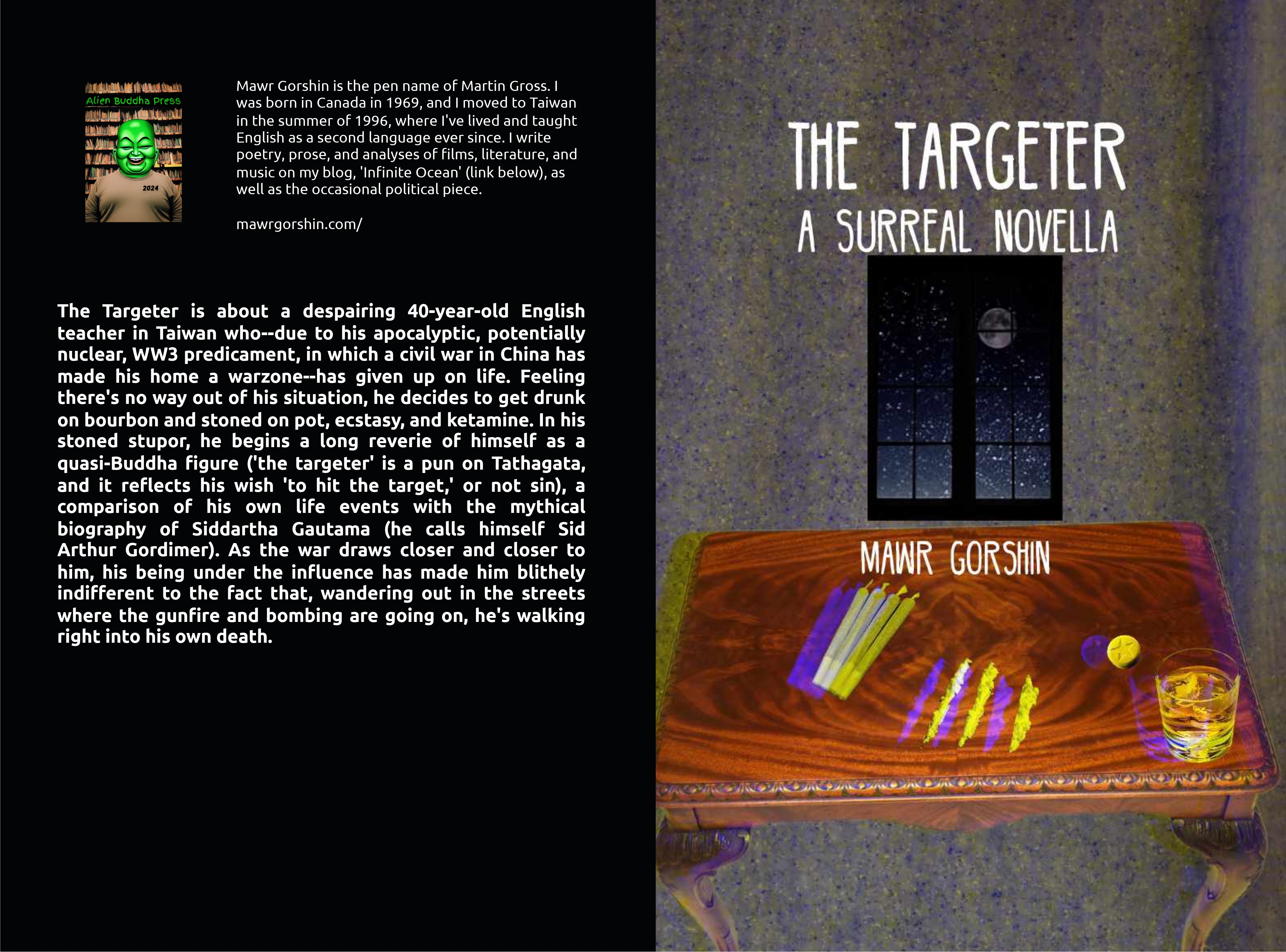
‘SPOTLIGHT: The Targeter: a Surreal Novella by Mawr Gorshin,’ from the Alien Buddha Press Blog

Please don’t forget to check out my new novella, The Targeter, published by AlienBuddha Press! Here you’ll find an excerpt from the novella, describing how the protagonist, stoned out of his mind, is having a reverie in which he imagines himself experiencing a divine birth comparable to the mythical birth of the Buddha. Here’s a link to the Amazon page, where the paperback costs a mere US$14.46.

Analysis of ‘It,’ Part III

Here are links to Parts I and II, if you haven’t seen them yet.

XI: Georgie’s Room and the House on Neibolt Street

Officer Nell won’t get the boys in trouble if they tear down the dam (page 424). In his intervention, we can see more duality of good and bad. It’s good that he put an end to the unsanitary dam, but the building of the dam, as I said towards the end of Part II, was a symbolic controlling of their fears and of the turbulent unconscious, and so tearing it down is a symbolic taking-away of that controlling and mastery of fear.

Also, Stan is about to talk about his scary experience of It, but Officer Nell’s interruption stops Stan from benefitting from the same talk therapy that Bill, Ben, and Eddie have just enjoyed. Perhaps the lack of that talk therapy at that time has contributed to a bottling up of pain that ultimately leads to Stan’s suicide.

In Eddie’s case, knowing of the filth in the dammed-up water has only reinforced his fear of germs and his aversion to the dark world down under, symbolic of the unconscious and the Shadow. He’s never fully faced these fears, and so when he finally does face them in the climax, his still-relative weakness contributes to his death, in spite of how brave he eventually becomes.

Adult Richie is driving into Derry, and he has his own flashbacks about his childhood experiences there. These include the dam in the Barrens that Mr. Nell wanted torn down, as well as his being in Bill’s house, in Georgie’s room to see the photo album, going to the cinema to see horror films (including the Wolf-man), and an experience with Bill at the house on Neibolt Street.

When Richie and Bill are about to go into the Denbrough house, there’s a moment of contemplation about Bill’s troubled relationship with his parents, a sense that they preferred Georgie over him (page 429). The love he received seemed to be only because Georgie was also there, and now that Georgie is dead, the love for Bill is dead, too.

This favouring of Georgie is the basis of Bill’s sibling jealousy, and with his little brother’s death, Bill feels that he’s to blame for it, since he’d have had unconscious desires to get rid of the little boy. Bill knows he was less than an ideal brother to George, and they’d had plenty of fights.

On the day George dies, Bill is too sick to have a fight with his brother. Significantly, he was dreaming about a…turtle…(page 429) which he later forgets about. In the unconscious world of his dreams, Bill sees an image of the good crawling thing, while also in his unconscious, there’s the wish of a bad crawling thing to take away the brother who’s been stealing his parents’ love from him. Hence, Bill’s guilt. Hence, also, the dialectical relationship between the good crawling thing and the bad one.

An interesting choice of words is used to describe Bill’s and Richie’s entrance into the former’s house: they go in “like ghosts” (page 431). They’re about to experience the ghost of Georgie (or so it seems to them), but they themselves are the real ghosts, apparently. The point is that the experience of the supernatural, of Pennywise in the form of Georgie’s movie-like photos, is a projection of the two boys’ own Shadows, Bill’s in particular, due to his guilt over George’s death.

When the two boys look at one of the photos, Bill puts his fingers on the picture, whose image looks alive, like a movie, and his fingers go into the picture. Inside, the tips of his fingers are slashed, Richie yanks Bill’s arm away to get his fingers out of the photo, and they’re bloody and in pain. This injury parallels the ripping-off of George’s arm (pages 439-440).

And just as Georgie’s torn-off arm is a symbolic castration, so are Bill’s lacerated fingers. The experience is a reinforcing of Bill’s guilt over the unconscious jealous wish to be rid of George. The symbolic castration, the Lacanian interpretation of which I gave in Part I, represents Bill’s traumatic leaving of the narcissistic Imaginary, where he’d have his parents focusing all on him, and entering the social, linguistic world of the Symbolic, where he’s just one of many people sharing attention with each other. And as I said Part I, his stuttering–a difficulty with language–represents a difficulty fitting in with society, a difficulty entering the Symbolic, hence, Bill’s being in the Losers Club.

Richie, Ben, and Beverly going to watch horror movies at the cinema, and running into Henry Bowers and his gang, fits together with Richie’s and Bill’s scary experience at the house on Neibolt Street in one crucial way…the werewolf.

One of the films the three Losers watch together is I Was a Teenage Werewolf. When Henry is bullying the Losers, he’s only twelve, but as an adolescent, he’s close enough to being an early teen. He can be associated with the teen werewolf in a number of other ways, apart from his viciousness.

It’s noted that the “Teenage Werewolf was somehow scarier […]…perhaps because he also seemed a little sad. What had happened wasn’t his own fault.” (page 461) He “turned into the werewolf [because he] was full of anger and bad feelings…Henry Bowers was just overflowing with bad feelings…” (pages 461-462). Henry is abused by his drunken, PTSD-afflicted father, Butch, so we can see how bullying begets bullying.

We later learn, in the twelfth chapter, “Three Uninvited Guests,” that Henry, blamed for Pennywise’s killings in the late 1950s and convicted for the murder of his father, is–as an adult–in a mental hospital, where he hears voices “coming from the moon…A ghost moon.” (page 791) In this, we can see more associations between Henry and the Teenage Werewolf.

Since Henry and his gang go after Richie, Ben, and Beverly after they all watch the horror movies at the cinema, which of course include the werewolf one, we can see how this ties in with Richie’s and Bill’s experience at the house on Neibolt Street.

When Pennywise presents himself to the kids, it’s in the form of their greatest fears, whatever pushes their emotional buttons the hardest. In Eddie’s case, what crawled out of the cellar window of the house on Neibolt Street was a hobo leper, a personification of disease, something his mother has conditioned him to be terrified of. In Richie’s case, what appears there is the teenage werewolf.

This form is what terrifies Richie because it is associated with his encounter with Henry Bowers, the real teenage werewolf, as it were, who not only terrorizes the Losers, but who will also go lunatic in the lunatic asylum when he’s an adult. As I’ve said previously, Pennywise is the killer in the abstract, metaphorical sense: It personifies trauma. Henry is blamed for all the killings of the late 1950s in Derry, and I’d say perhaps he really is the killer in the physical sense, with Pennywise’s presence in the killings as an allegorical concept. After all, Henry is psychopathic enough to be the real killer. The situation is similar to the gay-bashing killing of Adrian Mellon: the homophobes killed him, while Pennywise was simply present when it happened.

And once again, some good accompanies all of this bad in how Richie and Bill experience the horror in Georgie’s bedroom and on Neibolt Street together. They can validate each other’s trauma and strengthen each other by bonding together over it. Watching the horror films together is also a bonding over trauma, if only in a symbolic sense.

XII: Cleaning Up

We next come to Beverly’s story, and how she is on her way to Derry after fighting her way out of the clutches of her abusive husband, Tom Rogan. I mentioned previously how her relationship with this man is a repeat, as object relations theory explains, of her relationship with her abusive father, Al, just as Eddie’s relationship with his obese, overprotective wife is a repeat of his relationship with his obese, overprotective mother.

In the parallels between Tom and Al vis-à-vis Bev, we ought to ponder how her relationship with her husband is, by definition, obviously sexual; and so just as Eddie’s relationships with his wife and mother are, in one sense or another, sexual (i.e., Oedipal with his mother), so are there disturbing implications about Beverly and her abusive father. While it’s understood that Al’s physically abusive with her, and we never come across explicit evidence of sexual abuse, there are a number of passages that suggest that the abuse is more than must physical and psychological.

All abuse, whether physical, sexual, or psychological, is a form of psychological abuse, because all abuse, at its core, is about the abuser’s wish to have power and control over the victim. It shouldn’t be all that surprising that a father wishing to dominate his daughter, especially a father that ‘worries’ about her being with boys, would want to exercise that dominance sexually, even if on only one or two occasions. When it comes to rape, one time is enough to be traumatizing.

In his chapter-by-chapter review of It, Gabe Rodriguez agrees with me that “it’s implied that [Al] has lust for his daughter”. His ‘worrying’ about her with other boys implies sexual jealousy, just like Humbert Humbert with Lolita. We may not see examples of sexual abuse between Al and Bev because such trauma is so deeply repressed, and so painful, that it never resurfaces as such in her memories.

One thing to remember about repression, though, is that it does return to consciousness, though in an unrecognizable form. Bill’s unconscious wish to eliminate Georgie comes back in the form of moving photos. Eddie’s fear of sickness resurfaces in the form of the leper. Richie’s fear of Henry returns as the teenage werewolf. And the trauma of repressed memories of sexual abuse for Bev could conceivably return in the form of a bloody sinkhole (pages 509-512)

The drain in the bathroom sink in Bev’s home can easily be understood as a yonic symbol (with its “slightly fishy smell”–page 510). Voices calling out for help from it can be understood, symbolically speaking, as projections of Beverly’s own wish to cry for help. Blood spraying out of the sinkhole (page 512) could represent menstrual blood (after all, soon after this incident, Bev sees herself in the same bathroom mirror and notices the growth of her breasts–she’s approaching womanhood–page 519), or it could be the blood of torn vaginal walls after one of her father’s painful intrusions. In this indirect sense, then, the bloody sink could be a resurfacing of the repressed trauma of a sexual assault, too painful to be remembered explicitly.

There are a number of passages suggesting Al’s sexual abuse of Beverly. Here’s an example: “He did not drink, he did not smoke, he did not chase after women. I got all the women I need at home, he said on occasion, and when he said it a peculiar secretive smile would cross his face…They take care of me, and when they need it, I take care of them.” (page 513, King’s emphasis)

Of course, with abuse also comes traumatic bonding, as is the case when Al shows Bev love and affection. When he hugs her, she feels her love for him, knowing he hits her only when she ‘deserves’ it. (page 516) The cycle of abuse, involving a swinging pendulum of nice and nasty, creates confusion in the victim’s mind: is being hit a form of love? Is the sexual abuse a form of love? The abusive father can manipulate his daughter’s Oedipal feelings for him in these physical and sexual forms of abuse, reinforcing his control through her love of him.

Since, apart from the other Losers, no one other than Bev sees the blood in the bathroom sink, she uses the fake story of having seen a spider crawling about there (page 523). Given what we know of Its actual appearance, the choice of a spider is an interesting one to hide what she’s actually seen. Once again, unconscious trauma resurfaces in different forms.

Another hint of sexual abuse comes when Bev’s mother, Elfrida, asks her if her father ever touches her (page 523). The little girl acts surprised at the question, but “God, her father touched her every day.” (page 523, King’s emphasis) Bev is haunted by the question for a while, as it reappears in King’s idiosyncratic use of parenthetical interruptions in the narrative: “(does he ever touch you)” and “(does he)” (page 523, King’s emphasis)

Recall that Al certainly does “(worry an awful lot)” about Bev with other boys, and this is because he’s projecting his lust onto them, and projection is one of the commonest defence mechanisms. That her mother calls his punitive anger “blue devil” should give you a good idea why blue (second meaning given here) is the colour.

Bev has sexual experiences with all the Losers. That she does this in the ‘innocent’ late 1950s is surprising enough; that she does this as a preteen is, at least, bordering on shocking, if not lapsing into that. That she may have endured sexual abuse from her father, the resulting trauma of which would give her a kind of ‘slut’ complex, would thoroughly explain why she gives herself to all of the boys so easily and so young…in the 1950s. If a girl is made to believe she’s a slut through rape, she may act that way, out of no fault of her own.

Because of Al’s suspicions of her with other boys, he demands that she take her pants off so he can check if she’s still a virgin (page 1173). Examining if she’s still “intact” or not, of course, is just an excuse for him to get her pants off. That alone is too terrifying for the little girl to bear. When his hands are on her, they are “gentle. And that was somehow scariest of all.” (page 1176) Small wonder she runs away from him afterward.

To get back to the part of the story with the bloody sink, though, we learn that not only do the other Losers believe Beverly about the blood, since only they see it other than her, but they also help her clean it up, hence the name of Chapter 9. Once again, in the form of the kids’ solidarity and mutual validation of Bev, we can see goodness mixed in with all of the bad, that duality that pervades It in so many different forms, as well as in the traumatic bonding of Al with Bev. Showing her love and affection is good in and of itself, but his use of those positive feelings to manipulate and control her is all the more evil.

With the solidarity and validation the boys give Beverly, now Stan can finally tell them of his scary experience of It at the Standpipe (pages 542-553). After he tells them of his experience, and of fending off It by calling out the names of various birds from his bird-book 9page 553), he muses about what is worse than being frightened–being offended (page 557).

This sense of being offended gives us a clue as to why Stan is the one who kills himself. “You can live with fear…Maybe not forever, but for a long, long time. It’s offense you maybe can’t live with…” (page 558, King’s emphasis). The supernatural events offend a sane person’s sense of order, in Stan’s thinking. These things are shocking because they are so inexplicable; they’re traumatic because one can’t process the experiences. Stan is contemplating the indescribable, ineffable, undifferentiated world of Lacan’s Real. He can’t bear to endure it again as an adult, so he kills himself in his bathtub.

XIII: Derry: the Second Interlude

In “Derry: the Second Interlude,” Mike recalls the fire at the Black Spot in 1930. The Black Spot was a nightclub essentially for black soldiers from a nearby army base. It was burned down by the Maine Legion of White Decency, a secret society of white supremacists like the Ku Klux Klan (page 576).

Mike asks his father, William, about the historical background of the fire, and while the obvious racism behind the motive to burn the Black Spot isn’t to be denied, his father insists that there was more to the fire than just prejudice against blacks. In William’s opinion, “the Legion of White Decency was just another seed” (page 577), and it seemed to him “that bad things, hurtful things, do right well in the soil of this town,” Derry (page 578). What’s implied here with the “seed” planted in the “soil” is that William intuits the presence of Pennywise.

What’s linked to the racism behind the Black Spot fire is the racism of Henry Bowers and his father, Butch, against specifically the Hanlon family. Apart from hurling the usual racial slurs at Mike, we learn that Henry–at the age of ten and thus already demonstrating his psychopathy–killed Mike’s dog, Mr. Chips. Butch, who as Mike’s father observes, “was never right after he came back from the Pacific” (page 582), took a lot of his pain out on blacks and “nigger lovers,” and even killed a number of William’s chickens (page 583). Both fathers were farmers, but since Will Hanlon’s farm was more successful, Butch envied him, feeling humiliated that a black farmer had outdone him.

A similar envy could be seen in the white racists’ reaction to the fixing-up of the Black Spot, a bunch of blacks transforming the originally filthy dump of a place into a successful night club (page 594). The plan to fix up the place was suggested by Pfc. Dick Hallorann, also a character from The Shining.

Dick’s “shining” abilities helped him to save Will and several other club goers from the fire, going “back toward the bandstand…toward the fire” (page 602). He’s called crazy for wanting to go that way, but this is another interesting incidence of that duality of good mixed with bad that pervades It, just as when adult Bill with catatonic Audra on his bike, Silver, snaps her out of it only by risking death with her as they race around at the end of the novel. Dick similarly saves Will and the others by facing the fire, then going out a window (page 603).

Outside the burning nightclub, Will saw something disturbingly unusual, yet he hesitates to tell his son what it was. Mike senses correctly what it was by synchronicity, and while afraid to have his suspicions confirmed, he must know the truth, just as Lot’s wife had to see the burning pair of sinful cities, a sight that killed her (pages 608-609).

His father saw a giant bird, the same bird Mike saw four years earlier (page 609). Naturally, Mike gets a chill from the revelation of this synchronicity. We also learn that the bird didn’t hover. “It floated.” (page 609) There were also “big bunches of balloons tied to each wing,” an obvious reference to Pennywise.

Because Mike is convinced that “It’s come again” (page 609), he’s written everything down “in a kind of frenzy” page 610), his desperate attempt to use writing therapy to soothe his relapse into his old childhood traumas. Though he’s worn himself out with writing all night, and even slept with his notebook and pen on the table there in front of him, he wakes up “feeling free, somehow…purged of that old story” (page 610).

Since It attacks people based on their fears (Bill’s guilt over Georgie, Richie’s Henry/werewolf association, Bev’s bloody sink/damaged yoni association, Eddie’s fear of sickness and leper perverts), we can see why Mike shudders at the thought of the big bird, and how his father saw the same unsettling sight. We eventually learn of Mike’s instinctive fear of birds from an incident when he was a baby of only six months old, and a crow was pecking at him (page 1318). As for his father’s experience of the big bird, perhaps it was linked to the killing of his chickens. After all, both that killing and the deaths from the Black Spot fire were race-related.

And just to complete Mike’s relapse into his old trauma state in the mid-1980s, he sees a balloon tied to his reading lamp, filled with helium. A picture of his face is on it, with blood pouring out from where his eyes are supposed to be. The crow got at him after all, apparently. (page 610)

XIV: The Reunion

The adult Losers are all in Derry, and they meet with Mike in a Chinese restaurant for dinner. Ben tells of how he lost the weight as an adolescent and kept it off. Richie’s trash-mouth goes off constantly, and the others say “Beep-beep” to him as a kinder, gentler way to tell him to shut up. Fortune cookies are served for dessert, and they’ll make quite a spectacle soon enough.

Since everyone remembers the childhood events only very vaguely still, Mike suggests they all break up and go to whichever places in Derry they remember best (except the Barrens, which I imagine might bring up unconscious traumas they won’t yet be ready to deal with)…in order to jog their memories.

Finally, they get around to eating the fortune cookies. Since Richie uses humour to deal with his trauma, he jokes about reading a fortune that says he’ll “SOON BE EATEN UP BY A LARGE MONSTER. HAVE A NICE DAY.” (page 682) Instead of getting another “Beep-beep” from the others, they all laugh. A bit of appropriate humor can definitely ease the tension a bit.

Bill is the first, however, to realize that breaking open their cookies to read their fortunes is a bad idea. Nobody has gone for a fortune cookie until Mike passes around the bowl of them. Everyone, at least unconsciously, knows that his fortune in Derry cannot be a good one, hence the delay in touching the cookies. When Beverly grimaces upon opening hers, Bill realizes that, in spite of everyone’s huge lacunae of forgotten traumatic memories in Derry, “Somehow, some part of us still remembers…everything.” (page 683) No memory is forgotten: it’s all just repressed, pushed back into the unconscious.

Beverly sees blood spurting up from her fortune cookie, an obvious reference to the bloody sinkhole incident. Note the choice of words in the description on page 683 (my emphasis): the blood was “a bright red that sank in [the white tablecloth] and then spread out in grasping pink fingers.” Those “grasping pink fingers” could have only been Al’s.

Eddie sees “a huge bug…pushing its way out of his fortune cookie” (page 683), this bug being an obvious reference to his fear of germs, of bugs. Bill notices it, and understands it to be “some sort of terribly mutated cricket.” Notions of disease or mutation always link with the fear of not being healthy, of not being normal. Not being normal means being vulnerable to bullying (as a Loser), just like being vulnerable to disease.

Richie sees an eye in his fortune cookie. He’s staring at it “in a kind of sickened leer” (page 683). The “human eyeball stared with glazed intensity” right back at him. Since Richie is a DJ and a comedian (of sorts), he’s going to be sensitive to what his audience thinks of him as a performer. Any eyes looking at him with criticisms, ranging everywhere from the most trivial “Beep-beep” to the most scathing of them, will be difficult for him to deal with. Also, that staring eye is a projection of his own leers, of his own staring, a reminder that Trashmouth is quite the critic himself.

Ben sees teeth in his fortune cookie, and his instinctive reaction is to throw the cookie across the table (page 684). The teeth must have triggered in his unconscious his childhood overeating habits; the teeth are a mocking mirror reflecting his former size. Their biting nature, the way “they rattled together,” may have also prompted memories of Henry’s digging knife.

Bill never opens his fortune cookie: he’s too busy trying to stop Beverly from screaming at the sight of the insect from Eddie’s cookie. Bill does, however, “see its sides moving slowly in and out–bulge and relax…” (page 684). Could those movements be from a winking eye, by chance? “It had swelled like some unimaginable boil which was filling with pus. And still it pulsed slowly in and out.” (page 686) Is it a tiny heart?

As for Eddie’s insect, it looks as if it’s dying. As an association with disease and dying, the cricket looking that way is a fitting finishing touch to Eddie’s fears.

Bill knows they must all calm down to avoid making a scene, since Rose, their server, will soon be back and, not seeing any of the supernatural frights, will think they’re all crazy.

After Rose is finished asking how their meal was, Bill finally gets an idea as to what is in his cookie. He sees “a leg poking blindly out of his fortune cookie,” scraping at his plate (page 686). A leg is a limb: seeing this, and none of the rest of the tiny body, isn’t all that much dissimilar to the arm of a little boy that’s separated from the rest of his body.

Then Richie looks at Bill’s cookie and sees “a great grayish-black fly…slowly birthing itself from the collapsing remains of his cookie.” (page 686) It’s as though, through the association of bugs and disease, that Richie, Bill, and Eddie are sharing the same fear, giving each other mutual validation of that fear.

As Bill remarks after Rose leaves, it’s “a mutant fly” (page 687), further reinforcing the associations with Eddie’s experience of the “mutated cricket.” As members of the Losers Club, they all feel like mutants of a sort–sick, odd, different, and thus vulnerable to the bullying of people like Henry. Bill recalls, through this fly in the cookie the old short story of “The Fly,” later made into a movie. “The story scared the bejesus out of [Bill]” (page 687). The scientist in that story, with his head and hand swapped with those of a fly, felt similarly alienated from the world as the Losers do.

The fly from the cookie grows into the size of a sparrow, Bill covers it with his napkin, and Bev needs to leave the room to throw up. The fears are inside all of them, and they need to get these fears out of themselves, which is what her vomiting represents. A growing bug is Bill’s growing fear, also an idea he has for a new horror novel: writing about the fear gets it out of him, too.

Speaking of getting out, Mike rightfully advises them all to leave the restaurant right away. Bill knows It is up to Its old tricks, using the Losers’ inner fears to scare them all out of Derry.

XV: Walking Tours

As Ben is on his way to the old library, he’s going over childhood memories, having them come back to him at first in fragments. The silver dollar. Chüd (page 692). What did these things mean, though?

In the library now, he applies for a library card. He starts hearing a voice–only he can hear it. The only thing the woman making his library card notices that’s strange is his behaviour, including his perspiration (page 702).

As she’s off to type up the information on his card, he looks up and sees Pennywise on top of a staircase (page 703), “looking down at him…[with] a killer’s grin.” Ben knows he can’t react to what only he sees and hears there, for fear that everyone else in the library will think he’s crazy. This, of course is perfectly true, for Pennywise, properly understood, is a monster not of the physical world, but of the mind. It’s trauma personified.

Pennywise keeps calling Ben to go up the stairs to meet It face to face, but Ben knows he’ll want to face the clown by going down into the darkness, the unconscious of the sewers, where It “won’t want to see me…We’re going to kill you.” (page 704, King’s emphasis)

Naturally, Pennywise knows what Ben’s thinking (about killing him), because Pennywise is in Ben’s thoughts. The clown is taunting Ben in Richie’s “Pickaninny Voice,” warning him to get out of Derry while he still can (page 704).

It’s worthwhile to consider why King chose to have It present Itself primarily as a clown, of all forms. Apart from what we know that children often find clowns frightening, there’s also the fact that clowns are supposed to be funny. Since so much of the Losers’ childhood trauma is based on having suffered bullying (hence, their collective name), we should consider the juxtaposition of a source of terror with one of humour.

Apart from terrorizing his victim, a bully will commonly use humour in his belittling of his victim. Henry calling young, overweight Ben “Tits” (a reference, of course, to his ‘boy-boobs’) is meant to elicit laughter from the rest of Bowers’s gang. Bullies fancy themselves comedians, making fun of their victims. Narcissistic, emotionally abusive parents are also clowns, properly understood.

On top of this, Pennywise does an imitation of Richie, of all people, a guy who fancies himself a clown, of sorts. It’s mocking one of Ben’s friends, which can make Ben empathize with Richie; but also, since the clown is doing Richie’s Pickaninny Voice, a stereotype of black people, this mockery can also be understood as belittling a friend of both Ben’s and Richie’s…Mike.

Part of the reason the Losers keep saying “Beep-beep” to shut Richie up is because his inappropriate, trash-mouth humour reminds them, on at least an unconscious level, of the taunting humour of bullies like Henry. Richie’s humour also used to provoke Henry himself back when they were all kids, so his big mouth was potentially dangerous for them.

Pennywise mocking Richie before Ben, thus, is like holding a mirror up to his face, telling one of the Losers that, in a way, they’re just as bad as It. After all, he wants to kill It, doesn’t he? It even accuses Ben of killing the children in Its screaming, taunting voice (page 702), a clear case of projection on Its part.

Eddie’s wandering around Derry leads him to the Tracker Brothers’ Truck Depot. These brothers, two life-long bachelors named Phil and Tony, also had an immaculately clean, white mid-Victorian house. One would think that Eddie’s mom would accept her little boy going into such a clean house, but she assumed such a spotless house kept so clean by two unmarried men had to have been the home of homosexuals (page 712).

As for the Truck Depot, it was the filthy opposite of their house. The back of the building was used for playing baseball, and kids were invited to play there (page 713). Eddie, for obvious reasons, would never have been allowed by his mom to play baseball there.

The hypochondria and fear of germs his mom imposed on him is clearly a form of emotional abuse. Even two men living in a spotless house, actually just brothers, are assumed to be a pair of filthy “queers.” Nothing could possibly be clean enough for her.

Eddie walks out across the area where they used to play baseball, all the way to the fence, beyond which “the ground slipped down, aggressively green,” to the Barrens (page 720).

He contemplates what he feels is a misnomer for this area of land down there. There’s nothing barren about the Barrens. It’s quite the opposite, actually. If anything, it ought to be called “the Wilderness,” or “the Jungle,” especially now, since “the Barrens were more junglelike than ever” (page 720).

To make matters worse, Eddie feels that the name “Barrens” sounds ominous and sinister. “Barrens” implies a desert, a place of lifelessness. The “stretch of such tangled and virulent growth” implies an abundance of life, and the choice of the word virulent brings back Eddie’s fear of germs and disease. So the dialectical opposites of virulent and barren are sublated with the idea of disease bringing on death, Eddie’s greatest fear.

Furthermore, barren reminds Eddie of how all the Losers are childless, as Mike noted in the Chinese restaurant. In spite of how successful all of them turned out in terms of their careers, they were all ‘the barren ones,’ the Barrens. As kids, they all hung out in a place that would become their namesake, Eddie realizes.

As he’s turning away, he sees a cement cylinder, the kind of thing Ben used to call “Morlock holes.” (page 721) Going in there was going into the sewers, the hell of the unconscious mind, the land of repressed trauma, where all the filth and germs are.

Memories of the Barrens, as well as Henry Bowers’s gang chasing them in there, make Eddie want to leave, to be home with Myra, his new mama. And just then, he hears the voice of It. It tells him to catch a baseball tossed over the fence; he catches the ball so well, it’s as if he were an experienced baseball player (page 721). This ability at, and participation in, a game his neurotic mother forbade him to play should frighten him.

As soon as he catches the ball, it turns into a ball of string that’s unraveling (page 722). He realizes that It is with him when he sees the string going over the top of the fence “like a strand of spiderweb.”

The voice that’s calling out to him to play ball is that of Belch Huggins, who was murdered in the tunnels of Derry back in August of the late 50s. Belch was with Henry’s gang at the time, chasing the Losers in the sewers. Now, adult Eddie sees Belch coming out of the Barrens area to meet him on the other side of the fence.

When they meet, Belch offers Eddie a blowjob, just like the leper crawling from the cellar window in the house at 29 Neibolt Street. And sure enough, Eddie sees Belch transformed into that leper.

What Eddie sees here is a number of parallels reflecting his fear of germs and, ultimately, his domineering mother’s disapproval. Belch crawling out of the Barrens, one symbol of the unconscious, parallels the leper crawling out of the cellar, another such symbol. The filthy house at Neibolt Street parallels, on the one hand, the filthy Truck Depot, and on the other, the all-too-clean house of the Tracker Brothers, those life-long bachelors assumed by Eddie’s ignorant mother to be filthy “queers.” These men play ball with boys, just as the leper wants to ‘play ball’ with Eddie in another sense.

After continuing to be terrorized by It in other forms, Eddie finds the scariest one to be that of Patrick Hockstetter, one of the Bowers gang. What’s especially scary about Patrick is how sociopathic and solipsistic he was when alive. We will eventually learn how disturbed Patrick was in the chapter titled, “Another One of the Missing: The Death of Patrick Hockstetter” (pages 1045-1090), in which we learn of him murdering his baby brother at the age of five, his hobby of killing flies, collecting them in his pencil case, and presenting them to the other kids on the playground. He’s also seen by Beverly to be jerking off Henry in the Barrens.

Patrick’s killing, collecting, and displaying flies can be linked to Eddie’s and Bill’s fortune cookies, and seeing bugs crawling out of them. As one of Henry’s gang of bullies, Patrick also bugs the Losers. Though it was Beverly, rather than Eddie, who saw Patrick giving Henry a handjob, the association with homosexuality also links thematically with adult Eddie’s overall experience there at the Tracker Brothers’ Truck Depot.

All of these triggers of Eddie’s fear of filth and germs, including seeing a message on a balloon saying, “ASTHMA MEDICINE CAUSES LUNG CANCER!” (page 725), make him run and run from the Truck Depot area (page 726). He collapses where some kids see him and, thinking he’s a wino with a weird disease and may even be the child-killer, keep away from him. It has projected Its pathologies onto Eddie, just as It did onto Ben in the library.

Beverly is walking down Main Street, thinking about Ben’s three-line love poem to her, and how she, as a child, hid it in her lower bedroom drawer, among her underwear, so her father would never find it and suspect she was being naughty with boys. Imagining him still alive and still living in Derry, she wants to find the old apartment house they lived in and visit him.

As abusive as Al was to her, she is convinced that he has loved her. In this understanding, we can see how she has been able to reconcile what Melanie Klein would have called the good father and the bad father, a mental reconciliation called the depressive position. Her love of Bill, back in 1958, was a transference of her Oedipal love of her dad, since the authority Bill projected had a paternal quality, yet Bill, unlike Al, listened to her (page 727).

She finds the old apartment house, 127 Lower Main Street (page 729), and rings the doorbell a couple times (page 731), thinking about Ben’s poem again, and wondering if she’d begun menstruating at eleven, around the time her breasts had begun growing…also around the time she’d seen the blood in the sinkhole (see above).

Al doesn’t answer the door. Instead, it’s an old woman. She tells Beverly that her father, Alvin Marsh, died five years ago (page 732). The old woman’s name is Mrs. Kersh, a name Beverly’s misread on the mailbox for the first floor, where her father lived. This misreading represents how Bev has equated the old woman with her dad in her mind…and equated her with her mom, too.

This equating is significant, given how we just explored the good and bad father in Al, and how we’ll see the good and bad mother as represented in Mrs. Marsh…er, Kersh. For just as Al both ‘loved’ and abused Bev, so did Elfrida, as dead now (cancer) as Al, both ‘love’ and look the other way (for the most part, at least) whenever he abused their daughter. Put another way, Bev’s encounter here with Mrs. Kersh is a transference of Elfrida onto this old woman.

For the moment, we’re seeing the good mother transference in Mrs. Kersh as she shows hospitality to Beverly. Soon enough, though, the bad mother will come out.

Very little did Mrs. Kersh know Al (page 733), as she tells Bev in a manner like the inverted syntax of Yoda, who knew Anakin, who was also sometimes the good father, sometimes the abusive, bad one, cutting off Luke’s hand. Elfrida also little knew Al, from her looking away when he did…what he did…to her.

Mrs. Kersh, as the good mother transference, invites Beverly in and makes some tea for them. The changes made to her old home make it feel safe because it is almost all different (page 733). She tells Mrs. Kersh that she loves what’s been done with the place (page 736), but she’s sure she saw Marsh under the doorbell, not Kersh.

Beverly begins to observe other strange things about this old woman. She’s sure Mrs. Kersh’s teeth were white when they first met…now she sees yellow teeth (pages 736-737). Her eyes and hair have changed, too…uglier. Bev hopes Mrs. Kersh won’t see a negative reaction on her face.

The old woman mentions her father, calling him Robert “Bob” Gray, then Pennywise the Dancing Clown (page 737). Laughing, she has some black teeth now. The good mother transference is turning into the bad mother, a witch, and Beverly is feeling like Gretel in her home (page 739).

The witch says, “Oh, my fadder and I are one” (page 738), recalling John 10:30. The Biblical quote is meant to be understood as a good thing, of course. She, however, is one with Pennywise (the devil of this cosmology, remember), or more accurately, with Bev’s father. Put another way, the good and bad mother are one, the good and bad father are one, and mother and father are one.

Bev runs for the door, while the cackling witch is warning of what will happen to her and her friends if they stay in Derry. As she’s running out, she looks back and sees her father in the witch’s dress (page 740). He says to her what’s been implied over and over again in the childhood flashbacks: “I beat you because I wanted to FUCK you, Bevvie…” The bad witch mother is the bad rapist father. Her mother’s emotional neglect was every bit as abusive, in its own way, as her father’s terrorizing was.

Outside, Beverly looks back again and sees Al in Pennywise’s clothes, instead of the witch’s dress (page 740). It’s holding a child’s severed leg, reminding us of Georgie’s arm. Pennywise is equated with Al because the former is the personification of the trauma caused by the latter.

To sum up the situation with the good and bad mothers and fathers, as well as their transferences, they are all another manifestation of the duality of good and bad as I have mentioned as appearing here and there throughout the novel in various forms.

Richie is walking along Outer Canal Street, remembering a time when he was a kid and Henry’s gang was chasing him (page 743). He’s also trying to convince himself that what he and the others saw in the fortune cookies was just a group hallucination. After all, Rose didn’t see anything, just as Bev’s parents hadn’t seen any blood in the bathroom sink.

Richie remembers when, as a kid, he was the class clown, and that now, he has resumed that role (page 744). This remembering can be linked back to when Ben, in the library, saw Pennywise doing Richie’s Pickaninny Voice, accusing Ben of killing the children, and implying that the Losers are, in their own way, as bad as It is (see above). Richie’s a clown, as is Pennywise. They are mirrors held up to each other.

Just as Pennywise, personifying the Losers’ trauma, is a projection of theirs outward, so does Pennywise project his evil right back onto them. Abusers often project their vices onto their victims, as Al did his lechery onto little Beverly, and since the Losers are the novel’s protagonists, this projection of evil back and forth between them and Pennywise is another example of that dialectical duality appearing and reappearing at so many points in the novel.

Richie comes to City Center and sees the huge statue of Paul Bunyan there (page 746). He finds it idiotic and as cheerfully vulgar as he found its size overwhelming as a child. When it was built, there were those who thought it would be a great tourist attraction, while others thought it would be horrible, garish, and gauche (page 747). Since some find clowns amusing and entertaining, while others find them evil and scary, the giant Paul Bunyan statue, with its axe, can be seen as a double of Pennywise.

The association of these two is strengthened when we remember Richie, as a kid, having run away from Henry’s gang, who’d chased him from school until they lost him in Freese’s Department Store, then the exhausted boy was on one of the benches in front of the statue (page 748). The chase was provoked by Richie’s trash-mouth reaction to Henry slipping and falling on a wet floor at school.

As he was resting, he saw a message advertising a concert with performers like Jerry Lee Lewis, The Penguins, and Gene Vincent and the Blue Caps. Though the ad says it’s “WHOLESOME ENTERTAINMENT” (page 752), the boy’s mom wouldn’t have thought so, meaning there was no chance of little Richie seeing the show. Recall that, as a DJ, Richie has always found this kind of entertainment to be right up his alley. Since he’s something of a showman himself, he can identify with rock ‘n’ roll stars, which will be most significant a little later in this section of the chapter.

Adult Richie, by the Paul Bunyan statue again, is delighted to see a new ad for a rock show, this time with Judas Priest and Iron Maiden (page 754). He contemplates how the statue’s appearance has changed over the years. The grin on its face no longer looks cheery, and now we begin to see how Paul Bunyan is a double of Pennywise (page 756).

The statue starts to speak.

Like the giant in “Jack and the Beanstalk” (recall how many references to children’s stories there are in It), Paul’s statue says he’ll eat Richie up if he doesn’t give back his hen, harp, and bags of gold (page 756).

Richie rolls off the bench he’s been sitting on, and Paul’s axe slashes the bench (page 757). So, being terrorized by giant Paul Bunyan is like being chased by Henry Bowers’s gang all over again. In these connections between the school bullies, the statue, and Pennywise, we see how the third of these threats is just a psychological terror, causing the hallucinations that Richie’s convinced he saw in the Chinese restaurant, and reviving his old childhood traumas.

The mental associations are iconic (Bunyan/Pennywise, both by turns comic and scary) and localized (City Center, near where the bullies chased Richie). After the statue is no longer terrorizing him, just as when he knew he was safe from the bullies, Richie sees the ad for the rock shows again. Now, though, it’s all for dead rock starts, including the three who died in the famous plane crash of February, 1959…and the show is dedicated to Richie. “YOU’RE DEAD TOO!” it tells him (page 762), associating Richie as a performer with them.

The associations between Paul Bunyan and Pennywise are made complete when Richie looks up at the statue and sees the clown instead of the lumberjack (page 763). After the two exchange taunts, Pennywise alludes to Matthew 7:5 (page 764), about removing the beam from one’s own eye before removing the mote from someone else’s eye. This would be a comment on the giving and receiving of projections of evil as discussed above. The idea will be further developed below.

Richie finds himself speaking in a new, stereotyped black man’s voice, one he’d never done before, in an attempt to threaten Pennywise (pages 764-765) Apart from him again using his sense of humour and theatricality as a manic defence against his trauma, his use of this voice seems to be a mirrored parody of Pennywise having done the Pickaninny voice to Ben in the library. Then Richie begins to run like hell.

Pennywise’s voice thunders after him, saying, “We’ve got the eye down here, Richie…[…] give a great big hi to our great big eye!” (page 765) We’re reminded of the eye Richie saw in his fortune cookie. There’s also the removing of motes or beams from one’s eye alluded to here.

Richie looks back, and seeing neither Paul nor the clown, he now sees a giant statue of Buddy Holly, one of the three killed on “the day the music died.” (page 765) Also, like Richie, Buddy wore glasses, acceptable for a rock ‘n’ roll star back in the 1950s, but nerdy by 1980s standards. Richie is being mirrored and identified with Buddy in these two ways: a loser of life, and a just-plain Loser. Richie’s aspired to be a giant among performers, yet will he also die as such?

To complete the Richie/Buddy/nerd link, Richie sees tape on Buddy’s glasses (page 766). More associations can be made here: adhesive tape on glasses implies ones that aren’t very good for seeing through, which in turn implies impaired eyesight, like the mote or beam in one’s eyes. Someone idolizing pop star ‘giants’ or other such performers isn’t using his eyes very well, either. Visual hallucinations, such as seeing an eye in a fortune cookie, is certainly not seeing well.

He finally sees that Paul Bunyan the giant statue is back to normal, with its axe back over its shoulder; but his eyes are suddenly in agonizing pain. Even when the hallucinations of a living Paul Bunyan, Pennywise, and Buddy Holly are gone, his eyes are still doing him wrong. Richie even almost jabs his forefingers into his eyes (page 766). It’s as if, unconsciously, he wants to blind himself, so he won’t ever see traumatizing things again.

His contact lenses are hurting his eyes. They’re like the mote and beam he has to get out of his eyes. He blinks to get them out, and he–aided by a nearby high school girl–searches the sidewalk for almost fifteen minutes trying to find them (page 767).

Bill is walking up Witcham Street, and he pauses by the drain where George was killed (page 767). He won’t see Pennywise this afternoon, but he will see a ghost. He peers into the drain, wanting to confront the clown that killed his little brother, even threatening that he and the Losers will go down there and get It.

He gets no answer from It, but a boy of about ten with a skateboard approaches, wondering why Bill is talking into the sewer. Though the boy at first would seem to think that Bill is crazy, it turns out that he, too, has heard scary voices from the sewers (page 768).

In a sense, this boy could be said to be the ‘ghost’ that Bill sees, though as we learn later in this section, ‘seeing a ghost’ actually comes from a tongue-twister poem. Still, this boy could be the ‘ghost’ in the sense that he reminds Bill of Georgie. Bill has a kind of George transference for the boy, causing him to feel affection for him (page 773).

That the boy says he shouldn’t be talking to strangers, because of the recent spate of killings, further establishes the link between him and George in Bill’s mind. Bill would like to try out the boy’s skateboard, but realizing he’ll just crash and hurt himself, he wisely changes his mind (he’s almost forty years old, and unlike the two handsome actors who play adult Bill in the TV miniseries and the 2019 film, he’s bald).

Wanting to go on the skateboard, with the risk of crashing, anticipates his final ride on his old bike, Silver, with Audra. Further linking the skateboard to the bike is how Bill is going to find Silver later in this very section.

He learns about a shop called Secondhand Rose, Secondhand Clothes, a filthy, dingy place, and here is where he finds Silver, in the window (page 778). When he’s about to ask the owner of the shop about the bike, those tongue-twisting old lines suddenly pop up in his head: “He thrusts his fists against the posts and still insists he sees the ghosts.” (page 779) Seeing old Silver is also rather like seeing a ghost for Bill, so this must be a major factor in reviving the memory of this old rhyming couplet.

When Bill was a kid, he used to recite this rhyme as part of his speech therapy for ridding himself of his stammer. What’s curious about the words is how they include the idea of ‘seeing ghosts,’ something that should have always been triggering for little Bill…yet they helped cure his stutter.

In a similar vein, racing on the bike with Audra, as dangerous as it was, snaps her out of her catatonia. Perhaps a crash on the boy’s skateboard would have been good for Bill, too.

The point is that It is all about facing one’s fears in order to cure one’s trauma. One has to get hurt to get rid of hurt. This is what the duality of good and evil in the novel–its interconnected, dialectical nature–ultimately means.

We learn, incidentally, that the proprietor is gay, reminding us of Adrian Mellon and his murder (page 781). Bill buys the bike for twenty bucks, he calls Mike and asks if it will be OK to take the bike over to Mike’s garage so he can store it there. Mike agrees to it, and Bill takes it over there.

Mike is helping Bill fix up the bike, and at one point, a deck of playing cards (for attaching to the bike’s wheel) that Mike has just opened has two aces of spades; these two cards are also the only ones, after having scattered the deck all over the floor, to land face up (pages 788-789).

The ace of spades can symbolize many things, both positive and negative, but for the sake of this novel, it would seem that the negative meanings have far greater importance. It’s been called the Death Card, being associated with imminent death, bad fortune, disaster, hatred, war, and even the end of the world…which should remind us of the flooding in Derry, twice, and the…apocalyptic…rock fight. So the two cards are an omen.

There are two aces of spades seen in this deck because the Losers have to deal with It twice. That the card has both positive and negative symbolism also ties in with the theme of good and bad duality. It’s bad to face the terror of It, but it’s also good to do so in order to defeat It.

After attaching the playing cards to the bike’s rear wheel, then eating burgers that Mike has cooked for them, Bill brings up the rhyming couplet. Bill has written it down on a business card, and he’s had Mike read it, asking him if it means anything to him (pages 789-790). Mike remembers that Bill, as a kid, used to mumble the couplet to himself in an attempt to cure his stammer. Bill struggled with saying it properly back then, but he did at least once succeed.

He’s now frustrated that he can’t remember the precise moment when he successfully said it. We have here a case of repressed memory–which would normally be a repressed trauma–yet it’s also a move out of the traumatic, unutterable world of the Real and into the verbal, social world of the Symbolic.

“The ghosts”–representative of Bill’s trauma (i.e., Georgie’s ghost)–is fittingly at the end of the couplet. The saying of these words, presumably after having said all of the preceding ones without a stutter, would thus represent a fully successful recitation, progress–at the very least–in curing himself of his stutter. Saying that last word is symbolic of facing his fears, verbalizing his trauma.

His inability to remember his childhood success–that is, when it actually happened–means he can no longer make the moment real for himself, hence his hard banging of his fists on the picnic table in frustration (page 790). The forgetting is an unconscious resistance; sometimes we know when we need to face a trauma, but our unconscious forbids the confrontation out of how unbearable the pain will be. Still, the forgetting is frustrating because we know that we must confront the pain in order to be cured of it.

In this we once again note the good/bad duality. It’s good that the forgetting/resistance spares us the pain, but it’s also good to face the pain to be cured of it, and it’s bad to be denied that cure because of the forgetting.

Part IV is coming soon.

Stephen King, It, New York, Pocket Books, 1986

Analysis of ‘It,’ Part II

Here’s a link to Part I, if you haven’t seen it yet.

VI: Derry: the First Interlude

As Mike has written in his notes about Derry, “Can an entire city be haunted?” (page 189, King‘s emphasis) The entire city of Derry can be seen to symbolize the mind, a kind of collective mind, peopled with a host of characters who could thus represent everything from Melanie Klein‘s internal objects, both good and bad, to Carl Jung‘s archetypes.

The surface world of the town, from the ground up, would represent consciousness, where all is sunny and sweet. The underground, the sewers, and the cellars of each house, as I mentioned in Part I, would represent the unconscious mind. It, that is, Pennywise, would thus personify the Collective Shadow, normally repressed and dormant for about 27 years at a time, then let loose for about a year. One tries one’s best to repress, hide, and forget about trauma, but it eventually will out all the same.

The whole adventure that the Losers go through, once as kids in the late 1950s, and again as adults in the mid-1980s, can be seen as allegorical of what Jungians call Shadow work. In order to heal from trauma in a lasting way, one must face one’s traumas, and this is what we see the Losers doing (in an allegorical sense), first only partially achieving it as kids, then thoroughly achieving it as adults in their final confrontation with Pennywise.

Though confronting one’s Shadow, where all the dark traumas of the unconscious reside, is necessary for the sake of healing, it’s also dangerous. Jung himself, in his explorations of his own unconscious through Active Imagination, Shadow work, and other methods of integrating the conscious and unconscious aspects of his mind, brought himself dangerously close to a total psychotic breakdown.

In their final confrontation with It, Eddie dies; the surviving Losers aren’t even able to carry his body out from the underground. What’s more, this confrontation happens during a huge storm, the worst in Maine’s history, with rains reminding us of the Great Flood and that rainstorm at the beginning of the novel, an apocalyptic storm that causes the downtown area of Derry to collapse. This collapsing of downtown Derry, which is a merging together of the upper and lower worlds, is symbolic of that necessary but dangerous integration of the conscious and unconscious through Shadow work.

VII: Ben Hanscom Takes a Fall

As Ben sits on his airplane flight to Derry, “as drunk as a lord,” according to the stewardess observing him (page 211), he finds the old memories finally starting to come back to him. In his state of drunkenness, as well as his hovering between consciousness and unconsciousness, he finds “the wall between past and present disappear[ing]” (page 215). He is entering a world of non-differentiation, the traumatic Real, as Lacan would have called it.

It is fitting that Ben is drunk and falling asleep as he is starting to get these old memories back. As Nietzsche noted in The Birth of Tragedy, Dionysus, the god of wine, chaos, irrationality, emotion, and disorder (as opposed to Apollo as god of logic, clarity, the sun, and the principle of individuation), is also a god of unity, of non-differentiation. So drunk Ben, between wakefulness and sleep, is also experiencing a blur between the past and the present, the trauma of non-differentiation.

This is also rather like the non-differentiation of the Great Flood as paralleled in the rainstorms at the beginning and climax of the novel, when the waters above meet the waters below, recreating the primordial Chaos, tohu wa-bohu, in chapter one of Genesis.

Ben’s memories of being a kid at school, when he was fat and therefore an easy target of bullies like Henry Bowers, Belch Huggins, and Victor Criss, were also a disordered mix of good and bad, because it was also then that he had his crush on Beverly (pages 216-217). He demonstrated his poetic talent by writing his verse celebrating her beautiful, fiery red hair…”winter fire,/January embers” (page 246).

His trip down memory lane is compared to the adventures of the time-traveller in HG Wells‘s classic story; in particular, we’re reminded of “the land of the Morlocks, where machines pound on and on in the tunnels of the night” (page 215). This hellish, subterranean world is easily associated with the underground of Derry: its sewers, cellars, and representation of the unconscious and the Shadow, personified by that ultimate Morlock, Pennywise.

Henry is mad at Ben for not letting him copy his test answers in class. Henry likes to call overweight Ben “Tits” (page 252). We soon learn that Henry is much worse than your average bully: he’s a violent psychopath, a fact proven when he takes out a knife, has Belch and Victor hold Ben, then digs the blade into Ben’s gut.

That cutting into Ben’s flesh, apart from the obvious pain and terror it causes the boy, is a violation of the boundaries between self and other, that traumatic non-differentiation of the Real, of Dionysus.

It’s significant that Ben escapes Henry and his gang by falling through the fence separating the street they’re all on and the Barrens, which is a stretch of scrub land next to Derry, a swampy area where the sewers are. The Barrens, therefore, can also be symbolically linked with the unconscious…perhaps with the preconscious, since, though lower, it’s still outside. Ben’s breaking through the fence is also representative of a non-differentiation between consciousness and unconsciousness.

VIII: Bill Denbrough Beats the Devil (1)

Just as Ben has been flying in a plane on the way back to Derry, going from utter oblivion to flashbacks of childhood memories, so has Bill. And just as Mike’s writing about Derry has been a form of therapy for him, so has Bill’s writing of horror novels been a form of writing therapy for him.

All the stories he’s written, all the novels–they came from Derry, Bill muses (page 283). They came from that summer, when George died. They came from his trauma. His interviewers would ask him where he got all of his ideas from, and he’s answered by speaking of the inspiration coming from his unconscious…yet he’s doubted, more and more as the years go by, if there ever was such a thing as an unconscious (page 284). This unbelief in the unconscious comes from his total forgetting of Derry.

Eventually, though, a memory starts coming back, one of “beating the devil.” (page 285) The unconscious, be it a Freudian or Jungian version of it, doesn’t come back to Bill as a subterranean world of Morlocks, as it has for Ben; it’s just Derry. Bill’s focus on the conscious world of Derry is his resistance against confronting the unconscious.

Bill remembers his old bicycle from his childhood, named Silver, after the Lone Ranger’s horse. Bill is indeed a hero on that bike, beating the devil on it as he rides dangerously fast on it to save a life, be it Eddie’s, when he has to race off on it to get the asthmatic’s medicine, or be it Audra‘s at the end of the novel, when he races on the bike with her, risking a crash for both of them, to get her to snap out of her catatonia.

Beating the devil is just like beating Pennywise. Fittingly, as Bill rides the bike, he imitates the Lone Ranger, calling out, “Hi-yo Silver, AWAYYY!” (page 288) His risk of death, on both occasions on that bike, brings him to the brink of hell, then past it, coming around to salvation in heaven, as it were, for Eddie’s and Audra’s sakes. Bill is thus like a Christ figure, harrowing hell, then causing a resurrection of sorts (Audra’s), and ascending to a metaphorical heaven. In this way, he’s beaten the devil.

Bill wants to help Eddie because he failed to help his little brother. First, he helps Eddie with a nosebleed he gets after an altercation with Henry’s gang; Bill helps Eddie the way Bill’s mom used to help Georgie when he had nosebleeds (page 292). And when Eddie’s aspirator is empty, Bill rides off to the drugstore for his medicines…which, as it turns out, is mere tap-water (page 302).

When Bill goes off to get the ‘medicine,’ Ben stays with Eddie in the Barrens, where he’s met the two just after escaping Henry’s gang and getting the knife cut in his gut. After Bill returns with the ‘medicine’ for Eddie and rides off, Eddie tells Ben about the murder of Georgie, that it happened “right after the big flood” (page 311).

Eddie, as a double of Georgie, dies when the second “big flood” happens, and not too long after that, adult Bill rides dangerously on his bike for Audra’s sake, beating the devil once again.

Bill may have saved Eddie in the Barrens, but the boy cannot get over having failed to protect his little brother, and the night of that very day in the Barrens, when Bill is back home, he has a terrible fright reminding him of his guilt over George.

He remembers when Georgie was alive, and the two boys were arguing in front of the TV over who got to eat the popcorn (page 313). This kind of sibling jealousy and rivalry would have been part of the basis for Bill’s unconscious wish to get rid of his little brother, an unconscious wish that, in turn, has become Bill’s guilt now that George is really dead.

Bill goes into George’s bedroom and takes out an old photo album with pictures of the little boy in it. A shocking thing happens, something that has now happened a second time, the first time being the previous December, after which Georgie was killed.

Bill has been looking at a picture of George “fixedly for some time” (page 319). He’s about to close the photo album when he sees Georgie roll his eyes in the picture, then turn them up to look in Bill’s eyes. Then, with “a horrid leer,” Georgie winks his right eye at Bill (page 320). Apart from the obvious supernatural aspect, Bill’s fear stems from his guilt regarding the original wish-fulfillment of a dead, still, smiling Georgie, changing into a living, moving, vengeful little brother.

IX: One of the Missing: A Tale from the Summer of ’58

We learn of a ten-year-old boy named Edward Corcoran, who went missing back in the summer of 1958. He and his four-year-old brother, Dorsey, were abused by their stepfather, Richard P. Macklin, who actually beat Dorsey to death with a hammer, though he lied about it, claiming the little boy died of a fall from the top of a ladder. (Chapter 6)

Edward’s teacher reported seeing bruises all over his body, and she was so concerned for him that when she heard that he’d gone missing, she prayed every night that he’d run away from home, sick and tired of his stepfather’s abuse, rather than killed from another of Macklin’s beatings.

Though Macklin was suspected in the disappearance of Edward, we learn that It really killed the boy, It in the form of the Creature from the Black Lagoon, though originally appearing in the form of Dorsey (pages 336-341). Still, it could be argued that Macklin indirectly killed Edward, since his repeated physical abuse of the boy drove him to run away from home, thus exposing him to the danger of It. Besides, It–as the personification of trauma throughout the novel–is the killer of the boy only insofar as trauma killed him, the trauma inflicted on him by his raging stepfather.

Family abuse, of course, isn’t limited to the Corcoran family. As we know, Beverly suffered it from her own father, who is incorrectly referred to as her stepfather on page 330–a fortuitous error in that it helps to link the Corcoran boys to her through the theme of family abuse.

Edward Corcoran’s death is further linked thematically with the Losers’ experiences on pages 330 and 331 by a kind of synchronicity. On June 19th–though Macklin had nothing at all to do with the boy’s death (in the literal, physical sense, of course)–he died when Ben was watching TV with his mom, Eddie Kaspbarak’s mom was neurotically worrying about her boy possibly catching “phantom fever,” Bev’s “stepfather” [sic] kicked her in the derrière and told her to dry the dishes, Mike “got yelled at by some high-school boys…not far from the farm owned by Henry Bowers’s crazy father,” Richie was looking at pictures of half-naked girls in a magazine, and Bill was throwing the photo album across the room because Georgie’s photo winked at him.

All of the Losers “looked up at the exact moment Eddie Corcoran died…as if hearing some distant cry” (page 331). It, the creature, was behind this synchronicity, a synchronicity of shared trauma and abuse.

Mike couldn’t sleep on the night of the beginning of summer vacation, so soon after Corcoran’s death. He went out, rode his bike for a while, then parked it and walked to the Canal (pages 341-342). On the way, he found a pocket knife with the initials EC on the side. He also saw grooves in the grass leading to the Canal. “And there was blood.” (page 343)

The horror of these sights, where Corcoran died, brought back memories in Mike’s mind of a giant bird attacking him. We see how all of these traumas are thus interlinked.

It would be interesting to look at, compare, and contrast three mythical creatures in It. We’ve already looked a bit at the Turtle. There’s also the actual form if It as a giant spider. And now, we have the giant bird Mike confronted.

The first two giant animals, as representations of good and evil, have in common the fact that they crawl. This comparison suggests that It, the Satan of this cosmology to the Turtle’s God, is trying to do an evil emulation of good, is being parasitical to good. Satan is sometimes described as being an imitator of good, of wanting to be like Him.

“The prince of darkness is a gentleman,” Edgar says in King Lear. ” ‘The devil can cite Scripture for his purpose,” Antonio says in The Merchant of Venice. And in Paradise Lost, Book IV, Satan says, “Evil, be thou my good.” Pennywise similarly starts off with friendly charm before killing Georgie; his crawling on spiders’ legs can thus be seen as an imitation of the Turtle’s crawling on its legs.

Now, the giant bird that Mike has to fend off is, of course, evil, and contrary to the first two giants that crawl, this one is way up in the sky. On the other hand, when Stan has to fight off It as a child, he uses nothing other than a book of birds to help him. Crawling creatures can be good or evil; flying creatures can also be good or evil. Dualities of this sort pervade It.

X: The Dam in the Barrens

As Eddie Kaspbrak is driving a Cadillac in Boston, on his way to Derry, he’s thinking about such things as the subways, bad places to go, like tunnels (page 373). Such subterranean places would remind him of the Derry sewers, the Barrens, and the dirty cellar of the house at 29 Neibolt Street, in one of the windows of which he, as a child, saw a leper.

Such underground places–like the realm of Ben’s Morlocks–are crawling with germs, the sources of all of Eddie’s fears. Indeed his very sickness is his fear, the poison of his childhood memories (page 373).

Eddie remembers the day, when they were all kids, that Ben, whom they’d all recently met, decided to build a dam in the Barrens. On this same day, Bill talks about his experience seeing Georgie wink at him in that photo. It’s a brave confession on Bill’s part, him risking ridicule and disbelief; but since Eddie, Ben, and Stan have had–and Richie in the not-too-distant-future will have–comparable supernatural frights, they all hear Bill with sympathetic ears.

Interestingly, when Ben decides to build the dam, using his already remarkable talents as an architect, he says, “We could flood out the whole Barrens if we wanted to.” (page 376) The dam’s stoppage of the river water doesn’t, of course, flood out the whole Barrens, but this choice of words is still significant in how it can be linked with the rainy day when Georgie died, as well as with the flooding and destruction of downtown Derry during the climax of the novel.

These associations with the Great Flood suggest the washing away of all evil and the ultimate defeat of Pennywise. Building the dam, stopping and thus controlling the waters of the Barrens, which are associated with the turbulent world of the unconscious and the Shadow, thus represents a conquering and controlling of the boys’ fear.

This day is also a great bonding moment for these Losers. The building of the dam is actually a rebuilding of a dam destroyed by Henry and his gang. Rebuilding it, and bonding with each other, is doubly therapeutic for the boys, as is the beginning of a discussion about It.

Since It personifies trauma, talking about It is a kind of talk therapy for healing trauma. When Bill can talk about his photo album and George’s wink, Eddie can find it easier to talk about the leper in the cellar of the house on Neibolt Street, Ben can talk about his close encounter with It, and Stan can talk about his scary experience.

Eddie uses one word to describe the moment when he knows it’s finally safe to talk about his traumatic experience: “Recognition.” (page 395) The boys are sharing a mutual validation of their trauma, and building the dam on the same day, after their bullies destroyed the first one, is well juxtaposed with this talk therapy, for they are all beginning to rebuild their lives as well as the dam–as new friends.

I mentioned earlier how duality pervades It, in the form of mixtures of good and bad: good and bad birds, good and bad crawlers. There is also good and bad in, on the one hand, experiencing trauma, and on the other, talking about trauma, releasing the pain, and bonding with friends as a result of the discussion of trauma.

Similarly, there’s the horror of Eddie’s seeing a leper crawling out from under the porch of the house at 29 Neibolt Street, and hearing him offer the boy “a blowjob for a quarter” (page 400). A blowjob in and of itself is a pleasant thing, but not given to a child by a leper! My point is that we see dualities of good and bad mashed together on many occasions in It.

Remember also that the Shadow is not always evil; it’s just the ego-dystonic aspects of our minds, the things we want to reject. These things are often evil, but sometimes they’re hidden talents we’re afraid to acknowledge in ourselves because acknowledging them might force us to rise up to challenges we’re afraid of facing. Eddie has to learn to accept the reality of germs and sickness, that using his immune system will strengthen him against sickness. Facing and defeating It will turn the Losers Club into the Winners Club…even if a few of them die trying.

Now that Bill has told his photo album story about George, Eddie can tell them all about the leper, Ben can tell them about seeing the clown in the form of the mummy, and Stan is about to tell them about his experience of It, but all of them are interrupted by Mr. Nell (page 412), a police officer who reprimands them for building the dam and making a mess of the river in the Barrens. The water that’s being dammed up is waste from the toilets and dirty, used sink water; it’s all a great congregation of germs that would make Eddie retch if he knew.

Part III is coming soon.

Stephen King, It, New York, Pocket Books, 1986
Analysis of ‘It,’ Part I

I: Introduction

It is a 1986 horror novel by Stephen King. The story is told in a kind of non-linear narrative, alternating between two time periods separated by a 27-year interim: the late 1950s, when the protagonists are kids, and the mid-1980s, when they are adults with established careers, many of them married.

King conceived of the story back in 1978, and he started work on it in 1981, finishing it in 1985. The titular antagonist was originally meant to be a troll as in “Three Billy Goats Gruff,” but inhabiting the city’s sewer system instead of living under a bridge.

It won the British Fantasy Award in 1987, and it was nominated for the Locus and World Fantasy Awards the same year. Two major adaptations of the novel have been made: a two-part TV miniseries in 1990 starred Tim Curry, Richard Thomas, John Ritter, Tim Reid, and Annette O’Toole; and two films–It and It Chapter Two–came out in 2017 and 2019 respectively, starring Jessica Chastain, James McAvoy, and Bill Skarsgård, among many others.

As in many of King’s novels, novellas, and short stories, It is set in Maine (him being a native of Durham), in particular, in the fictional town of Derry, a place that seems pleasant and normal on the surface, but underneath (literally!), there are hidden evils. In the sewer system, and even in the cellar of the Denbrough house, there is the symbolism of hell, the unconscious, and Jung‘s Collective Shadow.

II: General Thoughts

It is a novel of such massive, epic scope that I cannot be expected to do justice to all of its oh, so many aspects, but I’ll deal with as much of it as I can, and I’m dividing it up into parts so that its admittedly tedious length can be bearable. The page numbers I’m using to quote or reference scenes are based on this edition.

I’ll start by mentioning the more obvious themes of the novel, including childhood trauma brought on by bullying, family abuse, and ethnic and racial prejudice. With this trauma comes repressed memory causing a total forgetting of all that happened in Derry, both when the protagonists (“the Losers Club“) were kids and immediately after having killed It once and for all. Connected to this forgetting is, in turn, the collective looking-the-other-way that the residents of Derry always do whenever something evil happens.

On another level, one hardly dealt with beyond brief nods to it in the two movies, and not dealt with at all in the TV miniseries, is the dualistic cosmology of It. While It, in Its typical form of Pennywise the Dancing Clown, is the principle of darkness, evil, and chaos, the principle of light, good, and order is represented in the form of a giant turtle named Maturin, which was little doubt influenced by various myths about the world being supported on the back of a giant turtle.

So Maturin, having vomited out and thus created the universe, is like God to Pennywise’s Satan. Maturin would be maturing, putting away the childish things of clownish Pennywise, just as the Losers’ quest to defeat Pennywise and thus face their fears ridding themselves of their traumas, is their own putting away of childish things.

III: After the Flood (1957)

To keep the Biblical allusions coming, the story begins with a rainstorm in Derry, and in the neighbourhood where Bill and George Denbrough live, little Georgie wants to play with a paper boat–made by his big brother Bill–his little ark in the Great Flood. “By that time, many people in Derry had begun to make nervous jokes about arks.” (page 4)

To finish making the paper boat for George, Bill-being too sick in bed with a fever to get it himself–wants George to go down to the cellar and get the paraffin. The cellar–which as I said above, is as symbolic of hell, the unconscious, and the Collective Shadow as is the sewage system–is terrifying to the little boy.

The smell of the cellar is awful, made worse by the flood (page 9)–recall the Great Flood allusion made above, and connect this all with the apocalyptic deluge ending of the novel. Down there, Georgie sees an old can of Turtle Wax; he stares at it in a daze for almost half a minute (pages 9 and 10). Naturally: in such a devilish dungeon, the frightened little boy would want to bond with Pennywise’s angelic opposite.

Though annoyed and impatient with his little brother’s fear of the cellar, Bill nonetheless loves him, and shows that love by making the paper boat as well as he can for little Georgie’s enjoyment. The little boy goes out in the rain in his raincoat with the boat, innocently unaware of how the Great Flood allusions are foreshadowing of his imminent, violent death.

When the paper boat slips into the storm drain, he’s so preoccupied with getting it back that he doesn’t seem anywhere near as scared of the dark underground as he was of the cellar. And instead of seeing the God-like turtle, he meets Satanic Pennywise, who like the Big Bad Wolf to Little Red Riding Hood, puts on the charm for Little Yellow Rain-Slicker. (Note in this connection that, in Charles Perrault‘s version of the children’s tale, she is eaten up by the Big Bad Wolf [symbolic of a child molester], and that’s the end of her–she simply dies, just like Georgie.)

In this iconic scene, which is probably the first that comes to mind when anyone thinks of It, just before Pennywise bites off Georgie’s arm and leaves him to bleed to death, he says, “Everything down here floats,” after saying, “when you’re down here with me, you’ll float, too” (page 18). Everything floats like a balloon filled with air; every dead soul floats down in Hades, the air of its spirit wandering aimlessly and hopelessly.

The violent tearing-off of Georgie’s arm is a symbolic castration of the sort, given his age (six), that represents, in Lacanian terms, the traumatic shift from the comfort of the dyadic, Oedipal, mother-to-son relationship to one with the larger society, as personified by the intervention of a third party, the father. Properly understood, the Oedipus complex in its expanded sense is a universal, narcissistic trauma, in which the child must learn to give up the dyadic, one-on-one relationship with one parent (traditionally, the mother), a relationship in which the child wants to hog the one parent all to him- or herself, and the child must accept sharing this parent, as well as all other people, with the world.

This giving-up of the one parent who’s done everything for you to share him or her with others, who has been conceived as an extension of oneself, and going from other to Other, to use Lacanian terms, is too difficult for some to do, as Georgie’s death can be seen to symbolize (i.e., he leaves his house, goes out into society, and he gets killed). This stage in life is a shift from the dyadic, narcissistic Imaginary (represented by seeing oneself in a mirror, or looking in the loving eyes of one’s smiling mother, whose face is a metaphorical mirror) to the social, cultural, and linguistic norms of the Symbolic, the entering of people other than one’s Oedipally-desired parent into one’s life, forcing one to interact with many people.

This is a traumatic change in a child’s life. The difficulty of accepting the social world of the Symbolic, wit its shared language and customs, can result in a clumsy adjustment to it, as symbolized by Bill’s stammer. His trauma over his little brother’s death stems from guilt over having failed to protect Georgie, which in turn can be seen to have stemmed from an unconscious wish to remove Georgie, so Bill can have his mom and dad to himself.

This trauma of entering society, sharing those you love with others, and dealing with nasty people is dealt with and developed in many different forms throughout the novel. Bill is bullied for his stutter; Beverly Marsh is bullied for being a girl who hangs out with a bunch of boys (i.e., she’s slut-shamed); Stanley Uris, a Jew, has to deal with antisemitic prejudice; Mike Hanlon has to put up with, among other things, being called a “nigger”; Ben Hanscom as a kid is bullied for being fat; Eddie Kaspbrak is picked on for being weak, an asthmatic hypochondriac, and having an overprotective mother; and Richie Tozier is bullied for his loudmouthed antics and his often inappropriately-timed attempts at humour (being a “four-eyes” doesn’t help him, either).

IV: After the Festival (1984)

Another example of the nastiness of entering society, as opposed to staying only with the one you love, is when, in 1984, Adrian Mellon and his partner, Don Hagarty, are harassed by a group of homophobic punks, the situation escalating to Adrian’s murder, him being thrown off a bridge. While the group of punks clearly parallels Henry Bowers’s gang of bullies who terrorize the Losers in the late 1950s, with Adrian’s death is also the presence of Pennywise (pages 23-24).

The point is that, on the literal level of It, Pennywise is the killer, but on the symbolic level, he personifies trauma and the frequent inability to overcome that trauma. It’s especially difficult for little kids to do so, and that’s why Pennywise typically kills children. When King created It as appearing usually in the form of a clown, it was because he concluded that children fear clowns “more than anything else in the world.” It feeds on people’s fears.

One way we could think of calling the monster “It” is as a pun on id, that part of us that desires, wants, and craves, typically to the point that is socially unacceptable or wrong. It craves the kids as food, satisfying Its hunger on them.

Now, of course, to say that It is merely a personification of the id is a grotesque, even absurd oversimplification, since there’s obviously so much more to It than animalistic desire. Still, seeing “It” as a pun on id is helpful in that it orients us in the right direction as to understand what the monster in the sewers really symbolizes. The id is completely repressed and in the unconscious…not partially–fully. Those sewers are the unconscious. They represent repressed memory; this is why the Losers forget everything that happened in Derry when they were kids…all except Mike, who never left the town, and has worked there as a librarian right up to the 1980s part of the story.

So when It has finished Its 27-odd-year hibernation, It resumes Its preying on kids in the town, the way repressed traumas keep coming back to the surface in some form or another. No matter how hard we try to hold the traumas back, they keep resurfacing, coming back up from the dark, smelly sewers of our minds.

V: Six Phone Calls (1985)

And so, remembering the promise that all of the members of the Losers Club made when they were kids after defeating It in the late 1950s–that if It came back to terrorize Derry again–that they would all come back to Derry, too, and kill It once and for all, Mike starts calling up all of his old friends to tell them about the problem.

Even as adults, some people cannot handle facing their old trauma head on, so when Stan Uris receives his phone call from Mike, instead of packing his things and heading back to Derry to keep his promise, he goes into his bathroom ostensibly to take a bath, but gets razorblades, and “slits his inner forearms open from wrist to the crook of the elbow” (page 76). With his blood, he uses his finger to write IT “on the blue tiles above the tub” (page 76).

Before Stan even receives the call from Mike, there is a long section describing how his life has been since the late 1950s, and sandwiched in between many of these events is a brief reference to those scary days, a kind of God-is-dead moment of despair, foreshadowing Stan’s suicide “The turtle couldn’t help us.” (page 62, King’s emphasis)

The Losers each have different ways of hanging onto their traumas. We’ve seen how Stan has hung onto his so much that he’d rather kill himself than face them again. Mike has hung onto his by being the only Loser to stay in Derry and to research the history of Pennywise; his writing down and journaling of events is his way of processing his traumas.

Bill processes his traumas by writing about them in the form of horror novels; he’s so focused on depicting the traumas vividly that he’s developed a talent at it and become a successful author, even married to a movie actress, Audra.

Other Losers have ways of hanging onto their traumas in a way best described through object relations theory, that is, how one’s early childhood relationships (e.g., with one’s parents) become repeated in later relationships. We see these repeated patterns in Eddie and Beverly.

Eddie’s mother is obese and overprotective of him, instilling an intense hypochondria and fear of germs in him. His choice of a wife, Myra, is similar in both her physicality and personality. Eddie “looked from Mother to Myra and back again to Mother.
“They could have been sisters. The resemblance was that close.” (page 118)

Beverly’s father, Alvin Marsh, is abusive and controlling, always ‘worrying about her,’ and suspecting she’s been fooling around with boys. She ends up marrying Tom Rogan, also an abusive, controlling man. Eddie and Beverly continue in dysfunctional relationships because they know no other way to relate to people. Someone like Tom preys on emotionally vulnerable women like Beverly, and he was able to spot her vulnerabilities easily: “But she was weak…weak somehow. It was as if she was sending out radio signals which only he could receive.” (page 137)

Richie Tozier has always dealt with his trauma through his joking around, a defence mechanism for coping with the terror around him by psychologically running away from it and reaching the opposite, happy side. In this way, his humour is a kind of manic defence, an avoidance of pain and sadness by putting on a happy, excited front. Connected to this avoidance of reality through frivolity is his vast array of fake Voices, which are the wearing of a False Self to hide his True Self. Though not on a pathologically narcissistic level for Richie, this fakery of his is narcissism on a small scale, a defence against the psychological fragmentation that could result if his childhood traumas, exacerbated by Pennywise, were to push him over the edge.

When Mike phones Richie to come back to Derry, the latter is again doing one of his Voices, not one of the comical ones he does on the radio as a DJ, “but a warm, rich, confident Voice. An I’m-All-Right Voice. It sounded great, but it was a lie. Just like all the other Voices were lies.” (page 77) So Richie has hung onto his trauma through this ongoing comic routine, and through the use of these fake Voices.

The record collection he has as a DJ, the vaults of records, his collection of Golden Oldies, were also a cover for something much darker. “They’re not records but dead bodies. You buried them deep but […] the ground is spitting them up to the surface. You’re not Rich ‘Records’ Tozier down there; down there you’re just Richie ‘Four-Eyes’ Tozier […] Those aren’t doors, and they’re not opening. Those are crypts, Richie. (pages 82-83)

As the memories come back to him, Richie remembers Henry Bowers chasing him, “and he felt more crypts cracking open inside of him.” (page 84)

Ben seems to have been doing the opposite of hanging onto his childhood traumas. He lost his weight with proud determination and kept it off, all the way to the mid-1980s, when he’s received his phone call from Mike…and this is why he needs to get drunk at the local bar before going back to Derry.

While Ben is doing heavy drinking instead of overeating as he did as a kid, the association of childhood trauma and ingesting a form of food is still here, for psychological purposes. There’s also a dialectical relationship between his so complete amnesia over his childhood in Derry that he doesn’t even know of the amnesia (page 104), and hanging onto the trauma, as we saw in the marital choices of Eddie and Beverly, or in Bill’s relapsed stammer.

Part II is coming soon.

Stephen King, It, New York, Pocket Books, 1986

Publication of ‘The Targeter,’ a Surreal Novella, by Alien Buddha Press, on July 14th

This is my new novella, originally published chapter by chapter here on my blog, but now you can gain access to all the chapters easily without searching my blog’s archives.

It will be released on July 14th on Amazon. It’s a quick read, only 111 pages, including the ‘about the author’ page.

It’s about a despairing 40-year-old English teacher in Taiwan who–due to his apocalyptic, potentially nuclear, WW3 predicament, in which a civil war in China has made his home a warzone–has given up on life. Feeling there’s no way out of his situation, he decides to get drunk on bourbon and stoned on pot, ecstasy, and ketamine. In his stoned stupor, he begins a long reverie of himself as a quasi-Buddha figure (‘the targeter’ is a pun on Tathāgata, and it reflects his wish ‘to hit the target,’ or not sin), a comparison of his own life events with the mythical biography of Siddartha Gautama (he calls himself Sid Arthur Gordimer). As the war draws closer and closer to him, his being under the influence has made him blithely indifferent to the fact that, wandering out in the streets where the gunfire and bombing are going on, he’s walking right into his own death.

I want to thank the publishers of Alien Buddha Press for putting my short book in print!

Synchronicity and September 11th

I: Introduction–What is Synchronicity?

Synchronicity is a concept that CG Jung wrote about in 1960. Literally, “unified time,” synchronicity refers to meaningful coincidences that have no causal connection. Because of this acausality, there’s no scientific way of testing the idea by way of falsifiability; one either believes in synchronicity, through personal, subjective experience, or one doesn’t believe in it.

Jung’s belief in this idea was part of his interest in spirituality, myth, and religion in themselves, not just for their psychological meaning, as atheistic Freud would have used them. This difference of opinion is essentially why Freud and Jung had a falling-out.

There are dozens of YouTube videos out there on synchronicity, describing it all too often in a sentimentalized way, linking it with ideas like the “law of attraction.” To be honest, I’d rather stay away from this kind of rose-tinted glasses interpretation.

To be even more frank, I haven’t yet made up my mind about whether or not I believe in synchronicity. As of this writing, I’ve recognized one distinct synchronicity that’s occurred over the past fifty-one years: three incidents occurring on September 11th–one in 1973, one in 1990, and one in, of course, 2001.

Notice how none of these three dates, assuming you know the history of all three incidents, are in any way ‘positive’ or sentimentalized. These three are the Chilean coup d’état of 1973, George HW Bush’s 1990 speech about us moving into a new world order (I’ll go into what is so unsettling about the speech below), and of course the terror attacks of 2001.

What these three incidents have in common beyond all sharing the same date–and this is the deeply meaningful part–is how all three tie in with US imperialism.

II: The Three September 11th Years

The Chilean coup d’état, backed by the CIA, ousted the democratically-elected president, Salvador Allende, a socialist who wanted to nationalize Chilean industries and thus thin the wallets of the American capitalists who wanted to be able to continue exploiting the country. Allende was replaced by Augusto Pinochet, a right-wing dictator and puppet of the Western imperialists. Allende’s socialist economic policies would be replaced by the “free market” ones of the Chicago Boys. Any leftist resistance resulted in imprisonment, violent punishments, killings, and being ‘disappeared,’ which included being thrown out of helicopters.

While Bush’s 1990 speech tried to present the coming new world order as a positive change in the political climate of the time, properly understood, the president was heralding a post-Soviet world, in which the “free market” had triumphed over ‘Big Brother’ government and socialism. The USSR hadn’t yet been dissolved as of the speech, but its demise was coming soon, and no one knew better that this dissolution was coming than the very people who’d been scheming about it. The fall of communism allowed the capitalists to do anything they wanted…to everyone.

As for the terror attacks in 2001, it really doesn’t matter if we go with the official narrative that Osama bin Laden and Al Qaeda masterminded the attacks, and that George W Bush’s administration was too careless and incompetent to have prevented the attacks; or if you believe it was an inside job with controlled demolitions, and that it was all blamed on Al Qaeda and, by extension, the whole Muslim world. What matters is how the attacks were used by the American ruling class to manufacture consent for war after war in the Middle East, not only to steal the oil and enrich themselves with it, but also to exercise their dominance over the whole region, being the capitalist imperialists that they are.

Indeed, as far as all three of these incidents are concerned, it isn’t so much what happened on September 11th as it is the aftermath. What happened on that day, these three times, was more about the warning of what was to come than the inciting event itself. For another part of this synchronicity is, how 911 can signify an emergency telephone number you ring when an urgent situation comes up.

III: The Chilean Coup D’état

All three of these incidents could be, and should have been, seen as dire warnings that matters were about to get much worse. The replacement of a socialist government with a right-wing dictatorship using “free market” economic policies was a kind of ‘laboratory experiment,’ if you will, to see how well it would go…from the point of view of the global capitalist class, of course. They never cared that the Chicago Boys’ economic policies were a disaster for poor Chileans; what mattered was the huge amassing of wealth for the rich, known as the “miracle of Chile.” As of the 1980s, this “free market” experiment would be tried in the US under Reagan and in the UK under Thatcher.

So the immiseration of the poor Chileans would be extended to Americans and the British. The lie would be propagated that the “free market” would involve minimal state intervention in the economy, when a) there’s always at least some state intervention in it, and b) state protection of private property, especially when the capitalist class accumulates a huge amount of private property, necessitates a particularly intrusive form of government…capitalist government–hence, Pinochet’s brand of fascism, hand in hand with the “free market.”

And still, right-wing libertarians and ‘anarcho’-capitalists continue to be duped by the idea that “true” capitalism is antithetical to an intrusive state. One shouldn’t be surprised in the least that Reagan‘s ‘small government’ (translation: war on the poor) would be accompanied by a great increase in military spending as part of a scheme to bring the USSR to an end. Since imperialism is the highest stage of capitalism, requiring the expansion of markets and capital into other countries, an expanded military will be needed to protect the interests of capitalist globalization.

Now, where plunging people into poverty hits you immediately, and scathingly, when you live in Third World Latin America, as was the case with Chileans in the 1970s, hitting us in the First World with poverty is more insidious and gradual in its effects. Problems like homelessness certainly increased under Reagan in the 1980s, but it’s grown worse since then, and now in the 2020s, there’s an epidemic of homelessness in many cities in the US and elsewhere.

This is all why I see a synchronistic meaning in these three September 11th dates and the emergency number 911. The Chilean coup d’état was an urgent warning not to let the “free market” counter-revolution spread to other countries. It was a warning left unheeded.

IV: Bush’s ‘New World Order’ Speech

As I said above, Bush’s new world order speech was presented in rosy, optimistic language about a new era of triumphant liberal democracy, since it was understood that the Cold War was over. There would be a greater commitment to US strength as the leader of that promotion of liberal democracy. Translation: US imperialism would reign supreme, and every other government in the world was expected to do whatever the US government told them to do.

There would be a Soviet-American partnership in promoting world democracy, as Bush expected. Again, translation: Russia was expected to do American bidding as everyone else was. Gorbachev‘s compliance with all of this was further proof of his weak, treasonous leadership.

Of course, nothing like Bush’s rosy vision came to be since September 11th, 1990. The advancement of American imperialist ambitions certainly did, though. With the tearing down of the Berlin Wall and the demise of the Soviet Bloc in Eastern Europe in 1989, it was already known that communism was out, and that Russia’s days, in their Soviet form, were numbered.

But while the mainstream Western media of the time were hailing the end of the Cold War as a triumph for democracy and the “end of history,” it would be foolish to assume that most Russians, and indeed many in the former Soviet Bloc, were holding their arms up, ready to embrace ‘capitalist freedom.’ Most people in the USSR wanted to keep the Soviet system; Boris Yeltsin and his ilk forcibly took it away.

In fact, since then, poll after poll has been done in Russia, indicating that majorities of Russians have consistently said life in Soviet-era Russia was happier than it has been since the era’s end. Since they were provided with free healthcare, education, housing, full employment, and other government benefits, it isn’t hard to see why the Soviet system was preferred.

While the Soviet system surely had its faults, it was also an effective counterweight to Western imperialism. The USSR aided anti-imperialist liberation movements in the Third World, and its example pushed the postwar capitalist West to adopt welfare systems and public healthcare. With the USSR’s demise, though, the West has had less and less incentive to keep these social services going. Accordingly, we’ve been losing them, bit by bit, over the years.

The signing of NAFTA not only took jobs away from American workers, but also gave those jobs, at lower pay, to Mexicans. The corporate tax rate, cut way down by the Reagan administration, stayed low (and was cut even lower by the Trump administration…it’s unlikely that Biden or anyone will raise it significantly any time soon).

Clinton killed welfare in the mid-1990s. His signing of the Telecommunications Act in 1996 led to the mergers and acquisitions in the media that, in turn, has led to 90% of American media being owned by only six corporations, meaning that the vast majority of our access to information is controlled by the rich. (This American near-oligopoly on information, incidentally, is also internationalized.) The repeal of the Glass-Steagall Act led, as many believe, to the 2008 financial crisis. And the government bailed the big banks out.

All of these forms of government intervention were clearly in the interest of capital…and yet there are still political idiots out there who think that the government and capitalism are musically exclusive opposites. Long live the “free market”!

The above are but a few examples of what Bush’s new world order resulted in for the US. Now we must take a brief look at what the ideas of his September 11th speech led to for Russia.

Part of the reason we should regard with skepticism Bush’s claim to greater Soviet-American cooperation (at the time, in the context of a united response to the Iraqi invasion of Kuwait, and therefore Gorbachev’s compliance with Western imperialist interests) is that, when the Berlin Wall fell, and East and West Germany were to be reunited and thus a part of NATO, it was promised to Gorbachev, most mendaciously, that NATO would move “not one inch eastward.”

Note how much farther eastward NATO has advanced to the East since then. A number of former SSRs and Warsaw pact members–the Czech Republic, Hungary, Poland, Bulgaria, Estonia, Latvia, Lithuania, Romania, Slovenia, Croatia, and Albania–joined NATO. Russia has NATO armies right on her borders now! Attempts have been made to have Ukraine join, too.

Anybody who knows anything about NATO realizes that the organization is an extension of US imperialism. These members of NATO do the bidding of the American empire, even when it’s against their own national interests to do so.

The debacle that has been the Russia-Ukraine war is squarely the fault of the US/NATO empire…but you wouldn’t know that to read the lies and propaganda of the Western media, who routinely call it “Russia’s war” and “Putin’s war.” Indeed, so much effort has been made to call Russia’s intervention “unprovoked” that in fact such a lie has been told precisely to cover up the fact that it was most definitely provoked.

Collaboration of the capitalist West with ex-Nazis, from the end of WWII to the present, has included the recruitment of Ukrainian Nazi sympathizers the whole time. Knowledge of this exposes the lie in the current capitalist mainstream media that there is no major Nazi menace in Ukraine.

Ever since a CIA-assisted coup d’état in 2014 in Ukraine, removing democratically-elected Viktor Yanukovych and replacing him with US puppets (recall Chile in 1973 and see these coups as part of a pattern), Ukrainian Nazi sympathizers have been part of their government and military, including far-right organizations like the Azov Battalion, Right Sector, and other admirers of Stepan Bandera.

These Russophobic extremists were, for the eight years between the coup and the beginning of the Russian intervention, discriminating against the use of the Russian language and terrorizing ethnic Russians in the Donbass. Putin, branded an “imperialist” and a “fascist” in a shameless act of projection by the Western establishment media, tried everything he could to find a peaceful resolution over those eight years, including the Minsk accords.

All the US and NATO have wanted to do is to keep sending weapons to the Ukrainian Nazis, including weapons that can be fired into Russia, which could provoke a wider war–WWIII, which in turn could go nuclear and bring about the end of the world. Since all of these events stem ultimately from the hypocritical words and secret schemes of Bush et al when he spoke on September 11th, 1990, we can see the 911 emergency that also went largely unheeded.

V: The Terrorist Attacks

That the terrorist attacks of 2001 were ringing the 911 emergency number is so obvious that I hardly need to explain how, but going through its consequences can remind us of the gravity of this emergency. Right from George W Bush’s statement that the attacks were “acts of war,” the red flags were waving.

Not only did the attacks give his administration a pretext for perpetual war (a “war on terror” isn’t directed at any country in particular, so there’s no clear way of ending the war), but they were also used to justify a number of restrictions on American civil liberties (the Patriot Act, which was extended during the Obama administration; racial profiling; NSA surveillance).

This authoritarian stripping-away of civil liberties is all too often assumed by propagandized right-wing idiots to be a form of socialism, since these politically illiterate morons assume that socialism is just “anything a government does.” These people are so ignorant of the political history of their own country that they’ve paid no attention to the removal of workers’ rights over the years (some of which I describe above), the cutting of taxes for the rich, and union-busting, none of which would happen under a socialist government.

These right-libertarians refuse to acknowledge the existence of authoritarian right-wing governments (recall again Pinochet). The Democratic Party–and the Labour Party in the UK–moved to the right because, as I said above, the demise of world communism meant that the West was no longer pressured into accommodating the working class.

US/NATO imperialism thus has been able to do anything it wants to any country, and to anyone within its own countries, with complete impunity. Endless war is in the interest of capital because war is a business–all those weapons manufacturers: Boeing, Lockheed-Martin, Raytheon, Northrop Grumman, etc., have been laughing all the way to the bank profiting off of human death and suffering in Afghanistan, Iraq, Libya, Syria, Yemen, and now Ukraine, the Palestinian Territories, and potentially Russia, China, and Iran. The American military is all over Africa, the rationale being that they’re fighting terrorists.

The tendency of the rate of profit to fall (TRPF) means that these weapons manufacturers, in order to remain competitive and survive as businesses, must keep their profits up. The only way they can do that is by either having actual wars all the time or at least sustaining a constant threat of war. No war, no sale of weapons–it’s as simple as that. The “war on terror” has given these companies a most convenient excuse to keep banging the war drums.

The scapegoating of the many heads of state around the world who refuse to kow-tow to US imperialism–starting with Milošević and Saddam, then continuing with Gaddafi, Assad, Maduro, Putin, Xi Jinping, Kim Jong-un, and whoever comes up in the future–has led to a desensitizing to the idea of war and its horrors. There was a time when people in the West were instinctively anti-war, regardless of whether they were leftists or mere liberals/hippies; not so much now…though a ray of hope has been seen in some who oppose US support of war in Ukraine and American support of the ongoing genocide in Gaza.

The point is that we’re seeing not just a resurgence of cold-blooded capitalism, but also a resurgence of its extreme…fascism. We’ve seen it in the anti-immigrant policies of Obama the deporter-in-chief, continued by the “anti-establishment” Trump/à la ICE and the caging of Latin Americans, and again continued with no-less-right-wing Biden. We’ve seen fascism in the excessive surveillance online. We see it in militarized cops. We’ve seen fascism in the support of Ukraine, as I discussed above. Indeed, all of the totalitarian things we were told would happen to us under communism have actually happened to us under neoliberal capitalism.

People complain about the supposed lack of human rights in Cuba. To those people, I’ll say two words: Guantanamo Bay. This is a form of contemporary fascism and authoritarian government.

People on the right complained about intrusive government during the Covid pandemic. I’m a skeptic about its dangers, too, but I never saw a “communist plot” to establish a “one-world government.” I saw a group of pharmaceutical companies make huge profits while millions of poor people got poorer–many became homeless. I saw the fascist, authoritarian government that grew out of this problem as a threat of capitalism, not communism.

VI: The Collective Shadow

I hope, Dear Reader, that you can now see the deep meaning behind this triple 9/11 synchronicity. It’s not just three identical dates when something…political…happened. They all share common themes: the intrusion of imperialism, a shift to the political right, violent consequences, the taking away of basic civil rights, and the promotion of fascist, authoritarian government.

Now, part of synchronicity is how the inner psychic life is connected with these meaningful coincidences in the external world. For me, it’s how I saw the deeper meaning in these three September 11th dates and their aftermaths. As for those behind the three events, I’d say that the connection between the inner and outer worlds is based on the Collective Shadow.

Just as there’s a collective unconscious, a large reservoir of all of the unconscious feelings of all of humanity, going back to the earliest of us in prehistory, so is there also an accumulation of all of our worst, most hateful, most bigoted, and most destructive thoughts. This accumulation is the Collective Shadow, an amalgam of the personal Shadow of each and every one of us.

Erich Fromm, in his book, The Anatomy of Human Destructiveness, would have called this dark part of all of us “the necrophilous character.” He wasn’t referring to the paraphilia; he described “necrophilia” as “the passionate attraction to all that is dead, decayed, putrid, sickly; it is the passion to transform that which is alive into something unalive; to destroy for the sake of destruction; the exclusive interest in all that is purely mechanical. It is the passion to tear apart living structures. (Fromm, his emphasis, page 369)

Consider in this connection all that resulted from all three September 11th events: the death resulting from Pinochet’s repressions, the terrorist attacks and the imperialist wars that ensued, but also the violence done to Russia as a result of the dissolution of the USSR: Yeltsin bringing out the tanks on the Russian protestors in 1993; his re-election, as a result of American interference in the vote in 1996; the impoverishment of the Russian masses (as a result of privatization) as the elites snapped up most of the amassed Soviet wealth to make themselves the Russian oligarchs; and as I mentioned above, the Western enabling of Ukrainian Nazis to attack ethnic Russians in the Donbass.

Now, please be careful with my use of the the expression “new world order”: I’m not using it in the sense of many right-wing conspiracy theorists who fantasize about a “one-world government” run by Freemasons, “the Jews,” and other members of an imagined elite of people in some kind of secret society of Devil-worshippers (“the Illuminati”). Those who run the world are capitalists and imperialists; they aren’t of any particular ethnic or religious group. They don’t need to have formal meetings, they don’t twirl their mustaches or laugh “Mwa-ha-ha-ha-ha!”, as in some badly-written B-movie. They simply share similar interests, and have social get-togethers where they discuss how to further their interests as the ruling class–how to get more for themselves and less for the rest of us.

I don’t believe in the Devil because I don’t need to. Human greed, aggression, and selfishness–spawned by, and a distortion of, the evolutionary drive to survive–sufficiently explain the problem. The Devil as a metaphorical concept, though, the Collective Shadow, might be believed in.

VII: Conclusion (Including 119 and November 9th)

I don’t necessarily believe in any of these ‘supernatural’ ideas; I just want to explore some possibilities, and show how, regardless of whatever the real explanation is for these coincidences, there have been some most disturbing patterns.

I see patterns. I can’t help it.

Incidentally, just as there is the 911 emergency phone number and the three September 11ths, so is there a 119 emergency phone number in parts of Asia (including where I live) and in Jamaica. Furthermore, just for fun, we can, in this connection, look at three dates for November 9th: 1917, when the Balfour Declaration was published in The Times newspaper; 1938, when Kristallnacht happened; and 1989, when the Berlin Wall fell.

Anyone who cares about the Palestinians will see the publication of the Balfour Declaration as, in a way, a kind of declaration of emergency of the oppression to come. Anyone who cares about Jews and worries about the spread of fascism will see the obvious state of emergency in Kristallnacht. And anyone who knows that the real purpose of the Berlin Wall (the Anti-fascist Protection Wall, as it was called in East Germany) was to keep bad people out, not to keep good people trapped in (the real resistance against defectors was to prevent brain drain; most of the East German workers and others in the former Soviet states were happy to stay and enjoy the government benefits that were soon to be gone by the 1990s), will see its fall as the beginning of NATO enlargement to the East, which has ultimately culminated in the Ukraine Nazi problem.

Now, you can criticize me, Dear Reader, for being selective about bad events on September 11th and on November 9th, while ignoring many good things that surely also happened on those dates, in different years. The point about synchronicity, though, is not to say that those two dates are “evil” ones; they simply represent, on these six occasions, coincidences that I find highly meaningful. I might consider these synchronicities a manifestation of two of what I call The Three Unities–that is, The Unity of Action and The Unity of Time.

Forget about the coincidental dates, though. The point is that fascism (Nazi or Zionist), and authoritarian, imperialist capitalism, along with its government and endless wars, are on the rise. None of the events of the earlier of those six dates directly caused those that succeeded them; but all of the events I discussed of those dates are disturbingly meaningful.

Analysis of ‘Frantic’

Frantic is a 1988 film directed by Roman Polanski and written by him, Gérard Brach, and Robert Towne. It stars Harrison Ford and Emmanuelle Seigner, with Betty Buckley, John Mahoney, and Yorgo Voyagis. Ennio Morricone wrote the film score.

The film was a box office disappointment, except for in countries like France, but it was a critical success. Rotten Tomatoes gave it a 77% positive reaction, based on 43 reviews. Siskel and Ebert, though critical of aspects of it, gave it “two thumbs up.”

Here is a link to quotes from the film, and here is a transcript of the dialogue.

The film begins with Dr. Richard Walker (Ford) and his wife, Sondra (Buckley), in a cab going from the airport to their hotel in Paris. From San Francisco, they’re here because he has to do a medical conference (they also had their honeymoon here twenty years before). One normally associates a trip to France with the height of romance, but a business trip like this tends to deflate those feelings of excitement for a return to the place of one’s honeymoon.

What’s more, so much of Paris has changed since the last time the Walkers were here that it’s hard for him to rekindle those romantic feelings through nostalgia. The sky is grey and overcast. Their cab even gets a flat tire.

A shower and a sleep are all the jet-lagged husband and wife want when they get to their hotel room. He speaks as if he’s going to ride her like a stud when they’re in bed, to which she coolly replies, “Promises, promises.” Indeed, after years of marriage and a few kids, it’s hard [!] to imagine a rekindling of the embers of the old fires of passion.

Even worse, she picked up the wrong suitcase, something that will have huge significance later. Though she thinks he should have lunch with Dr. Maurice Alembert, a colleague, since she thinks the latter knows that she and Richard have arrived early enough for them to have lunch together, he doesn’t want to go, so averse is he to extending the business aspect of his trip to Paris. She wants Walker to give her a note she can use to contact Alembert about the lunch, but he’s so opposed to it that he eats the paper.

Walker calls their kids at home and finds out that there are worries over there, too. Somebody has called for Sondra…from Paris (more significance about this will come later), and their teen daughter, Casey, is on a date that night all of a sudden. All of these concerns just add to the atmosphere of a very non-gay Paree.

Walker takes a shower and shaves, and during this time, Sondra has put on a tight red dress and left their room without his knowing. When he realizes she’s gone, he assumes that she’s just stepped out for the moment. Room service has given both of them a meal. He lies on the bed and takes a nap.

When he wakes up, this is when his worries really begin to grow. Things aren’t dull any more.

It’s interesting that he slept before the excitement has begun. I’m not saying that the rest of the movie is a dream. I’m not about to describe what literally happens in Frantic, but rather what I feel is the symbolic meaning of what happens, from a psychoanalytic perspective.

Walker sleeps…perchance, to dream. And as Freud pointed out, “the interpretation of dreams is  the royal road to a knowledge of the unconscious activities of the mind.” This association, of Walker having a brief sleep, dreaming, and therefore his unconscious expressing itself, is sufficient in itself for my purposes here.

His trip to France, so far, has been one disappointment after another, one annoyance after another. He wants some excitement in his life, and he’s about to get it…whether he likes the form that excitement is about to come in, or not.

One of the chief things we need to understand about the unconscious is that it’s all about conflict. One part of the mind wants to do one thing, while another part of the mind wants to do something else. Part of Walker wants his wife back, of course…but another part of him wants to get rid of her.

Sure he loves her–there’s no doubt about that; but she’s getting older, and it’s common for married men his age–especially in romantic Paris–to have the seven-year itch and want to chase young women, as morally objectionable as that may be. He’s a strait-laced, conservative family man, but he’s also a handsome, successful doctor, the kind of man many young women would find attractive and see as a good catch.

Surely Walker is aware of how potentially appealing he must be, including to sexually appealing young women like Michelle (Seigner), so he must be feeling the temptation to cheat on Sondra while she’s gone. It doesn’t matter that he never ends up cheating on her–the point is that he feels the temptation, and part of what’s making him so…frantic…about finding Sondra as soon as he can is his wish to make impossible any more opportunities to cheat.

What we see in Walker is the classic manifestation of the id, the ego, and the superego. His id, to put it perfectly bluntly, wants to fuck Michelle’s brains out. His ego knows that jeopardizing his marriage, a divorce from which would probably mean losing custody of his kids, makes an affair out of the question. Yet even if he can get away with sleeping with Michelle while Sondra’s missing, and she never learns about his adultery, Walker–being the strait-laced, conservative man that he is–has a superego that would plague him with guilt over doing such a naughty thing…especially while his wife is being held for ransom!

So the events as they unfold in the film give him his adventure, while resolving the conflict between to do or not to do (Michelle). The girl helps him find his wife, there are a few sexy, suggestive moments between them, and he gets Sondra back physically unharmed, though having had a big scare. In short, Frantic is wish-fulfillment for Walker…though because of his conflicted feelings, it’s also a nightmare.

As he’s trying to get help from such people as the hotel management and the American embassy, it is suggested one or two times that Sondra may have sneaked away to have an affair of her own. After all, she changed into that red dress just before leaving the hotel. Walker, of course, is offended at the idea of his wife betraying him; yet in his unconscious, this betrayal could also be a wish-fulfillment for him, since it now allows him to fool around with a clear conscience. In Eyes Wide Shut, Dr. Bill Harford (played by Tom Cruise) has similar thoughts, and therefore similar temptations.

Now, it can be argued that, with his wife out of the picture for the moment, Walker in his unconscious thoughts can explore homosexual possibilities as well as heterosexual ones, as is suggested when he asks about “the good-looking guy” working at the hotel desk to see if he knows where Sondra went. This man is later found in a gym, exercising and lifting weights, so his muscle tone is clear to see through the T-shirt he works out in.

Of course, Walker doesn’t make advances on this “good-looking guy” any more than he does on Michelle, but that isn’t the point. In his unconscious thoughts–allowed to come out with fewer inhibitions while he’s in a drowsy state of jet lag–his id explores the possibilities while his ego rejects them as unrealistic and his superego morally condemns their very contemplation.

The adventure and excitement aren’t limited to sexual possibilities. There’s also the contemplation of doing drugs. In a bar called The Blue Parrot, Walker is looking for a man named Dédé Martin (played by Boll Boyer). He meets a Rastafarian there who intuits that he’s desperately looking for “the white lady.” While Walker assumes the Rastafarian is talking about Sondra, he really means cocaine, a sample of which he gives Walker to snort in a toilet stall in the bar’s washroom.

Now, of course Walker doesn’t want–in his conscious mind–to be high on cocaine while he’s searching for his wife, so he washes it out of his nose as soon as the Rastafarian leaves. His acceptance of “the white lady” up his nose for the moment, however, is only out of politeness on the conscious level; unconsciously, he’d love at least to give coke a try, so he resolves his conflict about it by having it up his nose briefly, then washing it away.

Mistakenly equating “the white lady” with Sondra also rationalizes his indulgence with the drug, however brief it may be. [Later, when Michelle is helping him and they’re in her car, she snorts a line of “the white lady”…until he angrily stops her from doing it. Again, there’s a brief indulgence in it (his id projected onto her), then his ego and superego stop it.]

Walker asks the Rastafarian to give him Dédé’s address, which he gets from Michelle at a table farther off in the bar; so Walker and Michelle, maybe, see each other ever so briefly, without thinking much of it. Her distinctive leather jacket and hat make her more recognizable to him than vice versa, but her recognizing him seems to have more significance when we consider her liking of a particular song by Grace Jones: “I’ve Seen That Face Before (Libertango).”

Walker finds Dédé in his apartment with his throat cut. Michelle goes there at a later point, when Walker’s also there, and they meet right when she’s trying to process the shock of seeing Dédé’s body. She initially assumes Walker’s the killer, and she must be thinking that she’s seen his face before, him having asked the Rastafarian about Dédé’s whereabouts.

Now we can begin to understand the significance of the Grace Jones song as it relates to Michelle’s experiences of the plot of the movie. Walker isn’t “hanging ’round [her] door,” but rather Dédé’s; still, since Walker has accosted Michelle, frightening her in her already traumatized state upon having seen the corpse, he’s “like a hawk stealing for the prey,” as she imagines him.

Walker “shadows [Michelle] back home,” that is, he goes back to her apartment [his spastic crawling on the roof of which–with the suitcase–reflects his conflict over being with her vs resisting the temptation], because she mistakenly took Sondra’s luggage, and he needs to find out what’s in Michelle’s (which has been in his hotel room), to get what’s in it to exchange it with the kidnappers and get Sondra back.

What Grace Jones says in French sounds like something Michelle wants to say to Walker: “What are you looking for, meeting with death [i.e., Dédé’s corpse]? Who do you think you are [i.e., sticking your nose in my business]? Ah, you also hate life [i.e., your disappointing trip to France and your dull married life and work routine].”

Towards the end of the film, Walker and Michelle will “dance in bars and restaurants” (one in particular, called A Touch of Class, and they’ll dance to this song in particular). Before that, she’ll be “home with anyone who wants” to be there with her: namely, two Israeli agents who are also looking for what was smuggled in her luggage (a krytron), and later on, Walker will be there.

Michelle finds Walker “standing there alone” with “staring eyes” that “chill [her] to the bone,” because in spite of his conservative restraint, she–as an extremely desirable young woman–can sense that he wants to have her. His desire both scares and excites her. Indeed, she offers him plenty of opportunities to have her: in her apartment the first time, she changes shirts, being briefly topless and allowing him an opportunity to check her out; later, she gives him a peck on the cheek in his hotel room; and when she dances with him, she undulates seductively in a provocative red dress [!] that accentuates her curves.

Grace Jones’s next words in French seem, for the purposes of this movie, to be equating “Joël” with Walker; for he is in his hotel room with his suitcase (or Sondra’s, or Michelle’s, whichever). His hotel room has been ransacked by those trying to find the krytron, so he’s looking at his clothes, among other things lying all over the place. There are photos of Sondra that he’s used to help him find her; Michelle notices how happy his wife looks in one of them. The idea that he left without regret or melodrama sounds like irony or denial, since he slammed the door and stormed off.

Leaving Paris without regret or melodrama, while having also slammed the door of his hotel room and stormed off, sounds like his attempt at reconciling his unconscious wish to have an adventure without Sondra while consciously fearing for her life the whole time.

To continue discussing the events of Frantic as a symbolic expression of Walker’s thought processes, as I said above, Michelle changing her shirt in the bedroom of her apartment is such an example. While she’s briefly topless, he’s in her bathroom; he sees her and promptly closes the bathroom door. In his actions we can see him resolving his conflict of ‘to see, or not to see’ in this brief look and closing the door.

Not convinced that he secretly wants her? Later, he returns to her apartment with her suitcase (i.e., that clumsy entrance I mentioned above). Having sneaked through the bathroom window, and hearing her being questioned aggressively by the two Israeli agents, Walker gets naked and lies in her bed. He interrupts the interrogation, pretending to be her boyfriend; she goes along with it and sits on the bed with her arms around him.

He gets out of bed with only a stuffed animal to cover his groin. She’s standing behind him as he threatens one of the Israelis, giving her a clear view of his bare ass. Why the need to be nude, except as part of a wish to have a sexual relationship with her? His id wants him to be nude, while earlier, his superego closed the bathroom door.

In another scene earlier in the movie, Walker and Michelle are at the airport getting the suitcase, and they run into some old American colleagues of his, one of them–“Peter”–played by David Huddleston. Though nothing sexual is going on between Walker and Michelle, it must look that way to Peter and the other colleagues. The worried look on Walker’s face can be easily misconstrued as guilt, since the colleagues know Sondra…but in Walker’s unconscious, he really does feel guilty, not just worry that they’ll be gossiping about him and Michelle later.

In his hotel room with Michelle–and the French authorities and hotel staff are with him investigating his wife’s disappearance, since he knows the kidnappers will kill Sondra if he involves the cops–he gets rid of them by claiming he wants to be alone with Michelle, implying he’s having an affair with her, and also claiming they were right to think Sondra was also having an affair with someone. Again, on the surface, this is just an excuse to get rid of all of them; but unconsciously, he’d really like to be with her. He must have enjoyed her peck on his cheek.

To get back to the krytron, it’s hidden in, of all things, a statuette of the Statue of Liberty, which was in Michelle’s suitcase. How ironic it is that something used as a switch for a detonator for nuclear weapons has been put inside a symbol of ‘freedom.’

There’s a terrible fear of Arabs getting their hands on nukes (and Sondra’s kidnappers are Arabs, still routinely portrayed in movies of the time as villains); but the US created the first atomic bomb, and is the only country to have used nukes to kill people, yet we in the West don’t worry about American possession of nukes. France also has nuclear weapons, and while the Israeli government likes to keep to a policy of ‘deliberate ambiguity’ about having them, they most certainly have many.

The men at the American embassy (one of them played by Mahoney) are eager to get their hands on the krytron, as are the two Israeli agents, as if it would somehow be ‘safer’ in their hands. All Walker knows it that it’s the key to Sondra’s survival. To Michelle, as the smuggler of the krytron into France, it’s something she should have asked a lot more money for.

After a failed attempt to give the krytron to the kidnapper (Voyagis) in a parking lot to get Sondra back, Walker and the kidnapper agree to meet in A Touch of Class to arrange another exchange, this time, on the Île aux Cygnes. During Walker’s sexy dance with Michelle in that tight red dress, and Grace Jones is singing “I’ve seen that face before,” there are Arab men in the bar looking at him.

On the surface, Walker’s fearful face on the dance floor would seem to be because he thinks the watching Arabs are working with the kidnapper (lots of Arabs frequent A Touch of Class, as Michelle has remarked earlier), and that Sondra’s life is in their hands. On an unconscious level, though, Walker’s nervousness is really his guilt over dancing with Michelle while his wife’s in danger. He’s uncomfortable because he’s enjoying himself. When they walk into the bar, he politely says she looks nice; he’s really thinking that she looks hot.

The exchange on the Île aux Cygnes is next to the Paris replica of the Statue of Liberty. Recall the juxtaposition of an electronic detonator of nuclear weapons encased in a statuette of “Lady Liberty.” Now, the dangerous exchange of Sondra for that detonator is near another replica of “Lady Liberty.”

Just as there’s the paradox of fantasizing about an extramarital affair mixed with guilt over such thoughts, so is there the paradox of the ideal of democratic freedom mixed with coercion (the kidnapping) and the threat of using a weapon of mass destruction. A surface of goodness (marital fidelity, bourgeois democracy) hides the darkness inside us all (affair fantasies, ambitions of global imperialist dominance through nuclear deterrence).

Though Walker finally gets Sondra back, and it’s interesting to see both her and Michelle in those tight red dresses as they pass each other in the exchange, Michelle complicates the exchange by demanding payment from the kidnapper for having smuggled the krytron into France. A gunfight ensues, because the two Israeli agents arrive, demanding they hand over the krytron. In the struggle, Michelle is mortally wounded from a gunshot in the back from the pistol of the kidnapper, who’s been shot by one of the Israelis.

She puts the krytron in Walker’s pocket as she’s dying in his arms. The parallels between her and Sondra continue: where Sondra was in danger of being killed by the kidnapper, Michelle actually is killed by him. As she’s dying, Walker calls her “baby,” just as he was calling Sondra “babe” a number of times at the beginning of the film.

The point is that the second woman in a red dress has been a double for the first, having replaced her for a time. Now that Sondra is back, though, her appealing double is no longer needed in Walker’s unconscious fantasy world. His calling Michelle “baby” implies his wish, however unconscious, for her to be his new lover.

Siince all the Arabs are killed, the two Israelis approach Walker and Sondra for the krytron. He shows his contempt for them and their coveting of such a dangerous device, which has caused so much trauma and death, by throwing it into the Seine. The preoccupation with the krytron over human lives, a preoccupation on all political sides–American, Israeli, and Arab–as opposed to our sympathetic protagonist’s disregard for it, is meant to represent that old liberal “there’s bad on all sides” position on contentious political issues, a stance that ignores how there’s typically much more bad on one side (the US and Israel) than there is on the others (the Arabs and Soviets).

The movie ends with Walker and Sondra in a cab on their way out of Paris, paralleling their entrance into the city at the beginning. Where in the beginning, the couple were jet-lagged and bored, in the end, they’re emotionally scarred.

On the surface, those scars are from the scary kidnapping and killings they’ve witnessed; unconsciously, though, there’s guilt over fantasies about affairs–did Sondra have such unconscious thoughts, too? Is the fear of violence and death a cover for such guilt? Is that what everyone’s so…frantic…about?

In his review, Ebert criticized Frantic for having a number of ‘unnecessary’ scenes, such as the dance scene. As I’ve tried to show in my psychoanalytic interpretation, though, those scenes are very necessary. For the kidnapping is really a camouflage for unconscious fantasies of tossing aside one’s spouse to have an affair. The fear is really guilt.

Trust Is Like the Soul

About a month or so ago, my older sister, J., sent me a direct message on Twitter (stupidly renamed ‘X’ by Elon Musk, proving once again that the wealthiest in the world aren’t necessarily the smartest, just the most exploitative…but I digress). She has apparently read some of my blog posts on my family issues back in Canada. I don’t know which ones she read: there are so many of them that I doubt she had the time, let alone the patience, to get through anywhere even approaching all of them, but she seems to have gotten the basic idea of why I’m so upset with her and our two older brothers, R. and F.

I must say that this reading of hers is perhaps the first time she’s ever meaningfully paid close attention to my side of the story regarding my relationship with the family. Over a period of decades of never taking my point of view about anything seriously, her response to what I wrote is a precedent that I find quite…impressive.

Since she knows she has to choose her words tactfully in an attempt to hoover me back into the family, and my living on the other side of the world means that her choosing her words foolishly will only strengthen my resolve not to end my NO CONTACT status with her and our brothers, she expressed herself with the usual honeyed words. ‘I’ll always be her brother, and she’ll always love me.’ Pleasant words to read, no doubt, and the kind of thing a love-starved man like me needs to hear…but not the kind of thing that will make me easily forget decades of emotional abuse from her, our brothers, our dad, and most of all, our–in all likelihood–malignant narcissist mother.

I’m sure J. sincerely believes she loves me, but there are a number of things that need to be understood about this love to put it in the right context. I’m her younger brother: she has to love me. I’ve discussed in other posts how she, as the golden child of the family, was pressured by our mother to personify an idealized version of Mom: J. had to be the ‘perfect’ daughter, has to be the ‘perfect’ sister to R., F., and me, the ‘perfect’ aunt to our nephew and niece, the ‘perfect’ mother to her two sons–she has to be the ‘perfect’ family woman, all to please our mother and be ‘worthy’ of Mom’s love. Remember that a narcissistic mother makes her sons and daughters compete for her very conditional love, so they aim to please her in every way.

Now, to be fair to J., none of this pressure or her caving in to it was her fault–it was our mother’s. By placing these impossible-to-fulfill standards on J., and by manipulating her into believing she must embody–and has successfully embodied–these lofty ideals, Mom was not doing her job as a mother. In fact, J. should be infuriated with Mom for putting her through all of that. It was never J.’s job to be Mom’s ‘perfect’ daughter: it was J.’s job simply to be herself. But let’s at least be honest about all of this. J. ‘loves’ me because she has to, not because she deep-down wants to.

I, too, was assigned a phony role to play in the narcissistic family: I was the scapegoat, or identified patient. I was manipulated by Mom, through gaslighting, into embodying everything she hated about herself and therefore projected onto me–hence the autism lie, which was a projection of Mom’s narcissism (recall the early definition of autism, which is hardly applicable today). This role that I was forced into playing is why the family ‘loves’ me, but has never really liked me–and that includes J., who always tried to change me into a more ‘acceptable’ person. She thinks this kind of changing people is a form of love (she got this, no doubt, from Mom having done it to her), rather than thinking that accepting a person as he is will do a much better job of making him feel loved, which would in turn inspire him to change himself and rid himself of his dysfunctional habits.

J. is the only family member who makes any attempts at all to contact me, and that has far less to do with any genuine feelings of affection for me, and far more to do with her need to salvage what’s left of the family she’s lost over the years (her husband–for whom I composed this short piece of music–our parents, and me out of estrangement). She wants to keep alive her fairy-tale, romantic notion that we’re all a ‘happy, loving family’: this is all tied in with her being the golden child, as I described above. The point I’m trying to make here is that I exist, to her, only as a family relation–that is my whole value to her. As a unique, individual person, I mean nothing to her. Recall what she said: I’ll always be her brother, and she’ll always love me (my emphasis).

I mean absolutely nothing to R. and F., my two ‘brothers.’ I could rot away in a leper colony, and they wouldn’t care; they’d blame me for getting into the predicament rather than pity me for my misfortune. As I said in my post, False Families, they’d probably be amused at the idea of my home becoming a war zone from the US provoking a war with China over Taiwan, the way the MIC and NATO provoked Russia into a war over Ukraine. There is no affection between R. and F. on their side and me: I feel none for them because, in their constant bullying and belittling of me as a kid, teen, and young adult, they destroyed any foundation for a normal, healthy, brotherly relationship between us. Mom sat back and let it all happen, too, perfectly aware that her flying monkeys were hurting me. Dad didn’t do much to help me, either. R. and F. feel no affection for me because they regard me as a worm: why would I be OK with that?

The childhood trauma I suffered from the family’s abuse resulted in a number of dysfunctional habits of mine at the time, which existed as trauma responses, but which our mendacious, ignorant mother labelled as ‘autism symptoms’: these trauma responses included maladaptive daydreaming and social isolation. If no other people are around, I can feel safe, because my family’s treatment of me as a child taught me that people are mean and hurtful. Bullies at school and in the neighbourhood only made my problem worse, and I got no relief when I got home.

When your family betrays your trust, it’s hard to trust anybody, because as object relations theory teaches us, those primal family relationships you have as a child are like the blueprints for all future relationships you’ll have with anyone else. The bad relationships with family members become bad internal objects that haunt you like demon possession (<<p. 67 here). Alienation thus becomes epidemic: if those early family relationships go sour, you learn to believe all future relationships will go sour, too, because you don’t know any other way to relate to people; even if you try your best to fit in, you’ll unconsciously do something wrong to sabotage the relationship. As an adult, I have C-PTSD because of what happened when I was a kid, and I’ll always feel as though I can’t fit in, however hard I try.

Publilius Syrus once said, “Trust, like the soul, never returns once it is gone.” I first heard that quote in Child’s Play (not the Chucky movie), which I watched with my mother when I was a teen. I can never return to the family that betrayed me with lies, abuse, and gaslighting. I’m trying to heal, currently through the application of Jungian concepts like Shadow work and Active Imagination to get to the darkest recesses of my unconscious to find out what’s making me sabotage my life so much–I can’t heal by being in any way involved with the very people who made me sick in the first place.

If I were to be around R., F., and J. ever again (even if just online), I would be subjected to their little digs at me again. Those little digs may typically be small, by any objective measure, but even the minor ones would trigger in me memories of the nastier moments I endured with them when I was a kid. Also, I have good reason to believe that the three of them, as well as our mom when she was still alive, were doing so many smear campaigns on me–whenever discussions around the dinner table, for example, drifted towards me as a topic–that the younger generations have been taught to have at least slight regard for me, if not outright loathing.

You see, it isn’t so much that they ‘did this’ to me forty years ago, or ‘did that’ to me thirty years ago; it isn’t just the things that they did; it’s more about who they are that made them do these things, because I know that–them being who they are–they are sure to do those kinds of things again. I’m not just wallowing about in my remote past: I’m trying to protect myself from future re-traumatizing.

To regain my trust of R., F., and J. would be a Herculean task for them, especially with the limitations of the internet, and I simply don’t think the three of them regard me as worth the effort (R. and F. wouldn’t regard me as worth even a slight effort). For these reasons, I must maintain NO CONTACT with them, however well-intentioned my sister may seem.

Analysis of ‘In the Wake of Poseidon’

I: Introduction

In the Wake of Poseidon is King Crimson‘s second studio album, released in 1970. It came into being during a period of great instability in the band, since founding members Ian McDonald (alto sax, flute, clarinet, Mellotron, vibraphone, and backing vocals) and drummer Michael Giles quit after the band’s American tour. To make matters worse, lead singer/bassist Greg Lake would also leave, during the recording sessions of Poseidon, to cofound ELP.

Though the album was well-received by critics upon its release, citing the execution and production quality as better than its predecessor, Poseidon has since been regarded as something of a mere copy of In the Court of the Crimson King. Indeed, apart from “Peace–A Beginning,” all the tracks from Side One of Poseidon are parallels of those on Side One of the first album. Furthermore, on Side Two of Poseidon, towards the end of “The Devil’s Triangle,” there’s a clip from the title track of the previous album, the “Ah…ah, ah-ah, ah, ah-ah” vocals.

Still, in spite of what would seem legitimate criticisms of this reworking of the first album in the way guitarist/leader Robert Fripp would have had it, I’ve always preferred Poseidon to Crimson King: I find this second album to be bolder and more colourful than the first (though I consider the lyrics of the first album to be preferable overall to the obscurantism of those of the second). In an attempt to rationalize this ‘redoing’ of the first album, I’d say that Poseidon can be seen as the ‘epitaph,’ if you will, of Crimson King, a kind of ‘lament’ over the demise of the great original lineup.

Here is a link to all the album’s lyrics, and here is a link to all the tracks from the album, including the shorter single version of “Cat Food,” “Groon” (the B-side of the “Cat Food” single), and Greg Lake’s guide-vocal version of “Cadence and Cascade”.

Apart from the links to the first album that I’ve noted above, the second album has other links to the original lineup. Giles was retained as a ‘guest drummer’ for Poseidon, and two of its tracks are based on music the original band played live: “Pictures of a City” is based on “A Man, a City,” and “The Devil’s Triangle” is based on “Mars,” an instrumental improvisation based in turn on “Mars, the Bringer of War,” from Gustav Holst‘s The Planets.

In fact, as noted above, Lake even recorded a ‘guide vocal’ for “Cadence and Cascade” in an uncharacteristically unexpressive voice; not to bad-mouth replacement singer Gordon Haskell for his excellent performance on the recording used on Poseidon, but if Lake was available to sing the track, why didn’t he do so with his usual expressivity, then Haskell could have debuted on bass and vocals for Lizard?

Many of the themes of the first album are repeated here on the second: the horrors of war, modern alienation, capitalism, political corruption, and fear of the end of the world. The theme of modern alienation is in abundant supply in “Pictures of a City,” this album’s counterpart to “21st Century Schizoid Man.”

But as a sharp contrast to all of this negativity, remaining original members Fripp and lyricist Peter Sinfield gave us a trilogy of tracks on the ideal of peace. Of course, this ideal can never be realized if the issues of the preceding paragraph are not dealt with, but it’s good to be reminded of peace as a goal worth striving for, on three occasions spread out over the course of the album.

II: Peace–A Beginning

“Peace–A Beginning” opens with heavy reverb that will die out slowly over the course of the short track. Lake is singing a cappella in C minor. The four-line verse he sings makes references, however indirectly, to the four elements: air (“the wind”), fire (“lit by the flame”), earth (“the mountain”), and water (“the ocean” and “the river”); these are all identified with a personified peace.

Such basic, fundamental elements point in the direction of unity and permanence, which is fitting, given that peace will “never end.” It’s also fitting that there are two references to water, rather than just one; one of these is the ocean, appropriate for an album called In the Wake of Poseidon, the title track of which will deal more with the four elements.

When Lake sings the last word, we can hear Fripp softly play four notes on his guitar: A, F-sharp, C, and A-sharp. Then we go into the next song.

III: Pictures of a City

Since this song is Poseidon‘s equivalent of “21st Century Schizoid Man,” it’s fitting that we hear saxophones in it, played by McDonald’s replacement, saxist/flautist Mel Collins. His jazzy playing of the saxes reinforces the contemporary urban feel of the song. The band is playing in G minor, in a kind of twelve-bar blues before the first verse.

Rather than present any kind of narrative, Sinfield just gives us a series of urban images, true to the title of the song, as well as the sounds of the city, and the feelings that result from such sights and sounds.

“Concrete” gives us a “cold face,” leaving us “stark sharp” and “glass eyed,” lacking expression. Such are the alienating effects of modern urban life: removed from nature, with the city’s polluted air, fire breathing out smoke from cars’ exhaust pipes, earth covered up and suffocated, if you will, under concrete, and water made filthy through sewage, we’re also disconnected from community. The contaminating of the four elements means there can be no peace.

There’s a considerable amount of internal rhyme and assonance in these verses: “face cased,” “stark sharp,” “bright light scream beam,” “neon wheel,” “spice ice dance chance,” “mouth dry tongue tied.”

The third line of the first verse vividly portrays the problems of driving in the big city: road rage, screeching brakes, the honking of horns, and car accidents. Never mind wars between nations–one often finds oneself in a kind of war just by driving in a busy city.

The white of “red white green white” suggests light, like that of the “neon wheel.” Note the red and green of traffic lights, fittingly mentioned right after the “brake and squeal” of impatient drivers. Note also the absence of the yellow traffic light: one hurries up and waits, but never drives slowly.

After the first verse, we return to the jazzy twelve-bar blues riff of the harmonized saxes and guitar. City life sure can give you the blues.

Much of the imagery of the second verse, especially its first line, suggests how urban alienation leads to a desperate attempt to connect with others by looking for love in all the wrong places: “Dream flesh love chase perfumed skin.” There are other “tinseled sin[s]” going on, though. There’s the “greased hand” of political corruption and bribery. One’s teeth one ought to hide so the people we’re cheating don’t know of one’s wicked motives. “Pasteboard time slot sweat and spin” suggests the daily grind of the nine-to-five job, or wage slavery under capitalism.

This verse ends with Fripp playing a chromatic ascension of high notes going up to A-sharp, which leads into “42nd at Treadmills,” the fast middle-section equivalent of “Mirrors,” from “21st Century Schizoid Man.” Since this song is about the immorality of the city, I can interpret “Treadmill” in terms of its old use as a punishment for prisoners in the UK and US of the 19th century, used to exert labour from them, an effective metaphor for wage slavery. “42nd” suggests a doubling of the evil of “21st” from the original song.

Like “Mirrors,” “42nd at Treadmill” is essentially in a 12-bar blues structure (a cycle of four bars of the tonic chord, two of the subdominant chord, two of the tonic again, two of the dominant chord, and two again of the tonic). In fact, much of this section is simply a sped-up version of the 12-bar blues riff heard before each of the first two verses.

After this comes a soft, slow variation on the 12-bar blues structure, suggesting the night time and everyone having gone to sleep…though since this song was initially inspired by New York City, ‘the city that never sleeps,’ during King Crimson’s American tour of late 1969 and early 1970, perhaps we should imagine people tossing and turning in their beds, especially at this section’s dissonant ending, which suggests the morning and therefore the need to wake up and face yet another grueling work day.

With the final verse, instead of getting images of city life, we get what is largely the effect of city life on its residents–the alienation, brokenness, and blindness of those without political or class consciousness. Blinded by drunkenness and aimless partying, these people can’t communicate or see their reality for what it is. They’re doomed in an industrialized, urban hell.

The song ends with that chromatic ascension of high notes on Fripp’s guitar, but this time ending on B and introducing a chaotic, dissonant ending like the one for “21st Century Schizoid Man,” though I find this one to be far darker, and therefore better, than the first one. Also, you can hear in this one Fripp’s signature screaming guitar phrases, in which he quickly strums dissonant, high-pitched chords like the splintery ones you hear on “Sailor’s Tale.”

IV: Cadence and Cascade

This song is Poseidon’s equivalent to “I Talk to the Wind.” It features Fripp’s lyrical acoustic guitar playing, Haskell’s lead vocal as mentioned above, and some lovely flute solos by Collins. The song is in E major, Fripp opening with combinations of single notes, strums, and arpeggios in the tonic chord, an A-major chord, an E-major 7th chord, and A major again.

Haskell’s singing introduces two groupies, Cadence and Cascade, and the man they’re interested in, Jade, who depending on the interpretation of Sinfield’s lyric is variously portrayed as, for example, a singer, or a Silk Road merchant trading goods from the Far East. The names “Cadence and Cascade” suggest the two women’s beauty (more on the meanings of their names later); “Jade” suggests his wealth.

The women worship him for his wealth, power, and fame, but grow disappointed with him as they get to know him better: “As his veil fell aside…They found him just a man.” His phony appeal is comparable to that of a prostitute: “Sad paper courtesan.”

In the world of traditional sex roles, which still largely existed in the West as of 1970, women found their only option for gaining wealth and social status was through a man, so when they met a rich and powerful man, they idealized him…only to find later that he is just as faulty as any other man of modest means. Masculinity is an ideal that is rarely, if ever, even approached, let alone attained.

The bridge opens with Fripp playing one of his “devices,” a celeste, with an ascension of notes: B, C-sharp, E, F-sharp, and G-sharp; this is heard over an A major seventh chord, then with the switch to an A minor seventh chord, we hear celeste notes of G-sharp, A, B, C, and D, E, and F-sharp. We also hear Keith Tippett‘s jazzy piano in the background.

The verse of the bridge has Haskell singing about the lovemaking between the groupies and Jade, their worshipping of his wealth (“sequin,” and “velvet-gloved hand”) and fame (“Cascade kissed his name”). In a larger sense, the groupies’ worship of Jade can represent the idolatry of famous people in general, and the simping for billionaires. This applies to men and women, as worshippers and worshipped.

After the first flute solo, we hear a refrain of the “sad paper courtesan” verse, except that Cadence and Cascade now “knew [Jade] just a man” (my emphasis). The groupies have left him behind in their disappointment in him.

One of the biggest problems in our world is that, because of the worship of fame, wealth, status, and power, people keep aspiring to it, instead of sharing everything so that the basic needs of everyone are met. We aim for these heights, then in disappointment we fall…which leads me to my next point.

Apart from the groupies’ names suggesting their beauty, “Cadence and Cascade”–something Haskell sings several times leading into Collins’s second flute solo–are also words coming from the Latin world cadere, meaning “to fall.” There’s the musical cadence of resolving a harmonic progression back to the tonic, and a cascade is a waterfall (the element of water again, as jade is associated with the element of earth). Both meanings suggest musical or natural beauty, or the beauty of a woman’s cascade of long, wavy hair flowing down to her shoulders. There’s also the fall of the girls’ disappointment on knowing Jade is “just a man.”

V: In the Wake of Poseidon (including “Libra’s Theme”)

This track reworks the first album in two ways: the title, of course, parallels that of the last song on Side Two of the first album; more properly, though, this song is a reworking of “Epitaph,” the last song on Side One of the first album.

Sinfield apparently rewrote the lyric to this song about twenty-five times to make it tie in with the cover art, which therefore should be discussed now. I’ll describe each of the dozen faces not as they appear on the outer album cover–which shows a painting called The 12 Archetypes, or The 12 Faces of Humankind, by Tammo de Jongh–but in order of appearance as Sinfield brings them up in his lyric.

The Observer, a bald old man with spectacles up above his brow and his hand on his chin, looks pensive and scientifically-minded. His elements are Air and Earth. The opening lines, “Plato’s spawn cold ivied eyes/Snare truth in bone and globe,” refer to him. He represents Western science in the service of cold-blooded imperialism, taking over the globe and, exploiting it, reducing all indigenous resistance to skulls and bones.

The Joker, a harlequin painted in reds and yellows and smiling in a triangular hat, is the subject of the next two lines of the first verse. His elements being Fire and Air, he’d “coin pointless games/Sneer jokes in parrot’s robe.” His sardonic humor points out our everyday foibles and political corruption, but it’s “pointless” in how it does nothing to solve our problems.

The Actress is next. She’s Egyptian, with long pearl earrings and necklaces, and with tears running down her cheeks. Her elements are Water and Fire. She is represented in the lines, “Dame Scarlet Queen/Sheds sudden theatre rain.” She weeps for the sins of the world, as does…

…The Enchantress, her long dark hair going across her face. She has Water and Earth as her elements. She “knows every human pain.”

As I said above, the title track is especially concerned with the four elements, two of which are associated with each of the twelve archetypes, as we’ve seen and will continue to see. All four are also heard twice in the next verse, a bridge between the first and third verses, this latter continuing to depict the twelve archetypal faces.

Though the elements are associated with peace, as we saw in “Peace–A Beginning,” the “World [is] on the scales,” with war and destruction on one scale, balanced on the other with peace and its four elements. This “Balance of change” means the world is teetering “on the scales” between peace and war. Which side will win? Which will outweigh the other? Will it be the side that wants peace and justice for everyone, or will it be the side of the imperialistic warmongers, whose recklessness is pushing us all ever closer to nuclear armageddon?

This song, and therefore the entire album, has as much relevance for us today as it did back in 1970, with its Cold War fears of nuclear annihilation between the US/NATO and the USSR. We’re experiencing a new, and utterly needless, new Cold War between the Western, NATO-allied powers on one side, and Russia, China, the DPRK, and Iran on the other. Between the two sides are thousands of nuclear weapons, and no attempt at détente is even being considered.

To return to the archetypes, the next one is The Patriarch, an old philosopher with long white hair and a beard. He’s frowning, with a furrowed brow. Surrounding him are such shapes as flowers and snowflakes. His elements are Air and Water. Referring to him are the lines, “Bishop’s kings spin judgement’s blade/Scratch ‘Faith’ on nameless graves.” The Church controls the heads of state–The Patriarch being one of these stern religious leaders–and it pushes the kings to fight ‘holy’ wars. (One might think of the Archbishop of Canterbury and Bishop of Ely persuading Henry V to invade France.)

The Old Woman would “hoard ash and sand.” She has a wrinkled, sad face, and her hair is wrapped in white. Her elements are Earth and Air. Such women are “Harvest hags,” peasant farmers, whom we associate with the working class, yet these peasants are betraying the fellow proletarians in that they “rack rope and chain for slaves,” the next archetype to be discussed.

The Slave, a black African with earrings and a nose-ring, has Earth and Fire as her elements. The slaves “fear fermented words,” that is, they’re scared of revolution, and like the kulaks who hoarded grain during the famine in the USSR in the early 1930s, they “rear to spoil the feast.” This lack of solidarity among the poor is what allows the rich to stay in power.

The Fool, the laughing man to the centre-left of the front cover of the album, with the pink face, the blond beard, and the flowers in his hair, is “the mad man [who] smiles/To him it matters least.” In his foolish, delusional state, he doesn’t care about the corruption in the world, because like The Slave and the Old Woman, he has no class consciousness. His elements are Fire and Water.

After this verse is an instrumental passage that includes the (Libra’s?) theme (“Air, fire, earth, and water”), only it’s played by Fripp on the Mellotron instead of sung by Lake. I suspect that part of the reason this song is called “In the Wake of Poseidon” is that the god of sea and earthquakes best represents all four elements: the earth and water aspects hardly need to be elaborated on; air can be included in its being blown as wind over the sea, making waves, and Poseidon is known for his fiery temper–consider how he treated Odysseus after he blinded the god’s cyclopean son, Polyphemus. I’m assuming this section is “Libra’s Theme,” given our “world on the scales.”

To go back to the archetypal faces, the next one is The Warrior, wearing a steel helmet and a full black beard, and baring his teeth, ready to fight. His elements are Fire and Earth, and he’s represented in these lines: “Heroes’ hands drain stones for blood/To whet the scaling knife.” The weapons of war wound not only bodies, but the Earth as well.

Next comes The Logician, a wizard with dark hair and a long dark beard. He’s holding a wand in one hand while the other is held up high. There are stars all around him, presumably the magic from one of his spells. He’s represented with the lines, “Magi blind with visions light/Net death in dread of life.” He represents the theologian or philosopher who is ‘blinded by the light’ of his own dogma, preferring death and the peace of a presumed heaven over the pain of living here.

The naïve sheep of these religious shepherds are represented in The Child, a girl with long blonde hair and a face of sweet innocence. The necklace she’s wearing has a white key on it. Her elements are Water and Air, and these lines represent her in the song: “Their children kneel in Jesus’ till/They learn the price of nails.” To enter the Kingdom of Heaven, one must be as a child (Luke 18:17); hence, the key on The Child’s necklace (Matthew 16:19). Still, learning “the price of nails” means learning either to submit to the powers-that-be, whether they’re religious or political, or to suffer as Jesus did for defying them.

And the last archetype is The Mother Earth, or Mother Nature. We see her lying asleep in the grass in left profile, with dark skin and flowers and butterflies all around her. Her elements are Earth and Water, and the last two lines of the song refer to her: “Whilst all around our Mother Earth/Waits balanced on the scales.” Our Earth sits passively as mankind decides the fate of all living creatures who have her as their home: nuclear war, or peace? A healthy planet, or ecocide? Our collective fate is being weighed in the balance, “on the scales,” by psychopathic leaders who care about wealth and maintaining their power, and not about us.

To understand the deeper meaning of archetypes, one must look into analytical psychology, Jung‘s offshoot from Freudian psychoanalysis. Jungian psychology has a grounding in such psychoanalytical concepts as the unconscious and repression, but unlike Freud the atheist, Jung developed an interest in myth, mysticism, and religion far beyond just their psychological symbolism. As a result, he broke with Freud, who would later speak derisively of Jung as one who would “aspire to be a prophet” (Freud, page 280).

The archetypes are characters that reside in the collective unconscious, that aspect of the unconscious we all share and that has been inherited throughout human history. These include the Sage (which can find its equivalent in the song and album cover as The Patriarch), Innocent (The Child), Hero (Warrior), Magician (Logician), Jester (Joker), and Creator or Caregiver (The Mother Earth). The point is that we have all of these characters, hidden deep down in our unconscious; they influence how we think and interact in the world. To this extent, they control us, and therefore control mankind’s collective fate.

In this song, we can see how unhappy these twelve are, or how manipulative (or manipulated) they are. They’re in the depths of the ocean of the collective unconscious, so “the wake of Poseidon” is, literally speaking, the making conscious all of these characters that reside deep within the sea-god’s realm. If we can make their sorrow conscious, we can integrate them, become whole and healthy, then work to save our planet from ecocide and nuclear annihilation. Hence, the deep relevance of this song back in 1970 and, even more, today.

VI: Peace–A Theme

This is a short instrumental for solo acoustic guitar, about a minute long, in A major.

Fripp plays the melody Lake sang a cappella on “Peace–A Beginning,” as well as the bridge melody (“Searching for…, etc.) that we will hear on “Peace–An End.” Fripp opens with a strum of an open A major chord with an added sixth.

From this chord, he embellishes the melody Lake sang before with an appoggiatura: he does a hammer-on and a pull-off as part of the continuing melody with E, F-sharp, E, and D-flat. Then, he strums a D-flat minor 7th chord, and single notes D-flat and E, then a hammer-on to F-sharp, and a strum of a D-major 7th chord, the E, D-flat, and an A major chord, with a high note of D-flat.

Next, he strums the D-major 7th chord, and plays the above appoggiatura with the E, F-sharp, E, and D-flat. Then, there’s the strum of the D-flat minor 7th chord again, then a strum of an E dominant 9th chord, then a strum of a D major 6/9 chord, and an ending of the melody that includes another appoggiatura, a hammer-on and pull-off of F-sharp, A, F-sharp, and E, then the D-major 7th chord again.

All of the above is repeated, then we come to the bridge (“Searching for…,” etc., in “Peace–An End”). Fripp strums an A-major chord, then an A chord with a major second instead of a major third, then the A major six chord again. Then he plays arpeggiated chords of D-flat suspension 4th and a D-flat major. Next, a melody of F-sharp, A, B, D-sharp, E, D-sharp, B, G-sharp, and F-sharp is played over chords of D-major 7th, D-flat minor, and D-major 7th again.

After an E suspension 4th chord and an E major chord in the dominant, Fripp repeats the bridge section as described in the previous paragraph, but he ends the piece with a strum of an A 6/9 chord, only without a third, and with the sixth in the bass; then he softly hits an E-flat, a flattened fifth for A major.

VII: Cat Food

This song is another example of King Crimson doing a perverse variation on the 12-bar blues structure, with Tippett mixing in dissonant tone clusters with his more usual jazzy piano playing, and with the usual 4/4 time getting bars of 6/8 thrown in between from time to time. The song is in E minor.

The song is satirizing capitalism and consumerism, and all of the maddening effects these have on people, hence the piano discords. A woman shopping in a supermarket wants to talk to the manager, presumably to make a complaint. “Grooning to the muzak” sounds like an ironic comment on Fripp’s instrumental with drummer Michael Giles and his bassist brother, Peter (who plays all the bass parts on this album instead of Lake), “Groon,” Side B to the “Cat Food” single. Groon is a pun on groan, a complaining sound.

The blatantly atonal “Groon,” truly an acquired taste for most listeners, is a piece of avant-garde jazz that sounds like a Cecil Taylor improvisation, but with Fripp’s guitar replacing Taylor’s piano. The supermarket shopper, however, is annoyed with the muzak, or ‘elevator music,’ which is annoying at the other extreme: it’s music so bland, so ‘nice,’ and so conventional that it desperately needs a little dissonance to make it half-way interesting to listen to. The contrast between “Groon” and muzak is also the contrast between music as experimental art and music as sellable commodity.

She lays out her goods, as if to complain about them to the manager. They’re all “conveniently frozen,” so she can “come back for more” as soon as she’s finished with them. This is convenient for capitalists, who can make more money when she comes back. Ironically, this ‘convenience’ is what she has to complain about.

Next, the woman shopper is cooking at home, whipping up “a chemical brew/Croaking to a neighbour as she polishes a sabre.” The “chemical brew” suggests some kind of processed food from the supermarket, superficially tasty, but ultimately bad for you. Just as she ‘grooned’ to the muzak, now she ‘croaks’ in complaint to a neighbour, suggesting the social alienation that comes from the same source as the fetishized commodities that she’s bought–capitalism. The ‘sabre’ she polishes is presumably her cooking knife, but calling it a sabre evokes the idea that it’s used for killing rather than feeding.

She “knows how to flavour a stew,” but her meal is “poisoned especially for you,” because as I said above, this processed food, in its “tin,” is bad for you. “Hurri Curri” sounds like a brand name of cat food, or its particular flavour. It’s also a pun on hara kari, a form of ritual suicide, given how willingly eating such innutritious, processed food, this ‘hurried curry,’ this instant food, is bad for you.

Because the capitalist system is focused more on profit than on providing a nutritious product, we get the blues from it, hence the song’s 12-bar structure. The alienation from capitalism causes mental health problems, too, hence the piano dissonances, Lake’s mad cackling at the end of this second verse, and “your mother’s quite insane,” in the repeated bridge verse.

“Cat food…again?” sounds like a complaint about eating the same old crap over and over again. Cat food, with its unpleasant smell and even more unpleasant contents, is a metaphor for all the unhealthy junk food we all eat at least once in a while, enriching its producers.

“A fable on the label” of so many of these food products, stuffed in cans, suggests the lie that they’re full of vitamins, minerals, and other nutritious ingredients, when actually the processing and artificial colours, additives, and preservatives ruin the said nutrients, in all likelihood. It’s “drowning in miracle sauce,” meaning that the sauce, however superficially tasty it may be, is killing the nutrients by drowning them. With all of this understanding, the last two lines of the song should be self-explanatory.

The song ends with improvising over the 12-bar blues structure, with its alternating of a few bars of 4/4 with one in 6/8. Michael Giles does a few great drum licks here, as Tippett does with his colourful, jazzy piano.

VIII: The Devil’s Triangle

As I said above, this piece evolved out of “Mars,” the instrumental improvisation that the original King Crimson lineup played in their live shows, based in turn on the first movement of Holst’s The Planets. For this reason, I see the resulting studio version as still thematically linked to the horrors of war, and it’s therefore fitting to have it immediately precede “Peace–An End,” for dialectical purposes as I’ll explain later.

The piece includes three sections, titled “Merday Morn,” “Hand of Sceiron,” and “Garden of Worm.” The first part gives partial writing credit to McDonald, but not the last part, which includes the clip from “The Court of the Crimson King,” which he wrote with Sinfield.

Merday Morn” opens with a long, slow fade-in: the listener may get impatient waiting to hear any music. It’s as if the music were the sun slowly rising over the watery horizon of the ocean, the beginning of the ‘day of the sea,’ hence the name of this section. We sense that Poseidon is waking up, hence the album’s title, taken literally.

Recall that ‘the Devil’s Triangle’ is another name for the Bermuda Triangle, the legend surrounding the place–the three corners of which are Bermuda, Miami, and Puerto Rico–being that ships and airplanes entering it mysteriously disappear. One senses the fiery wrath of the sea-god here, and why the music is so spooky.

In the entire piece, we have all four elements represented: in “Merday Morn,” the sea obviously represents water, and the rising sun represents fire (as well as Poseidon’s fiery wrath); in “Hand of Sceiron,” air is represented at the end of the section by the sound of strong winds, as if ships are entering a storm; and “Garden of Worm” suggests the element of earth, symbolic of a grave for the dead in sunken ships at the bottom of the ocean, the ground of the seabed.

When we finally start hearing the music, we hear Michael Giles playing a martial beat in 5/4, accompanied by his brother, Peter, on the bass. Fripp is providing melody and harmony on the Mellotron, at first with string section tape, then, when the music starts to get tense, he uses brass section tape. To add to the tension, we’ll hear him play a lot of tritone intervals, which are fitting as the diabolus in musica.

“Hand of Sceiron” begins with a foghorn sound, suggesting that ships are approaching a dangerous area at sea. Along with the tritones heard on the Mellotron, we hear lots more dissonance on, for example, Tippett’s piano. This section ends, as noted above, with those winds. Sceiron refers to violent winds in a myth from an area described in Book IX, Chapter One (section 4) of Strabo‘s Geographica. A ticking metronome sounds like a clock that is ticking towards the end of one’s life.

Of course, the tension is raised to a climax in the “Garden of Worm” section, with its faster tempo and heightened dissonance. Independent layers of sound are put together: the 5/4 martial beat heard on the drums, with the bass in 4/4 playing descending fifths, and dissonance in the Mellotron and piano tone clusters. It all descends into chaos, including, by way of xenochrony, a brief passage for string section, and the clip from “The Court of the Crimson King.” It all ends with flurries of flute notes and a soft, arpeggiated resolution in E major on Fripp’s acoustic guitar.

So, what does all of this music mean? What does a ship entering the Bermuda Triangle and going missing there, all the passengers presumed dead, signify? The piece’s link with “Mars,” with the martial beat (though different from Holst’s original rhythm, because Holst’s estate did not give Fripp permission to use it), suggests the symbolism of war, too. But what do a ship lost in a sea storm, and soldiers killed or missing in action in a war, symbolize in “The Devil’s Triangle,” and In the Wake of Poseidon as a whole?

Recall the archetypes from the title track and the album cover, and how these reside in the collective unconscious. In the wake of Poseidon means ‘as a(n unpleasant) consequence of the sea-god.’ The realm of Poseidon, the ocean, is symbolic of the unconscious, both personal and collective. So as a consequence of confronting Poseidon and his tempestuous ways, we awaken the unconscious and discover those unpleasant parts of ourselves that we want to reject, repress, or project onto other people. To confront them is to confront what Jung called the Shadow. This is a scary, but necessary and enlightening experience.

“The Devil’s Triangle” begins in silence, and with a slow fade-in, because such a beginning represents not only the unawareness of unconscious conflicts, but also the unwillingness to learn of them, the resistance against them. As the music gets more and more dissonant, one is becoming more and more aware of the unpleasant, rejected parts of the Shadow.

The social problems dealt with in the other songs–urban alienation and decadence in “Pictures of a City,” hero-worship of wealth and celebrity in “Cadence and Cascade,” and capitalist consumerism in “Cat Food”–have their psychological roots in these unconscious, repressed conflicts. The way to end the conflicts and attain peace of mind is not to avoid them, by sailing around the Bermuda Triangle of the psyche, but to go through it and risk the dangers therein.

And dangerous it is. Jung warned of these risks when attempting to do what he called individuation through Shadow work, dream interpretation, and Active Imagination. One is advised, when doing this inner work, to have someone monitoring you, ideally a fully-trained therapist specializing in Jungian psychology. Otherwise, one risks navigating the treacherous waters of repressed traumas, leading to psychological fragmentation, a psychotic break with reality (what Lacan called The Real), which is what the “Garden of Worm” section represents.

The significant thing, though, that happens if you can make it through the maelstrom symbolized by the ending of “The Devil’s Triangle” (as Jung apparently did by bravely facing the demons of his own unconscious), and can integrate the darker aspects of your mind with the lighter ones, you can come out the other side and find peace and bliss, as symbolized by the pretty flurry of flute notes and Fripp’s acoustic guitar ending.

(Such psychological integration includes a man confronting his anima, as represented by the six female faces on the album cover and described in the title track, and a woman confronting her animus, the six male archetypes on the cover and in the title track. In this connection, the sea can be masculine, Poseidon, or feminine, Thalassa. La mer est la mère.)

I’ve written many times about my personal interpretation of the symbolism of the ouroboros, as representing the dialectical relationship between opposites as the meeting ends (the serpent’s head and tail) of a circular continuum (the serpent’s coiled body) including all intermediate points between the extremes. We can hear this oneness in contradiction in “The Devil’s Triangle” in how the music starts in peaceful silence, then the music comes in and gets increasingly dissonant, a move from the serpent’s biting head, down its coiled body towards its bitten tail. At the tail of extreme chaos and pain, we cross over to the head and back to peace and bliss, leading thus to…

IX: Peace–An End

One interesting thing about the “Peace” trilogy is how this last one is musically in ternary form (ABA), while “Peace–A Theme” is in binary form (AABB), and “Peace–A Beginning” is just the A theme heard twice. It’s as though peace begins as just a germinating idea, then it develops, and now it is complete, after having gone through the necessary hell of “The Devil’s Triangle.”

Furthermore, the first part is essentially a cappella, the second just an acoustic guitar solo, and this last part has both Lake and Fripp. It is musically thus the Hegelian dialectic triad of thesis (“Beginning”), negation (“Theme”), and sublation (“End”), this last part not only being complete, but also a resolution of the contradiction of the previous two parts. In fact, the first two parts ended without perfect resolutions: the A, F-sharp, C, and A-sharp on Fripp’s guitar ending “Beginning”; the A 6-9 chord with the sixth in the bass and the E-flat ending “Theme.”

Only now do we have a truly peaceful resolution in E major, with Lake’s last sung note, on “war,” being a D-flat, a major sixth in relation to the tonic, and so it’s reasonably consonant. It suggests, in combination with “war,” a somewhat tenuous peace–since when is perfect peace ever realized, anyway?–but it’s peace all the same, and therefore a fitting end to the album.

Two of the four elements are mentioned in the first line of the first verse–water and air (“sea” and “wind”). Water will again be mentioned in the first line of the last verse, too–“stream.” The reference to “dawn on a day without end” suggests earth and fire, in that we imagine the sun peeking over the horizon, that is, over the land, hills, and mountains in the morning. The fire of the sun will shine on an eternal day, too.

Because the four elements are so fundamentally what make up everything as we imagine it here, they bring us closer to the blissful oneness of Brahman, and therefore to peace, nirvana. Those twelve archetypal faces are each associated with two of the elements; and since attaining psychological peace, as I described it above–with my ouroboros symbolism–involves confronting the twelve archetypes in the Shadow of the ocean of the unconscious, then peace is in this way also associated with the elements.

A bird sings as you smile because it is pleased with your happiness–it is your friend. Peace causes a foe to love you as a friend; we must take those troublesome archetypes of the unconscious and make them our friends–this is how we change war into peace. We bring love to a child, like the sweet, innocent girl on the cover with the white key on her necklace. She has the key to heaven, remember, because one has to be as a child to enter heaven, the realm of peace.

You search for your friends, but can’t find them, because you foolishly don’t realize how close they are to you, like the nirvana and Buddhahood that the lost vagabond son of the parable doesn’t realize he already has, personified by his father. You search for yourself everywhere outside, but you don’t realize that you have to do the inner work, as described in my interpretation of “The Devil’s Triangle,” to find yourself within, in the twelve archetypes, the four elements, and the Atman that is already one with the oceanic feeling of Brahman.

The heart is what empathy flows from, so that’s why peace is a stream from there. Breadth, that is, the width of tolerance and open-mindedness, is the dawn, or beginning, of peace.

The fire of the sun will burn forever for peace, that is, without end; yet peace is also the end, ironically, like death, of the war. The war people would have had in mind back in 1970 was, of course, the Vietnam War, wishing it would end.

There are other wars, though, besides literal ones, that need to end. There’s the emotional war of psychological conflict, as dramatized in “The Devil’s Triangle” and the title track. The Jungian inner work described above to integrate the light and dark parts of the psyche, the conscious and unconscious, to bring about inner peace, can be compared to the Buddhist’s quest for nirvana.

Nirvana literally refers to the blowing out of a flame representing desire, and therefore suffering also. Nirvana is the resulting peace from having extinguished the fire of the delusion of a permanent ego. Yet Sinfield’s lyric, of peace as the dawn of a day without end, implies a permanently burning fire, while peace is also the end…and nirvana is the end of suffering.

How can we reconcile this contradiction, of a permanent fire and its extinguishment as both meaning peace? We can do so as the Mahayana tradition of Buddhism does, by equating nirvana with samsara, the cycle of reincarnation. We did so before with the dialectical interpretation of attaining peace by first going through the Devil’s Triangle, by passing first through hell to get to heaven. Similarly, the bodhisattva first swears off nirvana until he’s helped all living creatures to get there, hence they all travel there on the Great Vehicle, that boat that must weather Poseidon’s storm at sea.

Note how Lake’s singing on “Peace–An End” brings back the reverb at the end, just as “Peace–A Beginning” started with reverb. This beginning and ending reverb thus gives us a sense that the album has come full circle, like the cyclical eternity that the ouroboros originally symbolized. In this sense, we can see how peace never ends, even in a world full of suffering. Nirvana is samsara because we can only have peace and happiness by accepting the inevitability of pain.

X: Conclusion

Based on the interpretation I’ve given above, I must say that In the Wake of Poseidon, though not exactly a masterpiece, deserves better than being dismissed as a mere copy, or sequel, of In the Court of the Crimson King. To be sure, much of the second album does rework the first, but there are other things going on that shouldn’t be ignored.

Side Two of Poseidon is essentially new (the xenochrony notwithstanding). The first album presented the problems of the world; the second album expands on the discussion of those problems, and it also proposes a solution. Most importantly of all, In the Wake of Poseidon presents a kind of Jungian odyssey through hell to get to heaven, giving it a kind of universality of human experience that makes it an album that doesn’t just live in the shadow of its predecessor, but exists in its own right.

Analysis of ‘Chinatown’

Chinatown is a 1974 neo-noir vilm directed by Roman Polanski and written by Robert Towne. It stars Jack Nicholson and Faye Dunaway, with John Huston, Perry Lopez, John Hillerman, Diane Ladd, James Hong, and Burt Young.

The film is based historically on the California water wars from the early 20th century, by which LA interests secured water rights in the Owens Valley. Chinatown was also Polanski’s last American film.

It received critical acclaim, having been nominated for eleven Oscars, with Towne winning Best Original Screenplay. The AFI placed Chinatown second in its top ten mystery films of 2008, and it is often considered one of the best films of all time.

Here is a link to quotes from the film, and here is a link to Towne’s screenplay (its third draft).

One of the central themes of Chinatown is jealousy, and this theme is established right at the beginning of the film, when Curly (Young) is heartbroken at seeing photos of his wife in an affair with another man. The man responsible for getting the photos to prove her infidelity is private investigator JJ “Jake” Gittes (Nicholson). The setting is LA in 1937.

Gittes’s next job will be another investigation into a possible adultery, so more jealousy–though who the jealous one actually is will be revealed much later on. For now, though, it seems that a woman (Ladd) who calls herself Evelyn Mulwray suspects that her supposed husband, Hollis Mulwray (played by Darrell Zwerling), is seeing another woman, and she wants Gittes to get proof of this through photos, as he’s done for Curly.

Hollis is chief engineer for the Los Angeles Department of Water and Power. Gittes goes to City Hall, where the former mayor, Sam Bagby (played by Roy Roberts), is arguing the case for building a dam and reservoir for Alto Vallejo. Hollis, however, is against building the new dam, since a previously constructed one on his watch gave way and claimed the lives of over five hundred people.

This issue in the story was inspired, of course, by the California water wars as mentioned above. It also links the various strands of the story together, as we shall see. These strands include the above-mentioned theme of jealousy, the schemes of the rich to build a kind of empire based on control of the water, and the way Chinatown is a kind of modern-day adaptation of SophoclesOediups Rex, as first proposed by Wayne D. McGinnis in his article in a 1975 issue of Film Quarterly.

Indeed, the drought that the locals are suffering in is analogous to the plague that the people of Thebes are suffering in Sophocles’ tragedy. Since Oedipus Rex also inspired Freud‘s Oedipus complex, and a shocking revelation of incest comes up towards the end of Chinatown, it’s useful to know that jealousy is at the centre of a child’s Oedipal love of one parent and hatred of the other. The child narcissistically wants to hog the beloved parent all to him- or herself, and hates the other parent as a rival lover.

The rival parent is hated for having made the child feel pushed to the side, slighted, marginalized. In the child’s narcissistic state, he or she wants to remain the centre of attention, or the attention of the Oedipally-desired parent in particular. Being thus marginalized causes the child to be kicked out of his or her Oedipal Eden, and marginalization is another important theme of Chinatown, since not only is this part of LA not seen until the end of the movie, only occasionally referred to, but the Chinese-American characters, such as the Mulwrays’ butler, Kahn (Hong), are treated as mere details that hover in the background of the story.

To see how Oedipus Rex, and therefore the murderous/incestuous fulfillment of the Oedipus complex, relate to Chinatown, we need to interpret the Oedipus complex in an expanded and metaphorical, Lacanian form, since the equivalent characters of the play have their roles rearranged, if not outright reversed, in the movie. Instead of a young man unwittingly marrying and impregnating his mother, we have an old man raping and impregnating his daughter, giving birth to Katherine (played by Belinda Palmer), the Antigone of the film.

Furthermore, we seem to have two Oedipuses: a good one, Gittes, who like the Theban king is determined to uncover the truth of what’s going wrong in the city, no matter how painful that revelation will be (in accordance with Wilfred R. Bion‘s interpretation of Oedipus Rex, a growing in K); and the bad Oedipus, Noah Cross (Huston), the lecherous, incestuous rapist who, like a king, owns the police and the city, and who’s responsible for the deprivation of the city’s water, as Oedipus’ incest and patricide are responsible for the plague in Thebes.

If you read the third draft of Towne’s screenplay (link above), you’ll note that Cross’s original first name is given as Julian Cross. I’m guessing that when Huston was cast in the role, they decided to change the villain’s name to Noah, for Huston played the role of Noah eight years prior in The Bible: In the Beginning…, a film he also directed (as he did The Maltese Falcon, another noir film, and his directorial debut).

A number of interesting associations can be made with these two opposing Noahs. First of all, the Biblical Noah is the hero of his story, whereas Cross is the villain of his; Noah’s family is surrounded in water in the ark, whereas Cross deprives LA of water.

A particularly interesting association between these two Noahs, though Huston’s film doesn’t depict it, is how they’re related in terms of incest. In Genesis 9:18-24, Ham sees his father, drunken Noah, naked in his tent. This alone was considered quite a serious sin at the time–a breaking of the taboo against seeing a parent naked. Ham’s sin, however, may have been far more serious.

Most Biblical commentators, both ancient and modern, have thought that Ham’s merely seeing his father naked was not a sufficiently serious sin to deserve Noah’s curse. Seeing his father naked could be a Biblical euphemism for–among other possibilities–committing incest (paternal or maternal), as one reads in the Biblical condemnation of the sin: “the nakedness of thy [family member] shalt thou not uncover…” (Leviticus 18).

So Ham may have raped naked Noah (or his wife, his patriarchal property and therefore “his nakedness,” as euphemistically expressed), as Cross rapes his daughter, the real Evelyn Mulwray (Dunaway), and we assume he has similarly lecherous designs on Evelyn’s sister/daughter, pretty Katherine, hence Evelyn’s attempts to prevent him from getting his hands on the girl.

Now, if we apply Lacan‘s more metaphorical interpretation of the Oedipus complex, the little boy suffering his doomed love for his mother can be represented in the film by Cross. His mother can be represented by Evelyn (and later, Katherine), creating a kind of Iocaste complex, but with the sexes reversed. And the interfering, hated father can be represented by Hollis, who has intervened in this perverse family melodrama, married Evelyn, and spent time with Katherine, though in a perfectly innocent way, as opposed to the love affair that, as we later learn, Cross hopes to portray it in the newspapers, to disgrace and discredit Hollis, who has also frustrated Cross by opposing his plan to build the dam.

Hollis wants the water to be publicly available to everyone in the LA area; Cross wants to deprive the area of its water so the land can be bought up cheaply, then later sold at a much higher price. Because of Hollis’s opposition to Cross’s hoarding of the water, Hollis must be killed. The hoarding of the water parallels the wish to have Evelyn first, then Katherine later. Cross, an obvious narcissist who won’t take responsibility for the effects of having abused and estranged Evelyn, is also a wealthy capitalist who doesn’t care how his greedy control of LA’s water supply is hurting the people who live there, especially the local farmers and owners of orchards. In these ways, Cross personifies what I’ve elsewhere called the narcissism of capital.

As for the woman who impersonates Evelyn at the film’s beginning–actually named Ida Sessions–she could be seen as Cross’s idealized version of Evelyn, helping him to thwart Hollis. This idealized Evelyn, however false she may be, exists as she does exclusively for Cross’s benefit; she is thus a metaphorical mirror for his narcissism, an extension of himself rather than existing in her own right, just as the child wants the Oedipally-desired parent to exist for him or her. The real Evelyn originally served this purpose as Cross’s lover, but the trauma and shame she inevitably suffered from her incestuous union with him caused her to experience psychological fragmentation (Cross, accordingly, calls her “disturbed”). This fragmentation, an emotional falling-apart, is comparable to the fragmentation a child experiences up until the mirror stage, when he sees in his reflection a unified image of himself.

This image is the ideal-I, an idealized self-image, yet it’s also false, as Ida is a false Evelyn. Ego formation during the mirror stage, in the Imaginary Order, is grounded in untruth and illusion. It’s narcissistic, bringing about a False Self, reflecting grandiosity back to the subject, as Ida’s Evelyn does for Cross.

The dyadic mother/son relationship is reproduced for Cross in a transference first onto Evelyn, then onto Ida-as-Evelyn. Cross would like to do this a third time with Katherine, but Evelyn plays the role of the Non! du père by hiding her sister/daughter from him, then by threatening him with a pistol, a symbolic castrating phallus, at the end of the film.

The characters in this modern-day adaptation of Oedipus Rex often share, or even swap, roles. As I’ve said, both Gittes and Cross share the role of Oedipus, and Evelyn, pointing her gun at her father, is paradoxically in the prohibitive paternal role of Laius, who gets killed while traveling in a vehicle on the road.

She is also, however, in the role of Oedipus at times (recall that Freud rejected Jung‘s use of the term “Electra complex,” preferring to call the father/daughter romance the feminine version of the Oedipus complex; though what’s happened between Evelyn and Cross more properly corresponds with Freud’s earlier seduction theory). Apart from her incestuous union with Cross-as-male-Iocaste, and the shame she feels from that, she also gets a bullet in the eye, the same eye as the one with the flawed iris that Gittes has noticed, paralleling Oedipus’ having blinded himself upon learning of his shameful union with his mother.

Gittes’s parallels with Oedipus don’t end with his relentless search for the truth. He is deeply flawed in his own ways, though not necessarily in the same ways as Oedipus. Gittes is outright bumbling in the many mistakes he makes. The photos taken of Hollis and Katherine cause him embarrassing publicity leading not only to a near-fistfight with a banker at the barber’s but also to a near-lawsuit with the real Evelyn. His investigation of the releasing of water from the reservoir one night not only gets him nearly washed away and killed in the rushing water, but also gets him scathed with a cut nose from the knife of one of Cross’s henchmen (a short man in a white suit played by none other than Polanski himself).

The close proximity of the cut nose (awkwardly bandaged for much of the rest of the movie) to his eyes suggests another parallel between Gittes and blinded Oedipus. Indeed, the theme of blindness vs sight, as observed in Sophocles’ tragedy, is also seen in Chinatown, in the examples as given above as well as in the following, however symbolically.

First, there are Gittes’s newly-installed Venetian blinds, which he’d appreciate Curly not damaging as he goes through his grief over his wife’s unfaithfulness. Of course, towards the end of the film, we see the black eye that Curly must have given her as revenge for her adultery. When Gittes tells the dirty joke about “screwing like a Chinaman,” he has his back to the real Evelyn, thus blind to how offensive he’s being, even though his employees–to whom he’s telling the joke–are trying to warn him to watch his mouth. So his vulgarity is another glaring fault of his. Her alienation from men’s locker room humour, as well as that of his secretary, whom he asks to leave the room so he can be free to tell the joke, is also an example of marginalization.

Recall also how he tells Evelyn, just after making love with her in her bed, that he once tried to protect a woman he loved from being hurt and ended up making sure she was hurt. This sounds like Oedipus trying everything he could to prevent the fulfillment of the prophecy of his murdering his father and marrying his mother, yet he ended up fulfilling it anyway.

To get back to Cross and Evelyn, there’s no mention anywhere in the film about her mother, though in the third draft of the script (page 112, link above), she says, upon having revealed her incest with Cross to Gittes, that “the dam broke…[her] mother died…[Cross] became a little boy…[she] was fifteen…” In other words, Cross was going through his own fragmentation–he was losing his mind over his professional and personal adversities–and he found a defence from that fragmentation through a regression to infantile narcissism and an Oedipal transference, putting Evelyn in the role of a maternal Iocaste.

In this way, Cross responded to the extreme stresses of the time by reverting to the narcissistic solace of the dyadic, mother/son relationship via transference, back to the realm of the Imaginary. Still, that dyadic state keeps on being threatened by the marginalizing encroachment of third parties–Hollis, Gittes, and later, Evelyn herself when Cross jealously comes to want Katherine to complete his dyad.

A narcissist like Cross wants dyadic relationships with one person at a time–keeping things in the Imaginary–because the other person in the relationship is meant to act as a metaphorical mirror of the narcissist, as an extension of himself, like the narcissistic infant’s attitude toward the Oedipally-desired parent. The encroaching third party–the prototype of which is the child’s father, who prohibits his or her incestuous union with the mother–thrusts Cross back into the Symbolic Order, that of language, cultural norms, customs, and the radical alterity of other people who won’t act as mirrors or extensions of himself.

These other people, like Hollis, Gittes, and Evelyn, won’t indulge Cross in his wish to have Katherine as an extension of himself. Hollis won’t indulge Cross to have his dam, so he can buy the dried-up land cheap and sell it at higher prices later, and he won’t let Cross have Katherine, as Evelyn won’t let him have her, so Hollis has to be eliminated, and Evelyn’s plan to hide their daughter must be thwarted. Cross wants Gittes to find Katherine, but when Gittes learns Evelyn’s shocking secret about the girl and their father, he wants to stop Cross from getting Katherine, too.

Being thwarted by these third parties would make Cross feel marginalized, just as the child experiencing the Oedipus complex feels marginalized, pushed to the side and not allowed to have the Oedipally-desired parent, not allowed to be the phallus for that parent, because of the Non! du père coming from the third parties. Cross, however, is a rich capitalist, not a helpless child, and he can arrange to get what he wants with utter ruthlessness, just as King Oedipus, both by virtue of being King of Thebes and by being unaware that Queen Iocaste is his mother, can fulfill his own desires, as unconscious as they are.

Cross owns the police, as Evelyn observes at the end of the film, and his wealth can influence the government to build the dam and have huge quantities of water released from the reservoir every night, despite there being a “drought” in the LA area. So instead of being marginalized, Cross can marginalize others; he is free, through his wealth, to indulge his narcissism, just as King Oedipus indulges in his hubris, imagining his investigations will save Thebes from the plague the same way he saved the city from the Sphinx.

With the police working for Cross, Gittes can be arrested and detained instead of listened to, so Cross would be forced to face justice for his crimes; also, the police will shoot at Evelyn as she drives away with Katherine, killing the former (however unintentionally). Cross, though shot in the arm by Evelyn and showing grief over her death, nonetheless walks off with a traumatized Katherine so he can do to her what he did with her mother/sister.

It can be argued that part of the purpose of Greek tragedies like Oedipus Rex is that they are critiques of political corruption: the Theban king’s incest is symbolic of how his corrupt leadership has…plagued…his city. Similarly, the dyadic relationship Cross narcissistically and jealously wants to maintain with Katherine, marginalizing everyone else, spills over onto LA society as a whole (a private narcissistic relationship parallels such a relationship with the public)–controlling the water and depriving everyone else of it, marginalizing everyone else (a marginalizing paralleled by the Chinese-Americans’ relationship with white American society). Hence, Cross’s falling-out with Hollis is two-fold: over Katherine and over the dam.

My point is that, in Cross, we see how the unresolved Oedipal situation of narcissistically wanting to hog a person all to oneself leads, if one has the money and political influence, to wanting to hog crucial resources like water all to oneself, too. There are the material roots of power, and there are the psychological roots of grasping for power.

Recall what Cross says to Gittes after the latter has finally figured out that the former is responsible for Hollis’s murder and for having raped Evelyn: “Hollis was always fond of tide-pools…that’s where life begins…marshes, sloughs, tide-pools…he was fascinated by them.” (third draft of the script, link above, page 121) These three are all water sources and life sources, like one’s mother…le mer est la mère. In this we see the connection between Oedipal narcissism and that of capital.

Cross thus plans to incorporate the Northeast Valley into LA, then irrigate and develop it. He also schemes at finding Katherine, through Gittes’s help, and ‘irrigating and developing’ her, so to speak. His falling-out with Hollis outside the Pig and Whistle, as photographed by Walsh (played by Joe Mantell), one of Gittes’s employees, isn’t proof of Hollis having an affair with Katherine, but it reflects Cross’s jealous wish to hog that water and the girl to himself, and to stop Hollis from getting in the way of his plans.

Hollis is thus that third party, the Non! du père with his prohibitive laws and government regulations, stopping a capitalist from doing whatever he wants to the detriment of everyone else. But instead of the capitalist using the “free market” to rid himself of the intrusive government, Cross uses other parts of the government–corrupt cops, Yelburton (Hillerman), Mulvihill (played by Roy Jenson), etc.–to get what he wants, all proof of the hypocrisy of the capitalist who claims to advocate ‘small government,’ when he really considers government to be just fine…when it’s convenient for him.

Interestingly, right in the scene when Gittes meets Cross, and just before Cross wishes to hire him to find Katherine, Evelyn is brought up in the conversation, and Cross asks if Gittes is taking her for a ride…financially and sexually. Since Hollis is her husband, and Cross has had predatory interests in both females, he’ll feel jealousy toward Hollis and, potentially, Gittes. Again, in this we see the water and the women connect.

The eyeglasses found in the pond of saltwater (“bad for glass [sic]”) behind the Mulwray home are Cross’s, and they’re proof that he murdered Hollis, whose body had saltwater in it. The glasses fit in with the theme of sight-vs-blindness that’s also in Oedipus Rex. Killing Hollis, the Laius of the movie, and losing the glasses there is paralleled to Oedipus blinding himself after realizing his shame. One of the lenses is broken, too.

Note in this connection also the marginalization of the Chinese-American gardener, who like the other Asians is just a detail to the plot, whose imperfect English says “glass” when he means “grass,” and yet his comment is crucial to helping Gittes solve the mystery and determine Cross’s guilt. He’s thought the glasses were Hollis’s, and that Evelyn murdered her husband; but they’re bifocals, which Hollis never wore…Cross, however, did. Still, the git who is Gittes can’t convince Escobar (Lopez) and the other cops that Cross is their man.

So Gittes has to go home with the horrifying realization that he’s failed, as he has at so many other things, at protecting not only Evelyn, but also Katherine, whose father/grandfather is getting his filthy hands on her…as if the poor girl isn’t traumatized enough at seeing her mother/sister with a bullet in her eye. Rich Cross will get away with everything; Gittes cannot stop him.

The film ends with an emphasis on the theme of marginalization. Finally, we see in this last scene the Chinatown that is the film’s namesake and that has only been mentioned in passing here and there, like seeing the occasional Chinese-American servant. Walsh ends it all fittingly by telling Gittes, “Forget it, Jake–it’s Chinatown.” Yes, even in Chinatown, we should push it and its residents to the side. As the Chinese-American community comes over to see Evelyn’s dead body out of curiosity, Escobar shouts at them to get back and “clear the area.”

Marginalization, and the jealousy that comes from being pushed back, tossed aside, and forgotten for the sake of someone deemed more important–like a spouse in favour of a paramour, the needs of the poor in favour of pursuing profit, or a boy’s mother pushing him aside in favour of his father–this is the thematic essence of Chinatown.