This new poem by Jason Ryan Morton is–based on all the stuff of his thatI’vereadandanalyzed–quite a departure. His words are in italics to distinguish them from mine, as usual. Here’s the poem:
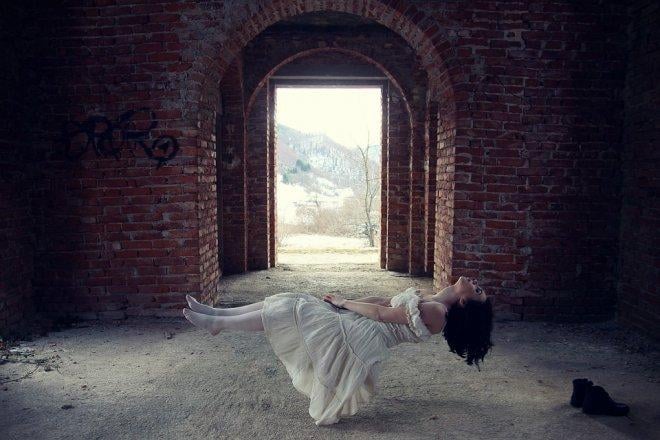
In the light of the moon Pale reflections of Adoration Enjoy the oceanic saturation Drinking in beauty of the Goddess three My love – my heart The soul of me cries out to touch your lips With a ghost of a kiss Brushing my life within your heart A truth of the dawn heralding a new light I slowly blend with you into one form Thus an eclipse is born.
And now for my analysis.
Normally, Jason’s writing is full of themes of despair and trauma, but here we see him adoring beauty and light. Instead of irreverence to religion, and denial of belief in God (a male god, mind you), we have an affirmation of the Divine Feminine, presumably in a metaphorical sense.
He’s looking up to the moonlight and admiring its beauty. The moonlight reflects his “Adoration” back to him; note the capitalizing of Adoration, suggesting that it’s his love that does the deifying. We send out love, and love gratefully comes back to us.
I really like the assonant music of this line: “Enjoy the oceanic saturation.” One feels saturated with the divine beauty surrounding us and passing within us, a connection with the oceanic universe. One is “drinking in,” internalizing the natural beauty all around, the beauty of the Triple Goddess.
He is in love with the moon goddess, wanting to kiss her glowing lips. The “ghost of a kiss” brushes his life, which is within her heart, for inside her heart is where his life and happiness lie.
“A truth of the dawn heralding a new light” seems to indicate that he has found new vitality and hope from her, a vitality and hope to replace the despair and trauma he wrote about before. He would “blend with [her] into one form,” like Atman discovering its identity with Brahman, and finding peace in moksha.
Now, “an eclipse is born” with this blending of him with her into one form. Such a blending suggests that Jason is identifying himself with the sun, since not only is there a solar eclipse, the result of the moon passing in front of the sun; but also since the moonlight is a reflection of the sunlight off of it. If he is identifying himself with the sunlight, then that sunlight can be seen to represent the fiery passions, which are calmed when absorbed by the moon, like a loving mother soothing her agitated baby.
But could the “eclipse” be a case of “love is blind”? Could the moon be driving Jason lunatic; does her mesmerizing beauty block his ability to see straight, to give and receive his solar light? Is this why “Adoration” is capitalized, the deification of his love projected onto her, rather than she herself deified? Is this the meaning of “the dawn heralding a new light,” that his new vitality and hope come not from her, but from his idealizing of her in his mind? Is his love for her real, or is it an illusion?
I’ll leave you, Dear Reader, to decide whether his love of the moon is real or delusional, whether it is good for him or not.
I will now analyze poem ‘Two’ from Diverging Paths, a book of poetry and prose by my Facebook friend, Jason Ryan Morton, whoseworkI’velookedat before. As before, I’ll be setting his poem in italics to distinguish his writing from mine. Here it is:
Words unheard don’t get the attention they deserve, The fall of life on a knife, A tongue of sword, Swerving to hit the closest, Human just a demon, In godlike form,
And now, for my analysis.
“The fall of life on a knife” isn’t a literal knife, but the knife of verbal abuse, “a tongue of sword.” Now, there are the hurtful words one hears screamed at oneself, then there are the words one tries to say in one’s self-defence. These are “words unheard”; and not being listened to, not being validated, can be just as painful as hearing the hurtful language of an abuser, for they “don’t get the attention they deserve.”
The sword or knife of verbal abuse is most often “swerving to hit the closest,” that is, those people closest to the abuser: family, close friends, co-workers, anyone whose company tends to be taken for granted.
The abuser is publicly perceived to be virtuous, “in godlike form,” but in terms of his or her nastiness, this “human” is “just a demon.” Such is the reality of the false and true selves of a narcissistic abuser.
The commas at the end of every line, especially the last one, suggest the ongoing, unending problem of abuse. It only ends when we break things off and get away. It’s an ending that comes off as abrupt, as if more was expected before the ending, like a sentence ended with a comma instead of a period.
I’d like to look at a short poem by my friend Jason Morton, whosepoetryI’velooked at before.
This one is from his book of poetry and prose, called Diverging Paths, the first poem from Part One, ‘Deliverance’ (on page ten of the document provided). Here it is, given in italics to distinguish his writing from mine:
Was it ever real, This tragic appeal, Staging mass reveal, In the name of God,
Was it ever there, Basing one’s truth on scares, Where we appear, To be nothing but ants,
And then the world fell, Apart in this shell, Domed humanity, Psychopathic hell…
And now for my analysis.
This seems, on the surface, to be another critique of the Christian faith, the “tragic appeal” of trusting in Christ to heal one’s pain and make one whole, when so many have tried and failed to gain that healing, that wholeness…hence, it’s tragic.
I know, however, from personal communication with Jason, that the core of the trauma he’s suffered in his life has been abuse in psychiatric hospitals. So Church abuses can be seen in this poem as symbolic of abuses from the mental health profession.
So, in this context, faith in the Church can be seen as blind faith in the efficacy of the psychiatric profession. The tragic appeal is in the idea that therapists offer some kind of panacea to all our mental health problems, when no such miracle cure exists…not so much because there really is no cure, but more so because so many psychiatrists seem less interested in helping their patients than in controlling them, like Nurse Ratched.
So, the authority of the abusive psychiatrist is symbolized by the omnipotence and omniscience of God, in whose name the cure is applied. “Was [the cure] ever there”? The truth that is based on scares is the fear that, being given no treatment, the patient will err to the point of self-destruction. Many emotional abusers would like to treat their victims, the identified patients, as if they were “nothing but ants,” helpless without the guidance of those claiming to know all the answers.
Such social dysfunction can be extended far beyond the abuses of the mental health profession and the Church, and into the general problem of alienation. Hence, “the world fell,/Apart in this shell”. Note the repeated use of commas at the end of almost every line, even in places where commas don’t seem to be necessary, as in the line just quoted. The enjambment between not only “fell” and “apart” but also between “we appear” and “to be nothing but ants” suggests a halting speech, interruptions that break the flow of communication. When we talk, we seem to be stammering, unable to speak coherently.
This “shell,” this “domed humanity” is the prison of our existence. Note how “domed” can be seen as a pun on doomed, for that’s how we’ll be if we don’t do something about our inability to communicate and connect with each other, be it in the realms of the Church, the psychiatric world, or in society in general. “Psychopathic hell,” the hell of, ironically, the God of psychiatry, can thus be seen as a pun on psychiatric hell, the hell of being exposed, when already being mentally ill, to doctors who don’t care for you.
‘The Last Breath’ is a poem by Rusty Rebar, a Facebook friend of mine. I gave it a quick read the day before and found it full of meaning, which I’d like to examine below. First, here’s his poem (I’m setting it in italics to distinguish his writing from mine, as always):
the last breath
1. the way a door slammed rattles the whole house or how the wrong word scorches an open heart shoes without soles a torn pair of pants
a moment that breaks every second after & you seemingly unable to put it back together the terror hidden in a corner of your fears
like a shy thief lurking afraid to risk capture but happy to hurt you wounds inflicted on you powerless to stop what keeps happening
2. pain an offering then a solace for all that is no surprise whatsoever you sit with your demons in front of the television mesmerized by action
quick millionaires running around in their underwear tights or pajamas depending joyful endorphins popping fulfilling safe anticipations same play — played night
& day — over & over spinning endless tomorrows out of imaginary yesterdays & what is wrong with that a world of wonderful rules & magically infinite chances
bread & circus the holy flesh of brainwash — firm faith in the glory of private property & money as the measure of all things held tighter when you have neither
3. with drugs — the effect wears off — larger doses needed to deaden nerves & block the bad feelings get back to work before the rent check comes due
escape from a prison inside the mind impossible the illusion of freedom ends & you find yourself back in your dark lonely cell more trapped than ever
luckily — your story also ends — there is no such thing as forever & no problem death cannot solve — best treasure what you do remember the last breath of a lost friend
And now, for my analysis.
We have three sets of verses, the first set of which centres around pain, broken or torn things, things with holes in them. The second set centres around forms of escape from the pain: television, the American Dream, bread and circuses, distractions. The third set centres around how the forms of escape, including drugs, don’t work–one cannot escape from one’s prison, since one has to go back to work before the rent is due. Still, there is one last escape…death.
So the three verse sets can be seen as the thesis (pain), negation (escape from the pain), and sublation (return to, and ultimate escape from, the pain). It’s the dialectic, but a very physical one, a materialistic one. Marx is turning Hegel right-side up.
The first set of verses is full of the imagery of violence: slammed doors, verbal abuse, the torn pants and the soleless shoes of a soulless world that doesn’t care for the poor. Moments that break, and you can’t put them back together. Thieves are afraid to get caught, but happy to hurt you: this is a world of alienation. We feel powerless to stop the pain.
The second set of verses deals with what Klein and Winnicott called the manic defence, or any attempt to avoid dealing with the painful, depressive sides of life, and to plunge instead into the manic, or exciting, sides of life (drugs, porn, etc.). One sits a mesmerized zombie in front of the idiot box, following the latest media nonsense, or one tries to identify with the rich, fantasizing that one day, the American Dream will come true for oneself…when of course there’s a snowball’s chance in hell of that ever happening.
One sees millionaires in the media dancing around in their underwear, because only they have the financial freedom to act as inanely as they like. Perhaps they’re wandering about in their pyjamas, like Hef. This empty worship of wealth goes on day after day, a hiding away from one’s secret sorrows. Those sorrows, however unacknowledged, go on “spinning endless tomorrows…”–reminding us of Macbeth‘s “Tomorrow, and tomorrow, and tomorrow” speech (Act V, Scene v)–“…out of imaginary yesterdays,” reminding us in turn of Macbeth’s words “And all our yesterdays have lighted fools/The way to dusty death.”
Life is as meaningless for us today, with our “faith in the glory of private/property” (note the enjambment between the two words, indicating how split a concept that one is, as is so much of our psychological fragmentation, symbolized by all the other examples of enjambment in this poem), as it was for the Scottish tyrant of Shakespeare’s play. One believes in such empty capitalistic concepts especially when one doesn’t benefit from the wealth of the 1%.
The third set of verses deals with the coming down, as it were, from the high one felt in the escape of the second set. One now feels even worse than before, unable to escape the reality one keeps coming back to. Still, there’s one last escape…death. “To die, to sleep,/No more…” (Act III, Scene i) Unlike the Dane, though, we in today’s secular world don’t generally worry about “the dread of something after death, —/The undiscovered country,” so “the last breath of a lost friend,” death, is a soft breeze on our faces, and gives us hope in our despair…the hope of despair.
The narcissistic mother rules them all. The codependent father won’t stand tall. The brothers are lost children; they feel small. The daughter is the golden child, Mom’s doll.
The scapegoat takes the fall. He wants to be set free.
The toxic family gangs up on him. They bully, scream, and shout, on any whim. His hopes at winning arguments are slim. The chances of them changing remain dim.
They blame their woes on him. He dreams of liberty.
His mother lies, claims he is mentally lacking. His father gripes, since he at school is slacking. His brothers threaten; they’re always attacking. His sister feigns concern…has he her backing?
Their false image is cracking. One day, he will flee.
His mother fabricates smear after smear. His father won’t speak out, seems not to hear. His brothers take advantage of his fear. His sister gives her voice, but not her ear.

 Infinite Ocean
You must be logged in to post a comment.