
On the hypocrisy of the US government’s ‘wish for peace’ between Rwanda and the DRC, while continuing to enable Rwandan aggression against the DRC. Also, on the setting up of a railway system in Angola to counter Chinese infrastructure investments in Africa in recent years, and to transport Congolese minerals out of Africa.
Category: literature
The Tanah–Beginnings, Chapter Two
[The following is the third of many posts–here is the first, and here is the second–about a fictitious discovery of ancient manuscripts of a religious text of narratives and magic spells. Its purpose for my readers and me is to provide a cosmology and mythography on which I am basing much, if not most, of my fiction–short stories and novels. If anyone is interested in reading this fiction, he or she can use these blog posts as references to explain the nature of the magic and universe in my fiction.]
- The worlds breathe out through their pores in all directions. The air inside is fiery hot; as it flows outwards, it slowly cools. When the breath reaches its farthest and coldest, it is inhaled, and it gradually heats again.
- The contents of the exhalations are fiery orbs that turn with imperceptible slowness, the heat tempering eventually. They are red, glowing balls, titanic in size to man, yet infinitesimal to the vastness of space. One of them has cooled, turning from red to blue.
- All of this, from breaths to orbs to our blue sphere, is in and of an endless sea of nothingness, where nothing and everything meet. Every drop of the eternal sea is an atom, and the waves undulate forever.
- The seas of our blue orb receded to give green to us. Creatures, great and small, extinct and extant, have inhabited both blue and green. Simple life progressed to compound forms, some that swim and others that crawl.
- Some skin has scales, and other skin has hair. Some limbs are legs, others, wings. Some made arms of their front legs, and straightened their backs. Their brains rose with their backs.
- The animals had two sexes, as did the final one: humanity.
- The male begets life in its first stage, then the female houses and nurtures that life in its growing stages in the womb. At the beginning, one didn’t know of the father’s role in giving life, but honoured only the mother in this; only later was the father acknowledged in this. Still, the mother is always seen as the seat of life.
- Man sees all things in pairs of opposites, therefore if woman is life, then man is death. Since man loves and honors life, he loves and honors woman, even facing death to preserve her life, and the lives she bears.
- Just as every body is ruled by a brain, and every family is ruled by parents, so has society been ruled by kings and queens from the beginning. Just as old inhalations and exhalations are replaced by new ones, and when old rotations of the orbs end, to be replaced by the beginnings of new rotations, so must old rule be replaced the the rule of the young. This is why new ideas replace old ones, and daughters leave their mothers and fathers to start their own families, and young kings replace old ones.
- Since woman is life, and man loves and honours woman, old queens may extend their rule while they replace their old husbands with young ones. Since woman is life and man is death, old kings are killed by young ones. This has been an ongoing, unending tragedy from the beginning, always remembered and dramatized.
- It would happen thus: a triumphant procession ushers in the king, who is accompanied by his queen. Among the crowd of admirers is the queen’s young paramour, who waits for a moment to be alone with her.
- The moment arrives, and he lies with her. Later, he walks in the garden in the evening, waiting to find the king alone. Soon he is alone with the king, and he kills him. The queen seems to mourn the dead king with an excess of tears, but she soon marries the young man, and he is the new king. Death follows copulation quickly, and more copulation ensues soon after.
- Thus life quickly begins, ends and begins again, as each orb’s cycles of rotation slowly do, and as the worlds’ breaths–in and out–do even slower. These are the rhythms of everything.
Commentary
While much of the cosmology of the manuscripts collectively known as The Tanah describes a flat Earth in a geocentric universe, every now and then one finds writings that seem to have an uncanny ability to anticipate, however vaguely, scientific ideas and theories millennia in advance of the time when these manuscripts are dated. These verses are an example of such an anticipation.
That said, though, those looking for scientific accuracy in this vague and poetic ‘retelling,’ as it would seem, of the Big Bang Theory (as a cyclical, endless series of big bangs and big crunches, in the context of a multiverse) and of evolutionary theory will be frustrated. These writings are far from being science; they’re meant to be understood as religious revelation. More accurately, though, they are part of a speculative system, a philosophical one, told in metaphors.
What should be focused on, instead of whether or not the ideas constitute an anticipation of modern science, is the reality of cycles in everything: breathing in and out, orbs turning on their axes, heat cooling and cold getting hot again (recall Nevil and Drofurb, Hador and Calt, as discussed in Chapter One). These cycles help us understand the true dialectical relationship between each pair of opposites.
We think in dualist opposites all the time, because it is so difficult to think in terms of a series of gradations from one opposite to another. Still, all is relative. One must not lose sight of how something seen one way can seem its opposite from another perspective, like the size of a planet to us as opposed to its size compared to the universe. All of our opposites, red heat and cold blue, everything and nothing, the blue sea and the green land, great and small, living and dead, male and female, must be known in this broader way.
We see evolution in animals, usually as progress upward: it is better to fly than to crawl, it is better to walk upright than to go on all fours. Reason seems superior to instinct. Is this necessarily so? Reason tends to be a weapon more than a comfort. Though things do advance, an apex is reached and the advancement must stop. If one dares climb higher than this, one falls to the bottom. Hence new rulers replace old ones.
In the sexes we see what seem to be two mere opposites; yet it is easy to see in many males considerable effeminacy, and in many females strikingly masculine attributes. Thus, between the black feminine and the white masculine edges, we see a vast grey area of grey humanity. The nuances of the original language of the manuscripts reflect this, though it’s virtually impossible to reflect this in English translation, hence my mention of this ‘grey area’ here. Furthermore, note the patrilineal assumptions of a daughter leaving her parents when marrying, yet also the matrilineal assumptions of a queen replacing her older, dead husband with a new king.
Indeed, a recurring nightmare throughout history, especially in ancient times, was that of regicide. When societies were commonly organized in a matrilineal fashion, a queen could replace her aged lord with a young one, as a tanist. This was when human sacrifice was customary. This butchery was as abominated then as now, but it was deemed equally necessary. The abhorrent practice abated over time, but the stories relating this horror stubbornly continued to be told. These terrible tales were recounted as myths and legends, in the garb of allegory and metaphor, not as history; hence the details were distorted.
Many of the greatest stories ever told are garbled versions of one of those ancient acts of ceremonial murder. The deaths of Osiris, Dionysus, Orpheus, Adonis, Tammuz, and even Christ bear an eerie similarity to those primordial regicides. These legends are like a bell ringing the peal of this unconscious memory.
Two of the greatest dramas ever written, Oedipus Rex and Hamlet, are about regicide. We love any great work of art through the centuries because it arouses our sympathy in a powerful way, unlike any other creative opus. Such masterpieces were these Sophocles and Shakespeare tragedies. The tanist, kinsman to the king, kills him and takes his place: thus did Oedipus kill his father, King Laius (however unwittingly), and thus did Claudius murder his brother, old King Hamlet. Two things are observed in these regicides–their necessity and their horror; Sophocles stressed the former and Shakespeare stressed the latter. Oedipus’s fate was preordained by the gods; it was ineluctable, though the family tried to circumvent it. Young Hamlet abominated his uncle for committing the crime, and was paralyzed with inaction because he would have to commit the same crime to avenge his father, so great was the prince’s horror in contemplating the bloody deed.
Along with the extreme horror of the killing of the king is, on the other side, extreme lewdness. Here we see extreme birth (resulting from orgiastic sexual unions) happening with extreme death (regicide). Sex and murder are juxtaposed as two extremes meeting each other. The extreme sexual aspect of this is seen in the lewdness of Oedipus committing incest with his mother, Iocaste (however unwittingly), and the birth of his sons/brothers and daughter/sister, Antigone. In Hamlet, the lewdness is in Claudius’s incestuous seduction of Hamlet’s mother, Gertrude, and their marriage “within a month” of the murder of old King Hamlet.
Necessity, horror, and cycles of birth, life, death, and rebirth. These are the eternal rhythms of the world.
The following fragment is a poem that expresses the same basic content as the opening verses just commented on. We have made an attempt to recreate the verse form: expanding and contracting orbs as represented in each word, as it is in the original language–a dazzling anticipation of concrete poetry! Unfortunately, rendering the verses in this fashion in English inevitably looks clumsy here. We beg the readers’ indulgence in our admittedly faulty presentation of the verses.
Hot,……………………………..burning………………………fire
blasted,……………………………………broke,……………………………..blew
compact………..matter,……………tightly……..compressed…………….into……..numberless
fragments………………………………….The………………………………pieces
flew……………………………outwards,…………………….expanding
in………………every………..direction…………They………cooled………as
they……………………………split…………………………….apart.
They……………………………….will………………………..return
to………….their…………….centres,…………….and……….heat…………up
while…………………………..closing……………………….together.
Red,…………..flaming……………sparks
are…………………………..these………………………fragments
of………..hot,………compact…….matter,…………These………balls
slowly…………………………turn,…………………………..seem
gigantic……………………..to…………………………….man,
who…………………sits…………on……………..an…………..orb…………cooler
and……………………….blue;…………………………yet
compared……………………….to………………………..wide,
infinite………..space,………….they……………are…………..no……………more
than…………………………….glistening…………………..molecules.
Small,…………………..empty,……………………infinite
nothingness………………..endlessly………………..grows
and…………expands………from…………our………..ball………of
blue…………………………..to…………………………..the
vast……………………………reaches……………………………of
everything…………………….This…….is………………….where…….all…………………..that
is……………………………..great…………………………….and
eternal…………………………meets………………………..everything
small,……………in…………………….a………..sea………………of……………naught–
nothing,…………………………….the………………………………void.
Home,………………………….blue…………………….Earth,
covered………………………………..in…………………………………..sea–
like…………………….the…………..ocean…………..where……………..nothing…………….and
everything……………………….meet,……………………………….our
vast…………………………………universe–…………………………….is
a………………………………..huge,………………….watery…………….ball……………….The
deep……………………………….seas……………………………….of
our……………………………….world…………………………….would
recede…………..and…………..give………………..green…………….to…………..this
small,…………………………..infant…………………………..planet.
Small,………………………..simple…………………animals
first………………………lived………………………here.
Life………..would…………evolve:………it………..would………..grow
into…………………..complex……………….forms.
Titanic………………………..lizards………………………….and
mammals…………..would………dominate………….air,……sea,…………….and
land……………………………..Then…………………………they’d
die,……………………………………or……………………………would
slowly…………….transform…………….into……………..birds……………or…………..today’s
smaller,………………………..humbler……………………..beasts.
Small,………………….simple……………………simians
straightened……………………………their………………………………backs,
and……………………..their………………..thinking………..grew…………..clever……………Front
feet………………………………..became…………………………….hands.
Men……………………………………..made………………………..societies,
civilizations………………..of……………….lasting………….grandeur…………………….His
achievements…………………………were………………………..glorious.
Hubris…………………………resulted………………………….in
decadence,………..and…………….the………….sad…………….gradual…………..demise
of………………………………..great………………………………..cultures.
Man,……………………………….woman,…………………child:
man…………………………….begets………………………………….life,
then………….woman……………gives………….shelter……………….to………..it
and………………………………….it…………………………………..grows
in…………………………………..her……………………………….womb.
We……………………..exalt…………..her……………..as………………giver……………….of
life:…………………………mother…………………………..goddess!
The…………………………………male………………………………..role
in……………….giving…………………life……………..not………………yet…………..known,
man……………………………….thus……………………………..retreats.
Woman……………………………is……………………………life,
Man…………………………………..is……………………death.
He………..loves…………..life,……………thus……….his………..heart
swells………………………..with……………………….love
for………………………….his………………………..lady
so………………….grand…………….He’ll……………protect……………..her,
preserve………………………her,……………………..and
honour…………………………….her………………………….till
he…………..retreats………..from…………life,……….crawling………..his
way……………………..toward………………………..death.
Minds……………………control………………….bodies,
fathers……………………..and………………..mothers
have………..sway………..over……….all…………….of…………….their
daughters………………………and…………………….sons,
thus………………………….societies’…………………governments
are……………………..in…………….the……………..thrall…………of………….their
kings………………………….and………………………queens.
New………………………….rule………………………replaces
the…………old,…………….for…………old………….kings…………….must
retreat……………………towards…………………….death.
New…………………………breaths……………………..blow
out,………………………………..all……………………………..the
orbs……………start…………..new………..cycles,…………..the…………….new
takes…………………………..the………………………place
of………………………………the……………………..old,
and…………………the………..rule………………of……..young………………kings
must……………………….commence……………..when
old………………………………….men,…………………………………old
rotations,……………and…………..breaths……………..can…………….no………………longer
continue…………………………………their…………………………….lives.
Woman…………………………….is……………………………life,
man……………………………….is…………………………death,
so…………the…………..rule………..of………….a………..queen
may…………………………go……………………….on
and…………………………….her…………………….glory,
like………………….that……………….of……………all…………goddesses,…………thus
is…………………………..extended…………………forever;
her………………………..husband,………………….however,
must………..die…………..like………….all…………..plants………………in
the……………………..autumn……………………….cold.
King,………………………..queen,…………………..youth:
enter……………………………the……………………………king,
and……….a………..handsome……….young…………man…………eyes
his…………………….beautiful………………………..queen.
He……………………………seduces………………………her,
and…………….she………….makes……………love…………….with……………..her
dashing,………………………….strong…………………paramour.
Cuckolded,…………………….castrated,………………….killed,
the…………..old……………….king………………..is………..lamented……………..by
whom?……………………..these………………………………..are
life’s…………………………..rhythms,…………………….always.
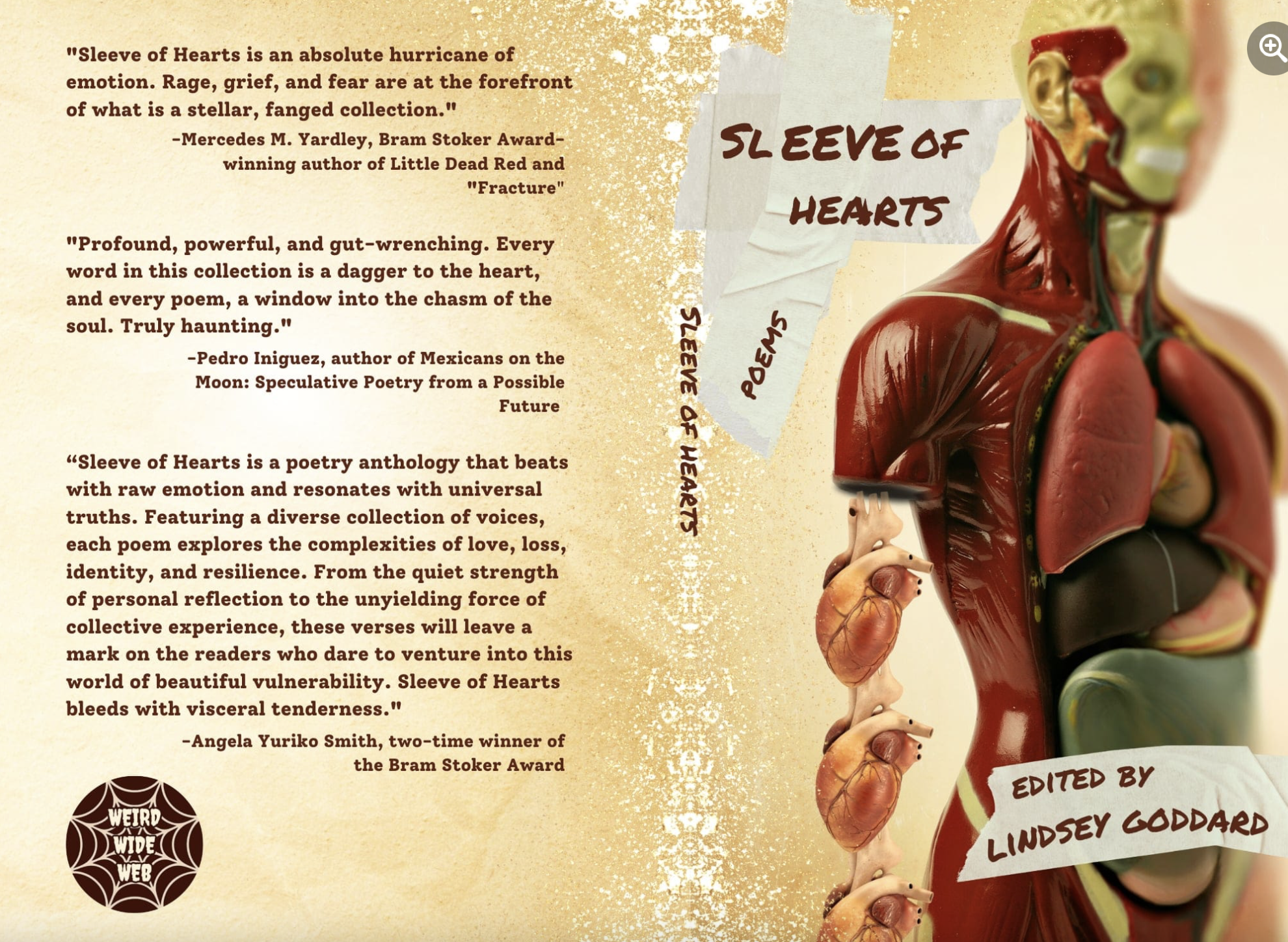
A Poem of Mine Published in the ‘Sleeve of Hearts’ Anthology
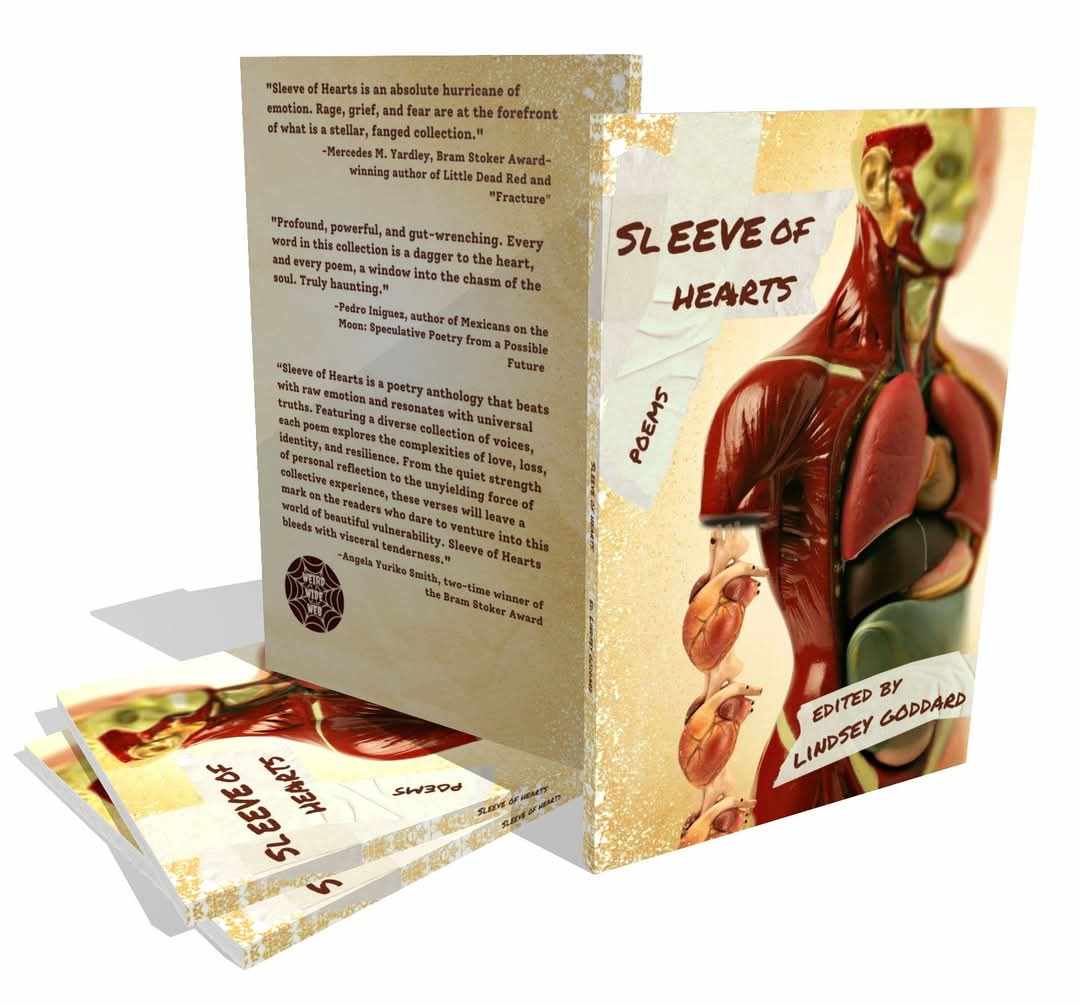
I have a poem, ‘Apples,’ published in the Sleeve of Hearts poetry anthology, presented by Weird Wide Web and edited by Lindsey Goddard. It’s published on Amazon, but if you want to show solidarity with the Amazon strikers, you can also find the book on Lulu.
Other great poets in the anthology include R.J. Allen, Devin M. Anderson, Alison Armstrong, L. Bachman, Erin Banks, A.J. Brown, Pixie Bruner, Anton Cancre, J. Rocky Colavito, Dawn Colclasure, Kirsten Noelle Craig, Rebecca Cuthbert, Josh Darling, Dawn DeBraal, Loki DeWitt, Gabrielle Faust, Ian Gielen, Reyna Gillette, Jyl Glenn, Lindsey Goddard, Simone Goddard, Sophie Goddard, Megan Guilliams, Sheila Henry, Kasey Hill, Josephine Jasper, Bryce Jenkins, J.L. Lane, Suzie Lockhart, J.C. Macek III, Mark Mackey, Benzo Monroe, Jonathan Moon, Shane David Morin, Jason Morton, Conner Muddiman, Nora B. Peevy, Rick Powell, Rie Sheridan Rose, Sumiko Saulson, Leigh Savage, Elodie Shayne, Raz T. Slasher, Tommy B. Smith, John Claude Smith, Judith Sonnet, Kurt Swaim, Michael Errol Swaim, Rob Tannahill, Jezzy Wolfe, and Amanda Worthington.
Here is what some people are saying about the anthology:
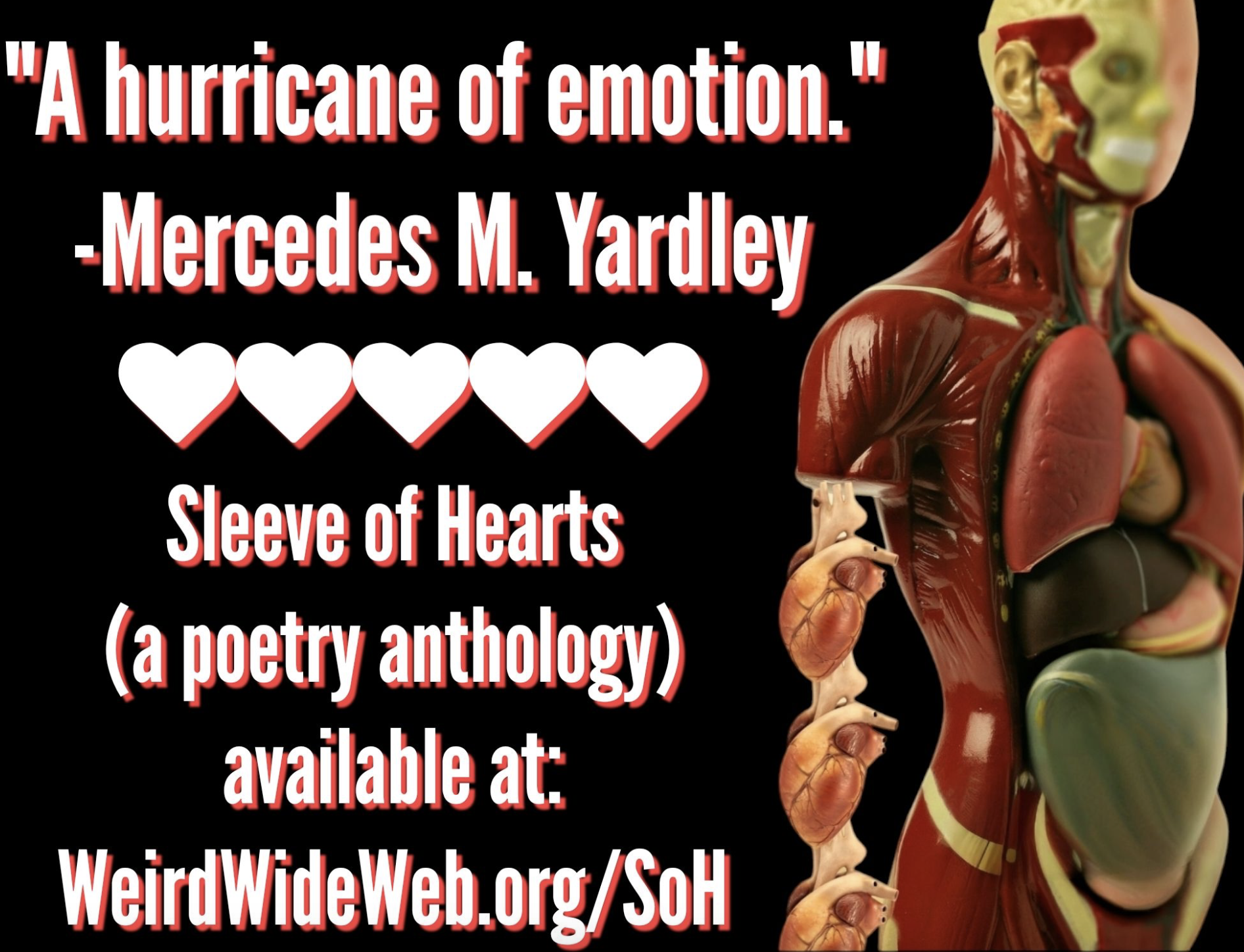
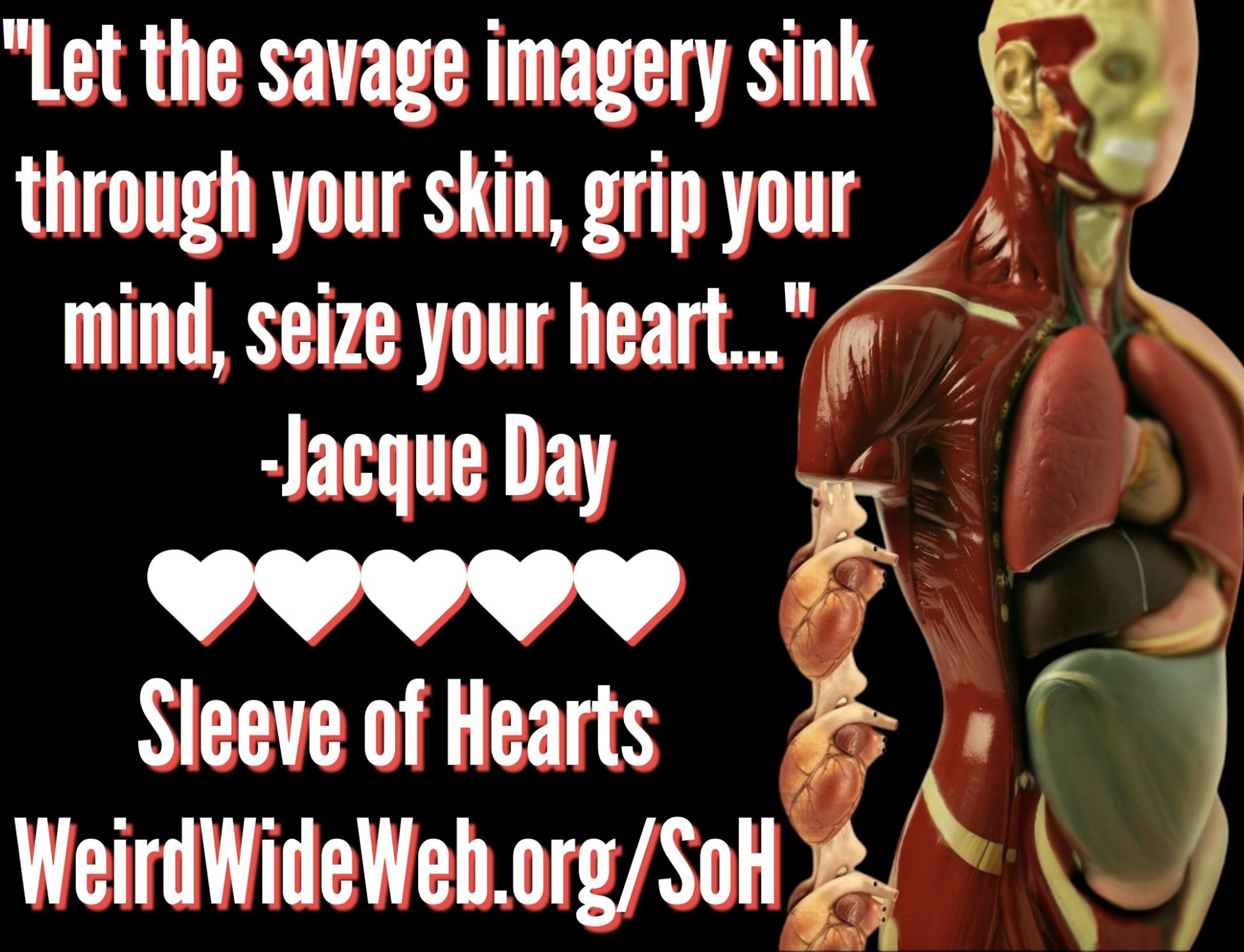

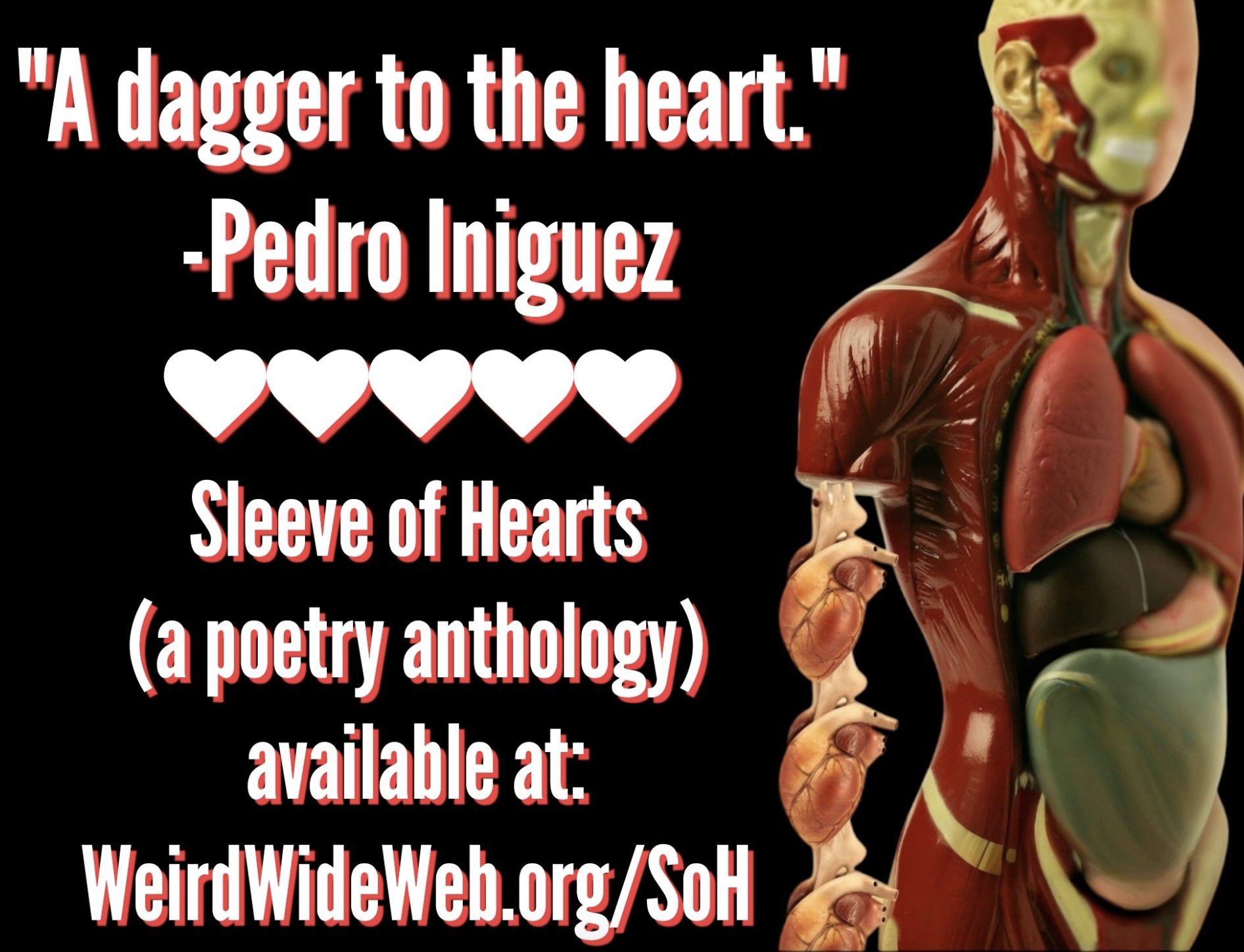
Go get your copy of this great poetry book today! 🙂
Beards
Jolani,
the———-HTS
terrorist, has been
getting a thoroughly new
look, thanks to the quackery
of Western asses’ jawbones,
as thanks, in turn, for the
toppling of Assad.
Samson
for———–our
time, he had his
teeth, as it were,
removed, and his
hair trimmed, to
seem all tame.
Beards
will———–grow
back, though, and the
renewed strength of HTS
will push apart the pillars
of the Middle East, and
ruin Syrian lives far
more than Assad.
The Tanah–Beginnings, Chapter One
[The following is the second of many posts–here is the first–about a fictitious discovery of ancient manuscripts of a religious text of narratives and magic spells. Its purpose for my readers and me is to provide a cosmology and mythography on which I am basing much, if not most, of my fiction–short stories and novels. If anyone is interested in reading this fiction, he or she can use these blog posts as references to explain the nature of the magic and universe in my fiction.]
- Waves everywhere, that from the lowest, rise to the highest, then fall to the lowest, rise high, and fall low, everywhere, always, these are Cao–a never-ending ocean.
- Cao is one; the Pluries are many. The one breaks up into the many, all of which then drop into the ocean.
- How does the one become the many, and how do the many become one?
- The Crims make Cao the Pluries, and they make the Pluries Cao.
- One Crim, Nevil, is fire, heating another Crim, Priff, water, into a third Crim, Weleb, air. Nevil leaves, thickening Weleb back into Priff, then freezing Priff into the last Crim, Drofurb, which is earth, or stone, or ice.
- The fire of Nevil also brings the light of day, Dis, and the heat of desire, Hador. When Nevil leaves, what remains is the cool or cold of calm, Calt, and the darkness of night, Noct.
- These eternal flows that move everywhere–up high and down low and back up, from one to many and back, from cool to hot and back to cold, from water to hot air and back to cold and ice and stone, from the dark of night to the light of day and back to black, from calm to desire and back to calm–all of these are Cao, all are the Pluries.
- The waves of Cao flow from Drofurb to Priff, and from Priff to Weleb by the brightness and heat of Nevil’s fire of desire, then Nevil fades away, bringing Weleb back to Priff, then Priff to Drofurb, darkening, cooling, and calming. The waves move Noct to Dis, and back to Noct. The waves flow from Calt to Hador and back to Calt.
- These ups and downs, highs and lows, heating and cooling, desire and calm, light and dark, night and day, ice to water to vapour to water to ice,…these are what is all of the world.
[The text breaks off here.]
Commentary
The above verses express not so much a beginning of the universe as the beginning of an understanding of its basic building blocks. The poetry in the original language has a rhythm that evokes the rushing waves of the universal ocean in a way that English cannot effectively render, unfortunately. We can get only a basic sense of the pendulum swings of the primordial opposites: up and down, light and dark, night and day, solid to liquid to gas, passion and calm.
As explained in the translator’s introduction, the imagery of the verses give off that sense of the dialectical thesis, negation, and sublation as given in the undulating movements of t, s, n, s, t…etc. The purpose of this emphasis on the wavelike movements of all opposites is to give the reader a sense that these undulations are the foundation of everything–the secrets of the universe.
Angels
As
when
Clarence showed George
a dark, gloomy world in
which he would not
live, to make him
appreciate
what
he had,
So
have
black angels shown Gaza
a slaughter of innocents
in which kids cannot
live, to make us
abominate
what
they did.
Analysis of ‘The Old Man and the Sea’
The Old Man and the Sea is a 1952 novella by Ernest Hemingway. He wrote it between December 1950 and February 1951, but published it in September 1952. It was the last major fictional work he published in his lifetime.
The novella was highly anticipated and released to record sales. Initial critical reception was highly positive, though its reputation has been more varied and somewhat less enthusiastic since, with a number of critics deeming it inferior to Hemingway’s earlier works.
Nonetheless, TOMATS has continued to be popular, as a book in English lessons around the world, according to Jeffrey Meyers‘s Hemingway: A Biography–1985). The Big Read, a 2003 BBC survey of the UK’s 200 “best-loved novels,” ranked TOMATS at #173.
Hemingway was directly involved in the 1958 film adaptation of the novella, with Spencer Tracy as Santiago, but Hemingway ended up disliking the film. He won the Pulitzer Prize for Fiction in 1953 for TOMATS, the first time he’d ever received the award. Even Fulgencio Batista, the new dictator of Cuba (the setting for the novella), gave Hemingway a Medal of Honor for the novella; though Hemingway disapproved of the new regime, he did accept the medal.
TOMATS got its highest recognition in 1954, when it won Hemingway the Nobel Prize in Literature. The Swedish Academy praised the novella for its “powerful, style-making mastery of the art of modern narration.”
Here are some quotes from the novella.
John Killinger in the 1960s connected TOMATS with Albert Camus, Jean-Paul Sartre, and Friedrich Nietzsche, that is, with philosophical existentialism and absurdism. I find such connections to be apt, given these philosophies’ focus on the meaninglessness of life in a world without God, and the absurdity of trying so hard to achieve something, only to fail, then to realize that one must nonetheless keep trying, in spite of one’s efforts’ futility.
We see this absurdism in Santiago’s painstaking efforts to catch the huge marlin, only to have it eaten down to the bone by sharks. Still, after this great disappointment, which in turn has come after an 84-day losing streak of never catching any fish, he as a fisherman must keep trying to catch fish in the future. Santiago thus is like Sisyphus, doomed to roll a boulder up a hill, only to have it roll back down and have to roll it up again, over and over, throughout eternity.
Another way to look at TOMATS is to do a comparison and contrast of the novella with such literary works as Moby-Dick and Life of Pi (which I will get into later on). Santiago thus corresponds with Captain Ahab, though their personalities are practically diametrical opposites: the former, a humble Cuban fisherman, is linked to St. James the Apostle, whose Spanish name is Santiago; mad, monomaniacal Ahab the whaler, on the other hand, is linked by name to the wicked King of Israel who introduced the worship of Baal to the ancient Hebrews and caused his kingdom to lapse into decadence.
In this analogy, the giant marlin corresponds, of course, to the white whale, though again the two are opposites in crucial ways. Santiago kills the marlin, as opposed to Captain Ahab being killed by Moby Dick. Santiago lashes the killed marlin to his skiff, whereas Captain Ahab is tangled in the line of the harpoon he’s thrown at the whale, tying him to the whale and being taken out to sea with it, dying as it swims away.
So in these ways, TOMATS is Moby-Dick in miniature and the anti-Moby-Dick, if you will, the two books being a kind of Hegelian dialectic of each other.
TOMATS is a miniature Moby-Dick not just in terms of literal size, that of the books and that of the marine animals…or of the boats and bodies of water in which the two stories are set, for that matter. Moby-Dick has a grand theme about seeking out the truth, symbolized by the white whale, while putting oneself in danger of self-destruction if one carries this quest too far, as Ahab does (see my blog post, link above, for details). TOMATS has a theme of searching for meaning and purpose, as symbolized by the marlin, yet failing to get that meaning (all Santiago has to show for his catch is the marlin’s skeleton, lashed to his skiff).
Santiago’s wounded pride is also a miniature of Ahab’s. The whale’s having bitten off Ahab’s leg, a symbolic castration, is a narcissistic injury infuriating the captain so much that he’s obsessed with finding the whale, sailing all over the world with his crew in the Pequod to find it and get his…revenge…on an animal?
Santiago, on the other hand, is merely saddened by his bad luck streak of eighty-four days of not catching any fish, gaining the bad reputation in his Cuban fisherman’s community as salao (very unlucky). He doesn’t sail out to the ends of the earth, as Ahab does, in the hopes of catching something to restore his sinking reputation. He merely sails further out into the Gulf Stream. In fact, after encountering the many difficulties he’s had in catching the marlin and having sharks bite off chunks of it, he regrets his having gone out so far; Ahab, even in dying, never regrets his lust for revenge.
As for the “anti-Moby-Dick” aspects of TOMATS, recall Ahab’s undying hate of the whale, as contrasted with Santiago’s love of the marlin, calling it his “brother” and feeling appreciation, respect, and compassion for it. Since Santiago (Spanish for St. James, recall, who was originally a fisherman himself, incidentally) can also be linked with Jesus, with the cuts and injuries Santiago gets in his struggles to reel in the marlin being compared by some critics to Christ’s wounds during His Passion and crucifixion, then his love of the marlin can also be linked with Christ’s words on the Cross about those who put Him up there: “Father, forgive them, for they know not what they do.” (Luke 23:34)
Another example of how TOMATS is Moby-Dick in miniature is in how the latter uses grandiose diction, whereas the former uses simple diction and shorter sentences. Instead of there being complex symbolism coupled with a deep analysis of that symbolism, as happens in Moby-Dick with its “Etymology,” “Cetology,” and “The Whiteness of the Whale,” in TOMATS we have a simpler symbolism with no breaks from the narrative that go off into tangents. Whereas Moby-Dick is a deluge of allusions and references to all kinds of literature, there’s very little of that in TOMATS.
Manolin, the boy who helps Santiago and would do anything for him, sympathizing with him to the point of weeping for him at the end when he sees the old man’s disappointment with the skeletal remains of the marlin lashed to the skiff, is again in stark contrast to Starbuck, who says all he can to discourage Ahab from going through with his self-destructive lust for…revenge?…against the white whale. In these characters’ opposing natures, we again can see how TOMATS is the anti-Moby-Dick, or rather that Moby-Dick could be renamed The Madman and the Sea.
To go into other aspects of TOMATS, Manolin and Santiago have a conversation, during which the old man says that eighty-five is a lucky number (superstitious nonsense, of course), and he fancies that he’ll bring in a fish “over a thousand pounds”, to which the boy, unlike Starbuck, gives no objections. Then they discuss what the newspaper will say about American baseball.
For a poor fishing community in Cuba, the only interesting baseball teams would be the American ones, like the Yankees, the Detroit Tigers, the Cincinnati Reds, the Chicago White Sox, or the Cleveland Indians. Santiago’s hero is Joe DiMaggio (whose father was a fisherman, as Santiago later notes–page 105). This looking to the US for role models instead of those inside one’s own country is symbolic and reflective of the influence of US imperialism, including its cultural forms.
Though Batista’s US-backed government wasn’t yet in power as of Hemingway’s writing of the novella, the resentment among many Cubans against US imperialism was already keenly felt, and it would have led to the nationalist and anti-imperialist Orthodox Party and Authentic Party leading in the polls in 1952, with Batista’s United Action coalition running a distant third. He had to take power in a coup that year in order to preserve an American political and economic hegemony that many Cubans had already been tiring of.
Hemingway, as a leftist who recognized the huge debt the world owed the Soviet Union for defeating the Nazis, would consciously or unconsciously have added this detail of Cubans worshipping American baseball players as an example of American cultural hegemony over Cuba, the cultural superstructure over the base of social relations that manifests internationally through imperialism. I’ve already mentioned Hemingway’s disapproval of Batista’s regime. Santiago’s painstaking efforts to catch the giant marlin, ultimately ending in failure, also reflects the reality of the doomed attempts of the poor to improve their lot in society, a reality underscored by how living in a Third World country under the boot of US imperialism will ensure that such attempts at improvement are, at best, no more than mere millimetres away from being absolutely impossible.
On pages 29-30, Santiago contemplates whether to think of the sea as feminine (la mar) or masculine (el mar). When the sea is understood to be feminine, she is loved by the fishermen, even when they are mad at her for withholding her bounty. If the sea is seen as masculine, though, then the fishermen regard him as a contestant or as an enemy. These fishermen tend to use buoys as floats for their lines, and they have motorboats–that is, they have the conveniences of modern technology that Santiago lacks. Still, in his humble simplicity and disadvantage, he still has more love for her than they have for him.
Just as I observed in my analysis of Moby-Dick (link above), the sea or ocean is symbolic of the unifying oneness of Brahman, a dialectical monism in which the water’s crests and troughs represent duality within the unity of the ocean as a totality. Sometimes the sea gives, and sometimes it takes away. Like Job, Santiago can accept this reality.
The marine life in TOMATS, like the white whale as I discussed it in that analysis, represent all of the things–as fixed entities that don’t seem to go through the endless flux and change of the sea–that are either desired, objects of attachment like the marlin, or are hated and dreaded, like the sharks that eat up the marlin.
As the Buddhists understand, these things have a way of tricking us into thinking that they have a permanence, when they are no more permanent than the constantly moving sea. The absurdism of Santiago’s trying to catch and keep the marlin is in his futile hope that it will be there with him, intact, all the way back on his trip to the shore.
Remember that while there are opposing tendencies between TOMATS and Moby-Dick, there are also parallels. One example is when Santiago, on having realized that the marlin has taken the bait, expresses his determination to keep struggling, even to the death, until he catches it. ‘”Fish,” he said softly, aloud, “I’ll stay with you until I am dead.”‘ (page 52) This is just like Ahab’s words on having harpooned the whale: “to the last I grapple with thee.” Santiago will harpoon the marlin, too.
Still, with this parallel, there is also the dialectical negation, as I mentioned above, of Santiago’s professed love of the marlin: ‘”Fish,” he said, “I love you and respect you very much.”‘ This is to be contrasted with Ahab’s words: “from hell’s heart I stab at thee; for hate’s sake I spit my last breath at thee.” But in the end there’s a sublation of both Santiago’s and Ahab’s attitude in these words of the former: “But I will kill you dead before this day ends.” (page 54) One harpooner loves his prey, the other hates his prey–both are determined to kill their prey.
The comparisons between the suffering of Santiago and that of Jesus are exemplified with the injuries to the hands of the former, a fisher of the marlin, and the hands of the latter, a fisher of men (Matthew 4:19). Santiago “felt the line carefully with his right hand and noticed his hand was bleeding.” (pages 55-56) The cut on his hand is like one of the stigmata. The absurdism of his suffering is that it’s all in vain, as if Christ hadn’t risen, making Church teaching and faith also in vain (1 Corinthians 15:14).
Moby-Dick isn’t the only book with a narrative of someone at sea and having deep religious, mystical, and philosophical themes that can be compared to those of TOMATS: another such novel is Life of Pi (The Young Man and the Sea, if you will), a book I plan to do an analysis of in about a month or so after this writing is published. One such a comparison is in how alone Santiago feels, so far away from the shore in his skiff (pages 60-61). The sight of ducks flying reminds him, however, that one is never alone at sea.
Pi is in a lifeboat with Richard Parker, a Bengal tiger, and though he insists that his tense relationship with the animal has saved his life by giving it purpose, he’s still starving for human company. Santiago may imagine that the flying ducks are giving him company, and that the marlin is his “brother,” but he’s still alone enough to wish he had Manolin with him. Ahab has a whole crew of harpooners to help him, but in his madness, he’s alienating all of his colleagues and thus making himself all alone at sea.
The point is that in all three stories’ cases, the ocean represents that formless void from which everything comes–Brahman, primordial Chaos, tohu-wa-bohu, Bion‘s O, Lacan‘s Real, or the Jungian collective unconscious and its Shadow, call it what you will. The marine animals swimming about in it–whales, marlins, flying fish, etc.–represent all those things we are attached to, and which cause us pain and suffering when we cannot get them. The quest for them must be undertaken alone, regardless of whether we choose to go on the quest, as Ahab and Santiago do, or if we’re thrown into the quest against our will, as happens to Pi.
The lone man’s confrontation with the briny Absolute is symbolic of Jung’s notion of Individuation. It’s a necessary spiritual quest fraught with danger, including the possibility of losing one’s mind, as almost happened to Jung himself. Santiago suffers terribly, with his stigmata-like cuts and overexertions, and ultimately in vain, like the absurdist Sisyphus rolling up the rock again and again; but he keeps his sanity, thanks to his abiding humility.
On the other hand, Ahab, in his narcissism and bloated self-concept, is doomed not only to death but also to an unquenchable madness in his attempt at this Individuation. Pi’s experience seems similar to Jung’s: he has a humility similar to Santiago’s, but the intense trauma that Pi goes through (the loss of his entire family, the ongoing fear of being killed and eaten by the tiger, no human contact or sight of land for what seems months, near starvation, etc.) brings him dangerously close to madness.
To take my point further, a confrontation with the Absolute, with Brahman, with ‘God’–whichever–is an attempt to reach heaven by unavoidably going through hell first, as I discussed in my analysis of Allen Ginsberg‘s “Howl,” and as Christ‘s Passion and harrowing of hell, properly interpreted, are an allegory of. Attaining divine blessedness isn’t a walk in the park; it shouldn’t and mustn’t be sentimentalized. To overcome suffering and enter nirvana, one must accept and embrace suffering.
Another point of comparison with all three books is how the animal objects of desire, hate, or dread are all male, at least symbolically so, as opposed to the essentially feminine sea–la mer est la mère, or la mar, as Santiago calls her. Moby Dick, a sperm whale, spouts masculinity like an ejaculation. Santiago’s marlin (a pun on man, with the added rli?) has a phallic “sword…as long as a baseball bat and tapered like a rapier” (page 62). Pi’s unlikely marine companion, Richard Parker, has a name to reinforce his masculinity in our minds. These animals, in their…phallic?…solidity, make for a decidedly male contrast to the feminine sea, whose waves flow like a dancing woman’s curves, and whose liquidity is like a mother’s milk, or like a pregnant woman’s amniotic fluid, released when her “water breaks.”
Parallel to this masculine/feminine opposition is that of the fire of desire, hate, or dread versus the calmly moving waves of nirvana’s water. The hard, unbending solidity of desire, hate, or dread is the samsara that the flowing ease of nirvana is antithetical to. There are things we desire, and want to keep; there are things we hate and dread, and thus wish to keep away. Neither the wanted nor the unwanted, however, can be kept or kept away; both must be allowed to flow in and flow out, as the oceanic waves of Brahman do. Still, there are storms at sea, which Santiago dreads in the hurricane months (page 61), the hell one must go through, as Pi does, before reaching heaven.
On page 63, Santiago has discovered that the marlin “is two feet longer than the skiff,” hence his need to lash the fish to the side of the boat after he’s reeled it in and killed it. This will be a tiring task.
When Santiago decides to pray “ten Our Fathers and ten Hail Marys” (pages 64-65), though he admits that he isn’t religious, we come to another point of comparison among TOMATS, Moby-Dick, and Life of Pi: to believe, or not to believe. Santiago is essentially the agnostic–he will “say his prayers mechanically” (page 65), not able to remember all the words and thus saying them fast so they’ll come out automatically. He makes an attempt at faith without making a commitment to it.
In his unswerving wickedness and vanity, Captain Ahab is a kind of anti-theist: his irreligiousness is horrifying to pious Starbuck. As for Pi, though in his maritime ordeal his faith is tested and he thus experiences temporary doubt, he manages to go to hell and back and, finally back on land in North America, he finds his faith restored and even stronger. Ahab’s impiousness, on the other hand, leads to his destruction.
Santiago’s use of prayer as a crutch, in contrast to both Pi and Ahab, results in his raised and ultimately frustrated hopes. Pi is willing to accept atheists for at least being committed to believing that there’s no God (Martel, pages 37-38), and while Pi would assuredly abominate the impiety of Ahab, it is especially the doubters, those committed neither to belief nor unbelief, like Santiago, with whom Pi is irritated. Santiago’s catching and losing of the marlin would seem to be his just desserts for his all-too-half-hearted prayers.
On page 66, Santiago wishes a flying fish will come on board that night, since they are “excellent to eat raw” and he wouldn’t have to cut one up. Within the same thought, he concludes with “Christ, I did not know [the marlin] was so big.” I find it significant that Santiago would speak of a fish and Christ (even if just swearing) in the same breath.
Recall that the fish is a Christian symbol, Ichthys, a Greek acronym for Iēsous Chrīstos Theoû Yἱός Sōtér, or “Jesus Christ, God’s Son, Saviour.” That the fish in question is a flying fish reinforces such symbolic associations as Christ ascending to heaven or walking on water.
The multi-religious Pi is plagued with guilt over his killing of a flying fish (Martel, page 245). He feels “as guilty as Cain.” One might also think of Judas Iscariot’s guilt over betraying another fish, Christ, then killing himself (Acts 11:18).
In Moby-Dick, though Ishmael acknowledges that whales are, of course, mammals, he stubbornly insists on calling them “fish” in the “Cetology” chapter, using Jonah (who was swallowed by “a great fish”, which Ishmael identifies with a whale) as his trustworthy source. For the sake of the symbolic association, I’ll go along with Ishmael’s mischievous scholarship here, and thus relate this killing of fish with Ahab’s bloody lust for revenge.
In these three men’s respective attitudes toward the…fish?…we can see a parallel symbolic attitude toward religion, God, and Christ. In Ahab’s hatred of Moby Dick, we see anti-theist impiety. In Pi’s repentant feelings for the flying fish he’s killed, we see his earnest religiosity. In Santiago’s wish to kill and eat a flying fish, we see not Ahab’s malice, but just a sense of how religion has its uses.
Santiago is so tired from his efforts to reel in the giant, powerful marlin that he wishes he could sleep (page 66). He must save all his strength; this is why he wants to eat a flying fish. He wants to kill the marlin “in all his greatness and his glory”–how like the greatness and glory of God on the Cross, the Christ-like fish.
He wishes both he and the fish could sleep…like being asleep in Christ (1 Corinthians 15, 1 Thessalonians 4:13-14). He would dream of the lions, as he’s done before and will do again, at the end of the story, after his disappointment with the marlin. “Why are the lions the main thing that is left?” he wonders.
Well, as with the fish, the lion is also a symbol of Christ, the lion of Judah (Revelation 5:5). You might also recall Aslan in C.S. Lewis‘s Lion, the Witch, and the Wardrobe, published just two years before TOMATS. Santiago, being of little faith, can only dream of Christian ideas, and can pray only mechanically, not remembering all the words. His determination to catch the marlin is only physical and faithless, hence his absurdist failure.
Examples of injuries that Santiago suffers, those which can be symbolically associated with Christ’s Passion, include a cut the old man gets below his eye (page 52). Such a cut may remind us of the crown of thorns. When he rests against the wood of the bow just after he gets that cut, we’re reminded of Christ resting against the wood of the rood.
Later, on page 66, he advises himself once again to “Rest gently now against the wood and think of nothing.” Just as with dreaming of the Christ-like lions, resting against the Cross-like wood is symbolically a leaning on the crutch of the Church, but, being without thought, it’s a mentally lazy, passive reliance on faith without putting the kind of commitment to that faith that Pi would put into it. Hence, Santiago fails in the end. The mini-tragedy here is in how Santiago suffers like Christ, but that suffering is all in absurdist vain.
A little later on, Santiago switches from one hero (Christ) to another (DiMaggio). On pages 67-68, he thinks of the Big Leagues (Gran Ligas), the New York Yankees and “the Tigres of Detroit.” Just as religion is the opium of the people, so is the hero worship of American pop culture, so fully appropriated by the Cubans that Santiago even mixes a bit of Spanish into the baseball league and its teams. These idols of his have a way of distracting people like him from what they should be focusing on: overcoming imperialist hegemony. Pressing on the wood and not thinking is just a distraction, just as wanting to be “worthy of the great DiMaggio who does all things perfectly” is (page 68).
DiMaggio “does all things perfectly” just as Christ does, for our “Heavenly Father is perfect.” (Matthew 5:48) Would “the great DiMaggio…stay with a fish as long as [Santiago] will stay with this one?” (page 68) Just as people often ask, ‘What would Jesus do?’ in any difficult situation, so does Santiago ask, ‘What would DiMaggio do?’ in this difficulty of catching the marlin. DiMaggio is like Christ, because for Santiago, it’s all about worshipping an idealization rather than fully using one’s own agency.
During his sleep the night before he went out in his skiff on his eighty-fifth ‘lucky’ day, he dreamed of “lions on the beach.” (page 25) He dreams of them again (page 81). In his dream, “he rested his chin on the wood of the bows…” As we can see, the lions and wood are reinforcing the Christian symbolism, and in his passive, dreaming state, this Christianity truly is the opium of the people, a drug to take one’s mind off of one’s suffering.
As he continues struggling with the marlin later on, Santiago says, “God, help me endure. I’ll say a hundred Our Fathers and a hundred Hail Marys. But I cannot say them now.” (page 87) He speaks as though he’d make a deal with God in order to catch the marlin, but faith doesn’t work that way. One doesn’t believe as thanks for getting what one wants, and one’s faith isn’t supposed to be dependent on whether or not one has good fortune. He won’t even pray now. Small wonder he fails in the end.
When, on page 92, Santiago says, “Do you have to kill me too?” in response to the marlin’s making the catch so difficult, and he thinks, “You are killing me, fish…But you have a right to. Never have I seen a greater, or more beautiful, or a calmer or more noble thing than you, brother. Come on and kill me. I do not care who kills who”, we see yet more comparison and contrast with Ahab, who would be killed by the whale, and even willingly, yet Santiago sees the marlin as his brother and doesn’t hate it, as Ahab hates Moby Dick.
Once Santiago has finally caught the marlin, he imagines “the great DiMaggio would be proud of [him] today” (page 97), since the culturally imperialist object of his worship is on a level with that other opium of the people, Christ…though Santiago never gets around to praying those ten Our Fathers and ten Hail Marys.
With the marlin lashed to the side of the skiff, Santiago wonders if he’s bringing it in, or vice versa (page 99). It’s rather like Ahab caught in his harpoon and stuck to the side of the whale as it swims away. Still, Santiago and the marlin are brothers, not mortal enemies, as are Ahab and the white whale.
After killing the first shark to bite at the marlin, Santiago implicitly imagines his use of his harpoon with which to brain the shark to death as being like DiMaggio hitting a ball with a baseball bat (pages 103-104). It makes him feel as if he were identified with his hero, an imitator of him, almost like an imitator of Christ (1 Corinthians 11:1).
Santiago believes it’s a sin not to hope (pages 104-105), just as he who doubts is damned (Romans 14:23). Of course, killing the marlin may have been a sin (page 105); but since everything is a sin in Santiago’s mind, in a Godless world, he feels he shouldn’t think of sin. He can assuage his guilt, however, by reminding himself that DiMaggio’s father was a fisherman. He feels guilt that he killed the marlin out of pride, though, not just because it’s his work, so he can’t stop thinking about sin.
So when two sharks come after the marlin, he must feel as though the eating away of it is his punishment (page 107). Indeed, he is “feeling the nail go through his hands and into the wood”, like Christ on the Cross.
Back on shore and with Manolin, who has been weeping over the disappointing sight of the marlin’s mere skeleton lashed to the side of the skiff, Santiago can at least enjoy the pleasure of having another human being to talk to (page 124), as opposed to his loneliness at sea. The boy wants to fish with the old man again, regardless of how unlucky he is. After all, companionship is more important than success at fishing.
Santiago’s inability to bring the marlin onshore intact is related to his shaky faith in God, but his weak faith is not his fault. In the mundane banality of an absurdist universe–as opposed to the grandiose, pantheist divinity of Pi’s universe on the one extreme, or the melodrama of Ahab’s Satanic drive to self-destruction on the other–there is no God and there is thus no meaning in the world. The absurdity of life, as seen in Sisyphus happily rolling the boulder up the hill again and again, is in making attempts to find meaning where there is none, just like Santiago’s half-assed attempts, if any, to pray to God. We try and fail, then try and fail again, just like praying over and over, with no answer from a God that’s dead.
Yet we keep trying all the same, as Santiago will keep on trying to catch a fish.
Ernest Hemingway, The Old Man and the Sea, New York, Scribner, 1952
My Short Story, ‘Santa’s Elves,’ is Published in the ‘Last Christmas’ Horror Anthology
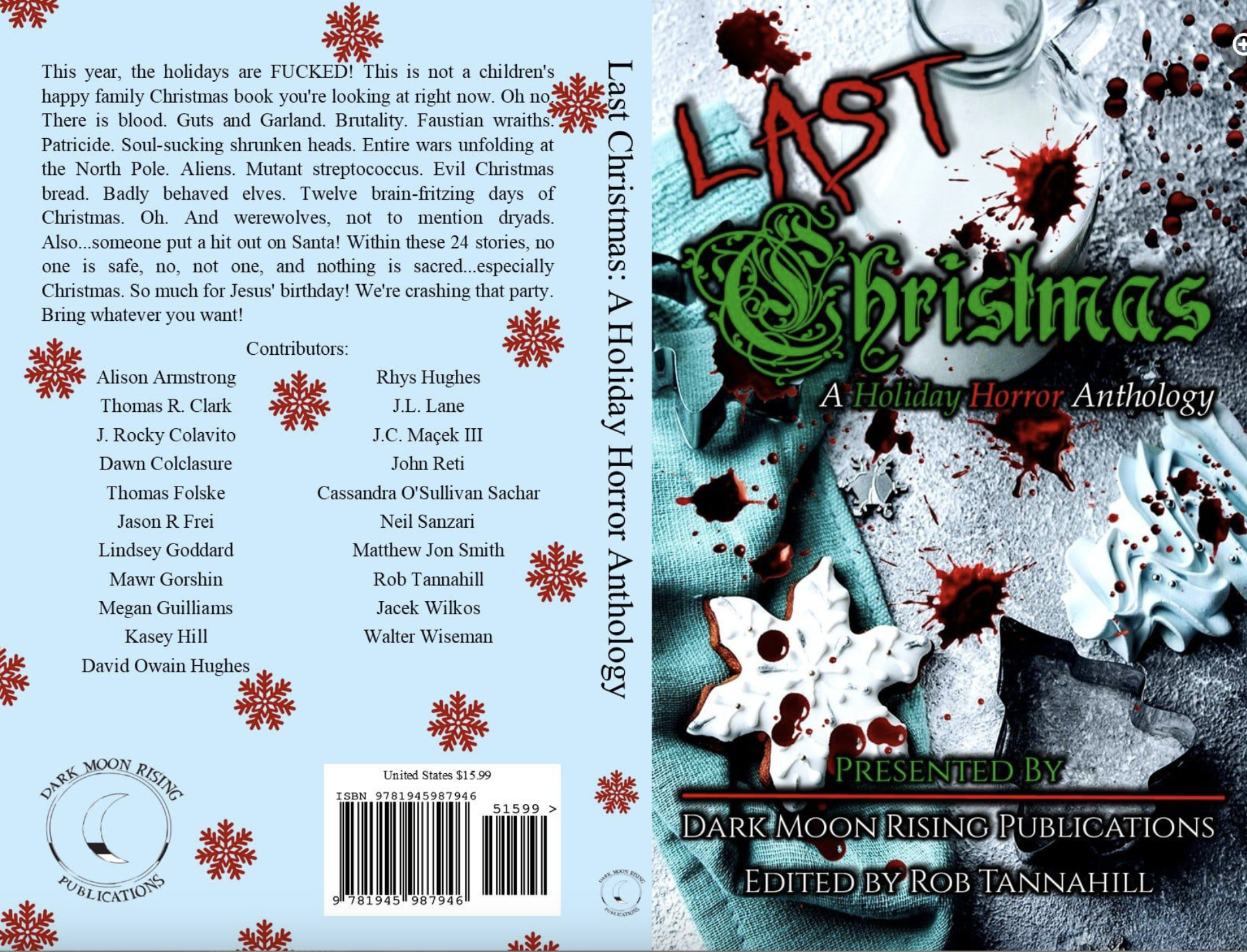
I have a horror short story, ‘Santa’s Elves,’ published in Last Christmas: A Holiday Horror Anthology, from Dark Moon Rising Publications, and edited by Rob Tannahill. The book is currently published in paperback on Amazon. It’s just $15.99. ($3.14 on Kindle.) It’s also available on Godless for $2.99.
My story is about Chinese toy factory labourers who have to work extra hard in December to make toys for the children of rich families in the West. They already work long hours almost every day for barely enough pay to live and/or to send to their families, who live far away from them and so they rarely ever see them. A divine presence from the heavens senses their inner cries for help, and when they make their toys this year, something…lethal…will be added to them, to give those Western families quite a surprise.
There are lots of other great authors whose work is featured on these pages. Please check the back cover in the photo given above to see their names (I hope you can get the image big enough to read them all). Here’s a cool promotional video you can watch.
Please go and buy yourself a copy of this collection of cool Christmas horror stories. You’ll love it! Happy holidays! 🙂
The Alien Buddha’s Best of 2024 is Published!
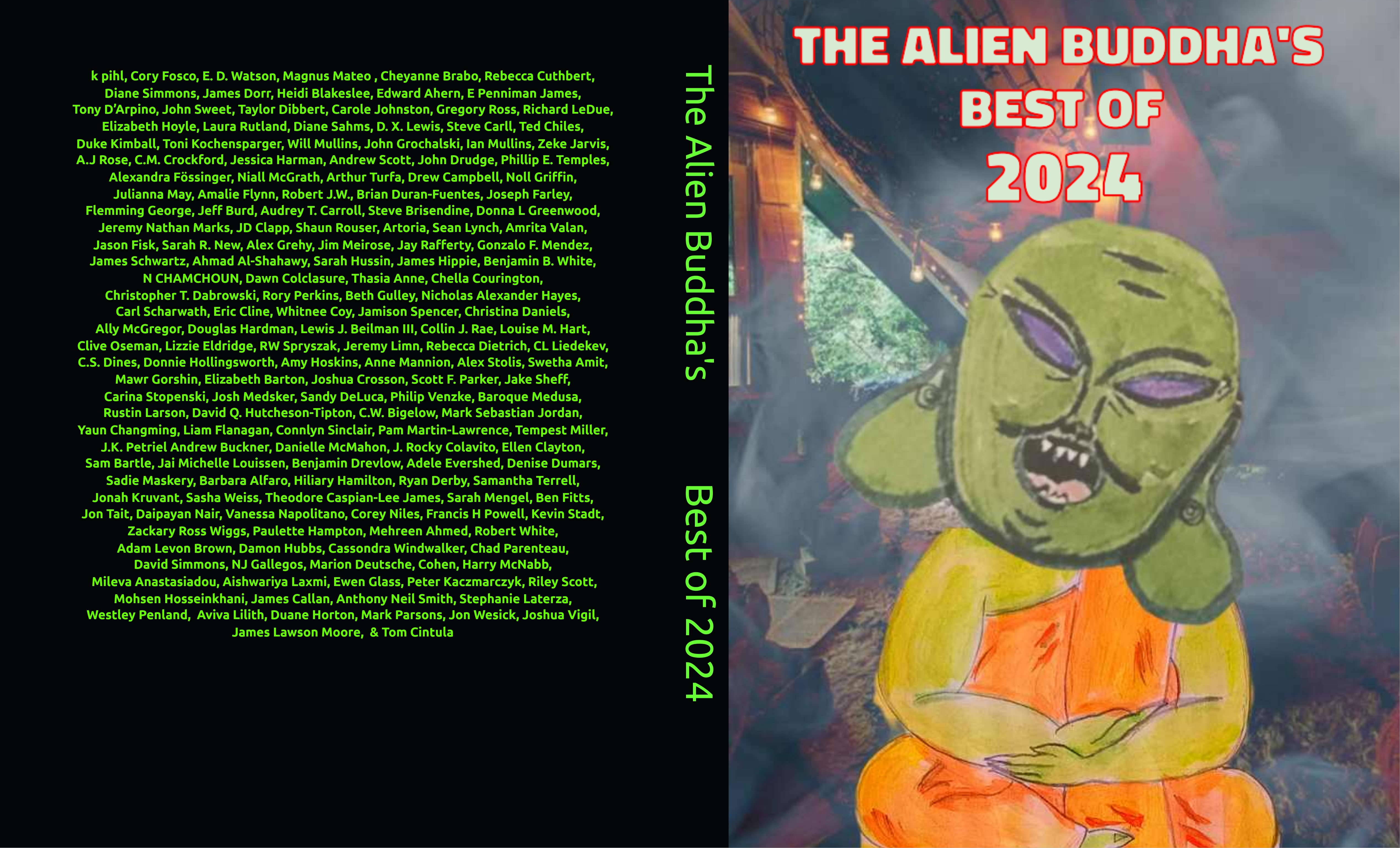
The Alien Buddha’s Best of 2024, which includes Chapter Eight of my novella, The Targeter, is now published on Amazon.
Chapter Eight of my novella is a reverie of the titular character, ‘The Targeter,’ actually named Sid Arthur Gordimer, who is drunk and high on a combination of marijuana, ecstasy, and ketamine. His thoughts drift back and forth in his reverie of being a prince in a mansion watching half-naked strippers dancing to electronic music in a party, then of being in a royal palace with Indian music.
His parents, the king and queen, are pressuring him into taking on the responsibilities of the crown…but of course, this is all just the reverie of a drunk, stoned man. Outside of Sid’s apartment, in the real world that he’s trying to escape with booze and drugs, a war is going on. Bombs and gunfire can be heard outside. The war has the potential of going nuclear, and he in his despair cannot face it sober.
He knows he’s no saint, and no prince. He’s a goner.
Please check out this collection of the work of so many talented writers (check the list of names on the back cover, if you can enlarge it sufficiently). And please check out my novella. If you like Chapter Eight, you’ll love the rest of it! 🙂
The Tanah–Translator’s Introduction
[The following is the first of many posts about a fictitious discovery of ancient manuscripts of a religious text of narratives and magic spells. Its purpose for my readers and me is to provide a cosmology and mythography on which I am basing much, if not most, of my fiction–short stories and novels. If anyone is interested in reading this fiction, he or she can use these blog posts as references to explain the nature of the magic and universe in my fiction.]
The manuscripts translated here were discovered in archaeological digs in northeastern Europe ten years before this writing. My colleagues and I have since been at work deciphering and translating this ancient text, a laborious, painstaking task that is still far from finished. These manuscripts, fragments full of lacunae, constitute only a portion of what has been unearthed; the translation of more texts is still underway, and ongoing digs just southwest of the Baltic region are expected to yield still more texts. This current publication is meant only as a taste of what is to come.
The manuscripts were found among the ruins, relics, and skeletons of an ancient Slavonic tribe; the writings are dated at about the first century CE. We say the tribe was Slavonic, but the language is far removed from that. In fact, the written script is unlike any known anywhere on Earth; one of our translating team even joked that The Tanah, as these writings are collectively known, is the product of extraterrestrials!
Now, the language seems outlandish, but the cultural attitudes expressed in that language reveal The Tanah‘s undoubtedly terrestrial origins. As one reads through its chapters and verses, one discovers the usual ancient, pre-scientific assumptions and prejudices, which skew and limit the expression of The Tanah‘s otherwise formidable wisdom.
The writers of The Tanah assume, for instance, that women’s main use of its spells should be to augment their physical beauty, help them find a husband, and acquire power and influence through ‘feminine wiles.’ Since its spells are of a paradoxical, dialectical nature, women are advised to use them to gain power through taking on a ‘submissive role.’ Curious.
Still, a surprising thing about The Tanah is that, in spite of these ancient presumptions about the world (a flat Earth in a geocentric universe, the chauvinistic belief in the superiority and centrality of the tribe owning The Tanah), there are also ideas about the world that, interpreted metaphorically, seem uncannily to anticipate certain insights in modern physics.
Examples of such scientific anticipations include what the texts call “Cao,” the undulating, unifying oneness of the entire universe, and the “Pluries,” the same atomic unifying reality that Cao is, but expressed in the form of an endless shower of particles, coming down like rain, hail, snow–some kind of precipitation. Since The Tanah is all to be read as allegory and metaphor, rather than as literal history, Cao and the Pluries could be understood to symbolize particle/wave duality.
Now, despite all of this apparent predicting of scientific ideas millennia ahead of their time, the texts are still essentially poetry, using the most vivid and striking imagery. Our translation does the best it can here, but as with any, much is inevitably lost in translation. There are nuances and multiple meanings in so many of the words of the original language that their ‘equivalents’ in English–or in any language, for that matter–can never bring out. Indeed, to cover all of those extra meanings of each word would require commentaries several times the size of the original texts and their translations.
The word “Cao” alone means so many things at once. “Oneness,” “infinity,” “universe,” “sea,” “ocean,” “waves,” “fundamental,” “void,” “chasm,” “nothing,” “everything,” and “all,” among many others. Similarly, “Pluries” can mean “particles,” “atoms,” “rain,” “precipitation,” “tears,” “snow,” “hail,” “sand,” “dust,” “ants,” “germs,” “plurality,” etc. The language these texts is written in is a most eccentric, idiosyncratic one. In reading any image used in the poetry and narratives, one must pause a moment and consider every possible association to be made with said image, just to begin to grasp the meaning of it in its fullness and totality.
If the reader finds it jarring to know that “Cao” can mean “nothing” and “everything” at the same time, he or she should bear in mind that this mystical concept has dialectical, yin-and-yang-like qualities. The imagery of the waves of the ocean that are associated with Cao suggest a dialectical shifting up and down, back and forth, between all the pairs of opposites, including every level between those crests and troughs, thus to embrace all things in the universe. This is an everything so comprehensive that it even includes nothing.
Cao represents that everything as understood as a oneness, whereas the Pluries represent everything as a plurality. Attempts at etymologies of these two mystical words suggest that “Cao” may be cognate with a composite of Greek Chaos and the Chinese Tao, though this latter derivation seems a bit of a stretch, given how far removed geographically Chinese culture and language were from where these texts were found, as well as the fact that “Tao” is modern Mandarin, not ancient Chinese. Still, Cao has both the mystical properties of Chaos and the Tao, so while the associations are probably just coincidental, they’re also fortuitous and appropriate.
Similarly, a speculative etymology of “Pluries” implies that the word is cognate with a combination of the Latin pluere, from which we also get the French word pleuvoir (“rain”), and the Latin pluralis, plures, and pluria (“plural”). Again, though, as with our speculative derivations of “Cao,” the surety of these etymologies is rather shaky and limited, given the geographic region from which we’ve found these texts. One would expect a Slavonic tribe to use a language more directly connected with actual Slavic roots. Then again, what is so fascinating about these texts is how mysterious they are: is this language an alien one after all? The written script is unlike any found on this Earth, as mentioned above.
So anyway, Cao and the Pluries are the source of all creation in the universe, as a unity and as a plurality. Not only does the natural world come from these two sources, but the supernatural, and all of magic, derive from them, too, hence the inclusion of many spells, which invoke Cao and the Pluries, and their creative power.
Cao and the Pluries aren’t the only ‘deities’ (if that’s what they are to be called) that are invoked in the many magic spells of The Tanah. Four particularly important ‘deities,’ or rather ‘basic forces,’ which is a better translation of dvami, are what the manuscripts call the “Crims” (krimso). These are the four elements: Priff (water, the first and most natural element to emerge from the watery Cao and Pluries), Nevil (fire, the first spark of passion and desire [Hador], causing the light of day [Dis] to emerge from the darkness of night [Noct]), Weleb (air, a thinning and diluting of all matter to near nothingness), and Drofurb (earth/stone, a return to the condensing of matter, yet going beyond liquid to a freezing [Calt] and solidifying of it).
Note how the Crims can be paired into dialectical opposites, with Priff and Weleb, then Nevil and Drofurb. The first two are everything (i.e., near Cao) and nothing (or near nothing). The latter two are the heat of desire vs. the cool of calmness. These two pairs of opposites move from the one to the other, then back again, like the crests and troughs of the universal ocean that is Cao itself, dialectical shifts from one extreme to the other.
The ensuing narratives also demonstrate a cyclical, dialectical shift from one extreme to its opposite, then back again, with every intermediate point expressed, too, in a shifting back and forth between opposites of many, varying manifestations. A journey out of slavery and into freedom, a mass exodus of a people out of an oppressive nation in which the masters pursue the slaves, reminds one of the Moses story.
A discussion of how to use the spells ethically versus unethically comes next. One must exercise discipline and responsibility in using the magic, for good, knowledge, and enlightenment; warnings are given against using the spells for selfish ends.
Again, in The Preaching and Proverbs, it is advised to use restraint and to be responsible in applying the magic. There is an urgent sense that warnings must be given repeatedly in The Tanah against using the magic for evil, since the writers correctly anticipate their warnings to go unheeded most of the time.
I find it fortuitous that the name of this collection of manuscripts sounds, however unintentionally and unwittingly, like a double pun, first on the Tanakh, or Hebrew Bible, with its laws and injunctions as to its moral use, and second on the Buddhist concept, given in the Pali tongue, as taņhā (“thirst,” “desire”). There’s no reason to see an etymology of tanah coming from such divergent languages, of course; but imagining such wordplay in the two words seems apt, in spite of such an improbable intention, given The Tanah‘s dialectical shifts back and forth between ethical and unethical uses.
The Lyrics are a series of verses that are magical incantations for the purpose of achieving a vast array of fulfillments of personal desires and wishes. Many of them involve causing harm to people in various ways, such as capturing souls and imprisoning them in jars, or when releasing them, they become ravenous beasts. Others involve various ways of taking control of people’s bodies, or taking a soul out of one body and putting it into another. Since such spells can be, and typically are, used in abusive ways, it is easy to see why so much is said elsewhere in The Tanah about refraining from the temptation to use these spells.
The Amores are a series of spells meant to aid the user who is in love, or who lusts after another…or many others. These spells aid in such things as maintaining youthful beauty, shaping one’s body into a more pleasing form, ensuring pleasant body odours in all the crevices of the body, preventing pregnancy or the transmission of venereal diseases, and using mind control to manipulate a love object into loving one back.
Again, warnings are repeatedly made in The Tanah to be at least extremely careful in the use of these spells, if not to refrain from ever using them, since in the use of any of them, not only is there the risk of harming the object of the spell, there’s the risk of harming the user of the spells, too, in the form of bad karma.
One way the spells work is through achieving one goal by way of its opposite. The spells thus exploit the dialectical unity of opposites. So, for example, if a woman wishes to have absolute control over a man she loves, she can do so by, ironically, being excessively submissive to him. This tactic has been used many times throughout history according to The Tanah, usually by women, and the beauty of this use of the spells is that they won’t work karmically against the user, since he or she has already exploited that opposite that would otherwise come eventually to plague the user.
The key to understanding not just the magic spells, but the entire philosophy, mythology, and cosmology of The Tanah as a whole, is to grasp that the whole universe must maintain a sense of balance. If things shift one way, they must shift the other way sooner or later. Those who fail to understand this sense of balance are typically those who misuse the spells for selfish ends. The shifting out of, and then back into, balance by means of opposing directions is the basis of understanding the Troughs and Crests of history, dealt with in the section of The Tanah called “The Future.”
Troughs, when the waves of Cao are at their lowest, represent the bad times of history. Crests, Cao’s waves when at their highest, are history’s good times. The next two books, having these titles, deal with these prophecies of good and bad.
Since the good prophecies are grouped together, as are the bad prophecies, rather than arranging them as alternating with each other, it is difficult to know which prophecy–good or bad–represents the end of the world. And since, as has been noted above, these prophecies exist in the form of allegorical tales rather than straightforward narrative prose, it is even more difficult to tell if the tale representing the apocalypse is a happy or unhappy one.
There is also a group of apocryphal texts, ones of uncertain authority, but which have been considered wise and instructive for the responsible practitioner of magic. These are also allegorical tales.
Now, as a closing note, a discussion of the verse styles should be given, if only in passing, since only a thorough study of the ancient language, beyond the scope of this translation and commentary, can do justice to the goldmine of literary, poetic beauty of the writing, as well as the multiple and nuanced meanings that are sadly lost in translation, as noted above.
Indeed, our English translation inevitably obscures, for example, the muscular metric rhythms, which can only ever so occasionally be approximated in the English, though we’ve tried our best. As for the imagery, we’ve managed, more often than not, to be able to bring out its structured use, with regular patterns of thesis/negation/sublation, usually given in a wavelike pattern of t-s-n-s-t…and so on in the same way.
As for whether or not the user of the magic spells needs to worry about their potentially adverse effects, well, we translators haven’t seen such effects…not yet, anyway.
Garrison Mauer, PhD, Professor of Religious Studies, McMaster University, Hamilton, Ontario, December 2024
 Infinite Ocean

You must be logged in to post a comment.