Detailed Synopsis of ‘Romeo and Juliet’

Act One: In the Prologue to Act One, the Chorus tells of two families in Verona, Italy, who have hated and fought with each other for many years.  The son of one family and the daughter of the other fall in love and kill themselves.  Their suicide ends the families’ fighting, and their story is “the two hours’ traffic of our stage.”  The Chorus then begs the patience of the audience for any imperfections in his synopsis of the play, promises that the actors will fill in any details he’s left out, and leaves.  (See my ‘Analysis of R&J’, first quote.)

On the streets of Verona, servants of the Capulet family discuss their hatred of the Montague family.  They meet servants of the Montagues: a Capulet servant bites his thumb at the Montagues to provoke them.  Tybalt, a Capulet, comes, as does Benvolio, a Montague.  Benvolio tries to stop a potential fight, reminding everyone that the prince has expressly forbidden any more fighting on Verona streets.  Benvolio says he only wants to keep the peace.  Tybalt says he hates peace, hell, all Montagues, and Benvolio.

The two families begin a violent brawl right there on the street.  Even Old Capulet and Old Montague call for their swords so they can join the fighting; Lady Montague forbids her husband to fight.  Finally, Prince Escalus and his men arrive, stopping the fighting.  The prince threatens death to the next ones to start another brawl.

After everyone leaves, Benvolio speaks with Old Montague and his wife about their son, Romeo.  Though glad that he wasn’t involved in the brawl, they worry about him, for he is always sad.  They see him coming, and Benvolio goes to talk to his cousin, to see if he can find out what’s troubling him.

After Romeo expresses his annoyance, in a plethora of paradoxes (see my ‘Analysis of R&J’, second quote), at the recent fighting, he tells Benvolio of his unrequited love for a beautiful girl named Rosaline.  She will live a chaste life, so Romeo has no hope of having her.

Meanwhile, in the Capulets’ house, Old Capulet is with Paris, a count, discussing a big party he will have in his house that night.  Paris hopes to marry Capulet’s daughter Juliet.  Capulet invites Paris to the party and encourages him to speak with Juliet, but reminds him that she is still very young, not even 14 years old.  It remains to be seen if she’ll like Paris.

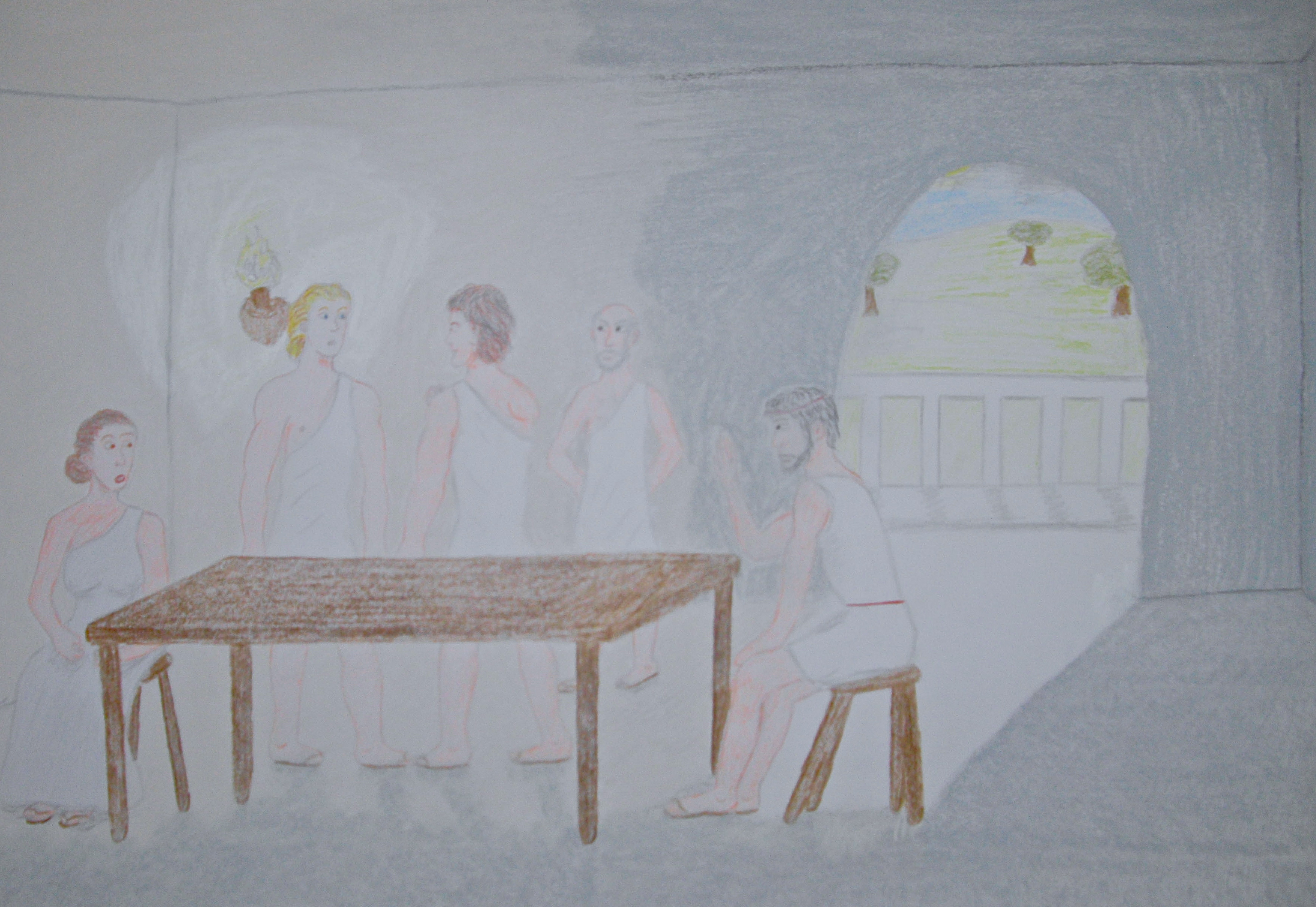
Capulet tells a servant to go about Verona and invite everyone other than the Montagues to his party.  He gives the servant a list of the names of those invited.  Unfortunately, the servant can’t read.  He leaves the house and walks about the streets, confused.

Not knowing Romeo and Benvolio are Montagues, the servant goes up to them and asks if they can read out the names for him.  Romeo reads while the servant memorizes.  When Romeo comes to Rosaline’s name, he is intrigued, asking about the party.  The servant says it’s being held at the Capulets’ house, and as long as they aren’t Montagues, they’re welcome to attend.  The servant leaves.

Romeo wants to go there to see Rosaline.  Benvolio promises Romeo will see other beautiful girls who’ll make him forget all about her.

Back in the Capulets’ house, Lady Capulet has the Nurse fetch Juliet.  After the Nurse jokes about amusing memories of Juliet as an infant, Lady Capulet asks if Juliet thinks she can love Paris.  Both Lady Capulet and the Nurse speak glowingly of the count, but Juliet will have to see if she will like him or not.

That night, Romeo, Benvolio, their witty friend Mercutio (kinsman to the prince), and other friends go down the streets toward the Capulets’ house, merrily chatting.  Romeo stops, having premonitions about the night because of a dream he’s had.  Mercutio insists that dreams are idle nonsense.  Romeo insists they can presage the truth.

Then Mercutio says Queen Mab has been in Romeo’s dreams.  Mercutio describes her as a tiny fairy that could sit on one’s fingertip.  She rides a tiny chariot and goes into men’s noses, reaching their brains as they sleep.  In their dreams, she makes their wishes come true.  Again, Mercutio insists that dreams are idle nonsense.

Benvolio insists that they hurry on to the Capulets’, for they’ll soon be late and miss supper.  As Romeo goes, he prophesies this night will be a fateful one, ultimately leading to his destruction.  Nonetheless, he charges ahead, embracing his fate, whatever it may be.

Wearing masks, the boys successfully get in the house and look around.  Looking for Rosaline, Romeo sees Juliet instead, and instantly falls in love with her, saying he “ne’er saw true beauty till this night.”

Tybalt recognizes Romeo, and calls for a servant to fetch his sword, for he wants to fight Romeo right there.  Old Capulet asks Tybalt why he’s so angry, and he says Romeo has come to spoil their party.  Capulet tells his hot-headed nephew to be patient and endure Romeo.  Tybalt says he won’t endure him; Capulet, now angry, tells him he will.  Tybalt grudgingly endures Romeo, but secretly promises to have his revenge later.

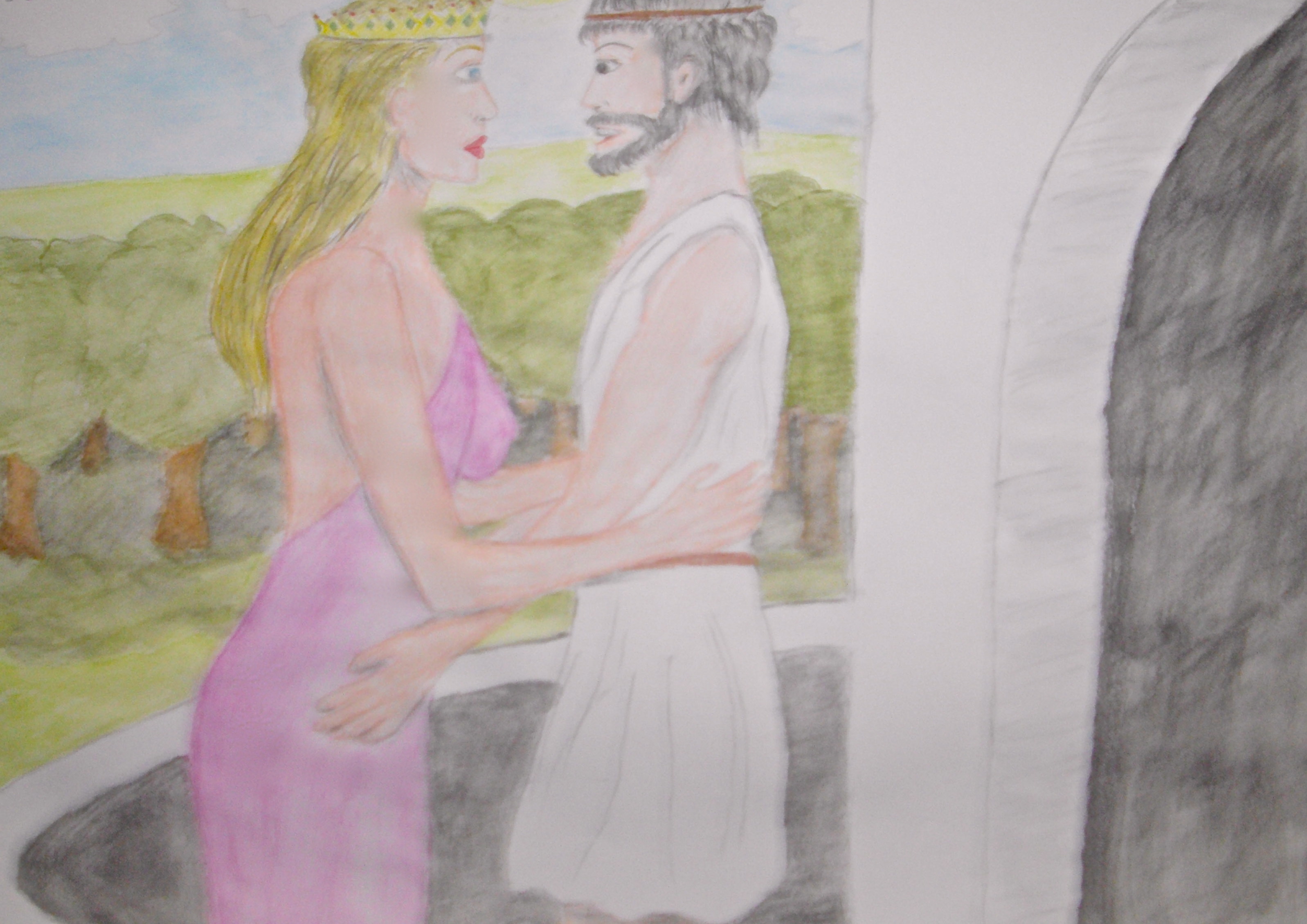
Romeo, meanwhile, takes Juliet by the hand and compares it to a holy shrine; and though his own hand has profaned hers, his lips are two pilgrims, who will atone for the sin with a kiss.  She, now as in love with him as he is with her, accepts his kisses.

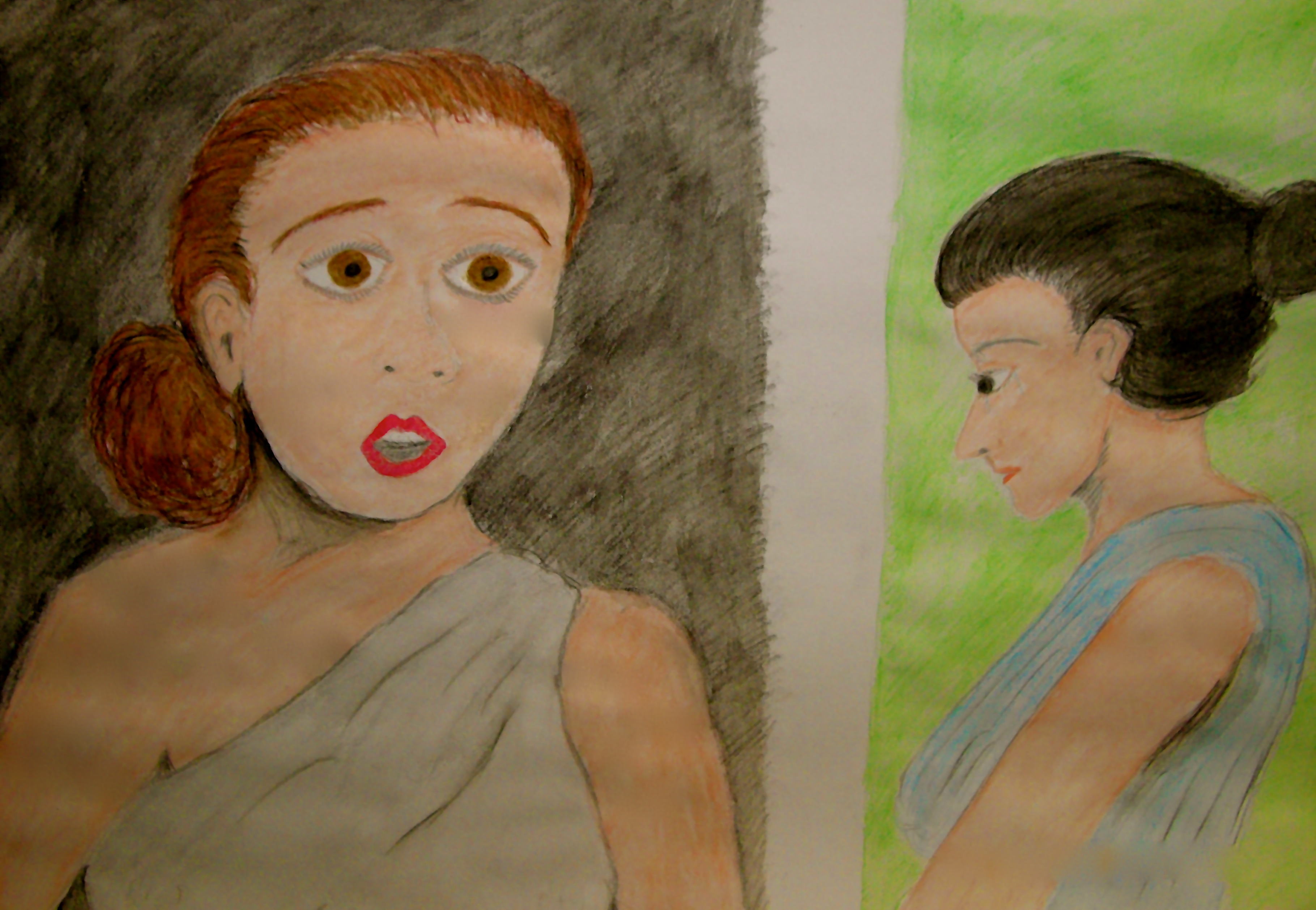
Later, Romeo learns from the Nurse that she, to his dismay, is a Capulet.  As he is leaving the house, Juliet has the Nurse go up to Tybalt and find out who Romeo is.  The Nurse tells Juliet what Tybalt knows: that Romeo is a Montague.  (See my ‘Analysis of R&J’, third quote.)

Act Two:  The Chorus recites another narrative sonnet, about Romeo no longer being in love with Rosaline, but this time being in love with a girl who returns his love.

As Romeo’s friends return home, he goes back to the Capulets’ house, jumping over the orchard walls.  Mercutio taunts him, thinking he’s still in love with Rosaline.

In the orchard, Romeo sees a light from one of the windows (see my ‘Analysis of R&J’, fourth quote).  Juliet emerges: thinking she’s alone, she declares her love for Romeo (quotes five and six).  Romeo is delighted to hear of her love for him.  He reveals himself, surprising her.  They declare their love for each other, then make plans to get married. As dawn approaches and Juliet is being nagged by the Nurse to come to bed, the young lovers say good bye and Romeo leaves (see the sixth quote).

He goes to the humble abode (‘cell’) of Friar Laurence, who’s been contemplating all the medicinal properties of herbs.  Romeo tells the friar he no longer loves Rosaline, but the Capulet Juliet instead.  Laurence chides him for his inconstancy in love, but agrees to marry him to Juliet, hoping to end the family feud.

The next day, on the streets of Verona, Romeo meets with Benvolio and Mercutio, who wonder why he didn’t go home with them the night before.  The Nurse comes to speak with Romeo, but Mercutio taunts and angers her first.  She reluctantly agrees to have Juliet meet with him in Friar Laurence’s cell to be married.

The Nurse goes back to the Capulets’ house, where Juliet is impatiently waiting for an answer from Romeo.  Still reluctant to help Juliet in marrying him, the Nurse delays giving her his answer, using her aches and fatigue as excuses.  Finally, after Juliet gets angry, the Nurse says that if Juliet is free to go to Friar Laurence’s cell that day, he’ll marry her to Romeo.

She goes there, and she and Romeo get married.  Friar Laurence, however, advises them to love moderately.

Act Three: On the streets of Verona during that very hot afternoon, Benvolio worries about getting into a fight with Tybalt, who’s challenged Romeo.  Mercutio would welcome a fight with Tybalt, who arrives with other Capulets.

They ask about the whereabouts of Romeo, who then arrives.  Tybalt calls him a villain, but Romeo, now secretly his kinsman, won’t fight him.  Angrier, Tybalt attacks Romeo, who still won’t fight back.

Furious about Romeo’s “vile submission”, Mercutio fights Tybalt in Romeo’s stead.  Romeo wants to stop the fight and comes between them, but Tybalt mortally wounds Mercutio, who, dying, curses both families (quote eight).  He’s taken away, and he dies offstage.

Enraged, Romeo wants to avenge his friend’s death.  He fights Tybalt, killing him.  He flees before the prince and his men can arrest him.  When the two families and the prince learn of what’s happened, Lady Capulet complains that Romeo must die for killing Tybalt; Old Montague reasons that, in killing Tybalt, Romeo merely did what the prince would have done anyway, as punishment for killing Mercutio, the prince’s kinsman.  Therefore, instead of using the death penalty to punish Romeo, the prince banishes him from Verona, threatening death if he ever returns.

Not knowing what’s happened, Juliet is at home in her room, thinking loving thoughts about Romeo.  The Nurse enters, telling her that Romeo killed Tybalt.  Juliet is torn between her loyalty to her husband, requiring her loving words, and her loyalty to her cousin, requiring her curses on Romeo.

Romeo is hiding in Friar Laurence’s cell, preferring death to banishment, since there is no life outside of Verona, without Juliet.  The Nurse visits, telling Romeo of Juliet’s tears over Tybalt’s murder.  Guilt-laden Romeo wants to kill himself; the friar chides him for his “womanish” tears.  Then Friar Laurence reminds Romeo of how lucky he is: he killed Tybalt, instead of vice versa; Prince Escalus could have had Romeo executed, but he’s had Romeo banished instead.

Next, the friar devises a plan to help Romeo and Juliet.  Romeo will go to Mantua.  Friar Laurence will plead for the prince’s forgiveness for Romeo, and in time, Romeo will be allowed to return and be reunited with Juliet.  This gives Romeo hope.  Romeo will go to Juliet’s bedroom, lie with her that night and comfort her before he has to leave the next day.

In the Capulets’ house, the sadness of the family makes it a bad time for Paris to woo Juliet.  Nonetheless, Old Capulet wants Paris to marry his daughter.

That night, in Juliet’s bed, she and Romeo have made love, and dawn is coming: Romeo must leave.  Juliet doesn’t want to admit that morning has come, and insists that it’s still night.  But he must go.  The Nurse comes in and tells them Lady Capulet is coming.  Romeo leaves, going down from her window into the orchard: Juliet has a premonition she’ll look down on him again one day, but he’ll be dead.

Her mother comes in, and after speaking of having someone hunt down Romeo in Mantua and kill him, she mentions Old Capulet’s plan for Paris to marry Juliet.  Juliet refuses to marry him, and when Old Capulet hears of her disobedience, he angrily threatens to disown her.

A tearful Juliet asks for words of comfort from her mother and the Nurse, neither of whom give her any.  Instead, the Nurse says she should forget Romeo and marry Paris.  After the Nurse leaves, Juliet no longer regards her as a friend or confidante.  She goes to Friar Laurence’s cell.

Act Four: At the friar’s cell, he and Paris discuss Paris’s marriage plans with Juliet.  When Juliet arrives, she and the friar find a private place to speak after Paris leaves.

Desperate to prevent this wedding, Juliet wants to die.  Friar Laurence has another idea to prevent it: if she would drink a medicine of his creation, it would make her seem dead in every way–no breath, no heartbeat, no movement from her body–but she’d really be fast asleep for 42 hours.  Her funeral would be held, and she’d be buried in the family tomb.

Romeo would receive letters from the friar, explaining the plan.  Romeo would sneak back into Verona and to the tomb, get reviving Juliet, and escape with her to Mantua.  She eagerly takes the vial of medicine.

Back at home, Juliet apologizes to her father and agrees to marry Paris.  After saying goodnight to her mother and the Nurse, Juliet is alone in her bedroom, holding the vial and fearing any possibility that the plan may not work.  Fearing marriage with Paris even more, she drinks the drug.

The next morning, with musicians and servants getting the wedding party ready, the Nurse goes to wake up Juliet, but finds her apparently dead.  She hysterically calls for Juliet’s parents, who rush to see her and mourn with the Nurse.  The wedding party has now become a funeral.

Act Five: On a street in Mantua, Romeo speaks of a dream he’s had of Juliet finding him dead, then of him reviving and being an emperor.

Balthasar, a servant to Romeo who knows nothing of Friar Laurence’s plan, tells him Juliet has died.  A mourning Romeo is determined to go back to Verona, to kill himself in her tomb so they’ll be together in death.

He finds a poor apothecary, and wants to buy poison from him.  The apothecary reluctantly takes Romeo’s money and gives him a powerful poison.

In Friar Laurence’s cell, Friar John comes to see him, after trying to deliver Laurence’s letters to Romeo in Mantua.  Laurence asks John if he received any letters from Romeo.  Friar John tells Laurence that he wasn’t able to get to Mantua, for he was detained in the house of a sick man believed to have an “infectious pestilence”.  He hasn’t given Romeo Laurence’s letters.  Friar Laurence must now hurry to the Capulets’ tomb.

That night, at the tomb, Paris goes to pay his last respects to Juliet.  Romeo and Balthasar also arrive.  Romeo tells Balthasar to leave; Balthasar does, but he hides nearby, worrying about Romeo.  Romeo comes to the tomb and confronts Paris, who assumes Romeo wants to do shame to the bodies.  They fight, and Romeo mortally wounds Paris.  Dying, Paris asks to be lain near Juliet.  Respecting his wish, Romeo brings his body near where Juliet lies.

During the fight, a page has called the watch, so a mob of people will soon come.

In the tomb, Romeo sees the bodies of Juliet and Tybalt.  He repents killing Tybalt, then looks on Juliet, amazed that, even though dead, she hasn’t lost any of her beauty.  He imagines personified Death is in love with her, and keeps her beautiful to be His lover.  Sobbing Romeo hugs and kisses her one last time, then drinks the poison, which kills him within seconds.

Friar Laurence arrives and sees dead Romeo, while Juliet is reviving.  The friar tells her the sad news and, saying he’ll make her a nun, begs her to leave with him, for a mob of people can be heard approaching the tomb.  Too afraid to be found there, the friar runs off.

Juliet notes that Romeo’s drunk poison, but left none for her.  She hopes to taste some on his lips; she kisses him, and feeling his lips’ warmth, knows he’s only just died.  This adds to her heartbreak.

Hearing the mob coming nearer and nearer, she knows she must act quickly if she is to die with him. She takes his “happy dagger” and stabs herself, falling dead on his body.

The mob arrives, along with Capulet, Lady Capulet, the prince, and Old Montague, who says that Lady Montague has died of grief because of Romeo’s banishment.  The friar also returns, explaining how Romeo and Juliet were secretly in love, and that he married them.

Once all has been revealed, the prince rebukes Old Montague and Old Capulet for the “scourge” caused by their hate; and because the prince has been too lenient with them, he himself has lost two kinsmen, Paris and Mercutio (quote nine).  The families repent of their hate, and the two grieving fathers promise to have monuments built in honour of each other’s child.

(If you liked what you just read, please subscribe to my newsletter; a link to it can be found at the side of this page.)

Detailed, Illustrated Synopsis for ‘A Midsummer Night’s Dream’

This post is meant to accompany my previous one, ‘Analysis of “A Midsummer Night’s Dream”‘ (MND).

Hippolyta and Theseus

Act One: Theseus, the Duke of Athens, having recently captured Hippolyta, the Queen of the Amazons, plans to marry her.  Egeus complains to the duke that his daughter, Hermia, refuses to obey him and marry Demetrius.  Instead, she loves Lysander, who fights for his right to marry her.  Lysander tells everyone Demetrius used to love Helena, who still “dotes” on him.

Hermia and Helena
Hermia and Helena

The Athenian law punishes those who disobey their fathers with the death penalty, and Egeus wishes to use this law to intimidate Hermia into marrying Demetrius; still, she boldly refuses.  The duke must uphold the law, but offers her a third choice: if she won’t marry Demetrius, instead of suffering death, she can devote herself to the chaste worship of the goddess Diana, and abjure the society of men.  She has until Theseus’ wedding day to decide.  Theseus, Egeus, and Demetrius then leave the room, and Lysander and Hermia are alone.

Hermia, Lysander, Demetrius, Egeus, and Theseus quarrelling.

Lysander comforts her (see first quote from my ‘Analysis of MND’ post), and tells her his plan to take her out of Athens and away from its cruel law.  They’ll go through the nearby forest and stay at his aunt’s home.  Then they’ll be married.  This gives Hermia hope.

When Helena joins them and tells them of her dejection from Demetrius’ preference of Hermia over her, they tell her of their plan to leave, Demetrius then having only Helena to love.  Lysander and Hermia leave, and Helena is alone, complaining in a monologue of her loss of Demetrius’ love (see second quote from ‘Analysis of MND’).  Finally, she foolishly decides to tell Demetrius about her friends’ plan to flee to the woods, hoping this will win Demetrius’ favour.

Peter Quince, having chosen the myth of Pyramus and Thisbe to have his ‘actors’ perform in a play before the duke, gives each actor his role.  Nick Bottom, every director’s nightmare, is to play Pyramus, lover of Thisbe; but Bottom wants to play every role.  Francis Flute, a boy, is to play Thisbe, but he doesn’t want to play a girl because he’s starting to grow a beard.  Bottom wants to play Thisbe, but Quince insists he’s to be only Pyramus.

Snug is to play a lion, but he wants to see his ‘lines’ quickly because he’s ‘slow of study’; Quince assures him he only needs to improvise roaring–this reassures Snug.  Bottom offers to play the lion, and boasts of his ability to roar; Quince says he’ll frighten away the ladies, so Bottom offers to roar softly.  Still, Quince insists Bottom is only to be Pyramus, and tells everyone to meet in the nearby forest that night to rehearse, because he doesn’t want the Athenians to watch how the play is being put together.

Act Two: In the forest that night, a fairy chats with Puck, and Puck tells her of the pranks he likes to play on people.

There is trouble in fairyland.  Oberon, the fairy king, is angry with Titania, his queen, because she, not even willing to share a bed with him, refuses to give him an Indian changeling boy for his page.  She says that the boy’s mother honoured Titania while the mother was alive, and out of friendship with the mother, Titania wants to have the child, and should have him.  She and her fairy retinue leave Oberon.

Oberon and Titania quarrel over the Indian boy.

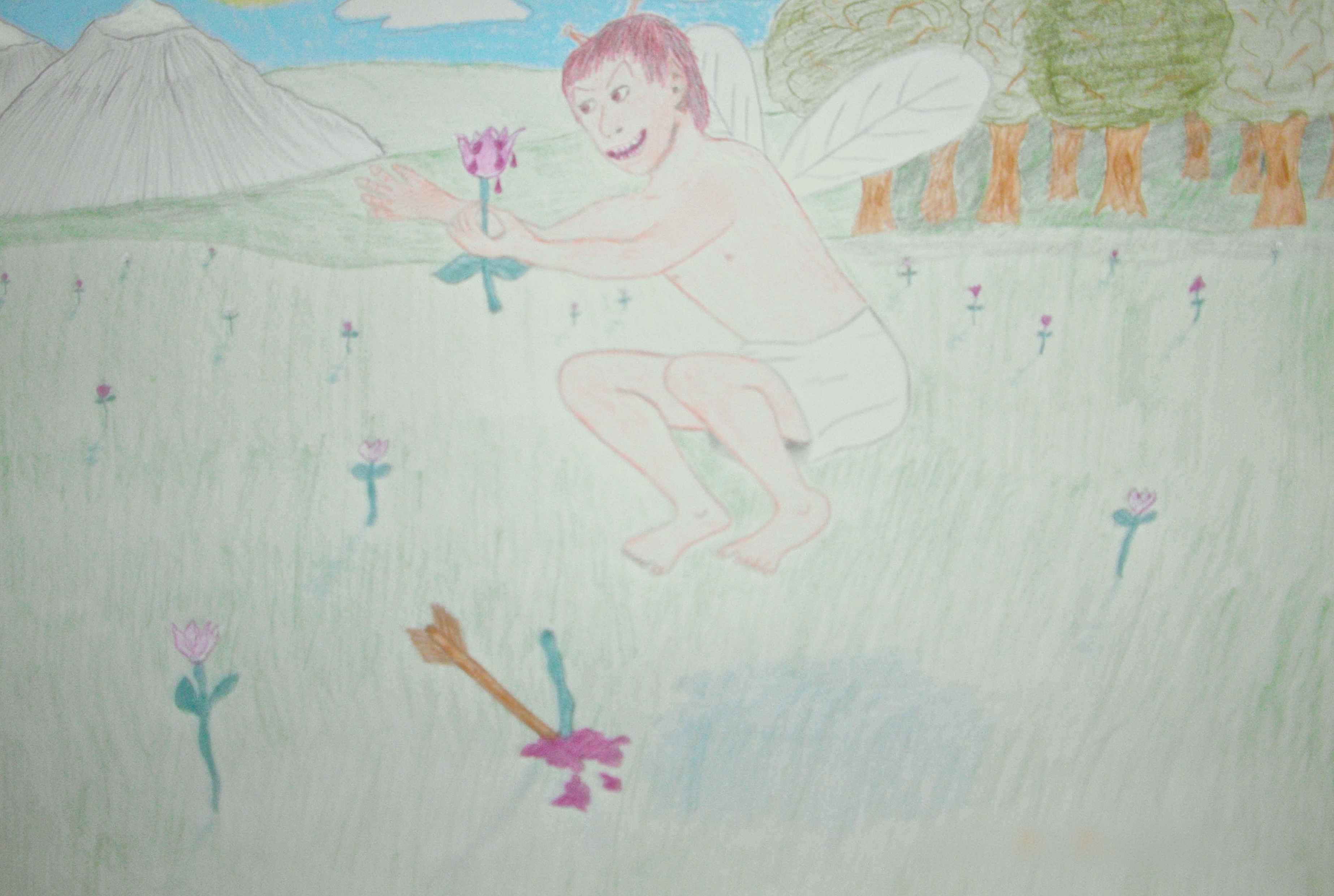
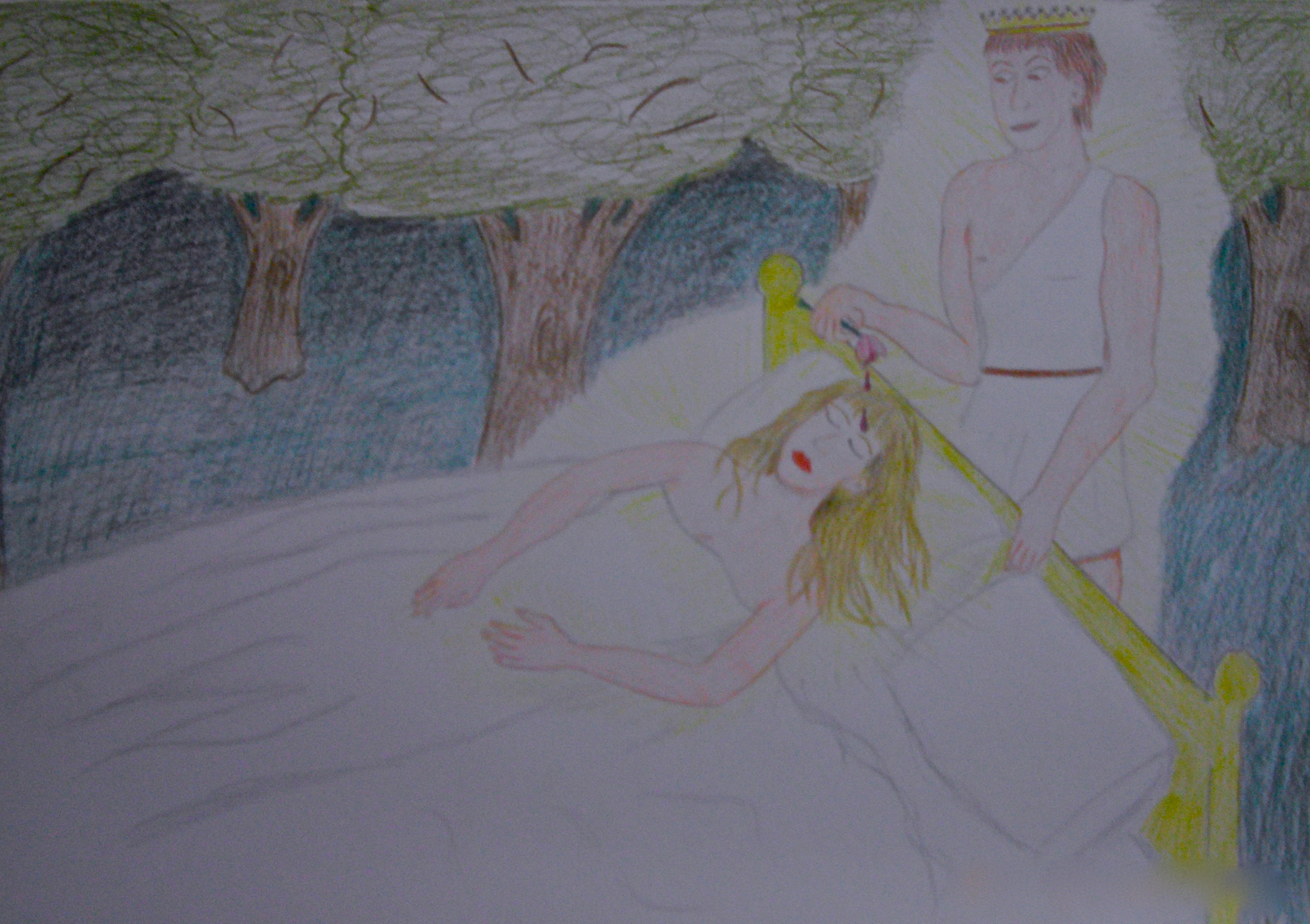
Wanting revenge for this ‘injury’, Oberon commands Puck, his fairy servant, to go off and find a special flower that one of Cupid’s arrows was shot into.  The arrow filled the flower with a potion, called ‘love in idleness’.  When the ‘love juice’ of this flower is poured onto the eyelids of anyone sleeping, he or she, when waking, will fall in love with the first person…or animal…or thing…he or she sees.  Puck flies away to find the flower.

Puck finds the magical flower.

Oberon plans to put the love juice on Titania’s eyelids as she sleeps that night, making her fall in love with something ‘vile’ to humiliate her.  While she’s thus distracted, he’ll get the Indian boy.

While Oberon is waiting for Puck to return, he sees Demetrius walking through the forest, chased by Helena.  Invisible to them, Oberon listens to what they say to each other.

Though Demetrius insists that he neither will nor can love her, Helena says she loves him all the same.  He warns her of the dangers a maid may encounter in a forest at night, when Demetrius has no inclination to protect her.  He continues to try outrunning her in his search for Hermia, and Helena complains of how men are supposed to pursue women, not vice versa.

Oberon, taking pity on her, tells Puck–when he returns with the flower–to put some of the love juice on the eyelids of a sleeping Athenian man who is disdainful of a woman’s love.  Oberon tells Puck, who’s never seen Demetrius before, he’ll know the man by the Athenian clothes he’s wearing.  So Puck takes some of the flower and searches for the Athenian, while Oberon takes the rest of the flower and finds Titania, whose fairies are singing her to sleep.

When she’s asleep, Oberon pours the love juice on her eyelids and chants a magical poem to make her fall in love with a hideous monster.  He tells her to “wake when some vile thing is near”, and leaves her.

Oberon puts the love juice on Titania's eyelids.
Oberon puts the love juice on Titania’s eyelids.

Meanwhile, Lysander and Hermia are wandering elsewhere in the forest, and they are tired and lost.  They decide to sleep, Lysander’s hopes of getting close to Hermia disappointed when she, out of maidenly modesty, tells him to sleep further off.  He does, and when Puck sees them asleep, he assumes that Lysander, in Athenian clothes and sleeping apart from the girl (presumably out of disdain for her), is the man Oberon wants Puck to use the love juice on.  Puck pours it on Lysander’s eyelids and leaves them.

Soon after, Demetrius and Helena walk by that area, Demetrius still scorning her.  He leaves her alone, and she looks at her reflection in a pond.  Her reflection distorted by the ripples in the water, she sadly concludes, “I’m as ugly as a bear.”  Then she sees Lysander sleeping, and worries that he could be dead.  She wakes him, and he falls in love with her.  Shocked at this sudden change in him, she assumes he is making fun of her.  She leaves the area in tears, him pursuing her, and Hermia is left alone there.  Later, she wakes from a terrible dream, and, frightened, wonders where Lysander went.  She then goes to look for him.

Act Three: The ‘rude mechanicals’ arrive in another area of the forest and begin rehearsing their play.  Bottom points out that the lion may frighten the ladies, so they decide they will tell the audience the lion is really Snug.

Quince then mentions ‘two hard things’: they need a wall on the stage to separate Pyramus and Thisbe; and they need the moonlight to shine on them on the stage, but they doubt that there will be a window to let the moonlight in.  They decide that Snout will portray, as it were, the wall, holding his fingers in such a way as to indicate a chink through which the lovers may speak.  Robin Starveling, holding a lantern, will represent the man in the moon.

As they rehearse, misspoken lines abound: instead of ‘odorous savours sweet’, we have ‘odious’ savours; the lovers won’t meet at ‘Ninus’ Tomb’ but at ‘Ninny’s Tomb’.

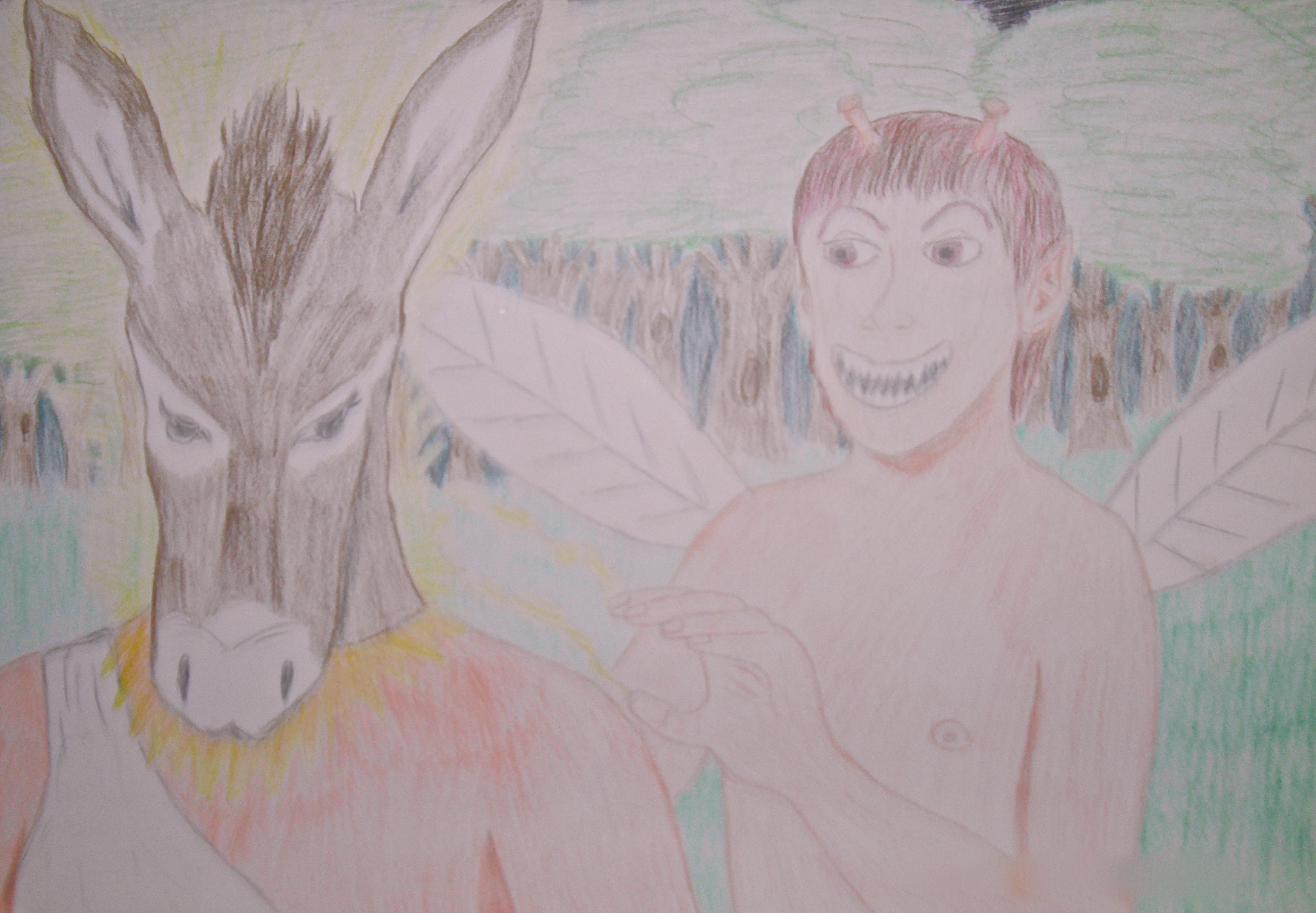
Bottom walks away momentarily.  Puck has been watching all of the rehearsing, and he’s much amused by the actors’ lack of talent.  He uses magic on Bottom, changing his head into that of a donkey.  When Bottom returns to say his next words of love to Thisbe, all the other actors run away from him in terror at his ‘monstrous’ transformation.

Puck gives Bottom a donkey's head.
Puck gives Bottom a donkey’s head.

Bottom, not yet knowing what’s happened to him, pretends not to be afraid at what he thinks is a prank, and he sings a song, waking Titania.  She falls in love with him and takes him with her to be waited on by her fairies.

Titania in love with ass-headed Bottom

Meanwhile, Oberon is angry with Puck for putting the love juice on the eyes of the wrong man.  Later, Hermia finds Demetrius and demands to know where Lysander is; she suspects Demetrius may have harmed Lysander.  When Demetrius insists he neither hurt Lysander nor knows where he is, Hermia leaves Demetrius, and he falls asleep.

Now Oberon puts the love juice on his eyelids, while Puck finds Helena and uses his magic to bring her near sleeping Demetrius.  Lysander, still in love with Helena, follows her, and Puck, amused, observes the young lovers’ folly (see ‘Analysis of MND’, third quote).

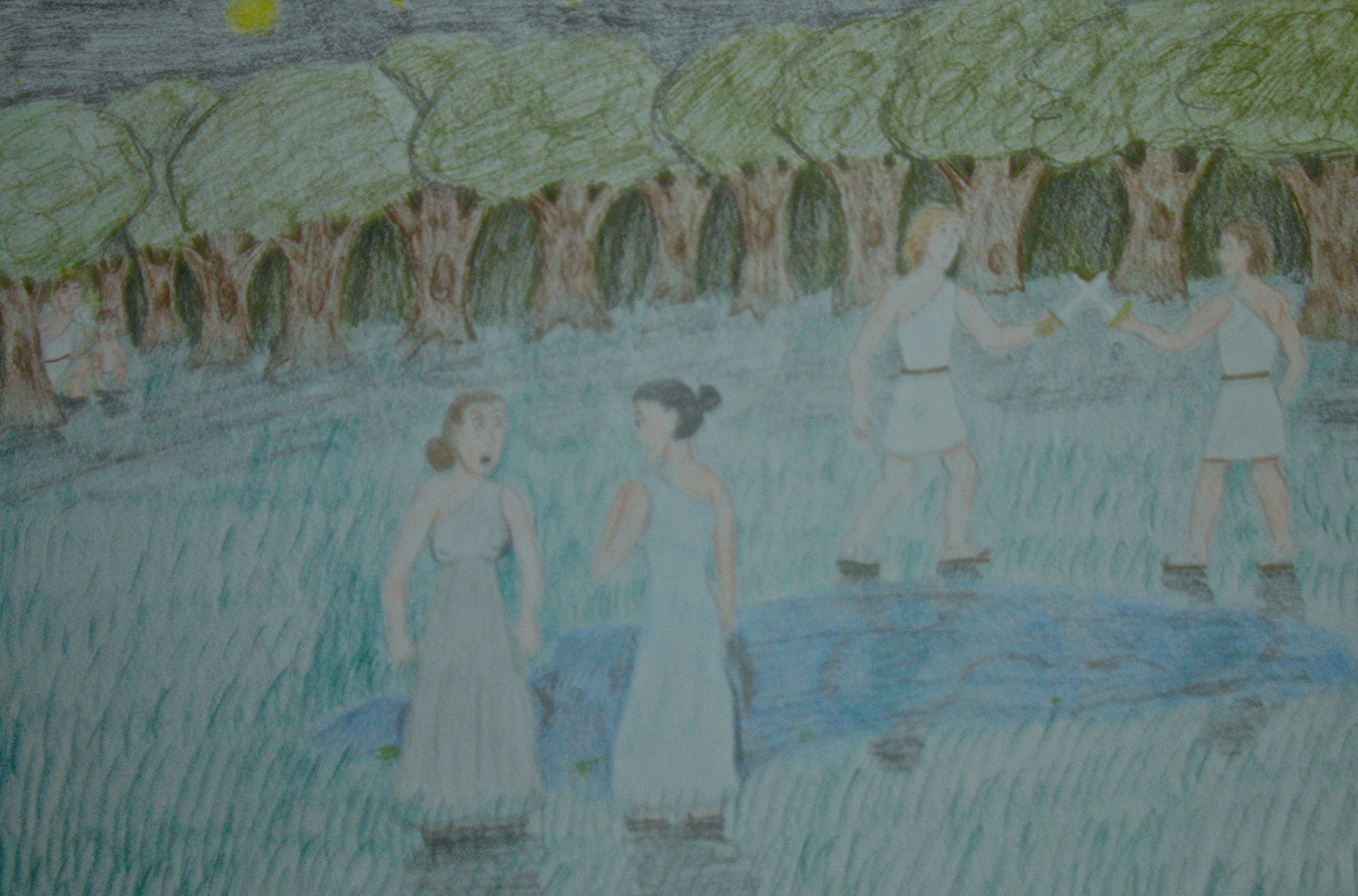
Lysander, weeping, pleads with Helena that men who love in jest don’t weep as they woo.  Helena retorts that his jest increases in cunning, and chides him for forgetting his true love, Hermia.  Lysander says he was foolish to love Hermia, and that Demetrius loves her, but not Helena.  This wakes Demetrius, who immediately calls Helena, “goddess, nymph, perfect, divine!”  Now Helena thinks both men are making fun of her.  Lysander and Demetrius start to show hostility to each other as rivals for Helena.

Then Hermia appears, happy to have finally found Lysander.  When she asks him why he left her, he bluntly tells her he hates her and now loves Helena.  Hermia can’t believe this, while Helena imagines all three of them are in ‘confederacy’ against her.  She chides Hermia for it, saying it’s unladylike, while Hermia says it’s Helena who scorns her.  The fighting between the four of them continues, with insults directed at Hermia’s shortness.  Lysander and Demetrius leave the girls to fight elsewhere.

Oberon blames all this trouble on Puck, who explains that Oberon told him he would know the man by his Athenian clothing, so it was an honest mistake.  Still, Puck doesn’t mind the mistake–to him, causing mischief for the four Athenian lovers is all good fun.

Hermia, Helena, Lysander, and Demetrius fighting; Oberon and Puck watch.

Oberon then orders Puck to use his magic to separate Lysander and Demetrius so they won’t hurt each other.  Soon, when all four lovers fall asleep, Puck is to use the love herb on Lysander’s eyes, correcting them so he’ll love Hermia again.  When everyone wakes in the morning, all the night’s folly will seem a dream.  Puck must hurry, for morning is coming soon.  Oberon will go to Titania and get the Indian boy.  Then he’ll release her from her love of ass-headed Bottom, “and all things shall be peace.”

Chanting, “Up and down, up and down,” Puck leads Lysander and Demetrius away from each other by imitating their voices, fooling each man into thinking he’s chasing the other.  They soon grow weary of the chase, and fall asleep.  The girls also grow weary and fall asleep.  Puck squeezes the love juice on Lysander’s eyelids, and chants a magical poem to ensure that he’s in love with Hermia again.  “Jack shall have Jill/Naught shall go ill.”

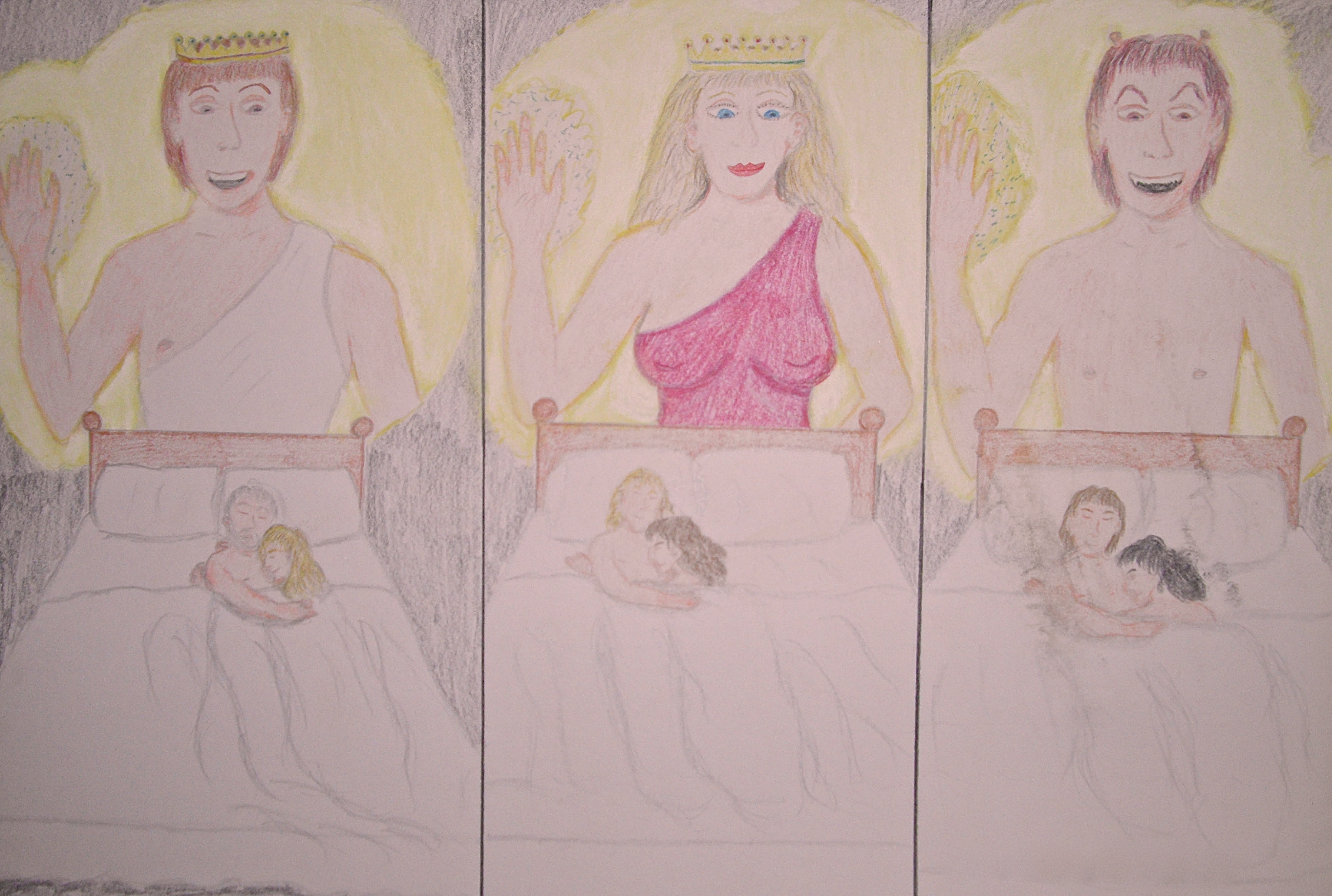
Act Four: Titania is in bed with ass-headed Bottom.  He asks for her fairy attendants, Peaseblossom, Cobweb, and Mustardseed, to scratch him.  Itchy, he feels “marvellous hairy about the face,” and needs a barber.  When Titania asks him what he wants to eat, he asks for hay, though she offers to have one of her fairies fetch him nuts.  They decide to sleep, and Titania tells her fairies to leave them.  Holding Bottom in her arms, she says, “O, how I love thee! how I dote on thee!”  They sleep.

Oberon and Puck watch Titania and Bottom.

Oberon and Puck watch, and the fairy king begins to pity his queen for her foolish ‘dotage’.  Now that he has the Indian boy, which she quickly gave him, he will “undo this hateful imperfection of her eyes.”  He also orders Puck to change Bottom back to normal.  Then all will think “this night’s accidents but as the fierce vexation of a dream.”  First, Oberon chants a magical poem to change Titania’s judgment back to normal.

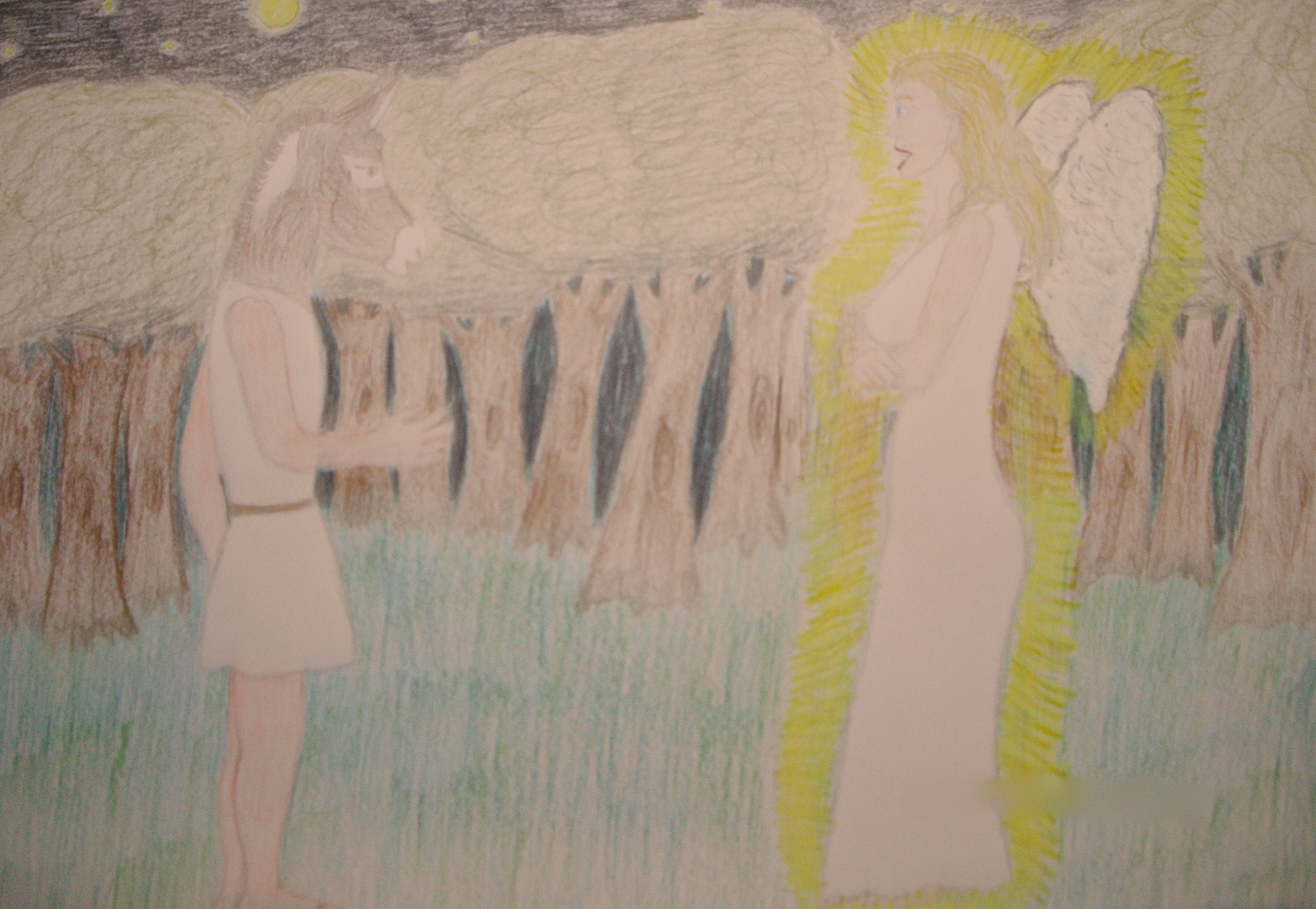
She wakes up and tells Oberon, “Methought I was enamoured of an ass.”  Indicating Bottom, Oberon says, “There lies your love.”  Shocked to see Bottom’s ass head, she asks how all of this happened.  Oberon says now that he and Titania are reconciled, they’ll go to Duke Theseus’ house tomorrow midnight, “and bless it to all fair prosperity.”  There, all the lovers will be happily married at the same time. Puck changes Bottom back to normal, saying, “Now when thou wak’st with thine own fool’s eyes peep.”

The next morning, Theseus, Hippolyta, Egeus, and their attendants, hunting, come by the forest.  They find the four young lovers sleeping there.  They wake.  Theseus asks what happened.  Lysander confesses that he eloped with Hermia to escape the Athenian law.  Egeus demands that the law be enforced, but Demetrius says–though he doesn’t know by what power–his love for Hermia “melted as the snow.”  He now loves Helena again.  Theseus overrules Egeus’ will, and they will all be married together in Athens.

Bottom, with his human head again, wakes up, and is amazed at his dream of having an ass’s head.  He says only a fool would tell people of such a dream, but he’ll tell everyone anyway.  He’ll have Peter Quince write a ballad of it, called “Bottom’s Dream”, and Bottom plans to sing it towards the end of their play.  He leaves the forest to find the other actors.

Back in Athens, the other ‘mechanicals’ are worried about what happened to Bottom.  Not knowing where he is, they conclude the play can’t be performed.  Snug tells them the Duke is coming from the temple.  If their play had gone forward, they’d have been all made men.  They are all disconsolate; then Bottom suddenly appears, and everyone quickly cheers up.  He tells them to hurry and get ready to perform, for he says, “our play is preferr’d.”

Act Five: Theseus and Hippolyta talk of love in his palace.  (See the fourth quote in my post ‘Analysis of MND’.)  Philostrate, master of revels, presents Theseus with a paper showing all the plays to be considered for the evening’s entertainment.  After rejecting several proposed plays, Theseus chooses “A tedious brief scene of young Pyramus and his love Thisby: very tragical mirth.”  Fascinated with these paradoxes, he asks Philostrate about the play.  Philostrate insists it’s unfit, but Theseus insists on hearing the play.  Philostrate reluctantly leaves to tell the ‘mechanicals’ to get ready to perform.

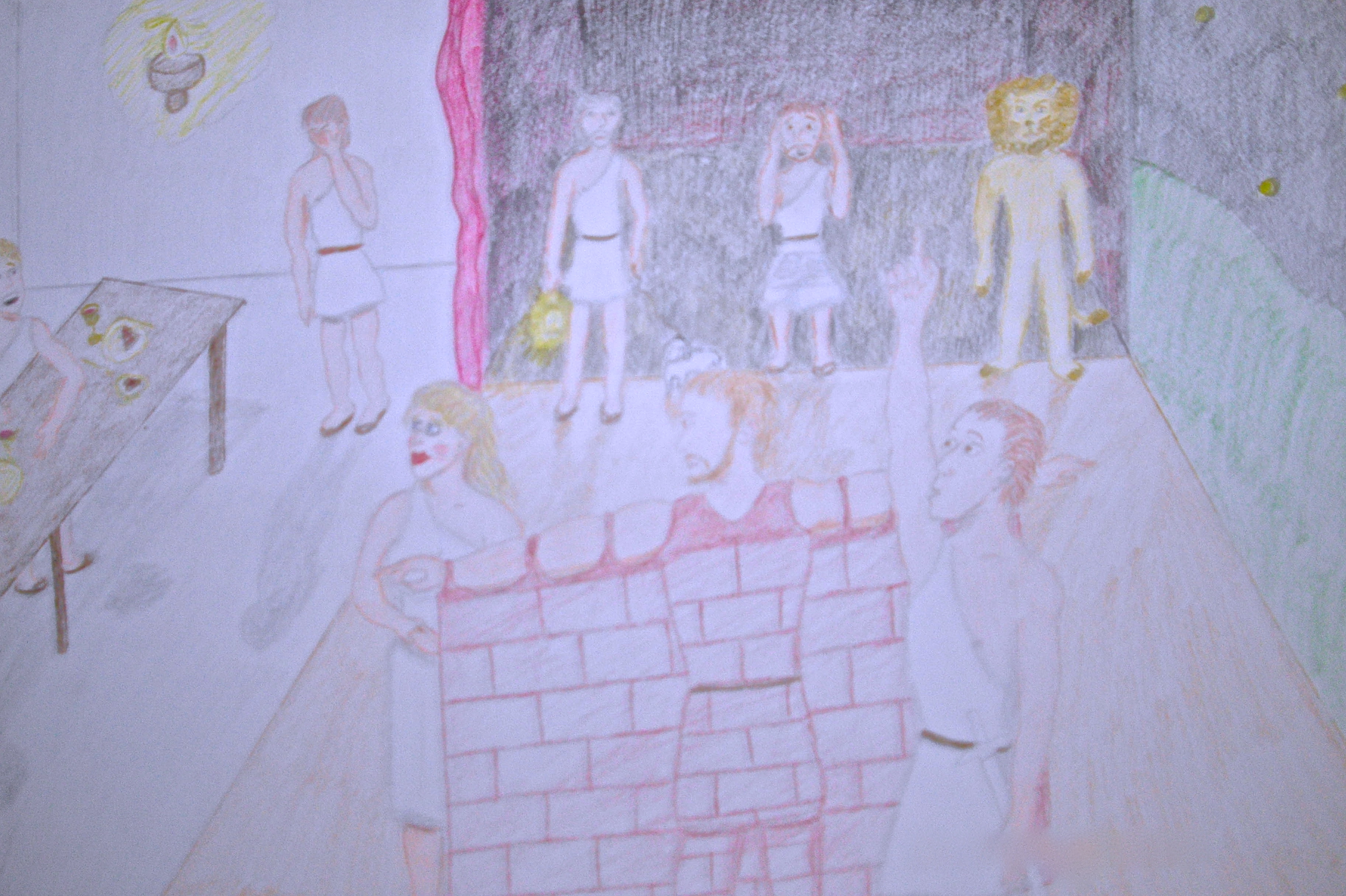
The play begins with all three married couples as the audience, and with Peter Quince as the Prologue: “If we offend, it is with our good will.”  As he continues speaking, it is obvious to Theseus, Lysander, and Hippolyta how inept Quince is.  He continues, introducing Bottom as Pyramus, Flute (in drag) as Thisbe, Snout as the Wall that separates the lovers (his hand shaped like a chink through which they can whisper to each other), Robin Starveling (with his lantern, dog, and bush) as Moonshine, and Snug as the Lion.

Quince gives a brief synopsis of the play: Pyramus would be with his lady Thisbe, but a wall separates the two lovers, and they can communicate only through a small hole in the wall; they agree to meet at Ninus’ Tomb; Thisbe arrives there first, but a Lion appears, and chases her; she gets away to safety, but only after a piece of her clothing is bitten and torn off, it being stained with the blood of a recent kill of the Lion’s.  Pyramus arrives, and sees the bloody piece of Thisbe’s clothing; he assumes she’s dead, and kills himself.  She returns, sees him dead, takes his sword, and kills herself, too.  Then Quince tells the audience his actors will now act out the story.  He leaves.

Snout presents himself as the wall, holding his hand out to represent the hole.  Bottom as Pyramus enters, reciting some ludicrous poetry about the night: “O night, O night, alack, alack, alack,…And thou, O wall, O sweet, O lovely wall,…Show me thy chink, to blink through with mine eyne.”  Wall holds up his fingers, so Pyramus can look for Thisbe.  Pyramus thanks Wall, and looks, but sees no Thisbe.  Disappointed, Pyramus says, “O wicked wall,” and curses Wall.  Theseus thinks the wall, being able to speak, should curse back; but Bottom comes out of character and tells the duke that Thisbe will be coming out now.

Francis Flute, in women’s clothes, enters as an absurd-looking Thisbe, hoping to speak with Pyramus.  They speak to each other briefly, and try to kiss through Wall’s chink, but obviously cannot.  Pyramus asks her if she’ll meet him at “Ninny’s Tomb”.  She says she will, and they leave.  Wall, having finished his part, says good-bye to the audience, and leaves also.

The 'rude mechanicals' perform 'Pyramus and Thisby'.
The ‘rude mechanicals’ perform ‘Pyramus and Thisby’.

Theseus, Demetrius, and Hippolyta comment on how ridiculous the play is.  Snug and Robin Starveling enter as, respectively, Lion and Moonshine.  Lion reassures the ladies, “whose gentle hearts do fear,” that he is really Snug the joiner.  Robin Starveling tells the audience his lantern represents the moon, and that he is the Man in the Moon.  Thisby appears, but Lion, roaring, scares her.  She runs away, and Lion tears her clothing.  Thorougly entertained by this unintended comedy, Demetrius, Theseus, and Hippolyta respectively shout out their compliments to the actors: “Well roar’d lion”; “Well run, Thisby”; “Well shone, Moon.”

Pyramus enters, thanking the Moon for its light.  He sees the piece of Thisbe’s clothing, “stain’d with blood”, and assumes she’s dead.  He takes out his sword and stabs himself.  He dies a slow and melodramatic death.  Moonshine leaves, and Thisbe re-enters.  She asks, “Asleep, love?  What, dead, my dove?”  She takes his sword, and says, “Come trusty sword; Come, blade, my breast imbrue.”  She stabs herself, and dies.  Theseus and Demetrius note that Moonshine, Lion, and Wall will have to bury the dead.

Bottom gets up and asks the audience if they’d like to see the Epilogue, or hear a Bergamask dance.  Theseus says no to the Epilogue, but will have the Bergamask.  The actors dance.

Then Theseus tells all the lovers, it’s “almost fairy time”, and so they must all go to bed.  They all leave, and the fairies enter, saying magic poems to bless the newly-weds, and singing and dancing.  They all then leave, except Puck, who addresses the audience.  (See the fifth and last quote from my ‘Analysis of MND’.)  He wishes a “good night unto you all.”

The fairies confer blessings on the newlyweds.

(If you liked what you just read, please subscribe to my newsletter; a link to it is at the side of the page.)