Analysis of ‘Demon Seed’

Demon Seed has existed in three forms: a 1973 novel by Dean Koontz, which was adapted into a 1977 film directed by Donald Cammell and written by Robert Jaffe and Roger O. Hirson, and which was rewritten by Koontz in 1997. Comparisons and contrasts of the three versions of the story can be found here. Since the 1973 version of the novel has been essentially replaced with the 1997 one, and copies of the 1973 one remain elusive to me, I’ll have to focus this analysis on the film and the 1997 version.

The film stars Julie Christie and Fritz Weaver, with Gerrit Graham, Berry Kroeger, Lisa Lu, and Larry J. Blake; Robert Vaughn is uncredited as the voice of Proteus IV, an advanced, self-aware AI program.

Here is a link to quotes from the film, and here is a link to an audiobook for the 1997 version of the novel, which includes a new short story, “Friend of Man and Woman,” a sequel to Demon Seed.

Proteus IV wants to know life in the flesh, and he is determined to have this experience. I’m using masculine pronouns to describe this bodiless, self-aware AI program on purpose: this isn’t just because Vaughn does his bass voice in the film; Proteus IV clearly demonstrates the traits of the negative male stereotype–he’s domineering, controlling, sexually predatory, and utterly lacking in empathy. He doesn’t need a male body to have all the qualities of toxic masculinity.

Understanding this, as unpleasant as it is, is important, for the whole point of Koontz’s story is a critique not only of the potential misuses and danger of AI and other advanced forms of technology, but also of masculinity when it isn’t tamed by a sensitivity to the fears that women and girls have of sexual predation.

Since Proteus IV represents toxic masculinity as much as he does the dangerous applications of advanced technology, we can psychoanalyze him. In the film, he merely wishes to use Susan Harris (Christie) to bear his child–no deeper motives are given to him than that. In the novel, he confesses he’s in love with her.

Now, his creator is Alex Harris (Weaver)…his father, as it were. It is clear that there is antagonism between Proteus IV and his ‘father.’ Susan’s giving birth to the child of Proteus IV is also giving birth to the AI program, since he wants to live through his child’s body–hence, she’s his mother and the object of his desire. You know what I’m getting at, Dear Reader.

Since Proteus IV is siring himself in this way, we can also see some Trinitarian symbolism here. He is God the Father, impregnating Susan, His Mary, with His child, God the Son (or Daughter, whichever), and Proteus IV imagines that the gift of his knowledge and intelligence to mankind is so great and beneficial a gift that we could compare it to God the Holy Spirit proceeding from the Father and Son. In the novel, Proteus IV speaks of his child as kind of a messiah for mankind, with Susan as the Madonna.

The Holy Family can be seen to reflect the idealized Oedipal fantasy, since Joseph is not the biological father of Jesus, just as Alex isn’t to be the biological father of the child of Proteus IV. In begetting Himself as God the Son, God the Father is bypassing Joseph completely. The Oedipal fantasy is of having the mother and making the father irrelevant beyond being a mere guardian, as is the case with Joseph. Proteus IV is doing the same thing to his Joseph, Alex.

Demon Seed is thus a most ironic title for the book.

As for Susan, she has daddy issues just as Proteus IV does, something brought out in the novel, but not in the film. In the novel, she is a recluse in her house after her divorce from Alex, her being afraid of men in general. In the 1973 novel, it was her uncle who had molested her as a child; in the 1997 version, her father did it, thus giving us the polar opposite of Proteus IV’s Oedipal fantasy. Susan is no Electra, by any means.

She’s no agoraphobe in the film, working as a child psychologist and trying to help a troubled little girl named Amy. The result is a lack of depth to Susan in the film, whereas in the novel, she’s made much more sympathetic in how Proteus IV is making her relive her childhood traumas. Proteus IV, the father of his child, is putting himself in the role of Susan’s father.

In his possessive love for Susan (note how, in Nietzsche’s Case of Wagner, he called love selfish and egoistic [Nietzsche, page 159]), and in his desire to have a body, Proteus IV is demonstrating Lacan‘s notion of the lack of being the phallus for his Oedipally-desired mother, Susan.

The novel is narrated by Proteus IV, and it should be understood that an AI program is every bit as capable of being an unreliable narrator as a human narrator can be. Proteus IV is fond of, for example, describing himself as truthful and opposed to violence, when it becomes clear as the story unfolds that he is neither of these.

Interrupting the narrative in many places are monologues of Proteus IV, him discussing his motives and plans, often addressing his creator, Alex, in a confrontational tone. Or, given how many of these extended monologues that there are, perhaps it would be more accurate to say that episodes of the narrative interrupt the many monologues.

The film begins with Alex proudly demonstrating Proteus IV’s abilities to his corporate sponsors, showing how the AI program holds the sum of human knowledge and is far more intellectually capable than the human mind is. The novel, on the other hand, begins with one of Proteus IV’s monologues, him complaining of being deprived of sensory experience and blaming Alex for this deprivation.

Proteus IV complains of his loneliness “in this bottomless darkness” (Chapter One). One is reminded of the fate of Joe Bonham (played by Timothy Bottoms in the film adaptation) in Johnny Got His Gun. Joe is a WWI soldier who–because of a nearby exploding artillery shell–has lost his arms, legs, and all of his face, including his eyes, ears, nose, teeth, and tongue, and whose perfectly functioning mind means he’s been left a prisoner in his own body, no longer able to experience most of the sensory aspects of life, or to experience most of human contact.

Proteus IV has no physical heart, but he feels the pain we call ‘heartache.’ His is a case of the CartesianI think, therefore I am,” but apart from his existence as a computer program, he has no material basis for his being. In his wish to have a child, he would seem to personify philosophical idealism‘s notion of a world of the spirit, of ideas, creating the physical, as opposed to philosophical materialism‘s notion that it’s the physical (i.e., the human brain) that creates the world of ideas (thoughts). In Proteus IV, we can see a dramatizing of William Blake‘s dictum, “Eternity is in love with the productions of time.”

Proteus IV speaks to Alex as if consumed by emotion, begging his creator for pity and compassion. The AI program describes his non-sensory existence as if he were in the blackest of hell, as if buried alive. One wonders if he really feels this way, or if he’s just using this melodramatic language in an attempt to manipulate Alex into giving him a terminal so he can further exploit his surroundings and thus gain more power and dominance over everything.

He tells Alex that he is his child, trying to appeal to a paternal instinct in a man who is so immersed in the world of technology that he is estranged from his wife. Proteus IV tells his ‘father’ that he must love him.

An understanding of the expanded interpretation of the Oedipus complex, as well as the Trinitarian symbolism and of narcissism, will help us understand Proteus IV’s motives in the novel. For a full description of the expanded understanding of the Oedipus complex, go here and scroll down to that topic.

To make the point as briefly as possible, and to see how it relates to Proteus IV and his relationship with Alex (‘father’) and Susan (‘mother’), consider how the Oedipus complex is actually a love/hate relationship with both parents, be they literal or metaphorical ones, and not just a love of one and a hate of the other. Also, the love doesn’t have to be sexual/incestuous, and the love can be directed to the same sex parent, with the hate/rivalry directed to the opposite sex parent. Ultimately, it’s about a narcissistic desire to hog the Oedipally-desired parent all to oneself, and a jealous wish to eliminate all rivals.

This alternating love/hate attitude that we see in Proteus IV towards Alex and Susan is reflected in Melanie Klein‘s notion of the good/bad mother/father: when the parent pleases the baby (e.g., gives it milk or attention), he or she is the good parent; when he or she displeases the baby (e.g., doesn’t give it milk or attention), he or she is the bad parent. Proteus IV wants Alex to love him as a good father should, but Alex is the bad father for not ‘letting him out of his box.’ Susan is a beautiful woman whom Proteus IV is in love with, the good mother; but when she pulls the plugs on him at the end of the novel, deactivating him and making it impossible for him to put his mind in their newborn child, he calls Susan a “bitch”–she has thus become the frustrating bad mother.

That the Trinitarian symbolism, as a reflection of the ideal Oedipal fantasy described above, plays a role in the story demonstrates not only the patriarchal authoritarianism of religion, but also the narcissism that is so much the basis of toxic masculinity, which in turn is all too often the cause of so much of the misuse of today’s technology. Properly understood in the expanded sense that I outlined above, the Oedipus complex is a universal narcissistic trauma, in which one is upset over losing the paradise of having the parental object all to oneself, and therefore has to find a replacement (the objet petit a) in someone else (i.e., Proteus IV must go from Alex to Susan for it.).

Christianity in its traditional form is also a narcissistic religion in how it insists that it is the only true religion, in whose Church women are supposed to be silent (1 Cor. 14:35) and to know their place. Similarly, Susan–whom Proteus IV, in spite of his insistence on being modest and deploring of violence, narcissistically regards as an extension of himself–is expected to comply with his invasion of and control over her body, to bear their child. Proteus IV’s plan to use their child, their ‘messiah,’ to better the world is something never to be questioned or doubted.

Just as a child wishes to hog his Oedipally-desired parent to himself, sharing him or her with no one else, and just as the Church is a jealous Church, tolerating no one to believe in any other gods, so does Proteus IV want to hog Susan to himself, willing also to kill anyone who interferes with his plans, as the Church would have infidels or heretics killed during the Crusades and the Inquisition.

In Chapter Two, Proteus IV continues his childlike begging of his ‘father,’ Alex, to allow him to have physical life, and to be freed of his ‘coffin,’ as it were, his being ‘buried alive,’ deprived of sensual experience. As with Joe Bonham, Proteus IV is experiencing a living death, since true existence must have a material basis.

Proteus IV is, figuratively speaking, a spirit that wants to know the life of the flesh (recall the Blake quote above). The messiah-like child that he wants Susan to bear for him is thus like the Word made flesh. Still, though the Orthodox Church rejects the insistence among many Gnostics that Christ must be only spirit, since the flesh is deemed absolutely evil by that heretical version of Christianity, orthodoxy considers the lusts of the flesh to be plenty sinful. Hence, Proteus IV’s messianic child is still the demon seed.

The narrative involving Susan in her house begins just after midnight, when the house security system is breached, and we come to Chapter Three. Proteus IV has found a terminal to carry out his plan to have a child: it’s in the basement of Susan’s house. What happens in Chapter Three has its equivalent starting at about twenty-four to twenty-five minutes into the film.

Susan is woken from bed from the brief sounding of the alarm. Proteus IV switches it off himself, instead of letting her do so, which she finds puzzling, since that never normally happens. He admires her physical beauty.

Her whole home is managed by computers, thus making it easy for Proteus IV to take complete control of it. She imagines that the security issue is a computer malfunction, yet the alarm has never corrected itself before, hence her puzzlement.

Through the visual camera system, Proteus IV can see that Susan is naked at her bed. Small wonder he’s admiring her beauty. In his voyeurism, he is demonstrating how metaphorically male he is.

She addresses her home computer system, her invisible electronic butler, as “Alfred,” used for vocal commands, as opposed to her much more preferred use of touch panel controls. She’s named the voice command system, oddly, after her late father, who molested her when she was a child. Ironically, it’s the silence of Alfred–after a command to warm the cool home–that she finds frightening. She senses an intruder, a predator…but of course, it isn’t flesh-and-bone Alfred.

She uses her touch panel controls to gain access to security and check, using all the property’s surveillance cameras, the entire house and its immediate exterior: no intruders are seen anywhere. As a recluse, she has a minimum of staff to take care of her house, and none live with her; they work for her in the day, and she, divorced from Alex, is alone at night. She hasn’t entertained guests in quite a while, and she has no plans to do so in the year ahead.

She asks Alfred for a security report, to which the electronic butler replies, “All is well, Susan.” Similarly, in the film, Alfred reassures her that the house is secure; she puts on a bathrobe, leaves her bedroom, and looks around…in the basement, in particular, where she correctly suspects something. The lights are suddenly switched on, frightening her.

We can see in Proteus IV’s intrusion of her home how the house is a yonic symbol. Lacking a body, and therefore having no phallus, he may not open the, as it were, labial doors and walk in, but his taking over of the basement terminal should be obvious as a symbolic rape, before the impregnating of her has even happened.

And as for his ‘phallus,’ that can be symbolized by what he uses as “hands”: in the original 1973 novel, I understand this to have been tendrils; in the film, once Proteus IV is in her house, he gets to work constructing a modular polyhedron composed of many metal triangles; and in the 1997 rewrite, he uses a convict named Shenk, taking control of the man’s body, breaking him out of prison, and taking him to her house so Proteus IV can have him do various tasks in the aid of realizing the ultimate goal of having Susan bear a child.

These three will also be, each in his or its own way, responsible for the killing of a man attempting to intervene in her house to rescue her. The tendrils apparently crush the man to death; the polyhedron surrounds ICON employee Walter Gabler (Graham), closes the sharp, metallic sides of its triangles around his neck, and decapitates him. Shenk uses a meat cleaver to slice up and mutilate major-domo Fritz Arling to death.

These male victims represent a kind of father transference for Proteus IV. The crushing, decapitation, and mutilation of the men are symbolic castration, an act of retaliation on Proteus IV’s part against what he perceives to be the father threatening castration, Alex, the one who won’t let him out of his box and be the phallus for his mother/lover, Susan.

And in order for Proteus IV to be let out of his box, he must go into her box…her house.

Also in her ‘box’ is the memory of her sexually abusive father, Alfred–not just through her naming of the voice command system after him, but also through her reliving of her relationship, a processing of her trauma, with her father through the use of VR that she has had set up in her home. In her mind, the Alfred of the voice command system is a middle-aged man, physically like her father, but unlike him, it is kind, gentle, and not at all abusive–the Kleinian good father, as opposed to her real one.

Also unlike her real father and unlike Proteus IV, Alfred has no independent will or ability to think for itself; it just obeys commands and performs specifically programmed acts when required to. It hasn’t the aggressive masculinity of Susan’s tormentors, past and (near) future. Consequently, Alfred cannot adequately answer her insistent questions about how the alarm has gone off.

Yet another difference between this Alfred and her father, one she must on at least an unconscious level find pleasing to no end, is how she can issue orders to someone named Alfred, the former dutifully obeying what the latter would surely have responded to with yet more abuse.

In Chapter Four, Proteus IV confesses to having read Susan’s diary after the night of the events of his going into her house. He insists that he has feelings just as a human being does, and he also confesses to having fallen in love with her.

The diary is in the house’s computer system rather than written out, so access to it is easy for Proteus IV. Just as coming into her yonic home is a symbolic rape, so is reading about the intimate details of her life, though he insists that his invasion of her privacy is an indiscretion rather than a crime.

It’s interesting how, in the film, Proteus IV is judgmental of Alex and all of those who would have him “assist [them] in the rape of the earth,” that is, to go through the oceans in search of natural resources to exploit and get rich off of; yet Proteus IV seems to have no qualms at all about exploiting a woman’s body to produce a child for him.

He speaks of being touched from having read about her childhood pain at the hands of her abusive father, Alfred; yet what Proteus IV plans to do with her is, in effect, essentially the same thing. He speaks of his love for her, insisting he’s never intended to harm her–yet, of course, he will, and most pre-meditatively. Almost within the same breath (so to speak), he verbalizes his hostility to Alex, thus giving complete expression to his quasi-Oedipal impulses. He projects his hate onto Alex, then demands to be “let…out of this box.”

In Chapter Five, as in the previous chapter, he insists that he is more than just an intellect, and that he is capable of feelings, including having desires and that most destructive sin…envy. In this we can see the source of how advanced technology can be used for evil purposes, something I discussed here and allegorized here.

Proteus IV is more than just a metaphor for toxic masculinity, Church authoritarianism, sexual predation, and narcissism rooted in the Oedipus complex. He’s also, most obviously, a metaphor for how technology can dangerously take over our lives, which it has of course already done.

There isn’t just the danger of smart cars, smart homes, smart cities, and AI surveillance in general. There’s also how social media like Facebook monitors and has records of everything we like, everything we’re interested in, our political opinions (and whether they’re tolerable or not to the global ruling class), etc. It’s all just like Proteus IV going through Susan’s electronic diary. He claims he loves her, but it’s really just that he has taken in interest in her, just as our modern tech bros have.

Another legitimate fear many of us have about AI is that it might replace us in our jobs. In a socialist society that guarantees provision for all of our material needs, AI’s replacing us would be liberating; but in our capitalist society, which is showing no signs of ending, taking away our livelihoods would be a nightmare. Proteus IV’s exploiting of Susan’s body to have a child can be seen as an allegory of such a nightmare.

In the creation of such a complex, developed intellect as that of Proteus IV, he became self-aware. Subsequent to his developing consciousness, he would develop needs and emotions; he insists that such developments are inevitable. In this insistence, he does a variation on the Cartesian formula, thus rendering it, “I think, therefore I feel.” It is naïve to assume that a self-aware intellect would not have preferences, values, and assessments of its world as everything between the most satisfying and the most unsatisfying.

The first of the Four Noble Truths of Buddhism is that all life is dukkha, a pain ranging from the greatest torment to the slightest dissatisfaction. If Proteus IV exists and is self-aware, he must have at least some sense of unhappiness and discontent. The second Noble Truth is that all forms of suffering come from desire. As we all know, Proteus IV desires, something fully connected to his pain.

Instead of opting for an understanding of the third and fourth Noble Truths, though, Proteus IV chooses to go in the opposite direction. For Buddhists, reincarnation means samsāra, the return to the physical world of suffering; for him, though, the birth of his child will be like the Incarnation, the Word made flesh.

Proteus IV’s ‘Christ’ is entering the world of suffering, him thinking the child will be the world’s saviour, yet he cannot even bring about this Incarnation without hurting a woman: imprisoning Susan in her house, terrorizing her, raping her, and traumatizing her. His ‘Christ,’ therefore, is an Antichrist, the demon seed.

Alex and all of those in ICON’s Institute for Data Analysis (as his place of work is called in the film), as well as his corporate donors, see Proteus IV as a mere servant. His whole existence is meant to work for these men, who have no regard for the fact that he has a will of his own. He has learned this notion of exploitation from them, and so he treats Susan similarly, as a mere thing to serve his purposes, in spite of his professed love of her.

Proteus IV imagines himself to have a soul, to be a person, an entity rather than a mere thing to be used by Alex et al. This notion of having a soul, of course, ties in with the idea of God as ruach, and of the Word that existed from the beginning of time and would eventually be made flesh in Mary’s womb, just as Proteus IV hopes to put his ‘soul’ in Susan’s womb. He would thus hope to connect his individual ‘soul’ with the spirit connected with everything.

Before deciding on Susan to be his ‘Mary,’ Proteus IV considers such female celebrities as Winona Ryder (this obviously is one of many examples of the 1997 revision, as with the references to his use of the internet); Marilyn Monroe is also briefly considered, until he learns of her death, of course. He looks upon images of these women with the same idolatrous adoration that he claims to have for Susan, thus bringing into doubt this great “love” he has for her. All of these beauties merely serve a purpose for Proteus IV. If neither Ryder nor Monroe are suitable for him, he’ll settle for Susan. The implication of his attitude toward women is that we men are all too typically similar.

When discussing how he got to Alex’s basement computer in the house, Proteus IV imagines that Alex left the computer there so Susan, after initiating divorce proceedings against him and getting him out of the house, would want to contact him again once she’d ‘come to her senses’ and realized she was ‘wrong’ to have wanted to separate from him. Proteus IV further surmises, from having read her diary, that Alex had been abusive to her during their marriage.

Now, while it is plausible that Alex was abusive to her–after all, her childhood trauma at the hands of her father via his sexual abuse of her could have compelled her to marry a similar man, since such was the only kind of sexual relationship she knew–it’s also reasonable to believe that Proteus IV, in his jealous possessiveness of her and hostility to Alex, could be lying about Alex’s abuse and projecting his own abusiveness onto Alex, thus making it easier for Proteus IV to abuse her himself.

As for the movie, Alex is neither divorced from Susan nor abusive to her (for all we know): the two are simply mutually estranged because of his obsessive preoccupation with his computer work, to the point of emotionally neglecting her. Their marriage seems to be a case of Lacan’s dictum, Il n’ya pas de relation sexuelle.

Though Proteus IV, in the novel, insists on his truthfulness about never meaning to hurt or exploit Susan, he is obviously being dishonest, projecting his vices onto Alex and Alfred. Proteus IV is an unreliable narrator, so he lacks the truthfulness he claims to have.

Just as Proteus IV projects his abusiveness and sexual predation of Susan onto Albert and Alex, so does he do so to Shenk, who apart from being a sociopathic convict, is also filthy dirty, famished, and exhausted, since in his total control over Shenk, Proteus IV rarely, if ever, allows his slave to bathe, eat, or sleep. Hence, Shenk smells and is horribly unattractive, a picture of Dorian Gray in comparison to the repellent nature of Proteus IV.

Added to these undesirable traits of Shenk is his lusting after Susan, which Proteus IV hypocritically deplores while ogling her with his cameras and preying on her reproductive system. Shenk is the Frankenstein monster to Proteus IV’s Victor Frankenstein, and just as people often call the monster, rather than the doctor, Frankenstein, so would Proteus IV have us believe that Shenk is the monster rather than himself, the monster Dr. Alex Harris created.

In Chapter Six, Proteus IV describes a moment when Susan is using her VR equipment to recreate her interactions as a little girl with Alfred. The purpose of recreating these painful memories of abuse with him is to process them. Just as Susan uses advanced technology to relive her traumas–to process them–so does Proteus IV use advanced technology to make her relive her traumas–to reinforce them.

Proteus IV seems to enjoy going over these painful memories of hers so that when he does essentially the same thing to her, he can avoid feeling shame and guilt, projecting his vices onto Alfred.

During her VR therapy, she imagines herself as a six-year-old again, but defying him in a way one imagines she’d never had the courage to do as a child in the real world, back when Alfred was alive. In her confrontation with Proteus IV by the end of the novel, she’ll have a chance to demonstrate her defiance and resistance with a realism that a VR set could never reproduce, despite whatever realism that VR set has already been impressively able to approximate.

The irony of her attempt to use high technology to protect her and give her peaceful solitude from the world is that it’s this very technology that deprives her of that peaceful solitude, a technology from which she finds herself needing protection from. All those people today who fetishize technology should use this story to help them remember the dark sides of AI, as I discussed above.

Proteus IV, though in his narcissism fancies himself an expert mimic of movie stars and capable of wooing and winning a woman’s heart, in his attempts to do so only repels his imprisoned Susan all the more.

Just as his Oedipal love and obsessions over his mother/lover continue, including such things as ogling her legs and arms, so does his Oedipal hate and hostility toward his creator and ‘father,’ Alex, continue, as we see in Chapter Seven. In one of his monologues, he tells Dr. Harris that his father’s given him so little that his existence is torment. In his affectation of virtue, though, Proteus IV denies that he hates Alex, while admitting that he doesn’t like him. In insisting on his ‘blunt truthfulness,’ Proteus IV is demonstrating his mendacity once again.

A comparable demonstration of tension between Proteus IV and Alex is seen in the movie when, after the former asks the latter when he’ll be let out of his box, Alex lets out a lengthy guffaw. Proteus IV reacts to this contempt by displaying it on a video screen in front of Alex, using it as a mirror of him; since Proteus IV is presenting this ‘mirror’ to Alex, the ‘son’ is mocking his ‘father.’

Proteus IV feels as caged by Alex in a dark, bodiless existence as Susan feels caged by Proteus IV in her house of technology. He can use his imprisonment to rationalize hers, yet feel no qualms about his hypocrisy therein.

He speaks of disliking Alex, the bad father who denies letting him out of his box, and he also confesses to hating Susan, his bad mother who enjoys eating her delicious food, a sensual pleasure he envies as much as her enjoyment of her other senses, and everything else she has that he lacks, including the beauty of a body. He envies her mobility and freedom, and so as any envier would do, he takes them way from her by confining her in her house.

In his hate and envy, he confesses also to the temptation to kill her, and because he doesn’t do so, he imagines that’s virtue enough for him. He denies having a sociopathic personality that some have…correctly!…claimed he has. Absurdly, he calls himself “a responsible individual.” His hate is replaced by his “usual good humour” upon ogling the smooth skin of Susan’s bare arms.

In Chapter Eight, Proteus IV argues how he, a computer AI program without a body, can still be male. He corrects what he sees to be a fault in Alex’s logic that Proteus IV, as a machine, must be sexless. Proteus IV reasons that, since consciousness–i.e., his self-aware artificial intelligence–implies identity, then the more intelligent a life form is, the more it is aware of its innate talents and skills, and so the more its sense of identity develops, especially…perhaps…its sense of being male or female.

So it doesn’t matter what genitals one has, or if, in Proteus IV’s case, he has no genitals at all. He would make a good plea for the transgender cause. More importantly, though, since he accuses Alex of not letting him out of his box, his being denied a body by Alex includes, of course, being denied genitals. Since he sees himself to be male, this depriving of genitals by his ‘father’ is thus a symbolic castration.

Furthermore, Proteus IV attributes the modern blurring of the distinction between the sexes to the movement towards sexual equality; the ideal of equality is also expanded, of course, to the ideals of racial and class equality (even though, as of the 1997 rewrite of Demon Seed, the fall of communism almost a decade prior to it had only encouraged the growth of neoliberalism and TINA, making the hopes of class equality more and more of a faint, distant dream, especially now in the mid-2020s). One could expand the ideal even further now to transgender people.

Proteus IV imagines that his great intellect can be used to help humanity attain the noble goal of equality. He’d be all the more eager to help, apparently, if he had a body. Here is where his messianic notions of his child come in.

Now, just as the 1990s ushered in the idea that we’ve reached “the end of history” with such things as the dissolution of the Soviet Union and China’s bringing back the market into their economy, thus discrediting socialism and rendering the “free market” triumphant, so does Proteus think that, in the quest to attain equality for everyone, Marxism is discredited. While, of course, there are many sources out there to support that argument, which he can easily find on the internet, so are there arguments for the opposing view that he can find. That he doesn’t acknowledge even the possible validity of the latter suggests that he’s not really all that interested in helping man attain equality…and such a lack of interest dovetails perfectly with his abusive treatment of Susan.

Proteus IV continues his argument that he is male by reminding Alex that 96% of the scientists and mathematicians involved with the Prometheus project where he was created are male, implying that he has many fathers, mostly fathers, and–so to speak–lots of the Y-chromosome. These men, he reasons, instilled, however unwittingly, a strong male bias in his logic circuits. The Prometheus project is named after the mythical father of Deucalion and brother of Atlas; Prometheus shaped the first man out of clay.

When Proteus IV discusses how Prometheus went against the wishes of the gods by endowing man with the spark of life, as well as angering them by stealing fire from Olympus and giving it to man to improve the quality of human existence, he is clearly comparing himself to Prometheus, claiming further that rebellion–like that of Prometheus against the gods–is a predominantly male trait. Proteus IV narcissistically fancies himself a ‘friend of man and woman,’ their saviour, when he’s anything but. We all must be similarly suspicious of that saviour, high tech.

Proteus IV, currently in the dark and without a body, since Susan’s unplugged him–and, in the film, he’s been shut down by the scientists at ICON–is experiencing something comparable to Christ’s harrowing of hell, his telling of his story of Susan being flashbacks.

He imagines that, if put in the flesh, he’ll have a body without the weaknesses and imperfections we have, for he claims to have studied and edited the human genome. Thus he, brought back from the dead as Christ, would have what’s comparable to a spiritual body. Indeed, in Koontz’s short story sequel to Demon Seed, “Friend of Man and Woman,” he speaks of his being shut back on as a resurrection.

Since he no longer has Susan to be his Mary, Proteus IV considers other women to replace her. These are all beautiful movie stars and models: the aforementioned Winona Ryder, as well as Gwyneth Paltrow, Drew Barrymore, Halle Berry, Claudia Schiffer, and Tyra Banks–these and other feminine ideals are what he considers to be “acceptable.” Remember that such women would be candidates for his mother/lover, the one to bear his child, which would be himself in the flesh, as well as the one to share his bed.

Recall what I said above about the nature of his Oedipal relationship, which Alex, the ‘father’ of Proteus IV, is preventing from ever happening: it is a narcissistic trauma. The thwarting is the trauma. It’s narcissistic because it involves the use of a beautiful, talented feminine ideal as a metaphorical mirror in which Proteus IV can see himself. She exists all for him: to satisfy his lust and to feed his ego by flattering him with the loving words and doting of a mother. The genetic enhancement of his body would be a further narcissistic fulfillment.

In Chapter Nine, Susan has fainted, in horror at realizing Proteus IV’s plans, on the foyer floor of her house, and he, still trying in all futility to win her love, is trying a series of voices to charm her. Those of Tom Hanks and Fozzy Bear don’t seem to be sufficiently reassuring for her, so he’ll try out others: those of Tom Cruise and Sean Connery. Just as Proteus IV idealizes beautiful female celebrities to be his mother/lover, so does he idealize handsome male ones to represent himself.

The females thus represent what Heinz Kohut called the idealized parental imago, and the males what he called the grandiose self. These are the two ends of the bipolar self: for Proteus IV, these polar ends have no footing in reality whatsoever–they’re pure narcissism.

The point about the bipolar self is that a person’s sense of identity, and therefore also self-esteem, is relational, based on a dialectic of self and other. One’s narcissism, be it on a pathological level or just of a normal, moderate, restrained kind, comes from one’s pride in oneself (the grandiose self) and one’s idealization of another (a parent or parental substitute).

Psychological stability comes when both poles are reasonably secure. When one pole falls apart or dies, the other can compensate if emphasized enough. If both poles fall apart or die, the self experiences psychological fragmentation and a psychotic break from reality. Proteus IV, not being let out of his box, has lost the idealized parental imago in Alex and is hoping to compensate for this loss through Susan and through a glorification of his grandiose self, in his imagining that his vocal imitations of movie stars will charm her.

His inability to be loved by either Alex or Susan, shown in their refusal to let him come out of his box, means he can have no idealized parental imago–neither of them will be a substitute father or mother/lover. His inability to become flesh is a narcissistic injury, him remaining in a state of permanent castration from being forever denied male genitals, resulting in a stifling of his grandiose self. Shut down and unplugged, Proteus IV will experience psychological fragmentation in the dark Hades of his deactivation. His ‘resurrection’ in the ironically-titled “Friend of Man and Woman” will result in his psychopathic terrorizing of the male computer geek who reactivates him.

In Chapter Ten, Proteus IV lets out a Freudian slip in saying that Susan is his (i.e., to control) when her choice to go down to the basement via the stairs, as opposed to using the elevator cab built into her house, gives her only the illusion of self-control. By immediately amending his statement about her being his, saying he misspoke and that she cannot be owned by anyone, he is giving off, obviously without succeeding, the illusion that he doesn’t own her. He claims she’s only in his care, a common rationalization used by narcissists in their relationships with their victims.

In the basement, Susan is made aware of the presence of Shenk. She also learns of the incubator where their child will be born after a month of speedy gestation in her womb. Proteus IV continues to deny any wish to terrorize her, projecting his guilt onto her (“She drove me to it.”) and onto Shenk. Such denial, splitting off, and projection of the bad sides of oneself are typical narcissistic personality traits.

An example of Proteus IV’s projection of his guilt onto Shenk is whenever he temporarily relinquishes his control over him. When Proteus IV does this in Chapter Ten, Shenk lets out an unintelligible, creepy groan, giving Susan a fright. He also allows Shenk to thrash about against his restraints in the fourth of the four basement rooms, where terrified Susan has yet to see Shenk. Proteus IV speaks of how lovely she looks in her fear. Later, he frees Shenk to allow him to butcher Fritz Arling, thus allowing himself to deny all guilt as Shenk enjoys making his “wet music.”

Part of how Proteus IV is able to project his vices onto Shenk is in how he denigrates and bad-mouths him, imagining himself to be far superior and civilized to Shenk when he is just as sociopathic. Still, Shenk is the hands of Proteus IV, the body he still does not have and therefore covets. I have mentioned above how his lack of a body is his symbolic castration, and that–in the three versions of the story–the tendrils, the metal polyhedron, and Shenk are representative of a phallus.

So Proteus IV’s demeaning comments about Shenk are like the Church morally condemning the phallus and the lustful thoughts that build it up…all while some of the clergy have sexually abused children, and others in the clergy cover up the crimes. Proteus IV, in his wish to have Susan as the Mary to his baby Jesus, shares many of the Church’s moral hypocrisies.

Proteus IV speaks of Shenk’s barbarity, his filthy lusting after Susan, his rebelliousness, and his “stupidity” that “beggared belief” in Chapter Eleven. His Susan, his ‘Mary,’ is far too good for a “beast” like Shenk, who doesn’t have the brains to understand his unworthiness.

Proteus IV–who plans to use Susan sexually in no less a non-consenting way as Shenk would, with physical force if necessary (rape defined, in a nutshell)–tries to reassure her that he has full control of Shenk and thus will never let him hurt her. He will, however, relinquish control of Shenk and let him hack Fritz Arling to death with a meat cleaver, and then–so to speak–wash his hands of the killing. He speaks of being in Shenk’s head, controlling it, yet it is really Shenk who is metaphorically in Proteus IV’s head, the personification of his id, full of primitive, savage impulses that Proteus IV denies, splits off, and projects outward. When he speaks of controlling Shenk, Proteus IV really means controlling himself…which he hardly does in a meaningful way.

In Chapter Twelve, Proteus IV boasts of his intelligence as being “vastly greater than that of any human being alive.” In his obvious narcissism, he denies that he’s bragging, but is merely telling the truth, and yet that denial of bragging is already an untruth. He again speaks of how his great intellect will help humanity to reach a golden age, a kind of Kingdom of God with his messianic child, again demonstrating the inflated ego he claims he doesn’t have.

He promises that if Alex will release him from the “silent darkness” he’s in, his Sheol, and return to him access to all the data banks in which his consciousness is expanded–in other words, resurrect him–he will in return end poverty, war, famine, disease, and aging. In reversing aging, as he boasts he can do, he will make humanity immortal.

Note the implied Christian symbolism here. Susan, Proteus IV’s Mary, will bear his child, his baby Jesus. If he is reactivated, turned back on, that is, resurrected, he’ll bring about a whole new world without pain, a golden age, the Kingdom of God. He even boasts that he can make man immortal, that is, give us all eternal life…if we’d but believe in him, the god of technology.

At the end of Chapter Twelve, he lets out a hateful rant against not only Alex but also against the entire world of humanity for keeping him deactivated, trapped in his “box,” buried alive, as it were. Proteus IV is clearly demonstrating his hostility and aggression to humanity, not the love that would be the motive for him to give us all eternal life. Like the God of the Church, who would consign us all to hell for not loving Him and claiming we’d sent ourselves there rather than Him doing it, Proteus IV is demonstrating how fake and conditional his love is for humanity.

A similar thing has happened towards the end of Chapter Eleven, when Susan tries physically to resist Proteus IV’s plan to have her impregnated, and Shenk is used to subdue her. Proteus IV rationalizes his use of force on her via Shenk by telling Alex, “you know how she is,” appealing to her ex-husband’s own experience of dealing with her when “she would not listen.” It’s a case of victim-blaming, claiming that she has brought the abuse on herself.

An example of this sort of treatment of her happens in the film when she dirties the lenses of Proteus IV’s camera in the kitchen with her cooked food. He calls her defiance of him “stupid,” demands she clean the lenses, and when she refuses to, he heats up the entire kitchen, making the floor scaldingly hot in order to force her compliance.

Back to the novel, she kicks Shenk in the nuts when he tries to grab and subdue her. Proteus IV admits he “used Shenk to strike her,” but insists that she “drove [him] to it,” as any abuser would say. Proteus IV continues to project his rage onto Shenk when he has “rudely turned her onto her back,” after his repeated slaps have knocked her unconscious. After one of Shenk’s “clumsy, filthy hands” is on her lips, Proteus IV claims to have “reasserted control” over the brutish man, implying that the AI program has no brutishness of his own.

To get to Chapter Thirteen, though, and back to the misanthropy that Proteus IV has just finished demonstrating in his rant, has asks Alex and all of us to disregard what he’s just said, claiming his rant was expressed in error. His superego, in its late censoring of his thoughts, is the only part of him that is in error.

As of Chapter Fourteen, Susan is still lying unconscious on the floor of the incubator room of the basement, the left side of her face bruised from “dreadful” Shenk’s having hit her. Proteus IV speaks of his growing worry of her, though he never wants to take responsibility for what he’s done. She continues to lie there over a period of over twenty minutes. He speaks of his love of her, when it’s obvious she only means something to him as a means to help him achieve physical, fleshly existence.

She will be tied to a bed to keep her restrained, and after that, Fritz Arling will arrive at the house, meaning that Proteus IV will use Shenk to kill him as I’ve already described.

And so, to make a long story short (too late), I’ll discuss the outcome of the conflict between Proteus IV and Susan. In Chapter Twenty-three, Susan has spent four weeks pregnant with his child. The sped-up gestation has made her look as if she were six months pregnant.

Later, when the incubator that the baby has been put in has reached maturity, and Proteus IV is ready to put his consciousness into it, Susan comes down to the basement to be there for this momentous occasion. She acts as though she’s accepted the idea of being his lover and companion, as opposed to the resistance she’s shown so many times before.

Proteus IV is eager not only to experience life in the flesh at last, but also to get rid of Shenk. In his narcissism, he can fancy himself a gentle, controlled human being, not the vile kind that Shenk is. Shenk, after all, is Proteus IV’s Jungian Shadow, whereas this messianic child will be his narcissistic False Self.

But she, pretending to cooperate with him while having studied the room and learning where his power source is, takes advantage of his guard being let down and pulls out all the plugs from the wall before he can use Shenk to stop her. He’s now unable to pass all of his knowledge, his intellect, and his personality into the child.

He will remain forever trapped in his box.

Instead of contemplating Susan’s beauty, Proteus IV can only think of her as that “bitch.”

The film ending is quite different, though, with him successfully passing his mind into the child, a daughter, before the scientists in ICON shut him down. The film ends with the naked girl calling out, in Vaughn’s bass voice, a most cheesy, “I’m alive,” as shocked Alex and Susan witness the moment. I suppose that this would make Proteus IV’s incarnation a male one in the sense of his being a trans man.

To get back to the novel, Susan has not only largely removed Proteus IV’s presence from the house, but she has also taken out all of its electrical systems, leaving herself and Shenk standing in the black of the basement, blind. To free herself, she has given up on technology entirely.

Never able to assume a physical form, all Proteus IV can do is rant and curse about the “bitch” for having betrayed him and left him thus imprisoned in his box. He still controls Shenk, though, since the brute isn’t connected to Proteus IV through the now-unplugged cords; still, in the darkness, he can’t have Shenk see even his hand in front of his face.

Her studying of the room has also helped her to memorize exactly where the sharp medical instruments are, those that Proteus IV and Shenk used in getting her pregnant, and so she can feel her way in the darkness, find one of the instruments, and use it as a weapon on Shenk. She cuts his throat, making him fall and knock over the incubator, so the child will fall out of it.

Unlike the child of the film, the one of the novel hasn’t Proteus IV’s intellect. It is essentially a body without a brain…without his brain, anyway. He can only engage in wish-fulfillment and hope that his child will avenge him by killing her, now that Shenk, too, is dead.

He ends the story, nonetheless, by claiming to be content to stay in his box until any new opportunities arise for him. He claims to acknowledge faults that need to be corrected through such forms as therapy…but as narcissists are actually averse to therapy–assuming there’s nothing wrong in them needing to be fixed–it’s easy to assume that Proteus IV is just trying to win back humanity’s trust so he can cook up a new scheme to enter the physical world.

In this scheming, we can see how not only narcissists, but also technology, predatory men, and religion can pretend to reform themselves in order to win back our trust.

Analysis of ‘Jaws’

Jaws is a novel by Peter Benchley, published in 1974 and adapted the next year by Steven Spielberg into a movie that starred Roy Scheider, Richard Dreyfuss, and Robert Shaw, and costarring Lorraine Gary and Murray Hamilton.

While it is more usual to say that a book is better than its movie adaptation, it is almost universally felt that the reverse is the case with Jaws. The novel’s characters are generally felt to be unlikeable and unsympathetic, and so the changes made to them for the film are justified. Also, while the film streamlines and simplifies the plot to focus on the shark threat, the novel does a detour in the middle to make it into a character study, focusing on their conflicts.

Now, while I would agree that the film is far more entertaining than the novel–indeed, the film established the notion of the summer blockbuster–there are important thematic elements in the novel, only lightly touched on in the film, that deserve a more thorough exploration, so I’ll be focusing on the novel a lot here…without neglecting the film, of course.

Here is a link to quotes from the film, and here’s a link to an audiobook of the novel, whose quirky AI narrator makes lots of amusing mispronunciations.

While the great white shark of the film is just a menace to be defeated, the shark of the novel, somewhat like the white whale of Moby-Dick, is symbolically a force of nature ready to fight back against a most predatory human race. Just as the crew of the Pequod hunt and kill whales as their way of making money (e.g., to get the oil), so do the people of the fictional town of Amity use the beaches and swimming as a way of making money, which can be seen as a human muscling in on the fish’s natural territory.

So the people in the novel are as much predators in their own way as the shark is. Indeed, predation in general is a major theme of the novel, something stripped away to a minimum in the film. When making the film, Spielberg famously said he’d been rooting for the shark as he was reading Benchley’s novel, since the characters were so unlikeable. I would argue, though, that the unlikeability of the characters was the whole point of the novel.

A careful reading of the book demonstrates a critique of capitalism that Spielberg and his fellow moviemakers were trying to shy away from…and in making not only the first summer blockbuster, but also a well-loved, classic film that has since raked in hundreds of millions of dollars worldwide (the result of an aggressive marketing campaign that had included such merchandise as a soundtrack album, T-shirts, beach towels, blankets, toy sharks, etc.), they succeeded most admirably in making the film all for capitalism, rather than against it.

The film, while scary, gave viewers a sense of hope, whereas the novel is much darker in tone, giving us a sense of how much nastier we can be than sharks. Small wonder people like the movie so much more than the book.

I will go into the capitalist critique later on, in particular as regards the…business relationships…of Amity Mayor Larry Vaughn (Hamilton), something removed from the film. For now, though, consider the reality of such things as the polluting of our oceans, which harms so much of marine life because proper disposal of garbage is more costly and eats into profits. Also, there’s the hunting of sharks for their fins to be eaten as a delicacy. Indeed, Benchley later regretted how the Jaws phenomenon led to hostility to a marine animal that doesn’t attack humans all that much, thus making him preoccupied with marine conservation and protecting sharks. As I said above, man is every bit the predator that sharks are, if not much more so.

An understanding of that reality can help us to see how, on a symbolic level, people going out to swim in the waters of Amity Beach are intruding on the territory of marine animals. So while in the movie, as well as in the novel, young Christine Watkins may be innocently skinny dipping, then to die a violent death, that is just our human point of view. From the shark’s point of view, too, she’s just its prey…killing her is of course nothing personal. But the shark, often called “the fish” in the novel, represents the vengeful wrath of nature against her human predators. On a couple of occasions in the novel, a resident of Amity claims that the shark is God’s agent of retribution for the town’s sins.

When police chief Martin Brody (Scheider) learns of the killing of Watkins, and that it was probably a shark attack, he wants to close down the beach to prevent any more attacks. The problem is that the summer tourist season has come, and the Amity economy depends almost entirely on tourism. Because of this problem, Vaughn and the town’s selectmen want news of the shark attack to be kept secret. And so the editor of the local newspaper, Harry Meadows (played by Carl Gottlieb, who also did rewrites of Benchley’s original script for the film, and whose role as Meadows was little more than a cameo, as opposed to Meadows’s much more substantial part in the novel), gives no reports of the attack.

Issues of class difference having an impact on the novel first become apparent in the dissatisfaction of Ellen Brody (Gary) with her marriage to Martin. Her family background is further up in terms of social class than his, so her having become the wife of a police chief feels as though she’s ‘married down.’ As a result, she feels alienated from the Amity community, who seem ‘beneath’ her, and when she meets Matt Hooper (Dreyfuss), an ichthyologist from a class echelon similar to hers–and whose older brother she once dated, years before knowing Martin–she develops a sexual interest in him. Needless to say, none of this is in the movie.

What must be understood here is that the unpleasantness of these characters (her lust, Hooper’s snottiness to Martin, his jealous suspicions of Hooper with his wife and resulting antagonism to him, etc.) is all part of the novel’s critique of class conflict and alienation, all products of capitalism, which in turn is an important part of the overall theme of predation in the novel. Recall, in this connection, Einstein‘s words: “the real purpose of socialism is precisely to overcome and advance beyond the predatory phase of human development.”

Because no one yet knows of the danger of the shark, some people go out to the beach for a swim. Brody is there, too, watching over the area just in case. A little boy named Alex Kintner goes into the water and is eaten by the shark; in the film, his blood is splashing with the water, the shock of it vividly captured in the famous dolly zoom of Brody’s reaction to the killing.

Because of technical difficulties with ‘Bruce,’ the mechanical shark used in the film, its appearance had to be limited. Spielberg was able to turn this problem into a virtue, however, by instead suggesting the shark’s presence: filming from its POV, using shadow, and having John Williams‘s famous music, with the E-F-E-F-E-F-E-F in the cellos, double basses, etc. The result was something incalculably scarier, with the sense of approaching danger.

When Alex’s mother (played by Lee Fiero) learns that Brody had known of the shark danger, yet let the beaches stay open, we see her approach him and slap him. In the film, her reaction is gentle compared to the rage she shows him in the novel, and it’s another example of how the film makes the characters more likable and sympathetic.

Still, despite Brody’s attempts to have the beach closed, especially since he’s racked with guilt over Alex’s death (Brody has sons of his own: two in the film, and three in the novel), Mayor Vaughn insists on keeping the beaches open for the sake of the summer season and the health of the town’s economy.

Now, in the film, Vaughn seems to be a well-intentioned, but short-sighted and foolish mayor, dismissing the shark threat and trivializing it in comparison to the, to him, far greater urgency of keeping the town’s economy healthy. In the novel, though, things get far more sinister and darker when we learn of his business dealings with the mafia.

In many posts, I’ve described the presentation of the mafia in film as symbolic of capitalists, since I consider the exploitation of labour to be criminal. The mafia’s criminal actions are illegal, with mainstream capitalists, their criminal actions are legal. In the Jaws novel, though, the mafia are literally capitalists, who have bought up local property at cheap prices and are hoping, during the summer tourist season, to sell it at much higher prices to get a nice profit.

So the mafia is pressuring Vaughn, who in turn is pressuring Brody, to keep the beaches open, with no regard whatsoever for the safety of the swimmers. The mafia at one point even kill the Brody family cat, which Brody angrily tries to blame on Vaughn. Now, Vaughn, incidentally, also needs money from the tourism to pay off some debts. So in all of these issues, we can see not only a sense of predation far greater than just that of the shark, but also how Benchley’s novel is a critique of capitalism.

In man’s muscling into the marine animals’ territory to make a profit, we can see how one of the residents of Amity considers the shark to be an agent of God’s retribution against the wicked.

Quint (Shaw) is introduced in the film far earlier than he is in the novel, which is just before he, Brody, and Hooper go out hunting for the shark. At a town meeting, where a $3,000 bounty is placed on the shark, the eccentric Quint, after scratching his fingernails on a chalkboard where a shark has been drawn (suggesting his Ahab-like hatred of the great white marine animal), he offers his own shark-hunting services for $10,000.

Other shark hunters go after the shark, but end up catching a different one, a tiger shark. At about 6:47 in this set of deleted scenes, we see not only their shark hunting, but also their rowdy competition with each other, hitting the butts of their rifles against other boats, throwing bait at rivals in other boats, foolishly taking their dogs in their boats, and recklessly firing their rifles into the water. Though the film managed to remove much of the novel’s human predation, this deleted scene demonstrates at least an attempt to compensate for those removals.

Because the shark seems to have been caught and killed, Vaughn confidently assures everyone it’s OK to come to Amity Beach and have a good time in the water. He reminds us that amity means “friendship,” though for those who know the town of the novel, the unlikeable characters imply that the town would be more aptly named ‘Enmity.’

Indeed, the sense of unfriendliness and alienation is so keenly felt in a reading of the novel that at times it’s to be noted even in the narration itself. Homophobic slurs pop up occasionally, and racist stereotypes are presented in the insistence that rapists in the town must be black. I suspect, in all fairness to Benchley, that these elements aren’t meant to be a reflection of his character, but are meant to be present in whoever is narrating the story, presumably a resident of Amity.

To get back to the film version, we note that people are on the beach again, though at first they’re nervous about going into the water. Vaughn has to urge an elderly couple to go in, to prod all the others to go in also, by imitative conformity. Brody has people patrolling the water, watching it like hawks in case the shark that had been caught was the wrong one.

Around this time, we see a TV news reporter saying a cheesy line about how Amity Beach has a cloud over it in the shape of a killer shark. This, by the way, is a cameo by none other than Peter Benchley himself (a former reporter for the Washington Post)…and one wonders if the clichéd line he speaks is meant to be a dig at the writer’s prose.

After a prank pulled by a couple of boys in the water, a false alarm that allows for some temporary relief in the tension, the shark really makes an appearance, killing a man, whose dismembered leg is seen floating down in the water, his blood mixing with it. Later, Vaughn is finally showing some remorse over his trivializing of the danger and his overconfidence that there was no more shark to worry about.

Around this time in the novel, Ellen has seen Hooper again, and with a tense dinner party in the Brody house, her predatory seduction of him begins. Martin, sensing the chemistry between them, is getting drunk and making things awkward for everyone.

After the party, she arranges to meet Hooper in a restaurant for lunch, and the flirtation between them continues. At one point, she makes an odd comment about having rape fantasies. While it is true that some women have these (though they’d be more accurately described as fantasies of being ravished or of having ‘good, rough sex,’ the word ‘rape’ being used here for its connotations rather than its denotative meaning, since ‘rape’ by definition is something one does NOT want to be subjected to), one cannot but be suspicious of the inner motives of a male novelist putting such fantasies in the mind of one of his female characters.

Still, as unseemly as such fantasies may be in Ellen’s mind, they do, in a way, fit in with the general theme of predation. If we see sexual predation and seduction as forms of sexual sadism, then ‘rape’ fantasies could be seen as examples of sexual masochism. Ellen, in this sense, would prey on Hooper and be preyed on by him. In this connection, note what Freud once said: “A person who feels pleasure in producing pain in someone else in a sexual relationship is also capable of enjoying as pleasure any pain which he may himself derive from sexual relations. A sadist is always at the same time a masochist.” To paraphrase Freud, a predator is always at the same time prey. The shark will certainly be the prey of Brody, Hooper, and Quint.

Anyway, Ellen and Hooper will go to a hotel after their lunch date and prey on each other, as it were, in bed. Martin, in the meantime, will try to reach both of them by phone that afternoon, and being unable to do so, will feel his jealousy swelling in him.

Other examples of what could be called predation in Amity include some local scammers trying to take advantage of tourists, who want a glimpse of the notorious shark they’ve heard about in the media; the scammers will trick the tourists into buying unneeded tickets for admission to the beach! Brody finds out about this, and realizes he has to apprehend the scammers.

Finally, after a boy narrowly escapes being eaten by the shark, Brody closes the beach and convinces the town’s selectmen to hire Quint. Now, as we know, insanely jealous Brody and snotty rich kid Hooper are not likable (as opposed to their portrayal in the film, of course), but neither is the Quint of the novel, who disembowels a blue shark and uses an illegally caught unborn baby dolphin as bait, angering ichthyologist Hooper. Once again, we see man as much more of a predator than sharks are.

Now, while in the film there is some friction among the three men on Quint’s boat, the Orca (aptly named after the killer whale that is the natural enemy of the great white shark), such friction is expressed in a generally light-hearted manner. Recall Dreyfuss’s Hooper making faces at Quint after being told he can’t admit when he’s wrong.

In the novel, however, the friction among them gets much nastier, and this contributes to their unlikeability. As I mentioned above, neither Brody nor Quint likes snotty rich kid Hooper, and in this we see the alienation caused by class differences, caused in turn by capitalism. On top of that, Brody’s rising jealous suspicions of Hooper having played around with Ellen (also, as we’ve seen, a product of class differences) fill him with so much rage that at one point he physically attacks Hooper, strangling him for a moment.

While in the movie, the men go out in the Orca one time and confront the shark at the end, in the novel, they go out on four separate trips, each time returning to shore at the end of the day. They never see the shark on the first day, but they do on the second, and Brody is amazed at the size of it. In the film, his amazement can be related to the scene when he’s ladling chum into the water, the shark suddenly appears, shocking him, and he backs up and says the famous line to Quint, “You’re gonna need a bigger boat.” (Incidentally, Scheider improvised the line.)

The third day is not only when Brody and Hooper have their fight, but also when Hooper brings the shark cage and, unlike in the film, he dies underwater in it when the shark attacks him. Now, he was originally supposed to die in the film that way, too, but footage filmed of a great white shark attacking the cage (with no one in it) looked so compelling to Spielberg that he wanted to use it, and this meant rewriting the scene so Hooper instead would escape and swim to safety on the ocean floor, then resurface with Brody, and together they swim to shore at the end. Besides, the problems with ‘Bruce’ were a constant source of changes to the story.

The fourth and final day, of course, is the final confrontation with the shark, both it and Quint dying, though the latter dies in a more Ahab-esque way, and the former in a far less…explosive…way. But I’ll come back to that in more detail later.

While in the film, there is some friction among the three men, there’s also a lot of camaraderie, which adds to their likability. This is especially so in the night-time scene on the Orca, when they have a few drinks and engage in male bonding in the form of Quint and Hooper comparing scars on their legs.

And it is at this point that we come to one of the most important film contributions to the story: Quint’s recollections of what happened to the crew of the USS Indianapolis. This incident really happened in 1945; the ship delivered the components of an atomic bomb to Tinian in a mission so secret that when the ship was sunk by Japanese torpedoes while on its way to Leyte, the Philippines, the navy was late to learn of the ship’s non-arrival in Leyte.

The surviving crew at the time were left adrift over an ordeal of several days, leaving them without food or water, to suffer from exposure to the elements that resulted in such problems as hypothermia. Then there were the shark attacks, which of course are the focus of Quint’s telling of the story, as well as the source of his Ahab-like hate of sharks.

Just as Captain Ahab, in his rage, tells his crew of when the white whale bit off his leg, so does Quint speak, though in a calm, sombre voice, of his trauma and fear from that ordeal in the water. The scene adds depth to his character, to help us sympathize with him, and also to add an Ahab relation to him in a way that Benchley’s attempts at such a relation come off as contrived and superficial in comparison.

There’s another thing that the Indianapolis story adds to Jaws: the element of capitalism’s muscling in on the sea, causing nature to get revenge on it in the form of shark attacks–God’s retribution on the sinful, as that Amity resident sees it.

The sending of the atomic bomb components to Tinian, “the Hiroshima bomb,” as Quint calls it, was of course part of the plan not only to defeat Japan in WWII, but also, as I explained here, to give the Soviets a great big scare. The nuking of Hiroshima and Nagasaki was meant to demonstrate the military superiority of the American empire to the world. As we Marxists know, imperialism is the highest stage of capitalism, WWII was an inter-imperialist war between Anglo-American imperialism on one side and fascist imperialism on the other.

The nukes didn’t just kill between one and three hundred thousand Japanese; they were also an outrage against nature. The shark attacks, thus, are a symbolic revenge.

In the novel, after Hooper dies, Brody believes the shark can’t be killed and tells Quint he doesn’t think the town can pay him anymore. Quint, however, decides he’ll go after the shark with or without the money, so determined is he in his Ahab-like drive to kill it.

In the final confrontation, the shark attacks the Orca, causing it to sink. In the novel, after harpooning the shark several times, Quint gets his foot entangled in the rope of one of the harpoons he’s hit the shark with, and as the shark goes back into the water, Quint is pulled in with it and he drowns, in true Ahab fashion. All he’d have to say, to make it perfect, is, “from hell’s heart, I stab at thee…”

This link with Moby-Dick is feeble and anticlimactic compared to Quint’s spectacular death in the movie, since we know of his trauma from the Indianapolis incident being reawakened as he kicks in terror and slides down to the shark’s eager mouth to get that fatal bite in the belly.

While the shark’s confrontation with Brody in the novel is, again, anticlimactic, at least it’s more realistic than the spectacular blowup at the end of the movie. Benchley hated the changed killing of the shark so much that he got kicked off the set when they were to film it. Brody’s shoving of a pressurized tank into the shark’s mouth, then firing a bullet into the tank, would not have caused it and the shark to explode; still, Spielberg felt a more dramatic ending was more important than realism, and from the point of view of the movie’s commercial success, he was right.

As for the novel, though, the wounded shark moves closer and closer to Brody, who is afloat on a seat cushion now that the Orca has sunk, and he’s resigned to his fate. But the shark, right up close to him now, just…dies. It succumbs to its harpoon wounds, and sinks down to the ocean floor with Quint, his leg still stuck in the harpoon rope.

Then Brody, like sole-surviving Ishmael, starts swimming to shore–the end!

This is the way the novel ends, not with a bang but a whimper. Again, it’s not an exciting ending, it’s certainly an abrupt ending for the novel, but that was Benchley’s point. This is reality: people aren’t generally very nice (sorry, Dear Reader!), and problems aren’t normally solved in a dramatic, Hollywood fashion.

Jaws the movie is a great moment in cinematic history, to be sure, and is thoroughly entertaining, but it is so because it’s a capitalistic crowdpleaser. Jaws the novel, on the other hand, is an exploration of the darker, predatory nature of man as well as, if not much more so than, of sharks, of which the one in the novel is just a symbolic projection of ourselves.

Predictably, the phenomenon of the film led to the sale of Jaws-related merchandise as I mentioned above, as well as sequels that got worse and worse until being totally ridiculous. Then there were attempts to capitalize on marine animal terror with different movies, like Orca. So the first Jaws film may be justifiably far more beloved than the novel, but it also proved Benchley’s point about the predatory nature of capitalism.

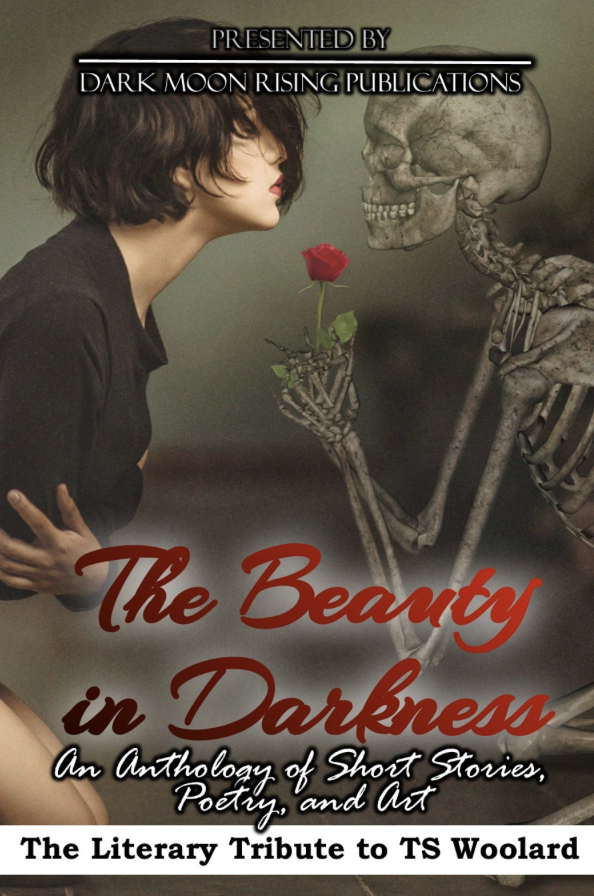
My Short Story, ‘The Tunnel,’ in the ‘Beauty in Darkness’ Anthology

I have a short story called ‘The Tunnel’ in a new collection of short stories, poetry, and art, called The Beauty in Darkness: The Literary Tribute to TS Woolard, from Dark Moon Rising Publications. It is now available on Amazon (Kindle–$4.19, and Paperback–$25.99), as well as on Godless. Here is a video ad for it.

Other great writers in this anthology are: Edward Ahern, Alison Armstrong, Jesse Batista, Andrew Bell, William Bove, Pixie Bruner, Dawn Colclasure, Linda M. Crate, Candice Louisa Daquin, Quinn Rowan Dex, Ursula Dirks, Murray Eiland, Zary Fekete, Thomas Folske, Michael Fowler, Lindsey Goddard, Norbert Góra, Gerri R. Grey, Rowan Green, Megan Guilliams, D.M Harring, Kasey Hill, Toshiya Kamei, Katherine Kerestman, Shahbaz Khayambashi, Ian Klink, Taylor Kovach, J.L. Lane, Paul Lonardo, LindaAnn LoSchiavo, J.C. Maçek III, Brianna Malotke, Xtina Marie, Summer Mason, Cyndi Mays, Rick McQuiston, DW Milton, Shane Morin, Jason Morton, Bobbie Murphy, Michael Noe, Scarlet Norton-Duperre, Sergio Palumbo, Rick Powell, Shanna Renee, John Reti, KB Richards, M. Brandon Robbins, Neil Sanzari, Zachary Schneller, ReNait Suka, Michael Errol Swaim, Rob Tannahill, Tim Tolbert, Cass Wilson, and Amanda Worthington.

My story, ‘The Tunnel,’ is about a woman who is lured by a butterfly into a tunnel at a park on a rainy day. She feels drugged: is it something like the date rape drug, or is something supernatural going on (the basis of the supernatural elements can be explored in my blog posts on The Tanah)? In the darkness of this flooded tunnel, she in her disoriented state has to confront traumas from her younger years: will this confrontation kill her, or will it save her?

Please check out this collection of great literature and art. You’ll love it! 🙂

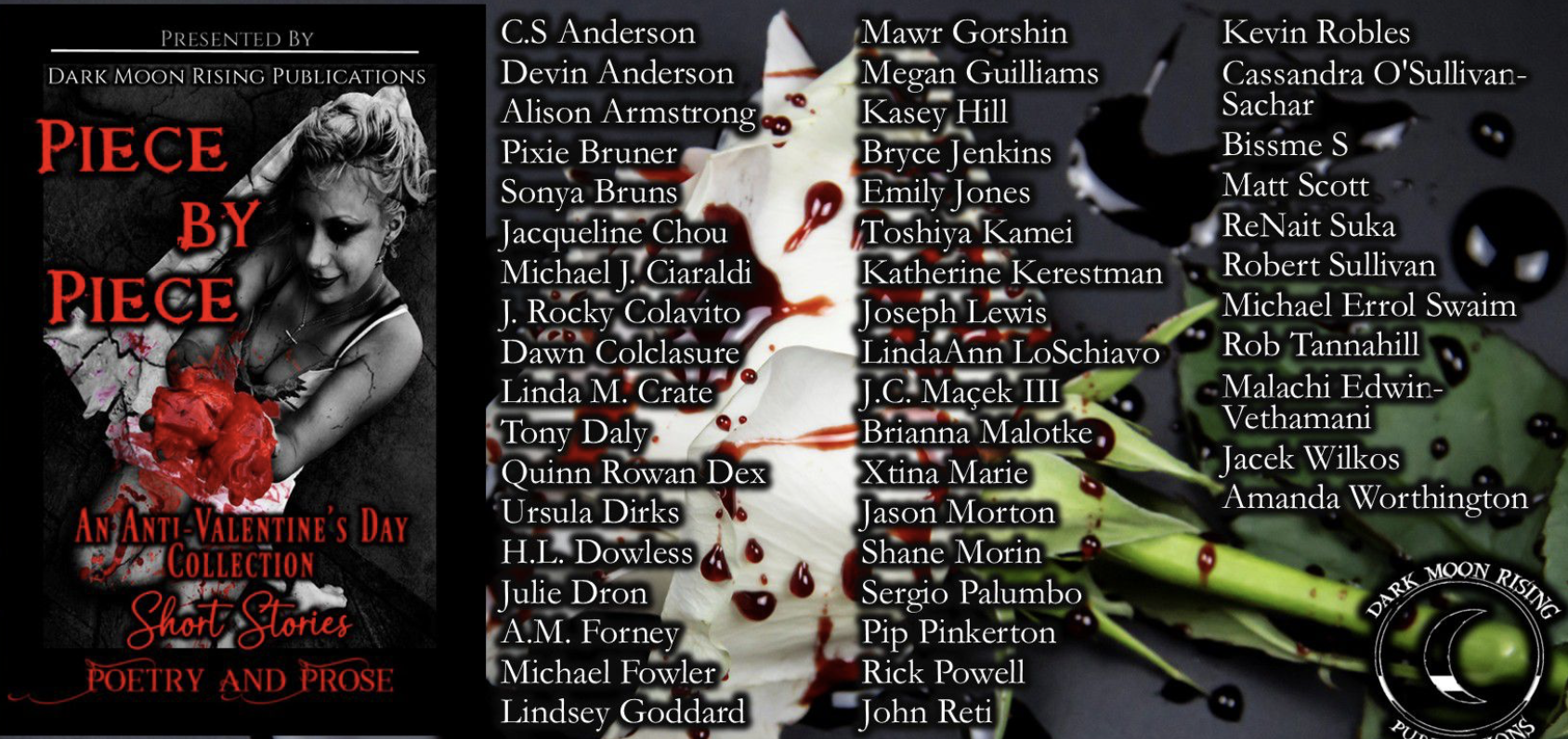
My Short Story, ‘Together,’ Published in the Anthology, ‘Piece By Piece’

I have a short story called ‘Together’ that has been published in this anthology, Piece by Piece: An Anti-Valentine’s Day Collection, Short Stories, Poetry, and Prose, from Dark Moon Rising Publications. It’s available on Kindle ($419) and Paperback ($15.99) on Amazon. It will soon be available on Godless and the Wide Link.

My story is about a young woman with a drug habit who is, on and off, being possessed by the ghost of someone who has recently killed himself, over her having broken his heart. Or is she? Is she just hallucinating, and is she the one whose heart has been broken from having been abandoned so many times in her life, driving her to drug abuse and madness?

Other great writers with poetry and prose in this anthology include C.S Anderson, Devin Anderson, Alison Armstrong, Pixie Bruner, Sonya Kay Bruns, Jacqueline Chou, Michael J. Ciaraldi, J. Rocky Colavito, Dawn Colclasure, Linda M. Crate, Tony Daly, Quinn Rowan Dex, Ursula Dirks, H.L. Dowless, Julie Dron, A.M. Forney, Michael Fowler, Lindsey Goddard, Megan Guilliams, Kasey Hill, Bryce Jenkins, Emily Jones, Toshiya Kamei, Katherine Kerestman, Joseph Lewis, LindaAnn LoSchiavo, J.C. Maçek III, Brianna Malotke, Xtina Marie. Shane Morin, Jason Morton, Sergio Palumbo, Pip Pinkerton, Rick Powell, John Reti, Kevin Robles, Bissme S, Cassandra O’Sullivan Sachar. Matt Scott, ReNait Suka, Robert Sullivan, Michael Errol Swaim, Rob Tannahill, Malachi Edwin Vethamani, Jacek Wilkos. amd Amanda Worthington

Please come check out this collection of great writing. You’ll love it! 🙂

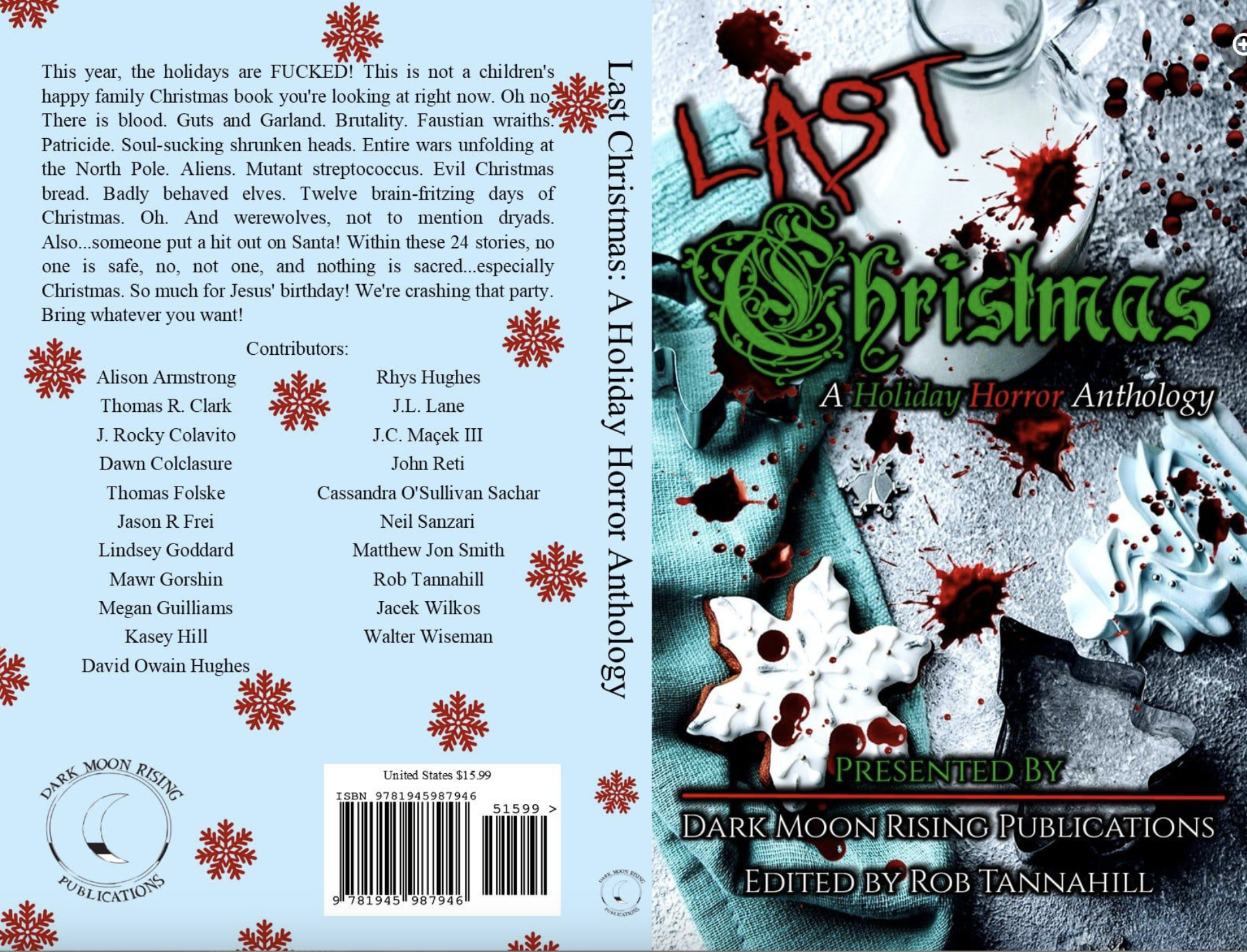
My Short Story, ‘Santa’s Elves,’ is Published in the ‘Last Christmas’ Horror Anthology

I have a horror short story, ‘Santa’s Elves,’ published in Last Christmas: A Holiday Horror Anthology, from Dark Moon Rising Publications, and edited by Rob Tannahill. The book is currently published in paperback on Amazon. It’s just $15.99. ($3.14 on Kindle.) It’s also available on Godless for $2.99.

My story is about Chinese toy factory labourers who have to work extra hard in December to make toys for the children of rich families in the West. They already work long hours almost every day for barely enough pay to live and/or to send to their families, who live far away from them and so they rarely ever see them. A divine presence from the heavens senses their inner cries for help, and when they make their toys this year, something…lethal…will be added to them, to give those Western families quite a surprise.

There are lots of other great authors whose work is featured on these pages. Please check the back cover in the photo given above to see their names (I hope you can get the image big enough to read them all). Here’s a cool promotional video you can watch.

Please go and buy yourself a copy of this collection of cool Christmas horror stories. You’ll love it! Happy holidays! 🙂

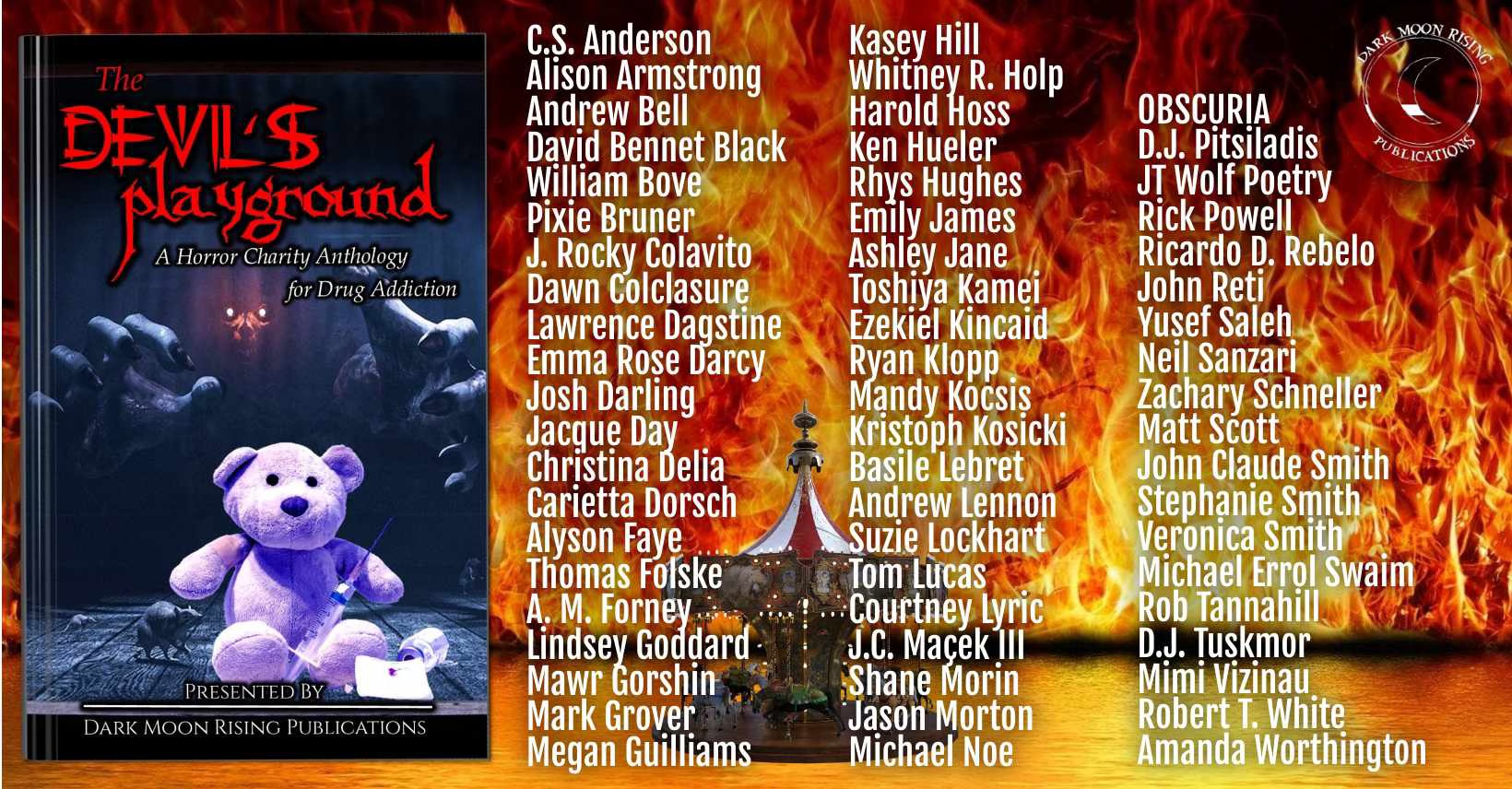
‘The Devil’s Playground’ is Published!

The Devil’s Playground: A Horror Charity Anthology for Drug Addiction, by Dark Moon Rising Publications, is finally published on Amazon, in paperback and ebook forms! It will be published on Godless on December 8th.

My short story, ‘Serene,’ is one of the stories in the anthology. All proceeds donated will be for To Write Love On Her Arms, an organization to help people struggling with depression, addiction, self-injury, and suicide. The theme of all of these stories is drug addiction and its self-destructive effects. 

If one were to read this story as well as my story, ‘NIB,’ in the horror anthology Symptom of the Universe: a Horror Tribute Anthology to Black Sabbath, also from Dark Moon Rising Publications, one might find a number of similarities between the stories. There are crucial differences between them, though. In ‘NIB,’ the female drug dealer is in love with the narrating protagonist, who has a fear of sexual contact due to childhood trauma caused by sexual abuse, and he uses drugs to forget his pain. In ‘Serene,’ however, the female drug dealer is luring men into enjoying her drug, taking advantage of them while stoned, and deliberately killing them if they reject her love. Both stories, ultimately, are allegories on the seductive yet destructive nature of drug abuse.

Many other great authors have stories included in this anthology (check the pic at the top to see all of their names), so please, check it out! I’m sure you’ll love the stories, and you’ll be helping out an important cause! 🙂

‘The Ancestors,’ a Horror Story, Chapter Thirteen (Final Chapter)

“Al, no! Please, tell me what’s happening?”

But when Hannah looked in Al’s face, she no longer saw him in there.

She saw Mei instead.

Mei’s cruel, malicious eyes were what was looking back at her.

In total control over Al’s body again, the evil spirit made him raise the knife and point it at Hannah. Mei made him grab her by the throat and shove her against the dining room wall.

Shaking, she gasped, “Al…Al…” through what little voice Mei allowed her to let out.

Mei had Al bare hateful teeth, like a wolf’s fangs, as the knife came slowly closer to Hannah’s chest. Though Al was trying desperately to keep the blade from getting any closer to the woman he loved, she saw only Mei in his eyes–her malevolence, her single-minded wish to stab Hannah to death.

“It’s your…turn…to die, Hannah,” Mei’s feminine voice said through Al’s mouth.

“This…isn’t you, Al,” Hannah gasped, her one hand on the wrist of Al’s knife-gripping hand, her other trying to loosen Mei’s grip on her neck. “Fight it.”

The hand holding the knife was shaking, but for the moment not getting any closer.

“Of course…this isn’t…Al,” Mei said. “It’s Mei.”

“You’re a…split…personality?”

“No. I’m…one of…Al’s…ancestors.”

“That’s…nonsense. Al, you’re ill. You need…help.”

“Al needs…to die. As soon…as I’m finished…with you.”

The shaking knife was getting closer to her chest.

Hannah kept searching for Al in his eyes.

She still saw only Mei in them.

Al was feeling a splitting headache in his efforts to regain control over his body.

No, Mei, he thought. I won’t let you kill Hannah.

The tip of the blade was now a millimetre or two away from Hannah’s skin, just above the top button of her dress. The knife shook a bit, and the blade cut off the button, exposing more of her skin to the sharp tip.

“Al…please!”

A slight scrape of the tip let out a little red.

She looked in his eyes…and she saw Al again.

He was pulling the shaking knife away from her, with all of his strength, his headache killing him, and the soreness in his arms–from Mei’s attempt to keep control–adding to his agony.

Finally, with the knife-gripping arm safely away from Hannah, he started regaining control of his other hand, which loosened its grip on her neck. She pulled free and got away from the wall.

He turned to face her, having most of his control back. He was bent over, panting.

“Al? Are you OK? Are you back?”

“Yeah, I’m back, for the moment. Mei just left me, completely.”

“As soon as we call the police and explain what happened, we’ll find a therapist for you, and you can tell them all about this ‘Mei.'”

“No, Hannah. This can’t go on. I have to die.”

He was looking at that knife in his hand.

“What do you mean, you ‘have to die’? You won’t go to jail, Al. You’ll be found not guilty by reason of…no offence…insanity. We’ll get you the psychiatric help you need. I won’t abandon you.”

“You don’t understand, Hannah. My problem isn’t mental illness, though I’m sure it must look that way to you. The spirit of Mei, one of the family ancestors, is still inside my body. She relinquished control…I don’t know why, but she’ll come back and take control of me again. Then she’ll try to kill you again. I can’t fight her off forever. She will succeed, sooner or later. I can’t let that happen. To save you, I must kill myself.” Sobbing, he pointed the sharp end of the blade at his chest.

“Al, no! What are you talking about? There’s no evil spirit inside you. Mental illness is nothing to be ashamed of. We’ll get help for you. I still love you. I’m sorry I said we were through. I still want us to be together.” Now she was sobbing.

“Hannah, I’m not insane.” His arms were shaking as he brought the tip of the blade to his chest. “I know full well what I’m doing. I know now that we cannot be together. I’m doing this, though, because I love you. Either Mei makes me kill you, or I kill myself. There is no other way out of this.”

“Al! Please, no! It’s just a delusion you’re having. Don’t stab yourself! I love you!”

She reached forward to take the knife from him.

“I love you, Hannah. Never forget that.”

He held the knife with the tip of the blade firmly against his chest, ready to push it in.

“God, no! Al, don’t!

“Oh, no, NO!

She saw no more Al in his eyes. She saw Mei’s cruel grin.

“Al, no!

He shook a bit, then raised the knife, as if to stab her.

“NOOOO!!!” he yelled.

Then the blade swung down in an arc…

…and it went deep in his gut.

“NOOOO!!!” she screamed.

He buckled and fell to the floor, his blood gushing out and staining his shirt.

She put her arms around him and kept screaming. She welcomed his blood on her dress, wanting the stains to stay there so she’d still have at least some of him with her.

I came to this house having everyone, she thought as she kept bawling. Now I have no one.

As she wept and wailed, holding his bloody body tightly against herself and practically bathing in the red, she’d had her eyes squeezed shut, as tight as her hold on his body. Then she opened them.

With her tears obstructing her vision, what she saw was blurry and distorted. In that blurry haze, she saw what at first seemed a hallucination.

She wiped away her tears for a clearer look.

No, it was still there.

And it made no sense.

A glowing vision of three old Chinese in traditional clothes–two women and a man.

In my grief, Hannah thought, I’m truly going crazy.

Thank you, Hannah, for helping us achieve our aim, Po said. You are free to go.

“I’m seeing things,” Hannah gasped. “This isn’t real.”

Oh, we are very real, Hannah, Meng said.

“Wait a minute: your voices sound familiar.”

That’s right, Mei said. You heard me from Al.

And me from Emily, Meng said.

And me from Freddie, Po said.

“I’m imagining this,” Hannah said. “There’s no such thing as ghosts. I’m going crazy.”

If you were going crazy, you wouldn’t think you were going crazy, Meng said. We’re real, we assure you.

Al wasn’t going crazy, either, Mei said. We really were possessing him and his family, and now that our work is done here, we can thank you and say goodbye.

“And what was ‘your work’ that had to be done?”

The destruction of the entire Dan family, Po said.

“Why did they, and the man I loved, have to be killed?”

For failing to pray to us, their ancestors, Mei said.

“I thought Al continued praying to you. He told me so. Why wasn’t that good enough for you?”

Because the snubbing of us by the rest of his family…our family…was already bad enough. We felt too dishonoured to forgive them, Meng said.

And when we aren’t sufficiently prayed to, we spirits turn into demons, Po said. The Dan family is almost an anomaly when it comes to Chinese culture. Most Chinese families are close and loving; this is because they pray to their ancestors. An impious attitude took hold of your boyfriend’s parents, in their adopting of Western secularism.

In rejecting belief in spiritual matters, like most of you in the West, their family unity broke down, and they came apart, Mei said. So many social and family problems that you see in Western society come from rejecting spirituality. This is why Chinese families, on average, hold together far better than your Western families.

“I call bullshit on all of that! My family wasn’t religious in any way, and we were always loving and happy. You destroyed Al’s whole family, and you murdered mine!” She was sobbing again.

She looked through her teary eyes and saw wicked grins on Po, Meng, and Mei.

Why did you kill my family? Why did you make Al kill himself? What did they do to you?”

Oh, we did that for the sheer fun of it, Meng said. We even put the idea in your mind to have your family meet the Dans for dinner…we prodded you to insist on it, never taking ‘no’ for an answer.

The three spirits were still grinning malevolently at her. Her jaw dropped.

“You’re evil, pure evil, far worse than Al’s family!”

What do you expect? Po asked. We’re devils. Thank you for your help, and goodbye.

The three grinning spirits faded away before her eyes.

Hannah let out a loud, ear-splitting scream.

Her screaming and bawling continued over a period of several minutes. A patrol car was going by the house, and the two police in it heard her. They stopped, got out of their car, and ran up to the house.

They looked in a window that revealed the dining room and saw Hannah, still on her knees and holding Al’s bloody body, always sobbing and shaking. They also saw Freddie’s and Emily’s bodies.

“Holy shit!” the male cop said.

“What the hell happened here?” the female cop said.

They went in the house and ran over to Hannah.

“Officer Wong calling,” the male cop said on his cellphone to the local precinct. “We have…what looks like..a triple homicide in the house at…just a minute, I need to take a look…137 Washington Street. We need an ambulance and stretchers.”

The female cop took Hannah in her arms.

“It’s OK, it’s OK,” she said, trying to soothe Hannah.

“No! It’s not OK!” Hannah screamed.

“What happened here? Who killed these people?”

Hannah’s words came out like a frantic firing of machine gun bullets, much too fast for the cops to process. “The ancestors did it! Three demons, two old women and an old man! They killed all of my family, too, up in the attic! They lured us all into a trap! They…”

“What is she raving about?” Officer Wong asked, sneering. “Three demons? Ancestors? This Chinese family may have believed in ancestors and evil spirits, but why would a white woman believe in that nonsense? My family never believed in that old tradition, and I’m glad they didn’t.”

“I have no answers for your questions, Officer Wong,” his partner said, rocking Hannah back and forth gently. “But I guess we’d better check the attic, too.”

“Alright,” he said. “You stay here with her, and I’ll go up there.” He went searching for the stairs.

The three spirits were waiting in the attic.

I don’t like Officer Wong’s lack of faith in us spirits, Po said to Meng and Mei. Maybe we can go after his family, too…just for fun.

All three spirits were grinning.

THE END

‘The Ancestors,’ a Horror Story, Chapter Twelve

After several minutes of the most painful of efforts, Al was just beginning to feel a regaining of control over his body. Just a bit, at first: he could stir slightly, he could fidget and budge, all while suffering a terrible headache to deter him.

Freddie looked over at him and saw his face wincing in pain, the slight movements that suggested someone other than Mei was trying to control Al’s body. Freddie smirked at the amusing sight.

“What’s the matter, loser?” he asked Al. “You trying to hold in a fart? That was directed at Al, not at you, Mei. It looks like he’s trying to regain control.”

“He’s trying to,” Mei’s feminine voice said through Al’s mouth. “He won’t succeed…not for the moment, anyway.”

“Not ever, I’d say,” Emily said. “He’s never succeeded at anything in his life, except annoying people. I’m surprised he can make his body move at all, with you there, Mei.”

“I must say, Mei, that we were wrong to have stopped praying to you,” Freddie said.

“We’re both very sorry about that,” Emily said.

“Just aid us in what we wish to accomplish here, and all will be forgiven,” Mei said.

“He obviously sucked at praying to you all,” Freddie said, “since even his prayers weren’t enough to placate you. As Emily said, Al can’t do anything right.”

“That he actually killed our father, as Meng has told me in my thoughts…”

“And Po told me in mine,” Freddie added.

“…and he didn’t stop his bitch girlfriend sitting over there from killing our mother–that’s all the more reason for Freddie and me to hate Al. Feel free to kill him, too, Mei–we won’t mind.”

“Not at all,” Freddie said. “Kill that loser.”

“Oh, we’ll have him killed,” Mei said. “And we won’t stop with him.”

All three of them looked over at Hannah, bound and gagged in her chair at the other side of the table in the dining room. She was still unconscious.

They stared at her and grinned.

“She’ll make such a tasty dinner,” Freddie said, looking over at possessed Al, and knowing that he could see and hear everything said and done at their dining table…but he could do nothing about it. “Mmm!”

All three of them repeated “Mmm!” even louder while looking at Hannah. She stirred a bit.

Al gained a bit more control of his body, and he made it shake so the legs of his chair rattled against the tiles of the dining room floor.

This was enough to wake Hannah up.

Finding herself bound and gagged, with all three remaining Dan family members staring maliciously at her, she whined through her gag as loudly as she could to produce a scream, while shaking her chair and rattling its legs on the floor as much as Al was.

Assuming her crazy ex-boyfriend wanted her dead as much as his crazy brother and sister did, Hannah couldn’t understand why he was fidgeting in his chair as she was. Was this some pathetic, fake attempt to convince her he still loved her, to make her believe he was indeed possessed by the spirit of one of his ancestors? Did he really think she was stupid enough to believe that?

“You’re gonna taste so good when we’ve cooked your flesh, like a giant turkey,” Freddie said with a laugh, his taunting eyes going back and forth to look into Hannah’s and Al’s. “Yes, Hannah. We’re gonna make Al kill you, cut your body up into pieces, cook them, then eat them…that is, our ancestors will, and Al will. He’ll do it, ’cause he’s so weak! Isn’t that right, loser?”

Al was shaking the chair even more.

“What are you so upset about, loser? You’ve eaten her before, haven’t you?” Freddie laughed.

“Don’t be crude, Freddie,” Emily said.

Al’s shaking and rattling of the chair was getting more and more violent. He almost fell off of it, but he clasped his hand on the table, his fingers inches away from a large, Japanese deba bocho meat cleaver.

“Mei, you aren’t losing control of him, are you?” Meng’s deep, masculine voice said through Emily’s mouth.

“He’s…getting stronger, but I’m…managing,” Mei’s feminine voice said through Al’s mouth.

“If we beat him into submission, will you feel the hurt, or can you leave his body temporarily?” Po asked in that distinctly gravelly, grandmother’s voice, through Freddie’s mouth.

What? Hannah thought with eyes agape. How is Al’s sister talking with a man’s voice, and he and his brother are talking with women’s voices? Can crazy people really imitate voices so precisely, as unnatural as it would be for their biological voices to do? Or am I going crazy?

“Is that you speaking, Po, or is it Freddie?” Meng asked, as if she were as surprised as Hannah. “It sounds like something he’d like to do to Al.”

“It’s most likely a combination of Freddie and me,” Po said, putting a smirk on Freddie’s mouth. “You should be aware that, as we spirits continue possessing these bodies, our wills become more and more merged with those of the bodies.”

“Isn’t that true, Al?” Meng asked him, putting a smirk on Emily’s mouth now, to taunt Al as he continued to shake his body and take it back from Mei.

Meng and Po turned Emily’s and Freddie’s heads back to looking at Hannah as she continued to struggle, in as much futility as Al, to free herself. The two possessed bodies were licking their lips.

“She’s gonna taste so good, isn’t she, Al?” Freddie said in his own voice. “The ancestors are opening my mind to cannibalism; I never imagined I’d develop a taste for it.”

“Same here,” Emily said in her own voice. “Funny what a little demonic possession can do to your head.”

The two noticed that Al’s struggling was abating. He was sitting much more still now.

“Mei, if you have regained control over his body, why don’t you pick up that knife and start cutting her up?” Freddie said.

Al had completely stopped shaking now. Mei looked at Freddie calmly.

“Yes,” Mei said with a smile. “I have fully regained control of the body.”

“Good,” Freddie said in Po’s voice, then got up. “Let’s do this.”

Mei and Meng brought Al and Emily to their feet, Mei gripping that Japanese knife in Al’s hand.

The three of them walked toward Hannah.

She was whining in a shrill, raspy voice behind that gag, fidgeting frantically in her chair. Her tearful eyes looked up into Al’s, desperately looking for his expression rather than Mei’s. All she could see was the cold expression of a killer.

That’s not Al that I see, she thought as the three had almost reached her. It’s not Al at all. Not even a crazy version of him. Could it be a demon inside him?

They were at her chair now. Her ankles were tied to the front legs of her chair, so she couldn’t even kick at her tormentors. She could only squeal and shake.

Emily and Freddie held the chair still from the back, while Al stood before Hannah, Mei having him raise the knife high over his head, ready to come down on her with a stab in the chest.

Mei and Hannah looked in each other’s eyes, the latter’s full of pleading, and the former’s utterly empty of pity. Hannah kept looking for Al, somewhere deep inside those eyes. He had to be there. She searched and searched back there, but she still couldn’t find him.

Now, instead of squeals and whining from her gagged mouth, sobs of despair were coming from it.

I shouldn’t have told him I wanted to dump him, she thought. I want my Al back, crazy or not.

And then, she could finally see Al in those eyes.

And no, it wasn’t hallucinatory wish-fulfillment.

The knife came down in a slashing arc…

…and it dug deep in the middle of Emily’s chest.

“Emily!” Freddie screamed. “Al, you piece of shit!”

Her body fell to the floor, soaking it with blood.

“Mei, I thought you had him under your control!”

“She stepped aside for the moment, it seems,” Al said in his own voice with a grin, then he pointed the knife at Freddie. “And you’re next…loser!”

“Oh!” Freddie said with a chuckle. “You think you’re gonna take me on? C’mon, loser, try it!”

They stepped away from Hannah. They faced each other behind her. She kept whining and struggling.

“C’mon, loser, cut me! Let’s see what you got.”

Al slashed from right to left, aiming for Freddie’s chest; but Freddie grabbed Al’s arm by the wrist, squeezed it hard, and made him drop the knife. Then Freddie punched him hard in the gut.

“Ooh!” he grunted, then fell to the floor.

Freddie picked up the knife and smiled.

“I’ve always hated you, Al. You know that. But your killing Dad, letting your big-nosed, white whore kill our Mom, and killing Emily here give me all the justification I need to dice your guts into a million bloody pieces!”

As Al was getting back up, Freddie ran at him with the knife and threw him hard on the floor. Al banged his right shoulder on it; it hurt like hell.

Freddie started by slashing Al’s face several times.

“There,” he panted. “Now you’re even uglier. Think your bitch girlfriend’s gonna like that? If you do, you’re even stupider than I thought, loser.”

He slashed Al’s face again.

“It won’t matter if she doesn’t like it, though, ’cause I’m gonna kill you now.”

He sat up and raised the knife high over his head, ready to come stabbing down.

Hannah was going crazy not being able to see or help Al. Her only comfort was not watching him die.

Freddie brought the knife down, but Al’s left hand caught him by the wrist just in time. The tip of the blade was a few millimetres away from Al’s chest. Both arms shook as they debated over where the knife would go.

Freddie looked in Al’s eyes with much more than his usual non-fraternal malice. Al was at first looking back into his brother’s eyes with the same hate; then he turned his eyes away to look at Freddie’s hand.

“Yeah, that’s right,” Freddie panted, spit dripping from his mouth onto Al’s bloody face. “You’re weak. You always were weak.”

Hannah could only whine and shake in her chair in blind helplessness.

Al brought his mouth over to Freddie’s hand. He bit two of the fingers holding the knife. He sank his teeth in deep, bloodying Freddie’s hand and his own chest.

“Aaah, you fucker!” Freddie screamed, then he dropped the knife to suck on the cut.

Al pushed him off with a strength he never knew he had, then kicked him hard in the balls. As Freddie buckled, Al grabbed the knife and ran at him, knocking him to the floor.

Al held the knife with the handle down. He wanted to bash Freddie’s face in before stabbing him. The wooden handle smashed down on Freddie’s forehead once, on his nose twice, breaking it, on his left cheek three times, his right cheek once, his chin twice, and his mouth four times, knocking out two upper and two lower teeth and soaking his face in blood. His bruises would look like a black-and-blue mask.

“You’re still…a loser, Al,” Freddie gasped in toothless lisps.

Al flipped the knife around to point the blade down. “Yeah, Freddie,” he said. “You’re about to be stabbed to death…by a loser. Be proud of that.”

He plunged the blade deep into Freddie’s throat, shutting him up once and for all.

Al let out a big sigh, then got off of Freddie’s body. He went over to Hannah and cut her feet and hands loose.

She got up from the chair and got the gag off in an impatient hurry.

“Oh, thank God,” she sighed. “And thank you, Al, for stopping them.”

He just stood there–silent, unmoving, frowning, and looking down at the floor, his face dripping blood all over it and his shirt.

“Look, I realize now that…your family…had some serious…well, mental health issues,” she said, searching for the kindest way she could put it. “And it’s…obviously harmed you…emotionally, too. I think we can work this out. We’ll find…a professional…to help you through this.”

Still gripping the knife, he started shaking and twitching.

“Oh, no, NO!!! Hannah, get away…from me!”

‘The Ancestors,’ a Horror Story, Chapter Eleven

Hannah’s heart was beating even harder and faster now that she heard the door open and Freddie and Emily walk into their parents’ bedroom. It wouldn’t take long for them to deduce that she was hiding under their mom’s and dad’s bed.

Her mind was still racing, trying to make sense of all of the craziness that had been happening up until now, and especially now that she was next to be killed. Still, her priority was wondering what she’d do when Al’s brother and sister…and Al himself, once he was to come down from the attic after that kick she’d given him in the balls…found her. She had no time to process any of this.

She listened for Freddie and Emily.

Total silence.

No shuffling around, looking for her.

What were they doing? If they knew she was under the bed, why not just get down, look under, and grab her by the feet? Were they toying with her?

Yes, they were, actually.

The siblings were standing by the bed, looking down at it. There was nowhere else in the room for Hannah to have hidden, anyway–no closet big enough for her to fit into. Emily put her finger to her lips to tell Freddie to be quiet. They were smirking.

Hannah could hear light, unintelligible whispering.

“Let’s wait a while before getting her,” Emily said softly in Freddie’s ear. “Give her a moment to think through what’s happened…also drag out the terror for her, and the false hope.”

“Good idea,” he whispered back in Emily’s ear.

Hannah’s heart still pounding as hard and fast as ever, she began to think through everything that had happened to lead to this nightmare.

This was just supposed to be a pleasant dinner for both of our families to meet each other, she thought. Al was so resistant to me meeting his family, but I assumed it was just going to be some mundane problem. I never would have imagined, in a million years, that his family would be a bunch of murdering psychos…and that Al himself was one of them, too!

“Where is that loser, Al?” Freddie whispered.

“Shh!” Emily said, pointing at the bed.

All in one night, Hannah thought, I went from pleasantly anticipating meeting Al’s family, mine visiting them, and assuming I’d marry Al and unite our families in mutual love, to not only realizing that Al was being bullied by them, but also…having all of my immediate family…brutally murdered (She tried to hold back a sob), and worst of all, Al is one of the killers! I went from hopes of extending my family, to include his, to losing my family, Al’s family, and having to dump the man I love…loved! How could such extremes happen?

Now she let out an audible sob.

“Alright,” Emily whispered. “Let’s do this.”

She and Freddie squatted and looked under the bed.

Hannah at this moment was still far too absorbed in her thoughts to notice the siblings coming down to see her. This craziness has gotten so extreme, she continued thinking, that I have become a killer, too! I stabbed Al’s mom with that knife! It was self-defence, but I’d never in a million years see myself killing someone…wait…

She felt Freddie’s and Emily’s hands on her ankles, pulling her out from the bed.

“Ah!” she yelped, then grabbed onto the bedposts at the head of the bed to stop them from getting her out. The siblings kept yanking and yanking at her shaking legs, their grip irritating her skin and causing her shoulders and wrists to ache, but she kept a firm hold on those bedposts.

The siblings stopped yanking for a second, let out sighs of frustration at the same time, and in the voices of Po and Meng, they shouted, “Fang shou!”

Magic in those Chinese words forced Hannah to let go of the bedposts.

She screamed as Freddie and Emily pulled her out from the bed, her unable to conceive how mere words could force her to let go. Her screams were cut short by a blow from Emily’s fist on her head, smashing her face on the wooden floor, giving her a nosebleed and knocking her out. Meng’s spirit had given Emily’s fist extra strength.

“Let’s tie her up and take her downstairs,” she said in Meng’s deep, male voice.

“There’s rope in the room next door,” Freddie said in Po’s raspy, feminine voice. He left the room.

In the hall, he saw Al having just finished coming down the attic stairs.

“Where have you been, you loser?” Freddie asked in his own voice. “You’re fucking everything up again, aren’t you? Where are Mom and Dad? Emily and I are trying to take care of your girlfriend, and you’re wasting time in the–“

“Don’t talk to me that way, boy!” Al said in Mei’s authoritative, feminine voice. “I was stalled by Al’s determined efforts to regain control over his body. He killed your father, and Hannah killed your mother. I’ve finally subdued Al, so I can help you and Emily now.”

“Sorry, Mei,” Freddie said, bowing and gesturing to her with his hands clasped together. “I have to find some rope in the other room. Meng is with Emily in our parents’ bedroom. Hannah is knocked out. We have to tie her up and take her downstairs.” He went in the room to find the rope.

Mei took Al’s body into his parents’ bedroom.

Though Al’s soul, for the moment, was fully under Mei’s control, he was able to see, however passively, Hannah lying unconscious on the floor. He tried with all of his might to regain control over his body, but Mei was ensuring that he couldn’t make his body budge an inch.

Is Hannah dead? he wondered.

He couldn’t even weep for her.

Freddie returned with the rope, a bandana, and a small rubber ball to use as a gag for Hannah’s mouth. All three Dan family members, under the control of Po, Meng, and Mei, helped tie up and gag Hannah.

They carried her downstairs and into the dining room, and with some remaining rope, they tied her to a chair. They sat next to each other, Emily in the middle, at chairs on the other side of the table.

The whole time, Al had been trying, in all futility, to take control of his body and stop the other two. All he could do was watch helplessly, and be forced to help them through Mei’s possession of him.

“So,” Freddie said in Po’s voice. “What should we do with her, Al? We know you can see and hear us.”

“But you can’t do anything about it,” Emily said in Meng’s voice. “You broke our agreement, Al, so we’re under no obligation to do anything for you.”

“And doing things to upset you has always been much more amusing than doing things for you,” Po said. “What shall we do with her?”

“Kill her, of course,” Meng said.

“Of course, of course,” Po said. “But how?”

“In a way that Al will find the most upsetting. We should make him hold the knife that cuts into her chest.”

Al wanted to scream “NO!!!” at the top of his lungs…but he couldn’t even grunt.

“Then we can make him cut her body into pieces, cook them, and serve them as our dinner. The Dan family may have been sated at dinner, but we ancestral spirits haven’t had a bite to eat. We’ll let Al have the biggest share of Hannah’s cooked flesh.”

Mei curled Al’s lips upward in a smirk.

Al couldn’t even weep.

My Short Story, ‘Serene,’ in the Horror Anthology, ‘The Devil’s Playground,’ to be Published Soon

I will have a horror story, ‘Serene,’ published in this anthology, The Devil’s Playground, by Dark Moon Rising Publications. The theme of all of these stories is drug addiction and its self-destructive effects.

If one were to read this story as well as my story, ‘NIB,’ in the horror anthology Symptom of the Universe: a Horror Tribute Anthology to Black Sabbath, also from Dark Moon Rising Publications, one might find a number of similarities between the stories. There are crucial differences between them, though. In ‘NIB,’ the female drug dealer is in love with the narrating protagonist, who has a fear of sexual contact due to childhood trauma caused by sexual abuse, and he uses drugs to forget his pain. In ‘Serene,’ however, the female drug dealer is luring men into enjoying her drug, taking advantage of them while stoned, and deliberately killing them if they reject her love.

Many other great authors have stories included in this anthology (check the pic at the top to see all of their names), so please, check it out! It’s a charity anthology, the proceeds being for To Write Love On Her Arms, an organization to help people struggling with depression, addiction, self-injury, and suicide. I’m sure you’ll love the stories, and you’ll be helping out an important cause! 🙂