Analysis of ‘Déserts’

I: Introduction

Déserts is a 1950-1954 piece by avant-garde composer Edgard Varèse, scored for fourteen winds (brass and woodwinds), five percussion players (including tympani, xylophone, snare drum, and woodblocks), one piano, and magnetic tape. Deserts, according to Varèse, refer to “not only physical deserts of sand, sea, mountains, and snow, outer space, deserted city streets… but also distant inner space… where man is alone in a world of mystery and essential solitude.”

He elaborated by saying that what he meant by deserts are these: “All those that people traverse or may traverse: physical deserts, on the earth, in the sea, in the sky, of sand, of snow, of interstellar spaces or of great cities, but also those of the human spirit, of that distant inner space no telescope can reach, where one is alone.”

The piece was originally meant to be the soundtrack to a modernist film that was never finished, a film of images of the deserts of the Earth, the underwater sea, and outer space, but most importantly, the deserts of the human mind: his loneliness and alienation, especially after the terrors of the decade that preceded Déserts‘s composition: concentration camps, the dropping of the atomic bomb on Japan, etc.

The piece is divided into seven sections, an alternation of four “Episodes” of music performed live by the ensemble of winds, piano, and percussion, with one of three “Interpolations” of magnetic tape recordings coming between each pair of “Episodes.” So Déserts is structured thus:

1st Episode
1st Interpolation of Organized Sound
2nd Episode
2nd Interpolation
3rd Episode
3rd Interpolation
4th Episode

Déserts is one of Varèse’s most radical pieces of music (and that says a lot, given the already experimental nature of the music he’d already composed before the 1950s). For in this piece, he introduces the use of pre-recorded sounds, a result of an anonymous gift of a tape recorder, which revived his musical inspiration, allowing him to compose music that would further advance its frontiers and experimental potential.

Until the 1950s, Varèse had been frustrated with the limitations of the technology of the time to produce the kind of new music he’d wanted to create. He was tiring of using the instruments of the orchestra, particularly the string section, which he’d used only sparingly (Amériques, Arcana, Offrandes, or the double bass in Octandre). The use of two ondes Martenots (or theremins, depending on the version) in Ecuatorial was something of an advance, but he needed more.

Hence, when Varèse should have been at the height of his creative powers, he actually composed very little, that is, in the 1940s. There was an ambitious idea, Etude pour Espace, that was never finished (<this arrangement of part of Espace was done in 2009). There was the Dance for Burgess (i.e., for Burgess Meredith), and Tuning Up (which was only sketched by Varèse, and completed by Chou Wen-chung in 1998).

But the totally new sound possibilities given to him through the tape recorder gift brought Varèse back. He regained his Muse, and created not only Déserts, but also Poème electronique in 1957-1958, for magnetic tape exclusively.

To understand Déserts, one must understand Varèse’s music in general, and for the uninitiated, such a general understanding is especially urgent, given how daunting this music will sound when heard for the first time. Frank Zappa was one of Varèse’s biggest and most famous fans, and he himself (also a composer and conductor of orchestral music) admitted that he couldn’t give “any structural insights or academic suppositions” as to how Varèse’s music works or why he liked it. As a teen, Zappa liked it simply for how ‘weird’ it sounded. Varèse’s music, Zappa says, is “completely unique.” If a fan like Zappa couldn’t explain Varèse’s music, the uninitiated will need insights far more desperately.

So I’ll try my best to give those insights myself.

II: Varèse’s Musical Language

To begin by painting with large brushstrokes, Varèse’s music is characterized by huge, dissonant sonorities and an extensive use of percussion, which isn’t generally used to punctuate rhythm, but rather to exploit and explore all the varieties of timbre it can provide. The dissonant sonorities are usually given through stentorian horns and shrill, sustained notes on woodwinds.

Varèse radically redefined music to mean “organized sound,” with a foreword-looking disregard for traditional notions of flowing, lyrical melodies, tonality, classical forms (sonata-allegro, binary, ternary, rondo, etc.), rhythm, or conventional groupings of instruments. Those huge, dissonant sonorities that I described above have come to be termed “sound masses.”

These sound masses of loud, dissonant brass and woodwinds tend to be contrasted with softer sections of individual, or small groupings of, percussion instruments (snare drum rolls, the quick tapping back and forth between differently pitched wood blocks, etc.) or solo woodwinds (flute, piccolo, or clarinet) playing long, sustained notes before the next loud, dissonant outburst. This shifting, from the softer passages of individual instruments to the large, loud groupings of horns and woodwinds, has been compared to natural processes of crystallization.

Varèse had an interest in science, and this interest naturally had an influence on how he chose to structure his compositions. So in the softer passages, the individual sounds can be likened to atoms and molecules; and the large, dissonant sound masses can be likened to the solids, the crystals formed out of those atoms and molecules. Smaller groupings of instruments can be seen to represent the middle phases of the solidifying process.

Varèse conceived of music as “sound as living matter.” So when we hear the crystallization of his sound masses, we can think of them as his intention to create living beings, so to speak. We should remember this when we look into Déserts specifically, a work about deserts of the mind, of people who are alone.

The basic parameters of Varèse’s music are duration, intensity, frequency, and timbre (sometimes space is considered, as in Espace, though the full exploitation of spatial effects in music has been the domain of such successors of Varèse as Karlheinz Stockhausen: listen to a live performance of Gruppen to get my point). For Varèse, these four parameters are all given equal importance.

Duration for Varèse isn’t subservient to traditional notions of rhythm or metre. One doesn’t usually tap one’s foot to Varèse. Instead, duration is more about holding notes at varying, sustained lengths. A note may be held, or repeated in short dots of sound, over a period of many seconds, rather than played to a beat–be this the regular beat of conventional music, or the asymmetric rhythms of, say, Stravinsky. As with the other three parameters, Varèse’s use of duration is generally divorced from conventional notions of ‘expressivity,’ which is not to say that his music lacks expressiveness, but rather that Varèse expresses himself in an entirely different way from the expression of the past.

Intensity for Varèse is his use of soft and loud dynamics. Interestingly, changes in dynamics on an instrument also result in changes in that instrument’s timbre. Don’t assume Varèse never toyed with the interrelation between intensity and timbre.

Frequency for Varèse is much more than just pitch. Sounds can be anything from the lowest to the highest frequencies, not necessarily with definite pitches. Sounds are made up of complex wave forms with multiple frequencies (i.e., the fundamental and overtone series), not just a single wave form. So in frequency, just as in intensity, we can find an overlap with timbre, something Varèse was deeply interested in exploiting to the maximum.

But frequency in terms of pitch alone in Varèse’s music leaves plenty to elaborate on. There is melody in Varèse–not nearly as much as in the music of his contemporaries, much less than that of those before him–but there is some. Varèse’s use of melody is unconventional, of course, using wide leaps and such dissonant intervals as minor 9ths, major 7ths, and minor 2nds. He also sometimes made use of the idée fixe, as in Arcana and Amériques.

Harmonically, Varèse’s music is obviously not tonal. It isn’t necessarily always atonal, either, though. There are ever-so-brief occasions when a melody or harmonic combination may seem tonic…then a cluster of dissonances will remind us we’re listening to Varèse. Consider the opening clarinet melody in Intégrales, which sounds like the 3rd, 7th, and upper tonic notes of a dominant 7th chord; then dissonances in the brass and woodwinds quickly dispel the aural illusion.

The fact is that Varèse didn’t conform to any harmonic system, traditional or non-traditional: not tonality, not Schoenberg‘s twelve-tone system, not Bartók‘s axis system, not Messiaen‘s modes of limited transposition, not the polytonality of Stravinsky or Milhaud–nothing remotely like any of these. Varèse seemed to be content to let the notes fall in any old way, because he’d always been more interested in frequency as an expression of timbre than of pitch. His use of sirens, as representations of a continuum pitch beyond twelve-tone equal temperament, should help us better to know how to think about his choices of pitch, rather than any use of scales or chords.

And finally, we come to what was perhaps Varèse’s favourite musical parameter, timbre. His fascination with timbre is why he used such an extensive number of percussion instruments in his works. Recall that one of Varèse’s most famous pieces, Ionisation, is to be played only by percussionists; these instruments are supplemented by such noisemakers as high and low sirens, two anvils, and a whip. Piano is also used, but not in its conventional, melodic way: it’s used as just another percussion instrument.

In his Densité 21,5 for solo platinum flute, again, though we hear monophonic melody throughout, the focus is on intensity and timbre. He was exploiting all the sound possibilities to be produced on the instrument, including tapping effects on the low finger keys about a third of the way into the piece.

Finally, as can be heard in Poème électronique and the three interpolations of organized sound in Déserts, Varèse uses electronically altered sound recordings on tape as an example of his love of exploiting timbre to maximum effect. Always remember that for Varèse, music is the organization of sound. Don’t listen for pretty, lyrical melodies (though that sort of thing can appear from time to time in his work–there is, after all, that one early work of his, written in a Romantic idiom, that he didn’t destroy, Un grand sommeil noir for voice and piano); listen instead for fascinating and imaginative manipulations of sound.

III: Déserts

Varèse’s discussion, in the above quotes, of deserts on the earth, in the sky, of sand, of snow, of interstellar space, etc., all seem to be metaphors for the deserts of the lonely human mind. On some level, this being alone could be manifested in the solitude of hermits and mystics; but the connotations of deserts suggest emptiness, lifelessness, purposeless stasis, and a sadness from being alone. The mystic’s solitude could be seen as an attempt to escape that sadness.

I will attempt, in my personal interpretation of Déserts, to find symbolism for this loneliness, as well as for mystical attempts to attain peace, in the musical structure of the piece. To begin with, note how there is no integration of the ensemble playing with the three interpolations of musique concrète. Such a division between these two ways of producing organized sound symbolically suggests a mutual alienation between people…and there’s nothing like alienation to provoke feelings of loneliness.

Déserts is probably Varèse’s most radical example of experimental music, of a break from almost every conceivable notion of tradition in music. Apart from the by-now-typical unorthodox instrumentation (no string section, extensive percussion as an integral part of the soundscape), as well as the introduction of tape recordings, he breaks even further with tradition here.

There is virtually no melody in this piece, except for a few ever so brief moments of rising and falling notes, including the lead-ups to those discordant fanfares, as Samuel Andreyev so aptly calls them. If melody is musical line, that is, curvy contours of notes going up and down in diatonic or chromatic steps or leaps, then the musical lines in Déserts were mostly drawn with a ruler, so to speak. We constantly get notes sustained or repeated in one pitch. Once again, his main interest is exploring timbre, durations, and intensities, not musical themes in the conventional sense.

Granted, there are a number of moments in the piece when we hear a woodwind or brass instrument play an alternation of notes a half-step from each other, going up and down several times (for example, the B-flat clarinet in bar 205). There are also two moments, in bars 45-46 and later in bars 50-58, when notes of an octatonic scale are heard in two separate transitions: first, G, B-flat, C-sharp, D, B-natural, and F; then, A-flat, G, and B-flat. But such moments as these are far more the exception than the rule in Déserts.

So, with single notes sustained or repeated on individual instruments making up most of the thematic material (except for the percussion sections and the fanfares, which will be dealt with later), we can see in each of these individual notes a symbol of aloneness.

Added to these lonely notes is a number of mirror chords, that is, chords whose notes reflect the same intervallic relationships among them. One example occurs in the first twenty bars of Déserts: in the bass clef, there is a stack of perfect fifths–D, A, and E; then, in the treble clef, there’s another stack of perfect fifths–F, C, and G. These six notes are static, unmoving during the beginning, except for the later addition of a B-flat, a B-natural, and a C-sharp. The diatonic mirror chord–opening the piece with Fs and Gs in the tubular bells (or chimes), xylophone, piano, piccolo, and B-flat clarinet, and later adding the other notes–symbolizes the lonely person looking in a mirror, seeing only himself instead of looking at others.

IV: Conscious vs Unconscious Varèse

Now, Varèse’s musical philosophy was such that one didn’t need to compose pieces with traditional notions of melody, harmony, rhythm, or conventional orchestration to move one’s listeners emotionally. Nonetheless, there’s the listener’s perspective on the matter as well as that of the composer, and the latter cannot realistically be expected to be oblivious to the attitude of the former.

Varèse may have consciously been dismissive of the idea that only conventional musical arrangements will move the listener in the desired, intended way; but there’s conscious intent and unconscious intent, too. Varèse may have been consciously unruffled by the vehemently negative reactions to his works when premiered before conservative audiences (and Déserts received one of those sadly typical responses); but this doesn’t mean he wasn’t at least unconsciously affected by that negativity.

There must have been something in his unconscious mind reacting with a ‘screw you’ attitude to the rejections he was getting from his audiences during those early performances of his work. Such mutual feelings of alienation between composer and audience, however unconscious and repressed for him, must have come out in its culmination in Déserts, through its extreme experimentation, even by Varèse’s standards, in its paucity of melody and gentle lyricism. He as an avant-gardist must have been in a mental desert of his own, which influenced how he wrote the piece.

Those sound masses of loud, dissonant fanfares are his crystallizations of “sound as living matter.” They are the children he’s sired, so to speak. They come into being between the quieter sections (for the most part), and therefore each sound mass, as a ‘living being,’ stands alone, in solitude, in a state of loneliness, surrounded by relative quiet on either side in musical time, a relative silence suggesting desolation. The fanfares are loud, dissonant sound masses because, experiencing the birth trauma of their crystallization, they’re screaming in pain. Existence is pain, as the Buddha observed.

Varèse surely didn’t consciously have this meaning for the sound masses; they’re just ‘organized sounds.’ Indeed, he once said that his music doesn’t tell any kind of story or have any kind of programmatic meaning; it’s just his music. Still, my interpretation, or something at least similar to it, surely is what the listener is imagining when hearing the sound masses in Déserts. Varèse, having grown accustomed to violent reactions against his musical experimentation, must have been sensitive to, and been anticipating, such reactions. All the same, he persisted in composing as he did, not just for the sake of experimenting, as he consciously conceived it, but as I suspect, unconsciously as an act of defiance against his conservative critics. This must, at least in part, have been what he meant when he famously said, “the present day composer refuses to die.”

V: Mystical Varèse

The quieter sections for percussion, especially those at the end of the third and fourth episodes, give a most vivid sense of loneliness and isolation, the deserts of desolation. On the other hand, there are also moments that seem to allude to a sense of mystical solitude, an urge to rise to a higher spiritual plane of existence. This surely is what the All Music Guide means when it says of Déserts, “The orchestra part expresses the gradual advance of mankind toward spiritual sunlight.” I’ve noticed several passages that suggest such an interpretation.

First, there are the opening tubular bells in F and G. They suggest church bells, ringing to summon the faithful but lonely to enter and receive edification. Then, there’s the association one can make of those horn fanfares with the arrival of the nobility. Their dissonance suggests pain, as I mentioned above, yet pain and suffering are also ennobling.

Finally, there’s the slow, gradual ascent of the following notes (mentioned in this video at about 12:05), buried in the first mirror chord mentioned above and the first two fanfares: C-sharp, D, E-flat, E-natural, F, F-sharp, and G. The burying of these rising notes symbolizes the mystery of spiritual ascent. In fact, the video linked above also mentions (at about 11:45) this chromatic rising as within the second fanfare, whose pitches are also all rising together.

Added to this idea of rising spiritually is how certain instrumentation, especially at the beginning, all play the same notes (if in different octaves), and at the same time, or at similar times. I’m thinking of the opening F and G notes in the tubular bells, xylophone, piano, B-flat clarinet and piccolo. Later, in bars 48-49 (see 15:26 of this video), we hear trombones and tympani playing major third intervals together (D-flat and F) in 5/4 time. This playing of the same notes by different instruments, when understood in relation to the notion of spiritual ascendance, can be seen to symbolize compassion and sympathy, which Schopenhauer deemed to be the basis of all morality.

VI: the Interpolations

The three musique concrète sections make use of sounds derived from factory noises and percussion instruments. The electronic alterations of these sounds seem to consist of a heavy use of reverb, echo, and distortion.

The sounds can be described, for the most part, as abrasive, percussive, and glissading. All three interpolations have at least a few manifestations of all three of these kinds of sounds, while the first has predominantly abrasive sounds, the second has more of the percussive kind than the other two sounds, and the third has more glissandi than the other two. A considerable number of abrasive sounds can be heard in all three interpolations, even if that sound isn’t always dominant.

That many of the sounds are derived from factory noises is thematically significant, given the context that Déserts is about the ‘deserts of the mind,’ a world of being alone. I mentioned alienation above, which is an especially modern problem considering the experience of workers in the world of industrial capitalism. Think of all those lonely, alienated workers in factories: hearing factory noises in Déserts is thus poignantly appropriate.

The abrasiveness of the sounds in all three interpolations, especially the first, is also significant in terms of what it can be seen to symbolize. The scratching, scraping, screeching metallic sounds evoke the harsh life of the factory worker, compounding his lonely misery. Such observations make me understand Varèse’s use of dissonance as more than just a transcending of the limitations of conventional harmony: the discords of the instrumental music shriek pain, just as these scraping sounds do in the interpolations.

The abrasive sounds are drawn out and sustained; when the instruments return in the second episode, we hear an abundance of sustained, dissonant combinations of notes played on the woodwinds and brass. So the second episode begins with a continuation of sustained, harsh sounds; this continuation of sustained harshness from the first interpolation to the second episode suggests the emotional effect of factory life on all the lonely people, whom I’ve described above as being symbolized by the crystallizations of loud, screaming fanfares of brass and woodwinds. Indeed, the loudness is sustained for quite a while in the first half of the second episode, before a substantial moment of relative quiet. That pain from factory life persists in one’s mind.

The second interpolation starts with much of the abrasive sound of the first, before the percussive sounds predominate. These sounds, presumably electronically altered xylophone and wood blocks, among other instruments, suggest again the toil of the workers hammering nails, anvils, etc. So we have a continuation of the theme of the plight of the lonely worker. These hammering sounds are carried on in the beginning of the third episode by the percussionists, with loud banging on the tympani, then later tapping on the xylophone.

The third interpolation seems, to a great extent, to be a fusion of the abrasive, percussive, and glissading sound effects, these last of the three coming more into prominence later on. The electronically altered glissandi seem like screams and wails of pain and suffering, the pain of the factory worker who is alienated from his work, from his coworkers, and from his species-essence. The very use of the then-new technology of magnetic tape, to produce harsh sound effects, is itself symbolic of how new technology can be, and often is, used to cause suffering, as in factories, with bombs, and modern surveillance.

VII: Conclusion

The fourth and final episode has a few more screams of fanfare pain in between moments of relative quiet, those quiet moments representing, as I mentioned above, isolating spaces between each crystallization of a lonely person shouting in agony. This continuation of ‘screams’ from the third interpolation and the fourth episode again suggests the emotional effect of factory life on the workers.

The piece ends with a long passage of quiet, using soft, sustained notes in the woodwinds and brass with intervals reminding us of the opening ninths and fifths in the first episode. These similarities between the beginning and ending of Déserts mean that the work has come full circle: the attempt to overcome the static, purposeless, lonely life through mysticism and religiosity seems to have failed (i.e., no chiming tubular bells are to be heard at the end–no ‘church’ to give guidance to the lonely).

This sustained softness, of relative silence, emphasizes the sense of aloneness, the empty deserts of the mind. Varèse composed Déserts not long after the devastation of WWII, so its horrors would not have been far from his thoughts. During this time, he complained about the conformist, conservative, money-oriented world he was living in.

These themes of loneliness, emptiness, and alienation make Déserts an especially relevant piece of music for our times in the 2020s, when we’re all being made to wear masks, practice social distancing, endure lockdowns, receive vaccinations that many fear haven’t been sufficiently tested, and–as many suspect–aren’t effective against new variants, and to risk losing our work and our homes. Whether one supports or is opposed to these new measures is irrelevant to my point, which is that the controversy is dividing us and alienating us from each other even more. Late stage capitalism is a desert all of its own.

May music like Déserts, Varèse’s appeal for a purer world, inspire us all to end our loneliness, and come back together as a global, human community.

‘The Last Breath,’ a Poem by Rusty Rebar

‘The Last Breath’ is a poem by Rusty Rebar, a Facebook friend of mine. I gave it a quick read the day before and found it full of meaning, which I’d like to examine below. First, here’s his poem (I’m setting it in italics to distinguish his writing from mine, as always):

the last breath

1.
the way a door slammed
rattles the whole house
or how the wrong word
scorches an open heart
shoes without soles
a torn pair of pants


a moment that breaks
every second after
& you seemingly unable
to put it back together
the terror hidden in
a corner of your fears

like a shy thief lurking
afraid to risk capture
but happy to hurt you
wounds inflicted on
you powerless to stop
what keeps happening

2.
pain an offering then
a solace for all that is
no surprise whatsoever
you sit with your demons
in front of the television
mesmerized by action

quick millionaires running
around in their underwear
tights or pajamas depending
joyful endorphins popping
fulfilling safe anticipations
same play — played night

& day — over & over
spinning endless tomorrows
out of imaginary yesterdays
& what is wrong with that
a world of wonderful rules
& magically infinite chances

bread & circus the holy
flesh of brainwash — firm
faith in the glory of private
property & money as the
measure of all things held
tighter when you have neither

3.
with drugs — the effect
wears off — larger doses
needed to deaden nerves
& block the bad feelings
get back to work before
the rent check comes due

escape from a prison
inside the mind impossible
the illusion of freedom ends
& you find yourself back
in your dark lonely cell
more trapped than ever

luckily — your story also
ends — there is no such thing
as forever & no problem
death cannot solve — best
treasure what you do remember
the last breath of a lost friend

And now, for my analysis.

We have three sets of verses, the first set of which centres around pain, broken or torn things, things with holes in them. The second set centres around forms of escape from the pain: television, the American Dream, bread and circuses, distractions. The third set centres around how the forms of escape, including drugs, don’t work–one cannot escape from one’s prison, since one has to go back to work before the rent is due. Still, there is one last escape…death.

So the three verse sets can be seen as the thesis (pain), negation (escape from the pain), and sublation (return to, and ultimate escape from, the pain). It’s the dialectic, but a very physical one, a materialistic one. Marx is turning Hegel right-side up.

The first set of verses is full of the imagery of violence: slammed doors, verbal abuse, the torn pants and the soleless shoes of a soulless world that doesn’t care for the poor. Moments that break, and you can’t put them back together. Thieves are afraid to get caught, but happy to hurt you: this is a world of alienation. We feel powerless to stop the pain.

The second set of verses deals with what Klein and Winnicott called the manic defence, or any attempt to avoid dealing with the painful, depressive sides of life, and to plunge instead into the manic, or exciting, sides of life (drugs, porn, etc.). One sits a mesmerized zombie in front of the idiot box, following the latest media nonsense, or one tries to identify with the rich, fantasizing that one day, the American Dream will come true for oneself…when of course there’s a snowball’s chance in hell of that ever happening.

One sees millionaires in the media dancing around in their underwear, because only they have the financial freedom to act as inanely as they like. Perhaps they’re wandering about in their pyjamas, like Hef. This empty worship of wealth goes on day after day, a hiding away from one’s secret sorrows. Those sorrows, however unacknowledged, go on “spinning endless tomorrows…”–reminding us of Macbeth‘s “Tomorrow, and tomorrow, and tomorrow” speech (Act V, Scene v)–“…out of imaginary yesterdays,” reminding us in turn of Macbeth’s words “And all our yesterdays have lighted fools/The way to dusty death.”

Life is as meaningless for us today, with our “faith in the glory of private/property” (note the enjambment between the two words, indicating how split a concept that one is, as is so much of our psychological fragmentation, symbolized by all the other examples of enjambment in this poem), as it was for the Scottish tyrant of Shakespeare’s play. One believes in such empty capitalistic concepts especially when one doesn’t benefit from the wealth of the 1%.

The third set of verses deals with the coming down, as it were, from the high one felt in the escape of the second set. One now feels even worse than before, unable to escape the reality one keeps coming back to. Still, there’s one last escape…death. “To die, to sleep,/No more…” (Act III, Scene i) Unlike the Dane, though, we in today’s secular world don’t generally worry about “the dread of something after death, —/The undiscovered country,” so “the last breath of a lost friend,” death, is a soft breeze on our faces, and gives us hope in our despair…the hope of despair.

Rights

The right,
left, and the centre are defined
in terms of their relations to each other.

The right,
were left and shifty centre moved
(along the spectrum, from their proper places)

rightwards,
wouldn’t seem extreme, like its sworn foe,
the oft-forgotten left. The centre, thus

more right,
would seem a milder kind of right,
while what to us seems left is centre. Our rights

fade right
into oblivion. Fascism
is normalized. The left and centre die.

The right
is all there is, and human rights
are all left in the centre of a dungheap.

We’re right
back where we started, when Hitler
was snuffing leftists, making centrists right.

Analysis of ‘The Little Shop of Horrors’

The Little Shop of Horrors is a black-and-white 1960 horror/comedy film directed by Roger Corman and written by Charles B. Griffith. The story may have been inspired by “Green Thoughts,” a 1932 story by John Collier; it may have been influenced by “The Reluctant Orchid,” a 1956 sci-fi story by Arthur C. Clarke, which in turn was inspired by “The Flowering of the Strange Orchid,” a 1905 HG Wells story.

The film stars Jonathan Haze, Jackie Joseph, Mel Welles, and Dick Miller, all of whom had worked with Corman on previous films. The Little Shop of Horrors uses a whimsical, idiosyncratic sense of humour, combining black comedy, farce, Jewish humour, and bits of spoof. It was shot on a budget of $28,000 ($240,000 in 2019), with interiors shot in two days.

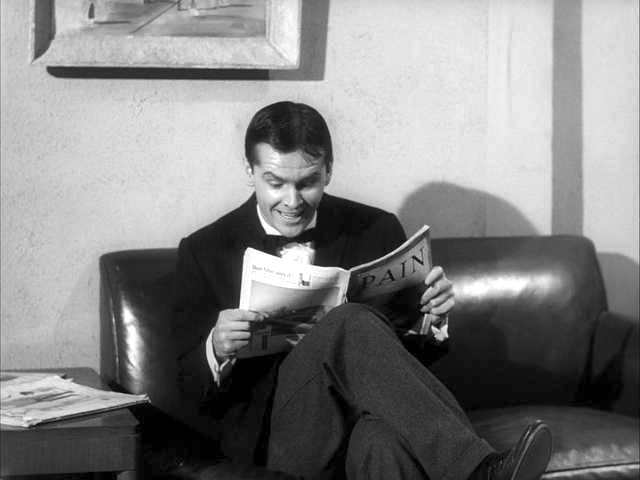
It gained a cult following after being distributed as a B-movie in a double feature with Mario Bava‘s Black Sunday. A small, early role for Jack Nicholson retrospectively helped the film’s popularity when promoted on home video releases. It became the basis for an off-Broadway musical, which in turn was made into a film adaptation in 1986, starring Rick Moranis, Steve Martin, and Ellen Greene.

A link to quotes from the film can be found here. Since Corman never bothered to copyright the film (thinking it had little in financial prospects), it has entered the public domain. A link to the entire film can be found here.

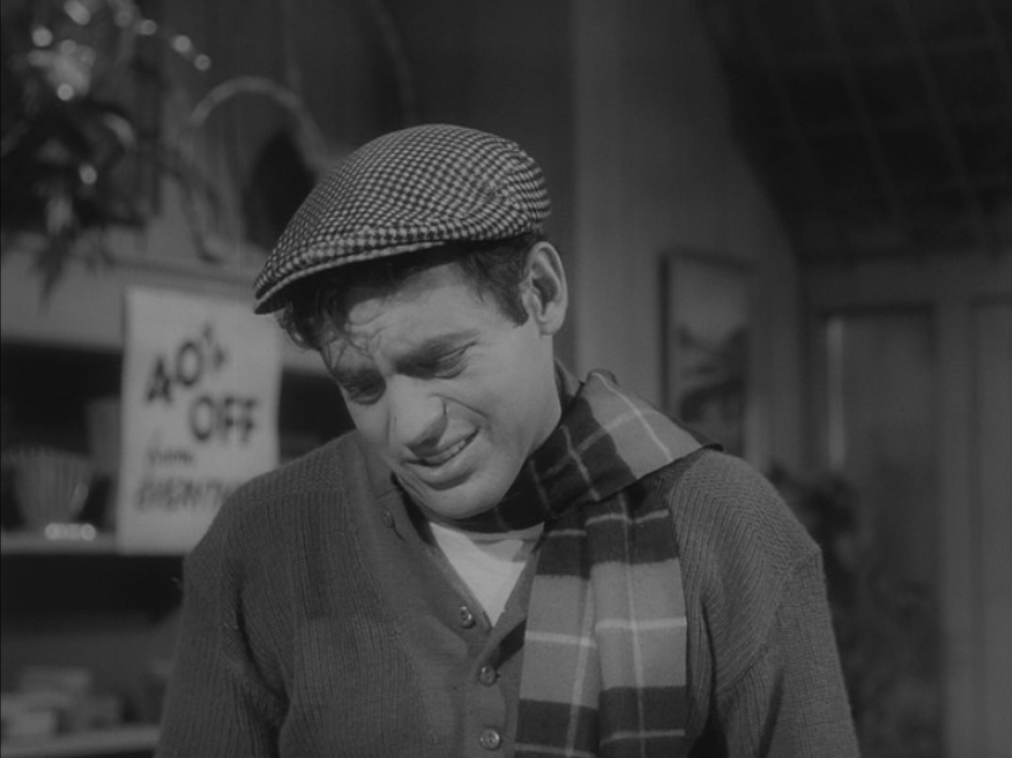
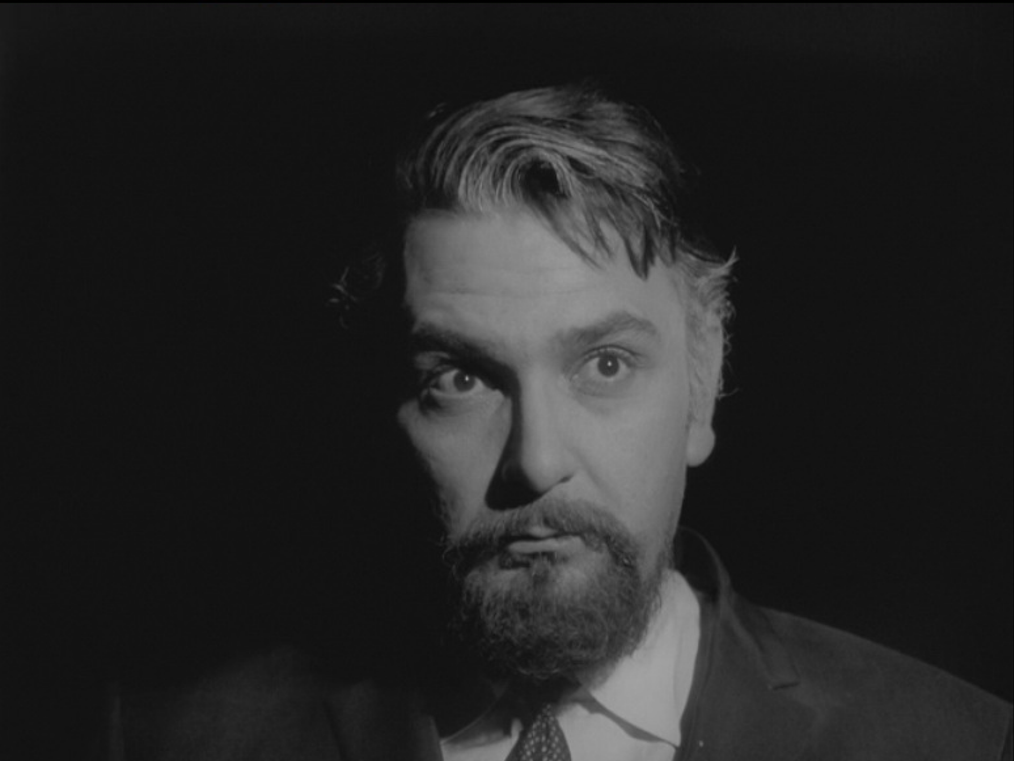
Seymour Krelboined (Haze) is a clumsy, socially awkward florist’s assistant working on skid row in California. His boss is Gravis Mushnick (Welles), a bad-tempered, penny-pinching stereotype of Jewish humour who speaks ungrammatical English, laden with malapropisms, in a thick Yiddish accent. Seymour will be fired for his ineptitude unless he can impress Mushnick with his new plant.

Seymour, Mushnick, and Audrey admiring Audrey Jr.

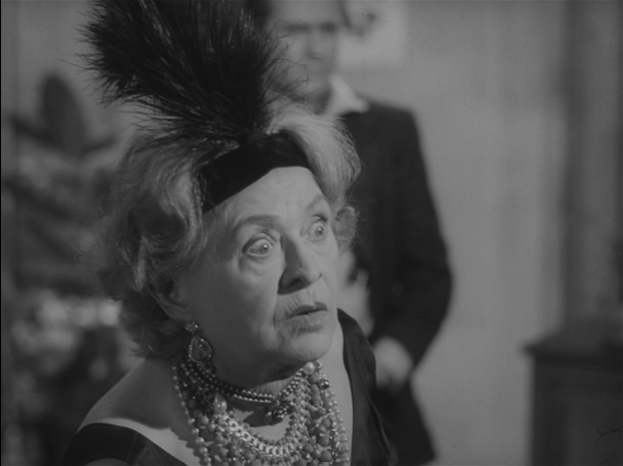
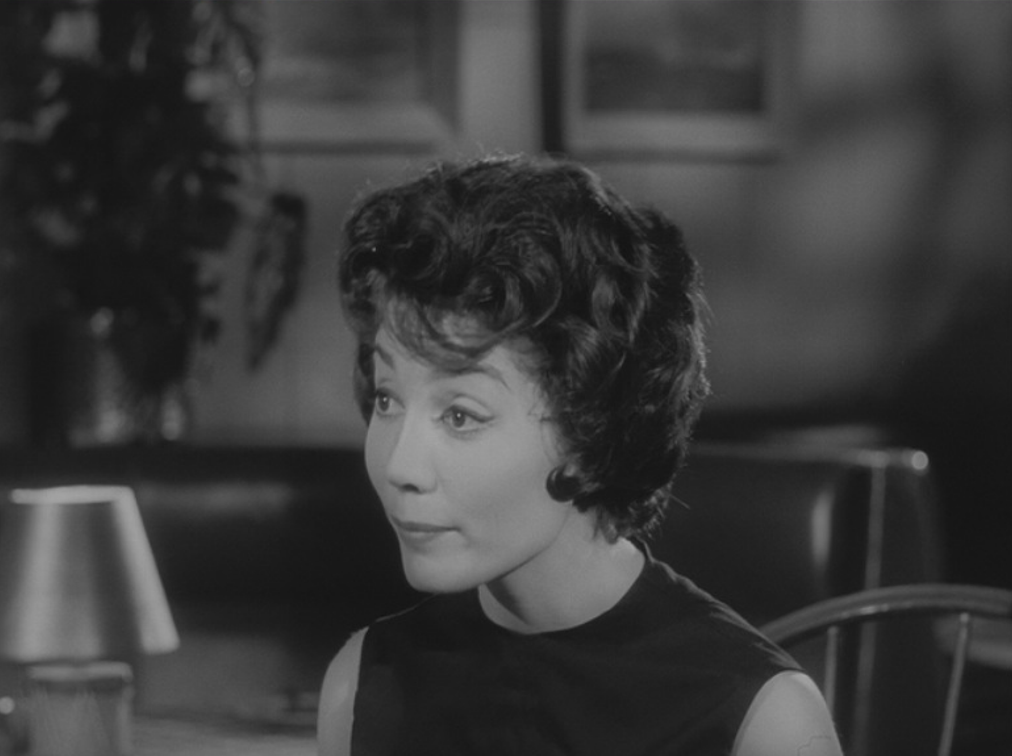
All the characters in this film are comically idiosyncratic in one form or another: Seymour’s love interest, Audrey Fulquard (Joseph), the sweet–if rather ditzy (her dialogue, too, abounds in malapropisms)–girl next door; Burson Fouch (Miller), an eccentric eater of flowers who gives Mushnick the idea to save Seymour’s job by using his unusual new plant to attract customers; Seymour’s hypochondriac mother Winifred (played by Myrtle Vail), who considers medication synonymous with food; ever-mourning Mrs. Shiva (aptly surnamed), who always needs flowers for funerals (hoping for cut-rate prices) for the latest death in the family; Sergeant Joe Fink, the narrator, and Officer Frank Stoolie, two Dragnet-style detectives; Dr. Phoebus Farb, a fittingly sadistic dentist; and Wilbur Force (Nicholson), a masochist who loves going to the dentist.

It’s interesting how Fouch, an eater of flowers, encourages the public display of a plant that, as it turns out, eats human flesh. Flowers are the commodity sold in Mushnick’s shop, of course, and Fouch is a consumer (in more ways than one) of them. The addition of ‘Audrey Jr.’, the giant man-eating variant of a Venus flytrap, to the store will cause business to boom in a way all storeowners dream of, but not even Mushnick will want to pay the gory price that Audrey Jr. demands.

The rapid growth of Audrey Jr., coupled with its appetite for human flesh, can be seen to symbolize the predatory nature of capitalism, which must continue growing, being fed on profits (i.e., the improved business of Mushnick’s flower shop), with no regard for the needs of human life.

So, consumption–in its various meanings–is the dominant theme of the movie: the plant’s consumption of human flesh, Fouch’s consumption of flowers, Mushnick’s customers’ consumption (buying) of his flowers, little Audrey Jr.’s consumption (using up) of Seymour’s blood, his mother’s consumption of medicines as if they were food, and the public’s consumption (i.e., reception of information/entertainment) of the display of Audrey Jr. in the flower shop.

Since the setting of the film is skid row, a part of town where the poor try to escape their troubles in such forms as alcohol and drugs, Winifred’s consumption of medicines can easily be seen as symbolic of drug addiction, especially since the tonic Seymour buys for her is 98% alcohol. She has a few sips and is already tipsy by the time he leaves their house with his then-little plant.

Winifred Krelboined

The symbolic relationship between Fouch’s eating of flowers and Audrey Jr.’s eating of people should be seen as a karmic one. Fouch’s eating of flowers symbolizes man’s destruction of nature by commodifying it; the plant’s man-eating is thus nature’s revenge on man, the destruction of the environment being also our destruction, our collective suicide.

Commodification, the making of exchange-values to generate profits, is the basis of capitalism; small wonder Marx began Capital, vol 1 with a discussion of the commodity. Flowers are Mushnick’s commodities, so Seymour’s plant and its growth represent how the profit made from commodities result in another kind of growth: the accumulation of capital. Audrey Jr.’s bloodlust represents the pain and suffering that inevitably result from all this capital accumulation.

Seymour’s social awkwardness reflects the aggravated kind of alienation one would encounter in the poverty of skid row. He loves raising plants, but he is only of any worth to Mushnick if he can nurse Audrey Jr. to health and present it appealingly to his boss’s customers, getting them to want to buy flowers in the shop. Once the plant’s health has revived, and it has grown thanks to its drinking of drops of Seymour’s blood, his boss no longer loathes him, and even starts calling him ‘Son.’

Two pretty girls, who enter the shop out of curiosity about Audrey Jr., and who wish to decorate a float with flowers, treat Seymour like a pop star upon learning that it is his horticultural skills that have brought the plant to life. After Mushnick, dreaming of wealth and moving his flower shop to Beverly Hills, gives ever-grieving Mrs. Shiva flowers for free, he notices Audrey Jr. sick again, regrets his generosity to her, and instantly reverts to his contempt for Seymour. The boy’s alienation arises from only being of value if he can help his boss make money.

His alienation grows worse when he realizes that the only way he can keep Audrey Jr. alive is by murdering people and feeding it the corpses. Since murder is repellant to his nature, his bloody work is now alienating him from what Marx called one’s species-essence.

Seymour Krelboined

One is alienated from one’s work, from oneself, and of course from other people. Seymour alienates himself from others, though he “didn’t mean it,” but he isn’t the only one. Dr. Farb, the dentist who loves drilling holes in people’s teeth, also alienates people with his sadism. There are the teeth that hack up a man, and there’s a man who hacks up teeth, another reversal comparable to that of Fouch vs Audrey Jr.

There’s karmic retribution in Audrey Jr. eating human flesh, in response to what Fouch’s flower-eating represents (destruction of the environment). Then there’s karmic retribution in Seymour’s killing of Dr. Farb, in response to the dentist’s gleeful torturing of his patients; recall how, in the 1986 film musical, Steve Martin’s dentist sings of people paying him “to be inhumane.” Many high-paid professionals–doctors, lawyers, politicians–do awful things on a scale comparable to those of the greedy capitalist.

The suffering of the poor in such places as skid row, people ever held down under the boot of the capitalist, often leads to varying forms of mental illness, as in Winifred’s hypochondria and the sexual masochism disorder of Wilber Force (Nicholson). While most masochists in the BDSM community engage in their kink in a way that doesn’t cause them psychosocial difficulties, Force’s eager willingness to have (imagined dentist) Seymour pull out several–it is safe to presume–perfectly healthy teeth is clearly an impairment of Force’s functioning in social situations.

Added to all of this, the farcical humour we see in Seymour’s clumsiness, the eccentricities of his mother and Fouch, Farb’s sadism, Force’s masochism, etc., should be seen as representative of the absurdist futility of their existence in an alienating, capitalist society that keeps them in poverty and misery. Even Fink and Stoolie, the police investigating the disappearances of Farb and the railroad detective (whom Seymour accidentally hit with a large rock and made fall on the tracks to be run over by a train), react to the death of Stoolie’s son–who was playing with matches–by nonchalantly saying, “Those are the breaks.”

Audrey Jr.’s chewing of human bodies into pieces, Dr. Farb’s drilling and pulling of teeth, and Force’s delight at getting his teeth drilled and pulled, all represent the psychological fragmentation that results from an alienating capitalist society that privileges the few and impoverishes most of the rest of humanity. Even the budding relationship between Seymour and Audrey doesn’t last long; predictably, the talking plant’s incessant demand, “Feed me!”, is what gets in the way of their love. The growing monster of capitalism eats up everything.

Audrey Fulquard

The two girls who want to feature Audrey Jr. on their float fittingly say that their spectators will “eat it up.” The literal or figurative consumption of commodities leads to the consumers being karmically consumed by their own materialism and commodity fetishism. People see only the growing plant; they know nothing of what it is actually fed to make it grow.

The reversals of Fouch’s flower-eating vs a man-eating plant, and of teeth that mutilate vs Farb’s mutilating of teeth, are a fusion of dialectical contradiction with karma.

Though Mushnick is horrified to find out that Seymour is feeding the plant human flesh, he is conflicted about whether to inform the authorities or to keep quiet and enjoy the new success of his business. It is common for business owners to be conflicted over the need to maximize profit vs the need to be humane towards their employees, to care about the environment, etc. We’ll notice however that, no matter how strongly…and sincerely…the capitalist feels about humanitarian concerns, the profit motive will take priority, because the capitalist is compelled to prioritize profit. Hence, Mushnick’s procrastination with telling the police.

Mrs. Hortense Feuchtwanger, a lady from the “Society of Silent Flower Observers of Southern California,” enters the flower shop and is fascinated with Audrey Jr. If the plant’s buds open on the evening she returns to the shop, and if she likes what she sees, she’ll give Seymour a trophy for his plant.

This trophy would represent the kind of recognition that Seymour, a misfit and ‘loser’ that no one has ever appreciated or liked, so desperately craves. Only recently have any women (Audrey, the two girls with the float, Mrs. Feuchtwanger) ever shown him any liking, and if there’s one thing we all desire, it’s that of the Other, to be desired of the Other, to get the Other’s recognition.

As with his romance with Audrey, though, Seymour’s appreciation from Mrs. Feuchtwanger will be short-lived, too. The lady returns to the flower shop to see the budding, and she is horrified–as are Audrey, Mushnick, Fouch, Winifred, and Fink and Stoolie, who are also there at the time–to see the faces of all those eaten by the plant in its opened flowers.

Oddly, the two girls with the float still like Audrey Jr., looking gleefully at the faces in the budded flowers. They represent the extreme of commodity fetishism: so entranced are they by the plant as a finished product that they show no regard for the victims that helped it grow.

Gravis Mushnick

Recall, also, that as horrified as Mushnick is at Audrey Jr., especially to learn that it is a talking plant, he, too, is willing to have it eat up someone–in this case, an armed robber (played by scriptwriter Griffith, who also did the voice of the plant). Guarding his money is more important to capitalist Mushnick than preventing yet another victim of Audrey Jr.

The robber isn’t the only member of the Lumpenproletariat to be fed to the plant: so is an aggressive prostitute who tries to get Seymour to be her next client. For indeed, with Audrey Jr. as symbolic of the ever-growing, ever-devouring monster that is capitalism, such Lumpenproletariat as criminals and streetwalkers are every bit as much victims of the bourgeoisie as are the strata of the working class just above them.

Capital seems to develop a mind of its own, in how it subjugates us all to the will of the profit motive, even when we try to resist it on moral grounds, as Mushnick and Seymour try to do. This ‘mind of its own’ would seem to explain, in symbolic terms, why the plant can talk, and why it can hypnotize Seymour into doing its will, right when he tries so vehemently to defy it.

So many of us on the left try to defy the system around us that we hate so much, but through the mesmerizing bourgeois media (part of the system’s superstructure), now including Facebook, the narcissistic exhibitionism of Instagram, etc., we all get pulled back into complying. Hence, Seymour wanders the streets of skid row, in such a trance as to ignore the charms of the streetwalker, and takes her back and feeds her to Audrey Jr.

When Fink and Stoolie learn that Seymour is responsible for all the killings, they and Mushnick chase him on the streets of skid row in the night. The two cops represent the feeble attempts that an otherwise bourgeois state makes to curb the excesses of capitalism. That feeble effort is demonstrated in their failure to apprehend ineffectual, spastic Seymour, who should be easy to catch.

Wilbur Force

They chase him into some bizarre, even surreal-looking, parts of town, but they are places nonetheless indicative of the capitalist preoccupation with commodities–rather unclean ones, actually. Seymour is chased into the private property of a tire and rubber company, when he runs and hides in a labyrinth of giant tires. One of the few times he doesn’t trip is over resting Mushnick’s leg, though Fink and Stoolie do trip over it!

Then Seymour hides in, of all things, a toilet among a maze of bathroom fixtures (sinks, bathtubs, etc). Mushnick tells the cops that they won’t find Seymour there, though he is most obviously there. In all of this not only do we see the symbolism of a bourgeois government failing to punish the excesses of capitalism, but we also see a capitalist helping in achieving that failure.

Seymour returns to the flower shop a broken man. Racked with guilt over his murders, he’s lost the woman he loves, he’s a wanted man, and it’s all because of that bloody, gluttonous plant that has repaid his services by ruining his life. In despair, he decides to sate Audrey Jr.’s hunger one last time with his own body…and a knife to kill it with.

A karmic reversal has finally happened to the plant, instead of it being an agent of karma; for such is the reality of the dialectical crests and troughs of theses phasing into negations and sublations that become new theses to be negated and sublated. Now Seymour’s face appears in the latest budding flower, to add to all the other faces. The plant dies, too, and just as capitalism kills, so will it destroy itself in the end.

Analysis of ‘Sink the Bismarck!’

I: Introduction

Sink the Bismarck! is a 1960 black-and-white British war film directed by Lewis Gilbert and written by Edmund H North, based on The Last Nine Days of the Bismarck (alternatively titled Hunting the Bismarck), a 1959 fictionalized account of the actual WWII naval battles of the German battleship Bismarck and cruiser Prinz Eugen vs. the British Royal Navy, written by CS Forester.

The film stars Kenneth More and Dana Wynter, with Carl Möhner, Laurence Naismith, Karel Stepánek, Esmond Knight, John Stride, Jack Gwillim, and Michael Hordern. The film was praised for its historical accuracy in spite of a number of inconsistencies. It’s to date the only war film to deal with the Bismarck naval battles, and it’s an anomaly in how it focuses much film time on the back-room strategists, as opposed to devoting the film to the combatants themselves.

A link to quotes from the film can be found here.

The film simplifies and distorts aspects of the battles, particularly those involving HMS Hood and HMS Prince of Wales. Though the actual man who oversaw the operation to sink the Bismarck was Sir Ralph Edwards (and the film acknowledges him in the ending credits), the film replaces him with the fictional Captain Shepard (More). Another character, WRNS Second Officer Anne Davis (Wynter), was invented with Shepard, their fictional interplay and chemistry adding human depth and emotional interest to the story, as did the fictional characters Forester added to his account (e.g., Dusty and Nobby).

This fictionalized history, in its book and film versions, is meant of course to dramatize the greatness of the British navy in their heroic struggle against Nazi Germany; but speaking of historical inaccuracies here, there is a context that has to be examined in order to understand the true nature of the conflict between England and the Nazis. The film and book would have us believe that Britain and Nazi Germany were on practically opposite ends of the political spectrum, with the UK’s liberal democracy on one side and German fascism on the other; but the political reality of the time revealed them to be not so far apart as it seemed.

II: Some Much-Needed Historical Context

Contrary to the heroic portrayal of him in the media, including this film, Churchill was a dreadful, even despicable, human being. Being a highly-placed man in the British Empire, he was as preoccupied with maintaining and protecting England’s imperialist interests as Hitler was in establishing Lebensraum for Germany. Such preoccupations included a gleeful, even fanatical, support for violence against the Japanese, Indians, Sudanese, Cubans, etc. He was easily as racist, if not more so, than Hitler, looking down on Native Americans, Australian aborigines, etc., as inferior.

Churchill also opposed women’s suffrage and workers’ rights, busting unions and violently suppressing strikes in a way that Hitler would have admired. He only supported Zionism for the sake of Western imperialist interests; like Hitler, he also spoke of the dangers of the “International Jews.”

Apart from the Churchill/Hitler comparison, the crimes of British imperialism are also comparable to those of the Nazis in terms of how horrific they were. Here are just a few examples: Boer War concentration camps, the transatlantic slave trade, the Opium Wars, the Bengal famine (Churchill diverted Indian food to European troops when a bad harvest had already made such food scarce, causing the deaths of millions of Indians), and the brutal repression of the Mau Mau uprising in Kenya.

Given this bloody context, we are now ready to see the fighting between England and Germany the right way: it wasn’t ‘democracy vs tyranny,’ it was simply inter-imperialist conflict. And just as the Soviet Union had a non-aggression pact with Nazi Germany (which also had a wider context not so well-known, and one which makes nonsense out of the notion of moral equivalency between fascists and communists), so did the capitalist West have such a pact with the Nazis: Munich, at which appeaser Neville Chamberlain claimed he’d achieved “peace in our time.”

Indeed, not only Churchill but many British conservatives (including the aristocracy) expressed support for fascism, for they knew it was an effective weapon against the rise of socialism. People like Churchill and Chamberlain were hoping, by ceding the Czechoslovakian Sudetenland to Nazi Germany, Hitler would be encouraged to go further East, invade the USSR, and crush communism.

Hitler, however, started presenting himself as a threat to Western imperial hegemony, and this caused Churchill et al to change their attitude toward this new imperialist challenger, and to regard him as just as much of an enemy as did Stalin, who’d been desperately trying to get the, till then, deaf Western powers to join him in an alliance against Hitler.

So inter-imperialist conflict is the basis of the fighting between Britain and the Nazis. In the particular instance of this movie and Forester’s book, the Nazis started the failed Operation Rheinübung in an attempt to block supplies from reaching England.

III: Pride

The notion of the British as the heroes and the Nazis as the (only) villains is, as I’ve stated above, a liberal bourgeois perspective, given that in actual fact both sides were imperialists vying for a bigger slice of the pie. This notion of one side as good, more civilized, more advanced, and therefore superior to the other is actually an attitude held on both sides of the conflict, and is thus an expression of national pride.

That ‘pride goeth…before a fall‘ is a recurring theme in this film, and it is noted on both sides of the conflict. While the tone of the film would have us believe that the irrational emotion of pride is far more a pronounced fault of the Nazis than of the British, there are a number of indications, including some Freudian slips, if you will, in the writing, that suggest that the chasm separating Nazi pride from that of the British isn’t as far apart as is assumed.

The film begins with a newsreel showing the 1939 launch of the Bismarck, with Hitler among the attendees. This is a moment of Nazi pride, assuming their new battleship has a Titanic-like invincibility.

Then we have a shot of the approaching Captain John Shepard in May 1941, walking in the direction of the Admiralty in London where he is to be the new overseer of strategizing in the War Room underground. As Shepard approaches, we see a statue of a lion to his left, a symbol of the strength of Britain. A huge flock of birds flies off the ground where he is walking, just before we see the film title flash on the screen; it is as if the birds deliberately make way for our great hero. In these visuals we see manifestations of British pride to parallel that shown in the Nazi newsreel.

We next see Edward R Murrow playing himself, CBS London radio correspondent. As an American broadcast journalist discussing the threat the Bismarck presents to England, his sympathy to Britain represents the solidarity felt between those countries that were and are part of Anglo-American imperialism. He says Britain is fighting alone, a claim easily proven false given the aid England got from her dominions of Canada, Australia, New Zealand, and South Africa, all before the US would enter WWII by the end of the year. This ‘Britain fighting alone’ is just another example of the country’s excessive pride.

IV: Stereotypes

Shepard is in many ways as much the ‘stiff upper lip‘ stereotype of the British as the film’s portrayal of Fleet Admiral Günther Lütjens (Stepánek) is of the Nazis. Within a minute of having entered the War Room, Shepard is quick to find annoyance with the informal work atmosphere he sees: a young man isn’t properly wearing his uniform (no jumper); the charms of the beautiful Davis are jocularly overestimated, by Shepard’s predecessor, as crucial to winning the war; Commander Richards (played by Maurice Denham) is eating a sandwich on duty; and a man addresses Davis as ‘Anne,’ which especially irks Shepard.

This stiff upper lip of Shepard’s extends, predictably, to his refusal to show or talk about his emotions. While part of his reason for this refusal is the pain he felt over the death of his wife during an air raid and the sinking of his ship by a German cruiser commanded by Lütjens, another part of the reason, surely, is his pride, especially seen in his stubborn insistence on the virtue of stoicism as against Davis’s argument for the healthy expression of feelings.

First Sea Lord Admiral Sir Dudley Pound (Naismith) says he’s been told that Shepard is “as cold as a witch’s heart.” Pound approves of this characterization of Shepard, as much of an exaggeration as it is; he wants a man with no heart or soul, but “just an enormous brain.” Fighting the Nazis in the North Atlantic will be “a grim business,” not to be won with “charm and personality.”

The fact is that inter-imperialist conflict is a grim business, making the British as grim in their dealings as the Nazis are. Hence, Pound wants an agent in southern Norway to make direct contact with the Admiralty, as dangerous as making such a contact will be for the agent. The Norway man will be shot by the Nazis in the middle of sending a message about where the Bismarck and Prinz Eugen are sailing, but Pound considers the sacrifice worth it.

V: A Naval Chess Game

Pound and Shepard learn that the German ships are coming out of the Baltic. The two men are looking at a large map on a table with small models of ships that are moved around like chess pieces. Indeed, the conflict turns out to be a “chess game” of sorts between Shepard and Lütjens: who will outsmart whom?

Pound notes the British ships available at Scapa Flow that could engage the Bismarck and Prinz Eugen : HMS King George V, HMS Prince of Wales, and HMS Hood. Pound contacts Admiral Sir John Tovey (Hordern, who actually served as a lieutenant commander in HMS Illustrious during the war) of King George V about the incomplete message from the agent in Norway who was killed: Prinz Eugen was spotted, and one must assume the worst, that the Bismarck is sailing with her.

As other players of this “chess game,” the men on King George V have to anticipate which way the German ships are going in order to intercept them: will they go through the Denmark Strait, will they sail south of Iceland, or through the Faeroes/Shetland passage?

Shepard wants to reinforce the Home Fleet, taking ships away from other duty. He considers taking HMS Victorious and HMS Repulse off escort duty, which would give the commander-in-chief an aircraft carrier and another battle cruiser. 20,000 men’s lives would be risked; Shepard doesn’t consider their lives a gamble, but a calculated risk. Pound approves of his decision.

Defending empire is, indeed, a grim business.

Now that King George V has Victorious and Repulse, Tovey wants the Hood and Prince of Wales in the Greenland area, while the Home Fleet sail from the Scapa Flow area, then south of the Faeroes and Iceland, to be ready to engage the Bismarck south of Greenland if the Hood and Prince of Wales fail…

…which, of course, they will.

Bad weather reinforces the British Navy’s difficulties, making the German ships virtually invisible. Lütjens speaks of the “chess game” he is playing with the British, and he proudly imagines himself able to win. Note the comparison between the stereotypical British vs German forms of pride, the ‘stiff upper lip’ of the former, and the boastful, ‘superior Aryan pride’ of the latter.

VI: Lütjens

Lütjens is, of course, portrayed as a stereotypical Nazi. The historical Lütjens, however, was nothing like this film portrayal, which should help us see that British and German pride aren’t as far apart from each other as is assumed.

The Lütjens of Forester’s book is somewhat prouder, but not as much as he is in the film. The film Lütjens complains of not receiving the recognition due to him in WWI; he is also fanatical in his belief that the Bismarck is unsinkable.

The Lütjens of history, however, was a very different man. He did not agree with Nazi policies: he was one of only a few navy commanders who publicly protested against the brutal mistreatment of the Jews during Kristallnacht. Also, he was one of the few officers to refuse to give Hitler the Nazi salute when the Führer visited the Bismarck on its first and final mission. Such rebellious actions would have taken uncommon courage; it was also in marked contrast to the film’s portrayal of a committed Nazi who’d have us never forget he is a Nazi and a German, and who passionately shouts, “Heil Hitler!

So, this contrast between the stoic Shepard and the crazed Nazi Lütjens is meant to make the former look like the more reasonable man by far. In effect, it’s to make the British seem superior to the Nazis, when as I indicated above, the crimes of British imperialism make England no more guiltless than Germany. Indeed, it is the role of fascism to be the ‘bad cop’ to the ‘good cop’ of the liberal bourgeoisie, when in reality, all cops are bastards.

VII: Shepard’s Mask of Ice

Shepard’s outer shell of stoicism is shown again when he’s asked about his son, Tom (Stride), an air gunner in Ark Royal‘s Swordfish squadron. One assumes the boy’s father would be glad to know he’s (for the moment, actually) far away from the danger of facing the Bismarck, but Shepard says his son must take his chances like everyone else. This would seem a brave, self-sacrificing attitude, but some might think it callous. In any case, the attitude Shepard presents here is fake; he’s just being too proud to admit to his feelings and emotional vulnerability. We’ll know his real feelings for Tom soon enough.

Shepard is again cold to his staff when he learns a young officer named Dexter is late for duty, though only a little. Commander Richards, the man to be relieved by Dexter, doesn’t mind the lateness, but Shepard does. He punishes the boy by requiring him for duty the next three nights. Richards pleads for Dexter, saying the boy wishes to have some time to spend with his girl, an army nurse, before she’s sent off from Portsmouth to go overseas; but Shepard won’t make an exception.

Shepard’s insistence on this punishment happens during a scene when Davis has discussed with him the loss of the man she loved, a “wonderful man” who was missing in action at Dunkirk the previous year. She has argued how good it is to talk about one’s feelings, while Shepard of course doesn’t think so. He similarly shows no warmth or pity to Dexter’s now being unable to be with his girl.

The reality of imperialism, as a modern extension of capitalism, is that it causes alienation to metastasize. We see this intensified alienation in Shepard, as the Director of Operations for the imperialist British fleet, in his callous attitude toward such young people in love as Dexter. While he shows a modicum of sympathy for Davis (presumably because of her elegant beauty), he still won’t concede any validity to her belief in the goodness of showing feelings.

Another provocation, happening by the end of that same scene, challenges an uncovering of Shepard’s outer mask of stoicism: he learns that Lütjens, who sank his ship, is commanding the Bismarck. Since he’s dealt with Lüjens before, though, Shepard will be able to get good hunches about what his nemesis plans to do.

VIII: Bismarck vs Hood

The Bismarck and Prinz Eugen are spotted sailing in the Denmark Strait, so the Hood and Prince of Wales (the latter of which has civilian workers aboard) will have to confront them the next morning. Captain Leach (Knight, who actually served as a gunnery officer on board the Prince of Wales, where he was seriously injured and blinded during the battle with the Bismarck) tells his men to get a good night’s sleep in preparation for the coming battle.

To get back to the theme of pride before a fall, the Hood is the pride of the British navy. When the men in the War Room know the Hood is about to face the Bismarck and Prinz Eugen, the Assistant Chief of the Naval Staff (played by Geoffrey Keen) proudly says, “Good old Hood; she’ll get them.”

The problem is, of course, that she won’t get them. Instead, the Bismarck first hits the Hood, only slightly damaging her, then after another salvo, the first three shells of which hit the water near the Hood, the fourth hits just below its main mast, penetrating the deck armour, and the Hood‘s deck explodes. Both the British and German sides are shocked at the destruction of this once great ship. What’s left of it is covered in smoke. The destruction of the Hood is thus a parallel of the upcoming destruction of the Bismarck, indicating a parallel of British imperialist pride with that of the Nazis.

IX: Parallels

There are enough parallels, or doublings, of so many aspects of the British and German sides in this film, revealed in a more or less Freudian slip-like fashion (i.e., not consciously expressed as doubles or parallels), as to justify–along with the British imperialist crimes mentioned above–the near moral equivalency of the British and the Nazis.

As noted above, the Hood and Bismarck are parallels, the pride of their respective countries’ navies, and they will both meet their demises. Shepard and Lütjens are doubles. Both are embittered from misfortunes of one kind or another from their pasts. The pride of Shepard and Lütjens will, in one sense or another, fall: the former will have to own up to his emotions, and the latter will face the consequences of his overconfidence.

Recall the difference, however, between the film’s portrayal of Lütjens and the historical man, who far from being overconfident, was actually pessimistic about the Bismarck‘s chances of a successful mission. In the film, Captain Ernst Lindemann (Möhner)–who is a parallel to Shepard’s Davis in being a soft-spoken voice of reason trying to temper the stubborn pride of his superior–is ordered by Lütjens to fire on the Hood; while the Lütjens of history ordered Lindemann not to engage the Hood, with Lindemann attacking despite his superior’s orders. And if the Lütjens of the film takes reckless chances, so does Shepard in his giving the Home Fleet Victorious and Repulse, risking the lives of 20,000 men.

The only reason we in the Anglo-American world consider the British in the film to be bold and daring in their risks, while considering the Nazis to be reckless in theirs, is because we have been culturally conditioned to sympathize with the former imperialists and not with the latter. In reality, neither side should have been sympathized with.

Another parallel, or doubling, in the film is the phone call from Churchill to the Admiralty and the telegram from Hitler to the Bismarck. We all know Hitler was a warmonger, but in Forester’s account (page 77 of this pdf), Hitler calls Churchill a warmonger (which he was, technically).

X: Damaging the Prince of Wales

To get back to the story, though, with the Hood gone, it’s up to the Prince of Wales to fight the Bismarck. The British ship hits the Bismarck on the bow, then the latter hits the former on the bridge, killing all but two men there. Hit several more times, the Prince of Wales has to retreat.

Directly below the flaming wreckage of what once was the bridge is the chart room, where the navigating officer sees blood dripping from the voice pipe onto his chart. This scene is in Forester’s account (page 55 of the pdf), and it is reproduced in the film.

Proud of his victory over the Hood and the Prince of Wales, Lütjens wants to continue sailing in the Atlantic in search of more opportunities of Nazi glory. (His pride is shown in both the book [pdf pages 61-64] and the film.) Damage to the Bismarck, however, has caused an oil leak, and Lindemann wants to return to Germany for refuelling and repairs. Proud Lütjens won’t have it, though, and he’ll have news of his victory sent to Berlin; repairs and refuelling can be done in Nazi-occupied Brest instead.

Sad news of the destruction of the Hood is disseminated throughout the Allied press, including Murrow’s sombre report, contrasting with the proud, jubilant news of the same thing in the Nazi reporting. The film and book–the latter dramatizing the loss through the grieving mother of a seaman named Nobby (pdf page 59)–would have us commiserating with the British, and looking with sober eyes at the Nazi gloating; but since, as I’ve said above, it’s just one criminal empire fighting a criminal would-be empire, the opposition between both sides should be seen as a dialectical sublation, not a Manichaean dualism.

XI: Airplanes

Prinz Eugen breaks away, heading to Brest. Shepard is aware that his son, Tom, is going to be exposed to the danger because Force H, the Ark Royal and its Swordfish planes are being deployed to hunt the Bismarck. Shepard’s efforts to contain his emotions are being tested once again.

After evading the radar of the Suffolk and Norfolk, the Bismarck (located by Catalina flying boats) is to be slowed down by an air strike from the Swordfish torpedo bombers. Another fall of British pride comes when, not only do the airplanes mistakenly attack the Sheffield, thinking she’s the Bismarck, but also the torpedoes used have an unreliable magnetic detonator that tends to cause them to explode just after being dropped in the water (pdf page 107). If my lip-reading is at all reliable, the captain of the Sheffield (played by John Horsley), in annoyance with the friendly fire incident, seems to be saying, “Stupid fucking bastards,” the audio being out for obvious reasons.

Later, the Swordfish return with conventional contact exploders, and one of their torpedoes detonates near the stern, jamming the Bismarck‘s rudder, slowing her down, and making manoeuvring impossible. Undaunted in his stubborn pride, Lütjens tells his men (who in Forester’s book haven’t properly slept in days…no rest for the wicked!) not to lose heart, for U-boats will be coming to help soon (the Luftwaffe will come, too), and of course the Bismarck is, apparently, unsinkable. His pride is about to come crashing down with his ship.

Tom Shepard participates in the earlier airstrikes, and with them comes news of his momentary disappearance. Naturally, the boy’s father is shaken upon hearing the news, desperately trying to contain himself with that mask of stoicism. Shepard has been warming up to Davis, though, little by little; and he follows her advice about talking about his feelings.

XII: Feelings

He tells her his reason for refusing to acknowledge them: the death of his wife has made him believe the disavowal of his feelings will shield him from future hurt. But he forgot about his strong love for his son. Another strong feeling of his, pride, has been thwarted in his forced confrontation with that love.

When he finally learns that his son is alive and well from a phone call, he freezes and cannot answer. He is suspended between the stoic front he always puts on and the awesome wave of relief that has washed all over him. He steps out back to shed a few embarrassing tears, and Davis has noticed; but she’s too elegant a lady to let him know she’s seen him in such a vulnerable state. The film’s sympathy to Britain softens this fall of pride.

XIII: Sinking the Bismarck

The most brutal fall of pride, of course, is reserved for the men of the Bismarck, since it is the filmmaker’s (and Forester’s) intent to maximize the contrast between the UK and the Nazis, and therefore their respective falls of pride. Lütjens has received a telegram from Hitler saying that all of Germany is waiting to welcome him as their great hero. They, of course, will never receive him, since he will die, ironically, with the telegram on him.

The destruction and sinking of the Bismarck (finished off by Dorsetshire) is shown in all its brutality, with salvo after salvo hitting her and penetrating that thick armour, a man from King Charles V saying, “Shoot!” over and over again. We see Germans trying to rescue their wounded on a stretcher, then a shell hits the ship, throwing the men and making them drop the wounded. Men down below race in the rising, flooding water, trying to escape a drowning. Men open a top hatch only to find flames preventing their escape.

Now, Admiral Tovey is gracious enough to have the Dorsetshire rescue the German survivors, but one controversial historical detail left out of the film is how this ship quickly left after rescuing only 110 Germans, because a U-boat was suspected to have been in the area. The film must do all in its power to portray the British as well as possible, while doing a caricature of Nazi evil.

XIV: Shepard and Davis

The potential for a romance between widowed Shepard and Davis has been kindled in her preference to work for him over a job offer in the US. He asks her out to dinner, thinking it’s evening, when in fact it’s the morning, so they leave the Admiralty to have breakfast together instead. This minimizing of any romantic chemistry between them seems another example of stereotypical British stoicism, the affectation of virtuous self-control.

Shepard and Davis walk away in that same shot that introduced him, with the lion statue on the left and the flock of birds flying off to make way again for the hero who now gets the girl. It’s pride in would-be British superiority on display once again, in contrast to the Nazi pride that the imperialist British navy felt they had a right to judge.

XV: Conclusion

My point is that while Nazi Germany’s racism, brutality, and imperialism were blatant and obvious, the British version of these vices has been obscured in a cloak of ‘civilization.’ The conventional capitalism of the UK, the US, Canada, Australia, New Zealand, etc. is perceived by many as innocuous (thanks in large part to the propaganda of films like Sink the Bismarck!, which aim to glorify these countries), while only the authoritarianism of fascism is seen as cruel and barbaric.

Mainstream Western capitalism is, however, on a continuum with fascism, the latter not emerging until the hegemony of the former is threatened by socialism, the true opposite of both ideologies. The bourgeois liberal would have you believe that not only is his ideology opposed to Naziism, but that…an obscene comparison!…fascism and communism are somehow sister ideologies. The fighting between the British and Nazi navies in this film is supposed to represent the opposition between mainstream capitalism and fascism, when really the fighting only represents a competition between the imperialism of two countries. After all, competition is part of the core of capitalism, so inter-imperialist conflict is to be expected.

As for the absurd comparison of fascism and communism, a study of the far more significant fighting of WWII–that on the Eastern front, between the Nazis and Soviets, a bitter struggle that dwarfs that of the Western front–should clear up any confusion about where those two ideologies truly stand in relation to each other.

And as for the actual comparability of bourgeois liberal ‘democracy’ and fascism, consider a few quotes from the ever-maligned Stalin: “Social democracy is objectively the moderate wing of fascism.” (And social democracy is the most leftward-leaning of bourgeois liberalism; consider, therefore, how much closer to fascism the ‘centrism’ of the Clintons, Blair, Obama, Biden, and Macron are!)

To clarify the meaning of the above Stalin quote, consider this other one of his: “What would happen if capital succeeded in smashing the Republic of Soviets? There would set in an era of the blackest reaction in all the capitalist and colonial countries, the working class and the oppressed peoples would be seized by the throat, the positions of international communism would be lost.” The depredations of thirty years of post-Soviet neoliberalism have proven Stalin to have been prescient.

In sum, England’s defeat of the Nazi threat to her shipping routes was heroic and salvific only to her, not to the preservation of ‘democracy.’ It’s only natural that, when two empires collide, they fight. The British saw themselves as trying to better the lives of their own people; so did the Nazis with respect to Germany. None of this, however, is to the betterment of humanity in a global sense.

Indeed, the oppressed peoples outside of the Anglo-American world see the political situation quite differently. One doesn’t fight empire with empire (consider Operation Paperclip and the tensions that led to the building of the Berlin Wall to see how ex-Nazis continued to collude with the capitalist West); one fights–and defeats–it with anti-imperialism.

Analysis of ‘Marathon Man’

Marathon Man is a 1976 thriller film directed by John Schlesinger and written by William Goldman, an adaptation of his 1974 novel. The film stars Dustin Hoffman and costars Laurence Olivier, Roy Scheider, William Devane, and Marthe Keller.

Olivier was nominated for a Best Supporting Actor Oscar for his portrayal of the antagonist, Dr. Christian Szell, who was ranked #34 on AFI’s 100 Years…100 Heroes & Villains list. The line “Is it safe?” ranked #70 on AFI’s 100 Years…100 Movie Quotes. The film was a critical and commercial success, though a number of changes from Goldman’s original intentions–the removal of scenes deemed excessively violent, and how Szell dies at the end of the film–brought the film down a few notches…in Goldman’s own assessment, too.

Still, I consider the story worth analyzing because of its depiction of the relationship between German Naziism (as personified by Szell and his older brother) and American capitalism (as personified by Szell’s American associates and couriers)–that is, the love/hate relationship between the US and fascism.

Here is a link to famous quotes from the film and novel, and here’s a link to a BBC radio play of it.

Thomas Babington “Babe” Levy (Hoffman) is a history PhD student in New York writing a dissertation on tyranny in American politics. He’s named after Thomas Babington Macaulay, a British Whig historian deemed progressive by 19th century standards, but who by today’s standards would be deemed insufferably elitist. Macaulay was known for writing a dramatized version of history, celebrating those he agreed with and vilifying those he disagreed with; similarly, Professor Biesenthal (played by Fritz Weaver) warns Babe not to get too emotional when researching the McCarthyism that destroyed his father. His doctoral thesis “mustn’t be turned into a hysterical crusade.”

Marx deemed Macaulay a “systematic falsifier of history.” By deeming his father innocent of the accusation of communist sympathies–rather than doing the brave thing and saying it shouldn’t matter whether his father was or wasn’t a ‘commie’ (i.e., there’s nothing to be ‘guilty’ or ‘innocent’ of), Babe is showing his reactionary, liberal tendencies (in a way, rather like those of Macaulay). This babyish political naïveté of Babe’s is something he’ll have to outgrow if he’s going to confront the fascists in his midst.

Apart from his historical/political leanings, Babe is also an aspiring marathon runner, hence the story’s name, and hence his nickname, after Babe Ruth, who we can visualize running past the three bases to home plate after hitting his many home runs. How should we interpret the meaning of Babe’s running? Firstly, he is accepting his place in the competitive world of capitalism, running with the others in an attempt to win the (rat) race, or World Series, of life. Second, as his successful running away from his captors, those working for Szell, indicates, Babe’s running represents his lifelong attempt to run away from his problems, instead of confronting them, as he finally does at the end.

Babe’s older brother is Henry David Levy (Scheider), known as “Hank,” or as “Doc” by Babe, or by his Division code name, “Scylla.” He is named after Henry David Thoreau, for reasons that, frankly, don’t make any sense to me at all, given Doc’s total conformity to the social and political establishment, the diametric opposite of Thoreau’s proto-environmentalist, anti-government stances. (Was the Levy brothers’ father hoping for Doc to have such a personality, or was this naming irony on Goldman’s part? Anybody who has read the novel, please inform me in the comments; I’ll be extremely grateful, and I’ll make the appropriate changes to this analysis then.)

Doc’s other name, Scylla, is more explicable. As a spy secretly working for the American government, and as a courier for Szell’s diamonds (in exchange for Szell’s betraying of his fellow Nazis), Doc is, symbolically speaking, vying for a Scylla and Charybdis kind of lesser evil status, rather like the US vis-à-vis Naziism. Though he’s a Jew (and a closeted gay), Doc has an American-style conservatism and violent manner (cut out of the film) that shows him to have a much more flawed character than meets the eye, an unpleasantness almost comparable to that of Szell.

Christian Szell’s older brother, Klaus, has been watching over Szell’s diamonds (which he’d extorted from prisoners in Auschwitz) in a New York bank while Szell hides away in Uruguay (Paraguay in the novel). If Szell needs money, Klaus takes out some diamonds and has these converted into cash. But one unlucky day, Klaus gets mixed up in a road rage incident that gets him and the other driver killed.

The other driver is a hot-tempered, middle-aged Jew, and Klaus is as much a Nazi sympathizer as Christian is. The mutual hate that both drivers feel, knowing each other’s ethnicity (Klaus: “You are a Jude!…[in German>>] Lick my arse!”//The Jewish driver: “You antisemitic bastard, you!”), causes their road rage to spiral out of control, leading to them crashing into an oil truck, killing both of them.

It’s easy to see the destructiveness of racial hatred in this scene, and to focus on the evil of antisemitism. But to get at the root of fascism, we have to look at its economic foundations. Szell, having lost his brother in the accident, no longer has anyone he can trust to watch over his diamonds, so he must come out of hiding and (or so he believes) kill the couriers before they have a chance to rob him of his diamonds.

This fear of losing one’s wealth is what drives the violence of fascism. When communist revolutions shook up Europe in the late 1910s, the beginning of the 1920s, and in the mid-1930s, regardless of whether they succeeded or failed, the capitalist class was scared, and the fascism of Mussolini, Hitler, Franco, et al was used either to beat down the working class or to lead them astray, making them think that foreigners were their enemy, rather than the rich. Szell’s paranoia and violence are symbolic of this reactionary use of fascism; note how, early in the film, there are numerous references to strikes and environmental protests.

Recall what Henry A. Wallace had to say about fascism: “A fascist is one whose lust for money or power is combined with such an intensity of intolerance toward those of other races, parties, classes, religions, cultures, regions or nations as to make him ruthless in his use of deceit or violence to attain his ends.” Here’s another quote: “If we define an American fascist as one who in case of conflict puts money and power ahead of human beings, then there are undoubtedly several million fascists in the United States.” And yet another: “Still another danger is represented by those who, paying lip service to democracy and the common welfare, in their insatiable greed for money and the power which money gives, do not hesitate surreptitiously to evade the laws designed to safeguard the public from monopolistic extortion.” Note Wallace’s recurring theme of the fascist’s lust for money.

While the racism, xenophobia, and national chauvinism of fascism are problems not to be trivialized, fascists at their core are capitalists, and their function is ultimately to preserve and protect the class structure of society. This is why we see Szell’s constant preoccupation with his diamonds. Though he’s surely no Jew-lover, we never hear him utter an antisemitic slur against Doc or Babe.

We mustn’t let ourselves be confused whenever people, conservatives such as Jonah Goldberg in particular, claim that men like Mussolini or Hitler were a ‘different kind’ of leftist. To say that the National Socialist German Workers’ Party was a socialist one is like saying the Democratic Party is democratic. The names of the parties mean nothing if their actions don’t replicate them. To reassure his big business donors, Hitler purged the Nazi party of all left-leaning members (Röhm, the Strassers, etc.) as soon as he came to power.

The point is that we don’t solve the problem of Nazi sympathizers by merely calling out people who make racist comments on social media, etc. We must get to the bottom of the fascist problem by dealing with its roots in class conflict. Hitler’s dream of lebensraum was inspired by the American takeover of land from the aboriginals. Imperialism in its modern form grew out of capitalism, a reaction to the tendency of the rate of profit to fall. Markets must expand to other countries to keep the profits flowing.

Similarly, Szell must leave South America and go to the Jewish-dominated diamond district of New York to retrieve the diamonds he stole from Jews in Auschwitz. He is the personification of an imperialist going into another country to plunder it, provoking the ire of those who live there.

Szell’s original hiding away in Uruguay/Paraguay, him a wealthy bourgeois with South American servants, reminds us of Dr. Josef Mengele (Todesengel, “Angel of Death”), of whom Szell (der weiße Engel, “the White Angel”) is the protégé and his double for the purposes of this story. Recall that Mengele–played by Gregory Peck–is the antagonist in The Boys From Brazil, in which Olivier also starred, playing a Jewish Nazi-hunter. Both of these films share as subject matter the fear of a resurgence of fascism.

Indeed, Marathon Man can be seen as a kind of allegory of the revival of fascism, in that Szell’s paranoia about being robbed of his diamonds (like Nazi paranoia of ‘Jewish world domination’) symbolizes the ruling class’s fear of losing their wealth and power from socialist revolution, as symbolized by the leftist references to such strikes as one of bakery workers and one of airport baggage handlers, as well as anti-pollution protests in Paris during Doc’s visit there.

Christian Szell–whose…Christian…name distinguishes him as a Gentile bourgeois from such Jewish bourgeois as Doc and all the New York diamond-dealers whose appraisals of Szell’s diamonds he needs, and whose surname (apart from its having been inspired by, oddly, George Szell) can be seen as a pun on sell, that is, to sell his diamonds for cash–must infiltrate another country, like an imperialist, and do violence against anyone who stands in his way, like a Nazi.

Szell’s American counterparts, Doc (or Scylla, recall) and Peter “Janey” Janeway (Devane), represent the Nazis’ American imperialist frienemies. They have to do business with Szell, for the sake of–in my allegory–maintaining the capitalist status quo, but Scylla, as a gay Jew, and Janey as his closet gay lover, certainly don’t like doing business with him.

The gay relationship between Scylla and Janey is only slightly hinted at in the film, in a scene in Scylla’s Paris hotel room, when he phones Janey, tells him he misses him, and wants him to “get [his] ass over [t]here.” Janey has worries about “appearances” (i.e., two men sharing a hotel room), but Scylla doesn’t care if their being together looks indiscreet. In the BBC radio drama (just after 38:00), Janey tells Babe there’s nothing he can say about Doc that won’t shock him, including his homosexuality (which would surely shock Babe to know). Goldman’s novel is even more open about Scylla’s and Janey’s gay relationship.

Now, these two men may be gay, but they’re also very much part of the conservative American political establishment. Doc is unsympathetic to Babe’s research on their father, a liberal who committed suicide because McCarthyist smears destroyed his reputation. Doc, as Scylla, may despise Szell, but he still chooses to work as a courier for him. Janey is a double agent pretending to oppose Szell by temporarily rescuing Babe from the dentist torture, but he wants the diamonds, too, and he gives Babe back to Szell when he realizes he can’t get any information from him.

What we see in these scenes between Szell, Scylla, and Janey is an allegorizing of the two-faced relationship that the US has always had with fascists. On the surface, the US appears to be opposed to Nazis (as we see dramatized in films like Saving Private Ryan), but secretly…or, not-so-secretly…American businessmen worked with Nazis, then after WWII, ex-Nazis were given jobs in the US government.

A thin veneer of liberalism and progressivism (as personified in Doc and Janey, in their gay relationship) hides American fascist sympathies. Recall how New Dealer FDR put Japanese Americans in internment camps. And during the 1950s, when there were higher taxes on the rich (high enough, in fact, to preclude the very existence of the kind of super-rich we see today), strong unions, and the welfare state, McCarthy’s witch hunt for communists and communist sympathizers was in full swing.

This last issue is of great concern to Babe, since it destroyed his and Doc’s father. Their father was a left-leaning liberal, left-leaning enough to make him want to ‘disown’ Doc, in Babe’s estimation, had their father lived long enough to see Doc become what Babe is led into believing is a successful oil businessman…and had their father known Doc is Scylla, a US government spy, he’d have disowned Doc all the more.

Still, this left-leaning doesn’t lean anywhere near Marxism-Leninism, which is what is truly threatening to American capitalism, the danger of a theft of the diamonds, so to speak, of the bourgeoisie. All the same, McCarthyism had that Szell-like paranoia of anyone even remotely connected to communist ideology; hence, such people, like the Levy brothers’ father, were destroyed.

This overwrought paranoia is emblematic of what links the American right with fascism. To those on the far right, anyone even a few millimetres to their left is by that fact alone a communist. Members of the Democratic Party are communists, apparently, even people like the Clintons, Obama, and Biden, who either enacted or endorsed very right-wing legislation. I know an American supporter of Trump who thinks this of the Democrats, and who holds the delusion that Justin Trudeau and hippies are communists. These far right-wing types actually reach that level of paranoid absurdity.

Similarly, Szell doesn’t trust any of his couriers with his diamonds, hence he has Chen, an Asian assassin, make several attempts on Scylla’s life. Scylla is plenty conservative as noted above, despite his closeted homosexuality; in fact, Doc’s code name is practically a pun on Szell. Still, none of this is good enough for the ex-Nazi dentist, so he kills Scylla with the blade hidden in his sleeve…just as Nazi Germany would eventually fight the US, the very country that inspired their imperialist lebensraum, in WWII.

Babe is smitten with a “Swiss” woman named Elsa Opel (Keller), though she is actually working with the same people associated with Szell. Small wonder Doc is quickly able to figure out that she is a phoney during lunch with her and Babe in a fancy restaurant. The two lovers have been mugged in Central Park by two men hired by Szell, the same two men who later abduct Babe in his apartment so Szell can do his sadistic dentistry on him. The two men’s German names are Erhardt (played by Marc Lawrence) and Karl (played by Richard Bright, who would have been easily remembered by mid-70s moviegoers as Al Neri in the two Godfather movies released just a few years before Marathon Man, thus making the link between Nazi Germany and mafia-like America all the surer).

So, Szell’s paranoia about having his diamonds stolen leads to his violence against his couriers, especially Scylla, then to Elsa and Babe…just as the capitalist class’s fear of losing their financial power led to the rise of fascism and its inherently violent nature. There is violence against Jews (in the film and in history, of course), let there be no trivializing of that fact; but at its core, the scourge of fascism is financial in nature.

So after Karl and Erhardt abduct Babe and tie him to a chair for Szell, we see an allegory of how fascist violence is provoked by a fear of the capitalist class losing its money. Though Babe is a Jew, and one would imagine ex-Nazi Szell hurling one antisemitic slur after another at him, instead, his one concern remains simply, “Is it safe?”

He won’t tell Babe what the “it” specifically refers to, so Babe has no way of being able to answer the question. Of course, what Szell means is to say, ‘Is it safe for me to go to the bank and retrieve my diamonds?’ Are his diamonds safe, or will he be robbed of them and killed? That this is a mystery to Babe is allegorical of how the common man is ignorant of the machinations of the ruling class.

Babe is terrorized and tortured by Szell and his tools of dentistry, just as the victims of fascism are terrorized and tortured; and just as Babe has no idea what Szell wants, those victimized by fascism usually don’t know what their far right-wing agenda is fuelled by. The common people assume that that agenda is limited to racial hatred, xenophobia, and extreme nationalism, when these three evils are just by-products of the agenda, which is to divert the working class from revolutionary intent, and to use violence to suppress socialist revolution during a time of capitalist crisis…to ensure that capitalism is safe.

Now, Babe is generally a rather weak, ineffectual man…a true Babe, hence Doc’s many taunts of him. The brothers’ reaction to the trauma of their father’s suicide has been to go in opposing directions, Doc a conservative, Babe a liberal. Doc’s trauma response is fight; Babe’s is flight. Babe screams for help like a damsel in distress when Karl and Erhardt break into his apartment. Symbolic of this weakness is a cavity he’s had throughout the story. Szell attacks the cavity with his dental tools, getting screams out of Babe. Then Szell finds a healthy tooth, honing in on a nerve, the pulp, the contacting of which is even more agonizing for Babe.

I have argued in other film analyses that the loss, or mutilation, of teeth (be they literal teeth or symbolic ones) is symbolic castration, in the Lacanian sense that any bodily mutilation represents a castration-like lack that gives rise to desire. The cutting-away at Babe’s healthy tooth is a trauma that, combined with those of the mugging and the witnessing of his brother’s bloody death, will push him over the edge and transform him from a meek man to a strong, revengeful man. His desire will be to have Szell recognize him and the hurt he’s caused, then to receive a return of that hurt.

After the mugging, Babe has admitted to a desire to use his pistol (which had been his father’s, used in his suicide) to shoot the muggers. Now he’ll want to use it all the more.

He manages to get away from his captors (when Szell finally acknowledges that Babe really doesn’t know anything about the diamonds), and he uses his running skills to evade them even while chasing him in a car. When he finally gets his hands on that gun from his apartment, that phallic gun, he finds his strength. Fear has been replaced with rage, just like that of the Jewish road rager at the beginning of the film…though Babe isn’t going to be rash and impulsive with his revenge on Nazis.

Elsa takes Babe to the house of Szell’s brother Klaus, and by now Babe is on to her. A final confrontation with her, Karl, Erhardt, and Janey ensues after finding out where Szell is going to be (his New York bank), and everyone except Babe is killed. Now Babe can go after Szell.

Szell has already been feeling the effects of his bad karma on the streets of the diamond district of New York. In spite of his having shaved himself to imitate male pattern baldness, so he wouldn’t be recognized by his weiße Engel mane of snowy hair, two middle-aged Jewish Holocaust survivors know who he is.

Pauline Kael called Marathon Man a “Jewish revenge fantasy,” but I’d like to extend that idea to a film about karmic retribution on fascists in general, in which Jews can be seen as a metonym for the working class. What we must remember is that while the Nazis murdered six million Jews, they also murdered five million non-Jews, including leftists, who represent the working class, and who were the first to be put in concentration camps. Jews and communists were the two main scapegoats on whom Nazis blamed the problems of Germany in the 1920s and 1930s. Indeed, Hitler conceived of communism as a Jewish conspiracy to take over the world.

So the two middle-aged Jews who recognize Szell, and later, Babe getting his revenge on Szell, can be seen to represent a leftist retaliation against fascism. After all, Nazi Germany invaded the Soviet Union in June of 1941, and while the Wehrmacht was succeeding at first at doing violence against the Soviets (just as Szell has terrorized Babe with his dental instruments), eventually the Red Army turned things around and, surrounding the Nazis in Russian territory as Szell is surrounded in the Jewish diamond district, the Nazis retreated like Szell. Finally, when all was lost, Hitler killed himself, as Szell stabs himself with the blade in his sleeve.

Now, at this point, we must discuss the difference between the ending of the film and that of the novel, the latter of which I consider much better. The BBC radio drama (link above) dramatizes the novel’s ending, and the Goodreads quotes of the novel (again, link above) give lengthy sections of Babe’s lecturing words as he fills Szell with bullets.

The film’s ending–in which Babe doesn’t kill Szell, but merely points his gun at him, tells him to swallow his diamonds, and throws the case of them into the water of a water-treatment facility, making Szell race down stairs after the case, fall, and stab himself with his sleeve-blade–comes across as liberal soft-heartedness. Punish fascists, have them destroy themselves, but dear God, for the sake of humanity, don’t kill the poor little Nazis.

Say whatever you want about the morality of Babe shooting Szell in cold blood; he has every motive in the world not only to settle the score for all the torture he’s suffered from Szell, but also to avenge his brother’s murder. Similarly, we leftists have every motive in the world to meet fascist violence with violence of our own.

Babe once “was a scholar and a marathon man, but that fella’s gone now.” Recall how I said above that Babe’s marathon running is symbolic of his running away from his problems. He’s acknowledged, after the mugging, that Doc would say Babe’s never confronted anything. Well, “that fella’s gone now”: Babe doesn’t run away anymore. He faces his problems now. He fights back.

Babe says, “if you don’t learn the mistakes of the past, you’ll be doomed to repeat them.” We leftists must learn from the mistakes of the past, too. We can’t afford to be soft on fascists, because they’ll never show us that courtesy if they rise to power again…and recently, there have been many examples of resurgences of fascism, in their traditional, national chauvinist forms, and in other authoritarian forms.

Babe says to Szell, “we’d have a nice peaceful place here if all you warmakers knew you better not start something because if you lost, agony was just around the bend.” We won’t have peace in the world by strumming guitars, smoking pot, and naïvely wishing for an end to war. Warmongers will be stopped only through revolutionary action: power must be seized by force; the imperialist bourgeoisie must be violently overthrown, and this is what Babe’s bullet-ridden revenge on Szell represents.

We, the proletariat, cannot solve our problems by running away from them. We must arm ourselves and fight back; for if we don’t, the far greater, gun-laden violence will continue in the forms of war and police shootings, income inequality will continue, our civil rights will continue to erode, and our ability to live on this earth will be gone forever.

Only when the Szells of the world are removed, will it be safe.

Analysis of ‘Misery’

Misery is a 1987 psychological horror novel written by Stephen King. It was adapted into a movie in 1990, directed by Rob Reiner and starring James Caan and Kathy Bates, with Lauren Bacall and Richard Farnsworth. Bates won a Best Actress Oscar for her performance as Annie Wilkes. A theatrical production in 2015 starred Bruce Willis and Laurie Metcalf.

Misery grew out of King’s wish to break free of the horror fiction genre (i.e., his 1984 fantasy novel, The Eyes of the Dragon), yet many of his fans wanted him to stick to horror. He was also struggling with alcohol and drugs at the time, of which the fictional drug, Novril, is a symbol. Since Novril can be seen as a pun on novel, and King once said, “Annie was my drug problem,” we can see how Novril symbolizes both his addictions and his troubled relationship with his fans.

Links to quotes from the novel and the film can be found here.

So, the struggle that Paul Sheldon (Caan) goes through with Annie is the same struggle any artist goes through in wanting to grow and be free to express him- or herself without restrictions…yet the Annies of the world keep imposing those restrictions. Give the fans what they want. We have to please the fans. Make art to make money. Produce a commodity that will sell…or die.

Sheldon no longer wants to write his hit romance novel series, the Misery books, about the female protagonist, Misery Chastain. He’s never meant those books to be his whole life. He wants to write something new, in a bid for artistic respectability. So he has killed off Chastain in what’s meant to be the final book of the romance series, Misery’s Child; and he has just finished writing a totally new and different novel, Fast Cars (the new book is untitled in the movie).

The film begins with him having just finished typing the manuscript and smoking a cigarette; then he drives out of his Colorado hotel during the opening credits in the soon-to-be snowstorm (while we hear “Shotgun,” by Jr. Walker and the All-Stars…in the novel, he listens to a cassette of Bo Diddley–page 21) and gets into the accident that breaks his legs.

The novel, however, begins when the accident has already happened, and his legs are in agonizing pain. The pain comes and goes in cycles (page 4), which are compared to those of the rising and falling tide.

Sheldon remembers a childhood experience of being with his parents on Revere Beach. The boy saw a broken-off piling jutting up from the sand; to him, it looked like a monster’s fang. He found the sight disturbing, but as the tide came in and covered up more and more of the piling, he felt better. Once the entire piling was submerged in water, he was at peace.

But then, the tide started going out, and he could see more and more of the piling again.

Now, his broken legs feel like two broken pilings (page 7), and Annie’s pain-killing drug, Novril, is the tide that will submerge those pilings (page 10)…until it wears off, and the pilings reappear from under the water. She controls the tide, so she is the Moon-goddess, “the lunar presence” (page 10).

He finds her body solid, all too solid (page 9), like a pagan idol (pages 9 and 10). How apt for a moon-goddess. It’s important to see Annie as symbolic of a goddess, especially the Moon-goddess. For, just as the goddess that Robert Graves wrote about inspired his poetry (as Graves said, “My thesis is that the language of poetic myth anciently current in the Mediterranean and Northern Europe was a magical language bound up with popular religious ceremonies in honour of the Moon-goddess, or Muse…and that this remains the language of true poetry” pages 9-10), Annie, in her own perverse way, will inspire Sheldon to write.

Of course, her inspiration is a bad one, right from when she finds him injured in his car. Recall that inspire is derived from the Latin inspīrāre, “to breathe upon or into.” Recall how Annie breathes her halitosis into Sheldon’s mouth, which he experiences as a kind of rape. (pages 5, 6, and 7)

He is “raped back into life” (page 7), which perfectly expresses the dual nature of his relationship with her: she saves his life, yet she abuses him as well. She takes care of him, yet she tortures him. Like that lunar-influenced tide that goes up and down, she both relieves and causes his suffering.

This duality is inherent to Annie’s personality: she presents a False Self of wholesome, Christian goodness to the world, but underneath, her True Self is narcissistic, sociopathic, and emotionally dysregulated. We typically hear her use ridiculously childish euphemisms (“cock-a-doodie,” etc.), but occasionally, actual swear-words come out of her mouth, too. It has been suspected that she has bipolar disorder, her manic ups and depressive downs being symbolized by the crests and troughs of her lunar influence on the tide.

Just as Annie presents a false version of herself to the world, so does she love reading fiction that presents a false, fantasy version of the world: romance novels, Sheldon’s in particular, of course. And when he presents her with his down-to-earth, realistic view of the world in Fast Cars (or the untitled manuscript of the movie), with the coarse language of slum kids, she hates it. She hates the reality, the truth, that his new book expresses.

And this lunatic woman controls whether he feels pain or comfort. “She kept the capsules. The capsules in her hand were the tide. She was the moon, and she had brought the tide which would cover the pilings.” (page 24) Recall that the rising tide that covers up the pilings doesn’t make then non-existent–it just makes them invisible. Just as her escape from reality in reading his books doesn’t erase her pain, the dope she gives him doesn’t heal his legs–it just make their fragmentation seem unnoticeable. His novels make her forget her pain; her Novril makes him forget his.

Just as she’s breathed life into Sheldon…as God did to Adam, and he “became a living soul” (Genesis 2:7)…so does Sheldon “breathe life into her [Misery Chastain, with whom Annie identifies and sympathizes].” (page 26) Annie, the Moon-goddess, inspires him, and he inspires her with his Misery books.

Annie and Sheldon are the two characters who, in her lonely house in snowy Colorado, make up the great majority of the story. All the other characters are mere details who only briefly have their appearances. The whole novel is about the dyadic, one-on-one relationship between Annie and Sheldon.

This is a relationship cut off from the rest of society, what Lacan would have called the Imaginary. Annie and Sheldon look at each other’s faces as if looking into a metaphorical mirror. Being Sheldon’s “number one fan,” Annie idealizes him as this brilliant, god-like author (recall how he can “breathe life into [Misery]”). She is the Moon-goddess to him, and he is her god. The idealizing is mirror-like in its mutuality.

We must be careful to qualify this mutual idealizing, though. She idealizes him, but he, of course, far from willingly idealizes her, for this Moon-goddess, as we know, is an evil one. He is merely dependent on her, as a baby is on his mother. His ‘religious devotion’ to her is based on fear and need, not love. She’s his ideal only in the sense that she relieves his pain, and is the only one who will do it.

This idealization must be understood in a dialectical sense, for the shadow of hate always accompanies the light of love. Just as a baby loves what Melanie Klein called the good mother and the good breast for nourishing him, and he hates the bad mother and bad breast for failing to nourish him and for frustrating his desires, so is Sheldon split in his feelings about Annie when she feeds and cares for him, and when she neglects and abuses him.

She experiences similar splitting in her attitude towards him when he succeeds at living up to her expectations as his ideal, or fails to do so. This splitting, or black-and-white thinking, is a common trait in people with borderline personality disorder, a comorbidity presumed to be part of Annie’s personality.

Splitting is also a manifestation of the duality theme in this novel: when the tide is up, and the pilings are submerged thanks to the Novril, Annie is the good mother; when the tide is down, and Sheldon is in agonizing, piling pain because she neglects to give him his dope, she’s the bad mother. The same ups and downs can be seen whenever he pleases or displeases her. Dialectical opposites.

A number of references are made to Annie as a kind of mother figure to Sheldon, all in the split, love/hate attitude, “with that same mixture of sternness and maternal love” (page 31) we expect to see in her.

In chapter 17 of Part I, when she’s about to make him burn the Fast Cars manuscript, he calls her “the devil,” that is, she’s the bad mother. Annie retorts with “Oh yes! Yes! That’s what a child thinks when mommy comes into the kitchen and sees him playing with the cleaning fluid from under the sink. He doesn’t say it that way, of course, because he doesn’t have your education. He just says, ‘Mommy, you’re mean!'” (page 57)

Earlier, when she has finished reading Misery’s Child and realizes Sheldon has killed off her beloved heroine, she goes through a similar flip-flop of splitting by saying, “I thought you were good, but you are not good. You are just a lying old dirty birdie.” (page 46) In the film, her temper tantrum over his killing off of Misery is fittingly preceded by a shot of the full moon just outside her house.

Just as she is the Moon-goddess for him, sometimes good (feeding him, nursing him back to health, giving him Novril), and sometimes bad (obviously), so is he “God” for her, sometimes good (in his Creation of the world of Misery that she loves), and sometimes bad (in killing off Chastain). As she says to him, “God takes us when He thinks it’s time and a writer is God to the people in a story, he made them up just like God made us up and no one can get hold of God to make him explain, all right, okay, but as far as Misery goes I’ll tell you one thing you dirty bird, I’ll tell you that God just happens to have a couple of broken legs and God just happens to be in MY house eating MY food…” (page 46).

In this world, the pagan Moon-goddess is more powerful than God, for Sheldon, in his helpless convalescence, needs her as a baby needs his mother. And nobody knows this better than Sheldon himself, to his “Misery Chastain[-like]…chagrin” (page 73, my emphasis). He may be “Paul Sheldon, the literary Zeus from whose brow sprang Misery Chastain,” but Annie is the Moon-goddess on whom he depends, she whose self-control and kindness waxes and wanes.

This lunar…and lunatic…waxing and waning of goodness in Annie is typical of the cyclical nature of the abusive relationship. The provocations and tension rise between the abuser and the victim until an explosion occurs, then a fake apology is given, then there’s a ‘honeymoon‘ (interesting word-choice) of brief kindness to the victim, then the abuse begins again, creeping in insidiously with small, growing provocations. The effect this cyclical abuse has on the victim is to establish traumatic bonding: one hates and fears the abuser, but one cannot live without him or her.

Another crucial aspect of this emotional abuse is Annie’s use of projection and gaslighting, the former symbolized early on in the novel through her breathing in Sheldon’s mouth to resuscitate him. Her bad breath going into his mouth feels like a kind of oral rape, as described above: in this act, she is symbolically projecting her badness into him.

As for the gaslighting, since this exhaled projection has been accomplished, she can easily blame the victim for her temper tantrums over the profanity in Fast Cars (“Look what you made me do!” page 29, when her agitated outburst makes her spill a bowl of beef soup on Sheldon’s bedspread, then throw the bowl into the corner of the room, breaking it and splashing soup on the wall.)

She continues to blame him for the mess she’s made in the following chapter on page 30. She tortures him by not giving him his medication until she’s finished cleaning up the mess. It’s safe to assume she’s calmed down by now, but her sadism is at its height, given the agonizing pain he’s in. “The tide went out. The pilings were back.” (page 30) “He began to cry soundlessly. The tide had never gone out so far” (page 31).

And when she finally gives him his three capsules of Novril, she makes him drink them down with the dirty water from the bucket she’s used to clean up the mess: “…he saw her lifting the yellow plastic floor-bucket toward him. It filled his field of vision like a falling moon.” (page 32)

After promising never to make her mad again (“Anger the moon which brought the tide? What an idea! What a bad idea!” –page 33), she kisses him on the cheek and tells him she loves him. Nasty waxes back into ‘nice.’

While Annie is associated with the moon, she also represents all of his fans, who want him to keep churning out Misery novels. Recall that fan is short for fanatic, an overzealous religious extremist, for example. Annie, who is worshipped as a lunar deity, is also a lunatic worshipper of Sheldon’s deity. That she’s his “number one fan” just makes her all the more fanatical…just like those other women readers of Sheldon’s work, each of whom also claims to be his number one fan (page 36), protesting whenever he takes a break from Misery to write something else.

Here we come against the tension between the wish for artistic freedom vs. the unending demand to satisfy the customer to make more money. This problem is fuelled by the profit motive. The author writes not to fulfill his or her urge to be artistically expressive, but merely to make money to survive.

That Annie bullies him into resurrecting Misery Chastain with the writing of Misery’s Return is symbolic of this capitalist coercion. Sheldon is Scheherazade, desperately fighting to keep himself alive by telling stories. The capitalist commodification of labour forces all workers to sell their labour, to sell themselves, rather like prostitutes, to have money to stay alive. There’s no voluntary choice being made, in spite of the nonsense we hear from right-wing libertarians and ‘anarcho’-capitalists: we workers provide a commodity or service, or we get thrown out in the street, starve, and die.

So we see this two-way, mutual idolizing going on. Annie worships the god in Sheldon as his number one fan, and he worships her lunar, tide-controlling deity to relieve his suffering. But she, as a pagan goddess, requires sacrifices from her devotees; and the sacrifice he’ll have to make is his manuscript of Fast Cars. (pages 54-55) “So he burned his book” (page 60).

This is the first part of her stifling of his artistic freedom; the second part, of course, is reviving Misery. He has to go back to churning out product like an assembly-line worker.

She gives him a Royal electric typewriter (page 76). Just looking at the thing is giving him bad feelings. “The Royal grinned at him, promising trouble.” (page 78) The banked semicircle of keys seem like teeth in an eerie grin. What’s more, he notices “a missing n.” (page 77) The missing n, in the context of the typewriter keys’ smile, looks like a grin with a missing tooth.

The “missing tooth” might remind us of that of Trelkovsky in The Tenant, which I interpreted in my analysis of that film as symbolic of castration, a symbol in itself of any bodily mutilation, or of any lack, which gives rise to desire. Sheldon has experienced the lack of his burned manuscript, and the missing n, one of the most commonly used letters, is symbolic of his lack of freedom to write as he wishes, a restriction of his artistic expression. Annie’s abuse is symbolically a castration of him.

This symbolic castration is carried further when she hobbles him as ‘punishment’ for secretly leaving his room. Recall that in the film, she uses that huge sledgehammer to break his feet at the ankles; but in the novel, she hacks off his left foot with an axe (page 279), and cuts off his thumb with an electric knife.

That the loss of the typewriter’s “teeth” (in the novel, not just the n of the film, but also the e [page 292] and the t [page 285]) and the hacking off of his foot and thumb are symbolic of castration is not just some indulgence on my part. King himself makes such associations in the narrative by juxtaposing them all.

“Sitting here in front of this typewriter with its increasingly bad teeth…he supposed he had been his own Scheherazade, just as he was his own dream-woman when he grabbed hold of himself and jacked off to the feverish beat of his fantasies. He didn’t need a psychiatrist to point out that writing had its autoerotic side–you just beat a typewriter instead of your meat” (pages 302-303).

A little later, Sheldon muses about “…the loss of his thumb. It was horrible, but…think how much worse it could have been.” (page 303)

“It could have been his penis, for instance…he began to laugh wildly…in front of the hateful Royal with its gaptoothed grin. He laughed until his gut and stump both ached.” (page 304)

The hobbling is related to restrictions on his artistic freedom (symbolized by the freedom to move around–to think of ideas to write, Sheldon used to take walks!…pages 153, 154, 155), capitalist restrictions on freedom (i.e, wage slavery). Recall when Annie mentions how the British at the Kimberly diamond mines hobbled native workers (which is historically apocryphal) so they’d continue working without being able to steal diamonds or run away. (pages 276-277)

She restricts his freedom to write anything other than her philistine Misery books, yet she so fails to see the production of such books as a business that she imagines “the talent God gave [him]” to write such books as the opposite of a business (page 94). It’s offensive to her to think of his writing as a business.

One interesting aspect of the story, developed far more in the novel–of course–than in the movie, is how we see the writing process in operation. Sections of the novel give us scenes from Misery’s Return presented with a type font different from that of the Sheldon/Annie narrative, with the missing ns (and later, the missing ts and es) filled in. All of these letters are among the most commonly used, so again, their lack–with the need to write them in–symbolizes Sheldon’s decreasing ability to express himself freely.

Things degenerate to the point where, his writing hand swollen and painful (page 380), some of the final pages of Misery’s Return must be hastily hand-written (pages 363-364) to finish it before the increasingly inquisitive police catch up with what Annie has been doing and arrest her (She’s planned a murder/suicide for herself and Sheldon to escape the shame of the arrest).

The ironic thing about her coercing of him to write a novel he doesn’t want to write is that he eventually comes to regard this new novel as his best work…at least, of the Misery novels (page 253). Her pushing him to rewrite how it is that Misery Chastain survives the death she’s supposed to have suffered in Misery’s Child, to make it more believable, is a case in point. In this sense, Annie is being Robert Graves’s Moon-goddess after all, inspiring Sheldon to write better.

All of this good inspiration must be qualified, however. Perhaps Misery’s Return is Sheldon’s best writing yet…from a technical standpoint. It’s ‘the best’ in the sense that it is a hugely entertaining story that will delight his fans (after all, unlike in the film, in which he burns the manuscript to spite Annie, in the novel, he hides it, burning only a decoy of it, and takes it out of her house to publish it later).

Still, as commercially successful as Misery’s Return will undoubtedly be, it’s still the same philistine schlock that he finds so artistically unsatisfying. Sheldon’s regarding it as his best work is, I suspect, more of Annie’s gaslighting, traumatizing influence on him.

Now, Sheldon has his book, and Annie has hers–her scrapbook, in which she keeps newspaper clippings of all the events in her life that she deems significant. Apart from such mundane things as the announcement of her birth, her graduation from nursing school, and her being made the new head maternity ward nurse in a hospital, a disturbing theme runs throughout these clippings: death.

“FIVE DIE IN APARTMENT HOUSE FIRE” (page 229); “two copies of [Annie’s] father’s obituary” (page 231); USC STUDENT DIES IN FREAK FALL” (page 231); and so many others like these. Sheldon, as he’s flipping through the scrapbook and surmising that she has killed all these people, muses: “This is Annie’s Book of the Dead, isn’t it?” (page 235)

Just as Annie’s maternalism is a cover for her sadism, the white of the moon and its dark side, her “maternal love and tenderness” and “the total solid blackness underlying it” (page 194), so is her nursing career a cover for the serial killer she really is, her true and false selves. As with her Christian posturing, her work as a nurse is just reaction formation, a professed concern for preserving life masking a contempt for it. “Keeping up appearances is very, very important.” (page 117)

Annie, like Dr. Herbert West in Re-Animator, pretends to care about preserving and reviving life, but is really an example of what Erich Fromm called the necrophilous character, one excessively preoccupied with death. “Necrophilia in the characterological sense can be described as the passionate attraction to all that is dead, decayed, putrid, sickly; it is the passion to transform that which is alive into something unalive; to destroy for the sake of destruction; the exclusive interest in all that is purely mechanical. It is the passion to tear apart living structures. (Fromm, page 369, his emphasis)

Now Sheldon knows he’s Scheherazade, telling his Misery story to stay alive. He hates having to continue with this philistine fiction because, like Annie, he has his own narcissistic tendencies. He wants to write serious literature and be admired by the critics (pages 357-358); being a bestselling author of popular fiction–something most struggling writers (myself included) would dream of being–simply isn’t good enough for him. Both he and Annie, when looking at each other’s faces, are looking into narcissistic mirrors.

Yet he’s as addicted to writing the novel as he’s addicted to taking the Novril; writing is as much a pain-relieving, therapeutic activity as taking the pain-killing dope is.

Unlike in the film, in which the local sheriff, Buster (Farnsworth)–prompted by Sheldon’s agent, Marcia Sindell (Bacall), who in the novel is barely mentioned, except to be named Bryce (page 37)–is seen early on investigating Sheldon’s disappearance, it isn’t until late in the novel that police appear (page 316), disturbing Annie’s dyadic, one-on-one, mother/son-like relationship with Sheldon.

In his state of traumatic bonding and learned helplessness, Sheldon at first can’t scream to the cop for help (pages 320-321). When he finally does yell (pages 322-323), Annie kills the cop, then projects her guilt onto Sheldon (page 332): “You killed him. If you had kept your mouth shut, I would have sent him on his way.”

Narcissists typically defend their fragile egos from criticism by projecting and repressing the shameful parts of themselves. Annie knows the police will be back, so she hides Sheldon in her basement (page 337), a terrifying, dark place where the rats are. “Spiders down there, he thought. Mice down there. Rats down there.” (page 336) The basement represents her unconscious, where all of her ugliest, most repressed thoughts lie. “He had never been as close to her as he was then, as she carried him piggy-back down the steep stairs.” (page 337) He finds himself left in the dark realm of her madness. The police, who represent her superego, must never find him in that ugly place.

Her gaslighting of him is working. Sheldon may try to fight it off as best he can, but her projected guilt does get into him. “Did he believe that [he was responsible for the cop’s murder]? No, of course not. But there was still that strong, hurtful moment of guilt–like a quick stab-wound…The guilt stabbed quickly again and was gone.” (page 367)

Two more cops arrive, also representative of Annie’s superego. Sheldon, not knowing their names yet, calls them David and Goliath because of their relative sizes (page 366). Sheldon is out of the basement now, back in his room, so he can see the cops out from his window. He dares not yell; her control of him is absolute. His room is symbolically the preconscious, meaning he’s able to bring the truth to consciousness, to the public, but he won’t, because he’s being suppressed by her.

All these visitors, be they the cops, the taxman (“not a cop but someone IN AUTHORITY”–page 185), or “those brats” (page 376–the TV news, actually), represent the Other of society who are invading Annie’s dyadic, one-on-one world with Sheldon. All three of these groups of people are authorities of one kind or another–the news media are understood to be an ‘authority,’ of sorts, on what is happening in the world.

Such authorities are symbolically associated with Lacan’s notion of the nom, or Non! du père, the father who, as a third party, forcibly ends the dyadic mother/son relationship (the other) and brings his son out of the Oedipus complex and into the larger society (the Other). But in the mother/son role-play we see in Annie and Sheldon, it is she–not he–who doesn’t want to be pulled out of the dyadic relationship.

So instead of Sheldon having a transference of Oedipal feelings for Annie (he loathes and dreads her too much for that, of course), she, in her ‘love’ for him, is having a transference of the Jocasta complex. She won’t let go of her narcissistic monopoly on his life, the way a child who Oedipally desires one of his or her parents doesn’t want to give up hogging that parent all to him- or herself.

Annie is certainly childish enough in her narcissistic hogging of Sheldon, and in her temper tantrums and violence when she complains about the taxman, brutally kills the cop (projecting her guilt onto Sheldon), and projects her childishness onto “those [TV news] brats.” In her petulance, Annie is the Bourka Bee-Goddess, with her needle syringe stinger (pages 256-257).

This bad-tempered Bourka Bee-Goddess, with her sting, reminds us of wasp-like Katherina, who warns Petruchio to beware her sting. Of course, the only way Sheldon can tame his shrew is by killing her.

The trauma she has put him through, though, means he’s stuck with the memory of her in his head. He hasn’t been traumatized once, but many times, and in a predicament from which he’s felt he can’t escape. This is the essence of complex post-traumatic stress disorder.

After he’s been rescued by “David and Goliath,” and has been brought back into society–with a prosthetic foot (page 411)–Sheldon still can’t get Annie out of his head. At the end of the film, in a restaurant with Sindell, he has a brief hallucination that the approaching waitress is Annie. In the book, he imagines her leaping up from behind his sofa in his apartment. (pages 414-415)

This reliving of his trauma, an inability to differentiate between fantasy and reality, and the inability to put his trauma into words, is the essence of what Lacan called the Real. Because of this intense pain, Sheldon feels he can no longer write.

Eventually, though, he does get his writing Muse back. We see the beginnings of a new story typed in that different font (pages 419-420), but with no letters missing, because this is Sheldon writing for Sheldon, not Scheherazade writing for Annie.

He can express himself through language again, so he has escaped both the terror of the Real and the narcissism of the Imaginary, and reentered the expressive, healthy social world of the Symbolic.

His misery is over.

Stephen King, Misery, New York, Pocket Books, 1987

Analysis of ‘The Wizard of Oz’

I: Introduction

The Wizard of Oz is a 1939 children’s fantasy musical movie produced by MGM and written by Noel Langley, Florence Ryerson, and Edgar Allan Woolf, based on the 1900 children’s fantasy story, The Wonderful Wizard of Oz, by L. Frank Baum. The film stars Judy Garland, Ray Bolger, Jack Haley, Bert Lahr, and Margaret Hamilton; it costars Frank Morgan and Billie Burke.

Considered one of the greatest films of all time, The Wizard of Oz features Garland’s immortal performance of “Over the Rainbow,” which one the Oscar for Best Original Song, and the film is characterized by its use of Technicolor (in Oz), which contrasts sharply with the black-and-white beginning and ending (in Kansas).

A link to famous quotes from the film can be found here. Here’s a link to a PDF of Baum’s book. I’ll be comparing the film with the book throughout. [NOTE: whenever I cite or quote from Baum or cite other PDFs here, I’m using the page numbers from the ‘paper’ copied in the PDFs, not the PDF page numberings.]

II: Preliminary Remarks

What is particularly interesting about the film and Baum’s book is how one can find political allegories in it, even though Baum never indicated any allegorical intent in his story; he insisted that it was meant just to entertain children. Still, a number of attempts have been made over the years to find an allegory in it.

One well-known allegory is that of historian Henry Littlefield, who saw in such things as Dorothy‘s silver shoes a symbol of bimetallism and the freeing of silver from what was felt by some in the US in the 1890s as the tyranny of the gold standard. Certainly this was the feeling of William Jennings Bryan, who famously spoke of the issue in his rousing “Cross of Gold” speech at the 1896 DNC. According to this allegory, the Cowardly Lion is supposed to be a satiric take on Bryan, since Baum didn’t sympathize with his position; though I see at best a tenuous connection between the character and the politician, and this is after reading Baum’s book, Littlefield’s allegory, and Bryan’s speech from beginning to end.

Indeed, though Littlefield’s allegory has its supporters, it’s far from universally accepted. While I agree that the Scarecrow represents the American farmer, or perhaps more generally peasant farmers (as does the sickle), and the Tin Woodman represents the industrial proletariat (as does the hammer), having the Lion represent Bryan seems wildly inconsistent in relation to the previous two. Surely the Lion should represent something properly paralleling them (more on that later).

In any case, however one judges the validity of Littlefield’s allegory, surely people today, as well as those who saw the film’s premiere in 1939, will find the bimetallist allegory not something they can identify with. People in the late thirties surely were more concerned with the Great Depression and the rise of fascism than they were with ‘freeing silver.’ And I think people today are more worried about the current economic crisis and resurgence of fascism than they are with bimetallism.

So, what can the film and book mean for us today, regardless of whether or not Baum and the film’s screenwriters consciously intended such a meaning? I’d like to propose such an allegory.

I see The Wizard of Oz, in its book and movie forms, as an allegory of class struggle. In fact, the bimetallism allegory, especially as advocated by Bryan in his “Cross of Gold” speech, dovetails with my interpretation beautifully (though not in the ironic, satirical sense in which Littlefield imagines Baum’s meaning), because for Bryan, the freeing of silver coinage was for the benefit of American farmers (i.e., helping them pay off their debts), and for the good of the common man. Bryan was known for his sympathy for the common worker, and in his speech, he spoke of the wage-earner as being “as much a businessman as his employer.”

Now, Baum vigorously supported the suffragette movement, and he was pro-worker, as seen in the sympathetic portrayal of the Scarecrow and the Tin Woodman, and in his vivid description of the plight of Uncle Henry and Auntie Em in their harsh farming life at the beginning of the story, representative of the harsh life of American farmers that Baum saw all around him in the Midwest in the late 19th century. One despicable thing about Baum, though, is how he advocated, in two editorials, the extermination of the Native Americans; but apart from this one egregious blot on him, Baum could be deemed to have been sufficiently progressive for his time to justify my interpretation of his story.

III: Grey Kansas

The filming of Kansas in sepia-toned black and white is appropriate, given Baum’s description of the farm of Dorothy Gale (Garland) as predominantly grey. Baum’s story introduces the cyclone almost immediately after a brief description of the dull, grey, and difficult farm life, and how such difficulties have dulled even the original beauty of her Auntie Em (played by Clara Blandick), and made her Uncle Henry (played by Charley Grapewin) never laugh, as Auntie Em never smiled.

The film, however, expands the opening Kansas sequence to include characters who are doubles of many of those we later see in Oz: Miss Almira Gulch/the Wicked Witch of the West (Hamilton), Hunk/the Scarecrow (Bolger), Hickory/the Tin Woodman (Haley), Zeke/the Cowardly Lion (Lahr), and Professor Marvel/Gatekeeper/Carriage Driver/Guard/Wizard of Oz (Morgan).

The fact that the three farmhands–three workers in the employ of Dorothy’s aunt and uncle–are doubles of her three “comrades” (Baum’s word) reinforce my interpretation that these three all represent members of the working poor…including the Lion.

Dorothy complains to her aunt and uncle about Miss Gulch wanting to take away her dog, Toto (played by Terry), and have him killed. Her aunt and uncle, too busy and stressed with their work on the farm, don’t have time to deal with her problems. When she tries to talk about Miss Gulch and Toto with the three farmhands, they have little time to listen, either. In this poor communication, due to the urgency of work, we see an example of alienation, which divides not only workers, but also families.

As so many of us do in the capitalist world, Dorothy dreams of the possibility of a better world, one “Over the Rainbow.” The lyrics of the song were written by socialist Yip Harburg, who got blacklisted even though he was no member of a communist party.

When mean Miss Gulch comes to the farm and demands to have Toto, having the law behind her, we learn also that she owns quite a stretch of land (Auntie Em says Gulch owns “half the county”). Her ownership of private property thus makes her a capitalist; since she’s a double of the Wicked Witch of the West, Gulch thus reinforces the witch’s tyranny over the Winkies as symbolic of capitalist imperialism, something by extension seen in the witch’s sister (according to the film), the Wicked Witch of the East, and her imperialist oppression of the Munchkins.

Gulch takes Toto away in a basket on her bicycle, but the dog jumps out and returns to Dorothy. To protect Toto, she feels she must run away. She meets Professor Marvel, a fortune teller who has apparently been to all kinds of wonderful places in the world; she’d love to accompany him on his travels.

He uses his crystal ball to make her believe that her Auntie Em is heartbroken over her running away, so she decides to go back. She manages to get back home by the time the cyclone comes. The cyclone represents the turbulent winds of revolution, which tear up the old order to make way for a new one. Back in the house and carried up in the eye of the cyclone, Dorothy is knocked unconscious and begins to dream.

IV: Landing in Oz

Since dreams are, as Freud noted, a royal road (a yellow-brick one, by chance?) to an understanding of the unconscious, we can see her experience of the Land of Oz as, on one level, symbolic of the experience of the world as felt by the unconscious mind, which tends to mishmash things together (for example, Melanie Klein, in The Psychoanalysis of Children, wrote of how a baby’s unconscious will think of milk, urine, and other liquids as identical). Hence, Miss Gulch is the Wicked Witch of the West, and the three farmhands are the Scarecrow, the Tin Woodman, and the Cowardly Lion.

Oz, too, is of course a fantastical version of the real world Dorothy and Toto have come from. It may be bright, colourful, and beautiful, but Oz is far from utopian…at least in Baum’s first Oz book. The Munchkins and Winkies are enslaved and oppressed by the wicked witches, and “the wonderful wizard of Oz” is no less a phoney than your average politician.

When Dorothy steps out of her house and into the colourful Land of Oz, she may have a feeling she’s not in Kansas anymore, but her going “over the rainbow” hasn’t landed her in an ideal world. Her house’s having dropped on and killed the Wicked Witch of the East, freeing the Munchkins and giving them cause to celebrate through the song “Ding-Dong, the Witch is Dead,” is only the beginning of the revolutionary change needed to liberate all of Oz. Crushing the old, oppressive institutions isn’t enough; one has to build new ones.

Who does the Wicked Witch of the East represent? Baum, having published his story in 1900, obviously never intended her to represent the evils of Eastern feudalism in, say, tsarist Russia or pre-republican China, which weren’t to end until one to two decades afterward. But the 1939 film was made long after those revolutionary changes, and in any case, we today can think of her as, on one level, symbolizing such old forms of tyranny if we wish, since such a retrospective interpretation will resonate far better with our generations than a preoccupation with free silver.

Art isn’t mathematics, in which an equation has only one correct answer and an infinitude of wrong answers. Meaning in art and literature is much more fluid, allowing a multiplicity of possible interpretations, however idiosyncratic some of them may be. When interpreting the meaning of a film, a book, a poem, or a myth, insisting on only one ‘correct’ meaning ruins the enjoyment of that art form, because such an insistence ossifies that art form. If the ‘correct’ interpretation has been established, why interpret that work of art any further? Just stick with Littlefield et al, and inquire no further. Now, if you like those old opinions of what Baum’s book means, you’re entitled to your opinion, and that’s fine. But please allow others to look at it in other ways if they wish; as long as a reasonable case can be made to support one’s interpretation, however eccentric it may be, it can be deemed ‘correct’ enough.

V: The Witches

As for the witches–who represent heads of state, or in the case of the wicked ones, represent colonizers and imperial rulers of the lands of others–Baum doesn’t develop them much in this first Oz book. We briefly see the Good Witch of the North among the Munchkins, the Wicked Witch of the West is encountered only when Dorothy et al enter the land of the Winkies, and Glinda, the Good Witch of the South, is seen only towards the end of the story.

To unify the story more in the film version, the Good Witch of the North (Burke) is a composite of the northern and southern witches; hence, she’s Glinda, the Good Witch of the North. And the Wicked Witch of the West is introduced in the land of the Munchkins, being the sister of the dead Witch of the East; we see much more of her in the film, too, since she’s the central villain.

Since the Glinda of the film combines the witches of the north and south, we naturally see more of her, too. An interesting theory about the film Glinda suggests she isn’t as good as she seems to be. Why doesn’t she simply tell Dorothy she can go home with the now-ruby slippers? At the end of the film, she says that Dorothy wouldn’t have believed her if she’d told her at the beginning, and that the little girl must learn for her self that she’s always had the power to use them to take her home…only Dorothy doesn’t learn it for herself. Glinda tells her at the end just as much as she could have told her earlier, and why would Dorothy believe her any more now than at the beginning?

It could be that Glinda’s all-too-saccharine, grinning goodness, bordering on–if not lapsing into–artificiality, is actually a cunning disguise meant to manipulate Dorothy into destroying the Wicked Witch of the West and getting rid of the Wizard of Oz. Since the Witch of the East is already killed, and the film’s Glinda is both the northern and southern witches, the success of her cunning plan would leave her the only one to rule all of Oz.

VI: Oz in Ounces

The only reason Oz seems to be such a sweet and beautiful place is because it is seen as such through the innocent eyes of a naïve little girl. But a world ruled by imperialistic witches, where people have a preoccupation with precious materials like gold (symbolized by the yellow brick road; then there’s the golden cap that commands the Winged Monkeys), silver and/or rubies (Dorothy’s shoes), and emeralds, is obviously a world symbolic of capitalism. Indeed, “Oz” has been interpreted to mean ounces (i.e., oz. of gold or silver).

To many Americans, whose political naïveté is comparable to ingenue Dorothy, “capitalism is freedom” (please refer to my many a debunking of the myth of the “free market”). Dorothy’s silver/ruby slippers taking her back to dreary, grey Kansas can be seen to reflect the disillusion one has when one wakes up from the slumber of the “American dream,” that if one works hard enough, one can become a millionaire, instead of realizing that one tends to stay in one’s social class of birth. Though she’s genuinely happy to be with her family again (which is ultimately what matters), her loss of the shoes during the trip back is symbolic of how the dream of striking it rich is an illusion.

So Dorothy, wearing silver or ruby slippers and travelling down a yellow brick road (yellow being symbolic of gold, as I mentioned above) towards the Emerald City can be seen to represent the dreams of the petite bourgeoisie of finding wealth and financial success. If, in my interpretation, the death of the Wicked Witch of the East represents the end of feudalism (i.e., such upheavals as the French Revolution, a western revolution, but east enough relative to the US), then the appearance of the Witch of the West among the Munchkins, with her coveting of now-Dorothy’s ruby slippers, can represent the advent of capitalism, and the imperialism that has grown from it.

Dorothy’s travels down the yellow brick road, crossing farmlands with lots of rich crops and food (Baum, chapter 3, page 33), are a sharp contrast with the grey farmland of Kansas and the struggles Henry and Em are having, a major issue with late 19th century American farmers. Still, this abundance of food is only one part of Oz; later on, Dorothy will find it difficult to find food (Baum, chapter 4, page 44; chapter 5, pages 54 and 61; chapter 7, page 75). Baum’s Oz is a kind of Spenserian bower of bliss, where what initially seems pleasurable is hiding potent evils to be discovered soon enough. The film’s use of studio sets and matte paintings are useful in reinforcing the sense of unreality in Oz.

VII: The Scarecrow and the Tin Man

Soon, Dorothy meets the Scarecrow, and learns that because his head is stuffed with straw, he must be lacking a brain. In Baum’s story, he says he doesn’t know anything (chapter 3, page 38)…but how does he know that he doesn’t know anything? He has a brain…he just doesn’t realize that he has one.

He represents the rural, uneducated farmer; I’d expand that by saying he also represents peasants. Such people are often perceived to be the ‘country bumpkin.’ Half of the problem of how to improve the lives of these impoverished people is to get them to see how capable they really are, something the ruling class doesn’t want them to see. They need confidence in their abilities.

Mao Zedong had great faith in the Chinese peasants, and he gave them the confidence they needed to help him fight the Japanese imperialists during their protracted war in the 1930s. When the CPC took control of China, they went through some rough moments, to be sure (though nowhere near as bad as the right-wing propagandists have portrayed those problems); but now China has grown from a Third World country to an economic rival of the US…all in a mere forty years.

The Scarecrow will go with Dorothy to ask the Wizard of Oz, who represents the consummate politician who is all talk and promises that are rarely kept, for a brain. The two continue down the yellow brick road and into a forest where they find the Tin Woodman, all rusted from head to foot after a rainfall. They use his oilcan to oil his joints so he can move again. We learn he hasn’t got a heart…though he’s sensitive enough to have three.

His body is made of tin, as we learn from Baum’s book (chapter 5, page 59), because the Witch of the East cursed his axe. Whenever he swung it to chop wood, he’d chop off a body part, which the local tinsmith would replace with one of tin; but none of these replaced body parts, now comprising all of him, would include a heart, or so the Tin Man imagines.

He represents the industrial worker, especially that of the eastern United States of the late 19th century, since it’s the Witch of the East, here representing the ruling class of the American east, who has cursed him with endless workplace injuries and a sense of dehumanization, resulting in his belief that he has lost his heart. He’ll join the others on their trip to see the wizard.

VIII: The Cowardly Lion

Deeper into the forest, into a darker and scarier part of it, they run into the Lion, who attacks the Scarecrow and Tin Woodman. When the Lion tries to attack Toto, Dorothy slaps him and shames him for his bullying. The Lion weeps like a baby, and we learn that he, apparently, lacks courage…though how could a cowardly lion have the guts to attack two men, one of them holding an axe?

As those of us familiar with the usual allegorizing of this story know, the Cowardly Lion is supposed to represent William Jennings Bryan. I must respectfully disagree with this interpretation, as I see the connection between the two to be far too vague to be convincing. Littlefield (pages 53-54), whose use of the story material is rather selective, bases much of his interpretation on this passage (chapter 6, page 66): “With one blow of his paw he sent the Scarecrow spinning over and over to the edge of the road, and then he struck at the Tin Woodman with his sharp claws. But, to the Lion’s surprise, he could make no impression on the tin, although the Woodman fell over in the road and lay still.”

The Lion’s claws’ failure to make an impression on the Woodman’s tin, according to Littlefield, represents Bryan’s failure (i.e., his 1896 loss to McKinley) to make an impression on the industrial labourers of the eastern US, whom the Tin Man represents in Littlefield’s allegory (i.e., the Witch of the East’s curse on him, or the workers of the East pressured into voting for McKinley and the gold standard by their bosses). Now, I can see how the above quote can represent Bryan’s failure to gain the votes of eastern workers…but must it represent this?

Furthermore, aspects of this passage, among others, can be seen to run counter to Littlefield’s interpretation. The Lion attacks the Scarecrow and the Tin Woodman: did Bryan attack farmers and industrial labourers during the 1896 election campaign? What’s more, did Bryan mistakenly believe himself to be a coward? Many pro-imperialists might have mistaken Bryan’s pacifism and anti-imperialism for cowardice, but that doesn’t necessitate his own confusion of his virtues with being craven.

Later in Baum‘s story, on the way to visit the Good Witch of the South, Dorothy, Toto, and her three comrades enter a forest where the Lion has to rescue the local animals from a giant, spider-like monster (chapter 21, page 239). As a reward for killing the monster, the Lion is made King of the Forest, which Littlefield interprets as Bryan ruling over “lesser politicians” (page 58–lesser, that is, in relation to the greater kingdoms of the Emerald City, ruled by the Scarecrow after the wizard leaves, and of the Winkies, ruled by the Tin Woodman after the killing of the Witch of the West).

Bryan lost three presidential elections, twice to McKinley in 1896 and 1900, and once to Taft in 1908; eventually, Bryan would be Secretary of State to Wilson in 1912, from which he, as a pacifist and anti-imperialist, would resign in 1915 in protest against the prospect of American involvement in WWI. Who were these “lesser politicians” that never-elected Bryan ruled over? Are the animals the Lion is ruling over “lesser” just because they’re animals? The people of the Emerald City and the Winkies are ruled over by men (of sorts, anyway); the animals are ruled over by an animal. Proportionally speaking, there are no ‘greater’ or ‘lesser’ politicians. If the Lion, based on Littlefield’s reasoning, is Bryan, is the Scarecrow, ruler of ‘greater’ politicians, McKinley?

My point is that we can accept Littlefield’s interpretation if we want to; but we are by no means compelled to. If you want to find a work of literature with a character indubitably representing Bryan, look no further than Inherit the Wind (i.e., Matthew Harrison Brady), which is an explicitly fictionalized account of the Scopes monkey trial.

IX: An Alternative Interpretation of the Lion

I just find it out of place that three clearly paralleled characters don’t have equally paralleled symbolisms. The Scarecrow, the Tin Woodman, and the Cowardly Lion: the first two represent different sections of the working class, while the third apparently doesn’t represent workers, but rather a politician. To be sure, Bryan championed the working class, but originally trained as a lawyer, he wasn’t one of them.

I find it more fitting to see the Lion, as lacking in confidence in his abilities as the other two, as also representing workers. Now, the Scarecrow represents the farmers and peasants, and the Tin Woodman represents the industrial proletariat: which workers, then, would the Lion represent?

I see the Lion as, dialectically, a synthesis, or sublation, of the former two. The Scarecrow lacks a brain (supposedly), and the Tin Woodman lacks a heart (supposedly). The two have a brief debate (chapter 5, page 61) over which organ is more valuable: the brain (reason) and the heart (emotions) are often seen as dialectical opposites (thesis and antithesis). Courage requires both brains and a heart.

Having the heart to run into danger without the brains to determine if it’s wise to face that danger doesn’t make one brave–it makes one stupid and reckless. Having the brains to recognize a danger without the heart to face it doesn’t make one a coward–it makes one wise and cautious. Sometimes people are too afraid to face danger because they have acquired the freeze trauma response.

Lacking both the brains and the heart to face dangers could be interpreted as cowardice in the sense that one has neither the heart to be brave nor the brains (i.e., the common sense) to tell the difference between dangers worth facing and those not worth facing. The lack of brains factor could also be interpreted as a lacking of the mental willpower needed to control one’s fear, since such a control is what courage is all about.

More important than any of the above, however, is the fact that, of course, none of these three characters lacks the virtue he thinks he lacks. The Scarecrow simply lacks confidence in his intellectual abilities; the Tin Woodman lacks confidence in his sensitivity and ability to be kind and loving; and the Lion lacks confidence in his…confidence!

After all, cowardice at its core is caused by a lack of self-confidence; and this is why the Lion is best understood as a combination of the Scarecrow and Tin Woodman. He embodies being scared when he doesn’t need to be. Like the other two, his real lack is that of confidence, hence as an embodiment of the lack of self-confidence, the Lion is the synthesis of the Scarecrow and Tin Woodman. And since all three of them, in my interpretation, represent the urban and rural working class, their central problem is their lack of self-confidence; having this confidence is what they need to overthrow the bourgeoisie.

The Lion also combines other aspects of the first two. Like the Scarecrow, he’s supposed to be scary, but feels he can’t be. Like the Tin Woodman with his sharp axe, the Lion has sharp claws and teeth.

His attacking of the Scarecrow and Tin Woodman makes sense in a way that Littlefield’s allegorizing of him doesn’t: as a symbol of another worker, the Lion attacks the other two symbols of workers because of a problem that’s common in the capitalist world–worker alienation leading to a lack of solidarity. Soon enough, though, the Lion will become a friend to Dorothy et al, and their new solidarity will lead to their ultimately getting what they want…the same way worker solidarity will lead to the revolutionary overthrow of the bourgeoisie.

X: The Poppy Field and the Emerald City

They get out of the forest, and in the film, they can see the Emerald City (fittingly, a matte painting that as such emphasizes the city’s illusory, fake nature) in the distance. A field of poppies, the scent of which puts the smeller to sleep, lies in their way.

They all run through the field, only to find Dorothy, Toto, and the Lion falling asleep. Now, the Emerald City can be seen to represent America, “the land of opportunity,” or by extension, the First World, as opposed to the forest they’ve just come out of, which in its scarcity of food for Dorothy and Toto, can be seen to symbolize the Third World.

Seeing the Emerald City, and believing that, being there, one can realize one’s hopes and aspirations, is to dream the American dream: one has to be asleep to believe it, as George Carlin once said. Hence, the poppies. Such frustrated hopes would have been as true of late 19th century American farmers as they are of most of us today.

If one wishes to make one’s allegory of Baum’s story specific to late 19th century America, one needn’t be preoccupied solely with the gold vs. silver controversies of the 1890s. One need simply consider the wealth inequality of the Gilded Age: an outer patina of economic prosperity (the Emerald City) hiding abject poverty (the want of food in the forest for Dorothy and Toto).

In Baum’s story, Dorothy et al must wear glasses to protect their eyes from the blinding gleam of the ubiquitous emeralds of the city (chapter 11, page 121). We later learn that the glasses make them see green and emeralds everywhere, when in fact there is none of either (chapter 15, pages 187-188). These glasses are the reverse of those worn by Nada (Roddy Piper) in They Live. Instead of revealing that our normal lives are a capitalist illusion, the green glasses provide that illusion.

The illusion of shiny, green emeralds is symbolic of American greenbacks, the illusion of money as an exchange-value for other commodities. The Wizard of Oz, representing the politician whose promises are never kept, and who represents the interests of capital, has fittingly had the Emerald City built for him to hide in, protected from the witches, protected from his own people, and protected from reality.

XI: The Wizard

In the film, we see Dorothy et al merrily prettied up to see the wizard; this beautifying is symbolic of how all of us in society must falsify our appearance to be ‘presentable,’ just as the wizard falsifies his own image. Frank Morgan plays not only the wizard, but the gatekeeper, the guard, and the carriage driver: it’s as if we were already aware that the wizard is no wizard, but is just an ordinary man.

The merry song of Dorothy et al getting prettied up, then being interrupted by the threat of the Wicked Witch of the West, who represents Western capitalism, indicates perfectly how the Gilded Age, as symbolized by the Emerald City, is at first all deceptively merry, then the ugly truth displays itself…in a form equally green (i.e., the witch’s skin), the ugly side of money.

When Dorothy et al finally meet the wizard, he presents phoney images of himself to trick them into thinking he’s far more powerful than he really is, just as all politicians deceive the people into thinking they are far more capable that they really are. In Baum’s story, Dorothy sees a huge head (chapter 11, page 127); the Scarecrow sees a beautiful woman (page 130); the Tin Woodman sees a terrible beast (page 132); and the Lion sees a ball of fire, which, when he gets too close, singes his whiskers (page 134). This last apparition, and the Lion’s reaction to it, are again related to Bryan by Littlefield (pages 54-55) in a way that, to my eyes, isn’t backed up with any evidence.

In the film, all of them see the wizard together, and the apparition is essentially a combination of what Baum has Dorothy and the Lion see. In any case, as we all find out at the end, these apparitions are all fake, and the real “wizard” is just a “humbug”…just as your average politician is.

XII: Killing the Witch

The Wicked Witch of the West’s enslavement of the Winkies and of the Winged Monkeys, just as is the case with the Witch of the East’s former enslavement of the Munchkins, can be seen to represent class conflict in general, be it in the ancient form of master vs. slave, of feudal lord vs. serf, or of bourgeoisie vs. proletariat. Slavery is slavery, regardless of if it’s the explicit ancient form of slaves sold on a market, feudal servitude, or the wage slavery of today.

What we shouldn’t forget is that slavery never died: it’s alive and well, and existing in many forms in the Third World. Many impoverished families find themselves in debt, and the only way out of that debt is to perform years of servitude to their creditors. There are literal slave markets in Libya, which used to be a prosperous country under Gaddafi’s benevolent dictatorship before the NATO intervention and his brutal murder.

To relate Baum’s story more directly with the political issues of the US in the late 19th century, one can consider how, though the black American slaves were freed, a clause in the 13th constitutional amendment has allowed for the continued enslavement of the incarcerated; and with the prison-industrial-complex of today, in which corporations can make prisoners toil away for long hours and for next to nothing in money, we can see how slavery in its more or less pure form still exists in the US.

As Dorothy et al are on their way to the witch’s castle, the witch commands her flying monkeys to fetch Dorothy and Toto. The contemporary use of the term ‘flying monkeys‘ has deep resonance when retrospectively used on the Winged Monkeys of Baum’s story and the 1939 film. The notion of blindly obedient servants to an evil master can vividly describe the American military, slaves of Western imperialism.

In Baum’s story, this symbolic servitude to capitalist imperialism is made even more explicit in the use of a golden cap (chapter 12, page 146), which is worn to command the monkeys three times. The witch has used it to have the monkeys help her enslave the Winkies, and she’s used it to drive away the wizard from the West; now she wants to use it to get Dorothy so she can get her hands on those shoes. Like the monkeys, we’re all slaves to wealth and power, be it in the form of the gold standard or other forms.

When the witch has Dorothy in her clutches, it’s only natural that the hag covets the silver/ruby slippers. This covetousness is representative of the greed of capitalists, who–no matter how rich and powerful they may already be–they always want more.

In Baum’s story, the witch makes Dorothy her slave and has the Lion her captive (chapter 12, pages 149-150). In the film, the Lion is with the Scarecrow and the Tin Woodman; looking at the witch’s castle, the Scarecrow has a plan. How can he have a plan without a brain? The Tin Woodman can’t bear to think of captive Dorothy’s suffering; how can he feel that way without a heart? The Lion goes in with the other two to rescue her: how can he do that without courage? As I mentioned above, their only real lack is self-confidence, something they can acquire through solidarity and mutual aid.

When the witch corners all of them, the witch threatens the Scarecrow with fire, symbolic of her evil passions, and so, something that needs to be quenched, extinguished. The Scarecrow, being representative of the rational element of Dorothy’s group (despite his belief that he lacks brains), is the opposite of the witch’s fiery passions…and thus, he’s afraid of “a lighted match.” Similarly, the water that quenches fire, and is thus symbolic of the extinguishment of the passions, and of a oneness with everything, is an opposing force that the witch fears. (Water may rust the Tin Man, but at least he can be oiled back to normal.)

Dorothy’s splashing of water on the witch–be it to extinguish the flame on the Scarecrow’s arm, as in the film, or to express her outrage to the witch for taking one of her silver shoes, as in Baum’s story (chapter 12, pages 153-154)–kills the witch by melting her because her evil is based on egoistic individualism, a defining symptom of capitalism, as opposed to the formlessness of water, a symbol often used to express the non-egoistic unity of the cosmos. The witch’s death by melting is thus symbolic of a death of the ego.

XIII: The Humbug of Oz

Dorothy’s second killing, however unintended, of a witch represents another revolutionary victory of the poor peasant farmers (recall that she’s from a family of farmers) and urban workers against the ruling class, be they slaveowners, feudal lords, or capitalists. She and her comrades now imagine they can return to the wizard and get what they wish of him.

His procrastinating on fulfilling his part of the bargain, a typical problem with politicians, angers Dorothy et al. Then Toto exposes where the wizard is hiding, and we see that the wizard is a bald little man (in Baum’s story, chapter 15, page 183), or an old man, played by Frank Morgan, as he played other men in the Emerald City. The wizard, like most politicians, is a fake…just an ordinary man, like any other.

He has no real powers, only a talent at creating clever illusions. We all know about this illusory quality of politicians, but we keep believing in them and hoping for the best of them all the same. Hence, when the wizard puts bran in the Scarecrow’s head (chapter 16, page 196), gives the Tin Woodman a heart “made entirely of silk and stuffed with sawdust” (page 197), and gives the Lion a drink (pages 198-199) that supposedly will fill him with courage, all three believe they’ve really been given what they need, though they’ve always had what they wanted from the start. The same goes for when, in the film, the Scarecrow gets a diploma, the Tin Woodman a testimonial in the shape of a heart, and the Lion, a medal for heroism.

As for Dorothy, the wizard says he’ll take her to Kansas himself, though he’s from Omaha (chapter 15, page 186), and he hasn’t “the faintest notion which way [Kansas] lies.” (chapter 17, page 204) He entrusts the rule of the Emerald City to the Scarecrow by virtue of his great brain (chapter 17, page 206); in the film, the wizard has the Scarecrow, Tin Woodman, and Lion rule together in his stead, whereas in Baum’s story, the Tin Woodman will rule over the Winkies now that they’re freed of the witch, and as we know, the Lion will rule over that forest.

Either way, the new rule of Dorothy’s three comrades over these sections of Oz–since all three, in my allegory, in turn represent the peasant farmers and industrial workers–represents the dictatorship of the proletariat, now that the oppressive rule of the wicked witches and fraudulent rule of the wizard are over. The notion of the dictatorship of the proletariat was already known in the late 19th century through the writings of Marx and Engels, as well as through the example of the short-lived Paris Commune.

Now, if the above speculation about the film’s Glinda is true–that is, that she is secretly trying to dominate all of Oz by removing the other witches and the wizard–then the worker rule symbolized by the triumvirate of the Scarecrow, Tin Woodman, and Lion will have the same challenge, symbolically speaking, that the socialist states of the 20th century had in dealing with reactionaries and capitalist encirclement.

XIV: No Place Like Home

But with the mishap of Toto running off to chase a cat, and the wizard’s balloon taking off without her, Dorothy thinks she’s lost her last hope of getting back to Kansas. Then Glinda comes (or, as in the book, Dorothy goes to Glinda) to tell her she’s always had the power, in those shoes, to go home herself, as her comrades have always had what they’ve thought they lacked.

In a sense, Dorothy’s discovery is like that of the Buddhist prodigal son, who returns home to do menial labour for years, only to learn he’d already had his father’s love and forgiveness from the beginning, but would never have believed it had he been told before. We the people are also fooled into thinking we need some charismatic leader to guide us to what we need, when we have the power to get what we want ourselves…we just need to band together, as Dorothy and her comrades have done.

The spirit of working together, mutual aid, and solidarity will help us defeat the wicked witches of the ruling class, not reliance on the fraudulent wizardry of politicians. We already have the basic building blocks to organize a revolution: we have the brains, the heart, and the courage, though we may not believe we do. We just need the self-confidence and camaraderie to pull it off.

So when Dorothy gets home–whether it’s her running to her Auntie Em in stocking feet, as in Baum’s story (chapter 24, page 261), or it’s her waking up to see her aunt, uncle, the three farmhands, and Professor Marvel, as in the film–she may no longer have the valuable shoes, but she has the love of all those around her. Together, they all can bring about the revolutionary change needed to end the harshness of their rural life, a real revolution to parallel the wish-fulfillment revolution of Dorothy’s Oz-dream…a true homecoming, to a better life that they’ve deserved from the beginning.

Analysis of ‘The Maltese Falcon’

The Maltese Falcon is a 1930 detective novel written by Dashiell Hammett and adapted into film in 1931, 1936 (a comedic version called Satan Met a Lady), the by-far most famous one in 1941, a film noir directed by John Huston, and a 1975 spoof sequel of the 1941 version called The Black Bird. The Huston film, which I’ll be discussing with the novel, starred Humphrey Bogart and Mary Astor, with Peter Lorre, Sydney Greenstreet, Lee Patrick, and Elisha Cook Jr.; it is also considered one of the greatest films of all time.

The 1941 film is largely a faithful adaptation, minus the novel‘s swearing (most of it Sam Spade‘s) and other scenes deemed inappropriate by the prudish Production Code, as well as other scenes that are rather superfluous as far as pacing and plot development are concerned. Apart from these differences, Hammett’s depiction of private detective Sam Spade is larger in build than that of Bogart (Spade in the novel is also blond), and the scene of Spade with the DA happens later in the novel than it does in the film.

A link to quotes from Huston’s film can be found here.

The search for the coveted Maltese falcon, a statuette of a bird of gold covered in valuable jewels, then covered in black enamel to hide its enormous worth, is symbolic of what Lacan called the objet petit a, the unattainable object-cause of desire.

The beautiful and mysterious Brigid O’Shaughnessy (Astor)–desired by Spade (Bogart) and his partner-detective, Miles Archer (played by Jerome Cowan)–can be seen as a double of the black bird, another objet petit a, for she, too, is a kind of “black bird” (i.e., evil chick). The difference between these two birds is in how the pursuers of the statuette continue in desiring it no matter what obstacles are in the way, while Spade–who doesn’t trust O’Shaughnessy–must resist his desire of the femme fatale to keep her from ruining his life.

She’s been lying to Spade all the way from the beginning of the story. She even lies about her name when she meets him in his San Francisco office. She calls herself “Ruth Wonderly,” and claims that a man named Floyd Thursby has run away with her kid sister from New York, when actually, O’Shaughnessy was with Thursby in Hong Kong trying to get the Maltese falcon before its other pursuers can get their hands on it.

Her whole manner is that of the pouting covert narcissist, the one who plays the role of pitiful victim while secretly scheming to make saps out of her male colleagues. Hence, this beauty is a femme fatale.

There is a sense in this whole story that desire, be it the coveting of a valuable object or the lusting after a beautiful woman, leads to suffering, as the Buddhists understood. People have chased after the elusive falcon for centuries since pirates stole it while it was en route to King Charles V of Spain, only to be frustrated never to capture it decisively and keep it.

Similarly, O’Shaughnessy has played man after man for a fool with her charms–Thursby, Archer, and Spade–only to get them either killed or in danger of being incarcerated. The phoney name she calls herself, “Wonderly,” is reflective of her pathologically narcissistic grandiosity and False Self. She’d have Spade and Archer believe she’s wonderful, when actually she’s a con woman, out to swindle both men out of their lives to pursue her ends.

The love of riches drives those who want to possess the Maltese falcon. The addiction to female beauty drives Archer and Spade to want O’Shaughnessy. It’s clear from early on that Spade is a ladies’ man.

His wholesome but relatively plain receptionist, Effie Perine (Patrick), knows Spade will like O’Shaughnessy, for “she’s a knockout.” Later, we learn that Spade has been having an affair with Iva Archer (played by Gladys George), the soon-to-be widowed wife of Miles, who doesn’t mind looking away from her if he can have O’Shaughnessy.

When two cops, Detective Tom Polhaus (played by Ward Bond) and Lieutenant Dundy (played by Barton MacLane), who suspect that Spade may be responsible for the deaths of Thursby and Archer, hear Spade say he doesn’t know anything about women, Tom says, “Since when?” (In the novel, he says, “The hell you don’t.”–chapter two) Spade has a reputation as a womanizer, and Iva’s frequent visits to his office and elsewhere, her being eager to see him, only intensify the suspicions that he’s killed his partner, hence his wish to keep her away from him.

Soon, Spade comes into contact with Joel Cairo (Lorre), who happens, incidentally, to be the man referred to in the song, “The Friends of Mr. Cairo,” by Jon and Vangelis. Cairo is a stereotypically effeminate homosexual, something largely censored out of Lorre’s performance, for obvious reasons. In the novel, references are made to his use of chypre as a fragrance (in the film, it’s gardenia) and diamonds on a finger of his left hand. When Effie Perrine tells Spade that Cairo wants to meet him in chapter four, she says he’s “queer.” In chapter ten, Spade refers to him as “the fairy,” and O’Shaughnessy refers to a boy Cairo once “had in Constantinople,” the public exposure of his sexuality angering him, in chapter seven.

What’s significant about his effeminacy and extravagance, also seen to an extent in the novel’s characterization of portly Kasper Gutman (Greenstreet), is how their decadence is related to their search for the black bird. Their decadence is of a capitalistic sort, a lust after riches and class hegemony, an internationalizing of the “American dream” felt also in Levantine Cairo.

Their decadence is that of the mafia, too, since they use muscle and guns to get what they want. We see this in Gutman’s use of Wilmer Cook (Cook Jr.), a young man shadowing Spade, though the latter is by no means intimidated by the former. Similarly, Cairo pulls a gun on Spade, wanting to search his office for the falcon, though Spade manages to get his gun off of him.

As I’ve argued in previous posts, the mafia makes for a poetically resonant symbol of capitalism, its predatory seeking of wealth through questionable practices and use of violence. We see in the fierce quest for the falcon a symbol of the bourgeois search for an elevation to the highest levels of social class.

Cairo offers Spade $5,000 to help him find the black bird. Gutman offers a first payment of $10,000 to get it for him. Both men know, though, that the falcon is worth so much more as to make thousands of dollars seem like pennies in comparison. This disparity in worth is symbolic of the capitalist exploitation of labour, minimal payments to workers to extract a maximum of surplus value.

The second time Spade meets with Gutman, the latter tells the former the history of the Maltese falcon. The Knights Templar (in chapter thirteen of the novel, Gutman calls them “the Order of the Hospital of St. John of Jerusalem, later called the Knights of Rhodes and other things”) in 1530 wanted King Charles V of Spain to give them Malta; he would do so in exchange for the tribute of a falcon to be sent to him every year in acknowledgement that Malta was still under Spain. If ever the knights were to leave, Malta would revert to Spain.

The first falcon sent to the king wasn’t to be a real, living one, but a golden statuette encrusted with the finest jewels from head to foot. In general, the falcons were meant, essentially, to be a yearly payment of rent, as a matter of form, to the king for permission for the knights to live in Malta.

The king, as emperor of that part of the Mediterranean at the time, was thus one of the most powerful men of the area during the late feudal period of Europe. Since the knights had access, through their spoils from their conquests in such places as the Middle East, to the finest jewels, metals, silks, gems, ivories, etc., the golden falcon was among the most valuable commodities ever.

The boat meant to deliver the falcon from Malta to Spain was stopped by a pirate attack. The pirates stole the falcon, and it ended up being passed around from place to place around the world over the next several centuries, up until the time of this story. Over this passage of time, history witnessed the change from feudalism to capitalism, while the bird has retained its superlative worth.

And so the Maltese falcon can be seen to symbolize the greatest attainment of class power, that which takes its owner in flight to the highest of financial freedoms. To own it is to be like a king, an emperor, owning property and wealth beyond one’s wildest dreams. To own it is to be better than the capitalist ruling class; to own it is to be like a feudal lord.

Small wonder Gutman, with his gluttony for wealth and power, wants the black bird so badly. He, Cairo, and Wilmer will use any dirty trick they can think of to get it, including drugging the drink Gutman fills and refills for Spade while discussing the history of the falcon, then while he’s unconscious, they can search for the falcon without Spade getting in the way.

Gutman may speak to Spade with cordiality, but he’s no friend to the detective, just as a boss is no friend to his employees. These are relationships of power and subservience. The drugging of Spade, as well as the use of Wilmer to push Spade around (in spite of how ineffectual Wilmer turns out to be), and the pointing of guns at Spade show clearly how unequal Gutman regards Spade as a business partner.

And regardless of how much Gutman offers to pay Spade for getting the falcon–a beginning payment of $10,000, or the full offer of $25,000 or even a quarter of a million–all these payments are microscopic in comparison to the actual, gargantuan worth of the black bird. Hence, payment for Spade’s service of securing the bird is like a small wage paid by an employer gaining a huge profit out of the deal.

Since Wilmer is also in Gutman’s employ, his relationship with Spade is full of the usual tensions between competing labourers, with the attendant alienation. In the novel, Wilmer hates Spade so much that he says, twice in chapter ten, what isn’t actually in print (for reasons that will immediately prove obvious), but what must be inferred as, “Fuck you.”

This mutual alienation among Gutman’s associates intensifies at the climax, when Spade, always trying to bargain (as a trade unionist would) for a better deal, insists on Gutman giving up a fall guy for the murders of Thursby and Archer, in addition to his cut. Spade suggests Wilmer, who naturally resents it, even though he’s surely responsible for at least the deaths of Thursby and Captain Jacobi (played by Huston’s father Walter), who dies having delivered the falcon to Spade’s office with several bullets in him, after the boat he sailed from Hong Kong to San Francisco, La Paloma, was burned down by Gutman’s men.

Gutman is hesitant to give up Wilmer to the police, claiming the boy is like a son to him (when actually, he’s worried Wilmer will squeal on him). Spade then suggests Cairo as the fall guy, or perhaps O’Shaughnessy could be considered; as long as Spade is safe from the cops. These suggestions, and the angry reactions they get, further show the growth of mutual alienation going around, all because of the power of that black enamelled commodity.

Before this climactic scene in the novel is one with Gutman’s drugged daughter, Rhea, whom Spade accidentally meets in the Alexandria Hotel (chapter seventeen). The scene is fairly superfluous to the plot, but it does help give us a more vivid idea of how corrupt and ruthless mafia-man Gutman is…that he’d allow his own daughter to be in such a state.

Gutman, Cairo, O’Shaughnessy, Wilmer, and Spade are all waiting for Effie to deliver the bird to Spade’s apartment in the morning. Gutman has given Spade the $10,000 down payment in an envelope, which Spade has given to O’Shaughnessy to watch over. At one point, Gutman takes the envelope back for a moment and looks over the bills: he finds only $9,000.

Has O’Shaughnessy stolen the missing $1,000? In the novel (and in the pre-Production Code 1931 film version), Spade takes her into his bathroom and makes her strip to see if she has the money on her–she doesn’t. Gutman has taken it to see what Spade will do, then he gives it back.

This scene is interesting in how it parallels that of the falcon’s delivery, when Gutman scrapes at the black enamel covering to see the gold and jewels underneath. There are none–it’s a fake! Just as she has had her coverings removed to find nothing of monetary value, so has the black bird. It’s a fake…and so is she.

These scenes underscore my point towards the beginning of this analysis: both O’Shaughnessy and the Maltese falcon are ‘black birds,’ as it were. They both, on the surface, seem to be beautiful and of almost limitless value, yet when the illusions are cast aside, they’re not only of no worth, but are dangerous addictions.

Warren Farrell once said that “female beauty is the world’s most potent drug.” (Farrell, Berkeley mass market edition, October 1996, page 72) I don’t agree: money is far more addictive, though perhaps female beauty is a distant second. Hence, the two black birds of this story. It’s interesting, in this connection, to remember Tony Montana‘s words in Scarface: “you gotta make the money first. Then when you get the money, you get the power. Then when you get the power, then you get the woman.”

We’ll note, however, that the real climax of the story isn’t the discovery that the falcon is a fake; it’s Spade telling O’Shaughnessy that he’s giving her up to the police for having shot Archer (Wilmer has sneaked out of the building while everyone’s eyes have been on the falcon, so he can no longer be the fall guy).

After Gutman and Cairo leave to resume their search for the bird, Spade bullies her into telling the truth that she shot Archer with Thursby’s gun. Since the police suspect Spade killed him to get Iva, he can’t let O’Shaughnessy’s beauty weaken his resolve to avoid being charged with murder.

It takes all of his emotional strength to look into her manipulatively teary eyes and tell her he “won’t play the sap” for her. Though he, a ladies’ man, is still enticed by her beauty and her claims that she loves him, he’s heard too many lies from her to think she’s any less a phoney than that lead bird she had shipped from Hong Kong.

The tension in Bogart‘s face vividly expresses Spade’s conflict. Still, he stays strong, and when Detective Polhaus and Lieutenant Dundy show up, Spade gives her to them. Polhaus asks about the bird, and Spade says it’s “the stuff that dreams are made of,” a reference to the illusory, theatrical magic in The Tempest. The theatrically presented dream of innumerable amounts of wealth is an illusion.

Indeed, though Spade can resist O’Shaughnessy’s charms as his objet petit a, neither Gutman nor Cairo can resist the lure of the Maltese falcon, their objet petit a, hence their plans to go to Istanbul to see if it’s there. Now, at the end of the novel, Wilmer shoots and kills Gutman; so Spade’s ability to resist his desires saves him, while Gutman’s inability to do so destroys him, as does Archer’s inability vis-à-vis O’Shaughnessy.

It is assumed that the reason Gutman et al received a fake falcon is because the sender, a Russian named Kemidov in Istanbul, cheated them when he found out its real worth, and that he has the real falcon, if not somebody else. But I wonder: is the whole story of the falcon actually a legend that Gutman all too credulously believes, simply because he wants to? In any case, the addiction to endless wealth never dies, though its attainment is surely only an enamelled dream for most of us.

Analysis of ‘Network’

Network is a 1976 satirical black comedy written by Paddy Chayefsky and directed by Sidney Lumet. It stars Peter Finch, William Holden, Faye Dunaway, and Robert Duvall; it costars Ned Beatty, Beatrice Straight, and Wesley Addy.

Finch won a posthumous Best Actor Oscar, Dunaway won Best Actress, Chayefsky won Best Original Screenplay, and Straight won Best Supporting Actress. Network is ranked #64 among the 100 greatest American films according to the AFI, and it was selected for preservation in the United States National Film Registry by the Library of Congress as being “culturally, historically, or aesthetically significant.” In 2005, Chayefsky’s script was voted by the two Writers Guilds of America one of the 10 greatest screenplays in the history of cinema.

A link to quotes from the film can be found here.

The opening and closing credits remind one of those of 1970s TV shows. The narrator (Lee Richardson‘s voice) fittingly sounds like an anchorman.

The essential point to the satire in the film is how the news media is reflective of the profit motive. Lower ratings for a news program, or any other TV show, mean lower profits, and this can’t be tolerated.

Longstanding United Broadcasting Systems (UBS) anchorman Howard Beale (Finch) is to be fired because his ratings have gone unacceptably low. This, among other personal problems in his life, which have arisen over the past six years or so (the death of his wife in 1970, his alcoholism), has driven him to contemplate suicide. Here we see how, under capitalism, human life is less important than profit.

Beale announces his plan, on his last TV appearance, to “blow his brains out” on live TV, shocking everybody. He is pulled out of his chair while he angrily protests with foul language and even punching someone among the crew…behaviour that’s in satirical contrast with the stereotypically calm, unemotional anchorman (in fact, soon after this incident we see a number of anchormen on TV screens discussing this sensational breaking news with the usual calm objectivity).

His announcement of his plan to kill himself on live TV has also done something that hasn’t happened to him in years: it has raised his ratings. Again, death is often more profitable than life.

His friend and fellow TV veteran, UBS news division president Max Schumacher (Holden), cares about him and wants him to have a dignified last moment on the air. Schumacher is also infuriated that Frank Hackett (Duvall), who works for the Communications Corporation of America (CCA), has made him lose face during a speech to stockholders with the CCA and UBS, planning to take over his division without having consulted him. So Schumacher’s putting Beale back on the air, instead of firing him outright, is also meant as a big “go fuck himself” to Hackett (as Schumacher explicitly says).

Again on live TV, Beale carries his newfound notoriety further and says his reason for claiming he’s intended to kill himself is because he’s run “out of bullshit.” He keeps saying “bullshit” over and over again during the broadcast, shocking some and amusing others. UBS’s ratings soar, and now we go from capitalism favouring death over life, to capitalism favouring vulgarity over “respectable broadcasting.”

Indeed, Diana Christensen (Dunaway), the ambitious new head of the network’s programming department, is thrilled with how Beale’s capricious and eyebrow-raising antics are pulling UBS out of its ratings slump by, paradoxically, dumping it into the gutter, so to speak. She wants “angry shows” that will allow the common people to vent their frustrations–not out of any sympathy for their problems, of course, but out of a wish to exploit them to make more money for UBS.

This wish of the media’s to exploit public discontent is paralleled in today’s world, where people can share all the memes, videos, and newspaper articles they want on Facebook, Twitter, etc., content that exposes all the injustices of the world, and vent all the people’s anger at those injustices…

…but nobody ever does anything about them.

Social media is more than willing to allow us to vent our anger (violations of “community standards” notwithstanding, of course), for our continued use of Facebook, Twitter, etc. ensures the continued making of profits. Christensen would have UBS do the same thing with Beale.

She manages to convince Hackett to go along with her plans, since he sees things only in terms of dollars and cents. Schumacher, who doesn’t want to see his troubled friend exploited for profit, doesn’t agree with her. Be that as it may, though, he is charmed by her beauty, and flattered by her claim to have had a crush on him when he once lectured at the University of Missouri. The two of them will begin an affair.

His infatuation with her, a narcissistic woman driven only by ambition and caring little about people or human relationships, is allegorical of our infatuation with TV, pop culture, movies, and the media in general (and in today’s world, we can expand all of this to an obsession with our relationship with social media). As Schumacher himself says to her when he finally comes to his senses and ends their affair: she’s “television incarnate.”

One of Christensen’s angry, radical targets for exploitation is a far-left terrorist organization called the Ecumenical Liberation Army (ELA). She sets up a TV show for them called “The Mao Tse-tung Hour.” One member of the ELA, Laurene Hobbs (played by Marlene Warfield), who calls herself “a bad-ass commie nigger,” finds herself deeply invested in the financial success of the show, always harping on angrily about her “distribution charges.”

In this satirical take we can see how even once-dedicated Marxists can sell their souls to capitalism. Consider the individuals and governments that have compromised with the market or to imperialism. Consider the Che Guevara T-shirts sold, and the Marxist books sold by eager capitalists who couldn’t care less how many people get radicalized by them…as long as the sellers are making a lot of money. Christensen, like capitalism, poisons everything she touches.

To get back to Beale, we find him having what would seem to be divine inspiration…of course, he’s simply losing his mind when hearing voices in bed, but it’s amusing to entertain the thought that he’s gone from suicidal alcoholic to the “mad prophet of the airwaves,” who is “denouncing the hypocrisies of our times.” In this way, we’re rather like mad King Lear who thought of Tom o’ Bedlam as a “noble philosopher.”

This merging of a news media man with a prophet is a satirical masterstroke for Chayefsky. The paradox of juxtaposing the lying corporate media with a ‘truth teller’ who has been ‘touched by God’ is coupled with the equivalency made between two messengers that are slavishly, uncritically followed by the masses.

This hilarious mixing of contradictory…and not-so-contradictory…elements is intensified and symbolized by Beale’s sudden fainting spells. When we first see him swoon, it’s brought on by extreme stress and his growing mental instability. Every time after that, as we see on “The Howard Beale Show,” it comes across as his divinely inspired ἐνθουσιασμός.

Before the show is set up, he’s already getting followers. Hackett and Christensen are thrilled, though Schumacher is trying to stop them from exploiting Beale. Hackett calls the mad anchorman’s rantings and ravings “a big-titted hit,” commodifying Beale as one would commodify the large breasts of a porn star. In this way, Hackett is demonstrating a character orientation that Erich Fromm called “the marketing character,” someone who uses people as commodities to profit from.

Fromm explains: “For the marketing character everything is transformed into a commodity–not only things, but the person himself, his physical energy, his skills, his knowledge, his opinions, his feelings, even his smiles. This character type is a historically new phenomenon because it is the product of a fully developed capitalism that is centered around the market–the commodity market, the labor market, and the personality market–and whose principle it is to make a profit by favorable exchange.” (Fromm, page 388)

Fromm elaborated on this elsewhere: “In the marketing orientation man encounters his own powers as commodities alienated from him…The way one experiences others is not different from the way one experiences oneself. Others are experienced as commodities like oneself; they too do not present themselves but their salable part.” (Fromm, page 53) Hackett sees himself, as a slave and hatchet-man for CCA, as a commodity; he also sees Beale as a commodity.

Everyone is worried about where Beale is, since he has unaccountably wandered off in the rain, like a wild, inspired prophet. Schumacher is worried about his friend; Hackett and Christensen are worried about their ‘product.’

Finally, Beale shows up at UBS for his next live broadcast, soaked in rain and in a coat and his pyjamas. He looks in the camera and says the famous line: “I’m as mad as hell, and I’m not gonna take this anymore!” This is his command to his followers, who are to shout it from their windows. Of course, people all over the US are shouting the line, and Christensen is thrilled that Beale is stirring up all this emotion.

Again, though, it’s just a meaningless channeling of popular rage; it achieves nothing but an improvement in UBS’s ratings. The “not gonna take this anymore” isn’t any more conducive to revolution than “The Mao Tse-tung Hour.”

The death of Edward Ruddy (played by William Prince), one of the old guard of UBS and someone sympathetic to Schumacher’s idea of how to run the news honestly, is the subject of Beale’s first appearance on his new show, a farce of TV commercialism including other shows of the ‘prophecy/fortune-telling’ theme that Christensen has concocted. His show begins with the studio audience chanting, like obedient automatons, Beale’s “mad as hell…” catchphrase.

What Beale has to say is, in all irony, utterly true: the replacement of Ruddy–and the decent, respectable journalism that he and Schumacher represent–by Hackett, Christensen, and their for-profit news as entertainment is an abomination and growing social evil, a prophecy we can see as very real in our media world today. Still, Beale’s audience is interested only in the spectacle he puts on, not the content of his message. This is an all-too-true observation of our experience of the media today.

Beale tells them that everything they see and hear on the TV is fake…a perfectly true judgement, but this truth doesn’t move his riveted audience one bit. They want to be amused, not informed. They want to be led by him, not to think for themselves. They listen to him not to be enlightened; they listen to him for the mere sake of listening to him.

So when he tells them, like a good prophet, to go to God, go to their guru, go to themselves…they’d rather just stay rapt watching him and not move a muscle without him. He tells them to turn off their TVs, as they of course should do, turn it off right in the middle of the sentence he’s speaking…but of course, they won’t.

He is the true and false prophet, all rolled into one.

His ecstatic fainting seems staged, but that’s OK with his audience.

So, why all of this hero worship of Beale, with the entertainment gained from watching his wild antics, without listening to his message or taking it seriously?

The psychological state of his followers can be described in terms of a combination of the ideas of Lacan and Kohut. The TV screen, on which Beale is seen, is a symbolic mirror for his viewers. In admiring “the grand old man of news,” his audience is transferring their idealized parental imago onto him. This one-on-one staring at the image on the screen thus puts them in the Imaginary Order.

Now, this transferred ideal parental imago is an internal object his audience has of their fathers; it’s also an ideal-I seen originally in the mirror reflection, but now moved onto the TV screen. So in worshipping Beale, his audience is actually projecting their unattainable ideal, the narcissistic version of themselves, onto him.

Such narcissistic projection onto TV celebrities is the satirical basis of Network. Instead of us communicating with each other, listening to the words of others and sharing our own words with them, we’d rather just gaze in awe at images on a TV screen (or, in today’s world, images on a phone or computer monitor). Instead of maturing and integrating with society and culture (the Symbolic Order), we’d rather have a one-on-one relationship with a face on a screen that only seems to be looking back at us like the specular image of a mirror–a regression back to the Imaginary.

Though Schumacher would protect his friend from Hackett’s and Christensen’s exploitation of him, and though he wants to preserve an ethical way of presenting the news, he is nonetheless infatuated with Christensen, the film’s beautiful personification of the charms of TV. Because she is “television incarnate,” his looking at her face is like looking at a TV screen with mesmerized eyes. He is as drawn to the allure of television, in a symbolic way, as Beale’s audience literally is to him.

Schumacher’s infatuation with Christensen has devastated his wife, Louise (Straight, whose brief scene expressing her hurt rage was all that was needed to win her an Oscar). We see, in the scene of his confession of his adultery to her, how the media destroys human relationships–a fake one-on-one relationship replaces real relationships.

So indeed, as good as Schumacher is, he too is lured into the seductive trap of the media. For even the best of us can be sucked into staring stupidly at a screen. Christensen’s beauty and charms are a narcissistic mirror of how he’d like to see himself. His relationship with her, therefore, parallels Beale’s relationship with his idolatrous audience.

Now, Beale starts out at the lowest of the low in his life, as an alcoholic widower facing the loss of his job and contemplating suicide. Then, it’s the very wild antics of his, those that were merely his reaction to his low point, that have pushed him over the edge of that low and raised him, paradoxically, to the top.

In a number of posts, I have compared the dialectical relationship between opposites to the head and tail of the ouroboros. In Network, Beale’s suicidal ideation is the serpent’s bitten tail; his meteoric rise to fame is a move from that tail to the serpent’s biting head.

Of course, Beale carries his newfound fame and influence too far for CCA’s comfort. On one show, he discusses a plan that the conglomerate has to allow an Arab takeover of it in exchange for some much-needed money. This time, his audience does listen to him, and they do his bidding to petition the US government to stop the Arab takeover. Hackett, Christensen, and especially, CCA head Arthur Jensen (Beatty) are most upset with Beale.

Beale is taken to meet Mr. Jensen, who curiously is dressed like a man from the late nineteenth century. One is thus reminded, by his choice of clothes, of the robber barons of the era.

He takes Beale into a large conference room, where all the CCA big brass make their decisions. He dims the lights for the right dramatic effect (the scene’s darkness also parallels Beale’s scene in bed when ‘divinely inspired’ for the first time). Then Jensen rebukes Beale for having “meddled with the primal forces of nature” (i.e., stopping the CCA deal with the Arabs).

Jensen gives a long speech about how, apparently, capitalism is the Guiding Force, the pantheistic Essence, of the entire cosmos. The universal Oneness of money pervades all, it would seem. There are no nations or peoples; there is only the global, cosmic market, which permeates every atom of existence.

This equating of capitalism with God is yet another satirical masterstroke of Chayefsky, for not only does it comment on the universal worship of the Almighty Dollar, paralleling our worship of TV, computer, and smartphone screens, and of the media in general, but it also prophesies the neoliberalism that was only nascent in the mid-1970s, and is ubiquitous and in full flower now…une fleur du mal. More than even that, it links the authoritarianism of religion with capital.

Everything that people were “as mad as hell” about in the early-to-mid 1970s–the bad economy, crime, etc.–can be connected to the oil crisis of 1973, which ended the prominence of the Keynesian economics of 1945-1973 and saw the beginning of the end of the welfare capitalism of the time. OAPEC brought about an oil embargo in response to the West’s support of Israel during the Yom Kippur War, a move that in turn raised the price of oil and caused the first of two oil shocks.

This move of OAPEC is why Beale doesn’t want the Arabs to take over CCA and UBS. Jensen will not, however, have Beale stand in the way of fulfilling the neoliberal prophecy. In fact, he’d have Beale evangelize it on his TV show.

Jensen is now the new god inspiring Beale, it would seem.

Fittingly, when Beale does his next show, instead of giving rousing speeches that galvanize his followers, he talks about the gradual decline of Western democracy. Our lives, he says, will become increasingly meaningless and valueless.

Now, such a prophecy, starting in the mid-1970s and continuing until now, in the 2020s, has been perfectly accurate. First, there was Reagan’s union-busting in the early 1980s. Then, his and Thatcher’s deregulating and tax cuts for the rich allowed millionaires to become billionaires who could control the government all the better.

Next, the dissolution of the Soviet Union and the Eastern Bloc (recall Beale’s prophecy that communism is finished even as of the 1970s), along with the reintroduction of the market in China and Vietnam in the 1980s, meant the Western governments no longer needed to provide welfare capitalism to appease the working class and stave off socialist revolution. The imperialist capitalist class could do anything to anybody, and with impunity. (Indeed, as Beale says, the US is as strong as ever, and will continue to be.)

Hence, Clinton’s gutting of welfare in the mid-1990s, the disproportionate incarceration of minorities, the allowing of mergers and acquisitions in the American media (aptly prophesied in Network, in CCA’s takeover of UBS), and the first “humanitarian war” in Kosovo in 1999. The Patriot Act, as part of the global “war on terror,” would continue to erode Americans’ democratic freedoms, and would be re-authorized by Obama, with the NSA surveillance of emails and smartphone messages that was exposed by Snowden.

Assange‘s Wikileaks exposure of American military abuses in Iraq (via Chelsea Manning) has unleashed the wrath of the Western political establishment, and his shameful incarceration and persecution have jeopardized the future of journalistic freedom. Now, thanks to the not-so-benign agenda of the Bill and Melinda Gates Foundation, fear of a disease with a survival rate of about 99% has goaded people into taking dubious, hastily-produced vaccines.

Beale is right: we’ve lost a huge amount of democratic freedom thanks to the rise of neoliberalism, and our lives have become meaningless and valueless. It’s the truth, but it’s a depressing truth. Accordingly, the ratings for “The Howard Beale Show” are dropping. Naturally, CCA wants to get rid of Beale, but because Jensen likes the message Beale is preaching, he wants him to stay on the air in spite of the drop in profits. Hackett, Christensen, et al thus decide to have Beale assassinated on his show by members of the ELA.

Beale, thus, has come full circle: he has gone from wanting to kill himself over poor ratings to being killed by others over poor ratings. He has gone from the bitten tail of the ouroboros to its biting head, then down the serpent’s coiled length (which symbolizes a circular continuum between the extremes) back to the tail.

It is fitting that the film ends with TV screens showing not only his bloodied body, but also commercials like the classic, “He likes it! Hey, Mikey!” Life Cereal ad. Beale is as much a commodity as a cereal is.

Network is more than a film. It is a prophecy of our times.