‘The Last Breath,’ a Poem by Rusty Rebar

‘The Last Breath’ is a poem by Rusty Rebar, a Facebook friend of mine. I gave it a quick read the day before and found it full of meaning, which I’d like to examine below. First, here’s his poem (I’m setting it in italics to distinguish his writing from mine, as always):

the last breath

1.
the way a door slammed
rattles the whole house
or how the wrong word
scorches an open heart
shoes without soles
a torn pair of pants


a moment that breaks
every second after
& you seemingly unable
to put it back together
the terror hidden in
a corner of your fears

like a shy thief lurking
afraid to risk capture
but happy to hurt you
wounds inflicted on
you powerless to stop
what keeps happening

2.
pain an offering then
a solace for all that is
no surprise whatsoever
you sit with your demons
in front of the television
mesmerized by action

quick millionaires running
around in their underwear
tights or pajamas depending
joyful endorphins popping
fulfilling safe anticipations
same play — played night

& day — over & over
spinning endless tomorrows
out of imaginary yesterdays
& what is wrong with that
a world of wonderful rules
& magically infinite chances

bread & circus the holy
flesh of brainwash — firm
faith in the glory of private
property & money as the
measure of all things held
tighter when you have neither

3.
with drugs — the effect
wears off — larger doses
needed to deaden nerves
& block the bad feelings
get back to work before
the rent check comes due

escape from a prison
inside the mind impossible
the illusion of freedom ends
& you find yourself back
in your dark lonely cell
more trapped than ever

luckily — your story also
ends — there is no such thing
as forever & no problem
death cannot solve — best
treasure what you do remember
the last breath of a lost friend

And now, for my analysis.

We have three sets of verses, the first set of which centres around pain, broken or torn things, things with holes in them. The second set centres around forms of escape from the pain: television, the American Dream, bread and circuses, distractions. The third set centres around how the forms of escape, including drugs, don’t work–one cannot escape from one’s prison, since one has to go back to work before the rent is due. Still, there is one last escape…death.

So the three verse sets can be seen as the thesis (pain), negation (escape from the pain), and sublation (return to, and ultimate escape from, the pain). It’s the dialectic, but a very physical one, a materialistic one. Marx is turning Hegel right-side up.

The first set of verses is full of the imagery of violence: slammed doors, verbal abuse, the torn pants and the soleless shoes of a soulless world that doesn’t care for the poor. Moments that break, and you can’t put them back together. Thieves are afraid to get caught, but happy to hurt you: this is a world of alienation. We feel powerless to stop the pain.

The second set of verses deals with what Klein and Winnicott called the manic defence, or any attempt to avoid dealing with the painful, depressive sides of life, and to plunge instead into the manic, or exciting, sides of life (drugs, porn, etc.). One sits a mesmerized zombie in front of the idiot box, following the latest media nonsense, or one tries to identify with the rich, fantasizing that one day, the American Dream will come true for oneself…when of course there’s a snowball’s chance in hell of that ever happening.

One sees millionaires in the media dancing around in their underwear, because only they have the financial freedom to act as inanely as they like. Perhaps they’re wandering about in their pyjamas, like Hef. This empty worship of wealth goes on day after day, a hiding away from one’s secret sorrows. Those sorrows, however unacknowledged, go on “spinning endless tomorrows…”–reminding us of Macbeth‘s “Tomorrow, and tomorrow, and tomorrow” speech (Act V, Scene v)–“…out of imaginary yesterdays,” reminding us in turn of Macbeth’s words “And all our yesterdays have lighted fools/The way to dusty death.”

Life is as meaningless for us today, with our “faith in the glory of private/property” (note the enjambment between the two words, indicating how split a concept that one is, as is so much of our psychological fragmentation, symbolized by all the other examples of enjambment in this poem), as it was for the Scottish tyrant of Shakespeare’s play. One believes in such empty capitalistic concepts especially when one doesn’t benefit from the wealth of the 1%.

The third set of verses deals with the coming down, as it were, from the high one felt in the escape of the second set. One now feels even worse than before, unable to escape the reality one keeps coming back to. Still, there’s one last escape…death. “To die, to sleep,/No more…” (Act III, Scene i) Unlike the Dane, though, we in today’s secular world don’t generally worry about “the dread of something after death, —/The undiscovered country,” so “the last breath of a lost friend,” death, is a soft breeze on our faces, and gives us hope in our despair…the hope of despair.

Analysis of ‘Vertigo’

Vertigo is a 1958 psychological thriller produced and directed by Alfred Hitchcock. The screenplay was written by Alec Coppel and Samuel Taylor, based on the 1954 novel D’entre les morts, by Boileau-Narcejac. The film stars James Stewart, Kim Novak, and Barbara Bel Geddes, with Tom Helmore and Henry Jones.

The film was shot on location in the city of San FranciscoCalifornia, as well as Mission San Juan BautistaBig Basin Redwoods State Park, Cypress Point on 17-Mile Drive, and Paramount Studios. It’s the first film to use the dolly zoom, distorting perspective to create the disorientation of the vertiginous acrophobia of police detective John “Scottie” Ferguson (Stewart); hence, the in-camera effect is often called “the Vertigo effect.”

While Vertigo originally received mixed reviews, it’s now considered one of Hitchcock’s best films, as well as one of the best films ever made. The American Film Institute ranked Vertigo #9 in 2007 (up from #61 in 1998) in “AFI’s 100 Years…100 Movies.”

A link to quotes from the film can be found here.

Apart from changing the setting of the novel from WWII France to late Fifties San Francisco (as well as, accordingly, changing the characters’ French names to English ones), comparatively few changes were made in this Hitchcock adaptation from its source material (in contrast with the many changes made in Psycho, Rear Window, and especially The Birds). Marjorie “Midge” Wood (Bel Geddes) was invented for the film by scriptwriter Taylor; she has no equivalent in the novel. The opening scene, with Scottie and another cop chasing a perp on rooftops, Scottie almost falling and the other cop actually falling to his death–thus establishing Scottie’s acrophobia–was added to the beginning of the story; whereas in the novel, the trauma causing the protagonist’s acrophobia is explained in a flashback. Apart from such changes as these, though, the film follows the novel’s plot quite faithfully.

What triggers Scottie’s vertigo is, of course, looking down from great heights to abysmal depths below, reminding him of not only his close brush with death hanging from that rooftop (his survival of which is never explained), but also the death of the cop he feels responsible for. Looking down causes him vertigo.

He experiences another kind of vertigo, if you will, from looking up…in a largely metaphorical sense, mind you. He is so captivated by the beauty of Madeleine (Novak), the supposed wife of his old acquaintance, Gavin Elster (Helmore), that ‘looking up’ at her–on the pedestal he’s placed her–is causing him to see a distorted, disorienting, and dizzying sight of another sort. Looking up causes him vertigo.

When he speaks to Midge about his proposed attempt to cure his acrophobia by facing it incrementally–and literally step by step, using a step-ladder–he says as he goes up each step, “I look up, I look down.” Now, his method using the step-ladder fails, but he will ultimately succeed in curing his acrophobia by looking up at Madeleine/Judy as she ascends the bell tower stairs above him, then by looking down at the stairs below when he’s almost at the top with her. Of course, this cure comes at a terrible cost–the loss of her life.

Elster takes advantage of Scottie’s phobia by using it to help him do the opposite of putting a woman up on a pedestal–to discard the wife Elster doesn’t love, the real Madeleine. Elster’s discarding of his wife, to the point of killing her, parallels the discarding of Carlotta Valdes by her husband, which lead to her own death, by her own hand, after grieving over not only this discarding, but her separation from their child.

In the identifying of Carlotta with Madeleine/Judy, which is the identifying of discarded, loathed wives with the woman Scottie has put up on a pedestal, we see the dialectical relationship between the despised and the adored, she who is looked down upon with she who is looked up to. The discarded wife, thought to be Scottie’s love, is literally looked down on after Elster has thrown her from the top of the bell tower, right after Scottie has looked up at Madeleine/Judy while following her up the bell tower stairs. And the movie ends with him looking down at dead Judy after her fall.

The duality of this dialectical unity-in-contradiction is expressed in the two-part structure of the plot, these two parts having many parallels. Each part begins with Scottie being freshly traumatized after having seen a death from falling. Judy is made to impersonate Madeleine, first by Elster, then by Scottie, who is twice obsessively in love with her.

Judy is twice going mad. The first time, it’s a combination of feigned madness–in her acting job as Madeleine possessed of the ghost of suicidal Carlotta–with her real torment from being in love with Scottie while being forced to deceive him. The second time, she’s in love with him while being forced by him to play, once again, the very role that has deceived and hurt him, causing her to be racked with guilt.

There’s his being in the restaurant with the red walls, seeing her walking out with Elster; then after the ‘suicide,’ he’s in the restaurant again, seeing a woman who looks like her, walking out with another man. He follows her green car to her home; then after the ‘suicide,’ he sees her car, but it’s been sold to another woman. He sees “Madeleine” in the museum looking at the Carlotta portrait; then, after the ‘suicide,’ he goes there again, only to see a different woman looking at the portrait. Finally, there’s the faked suicide and real murder of Elster’s wife, and the real, if accidental, falling death of Madeleine/Judy.

The opening credits, with their titles and visuals designed by Saul Bass, establish the film’s central themes. A closeup of eyes and vertiginous spirals link the obsessive gaze with dizziness. “I look up, I look down.” Regardless of if one sees the idealized or the despised/dreaded, one cannot see straight–one has vertigo.

Two things are significant about Midge, both of which we learn from the first scene between her and Scottie: they used to be engaged (until she broke it off), and she designs brassieres, one of which Scottie takes a close, fascinated look at. These details are significant in how we learn, soon enough, that Midge is maternal in her relationship with Scottie. The implied Oedipal symbolism here indicates once again the influence of psychoanalysis on Hitchcock.

Midge’s calling-off of the engagement, presumably long before the beginning of the film, is symbolically like the dissolution of a boy’s Oedipus complex, his original looking up in adoration at his mother, coupled with his looking down in horror and guilt at the unconsciously wished-for death of his father, triggered in Scottie’s case by his looking down at the death of the cop, an authority figure associated with one’s father.

Without Midge as his symbolic mother/lover, Scottie needs a replacement for his objet petit a, and that new love object becomes Madeleine. Now recall that the objet petit a is the unattainable object cause of desire, a desire coming from the lack of being able to obtain the original love-object, Mother. Because this love-object is unattainable, Scottie can’t have her even though Madeleine loves him back…for she isn’t really Madeleine, she’s just Judy. “Madeleine” is an idea, not a real woman.

Judy never is who she really is; she’s only what men want her to be–an impossible ideal who is, paradoxically, also tossed aside and therefore despised. When Scottie first sees her in that restaurant, her pretending to be Elster’s wife, he sees only an image of her, not the real her. The walls of the restaurant are a vivid red; her dress is a contrastingly vivid green. Red is the colour of dangerous passions (think of, for example, the red lightsabers of the Sith), while green is the colour of life (i.e., plants, etc.). The passion of red leads to death, making it the symbolic opposite of green for our purposes–Thanatos vs Eros.

We see her get up and walk out of the restaurant, framed by a doorway; she’s thus a portrait in a picture, like Carlotta Valdes. As an image, she’s being idealized. We see, just before she and Elster go outside, their mirror reflection; as Lacan pointed out about the mirror stage, the specular image is the unitary, idealized version of oneself, as opposed to the chaotic, fragmentary reality of the person being reflected in the mirror. Scottie sees Madeleine’s idealization in the mirror instead of Judy; he also sees Elster’s idealization as an old friend instead of the villain he really is.

Just as Judy isn’t really Madeleine, Madeleine isn’t really Carlotta, whose ghost is imagined to be inside Madeleine’s body. Carlotta, recall, was a mother who lost her husband and child, then killed herself out of grief. Once despised, looked down on by her husband, now Carlotta (in that museum portrait) is looked up to by “Madeleine.”

And just as Judy is required to imitate the looks of Madeleine (the grey suit, the white pair pinned up), so is “Madeleine” required to imitate the looks of Carlotta (the swirl of hair in the back, as seen in the portrait). She’s bought a bouquet of flowers (which could be seen as symbolic of the vulva) identical to those seen in the picture, in which Carlotta holds the flowers in her lap.

Carlotta was suicidal, so Judy as Madeleine must appear suicidal, too, hence her jumping in San Francisco Bay at Fort Point. Scottie’s rescuing her shifts his obsessive fascination with her beauty towards falling in love with her as a person, for he sees in her a fellow sufferer. His love is not merely physical: his compassion for her, seeing her pain, makes him see himself in her, as if she were a mirror.

The specular image that Lacan wrote about doesn’t have to be a literal mirror reflection; it can be, for example, the smiling face of a baby’s mother looking down at it. Since Madeleine/Judy is the objet petit a replacing Scottie’s original mother transference in Midge, when he looks into the sad eyes of his love, he’s seeing a metaphorical mirror of the pain in his own eyes. That the pain Judy’s expressing in her eyes is an acting job means that Scottie isn’t seeing straight: her feigned pain is his vertigo.

He takes her to Muir Woods, where they see the huge sequoia sempervirens trees; he translates the second Latin word as “always green, ever living.” She notes how so many people have lived and died while these trees have continued to live for thousands of years. Recall her green dress, the colour of life, worn in the restaurant scene; just as the destructive passion of red on the walls contrasts with her green dress, so does the awesome green eternity of the trees, which Scottie and Madeleine both look up to, contrast with her sudden running to the ocean in another (supposed) suicide attempt.

These ‘suicides’ always involve her going down–down into the water of San Francisco Bay, down from the bell tower. Suicide resulted from Carlotta being looked down on by her husband, so Madeleine’s ‘suicides,’ an imitation of Carlotta’s, also involve going down, because Madeleine, supposedly possessed of Carlotta’s spirit, also feels looked down on, in spite of Scottie’s idealizing of her, his looking up at her. Hence, the dialectical unity of looking up and down at her.

Despised Carlotta was a mother. Now, maternal Midge has thoughts of winning Scottie back (accordingly, we see her in a red top, the colour of her passion for him); her plain Jane looks, however, are no competition for the mesmerizing charms of Madeleine/Judy, so when Midge paints an imitation Carlotta portrait with her face replacing the original, Scottie is so unimpressed, he leaves the apartment. The tall man has looked down on the picture on the easel, and looked down on her, who is seated at the time.

As spurned a ‘mother’ as Carlotta was, Midge berates herself for her foolish move. She may be the ideal mate for Scottie, in that her wholesomeness is grounded in reality…as opposed to the fantasy world surrounding Madeleine/Judy; but Midge as Oedipal transference is passé for him.

Scottie’s vertigo, his dizzying distortion of reality coming from his looking up and down, is symbolic of his schizoid relationship with his objects, or other people. WRD Fairbairn wrote about what he called the “basic schizoid position,” which stems from a failure–varying in intensity from person to person–to establish stable object relationships grounded in reality. Such a failure is the basis of Scottie’s problems.

His relationship with Midge would be one between what Fairbairn called the Central Ego (Scottie) and the Ideal Object (Midge); she’s ‘ideal’ in the sense that she’s someone he can relate to in the real world, and such a healthy relationship is thus the best, or ideal, kind. His faux relationship with “Madeleine” is one between Fairbairn’s Libidinal Ego (Scottie) and the Exciting Object (“Madeleine”)–it’s thrilling, but it’s just a fantasy. His relationship with those who fall to their deaths is one between Fairbairn’s Anti-libidinal Ego (Scottie) and the Rejecting Object (the cop, Elster’s wife, and Judy); Scottie looks down on them, he dreads them, he’d erase their memory from his mind if he could.

Another example of Scottie’s anti-libidinal relationship with the world is in the ordeal he goes through with the coroner (Jones), whose insensitive assessment of Scottie’s weakness, his acrophobia having prevented him from saving “Madeleine,” just rubs salt on his wounds. The coroner is another Rejecting Object because he, in his looking down on Scottie, reminds him of the harsh reality he tries to avoid by having Judy dress up as his Exciting Object, “Madeleine.”

Madeleine is dead in two senses: Elster has literally murdered his wife; and she’s dead in the sense that, as an idealization that no living woman in the real world could ever measure up to, she cannot live in the flesh. Judy, however, does exist in the real world, and she just wants to be able to live as her real self.

Small wonder we see her in that green dress in the restaurant, in a green car when Scottie is tailing her in his, and in a green outfit when Scottie talks to her in her apartment. Green is the colour of life (remember those sequoias), and she just wants to live; even when she’s impersonating Madeleine, her green dress and green car represent her wish to feel alive as herself to at least some extent.

He, of course, wants to live, too; hence we see him in a green sweater in his apartment after he’s rescued “Madeleine” from San Francisco Bay. He feels alive when he’s finally met her, because having seen the combination of her beauty and her pain (she’s wearing his red bathrobe, since she’s the object of his passions, and she’ll come to return that passion to him), he’s fallen in love with her.

His love, however, is that dangerous red passion that leads to death. Later, his obsessive wish to have Judy conform precisely to Madeleine’s looks is fully achieved to Bernard Hermann‘s music, which at that point reminds one of Wagner‘s Liebestod, or “love death.” Scottie and Judy are Tristan and Isolde, two lovers who cannot be together in the living world of reality. Their love is a vertiginous swirl.

More must be said of Hermann’s brilliant music. During the opening credits, the prelude, with its swirling arpeggios of an E-flat minor/major 7th chord (the ‘primal cell’ as described on page 4 of this PDF: ascending and descending E-flat, G-flat, B-flat, D–with an added 6th, C) in the strings, winds, and harp, playing in contrary motion, is a perfect sonic counterpart to Saul Bass’s vertiginous swirl coming out of the eye closeup. But back to the symbolism of the story.

The dialectical relationship between the idolized and the despised/dreaded can be vividly expressed through the symbolism of the ouroboros that I’ve used in a number of previous posts. The serpent, coiled into a circle and biting its tail, represents a circular continuum with the opposite extremes meeting where the head bites the tail, and the coiled middle represents every intermediate point between the extremes.

Scottie brings Judy closer and closer to his ideal of Madeleine, bringing her up along the coiled serpent’s body towards its head, the idolized ideal. Once we’ve reached the perfected ideal (the ouroboros’ biting head), a green light shines in the room from the sign outside Judy’s apartment, glowing on both Scottie and Judy (who’s now fully dressed as Madeleine in the grey suit and with her white hair pinned at the back). That green of life shows that Scottie’s life has returned to him, for he has his “Madeleine” back.

Later, though, when he sees Judy in the black dress and they’re about to go out to dinner, he sees her wearing that distinctive red necklace that “Madeleine” and Carlotta once wore. Judy has made herself to be even more like Madeleine…too much like her. Now he shifts further along the circular continuum of the coiled body of the ouroboros; he’s passed the biting head of the Madeleine ideal over to the bitten tail of despised Judy, for now he knows that she more than merely resembles “Madeleine”…she is “Madeleine”!

She is despised because Scottie has figured out that Judy is a mere actress who helped Elster deceive him into falling in love with her, to distract him while Elster murders the real Madeleine, making everyone think her death was a suicide.

In Looking Awry, Slavoj Zižek makes some interesting points about the dialectical relationship between the idealized “Madeleine” and the despised Judy: ‘Recall the way Judy, the girl resembling “Madeleine,” is presented when the hero runs into her for the first time. She is a common redhead with thick makeup who moves in a coarse, ungracious way–a real contrast to the fragile and refined Madeleine. The hero puts all his effort into transforming Judy into a new “Madeleine,” into producing a sublime object, when, all of a sudden, he becomes aware that “Madeleine” herself was Judy, this common girl. The point of such a reversal is not that an earthly woman can never fully conform to the sublime ideal; on the contrary, it is the sublime object herself (“Madeleine”) that loses her power of fascination.” (Zižek, page 85)

Later on, Zižek says, ‘True, Judy finally gives herself to Scottie, but–to paraphrase Lacan–this gift of her person “is changed inexplicably into a gift of shit”: she becomes a common woman, repulsive even. This produces the radical ambiguity of the film’s final shot in which Scottie looks down from the brink of the bell tower into the abyss that has just engulfed Judy.’ (Zižek, page 86)

How is Scottie able to recognize the necklace? He has such a vivid recollection of it, originally Carlotta’s, that he recalls it in a nightmare he’s had shortly after the coroner’s judgement of the “suicide.” He dreams of Carlotta standing with Estler, as if she, rather than Madeleine, were his wife. Since Carlotta, the despised and rejected mother, has been linked with similarly rejected, maternal Midge, we can see in Carlotta another Oedipal transference in Scottie’s unconscious. This in turn makes Estler an Oedipally-hated father transference, since he as the villain is the one who has caused all this pain for Scottie.

The habanera rhythm of the music heard in the museum scene, when both “Madeleine” and Scottie were looking at Carlotta’s portrait, is now heard during the nightmare scene with far more dissonant, tense music. We see a flashing of red, the colour of destructive passion, during much of this nightmare. The bouquet of flowers, symbol of Carlotta’s vulva, is seen to break apart into fragments of petals, symbolizing an unconscious desire to possess the mother transference sexually, even to violate her. This wish-fulfillment cannot come without a punishment, that of the castrating father-transference (Estler, in this context); hence Scottie sees not “Madeleine” fall to her death from the bell tower, but himself! He wakes in a sweaty terror because he imagines he has projected the punishment he’s deserved onto her.

Recall how I said that he falls in love with “Madeleine” because he sees his own pain in her. Seeing himself fall to his death instead of seeing her do so in his dream is another unconscious wish-fulfillment. He can only live–that is, be green with life–if she lives.

Still, he continues to project his pain onto her as Judy, a kind of repetition compulsion, a merging of Thanatos with Eros. Just as he feels responsible for the death of the falling cop, he feels responsible–due to his acrophobia–for her death, the death he feels he should have suffered, as in his nightmare. Yet he drives Judy to her death, not just through her fall at the end of the movie, but also through his refusal to let Judy live as herself, by making her live only as the dead idealization of “Madeleine.”

The idealized woman, “Madeleine,” exists right on the cusp where ideal sits next to despised, shunned, dreaded–that is, next to Carlotta and Judy. Carlotta the mother was supposedly possessing the body of “Madeleine,” pushing her to kill herself. This mother is the objet petit a, the object-cause of Scottie’s desire, a vividly red (i.e., the necklace), dangerous, destructive passion that kills the green of life.

Zižek writes, ‘The elevation of an ordinary, earthly woman to the sublime object always entails mortal danger for the miserable creature charged with embodying the Thing, since “Woman does not exist.”‘ (Zižek, page 84) Later, he writes, ‘The ideal love-object lives on the brink of death, her life itself is overshadowed by imminent death–she is marked by some hidden curse or suicidal madness, or she has some disease that befits the frail woman.’ (page 85)

That cusp between ideal and despised is the dialectical point on the circular continuum of the ouroboros where its head bites its tail, where one extreme opposite phases into the other. At that cusp is the Oedipally desired mother, Carlotta, who is transferred onto “Madeleine,” the unattainable objet petit a. Just as the mother, Carlotta, brought about the death–as is supposed–of Madeleine, so does another ‘mother,’ an elderly nun (associable, at least, with Mother Superior), cause the death of Judy-as-Madeleine by appearing suddenly from the shadows, startling Judy, and making her fall.

Scottie looked up to her as “Madeleine”; he literally looked up to Judy as he angrily made her ascend the stairs, handling her as aggressively as Estler held the real Madeleine before throwing her from the bell tower to her death. Now Scottie looks down ruefully at the girl he despised not only for not being his ideal Madeleine, but also, paradoxically, for being Madeleine, all-too-Madeleine.

I look up, I look down. I look up, I look down.

Slavoj Zižek, Looking Awry: an Introduction to Jacques Lacan through Popular Culture, Cambridge, MIT Press, 1992

Cars

Driving
makes you

move
forward,

but
driving

drives
you crazy.

Held
inside

a
racing

box,
people

go
together,

but
they’re

all
alone

in
their

drive
to be the

best.
Ambition,

speed,
and power

are
all-important,

not
mutual

aid.
Muffler

filth
blackens

the
white

of
clouds.

We
want

to
outrace

the
others.

We
crash

&
burn

in-
stead

of
finding

glory,
recognition.

Fire
engines,

die
aflame.

‘The Splitting,’ a Sci-Fi Horror Novel, Book II, Chapter Eight

About thirty minutes later, Peter and Michelle were pushing open the front doors of the Mississauga Exposé building. The first floor lobby area was a huge space, with a sea of employees walking here and there.

Michelle’s agitated eyes were darting around, spotting all the female heads and hoping to find her mother’s among them. She noticed some of the newly-hired security men walking about, too, but they gave her little reassurance of Siobhan’s safety.

“Oh, where is she?” Michelle asked in a shaky, breathy voice.

“Chances are…she’s upstairs…in her office,” Peter said in pants.

“Yeah, but sometimes…Mom comes down here…to chat…with her employees…about something,” Michelle panted, her head always shifting from left to right and back again, tirelessly trying to find Siobhan. “And sometimes…she leaves the building…on an errand. If she’s about to do that, I don’t want…to miss her…as she walks out the door.”

“I’ll tell you what,” he said. “You keep looking…among these people, if that’s what you want to do; I’ll go ask…the receptionist…if she knows where your mom is.”

“OK, thanks, Peter.” He left Michelle as she looked around, especially by the front doors. “Where are you, Mom?”

Peter reached the receptionist after fighting his way through the crowd; her desk was way off at the back of the lobby. You’d think her desk would be closer to the front doors, he thought.

“Hello,” she said. “How can I help you?”

“Yes,” he said. “I need to talk to…Siobhan Buchanan.”

“Do you have an appointment?” the receptionist asked.

“N-no, but this is urgent,” he said. “Her daughter, Michelle, needs to talk to her. I’m Michelle’s boyfriend.”

“Where’s Michelle? She’s free to see her mom whenever she wants, but unless I see her confirming you’re with her, I can’t let you see Siobhan. There are fears of security breaches. This may surprise you, but there are actually possible death threats against her.”

“Oh, I know all about that,” he said, finally catching his breath. “That’s why we want to talk to her.”

“And that’s why we have to be careful with anyone who can’t be vouched for,” the receptionist said. “Sorry.”

“W-wait–Michelle is with me. I’ll go get her.”

“OK.”

Peter looked around behind him, but Michelle was nowhere to be seen among all those people walking about in the lobby.

He left the receptionist’s desk and slipped back into the crowd to find Michelle. The jostling people were making it difficult for him to return to the front door area.

Finally, when he got to a clearing of the people, he heard Michelle shouting, “Mom! Wait, it’s me, Michelle! I wanna talk to you! Peter, I found her!”

Siobhan was approaching Michelle with two security men walking on either side of her, their eyes always on everyone else in the lobby. Peter raced over to stand beside Michelle.

When Siobhan was three or four feet away from Michelle and Peter, she and the two men stopped walking.

“What is it, sweetie?” she asked. “Why do you and Peter look so agitated? What’s wrong?”

“We–I mean, I just saw an assassin shoot two women–carriers of The Splits in the ladies room in the Northeast Mall just now,” Michelle said. “What Peter told me is true. You’re in danger.”

“Well, that’s what I have these security men here for,” her mother said. “As you can see, they’re watching the whole area like hawks, and I have others in the lobby looking out for me and on the other floors of the building. Remember that I’m not the only one in danger from those hired assassins. Many, if not most, of the employees here had The Splits, and the assassins will be after them, too.”

“Yes, well…I just wanna be with you, Mom,” Michelle said in a trembling voice. “I’m afraid for you. If something happens to you, I wanna be there.” A tear ran down her cheek.

“That’s very sweet of you, Michelle, but I should be OK with these two men here,” Siobhan said. “Now, we have to get going. I have an important meeting to chair in ten minutes in North York. I’m going to be late as it is. I can’t stay and chat. I’ll see you tonight at home. Bye.”

“No, Mom, please!” Michelle sobbed as she saw her mom walk past with the men. “Let me go with you.”

“Sweetie, I’ll be OK,” Siobhan said. “Don’t slow me down. I’m in a hurry.”

“I won’t slow you down, Mom.” Michelle ran over with Peter in front of Siobhan. “Just let me go with you.”

They were all by the front doors now.

“Do you have your own transportation?” Siobhan asked, gently moving Michelle to the side. “If Peter didn’t bring his car, we won’t have enough room in mine for him, you, and my two men here.”

Just outside the front doors was a familiar man with his right hand inside his blazer and his left inside his left pants pocket. Siobhan’s daughter is with her again, he thought. But she isn’t in the way of my line of fire this time. I may have to upset her daughter after all.

“Oh, your car is big enough,” Peter said. “We should all be able to squeeze in.”

Siobhan opened one of the doors. “Oh, this is getting ridiculous,” she said. “With us all squished in like that, it will be awkward and uncomfortable. You worry too much, Michelle.”

The man was standing right in front of Siobhan.

“Mom, please,” Michelle sobbed. “For my peace of mind,–“

The man began slowly pulling his pistol out of its holster in his blazer. The other hand was fumbling with a small can of bug spray in his pants pocket.

The security men’s eyes widened at the sight of the emerging pistol. They reached for theirs.

“I’ll tell you what,” Peter said. “I won’t go. That’ll leave some room in your car, Ms. Bucha–“

The man fired a bullet in Siobhan’s chest.

“Mom!” Michelle screamed.

Peter was so shocked, he almost lost his balance, barely keeping himself from falling.

The can of bug spray fell out of the assassin’s fumbling fingers and dropped to the ground.

The dots of light flew out of Siobhan’s body as she fell to the ground. They also flew out of the hands of the two security men, who no longer needed their pistols.

Those lights entered every inch of the assassin’s body, as others flew in from other nearby carriers both inside and outside the building. He dropped his gun.

Gunshots from other assassins in the area killed a few other carriers, but the other assassins were no more adept at getting out their cans of bug spray than Siobhan’s killer was.

Swarms of light dots were flying into the bodies of the other killers. With Schadenfreude, Peter watched the tearing-up of their bodies as his eyes moved around the area to see the whole spectacle; but Michelle, her eyes flooding with tears as she held her mother’s bloodied body in her arms, focused on the ripping-up of her mother’s assassin’s body.

Yeah, aliens, she thought as she wept, tear that bastard to pieces. Go, aliens, go. You have my sympathy now.

The remaining aliens inside Siobhan’s body were giving her temporary extra life, just enough to let her communicate with Michelle one last time.

“Michelle,” she gasped after coughing out some blood. “Now, you know…who your enemies…are. Fight…them…with us.”

“Yes, Mom,” Michelle sobbed. “I’ll do it for you.”

“No,” Siobhan panted. “Not…for me. For…the world.”

“Mom, don’t die. Can’t the aliens heal you?”

“No….It’s OK, sweetie. Let me go. It’s for…the cause.”

Her body flopped down and stopped moving.

Michelle screamed a mix of grief and rage. She reached for the gun of the assassin, whose body was tearing out of its suit and exposing his brain, heart, lungs, stomach, intestines, and thigh muscles. The widening and narrowing of those huge tear-holes in his body persisted long enough for her to point his gun at his heart; but before she had time to pull the trigger, his body blew to pieces, spraying his blood everywhere, soaking her and Peter in red.

“Eww, God,” he grunted, then looked over at her. “I’m so sorry, Michelle.” He put his arms around her. She hugged him back, bawling hoarsely.

The security men felt the lights fly back into their bodies. They looked around at all the screaming people, obviously non-carriers.

“We won’t be able to hide this,” one of the two said. “We’ll have to accelerate our plans.”

“The news media and governments can no longer pretend this is all just a conspiracy theory, either,” the other man said. “They’ll be accelerating their plans, too. Get ready for a war. A global one.”

Scapegoat

The narcissistic mother rules them all.
The codependent father won’t stand tall.
The brothers are lost children; they feel small.
The daughter is the golden child, Mom’s doll.

The scapegoat takes the fall. He wants to be set free.

The toxic family gangs up on him.
They bully, scream, and shout, on any whim.
His hopes at winning arguments are slim.
The chances of them changing remain dim.

They blame their woes on him. He dreams of liberty.

His mother lies, claims he is mentally lacking.
His father gripes, since he at school is slacking.
His brothers threaten; they’re always attacking.
His sister feigns concern…has he her backing?

Their false image is cracking. One day, he will flee.

His mother fabricates smear after smear.
His father won’t speak out, seems not to hear.
His brothers take advantage of his fear.
His sister gives her voice, but not her ear.

The scapegoat’s out of here. He now begins to be.

Rights

The right,
left, and the centre are defined
in terms of their relations to each other.

The right,
were left and shifty centre moved
(along the spectrum, from their proper places)

rightwards,
wouldn’t seem extreme, like its sworn foe,
the oft-forgotten left. The centre, thus

more right,
would seem a milder kind of right,
while what to us seems left is centre. Our rights

fade right
into oblivion. Fascism
is normalized. The left and centre die.

The right
is all there is, and human rights
are all left in the centre of a dungheap.

We’re right
back where we started, when Hitler
was snuffing leftists, making centrists right.

‘The Splitting,’ a Sci-Fi Horror Novel, Book II, Chapter Seven

The afternoon of the next day, Peter and Michelle were walking in a Toronto shopping mall.

“I can’t believe those things in your mom went ahead and revealed themselves to you like that,” he said.

“Her identity has been fused with that of the…aliens,…it seems,” Michelle said, whispering aliens. “She trusts me as her daughter, but they needed to gain my trust.”

“OK, but she’s aware…and they are aware…of the danger of these government assassins, right?” he asked.

“If there even are government assassins. But yeah, she says she has armed security patrolling the newspaper, just in case you’re right. I saw them there. She should be OK, for now, at least. I’ll wanna be with her when she goes home tonight, though.”

“And what if an assassin tries to shoot her, but you get caught in the crossfire and he hits you instead? I don’t wanna lose you any more than you want to lose her.”

“If she gets shot, I don’t wanna learn about it on the news. I wanna be there with her.” Michelle began to sob.

“Hey, c’mon. Don’t start crying.” Peter put his arm around her. “Look, I know it isn’t easy talking about this, but…how much of her do you think is her, and how much do you think is…alien?” He whispered the last word.

All of her is my mom!” Michelle shouted, then covered her mouth in embarrassment at all the faces in the mall looking at her. “The…alien part” [whispered] “…is so fully spread around in her, there’s no distinguishing the one from the other. It’s like…syrup on pancakes, you know? You can’t separate them once the one is poured on the other. What’s more to the point, though, is that, maybe, just maybe, I really am beginning to sympathize with…those things, despite what they did to my dad.”

“That’s your attachment to your mom speaking, I’m afraid.”

“It’s more than that!” Again, Michelle caught herself after shouting. “She’s made genuine changes to the paper, and to the governance of Mississauga District, changes she’d never have made before those things got inside her. Pay raises to all her employees, new health benefits for them, cleaning up the air, new regulations about garbage disposal that won’t hurt the environment, better welfare, lots of things like that, obviously the influence of the…aliens.” That last word was whispered again.

“Wayne Grey’s been doing all that in MedicinaTech, too,” Peter said. “When he talks about not caring about profits, he seems to mean it, as do all those on the Board of Directors, who by now have all been compromised by the…aliens.” [whispered] “…Since they won’t come inside me, I can go back there and talk with the staff in all civility. The things fly out of everyone, but they don’t enter me. They just hover in front of me, you know, the way they always do to us. But I’ll bet there’s another reason these people with those things in them are being assassinated: the capitalist governments of the world want to stop these good reforms. I really think those things only kill the bad guys…”

Michelle scowled at him for that last remark, remembering her dad.

“…O-or change the bad into the good, as they did your mom,” Peter said in an awkward attempt at self-correction. “Hey, I include my own mom and dad among the bad guys.”

Michelle continued scowling at him. “My mom may have been misguided in her running of the newspaper and the city, as were your late parents in MedicinaTech, but my mom was never a bad person, Peter. And you shouldn’t talk that way about your parents, as flawed as they were.”

“OK, bad choice of words. I’m sorry, but you know what I was trying to say.”

“Yeah, but still, I’m not so sure if these changes for the good really are well-intentioned,” Michelle said. “I mean, what if those things are really just trying to win our sympathy and support, to gain our help, then when they’ve totally taken over, they start to do really evil things, and it’s too late for us to stop them?”

“I’ve thought of that, too,” Peter said. “Believe me.”

They were approaching a public washroom. “Wait a sec,” she said. “I gotta pee.”

“So do I,” he said.

She went in the ladies’ room followed by three other women. She and one of them immediately went into stalls while the other two were checking themselves in the mirror.

A few seconds after the first tinkling of piss could be heard, the woman at the mirror to the left released the dots of light from her right hand. As soon as the lights entered the woman to the right, she dropped her tube of lipstick and fell to the floor.

Michelle and the other woman in a stall could hear grunts of pain over the sound of their pissing, but felt powerless to help until emptying their bladders, so full were they. They pressed and tried to go as fast as they could to be ready to help, but by the time Michelle had pulled her pants up and opened her stall door, the grunting woman was up on her feet again and grinning one of those creepy grins at the carrier woman, then at Michelle.

“Are you OK?” Michelle asked her. “I heard grunts of pain.”

“Oh, I’m fine,” the still-smiling woman said, then gave a fake-sounding laugh. “I just had a sudden pang of pain in my stomach. It happens to me once in a while. I took a pill, and it kicked in immediately.”

Michelle stared in her eyes for a few seconds. “Really?”

“Oh, yes,” the woman said with another fake laugh and that grin never leaving her face. “Don’t worry, I’m OK.” Her grin wavered a bit as she saw that Michelle clearly wasn’t buying her story.

“Really, Miss,” the first carrier said, also with a fake smile. “It happened just as she said it did.”

“I don’t believe either of you,” Michelle said, now looking at the first carrier hard in the eyes. “I know what really happened, and I know what you are. And you know exactly what I mean by that.”

The woman in the other stall stayed quiet, but was watching everything through the crack in the door.

“Really?” the old and new carriers said together, then released the lights on Michelle. They, of course, just hovered in front of her as usual. “Oh, you’re an ally,” the carriers also said together, seeming to possess only one mind between them.

“An ally?” Michelle said with a sneer. “I don’t see myself as an ally of yours. Believe me.”

“You will one day,” the first carrier said. “So will your boyfriend, when all is revealed. But not now. You still aren’t ready to understand what has to be done.”

“Ready?” Michelle asked. “How do you know about my boyfriend? What do you want from us?” She came out of her stall. The dots of light retreated, returned to, and reentered their carriers.

“You’re not ready to be told everything,” the new carrier said. “Nor is your boyfriend ready for the burden.”

“You’ll know soon enough, though,” the first carrier said.

“How do you know about my boyfriend?” Michelle asked. “Did you see us together out there?”

“We didn’t need to see you together,” the first carrier said. “We know a lot of things you don’t need eyes, ears, or the sense of touch to learn of. But you will like what we will–“

Suddenly, a gun with a silencer went off, the bullets hitting both carriers in the heart and killing them. Michelle screamed and jumped, then looked back.

“They needed their eyes and ears to know I was coming,” the woman in the stall said. She came out with the pistol in her right hand and a small can of bug spray in her left. “They’re nowhere near omniscient.”

The lights flew out of the dead women’s bodies and at their assassin. She sprayed the first half-dozen or so. They all lost their glow, then fell to the floor, hitting it with a sound like dropped marbles.

“And now, it’s your turn…,” she said, but Michelle had already run out of the washroom. “Oh, shit. Can’t go after her. Gotta dispose of these two.” She walked over to the bodies.

As soon as Michelle had thrown open the washroom door, she saw Peter walking past it. She grabbed his hand and pulled him along.

“Hey, Michelle!” he said. “What is it? Where are we going?”

“To Mississauga!” she said, still with her hand tightly holding his and making him run with her.

“Mississauga?”

“Yes,” she said as they were approaching an exit. “To the newspaper. Those assassins you were telling me about are real!”

Analysis of ‘The Little Shop of Horrors’

The Little Shop of Horrors is a black-and-white 1960 horror/comedy film directed by Roger Corman and written by Charles B. Griffith. The story may have been inspired by “Green Thoughts,” a 1932 story by John Collier; it may have been influenced by “The Reluctant Orchid,” a 1956 sci-fi story by Arthur C. Clarke, which in turn was inspired by “The Flowering of the Strange Orchid,” a 1905 HG Wells story.

The film stars Jonathan Haze, Jackie Joseph, Mel Welles, and Dick Miller, all of whom had worked with Corman on previous films. The Little Shop of Horrors uses a whimsical, idiosyncratic sense of humour, combining black comedy, farce, Jewish humour, and bits of spoof. It was shot on a budget of $28,000 ($240,000 in 2019), with interiors shot in two days.

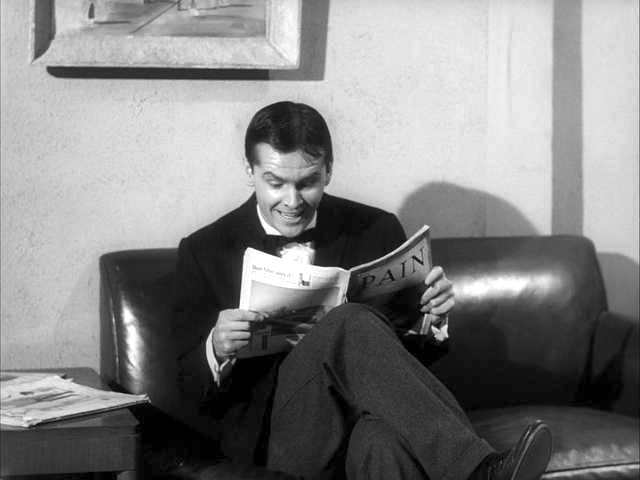
It gained a cult following after being distributed as a B-movie in a double feature with Mario Bava‘s Black Sunday. A small, early role for Jack Nicholson retrospectively helped the film’s popularity when promoted on home video releases. It became the basis for an off-Broadway musical, which in turn was made into a film adaptation in 1986, starring Rick Moranis, Steve Martin, and Ellen Greene.

A link to quotes from the film can be found here. Since Corman never bothered to copyright the film (thinking it had little in financial prospects), it has entered the public domain. A link to the entire film can be found here.

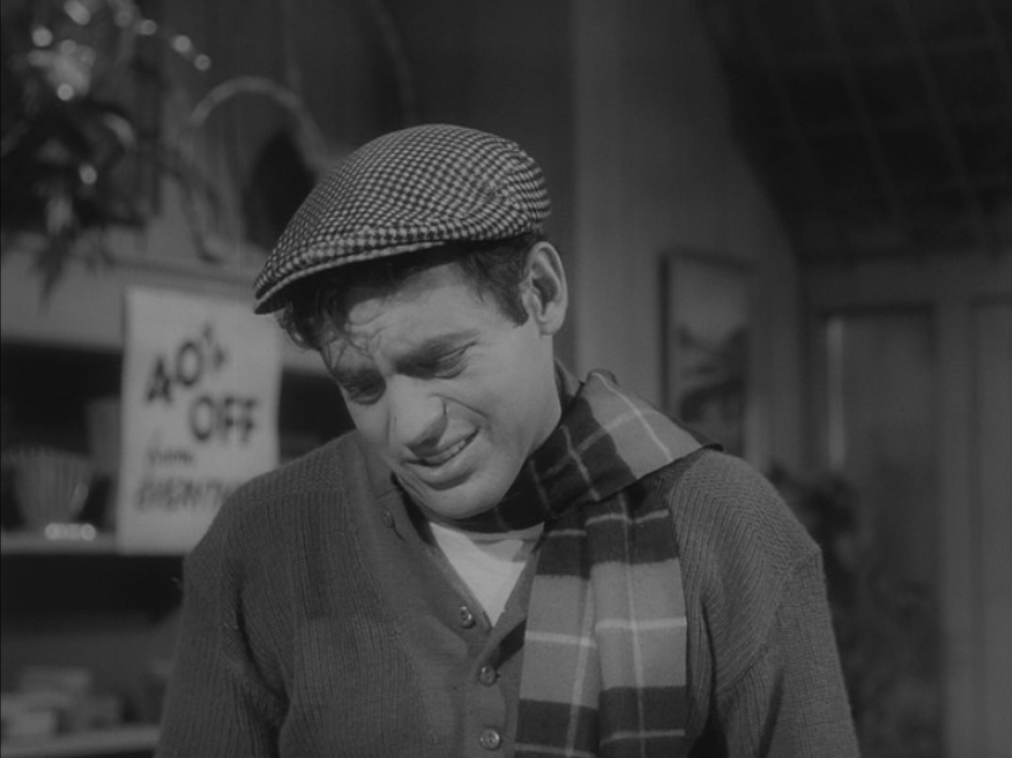
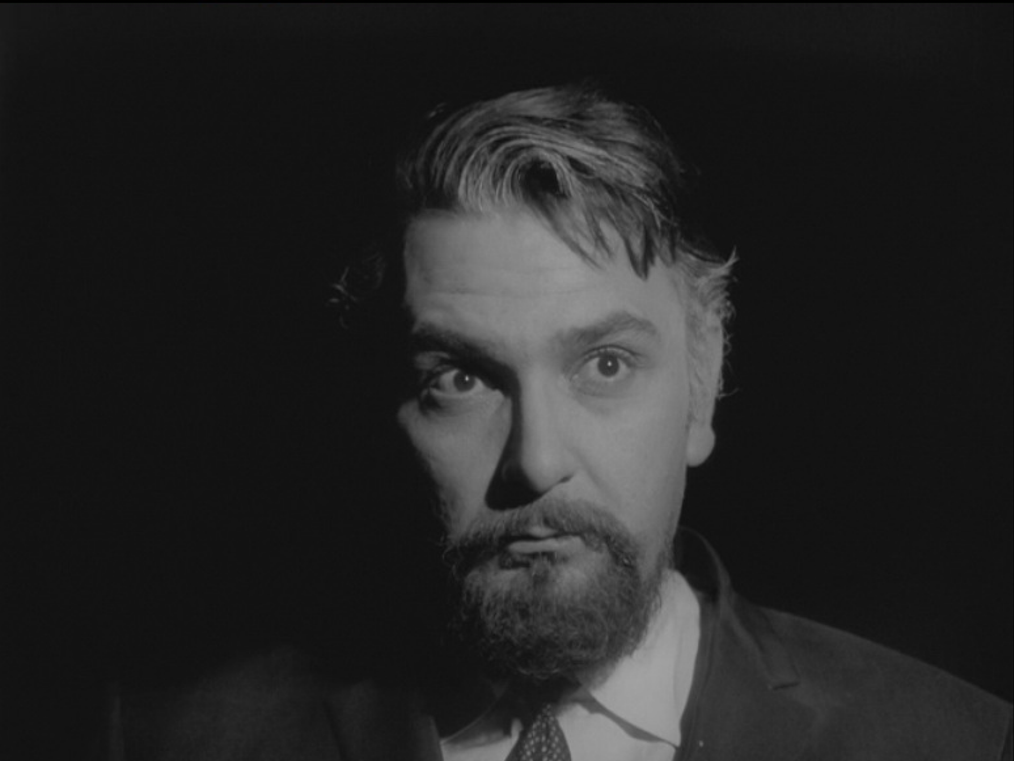
Seymour Krelboined (Haze) is a clumsy, socially awkward florist’s assistant working on skid row in California. His boss is Gravis Mushnick (Welles), a bad-tempered, penny-pinching stereotype of Jewish humour who speaks ungrammatical English, laden with malapropisms, in a thick Yiddish accent. Seymour will be fired for his ineptitude unless he can impress Mushnick with his new plant.

Seymour, Mushnick, and Audrey admiring Audrey Jr.

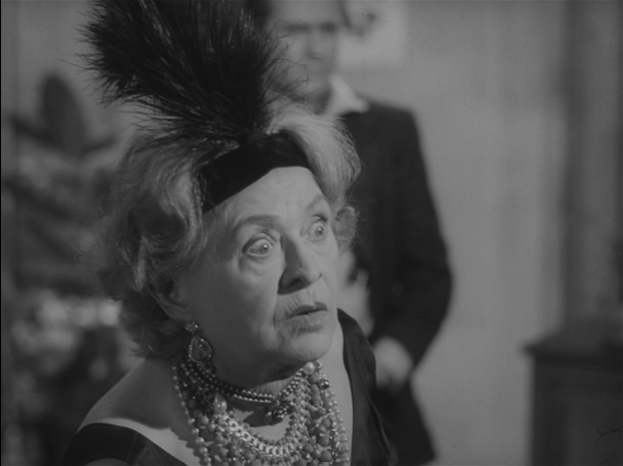
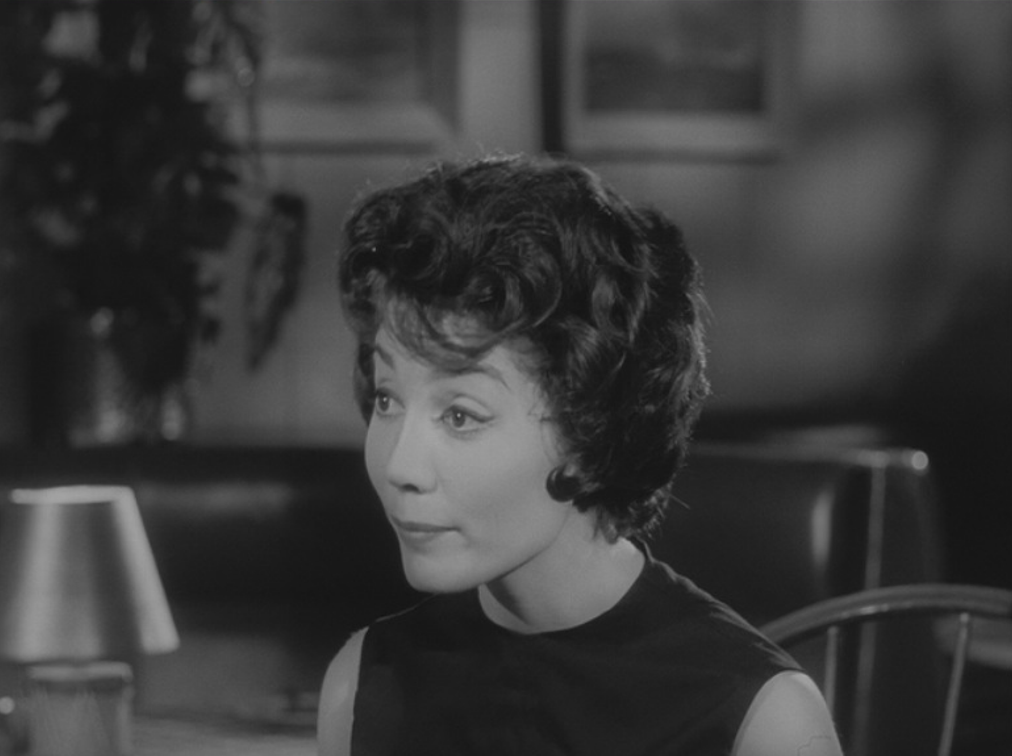
All the characters in this film are comically idiosyncratic in one form or another: Seymour’s love interest, Audrey Fulquard (Joseph), the sweet–if rather ditzy (her dialogue, too, abounds in malapropisms)–girl next door; Burson Fouch (Miller), an eccentric eater of flowers who gives Mushnick the idea to save Seymour’s job by using his unusual new plant to attract customers; Seymour’s hypochondriac mother Winifred (played by Myrtle Vail), who considers medication synonymous with food; ever-mourning Mrs. Shiva (aptly surnamed), who always needs flowers for funerals (hoping for cut-rate prices) for the latest death in the family; Sergeant Joe Fink, the narrator, and Officer Frank Stoolie, two Dragnet-style detectives; Dr. Phoebus Farb, a fittingly sadistic dentist; and Wilbur Force (Nicholson), a masochist who loves going to the dentist.

It’s interesting how Fouch, an eater of flowers, encourages the public display of a plant that, as it turns out, eats human flesh. Flowers are the commodity sold in Mushnick’s shop, of course, and Fouch is a consumer (in more ways than one) of them. The addition of ‘Audrey Jr.’, the giant man-eating variant of a Venus flytrap, to the store will cause business to boom in a way all storeowners dream of, but not even Mushnick will want to pay the gory price that Audrey Jr. demands.

The rapid growth of Audrey Jr., coupled with its appetite for human flesh, can be seen to symbolize the predatory nature of capitalism, which must continue growing, being fed on profits (i.e., the improved business of Mushnick’s flower shop), with no regard for the needs of human life.

So, consumption–in its various meanings–is the dominant theme of the movie: the plant’s consumption of human flesh, Fouch’s consumption of flowers, Mushnick’s customers’ consumption (buying) of his flowers, little Audrey Jr.’s consumption (using up) of Seymour’s blood, his mother’s consumption of medicines as if they were food, and the public’s consumption (i.e., reception of information/entertainment) of the display of Audrey Jr. in the flower shop.

Since the setting of the film is skid row, a part of town where the poor try to escape their troubles in such forms as alcohol and drugs, Winifred’s consumption of medicines can easily be seen as symbolic of drug addiction, especially since the tonic Seymour buys for her is 98% alcohol. She has a few sips and is already tipsy by the time he leaves their house with his then-little plant.

Winifred Krelboined

The symbolic relationship between Fouch’s eating of flowers and Audrey Jr.’s eating of people should be seen as a karmic one. Fouch’s eating of flowers symbolizes man’s destruction of nature by commodifying it; the plant’s man-eating is thus nature’s revenge on man, the destruction of the environment being also our destruction, our collective suicide.

Commodification, the making of exchange-values to generate profits, is the basis of capitalism; small wonder Marx began Capital, vol 1 with a discussion of the commodity. Flowers are Mushnick’s commodities, so Seymour’s plant and its growth represent how the profit made from commodities result in another kind of growth: the accumulation of capital. Audrey Jr.’s bloodlust represents the pain and suffering that inevitably result from all this capital accumulation.

Seymour’s social awkwardness reflects the aggravated kind of alienation one would encounter in the poverty of skid row. He loves raising plants, but he is only of any worth to Mushnick if he can nurse Audrey Jr. to health and present it appealingly to his boss’s customers, getting them to want to buy flowers in the shop. Once the plant’s health has revived, and it has grown thanks to its drinking of drops of Seymour’s blood, his boss no longer loathes him, and even starts calling him ‘Son.’

Two pretty girls, who enter the shop out of curiosity about Audrey Jr., and who wish to decorate a float with flowers, treat Seymour like a pop star upon learning that it is his horticultural skills that have brought the plant to life. After Mushnick, dreaming of wealth and moving his flower shop to Beverly Hills, gives ever-grieving Mrs. Shiva flowers for free, he notices Audrey Jr. sick again, regrets his generosity to her, and instantly reverts to his contempt for Seymour. The boy’s alienation arises from only being of value if he can help his boss make money.

His alienation grows worse when he realizes that the only way he can keep Audrey Jr. alive is by murdering people and feeding it the corpses. Since murder is repellant to his nature, his bloody work is now alienating him from what Marx called one’s species-essence.

Seymour Krelboined

One is alienated from one’s work, from oneself, and of course from other people. Seymour alienates himself from others, though he “didn’t mean it,” but he isn’t the only one. Dr. Farb, the dentist who loves drilling holes in people’s teeth, also alienates people with his sadism. There are the teeth that hack up a man, and there’s a man who hacks up teeth, another reversal comparable to that of Fouch vs Audrey Jr.

There’s karmic retribution in Audrey Jr. eating human flesh, in response to what Fouch’s flower-eating represents (destruction of the environment). Then there’s karmic retribution in Seymour’s killing of Dr. Farb, in response to the dentist’s gleeful torturing of his patients; recall how, in the 1986 film musical, Steve Martin’s dentist sings of people paying him “to be inhumane.” Many high-paid professionals–doctors, lawyers, politicians–do awful things on a scale comparable to those of the greedy capitalist.

The suffering of the poor in such places as skid row, people ever held down under the boot of the capitalist, often leads to varying forms of mental illness, as in Winifred’s hypochondria and the sexual masochism disorder of Wilber Force (Nicholson). While most masochists in the BDSM community engage in their kink in a way that doesn’t cause them psychosocial difficulties, Force’s eager willingness to have (imagined dentist) Seymour pull out several–it is safe to presume–perfectly healthy teeth is clearly an impairment of Force’s functioning in social situations.

Added to all of this, the farcical humour we see in Seymour’s clumsiness, the eccentricities of his mother and Fouch, Farb’s sadism, Force’s masochism, etc., should be seen as representative of the absurdist futility of their existence in an alienating, capitalist society that keeps them in poverty and misery. Even Fink and Stoolie, the police investigating the disappearances of Farb and the railroad detective (whom Seymour accidentally hit with a large rock and made fall on the tracks to be run over by a train), react to the death of Stoolie’s son–who was playing with matches–by nonchalantly saying, “Those are the breaks.”

Audrey Jr.’s chewing of human bodies into pieces, Dr. Farb’s drilling and pulling of teeth, and Force’s delight at getting his teeth drilled and pulled, all represent the psychological fragmentation that results from an alienating capitalist society that privileges the few and impoverishes most of the rest of humanity. Even the budding relationship between Seymour and Audrey doesn’t last long; predictably, the talking plant’s incessant demand, “Feed me!”, is what gets in the way of their love. The growing monster of capitalism eats up everything.

Audrey Fulquard

The two girls who want to feature Audrey Jr. on their float fittingly say that their spectators will “eat it up.” The literal or figurative consumption of commodities leads to the consumers being karmically consumed by their own materialism and commodity fetishism. People see only the growing plant; they know nothing of what it is actually fed to make it grow.

The reversals of Fouch’s flower-eating vs a man-eating plant, and of teeth that mutilate vs Farb’s mutilating of teeth, are a fusion of dialectical contradiction with karma.

Though Mushnick is horrified to find out that Seymour is feeding the plant human flesh, he is conflicted about whether to inform the authorities or to keep quiet and enjoy the new success of his business. It is common for business owners to be conflicted over the need to maximize profit vs the need to be humane towards their employees, to care about the environment, etc. We’ll notice however that, no matter how strongly…and sincerely…the capitalist feels about humanitarian concerns, the profit motive will take priority, because the capitalist is compelled to prioritize profit. Hence, Mushnick’s procrastination with telling the police.

Mrs. Hortense Feuchtwanger, a lady from the “Society of Silent Flower Observers of Southern California,” enters the flower shop and is fascinated with Audrey Jr. If the plant’s buds open on the evening she returns to the shop, and if she likes what she sees, she’ll give Seymour a trophy for his plant.

This trophy would represent the kind of recognition that Seymour, a misfit and ‘loser’ that no one has ever appreciated or liked, so desperately craves. Only recently have any women (Audrey, the two girls with the float, Mrs. Feuchtwanger) ever shown him any liking, and if there’s one thing we all desire, it’s that of the Other, to be desired of the Other, to get the Other’s recognition.

As with his romance with Audrey, though, Seymour’s appreciation from Mrs. Feuchtwanger will be short-lived, too. The lady returns to the flower shop to see the budding, and she is horrified–as are Audrey, Mushnick, Fouch, Winifred, and Fink and Stoolie, who are also there at the time–to see the faces of all those eaten by the plant in its opened flowers.

Oddly, the two girls with the float still like Audrey Jr., looking gleefully at the faces in the budded flowers. They represent the extreme of commodity fetishism: so entranced are they by the plant as a finished product that they show no regard for the victims that helped it grow.

Gravis Mushnick

Recall, also, that as horrified as Mushnick is at Audrey Jr., especially to learn that it is a talking plant, he, too, is willing to have it eat up someone–in this case, an armed robber (played by scriptwriter Griffith, who also did the voice of the plant). Guarding his money is more important to capitalist Mushnick than preventing yet another victim of Audrey Jr.

The robber isn’t the only member of the Lumpenproletariat to be fed to the plant: so is an aggressive prostitute who tries to get Seymour to be her next client. For indeed, with Audrey Jr. as symbolic of the ever-growing, ever-devouring monster that is capitalism, such Lumpenproletariat as criminals and streetwalkers are every bit as much victims of the bourgeoisie as are the strata of the working class just above them.

Capital seems to develop a mind of its own, in how it subjugates us all to the will of the profit motive, even when we try to resist it on moral grounds, as Mushnick and Seymour try to do. This ‘mind of its own’ would seem to explain, in symbolic terms, why the plant can talk, and why it can hypnotize Seymour into doing its will, right when he tries so vehemently to defy it.

So many of us on the left try to defy the system around us that we hate so much, but through the mesmerizing bourgeois media (part of the system’s superstructure), now including Facebook, the narcissistic exhibitionism of Instagram, etc., we all get pulled back into complying. Hence, Seymour wanders the streets of skid row, in such a trance as to ignore the charms of the streetwalker, and takes her back and feeds her to Audrey Jr.

When Fink and Stoolie learn that Seymour is responsible for all the killings, they and Mushnick chase him on the streets of skid row in the night. The two cops represent the feeble attempts that an otherwise bourgeois state makes to curb the excesses of capitalism. That feeble effort is demonstrated in their failure to apprehend ineffectual, spastic Seymour, who should be easy to catch.

Wilbur Force

They chase him into some bizarre, even surreal-looking, parts of town, but they are places nonetheless indicative of the capitalist preoccupation with commodities–rather unclean ones, actually. Seymour is chased into the private property of a tire and rubber company, when he runs and hides in a labyrinth of giant tires. One of the few times he doesn’t trip is over resting Mushnick’s leg, though Fink and Stoolie do trip over it!

Then Seymour hides in, of all things, a toilet among a maze of bathroom fixtures (sinks, bathtubs, etc). Mushnick tells the cops that they won’t find Seymour there, though he is most obviously there. In all of this not only do we see the symbolism of a bourgeois government failing to punish the excesses of capitalism, but we also see a capitalist helping in achieving that failure.

Seymour returns to the flower shop a broken man. Racked with guilt over his murders, he’s lost the woman he loves, he’s a wanted man, and it’s all because of that bloody, gluttonous plant that has repaid his services by ruining his life. In despair, he decides to sate Audrey Jr.’s hunger one last time with his own body…and a knife to kill it with.

A karmic reversal has finally happened to the plant, instead of it being an agent of karma; for such is the reality of the dialectical crests and troughs of theses phasing into negations and sublations that become new theses to be negated and sublated. Now Seymour’s face appears in the latest budding flower, to add to all the other faces. The plant dies, too, and just as capitalism kills, so will it destroy itself in the end.

‘The Splitting,’ a Sci-Fi Horror Novel, Book II, Chapter Six

Michelle returned home that night to see her mom watching TV. Instead of having that unnatural-looking smile on her face, her mother seemed worried about what she was watching on the news.

“Hi, Mom,” Michelle said in a shaky voice.

“Hi, sweetie,” her mom said, still frowning at the TV screen.

“What’s on the news that has you so worried?”

“Oh, it isn’t so much worrying me as it’s just…this nonsense so many people believe about an ‘alien invasion.’ Ridiculous.”

“Oh, you mean those wacko conspiracy theorists?”

“Yes, dear,” her mom said, turning off the TV and standing up. “People are saying that The Splits was really aliens entering people’s bodies instead of the virus it actually was. How can anybody believe such rubbish?”

“I know,” Michelle said, avoiding Siobhan’s eyes. “There are a lot of dumb, crazy people out there.”

“You wanna know what their ‘proof’ is, Michelle? People possessed of the aliens show little to no emotion.” Siobhan let out a loud laugh, which seemed forced to Michelle. “As if there’s no such thing as ordinary people not showing emotions, especially in today’s world, when all those vaccines were draining people of their energy and making people plod around like zombies. You and Peter have noticed that.”

“Yes, we have,” Michelle said, frowning and still avoiding her mother’s eyes.

“And those vaccines, given out years ago, are still showing those effects, to this day. So why make a big deal about lots of people showing no feelings?” Her mom had a huge, ear-to-ear grin, which was supposedly to show how absurd she thought the conspiracy theories were, but which really just looked fake, as if painted on her face. “They say the governments know about the aliens, and are doing a cover-up.”

“Yeah, but some people in those governments really believe this is happening, and they’re sending out assassins to kill anyone they think is possessed of the aliens.”

“Really? Did Peter tell you that?”

“Yes, Mom. Just today. He says he watched a video of Ottawa politicians discussing this plan to kill anyone known to have had The Splits.”

“Now, Michelle, surely you must realize by now that Peter, as much as you love him, isn’t always a reliable source?”

“No, of course he has his loopy moments, more than I care to admit, but if he’s right this time, we need to be careful with you.”

Her mom stared into her eyes with a frown of suspicion for several seconds.

“It’s not so much that I believe his every word. It’s just that I care about you and want you to be safe.”

Siobhan still suspected insincerity in her daughter’s eyes.

“What are your thoughts about this ‘alien’ business?” She continued staring hard at Michelle. A touch of anger was on Siobhan’s lips.

“I–I don’t know what to think.” Michelle began sobbing.

“What nonsense is Peter telling you about me?” Siobhan asked, looking down at Michelle’s purse, with what looked like a tall can of bug spray poking out in a bulge at the side of her purse. “Some of the conspiracy theorists claim that bug spray is what kills the aliens. Surely you don’t believe such nonsense, do you?”

“No, of course not,” Michelle sobbed. “It’s just that I…I…”

“If you don’t, then why have you been carrying bug spray in your purse?” her mom asked with more than a tinge of angry tension in her voice and face. “You aren’t planning, in your paranoia, on spraying your own mother in the face with that, are you?”

“If the theories are so ridiculously untrue, why are you so nervous around bug spray, Mom?”

“I just told you. I don’t want my obviously paranoid daughter spraying it on me.”

“It isn’t sprayed on the people, Mom. When those little lights fly out at us, we spray them, not the carriers.”

“How do I know you’re not going to get nervous around me, think I’m going to send those things out at you, make you fumble in your purse for the spray can, then spray those toxic chemicals in my eyes as a spastic reaction?”

“Because you’re my mom, and I love you!” Michelle sobbed.

Am I your mom?” Siobhan asked with a sneer. “Or am I one of the ‘pod people’? What is Peter making you think about me?”

“I only plan on using it on other people,” Michelle said. “I’ll tell you another reason I won’t use it on you.”

“Oh? And what’s that?” Her mom crossed her arms in front of her chest. “This should be interesting.”

“The aliens won’t come inside me or Peter. We’ve confronted the dots of light several times, and they never enter us or try to take control of us. They just hover in front of us, as if they’re studying us.”

Siobhan was calming down. “Why won’t they go inside you?”

“Peter and I believe they think we’re sympathetic to their ’cause’.”

“That’s right,” her mom said after a huge sigh, then uncrossed her arms and felt herself completely calm now. “We know you’re completely sympathetic, though you don’t know why, and it isn’t yet safe to tell you all the reasons for that sympathy.”

“Mom?” Michelle’s mouth and eyes were wide open.

“I just needed to be sure for myself that you weren’t going to do anything on me with that bug spray.” Siobhan spread her arms out to her sides, and dozens of tiny glowing balls flew out of her hands and hovered in front of Michelle. She froze in controlled fear; she was getting used to knowing she didn’t need to fear them. “That’s right, sweetie. They won’t hurt you.”

“But they will hurt other people. They hurt you. They killed Dad. I don’t want them to kill any more people.”

“They don’t actually kill people.”

“Oh, really? What would you call it?”

Anyone who rejects what we want to do dies of his or her rejecting of our plan. Those who die kill themselves, essentially, out of their own closed-mindedness.”

“That sounds like blaming the victim, Mom.”

“Those ‘victims’ are also victimizers, or at least potential victimizers.”

“That sounds like a rationalization. Are you saying that Dad was a victimizer?

“Yes, I’m sorry to say. I was, too, helping him run that…propaganda-spouting company and ruling over Mississauga, making people think MedicinaTech was the only problem in the world, and distracting people from how we were all part of a much bigger problem, the immiseration of the global poor. Fortunately, when the extraterrestrials entered me, and I went through that painful ordeal, I was open-minded enough to accept the changes they want to make to the world; and so when I got better, I began making democratic changes to the governance of Mississauga and to the management of the newspaper, things your father would never have allowed.”

Something Peter’s parents would never have allowed, either, Michelle thought. “But…you let Dad die,” she sobbed.

“Yes, sweetie.” Siobhan let out a big sigh. “That was hard. It was the hardest thing I’ve ever had to do. But there are greater, global needs, more urgent than just those of our family. The needs of poor, starving families we’ve never met.”

I can’t help thinking Mom’s been brainwashed, Michelle thought. Killing Dad didn’t seem so hard to her when she did it in the hospital. And this ‘save the world’ stuff could be a trick, something they’re trying to get Peter and me to go along with while the aliens plan to do something far more evil.

Standing outside their house and looking through the large living room window at them, a man in his thirties was clutching his pistol, debating in his mind whether or not to pull it out of its holster. I can’t get a clear shot at Siobhan with her daughter standing in the way, he thought. I guess I’ll try tomorrow. I wouldn’t want her daughter to see her mother shot, anyway. It would be too upsetting for her.

Analysis of ‘Sink the Bismarck!’

I: Introduction

Sink the Bismarck! is a 1960 black-and-white British war film directed by Lewis Gilbert and written by Edmund H North, based on The Last Nine Days of the Bismarck (alternatively titled Hunting the Bismarck), a 1959 fictionalized account of the actual WWII naval battles of the German battleship Bismarck and cruiser Prinz Eugen vs. the British Royal Navy, written by CS Forester.

The film stars Kenneth More and Dana Wynter, with Carl Möhner, Laurence Naismith, Karel Stepánek, Esmond Knight, John Stride, Jack Gwillim, and Michael Hordern. The film was praised for its historical accuracy in spite of a number of inconsistencies. It’s to date the only war film to deal with the Bismarck naval battles, and it’s an anomaly in how it focuses much film time on the back-room strategists, as opposed to devoting the film to the combatants themselves.

A link to quotes from the film can be found here.

The film simplifies and distorts aspects of the battles, particularly those involving HMS Hood and HMS Prince of Wales. Though the actual man who oversaw the operation to sink the Bismarck was Sir Ralph Edwards (and the film acknowledges him in the ending credits), the film replaces him with the fictional Captain Shepard (More). Another character, WRNS Second Officer Anne Davis (Wynter), was invented with Shepard, their fictional interplay and chemistry adding human depth and emotional interest to the story, as did the fictional characters Forester added to his account (e.g., Dusty and Nobby).

This fictionalized history, in its book and film versions, is meant of course to dramatize the greatness of the British navy in their heroic struggle against Nazi Germany; but speaking of historical inaccuracies here, there is a context that has to be examined in order to understand the true nature of the conflict between England and the Nazis. The film and book would have us believe that Britain and Nazi Germany were on practically opposite ends of the political spectrum, with the UK’s liberal democracy on one side and German fascism on the other; but the political reality of the time revealed them to be not so far apart as it seemed.

II: Some Much-Needed Historical Context

Contrary to the heroic portrayal of him in the media, including this film, Churchill was a dreadful, even despicable, human being. Being a highly-placed man in the British Empire, he was as preoccupied with maintaining and protecting England’s imperialist interests as Hitler was in establishing Lebensraum for Germany. Such preoccupations included a gleeful, even fanatical, support for violence against the Japanese, Indians, Sudanese, Cubans, etc. He was easily as racist, if not more so, than Hitler, looking down on Native Americans, Australian aborigines, etc., as inferior.

Churchill also opposed women’s suffrage and workers’ rights, busting unions and violently suppressing strikes in a way that Hitler would have admired. He only supported Zionism for the sake of Western imperialist interests; like Hitler, he also spoke of the dangers of the “International Jews.”

Apart from the Churchill/Hitler comparison, the crimes of British imperialism are also comparable to those of the Nazis in terms of how horrific they were. Here are just a few examples: Boer War concentration camps, the transatlantic slave trade, the Opium Wars, the Bengal famine (Churchill diverted Indian food to European troops when a bad harvest had already made such food scarce, causing the deaths of millions of Indians), and the brutal repression of the Mau Mau uprising in Kenya.

Given this bloody context, we are now ready to see the fighting between England and Germany the right way: it wasn’t ‘democracy vs tyranny,’ it was simply inter-imperialist conflict. And just as the Soviet Union had a non-aggression pact with Nazi Germany (which also had a wider context not so well-known, and one which makes nonsense out of the notion of moral equivalency between fascists and communists), so did the capitalist West have such a pact with the Nazis: Munich, at which appeaser Neville Chamberlain claimed he’d achieved “peace in our time.”

Indeed, not only Churchill but many British conservatives (including the aristocracy) expressed support for fascism, for they knew it was an effective weapon against the rise of socialism. People like Churchill and Chamberlain were hoping, by ceding the Czechoslovakian Sudetenland to Nazi Germany, Hitler would be encouraged to go further East, invade the USSR, and crush communism.

Hitler, however, started presenting himself as a threat to Western imperial hegemony, and this caused Churchill et al to change their attitude toward this new imperialist challenger, and to regard him as just as much of an enemy as did Stalin, who’d been desperately trying to get the, till then, deaf Western powers to join him in an alliance against Hitler.

So inter-imperialist conflict is the basis of the fighting between Britain and the Nazis. In the particular instance of this movie and Forester’s book, the Nazis started the failed Operation Rheinübung in an attempt to block supplies from reaching England.

III: Pride

The notion of the British as the heroes and the Nazis as the (only) villains is, as I’ve stated above, a liberal bourgeois perspective, given that in actual fact both sides were imperialists vying for a bigger slice of the pie. This notion of one side as good, more civilized, more advanced, and therefore superior to the other is actually an attitude held on both sides of the conflict, and is thus an expression of national pride.

That ‘pride goeth…before a fall‘ is a recurring theme in this film, and it is noted on both sides of the conflict. While the tone of the film would have us believe that the irrational emotion of pride is far more a pronounced fault of the Nazis than of the British, there are a number of indications, including some Freudian slips, if you will, in the writing, that suggest that the chasm separating Nazi pride from that of the British isn’t as far apart as is assumed.

The film begins with a newsreel showing the 1939 launch of the Bismarck, with Hitler among the attendees. This is a moment of Nazi pride, assuming their new battleship has a Titanic-like invincibility.

Then we have a shot of the approaching Captain John Shepard in May 1941, walking in the direction of the Admiralty in London where he is to be the new overseer of strategizing in the War Room underground. As Shepard approaches, we see a statue of a lion to his left, a symbol of the strength of Britain. A huge flock of birds flies off the ground where he is walking, just before we see the film title flash on the screen; it is as if the birds deliberately make way for our great hero. In these visuals we see manifestations of British pride to parallel that shown in the Nazi newsreel.

We next see Edward R Murrow playing himself, CBS London radio correspondent. As an American broadcast journalist discussing the threat the Bismarck presents to England, his sympathy to Britain represents the solidarity felt between those countries that were and are part of Anglo-American imperialism. He says Britain is fighting alone, a claim easily proven false given the aid England got from her dominions of Canada, Australia, New Zealand, and South Africa, all before the US would enter WWII by the end of the year. This ‘Britain fighting alone’ is just another example of the country’s excessive pride.

IV: Stereotypes

Shepard is in many ways as much the ‘stiff upper lip‘ stereotype of the British as the film’s portrayal of Fleet Admiral Günther Lütjens (Stepánek) is of the Nazis. Within a minute of having entered the War Room, Shepard is quick to find annoyance with the informal work atmosphere he sees: a young man isn’t properly wearing his uniform (no jumper); the charms of the beautiful Davis are jocularly overestimated, by Shepard’s predecessor, as crucial to winning the war; Commander Richards (played by Maurice Denham) is eating a sandwich on duty; and a man addresses Davis as ‘Anne,’ which especially irks Shepard.

This stiff upper lip of Shepard’s extends, predictably, to his refusal to show or talk about his emotions. While part of his reason for this refusal is the pain he felt over the death of his wife during an air raid and the sinking of his ship by a German cruiser commanded by Lütjens, another part of the reason, surely, is his pride, especially seen in his stubborn insistence on the virtue of stoicism as against Davis’s argument for the healthy expression of feelings.

First Sea Lord Admiral Sir Dudley Pound (Naismith) says he’s been told that Shepard is “as cold as a witch’s heart.” Pound approves of this characterization of Shepard, as much of an exaggeration as it is; he wants a man with no heart or soul, but “just an enormous brain.” Fighting the Nazis in the North Atlantic will be “a grim business,” not to be won with “charm and personality.”

The fact is that inter-imperialist conflict is a grim business, making the British as grim in their dealings as the Nazis are. Hence, Pound wants an agent in southern Norway to make direct contact with the Admiralty, as dangerous as making such a contact will be for the agent. The Norway man will be shot by the Nazis in the middle of sending a message about where the Bismarck and Prinz Eugen are sailing, but Pound considers the sacrifice worth it.

V: A Naval Chess Game

Pound and Shepard learn that the German ships are coming out of the Baltic. The two men are looking at a large map on a table with small models of ships that are moved around like chess pieces. Indeed, the conflict turns out to be a “chess game” of sorts between Shepard and Lütjens: who will outsmart whom?

Pound notes the British ships available at Scapa Flow that could engage the Bismarck and Prinz Eugen : HMS King George V, HMS Prince of Wales, and HMS Hood. Pound contacts Admiral Sir John Tovey (Hordern, who actually served as a lieutenant commander in HMS Illustrious during the war) of King George V about the incomplete message from the agent in Norway who was killed: Prinz Eugen was spotted, and one must assume the worst, that the Bismarck is sailing with her.

As other players of this “chess game,” the men on King George V have to anticipate which way the German ships are going in order to intercept them: will they go through the Denmark Strait, will they sail south of Iceland, or through the Faeroes/Shetland passage?

Shepard wants to reinforce the Home Fleet, taking ships away from other duty. He considers taking HMS Victorious and HMS Repulse off escort duty, which would give the commander-in-chief an aircraft carrier and another battle cruiser. 20,000 men’s lives would be risked; Shepard doesn’t consider their lives a gamble, but a calculated risk. Pound approves of his decision.

Defending empire is, indeed, a grim business.

Now that King George V has Victorious and Repulse, Tovey wants the Hood and Prince of Wales in the Greenland area, while the Home Fleet sail from the Scapa Flow area, then south of the Faeroes and Iceland, to be ready to engage the Bismarck south of Greenland if the Hood and Prince of Wales fail…

…which, of course, they will.

Bad weather reinforces the British Navy’s difficulties, making the German ships virtually invisible. Lütjens speaks of the “chess game” he is playing with the British, and he proudly imagines himself able to win. Note the comparison between the stereotypical British vs German forms of pride, the ‘stiff upper lip’ of the former, and the boastful, ‘superior Aryan pride’ of the latter.

VI: Lütjens

Lütjens is, of course, portrayed as a stereotypical Nazi. The historical Lütjens, however, was nothing like this film portrayal, which should help us see that British and German pride aren’t as far apart from each other as is assumed.

The Lütjens of Forester’s book is somewhat prouder, but not as much as he is in the film. The film Lütjens complains of not receiving the recognition due to him in WWI; he is also fanatical in his belief that the Bismarck is unsinkable.

The Lütjens of history, however, was a very different man. He did not agree with Nazi policies: he was one of only a few navy commanders who publicly protested against the brutal mistreatment of the Jews during Kristallnacht. Also, he was one of the few officers to refuse to give Hitler the Nazi salute when the Führer visited the Bismarck on its first and final mission. Such rebellious actions would have taken uncommon courage; it was also in marked contrast to the film’s portrayal of a committed Nazi who’d have us never forget he is a Nazi and a German, and who passionately shouts, “Heil Hitler!

So, this contrast between the stoic Shepard and the crazed Nazi Lütjens is meant to make the former look like the more reasonable man by far. In effect, it’s to make the British seem superior to the Nazis, when as I indicated above, the crimes of British imperialism make England no more guiltless than Germany. Indeed, it is the role of fascism to be the ‘bad cop’ to the ‘good cop’ of the liberal bourgeoisie, when in reality, all cops are bastards.

VII: Shepard’s Mask of Ice

Shepard’s outer shell of stoicism is shown again when he’s asked about his son, Tom (Stride), an air gunner in Ark Royal‘s Swordfish squadron. One assumes the boy’s father would be glad to know he’s (for the moment, actually) far away from the danger of facing the Bismarck, but Shepard says his son must take his chances like everyone else. This would seem a brave, self-sacrificing attitude, but some might think it callous. In any case, the attitude Shepard presents here is fake; he’s just being too proud to admit to his feelings and emotional vulnerability. We’ll know his real feelings for Tom soon enough.

Shepard is again cold to his staff when he learns a young officer named Dexter is late for duty, though only a little. Commander Richards, the man to be relieved by Dexter, doesn’t mind the lateness, but Shepard does. He punishes the boy by requiring him for duty the next three nights. Richards pleads for Dexter, saying the boy wishes to have some time to spend with his girl, an army nurse, before she’s sent off from Portsmouth to go overseas; but Shepard won’t make an exception.

Shepard’s insistence on this punishment happens during a scene when Davis has discussed with him the loss of the man she loved, a “wonderful man” who was missing in action at Dunkirk the previous year. She has argued how good it is to talk about one’s feelings, while Shepard of course doesn’t think so. He similarly shows no warmth or pity to Dexter’s now being unable to be with his girl.

The reality of imperialism, as a modern extension of capitalism, is that it causes alienation to metastasize. We see this intensified alienation in Shepard, as the Director of Operations for the imperialist British fleet, in his callous attitude toward such young people in love as Dexter. While he shows a modicum of sympathy for Davis (presumably because of her elegant beauty), he still won’t concede any validity to her belief in the goodness of showing feelings.

Another provocation, happening by the end of that same scene, challenges an uncovering of Shepard’s outer mask of stoicism: he learns that Lütjens, who sank his ship, is commanding the Bismarck. Since he’s dealt with Lüjens before, though, Shepard will be able to get good hunches about what his nemesis plans to do.

VIII: Bismarck vs Hood

The Bismarck and Prinz Eugen are spotted sailing in the Denmark Strait, so the Hood and Prince of Wales (the latter of which has civilian workers aboard) will have to confront them the next morning. Captain Leach (Knight, who actually served as a gunnery officer on board the Prince of Wales, where he was seriously injured and blinded during the battle with the Bismarck) tells his men to get a good night’s sleep in preparation for the coming battle.

To get back to the theme of pride before a fall, the Hood is the pride of the British navy. When the men in the War Room know the Hood is about to face the Bismarck and Prinz Eugen, the Assistant Chief of the Naval Staff (played by Geoffrey Keen) proudly says, “Good old Hood; she’ll get them.”

The problem is, of course, that she won’t get them. Instead, the Bismarck first hits the Hood, only slightly damaging her, then after another salvo, the first three shells of which hit the water near the Hood, the fourth hits just below its main mast, penetrating the deck armour, and the Hood‘s deck explodes. Both the British and German sides are shocked at the destruction of this once great ship. What’s left of it is covered in smoke. The destruction of the Hood is thus a parallel of the upcoming destruction of the Bismarck, indicating a parallel of British imperialist pride with that of the Nazis.

IX: Parallels

There are enough parallels, or doublings, of so many aspects of the British and German sides in this film, revealed in a more or less Freudian slip-like fashion (i.e., not consciously expressed as doubles or parallels), as to justify–along with the British imperialist crimes mentioned above–the near moral equivalency of the British and the Nazis.

As noted above, the Hood and Bismarck are parallels, the pride of their respective countries’ navies, and they will both meet their demises. Shepard and Lütjens are doubles. Both are embittered from misfortunes of one kind or another from their pasts. The pride of Shepard and Lütjens will, in one sense or another, fall: the former will have to own up to his emotions, and the latter will face the consequences of his overconfidence.

Recall the difference, however, between the film’s portrayal of Lütjens and the historical man, who far from being overconfident, was actually pessimistic about the Bismarck‘s chances of a successful mission. In the film, Captain Ernst Lindemann (Möhner)–who is a parallel to Shepard’s Davis in being a soft-spoken voice of reason trying to temper the stubborn pride of his superior–is ordered by Lütjens to fire on the Hood; while the Lütjens of history ordered Lindemann not to engage the Hood, with Lindemann attacking despite his superior’s orders. And if the Lütjens of the film takes reckless chances, so does Shepard in his giving the Home Fleet Victorious and Repulse, risking the lives of 20,000 men.

The only reason we in the Anglo-American world consider the British in the film to be bold and daring in their risks, while considering the Nazis to be reckless in theirs, is because we have been culturally conditioned to sympathize with the former imperialists and not with the latter. In reality, neither side should have been sympathized with.

Another parallel, or doubling, in the film is the phone call from Churchill to the Admiralty and the telegram from Hitler to the Bismarck. We all know Hitler was a warmonger, but in Forester’s account (page 77 of this pdf), Hitler calls Churchill a warmonger (which he was, technically).

X: Damaging the Prince of Wales

To get back to the story, though, with the Hood gone, it’s up to the Prince of Wales to fight the Bismarck. The British ship hits the Bismarck on the bow, then the latter hits the former on the bridge, killing all but two men there. Hit several more times, the Prince of Wales has to retreat.

Directly below the flaming wreckage of what once was the bridge is the chart room, where the navigating officer sees blood dripping from the voice pipe onto his chart. This scene is in Forester’s account (page 55 of the pdf), and it is reproduced in the film.

Proud of his victory over the Hood and the Prince of Wales, Lütjens wants to continue sailing in the Atlantic in search of more opportunities of Nazi glory. (His pride is shown in both the book [pdf pages 61-64] and the film.) Damage to the Bismarck, however, has caused an oil leak, and Lindemann wants to return to Germany for refuelling and repairs. Proud Lütjens won’t have it, though, and he’ll have news of his victory sent to Berlin; repairs and refuelling can be done in Nazi-occupied Brest instead.

Sad news of the destruction of the Hood is disseminated throughout the Allied press, including Murrow’s sombre report, contrasting with the proud, jubilant news of the same thing in the Nazi reporting. The film and book–the latter dramatizing the loss through the grieving mother of a seaman named Nobby (pdf page 59)–would have us commiserating with the British, and looking with sober eyes at the Nazi gloating; but since, as I’ve said above, it’s just one criminal empire fighting a criminal would-be empire, the opposition between both sides should be seen as a dialectical sublation, not a Manichaean dualism.

XI: Airplanes

Prinz Eugen breaks away, heading to Brest. Shepard is aware that his son, Tom, is going to be exposed to the danger because Force H, the Ark Royal and its Swordfish planes are being deployed to hunt the Bismarck. Shepard’s efforts to contain his emotions are being tested once again.

After evading the radar of the Suffolk and Norfolk, the Bismarck (located by Catalina flying boats) is to be slowed down by an air strike from the Swordfish torpedo bombers. Another fall of British pride comes when, not only do the airplanes mistakenly attack the Sheffield, thinking she’s the Bismarck, but also the torpedoes used have an unreliable magnetic detonator that tends to cause them to explode just after being dropped in the water (pdf page 107). If my lip-reading is at all reliable, the captain of the Sheffield (played by John Horsley), in annoyance with the friendly fire incident, seems to be saying, “Stupid fucking bastards,” the audio being out for obvious reasons.

Later, the Swordfish return with conventional contact exploders, and one of their torpedoes detonates near the stern, jamming the Bismarck‘s rudder, slowing her down, and making manoeuvring impossible. Undaunted in his stubborn pride, Lütjens tells his men (who in Forester’s book haven’t properly slept in days…no rest for the wicked!) not to lose heart, for U-boats will be coming to help soon (the Luftwaffe will come, too), and of course the Bismarck is, apparently, unsinkable. His pride is about to come crashing down with his ship.

Tom Shepard participates in the earlier airstrikes, and with them comes news of his momentary disappearance. Naturally, the boy’s father is shaken upon hearing the news, desperately trying to contain himself with that mask of stoicism. Shepard has been warming up to Davis, though, little by little; and he follows her advice about talking about his feelings.

XII: Feelings

He tells her his reason for refusing to acknowledge them: the death of his wife has made him believe the disavowal of his feelings will shield him from future hurt. But he forgot about his strong love for his son. Another strong feeling of his, pride, has been thwarted in his forced confrontation with that love.

When he finally learns that his son is alive and well from a phone call, he freezes and cannot answer. He is suspended between the stoic front he always puts on and the awesome wave of relief that has washed all over him. He steps out back to shed a few embarrassing tears, and Davis has noticed; but she’s too elegant a lady to let him know she’s seen him in such a vulnerable state. The film’s sympathy to Britain softens this fall of pride.

XIII: Sinking the Bismarck

The most brutal fall of pride, of course, is reserved for the men of the Bismarck, since it is the filmmaker’s (and Forester’s) intent to maximize the contrast between the UK and the Nazis, and therefore their respective falls of pride. Lütjens has received a telegram from Hitler saying that all of Germany is waiting to welcome him as their great hero. They, of course, will never receive him, since he will die, ironically, with the telegram on him.

The destruction and sinking of the Bismarck (finished off by Dorsetshire) is shown in all its brutality, with salvo after salvo hitting her and penetrating that thick armour, a man from King Charles V saying, “Shoot!” over and over again. We see Germans trying to rescue their wounded on a stretcher, then a shell hits the ship, throwing the men and making them drop the wounded. Men down below race in the rising, flooding water, trying to escape a drowning. Men open a top hatch only to find flames preventing their escape.

Now, Admiral Tovey is gracious enough to have the Dorsetshire rescue the German survivors, but one controversial historical detail left out of the film is how this ship quickly left after rescuing only 110 Germans, because a U-boat was suspected to have been in the area. The film must do all in its power to portray the British as well as possible, while doing a caricature of Nazi evil.

XIV: Shepard and Davis

The potential for a romance between widowed Shepard and Davis has been kindled in her preference to work for him over a job offer in the US. He asks her out to dinner, thinking it’s evening, when in fact it’s the morning, so they leave the Admiralty to have breakfast together instead. This minimizing of any romantic chemistry between them seems another example of stereotypical British stoicism, the affectation of virtuous self-control.

Shepard and Davis walk away in that same shot that introduced him, with the lion statue on the left and the flock of birds flying off to make way again for the hero who now gets the girl. It’s pride in would-be British superiority on display once again, in contrast to the Nazi pride that the imperialist British navy felt they had a right to judge.

XV: Conclusion

My point is that while Nazi Germany’s racism, brutality, and imperialism were blatant and obvious, the British version of these vices has been obscured in a cloak of ‘civilization.’ The conventional capitalism of the UK, the US, Canada, Australia, New Zealand, etc. is perceived by many as innocuous (thanks in large part to the propaganda of films like Sink the Bismarck!, which aim to glorify these countries), while only the authoritarianism of fascism is seen as cruel and barbaric.

Mainstream Western capitalism is, however, on a continuum with fascism, the latter not emerging until the hegemony of the former is threatened by socialism, the true opposite of both ideologies. The bourgeois liberal would have you believe that not only is his ideology opposed to Naziism, but that…an obscene comparison!…fascism and communism are somehow sister ideologies. The fighting between the British and Nazi navies in this film is supposed to represent the opposition between mainstream capitalism and fascism, when really the fighting only represents a competition between the imperialism of two countries. After all, competition is part of the core of capitalism, so inter-imperialist conflict is to be expected.

As for the absurd comparison of fascism and communism, a study of the far more significant fighting of WWII–that on the Eastern front, between the Nazis and Soviets, a bitter struggle that dwarfs that of the Western front–should clear up any confusion about where those two ideologies truly stand in relation to each other.

And as for the actual comparability of bourgeois liberal ‘democracy’ and fascism, consider a few quotes from the ever-maligned Stalin: “Social democracy is objectively the moderate wing of fascism.” (And social democracy is the most leftward-leaning of bourgeois liberalism; consider, therefore, how much closer to fascism the ‘centrism’ of the Clintons, Blair, Obama, Biden, and Macron are!)

To clarify the meaning of the above Stalin quote, consider this other one of his: “What would happen if capital succeeded in smashing the Republic of Soviets? There would set in an era of the blackest reaction in all the capitalist and colonial countries, the working class and the oppressed peoples would be seized by the throat, the positions of international communism would be lost.” The depredations of thirty years of post-Soviet neoliberalism have proven Stalin to have been prescient.

In sum, England’s defeat of the Nazi threat to her shipping routes was heroic and salvific only to her, not to the preservation of ‘democracy.’ It’s only natural that, when two empires collide, they fight. The British saw themselves as trying to better the lives of their own people; so did the Nazis with respect to Germany. None of this, however, is to the betterment of humanity in a global sense.

Indeed, the oppressed peoples outside of the Anglo-American world see the political situation quite differently. One doesn’t fight empire with empire (consider Operation Paperclip and the tensions that led to the building of the Berlin Wall to see how ex-Nazis continued to collude with the capitalist West); one fights–and defeats–it with anti-imperialism.