The Tanah–Migrations, Chapter Four

[The following is the sixteenth of many posts–here is the first, here is the second, here is the third, here is the fourth, here is the fifth, here is the sixth, here is the seventh, here is the eighth, here is the ninth, here is the tenth, here is the eleventh, here is the twelfth, here is the thirteenth, here is the fourteenth, and here is the fifteenth–about a fictitious discovery of ancient manuscripts of a religious text of narratives and magic spells. Its purpose for my readers and me is to provide a cosmology and mythography on which I am basing much, if not most, of my fiction–short stories and novels. If anyone is interested in reading this fiction, he or she can use these blog posts as references to explain the nature of the magic and universe in my fiction.]

Years went by, and the Luminosians enjoyed themselves in their new, stolen homes. They kept using their magic for their own selfish purposes, much to the dismay of the elders, who never kept quiet in their complaints.

Not only did they use their magic to deter the hungry Zagans from fishing in the nearby lake or eating the fruit of the trees surrounding the city, but the Luminosians also used it to create more wealth and abundance for themselves, as well as other physical pleasures.

Some Luminosians used magic to create alcoholic drinks and narcotics for themselves, which of course were used to excess. Others used it to seduce women, or to force themselves on women. Love as a mutually shared experience was growing rarer and rarer.

And still, the Zagans starved and starved.

There is one story of a young Luminosian man who ached over the charms of a beautiful girl who lived in the house next to his. He’d look out his side window into hers, and steal glimpses of her undressing, to see her beautiful figure, creamy skin, and long, wavy black hair. He had to have her.

So one day, standing by the rear window of his house (where the starving Zagans could be seen at a distance–not that he bothered to notice them), he lit a small fire and invoked Nevil. He closed his eyes, took several long, deep, slow breaths, and allowed himself to be relaxed enough to be in a trance and be receptive to the Crim of fire and passion.

In that special, mystical language, he chanted, “Nevil, make her want me,” over and over again.

The heat and the smoke wafted from his small flame, through the side window, out and through the side window of her house, and finally to her bed, where she was napping. She breathed the heat and the fumes through her nostrils.

She woke up and coughed. Then she looked through her window and saw him through his. Her eyes welcomed him to come over, which he immediately did.

He had her aggressively on her bed. When he was finished with her, he looked down at her nakedness, and found he hated her for having been so cheap.

She’d woken out of her torpor and trance, then screamed to see this beast on top of her. Now, he hated her all the more.

He started to beat her like an animal. When he was finished hitting her, she was dead, all bruised and bloody. He put on his clothes and walked out of her house with a haughty pout on his face.

Another story is about an older man sitting by his rear window, where he could see, far off, the starving Zagans. It grieved his heart to know that the home he’d acquired came from the loss of those who’d lived in it before him. Did he repent of his wrongful gain, though, and strive to give it back to the original Zagan owners? No.

He tried to ignore his sin by magically conjuring up narcotic and alcoholic pleasures. He turned his head away from his window.

He took a small plant in a pot of soil and watered it. He breathed in and out, slowly and deeply, with his eyes closed, until he was in a deep trance. By the window, he waited for a gust of wind. When it came, he chanted in the mystical language, over and over, “Drofurb, Priff, and Weleb, give me euphoria!”

After chanting this enough times, the plant grew into something leafy and exotic. He used a knife to cut off some of the leaves, then diced these into tiny pieces, and put them in a pipe that he then lit. He now invoked Nevil with the chant, “Nevil, give me euphoria!”

After chanting this enough times, he smoked the pipe. A foggy blur passed before his eyes. Now, the plant that he was using already had narcotic properties; but the invocation of the four Crims was meant to build a much more powerful euphoria…and it did just that for him.

After the foggy blur, he saw a wavelike movement all around him, as if he were in the sea. A tingling, massage-like sensation went all through his body. He closed his eyes, grinned, and leaned by his rear window. Then he opened them and looked outside.

He could see the starving Zagans way out there, a man, a woman, and their three little children. The drug was not making them look human, though. Instead, they all looked ugly, deformed, monstrous, and threatening.

He scowled at them and raised his fist in a fury. “Crims,” he said in a raspy voice. “Destroy them! They are a danger, a threat to us Luminosians!”

He looked up in the sky and saw a large ball of fire dropping over the Zagan family. It hit them with a blinding blast of white light that shone everywhere he could see, making him squeeze his eyes shut. When he opened them, the family was no more. He saw only a large, black spot shaped like a star on the ground where the fireball had burned it. He smiled.

The next day, after his euphoria was over and he could see and perceive everything normally, he looked out that window again. The black spot was not there.

The emaciated bodies of the Zagan family were there, though, lying dead–not killed from a fireball, as he had hallucinated, but from hunger.

He hated the family even more for having made him feel so bad. “I’m glad they’re dead,” he hissed.

After a month of this kind of Luminosian debauchery and wickedness, a heavy rain fell on Zaga, lasting for days and flooding the city with water that went up to a man’s waist. The elders emerged and told all the Luminosians that the flooding was a sign.

“Did we not warn you?” one of the elders said. “We are to be punished for our sins–all of us!”

“Oh, be quiet, old man!” a young Luminosian man said. “If Priff had wanted to punish us, the flood would have gone up much higher, drowning us all. We need only reroute this water over to the lake and sea.”

“We never said this flooding was in itself the punishment,” another elder said. “Only that it is a sign of future punishment.”

The young man laughed at him.

A week later, as the rerouting of the water was underway, and many Luminosians not participating in the work were in their houses enjoying magically-enhanced sex and narcotics–similar to the stories of the two men related above–the footfalls of many horses could be heard in the distance. As the sound came closer, the heads of the Luminosian workers turned to listen and look.

On those approaching horses was an army. Each mounted man had either a spear or a bow and arrow ready to shoot. The leader of the army noted how defenceless the Luminosians, now knee-deep in the water, were. “Hold your fire,” he told his men. “As long as they don’t resist us, we’ll take them without need of violence.”

The army descended from the very cliff that the Luminosians had descended when they took the city from the Zagans. The army entered Zaga, their horses wading in the water, and their men pointed their arrows and spears at the helpless Luminosians. “Continue your work,” the second-in-command of the army told them. “Finish rerouting the water for our city, for it is ours now. Then we will find new work for you.”

The Luminosians were in such shock and disbelief that they seemed no more sober than those in their houses using narcotics. The elders looked sadly at their fellow, sinning Luminosians with a look telling them that they had been duly warned. Any surviving, starving Zagans watching from afar felt some comfort in knowing their tormentors were now about to feel a similar torment.

The leader of the army had his men search the houses of the decadents indulging in fornication and narcotics. When he learned of their sin, he ordered his men to have the sinners rounded up, dressed, sobered, and taken away to be slaves in the country from which the army had come, Zoya.

Commentary

The manuscript breaks off here, and no subsequent chapters relating the fate of the Luminosians, in their new state of slavery and drudgery, have been found. It is clear, though, from the next set of writings, ‘The Laws,’ that the missing writings must have commented on how the Luminosians had learned, the hard way, that their magic should have been used for selfless, not selfish, ends.

As was mentioned in the commentaries of the previous chapters of ‘Migrations,’ one can see how the ancient world had its share of people who decried the evils of settler-colonialism and decadent indulgence in sex, drugs, and alcohol to the point of disregarding the political evils of the world. So many today, among the wealthy and famous, could learn lessons from ancient writings like these.

Analysis of ‘Breakfast at Tiffany’s’

Breakfast at Tiffany’s is a 1958 novella by Truman Capote. It was adapted into a film by Blake Edwards in 1961, starring Audrey Hepburn and George Peppard, with Patricia Neal, Martin Balsam, Buddy Ebsen, and Mickey Rooney. The film differs from the novella in many significant ways, as will be discussed below.

The novella is so short, not even a hundred pages, to go by the edition I have, that ‘novella’ seems to describe a story too long for BAT, and ‘short story’ is too short for it. Since, as is the case with my copy, the story is often published with three short stories–“House of Flowers,” “A Diamond Guitar,” and “A Christmas Memory“–I’ll make a number of references to these stories whenever they share comparable or contrasting themes with BAT.

The novella is as short as it is, but the film is almost two hours long, suggesting a much longer story. Neal’s character, Mrs. Emily Eustache “2E” Failenson, is nowhere to be found in Capote’s story.

The unnamed narrator of the novella is named Paul Varjak (Peppard) in the film. He and Holly Golightly (Hepburn) develop a love relationship that is absent in Capote’s story (in fact, true to the writer’s own sexuality, the unnamed narrator–it is implied–is gay, therefore making his story at least somewhat autobiographical, since the narrator is as much a writer as Capote was).

The regrettably racist caricature of a Japanese, in the klutzy Mr. Yunioshi–played by Rooney in yellowface–isn’t in Capote’s story, either, though Yunioshi is referred to with a racial slur–a “Jap”–by Joe Bell, a bartender near the beginning of the story.

The film ends with a typical Hollywood rom-com cliché, with Varjak getting the girl and kissing her in the rain; while in Capote’s story, there is a far more ambiguous and uncertain ending, with Holly leaving the narrator and going off, out of New York City and into the world.

As for the casting of Holly for the film adaptation, Capote was hoping for Marilyn Monroe to play the part, and he was angry that the part ended up going to Hepburn (though he came to like her performance, all the same). Given that Holly is a romantic dreamer of a girl, chasing wealthy men, I find Capote’s preference of Monroe to play her strange and ironic, when Monroe, having married Arthur Miller at one point, demonstrated left-wing sympathies that may have contributed to her having been murdered, as opposed to the official suicide story of her death. The only thing Monroe had in common with Holly was the blonde hair (well, bleach-blonde, in Monroe’s case), and so brunette Hepburn had blonde streaks added to her hair.

The opening scene in the novella is nowhere to be found in the film, which during the credits shows Holly window-shopping outside a Tiffany’s store. We come to understand that Holly loves being in Tiffany’s because the luxury jewelry store is the only place where she can feel a sense of safety, peace, and calm in her turbulent world. She imagines that nothing bad can ever happen there.

She denies that she likes Tiffany’s for the jewelry (Capote, page 35). While it may not literally be the jewelry that she likes so much about the store, surely it’s the sense of a luxurious life that Tiffany’s represents that gives her that safe, serene feeling.

Holly is a socialite who, as a kind of “American geisha,” dates wealthy men and accepts cash gifts from them; she also aspires to marry such a man. If it isn’t about the wealth that makes Tiffany’s so appealing to her, then why is it that store, of all stores, that gives her that feeling of peace and security?

Material abundance, of the sort that a luxury jewelry store can easily represent, can give one a great and obvious sense of security, of safety and therefore of calm, peace, and serenity, that nothing bad can happen. Thus, Tiffany’s is a capitalist paradise. After all, money isn’t everything, but having one’s basic material needs taken care of certainly gives a sense of peace of mind, so material abundance ensures that peace of mind all the more.

Why does Holly want to “wake up one fine morning and have breakfast at Tiffany’s” (page 35)? Why breakfast at Tiffany’s, which at the time sold only jewelry, and not food (the Blue Box Café first opened in 2017)? Consider the origin of the word ‘breakfast’–a breaking of a fast. So it’s the ending of a period of going without food.

The implication here, symbolically understood, is that one is going from rags to riches, from fasting or starving to abundance, all in one fell swoop. Such has always been Holly’s ambition: to go from her humble beginnings as Lulamae Barnes, married in her teens to a veterinarian named Doc Golightly (Ebsen) in Texas, to her now glamorous life in New York City, renamed Holly Golightly and chasing rich men to subsidize her now high-maintenance lifestyle, and thence, she hopes, to marriage and solid security with such a rich man, who would be Tiffany’s personified.

What we have here is a traditional woman’s version of the American Dream: social mobility through marrying up. The story takes place before the Sexual Revolution, and so women were still chained to the fetters of traditional sex roles, meaning they had to get their access to wealth through successful men…if they were young, pretty, and desirable enough…which Holly assuredly is, at the age of about eighteen or nineteen.

Beyond this dream of chasing wealth, though, is the pursuit of what Lacan would have called an ultimately unfulfillable desire. Tiffany’s symbolizes a nirvana one can never attain, though Holly will never stop trying, romantic dreamer that she is. She can never settle for an ordinary life, and that’s why she leaves New York City and the unnamed narrator for the unknown at the end of Capote’s novella. She may not have married José Ybarra-Jaeger (José da Silva Pereira in the film, played by José Luis de Vilallonga), the rich Brazilian diplomat, but she does go to Brazil in search of a similar dream.

This endless seeking out of more and more to satisfy a desire that can never be satisfied, is not only the essence of what drives Holly to do what she does (symbolically, what Lacan would have called jouissance), but also her unfulfillable desire can be paralleled to capitalism’s endless pursuit of profit (i.e., the Marxist notion of surplus value and Lacan’s plus-de-jouir, or “surplus enjoyment”). Hence, Tiffany’s can be seen as a capitalist paradise.

It is common for people to dream about striking it rich rather than doing the hard work of fighting for workers’ rights and reducing income inequality. Hence, even in today’s world of the obscenely wealthy few vs the impoverished many, we still have all this simping for billionaires going on. Holly can be seen to represent such people, on at least some level.

We can contrast her lifestyle among the affluent in New York City with the uniformly poor in “House of Flowers,” set in Third World Haiti, “A Diamond Guitar,” set in the austerity of an American prison, and “A Christmas Memory,” about a family so poor that the narrator, when a boy and close to his older female cousin, had to save up every penny they could get over the year to pay for the ingredients they needed to make Christmas fruitcakes (page 144). While Holly dreams of the security that comes from wealth, so many others just struggle to survive.

Capote’s novella begins with bar owner Joe Bell telling the narrator about photos of a black man holding a wooden sculpture of a woman’s head, and the woman looks exactly like Holly. Yunioshi is the one who found the wooden head while traveling in Africa, and he informed Bell of it.

It seems that Holly’s been to Africa some time since the end of the narrator’s story about her. Bell imagines she’s “got to be rich to go mucking around in Africa.” (page 8) In this incident, we see again the contrast between being a girl from the First World Who aspires to wealth, and people in poverty with much more humble dreams, as those in Capote’s aforementioned three stories.

The story about her in Africa causes the narrator to recall his story about her from years before, back in the 1940s. Though she had dreams of wealth, she lived in a modest brownstone apartment building in Manhattan’s Upper East Side. Yunioshi, in an apartment on the top floor, complains about Holly ringing his bell and waking him up to open the door for her.

This scene corresponds with the beginning of the film after the opening credits, though as I said above, the novella doesn’t portray Yunioshi as a spastic racist Asian stereotype, bumping into things, and having buck teeth sticking out of his face. Blake Edwards films are full of slapstick, but it’s sad that he stooped to this low for cheap laughs. In all fairness to Rooney, though, when he realized how offensive his performance was, he expressed the deepest remorse and publicly apologized to Asian communities. Edwards was similarly contrite.

Anyway, the narrator has seen her for the first time during this altercation with Yunioshi (page 11). He describes her as having “an almost breakfast-cereal air of health” (page 12). In this context, we note that a man who’s just “pick[ed] up the check” for her, one of those male pursuers of hers who pay for things for her in the hopes of getting…something…back from her. This picking up the check is the so-to-speak breakfast–the end of her poverty–that she hopes will one day lead to Tiffany’s.

From then on, she isn’t ringing Yunioshi’s bell, but the narrator’s, and they haven’t met yet (page 13). He learns more about her nonetheless, such as her cat (which is never named) and her playing the guitar, something she sometimes does sitting out on the fire escape as her hair dries (page 15). We’re reminded of the scene in the film when Hepburn is there, strumming and singing “Moon River,” with music by Henry Mancini.

When the narrator finally does meet her, it’s out by his window. Coming into his room, she explains that she’s trying to get away from another suitor. She notes the narrator’s resemblance to her brother, Fred, and so, feeling a brother transference, she wants to call him Fred. Note how she doesn’t go by her real name (Lulamae), she doesn’t call the narrator by his real name (which we never learn in the novella, and as I mentioned above, is given as Paul Varjak in the film), and the cat is never given a name (except “Cat” in the film).

At the end of the film, Holly contemplates their no-name status when justifying to Varjak why nobody belongs to anybody, and saying that she doesn’t know who she is. Namelessness, thus, represents social alienation, between people and in one’s own species-essence.

Linked with this alienation from within and without is how OJ Berman (Balsam) characterizes Holly: “She is a phony,” and “She isn’t a phony because she’s a real phony.” (page 27) Berman is a Hollywood talent agent who has groomed Holly in the hopes of making her into a movie star. She believes all the nonsense she says about herself, and his grooming of her, which has included French lessons to help her get rid of her original hillbilly accent from Texas, has been part of the process of creating her phony personality as a café society girl. (page 29)

To get back to her meeting of the narrator, he tells her he’s a writer. He also tells her that it is Thursday, which reminds her that she has to go to Sing Sing and meet a mafia man incarcerated there named Salvatore “Sally” Tomato. She’ll get the “weather report” from him: a coded message to transmit information about such criminal activities as the narcotics smuggling that she’ll get entangled in and arrested for towards the end of the story. She’ll give that “weather report” to Sally’s lawyer, Oliver O’Shaughnessy, every week.

As I’ve pointed out in many other posts, I regard mafia men in movies and fiction as representative of capitalists in general, since as a Marxist I regard capitalism’s accumulation of surplus value to be a theft of the value that workers put into the production of commodities; therefore, capitalism in general is criminal activity, whether legalized or not.

Holly’s regular involvement with Sally, therefore, is part of her own simping for the rich, which in turn is part of her dream of finding that peace and security that comes from wealth, as represented by Tiffany’s. The chaotic and troubling world from which she wishes to escape into a capitalist paradise is the capitalist hell of poverty, which she naturally fears. One is reminded of what Belle says to Scrooge in A Christmas Carol as an explanation for his own pursuit of wealth: she says to him, “You fear the world so much” (Dickens, page 50).

To get back to OJ Berman and whatnot, he first appears at one of Holly’s many parties, in which she hobnobs with rich and socially important people like him. In the film, you can spot a couple of Asians in the background, extras with no dialogue: they seem to be there as if to say, ‘Look, the filmmakers are not saying that all Asians are like Yunioshi.’ The inclusion of these two non-caricatured Asians hardly compensates for Rooney’s performance, though.

One presumably wealthy man that Holly shows interest in is Rusty Trawler. He’s thrice divorced, but he’ll end up marrying someone else (page 66). Rusty also seems to be a Nazi sympathizer, for according to a set of clippings from gossip columns about Holly and Rusty, “he attended rallies in Yorkville“, he’d “sent her a cable offering to marry her if Hitler didn’t” (recall that the narrator’s reminiscences about her take place during WWII, when her brother Fred is serving in the army), and Winchell always referred to [Rusty] as a Nazi (page 33).

Yes, Holly, in her pursuit of that capitalist paradise of peace, symbolized by Tiffany’s, is even willing to marry a fascist if he has money. Supporters of capitalism are willing to lean that far right, if need be.

Her wish to marry money runs deeper than mere gold-digging, though. The transactional relationship between men and women as a result of sex roles (he gives her money in exchange for at least the hope of sex) is, of course, profoundly alienating, exacerbated by modern capitalism. She opts for this transactional relationship with men (while also having something of a bisexual attraction to women, using the word “dyke” in a non-derogatory sense, and hinting at this sexuality in the stripper scene in the film) because, as I mentioned above, deep down, she cannot relate to people in a deep, meaningful way.

Her platonic friendship with the narrator, therefore, is an ideal escape from the usual ‘I give you something, so you give me something back’ trap between men and women, because recall, it is strongly implied, if you’re paying attention as you read, that the narrator is gay. Holly observes that if a man likes neither baseball nor horses, “he don’t like girls.” (page 34) The narrator likes neither; he’s even tried riding a horse with her in the park (pages 77-78), and he loses control of his mare and falls off. Also, when saying she’ll never rat out Sally Tomato in exchange for the cops dropping the charges against her in her connection with him, she addresses the narrator as “Maude,” slang at the time for a gay man or a male prostitute (page 91).

He has no sexual interest in her, a girl whom, recall, Capote wanted Marilyn Monroe to play, therefore Holly’s something of a sex goddess. He is, nonetheless, fascinated with her in the way a gay man might be with a beautiful woman or a talented female singer like Judy Garland, that is, adoring her for aesthetic reasons rather than sexual ones.

To get back to Rusty, when the narrator has learned that he’s married for the fifth time, according to a newspaper (page 66), he assumes that Holly is the bride, and he’s most unhappy to have learned of this. Later, he realizes that it isn’t Holly whom Rusty has married, but Mag Wildwood, a fellow socialite, friend and sometimes roommate of Holly’s, and a model with a stutter (page 67). He goes “limp with relief” to have learned of this.

On a Monday in October 1943, he is with Holly in Joe Bell’s bar drinking Manhattans (pages 47-48). Then, after lunch in a cafeteria in the park, they avoid the zoo, since Holly can’t stand to see anything in a cage; oddly, for Christmas she’ll buy him a beautiful bird cage and make him promise never to put a living thing in it. (page 53) She sees herself as a free bird.

On that Monday in October, they pass a Woolworth’s, and she wants him to go in with her and steal something (page 49). He goes in reluctantly, and she eyes some Halloween masks. The two of them put on masks and walk out of the store wearing them. After they’ve run off for a few blocks (they’ll wear the masks all the way home), she tells him how she used to steal things when she had to or wanted to, and she still does it every now and then. The scene is replicated in the movie.

That a young woman who attracts wealthy men in the hopes of one day marrying one, and who feels peace of mind only in a luxury jewelry store, would engage in shoplifting from time to time makes perfect sense to me. She embodies the self-centered materialism of capitalism; capitalists accumulate their wealth by stealing the fruits of workers’ labour.

In the film, the shoplifting scene comes right after a scene with the two in Tiffany’s, then in the public library. Note the contrast between the private property of the jewelry store and the 5 and 10 store where they steal the masks. Sandwiched in between in a place for the public, one she significantly doesn’t know about. As a lover of all things connected with capitalism, Holly is fully aware of those places that are private property, but she’s a bit of a fish out of water in public places.

Eventually, that dull, unromantic life she’s tried to run away from tries to find her and get her back. Such a life is personified in Doc Golightly (Ebsen), who’s been snooping around near the brownstone building and getting the narrator’s attention (pages 57-58). This is after the narrator has had a falling-out with her, over a slur he’s made about her way of getting money from men (page 56).

Doc is a personification of the cage she never wants to be trapped in. His appearance and the falling-out between her and the narrator sandwich her bird cage gift that he puts in front of her door: then she rejects it as much as he has, having put it “on a sidewalk ashcan waiting for the garbage collector.” (page 56), then it’s taken back by him into his room. She’ll reject Doc the cage again when he tries to take her back with him to Texas.

Oddly, her revulsion against animals in cages is disregarded by the moviemakers when we see a shot most deliberately taken of a bird in a cage in Holly’s apartment, early on in the film, during that party scene. We see Balsam as Berman looking at the bird. Is Holly supposed to be enigmatically contradicting herself here? Or is it a wish-fulfillment on the filmmakers’ part to put Holly in a cage, as we see when she decides to stay with Varjak at the end of the movie?

When the narrator first meets Doc, he imagines that the man, being so much older than Holly, is her father rather than her husband (page 59). Doc married her when she was just going on fourteen, making her the stepmother of kids he’s had from a previous marriage, kids older than she was! (page 60) Doc claims she had no reason to be unhappily married to him, as his daughters did all the housework and she didn’t have to lift a finger (pages 60-61).

As a horse doctor, he presumably has been able to provide a decent life for her. But the point is that, beyond how cringe we today would find such a marriage to a girl so young, Holly is a romantic who wants to rise up above the mediocre and the ordinary, to the heights that capitalism promises (but rarely delivers) and to those pleasures that jouissance wants (and never fully delivers). Hence, she left him, and despite his pleas for her to come back, she never will.

Still, when Madame Sapphia Spanella, another tenant in the brownstone, sees Holly and Doc embracing, she assumes he is another of Holly’s johns and is morally appalled. Holly thought she’d see her brother Fred before being surprised by Doc (page 64). Later, after Rusty’s married Mag, Holly learns of Fred’s having been killed in action, and she smashes everything in her apartment in a rage of grief. Spanella is as horrified now to know of this tantrum as she was scandalized before with her and Doc. As it turns out, not everyone in the past of otherwise self-centred Holly is contemptuously tossed aside. Elsewhere, now that Rusty is unavailable, she now has a new rich man: the Brazilian diplomat, José.

After Fred’s death and the arrival of José into her life, Holly is changed in many ways. She’s nowhere near as sociable as she once was, José has replaced Mag as her roommate, she generally never mentions Fred anymore, and she no longer calls the narrator “Fred” (page 71). The only times she ever leaves her apartment are on Thursdays to see Sally in Sing Sing.

Because she imagines she’ll soon marry José, she’s developed a “keen sudden un-Holly-like enthusiasm for homemaking,” thus making her buy a number of things that it doesn’t seem quite like her to buy. She’s bought two Gothic ‘easy’ chairs from the William Randolph Hearst estate, and given his tendency to have flirted with fascism around this time, though, perhaps this purchase in particular isn’t all that un-Holly-like (page 71). She’s also trying to learn Portuguese so she’ll be comfortable living in Rio when her husband-to-be takes her there (page 72).

Now, since Holly is taken to having rich men pay her way, whether they be husbands or not, it is apposite to point out that in the movie, Varjak also has someone paying his way. This is the wealthy Emily Eustache “2E” Failenson (Neal), his “decorator.” The inclusion of this character has a way of equalizing things between the sexes; it’s as if the filmmakers, in spite of preferring to put Holly in the ‘cage’ of a relationship with Varjak, don’t wish to leave the receiving of cash in exchange for sex to be stereotypically the exclusive domain of ‘gold digging women.’

After the fiasco with the horses, the narrator finds “photographs of Holly…front-paged by the late edition of the Journal-American and by the early editions of both the Daily News and the Daily Mirror.” (page 79) She’s been arrested in a narcotics bust connected with Sally Tomato (page 80).

The narrator imagines it must be Spanella who is to blame, given how she always complains to the authorities about Holly in a way we see Yunioshi do in the film (Yunioshi is also the one in the film who gets the cops on Holly for the drugs).

Joe Bell, who also likes Holly, wants the narrator to call her rich friends to help her out (page 83). The narrator tries Rusty and Mag, who turn on Holly, not wanting their names at all to be associated with her. Calling Doc in Texas is out of the question–Holly would never want that. Then the narrator tries Berman, who says she’ll be out on bail (pages 84-85).

When the narrator goes to find her in her apartment, though, she isn’t there. He does find a man in her home–José’s cousin, who has a message from José for her (pages 85-86). He wants to break off the marriage plans, because, like Rusty and Mag, José doesn’t want his name, family, and reputation to be stained by association with a girl mixed up with drugs. The narrator finds Holly in a hospital room, where she’s been since the arrest. There he reads her José’s letter (pages 87-88).

Now, she’s heartbroken to know that José has dumped her, that he’s just another “rat like Rusty” (page 88), but she’s not going to let that stop her from going to Brazil anyway. The narrator tries in all futility to stop her from jumping bail, for she won’t “waste a perfectly fine ticket” (page 90), and she won’t testify against Sally Tomato, even though she admits that she is “rotten to the core” (page 91).

I’m not interested in the sentimentalized, rom-com Hollywood ending of the film, so I’ll stick with the novella’s ending. Holly really does leave New York and the gay narrator, and she even gets rid of the cat, putting it outside the car taking her to the airport and telling the cat to “f___ off!” when it won’t leave her. (page 95)

Some may think of Holly favourably as a feminist free spirit for leaving the narrator, as opposed to her choosing to stay in her ‘cage’ in a patriarchal relationship with straight Varjak. But when we read the ending of Capote’s version, in which she isn’t freeing herself from a relationship with a gay friend–who has no wish to dominate her as a husband might–and where she doesn’t want to take responsibility for her involvement in a mafia racket or even for her cat, we realize that the narrator is right when he says to her, “You are a bitch.” (page 95)

She tosses the cat aside because of her fear of commitment, her wish never to be chained to anyone or anything, not caring at all about who or what she’s hurting as a result of abandoning them–Doc, the cat, or her friend the narrator. She is just that self-centred, on an endless quest to satisfy her insatiable thirst for jouissance, that surplus-value plus-de-jouir that connects her desires with capitalism, hence her trip to Rio when she’s lost her José.

Still, the narrator will find the abandoned cat and take care of it (page 97). He gets a postcard from her, saying she’s been to Buenos Aires, liking it there far more than Brazil. She’s “joined at the hip with duhvine Señor. Love? Think so.” He’s married and with “7 brats,” though (page 97). In other words, she’ll use him for his money, for as long as the relationship lasts. Then, as we learned from the beginning of the novella, she’ll pursue her elusive jouissance somewhere in Africa. The narrator just hopes that Holly, like the cat that in many ways is a double of her, has found a place where she truly belongs (page 98).

As I said above, the three stories in my edition of the book that fallow BAT“House of Flowers,” A Diamond Guitar,” and “A Christmas Memory”–all share certain themes with the main story, and I think they’re all worth mentioning before I end this analysis. These themes include: platonic relationships and/or friendships with implied homosexual elements, the breaking-away and ending of said friendships with the aim of attaining personal freedom, and whether or not marriage is a kind of prison.

In the first of these three stories, set in Port-au-Prince, Haiti, Ottilie is a beautiful, strong-willed prostitute, parallel to Holly as an “American geisha.” But where Holly hopes to marry a rich man and experience the capitalist paradise of peace and freedom from the “mean reds,” a paradise symbolized by Tiffany’s, Ottllie’s marriage to the aptly-named Royal Bonaparte, a marriage in the Third World, a harsh contrast to the opulence of New York City, it is a nightmare in which she is tyrannized by her new grandmother-in-law, the also aptly-named Old Bonaparte…a witch. Her new home is the cage Ottilie is trapped in, “like a house of flowers” (page 109).

In such historically impoverished countries as India and China, it was common for women to be treated like abject slaves by their mothers-in-law, since in a patrilineal society, a married woman leaves the family of her flesh and blood to live with her husband’s family, who don’t regard her as their own flesh and blood. So, the contrast between the First World and the Third World is apparent in regard to a woman’s marriage: one as, on the one hand, at least a dream of marrying up into Tiffany’s heaven, vs on the other hand, marrying into patriarchal hell.

In “A Diamond Guitar,” it’s been said that Mr. Schaeffer is parallel to Holly for being, like her, a dreamer; but I must disagree and say that he corresponds to the narrator of BAT, and that it’s Tico Feo who corresponds to Holly, and for several reasons. Tico Feo is a young man with blond hair (like Holly, young and blonde); the boy tells a lot of lies (as Holly is a “phony”), he plays the guitar, as she does, and like her, he eventually frees himself from the Alabama prison he and Schaeffer are stuck in (and just as Holly jumps bail and leaves the narrator in NYC, so does Tico Feo abandon Schaeffer in the prison).

Schaeffer’s and Tico Feo’s relationship isn’t at all physical, but “they were as lovers” (page 130), just as Holly and the narrator of BAT have a platonic relationship, but he is so fascinated with her as almost to be in love with her. The narrator in BAT expresses himself artistically as a writer; Schaeffer does so by carving dolls.

In “A Christmas Memory,” there’s another platonic male-to-female relationship, but this time in the form of a boy and his much elder cousin. Both characters are unnamed, though she calls him “Buddy,” and he, the narrator, calls her simply “my friend.” This kind of naming and non-naming is similar to how the unnamed narrator of BAT is addressed as “Fred” by Holly (recall, not her real name, either), implying a transference of her brother-to-sister relationship with the real Fred that parallels the familial relationship of cousins “Buddy” and his “friend.”

So we can see a number of parallel themes and motifs in all these stories, including also Capote’s autobiographical elements in at least three of the four stories, through the implied homosexuality in the narrator of BAT, the platonic homosexuality of Schaeffer’s and Tico Feo’s relationship, and how “Buddy,” the boy in “A Christmas Memory,” dramatizes much of Capote’s childhood. We see the superiority of platonic relationships over transactional, sexual ones, and we also see the yearning to escape from one’s cages–literal ones, metaphorical ones, and ones made of flowers.

Truman Capote, Breakfast at Tiffany’s, London, Penguin Essentials, 1961

My Short Story, ‘Santa’s Elves,’ is Published in the ‘Last Christmas’ Horror Anthology

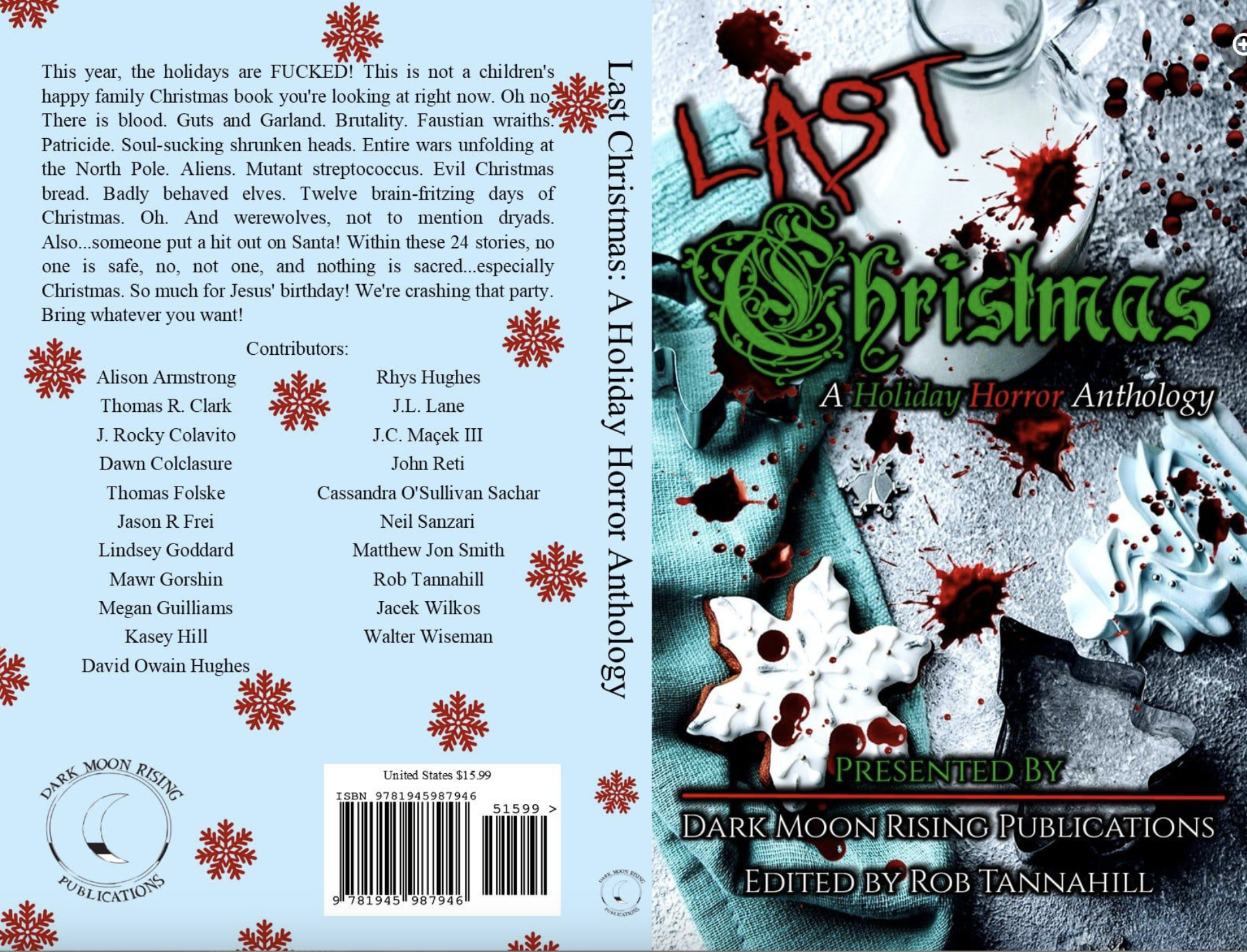
I have a horror short story, ‘Santa’s Elves,’ published in Last Christmas: A Holiday Horror Anthology, from Dark Moon Rising Publications, and edited by Rob Tannahill. The book is currently published in paperback on Amazon. It’s just $15.99. ($3.14 on Kindle.) It’s also available on Godless for $2.99.

My story is about Chinese toy factory labourers who have to work extra hard in December to make toys for the children of rich families in the West. They already work long hours almost every day for barely enough pay to live and/or to send to their families, who live far away from them and so they rarely ever see them. A divine presence from the heavens senses their inner cries for help, and when they make their toys this year, something…lethal…will be added to them, to give those Western families quite a surprise.

There are lots of other great authors whose work is featured on these pages. Please check the back cover in the photo given above to see their names (I hope you can get the image big enough to read them all). Here’s a cool promotional video you can watch.

Please go and buy yourself a copy of this collection of cool Christmas horror stories. You’ll love it! Happy holidays! 🙂

‘The Devil’s Playground’ is Published!

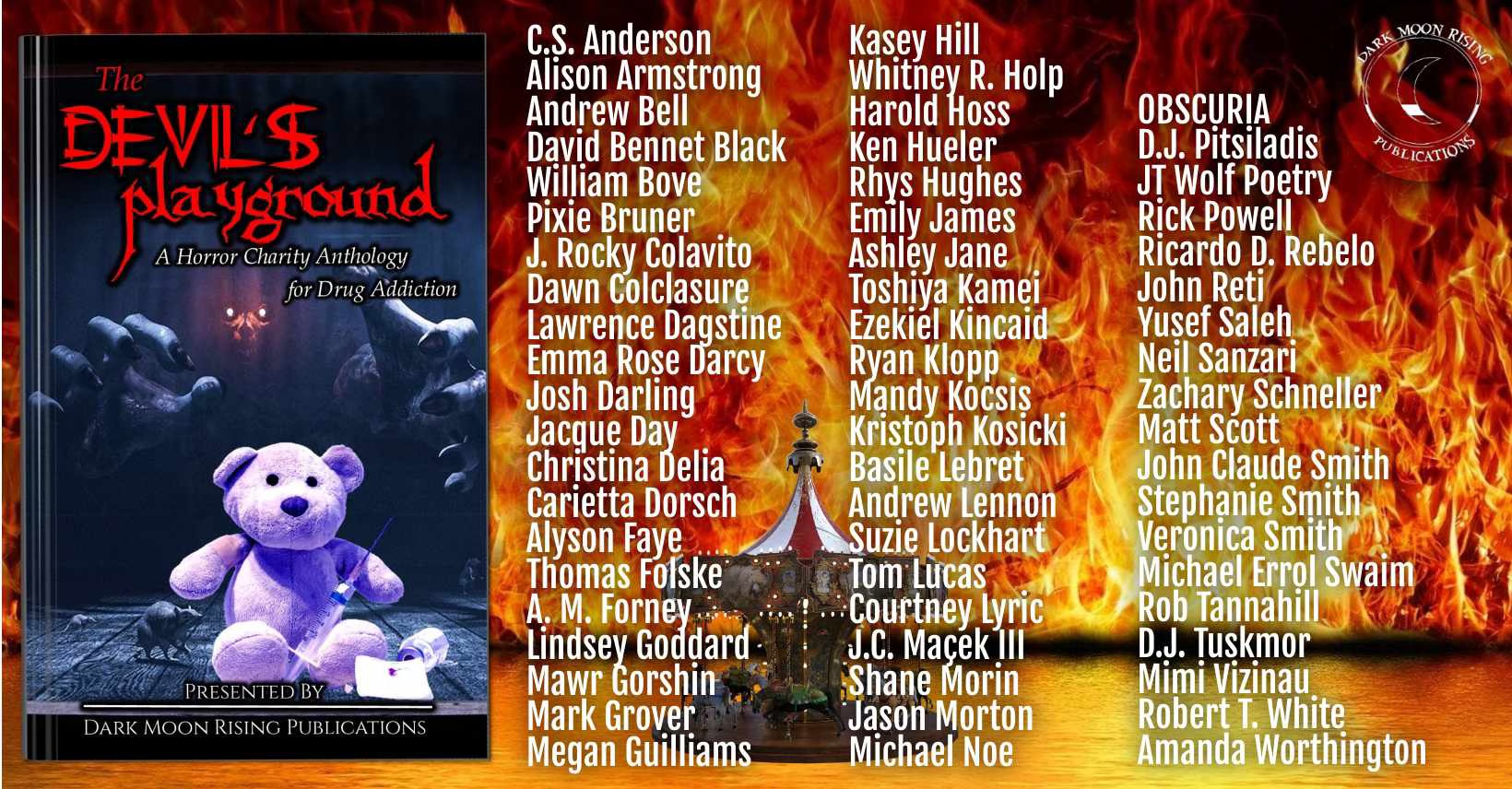
The Devil’s Playground: A Horror Charity Anthology for Drug Addiction, by Dark Moon Rising Publications, is finally published on Amazon, in paperback and ebook forms! It will be published on Godless on December 8th.

My short story, ‘Serene,’ is one of the stories in the anthology. All proceeds donated will be for To Write Love On Her Arms, an organization to help people struggling with depression, addiction, self-injury, and suicide. The theme of all of these stories is drug addiction and its self-destructive effects. 

If one were to read this story as well as my story, ‘NIB,’ in the horror anthology Symptom of the Universe: a Horror Tribute Anthology to Black Sabbath, also from Dark Moon Rising Publications, one might find a number of similarities between the stories. There are crucial differences between them, though. In ‘NIB,’ the female drug dealer is in love with the narrating protagonist, who has a fear of sexual contact due to childhood trauma caused by sexual abuse, and he uses drugs to forget his pain. In ‘Serene,’ however, the female drug dealer is luring men into enjoying her drug, taking advantage of them while stoned, and deliberately killing them if they reject her love. Both stories, ultimately, are allegories on the seductive yet destructive nature of drug abuse.

Many other great authors have stories included in this anthology (check the pic at the top to see all of their names), so please, check it out! I’m sure you’ll love the stories, and you’ll be helping out an important cause! 🙂

‘The Ancestors,’ a Horror Story, Chapter Thirteen (Final Chapter)

“Al, no! Please, tell me what’s happening?”

But when Hannah looked in Al’s face, she no longer saw him in there.

She saw Mei instead.

Mei’s cruel, malicious eyes were what was looking back at her.

In total control over Al’s body again, the evil spirit made him raise the knife and point it at Hannah. Mei made him grab her by the throat and shove her against the dining room wall.

Shaking, she gasped, “Al…Al…” through what little voice Mei allowed her to let out.

Mei had Al bare hateful teeth, like a wolf’s fangs, as the knife came slowly closer to Hannah’s chest. Though Al was trying desperately to keep the blade from getting any closer to the woman he loved, she saw only Mei in his eyes–her malevolence, her single-minded wish to stab Hannah to death.

“It’s your…turn…to die, Hannah,” Mei’s feminine voice said through Al’s mouth.

“This…isn’t you, Al,” Hannah gasped, her one hand on the wrist of Al’s knife-gripping hand, her other trying to loosen Mei’s grip on her neck. “Fight it.”

The hand holding the knife was shaking, but for the moment not getting any closer.

“Of course…this isn’t…Al,” Mei said. “It’s Mei.”

“You’re a…split…personality?”

“No. I’m…one of…Al’s…ancestors.”

“That’s…nonsense. Al, you’re ill. You need…help.”

“Al needs…to die. As soon…as I’m finished…with you.”

The shaking knife was getting closer to her chest.

Hannah kept searching for Al in his eyes.

She still saw only Mei in them.

Al was feeling a splitting headache in his efforts to regain control over his body.

No, Mei, he thought. I won’t let you kill Hannah.

The tip of the blade was now a millimetre or two away from Hannah’s skin, just above the top button of her dress. The knife shook a bit, and the blade cut off the button, exposing more of her skin to the sharp tip.

“Al…please!”

A slight scrape of the tip let out a little red.

She looked in his eyes…and she saw Al again.

He was pulling the shaking knife away from her, with all of his strength, his headache killing him, and the soreness in his arms–from Mei’s attempt to keep control–adding to his agony.

Finally, with the knife-gripping arm safely away from Hannah, he started regaining control of his other hand, which loosened its grip on her neck. She pulled free and got away from the wall.

He turned to face her, having most of his control back. He was bent over, panting.

“Al? Are you OK? Are you back?”

“Yeah, I’m back, for the moment. Mei just left me, completely.”

“As soon as we call the police and explain what happened, we’ll find a therapist for you, and you can tell them all about this ‘Mei.'”

“No, Hannah. This can’t go on. I have to die.”

He was looking at that knife in his hand.

“What do you mean, you ‘have to die’? You won’t go to jail, Al. You’ll be found not guilty by reason of…no offence…insanity. We’ll get you the psychiatric help you need. I won’t abandon you.”

“You don’t understand, Hannah. My problem isn’t mental illness, though I’m sure it must look that way to you. The spirit of Mei, one of the family ancestors, is still inside my body. She relinquished control…I don’t know why, but she’ll come back and take control of me again. Then she’ll try to kill you again. I can’t fight her off forever. She will succeed, sooner or later. I can’t let that happen. To save you, I must kill myself.” Sobbing, he pointed the sharp end of the blade at his chest.

“Al, no! What are you talking about? There’s no evil spirit inside you. Mental illness is nothing to be ashamed of. We’ll get help for you. I still love you. I’m sorry I said we were through. I still want us to be together.” Now she was sobbing.

“Hannah, I’m not insane.” His arms were shaking as he brought the tip of the blade to his chest. “I know full well what I’m doing. I know now that we cannot be together. I’m doing this, though, because I love you. Either Mei makes me kill you, or I kill myself. There is no other way out of this.”

“Al! Please, no! It’s just a delusion you’re having. Don’t stab yourself! I love you!”

She reached forward to take the knife from him.

“I love you, Hannah. Never forget that.”

He held the knife with the tip of the blade firmly against his chest, ready to push it in.

“God, no! Al, don’t!

“Oh, no, NO!

She saw no more Al in his eyes. She saw Mei’s cruel grin.

“Al, no!

He shook a bit, then raised the knife, as if to stab her.

“NOOOO!!!” he yelled.

Then the blade swung down in an arc…

…and it went deep in his gut.

“NOOOO!!!” she screamed.

He buckled and fell to the floor, his blood gushing out and staining his shirt.

She put her arms around him and kept screaming. She welcomed his blood on her dress, wanting the stains to stay there so she’d still have at least some of him with her.

I came to this house having everyone, she thought as she kept bawling. Now I have no one.

As she wept and wailed, holding his bloody body tightly against herself and practically bathing in the red, she’d had her eyes squeezed shut, as tight as her hold on his body. Then she opened them.

With her tears obstructing her vision, what she saw was blurry and distorted. In that blurry haze, she saw what at first seemed a hallucination.

She wiped away her tears for a clearer look.

No, it was still there.

And it made no sense.

A glowing vision of three old Chinese in traditional clothes–two women and a man.

In my grief, Hannah thought, I’m truly going crazy.

Thank you, Hannah, for helping us achieve our aim, Po said. You are free to go.

“I’m seeing things,” Hannah gasped. “This isn’t real.”

Oh, we are very real, Hannah, Meng said.

“Wait a minute: your voices sound familiar.”

That’s right, Mei said. You heard me from Al.

And me from Emily, Meng said.

And me from Freddie, Po said.

“I’m imagining this,” Hannah said. “There’s no such thing as ghosts. I’m going crazy.”

If you were going crazy, you wouldn’t think you were going crazy, Meng said. We’re real, we assure you.

Al wasn’t going crazy, either, Mei said. We really were possessing him and his family, and now that our work is done here, we can thank you and say goodbye.

“And what was ‘your work’ that had to be done?”

The destruction of the entire Dan family, Po said.

“Why did they, and the man I loved, have to be killed?”

For failing to pray to us, their ancestors, Mei said.

“I thought Al continued praying to you. He told me so. Why wasn’t that good enough for you?”

Because the snubbing of us by the rest of his family…our family…was already bad enough. We felt too dishonoured to forgive them, Meng said.

And when we aren’t sufficiently prayed to, we spirits turn into demons, Po said. The Dan family is almost an anomaly when it comes to Chinese culture. Most Chinese families are close and loving; this is because they pray to their ancestors. An impious attitude took hold of your boyfriend’s parents, in their adopting of Western secularism.

In rejecting belief in spiritual matters, like most of you in the West, their family unity broke down, and they came apart, Mei said. So many social and family problems that you see in Western society come from rejecting spirituality. This is why Chinese families, on average, hold together far better than your Western families.

“I call bullshit on all of that! My family wasn’t religious in any way, and we were always loving and happy. You destroyed Al’s whole family, and you murdered mine!” She was sobbing again.

She looked through her teary eyes and saw wicked grins on Po, Meng, and Mei.

Why did you kill my family? Why did you make Al kill himself? What did they do to you?”

Oh, we did that for the sheer fun of it, Meng said. We even put the idea in your mind to have your family meet the Dans for dinner…we prodded you to insist on it, never taking ‘no’ for an answer.

The three spirits were still grinning malevolently at her. Her jaw dropped.

“You’re evil, pure evil, far worse than Al’s family!”

What do you expect? Po asked. We’re devils. Thank you for your help, and goodbye.

The three grinning spirits faded away before her eyes.

Hannah let out a loud, ear-splitting scream.

Her screaming and bawling continued over a period of several minutes. A patrol car was going by the house, and the two police in it heard her. They stopped, got out of their car, and ran up to the house.

They looked in a window that revealed the dining room and saw Hannah, still on her knees and holding Al’s bloody body, always sobbing and shaking. They also saw Freddie’s and Emily’s bodies.

“Holy shit!” the male cop said.

“What the hell happened here?” the female cop said.

They went in the house and ran over to Hannah.

“Officer Wong calling,” the male cop said on his cellphone to the local precinct. “We have…what looks like..a triple homicide in the house at…just a minute, I need to take a look…137 Washington Street. We need an ambulance and stretchers.”

The female cop took Hannah in her arms.

“It’s OK, it’s OK,” she said, trying to soothe Hannah.

“No! It’s not OK!” Hannah screamed.

“What happened here? Who killed these people?”

Hannah’s words came out like a frantic firing of machine gun bullets, much too fast for the cops to process. “The ancestors did it! Three demons, two old women and an old man! They killed all of my family, too, up in the attic! They lured us all into a trap! They…”

“What is she raving about?” Officer Wong asked, sneering. “Three demons? Ancestors? This Chinese family may have believed in ancestors and evil spirits, but why would a white woman believe in that nonsense? My family never believed in that old tradition, and I’m glad they didn’t.”

“I have no answers for your questions, Officer Wong,” his partner said, rocking Hannah back and forth gently. “But I guess we’d better check the attic, too.”

“Alright,” he said. “You stay here with her, and I’ll go up there.” He went searching for the stairs.

The three spirits were waiting in the attic.

I don’t like Officer Wong’s lack of faith in us spirits, Po said to Meng and Mei. Maybe we can go after his family, too…just for fun.

All three spirits were grinning.

THE END

‘The Ancestors,’ a Horror Story, Chapter Twelve

After several minutes of the most painful of efforts, Al was just beginning to feel a regaining of control over his body. Just a bit, at first: he could stir slightly, he could fidget and budge, all while suffering a terrible headache to deter him.

Freddie looked over at him and saw his face wincing in pain, the slight movements that suggested someone other than Mei was trying to control Al’s body. Freddie smirked at the amusing sight.

“What’s the matter, loser?” he asked Al. “You trying to hold in a fart? That was directed at Al, not at you, Mei. It looks like he’s trying to regain control.”

“He’s trying to,” Mei’s feminine voice said through Al’s mouth. “He won’t succeed…not for the moment, anyway.”

“Not ever, I’d say,” Emily said. “He’s never succeeded at anything in his life, except annoying people. I’m surprised he can make his body move at all, with you there, Mei.”

“I must say, Mei, that we were wrong to have stopped praying to you,” Freddie said.

“We’re both very sorry about that,” Emily said.

“Just aid us in what we wish to accomplish here, and all will be forgiven,” Mei said.

“He obviously sucked at praying to you all,” Freddie said, “since even his prayers weren’t enough to placate you. As Emily said, Al can’t do anything right.”

“That he actually killed our father, as Meng has told me in my thoughts…”

“And Po told me in mine,” Freddie added.

“…and he didn’t stop his bitch girlfriend sitting over there from killing our mother–that’s all the more reason for Freddie and me to hate Al. Feel free to kill him, too, Mei–we won’t mind.”

“Not at all,” Freddie said. “Kill that loser.”

“Oh, we’ll have him killed,” Mei said. “And we won’t stop with him.”

All three of them looked over at Hannah, bound and gagged in her chair at the other side of the table in the dining room. She was still unconscious.

They stared at her and grinned.

“She’ll make such a tasty dinner,” Freddie said, looking over at possessed Al, and knowing that he could see and hear everything said and done at their dining table…but he could do nothing about it. “Mmm!”

All three of them repeated “Mmm!” even louder while looking at Hannah. She stirred a bit.

Al gained a bit more control of his body, and he made it shake so the legs of his chair rattled against the tiles of the dining room floor.

This was enough to wake Hannah up.

Finding herself bound and gagged, with all three remaining Dan family members staring maliciously at her, she whined through her gag as loudly as she could to produce a scream, while shaking her chair and rattling its legs on the floor as much as Al was.

Assuming her crazy ex-boyfriend wanted her dead as much as his crazy brother and sister did, Hannah couldn’t understand why he was fidgeting in his chair as she was. Was this some pathetic, fake attempt to convince her he still loved her, to make her believe he was indeed possessed by the spirit of one of his ancestors? Did he really think she was stupid enough to believe that?

“You’re gonna taste so good when we’ve cooked your flesh, like a giant turkey,” Freddie said with a laugh, his taunting eyes going back and forth to look into Hannah’s and Al’s. “Yes, Hannah. We’re gonna make Al kill you, cut your body up into pieces, cook them, then eat them…that is, our ancestors will, and Al will. He’ll do it, ’cause he’s so weak! Isn’t that right, loser?”

Al was shaking the chair even more.

“What are you so upset about, loser? You’ve eaten her before, haven’t you?” Freddie laughed.

“Don’t be crude, Freddie,” Emily said.

Al’s shaking and rattling of the chair was getting more and more violent. He almost fell off of it, but he clasped his hand on the table, his fingers inches away from a large, Japanese deba bocho meat cleaver.

“Mei, you aren’t losing control of him, are you?” Meng’s deep, masculine voice said through Emily’s mouth.

“He’s…getting stronger, but I’m…managing,” Mei’s feminine voice said through Al’s mouth.

“If we beat him into submission, will you feel the hurt, or can you leave his body temporarily?” Po asked in that distinctly gravelly, grandmother’s voice, through Freddie’s mouth.

What? Hannah thought with eyes agape. How is Al’s sister talking with a man’s voice, and he and his brother are talking with women’s voices? Can crazy people really imitate voices so precisely, as unnatural as it would be for their biological voices to do? Or am I going crazy?

“Is that you speaking, Po, or is it Freddie?” Meng asked, as if she were as surprised as Hannah. “It sounds like something he’d like to do to Al.”

“It’s most likely a combination of Freddie and me,” Po said, putting a smirk on Freddie’s mouth. “You should be aware that, as we spirits continue possessing these bodies, our wills become more and more merged with those of the bodies.”

“Isn’t that true, Al?” Meng asked him, putting a smirk on Emily’s mouth now, to taunt Al as he continued to shake his body and take it back from Mei.

Meng and Po turned Emily’s and Freddie’s heads back to looking at Hannah as she continued to struggle, in as much futility as Al, to free herself. The two possessed bodies were licking their lips.

“She’s gonna taste so good, isn’t she, Al?” Freddie said in his own voice. “The ancestors are opening my mind to cannibalism; I never imagined I’d develop a taste for it.”

“Same here,” Emily said in her own voice. “Funny what a little demonic possession can do to your head.”

The two noticed that Al’s struggling was abating. He was sitting much more still now.

“Mei, if you have regained control over his body, why don’t you pick up that knife and start cutting her up?” Freddie said.

Al had completely stopped shaking now. Mei looked at Freddie calmly.

“Yes,” Mei said with a smile. “I have fully regained control of the body.”

“Good,” Freddie said in Po’s voice, then got up. “Let’s do this.”

Mei and Meng brought Al and Emily to their feet, Mei gripping that Japanese knife in Al’s hand.

The three of them walked toward Hannah.

She was whining in a shrill, raspy voice behind that gag, fidgeting frantically in her chair. Her tearful eyes looked up into Al’s, desperately looking for his expression rather than Mei’s. All she could see was the cold expression of a killer.

That’s not Al that I see, she thought as the three had almost reached her. It’s not Al at all. Not even a crazy version of him. Could it be a demon inside him?

They were at her chair now. Her ankles were tied to the front legs of her chair, so she couldn’t even kick at her tormentors. She could only squeal and shake.

Emily and Freddie held the chair still from the back, while Al stood before Hannah, Mei having him raise the knife high over his head, ready to come down on her with a stab in the chest.

Mei and Hannah looked in each other’s eyes, the latter’s full of pleading, and the former’s utterly empty of pity. Hannah kept looking for Al, somewhere deep inside those eyes. He had to be there. She searched and searched back there, but she still couldn’t find him.

Now, instead of squeals and whining from her gagged mouth, sobs of despair were coming from it.

I shouldn’t have told him I wanted to dump him, she thought. I want my Al back, crazy or not.

And then, she could finally see Al in those eyes.

And no, it wasn’t hallucinatory wish-fulfillment.

The knife came down in a slashing arc…

…and it dug deep in the middle of Emily’s chest.

“Emily!” Freddie screamed. “Al, you piece of shit!”

Her body fell to the floor, soaking it with blood.

“Mei, I thought you had him under your control!”

“She stepped aside for the moment, it seems,” Al said in his own voice with a grin, then he pointed the knife at Freddie. “And you’re next…loser!”

“Oh!” Freddie said with a chuckle. “You think you’re gonna take me on? C’mon, loser, try it!”

They stepped away from Hannah. They faced each other behind her. She kept whining and struggling.

“C’mon, loser, cut me! Let’s see what you got.”

Al slashed from right to left, aiming for Freddie’s chest; but Freddie grabbed Al’s arm by the wrist, squeezed it hard, and made him drop the knife. Then Freddie punched him hard in the gut.

“Ooh!” he grunted, then fell to the floor.

Freddie picked up the knife and smiled.

“I’ve always hated you, Al. You know that. But your killing Dad, letting your big-nosed, white whore kill our Mom, and killing Emily here give me all the justification I need to dice your guts into a million bloody pieces!”

As Al was getting back up, Freddie ran at him with the knife and threw him hard on the floor. Al banged his right shoulder on it; it hurt like hell.

Freddie started by slashing Al’s face several times.

“There,” he panted. “Now you’re even uglier. Think your bitch girlfriend’s gonna like that? If you do, you’re even stupider than I thought, loser.”

He slashed Al’s face again.

“It won’t matter if she doesn’t like it, though, ’cause I’m gonna kill you now.”

He sat up and raised the knife high over his head, ready to come stabbing down.

Hannah was going crazy not being able to see or help Al. Her only comfort was not watching him die.

Freddie brought the knife down, but Al’s left hand caught him by the wrist just in time. The tip of the blade was a few millimetres away from Al’s chest. Both arms shook as they debated over where the knife would go.

Freddie looked in Al’s eyes with much more than his usual non-fraternal malice. Al was at first looking back into his brother’s eyes with the same hate; then he turned his eyes away to look at Freddie’s hand.

“Yeah, that’s right,” Freddie panted, spit dripping from his mouth onto Al’s bloody face. “You’re weak. You always were weak.”

Hannah could only whine and shake in her chair in blind helplessness.

Al brought his mouth over to Freddie’s hand. He bit two of the fingers holding the knife. He sank his teeth in deep, bloodying Freddie’s hand and his own chest.

“Aaah, you fucker!” Freddie screamed, then he dropped the knife to suck on the cut.

Al pushed him off with a strength he never knew he had, then kicked him hard in the balls. As Freddie buckled, Al grabbed the knife and ran at him, knocking him to the floor.

Al held the knife with the handle down. He wanted to bash Freddie’s face in before stabbing him. The wooden handle smashed down on Freddie’s forehead once, on his nose twice, breaking it, on his left cheek three times, his right cheek once, his chin twice, and his mouth four times, knocking out two upper and two lower teeth and soaking his face in blood. His bruises would look like a black-and-blue mask.

“You’re still…a loser, Al,” Freddie gasped in toothless lisps.

Al flipped the knife around to point the blade down. “Yeah, Freddie,” he said. “You’re about to be stabbed to death…by a loser. Be proud of that.”

He plunged the blade deep into Freddie’s throat, shutting him up once and for all.

Al let out a big sigh, then got off of Freddie’s body. He went over to Hannah and cut her feet and hands loose.

She got up from the chair and got the gag off in an impatient hurry.

“Oh, thank God,” she sighed. “And thank you, Al, for stopping them.”

He just stood there–silent, unmoving, frowning, and looking down at the floor, his face dripping blood all over it and his shirt.

“Look, I realize now that…your family…had some serious…well, mental health issues,” she said, searching for the kindest way she could put it. “And it’s…obviously harmed you…emotionally, too. I think we can work this out. We’ll find…a professional…to help you through this.”

Still gripping the knife, he started shaking and twitching.

“Oh, no, NO!!! Hannah, get away…from me!”

‘The Ancestors,’ a Horror Story, Chapter Eleven

Hannah’s heart was beating even harder and faster now that she heard the door open and Freddie and Emily walk into their parents’ bedroom. It wouldn’t take long for them to deduce that she was hiding under their mom’s and dad’s bed.

Her mind was still racing, trying to make sense of all of the craziness that had been happening up until now, and especially now that she was next to be killed. Still, her priority was wondering what she’d do when Al’s brother and sister…and Al himself, once he was to come down from the attic after that kick she’d given him in the balls…found her. She had no time to process any of this.

She listened for Freddie and Emily.

Total silence.

No shuffling around, looking for her.

What were they doing? If they knew she was under the bed, why not just get down, look under, and grab her by the feet? Were they toying with her?

Yes, they were, actually.

The siblings were standing by the bed, looking down at it. There was nowhere else in the room for Hannah to have hidden, anyway–no closet big enough for her to fit into. Emily put her finger to her lips to tell Freddie to be quiet. They were smirking.

Hannah could hear light, unintelligible whispering.

“Let’s wait a while before getting her,” Emily said softly in Freddie’s ear. “Give her a moment to think through what’s happened…also drag out the terror for her, and the false hope.”

“Good idea,” he whispered back in Emily’s ear.

Hannah’s heart still pounding as hard and fast as ever, she began to think through everything that had happened to lead to this nightmare.

This was just supposed to be a pleasant dinner for both of our families to meet each other, she thought. Al was so resistant to me meeting his family, but I assumed it was just going to be some mundane problem. I never would have imagined, in a million years, that his family would be a bunch of murdering psychos…and that Al himself was one of them, too!

“Where is that loser, Al?” Freddie whispered.

“Shh!” Emily said, pointing at the bed.

All in one night, Hannah thought, I went from pleasantly anticipating meeting Al’s family, mine visiting them, and assuming I’d marry Al and unite our families in mutual love, to not only realizing that Al was being bullied by them, but also…having all of my immediate family…brutally murdered (She tried to hold back a sob), and worst of all, Al is one of the killers! I went from hopes of extending my family, to include his, to losing my family, Al’s family, and having to dump the man I love…loved! How could such extremes happen?

Now she let out an audible sob.

“Alright,” Emily whispered. “Let’s do this.”

She and Freddie squatted and looked under the bed.

Hannah at this moment was still far too absorbed in her thoughts to notice the siblings coming down to see her. This craziness has gotten so extreme, she continued thinking, that I have become a killer, too! I stabbed Al’s mom with that knife! It was self-defence, but I’d never in a million years see myself killing someone…wait…

She felt Freddie’s and Emily’s hands on her ankles, pulling her out from the bed.

“Ah!” she yelped, then grabbed onto the bedposts at the head of the bed to stop them from getting her out. The siblings kept yanking and yanking at her shaking legs, their grip irritating her skin and causing her shoulders and wrists to ache, but she kept a firm hold on those bedposts.

The siblings stopped yanking for a second, let out sighs of frustration at the same time, and in the voices of Po and Meng, they shouted, “Fang shou!”

Magic in those Chinese words forced Hannah to let go of the bedposts.

She screamed as Freddie and Emily pulled her out from the bed, her unable to conceive how mere words could force her to let go. Her screams were cut short by a blow from Emily’s fist on her head, smashing her face on the wooden floor, giving her a nosebleed and knocking her out. Meng’s spirit had given Emily’s fist extra strength.

“Let’s tie her up and take her downstairs,” she said in Meng’s deep, male voice.

“There’s rope in the room next door,” Freddie said in Po’s raspy, feminine voice. He left the room.

In the hall, he saw Al having just finished coming down the attic stairs.

“Where have you been, you loser?” Freddie asked in his own voice. “You’re fucking everything up again, aren’t you? Where are Mom and Dad? Emily and I are trying to take care of your girlfriend, and you’re wasting time in the–“

“Don’t talk to me that way, boy!” Al said in Mei’s authoritative, feminine voice. “I was stalled by Al’s determined efforts to regain control over his body. He killed your father, and Hannah killed your mother. I’ve finally subdued Al, so I can help you and Emily now.”

“Sorry, Mei,” Freddie said, bowing and gesturing to her with his hands clasped together. “I have to find some rope in the other room. Meng is with Emily in our parents’ bedroom. Hannah is knocked out. We have to tie her up and take her downstairs.” He went in the room to find the rope.

Mei took Al’s body into his parents’ bedroom.

Though Al’s soul, for the moment, was fully under Mei’s control, he was able to see, however passively, Hannah lying unconscious on the floor. He tried with all of his might to regain control over his body, but Mei was ensuring that he couldn’t make his body budge an inch.

Is Hannah dead? he wondered.

He couldn’t even weep for her.

Freddie returned with the rope, a bandana, and a small rubber ball to use as a gag for Hannah’s mouth. All three Dan family members, under the control of Po, Meng, and Mei, helped tie up and gag Hannah.

They carried her downstairs and into the dining room, and with some remaining rope, they tied her to a chair. They sat next to each other, Emily in the middle, at chairs on the other side of the table.

The whole time, Al had been trying, in all futility, to take control of his body and stop the other two. All he could do was watch helplessly, and be forced to help them through Mei’s possession of him.

“So,” Freddie said in Po’s voice. “What should we do with her, Al? We know you can see and hear us.”

“But you can’t do anything about it,” Emily said in Meng’s voice. “You broke our agreement, Al, so we’re under no obligation to do anything for you.”

“And doing things to upset you has always been much more amusing than doing things for you,” Po said. “What shall we do with her?”

“Kill her, of course,” Meng said.

“Of course, of course,” Po said. “But how?”

“In a way that Al will find the most upsetting. We should make him hold the knife that cuts into her chest.”

Al wanted to scream “NO!!!” at the top of his lungs…but he couldn’t even grunt.

“Then we can make him cut her body into pieces, cook them, and serve them as our dinner. The Dan family may have been sated at dinner, but we ancestral spirits haven’t had a bite to eat. We’ll let Al have the biggest share of Hannah’s cooked flesh.”

Mei curled Al’s lips upward in a smirk.

Al couldn’t even weep.

My Short Story, ‘Serene,’ in the Horror Anthology, ‘The Devil’s Playground,’ to be Published Soon

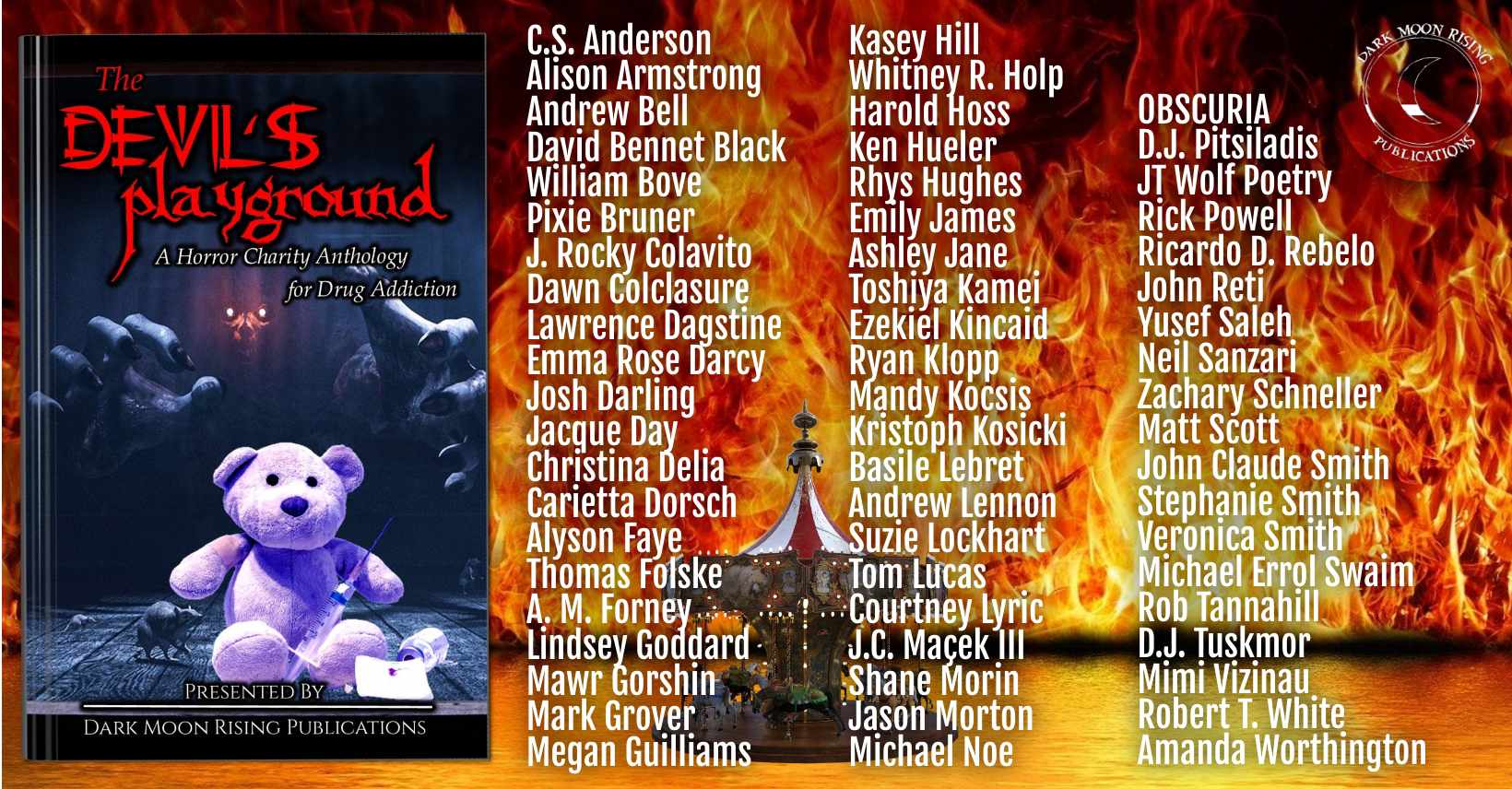
I will have a horror story, ‘Serene,’ published in this anthology, The Devil’s Playground, by Dark Moon Rising Publications. The theme of all of these stories is drug addiction and its self-destructive effects.

If one were to read this story as well as my story, ‘NIB,’ in the horror anthology Symptom of the Universe: a Horror Tribute Anthology to Black Sabbath, also from Dark Moon Rising Publications, one might find a number of similarities between the stories. There are crucial differences between them, though. In ‘NIB,’ the female drug dealer is in love with the narrating protagonist, who has a fear of sexual contact due to childhood trauma caused by sexual abuse, and he uses drugs to forget his pain. In ‘Serene,’ however, the female drug dealer is luring men into enjoying her drug, taking advantage of them while stoned, and deliberately killing them if they reject her love.

Many other great authors have stories included in this anthology (check the pic at the top to see all of their names), so please, check it out! It’s a charity anthology, the proceeds being for To Write Love On Her Arms, an organization to help people struggling with depression, addiction, self-injury, and suicide. I’m sure you’ll love the stories, and you’ll be helping out an important cause! 🙂

‘The Ancestors,’ a Horror Story, Chapter Eight

After thoroughly checking all of the rooms on the second and third floors, Mr. Dan and Doug approached the bathroom, where Mr. Sandy had been before he was killed.

“Oh, no–now I have to use the can,” Doug said, then went in.

After he closed the door, Mr. Dan thought, And I have to find something just right for you, young man.

But first, he pulled down the attic stairs, then went up them. He peeked his head in, hearing Emily still cleaning up the blood.

“You just about finished up here?” he asked in Chinese.

“Almost,” she said in Chinese. “Just a little more to wipe up.”

“Well, hurry up,” he said. “I’m taking Hannah’s brother up here. He’s in the bathroom. He’s taking his time in there; I guess it’s a number two, but who knows? Maybe not. I’ll send something up to you. Wait to get it, but hurry with the cleaning!”

He went back down, heard Doug fart and grunt, and he surmised that, indeed, it had to be a number two. He’d have a little more time to find…something just right for Doug.

He went into a room next to the one with the boxes, looked around impatiently, and found a baseball bat. He heard some shuffling steps out in the hallway. Oh, no, he thought, Hannah’s brother. Then after a worried pause, he opened the door and looked out.

Nobody out in the hall.

The bathroom door was still closed.

Was Doug still crapping in there?

Mr. Dan went up to the bathroom door to listen. He heard another fart, the slipping out of shit, and a horrible stink.

He squished up his face in disgust, but was relieved that Doug was still in there and suspected nothing. Mr. Dan went up the attic steps with the baseball bat.

“Emily,” he called.

“What?” she said with surprise, looking back at him from the corner where she’d just finished cleaning. “I thought you were already up here. I heard–“

“No, not yet,” he said, then presented the bat. “Put this over there, then get out of here.”

She took the bat, put it in the corner opposite where she’d been cleaning, and rushed over to the attic stairs.

“I’ve got to clean all this blood off my–” she began as she went down the stairs.

“Shh!” he said. “Hurry up and get out of here before he comes out of the bathroom!”

She went down the hall and took the stairs to the second floor. As soon as she’d disappeared, Doug came out of the bathroom.

Mr. Dan let out a sigh of relief.

“What are you so relieved about, Mr. Dan?” Doug asked, looking askance at him.

“Oh, nothing,” Mr. Dan said with a smile and a slightly nervous chuckle. “I was just getting a little impatient waiting for you to finish, that’s all. Sorry about that.” He gestured to the pulled down attic stairs. “Shall we look in the attic now? It’s the only place we haven’t looked.”

“OK.”

They went up into the attic, Doug first.

He heard moaning in one corner of the attic and rushed over to see. “Dad? Mom?” he called out.

Meanwhile, Mr. Dan sneaked over to the other corner, picked up the bat where he’d seen Emily leave it, and hid it behind his legs by the time Doug looked back.

“There’s nobody here,” Doug said. “I heard moaning right from here, but there’s no source for the moans.”

“Really?” Mr. Dan said. “There’s a lot of shadow behind all those boxes. Look again.”

“I’m looking at the shadow behind the boxes, but there’s nothing–wait, under that blanket over there.”

As Doug was approaching it, Mr. Dan raised the bat over his head. “Goodbye, Doug,” he said in a female voice.

“Emily, are you up here?” Doug asked as he pulled back the blanket, revealing his parents’ bloody bodies. He gasped, his eyes widening.

“No, not Emily,” Mr. Dan said in that woman’s voice.

“Mei’s voice,” a young man said from behind Mr. Dan, who turned around to see who it was.

Now he gasped, his eyes widening.

Al swung the axe right at his father’s chest. Blood sprayed out when it dug deep into him.

Mr. Dan fell to the floor, the bat dropping and hitting him on the head. His blood grew into a large puddle all over the floor.

“Al, Jesus fuck!” Doug said. “How could you do that?”

“It wasn’t easy,” Al panted. “That’s for sure. I’m so sorry, Papa.” He bent down and closed his father’s eyes. “Goodbye. Forgive me. I had no choice.” He rose to his feet.

“Why would you kill your own dad, Al?”

“To stop him from bashing your brains in with that bat, of course.”

“What? Al, this is so fucked up! What’s going on? Why would your family…wanna kill my family? Oh, God…Mom, Dad…” He looked back at his parents’ corpses with tears forming in his eyes.

“Because the spirits of my ancestors are taking possession of my family’s bodies to take you all as sacrifices, so my ancestors won’t bother Hannah and me anymore,” Al said in a cold, monotone voice.

“What? What horseshit are you talking about?”

“My family stopped praying to the spirits of our ancestors years ago,” Al explained. “The spirits got angry because of this disrespect, and they’ve been plaguing our family ever since.” He put the axe down on the floor beside him, next to the bat.

“Spirits, Al?” Doug asked, looking at him with a sneer. “Seriously? Let’s face it: You’re a family of homicidal nutjobs. No offence intended to Chinese people in general, but I don’t want you anywhere near my sister!”

“I love Hannah more than anything, and I’m truly sorry for what happened to your parents,” Al said in sobs. “The spirits forced me to agree with this, so I could marry her one day and we could live in peace. If they know I’ve broken the agreement, they–“

“Fuck you, Al, you and your fucked-up family!” Doug bawled.

Al was silent as Doug looked down at his parents’ bodies and wept for them.

“Oh, no…NO!” Al suddenly said.

“What?” Doug said.

But before Doug could turn his head back and see what was going on, he felt a crack of the baseball bat on his head, knocking him out.

Two Five-Star Reviews for ‘Nature Triumphs’!

Nature Triumphs: a Charity Anthology of Dark Speculative Literature has recently received two five-star reviews. Scroll down the Amazon page to read them yourself, or read them here:

Avid reader called the anthology “Fun, Appealing, Scary, Thought-Provoking Eco-Horror Fiction–And Just in Time for Halloween)

“I loved this wonderful, big, entertaining, appealing, fun book –scary AND heartfelt eco-horror anthology. Exceptionally well-edited containing many varietal, well-written, vivid, horrifying stories and poems by diverse, established authors. Innovative concept/environmental/ecological/nature theme masterfully executed. I especially like stories “Yard Work” by Michael Errol Swaim, “Blood Rose” by Alison Armstrong, “One Side of a Conservation with Mother Nature” by Kyle Heger, “A Reversal of Fortune” by JG Faherty, and “last Call at the Garden of Eden” by Lamont A. Turner. I like that the money goes to The Nature Conservancy. Great book/gift for Halloween and for lovers/readers of horror, sci fi, dark speculative, ecological/ nature fiction and poetry.”

Jordan Francis called it “A beautiful and haunting Anthology for a great cause“.

“A beautiful and haunting Anthology. This collection of short stories and poems is amazing. It is at turns haunting, funny, and beautiful. This has introduced me to a multitude of great writers that i need to go back and check out their other works. Definitely worth the price of admission.”

Recall that my story, “The Bees,” is about a geneticist/beekeeper who, fed up with the world’s indifference to the dying off of the bees, does genetic alterations of the many bees he takes care of. He weaponizes them, making them bigger, stronger, smarter, and more lethal, capable of stinging their victims many times until they die. Can he be stopped, or will his enhanced bees multiply and tyrannize the world?

I really hope you’ll all go out and get yourselves a copy of this collection. It’s all for a good cause, and you’ll love the stories and poetry! 🙂