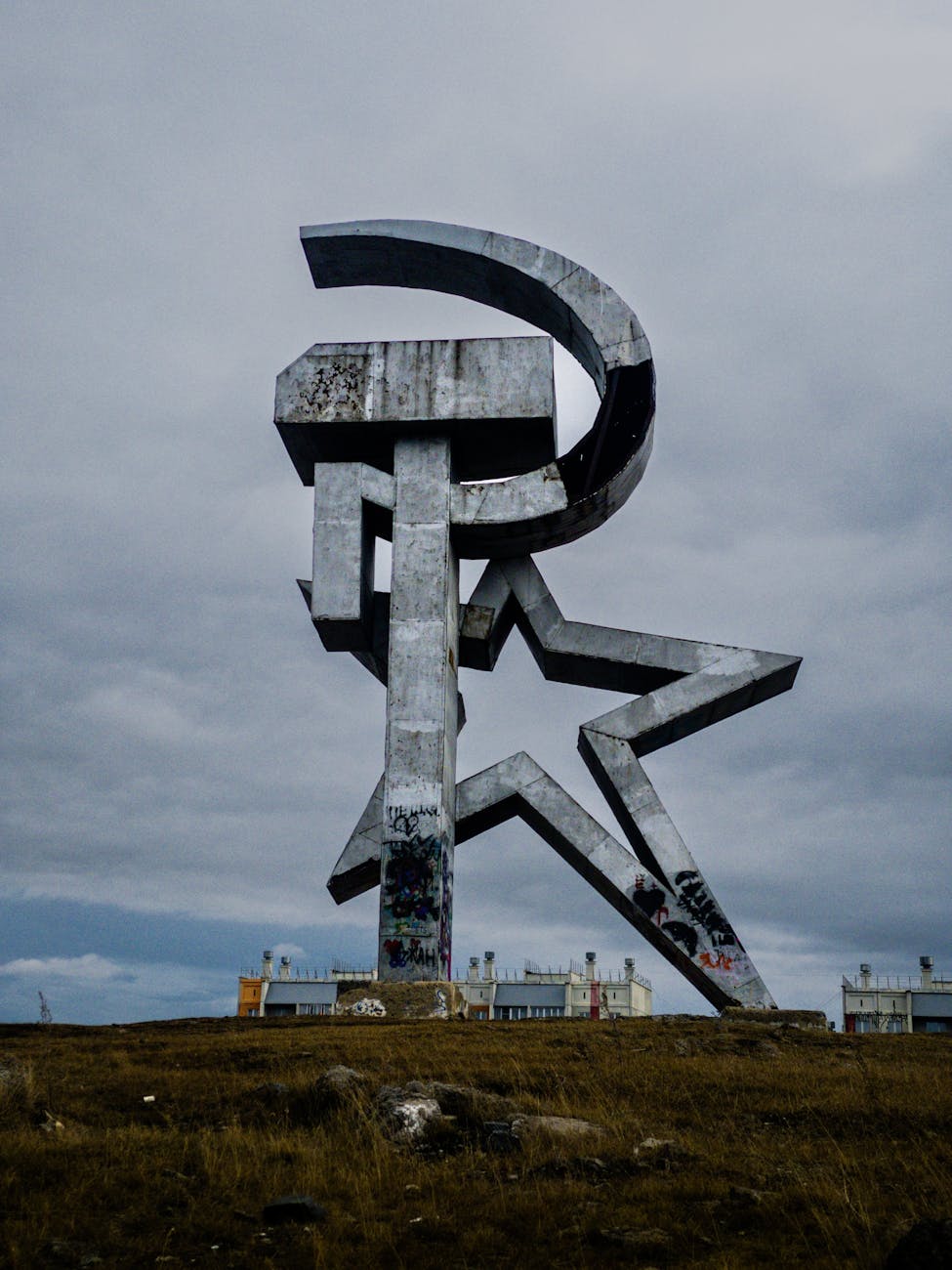
What Is Feared of Communism Is Here in Capitalism

I: Introduction

Several weeks before I started writing this post, I shared a meme on Facebook, one whose pro-Soviet content I don’t remember (and which isn’t all that relevant, anyway), but which also got me a troll reaction from some liberal who said, “No Gulags.” This comment is what has inspired the current article.

I’ve already written a number of defenses of communism in such articles as these, as well as a number of criticisms of capitalism, from both my former anarchist and my current ‘tankie’ perspectives, as can be found here. In this article, though, I feel I need to address something different.

There’s always this fear among many in the West, including many on the left: what if we ‘tankies’ are in denial about how the dictatorship of the proletariat will inevitably become totalitarian and oppressive? My answer in this article is that capitalism has already become so. We’d might as well try socialism. What else have we to lose, but our chains?

II: The Forms of Totalitarianism

Totalitarianism, tyranny, an oppressive state–whatever you want to call it–takes on many forms. I’ll list off pretty much the main forms here. First, and most obviously, totalitarianism discards these:

–a free press
–freedom of speech, and
–democracy

Then, with its intrusive government, we start to go into totalitarianism’s harsher forms:

–cults of personality
–surveillance, and
–police brutality

Finally, we come to the most horrifying forms:

–concentration camps, and
–mass murder, or genocides

Communism, of course, has been accused of perpetrating all of the above. Fascism, even more obviously (or, at least it should be more obvious), has been genuinely guilty of all of these. The horseshit horseshoe theory would have you believe that the extreme left and extreme right are similar in having supposedly led to the same outcomes, leaving liberal democracy as the only viable alternative.

A far more accurate representation of the relationship between the left, centre, and right, however, would be the fishhook theory, in which we can see liberal centrism backsliding into fascism. Recall Stalin’s words on the subject: “Social-democracy is objectively the moderate wing of fascism.” Note in this connection that social democracy is as left-leaning as liberals get; the rest of liberalism moves only further rightward.

A casual observation of Western politics, especially from the dissolution of the USSR to the present day, should demonstrate the truth of Stalin’s words. First, liberals demonized communism in lockstep with conservatives. Then, declaring an “end of history” with communism’s demise and the “free market” as the only viable system, liberals helped to chip away at social welfare, since there was no longer any fear of socialist revolution. Finally, as leftist agitation revives, they’ve used fascism to thwart it.

And here we are.

One must take seriously the notion of a fear of communism, through its association with the atrocities listed above, to understand the great lengths to which right-wingers will go to defend capitalism. Note that these right-wingers are usually of the petite bourgeoisie, the useful idiots of the ruling class, whose real reason for fearing communism is the loss of their wealth; so they fear monger in the media they own to tell the middle and lower classes about communist ‘atrocities.’

As a result, the conservative and liberal masses will tolerate any horrors that go on in our society today so as to prevent a resurgence of socialism. If the poor are so bad off, it’s because they’re lazy, talentless, incompetent ‘losers,’ or they waste money that they should be saving. Never mind that class mobility is a myth. People generally stay in the class they were born in.

When one tries to tell these bootlickers of the rich that the root of the problem of the poor is systemic, the inevitable result of capitalism, they claim that our political problems stem from ‘corporatism,’ because apparently, ‘real capitalism’ and the government are mutually-exclusive antitheses of each other. Never mind that capitalists have always used the state to protect their private property interests: that’s what the cops are for.

Even today’s boot-lickers of the rich cannot deny that the political system, especially that of the past twenty-five years or so, has been nothing less than an unmitigated disaster, one that continues to get worse and worse. What they cannot bring themselves to admit is that this disaster has been the result of the neoliberal experiment, which is a subordination of everything, the government in particular, to the Almighty Market. Hence the need to describe our growing totalitarianism as ‘socialist,’ even when it should be obvious to anyone with half a brain that the current system is anything but socialist.

Politicians on both sides of the political fence accuse each other of being ‘communist.’ Trump and his administration spew constant verbal flatulence about the dangers of ‘radical Marxist extremists,’ when if anything, even among today’s progressives, Western Marxism is practically moribund. Liberals are similar, with Kamala Harris bizarrely calling Trump a ‘communist.’ At first, this comment just seems to be yet another air-headed one from her; yet on closer inspection, we can see how its purpose was really to associate today’s totalitarianism with communism rather than with its true source–fascism.

Her Democratic Party has also joined Republicans in issuing a blanket condemnation of socialism just before Trump’s meeting with ‘socialist’ Zohran Mamdani. This bipartisan fear of socialist ‘totalitarianism’ is bogus given their recent embrace of fascist totalitarianism, as I’ll attempt to prove below. Their real fear, as I mentioned above, is the plan to have workers take control of the means of production, and therefore to take the excess wealth of the billionaire class and redistribute it among the masses. Such a taking of wealth is a taking of power from the ruling class.

But let’s now look at all of the ways that capitalism has turned totalitarian.

III: No More Free Press

This loss didn’t come about in one fell swoop (i.e., with Trump). It started decades ago, and gradually got worse before we came to where we are today. While the mainstream Western media has always been bourgeois in ideology, we can see the beginnings of this particular problem with the abolition of the fairness doctrine in 1987. Introduced in 1949, the fairness doctrine was a policy requiring the media to present controversial issues of importance from differing points of view. Since the dissolution of the Soviet Union and the demise of the Eastern Bloc would come not too many years since the abolition of this policy, it’s easy to see how the already anti-communist stance of the media during the Cold War would become even more insistently pro-capitalist after that.

Next came the Telecommunications Act that Clinton signed into law in 1996, which allowed mergers and acquisitions in the American media, leading to today’s control of about 90% of the US media by only six corporations. This change thus means that most of Americans’ access to information is decided by the ruling class, and therefore reflecting their agenda and interests. There’s an international networking of media to tell essentially the same stories from largely the same political points of view, so this problem is not limited to the US.

The situation got worse in 2013, when Jeff Bezos bought The Washington Post. Just so there’s no misunderstanding that the centibillionaire supposedly has no interest in the political content in his newspaper, in 2025 he announced that the WaPo would essentially promote right-wing views only, euphemistically worded as defending “personal liberties and free markets.” Well, we all know what conservatives mean when they say that.

Additionally, Elon Musk bought Twitter in 2022, idiotically renaming it “X.” The social media website has also become a haven for right-wing views, which should not be surprising, given its owner’s Nazi salute during Trump’s inauguration and other manifestations of Musk’s far-right leanings.

Indeed, Mint Press News (MPN) published an article in late November of 2025 about how seven oligarchs, including of course Bezos and Musk, are now controlling key elements of the mainstream media. Remember in this connection Mark Zuckerberg’s ownership of Facebook. Larry Ellison is to purchase CNN as of the writing of my article, and CNN has already been partisan to the Democratic Party/liberal wing of the ruling class.

When you have oligarchs like these controlling the average person’s access to information, who needs a state-owned media to brainwash them into compliance (and, incidentally, the presence of ex-FBI agents, ex-CIA officials, ex-generals, and former security state operatives in the news–all of whom work for imperialist capitalism, in case there was any misunderstanding–is enough to make one wonder if American media is anything other than state-owned)? The attendance of elites like Zuckerberg, Bezos, and Musk at Trump’s inauguration should have been sufficiently and disturbingly portentous of things soon to come.

Now, there are still left-wing voices like mine and those in alternative media, like MPN or ChatNews Net, to give the people a dissenting voice, but firstly, our voices get nowhere near the circulation of the establishment ones, and we also get trolled a lot by reactionary types, either the useful idiots of that establishment, or paid trolls whose job is to discourage us from being those necessary ones shouting in the wilderness.

The point is that a stifled free press marks the beginning of totalitarianism, because no free press means no freedom of speech, which brings me to my next topic.

IV: No More Freedom of Speech

The one crowning example of a lack of freedom of speech in recent years has been the suppression of pro-Palestinian protestors on the campsites of American universities. This suppression is of crucial importance, for it is about preventing the one basic thing anyone in a truly democratic society should be given the freedom to do: protest injustice.

Injustice has always been a part of human experience, and overcoming it has sadly never been easy. We should, however, at least be able to talk openly about injustice and make demands that it stop. This is especially true if the injustice is as extreme as an ongoing genocide. If the powers-that-be can suppress the protesting of ethnic cleansing, it will become all the easier to suppress the protests of smaller injustices, which leads to…

V: No More Democracy

Let’s start by defining what democracy actually is. At the risk of sounding pedantic and condescending, I’ll use an etymology you should already know: the word comes from Greek words meaning “people rule.” Now, what does the rule of the people actually entail? Mindless voting for a particular political party, with little thought as to what the real issues are (i.e., “Vote blue, no matter who”)? Or does it mean ensuring that the policies enacted serve the will and interests of regular, working-class people?

I’ll put my money on the latter definition.

Let’s compare, for example, Libya under the rule of Muammar Gaddafi, as contrasted with the years of revolving-door voting for different leaders, say, every four to eight years or so in the US, the UK, Canada, etc. Neoliberalism has, over the past forty to fifty years, eroded economic democracy by crushing unions; it has cut welfare funding and regulations to allow the rich to gain more profit at the expense of the people and the environment; and it has generally immiserated the poor, leading to an epidemic of homelessness. How is any of this power for the people? How is it democratic?

Contrast that with the ‘despotic’ rule of Gaddafi. His Jamahiriya, or Third International Theory, was a kind of Islamic socialism that provided for the basic needs of Libyans throughout the years of his rule of the country. The benefits that his government provided included guaranteed universal housing, education, and health care, as well as free electricity and the free starting of farming businesses, bursaries given to mothers with newborn babies, cheap gas, and the raising of Libyan literacy from 25% to 87%.

How is ‘Western democracy’ better than that?

The notion that Gaddafi was a ‘brutal dictator’ would be based on the idea of his suppressing of anyone opposed to his system of government; but who would have opposed such a system? Anyone opposed to the kind of thing his government was providing, of course–that is, opposed to giving the benefits described above to his people (such opposition would have included Islamic fundamentalists, who were often imprisoned during his rule). I don’t know about you, Dear Reader, but I don’t have much sympathy for those opposed to giving the Libyan people the aforementioned benefits.

My point is that Gaddafi may have been a dictator, but whatever actual objective flaws he may have had, he was by any reasonable standard a benevolent dictator. Why is his having stayed in power for over forty years a problem if he had provided those benefits to his people; whereas having an assembly line–as it were–of presidents or prime ministers who change every half- or full decade or so, but largely serve the rich instead of the ordinary people, is considered more democratic?

Another important point must be considered: are the candidates available to be voted for truly representative of the wishes and interests of ordinary people in Western elections, or are they people chosen–directly or indirectly–by the ruling class, while more truly representative candidates are deliberately marginalized, and therefore unavailable?

As anyone who has read enough of my articles should already know, I am no supporter of Bernie Sanders, but note how not only does he not have a snowball’s chance in hell of ever being elected (let alone of being allowed to tax the rich to gain the revenue needed to pay for the FDR-New-Deal kind of social programs that are so popular among working-class Americans), but he is correctly understood to be a sheepdog for the left. The establishment uses people like him and AOC to sell hope to the masses, then at the last minute, he bows down and tells his crestfallen supporters to vote instead for the newest corporate whore of the Democratic Party. This is by design.

Similarly, because of their left-wing political positions, the Green Party of the United States stands no chance of even being in a position to challenge the corrupt and morally bankrupt two-party system of the US, let alone to win elections and implement their policies.

Anyone with any sense knows that the Democrats and the Republicans are, at best, mere variations on each other, and at worst, two wings of the same party, the Capitalist Party, with virtually identical, imperialist policies. While generally less extreme than in the US, the bourgeois political parties of any country under capitalism are of essentially the same nature.

This sad state of affairs is actually worse than having a one-party state (and contrary to bourgeois propaganda, there was and is far more democracy in the Soviet and Chinese systems than is assumed in the West), because in multi-party bourgeois politics, there is the illusion of choice that fools the public into thinking they needn’t change the system. The ruling class will never allow any party to challenge the capitalist system; they’ll never allow anyone to legislate them out of their wealth. Recall Goethe’s words.

Voting does not work. I haven’t even gotten into the corruption of the US electoral college or gerrymandering. Revolution is the solution.

VI: Intrusive Government

Thanks to anti-Soviet propaganda like George Orwell’s Animal Farm or Nineteen Eighty-four, as well as Leon Trotsky‘s description of the USSR as “totalitarian” and his description of their labour camps as “concentration camps,” we in the West have come to associate big, intrusive government with socialism and communism, when associating them with right-wing and fascist governments is far more apt, as I’ll try to demonstrate.

The association of intrusive government with communism is so consummate in the minds of so many in the West that whenever one sees examples of such intrusiveness in the US, it’s assumed that the country has become ‘communist.’ This is especially true when the Democrats are in power, since they are assumed by the politically illiterate to be ‘left-wing.’

Recall in this connection the conservative reaction to Obama becoming president, and how they idiotically said “there’s a communist living in the White House,” and he would enact socialist policies, when in reality he did nothing of the sort. He extended George W Bush’s Patriot Act, ordered more drone strikes than Dubya, was the Deporter-In-Chief, helped oust the actually socialist Gaddafi, and helped the capitalist class do particularly well during the economic crisis of the late 2000s and early 2010s, including bailing out the banks. He was in fact groomed by the ruling class to do things like these. The colour of his skin is completely irrelevant.

The problem of NSA surveillance was exposed by Edward Snowden back in 2013, during Obama’s very capitalist administration. AI is only going to make this surveillance worse, as I’ll demonstrate in its section below.

Obama’s continuation of Bush’s wars in Iraq and Afghanistan, as well as his administration’s involvement in the regime change operations in Libya and Syria, are clear, blatant examples of capitalist imperialism in those countries, not of socialism. When people speak of ‘human rights violations’ in Cuba, I have two words to say to them: Guantanamo Bay, something Obama allowed to continue from Bush’s administration, and which continues to this day, though with fewer people imprisoned.

The point is that the US government, like any capitalist, imperialist government, is so intrusive that it insinuates itself into the affairs of other countries, places it doesn’t belong, either through military invasions or coups d’état. Right-wingers think of intrusive government as being an essentially socialist affair (welfare, single-payer healthcare, etc.), while ignoring the military, NSA, and CIA as branches of the government, which are totally bloated.

The libertarian notion of ‘small government’ is a con game, anyway. It’s not about whether government is ‘big’ or ‘small’; it’s about who the government serves–the people, or the wealthy elite. Similarly, the validity or invalidity of taxation depends on two things, as I see it–who is being taxed the most, and how the tax revenue is being spent. If the rich pay the most taxes, and the revenue is spent on social programs for the poor, taxation is valid; if the middle and lower classes are being taxed up the kazoo, while the rich pay little if any taxes, and if the tax money is being spent mostly on the imperial war machine and to bail out the banks, taxation is invalid.

So, intrusive government can be totally capitalist; socialism has no monopoly on the problem.

Since I’ve been criticizing the Obama administration a lot, and since liberals are always fawning over him and finding no fault in him at all, this brings me to my next point.

VII: Cults of Personality

Anti-communists love to quack about how we tankies supposedly revere men like Stalin and Mao as if they were gods. We do no such thing. It must also be understood that Stalin and Mao rejected the idea of being raised up on such pedestals, contrary to bourgeois propaganda. We Marxist-Leninists are also thoroughly willing to acknowledge their faults as leaders.

Their achievements in helping to modernize Russia and China are enough to explain that their people simply loved them rather than ‘worshipped’ them. Indeed, decades after it was ‘necessary’ to love Stalin, huge numbers of Russians still love him, and it shouldn’t be difficult to see why: over a mere two and a half decades or so, he transformed the USSR from being a backward, agrarian state into an industrialized, nuclear-armed superpower, while also having defeated the Nazis.

Mao’s attempts to modernize China went on a rockier road, admittedly (with the deaths from the Great Leap Forward wildly exaggerated), but the foundation he built was essential to the glorious success of China today. Again, the Western painting of Stalin and Mao as cruel tyrants has far more to do with bourgeois, Cold War propaganda than it does with reality.

Still, all of that is secondary to the point I want to make, which is that the political right has its cults of personality no less, if not much more, than the left has. Hitler and Mussolini had cults of personality, and contrary to the delusions of many right-wing libertarians, fascism is a capitalist ideology, not a socialist one. The whole purpose of fascism is to crush leftist uprisings (which, by the way, should explain the recent rise in fascist totalitarianism); Hitler’s big business donors ensured that he’d never take seriously the S in NSDAP.

But even more to my point is how we can see a cult of personality in recent, capitalist presidents like Obama and Trump, in each of whom one could write up an epic catalogue of awful things both have done. Still, their worshippers refuse to find fault in them, or they at least minimize their faults.

How many times have we seen nauseating praise of Obama has having led the US for eight years without any scandals, and how he was all grace, style, and class? Let’s just conveniently ignore his drone killings, his prosecuting of (and, based on political and social status, double-standards on) whistle-blowers, his expansion of all of the evils of his predecessor’s administration, and everything else I mentioned above? Eight years of grace, style, and class war…there, I fixed it.

Then, there’s Trump’s even more obvious cult of personality. Many among the religious right have imagined that God sent Orange-face to take on the “deep state” and to “drain the swamp” of corruption. If that isn’t a cult of personality, I don’t know what is.

Not only will the MAGA crowd believe such nonsense about Trump, they’ll also do all kinds of mental gymnastics to do away with their cognitive dissonance upon facing the truth. They claim, for example, that as with King David (who committed adultery with Bathsheba and had her cuckolded husband, Uriah the Hittite, killed so he could marry her), God chose a sinner in Trump to do His will. This is so even in light of how it’s pretty much settled that Trump is guilty of having joined in on the sexual exploitation and abuse of underage girls with Epstein et al.

And the ‘president of peace’? Apart from his failure to end the Russia/Ukraine war (which I figured he wouldn’t have been able to do even if he’d sincerely wanted to), his banging of the war drums against Venezuela–not to stop a drug cartel, but to steal their oil, a motive freely admitted to–proves that he’s no less of a warmonger than any other US president. The MAGA crowd still won’t admit that they were conned…that their Lord and Saviour is as much a sheepdog for the right as Bernie Sanders is a sheepdog for the left.

VIII: Surveillance

Now, if there’s any one thing that we associate with totalitarianism, it’s surveillance. We can thank Orwell for that: BIG BROTHER IS WATCHING YOU, telescreens that, as you watch them, people on the other side are watching you, the Thought Police, etc. Furthermore, also thanks to the snitch, totalitarian surveillance is also associated with socialism. So, if people today feel themselves to be surveilled, they all too often tend to think theirs is a socialist government.

Well, we’re far beyond what Snowden discovered over a decade ago as of this writing, and as I’ve endeavoured to demonstrate to you, Dear Reader, ours is a capitalist world. Only a small handful of countries today are of the Marxist-Leninist ideology (and some leftists dispute whether a few of those even are truly socialist). People are going to have to confront the reality that it’s our capitalist government that is oppressing us.

To start with a relatively minor example, you must have noticed by now that whenever you show an interest in this or that product online, you tend to see ads for similar products, or ones associated in one way or another with that product. Obviously, capitalists are surveilling you, and trying to get you to part with your money to buy their product and line their pockets. BIG BUSINESS IS WATCHING YOU.

There are surveillance cameras on streets, ready to catch proof of drivers violating traffic laws (including relatively trivial ones) as an excuse to pass out fines and take more money out of your pockets. There seems to be less of an interest in driver safety than there is in controlling people.

Of course, surveillance has recently been enhanced through the use of AI in the forms of smart homes, smart TVs, smart cars, and smart cities. Orwell’s telescreens had nothing on this. Keep in mind also how this AI is linked with some of the richest men in the world: Jensen Huang, cofounder of Nvidia, as well as Musk, Bezos, and Zuckerberg. There has been growing concern that tech bros like these are further eroding democracy (News flash: they’re all capitalists!)

This surveillance can, of course, be used to help the ruling class track any and all revolutionary activity, on- or offline. Remember how a number of those tech bros are buddying up with Trump. Palantir is another big tech company using AI in aid of government surveillance, helping to enable such things as Trump’s deportations.

Two of Palantir’s founders, Peter Thiel and Alex Karp, have publicly shown themselves to be particularly problematic in their attitudes to human rights, democracy, and warmongering. Thiel has been described as both an Ayn Rand libertarian and a ‘skeptic’ about democracy–something many might find contradictory, but not me, for the reasons I’ve given above and in other posts. As for Karp, one need only watch him ranting in YouTube videos to get a clear sense of how unhinged (and/or addled by narcotics, most likely) he is, fanatically defending imperialist war, Zionism, Western chauvinism, and ICE.

Seriously, do we want loose cannons like these in charge of AI and surveillance? Now ICE, among other things, brings me to my next topic.

IX: Police Brutality and ICE

Now, let’s start going into the truly nasty and violent aspects of our growing totalitarian world, in case what I mentioned above wasn’t enough to convince you, Dear Reader. I know I’ve been focusing a lot on the US, the belly of the beast to which ICE is specific, but manifestations of the militarization of police can be found in many countries around the world–not just in the US, but also in Brazil, Canada, Colombia, France, Germany, Indonesia, Italy, Mexico, and the UK, as well as in Africa. I should hardly need to go into great detail about the harm police militarization does to democracy, to public trust, to marginalized communities in particular, and to civilians perceived as enemies. The Thought Police, NKVD, and Stasi had nothing on these cops.

A lot of white people in the US and elsewhere in the West show little, if any, sensitivity to how these cops brutalize blacks, Latin Americans, and LGBTQ+ people. If such white and conservative people had ever had the experience of being disproportionately targeted by militarized police, though, they’d not only realize what a totalitarian world we’ve been living in, they might also realize that those marginalized groups…are…actually…people, too, no less so than the straight white crowd.

We always hear stories of how the secret police of socialist states would round up dissidents in the middle of the night, using torture and intimidation to crush political dissent. What we don’t hear is how these dissidents were, or were at least perceived to be, the kind of capitalist sympathizers who, if left to do whatever they wanted, would have all the sooner and surer brought back capitalism, leading in turn to the capitalist totalitarian nightmare we’re in now…which includes having the same kind of cops doing the same kind of thing to the anticapitalist dissidents of today.

We’ve already seen the extent to which ICE will terrorize people in the Latin American community on the pretext that they’re illegals, kidnapping them, separating children from their parents in cages, then deporting them. Venezuelans have been sent to CECOT in El Salvador; others have been sent to “Alligator Alcatraz,” places that are actually concentration camps (more on that below), where they’ve suffered all kinds of abuses. These cops often nab them at night, too.

We’ve known for ages about police brutality and the killing of blacks, often with impunity. Note that none of this started under Trump, whom liberals like to blame for everything while ignoring the sins of their favourted presidents: the Obama and Biden administrations presided over a lot of this kind of brutality, as well as the ICE deportations. Fascism has been building and growing in the West for a long time.

Things have taken a recent turn for the worse under the second Trump administration, with Pam Bondi announcing that law enforcement officials are to investigate Antifa and other supposed domestic terrorist groups. This will be nothing less than a crackdown on leftist groups perceived as a threat to the American capitalist government. Note that ‘Antifa’ just means antifascist, which should be deemed a perfectly reasonable stance to have, especially in our increasingly fascist world. So criminalizing an ‘organization’ not clearly defined as such should tell you what kind of a government the US really has. Now, let’s talk about those…

X: Concentration Camps and Prisons

Before I get into the current situation, it might be fitting to point out that, contrary to anti-Soviet propaganda that came from such groups as the CIA during the Cold War, the CIA themselves knew that being in the Gulag labour camps was nowhere near as bad as we’ve been led to believe. Among the many facts given in the link above, the Soviet archives reveal that 20 to 40 percent of Gulag inmates were released every year, and the vast majority of inmates were charged with nonpolitical offences: murder, assault, theft, and any of the other usual crimes punishable in any society.

The Nazi concentration camps, on the other hand, were genuine death camps, in which up to 11 million inmates were victims of murder for being Jews, Roma, gay men, Jehovah’s Witnesses, the mentally ill and mentally or physically disabled, political and religious opposition to the regime, etc. And fascists were and are allied with capitalism, not socialism…in case you forgot.

As for today’s capitalist concentration camps, I’ve already mentioned those in El Salvador and in Florida, where many have been held without charge or due process, and where many are being subject to beatings, psychological and sexual abuse, inhumane living conditions, denial of medical care, incommunicado detention, overcrowding, inadequate food rations, etc.

Let’s now do a comparison of the characteristic detainees: in CECOT and Alligator Alcatraz, the great majority of inmates are Latin Americans; in the Nazi concentration camps, the inmates were mostly “Untermenschen“–Jews, Roma, gay men, the mentally ill and disabled, and political prisoners; in the Gulag, they were mostly criminals. Seriously, which political stance is far, far guiltier of using labour camps as places for abuse and injustice–the far left, or the far right?

Next, we can look at the for-profit prison system, which uses inmates to do labour for corporations and typically pays them wages far below the minimum wage, making the work hardly distinguishable from slavery. Prisons for profit are perhaps most notorious in the US, but they also exist in countries around the world, including the UK, Australia, New Zealand, France, South Africa, South Korea, Brazil, Chile, Mexico, Jamaica, Peru, etc., to varying extents.

Note how capitalistic such prisons are (i.e., the motive is maximizing profits for the corporations). The near-slave status of the prisoner-labourers is easily comparable to that of the slaves in the Nazi concentration camps, who generally worked for nothing. In the US, the 13th amendment permits prison slavery. In contrast, in the Gulag, inmates were paid or given food, given more or less of it depending on how productive their work was.

Of course, the very worst concentration camp in the world–and it can legitimately, if metaphorically, be called one, for its victims (innocent men, women, and children) are trapped in the place and murdered and brutalized every day–is the open-air concentration camp that is Gaza. The totalitarian mass murder going on there and elsewhere is my next topic.

XI: Mass Murder

Before I go into the capitalist mass murder of today (and of so many years and decades before that), we need to take a brief look at the nonsense that bourgeois propaganda has said about the deaths blamed on communism, or more accurately, how many deaths there supposedly were due to communism, as opposed to how many deaths there actually were.

The spurious sources of the ‘100 million killed by communists’ idea are such books as The Black Book of Communism, the lies of Robert Conquest, and the like. Please click on the links if you want more detail on that, since I don’t wish to waste time and space going into that. Suffice it to say that the 100 million figure is wildly exaggerated and deliberately contrived for maximum propagandistic effect. Bourgeois paranoia about the spread of communism during the Cold War necessitated, from the ruling class’s point of view, exaggerated numbers meant to shock, not to inform. You know the old cliché: in war, the first casualty is the truth.

In any case, even if one accepts the absurdly high number of 100 million deaths as accurate, this otherwise bloated figure is dwarfed by the millions of people who have died, and who continue to die annually, under capitalism. We’ve been able to feed the entire world for a long time, but we don’t because there’s no profit in doing so. The combined wealth of oligarchs like Musk, Ellison, Bezos, Zuckerberg, Buffett, Thiel, Karp, and others could feed the world, build hospitals and schools, provide affordable (if not free) housing, and the like. The deaths resulting from starvation, disease, homelessness, and war are largely preventable: only the ruling class’s greed and psychopathy prevent it.

The endless imperialist wars cause constant, needless deaths. The Iraq War alone resulted in at least a million deaths. Contrary to what right-wing libertarians think, war is not just ‘government stuff.’ War is a business. Weapons manufacturers like Boeing, Raytheon, Lockheed-Martin, Northrop Grumman, and others are laughing all the way to the bank with all the glorious profits they’re making off of human suffering and death. The stealing of natural resources, like the oil in Iraq and Syria and the oil to be stolen from Venezuela, is a crucial aspect of capitalist imperialism and the obvious motive for these wars.

The recent genocides in Yemen, Palestine, and Sudan are the most egregious examples of capitalist mass murder, though. Again, weapons from many countries around the world have been sold to the killers in these genocides: the Saudi-led coalition killing Yemenis, the IDF killing Gazans and those in the West Bank, and the Rapid Support Forces (RSF) killing the Sudanese.

Special attention ought to be given to the ethnic cleansing of the Palestinians, though. The real reason for the support of so many countries around the world, especially the Anglo-American NATO-allied empire, for Israel–apart from the obvious business interests (i.e., the buying and selling of weapons)–is how crucial the Jewish state is as an ally in maintaining imperial control of the region. There’s a lot of oil there, and so a lot of money is to be made. Israel is needed to kick ass in the region to secure those capitalist imperialist interests.

The official number killed in Gaza since October 7th, 2023, as of this writing, and excluding the thousands estimated to be buried under the rubble, is over 70,000 people. The ‘ceasefire’ is of course complete bullshit, since the IDF has still been killing Gazans without interruption, and of course we can see no end to the killing any time soon, for the whole point of the killing is not to stop Hamas, but total extermination.

What should be particularly chilling about all of this is that not only are the people with the power and authority to do so aren’t lifting a finger to stop the killing, but also that these genocides can be seen as a template for possibly wiping out any other group of people who try to stand up to imperialism, colonialism, and capitalism in general. With AI surveillance, any of us in the resistance can be fingered and hit with a drone strike, if not a balls-out genocide like in Yemen, Palestine, and Sudan. The psychopaths in power simply have no respect for human life.

XII: Utopian Thinking

Critics of communism like to claim that we leftists all dream of a perfect world with no pain, and that we’ll force our vision on everybody with a globe-spanning government. It is especially amusing to get this charge of utopianism from the supposedly anti-government right-wing libertarians, who imagine that the “free market” is naturally self-regulating and efficient (easily seen as total bullshit when we consider wasted food and starving people, as well as empty houses and homelessness, to give just two examples), and that the “invisible hand” will magically make everything right.

This “free market” ideology has been increasingly the dominant one in our world since the Reagan/Thatcher years, of course. It would be far more correctly called neoliberalism, since this new liberalizing of the market (translation: let the capitalist class be “free” to be as selfish, greedy, and hoarding as they like) really involves a subordinating of the government (and everything and everyone else) to the whims of the market, not an eliminating of the government.

Just as right-wingers imagine there’s no such thing as governments eradicating poverty (even though many governments have at least made impressive progress in doing so), so do we on the left (as well as anyone with a modicum of common sense) know there’s no such thing as allowing “rational” selfishness to run rampant and magically provide for everyone’s needs, while also not needing a government to protect capitalists’ private property.

For people so supposedly anti-government, many right-wing libertarians sure like getting into it. Look at the ‘libertarian’ Koch brothers, who pumped so much of their wealth into the Republican Party. Look at libertarians Ron Paul and Rand Paul, who work in the government. And look at Argentina’s current president, Javier Milei, a self-proclaimed “anarcho”-capitalist, who is set to receive $40 billion from the Trump administration in exchange for forcing Argentinians to vote for Milei, whose policies ruined the country’s economy. I thought it was bad to let the government intervene in the economy, and to force its will on the people.

Apparently not.

XIII: Cold War Fears of Nuclear War

Now, as if all of the above wasn’t bad enough, the one peace dividend we were supposed to enjoy from the end of the Cold War–no more fears of the two great superpowers, the US and the USSR, going into a hot war and killing everybody all over the world through nuclear annihilation–is no longer to be had. The US/NATO provocation of war with Russia over Ukraine, as well as the looming war with China over Taiwan, has killed even that one peace dividend.

That nut-job I mentioned above, Alex Karp, envisions a three-way war between the West on one side, and Russia, China, and Iran on the other. With the connections between the tech bros (and their AI in the US military) and Trump’s right-wing government, such fears of the world’s annihilation are well-founded.

XIV: Conclusion

So, even if socialist revolution leads to the totalitarian nightmare that the right-wingers are so scared of…so what? What’s the difference between that kind of totalitarianism and the right-wing kind we’re currently living in?

I’ll tell you what the real difference is…and yes, the capitalists are terrified of it. Ordinary people will gain access to free healthcare, housing, and education up to university, full employment, food security, a social safety net, etc…all of their basic needs met, and recipients will include people in the Third World. Getting all those things, however, will also mean that the ruling class will lose all their excess wealth–that’s the real reason they’re so scared of socialist revolution.

Let’s scare them.

Analysis of ‘The Party’

The Party is a 1968 comedy directed by Blake Edwards, written by him, and Tom and Frank Waldman. It stars Peter Sellers, with Claudine Longet, Gavin MacLeod, J. Edward McKinley, Fay McKenzie, James Lanphier, Steve Franken, Denny Miller, and Herb Ellis.

The film is a loosely structured farce, made up of a series of set pieces for Sellers to do improvisational comedy around. His character in the film is inspired by an Indian he played in The Millionairess (1960) and the bumbling Inspector Clouseau of the Pink Panther movies. While The Party is considered a classic comedic film, there is the problem of Sellers, a white British actor, wearing brownface and doing a caricature of an Indian stereotype…a buffoonish one, at that. I’ll address this issue more fully later.

Here is a link to quotes from the film, and here are links to the full movie.

It begins with an example of metacinema: we see what we originally think is the actual film, but it ends up being a film set in which Hrundi V. Bakshi (Sellers) is playing a bugler in a war between Indians and the British. The film they’re making is called Son of Gunga Din, which is an interesting title when one considers the poem, “Gunga Din,” by Rudyard Kipling.

What essentially needs to be known about Kipling’s poem, as far as its relevance to The Party is concerned, is that Gunga Din is an Indian water-carrier for the British; he is often treated abusively by the British soldiers for not bringing water to them fast enough. Nonetheless, when Gunga Din bravely tends to the wounded British soldiers on the battlefield, saves the life of the soldier narrating the poem, and is shot and killed there, the narrator regrets his abuse of Gunga Din and admits, at the end of the poem, that Gunga Din was the better man.

This far more respectful attitude of a white man for an Indian is, of course, in great contrast to Kipling’s later imperialist poem, “The White Man’s Burden,” which characterizes the colonialized natives as “Half devil and half child.” Similarly, Blake Edwards’s adaptation of Breakfast at Tiffany’s is far less apologetic than The Party is in its racist, cartoonish depiction of a Japanese man, Mr. Yunioshi, played by Mickey Rooney in yellowface.

I suspect that the ‘son of Gunga Din’ is not only far less servile to the British, but outright revolutionary in attitude. The filmmakers have hired Bakshi straight out of India to act in their movie, and his role is prominent: I’m guessing that he is the son of Gunga Din. If so, I see an intriguing parallel of Bakshi’s spastic messing up of the movie, one already about revolutionary resistance against whitey, and his later bumbling antics at the party of Hollywood A-listers he’s been accidentally invited to. Perhaps the best way for the Third World to overthrow Western imperialism is to be clumsy and accidentally ‘crash’ the party.

The point is that this opening scene–with the Indians fighting against British imperial rule (we see what are presumably members of a Scottish regiment, in their kilts and their playing of the bagpipes)–sets the thematic tone for the rest of the film, which can be seen as allegorical of the Third World resisting the plunder of the First World by screwing everything up in it.

Since Hollywood, as a crucial part of the Western media, has always been, in one form or another, a mouthpiece of Western capitalist propaganda (however ‘left-leaning’ and liberal that may be), then Bakshi’s bungling and screwing up of everything on the set (playing the bugle non-stop, long after he’s supposed to be shot and dead; attempting to stab a Sikh guard [presumably one of several Sikh collaborators with the British] while visibly wearing an underwater watch [the film being set in the late 19th century, when such watches didn’t exist]; and accidentally blowing up a fort before it’s filmed) can be seen as representative of Third World resistance, however unconscious, against such propagandistic narratives.

The luckless filming of Son of Gunga Din is one of three focal points in The Party. The other two are Bakshi’s accidental invite to the A-lister party, leading up to all of his buffoonery and screwing things up there; and finally, the bringing of the painted-up baby elephant–a symbol of India, as Bakshi calls it–to the party, which causes the lady of the house, Alice Clutterbuck (McKenzie) to go into hysterics, and which leads to the entire house being filled with soap bubbles, since Bakshi–offended at the hippie slogans painted on the elephant–wants them all washed off.

The odd thing about The Party is how it is paradoxically both racist and anti-racist, almost at the same time. True, it is awful to see a white man in brownface affecting an Indian accent and making use of all the typical Indian stereotypes (playing the sitar during the opening credits, for example); we can leave it up to Indian viewers of the film, as well as those of Indian descent, to decide if they want to forgive Sellers et al for presenting these stereotypes and making fun of Indian culture and–from the biased Western point of view, at least–idiosyncrasies.

Not to excuse the film for these great faults, but there are other things going on in The Party that clearly criticize racism, directly or indirectly. For one thing, while Bakshi is a buffoon for about the first hour and fourteen minutes of the film, by the time he’s changed into the red outfit and he hears Michèle Monet (Longet) crying alone in a bedroom at the party, he goes in and consoles her, demonstrating what a kind man he really is. At this moment, Bakshi finally starts to be properly humanized: he’s no longer just a stock comic Indian stereotype, but a nuanced character with some complexity. He continues to be so largely through the rest of the film. Again, this change doesn’t fully redeem the film, but for what it’s worth, it’s a lot better than what was done with Yunioshi.

Bakshi’s kindness to Michèle, which includes defending her right not to have to leave the party with the lecherous movie producer, CS Divot (MacLeod), demonstrates that he has qualities that more than compensate for his clumsiness and social awkwardness. In fact, he has good qualities that render his quirks insignificant. He has the only qualities of a human being that really matter–he has a good heart. You’re a better man than we are, son of Gunga Din.

As for Bakshi’s messing up of everything at the party–which includes getting mud on his shoe, losing it in the water he tries to wash the mud off with, laughing awkwardly at conversations he’s not a part of, shooting a dart from a toy gun at the forehead of Western movie star “Wyoming Bill” Kelso (Miller), dropping bird feed (“Birdie Num-Num”) on the floor, fiddling with a panel of electronics and disrupting the party further, getting caviar on his hand, then shaking the hands of others, thus spreading the caviar odor, catapulting his roast chicken at a woman’s tiara during dinner, setting off the sprinklers in the backyard, breaking the toilet and unrolling all the toilet paper after desperately needing to pee, and falling into the swimming pool–it should be emphasized that the A-list guests deserve to have their party ruined, given their snobbery.

Among these snobbish guests are some of the richest, most powerful and influential people in the Hollywood film industry: stars and starlets, producers, and studio heads like the host of the party, General Fred R Clutterbuck (McKinley), husband of Alice, among others. Also invited are a congressman (played by Thomas W Quire) and his wife, Rosalind (played by Marge Champion). This last one is particularly icy and snobbish to Bakshi when she butts in line ahead of him to get to the washroom.

This combination of Hollywood royalty and American politicians, as well as the fact that they’re all white, reinforces how they–in sharp contrast to Bakshi–are all part of the ruling class. In this sense, the party almost sounds like the political party in power. They look like a group of people in desperate need of a bumbling fool to intrude and be a shock to the system.

Bakshi’s disruptions of the established order even seem to have a subversive effect on the staff, intentional or not. After refusing an alcoholic drink from a waiter, Levinson (Franken), Bakshi walks off while Levinson helps himself to the rejected drink. He’ll continue his drunken devotion to Bacchus throughout the rest of the movie. Later, as the party is clearly falling apart and soap suds are everywhere, the maid (played by Francis Davis) stars dancing erotically to the song “The Party.” Even the jazz musicians, at one point in the middle of the film, sneak off to a room and pass around a joint. Instead of doing their alienating work, the staff are joining in on the fun.

The point here is that there’s a connection to be made between the staff, who represent the proletariat of the First World (including blacks like the dancing maid), and Bakshi, who represents the Third World proletariat. They should all join together and overthrow the bourgeoisie, in a revolution symbolized by the mayhem Bakshi instigates at the party. I hope that in these examples I have shown that The Party has antiracist elements as well as the unfortunate racist ones.

To be sure, the antiestablishment ethos of this film, as well as so many others of the late 1960s and much of the 1970s, never meant to carry their subversiveness to a…Soviet…extreme [!]. After all, the makers of such films are, like the Hollywood snobs of the party, just bourgeois liberals themselves, not Marxists. Still, these left-leaning types were of a sort at the time when ‘left-leaning’ actually meant something, as opposed to the liberals of the 21st century, who are unapologetically embracing such reactionary right-wing politics as the “free market,” jingoist Russophobia, and Zionism. I thus feel free to interpret this liberal film in as Marxist a way as I please.

It’s fitting that, just when Bakshi is beginning to shed his stock comic Indian stereotypes and showing his compassionate, humanized side, he’s switched from that fashion faux pas of a suit into the…red…outfit [!]. Similarly, we can hear in Michèle’s otherwise saccharine song, “Nothing to Lose,” a subtle allusion to the conclusion of a classic revolutionary text. We have “so much to gain”…even the world.

Now, while some of the staff are going along with the subversion described above, others represent the typical bootlicking class collaborators, like Harry (Lanphier), the headwaiter. He is frequently angry with drunken Levinson and his resulting incompetence, resulting in turn with Harry strangling Levinson. If Levinson’s drinking on the job is his form of rebellion against his alienating work, then Harry’s comic strangling of him represents a fascist bullying of the proletariat. In the end, when Clutterbuck learns from Divot that Bakshi is the one who blew up the fort on the movie set, he–meaning to strangle Bakshi in revenge–accidentally strangles Harry instead.

Allegorically speaking, the falling apart of the party represents the self-destruction of capitalism and imperialism, partly brought about by a Third World uprising (as personified by Bakshi). Clutterbuck, who represents the ruling class, accidentally strangles Harry (the class collaborating middle class, who fancies himself higher than that, as seen in an embarrassing scene in a room in his underwear, admiring his would-be muscles before a mirror) because when capitalism finally comes crashing down, it will crush its own in the imperial core, even in its attempts to crush those in the global south (i.e., Clutterbuck’s attempt to strangle Bakshi).

As for Bakshi’s defending of Michèle from not only Divot’s sexual advances but also his bullying demands that she leave with him, his gallantry goes against the stereotype of the patriarchal Indian male. He doesn’t see women as a man’s property, unlike Divot, who at the beginning of the movie is seen snapping his fingers at a sunbathing bikini blonde, signaling her to go in a camper with him to satisfy him sexually, something she isn’t all that keen on doing.

Bakshi’s offence at the sight of the baby elephant with hippie slogans painted all over its body (“The world is flat,” “Socrates eats hemlock,” and “Run naked”) is in itself worthy of comment. Recall that he says the elephant is a symbol of India; he considers it humiliating to have the animal presented thus publicly, so he wants the kids who painted it up to wash the paint all off. The writers of the screenplay must have seen the dramatic irony of a white man in brownface saying such things. Sellers, of course, needed to wash all the brown off, too, to stop humiliating Indians.

But again, while wearing that brownface, he says a very Indian-affirming line to Divot while defending Michèle’s right to stay at the party: “In India we don’t think who we are; we know who we are.” I’m reminded of the Hindu notion of the identity of Atman with Brahman. If we know of this unity, whether we’re Indian or not, that indeed, everyone and everything are all one, we’ll be liberated from samsara. Having seen The Party, Indira Gandhi loved that line. If one watched this film with one’s head tilted a certain way, one could see the brownface and Indian stereotypes as a kind of meta-cinematic comment on racism in Hollywood movies.

Towards the end of the film, we see not only Bakshi and Michèle dancing together, but also a white man dancing with that maid. The sexiness of the latter couple’s dance moves implies a tolerance and even a celebration of interracial romances. Such an attitude is also implied when Bakshi drives Michèle home, and that they’ll surely get together again in the near future, leading to possible dates. For a film with the problematic use of brownface and Indian stereotypes, the implied romantic interest here between an Indian man and a white woman is extraordinarily antiracist given the film’s release in 1968, when there still would have been a lot more raised conservative eyebrows at the idea than there would be today.

In the end, a film about an Indian blowing up a movie prop and messing things up at a party shouldn’t be seen as a racist portrayal of a swarthy buffoon (though using an actual Indian actor to play the buffoon, in spite of Sellers’s comic talents and box-office draw, would have been much better for the film). Instead, allegorically speaking, an Indian encroaching on the world of the American ruling class and screwing everything up for them, intentionally or not, seems like karma in action. After all, how often have Western imperialists–British, American, etc.–intentionally encroached on Third World countries like India and screwed things up for them?

And ultimately, the goal of the destruction of the old order isn’t destruction for its own sake, but its replacement with a much better way of doing things. This is what we see in the growing relationship between Bakshi and Michèle. Their initial loneliness and alienation has been replaced with love and togetherness, representative of that new way of doing things–one of sexual and racial equality, and loving human companionship.

Analysis of ‘Sleuth’

Sleuth is a 1972 mystery film directed by Joseph L Mankiewicz, with a script by Anthony Shaffer, based on his 1970 Tony Award-winning play. The film stars Laurence Olivier and Michael Caine, both of whom got Oscar nominations. Mankiewicz’s final film, Sleuth received overwhelmingly positive reviews, with an Oscar nomination for Best Director, too, as well as one for Best Original Score.

Here is a link to quotes from the film, a link to the script, and links to the full movie (in case any of them are pulled from YouTube).

Hints to what the dominant themes of the film are–theatricality, deception, mind games–are already given during the opening credits…provided one already knows better. Fictional actors’ names are listed, meant for roles that do not exist onscreen. These include ‘Alec Cawthorne’ as Inspector Doppler, who is actually played by a disguised Michael Caine; also, ‘John Matthews’ as Detective Sergeant Tarrant, ‘Eve Channing’ as Marguerite Wyke, and ‘Teddy Martin’ as Police Constable Higgs, all characters only referred to by Andrew Wyke (Olivier) and Milo Tindle (Caine), the only two people ever seen throughout the film. The reason for this deception was that the production team wanted to reveal as little as possible to the audience to maximize the element of surprise.

Another hint of the theme of deception at the end of the opening credits (as well as at the end of the film) is the framing of the visuals in a theatre stage with curtains. It’s hardly necessary to show such a framing in the cinema–as opposed to a stage production of Sleuth–unless the very idea is to stress that what we’re seeing isn’t real.

The film begins with Tindle driving into Wyke’s country manor house, a vast area of property indicating how obviously wealthy Wyke, a bestselling writer of crime fiction, is. That Wyke considers the enjoyment of his genre of writing to be “the normal recreation of noble minds” is a further association of him with the aristocracy, something against which middle-class Tindle, who “[doesn’t] know very much about noble minds,” will be sharply contrasted.

As Tindle is walking about outside trying to find Wyke, he can hear the latter reciting his prose aloud into a tape recorder. Wyke is among hedgerows designed like a labyrinth, and Tindle cannot locate the voice until Wyke moves some hedge, which has been like a wall separating the two men.

When they meet, introduce themselves, and shake hands, Wyke welcomes Tindle to “Cloak Manor,” the name of his home and yet another early indication of the film’s theme of subterfuge.

Wyke notes how “all detectives were titled,” as is the sleuth of his novels, Lord Merridew. His sleuth, far cleverer than the comparatively dimwitted and frequently baffled police detectives of his novels, represents an idealized version of his egotistical, elitist self. This is so in spite of Wyke’s claim that we are living in a “classless society,” a bizarre assertion to be made in capitalist England, when not even any of the socialist states of the twentieth century, for all of their accomplishments, ever achieved classlessness, let alone the giving-up of money or the withering-away of the state.

Snobbish Wyke would never allow his fiction to be adapted for television, which for him is “no recreation for noble minds.” Wyke leads Tindle inside, where he is now to be acquainted with Wyke’s many automata, including a sailor named Jolly Jack Tar, who laughs at Wyke’s jokes. These automata, or fake people, once again reinforce the themes of theatricality and deception.

Finally, Wyke gets to the point of why he’s invited Tindle to his home. He knows that Tindle has been having a sexual relationship with his wife, Marguerite, for some time, and so he, in all bluntness, asks about Tindle’s wish to marry her.

Normally, a man would be furious to learn that his wife has made him a cuckold, especially a man as narcissistic as Wyke obviously is. Nonetheless, he pretends not to be angry, and instead acts as though Tindle’s affair with her is an excellent opportunity for Wyke to get rid of her by having Tindle take her off his hands. Then, Wyke can be free to live with his mistress, a girl named Téa.

Wyke needs first to know of Tindle’s family background. Tindle’s answer indicates humble beginnings: his mother was a farmer’s daughter from Hereford, and his father was an Italian watchmaker who immigrated to England in the 1930s and anglicized his original name, Tindolini.

Now, just as Wyke has disingenuously claimed that ours is a “classless society,” so does he claim that, in response to learning of Tindle’s (lapsed) Catholic background, “we’re all liberals here,” and that Wyke has no prejudice against Catholics, lapsed or not. Here, “Catholic” can be seen as a metonym for ‘Italian,’ an ethnicity against which Wyke is decidedly prejudiced, as he’ll soon demonstrate.

Changing the family name from Tindolini to Tindle was meant to make the family become English, something Wyke doesn’t seem to think is possible. The fact that Tindle’s father went broke from being nothing more than a watchmaker reinforces the class divide between him and Wyke, but it must be emphasized that none of this divide makes Tindle in any way a proletarian, and it’s important to understand this fact to make sense of the class analysis of this film.

Tindle owns two hairdressing salons, one in South Kensington called Casa Tindolini, and another in Brighton. Therefore, Tindle is petite bourgeois, as contrasted with Wyke as a member of the gentry. So the nature of the class conflict as allegorized in Sleuth is not between capitalist and worker, but between big capitalist and little capitalist; and as Marx once observed, “One capitalist always strikes down many others.” (Marx, p. 929)

The film’s liberal bias is to have us see Tindle as the poor underdog, and therefore to have us sympathize with him. If we’re paying attention, though, by the time we get to the end of the movie, we’ll realize that Tindle is every bit as cruel in his humiliating games as Wyke is. It’s the nature of the bourgeoisie, petite or haute, to step either on those below them (Wyke), or to step on those above them in their ascendancy to the top, as Tindle is attempting to do in either cuckolding Wyke, getting money for Wyke’s jewels, or playing games of revenge on him.

Now, I mentioned earlier that Wyke pretends not to mind Tindle’s sleeping with Marguerite, but sooner or later we have to see Wyke’s narcissistic injury come out. He makes a few crude references to her copulating with Tindle, offending him and making him want to leave the house in a huff. Wyke manages to deescalate the situation by pretending to reminisce about the woman he used to love, remembering how “intolerably tiresome” she is now, and asking if Tindle can “afford to take her off [Wyke’s] hands”.

As a mere petit bourgeois, of course Tindle cannot afford the luxurious life that Marguerite has been accustomed to as Wyke’s wife. Tindle will have to help Wyke defraud the insurance company that has covered the jewelry Wyke bought for her. Wyke will recoup his losses from the insurance claim, and Tindle will get enough of a cut to subsidize her now-high-maintenance lifestyle.

Note how Marguerite’s very existence is coupled with all the expensive things to be bought to ensure that she’ll stay with Tindle and not go running back to Wyke for support. This is because she is a much an object to Wyke (and to Tindle, as Wyke imagines) as the expensive things are objects to her. In capitalism, people are as commodified as things are.

This brings us back to my point about the liberal bias of this film, which makes us see Tindle as the poor underdog, when, though nowhere near as wealthy as Wyke is, he’s as much a capitalist as Wyke is. Marguerite is Wyke’s property, and Tindle is appropriating that property for himself, as part of his ambitious upward mobility.

The actual underdogs of Sleuth are so marginalized that we never see them onscreen. They’re only referred to in Wyke’s and Tindle’s conversations: the women (Marguerite, Téa, Joyce, Wyke’s maid, his secretary) and the servants (Wyke’s gardener, etc.). They’re invisible because they hardly matter. The sexual objectifying of Wyke’s two women, in fact, is so complete that their very names sound like puns on drinks–tea, or thé in French, and margarita.

Wyke wants Tindle, disguised, to ‘break in’ and ‘steal’ the jewels, all as deception to defraud the insurance company. Though Tindle has his worries about the crime going wrong and him being charged, Wyke will reassure him that they can pull it off safely.

The two enter a room with a pool table and play a brief game of billiards as the topic of Wyke’s sexual relationship with Téa is broached. Note the sexual symbolism of the men’s handling of phallic pool cues, knocking balls into yonic holes, as Wyke insists upon his his sexual prowess…at his age, in about his mid-sixties, to go by Olivier’s age as of 1972. Such bragging is, of course, reaction formation and denial of Wyke’s actual impotence, as revealed by the end of the film, rather like how his professed liberal lack of bigotry is reaction formation and denial, as well as his supposedly not being infuriated at having been cuckolded by Tindle.

Since we’re dealing here with a young man and another old enough to be the father of the first, the two having possession, in one sense or another, of the wife of the second man, we can see in them transferences of both the Oedipus and Laius complexes. Both men, as we learn later on in the film, would be rid of the other, if not actually, then in their games’ representation of actuality, to be free to have Mama-Marguerite. Wyke may not love her anymore, but she still ‘represents’ him (i.e., she is his ‘property’), as he’ll tell Tindle with his pistol pointed at the terrified man’s clown-wig-covered head.

The reason so much of Wyke’s wealth is put into jewelry, by the advice of his accountant, is to avoid being “virtually castrated by taxation.” Having Tindle fake the grand larceny of Wyke’s wife’s jewels in order to collect the insurance money is thus one capitalist helping another to cheat the ‘socialist’ taxman in his attempt at Wyke’s “emasculation.” Wyke is thus protecting his family jewels [!].

Marguerite and the servants are all away for the weekend, during which the entire film is set, so now is the perfect opportunity for Tindle to do the fake break-in and theft. Tindle’s worries about the criminality of the act are trivialized by Wyke, who notes how “all good moneymaking schemes in England have to be [criminal] these days,” a trenchant comment on capitalism. After Wyke reassures Tindle of the safety of the scam, as well as promising him that his cut will be 70,000 pounds, in cash, tax-free, Tindle agrees to do it.

Part of the reason for the disguise, which will be a clown costume (part of Wyke’s secret plan to humiliate Tindle), is to have him wear large shoes to hide his actual footprints. Tindle follows Wyke, who leads him down–with a further demonstration of his racism by ‘slanting’ his eyes with his fingers and imitating an Asian accent–to a room holding a number of disguises, including of course the clown outfit.

As they go down there, Wyke tells Tindle of how, before television, people used to amuse themselves with “treasure hunts, charades, games of infinite variety.” Just as the modern media lies to us with its corporate agenda, so did these games deceive, as Wyke’s and Tindle’s especially will, we’ll soon see. Take whichever form it will, the capitalist class tries to deceive us, engages in make-believe, manipulates us, just as Wyke does to Tindle, then later, vice-versa.

They rummage through Wyke’s old dressing-up basket, trying out a number of disguises before deciding on the clown one. Instead of “an old pair of sneakers and a sock,” Wyke insists on the disguise having a “sense of style,” some “amateur aristocratic quirkiness,” which once again links the ruling class with the film’s theme of theatricality and deception.

All costumed up, Tindle goes outside to get a ladder to put up on a wall leading up to a second-storey window for him to break into. Since he’s about to steal Wyke’s jewels (symbolic, on one level, of emasculating him–nicking his family jewels and cuckolding him), Tindle is also, as it were, climbing the social ladder, going from middle class to upper class, as he hopes.

This going up the ladder is difficult for him, as he’s “not very good at heights,” and he hopes that Wyke will hold the ladder steady for him. This is comparable to how difficult-to-well-nigh-impossible it is to move up from class to class, in spite of such fantasies as “the American dream.” Of course, Wyke won’t help Tindle, because this fake burglary must be simulated sufficiently to approximate reality so as to satisfy the police. Wyke also won’t help Tindle because it’s only natural that the upper class won’t help the middle class rise.

As Tindle is clumsily trying to go up the ladder in those big, awkward clown shoes, Wyke is inside pretending to be a female servant hearing Tindle’s noises outside. Wyke is speaking in a falsetto woman’s voice: this is one of a number of examples of Wyke pretending to be someone else, often imitating other accents. It’s part of the film’s theme of theatricality, fakery, and pretense.

Once Tindle is inside again, he must vandalize the place in a search for jewels whose location he pretends not to know about. When he finds the safe and blows it open with explosives, he discovers a red ruby necklace. Wyke never wanted to see it around Marguerite’s neck, feeling it made her “look like a blood sacrifice.” Again, the association of jewels with balls makes his aversion to the blood red colour symbolic of castration anxiety.

Tindle, on the other hand, wishes his father could see the rubies, for the poor old man never knew what success was. Wyke, as Tindle’s father transference, thus is part of a family romance, Tindle’s wealthy dream-father, as opposed to his broke real one.

Now that the jewels are pocketed, the explosion is meant to wake Wyke up, and a struggle between the two is to ensue. Tindle has to leave a wound of some kind on Wyke to convince the police. Since it would be rather difficult to hit Wyke hard enough without hitting him too hard, he suggests having Tindle tie him up; then he imitates the cleaning woman’s voice, imagining her to have found him all tied up and working on one of his stories. More of his theatricality and pretense.

Just before Wyke throws in the first plot twist and has Tindle understand that the whole fake jewelry burglary has just been the former setting the latter up to be shot and killed with the burglary as a pretext, Wyke does a number of things to foreshadow this twist. First, with the pistol in his hand, Wyke fires at a jug in Tindle’s hand, frightening and enraging him. Then, he makes “a bad Italian joke” about it being “open season all year round for…seducers and wife stealers,” as well as deliberately claiming that Italy, not England, is Tindle’s “country of origin.” In connection with Wyke’s elitist bigotry against even other Europeans, note that his surname is a pun on white.

While his intention to kill Tindle is as much theatricality and deception as is the fake burglary, or even the intention of defrauding the insurance company, his hatred of Tindle is real. It’s bad enough for Wyke that he’s being cuckolded, his wife and ‘property’ stolen from him–the narcissistic rage he feels from that alone is unbearable; but that the other man, of all men, is even just half a “wop” or “dago” (the same way being only part-Jew is tantamount to being a full-Jew to a Nazi) is enough to require a tit-for-tat humiliation. Sleuth being an allegory of class antagonisms, we see in Wyke vs Tindle how capitalism, even between haut and petit bourgeois, is all about abasing the competition to glorify oneself.

This is why Tindle must be ‘killed’ while fully dressed in his clown costume, right after he’s tearfully begged Wyke not to kill him. Tindle must be brought down because, as a mere petit bourgeois “half-dago,” he’s “a jumped-up pantry boy who doesn’t know his place” (a line loosely quoted, by the way, in The Smiths‘ song, “This Charming Man”). Just before shooting clowned-up Tindle in the back of the head, Wyke says, “Farewell, Punchinello,” a reference to Pulcinella, a clownish character from commedia dell’arte, and its English descendant, Punch.

The scheme to kill Tindle with legal impunity from the apparent attempted burglary is, as I’ve said, all just one of Wyke’s many games of humiliation, not at all real, more theatricality and deception. The firing of a blank from his phallic gun suggests Wyke’s impotence, his own private feelings of humiliation projected onto Tindle.

After the game is over, and Tindle, having come to from fainting and having gone home, we see Wyke at home alone, gratified from the narcissistic supply he’s got from humiliating Tindle and listening to old recordings of Cole Porter songs like “You Do Something to Me” and “Anything Goes.” In the former song, “that voodoo that you do so well” reminds us of the deceptive ‘magic’ of Wyke’s games. His old-fashioned taste in music reinforces the sense of the Generation Gap between him and Tindle.

This gap between crusty old conservatives and young liberals is emphasized in the lyric to “Anything Goes.” The breaking of the old Victorian taboo of “a glimpse of stocking,” as well as the switch from “better words” to “four-letter words” (as had only about a half-decade before Sleuth‘s release been allowed in films, and before that, “the end of the Chatterly ban”), reflects a social rift that distracts us from the ongoing rift between capitalist and worker.

“Detective Inspector Doppler” arrives at Wyke’s home, saying he’s there to investigate “the disappearance of a Mr. Milo Tindle.” Now, to those who’ve never seen the film or the play, Doppler is a third character just introduced to the story, played by “Alec Cawthorne” and not by Caine disguised in a clever makeup job to make him look like a middle-aged man, almost Wyke’s age. The theatricality and deception are as much for us, the audience, as they are for Wyke. Tindle’s disguise is so complete, it even includes his use of a rhotic accent.

As “Doppler” does his investigation, he gives off the impression that not only is Wyke genuinely guilty of having killed Tindle (we haven’t yet seen Tindle as himself since the firing of the pistol, so for all we first-time viewers know, that was a real bullet fired), but Wyke has also carelessly left out circumstantial evidence for “Doppler” to find. Actually, Wyke’s denials to “Doppler” of being guilty of murder are real, for Tindle sneaked into the house to plant the incriminating evidence (blood on the bannisters, Tindle’s clothes “all screwed up on the floor of a wardrobe”) while Wyke was out of the house for the day.

In playing this game on Wyke, Tindle isn’t just getting revenge for himself; he’s also avenging the sullied reputation of police detectives, who are routinely looked down on in Wyke’s fiction as “baffled” and not particularly intelligent. It is always the noble, titled Lord Merridew who, as the brilliant sleuth, solves the case.

Wyke here is demonstrating his elitism once again, with Merridew representing the gentry, and those “baffled” police inspectors representing the common masses, as Tindle is thought of as representing. What must be remembered, though, is that just as Tindle is a member of the petite bourgeoisie and is therefore no less a capitalist than Wyke, the police, of whatever modest means they may be, represent and defend the interests of the capitalist class. So Tindle’s humbling of Wyke through the clever detective work of “Doppler” is not the working class one-upping the bourgeoisie, but rather a capitalist doing this to a fellow capitalist.

Of course, in spite of Wyke’s looking down on common cops, just as with his denial of prejudice or Othello-like jealousy, he denies that condescension by claiming that “Merridew would have been proud of [Doppler]” for being so diligent in his tireless attempts to contact Tindle by phone. Now, Tindle knows this compliment to be fake, but in keeping with the theatricality and deception going on with both men, “Doppler” says the compliment is “praise indeed, Sir,” and claims to enjoy Wyke’s fiction.

Wyke enjoys the narcissistic supply he gets from hearing that “Doppler” reads his work, but his ego trip is short-lived when he isn’t allowed to finish naming his favourite of all of his books, The Case of the Crucified Communist (the title of which sounds like a capitalist’s wish-fulfillment), before “Doppler” resumes talking about the Tindle case.

As the evidence against Wyke seems to be mounting, he and “Doppler” go outside to where the dirt has been freshly dug, implying that this is where Wyke has buried Tindle’s body. Wyke tries to maintain his innocence by saying his gardener has been “aching for an opportunity to slander his employer.” In this quote, we see not only an example of class conflict, but also one of the marginalization of a worker, one only spoken of, not ever seen.

“Doppler,” on the other hand, defends gardeners and has nothing but praise for how perceptive he finds them to be. Note here how Tindle, in taking the side of gardeners, is again associating himself with the poor, downtrodden working class, as liberals are wont to do; though as a bourgeois himself, Tindle is no more a worker than Wyke is.

Finally, the pressure rises on Wyke until the circumstantial evidence against him seems so strong that “Doppler” makes to arrest him. Wyke is now feeling a stress and fear comparable to Tindle’s when he thought he was about to die. Then, “Doppler,” behind Wyke, pulls off his face makeup, wig, etc., to reveal Tindle underneath it all.

Now, the first-time viewer sees that not only was the fake burglary artifice, but so was Tindle’s death and the very existence of Doppler, a veritable doppelgänger for Tindle. Wyke is now as enraged as Tindle was to discover his fears were all for nothing.

Tindle is not yet satisfied in his lust for revenge, though. He’s got more tricks in store for Wyke, including the next game, immediately to be played on the old man.

He insists, though, that this game he’s about to play on Wyke is not pretend. He claims that he’s actually murdered Téa and planted four pieces of evidence about the house that will incriminate Wyke, and that the police will show up in a matter of minutes, find the evidence, which is all hiding in plain view, and charge Wyke with the murder.

To agitate Wyke all the more, Tindle claims he has had sex with her, her willing to it, before strangling her to death with one of the four pieces of evidence. Wyke has been assuming that Tindle is having him on (as he should), until he phones Téa’s home, getting her roommate, Joyce, to answer the call and tearfully confirm that Téa has, indeed, been murdered.

Now that Wyke is convinced the murder is real, he frantically goes about searching for the four objects: a stocking, a shoe, a false eyelash, and a bracelet. After finding and disposing of the four things, Tindle reveals that no cops have arrived as he’s led Wyke to believe. It turns out that Têa and Joyce were happy to help Tindle get even with Wyke, for Wyke has often played games of humiliation on them, too. Wyke personifies the ruling class that humiliates the marginalized with phony set-ups, targeting marginalized people like women.

Téa, for example, is so marginalized that it takes quite some time, since knowing of her ‘murder,’ for Wyke to express any pity for her, a callousness that Tindle notes. Women like her, Marguerite, and Joyce are never seen and never heard…silenced, in effect. They are represented only in the words the two men use to refer to them.

Similarly, people of colour are marginalized in the presentation of this story, even to the point of them being marginalized, as Tindle imagines they must be (and probably correctly so, given Wyke’s obvious racism), in Wyke’s novels. Tindle assumes that blacks don’t “play much of a part in the books [Wyke] write[s]…Except for the odd, eyeball-rolling darkie, to take his place alongside the swarthy Yid, the oily Levantine, and others.” The point is that Shaffer’s marginalizing of workers, women, and people of colour by not presenting any of them physically on the stage or screen is to indicate how slightly they have been regarded in real life.

To get back to the ending, where Wyke realizes that the danger of the cops finding the four pieces of evidence is all faked, Tindle hits him with one final bit of humiliation…and this time, it’s all too real. He tells Wyke that Téa, having actually met Tindle in the house while Wyke was away, has told Tindle that Wyke is impotent and hasn’t done it with her for over a year.

This narcissistic injury is too much for Wyke to bear. He cannot risk Tindle circulating this tidbit of gossip, not even just to Marguerite. Now the pistol must have only real bullets. Tindle’s murder cannot be faked this time. The firing of a real bullet into him is symbolic of Wyke’s phallus working properly.

Tindle insists, though, that since he’s told the police about the faked burglary story after Wyke’s faked shooting of him, and…maybe…the police will stop by the house, Wyke won’t be able to use the burglary story to justify shooting Tindle. Since Tindle’s been lying the whole time, Wyke nonetheless figures he doesn’t need to believe him this time, so as Tindle is walking toward the front door with Marguerite’s fur coat (a further theft from Wyke), he gets shot in the back.

Shortly afterwards, the police do show up, as promised, by the front door. Wyke is truly screwed now, and just as Tindle’s fake murder has turned real, so is the fake danger of Wyke being arrested now real. As Tindle is dying, he activates all the automata in the room, particularly Jolly Jack Tar, notable for his hearty guffaw as demonstrated a number of times throughout the film, and now laughing with Tindle at Wyke.

If only that gun could have been, with a blank, as impotent as Wyke’s biological gun is. then he could tell the cops, “it was just a bloody game.”

The movie ends with a shot of the theatre and a quick drop of the curtains, giving off a Brechtian alienation effect to remind us that Sleuth is just a bloody play. It’s as unreal as any of the games Wyke and Tindle have played on each other.

The emphasis on the unreality of the story is to suggest that who Wyke and Tindle represent–gentry vs petite bourgeoisie, conservative vs liberal, or the opposing mainstream political parties representing these two factions, whichever–are more play-acting in their vying for power than they are really competing. We always focus on these two groups, while ignoring the politically marginalized people represented by their absence on the screen or stage.

The political tap-dance the two groups do is a distraction from the people we should be concerned about–workers like the gardener, cleaning lady, and secretary; women like Marguerite, Téa, and Joyce; and people of colour like blacks, Levantines, or in any case anyone not of Anglo-Saxon stock, like Jews…or Italians, for that matter.

We see these two mainstream groups battling it out in debates on TV, keeping the spectrum of the otherwise lively debates strictly circumscribed, so as to ensure that certain touchy issues–like poverty, income inequality, endless war, student debt, homelessness, genocide, government surveillance, etc.–are kept out of the debates, since their inclusion might threaten the capitalist/imperialist structure that the ruling class wants kept intact.

Accordingly, the two sides’ debates are all just theatre, all fakery and deception, all “just a bloody game,” like the ones Wyke and Tindle play on each other. For if the debates were real, they’d actually be relevant to the common people. And we can’t have that, can we?

Lebensraum

Get out. Our home now.

We’re driving our wagons out west.Get out. Our home now.

We’re driving our wagons out west.Get out. Our home now.
We’ve got a chunk of Mexico.

We’re driving our wagons out west.Get out. Our home now.
We’ve got a chunk of Mexico. We’re joining Germany with Austria.

We’re driving our wagons out west.Get out. Our home now. We want the Sudetenland.
We’ve got a chunk of Mexico. We’re joining Germany with Austria.

………………………………………………………………………………………….We’re taking Poland.
We’re driving our wagons out west.Get out. Our home now. We’ve got the Sudetenland.
We’ve got a chunk of Mexico. We’re joining Germany with Austria.

…………………………………………………………………………………………..We’re taking Poland.
We’re driving our wagons out west.Get out. Our home now. We’ve got the Sudetenland.
We’ve got a chunk of Mexico. We’re joining Germany with Austria. We want Ukraine.

…………………………………………………We’re taking Poland. We’re wiping out the USSR.
We’re driving our wagons out west.Get out. Our home now. We’ve got the Sudetenland.
We’ve got a chunk of Mexico. We’re joining Germany with Austria. We want Ukraine.

…………………………………………………We’re taking Poland. We’re wiping out the USSR.
We’re driving our wagons out west.Get out. Our home now. We’ve got the Sudetenland.
We’ve got a chunk of Mexico. We’re joining Germany with Austria. We want Ukraine.
………………………………………………………………………..We’re taking some of Palestine.

………………………………………………….We’re taking Poland. We’re nearing Russia.
We’re driving our wagons out west.Get out. Our home now. We’ve got the Sudetenland.
We’ve got a chunk of Mexico. We’re joining Germany with Austria. We want Ukraine.
………………………………………………………………………..We’re taking more of Palestine.
………………………………..Central and South America are our backyard.

…………………………………………………..We’re taking Poland. We’re nearing Russia.
We’re driving our wagons out west.Get out. Our home now. We’ve got the Sudetenland.
We’ve got a chunk of Mexico. We’re joining Germany with Austria. We want Ukraine.
………………………………………………………………………..We’re taking more of Palestine.
………………………………..Central and South America are our backyard. China’s a problem.

……………………………………………………We’re taking Poland. We’re nearing Russia.
We’re driving our wagons out west.Get out. Our home now. We’ve got the Sudetenland.
We’ve got a chunk of Mexico. We’re joining Germany with Austria. We want Ukraine.
…………………………………………Gaddafi’s a problem. We’re taking more of Palestine.
………………………………..Central and South America are our backyard. China’s a problem.

……………………………………………………..We’re taking Poland. We’re nearing Russia.
We’re driving our wagons out west.Get out. Our home now. We’ve got the Sudetenland.
We’ve got a chunk of Mexico. We’re joining Germany with Austria. We want Ukraine.
…………………Libya is liberated. Assad is a problem. We’re taking more of Palestine.
………………………………..Central and South America are our backyard. China’s a problem.

………………………………………………………We’re taking Poland. We’re weakening Russia.
We’re driving our wagons out west.Get out. Our home now. We’ve got the Sudetenland.
We’ve got a chunk of Mexico. We’re joining Germany with Austria. We want Ukraine.
……………..Libya is liberated. Assad is still a problem. We’re taking more of Palestine.
………………………………..Central and South America are our backyard. China’s a problem.

………………………………………………………We’re taking Poland. We’re weakening Russia.
We’re driving our wagons out west.Get out. Our home now. We’ve got the Sudetenland.
We’ve got a chunk of Mexico. We’re joining Germany with Austria. We want Ukraine.
………………………Libya is liberated. Syria is liberated. We’re taking more of Palestine.
………………………………..Central and South America are our backyard. China’s a problem.

………………….We demand Greenland. We’re taking Poland. We’re weakening Russia.
We’re driving our wagons out west. Get out. Our home now. We’ve got the Sudetenland.
We’ve got a chunk of Mexico. We’re joining Germany with Austria. We want Ukraine.
……………………….Libya is liberated. Syria is liberated. We’re taking more of Palestine.
.Central and South America are our backyard. We want Panama. China’s a problem.

Canada will be the 51st state.
…………………..We demand Greenland. We’re taking Poland. We’re weakening Russia.
We’re driving our wagons out west. Get out. Our home now. We’ve got the Sudetenland.
We’ve got a chunk of Mexico. We’re joining Germany with Austria. We want Ukraine.
……………………….Libya is liberated. Syria is liberated. We’re taking more of Palestine.
Central and South America are our backyard. We want Panama. China’s a problem.

Leftist Fundamentals

Photo by AXP Photography on Pexels.com

I: Introduction

We leftists tend to be our own worst enemies, far more so in many ways than the ruling class are. Instead of banding together in solidarity and planning how to overthrow the ruling class, we far too often would much rather bicker and argue over relatively minor issues of doctrine or political analysis.

We tend to forget, it seems, that the ruling class are far more united in the implementation of their agenda than we are. Sure, liberals currently are all in a dither over the recent reelection of Trump, wringing their hands and acting as though the world is about to come to an end, just as they did in November of 2016. I’d say, however, that all of this rending of garments is more of a media melodrama, meant to distract us all from how it’s more the political system is just continuing down the same neoliberal trajectory it’s been going along for the past forty years than it is some kind of imminent Night of the Long Knives.

We know the media is manipulating us, yet we don’t know. Each new outrage that gets thrust into our faces, be it the latest Israeli atrocity, updates on the Ukraine war, or Project 2025, is presented to us in a way meant to rile our anger, though not to unite us–rather, to get us to fight with each other over the ‘correct’ way to interpret what’s happening. The ruling classes laugh at us as we fight each other instead of fighting them, because the attempt to get ego gratification over ‘winning’ an argument with another leftist is far easier than setting aside our petty differences and fighting the real enemy.

None of this is to say, however, that there are no legitimate differences of opinion among leftists that can be safely disregarded. Unity on these fundamental points, the subject of this article, must be respected if we’re to move ahead and organize to overthrow the capitalist class. As for the petty issues so often bickered about, those can be dealt with once the revolution has been successfully achieved, and a socialist society is being built.

Photo by Ehsan Haque on Pexels.com

II: The Fundamentals

The following are the basic points we leftists should all agree on. There may be variation on how to interpret what these points exactly mean, or how they should be put into practice, but here they are, and they are not negotiable:

The complete replacement of capitalism with a state-planned, socialist economy. No social-democratic compromises with the market, please. We’ve tried that before, with the welfare capitalism of the post-war period, 1945-1973; when attempts like this are made, so that capitalism is ‘more comfortable’ for the working class, it’s only a matter of time before the ruling class gets sick and tired of paying higher taxes and negotiating with unions. Then they start seducing the public with the allure of ‘small government’ and the ‘free market,’ which will lead us right back down the Reaganite/Thatcherite path to the neoliberal nightmare we’re in now.

The only scenario in which a socialist state can tolerate a market economy is when a developing country needs to pull itself out of poverty by building up its productive forces, as countries like China and Vietnam have done. Once these productive forces have been fully built up, though, the left-wing factions of their communist parties should regain their preeminent influence, and guide the nation beyond the primary stage of socialism.

Now, I know any anarchists reading this will wince at my advocating a socialist state. As a former anarchist myself, I can understand how they feel. My suggestion to them is to use dialectical reasoning to resolve the contradiction between having and not having a state. A sublating of this contradiction would be to have the kind of state that withers away. I also recommend reading this.

Stalin was committed to the idea of advancing socialism to the point of a centralized state eventually dying out…when it would be possible to do so (not when there was the threat of a Nazi invasion, and not when the Americans had the atomic bomb). The obstacle to such an end goal was not his ‘tyrannical lust for power,’ contrary to imperialist propaganda (Stalin asked to resign from his position as General Secretary of the Soviet Union no less than four times, but was refused, contrary to the myth that he was a dictator with absolute power; for further reading of a defence of state socialism, anarchists can go here); that obstacle was imperialism’s relentless attempts at sabotaging socialism. This leads me to my next point.

Photo by Travel Photographer on Pexels.com

Commitment to opposing imperialism in all of its forms. The wish to free ourselves from capitalist exploitation must not be limited to the Anglo/American/NATO-allied countries of the First World. The entire globe must be liberated. No one is free until all of us are free.

The modern stage of capitalism, coming to reach a zenith from around the mid-to-late-19th century in such forms as the Scramble for Africa, has been imperialism. This consists of, as Lenin observed, the concentration of production and monopolies, the new role of the banks, finance capital, the export of capital to other countries, the division of the world among the capitalist powers, and competition between the great powers over which will dominate and be the greatest exploiter of the world.

A crucial element of imperialism is colonialism. One starts with the idea that one supposedly has the right to move into the land where someone else–the indigenous community–has lived for many, many generations, if not centuries, then supposedly has the right to take over and kick the indigenous population out. If they don’t like that, one can simply kill them. This is the basis of the imperial problem: that one can steal the land from those who lived there first.

This is the settler-colonialist foundation of the US, Canada, Australia, New Zealand, Israel, and many other countries. From this dubious foundation, the settler-colonialist imagines he has the right to go into other sovereign states and steal their natural resources to enrich himself from them. So from settler-colonialism, one proceeds to imperialism.

Just as the boss imagines he has the right to exploit his workers and steal the fruits of their labour to enrich himself, so does the imperialist, a natural outgrowth from the settler-colonialist, imagine he has the right to exploit the indigenous peoples and steal their natural resources. He can achieve this exploitation and theft militarily or through neocolonialism–an indirect control of the dependent country by such methods as financial obligation through international borrowing (think of the IMF and the World Bank).

Other forms of imperialist control include interfering with the political process of the dependent countries by fomenting coups d’état to remove democratically-elected heads of state to replace them with leaders who will be puppets of the empire. There are many examples of this slimy tactic: Iran, 1953; Guatemala, 1954; Chile, 1973; and Ukraine, 2014 are just a few examples.

Yet another form of imperial control is the manufacturing of consent for war to further the interests of empire; this manufacturing of consent is achieved through the deceitful media that works for empire, which leads to the next point.

Photo by Leon Huang on Pexels.com

One must recognize imperialist propaganda for what it is, never trust it, and always oppose it.

The managers of empire are relentless in their efforts to teach us who they want us to love, who they want us to hate, who to despise, and what we’re supposed to dismiss as ideas thrown into the dustbin of history. Hence, TINA and the “end of history.”

Imperial propagandists are fond of telling us of those heads of state regarded as ‘evil dictators’ who must be removed from power for the sake of preserving ‘freedom and democracy.’ Examples of such undesirables from the recent and more remote past include Stalin, Mao, Milosevic, Saddam, Gaddafi, Assad, Yanukovych, the Kims, Putin, Xi Jinping, etc.

This is not to say that all of the names above are completely beyond reproach. It is just that we should not feel antipathy towards them merely because the Anglo/American/NATO-allied empire says they are all bad men. For whatever wrongdoing these men are…or are not!…guilty of, the Western empire is guilty of much more wrongdoing.

A detailed discussion of the sins of capitalism is beyond the scope of this article, but if you want to delve deeper into that, Dear Reader, you can look at this and this, the latter being something I wrote back in my then-naïve anarchist phase, but scroll down to the fourth section, marked “Capitalist Crimes.”

The point to be made here is that the Western imperialists always need to have an enemy, a political scapegoat on whom they can project all of their vices. Starting around seventy-five years ago (as of the publication of this article, of course), that enemy was communism, which the imperialists were desperate to discredit out of a fear of leftist revolution.

The last great taboo to be broken in leftist thinking is the defence of Stalin, who–thanks to decades of having our heads pounded in with anti-communist propaganda–is portrayed as a kind of left-wing version of Hitler. The idea is as absurd as it is offensive, given that Stalin’s leadership of the Red Army–who did most of the work fighting off the Wehrmacht, with a sacrifice of about 27 million Soviets–was crucial in defeating the Nazis. One is normally called a hero for doing that.

Apart from the fact that the deaths under Stalin are wildly exaggerated and taken out of context (and imperialist propaganda is so pervasive that only Marxist-Leninist sources will offer a different perspective), one should consider how even in recent years, large percentages of Russians, who haven’t lived under a socialist government in decades, still have a high regard for Stalin and look back on the Soviet years with nostalgia. If people are worried about the admiration of dictators, they should worry about all the people out there who still admire Hitler.

But more importantly, what is the real reason Stalin is so vilified? The fact is, his leadership demonstrated that one really can stand up to the imperialists, successfully fight off a vicious fascist invasion, and build socialism in one’s country (i.e., provide free education, healthcare, housing, full employment, etc.). He took a backward society made up mostly of illiterate peasant farmers and transformed it into a modern, industrialized, nuclear-armed superpower by the time of his death. This all was achieved within the space of about twenty-five years. That is nothing short of impressive. The capitalist West felt nothing short of threatened.

The Western media couldn’t let such achievements be spread around freely, inspiring Western leftists to want to bring about socialism in their respective countries. So a propaganda Blitzkrieg had to be unleashed all over the capitalist West, terrifying people with a narrative that communism not only ‘doesn’t work,’ but also leads to brutal totalitarian dictatorships, even though the CIA secretly knew that the Gulag was nowhere near as bad as the media were claiming it was.

Of course, the western propagandists had a lot of help from ‘dissident leftists,’ like George Orwell, Milovan Djilas, Noam Chomsky, Leon Trotsky, Mikhail Gorbachev, and Nikita Khrushchev, the last of whom denounced Stalin and his ‘cult of personality’ in a secret speech in 1956. Such traitors as these have given us leftists the “unkindest cut of all.”

After the counterrevolution was complete by the early 1990s, and the imperialists as the only superpower could do anything they wanted to any other country with impunity, it was time to look for a new enemy to draw attention away from the discontents felt in the imperial core, and in the 2000s, that enemy became Islamic terrorism. Though there was considerable opposition to the Bush administration’s decision to invade Iraq in 2003 to steal from the country, the notion of regime change to remove ‘brutal dictators’ and further the cause of ‘freedom and democracy’ has been the accepted rationale–thanks to the corporate media–for all the banging of the war drums since.

Of course, having Democrats in the White House has made it a lot easier to manufacture consent among liberals, hence the Obama administration’s destabilizing (with France’s help) of Libya–with virtually no protest from those who’d protested Bush’s invasion of Iraq–to remove Gaddafi, all because–apart from Sarkozy’s financial entanglements–the Libyan leader wanted to establish an African currency, based on gold, that would free Africa from being chained to the IMF and World Bank, something the Western imperialists would never abide.

Then the imperialists went after Assad, their real reason being, again, to steal their oil, while using the media to lie to us about Assad ‘gassing his people’ and other such nonsense. They‘re still stealing Syrian oil (and wheat), by the way.

Yanukovych wanted to partner with Russia to help Ukraine deal with its financial problems without having to be dependent on the IMF, but such a decision was unacceptable to the West, hence his ouster, to be replaced with a government and military including Russophobic Neo-Nazis. This anti-Russian attitude leads us to the next enemy of the empire.

Russia is reviled not because ‘Putin helped Trump win’ in 2016, a baseless accusation that just fueled the fire and helped manufacture consent for the needlessly bellicose attitude that has led to this awful war in Ukraine, taking away billions of dollars that could be used to help the American poor and fix their country’s crumbling infrastructure. The recent Russophobia and Sinophobia are really because Russia and China, as objects of American hate, are getting stronger (i.e., the BRICS alliance) while the Western empire is deservedly dying.

Still, the Western media, mostly owned by the top oligarchs and, as capitalists, have interests fully entwined with those of imperialism, have convinced a huge swathe of the Western population into believing that Russia and China are our latest enemies, as well as Iran, North Korea, Venezuela, etc. For us to believe such nonsense is, of course, far more convenient than to believe the far more uncomfortable truth, that it’s our leaders, both conservative and liberal, who are the problem.

Photo by Nico Becker on Pexels.com

We must stop hating only one half of the ruling class. It’s the entire system–DNC and GOP, Tory and Labour, Tory and Liberal, etc.–that must be opposed. We must give up on such things as Trump Derangement Syndrome. It’s so ridiculous–and hypocritical–that liberals are up in arms whenever Trump does something admittedly awful, such as rounding up ‘illegals,’ putting them in cages via ICE, and kicking them out of the country, but when Obama or Biden did more or less the same thing, liberals largely ignore or rationalize the problem.

On the other side of the coin, Biden and Harris are rightly despised for their support of Israel and its ‘right to self-defence’ (translation: its apartheid, genocidal policies), but little thought is given to the fact that Trump will be every bit as supportive of those policies when he comes back into office in 2025.

Enough of the black-and-white thinking! In the larger scheme of politics, the ideological differences between conservative and liberal are petty. Both sides are capitalist and imperialist: that’s what matters, not the minutiae that they disagree about. That their squabbles are mere right-wing infighting is especially true in a neoliberal world in which income inequality is at an extreme, homelessness is an epidemic in many parts of the world, most mainstream politicians, conservative or liberal, support the US/NATO proxy war of helping Ukrainian Nazis to fight Russians, thereby provoking the danger of a possibly nuclear WWIII, and most of these politicians support Zionism.

We cannot expect real change when we get upset if a party representing one side of the capitalist class, the side we don’t personally like, wins, but we rest on our laurels when the party representing the side we do like wins. The entire system must be dismantled. The only way to achieve this dismantling is through revolution, not through voting, which is meaningless and only perpetuates the system.

As Mao said, “Revolution is not a dinner party.” Revolution isn’t ‘nice.’ It is violent, it is forceful, it is difficult, and it requires planning and organization. People like voting because it is easy; the ruling class likes voting because it takes the people’s minds off of revolution.

A true left-wing revolution, as opposed to mere liberal, social-democrat reforms, will guarantee such things as these:

–the means of production are controlled by the workers
private property is abolished
–commodities are produced to provide for everyone
elimination of class differences, leading to
–…no more centralized state monopoly on power, and…
–…no more money (i.e., replaced with a gift economy)
–an end to imperialism and all the wars it causes
–an end to the huge gap between the rich and the poor
–an end to global hunger in the Third World
–free universal health care 
–free education for all, up to university, ending illiteracy
–housing for all
–equal rights for women, people of colour, LGBT people, disabled people
–employment for all, with decent remuneration and hours
–a social safety net in case of job loss

Conservatives abominate such changes. Liberals speak of gradual, gentle nudging in the left-wing direction without ever really delivering. When some progress has been made in the leftist direction, the right-wingers complain, liberals tend–in varying degrees–to cave in, and we move back in the rightist direction, as we have for the past thirty to forty years. Small wonder Stalin once said, “Social-Democracy is objectively the moderate wing of fascism.”

Does that quote sound too extreme to you, Dear Reader? Consider how the Social Democratic Party of Germany opposed the failed communist German Revolution of 1918-1919, favoring instead the Weimar Republic, upon whose foundation it took only a decade and a half thereafter to lapse into Nazism. Consider how the Democratic Party, about five years after the dissolution of the USSR, gutted welfare, created the Telecommunications Act of 1996 (merging the American media into six corporations), and interfered with the 1996 Russian election to keep pro-US Yeltsin in power. Finally, there’s of course the Biden administration’s pouring of money into Ukraine.

Photo by Alexander Popovkin on Pexels.com

III: Conclusion

That list you saw a couple of paragraphs ago–those are the leftist fundamentals, right there. I just had to expand on some of them, and make a few more important points to show how indispensable these ideas are to eliminate capitalism and imperialism once and for all.

The point is that once a revolution has been achieved, that isn’t the end of the struggle. The forces of reaction will do everything in their power to restore capitalism, and we have to have a strong defence against that. This is why a socialist state is needed: not only to implement the transition (the dictatorship of the proletariat, or a workers’ state–true democracy) from capitalism to full communism, but also to protect the gains of the revolution; otherwise, our efforts will all be in vain.

Whenever a socialist state was either weak or non-existent, the revolution was short-lived. The Paris Commune and the Spanish Revolution of 1936 are noteworthy examples of such nobly lofty, but ultimately failed, revolutions.

In today’s perilous times, we can’t afford to be soft leftists (translation: liberals); we have to be HARD leftists, always wary of backsliding into liberalism. That means that in today’s imperialist stage of late capitalism, we can’t stop at being Marxists: we have to be Marxist-Leninists.

To be this way, we must advocate a state-planned socialist economy; we must oppose all forms of imperialism, but especially in its current Anglo-American-NATO form as the contemporary, primary contradiction (though if, in the future, any of the emerging powers from BRICS grow to be substantially imperialist, they must then be opposed, too); we mustn’t trust the mainstream, corporate media and its pro-empire propaganda; and we must oppose the entire system of capitalism/imperialism, not just get upset if, for example, the GOP wins, but be content if the Democrats win (or vice versa).

There are no quick and easy answers. Our enemies are far too well-equipped militarily, and far too adept at using the media and modern tech to play mind-games on us and surveil us, to keep us compliant. We must similarly undergo training–that is, our young and able-bodied comrades–and we must learn to organize and plant seeds of revolution in the minds of as many fence-sitters out there as we can. This latter is what I try to do here on this blog.

Let’s do it, comrades.

Analysis of ‘Commando’

I: Introduction

Commando is a 1985 action film directed by Mark L. Lester and written by Steven E. de Souza, after a story by Joseph Loeb III, Matthew Weisman, and de Souza. It stars Arnold Schwarzenegger and Rae Dawn Chong, with Alyssa Milano, Vernon Wells, Bill Duke, Dan Hedaya, James Olson, and David Patrick Kelly.

The music score, noted for its use of steel drums, was by James Horner, and the film ends with a song by The Power Station called “We Fight for Love,” when Michael Des Barres replaced Robert Palmer as lead singer.

Here‘s a link to quotes from the film.

Giving the film a rating of 67% based on reviews from 36 critics, Rotten Tomatoes aptly describes Commando in its consensus as having a “threadbare plot, outsized action, and endless one-liners.” In other words, it’s a crowd-pleaser with all the gratuitous violence, swearing, and cheesy puns that a movie-going philistine could ever want.

So, Dear Reader, you’re probably wondering why I’m wasting my energy with this Hollywood schlock. Well, apart from the fact that the philistine in me finds this mindless entertainment amusing (the nostalgic memories of watching it as a teen in the 1980s being a big part of that amusement), the flash and excitement that Commando delivers is a distraction from the political undertones that I feel should be discussed.

II: A Brief Digression, If You’ll Indulge Me, Please

As should be obvious to anyone watching the film with his or her brain turned on, Commando contributes to the mythology of the US as the great saviour of other countries from tyranny and despotism. I’m not saying this as if it were a great revelation to you, Dear Reader: I bring this up because I want to discuss the social effects of movies like this, and how they brainwash Westerners, Americans especially, into cheering for US/NATO imperialism.

I was trying to do such commentary on another film aptly starring right-leaning Schwarzenegger, Conan the Barbarian. The reader response to that analysis was mixed: while one positive responder understood my intentions, to alert people to the hypnotizing danger of passively accepting Hollywood action films as US imperialist and right-wing libertarian propaganda (an example of the kind of thing Michael Parenti analyzed in his book, Inventing Reality), two others blasted my Conan analysis for seemingly opposing reasons.

The first negative responder was a woman who went out of her way to be as insulting as possible, saying my analysis was ‘so superficial as to be silly,’ and that during the Reagan era, pretty much all movies reflected a right-wing ideology, so apparently there’s no insight to be gained from describing Conan the way I did. First of all, many 1980s movies did obviously reflect a right-wing stance, but many others didn’t–take They Live, for instance, as an anti-Reagan film. Secondly, only someone with a right-wing bias (as I suspect she has) would see no value in critiquing Conan‘s right-wing agenda, since a left-wing sympathy would see that value. I’d say it was her reading of what I wrote that was “superficial” and “silly”: I suspect she read only the first few paragraphs, snorted and called it ‘stupid!’, then jumped to conclusions and made her snarky comments without bothering to read any further.

The second commenter took the opposite view, seeing my discussion of a right-wing libertarian, anti-communist allegory in Conan as “the most half-baked review” of a movie that he’d ever read. Then he ‘corrected’ me by pointing out something I myself stated, however briefly, in my analysis: that the film is about determination in rising up against one’s obstacles (speaking of pointing out the obvious, hence my brevity in stating it). Never mind that I flooded the analysis with links to prove my point about the allegory (i.e., the director’s right-wing leanings as well as those of Schwarzenegger’s, a link stating that Nazi salutes were done on the set, etc.). And what I wrote wasn’t a review (my saying whether or not I liked the film), but an analysis, stated plainly in the title (a discussion of themes, symbolism, allegory, etc.). So, was I stating the absurdly obvious, or was I going off on some “half-baked” tangent? I’m not sure.

My point in bringing up the Conan analysis and its negative responses is to say that this one of Commando is one of many articles in which I’m not just saying what I like or dislike about a film. The film analyses are about relating the content of the films with either political issues (typically from a Marxist-Leninist viewpoint) or with psychoanalytic ones (usually Freudian and post-Freudian, but recently, more and more Jungian).

That kind of analysis is what I do here on this blog; so if that’s not your thing, please read no further (I gave just such a warning at the beginning of my Conan analysis, which as I explained above, went unheeded at least twice). If, however, you do like how I relate film, literature, and music to leftist politics and psychoanalysis, then by all means, read on, Dear Reader.

III: Some Rather Needless Killing

The film begins with three men assassinated, all former members of the unit of US Army Special Forces Colonel John Matrix (Schwarzenegger). The first victim is shot by two men posing as garbagemen; the second of these two killers, Cooke (Duke), then kills a car salesman by running him over right in the dealership with the car he’s supposedly interested in buying; and the third victim, Bennett (Wells), is supposedly blown up in a boat, though we later learn that his death has been faked.

Matrix, it seems, is next to be assassinated.

As it turns out, though, he isn’t to be killed, but rather to be forced to assassinate the president of a fictional Latin American country, Val Verde, this man being someone Matrix originally helped put in power there, having ousted Arius (Hedaya), a brutal dictator who wants to be reinstated. If Matrix doesn’t cooperate, Arius will have his men kill Matrix’s pre-teen daughter, Jenny (Milano), whom they’ve kidnapped.

Here’s my point: why were those two men killed at the beginning of the film, with Bennett’s death faked? Apparently, Arius’ men (including Bennett) mean to agitate General Franklin Kirby (Olson) and get him to go to Matrix’s home to warn him personally that he’s probably next to die, and in the process Kirby will unwittingly help the bad guys know where Matrix lives.

This is an absurd way to get to Matrix, whose address (somewhere in upstate California, in the mountains) is presumably private for his and Jenny’s protection. Would Kirby be stupid enough to go there personally, risking leading the assassins right to Matrix? Couldn’t the killers just find another way to find him (e.g., paying someone in the army a handsome sum to disclose the address, etc.)? Wouldn’t it be better to catch Matrix off guard in a surprise attack?

It’s obvious that the killings at the beginning were just an excuse to have excitement for its own sake, to lull the audience in, to make them passive recipients of more pro-US propaganda.

IV: Matrix and Jenny

Of course, Schwarzenegger as tough guy Matrix is supposed to personify how ‘indestructible’ the American empire is (an empire that, incidentally, failed to defeat North Korea, lost against Vietnam, and similarly left Afghanistan with its tail between its legs). The liberals, however, can’t have their big hero be just a cold-hearted killer; we have to see his sensitive side, so during the opening credits and before Jenny’s kidnapping, we see some father/daughter quality time between Matrix and her.

While they’re eating sandwiches at home, he makes a cliché joke about gender-bending Boy George. Then he refers to his life as a boy in East Germany, and how the communists said that rock ‘n’ roll is “subversive.” While communists back in the 1950s and 1960s were probably much more socially conservative (as were, obviously, at least half of Americans back then) than in recent years (a lessening of conservatism that can’t be reasonably be said of those half of all Americans!), we’re meant to deem this old judgement of the communists as an example of how ‘repressive‘ they were and are. Matrix’s later quip that “Maybe they were right” is meant to be flippant, yet it tells us which people still have the repressive attitude…still by the 1980s and since then. Putin may not be sympathetic to LGBT people, but he hasn’t been a communist in decades.

Now, we’ve acknowledged that Matrix is of German background (presumably to rationalize Austrian Schwarzenegger’s undeniable accent), yet his name sounds utterly English, since we don’t want our American hero to seem inordinately Teutonic (shouldn’t his name be more like ‘Johann Meetrichs’?).

Given the film’s obvious agenda to glorify Anglo/American/NATO imperialism as comprising the ‘good guys,’ as against anyone who would dare defy said imperialism (Arius et al), the idea of having a German-American hero fighting those defiant of that imperialism (who, in real life, tend to be left-wing) strongly suggests the enlisting of fascists, at least symbolically. Matrix would have defected from East Germany early on, and the real purpose of the Berlin Wall, or Anti-fascist Protection Wall, as the East Germans called it, was just that: to keep the West German fascists out (i.e., those ex-Nazis who, rather than be punished for their war crimes, were given cushy jobs to fight the ‘commies’), as well as to keep East Germany from losing needed skilled workers.

Matrix’s leaving of the socialist state would have stemmed from an ideological hatred of socialism. Germans who hate socialism have historically leaned towards fascism as a protection against Marxism. The capitalist class has always used fascism to protect themselves against left-wing revolution, as have the petite bourgeoisie. The film’s negative portrayal of Latin Americans reinforces the idea that there’s a Nazi racist undertone here, as there was in Conan, as I argued in my analysis of it (see link above).

So what we see in German-American Matrix is a personification of the continuum between liberalism and fascism. He’s the sensitive father, as I discussed above in his relationship with Jenny at the beginning of the film, but she can be seen as personifying his threatened class interests when she’s kidnapped, making him ruthless in his lawless, bloody, and murderous quest to get her back. The fact that she’s a sweet, helpless, and sympathetic girl shouldn’t deflect us from seeing that cynical reality. Her sweetness, taken from an allegorical perspective, is being used as propaganda to justify all of his killing. More on that later.

My point is that liberals, seeming progressive in their goals on the surface, will betray that progressive agenda in a heartbeat if their class interests are at stake, and that’s what’s represented in Matrix’s quick switch from sensitive father to unflinching killer, thief, destroyer of property, kidnapper (however briefly, of Cindy [Chong]), etc.

Stalin once said that “Social-Democracy is objectively the moderate wing of fascism.” (Note that social democracy is the furthest left of liberalism.) His words may, on the surface, seem extreme, but put in their proper historical perspective, they are clearly understood. He said them in 1924, just five years after the social-democratic Weimar Republic had used the right-wing Freikorps to crush the Spartacist Uprising‘s attempt at a communist revolution in Germany, murdering Rosa Luxemburg and Karl Liebknecht. The Weimar Republic’s soft and ineffective rule would lead to great dissatisfaction on both the far left and far right, one thing would lead to another, and by the early 1930s, you-know-who would rise to power in Germany.

If the ‘far left’ of liberalism can lead to fascism, so can more ‘moderately left’ versions of it. We easily backslid from the welfare capitalism of the era of post-WWII economic prosperity to the ‘free market’ capitalism of the Reagan/Thatcher years, and thence to the far-right nightmare of recent decades, all thanks to the dissolution of the Soviet Union, which meant that a large welfare state was no longer needed to ward off the danger of proletarian revolution in the West. We’d reached ‘the end of history,’ and the ruling class no longer felt threatened by the working class.

That liberals today are supporting literal fascists in Ukraine and Israel should help you see the truth in Stalin’s words, Dear Reader.

V: Making Matrix Aid Arius’ Revolution

We never learn of Arius’ political ideology; we only know that he’s a brutal dictator, who’s “tortured and killed” those who have resisted him. But is he on the left, or the right?

He’s a Latin American, a former ruler of Val Verde, as I mentioned above. We know that Matrix helped overthrow Arius and put a new president, Velasquez, in power. Here’s the funny thing, though: the US army, CIA, etc. like putting brutal right-wing dictators in power in Latin America.

Indeed, the American government has a history of intervening in other countries’ political affairs, typically replacing democratically-elected heads of state with ones that further the capitalist/imperialist interests of the US/NATO countries. Examples include Iran in 1953, Guatemala in 1954, Chile in 1973…and more recently, Ukraine in 2014, and Bolivia in 2019, as well as attempted coups in places like Venezuela. One should look into US support for Operation Condor, too.

Of course, the Western corporate media likes to portray these interventions as ‘triumphs of freedom and democracy,’ when actually they were anything but. So we shouldn’t be surprised to see the ousting of Arius and replacement of him by US-backed Velasquez in Commando as portrayed as a good thing. It’s all just part of the propaganda used to make the US look like the good guys, while men like Arius are vilified.

So the very idea of the American military, as represented by Matrix, as not wanting to help spearhead a coup and install a dictator is ludicrous. Pinochet was the Arius of Chile in the 1970s, responsible for the deaths and disappearances of thousands of dissident Chileans, including dropping some of them from helicopters. The CIA helped put Pinochet in power, a “scumbag” who “tortured and killed” many, yet I doubt that any in the US military would have applied Matrix’s words to Pinochet the way Matrix applied them to Arius.

So Matrix not wanting to overthrow a Latin American government and replacing it with that of a brutal right-wing dictator is sheer denial on the part of the propagandists making this film. Moviegoers who see this film, knowing little if anything about the true political state of affairs in the world, will just eat up this propaganda uncritically, absorbing it and imagining that what the film portrays more or less corresponds with what the US government’s role in world affairs really is: the ‘policemen’ of the world, fighting tyranny and oppression everywhere, rather than the cause of so much of it.

This is a dangerous message to send to Western audiences, reinforcing a myth of our supposed superiority, which in turn is used to justify more and more imperial conquests, killing more and more innocent people. This urge to impose ‘freedom and democracy’ has led to possibly a million Iraqi deaths, and the destruction of Libya, changing it from a prosperous nation that took care of its people to a failed state with a slave trade. The current wish to bring ‘freedom and democracy’ to Russia and China could lead to a very nuclear WWIII, killing everyone on the globe.

Since Commando was made in the mid-1980s, I wonder why the film didn’t portray Arius as a left-wing dictator, but just as a generic one. Surely portraying him as a ‘commie’ would have made for effective Cold War propaganda, wouldn’t it have? Perhaps they didn’t specify his ideology because they knew enough left-wing critics still existed in the 1980s to trash the film for being even more obvious right-wing propaganda than it was and is. Still, for the reasons I’ve given above, it makes more sense for Arius to have a left-wing, rather than right-wing, ideology, so we’ll just go with that, remembering that his vilification, as well as the dehumanizing of his troops, is all part of Commando‘s obvious right-wing agenda.

VI: The Female Factor

Getting Cindy, an off-duty flight attendant, to help Matrix without there being any sexual chemistry between these attractive male and female leads seems as if this film is an example of the emerging kind that is trying to show more respect to female characters (her firing a rocket launcher correctly…on the second try; her flying a seaplane, etc.), especially since she’s a POC. Still, there’s plenty of sexism against women to keep Commando far behind more recent action films, which are sure to include women kicking lots of ass.

Poor Cindy is frequently treated like a whore, even explicitly called one by predatory Sully (Kelly, whom you’ll recall clinking those bottles together at the climax of The Warriors), leaving her in a huff for not letting him have his way with her. Later, without asking for her consent, in Sully’s motel room and waiting for Cooke, Matrix opens her top to make her look easy, that is, having indeed let Sully have his way with her. Even a cop, who’s later helped apprehend Matrix for trying to rob an army surplus store, sees her in a car next the cops’ truck and assumes she’s a “hooker.”

Earlier, Sully–asshole that he is–jokes in the airport about having “a little more time with” kidnapped Jenny. At the end of the film, Matrix carries her on his shoulder as if this damsel-in-distress were a prize he’s won after killing everyone else.

But the crowning piece of sexism in the film is the gratuitous display of a woman’s large, shaking breasts in a motel room next to Sully’s during Matrix’s fight with Cooke. It’s a completely unnecessary moment of titillation mixed with humour, meant as one of many examples of Commando‘s use of visuals to dazzle and distract the viewer as he or she absorbs the pro-US propaganda without thinking.

(By the way, Ava Cadell, who played the woman in the motel scene, has since become a therapist with a doctorate from Newport University, California. She has written a number of books on sexuality, has done lectures, and given counseling to couples on personal issues. Here’s her website. As we can see, she’s risen far above doing mere cheesecake roles in schlocky Hollywood movies.)

VII: Rescuing Jenny

Rescuing a damsel in distress is more acceptable in the modern world, of course, if she’s a child. Our sympathy for her is what makes the wiping out of everyone else on the island where she’s being held hostage seem perfectly justified.

Commando, however, is just a movie. It isn’t reality. As a piece of American propaganda, it causes us to transfer our desensitizing of the brutal killing of all the dehumanized Latin American soldiers to the killing of any other people in the world, be they soldiers or civilians, who in any way stand between the US/NATO empire and the achievement of its goals.

Part of ensuring the audience’s desensitizing to the deaths of the soldiers is a showering of contempt on them and their worth. Bennett tells Arius that his “little pissant soldiers…are nothing.” This sort of devaluing of them makes it all the easier for the audience to watch them all die.

On the other side of the coin, Matrix’s killing of them all comes with nary a scratch on his body, for he personifies the invincibility of the American empire. Indeed, one of the particularly ludicrous aspects of Commando is how Matrix can single-handedly wipe out so many dozens of soldiers, and not even one of them can get a lucky shot and give him a significant wound, let alone kill him.

The tool shed scene, apart from showcasing gratuitous violence for the sheer fun of it, demonstrates that shaving off the top of a man’s head with a small buzzsaw blade thrown like a Frisbee (in the director’s cut, a second buzzsaw blade hits a guy in the neck), the stabbing of an axe into a soldier’s balls, and the hacking off of a man’s arm with a machete are not horrifying sights to see, but exciting ones.

The message given throughout the film is that, since Matrix can break one law after another with impunity to save Jenny, and since he personifies American military might, then the US government, military, and intelligence are free to disregard international law, UN Security Council Resolutions, etc., to achieve their objectives and maintain their global hegemony.

Let’s see how these issues translate into the politics of the real world. Israel, properly seen as an extension of Western imperialism into the Middle East, has been given carte blanche by the US government to kill and maim as many Gazans as they like. The rationalization?…to rescue a number of Israeli hostages taken by Hamas on October 7th of 2023, rather like the kidnapping of Jenny. Where all those killed in Commando are soldiers, most, if not almost all, of the Gazans being killed are innocent civilians, including women and children.

Israel has made incursions into the West Bank, and the detonating of pagers in Lebanon–as well as airstrikes on several buildings in Beirut–has killed and injured many there, too, though there’s a similar rationale…the need to wipe out Hezbollah. The UN has, by the way, acknowledged that the armed resistance of fighters like Hamas is legitimate against an occupying force like Israel, but to the Zionist apologist, Hamas and Hezbollah are ‘terrorists’ whom he or she would surely sneer at as “little pissant soldiers” who “are nothing.”

Elsewhere, the Nord Stream pipelines were blown up by the US, with the help of Norway–an act of ecoterrorism practically confessed to by the American government. Seymour Hersh, the acclaimed investigative journalist who exposed the My Lai Massacre back in 1968, found conclusive, detailed evidence of how this crime was committed, yet the mainstream, corporate, imperialist media absurdly blamed the attack on Russia. How predictable. The motive behind this terrorist act, apart from the usual Russophobia/anti-Putin agenda (their ‘unprovoked’ invasion of Ukraine), was to stop Germany from buying cheap Russian oil and forcing the country to buy American oil.

Needless to say, the US government hasn’t been punished, nor will be, for this crime any more than Israel will be for her crimes against humanity. We, the general public, shrug these crimes off, or at least are expected to, just as we do the excesses of Matrix’s violence, all to rescue one little girl, who personifies his threatened class interests as I said above, and who is carried on his shoulder at the film’s end as a kind of trophy.

When Kirby, who has arrived with his army at that time, asks Matrix what he’s left for them, he callously says, “Just bodies.” Matrix then refuses to resume working for Kirby as a soldier, wanting instead to be the nice, sensitive father to Jenny; but as with any liberal, being the nice guy comes only when one’s class interests (symbolic ones in Matrix’s case) aren’t being threatened.

VIII: Confession, Projection, and Denial

In a conversation with Cindy in Sully’s car on the way to the motel to confront Cooke, Matrix explains why he has to rescue Jenny. In the process, he goes into a kind of confession of guilt, not only about how he, constantly on assignment as a Special Forces man somewhere on the other side of the world (Laos, Angola, Lebanon, Pakistan, etc.), has never had time to be with Jenny, but also about how he did “things you don’t want to know about,” and which he wishes he didn’t know he’d done.

Bennett, we learn, was kicked out of Matrix’s unit for being excessively violent (and this is why he, wanting to get revenge on Matrix for his expulsion, is willing to help Arius “for nothing,” to get a chance to get at Matrix). Yet given what we know Matrix has implied in his confession to Cindy, and what we know of his brutal killing of so many in this film…including his killing of Bennett, to get him to “let off some steam,” it’s hard to imagine Bennett being all that much more violent.

It should be obvious that, Matrix representing American militarism and seeing Bennett and Arius as far worse than he, the film’s pro-US propaganda tries to excuse American violence by projecting it out to other countries. Bennett, significantly, is Australian–just listen to his accent. Arius is Latin American. These latter two are so awful, apparently, that Matrix, and therefore the US, can’t be all that bad.

So in giving his brief confession, implying the awful things he’s done, while projecting far worse guilt onto people from other countries, Matrix–in spite of his constant violence and lawlessness, like that of the US, as I’ve explained above–can still be regarded as the liberal ‘good guy,’ as politicians like the Clintons, Obama, Biden, and Harris can be seen. One can safely deny being as bad as the antagonists are, and the protagonists’ guilt will be ignored and forgotten about by moviegoing lovers of action films.

Another thing that will be ignored and forgotten in Commando is the political ideology that Arius must have, as is typical of any Latin American head of state that opposes American imperial hegemony and ends up being ousted in a coup d’état. Such an ideology is glossed over and disregarded: all we know is that Arius believes the people of Val Verde need “an understanding of discipline,” which sounds unsettling coming from a generic ‘dictator,’ whom many in the audience would imagine to be a left-wing one, as I’m assuming Arius is.

Now, Marxism-Leninism does have an understanding of party discipline, but it isn’t anything brutal, as Arius is implying in Commando‘s propagandistic script. It’s about organizing the working class to rise up in revolution and defeat the ruling class, thus liberating the people from oppression, not subjecting them to oppression, the latter of which is what US puppets like Pinochet did to their people. As for how “extremist” a left-wing political ideology is, just read the <<<link. You won’t know the truth of the matter by watching Arius’ caricature of it.

IX: Conclusion

I hope, Dear Reader, that if you’ve read this far, that you understand my intentions in writing this analysis of Commando. I know it’s no Earth-shattering revelation that the film has a right-wing agenda: my purpose is to explore the political ramifications and social effects of said agenda, to warn of its dangers on a public not aware of how consent is manufactured for war and its atrocities.

The ‘tangents’ I went off on in elucidating these political and social implications, far from being “half-baked,” are the whole point of the article. People need to be conscious of the political wool being pulled over their eyes, not to be told, “Oh, come on, it’s just a movie. Lighten up!”

2025

Photo by KEVIN MACH on Pexels.com

I: Introduction

Some people take Facebook memes far too seriously. They also seem to think that the sharing of one meme, often done on a mere whim, encapsulates the essence of the sharer’s political thinking, rather than understanding that the meme is just one thought that passes through time, while a consistency of themes in memes would be a far better indicator of one’s political stance.

Of course, a lot of the snarky comments one gets from having shared controversial Facebook memes these days comes from the heated political climate leading up to the US presidential elections in November. One the one hand, the liberals are trying to scare us into voting for Harris/Walz because if Trump gets four more years, that will be ‘the end of democracy,’ as if democracy is even a meaningful concept in our global capitalist, imperialist system, exacerbated by over forty years of neoliberalism.

On the other hand, some people on the left seem to be trivializing the problem of Trump if he becomes the next president. 2025 will be an…interesting year, it seems…

II: A Trump Meme

A Trump meme that I recently shared showed a colour photo of him in absurd-looking blue shorts, and beside it was a black-and-white photo of Hitler, also in shorts. Both of them were posed similarly, leaning. Regrettably, I no longer have access to the meme, and I can’t find it anywhere.

The meme includes a quote attributed to Mark Twain: “History does not repeat itself, but it often rhymes.” Now, most people’s gut reaction to this meme will be to assume it’s equating Trump to Hitler, which is a little much, to put it mildly.

I didn’t interpret the meaning of the meme that way. Note that rhyme means the middle to the end of the words in question sound the same, while the beginning of those words sounds different. Rhyming words can even have completely different spellings: day and weigh, do and threw, etc.

My point is that when history ‘rhymes,’ one isn’t experiencing the same things, but rather some things that are comparable. To be sure, Trump is no repeat of Hitler, but should a mere paralleling of some of their politics be thought so controversial, particularly thought so among leftists?

[A second point to consider: the meme was a joke (i.e., the ridiculous shorts the two were wearing). As I said at the top of this article, some people take memes far too seriously.]

In order to highlight both differences between Trump and Hitler and the jocular nature of the meme, I added this quote by Marx at the top of my post: “Hegel remarks somewhere that all great world-historic facts and personages appear, so to speak, twice. He forgot to add: the first time as tragedy, the second time as farce.” I was obviously implying that Hitler corresponded to tragedy, and Trump corresponded to farce.

Anyway, a few leftist Facebook friends of mine objected quite vehemently to my sharing of the meme. One woman in particular insisted quite stridently that Trump is not a fascist, but a clown. I agree with the second part of her objection; allow me to explain why I disagree with the first part.

Before I go into the reasons for why I see Trump as, if not a full-blown fascist, at least someone with fascist tendencies, I should remind you, Dear Reader, of the contemporary political context in which Trump has emerged. Fascism arises whenever capitalism is in crisis, and when the ruling class is worried that the restive working class is showing threatening signs of wanting to revolt. Fascism is used to beat the workers into submission.

Bourgeois liberal democracy is a sham. It’s a theatrical show meant to present the illusion that ordinary people have a say in how their government is run. Go to the voting booth, check the box next to the name of the candidate you want in office, and you’ve exercised your democratic freedom of choice. Then your country will be ruled by someone you think represents your interests for, depending on the country, four or however many years until the next election. Wow, what power to the people!

Anyone who has been properly paying attention to what has been going on, especially for the past forty years, almost everywhere in the world, knows that the governments (especially in the US) have been increasingly representing the interests of the 1%, while ignoring the needs of the 99%, with more and more brazen blatancy.

This. Is. Not. Even. Remotely. Democratic.

There have been plenty of protests and demonstrations over the past ten to fifteen years or so, from the Occupy movement to Black Lives Matter. This is the sort of thing, due to neoliberalism‘s causing the rich to get richer and the poor to get poorer, that makes the ruling class nervous. We’ve also seen an increasing militarization of the American police, and Trump has expressed a desire to ramp up even more police power on at least two occasions.

A huge aspect of fascism is the settler-colonialist mentality, and the US–as well as my country, Canada, and Australia, New Zealand, Israel, etc.–is founded on the stealing of land from the indigenous peoples originally living there and killing all of those who resisted. Hitler’s ambition to go east and invade and colonize the Slavic countries, for the sake of lebensraum, was inspired by white Americans moving out west and taking more and more of the land away from the Native Americans, resulting in their genocide.

Fascists, thus, are more than just your garden-variety imperialists…they’re hyper-imperialists. Consider not only what I said above about Nazi lebensraum, but also fascist Italy’s invasions of African countries like Ethiopia in the 1930s. Just as Hitler wanted to make Germany great again, so did Mussolini want to make Italy great again. Sound familiar?

While most recent American presidents have timidly concealed their imperialist ambitions under the obvious lie that they want to bring ‘freedom and democracy’ to ‘tyrannical regimes’ that often just so happened also to be sitting on lots of oil, Trump, with respect to Venezuela and Syria, has made no attempt to cover up his coveting of their oil. One of the main purposes of territorial expansion, be it of an overtly fascist nature or not, is to take the natural resources of the land one conquers and to enrich one’s own nation with them. In this, we can see a connection between Trump and fascism, but more connections are to follow, if you’ll bear with me, Dear Reader, in another digression.

III: Liberalism and Fascism

Another part of the context in which fascism should be seen is its place on the continuum of all political ideologies. In my article, The Ouroboros of Dialectical Materialism, I imagined a circular continuum symbolized by the ouroboros, on which two opposite extremes meet and phase into each other–the serpent’s head biting its tail, and all other points on its coiled body corresponding to the intermediate points on the continuum. Fascism would be the biting head, and communism would be the bitten tail…not because the two ideologies are similar or identical (Of course not! They’re diametrical opposites! I’m not doing some idiotic horseshoe theory here!), but because the one is a reaction against the other (e.g., part of Nazi Germany became East Germany).

In that article, I also said that one could superimpose the four-way political compass on the ouroboros, so that–as I pointed out above–fascism and other far-right forms of government would be in the top-right corner, towards and including the serpent’s biting head, and communism and other far-left ideologies would be in the top-left corner, towards and including the serpent’s bitten tail. Anarchism and social democracy would be in the bottom-left, and right-wing libertarianism and other moderate right-wingers would be in the bottom-right. It would seem that social democrats and other liberals would be far from fascism.

Political matters aren’t that simple, though. Another thing I pointed out in that article is that there is a tendency to slide counter-clockwise from the tail all the way along the coiled body of the ouroboros to the biting head. Over the past forty to fifty years, we’ve seen just such a slide from, for example, the centrist Johnson years of ‘The Great Society‘ and ‘The War on Poverty‘ (all while dishonestly escalating the Vietnam War and brutally fighting the Cold War in its other aspects, don’t forget), to the neoliberal revolution of Reagan and Thatcher, which began the unravelling of such things as welfare capitalism in favour of the ‘free market,’ and thence to the current immiseration of the poor and the ruling class flirting with fascism (Ukraine, Trump, the Gaza genocide, etc.).

Stalin once said, “Social-Democracy is objectively the moderate wing of fascism.” This may seem, on the surface, to be a rather extreme point of view, but consider the liberal slide to the right that I described in the previous paragraph. Liberals are ‘progressive’ during good times, but they’ll sway to the right either during bad times, or if progressive policies go against their class interests. With the dissolution of the socialist states by the early 1990s, no one in the capitalist West, including liberals, had a fear of left-wing revolution, so there was no more incentive to keep alive such things as the welfare state or a diversified media.

And since imperialism is a crucial part of late stage capitalism, the Western ruling class is concerned about the rise of Russia and China. These countries threaten the class interests of the Western ruling class, which again includes the liberals. This is the real reason behind the banging of the war drums against countries like Russia and China.

Accordingly, to counter Russia’s rise, the CIA helped orchestrate a coup d’état in Ukraine in 2014, ousting the democratically-elected, pro-Russian and anti-IMF Viktor Yanukovych and replacing his government with one including Nazi sympathizers. Recall what I said before about the capitalist class using fascism during capitalist crises in order to hold on to power. This is exactly what the Western NATO imperialists have been doing, having used these Ukrainian Nazis to provoke Russia for eight years with violence against ethnic Russians in the Donbas, forcing Putin–who between 2014 and late February 2022, did all he could to secure a peace deal with uncooperative people on the other side–to intervene in Ukraine.

Of course, the Western media have either downplayed if not outright denied or ignored the influence of Nazis in the Ukrainian government and military, but that country has had a history of Nazi sympathizers, nurtured by the capitalist West, ever since WWII. And since much of our current Russophobia is being kindled by liberals, including many in Hollywood, then we can see how liberalism–the farthest left of which is social democracy–can cozy up with fascism.

Now, if liberals can embrace fascism, why wouldn’t conservatives like Trump (a former Democrat, by the way)? The point is that liberals can, and often do, shift to the right, even to the point of fascism if it will further their own interests. Mussolini was a socialist in his youth, then he shifted to the right (with Britain’s influence, to keep Italy in WWI) and established fascism as an ideology.

Charleton Heston was a civil rights supporting liberal, then he shifted to the right and supported the NRA. Trump, as I said above, was a Democrat for a while before running as a Republican. One grows more conservative as one gets older, right? Well, if one has lots of capital to protect.

Conservatives are already closer on the political spectrum to fascism than liberals are, so if the latter can come to sympathize with the far right, then it’s all the easier for conservatives to come that way. Left and right politics aren’t a dichotomy of ‘them’ vs ‘us,’ but a continuum where anyone can slide the one way to the other, given the right material conditions.

IV: Trump and Fascism

Now that we’ve established the political, historical, and material contexts behind which someone like Trump can be seen as at least fascist-leaning, let’s see some actual things he’s done that indicate contributions to the general fascist agenda.

I’ve already explained the fascist nature of much of the current Ukrainian government. Trump sold millions of dollars worth of Javelin missiles to Ukraine. He may have hesitated at first, only agreeing when he was convinced it would be good for US business, but still, he did have them sold. Hitler also had big business backers because they knew supporting Nazi Germany would be good for business. Fascism is hyper-capitalism and hyper-imperialism. At the end of the day, it’s all about good business.

Of course, Trump was not unique in giving aid to Ukraine: Obama may have never sent the Javelins, but his administration sent other forms of aid to Ukraine–millions of dollars in security assistance. And the Biden administration has sent in billions in aid. My saying that Trump was not unique in sending aid to Ukraine is for the same reason that I’m saying Trump is not unique among US politicians in having fascist tendencies. I’m just establishing that Trump is very much a part of the general fascist trajectory that world politics are moving unswervingly towards.

The point is that if Trump were truly not a fascist, but just ‘a clown,’ he wouldn’t have sold those Javelins to Ukraine at all. He and his supporters like to portray him as anti-war; he’s boasted that as soon as he becomes president again, he’ll immediately end the war in Ukraine. I call bullshit on that. His boast is just the typical empty promise of a politician to get votes. The US and NATO are in too deep in Ukraine to get out; they’ve invested so many billions of dollars in it. Trump couldn’t pull out even if he wanted to, and I’d say it’s a safe bet he doesn’t want to. After all, with the sale of the Javelins, war with Ukraine is good for US business, isn’t it? Trump has owned stock in defence contractors like Raytheon. He knows that war is where the money is.

He may not have started any new wars in his administration, but he never ended any, either. He almost started a war with Iran by having Soleimani assassinated, and his administration attempted a ‘Bay of Pigs’ style coup on the Venezuelan government, to get all that oil, as I mentioned above.

War is a business, and Trump is a businessman; he isn’t anti-war.

Where his fascist tendencies are at their most obvious are in his ‘America first’ rhetoric and his discriminatory wish to keep out the Latin Americans with his wall. What should also be obvious is the fact that Obama was the ‘Deporter-in-Chief,‘ Hillary spoke of the need to have a ‘barrier’ to keep out ‘illegals,’ Biden has been pretty much as harsh in his dealing with ‘illegals’ (who might not have been pouring through the southern US border if not for the US government’s immiseration of Latin Americans in their home countries via such tactics as economic sanctions and replacing democratically-elected leftist governments with authoritarian right-wing ones, thus forcing the desperate poor to try their luck in the US), and that Kamala Harris promises to be even stricter with border security than Trump (and as a prosecutor who fought to keep non-violent offenders, and even innocent men, in jail, she can be trusted to keep her promise).

Again, I’m not saying Trump is unique in his anti-immigrant positions. He’s part of a general trend toward the far right. The point is that he isn’t outside of the fascist problem, and it’s absurd to say he is outside of it. The real difference between him and the other members of the fascist-leaning establishment is that when they discuss the problem of ‘illegals’ going into the US, they use polite language, whereas when Trump discusses it, he uses the bluntest, rudest language he can muster.

Next, we have to deal with an issue that would make Trump undoubtedly a dictator…if it really comes to be. Has all of this talk about Project 2025 been a real, legitimate worry, or is it just scaremongering in the media?

First of all, nothing in the manifesto of Project 2025 should be of any surprise. We’ve all known that the conservative agenda has always been about returning the US to the reactionary politics of the 1950s and earlier. We all know how reactionary Trump is, that his name is brought up many times in that manifesto, and many of the people involved in devising Project 2025 are associated with Trump (like the Heritage Foundation), which all implies that if he’s elected, he surely would enact much, if not all, of the backward policies of the manifesto (despite his attempts to distance himself from it, assuredly to prevent a loss of votes). His adding of conservative Supreme Court justices led to the overturning of Roe vs Wade [which the Dems have never shown any serious interest in codifying], so his enacting of Project 2025 is no idle threat. (Recall that the underestimating of Hitler was a factor in his rise to power.)

On the other hand, it should be obvious to everyone that the Democratic Party is just using Project 2025 to scare liberals into voting for Kamala Harris, even if they don’t like her (they shouldn’t, for the reasons I’ve given above and will give later). Since there’s no real choice for progressives to vote for in the corrupt two-party system (and as promising as the likes of Jill Stein are, even if she miraculously wins the election, the ruling class won’t allow her to make the needed reforms to the system), then the Democrats have to resort to slimy lesser-evil voting again.

Liberals be libbing again. Oh, dear…

Other things that suggest that Trump could be reaching for dictatorial powers, it seems, include his saying, about one hour into a speech he did for his Christian followers, that if he’s voted into office, they’ll never need to vote again. Now, did he mean this, or is it just another of the many examples of verbal flatulence we’re so used to hearing from him (e.g, his claiming that ‘extreme left, Marxist Democrats‘ want to allow abortions as late as when the baby is actually born)? Surely, the Democrats are also using these words of his to scare people into voting blue, regardless of what he actually meant in saying them.

Then there was the tweet he sent, with Grieg’s “In the Hall of the Mountain King” as an eerie, dramatic soundtrack, showing Trump as president not just for 2024, but also 2028, 2032, 2036,…etc., going well into and beyond the 22nd century. Is this to imply a dynasty of Trumps, with his sons, grandsons, etc., to succeed him? That tweet, if anything, comes across as trolling, provocation for the mere fun of it, and suggests, to me, a collusion with the Democrats to scare people into voting blue. Trump has always been used as controlled opposition by the ruling class.

Finally, there was that botched assassination attempt…or (deliberately?) botched security…of Trump, attempted by a kid who makes a Star Wars stormtrooper seem a marksman by comparison. Lots of conspiracy theories are floating around online in response to that debacle, almost as spastic as the January 6th farce. Is Trump, if elected, nonetheless going to use that ‘attempt on his life‘ to give himself emergency powers?

The main factor that would allow Trump to assume dictatorial powers is if he has enough followers, enough muscle, to help him do it. He didn’t have enough of it, as was obviously demonstrated in that pathetic, unarmed January 6th attempt (the Nazi Beer Hall putsch was more of something to take seriously). Since the excesses and incompetence of the Biden administration, I can imagine a lot more Americans siding with Trump. The fascist-leaning types tend to work out in the gym and get military training far more than us on the left, sadly, so there’s more of a possibility of a putsch this time.

If Trump tries to take over, the CIA–in their wish to maintain the veneer of democracy that the masses need to have some sense of hope and thus stave off revolution–could try to have him killed and make it look as if he died of old age; the conspiracy theorists would have a field day, of course, but the ‘official’ explanation sent out in the mainstream media would probably drown out all of the Trumpers’ cries of foul play. Many attempts on Hitler’s life were made, and any more attempts on Trump’s life would reinforce our sense that he’ll have assumed dictatorial powers. But again, any success or failure in such attempts would depend in large part on how many followers Trump will have to make his fascism a reality.

V: Kamala is NO Alternative to Trump

Another meme I shared on Facebook that gave me some static was one of Kamala Harris wearing a necklace resembling one costing $62,000. It’s assumed that she’s wearing the exact same necklace, having paid that much for it. The meme has her say, “Hello, fellow working class people…Today is the day I hope you will donate.”

Shit-lib supporters of her naturally got upset and not only said the usual nonsense of not voting for her equalling voting for Trump, as well as doubting that the necklaces were the same. I personally couldn’t care less if the necklaces are the same or not. I don’t generally take memes literally, as I didn’t in the case of the Trump/Hitler meme discussed above. As far as I’m concerned, it’s what the expensive necklace represents: she, as vice president and thus in with the ruling class, is in no way connected with the working class. It isn’t really about how much money she makes (though, incidentally, she has a net worth of $8 million as of 2024); it’s about which class she’s affiliated with.

As with Trump/Vance, Harris/Walz support Israel, the racist, apartheid regime that’s been murdering Gazans by the tens of thousands–at least between 35,000 and 40,000 since October 7th, which was NOT the beginning of this nightmare. This ongoing genocide is a red line, and that’s all the reason anyone needs not to vote either red or blue. It doesn’t matter how much more of a ‘Hitler’ Trump either seems or actually is: the Biden/Harris administration is already more than fascist enough, and Ms. “I’m speaking!” has made it clear that she plans to keep things the way they are in Gaza.

By a sad irony, members of the same ethnic group that were victimized by fascism back in WWII are now, and have been since a few years after that war ended, the fascist victimizers in their settler-colonialist ethnocracy. Now, this is not to give credence to the idea that Israel somehow rules the US and therefore the world, an idea whose antisemitic overtones should be obvious. As I explained in more detail in this post, it’s the Western imperialist powers that use Israel as a crucial ally in the Middle East, an extremely important region for globally strategic reasons (as well as for all that oil!), to protect their interests. Back when he still had all his marbles (and was just as evil back then as he is today), Biden said the quiet part out loud here about the true relationship between Israel and the US…and by extension, the rest of the Anglo-American/NATO empire.

So, Kamala Harris, by continuing what Biden was doing, is thoroughly entrenched in the system, supporting not only Zionism (as many non-Jews–especially evangelical Christians–do, and many Jews oppose) but also the entire neoliberal agenda as well as the system of incarceration as discussed above. This entrenchment is the real reason for her rise to prominence in politics, not competence, of which people with discerning eyes and ears can find no evidence. The fact that she’s a woman of colour is also helpful to the ruling class, for while she’ll dutifully do all their bidding, her appearance as a non-white male creates the illusion–as it did with Obama–that her election will further racial equality.

As I said almost eight years ago in this article, it isn’t the women at the top (or the people of colour up there, for that matter) who count, but those at the bottom who do, for there are so many more down there than those at the top. Who do we want to raise up to a level of dignity, a small minority of people, or the great majority of them?

Because of Kamala’s willingness to prostitute herself to the system (I need use the word ‘prostitute’ only in a metaphorical sense), she’s never needed actual ability to get as far as she has in her career, in spite of the words of those who insist that, because of that career, she must be competent. For these reasons, I feel I can speak most bluntly about her in a way that should not at all be controversial.

She is a total airhead.

All one needs to do to see the truth of this is to watch the many video clips of her doing that ditzy cackle and engaging in her many word salads. One cannot reduce the word salads to the occasional gaffe, of which even the best speakers have the bad luck of doing once in a while. She’s done way too many of these–it’s a habit with her.

Biden was showing clear signs of dementia back in 2020, and surely those working with him, and helping him with his election campaign then, knew of this problem better than anyone else. His ability when younger was no longer relevant; he was put against Trump because he was associated with Obama, whose charm had been missed after four years of Trump. Biden is a Zionist and a whore for the system, too; his current incompetence had been irrelevant, as far as the ruling class was concerned, until it was exposed in his debate with Trump. Kamala’s incompetence is similarly irrelevant: as long as she furthers the interests of the ruling class, that’s good enough for them.

VI: Conclusion

So, in answer to that one woman’s objection that Trump is a clown: yes, he is a clown, of course (look at his hair and at his orange face, and listen to his ridiculous bragging about all the amazing things he promises he’ll do; listen, also, to his bizarre statements about the ‘extreme left, Marxist Democrats’–something, incidentally, that only a far-right extremist would think about the largely centre-right Dems). He isn’t the only clown, though.

Joe Biden is a clown–at least, his dementia has turned him into one. Kamala Harris is a clown (cackling, word salads). In fact, Hitler was a clown (the toothbrush mustache and the more-or-less bowl haircut, to say nothing of his weird conceptions of the state of world politics of his time). Mussolini was a clown. We need to remember, though, that clowns, just like Pennywise, can be scary as well as funny.

A female troll who gave me a hard time about the memes I’d shared that criticized Kamala asked me, in all snarkiness, if I was even American (I’m Canadian), as if anyone outside of her sacred country has any right to say anything about the election in November. We’re talking here about a country with hundreds of military bases around the world. This is a country that orchestrates, or at least helps to orchestrate, coup after coup in other countries to ensure the latter have governments friendly to the interests of the former. This country sells weapons and gives aid to countries that commit genocides (Israel on Gaza, Saudi Arabia on Yemen–granted, my country’s government has been guilty of giving the offending countries aid, too, and I don’t have any more love of the Canadian government than I do of that of the US). The US has been engaging in nuclear brinksmanship with Russia and China, bringing us all dangerously close to WWIII. To suggest that as a non-American, I have no business criticizing her government is extremely arrogant of her.

What goes on in the US does not happen in isolation from the rest of the world. The American government’s foreign policy is a poison to the entire world, so yes, we citizens of the rest of the planet, no matter how far away we live from the US, have not only every right to voice our opinions about this upcoming election…we have the duty to do so!

Ultimately, it doesn’t matter whether Trump, if elected, goes balls-out fascist on us, or if all that talk about Project 2025, ‘[Christians] will never have to vote again,’ and ‘Trump 4eva’ is just trolling and scaremongering to manipulate Americans into voting Democrat. The US has already been lapsing into fascism whether red or blue (the surveillance state, the wish for mass deportations, class collaboration in the form of simping for billionaires, the enabling of genocide, etc.), and the trajectory towards even more fascism, regardless of a Trump win or a Harris win, will assuredly continue, be it a faster or slower move farther to the right.

The US, founded on settler-colonialism (as, to be fair, is my country, Canada, and many others, no less so), the enslavement of blacks, and the genocide of the aboriginals, in which a small minority of people hoard most of the wealth, cannot reasonably be called a democracy. There’s no threat of losing a democracy that never even existed in the first place.

The problem won’t be solved by voting in the ‘better’ candidate. The problem will be solved by smashing the system the injustice is based on and replacing it with a new one, to serve the people. Doing so will be extremely difficult, if not bordering on impossible–I have no illusions about that–but it’s the only way.

In an accelerationist sense, a Trump win, with him assuming dictatorial powers, could cause just the outrage needed to motivate the people into rising up in revolution. I’m not hoping for such an outcome in the election, of course. For just as his move for those powers depends on him having enough people to back him, our success in revolution, in response to him doing that or otherwise, will depend on us having enough people to back us. Are there enough of us?

Swimmers

Israel
has
swim-
mers,
as do the Palestinians.

Zion
does
not
need
swimmers; it just needs to disappear.

One
can
only
wish
the Palestinians could swim away from their hellfire.

But
they
can
only
quench that fire with all of the blood they’ve been swimming in.

They
should
not
have
to swim away, in red or blue; for Israel needs to disappear, no blood or water for land.