Two Five-Star Reviews for ‘Nature Triumphs’!

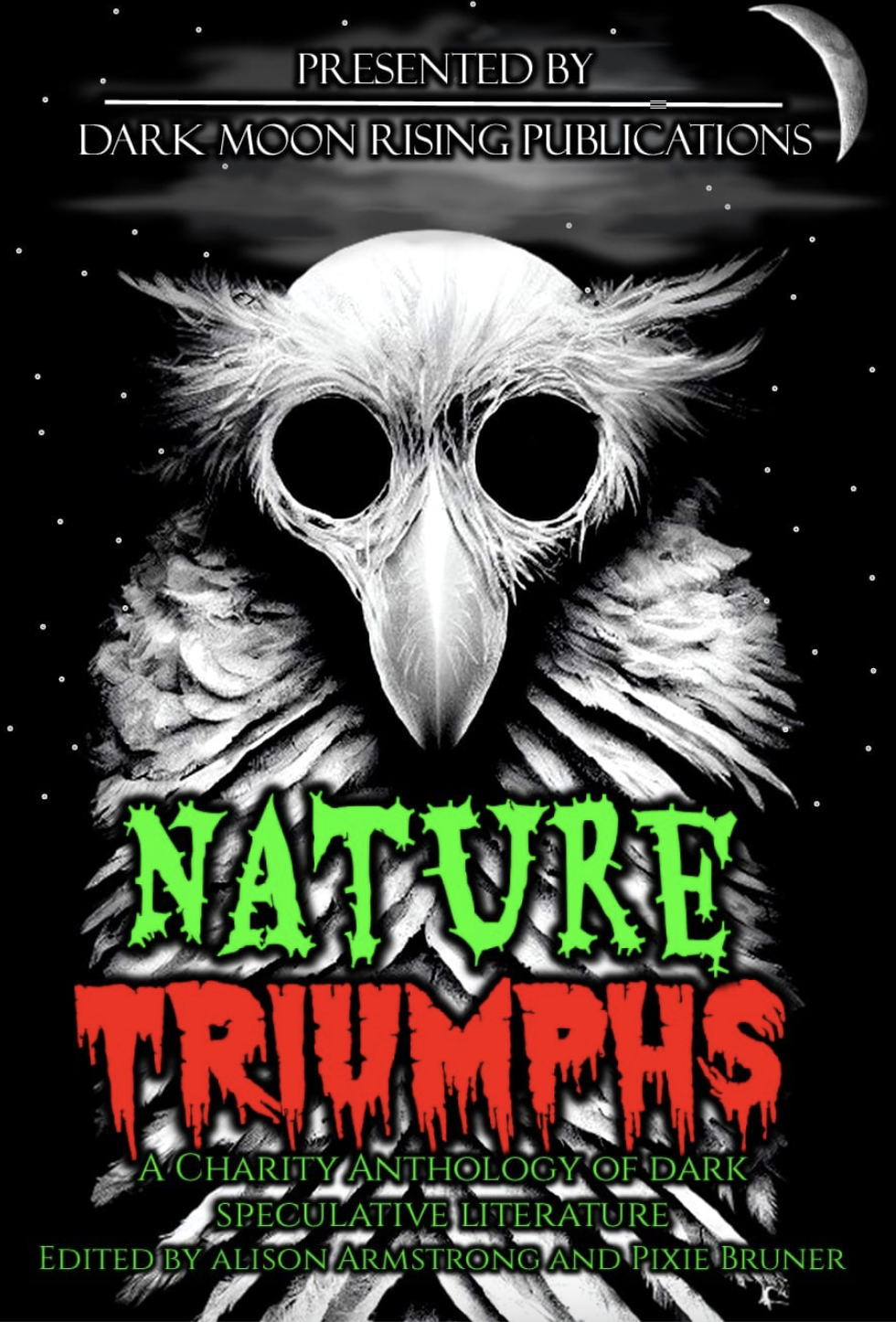
Nature Triumphs: a Charity Anthology of Dark Speculative Literature has recently received two five-star reviews. Scroll down the Amazon page to read them yourself, or read them here:

Avid reader called the anthology “Fun, Appealing, Scary, Thought-Provoking Eco-Horror Fiction–And Just in Time for Halloween)

“I loved this wonderful, big, entertaining, appealing, fun book –scary AND heartfelt eco-horror anthology. Exceptionally well-edited containing many varietal, well-written, vivid, horrifying stories and poems by diverse, established authors. Innovative concept/environmental/ecological/nature theme masterfully executed. I especially like stories “Yard Work” by Michael Errol Swaim, “Blood Rose” by Alison Armstrong, “One Side of a Conservation with Mother Nature” by Kyle Heger, “A Reversal of Fortune” by JG Faherty, and “last Call at the Garden of Eden” by Lamont A. Turner. I like that the money goes to The Nature Conservancy. Great book/gift for Halloween and for lovers/readers of horror, sci fi, dark speculative, ecological/ nature fiction and poetry.”

Jordan Francis called it “A beautiful and haunting Anthology for a great cause“.

“A beautiful and haunting Anthology. This collection of short stories and poems is amazing. It is at turns haunting, funny, and beautiful. This has introduced me to a multitude of great writers that i need to go back and check out their other works. Definitely worth the price of admission.”

Recall that my story, “The Bees,” is about a geneticist/beekeeper who, fed up with the world’s indifference to the dying off of the bees, does genetic alterations of the many bees he takes care of. He weaponizes them, making them bigger, stronger, smarter, and more lethal, capable of stinging their victims many times until they die. Can he be stopped, or will his enhanced bees multiply and tyrannize the world?

I really hope you’ll all go out and get yourselves a copy of this collection. It’s all for a good cause, and you’ll love the stories and poetry! 🙂

Analysis of Anton Webern’s ‘Zwei Lieder,’ Op. 19

I: Introduction

“Zwei Lieder,” or “Two Songs,” op. 19, is a short piece for mixed choir and five instruments by Anton Webern, set to two poems by Johann Wolfgang von Goethe. It was composed in 1925-1926; the five instruments are celesta, guitar, violin, clarinet, and bass clarinet, with a choir of sopranos, altos, tenors, and basses.

Webern, along with Alban Berg (who composed the opera Wozzeck), was one of the most famous pupils of Arnold Schoenberg (who composed Pierrot Lunaire), these three composers being the most famous members of the Second Viennese School, who used Schoenberg’s twelve-note compositional technique. This technique involves taking the twelve semitones and rearranging them in any order to produce a tone row, or basic set. This tone row becomes the thematic, melodic, and harmonic basis of a composition.

Because the twelve-note system eschews the major-minor system, the resulting music is atonal, and therefore it is an acquired taste, to put it mildly. One must get used to the ’emancipation of the dissonance,’ which is no longer required to be resolved quickly back to consonance, and so the music sounds ‘harsh’ to the uninitiated listener.

When it comes to Webern’s music, I usually prefer to listen to his instrumental works, such as the Symphony, op. 21 (1927-1928), the Five Movements for String Quartet, op. 5 (1909), the Piano Quintet (1907), the Concerto for Nine Instruments, op. 24 (1931-1934), and the Quartet, op. 22 (1928-1930), for clarinet, tenor saxophone, violin, and piano. However, since when it comes to my doing analyses of music here on my blog, I prefer to have programmatic content along with the music, I’ve chosen a Webern composition with a text, among his music that I don’t listen to all that often.

Therefore, I’ve chosen to analyze his “Zwei Lieder,” among his least-performed, and therefore least-known, compositions. The reason that this otherwise superb piece of music is so rarely performed is that Webern’s choice of instrumentation is, sadly, impractical from the point of view of setting up performances of it. A choir, combined with the odd assembly of five instruments I mentioned above, all to perform a piece that lasts about two minutes, will be too much trouble for most organizers of concerts to put together.

Such a piece is best performed as a recording, and here is a link to a recording of the piece. Here is a link to the first poem in the original German and in English translation (which I will not be quoting here!); and here is a link to the second poem in the original German and in French translation (which I wouldn’t be quoting here even if I had permission to!).

The text of the two poems, in the original German as well as in English and French translations, can be found also in the booklet (pages 142-143) for the Complete Works of Webern, Opp. 1-31, conducted by Pierre Boulez for Sony Classical. I’ll be using these texts as the basis of my interpretation of the poetry; the websites linked in the previous paragraph are just there for your information, Dear Reader.

II: The Music

The tone row that Webern uses for the setting of both poems is G, B-flat, F-sharp, F-natural, E-flat, A, G-sharp, C-sharp, D, B-natural, E-natural, and C-natural. The “Zwei Lieder,” op. 19, is Webern’s first work to use the same tone row all the way through the entire composition.

A tone row can be played out in four ways: the original order, inversion (upside-down), retrograde (backwards), and retrograde-inversion (both backwards and upside-down). Furthermore, the tone row can be transposed to any key other than the original set of pitches. In the case of the “Zwei Lieder,” Webern transposes the tone row by a tritone, the diabolus in musica.

Now, as Samuel Andreyev demonstrates in his musical analysis of Webern’s piece (and my analysis owes a great debt to Andreyev’s analysis of the piece), one would find it impossible to hear the tone row played out in a clear, linear fashion because Webern breaks up the tone row among the instruments and choir in a way that the ear could never follow, certainly not without reading the score as one is listening.

For a precise demonstration of how the tone row is manifested in the piece, I’ll leave that to Andreyev to explain, since I lack his technical expertise. Instead, I’ll just make some more general remarks about the music.

Instead of the traditional kind of melody, which flows and is linear, having a singing quality, Webern’s concise musical style tends toward punctualism–an isolating of the successive notes through wide leaps, unorthodox uses of duration, dynamics, and attacks that are divorced from conventional ‘expressivity’–and Klangfarbenmelodie, or an assigning of the successive notes of a melody to different instruments. Therefore, melody isn’t perceived as musical lines, but rather as musical ‘dots,’ if you will.

Because of these kinds of innovations in Webern’s music, he has been associated, in retrospect, with the postwar total serialism of composers like Boulez (i.e., his Le Marteau Sans Maître) and Karlheinz Stockhausen (i.e., his Gesang der Jünglinge). Webern’s puncualism and Klangfarbenmelodie have been seen as anticipating the 1950s serializing of not only pitch, but also all the musical parameters as listed in the previous paragraph.

III: The Text

Goethe’s poems are both sets of two four-line verses in trochaic tetrameter (a line has four feet, each of which has a stressed, then unstressed, syllable), with a rhyme scheme of ABAB CDCD. They are vignettes of the beauty of nature, of flowers in bloom or soon to be in bloom. Images or scenes of natural beauty were something Webern always loved, and I understand that even among his instrumental works, there was the inspiration of nature.

His choice of having a mixed choir sing these verses–as opposed to, say, having just one singer–what must have been the main factor in causing the logistical difficulties in having op. 19 performed, must have been of such insistent importance to him, overruling the practical problems that would have forbidden frequent performances of the piece. I’m guessing that the choral singing was meant to give the verses a sense of holiness. For Webern, nature is sacred.

These poems are inspired by Chinese literature; in fact, these two poems are part of a cycle Goethe composed, called Chinesisch-deutsche Jahres- und Tageszeiten (“Chinese-German Seasons and Times of Day”). Chinese literature, all things Chinese, actually, had been quite popular in Europe at the time of his writing, ever since Voltaire‘s time.

The first poem describes narcissus flowers blooming in a garden in rows. The first verse gives us a vivid sense not just of the flowers’ beauty, but also of their ‘innocence,’ ‘purity,’ and ‘modesty.’ Since when is a narcissus modest, I wonder?

Indeed, one thing to keep in mind when interpreting poetry, or literature in general, is that things often aren’t as they seem. We may be reading a beautiful description of nature, but what the imagery is meant to represent may not be all that beautiful…once we have looked beneath the surface.

The narcissus flowers are as white as lilies; they have the purity of candles. Candles may give light, which is inherently a good thing, but the light comes from fire, the fire of the passions, which are anything but pure. Goethe’s word for pure is reine, the same word Heinrich Heine used in “Du bist wie eine Blume” (“You are like a flower”), “So hold und schön und rein” (“So lovely, fair, and pure”), a poem about a woman whose ‘purity’ broke Heine’s heart. ‘Purity’ isn’t necessarily a good thing.

Goethe would have been perfectly aware of the Echo and Narcissus myth, in which the latter broke the former’s heart, and the latter was punished for his vanity by being made to fall in love with the image of his own reflection in a pond, meaning that the handsome youth, in a sense, broke his own heart. In his grief over never being able to have what he saw, Narcissus died and turned into the flower of Goethe’s poem.

Now, obviously neither Webern nor especially Goethe would have known anything about narcissism in the modern psychiatric sense that people today would know of it. The seeds of the personality type, however–the vanity, haughtiness, and pitiless rejection of others–would have been intuited in the mythic character of Narcissus, intuited especially by a poet of Goethe’s stature. So on at least an unconscious level, Goethe must have used the flower as a symbol of sinful pride; Webern must have picked up on this idea–again, at least unconsciously, and reflected it somehow in his music.

Similarly, while Webern would never have consciously thought of the music he’d arranged for the poems as ‘harsh,’ he certainly knew, from the conservative public’s reaction to his atonal works (and those of his modernist contemporaries, like Schoenberg and Berg), that they were perceived that way. And even though his “Zwei Lieder” use softer sonorities, their atonality, dissonance, and wide melodic leaps are all clear signs of musical tension, deliberately used. Therefore this tension, set to these poems, suggests a sensitivity in his mind to Goethe’s expression of an undercurrent of tension in otherwise surface idyllic verses.

Now, I’m about to do a kind of ‘retrospective’ interpretation of these verses, applying a modern meaning to writing that’s showed no knowledge of contemporary ideas. Some of my readers, such as one who commented on my analysis of the Echo and Narcissus myth (link above), would balk at my ‘projecting of modern ways of seeing’ onto old texts, insisting instead that whatever the original meaning there was of the old text is the only ‘correct’ way of thinking about it.

I beg to differ. Just because the writing is old doesn’t mean the interpretation has to be old. The arts are not STEM fields: they don’t have only one correct answer, like 2 + 2 = 4, and an infinitude of incorrect answers. Artists often are reticent about what they’ve created because they want to allow us to find our own meaning in their works. Insisting that the work means only what the artist had originally intended takes all the fun and joy out of experiencing the work.

Another justification I have for interpreting the meaning of a work of literature, film, or piece of music, drawing on elements that came into being long after the work was created, is to give the work a new meaning and relevance for us now, so we can relate to it in our own way and therefore enjoy it far more. Insisting that the work’s ‘ancient meaning’ is its only meaning makes the work dead to us now.

Besides, some themes and ideas are so universal that they apply to all times of history, including those times when people knew nothing of the modern concepts. Just because narcissism wasn’t known as a personality disorder in, for example, ancient Greece, doesn’t mean that narcissists didn’t exist back then, let alone cause pain and suffering to the Echoes of their day.

With this understanding in mind, I can begin to do my interpretation of these verses. We should also keep in mind when Webern set the poems to music: in the mid-1920s, when certain…politically tempestuous…things were going on in Europe, in Germany and Austria in particular. As of the piece’s composition, Hitler would have been released from prison after having served just over eight months of his sentence for the crime of high treason after the failed Beer Hall Putsch. The Nazi Party may not have achieved their immediate goal of taking over the German government, but they did gain national attention and their first propaganda victory, which surely would have gotten Webern’s attention.

As an Austrian patriot, Webern did, for a while at least, have some sympathy for Nazism. By the time the Nazis had come to power in the early 1930s, though, he was growing in opposition to them. He even gave a public speech in 1933, publicly denouncing the Nazis for calling his music, as well as that of Schoenberg and Berg, “cultural Bolshevism” and “degenerate music.” (He was lucky the Nazis didn’t arrest him for this.)

He was certainly never an antisemite. His musical mentor, Schoenberg, was a Jew. He resigned from a position as chorus master for the Mödling Men’s Choral Society in 1926 (the year he finished his “Zwei Lieder”) over his controversial hiring of a Jewish singer, Greta Wilheim, to replace a sick one. So his attitude towards Nazism was complicated.

I’ll now relate these political issues to how I imagine Webern could have read Goethe’s poems. To think that Goethe would have intended the interpretation I’m about to make would be absurd, and I admit I’m stretching things when I make speculations about Webern interpreting them in the way I’m about to describe. But in making this interpretation, I’m hoping not only to make the poems relevant for our time, but also to show that there’s more to them than just a pretty painting of nature in words–there’s a deeper meaning.

These narcissus flowers, white and pure, like stars, are as pretty as lilies. They bow with a modest demeanour. Since, as I noted above, the associations one makes of this flower with vain Narcissus are so obvious, then the flowers appearing so modest must be mere affectation on their part.

The white flowers have a yellow centre with a red rim circling it, glowing love, as the first verse points out. This red around the yellow middle is thus the loving heart of the flowers. This love, affection, and affinity of the flowers is thus a personifying of them…and an idealizing of them.

This idealizing of the narcissus flowers is significant, for as is associated with such flowers, narcissism is all about an idealizing of the self. As is indicated in the second verse, these early narcissus flowers have bloomed in the garden in rows. They are a group symbolizing beautiful and idealized, but also vain, self-important people. They are thus representative of group narcissism.

Now Freud, who discussed how groups of people living in the same community may look down on those outside their circle with contempt, was writing about this issue as an example of group psychology in 1922, which was just a few years before Webern composed his “Zwei Lieder.” I’m not suggesting that Webern read Freud’s work and was influenced by it in setting the poems to music. What I am saying is that we’ve all–at any point in history, even back to Goethe and earlier–sensed the arrogance of the in-group toward outsiders. Parochial, chauvinistic attitudes have existed since time immemorial.

So, is Webern’s choral setting of the poems meant to suggest a holy beauty in these flowers, or a ‘holier-than-thou’ attitude? Webern surely would have been aware of the hyperinflation of Germany in the early 1920s and its effect on the German psyche. This pain is the kind of thing that can drive people to have nationalistic feelings, to looking for a leader who will ‘save the nation’ from its ruin. As we know, some Germans looked to Hitler in the hopes of such a saviour.

I suspect that Webern could have read such a meaning in the poem’s hope that the narcissus flowers know for whom they’re waiting. As they stand in their rows waiting for their idealized leader, they are described in the original German as “so spaliert erwarten,” or “so trellised in expectation.” They’re being held up, as if by a trellis, which implies that they’re “stand[ing] at attention,” as the translation in my CD booklet (page 143) has it.

Narcissism involves an idealizing of another–an idealized parental imago who may mirror back one’s grandiosity, as Heinz Hohut described the relationship, or an idealized political figure–who reflects back one’s own narcissism. This is the true meaning of Narcissus falling in love with his reflection in the pond: the ideal is oneself, yet it’s also out there, another, as Lacan spoke of the ideal-I in the mirror stage. One sees oneself in the idealized other, and hopes to attain that ideal oneself.

So the narcissus flowers, standing at attention in their neatly-arrayed rows in the garden…a kind of Garden of Eden in its idealization?…are like the SA standing at attention before Hitler, whom they wait for, in hopeful expectation, ‘to save’ their nation, while looking down with scorn and contempt for foreign nations and other ethnic groups.

Webern could have made these associations in his mind–consciously or unconsciously–as he read Goethe’s poem, and written the music the way he did in accordance with such a meaning–with the dissonance, atonality, and wide melodic leaps to express his own inner conflicts (should he, in his Austrian patriotism, support fascism, or oppose its antisemitism and rejection of his art?) about the political direction he saw Europe going in at the time.

As for Goethe’s intention, he could have imagined the narcissus flowers standing in an orderly group awaiting a leader of a more general sort, but one who has the same demagogic qualities. This ‘follow the leader’ mentality has always existed, of course, so his poem has a universal relatability in this regard.

Now, the second poem describes sheep leaving a meadow, revealing a pure green of grass. There’s that word, “reines,” or “pure” again: recall what I said above about both the positive and negative feelings that can come from the use of this word.

So, who are the sheep? Are they those who are timid and easily led, as the word is commonly used today to describe people who blindly believe all the nonsense in the mainstream media and follow mainstream politics uncritically? Such a meaning could be too contemporary and too English to be fitting in a reading of such an old, German poem.

Or are the sheep the followers of the Church? Certainly Goethe, as a freethinker, wasn’t fond of the more dogmatic aspects of the Church, and so he probably wouldn’t have thought much of the simple-minded, unthinking flock. The sheep’s leaving the meadow, to reveal the purity of the green, could be indicating an improved world once we’ve been rid of the uncritical believers.

Or are the sheep those who truly abide by the spirit of what it means to be a Christian, as opposed to the mere conformist churchgoers? Not those who say “Lord, Lord,” but those who do good works without regard of reward (Matthew 7:21)? Their leaving the meadow could reveal a grass whose purity is of a more ironic sort.

In any case, the sheep’s absence will result in the glorious blooming of the flowers. This blooming is described as a “paradise” (recall my reference to the Garden of Eden in its idealization). Again, is Webern’s use of a choir to sing these verses in earnest, or is it ironic? And whichever answer may be correct, for which is it in earnest, and for which is it ironic…for the sheep, or for the paradise?

Note that there are parallel themes going on in both poems. There’s an idealizing of the beauty of the flowers, with an ironic undercurrent. By the end of each second verse, there’s a hope or expectation of good which may end up being its opposite.

Hope, in the second verse, spreads a light mist in front of us, implying that what we see is no longer clear because of that hope. What will be true and what we want to be true are often very different from each other.

Similarly, a parting of the clouds should give us clear, sunny skies (‘the fire of the sun’), and therefore clear vision. Just as one hopes that the leader the narcissus flowers are waiting for will be a good one, so does one hope that one’s unobstructed vision will reveal happiness and the fulfillment of one’s wishes.

IV: Conclusion

Among all of the German and Austrian nationalists, like Webern, there was a growing feeling that fascism might fulfill their wishes and give them happiness by restoring glory to their countries. While he felt that national pride and hoped that leaders like Hitler would fulfill those wishes, his continued friendship with Jews, going all the way to the Anschluss and beyond, would have been a source of great conflict for him, not to mention a potential danger.

He surely would have felt that conflict as early as the mid-1920s, when he composed the “Zwei Lieder,” for Hitler had made no secret of his antisemitism, of course, just as he was putting his nationalism on broad display. I believe the second poem’s expression of hope as a mist obscuring one’s vision put Webern’s conflict into words.

Similarly, as I said above, the atonality, dissonance, and wide melodic leaps at least unconsciously expressed his psychological conflict about the growth of European fascism in the 1920s. This musical expression of that conflict extends to the transposition of the tone row by the tritone interval…known significantly as the ‘devil in music.’

So Goethe’s poems teach us that we need to be careful as we look through the mists of hope, as well as to know who we are waiting for. Will we get that happiness, or will we get horror? Are we waiting for a hero, or a villain? In Webern’s case, he got shot and killed by an American soldier in the end, after having been disillusioned by fascism’s bloody failure. Be careful what you hope for…and for whom you are waiting.

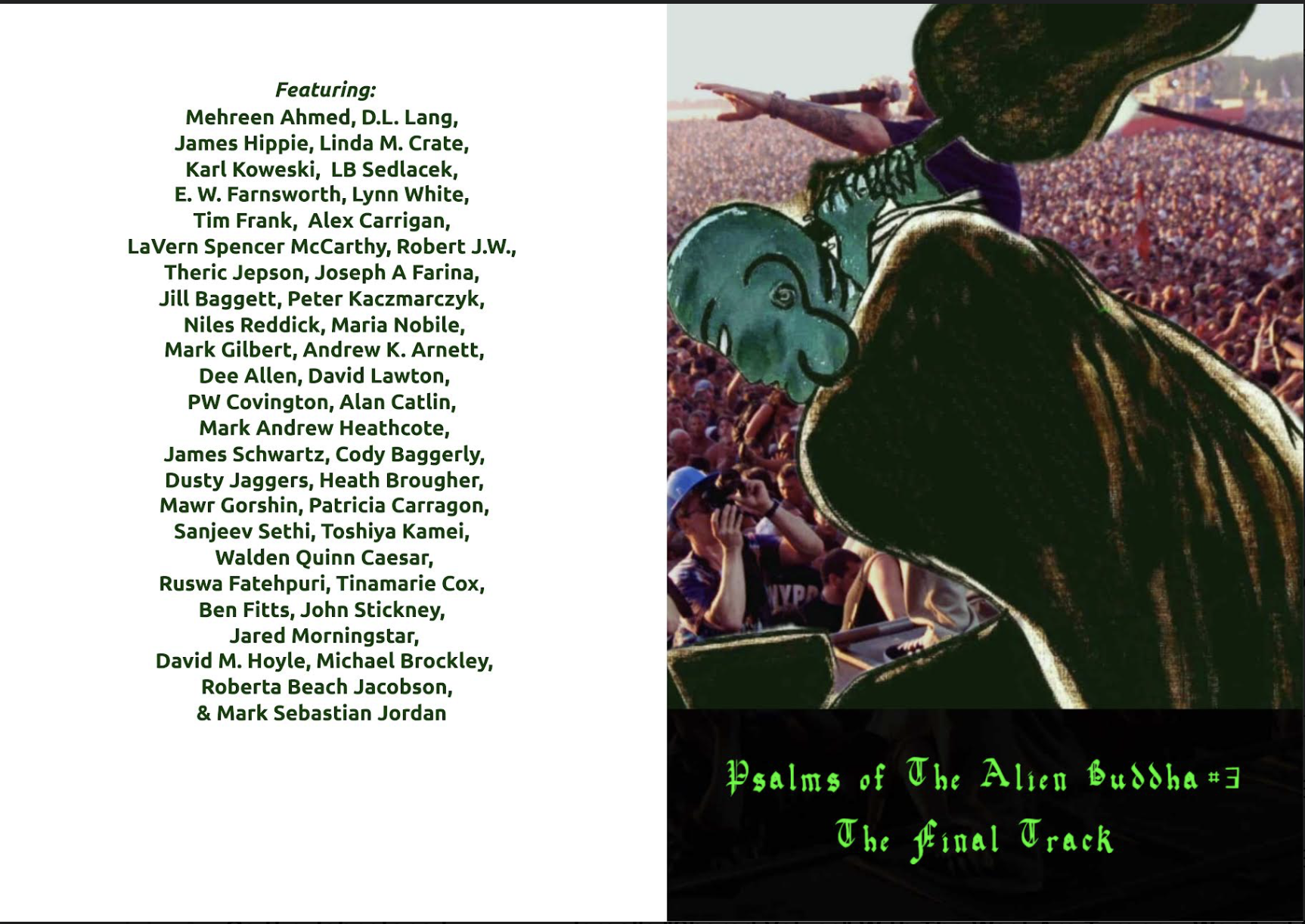
My Short Story, ‘Sing, Sing, Sing,’ in the Anthology, ‘Psalms of the Alien Buddha #3, The Final Track

Psalms of the Alien Buddha #3, the Final Track is a new anthology of poetry and prose published by Alien Buddha Press. I have a horror short story in it, called “Sing, Sing, Sing.”

The story is about two eighteen-year-old girls in a high school jazz band who love a jazz clarinetist, Woody, who is almost ten years older than them, and who is creepy enough to want to fool around with them. The first of these two girls, Claire, is jealous of Hedda, the second girl, for stealing Woody, and Claire wants to get revenge on Hedda. Claire also knows how to use magic, so that will be how she achieves her revenge. Now, when she achieves her revenge, will all be well with her, or will she have to deal with some bad karma because of it?

Of course, there are many other talented writers of prose and poetry in this anthology. I’m hoping you can read all their names on the back cover presented above. The paperback is now available on Amazon for $14.99. Go check it out: I’m sure you’ll love it!

‘Nature Triumphs,’ an Upcoming Horror Anthology, Includes a Short Story by Me…’The Bees’

Nature Triumphs: a Charity Anthology of Dark Speculative Literature, is an upcoming collection of horror short stories and poetry edited by Alison Armstrong and Pixie Bruner, and presented by Dark Moon Rising Publications. The charity is dedicated to helping save the environment.

My short story is called ‘The Bees.’ It’s about a geneticist/beekeeper who, fed up with the world’s indifference to the dying off of the bees, does genetic alterations of the many bees he takes care of. He weaponizes them, making them bigger, stronger, smarter, and more lethal, capable of stinging their victims many times until they die. Can he be stopped, or will his enhanced bees multiply and tyrannize the world?

All the talented writers in this anthology include Angela Acosta, M.G. Allen, Alison Armstrong, Lilse Asalt, Andrew Bell, Katie Brunecz, Pixie Bruner, Ramsey Campbell, J. Rocky Colavito, Rebecca Cuthbert, Julie Dron, Stephanie Ellis, Timons Esaias, J.G. Faherty, Thomas Folske, Brian U. Garrison, Elana Gomel, Alejandro Gonzales, Norbert Góra, [myself], Sebastian Gray, Megan Guilliams, Linda Kay Hardie, Kyle Heger, Kristi Hendricks, Kasey Hill, Larry Hodges, Akua Lezli Hope, Sandra Lindow, Gordon Linzner, J.C. Maçek III, Victor Malone, John C. Mannone, David C. Kopaska-Merkel, Makena Metz, Edward Morris, Irena Barbara Nagler, Kris Nelson, Kevin Sandefur, Em Starr, Michael Errol Swaim, Rob Tannahill, Lamont A. Turner, and Mary A. Turzillo.

The anthology drops on September 3rd, and they’re doing preorders now on Amazon and everywhere. Please come check it out, and help us to help the environment in a fun, scary way. I’m sure you’ll love the stories and poems in this collection!

Swimmers

Israel
has
swim-
mers,
as do the Palestinians.

Zion
does
not
need
swimmers; it just needs to disappear.

One
can
only
wish
the Palestinians could swim away from their hellfire.

But
they
can
only
quench that fire with all of the blood they’ve been swimming in.

They
should
not
have
to swim away, in red or blue; for Israel needs to disappear, no blood or water for land.

Analysis of ‘It,’ Part VI

Here are Parts I, II, III, IV, and V, if you haven’t read them yet.

XXVI: The Circle Closes

In this chapter, we return to the involvement of Tom Rogan and Audra in the story. In fact, the first two sections of this chapter are named Tom and Audra (pages 1278 and 1283). Both of these characters are having nightmares.

Tom’s dream is fascinating in how he’s seeing everything through the eyes of a similar psychopath, teen Henry. First, he sees himself pressing the button on the switchblade and stabbing Butch Bowers in the neck. Then, he sees himself in the sewers with Victor and Belch, chasing the Losers (page 1279).

It’s fitting that Tom should see himself as Henry, not just because both are abusive, but also because both were abused…by their fathers. One crucial difference, though, is that–as despicable as Tom is–he wouldn’t kill: he didn’t kill, and wouldn’t have killed, his father as Henry did, so seeing himself about to commit patricide is more than disturbing for him.

We recall the many patterns and parallels of abusive relationships in the novel: Al/Tom vs Beverly, Eddie vs his mom/Myra, Butch vs Henry, Eddie Corcoran vs his father, and Henry’s gang vs the Losers. What’s important in emphasizing the parallels between Tom and Henry is how both were abused by their fathers, so both learned that one ‘solves’ relationship problems through power and control in the form of abuse. To reinforce the parallel between Tom’s and Henry’s fathers, both fathers have alliterative names–Ralph Rogan, and Butch Bowers (page 1278).

Just as Tom imagined, from what he’d learned about getting “whoppins” if his younger brother and sisters–put in his charge from a young age–ever did wrong, he now imagines that the kids he’s chasing in the sewers need “a whoppin” (pages 1278-1279).

Tom’s fear of his father, just like teen Henry’s fear of his, is enough to make his killing of Ralph unthinkable…just as coward Henry’s would have been, had Henry not lived in the Trauma-town of Derry. So with Tom’s entrance into Trauma-town, now he is having the same unconscious murderous phantasies as every other resident there. His nightmare is actually wish-fulfillment.

Chasing the Losers in the sewers is also wish-fulfillment for Tom, since little Bev is one of the people being chased. All of these parallels of abusers and abused, especially when embodied in people within the city limits of Derry, reflect how It personifies not just the violent aspects of the Shadow, but of the Collective Shadow in general.

Tom deems the sewers to be a smelly purgatory (page 1279), which they are, since as representations of the unconscious mind, they can purge one of one’s trauma (i.e., through Jungian Shadow work and Active Imagination), provided that one navigates these passages correctly and has the courage to face It head on, as the young Losers, under Bill’s leadership, are trying to do.

Tom, like Henry, does not have the strength of character to be able to face his dark sides, so even dreaming about doing so is too much for him (page 1280). Just as Al, who recall had just been chasing after Bev out of suspicions that she’d been messing around with boys, so is Tom now chasing her out of suspicions that she’s fooling around with one of them, Bill, and has been sneaking (phallic) smokes. It’s easier to project aggression and wield control over her than to control himself, therefore it’s easy to equate Tom with Henry.

Tom wakes up, and for a moment he isn’t sure if he’s awake or still dreaming (page 1281), since he thinks he’s seeing one of Pennywise’s balloons. He also gets the feeling that this has been more than just a nightmare: after all, the unconscious is a world of a much deeper and higher truth–this is why surrealism is called what it is called.

Like Henry, Tom is also hearing voices (page 1282). He’s hearing a voice from a balloon tied to the knob of the bathroom door. The voice is telling him to give Beverly and the other Losers “a whoppin“. Hypnotized by the voice no less than Henry has been, Tom obeys Its commands and gets dressed (page 1283).

As I said above, Audra is also having bad dreams. Like Tom, she feels as though she’s in some strange place, and in a different body.

That would be the body of little Beverly in the sewers, being chased by Henry, Victor, and Belch.

Bill is with her, which is fitting, since Audra has been pursuing Bill to Derry. Recall that, when Bill is about to make love with Beverly, he notes how Audra looks like her, so what we have in these shared dreams and experiences are examples of synchronicity.

In Audra’s dream, she-as-Bev is holding his hand, reminding us of his adulterous lovemaking with her, as well as Bev’s cheating on Tom, with whose cuckoldry we of course have no sympathy. We do feel bad for Audra, though, especially when we consider what’s soon to happen to her.

Them all experiencing the sewers, whether in dream or as a distant, repressed memory, or the soon-to-be-experienced second confrontation with It as adults, is an experience of the sewers as the collective unconscious, where all minds merge. Audra feels the terror of the experience (page 1284) because it’s the terror of the Shadow.

The terror is so vivid that she hears the voice of Pennywise telling her that they all float down there after she wakes up and finds herself in bed in a hotel room in the Derry area (pages 1284-1286). She calls the Derry Town House to contact Bill, and the annoyed clerk wonders why so many calls for Bill have to happen that night (page 1287). Bill isn’t in his room because he has to deal with Eddie, as we’ll soon see; but Audra’s getting suspicions that her husband is with another woman (which of course he is–pages 1287-1288). And we can see again just how synchronistic events are getting.

As she’s trying to calm down and reassure herself that, after a bad dream, her suspicions are just over-reactions, she sees the bathroom light go on, and she hears that voice say, “We all float down here, Audra” (page 1288). The TV turns on, and she sees Pennywise.

Terrified, she races out of her room and out of the hotel to the parking lot, the only thing on her mind being finding Bill in the Derry Town House (page 1289). She finds her rented Datsun, not knowing the significance of it being parked nose-to-nose with the LTD wagon Tom Rogan is using (pages 1289-1290). He’s been in the car, having been goaded by It to go there no less than she’s been.

She feels his hand on her shoulder, it forcing her to turn around. He recognizes her as an actress in the movies, then he kidnaps her and takes her to the very sewers she’s just been dreaming of.

We can see why this chapter is named “The Circle Closes.” So many separate strands are being brought together here. Not just the return of the adult Losers to Derry to be reunited with Mike, not just the three uninvited guests of Tom, Audra, and Henry being added to the mix, but there’s also the back-and-forth between the late 1950s and the mid-1980s and the parallelism of these moments. Finally, there’s a kind of merging of the past and present and of inside and outside of Derry, through the unconscious world of dreams…and therefore a fusion of conscious and unconscious.

Fully understood, It narrates the story of a universe where all is one. Different people, even those living far away from each other, are united in one consciousness. The past and present are one. Good and evil are juxtaposed, and therefore one. Wildly differing actions are united through the non-causal, but meaningful coincidences of synchronicity. And the meeting place of all of these separate strands is the collective unconscious, the Collective Shadow, as symbolized by the hellish, smelly, filthy, dark sewer system under Derry.

In the section, Eddie’s Room, beginning on page 1290, Bev and Bill get dressed after receiving the call and go to Eddie’s room. Eddie’s arm is broken again, after the fight with Henry–again, we see the present paralleling the past.

They can’t tell the police about dead Henry, for Eddie will be charged with murder in a town that looks the other way whenever real evil happens (pages 1292-1292). There’s no proof of Eddie killing in self-defense, for Henry’s knife is gone.

They call Richie and Ben, who will arrive right away (page 1293). They try calling Mike, who of course isn’t at home, so they try the library, too. Instead of Mike answering the phone, the Chief of Police answers, and he tells Beverly that Mike is at the Derry Home Hospital, having been “assaulted and badly wounded a short time ago” (page 1294). Since she doesn’t want to tell the cop who she is and what she knows of the assault, he starts to suspect her, being someone who is oddly calling the library so late at night (page 1295).

With Beverly’s stress over the cop’s suspicions, we come to another major theme coalescing here from the experiences of many of the characters: guilt, and accompanying guilt, the fear of being caught in the guilty act. We’ve already dealt with Bill’s guilt over the murder of Georgie, which as I explained in previous parts is based on unconscious wish-fulfillment. Now, there’s Bill’s guilt over cheating on Audra with Bev…and Audra’s on her way, with suspicions of him!

There’s the guilt that Eddie’s mom tried to impose on him for hanging out with friends she didn’t want him to be with. There’s the guilt Al was imposing on little Bev (via his abuse of her) for hanging out with boys.

There’s also the guilt of having really done things (regardless of whether or not they really should be deemed bad) that others disapprove of. Bill was really cheating on Audra. Bev has really cheated on Tom with Bill. Little Bev really had sexual relations with all of the kid Losers, just as her dad feared.

Audra is trying to find the husband she rightly suspects of cheating on her. Tom is trying to find the wife he correctly suspects of cheating with Bill. Al chased after little Bev suspecting (correctly, as I’ve argued above) that her hymen is gone. The cop rightly suspects that Beverly knows a lot more about the circumstances of the assault on Mike than she’s letting on.

Guilt and the fear of punishment (regardless of whether or not that punishment is deserved) are manifestations of the traumatic feelings all of these characters are having, and having them all coalesce right now–with either dreams of, memories of, or plans of going very soon to the sewers–is significant because of how the sewers symbolize the unconscious, that place where everything merges into one.

Of course, there’s also the guilt of the actual antagonists of the novel: Pennywise, Al Marsh, Tom, Henry and his gang, Eddie Cocoran’s abusive father, Eddie Kaspbrak’s mom, the homophobic killers of Adrian Mellon, etc.–not that any of them feel much of any remorse for their actions, since it’s their positions of power and/or authority that makes them feel immune to remorse. Still, guilt–whether acknowledged or not–has its home, among all the other negative, rejected feelings, in the sewers.

To get back to the phone call with the Chief of Police, Beverly is worried that Henry’s assault on Mike could kill him (pages 1295-1296). This fear is tied in with her guilt, since her not telling the cop what she knows about Henry is obstructing the investigation.

She hangs up on the cop, and looks over at Henry’s corpse, which has one eye closed and the other open (page 1296), this opened eye oozing blood from its injury. He seems “to be winking at her,” adding to her guilt, fear, and sense that It, like her father and living Henry, are all coming to get her. Of course they are: they’re all one in Pennywise.

The Losers need to know how Mike is doing, so Richie calls the hospital, but pretends to be a news reporter, so he and his friends won’t be linked to the assault on Mike and the killing of Henry (pages 1296-1297). Richie calls himself “Mr. Kerpaskian,” which the one on the other end understands to be a “Czech-Jewish” name. After hanging up and finishing his act, Richie curses “Jesus!” four times. The “Czech-Jewish” name he assumed for himself must have made him think of suicide-Stan, and therefore must have given him the feeling that all the Losers were about to destroy themselves.

With the fear of being linked to all of this violence and therefore of being arrested, they all decide immediately to go to the Barrens and face It in the sewers (page 1298). As they’re driving over there, the car radio is playing the kind of classic, mid-to-late 1950s rock ‘n’ roll that they as kids would have heard all the time: “Be-Bop-A-Lula,” Buddy Holly, and “Summertime Blues.”

The problem is that Pennywise gets involved, reminding Richie of his “All-Dead Rock Show” that he saw near the Paul Bunyan statue (page 1299). Everyone wants the radio turned off, especially Bill when he hears the voice of Georgie blaming him for being murdered by Pennywise (page 1300).

They arrive at the Barrens, and already a number of things to parallel the late 1950s experience have arrived: assaults by Henry, Eddie’s broken arm, the Fifties music, and the rain and thunder (pages 1299-1300). Ben is to lead them past the old clubhouse to the pumping station’s concrete cylinder (pages 1301-1302), though Ben can hardly be expected to remember where it is after twenty-seven years. He is leading them just as he did the last time. Bill is stuttering just as he did as a kid.

All of these parallels, just as with the previous chapter’s mid-sentence transitions back and forth between the late 1950s and the mid-1980s, are indications of the unity between the past and the present in It, how everything is one in It.

The cylinder is “almost completely buried in a wallow of blackberry bushes” (page 1302), suggesting the obscure, repressed nature of unconscious feelings; yet the iron manhole cover has been pushed off, Ben assuming that its removal has been fairly recent (page 1303). Has Pennywise removed it, to lure the Losers in?

In a sense, Pennywise did. There are fresh scratches, those of someone who has gone in recently. With matches that Richie brought from Eddie’s room, they light up the darkness. Bill sees a strap…the strap of Audra’s purse (pages 1303-1304). This is where Tom–possessed by Pennywise–has taken her.

Bill can’t believe Audra’s here–she should be in England. He imagines what he’s seeing is another one of Pennywise’s illusions…but it isn’t. He looks through the contents of her purse (page 1305), and he sees things too accurately hers to be a mere illusion. She’s really down there in the sewers!

That Bill is wondering–since Henry, Victor, and Belch are all dead (Hockstetter, too, recall)–who could have got Audra down into the sewers (page 1305), and no one concludes that it was Pennywise who got her, adds weight to my speculation that It is a metaphor rather than an actual entity in the story. They of course don’t know that Tom is the one who got her.

The Losers go down the cylinder, Bill praying to God that Audra is all right (page 1306). Going back to the guilt/fear-of-reprisals motif discussed above, he is worrying that Audra’s abduction could be punishment for his adultery with Beverly, or even his fooling around with her when they were kids.

Bill starts having vivid memories of the underground place once he feels the cold water down below–the feel and the smell, the sense of claustrophobia…and yet, he forgets one of the most important memories…how did they get out?

XXVII: Under the City

Since we’re going into the sewers for the final confrontation with It, and the sewers symbolize the unconscious, where the secrets of everything live, and where all is one, it is fitting finally to have a glimpse of things from Its perspective.

Derry, that is, up above in the sunlight, is representative of the conscious mind–always trying to look good in public, cheerful and pleasant, what Jung would have called the Persona. Derry also hides its slimy underbelly, fittingly, in the sewers, just as the Persona tries to hide the Shadow.

But now that we’re down in those sewers, what is dark is coming to light–thanks to those matches that Richie took from Eddie’s room, to the extent that they’re of much use.

As It, in August 1958, comes to realize that there’s something new about–namely, those potentially threatening kids–It contemplates Its place in the universe, and Its relationship with the Turtle (page 1307). Recall that the Turtle corresponds to God, or Ahura Mazda, the principle of light, the spirit, and goodness, however one prefers to conceptualize Maturin. Recall also that It, a giant spider, corresponds to Satan, Angra Mainyu, or the principle of darkness, the flesh, and evil.

Just as Satan’s first sin was pride, leading him to believe that he could run the universe better than God, so does It think of the Turtle as stupid and passive, never leaving its shell. It may have vomited out the entire universe at the dawn of creation, but it hasn’t done much since then. Many people–that is, those who believe God exists but aren’t religious–tend to think similarly of Him.

The Turtle withdrew into its shell, and It came to Earth, to Derry, to be the god of this world as Satan is understood to be (2 Corinthians 4:4). Here’s an interesting quote from It: “It had created a place in Its own image, and It looked upon this place with favor from the deadlights which were Its eyes” (page 1307), reminding us of Genesis 1:26 and Genesis 1:31. Such a quote suggests a Gnostic interpretation of the God of Creation, a Satanic Demiurge creating the physical world, as opposed to Maturin’s spiritual world, one hidden in its shell.

It finds there to be, in the imagination of these kids coming into the sewers to confront It, both good and bad qualities. For It, their imagination is good in how their fear gives them a good taste when It eats them. Their imagination can be bad, however, when it is used against It, as it was used when Beverly fired the silver projectiles at It, hurting It and causing It to feel fear, a new experience that It doesn’t like. So in this, we see yet another example of the good/bad duality in the novel.

It doesn’t like change. It wants a reliable, cyclical world in which It wakes, eats, and sleeps in a state of hibernation for twenty-seven years before repeating the cycle. In bravely facing It and proving that It can be hurt, the kids have broken the routine.

This breaking of Its cyclical routine, of introducing change and the new element that It can be hurt, defeated, and even killed, has brought to Its attention the notion of an Other. No, It is not the centre of the universe, where everything else, like the Turtle, is stupid, timidly hiding, and exists only in terms of its relationship with It.

This “Other” that It is so worried about (page 1309) sounds a lot like Lacan’s notion of the Other, as opposed to an other that exists only as a narcissistic, metaphorical mirror of oneself, rather than a distinct entity in its own right. Such independent entities are what is so threatening to it, for as existing outside of It, they can take away Its power and control. The hurt that It has felt from the silver projectile is narcissistic injury. It is afraid of not being alone (page 1309), because not being alone means sharing the world with others, a break from the narcissistic world of a dyadic relationship in which the ‘other’ is really oneself reflected to oneself like the image in a mirror.

This is all significant when seen in light of how I interpreted the murder of Georgie. Recall how I said that the tearing-off of Georgie’s arm is a symbolic castration, the little boy’s traumatic need to leave the dyadic mother-to-son relationship and enter the larger society, to go from other to Other (see Part I, section III).

It is fitting that the first killing in the novel, George, should be thematically linked with its last killing, the destroying of It. It, as I’ve always said, personifies trauma, and the Oedipus complex, properly understood, is the ultimate, universal, narcissistic trauma in which a child has to give up his or her perceived ‘ownership‘ of the desired parent, to accept sharing him or her (and by extension, all people) with others.

Though It has lived since the beginning of the universe, vomited out by the Turtle (which is, as the creator of the universe, its ‘mother,’ in effect), It has the personality of a child–selfish, grasping, impetuous, and violent if he doesn’t get his way. By feeding off of children’s fears, It is projecting Its inadequacies onto them.

Georgie is a sweetheart compared to babyish It.

It hopes to defeat the kids by having them see “the deadlights of Its eyes” (page 1309, King’s emphasis), by having them “cast […] one by one into the macroverse“.

In Stephen King’s cosmology, the macroverse is the home of It and Maturin, probably created by Gan, a much higher and more powerful being than the other two–‘God’ in a far truer sense that I conceived Maturin of being (which was really just to contrast the Turtle with Satanic It, in the dualist sense), and the Other that It fears (see above). Gan emerged from primordial Chaos and is a character in King’s Dark Tower series, so a deeper discussion of Gan is outside the scope of this already gargantuan article. Gan may have created Maturin and It, though, so I’ll leave it at that.

The point is, from the strictly limited perspective of this novel, casting the Losers out into the macroverse–that is, outside of the mainstream universe that the Turtle puked out, our everyday reality being a part of it–is symbolically a throwing of the kids outside of anything they could possibly understand, verbalize, or mentally process. The macroverse, for the Losers, is just another manifestation of Lacan’s traumatic, ineffable Real.

Note that It, the personification of trauma and the embodiment of the Shadow, lurking in those dark sewers, is comprised of the deadlights, Its very life-essence. These are orange, ghostly lights that originated from the macroverse, and if one looks into them, one suffers insanity, if not death.

Again, the deadlights can be seen to symbolize the Real. It’s paradoxical that, in a world where darkness is considered evil and the light symbolic of goodness, that looking into these lights can cause madness or death, rather than enlightenment and bliss.

Reality is much deeper and more complex than that. As I’ve stated a number of times here, in It, in the world of the unconscious and all that is beyond our ordinary, sensory perception, all is one. Past and present are one, as seen in, for example, the jumping back and forth between the late Fifties and the mid-Eighties in those mid-sentence transitions we discussed above. The characters’ experiences are made one (e.g., Tom dreaming that he’s Henry, Audra dreaming that she’s Beverly, etc.), and good and bad juxtaposed are made one. Similarly, the light and dark can be juxtaposed and made one, in their extreme forms in the sewers.

As I’ve argued in many blog posts, the ouroboros can be used as a symbol of the dialectical relationship between opposites: the serpent’s biting head is one extreme, its bitten tail is the opposite extreme, and its coiled body represents a circular continuum where every intermediate point is found. Seeing the deadlights, especially when in the infinite black of the sewers, is a blinding light that shocks and terrifies rather than edifies you. Sometimes the light of truth is too painful to see, and the extremes of dark and light, the ouroboros’ biting place, are like Wilfred Bion‘s O as much as it is Lacan’s Real, Rudolph Otto‘s mysterium tremendum et fascinans, the numinous.

Part of the meaning behind the duality of good and bad that runs throughout this novel is how the two are dialectically linked, and the terror of seeing the deadlights is equivalent to the terror of the dark unknown in the sewers. The Losers’ running from Henry’s gang, yet also running straight into Its lair, out of the light and into the darkness, only to confront the deadlights, is part of this paradox.

Speaking of darkness and light, the kid Losers have maybe ten matches that Bill wants to save for later, since they still have dim light in the drains that they can use for now (page 1309). Since this part of the story directly deals with, in a symbolic sense, confronting the Shadow, a preference of dark over light is fitting.

They’re going in deeper water now, with such dead animals as a rat, a kitten, and what seems to be a bloated woodchuck floating around them (page 1310). Such ghastly things, combined with the darkness and the stink, symbolize how an exploration of the Shadow is, however in the end therapeutic, a perilous enterprise, which if done incorrectly and carelessly, can lead to the opposite of therapy and mental health.

And while the water they’re going through is relatively placid for the moment, it will soon roar out at them. The shapelessness of water is symbolic of the undifferentiated, indescribable nature of the Real. Again, this all adds to the uncertainty of the end of the Losers’ pursuit.

As we know, each of the Losers seems to have his (or in Bev’s case, her) special talent. Hers is marksmanship with Bill’s slingshot and the silver projectiles she’s shot at It-as-Werewolf. “Big Bill” is the leader of the group. Richie’s (potential) talent is as the self-proclaimed comedian. Mike is the town historian. Ben is the engineer. Stan can shout out bird names from his bird book to protect them. And Eddie is the one who knows which way to go, how to get found again when they’re lost (pages 1310-1311).

Again, it’s paradoxical that Eddie, the weak, germ-phobic ‘mama’s boy,’ would be the one who can lead the group through the treacherous sewers, hellish symbol of the unconscious, home of trauma, and the centre of the Shadow, but here we are. This paradox is yet another example of the good/bad duality of It, for Eddie is a mix of strength and weakness, of helplessness and helpfulness.

Eddie’s only answer to Bill’s question of which pipe to go through, however, is that it depends on where they all want to go (page 1311). Bill, in frustration, reminds Eddie that they’re trying to find It. Richie, Bev, Ben, Stan, and Mike all agree that It is near or under the Canal. This means going down the lower of the pipes to get to It.

Stan unhappily points out that this lower pipe is “a shit-pipe” (page 1312). Bill isn’t surprised to know this unpleasant fact, and neither should we be. The unconscious is a place of repressed feelings. The Shadow is all that is rejected from us. Part of that rejecting and repressing involves projection and splitting off of what we don’t like about ourselves. What better metaphor for such rejected, projected material is there than shit?

As reluctant as they all are to go through a pipe and get immersed in excrement, though, there is a strong motivation to go in that’s coming at them from behind: Henry and his gang. Here again, we have a fusion of opposites, in this case, in front with behind. They’re going forward to find It, and they’re fleeing Henry, who’s behind them. And in my interpretation, Henry-as-murderer is equivalent to It-as-murderer. The sewers are a world of non-differentiation: here, all is one.

As fetid as the smell of the sewage is, Bill is aware of an “undersmell,” the smell of some kind of animal…It. For Bill, recognizing such a smell is good news, for he knows they’re all going in the right–if rank–direction (page 1312). Again, good and bad are united.

Twenty feet inside this giant, metal rectum, they find the air to be worse than rancid–it’s outright poisonous. The bad things that other people project end up getting introjected by us, toxic smells symbolically breathed in. Such exchanged pain is the basis of all of our trauma.

Bill calls out to Eddie for guidance: the leader of the group, “Big Bill,” the one brave enough to face It, the one hungering for revenge for George, needs Eddie, the one regarded as the weakest, the most afraid, and the most averse to this paradise of germs in the shit-pipe. All is one here, including strength and weakness, large and small, bravery and fear.

All the light is gone now. It’s no longer dark…now, it’s black (page 1313). Sounds are magnified and echoing, including those of the Losers shuffling along in the pipe, and the “sewage running in controlled bursts” (page 1313). The pipe is defecating on them. Indeed, they all scream when they get doused with it at one point, “a shit-shower,” as Richie calls it (page 1314). Now, in the absolute black, Bill could use one of those matches (page 1315).

They’ve come out of the shit-pipe, and with a lit match they can look around. Patrick Hockstetter’s body is to Bill’s right. This would seem to be an omen, for Henry and his gang are coming (page 1315). The Losers hear them coming from the pipes’ echoing acoustics.

After Richie taunts Henry and his threat of “We’ll get youuuuuu–“ (page 1316, King’s emphasis) with the name “banana heels,” they all hear “a shriek of…mad fear and pain…through the pipe”. One of Henry’s gang…Victor, or Belch?…has been killed by It. Mike thinks it’s “some monster.”

The Losers continue toward the Canal, while the storm outside rages and brings “an early darkness to Derry” (page 1317). This storm has an apocalyptic quality similar to the one that destroys downtown Derry at the climax of the novel. This one has screaming winds, stuttering electric fire, and the racket of falling trees, all of which sound “like the death-cries of huge prehistoric creatures.”

Next, we have another narration from Its point of view, but in May of 1985. It knows that the adult Losers have returned, and It also senses the return of “that maddening, galling fear…that sense of Another.” (page 1317) It feels that the Losers are agents of this Other (page 1309). I mentioned above that a higher God named Gan is this Other, from the macroverse and therefore a reminder to It that there’s much more to the world than just our mainstream universe, with the Turtle (as its creator) and It as the only two major powers. And since the Turtle remains in its shell and is, in Its estimation, “stupid,” then It, as god of our world, of Derry, is the only true power.

As I explained above, these higher powers are symbols of the Oedipal triangle we all go through that pulls us out of the dyadic, narcissistic, one-on-one parent-to-child relationship of the Imaginary and into the larger culture and society of the Symbolic, represented by a third party, the other parent, the Non! du Père that forbids the original dyadic relationship of the second party, the Oedipally-desired parent, as a mirror of the self.

In King’s cosmology, It corresponds to the child, Maturin corresponds to the Oedipally-desired parent (though It gets Its narcissistic supply not from the Turtle’s love and attention, but from a sense of superiority over the Turtle’s perceived stupidity and ineffectiveness), and Gan–the Other–corresponds to the intrusive third party that forces It to acknowledge that there’s a much larger world out there than the one It has power over. The Losers, as the apparent agents of Gan, are making It feel as though It’s about to be the real loser.

It feels somewhat encouraged in how now there are only five Losers to deal with: Stan has killed himself, and Its dogsbody–Henry–has put Mike in the hospital. It plans to send a nurse to Mike to finish him off (page 1318). It remembers how, when Mike was a baby, a large crow was pecking at him until his mother hit the bird with her fist and drove it away. The trauma of the crow would stay in Mike’s unconscious until he saw the giant bird.

Its other dogsbody, Tom Rogan, has arrived in Its lair with Audra. He has also died of shock from seeing It in Its naked, undisguised form (page 1318). Audra has seen the horror of the deadlights, and she realizes that It, the giant spider, is FEMALE (page 1319).

This kids should have killed It when they had the chance, when It was hurt and therefore at Its most vulnerable. Instead, the adult Losers, older and fewer in number, will have to face It healed, renewed after Its twenty-seven-year rest (page 1320). What’s more, the adult Losers no longer have their vivid, childhood imaginations to give them power to fight It.

Now, their imaginations have been stifled by TV. They need Dr. Ruth to help them fuck, and Jerry Falwell to help them to be saved. It realizes, however, that their imaginations aren’t as weak as It thought they would be, especially when the five’s imaginations are combined.

It heartens Itself by remembering that “Big Bill,” the leader and the strongest of the group (and as “the writer,” he’s also the most imaginative of them), has been weakened by his fear for his wife and what’s happened to her. After killing and feeding on him, killing the remaining four should be all the easier.

Now we come to the adult Losers going through the pipes (page 1321). Them all being bigger now, it’s much harder going through such tight pipes. As they’re going through, they get to a part of the sewer system that’s moldered, ‘and the bodies of Victor Criss and Belch Huggins had moldered along with it. Like Peter Pan’s Wild Boys, Victor and Belch had never grown up.” (page 1323)

Since the sewers represent the unconscious and the Shadow, and the sense of danger down there is linked with trauma, then the deaths of the two teen bullies represent how trauma has a way of putting its child victims in a state of arrested development, like those Wild Boys who never grew up. Trauma responses that serve a vital survival purpose in childhood become dysfunctional in adulthood, making the adult who was traumatized as a child still, in a way, a child. This is why the adult Losers have to confront It: their adventure underground is a symbolic facing of their childhood pain in order to be freed of it.

There’s yet another mid-sentence transition, from the adult Losers in the sewers to the kid Losers there, on page 1325. Richie begins asking Bill, “Do you have any idea…” then we go to “how long they had been wandering through the tunnels under Derry…” in the narration on page 1326.

With the ending of the adult Losers section, just before Richie’s question, Bill has found Audra’s wedding ring and put it on his finger. His match has also blown out, leaving them all in darkness. Richie’s unfinished question leaves them all in an even greater darkness of uncertainty, but the finding of her ring represents a sense of hope. The darkness and unfinished question transitioning back to the late Fifties, when the kid Losers have much less of an idea that they can defeat It, diminishes their sense of hope all the more.

There is, if anything, a far greater sense of hopelessness now, since Bill knows he won’t ever find his way back out of the sewers (page 1326). He remembers how his dad once told him that “You could wander for weeks.” They are desperately relying on Eddie’s guidance. They don’t have to be killed by It. They could die of endless wandering, get lost in the wrong pipes, or get drowned in the piss and shit.

An exploration of the Shadow can be similarly treacherous. One can be, without the guidance of a Jungian analyst, lost in the darkness of one’s negative, trauma-induced thoughts, driven mad, as Jung himself almost was.

As the kids are crawling through and smelling the filth, their traumatic memories and associations are all coming to mind, as one would expect to experience while doing Shadow work. Ben remembers the mummy from the smell. Eddie imagines it’s the smell of the leper. Richie thinks the stink is that of a moldering, rotting lumberjack’s jacket, big enough to fit Paul Bunyan. Beverly thinks of the smell of her dad’s sock-drawer (which in turn might remind one of that smell she and her dad made between them–page 1047). Stan remembers the smell of clay mixed with oil, which he associates with the demonic Golem. Mike thinks of the dry smell of feathers in a dead nest (pages 1326-1327).

Recall again how these smells are symbolic of introjections from what bullies and other abusers are projecting from themselves, what the abusers hate about themselves thrown onto their victims, the shit that gives off the stink, toxic fumes from toxic people.

Eddie directs them all to where the Canal is, which he says is less than half a mile away, provided they can keep going in a straight line (page 1328).

Then they hear a scream: “–gonna get you sons of bitches. We’re gonna get youuuuuuu–“ (page 1329, King’s emphasis). Henry is still coming. They have no idea how far back he is, since the echoes give a distorted sense of distance.

About fifteen minutes later, they hear something coming toward them. Richie is so scared, he feels like a helpless three-year-old. One is reminded of adult Richie’s fortune cookie, for they all see, once Bill lights another match, “the Crawling Eye!” (page 1230).

It’s a gigantic eye filling the tunnel, with a black pupil two feet across, the iris a reddish-brown colour. The white of the eye is “laced with red veins.” It moves with tentacles, suggesting the crawling of It-as-spider. It’s looking at the kids greedily. Then, Bill’s match goes out. It’s as though the Eye can see them, but not vice versa.

This Eye is full of symbolism. This Eye stares at them just as the little eye in Richie’s fortune cookie stares at him: it’s a critical stare. The black iris is the black of the sewers, the world of the feared unknown. The russet colour of the iris suggests the red of blood from being hurt or killed (just as the red veins on the white of the eye) and the brown of shit. Henry (identified with It-as-killer) is right behind the kids, his own eyes watching for signs of them. Everything this Eye is implying is a death right there in the sewers…and even though we know the kids survive this incursion into the sewers, we also know there will be another incursion, with not all of the adult Losers surviving.

Bill feels the Eye’s tentacles touching his ankles (page 1330). He feels Its heat, the heat of passion and hate. Beverly also feels a tentacle touch her ear and painfully tighten like a noose around her. As It’s pulling her, she feels as if a strict schoolteacher were forcing her to sit wearing a dunce cap in the corner of the classroom (pages 1330-1331). In this, we can see how the terror of the Eye represents the pain of being criticized.

Eddie senses the tentacles around him but not landing on him (page 1331). He feels as if he were in a dream–a fitting feeling, given how the sewers represent the unconscious, and a giant eye with tentacles is a surreal image, the illogical, dreamlike kind that the unconscious would like to express.

His mind is screaming out to him to run home to his mamma, since he can find his way out. He’s much braver than that, though, and as we’ll learn by the end of the novel, adult Eddie is not only the Loser brave enough to face death, he’s also the one whose body will be left in the sewers, because the other adult Losers won’t be able to carry him out.

One thing we should never forget about the Shadow is that it is not all evil. It just represents aspects of ourselves that we don’t want to accept are there; sometimes they’re vices, but other times, they’re virtues. In Eddie’s case, he has strength and bravery he doesn’t even know he has.

He shouts “No!” with “a Norse-warrior sound” that one would never guess such a thin chest could ever bellow (page 1332). He does more violent shouting, he kicks at the Eye, his foot going deep into the cornea, and he shouts at the others to fight It, for “It’s just a fucking Eye!” He’s calling his friends “pussies”, he’s fighting It, and he’s “GOT A BROKEN ARM!”

Eddie, the weak one with “asthma,” is actually the strong one of the Losers. All opposites combine into oneness in the sewers. Here, weakness becomes strength, and vice versa. Eddie is so much more than the Persona his mother would have him show the world.

The other Losers start fighting the Eye, and they cause It to withdraw (page 1333). Stan can hear Henry still coming, so they have to move out (page 1334). The tunnel is going downward, and the stench is getting stronger. They have a feeling of disconnection, as they had in the house at Neibolt Street, as if they’re over the edge of the world, in nothingness, “Derry’s dark and ruined heart” (pages 1334-1335). I’m reminded of Joseph Conrad‘s Heart of Darkness, and Apocalypse Now, where there are similar depths of evil, of a sense of the end of the world.

Part of that apocalyptic evil is a sense that they’re drifting apart, isolated and alone, as Bev is feeling. She tells the others to hold hands, so they’ll all stay together, because it’s only through their solidarity that they can hope to defeat It.

They come to a widened-out part of the tunnel. The area is huge. Bill is stuttering that they must go, for Henry will reach them soon (page 1336). Then, Stan notices the giant bird coming. Since It is the bird, and Henry is understood to be coming soon, we can see again how the bully and the evil entity can be at least symbolically equated.

It attacks Eddie first. As they’re trying to fight It off, Stan tries to do what he did with his bird book the last time he had to face It alone: he’s calling out the names of birds he believes in–scarlet tanagers, vultures, New Guinea mudlark, flamingos of Brazil, and golden bald eagles (page 1338).

With a large silence indicating that the bird has disappeared into the darkness, the Losers check Eddie’s cuts. Henry shouts out that he and Belch are coming (page 1338). Bill stutters that Henry should go back while there’s still time, for It is far more dangerous than Henry could ever be. The bullies, of course, won’t go back, for as I’ve explained, and what Bill and the other Losers don’t fully comprehend, is that the murderous instinct of It and the bullies is one and the same. In the subterranean unconscious, all is one.

The Losers reach a wall, where there’s a small door with a mark on it. Bill sees it as a paper boat. Stan sees a rising bird (page 1339). Mike sees a hooded face, maybe Butch Bowers’s. Richie sees eyes behind a pair of glasses. Beverly sees a balled-up fist (Al’s, presumably). Eddie sees the leper’s face, all disease and sickness on it. Ben sees “a tattered pile of wrappings”–the mummy’s? (page 1340)

In other words, they all see their traumas.

The door isn’t locked, so Bill pushes it open, letting out “a flow of sick yellow-green light” and a powerful “zoo smell.” As the kids pass through and into Its lair, we have another mid-sentence transition to the next section, beginning with “Bill…”

We return to the adult Losers in the sewers. Bill has stopped abruptly, and he tells the others that It was where they are now. He and Richie remember that It was in the form of the Eye, so we see how these two sections are linked, and it’s easy to know why Richie would remember the Eye (page 1341).

Bill mentions how Audra came to Derry because he told her the name of the town. Since Henry didn’t take her into the sewers, though, how could she have gotten in there? Ben assumes that It brought her down there, to rob Bill of his courage (page 1342).

Beverly correctly suspects it was Tom who brought Audra into the sewers, because Bev also mentioned that it was Derry where she had to go to when she fought him and left him.

There’s a discussion of how everyone’s lives are intertwined: Bill and Audra, Bev and Tom, Henry, etc. Richie compares this interconnectedness to a soap opera, where Bill thinks it’s better compared to the circus (page 1342). In any case, here in the sewers, all is one.

Bill seems to have an intuitive sense of object relations theory, though he gets the names mixed up. He imagines that in abusive Tom, Beverly has married Henry, when she corrects him and says that in Tom she really married her father.

Bill knows they’re getting closer because he can smell It. He remembers, down the passageway, there’s that door with the mark on it. Again, in this moment, we see a link unifying the past with the present–all of time is one. He can’t, however, remember what’s behind the door. When exploring the depths of the Shadow, one always comes across ever darker, more repressed things one cannot discover because one doesn’t want to discover them. He remembers how scared he was when he opened the little door, the flood of light that came out, and the zoo-smell…but nothing more (page 1343).

He asks the others if they remember what It really was; none of them can. Beverly remembers they used the ritual of Chüd to fight It. They hear the approach of dragging feet, and Bill lights a match.

We next switch to a section with a sample of the residents of Derry responding to a number of ‘wrong things happening’ (pages 1343-1346). They start happening at 5:00 AM, just before the sunrise.

The first of these wrong things is the clock of the Grace Baptist Church not chiming that morning, the way it has unfailingly done at each hour and each half (except one time, at the noon-hour, supposedly a deliberate omission to mourn the deaths of some children from an explosion of the Kitchener Ironworks, though it actually just didn’t chime because it didn’t–page 1344).

Every old-timer in Derry has woken up at this time, sensing that something’s wrong, but not knowing what it is. It’s a sense of the lack of something that’s supposed to have happened. Norbert Keene, who has told Mike about the Bradley Gang and told Eddie about his asthma placebo, is now looking out his window to see a darkening sky, when the weather report of the night before has called for clear skies (page 1345). It’s going to rain.

He remembers the day the Bradley Gang was gunned down. He’s scared, thinking, “Those kids…[are] monkeying around.” Does he mean the Losers Club? If so, he’s sensing a synchronicity.

Egbert Thoroughgood, who was in the Silver Dollar when Claude Heroux used his axe and gave those men so many whacks, wakes with a scream and having wet the bed after a dream about Claude. He, too, knows that something is terribly wrong. His terrifying dream (and dreams are part of the royal road to an understanding of the unconscious, as Freud observed) is connected through synchronicity to the apocalyptic events about to occur in Derry.

Dave Gardener, who found Georgie’s bloody, one-armed body on that other day of flooding, is now disturbed by the conspicuous lack of a chime from the local church clock. He sees the clouds coming in, and he’s even more worried (page 1346). He senses the danger because another Great Flood is coming.

The Derry Chief of Police, who has done his best to solve the new string of child-killings, and the one who suspects that Bev knows more about the circumstances surrounding the attack on Mike in the library than she’s let on, sees the clouds out there, and feels the same worry as Keene, Thoroughgood, and Gardener. He senses that it will do more than just “pour buckets” (page 1346, King’s emphasis).

The great, apocalyptic thunderstorm is about to come. The cop sees the huge raindrops beginning to fall. He hears the rumbling in the sky, and he is shuddering with fear.

These men all instinctively know that this won’t be just any thunderstorm, or even any old flooding. The morning has been full of omens. The lack of chiming from a church clock known to be faithful with it implies ‘the end of time,’ in a sense. Dreams and memories of horrific violence, both past and present, add to the ominous energy.

This merging of the inner and outer worlds, a fearful sense inside the mind from bad dreams, and the sense of things going wrong out there, in the physical world, is the essence of synchronicity…but not the sentimental kind we learn of in YouTube videos, of good news from the universe.

Back in the sewers, after Bill has lit a match and held it up to see, he sees an apparition of George further up the tunnel, in his yellow rainslicker (page 1347). He’s blaming Bill for allowing him to die, plaguing Bill further with guilt.

The apparition, of course, is a projection of Bill’s guilt feelings, his unconscious running wild. He feels as if his friends are abandoning him, though Richie, Beverly, and Eddie are shouting at him to fight It and kill It (page 1348).

Bill tries to fight It off, saying the couplet for his stuttering therapy. As he does, Richie remembers that Bill stutters only in his own voice; he never stutters when he pretends to be someone else (page 1349).

This stuttering when he’s himself, but not stuttering when he’s not himself, ties in with what I was saying back in Part I of this analysis, when I related the stuttering to Bill’s difficulty transitioning from Lacan’s Imaginary–a narcissistic mindset in which a child’s Oedipally-desired parent is a metaphorical mirror reflecting his ego–to the Symbolic, a sociocultural mindset expressed through language, in which one interacts with many Others who exist as entities unto themselves, not just as extensions of oneself.

Another aspect of this transition from dyadic relationships to the larger society involves engaging in that society’s fakery while acting as if it were sincere, even believing it’s sincere, something Lacan expressed in his French pun of le Non! du père and les non-dupes errent. To be able to adjust to society and gain its healthy benefits, one must ‘play the game,’ or participate in the hypocrisies and play-acting that everyone does in order to fit in. Hence, for Bill to be free of his stutter, he must speak in a voice other than his own. Entering society, which must be done through language, means speaking an actor’s lines, so to speak.

Bill must recite that couplet like an actor reciting Shakespeare’s blank verse, so to speak, so that he can immerse himself in the cultural world of the Symbolic and its use of language. As he repeats the couplet, not stuttering, he gains strength and can advance on It, making It back off (page 1350).

A little later, though, he falters, and the real Bill starts coming back, consumed with guilt. Weeping, he says sorry to George, and his stuttering returns as well (pages 1350-1351).

Outside, and as of 5:30 in the morning, it’s raining hard. Weather forecasters are apologizing for the misleading predictions of good weather from the day before, which have raised the hopes of people planning picnics and other outings only to be disappointed today. Such disappointments, though, will be the least of their worries.

Though the rain is heavy, everyone agrees there won’t be flooding; still, everyone’s uneasy about the growing storm (page 1352). There are explosions: one from a power-transformer at 5:45, then an underground explosion is felt at 6:05. A number of people are killed (page 1353).

Mike wakes up in his hospital room at 6:46 after having “an anxiety dream.” Once again, the inner and outer worlds are united through synchronicity. He slowly starts to remember how he was in the library, about to write in his notebook, when Henry appeared. Since he doesn’t know any more after the attack, he can only worry that Henry has gone after the other Losers (page 1354).

He uses the call-bell to get help. A male nurse comes in the room, Mark Lamonica, whose sister was killed back in 1958, so this is a bad omen. Mark doesn’t want to hear anything Mike has to say, another bad sign. He just wants to give Mike a shot.

Just as the shot from the syringe is symbolic of projection, the kind of projection one would get from an abuser, the unwillingness to listen to the words of the one an abuser is preying on is just as bad, for one must be able to rid oneself of the pain the abuser is putting into one. The shot will put Mike to sleep, as in “to die, to sleep, no more.” The shot is a projection of the badness inside the abuser, like the projections that Eddie and Bev receive from his mother and her father respectively.

This kind of projection is projective identification, where the recipient is manipulated into manifesting the projections, hence, Eddie’s germ-phobia and fragility, Bev’s promiscuity with the Loser boys when she was a girl, and Mike’s receiving of the Thanatos the nurse wants to inject into him.

Back in the tunnels, Bill wants everyone to be quiet (page 1355). Since Richie has lit a match, everyone looks around, expecting to see It in the form of another monster, a new surprise: perhaps Rodan, or a xenomorph from Alien.

This isn’t the problem that Bill is worried about, though. He senses that Mike is in danger back in the hospital. Ben feels it, too. Bill wants everyone to hold hands immediately.

It’s interesting how, in the sewers, symbolic of the collective unconscious and a place where all is one, the Losers can psychically feel Mike’s current state of danger, all the way from there to the hospital.

Bill shouts out, “Send him our power!” in a strange, deep voice, as if he were a shaman in a trance (page 1356, King’s emphasis). Beverly feels something leave all of their bodies and go out toward Mike. Again, the tunnels have a mystical quality rather like the Shining, which allows the Losers to send out a kind of divine energy to help Mike.

And indeed, this power gets to Mike, and in spite of being injured, weakened, and bedridden, he is able to use this power to pick up a glass and smash Mark the nurse in the face with it (page 1357), making him drop the syringe and saving Mike from getting the fatal injection.

Back in the tunnels again, Bill senses that Mike is all right. Ben has felt the power going out from them and coming back, but he doesn’t know where it went or what it did…if it even existed (page 1358).

They all continue through the tunnel, Ben recalling the thick zoo smell. They’ve reached the door they’d found when they were kids, that small door. Ben’s heart is beating faster. The place is triggering painful childhood memories for him. He feels fat again.

Since they’re all grown up, it will be hard for them to get through the door. They see that mark on it, the one that evokes different things for each of them to see, as it did when they were kids. Bev sees Tom; Bill sees Audra’s severed head, with accusing eyes to guilt-trip him the way Georgie’s apparition has done (the severed head might also remind us of Stan’s in the library fridge–page 909); Eddie sees a skull over two crossed bones, the poison symbol, Richie sees Paul Bunyan’s face; and Ben sees Henry Bowers (page 1359).

Bill pushes the door open, letting out that flood of sick yellow-green light again, as well as more of the zoo smell, “the smell of the past become the present” (page 1359). Once again, we see how all is one in this subterranean place of the unconscious, where all times are the same time.

They all crawl through, and Bill is the first of them to see It in Its original form…or, at least, the form that is the closest that their minds can come to comprehend what It really is. They see a giant spider-like thing, but to see exactly what Its form is would be to confront Lacan’s traumatic, inexpressible, indescribable Real.

So shocking a thing makes it easy for Bill to understand why Stan killed himself…and now, Bill wishes he’d done so, too (page 1360). Seeing exactly what It is…the deadlights…is something Bill would never want to see–the Real.

Ben senses that he can read Its mind (page 1361). Once again, we get an idea of how all is one down here in the sewers; there is a kind of shared consciousness where Ben can sense Its thoughts, and all of the Losers can send their psychic energy to aid Mike. Ben senses Its egg-sac, and he shudders at its implications (page 1361).

It is a She, and She is pregnant.

Stan is the only one who understood what they were all up against, and this is why he killed himself. It is a She, a pregnant She who will produce a litter of baby-Its that will continue to terrorize Derry even if the Losers manage to kill the mother.

They have to kill every single It out there. No matter how well you defeat evil, it keeps coming back. This is the offensive thing that Stan could never accept–the reality of the Real.

Bill goes forward, toward It, thinking, Got to become a child again (page 1361), recalling the same Biblical idea I discussed when Mike, writing in his notebook in his library, was thinking about how one must have the right child-like quality–faith–to confront It (pages 1159-1160) as the Losers had faced It in the late Fifties.

Now that Bill knows that It is a She, when he accuses It of killing his brother, instead of calling It a bastard, he calls It a “fuh-fuh-fucking BITCH!” (page 1362, King’s emphasis). He’s going over to It, and It is going up to him, “burying Bill in Its shadow,” a fitting way to express something symbolic of Shadow work.

“Shadow” is also fittingly juxtaposed with the fact that Ben is looking into Its eyes, and for an instant he can see “the shape behind the shape,” the orange deadlights “that mocked life” (page 1362).

And now what begins, for the second time, what is the subject of the next chapter.

XXVIII: The Ritual of Chüd

Bill’s confrontation with It-as-giant-spider was greatly influenced by The Lord of the Rings, in particular, Frodo’s predicament in the lair of Shelob, also a giant spider. The confrontation to begin at the end of the previous chapter was that of the adult Losers; the one beginning this chapter is the one with the kids in 1958.

Bill is showing incredible bravery as he crosses the room toward It (page 1364), again accusing It of killing his brother and him wanting revenge. The same language used in adult Bill’s facing of It is used here with little Bill’s confrontation: “It was rearing up over Bill…It buried Bill in Its shadow, Its legs pawing at the air.” This should be compared with King’s near-identical words on page 1362.

The point is that these repeated words suggest once again how the late Fifties experience is paralleled by the mid-Eighties one, that in this subterranean world that represents the collective unconscious, the past is at one with the present, because here, all is one–the Spider’s lair symbolizes the traumatic, undifferentiated realm of Lacan’s Real.

Again, though, just as at the end of the previous chapter, we have that juxtaposition of Bill “buried…in Its shadow” with Ben beholding that “insane light” (page 1364). We get a repeat of the language of the end of the previous chapter, too, from page 1362, again on page 1364 in this chapter: “Ben…heard Its eager mewling, looked into Its timeless, evil eyes, and saw something behind the shape”. All of this once again reinforces the idea that the past and present are one, a cyclical repetition, synchronicity.

Richie seems to anticipate knowledge of Its sex when he says to Ben, “Let’s get her, Haystack!” (page 1365). Ben is surprised to hear that It might be a She; Her? he thinks. Again, Richie’s synchronistic anticipation strengthens our understanding that in the sewers, past and present are one because in the collective unconscious, all is one.

Richie runs toward Bill and into the shadow of It, and soon after, soon enough to be a near-juxtaposition, we read of Bill looking into the orange deadlights of Its eyes. Chüd has begun, just as it has at the end of the previous chapter.

Bill is in the void, confronting It directly, even conversing with It in their minds. Both are threatening each other, trying to intimidate each other (page 1365).

It would seem absurd to think that a little boy could even attempt to intimidate the “eternal…the Eater of Worlds“, but Bill can actually do it. His youthful imagination, as I’ve said before, while tasty to It, can also be used as a weapon against It, that childlike faith that Mike has observed.

Bill begins mentally chanting the “thrusts his fists against the posts” couplet, and It fires him like the Human Cannonball across the Spider’s chamber in an attempt to make him stop. Bill reminds himself that It’s only in his head, and he’s right–It, or Pennywise, is only a metaphor, a personification of his mental state.

As he’s thrown about, past piles of human and animal bones, Bill keeps trying to recite the couplet, a few words at a time (page 1366). He is surrounded in darkness, total black. It is telling him to stop reciting the couplet, but he gets to the point of reciting it in its entirety. It is getting intimidated.

Bill wishes he could say it out loud without stuttering, instead of just reciting it in his mind. He would thus have so much more power to defeat It. As I’ve said previously, his stuttering, or difficulty using language to connect with others socially, stems from an inability to enter what Lacan called the Symbolic–the sociocultural world of language as a cure for the traumatizing, maddening world of the Real (the deadlights) that he’s experiencing in the Spider’s lair.

Still, It is desperately trying to make the boy continue to believe that Its illusion is real. It has to try to destroy Bill’s confidence, to make him believe that he has already lost the fight.

Soon, though, Bill starts to sense that there is another being among them, a huge presence that is giving him a sense of awe, something with far greater power than It (page 1367).

Bill has encountered the Turtle.

The Turtle has kind eyes. It is the principle of goodness, but it is passive, the dark yin to Its bright yang, the maddening brightness of the deadlights. The Turtle won’t actively help Bill defeat It, but he is getting a feeling, through knowing the existence of the Turtle, that there is an Other, not just the dyadic existence of It on the one side, and on the other side, all of these child victims who exist only to sate Its hunger, only to be mirror reflections of Its narcissism in Lacan’s Imaginary.

The Turtle represents a God-like third party, opening up the possibility of there being a Final Other, Gan, the real, ultimate God of Stephen King’s cosmology. The existence of these so many others means that the dyadic, narcissistic world of It can be broken down and destroyed, the Imaginary supplanted by the Symbolic…Bill just has to say the couplet, use spoken language to bring on the Other of society.

Bill begs for help from the Turtle, but he doesn’t even get a “God helps those who help themselves” kind of response. Bill must help himself, and apart from the Turtle’s advice to recite the couplet out loud (page 1368), Bill has to rely on Chüd alone.

Bill is also getting a sense that It is only bluffing in Its threats (page 1370). He has only the ritual of Chüd to fight It with…and maybe, that’s all he needs.

To recite the couplet out loud without stuttering, Bill has to use a voice other than his own, so he drops his voice a full register to make it like his father’s voice (page 1371). He shouts the couplet out loud like this, making It scream in his mind in frustration. It’s writhing and pushing him away.

Recall what I said before about entering the Symbolic not just through language, but also through a belief in the phoniness of social interaction–to be duped by that phoniness is, paradoxically, not to err…le Non! du père is les non-dupes errent. In speaking in a voice that isn’t his own, his father’s voice, Bill is engaging in the fakery of society; and so, he isn’t erring, and in entering the Symbolic thus, he can defeat It. That he uses, of all voices, his father’s, is most fitting in this connection.

He repeats his screaming of the couplet, making It scream again and feel even more intense pain (page 1371). It’s still trying to push him away, to get rid of him, but he won’t stop fighting. He knows the importance of a child’s faith, as Mike will later observe as an adult in the library. Bill affirms his belief in all of those childhood things, like the Tooth Fairy, Santa Claus, Captain Midnight, etc. (page 1372) Believing in such things is yet another example of being duped by ideas that society teaches children about…but Bill isn’t erring.

He’s made It scream again. The Turtle is impressed with Bill, but tells him to continue, to finish It off. He mustn’t let It get away (page 1373). The Turtle’s head withdrawn back into its shell, its voice fades away. It is in agonizing pain, begging Bill to let It go.

He touches Its web, and his hand goes numb (page 1374). Ben warns him not to touch it. It is retreating back into the darkness of Its chamber at the back. Strands of Its web are floating down. Mike warns Bill to watch out for the falling web. Bill can’t see the Spider, but he can mentally hear It mewling and crying out in pain.

He doesn’t know if It’s retreated to hide, to die, or to escape. He’s come out of the void-state, and Richie is asking him what happened. Bill knows they have to make sure It is dead (page 1375).

Up above, the spiderweb is drooping and collapsing, “losing its fearful symmetry,” an amusing nod to William Blake‘s poem, “The Tyger,” in which the duality of the Tyger’s beauty and ferocity finds a parallel in the good/bad duality pervading It.

This reference to the Blake poem is also illuminating in how it’s part of his Songs of Experience, as opposed to his Songs of Innocence. Consider what’s been happening to the Loser kids: throughout this novel, they have been going through a transition from innocence to experience. We see the Losers as kids and as adults. The traumas It has been putting them through are the crucial part of that transition.

“The Tyger” is mostly verses that are questions posed to the animal. There is a terrible mystery surrounding the Tyger. And since the spiderweb also has a “fearful symmetry,” It, too, has a terrible mystery about it; but the spiderweb is “losing its fearful symmetry,” because the Losers have entered Its lair, confronted It, scared It, and hurt It.

The novel then brings us back to the mid-80s, with adult Bill confronting It, who taunts him about his baldness (page 1377). Bill, doing the ritual of Chüd a second time, is full of vengeful thoughts again: he accuses It of killing not only his brother, but also Stan, and of trying to kill Mike. Bill plans to finish what he’d only started as a boy with the previous ritual of Chüd.

It tells him that the “stupid” Turtle is dead. It also promises that Bill will see the deadlights. He senses, though, that It is still hurt from the last time (page 1378).

In a section titled Richie, the other four adult Losers are watching Bill in his confrontation with It, paralyzed. At first, this confrontation is “an exact replay of what had happened before,” suggesting again the idea that here in the sewers, past and present are one. It has thrown Bill, and he is intent on seizing Its tongue.

Since I’ve compared the Turtle to God, we can see how Bill’s having heard that “the Turtle is dead oh God the Turtle is really dead” would cause him to feel “sickening…despair.” (page 1379) This despair is like that of anyone who has contemplated what Nietzsche meant by “God is dead,” that the Christian God can no longer be believed in.

In a world where evil, in one form or another, very much exists, to think that a powerful force of good doesn’t exist, to help us fight that evil, is terrifying. I dealt with such terrors in my analyses of films like The Exorcist and The Omen. Since the Turtle, even when alive, hasn’t helped the Losers in any substantive capacity, we can see how It is also a terrifying story with its lack of a powerful force of good. The non-intervening Turtle is more the God of the deists than the actual Christian God.

Still, the Losers won’t give up. Richie, for a change, puts one of his inane voices to good use, in this case, his Irish Cop Voice, to distract It from using Its stinger on Bill (page 1379). Richie senses pain and anger in Its head. He jumps into the void, joining Bill there, and manages to do what Bill hasn’t been able to: having hurt It, Richie grabs hold of Its tongue (page 1380). It’s thought only Bill would challenge It, and now It has to shake Richie off while he’s doing a Spanish accent.

In the next section, titled Eddie, Eddie is watching Bill, and especially Richie, confronting It (page 1384). He’s impressed that Richie has improved his act: his Irish Cop Voice really sounds like Mr. Nell, the cop who, back when the Losers were kids in the Barrens, wanted them to take down their dam.

Eddie senses the connection between Richie and the Spider, how they’re staring at each other and swirling their talking and emotions together (page 1385). Naturally, there’s a connection, a swirling together: as a symbol of trauma, the Spider is like a mirror that Richie is looking into. His voices, his humor, are a way of dealing with his trauma, as I’ve said before.

By doing his voices, Richie, like Bill, is not speaking in his own voice. Thus, like Bill, Richie is leaving Lacan’s traumatic Real and entering the sociocultural world of the Symbolic, the world of the Other (i.e., many others, not one other as an extension of oneself, as in the narcissistic Imaginary), via the social fakery of les non-dupes errent. Since It cannot bear the multiple Other, Richie is succeeding in hurting It.

Bill is slumped on the floor, his nose and ears bleeding (page 1385). Eddie is thinking that they can hurt It while It’s distracted with Richie. He hears Richie in his head, crying out for help (page 1386). Eddie take out his aspirator, ready to use it as a weapon…as odd as that must sound.

Recall how Eddie, from the time he’d learned from Mr. Keene that the medicine was just a watery placebo, nonetheless continued to use it, and blackmailed his mom into letting him be with his friends if he continued to use it. (Recall also when all the Losers, before entering the house at Neibolt Street, borrowed his aspirator–pages 1107-1108.) His use of the aspirator now, to spray it in the Spider’s eye while believing that it really works against asthma (page 1386), is another example of les non-dupes errent. He’s let himself be a dupe of the placebo’s supposed efficacy, and paradoxically, he isn’t erring in his attack on It.

As he does so, though, he hears the voice of his mother forbidding him to go near It, for fear of It giving him cancer. Eddie, however, won’t stay in the cocoon of his mother’s excessive protection; he wants out of the dyadic world of the Imaginary and into that of the Symbolic, out of the one-on-one other and into the societal Other, and being duped by the ‘efficacy’ of the placebo is his ticket there, where he’ll unerringly go.

His childlike belief in the sprayed ‘medicine’ is enough to make It scream in pain. He calls out to Bill to come back from the void. Unlike any conceptions we may have that Eddie is a weak ‘mama’s boy,’ he has proven his bravery.

He’ll have to pay the price for his bravery, though, and like Georgie, he’ll pay with his arm (page 1387). His defying of his domineering mother’s voice is his accepting of le Non! du père via les non-dupes errent, his leaving of the Imaginary to enter the Symbolic; and as with Georgie, the loss of Eddie’s arm is a symbolic castration.

Recall how, back in Part I, when I was discussing Georgie’s death, I interpreted the tearing-off of his arm as being also a symbolic castration, and that his trauma is also symbolically the result of the Oedipus complex, a universal narcissistic trauma. His leaving the house, to go out and play with his paper boat in the torrential rain, is symbolically a leaving of the protective womb of his family, of his mother (who has been at the piano, playing Für Elise, among other things–pages 4 and 7), to go out into the real world, into society, a leaving of the Imaginary to enter the Symbolic. The symbolic castration, in Lacanian terms, is a realization that one cannot be the fulfillment of one’s mother’s desire: one cannot be the phallus for her, and so one cannot hog her to oneself; one must share her with one’s father.

Anyway, the dissolution of Georgie’s Oedipus complex, linked with Eddie’s renunciation of his mother’s dominance, leading to their symbolic castrations/literal deaths, is accompanied by other parallels with Eddie’s death. Both deaths have occurred during a Deluge-like rainfall. The apocalyptic nature of the novel’s climax, with the destruction of downtown Derry, can be linked with the end of the Oedipal relationship that both George and Eddie have had with their mothers. In leaving the comfort of the dyadic relationship to go out into the uncertainties of the social world, both of them have experienced a kind of ‘paradise lost.’ Both have shown great bravery, too: Georgie in first going down into the scary cellar to get the paraffin, and Eddie in directly confronting It with his aspirator. Both have left Mom.

These parallels also reinforce the unity of the past with the present via their cyclical recurrences. With the kid Losers’ confrontation of It in the sewers, there was also torrential rain symbolically associated with the Great Flood, as well as with Lacan’s traumatic Real.

The next section describes the destruction going on outside in Derry because of the growing storm (pages 1388-1393). The winds are blowing much faster now, at 7:00 AM. All the power on the Kansas Street side of the Barrens has been killed by the explosion of the power-transformer at Tracker Brothers’. An old maple tree has fallen, flattening a Nite-Owl store and pulling down enough power lines to knock out the power in both the Old Cape and Sherburn Woods development beyond it (page 1389).

The rain is now a tropical downpour. The streets going downhill into the downtown shopping area are foaming and running with water. It’s easy to associate all of this rain, symbolically at least, with the Deluge.

People are getting killed. Raymond Fogarty, the minister who presided over George’s burial rites, has been killed by a toppling beer cooler (pages 1389). Mr. Nell, now 77, has been watching the storm, and he suffers a fatal stroke at 7:32 (page 1391).

What’s especially interesting about this whole section is that, except for the very last sentence (“And the wind continued to rise.”–page 1393), it is all one continuous, unbroken paragraph…for about five and a half pages. This general lack of paragraph breaks suggests the non-differentiation of Lacan’s Real, a traumatic place whose chaos cannot be expressed in words. The apocalyptic destruction cannot be verbalized, emotionally processed, or healed from.

The next section brings us back to the late 1950s in the tunnels, a fact made immediately apparent from the presentation of a very living little Eddie leading the kid Losers through the dark tunnels (page 1393). He has to admit, for the first time in his life, that he is lost.

Bill is really scared: he remembers what his dad told him about getting lost here. Because the blueprints have disappeared, “nobody knows where all the damned sewers and drains go, or why” (page 1394, King’s emphasis). Not even Eddie knows how to get out. Bill’s dad told him people have gotten lost down here before. “It’s happened before.” Bill’s seen the bones here.

He doesn’t even know for sure if they’ve killed It or not.

Bill is also troubled by the feeling that the bond between him and the rest of the Losers is dissolving–they’re fading away from each other (page 1395). He knows that through their solidarity, they have been able to defeat It, if not yet kill It. It’s only a spider, after all. It seems as though the human mind can cope with anything…except “(the deadlights)“.

The Other, through their friendship, seems to have made the Losers more than children (page 1396). This is the therapeutic strength of the Symbolic, to leave narcissistic dyads and enter the society of many people.

There’s no sense of that Other now, though. Instead of being in the Symbolic, being trapped in these dark, labyrinthine tunnels is to be trapped in Lacan’s traumatic, undifferentiated Real. Worse, Henry is still out there, looking for them. He could turn a corner and find them at any time. I equate him with It, as a murderer. Even if they’re not one and the same, though, and even if It, though not dead, isn’t going to reappear any time soon, Henry very well could.

Bill wanted to have his friends all come down here to help him in his personal vendetta with It. It’s his responsibility that he and his friends should not be lost down here, so it’s on him to get them all back out. His dad has told him how nearly-impossible it is to find one’s way back out, and not even Eddie can find the way out. Bill is feeling the weight of his selfishness pressing down on him.

Recall how he also feels that he and his friends are drifting apart from each other, getting alienated from each other, the worst thing to happen to kids trapped in such a dangerous, dark place. Bev, on the other hand, has the solution to their feelings of mutual estrangement: each boy is to have a turn making love to her. They are shocked to hear her unzipping and undressing right in front of them (pages 1396-1397). Her father’s told her about this kind of thing…which should tell us all something about her relationship with him.

She asks, in all insouciance, who will be the first boy to have her, then she says, “I think…”, and there’s another mid-sentence transition into the next section, back to the mid-80s in the tunnels, when adult Beverly finishes her own sentence by tearfully saying she thinks Eddie is dying (page 1397). Note how this transition links a moment–leading up to an act that would result in the beginning of life–to a moment leading to the end of a life.

The tunnels, subterranean symbols of the unconscious, are a place where all is one. This means that all opposites are united here: good and evil (the Shadow, remember, isn’t always bad), male and female (Bev’s sexual union with the boys being symbolic of this), past and present (what these mid-sentence transitions, as well all the cyclical recurrences, represent, as I’ve said before), dark and light as both representing evil (the dark as well as the deadlights), birth and death, Eros and Thanatos, etc.

Bill and Richie are arguing over whether to go after It and resume the fight, or to put a tourniquet on Eddie to control the bleeding, save him, and get him to safety. Bev, knowing Eddie’s going to die, tells the two men to go after It and kill It, for if It lives to kill again after the next quarter-century goes by, then Eddie will have died in vain (page 1398).

Bill and Richie are about to chase It, but Bill looks up and sees Audra in the spiderweb. He screams out her name as she’s dropping in starts and stops, with the web falling all around. Ben and Richie insist that Bill leave her there for the moment so they can all go after and kill It. Bill can’t help hesitating for a moment, then he goes with them after It (page 1399).

In the next section, titled Ben, he, Bill, and Richie are following Its trail of black blood (page 1399). Ben soon discovers a trail of Its eggs, about the size of ostrich eggs. He can see through them and see all of the black fetuses. Bill and Richie also stop and gape at the eggs for a moment, but Ben, planning on dealing with the problem himself, tells them to continue going after It.

Since the eggs are miscarried offspring, Ben assumes they’ll all die…but what if even one survives after Bill and Richie have killed the mother? Again, Eddie’s death would be in vain. Ben must kill them.

He stomps on the first egg with his boot (page 1400). He sees a rat-sized baby spider trying to get away, so he goes after it and crushes it with his boot, feeling it crunch and splatter.

There could be thousands, even millions, of these eggs, if It is anything like a normal spider. Having already vomited from the stomping, Ben thinks he’ll go mad having to kill so many; still, he must.

He keeps stomping on one egg after the other in the growing darkness, using the matches Richie gave him to provide him with what little light he can have. This stomping on the eggs can be seen as yet another instance of the duality of good and evil that I’ve mentioned so many times as manifesting in this novel: if we think of these babies as having the sentience and consciousness of human beings, it’s awful to massacre the innocent–hence, Ben’s nausea from doing it. How it’s good to kill them needn’t be explained.

The next, brief section tells us of Its fear, pain, and grief over Ben’s killing of Its young (page 1401). It ponders the possibility of Its not being eternal after all. It’s blind in one eye, and It feels a poisonous pain down Its throat, thanks to Eddie’s aspirator.

That such an originally intimidating monster can now be so vulnerable, so afraid because of the modest efforts of three unassuming men–one of them using his aspirator, of all things, as a weapon to poison and partially blind It, another to hurt It by merely reciting a couplet originally meant to help cure his stutter, and another awkwardly hanging onto Its tongue–shows us how weak It really is underneath that intimidating façade.

In other words, It is in this way also like Henry–intimidating on the surface, but weak and cowardly on the inside. We see here another duality made one in the sewers, the duality of weak vs strong. Similarly, the Losers–as kids and as adults–have seemed weak on the outside, but inside of each of them is a surprising strength and courage.

Nonetheless, in spite of Its fear, It knows It must fight Ben, Bill, and Richie. Its fight-or-flight response has switched back to the former, so It turns around to face them.

In the next section, titled Beverly, she can barely make out, in an enveloping darkness that’s turning to black, Audra falling another twenty feet, “then fetch up again” (pages 1401-1402). Bev remembers how she was Bill’s first love; then, feeling Eddie’s dead body with her, she remembers that all of the Losers were her first loves. She tries to remember that time in the tunnels when she gave herself to all of them, and then we come to the next section.

Another mid-sentence transition takes us back to 1958, starting with “Her thoughts broke off as she realized that Eddie” […] “comes to her first” (page 1403, King’s emphasis). Again, what links these two sections is Eddie’s death and his lovemaking with her, Eros and Thanatos; but also, we learn that little Eddie goes to Bev first because he’s scared and he wants her to comfort him as his mother would do. Adult Eddie’s body, lying dead with her, is also like a helpless child being held by his mother; Beverly is thus like an Oedipal transference for him, whether alive or dead, and since all is one down here, life (Eros) and death (Thanatos) are yet another two opposites to be dialectically united.

She instructs him to put his “thing” in her (page 1403). Again, this reference to his penis links this section to the last one in that, adult Eddie’s lost arm being a symbolic castration as I’ve described above (as with Georgie), we have another set of unified dialectical opposites (castrated vs intact). And since the Lacanian notion of symbolic castration involves the boy’s not being able to be the phallus for his mother, and Bev is his Oedipal mother transference, then we have another unity of opposites in his having his ‘mother’ vs not having her.

As with the scene of Beverly seeing Henry and Patrick Hockstetter engaging in mutual masturbation, Stephen King is really pushing the envelope here by having a sex scene with pre-teen kids. For obvious reasons, there are no pornographic details being given here; but the very idea of having such a scene is enough to raise eyebrows all on its own.

Naturally, the focus is on the psychology of the experience rather than its physicality. We sense Eddie’s fear and awkwardness, and finally his love for Beverly (pages 1403-1405).

The point of the sexual union between her and all of the other boys is not to be titillating in some sick, perverted way, but rather to cement the Losers’ sense of solidarity, to bring them all closer together in love and oneness, as a cure for that drifting apart that Bill has been fearing has been happening to all of them.

After Eddie, it’s Mike’s turn (Egad! Interracial sex…in the late 50s!) then Richie’s (page 1405), then Stan’s. Then Ben has her (page 1406).

He is, like Eddie, afraid and awkward, thinking he can’t do it. She finds that he is “too big […] and too old for her“; it makes her think of “Henry’s M-80s, something not meant for kids,” suggesting that Ben inside her is making her think of the sexual abuse I suspect Al is guilty of with her.

Her union with Ben is about the longest one described, about two and a half pages, which is fitting, since at the end of the novel, Ben and Bev will leave Derry together and become a couple. Naturally, the emotional connection between the two is strongest during sex, because deep down, they really love each other. She even says, “If you wrote the poem, show me.” (page 1407)

As they’re doing it, she starts thinking about how giggling kids will refer to sex as “It” (page 1408). She thinks, “for many of them sex must be some unrealized undefined monster.” She reflects how one laughs at what’s fearful and unknown as well as at what’s funny…like a clown, It. This unrealized, undefined monster also sounds like Lacan’s Real. Sex is heaven and hell combined, Eros and Thanatos.

When she’s finished with Ben, it’s Bill’s turn (page 1409). Of course, he’s stuttering all over the place. The lovemaking is passionate, but not the same as it was with Ben. Bill is almost calm; his eagerness is held back by his anxiety for her. They cannot talk of what they’ve been doing, not even with each other. After all, Bev has just done exactly what her father has been worried about her doing, what he’s been accusing her of. The slut-shaming she’s experienced has prodded her to do with the boys something no pre-teen girl would ever normally do, especially in the ‘innocent’ late 1950s. This is partly why I suspect Al of sexually abusing her.

When Eddie was to enter her, she thought of Al wanting to see if she was intact. Eddie rammed in hard, and it hurt, but this doesn’t come across as a broken hymen (page 1404). But now that they have all finished having her, the Losers can think about getting…

Please wait for the final part.

Stephen King, It, New York, Pocket Books, 1986

Analysis of ‘It,’ Part IV

Here are links to Parts I, II, and III, if you haven’t read them yet.

XVI: Three Uninvited Guests

While on the literal level, Pennywise is of course the killer in It, on a symbolic level, It is trauma personified. Henry Bowers has been blamed for all the murders in the late 1950s, while we know he actually killed his father and Mike’s old dog, Mr. Chips. I suspect, however, that Henry and Patrick Hockstetter are psychopathic enough, at least, to have committed all the killings. Pennywise’s presence in all these proceedings, including his own manifested violence, seem merely symbolic.

In this chapter, three people are getting involved in the Losers’ mission to destroy It. Two of them, Henry and Tom Rogan, Bev’s abusive husband, seem apt to be included, since they’re both trauma-inflicting bullies. The third, however, is Audra, Bill’s wife, and she’ll wind up on the receiving end of trauma.

As I mentioned previously in section XI: Georgie’s Room and The House On Neibolt Street from Part III, Henry is associated with the werewolf because, as we see in this chapter, he as an adult inmate in a mental hospital is hearing voices from the moon; thus he’s a lunatic of a sort comparable to how the full moon causes a lycanthrope to change into a wolf. The voice of the moon is the voice of Pennywise in the forms of Victor and Belch (page 791).

Since Pennywise is trauma personified, and since It represents the Collective Shadow, then it makes sense to understand these voices to be projections of Henry’s own traumas and madness. For him to see and hear Pennywise in the moon is to confront himself in a metaphorical mirror reflection.

So when Henry hears voices taunting him about his failures in such situations as the Apocalyptic Rock Fight (to be dealt with two chapters later, after the third Derry interlude), and they tell him to go back to Derry and kill all of the Losers, what on the surface would seem to be the clown is actually a projection of Henry’s mad thoughts (page 797).

Pennywise, in the voice of Victor Criss, tells Henry to get out of the mental hospital and get revenge on the Losers for the rock fight. Vic offers to help by taking care of a guard named Koontz, named apparently after Dean Koontz, who as a fellow horror/suspense thriller writer was something of a rival to Stephen King. Pennywise appears before this guard with the head of a Doberman pinscher, terrifying the guard and killing him (pages 802-803). That King would write a killing of a man named Koontz thus sounds like a form of wish-fulfillment.

Next, we learn of how Tom Rogan has found out where Beverly is going. After escaping Tom’s clutches, Bev got help from a friend named Kay McCall. Tom manages to find out that Kay has helped Beverly, so he finds Kay and gets the information of where his wife is going, by literally beating that information out of Kay (page 809). Feeling guilty over having told Tom, who threatened to slice up her face if she didn’t, Kay tries to contact Bev in Derry by phone to warn her that he’s on his way there (page 813).

On the plane from Chicago to Derry, Tom has a copy of Bill Denbrough’s novel, The Black Rapids. He’s read and reread the note on the author at the back of the book (page 813). He knows Bill is from New England; he also knows Bill’s wife, Audra Phillips, is a noted actress, and he’s trying to remember what movies he’s seen her in.

He remembers that Audra is a redhead, and therefore she looks a lot like Beverly. Since Bev wants to go to Derry to see her old childhood friends, including Bill, and since Bill seems to have a thing for redheads, does all of this mean that, not only were Bill and Bev an item as kids, but do they now want to revive their old love?

Tom has some insight into psychology, though as a narcissist and a psychopath, he uses that insight to manipulate and control, not to help, people like Bev (page 814). He has an instinct that people do transferences of those they knew as kids onto those they know now as adults, including transferences of love.

Eddie’s made such a transference of his obese, overprotective mother onto Myra (whose overprotectiveness, surprisingly, hasn’t motivated her to join Henry, Tom, and Audra in a search for the Losers in Derry). Bev did a transference from her father onto Tom. And Bill, Tom intuits, has done a transference of Beverly onto Audra…yet this transference seems to be insufficient for Bill, so he needs Beverly again. Tom’s intuition and his wild, sociopathic jealousy are welded together here.

This jealousy of his is extensively paralleled with that of Bev’s father, who always ‘worried about her…a lot,’ that she’d fall into vice with other boys. Tom similarly doesn’t like Bev to be smoking, and he’s bringing her a carton of cigarettes…not to smoke, but to eat (page 817).

Cigarettes are phallic symbols, too. Tom’s not liking Bev smoking is unconsciously linked to the idea of her practicing fellatio on an object other than his own phallus. Making her “eat” the cigarettes is a way of ‘curing’ her of her smoking habit by a kind of ironic overkill, punishing her with the sin.

Audra argues with her bad-tempered movie producer, Fredde Firestone, about her and Bill suddenly having to leave England and go to Derry (pages 817-822). In the US, she rents a Datsun to drive into the city.

She and Tom take rooms in motels that are side by side. In fact, the LTD wagon he’s bought and the Datsun she’s rented are parked nose-to-nose (page 824), with only a raised concrete sidewalk to separate them.

Such a coincidence is the kind of synchronicity that can happen only in Derry, it seems. The inner world of Tom’s mind, jealously preoccupied with the red hair of Audra and Beverly, is coinciding with the outer-world proximity of Audra’s Datsun.

XVII: Derry: The Third Interlude

Mike is reflecting on the period of killings that included the fire in the Black Spot. He imagines the killings to have been a kind of huge human sacrifice to satisfy Pennywise, as if It were a pagan god.

These cycles of killings of every twenty-seven years or so, these mass human sacrifices, as it were, would come to an end, and It being thus satisfied, would then go to sleep for about a quarter century. Yet just as there is a cause to end the killings for the moment, there’s also a cause to begin them.

And in the case of the spate of killings from 1929 to 1930, the cause was the incident with the Bradley Gang (page 827).

As usual, whenever there’s such horror as the shootout that killed the Bradley Gang in a bloodbath, the people of Derry, for the most part, pretend to forget what happened, either claiming they were out of town that day, or napping that afternoon and not knowing what happened until they’d heard about it on the news, or straight out lying about it.

As I’ve mentioned previously, Derry is the kind of town where people, on the surface, affect sweetness, kindness, gentleness, and good manners, all the while hiding the town’s slimy underbelly. It’s far easier to engage in denial and projection than it is to be honest about one’s traumas and confront the scary stuff. And as I’ve also said previously, confronting the scary stuff is what It is all about.

Mike manages to get the true story about the Bradley Gang shootout from Norbert Keene, owner of the Center Street Drug Store from 1925 to 1975 (page 828). The gang was led by the brothers George and Al Bradley; they would rob stores across Derry throughout the late 1920s, until of course the locals got fed up with them and gunned them all down. Even Pennywise was among the shooters.

The gang had been hitting banks across the Midwest and even kidnapped a banker for ransom (page 831). They got paid thirty thousand dollars for the ransom, a lot of money back in the late 1920s, but they still killed the banker.

The Midwest was getting sick of gangs like the Bradleys always terrorizing them, so the gang went up northeast and into the Derry area. They’d been lying low in a big farmhouse they’d rented there, but they were getting bored and wanted to do some hunting. They had the guns, but not the ammo, so they went to Machen’s Sporting Goods to get it. The owner, Lal Machen, was shocked to learn just how much ammo the gang wanted to buy (page 832), but said he’d have rather made the sale than his competition in a store up in Bangor. Lal knew exactly who his customers were, of course.

The gang was supposed to pick up the ammo two days later, at two in the afternoon (page 833). When the gang left the store, Lal told as many people as possible that the Bradley Gang would be at his store at the agreed time, and he knew that if the gang wanted ammo, they were sure to get a lot of it (page 834)…but in a way they hadn’t been expecting to get it.

When the time of reckoning came, Lal told Al Bradley, sitting in a La Salle, to put his hands up and that he was surrounded (page 838). Lal started firing, hitting Al in the shoulder. The shootout was all over in about four or five minutes. George, running away, got a bullet in the back of his head (page 841).

As I said above, it’s understood by Keene that one of the gunmen who massacred the Bradley Gang was a clown (page 843). We should consider how every shooter saw Pennywise using the same gun that he was using. Keene fired a Winchester, and he saw the clown fire a Winchester. Biff Marlow used a Remington, and he saw Pennywise shoot with a Remington. Jimmy Gordon used an old Springfield, and he saw the clown use one just like his.

This use of the same guns reinforces the idea that Pennywise is not someone there in the real, physical world. He’s a dagger of the mind, so to speak, proceeding from the heat-oppressèd brain. He’s a projection of the gunmen’s own aggression, a personification of their trauma, of their fight-or-flight response…here, with an emphasis on fight.

Keene imagines the man was wearing clown makeup to hide his identity, as a Klansman might do with the white hood. This sounds like an unconscious wish-fulfillment and projection of a group of murderers who wanted to remain anonymous, just as so many in Derry ‘didn’t know’ what really happened that day.

XVIII: The Apocalyptic Rockfight

It’s interesting that the rockfight between the Losers Club–all seven of them now, with Mike finally joining them–and Henry Bowers’s Gang is described as being ‘apocalyptic,’ of all things. Recall that both the flooding in Derry at the novel’s beginning, when Georgie is murdered, and at the end, when the adult Losers confront and defeat It once and for all, are associated with the Great Flood, another world-ending event.

Pennywise, or It in Its giant spider form, must be seen in Its context of the whole cosmology of King’s novels, as must the Turtle, Maturin, in the Macroverse in which the Turtle vomited out our mainstream universe. Maturin is the God, or Ahura Mazda, the principle of good in this dualistic cosmology; and It is the Devil, or Angra Mainyu, the principle of evil, in this universe.

Good and evil are at war with each other throughout sacred histories like those of Christianity, Zoroastrianism, or the mythography King has created in novels like It. At the end of these sacred histories, the war between the powers of light and darkness comes to a head, and we get the apocalyptic final confrontation, like Ragnarök–a great, epic battle.

Just as the adult Losers have their ultimate confrontation with It at the end of the novel, with a fitting Deluge and destruction of downtown Derry, so do the pre-teen Losers have their great fight–no less a battle between good and evil, in its own way–with Henry Bowers’s gang. Depicting both battles as, each in its own way, apocalyptic is fitting, even if calling the rockfight ‘apocalyptic’ sounds a tad melodramatic on the surface. For the point is that fighting It is perfectly paralleled with fighting Henry and his bullies; it’s all about confronting trauma, facing one’s fears.

Pennywise is Henry…and his bullies, his father, Bev’s father and her husband, Eddie’s mother and his wife, the racist secret society (the Maine Legion of White Decency) that killed all the blacks in the Black Spot, Adrian Mellon’s homophobic murderers, etc. Pennywise is the Collective Shadow.

After having looked around Derry to jog their memories and confront Pennywise in various forms, the adult Losers go to the library to meet up with Mike, Bill being the first to arrive. Bill is thinking about Silver in Mike’s garage, the day the kids met in the Barrens (except Mike) and told their scary stories about It, and–looking over at Mike–Bill remembers the day Mike joined the Losers, the day of the apocalyptic rockfight (pages 850-851).

A number of the Losers, when they were kids, each had his own set of reasons why he thought Henry hated him the most, these being Ben, Richie, Stan, and Bill. To be sure, Henry virulently hates all four of them, but the kid Henry hated the most was Mike (pages 854-855). This hate stemmed from how Mike’s father’s farm so fully outclassed Butch Bowers’s farm, as I’ve already mentioned.

Now, Butch was as crazy and sociopathic as his son, and he hated Mike and his father as much as Henry did. Butch is how Henry learned racism against blacks. Parents teaching their kids bigoted ideas is a form of emotional abuse; in fact, Butch rewarded Henry with his first beer (page 858) for having killed Mr. Chips, Mike’s dog, by poisoning burger meat (psychopathic Henry even sat and watched the dog die after eating the meat–page 857).

Naturally, Henry wanted his father’s love, something difficult to get from a man plagued with PTSD after fighting the Japanese in WWII. Henry was afraid of crazy Butch, just as his bully friends, Victor et al, were afraid of the vicious man, who was as abusive to them as he was to Henry. Even Butch’s wife left him after he beat her almost to death.

The point is that abuse and the trauma resulting from it are contagious. This is how that It-spider has existed throughout the sacred history of King’s cosmology. It feeds on human flesh, but finds that the fear of children makes that flesh taste better. So trauma and abuse are like the original sin that is passed from generation to generation, nourishing It the whole time. Killing It thus ends the sacred history, an apocalyptic moment like the rockfight, since It is manifested in Henry and his gang of bullies.

Hurt people hurt people. Henry hurts everyone, because he himself has been hurt so much. It feeds on everyone’s pain.

Henry, Victor, Belch, and two other bullies named Peter Gordon and Steve “Moose” Sadler are chasing Mike toward the Barrens, while on the bank of the Kenduskeag Stream, the six Losers are discussing how It is terrorizing them. They realize It lives in the sewers (pages 863-864).

Bill’s father, Zack Denbrough, told him that the whole sewer area was originally marsh. Zack explained that the machinery used to pump the sewage is old and needs to be replaced, but the city council doesn’t want to pay for new machinery whenever the issue is brought up at budget meetings. So the sewers are never fixed.

Recall that I see the underground, including of course the sewers, as a symbol of the unconscious. The sewers reek of piss and shit, the filth ejected from our bodies, which in turn is symbolic of all that we project and deny, pain that the unconscious mind wants to pretend doesn’t exist, just as the residents of Derry look the other way when It terrorizes somebody.

Replacing the old machinery with new machinery is like a psychoanalyst giving therapy to an analysand, delving into the unconscious and bringing repressed traumas out to the surface so we can recognize them as they are, not to be tricked into thinking they’re something else, hiding in plain sight in an unrecognizable form. The council’s refusal to replace the sewers’ machinery is like a patient’s resistance to his therapist’s probing into the secrets of his mind.

The rockfight happens near the Barrens, by the bank of the Kenduskeag, because this area represents the unconscious. This battle represents a struggle between different parts of the unconscious mind.

As Henry’s gang is chasing Mike, Henry admits that it was he who killed Mr. Chips, enraging Mike (page 887). He gets his revenge by hurling a chunk of coal at Henry, hitting him on the forehead (page (889). A while later, Bill seems to have a premonition, and he tells the other Losers to gather rocks as ammo (page 894). They all start gathering lots of rocks, as if they know Mike is coming, Henry’s gang close behind.

Mike reaches the Losers, and he’s standing beside Bill, panting, when Henry and his gang arrive. Henry taunts the Losers, calling Richie “four eyes,” Ben the “fatboy,” and Stan “the Jew” (page 897). Of course, Mike is referred to as “that nigger,” whom Henry wants at the moment. Bill is called a “stuttering freak” (King’s emphasis).

Mike isn’t the only one seething with rage at Henry for all the wrongs he’s caused. The rest of the Losers are sick of Henry’s crap, and they have the rocks to prove it. The rockfight begins.

Henry gets a rock from Bill on the shoulder, then one on the head (page 898). Rocks from Richie, Eddie, Stan, and Beverly also hit him, making Henry scream out in disbelief that these little kids could actually hurt him. His shouts for help from his gang make him sound like the weakling. Henry’s wimpish reaction is a reminder to all of us of just what bullies really are: they’re cowards, always picking on kids who are weaker and who can’t fight back…because bullies can’t handle people who fight back.

And so, of course, Henry and his gang of bullies lose the fight and have to retreat. A badly injured Henry threatens that he’ll kill all the Losers (page 902). We know he’ll follow up on that promise by chasing the Losers into the sewers, though the only ones who will die then are his own gang, while he himself goes insane, confesses to all the murders, and ends up in Juniper Hill Asylum.

So the chapter ends with yet another mix of good and bad: it’s bad that Mike was bullied and chased, and it’s bad that there was a fight; but it’s good that the Losers Club became the Winners Club for that day, and it’s good that the kids have found a new friend in Mike.

XIX: The Album

The rest of the adult Losers arrive in Mike’s library, and they all bring booze (page 905). We all have our ways of dealing with trauma, and isn’t the use of alcohol a common way to cope?

As we all know, Stan had his own way of dealing with trauma–escaping it through death. Mike is reminded of Stan’s suicide when he opens the library refrigerator and sees, inside it, Stan’s severed head next to Mike’s sixpack of Bud Light (page 909). Just as alcohol is an escape from trauma, so is suicide, so it’s fitting, though ghoulish, to see the two side by side.

Stan’s eyes change into those of Pennywise, who then taunts Mike. Then Mike has his own flashback…

A few days after the rockfight, Mike meets up with the other six Losers in the Barrens again. He learns that, with Ben’s guidance, they’re making an ‘underground treehouse,’ since with an actual treehouse, there’s the fear of falling out and hurting oneself (page 914).

Another good reason to have an underground treehouse is as an effective hiding spot for when Henry and his gang come along, as will indeed happen later in the story. Having this underground hideout in the Barrens, symbolic of the unconscious, will be a good safe space for the Losers in a symbolic sense, too, for here, the Losers can soothe each other’s unconscious traumas and validate each other. Mike is already feeling better with his new friends.

Indeed, the kids start talking about their scary experiences of It (page 917), and now Mike can feel safe about talking about the clown, too (page 918). He can also talk about the big bird (page 921), as well as mention some old photos his dad has in an album. The Losers are relieved to know that Mike doesn’t think they’re all crazy with their clown stories. Mike’s bird story makes Stan’s story about the Standpipe, and his shouting out the names of birds to stop the horror, feel valid.

For Mike, the presence of that giant bird in his dreams and unconscious is a shadow in his mind’s darker corners…the Shadow. (page 922).

Some time has passed since these discussions about It, at least a week, and the underground clubhouse is almost finished (page 926). Mike brings his father’s photograph album to the clubhouse. Inside the album are old pictures and clippings about Derry. He’s brought the album because he’s sure he’s seen the clown in it before, and he wants the other Losers to see It.

Since only Mike and Richie are at the clubhouse for the moment, with Ben down at work in the hole, Mike wants to wait for all the others to get there before looking at the pictures and seeing Pennywise in them. Richie is reluctant to look into any photo albums at all, since he’s had that disturbing experience with Bill looking into the photo album with Georgie’s pictures (page 928).

George’s and Mike’s photo albums are symbolic of all the traumatic memories the people of Derry have suffered–moments frozen in time, motionless photographs, yet thanks to the pain those moments inflict, the memories have lives of their own, hence the pictures move, like short films.

When Bill and Eddie have arrived, and Ben’s come out of the hole, Bill notices Mike’s album (page 936). Mike says he’ll show them all photos of the clown when Stan and Beverly arrive, making Bill and Richie nervous because of Georgie’s photos. More work is done on the hole until Stan and Bev come back.

Since the underground clubhouse, like the Barrens, sewers, and cellars, are all symbolic of the unconscious, and traumatic feelings are associated with the album photos, both working in the hole and looking in the album are symbolic of doing the inner work to make the unconscious conscious–they’re two sides of the same coin, so to speak. It’s rewarding, healing work, but it’s also scary.

Mike says that some of the pictures his dad has put in the album go back a hundred years (page 936). So having photos with Pennywise, the personification of Derry’s collective, accumulated traumas, is a representation of not only the personal Shadow of Mike’s father, but of Derry’s collective Shadow.

Mike’s dad collects this old stuff because it was there before the Hanlon family came to Derry, rather like coming into a theatre in the middle of a movie and wanting to know how it starts, according to an analogy Mike and Bill make (page 937). Of course, coming into Derry late and not knowing the town’s early years is like how all of us not only don’t know the inner workings of our personal unconscious, but also don’t know the collective unconscious–the archived, as it were, accumulation of old experiences shared by all of humanity going back to the dawn of Homo sapiens.

Mike wants to show the Losers the clown in the photo album so they can all get to the bottom of what It is and what It is trying to do to all of them…just like digging the hole in the underground clubhouse, fixing it up down there, is also the Losers’ getting to the bottom of their traumas, in a symbolic sense.

As they’re looking through the album, thumbing through the pages, Bill flips out, warning them not to touch the pages and using a fist to gesture at the album for fear of cutting up his fingers again. Everyone gets a scare from his reaction, but Richie of course understands because he was there when they were looking through George’s album (page 937).

They look at one of the first pages, which Mike thinks is from the early to mid-seventeen-hundreds (page 938). The picture is a woodcut that Mike’s father put under a protective plastic cover, which relieves Bill. It shows a juggler on a muddy street. He has a huge grin on his face, with no makeup, though Bill’s sure it’s the clown’s face.

Mike flips some more pages and finds a picture from 1856 (page 939), a colour picture, like a cartoon, showing drunks in front of a saloon. A fat politician is also seen holding a pitcher of beer. Women are seen looking at the drunks disapprovingly. A caption at the bottom says, “POLITICS IN DERRY IS THIRSTY WORK, SEZ SENATOR GARNER!” (page 940).

This image of drunks in Derry ties in with the beginning of the chapter, with the adult Losers coming into Mike’s library, all of them bringing booze. The use of alcohol to drink away one’s fears was as common a way to deal with Derry’s traumas then as it is now. It’s all about escaping the pain, rather than facing it.

The clown is seen in the picture, just as he was seen in the previous one. So many years had gone by, from around the 1750s to 1856, yet Pennywise is there, in both pictures.

Then Mike shows them a picture from 1891. The clown can be seen to the left (pages 940-941). Then they see a photograph from 1933. Pennywise is seen drinking champagne from a lady’s high-heeled shoe. The clown seems to want to encourage drinking as a way of avoiding one’s pain.

Next, a newspaper article from 1945, about the surrender of Japan. A parade celebrating the American victory is seen in the photo…with Pennywise in the background. To Bill, however, there doesn’t seem to be any victory. The matrix of dots that make up the grainy photo suddenly disappear, and the picture starts to move (page 942). He’s terrified.

He points out the supernatural occurrence to the others, and they all see it. It’s just like what Bill and Richie saw of Georgie’s pictures. Then Ben notes that there are sounds emanating from the photo: the band playing a marching tune, the cheering of the crowd in the parade, popping noises…firecrackers (page 942).

As I said above, these moments of the past may have seemed frozen in time, but trauma–as personified by Pennywise–brings them back to life, making them move and make sounds.

It’s interesting that Pennywise is appearing in photos from years when he was supposed to be dormant. In part, he’s appearing in the pictures now, in 1958, because he isn’t dormant, and he wants to scare the kids. But his appearance in photos from his dormant years also reflects how trauma resides in the unconscious and stays there, in spite of not coming out into recognizable, conscious view. He appears in the photos because unconscious material appears in consciousness, hiding in plain sight.

As the parade is seen moving away in the photo, Pennywise comes forward, climbs up a lamppost, and looks straight at the kids up close, his nose pushing against the protective plastic covering (page 944) Mike’s dad put over the pictures. I’m reminded of the fly in Bill’s unopened fortune cookie, pushing in it and making it bulge out (page 685). Those unconscious traumas are trying to come out and be known, but our protective coverings (defence mechanisms like repression, denial, projection, etc.) try to keep them inside and hidden…hence, the bulges.

Pennywise threatens to drive all the kids mad and kill them. He presents himself as the Teenage Werewolf, to give Richie a scare, as the leper, to give Eddie a scare, as the mummy, to give Ben a scare, and as the dead boys in the Standpipe, to scare Stan. We presumably would have seen more (i.e., the bloody sinkhole, Georgie, and the giant bird), but Stan, unable to bear any more, grabs the photo album and slams it shut (page 945).

Stan objects to the whole thing, saying “No” over and over again. Bill thinks his denials are more worrisome than the existence of the clown, that Pennywise wants everyone to deny Its existence, so It needn’t fear any attempts to kill It, as Bill is aiming for.

Certainly killing It is of the utmost importance, on the literal level, to save Derry from future killings, and on the symbolic level, to cure the Losers of their traumas. Bill’s personal reasons for wanting to kill It, however, seem a lot more selfish.

Bill insists on changing Stan’s nos into yeses, even shaking him as he tries to change them; and Ben, Richie, Mike, Bev, and Eddie all add their own yeses into the mix to persuade Stan, whose nos are a foreshadowing of his eventual suicide, his inability to face his traumas, what he thinks has offended him (pages 557-558), has outraged his sense of what is rational, explicable, and what can be put into words…Lacan’s undifferentiated, traumatic Real.

Stan eventually relents and says yes, to appease Bill and the others, though deep down, he still wants to say no (page 946). And though Bill would like to believe that his wish to kill It is selfless, for the sake of all the Losers and for everyone in Derry, deep down, he knows he wants to kill It as a personal vendetta against the killer of his little brother, and that he’s using his friends, even risking their lives, to help him assuage his guilt over Georgie’s death.

And these private thoughts are making Bill feel all the guiltier.

XX: The Smoke-Hole

Because of the pain in his eyes from his contact lenses, Richie has switched back to glasses (page 948). All the adult Losers in the library are continuing their alcoholic drinking (page 949), though they aren’t getting drunk.

Suddenly, the burning in Richie’s eyes gets to be too great to bear, even with glasses replacing contact lenses (page 950). He now knows what’s causing this pain. He remembers the incident, when they were all kids, and they were doing an old Native American ceremony Ben had read about, involving sitting in an enclosed, smoke-filled area and trying to endure the smoke as long as they could. Richie and Mike lasted the longest, but the smoke had hurt Richie’s eyes then, and he remembers the pain now. Memories of Derry have triggered the pain in his unconscious (pages 951-952).

The purpose of sitting in and enduring the smoke-filled, enclosed area, a smoke-hole, is to have visions. The Losers hope that a vision in the smoke will help them find a way to defeat It (pages 958-959). The kids decide to make their underground clubhouse into a smoke-hole.

Since, as I’ve said above, any underground area–the sewer, the cellars, the Losers’ clubhouse, etc.–is symbolic of the unconscious, the use of a smoke-hole to get mystical visions is an attempt, symbolically, to make conscious contact with the unconscious, what Jung would have called Active Imagination. One conjures up images from the unconscious to gain insights into psychic truth.

Now, gaining this insight can be dangerous–one can go mad without someone, outside of the foray into the unconscious, as a guide to pull one out if one goes too far inside. The kids consider having someone stay outside of the smoke-hole in case those inside, coughing and choking from the smoke, need help to get out. They want Beverly to be the one outside, because she’s a girl. She’s furious with them for their sexist, over-protective traditionalism (page 963).

Because she insists on being included, they decide instead to use matches, one of them burnt, for drawing straws (page 964). She ends up stuck with the last match, but miraculously, it isn’t burnt. It seems to be a divine sign that all seven of them are to go into the smoke-hole (page 966).

We can see, in this experience they’re about to have, a dialectical combination of good and bad, that theme I’ve said is a recurring one throughout the novel. It’s good to have the vision and gain the insight from it on how to defeat Pennywise, but it’s bad to put oneself–especially when one is just a child–through such an ordeal, one that could kill you. But any mystical experience is a kind of paradoxical meeting of the extremes of heaven and hell–like Jesus’ passion, death, harrowing of hell, resurrection, and ascension to heaven.

One by one, the kids–finding the smoke too difficult to bear–leave the smoke-hole, and Mike and Richie are the only remaining two (page 972). Again, the intensity of the smoke is unbearable–at its worst–but these two are the ones to receive the vision.

They see a world from long ago, before the dawn of man (page 977). There’s even an allusion to John 1:1, to give us a sense that this really must be the beginning of time: “(the word in the beginning was the word the world the) (page 978, King’s emphasis). Mike feels a vibration, a steady, low one, the kind of thing that makes us think of the foundation of all matter, of all creation. The vibration is growing and growing.

Richie thinks they’re about to see the coming of It (page 979). He sees a huge, electric object in the sky; he thinks it’s a spaceship, but it isn’t, even though it must have come through space to get to Earth. There are explosions. He’s convinced he’s seeing It.

The other kids pull Mike and Richie out of the smoke-hole (page 980). They ask the two boys what they saw. What’s interesting about their description of what they saw is how they describe it in evil terms, yet they don’t understand what they saw, and their descriptions imply divine things, in spite of how devilish they think it all was.

It was the beginning of time, yet Mike says it was “like the end of the world” (page 985). Richie thinks he saw It come (page 984), but the “spaceship,” in spite of his denial that it was God, was “like the Ark of the Covenant…that was supposed to have the Spirit of God inside…” (page 985).

In other words, the Turtle, as I see it. Those explosions must have been the Turtle vomiting out the universe.

Part V is coming soon.

Stephen King, It, New York, Pocket Books, 1986
Analysis of ‘It,’ Part III

Here are links to Parts I and II, if you haven’t seen them yet.

XI: Georgie’s Room and the House on Neibolt Street

Officer Nell won’t get the boys in trouble if they tear down the dam (page 424). In his intervention, we can see more duality of good and bad. It’s good that he put an end to the unsanitary dam, but the building of the dam, as I said towards the end of Part II, was a symbolic controlling of their fears and of the turbulent unconscious, and so tearing it down is a symbolic taking-away of that controlling and mastery of fear.

Also, Stan is about to talk about his scary experience of It, but Officer Nell’s interruption stops Stan from benefitting from the same talk therapy that Bill, Ben, and Eddie have just enjoyed. Perhaps the lack of that talk therapy at that time has contributed to a bottling up of pain that ultimately leads to Stan’s suicide.

In Eddie’s case, knowing of the filth in the dammed-up water has only reinforced his fear of germs and his aversion to the dark world down under, symbolic of the unconscious and the Shadow. He’s never fully faced these fears, and so when he finally does face them in the climax, his still-relative weakness contributes to his death, in spite of how brave he eventually becomes.

Adult Richie is driving into Derry, and he has his own flashbacks about his childhood experiences there. These include the dam in the Barrens that Mr. Nell wanted torn down, as well as his being in Bill’s house, in Georgie’s room to see the photo album, going to the cinema to see horror films (including the Wolf-man), and an experience with Bill at the house on Neibolt Street.

When Richie and Bill are about to go into the Denbrough house, there’s a moment of contemplation about Bill’s troubled relationship with his parents, a sense that they preferred Georgie over him (page 429). The love he received seemed to be only because Georgie was also there, and now that Georgie is dead, the love for Bill is dead, too.

This favouring of Georgie is the basis of Bill’s sibling jealousy, and with his little brother’s death, Bill feels that he’s to blame for it, since he’d have had unconscious desires to get rid of the little boy. Bill knows he was less than an ideal brother to George, and they’d had plenty of fights.

On the day George dies, Bill is too sick to have a fight with his brother. Significantly, he was dreaming about a…turtle…(page 429) which he later forgets about. In the unconscious world of his dreams, Bill sees an image of the good crawling thing, while also in his unconscious, there’s the wish of a bad crawling thing to take away the brother who’s been stealing his parents’ love from him. Hence, Bill’s guilt. Hence, also, the dialectical relationship between the good crawling thing and the bad one.

An interesting choice of words is used to describe Bill’s and Richie’s entrance into the former’s house: they go in “like ghosts” (page 431). They’re about to experience the ghost of Georgie (or so it seems to them), but they themselves are the real ghosts, apparently. The point is that the experience of the supernatural, of Pennywise in the form of Georgie’s movie-like photos, is a projection of the two boys’ own Shadows, Bill’s in particular, due to his guilt over George’s death.

When the two boys look at one of the photos, Bill puts his fingers on the picture, whose image looks alive, like a movie, and his fingers go into the picture. Inside, the tips of his fingers are slashed, Richie yanks Bill’s arm away to get his fingers out of the photo, and they’re bloody and in pain. This injury parallels the ripping-off of George’s arm (pages 439-440).

And just as Georgie’s torn-off arm is a symbolic castration, so are Bill’s lacerated fingers. The experience is a reinforcing of Bill’s guilt over the unconscious jealous wish to be rid of George. The symbolic castration, the Lacanian interpretation of which I gave in Part I, represents Bill’s traumatic leaving of the narcissistic Imaginary, where he’d have his parents focusing all on him, and entering the social, linguistic world of the Symbolic, where he’s just one of many people sharing attention with each other. And as I said Part I, his stuttering–a difficulty with language–represents a difficulty fitting in with society, a difficulty entering the Symbolic, hence, Bill’s being in the Losers Club.

Richie, Ben, and Beverly going to watch horror movies at the cinema, and running into Henry Bowers and his gang, fits together with Richie’s and Bill’s scary experience at the house on Neibolt Street in one crucial way…the werewolf.

One of the films the three Losers watch together is I Was a Teenage Werewolf. When Henry is bullying the Losers, he’s only twelve, but as an adolescent, he’s close enough to being an early teen. He can be associated with the teen werewolf in a number of other ways, apart from his viciousness.

It’s noted that the “Teenage Werewolf was somehow scarier […]…perhaps because he also seemed a little sad. What had happened wasn’t his own fault.” (page 461) He “turned into the werewolf [because he] was full of anger and bad feelings…Henry Bowers was just overflowing with bad feelings…” (pages 461-462). Henry is abused by his drunken, PTSD-afflicted father, Butch, so we can see how bullying begets bullying.

We later learn, in the twelfth chapter, “Three Uninvited Guests,” that Henry, blamed for Pennywise’s killings in the late 1950s and convicted for the murder of his father, is–as an adult–in a mental hospital, where he hears voices “coming from the moon…A ghost moon.” (page 791) In this, we can see more associations between Henry and the Teenage Werewolf.

Since Henry and his gang go after Richie, Ben, and Beverly after they all watch the horror movies at the cinema, which of course include the werewolf one, we can see how this ties in with Richie’s and Bill’s experience at the house on Neibolt Street.

When Pennywise presents himself to the kids, it’s in the form of their greatest fears, whatever pushes their emotional buttons the hardest. In Eddie’s case, what crawled out of the cellar window of the house on Neibolt Street was a hobo leper, a personification of disease, something his mother has conditioned him to be terrified of. In Richie’s case, what appears there is the teenage werewolf.

This form is what terrifies Richie because it is associated with his encounter with Henry Bowers, the real teenage werewolf, as it were, who not only terrorizes the Losers, but who will also go lunatic in the lunatic asylum when he’s an adult. As I’ve said previously, Pennywise is the killer in the abstract, metaphorical sense: It personifies trauma. Henry is blamed for all the killings of the late 1950s in Derry, and I’d say perhaps he really is the killer in the physical sense, with Pennywise’s presence in the killings as an allegorical concept. After all, Henry is psychopathic enough to be the real killer. The situation is similar to the gay-bashing killing of Adrian Mellon: the homophobes killed him, while Pennywise was simply present when it happened.

And once again, some good accompanies all of this bad in how Richie and Bill experience the horror in Georgie’s bedroom and on Neibolt Street together. They can validate each other’s trauma and strengthen each other by bonding together over it. Watching the horror films together is also a bonding over trauma, if only in a symbolic sense.

XII: Cleaning Up

We next come to Beverly’s story, and how she is on her way to Derry after fighting her way out of the clutches of her abusive husband, Tom Rogan. I mentioned previously how her relationship with this man is a repeat, as object relations theory explains, of her relationship with her abusive father, Al, just as Eddie’s relationship with his obese, overprotective wife is a repeat of his relationship with his obese, overprotective mother.

In the parallels between Tom and Al vis-à-vis Bev, we ought to ponder how her relationship with her husband is, by definition, obviously sexual; and so just as Eddie’s relationships with his wife and mother are, in one sense or another, sexual (i.e., Oedipal with his mother), so are there disturbing implications about Beverly and her abusive father. While it’s understood that Al’s physically abusive with her, and we never come across explicit evidence of sexual abuse, there are a number of passages that suggest that the abuse is more than must physical and psychological.

All abuse, whether physical, sexual, or psychological, is a form of psychological abuse, because all abuse, at its core, is about the abuser’s wish to have power and control over the victim. It shouldn’t be all that surprising that a father wishing to dominate his daughter, especially a father that ‘worries’ about her being with boys, would want to exercise that dominance sexually, even if on only one or two occasions. When it comes to rape, one time is enough to be traumatizing.

In his chapter-by-chapter review of It, Gabe Rodriguez agrees with me that “it’s implied that [Al] has lust for his daughter”. His ‘worrying’ about her with other boys implies sexual jealousy, just like Humbert Humbert with Lolita. We may not see examples of sexual abuse between Al and Bev because such trauma is so deeply repressed, and so painful, that it never resurfaces as such in her memories.

One thing to remember about repression, though, is that it does return to consciousness, though in an unrecognizable form. Bill’s unconscious wish to eliminate Georgie comes back in the form of moving photos. Eddie’s fear of sickness resurfaces in the form of the leper. Richie’s fear of Henry returns as the teenage werewolf. And the trauma of repressed memories of sexual abuse for Bev could conceivably return in the form of a bloody sinkhole (pages 509-512)

The drain in the bathroom sink in Bev’s home can easily be understood as a yonic symbol (with its “slightly fishy smell”–page 510). Voices calling out for help from it can be understood, symbolically speaking, as projections of Beverly’s own wish to cry for help. Blood spraying out of the sinkhole (page 512) could represent menstrual blood (after all, soon after this incident, Bev sees herself in the same bathroom mirror and notices the growth of her breasts–she’s approaching womanhood–page 519), or it could be the blood of torn vaginal walls after one of her father’s painful intrusions. In this indirect sense, then, the bloody sink could be a resurfacing of the repressed trauma of a sexual assault, too painful to be remembered explicitly.

There are a number of passages suggesting Al’s sexual abuse of Beverly. Here’s an example: “He did not drink, he did not smoke, he did not chase after women. I got all the women I need at home, he said on occasion, and when he said it a peculiar secretive smile would cross his face…They take care of me, and when they need it, I take care of them.” (page 513, King’s emphasis)

Of course, with abuse also comes traumatic bonding, as is the case when Al shows Bev love and affection. When he hugs her, she feels her love for him, knowing he hits her only when she ‘deserves’ it. (page 516) The cycle of abuse, involving a swinging pendulum of nice and nasty, creates confusion in the victim’s mind: is being hit a form of love? Is the sexual abuse a form of love? The abusive father can manipulate his daughter’s Oedipal feelings for him in these physical and sexual forms of abuse, reinforcing his control through her love of him.

Since, apart from the other Losers, no one other than Bev sees the blood in the bathroom sink, she uses the fake story of having seen a spider crawling about there (page 523). Given what we know of Its actual appearance, the choice of a spider is an interesting one to hide what she’s actually seen. Once again, unconscious trauma resurfaces in different forms.

Another hint of sexual abuse comes when Bev’s mother, Elfrida, asks her if her father ever touches her (page 523). The little girl acts surprised at the question, but “God, her father touched her every day.” (page 523, King’s emphasis) Bev is haunted by the question for a while, as it reappears in King’s idiosyncratic use of parenthetical interruptions in the narrative: “(does he ever touch you)” and “(does he)” (page 523, King’s emphasis)

Recall that Al certainly does “(worry an awful lot)” about Bev with other boys, and this is because he’s projecting his lust onto them, and projection is one of the commonest defence mechanisms. That her mother calls his punitive anger “blue devil” should give you a good idea why blue (second meaning given here) is the colour.

Bev has sexual experiences with all the Losers. That she does this in the ‘innocent’ late 1950s is surprising enough; that she does this as a preteen is, at least, bordering on shocking, if not lapsing into that. That she may have endured sexual abuse from her father, the resulting trauma of which would give her a kind of ‘slut’ complex, would thoroughly explain why she gives herself to all of the boys so easily and so young…in the 1950s. If a girl is made to believe she’s a slut through rape, she may act that way, out of no fault of her own.

Because of Al’s suspicions of her with other boys, he demands that she take her pants off so he can check if she’s still a virgin (page 1173). Examining if she’s still “intact” or not, of course, is just an excuse for him to get her pants off. That alone is too terrifying for the little girl to bear. When his hands are on her, they are “gentle. And that was somehow scariest of all.” (page 1176) Small wonder she runs away from him afterward.

To get back to the part of the story with the bloody sink, though, we learn that not only do the other Losers believe Beverly about the blood, since only they see it other than her, but they also help her clean it up, hence the name of Chapter 9. Once again, in the form of the kids’ solidarity and mutual validation of Bev, we can see goodness mixed in with all of the bad, that duality that pervades It in so many different forms, as well as in the traumatic bonding of Al with Bev. Showing her love and affection is good in and of itself, but his use of those positive feelings to manipulate and control her is all the more evil.

With the solidarity and validation the boys give Beverly, now Stan can finally tell them of his scary experience of It at the Standpipe (pages 542-553). After he tells them of his experience, and of fending off It by calling out the names of various birds from his bird-book 9page 553), he muses about what is worse than being frightened–being offended (page 557).

This sense of being offended gives us a clue as to why Stan is the one who kills himself. “You can live with fear…Maybe not forever, but for a long, long time. It’s offense you maybe can’t live with…” (page 558, King’s emphasis). The supernatural events offend a sane person’s sense of order, in Stan’s thinking. These things are shocking because they are so inexplicable; they’re traumatic because one can’t process the experiences. Stan is contemplating the indescribable, ineffable, undifferentiated world of Lacan’s Real. He can’t bear to endure it again as an adult, so he kills himself in his bathtub.

XIII: Derry: the Second Interlude

In “Derry: the Second Interlude,” Mike recalls the fire at the Black Spot in 1930. The Black Spot was a nightclub essentially for black soldiers from a nearby army base. It was burned down by the Maine Legion of White Decency, a secret society of white supremacists like the Ku Klux Klan (page 576).

Mike asks his father, William, about the historical background of the fire, and while the obvious racism behind the motive to burn the Black Spot isn’t to be denied, his father insists that there was more to the fire than just prejudice against blacks. In William’s opinion, “the Legion of White Decency was just another seed” (page 577), and it seemed to him “that bad things, hurtful things, do right well in the soil of this town,” Derry (page 578). What’s implied here with the “seed” planted in the “soil” is that William intuits the presence of Pennywise.

What’s linked to the racism behind the Black Spot fire is the racism of Henry Bowers and his father, Butch, against specifically the Hanlon family. Apart from hurling the usual racial slurs at Mike, we learn that Henry–at the age of ten and thus already demonstrating his psychopathy–killed Mike’s dog, Mr. Chips. Butch, who as Mike’s father observes, “was never right after he came back from the Pacific” (page 582), took a lot of his pain out on blacks and “nigger lovers,” and even killed a number of William’s chickens (page 583). Both fathers were farmers, but since Will Hanlon’s farm was more successful, Butch envied him, feeling humiliated that a black farmer had outdone him.

A similar envy could be seen in the white racists’ reaction to the fixing-up of the Black Spot, a bunch of blacks transforming the originally filthy dump of a place into a successful night club (page 594). The plan to fix up the place was suggested by Pfc. Dick Hallorann, also a character from The Shining.

Dick’s “shining” abilities helped him to save Will and several other club goers from the fire, going “back toward the bandstand…toward the fire” (page 602). He’s called crazy for wanting to go that way, but this is another interesting incidence of that duality of good mixed with bad that pervades It, just as when adult Bill with catatonic Audra on his bike, Silver, snaps her out of it only by risking death with her as they race around at the end of the novel. Dick similarly saves Will and the others by facing the fire, then going out a window (page 603).

Outside the burning nightclub, Will saw something disturbingly unusual, yet he hesitates to tell his son what it was. Mike senses correctly what it was by synchronicity, and while afraid to have his suspicions confirmed, he must know the truth, just as Lot’s wife had to see the burning pair of sinful cities, a sight that killed her (pages 608-609).

His father saw a giant bird, the same bird Mike saw four years earlier (page 609). Naturally, Mike gets a chill from the revelation of this synchronicity. We also learn that the bird didn’t hover. “It floated.” (page 609) There were also “big bunches of balloons tied to each wing,” an obvious reference to Pennywise.

Because Mike is convinced that “It’s come again” (page 609), he’s written everything down “in a kind of frenzy” page 610), his desperate attempt to use writing therapy to soothe his relapse into his old childhood traumas. Though he’s worn himself out with writing all night, and even slept with his notebook and pen on the table there in front of him, he wakes up “feeling free, somehow…purged of that old story” (page 610).

Since It attacks people based on their fears (Bill’s guilt over Georgie, Richie’s Henry/werewolf association, Bev’s bloody sink/damaged yoni association, Eddie’s fear of sickness and leper perverts), we can see why Mike shudders at the thought of the big bird, and how his father saw the same unsettling sight. We eventually learn of Mike’s instinctive fear of birds from an incident when he was a baby of only six months old, and a crow was pecking at him (page 1318). As for his father’s experience of the big bird, perhaps it was linked to the killing of his chickens. After all, both that killing and the deaths from the Black Spot fire were race-related.

And just to complete Mike’s relapse into his old trauma state in the mid-1980s, he sees a balloon tied to his reading lamp, filled with helium. A picture of his face is on it, with blood pouring out from where his eyes are supposed to be. The crow got at him after all, apparently. (page 610)

XIV: The Reunion

The adult Losers are all in Derry, and they meet with Mike in a Chinese restaurant for dinner. Ben tells of how he lost the weight as an adolescent and kept it off. Richie’s trash-mouth goes off constantly, and the others say “Beep-beep” to him as a kinder, gentler way to tell him to shut up. Fortune cookies are served for dessert, and they’ll make quite a spectacle soon enough.

Since everyone remembers the childhood events only very vaguely still, Mike suggests they all break up and go to whichever places in Derry they remember best (except the Barrens, which I imagine might bring up unconscious traumas they won’t yet be ready to deal with)…in order to jog their memories.

Finally, they get around to eating the fortune cookies. Since Richie uses humour to deal with his trauma, he jokes about reading a fortune that says he’ll “SOON BE EATEN UP BY A LARGE MONSTER. HAVE A NICE DAY.” (page 682) Instead of getting another “Beep-beep” from the others, they all laugh. A bit of appropriate humor can definitely ease the tension a bit.

Bill is the first, however, to realize that breaking open their cookies to read their fortunes is a bad idea. Nobody has gone for a fortune cookie until Mike passes around the bowl of them. Everyone, at least unconsciously, knows that his fortune in Derry cannot be a good one, hence the delay in touching the cookies. When Beverly grimaces upon opening hers, Bill realizes that, in spite of everyone’s huge lacunae of forgotten traumatic memories in Derry, “Somehow, some part of us still remembers…everything.” (page 683) No memory is forgotten: it’s all just repressed, pushed back into the unconscious.

Beverly sees blood spurting up from her fortune cookie, an obvious reference to the bloody sinkhole incident. Note the choice of words in the description on page 683 (my emphasis): the blood was “a bright red that sank in [the white tablecloth] and then spread out in grasping pink fingers.” Those “grasping pink fingers” could have only been Al’s.

Eddie sees “a huge bug…pushing its way out of his fortune cookie” (page 683), this bug being an obvious reference to his fear of germs, of bugs. Bill notices it, and understands it to be “some sort of terribly mutated cricket.” Notions of disease or mutation always link with the fear of not being healthy, of not being normal. Not being normal means being vulnerable to bullying (as a Loser), just like being vulnerable to disease.

Richie sees an eye in his fortune cookie. He’s staring at it “in a kind of sickened leer” (page 683). The “human eyeball stared with glazed intensity” right back at him. Since Richie is a DJ and a comedian (of sorts), he’s going to be sensitive to what his audience thinks of him as a performer. Any eyes looking at him with criticisms, ranging everywhere from the most trivial “Beep-beep” to the most scathing of them, will be difficult for him to deal with. Also, that staring eye is a projection of his own leers, of his own staring, a reminder that Trashmouth is quite the critic himself.

Ben sees teeth in his fortune cookie, and his instinctive reaction is to throw the cookie across the table (page 684). The teeth must have triggered in his unconscious his childhood overeating habits; the teeth are a mocking mirror reflecting his former size. Their biting nature, the way “they rattled together,” may have also prompted memories of Henry’s digging knife.

Bill never opens his fortune cookie: he’s too busy trying to stop Beverly from screaming at the sight of the insect from Eddie’s cookie. Bill does, however, “see its sides moving slowly in and out–bulge and relax…” (page 684). Could those movements be from a winking eye, by chance? “It had swelled like some unimaginable boil which was filling with pus. And still it pulsed slowly in and out.” (page 686) Is it a tiny heart?

As for Eddie’s insect, it looks as if it’s dying. As an association with disease and dying, the cricket looking that way is a fitting finishing touch to Eddie’s fears.

Bill knows they must all calm down to avoid making a scene, since Rose, their server, will soon be back and, not seeing any of the supernatural frights, will think they’re all crazy.

After Rose is finished asking how their meal was, Bill finally gets an idea as to what is in his cookie. He sees “a leg poking blindly out of his fortune cookie,” scraping at his plate (page 686). A leg is a limb: seeing this, and none of the rest of the tiny body, isn’t all that much dissimilar to the arm of a little boy that’s separated from the rest of his body.

Then Richie looks at Bill’s cookie and sees “a great grayish-black fly…slowly birthing itself from the collapsing remains of his cookie.” (page 686) It’s as though, through the association of bugs and disease, that Richie, Bill, and Eddie are sharing the same fear, giving each other mutual validation of that fear.

As Bill remarks after Rose leaves, it’s “a mutant fly” (page 687), further reinforcing the associations with Eddie’s experience of the “mutated cricket.” As members of the Losers Club, they all feel like mutants of a sort–sick, odd, different, and thus vulnerable to the bullying of people like Henry. Bill recalls, through this fly in the cookie the old short story of “The Fly,” later made into a movie. “The story scared the bejesus out of [Bill]” (page 687). The scientist in that story, with his head and hand swapped with those of a fly, felt similarly alienated from the world as the Losers do.

The fly from the cookie grows into the size of a sparrow, Bill covers it with his napkin, and Bev needs to leave the room to throw up. The fears are inside all of them, and they need to get these fears out of themselves, which is what her vomiting represents. A growing bug is Bill’s growing fear, also an idea he has for a new horror novel: writing about the fear gets it out of him, too.

Speaking of getting out, Mike rightfully advises them all to leave the restaurant right away. Bill knows It is up to Its old tricks, using the Losers’ inner fears to scare them all out of Derry.

XV: Walking Tours

As Ben is on his way to the old library, he’s going over childhood memories, having them come back to him at first in fragments. The silver dollar. Chüd (page 692). What did these things mean, though?

In the library now, he applies for a library card. He starts hearing a voice–only he can hear it. The only thing the woman making his library card notices that’s strange is his behaviour, including his perspiration (page 702).

As she’s off to type up the information on his card, he looks up and sees Pennywise on top of a staircase (page 703), “looking down at him…[with] a killer’s grin.” Ben knows he can’t react to what only he sees and hears there, for fear that everyone else in the library will think he’s crazy. This, of course is perfectly true, for Pennywise, properly understood, is a monster not of the physical world, but of the mind. It’s trauma personified.

Pennywise keeps calling Ben to go up the stairs to meet It face to face, but Ben knows he’ll want to face the clown by going down into the darkness, the unconscious of the sewers, where It “won’t want to see me…We’re going to kill you.” (page 704, King’s emphasis)

Naturally, Pennywise knows what Ben’s thinking (about killing him), because Pennywise is in Ben’s thoughts. The clown is taunting Ben in Richie’s “Pickaninny Voice,” warning him to get out of Derry while he still can (page 704).

It’s worthwhile to consider why King chose to have It present Itself primarily as a clown, of all forms. Apart from what we know that children often find clowns frightening, there’s also the fact that clowns are supposed to be funny. Since so much of the Losers’ childhood trauma is based on having suffered bullying (hence, their collective name), we should consider the juxtaposition of a source of terror with one of humour.

Apart from terrorizing his victim, a bully will commonly use humour in his belittling of his victim. Henry calling young, overweight Ben “Tits” (a reference, of course, to his ‘boy-boobs’) is meant to elicit laughter from the rest of Bowers’s gang. Bullies fancy themselves comedians, making fun of their victims. Narcissistic, emotionally abusive parents are also clowns, properly understood.

On top of this, Pennywise does an imitation of Richie, of all people, a guy who fancies himself a clown, of sorts. It’s mocking one of Ben’s friends, which can make Ben empathize with Richie; but also, since the clown is doing Richie’s Pickaninny Voice, a stereotype of black people, this mockery can also be understood as belittling a friend of both Ben’s and Richie’s…Mike.

Part of the reason the Losers keep saying “Beep-beep” to shut Richie up is because his inappropriate, trash-mouth humour reminds them, on at least an unconscious level, of the taunting humour of bullies like Henry. Richie’s humour also used to provoke Henry himself back when they were all kids, so his big mouth was potentially dangerous for them.

Pennywise mocking Richie before Ben, thus, is like holding a mirror up to his face, telling one of the Losers that, in a way, they’re just as bad as It. After all, he wants to kill It, doesn’t he? It even accuses Ben of killing the children in Its screaming, taunting voice (page 702), a clear case of projection on Its part.

Eddie’s wandering around Derry leads him to the Tracker Brothers’ Truck Depot. These brothers, two life-long bachelors named Phil and Tony, also had an immaculately clean, white mid-Victorian house. One would think that Eddie’s mom would accept her little boy going into such a clean house, but she assumed such a spotless house kept so clean by two unmarried men had to have been the home of homosexuals (page 712).

As for the Truck Depot, it was the filthy opposite of their house. The back of the building was used for playing baseball, and kids were invited to play there (page 713). Eddie, for obvious reasons, would never have been allowed by his mom to play baseball there.

The hypochondria and fear of germs his mom imposed on him is clearly a form of emotional abuse. Even two men living in a spotless house, actually just brothers, are assumed to be a pair of filthy “queers.” Nothing could possibly be clean enough for her.

Eddie walks out across the area where they used to play baseball, all the way to the fence, beyond which “the ground slipped down, aggressively green,” to the Barrens (page 720).

He contemplates what he feels is a misnomer for this area of land down there. There’s nothing barren about the Barrens. It’s quite the opposite, actually. If anything, it ought to be called “the Wilderness,” or “the Jungle,” especially now, since “the Barrens were more junglelike than ever” (page 720).

To make matters worse, Eddie feels that the name “Barrens” sounds ominous and sinister. “Barrens” implies a desert, a place of lifelessness. The “stretch of such tangled and virulent growth” implies an abundance of life, and the choice of the word virulent brings back Eddie’s fear of germs and disease. So the dialectical opposites of virulent and barren are sublated with the idea of disease bringing on death, Eddie’s greatest fear.

Furthermore, barren reminds Eddie of how all the Losers are childless, as Mike noted in the Chinese restaurant. In spite of how successful all of them turned out in terms of their careers, they were all ‘the barren ones,’ the Barrens. As kids, they all hung out in a place that would become their namesake, Eddie realizes.

As he’s turning away, he sees a cement cylinder, the kind of thing Ben used to call “Morlock holes.” (page 721) Going in there was going into the sewers, the hell of the unconscious mind, the land of repressed trauma, where all the filth and germs are.

Memories of the Barrens, as well as Henry Bowers’s gang chasing them in there, make Eddie want to leave, to be home with Myra, his new mama. And just then, he hears the voice of It. It tells him to catch a baseball tossed over the fence; he catches the ball so well, it’s as if he were an experienced baseball player (page 721). This ability at, and participation in, a game his neurotic mother forbade him to play should frighten him.

As soon as he catches the ball, it turns into a ball of string that’s unraveling (page 722). He realizes that It is with him when he sees the string going over the top of the fence “like a strand of spiderweb.”

The voice that’s calling out to him to play ball is that of Belch Huggins, who was murdered in the tunnels of Derry back in August of the late 50s. Belch was with Henry’s gang at the time, chasing the Losers in the sewers. Now, adult Eddie sees Belch coming out of the Barrens area to meet him on the other side of the fence.

When they meet, Belch offers Eddie a blowjob, just like the leper crawling from the cellar window in the house at 29 Neibolt Street. And sure enough, Eddie sees Belch transformed into that leper.

What Eddie sees here is a number of parallels reflecting his fear of germs and, ultimately, his domineering mother’s disapproval. Belch crawling out of the Barrens, one symbol of the unconscious, parallels the leper crawling out of the cellar, another such symbol. The filthy house at Neibolt Street parallels, on the one hand, the filthy Truck Depot, and on the other, the all-too-clean house of the Tracker Brothers, those life-long bachelors assumed by Eddie’s ignorant mother to be filthy “queers.” These men play ball with boys, just as the leper wants to ‘play ball’ with Eddie in another sense.

After continuing to be terrorized by It in other forms, Eddie finds the scariest one to be that of Patrick Hockstetter, one of the Bowers gang. What’s especially scary about Patrick is how sociopathic and solipsistic he was when alive. We will eventually learn how disturbed Patrick was in the chapter titled, “Another One of the Missing: The Death of Patrick Hockstetter” (pages 1045-1090), in which we learn of him murdering his baby brother at the age of five, his hobby of killing flies, collecting them in his pencil case, and presenting them to the other kids on the playground. He’s also seen by Beverly to be jerking off Henry in the Barrens.

Patrick’s killing, collecting, and displaying flies can be linked to Eddie’s and Bill’s fortune cookies, and seeing bugs crawling out of them. As one of Henry’s gang of bullies, Patrick also bugs the Losers. Though it was Beverly, rather than Eddie, who saw Patrick giving Henry a handjob, the association with homosexuality also links thematically with adult Eddie’s overall experience there at the Tracker Brothers’ Truck Depot.

All of these triggers of Eddie’s fear of filth and germs, including seeing a message on a balloon saying, “ASTHMA MEDICINE CAUSES LUNG CANCER!” (page 725), make him run and run from the Truck Depot area (page 726). He collapses where some kids see him and, thinking he’s a wino with a weird disease and may even be the child-killer, keep away from him. It has projected Its pathologies onto Eddie, just as It did onto Ben in the library.

Beverly is walking down Main Street, thinking about Ben’s three-line love poem to her, and how she, as a child, hid it in her lower bedroom drawer, among her underwear, so her father would never find it and suspect she was being naughty with boys. Imagining him still alive and still living in Derry, she wants to find the old apartment house they lived in and visit him.

As abusive as Al was to her, she is convinced that he has loved her. In this understanding, we can see how she has been able to reconcile what Melanie Klein would have called the good father and the bad father, a mental reconciliation called the depressive position. Her love of Bill, back in 1958, was a transference of her Oedipal love of her dad, since the authority Bill projected had a paternal quality, yet Bill, unlike Al, listened to her (page 727).

She finds the old apartment house, 127 Lower Main Street (page 729), and rings the doorbell a couple times (page 731), thinking about Ben’s poem again, and wondering if she’d begun menstruating at eleven, around the time her breasts had begun growing…also around the time she’d seen the blood in the sinkhole (see above).

Al doesn’t answer the door. Instead, it’s an old woman. She tells Beverly that her father, Alvin Marsh, died five years ago (page 732). The old woman’s name is Mrs. Kersh, a name Beverly’s misread on the mailbox for the first floor, where her father lived. This misreading represents how Bev has equated the old woman with her dad in her mind…and equated her with her mom, too.

This equating is significant, given how we just explored the good and bad father in Al, and how we’ll see the good and bad mother as represented in Mrs. Marsh…er, Kersh. For just as Al both ‘loved’ and abused Bev, so did Elfrida, as dead now (cancer) as Al, both ‘love’ and look the other way (for the most part, at least) whenever he abused their daughter. Put another way, Bev’s encounter here with Mrs. Kersh is a transference of Elfrida onto this old woman.

For the moment, we’re seeing the good mother transference in Mrs. Kersh as she shows hospitality to Beverly. Soon enough, though, the bad mother will come out.

Very little did Mrs. Kersh know Al (page 733), as she tells Bev in a manner like the inverted syntax of Yoda, who knew Anakin, who was also sometimes the good father, sometimes the abusive, bad one, cutting off Luke’s hand. Elfrida also little knew Al, from her looking away when he did…what he did…to her.

Mrs. Kersh, as the good mother transference, invites Beverly in and makes some tea for them. The changes made to her old home make it feel safe because it is almost all different (page 733). She tells Mrs. Kersh that she loves what’s been done with the place (page 736), but she’s sure she saw Marsh under the doorbell, not Kersh.

Beverly begins to observe other strange things about this old woman. She’s sure Mrs. Kersh’s teeth were white when they first met…now she sees yellow teeth (pages 736-737). Her eyes and hair have changed, too…uglier. Bev hopes Mrs. Kersh won’t see a negative reaction on her face.

The old woman mentions her father, calling him Robert “Bob” Gray, then Pennywise the Dancing Clown (page 737). Laughing, she has some black teeth now. The good mother transference is turning into the bad mother, a witch, and Beverly is feeling like Gretel in her home (page 739).

The witch says, “Oh, my fadder and I are one” (page 738), recalling John 10:30. The Biblical quote is meant to be understood as a good thing, of course. She, however, is one with Pennywise (the devil of this cosmology, remember), or more accurately, with Bev’s father. Put another way, the good and bad mother are one, the good and bad father are one, and mother and father are one.

Bev runs for the door, while the cackling witch is warning of what will happen to her and her friends if they stay in Derry. As she’s running out, she looks back and sees her father in the witch’s dress (page 740). He says to her what’s been implied over and over again in the childhood flashbacks: “I beat you because I wanted to FUCK you, Bevvie…” The bad witch mother is the bad rapist father. Her mother’s emotional neglect was every bit as abusive, in its own way, as her father’s terrorizing was.

Outside, Beverly looks back again and sees Al in Pennywise’s clothes, instead of the witch’s dress (page 740). It’s holding a child’s severed leg, reminding us of Georgie’s arm. Pennywise is equated with Al because the former is the personification of the trauma caused by the latter.

To sum up the situation with the good and bad mothers and fathers, as well as their transferences, they are all another manifestation of the duality of good and bad as I have mentioned as appearing here and there throughout the novel in various forms.

Richie is walking along Outer Canal Street, remembering a time when he was a kid and Henry’s gang was chasing him (page 743). He’s also trying to convince himself that what he and the others saw in the fortune cookies was just a group hallucination. After all, Rose didn’t see anything, just as Bev’s parents hadn’t seen any blood in the bathroom sink.

Richie remembers when, as a kid, he was the class clown, and that now, he has resumed that role (page 744). This remembering can be linked back to when Ben, in the library, saw Pennywise doing Richie’s Pickaninny Voice, accusing Ben of killing the children, and implying that the Losers are, in their own way, as bad as It is (see above). Richie’s a clown, as is Pennywise. They are mirrors held up to each other.

Just as Pennywise, personifying the Losers’ trauma, is a projection of theirs outward, so does Pennywise project his evil right back onto them. Abusers often project their vices onto their victims, as Al did his lechery onto little Beverly, and since the Losers are the novel’s protagonists, this projection of evil back and forth between them and Pennywise is another example of that dialectical duality appearing and reappearing at so many points in the novel.

Richie comes to City Center and sees the huge statue of Paul Bunyan there (page 746). He finds it idiotic and as cheerfully vulgar as he found its size overwhelming as a child. When it was built, there were those who thought it would be a great tourist attraction, while others thought it would be horrible, garish, and gauche (page 747). Since some find clowns amusing and entertaining, while others find them evil and scary, the giant Paul Bunyan statue, with its axe, can be seen as a double of Pennywise.

The association of these two is strengthened when we remember Richie, as a kid, having run away from Henry’s gang, who’d chased him from school until they lost him in Freese’s Department Store, then the exhausted boy was on one of the benches in front of the statue (page 748). The chase was provoked by Richie’s trash-mouth reaction to Henry slipping and falling on a wet floor at school.

As he was resting, he saw a message advertising a concert with performers like Jerry Lee Lewis, The Penguins, and Gene Vincent and the Blue Caps. Though the ad says it’s “WHOLESOME ENTERTAINMENT” (page 752), the boy’s mom wouldn’t have thought so, meaning there was no chance of little Richie seeing the show. Recall that, as a DJ, Richie has always found this kind of entertainment to be right up his alley. Since he’s something of a showman himself, he can identify with rock ‘n’ roll stars, which will be most significant a little later in this section of the chapter.

Adult Richie, by the Paul Bunyan statue again, is delighted to see a new ad for a rock show, this time with Judas Priest and Iron Maiden (page 754). He contemplates how the statue’s appearance has changed over the years. The grin on its face no longer looks cheery, and now we begin to see how Paul Bunyan is a double of Pennywise (page 756).

The statue starts to speak.

Like the giant in “Jack and the Beanstalk” (recall how many references to children’s stories there are in It), Paul’s statue says he’ll eat Richie up if he doesn’t give back his hen, harp, and bags of gold (page 756).

Richie rolls off the bench he’s been sitting on, and Paul’s axe slashes the bench (page 757). So, being terrorized by giant Paul Bunyan is like being chased by Henry Bowers’s gang all over again. In these connections between the school bullies, the statue, and Pennywise, we see how the third of these threats is just a psychological terror, causing the hallucinations that Richie’s convinced he saw in the Chinese restaurant, and reviving his old childhood traumas.

The mental associations are iconic (Bunyan/Pennywise, both by turns comic and scary) and localized (City Center, near where the bullies chased Richie). After the statue is no longer terrorizing him, just as when he knew he was safe from the bullies, Richie sees the ad for the rock shows again. Now, though, it’s all for dead rock starts, including the three who died in the famous plane crash of February, 1959…and the show is dedicated to Richie. “YOU’RE DEAD TOO!” it tells him (page 762), associating Richie as a performer with them.

The associations between Paul Bunyan and Pennywise are made complete when Richie looks up at the statue and sees the clown instead of the lumberjack (page 763). After the two exchange taunts, Pennywise alludes to Matthew 7:5 (page 764), about removing the beam from one’s own eye before removing the mote from someone else’s eye. This would be a comment on the giving and receiving of projections of evil as discussed above. The idea will be further developed below.

Richie finds himself speaking in a new, stereotyped black man’s voice, one he’d never done before, in an attempt to threaten Pennywise (pages 764-765) Apart from him again using his sense of humour and theatricality as a manic defence against his trauma, his use of this voice seems to be a mirrored parody of Pennywise having done the Pickaninny voice to Ben in the library. Then Richie begins to run like hell.

Pennywise’s voice thunders after him, saying, “We’ve got the eye down here, Richie…[…] give a great big hi to our great big eye!” (page 765) We’re reminded of the eye Richie saw in his fortune cookie. There’s also the removing of motes or beams from one’s eye alluded to here.

Richie looks back, and seeing neither Paul nor the clown, he now sees a giant statue of Buddy Holly, one of the three killed on “the day the music died.” (page 765) Also, like Richie, Buddy wore glasses, acceptable for a rock ‘n’ roll star back in the 1950s, but nerdy by 1980s standards. Richie is being mirrored and identified with Buddy in these two ways: a loser of life, and a just-plain Loser. Richie’s aspired to be a giant among performers, yet will he also die as such?

To complete the Richie/Buddy/nerd link, Richie sees tape on Buddy’s glasses (page 766). More associations can be made here: adhesive tape on glasses implies ones that aren’t very good for seeing through, which in turn implies impaired eyesight, like the mote or beam in one’s eyes. Someone idolizing pop star ‘giants’ or other such performers isn’t using his eyes very well, either. Visual hallucinations, such as seeing an eye in a fortune cookie, is certainly not seeing well.

He finally sees that Paul Bunyan the giant statue is back to normal, with its axe back over its shoulder; but his eyes are suddenly in agonizing pain. Even when the hallucinations of a living Paul Bunyan, Pennywise, and Buddy Holly are gone, his eyes are still doing him wrong. Richie even almost jabs his forefingers into his eyes (page 766). It’s as if, unconsciously, he wants to blind himself, so he won’t ever see traumatizing things again.

His contact lenses are hurting his eyes. They’re like the mote and beam he has to get out of his eyes. He blinks to get them out, and he–aided by a nearby high school girl–searches the sidewalk for almost fifteen minutes trying to find them (page 767).

Bill is walking up Witcham Street, and he pauses by the drain where George was killed (page 767). He won’t see Pennywise this afternoon, but he will see a ghost. He peers into the drain, wanting to confront the clown that killed his little brother, even threatening that he and the Losers will go down there and get It.

He gets no answer from It, but a boy of about ten with a skateboard approaches, wondering why Bill is talking into the sewer. Though the boy at first would seem to think that Bill is crazy, it turns out that he, too, has heard scary voices from the sewers (page 768).

In a sense, this boy could be said to be the ‘ghost’ that Bill sees, though as we learn later in this section, ‘seeing a ghost’ actually comes from a tongue-twister poem. Still, this boy could be the ‘ghost’ in the sense that he reminds Bill of Georgie. Bill has a kind of George transference for the boy, causing him to feel affection for him (page 773).

That the boy says he shouldn’t be talking to strangers, because of the recent spate of killings, further establishes the link between him and George in Bill’s mind. Bill would like to try out the boy’s skateboard, but realizing he’ll just crash and hurt himself, he wisely changes his mind (he’s almost forty years old, and unlike the two handsome actors who play adult Bill in the TV miniseries and the 2019 film, he’s bald).

Wanting to go on the skateboard, with the risk of crashing, anticipates his final ride on his old bike, Silver, with Audra. Further linking the skateboard to the bike is how Bill is going to find Silver later in this very section.

He learns about a shop called Secondhand Rose, Secondhand Clothes, a filthy, dingy place, and here is where he finds Silver, in the window (page 778). When he’s about to ask the owner of the shop about the bike, those tongue-twisting old lines suddenly pop up in his head: “He thrusts his fists against the posts and still insists he sees the ghosts.” (page 779) Seeing old Silver is also rather like seeing a ghost for Bill, so this must be a major factor in reviving the memory of this old rhyming couplet.

When Bill was a kid, he used to recite this rhyme as part of his speech therapy for ridding himself of his stammer. What’s curious about the words is how they include the idea of ‘seeing ghosts,’ something that should have always been triggering for little Bill…yet they helped cure his stutter.

In a similar vein, racing on the bike with Audra, as dangerous as it was, snaps her out of her catatonia. Perhaps a crash on the boy’s skateboard would have been good for Bill, too.

The point is that It is all about facing one’s fears in order to cure one’s trauma. One has to get hurt to get rid of hurt. This is what the duality of good and evil in the novel–its interconnected, dialectical nature–ultimately means.

We learn, incidentally, that the proprietor is gay, reminding us of Adrian Mellon and his murder (page 781). Bill buys the bike for twenty bucks, he calls Mike and asks if it will be OK to take the bike over to Mike’s garage so he can store it there. Mike agrees to it, and Bill takes it over there.

Mike is helping Bill fix up the bike, and at one point, a deck of playing cards (for attaching to the bike’s wheel) that Mike has just opened has two aces of spades; these two cards are also the only ones, after having scattered the deck all over the floor, to land face up (pages 788-789).

The ace of spades can symbolize many things, both positive and negative, but for the sake of this novel, it would seem that the negative meanings have far greater importance. It’s been called the Death Card, being associated with imminent death, bad fortune, disaster, hatred, war, and even the end of the world…which should remind us of the flooding in Derry, twice, and the…apocalyptic…rock fight. So the two cards are an omen.

There are two aces of spades seen in this deck because the Losers have to deal with It twice. That the card has both positive and negative symbolism also ties in with the theme of good and bad duality. It’s bad to face the terror of It, but it’s also good to do so in order to defeat It.

After attaching the playing cards to the bike’s rear wheel, then eating burgers that Mike has cooked for them, Bill brings up the rhyming couplet. Bill has written it down on a business card, and he’s had Mike read it, asking him if it means anything to him (pages 789-790). Mike remembers that Bill, as a kid, used to mumble the couplet to himself in an attempt to cure his stammer. Bill struggled with saying it properly back then, but he did at least once succeed.

He’s now frustrated that he can’t remember the precise moment when he successfully said it. We have here a case of repressed memory–which would normally be a repressed trauma–yet it’s also a move out of the traumatic, unutterable world of the Real and into the verbal, social world of the Symbolic.

“The ghosts”–representative of Bill’s trauma (i.e., Georgie’s ghost)–is fittingly at the end of the couplet. The saying of these words, presumably after having said all of the preceding ones without a stutter, would thus represent a fully successful recitation, progress–at the very least–in curing himself of his stutter. Saying that last word is symbolic of facing his fears, verbalizing his trauma.

His inability to remember his childhood success–that is, when it actually happened–means he can no longer make the moment real for himself, hence his hard banging of his fists on the picnic table in frustration (page 790). The forgetting is an unconscious resistance; sometimes we know when we need to face a trauma, but our unconscious forbids the confrontation out of how unbearable the pain will be. Still, the forgetting is frustrating because we know that we must confront the pain in order to be cured of it.

In this we once again note the good/bad duality. It’s good that the forgetting/resistance spares us the pain, but it’s also good to face the pain to be cured of it, and it’s bad to be denied that cure because of the forgetting.

Part IV is coming soon.

Stephen King, It, New York, Pocket Books, 1986