The Tanah: Troughs–Chapter One

[The following is the forty-first of many posts–here is the first, here is the second, here is the third, here is the fourth, here is the fifth, here is the sixth, here is the seventh, here is the eighth, here is the ninth, here is the tenth, here is the eleventh, here is the twelfth, here is the thirteenth, here is the fourteenth, here is the fifteenth, here is the sixteenth, here is the seventeenth, here is the eighteenth, here is the nineteenth, here is the twentieth, here is the twenty-first, here is the twenty-second, here is the twenty-third, here is the twenty-fourth, here is the twenty-fifth, here is the twenty-sixth, here is the twenty-seventh, here is the twenty-eighth, here is the twenty-ninth, here is the thirtieth, here is the thirty-first, here is the thirty-second, here is the thirty-third, here is the thirty-fourth, here is the thirty-fifth, here is the thirty-sixth, here is the thirty-seventh, here is the thirty-eighth, here is the thirty-ninth, and here is the fortieth–about a fictitious discovery of ancient manuscripts of a religious text of narratives and magic spells. Its purpose for my readers and me is to provide a cosmology and mythography on which I am basing much, if not most, of my fiction–short stories and novels. If anyone is interested in reading this fiction, he or she can use these blog posts as references to explain the nature of the magic and universe in my fiction.]

Translator’s Introduction

The ancient tribe that wrote the books of the Tanah conceived of history as a series of crests and troughs, the former being periods of good fortune, and the latter being periods of bad fortune. The writers chose to collect the major troughs of their sacred history and narrate the happenings of each in the chapters of this book, and to collect the major crests of that history and tell of them in the chapters of the next book.

The beginnings of these books of crests and troughs deal with those current to the writers at the time of writing; that is, the first chapters of each deal with the enslavement of the Luminosians by the Zoyans (Troughs), and their prophesied liberation (Crests).

Subsequent chapters in each book deal with scenarios believed to happen hundreds of years after the writing: a trough of servitude to wealthy owners of land, what reads like a prophecy of feudalism; then, a crest will come, liberating the people from this servitude. A final trough concerns a world with increasing and extreme wealth inequality, with authoritarian states that use violence to keep the masses in check, and various methods of lulling the masses into docility and complacency, again, to keep them in check–that is, breads and circuses. It prophesies a world disturbingly close to our own, so accurate is its prescience.

As for the corresponding crest meant to lift the world out of that distant, dystopian future, there is an ambiguity to it as to whether the future world will be saved by the leadership of some messiah-like figure, or if the Earth’s only salvation will be a kind of Armageddon, killing and wiping out all of human, animal, and plant life, leading to a far-off, gradual regeneration of life in a completely new form. Again, the prophecy seems chillingly prescient.

Chapter One

Woe to us Luminosians! Our punishment is just!

We have been under the yoke of the Zoyans for ten years now, and no end to our misery is in sight! We only know that a crest will one day come to liberate us, yet it seems so far away from us.

We toil, we dig, we build, we break up rock, we serve meals to and clean for our betters, the Zoyans. We do all of these tasks as just punishment for our wicked and selfish use of magic, turning the once-benevolent Crims against us! We deserve our suffering!

The Zoyans degrade us because we degraded others. They conquered us because we conquered others. They make us slaves because we made slaves of others. They use our women for their sexual sport because we used the women of others for our sexual sport. The Echo Effect taught us of these dangers, but we would not listen.

These hard times that we must endure are a trough. A trough is part of a wave, and therefore a crest will come. Ill fortune is no more permanent than good fortune is. A trough will move up into a crest just as surely as a crest will move down into another trough.

We cannot know how long this trough will last. We only know that, one day, the wave will begin to rise again. Will that day come tomorrow? Will it come next week? Next month? Next year? In how many years will it come? In how many decades will it come?

We do not know any of this. We only know that the wave will rise again into a crest. We must therefore be patient, have faith, and endure.

So for now, we must continue to do our work, as hateful as it is. We must continue to toil, to dig, to build, to break up rock, to serve meals and clean for our betters, the Zoyans. We must do all of these tasks as penance for having made others do these tasks for us one time in the past, what had been a crest for us.

We must remember: if the beginning of a new crest has not come yet, it is because our penance for our own sins is not yet complete. It will be complete one day: we must have faith, and be patient. The Crims know when that day will be, and we know that they are faithful to us.

The Tanah: Amores–Four More Spells for Attractiveness

[The following is the thirty-ninth of many posts–here is the first, here is the second, here is the third, here is the fourth, here is the fifth, here is the sixth, here is the seventh, here is the eighth, here is the ninth, here is the tenth, here is the eleventh, here is the twelfth, here is the thirteenth, here is the fourteenth, here is the fifteenth, here is the sixteenth, here is the seventeenth, here is the eighteenth, here is the nineteenth, here is the twentieth, here is the twenty-first, here is the twenty-second, here is the twenty-third, here is the twenty-fourth, here is the twenty-fifth, here is the twenty-sixth, here is the twenty-seventh, here is the twenty-eighth, here is the twenty-ninth, here is the thirtieth, here is the thirty-first, here is the thirty-second, here is the thirty-third, here is the thirty-fourth, here is the thirty-fifth, here is the thirty-sixth, here is the thirty-seventh, and here is the thirty-eighth–about a fictitious discovery of ancient manuscripts of a religious text of narratives and magic spells. Its purpose for my readers and me is to provide a cosmology and mythography on which I am basing much, if not most, of my fiction–short stories and novels. If anyone is interested in reading this fiction, he or she can use these blog posts as references to explain the nature of the magic and universe in my fiction.]

Physical Attractiveness Spell

[Take a ritual bath in the manner described in previous spells. Recite the following verse over and over again as the lather is spread on your body and rinsed off.]

Weleb, blow on me a flower’s fragrance.
Nevil, make whom I love burn for me.
Drofurb, make his love as strong as stone.
Priff, give me long and flowing, lovely hair.

Comment: this spell was meant for women to use on men.

Spell for Knowing and Being Another’s Fantasy Lover

[Burn a flame in a pile of twigs surrounded in a mound of dirt. Do this on a windy day. As you hold a small pot of water just over the fire, to heat the water, stare into the flame and recite the verse below, over and over. When the water is hot enough–not so hot as to burn the skin–pour it on your arm and continue repeatedly chanting the verse.]

Weleb, blow on me the secrets of his dreams.
Nevil, teach me all of his desires.
Drofurb, make me the ground of what he wants.
Priff, pour on me the scent of all his lusts.

Comment: again, this is a spell meant for women to use on men, not vice versa.

Weight Loss Spell

[Dig holes large enough to fit your feet in, holes in a circle around a large fire. Fill the holes with water, enough to go up to your ankles. Do this on a windy day. As you recite the following verse, go around the fire with your bare feet going in the holes and splashing in the water. Make sure never to miss the holes. Continue to do so until there is no more splashing water, only mud, always repeating the verse.]

Weleb, blow thinness on me!
Nevil, burn my fat off me!
Drofurb, make my fat sink into you!
Priff, wash my fat off me!

Comment: the desired weight loss was expected to be achieved within a week or two.

Spell for Sculpting the Desired Body Shape

[Take a ritual bath as described previously. As you spread the lather all over your body, move your hands in shapes that accurately imitate the contours you wish your body to have, pushing in or pulling out wherever you want the curves to go in or out, all while repeatedly chanting the verse below.]

Weleb, blow on me the shape I want!
Nevil, burn away the curves I hate!
Drofurb, set my wanted shape in stone!
Priff, make my wanted curves flow like waves!

Comment: this, too, is a spell meant for women–usually. It was rare that men ever used it. The desired body shape was expected to come within a few days, at most.

Even though these four spells were thought to be relatively harmless as far as the elders were concerned, reliance on them to make one–usually, a woman–more attractive was still frowned on by the elders, who wished their people wouldn’t base their worth on their physical attractiveness alone.

The Tanah: Amores–Translator’s Introduction and First Four Spells

[The following is the thirty-sixth of many posts–here is the first, here is the second, here is the third, here is the fourth, here is the fifth, here is the sixth, here is the seventh, here is the eighth, here is the ninth, here is the tenth, here is the eleventh, here is the twelfth, here is the thirteenth, here is the fourteenth, here is the fifteenth, here is the sixteenth, here is the seventeenth, here is the eighteenth, here is the nineteenth, here is the twentieth, here is the twenty-first, here is the twenty-second, here is the twenty-third, here is the twenty-fourth, here is the twenty-fifth, here is the twenty-sixth, here is the twenty-seventh, here is the twenty-eighth, here is the twenty-ninth, here is the thirtieth, here is the thirty-first, here is the thirty-second, here is the thirty-third, here is the thirty-fourth, and here is the thirty-fifth–about a fictitious discovery of ancient manuscripts of a religious text of narratives and magic spells. Its purpose for my readers and me is to provide a cosmology and mythography on which I am basing much, if not most, of my fiction–short stories and novels. If anyone is interested in reading this fiction, he or she can use these blog posts as references to explain the nature of the magic and universe in my fiction.]

Translator’s Introduction

Here we come to perhaps the most controversial of the spells, for on the one hand, the elders of the tribe abominated them for their wickedness, while others coveted them for their perceived ability to fulfill so many sexual desires. As with the Lyrics, these Amores‘ efficacy seems to depend on their users’ unshaking faith in the power of the Crims–Nevil, the Crim of fire (and therefore, of sexual passion) in particular. These spells are chanted, not sung, as are the Lyrics.

Apart from the supposed magical power of the original language–whose rhythms, alliteration, assonance, etc., cannot adequately be rendered in English–some other items are to be used to aid in the effectiveness of the spells, being either indispensable or at least helpful in achieving the best results. These include early forms of soap that combined animal fat with fire ashes; though the spells involved bathing while wiping the soap all over one’s body, the purpose wasn’t cleaning oneself–it was about spreading the benefits of the magic’s power all over oneself.

Anti-aging, youth-preserving spell

[Burn wood to ashes while invoking Nevil. Drip animal fat on the ashes, still invoking Nevil. Get naked and bathe with the soap made from the ashes and animal fat while repeatedly chanting the following lines.]

Nevil, keep all wrinkles off of me!
Nevil, keep my skin smooth as can be!
Nevil, keep me beautiful and desired!
Keep me young with your so holy fire!

Sexual attraction spell

[The following lines are to be repeatedly chanted with the same instructions as those of the anti-aging spell above. Be careful, upon completion of the ritual bath and incantation, to have present only the desired one to be attracted by the spell.]

Nevil, make him want me.
Nevil, draw him to me.
Make my fragrance pull him near.
May I have his eyes and ears.

Comment: this spell was generally used by women to attract men, hence the warning to ensure that only the desired men be at hand once the bath and spell were completed. Spells for men to attract–really, to seduce–women, were of a different sort, an example of which will be found soon below.

Potency spell

[Burn a fire surrounded in a mound of dirt. Wave a rock, ideally, one of a phallic shape, over the flame while repeatedly chanting the following lines.]

Nevil, have me ready for her.
Nevil, do sustain me for her.

Seduction spell

[Burn a small flame in a private room into which you would have the desired woman enter and meet you. Repeatedly chant the following lines while, on one side of the flame and her on the other, you keep eye contact with her.]

[Her name], receive me.
[Her name], yield to me.

The Tanah–The Preaching, Translator’s Introduction, and First Spell

[The following is the twenty-ninth of many posts–here is the first, here is the second, here is the third, here is the fourth, here is the fifth, here is the sixth, here is the seventh, here is the eighth, here is the ninth, here is the tenth, here is the eleventh, here is the twelfth, here is the thirteenth, here is the fourteenth, here is the fifteenth, here is the sixteenth, here is the seventeenth, here is the eighteenth, here is the nineteenth, here is the twentieth, here is the twenty-first, here is the twenty-second, here is the twenty-third, here is the twenty-fourth, here is the twenty-fifth, here is the twenty-sixth, here is the twenty-seventh, and here is the twenty-eighth–about a fictitious discovery of ancient manuscripts of a religious text of narratives and magic spells. Its purpose for my readers and me is to provide a cosmology and mythography on which I am basing much, if not most, of my fiction–short stories and novels. If anyone is interested in reading this fiction, he or she can use these blog posts as references to explain the nature of the magic and universe in my fiction.]

Translator’s Introduction

And now, after all of those mythical narratives and moral injunctions, we finally come to some spells. This book is called “The Preaching,” since it concerns itself as much with the danger of using spells for evil or selfish purposes as in the previous books; but in this book, the difference is in the wish to use magic itself to prevent the use of evil or self-serving magic.

What follows is a series of verses, each coupled with instructions on how to perform the spell. These include the materials to be used–usually the air, earth, fire, and water that correspond to the four Crims, or Weleb, Drofurb, Nevil, and Priff, to whom the magic practitioners prayed to resist the temptation to do evil with magic–as well as how to use the materials for these good purposes.

Once the materials are prepared and used properly, the verses are to be chanted repeatedly, many, many times, with increasing volume, speed, and emotional intensity. Something that cannot be rendered with justice in English is the original language’s deliberate repetitions of sounds–assonance, consonance, alliteration, and even some rhyming, as well as the pounding rhythmic cadences. In these sound repetitions was the believed power and effectiveness of the magic, for it was believed that the whole universe consisted of eternal undulations, and so through sympathetic magic, an imitation of those undulations–“the rhythms of everything”–one could influence what happens in the world.

Each magical incantation attempts to prevent the committing of each of the sins listed in Chapter One of The Laws, Book 2. So we will find verses meant to stop the use of magic in aid of fornication, cruelty to others, controlling others, starting wars, taking others’ land, gaining excessive wealth, stealing, selfishness, and treating others unfairly. The verses also have a visual presentation, as did those at the end of each chapter in Beginnings, though our rendering of them inevitably will fail to preserve that visual element perfectly.

Here is the first spell of the book; others will follow in later installments. Note the shape of the verses, which represents a symbol this ancient civilization used to represent unity in plurality.

[Collect rain in a large basin. On a windy day, set a fire with clumps of dirt surrounding it. Use some of the water to put out some of the fire. Let the wind blow out some of the fire. Any remaining fire is to be smothered in the clumps of dirt. Do all of the above while chanting the following verses, over and over, louder and louder, with more and more emotion.]

All
is
the
the Void is all

Rain
falls
into
the ocean is rain

The
many
make
the One, from which many come

Water
drowns
the
water, by fire, is made air

Commentary: This is an introductory, generalized spell meant to promote oneness in the community before dealing with the specific sins. For ‘rain,’ and ‘many,’ read the Pluries. For ‘the Void,’ ‘ocean,’ and ‘the One,’ read Cao. For ‘water,’ ‘fire,’ and ‘air,’ read Priff, Nevil, and Weleb, respectively.

As for the first, second, and fourth verses, they are meant to be read as “All is the Void; the Void is all,” “Rain falls into the ocean; the ocean is rain,” and “Water drowns the fire; water, by fire, is made air.” These four verses are all meant to represent the back-and-forth movement of everything, the undulations of the universe that unify all plurality. The remaining verses will appear in subsequent installments, as mentioned above.

A Poem of Mine Published in the ‘Sleeve of Hearts’ Anthology

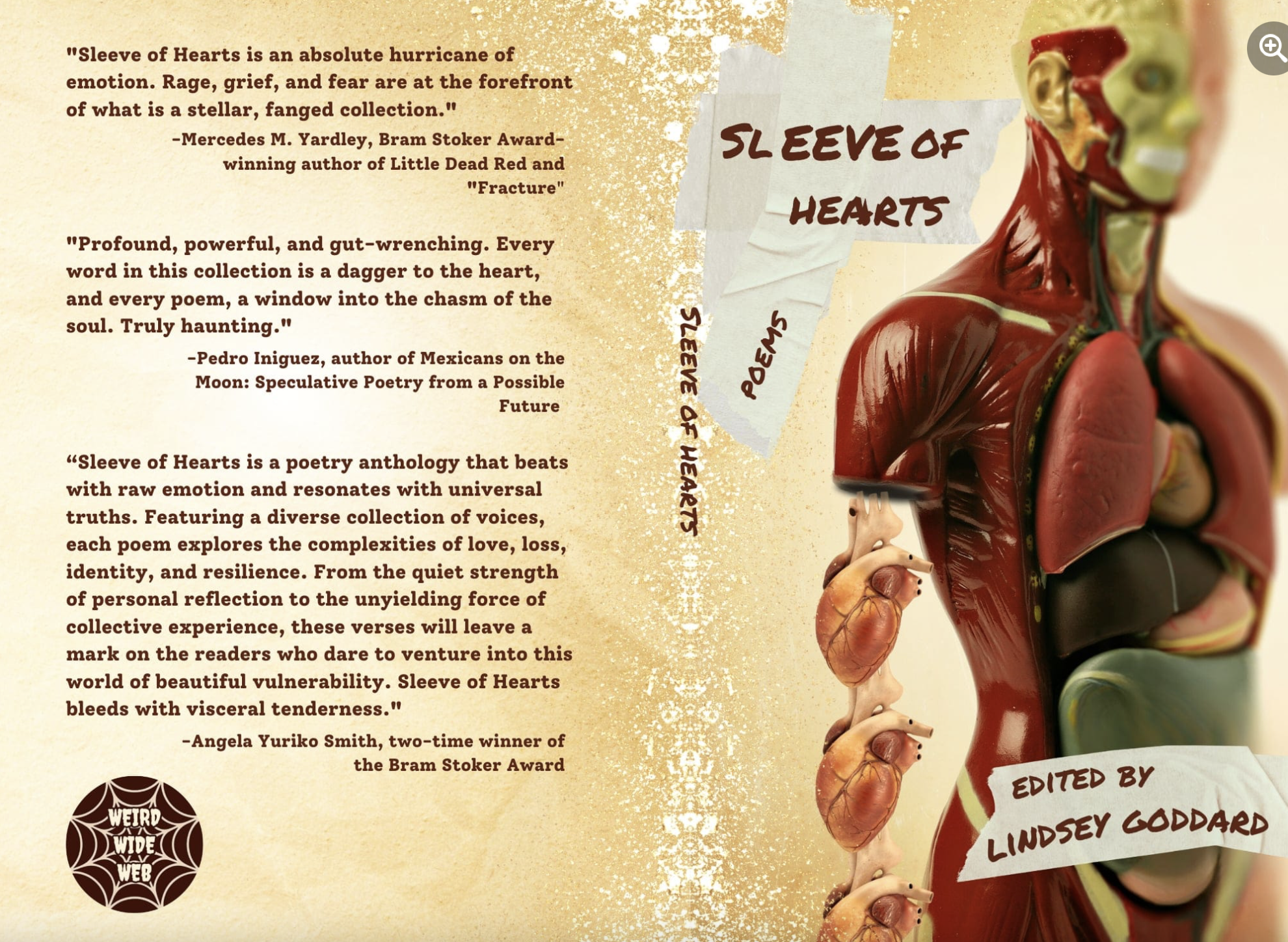
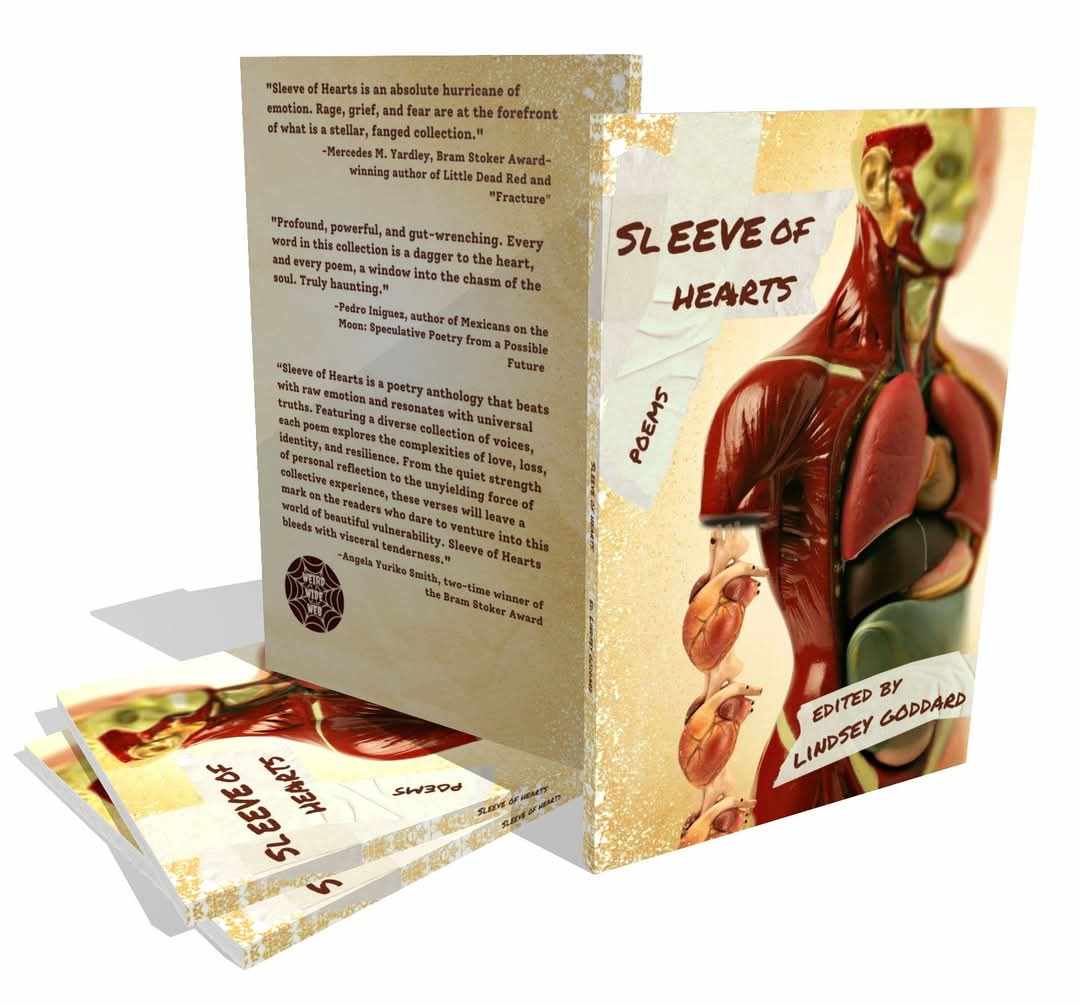
I have a poem, ‘Apples,’ published in the Sleeve of Hearts poetry anthology, presented by Weird Wide Web and edited by Lindsey Goddard. It’s published on Amazon, but if you want to show solidarity with the Amazon strikers, you can also find the book on Lulu.

Other great poets in the anthology include R.J. Allen, Devin M. Anderson, Alison Armstrong, L. Bachman, Erin Banks, A.J. Brown, Pixie Bruner, Anton Cancre, J. Rocky Colavito, Dawn Colclasure, Kirsten Noelle Craig, Rebecca Cuthbert, Josh Darling, Dawn DeBraal, Loki DeWitt, Gabrielle Faust, Ian Gielen, Reyna Gillette, Jyl Glenn, Lindsey Goddard, Simone Goddard, Sophie Goddard, Megan Guilliams, Sheila Henry, Kasey Hill, Josephine Jasper, Bryce Jenkins, J.L. Lane, Suzie Lockhart, J.C. Macek III, Mark Mackey, Benzo Monroe, Jonathan Moon, Shane David Morin, Jason Morton, Conner Muddiman, Nora B. Peevy, Rick Powell, Rie Sheridan Rose, Sumiko Saulson, Leigh Savage, Elodie Shayne, Raz T. Slasher, Tommy B. Smith, John Claude Smith, Judith Sonnet, Kurt Swaim, Michael Errol Swaim, Rob Tannahill, Jezzy Wolfe, and Amanda Worthington.

Here is what some people are saying about the anthology:

Go get your copy of this great poetry book today! 🙂