Stairs

The wealthy, monied aristocracy

causes those of the petite bourgeoisie

to be afraid of those in poverty,

to whom those in the economic centre

may, one unhappy day, have to descend.

Those in the lower social echelons

dream, one day, of ascending to the top;

but those already there would have them stop

for fear that they would, one day, them usurp.

Still, the rich promote the American dream.

In their deceptiveness, they’d make it seem

that anyone financially can rise,

to make them work more tirelessly…what lies!

for their employers; yet, nothing comes of

this extra work. Hence, this misguided love

of all things monetary blinds us all

from the reality that there’s a wall

that separates each step on this stairway.

All walls of glass, invisible, but they

will stay there always, until we, as one,

decide to break them down. Then, we will run

up to the top, and tear the structure down.

Then we will have a world for all the people, not one of rising claimants to the crown.

Analysis of the Medea Myth

In Greek myth, Medea is something of a paradox: on the one hand, we sympathize with her for her suffering at the hands of her disloyal husband, Jason, who abandons her for Corinthian King Creon‘s daughter, the beautiful young princess Creusa (or Glauce), and for the abusive treatment she suffers as a foreigner, a ‘barbarian,’ and an exile. On the other hand, we are horrified at the wickedness she is capable of: fratricide, treason against her father, King Aeëtes (out of a capricious falling-in-love with Jason), and–as if immolating Creon and Creusa with a cursed, poisoned robe weren’t cruel enough–Medea, by Euripides‘ innovation, commits a double filicide on her and Jason’s sons (although some scholars believe Neophron was the one who added this horror to her list of sins).

This paradox of Medea, arousing extremes of sympathy and antipathy, are representative of contradictory feelings many have towards foreigners: sympathy for their plight as second-class citizens, and the antipathy of xenophobia. Medea as the representative of all foreigners living in a land hostile to them, whose suffering can sometimes drive them to commit criminal, even atrocious acts, is therefore a story most relevant to our times, as I plan to demonstrate.

I will be examining her story primarily from three sources: the Medea of Seneca and of Euripides, and the 1969 film by Pier Paolo Pasolini, which is based on Euripides’ Medea. What is only incidentally examined in the two classical tragedies–that is, not only the plight of the foreigner, but also the relationship between imperialist plunderers and the countries they plunder–is developed more in Pasolini’s film (in his demythologizing of the source material), as I will also try to demonstrate.

A major contrast between what Euripides and Seneca wrote, and what Pasolini presents on the screen, is precisely that. In the former two, we have excesses of words–long, poetic speeches that are the hallmark of ancient Greek and Roman drama. In Pasolini, we have a relative dearth of dialogue; he is more interested in presenting vivid spectacle (rather like Michelangelo Antonioni, as we see in Blowup, La Notte, and The Passenger) than in providing plot and dialogue.

Medea is, as the daughter of Aeëtes, also the granddaughter of Helios, the sun-god. It can be said that she derives her ardour from the heat of the sun. She is also a sorceress, her magical abilities therefore making her an object of fear, exacerbating the xenophobia she already has to suffer, and, as a kind of self-fulfilling prophecy, providing her with the power to do the very kind of evil that people are afraid she’ll do.

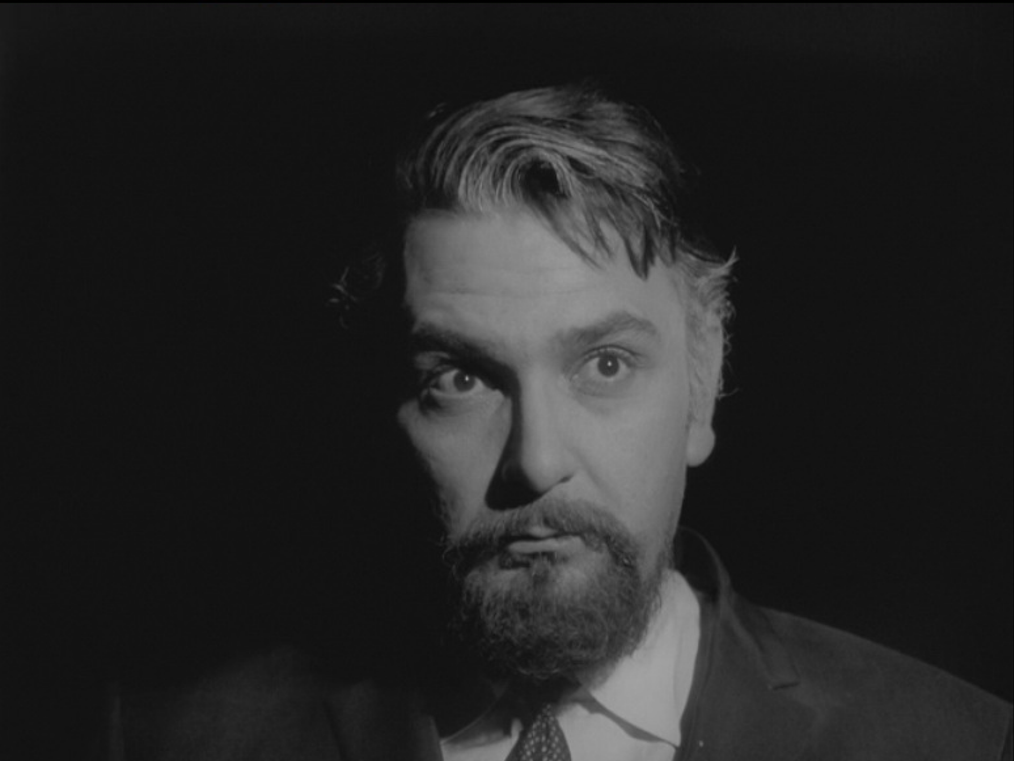
Jason as a child has been raised by the wise centaur Chiron, to keep the boy safe from his uncle Pelias, the usurping king of Iolcus who otherwise might want to kill Jason out of a fear he’ll be a threat to his power. Pasolini’s film begins with Chiron educating the boy; first we see him as a centaur, then, when Jason (played by Giuseppe Gentile) has come of age, Chiron is seen as fully human. (Such a representation of Chiron isn’t completely without precedent, for there are traditional Greek representations of him with human front legs, demonstrating his unique status as a centaur.) In the context of Pasolini’s atheistic demythologizing of the narrative, then, Chiron as a centaur represents the fanciful imagination of Jason as a child, while human Chiron as seen in Jason’s adulthood represents his loss of that childhood imagination. Put another way, the half-human, half-bestial Chiron represents the not-yet-developed reason of Jason’s childhood; the fully-human Chiron represents adult Jason’s fully developed reason.

Pasolini’s Chiron (played by Laurent Terzieff) admits to having lied to young Jason, who isn’t his son, as he’s previously said. He emphasizes to the boy that everything is sacred, that nothing in nature is ‘natural,’ that gods inhabit everything in nature. The sacred, however, is a mix of good and bad, that the gods love and hate. Again, Chiron admits to being a liar and to being too poetic. He predicts that, when fully-grown Jason goes to Pelias to demand his right to the kingdom, that the usurper will demand that he first fetch him the Golden Fleece. Finally, we see fully-human Chiron admit to adult Jason that there are no gods: his talk of gods inhabiting everything in nature has been another lie. Myths are essentially lies, in the opinion of atheistic Pasolini.

That we see centaur Chiron with Jason the child, and later, human Chiron with adult Jason, a mentor who admits to having told the boy poetic lies, represents the shift from an earlier, poetic, metaphorical use of language (as Northrop Frye discussed in The Great Code) to the later prosaic, descriptive kind of language (Frye, pages 24-28, 31-32). Analogous to this shift in language is also what his change from half-human, half-horse to fully human represents: a shift from animalistic primitivism–and its belief in myths, gods, magic, etc.–to a more advanced civilization lacking in gods. This contrast between god-fearing and godless, between the mythically and non-mythically oriented, between ‘barbarism’ and ‘civilization,’ will be especially apparent in the Corinthian attitude towards Medea as seen especially in the film.

Since Pelias assumes Jason will never succeed in getting the Golden Fleece, he shrewdly claims he’ll give his kingdom to Jason if he gives Pelias the Fleece. Pelias doesn’t realize, however, that Jason will get crucial help from a woman whom Eros (according to Apollonius of Rhodes) will hit with one of his love-arrows…Medea.

One interesting point to mine for meaning in is how some writers, such as Apollonius of Rhodes and Seneca, regarded the Argo as having been the first ship (in Greek mythical history). The implication of this first boat, as regards sailing off to a distant land to steal the Golden Fleece, is that Jason’s mission can be seen to represent the beginnings of imperialist plunder.

The choral ode at the end of Act Two of Seneca’s play deals with this mythologizing of the dawn of imperialism:

Glorious were the ages our forefathers saw
when deception was far distant.
Each person lived an unambitious life, at home,
then growing old on ancestral farmland,
rich with a little, they knew no wealth
except what their native soil brought forth.
The world was once divided into strict partitions,
but those were broken by the pinewood ship,
which ordered the ocean to suffer a beating
and the sea, once inviolate, to turn into
one of our reasons to fear. […]
What was the prize for this journey?
The Golden Fleece,
and Medea, greater evil than all the sea,
a worthy cargo for the world’s first boat.
Now at last the sea has yielded and obeys all laws.
Now there is no need of a ship made by Pallas’ hand,
rowed back by kings, a well-renowned vessel–an Argo.
Any old skiff can wander the deep.
All boundaries are gone and the cities
have set up their walls in new lands;
the world is a thoroughfare, nothing remains
where it was. [Seneca, Act II, lines 329-339, 361-372]

In fact, the ending of this choral ode was famously quoted by none other than that exemplar of colonialism, Christopher Columbus, in his Book of Prophecies:

The ages will come, in faraway years
when Ocean will set free the links of Nature
and the great earth lie open, and Tethys will open,
new worlds, and Thule will be no longer
the end of the earth. [Seneca, Act II, lines 373-379; the original Latin can be found here]

So Medea and the society of Colchis can be seen, in relating Euripides’ and Seneca’s plays to our world, as representative of the Third World of today; for though imperialism in its capitalist form of course didn’t exist in the ancient world, class conflict did, in the analogous form of the master vs. slave contradiction. Recall Marx’s words: “the history of all hitherto existing society is the history of class struggles.”

The Corinthians’ regarding of Medea and the Colchians as barbarian has its parallel in the modern world, with Western imperialists’ racist labelling of those in developing countries as ‘uncivilized,’ or not considered “decent,” and using such labelling to justify taking over their land and stealing their resources for the imperialists’ enrichment. Pasolini’s film, in its vivid, graphic depiction of the Colchians performing a human sacrifice, with an exotic soundtrack of music from such places as Tibet and other parts of the Orient, emphasizes the foreign contrast between mythically-oriented, ritualistic Colchis and ‘civilized’ Corinth. The ‘civilized’ countries could cite this human sacrifice as proof of the lack of civilization in Colchis while turning around and stealing from the Colchians, or exiling Medea, and not considering their own behaviour as, in its own way, equally cruel.

In his atheistic treatment of the Jason and Medea myth, Pasolini largely removes the supernatural elements, replacing them with characters’ perception of, and belief in, a divinity that isn’t physically there. So instead of seeing Eros shoot a love arrow into the heart of Medea (played by Maria Callas in her only film role, also in which she doesn’t sing), she sees Jason’s arrival, and it’s love at first sight, expressed through her falling on the floor on her back.

Similarly, in Pasolini’s film, we don’t see her use her magic to help Jason plough the field with the fire-breathing bulls; nor do we see her use her magic to help him defeat the army of warriors that grew from a dragon’s teeth sown in the ploughed field; nor do we see her use her magic to put to sleep the dragon that guarded the Fleece. Instead, she simply has her brother, Absyrtus (Apsirto, played by Sergio Tramonti), steal the Fleece and take it with her by chariot to Jason and the Argonauts.

The film portrays Apsirto as rather weak-willed and dim-witted, for he shows no resistance to Medea’s wish for him to help her commit what his family and all of Colchian society would deem an act of the most abominable impiety. He just smiles like a fool and does her bidding without question. Indeed, when Aëetes and his men chase her and her brother to retrieve their prized Fleece, she raises an axe to kill Apsirto, but he shows not the slightest ability to defend himself.

Her helping Jason to steal the Fleece, a coveted possession that can be seen to represent the natural resources of a developing country, can in turn be seen to represent the puppet leader of said developing country collaborating with its imperialist oppressor.

In the film, when Medea finds herself outside of Colchis with Jason and the Argonauts, and therefore in a land foreign to her own, she feels alienated from it. The men all set up tents, but do not pray to the gods to bless them. Such irreligiousness is inexplicable to her.

She thus goes through a spiritual crisis. She runs about the land, which is barely covered in any vegetation, and calls out to her gods of the sun and earth; they do not seem to hear her in this strange, foreign land.

Jason returns to Iolcus and gives Pelias the Fleece, but the king feels no obligation to keep his promise and give Jason his rightful place on the throne. Unlike in the original myth, in which Medea schemes to have Pelias’ own daughters kill him, the Jason of Pasolini’s film simply accepts not regaining the throne, telling his uncle that the Fleece is of no use, value, or meaning outside of Colchis. Of course not: its meaning exists only for those who believe in it; in Pasolini’s godless world, the Fleece cannot mean anything outside of the Colchian culture that reveres it.

Pelias’ wives strip Medea of her black priestess robes and jewellery, replacing them with humble clothing similar to their own, the clothing of a wife. Medea has lost her gods, the Fleece’s value is no more, and she is now a mere housewife. Still, she’ll bear these losses, as long as Jason remains true to her…

She and Jason live in Corinth for ten years. Various sources say the couple have had anywhere from one to fourteen children. In the plays by Euripides and Seneca, and in Pasolini’s film, they have two sons.

Now, with this family living in Corinth, Medea is not the only foreigner–all of them are. In fact, Jason finds himself and his whole family in danger of Acastus, son of Pelias, who wants revenge for the killing of his father (for which, recall, Medea is responsible), and who has driven all of them out of Iolcus.

Jason can find only one practical solution to his predicament as an exile: marry Creusa, daughter of Creon, king of Corinth, and thus abandon Medea. This new marriage should at least give protection to him and their two boys…and with this scorning and rejection of Medea, the tragedies of Euripides and Seneca begin.

Pasolini’s film only subtly shows Medea’s realization that her husband is abandoning her for another woman, a disloyalty grown out of his fickle nature rather than a need to protect himself and their sons from Acastus, who doesn’t figure in the film. She goes to Corinth with her nurse (played by Annamaria Chio), who is reluctant to go because she knows what Jason is about to do; Medea sees a kind of dancing competition among suitors as to who will win the princess’s hand. Jason is participating in the dance with the other men, and Medea takes the shocking hint.

Euripides’ play opens with a long speech by the nurse, who describes Medea’s anguish on learning of her husband’s betrayal. Seneca’s begins with Medea herself giving the long, anguished speech.

Comparisons and contrasts can be made between the Medea plays and a couple by Shakespeare with regard to the theme of revenge, namely, The Merchant of Venice and Hamlet. Medea is disenfranchised both as a foreign “barbarian” and as a woman; Shylock, in TMOV, is disenfranchised for being a foreigner and a Jew in Venice. Because of their ill-treatment, both Medea and Shylock are pushed over the edge and driven to commit violent, horrible acts. As a result, both characters are sympathized with and abominated for what they do (Medea) or at least intend to do (Shylock). Shylock is allowed, at the end of TMOV, to live, but he has been financially and spiritually destroyed. In the end, though Medea physically gets away scot-free to Athens on her grandfather’s solar chariot, she can be said to have destroyed her own soul by her double filicide. Shylock is punished for his sins; Medea is punished by her sins.

As far as comparisons, or really, contrasts with Hamlet are concerned, Medea clearly shows its protagonist (if such a violent woman can be called such–i.e., a sympathetic character) to be firmly resolved in her wish not only to get revenge on and kill Creusa and Creon, but also to kill her two boys. In contemplating the double filicide, she wavers somewhat in her guilt, as can be seen in the Seneca, but she goes through with it all the same. She’s firmly resolved to commit all the killings in Pasolini’s film, too.

But in Hamlet, as we all know, the Danish prince delays his revenge all the way to the bitter end, when he’s been pricked by “the point envenom’d,” and only when he knows he’s going to die does he finally get his revenge on his uncle Claudius. A number of characters either in Hamlet or referred to in the play take (or want to take) their revenge more decisively than the Dane does: namely, they are Laertes (Act IV, Scene v, from line 109), Fortinbras, who is slowed down in his revenge only by a vast stretch of land to traverse, and Pyrrhus, who hesitates only briefly before killing Priam to avenge his father, Achilles (Act II, Scene ii, lines 444-491). And certainly, Medea is much quicker to revenge than Hamlet is.

Now, Colchis, Iolcus, and Corinth can be contrasted in terms of how “barbaric” vs ‘enlightened/’progressive’ they are. Colchis, as we already know, represents ‘primitive’ society, that of the developing world. Iolcus, with its usurping, double-crossing King Pelias, represents the unapologetically imperialistic part of the world, that which takes from other countries (i.e., the Golden Fleece), that which enriches itself at the expense of others, and feels no remorse for that foreign policy. In our modern world, Pelias is the conservative.

Corinth, however, is more like today’s liberal world. Creon would take in Jason and his sons; taking in Medea, however, would be crossing over the line for him. As we on the left know, liberal generosity has its limits, to put it mildly. As a manifestation of modern liberal thinking, social democracy would improve the lives of those within one’s own country, and has no qualms about taking from the Third World to enrich itself. Creon’s treatment of Medea, and of Jason and their sons, can be seen as symbolic of this liberal double standard. We’ll take care of the needy among us, and a select number of foreign refugees, but anyone outside of these must fend for themselves.

In Euripides’ play, Medea laments the miserable existence of women. She says,

Of all the sentient creatures of the earth, we women are
the most unfortunate. First there is the dowry: at such
exorbitant expense we have to buy a husband–pay
to take a master for our bodies. And as the seasons pass,
if he prove false, then are we twice abused…
…All our hopes and striving lean
on this one thing: whether the husband that we take
turns out good or ill. For marriage is the only choice
we have, and divorce discredits women utterly.
We leave the house we knew, the dear comfort of familiar
ways. We must enter the husband’s world, accommodate
strange practices, the habits of his house, and figure out–
oh, hardest yet–how best to deal with his whims, for little
in our past prepares us for this task of satisfying him. […]

A man when he is bored at home, or irritated by
the burdens of domestic life, goes out into the streets,
or to the baths, debates philosophy for sport, diverts
himself with games and friends, and does what pleases him.
Our lives are monotone: for on one man we’re forced
to fix our gaze. Men say we lead an easy life,
safe at home while they risk all at the point of a spear.
What do they know? I would rather stand three times
in battle with shield and spear than give birth once. (Euripides, lines 252-256, 259-267, and 273-281)

Medea might want to pause before preferring to fight three battles, and risk a violent death on the battlefield, to giving birth to a child; then again, I as a man should pause before presuming that risking one’s life to give birth, especially without modern medicine, as would have been the case with women in Medea’s time, would be preferable to going to war. The grass is always greener on the other side of the fence, I suppose.

While the patriarchal aspects of the sources of Medea’s suffering are so obvious as not to need much further comment (beyond how her leaving of Colchis and her family, to be with her new husband, Jason, is symbolic of patrilocal culture), I suspect we could be dealing at least in part with matrilineal customs, too. After all, though Jason is working to secure the safety of his and Medea’s sons in Corinth, threats of exiling the boys as well as Medea also loom over the course of the play. See, for example, in Euripides’ play, lines 976-977, where Medea says, “Do I not have the children? And aren’t we–they and I–/now exiles in need of friends?”

If descent in their world were patrilineal, the boys’ association with their father would ensure their safety without question; after all, only Medea, with her magic, is a threat to Creon and his daughter. The boys’ matrilineal association with Medea would make them as much foreigners as she is, and this association would threaten them with exile as well as her. Finally, Jason is marrying into Creon’s family, not Creusa into his family; his entrance into Creon’s family is thus matrilocal.

In Act Four of Seneca’s play, the nurse and Medea give detailed descriptions of the scorned wife preparing her “uncanny rites” (Seneca, line 680) and magic spells. In Pasolini’s film, we see Medea looking out of a window at the sun, her grandfather (as she, in this atheistic production, imagines it to be: she can easily be understood to be imagining the sound of Helios’ voice), and does something rarely seen in the film…she smiles. Then she assembles her ladies-in-waiting, including her nurse, who is ever-reluctant to participate in Medea’s violent plans, and chants with them, pacing back and forth ritualistically, to prepare the spell to make lethal her gift of a gown, necklaces, and a tiara for Creusa.

The film shows Medea’s revenge on Creusa (played by Margareth Clémenti) and Creon (played by Massimo Girotti, who incidentally was also in Last Tango in Paris) twice: first, as a vision Medea has of the gown literally burning the princess and king; then, as the actual revenge carried out, with Creusa looking at herself in the mirror fearfully while wearing the gown, identifying with Medea and her suffering, and then killing herself in remorse, with Creon following after and imitating her suicide.

Pasolini’s atheistic, demythologized representation of Creusa’s demise can be interpreted along Lacanian lines. Her beholding of herself in the mirror while wearing Medea’s gown, necklaces, and tiara can be seen as her looking at her ideal-I in the specular image. The ideal wife for Jason isn’t Creusa, but Medea. Creusa sees herself dressed like Medea and knows she cannot measure up to Medea’s ideal, because she cannot replace the woman who ought still to be Jason’s wife. Therefore, Creusa cannot marry him. The pain she feels from having caused Medea such pain, a pain Medea has projected onto Creusa in the form of the gift of clothes, is a metaphorical burning of her entire body, her entire self. That metaphorical fire is the fire of suffering caused by desire, the desire to have a man who isn’t hers for the taking.

After the killing of Creusa and Creon comes the atrocity of Medea’s killing of her two sons. Seneca has them killed onstage. Pasolini doesn’t show the killings, but he slowly builds up the suspense leading up to the implied act; this leading-up includes Medea’s last moments as a mother with the boys, bathing them and holding them lovingly. Seeing the boys naked as she bathes them reinforces our sense of their vulnerability and helplessness; seeing her cuddle with each of them after their baths is a touching moment that reinforces how heartbreaking it is to know she is also planning to kill them, given that we watchers of the film know the original myth.

Euripides shows Medea, having already killed them, on Helios’ sun-chariot, a subversion of the notion of the deus ex machina, which is normally used to resolve a difficulty in the plot, in a contrived manner, through divine intervention. To use this plot device is actually rather lazy writing, as having a god resolve a problem is conveniently far easier than doing so through human effort, which requires the writer to devise a thoroughly thought-out solution him- or herself.

The deus ex machina appearance of Medea resolves her problem of where she, as an exile and a murderess, is to go to escape punishment. Earlier in Euripides’ play, Aegeus, king of Athens, has promised her he’ll let her live in Athens if she uses her herbs to cure his infertility. So she will go there and be safe, never punished for her crimes, since Aegeus knows nothing of them. He will also marry her.

Using the deus ex machina for her, however, is a perversion of the purpose of the plot device, since it’s meant to resolve difficulties and thus prevent tragedy. In Medea’s case, she uses it just after aggravating the tragedy, not preventing it, and ensuring that her victims won’t receive justice. After all, the chthonic religion that she adheres to resorts to revenge, not to justice, to settle grievances (the Furies, for example, were chthonic deities of vengeance). Recall that Hecate, one of the prominent chthonic gods, is one to whom Medea prays to aid her in her revenge in, for example, Seneca’s play (Act IV, lines 833-842).

In killing their boys, Medea has done to Jason what he’d initially planned to do to her: deprive a spouse of a family, a country, and a future. She kills the boys not to hurt them, but to hurt him. Now Jason has lost not only a family to marry into and thus to protect him from the dangers of exile and avenging Acastus, but he’s also lost the future of his family line through the boys’ deaths. In destroying Jason’s hopes of patrilineal descent, Medea’s revenge can be seen as a proto-feminist act.

The ambiguity over whether we’re dealing with a matrilineal or patrilineal society could be resolved by imagining that Medea, like Aeschylus‘ trilogy, the Oresteia, represents a transition from lineal descent by the female to that by the male, and therefore also represents a conflict between the two. Just as we see in Medea a mythologized beginning of imperialist plunder, so do we see in the play a mythologized beginning of the patriarchal family’s oppression of women.

That we see the mythological origins of the imperialist plunder of ‘primitive’ societies coinciding with the origins of the oppression of women is significant, for Friedrich Engels, in his Origin of the Family, Private Property, and the State, also noted the coinciding of the end of matrilineal society with the end of primitive communism…and therefore the beginning of not only patrilineal society, but also societies based on class conflict.

Now, one cannot go on plundering, oppressing, and mistreating the poor, women, the landless, and developing societies indefinitely without expecting some eventual form of horrifying karmic retribution. For we should see the excesses of Medea’s revenge as just such a retribution, a dialectical shift from the oppressor hurting the oppressed to vice versa.

In our modern world, we shouldn’t be too surprised at this or that terrorist attack in, say, New York City, London, Madrid, Paris, or in Israel. We may lament the deaths of these victims (as we do Medea’s sons), but when we allow the existence of governments that cause mayhem in the Middle East and other parts of the Third World, and when we as First Worlders benefit from such oppression (as Jason, Creon, and Creusa were meant to benefit from a marriage that would undo Medea; or as Pelias planned to benefit from the theft of the Golden Fleece), when karma gets back at us, we shouldn’t pretend to be shocked by such violence.

On the contrary, such violence should be expected.

Euripides, Euripides, 1 (Medea, Hecuba, Andromache, The Bacchae), Philadelphia, University of Pennsylvania Press, 1998

Seneca, Six Tragedies, New York, Oxford University Press, 2010

Analysis of ‘A Tale of Two Cities’

A Tale of Two Cities is an 1859 historical novel by Charles Dickens, set just before and during the French Revolution, the two cities being London and Paris. The story is about the intersecting lives of Doctor Alexandre Manette, his daughter Lucie, and Charles Darnay in France, and Sydney Carton in England.

A Tale of Two Cities is Dickens’s most famous work of historical fiction, and it’s one of the best-selling novels of all time. It has been adapted for film, TV, radio, and the stage, and it continues to influence popular culture.

Here is a link to famous quotes from the novel.

Of all the themes in this novel, the dominant one seems to be duality, expressed in many forms: London/Paris, feudalism/capitalism, light/darkness, Darnay/Carton (two men so fortuitously similar in appearance as to seem twins), Lucie Manette/Madame Defarge (personifications of light and darkness, respectively), and life/death…or death/life, as manifested in symbolic resurrections in the story.

The famous beginning of the novel establishes this theme of duality: “It was the best of times, it was the worst of times,…” The dualistic paradoxes continue with this famous long opening sentence: wisdom/foolishness, belief/incredulity, Light/Darkness, hope/despair, everything/nothing, Heaven/”the other way,” and good/evil.

These juxtaposed opposites represent their dialectical unity, the clash of contradictions. Though the above opposites are of the Hegelian dialectic of ideas, they refer to an epoch famously discussed by Marx as of the historical, materialist dialectic. The novel begins in 1775, just fourteen years before the French Revolution, when the old feudal system would be violently replaced by the capitalist mode of production.

Another duality is seen when Dickens compares the French Revolution to politically radical activity going on in England around the time of the novel’s publication. He fears that a similar bloodbath to that of the Reign of Terror may occur in England, though by the end of the novel, things seem more hopeful for England, even to the point of a tinge of nationalistic pride (recall patriotic Miss Pross‘s defiant words to Madame Defarge: “I am a Briton”–Book Three, Chapter 14, page 407).

The duality of death/life becomes apparent in Book One, Chapter 2, when it is learned that someone has been “RECALLED TO LIFE.” This enigmatic phrase, we later learn, refers to Doctor Manette, who in his 18-year incarceration in the Bastille–a kind of death–has been freed, a kind of resurrection. Other symbolic resurrections, two of them, will occur for Darnay, thanks to his look-alike, Carton.

The trauma of Doctor Manette’s incarceration stays with him after his release, when we find him still making shoes, his work in the Bastille, in the darkness, something he no longer needs to do, but a task he feels psychologically compelled to continue doing. His union with Lucie, the daughter he’s never known and who until now has thought him dead, will bring him back into the light. ‘Lucie‘ literally means ‘light.’

She is so shocked to learn that her father is actually alive that she faints. Symbolically, father and daughter have exchanged the states of life and death, unified opposites like so many others in this story.

Another example of duality is that of two spilled reds: wine, and blood. In Chapter 5 of Book One, a large cask of wine is dropped on the ground by the wine shop of M. Ernest and Mme. Thérese Defarge, in the Faubourg Sainte-Antoine, a suburb of Paris. The poor people of the area rush over to have as much of a drink of the spilled wine as they can. One of them smears BLOOD on a wall with the muddy wine (page 32).

This eagerness of the poor to drink wine off the filthy ground is a reflection of their desperation, want, and hunger. “Hunger. It was prevalent everywhere. Hunger was pushed out of the tall houses, in the wretched clothing that hung upon poles and lines; Hunger was patched into them with straw and rag and wood and paper; Hunger was repeated in every fragment of the small modicum of firewood that the man sawed off; Hunger stared down from the smokeless chimneys, and started up from the filthy street that had no offal, among its refuse, of anything to eat. Hunger was the inscription on the baker’s shelves, written in every small loaf of his scanty stock of bad bread; at the sausage-shop, in every dead-dog preparation that was offered for sale. Hunger rattled its dry bones among the roasting chestnuts in the turned cylinder; Hunger was shred into atomies in every farthing porringer of husky chips of potato, fried with some reluctant drops of oil.” (page 33)

Soon after, Dickens relates Want to violent imagery: “The trade signs (and they were almost as many as the shops) were, all, grim illustrations of Want. The butcher and the porkman painted up only the leanest scrags of meat; the baker, the coarsest of meagre loaves. The people rudely pictured as drinking in the wine-shops, croaked over their scanty measures of thin wine and beer, and were gloweringly confidential together. Nothing was represented in a flourishing condition, save tools and weapons; but, the cutler’s knives and axes were sharp and bright, the smith’s hammers were heavy, and the gun-maker’s stock was murderous.” (Dickens, page 34)

This juxtaposition of red wine and blood with hunger and want, and with references to “sharp and bright” knives and axes, heavy hammers, and with the “murderous” gun-maker’s stock, is altogether a foreshadowing of the violence in the impending revolution, when the poor and hungry will finally have their revenge on the rich.

Later in this chapter, we meet not only the Defarges, but also the three “Jacques.” These revolutionaries name themselves after the Jacquerie, a popular peasant revolt in northern France back in the 14th century. The nobles of the time derided these peasants as “Jacques” for the padded surplice, called “jacques” that they wore. The term jacquerie became synonymous with peasant uprisings in both France and England thereafter.

I don’t know if there’s a direct connection in meaning between the kind of Jacques the French nobility were scorning in the 14th century and the “sly, insinuating Jacks” (I, iii, 53) that Richard III was railing against in Shakespeare’s play, but there’s an interesting association that can be made in the “Jacques” of Dickens’s novel trading positions of power with the 18th century French nobility and the Duke of Gloucester’s contempt for such people of low birth when he famously says, “The world is grown so bad/That wrens make prey where eagles dare not perch./Since every Jack became a gentleman/There’s many a gentle person made a Jack.” (I, iii, 70-73).

Meanwhile, Madame Defarge is typically seen knitting (see Book Two, Chapters 15 and 16 in particular). She will be a tricoteuse during the guillotine executions, doing her knitting there. This knitting symbolically suggests an association with the Fates, who in their spinning determined everyone’s life and death. Since Defarge is also seen knitting long before the revolution and its Reign of Terror, this early knitting is a foreshadowing of the violence to come.

She encrypts the names of those to be executed into her knitting, again connecting her with the Fates, but also, in a way, with Penelope, who wove a shroud while waiting ever so patiently for her husband, Odysseus, to come home and kill all of her suitors, who were eating her out of house and home. Madame Defarge, as she knits, is also waiting ever so patiently for the violent overthrow of those who, like Penelope’s suitors, have done violence of one form or another to her home (more on that later).

To jump ahead in Dickens’s story, we encounter the first time Carton saves Darnay, who is on trial for treason against the British Crown, by simply demonstrating to the court his uncanny physical resemblance to the accused. The witnesses, two spies, claim that they could pick Darnay out from any man; but their testimony is undermined by Carton’s likeness to him.

The doubles share more in common than just their looks. They share some sense of shame, Darnay’s by his association with his uncle, the wicked Marquis St. Evrémonde, and Carton by his life as a drunken wastrel. Both men redeem themselves: Darnay, by renouncing his uncle’s family and changing his name from Evrémonde to an Anglicizing of D’Aulnais (his mother’s maiden name); and Carton, by taking Darnay’s name and place in La Force Prison, from which he’s to be taken and guillotined, the former thus sacrificing his life to save that of the latter.

Yet another duality is to be found in the two systems of class oppression portrayed in A Tale of Two Cities–namely, the outgoing feudalist one and the incoming capitalist one. Though the revolutionaries, the left-wingers, were hoping for a genuinely new society based on the principles of liberté, égalité, fraternité, this was a bourgeois, not a socialist, revolution. It was good that feudal France was no more, but a new form of class struggle was about to be born.

The despicable decadence of feudal times is personified in the unnamed aristocrat known as “Monseigneur.” In Chapter 7 of Book Two, we learn that he needs no less than four men, in “gorgeous decoration,” to get his morning’s chocolate into his mouth (Dickens, page 114)

The cruelties of feudalism, however, are personified in the marquis, whose carriage runs over a little boy, killing him. The marquis’s reaction to the death he’s caused is beyond insensitive: to compensate Gaspard, the dead boy’s grieving father, the marquis tosses him a gold coin and drives on. Gaspard will kill him in revenge, hide out for a year, then be hanged for murder.

The chateau of the marquis is vividly described in terms of the wickedness of the man who lives in it. The first paragraph of Book Two, Chapter 9, “The Gorgon‘s Head,” repeatedly uses the word “stone” or “stony” to describe so much of the marquis’s property as to suggest that Medusa‘s head had turned everything to stone two hundred years prior. This emphasis on stoniness, of course, reflects the marquis’s stony heart, just as the petrifying ugliness of the Gorgon’s head is a mirror to his moral ugliness.

It is this ugliness of feudal France that is the context in which the ugliness of revolutionary violence must be understood. Dickens’s tone, during his narration of all of the events from the storming of the Bastille to the Reign of Terror, gives the clear impression that he considered the actions of the revolutionaries to be no less evil than those of their former feudal oppressors.

As with A Christmas Carol, the Dickens who was otherwise thoroughly sympathetic to the poor is in this novel showing what we today would call peak liberalism.

For my part, I’m ambivalent about the wrongs the revolutionaries committed. Their main fault resides in ultimately leaving France with a new system of economic exploitation–capitalism–to replace the old system. The Defarges, after all, are the petite bourgeois owners of a wine shop. As for the violence of the revolutionaries, what can I say? Recall Mao’s words: “A revolution is not a dinner party.”

Were there excesses of violence? Undoubtedly. But revolutions are by definition chaotic, bloody, and messy. The oppressing class can’t be voted or legislated away…they can only be violently overthrown, for they will undermine every attempt to tax them or rein in their power over us. French revolutionary violence was, properly understood, a reaction to centuries of violence done to a starving, wretched populace of peasants.

As for Madame Defarge, her violent excesses may be wrong, but they’re perfectly explicable. Her sister was raped by Darnay’s uncle; her brother confronted the uncle about the rape and was run through with the uncle’s sword. Both her brother and sister died after the best, though failed, efforts of Dr. Manette, who was imprisoned for attempting to report the crimes, and who wrote of them in a manuscript in his cell. Having found the manuscript, which denounces the whole Evrémonde family, Madame Defarge uses it to avenge her dead siblings by trying to destroy not only Darnay, but his whole family, too.

She was “imbued from her childhood with a brooding sense of wrong, and an inveterate hatred of a class, opportunity had developed her into a tigress. She was absolutely without pity. If she had ever had the virtue in her, it had quite gone out of her.

“It was nothing to her that an innocent man was to die for the sins of his forefathers; she saw, not him, but them.” (Book Three, Chapter 14, page 402)

One set of excesses tends to lead to an opposing set of excesses, like the teeth of the ouroboros biting into its tail, a symbol of the dialectical relationship between opposites that I’ve used many times. Since we don’t like riots, we should recall MLK’s words: “A riot is the language of the unheard.” Similarly, if you don’t like revolutionary bloodshed, you should bear in mind that such bloody excesses are the words of those who have hitherto been silenced by their oppressors, often spoken in gory fashion.

Madame Defarge is motivated by revenge, personified in one of the other revolutionary women, known literally as The Vengeance. She is the “shadow” of Madame Defarge, a darkness within darkness. All of those who have suffered under feudal rule have been in darkness, such as Doctor Manette in his shadowy prison cell, and in the garret of the Defarges’ wine shop where he is found obsessively making shoes (Chapter 5, The Wine Shop). So when the revolutionaries have their revenge, they put men like Darnay in the darkness of cells in La Force, too. Indeed, his second arrest occurs at night.

Lucie’s light is in dialectical contrast to Madame Defarge’s darkness. The former says of the latter, “that dreadful woman seems to throw a shadow on me and on all my hopes.” (Book Three, Chapter 3, The Shadow, page 298) Her light, symbolized by each golden thread of her hair, pulls her father out of the dark. (Book One, Chapter 6, The Shoemaker, pages 47-49)

Elsewhere, we have Jerry Cruncher, the “resurrection man” who raids graves in the darkness, and is thus a dark parody of the real resurrection man, Carton, who by taking on Darnay’s identity recalls him to life, bringing him out of that dark cell and into the light, to be reunited with the light of his life, Lucie.

Thus Jerry, a nasty fellow who abuses his wife early on in the story, is the darkness to Carton’s light. Before he is to be guillotined, Carton compares his fate to that of Christ. He quotes the Gospel according to John: “I am the Resurrection and the Life.” (John 11:25) Carton, as a Christ-figure, dies so Darnay can live. In this we see the dialectical relationship between life and death in Dickens’s novel. Recall in this connection another important quote from John: “I am the light of the world: he that followeth me shall not walk in darkness, but shall have the light of life.” (John 8:12)

Though Carton loves Lucie, he knows he can never have her. After all, light doesn’t sit with light, but rather with its dialectical opposite: darkness. Carton will go into the darkness of Darnay’s cell so the latter can go out into Lucie’s light.

And while darkness and light are intertwined, so are life and death. Having approached the guillotine, Carton imagines a future world, one long after his death, in which Darnay and Lucie will name a son after Carton. He can “see the lives for which [he] lay[s] down [his] life,” (Dickens, page 417) and in his prophetic visions, as well as the son, Carton has his own resurrection, his own recalling to life after death.

Speaking of ‘resurrections,’ though, another resurrection can be seen today as compared with what was going on back in Dickens’s day and before: the exacerbated immiseration of the poor. A Tale of Two Shitties: the shittiness of Dickens’s time, and the shittiness of our world ever since the dissolution of the socialist states. In this, we see yet another duality: class conflict then, and class conflict now.

Dickens, sympathetic to the plight of the poor but horrified at revolutionary violence, was using this novel to warn the rich of the danger of aggravating class conflict to the point of provoking such violence. When one considers the extremes of income inequality today, as well as all these unending imperialist wars, climate change, and how fear of disease is a distraction from the contemplation of revolution, one would think the ruling class would be heeding Dickens’s warning.

Instead, would-be leftists virtue signal in such ways as AOC wearing a dress with the message “TAX THE RICH” (of which Dickens would have approved) while ignoring protestors outside the Met Gala. In some photos of that dress, the T in TAX isn’t really showing, a kind of fortuitous prophecy. Then there was that small guillotine set by the front door of Bezos’s mansion.

May the Evrémondes everywhere in the world watch out.

The modern-day Madame Defarge is doing her knitting.

Charles Dickens, A Tale of Two Cities, Collins Classics, London, 1859

The Ouroboros of Philosophy

I: Introduction

My concern here is not with presenting an encyclopedic understanding of philosophy and its history; I am in no way qualified even to attempt that. Instead, I will look at selected examples of philosophical ideas as manifestations of what I see the ouroboros as symbolizing.

As I’ve explained in a number of posts, I use the ouroboros to symbolize the dialectical relationship between opposites. The serpent, coiled in a circle and biting its tail, represents a circular continuum whose extreme opposites meet and phase into each other, the biting head being one extreme, and the bitten tail being its opposite. The coiled middle of the serpent represents all the intermediate points on the continuum, the moderate points between the extremes.

The dialectic, often being a dialogue of two disagreeing philosophers presenting their opposing opinions in a back-and-forth debate, has been the basis of so much of the history of Western philosophy that I find it illustrative to use my ouroboros symbolism to systematize the dialectic. Such a systematization is what I will attempt here.

II: Ancient Greece, and the Ancient East

Thales, interestingly, conceived of the universe as having originated in water. He believed this origin to be literally true, as Aristotle explained it in his Metaphysics:

“Most of the first philosophers thought that principles in the form of matter were the only principles of all things. For they say that the element and first principle of the things that exist is that from which they all are and from which they first come into being and into which they are finally destroyed, its substance remaining and its properties changing…There must be some nature–either one or more than one–from which the other things come into being, it being preserved. But as to the number and form of this sort of principle, they do not all agree. Thales, the founder of this kind of philosophy, says that it is water (that is why he declares that the earth rests on water). He perhaps came to acquire this belief from seeing that the nourishment of everything is moist and that heat itself comes from this and lives by this (for that from which anything comes into being is its first principle)–he came to this belief both for this reason and because the seeds of everything have a moist nature, and water is the natural principle of moist things.” (Aristotle, Metaphysics 983b6–11, 17-27…Barnes, page 63)

I, on the other hand–and as anyone who has read enough of my blog knows–interpret the water origin metaphorically, hence the name of my blog, Infinite Ocean. The rising and falling of the waves symbolize the opposing sides of the dialectic, the movements up and down each being a sublation of thesis (crest) and negation (trough).

It is from this notion of water that we move on to Heraclitus and his notion of endless movement. I discussed his ideas here. Diogenes Laërtius, in his Lives of the Philosophers, had this to say about the beliefs of Heraclitus: “All things come about through opposition, and the universe flows like a river. The universe is finite, and there is one world.” (Barnes, page 107)

To make a temporary digression from ancient Greece to ancient India, the endless, watery flow of everything in the universe has been used to describe Brahman, Atman being but a drop of this water. Furthermore, this universal Oneness, this monism that has been attributed to Thales, Heraclitus, and the Hindus is described as flowing and moving; yet this monism, pushed to its extreme, from its flowing to its extreme opposite, a Oneness of motionless stasis, is found in the philosophy of Parmenides and Zeno.

Parmenides insisted that notions of motion and plurality are illusions, the maya of the Hindus. All is one according to him; the universe has always been, is now, and always will be, an unmoving, unchangeable sphere. This Oneness is a reaction against Heraclitus (or vice versa) and against the philosophical pluralists, movements from the bitten tail of the ouroboros to its biting head, shifts from one extreme to their dialectical opposites.

In fact, Parmenides’ young pupil (and lover), Zeno, went so far as to defend his teacher’s rigid monism by devising a number of paradoxes to show the illusory nature of motion, change, and divisibility. His paradoxes, again, were a reaction, a dialectical shift from bitten tail to biting head, against the pluralists. Zeno’s point, as understood by Plato, was that if his paradoxes–for example, of infinitesimally divided walking distances precluding the possibility of getting anywhere, or Achilles never catching up to the tortoise, or a never-moving arrow in flight–are absurd, so much more absurd are the pluralists’ ideas.

As Plato expressed Zeno’s meaning: “My book attacks those who say that several things exist, aiming to show that their hypothesis, that several things exist, leads to even more ridiculous results, if you examine it properly, than the hypothesis that only one thing exists.” (Plato, Parmenides…Barnes, page 152) It isn’t about the ideas in themselves; it’s about ideas in dialectical opposition to others.

Parmenides’ and Zeno’s unchanging monism can, in a way, be compared to the eternal soul of Atman in Brahman, which in turn was reacted against in Buddhism’s adoption of the doctrines of anattā (or anātman) and impermanence. Again we see the dialectical movement of one doctrine, felt to have been pushed too far (e.g., Atman is believed to exist despite a lack of empirical evidence), over to its opposite (no soul or permanent self), a shift from the biting head to the bitten tail of the ouroboros.

The dialectical relationship between opposites, as I symbolize with the serpent’s head and tail, can also be seen in the yin/yang symbol of Taoism. The white dot in yin, and the black dot in yang, are like the teeth of the head stabbed into the tail. One opposite is experienced in the other.

III: From Doubt to Certainty

Another example of the ouroboros of philosophy can be found in the radical doubts of René Descartes. His doubting of the certainty of any kind of existence, including his own, found him passing beyond the bitten tail of extreme doubt to the biting head of cogito, ergo sum, which given more fully is dubito, ergo cogito, ergo sum: “I doubt, therefore I think, therefore I am.”

His very doubting, brought to such an extreme of doubts of existence, becomes the very existence, his own existence since he’s the one doing the doubting, that gives him a certain foundation for knowledge on which he can at least hope to build further certainties.

IV: Hegel and Marx

A few centuries later, we come to Hegel, who systematized the dialectic as a confrontation of, and resolution of, contradictions simplified in Fichte‘s triad of “thesis, antithesis, and synthesis,” a formula Hegel neither used nor liked. For my part, I prefer the terms thesis, negation, and sublation, which instead of being in the simplified form of a triad, go round and round in a circle of endless manifestations of contradictions to be clashed together and sublated, over and over again.

A simple but convenient example of Hegel’s dialectic can be found in his Science of Logic. He opposes being and nothing, which I would represent respectively as the serpent’s biting head and bitten tail. Then, his sublation of these contradictions, becoming, I’d represent as the coiled middle of the ouroboros.

Another example of the ouroboros of philosophy, as seen in Hegelian thought, can be found in his master/slave dialectic. Two men confront each other: a struggle ensues, and one attains mastery over the other. In my ouroboros symbolism, the master is the serpent’s biting head, and the slave is its bitten tail.

Over time, the slave’s creative efforts build up his sense of worth and usefulness to his master, as well as his own recognition of self-consciousness, a moving along the coiled body of the serpent from its tail to its head, to the point where his master finds himself utterly dependent on the slave for recognition of the master’s existence, and for the products the slave makes. Now the slave reaches the serpent’s biting head, and he trades places with his master. The other way to see this trading of places is to imagine the slave going in the opposite direction: right from the bitten tail over to the biting head, an excess of servitude phasing into its dialectical opposite, mastery.

The master/slave dialectic was a great inspiration for Karl Marx, who saw the Labour Theory of Value as the mechanism whereby the proletariat would one day overthrow the bourgeoisie. The workers need to know how it’s the total amount of their socially necessary labour time, not their bosses’ management, that creates value in commodities; and armed with this knowledge, they will be inspired to get organized and bring on a proletarian revolution.

Now, another dialectical shift from the biting head to the bitten tail can be found in Marx’s materialist reaction to Hegel’s philosophical idealism. Marx’s reversal of the notion that the world of ideas, of the spirit, brings about the physical world–typical of religious thinking–and making it instead that it’s the physical (i.e., having a brain) that creates the world of ideas (thinking), was him turning Hegel upside-down, standing him “on his head.” Though as Marx would have had it, Hegel’s dialectic was already “standing on its head,” and Marx simply put the dialectic back on its feet (Marx, pages 19, 102-103).

For Marx, the dialectic presents itself in physical manifestations throughout history, going from the ancient master/slave contradiction to that of the feudal landlord vs. the poor peasant. Within feudalism, though, a growing mercantile class, the first capitalists, would eventually overthrow their feudal lords and become the next ruling class, the bourgeoisie.

The suffering and struggling of those held down by the feudal lord, those including the rising capitalists, are thus symbolized in my system as those moving from the bitten tail of the ouroboros, along its coiled body in the middle, up to its biting head, where they would replace feudalism with capitalism. Such a bourgeois revolution was vividly depicted in Dickens’s Tale of Two Cities.

The bourgeoisie, now the head biting the tail of the proletariat, are no longer revolutionary. The working class has attempted revolution in, for example, the Paris Commune, the USSR, the Eastern Bloc, and Afghanistan‘s attempts at modernization in the late 1970s, but counterrevolution ruined all their hopes. We’ll have to see if a new socialist movement will rescue us all from late stage capitalism, and will sustain itself by repelling all future attempts at counterrevolution.

V: Schopenhauer

Schopenhauer‘s pessimism was inspired by the reading of translations of ancient Buddhist and Hindu texts. Interestingly, his idea of the thing-in-itself, the essence of everything as understood without the deceiving senses, is will, the striving to be alive (“On the Antithesis of Thing in Itself and Appearance,” 1; Schopenhauer, page 55). This conception is in contrast to the Eastern idea that the Oneness of everything, Brahman, Tao, etc., is the source of peace and bliss.

Now, this contrast I speak of is a dialectical one, for Atman, the soul of the willing individual, is to be identified with Brahman, the peaceful Oneness of the universe. The world is will, but it’s also representation, maya, a deception of the senses that, in its illusory nature, causes suffering. One ends suffering by negating the will-to-life, and thus tranquilizing it. When one understands Atman to be the same as Brahman, and to see plurality as an illusion, the ego is neutralized, the selfish desires of the will are extinguished, and one attains nirvana.

So life, for Schopenhauer, is essentially not worth living; being trapped in a body, with all its aches, pains, and ageing, is like being in a penal colony (“On the Suffering of the World,” 9, Schopenhauer, page 49). The extreme sadness such a realization engenders, though–the reaching of the serpent’s bitten tail–isn’t necessarily so bleak. One can pass the tail to the biting head of bliss by, paradoxically, extending one’s suffering, by suffering not all alone, but with other sufferers. Compassion is the basis of moral edification, according to Schopenhauer, and in compassion we find liberation from suffering, since compassion will drive us to end our suffering by ending that of those others we identify with in our pity for them.

The dialectical reaction against Schopenhauer’s pessimism can be seen in Nietzsche’s affirmation of the will-to-life, and his existentialism leads us to the next topic.

VI: From Absurdity to Meaning

In existentialism, one confronts the meaninglessness of life, the bitten tail of the ouroboros, by giving life meaning, one’s own personal purpose, a shift over to the serpent’s biting head. In Kierkegaard‘s Christian existentialism, this giving of meaning to life, as an escape from meaninglessness, is in the form of a leap of faith in God, believing in Him despite a lack of proof of His existence.

With the atheistic existentialism of such writers as Nietzsche and Sartre, though, one lacks the crutch of a leap of faith in God, so one must create one’s own, personal meaning in life. This, after Kierkegaard’s counsel has failed us, means a revolution around the body of the ouroboros, from the biting head after our leap of faith from the tail, going all the way back to that tail the long way, then to go past to the biting head again.

With Camus‘s absurdism, though, even the making of one’s own meaning rests on flimsy ground, since the contradiction between unescapable meaninglessness and man’s need to find meaning is equally unescapable. Camus’s advice, therefore, is to act in defiance against meaninglessness, to strive for flashes of meaning, however evanescent such flashes may be, since one must accept meaninglessness along with our defiance of it.

Just as Sisyphus must endlessly roll that boulder up the hill, only to see it roll back down and to have to roll it up again…and again, and again, and again, so must we go in endless cycles along the coiled body of the ouroboros, shifting past the biting head to the bitten tail, and back around the body to the head again…and again, and again, and again…

Small wonder the ouroboros is a symbol of eternity, Nietzsche’s myth of the eternal recurrence.

VII: Conclusion

So this absurdist advice can be seen as a variation on much of what I reviewed before: Zeno’s paradoxes of walking and getting nowhere, of swift Achilles never catching up to the tortoise, and of a flying, yet motionless arrow. Similarly, one is only certain of one’s existence through one’s extreme doubting; the sublation of two contradictions leads only to a new thesis to be negated and sublated, again and again and again. Will a socialist revolution lead to a classless, stateless, and money-less society? I continue to hope for it, in spite of the miserable state the world is in right now.

In Schopenhauer’s pessimism, the way to blessedness is through compassion, or suffering on a larger, more magnanimous scale; this in a way is strikingly similar to Kierkegaard’s leap of faith (i.e., a faith coupled with deeds of Christian charity), which is odd given Schopenhauer’s atheism…an atheism coupled with the inspiration of Eastern religion! And finding meaning is the solution to the impossibility of ever finding meaning? Again, it sounds like the bitten tail of atheism shifting over to the biting head of theism!

Reflecting on these observations, I find that the unchanging unity of all that Parmenides and Zeno insisted on is actually the ever-changing fluidity of Heraclitus. Parmenides’ stony sphere is really Thales’ water.

Atman = Brahman = anātman

‘The Last Breath,’ a Poem by Rusty Rebar

‘The Last Breath’ is a poem by Rusty Rebar, a Facebook friend of mine. I gave it a quick read the day before and found it full of meaning, which I’d like to examine below. First, here’s his poem (I’m setting it in italics to distinguish his writing from mine, as always):

the last breath

1.
the way a door slammed
rattles the whole house
or how the wrong word
scorches an open heart
shoes without soles
a torn pair of pants


a moment that breaks
every second after
& you seemingly unable
to put it back together
the terror hidden in
a corner of your fears

like a shy thief lurking
afraid to risk capture
but happy to hurt you
wounds inflicted on
you powerless to stop
what keeps happening

2.
pain an offering then
a solace for all that is
no surprise whatsoever
you sit with your demons
in front of the television
mesmerized by action

quick millionaires running
around in their underwear
tights or pajamas depending
joyful endorphins popping
fulfilling safe anticipations
same play — played night

& day — over & over
spinning endless tomorrows
out of imaginary yesterdays
& what is wrong with that
a world of wonderful rules
& magically infinite chances

bread & circus the holy
flesh of brainwash — firm
faith in the glory of private
property & money as the
measure of all things held
tighter when you have neither

3.
with drugs — the effect
wears off — larger doses
needed to deaden nerves
& block the bad feelings
get back to work before
the rent check comes due

escape from a prison
inside the mind impossible
the illusion of freedom ends
& you find yourself back
in your dark lonely cell
more trapped than ever

luckily — your story also
ends — there is no such thing
as forever & no problem
death cannot solve — best
treasure what you do remember
the last breath of a lost friend

And now, for my analysis.

We have three sets of verses, the first set of which centres around pain, broken or torn things, things with holes in them. The second set centres around forms of escape from the pain: television, the American Dream, bread and circuses, distractions. The third set centres around how the forms of escape, including drugs, don’t work–one cannot escape from one’s prison, since one has to go back to work before the rent is due. Still, there is one last escape…death.

So the three verse sets can be seen as the thesis (pain), negation (escape from the pain), and sublation (return to, and ultimate escape from, the pain). It’s the dialectic, but a very physical one, a materialistic one. Marx is turning Hegel right-side up.

The first set of verses is full of the imagery of violence: slammed doors, verbal abuse, the torn pants and the soleless shoes of a soulless world that doesn’t care for the poor. Moments that break, and you can’t put them back together. Thieves are afraid to get caught, but happy to hurt you: this is a world of alienation. We feel powerless to stop the pain.

The second set of verses deals with what Klein and Winnicott called the manic defence, or any attempt to avoid dealing with the painful, depressive sides of life, and to plunge instead into the manic, or exciting, sides of life (drugs, porn, etc.). One sits a mesmerized zombie in front of the idiot box, following the latest media nonsense, or one tries to identify with the rich, fantasizing that one day, the American Dream will come true for oneself…when of course there’s a snowball’s chance in hell of that ever happening.

One sees millionaires in the media dancing around in their underwear, because only they have the financial freedom to act as inanely as they like. Perhaps they’re wandering about in their pyjamas, like Hef. This empty worship of wealth goes on day after day, a hiding away from one’s secret sorrows. Those sorrows, however unacknowledged, go on “spinning endless tomorrows…”–reminding us of Macbeth‘s “Tomorrow, and tomorrow, and tomorrow” speech (Act V, Scene v)–“…out of imaginary yesterdays,” reminding us in turn of Macbeth’s words “And all our yesterdays have lighted fools/The way to dusty death.”

Life is as meaningless for us today, with our “faith in the glory of private/property” (note the enjambment between the two words, indicating how split a concept that one is, as is so much of our psychological fragmentation, symbolized by all the other examples of enjambment in this poem), as it was for the Scottish tyrant of Shakespeare’s play. One believes in such empty capitalistic concepts especially when one doesn’t benefit from the wealth of the 1%.

The third set of verses deals with the coming down, as it were, from the high one felt in the escape of the second set. One now feels even worse than before, unable to escape the reality one keeps coming back to. Still, there’s one last escape…death. “To die, to sleep,/No more…” (Act III, Scene i) Unlike the Dane, though, we in today’s secular world don’t generally worry about “the dread of something after death, —/The undiscovered country,” so “the last breath of a lost friend,” death, is a soft breeze on our faces, and gives us hope in our despair…the hope of despair.

Analysis of ‘The Little Shop of Horrors’

The Little Shop of Horrors is a black-and-white 1960 horror/comedy film directed by Roger Corman and written by Charles B. Griffith. The story may have been inspired by “Green Thoughts,” a 1932 story by John Collier; it may have been influenced by “The Reluctant Orchid,” a 1956 sci-fi story by Arthur C. Clarke, which in turn was inspired by “The Flowering of the Strange Orchid,” a 1905 HG Wells story.

The film stars Jonathan Haze, Jackie Joseph, Mel Welles, and Dick Miller, all of whom had worked with Corman on previous films. The Little Shop of Horrors uses a whimsical, idiosyncratic sense of humour, combining black comedy, farce, Jewish humour, and bits of spoof. It was shot on a budget of $28,000 ($240,000 in 2019), with interiors shot in two days.

It gained a cult following after being distributed as a B-movie in a double feature with Mario Bava‘s Black Sunday. A small, early role for Jack Nicholson retrospectively helped the film’s popularity when promoted on home video releases. It became the basis for an off-Broadway musical, which in turn was made into a film adaptation in 1986, starring Rick Moranis, Steve Martin, and Ellen Greene.

A link to quotes from the film can be found here. Since Corman never bothered to copyright the film (thinking it had little in financial prospects), it has entered the public domain. A link to the entire film can be found here.

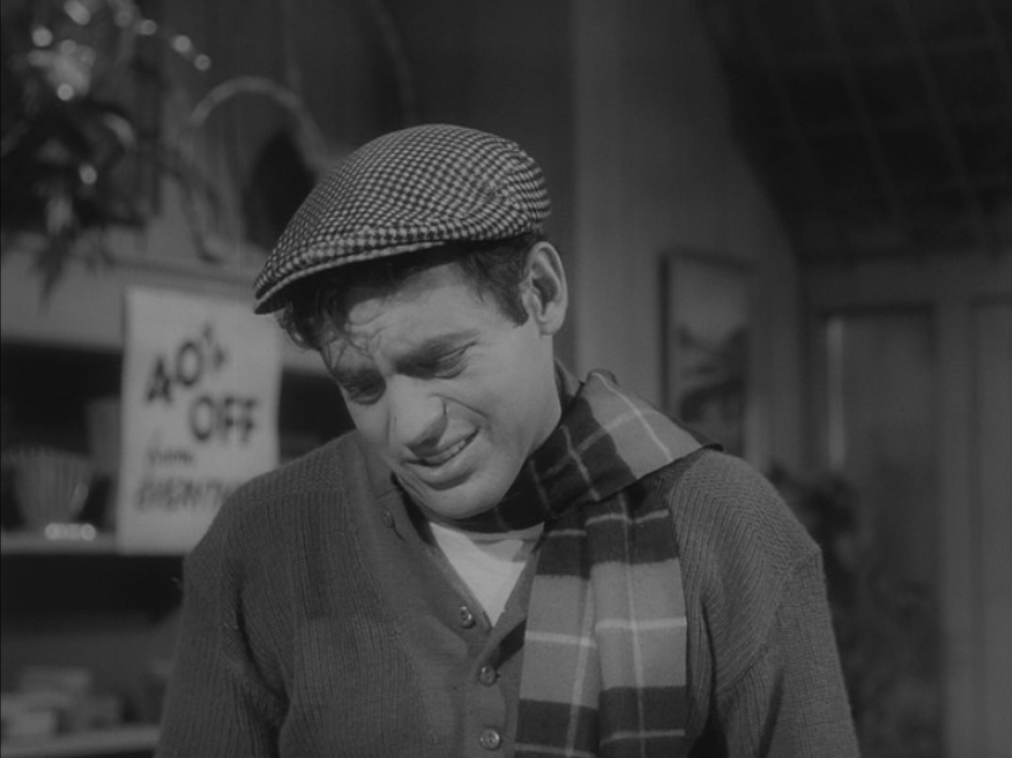
Seymour Krelboined (Haze) is a clumsy, socially awkward florist’s assistant working on skid row in California. His boss is Gravis Mushnick (Welles), a bad-tempered, penny-pinching stereotype of Jewish humour who speaks ungrammatical English, laden with malapropisms, in a thick Yiddish accent. Seymour will be fired for his ineptitude unless he can impress Mushnick with his new plant.

Seymour, Mushnick, and Audrey admiring Audrey Jr.

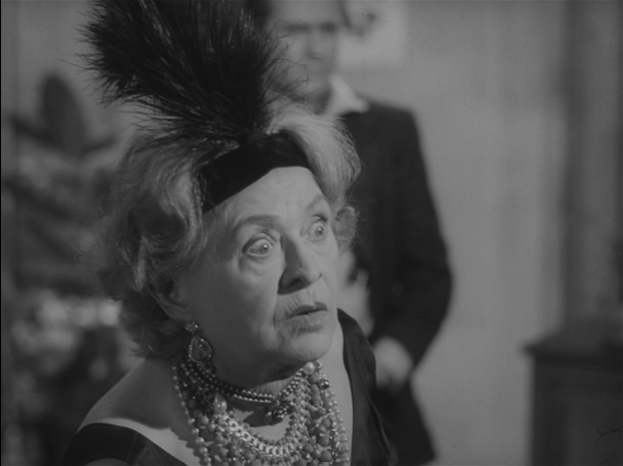
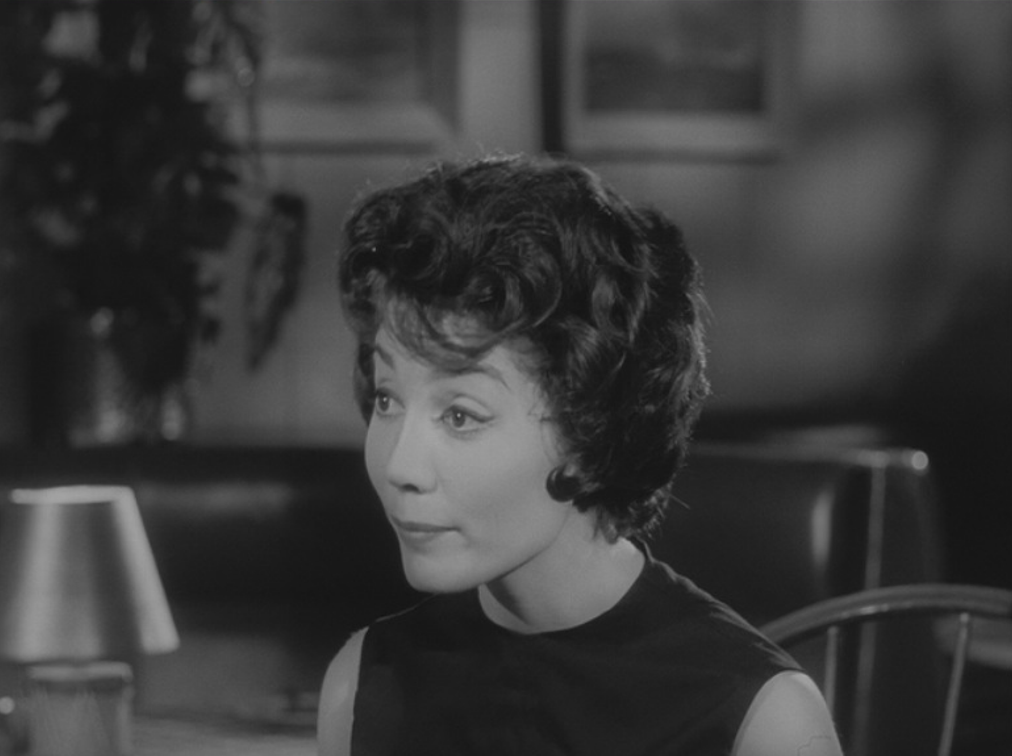
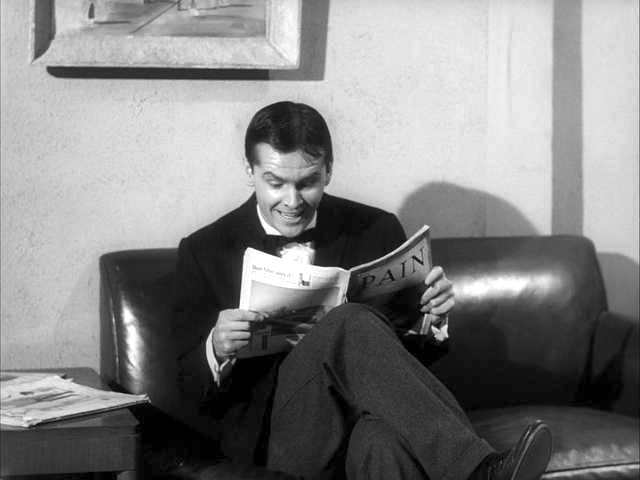
All the characters in this film are comically idiosyncratic in one form or another: Seymour’s love interest, Audrey Fulquard (Joseph), the sweet–if rather ditzy (her dialogue, too, abounds in malapropisms)–girl next door; Burson Fouch (Miller), an eccentric eater of flowers who gives Mushnick the idea to save Seymour’s job by using his unusual new plant to attract customers; Seymour’s hypochondriac mother Winifred (played by Myrtle Vail), who considers medication synonymous with food; ever-mourning Mrs. Shiva (aptly surnamed), who always needs flowers for funerals (hoping for cut-rate prices) for the latest death in the family; Sergeant Joe Fink, the narrator, and Officer Frank Stoolie, two Dragnet-style detectives; Dr. Phoebus Farb, a fittingly sadistic dentist; and Wilbur Force (Nicholson), a masochist who loves going to the dentist.

It’s interesting how Fouch, an eater of flowers, encourages the public display of a plant that, as it turns out, eats human flesh. Flowers are the commodity sold in Mushnick’s shop, of course, and Fouch is a consumer (in more ways than one) of them. The addition of ‘Audrey Jr.’, the giant man-eating variant of a Venus flytrap, to the store will cause business to boom in a way all storeowners dream of, but not even Mushnick will want to pay the gory price that Audrey Jr. demands.

The rapid growth of Audrey Jr., coupled with its appetite for human flesh, can be seen to symbolize the predatory nature of capitalism, which must continue growing, being fed on profits (i.e., the improved business of Mushnick’s flower shop), with no regard for the needs of human life.

So, consumption–in its various meanings–is the dominant theme of the movie: the plant’s consumption of human flesh, Fouch’s consumption of flowers, Mushnick’s customers’ consumption (buying) of his flowers, little Audrey Jr.’s consumption (using up) of Seymour’s blood, his mother’s consumption of medicines as if they were food, and the public’s consumption (i.e., reception of information/entertainment) of the display of Audrey Jr. in the flower shop.

Since the setting of the film is skid row, a part of town where the poor try to escape their troubles in such forms as alcohol and drugs, Winifred’s consumption of medicines can easily be seen as symbolic of drug addiction, especially since the tonic Seymour buys for her is 98% alcohol. She has a few sips and is already tipsy by the time he leaves their house with his then-little plant.

Winifred Krelboined

The symbolic relationship between Fouch’s eating of flowers and Audrey Jr.’s eating of people should be seen as a karmic one. Fouch’s eating of flowers symbolizes man’s destruction of nature by commodifying it; the plant’s man-eating is thus nature’s revenge on man, the destruction of the environment being also our destruction, our collective suicide.

Commodification, the making of exchange-values to generate profits, is the basis of capitalism; small wonder Marx began Capital, vol 1 with a discussion of the commodity. Flowers are Mushnick’s commodities, so Seymour’s plant and its growth represent how the profit made from commodities result in another kind of growth: the accumulation of capital. Audrey Jr.’s bloodlust represents the pain and suffering that inevitably result from all this capital accumulation.

Seymour’s social awkwardness reflects the aggravated kind of alienation one would encounter in the poverty of skid row. He loves raising plants, but he is only of any worth to Mushnick if he can nurse Audrey Jr. to health and present it appealingly to his boss’s customers, getting them to want to buy flowers in the shop. Once the plant’s health has revived, and it has grown thanks to its drinking of drops of Seymour’s blood, his boss no longer loathes him, and even starts calling him ‘Son.’

Two pretty girls, who enter the shop out of curiosity about Audrey Jr., and who wish to decorate a float with flowers, treat Seymour like a pop star upon learning that it is his horticultural skills that have brought the plant to life. After Mushnick, dreaming of wealth and moving his flower shop to Beverly Hills, gives ever-grieving Mrs. Shiva flowers for free, he notices Audrey Jr. sick again, regrets his generosity to her, and instantly reverts to his contempt for Seymour. The boy’s alienation arises from only being of value if he can help his boss make money.

His alienation grows worse when he realizes that the only way he can keep Audrey Jr. alive is by murdering people and feeding it the corpses. Since murder is repellant to his nature, his bloody work is now alienating him from what Marx called one’s species-essence.

Seymour Krelboined

One is alienated from one’s work, from oneself, and of course from other people. Seymour alienates himself from others, though he “didn’t mean it,” but he isn’t the only one. Dr. Farb, the dentist who loves drilling holes in people’s teeth, also alienates people with his sadism. There are the teeth that hack up a man, and there’s a man who hacks up teeth, another reversal comparable to that of Fouch vs Audrey Jr.

There’s karmic retribution in Audrey Jr. eating human flesh, in response to what Fouch’s flower-eating represents (destruction of the environment). Then there’s karmic retribution in Seymour’s killing of Dr. Farb, in response to the dentist’s gleeful torturing of his patients; recall how, in the 1986 film musical, Steve Martin’s dentist sings of people paying him “to be inhumane.” Many high-paid professionals–doctors, lawyers, politicians–do awful things on a scale comparable to those of the greedy capitalist.

The suffering of the poor in such places as skid row, people ever held down under the boot of the capitalist, often leads to varying forms of mental illness, as in Winifred’s hypochondria and the sexual masochism disorder of Wilber Force (Nicholson). While most masochists in the BDSM community engage in their kink in a way that doesn’t cause them psychosocial difficulties, Force’s eager willingness to have (imagined dentist) Seymour pull out several–it is safe to presume–perfectly healthy teeth is clearly an impairment of Force’s functioning in social situations.

Added to all of this, the farcical humour we see in Seymour’s clumsiness, the eccentricities of his mother and Fouch, Farb’s sadism, Force’s masochism, etc., should be seen as representative of the absurdist futility of their existence in an alienating, capitalist society that keeps them in poverty and misery. Even Fink and Stoolie, the police investigating the disappearances of Farb and the railroad detective (whom Seymour accidentally hit with a large rock and made fall on the tracks to be run over by a train), react to the death of Stoolie’s son–who was playing with matches–by nonchalantly saying, “Those are the breaks.”

Audrey Jr.’s chewing of human bodies into pieces, Dr. Farb’s drilling and pulling of teeth, and Force’s delight at getting his teeth drilled and pulled, all represent the psychological fragmentation that results from an alienating capitalist society that privileges the few and impoverishes most of the rest of humanity. Even the budding relationship between Seymour and Audrey doesn’t last long; predictably, the talking plant’s incessant demand, “Feed me!”, is what gets in the way of their love. The growing monster of capitalism eats up everything.

Audrey Fulquard

The two girls who want to feature Audrey Jr. on their float fittingly say that their spectators will “eat it up.” The literal or figurative consumption of commodities leads to the consumers being karmically consumed by their own materialism and commodity fetishism. People see only the growing plant; they know nothing of what it is actually fed to make it grow.

The reversals of Fouch’s flower-eating vs a man-eating plant, and of teeth that mutilate vs Farb’s mutilating of teeth, are a fusion of dialectical contradiction with karma.

Though Mushnick is horrified to find out that Seymour is feeding the plant human flesh, he is conflicted about whether to inform the authorities or to keep quiet and enjoy the new success of his business. It is common for business owners to be conflicted over the need to maximize profit vs the need to be humane towards their employees, to care about the environment, etc. We’ll notice however that, no matter how strongly…and sincerely…the capitalist feels about humanitarian concerns, the profit motive will take priority, because the capitalist is compelled to prioritize profit. Hence, Mushnick’s procrastination with telling the police.

Mrs. Hortense Feuchtwanger, a lady from the “Society of Silent Flower Observers of Southern California,” enters the flower shop and is fascinated with Audrey Jr. If the plant’s buds open on the evening she returns to the shop, and if she likes what she sees, she’ll give Seymour a trophy for his plant.

This trophy would represent the kind of recognition that Seymour, a misfit and ‘loser’ that no one has ever appreciated or liked, so desperately craves. Only recently have any women (Audrey, the two girls with the float, Mrs. Feuchtwanger) ever shown him any liking, and if there’s one thing we all desire, it’s that of the Other, to be desired of the Other, to get the Other’s recognition.

As with his romance with Audrey, though, Seymour’s appreciation from Mrs. Feuchtwanger will be short-lived, too. The lady returns to the flower shop to see the budding, and she is horrified–as are Audrey, Mushnick, Fouch, Winifred, and Fink and Stoolie, who are also there at the time–to see the faces of all those eaten by the plant in its opened flowers.

Oddly, the two girls with the float still like Audrey Jr., looking gleefully at the faces in the budded flowers. They represent the extreme of commodity fetishism: so entranced are they by the plant as a finished product that they show no regard for the victims that helped it grow.

Gravis Mushnick

Recall, also, that as horrified as Mushnick is at Audrey Jr., especially to learn that it is a talking plant, he, too, is willing to have it eat up someone–in this case, an armed robber (played by scriptwriter Griffith, who also did the voice of the plant). Guarding his money is more important to capitalist Mushnick than preventing yet another victim of Audrey Jr.

The robber isn’t the only member of the Lumpenproletariat to be fed to the plant: so is an aggressive prostitute who tries to get Seymour to be her next client. For indeed, with Audrey Jr. as symbolic of the ever-growing, ever-devouring monster that is capitalism, such Lumpenproletariat as criminals and streetwalkers are every bit as much victims of the bourgeoisie as are the strata of the working class just above them.

Capital seems to develop a mind of its own, in how it subjugates us all to the will of the profit motive, even when we try to resist it on moral grounds, as Mushnick and Seymour try to do. This ‘mind of its own’ would seem to explain, in symbolic terms, why the plant can talk, and why it can hypnotize Seymour into doing its will, right when he tries so vehemently to defy it.

So many of us on the left try to defy the system around us that we hate so much, but through the mesmerizing bourgeois media (part of the system’s superstructure), now including Facebook, the narcissistic exhibitionism of Instagram, etc., we all get pulled back into complying. Hence, Seymour wanders the streets of skid row, in such a trance as to ignore the charms of the streetwalker, and takes her back and feeds her to Audrey Jr.

When Fink and Stoolie learn that Seymour is responsible for all the killings, they and Mushnick chase him on the streets of skid row in the night. The two cops represent the feeble attempts that an otherwise bourgeois state makes to curb the excesses of capitalism. That feeble effort is demonstrated in their failure to apprehend ineffectual, spastic Seymour, who should be easy to catch.

Wilbur Force

They chase him into some bizarre, even surreal-looking, parts of town, but they are places nonetheless indicative of the capitalist preoccupation with commodities–rather unclean ones, actually. Seymour is chased into the private property of a tire and rubber company, when he runs and hides in a labyrinth of giant tires. One of the few times he doesn’t trip is over resting Mushnick’s leg, though Fink and Stoolie do trip over it!

Then Seymour hides in, of all things, a toilet among a maze of bathroom fixtures (sinks, bathtubs, etc). Mushnick tells the cops that they won’t find Seymour there, though he is most obviously there. In all of this not only do we see the symbolism of a bourgeois government failing to punish the excesses of capitalism, but we also see a capitalist helping in achieving that failure.

Seymour returns to the flower shop a broken man. Racked with guilt over his murders, he’s lost the woman he loves, he’s a wanted man, and it’s all because of that bloody, gluttonous plant that has repaid his services by ruining his life. In despair, he decides to sate Audrey Jr.’s hunger one last time with his own body…and a knife to kill it with.

A karmic reversal has finally happened to the plant, instead of it being an agent of karma; for such is the reality of the dialectical crests and troughs of theses phasing into negations and sublations that become new theses to be negated and sublated. Now Seymour’s face appears in the latest budding flower, to add to all the other faces. The plant dies, too, and just as capitalism kills, so will it destroy itself in the end.

Analysis of ‘The Wizard of Oz’

I: Introduction

The Wizard of Oz is a 1939 children’s fantasy musical movie produced by MGM and written by Noel Langley, Florence Ryerson, and Edgar Allan Woolf, based on the 1900 children’s fantasy story, The Wonderful Wizard of Oz, by L. Frank Baum. The film stars Judy Garland, Ray Bolger, Jack Haley, Bert Lahr, and Margaret Hamilton; it costars Frank Morgan and Billie Burke.

Considered one of the greatest films of all time, The Wizard of Oz features Garland’s immortal performance of “Over the Rainbow,” which one the Oscar for Best Original Song, and the film is characterized by its use of Technicolor (in Oz), which contrasts sharply with the black-and-white beginning and ending (in Kansas).

A link to famous quotes from the film can be found here. Here’s a link to a PDF of Baum’s book. I’ll be comparing the film with the book throughout. [NOTE: whenever I cite or quote from Baum or cite other PDFs here, I’m using the page numbers from the ‘paper’ copied in the PDFs, not the PDF page numberings.]

II: Preliminary Remarks

What is particularly interesting about the film and Baum’s book is how one can find political allegories in it, even though Baum never indicated any allegorical intent in his story; he insisted that it was meant just to entertain children. Still, a number of attempts have been made over the years to find an allegory in it.

One well-known allegory is that of historian Henry Littlefield, who saw in such things as Dorothy‘s silver shoes a symbol of bimetallism and the freeing of silver from what was felt by some in the US in the 1890s as the tyranny of the gold standard. Certainly this was the feeling of William Jennings Bryan, who famously spoke of the issue in his rousing “Cross of Gold” speech at the 1896 DNC. According to this allegory, the Cowardly Lion is supposed to be a satiric take on Bryan, since Baum didn’t sympathize with his position; though I see at best a tenuous connection between the character and the politician, and this is after reading Baum’s book, Littlefield’s allegory, and Bryan’s speech from beginning to end.

Indeed, though Littlefield’s allegory has its supporters, it’s far from universally accepted. While I agree that the Scarecrow represents the American farmer, or perhaps more generally peasant farmers (as does the sickle), and the Tin Woodman represents the industrial proletariat (as does the hammer), having the Lion represent Bryan seems wildly inconsistent in relation to the previous two. Surely the Lion should represent something properly paralleling them (more on that later).

In any case, however one judges the validity of Littlefield’s allegory, surely people today, as well as those who saw the film’s premiere in 1939, will find the bimetallist allegory not something they can identify with. People in the late thirties surely were more concerned with the Great Depression and the rise of fascism than they were with ‘freeing silver.’ And I think people today are more worried about the current economic crisis and resurgence of fascism than they are with bimetallism.

So, what can the film and book mean for us today, regardless of whether or not Baum and the film’s screenwriters consciously intended such a meaning? I’d like to propose such an allegory.

I see The Wizard of Oz, in its book and movie forms, as an allegory of class struggle. In fact, the bimetallism allegory, especially as advocated by Bryan in his “Cross of Gold” speech, dovetails with my interpretation beautifully (though not in the ironic, satirical sense in which Littlefield imagines Baum’s meaning), because for Bryan, the freeing of silver coinage was for the benefit of American farmers (i.e., helping them pay off their debts), and for the good of the common man. Bryan was known for his sympathy for the common worker, and in his speech, he spoke of the wage-earner as being “as much a businessman as his employer.”

Now, Baum vigorously supported the suffragette movement, and he was pro-worker, as seen in the sympathetic portrayal of the Scarecrow and the Tin Woodman, and in his vivid description of the plight of Uncle Henry and Auntie Em in their harsh farming life at the beginning of the story, representative of the harsh life of American farmers that Baum saw all around him in the Midwest in the late 19th century. One despicable thing about Baum, though, is how he advocated, in two editorials, the extermination of the Native Americans; but apart from this one egregious blot on him, Baum could be deemed to have been sufficiently progressive for his time to justify my interpretation of his story.

III: Grey Kansas

The filming of Kansas in sepia-toned black and white is appropriate, given Baum’s description of the farm of Dorothy Gale (Garland) as predominantly grey. Baum’s story introduces the cyclone almost immediately after a brief description of the dull, grey, and difficult farm life, and how such difficulties have dulled even the original beauty of her Auntie Em (played by Clara Blandick), and made her Uncle Henry (played by Charley Grapewin) never laugh, as Auntie Em never smiled.

The film, however, expands the opening Kansas sequence to include characters who are doubles of many of those we later see in Oz: Miss Almira Gulch/the Wicked Witch of the West (Hamilton), Hunk/the Scarecrow (Bolger), Hickory/the Tin Woodman (Haley), Zeke/the Cowardly Lion (Lahr), and Professor Marvel/Gatekeeper/Carriage Driver/Guard/Wizard of Oz (Morgan).

The fact that the three farmhands–three workers in the employ of Dorothy’s aunt and uncle–are doubles of her three “comrades” (Baum’s word) reinforce my interpretation that these three all represent members of the working poor…including the Lion.

Dorothy complains to her aunt and uncle about Miss Gulch wanting to take away her dog, Toto (played by Terry), and have him killed. Her aunt and uncle, too busy and stressed with their work on the farm, don’t have time to deal with her problems. When she tries to talk about Miss Gulch and Toto with the three farmhands, they have little time to listen, either. In this poor communication, due to the urgency of work, we see an example of alienation, which divides not only workers, but also families.

As so many of us do in the capitalist world, Dorothy dreams of the possibility of a better world, one “Over the Rainbow.” The lyrics of the song were written by socialist Yip Harburg, who got blacklisted even though he was no member of a communist party.

When mean Miss Gulch comes to the farm and demands to have Toto, having the law behind her, we learn also that she owns quite a stretch of land (Auntie Em says Gulch owns “half the county”). Her ownership of private property thus makes her a capitalist; since she’s a double of the Wicked Witch of the West, Gulch thus reinforces the witch’s tyranny over the Winkies as symbolic of capitalist imperialism, something by extension seen in the witch’s sister (according to the film), the Wicked Witch of the East, and her imperialist oppression of the Munchkins.

Gulch takes Toto away in a basket on her bicycle, but the dog jumps out and returns to Dorothy. To protect Toto, she feels she must run away. She meets Professor Marvel, a fortune teller who has apparently been to all kinds of wonderful places in the world; she’d love to accompany him on his travels.

He uses his crystal ball to make her believe that her Auntie Em is heartbroken over her running away, so she decides to go back. She manages to get back home by the time the cyclone comes. The cyclone represents the turbulent winds of revolution, which tear up the old order to make way for a new one. Back in the house and carried up in the eye of the cyclone, Dorothy is knocked unconscious and begins to dream.

IV: Landing in Oz

Since dreams are, as Freud noted, a royal road (a yellow-brick one, by chance?) to an understanding of the unconscious, we can see her experience of the Land of Oz as, on one level, symbolic of the experience of the world as felt by the unconscious mind, which tends to mishmash things together (for example, Melanie Klein, in The Psychoanalysis of Children, wrote of how a baby’s unconscious will think of milk, urine, and other liquids as identical). Hence, Miss Gulch is the Wicked Witch of the West, and the three farmhands are the Scarecrow, the Tin Woodman, and the Cowardly Lion.

Oz, too, is of course a fantastical version of the real world Dorothy and Toto have come from. It may be bright, colourful, and beautiful, but Oz is far from utopian…at least in Baum’s first Oz book. The Munchkins and Winkies are enslaved and oppressed by the wicked witches, and “the wonderful wizard of Oz” is no less a phoney than your average politician.

When Dorothy steps out of her house and into the colourful Land of Oz, she may have a feeling she’s not in Kansas anymore, but her going “over the rainbow” hasn’t landed her in an ideal world. Her house’s having dropped on and killed the Wicked Witch of the East, freeing the Munchkins and giving them cause to celebrate through the song “Ding-Dong, the Witch is Dead,” is only the beginning of the revolutionary change needed to liberate all of Oz. Crushing the old, oppressive institutions isn’t enough; one has to build new ones.

Who does the Wicked Witch of the East represent? Baum, having published his story in 1900, obviously never intended her to represent the evils of Eastern feudalism in, say, tsarist Russia or pre-republican China, which weren’t to end until one to two decades afterward. But the 1939 film was made long after those revolutionary changes, and in any case, we today can think of her as, on one level, symbolizing such old forms of tyranny if we wish, since such a retrospective interpretation will resonate far better with our generations than a preoccupation with free silver.

Art isn’t mathematics, in which an equation has only one correct answer and an infinitude of wrong answers. Meaning in art and literature is much more fluid, allowing a multiplicity of possible interpretations, however idiosyncratic some of them may be. When interpreting the meaning of a film, a book, a poem, or a myth, insisting on only one ‘correct’ meaning ruins the enjoyment of that art form, because such an insistence ossifies that art form. If the ‘correct’ interpretation has been established, why interpret that work of art any further? Just stick with Littlefield et al, and inquire no further. Now, if you like those old opinions of what Baum’s book means, you’re entitled to your opinion, and that’s fine. But please allow others to look at it in other ways if they wish; as long as a reasonable case can be made to support one’s interpretation, however eccentric it may be, it can be deemed ‘correct’ enough.

V: The Witches

As for the witches–who represent heads of state, or in the case of the wicked ones, represent colonizers and imperial rulers of the lands of others–Baum doesn’t develop them much in this first Oz book. We briefly see the Good Witch of the North among the Munchkins, the Wicked Witch of the West is encountered only when Dorothy et al enter the land of the Winkies, and Glinda, the Good Witch of the South, is seen only towards the end of the story.

To unify the story more in the film version, the Good Witch of the North (Burke) is a composite of the northern and southern witches; hence, she’s Glinda, the Good Witch of the North. And the Wicked Witch of the West is introduced in the land of the Munchkins, being the sister of the dead Witch of the East; we see much more of her in the film, too, since she’s the central villain.

Since the Glinda of the film combines the witches of the north and south, we naturally see more of her, too. An interesting theory about the film Glinda suggests she isn’t as good as she seems to be. Why doesn’t she simply tell Dorothy she can go home with the now-ruby slippers? At the end of the film, she says that Dorothy wouldn’t have believed her if she’d told her at the beginning, and that the little girl must learn for her self that she’s always had the power to use them to take her home…only Dorothy doesn’t learn it for herself. Glinda tells her at the end just as much as she could have told her earlier, and why would Dorothy believe her any more now than at the beginning?

It could be that Glinda’s all-too-saccharine, grinning goodness, bordering on–if not lapsing into–artificiality, is actually a cunning disguise meant to manipulate Dorothy into destroying the Wicked Witch of the West and getting rid of the Wizard of Oz. Since the Witch of the East is already killed, and the film’s Glinda is both the northern and southern witches, the success of her cunning plan would leave her the only one to rule all of Oz.

VI: Oz in Ounces

The only reason Oz seems to be such a sweet and beautiful place is because it is seen as such through the innocent eyes of a naïve little girl. But a world ruled by imperialistic witches, where people have a preoccupation with precious materials like gold (symbolized by the yellow brick road; then there’s the golden cap that commands the Winged Monkeys), silver and/or rubies (Dorothy’s shoes), and emeralds, is obviously a world symbolic of capitalism. Indeed, “Oz” has been interpreted to mean ounces (i.e., oz. of gold or silver).

To many Americans, whose political naïveté is comparable to ingenue Dorothy, “capitalism is freedom” (please refer to my many a debunking of the myth of the “free market”). Dorothy’s silver/ruby slippers taking her back to dreary, grey Kansas can be seen to reflect the disillusion one has when one wakes up from the slumber of the “American dream,” that if one works hard enough, one can become a millionaire, instead of realizing that one tends to stay in one’s social class of birth. Though she’s genuinely happy to be with her family again (which is ultimately what matters), her loss of the shoes during the trip back is symbolic of how the dream of striking it rich is an illusion.

So Dorothy, wearing silver or ruby slippers and travelling down a yellow brick road (yellow being symbolic of gold, as I mentioned above) towards the Emerald City can be seen to represent the dreams of the petite bourgeoisie of finding wealth and financial success. If, in my interpretation, the death of the Wicked Witch of the East represents the end of feudalism (i.e., such upheavals as the French Revolution, a western revolution, but east enough relative to the US), then the appearance of the Witch of the West among the Munchkins, with her coveting of now-Dorothy’s ruby slippers, can represent the advent of capitalism, and the imperialism that has grown from it.

Dorothy’s travels down the yellow brick road, crossing farmlands with lots of rich crops and food (Baum, chapter 3, page 33), are a sharp contrast with the grey farmland of Kansas and the struggles Henry and Em are having, a major issue with late 19th century American farmers. Still, this abundance of food is only one part of Oz; later on, Dorothy will find it difficult to find food (Baum, chapter 4, page 44; chapter 5, pages 54 and 61; chapter 7, page 75). Baum’s Oz is a kind of Spenserian bower of bliss, where what initially seems pleasurable is hiding potent evils to be discovered soon enough. The film’s use of studio sets and matte paintings are useful in reinforcing the sense of unreality in Oz.

VII: The Scarecrow and the Tin Man

Soon, Dorothy meets the Scarecrow, and learns that because his head is stuffed with straw, he must be lacking a brain. In Baum’s story, he says he doesn’t know anything (chapter 3, page 38)…but how does he know that he doesn’t know anything? He has a brain…he just doesn’t realize that he has one.

He represents the rural, uneducated farmer; I’d expand that by saying he also represents peasants. Such people are often perceived to be the ‘country bumpkin.’ Half of the problem of how to improve the lives of these impoverished people is to get them to see how capable they really are, something the ruling class doesn’t want them to see. They need confidence in their abilities.

Mao Zedong had great faith in the Chinese peasants, and he gave them the confidence they needed to help him fight the Japanese imperialists during their protracted war in the 1930s. When the CPC took control of China, they went through some rough moments, to be sure (though nowhere near as bad as the right-wing propagandists have portrayed those problems); but now China has grown from a Third World country to an economic rival of the US…all in a mere forty years.

The Scarecrow will go with Dorothy to ask the Wizard of Oz, who represents the consummate politician who is all talk and promises that are rarely kept, for a brain. The two continue down the yellow brick road and into a forest where they find the Tin Woodman, all rusted from head to foot after a rainfall. They use his oilcan to oil his joints so he can move again. We learn he hasn’t got a heart…though he’s sensitive enough to have three.

His body is made of tin, as we learn from Baum’s book (chapter 5, page 59), because the Witch of the East cursed his axe. Whenever he swung it to chop wood, he’d chop off a body part, which the local tinsmith would replace with one of tin; but none of these replaced body parts, now comprising all of him, would include a heart, or so the Tin Man imagines.

He represents the industrial worker, especially that of the eastern United States of the late 19th century, since it’s the Witch of the East, here representing the ruling class of the American east, who has cursed him with endless workplace injuries and a sense of dehumanization, resulting in his belief that he has lost his heart. He’ll join the others on their trip to see the wizard.

VIII: The Cowardly Lion

Deeper into the forest, into a darker and scarier part of it, they run into the Lion, who attacks the Scarecrow and Tin Woodman. When the Lion tries to attack Toto, Dorothy slaps him and shames him for his bullying. The Lion weeps like a baby, and we learn that he, apparently, lacks courage…though how could a cowardly lion have the guts to attack two men, one of them holding an axe?

As those of us familiar with the usual allegorizing of this story know, the Cowardly Lion is supposed to represent William Jennings Bryan. I must respectfully disagree with this interpretation, as I see the connection between the two to be far too vague to be convincing. Littlefield (pages 53-54), whose use of the story material is rather selective, bases much of his interpretation on this passage (chapter 6, page 66): “With one blow of his paw he sent the Scarecrow spinning over and over to the edge of the road, and then he struck at the Tin Woodman with his sharp claws. But, to the Lion’s surprise, he could make no impression on the tin, although the Woodman fell over in the road and lay still.”

The Lion’s claws’ failure to make an impression on the Woodman’s tin, according to Littlefield, represents Bryan’s failure (i.e., his 1896 loss to McKinley) to make an impression on the industrial labourers of the eastern US, whom the Tin Man represents in Littlefield’s allegory (i.e., the Witch of the East’s curse on him, or the workers of the East pressured into voting for McKinley and the gold standard by their bosses). Now, I can see how the above quote can represent Bryan’s failure to gain the votes of eastern workers…but must it represent this?

Furthermore, aspects of this passage, among others, can be seen to run counter to Littlefield’s interpretation. The Lion attacks the Scarecrow and the Tin Woodman: did Bryan attack farmers and industrial labourers during the 1896 election campaign? What’s more, did Bryan mistakenly believe himself to be a coward? Many pro-imperialists might have mistaken Bryan’s pacifism and anti-imperialism for cowardice, but that doesn’t necessitate his own confusion of his virtues with being craven.

Later in Baum‘s story, on the way to visit the Good Witch of the South, Dorothy, Toto, and her three comrades enter a forest where the Lion has to rescue the local animals from a giant, spider-like monster (chapter 21, page 239). As a reward for killing the monster, the Lion is made King of the Forest, which Littlefield interprets as Bryan ruling over “lesser politicians” (page 58–lesser, that is, in relation to the greater kingdoms of the Emerald City, ruled by the Scarecrow after the wizard leaves, and of the Winkies, ruled by the Tin Woodman after the killing of the Witch of the West).

Bryan lost three presidential elections, twice to McKinley in 1896 and 1900, and once to Taft in 1908; eventually, Bryan would be Secretary of State to Wilson in 1912, from which he, as a pacifist and anti-imperialist, would resign in 1915 in protest against the prospect of American involvement in WWI. Who were these “lesser politicians” that never-elected Bryan ruled over? Are the animals the Lion is ruling over “lesser” just because they’re animals? The people of the Emerald City and the Winkies are ruled over by men (of sorts, anyway); the animals are ruled over by an animal. Proportionally speaking, there are no ‘greater’ or ‘lesser’ politicians. If the Lion, based on Littlefield’s reasoning, is Bryan, is the Scarecrow, ruler of ‘greater’ politicians, McKinley?

My point is that we can accept Littlefield’s interpretation if we want to; but we are by no means compelled to. If you want to find a work of literature with a character indubitably representing Bryan, look no further than Inherit the Wind (i.e., Matthew Harrison Brady), which is an explicitly fictionalized account of the Scopes monkey trial.

IX: An Alternative Interpretation of the Lion

I just find it out of place that three clearly paralleled characters don’t have equally paralleled symbolisms. The Scarecrow, the Tin Woodman, and the Cowardly Lion: the first two represent different sections of the working class, while the third apparently doesn’t represent workers, but rather a politician. To be sure, Bryan championed the working class, but originally trained as a lawyer, he wasn’t one of them.

I find it more fitting to see the Lion, as lacking in confidence in his abilities as the other two, as also representing workers. Now, the Scarecrow represents the farmers and peasants, and the Tin Woodman represents the industrial proletariat: which workers, then, would the Lion represent?

I see the Lion as, dialectically, a synthesis, or sublation, of the former two. The Scarecrow lacks a brain (supposedly), and the Tin Woodman lacks a heart (supposedly). The two have a brief debate (chapter 5, page 61) over which organ is more valuable: the brain (reason) and the heart (emotions) are often seen as dialectical opposites (thesis and antithesis). Courage requires both brains and a heart.

Having the heart to run into danger without the brains to determine if it’s wise to face that danger doesn’t make one brave–it makes one stupid and reckless. Having the brains to recognize a danger without the heart to face it doesn’t make one a coward–it makes one wise and cautious. Sometimes people are too afraid to face danger because they have acquired the freeze trauma response.

Lacking both the brains and the heart to face dangers could be interpreted as cowardice in the sense that one has neither the heart to be brave nor the brains (i.e., the common sense) to tell the difference between dangers worth facing and those not worth facing. The lack of brains factor could also be interpreted as a lacking of the mental willpower needed to control one’s fear, since such a control is what courage is all about.

More important than any of the above, however, is the fact that, of course, none of these three characters lacks the virtue he thinks he lacks. The Scarecrow simply lacks confidence in his intellectual abilities; the Tin Woodman lacks confidence in his sensitivity and ability to be kind and loving; and the Lion lacks confidence in his…confidence!

After all, cowardice at its core is caused by a lack of self-confidence; and this is why the Lion is best understood as a combination of the Scarecrow and Tin Woodman. He embodies being scared when he doesn’t need to be. Like the other two, his real lack is that of confidence, hence as an embodiment of the lack of self-confidence, the Lion is the synthesis of the Scarecrow and Tin Woodman. And since all three of them, in my interpretation, represent the urban and rural working class, their central problem is their lack of self-confidence; having this confidence is what they need to overthrow the bourgeoisie.

The Lion also combines other aspects of the first two. Like the Scarecrow, he’s supposed to be scary, but feels he can’t be. Like the Tin Woodman with his sharp axe, the Lion has sharp claws and teeth.

His attacking of the Scarecrow and Tin Woodman makes sense in a way that Littlefield’s allegorizing of him doesn’t: as a symbol of another worker, the Lion attacks the other two symbols of workers because of a problem that’s common in the capitalist world–worker alienation leading to a lack of solidarity. Soon enough, though, the Lion will become a friend to Dorothy et al, and their new solidarity will lead to their ultimately getting what they want…the same way worker solidarity will lead to the revolutionary overthrow of the bourgeoisie.

X: The Poppy Field and the Emerald City

They get out of the forest, and in the film, they can see the Emerald City (fittingly, a matte painting that as such emphasizes the city’s illusory, fake nature) in the distance. A field of poppies, the scent of which puts the smeller to sleep, lies in their way.

They all run through the field, only to find Dorothy, Toto, and the Lion falling asleep. Now, the Emerald City can be seen to represent America, “the land of opportunity,” or by extension, the First World, as opposed to the forest they’ve just come out of, which in its scarcity of food for Dorothy and Toto, can be seen to symbolize the Third World.

Seeing the Emerald City, and believing that, being there, one can realize one’s hopes and aspirations, is to dream the American dream: one has to be asleep to believe it, as George Carlin once said. Hence, the poppies. Such frustrated hopes would have been as true of late 19th century American farmers as they are of most of us today.

If one wishes to make one’s allegory of Baum’s story specific to late 19th century America, one needn’t be preoccupied solely with the gold vs. silver controversies of the 1890s. One need simply consider the wealth inequality of the Gilded Age: an outer patina of economic prosperity (the Emerald City) hiding abject poverty (the want of food in the forest for Dorothy and Toto).

In Baum’s story, Dorothy et al must wear glasses to protect their eyes from the blinding gleam of the ubiquitous emeralds of the city (chapter 11, page 121). We later learn that the glasses make them see green and emeralds everywhere, when in fact there is none of either (chapter 15, pages 187-188). These glasses are the reverse of those worn by Nada (Roddy Piper) in They Live. Instead of revealing that our normal lives are a capitalist illusion, the green glasses provide that illusion.

The illusion of shiny, green emeralds is symbolic of American greenbacks, the illusion of money as an exchange-value for other commodities. The Wizard of Oz, representing the politician whose promises are never kept, and who represents the interests of capital, has fittingly had the Emerald City built for him to hide in, protected from the witches, protected from his own people, and protected from reality.

XI: The Wizard

In the film, we see Dorothy et al merrily prettied up to see the wizard; this beautifying is symbolic of how all of us in society must falsify our appearance to be ‘presentable,’ just as the wizard falsifies his own image. Frank Morgan plays not only the wizard, but the gatekeeper, the guard, and the carriage driver: it’s as if we were already aware that the wizard is no wizard, but is just an ordinary man.

The merry song of Dorothy et al getting prettied up, then being interrupted by the threat of the Wicked Witch of the West, who represents Western capitalism, indicates perfectly how the Gilded Age, as symbolized by the Emerald City, is at first all deceptively merry, then the ugly truth displays itself…in a form equally green (i.e., the witch’s skin), the ugly side of money.

When Dorothy et al finally meet the wizard, he presents phoney images of himself to trick them into thinking he’s far more powerful than he really is, just as all politicians deceive the people into thinking they are far more capable that they really are. In Baum’s story, Dorothy sees a huge head (chapter 11, page 127); the Scarecrow sees a beautiful woman (page 130); the Tin Woodman sees a terrible beast (page 132); and the Lion sees a ball of fire, which, when he gets too close, singes his whiskers (page 134). This last apparition, and the Lion’s reaction to it, are again related to Bryan by Littlefield (pages 54-55) in a way that, to my eyes, isn’t backed up with any evidence.

In the film, all of them see the wizard together, and the apparition is essentially a combination of what Baum has Dorothy and the Lion see. In any case, as we all find out at the end, these apparitions are all fake, and the real “wizard” is just a “humbug”…just as your average politician is.

XII: Killing the Witch

The Wicked Witch of the West’s enslavement of the Winkies and of the Winged Monkeys, just as is the case with the Witch of the East’s former enslavement of the Munchkins, can be seen to represent class conflict in general, be it in the ancient form of master vs. slave, of feudal lord vs. serf, or of bourgeoisie vs. proletariat. Slavery is slavery, regardless of if it’s the explicit ancient form of slaves sold on a market, feudal servitude, or the wage slavery of today.

What we shouldn’t forget is that slavery never died: it’s alive and well, and existing in many forms in the Third World. Many impoverished families find themselves in debt, and the only way out of that debt is to perform years of servitude to their creditors. There are literal slave markets in Libya, which used to be a prosperous country under Gaddafi’s benevolent dictatorship before the NATO intervention and his brutal murder.

To relate Baum’s story more directly with the political issues of the US in the late 19th century, one can consider how, though the black American slaves were freed, a clause in the 13th constitutional amendment has allowed for the continued enslavement of the incarcerated; and with the prison-industrial-complex of today, in which corporations can make prisoners toil away for long hours and for next to nothing in money, we can see how slavery in its more or less pure form still exists in the US.

As Dorothy et al are on their way to the witch’s castle, the witch commands her flying monkeys to fetch Dorothy and Toto. The contemporary use of the term ‘flying monkeys‘ has deep resonance when retrospectively used on the Winged Monkeys of Baum’s story and the 1939 film. The notion of blindly obedient servants to an evil master can vividly describe the American military, slaves of Western imperialism.

In Baum’s story, this symbolic servitude to capitalist imperialism is made even more explicit in the use of a golden cap (chapter 12, page 146), which is worn to command the monkeys three times. The witch has used it to have the monkeys help her enslave the Winkies, and she’s used it to drive away the wizard from the West; now she wants to use it to get Dorothy so she can get her hands on those shoes. Like the monkeys, we’re all slaves to wealth and power, be it in the form of the gold standard or other forms.

When the witch has Dorothy in her clutches, it’s only natural that the hag covets the silver/ruby slippers. This covetousness is representative of the greed of capitalists, who–no matter how rich and powerful they may already be–they always want more.

In Baum’s story, the witch makes Dorothy her slave and has the Lion her captive (chapter 12, pages 149-150). In the film, the Lion is with the Scarecrow and the Tin Woodman; looking at the witch’s castle, the Scarecrow has a plan. How can he have a plan without a brain? The Tin Woodman can’t bear to think of captive Dorothy’s suffering; how can he feel that way without a heart? The Lion goes in with the other two to rescue her: how can he do that without courage? As I mentioned above, their only real lack is self-confidence, something they can acquire through solidarity and mutual aid.

When the witch corners all of them, the witch threatens the Scarecrow with fire, symbolic of her evil passions, and so, something that needs to be quenched, extinguished. The Scarecrow, being representative of the rational element of Dorothy’s group (despite his belief that he lacks brains), is the opposite of the witch’s fiery passions…and thus, he’s afraid of “a lighted match.” Similarly, the water that quenches fire, and is thus symbolic of the extinguishment of the passions, and of a oneness with everything, is an opposing force that the witch fears. (Water may rust the Tin Man, but at least he can be oiled back to normal.)

Dorothy’s splashing of water on the witch–be it to extinguish the flame on the Scarecrow’s arm, as in the film, or to express her outrage to the witch for taking one of her silver shoes, as in Baum’s story (chapter 12, pages 153-154)–kills the witch by melting her because her evil is based on egoistic individualism, a defining symptom of capitalism, as opposed to the formlessness of water, a symbol often used to express the non-egoistic unity of the cosmos. The witch’s death by melting is thus symbolic of a death of the ego.

XIII: The Humbug of Oz

Dorothy’s second killing, however unintended, of a witch represents another revolutionary victory of the poor peasant farmers (recall that she’s from a family of farmers) and urban workers against the ruling class, be they slaveowners, feudal lords, or capitalists. She and her comrades now imagine they can return to the wizard and get what they wish of him.

His procrastinating on fulfilling his part of the bargain, a typical problem with politicians, angers Dorothy et al. Then Toto exposes where the wizard is hiding, and we see that the wizard is a bald little man (in Baum’s story, chapter 15, page 183), or an old man, played by Frank Morgan, as he played other men in the Emerald City. The wizard, like most politicians, is a fake…just an ordinary man, like any other.

He has no real powers, only a talent at creating clever illusions. We all know about this illusory quality of politicians, but we keep believing in them and hoping for the best of them all the same. Hence, when the wizard puts bran in the Scarecrow’s head (chapter 16, page 196), gives the Tin Woodman a heart “made entirely of silk and stuffed with sawdust” (page 197), and gives the Lion a drink (pages 198-199) that supposedly will fill him with courage, all three believe they’ve really been given what they need, though they’ve always had what they wanted from the start. The same goes for when, in the film, the Scarecrow gets a diploma, the Tin Woodman a testimonial in the shape of a heart, and the Lion, a medal for heroism.

As for Dorothy, the wizard says he’ll take her to Kansas himself, though he’s from Omaha (chapter 15, page 186), and he hasn’t “the faintest notion which way [Kansas] lies.” (chapter 17, page 204) He entrusts the rule of the Emerald City to the Scarecrow by virtue of his great brain (chapter 17, page 206); in the film, the wizard has the Scarecrow, Tin Woodman, and Lion rule together in his stead, whereas in Baum’s story, the Tin Woodman will rule over the Winkies now that they’re freed of the witch, and as we know, the Lion will rule over that forest.

Either way, the new rule of Dorothy’s three comrades over these sections of Oz–since all three, in my allegory, in turn represent the peasant farmers and industrial workers–represents the dictatorship of the proletariat, now that the oppressive rule of the wicked witches and fraudulent rule of the wizard are over. The notion of the dictatorship of the proletariat was already known in the late 19th century through the writings of Marx and Engels, as well as through the example of the short-lived Paris Commune.

Now, if the above speculation about the film’s Glinda is true–that is, that she is secretly trying to dominate all of Oz by removing the other witches and the wizard–then the worker rule symbolized by the triumvirate of the Scarecrow, Tin Woodman, and Lion will have the same challenge, symbolically speaking, that the socialist states of the 20th century had in dealing with reactionaries and capitalist encirclement.

XIV: No Place Like Home

But with the mishap of Toto running off to chase a cat, and the wizard’s balloon taking off without her, Dorothy thinks she’s lost her last hope of getting back to Kansas. Then Glinda comes (or, as in the book, Dorothy goes to Glinda) to tell her she’s always had the power, in those shoes, to go home herself, as her comrades have always had what they’ve thought they lacked.

In a sense, Dorothy’s discovery is like that of the Buddhist prodigal son, who returns home to do menial labour for years, only to learn he’d already had his father’s love and forgiveness from the beginning, but would never have believed it had he been told before. We the people are also fooled into thinking we need some charismatic leader to guide us to what we need, when we have the power to get what we want ourselves…we just need to band together, as Dorothy and her comrades have done.

The spirit of working together, mutual aid, and solidarity will help us defeat the wicked witches of the ruling class, not reliance on the fraudulent wizardry of politicians. We already have the basic building blocks to organize a revolution: we have the brains, the heart, and the courage, though we may not believe we do. We just need the self-confidence and camaraderie to pull it off.

So when Dorothy gets home–whether it’s her running to her Auntie Em in stocking feet, as in Baum’s story (chapter 24, page 261), or it’s her waking up to see her aunt, uncle, the three farmhands, and Professor Marvel, as in the film–she may no longer have the valuable shoes, but she has the love of all those around her. Together, they all can bring about the revolutionary change needed to end the harshness of their rural life, a real revolution to parallel the wish-fulfillment revolution of Dorothy’s Oz-dream…a true homecoming, to a better life that they’ve deserved from the beginning.

Analysis of ‘Bonnie and Clyde’

Bonnie and Clyde is a 1967 crime drama written by David Newman and Robert Benton, loosely based on the early-to-mid-thirties crime spree of the Barrow gang. The film was directed by Arthur Penn; it stars Warren Beatty (who also produced it) and Faye Dunaway, and costars Gene Hackman, Estelle Parsons, and Michael J. Pollard. All five of these actors were nominated for Oscars, with Parsons winning.

Bonnie and Clyde ushered in a new era of filmmaking (New Hollywood), with its shockingly bloody gunshot wounds (produced by squibs), jump cuts (courtesy of the direct influence of the late fifties/sixties French New Wave; in fact, François Truffaut and Jean-Luc Godard were consulted during the making of the film), and sexual innuendo, helping to bring the old, prudish Production Code to an end and replacing it with the MPAA ratings system.

As good and ground-breaking as the film is, though, don’t expect that watching it will leave you well-informed about the real history of Bonnie and Clyde. The film not only romanticizes the crime spree, making the Barrow gang into social rebels and heroes to the late sixties counterculture, but it also plays fast and loose with what actually happened back in the early-to-mid-1930s. The real crime duo’s meeting place was totally different (at the home of Barrow’s friend Clarence Clay, not at Bonnie’s home); they robbed far fewer banks (mostly grocery stores and gas stations); there’s no evidence that they robbed from the rich and gave to the poor; Bonnie was already married (to Roy Thornton, who was in prison himself during and after the crime spree), and the real Frank Hamer (played by Denver Pyle) and Blanche Barrow (Parsons) were totally unlike the weak, humiliated portrayals seen in the film.

The film was reviled on its first release, most audiences being disgusted with the excess violence. But over time, it has become a classic, to the point where Quentin Tarantino said film history can be divided into films made before and after Bonnie and Clyde, that is, that the cinema of the seventies started with this late-sixties movie.

A link to famous quotes from the film can be found here.

Though the writers denied intending any deeper meaning behind their movie, their having changed so much of the history, and indulgently so (they were originally even going to have Clyde be bisexual!), to suit their purposes, suggests at least unconscious motives. Therefore, I feel free to interpret the film’s meaning as I will.

The film’s mythology of the Barrow gang, who “rob banks,” portrays them as sympathetic to the poor, and as society’s rebels who are sticking it to the Man. I will carry that line of thinking a little further, and say that their crime spree is symbolic of a revolutionary expropriation of the capitalists. Their being shot and killed by the police thus represents a counter-revolution and restoration of capitalism.

We see black-and-white pictures of Bonnie, Clyde, et al during the opening credits, establishing a photograph motif symbolizing the fixed image, the idealized myth, of the Barrow gang, as opposed to who they really were. This contrast between ideal and real is reinforced immediately after in the opening scene, with Bonnie Parker (Dunaway) nude in her bedroom and looking at herself in the mirror. This is Lacan‘s mirror, in which we have the contrast between the idealized mirror reflection (her ideal-I), a unified totality (just as in those photos), and the woman looking at it, she who feels lacking, fragmented physically and psychologically, and discontented with her life.

Her inner fragmentation is related to her fragmented relationship with the outside world, that is, her social alienation and that of her species-essence. The jump cuts in this scene, the deliberately choppy editing, symbolize her fragmentation. The shot of her lying on her bed, with her head between the bars of the head of her bed, make her look imprisoned. She bangs her fists in frustration on the bars like a prisoner wanting to be free, for she has a dull job as a waitress, and she wants more out of life.

Then her chance to be free arrives, outside, by her mother’s car.

She looks out the window and sees Clyde Barrow (Beatty) trying to steal her mom’s car. Her choice of words to address him is significant: she calls out, “Hey, boy!” She’s up there, calling down to him from the second floor, addressing the young man as “boy.”

This moment introduces another theme of the movie: the reversal of sex roles. She hollers down at him, rather than, say, him looking down at her and calling her “girl.” This role reversal, many more examples of which we’ll see soon enough, symbolizes–by challenging the validity of traditional sex roles–a movement towards the equality of the sexes, which in turn is a necessary part of the revolutionary liberation of humanity.

She quickly gets dressed and goes down to meet him. They walk together, buy bottles of Coke, and the sexual innuendo between them commences as we see her with her lips around the bottle top, sensuously drinking in a way suggestive of fellatio. She’s skeptical of his claim to be a thief until he pulls out a pistol, then lowers it to his crotch area, giving the gun obvious phallic symbolism. The sexual innuendo continues when she touches his gun, as if she’d like to masturbate him.

He goes off and robs a store, firing his gun as he and Bonnie race off in a car. She’s so thrilled with his daring that she wants to make love with him. They pull over by some trees, and she jumps on him and covers his face with kisses.

Here we have another reversal of sex roles: she is the sexual aggressor, not the man. In fact, the reversal is carried even further when he has to fight her off…for we learn that he is impotent.

Making Clyde impotent is yet another indulgent invention of the scriptwriters, who earlier considered putting Clyde in a scene involving a bisexual ménage à trois with Bonnie and CW Moss (Pollard). This earlier idea was scrapped for being obviously too risqué even for the radical sixties, especially since the Production Code, though moribund from an increasingly lax enforcement, still wasn’t quite dead yet.

I wonder if the scriptwriters’ inspiration, for bisexuality on the one hand and impotence on the other, came from the fact that the real Clyde Barrow, while incarcerated in Eastham Prison Farm from 1930 to 1932, was raped by an inmate. Either way, this all adds to the theme of sex role reversal by making (or at least seeming to make) Clyde, in one sense or another, sexually passive.

In any case, he does feel emasculated, and his chopped-off toes symbolize such a castration. Small wonder he needs to fire that phallic gun of his, ejaculating bullets to compensate for what he feels to be his incomplete manhood. On the other hand, his giving Bonnie his gun to practice firing at a tire, behind a home they’ve squatted in (repossessed by a bank), is symbolically giving her a phallus, thus once again bringing about a sex role reversal.

When the fledgling duo of thieves see the family that has lost their home to the bank, they show their sympathy. Clyde fires bullets into the sign saying that the family’s home is now the bank’s property, and he tells the father, “We rob banks,” with a proud grin.

Clyde gives his gun to the father and a man named Davis (who worked there with the family), allowing them to fire bullets at the sign and house windows, to release their frustration at the bank’s taking it away from them. Davis is black, incidentally, and he is treated with pleasantly surprising respect, given the time when Jim Crow was still the law of the land in the American south. He is referred to by name, not as the ‘coloured fellow,’ or the ‘Negro,’ or any other word beginning with n. This sympathy and comradeship against such capitalist institutions as banks and against racism shows how the Bonnie and Clyde of the film represent socialist expropriators of the ruling class, as well as friends of the people.

Later, Clyde–after telling Bonnie not to be nervous about their next job (while he is the one obviously nervous)–attempts a robbery of a small bank that has gone out of business and lost all of its money due to the Depression. When she learns of the bank’s lack of money, Bonnie laughs at Clyde as they hurry away in their car. His embarrassment is another symbolic emasculation, a lowering of him from the unattainable male chauvinist ideal, showing him to be her equal. He fires a few ejaculatory bullets in the window of the bank in a pathetic attempt to save face.

They begin to build up the Barrow gang by adding CW Moss, a composite of WD Jones and Henry Methvin, as their getaway driver. First, Clyde shows his inadequacy during their next bank heist by only weakly saying, “This is a stick-up,” then saying it again loud enough to be heard by all in the bank. Then, Moss demonstrates his incompetence by parking their getaway car where Bonnie and Clyde can’t find it.

Both men’s failings once again show the myth of male superiority, showing Bonnie to be their equal.

While we don’t see any signs of incompetence in Bonnie, who is far less experienced as a criminal than Clyde or Moss, Parsons’s portrayal of Blanche, the wife of Clyde’s brother Buck Barrow (Hackman), is most unflattering. Her hysterics so annoyed the real Blanche, who was alive to see the film, that she complained of the writers and Parsons making her “look like a screaming horse’s ass!”

And Parsons, of all the nominated actors in the film, was the one to win an Oscar, which must have embittered the real Blanche all the more.

While, on the one hand, we have the lowering of men from their chauvinistic high horse, we also have the urge to raise women higher, where we see Bonnie succeeding and Blanche failing. Bonnie, the liberated woman of the movie, naturally loses her patience with Blanche and her traditional womanhood. As unpleasant as it may be to watch Bonnie verbally abusing Blanche, still, the demand for her to toughen up is as necessary–for the sake of sexual equality–as it is to see the men humbled.

Speaking of Bonnie as a feminist icon in the film, another reversal of sex roles happens when Clyde takes that famous photograph of Bonnie with his cigar in her mouth and his gun in her hand, leaning against the car. The gun and cigar make her into the phallic woman, an idealized, strong version of herself making the photo comparable to the ideal-I she saw in her mirror reflection at the beginning of the film.

The ideal of those photos, still images showing people as unified totalities instead of the fragmented people we all feel ourselves to be, is a motif in this film connected with the image of Bonnie at the mirror. The pictures are representative of the Imaginary Order, establishing the self as an illusory, idealized ego.

The photos of the real Bonnie and Clyde that were discovered in their hideout in Joplin were published in the newspapers, adding to the grandeur of the myth of the Barrow gang. The contrast between, for example, the photograph of Bonnie with a cigar in her mouth and the real Bonnie, who didn’t smoke cigars, demonstrates this difference between the ideal and the real. That photo may have made her look like a cigar-chomping, gun-brandishing moll, but the real Bonnie wasn’t as tough as all that.

So the screenwriters were perhaps a bit more justified in their mythologizing and romanticizing of Bonnie and Clyde than it would seem, since the media of the 1930s were doing a mythologizing and romanticizing of their own. This is a story of idealized images, as contrasted with the disappointing reality of (in the film) an impotent Clyde, a dim-witted Moss, and a screaming, weak Blanche. The movie’s idealizations, in turn, contrast with the disappointing reality that these thieves were no Robin Hood and his band of merry men, robbing the rich and giving to the poor, but were just common criminals, Clyde having been especially hardened by the traumatizing prison rapes he suffered.

Added to the deliberate falsifying of history is the film’s anachronistic use of bluegrass banjo music, which hadn’t existed until the mid 1940s.

More romanticizing of the Barrow gang occurs when they rob a bank, but let a poor man keep his money. They’re violent only to those who try to protect the wealth of the establishment–the cops. Hence, my allegorizing of them as socialist revolutionaries.

The stolen money is divided up fairly among all the members of the gang. Even Blanche, who sticks up for herself and demands her share, gets hers. Unlike in capitalist society, where banks can seize a poor family’s home and transfer wealth up to the 1%real robbery!–the socialists that our expropriating revolutionaries represent here understand the principle, “From each according to his ability [i.e., Bonnie, Clyde, and Buck, who’ve robbed the bank], to each according to his needs [i.e., Moss and Blanche, who were outside or in the car].”

Texas Ranger Frank Hamer follows and tries to catch the gang, but he’s caught himself, then humiliated in photos taken of him with the gang and later sent to the newspapers. This never actually happened. Hamer was a well-respected law enforcer, inducted into the Texas Ranger Hall of Fame; his posse shot and killed Bonnie and Clyde not out of a wish for revenge over his wounded pride, but out of their need to stop a gang of violent cop-killers. In fact, his widow and son sued Warner Bros.-Seven Arts for defamation of character, getting an out-of-court settlement.

The Barrow gang needs a new car after that bank robbery, so they steal one owned by an undertaker, Eugene Grizzard (played by Gene Wilder). The theft of Grizzard’s car, and the kidnapping of him and his girlfriend, Velma Davis (played by Evans Evans), seem to be based on those of Dillard Darby and Sophia Stone.

Eugene and Velma have been making out when the car theft occurs, so the two lovers race out after the Barrow gang in her car. Furious, Eugene puts on a phoney show of macho bravado in his shouting that he’s “gonna tear them apart!” But when Velma, the driver, warns that the thieves may have guns, he immediately loses his courage and tells her to turn around so they can inform the police.

In this comic scene, we see another reversal of sex roles. He is all emotional, while she is keeping her cool. She is driving because it’s her car, of course, but the visuals of a woman driver and male passenger, as opposed to the traditional vice versa, still reinforces the role-reversal theme. Ultimately, though, the Barrow gang’s possession of phallic guns (including the women) vs. Eugene’s not having any is a symbolic emasculation for him, a male humiliation comparable to Clyde’s impotence, Moss’s slow-wittedness, and Hamer’s photos with the gang.

Just as a little boy experiences a symbolic castration when confronting the nom (or Non!) du père, with its prohibition against Oedipal incest with Mother, so is Eugene experiencing a kind of ‘legal prohibition,’ if you will, against getting his stolen car back; for in the world of the Barrow gang, a world symbolic of the proletarian dictatorship, the poor have the ‘legal’ right to expropriate the bourgeoisie. Eugene and Velma are, by their appearance and their nice-looking cars and house, clearly middle-class.

The Barrow gang chases after, catches, and kidnaps Eugene and Velma, and at first they’re friendly with the two, Buck telling them his silly joke about the cow’s milk mixed with brandy, and the gang buying them hamburgers. But when Eugene tells them he’s an undertaker, an instance of foreshadowing of Bonnie’s and Clyde’s fate, she gets apprehensive and insists on kicking them out.

Scared and craving a reunion with her mother, Bonnie runs off. The gang finds her, and they agree to a visit with her family. This visit, with her mother’s fear for her clearly apparent, strengthens our sense of sympathy for her and for the rest of the gang.

Clyde tries to reassure Bonnie’s mother that he’ll find legitimate work as soon as the Depression is over. Here’s the thing: economic hardship has a way of turning desperate people into criminals, for it’s capitalism’s inherent nature to lead to crises, due to the tendency of the rate of profit to fall.

The gang finds another temporary hideout, and Moss and Blanche go off to a restaurant to get takeout; but someone there recognizes them and calls the cops. Another shootout and escape leave Buck with a gunshot wound to the head, and Blanche with a bullet breaking the car window and blinding her in the left eye. They camp somewhere in the bush, but the cops find them and another shootout ensues, with the death of Buck and the arrest of grieving, hysterical Blanche. Both Bonnie and Clyde have been shot in the arm, but they and Moss get away. (In the film, by the way, we at no point see Bonnie get that crippling, third-degree leg burn that she got in real life.)

Now, if we see their bank robbing, shooting policemen, and showing mercy to the poor as allegorical of socialist revolution, then we can see the police raids as symbolic of counter-revolutionary attempts to restore capitalism. Consider, as historic examples, the Russian Civil War, the Spanish Civil War, the Korean War, the failed Bay of Pigs invasion, and the suppression of the weakly-defended, short-lived Paris Commune.

The injuries the Barrow gang have sustained, including the loss of Buck and Blanche, remind us of how important a good defence is. Similarly, during the Cold War, the USSR, China under Mao, and the DPRK learned of the necessity of having a strong nuclear defence. The Barrow gang has had only getaway cars and easily found hideaways to protect themselves in.

Moss drives wounded Bonnie and Clyde to an open-air place by a lake where a group of poor people, those that the Depression has cast aside, are staying. Moss asks them for some water. They huddle around the car to look on sympathetically at Bonnie and Clyde. Again, this solidarity among the poor and among society’s misfits shows how the Barrow gang can be seen as representative of socialists.

After that, Moss drives them to the house of his father, Ivan Moss (played by Dub Taylor). His pa is furious that he’s got a tattoo on his chest, the influence of Bonnie and Clyde, whom Ivan would give over to the police in a heartbeat, though he gives the two thieves dissembling grins the whole time.

The conflict between father and son here is a reflection of the generation gap of the late sixties. CW Moss’s tattoo says “Love,” suggestive of the hippies, while Ivan’s disapproval of it suggests the conservative parents of that later decade.

Dim-witted CW should know better than to put the care of his fugitive friends in the hands of his arch-conservative father; but he doesn’t have anywhere else to take them. This is why a better defence is so important.

Smiling Ivan, always pretending to be a hospitable friend to Bonnie and Clyde, is like the kind of fifth-column traitor that used to sneak into the socialist states and tear them apart, bit by bit, on the inside.

And CW is just weak-willed enough to allow his father and Hamer to set a trap for the crime duo, just as Blanche–both eyes bandaged, instead of only the one injured eye–is blind to Hamer’s scheming and tells him CW’s name. Such weak-willed people in the socialist states used to help the fifth-column traitors, too, in their efforts to restore capitalism, leading in turn to today’s neoliberal nightmare.

Bonnie’s and Clyde’s injuries heal, and she writes a poem on their life together. It is sent to the newspapers, a poem that foreshadows their deaths; but as a communication of who they are to the media, it replaces photographic images with language, a far more meaningful expression. Instead of still photos giving the illusory, unified egos of the Imaginary, we have the therapeutic language of the Symbolic.

Clyde is delighted with her poem when he sees it published in the papers; he feels she has told his story to the world. This makes him feel integrated with society, rather than alienated from it. The linguistic, expressive world of the Symbolic has healed him, and he can finally make love to Bonnie. He’d also like to marry her.

The problem is that Ivan has made a deal with Hamer to set a trap for our two lovers. The police will be lenient with CW in return for Ivan’s help in catching Bonnie and Clyde.

Bonnie and Clyde are going in their car to where the ambush has been prepared. Clyde is wearing sunglasses with the left eye glass broken out, symbolic of his inability to see straight and anticipate the danger he and Bonnie are in (In fact, it parallels Blanche’s wounded left eye).

As they’re approaching the trap, she gets a pear and eats it, sharing it with him; they look rather like Adam and Eve eating the forbidden fruit and making themselves nakedly vulnerable to the death sentence they’re about to suffer.

Ivan’s truck is on the side of the road, and seeing them nearing their death trap, he waves at them and gives them another dissimulating smile. Clyde stops the car and goes over to help Ivan with his apparently broken down truck.

In this scene, just as in the beginning one of nude Bonnie in her room, we see a number of jump cuts symbolic of fragmentation. This fragmentation, however, is not that of the Imaginary, but that of the Real, in which a chaotic lack of differentiation resides, the traumatic, non-differentiated world of terror and death. The language of the Symbolic cannot express this experience.

Ivan slips under his truck for safety, just after we see a flock of birds fly out from the bushes where Hamer’s armed men are hiding; these birds are a bad omen, but the warning is too late for Bonnie and Clyde.

The jump cuts show the two lovers looking about in suspicion, then at each other one last time as they resign themselves to their fate. This looking in each other’s eyes is a mirroring of their love for each other, paralleling Bonnie’s looking in her mirror reflection at the beginning of the movie. In their love, they see themselves in each other.

Then the bullets fly out.

Since guns in this film are phallic, the bullets are symbolic ejaculations. Hamer’s sense of manhood has been humiliated, especially by Bonnie’s kiss on his lips when the photos are taken of him with the gang (hence his ejaculatory spitting on her afterwards), so his and the posse’s shooting of her and Clyde is him taking his revenge and regaining his sense of manhood. It’s his wish to humiliate them back in, symbolically, a similarly sexual and emasculating way, by raining, if you will, bukkake bullets all over their bodies, spraying red semen on them.

The two lie there dead, a physical fragmentation to complement their psychological fragmentation at the start of the film. Hamer and his posse emerge from the bushes and look at their bloody work, reminding us of the executions of the roughly 20,000 Communards, 147 of whom were shot against what’s now called the Communards’ Wall. We see Hamer’s men through the bullet-riddled glass of Clyde’s car, glass which gives some reflection of the trees behind, reminding us of Bonnie’s mirror from the beginning scene.

In all of these ways, we see the first and last scenes of the movie as doubles of each other: an opening scene of fragmentation, the alienation of capitalism; the middle of the film’s capers representative of socialist hopes; and the end as the brutal, bloody restoration of the original, fragmentary estrangement of society that is caused by capitalism.

The Ouroboros of the Tendency of the Rate of Profit to Fall

In the third volume of Capital, Marx explains, using a formula, how there’s a tendency of the rate of profit to fall. The numerator is the surplus value (s), and the denominator is the total capital (C) invested. This total capital is the sum of variable capital (v), or wage labour, plus constant capital (c), or money spent on the means of production (machines, equipment, raw materials, etc.–Marx, page 317). The quotient of s over C (or s over c + v) is the rate of profit. If constant capital rises, the denominator rises while the surplus value doesn’t, and there is a fall in the rate of profit.

Sometimes, in order to gain a (however temporary) competitive advantage, a company will invest in higher technology (i.e., new machines) to boost production. This means a rise in constant capital as against surplus value, resulting in a lower rate of profit.

Since value in a commodity comes from the socially-necessary labour time put into it, having a greater involvement of machinery in production means less human labour is going into it, so less value and a lower price. The lower price means people buy this company’s commodity more than that of the competition, hence this company’s competitive advantage.

Still, this advantage is only temporary, since the competition will learn of the new machinery/technology and will soon be compelled to use it in their own production, and the price of all commodities in this branch of industry will go down. With the lowering of the cost price will come a fall in the rate of profit.

Now, the fall in the rate of profit is only a tendency, happening gradually over a period of decades. It isn’t a straight, diagonal drop; there are many small bumps upward that accompany the overall drop. These upward bumps are caused by countervailing factors in the capitalist class’s attempts to reverse the fall in the rate of profit. These countervailing factors include such things as opening up branches in foreign countries, particularly in the Third World, for the sake of exploiting cheap labour.

Nonetheless, the fall in the rate of profit is never fully reversed, and the result of the unemployed and underemployed (because machines are gradually replacing them) not having the money to buy so many commodities means there is overproduction. This problem snowballs into the economic crises that plague us every ten to fifteen years.

Though Marx predicted that one crisis too many would result in a socialist revolution, crises don’t stop capitalists from being capitalists. For all of the blather we hear from right-wing libertarians that the “free market” is antithetical to the state, we Marxists know that the capitalist (not the “corporatist“) class always has used and always will use the state to further their interests. Hence, the bailing out of the banks by Bush, Obama, and Trump, and Keynesian economics‘ use of government intervention and spending to prevent or mitigate economic crises from 1945-1973.

So in these crises, we see a rise in the money of the ruling class along with the further immiseration of the poor. Along with that contradiction come others: the tendency of the rate of profit to fall (TRPF) can be accompanied by a rise in the mass of profit; and the TRPF results from the temporary rise in profits as a result of those boosts in production from the early improvements in machinery/technology.

Thus, the rising vs falling of profits, as well as the accumulation of wealth vs immiseration of the poor, are to be understood in terms of dialectics. If, Dear Reader, you have been following my posts on the symbolism of the ouroboros, you’ll know that I use the serpent’s biting head and bitten tail to represent dialectically meeting extreme opposites on a circular continuum, which in turn is symbolized by the serpent’s coiled body.

So, as profits go up temporarily with boosts in production for particular businesses against their competition, we see a movement along the serpent’s body towards its head. We see similar movements towards the head when companies try to offset the TRPF by keeping wages down, intensifying worker exploitation, ensuring a sizeable reserve army of labour, imperialist inroads into foreign markets, etc.

Still, the reaching of the serpent’s head biting its tail will inevitably come, and the bitten tail of an economic crisis will come. The working of our way to an economic recovery is the movement from the bitten tail to the middle of the coiled body of the ouroboros; then the irresistible temptation to raise profits through increases in constant capital will lower the value of products through a lesser proportion of variable capital, and a move toward the biting head will come again. The cycle, a downward cycle leading to worse and worse crises, always repeats itself.

So, when is that ‘one crisis too many’ going to happen?

The socialist revolutions of the twentieth century happened in backward, pre-industrialized, Third World countries, not in the developed West of Marx’s predictions, where the flourishing of the productive forces were supposed to bring forth such abundance that communist society would be possible. Instead, the scheming capitalist class has figured out ingenious methods to adapt capitalism and help it survive even the most apocalyptic of crises.

As David Harvey said, ‘Capital is not a fixed magnitude!! Always remember this, and appreciate that there is a great deal of flexibility and fluidity in the system. The left opposition to capitalism has too often underestimated this. If capitalists cannot accumulate this way, then they will do it another way. If they cannot use science and technology to their own advantage, they will raid nature or give recipes to the working class. There are innumerable strategies open to them, and they have a record of sophistication in their use. Capitalism may be monstrous, but it is not a rigid monster. Oppositional movements ignore its capacity for adaptation, flexibility and fluidity at their peril. Capital is not a thing, but a process. It is continually in motion, even as it itself internalizes the regulative principle of “accumulation for the sake of accumulation, production for the sake of production.”‘ (Harvey, page 262)

With the Great Depression came FDR’s New Deal and the beginning of the dominance of Keynesian government interventions to save the capitalist system from itself. Many desperate people at the time were considering communism. A lot of people confuse the ensuing post-war capitalist accommodations (strong unions, high taxes for the rich, extensive state regulation of the economy) with socialism (rather than associating it with social democracy and welfare capitalism). On the contrary, the idea was to keep the Western working class from sympathizing with Marxism-Leninism by making capitalism seem ‘more comfortable.’

At the same time, a ruthless anti-communist propaganda campaign was going on during the Cold War, manifested in such varying forms as the spurious writing of ‘historians’ like Robert Conquest, books like The Black Book of Communism, the CIA‘s infiltration of the media, Ayn Rand‘s hack writing, and the Austrian School of economics.

So many people don’t realize how thoroughly they have been brainwashed with anti-communist propaganda, and this is especially true of those who grew up during the Cold War years, having heard, as naïve, impressionable children, about how ‘evil’ and ‘tyrannical’ the Soviet Union and Mao‘s China were. It’s gotten so bad that many today equate any kind of political corruption with some form of communism.

The political right extended their notion of ‘toxic socialism’ to include any form of government intervention, particularly those involving social programs and welfare, but in the context of a capitalist state. Hence such right-wing libertarians as Milton Friedman, Murray Rothbard, etc., started recommending a rollback of those left-leaning programs in favour of the “free market” around the time of the oil crises of the 1970s.

Whenever times are difficult, one tends to want to change from the hitherto dominant system; in the case of the 70s, it was a change from the Keynesian/welfare capitalism to what would become our neoliberal nightmare today. Sadly, far too few people were well-versed enough in history to know that what Rand, Friedman, Rothbard, Ludwig von Mises, and Friedrich Hayek were espousing was simply a return to the Gilded Age capitalism that had started the chain of events that ultimately led to the Great Depression in the first place.

The changes were small at first, since the focus of the 1970s and 80s was dissolving the Soviet Union and making all the socialist states return to capitalism. Reagan busted unions in the form of firing striking air traffic controllers, and he and Thatcher cut taxes for the rich and deregulated the economy. None of this constituted the ‘small government’ that libertarians fetishize, since Reagan bloated military spending at the same time. It’s not ‘big’ vs ‘small’ government; it’s government for the rich vs for the people.

Meanwhile, the Soviet/Afghan War that Brzezinski, during the Carter administration, had goaded the USSR into fighting was bleeding the Soviet economy dry. This problem, combined with the weakness of Gorbachev, means the Western imperialists knew what was coming; hence George HW Bush’s speech on September 11th, 1990, that we were entering a “new world order”…not that of the conspiracy theorists, since “new world order” can mean many things to many people, but the heralding of our post-Cold War, neoliberal, “free market” era.

Funny thing: around this time came another recession, which should have reminded us of the unstable nature of capitalism, and of the TRPF. But the fall of global communism was seen as a triumph for ‘freedom and democracy’ over ‘tyranny and totalitarianism,’ even though Russians unsuccessfully tried three times to save/restore the Soviet system, first through a brief coup ousting Gorbachev, second through an uprising against the Russian parliament, repressed by Yeltsin’s tanks, and third through an attempt to elect the Communist Party of the Russian Federation in 1996, but through the Clinton administration’s machinations, the extremely unpopular Yeltsin was reelected.

Isn’t democracy a wonderful thing?

Polls have since consistently shown that not only Russians but also East Europeans and East Germans, in large numbers if not majorities, have been nostalgic about the socialist systems of government that they lost over three decades ago. While things were generally bad throughout the twentieth century (and obviously throughout all of history, for that matter), if you were paying attention, Dear Reader, you’d have noticed that things started to get really…really shitty around the time of the dissolution of the Soviet Union.

Without much of a major socialist alternative in the world to challenge global capitalism, the neoliberals knew they could do anything they wanted…to anybody. Accordingly, Clinton introduced NAFTA, he gutted welfare, ended the Glass-Steagall legislation that many think was a huge factor causing the 2008 financial crisis, enacted the Telecommunications Act that allowed mergers and acquisitions in American media, leading to most of it being owned by only six corporations, and had NATO bomb Kosovo, leaving a huge US military base there.

9/11 was a dream come true to defence contractors like Raytheon, Boeing, and Lockheed-Martin, since the US needed a new enemy, after the fall of communism, to justify the inflated budget of the military-industrial complex. Such is the logic, however diabolical, of capitalism: production and sales have to be kept up to counteract the TRPF. World peace? Ecological health? Social justice? All of these things be damned if they disrupt the steady flow of profit. Opposing those good things, for the sake of profit, may be evil, but it isn’t irrational.

The promotion of perpetual war, against Al Qaeda and ISIS, and threats of war against Russia, China, North Korea, and Iran, has come to such a point that the American army has become a huge refuge for the unemployed, all for the sake of keeping defence contractors’ profits up. Not that the ruling class cares about the needs of the unemployed, of course.

What is particularly galling about not only the 2008 financial crisis–the worst since the Great Depression–but also the current financial crisis, surely an outright economic meltdown, is that while millions of people are being plunged into poverty, homelessness, and despair, the ruling class is doing better and better. The billionaire class grew tremendously in the 2010s, while for the rest of us the economy only ever so slowly pulled itself out of the mire. The same has been happening over this past year.

This is what I mean when I speak of the ouroboros of the TRPF: the problem moves in an endless downward spiral. There’s the reckless, unrestrained pursuit of profit, whose rate falls, resulting in a crisis (movement along the serpent’s body to its biting head). The crisis plunges us all into misery, but the capitalist class is bailed out by the bourgeois state instead of punished for its excesses, so it’s free to resume its rapacious pursuit of profit (movement from the serpent’s bitten tail along its coiled body towards its biting head once again). There is no learning from mistakes, only continued, unchecked greed.

This lack of learning, however, doesn’t mean the capitalist class isn’t getting nervous about the rising anger of the people. Our overlords have used one devious tactic after another to distract us and goad us into fighting with each other instead of fighting them. These tactics range from resorting to fascism (Bolsonaro, the far-right in Ukraine, Anez in Bolivia, Trump’s tendencies, etc.) to exploiting the Covid-19 pandemic to isolate (lockdowns) and alienate people from one another (social distancing) on the one hand, and to generate profits from it (the sale of masks and repeated vaccinations) on the other.

Regardless of where we, as leftists, stand on the coronavirus controversies (yet another way for the ruling class to divide us)–Do we believe it’s real, or a rebranding of the flu?–we should at least agree that the capitalist class and their media are exploiting the issue for their own private gain. From Pharma man to ‘farmer,’ Bill Gates, who has no background in medicine, way too much money, and therefore way too much influence over the WHO, CDC, etc. shouldn’t be trusted. Meanwhile, millions of Americans are losing their jobs (and with that, their already-shitty-as-it-is medical insurance), their homes, and their already teetering mental health.

Are we going to allow yet another movement along the ouroboros’s body until it reaches its biting head again? Will this or the next crisis lead to “the Great Reset” of what suspiciously sounds like a return to some form of feudalism, or will it lead to a socialist revolution? This bullshit stops when we all put our feet down and say, “Enough!”