Analysis of ‘It,’ Part II

Here’s a link to Part I, if you haven’t seen it yet.

VI: Derry: the First Interlude

As Mike has written in his notes about Derry, “Can an entire city be haunted?” (page 189, King‘s emphasis) The entire city of Derry can be seen to symbolize the mind, a kind of collective mind, peopled with a host of characters who could thus represent everything from Melanie Klein‘s internal objects, both good and bad, to Carl Jung‘s archetypes.

The surface world of the town, from the ground up, would represent consciousness, where all is sunny and sweet. The underground, the sewers, and the cellars of each house, as I mentioned in Part I, would represent the unconscious mind. It, that is, Pennywise, would thus personify the Collective Shadow, normally repressed and dormant for about 27 years at a time, then let loose for about a year. One tries one’s best to repress, hide, and forget about trauma, but it eventually will out all the same.

The whole adventure that the Losers go through, once as kids in the late 1950s, and again as adults in the mid-1980s, can be seen as allegorical of what Jungians call Shadow work. In order to heal from trauma in a lasting way, one must face one’s traumas, and this is what we see the Losers doing (in an allegorical sense), first only partially achieving it as kids, then thoroughly achieving it as adults in their final confrontation with Pennywise.

Though confronting one’s Shadow, where all the dark traumas of the unconscious reside, is necessary for the sake of healing, it’s also dangerous. Jung himself, in his explorations of his own unconscious through Active Imagination, Shadow work, and other methods of integrating the conscious and unconscious aspects of his mind, brought himself dangerously close to a total psychotic breakdown.

In their final confrontation with It, Eddie dies; the surviving Losers aren’t even able to carry his body out from the underground. What’s more, this confrontation happens during a huge storm, the worst in Maine’s history, with rains reminding us of the Great Flood and that rainstorm at the beginning of the novel, an apocalyptic storm that causes the downtown area of Derry to collapse. This collapsing of downtown Derry, which is a merging together of the upper and lower worlds, is symbolic of that necessary but dangerous integration of the conscious and unconscious through Shadow work.

VII: Ben Hanscom Takes a Fall

As Ben sits on his airplane flight to Derry, “as drunk as a lord,” according to the stewardess observing him (page 211), he finds the old memories finally starting to come back to him. In his state of drunkenness, as well as his hovering between consciousness and unconsciousness, he finds “the wall between past and present disappear[ing]” (page 215). He is entering a world of non-differentiation, the traumatic Real, as Lacan would have called it.

It is fitting that Ben is drunk and falling asleep as he is starting to get these old memories back. As Nietzsche noted in The Birth of Tragedy, Dionysus, the god of wine, chaos, irrationality, emotion, and disorder (as opposed to Apollo as god of logic, clarity, the sun, and the principle of individuation), is also a god of unity, of non-differentiation. So drunk Ben, between wakefulness and sleep, is also experiencing a blur between the past and the present, the trauma of non-differentiation.

This is also rather like the non-differentiation of the Great Flood as paralleled in the rainstorms at the beginning and climax of the novel, when the waters above meet the waters below, recreating the primordial Chaos, tohu wa-bohu, in chapter one of Genesis.

Ben’s memories of being a kid at school, when he was fat and therefore an easy target of bullies like Henry Bowers, Belch Huggins, and Victor Criss, were also a disordered mix of good and bad, because it was also then that he had his crush on Beverly (pages 216-217). He demonstrated his poetic talent by writing his verse celebrating her beautiful, fiery red hair…”winter fire,/January embers” (page 246).

His trip down memory lane is compared to the adventures of the time-traveller in HG Wells‘s classic story; in particular, we’re reminded of “the land of the Morlocks, where machines pound on and on in the tunnels of the night” (page 215). This hellish, subterranean world is easily associated with the underground of Derry: its sewers, cellars, and representation of the unconscious and the Shadow, personified by that ultimate Morlock, Pennywise.

Henry is mad at Ben for not letting him copy his test answers in class. Henry likes to call overweight Ben “Tits” (page 252). We soon learn that Henry is much worse than your average bully: he’s a violent psychopath, a fact proven when he takes out a knife, has Belch and Victor hold Ben, then digs the blade into Ben’s gut.

That cutting into Ben’s flesh, apart from the obvious pain and terror it causes the boy, is a violation of the boundaries between self and other, that traumatic non-differentiation of the Real, of Dionysus.

It’s significant that Ben escapes Henry and his gang by falling through the fence separating the street they’re all on and the Barrens, which is a stretch of scrub land next to Derry, a swampy area where the sewers are. The Barrens, therefore, can also be symbolically linked with the unconscious…perhaps with the preconscious, since, though lower, it’s still outside. Ben’s breaking through the fence is also representative of a non-differentiation between consciousness and unconsciousness.

VIII: Bill Denbrough Beats the Devil (1)

Just as Ben has been flying in a plane on the way back to Derry, going from utter oblivion to flashbacks of childhood memories, so has Bill. And just as Mike’s writing about Derry has been a form of therapy for him, so has Bill’s writing of horror novels been a form of writing therapy for him.

All the stories he’s written, all the novels–they came from Derry, Bill muses (page 283). They came from that summer, when George died. They came from his trauma. His interviewers would ask him where he got all of his ideas from, and he’s answered by speaking of the inspiration coming from his unconscious…yet he’s doubted, more and more as the years go by, if there ever was such a thing as an unconscious (page 284). This unbelief in the unconscious comes from his total forgetting of Derry.

Eventually, though, a memory starts coming back, one of “beating the devil.” (page 285) The unconscious, be it a Freudian or Jungian version of it, doesn’t come back to Bill as a subterranean world of Morlocks, as it has for Ben; it’s just Derry. Bill’s focus on the conscious world of Derry is his resistance against confronting the unconscious.

Bill remembers his old bicycle from his childhood, named Silver, after the Lone Ranger’s horse. Bill is indeed a hero on that bike, beating the devil on it as he rides dangerously fast on it to save a life, be it Eddie’s, when he has to race off on it to get the asthmatic’s medicine, or be it Audra‘s at the end of the novel, when he races on the bike with her, risking a crash for both of them, to get her to snap out of her catatonia.

Beating the devil is just like beating Pennywise. Fittingly, as Bill rides the bike, he imitates the Lone Ranger, calling out, “Hi-yo Silver, AWAYYY!” (page 288) His risk of death, on both occasions on that bike, brings him to the brink of hell, then past it, coming around to salvation in heaven, as it were, for Eddie’s and Audra’s sakes. Bill is thus like a Christ figure, harrowing hell, then causing a resurrection of sorts (Audra’s), and ascending to a metaphorical heaven. In this way, he’s beaten the devil.

Bill wants to help Eddie because he failed to help his little brother. First, he helps Eddie with a nosebleed he gets after an altercation with Henry’s gang; Bill helps Eddie the way Bill’s mom used to help Georgie when he had nosebleeds (page 292). And when Eddie’s aspirator is empty, Bill rides off to the drugstore for his medicines…which, as it turns out, is mere tap-water (page 302).

When Bill goes off to get the ‘medicine,’ Ben stays with Eddie in the Barrens, where he’s met the two just after escaping Henry’s gang and getting the knife cut in his gut. After Bill returns with the ‘medicine’ for Eddie and rides off, Eddie tells Ben about the murder of Georgie, that it happened “right after the big flood” (page 311).

Eddie, as a double of Georgie, dies when the second “big flood” happens, and not too long after that, adult Bill rides dangerously on his bike for Audra’s sake, beating the devil once again.

Bill may have saved Eddie in the Barrens, but the boy cannot get over having failed to protect his little brother, and the night of that very day in the Barrens, when Bill is back home, he has a terrible fright reminding him of his guilt over George.

He remembers when Georgie was alive, and the two boys were arguing in front of the TV over who got to eat the popcorn (page 313). This kind of sibling jealousy and rivalry would have been part of the basis for Bill’s unconscious wish to get rid of his little brother, an unconscious wish that, in turn, has become Bill’s guilt now that George is really dead.

Bill goes into George’s bedroom and takes out an old photo album with pictures of the little boy in it. A shocking thing happens, something that has now happened a second time, the first time being the previous December, after which Georgie was killed.

Bill has been looking at a picture of George “fixedly for some time” (page 319). He’s about to close the photo album when he sees Georgie roll his eyes in the picture, then turn them up to look in Bill’s eyes. Then, with “a horrid leer,” Georgie winks his right eye at Bill (page 320). Apart from the obvious supernatural aspect, Bill’s fear stems from his guilt regarding the original wish-fulfillment of a dead, still, smiling Georgie, changing into a living, moving, vengeful little brother.

IX: One of the Missing: A Tale from the Summer of ’58

We learn of a ten-year-old boy named Edward Corcoran, who went missing back in the summer of 1958. He and his four-year-old brother, Dorsey, were abused by their stepfather, Richard P. Macklin, who actually beat Dorsey to death with a hammer, though he lied about it, claiming the little boy died of a fall from the top of a ladder. (Chapter 6)

Edward’s teacher reported seeing bruises all over his body, and she was so concerned for him that when she heard that he’d gone missing, she prayed every night that he’d run away from home, sick and tired of his stepfather’s abuse, rather than killed from another of Macklin’s beatings.

Though Macklin was suspected in the disappearance of Edward, we learn that It really killed the boy, It in the form of the Creature from the Black Lagoon, though originally appearing in the form of Dorsey (pages 336-341). Still, it could be argued that Macklin indirectly killed Edward, since his repeated physical abuse of the boy drove him to run away from home, thus exposing him to the danger of It. Besides, It–as the personification of trauma throughout the novel–is the killer of the boy only insofar as trauma killed him, the trauma inflicted on him by his raging stepfather.

Family abuse, of course, isn’t limited to the Corcoran family. As we know, Beverly suffered it from her own father, who is incorrectly referred to as her stepfather on page 330–a fortuitous error in that it helps to link the Corcoran boys to her through the theme of family abuse.

Edward Corcoran’s death is further linked thematically with the Losers’ experiences on pages 330 and 331 by a kind of synchronicity. On June 19th–though Macklin had nothing at all to do with the boy’s death (in the literal, physical sense, of course)–he died when Ben was watching TV with his mom, Eddie Kaspbarak’s mom was neurotically worrying about her boy possibly catching “phantom fever,” Bev’s “stepfather” [sic] kicked her in the derrière and told her to dry the dishes, Mike “got yelled at by some high-school boys…not far from the farm owned by Henry Bowers’s crazy father,” Richie was looking at pictures of half-naked girls in a magazine, and Bill was throwing the photo album across the room because Georgie’s photo winked at him.

All of the Losers “looked up at the exact moment Eddie Corcoran died…as if hearing some distant cry” (page 331). It, the creature, was behind this synchronicity, a synchronicity of shared trauma and abuse.

Mike couldn’t sleep on the night of the beginning of summer vacation, so soon after Corcoran’s death. He went out, rode his bike for a while, then parked it and walked to the Canal (pages 341-342). On the way, he found a pocket knife with the initials EC on the side. He also saw grooves in the grass leading to the Canal. “And there was blood.” (page 343)

The horror of these sights, where Corcoran died, brought back memories in Mike’s mind of a giant bird attacking him. We see how all of these traumas are thus interlinked.

It would be interesting to look at, compare, and contrast three mythical creatures in It. We’ve already looked a bit at the Turtle. There’s also the actual form if It as a giant spider. And now, we have the giant bird Mike confronted.

The first two giant animals, as representations of good and evil, have in common the fact that they crawl. This comparison suggests that It, the Satan of this cosmology to the Turtle’s God, is trying to do an evil emulation of good, is being parasitical to good. Satan is sometimes described as being an imitator of good, of wanting to be like Him.

“The prince of darkness is a gentleman,” Edgar says in King Lear. ” ‘The devil can cite Scripture for his purpose,” Antonio says in The Merchant of Venice. And in Paradise Lost, Book IV, Satan says, “Evil, be thou my good.” Pennywise similarly starts off with friendly charm before killing Georgie; his crawling on spiders’ legs can thus be seen as an imitation of the Turtle’s crawling on its legs.

Now, the giant bird that Mike has to fend off is, of course, evil, and contrary to the first two giants that crawl, this one is way up in the sky. On the other hand, when Stan has to fight off It as a child, he uses nothing other than a book of birds to help him. Crawling creatures can be good or evil; flying creatures can also be good or evil. Dualities of this sort pervade It.

X: The Dam in the Barrens

As Eddie Kaspbrak is driving a Cadillac in Boston, on his way to Derry, he’s thinking about such things as the subways, bad places to go, like tunnels (page 373). Such subterranean places would remind him of the Derry sewers, the Barrens, and the dirty cellar of the house at 29 Neibolt Street, in one of the windows of which he, as a child, saw a leper.

Such underground places–like the realm of Ben’s Morlocks–are crawling with germs, the sources of all of Eddie’s fears. Indeed his very sickness is his fear, the poison of his childhood memories (page 373).

Eddie remembers the day, when they were all kids, that Ben, whom they’d all recently met, decided to build a dam in the Barrens. On this same day, Bill talks about his experience seeing Georgie wink at him in that photo. It’s a brave confession on Bill’s part, him risking ridicule and disbelief; but since Eddie, Ben, and Stan have had–and Richie in the not-too-distant-future will have–comparable supernatural frights, they all hear Bill with sympathetic ears.

Interestingly, when Ben decides to build the dam, using his already remarkable talents as an architect, he says, “We could flood out the whole Barrens if we wanted to.” (page 376) The dam’s stoppage of the river water doesn’t, of course, flood out the whole Barrens, but this choice of words is still significant in how it can be linked with the rainy day when Georgie died, as well as with the flooding and destruction of downtown Derry during the climax of the novel.

These associations with the Great Flood suggest the washing away of all evil and the ultimate defeat of Pennywise. Building the dam, stopping and thus controlling the waters of the Barrens, which are associated with the turbulent world of the unconscious and the Shadow, thus represents a conquering and controlling of the boys’ fear.

This day is also a great bonding moment for these Losers. The building of the dam is actually a rebuilding of a dam destroyed by Henry and his gang. Rebuilding it, and bonding with each other, is doubly therapeutic for the boys, as is the beginning of a discussion about It.

Since It personifies trauma, talking about It is a kind of talk therapy for healing trauma. When Bill can talk about his photo album and George’s wink, Eddie can find it easier to talk about the leper in the cellar of the house on Neibolt Street, Ben can talk about his close encounter with It, and Stan can talk about his scary experience.

Eddie uses one word to describe the moment when he knows it’s finally safe to talk about his traumatic experience: “Recognition.” (page 395) The boys are sharing a mutual validation of their trauma, and building the dam on the same day, after their bullies destroyed the first one, is well juxtaposed with this talk therapy, for they are all beginning to rebuild their lives as well as the dam–as new friends.

I mentioned earlier how duality pervades It, in the form of mixtures of good and bad: good and bad birds, good and bad crawlers. There is also good and bad in, on the one hand, experiencing trauma, and on the other, talking about trauma, releasing the pain, and bonding with friends as a result of the discussion of trauma.

Similarly, there’s the horror of Eddie’s seeing a leper crawling out from under the porch of the house at 29 Neibolt Street, and hearing him offer the boy “a blowjob for a quarter” (page 400). A blowjob in and of itself is a pleasant thing, but not given to a child by a leper! My point is that we see dualities of good and bad mashed together on many occasions in It.

Remember also that the Shadow is not always evil; it’s just the ego-dystonic aspects of our minds, the things we want to reject. These things are often evil, but sometimes they’re hidden talents we’re afraid to acknowledge in ourselves because acknowledging them might force us to rise up to challenges we’re afraid of facing. Eddie has to learn to accept the reality of germs and sickness, that using his immune system will strengthen him against sickness. Facing and defeating It will turn the Losers Club into the Winners Club…even if a few of them die trying.

Now that Bill has told his photo album story about George, Eddie can tell them all about the leper, Ben can tell them about seeing the clown in the form of the mummy, and Stan is about to tell them about his experience of It, but all of them are interrupted by Mr. Nell (page 412), a police officer who reprimands them for building the dam and making a mess of the river in the Barrens. The water that’s being dammed up is waste from the toilets and dirty, used sink water; it’s all a great congregation of germs that would make Eddie retch if he knew.

Part III is coming soon.

Stephen King, It, New York, Pocket Books, 1986
Analysis of ‘It,’ Part I

I: Introduction

It is a 1986 horror novel by Stephen King. The story is told in a kind of non-linear narrative, alternating between two time periods separated by a 27-year interim: the late 1950s, when the protagonists are kids, and the mid-1980s, when they are adults with established careers, many of them married.

King conceived of the story back in 1978, and he started work on it in 1981, finishing it in 1985. The titular antagonist was originally meant to be a troll as in “Three Billy Goats Gruff,” but inhabiting the city’s sewer system instead of living under a bridge.

It won the British Fantasy Award in 1987, and it was nominated for the Locus and World Fantasy Awards the same year. Two major adaptations of the novel have been made: a two-part TV miniseries in 1990 starred Tim Curry, Richard Thomas, John Ritter, Tim Reid, and Annette O’Toole; and two films–It and It Chapter Two–came out in 2017 and 2019 respectively, starring Jessica Chastain, James McAvoy, and Bill Skarsgård, among many others.

As in many of King’s novels, novellas, and short stories, It is set in Maine (him being a native of Durham), in particular, in the fictional town of Derry, a place that seems pleasant and normal on the surface, but underneath (literally!), there are hidden evils. In the sewer system, and even in the cellar of the Denbrough house, there is the symbolism of hell, the unconscious, and Jung‘s Collective Shadow.

II: General Thoughts

It is a novel of such massive, epic scope that I cannot be expected to do justice to all of its oh, so many aspects, but I’ll deal with as much of it as I can, and I’m dividing it up into parts so that its admittedly tedious length can be bearable. The page numbers I’m using to quote or reference scenes are based on this edition.

I’ll start by mentioning the more obvious themes of the novel, including childhood trauma brought on by bullying, family abuse, and ethnic and racial prejudice. With this trauma comes repressed memory causing a total forgetting of all that happened in Derry, both when the protagonists (“the Losers Club“) were kids and immediately after having killed It once and for all. Connected to this forgetting is, in turn, the collective looking-the-other-way that the residents of Derry always do whenever something evil happens.

On another level, one hardly dealt with beyond brief nods to it in the two movies, and not dealt with at all in the TV miniseries, is the dualistic cosmology of It. While It, in Its typical form of Pennywise the Dancing Clown, is the principle of darkness, evil, and chaos, the principle of light, good, and order is represented in the form of a giant turtle named Maturin, which was little doubt influenced by various myths about the world being supported on the back of a giant turtle.

So Maturin, having vomited out and thus created the universe, is like God to Pennywise’s Satan. Maturin would be maturing, putting away the childish things of clownish Pennywise, just as the Losers’ quest to defeat Pennywise and thus face their fears ridding themselves of their traumas, is their own putting away of childish things.

III: After the Flood (1957)

To keep the Biblical allusions coming, the story begins with a rainstorm in Derry, and in the neighbourhood where Bill and George Denbrough live, little Georgie wants to play with a paper boat–made by his big brother Bill–his little ark in the Great Flood. “By that time, many people in Derry had begun to make nervous jokes about arks.” (page 4)

To finish making the paper boat for George, Bill-being too sick in bed with a fever to get it himself–wants George to go down to the cellar and get the paraffin. The cellar–which as I said above, is as symbolic of hell, the unconscious, and the Collective Shadow as is the sewage system–is terrifying to the little boy.

The smell of the cellar is awful, made worse by the flood (page 9)–recall the Great Flood allusion made above, and connect this all with the apocalyptic deluge ending of the novel. Down there, Georgie sees an old can of Turtle Wax; he stares at it in a daze for almost half a minute (pages 9 and 10). Naturally: in such a devilish dungeon, the frightened little boy would want to bond with Pennywise’s angelic opposite.

Though annoyed and impatient with his little brother’s fear of the cellar, Bill nonetheless loves him, and shows that love by making the paper boat as well as he can for little Georgie’s enjoyment. The little boy goes out in the rain in his raincoat with the boat, innocently unaware of how the Great Flood allusions are foreshadowing of his imminent, violent death.

When the paper boat slips into the storm drain, he’s so preoccupied with getting it back that he doesn’t seem anywhere near as scared of the dark underground as he was of the cellar. And instead of seeing the God-like turtle, he meets Satanic Pennywise, who like the Big Bad Wolf to Little Red Riding Hood, puts on the charm for Little Yellow Rain-Slicker. (Note in this connection that, in Charles Perrault‘s version of the children’s tale, she is eaten up by the Big Bad Wolf [symbolic of a child molester], and that’s the end of her–she simply dies, just like Georgie.)

In this iconic scene, which is probably the first that comes to mind when anyone thinks of It, just before Pennywise bites off Georgie’s arm and leaves him to bleed to death, he says, “Everything down here floats,” after saying, “when you’re down here with me, you’ll float, too” (page 18). Everything floats like a balloon filled with air; every dead soul floats down in Hades, the air of its spirit wandering aimlessly and hopelessly.

The violent tearing-off of Georgie’s arm is a symbolic castration of the sort, given his age (six), that represents, in Lacanian terms, the traumatic shift from the comfort of the dyadic, Oedipal, mother-to-son relationship to one with the larger society, as personified by the intervention of a third party, the father. Properly understood, the Oedipus complex in its expanded sense is a universal, narcissistic trauma, in which the child must learn to give up the dyadic, one-on-one relationship with one parent (traditionally, the mother), a relationship in which the child wants to hog the one parent all to him- or herself, and the child must accept sharing this parent, as well as all other people, with the world.

This giving-up of the one parent who’s done everything for you to share him or her with others, who has been conceived as an extension of oneself, and going from other to Other, to use Lacanian terms, is too difficult for some to do, as Georgie’s death can be seen to symbolize (i.e., he leaves his house, goes out into society, and he gets killed). This stage in life is a shift from the dyadic, narcissistic Imaginary (represented by seeing oneself in a mirror, or looking in the loving eyes of one’s smiling mother, whose face is a metaphorical mirror) to the social, cultural, and linguistic norms of the Symbolic, the entering of people other than one’s Oedipally-desired parent into one’s life, forcing one to interact with many people.

This is a traumatic change in a child’s life. The difficulty of accepting the social world of the Symbolic, wit its shared language and customs, can result in a clumsy adjustment to it, as symbolized by Bill’s stammer. His trauma over his little brother’s death stems from guilt over having failed to protect Georgie, which in turn can be seen to have stemmed from an unconscious wish to remove Georgie, so Bill can have his mom and dad to himself.

This trauma of entering society, sharing those you love with others, and dealing with nasty people is dealt with and developed in many different forms throughout the novel. Bill is bullied for his stutter; Beverly Marsh is bullied for being a girl who hangs out with a bunch of boys (i.e., she’s slut-shamed); Stanley Uris, a Jew, has to deal with antisemitic prejudice; Mike Hanlon has to put up with, among other things, being called a “nigger”; Ben Hanscom as a kid is bullied for being fat; Eddie Kaspbrak is picked on for being weak, an asthmatic hypochondriac, and having an overprotective mother; and Richie Tozier is bullied for his loudmouthed antics and his often inappropriately-timed attempts at humour (being a “four-eyes” doesn’t help him, either).

IV: After the Festival (1984)

Another example of the nastiness of entering society, as opposed to staying only with the one you love, is when, in 1984, Adrian Mellon and his partner, Don Hagarty, are harassed by a group of homophobic punks, the situation escalating to Adrian’s murder, him being thrown off a bridge. While the group of punks clearly parallels Henry Bowers’s gang of bullies who terrorize the Losers in the late 1950s, with Adrian’s death is also the presence of Pennywise (pages 23-24).

The point is that, on the literal level of It, Pennywise is the killer, but on the symbolic level, he personifies trauma and the frequent inability to overcome that trauma. It’s especially difficult for little kids to do so, and that’s why Pennywise typically kills children. When King created It as appearing usually in the form of a clown, it was because he concluded that children fear clowns “more than anything else in the world.” It feeds on people’s fears.

One way we could think of calling the monster “It” is as a pun on id, that part of us that desires, wants, and craves, typically to the point that is socially unacceptable or wrong. It craves the kids as food, satisfying Its hunger on them.

Now, of course, to say that It is merely a personification of the id is a grotesque, even absurd oversimplification, since there’s obviously so much more to It than animalistic desire. Still, seeing “It” as a pun on id is helpful in that it orients us in the right direction as to understand what the monster in the sewers really symbolizes. The id is completely repressed and in the unconscious…not partially–fully. Those sewers are the unconscious. They represent repressed memory; this is why the Losers forget everything that happened in Derry when they were kids…all except Mike, who never left the town, and has worked there as a librarian right up to the 1980s part of the story.

So when It has finished Its 27-odd-year hibernation, It resumes Its preying on kids in the town, the way repressed traumas keep coming back to the surface in some form or another. No matter how hard we try to hold the traumas back, they keep resurfacing, coming back up from the dark, smelly sewers of our minds.

V: Six Phone Calls (1985)

And so, remembering the promise that all of the members of the Losers Club made when they were kids after defeating It in the late 1950s–that if It came back to terrorize Derry again–that they would all come back to Derry, too, and kill It once and for all, Mike starts calling up all of his old friends to tell them about the problem.

Even as adults, some people cannot handle facing their old trauma head on, so when Stan Uris receives his phone call from Mike, instead of packing his things and heading back to Derry to keep his promise, he goes into his bathroom ostensibly to take a bath, but gets razorblades, and “slits his inner forearms open from wrist to the crook of the elbow” (page 76). With his blood, he uses his finger to write IT “on the blue tiles above the tub” (page 76).

Before Stan even receives the call from Mike, there is a long section describing how his life has been since the late 1950s, and sandwiched in between many of these events is a brief reference to those scary days, a kind of God-is-dead moment of despair, foreshadowing Stan’s suicide “The turtle couldn’t help us.” (page 62, King’s emphasis)

The Losers each have different ways of hanging onto their traumas. We’ve seen how Stan has hung onto his so much that he’d rather kill himself than face them again. Mike has hung onto his by being the only Loser to stay in Derry and to research the history of Pennywise; his writing down and journaling of events is his way of processing his traumas.

Bill processes his traumas by writing about them in the form of horror novels; he’s so focused on depicting the traumas vividly that he’s developed a talent at it and become a successful author, even married to a movie actress, Audra.

Other Losers have ways of hanging onto their traumas in a way best described through object relations theory, that is, how one’s early childhood relationships (e.g., with one’s parents) become repeated in later relationships. We see these repeated patterns in Eddie and Beverly.

Eddie’s mother is obese and overprotective of him, instilling an intense hypochondria and fear of germs in him. His choice of a wife, Myra, is similar in both her physicality and personality. Eddie “looked from Mother to Myra and back again to Mother.
“They could have been sisters. The resemblance was that close.” (page 118)

Beverly’s father, Alvin Marsh, is abusive and controlling, always ‘worrying about her,’ and suspecting she’s been fooling around with boys. She ends up marrying Tom Rogan, also an abusive, controlling man. Eddie and Beverly continue in dysfunctional relationships because they know no other way to relate to people. Someone like Tom preys on emotionally vulnerable women like Beverly, and he was able to spot her vulnerabilities easily: “But she was weak…weak somehow. It was as if she was sending out radio signals which only he could receive.” (page 137)

Richie Tozier has always dealt with his trauma through his joking around, a defence mechanism for coping with the terror around him by psychologically running away from it and reaching the opposite, happy side. In this way, his humour is a kind of manic defence, an avoidance of pain and sadness by putting on a happy, excited front. Connected to this avoidance of reality through frivolity is his vast array of fake Voices, which are the wearing of a False Self to hide his True Self. Though not on a pathologically narcissistic level for Richie, this fakery of his is narcissism on a small scale, a defence against the psychological fragmentation that could result if his childhood traumas, exacerbated by Pennywise, were to push him over the edge.

When Mike phones Richie to come back to Derry, the latter is again doing one of his Voices, not one of the comical ones he does on the radio as a DJ, “but a warm, rich, confident Voice. An I’m-All-Right Voice. It sounded great, but it was a lie. Just like all the other Voices were lies.” (page 77) So Richie has hung onto his trauma through this ongoing comic routine, and through the use of these fake Voices.

The record collection he has as a DJ, the vaults of records, his collection of Golden Oldies, were also a cover for something much darker. “They’re not records but dead bodies. You buried them deep but […] the ground is spitting them up to the surface. You’re not Rich ‘Records’ Tozier down there; down there you’re just Richie ‘Four-Eyes’ Tozier […] Those aren’t doors, and they’re not opening. Those are crypts, Richie. (pages 82-83)

As the memories come back to him, Richie remembers Henry Bowers chasing him, “and he felt more crypts cracking open inside of him.” (page 84)

Ben seems to have been doing the opposite of hanging onto his childhood traumas. He lost his weight with proud determination and kept it off, all the way to the mid-1980s, when he’s received his phone call from Mike…and this is why he needs to get drunk at the local bar before going back to Derry.

While Ben is doing heavy drinking instead of overeating as he did as a kid, the association of childhood trauma and ingesting a form of food is still here, for psychological purposes. There’s also a dialectical relationship between his so complete amnesia over his childhood in Derry that he doesn’t even know of the amnesia (page 104), and hanging onto the trauma, as we saw in the marital choices of Eddie and Beverly, or in Bill’s relapsed stammer.

Part II is coming soon.

Stephen King, It, New York, Pocket Books, 1986
My Short Story, ‘The Harvest,’ Is Now Published in This Alien Buddha Press Anthology

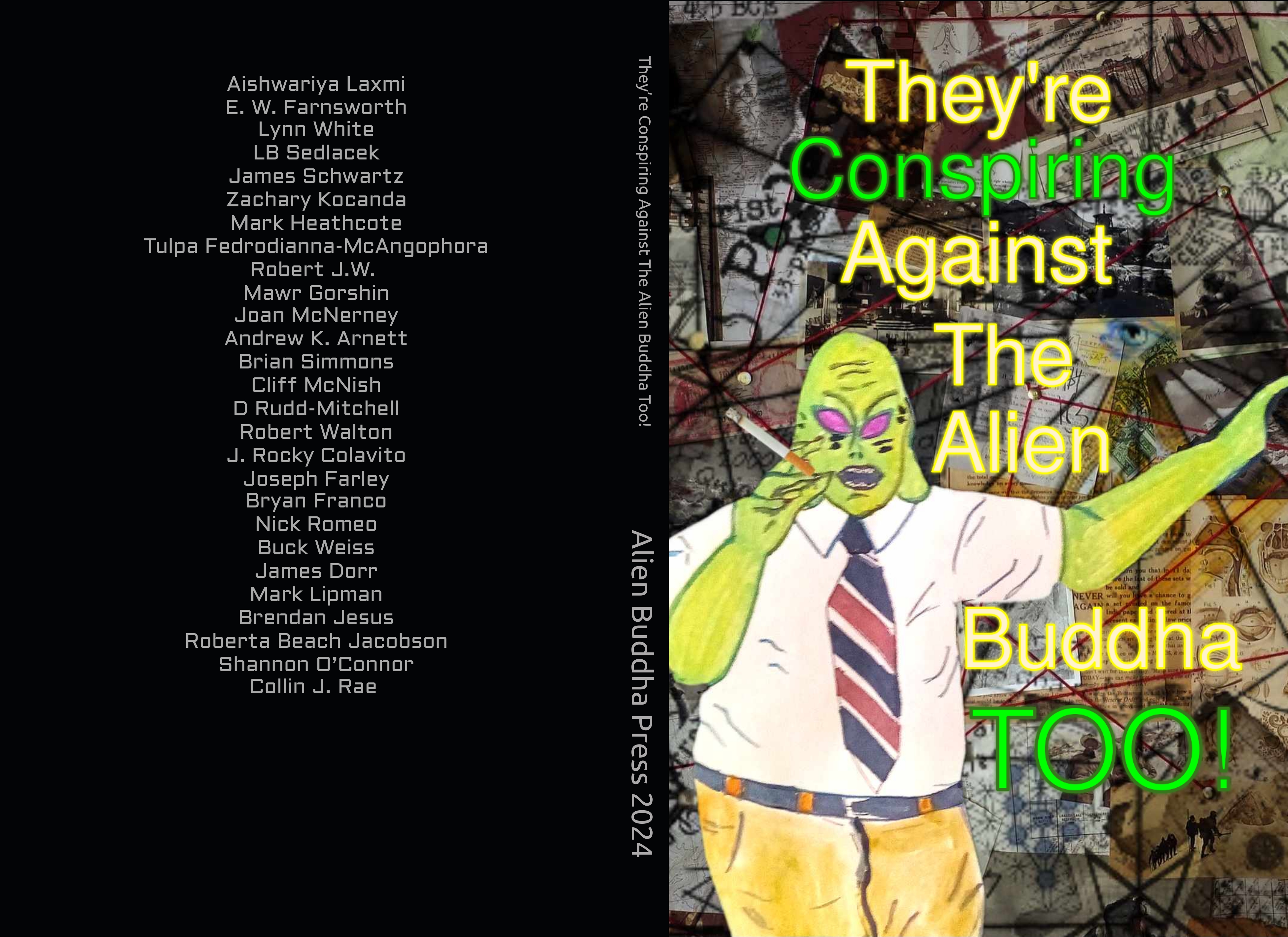
They’re Conspiring Against the Alien Buddha Too! is now published on Amazon, and here’s a link to it. My short story, ‘The Harvest,’ is on page 52 in the anthology. The paperback is $16.99.

Other writers who have written great stories and poetry for the anthology are Aishwariya Laxmi, E.W. Farnsworth, Lynn White, L.B. Sedlacek, James Schwartz, Zachary Kocanda, Mark Heathcote, Tulpa Fedrodianna-McAngophora, Robert J.W., (my story comes next in this order), Joan McNerney, Andrew K. Arnett, Brian Simmons, Cliff McNish, D. Rudd-Mitchell, Robert Walton, J. Rocky Colavito, Joseph Farley, Bryan Franco, Nick Romeo, Buck Weiss, James Dorr, Mark Lipman, Brendan Jesus, Roberta Beach Jacobson, Shannon O’Connor, and Collin J. Rae.

Please go check out this great anthology, now that it’s out!

Publication of ‘They’re Conspiring Against The Alien Buddha Too!,’ by Alien Buddha Press, on July 4th

This is to announce the publication of a new anthology of short stories about conspiracies, called They’re Conspiring Against The Alien Buddha Too! It’s being published by Alien Buddha Press, the same people who published–in a poetry collection–a few poems of mine, namely ‘Gaza’ and ‘Stomping,’ and who will publish my novella, The Targeter, in a few weeks, too.

In this particular anthology of short stories, I have one included, called ‘The Harvest.’ Other writers in the anthology are Aishwariya Laxmi, E.W. Farnsworth, Lynn White, L.B. Sedlacek, James Schwartz, Zachary Kocanda, Mark Heathcote, Tulpa Fedrodianna-McAngophora, Robert J.W., (my story comes next in this order), Joan McNerney, Andrew K. Arnett, Brian Simmons, Cliff McNish, D. Rudd-Mitchell, Robert Walton, J. Rocky Colavito, Joseph Farley, Bryan Franco, Nick Romeo, Buck Weiss, James Dorr, Mark Lipman, Brendan Jesus, Roberta Beach Jacobson, Shannon O’Connor, and Collin J. Rae.

I want to thank Red, Dave, and any- and everybody else involved in Alien Buddha Press for including ‘The Harvest’ in this publication. Remember, Dear Readers, to check out this book on Amazon on the 4th of July, a date so easy to remember!

‘The Ancestors,’ a Horror Story, Chapter Three

Al was relieved, for the vast majority of his date with Hannah the following night, that she’d never brought up the subject of meeting his family and having dinner with them. She’d never even mentioned it in her texts or phone calls that day, prior to their date.

The fact is, she was worried herself that he was going to try to get out of the family get-together again.

Still, as he was walking her home in her neighbourhood, and they were holding hands and looking up at the stars, admiring their shining beauty, she knew she had to bring up the dinner sooner or later. So she took a deep breath and looked at him, having noted his thinly-disguised nervousness right from the beginning of their date.

“So,” she asked, “have you talked to your family about me going over to your home and having dinner with you all?”

She felt his hand jerk in hers and saw his whole body shake in a set of spasms.

“What is it, Al? Surely it won’t be that bad for me to meet them. Have you talked to them about it at all, or not?”

“N-not yet,” he said. “But I w-will s-soon.”

“Al, you had all of last night after our date and all day today to talk to them about it. Why are you delaying it?”

“I-I told you before. They’ll bully me and make me look stupid in front of you. I don’t want you to see that. I’m really sensitive about it; it really upsets me when they do that.”

“Oh, sweetie,” she said. “I told you before. If they treat you badly, I won’t see it as a fault in you. I’ll see it as a fault in them. After the one dinner, I won’t have to see them again. I won’t want to.”

“Please, Hannah. This is so hard for me.”

“Surely it can’t be that bad, Al. It’s just a dinner.”

“Can we please just not have the dinner with them? Everything is so nice when it’s just you and me.”

“This isn’t about them having a low opinion of you, is it, Al?” She was getting angry now.

“It is, it is, Hannah. It’s just as I said.”

“I don’t think so. They don’t like you dating a non-Chinese, a non-Asian, and you don’t have the guts to stand up for your girlfriend!”

“No, no, it’s not that. It’s…”

“It’s…what?!

“It’s…well,…”

“If you truly loved me, you’d stand up for me, and you’d get them to grow out of their xenophobia.”

“My family isn’t racist at all, Hannah!”

“Then what is it?”

He remained silent for several seconds.

“Well, whatever it is, Al, you’re hiding something from me, and no relationship can ever work if either of the people involved is hiding something from the other. There has to be openness and honesty for a relationship to work, and if you can’t be open and honest with me about your family, then I guess we should break up.”

“No, no, no! I love you, Hannah, more than anything!”

“Then you know what you have to do to prove your love to me!”

He took a deep breath. “OK, OK. H-how about…w-we have your whole f-family…come over?”

“My whole family?” She sneered at him in disbelief. “We just went from you not wanting me to meet your family to my mom, dad, brother, and me meeting them, all in one fell swoop?”

“Well, I f-figure i-if I have to go through you meeting my family, w-we’d might a-as well have our whole family meet them, all at once, and just get this all over with. They’ll all have to meet each other eventually anyway, right? And after that, you and I can just be together without w-worrying about whether or not my family likes you, whether or not they respect me, or if your family likes me or my family. You and I will still have each other, and that’s all that matters, right?”

“OK,” she said slowly, still looking askance at him. “Are you sure you want us all there?”

“Yes, I’m a-absolutely sure,” he said.

“Really? You still look a little nervous about it.”

“Well, I am, ’cause my family will make me look stupid in front of all of your family, but if you don’t care about that, who cares if your family cares about it, right?”

“Still, it might make you a little too uncomfortable. I don’t think they should come; only I should.”

“Well, think of your family coming as me making it up to you, f-for my reluctance to have you meet my family.”

“Oh, Al, that isn’t necessary.”

“I think it is. Our whole families should meet each other, as a test to see if they’re cool with us being together. If they don’t approve, fuck ’em. We love each other, that’s all that matters.”

They’d now reached the front porch of her house.

“Well, OK. We can have the dinner tomorrow night, at about…8:00?”

“That sounds good. Can your whole family make it?”

“They should all be free, and they’ll be happy not to have to cook their own dinner, and they all love Chinese food. I’ll tell them about it as soon as I go inside, so you tell your family we’re all having dinner together, OK?”

“OK, I’ll tell them for sure. I promise.”

“Great. We’ll see you at your home tomorrow night at 8:00. If there’s a problem, text me, as I will you if my family can’t make it.”

“Sure. Good night, Hannah.” They kissed.

“Good night,” she said with a smile, and she went inside her house.

Al just stood there for a few minutes, frozen on the spot.

I hope Hannah and her family can forgive me, he thought.

‘The Ancestors,’ a Horror Story, Chapter Two

“Oh, there goes Al again!” his older brother, Freddie, called from the top of the basement stairs. “In the basement, talking to himself.”

“Shut up, Freddie!” Al shouted. “Go away and mind your own business! I’m busy!”

“Yeah, busy talking to yourself,” Freddie said. “Freak!”

“I’m not talking to myself. I’m praying to the ancestors. You know that, you faithless scum!”

“I know you still believe in that stupid old religion, which never did the family any good, and which we all left behind in Asia, ’cause we aren’t backward-thinking, the way you are!”

“My praying to the ancestors is the only thing keeping the family’s bad luck from getting any worse.”

“You’re the only one giving the family any bad luck,” Freddie said. “You’re a stupid, spastic loser!”

“Go to hell!” Al shouted. “Leave me alone!”

“Leave me alone!” Freddie said in a mocking, whiny voice.

“Will both of you be quiet?” their father shouted from the living room. “Freddie, get out of the basement and help me move this desk. Leave Al to his silly praying, if he must do it. Cut out the noise, and give the rest of us some peace!”

“Freak!” Freddie shouted at Al, then slammed the basement door.

“Asshole,” Al whispered, then he sighed and looked back at the altar. He closed his eyes and started to concentrate on the spirits.

He breathed in and out, slowly and deeply.

He listened in the silence of the dark room, waiting for a sign of the spirits’ presence.

Finally, after about half a minute, he heard a hoarse, feminine voice, speaking in Chinese.

What do you want, boy?

“Po?” Al said, his voice wavering.

Well, what is it?

“I have a girlfriend,” he stammered in Chinese.

How sweet, the old woman’s voice rasped with sarcasm.

“She w-wants to m-meet the family,” he went on. “Please d-don’t cause any trouble w-while we have dinner together here. I love her v-very much.”

How touching. Why should we care about your personal problems, boy? Your family abandoned us years ago. We became demons because of your neglect. Your weak attempts to placate us are far from enough to compensate. Why should we do anything kind for a worm like you?

“What can I do t-to ease your wrath? What do you want me to do t-to ensure that she and my family can have a pleasant dinner here together, with no bad luck, no disasters of any kind?”

There was a long silence.

“Please, Po. What do you want from me?”

Po paused thoughtfully in silence a little longer.

He opened his eyes, then said, “Po?”

A glow of light appeared weakly at first, then it grew larger and brighter. Finally, he saw an apparition of an old woman in traditional Chinese clothing, a red Qing Dynasty dress with an ornate, light-blue headdress. She looked like a bride at an old wedding.

As pretty as her clothes were, though, the look on her face was anything but pleasant. It wore a scowl and piercing, malignant black eyes that looked at him as though she wanted to kill him, slowly and painfully.

He was afraid to ask again, but he knew he had to.

“What do you want me to do for you, Po?”

Have the girl’s whole family come here for dinner.

“Her whole family?”

Yes. Her mother, father, brothers, and sisters, if any.

“Why h-have all of them come, Po?”

Why not? If you want to marry this girl one day, don’t you think it’s right if all of both families meet and get to know each other?

“W-well, yes, but…”

But what? What could be the problem? Now, Po was grinning. What could possibly be wrong with that? Families should be close, shouldn’t they? Her words implied his family’s neglect.

“O-of course, but…what do you want to do with her family?”

What we spirits will do with her family is none of your concern, boy. Just make sure they’re all here, and don’t interfere with us while they’re here. If you want to live a long and happy life with this girl, with us never troubling you again, then you’ll do exactly as we wish without question. Give us her family, and you’ll be free of us forever. I give you my word.

“But, Po,” he said as he saw her image slowly fading away, “at least give me some idea of what you plan…”

Give us her family… Her voice dissolved in a reverberating echo, as did her apparition.

He just stood there alone in the darkness, shuddering.

‘The Ancestors,’ a Horror Story, Chapter One

Al Dan, 25, and Hannah Sandy, 24, were taking a walk in the park at around 9 pm. They’d been seeing each other for almost a year. Smiling, she had her head on his shoulder. With an ear-to-ear grin, he was enjoying resting the side of his head against the top of hers, feeling the soft cushioning of her long, blonde hair.

He looked up at the night sky. “The stars are really beautiful, aren’t they, Hannah?” he said.

“Yeah,” she said after taking a quick look. “I love coming out here in this park with you.”

“It’s such a nice place for us to take a walk after having dinner,” he said. “The trees, the grass, the smell of the flowers, the soft breeze on our faces, and best of all, you.”

“Aww, you’re so sweet,” she said, then they gave each other a peck on the lips. “You know, Al, we’ve been going out for about a year now, and I’m so happy with you, I don’t see myself being with anyone else.”

“I feel the same way. You’re pretty, you’re nice,…”

“You’re cute, you’re sweet, you’re funny, you’re considerate to me in ways that no other guy I’ve dated ever has been,…”

“You drive me wild in bed,…”

She giggled and hugged him tight. “You’re great in bed,…”

They both hugged each other even tighter and kissed again.

“There’s just one thing, though, Al.” They stopped walking and looked at each other.

“What’s that?” His smile faded.

“I introduced you to my mom, dad, and brother months ago, but I still haven’t met your family. Not even once.”

He was frowning and visibly shaking.

“What is it, Al? I’ve asked to meet your family for the third time now. The first two times, you made excuses to get out of it, and now, you’re still uncomfortable about me meeting them. What’s wrong?”

He was stammering, groping for the right words.

“Your family doesn’t like the idea of you dating a white woman, is that it?” she said with growing anger. “They’d never accept you with anyone other than an Asian, someone of Chinese descent only, is that it?”

“No, no,” he said, holding her hands and looking into her eyes so she’d see his sincerity. “It isn’t like that at all. My family’s not racist at all. They’re completely tolerant. It’s…just…that…”

“What?!”

“Well, it’s hard to put into words. If I told you, you wouldn’t believe me. You’d think I’m crazy.”

“Well, what is it?” She was calming down, and sensing genuine anxiety about his family mixed in with that love for her that she’d always known was sincere. She looked in his eyes with empathy. “Come on, Al. What’s bothering you about your family?”

“Well,…my mom and dad…and my brother and sister…are always putting me down, insulting me, bullying me, and blaming me for everything that goes wrong in the family. They’ll make me look stupid, and I’m afraid that after a night of listening to them belittle me, you’ll think I’m a loser and want to dump me.”

“Oh, sweetie,” she said, then hugged him. “If I see your family treating you badly, I’ll see that as a blot on them, not on you. I know the real you, and if they can’t see your goodness, then that’s their problem, not yours. I’ll always love you, no matter what. But let me meet them so I can at least see for myself what kind of people they are, OK?”

He put on his most convincing fake smile, hiding all of his undying worries. “OK.” They kissed.

*************

After walking her home and kissing her good night, Al walked back to his house as slowly as possible, for he needed as much time as he could give himself to think of a way out of this predicament.

What the hell am I going to do? he wondered. I can’t tell Hannah about my family’s secret curse! She’d never believe me; she’d think I’m crazy, and I probably am. I’ve certainly been driven crazy by this problem my family started ever since we moved here in Toronto from China, and they gave up on the old family traditions.

I’m the only one who still believes in them, and the family laughs at me for doing so. The ghosts of the ancestors, mad at the family for neglecting them, directly trouble only me. Only I ever pray to them, keeping them from doing their worst. The only problems we have are constant cases of bad luck, which the family blames on me, instead of realizing it’s the ghosts that are doing it. If I were to stop praying to them, they’d be far more malevolent, even violent. Not only could a lot of bad luck happen during our big dinner together; the ghosts may do something awful to Hannah, to hurt her. I can’t let that happen!

Oh, what am I going to do? I can’t keep making excuses to stop Hannah from seeing my family. She isn’t going to accept verbal abuse from them as a sufficient reason to avoid meeting them. She wants to take our relationship to the next level, and I do, too. I want to marry this girl! No one’s ever loved me or valued me the way she does, and marrying her will require my family’s involvement, one way or the other. I’ll have to take this risk if I’m to keep her.

Al was now within a block of his house. He thought, Maybe I can pray extra hard to the ancestors. The family’s neglect of praying to them is what has made them so angry with us, so if I pray all the more earnestly to them, maybe I can appease their wrath, at least to an extent. Maybe I can ask them to tell me what they want me to do in exchange for not troubling us anymore. Trying to get the family to pray to them again is useless: they don’t believe in the spirits, and as I’ve always known, the moments of bad luck that the ghosts cause are always made to look like they’re my fault, rather than being supernatural. I’m the pious one who prays to the ghosts, but I suffer the worst: no good deed goes unpunished!

He went in the front door of his house, then into the basement where the altar was. He sighed, then lit a stick of incense and put it between his hands. He bowed before the altar. Oh, well, he thought. It’s worth a try.

‘The Face,’ a Horror Short Story

Stella, a pretty young brunette, looked around at the other university students surrounding the campfire with her that night and asked, “So, does anybody know any good ghost stories?”

Cory, a blond, clean-shaven young man in a T-shirt and jean shorts, said, “Well, I once heard a claim some of the people living near here insist is true.”

“And what claim is that?” she asked.

“That a witch lives in the woods surrounding this camp,” he said.

Everyone other than him let out a big “Ooh!”

One of them said, imitating Burt Ward, “Holy Blair Witch Project, Batman!”

The others laughed.

“Allegedly, a witch has haunted these woods for many decades,” he went on. “She pulls her victims into a deathtrap slowly, insidiously, the victims being people who have come here for camping.”

His listeners let out another “Ooh!”

“If this story is true,” Stella asked, “then why hasn’t anybody heard any reports of missing persons leading to this camp, with police investigating? If people have spoken about a witch here, why haven’t any of us, or anyone else, for all we know, heard about it?”

“Because,” he said, “the witch uses her magic to throw off the scent anyone trying to find the missing people, so no one suspects that there’s any evil in these woods. Police and anyone else investigating are led to believe the victims went missing somewhere else, and only the locals here know about the witch.”

“Oh, what a cheap cop-out!” one of the listeners said, amid a chorus of boos and groans from the others. 

“I suppose so, but that’s the story I heard,” Cory went on. “Anyway, they say that the witch gets you, actually, right when you hear a story about another group going missing here. The listeners get sucked right up into the story and join its victims in the same fate.”

The listeners let out a third “Ooh!”

“If that’s so,” Stella asked, “then how did you come to know this story about a group of the witch’s victims?”

“How do you know I’m about to tell such a story?” Cory asked.

“I just assumed you were about to,” she said.

“Look, I just told you a fact that the locals here believe in,” he said. “I wasn’t about to tell an actual ghost story. Anyway, do you all remember the Daltons? That family, all of them blonds, remember? They went on vacation in Europe three years ago.”

“Oh, yeah, I remember them,” Manny said, a man with short black hair. All the other listeners nodded, having remembered the Dalton family. “What happened to them? I haven’t heard from them since they left.”

“Well,” Cory began, “they were going in their car on the way to the airport, and their car broke down on the highway not too far from here.”

“Not too far from here?” Manny said with a sneer.

“Well, yeah,” Cory said. “As you’ll recall, we’re all not too far from here, in our hometown just a mile or so from this forest, as the Daltons were, and as the airport is, too, so it shouldn’t come as too much of a surprise to you.”

“Very well,” Stella said. “Go on.”

“Anyway, they tried calling someone for help, but they must have had a bad connection, so they eventually gave up trying. Looking around there on the side of the road, Mr. Dalton found the trees and the scenery really beautiful, really charming, and since the family had packed tents and stuff like that, and it was getting late, he thought they could pitch their tents for the night and try to get help the next morning.”

“Why?” Manny asked, sneering again in disbelief. “They’d have missed their flight by then, wouldn’t they have?”

“Wasn’t anybody else driving up that road at the time, someone who could have helped them?” Stella asked. “Surely there was somebody driving around there.”

“Apparently, next to nobody else was driving around at the time, or else they would have simply gotten the help, gone to the airport on time, flown off to Europe, and come back to tell us all what happened to them.”

“Why aren’t they back home?” Manny asked. “Since they’d disappeared, how do you know what happened to them?”

“I met someone recently who found out, and she told me the whole story,” Cory said. “Don’t worry. I’ll get back to who she was later. Anyway, the Daltons felt really enamoured of the beauty of the place, so they went in among the trees, pitched their tents, and went to sleep.”

“And what happened the next morning?” Stella asked.

“Oh, we haven’t finished with what happened that night,” he said.

“We all know,” she said with a sneer of her own. “The witch got them, right?”

Everyone laughed, even Cory.

“Yeah, and the witch is gonna get us, too, for hearing this story here,” Manny said. “Ooh!”

Everyone, including Cory, laughed even louder.

“C’mon, no,” he said with continued laughing. “This isn’t that kind of story, really. This is a normal one, nothing supernatural, but still interesting—just what really happened to them, according to what this woman told me a little while back.”

“I’m guessing they made it to Europe, found they liked it there, and decided to stay there,” she said.

“And they were such jerks, they never said goodbye to any of their neighbours in town,” Manny said.

More laughs.

“Well, anyway, let me carry on with what happened that night,” Cory said. “They were all lying there in their tents—Mr. and Mrs. Dalton, and their three kids, two boys and a girl around their pre-teen years—just dozing off, and the grating, rasping noise of some bird just outside was heard, rousing all five of them.”

“Oh, how annoying,” Anna, a woman with long, wavy red hair, said.

“Yeah,” Cory went on. “Mr. Dalton was really angry. All of the family got out of their tents to see what was making the noise. It was pitch black out, but they got out their flashlights, and Mr. Dalton had a baseball bat to swat at the bird with.”

“Silly thing to do,” Trevor, a man with long, dark brown hair, said.

“Oww!” Stella grunted. Everybody looked at her. “Some horsefly or something bit me.”

“Will you be OK?” Anna asked.

“Yeah, I’ll be fine,” Stella said. “Carry one with your story, Cory.”

“Anyway, yeah, sure, Mr. Dalton was being silly, but he was mad, and angry people do foolish things, don’t they? The family pointed their flashlights at the animal to get a decent look at it, which was hard, since it was flying about and dodging the light. Mr. Dalton was swinging his bat in a fury. What they did see of the bird, though, was that it was one they couldn’t recognize as being one they, or anyone else, had ever seen before.”

“What did it look like?” Anna asked. 

Stella looked over at her and saw blonde hair in the flickering light of the campfire. Her eyes widened. Isn’t she a redhead? she asked herself.

“Oww!” Anna groaned. “That horsefly just got me.” Like Stella, she was rubbing the bite mark. The other listeners looked around, but couldn’t see any insect.

“The bird was brightly feathered, a bit like a toucan,” Cory went on. “A lot of blue, purple, and yellow feathers. It had a long, sharp beak. It flew around really fast, darting here and there, back and forth, up and down. Mr. Dalton was getting really frustrated, and his family was telling him to stop swinging the bat, because of course what he was doing was pointless. Still, he wouldn’t stop trying to hit the bird; he was getting obsessive about it, like a madman.”

“Wow, you seem to know this story in the most minute detail,” Trevor said. Anna looked over at him and saw short blond hair on him. 

Surprised, she thought, Blond now? When did he get a haircut?

“Yeah, I really know a lot of detail,” Cory said with a chuckle. “The woman who told me the story remembered all the details so well, and I found the story so compelling that I managed to remember all of them. Anyway, at one point, after Mr. Dalton had been swinging that bat for a while, I guess the bird got tired of dodging it, and it swooped down and pecked him hard on the head. He groaned in pain, dropped the bat, and fell on the ground. His wife and kids went over to see if he was OK. He had blood coming out of his head. Mrs. Dalton put a flashlight to it to see it better, and she saw a mix of red and green pouring out of the wound.”

Now his listeners gave an “Ooh” that was serious. Stella and Anna also noticed something strange about Cory: no longer in a T-shirt and jean shorts, he was now wearing a dark brown robe, like that of a monk. The women shook their heads and looked again: yes, a robe was on him.

He continued: “As the family was looking with alarm at the red and green liquid, assuming the bird put the green there, it swooped down and pecked the wife and kids on the head, too, in one fell swoop. They all screamed in pain and fell to the ground beside Mr. Dalton.”

“I’m guessing they all had a mix of blood and green coming out of their heads, too,” Manny said. Stella looked at him and saw blond hair; her eyes and mouth widened at the sight.

“Yeah, presumably,” Cory said, “because I’ll tell you another thing: all of the family started to feel woozy. It was as if that green stuff was a drug injected into their bloodstreams, for the five of them were now getting up and staggering about, bumping into each other and into trees. They’d dropped all their flashlights, and they were wandering into the forest aimlessly.”

“Oww!” Manny said, then rubbed his neck.

“That horsefly seems to be getting us all,” Trevor said. “Oww! I got that right.”

Everyone except Cory looked around to try to find the ‘horsefly,’ but instead they saw a little glowing ball of changing colours—yellow, blue, and purple. 

“Strange colours for a firefly,”Manny said. “Is that what bit us?”

“I don’t see anything,” Cory said, looking away and frowning in annoyance at all these interruptions. “Shall I continue with my story? You don’t want to miss the ending.”

“Sure, of course,” Trevor said in a slurred voice. “Carry on.”

“As I was saying,” Cory said, “the Daltons were stumbling about in the dark, bumping into each other and into trees, falling down, getting back up, and stumbling about further into the forest.”

“Am I high?” Stella asked, looking about and seeing a blur.

“I feel stoned, too,” Manny slurred.

“My head is swimming,” Anna said.

All three of them, as well as Trevor, looked at Cory, who not only looked even more annoyed at their continued interrupting of his story, but who also had brown hair and a mustache and goatee connected in a circle around his mouth. Everything was getting blurrier and blurrier for them after that moment. The flames of the campfire were moving like ocean waves.

The four bitten listeners looked around at each other, straining to see detail. Instead of seeing, apart from Cory, the original people they’d come to camp with, they saw what seemed to be a blond family: a father, a mother, and three pre-teen kids—two boys, and a girl. Yes, one campfire member, a bald man, had been there but said nothing the whole time…or had he been there? Were the four hallucinating him before? None of them could remember for sure. In any case, he, if he’d been there originally, was one of this new family now…or a family member just appeared out of thin air.

“I’ll continue,” Cory said after a sigh of annoyance. “The Daltons continued blundering their way through the woods until they came close to a cliff.”

Stella looked up to her right and saw what looked like two black holes in the sky, just above the forest trees behind the campers’ tents. The holes seemed vaguely like eyes. 

“The Daltons all looked out of a clearing in the woods, past the cliff and out into the night sky,” Cory went on. “They looked out at the glowing stars. They were all mesmerized by the glow, staring stupidly at it.”

His listeners could hear the raspy squawking of some bird flying in circles over their heads. They felt compelled to stand up, watching the brightly coloured bird. It started flying away from the campfire, and they all followed it mindlessly.

“All right,” Cory said with a scowl. “I guess I’ll just have to get up and go along with all of you, if this is the only way I’ll be able to finish telling this story.” He got up and walked behind them.

As they were walking, following the bird and heading towards the trees behind their tents, Stella looked up and noticed those eye-like black holes following them, too, hovering up high in the air, darker than the shadows all around them.

She and the other listeners also looked at each other at one point, finding each other’s inexplicable change of appearance the oddest of blond. There was something vaguely familiar about how all five of them looked, but they at first couldn’t put their fingers on it.

They had come into the woods by now, going up a hill. They could hear Cory behind them, continuing to tell his story.

“Anyway,” he said, “as the family continued staring up at the stars in their state of rapt hypnotism, they began to see, in the blackness between the stars, what looked like the eyes, nostrils, and mouth of a face. These were all just holes, though each a distinct, darker black than that of the night sky.”

Stella looked down at herself and saw what she was wearing. What? she thought. I wasn’t wearing this! How and when did I change my clothes? Then she looked out at the blond others. The ‘father’ of the group…she remembered his face from somewhere. Is that Mr. Dalton? No, it couldn’t be!

That bird could still be heard making that grating call from up above them, obscured among the leaves in the trees. None of them could see its blue, yellow, and purple feathers at all.

“The face in the night sky began to talk to the Daltons,” Cory said from behind the group. He could have stopped talking, though, for his would-be listeners were too disoriented from the bites they’d gotten to be paying attention. They just kept walking up the incline in the woods, following the squawking of the hiding bird. He continued his story, all the same, though: “The face said, in the scratchy voice of an old crone, ‘You are mine. Come into my mouth.’”

Stella, feeling as if she were on a bad drug trip, got a mirror out of her purse as well as a flashlight. She turned it on with a shaky hand, and with her other shaky hand, she put the mirror up to her face. 

She didn’t see herself.

She saw Mrs. Dalton.

She looked to her right and saw Mr. Dalton.

The would-be listeners stopped walking, for they’d come to a clearing in the forest, and a cliff looking down to a lake. They weren’t interested in it, though: they looked instead up at the starry sky.

Stella was the first to notice those black hole eyes among the stars. A mouth-like hole was beginning to form below the eyes, as she could make out with her own eyes squinted. She looked around at all the others: all Daltons, the father, herself as the mother, and the two sons and daughter instead of her adult friends.

Cory, in his dark robe and looking more like a sorcerer’s apprentice than a monk, concluded his story with these words: “And so, the Daltons fell, not off the cliff and into the lake below, but into the mouth in the sky, which flew right at them and ate them up.”

“And that’s the end of the story?” Stella asked him in a trembling, slurred voice. 

She looked back at him and saw him nodding with a malevolent smirk. 

“And who is the woman who told you this story?” she asked.

“She is my master,” he said. “Look in front of you, if you’d like to meet her.”

Stella turned her head back to her front with the slowest of reluctance. Her eyes turned away from Cory, then past the three kids, then past Mr. Dalton, and finally up to the night sky, dreading what was there. 

There she saw the blackest of eyes, nostrils, and a mouth. The other Daltons were staring at the face, too, but in a euphoric daze.

The face was moving at them all faster and faster.

“You are mine,” it said in that scratchy voice. “Come into my MOUTH!!!”

Before they knew it, they were already inside.

‘Mama,’ a Psychological Horror Novel, Chapter Fourteen (Final Chapter)

I see three large pins leaning against the wall opposite me, the sharp ends pointing up, the white ball handles resting on the ground. They’re all the size and length of spears.

They look just like the pins I used on the voodoo doll for Mama, except of course for their huge size. Since that’s what they look like, and there’s a window on that wall they’re resting against, I probably ought to stand up and take a look at my reflection in it.

Yep, just as I thought: instead of seeing myself as I actually look, I see a giant voodoo doll version of myself. Another of my vivid hallucinations, for sure.

…and check this out. Those pins are now rising up from the ground, floating horizontally, with their sharp ends pointed directly at me. I suppose they’re going to fly right at me, like thrown spears, and stab into my chest and guts. If only this wasn’t a hallucination–I’d love to die.

In the window reflection, I still look like a giant voodoo doll. I’m surely fantasizing that Mama’s ghost is taking her revenge on me for sticking pins into that voodoo doll of mine that I’d made of her. That’s the logical explanation for this hallucination I’m seeing here.

It’s funny how, even though I finally realize what my mind is doing, I’m still hallucinating. Though I’ve brought my unconscious fears and desires up into my consciousness, I am by no means cured of my propensity to see and hear things. My eyes and ears continue to deceive me because I want to continue deceiving myself.

Oh, here they come. Those pins are flying right at me.

I’ll stick my chest and guts out to receive them better, even though I know I won’t be…

“Unghhhh!!!”

This is…the most intense,…the most vivid…hallucination…I’ve ever had.

I really feel…three stab wounds…one just above…my heart…towards my shoulder…one towards…my left side…under my nipple…and one in…my gut…just over…and to the…right of my…belly button.

I’m coughing blood…It really feels…like I am…The pain is sharp…and intense…My whole torso…is drowning…in blood…I’m lying…flat on my back…on the ground.

The pain…is still here…I’ve never hallucinated…this intensely…before…I’ve seen things…I’ve heard things…but I’ve never felt things…not this badly, anyway.

This is no hallucination…this is really happening!

I saw no attacker, though…I saw no one…running into…this alley,…sticking a knife…into me…three times…then running off…If I hallucinate…I’ll at least…see a distortion…of what…really happened…there will be…a hallucinatory substitution…of the actual event.

The three pins…could have represented…three stab wounds..but I should have…seen someone…or something…to represent my killer…Besides, who would have…come in here…randomly wanting…to kill me?

Who’s this…coming up to me now?

Here he is,” a man among them says. “Ooh! He’s been stabbed! Who did this? I saw nobody else come in this alley.”

“Neither did I,” a woman beside him says. “There’s no murder weapon lying around anywhere, either. No knife, no…He’s already lost a lot of blood. I’m amazed he’s still conscious. It’s a good thing another ambulance got here. We’ve gotta rush him to the hospital!”

As they’re…putting me…on a stretcher, I’m thinking…Don’t bother…I’m gonna die…I want to die…I hate my life…My life is…Hell…

Wait a minute…I can’t explain…what reality…this hallucination…corresponds to…These people…are putting me…into an ambulance…All of this…looks normal…They’ve put…an oxygen mask…on my face.

Could it be…that I didn’t hallucinate…that last time?

Did Mama’s ghost…really do that…to me?

None of those people…saw a killer…run in and…stab me…then run out…They do see my stab wounds, though….They’ve bandaged them.

Very clever, Mama.

You wiped out…Aunt Jane…and that man…because you didn’t…need them anymore…They served their purpose…and you removed them…In making me…doubt myself,…you reinforced…my feelings of worthlessness…so I’d stop trying…to resist you…Now that you…have killed me,…you can torture me…in the deeper, darker regions…of Hell,…while you…destroy the world…without my ability…to stop you.

There is no escape for me.

My no longer believing…in the supernatural…was a wish fulfillment…I could hope…for a quick death…and nothingness afterwards…a nothingness…of peace…no Hell.

Now,…with her spirit…on the loose…since she no longer…has a body…to limit her magical powers…she can do anything…and with me dead,…I can’t use…what magic I know…to stop her.

Wait a minute…

With my death…I’ll be free…from the limitations…of my body, too…As pure spirit,…I’ll be able…to gain access…to all kinds…of magical formulas…just like her…I can still stop her!

The hospital staff…are taking me…out of the ambulance.

A mushroom cloud…just blew up…in the distant sky…The ground is shaking.

The staff…were startled by it…They reacted to it.

I didn’t just…imagine it…The explosion…was real.

Mama’s ghost…is destroying the world…I must die quickly,…free my soul…from my body…and fight her…with my own magic.

But her power…is so much…greater than mine…I’ll have to learn…a lot of magic,…and quickly…to stop her.

How can I…grow in power…quickly enough…to stop her?

Transcending my ego,…uniting my spirit…with that of…the world spirit…should give me…the power I need.

In my dying moments,…I must meditate…my fading…consciousness…should make it…easier for me…

And with no me…no Roger…separate from the world…no ego…for Mama…to target,…she won’t…be able…to stop me.

I…must…concentrate…

There isno Roger…I’m merging…with Brahman…

My blood…is spreading…out everywhere…as is…my soul…It’s uniting…with the world…

My union…with the world spirit…will defeat…her ghost…

My…inner peace…will destroy…her hate…and wickedness…

Mama,…I’m gonna…kill…you…again…

THE END

‘Mama,’ a Psychological Horror Novel, Chapter Thirteen

Whoa! Look at that huge mushroom cloud in the sky, far off in the distance. No one, other than myself, has even noticed it, much less reacted to it. Now that Mama’s ghost is having me put away, where I can’t do anything to stop her, she can go ahead with her plans to destroy the world and bring us all to Hell, to join her. The people on the streets aren’t reacting to the nuclear blast because her magic is restraining them, hypnotizing them into a state of total apathy!

No one cares. No one will help me. Aunt Jane and…that man everyone says is my father…are just working for Mama’s ghost, to keep me under her control so she can be free to unleash her mayhem on the world. I’m powerless to save everyone from her.

I wanna kill myself so badly, but I can’t, because: I can’t escape from the clutches of the staff taking me back to the mental hospital; I’m too chicken to endure the pain of slashing my wrists, or jumping off of a building, or any other violent form of suicide; I have no pills to OD on; and besides, killing myself will only bring myself further into Hell and under Mama’s control.

There’s nothing I can do to relieve my pain. No…

Oof! What…the…? Did one of those boats on this surreal road just collide with the elephant I’m riding on? Oh! It’s losing balance…I’m falling off!

Aah! I just hit the road on my left side, hurting my upper arm and hip. Now I’m in pain on both sides of my body, after that motorcycle crash I had before.

Hey, I see Aunt Jane and…that man…lying on the road, too. They’re all bloody and unconscious. Are they dead? I’ll check for her pulse: oh, my God, she is dead. She was working for Mama’s ghost, though, helping to ensure that I stay locked away in the mental hospital, so I couldn’t stop Mama from using her magic to make a Hell here on Earth. Why would Mama kill my aunt all of a sudden?

What’s that? Coughing coming from…that man. I’ll go over to him, in spite of my revulsion from him. What does he want from me now?

“Roger…Roger,” he’s saying between gasps and coughs. “I…am your…father. Why…can’t you…just accept me?” More coughing from him–it’s revolting to watch and hear.

Again, though, I must ask myself: why would Mama’s ghost kill off the people who were helping her? I see the hospital worker, the one who was steering the elephant we were on, lying next to ‘Dad,’ dead and covered in his own blood, too.

“I…love…you, Roger,” says ‘Dad,’ then his head falls to the side, and he’s lying there dead, with his eyes wide open. I’m checking his pulse. No, he’s definitely dead.

I don’t understand any of this. Why is Mama doing this?

None of it makes any sense, unless…

…unless it’s all just been figments of my imagination the whole time.

Is that why no one responded to the nuclear blast I saw a few minutes ago? Because there was no nuclear blast?

My seeing boats on the road instead of cars, celery sticks instead of lampposts, animal heads on people’s bodies, mushrooms instead of skyscrapers, fire in the background, blue elephants instead of ambulances to take me back to the mental hospital,…none of these are Mama’s magic, but just my hallucinations going to such an extreme?

All because I can’t accept that this man was my father?

Hey…as I look all around me, I see that the surreal imagery I’d seen before is all gone. Now, everything looks normal: cars and buses on the road, lampposts, tall buildings, pedestrians with human heads, no fire to be seen anywhere at all, not even on the horizon. All there is before me is that car crash–my ambulance lying on its side, with the back door wide open so I could crawl out and look around outside, and my aunt and…my…father…lying here, dead.

The world is just an ordinary place.

And I am just an ordinary man.

I’m no hero. My life isn’t the great melodrama that I imagined it to be, with a demonic mother persecuting me. I probably didn’t even kill her; as everybody else told me, she just died of a heart attack, and I was just a fool sticking pins into a doll that had no effect on her at all. I’m nothing special; I’m just a deluded idiot.

And because of my resistance from them, I just lost the only two people in the whole world who actually cared about me. I’m mediocre, and alone.

This existence is worse than any fiery Hell I could imagine…and it’s all of my own creation.

People are crowding around the ambulance. I’ve got to get away from them, or else I’ll be put in that mental institution for the rest of my life, and I don’t want the rest of my life to be a long one.

Since there’s no mother-demon trying to get me, suicide is still a viable option for me. I’m getting out of here, now, before another ambulance arrives!

Umph! Oh, getting this crowd of onlookers to open up a path for me is annoyingly difficult!

“C’mon, you people! Out of my way!” I shout.

“Hey, don’t be so pushy!” a man says.

“You’re injured,” a woman says. “You need to go to the hospital, Sir.”

“Mind your own business!” I shout, then get free.

I’m running away from the crash scene and down the street. I see an alley between two tall buildings, and I’m running towards it.

A voice whispers in my ear, “Yes, Roger, go in there.”

That was another hallucination, of course, the voice of ‘Mama.’ I don’t believe any of that’s real anymore, but I’m still going into the alley. Piles of garbage bags and boxes are lying against the walls on both sides. Is this where I was before, when I crashed the bike? It smells just as bad.

Looking back, I can see a few people running after me. I’d better hide.

Behind these boxes here will be good. Yeah, those people just ran past. I can hear them running farther and farther away, their footsteps getting softer and softer. I hear nothing at all now.

Good. I’m all alone now. No one to bother me. Absolute peace.

…except for the war going on in my heart.

I hate my life. I never amounted to anything. The only way I could make my life have any meaning was to make up a melodramatic, hallucinatory story about my mother being a witch and a demon from Hell bent on destroying the world, so I could fancy myself a hero about to save everyone. What a load of ridiculous nonsense, all fabricated to hide the truth from myself, that I’m just a pathetic loser! I couldn’t have an average man as a father, because I’m below average.

If only I could have just accepted that man as my father! I could have grown to love him, to receive his love, and then finally learn to love myself! And now he’s dead.

Now I have nobody to value me in any way.

I hate myself, and I want to die. But I’m too scared to kill myself, as much as I hate living.

If only I could kill myself quickly and painlessly. I have no sleeping pills or other drugs to OD on. I have no access to a bathtub and razors so I can do it the old Roman way. And I don’t have the guts to jump off of a tall building.

What am I going to do? I don’t want to be in a mental institution for the rest of my worthless life.

I want to die…now…but I can’t do it.

If only there were somebody out there who could do it for me. Any murderers out there?

Is there anything in these boxes or garbage bags that I could use? Any bottles I could break, and use the jagged edge to cut myself? Let me take a look…

Hey, what’s that over there, by the opposite wall? Another hallucination? Very well–bring it on. Nothing else is helping.