Analysis of ‘Islands’

I: Introduction

Islands is the fourth album by King Crimson, released in 1971. Leader/guitarist Robert Fripp replaced two musicians from the previous album, Lizard, for this one: bassist/singer Gordon Haskell for Boz Burrell, whom Fripp had taught to play bass (Boz had a little guitar-playing experience prior to his joining Crimson), and drummer Andy McCulloch with Ian Wallace. Like Lizard, though, Islands continued with the jazz influence.

Though this lineup of musicians (later without lyricist/light-show man Peter Sinfield) continued long enough to do gigs (something the lineups of Lizard and In the Wake of Poseidon were not able to do), it was still part of that period in King Crimson’s history when there was great instability. For at the end of the touring to promote Islands, Fripp ended up replacing all of the musicians, with bassist/singer John Wetton, drummer Bill Bruford, (who’d left the far more successful Yes to join), violinist David Cross, and percussionist Jamie Muir to record Larks’ Tongues in Aspic (they even found a new lyricist in Richard Palmer-James).

The instability of this period had left King Crimson at its weakest. Fripp and saxophonist/flautist Mel Collins play as well as ever. Boz had a good, expressive singing voice (better than Haskell’s, and almost as good as that of original bassist/singer Greg Lake), but Fripp’s having had to teach Boz how to play bass from scratch meant that he lacked the necessary precision. Similarly, Wallace was a capable, aggressive drummer, but he was no Michael Giles, Bruford, McCulloch, or even Pat Mastelotto. As a result, the music of Islands is simpler and, to be perfectly blunt, mostly rather dull, except for the excellent “Sailor’s Tale,” “The Letters,” with its dark themes of jealousy and violence, and the naughty “Ladies of the Road.”

Tensions had been building between Fripp and Sinfield, the two having increasingly divergent views of the direction that the band should have gone in. Sinfield said he “musically wanted to find a softer, Miles Davis-with-vocals sexy package.” In the end, of course, Fripp’s vision won out, and after Islands was made, Sinfield was out. That “package” that Sinfield wanted, however, seems to be what ended up on the album, and accordingly, he has called the album his Islands; Fripp denies this with some justification, though, since he–and not Sinfield–is credited with writing all of the music, and of course, Sinfield didn’t sing or play any instruments on the album…apart from some tinkering with the VCS3 on “Sailor’s Tale” and “The Letters.”

Here is a link to all the music on the album (with bonus tracks), and here is a link to the lyrics.

The cover shows a depiction of the Trifid Nebula in Sagittarius. Why an album with the title Islands (showing neither the name of the band nor that of the album on the original cover used in the UK and most other countries) would have a cover picture of stars in space seems highly odd. Perhaps the point is that the stars are rather like islands in how ‘lonely’ they seem out there.

I make this interpretation because I can see loneliness, alienation, and isolation as major themes in Sinfield’s lyrics, as well as there being a dialectical tension between being alone and being with other people. Note, in this connection, how isolate is etymologically linked with island.

II: Formentera Lady

Formentera is, fittingly for the album, part of the Balearic Island chain off the southern coast of Spain in the Mediterranean Sea. So, the “lady” of Formentera could be an actual lover Sinfield had there, or she could be a personification of the island itself. I’ll accept both interpretations, while leaning more towards the former of the two.

The song begins with a double bass, played by South African jazz musician Harry Miller, playing what will be the melody of the verses sung by Boz. This melody, in E minor, starts with a double descension of four notes, the second descension starting a whole tone lower and ending a major third lower. The first time Miller plays it, it’s with parallel perfect fifths below the melody; the second time, he plays single notes sul ponticello. The third time, he goes back to the fifths.

Then, Collins comes in with flute trills, and flurries of piano notes by Keith Tippett (whose jazzy playing was previously heard on Lizard and ITWOP) follow. We also hear chimes from Wallace.

Finally, Boz comes in singing the first verse, in which Sinfield describes what he sees on the island of Formentera: houses, the shore-line, and the vegetation there, as well as a “stony road.” Sinfield seems to be reminiscing about a time when he visited the island while on vacation, remembering the woman he loved while there.

The first two lines of the verses are in E minor, while the second two lines of each are in A minor, and the choruses will be in A major. In his solitude, Sinfield is “musing over man.”

When we hear the choruses, Boz plays a simple motif of two A notes again an again on the bass as he sings of Sinfield’s happiness with his lover. Wallace’s hi-hat and bass drum are heard in the background, with Collins on the flute playing the vocal melody before Boz sings it.

In the third verse, after more descriptions of life on Formentera (the activity of some of the people in particular), Sinfield makes an allusion to Homer‘s Odyssey. He compares himself to Odysseus and his lover to Circe, on whose island he and his men were lured, and many of them were turned into pigs by her magic.

The implication of this classical allusion is that his lady is rather like those ladies of the road, those groupies who tempted the lust of the musicians in King Crimson, turning them into the pigs who oink their lewd thoughts about the groupies on the first track of Side Two–in this sense a parallel of this first track on Side One. Now, however, Sinfield’s Circe is gone, but “still her perfume lingers, still her spell.”

He cannot forget how lovely she was. Without her now, he feels lonely, isolated, and alienated from her. Perhaps this is because when he’d had her, he’d been similarly porcine with her in his lust, making her no longer like him. Now he regrets his lewd acts with her.

Note that in the second chorus, the Formentera lady is a “dark lover,” like “dark Circe,” thus confirming my identification of the one with the other. The sexual union between her and Sinfield/Odysseus, followed by the separation of the two, is an example of the theme I mentioned earlier of the dialectical tension between being alone, like an island, and being with others.

After this second chorus is an instrumental outro that takes up just about all of the second half of the song. Wallace adds more percussion instruments, such as claves and a triangle. Collins solos on the flute, and soon after, on the sax. Fripp plays an acoustic guitar. Miller plucks the strings on his double bass.

Soprano Paulina Lucas vocalizes through most of this, representing the Formentera lady “sing[ing her] song for [us].” Her voice tends to hover from a high A or A-sharp, then descends chromatically to E or thereabouts; this descension is the near-reverse of Fripp’s guitar solo on “Ladies of the Road,” in which a more-or-less chromatic ascent of notes suggests a woman’s sighs during sex leading to orgasm. Perhaps the Formentera lady’s descending sighs are meant to suggest her gradual disappointment with her Odysseus.

We also hear strings play a melody of E, G-G, then E, G-A. We’ll hear this theme again early on in “Sailor’s Tale,” but on electric guitar and sax. The repeating of this theme suggests that the upcoming instrumental is a sequel to “Formentera Lady,” a continuation of the story of Sinfield/Odysseus wandering on the sea after leaving his Circe.

III: Sailor’s Tale

The instrumental begins, as Lucas’s voice fades out, with Wallace tapping the ride cymbal. The rhythm is a horizontal hemiola of alternating 6/8 and 3/4. Since such a rhythm is something of a cliché in Spanish and Latin American music, it is also a fitting way to continue the musical story of “Formentera Lady,” as is the aforementioned theme on the strings from then, and now played by Fripp and Collins. Also, the key of A in the chorus and instrumental outro of the previous track is kept in this one, though it’s in A minor now.

Wallace adds the bass drum and snare to the rhythm on the ride cymbal, and Boz plays A, C, A (an octave higher)-G-E in the upper-middle register of the bass, the up-and-down melodic contour suggesting the movement of the waves at sea. Then Fripp and Collins come in with that theme from the previous track. The switch from A major in “Formentera Lady” to A minor in “Sailor’s Tale” (with a brief change to A major before Collins’s frantic soprano sax solo) suggests the shift in Sinfield’s fortunes of being happy with his lover to being sad and alone without her (the notion of ‘happy’ major and ‘sad’ minor is of course an oversimplification, but the association is fitting given the themes of this album). Fripp is playing sustained electric guitar leads behind Collins’s solo.

In this music, one can visualize the change in Sinfield’s fortunes, from happy to sad, as represented by Odysseus the sailor and his crew being tossed about on the waves of the sea after leaving Circe’s island, ever thwarted by Poseidon. One can imagine the ultimate, horrific fate of the crew when they encounter Scylla, and soon after the giant whirlpool, Charybdis, killing a number of Odysseus’ men.

The middle section of the instrumental has the time signature changed to 4/4, with a slower and less frenetic pace, but a nonetheless ominous one. Boz plays A, C, D-E, G (and variations thereon) on the bass. The passage features Fripp playing splintery, angular, dissonant, and screaming chords on his Gibson, whose tone reminds us of that of a banjo. This would seem apt given the fact that Fripp’s trademark cross-picking technique shares a lot in common with banjo players’.

Pretty soon, we’ll hear Fripp’s Mellotron (string tapes) playing the sustained notes of an A minor 7th chord in the background, behind his relentless screaming phrases on the guitar. Collins will play a flute theme in dissonant counterpoint to the already tense atmosphere. One senses that the sailor (be he Odysseus, or whoever else) is not long for this world. He’ll die alone.

The music returns to that of the original, horizontal hemiola rhythm, with Fripp strumming a high-pitched, screaming A minor chord. The Mellotron comes in full force here, with string tapes and a low A note from the brass tapes. There’s a brief change to D minor, then back to A minor, and back to D minor, but this time much more dissonant and chaotic.

Finally, we hear only Fripp’s splintery, dissonant chords being strummed from up high, then descending until they reach a D minor chord, and a D major one. We sense that the sailor has perhaps fallen into the gaping mouth of Charybdis. The music ends with an eerie shift back and forth in parallel fourths in low A and D to A-sharp and D-sharp on the Mellotron (brass tapes).

IV: The Letters

The melody for the verses that Boz sings is derived from the vocal part for the Giles, Giles, and Fripp song “Why Don’t You Just Drop In,” from The Brondesbury Tapes compilation. The original lineup of King Crimson performed the G, G, and F song live, titled simply “Drop In“; it can be heard on the live album, Epitaph.

This second version sounds even more similar to “The Letters” in how the verses are sung with less consistent instrumental backing than on the first version (Ian McDonald‘s sax, with Giles’s drums later, in “Drop In”; and just Fripp playing soft electric guitar in the background in “The Letters“), and with a similar middle section with sax playing low pairs of notes. The G, G, and F version, in contrast, has a full, conventional instrumental background of guitar, bass, and drums, with harmonized vocals by both Peter Giles (also on bass) and his brother, drummer Michael.

“The Letters” begins softly and sadly, unlike the pop-oriented G, G, and F version, and unlike the jazzy King Crimson “Drop In.” As I said above, Fripp plays softly, in F-sharp minor. When Boz sings, it’s as though there’s no accompaniment at all; he seems all alone, alienated, and stranded on an island after his boat crashed from the sea storm in “Sailor’s Tale.”

Boz doesn’t sing about the pain of sailor Sinfield/Odysseus, though. Rather, “The Letters” is about a man’s wife and his mistress. The latter writes to the former, gloating about how she seduced him and made him cheat on his wife, who’s now insane with jealousy, of course.

Neither of Odysseus’ mistresses, Circe or Calypso, ever wrote letters to Penelope, boasting of having taken her husband to bed; but given her determination to be faithful to him after so many suitors tried to replace him as king of Ithaca, one could imagine Penelope’s rage had Circe or Calypso ever sent her such letters. Comparing the lyric of “The Letters” to such a possible mythical scenario can be evocative of how hot the rage of the betrayed wife must be.

We see in this adultery the dialectical tension between human connection and alienation, how the liaison between man and mistress alienates husband from wife, making her feel as stranded on an island as Odysseus would be after enduring a storm at sea. Could Sinfield have found himself in a jealous conflict between a wife or girlfriend on the one hand, and a groupie/Formentera lady on the other? Is such a conflict the basis of having the first track, “The Letters,” and “Ladies of the Road” on Islands?

The middle, instrumental section is, as I said above, similar to that of “Drop In,” with baritone and tenor saxes playing pairs of low notes in F-sharp. Fripp is playing sustained guitar leads over the saxes. In addition to the F-sharp pairs of notes, we also hear the saxes play a similar motif to that one on the strings in “Formentera Lady” and on the guitar and sax early on in “Sailor’s Tale.” The motif is F-sharp, A, and B, similar to the E, G, and A of the previous two tracks.

The music dies down, and we hear some soft (tenor?) sax playing, building up to a louder climax before the next verse. There’s brief silence before Boz belts out, “Impaled on nails of ice!” The jealous wife writes a reply letter to her husband’s mistress, telling her she’s murdered him and is about to kill herself. While Boz is singing this verse, we can hear Wallace banging about on the drums and cymbals, Collins on the flute, and Fripp’s guitar and Boz’s bass.

For the last four lines, in which Boz sings of the murder/suicide, they start with Wallace tapping on the ride cymbal a bit, then Boz’s voice is all alone. Adultery, jealousy, and killing lead to loneliness.

V: Ladies of the Road

So many rock bands out there have at least one or two naughty songs, celebrations of male lust and objectification of women. One can think of Led Zeppelin’s “Sick Again,” “Motherly Love,” by the Mothers of Invention, or Ted Nugent’s “Jailbait” as noteworthy examples. Even a band as ordinarily intellectual as King Crimson are no exception, as Sinfield’s lecherous lyric here demonstrates.

Yes, this song is naughtier than that second verse of “Easy Money,” the version usually played live. The title of this song makes it pretty obvious what it’s about. “Ladies of the Road” is the kind of song that may limit the number of female fans a band may have. As I myself have been guilty of, we men have to remember that women don’t exactly appreciate it when we write of our sexual feelings for them.

Still, as alienating to women as this song surely is, it is for this very reason that the song fits thematically with the others on Islands. In “Ladies of the Road,” we have another example of the dialectical tension between human connection (sex, in this case) and alienation (the result of treating women in the scurrilous way the song does).

The verses describe sexual encounters with various groupies in increasingly explicit terms. These girls include a hippie, an Asian (stereotypically presumed to be Chinese, and whose ungrammatical English is mocked: “Please, me no surrender”), and a stoner from San Francisco. The last verse frankly describes acts of fellatio and cunnilingus.

The chorus compares the girls to stolen apples, implying the rough, possessive, and sexualizing treatment they’ve been subjected to by the rockers. Nonetheless, these girls “are versed in the truth,” that is, they know what they’re getting into. They have sexual agency: they aren’t wide-eyed, innocent virgins merely being ruined by these lascivious men, and they know the men’s true nature far better than the men know the girls. Perhaps this admission mitigates the song’s sexism, if only a little bit.

The song is in E, with a blues-like feel, though without the standard 12-bar chord progression. Instead, the chords are seventh-chord oriented, in E, A, C, and B for the verses; during the guitar and sax solos, it’s generally in E, and for the twice-heard chorus, there’s a chromatic descension of C-sharp minor, C augmented, E major 2nd inversion, B-flat half-diminished, and A major 7th to G sharp to A major 7th.

At first, Boz sings it with just Fripp’s chordal backing and blues licks on the guitar, and with Wallace shaking a tambourine. In the middle of the second verse, Wallace starts stomping on the bass drum, and Boz starts playing the bass.

Collins does a deliberately grating tenor sax solo after the second verse. I remember hating the harshness of the solo when I first heard it (on The Young Person’s Guide to King Crimson double LP compilation, back in my teens); it didn’t take me long, though, to understand the meaning of the grating sound. I recall a quote from Frank Zappa: “On a saxophone you can play sleaze.” That’s exactly what Collins is doing here. Like Fripp’s guitar solo to come (pardon the expression), Collins’s sax sounds like the squealing voice of a groupie approaching orgasm, which in turn is represented by Fripp’s distorted guitar immediately following Collins’s solo.

During the sax solo, we fortuitously also hear that motif of the fifth, flat seventh, and upper root note, the motif heard in all three songs on Side One that I mentioned before, though here it’s B (6 times, like the sax in the middle section of “The Letters,” though 8 times there), D (flattened a bit), and E. The motif is later buried during the verses in Boz’s bass line, just where the chord goes up from E to A, hence E, G, and A.

During the second playing of the chorus, the flute sound we hear isn’t played by Collins: as it says on the credits for this track on the inner sleeve of The Young Person’s Guide to King Crimson, Fripp plays a Mellotron (flute tapes), while Collins only plays sax, and he and Wallace sing backing vocals. Note also how the music during the verses and solos is all the masculine stereotype of sexual aggression, while the music of the two choruses is all gentle and pretty, the feminine stereotype. Would it be any other way?

VI: Prelude: Song of the Gulls

The harmonic progression at the beginning of this classical-music-oriented instrumental is derived from another, of the same musical style, from The Cheerful Insanity of Giles, Giles and Fripp–namely, the slow middle section of Fripp’s “Suite No. 1.” The progression is one of tonic major, mediant, sub-dominant, and back to tonic: E major, G-sharp minor, A major, and back to E major.

The first three chords of this progression, incidentally, are also a slight variation on that E, G, A motif I keep bringing up, the only difference being the sharpening of the G. There is a group of session string players (also heard playing the E, G, G and E, G, A motif toward the end of “Formentera Lady”) who are playing arpeggiated pizzicato notes of the backing chords, while strings also play the E, G-sharp, A, F-sharp, and E melody arco, with Robin Miller‘s oboe playing a harmony line in thirds above it–G-sharp, B, C-sharp, A, and G-sharp. Note how the intervals of the first three notes in the oboe line parallel those of the E, G, A motif.

Rhythmically, the music is in a slow, waltz-like 3/4 time. There is a melancholy to this music, especially when it shifts to the relative minor, in C-sharp, and those pizzicato arpeggiated notes are now played arco.

This melancholy will become clearer when we come to the final, title track of the album, on which we hear Boz singing, “Gaunt granite climbs where gulls wheel and glide/Mourfully cry o’er my island.” The sadness of the song of the gulls is an expression of the loneliness one feels when left alienated and isolated, as if left on an island, for alienation and isolation are the central themes of Islands.

VII: Islands

The song begins with a soft piano chord by Tippett in C-sharp minor. Boz sings of Sinfield being “encircled by sea” on his island, where “waves sweep the sand” (i.e., pull the sand off the land and into the sea), implying a slow eating away of himself in his loneliness and isolation. Remember that this C-sharp minor is the same key as the shift to the melancholy relative minor in the previous track.

His “sunsets fade,” and he’ll “wait only for rain.” “Love erodes [his] high-weathered walls/Which fend off the tide…[on his] island.” Love and heartbreak are eating his heart away. The next verse includes the reference to the gulls that “mournfully cry o’er [his] islands.” The piano continues to back Boz’s voice, as does a bass flute played by Collins.

The melodic contour of Boz’s vocal part is to an extent the inverse of his vocal line for the verses of “Formentera Lady.” On that track, his voice did two descensions of four notes, recall, the second of these a whole tone lower; in “Islands,” it’s two ascensions of three notes, the second of these also a whole tone lower. It’s as though “Islands” is the opposite in mood to “Formentera Lady,” which happily reminisces about Sinfield’s lover. In “Islands,” he is just sad and alone without her on his island, like Odysseus on Calypso’s island of Ogygia, missing his Penelope.

The chord progression for the verses is C-sharp minor, G-sharp minor, F-sharp minor, and G-sharp minor. The chorus has a chord progression of E major to A major, going back and forth three times.

Above, I mentioned a pair of three-note vocal ascensions. These occur during the verses, on the G-sharp minor and F-sharp minor chords, and they can be heard as variations on the E, G, A motif, though here the notes are G-sharp, A, and B, then F-sharp, G-sharp, and A…or root, minor second, and minor third, rather than root, minor third, and perfect fourth.

So, what can this motif be said to represent? I’d say it represents a stepping up from the water onto the shore of an island, which in turn represents a moving away from human connection to loneliness, alienation, and isolation.

To go back to the lyric, Sinfield’s “dawn bride’s veil…dissolves in the sun, love’s web is spun.” Is the bride his Formentera lady, who left him, thus dissolving in the sun, or was she his wife or girlfriend, having left him after learning of his affair with the Formentera lady? In any case, “love’s web” drew him in like a fly and caught him, and now he’s alone. In this connection, who are the prowling cats, and who are the running mice–the rock band and groupies, respectively, or vice versa?

The chorus seems to give us a happy resolution for the lonely islander. Boz sings of “infinite peace” under the water, where “islands join hands ‘neath heaven’s sea.” I’d say this is his wish-fulfillment, a fantasy of rejoining the social world as a hallucinatory cure to his loneliness. “Heaven’s sea” is that infinite ocean of all-unifying Brahman, to link his Atman with the pantheistic Absolute (it can also represent human connection). To attain this state of nirvana, though, one mustn’t go around lusting after groupies. In any case, “islands join[ing] hands” is yet another example of the dialectical tension in this album between human connection and isolation.

After the first chorus and some soft piano, we hear Mark Charig‘s cornet over a pedal harmonium played by Fripp. After Boz sings the chorus again, the piano comes back with Miller’s oboe, then Boz sings the next verse.

The melancholy of lonely Sinfield comes back in this third verse, with such imagery as “Dark harbour quays like fingers of stone/Hungrily reach from my island.” He’d hungrily reach for and clutch at the “words, pearls, and gourds” of sailors (i.e., the love of human company), items of love “strewn on [his] shore,” if only they were real and not a product of his imagination. Instead, all that he has on his island will just “return to the sea.” He’ll even lose what little he has there, in his desolation.

That wish-fulfilling chorus is repeated, then the cornet returns with the pedal harmonium and piano accompaniment. Fripp will add Mellotron (strings tapes), while Wallace softly hits the cymbals. The song ends with a slow fade-out on the pedal harmonium.

VII: Once With the Oboe, Once Without It, and Then, We’ve Finished

I’ll bet Fripp had fun pretending to be a conductor, counting out the time and waving an imaginary baton for the orchestra to start playing.

People speak of an epidemic of male loneliness these days. It shouldn’t be trivialized, but what a lot of men need to understand (as I wish I had, during my own lonely and embittered youth), is that a reactionary, disrespectful attitude towards women and everyone/everything else won’t cure that loneliness. In our alienated world, a lot of women are lonely, too. One should punch up at the ruling class responsible for that loneliness, divisiveness, and alienation, not down at the “girls of the road.”

The Tanah–The Laws, Book 1, Chapter 4

[The following is the twentieth of many posts–here is the first, here is the second, here is the third, here is the fourth, here is the fifth, here is the sixth, here is the seventh, here is the eighth, here is the ninth, here is the tenth, here is the eleventh, here is the twelfth, here is the thirteenth, here is the fourteenth, here is the fifteenth, here is the sixteenth, here is the seventeenth, here is the eighteenth, and here is the nineteenth–about a fictitious discovery of ancient manuscripts of a religious text of narratives and magic spells. Its purpose for my readers and me is to provide a cosmology and mythography on which I am basing much, if not most, of my fiction–short stories and novels. If anyone is interested in reading this fiction, he or she can use these blog posts as references to explain the nature of the magic and universe in my fiction.]

While it is perfectly good and wise to use magic to aid and benefit others, and wicked and foolish to use it for selfish or malignant ends, the very best use of magic is to gain knowledge and enlightenment. As far as enemies of the community are concerned, magic should be used for defence–never for attack.

Use magic as an aid in meditation, for contemplation of the foundations of all being in the world: the Three Unities of Space, Time, and Action; the Echo Effect, and how to make it return good to oneself, and not evil; the Crims of air, Weleb, fire, Nevil, earth, Drofurb, and water, Priff–not to use them for personal gain at the expense of others, but for how they interact with and parallel the Unity of Action and the Echo Effect; and the most foundational of everything, Cao and the Pluries.

One should use magic to help in studying all of these, to know the world better, to understand its rhythms, and thus to become wiser. This wisdom will aid in making decisions that will benefit the community, deliver them, we hope, from their current slavery under the Zoyans, and protect them from the temptations that do only harm.

In this, we can see the wisdom of combining magic with the old teachings. If used well, magic can give concrete examples of exactly why the old teachings are wise and correct; if used foolishly, to replace the old teachings, magic will be only a curse to the community, if not now or soon after, surely at some point in the distant future, and it will be only a harsher curse the later it comes.

If one wishes to contemplate the Three Unities of Space, Time, and Action, while also contemplating the four Crims of the elements, one can sit in a bath of water up to the neck, with the smell of mud surrounding it, a breeze blowing around one’s head, and a fire burning nearby. With one’s eyes closed and breathing in and out slowly and deeply, one relaxes, goes into a trance, and can feel not only a closeness to Priff, Drofurb, Weleb, and Nevil, but also the waves of Cao with Weleb’s breeze blowing on the water.

In feeling the unity of all things in this way–the unity of the complementing Crims, the wavelike Unity of Space in Cao, and also staying mindful of the ever-present now–the Unity of Time–one can feel how the Echo Effect moves to bring weal or woe to us all. While sitting thus in the bath, one can chant, “Cao, Pluries, make me know you,” over and over again. The bath is best had outside, so that after the chant has been said enough times, the rain should fall, soaking one’s head in the Pluries to achieve even greater illumination. It is good that the rain will quench the nearby flames; the spell will thus help to calm the fires of desire, malice, and selfish craving.

Doing this meditation and spell often enough will help one feel a oneness between oneself and all others, even with animal and plant life, thus strengthening love, compassion, and goodwill to all others, even to those outside the community. If enough of the community does this meditation and spell regularly, it may even cause the Echo Effect to free us all from slavery to the Zoyans.

[The text breaks off here.]

The Tanah–Migrations, Chapter Three

[The following is the fifteenth of many posts–here is the first, here is the second, here is the third, here is the fourth, here is the fifth, here is the sixth, here is the seventh, here is the eighth, here is the ninth, here is the tenth, here is the eleventh, here is the twelfth, here is the thirteenth, and here is the fourteenth–about a fictitious discovery of ancient manuscripts of a religious text of narratives and magic spells. Its purpose for my readers and me is to provide a cosmology and mythography on which I am basing much, if not most, of my fiction–short stories and novels. If anyone is interested in reading this fiction, he or she can use these blog posts as references to explain the nature of the magic and universe in my fiction.]

The Luminosian practitioners of magic began their ritual by collecting twigs and piling them on a small hill of dirt. They did this by the edge of the cliff over which they could see the city, named Zaga, which they wanted to invade, settle in, and colonize.

When the wind was blowing unswervingly in the direction of Zaga, they lit the twigs and began their incantation to the beat of a drum: “Fly to Zaga! Fly to Zaga!”

Drofurb, Weleb, and Nevil were the Crims appealed to in this endeavour to take the city. Priff was left out since it was felt that water would weaken the power of Nevil’s fire. Apart from the evil that the elders decried in this taking of a city that didn’t belong to the Luminosian invaders-to-be, the elders also noted how the neglect of Priff in the ritual would throw the four elements of air, fire, earth, and water out of balance.

“Throwing fire over there will send a flood of water back to us, I prophesy!” one of the elders warned. “A lack of Priff will bring Priff to us in an unwelcome manner!”

“Hear, hear!” the other elders shouted in agreement.

“Silence!” one of the supporters of the ritual shouted back. “You’re diluting the effectiveness of the ritual!”

“Good!” that first elder said. “You are all doing evil!”

“Silence!” more supporters of the ritual shouted.

“Fly to Zaga!” continued the chanters of the ritual. “Fly to Zaga!”

From the burning pile of twigs on the hill of Drofurb’s dirt flew a few sparks at first. Then, after the chant had been repeated enough times, louder and louder, those sparks were getting bigger, growing into small balls of flying fire. These were now being blown by the wind, Weleb’s air, over the cliff and towards Zaga.

“It’s working!” one of the supporters of the ritual shouted, then he pointed over the cliff at Zaga. “Look! Nevil’s fire is flying over to the city! Zaga will soon be ours!”

“No, no,” the elders moaned. “Not like this. No!”

The rest of the Luminosians cheered as the balls of fire flew in a swarm closer and closer to Zaga.

Some of the people of the city looked up at the sky and noticed the flock of lights coming to them.

“Look,” a Zagan man said to his wife, pointing at the distant lights. “What is that up there?”

His wife looked at the coming balls of light with fear. She pulled their son and daughter close to her waist.

More Zagans noticed the nearing lights. Eyes and mouths widened.

“Fireflies?” a Zagan woman asked.

The Luminosians cheered and chanted “Victory!” as the elders held their heads in their hands.

The Zagans could hear the Luminosians cheering in the distance. A few Zagans saw them on the cliff and pointed up at them.

“Who are they?” a man pointing up at the Luminosians asked. “Did they send those lights?”

Soon, it became clear to the Zagans that the approaching glowing balls were not mere lights. They were not fireflies. They were a danger.

“Balls of fire!” a Zagan woman screamed. “A weapon!”

“They’re coming to kill us all!” a Zagan man yelled.

All the Zagans started to run and scream.

The balls of fire were about the size of rocks put in slings and shot thus. They penetrated the backs of most of the running and screaming Zagans, exiting through their chests and leaving holes in their torsos. The victims, men, women, and children, fell down with their faces hitting the dirt.

Those few Zagans who weren’t hit managed to get outside of the city or hide in their houses or shops. They all wept, wondering what they had done to deserve such a cruel fate. How had they angered the gods?

The triumphant Luminosians descended from the cliff down a grassy incline to the side of the cliff, all cheering, singing, and dancing in praise of the Crims. The mass of them entered the city of Zaga, looked around all of the buildings, and took control of everything.

They went into the houses and claimed them for themselves. Any Zagan families hiding in them were given a choice: leave the city, or become slaves. The few who stayed, out of a wish never to leave the homes they loved, were heartbroken to see these others taking their homes and forcing them to do slave labour in them.

Again, the elders denounced their fellow Luminosians for doing such evil.

“You may enjoy this crest of good luck now,” one of the elders warned. “But we will all suffer a terrible trough for your sin. Perhaps not soon, but it will come. You will see!”

“Oh, do be quiet!” the new Luminosian owner of a Zagan house said. “Our trough was slavery under the Tenebrosians! This, now, is our crest, to be enjoyed forever!”

The other Luminosians cheered at these words.

“Oh, you fools,” another elder said. “Crests never last forever. You have no understanding of the old teachings.”

“We have no use for the old teachings!” said the wife of the Luminosian who took possession of the Zagan house.

The Zagan family who chose to stay in their house, and become the slaves of its new Luminosian owner, could only weep.

The other surviving Zagans–who were outside the city and left in the surrounding wilderness, not even allowed to fish in the lake or eat the fruit of the trees around Zaga–were forced to migrate as the Luminosians had had to do. They were starving.

Commentary

This narrative demonstrates how religious or philosophical ideas can be misused to justify acts of cruelty and injustice. Others have hurt us, so we ‘have the right’ to hurt others, even when those others we’re hurting aren’t the same as those who hurt us, or who hurt our ancestors.

It’s haunting how this ancient narrative is still relevant to events contemporary with the publication of these translations…and especially relevant to them.

Analysis of ‘Sleuth’

Sleuth is a 1972 mystery film directed by Joseph L Mankiewicz, with a script by Anthony Shaffer, based on his 1970 Tony Award-winning play. The film stars Laurence Olivier and Michael Caine, both of whom got Oscar nominations. Mankiewicz’s final film, Sleuth received overwhelmingly positive reviews, with an Oscar nomination for Best Director, too, as well as one for Best Original Score.

Here is a link to quotes from the film, a link to the script, and links to the full movie (in case any of them are pulled from YouTube).

Hints to what the dominant themes of the film are–theatricality, deception, mind games–are already given during the opening credits…provided one already knows better. Fictional actors’ names are listed, meant for roles that do not exist onscreen. These include ‘Alec Cawthorne’ as Inspector Doppler, who is actually played by a disguised Michael Caine; also, ‘John Matthews’ as Detective Sergeant Tarrant, ‘Eve Channing’ as Marguerite Wyke, and ‘Teddy Martin’ as Police Constable Higgs, all characters only referred to by Andrew Wyke (Olivier) and Milo Tindle (Caine), the only two people ever seen throughout the film. The reason for this deception was that the production team wanted to reveal as little as possible to the audience to maximize the element of surprise.

Another hint of the theme of deception at the end of the opening credits (as well as at the end of the film) is the framing of the visuals in a theatre stage with curtains. It’s hardly necessary to show such a framing in the cinema–as opposed to a stage production of Sleuth–unless the very idea is to stress that what we’re seeing isn’t real.

The film begins with Tindle driving into Wyke’s country manor house, a vast area of property indicating how obviously wealthy Wyke, a bestselling writer of crime fiction, is. That Wyke considers the enjoyment of his genre of writing to be “the normal recreation of noble minds” is a further association of him with the aristocracy, something against which middle-class Tindle, who “[doesn’t] know very much about noble minds,” will be sharply contrasted.

As Tindle is walking about outside trying to find Wyke, he can hear the latter reciting his prose aloud into a tape recorder. Wyke is among hedgerows designed like a labyrinth, and Tindle cannot locate the voice until Wyke moves some hedge, which has been like a wall separating the two men.

When they meet, introduce themselves, and shake hands, Wyke welcomes Tindle to “Cloak Manor,” the name of his home and yet another early indication of the film’s theme of subterfuge.

Wyke notes how “all detectives were titled,” as is the sleuth of his novels, Lord Merridew. His sleuth, far cleverer than the comparatively dimwitted and frequently baffled police detectives of his novels, represents an idealized version of his egotistical, elitist self. This is so in spite of Wyke’s claim that we are living in a “classless society,” a bizarre assertion to be made in capitalist England, when not even any of the socialist states of the twentieth century, for all of their accomplishments, ever achieved classlessness, let alone the giving-up of money or the withering-away of the state.

Snobbish Wyke would never allow his fiction to be adapted for television, which for him is “no recreation for noble minds.” Wyke leads Tindle inside, where he is now to be acquainted with Wyke’s many automata, including a sailor named Jolly Jack Tar, who laughs at Wyke’s jokes. These automata, or fake people, once again reinforce the themes of theatricality and deception.

Finally, Wyke gets to the point of why he’s invited Tindle to his home. He knows that Tindle has been having a sexual relationship with his wife, Marguerite, for some time, and so he, in all bluntness, asks about Tindle’s wish to marry her.

Normally, a man would be furious to learn that his wife has made him a cuckold, especially a man as narcissistic as Wyke obviously is. Nonetheless, he pretends not to be angry, and instead acts as though Tindle’s affair with her is an excellent opportunity for Wyke to get rid of her by having Tindle take her off his hands. Then, Wyke can be free to live with his mistress, a girl named Téa.

Wyke needs first to know of Tindle’s family background. Tindle’s answer indicates humble beginnings: his mother was a farmer’s daughter from Hereford, and his father was an Italian watchmaker who immigrated to England in the 1930s and anglicized his original name, Tindolini.

Now, just as Wyke has disingenuously claimed that ours is a “classless society,” so does he claim that, in response to learning of Tindle’s (lapsed) Catholic background, “we’re all liberals here,” and that Wyke has no prejudice against Catholics, lapsed or not. Here, “Catholic” can be seen as a metonym for ‘Italian,’ an ethnicity against which Wyke is decidedly prejudiced, as he’ll soon demonstrate.

Changing the family name from Tindolini to Tindle was meant to make the family become English, something Wyke doesn’t seem to think is possible. The fact that Tindle’s father went broke from being nothing more than a watchmaker reinforces the class divide between him and Wyke, but it must be emphasized that none of this divide makes Tindle in any way a proletarian, and it’s important to understand this fact to make sense of the class analysis of this film.

Tindle owns two hairdressing salons, one in South Kensington called Casa Tindolini, and another in Brighton. Therefore, Tindle is petite bourgeois, as contrasted with Wyke as a member of the gentry. So the nature of the class conflict as allegorized in Sleuth is not between capitalist and worker, but between big capitalist and little capitalist; and as Marx once observed, “One capitalist always strikes down many others.” (Marx, p. 929)

The film’s liberal bias is to have us see Tindle as the poor underdog, and therefore to have us sympathize with him. If we’re paying attention, though, by the time we get to the end of the movie, we’ll realize that Tindle is every bit as cruel in his humiliating games as Wyke is. It’s the nature of the bourgeoisie, petite or haute, to step either on those below them (Wyke), or to step on those above them in their ascendancy to the top, as Tindle is attempting to do in either cuckolding Wyke, getting money for Wyke’s jewels, or playing games of revenge on him.

Now, I mentioned earlier that Wyke pretends not to mind Tindle’s sleeping with Marguerite, but sooner or later we have to see Wyke’s narcissistic injury come out. He makes a few crude references to her copulating with Tindle, offending him and making him want to leave the house in a huff. Wyke manages to deescalate the situation by pretending to reminisce about the woman he used to love, remembering how “intolerably tiresome” she is now, and asking if Tindle can “afford to take her off [Wyke’s] hands”.

As a mere petit bourgeois, of course Tindle cannot afford the luxurious life that Marguerite has been accustomed to as Wyke’s wife. Tindle will have to help Wyke defraud the insurance company that has covered the jewelry Wyke bought for her. Wyke will recoup his losses from the insurance claim, and Tindle will get enough of a cut to subsidize her now-high-maintenance lifestyle.

Note how Marguerite’s very existence is coupled with all the expensive things to be bought to ensure that she’ll stay with Tindle and not go running back to Wyke for support. This is because she is a much an object to Wyke (and to Tindle, as Wyke imagines) as the expensive things are objects to her. In capitalism, people are as commodified as things are.

This brings us back to my point about the liberal bias of this film, which makes us see Tindle as the poor underdog, when, though nowhere near as wealthy as Wyke is, he’s as much a capitalist as Wyke is. Marguerite is Wyke’s property, and Tindle is appropriating that property for himself, as part of his ambitious upward mobility.

The actual underdogs of Sleuth are so marginalized that we never see them onscreen. They’re only referred to in Wyke’s and Tindle’s conversations: the women (Marguerite, Téa, Joyce, Wyke’s maid, his secretary) and the servants (Wyke’s gardener, etc.). They’re invisible because they hardly matter. The sexual objectifying of Wyke’s two women, in fact, is so complete that their very names sound like puns on drinks–tea, or thé in French, and margarita.

Wyke wants Tindle, disguised, to ‘break in’ and ‘steal’ the jewels, all as deception to defraud the insurance company. Though Tindle has his worries about the crime going wrong and him being charged, Wyke will reassure him that they can pull it off safely.

The two enter a room with a pool table and play a brief game of billiards as the topic of Wyke’s sexual relationship with Téa is broached. Note the sexual symbolism of the men’s handling of phallic pool cues, knocking balls into yonic holes, as Wyke insists upon his his sexual prowess…at his age, in about his mid-sixties, to go by Olivier’s age as of 1972. Such bragging is, of course, reaction formation and denial of Wyke’s actual impotence, as revealed by the end of the film, rather like how his professed liberal lack of bigotry is reaction formation and denial, as well as his supposedly not being infuriated at having been cuckolded by Tindle.

Since we’re dealing here with a young man and another old enough to be the father of the first, the two having possession, in one sense or another, of the wife of the second man, we can see in them transferences of both the Oedipus and Laius complexes. Both men, as we learn later on in the film, would be rid of the other, if not actually, then in their games’ representation of actuality, to be free to have Mama-Marguerite. Wyke may not love her anymore, but she still ‘represents’ him (i.e., she is his ‘property’), as he’ll tell Tindle with his pistol pointed at the terrified man’s clown-wig-covered head.

The reason so much of Wyke’s wealth is put into jewelry, by the advice of his accountant, is to avoid being “virtually castrated by taxation.” Having Tindle fake the grand larceny of Wyke’s wife’s jewels in order to collect the insurance money is thus one capitalist helping another to cheat the ‘socialist’ taxman in his attempt at Wyke’s “emasculation.” Wyke is thus protecting his family jewels [!].

Marguerite and the servants are all away for the weekend, during which the entire film is set, so now is the perfect opportunity for Tindle to do the fake break-in and theft. Tindle’s worries about the criminality of the act are trivialized by Wyke, who notes how “all good moneymaking schemes in England have to be [criminal] these days,” a trenchant comment on capitalism. After Wyke reassures Tindle of the safety of the scam, as well as promising him that his cut will be 70,000 pounds, in cash, tax-free, Tindle agrees to do it.

Part of the reason for the disguise, which will be a clown costume (part of Wyke’s secret plan to humiliate Tindle), is to have him wear large shoes to hide his actual footprints. Tindle follows Wyke, who leads him down–with a further demonstration of his racism by ‘slanting’ his eyes with his fingers and imitating an Asian accent–to a room holding a number of disguises, including of course the clown outfit.

As they go down there, Wyke tells Tindle of how, before television, people used to amuse themselves with “treasure hunts, charades, games of infinite variety.” Just as the modern media lies to us with its corporate agenda, so did these games deceive, as Wyke’s and Tindle’s especially will, we’ll soon see. Take whichever form it will, the capitalist class tries to deceive us, engages in make-believe, manipulates us, just as Wyke does to Tindle, then later, vice-versa.

They rummage through Wyke’s old dressing-up basket, trying out a number of disguises before deciding on the clown one. Instead of “an old pair of sneakers and a sock,” Wyke insists on the disguise having a “sense of style,” some “amateur aristocratic quirkiness,” which once again links the ruling class with the film’s theme of theatricality and deception.

All costumed up, Tindle goes outside to get a ladder to put up on a wall leading up to a second-storey window for him to break into. Since he’s about to steal Wyke’s jewels (symbolic, on one level, of emasculating him–nicking his family jewels and cuckolding him), Tindle is also, as it were, climbing the social ladder, going from middle class to upper class, as he hopes.

This going up the ladder is difficult for him, as he’s “not very good at heights,” and he hopes that Wyke will hold the ladder steady for him. This is comparable to how difficult-to-well-nigh-impossible it is to move up from class to class, in spite of such fantasies as “the American dream.” Of course, Wyke won’t help Tindle, because this fake burglary must be simulated sufficiently to approximate reality so as to satisfy the police. Wyke also won’t help Tindle because it’s only natural that the upper class won’t help the middle class rise.

As Tindle is clumsily trying to go up the ladder in those big, awkward clown shoes, Wyke is inside pretending to be a female servant hearing Tindle’s noises outside. Wyke is speaking in a falsetto woman’s voice: this is one of a number of examples of Wyke pretending to be someone else, often imitating other accents. It’s part of the film’s theme of theatricality, fakery, and pretense.

Once Tindle is inside again, he must vandalize the place in a search for jewels whose location he pretends not to know about. When he finds the safe and blows it open with explosives, he discovers a red ruby necklace. Wyke never wanted to see it around Marguerite’s neck, feeling it made her “look like a blood sacrifice.” Again, the association of jewels with balls makes his aversion to the blood red colour symbolic of castration anxiety.

Tindle, on the other hand, wishes his father could see the rubies, for the poor old man never knew what success was. Wyke, as Tindle’s father transference, thus is part of a family romance, Tindle’s wealthy dream-father, as opposed to his broke real one.

Now that the jewels are pocketed, the explosion is meant to wake Wyke up, and a struggle between the two is to ensue. Tindle has to leave a wound of some kind on Wyke to convince the police. Since it would be rather difficult to hit Wyke hard enough without hitting him too hard, he suggests having Tindle tie him up; then he imitates the cleaning woman’s voice, imagining her to have found him all tied up and working on one of his stories. More of his theatricality and pretense.

Just before Wyke throws in the first plot twist and has Tindle understand that the whole fake jewelry burglary has just been the former setting the latter up to be shot and killed with the burglary as a pretext, Wyke does a number of things to foreshadow this twist. First, with the pistol in his hand, Wyke fires at a jug in Tindle’s hand, frightening and enraging him. Then, he makes “a bad Italian joke” about it being “open season all year round for…seducers and wife stealers,” as well as deliberately claiming that Italy, not England, is Tindle’s “country of origin.” In connection with Wyke’s elitist bigotry against even other Europeans, note that his surname is a pun on white.

While his intention to kill Tindle is as much theatricality and deception as is the fake burglary, or even the intention of defrauding the insurance company, his hatred of Tindle is real. It’s bad enough for Wyke that he’s being cuckolded, his wife and ‘property’ stolen from him–the narcissistic rage he feels from that alone is unbearable; but that the other man, of all men, is even just half a “wop” or “dago” (the same way being only part-Jew is tantamount to being a full-Jew to a Nazi) is enough to require a tit-for-tat humiliation. Sleuth being an allegory of class antagonisms, we see in Wyke vs Tindle how capitalism, even between haut and petit bourgeois, is all about abasing the competition to glorify oneself.

This is why Tindle must be ‘killed’ while fully dressed in his clown costume, right after he’s tearfully begged Wyke not to kill him. Tindle must be brought down because, as a mere petit bourgeois “half-dago,” he’s “a jumped-up pantry boy who doesn’t know his place” (a line loosely quoted, by the way, in The Smiths‘ song, “This Charming Man”). Just before shooting clowned-up Tindle in the back of the head, Wyke says, “Farewell, Punchinello,” a reference to Pulcinella, a clownish character from commedia dell’arte, and its English descendant, Punch.

The scheme to kill Tindle with legal impunity from the apparent attempted burglary is, as I’ve said, all just one of Wyke’s many games of humiliation, not at all real, more theatricality and deception. The firing of a blank from his phallic gun suggests Wyke’s impotence, his own private feelings of humiliation projected onto Tindle.

After the game is over, and Tindle, having come to from fainting and having gone home, we see Wyke at home alone, gratified from the narcissistic supply he’s got from humiliating Tindle and listening to old recordings of Cole Porter songs like “You Do Something to Me” and “Anything Goes.” In the former song, “that voodoo that you do so well” reminds us of the deceptive ‘magic’ of Wyke’s games. His old-fashioned taste in music reinforces the sense of the Generation Gap between him and Tindle.

This gap between crusty old conservatives and young liberals is emphasized in the lyric to “Anything Goes.” The breaking of the old Victorian taboo of “a glimpse of stocking,” as well as the switch from “better words” to “four-letter words” (as had only about a half-decade before Sleuth‘s release been allowed in films, and before that, “the end of the Chatterly ban”), reflects a social rift that distracts us from the ongoing rift between capitalist and worker.

“Detective Inspector Doppler” arrives at Wyke’s home, saying he’s there to investigate “the disappearance of a Mr. Milo Tindle.” Now, to those who’ve never seen the film or the play, Doppler is a third character just introduced to the story, played by “Alec Cawthorne” and not by Caine disguised in a clever makeup job to make him look like a middle-aged man, almost Wyke’s age. The theatricality and deception are as much for us, the audience, as they are for Wyke. Tindle’s disguise is so complete, it even includes his use of a rhotic accent.

As “Doppler” does his investigation, he gives off the impression that not only is Wyke genuinely guilty of having killed Tindle (we haven’t yet seen Tindle as himself since the firing of the pistol, so for all we first-time viewers know, that was a real bullet fired), but Wyke has also carelessly left out circumstantial evidence for “Doppler” to find. Actually, Wyke’s denials to “Doppler” of being guilty of murder are real, for Tindle sneaked into the house to plant the incriminating evidence (blood on the bannisters, Tindle’s clothes “all screwed up on the floor of a wardrobe”) while Wyke was out of the house for the day.

In playing this game on Wyke, Tindle isn’t just getting revenge for himself; he’s also avenging the sullied reputation of police detectives, who are routinely looked down on in Wyke’s fiction as “baffled” and not particularly intelligent. It is always the noble, titled Lord Merridew who, as the brilliant sleuth, solves the case.

Wyke here is demonstrating his elitism once again, with Merridew representing the gentry, and those “baffled” police inspectors representing the common masses, as Tindle is thought of as representing. What must be remembered, though, is that just as Tindle is a member of the petite bourgeoisie and is therefore no less a capitalist than Wyke, the police, of whatever modest means they may be, represent and defend the interests of the capitalist class. So Tindle’s humbling of Wyke through the clever detective work of “Doppler” is not the working class one-upping the bourgeoisie, but rather a capitalist doing this to a fellow capitalist.

Of course, in spite of Wyke’s looking down on common cops, just as with his denial of prejudice or Othello-like jealousy, he denies that condescension by claiming that “Merridew would have been proud of [Doppler]” for being so diligent in his tireless attempts to contact Tindle by phone. Now, Tindle knows this compliment to be fake, but in keeping with the theatricality and deception going on with both men, “Doppler” says the compliment is “praise indeed, Sir,” and claims to enjoy Wyke’s fiction.

Wyke enjoys the narcissistic supply he gets from hearing that “Doppler” reads his work, but his ego trip is short-lived when he isn’t allowed to finish naming his favourite of all of his books, The Case of the Crucified Communist (the title of which sounds like a capitalist’s wish-fulfillment), before “Doppler” resumes talking about the Tindle case.

As the evidence against Wyke seems to be mounting, he and “Doppler” go outside to where the dirt has been freshly dug, implying that this is where Wyke has buried Tindle’s body. Wyke tries to maintain his innocence by saying his gardener has been “aching for an opportunity to slander his employer.” In this quote, we see not only an example of class conflict, but also one of the marginalization of a worker, one only spoken of, not ever seen.

“Doppler,” on the other hand, defends gardeners and has nothing but praise for how perceptive he finds them to be. Note here how Tindle, in taking the side of gardeners, is again associating himself with the poor, downtrodden working class, as liberals are wont to do; though as a bourgeois himself, Tindle is no more a worker than Wyke is.

Finally, the pressure rises on Wyke until the circumstantial evidence against him seems so strong that “Doppler” makes to arrest him. Wyke is now feeling a stress and fear comparable to Tindle’s when he thought he was about to die. Then, “Doppler,” behind Wyke, pulls off his face makeup, wig, etc., to reveal Tindle underneath it all.

Now, the first-time viewer sees that not only was the fake burglary artifice, but so was Tindle’s death and the very existence of Doppler, a veritable doppelgänger for Tindle. Wyke is now as enraged as Tindle was to discover his fears were all for nothing.

Tindle is not yet satisfied in his lust for revenge, though. He’s got more tricks in store for Wyke, including the next game, immediately to be played on the old man.

He insists, though, that this game he’s about to play on Wyke is not pretend. He claims that he’s actually murdered Téa and planted four pieces of evidence about the house that will incriminate Wyke, and that the police will show up in a matter of minutes, find the evidence, which is all hiding in plain view, and charge Wyke with the murder.

To agitate Wyke all the more, Tindle claims he has had sex with her, her willing to it, before strangling her to death with one of the four pieces of evidence. Wyke has been assuming that Tindle is having him on (as he should), until he phones Téa’s home, getting her roommate, Joyce, to answer the call and tearfully confirm that Téa has, indeed, been murdered.

Now that Wyke is convinced the murder is real, he frantically goes about searching for the four objects: a stocking, a shoe, a false eyelash, and a bracelet. After finding and disposing of the four things, Tindle reveals that no cops have arrived as he’s led Wyke to believe. It turns out that Têa and Joyce were happy to help Tindle get even with Wyke, for Wyke has often played games of humiliation on them, too. Wyke personifies the ruling class that humiliates the marginalized with phony set-ups, targeting marginalized people like women.

Téa, for example, is so marginalized that it takes quite some time, since knowing of her ‘murder,’ for Wyke to express any pity for her, a callousness that Tindle notes. Women like her, Marguerite, and Joyce are never seen and never heard…silenced, in effect. They are represented only in the words the two men use to refer to them.

Similarly, people of colour are marginalized in the presentation of this story, even to the point of them being marginalized, as Tindle imagines they must be (and probably correctly so, given Wyke’s obvious racism), in Wyke’s novels. Tindle assumes that blacks don’t “play much of a part in the books [Wyke] write[s]…Except for the odd, eyeball-rolling darkie, to take his place alongside the swarthy Yid, the oily Levantine, and others.” The point is that Shaffer’s marginalizing of workers, women, and people of colour by not presenting any of them physically on the stage or screen is to indicate how slightly they have been regarded in real life.

To get back to the ending, where Wyke realizes that the danger of the cops finding the four pieces of evidence is all faked, Tindle hits him with one final bit of humiliation…and this time, it’s all too real. He tells Wyke that Téa, having actually met Tindle in the house while Wyke was away, has told Tindle that Wyke is impotent and hasn’t done it with her for over a year.

This narcissistic injury is too much for Wyke to bear. He cannot risk Tindle circulating this tidbit of gossip, not even just to Marguerite. Now the pistol must have only real bullets. Tindle’s murder cannot be faked this time. The firing of a real bullet into him is symbolic of Wyke’s phallus working properly.

Tindle insists, though, that since he’s told the police about the faked burglary story after Wyke’s faked shooting of him, and…maybe…the police will stop by the house, Wyke won’t be able to use the burglary story to justify shooting Tindle. Since Tindle’s been lying the whole time, Wyke nonetheless figures he doesn’t need to believe him this time, so as Tindle is walking toward the front door with Marguerite’s fur coat (a further theft from Wyke), he gets shot in the back.

Shortly afterwards, the police do show up, as promised, by the front door. Wyke is truly screwed now, and just as Tindle’s fake murder has turned real, so is the fake danger of Wyke being arrested now real. As Tindle is dying, he activates all the automata in the room, particularly Jolly Jack Tar, notable for his hearty guffaw as demonstrated a number of times throughout the film, and now laughing with Tindle at Wyke.

If only that gun could have been, with a blank, as impotent as Wyke’s biological gun is. then he could tell the cops, “it was just a bloody game.”

The movie ends with a shot of the theatre and a quick drop of the curtains, giving off a Brechtian alienation effect to remind us that Sleuth is just a bloody play. It’s as unreal as any of the games Wyke and Tindle have played on each other.

The emphasis on the unreality of the story is to suggest that who Wyke and Tindle represent–gentry vs petite bourgeoisie, conservative vs liberal, or the opposing mainstream political parties representing these two factions, whichever–are more play-acting in their vying for power than they are really competing. We always focus on these two groups, while ignoring the politically marginalized people represented by their absence on the screen or stage.

The political tap-dance the two groups do is a distraction from the people we should be concerned about–workers like the gardener, cleaning lady, and secretary; women like Marguerite, Téa, and Joyce; and people of colour like blacks, Levantines, or in any case anyone not of Anglo-Saxon stock, like Jews…or Italians, for that matter.

We see these two mainstream groups battling it out in debates on TV, keeping the spectrum of the otherwise lively debates strictly circumscribed, so as to ensure that certain touchy issues–like poverty, income inequality, endless war, student debt, homelessness, genocide, government surveillance, etc.–are kept out of the debates, since their inclusion might threaten the capitalist/imperialist structure that the ruling class wants kept intact.

Accordingly, the two sides’ debates are all just theatre, all fakery and deception, all “just a bloody game,” like the ones Wyke and Tindle play on each other. For if the debates were real, they’d actually be relevant to the common people. And we can’t have that, can we?

A Chapter from ‘The Targeter,’ Featured in ‘Alien Buddha Zine #68

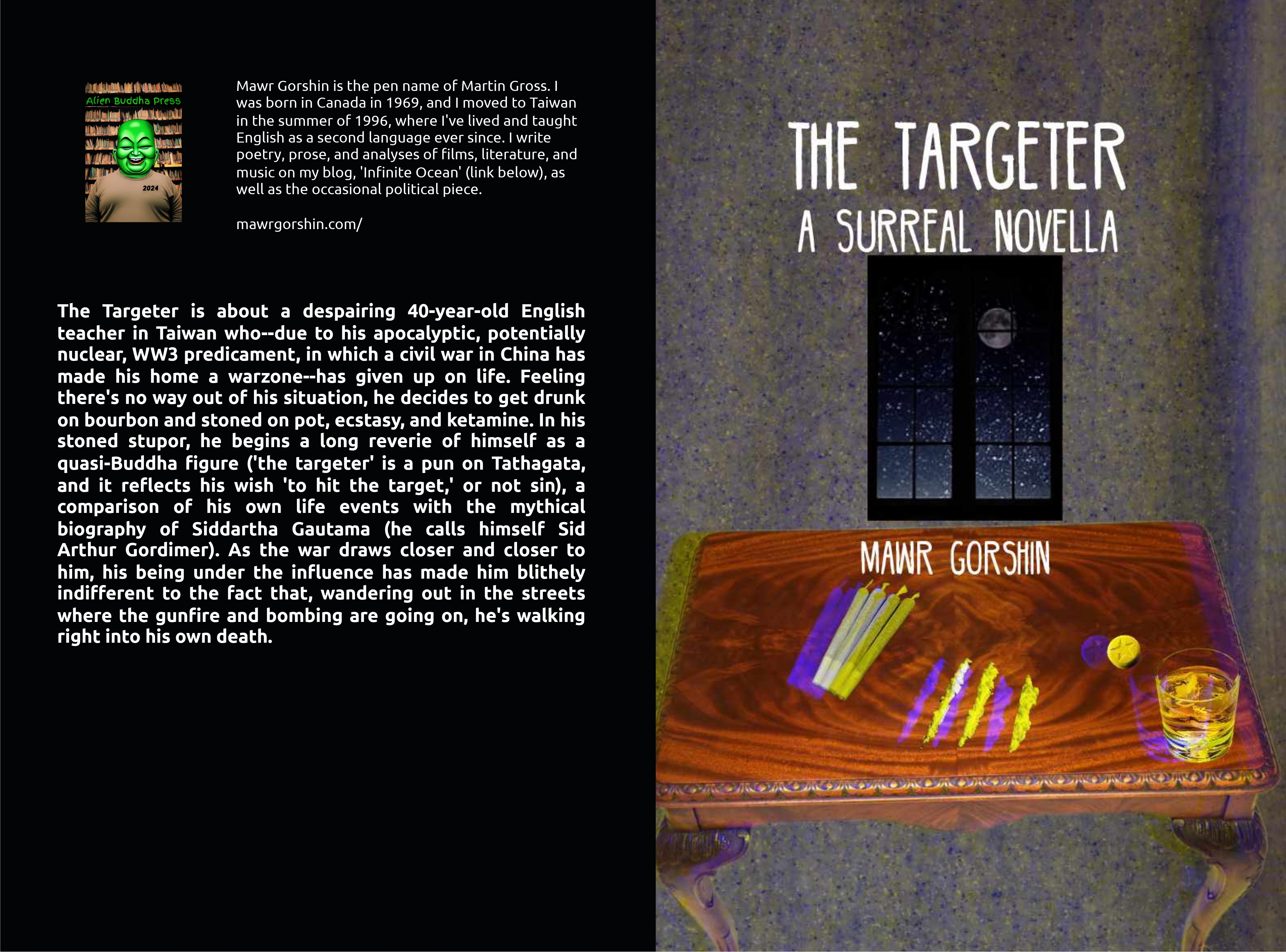
Chapter Eight from my novella, The Targeter, is being featured in Alien Buddha Zine #68, from Alien Buddha Press. It begins on page 34, with a copy of the cover of the novella:

Then it goes into Chapter 8 of my novella, the chapter being a reverie of the titular character, named Sid Arthur Gordimer, who is drunk and high on a combination of marijuana, ecstasy, and ketamine. His thoughts drift back and forth in his reverie of being a prince in a mansion watching half-naked strippers dancing to electronic music in a party, then of being in a royal palace with Indian music.

His parents, the king and queen, are pressuring him into taking on the responsibilities of the crown…but of course, this is all just the reverie of a drunk, stoned man. Outside of Sid’s apartment, in the real world that he’s trying to escape with booze and drugs, a war is going on. Bombs and gunfire can be heard outside.

He knows he’s no saint, and no prince. He’s a goner.

Please check out the Alien Buddha Zine, which drops on October 29th and has lots of other talented writers in it…and please check out my novella!