
The
world
is spinning
round,
as
if
Dom’s
totem were
man’s
O.
As
Earth
spins, we’re in
a fog
of
no
clear
view, a dream
going
on.
We
dream
unendingly,
until…
O!
It
stops
turning. Then
we wake
up.
The
world
is spinning
round,
as
if
Dom’s
totem were
man’s
O.
As
Earth
spins, we’re in
a fog
of
no
clear
view, a dream
going
on.
We
dream
unendingly,
until…
O!
It
stops
turning. Then
we wake
up.

As a Canadian expatriate having lived in Taiwan for the past 28 years (as of the publication of this post), I have seen many instances of the locals’ fetishization of the latest in technology. They typically link high-tech with ‘convenience,’ which of course is its ostensible raison d’être.
One time, perhaps about fifteen to twenty years ago, I was a guest teacher in a class of high school English students. I was doing lectures on topics based on newspaper articles chosen by the regular teacher of the class. She typically chose articles on the topics of science and technology, since her students were probably mostly going to go into STEM fields.
Such choices of topics were fine with me, but at one point I suggested news articles based on current events in politics, which I thought would not only be far more interesting to the students, but also an important way to immerse the kids in the goings-on of other countries, as well as getting them to be more aware of the major political issues affecting the world. After all, I had noticed something of an island mentality among far too many of the locals, a tendency to be insular and show no interest in the world beyond Japan, South Korea, and mainland China.
That teacher was adamantly opposed to the idea of current events as lecture topics. I found her opposition utterly baffling. Apart from suggesting she get someone other than me to do the lectures for the class (for my apparent belabouring of the change in subject matter…!), she gave the following as her reasons: classrooms in general avoid discussions of current events, for such avoidance is “common sense.” It’s sensible to avoid the topic, because everybody else avoids it.
???
A discussion of political issues in class, far from being inappropriate, could be made into practical English conversation practice, in the form of debates in which students can be put into teams and argue the various points of view, regardless of whether or not they actually hold such points of view. But no: making students in any way politically literate was a no-no. We just stuck to topics on technology.
As an English teacher here, I’ve noticed over the years that kids in the Taiwanese education system are generally geared towards careers in engineering, computers, semiconductor and cellphone manufacturing, and that sort of thing. It’s about getting them to have jobs in high tech in order to make lots of money, in other words. One is totally indoctrinated into the capitalist system, never to question it. After all, TINA.
Now, my political leanings as of those years hadn’t yet drifted to the left (so I wasn’t trying to impose my personal political opinions on the kids), but the education system here shows no desire whatsoever to instill any kind of political consciousness in the kids, be it right-wing, left-wing, or centrist. As a result, all that’s left for the kids to espouse is the default worldview: neoliberalism, treated as if it were the universal truth, an ideological ‘end of history,’ in which prostrating oneself to the mercies of the all-mighty market is the only way to live. It isn’t even an ideology: it’s just ‘the truth.’

Further Taiwanese fetishizing of high-tech can be seen with the locals willingly buying things with their smartphones instead of using cash. Oh, boy–we have another excuse to play with our phones! It’s so convenient! Oh, really? Standing there, fumbling around with your phone, clicking things, making mistakes here and there, then clicking on them again…somehow, this fiddling around is more convenient than taking cash out of your wallet, giving it to the cashier, taking your paid-for items and change, then promptly leaving the store?
Using smartphones instead of cash to pay for things is leading to the idea of a future cashless society, something many of us have a legitimate fear of. Paying digitally increases our dependence on the internet. What if there’s an outage? What if we’re hacked? What if we, for some reason, get locked out of our accounts and cannot buy food or other necessities? What if our being locked out of them is because we’ve expressed an opinion that the snooping government doesn’t like?
In this imagined, and very possible, future scenario, we can see the duality of a fetishization of technology vs. a total lack of engagement with what’s happening in the world politically. But the problem doesn’t end with digital payment.
The latest technological trend, of course, has been AI, and in recent months I’ve seen the TV news here in Taiwan awash with stories on Jensen Huang and his company, in my opinion aptly named Nvidia (Invidia, a Latin word from which we get envy, means ‘looking at (someone) with the evil eye, with hostility.’). The locals are treating Huang like a celebrity, not least of all because he’s Taiwanese-American, but also, of course, because of their ongoing fetishization of the newest in technology.
Now, AI can be a good or a bad thing, depending on how it’s used. Put another way, AI can be used to do all of our work, which, depending on which economic system we have, can be a good or a bad thing.
If we have an economic system in which commodities and services are provided to fulfill everyone’s needs, then AI will be the great liberator of all of humanity. That is, if everyone around the Earth was provided with and guaranteed access to food, housing, education, healthcare, and all other forms of wherewithal, we’d never have to work again to survive. We could all actually enjoy life.
But, in our current economic system, in which commodities and services are here to maximize profits, with no consideration given to the needs of the poor, then AI taking our jobs away from us would be an absolute nightmare. I see no indications of our current economic system changing from a capitalist one to a socialist one any time in the foreseeable future. The shift from the US/NATO alliance to a BRICS one will still be largely of countries with a capitalist economic system.
It’s been argued that old jobs lost to AI can, in some cases, be replaced with new jobs operating the AI. Not everybody losing the old jobs, however, will have the ability, the desire, or the finances to be trained to do the new jobs. As an English teacher here in Taiwan, I’m very worried that, in the next few years, I’ll be replaced by a robot in at least some, if not most or even all, of my classes; and since the beginning of all the Covid hysteria, I’ve been chronically underemployed as it is.

Furthermore, AI can be used in aid of surveillance by the government and corporations, eroding our right to privacy. It was bad enough to know what Edward Snowden revealed about the NSA’s snooping around with our cellphone calls and email messages years ago. What is Facebook, but a large profile of each and every person’s likes and dislikes, political opinions, geographic location, friends and family, etc.? Then there’s surveillance through such things as Google. Our constant use of smartphones makes it easy to track us. AI is only going to make this monitoring easier, more meticulous, and more thorough.
Big Broadband is watching you. All of this surveillance, being expanded into such things as smart TVs, smart cars, and smart cities, is eerily Orwellian. Indeed, that smart TVs have cameras installed in them, so the watcher becomes the watched, reminds me of the telescreens in Nineteen Eighty-four. Now, while Orwell’s dystopia was meant as a satire of totalitarianism, and of Stalin in particular, we shouldn’t be so dull-witted as to think that any of this oppressive new technology is in the service of socialism–quite the contrary.
First of all, contrary to the alarmist right-wing nonsense we hear in the media (including the verbal flatulence we hear from the puckered mouth of Trump), our society is not being inundated with Marxist ideology. If anything, Marxism is moribund. The only Marxist-Leninist governments in the world currently are Cuba, North Korea, and (arguably) China, Vietnam, and Laos.
What the far-right idiotically calls ‘extremist, far-left, Marxist’ politicians are typically just liberals. A genuine communist would push for revolution to help the poor, not vote Democrat. Leftists are anti-Zionist, unlike any politician in the mainstream. Etc., etc.
But more to the point is that all this high-tech surveillance is in the service of capitalism and imperialism, not socialism. Right-wingers have to get over this cretinous idea that if the government does something, it’s automatically socialist, and that any form of political corruption is also socialist. There is such a thing as capitalist government, and it’s every bit as capable of being huge, bloated, and bureaucratic as a socialist state can be.
The kind of government we find in the vast majority of countries in the world are those supportive of the neoliberal ‘free market.’ Their governments intervene in and regulate the economy in ways that help the big corporations, which are capitalist—‘corporatism’ is needless verbiage used by right-wing libertarians to deflect responsibility away from themselves for having supported an economic system that has been, especially over the past 45 years, an unmitigated disaster.
Anyway, the state will use all of this AI surveillance, as well as the eventual disappearance of cash, to seek out and punish anyone who tries to make the people rise up in revolution and attempt to overthrow the capitalist system that continues to make the rich richer and the poor poorer. Much censorship of Facebook and Twitter posts is for those who, for example, protest the ongoing genocide of the Palestinians. Support for Israel is extremely important to the Western empire and the maintenance of the so-called ‘rules-based international order.’ Some have argued that the liberation of Palestine will lead to a toppling of the capitalist/imperialist system. We who want that liberation are thus seen as a threat to the system: as AI surveillance and cashless societies flourish, we will surely be punished with far more than mere censorship.
The surveillance serves the interests of the bourgeois state because, of course, it also serves the very interests of the bourgeoisie itself. Most of us have surely seen by now that any time we show an interest in this or that product online, similar ones pop up in ads on our devices when we, for example, are scrolling on Facebook. Big Business is watching you.

At the beginning of this article, I wrote specifically of the Taiwanese fetishizing of technology not to suggest that only the locals where I live have this problem, but rather that seeing specifically the locals’ adoration of AI et al is just something I see right before my eyes. There’s little doubt in my mind that there’s at least a comparable, if not sometimes even greater, fetishizing of high-tech elsewhere, all over the world. As a symptom of a very global neoliberalism, fetishization of technology is a manifestation of what Marx called the fetishization of the commodity.
The worship of things, as opposed to acknowledging their origins in the workers’ production process, that is, focusing on things instead of on people, is what keeps us all, whether here in Taiwan (i.e., lectures on tech instead of on the current events that affect us all) or anywhere else in the world, under the spell of the ruling class. It’s one of many ways they keep us under their control.
There’s the brute force, surveillance, and gaslighting as depicted in Nineteen Eighty-four that is used to keep their power over us secure and intact; there is also the seducing and distracting of us with pleasure, as depicted in Huxley‘s Brave New World, with drugs and sexual indulgence. In our world, those drugs can be literal narcotics or the metaphorical opium of the people–religion. The sexual indulgence can come in the forms of internet porn, OnlyFans, or those countless photos of curvaceous beauties in string bikinis we see as we scroll down our Facebook feeds. The ruling class keeps us in check through bullying (militarized police, imperialist invasions, coups d’état), high-tech surveillance, propaganda, or addictions to pleasure.
I tried to allegorize all these issues in several short stories I’ve written over the past several months. In particular, these include “The Harvest,” “The Portal,” and “Neville.”
In “The Harvest,” reptilian aliens come to Earth and take over a town guised as doctors and nurses who take advantage of sick people and drug them so they can harvest all their organs. In “The Portal,” a young woman–while high on acid–stumbles into a portal that takes her to…a spaceship, or an alien planet?…where she discovers that aliens are working with human collaborators to conquer the Earth as part of an alien agenda of imperialism and colonization, enlisting the help of powerful human organizations like DARPA, with such forms of oppressive technology as robot dogs. In “Neville,” aliens invade Earth by impregnating women (through great sex!), having them give birth to half-alien children–all identical-looking and unusually large, growing fast–who hog all the food, starving the rest of humanity.
In these stories, I was using the invading aliens as personifications of imperialists who kill and plunder the Third World for resources. The use of drugs and sex in the stories was meant to represent how the ruling class uses these forms of pleasure to distract and control us.
Caitlin Johnstone made a comment that I assume to be a passage from one of her many articles, which I cannot for the life of me find so I can link it here. But to paraphrase the essence of what she said, it was that, while the potential for abuse of all of this new technology (digital payments, AI taking our jobs, surveillance through AI, smart TVs, cars, and cities, etc.) should be cause for alarm, the greatest form of control the ruling class has is through the control of our narratives via propaganda. Propaganda is a modern form of manipulative know-how.
Part of our liberation from all of these oppressive forces will be through the transforming of our narratives from ones that keep our eyes shut–dreaming all the time, as it were–to waking us all up. Addictions to pleasure–the drugs of religion or the literal ones, pics and video of beautiful nude or seminude women, video games, Hollywood movies (with CIA approval!), etc.–keep us asleep. Waking us all up, though, threatens the ruling class. Perhaps that’s why the political right speaks disparagingly about being ‘woke’? So, apparently, it is smarter to remain asleep?

On my blog, Infinite Ocean, I try to weave new narratives that can raise people’s political consciousness to lead to our liberation. I do this in the form of political articles like this one as well as, whenever applicable, my analyses of literature, film, and music.
We need new, liberating narratives. We need to find ways to take this new tech and use it for our benefit, not that of the ruling class. Most of all, we have to stop fetishizing tech and other commodities at the expense of the people; we need to start caring about the welfare of our communities, for while the ruling class are few, WE ARE MANY. If we take control of tech–to liberate us from work instead of depriving us of it, or having its pile-up of garbage destroy our Earth–then tech will no longer be dreck.
Hannah could no longer contain herself.
“Oh, for God’s sake!” she said, rising from her seat.
“What’s your problem now?” Freddie asked with another of his smug smirks.
“What’s my problem now?” she said, sneering at his attitude with incredulity. “I can’t believe this family of yours!”
“Excuse me?” Mrs. Dan said.
“Yes, I’m saying that without holding it back this time,” Hannah said, her face red, not with embarrassment from making the Dans lose face, but with anger. “Mrs. Dan, my entire family has been missing for the past…what, half-hour at least? Not even Al has returned! What is going on here? Since when is this even remotely how guests are treated?”
“Hanna, please, calm down,” Mrs. Dan said.
“Calm down? All my dad did was go to the upstairs bathroom! All my mom and brother did was go up to find out what happened to them. They should all be back by now! Why aren’t they?”
“I’m sure there’s a simple explanation for all of this,” Freddie said, then, with an unmistakeable tone of contempt, “Take it easy.”
“Don’t you tell me to take it easy, Mr. Brother-bully!” Hannah shouted. “You can’t even do a simple thing like treat Al with respect, and you expect me to be cool when my entire family and boyfriend have gone missing for no good reason? There’s a simple explanation for this? You’ll need an extraordinary explanation for all of this, which–if I get it, if I actually get it–will get an extraordinary apology from me. I don’t see any of my family coming back. I don’t see Emily, or your dad or your brother coming back. What secret are you hiding from us?” She glared at both of them.
Mrs. Dan was laughing nervously. “Let’s go upstairs together, my dear,” she said to Hannah as she rose from her seat.
Hannah frowned at her. “And it will be my turn to disappear, I suppose,” she hissed. “At least you won’t have anyone else to complain about your less-than-stellar hospitality, will you, Mrs. Dan? And I’ll finally know the truth…with a knife in my back, I suppose?”
Mrs. Dan laughed again. “I assure you, my dear, at my age, I lack the strength to harm you even if I wanted to. Let’s go up the stairs and find them.”
“Or is this some elaborate prank, and I’m going to find them all up in the attic or something, laughing and partying,” Hannah said with a scowl as she followed Mrs. Dan out of the living room.
You’ll find them all in the attic, all right, Freddie thought. But they won’t be doing anything but bleeding, as you soon will be, you crabby little bitch.
“Please don’t take it too personally if I stay behind you the whole way up, Mrs. Dan,” Hannah said coolly.
“As you wish, dear,” Mrs. Dan said, then thought, Not that staying behind me will do you any good, of course.
“Of course, you’re not the only one I need to worry about, as far as possibly getting a knife in my back is concerned.”
That’s right, Mrs. Dan thought as they reached the second floor. “Would you like to look around the rooms on this floor, my dear?”
“No, I wouldn’t. I’d like you to show me around, while I keep my eyes open for any…surprises.”
“Very well,” Mrs. Dan said with another giggle, then she opened the door to the nearest of the rooms. She went in first, then Hannah followed, her eyes darting around everywhere for possible attackers. Mrs. Dan turned on the light.
Hannah quickly scanned the room for her family, and of course she found nobody. Then she went back to looking out for any lurking dangers.
“Nothing here,” she said with her permanent pout. “Let’s carry on to the next room.”
They left the room, Hannah always behind her host and looking out for trouble. They approached the next room. There was a noise inside it, something having fallen over.
“What was that?” Hannah snapped, her back straight and rigid.
“Let’s find out,” Mrs. Dan said as she opened the door, then turned on the light. Some boxes lay on the floor in a mess. The women went in the room.
Again, after Mrs. Dan switched on the light, Hannah remained behind her, taking quick looks around the room while remembering to look behind her in case someone was sneaking up on her. She stepped in further.
Apart from the mess of boxes in the middle of the floor, there didn’t seem to be anything of concern going on there. Hannah took a deep breath.
Whatever’s going on up here, she thought, I’m pretty sure I won’t be going back downstairs.
She felt something brush against her calf.
“Oh!” she yelped, then looked behind her and saw nobody. She looked down.
It was the cat.
She smiled, sighed, bent down, and petted it.
“Aww, cute little kitty cat,” she said.
She felt a hand touch her shoulder.
She yelped again and looked up behind her. The cat ran away.
“Oh, I’m sorry, dear,” Mrs. Dan said, taking her hand away. “I didn’t mean to scare you. I just wanted to say that we seem to be finished in here, and so we can go on to the next room.”
“Oh, OK,” Hannah said with a nervous chuckle. She got up and followed Mrs. Dan out of the room.
As they went back into the hall, Hannah noticed something jutting out of the right front pocket of Mrs. Dan’s black pants. It hadn’t been there before. It looked like the handle of a knife.
Did she pocket it while I was distracted by the cat? she wondered. I don’t dare ask her about it, but I’m especially making sure she’s always within my field of vision now.
They went through the rest of the rooms on the second floor and found nothing, Hannah always checking to see if Emily or Mr. Dan was about to ambush her, while never taking her eyes off of Mrs. Dan. Then the two women went up the stairs, Mrs. Dan first, of course, to the third floor.
As they went through the rooms on the third floor, Hannah found it increasingly suspicious that there was still no trace of her parents or brother, nor of Mr. Dan, Emily, or Al.
“This doesn’t make any sense!” Hannah said in exasperation. “Where the hell is everyone?”
“I’m sure we’ll find them soon, d–“
“No, you tell me what you’ve done with them! Mrs. Dan, I’ll bet you and your family already know where they are, and you’re leading me into the same trap, aren’t you?”
“Oh, come, come, my d–“
“Don’t you ‘come, come’ me! Something screwy is–“
They heard a moan from up in the attic.
Hannah looked daggers at Mrs. Dan.
“Your plan is for me to be moaning like that, too, isn’t it?”
Mrs. Dan giggled again. “No, not at all, don’t be–“
“Let’s go up there. You first.”
As they went up the ladder to the attic, Hannah looked at that handle sticking out of Mrs. Dan’s pants pocket.
I’m no pickpocket, she thought, but maybe she’ll be too distracted from climbing the stairs to notice me pulling that knife out of her pocket, if that’s what it in fact is. She reached up slowly and carefully.
Another moan was heard from the stack of boxes.
“Over there,” Hannah said when both of them had reached the top of the stairs. She pointed to the boxes, then ran ahead.
Aren’t you worried about me being behind you? Mrs. Dan thought with a smirk.
Hannah went behind the boxes, near a window. A large, long blanket was covering whoever was moaning, or so it seemed. She threw the blanket off a bit and saw her father’s bifurcated, bloody face, and her mother’s bloody, slit throat.
She screamed out loud, then looked up, remembering Mrs. Dan. She could see her in the window reflection, raising the axe that had killed Brad, about to be buried in her back.
“Goodbye, Hannah,” Meng said through Mrs. Dan’s mouth.
Hannah spun around and lunged at the woman’s guts.
“Did you misplace this?” Hannah hissed at her.
Mrs. Dan dropped the axe behind her, looked down at her knife in her bloody belly, and said in Meng’s low voice,” So, it was…you who…took it. No…matter, another…will kill…you.”
She fell to the floor.
Shaking and panting, Hannah looked back at her parents’ corpses. “That psycho-bitch,” she gasped. “I knew something twisted was going on here. This whole family’s fucked up.” Then she turned around again, her eyes darting around frantically for that…other…who would kill her. She saw no one.
She looked back at the bodies, with teary eyes.
“Oh, Mom, Dad,” she sobbed.
Then she noticed the arm of another body beside her father’s. She saw the black shirt sleeve of Mr. Dan.
She threw the blanket further off, and indeed, it was his body, with a bloody gash in the chest.
“Oh, God!” she gasped, then retched. At least I don’t have to worry about him killing me, she thought, then she remembered to look around the attic again for any more attackers. “Freddie? Emily? No? Good.” Where’s Al?”
She heard another moan, from the far side of Mr. Dan’s body, under the blanket.
Where’s Doug? she wondered. “Oh, no.”
There was a slight movement under the blanket’s edge.
She went over, past the three revealed corpses, and dreaded what she was about to see, but held the hope that her brother was still alive…or was it Al?
She pulled the blanket away. Doug moaned again, his eyes half-open.
“Oh, God! Doug!” she said.
CRACK!!!
She gave a jolt, and screamed at the sight of his now-bloody, fractured skull.
Then she looked up.
The bat was in Al’s hands.
Scholar Charles Onana is being falsely accused of genocide denial, with regards to the tragedy in Rwanda, while his Western accusers look the other way as the genocide in Palestine continues.
When the
blue and
white star
flashes its
lights across the sky and torches the ground, this is put up with, seen as self-defence.
But when
the scorched
Arab earth
fires back
at the starry night, there’s ire and outrage: one’s land is too promised to be an inferno.
I: Introduction
A Streetcar Named Desire is a 1947 play by Tennessee Williams, premiered on December 3rd of that year. It’s considered one of the greatest plays of the 20th century, and is Williams’s most popular, being among his most performed and adapted in many forms, including notably the 1951 film.
The original cast of ASND was made up of almost all the same actors as in the film version, except for Blanche DuBois having been playing by Jessica Tandy onstage, and by Vivien Leigh in the film.
Here’s a link to the entire play.
II: Famous Actors for the Roles
Apart from Tandy and Leigh, other notable actresses who have played Blanche are Tallulah Bankhead (for whom Williams actually wrote the character, though she hadn’t played the role until 1956, because she was felt to be too strong for it), Ann-Margret, Cate Blanchett, Blythe Danner, Uta Hagen, and Rachel Weisz. Every actress Williams saw performing the role he loved, feeling that each of them brought something different to Blanche.
Apart from the most famous portrayal by Marlon Brando, Stanley Kowalski has been played notably by Anthony Quinn, Treat Williams, Alec Baldwin, Rip Torn, Aidan Quinn, and Christopher Walken.
Apart from Kim Walker, Stella–Blanche’s younger sister and Stanley’s wife–has been played by Beverly D’Angelo and Diane Lane.
Karl Malden played Harold “Mitch” Mitchell in the original stage production and in the 1951 film.
III: Themes
A central theme of ASND is narcissism, with the whole spectrum of pride/vanity to humility/shame expressed at many different points at the extremes and in between them. Blanche is vain, insufferably so to Stanley, who has a fierce pride of his own. Stella is much more submissive, forgiving of her husband’s brutality, giving in to his demand to put Blanche in a mental institution, and believing his denials of a rape of her sister that he’s obviously guilty of. Mitch is most gentlemanly to ladies, but when he learns of Blanche’s waywardness, he loses his sensitivity almost immediately.
Blanche’s narcissism is of the covert variety, expressed in a passive-aggressive form, her often seeming to play the victim. Her narcissism is a defence against psychological fragmentation, a defence that apish Stanley will break through, causing her to have a nervous breakdown at the play’s end. Her very name, meaning ‘white,’ suggests her narcissistic False Self of sweetness, purity, and ladylike sense of culture, but it also hides her True Self of promiscuity, snobbishness, and ethnic bigotry (i.e., against the Polish).
Stanley is her diametrical opposite, making hardly the slightest attempt to hide his harshness (or so it would seem). His wish to break through all of Blanche’s masks and disguises and reveal the truth in no way redeems him of his cruelty. He is perceived as an ape, and rightly so, for he rids us of all doubt by the end of the play.
So along with the spectrum between narcissism/pride/vanity and humility/shame, there’s also a spectrum between social artifice/fakery and brutal honesty in ASND. In the case of this latter spectrum, it should be obvious which character personifies social artifice, and which brutal honesty. A character like Mitch falls somewhere in between the extremes, as we’ll see later on.
IV: Scene One
A verse by Hart Crane (the fifth from “The Broken Tower”), which is put before the beginning of Williams’s play, seems to express Blanche’s situation when she arrives in New Orleans. She’s looking for a building on a street called “Elysian Fields,” whose heavenly associations are ironic given what a hell-hole she finds her new home to be.
She is a Southern belle used to a life of dainty clothes, perfume, comfort, and culture in Belle Reve (“sweet dream,” loosely translated), the old home she’s lost to creditors, forcing her to live with Stella and Stanley, or else face homelessness. Living in such a shockingly poor home will be a crushing humiliation for Blanche.
To get to Elysian Fields, she’s taken a streetcar named Desire, then transferred to one called “Cemeteries” (Williams, page 3). The streetcar named Desire was inspired by an actual streetcar with the same name, which ran a half-block away from Williams’s apartment on Toulouse Street in the New Orleans’s French Quarter, where he wrote the play.
The names of the streetcars, as well as the name of Stella’s and Stanley’s home, have been chosen as more than just names of places in the real world, though. Desire leads to cemeteries…rather like, the wages of sin is death…and death leads to an afterlife that may seem like heaven, but is actually hell. It should be easy for anyone who has read or watched a performance of ASND to see how these names are points on the trajectory of Blanche’s life, just as the verse from Crane’s poem reflects her life.
She has led a life of desire–from her marriage to a husband who, it turns out, had homosexual feelings he acted on, then killed himself after knowing her shocked reaction to this acting-on them (recall that Williams himself was gay, and therefore his sexuality rubbed off in some of his plays), to her own promiscuity, which included a sexual relationship with one of her teen students. This inappropriate relationship led to the bad karma of her being fired as a high school teacher. We see how desire has led to the cemeteries of her husband and her job.
And now she has to live in the hellish ‘heaven’ of her sister’s shabby home, to be shared with a man whose bestial nature will be soon apparent to her.
When Blanche sees her sister for the first time in a long time, she addresses her as “Stella for Star!” (page 6). Since this is the literal meaning of her younger sister’s name, Blanche’s imagined poetic pointing-out of that meaning demonstrates her literary pretensions early on in the play.
Though she affects refinement, her own vulgarity and ignorance also come out early in the play as she and Stella discuss Stanley, whom Blanche not only refers to as one of those “Polacks,” but also imagines as being “something like Irish,” but “not so–highbrow?” (page 9) His friends are “a mixed lot,” according to Stella, and are therefore “heterogeneous–types” to Blanche, which suggests a quite racial categorizing of them; after all, there’s Pablo (Nick Dennis in the original production and the 1951 film).
After Blanche has sorrowfully told Stella about the loss of Belle Reve, being so ashamed of its loss that she imagines her sister’s questioning about it to be a judgement on her for losing it (pages 11 and 12), she meets Stanley. It’s so fitting that Brando exemplified Stanislavski‘s Method Acting in the role of Stanley, his name almost sounding like a pun on Stanislavski, since there’s no affectation whatsoever to be seen in Kowalsky; while Blanche’s character seems to require the technique of the classical acting style, with its “saw[ing of] the air too much with [one’s] hand,” and its “tear[ing of] a passion to tatters.”
A cat screeches near the window, startling sensitive Blanche. In the film, Brando’s Stanley imitates the cat’s screeching, a kind of foreshadowing of how upsetting he’ll soon be to her. In fact, he is upsetting to her already by the end of this first scene, when he brings up her marriage (page 15). Bringing this up triggers painful memories for her that will be brought up in full later.
When I referred to Blanche as narcissistic and fake, neither of these faults necessitate our lack of empathy for her. She’s suffered terribly, and she’s about to suffer even worse by the end of the play, thanks to Stanley’s merciless cruelty. Her narcissism and maintaining of illusions are the only things that are keeping her from falling apart completely.
V: Scene Two
When Stanley learns from Stella of Blanche’s loss of Belle Reve, he starts worrying that his wife has been cheated of the family property, for the “Napoleonic Code” (which, contrary to what Williams believed, did not exist in Louisiana at the time) states that what belongs to the wife belongs to the husband and vice versa (though Stanley doesn’t seem too concerned with the vice versa). If Blanche has lost the family property, then so has Stella…and so has Stanley.
The point is that Stanley is a very domineering husband, and he believes he has the right to extend the patriarchal dominance of his home onto Stella’s sister. He doesn’t even like his wife’s leaving him “a cold plate on ice” for dinner while she and Blanche go out to eat, then to a show, so he and his friends can play poker in his home without any women disturbing them (page 16).
His utter lack of respect for a woman’s rights is on full display when he starts pulling out Blanche’s dresses from her wardrobe trunk in search of any documents to tell him what happened to Belle Reve. He imagines Blanche’s fancy-looking clothes are all expensive, too much so for a teacher’s salary, so he says he’ll have an acquaintance in a jewelry store do an appraisal of her “diamonds,” “pearls and gold bracelets” (pages 18-19). Stella insists that the “diamonds” are just rhinestones. Stanley still thinks he has the right to Stella’s ‘wealth.’
Stanley’s borderline, if not outright, misogyny is to the point of bluntly telling Blanche that he has no interest in complimenting women on their looks, since in his opinion, they either already know they’re beautiful and therefore don’t need to be complimented, or they’re so vain that they “give themselves credit for more than what they’ve got.” (page 21) Blanche, in her thirties and with fading beauty, has an already fragile self-concept and therefore doesn’t need Stanley’s kind of bluntness.
He doesn’t take it as well as he dishes it out, though. When she responds to his bluntness by calling him “a little bit on the primitive side,” and says she could tell no more about him than that he’s a man her sister married, he throws a brief tantrum (pages 21-22). In his brutal honesty, he should not be confused with men like Alceste the misanthrope, who sincerely hated social hypocrisy in spite of his continuing attraction to the flirtatious coquette Célimène, who had eyes for him as well as for other men. Stanley, on the other hand, is simply an ape.
His brutish demanding that Blanche show him legal papers connected with the DuBois plantation leads to him grabbing love letters from her husband. Stanley’s insensitivity to her husband’s letters is a touch that insults them, meaning she’ll need to burn them (page 23). He has again triggered painful memories about a husband with the opposite personality of Stanley’s, a sensitive poet, not a growling gorilla.
Her saying she’d not have him touch her letters “because of their–intimate nature…” (page 23) is a foreshadowing of the horrible thing that Stanley will do to her at the play’s–pardon the expression–climax. She surrenders to his looking through her legal papers, just as she’ll surrender to him in a more physical way later.
It’s interesting how his use of legality to persecute her parallels his use of physicality to persecute her. Feminists would have a field day analyzing these parallels, as I’m sure they already have. In this connection, I also find it interesting how the Napoleonic Code didn’t exist in Louisiana at the time of the story: Stanley’s imagined authority over Stella and Blanche is as fake as Blanche’s pretensions to culture and high breeding. As I said above, he has no business pretending to be any more honest than she does.
VI: Scene Three
Stanley, Mitch, Pablo, and Steve (Rudy Bond in the original production and the 1951 film) are playing poker while Stella and Blanche are out. Poker night is an all-boys club in which women are persona non grata, of course. It’s bad enough when people in high positions of political, economic, and religious power and authority use sex roles and the patriarchal family to divide the sexes and keep women down; when working-class men reinforce these divisions and discriminatory attitudes, it makes proletarian solidarity all the more difficult to cultivate.
Another example of this lack of solidarity, but from a racial angle, is Pablo suggesting going to get some chop suey from the “Chinaman’s” (page 27), this being a term which, by the time of the writing of the play, must have already begun to acquire derogatory overtones in the US. Pablo, as an Hispanic and therefore surely someone familiar with being on the receiving end of ethnic slurs (Stanley will have called him a “greaseball” by the end of the play, and I suspect it won’t be the first time), should have at least some sensitivity to how inappropriate “Chinaman” sounds, as should Stanley, as a Polish-American who is infuriated with Blanche saying “Polack.”
Of the poker players, Mitch is the only unmarried one (page 28), and he has a sick mother at home, so he worries about her and must leave the poker game. His duty to her gives off the impression that he’s a ‘mama’s boy,’ and that he’s ‘sensitive.’ Blanche will soon pick up on his “superior” manner (page 30), and see in him the hope of a husband. Stanley shows his contempt for Mitch’s devotion to his mother by saying the guys will “fix [him] a sugar-tit.” (page 28)
Mitch is pleased to meet Blanche when she and Stella have returned and he has stepped away from the poker game for the moment, so he is playing the role of the gentleman while the other boys continue with their all-boys-club card game. Stanley, predictably, feels the most invaded by the feminine presence.
He assures Blanche that none of the men are interested in standing up when she enters the room. He’d have her and Stella go up to Steve’s place and sit with Eunice, Steve’s wife (Peg Hillias in the original stage production and the 1951 film), whom he treats with a shabbiness comparable to how Stanley treats Stella and Blanche. Though it’s nearly two-thirty in the morning, Stanley sees the poker game as not finishing any time soon, and he spanks Stella on the thigh…or is it the ass?…to discourage her and Blanche from staying; this only angers her.
Gentlemanly Mitch, however, will repeatedly insist, “Poker shouldn’t be played in a house with women” (pages 36 and 37). Stanley is annoyed that Mitch, more interested in Blanche than the game, won’t come back to it. He’s particularly angry when Blanche turns on the radio (page 35). He rushes over and smashes it.
Stella, furious, calls Stanley an animal and tells his friends to go home immediately. He goes wild at her ending his sacred card game and goes after her. His friends try to calm him down, but it’s no good.
Both husband and wife go offstage, and we know that he hits her (page 35). Both she and Blanche scream. Stella is taken upstairs to Steve’s and Eunice’s place while Stanley’s friends try again to calm him down by pouring shower water on him, but he just gets angrier, curses at them, and hits them. They all leave with their poker winnings (page 37).
With Stella gone, Stanley finally realizes he’s screwed up. Now we have the famous moment when he screams out “Stella!” repeatedly. Without her, he’s no longer the dominant male, but he’s been reduced to a weepy little boy.
Perhaps his weepiness in part has triggered her maternal instinct, but in any case, she goes back to him and forgives him, a shocking thing for Blanche, Eunice, and any reasonable person to see. Stella is letting him manipulate her with that helpless little boy routine, a classic page out of the narcissist’s playbook.
Eunice would get the law on him for hitting his wife and making such noise so late at night. Just as the men demonstrated by trying to calm him down, there is no social acceptance of violence against women, though that doesn’t mean men never get away with it.
Blanche comes out, horrified that her sister, with child, went back to the man who hit her. Mitch is there to talk with Blanche, since he’s still interested in pursuing her. What should be a bad omen for her is how, in spite of how Mitch is still acting the gentleman, he trivializes this moment of domestic violence.
VII: Scene Four
The next morning, Blanche wants to talk Stella out of remaining in her relationship with Stanley after having seen how bestial he is capable of being. As with Mitch, Stella trivializes what happened the night before, which of course is all the more disturbing.
Stella thinks that Stanley’s having felt ashamed of himself for his barbaric behaviour is enough to forgive him, when she knows full well that he’ll do such things again, and soon.
Stella was as much of a Southern belle as Blanche, but the former being taken off the pedestal didn’t upset her the way the latter was forcibly removed from it. Blanche cannot conceive how Stella is willing to tolerate living with such a man as Stanley.
Part of the difference in the two women’s attitudes is how Blanche, unlike Stella, still believes in romantic notions of gallantry, illusions to protect her–it would seem–from the brutality of reality. When Stella speaks of how Stanley, on their wedding night, went around their home with one of her slippers smashing all the light-bulbs with it, instead of being terrified, as Blanche would have been, Stella admits to having been thrilled by his wildness (pages 41-42).
Blanche feels there’s a desperate need to get herself and Stella away from Stanley. She remembers a wealthy oilman named Shep Huntleigh, who she imagines could use his money to get her and Stella away from that brute of a husband. She imagines she’ll get Western Union through the telephone operator to contact Shep and tell him that she and Stella are in a desperate situation and need his help (pages 43-44). This urgent attempt to get Western Union and contact Shep will be repeated in Scene Ten (page 95), at the climax of the play, when Blanche is sure that Stanley, alone with her at home while Stella is in the hospital to have her baby, won’t have anyone there to hold his leash.
This Shep Huntleigh represents, in another way, the diametrical opposite of Stanley. He’s not only wealthy, but he’s also a gentleman, Blanche’s gallant, romantic ideal. According to Heinz Kohut‘s conception of the bipolar self, the two poles that give a person a stable sense of self are ones based on someone to idealize (in childhood, the idealized parental imago) and someone to mirror the grandiose self. When both of these needs are met, one can live with a healthy, restrained, and moderate sense of narcissism. If one of the poles fails, or is thwarted, the other can compensate. If both fail, one is at best in an extremely fragile position (as Blanche is, already at the beginning of the play), and at worst, one experiences psychological fragmentation and a psychotic break with reality (as happens to Blanche at the end of the play).
Blanche is hoping that a courtship with Mitch will lead not only to a husband who can ‘make an honest woman of her,’ so she can put her promiscuous past and reputation behind her, but also to a satisfying of her narcissistic need for someone to mirror back her grandiose self to her. His gentlemanly routine of putting her up on a pedestal will satisfy that need.
When Mitch learns, through Stanley’s merciless probing into her past, of her promiscuity when she lived in Laurel (living in The Flamingo, a hotel known for prostitution, her sexual relationship with one of her underage students), and he refuses to marry her, she uses her idealization of Shep Huntleigh, a kind of Oedipal transference of the idealized parental imago, to keep her fragile self hanging on. Of course, Stanley tears that compensatory fantasy apart, and she goes mad in the end.
The psychiatrist (played by Richard Garrick in the original stage production and the 1951 movie)–who, with the matron (Ann Dere), comes to take Blanche to the mental hospital at the end of the play–temporarily destroys her ever-so-faint hopes to be taken away by Shep; but he wisely humours her, putting on the gentlemanly act to make her cooperate, and revives for the moment her hope to have the idealizing pole satisfied.
Anyway, Blanche continues trying to convince her sister that Stanley is not worth keeping. When Stella speaks of the “things that happen between a man and a woman in the dark,” making such things as Stanley hitting her “seem–unimportant” (page 46), we’re reminded of how “thrilled” she was at his smashing of the light-bulbs. A nasty man is often exciting to a woman, where a nice guy finishes last. As the Chinese say, “男人不壞,女人不愛” (“If men aren’t bad, women won’t love them.”) Bad boys are sexy, and in this observation come so many of women’s problems with men. Recall, in this connection, how good-looking young Brando was in the 1951 film, with his muscle tone and his shirt off. I’ll bet the girls were swooning with ecstasy at the sight of him on the screen.
Blanche responds to what Stella says by pointing out what I said above about the title of the play–that it’s not just inspired by the name of a streetcar near where Williams was writing his play. Stella is talking about her “brutal desire,” a streetcar that brought Blanche to this Godforsaken home of Stella’s and Stanley’s. A streetcar named Desire, then one named Cemeteries…Blanche imagines that Stella’s desire will lead to her death at Stanley’s hands.
As Blanche goes on condemning him as “common,” he’s approaching home and overhearing her words. He is fuming inside as she speaks of how his wife should be with a better man than “an animal,” someone “subhuman” and “bestial” (page 47).
Since Blanche has been bad-mouthing him so much to his wife, he’ll get his revenge on her by learning the gossip about how “common” she is, making all of her pretensions to art and culture seem utterly hypocritical.
VIII: Scene Five
Stella and Blanche can hear Steve and Eunice fighting upstairs, the latter accusing the former of fooling around with some “blonde,” which Steve denies (page 49). The fight escalates, she throws something at him, then he hits her, and she wants to get the police (page 50). She runs off, and he goes after her. We sense that domestic violence in the ‘heavenly’ Elysian Fields is not limited to Stella and Stanley.
Stanley comes by, and Blanche–in her usual ‘ladylike’ voice–taunts him by saying he must be an Aries, since he’s so “forceful and dynamic,” and he loves “to bang things around” (page 51). Naturally, he’s annoyed at these words. Stella tells her that Stanley was born just after Christmas, making him a Capricorn. Blanche comments, “the Goat!”, annoying him all the more.
When she mentions that her birthday is the following month, in mid-September, making her a Virgo, which is the Virgin, Stanley–already knowing a few things about her scandalous reputation in Laurel–has an opportunity to insult her back. He mentions a man named Shaw, a name common enough that she can pretend this is not someone she knows in particular, a man she apparently met in Laurel, at a hotel named the Flamingo, the place where prostitution goes on (as I mentioned above), so naturally, Blanche denies any association with it.
When Stanley leaves, though, Blanche asks Stella, in a state of great anxiety, if she’s heard any dirty gossip about her (page 52). Stella denies having heard anything nasty about Blanche. Around this time, Steve and Eunice have returned in each others’ arms, fully reconciled; their making-up parallels the making-up of Stanley and Stella that happened so soon before.
Blanche explains to Stella the reason for her bad reputation in Laurel. The loss of Belle Reve, on top of her husband’s suicide and the scandal surrounding her sexual relationship with her teen student, put her into a situation so desperate that she had “to be seductive,” to “put on soft colours” (page 53). She’s needed to do this with men “in order to pay for–one night’s shelter!”
She’s found that “men don’t…even admit your existence unless they are making love to you. And you’ve got to have your existence admitted by someone, if you’re going to have someone’s protection.” So she’s got to “put a–paper lantern over the light”, something she habitually does so people won’t see her aging and fading beauty, something she’s terrified of, just as she’s terrified of the light revealing the truth of her scandalous behaviour, something she’s feen forced into because of her losses…but the cruel, judgemental world will never be understanding to her about that.
And Stanley is the epitome of that cruel and judgemental world, not that he’s any better, of course.
She senses that Stanley wants to throw her out of his and Stella’s home, so she doesn’t want to be a burden to her sister, something she promises she won’t be in the most hysterical of words. Stella is shocked by how emotional Blanche is getting. Blanche is placing all of her hopes on Mitch, with whom she is having a date at seven that very night (page 54).
In anticipation of Stella learning, through Stanley, about Blanche’s reputation in Laurel as a ‘woman of loose morals,’ she frantically insists that on dates with Mitch, he’s gotten only “a good night kiss” from her (page 55). She wants his respect, yet she’s terrified of losing him, hence she’s so sensitive about her age. She wants him to think of her as “prim and proper.”
Of course, Mitch wants her to think of him as a gentleman. He has his social mask, and she has hers, symbolized by that paper lantern over the light, to hide the aging on her face.
Stanley returns, and he leaves with Stella, with Steve and Eunice accompanying them. Blanche is alone in the apartment.
Just before Mitch is to show up for his date with her that night, Blanche sees a handsome young man (played by Wright King in the 1951 film), who appears at the door. He says he’s “collecting for the Evening Star,” a newspaper. She jokes about him as a star taking up collections because she finds him so attractive, but he is so innocent and sweet (just the way she likes her boys), he doesn’t understand her joke.
I suspect that she, in her fragile, unstable mental state, is imagining this boy’s presence. He can easily be seen as reminding her of not only the boy she had the affair with, but also her husband back when she first knew him, when the couple were both very young. Her student/lover presumably reminded her of her husband, too.
The boy collecting money is so perfect to her. He’s polite, he calls her “ma’am,” and he’d never treat her like a whore. He’s shying away as she makes her advances to him.
Finally, she gives him a kiss on the mouth (page 57), but not wanting to go any further, as with Mitch, she sends the boy off. And fittingly, just after he disappears, Mitch arrives for their date.
IX: Scene Six
At 2:00 a.m. of the same night of their date, Mitch notes that Blanche is getting tired. After he drops her off at home, it seems that he’ll take “that streetcar named Desire” back home, for we can see just how much they desire each other. Still, he’s sad because he thinks he hasn’t entertained her much tonight.
Though she still wants him to think of her as a lady who isn’t cheap, she still likes tempting him. She’d have him come into Stella’s and Stanley’s place, since the husband and wife aren’t back home yet. She also wants to give Mitch a drink, and she even asks him, “Voulez-vous couchez avec moi ce soir?” She also says in French that it’s a shame he doesn’t understand the question, but of course she’s happy he doesn’t (page 61). They actually go into the bedroom, her carrying the drinks.
A little later, she has him pick her up to see how light she is. Still, she’d have him let her go and be a gentleman while her sister and Stanley are still away (page 63). She fears Stanley exposing her bad reputation in Laurel, but he can’t resist continuing her coquettishness.
Almost immediately after Mitch’s picking her up and putting her back down, she brings up how much she doesn’t like Stanley, with her worries that he may have told Mitch some bad things about her (page 64). It’s interesting to see this juxtaposition of her teasing of Mitch with her fears of him learning of her ‘loose’ ways in Laurel. It’s as if her unconscious death drive, her Jungian Shadow, is deliberately sabotaging her date.
She gets nervous when Mitch asks her age (page 65). He asks because of his mother, who has wanted to know more about her. After all, his mother will probably die in a few months, and she wants to make sure her son is settled (page 66).
Next, the conversation turns toward Blanche’s old husband, a sad topic for her. The two married when very young. He was “different.” He had “a nervousness, a softness and tenderness which wasn’t like a man’s,” but not at all “effeminate-looking” (page 66). He needed her help.
Eventually, she found him with another man.
They pretended that nothing had happened, then the three of them went to Moon Lake Casino to be drunk and dance, to the music of the Varsouviana in particular. Then her husband broke away from her, ran outside, put a revolver in his mouth, and shot himself.
He ran out and killed himself because, on the dance floor, she’d told him he disgusted her (page 67). So she blames herself for his suicide.
Now, in the 1951 film version, all references to homosexuality in the play–however indirect–were censored for obvious reasons. Instead, the husband is portrayed as simply weak, overly sensitive, weepy, and a poet–all the gay stereotypes without the gay. A similar excising of homosexuality in a Tennessee Williams play was done in the 1958 film adaptation of Cat on a Hot Tin Roof.
Empathizing with Blanche, and seeming to be similarly sensitive, Mitch reaches out to her after hearing her tragic story. She needs someone, as he needs someone. He’s seriously considering marrying her.
Except…
X: Scene Seven
In mid-September, it’s Blanche’s birthday, and Stanley has plans of ruining it for her (page 69). He’s found the dirt on her that he needs to prove that she has no business calling him ‘common.’
To add to his irritation, she is “soaking in a hot tub” on a day when the temperature is 100. He can’t stand how Stella serves cokes to “Her Majesty in the tub.” He’s convinced, “from the most reliable sources–which [he has] checked on”, that Blanche is a liar about her past (page 70).
Her singing in the bathtub, like a “canary bird,” is annoying him all the more. He can’t stand her pretense of being some kind of “lily,” all sweet and delicate, when he’s discovered that she, in his judgement, is a common whore.
The sad thing about the animosity between both of them is how it’s based on prejudicial notions of class, ethnicity, and sex. His faults, in her estimation, are because he’s a low-class “Polack.” Her faults, in his estimation, are because she’s a ‘slut.’
His real faults don’t come from his being working-class or Polish. Anyone, of any ethnicity or any social class, can be irascible, crass, rude, or violent, as Stanley is. Her real faults don’t stem from her private sexual life. Any woman, with or without literary and cultural pretensions, can fall the way Blanche has fallen, given the combination of misfortunes she’s had to suffer.
Her promiscuity should be perfectly forgivable if she can find a husband and commit to him. Her questionable relationship with her seventeen-year-old student can easily be forgotten given the same positive change in her fortunes.
What’s more, what he does to her towards the end of the play renders her sins insignificant in comparison to his. This play demonstrates the cruelty of the old double standard between the sexes more vividly than perhaps any story out there. The double standard can be expressed in the metaphorical use of words used in dog-breeding: when a man screws around, he’s a stud; when a woman does it, she’s a bitch.
This cruel double standard can help us to understand why Blanche does the prim and proper routine, why she makes mental escapes into a world of romance, poetry, and gallant gentlemen, and why she sings like a canary bird in the bathtub. It’s all a desperate attempt on her part to survive and stay sane.
Of course, if we had a society that had institutions to care for unfortunates like Blanche, she would never need to sell herself to survive. And if that society gave workers like Stanley the full fruits of their labour, and if that labour was meaningful instead of alienating, he probably wouldn’t be half the ape that he acts like.
But I digress. Back to the story.
Now, while Stanley is telling Stella about Blanche’s lies about only ever being kissed by men, as she’s told Mitch (page 70), and about quitting teaching merely because of her nerves, rather than being fired for sexual misconduct with a minor, Blanche is in the tub singing about such phony things as paper moons, cardboard seas, the Barnum and Bailey circus, honky-tonk parades, and melodies from penny arcades–things that wouldn’t be make-believe if she had a man who believed in her (pages 70-71). Just as I said above: she wouldn’t need to indulge in all the fakery if she had a man to love her…as she once had.
We can’t expect any compassion from merciless Stanley, though, of course. He’s found fault in her, and he has all the reasons he needs to hate her.
Stella tries to reason with Stanley, to get him to understand the misfortunes her sister has gone through to bring her to her current situation. She brings up Blanche’s “degenerate” husband (page 73). Stanley is deaf to all of this: he’d rather hate Blanche than pity her.
In fact, Stanley has told Mitch all about Blanche’s scandalous past, and though he’s infuriated with Stanley for blackening her reputation, he’s checked the sources of Stanley’s stories and has confirmed them. He’s been invited to Blanche’s birthday party, but he won’t show up (page 74).
Stanley has given her some extraordinary birthday gifts. He’s been most thoughtful to her.
Finally, he gets so furious with her holding up the bathroom and singing endlessly that he shouts at her to get out (page 75). She tries her best to hold herself together against his savagery. Still, she worries about what he’s told Stella about her.
XI: Scene Eight
Forty-five minutes later, the three of them are sitting at a dismal birthday dinner (page 76). Blanche is wearing an artificial smile, trying to hide her disappointment at Mitch’s absence.
She asks Stanley to tell them a joke, something to cheer them up without it being vulgar or indecent. In his disgust with her affectations about being the ‘high-class’ lady from Belle Reve, rather than the whore from the Flamingo, he says he knows no jokes “refined enough for [her] taste.” Therefore, Blanche will tell one…a joke that ends with “God damn…!” She’s as capable of rough language as he is (page 77).
When Stella gripes at him for his bad table manners and tells him to help her clear the table, he has another of his temper tantrums, throwing a plate to the floor. He refuses to let himself come anywhere near being dominated by her or Blanche.
He’s infuriated at being called a “Polack” by Blanche, and judged as “vulgar–greasy,” but he sees no injustice in his own dominance as a man over her and his wife. He twists the socialist meaning of Huey Long‘s “Every man a king” slogan, meant to indicate that all people should have access to the plenty that a king enjoys, and instead he uses it to mean that men should be the kings of their women. In this, we can see what I was saying above, that a lack of solidarity between the sexes, as well as between people of different ethnic groups, is bad for the working class.
Blanche is still worried that Stanley has told Stella some dirt he’s learned from Laurel. Stella denies hearing anything, but of course she’s heard plenty. Blanche wants to call Mitch’s home and find out why he hasn’t shown up for her birthday party. She’ll regret making the call (page 78).
Stanley has another ‘gift’ for Blanche: a ticket back to Laurel. She can hear the Varsouviana music. She runs off, coughing and gagging (page 81).
Stella reprimands Stanley for being so cruel to her sister, and he reminds Stella of how he’d pulled her down from the columns of Belle Reve, and she liked it. He’s now pulled Blanche down from those columns, too, and she hates it…therefore, he hates her.
Overwhelmed by stress, Stella is going to go into labour. He has to take her to the hospital.
XII: Scene Nine
Blanche is alone in the apartment again, and Mitch arrives, dressed in his work clothes. He has no more interest in playing the role of the gentleman for her, having confirmed what Stanley told him about her. His coldness to her, and her realization that she has lost him, just as she lost her husband, reminds her of the Varsouviana music she’d heard when he ran off and put a gun in his mouth (page 84).
Mitch doesn’t like how dark it is in the place. He wants to see her in the light, which of course she never wants to be seen in (page 86). She finds the dark comforting, something she can hide in. Just as it hides her age, the darkness also hides her sinful past–it is her Jungian Shadow.
He insists on seeing her in the light even to the point of tearing off the paper lantern from the light-bulb. He wants to see her “good and plain,” which causes her narcissistic injury, for she finds exposure to the light “insulting.”
He wants realism, but she wants “magic.” She wants to hide in romance, to be worshipped by a gentleman. She wants comforting illusions.
When he sees her in the light, he doesn’t mind that she’s older than he thought; but he’s heartbroken to know that she, of supposedly “old-fashioned” ideals, has serviced men in the Flamingo. He at first dismissed Stanley’s accusations as slander, but then he checked Stanley’s sources and he is no longer able to deny the truth about her (page 87).
Blanche tries her best to deny Mitch’s sources, claiming the stories of the men who knew of her promiscuity are slanders to get revenge on her for rejecting their advances, but Mitch won’t believe her. Knowing she can’t get him to sympathize with her, she ironically exaggerates her sin by claiming the hotel she stayed in was not called The Flamingo, but “The Tarantula,” where she supposedly brought all her victims (page 87).
Again, she tries to explain what drove her to promiscuity–the suicide of her husband, Allan, her hopes of finding a man’s protection but never getting it, and the slow fading away of her looks from aging. She still hopes she can win Mitch’s sympathy by appealing to his need for somebody, as she needs somebody, and noting how gentle he seems (page 88)…but all that matters to him is that she lied to him.
As all of this is being said, a Mexican woman outside can be heard saying, “Flowers, flowers, flowers for the dead” in Spanish…some ominous foreshadowing of Blanche’s fate, metaphorically speaking.
Blanche speaks of “blood-stained pillow slips” that need changing, symbolic of her promiscuity. She imagines that “a coloured girl [could] do it,” suggesting a projection of her sin, what makes Blanche “common,” onto blacks, onto common workers. Blanche would continue to use racial and class prejudice as an ego defence mechanism to protect her against judgement for her sins.
Still, not only does Mitch feel no sympathy for Blanche, but he also no longer feels any obligation to play the role of the gentleman for her (page 89). He takes it to the point of wanting sex from her, imagining that she’s owed it to him “all summer.”
As we can see, his gentleman routine is as much of a phony act as is her ladylike routine. So much in this play is illusion and pretense.
Since Mitch has his hands on her waist, and it’s clear that he doesn’t want to marry her, she has no intention of satisfying him like a ‘cheap’ woman. His intention is to have her whether she’ll consent or not…in other words, he’s prepared to rape her.
She screams “Fire! Fire! Fire!” to make him go away, since screaming fire is considered a much more effective way to get help against a rapist than yelling rape. When we consider what’s going to happen to Blanche in the next scene (just after the end of it, specifically), we can see that Mitch is actually a more moderate version of Stanley, or rather, that Stanley is representative of an extreme version of ‘gentlemen’ like Mitch.
XIII: Scene Ten
It’s later that same night. Blanche is dressed in her prettiest of dresses, wearing her rhinestone tiara, and in front of the dressing table mirror. Since Mitch left, she’s been drinking steadily. She imagines she has a number of “spectral admirers” around her (page 90).
As I said above, her loss of Mitch is a loss of the mirror of her grandiose self, one of the two poles that are holding her together. So the group of “spectral admirers” is there in a desperate attempt by her to avoid the psychological fragmentation that is her fate via Stanley.
She’s talking to these imagined admirers: she’s hallucinating their presence. She’s holding a hand mirror to look at herself more closely, the hand holding it trembling. The chasm between who she knows she really is and the Lacanian ideal-I she wants to see in the specular image must be so vast that she smashes the mirror down hard to crack the glass.
Stanley returns from the hospital, and he’s in an uncharacteristically good mood. He is even, for the moment, kind to Blanche. He’s happy because he’s soon to be a father and hoping for a son (page 92).
Blanche has hopes of her own, only hers are completely imaginary. Just as she’s been seeing make-believe admirers in the mirror, for the sake of her grandiose self, she’s also imagining that Mr. Shep Huntleigh, her personified ideal, will take her on a cruise of the Caribbean (page 91).
Only through an escape into fantasy can she hope to keep her bipolar self intact, with Shep at one pole (idealization), and the admirers in the mirror reflection at the other pole (grandiosity). Yet Stanley is about to smash both poles for her, to rid her of her illusions, and traumatize her so severely that her psychotic break from reality will be complete.
Still, though, for the moment, Stanley is being nice to her because of his good mood as an expectant father. He doesn’t believe a word she’s saying about a cruise with Shep, but he’s humouring her all the same, to keep the peace, hence his comment that the rhinestones on her tiara are “Tiffany diamonds” (page 91). In his humouring of her, we can see that he’s as capable of pretense as she is.
Though he’s trying to be generous with her to keep the mood pleasant, she doesn’t want to reciprocate (page 93). She’s annoyed at the continuing lack of privacy, and yearns for her “millionaire from Dallas” to restore it to her. In her swelling narcissism, she boasts of her inner beauty–“beauty of the mind and richness of the spirit and tenderness of the heart”–all of which can replace her fading physical beauty.
This boasting is causing Stanley’s patience to fade, especially when she speaks of “casting [her] pearls before swine!” (page 93) “Swine,” of course, refers not just to Stanley but also to his friend, Mitch, whom she now regards as no less common than Stanley. She lies that Mitch “returned…to beg [her] forgiveness,” which she wouldn’t give.
When Stanley reminds her about the telegram she supposedly got from Shep, and he sees she has briefly forgotten about it, he’s caught her in a lie (page 94). Now his anger comes back in full.
Stanley knows there is no Shep, and he knows that Mitch never came to her asking for forgiveness. It’s all only her “imagination…lies and conceit and tricks!” It was all narcissistic fantasy, which she’s been using to protect her bipolar self from psychological fragmentation.
He is disgusted with her phony charade, but he cannot see the pain she went through that brought her to this. He’s tearing down her fake performance, and he’s about to bring her to that state of fragmentation. But first, he’ll go into the bathroom to change into his pajamas.
Just as before, when she suggested to Stella that their escape from Stanley would be a call to Western Union to contact Shep (Scene Four, page 44), she’s at the phone, trying to do it again for real, to save herself from this beast (pages 94-95).
She hears noises from outside at night. She leaves the phone and, according to the stage directions, she goes to the kitchen. Outside, a drunkard is attacking a prostitute. This is obvious foreshadowing of what’s about to happen to her.
Stanley comes back from the bathroom, having changed into his pajamas, and he’s looking at her lewdly. Part of the problem of being labelled a ‘cheap’ or ‘easy’ woman is, of course, how she becomes prey for lecherous men. Mitch gave Blanche a try; now, Stanley wants to…only he’ll be much more insistent on it.
He hangs up the phone on her, and he’s standing in a place where he can stop her from getting away. She knows what that look in his eyes means, and she needs to protect herself, so she smashes a bottle and points the jagged end at him (page 96).
She tries to fight the good fight, “some rough-house,” but he overpowers her, of course. Now that they’re going to have “this date” (an interesting choice of words on Stanley’s part, reminding us of how her dating Mitch ended), he picks her up and takes her to the bed (page 97). She moans and yields to him in all hopelessness.
XIV: Scene Eleven
A few weeks later, Stella is home with the baby, and she’s packing Blanche’s things. Eunice also comes by.
Stanley is playing poker with Steve, Mitch, and Pablo again at the kitchen table. The atmosphere of this game is the same as the last one (page 98).
Pablo curses at Stanley in Spanish, making the latter call the former a “greaseball.” Once again, the use of ethnic slurs demonstrates the lack of solidarity among the working class.
Blanche has told Stella that Stanley raped her, but Stella refuses to believe it (page 99). Eunice agrees that Stella should never believe it, since she’d never be able to carry on with Stanley. This understanding brings us back to the theme of illusions that keep the pain away, that protect us from fragmentation.
Blanche has finished bathing and is ready to come out of the bathroom. She’s full of anxiety and insecurity, wondering if the coast is clear (i.e., no men to see her), and if she’s failed to rinse all of the soap out of her hair (page 100). Stella and Eunice try to comfort and humour her by telling her how good she looks.
Blanche is still hoping for Shep Huntleigh to call her and take her on that cruise. Again, Stella and Eunice are humouring her with this fantasy, knowing full well that it’s a psychiatrist who is about to take her away. Again, they have to keep her illusions intact, for reality will destroy her.
Blanche imagines she’s going to spend the rest of her life on the sea (page 102). She thinks she’ll die holding “the hand of some nice-looking ship’s doctor, a very young one…” How ironic that it’s actually going to be a doctor who takes her away…and not a young or handsome one.
The doctor and nurse, or matron, arrive at the door and ring the doorbell. Blanche, of course, is full of hope that it’s Shep who has come to her rescue. How disappointed she’ll be.
As Blanche looks in shock at these two unexpected and unwanted visitors, she can hear the Varsouviana again. This was the music she heard just before her husband’s suicide, which in turn led to the events that have been corroding her whole sense of self. She’s hearing the music again in her mind; it’s a trigger leading to her destruction.
She’s trying to escape from the two visitors, claiming she forgot something (page 104). The nurse goes in after her and calls out to her, her voice echoing in Blanche’s mind, a threatening echo that suggests a recurring pain, a returning trauma.
Stanley, impatient to get rid of her, asks if it’s the paper lantern she wants. He tears it off the light-bulb and gestures to give it to her. According to the stage directions, “She cries out as if the lantern was herself.” (page 105) Of course she’d see it that way: all that Blanche has been, to keep her sanity, is a covering-up of the light, a comforting dimness, her narcissistic False Self. Revealing the light’s brightness exposes her True Self and all the ugliness she perceives it to be.
This is her succumbing to psychological fragmentation.
As the nurse is restraining her, Mitch gets up and tries to hit Stanley for his cruelty to Blanche. Mitch would seem to have a modicum of gallantry after all. Stanley’s denial of guilt shows he’s as fake about his commonality as she is about hers.
It is the Doctor, however, whose gentlemanly act of removing his hat and greeting her, that calms her down, restoring her comforting illusions. Stanley’s raping of her means that he has put his filth and commonality inside her, something she cannot expel. For her, kindness comes from strangers, not from people close to her.
The 1951 film changed the ending by having Stella refuse to be with Stanley anymore, since the old Motion Picture Production Code would never tolerate his rape going unpunished. No divorce, of course, but no easy forgiveness of him, either. Among social conservatives, there can be no acceptance of such violence against women as rape, however much the law may allow guilty men to slip through its cracks.
Williams’s play, however, exposes the ugly side of society by granting no justice or satisfaction to the long-suffering marginalized: ‘fallen’ women, ‘degenerate’ gays, ‘mama’s boys,’ ‘Polacks,’ ‘Chinamen,’ and ‘greaseballs.’ Williams would not whitewash cruel reality.
XV: Conclusion
You see, the cruel irony of “depend[ing] on the kindness of strangers” is twofold for Blanche. On the one hand, those strangers who were ‘kind’ to her were the Johns who solicited prostitution from her in exchange for money so she could survive–in other words, total exploitation. On the other hand, those she’s known well have hurt her the most: her husband, whose suicide was an abandoning of her; Mitch, who abandoned her out of a refusal to forgive her for her shady past; Stanley, for obvious reasons; and even Stella, for refusing to believe her accusation of Stanley (her relationship to her oaf of a husband being more important to her than her loyalty to her sister), and for allowing Blanche to be taken to a mental institution, her final humiliation.
In a world of alienation, only strangers can be kind.
Tennessee Williams, A Streetcar Named Desire, London, Penguin Books, 1947
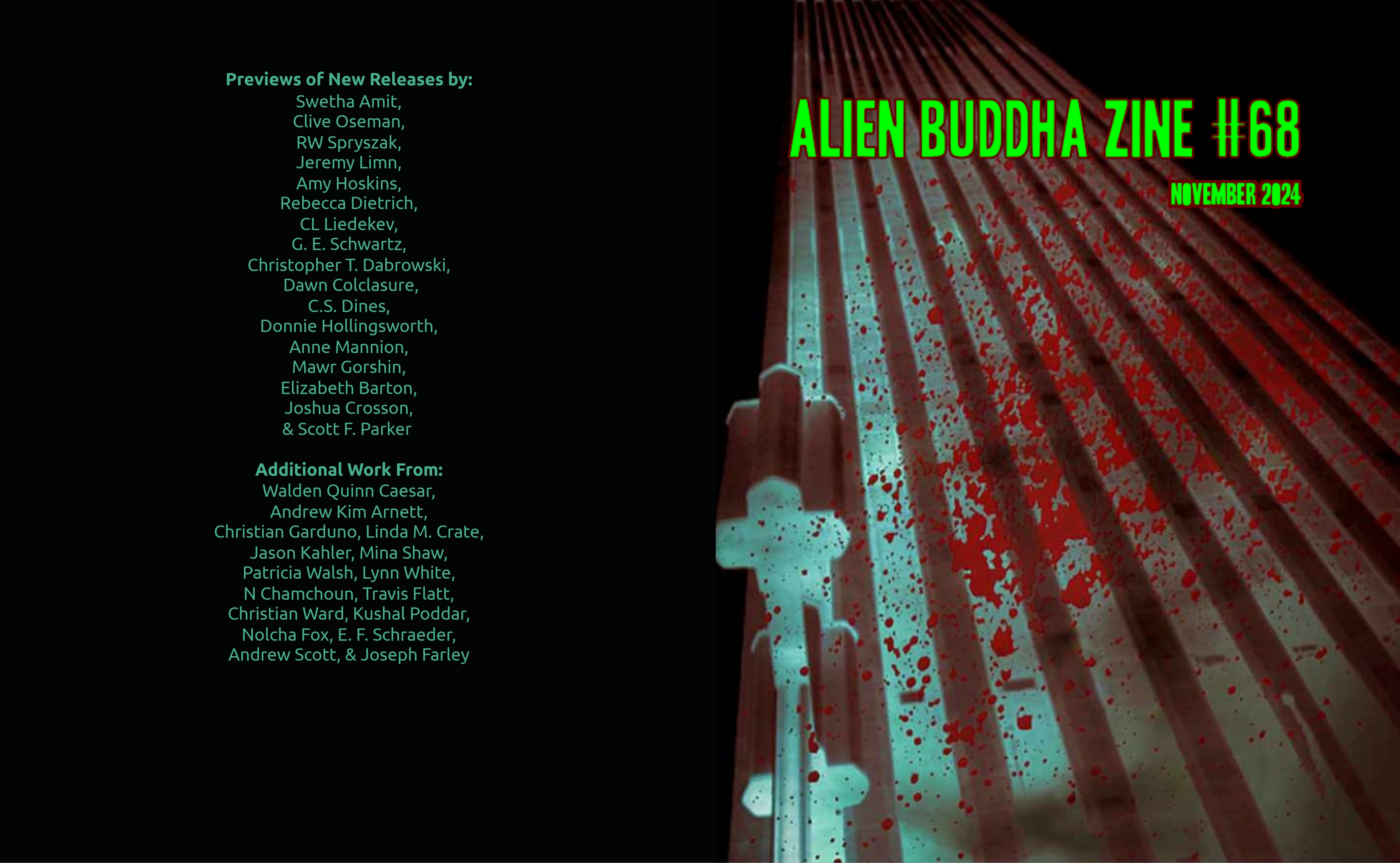
Chapter Eight from my novella, The Targeter, is being featured in Alien Buddha Zine #68, from Alien Buddha Press. It begins on page 34, with a copy of the cover of the novella:
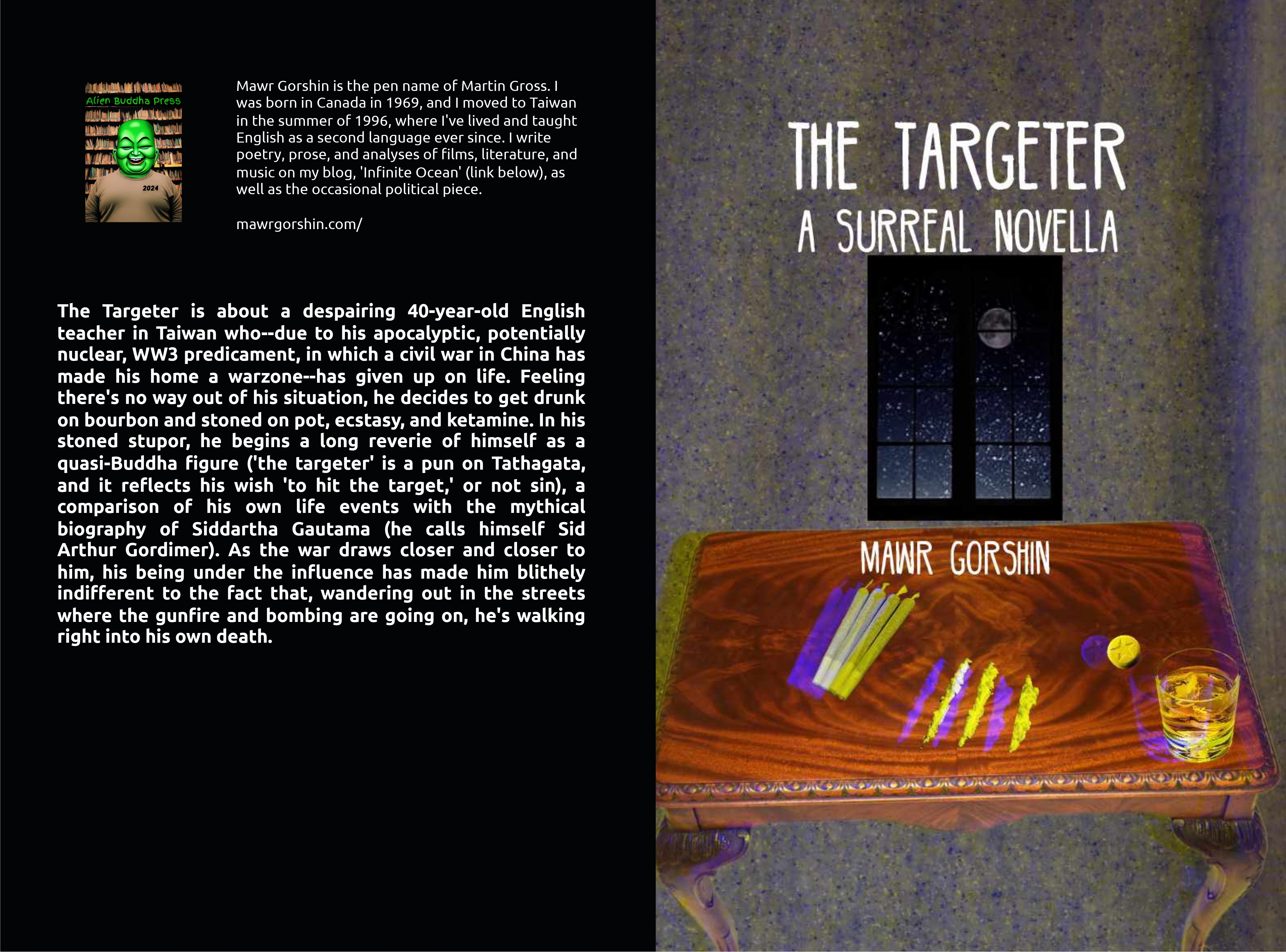
Then it goes into Chapter 8 of my novella, the chapter being a reverie of the titular character, named Sid Arthur Gordimer, who is drunk and high on a combination of marijuana, ecstasy, and ketamine. His thoughts drift back and forth in his reverie of being a prince in a mansion watching half-naked strippers dancing to electronic music in a party, then of being in a royal palace with Indian music.
His parents, the king and queen, are pressuring him into taking on the responsibilities of the crown…but of course, this is all just the reverie of a drunk, stoned man. Outside of Sid’s apartment, in the real world that he’s trying to escape with booze and drugs, a war is going on. Bombs and gunfire can be heard outside.
He knows he’s no saint, and no prince. He’s a goner.
Please check out the Alien Buddha Zine, which drops on October 29th and has lots of other talented writers in it…and please check out my novella!
After thoroughly checking all of the rooms on the second and third floors, Mr. Dan and Doug approached the bathroom, where Mr. Sandy had been before he was killed.
“Oh, no–now I have to use the can,” Doug said, then went in.
After he closed the door, Mr. Dan thought, And I have to find something just right for you, young man.
But first, he pulled down the attic stairs, then went up them. He peeked his head in, hearing Emily still cleaning up the blood.
“You just about finished up here?” he asked in Chinese.
“Almost,” she said in Chinese. “Just a little more to wipe up.”
“Well, hurry up,” he said. “I’m taking Hannah’s brother up here. He’s in the bathroom. He’s taking his time in there; I guess it’s a number two, but who knows? Maybe not. I’ll send something up to you. Wait to get it, but hurry with the cleaning!”
He went back down, heard Doug fart and grunt, and he surmised that, indeed, it had to be a number two. He’d have a little more time to find…something just right for Doug.
He went into a room next to the one with the boxes, looked around impatiently, and found a baseball bat. He heard some shuffling steps out in the hallway. Oh, no, he thought, Hannah’s brother. Then after a worried pause, he opened the door and looked out.
Nobody out in the hall.
The bathroom door was still closed.
Was Doug still crapping in there?
Mr. Dan went up to the bathroom door to listen. He heard another fart, the slipping out of shit, and a horrible stink.
He squished up his face in disgust, but was relieved that Doug was still in there and suspected nothing. Mr. Dan went up the attic steps with the baseball bat.
“Emily,” he called.
“What?” she said with surprise, looking back at him from the corner where she’d just finished cleaning. “I thought you were already up here. I heard–“
“No, not yet,” he said, then presented the bat. “Put this over there, then get out of here.”
She took the bat, put it in the corner opposite where she’d been cleaning, and rushed over to the attic stairs.
“I’ve got to clean all this blood off my–” she began as she went down the stairs.
“Shh!” he said. “Hurry up and get out of here before he comes out of the bathroom!”
She went down the hall and took the stairs to the second floor. As soon as she’d disappeared, Doug came out of the bathroom.
Mr. Dan let out a sigh of relief.
“What are you so relieved about, Mr. Dan?” Doug asked, looking askance at him.
“Oh, nothing,” Mr. Dan said with a smile and a slightly nervous chuckle. “I was just getting a little impatient waiting for you to finish, that’s all. Sorry about that.” He gestured to the pulled down attic stairs. “Shall we look in the attic now? It’s the only place we haven’t looked.”
“OK.”
They went up into the attic, Doug first.
He heard moaning in one corner of the attic and rushed over to see. “Dad? Mom?” he called out.
Meanwhile, Mr. Dan sneaked over to the other corner, picked up the bat where he’d seen Emily leave it, and hid it behind his legs by the time Doug looked back.
“There’s nobody here,” Doug said. “I heard moaning right from here, but there’s no source for the moans.”
“Really?” Mr. Dan said. “There’s a lot of shadow behind all those boxes. Look again.”
“I’m looking at the shadow behind the boxes, but there’s nothing–wait, under that blanket over there.”
As Doug was approaching it, Mr. Dan raised the bat over his head. “Goodbye, Doug,” he said in a female voice.
“Emily, are you up here?” Doug asked as he pulled back the blanket, revealing his parents’ bloody bodies. He gasped, his eyes widening.
“No, not Emily,” Mr. Dan said in that woman’s voice.
“Mei’s voice,” a young man said from behind Mr. Dan, who turned around to see who it was.
Now he gasped, his eyes widening.
Al swung the axe right at his father’s chest. Blood sprayed out when it dug deep into him.
Mr. Dan fell to the floor, the bat dropping and hitting him on the head. His blood grew into a large puddle all over the floor.
“Al, Jesus fuck!” Doug said. “How could you do that?”
“It wasn’t easy,” Al panted. “That’s for sure. I’m so sorry, Papa.” He bent down and closed his father’s eyes. “Goodbye. Forgive me. I had no choice.” He rose to his feet.
“Why would you kill your own dad, Al?”
“To stop him from bashing your brains in with that bat, of course.”
“What? Al, this is so fucked up! What’s going on? Why would your family…wanna kill my family? Oh, God…Mom, Dad…” He looked back at his parents’ corpses with tears forming in his eyes.
“Because the spirits of my ancestors are taking possession of my family’s bodies to take you all as sacrifices, so my ancestors won’t bother Hannah and me anymore,” Al said in a cold, monotone voice.
“What? What horseshit are you talking about?”
“My family stopped praying to the spirits of our ancestors years ago,” Al explained. “The spirits got angry because of this disrespect, and they’ve been plaguing our family ever since.” He put the axe down on the floor beside him, next to the bat.
“Spirits, Al?” Doug asked, looking at him with a sneer. “Seriously? Let’s face it: You’re a family of homicidal nutjobs. No offence intended to Chinese people in general, but I don’t want you anywhere near my sister!”
“I love Hannah more than anything, and I’m truly sorry for what happened to your parents,” Al said in sobs. “The spirits forced me to agree with this, so I could marry her one day and we could live in peace. If they know I’ve broken the agreement, they–“
“Fuck you, Al, you and your fucked-up family!” Doug bawled.
Al was silent as Doug looked down at his parents’ bodies and wept for them.
“Oh, no…NO!” Al suddenly said.
“What?” Doug said.
But before Doug could turn his head back and see what was going on, he felt a crack of the baseball bat on his head, knocking him out.
The ground under which the dead are buried
hides many crimes
& conceals the lies
with green grasses
The whole rest of the world works so hard,
barely hangs on,
& rarely rests its
sore, tired arms.
One day, those buried alive, the living dead
will rise up from
its prison grave
and eat the rich.
I: Introduction
Commando is a 1985 action film directed by Mark L. Lester and written by Steven E. de Souza, after a story by Joseph Loeb III, Matthew Weisman, and de Souza. It stars Arnold Schwarzenegger and Rae Dawn Chong, with Alyssa Milano, Vernon Wells, Bill Duke, Dan Hedaya, James Olson, and David Patrick Kelly.
The music score, noted for its use of steel drums, was by James Horner, and the film ends with a song by The Power Station called “We Fight for Love,” when Michael Des Barres replaced Robert Palmer as lead singer.
Here‘s a link to quotes from the film.
Giving the film a rating of 67% based on reviews from 36 critics, Rotten Tomatoes aptly describes Commando in its consensus as having a “threadbare plot, outsized action, and endless one-liners.” In other words, it’s a crowd-pleaser with all the gratuitous violence, swearing, and cheesy puns that a movie-going philistine could ever want.
So, Dear Reader, you’re probably wondering why I’m wasting my energy with this Hollywood schlock. Well, apart from the fact that the philistine in me finds this mindless entertainment amusing (the nostalgic memories of watching it as a teen in the 1980s being a big part of that amusement), the flash and excitement that Commando delivers is a distraction from the political undertones that I feel should be discussed.
II: A Brief Digression, If You’ll Indulge Me, Please
As should be obvious to anyone watching the film with his or her brain turned on, Commando contributes to the mythology of the US as the great saviour of other countries from tyranny and despotism. I’m not saying this as if it were a great revelation to you, Dear Reader: I bring this up because I want to discuss the social effects of movies like this, and how they brainwash Westerners, Americans especially, into cheering for US/NATO imperialism.
I was trying to do such commentary on another film aptly starring right-leaning Schwarzenegger, Conan the Barbarian. The reader response to that analysis was mixed: while one positive responder understood my intentions, to alert people to the hypnotizing danger of passively accepting Hollywood action films as US imperialist and right-wing libertarian propaganda (an example of the kind of thing Michael Parenti analyzed in his book, Inventing Reality), two others blasted my Conan analysis for seemingly opposing reasons.
The first negative responder was a woman who went out of her way to be as insulting as possible, saying my analysis was ‘so superficial as to be silly,’ and that during the Reagan era, pretty much all movies reflected a right-wing ideology, so apparently there’s no insight to be gained from describing Conan the way I did. First of all, many 1980s movies did obviously reflect a right-wing stance, but many others didn’t–take They Live, for instance, as an anti-Reagan film. Secondly, only someone with a right-wing bias (as I suspect she has) would see no value in critiquing Conan‘s right-wing agenda, since a left-wing sympathy would see that value. I’d say it was her reading of what I wrote that was “superficial” and “silly”: I suspect she read only the first few paragraphs, snorted and called it ‘stupid!’, then jumped to conclusions and made her snarky comments without bothering to read any further.
The second commenter took the opposite view, seeing my discussion of a right-wing libertarian, anti-communist allegory in Conan as “the most half-baked review” of a movie that he’d ever read. Then he ‘corrected’ me by pointing out something I myself stated, however briefly, in my analysis: that the film is about determination in rising up against one’s obstacles (speaking of pointing out the obvious, hence my brevity in stating it). Never mind that I flooded the analysis with links to prove my point about the allegory (i.e., the director’s right-wing leanings as well as those of Schwarzenegger’s, a link stating that Nazi salutes were done on the set, etc.). And what I wrote wasn’t a review (my saying whether or not I liked the film), but an analysis, stated plainly in the title (a discussion of themes, symbolism, allegory, etc.). So, was I stating the absurdly obvious, or was I going off on some “half-baked” tangent? I’m not sure.
My point in bringing up the Conan analysis and its negative responses is to say that this one of Commando is one of many articles in which I’m not just saying what I like or dislike about a film. The film analyses are about relating the content of the films with either political issues (typically from a Marxist-Leninist viewpoint) or with psychoanalytic ones (usually Freudian and post-Freudian, but recently, more and more Jungian).
That kind of analysis is what I do here on this blog; so if that’s not your thing, please read no further (I gave just such a warning at the beginning of my Conan analysis, which as I explained above, went unheeded at least twice). If, however, you do like how I relate film, literature, and music to leftist politics and psychoanalysis, then by all means, read on, Dear Reader.
III: Some Rather Needless Killing
The film begins with three men assassinated, all former members of the unit of US Army Special Forces Colonel John Matrix (Schwarzenegger). The first victim is shot by two men posing as garbagemen; the second of these two killers, Cooke (Duke), then kills a car salesman by running him over right in the dealership with the car he’s supposedly interested in buying; and the third victim, Bennett (Wells), is supposedly blown up in a boat, though we later learn that his death has been faked.
Matrix, it seems, is next to be assassinated.
As it turns out, though, he isn’t to be killed, but rather to be forced to assassinate the president of a fictional Latin American country, Val Verde, this man being someone Matrix originally helped put in power there, having ousted Arius (Hedaya), a brutal dictator who wants to be reinstated. If Matrix doesn’t cooperate, Arius will have his men kill Matrix’s pre-teen daughter, Jenny (Milano), whom they’ve kidnapped.
Here’s my point: why were those two men killed at the beginning of the film, with Bennett’s death faked? Apparently, Arius’ men (including Bennett) mean to agitate General Franklin Kirby (Olson) and get him to go to Matrix’s home to warn him personally that he’s probably next to die, and in the process Kirby will unwittingly help the bad guys know where Matrix lives.
This is an absurd way to get to Matrix, whose address (somewhere in upstate California, in the mountains) is presumably private for his and Jenny’s protection. Would Kirby be stupid enough to go there personally, risking leading the assassins right to Matrix? Couldn’t the killers just find another way to find him (e.g., paying someone in the army a handsome sum to disclose the address, etc.)? Wouldn’t it be better to catch Matrix off guard in a surprise attack?
It’s obvious that the killings at the beginning were just an excuse to have excitement for its own sake, to lull the audience in, to make them passive recipients of more pro-US propaganda.
IV: Matrix and Jenny
Of course, Schwarzenegger as tough guy Matrix is supposed to personify how ‘indestructible’ the American empire is (an empire that, incidentally, failed to defeat North Korea, lost against Vietnam, and similarly left Afghanistan with its tail between its legs). The liberals, however, can’t have their big hero be just a cold-hearted killer; we have to see his sensitive side, so during the opening credits and before Jenny’s kidnapping, we see some father/daughter quality time between Matrix and her.
While they’re eating sandwiches at home, he makes a cliché joke about gender-bending Boy George. Then he refers to his life as a boy in East Germany, and how the communists said that rock ‘n’ roll is “subversive.” While communists back in the 1950s and 1960s were probably much more socially conservative (as were, obviously, at least half of Americans back then) than in recent years (a lessening of conservatism that can’t be reasonably be said of those half of all Americans!), we’re meant to deem this old judgement of the communists as an example of how ‘repressive‘ they were and are. Matrix’s later quip that “Maybe they were right” is meant to be flippant, yet it tells us which people still have the repressive attitude…still by the 1980s and since then. Putin may not be sympathetic to LGBT people, but he hasn’t been a communist in decades.
Now, we’ve acknowledged that Matrix is of German background (presumably to rationalize Austrian Schwarzenegger’s undeniable accent), yet his name sounds utterly English, since we don’t want our American hero to seem inordinately Teutonic (shouldn’t his name be more like ‘Johann Meetrichs’?).
Given the film’s obvious agenda to glorify Anglo/American/NATO imperialism as comprising the ‘good guys,’ as against anyone who would dare defy said imperialism (Arius et al), the idea of having a German-American hero fighting those defiant of that imperialism (who, in real life, tend to be left-wing) strongly suggests the enlisting of fascists, at least symbolically. Matrix would have defected from East Germany early on, and the real purpose of the Berlin Wall, or Anti-fascist Protection Wall, as the East Germans called it, was just that: to keep the West German fascists out (i.e., those ex-Nazis who, rather than be punished for their war crimes, were given cushy jobs to fight the ‘commies’), as well as to keep East Germany from losing needed skilled workers.
Matrix’s leaving of the socialist state would have stemmed from an ideological hatred of socialism. Germans who hate socialism have historically leaned towards fascism as a protection against Marxism. The capitalist class has always used fascism to protect themselves against left-wing revolution, as have the petite bourgeoisie. The film’s negative portrayal of Latin Americans reinforces the idea that there’s a Nazi racist undertone here, as there was in Conan, as I argued in my analysis of it (see link above).
So what we see in German-American Matrix is a personification of the continuum between liberalism and fascism. He’s the sensitive father, as I discussed above in his relationship with Jenny at the beginning of the film, but she can be seen as personifying his threatened class interests when she’s kidnapped, making him ruthless in his lawless, bloody, and murderous quest to get her back. The fact that she’s a sweet, helpless, and sympathetic girl shouldn’t deflect us from seeing that cynical reality. Her sweetness, taken from an allegorical perspective, is being used as propaganda to justify all of his killing. More on that later.
My point is that liberals, seeming progressive in their goals on the surface, will betray that progressive agenda in a heartbeat if their class interests are at stake, and that’s what’s represented in Matrix’s quick switch from sensitive father to unflinching killer, thief, destroyer of property, kidnapper (however briefly, of Cindy [Chong]), etc.
Stalin once said that “Social-Democracy is objectively the moderate wing of fascism.” (Note that social democracy is the furthest left of liberalism.) His words may, on the surface, seem extreme, but put in their proper historical perspective, they are clearly understood. He said them in 1924, just five years after the social-democratic Weimar Republic had used the right-wing Freikorps to crush the Spartacist Uprising‘s attempt at a communist revolution in Germany, murdering Rosa Luxemburg and Karl Liebknecht. The Weimar Republic’s soft and ineffective rule would lead to great dissatisfaction on both the far left and far right, one thing would lead to another, and by the early 1930s, you-know-who would rise to power in Germany.
If the ‘far left’ of liberalism can lead to fascism, so can more ‘moderately left’ versions of it. We easily backslid from the welfare capitalism of the era of post-WWII economic prosperity to the ‘free market’ capitalism of the Reagan/Thatcher years, and thence to the far-right nightmare of recent decades, all thanks to the dissolution of the Soviet Union, which meant that a large welfare state was no longer needed to ward off the danger of proletarian revolution in the West. We’d reached ‘the end of history,’ and the ruling class no longer felt threatened by the working class.
That liberals today are supporting literal fascists in Ukraine and Israel should help you see the truth in Stalin’s words, Dear Reader.
V: Making Matrix Aid Arius’ Revolution
We never learn of Arius’ political ideology; we only know that he’s a brutal dictator, who’s “tortured and killed” those who have resisted him. But is he on the left, or the right?
He’s a Latin American, a former ruler of Val Verde, as I mentioned above. We know that Matrix helped overthrow Arius and put a new president, Velasquez, in power. Here’s the funny thing, though: the US army, CIA, etc. like putting brutal right-wing dictators in power in Latin America.
Indeed, the American government has a history of intervening in other countries’ political affairs, typically replacing democratically-elected heads of state with ones that further the capitalist/imperialist interests of the US/NATO countries. Examples include Iran in 1953, Guatemala in 1954, Chile in 1973…and more recently, Ukraine in 2014, and Bolivia in 2019, as well as attempted coups in places like Venezuela. One should look into US support for Operation Condor, too.
Of course, the Western corporate media likes to portray these interventions as ‘triumphs of freedom and democracy,’ when actually they were anything but. So we shouldn’t be surprised to see the ousting of Arius and replacement of him by US-backed Velasquez in Commando as portrayed as a good thing. It’s all just part of the propaganda used to make the US look like the good guys, while men like Arius are vilified.
So the very idea of the American military, as represented by Matrix, as not wanting to help spearhead a coup and install a dictator is ludicrous. Pinochet was the Arius of Chile in the 1970s, responsible for the deaths and disappearances of thousands of dissident Chileans, including dropping some of them from helicopters. The CIA helped put Pinochet in power, a “scumbag” who “tortured and killed” many, yet I doubt that any in the US military would have applied Matrix’s words to Pinochet the way Matrix applied them to Arius.
So Matrix not wanting to overthrow a Latin American government and replacing it with that of a brutal right-wing dictator is sheer denial on the part of the propagandists making this film. Moviegoers who see this film, knowing little if anything about the true political state of affairs in the world, will just eat up this propaganda uncritically, absorbing it and imagining that what the film portrays more or less corresponds with what the US government’s role in world affairs really is: the ‘policemen’ of the world, fighting tyranny and oppression everywhere, rather than the cause of so much of it.
This is a dangerous message to send to Western audiences, reinforcing a myth of our supposed superiority, which in turn is used to justify more and more imperial conquests, killing more and more innocent people. This urge to impose ‘freedom and democracy’ has led to possibly a million Iraqi deaths, and the destruction of Libya, changing it from a prosperous nation that took care of its people to a failed state with a slave trade. The current wish to bring ‘freedom and democracy’ to Russia and China could lead to a very nuclear WWIII, killing everyone on the globe.
Since Commando was made in the mid-1980s, I wonder why the film didn’t portray Arius as a left-wing dictator, but just as a generic one. Surely portraying him as a ‘commie’ would have made for effective Cold War propaganda, wouldn’t it have? Perhaps they didn’t specify his ideology because they knew enough left-wing critics still existed in the 1980s to trash the film for being even more obvious right-wing propaganda than it was and is. Still, for the reasons I’ve given above, it makes more sense for Arius to have a left-wing, rather than right-wing, ideology, so we’ll just go with that, remembering that his vilification, as well as the dehumanizing of his troops, is all part of Commando‘s obvious right-wing agenda.
VI: The Female Factor
Getting Cindy, an off-duty flight attendant, to help Matrix without there being any sexual chemistry between these attractive male and female leads seems as if this film is an example of the emerging kind that is trying to show more respect to female characters (her firing a rocket launcher correctly…on the second try; her flying a seaplane, etc.), especially since she’s a POC. Still, there’s plenty of sexism against women to keep Commando far behind more recent action films, which are sure to include women kicking lots of ass.
Poor Cindy is frequently treated like a whore, even explicitly called one by predatory Sully (Kelly, whom you’ll recall clinking those bottles together at the climax of The Warriors), leaving her in a huff for not letting him have his way with her. Later, without asking for her consent, in Sully’s motel room and waiting for Cooke, Matrix opens her top to make her look easy, that is, having indeed let Sully have his way with her. Even a cop, who’s later helped apprehend Matrix for trying to rob an army surplus store, sees her in a car next the cops’ truck and assumes she’s a “hooker.”
Earlier, Sully–asshole that he is–jokes in the airport about having “a little more time with” kidnapped Jenny. At the end of the film, Matrix carries her on his shoulder as if this damsel-in-distress were a prize he’s won after killing everyone else.
But the crowning piece of sexism in the film is the gratuitous display of a woman’s large, shaking breasts in a motel room next to Sully’s during Matrix’s fight with Cooke. It’s a completely unnecessary moment of titillation mixed with humour, meant as one of many examples of Commando‘s use of visuals to dazzle and distract the viewer as he or she absorbs the pro-US propaganda without thinking.
(By the way, Ava Cadell, who played the woman in the motel scene, has since become a therapist with a doctorate from Newport University, California. She has written a number of books on sexuality, has done lectures, and given counseling to couples on personal issues. Here’s her website. As we can see, she’s risen far above doing mere cheesecake roles in schlocky Hollywood movies.)
VII: Rescuing Jenny
Rescuing a damsel in distress is more acceptable in the modern world, of course, if she’s a child. Our sympathy for her is what makes the wiping out of everyone else on the island where she’s being held hostage seem perfectly justified.
Commando, however, is just a movie. It isn’t reality. As a piece of American propaganda, it causes us to transfer our desensitizing of the brutal killing of all the dehumanized Latin American soldiers to the killing of any other people in the world, be they soldiers or civilians, who in any way stand between the US/NATO empire and the achievement of its goals.
Part of ensuring the audience’s desensitizing to the deaths of the soldiers is a showering of contempt on them and their worth. Bennett tells Arius that his “little pissant soldiers…are nothing.” This sort of devaluing of them makes it all the easier for the audience to watch them all die.
On the other side of the coin, Matrix’s killing of them all comes with nary a scratch on his body, for he personifies the invincibility of the American empire. Indeed, one of the particularly ludicrous aspects of Commando is how Matrix can single-handedly wipe out so many dozens of soldiers, and not even one of them can get a lucky shot and give him a significant wound, let alone kill him.
The tool shed scene, apart from showcasing gratuitous violence for the sheer fun of it, demonstrates that shaving off the top of a man’s head with a small buzzsaw blade thrown like a Frisbee (in the director’s cut, a second buzzsaw blade hits a guy in the neck), the stabbing of an axe into a soldier’s balls, and the hacking off of a man’s arm with a machete are not horrifying sights to see, but exciting ones.
The message given throughout the film is that, since Matrix can break one law after another with impunity to save Jenny, and since he personifies American military might, then the US government, military, and intelligence are free to disregard international law, UN Security Council Resolutions, etc., to achieve their objectives and maintain their global hegemony.
Let’s see how these issues translate into the politics of the real world. Israel, properly seen as an extension of Western imperialism into the Middle East, has been given carte blanche by the US government to kill and maim as many Gazans as they like. The rationalization?…to rescue a number of Israeli hostages taken by Hamas on October 7th of 2023, rather like the kidnapping of Jenny. Where all those killed in Commando are soldiers, most, if not almost all, of the Gazans being killed are innocent civilians, including women and children.
Israel has made incursions into the West Bank, and the detonating of pagers in Lebanon–as well as airstrikes on several buildings in Beirut–has killed and injured many there, too, though there’s a similar rationale…the need to wipe out Hezbollah. The UN has, by the way, acknowledged that the armed resistance of fighters like Hamas is legitimate against an occupying force like Israel, but to the Zionist apologist, Hamas and Hezbollah are ‘terrorists’ whom he or she would surely sneer at as “little pissant soldiers” who “are nothing.”
Elsewhere, the Nord Stream pipelines were blown up by the US, with the help of Norway–an act of ecoterrorism practically confessed to by the American government. Seymour Hersh, the acclaimed investigative journalist who exposed the My Lai Massacre back in 1968, found conclusive, detailed evidence of how this crime was committed, yet the mainstream, corporate, imperialist media absurdly blamed the attack on Russia. How predictable. The motive behind this terrorist act, apart from the usual Russophobia/anti-Putin agenda (their ‘unprovoked’ invasion of Ukraine), was to stop Germany from buying cheap Russian oil and forcing the country to buy American oil.
Needless to say, the US government hasn’t been punished, nor will be, for this crime any more than Israel will be for her crimes against humanity. We, the general public, shrug these crimes off, or at least are expected to, just as we do the excesses of Matrix’s violence, all to rescue one little girl, who personifies his threatened class interests as I said above, and who is carried on his shoulder at the film’s end as a kind of trophy.
When Kirby, who has arrived with his army at that time, asks Matrix what he’s left for them, he callously says, “Just bodies.” Matrix then refuses to resume working for Kirby as a soldier, wanting instead to be the nice, sensitive father to Jenny; but as with any liberal, being the nice guy comes only when one’s class interests (symbolic ones in Matrix’s case) aren’t being threatened.
VIII: Confession, Projection, and Denial
In a conversation with Cindy in Sully’s car on the way to the motel to confront Cooke, Matrix explains why he has to rescue Jenny. In the process, he goes into a kind of confession of guilt, not only about how he, constantly on assignment as a Special Forces man somewhere on the other side of the world (Laos, Angola, Lebanon, Pakistan, etc.), has never had time to be with Jenny, but also about how he did “things you don’t want to know about,” and which he wishes he didn’t know he’d done.
Bennett, we learn, was kicked out of Matrix’s unit for being excessively violent (and this is why he, wanting to get revenge on Matrix for his expulsion, is willing to help Arius “for nothing,” to get a chance to get at Matrix). Yet given what we know Matrix has implied in his confession to Cindy, and what we know of his brutal killing of so many in this film…including his killing of Bennett, to get him to “let off some steam,” it’s hard to imagine Bennett being all that much more violent.
It should be obvious that, Matrix representing American militarism and seeing Bennett and Arius as far worse than he, the film’s pro-US propaganda tries to excuse American violence by projecting it out to other countries. Bennett, significantly, is Australian–just listen to his accent. Arius is Latin American. These latter two are so awful, apparently, that Matrix, and therefore the US, can’t be all that bad.
So in giving his brief confession, implying the awful things he’s done, while projecting far worse guilt onto people from other countries, Matrix–in spite of his constant violence and lawlessness, like that of the US, as I’ve explained above–can still be regarded as the liberal ‘good guy,’ as politicians like the Clintons, Obama, Biden, and Harris can be seen. One can safely deny being as bad as the antagonists are, and the protagonists’ guilt will be ignored and forgotten about by moviegoing lovers of action films.
Another thing that will be ignored and forgotten in Commando is the political ideology that Arius must have, as is typical of any Latin American head of state that opposes American imperial hegemony and ends up being ousted in a coup d’état. Such an ideology is glossed over and disregarded: all we know is that Arius believes the people of Val Verde need “an understanding of discipline,” which sounds unsettling coming from a generic ‘dictator,’ whom many in the audience would imagine to be a left-wing one, as I’m assuming Arius is.
Now, Marxism-Leninism does have an understanding of party discipline, but it isn’t anything brutal, as Arius is implying in Commando‘s propagandistic script. It’s about organizing the working class to rise up in revolution and defeat the ruling class, thus liberating the people from oppression, not subjecting them to oppression, the latter of which is what US puppets like Pinochet did to their people. As for how “extremist” a left-wing political ideology is, just read the <<<link. You won’t know the truth of the matter by watching Arius’ caricature of it.
IX: Conclusion
I hope, Dear Reader, that if you’ve read this far, that you understand my intentions in writing this analysis of Commando. I know it’s no Earth-shattering revelation that the film has a right-wing agenda: my purpose is to explore the political ramifications and social effects of said agenda, to warn of its dangers on a public not aware of how consent is manufactured for war and its atrocities.
The ‘tangents’ I went off on in elucidating these political and social implications, far from being “half-baked,” are the whole point of the article. People need to be conscious of the political wool being pulled over their eyes, not to be told, “Oh, come on, it’s just a movie. Lighten up!”
 Infinite Ocean
You must be logged in to post a comment.