‘The Splitting,’ a Sci-Fi Horror Novel, Book III, Chapter One

[I have just republished an expanded version of the entire novel, with added scenes and further character development. Instead of publishing it chapter by chapter, which would have been too much of a pain, I did it book by book. Here are links to the four books: I, II, III, and IV. As you can see, I’ve also left the original, shorter versions published, because replacing them all with the expanded version would also have been too much of a pain. So I leave you, Dear Reader, with the choice of the shorter versions or the longer ones. You are free to choose whichever ones you prefer: a quicker but less-developed read, or a longer and fuller story. Either way, I hope you like my story.]

2032, Puerto Ayacucho, Amazonas, Venezuela

Sergeant Dan Miller, of the United City States Army, Exxon-Mobil Division, saluted Captain Finch as both of them were about to enter their office in their nine-year-old military installation. Both men had coffees in their hands, and they’d just finished lunch.

“Did you have a good lunch, sir?” Miller asked as his saluting hand came down.

“Yes, I did, Dan,” Finch said as his came down and they entered. “How about you?”

“Oh, fine, sir. I must say, I like the food here much better than I did in the Samsung base in Seoul, where I was posted a couple years ago. I hate kimchi, but the corn, rice, and beans here are a lot better. I’m so glad we kicked all the commies out of this place, that old Maduro government, and that Exxon-Mobil is running things in Caracas.”

“I couldn’t agree more,” Finch said, looking away and his smile fading. “This whole continent is our backyard. We have far better use for the locals’ oil reserves than they do. Anyway, have those reports on my desk by 1400J.”

“Yes, sir,” Miller said, and went over to the filing cabinet, which was on the wall opposite to Finch’s office, where Finch went in and closed the door.

A minute later, Sergeant Judy West, of the Shell Oil Company’s air force, entered the office. “Good afternoon, Sergeant,” she said.

“Hi, Sergeant,” he said, looking away from his files. “How can I help you today?”

“Oh, I was just wondering if you were aware of any reports of alien activity here in Amazonas.”

“Not much of anything,” he said. “How’s things going in Africa, with the airstrikes and the drones spraying those glowing little bastards?”

“Well, after a year of it, we’ve killed many of them, but they’ve killed many more of ours,” she said. “At best, it’s been a stalemate; at worst, it could become Vietnam and Afghanistan, all over again.”

“Fuck,” he grunted. “Why can’t the good guys win, for a change?”

“I know how you feel,” she said, looking away and frowning. “Anyway, do you know of any rumours that there could be carriers of the aliens among us? Not necessarily here in this base, but maybe in other bases in South America, American soldiers who could be possessed by those little balls of light?”

“I’ve heard a rumour or two, a few suspicions, but nothing more than that.”

“Can you name any names of suspected military people?” she asked. “Even the vaguest lead could help.”

“No, no names, sorry. I wish I knew some, I really wish I did. I’d love to have an opportunity or two to fuck them up. I hate those sons o’ bitches.”

“Oh, I know the feeling,” she said with a sigh and a scowl. “If you learn of anything, just let me know. Here’s my name card.” She gave it to him.

“Thanks,” he said, taking it and putting it in his pocket. “In the meantime, though, I have my trusty can of bug spray here.” He gestured to it, fastened to his belt, as was standard for all military uniforms. “The very second I see any of them, my first reaction won’t be to call you, understand. Instead, I’ll zap the shiny little cocksuckers. Watch ’em die like the little cockroaches they are.”

“Well, you may encounter them pretty soon in the future,” she said. “We have intelligence that they’re infiltrating the whole Global South: not only here and Africa, but also Southeast Asia.”

“I’d enjoy a chance to kill some of ’em,” he said, with his back to her and looking at his files again. “Bring ’em on.”

“You may get that chance sooner than you think.”

“Oh?”

He looked behind.

His eyes and mouth widened.

Those glowing little bastards were flying from her fingers.

He got out his can of bug spray as quick as lightning and sprayed the half dozen of them that flew out in front. They all fell, tapping and bouncing on the wooden floor beside him.

“You little whore!” he shouted, reaching for a pistol he had hidden in the filing cabinet, in case of alien carrier emergency. He pointed it at her. “Now it’s time for you to die, you alien carrier bitch.”

But before he could pull the trigger, Bolshivarian balls of light were entering him in his back. Shaking and grunting in pain, he pointed the gun up to the ceiling and pulled the trigger.

Click.

He still had the safety on.

Still shaking and grunting, he dropped the gun and fell to the floor. The familiar red cracks were showing all over his face and hands.

Luckily for his assailants, his grunts of pain weren’t loud enough to attract the attention of anyone outside. West and Finch approached Miller, looked down with blank expressions at him from either side of his fidgeting body, and watched him begin to rip apart, tearing holes in his uniform.

“Open the window,” Finch told her. “We need to get the toxins out of the room.”

“Yes, sir,” she said, walking around Miller and the sprayed area to get to the window.

Finch watched as Miller’s flesh was ripping open, exposing his brain, trachea, stomach, bladder, and leg muscles. His ribcage was broken out wide open, like two doors to a welcoming entrance, to expose his heart and lungs. His uniform shirt and pants were in shreds.

The torn-open innards had mouth-like holes formed in them, grunting, “No. No. No. No. Get out. Get out of me.”

“It’s a good thing most of everyone else is still at lunch,” Finch said. “We can’t have anyone seeing this.”

Miller’s body exploded, spraying his blood everywhere. Finch and West dodged the red spray in time, getting only a minimal amount of tiny dots of blood on their uniforms.

“I’ll go outside and use our energy to influence everyone to stay away from this office,” Finch said, heading for the door outside. “Our Bolshivarian technology fortunately can clean up this mess far quicker than human hands. Then we can honour our fallen ones lying there among his body parts.”

“Yes, sir,” she said in a choked-up voice, watching him go out the door.

The remaining balls of light came out of her, careful to keep their distance from the bug spray toxins still in the air. The lights pushed the toxins out the window; then they made the blood disappear off the walls, Miller’s desk, her uniform, and the floor. It was a slow fading away of red, but it was ultimately faster than rags, a bucket of water, and mops would have been.

Once Miller’s body parts were picked up and disposed of, she had time to look at the marble-like balls on the floor, those that used to glow with life.

Before picking them up for burial, she needed a moment to weep for them.

‘The Splitting,’ a Sci-Fi Horror Novel, Book II, Chapter Twelve

Back in their hotel in Luanda that night, Peter, Michelle, and Bob slept much better than the night before. The Bolshivarian lights in Bob’s body gave him a psychic connection with Phil that soothed him to sleep; some of those lights also flew into Peter’s and Michelle’s room to soothe them to sleep with the energy of their parents.

Michelle especially slept like a baby. Her connection with her parents felt so comforting, it was almost as if they’d never died. She felt the Bolshivarians to be the surest of friends.

Peter enjoyed no less restful a sleep, hearing the loving words of his parents’ energy calming him. Still, though he enjoyed his sleep and woke up the next morning thoroughly refreshed, he wasn’t sure if it was his parents that had lulled him into such a perfect sleep, or just the skillful, yet deceptive, charm of the Bolshivarians.

The next morning, after breakfast, Bob apprised Peter and Michelle of the situation regarding the American response to the Bolshivarian takeover of Africa.

“The first of the airstrikes is coming today,” he told them. “The Bolshivarians informed me of their plan to engage the fighter planes and drones, which will hit us not only with missiles and gunfire from the planes, but also with bug spray from the drones.”

“How will the Bolshivarians be able to counterattack with bug spray shooting at them?” Peter asked.

“They didn’t tell me exactly how they were going to avoid the bug spray, but they’re aware of the danger and planning a way to evade it,” Bob said. “Don’t worry: the Bolshivarians are clever enough not to let themselves be exposed to the drones’ spray guns, which our intelligence tells us will all spray only forward. We can sneak up from behind and their radar won’t pick us up. The American and NATO forces are the ones who need to be cleverer, not our side.”

“How will the Bolshivarians fight them?” Peter asked.

“They’ll fly into the planes’ cockpits and into the bodies of the pilots,” Bob said. “You know what happens next.”

“What if the pilots wear those protective suits?” Michelle asked.

“Oh, everybody knows by now that those suits never worked,” Bob said. “Bolshivarians can fly through them with ease.”

“If so, then why did they let people think they were safe in the suits last year?” Michelle asked.

“For several reasons,” Bob explained. “First of all, we wanted humans to have some sense of hope, so they wouldn’t feel all hopeless and despairing. Secondly, we came to Earth right when you humans were so worried about all those coronavirus variants. We wanted you, for the time being, to think our presence was just another disease, to distract you until enough of us had settled in and established enough carriers around the world so we could move around among you and blend in with you, so you wouldn’t be able to tell which ones were carriers and which ones weren’t.”

Clever plan, Peter thought, and devious.

Bob looked at him as if he’d heard Peter say those words out loud. “We’re here to help you, Peter, not to dominate you. Our ways may be strange to you, but that doesn’t mean we have ill intentions.”

Whoa, Peter thought with widened eyes. The Bolshivarians can read my thoughts. I’d better bury my feelings deeper down in my mind from now on.

“We know your doubts, Peter,” Bob said. “But we don’t doubt you. Don’t worry.”

“I don’t doubt you,” Michelle said.

“Even though they killed your dad, my dad, and my mother?” Peter said, glaring at her.

“You know the real reason they died,” Bob said.

“I know your rationalization for it,” Peter said, and then with sarcasm, “‘They rejected the new way, so their deaths were their fault, not yours’.”

“Our parents still exist in spirit, Peter,” Michelle said. “Didn’t you feel them last night?”

“Did we feel their spirits, or did we feel hallucinations?” Peter asked, looking hard at Bob.

“Peter, if we Bolshivarians had wanted to kill all of humanity, we could have done it like that!” Bob said with a snap of his fingers. “If we’d wanted to take control of all of your bodies and enslave you, we could have done it like that!” He snapped his fingers again. “But we didn’t. We could have gotten through every protective suit and either controlled or killed every head of state in your world, every CEO/leader of every city-state government, with none of you able to stop us, in the blink of an eye! But we didn’t…and many, many Bolshivarians have died because of the fluke discovery of bug spray toxins.”

Now Peter looked down at his hands.

“We want to save your planet and your people from destruction, but before we can do that, we need to gain the trust of at least a reasonable number of you, and gain the willful cooperation of enough of you. We’ve given as many of you as we can a chance to choose either to work with us or against us. We’ve allowed many to be non-carriers, because we want your friendship by free will. Even those who’ve died, like your parents, can still communicate with you through our collective psychic energy. Can you please try to trust us, Peter?”

Peter looked at Bob for several seconds.

“They cured the world of the coronaviruses, didn’t they?” Michelle added. “You, Peter, of all people, should be grateful to the Bolshivarians for doing away with the masks and vaccines, right?”

“Yeah, you’re right,” Peter said. “Wayne Grey did pull that off. I’ll give him that. I wish I hadn’t punched him.”

“And those were not hallucinations of my mom and dad,” Michelle said in a shaky voice, looking in Peter’s eyes with pain and conviction.

Can you try to trust us, Peter?” Bob asked again.

“OK,” he said. “I’ll try. The governments here on Earth have certainly proved themselves untrustworthy.”

“Good,” Bob said. “Now let’s get ready for those airstrikes.”

************

Four hours later, Bob was in his room, sitting crosslegged on his bed in a meditative position. The balls of light were floating on all sides around his body. He could feel the messages the Bolshivarians from other parts of Angola, including those of the warehouse hideout, were sending him.

Oh, no! he thought.

Peter and Michelle were in their room, too, lying on their bed in each other’s arms and waiting for Bob to tell them what was going on.

From outside their window, they could hear approaching planes.

Just as they got off their bed to look out the window, Bob rushed into their room.

“Hey, Bob!” Michelle shouted in annoyance. “We could have been indecent in here!”

“Sorry,” he said. racing for that window. “I didn’t have time to knock.” All three of them looked out the window.

Four fighter planes were approaching, accompanied by half a dozen small, brown ovoid drones with spray guns on them.

“Just as I feared,” he said. “Not only did they know that Lenny Van der Meer and the other Bolshivarian carriers are hiding out in that warehouse, but they know we’re here, too!”

“Who informed the Americans?” Peter asked. “Were there spies hiding out in that basement? Are there spies here in this hotel?”

“Unlikely, bordering on impossible,” Bob said. “We’d have been able to sense treason among us; it would take an extraordinary ability to bury one’s feelings for us not to sense traitors. Spies must have been hiding out among the trees or bushes outside.”

“There aren’t many trees or bushes to hide behind around here, or near that warehouse,” Peter said. “Years of global warming and wildfires have ensured that.”

“Not many trees or bushes, but enough for, say, one or two spies to hide among,” Bob said. “In any case, somebody from outside, somewhere, found our people there…and here. We’ve gotta get out of here. Move!

The three of them rushed out of the room, down the hall, and down a flight of stairs to the ground floor. Just as they were making a run for the front doors, the striking of the first missile shook the building.

“Oh, shit!” Peter shouted.

“Are these the same fighters and drones that hit the warehouse, do you think?” Michelle asked.

“No,” Bob said. “Lenny and his people took them all out as I described before.”

“So, Lenny’s still alive?” Peter asked.

“As far as I know, yes,” Bob said. “Let’s just hope the Bolshivarians here can be as successful.”

Three more strikes shook the building, causing it to collapse. Peter, Michelle, and Bob screamed before losing consciousness and being buried in rubble by the front door.

Outside, drones were shooting bug spray at swarms of dots of light flying at them; after a dozen or so of lights flying in front were sprayed, all of them lost their light and fell like marbles on the ground, all lifeless. Then, the fighter jets shot at the carriers who’d been sending up the lights. They all lay on the ground in a bloody lake.

These victims, however, were just a sacrificial distraction.

A swarm of Bolshivarian lights far greater in number were flying behind all the jets and drones. None of their radar could detect the approach of the lights, whose advanced alien technology could easily evade being picked up by radio airwaves.

The overconfident pilots had no idea what was coming at them.

The first man to feel the tiny lights entering his body screamed. His jet veered to the right as he fidgeted and struggled in his seat, feeling his body tearing to pieces and ripping out of his uniform.

“James, what’s wrong?” the pilot to his right said; but before he could say any more, James’s plane crashed into his. A huge explosion lit up the sky. Three drones flying nearby also got destroyed in the explosion.

A number of carriers looking up from the ground cheered when they saw the explosion.

“Half of the threat gone, all at once!” one of them shouted.

Sadly, he was gunned down, seconds after, by one of the two remaining fighter jets.

The remaining carriers sent up their balls of light; one of the drones sprayed them, causing them all to drop on the ground, as lightless and lifeless as the other ‘marbles.’ Then the fighter jets shot at the carriers and left them all in a pool of gore.

Meanwhile, the other two drones turned around to face the swarm of lights behind. They sprayed at the leading dozen or two of them, causing them and many more behind to fall on the ground. The third drone turned around to help the other two.

Now, the remaining carriers were free to shoot their lights up at the two fighter jets.

As the pilots screamed, fidgeted in their seats, and felt their splitting bodies rip out of their uniforms, the lights took control of the jets, aimed their guns at the three drones, and shot at them.

The carriers cheered as they saw the drones explode up in the air. Then they dodged out of the way when the two jets fell to the ground, a few feet away on either side of the hotel, and blew up in flames.

The surviving Bolshivarian lights flew over to the rubble of the hotel, soon to be joined by the surviving carriers, who ran over. The lights scanned the rubble for signs of life: only three were found to be still alive, and barely so–Peter, Michelle, and Bob.

The carriers, about a dozen of them, worked fast to pull the pieces of brick off the bodies of the injured three. Bob was unconscious, approaching death; Peter and Michelle lay there, hovering between consciousness and unconsciousness, moaning and sighing.

The lights hovered above and around the three. Their light and warmth touched the three hurt bodies.

Bob, being the closest to death, was the priority. The lights scanned his vital signs: his pulse was extremely weak and rhythmically irregular. He had broken bones all over. He was bathed in his blood; his life was fading fast.

Even with all the Bolshivarians’ medical knowledge, centuries in advance of that of humanity, they couldn’t save Bob. Since Peter and Michelle also urgently needed help, they switched their focus onto them. They weren’t as near death as Bob had been, but they weren’t much further away from death, either.

A crowd of people, carriers and non-carriers, watched the process of treating Peter and Michelle. Their eyes were locked on the two injured–eyes full of worry. A tense several hours ensued.

Peter’s and Michelle’s broken and fractured bones, their cuts and bruises, were hardly fewer than those on Bob. All onlookers, including the carriers, who knew of the Bolshivarians’ abilities, and even the Bolshivarian lights themselves, were full of doubts as to whether or not they could save the two.

Their pulses, though not as bad as Bob’s, were still weak and irregular. They showed considerable shortness of breath. The struggle to heal them involved a back-and-forth movement between weaker and stronger pulses, more and less irregular pulses, and greater and lesser shortness of breath.

Broken bones were set, fractures were healed millimetre by millimetre, bruises and cuts ever so slowly faded away–the bloody red slashes lengthening, shortening, and lengthening and shortening over and over again, the blotches of black, blue, and purple shrinking, growing, and shrinking again and again.

But finally, the white lights’ healing efforts succeeded here where they hadn’t been able to with Bob. Non-carriers–local Angolans as sympathetic to the Bolshivarians as Peter and Michelle–watched with dropped jaws and agape eyes at the aliens’ ability to bring Peter and Michelle fully back to health, all in only three to four hours.

Peter and Michelle, of course, were no less amazed.

“What?” he said, getting up slowly and awkwardly.

“We’re better?” Michelle said, also getting up and testing her arms and legs by moving them around. “So quickly? How could they do that?”

“To explain to you what Bolshivarian medicine can do,” one of the carriers said, “would be like explaining computers to cavemen.”

Peter and Michelle looked down at Bob’s lifeless body.

“He didn’t make it?” Michelle asked.

They could feel a sad answer in the negative from the floating lights.

Peter moved his body around, to test how well he’d been healed. “Wow,” he said. “The Bolshivarians make our doctors look like…well, witch doctors in comparison.”

Now do you trust them?” she asked with a sneer.

“Yeah, I guess I do,” he said.

“If only their skill could have saved my mom,” she said with a frown. “I guess she was as close to death as Bob here, too close to be saved.”

Peter’s cellphone rang. “Wow,” he said as he pulled it out of his pants pocket. “My phone didn’t get damaged. Hello?”

“Peter?” a woman’s voice said. “This is Karen Finley. It’s a good thing you gave us your cellphone number yesterday. Are you and Michelle OK? We know about the attack on your hotel.”

“Oh, hi, Karen,” he said. “We’re OK now. The Bolshivarians just saved our lives after the fighter jets hit our hotel. They’re the most amazing doctors.”

“I’m glad for that,” she said. “That’s so awful, what happened to you there. I’m so sorry.”

“How did you know the jets attacked us here?” he asked.

“The Bolshivarians told us,” she said. “They can find out anything, you know, if they focus on it. First, we learned about the warehouse being hit, then Tory and I wondered if you two were OK, so we asked them.”

“Thanks for your concern,” he said.

“Wait,” she said. “Tory wants to talk to you.” She gave her phone to her husband.

“OK,” Peter said. “Hello, Tory?”

“Hi,” Tory said. “Lenny says we’re all going to have to get out of Africa. More airstrikes are planned. Now that we’ve seen how badly the Americans and NATO can hit us, how well they can find us, thanks to their spies, the plan is to go to South America, where the Bolshivarians have many contacts who will help us. Lenny and his contacts here have arranged airplanes to take us there. There’s an airbase not far from where the warehouse was. The Bolshivarians can guide you to it. We all have to hurry, though, OK?”

“OK,” Peter said. “Thanks for the call. We’ll get over there right away. Bye.” They hung up.

“What’s the plan?” Michelle asked.

“We’re going to South America.”

“South America?” she asked.

“Yes, and we gotta hurry,” he said, taking her by the hand. “I’ll explain on the way. Let’s go.”

“B-but Peter?…” she said.

Michelle, Bob’s voice said in her mind. Go!

Yes, Michelle, Siobhan’s voice now said. Go with Peter.

Peter and Michelle started running towards a car one of the carriers was gesturing to.

END OF BOOK TWO

‘The Splitting,’ a Sci-Fi Horror Novel, Book II, Chapter Eleven

None of the three of them slept well that night. Bob could feel, through the energy of the alien balls of light in his body, the psychic presence of Phil trying to console him, though it wasn’t enough to stop Bob’s sobbing or to help him sleep.

All Michelle could think about was the impending air strikes. Actually, she was trying to think only about that looming danger, because it was taking her mind off of something far more painful. She was trying not to think about her dead mother, though the killing of Phil, and how it reminded her of her mother’s killing, was making it difficult to forget. Only her worries about the American air force and drones bombing where they were could approach helping to take her mind off the loss of her mother…and those worries did nothing to help her sleep.

Peter, who held Michelle’s trembling body in his arms in bed, and stroked her hair–to soothe her–still found himself unsure if he could trust Bob and the aliens. He wanted to trust them…needed to trust them, for Michelle’s sake…but he couldn’t completely. The only way he could reconcile himself to them was to know he trusted the American empire far less.

The next day, Bob drove them east out of Luanda in a rented car to the hideout where Lenny Van der Meer and his army of human carriers–of the tiny, white balls of light–were. They arrived at about 2:55 pm.

The place was a huge warehouse in the middle of nowhere: it was surrounded by a flat, empty landscape of pebbly ground dotted with occasional tufts of grass and even more occasional, isolated trees. Two people were standing at the entrance to the building. A parking lot was filled with cars. Bob parked there, and he, Peter, and Michelle got out of the car.

Bob was the first of the three to approach the two at the large doors in the front centre of the building. He let out the balls of light to assure the two that he, Peter, and Michelle were friends. They were let in.

Inside were aisles of pallet racks filled with stored goods in boxes throughout. No employees were anywhere to be seen, though.

“Where is everybody?” Peter asked.

“Downstairs,” one of the two at the door said, gesturing with his outstretched arm at a stairway to the basement at the far left of the warehouse. “Go that way.”

“Thanks,” Michelle said, and she, Peter, and Bob walked over to the stairs.

As they approached the stairs, they could hear a crescendo of buzzing voices speaking indistinctly as a group. Obviously there was a large group of people down there.

They went down to the bottom of the stairs, where they pushed two large red doors forward to lead them into a huge basement filled with people. The glowing dots of light were floating above the heads of everyone, illuminating the entire basement so well that the electric lights had been left off the whole time.

Peter, Michelle, and Bob walked through the sea of people with no resistance from anyone. In fact, every face that looked at them greeted them with a smile.

“I’ve almost forgotten the days when those lights actually used to scare me,” Peter said loudly in Michelle’s ear.

“Me, too,” she said in his with equal loudness, as if in revenge for his hurting her eardrum.

“We know the feeling, too,” a middle-aged man Peter was passing by said to him.

“What?” Peter asked him.

“You aren’t a carrier of the alien lights, are you?” the man asked, to which Peter and Michelle shook their heads. “Neither are we,” he said, gesturing to a woman standing with him. He shook Peter’s hand, and the woman shook Michelle’s. With greying hair, they were twice Peter’s and Michelle’s ages.

“I’m Peter Cobb-Hopkin. This is my girlfriend, Michelle Buchanan.”

“Pleased to meet you. I’m Tory Lee, and this is my wife, Karen Finley.”

“You kept your surname,” Michelle noted with a smile.

“Yes,” Karen said, grinning back. “It’s the feminist in me.” She gave a little chuckle.

“My dad was the Cobb, my mom the Hopkin,” Peter said. “She thought similarly. So, the lights never go inside you two either, eh? They know you’re sympathetic to their cause?”

“We were sympathetic right from the beginning,” Tory said. “We took note of who the victims of ‘The Splits’ were right away–either wealthy, powerful people, or their bootlickers.” He then frowned slightly.

“And we never bought that story that ‘The Splits’ was a new virus,” Karen said, who also frowned slightly at Tory’s last words. “We caught on early that it was an alien intervention.”

“I didn’t know about aliens, but I’d been skeptical that The Splits was a virus from Day One,” Peter said. “That’s because I’d been skeptical of all those ‘coronavirus variants’ that had come before.”

“Oh, yeah,” Tory said. “Those were all obvious government psy-ops.”

The dots of light were humming a soothing middle C, getting everyone’s attention and stopping the talking. They then lessened their glow, dimming the room and making everyone look towards a podium with a spotlight.

Lenny Van der Meer stepped onto the podium.

“There he is,” Tory whispered.

“Who?” Peter asked, not recognizing Lenny’s face from far off.

“Lenny Van der Meer,” Karen whispered. “Our leader.”

“Friends, brothers and sisters,” Lenny said into a microphone. “Let us all remember why we’re here; and for those humans who haven’t been altered by us from the planet Bolshivaria, those honorary humans with no need of a purging, we Bolshivarians will allow you to receive our communication as we would communicate with each other, for ease and clarity of understanding, without the limitations of human speech.”

“That sounds a bit arrogant,” Peter said.

“Shh!” Michelle said, frowning at him.

“Let’s all close our eyes, clear our minds, and listen,” Lenny said. “Relax, take deep breaths, and let us come inside you humans. We won’t hurt you; don’t be afraid. Remember, we’re your friends.”

I want to believe you, Peter thought. But I’m still not sure. Well, I’ll open my mind and give you a chance.

He, Michelle, Tory, and Karen, as well as all the other non-carriers in the basement, felt the lights enter their bodies. They felt no pain at all; in fact, the gentle vibrations felt from head to toe were quite soothing.

Indeed, the Bolshivarians’ intentions were communicated with a clarity and precision that no words, of any verbally expressed language, could ever convey. One didn’t hear or see a language: one felt it.

The Bolshivarians’ mission was to save the Earth from her Earthlings. Not only would they rid humanity of corrupt, warmongering politicians; not only would they eliminate world poverty, homelessness, and inaccessibility to healthcare and education; not only would they purge the world of the greedy rich. They would end the ecological destruction of the planet. The oceans, land, and air would be purged of pollution. No more wildfires. No more rising sea levels. Global warming wouldn’t only be stopped…it would be reversed.

This seems too good to be true, Peter thought.

Tory and Karen had the same doubts, though they wanted to believe it as much as Peter did.

Michelle fell in love with the message vibrated throughout her body.

The Bolshivarians’ message continued to be sent directly into the brains of everyone in the basement: no more city-states, each governed by a corporation. The numbing, apathy-inducing effects of vaccines imposed on world populations would be nullified. No more loneliness. No more alienation, no more mutual hate and anger, but communities of loving people, working and helping each other. We Bolshivarians can transform your world. We are your salvation.

This, from the aliens that killed my parents? Peter wondered.

I watched our 22-year-old son get torn to pieces, Karen thought. He was an ambitious yuppie, but did he deserve to die because of ambition? Did our salvation really necessitate his death?

We’ve had to bury our feelings deep down, just to survive, Tory thought. Just to escape our son’s fate.

Now the message changed from promises of an improved world to a kind of communion with the Bolshivarians, a shared consciousness. Vibrations passed from person to person in waves moving from one side of the basement to the other. A collective empathy washed over all of them in a cool cleansing.

Oh, this feels wonderful! Michelle thought, grinning. Beautiful!

All in attendance experienced a peaceful, oceanic state. Ripples of soothing vibrations flowed back and forth, left and right, among all of them. They were no longer separate entities: they were all one. Even Peter, Tory, and Karen let go of their doubts and began to enjoy the experience.

Not even acid feels this good, Tory thought.

Everyone, always with his or her eyes shut, always breathing in and out slowly and deeply as if meditating, fell into a dreamlike state. They all started seeing familiar faces from their pasts.

Bob saw Phil approaching him. I miss you so much, Bob thought, a tear running down his cheek. It’s as if you’d been gone for years.

Don’t feel with your human body, Phil told him in his thoughts. Feel through the Bolshivarians inside you, and it will be as if I’d never left you. We’re all united through them. You know that.

Tory and Karen saw the face of their son. Cameron! mother and father shouted out to him in their thoughts.

Don’t be angry with the Bolshivarians on my account, he told them mentally. They didn’t kill me. My rejection of their values did. I lived a greedy, selfish, ambitious life. They gave me a chance to rethink my attitude, to reject my greed, and I refused to. It’s that kind of selfishness that’s destroying all life here. Better that a few of us die than everybody. If only I’d had the eyes to see where I was going wrong, while I still had the chance. I failed you both. I’m sorry.

Both parents’ faces were soaked with tears.

Peter saw his mom and dad before him. His heart thumped harder and faster.

You were right, son, his father told him. We should have listened to you instead of chasing money and power.

Yes, Peter, his mother echoed in his thoughts. We are so sorry. The Bolshivarians tried to show us the way, and we wouldn’t open our minds to it. Our deaths were all our fault. Don’t blame them.

Are these really my parents’ spirits? Peter wondered. I’d really like to believe it’s them…I so, so want to believe it’s them!…but is it an illusion the Bolshivarians are pushing on us to make us all side with them? Was President Price right in warning us of their attempts to get us on their side, or was she lying, the way the American government always lies? Again, the only thing making me side with the Bolshivarians is my hate for the political establishment of our world, which has already proven itself the worst that anything could possibly be. But can there be anything worse than that?

Finally, Michelle saw her father.

I’m so sorry for not listening to you, Michelle, he told her psychically. I brought my death onto myself. It was all my fault.

“Oh, Daddy, don’t blame yourself,” she whispered, her closed eyes letting out a few tears. “You didn’t know.”

I refused to allow myself to know, he said in her mind’s ear. Your mother did, and she allowed herself to adapt, as I should have done.

Then Siobhan appeared, standing next to him in Michelle’s vision.

“Mom!” Michelle sobbed audibly. “How are you two here?”

(Peter heard her, turned his head in her direction, then resumed listening to his parents, his eyes kept shut the whole time.)

When the aliens came inside us, they absorbed our energy, her dad said. We are part of the Bolshivarian collective consciousness, even in death. We’ll always be with you, Michelle.

We’ll never leave you, sweetie, Siobhan said. Don’t grieve.

Michelle was sobbing louder.

Just let the balls of light come inside you, and you can commune with us anytime, her father said.

It’ll be as if we never left you, Siobhan said.

“Yes,” Michelle sobbed.

We never really died, sweetie, her mom said. We died only in body.

“I love you,” Michelle sobbed.

We love you, too, her father said. Now, to show us your love, do as the Bolshivarians wish.

“I will,” Michelle said, wiping the tears off her cheeks.

It’s for the good of humanity, Siobhan said.

The apparitions vanished. The dots of light came out of everyone, they rose up above the people’s heads, and everyone opened his eyes. All eyes were now on Lenny again.

“Friends, brothers and sisters,” he said into the microphone. “It is time to band together. Our enemy is about to strike, and we must be ready.”

OK, Peter thought. I just hope that the greater enemy isn’t you.

‘The Splitting,’ a Sci-Fi Horror Novel, Book II, Chapter Ten

Three days later, Peter, Michelle, and the two bodyguards arrived in their hotel rooms in Luanda, Angola. The couples’ rooms were right next door to each other.

“Remember,” one of the bodyguards told Peter and Michelle before putting the key into the door of his room. “If you need us urgently, bang on the wall, and we’ll be right over.”

“OK,” Michelle said as she put the key into the door of her and Peter’s room. “Thanks, Bob.”

“One of us will guard you as you sleep,” the second bodyguard said as Bob opened their door. “Me, tonight. Bob, tomorrow night, and back and forth between us, night after night.”

“Thanks, Phil,” Peter said as she opened their door.

“We’ll put our bags on our beds, then come right over to your room to discuss our plans to meet up with Lenny Van der Meer,” Bob said. “We won’t be long discussing it, as we know how tired you two are.” They went in their rooms and closed the doors.

“I’m amazed at how well they were able to get us out here so fast,” Peter said as he and Michelle put their luggage on their bed. “There really are a lot of carriers out there in so many parts of the world.”

“And they all link together so well,” Michelle said. “Those little balls of light in their bodies seem to be able to feel each other’s presence from miles away.”

“It’s like they’re using the Force, or something,” he said. “I just don’t understand why they chose such a cheap hotel for us. We have money; we could have gotten something much nicer.”

“They said they had a reason for choosing this place,” she said. “We’ll know why soon enough.”

They heard a knock on the door. Peter hurried over to open it.

“Wait, be careful,” she said. “Look through the peephole first. Remember that guy who seemed to be following us all the way from Pearson Airport. Bob and Phil think he’s another assassin waiting to strike.”

Peter looked through the peephole. It was Bob and Phil.

“It’s OK,” he said, and opened the door for them.

“Our contacts tell us we’ll be able to meet with Lenny tomorrow afternoon at about three in their hideout just a mile outside of Luanda,” Phil said as he and Bob walked into the room. Peter took a quick look around the empty hall before closing the door.

“It’s great to have you two to give Lenny and his people assurances that we’re on his side,” Michelle said.

“What about that assassin, though?” Peter asked. “Are you sure he’s an assassin? How do you know he’s not someone who by coincidence was just coming to Luanda on our flight?”

“We know,” Bob said, with a hard look of self-assurance in his eyes. “We knew he was outside your house the night we heard the president’s speech.”

“And you lit up the room with your dots of light, so he’d know who to target?” Peter asked with a sneer.

“He already knew about us,” Phil said. “His people killed Siobhan…”

Michelle shuddered when she heard that.

“…knowing she had us to protect her,” Phil continued, “and now to protect you. We didn’t reveal anything to him that he didn’t already know; we weren’t in any less danger before the lighting up than after it.”

“We were taunting him, if anything,” Bob said. “We were hoping he’d strike that very night, when we were ready for him. All alone in your house, without anybody outside knowing about it.”

“Unfortunately, his stalking us like this is dragging it out,” Michelle said. “I hope he doesn’t strike when we meet Lenny tomorrow.”

“He’ll want to strike in a public place, to expose us,” Phil said.

“Still, if he strikes in Lenny’s hideout, he’s stupid,” Bob said. “With so many of us to protect Lenny, the assassin will be split up into pieces almost instantly.”

Michelle turned on the TV. “Let’s find out what’s going on in the world,” she said.

“I’m hot,” Peter said, reaching for the hotel phone on the bedside table. “I’m calling room service for some drinks. What d’you want, Michelle?”

“Ginger ale, if they have it,” she said as she went through the channels to find the news.

“You guys want anything?” he asked them.

“I’m OK, thanks,” Bob said.

“Me, too,” Phil said.

Michelle switched the TV to CNN. It was showing a live press conference with President Price, who was listening to a reporter’s question. “BREAKING NEWS” was showing in big letters along the bottom of the screen, with “ALIENS ATTACK AFRICA.”

“What?” Michelle said, wide-eyed and her jaw dropping. She turned up the volume.

“What is the plan for dealing with all the American troops suddenly killed in all of these military bases?” a reporter asked the president.

“Our first plan is to send deployments of our air force to the bases and surrounding areas,” she answered. “Including drones. We will start with airstrikes in the areas most severely hit, places like Burkina Faso, Angola, and Zimbabwe. If the airstrikes are successful, we will do the same to the other, less severely hit areas. If not successful, we’ll have to consider…well, a more sweeping response.”

“Which is…?” the reporter asked.

“That is something I’m not at liberty to talk about at the moment,” the president said, then left the podium and began leaving the room. “We’ll update you as soon as we’ve gotten word on the outcomes of the airstrikes. Thank you.”

“Madame President?!” another reporter shouted, but she had already left the room.

“Holy shit,” Peter said. “We just entered a war zone.”

“The war has begun,” Bob said. “Just as you said it would, Phil.”

Michelle continued following the developing news story; her eyes were glued to the TV.

“Do your connections know about this?” Peter asked. “Have they told you about their plans?”

“We know of a general plan to make carriers of all the people in developing countries,” Phil said. “Not much more detail than that.”

“Certainly nothing about hitting American military bases,” Bob said. “We should have thought twice about coming here, given the planned American response.”

“Oh, that’s OK,” Peter said. “I feel more comfortable being around you than around the powers-that-be back at home.”

“Thank you, Peter,” the bodyguards said in unison.

Wow, Peter thought. Their voices sound like that of one man. Do they lack individuality, as the media claim they do?

The doorbell rang. “Room service!” a male voice with an African accent said.

“Our drinks!” Peter said, rushing to the door. “Good!”

Bob and Phil looked over at the door with frowns.

Peter opened it wide. A black man held, not a tray of drinks, but a pistol.

“Shit!” Peter shouted, then jumped out of the way and fell on the floor.

Michelle looked behind her, her eyes and mouth even more agape.

Bob and Phil pulled out their pistols. Phil ran for the door and let out his dots of light.

“No!” Bob screamed, aiming at the assassin.

But the assassin shot first, hitting Phil in the chest just as he’d reached the doorway. He fell on his back, and the dots of light flew at his killer.

Not missing a beat, the assassin pulled a small can of bug spray from his left pants pocket with his free hand, and he sprayed the first several balls of light coming at him. All the lights dropped like marbles on the floor.

Before he could shoot or spray again, Bob fired a bullet in his forehead. He dropped on his front, right by Phil’s feet, with his own legs still outside the door and in the hallway.

“Peter?” Bob said, bordering on sobbing. “C-could you please pull the killer’s body into the room for me? I can’t risk getting too close to it, with that toxic spray in the air.”

“Sure,” Peter said, then went over and pulled the assassin’s body in, getting his feet past the doorway, and closed the door. Bob pulled Phil’s body further into the centre of the room and away from the assassin’s body. He knelt before Phil’s head and wept.

“Was he your brother, or something?” Michelle asked.

“My lover,” Bob said, tears rolling down his cheeks.

“Oh, sorry,” she said. They have feelings no less than we do, she thought. The aliens inside them don’t diminish human emotion; they may be odd in expressing it, but they don’t feel it any less.

“What about the rest of the people in the hotel?” Peter asked. “They’ll have heard the gunshots.”

“Don’t worry about that,” Bob said. “Everybody in Africa is being made a carrier, or being torn to pieces if they reject us.” He closed Phil’s eyes. “That’s what hitting the US military bases was all about. If we can succeed in taking all of them out, then taking out, or converting, the rest of the African population will be all the easier.”

Suddenly, they heard a man screaming from down the hall.

The three of them ran out into the hall in the direction of the voice. They turned a corner and found the man who’d gone with them on the plane from Toronto.

“We told you he was an assassin,” Bob said after seeing the man’s pistol and can of bug spray lying on either side of him on the floor.

He lay there on his back, shaking and screaming, his body ripping open wide enough to tear holes in his shirt and pants legs. His heart, lungs, and stomach were showing behind his ripped-open ribcage, and his leg muscles were showing. Though he had the red crack marks on his face, since he hadn’t opened up there yet, he was recognizable to Bob, Peter, and Michelle.

A crowd of guests and hotel staff were standing in a circle around him, staring down intently at him. The glowing little white balls were hovering everywhere among and around their carriers.

The man’s head was ripping open now, exposing his brain. After one last scream, his body blew apart, spraying blood everywhere.

“He must have provided our ‘room service’,” Peter said.

“No doubt of that,” Bob said. “And now you understand why we chose this cheap hotel to spend the night. Our people are everywhere in it. Now that he’s out of the way, we should be safe to stay here until we go to meet Lenny Van der Meer.”

“Then we’ll just have to worry about the coming airstrikes,” Michelle added.

‘The Splitting,’ a Sci-Fi Horror Novel, Book II, Chapter Nine

In Michelle’s home that night, she and Peter sat on the side of her parents’ bed. He had his arm around her. Her face flooded with tears, she barely moved, except for a self-soothing, slow and gentle rocking back and forth.

Her eyes would sometimes drift over to the photos on the dresser and bedside table. Photos of her mom and dad at various ages, sometimes with Michelle as a little girl, as a teen, or when she’d graduated from university, this last one with Peter, too, these were all bittersweet memories now.

He looked at the photos, too, having seen her look at them. “Sometimes I go into my parents’ room,” he said. “I’ll stare at their photos and remember when they were alive, thinking about the minority of my memories with them that were good. Then I’ll feel guilty for not thinking of the good memories as a majority.”

Michelle remained silent.

“Michelle! Peter!” a man’s voice shouted from the first floor. “Come down here! You’ll wanna see what’s on the TV now!”

Peter got up, but Michelle was practically frozen sitting on the bed. “Michelle?” he said.

She still wouldn’t say or do anything.

“Well, I wanna know what your late mom’s two bodyguards are watching on TV,” he said, bending down by her. “They may have failed to save her, but they’re here to protect us from any attempt on our lives by anyone who thinks, however mistakenly, that the alien dots of light are inside our bodies. The way you are now, though, I don’t want you left all alone; so you’re coming with me.”

He gently slid his right arm under her legs, put his left arm on her back, and picked her up. He carried her out of her parents’ bedroom, down the stairs, and into the living room. The two security men were watching the new US president making a speech.

“I knew it,” one of the men said. “There’s going to be a war.”

“I want to apologize to you, the American people, and to the world, for not being honest with you about what’s been happening until now,” President Price said at her desk in the Oval Office, looking directly into the camera in a way that reminded Peter of old video from 2003 of Bush looking into the camera and justifying the Iraq invasion. “We didn’t want to cause a worldwide panic; we needed time to plan our response to the alien attack while debates about ‘conspiracy theories’ of aliens softened the shock for all of you. Such planning necessitated keeping our knowledge of the aliens classified information.”

“Oh, of course, Madame President,” Peter said as he laid still-unmoving Michelle in a chair. “You’ve had nothing but the noblest of intentions, haven’t you?” He sat on the floor by Michelle’s feet.

“But now, of course, we can no longer conceal the truth from you,” Price went on. “I assure you, though, our plans are thoroughly worked out, fortunately in time when all of this was so suddenly revealed.”

“Oh, how fortunate,” Peter said with a sneer.

“Please, Peter,” one of the men said. “We need to pay attention to every detail, to know how to respond ourselves.”

“Sorry,” Peter said.

“All those formerly diagnosed with what was called ‘The Splits’ were and are actually people possessed of those aliens…the surviving carriers, that is. I know it will be hard to hear this, especially for those of you who have family and friends who are carriers, but these people are thoroughly compromised. They may still look human, they may sound like the same people you’ve always known and loved, but the alien in them has completely taken them over. The human soul in them was gone long ago, in spite of how well they may imitate human speech and behaviour. This is hard to hear, but you must steel yourselves to hear this and understand. These carriers are not human.”

“You bitch,” Peter hissed at the TV.

“This is an enemy that hides,” the president went on. “It hides in plain sight, in human form. It can imitate human thought, but it has no real human thoughts. Each and every carrier who is possessed of the aliens is completely given over to their agenda. All that the carriers do is in service of the aliens, not in the service of humanity.”

“Oh, and you serve humanity, Madame President?” Peter said with another sneer.

“Please, Peter,” one of the security men said.

“When the carriers, those in high-ranking government/business positions, claim they are making democratic changes to society, improving the lives of ordinary, working-class people, whatever you do, don’t believe them!” Price warned. “All that talk is just a front, a con game to trick you into thinking they are our friends.”

“Right,” Peter said. “Your hegemony is so much better for us all, isn’t it Madame Pres–“

“Peter, we must hear her!” the other bodyguard said.

“Why?” Peter asked, with a sneer now for him. “Is what she’s saying true? Is it all a con game?”

The bodyguard frowned at him and gave no answer.

“I know that it’s hard,” Price went on, “if one of the carriers happens to be your mother, your father, brother, sister, cousin, or a close friend. What you must try to understand is that that carrier, as soon as he or she became a carrier, was as of that time no longer your mother or–“

“Bullshit!” Michelle shouted, jumping up from her chair and startling the three young men, whose eyes darted away from the TV screen and back up at her. With new tears running down her cheeks, she bawled, “She never stopped being my mother, aliens or no aliens! She was my mother right up until she died, when your people murdered her!”

“Please, Michelle, calm down,” the first of the security men said. “We need to hear all of the president’s speech to know how best to react to their plans.”

Peter got up, put his arms around her, and held her as she sobbed on his shoulder. “They murdered her, Peter! They murdered her!”

“I know, sweetie, I know,” he said, rubbing one hand on her back and stroking her hair with the other. Well, at least she’s finally responsive, he thought.

“Behind the mass deception that they’re improving the lives of humanity is a plan for world domination,” the president continued.

The two security men chuckled at this assertion. Peter looked at them and hoped it was sincere.

“Everyone must be the same as the aliens,” Price said with a hint of sarcasm. “No one is allowed to be different, or think for themselves. Everyone must think the same thoughts, have the same opinions. If you don’t agree with the aliens’ plans, they’ll kill you, tear your body up in that horrible, violent way we all originally thought was a disease called ‘The Splits’.”

“Where did she get that idea?” the second bodyguard whispered.

“It’s a lie,” the first said. “Don’t believe her, Peter. Neither of you agreed with us at first, but we didn’t kill you. Remember that.”

“We have been studying, scrutinizing the carriers we’ve had to detain in order to learn as much about them as we can,” Price said. “Over the months, we’ve even experimented on them to extract whatever knowledge we could. We have learned that the aliens hate individuality, free thought, and ambition to rise high in a freely competitive environment. When the carriers talk to you about the ‘collective good,’ what they’re really talking about is mass conformity. I, as leader of the free world, can’t and won’t allow that to happen.”

“Free world,” Peter scoffed. “What free world?”

“One of the carriers we’d caught and detained, Lenny Van der Meer, escaped a month ago and is hiding, we believe, somewhere in Africa with other carriers,” Price said, with a photo of Van der Meer showing beside her. “Here we’ll show you a brief video of him so you can see the kind of ‘people’ these carriers are. I have to warn you, though, that it will be disturbing to watch.”

“The agitprop thickens,” Peter whispered.

The TV cut to a shaky video showing a dimly-lit room with Van der Meer, a blonde woman in a business suit crouched in a corner, and a few black men and women standing around her. She was in about her mid-thirties, shaking, and in tears.

“You work for the IMF, do you not?” Van der Meer asked her. “Your loans keep poor countries like this one we live in forever in debt, don’t they?”

“Look, if they can’t pay back their loans,” she said in a shaky, sobbing voice, “It’s out of my ha–“

Suddenly, the dots of light flew out of his hands and out of those of the other people in the room. The little lights went inside her body, and red cracks appeared all over her face and hands. She shook and screamed in pain for a few seconds before the video was cut off.

The TV showed President Price again.

“As you can see,” she said, “this is not the kind of man we should be sympathizing with.”

“I beg to differ,” Peter said. “I hate the IMF.”

“Remember that every carrier…every carrier in the whole world, has the exact same agenda as Lenny Van der Meer,” she continued. “Make no mistake. The carriers all think with the same mind. They’ll kill anyone who stands in the way of their alien masters. This is why we must stop them–for the very survival of the human race. So report all known carriers in your area to the local authorities. They’ll do the rest. As we learn more about the latest moves of the aliens and their once-human carriers, we’ll inform you of these latest developments. A full military confrontation is being planned, which will eliminate this menace while ensuring minimal human casualties. For security reasons, I cannot at the moment discuss any of the details of these plans, as it’s classified information.”

“Of course not,” Peter said. “War crimes are best kept as secret as possible.”

“So please have faith in the judgement of this government, as well as the governments of the world cooperating with us, to do the right thing,” she concluded. “God bless America, and God bless our Mother Earth.”

One of the bodyguards turned off the TV.

“So, what do we do now?” the other bodyguard asked.

“Go to Africa,” Michelle said in a monotone, almost trancelike voice. “Find this Lenny Van der Meer.”

“Sounds intriguing,” Peter said. “But how are we going to get there with all this global surveillance and security asking questions about our destination and the purpose of our travels?”

“We still have the private planes of our dead parents,” she said, still in a monotone voice, staring straight ahead in a trance.

“Yes, but people working for the global governments/corporations will still be getting in our way,” Peter said. “After all, they’ll know your mom was a carrier, and they’ll suspect we are carriers, too, as you two men definitely are.”

“Many of those people in the governments/corporations are secretly carriers,” the first bodyguard said. “The two of us can network things so that when you go through customs and checkpoints, you’ll encounter only our people.”

“Well, I guess that settles it,” Peter said with a smile.

“I guess it does,” she said, still looking straight ahead at nothing in particular.

Glowing dots of light floated out of the pores of the bodyguards and lit up the living room. Neither Peter nor Michelle even flinched.

A man in a suit, watching from outside and with a pistol hidden in a holster in his blazer, flinched, though.

‘The Splitting,’ a Sci-Fi Horror Novel, Book II, Chapter Eight

About thirty minutes later, Peter and Michelle were pushing open the front doors of the Mississauga Exposé building. The first floor lobby area was a huge space, with a sea of employees walking here and there.

Michelle’s agitated eyes were darting around, spotting all the female heads and hoping to find her mother’s among them. She noticed some of the newly-hired security men walking about, too, but they gave her little reassurance of Siobhan’s safety.

“Oh, where is she?” Michelle asked in a shaky, breathy voice.

“Chances are…she’s upstairs…in her office,” Peter said in pants.

“Yeah, but sometimes…Mom comes down here…to chat…with her employees…about something,” Michelle panted, her head always shifting from left to right and back again, tirelessly trying to find Siobhan. “And sometimes…she leaves the building…on an errand. If she’s about to do that, I don’t want…to miss her…as she walks out the door.”

“I’ll tell you what,” he said. “You keep looking…among these people, if that’s what you want to do; I’ll go ask…the receptionist…if she knows where your mom is.”

“OK, thanks, Peter.” He left Michelle as she looked around, especially by the front doors. “Where are you, Mom?”

Peter reached the receptionist after fighting his way through the crowd; her desk was way off at the back of the lobby. You’d think her desk would be closer to the front doors, he thought.

“Hello,” she said. “How can I help you?”

“Yes,” he said. “I need to talk to…Siobhan Buchanan.”

“Do you have an appointment?” the receptionist asked.

“N-no, but this is urgent,” he said. “Her daughter, Michelle, needs to talk to her. I’m Michelle’s boyfriend.”

“Where’s Michelle? She’s free to see her mom whenever she wants, but unless I see her confirming you’re with her, I can’t let you see Siobhan. There are fears of security breaches. This may surprise you, but there are actually possible death threats against her.”

“Oh, I know all about that,” he said, finally catching his breath. “That’s why we want to talk to her.”

“And that’s why we have to be careful with anyone who can’t be vouched for,” the receptionist said. “Sorry.”

“W-wait–Michelle is with me. I’ll go get her.”

“OK.”

Peter looked around behind him, but Michelle was nowhere to be seen among all those people walking about in the lobby.

He left the receptionist’s desk and slipped back into the crowd to find Michelle. The jostling people were making it difficult for him to return to the front door area.

Finally, when he got to a clearing of the people, he heard Michelle shouting, “Mom! Wait, it’s me, Michelle! I wanna talk to you! Peter, I found her!”

Siobhan was approaching Michelle with two security men walking on either side of her, their eyes always on everyone else in the lobby. Peter raced over to stand beside Michelle.

When Siobhan was three or four feet away from Michelle and Peter, she and the two men stopped walking.

“What is it, sweetie?” she asked. “Why do you and Peter look so agitated? What’s wrong?”

“We–I mean, I just saw an assassin shoot two women–carriers of The Splits in the ladies room in the Northeast Mall just now,” Michelle said. “What Peter told me is true. You’re in danger.”

“Well, that’s what I have these security men here for,” her mother said. “As you can see, they’re watching the whole area like hawks, and I have others in the lobby looking out for me and on the other floors of the building. Remember that I’m not the only one in danger from those hired assassins. Many, if not most, of the employees here had The Splits, and the assassins will be after them, too.”

“Yes, well…I just wanna be with you, Mom,” Michelle said in a trembling voice. “I’m afraid for you. If something happens to you, I wanna be there.” A tear ran down her cheek.

“That’s very sweet of you, Michelle, but I should be OK with these two men here,” Siobhan said. “Now, we have to get going. I have an important meeting to chair in ten minutes in North York. I’m going to be late as it is. I can’t stay and chat. I’ll see you tonight at home. Bye.”

“No, Mom, please!” Michelle sobbed as she saw her mom walk past with the men. “Let me go with you.”

“Sweetie, I’ll be OK,” Siobhan said. “Don’t slow me down. I’m in a hurry.”

“I won’t slow you down, Mom.” Michelle ran over with Peter in front of Siobhan. “Just let me go with you.”

They were all by the front doors now.

“Do you have your own transportation?” Siobhan asked, gently moving Michelle to the side. “If Peter didn’t bring his car, we won’t have enough room in mine for him, you, and my two men here.”

Just outside the front doors was a familiar man with his right hand inside his blazer and his left inside his left pants pocket. Siobhan’s daughter is with her again, he thought. But she isn’t in the way of my line of fire this time. I may have to upset her daughter after all.

“Oh, your car is big enough,” Peter said. “We should all be able to squeeze in.”

Siobhan opened one of the doors. “Oh, this is getting ridiculous,” she said. “With us all squished in like that, it will be awkward and uncomfortable. You worry too much, Michelle.”

The man was standing right in front of Siobhan.

“Mom, please,” Michelle sobbed. “For my peace of mind,–“

The man began slowly pulling his pistol out of its holster in his blazer. The other hand was fumbling with a small can of bug spray in his pants pocket.

The security men’s eyes widened at the sight of the emerging pistol. They reached for theirs.

“I’ll tell you what,” Peter said. “I won’t go. That’ll leave some room in your car, Ms. Bucha–“

The man fired a bullet in Siobhan’s chest.

“Mom!” Michelle screamed.

Peter was so shocked, he almost lost his balance, barely keeping himself from falling.

The can of bug spray fell out of the assassin’s fumbling fingers and dropped to the ground.

The dots of light flew out of Siobhan’s body as she fell to the ground. They also flew out of the hands of the two security men, who no longer needed their pistols.

Those lights entered every inch of the assassin’s body, as others flew in from other nearby carriers both inside and outside the building. He dropped his gun.

Gunshots from other assassins in the area killed a few other carriers, but the other assassins were no more adept at getting out their cans of bug spray than Siobhan’s killer was.

Swarms of light dots were flying into the bodies of the other killers. With Schadenfreude, Peter watched the tearing-up of their bodies as his eyes moved around the area to see the whole spectacle; but Michelle, her eyes flooding with tears as she held her mother’s bloodied body in her arms, focused on the ripping-up of her mother’s assassin’s body.

Yeah, aliens, she thought as she wept, tear that bastard to pieces. Go, aliens, go. You have my sympathy now.

The remaining aliens inside Siobhan’s body were giving her temporary extra life, just enough to let her communicate with Michelle one last time.

“Michelle,” she gasped after coughing out some blood. “Now, you know…who your enemies…are. Fight…them…with us.”

“Yes, Mom,” Michelle sobbed. “I’ll do it for you.”

“No,” Siobhan panted. “Not…for me. For…the world.”

“Mom, don’t die. Can’t the aliens heal you?”

“No….It’s OK, sweetie. Let me go. It’s for…the cause.”

Her body flopped down and stopped moving.

Michelle screamed a mix of grief and rage. She reached for the gun of the assassin, whose body was tearing out of its suit and exposing his brain, heart, lungs, stomach, intestines, and thigh muscles. The widening and narrowing of those huge tear-holes in his body persisted long enough for her to point his gun at his heart; but before she had time to pull the trigger, his body blew to pieces, spraying his blood everywhere, soaking her and Peter in red.

“Eww, God,” he grunted, then looked over at her. “I’m so sorry, Michelle.” He put his arms around her. She hugged him back, bawling hoarsely.

The security men felt the lights fly back into their bodies. They looked around at all the screaming people, obviously non-carriers.

“We won’t be able to hide this,” one of the two said. “We’ll have to accelerate our plans.”

“The news media and governments can no longer pretend this is all just a conspiracy theory, either,” the other man said. “They’ll be accelerating their plans, too. Get ready for a war. A global one.”

‘The Splitting,’ a Sci-Fi Horror Novel, Book II, Chapter Seven

The afternoon of the next day, Peter and Michelle were walking in a Toronto shopping mall.

“I can’t believe those things in your mom went ahead and revealed themselves to you like that,” he said.

“Her identity has been fused with that of the…aliens,…it seems,” Michelle said, whispering aliens. “She trusts me as her daughter, but they needed to gain my trust.”

“OK, but she’s aware…and they are aware…of the danger of these government assassins, right?” he asked.

“If there even are government assassins. But yeah, she says she has armed security patrolling the newspaper, just in case you’re right. I saw them there. She should be OK, for now, at least. I’ll wanna be with her when she goes home tonight, though.”

“And what if an assassin tries to shoot her, but you get caught in the crossfire and he hits you instead? I don’t wanna lose you any more than you want to lose her.”

“If she gets shot, I don’t wanna learn about it on the news. I wanna be there with her.” Michelle began to sob.

“Hey, c’mon. Don’t start crying.” Peter put his arm around her. “Look, I know it isn’t easy talking about this, but…how much of her do you think is her, and how much do you think is…alien?” He whispered the last word.

All of her is my mom!” Michelle shouted, then covered her mouth in embarrassment at all the faces in the mall looking at her. “The…alien part” [whispered] “…is so fully spread around in her, there’s no distinguishing the one from the other. It’s like…syrup on pancakes, you know? You can’t separate them once the one is poured on the other. What’s more to the point, though, is that, maybe, just maybe, I really am beginning to sympathize with…those things, despite what they did to my dad.”

“That’s your attachment to your mom speaking, I’m afraid.”

“It’s more than that!” Again, Michelle caught herself after shouting. “She’s made genuine changes to the paper, and to the governance of Mississauga District, changes she’d never have made before those things got inside her. Pay raises to all her employees, new health benefits for them, cleaning up the air, new regulations about garbage disposal that won’t hurt the environment, better welfare, lots of things like that, obviously the influence of the…aliens.” That last word was whispered again.

“Wayne Grey’s been doing all that in MedicinaTech, too,” Peter said. “When he talks about not caring about profits, he seems to mean it, as do all those on the Board of Directors, who by now have all been compromised by the…aliens.” [whispered] “…Since they won’t come inside me, I can go back there and talk with the staff in all civility. The things fly out of everyone, but they don’t enter me. They just hover in front of me, you know, the way they always do to us. But I’ll bet there’s another reason these people with those things in them are being assassinated: the capitalist governments of the world want to stop these good reforms. I really think those things only kill the bad guys…”

Michelle scowled at him for that last remark, remembering her dad.

“…O-or change the bad into the good, as they did your mom,” Peter said in an awkward attempt at self-correction. “Hey, I include my own mom and dad among the bad guys.”

Michelle continued scowling at him. “My mom may have been misguided in her running of the newspaper and the city, as were your late parents in MedicinaTech, but my mom was never a bad person, Peter. And you shouldn’t talk that way about your parents, as flawed as they were.”

“OK, bad choice of words. I’m sorry, but you know what I was trying to say.”

“Yeah, but still, I’m not so sure if these changes for the good really are well-intentioned,” Michelle said. “I mean, what if those things are really just trying to win our sympathy and support, to gain our help, then when they’ve totally taken over, they start to do really evil things, and it’s too late for us to stop them?”

“I’ve thought of that, too,” Peter said. “Believe me.”

They were approaching a public washroom. “Wait a sec,” she said. “I gotta pee.”

“So do I,” he said.

She went in the ladies’ room followed by three other women. She and one of them immediately went into stalls while the other two were checking themselves in the mirror.

A few seconds after the first tinkling of piss could be heard, the woman at the mirror to the left released the dots of light from her right hand. As soon as the lights entered the woman to the right, she dropped her tube of lipstick and fell to the floor.

Michelle and the other woman in a stall could hear grunts of pain over the sound of their pissing, but felt powerless to help until emptying their bladders, so full were they. They pressed and tried to go as fast as they could to be ready to help, but by the time Michelle had pulled her pants up and opened her stall door, the grunting woman was up on her feet again and grinning one of those creepy grins at the carrier woman, then at Michelle.

“Are you OK?” Michelle asked her. “I heard grunts of pain.”

“Oh, I’m fine,” the still-smiling woman said, then gave a fake-sounding laugh. “I just had a sudden pang of pain in my stomach. It happens to me once in a while. I took a pill, and it kicked in immediately.”

Michelle stared in her eyes for a few seconds. “Really?”

“Oh, yes,” the woman said with another fake laugh and that grin never leaving her face. “Don’t worry, I’m OK.” Her grin wavered a bit as she saw that Michelle clearly wasn’t buying her story.

“Really, Miss,” the first carrier said, also with a fake smile. “It happened just as she said it did.”

“I don’t believe either of you,” Michelle said, now looking at the first carrier hard in the eyes. “I know what really happened, and I know what you are. And you know exactly what I mean by that.”

The woman in the other stall stayed quiet, but was watching everything through the crack in the door.

“Really?” the old and new carriers said together, then released the lights on Michelle. They, of course, just hovered in front of her as usual. “Oh, you’re an ally,” the carriers also said together, seeming to possess only one mind between them.

“An ally?” Michelle said with a sneer. “I don’t see myself as an ally of yours. Believe me.”

“You will one day,” the first carrier said. “So will your boyfriend, when all is revealed. But not now. You still aren’t ready to understand what has to be done.”

“Ready?” Michelle asked. “How do you know about my boyfriend? What do you want from us?” She came out of her stall. The dots of light retreated, returned to, and reentered their carriers.

“You’re not ready to be told everything,” the new carrier said. “Nor is your boyfriend ready for the burden.”

“You’ll know soon enough, though,” the first carrier said.

“How do you know about my boyfriend?” Michelle asked. “Did you see us together out there?”

“We didn’t need to see you together,” the first carrier said. “We know a lot of things you don’t need eyes, ears, or the sense of touch to learn of. But you will like what we will–“

Suddenly, a gun with a silencer went off, the bullets hitting both carriers in the heart and killing them. Michelle screamed and jumped, then looked back.

“They needed their eyes and ears to know I was coming,” the woman in the stall said. She came out with the pistol in her right hand and a small can of bug spray in her left. “They’re nowhere near omniscient.”

The lights flew out of the dead women’s bodies and at their assassin. She sprayed the first half-dozen or so. They all lost their glow, then fell to the floor, hitting it with a sound like dropped marbles.

“And now, it’s your turn…,” she said, but Michelle had already run out of the washroom. “Oh, shit. Can’t go after her. Gotta dispose of these two.” She walked over to the bodies.

As soon as Michelle had thrown open the washroom door, she saw Peter walking past it. She grabbed his hand and pulled him along.

“Hey, Michelle!” he said. “What is it? Where are we going?”

“To Mississauga!” she said, still with her hand tightly holding his and making him run with her.

“Mississauga?”

“Yes,” she said as they were approaching an exit. “To the newspaper. Those assassins you were telling me about are real!”

Analysis of ‘The Little Shop of Horrors’

The Little Shop of Horrors is a black-and-white 1960 horror/comedy film directed by Roger Corman and written by Charles B. Griffith. The story may have been inspired by “Green Thoughts,” a 1932 story by John Collier; it may have been influenced by “The Reluctant Orchid,” a 1956 sci-fi story by Arthur C. Clarke, which in turn was inspired by “The Flowering of the Strange Orchid,” a 1905 HG Wells story.

The film stars Jonathan Haze, Jackie Joseph, Mel Welles, and Dick Miller, all of whom had worked with Corman on previous films. The Little Shop of Horrors uses a whimsical, idiosyncratic sense of humour, combining black comedy, farce, Jewish humour, and bits of spoof. It was shot on a budget of $28,000 ($240,000 in 2019), with interiors shot in two days.

It gained a cult following after being distributed as a B-movie in a double feature with Mario Bava‘s Black Sunday. A small, early role for Jack Nicholson retrospectively helped the film’s popularity when promoted on home video releases. It became the basis for an off-Broadway musical, which in turn was made into a film adaptation in 1986, starring Rick Moranis, Steve Martin, and Ellen Greene.

A link to quotes from the film can be found here. Since Corman never bothered to copyright the film (thinking it had little in financial prospects), it has entered the public domain. A link to the entire film can be found here.

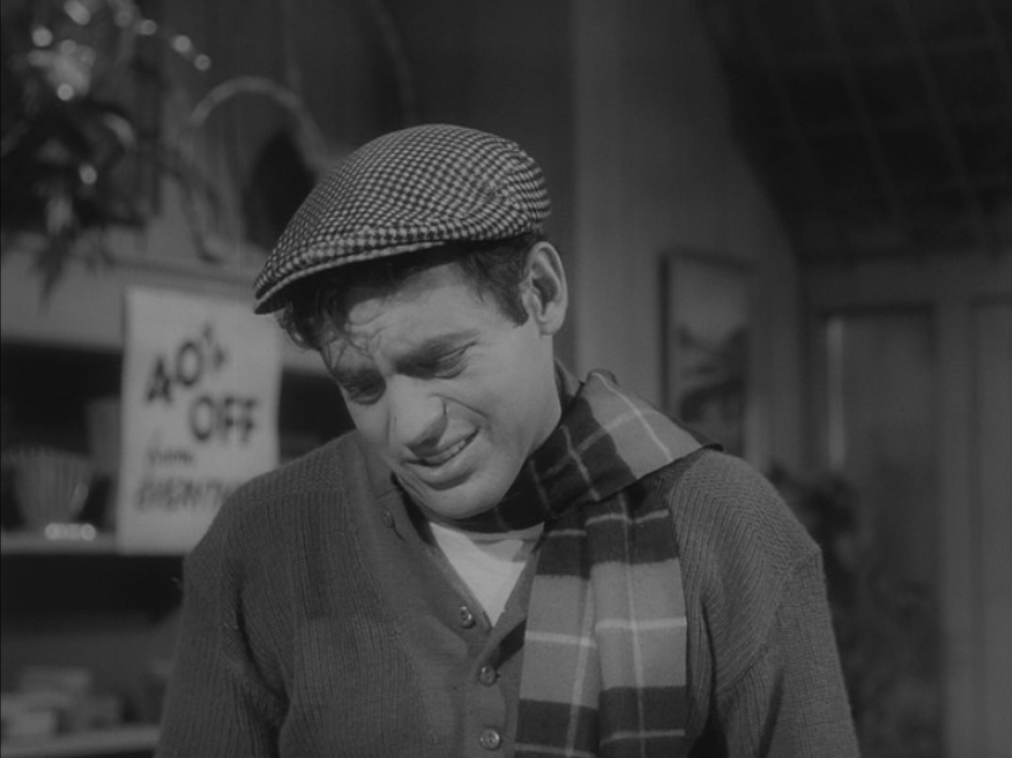
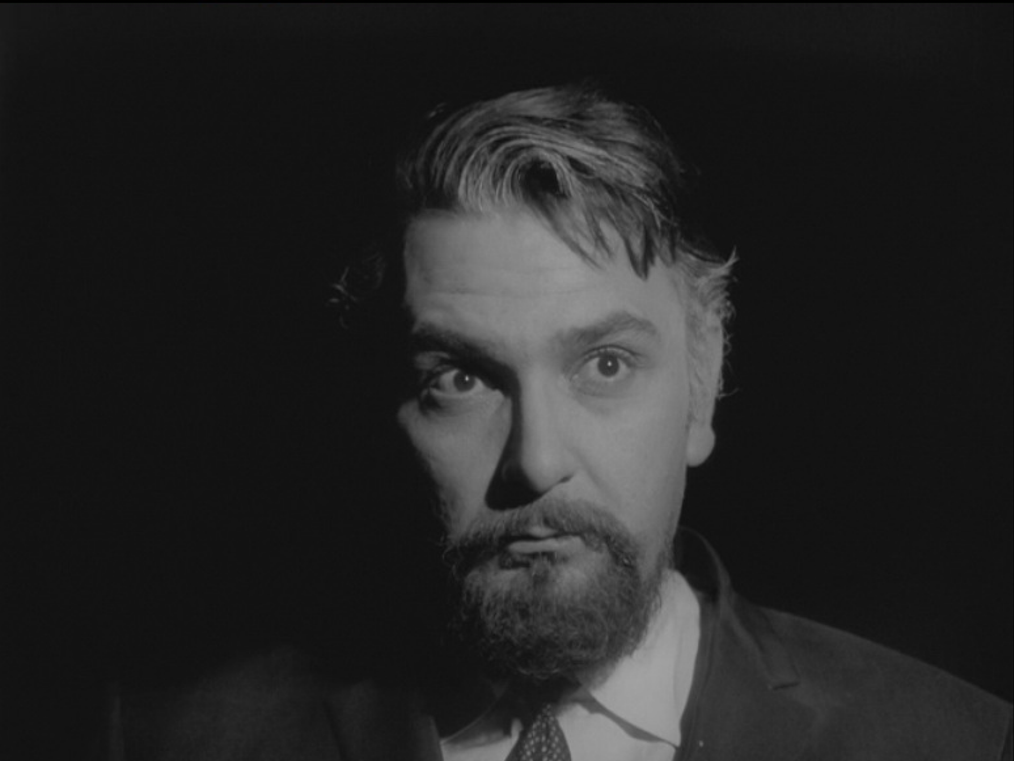
Seymour Krelboined (Haze) is a clumsy, socially awkward florist’s assistant working on skid row in California. His boss is Gravis Mushnick (Welles), a bad-tempered, penny-pinching stereotype of Jewish humour who speaks ungrammatical English, laden with malapropisms, in a thick Yiddish accent. Seymour will be fired for his ineptitude unless he can impress Mushnick with his new plant.

Seymour, Mushnick, and Audrey admiring Audrey Jr.

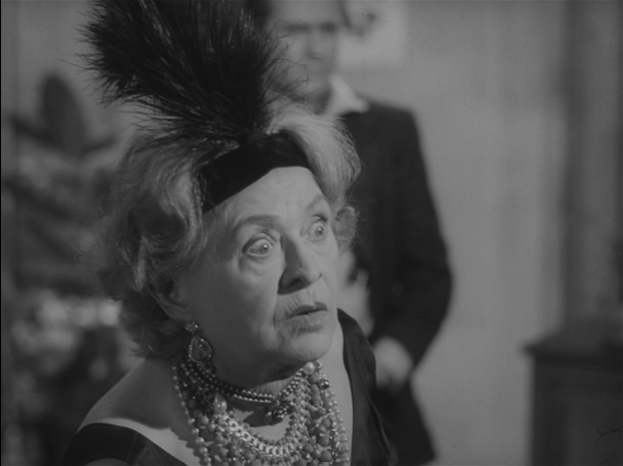
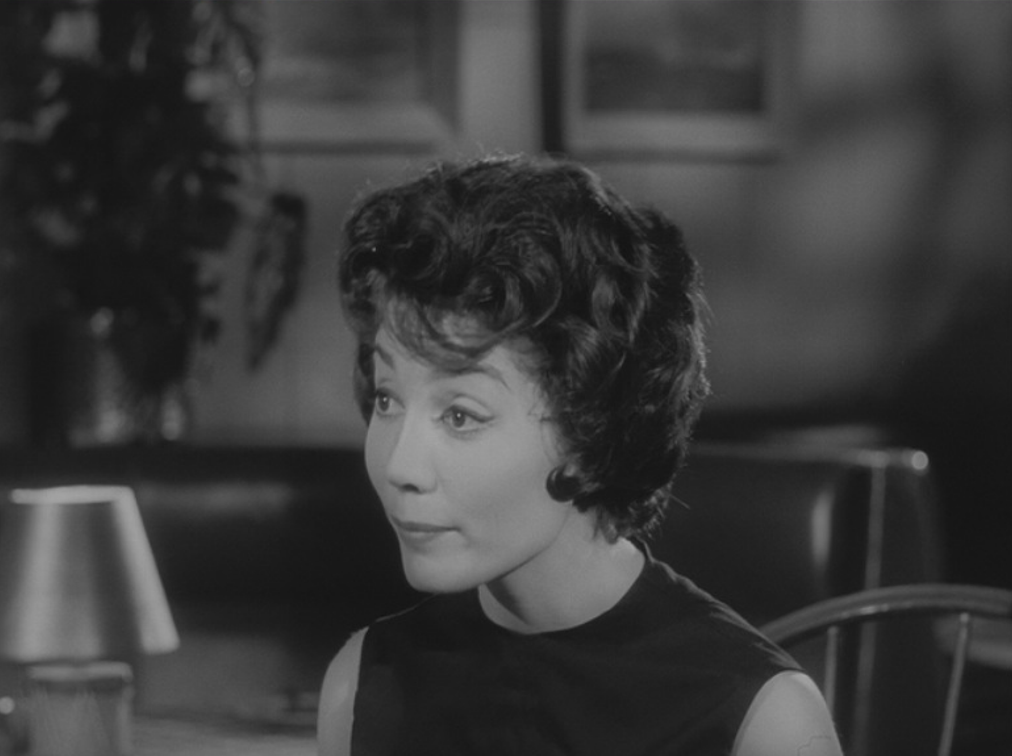
All the characters in this film are comically idiosyncratic in one form or another: Seymour’s love interest, Audrey Fulquard (Joseph), the sweet–if rather ditzy (her dialogue, too, abounds in malapropisms)–girl next door; Burson Fouch (Miller), an eccentric eater of flowers who gives Mushnick the idea to save Seymour’s job by using his unusual new plant to attract customers; Seymour’s hypochondriac mother Winifred (played by Myrtle Vail), who considers medication synonymous with food; ever-mourning Mrs. Shiva (aptly surnamed), who always needs flowers for funerals (hoping for cut-rate prices) for the latest death in the family; Sergeant Joe Fink, the narrator, and Officer Frank Stoolie, two Dragnet-style detectives; Dr. Phoebus Farb, a fittingly sadistic dentist; and Wilbur Force (Nicholson), a masochist who loves going to the dentist.

It’s interesting how Fouch, an eater of flowers, encourages the public display of a plant that, as it turns out, eats human flesh. Flowers are the commodity sold in Mushnick’s shop, of course, and Fouch is a consumer (in more ways than one) of them. The addition of ‘Audrey Jr.’, the giant man-eating variant of a Venus flytrap, to the store will cause business to boom in a way all storeowners dream of, but not even Mushnick will want to pay the gory price that Audrey Jr. demands.

The rapid growth of Audrey Jr., coupled with its appetite for human flesh, can be seen to symbolize the predatory nature of capitalism, which must continue growing, being fed on profits (i.e., the improved business of Mushnick’s flower shop), with no regard for the needs of human life.

So, consumption–in its various meanings–is the dominant theme of the movie: the plant’s consumption of human flesh, Fouch’s consumption of flowers, Mushnick’s customers’ consumption (buying) of his flowers, little Audrey Jr.’s consumption (using up) of Seymour’s blood, his mother’s consumption of medicines as if they were food, and the public’s consumption (i.e., reception of information/entertainment) of the display of Audrey Jr. in the flower shop.

Since the setting of the film is skid row, a part of town where the poor try to escape their troubles in such forms as alcohol and drugs, Winifred’s consumption of medicines can easily be seen as symbolic of drug addiction, especially since the tonic Seymour buys for her is 98% alcohol. She has a few sips and is already tipsy by the time he leaves their house with his then-little plant.

Winifred Krelboined

The symbolic relationship between Fouch’s eating of flowers and Audrey Jr.’s eating of people should be seen as a karmic one. Fouch’s eating of flowers symbolizes man’s destruction of nature by commodifying it; the plant’s man-eating is thus nature’s revenge on man, the destruction of the environment being also our destruction, our collective suicide.

Commodification, the making of exchange-values to generate profits, is the basis of capitalism; small wonder Marx began Capital, vol 1 with a discussion of the commodity. Flowers are Mushnick’s commodities, so Seymour’s plant and its growth represent how the profit made from commodities result in another kind of growth: the accumulation of capital. Audrey Jr.’s bloodlust represents the pain and suffering that inevitably result from all this capital accumulation.

Seymour’s social awkwardness reflects the aggravated kind of alienation one would encounter in the poverty of skid row. He loves raising plants, but he is only of any worth to Mushnick if he can nurse Audrey Jr. to health and present it appealingly to his boss’s customers, getting them to want to buy flowers in the shop. Once the plant’s health has revived, and it has grown thanks to its drinking of drops of Seymour’s blood, his boss no longer loathes him, and even starts calling him ‘Son.’

Two pretty girls, who enter the shop out of curiosity about Audrey Jr., and who wish to decorate a float with flowers, treat Seymour like a pop star upon learning that it is his horticultural skills that have brought the plant to life. After Mushnick, dreaming of wealth and moving his flower shop to Beverly Hills, gives ever-grieving Mrs. Shiva flowers for free, he notices Audrey Jr. sick again, regrets his generosity to her, and instantly reverts to his contempt for Seymour. The boy’s alienation arises from only being of value if he can help his boss make money.

His alienation grows worse when he realizes that the only way he can keep Audrey Jr. alive is by murdering people and feeding it the corpses. Since murder is repellant to his nature, his bloody work is now alienating him from what Marx called one’s species-essence.

Seymour Krelboined

One is alienated from one’s work, from oneself, and of course from other people. Seymour alienates himself from others, though he “didn’t mean it,” but he isn’t the only one. Dr. Farb, the dentist who loves drilling holes in people’s teeth, also alienates people with his sadism. There are the teeth that hack up a man, and there’s a man who hacks up teeth, another reversal comparable to that of Fouch vs Audrey Jr.

There’s karmic retribution in Audrey Jr. eating human flesh, in response to what Fouch’s flower-eating represents (destruction of the environment). Then there’s karmic retribution in Seymour’s killing of Dr. Farb, in response to the dentist’s gleeful torturing of his patients; recall how, in the 1986 film musical, Steve Martin’s dentist sings of people paying him “to be inhumane.” Many high-paid professionals–doctors, lawyers, politicians–do awful things on a scale comparable to those of the greedy capitalist.

The suffering of the poor in such places as skid row, people ever held down under the boot of the capitalist, often leads to varying forms of mental illness, as in Winifred’s hypochondria and the sexual masochism disorder of Wilber Force (Nicholson). While most masochists in the BDSM community engage in their kink in a way that doesn’t cause them psychosocial difficulties, Force’s eager willingness to have (imagined dentist) Seymour pull out several–it is safe to presume–perfectly healthy teeth is clearly an impairment of Force’s functioning in social situations.

Added to all of this, the farcical humour we see in Seymour’s clumsiness, the eccentricities of his mother and Fouch, Farb’s sadism, Force’s masochism, etc., should be seen as representative of the absurdist futility of their existence in an alienating, capitalist society that keeps them in poverty and misery. Even Fink and Stoolie, the police investigating the disappearances of Farb and the railroad detective (whom Seymour accidentally hit with a large rock and made fall on the tracks to be run over by a train), react to the death of Stoolie’s son–who was playing with matches–by nonchalantly saying, “Those are the breaks.”

Audrey Jr.’s chewing of human bodies into pieces, Dr. Farb’s drilling and pulling of teeth, and Force’s delight at getting his teeth drilled and pulled, all represent the psychological fragmentation that results from an alienating capitalist society that privileges the few and impoverishes most of the rest of humanity. Even the budding relationship between Seymour and Audrey doesn’t last long; predictably, the talking plant’s incessant demand, “Feed me!”, is what gets in the way of their love. The growing monster of capitalism eats up everything.

Audrey Fulquard

The two girls who want to feature Audrey Jr. on their float fittingly say that their spectators will “eat it up.” The literal or figurative consumption of commodities leads to the consumers being karmically consumed by their own materialism and commodity fetishism. People see only the growing plant; they know nothing of what it is actually fed to make it grow.

The reversals of Fouch’s flower-eating vs a man-eating plant, and of teeth that mutilate vs Farb’s mutilating of teeth, are a fusion of dialectical contradiction with karma.

Though Mushnick is horrified to find out that Seymour is feeding the plant human flesh, he is conflicted about whether to inform the authorities or to keep quiet and enjoy the new success of his business. It is common for business owners to be conflicted over the need to maximize profit vs the need to be humane towards their employees, to care about the environment, etc. We’ll notice however that, no matter how strongly…and sincerely…the capitalist feels about humanitarian concerns, the profit motive will take priority, because the capitalist is compelled to prioritize profit. Hence, Mushnick’s procrastination with telling the police.

Mrs. Hortense Feuchtwanger, a lady from the “Society of Silent Flower Observers of Southern California,” enters the flower shop and is fascinated with Audrey Jr. If the plant’s buds open on the evening she returns to the shop, and if she likes what she sees, she’ll give Seymour a trophy for his plant.

This trophy would represent the kind of recognition that Seymour, a misfit and ‘loser’ that no one has ever appreciated or liked, so desperately craves. Only recently have any women (Audrey, the two girls with the float, Mrs. Feuchtwanger) ever shown him any liking, and if there’s one thing we all desire, it’s that of the Other, to be desired of the Other, to get the Other’s recognition.

As with his romance with Audrey, though, Seymour’s appreciation from Mrs. Feuchtwanger will be short-lived, too. The lady returns to the flower shop to see the budding, and she is horrified–as are Audrey, Mushnick, Fouch, Winifred, and Fink and Stoolie, who are also there at the time–to see the faces of all those eaten by the plant in its opened flowers.

Oddly, the two girls with the float still like Audrey Jr., looking gleefully at the faces in the budded flowers. They represent the extreme of commodity fetishism: so entranced are they by the plant as a finished product that they show no regard for the victims that helped it grow.

Gravis Mushnick

Recall, also, that as horrified as Mushnick is at Audrey Jr., especially to learn that it is a talking plant, he, too, is willing to have it eat up someone–in this case, an armed robber (played by scriptwriter Griffith, who also did the voice of the plant). Guarding his money is more important to capitalist Mushnick than preventing yet another victim of Audrey Jr.

The robber isn’t the only member of the Lumpenproletariat to be fed to the plant: so is an aggressive prostitute who tries to get Seymour to be her next client. For indeed, with Audrey Jr. as symbolic of the ever-growing, ever-devouring monster that is capitalism, such Lumpenproletariat as criminals and streetwalkers are every bit as much victims of the bourgeoisie as are the strata of the working class just above them.

Capital seems to develop a mind of its own, in how it subjugates us all to the will of the profit motive, even when we try to resist it on moral grounds, as Mushnick and Seymour try to do. This ‘mind of its own’ would seem to explain, in symbolic terms, why the plant can talk, and why it can hypnotize Seymour into doing its will, right when he tries so vehemently to defy it.

So many of us on the left try to defy the system around us that we hate so much, but through the mesmerizing bourgeois media (part of the system’s superstructure), now including Facebook, the narcissistic exhibitionism of Instagram, etc., we all get pulled back into complying. Hence, Seymour wanders the streets of skid row, in such a trance as to ignore the charms of the streetwalker, and takes her back and feeds her to Audrey Jr.

When Fink and Stoolie learn that Seymour is responsible for all the killings, they and Mushnick chase him on the streets of skid row in the night. The two cops represent the feeble attempts that an otherwise bourgeois state makes to curb the excesses of capitalism. That feeble effort is demonstrated in their failure to apprehend ineffectual, spastic Seymour, who should be easy to catch.

Wilbur Force

They chase him into some bizarre, even surreal-looking, parts of town, but they are places nonetheless indicative of the capitalist preoccupation with commodities–rather unclean ones, actually. Seymour is chased into the private property of a tire and rubber company, when he runs and hides in a labyrinth of giant tires. One of the few times he doesn’t trip is over resting Mushnick’s leg, though Fink and Stoolie do trip over it!

Then Seymour hides in, of all things, a toilet among a maze of bathroom fixtures (sinks, bathtubs, etc). Mushnick tells the cops that they won’t find Seymour there, though he is most obviously there. In all of this not only do we see the symbolism of a bourgeois government failing to punish the excesses of capitalism, but we also see a capitalist helping in achieving that failure.

Seymour returns to the flower shop a broken man. Racked with guilt over his murders, he’s lost the woman he loves, he’s a wanted man, and it’s all because of that bloody, gluttonous plant that has repaid his services by ruining his life. In despair, he decides to sate Audrey Jr.’s hunger one last time with his own body…and a knife to kill it with.

A karmic reversal has finally happened to the plant, instead of it being an agent of karma; for such is the reality of the dialectical crests and troughs of theses phasing into negations and sublations that become new theses to be negated and sublated. Now Seymour’s face appears in the latest budding flower, to add to all the other faces. The plant dies, too, and just as capitalism kills, so will it destroy itself in the end.

‘The Splitting,’ a Sci-Fi Horror Novel, Book II, Chapter Six

Michelle returned home that night to see her mom watching TV. Instead of having that unnatural-looking smile on her face, her mother seemed worried about what she was watching on the news.

“Hi, Mom,” Michelle said in a shaky voice.

“Hi, sweetie,” her mom said, still frowning at the TV screen.

“What’s on the news that has you so worried?”

“Oh, it isn’t so much worrying me as it’s just…this nonsense so many people believe about an ‘alien invasion.’ Ridiculous.”

“Oh, you mean those wacko conspiracy theorists?”

“Yes, dear,” her mom said, turning off the TV and standing up. “People are saying that The Splits was really aliens entering people’s bodies instead of the virus it actually was. How can anybody believe such rubbish?”

“I know,” Michelle said, avoiding Siobhan’s eyes. “There are a lot of dumb, crazy people out there.”

“You wanna know what their ‘proof’ is, Michelle? People possessed of the aliens show little to no emotion.” Siobhan let out a loud laugh, which seemed forced to Michelle. “As if there’s no such thing as ordinary people not showing emotions, especially in today’s world, when all those vaccines were draining people of their energy and making people plod around like zombies. You and Peter have noticed that.”

“Yes, we have,” Michelle said, frowning and still avoiding her mother’s eyes.

“And those vaccines, given out years ago, are still showing those effects, to this day. So why make a big deal about lots of people showing no feelings?” Her mom had a huge, ear-to-ear grin, which was supposedly to show how absurd she thought the conspiracy theories were, but which really just looked fake, as if painted on her face. “They say the governments know about the aliens, and are doing a cover-up.”

“Yeah, but some people in those governments really believe this is happening, and they’re sending out assassins to kill anyone they think is possessed of the aliens.”

“Really? Did Peter tell you that?”

“Yes, Mom. Just today. He says he watched a video of Ottawa politicians discussing this plan to kill anyone known to have had The Splits.”

“Now, Michelle, surely you must realize by now that Peter, as much as you love him, isn’t always a reliable source?”

“No, of course he has his loopy moments, more than I care to admit, but if he’s right this time, we need to be careful with you.”

Her mom stared into her eyes with a frown of suspicion for several seconds.

“It’s not so much that I believe his every word. It’s just that I care about you and want you to be safe.”

Siobhan still suspected insincerity in her daughter’s eyes.

“What are your thoughts about this ‘alien’ business?” She continued staring hard at Michelle. A touch of anger was on Siobhan’s lips.

“I–I don’t know what to think.” Michelle began sobbing.

“What nonsense is Peter telling you about me?” Siobhan asked, looking down at Michelle’s purse, with what looked like a tall can of bug spray poking out in a bulge at the side of her purse. “Some of the conspiracy theorists claim that bug spray is what kills the aliens. Surely you don’t believe such nonsense, do you?”

“No, of course not,” Michelle sobbed. “It’s just that I…I…”

“If you don’t, then why have you been carrying bug spray in your purse?” her mom asked with more than a tinge of angry tension in her voice and face. “You aren’t planning, in your paranoia, on spraying your own mother in the face with that, are you?”

“If the theories are so ridiculously untrue, why are you so nervous around bug spray, Mom?”

“I just told you. I don’t want my obviously paranoid daughter spraying it on me.”

“It isn’t sprayed on the people, Mom. When those little lights fly out at us, we spray them, not the carriers.”

“How do I know you’re not going to get nervous around me, think I’m going to send those things out at you, make you fumble in your purse for the spray can, then spray those toxic chemicals in my eyes as a spastic reaction?”

“Because you’re my mom, and I love you!” Michelle sobbed.

Am I your mom?” Siobhan asked with a sneer. “Or am I one of the ‘pod people’? What is Peter making you think about me?”

“I only plan on using it on other people,” Michelle said. “I’ll tell you another reason I won’t use it on you.”

“Oh? And what’s that?” Her mom crossed her arms in front of her chest. “This should be interesting.”

“The aliens won’t come inside me or Peter. We’ve confronted the dots of light several times, and they never enter us or try to take control of us. They just hover in front of us, as if they’re studying us.”

Siobhan was calming down. “Why won’t they go inside you?”

“Peter and I believe they think we’re sympathetic to their ’cause’.”

“That’s right,” her mom said after a huge sigh, then uncrossed her arms and felt herself completely calm now. “We know you’re completely sympathetic, though you don’t know why, and it isn’t yet safe to tell you all the reasons for that sympathy.”

“Mom?” Michelle’s mouth and eyes were wide open.

“I just needed to be sure for myself that you weren’t going to do anything on me with that bug spray.” Siobhan spread her arms out to her sides, and dozens of tiny glowing balls flew out of her hands and hovered in front of Michelle. She froze in controlled fear; she was getting used to knowing she didn’t need to fear them. “That’s right, sweetie. They won’t hurt you.”

“But they will hurt other people. They hurt you. They killed Dad. I don’t want them to kill any more people.”

“They don’t actually kill people.”

“Oh, really? What would you call it?”

Anyone who rejects what we want to do dies of his or her rejecting of our plan. Those who die kill themselves, essentially, out of their own closed-mindedness.”

“That sounds like blaming the victim, Mom.”

“Those ‘victims’ are also victimizers, or at least potential victimizers.”

“That sounds like a rationalization. Are you saying that Dad was a victimizer?

“Yes, I’m sorry to say. I was, too, helping him run that…propaganda-spouting company and ruling over Mississauga, making people think MedicinaTech was the only problem in the world, and distracting people from how we were all part of a much bigger problem, the immiseration of the global poor. Fortunately, when the extraterrestrials entered me, and I went through that painful ordeal, I was open-minded enough to accept the changes they want to make to the world; and so when I got better, I began making democratic changes to the governance of Mississauga and to the management of the newspaper, things your father would never have allowed.”

Something Peter’s parents would never have allowed, either, Michelle thought. “But…you let Dad die,” she sobbed.

“Yes, sweetie.” Siobhan let out a big sigh. “That was hard. It was the hardest thing I’ve ever had to do. But there are greater, global needs, more urgent than just those of our family. The needs of poor, starving families we’ve never met.”

I can’t help thinking Mom’s been brainwashed, Michelle thought. Killing Dad didn’t seem so hard to her when she did it in the hospital. And this ‘save the world’ stuff could be a trick, something they’re trying to get Peter and me to go along with while the aliens plan to do something far more evil.

Standing outside their house and looking through the large living room window at them, a man in his thirties was clutching his pistol, debating in his mind whether or not to pull it out of its holster. I can’t get a clear shot at Siobhan with her daughter standing in the way, he thought. I guess I’ll try tomorrow. I wouldn’t want her daughter to see her mother shot, anyway. It would be too upsetting for her.

‘The Splitting,’ a Sci-Fi Horror Novel, Book II, Chapter Five

Peter and Michelle were sitting at a table in Starbucks, sipping coffee.

“Funny thing,” he said after taking a sip. “This is the same Starbucks we were in almost a year ago, when I’d first heard about the death of Derek Gould, and his wife being a carrier of those things. Everyone, including you, had masks on, while I thought it was all bullshit–“

“You still think the coronaviruses were all bullshit,” Michelle said, with a distracted look on her face.

“Yeah, but I changed my mind about The Splits, remember?” he said, annoyed at her interruption. “Now that the fake pandemic scare is gone, and no one’s wearing a mask or a protective suit, no one thinks we’re in danger–“

“Except the ‘conspiracy theorist wackos’ who can’t get a cellphone-recorded video in edgewise on YouTube,” she said.

He scowled at this second interruption, then said, “And we’re in far more danger now than ever before.”

“Well, we are safe, apparently. Those things don’t feel they need to enter us.” She was frowning, giving her reassurances a bitter irony.

We’re OK, it seems, but there are other considerations. Your mom–“

“I got the bug spray out of our house, Peter. She didn’t take it away from me.”

“Stop interrupting! I’m not talking about that. I’m actually worried about her now.”

“Wow, you’re joining the club now, eh? Why are you worried about her? I thought she was just an ‘ET’ to you.” Now she was scowling.

He sighed.

“I watched another video today, just before we got together here. Now, listen–this is important, and it directly affects you and your mom. The video was of a meeting of the heads of the Ottawa District/Shopify Incorporated. They, too, secretly know of the alien invasion. They’d spoken with our brand-new American president Price about plans to deal with ‘those things,’ as the aliens are being officially referred to.”

“And what does all that have to do with my mother?”

“The plan is to go after anyone who is, or is suspected of being, a carrier. Targeted assassinations. They know the aliens tend to go for rich and politically powerful people. They revealed at this meeting that the carrier who let loose the aliens on the late President Trenton was his secretary of state.”

“Really?”

“Yeah. Wait for when the news announces her fake death.”

“Her fake death? Of what?”

“They haven’t decided what it officially will be yet. After the audio recording got cut off, it seems they tried to arrest her, those things flew out again, and a man in security pulled out his gun on impulse and put three bullets in her chest. The Ottawa people said as much in the video.”

“Wow.” Michelle was already shaking at the implications this news had for her mother.

“Now, I don’t know if the people in that Ottawa meeting know your mom’s a carrier, but someone there surely knows someone who knows someone who knows someone who knows she is. In any case, they’ll have files of everyone known to be a carrier from last year, and they’ll have a file on your mom for sure. So just be careful with her, if you want her to live.”

Michelle shuddered. “How am I going to warn her if talking about aliens is itself a dangerous thing for me?”

“I don’t know,” he said. “But I assume that, underneath the alien possession of her, your real mom is still in there, buried deep inside.”

“Of course she’s still in there!” Michelle shouted, then covered her mouth and blushed from all the customers and Starbucks staff who heard her outburst. A tear ran down her cheek. “She may just be an ET to you, but she’s still my mother.”

“I’m sorry, Michelle,” he said. “I know I’m tactless sometimes. But believe me when I say I care about you and her. Please be careful with her. Watch if anyone suspicious seems to be following her.”

“Oh, what am I gonna do?” she sobbed. “And those things are supposed to have our sympathy?”

“I know.” He put his arm around her. “What do those little lights want from us?”