Analysis of ‘Howl’

I: Introduction

“Howl” is a poem by Allen Ginsberg, written in 1954-1955 and dedicated to Carl Solomon, hence it’s also known as “Howl for Carl Solomon.” It was published in Ginsberg’s 1956 collection, Howl and Other Poems.

“Howl” is considered one of the great works of American literature. Ginsberg being one of the writers of the Beat Generation, “Howl” reflects the lifestyle and preoccupations of those writers–Jack Kerouac, William S. Burroughs, Neal Cassady (“N.C., secret hero of these poems”; also, “holy Kerouac […] holy Burroughs holy Cassady”), etc.

The preoccupations of the Beat Generation writers included such subculture practices (as of the conservative 1950s, mind you) as drug use, homosexuality, free love, interest in non-Western religions, etc. Such practices are described with brutal, uncensored frankness in “Howl,” hence the poem was the focus of an obscenity trial in 1957.

Here is a link to the entire poem, and here is an annotated version of it (without the ‘footnote’).

The very title of the poem, one that gives vivid description to so much suffering, must be–on at least an unconscious level–an allusion to the final scene in King Lear, when the grieving king enters, carrying his freshly executed daughter, Cordelia. He calls out “Howl, howl, howl, howl! O, you are men of stones!” As in “Howl,” King Lear demonstrates, as I argued in my analysis of the play, that in the midst of so much suffering and loss, one can also gain something: Lear loses everything, but he also gains self-knowledge. Similarly, “the best minds of [Ginsberg’s] generation” suffered much and engaged in much self-destruction, but they also searched for forms of spiritual enlightenment, as I’ll demonstrate below. By the ‘footnote‘ section of the poem, we’ll find Ginsberg gaining that “Holy!” enlightenment.

II: Part I of the Poem

Now, “the best minds of [Ginsberg’s] generation” were those Beat Generation writers and their socially non-conforming ilk, engaging in all the wild behaviour we associate with them–doing drugs, having promiscuous sex, etc. As a result, they have been “destroyed by madness,” and have been “starving hysterical naked.”

“Naked” could be a reference to illicit sex, but it more likely refers to a lack of possessions in general, as the word is used in Hamlet, Act IV, Scene vii (in which Hamlet writes, in a letter to Claudius, “I am set naked on your kingdom.”). After all, these “best minds” are “starving hysterical naked.” Their wildness comes in large part because of their poverty, the cause of which, in turn, is an issue I’ll delve into in more detail later.

These drug addicts are going “through the negro streets at dawn looking for an angry fix”, yet in spite of their Dionysian sinfulness, they’re also “angelheaded hipsters burning for the ancient heavenly connection”. They seem to be offering their own idiosyncratic interpretation of Luther’s injunction to “sin boldly.”

Indeed, there is a duality permeating these pages, cataloguing on the one hand sin, obscenity, and excess, and on the other, a search for spirituality and salvation. They are in “poverty and tatters […] high […] smoking” and “contemplating jazz,” for this music was an important soundtrack to the lives of the Beats, as one can note many times reading Kerouac’s On the Road. Yet they also “bared their brains to Heaven under the El and saw Mohammedan angels…”

The El is the elevated train in New York, but it’s also a Hebrew name for God. Note also that the words “Mohammedan” and “negro” were being used here before they were considered unacceptable. Ginsberg’s reference to the Muslim faith is one of many examples of the Beats taking spiritual inspiration from non-Western sources. Some Beats having hung out in Tangiers (in the International Zone in particular) can, in part, be seen as an example of this influence.

The use of “who” beginning many of the long lines of this first part of “Howl” is paralleled with the refrains of “Moloch” in Part Two, “I’m with you in Rockland” in Part Three, and “Holy” in the ‘footnote.’ “Who” reminds us that the subject of Part One, an almost interminable sentence, is Ginsberg’s beatnik friends. The refrains of the other three parts also, of course, remind us of their respective subjects, an explanation of which will come when I get to those parts below.

Special attention should be given to Ginsberg’s use of long lines, something he derived from Walt Whitman, whose non-conforming behaviour (including homosexuality) could make him a kind of Beat Generation poet of the 19th century. One could compare these long lines to the sometimes lengthy verses of the Bible, giving Whitman’s and Ginsberg’s poetry a near-sacred feel, in spite of (or perhaps because of) its sensuality (recall in this connection the sensuality of the Song of Solomon… could the dedication to Carl Solomon be linked to this Biblical association?).

Long lines are oceanic, inclusive, requiring deep breaths to take in everything before expressing everything. They are universal because the poetry of Whitman and Ginsberg is universal: these two men are bards of Brahman, seeing holiness in everything (read Ginsberg’s “footnote” to see what I mean). The two poets embrace all religious traditions, like Pi, but they also reject the limitations of any one religious tradition or dogma. These long lines, in including everything but eschewing the rigidity of traditional short and exact metres, exemplify the same paradox in poetry.

In “Blake-like tragedy”, we find another example of a spiritual non-conformist in whom Ginsberg found inspiration. I discussed William Blake‘s unconventional approach to Christianity in the “Jerusalem” section of this analysis of an ELP album.

Ginsberg was once “expelled from the academies for crazy […] obscene odes…”, that is, he was kicked out of Columbia University for writing obscenities on his dorm room window. His friends “got busted in their pubic beards returning through Laredo with a belt of marijuana for New York,” that is, they were caught in Laredo with weed stashed in their underwear.

They “ate fire” and “drank turpentine in Paradise Alley…”, referring to the ingesting of toxic substances (drugs and alcohol) in a slum in New York City, full of run-down hotels, brothels, and dope dealers. Nonetheless, in a poem, Paradise Alley also has heavenly associations, and thus in this line we have another juxtaposition of the sinful with the spiritual.

Those readers who may have difficulty reconciling my close associating of sin with mysticism should take into account the idea of the dialectical unity of opposites, an idea I’ve symbolized with the image of the ouroboros in a number of blog articles. Two extreme opposites meet, or phase into each other, where the serpent’s head bites its tail, and all intermediate points are found in their respective places along the middle of the ouroboros’ body, coiled into a circular continuum.

Applied to “Howl,” this means that the harshest Hell phases into the highest Heaven and vice versa. One cannot understand this idea while adhering to traditional Christian dogma and its literal reading of an eternity in either Heaven or Hell. My interpretation of the ‘afterlife’ is metaphorical. In our moments of darkest despair, we often see the light and come out the other side (“It’s always darkest before the dawn.”); this is what Christ‘s Passion, harrowing of Hell, and Resurrection symbolize. Note also that those who rise to the highest points of pride tend to fall, as Satan and the rebel angels did. Finally, keep in mind the BeatitudesMatthew 5:4 and 5:11-12 in particular.

This Heaven/Hell dialectic can be seen in the four parts of “Howl.” This first part is the Hell thesis, with the second, “Moloch” part representing the Satanic cause of that Hell; the “Rockland” third part is the Purgatory sublation (though therapy in an insane asylum must be judged to be a remarkably ill-conceived purging of sin), and the “footnote” is the antithesis Heaven that stands in opposition to this present first part.

In this way, we can see “Howl” as Ginsberg’s modern Beat rendition of Dante‘s Divine Comedy. And just as Dante’s Inferno is the most famous first part of his epic poem, so is the infernal first part of “Howl” the most famous part, with its emphasis on human suffering. Similarly, Pasolini‘s Salò, with its sections divided up into Circles of Manias, Shit, and Blood–like Dante’s nine circles of Hell–is also focused on suffering, sin, and sexual perversity.

To come back to the last line discussed before my dialectical digression, and to link both discussions, this inferno part makes fitting reference, in this line, to the paradiso of Paradise Alley and the purgatorio of the “purgatoried […] torsos”. These torsos may be purged of sin through the ingesting of alcohol and drugs, or through sex (“pubic beards”, “torsos”, and “cock and endless balls”).

Just as there’s a dialectical unity of Heaven and Hell (i.e., one must go through Hell to reach Heaven, as Jesus did, the passing through the ouroboros’ bitten tail to get to its biting head), so is there also a dialectical unity of sin and sainthood (i.e., one uses drugs or sexual ecstasy to have mystical visions or spiritual ecstasy). The fires of Hell are those of desire, in samsāra; blowing out the flame leads to nirvana. The Mahayana Buddhist tradition, however, sees a unity between samsara and nirvana–the fire is the absence of fire…Heaven is Hell. The Beats, in their excesses, understand these paradoxes.

Part of those Dionysian excesses are, as mentioned above, the alcohol and drug abuse (“peyote” and “wine drunkenness over the rooftops”). Similarly, the Beats were “chained […] to subways for the endless ride from Battery to holy Bronx on benzedrine“, that is, they were so high on the benzedrine that they were frozen from doing anything while on their endless joyride on the subway, “chained” to it, all the way from Battery to the Bronx. Note how the Bronx is “holy”: in their sinful indulgence on drugs, the beatniks attain sainthood in the Bronx.

At Fugazzi’s…Bar and Grill, at 305, 6th Ave. in New York City?…they are “listening to the crack of doom on the hydrogen jukebox”. In Macbeth, “the crack of doom” is the end of the world, and a “hydrogen jukebox” suggests the hydrogen bombs that had been created, recently as of the writing of “Howl,” a bomb whose destructive power, greater than the original atomic bomb, can bring us even closer to “the crack of doom.”

Ginsberg and company, however, are getting wasted listening to music–jazz, presumably, on the jukebox. They are creating their own armageddon of drunken self-destruction. That end of the world, though, is followed by the Kingdom of God: the beatniks, in their rejection of the conservative values of the nuclear family, are getting nuclear bombed drunk; and the hellish fires of “the crack of doom,” the ouroboros’ bitten tail, will be passed through to attain the heavenly Kingdom of God, the serpent’s biting head.

The dialectic is manifested once again in how this “lost battalion of platonic conversationalists” are “jumping down the stoops off fire escapes off windowsills off Empire State…” Since sorrows “come not single spies but in battalions,” it’s easy to see them leading to despair and suicide. Yet the beatniks would express platonic ideals in philosophical discussion, an Apollonian trait; of course, in true Dionysian fashion, they would also jump off of buildings to their deaths to escape the egoistic experience for that of the oneness of Brahman.

Thus, the juxtaposition of jumping suicides with platonic conversation is a case of “whole intellects disgorged […] for seven days and nights”…the seven days and nights of Biblical creation, ending in a day and night of rest–that Heaven of intellectual bliss? It’s fitting to include the Sabbath–“meat for the Synagogue”, since Ginsberg was Jewish.

Indeed, the Beats return from debauchery to spirituality in not only the Synagogue, but also “Zen New Jersey”, “suffering Eastern sweats and Tangerian bone-grindings and migraines of China under drunk withdrawal”. We’re reminded of the Opium Wars, the victimizing of China under Western imperialism, and maybe the jumping “off Empire State” is Ginsberg’s rejection of that very imperialism.

These hipsters “studied Plotinus Poe St. John of the Cross telepathy and bop kabbalah because the cosmos instinctively vibrated at their feet in Kansas”. Plotinus was a neoplatonist who believed that all of reality is based on “the One,” a basic, ineffable state beyond being and non-being, the creative source of the universe and the teleological end of all things. St. John of the Cross was a Spanish mystic and poet who wrote The Dark Night of the Soul, both a poem and a commentary on it that describe a phase of passive purification in the mystical development of one’s spirit.

What’s interesting here is how Ginsberg sandwiches, between these two writers of spiritual, philosophical matters, Edgar Allan Poe, also a great writer, but one whose death at the relatively young age forty was the self-destructive result of alcoholism, drug abuse, and/or suicide, his last moments having been in a delirious, agitated state with hallucinations.

Though St. John of the Cross hadn’t intended this meaning, “the dark night of the soul” has the modern meaning of ‘a crisis in faith,’ or ‘an extremely difficult or painful period in one’s life.’ The combining of these three writers in the above-quoted line in “Howl” suggests a dialectical thesis, negation, and sublation of them respectively: the wisdom of philosophy (Plotinus), the destructiveness of the Dionysian way (Poe), and a combination of passive mystical purification with a spiritual crisis and a painful time in life (St. John of the Cross).

Such an interpretation dovetails well with the Heaven and Hell, saintly sinner theme I’ve been discussing as running all the way through Ginsberg’s poem. The juxtaposition “bop kabbalah” continues that theme, with “bop” representing the contemporary jazz that he and his beatnik pals were grooving to while drunk or stoned, and “kabbalah” representing Jewish mysticism, a fitting form of it for Ginsberg.

This “bop kabbalah” dialectic is further developed in how “the cosmos instinctively vibrated at their feet in Kansas,” since Kansas was the Mecca of jazz and bebop for hipsters at the time; and a ‘vibrating cosmos’ suggests the oceanic waves of Brahman, or Plotinus’ One. The hipsters were also going “through the streets of Idaho seeking visionary Indian angels…”, even more of a juxtaposition of the common and the cosmic.

They’d be “seeking jazz or sex or soup”, and they would “converse about America and Eternity”. These hipsters led bohemian lives, but also wanted to know the rest of the world, so by “America” it is not meant to be only the US but also Latin America–the Mayan ruins of Mexico. To escape the evil of American capitalism, Ginsberg “took ship to Africa”. These are examples of the Beats immersing themselves in the wisdom of other cultures. The protesting of capitalism is part of the basis of the Beats’ destructive Dionysian non-conformity; hence, they “burned cigarette holes in their arms”.

Note how the Beats’ protesting of “the narcotic tobacco haze of capitalism”, having “distributed Supercommunist pamphlets” would have been done in 1950s America, at a time of welfare capitalism, higher taxes for the rich, and strong unions. Imagine the passion the Beats would have had distributing “Supercommunist pamphlets” in today’s neoliberal nightmare of a world!

They “bit detectives in the neck”, those protectors of private property and the capitalist system. Recall how Marx compared capitalists to vampires, as Malcolm X called them bloodsuckers; Ginsberg’s vampire-like Beats biting cops’ necks is indulging in amusing irony here. After all, he insists that the Beats’ non-conforming sexuality and intoxication are “committing no crime”. They “howled on their knees in the subway […] waving genitals…”

More obscenity and saintliness are merged when Ginsberg says they “let themselves be fucked in the ass by saintly motorcyclists and screamed with joy.” This line in particular got him in trouble with the law, though in the end, “Howl” was ruled to have “redeeming social importance.” Similarly, the Beats “blew and were blown by those human seraphim”, and “balled in the morning in the evening […] scattering their semen freely…”

When a “blond and naked angel came to pierce them with a sword”, we see an allusion to The Ecstasy of St. Teresa, a fusion of sexual ecstasy with spiritual ecstasy.

Now, “the three old shrews of fate” who have taken away the Beats’ boy lovers are the Moirai. These can be seen to personify the kind of conformist, nuclear family that the Beats are rebelling against. Each shrew is one-eyed, for in her conformity, she cannot see fully. One is “of the heterosexual dollar”, a slave to the capitalist, patriarchal family, and in her complaining of her lot in life, she seems shrewish. One shrew “winks out of the womb”, since by limiting her life to that of a career mother, she also sees little. The last shrew “does nothing but sit on her ass and snip the […] threads of the craftsman’s loom”; she is Atropos, who in cutting the thread ends people’s lives, yet in limiting herself to doing traditional women’s work, she’s ending her own life, too.

The Beats “copulated ecstatic and insatiate […] and ended […] with a vision of ultimate cunt and come eluding the last gyzym of consciousness”. Here again, we see Ginsberg uniting the sexual with the “ecstatic” spiritual: in “ultimate cunt”, we have a fusion of the final with the beginning of life; similarly, “come” and “gyzym” would begin life, yet here we have “the last” of it. The end is dialectically the beginning–the Alpha and the Omega, the eternal, cyclical ouroboros.

Such heterosexual Beats as “N.C.”, or Neal Cassady, “sweetened the snatches of a million girls”. He “went out whoring through Colorado in myriad stolen night-cars”. Indeed, a reading of On the Road will reveal how Cassady (i.e., Dean Moriarty) did exactly this.

When it says that the Beats “ate the lamb stew of the imagination”, since there’s so much juxtaposition of sensuality with spirituality in “Howl,” I suspect that “lamb” here refers at least in part to the Lamb of God. Ginsberg may have been Jewish, but as a Beat poet, he would have been interested in religious and spiritual traditions outside of his own. The ‘eating of the lamb stew of the imagination’ would thus be yet another example of “Howl” fusing the sensual and the spiritual.

The Beats were “under the tubercular sky surrounded by orange crates of theology,” yet another example of such fusions, as is “rocking and rolling over lofty incantations”. They “threw their watches off the roof to cast their ballot for Eternity outside of Time,” indicating a preference of the transcendent over the mundane; yet they’ve also engaged in suicidal acts, indicating the despair that bars one from entry to Heaven. Such suicidal acts include “cut[ting] their wrists three times successfully unsuccessfully,” as well as having “jumped off the Brooklyn Bridge this actually happened”.

Some Beats were “burned alive in their innocent flannel suits”, an apparent allusion to The Man in the Gray Flannel Suit, by Sloan Wilson, another Beat book. One Beat, Bill Cannastra, was with those “who sang out of their windows in despair, fell out of the subway window”: Cannastra died drunkenly trying to exit a moving subway car.

Some “danced on broken wineglasses barefoot”. Some went “journeying to each other’s hotrod Golgotha jail-solitude watch or Birmingham jazz incantation”. Again, we see a merging of the sensual (“wineglasses,” “jazz,” “hotrod”) and the spiritual (i.e., the Christian imagery of “Golgotha”), as well as a fusion of salvation (Christ’s crucifixion at Golgotha, the place of the skull) and condemnation (“jail”).

The Beats hoped, in their travels, “to find out if I had a vision or you had a vision or he had a vision to find out Eternity”. They were often in Denver, as Kerouac and Cassady were (represented by Sal Paradise and Dean Moriarty, respectively) in On the Road. All of the drinking and partying therein is Dionysian mysticism, if properly understood.

For in spite of how antithetical this drunken partying may seem to the spiritual life, the Beats also “fell on their knees in hopeless cathedrals praying for each other’s salvation”. The cathedrals were “hopeless” because there’s no salvation in conventional, orthodox religion.

So instead, they “retired to Mexico to cultivate a habit, or Rocky Mount to tender Buddha or Tangiers to boys […] or Harvard to Narcissus…” Alternative forms of spirituality may have been Buddhism (consider Kerouac and The Dharma Bums), or the dialectical opposite of spirituality, indulgence in drugs or pederasty, or a generally narcissistic attitude. In any case, the “hopeless cathedrals” would never have sufficed for the Beats.

Just as there’s a fine line between Heaven and Hell as described in “Howl,” so is there a fine line between genius and madness here. Ginsberg has celebrated the inspired creative genius of Kerouac, Cassady, Burroughs…himself in this very poem…and others. Ginsberg has demonstrated many of the acts of madness of the Beats. Now we must examine the attempts ‘to cure’ madness.

Now, what must be emphasized here is that it’s not so much about curing mental illness as it is about taking non-conforming individuals and making them conform. Recall that at this time, the mid-20th century, homosexuality was considered a form of mental illness. The proposed cures for these ‘pathologies’ were such things as lobotomy, “Metrazol electricity hydrotherapy psychotherapy occupational therapy pingpong…”

Recall that “Howl” is dedicated to Carl Solomon, who voluntarily institutionalized himself, “presented [himself] on the granite steps of the madhouse…” Solomon, mental institutions (what Ginsberg calls “Rockland”), and pingpong will return in Part Three of this poem.

The psychotherapy in these mental institutions will include such fashionably Freudian ideas as the Oedipus complex, as we can see in Ginsberg’s line about “mother finally ******”. The ultimate narcissistic fantasy, about sexual union with the mother, Lacan‘s objet petit a, has to have a four-letter word censored, for a change in this poem, since it’s a gratification too great for even Ginsberg to discuss directly: “ah, Carl, while you are not safe I am not safe…”

Still, while mired not only in madness but, worse, also in the prisons of psychiatry–those cuckoo nests–these incarcerated Beats can still experience the divine. They have “dreamt and made incarnate gaps in Time and Space […] trapped the archangel of the soul […] jumping with sensation of Pater Omnipotens Aeterna Deus…”

This connection with the divine is achieved through the use of language, a kind of talking cure, entry into the cultural/linguistic world of Lacan‘s Symbolic, as expressed in Ginsberg’s poetry and the prose of Beats like Kerouac and Burroughs. They’ll use “elemental verbs and set the noun and dash of consciousness […] to recreate the syntax and measure of poor human prose…”

The Beats are thus a combination of “the madman bum and angel beat in Time,” a marriage of Heaven and Hell (recall the “Blake-like tragedy” above), the best and the worst, “speechless and intelligent and shaking with shame,…” They “blew the suffering of America’s naked mind for love into an eli eli lamma lamma sabachthani saxophone cry…” In this, we see how the Beats combine jazz sax partying with suffering, despair, Lamb-of-God salvation and love.

“Howl” describes the individual experiences of men like Cannastra, Cassady, Kerouac, Solomon, and Ginsberg as if all the Beats had experienced them collectively, since in their solidarity of non-conformity, they felt the Dionysian unity, Plotinus’ One, Brahman’s nirvana. Ginsberg will feel that solidarity with Solomon in Part Three, but first,…

III: Part II of the Poem

Note how Moloch is described as a “sphinx of cement and aluminum” who “bashed open [the Beats’] skulls and ate up their brains and imagination”. Moloch, an ancient Canaanite god depicted in the Bible and understood to have been one requiring child sacrifice, is a Satanic figure in “Howl,” the Devil responsible for the Inferno of Ginsberg’s Divine Comedy here. But what does this Satanic figure in turn represent?

The “sphinx of cement and aluminum” that is also “Filth! Ugliness! Ashcans and unobtainable dollars” is modern-day industrial capitalism. Children are sacrificed to this Moloch, this Mammon of money, by having their skulls bashed open and their brains and imagination eaten. In our education systems, children’s energy, individuality, and creativity are all stifled and replaced with obedience and conformity, that energy redirected towards making money for the Man, never for the people, for whom it’s “unobtainable.”

The “Solitude” of Moloch is alienation, the lack of togetherness among people, which has been replaced by cold-blooded competition. This had led to “Children screaming under the stairways!”

In this second part–instead of the preceding part’s long lines ending in commas, which suggested an ongoing problem seemingly without end, the hopelessness of eternal infernal punishment–we have lines ending in exclamation points, to express the rage Ginsberg feels against an economic system to which we all feel we’ve had to sell our souls. Small wonder the non-conforming Beat writers were going mad in a drunken, Dionysian frenzy.

Moloch is an “incomprehensible prison!” It’s a “soulless jailhouse and Congress of sorrows! Moloch whose buildings are judgment! Moloch the vast stone of war! Moloch the stunned governments!” Ginsberg recognizes, as so many right-wing libertarians fail to do (or are dishonest about not recognizing), that capitalism very much requires a state and a Congress to make laws that protect private property. Government only does socialist stuff when it’s a workers’ state, not the dictatorship of the bourgeoisie, as the US has always been.

These “buildings [of] judgment” that are “the vast stone of war” are symbols of the modern, industrial world. The capitalist government has far too little funding for the poor, for education, for healthcare or for affordable housing, but it has plenty of money for the military. The Moloch government is “stunned” because it’s confused over who should have access to this tax revenue.

The evil industry of capitalism “is pure machinery!” It’s “blood is running money!” Since capitalism in our modern world spills into imperialism, as Lenin pointed out, then it’s easy to see how money can be linked with blood, death, and human suffering in war. Moloch’s “fingers are ten armies!” These are the armies of the Americans who, already in the 1950s, were occupying South Korea, making their women into prostitutes for the enjoyment of the GIs, and making their men fight their brothers and sisters in the north. Moloch’s “ear is a smoking bomb”, like those dropped all over North Korea.

The specifically modern, industrial nature of the capitalism that Ginsberg is excoriating here is found in such lines as this: “Moloch whose skyscrapers stand in the longs streets like endless Jehovahs! Moloch whose factories dream and croak in the fog! Moloch whose smoke-stacks and antennae crown the cities!”

These skyscrapers will be office buildings, places of business, the nerve centres of capitalism. Just as Moloch and Mammon are false gods, so are the “endless Jehovahs” a heathenizing of the Biblical God by pluralizing Him. The irony mustn’t have been lost on Jewish Ginsberg to know that Elohim can be the one God of the Bible as well as the many gods of paganism. Indeed, Judeo-Christianity has often been used to justify capitalism, imperialism, and settler-colonialism.

Moloch’s “love is endless oil and stone!” Note the endless coveting of oil in the Middle East. This would have been evident to Ginsberg as early as 1953, when the coup d’état in Iran happened to protect British oil interests in the region. The indictment against capitalism continues in these words: “Moloch whose soul is electricity and banks!”

Note also that Moloch’s “poverty is the specter of genius!” By “genius,” we can easily read Communism, since European poverty in the mid-19th century inspired the spectre that was haunting the continent.

“Moloch in whom I sit lonely! Moloch in whom I dream Angels! Crazy in Moloch! Cocksucker in Moloch! Lacklove and manless in Moloch!” Again, Ginsberg addresses the problem of alienation caused by capitalism. He also explains in this long line how one resolves the contradiction between sinning and the pursuit of salvation. One “dream[s of] Angels” in a desperate attempt to escape Moloch’s inferno. Still, that very desperation, in finding the escape so impossible, causes one to go “Crazy in Moloch!”

Conservative society’s moralistic condemnation of homosexuality, something gay Ginsberg would have been more than usually sensitive to, reduced his form of sexual expression to mere pornographic language, hence “Cocksucker in Moloch!” Recall Senator Joseph McCarthy‘s vulgar homophobia when he said, back at a time when such language would have been far more shocking, “If you want to be against McCarthy, boys, you’ve got to be either a Communist or a cocksucker.” Of course, the taboo against homosexuality was so aggravated at the time that it would have been so much more difficult for LGBT people like Ginsberg to find love, hence “Lacklove and manless in Moloch!”

“Moloch…entered [his] soul early!” It brainwashed him as a child into thinking he needed to conform to the ways of a capitalist, heterosexual society. He’d later have to work to unlearn all of that poisonous conditioning. “Moloch…frightened [him] out of [his] natural ecstasy!” He had to “abandon” Moloch.

Moloch is an industrial capitalist world of “Robot apartments!” (Imagine how much more robotic they’re becoming now, in our world of smart cities, with AI surveillance.) The “blind capitals! demonic industries!…invincible madhouses!” [to be dealt with in the next part] “granite cocks! monstrous bombs!” are those of a capitalist state, far more totalitarian than a socialist one could ever be.

“They broke their backs lifting Moloch to heaven!” Those phallic skyscrapers are “granite cocks!” Moloch is “lifting the city to Heaven”, with these skyscrapers as Towers of Babel: this tireless, slavelike construction has confused our language, making us incapable of communicating with or understanding each other, more capitalist alienation.

The pain and Hell of Moloch’s Inferno, though, is also in close proximity, as I described above, with the Heaven, the Paradiso, to which the Beats were trying to escape. Hence, “Visions! omens! hallucinations! miracles! ecstasies!” One has mystical experiences of bliss and psychotic breaks from reality at the same time. One thus also has “Dreams! adorations! illuminations! religions! the whole boatload of sensitive bullshit!” One has “Breakthroughs!…flips and crucifixions!…Highs! Epiphanies! Despairs!…suicides!…Mad generation!”

Though this is the Hell of Moloch, there is also “Real holy laughter…!…the holy yells!” The “Howl! Howl! Howl!” of Hell leads to holiness, that passing from the bitten tail of the ouroboros to its biting head. To reach the very best, one must pass through the absolute worst.

Still, some tried to purge the Beats through the dubious mental institutions, and this is where we must go next…

IV: Part III of the Poem

This part of “Howl” is most directly addressed to Carl Solomon, to whom, recall, the entire poem is dedicated–this ‘Song of Solomon,’ if you will. Ginsberg met Solomon in a mental hospital in 1949; he calls it “Rockland” in the poem, though it was actually Columbia Presbyterian Psychological Institute. In fact, among Solomon’s many complaints about Ginsberg and “Howl” was his vehement insistence that he was “never in Rockland” and that this third part of the poem “garbles history completely.”

As much of a fabrication as “Rockland” is, though, we can indulge Ginsberg in a little poetic license. After all, “Rockland” has a much better literary ring to it than “Columbia Presbyterian Psychological Institute,” or “New York State Psychiatric Institute,” or even “Pilgrim Psychiatric Center,” this latter being another psychiatric hospital to which Solomon was admitted.

In any case, maybe the point isn’t so much about Ginsberg being literally, physically with Solomon in the correctly-named mental institution, but rather that the poet was with Solomon in spirit, in solidarity with him, in a metaphorically therapeutic state of being, a true purging of Solomon’s sin and pain, which Ginsberg called “Rockland.” As such, this ‘mental hospital,’ as it were, is the Purgatorio that the actual hospital could never have been. The actual hospital would have just pushed conformity onto Solomon. The solidarity of Ginsberg and the other Beats, being with Solomon “in Rockland,” is the real cure.

So as I see it, the refrain “I’m with you in Rockland” means that Ginsberg was in solidarity with Solomon in his process of mental convalescence, a far better healer than the best shrinks in his actual loony bin. Ginsberg’s love and friendship, as that of all the other Beats, is a therapy to make that of his doctors and nurses seem like wretched Ratcheds in comparison. This part of “Howl” is the Purgatorio because of the Beats, not because of the therapists.

Solomon is “madder than” Ginsberg is, in both senses: more insane, and so voluntarily in a mental institution that the poet is only visiting; and angrier, because of the conformist society he was so at odds with that he chose to be put in the institution.

Solomon “imitate[s] the shade of [Ginsberg’s] mother”, who also had mental health issues, and so Ginsberg’s love for her inspired his empathy for Solomon. Similar empathy can be seen between Ginsberg, Solomon, and all the other Beats, since they were all “great writers on the same dreadful typewriter”–the Beats tended to type, rather than write, their literary works. Recall the caustic words of Truman Capote about the Beats: It “isn’t writing at all–it’s typing.”

Recall how the first part of “Howl” had its lines ending in commas, making it one interminable sentence with only breaths to break it up. The second part had its thoughts ending in a plethora of exclamation marks…endless screaming about the agonies that Satanic Moloch was inflicting on all the Beats. In this third part, however, there are neither commas nor exclamation marks. No periods, parentheses, or dashes, either. There’s no punctuation at all, unless you count the apostrophe in “I’m”. This lack of an indication of pauses suggests a kind of rapid-fire speaking, a frantic dumping-out of words, a therapeutic release of feelings that have been pent up for far too long. Such expression is a true purging of pain.

Now, in direct contrast to this verbal purging, this Symbolic expression of the undifferentiated, ineffable Real, Solomon suffered from the staff of the mental hospitals and their bogus therapy. The “nurses [are] the harpies of the Bronx”. He would “scream in a straitjacket that [he was] losing the game of the actual pingpong of the abyss.” I assume that a pingpong table was provided in Solomon’s hospital, in an abortive attempt to allow the patients to enjoy themselves.

He would “bang on the catatonic piano”, trying and failing to express himself artistically on instruments presumably also provided by the hospital. The immobility of catatonia, a perfect metaphor for the lifelessness of the patients, results in discords ‘banged on the piano’ instead of flowing, expressive music.

One’s innocent soul “should never die ungodly in an armed madhouse […] where fifty more shocks will never return your soul to its body”. This, of course, is a reference to the particularly egregious practice of electroshock treatments for the mentally ill. Ginsberg felt that shock therapy robbed Solomon of his soul. This practice is critiqued in Ken Kesey‘s One Flew Over the Cuckoo’s Nest.

Solomon would “accuse [his] doctors of insanity”, given such truly psychopathic practices as described in the previous paragraph. Indeed, this Purgatorio of Ginsberg’s poem, set in a mental institution, is ironic in how the opposite of purgatory occurs here, where a restoration to mental health is expected, while the friendship and solidarity Ginsberg has with Solomon is the real cure.

Ginsberg and Solomon, both Jews, would “plot the Hebrew socialist revolution against the fascist national Golgotha”, the American political establishment of the 1950s that was right-wing and, ironically, Christian. American imperialism crushes revolutionaries just as Roman imperialism crucified Christ. The Rockland “comrades [will be] all together singing the final stanzas of the Internationale.”

The American government, whose FBI and CIA were monitoring men like Ginsberg in the 1950s for their subversive activities, “coughs all night and won’t let [them] sleep”.

Their “souls’ airplanes” will “drop angelic bombs”, and the “imaginary walls” of the hospital will “collapse”. The “skinny legions” thus can “run outside […] O victory forget your underwear we’re free”. As I said above, the true healing from mental illness will come outside of the mental institutions, not inside them. Without underwear, the freed inmates will be naked, allowed to be their true selves, with no need to cover up who they really are.

Solomon thus will go “on the highway across America in tears to the door of [Ginsberg’s] cottage”. This cottage will be the locale of restoration to mental health that the loony bins could never be. His cottage will be the real purgatory, cleansing all the Beats of their sins and readying them for Heaven, for Ginsberg’s Paradiso, which is…

V: Footnote to Howl

Allegedly, Ginsberg stated in the Dedication that he took the title for the poem from Kerouac. I still believe, however, that the title for “Howl” was inspired, whether in the conscious or unconscious of Ginsberg or Kerouac, by Lear’s repeated cry of “Howl!” over Cordelia’s death.

I insist on this allusion in part because of how the “footnote” begins, with its uttering of “Holy!” fifteen times. On the one hand, “Holy!” can be heard as a pun on “Howl!” On the other hand, “Holy!” is the dialectical opposite of “Howl!” It is yet another instance of the Heaven/Hell dialectic that permeates the entire poem.

This repetition of “Holy!” implies the repetition of the title, just as Lear repeated the word four times.

Like the second part, the ‘footnote’ ends each statement with an exclamation point. The second part, with its Satanic Moloch, is like the Centre of Hell in its Ninth Circle, as depicted by Dante in his Inferno. This area is the worst part of Hell, where Satan is trapped waist-deep in ice, his three faces’ mouths feasting on Brutus, Cassius, and Judas Iscariot.

My point is that the same punctuation is used in the very worst and best places in “Howl.” Here is where the bitten tail of the ouroboros, where Satan’s mouths are feasting, leads immediately to the serpent’s biting head of Heaven, Ginsberg’s Paradiso. The exclamation points represent screams of horror in the “Moloch” part, and screams of joy in this “Holy!” footnote.

“Everything is holy!” to Ginsberg. “The world is holy! The soul is holy!” As a convert to Buddhism, following such Mahayana forms as Tibetan Buddhism, Ginsberg would have understood the unity of samsara and nirvana. So while all life is suffering, or the duhkha of samsara, it’s all manifestations of Buddha-consciousness, too, or “Holy!” Once again, Heaven and Hell are unified.

Even the ‘sinful’ or dirty parts of the body are holy: “The tongue and cock and hand and asshole holy!” Furthermore, “everybody’s holy! everywhere is holy!”

“The bum’s as holy as the seraphim! the madman is holy as you my soul are holy!” People from the lowest ranks of society to the highest orders of angels are of equal worth, the greatest worth…holy!

The typewriter may have been “dreadful” back in the third part of “Howl,” but here it’s holy, as “the poem is holy”. Of course, the Beats are holy, including Ginsberg himself, Solomon, Kerouac, Burroughs, and Cassady, “the unknown buggered and suffering beggars holy the hideous human angels!”

Ginsberg must also acknowledge the sanctity of his “mother in the insane asylum!” He similarly praises the sanctity of “the groaning saxophone!…the bop apocalypse! Holy the jazzbands marijuana hipsters peace peyote pipes and drums!”

While he condemned the skyscrapers of Moloch in the second part, here he sees them as holy, as well as the solitude of alienation he called evil earlier. The “mysterious rivers of tears under the streets!” are also holy. What is painful is also divine. Heaven and Hell are one. So the “lone juggernaut,” a Hindu god whose worship was once believed in the West to involve religious fanatics throwing themselves before its idol’s chariot, to be crushed under its wheels, is actually holy and good.

“Holy the vast lamb of the middleclass!” The petite bourgeoisie of 1950s American would still have been predominantly Christian, of the Lamb of God, and thus disapproving of Ginsberg’s homosexuality, but he deems them holy nonetheless, as he does “the crazy shepherds of rebellion!” And since Jesus was “the good Shepherd,” we can see in these “shepherds of rebellion” another paradox of conformist Christian with rebellious Beats.

He praises as holy many cities of the world, including New York, San Francisco, Paris, Tangiers, Moscow, and Istanbul, reinforcing the sense of a pantheistic universe.

Ginsberg, as a gay activist and socialist, was somewhat disenchanted with, for example, the social conservatism he saw in Cuba and its persecution of homosexuals in the mid-1960s, as well as with China, who turned against him as a “troublemaker,” and with Czechoslovakia’s arresting him for drug use. Because of these kinds of disappointments (these above examples having happened long after the writing and publication of “Howl,” of course, but still illustrative of the general kind of disillusion he must have already felt toward the, for him, insufficiently progressive Third International), he spoke of a “fifth International” as holy.

Note also “holy the Angel in Moloch!” Once again, we see the dialectic of Heaven and Hell, of angels and devils, and of nirvana and samsara. Similarly, the sea and the desert are holy, visions and hallucinations are holy, miracles and the abyss are holy, and “forgiveness! mercy! charity! faith!…suffering! magnanimity!” are holy.

Finally, the “intelligent kindness of the soul!” is holy.

VI: Conclusion

What makes “Howl” a great work of literature, like any great literature, is its embrace of the All. The dialectical unity of opposites is a kind of shorthand for expressing the universal in its infinite complexity. Such merisms as “the heavens and the earth” or “good and evil” are unions of opposites as a quick way of including everything between them, like the eternity of the cyclical ouroboros. The unified Heaven and Hell of “Howl” thus include everything between them, too.

Howling is holy, and vice versa.

‘The Devil’s Playground’ is Published!

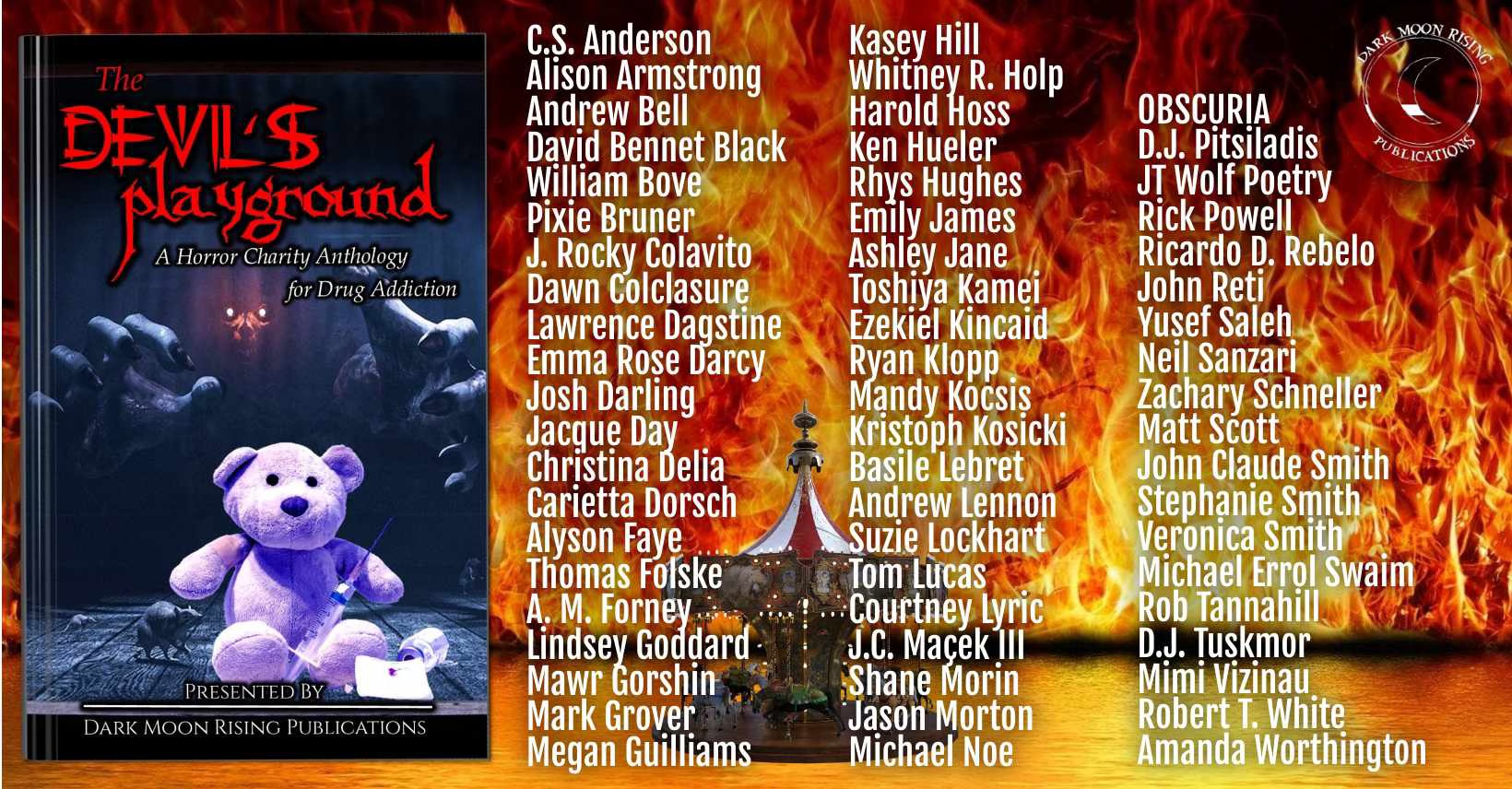
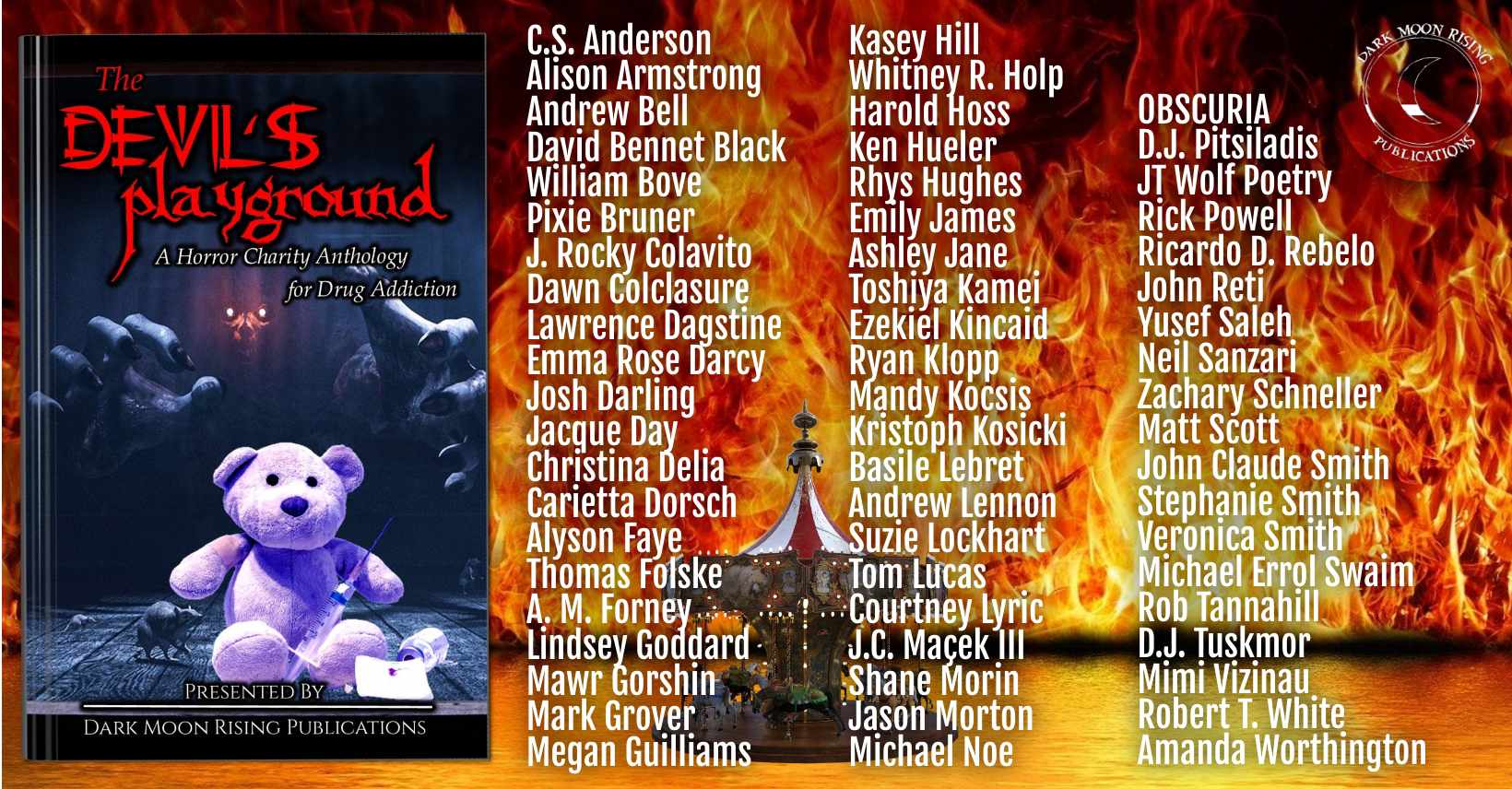
The Devil’s Playground: A Horror Charity Anthology for Drug Addiction, by Dark Moon Rising Publications, is finally published on Amazon, in paperback and ebook forms! It will be published on Godless on December 8th.

My short story, ‘Serene,’ is one of the stories in the anthology. All proceeds donated will be for To Write Love On Her Arms, an organization to help people struggling with depression, addiction, self-injury, and suicide. The theme of all of these stories is drug addiction and its self-destructive effects. 

If one were to read this story as well as my story, ‘NIB,’ in the horror anthology Symptom of the Universe: a Horror Tribute Anthology to Black Sabbath, also from Dark Moon Rising Publications, one might find a number of similarities between the stories. There are crucial differences between them, though. In ‘NIB,’ the female drug dealer is in love with the narrating protagonist, who has a fear of sexual contact due to childhood trauma caused by sexual abuse, and he uses drugs to forget his pain. In ‘Serene,’ however, the female drug dealer is luring men into enjoying her drug, taking advantage of them while stoned, and deliberately killing them if they reject her love. Both stories, ultimately, are allegories on the seductive yet destructive nature of drug abuse.

Many other great authors have stories included in this anthology (check the pic at the top to see all of their names), so please, check it out! I’m sure you’ll love the stories, and you’ll be helping out an important cause! 🙂

‘The Ancestors,’ a Horror Story, Chapter Thirteen (Final Chapter)

“Al, no! Please, tell me what’s happening?”

But when Hannah looked in Al’s face, she no longer saw him in there.

She saw Mei instead.

Mei’s cruel, malicious eyes were what was looking back at her.

In total control over Al’s body again, the evil spirit made him raise the knife and point it at Hannah. Mei made him grab her by the throat and shove her against the dining room wall.

Shaking, she gasped, “Al…Al…” through what little voice Mei allowed her to let out.

Mei had Al bare hateful teeth, like a wolf’s fangs, as the knife came slowly closer to Hannah’s chest. Though Al was trying desperately to keep the blade from getting any closer to the woman he loved, she saw only Mei in his eyes–her malevolence, her single-minded wish to stab Hannah to death.

“It’s your…turn…to die, Hannah,” Mei’s feminine voice said through Al’s mouth.

“This…isn’t you, Al,” Hannah gasped, her one hand on the wrist of Al’s knife-gripping hand, her other trying to loosen Mei’s grip on her neck. “Fight it.”

The hand holding the knife was shaking, but for the moment not getting any closer.

“Of course…this isn’t…Al,” Mei said. “It’s Mei.”

“You’re a…split…personality?”

“No. I’m…one of…Al’s…ancestors.”

“That’s…nonsense. Al, you’re ill. You need…help.”

“Al needs…to die. As soon…as I’m finished…with you.”

The shaking knife was getting closer to her chest.

Hannah kept searching for Al in his eyes.

She still saw only Mei in them.

Al was feeling a splitting headache in his efforts to regain control over his body.

No, Mei, he thought. I won’t let you kill Hannah.

The tip of the blade was now a millimetre or two away from Hannah’s skin, just above the top button of her dress. The knife shook a bit, and the blade cut off the button, exposing more of her skin to the sharp tip.

“Al…please!”

A slight scrape of the tip let out a little red.

She looked in his eyes…and she saw Al again.

He was pulling the shaking knife away from her, with all of his strength, his headache killing him, and the soreness in his arms–from Mei’s attempt to keep control–adding to his agony.

Finally, with the knife-gripping arm safely away from Hannah, he started regaining control of his other hand, which loosened its grip on her neck. She pulled free and got away from the wall.

He turned to face her, having most of his control back. He was bent over, panting.

“Al? Are you OK? Are you back?”

“Yeah, I’m back, for the moment. Mei just left me, completely.”

“As soon as we call the police and explain what happened, we’ll find a therapist for you, and you can tell them all about this ‘Mei.'”

“No, Hannah. This can’t go on. I have to die.”

He was looking at that knife in his hand.

“What do you mean, you ‘have to die’? You won’t go to jail, Al. You’ll be found not guilty by reason of…no offence…insanity. We’ll get you the psychiatric help you need. I won’t abandon you.”

“You don’t understand, Hannah. My problem isn’t mental illness, though I’m sure it must look that way to you. The spirit of Mei, one of the family ancestors, is still inside my body. She relinquished control…I don’t know why, but she’ll come back and take control of me again. Then she’ll try to kill you again. I can’t fight her off forever. She will succeed, sooner or later. I can’t let that happen. To save you, I must kill myself.” Sobbing, he pointed the sharp end of the blade at his chest.

“Al, no! What are you talking about? There’s no evil spirit inside you. Mental illness is nothing to be ashamed of. We’ll get help for you. I still love you. I’m sorry I said we were through. I still want us to be together.” Now she was sobbing.

“Hannah, I’m not insane.” His arms were shaking as he brought the tip of the blade to his chest. “I know full well what I’m doing. I know now that we cannot be together. I’m doing this, though, because I love you. Either Mei makes me kill you, or I kill myself. There is no other way out of this.”

“Al! Please, no! It’s just a delusion you’re having. Don’t stab yourself! I love you!”

She reached forward to take the knife from him.

“I love you, Hannah. Never forget that.”

He held the knife with the tip of the blade firmly against his chest, ready to push it in.

“God, no! Al, don’t!

“Oh, no, NO!

She saw no more Al in his eyes. She saw Mei’s cruel grin.

“Al, no!

He shook a bit, then raised the knife, as if to stab her.

“NOOOO!!!” he yelled.

Then the blade swung down in an arc…

…and it went deep in his gut.

“NOOOO!!!” she screamed.

He buckled and fell to the floor, his blood gushing out and staining his shirt.

She put her arms around him and kept screaming. She welcomed his blood on her dress, wanting the stains to stay there so she’d still have at least some of him with her.

I came to this house having everyone, she thought as she kept bawling. Now I have no one.

As she wept and wailed, holding his bloody body tightly against herself and practically bathing in the red, she’d had her eyes squeezed shut, as tight as her hold on his body. Then she opened them.

With her tears obstructing her vision, what she saw was blurry and distorted. In that blurry haze, she saw what at first seemed a hallucination.

She wiped away her tears for a clearer look.

No, it was still there.

And it made no sense.

A glowing vision of three old Chinese in traditional clothes–two women and a man.

In my grief, Hannah thought, I’m truly going crazy.

Thank you, Hannah, for helping us achieve our aim, Po said. You are free to go.

“I’m seeing things,” Hannah gasped. “This isn’t real.”

Oh, we are very real, Hannah, Meng said.

“Wait a minute: your voices sound familiar.”

That’s right, Mei said. You heard me from Al.

And me from Emily, Meng said.

And me from Freddie, Po said.

“I’m imagining this,” Hannah said. “There’s no such thing as ghosts. I’m going crazy.”

If you were going crazy, you wouldn’t think you were going crazy, Meng said. We’re real, we assure you.

Al wasn’t going crazy, either, Mei said. We really were possessing him and his family, and now that our work is done here, we can thank you and say goodbye.

“And what was ‘your work’ that had to be done?”

The destruction of the entire Dan family, Po said.

“Why did they, and the man I loved, have to be killed?”

For failing to pray to us, their ancestors, Mei said.

“I thought Al continued praying to you. He told me so. Why wasn’t that good enough for you?”

Because the snubbing of us by the rest of his family…our family…was already bad enough. We felt too dishonoured to forgive them, Meng said.

And when we aren’t sufficiently prayed to, we spirits turn into demons, Po said. The Dan family is almost an anomaly when it comes to Chinese culture. Most Chinese families are close and loving; this is because they pray to their ancestors. An impious attitude took hold of your boyfriend’s parents, in their adopting of Western secularism.

In rejecting belief in spiritual matters, like most of you in the West, their family unity broke down, and they came apart, Mei said. So many social and family problems that you see in Western society come from rejecting spirituality. This is why Chinese families, on average, hold together far better than your Western families.

“I call bullshit on all of that! My family wasn’t religious in any way, and we were always loving and happy. You destroyed Al’s whole family, and you murdered mine!” She was sobbing again.

She looked through her teary eyes and saw wicked grins on Po, Meng, and Mei.

Why did you kill my family? Why did you make Al kill himself? What did they do to you?”

Oh, we did that for the sheer fun of it, Meng said. We even put the idea in your mind to have your family meet the Dans for dinner…we prodded you to insist on it, never taking ‘no’ for an answer.

The three spirits were still grinning malevolently at her. Her jaw dropped.

“You’re evil, pure evil, far worse than Al’s family!”

What do you expect? Po asked. We’re devils. Thank you for your help, and goodbye.

The three grinning spirits faded away before her eyes.

Hannah let out a loud, ear-splitting scream.

Her screaming and bawling continued over a period of several minutes. A patrol car was going by the house, and the two police in it heard her. They stopped, got out of their car, and ran up to the house.

They looked in a window that revealed the dining room and saw Hannah, still on her knees and holding Al’s bloody body, always sobbing and shaking. They also saw Freddie’s and Emily’s bodies.

“Holy shit!” the male cop said.

“What the hell happened here?” the female cop said.

They went in the house and ran over to Hannah.

“Officer Wong calling,” the male cop said on his cellphone to the local precinct. “We have…what looks like..a triple homicide in the house at…just a minute, I need to take a look…137 Washington Street. We need an ambulance and stretchers.”

The female cop took Hannah in her arms.

“It’s OK, it’s OK,” she said, trying to soothe Hannah.

“No! It’s not OK!” Hannah screamed.

“What happened here? Who killed these people?”

Hannah’s words came out like a frantic firing of machine gun bullets, much too fast for the cops to process. “The ancestors did it! Three demons, two old women and an old man! They killed all of my family, too, up in the attic! They lured us all into a trap! They…”

“What is she raving about?” Officer Wong asked, sneering. “Three demons? Ancestors? This Chinese family may have believed in ancestors and evil spirits, but why would a white woman believe in that nonsense? My family never believed in that old tradition, and I’m glad they didn’t.”

“I have no answers for your questions, Officer Wong,” his partner said, rocking Hannah back and forth gently. “But I guess we’d better check the attic, too.”

“Alright,” he said. “You stay here with her, and I’ll go up there.” He went searching for the stairs.

The three spirits were waiting in the attic.

I don’t like Officer Wong’s lack of faith in us spirits, Po said to Meng and Mei. Maybe we can go after his family, too…just for fun.

All three spirits were grinning.

THE END

Dunes

Men erect
edifices, imagining
we’ll look on them and despair.
But these are houses built on the sand–
one day, they’ll crumble, like sand castles, and be dunes.

One tears
up the trees, imagining
the plant life of the Earth is limitless.
But when grass no longer grows, and green turns brown,
those castles made of sand will turn into barren dunes eventually.

One wages war
and heightens heat, imagining
that gold and paper green will last forever.
But these are worthless colours without the green of the ground.
Dunes will one day make us look on these works of the wicked, and despair.

‘The Ancestors,’ a Horror Story, Chapter Twelve

After several minutes of the most painful of efforts, Al was just beginning to feel a regaining of control over his body. Just a bit, at first: he could stir slightly, he could fidget and budge, all while suffering a terrible headache to deter him.

Freddie looked over at him and saw his face wincing in pain, the slight movements that suggested someone other than Mei was trying to control Al’s body. Freddie smirked at the amusing sight.

“What’s the matter, loser?” he asked Al. “You trying to hold in a fart? That was directed at Al, not at you, Mei. It looks like he’s trying to regain control.”

“He’s trying to,” Mei’s feminine voice said through Al’s mouth. “He won’t succeed…not for the moment, anyway.”

“Not ever, I’d say,” Emily said. “He’s never succeeded at anything in his life, except annoying people. I’m surprised he can make his body move at all, with you there, Mei.”

“I must say, Mei, that we were wrong to have stopped praying to you,” Freddie said.

“We’re both very sorry about that,” Emily said.

“Just aid us in what we wish to accomplish here, and all will be forgiven,” Mei said.

“He obviously sucked at praying to you all,” Freddie said, “since even his prayers weren’t enough to placate you. As Emily said, Al can’t do anything right.”

“That he actually killed our father, as Meng has told me in my thoughts…”

“And Po told me in mine,” Freddie added.

“…and he didn’t stop his bitch girlfriend sitting over there from killing our mother–that’s all the more reason for Freddie and me to hate Al. Feel free to kill him, too, Mei–we won’t mind.”

“Not at all,” Freddie said. “Kill that loser.”

“Oh, we’ll have him killed,” Mei said. “And we won’t stop with him.”

All three of them looked over at Hannah, bound and gagged in her chair at the other side of the table in the dining room. She was still unconscious.

They stared at her and grinned.

“She’ll make such a tasty dinner,” Freddie said, looking over at possessed Al, and knowing that he could see and hear everything said and done at their dining table…but he could do nothing about it. “Mmm!”

All three of them repeated “Mmm!” even louder while looking at Hannah. She stirred a bit.

Al gained a bit more control of his body, and he made it shake so the legs of his chair rattled against the tiles of the dining room floor.

This was enough to wake Hannah up.

Finding herself bound and gagged, with all three remaining Dan family members staring maliciously at her, she whined through her gag as loudly as she could to produce a scream, while shaking her chair and rattling its legs on the floor as much as Al was.

Assuming her crazy ex-boyfriend wanted her dead as much as his crazy brother and sister did, Hannah couldn’t understand why he was fidgeting in his chair as she was. Was this some pathetic, fake attempt to convince her he still loved her, to make her believe he was indeed possessed by the spirit of one of his ancestors? Did he really think she was stupid enough to believe that?

“You’re gonna taste so good when we’ve cooked your flesh, like a giant turkey,” Freddie said with a laugh, his taunting eyes going back and forth to look into Hannah’s and Al’s. “Yes, Hannah. We’re gonna make Al kill you, cut your body up into pieces, cook them, then eat them…that is, our ancestors will, and Al will. He’ll do it, ’cause he’s so weak! Isn’t that right, loser?”

Al was shaking the chair even more.

“What are you so upset about, loser? You’ve eaten her before, haven’t you?” Freddie laughed.

“Don’t be crude, Freddie,” Emily said.

Al’s shaking and rattling of the chair was getting more and more violent. He almost fell off of it, but he clasped his hand on the table, his fingers inches away from a large, Japanese deba bocho meat cleaver.

“Mei, you aren’t losing control of him, are you?” Meng’s deep, masculine voice said through Emily’s mouth.

“He’s…getting stronger, but I’m…managing,” Mei’s feminine voice said through Al’s mouth.

“If we beat him into submission, will you feel the hurt, or can you leave his body temporarily?” Po asked in that distinctly gravelly, grandmother’s voice, through Freddie’s mouth.

What? Hannah thought with eyes agape. How is Al’s sister talking with a man’s voice, and he and his brother are talking with women’s voices? Can crazy people really imitate voices so precisely, as unnatural as it would be for their biological voices to do? Or am I going crazy?

“Is that you speaking, Po, or is it Freddie?” Meng asked, as if she were as surprised as Hannah. “It sounds like something he’d like to do to Al.”

“It’s most likely a combination of Freddie and me,” Po said, putting a smirk on Freddie’s mouth. “You should be aware that, as we spirits continue possessing these bodies, our wills become more and more merged with those of the bodies.”

“Isn’t that true, Al?” Meng asked him, putting a smirk on Emily’s mouth now, to taunt Al as he continued to shake his body and take it back from Mei.

Meng and Po turned Emily’s and Freddie’s heads back to looking at Hannah as she continued to struggle, in as much futility as Al, to free herself. The two possessed bodies were licking their lips.

“She’s gonna taste so good, isn’t she, Al?” Freddie said in his own voice. “The ancestors are opening my mind to cannibalism; I never imagined I’d develop a taste for it.”

“Same here,” Emily said in her own voice. “Funny what a little demonic possession can do to your head.”

The two noticed that Al’s struggling was abating. He was sitting much more still now.

“Mei, if you have regained control over his body, why don’t you pick up that knife and start cutting her up?” Freddie said.

Al had completely stopped shaking now. Mei looked at Freddie calmly.

“Yes,” Mei said with a smile. “I have fully regained control of the body.”

“Good,” Freddie said in Po’s voice, then got up. “Let’s do this.”

Mei and Meng brought Al and Emily to their feet, Mei gripping that Japanese knife in Al’s hand.

The three of them walked toward Hannah.

She was whining in a shrill, raspy voice behind that gag, fidgeting frantically in her chair. Her tearful eyes looked up into Al’s, desperately looking for his expression rather than Mei’s. All she could see was the cold expression of a killer.

That’s not Al that I see, she thought as the three had almost reached her. It’s not Al at all. Not even a crazy version of him. Could it be a demon inside him?

They were at her chair now. Her ankles were tied to the front legs of her chair, so she couldn’t even kick at her tormentors. She could only squeal and shake.

Emily and Freddie held the chair still from the back, while Al stood before Hannah, Mei having him raise the knife high over his head, ready to come down on her with a stab in the chest.

Mei and Hannah looked in each other’s eyes, the latter’s full of pleading, and the former’s utterly empty of pity. Hannah kept looking for Al, somewhere deep inside those eyes. He had to be there. She searched and searched back there, but she still couldn’t find him.

Now, instead of squeals and whining from her gagged mouth, sobs of despair were coming from it.

I shouldn’t have told him I wanted to dump him, she thought. I want my Al back, crazy or not.

And then, she could finally see Al in those eyes.

And no, it wasn’t hallucinatory wish-fulfillment.

The knife came down in a slashing arc…

…and it dug deep in the middle of Emily’s chest.

“Emily!” Freddie screamed. “Al, you piece of shit!”

Her body fell to the floor, soaking it with blood.

“Mei, I thought you had him under your control!”

“She stepped aside for the moment, it seems,” Al said in his own voice with a grin, then he pointed the knife at Freddie. “And you’re next…loser!”

“Oh!” Freddie said with a chuckle. “You think you’re gonna take me on? C’mon, loser, try it!”

They stepped away from Hannah. They faced each other behind her. She kept whining and struggling.

“C’mon, loser, cut me! Let’s see what you got.”

Al slashed from right to left, aiming for Freddie’s chest; but Freddie grabbed Al’s arm by the wrist, squeezed it hard, and made him drop the knife. Then Freddie punched him hard in the gut.

“Ooh!” he grunted, then fell to the floor.

Freddie picked up the knife and smiled.

“I’ve always hated you, Al. You know that. But your killing Dad, letting your big-nosed, white whore kill our Mom, and killing Emily here give me all the justification I need to dice your guts into a million bloody pieces!”

As Al was getting back up, Freddie ran at him with the knife and threw him hard on the floor. Al banged his right shoulder on it; it hurt like hell.

Freddie started by slashing Al’s face several times.

“There,” he panted. “Now you’re even uglier. Think your bitch girlfriend’s gonna like that? If you do, you’re even stupider than I thought, loser.”

He slashed Al’s face again.

“It won’t matter if she doesn’t like it, though, ’cause I’m gonna kill you now.”

He sat up and raised the knife high over his head, ready to come stabbing down.

Hannah was going crazy not being able to see or help Al. Her only comfort was not watching him die.

Freddie brought the knife down, but Al’s left hand caught him by the wrist just in time. The tip of the blade was a few millimetres away from Al’s chest. Both arms shook as they debated over where the knife would go.

Freddie looked in Al’s eyes with much more than his usual non-fraternal malice. Al was at first looking back into his brother’s eyes with the same hate; then he turned his eyes away to look at Freddie’s hand.

“Yeah, that’s right,” Freddie panted, spit dripping from his mouth onto Al’s bloody face. “You’re weak. You always were weak.”

Hannah could only whine and shake in her chair in blind helplessness.

Al brought his mouth over to Freddie’s hand. He bit two of the fingers holding the knife. He sank his teeth in deep, bloodying Freddie’s hand and his own chest.

“Aaah, you fucker!” Freddie screamed, then he dropped the knife to suck on the cut.

Al pushed him off with a strength he never knew he had, then kicked him hard in the balls. As Freddie buckled, Al grabbed the knife and ran at him, knocking him to the floor.

Al held the knife with the handle down. He wanted to bash Freddie’s face in before stabbing him. The wooden handle smashed down on Freddie’s forehead once, on his nose twice, breaking it, on his left cheek three times, his right cheek once, his chin twice, and his mouth four times, knocking out two upper and two lower teeth and soaking his face in blood. His bruises would look like a black-and-blue mask.

“You’re still…a loser, Al,” Freddie gasped in toothless lisps.

Al flipped the knife around to point the blade down. “Yeah, Freddie,” he said. “You’re about to be stabbed to death…by a loser. Be proud of that.”

He plunged the blade deep into Freddie’s throat, shutting him up once and for all.

Al let out a big sigh, then got off of Freddie’s body. He went over to Hannah and cut her feet and hands loose.

She got up from the chair and got the gag off in an impatient hurry.

“Oh, thank God,” she sighed. “And thank you, Al, for stopping them.”

He just stood there–silent, unmoving, frowning, and looking down at the floor, his face dripping blood all over it and his shirt.

“Look, I realize now that…your family…had some serious…well, mental health issues,” she said, searching for the kindest way she could put it. “And it’s…obviously harmed you…emotionally, too. I think we can work this out. We’ll find…a professional…to help you through this.”

Still gripping the knife, he started shaking and twitching.

“Oh, no, NO!!! Hannah, get away…from me!”

‘The Ancestors,’ a Horror Story, Chapter Eleven

Hannah’s heart was beating even harder and faster now that she heard the door open and Freddie and Emily walk into their parents’ bedroom. It wouldn’t take long for them to deduce that she was hiding under their mom’s and dad’s bed.

Her mind was still racing, trying to make sense of all of the craziness that had been happening up until now, and especially now that she was next to be killed. Still, her priority was wondering what she’d do when Al’s brother and sister…and Al himself, once he was to come down from the attic after that kick she’d given him in the balls…found her. She had no time to process any of this.

She listened for Freddie and Emily.

Total silence.

No shuffling around, looking for her.

What were they doing? If they knew she was under the bed, why not just get down, look under, and grab her by the feet? Were they toying with her?

Yes, they were, actually.

The siblings were standing by the bed, looking down at it. There was nowhere else in the room for Hannah to have hidden, anyway–no closet big enough for her to fit into. Emily put her finger to her lips to tell Freddie to be quiet. They were smirking.

Hannah could hear light, unintelligible whispering.

“Let’s wait a while before getting her,” Emily said softly in Freddie’s ear. “Give her a moment to think through what’s happened…also drag out the terror for her, and the false hope.”

“Good idea,” he whispered back in Emily’s ear.

Hannah’s heart still pounding as hard and fast as ever, she began to think through everything that had happened to lead to this nightmare.

This was just supposed to be a pleasant dinner for both of our families to meet each other, she thought. Al was so resistant to me meeting his family, but I assumed it was just going to be some mundane problem. I never would have imagined, in a million years, that his family would be a bunch of murdering psychos…and that Al himself was one of them, too!

“Where is that loser, Al?” Freddie whispered.

“Shh!” Emily said, pointing at the bed.

All in one night, Hannah thought, I went from pleasantly anticipating meeting Al’s family, mine visiting them, and assuming I’d marry Al and unite our families in mutual love, to not only realizing that Al was being bullied by them, but also…having all of my immediate family…brutally murdered (She tried to hold back a sob), and worst of all, Al is one of the killers! I went from hopes of extending my family, to include his, to losing my family, Al’s family, and having to dump the man I love…loved! How could such extremes happen?

Now she let out an audible sob.

“Alright,” Emily whispered. “Let’s do this.”

She and Freddie squatted and looked under the bed.

Hannah at this moment was still far too absorbed in her thoughts to notice the siblings coming down to see her. This craziness has gotten so extreme, she continued thinking, that I have become a killer, too! I stabbed Al’s mom with that knife! It was self-defence, but I’d never in a million years see myself killing someone…wait…

She felt Freddie’s and Emily’s hands on her ankles, pulling her out from the bed.

“Ah!” she yelped, then grabbed onto the bedposts at the head of the bed to stop them from getting her out. The siblings kept yanking and yanking at her shaking legs, their grip irritating her skin and causing her shoulders and wrists to ache, but she kept a firm hold on those bedposts.

The siblings stopped yanking for a second, let out sighs of frustration at the same time, and in the voices of Po and Meng, they shouted, “Fang shou!”

Magic in those Chinese words forced Hannah to let go of the bedposts.

She screamed as Freddie and Emily pulled her out from the bed, her unable to conceive how mere words could force her to let go. Her screams were cut short by a blow from Emily’s fist on her head, smashing her face on the wooden floor, giving her a nosebleed and knocking her out. Meng’s spirit had given Emily’s fist extra strength.

“Let’s tie her up and take her downstairs,” she said in Meng’s deep, male voice.

“There’s rope in the room next door,” Freddie said in Po’s raspy, feminine voice. He left the room.

In the hall, he saw Al having just finished coming down the attic stairs.

“Where have you been, you loser?” Freddie asked in his own voice. “You’re fucking everything up again, aren’t you? Where are Mom and Dad? Emily and I are trying to take care of your girlfriend, and you’re wasting time in the–“

“Don’t talk to me that way, boy!” Al said in Mei’s authoritative, feminine voice. “I was stalled by Al’s determined efforts to regain control over his body. He killed your father, and Hannah killed your mother. I’ve finally subdued Al, so I can help you and Emily now.”

“Sorry, Mei,” Freddie said, bowing and gesturing to her with his hands clasped together. “I have to find some rope in the other room. Meng is with Emily in our parents’ bedroom. Hannah is knocked out. We have to tie her up and take her downstairs.” He went in the room to find the rope.

Mei took Al’s body into his parents’ bedroom.

Though Al’s soul, for the moment, was fully under Mei’s control, he was able to see, however passively, Hannah lying unconscious on the floor. He tried with all of his might to regain control over his body, but Mei was ensuring that he couldn’t make his body budge an inch.

Is Hannah dead? he wondered.

He couldn’t even weep for her.

Freddie returned with the rope, a bandana, and a small rubber ball to use as a gag for Hannah’s mouth. All three Dan family members, under the control of Po, Meng, and Mei, helped tie up and gag Hannah.

They carried her downstairs and into the dining room, and with some remaining rope, they tied her to a chair. They sat next to each other, Emily in the middle, at chairs on the other side of the table.

The whole time, Al had been trying, in all futility, to take control of his body and stop the other two. All he could do was watch helplessly, and be forced to help them through Mei’s possession of him.

“So,” Freddie said in Po’s voice. “What should we do with her, Al? We know you can see and hear us.”

“But you can’t do anything about it,” Emily said in Meng’s voice. “You broke our agreement, Al, so we’re under no obligation to do anything for you.”

“And doing things to upset you has always been much more amusing than doing things for you,” Po said. “What shall we do with her?”

“Kill her, of course,” Meng said.

“Of course, of course,” Po said. “But how?”

“In a way that Al will find the most upsetting. We should make him hold the knife that cuts into her chest.”

Al wanted to scream “NO!!!” at the top of his lungs…but he couldn’t even grunt.

“Then we can make him cut her body into pieces, cook them, and serve them as our dinner. The Dan family may have been sated at dinner, but we ancestral spirits haven’t had a bite to eat. We’ll let Al have the biggest share of Hannah’s cooked flesh.”

Mei curled Al’s lips upward in a smirk.

Al couldn’t even weep.

Analysis of ‘Payback’

Payback is a 1999 neonoir film directed by Brian Helgeland, written by him, with rewrites for the theatrical release by Terry Hayes. The film is based on the 1962 novel, The Hunter, by Donald E. Westlake, writing under the pseudonym of Richard Stark; this novel had earlier been adapted into the 1967 film, Point Blank.

Payback stars Mel Gibson, with Gregg Henry, Maria Bello, Lucy Liu, Deborah Kara Unger, David Paymer, Bill Duke, William Devane, James Coburn, Kris Kristofferson, and John Glover.

There are actually two substantially different versions of this movie, with different colour grading, different soundtracks, and most importantly, with completely reshot third acts, leading to totally different endings. The test screenings for the film, right after it wrapped, didn’t yield a positive result. It was felt to be excessively dark and violent, with a wife beating, a shot dog, and other characters killed in cold blood.

A more crowd-pleasing version was wanted, so Helgeland was out, Hayes’s rewrites were made, and the central villain–done in a voice-over by Sally Kellerman–was replaced by Kristofferson (both seen and heard), while removing the objectionable parts mentioned above and adding a voice-over narration by Gibson.

Helgeland’s version–the director’s cut–is called Payback: Straight Up, and it was released on DVD, Blu-ray, and HD DVD in 2007. According to The A.V. Club, Straight Up is “a marked improvement on the unrulier original.” Indeed, the theatrical release was not all that well received, and with the generally better critical reception of the director’s cut–which has a darker, more ambiguous ending–one realizes that the reaction of the test-screen audience perhaps should not have been taken too much to heart.

Here is a link to quotes from the film, here is a link to the director’s cut, and here is a link to a PDF of The Hunter. I’ll be comparing both film versions and the plot of the novel.

The main theme of the film is, most obviously, theft, since it’s not just the $70,000 cut that Porter (Gibson–Parker in the novel, who is double-crossed out of $45,000) loses after being double-crossed by his heist partners, Val Resnick (Henry–Mal Resnick in the novel) and Porter’s wife, Lynn (Unger). They’ve stolen the total amount of money from a rival Chinese mafia organization. Porter’s wish to get his $70,000 back from “the Outfit,” a powerful mafia organization Val has given the money to so he can rejoin them after having been kicked out for committing a blunder, is seen by the Outfit as a theft in itself.

Since the film deals with a number of mafia organizations, as well as two corrupt cops (Detectives Hicks and Leary, respectively played by Duke and Jack Conley), and since I have a habit of seeing mafia as representative of competing capitalists, we can see how the alienating, dog-eat-dog world of Payback is allegorical of our own, oh-so-troubled times.

When we don’t have solidarity among the working class, united in their struggle for liberation from capitalist exploitation, those very common people end up attacking each other, fighting with each other, hurting each other. Such is the kind of dog-eat-dog-world we see in Payback.

The theatrical release begins with a scene in a room where a doctor…or sorts…removes bullets from Porter’s back–bullets put there by Lynn during the double-crossing. Because Porter is a professional thief, and therefore would be tracked by the cops if he went to a hospital, he has to resort to this kind of low-quality ‘healthcare.’

The novel begins with Parker as a penniless, shabbily-dressed drifter (one might remember young Hitler during his destitute days…I’ll go into why I’m making this comparison later) crossing the George Washington Bridge into Manhattan and bent on getting his money back. The beginning of the director’s cut is similar (since it’s far more faithful in general to the novel), and after the crossing of the bridge, Porter comes out of a train station that looks like the one at the end of this film version, where he again gets shot, and he needs Rosie (Bello) to drive him to that ‘doctor’ before he dies, thus making the plot of the director’s cut come full circle.

Since The Outfit, as I see it, represents the capitalist system (an idea that can be seen more vividly in the novel, when it’s described as having branches all over the US–in New York City and Chicago, for example–and how it grew from the old Prohibition days into a corporation with an outer veneer of legitimacy, to keep the cops away), and violent, criminal types like Porter/Parker and Val/Mal work sometimes inside (the latter), and sometimes if not always (the former) outside of The Outfit, these two men can be seen to personify fascism in its different aspects.

If that observation seems odd to you, Dear Reader, let me elaborate.

Neither of these men are concerned with how the exploitative, hierarchical structure of capitalism as represented in The Outfit is harmful to the world’s most vulnerable…as fascists aren’t concerned with it, either. Val/Mal wants into the system in order to enjoy its perks (just as Hitler enjoyed the backing of big business to help him come to power). Porter/Parker is only concerned with getting back the money he was cheated from; since Val/Mal gave his stolen share to The Outfit, Porter/Parker wants them to give it back to him…and he’ll kill anyone who stands in his way.

Naturally, The Outfit doesn’t want to part with $70,000, so their top brass refuse to give Porter ‘his money.’ This refusal is similar to how the Western imperialist powers didn’t want to cede such territory as Poland to Nazi Germany, who wanted their piece of the pie…hence the Nazi invasion of Poland started the inter-imperialist WWII.

Remember that what our protagonist wants back is something he himself helped to steal…just as Nazi Germany ‘took back’ Poland, some of which (West Prussia and Silesia) was once part of the German Empire before it was lost at the end of WWI. This land was felt to have been ‘stolen’ from Germany, and the Nazis used all violence imaginable to get it back, as Porter does.

Like fascists, he couldn’t care less about the suffering of the poor; he just wants to bring himself out of pennilessness and back into wearing stylish suits as quickly as possible, like the petite bourgeoisie, who often side with fascism, especially if they lose power to the haute bourgeoisie (whom The Outfit could be seen to personify). At the beginning of the film, Porter steals paper money from a homeless man, justifying his theft (in the theatrical release, significantly) by noting that the homeless man is faking his lameness. There’s to be no sympathy for the destitute if they aren’t disabled, apparently. Those are neoliberal values for you.

The theatrical version changed the film to make Porter more likable, in spite of the fact that he’s hardly less sociopathic than Val…or your average fascist, for that matter. The scene of Porter fighting with and beating Lynn in her kitchen was removed, as was his killing, near the end of the film, of an Outfit soldier in cold blood in a truck for speaking to Rosie as if she were a mere whore.

But even without these scenes, Porter is still a nasty piece of work. He kicks Lynn’s apartment door in while her back is to it; she’s pushed into a wall, knocking the wind out of her. There’s all of his other, unfeeling violence, all just to get $70,000, which keeps being mistakenly thought to be $130,000. The very tagline of the theatrical release is “get ready to root for the bad guy.”

The crucial difference to be found between the theatrical release and the director’s cut is that the latter presents a dark, gritty world that is so harsh that one cannot watch it without thinking there’s something unacceptably wrong with it…it’s implicitly a social critique…whereas the former–with its more sympathetic Porter–makes his violence seem ‘hip.’ It’s significant that this glamourizing of sociopathic Porter should be in a film from the late 1990s, by which time the replacement of welfare capitalism with the neoliberal ‘free market’ variety had been firmly established.

You see, Porter demonstrates a kind of ‘triumph of the will’ that we’ve already seen in Conan the Barbarian. There’s a message advocating an acceptance of this kind of colder- and colder-blooded competition that has insidiously crept into otherwise mainstream liberal Hollywood movies, implicitly encouraging viewers to adopt the same unfeeling attitude.

First, we make it ‘cool’ and ‘badass’ to show a macho man killing and killing to get what he wants–in this case, seventy grand. Then, we make it hip to use racial slurs, as Tarantino did, and as we hear Val doing, calling the Chinese mafia “chows” and “fuckin’ slants!” All we need is for economic times to be hard–symbolically expressed in scruffy, penniless Porter itching to get his $70,000 at the film’s beginning–while one never challenges the capitalist system that caused these problems, of course, and the stage is set for fascist violence to come in.

After ripping off the homeless guy, Porter surveys the busy sidewalks to find a man who looks similar enough to him for a photo ID he can fake as being of himself. He finds a suitable guy, bumps into him and apologizes, brushing his suit to distract him while pickpocketing his wallet. As we can see, the theatrical release glamourizes a thief and killer, ruthlessly stopping at nothing to get ‘his’ money, whereas the director’s cut presents him as such not to make him seem ‘cool,’ but as an implicit social commentary, a dark one, meant to raise eyebrows.

Just before the wife-beating, Lynn tells Porter that Val has arranged to pay her rent, just as in the novel, Mal does this for her in return for a sexual relationship with her. Resnick has stolen far more than just money from our prickly protagonist.

In the film, a far better motive is given to Lynn to double-cross and kill Porter than is given in the novel: she thinks he has been having an affair with Rosie (which he claims happened before he met Lynn). In the novel, Mal threatens to kill her if she doesn’t shoot Parker…because he’s too much of a coward to do his dirty work himself.

Val, even more overtly violent than Porter, enjoys beating women–prostitutes in particular, suggesting a…shall we say, Joy Division mentality about them?–and has a racist attitude, at least towards Asians. His favorite prostitute is the S-and-M-leaning Pearl (Liu), who is linked with the Chinese mafia, and with whom he trades punches. One is reminded of Freud‘s comment: “A sadist is always at the same time a masochist.” Val utterly personifies fascism.

As I mentioned above, he stole Porter’s cut to buy his way back into The Outfit, which as I also mentioned above, represents capitalism in its more presentable form. There are different levels of viciousness in capitalism. When economic times are good, capitalism can pretend to be democratic; when they’re bad, the democratic mask falls off, and the ugly, violent face of fascism shows itself.

Val represents the kind of fascist who wants to hide in, and get the benefits of, capitalism’s respectability in the form of The Outfit. Porter, however, represents the kind of fascist who sees through the phony masquerade of The Outfit and the capitalism it represents, so he’d rather work outside of it, even butting heads with it, if necessary.

A middle-man between Val and Lynn’s seller of drugs is Arthur Stegman (Paymer), who also owns a taxicab operation (in the novel, the Rockaway Car Rental). As with the ‘legitimacy’ of The Outfit, Stegman’s cab business is the respectable one he, as a dealer of drugs like the heroin Lynn has ODed on, hides behind (in the novel, she kills herself by ODing on sleeping pills).

The point I’m trying to make–about the outer mask of respectability we have in capitalism (The Outfit, Stegman’s cab company) vs. the naked aggression of fascism as personified in Porter and Val–is that we shouldn’t have any illusions about the former as being somehow contrasted against the latter. To many of you readers, the point may be too obvious to need to be said; but remember that, as of my writing of this article, millions of Americans are voting for Harris or Trump, fully believing that who they’re voting for are acting in their interests.

Recall that quote by Frank Zappa–who was no supporter of socialism, yet nonetheless had no illusions about the American political and economic system he lived in–about how the illusion of freedom will last only as long as it remains profitable to do so. Once that illusion is too expensive to maintain (as it has been for several decades now), it will be removed, and we will see the naked reality of our hierarchical system based on money and power, and given expression in the form of fascism.

When the comfortable life of liberals is safe and intact, they can pretend to be magnanimous and gracious. When their class privileges are in any way threatened, though, they show their true, violent colours. Val, in the comfort and discreetness of his Outfit hotel room, can hide his sadism with Pearl. When he’s been told by Stegman at a restaurant that Porter is alive and well and presumably wants to kill Val, he shows how nasty he’s capable of being right out in public, right out in the open.

He’s speaking out loud at his table, with no regard for the other patrons. He speaks of having Porter killed for sure, again, loud enough for everyone to hear and not caring at all about it. He even threatens another customer, walking right up to his table, for merely looking at him.

When Val goes to see Carter (Devane), a superior to him in The Outfit, he’s all deferential, because of course he has to be. He’s hoping for help from Carter, but now that Carter’s class interests are also being compromised (as are those of The Outfit in general) by Porter’s visit to Val’s room the night before, Carter not only won’t help Val at all with doing away with Porter, he also wants Val to move out of the hotel, not coming back until he’s removed Porter all by himself (the same thing happens to Mal in the novel). The liberal in Carter has shown his true colours, too. There is to be no more “unpleasantness” from Porter at the hotel.

In the director’s cut, Val is standing outside The Outfit building, angry about having been cut loose from them. He shouts that to do something right, one must do it oneself; then, facing and gesturing to the two US flags by the front doors of the building, he shouts, “It’s the American way!”

Once again, this moment seems to demonstrate Helgeland’s original intentions for Payback, the implied critique of capitalism. When you’re in a bad situation as Val is, those in power won’t help you. You have to deal with the problem yourself–no government handouts, for that would be ‘vile socialism.’ Val is so brainwashed by American capitalist ideology, though, that he won’t even admit that the system is screwing him, knowing full well how screwed by it he is.

After all, it’s the American way. Long live the free market!

He has a racist attitude towards the Chinese (and presumably by extension, towards Asians in general), but this doesn’t mean he won’t enlist their help in killing Porter for him. It’s just as when the Nazis, though regarding the Japanese as racially inferior to them, nonetheless were content to have them in the Axis to keep the Americans occupied during WWII. Politics makes strange bedfellows, and Val has to make do with what little he has.

Though he helped Porter rip off the Chinese mafia, he’s enough of a snake to blame the entire robbery on Porter in order to motivate them to kill him and have their satisfaction in him alone. Unfortunately for Val, though, those two cops intervene just in time to scare the Chinese mafia away.

Now, Detectives Leary and Hicks are thoroughly corrupt, willing to be bought off by Stegman for selling heroin, as well as to save Porter from being charged with the killing of Lynn, etc. (i.e., by having Porter give them the $70,000); but that doesn’t mean they’ll let Val and the Chinese mafia finish off Porter after running into him with their car.

You see, Leary and Hicks represent the kind of capitalism in which the government intervenes, as opposed to the theoretical ‘free market’ capitalism as represented in the lawless Chinese mafia and The Outfit. Just as these two cops will extort money from Porter or Stegman, the state will gladly take cash gifts from capitalists, be they liberal, moderately conservative, or fascist in ideology, in exchange for government protection. Only right-wing libertarians and their extreme, deluded version–‘anarcho’- capitalists–entertain the fantasy that the state and the market are mutually exclusive, and that an unholy alliance between the two cannot be ‘true’ capitalism, but is ‘corporatism’ instead.

Leary and Hicks are a rewrite of cops in the novel who, investigating a shop-owner named Delgardo for moving marijuana from Canada into the States, suspect that Parker is in on the drug-dealing, too (Part III, Chapter 1). In the, to be frank, rather anti-climactic ending of the novel, Parker manages to get his money with minimal difficulty, as opposed to the bloody injuries Porter sustains in both the theatrical release and the director’s cut.

The cops in the novel, however, being incorruptible types compared to Leary and Hicks, finger Porter for helping Delgardo to move the marijuana into the country (Part IV, Chapter 4), and while he manages to get away from the cops, he flees with the wrong baggage, one with clothes rather than the one with the money. The novel ends with him, having enlisted the aid of three men, ripping off The Outfit again, but for a smaller sum of money.

While Parker kicks the asses of the cops in order to escape them in the novel, in the film, Porter plans to frame Hicks and Leary for his killing of Val; he does so by stealing Hicks’s badge, tricking Leary into getting his fingerprints all over the pistol he’s used to put a bullet in Val’s head, and putting Hicks’s badge in the hand of Val’s corpse.

In the novel, Parker needs Rose only to get an address so he can find Mal. In the film, Porter does more than that with her: he revives a relationship with Rosie, now that Lynn is dead. When killing Val, after learning that he needs to contact Carter and Fairfax (Coburn) about getting his money, he saves her from a brutal rape in her apartment. (In the director’s cut, he arrives too late, unfortunately, to stop Val from shooting and killing her dog.)

When Porter goes to Carter’s office, we come to the greatest divergence between the theatrical release and the director’s cut: the identity of the film’s central villain–respectively, Mr. Bronson (Kristofferson) and Ms. Bronson (Kellerman, in voice-over). Since we only hear her voice and never see her, this lends her a fascinating aura of mystery: she’s like a vengeful mother goddess after Porter has shot Carter.

Though I tend to prefer the soundtrack of the theatrical release, with the five-note, chromatic sax ostinato of its main title, I must say that I prefer the darker, more ambiguous ending of Helgeland’s version to the crowd-pleasing, raised-stakes version with Kristofferson, as superficially thrilling as it is. Hence, I’ll deal with the director’s cut ending.

Having not only a woman as the head of the mafia Outfit, but also a woman who surprises and shoots Porter at the train station, the director’s cut ending defies the stereotype of the ‘innocent woman’ vs. the necessarily male villain. This ending, though closer to the novel version (i.e., the payoff happens at a subway station–Part IV, towards the end of Chapter 3), also improves on its disappointingly anti-climactic denouement.

Helgeland’s ending can also be seen to reflect the relationship between fascism (as personified in cold-blooded killer Porter and sadistic Val) and the mainstream imperial ruling class (The Outfit). As Carter has observed, the sadism of Val “comes in handy,” but anyone…anyone…who causes trouble for The Outfit must be removed–either kicked out of the hotel (Val), or killed (Porter).

Similarly, the ruling class has always found fascists to be useful in beating the working class into submission; hence, for example, when Hitler was allowed to take the Sudetenland and encouraged to go east and invade the USSR. When he and Mussolini started to move in on such territory as that of the British Empire, though, they were making themselves into troublemakers of a sort that Porter could be seen to represent, with his fascist-like bent towards violence.

Hence, the violent, he-who-lives-by-the-bullet-shall…die?…by-the-bullet, fate of Porter is comparable to the crushing defeat of Hitler and Mussolini by the end of WWII. The two dictators died…as Porter just might die…but their fascist legacy lived on, through Operations Paperclip and NATO-backed Gladio, Western support of Ukrainian Nazi sympathizers to this day, etc.–as Porter just might survive.

My Short Story, ‘Serene,’ in the Horror Anthology, ‘The Devil’s Playground,’ to be Published Soon

I will have a horror story, ‘Serene,’ published in this anthology, The Devil’s Playground, by Dark Moon Rising Publications. The theme of all of these stories is drug addiction and its self-destructive effects.

If one were to read this story as well as my story, ‘NIB,’ in the horror anthology Symptom of the Universe: a Horror Tribute Anthology to Black Sabbath, also from Dark Moon Rising Publications, one might find a number of similarities between the stories. There are crucial differences between them, though. In ‘NIB,’ the female drug dealer is in love with the narrating protagonist, who has a fear of sexual contact due to childhood trauma caused by sexual abuse, and he uses drugs to forget his pain. In ‘Serene,’ however, the female drug dealer is luring men into enjoying her drug, taking advantage of them while stoned, and deliberately killing them if they reject her love.

Many other great authors have stories included in this anthology (check the pic at the top to see all of their names), so please, check it out! It’s a charity anthology, the proceeds being for To Write Love On Her Arms, an organization to help people struggling with depression, addiction, self-injury, and suicide. I’m sure you’ll love the stories, and you’ll be helping out an important cause! 🙂