Macbeth is a tragedy Shakespeare is believed to have written between 1603 and 1607. The play’s Scottish war hero turned tyrannical king is based on, but bears little actual resemblance to, King Macbeth of Scotland (reigning from 1040 until his death in 1057); the historical king is believed to have actually been a good and able king.
The play includes many magical incantations thought to have been taken from real witches without their permission, angering them and causing them to curse the play in revenge. For this reason, the play is considered unlucky. Accordingly, when actors are rehearsing the play, referring to it or the title character by name is taboo. Instead, one calls it ‘the Scottish play’, ‘MacBee’, etc. If one accidentally says ‘Macbeth’ in a theatre, there are cleansing rituals that can be done to avert disaster, one example being spinning around three times as fast as possible, spitting over one’s shoulder, and uttering an obscenity. Disastrous performances from the play’s history have contributed to the superstition. The BBC comedy ‘Blackadder the Third’ did a hilarious sendup of this superstition in the episode, ‘Sense and Senility’. http://www.youtube.com/watch?v=h–HR7PWfp0
Macbeth is the shortest Shakespeare tragedy, with a quick-moving first act and, apart from the title character himself, minimal character development, causing some scholars to believe we don’t have a complete copy of the play. Banquo’s son Fleance is supposed to have begot a line of kings leading up to James I, the (as of the writing of the play) new king of both Scotland and England, after the death of Queen Elizabeth I: this long lineal connection to Fleance is thought to be a politically-motivated praising of the new king.
Here are some famous quotes:
‘Fair is foul, and foul is fair;/Hover through the fog and filthy air.’ –3 Witches, I, i, lines 10-11
‘So foul and fair a day I have not seen.’ –Macbeth, I, iii, line 38
‘Two truths are told/As happy prologues to the swelling act/Of the imperial theme.’ –Macbeth, I, iii, lines 127-129
‘I have no spur/To prick the sides of my intent, but only/Vaulting ambition, which o’erleaps itself/And falls on the other.’ –Macbeth, I, vii, lines 25-28
‘Is this a dagger which I see before me,/The handle toward my hand? Come, let me clutch thee.’ –Macbeth, II, i, lines 33-34
‘Methought I heard a voice cry, Sleep no more!/ Macbeth does murder sleep.‘ –Macbeth, II, ii, lines 35-36
‘Double, double, toil and trouble;/Fire burn, and cauldron bubble.’ –3 Witches, IV, i, lines 10-11
‘Out, damn’d spot! out, I say!’ –Lady Macbeth, V, i, about line 34
‘Tomorrow, and tomorrow, and tomorrow/Creeps in this petty pace from day to day/To the last syllable of recorded time;/And all our yesterdays have lighted fools/The way to dusty death. Out, out, brief candle!/Life’s but a walking shadow, a poor player/That struts and frets his hour upon the stage,/And then is heard no more. It is a tale/Told by an idiot, full of sound and fury,/Signifying nothing.’ –Macbeth, V, v, lines 19-28
Three prophecies for Macbeth’s fate:
I) Beware Macduff, beware the Thane of Fife.
II) None of woman born shall harm Macbeth.
III) Macbeth shall never fall till great Birnham wood come to high Dunsinane hill.
One important theme in Macbeth is that of fertility versus infertility, or of life versus death. Banquo’s fertility allows him to begin a line of kings that continues right up to the reign of King James, almost six centuries later, and during Shakespeare’s time. Macduff, the one eventually to kill Macbeth, has several children, ‘all [his] pretty chickens’, whom Macbeth has had killed. Macduff observes that Macbeth, however, ‘has no children’.
Macbeth is defeated when Birnham wood comes to Dunsinane; all those tree branches, symbols of life and fertility, coming to Macbeth, symbol of death and infertility, to end his reign of terror.
The most important theme of Macbeth, however, is that of equivocation, perfectly embodied in the quote, ‘Fair is foul, and foul is fair.’ These opposites appear several times throughout the play, as in the second quote above.
Other examples include when Banquo asks why, upon hearing the witches prophesy of Macbeth being Thane of Cawdor and the future king of Scotland, Macbeth starts in fear on hearing of things ‘so fair’. Later, when Macbeth has been crowned king (having murdered Duncan, the previous king, to get the throne), Banquo correctly suspects that Macbeth ‘play’dst most foully for’t.’
The beginning of the play is ‘So foul and fair a day’, for it is foul with the smell of the blood of war, and yet fair with Scotland’s victory over Norway and Ireland, thanks to Macbeth’s valour.
Macbeth says the witches’ prophecies ‘Cannot be ill; cannot be good’; for if bad, how do they result in good for him, making him Thane of Cawdor? If good, why do the prophecies frighten him with the firing up of his murderous ambition? Macbeth shudders over the ‘fair’ prophecies of his being Thane of Cawdor and the future king, for these spur his ‘Vaulting ambition’, his tragic flaw, which will change him from the fair war hero at the play’s beginning to the foul tyrant who must be killed at the play’s end. Indeed, even though the play ends happily with Macbeth killed and Scotland restored, it is still a tragedy in how a good man is turned into a bad man, who ultimately must be destroyed.
Banquo’s prophecies are also foul and fair. He is, according to the witches, ‘Lesser than Macbeth, and greater’; ‘Not so happy, yet much happier’. For though Banquo won’t be a king himself, his descendants will be, right up to King James, and as Macbeth imagines, possibly ‘to th’ crack of doom’.
Macbeth and Lady Macbeth switch the roles of foul and fair midway into the play, when he is crowned king. Before that, he is still somewhat good in his feelings of guilt and fear over the plotting of King Duncan’s murder; Lady Macbeth, meanwhile, relishes in her wickedness, even calling on evil spirits to keep her constant in her ambition. After he’s crowned, however, it is Lady Macbeth who is fearful and remorseful, while he is grinning in his machinations. He frowns only from his fears of losing his power; he never repents. Though Banquo’s ghost frightens him, the witches’ prophecy–that ‘none of woman born’ will kill him–gives him a false ‘fair is foul’ kind of confidence. (More on that later.)
Lady Macbeth, after disposing of the bloody daggers her husband has used on King Duncan, says ‘How easy is it’ to wash the blood off; later, during the sleepwalking scene, the imaginary blood she has on her hands is impossible to remove, as is the erasing of her guilt. The fair of easy becomes the foul of impossible.
Even the porter speaks of equivocation in bawdy humour. Wine’s effect on a man ‘provokes the desire, but it takes away the performance…makes him stand to, and not stand to; in conclusion, equivocates him in a sleep,…’ etc.
Finally, the second two prophecies of Macbeth’s ultimate fate are equivocal in his destiny being both foul and fair at the same time. That he will never lose his power till the forest of Birnham moves to his castle sounds as though he’ll be king forever…fair. How can the trees be uprooted and made to move up to Dunsinane hill? Macbeth doesn’t consider, however, that the English army, led by Duncan’s son Malcolm, will cut off branches from the Birnham trees and carry them to Dunsinane, to hide their numbers. Within the time frame of this play, these branch-carrying usurpers of Macbeth seem to come very soon, too…foul. When Macbeth learns the truth of this, he begins ‘To doubt th’ equivocation of the fiend/That lies like truth.’
Furthermore, the cocky self-confidence Macbeth gains from the prophecy ‘none of woman born’ will kill him (that is, none born by going through his mother’s birth canal) makes him forget all too easily the first prophecy, ‘Beware Macduff’, who wasn’t born of woman, but ‘was from his mother’s womb/ Untimely ripp’d’, that is, born by Caesarian section. Again, what makes Macbeth feel invincible–fair–should actually make him feel most vulnerable–foul.
Act One: Forced by his elder brother, Oliver, to do menial work, Orlando complains of him to Adam, the family’s aged servant. Though Orlando’s late father, Sir Rowland de Boys, gave an inheritance to all three of his sons, Oliver, the eldest, refuses to let Orlando, the youngest, have his share. Orlando will no longer endure this unfair treatment.
Oliver enters, scorning Orlando when he demands his inheritance. The brothers fight, and Orlando has Oliver in a headlock, not letting him go until he says he’ll give Orlando the inheritance. Let go, Oliver speaks abusively to Adam, who protests the abuse. Oliver leaves angrily.
Elsewhere, Oliver meets with Charles, a big, strong wrestler who’s killed men in wrestling matches. Charles mentions the usurped Duke Senior and his men, who are living like Robin Hood in the forest of Arden. Charles also says that Orlando wishes to fight him in a wrestling match, and warns Oliver that Orlando will most likely be killed in the fight. Oliver, though saying he will try to dissuade Orlando from wrestling Charles, secretly would like his brother to die in the match, of course.
In the next scene, Rosalind complains to her cousin and good friend Celia of how sad she is that her father, Duke Senior, has been usurped and banished by Duke Frederick, her uncle and Celia’s father. Celia tries to cheer her up by speaking with her about love. Touchstone the jester enters and makes some witty remarks. Then Le Beau, a courtier, arrives, and tells them all about the wrestling match between Charles and Orlando. They all go over to watch it.
The girls meet Orlando and try to dissuade him from fighting the much bigger and stronger Charles. Orlando says he doesn’t care if he dies, for he has no friends, nor anything to live for, and his absence will give more room to the rest of the people of the world. He and Rosalind are already beginning to have feelings for each other. Charles arrives, as does Duke Frederick. The match begins.
At first, Charles is clearly winning, though Orlando won’t give up. Celia wishes she could be invisible and trip Charles. Orlando, however, gets lucky and wins the match, injuring Charles badly enough that other men must life the heavy wrestler and carry him off.
Duke Frederick congratulates Orlando and asks him his name. When Orlando says he’s the son of the late Sir Rowland de Boys, a friend of Duke Senior, Frederick leaves angrily.
The girls go to speak with Orlando, congratulating him. Rosalind gives him a necklace to remember her by, and they’re already in love, though they haven’t said so. The girls leave him.
Alone with Celia, Rosalind tells her of her love for Orlando, and that, since her father and his were friends, that makes her love of Orlando all the luckier. Celia says that her father disliked Sir Rowland de Boys, but that she likes Orlando no less for that.
Duke Frederick enters and tells Rosalind she’s banished from the dukedom. When she asks why, he says it’s because she’s Duke Senior’s daughter. Though he tolerated her before, for Celia’s sake, he now feels his power is threatened by the likes of her. When Celia tries to defend her, he calls Celia a fool for not worrying about Rosalind as a threat to her future power. He leaves.
Celia comforts Rosalind, insisting that her father has banished her, too, for she has no life without Rosalind’s company. The girls plan to dress as poor people to avoid being enticing targets for highway bandits. And since Rosalind is the taller of the two, she’ll disguise herself as a boy, and call herself ‘Ganymede’. Celia will pretend to be ‘his’ sister, and call herself ‘Aliena’ (foreigner). They’ll have Touchstone accompany them for protection, go into Arden, and look for Duke Senior.
Act Two: In Arden, Duke Senior speaks with his men of how much better life in the forest is, compared with the phoney court. With the harshness of nature, one has honesty instead of flattery, and nature can impart much wisdom to us. (See quote 1 from my ‘Analysis of As You Like It‘.)
He asks of the melancholy Jacques (pronounced ‘JAY-queez’), and is told that Jacques is weeping over the killing of a deer.
Back in the dukedom, Adam warns Orlando of Oliver’s plot to burn down Orlando’s home while he’s sleeping. Orlando plans to flee into Arden; Adam wants to go with him, and offers him all the money he’s saved from his employment with the de Boys family. Orlando is touched by the generosity of the older generation, a virtue he feels is lacking among the young. They prepare to leave for Arden.
‘Ganymede’, ‘Aliena’, and Touchstone have been walking long to get to Arden, and are all exhausted. They see two shepherds, older Corin and younger Silvius. Silvius is complaining of his unrequited love for the shepherdess Phoebe, saying that Corin, in his age, has forgotten of the young’s pain from lovesickness. Silvius leaves.
‘Ganymede’, affecting a boy’s voice and manner, asks Corin where ‘he’ and ‘his’ friends can find accommodation. Corin tells them of the house of a churlish old shepherd who wants to sell it, and he takes the three tired travellers there.
After Amiens, a singer in Duke Senior’s company, and his backing musicians perform a song, Jacques adds a verse with the word ‘Ducdame’, explaining to them that it’s ‘a Greek invocation, to draw fools into a circle.’ Amiens sings the new verse.
Orlando and Adam are entering the forest in the evening. Adam is deathly tired, and desperately needs rest and food, which Orlando searches for.
Duke Senior and his men arrive at the camp with the food from their hunt. Jacques enters, laughing and saying he’s seen a jester in motley clothes going about in the woods. He chatted with the jester, and Jacques laughed at the fool’s witty remarks. Now Jacques wishes he were a fool: ‘Motley’s the only wear.’
Orlando, brandishing a sword, surprises them, demanding they give him their food. Duke Senior gently says he is free to eat with them if he wishes. Disarmed by their unexpected gentleness, Orlando blushingly sheathes his sword and apologizes for his roughness, saying he assumed rudeness was a universal trait in the forest. He mentions Adam’s age and weakness, and his desperate need for food and rest. Duke Senior promises he and his men won’t touch any of the food till Orlando returns with the old man. Orlando hurries off to get Adam.
Duke Senior speaks of how we all suffer in the ‘wide and universal theatre’ of the world. Jacques speaks of how we all are actors, playing the roles of seven ages throughout our lives. (See the second quote from my ‘Analysis of AYLI‘.)
Orlando returns with Adam, and everyone eats that night while Amiens sings a sad song.
Act Three: Back in the dukedom, Duke Frederick is paranoid about everyone leaving the court to go to Arden; he forces Oliver to find and kill Orlando. Oliver rushes off, glad to do the job.
The next day, Orlando, ecstatic with love for Rosalind, starts carving her name in tree bark and writing love poems, sticking the paper on which they’re written on tree branches. He does this all over the forest.
Corin asks Touchstone how he likes the rustic life; the jester answers this question with his usual wit, comparing life in Arden with life in the court. Celia finds one of the poems and reads it to Rosalind. Touchstone hears, and begins improvising witty parodies of the poem, annoying Rosalind. Celia realizes Orlando is the poet (third quote), and tells Rosalind, who is upset, since she’s still dressed as Ganymede.
Jacques meets Orlando, and they make a witty exchange, saying how displeased they are to have met; Jacques asks Orlando not to mar the trees with any more of his bad verses. ‘Ganymede’ finds Orlando, and Jacques leaves.
‘Ganymede’ asks Orlando if he knows what the time is; when Orlando says he couldn’t possibly know in a forest, ‘he’ says that he couldn’t possibly be in love then, for lovesick people can know the exact time anywhere from counting every sad second of the day. Also, a man in love would be ill-groomed.
Not knowing he’s speaking to Rosalind, Orlando insists that he loves her. ‘Ganymede’ claims ‘he’ can cure Orlando of his lovesickness by ‘pretending to be Rosalind’ while he pretends to love ‘Ganymede as Rosalind’.
In another part of the forest, Touchstone hopes to marry the country girl Audrey, and he even gets a priest, Sir Oliver Martext, to marry them; but Jacques intervenes, advising Touchstone not to use Sir Oliver’s dubious services, and to find a church instead. Touchstone thus dismisses Sir Oliver.
Back to where ‘Ganymede’ and ‘Aliena’ are, Rosalind complains of how Orlando hasn’t returned to meet her at the promised time. Corin comes over and tells ‘Ganymede’ and ‘Aliena’ about a true ‘pageant’ of love. He leads them to see Silvius complaining of his love to disdainful Phoebe. ‘Ganymede’ scolds her for not realizing how lucky she is to have Silvius’ love, since she’s ‘not for all markets’. Though Phoebe doesn’t like the rudeness of ‘Ganymede’, she sure fancies ‘him’, thus shocking Rosalind, who tries to discourage Phoebe’s advances. After ‘Ganymede’ and ‘Aliena’ leave, Phoebe tells Silvius to help her write an angry letter complaining to ‘him’ of ‘his’ rudeness to her.
Act Four: ‘Ganymede’ and Jacques speak of the latter’s melancholy, whose uniqueness Jacques describes as having many diverse ingredients. Orlando appears, and Jacques leaves.
‘Ganymede’ chides Orlando for being late. (As the discussion continues, quote four appears.) With ‘Aliena’ playing the role of priest, ‘Ganymede’ and Orlando have a mock wedding. He says he’ll love Rosalind ‘For ever and a day’. (Next comes quote five.) Orlando then leaves, having promised not to be late for their next meeting. Rosalind then tells Celia of ‘how many fathom deep’ she is in love, ‘But it cannot be sounded’.
Elsewhere in the forest, Jacques complains to the lords of their killing of another deer. He demands they sing a song for the deer.
Back with ‘Ganymede’ and ‘Aliena’, Silvius gives ‘him’ a letter written by Phoebe, complaining of ‘his’ disdainfulness to her. Oliver then appears; looking on ‘Aliena’, he’s quite taken by her beauty. He explains to her and ‘Ganymede’ that Orlando can’t be there at the promised time, since he’s been injured by a lioness, having defended then-sleeping Oliver from the beast (and a snake). Seeing Orlando’s bloody handkerchief as proof, ‘Ganymede’ faints. Oliver tells ‘him’ to be more of a man.
Act Five: Touchstone learns of a country fellow named William who fancies Audrey. Jealous Touchstone has a witty conversation with William (see quote six), then scares him off.
Now reconciled to Orlando, Oliver tells him of his love for ‘Aliena’, and of their plan to be married. Though happy for his brother, Orlando is sad from lacking Rosalind. He tells ‘Ganymede’ he can no longer pretend; ‘Ganymede’, claiming ‘he’ knows magic, claims ‘he’ can make Rosalind appear.
Silvius and Phoebe go over to ‘Ganymede’ and Orlando. Phoebe tells Silvius to explain to ‘Ganymede’ what love is; Silvius speaks of the pain and devotion one feels, and that he feels that way for Phoebe, who says she feels that way for ‘Ganymede’. Orlando in turn says he feels that way for Rosalind, while ‘Ganymede’ says ‘he’ feels that way ‘for no woman’. ‘Ganymede’ can endure no more of this: ‘he’ promises to fix everything for all of them, saying that if Phoebe can’t love ‘Ganymede’, she must then love Silvius. Phoebe agrees to this. They will all meet again the next day.
Elsewhere in the forest, Touchstone and Audrey are visited by two singing boys. Touchstone doesn’t like their performance.
The next day, everyone comes together where Rosalind will appear. Duke Senior notes how ‘Ganymede’ looks rather like his daughter Rosalind. Orlando agrees. ‘Ganymede’ and ‘Aliena’ go into some bushes. When Touchstone appears with Audrey, Duke Senior and Jacques talk with the jester, who has many witty things to say. Jacques mentions again what ‘a rare fellow’ he is, ‘and yet a fool’.
Rosalind and Celia appear, in beautiful dresses, accompanied by Hymen, the god of marriage. Everyone, especially Orlando, Oliver, Duke Senior, and Phoebe, stare at the three in amazement. Hymen marries Orlando to Rosalind, Oliver to Celia, Silvius to Phoebe (who clearly has no intention of having a woman for her lord), and Touchstone to Audrey, a comically awkward match.
Celebrations are in order, with Amiens singing and everyone dancing. Jacques, brother of Orlando and Oliver, appears and tells everyone of Duke Frederick coming into Arden with an army and planning to do war with them all. Racing through the forest, however, the usurping duke met a religious man who dissuaded him from going ahead with his attack. Instead, Frederick has given up his power and decided to be a religious man himself. Duke Senior has his dukedom back.
Melancholy Jacques asks Jacques de Boys of the religious man, and would rather find him and receive his spiritual enlightenment than join the–to Jacques–empty-headed celebrations. Duke Senior asks him to stay, but he won’t. He leaves immediately. The celebrations continue.
Epilogue: Rosalind ends the play with a few words to the men and women in the audience, entreating them, who love each other, to enjoy the play as much as it should please them. During the speech, indirect acknowledgement is made to the fact that a boy actor is playing ‘her’. ‘She’ asks the audience to bid ‘her’ farewell.
A pastoral comedy Shakespeare is believed to have written about 1599, As You Like It has been met with a varied critical response, though I am one of the play’s staunch supporters. The story is about Rosalind, who is banished from the oppressive court of Duke Frederick, usurping brother of her father, Duke Senior. Duke Frederick is the father of Rosalind’s cousin, Celia, who flees with her. The two young women, in disguise and accompanied by Touchstone, the witty court jester, enter the Edenic forest of Arden, where they’re eventually reunited with Duke Senior and all his courtiers, who have also been banished by Frederick, before the play starts.
Others to leave the court and enter the forest are Orlando and the aged Adam, soon to be chased by Orlando’s wicked older brother, Oliver. The two brothers are soon reconciled, and both have fallen in love with the women; Touchstone is matched with a country girl, Audrey. The couples are all married at the end of the play with another country couple, Silvius and Phoebe. While on the way into the forest with an army to do war on his brother, Duke Frederick surprisingly gives up the dukedom on meeting a religious man.
The two settings of the play are sharply contrasted: the corrupt court, where there is much scheming and little happiness; and the idyllic forest of Arden, a relative paradise on earth where the worst sorrows are mere complaints of unrequited love. (The name of the forest could be a portmanteau of ‘Arcadia’ and ‘Eden’; or it could simply be an anglicizing of Ardennes, since the story is set in France.)
Here are some famous quotes:
“Sweet are the uses of adversity/Which, like the toad, ugly and venomous,/Wears yet a precious jewel in his head;/And this our life, exempt from public haunt,/Finds tongues in trees, books in the running brooks,/Sermons in stones, and good in every thing.”
–Duke Senior, Act II, scene i, lines 12-17
“All the world’s a stage,/And all the men and women merely players/They have their exits and their entrances,/And one man in his time plays many parts,/His acts being seven ages. At first, the infant:/Mewling and puking in the nurse’s arms,/And then the whining schoolboy, with his satchel,/And shining morning face, creeping like snail/Unwillingly to school. And then the lover,/Sighing like furnace, with a woeful ballad/Made to his mistress’ eyebrow. Then a soldier,/Full of strange oaths, and bearded like the pard,/Jealous in honour, sudden, and quick in quarrel,/Seeking the bubble reputation/Even in the cannon’s mouth. And then the justice,/In fair round belly with good capon lin’d,/With eyes severe and beard of formal cut,/Full of wise saws and modern instances;/And so he plays his part. The sixth age shifts/Into the lean and slipper’d pantaloon,/With spectacles on nose and pouch on side,/His youthful hose, well sav’d, a world too wide/For his shrunk shank; and his big manly voice,/Turning again toward childish treble, pipes/And whistles in his sound. Last scene of all,/That ends this strange eventful history,/Is second childishness, and mere oblivion,/Sans teeth, sans eyes, sans taste, sans everything.”
–Jacques, Act II, scene vii, lines 139-166
“O wonderful, wonderful, and most wonderful! and yet again wonderful, and after that, out of all whooping.” –Celia, Act III, scene ii, lines 178-180
“”Why then, can one desire too much of a good thing?” –Rosalind, Act IV, scene i, lines 108-109
“No, no, Orlando: men are April when they woo, December when they wed: maids are May when they are maids, but the sky changes when they are wives.”
–Rosalind, Act IV, scene i, lines 131-134
“The fool doth think he is wise, but the wise man knows himself to be a fool.”
–Touchstone, Act V, scene i, lines 19-31
As You Like It is Shakespeare’s most self-consciously theatrical play. As a playwright and actor, he was always sensitive to the illusory nature of theatre, to a degree far greater than most of us, and he enjoyed playing little games with that artificiality in the plays-within-plays of A Midsummer Night’s Dream, Hamlet, The Taming of the Shrew, and others. The bad acting in the ‘Pyramis and Thisbe’ play (interrupted by constant laughter in the audience in MND), Hamlet’s outbursts during the performance of ‘The Murder of Gonzago’, and the brief interruption of the Petruchio and Katharine play to wake nodding Christopher Sly in TOS, are all pre-Brechtian forms of ‘alienation effect’, meant to take away the illusion of the story and remind the audience that they’re really just watching actors on a stage.
In As You Like It, the Bard uses no plays-within-plays to demonstrate theatrical artificiality, but he emphasizes that dramatic phoniness in other ways.
Duke Frederick, not the rightful duke, usurps the dukedom of his elder brother, Duke Senior, and plays the role, as it were, of duke. Banished Rosalind and her faithful cousin Celia, ladies of the court, leave for the forest of Arden dressed as poor people; Rosalind even goes so far as to disguise herself and act like a boy!
Orlando–as much an heir to the fortune of his father, Sir Rowland de Boys, as his wicked elder brother, Oliver–plays the role of lowly farmer at the beginning of the play. Then, Orlando plays the role of wrestler in a match against the far bigger and stronger Charles. Entering Arden, he plays the roles of bandit and love poet, both foolishly.
Jacques, of course, gives his lengthy speech on how we all play seven roles our whole lives: “All the world’s a stage…” First, we play the role of baby, then those of the schoolboy, lover, soldier, respectable man of society, aging man who watches his body slowly deteriorate, and finally the senile old man who suffers from dementia and dies a baby all over again.
Another insightful moment from Jacques comes when he sings the ‘Ducdame’ verse, “a Greek invocation, to draw fools into a circle.” Aren’t crowd-pleasing comedies the same thing, that is, just theatrical invocations drawing audiences into circles, so they can watch meaningless frivolity? Who knows what ‘Ducdame’ is supposed to mean? It quite possibly means nothing, yet people continue to speculate in their circles nonetheless.
Not everyone thinks As You Like It is on the same artistic level as, for example, Twelfth Night, The Taming of the Shrew, or the great tragedies. It’s assumed by some that As You Like It is a mere crowd-pleaser (as even the play’s title suggests). I disagree. I say it’s both a crowd-pleaser and a satire of the crowd-pleaser. Just as much as Touchstone speaks derisively of the performance of the two boy singers in Act V, scene iii, Shakespeare was deriding, however indirectly, the hack playwrights of his day.
I see Shakespeare as the Frank Zappa of Elizabethan theatre. Like Zappa, the Bard wrought his art in a genre that, during their lifetimes, was given slight regard by contemporary art snobs; fortunately and deservedly, their work has been posthumously viewed, however, with much more respect. Also, like Zappa, Shakespeare took his art form, experimented with it radically, subverted it, and used it to critique society. Not only was his audience laughing at his comedies, he was laughing at the audience, too, for quite often not seeing the deeper meaning, however subtly shown, in the writing.
Though AYLI is supposed to be a gleeful comedy, the wisest characters are the fool Touchstone and Jacques, who significantly is always melancholy. Jacques won’t even join the others in their–to him–empty celebrations at the play’s end. He’d rather find spiritual enlightenment from the religious man who’s converted Duke Frederick so suddenly…and in so contrived a fashion.
Jacques’s speech, “All the world’s a stage…”, is the most famous part of the play, put right in the middle of it, and as mentioned above, it’s all about the sad and phoney roles we all play throughout our lives…an odd, subversive thing to put in an ostensibly cheerful, mindlessly crowd-pleasing pastoral comedy.
The play is all about artificiality, pretence, theatricality, deceit, and role-playing. Rosalind, disguised as the boy Ganymede (a name whose homoerotic overtones should be obvious to anyone well-versed in Greek myth), represents what for Shakespeare must have been an amusing dramatic joke: female characters were always played by boys in his day. Furthermore, ‘Ganymede’ tells lovesick Orlando ‘he’ will play the role of Rosalind in an attempt to cure Orlando of his yearning for her (actually, she’s testing his love for her).
So, we have, in theatrical terms, a boy playing a girl playing a boy playing a girl. In terms of the story, we have Rosalind, who’s playing Ganymede, who’s playing Rosalind. Seem reasonable to you?
On top of that, Orlando’s in on this farce, pretending that an effeminate ‘boy’ (appropriately named Ganymede, as we observed above) is his lover. Celia plays the role of priest in a mock marriage of the would-be (and will-be) lovers in Act IV, scene one.
But in the end, Orlando cannot continue pretending, so ‘Ganymede’, pretending to know magic, says ‘he’ can make Rosalind appear. When she does come out of the bushes with Celia, both women now in beautiful dresses, Shakespeare deliberately makes things even more contrived by presenting, out of nowhere, Hymen, the god of marriage!
The deus ex machina (or ‘god out of the machine’) was a contrived device used in ancient Greek tragedy to give a quick and easy resolution to an almost unsolvable problem. A god would appear, coming down from heaven, lowered onto the stage by a crane, and he would fix whatever the problem was in the tragedy.
Shakespeare seems to be subverting this idea, for no god is needed to marry Rosalind and Orlando, Oliver and Celia, Sylvius and Phoebe, and Touchstone and Audrey. All Rosalind has to do is change back into women’s clothes, and Orlando will have her; then the four couples can find, for example, the religious man who’s converted Duke Frederick so miraculously, and they can all be married.
Which brings us to the second contrived element at the end of the play. Another Jacques, younger brother of Oliver and older brother of Orlando, appears at an all-too-well-timed moment to announce that Duke Frederick raised an army to help him make war on all who’d left the increasingly unpopular dukedom to live in Arden; yet Frederick’s had a conversation with a religious man in the forest, and repenting all of a sudden, he’s given up the dukedom to live a monastic life!
This absurdly improbable resolution of Duke Senior’s usurpation outdoes the bizarre appearance of Hymen by far; and what must be stressed here is that its phoniness is too blatant and painfully obvious to have been an oversight on Shakespeare’s part. How could a writer of his genius have allowed himself to settle for such an uninspired ending? Obviously, he intended this double deus ex machina ending as a further development of the play’s themes of theatricality and artificiality. What’s more, he perverts the deus ex machina ending by having no god resolve the problem of Duke Frederick’s intended attack, but instead puts a god in a place where one simply isn’t needed.
Finally, this deus ex machina ending, in a perverse distortion of its original function, makes fun of other, less talented contemporary playwrights, who may well have often used it. Here we see Shakespeare in true Zappa-esque form. By writing a play with an obviously phoney ending, the Bard is mocking less capable writers: don’t ever believe he was being a bad writer himself.
Act One: In the Prologue to Act One, the Chorus tells of two families in Verona, Italy, who have hated and fought with each other for many years. The son of one family and the daughter of the other fall in love and kill themselves. Their suicide ends the families’ fighting, and their story is “the two hours’ traffic of our stage.” The Chorus then begs the patience of the audience for any imperfections in his synopsis of the play, promises that the actors will fill in any details he’s left out, and leaves. (See my ‘Analysis of R&J’, first quote.)
On the streets of Verona, servants of the Capulet family discuss their hatred of the Montague family. They meet servants of the Montagues: a Capulet servant bites his thumb at the Montagues to provoke them. Tybalt, a Capulet, comes, as does Benvolio, a Montague. Benvolio tries to stop a potential fight, reminding everyone that the prince has expressly forbidden any more fighting on Verona streets. Benvolio says he only wants to keep the peace. Tybalt says he hates peace, hell, all Montagues, and Benvolio.
The two families begin a violent brawl right there on the street. Even Old Capulet and Old Montague call for their swords so they can join the fighting; Lady Montague forbids her husband to fight. Finally, Prince Escalus and his men arrive, stopping the fighting. The prince threatens death to the next ones to start another brawl.
After everyone leaves, Benvolio speaks with Old Montague and his wife about their son, Romeo. Though glad that he wasn’t involved in the brawl, they worry about him, for he is always sad. They see him coming, and Benvolio goes to talk to his cousin, to see if he can find out what’s troubling him.
After Romeo expresses his annoyance, in a plethora of paradoxes (see my ‘Analysis of R&J’, second quote), at the recent fighting, he tells Benvolio of his unrequited love for a beautiful girl named Rosaline. She will live a chaste life, so Romeo has no hope of having her.
Meanwhile, in the Capulets’ house, Old Capulet is with Paris, a count, discussing a big party he will have in his house that night. Paris hopes to marry Capulet’s daughter Juliet. Capulet invites Paris to the party and encourages him to speak with Juliet, but reminds him that she is still very young, not even 14 years old. It remains to be seen if she’ll like Paris.
Capulet tells a servant to go about Verona and invite everyone other than the Montagues to his party. He gives the servant a list of the names of those invited. Unfortunately, the servant can’t read. He leaves the house and walks about the streets, confused.
Not knowing Romeo and Benvolio are Montagues, the servant goes up to them and asks if they can read out the names for him. Romeo reads while the servant memorizes. When Romeo comes to Rosaline’s name, he is intrigued, asking about the party. The servant says it’s being held at the Capulets’ house, and as long as they aren’t Montagues, they’re welcome to attend. The servant leaves.
Romeo wants to go there to see Rosaline. Benvolio promises Romeo will see other beautiful girls who’ll make him forget all about her.
Back in the Capulets’ house, Lady Capulet has the Nurse fetch Juliet. After the Nurse jokes about amusing memories of Juliet as an infant, Lady Capulet asks if Juliet thinks she can love Paris. Both Lady Capulet and the Nurse speak glowingly of the count, but Juliet will have to see if she will like him or not.
That night, Romeo, Benvolio, their witty friend Mercutio (kinsman to the prince), and other friends go down the streets toward the Capulets’ house, merrily chatting. Romeo stops, having premonitions about the night because of a dream he’s had. Mercutio insists that dreams are idle nonsense. Romeo insists they can presage the truth.
Then Mercutio says Queen Mab has been in Romeo’s dreams. Mercutio describes her as a tiny fairy that could sit on one’s fingertip. She rides a tiny chariot and goes into men’s noses, reaching their brains as they sleep. In their dreams, she makes their wishes come true. Again, Mercutio insists that dreams are idle nonsense.
Benvolio insists that they hurry on to the Capulets’, for they’ll soon be late and miss supper. As Romeo goes, he prophesies this night will be a fateful one, ultimately leading to his destruction. Nonetheless, he charges ahead, embracing his fate, whatever it may be.
Wearing masks, the boys successfully get in the house and look around. Looking for Rosaline, Romeo sees Juliet instead, and instantly falls in love with her, saying he “ne’er saw true beauty till this night.”
Tybalt recognizes Romeo, and calls for a servant to fetch his sword, for he wants to fight Romeo right there. Old Capulet asks Tybalt why he’s so angry, and he says Romeo has come to spoil their party. Capulet tells his hot-headed nephew to be patient and endure Romeo. Tybalt says he won’t endure him; Capulet, now angry, tells him he will. Tybalt grudgingly endures Romeo, but secretly promises to have his revenge later.
Romeo, meanwhile, takes Juliet by the hand and compares it to a holy shrine; and though his own hand has profaned hers, his lips are two pilgrims, who will atone for the sin with a kiss. She, now as in love with him as he is with her, accepts his kisses.
Later, Romeo learns from the Nurse that she, to his dismay, is a Capulet. As he is leaving the house, Juliet has the Nurse go up to Tybalt and find out who Romeo is. The Nurse tells Juliet what Tybalt knows: that Romeo is a Montague. (See my ‘Analysis of R&J’, third quote.)
Act Two: The Chorus recites another narrative sonnet, about Romeo no longer being in love with Rosaline, but this time being in love with a girl who returns his love.
As Romeo’s friends return home, he goes back to the Capulets’ house, jumping over the orchard walls. Mercutio taunts him, thinking he’s still in love with Rosaline.
In the orchard, Romeo sees a light from one of the windows (see my ‘Analysis of R&J’, fourth quote). Juliet emerges: thinking she’s alone, she declares her love for Romeo (quotes five and six). Romeo is delighted to hear of her love for him. He reveals himself, surprising her. They declare their love for each other, then make plans to get married. As dawn approaches and Juliet is being nagged by the Nurse to come to bed, the young lovers say good bye and Romeo leaves (see the sixth quote).
He goes to the humble abode (‘cell’) of Friar Laurence, who’s been contemplating all the medicinal properties of herbs. Romeo tells the friar he no longer loves Rosaline, but the Capulet Juliet instead. Laurence chides him for his inconstancy in love, but agrees to marry him to Juliet, hoping to end the family feud.
The next day, on the streets of Verona, Romeo meets with Benvolio and Mercutio, who wonder why he didn’t go home with them the night before. The Nurse comes to speak with Romeo, but Mercutio taunts and angers her first. She reluctantly agrees to have Juliet meet with him in Friar Laurence’s cell to be married.
The Nurse goes back to the Capulets’ house, where Juliet is impatiently waiting for an answer from Romeo. Still reluctant to help Juliet in marrying him, the Nurse delays giving her his answer, using her aches and fatigue as excuses. Finally, after Juliet gets angry, the Nurse says that if Juliet is free to go to Friar Laurence’s cell that day, he’ll marry her to Romeo.
She goes there, and she and Romeo get married. Friar Laurence, however, advises them to love moderately.
Act Three: On the streets of Verona during that very hot afternoon, Benvolio worries about getting into a fight with Tybalt, who’s challenged Romeo. Mercutio would welcome a fight with Tybalt, who arrives with other Capulets.
They ask about the whereabouts of Romeo, who then arrives. Tybalt calls him a villain, but Romeo, now secretly his kinsman, won’t fight him. Angrier, Tybalt attacks Romeo, who still won’t fight back.
Furious about Romeo’s “vile submission”, Mercutio fights Tybalt in Romeo’s stead. Romeo wants to stop the fight and comes between them, but Tybalt mortally wounds Mercutio, who, dying, curses both families (quote eight). He’s taken away, and he dies offstage.
Enraged, Romeo wants to avenge his friend’s death. He fights Tybalt, killing him. He flees before the prince and his men can arrest him. When the two families and the prince learn of what’s happened, Lady Capulet complains that Romeo must die for killing Tybalt; Old Montague reasons that, in killing Tybalt, Romeo merely did what the prince would have done anyway, as punishment for killing Mercutio, the prince’s kinsman. Therefore, instead of using the death penalty to punish Romeo, the prince banishes him from Verona, threatening death if he ever returns.
Not knowing what’s happened, Juliet is at home in her room, thinking loving thoughts about Romeo. The Nurse enters, telling her that Romeo killed Tybalt. Juliet is torn between her loyalty to her husband, requiring her loving words, and her loyalty to her cousin, requiring her curses on Romeo.
Romeo is hiding in Friar Laurence’s cell, preferring death to banishment, since there is no life outside of Verona, without Juliet. The Nurse visits, telling Romeo of Juliet’s tears over Tybalt’s murder. Guilt-laden Romeo wants to kill himself; the friar chides him for his “womanish” tears. Then Friar Laurence reminds Romeo of how lucky he is: he killed Tybalt, instead of vice versa; Prince Escalus could have had Romeo executed, but he’s had Romeo banished instead.
Next, the friar devises a plan to help Romeo and Juliet. Romeo will go to Mantua. Friar Laurence will plead for the prince’s forgiveness for Romeo, and in time, Romeo will be allowed to return and be reunited with Juliet. This gives Romeo hope. Romeo will go to Juliet’s bedroom, lie with her that night and comfort her before he has to leave the next day.
In the Capulets’ house, the sadness of the family makes it a bad time for Paris to woo Juliet. Nonetheless, Old Capulet wants Paris to marry his daughter.
That night, in Juliet’s bed, she and Romeo have made love, and dawn is coming: Romeo must leave. Juliet doesn’t want to admit that morning has come, and insists that it’s still night. But he must go. The Nurse comes in and tells them Lady Capulet is coming. Romeo leaves, going down from her window into the orchard: Juliet has a premonition she’ll look down on him again one day, but he’ll be dead.
Her mother comes in, and after speaking of having someone hunt down Romeo in Mantua and kill him, she mentions Old Capulet’s plan for Paris to marry Juliet. Juliet refuses to marry him, and when Old Capulet hears of her disobedience, he angrily threatens to disown her.
A tearful Juliet asks for words of comfort from her mother and the Nurse, neither of whom give her any. Instead, the Nurse says she should forget Romeo and marry Paris. After the Nurse leaves, Juliet no longer regards her as a friend or confidante. She goes to Friar Laurence’s cell.
Act Four: At the friar’s cell, he and Paris discuss Paris’s marriage plans with Juliet. When Juliet arrives, she and the friar find a private place to speak after Paris leaves.
Desperate to prevent this wedding, Juliet wants to die. Friar Laurence has another idea to prevent it: if she would drink a medicine of his creation, it would make her seem dead in every way–no breath, no heartbeat, no movement from her body–but she’d really be fast asleep for 42 hours. Her funeral would be held, and she’d be buried in the family tomb.
Romeo would receive letters from the friar, explaining the plan. Romeo would sneak back into Verona and to the tomb, get reviving Juliet, and escape with her to Mantua. She eagerly takes the vial of medicine.
Back at home, Juliet apologizes to her father and agrees to marry Paris. After saying goodnight to her mother and the Nurse, Juliet is alone in her bedroom, holding the vial and fearing any possibility that the plan may not work. Fearing marriage with Paris even more, she drinks the drug.
The next morning, with musicians and servants getting the wedding party ready, the Nurse goes to wake up Juliet, but finds her apparently dead. She hysterically calls for Juliet’s parents, who rush to see her and mourn with the Nurse. The wedding party has now become a funeral.
Act Five: On a street in Mantua, Romeo speaks of a dream he’s had of Juliet finding him dead, then of him reviving and being an emperor.
Balthasar, a servant to Romeo who knows nothing of Friar Laurence’s plan, tells him Juliet has died. A mourning Romeo is determined to go back to Verona, to kill himself in her tomb so they’ll be together in death.
He finds a poor apothecary, and wants to buy poison from him. The apothecary reluctantly takes Romeo’s money and gives him a powerful poison.
In Friar Laurence’s cell, Friar John comes to see him, after trying to deliver Laurence’s letters to Romeo in Mantua. Laurence asks John if he received any letters from Romeo. Friar John tells Laurence that he wasn’t able to get to Mantua, for he was detained in the house of a sick man believed to have an “infectious pestilence”. He hasn’t given Romeo Laurence’s letters. Friar Laurence must now hurry to the Capulets’ tomb.
That night, at the tomb, Paris goes to pay his last respects to Juliet. Romeo and Balthasar also arrive. Romeo tells Balthasar to leave; Balthasar does, but he hides nearby, worrying about Romeo. Romeo comes to the tomb and confronts Paris, who assumes Romeo wants to do shame to the bodies. They fight, and Romeo mortally wounds Paris. Dying, Paris asks to be lain near Juliet. Respecting his wish, Romeo brings his body near where Juliet lies.
During the fight, a page has called the watch, so a mob of people will soon come.
In the tomb, Romeo sees the bodies of Juliet and Tybalt. He repents killing Tybalt, then looks on Juliet, amazed that, even though dead, she hasn’t lost any of her beauty. He imagines personified Death is in love with her, and keeps her beautiful to be His lover. Sobbing Romeo hugs and kisses her one last time, then drinks the poison, which kills him within seconds.
Friar Laurence arrives and sees dead Romeo, while Juliet is reviving. The friar tells her the sad news and, saying he’ll make her a nun, begs her to leave with him, for a mob of people can be heard approaching the tomb. Too afraid to be found there, the friar runs off.
Juliet notes that Romeo’s drunk poison, but left none for her. She hopes to taste some on his lips; she kisses him, and feeling his lips’ warmth, knows he’s only just died. This adds to her heartbreak.
Hearing the mob coming nearer and nearer, she knows she must act quickly if she is to die with him. She takes his “happy dagger” and stabs herself, falling dead on his body.
The mob arrives, along with Capulet, Lady Capulet, the prince, and Old Montague, who says that Lady Montague has died of grief because of Romeo’s banishment. The friar also returns, explaining how Romeo and Juliet were secretly in love, and that he married them.
Once all has been revealed, the prince rebukes Old Montague and Old Capulet for the “scourge” caused by their hate; and because the prince has been too lenient with them, he himself has lost two kinsmen, Paris and Mercutio (quote nine). The families repent of their hate, and the two grieving fathers promise to have monuments built in honour of each other’s child.
(If you liked what you just read, please subscribe to my newsletter; a link to it can be found at the side of this page.)
Romeo and Juliet, Shakespeare’s first great tragedy (his very first being Titus Andronicus), was probably written around the early to mid-1590s. Its plot was based on an Italian tale, translated into verse as The Tragical History of Romeus and Juliet by Arthur Brooke in 1562. Shakespeare expanded the plot by developing supporting characters, particularly Mercutio and Paris.
The archetypal young lovers have the bad luck of being born into two powerful families, the Montagues and the Capulets, who have hated and fought with each other for as long as can be remembered. Romeo’s and Juliet’s love for each other is as passionate as their families’ hatred for each other is virulent. Fate seems to conspire against the lovers. Romeo is banished from Verona for killing Juliet’s cousin Tybalt, who’s killed Romeo’s friend, Mercutio. (The latter victim is kinsman to Paris and the Prince of Verona, who’s tried unsuccessfully to stop all the fighting.) The lovers’ misfortune continues with Juliet’s seeming suicide–misinterpreted as actual by Romeo, who poisons himself in her tomb–and her actual suicide on seeing his body. With the lovers’ deaths at the end of the play, Old Montague and Old Capulet finally end their hatred. The tragedy seems to be heaven’s only way of stopping the feud.
The play is set mostly in Verona, Italy, and briefly in Mantua. Here are some famous quotes:
Two households, both alike in dignity,/In fair Verona where we lay our scene,/From ancient grudge break to new mutiny,/Where civil blood makes civil hands unclean./From forth the fatal loins of these two foes,/A pair of star-cross’d lovers take their life;/Whose misadventur’d piteous overthrows/Doth with their death bury their parents’ strife./The fearful passage of their death-mark’d love,/And the continuance of their parents’ rage,/Which, but their children’s end, nought could remove,/Is now the two hours’ traffic of our stage;… (Chorus, Prologue, lines 1-12)
Why then, O brawlinglove! O lovinghate!/O any thing, of nothing first create!/O heavylightness! Seriousvanity!/Mis-shapenchaos of well-seemingforms! (Romeo, I, i, lines 174-177)
My only love sprung from my only hate!/Too early seen unknown, and known too late! (Juliet, I, v, 136-137)
But soft! what light through yonder window breaks?/It is the east, and Juliet is the sun! (Romeo, II, ii, lines 2-3)
O Romeo, Romeo, wherefore art thou Romeo? (Juliet, II, ii, line 33)
What’s in a name? That which we call a rose,/By any other name would smell as sweet. (Juliet, II, ii, lines 43-44)
Good-night, good-night! Parting is such sweet sorrow/That I shall say good-night till it be morrow. (Juliet, II, ii, lines 185-186)
A plague o’ both your houses! (Mercutio, III, i, line 103)
All are punish’d! (Prince, V, iii, line 294)
Apart from the theme of fate, the most important themes of this play are those of dualism and duality. The words in boldface in the above quotes give some of the many references to dualism, or opposites that either complement or do battle with each other, or duality, groups of two.
Significantly, the very first word of the play is ‘Two’, and the Chorus’ opening sonnet in the Prologue to Act One is riddled with references to ‘two, ‘both’, ‘pair’, and juxtaposed opposites, as well the doubled ‘civil’ in line four. This emphatic reference to duality and dualism clearly establishes these central themes, right at the beginning of the play. (Incidentally, there are two narrative sonnets that the Chorus recites; the second one, in the Prologue beginning Act Two, is usually omitted in productions of the play.)
Other examples of duality are, of course, the boy and girl who are in love, but from two families that hate. Indeed, this is as much a hate story as it is a love story, the hate giving paradoxical intensity to the love.
Two other opposites, given shortly after the Chorus’ first narrative sonnet, are Benvolio (literally, ‘good will’), who is Romeo’s well-meaning, peace-loving cousin and friend; and Tybalt (the ‘prince’ or ‘king of cats’: I wonder, is his name, its spelling at least, a pun on ‘tyrant’?), Juliet’s fierce, belligerent cousin. The cousins’ opposition is again highlighted in the opening fight scene, further establishing the dualism theme at the beginning of the play.
Other opposites are Friar Laurence, Romeo’s ‘surrogate father’, as it were, and the Nurse, Juliet’s ‘surrogate mother’, since their actual parents seem to show little interest in their lives. The friar would have Romeo and Juliet married, for he sees in their union an end to the families’ fighting; whereas the nurse is reluctant to match the lovers throughout the play, fearing the ill consequences of their most unlikely match-making.
Of especial importance to the play’s symbolism is the opposition of night and day, of light and dark. Interestingly, most of the wooing and love-making is at night, and most of the fighting in the day; this suggests a yin and yang-like intermingling of opposites. The perfect mingling of opposites is in all of the many references to stars throughout the play, for stars are lights in darkness. To a lesser extent, this mix of light and dark is also seen in the references to the moon.
The intermingling of opposites is also apparent in the many paradoxes heard in the play, such as the plethora Romeo gushes out in front of Benvolio when we first see them together (some of those paradoxes were seen in the second quote above). Other paradoxes come from Juliet, when she reacts to Romeo’s killing of Tybalt: ‘Beautiful tyrant! fiend angelical!/Dove-feather’d raven! wolfish-ravening lamb!’ Indeed, she goes back and forth between cursing and praising Romeo in that scene.
The first two acts of the play are mostly happy, and could almost even be part of a comedy; the remainder is essentially sad and tragic–more dualism. At the beginning of this ‘sad half’, we have two killings, the accidental one of Mercutio and the deliberate murder of Tybalt. The play also deals with two marriages: the planned marriage of Paris and Juliet, and her real marriage with Romeo. Juliet commits suicide two times, a fake suicide with Friar Laurence’s drugs, then her real suicide by stabbing herself with Romeo’s dagger.
As for duality, groups of two, there are two friars, Laurence, and Friar John, who was unsuccessful in delivering Laurence’s letters to Romeo in Mantua. Indeed, there are two cities that the play is set in: Verona and Mantua. Romeo has two romantic interests, Rosaline and Juliet. There are two Capulet parties, the actual one in which Romeo meets Juliet, and the planned party for her marriage to Paris. There are two drugs: Juliet’s, from Friar Laurence, fakes death; Romeo’s, from the Apothecary, causes real death.
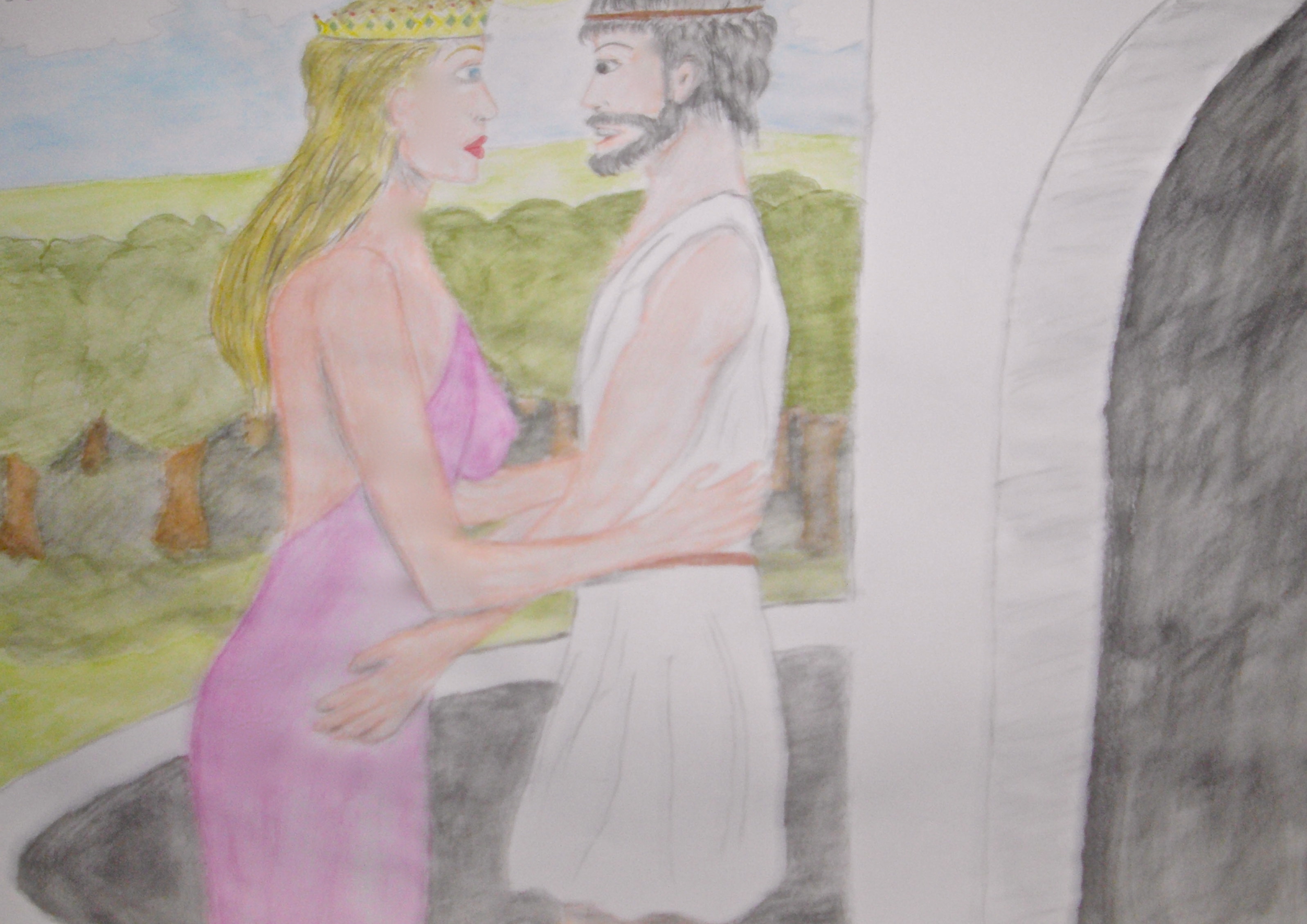
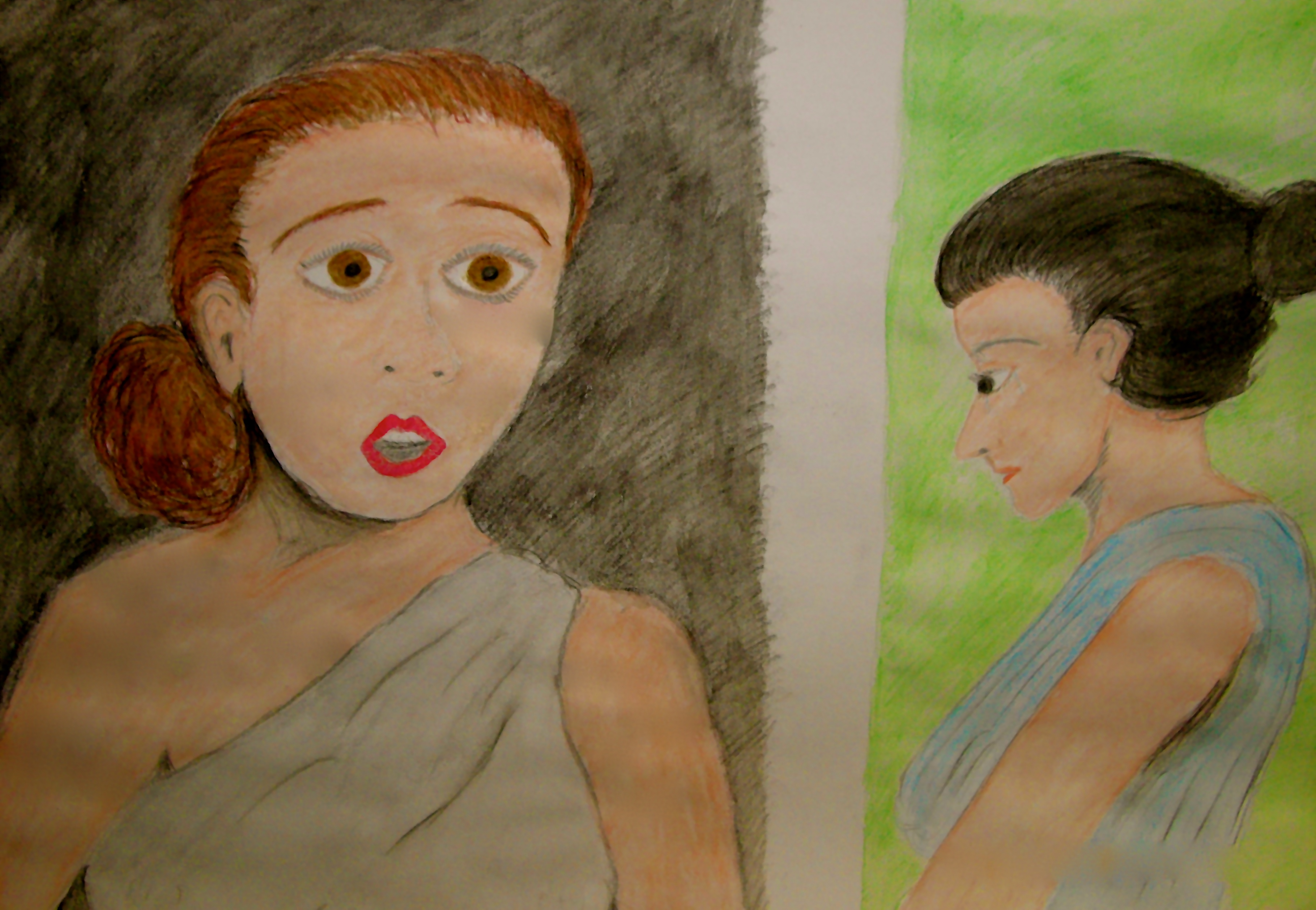
Act One: Theseus, the Duke of Athens, having recently captured Hippolyta, the Queen of the Amazons, plans to marry her. Egeus complains to the duke that his daughter, Hermia, refuses to obey him and marry Demetrius. Instead, she loves Lysander, who fights for his right to marry her. Lysander tells everyone Demetrius used to love Helena, who still “dotes” on him.
Hermia and Helena
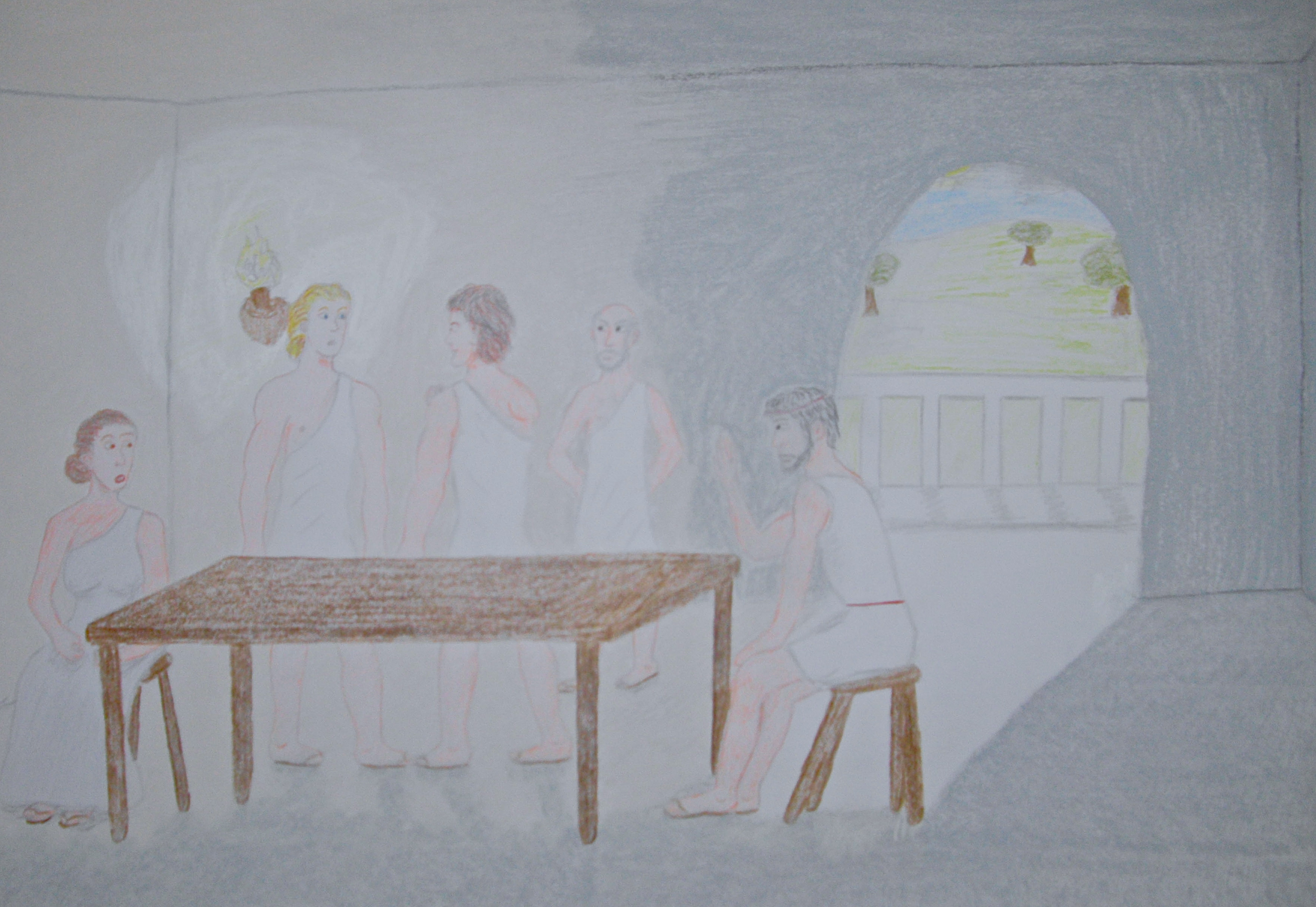
The Athenian law punishes those who disobey their fathers with the death penalty, and Egeus wishes to use this law to intimidate Hermia into marrying Demetrius; still, she boldly refuses. The duke must uphold the law, but offers her a third choice: if she won’t marry Demetrius, instead of suffering death, she can devote herself to the chaste worship of the goddess Diana, and abjure the society of men. She has until Theseus’ wedding day to decide. Theseus, Egeus, and Demetrius then leave the room, and Lysander and Hermia are alone.
Hermia, Lysander, Demetrius, Egeus, and Theseus quarrelling.
Lysander comforts her (see first quote from my ‘Analysis of MND’ post), and tells her his plan to take her out of Athens and away from its cruel law. They’ll go through the nearby forest and stay at his aunt’s home. Then they’ll be married. This gives Hermia hope.
When Helena joins them and tells them of her dejection from Demetrius’ preference of Hermia over her, they tell her of their plan to leave, Demetrius then having only Helena to love. Lysander and Hermia leave, and Helena is alone, complaining in a monologue of her loss of Demetrius’ love (see second quote from ‘Analysis of MND’). Finally, she foolishly decides to tell Demetrius about her friends’ plan to flee to the woods, hoping this will win Demetrius’ favour.
Peter Quince, having chosen the myth of Pyramus and Thisbe to have his ‘actors’ perform in a play before the duke, gives each actor his role. Nick Bottom, every director’s nightmare, is to play Pyramus, lover of Thisbe; but Bottom wants to play every role. Francis Flute, a boy, is to play Thisbe, but he doesn’t want to play a girl because he’s starting to grow a beard. Bottom wants to play Thisbe, but Quince insists he’s to be only Pyramus.
Snug is to play a lion, but he wants to see his ‘lines’ quickly because he’s ‘slow of study’; Quince assures him he only needs to improvise roaring–this reassures Snug. Bottom offers to play the lion, and boasts of his ability to roar; Quince says he’ll frighten away the ladies, so Bottom offers to roar softly. Still, Quince insists Bottom is only to be Pyramus, and tells everyone to meet in the nearby forest that night to rehearse, because he doesn’t want the Athenians to watch how the play is being put together.
Act Two: In the forest that night, a fairy chats with Puck, and Puck tells her of the pranks he likes to play on people.
There is trouble in fairyland. Oberon, the fairy king, is angry with Titania, his queen, because she, not even willing to share a bed with him, refuses to give him an Indian changeling boy for his page. She says that the boy’s mother honoured Titania while the mother was alive, and out of friendship with the mother, Titania wants to have the child, and should have him. She and her fairy retinue leave Oberon.
Oberon and Titania quarrel over the Indian boy.
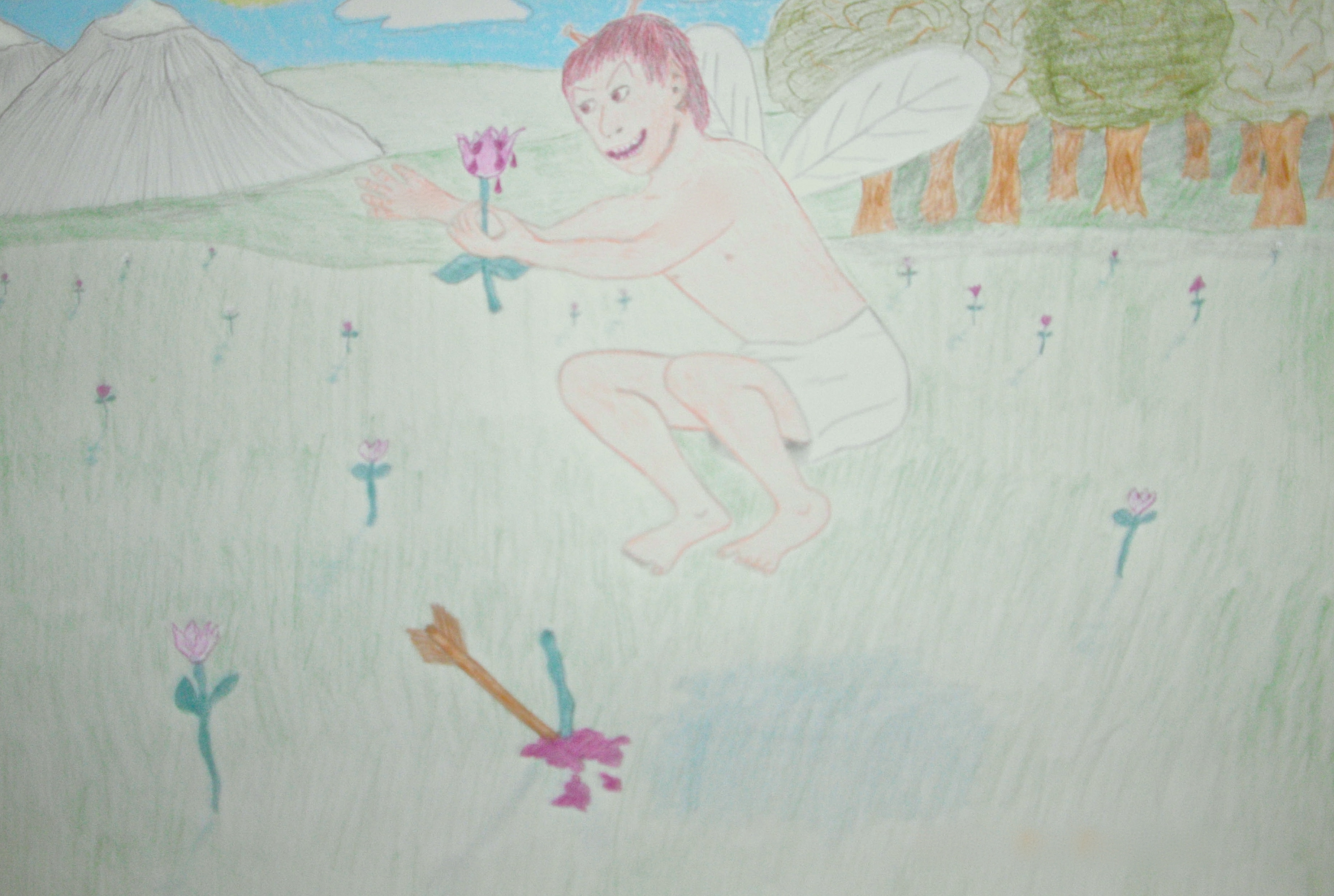
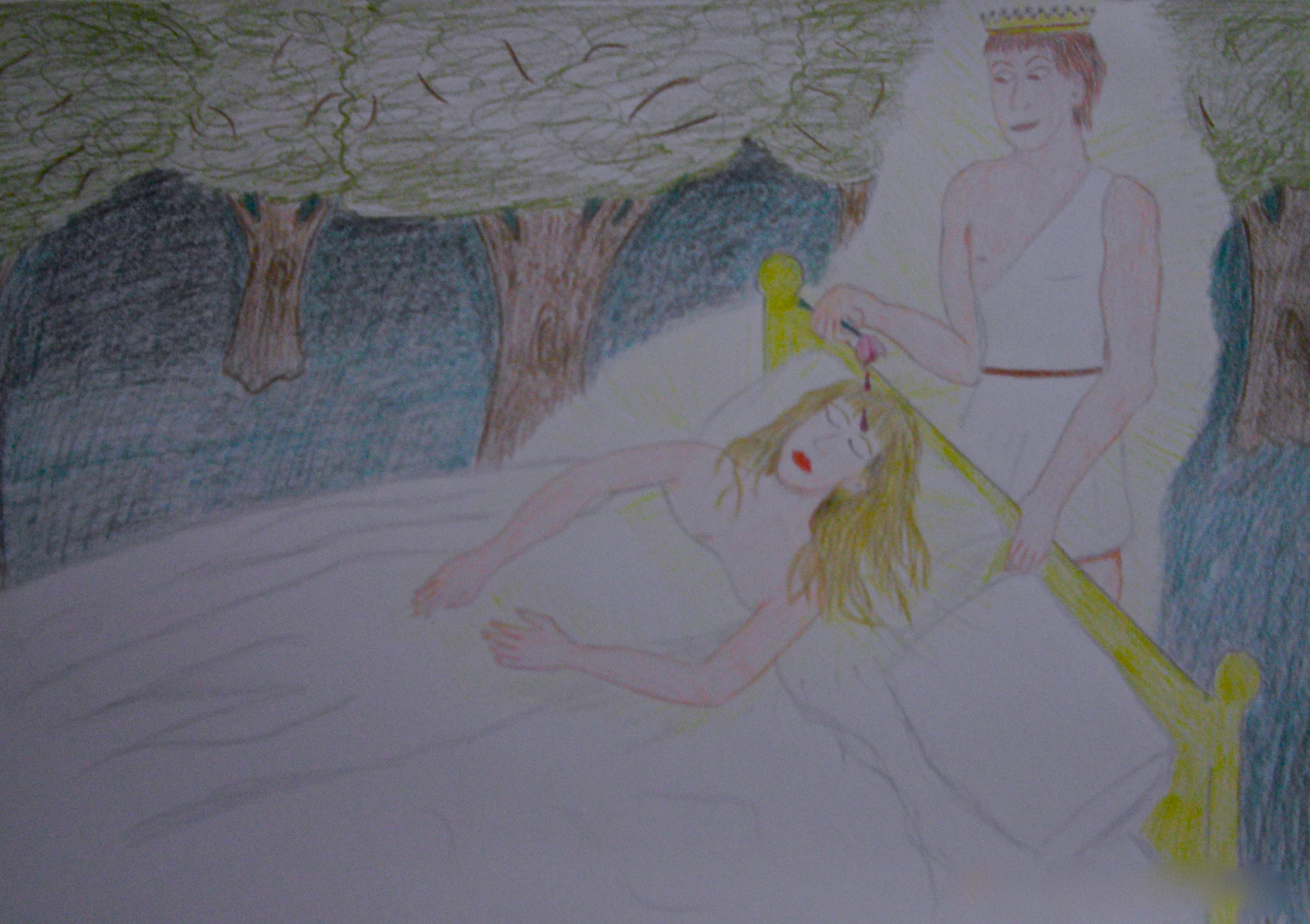
Wanting revenge for this ‘injury’, Oberon commands Puck, his fairy servant, to go off and find a special flower that one of Cupid’s arrows was shot into. The arrow filled the flower with a potion, called ‘love in idleness’. When the ‘love juice’ of this flower is poured onto the eyelids of anyone sleeping, he or she, when waking, will fall in love with the first person…or animal…or thing…he or she sees. Puck flies away to find the flower.
Puck finds the magical flower.
Oberon plans to put the love juice on Titania’s eyelids as she sleeps that night, making her fall in love with something ‘vile’ to humiliate her. While she’s thus distracted, he’ll get the Indian boy.
While Oberon is waiting for Puck to return, he sees Demetrius walking through the forest, chased by Helena. Invisible to them, Oberon listens to what they say to each other.
Though Demetrius insists that he neither will nor can love her, Helena says she loves him all the same. He warns her of the dangers a maid may encounter in a forest at night, when Demetrius has no inclination to protect her. He continues to try outrunning her in his search for Hermia, and Helena complains of how men are supposed to pursue women, not vice versa.
Oberon, taking pity on her, tells Puck–when he returns with the flower–to put some of the love juice on the eyelids of a sleeping Athenian man who is disdainful of a woman’s love. Oberon tells Puck, who’s never seen Demetrius before, he’ll know the man by the Athenian clothes he’s wearing. So Puck takes some of the flower and searches for the Athenian, while Oberon takes the rest of the flower and finds Titania, whose fairies are singing her to sleep.
When she’s asleep, Oberon pours the love juice on her eyelids and chants a magical poem to make her fall in love with a hideous monster. He tells her to “wake when some vile thing is near”, and leaves her.
Oberon puts the love juice on Titania’s eyelids.
Meanwhile, Lysander and Hermia are wandering elsewhere in the forest, and they are tired and lost. They decide to sleep, Lysander’s hopes of getting close to Hermia disappointed when she, out of maidenly modesty, tells him to sleep further off. He does, and when Puck sees them asleep, he assumes that Lysander, in Athenian clothes and sleeping apart from the girl (presumably out of disdain for her), is the man Oberon wants Puck to use the love juice on. Puck pours it on Lysander’s eyelids and leaves them.
Soon after, Demetrius and Helena walk by that area, Demetrius still scorning her. He leaves her alone, and she looks at her reflection in a pond. Her reflection distorted by the ripples in the water, she sadly concludes, “I’m as ugly as a bear.” Then she sees Lysander sleeping, and worries that he could be dead. She wakes him, and he falls in love with her. Shocked at this sudden change in him, she assumes he is making fun of her. She leaves the area in tears, him pursuing her, and Hermia is left alone there. Later, she wakes from a terrible dream, and, frightened, wonders where Lysander went. She then goes to look for him.
Act Three: The ‘rude mechanicals’ arrive in another area of the forest and begin rehearsing their play. Bottom points out that the lion may frighten the ladies, so they decide they will tell the audience the lion is really Snug.
Quince then mentions ‘two hard things’: they need a wall on the stage to separate Pyramus and Thisbe; and they need the moonlight to shine on them on the stage, but they doubt that there will be a window to let the moonlight in. They decide that Snout will portray, as it were, the wall, holding his fingers in such a way as to indicate a chink through which the lovers may speak. Robin Starveling, holding a lantern, will represent the man in the moon.
As they rehearse, misspoken lines abound: instead of ‘odorous savours sweet’, we have ‘odious’ savours; the lovers won’t meet at ‘Ninus’ Tomb’ but at ‘Ninny’s Tomb’.
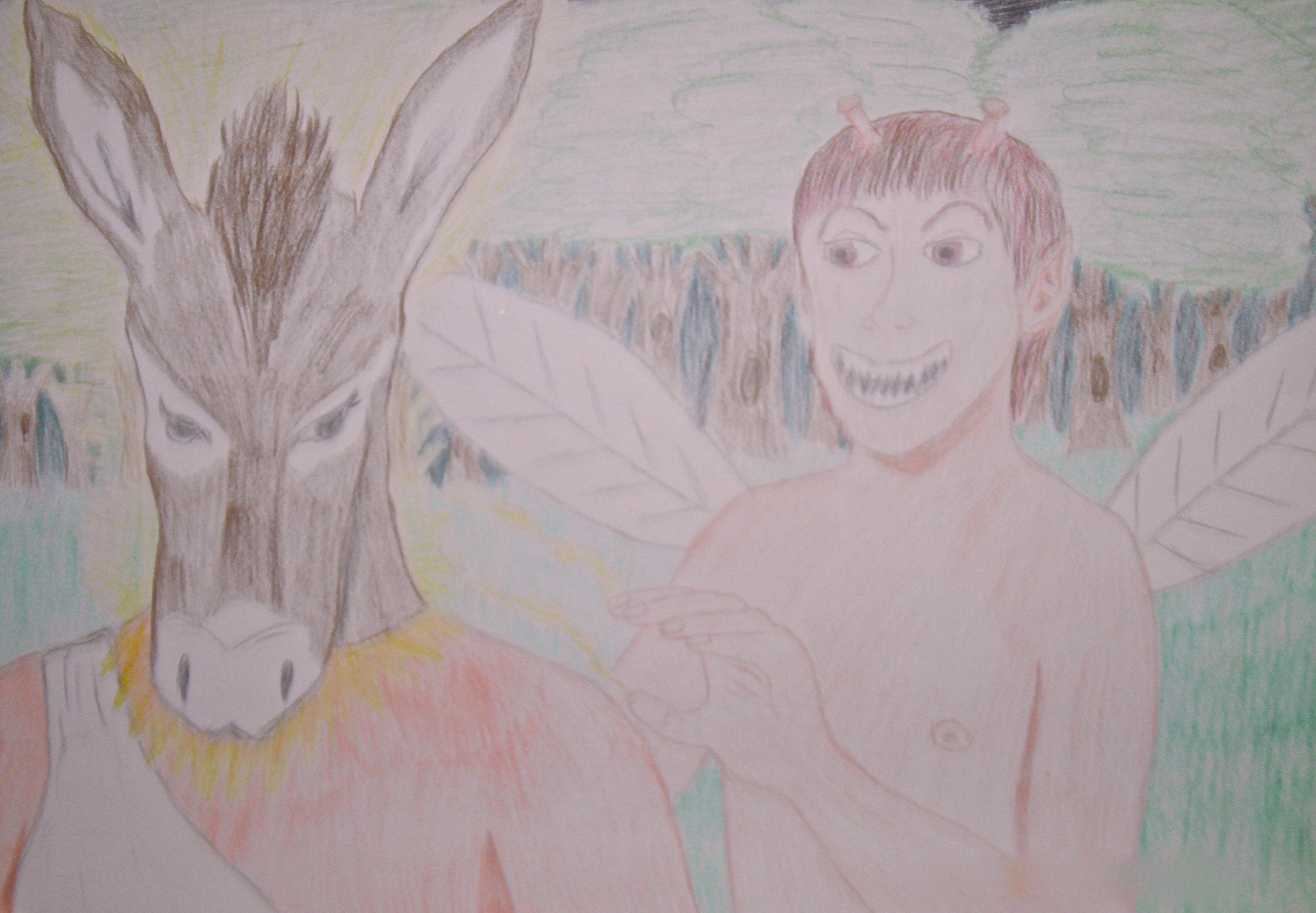
Bottom walks away momentarily. Puck has been watching all of the rehearsing, and he’s much amused by the actors’ lack of talent. He uses magic on Bottom, changing his head into that of a donkey. When Bottom returns to say his next words of love to Thisbe, all the other actors run away from him in terror at his ‘monstrous’ transformation.
Puck gives Bottom a donkey’s head.
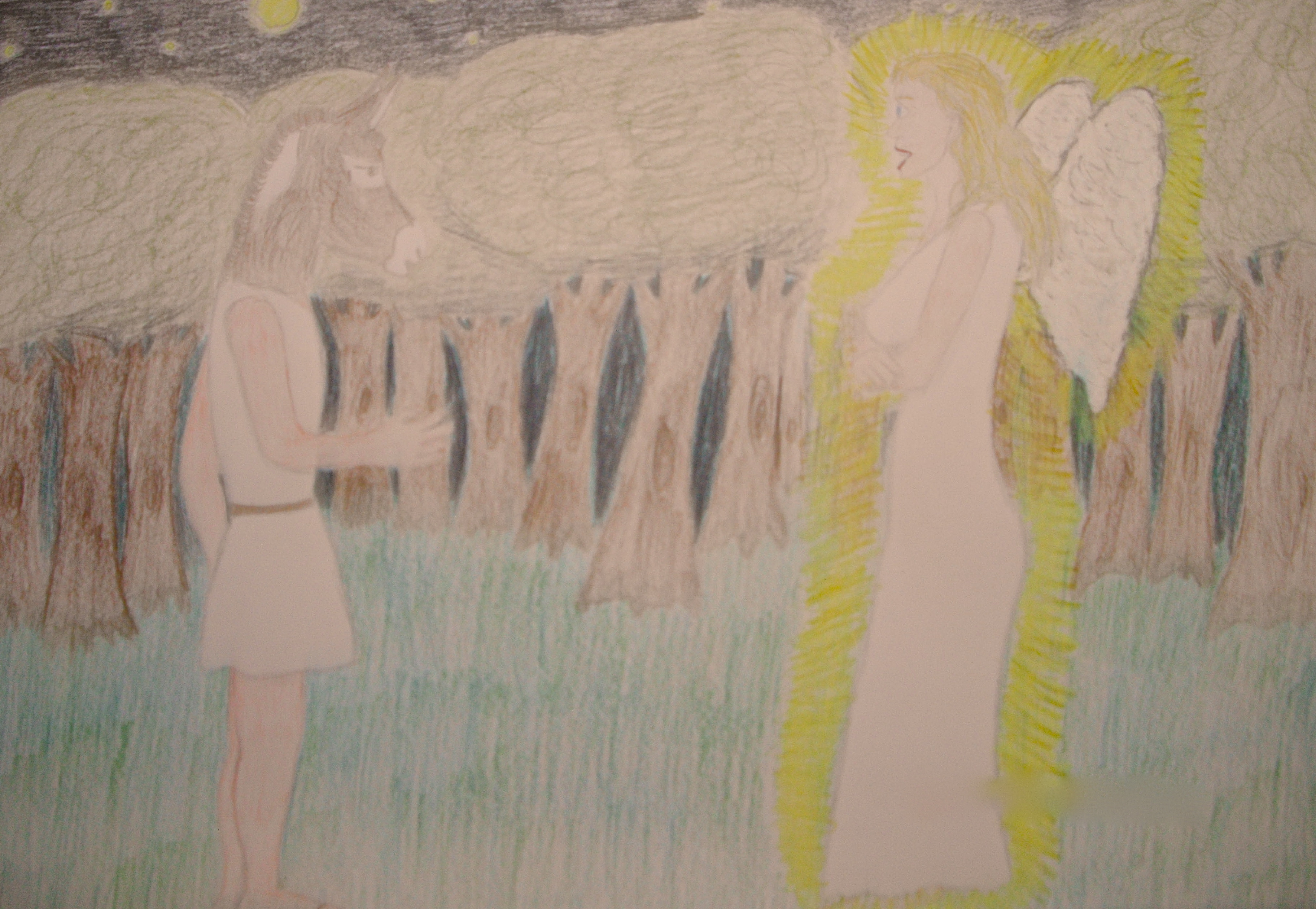
Bottom, not yet knowing what’s happened to him, pretends not to be afraid at what he thinks is a prank, and he sings a song, waking Titania. She falls in love with him and takes him with her to be waited on by her fairies.
Titania in love with ass-headed Bottom
Meanwhile, Oberon is angry with Puck for putting the love juice on the eyes of the wrong man. Later, Hermia finds Demetrius and demands to know where Lysander is; she suspects Demetrius may have harmed Lysander. When Demetrius insists he neither hurt Lysander nor knows where he is, Hermia leaves Demetrius, and he falls asleep.
Now Oberon puts the love juice on his eyelids, while Puck finds Helena and uses his magic to bring her near sleeping Demetrius. Lysander, still in love with Helena, follows her, and Puck, amused, observes the young lovers’ folly (see ‘Analysis of MND’, third quote).
Lysander, weeping, pleads with Helena that men who love in jest don’t weep as they woo. Helena retorts that his jest increases in cunning, and chides him for forgetting his true love, Hermia. Lysander says he was foolish to love Hermia, and that Demetrius loves her, but not Helena. This wakes Demetrius, who immediately calls Helena, “goddess, nymph, perfect, divine!” Now Helena thinks both men are making fun of her. Lysander and Demetrius start to show hostility to each other as rivals for Helena.
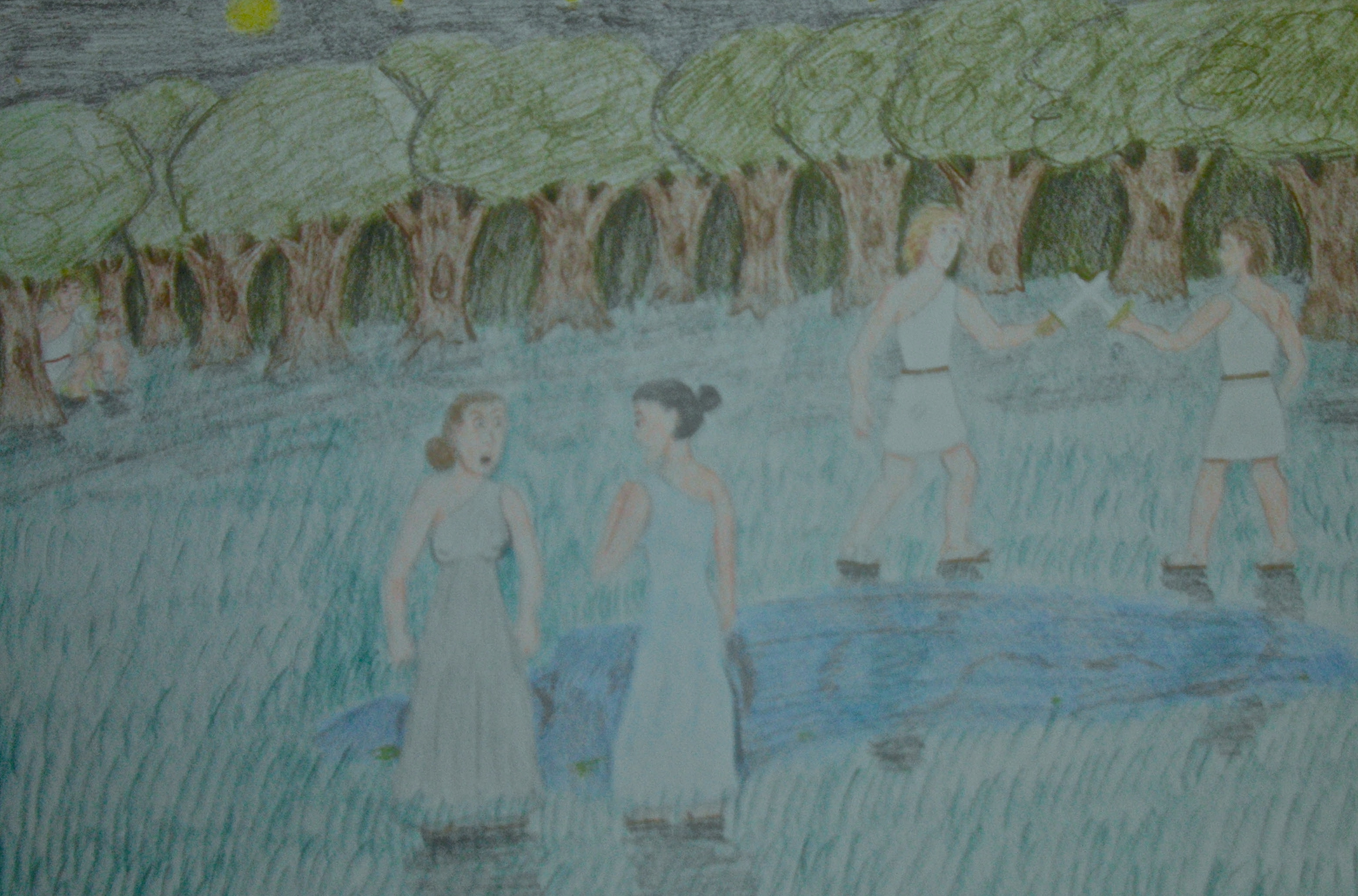
Then Hermia appears, happy to have finally found Lysander. When she asks him why he left her, he bluntly tells her he hates her and now loves Helena. Hermia can’t believe this, while Helena imagines all three of them are in ‘confederacy’ against her. She chides Hermia for it, saying it’s unladylike, while Hermia says it’s Helena who scorns her. The fighting between the four of them continues, with insults directed at Hermia’s shortness. Lysander and Demetrius leave the girls to fight elsewhere.
Oberon blames all this trouble on Puck, who explains that Oberon told him he would know the man by his Athenian clothing, so it was an honest mistake. Still, Puck doesn’t mind the mistake–to him, causing mischief for the four Athenian lovers is all good fun.
Hermia, Helena, Lysander, and Demetrius fighting; Oberon and Puck watch.
Oberon then orders Puck to use his magic to separate Lysander and Demetrius so they won’t hurt each other. Soon, when all four lovers fall asleep, Puck is to use the love herb on Lysander’s eyes, correcting them so he’ll love Hermia again. When everyone wakes in the morning, all the night’s folly will seem a dream. Puck must hurry, for morning is coming soon. Oberon will go to Titania and get the Indian boy. Then he’ll release her from her love of ass-headed Bottom, “and all things shall be peace.”
Chanting, “Up and down, up and down,” Puck leads Lysander and Demetrius away from each other by imitating their voices, fooling each man into thinking he’s chasing the other. They soon grow weary of the chase, and fall asleep. The girls also grow weary and fall asleep. Puck squeezes the love juice on Lysander’s eyelids, and chants a magical poem to ensure that he’s in love with Hermia again. “Jack shall have Jill/Naught shall go ill.”
Act Four: Titania is in bed with ass-headed Bottom. He asks for her fairy attendants, Peaseblossom, Cobweb, and Mustardseed, to scratch him. Itchy, he feels “marvellous hairy about the face,” and needs a barber. When Titania asks him what he wants to eat, he asks for hay, though she offers to have one of her fairies fetch him nuts. They decide to sleep, and Titania tells her fairies to leave them. Holding Bottom in her arms, she says, “O, how I love thee! how I dote on thee!” They sleep.
Oberon and Puck watch Titania and Bottom.
Oberon and Puck watch, and the fairy king begins to pity his queen for her foolish ‘dotage’. Now that he has the Indian boy, which she quickly gave him, he will “undo this hateful imperfection of her eyes.” He also orders Puck to change Bottom back to normal. Then all will think “this night’s accidents but as the fierce vexation of a dream.” First, Oberon chants a magical poem to change Titania’s judgment back to normal.
She wakes up and tells Oberon, “Methought I was enamoured of an ass.” Indicating Bottom, Oberon says, “There lies your love.” Shocked to see Bottom’s ass head, she asks how all of this happened. Oberon says now that he and Titania are reconciled, they’ll go to Duke Theseus’ house tomorrow midnight, “and bless it to all fair prosperity.” There, all the lovers will be happily married at the same time. Puck changes Bottom back to normal, saying, “Now when thou wak’st with thine own fool’s eyes peep.”
The next morning, Theseus, Hippolyta, Egeus, and their attendants, hunting, come by the forest. They find the four young lovers sleeping there. They wake. Theseus asks what happened. Lysander confesses that he eloped with Hermia to escape the Athenian law. Egeus demands that the law be enforced, but Demetrius says–though he doesn’t know by what power–his love for Hermia “melted as the snow.” He now loves Helena again. Theseus overrules Egeus’ will, and they will all be married together in Athens.
Bottom, with his human head again, wakes up, and is amazed at his dream of having an ass’s head. He says only a fool would tell people of such a dream, but he’ll tell everyone anyway. He’ll have Peter Quince write a ballad of it, called “Bottom’s Dream”, and Bottom plans to sing it towards the end of their play. He leaves the forest to find the other actors.
Back in Athens, the other ‘mechanicals’ are worried about what happened to Bottom. Not knowing where he is, they conclude the play can’t be performed. Snug tells them the Duke is coming from the temple. If their play had gone forward, they’d have been all made men. They are all disconsolate; then Bottom suddenly appears, and everyone quickly cheers up. He tells them to hurry and get ready to perform, for he says, “our play is preferr’d.”
Act Five: Theseus and Hippolyta talk of love in his palace. (See the fourth quote in my post ‘Analysis of MND’.) Philostrate, master of revels, presents Theseus with a paper showing all the plays to be considered for the evening’s entertainment. After rejecting several proposed plays, Theseus chooses “A tedious brief scene of young Pyramus and his love Thisby: very tragical mirth.” Fascinated with these paradoxes, he asks Philostrate about the play. Philostrate insists it’s unfit, but Theseus insists on hearing the play. Philostrate reluctantly leaves to tell the ‘mechanicals’ to get ready to perform.
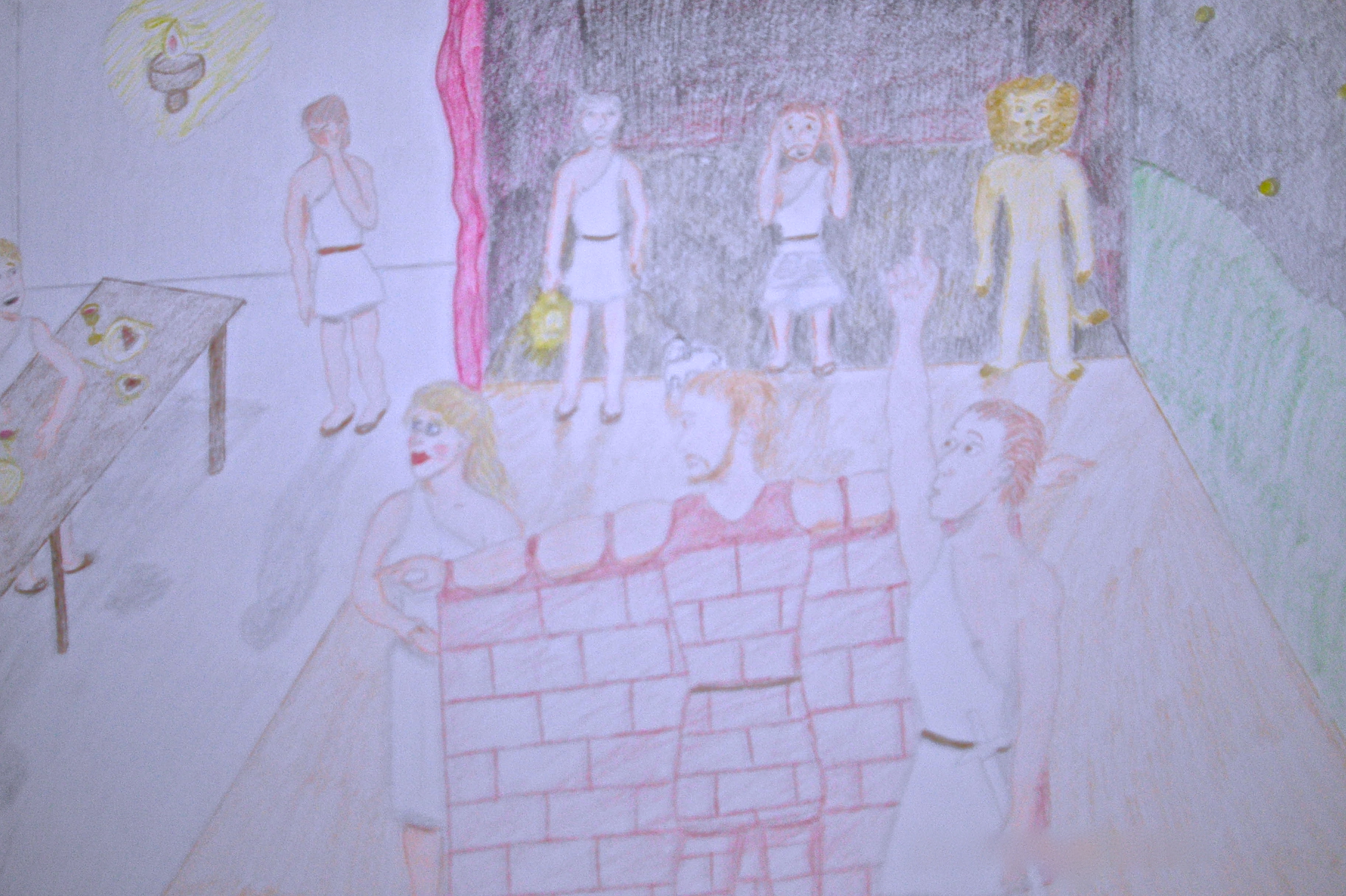
The play begins with all three married couples as the audience, and with Peter Quince as the Prologue: “If we offend, it is with our good will.” As he continues speaking, it is obvious to Theseus, Lysander, and Hippolyta how inept Quince is. He continues, introducing Bottom as Pyramus, Flute (in drag) as Thisbe, Snout as the Wall that separates the lovers (his hand shaped like a chink through which they can whisper to each other), Robin Starveling (with his lantern, dog, and bush) as Moonshine, and Snug as the Lion.
Quince gives a brief synopsis of the play: Pyramus would be with his lady Thisbe, but a wall separates the two lovers, and they can communicate only through a small hole in the wall; they agree to meet at Ninus’ Tomb; Thisbe arrives there first, but a Lion appears, and chases her; she gets away to safety, but only after a piece of her clothing is bitten and torn off, it being stained with the blood of a recent kill of the Lion’s. Pyramus arrives, and sees the bloody piece of Thisbe’s clothing; he assumes she’s dead, and kills himself. She returns, sees him dead, takes his sword, and kills herself, too. Then Quince tells the audience his actors will now act out the story. He leaves.
Snout presents himself as the wall, holding his hand out to represent the hole. Bottom as Pyramus enters, reciting some ludicrous poetry about the night: “O night, O night, alack, alack, alack,…And thou, O wall, O sweet, O lovely wall,…Show me thy chink, to blink through with mine eyne.” Wall holds up his fingers, so Pyramus can look for Thisbe. Pyramus thanks Wall, and looks, but sees no Thisbe. Disappointed, Pyramus says, “O wicked wall,” and curses Wall. Theseus thinks the wall, being able to speak, should curse back; but Bottom comes out of character and tells the duke that Thisbe will be coming out now.
Francis Flute, in women’s clothes, enters as an absurd-looking Thisbe, hoping to speak with Pyramus. They speak to each other briefly, and try to kiss through Wall’s chink, but obviously cannot. Pyramus asks her if she’ll meet him at “Ninny’s Tomb”. She says she will, and they leave. Wall, having finished his part, says good-bye to the audience, and leaves also.
The ‘rude mechanicals’ perform ‘Pyramus and Thisby’.
Theseus, Demetrius, and Hippolyta comment on how ridiculous the play is. Snug and Robin Starveling enter as, respectively, Lion and Moonshine. Lion reassures the ladies, “whose gentle hearts do fear,” that he is really Snug the joiner. Robin Starveling tells the audience his lantern represents the moon, and that he is the Man in the Moon. Thisby appears, but Lion, roaring, scares her. She runs away, and Lion tears her clothing. Thorougly entertained by this unintended comedy, Demetrius, Theseus, and Hippolyta respectively shout out their compliments to the actors: “Well roar’d lion”; “Well run, Thisby”; “Well shone, Moon.”
Pyramus enters, thanking the Moon for its light. He sees the piece of Thisbe’s clothing, “stain’d with blood”, and assumes she’s dead. He takes out his sword and stabs himself. He dies a slow and melodramatic death. Moonshine leaves, and Thisbe re-enters. She asks, “Asleep, love? What, dead, my dove?” She takes his sword, and says, “Come trusty sword; Come, blade, my breast imbrue.” She stabs herself, and dies. Theseus and Demetrius note that Moonshine, Lion, and Wall will have to bury the dead.
Bottom gets up and asks the audience if they’d like to see the Epilogue, or hear a Bergamask dance. Theseus says no to the Epilogue, but will have the Bergamask. The actors dance.
Then Theseus tells all the lovers, it’s “almost fairy time”, and so they must all go to bed. They all leave, and the fairies enter, saying magic poems to bless the newly-weds, and singing and dancing. They all then leave, except Puck, who addresses the audience. (See the fifth and last quote from my ‘Analysis of MND’.) He wishes a “good night unto you all.”
The fairies confer blessings on the newlyweds.
(If you liked what you just read, please subscribe to my newsletter; a link to it is at the side of the page.)



 Infinite Ocean
You must be logged in to post a comment.