The ‘Right’ Definition of Socialism?

[NOTE TO READER: Though I personally am an anarchist, the following is a defence of socialism in general.  In particular, while I mention social democracy and anarchism, my focus is on defending communism against right-wing bias.  My criticisms are mostly of neoliberalism, but in general I am writing here against all forms of capitalism.]

Introduction

Several months before the time of this writing, on a Facebook page for debates, a question was asked: what is the definition of socialism?  The answer I gave was that the means of production are to be put into the hands of the workers, as opposed to being owned privately or by the state.  I felt that this was about as objective a definition as one could come up with: I still do.

Then I started getting trolled by someone who is obviously stridently anti-socialist.  (For the sake of discretion, I’ll refrain from revealing his name.)  So much for objectivity in the discussion.  The usual straw-man arguments were used, including the use of force to try to realize the unrealizable: utopia ‘at the point of a gun’.

Apparently, the anti-socialist troll wasn’t aware of the existence of democratic socialism, let alone its remarkable success in such places as Scandinavia (in Sweden, they’re actually experimenting with the idea of a six-hour workday).  Still, imagine his response had I brought that up.  He would probably have responded by saying the capitalists there are being ‘forced’ into paying high taxes–a kind of government robbery.  The notion that overworked, underpaid workers are being robbed of the full fruits of their labour presumably doesn’t exist as a concept to him, nor that the taxes just give back what was taken from the poor.

Anyway, I responded to his cliche critiques by sharing a YouTube video called Why You’re Wrong About Communism.  Perhaps this video, with its rather brief, seven-minute defence of what’s considered a more extreme form of socialism, wasn’t the best choice for a rejoinder.  [The communist speaker, Jesse Myerson, gives a fuller treatment of his argument in this Salon article, Why you’re wrong about communism: 7 huge misconceptions about it (and capitalism).]  Still, to anyone who is reasonably knowledgeable about labour issues, the video was a fair response.

This was my troll friend’s word-for-word response to the video:

First there is a difference between capitalism as it is today and free market capitalism.
The capitalism that we have today is a top down government directed sort, which moves money and power to the elite, same as communism. The proletariat are merely the worker bees for the elite.
“THE TYRANNY OF WORK”, What an ass. You don’t work you don’t eat. If enough people stop working how there will be enough of anything for anybody. They can fire you, you can also quit, I don’t hear anyone raising arms to protect the employer about that.
What a stupid, stupid man, such a dreamer, how do you make it function so that there is enough supply for everyone. Answer a top down, government controlled police state. Orwell was right, “If you want a vision of the future, imagine a boot stamping on a human face…FOREVER.
His demeanor belies his belief is nothing more than a dream.
Communism is the dream the eventually becomes the nightmare.

The ironic thing about what the troll said is that, as recent as about two years ago, I would have eagerly agreed with him, more or less 100%.  I have, however, since learned more about labour issues and therefore now understand that whatever is ‘impressive’ about his argument is only superficially so.  Looked at with greater scrutiny, his response shows appalling straw-manning and ignorance, to say nothing of its callousness toward the plight of the poor.

My response to his argument, given below point for point, was not posted on the Facebook page for him to read (nor do I wish it to be) for several reasons: first, it is too long, and would read like a rant (for indeed, there are so many weaknesses in his logic that such a lengthy response is unavoidable); second, he is obviously so biased against my position that he’ll never listen or open his mind to it (right-wing propaganda will do that); and finally, his kind of opinionated, obnoxious attitude (“what an ass…What a stupid, stupid man…”) is something I have little patience for, and what follows below would assuredly just be answered with more of his aggressive, closed-minded rudeness and straw-man arguments.  Thus, I write this response for those willing to listen and open their minds.

My Response:

I–The Free Market

By contrasting “free market” capitalism against “capitalism as it is today”, namely, “a top down government directed sort”, he is suggesting a number of utterly absurd ideas: the free market isn’t a top-down sort of capitalism, it doesn’t involve government at all (or involves only a minimal amount of government intervention), and what we have today isn’t laissez-faire capitalism.

He also, fantastically, more or less equates the crony capitalism of the Obama administration with communism, showing his obvious ignorance of even the most basic of Marxist ideas (it’s always amusing to know that those most hostile to socialism are those totally ignorant of its most elementary ideas).  Socialist governments do not redistribute wealth and power to the rich, unless they’re so corrupt as no longer to deserve to be called socialist; they redistribute it to the poor–the point should be obvious.  What we have today in America is the exact opposite of communism, in almost every conceivable way.  More on that later.

Communism is a system involving a classless, stateless, and money-less society; socialism, according to the definition given by Marxist theory, is the transition between capitalism and communism, using a socialist state (the ‘dictatorship of the proletariat‘) to effect that transition.  This transition is what socialist states like the USSR and China under Mao tried to achieve.  Anarcho-communists like me, on the other hand, want full communism immediately after the proletarian revolution, with no transitional state in between.

This stateless preference is, as I see it, for two reasons: first, because the state capitalism of socialist states tends to be self-perpetuating rather than effecting a real transition to full communism (the state becomes the new capitalists); either this self-perpetuation occurs, or we have a relapse into capitalism (i.e., Russia in the 1990s, or China from Deng Xiaoping onward).  The second reason for preferring no transitional state is to avoid the kind of totalitarianism my trolling friend is so terrified of, but can’t imagine existing in the free market, which I must examine now.

The so-called ‘free market’ is something fetishized by many Americans (including my American troll friend), more than a few British, and sporadically others (i.e., Stefan Molyneux in Canada), people who either allow themselves to be taken in by right-wing propaganda, or try to con others with it.  These people imagine that an unregulated, or at least minimally regulated, economy will result in prosperity for all.  In their world (as well as that of the conspiracy theorists), government is apparently the only evil to be vanquished.  Capitalism, on the other hand, is perfectly OK and should be left alone.  Minimized taxation, ‘freedom’ to pay lower wages, and reduced benefits for workers will result in maximized profits (of course!), which will in turn result in maximized reinvestment, creating more jobs.  The wealth of the rich will therefore ‘trickle down’ to the poor. (Notice how, apparently, ‘trickle down‘ economics is in no way connected to a “top down” sort of capitalism.)

This idea is not merely ridiculously untrue; it is an outright lie.  Wealth inequality is now reaching levels comparable in many ways to those of the 19th century, largely because of neoliberal policies advocated in the 1970s and begun during the Reagan and Thatcher years.  We aren’t lacking in laissez-faire capitalism: we’ve been drowning in it for over thirty years now.  Only readers of right-wing propaganda would have missed that fact.  I once did, because I used to read conservative agit-prop; I, indeed, was once a right-libertarian, much like my troll friend seems to be–but like Will Moyer, I’m not anymore.

[NOTE TO READER: My use below of a book by economist Ha-Joon Chang–who advocates a ‘reformed’ capitalist economy with extensive government regulation of a sort essentially like the kind advocated by mainstream liberals or social democrats–must not be misconstrued as an endorsement of such suggestions for a solution to our present economic woes.  I want absolutely no compromises with capitalism.  I use Chang’s book only to show the hopeless flaws of free market capitalism, for his book gives a devastating critique of it.  He himself considers capitalism to be “the worst economic system except for all the others.” (his emphasis)  So, like Keynes, who allegedly once said capitalism is, “the astonishing belief that the nastiest motives of the nastiest men somehow or other work for the best results in the best of all possible worlds,” Chang can be seen as an example of how even some capitalists admit that capitalism is a terrible system.]

23 Things They Don’t Tell You About Capitalism, by Ha-Joon Chang (Penguin Books, 2010), is a timely book that thoroughly examines how the free market is not only responsible for all the appalling wealth inequality we’ve been suffering, but is also ineffective in improving the economy–the one rationale for adopting laissez-faire.  The one virtue it supposedly has, which its advocates claim will compensate for wealth inequality, even that virtue is lacking.

To keep the economy going, people need to have money to buy things; they can’t do that if the vast majority are so poor that they can barely subsist.  During the mid-twentieth century, the so-called ‘Golden Age of Capitalism’ (between 1950 and 1973), when the economy enjoyed the highest-ever growth rates in most of the rich capitalist countries (Chang, page 142), unions were strong, there was rapid growth in progressive taxation and social welfare spending, and wages were higher.  The free market had nothing to do with this prosperity.

What Chang’s book shows (page 145) is how, with the rise of neoliberalism from the 80s to the present, economic growth in the top capitalist economies has actually slowed.  The free market is clearly bad for the economy, and bad all around.  It is clear to all thinking people that laissez faire benefits the rich, and only the rich.  It’s also easy to see that free market advocates, who routinely dupe ‘anarcho’-capitalists with their anti-government (and only anti-government) rhetoric, are not only wrong, they’re outright lying.

It is so sad to know that many people are still deceived by these lies, to this day, even after the 2008 economic crisis (which prompted Chang’s book).  To say that a freer market, or a non-governmental, absolutely free market (of the sort that the ‘anarcho’-capitalists propose), is the solution to the world’s ills makes as much sense as saying that Naziism would have benefitted the world had it been allowed to run its course, with no resistance at all!

There are, of course, some examples of badly planned economies in socialist countries: for example, the Soviet-type planned economy, with its systemic undersupply, anti-innovation bias, and low quality of goods, among many other problems; and the disastrous Great Leap Forward of Maoist China.  Social Democrats in northern European countries, however, have proven much more capable (see Chang, pages 104-105, to learn how Norway, Luxemburg, Switzerland, Denmark, Iceland, Ireland, and Sweden all had higher per capita incomes, in US dollars, than the US in 2007.  Remember that these countries are largely social democratic).

Just as there are different kinds of capitalism, there are also different kinds of socialism, as opposed to the troll’s straw-man characterization of them by painting them all with the same brush.  Now, which ideology’s differences are more significant, and which more negligible–those of socialism, or those of capitalism?  These differences we will now explore.

The troll’s notion of a “top down government directed sort” of capitalism is crony capitalism, or ‘corporatism’, where certain big, powerful corporations are given preferential treatment over other businesses, such as Mom and Pop ones–in other words, favouritism through government regulation.  I assume he imagines that the ‘free market’ will result in a level playing field in which all businesses compete equally.  Then happiness and harmony will reign.  Speaking of utopian dreaming…

Since capitalism requires a state to protect private property, and since capitalism’s driving motive is always gain–no matter who among the poor gets hurt, then it is easy to see how capitalism quickly degenerates into cronyism.  If the state can benefit certain companies against others–for a price–by regulating in the formers’ favour, then those richer companies will gladly forsake fairness to make even greater profits.  With capitalism, the key word is profit, not freedom.

Also, as Chang explains in his book, there is no such thing as an objectively defined ‘free market’ (pages 1-10).  What some consider necessary regulations, others consider hindrances to the free market.  Some regulations are ‘invisible’, as it were, and taken for granted, but are absolutely necessary to hold a capitalist society together.

Capitalism requires state protection of private property just to exist (I’m sorry to disillusion the ‘anarcho’-capitalists, but if they had their way, the capitalists would become the state, more or less immediately), and where there’s a state, there will always be regulations of one kind or another.  That is part of the state’s raison d’être.

So the question shouldn’t be whether there should be government regulation at all, or none at all, but rather how much–or how little–regulation there should be.  Put another way, how far shall we take deregulation, if government–and government alone–is such an evil bogeyman?  Shall we, for example, legalize child labour, or even child pornography, just for the sake of the free market?  What about slavery, when human trafficking already exists in a huge way, if illegally?  Won’t decriminalizing those moral monstrosities maximize profits and boost the economy?  It is ‘job creation’, after all, isn’t it?

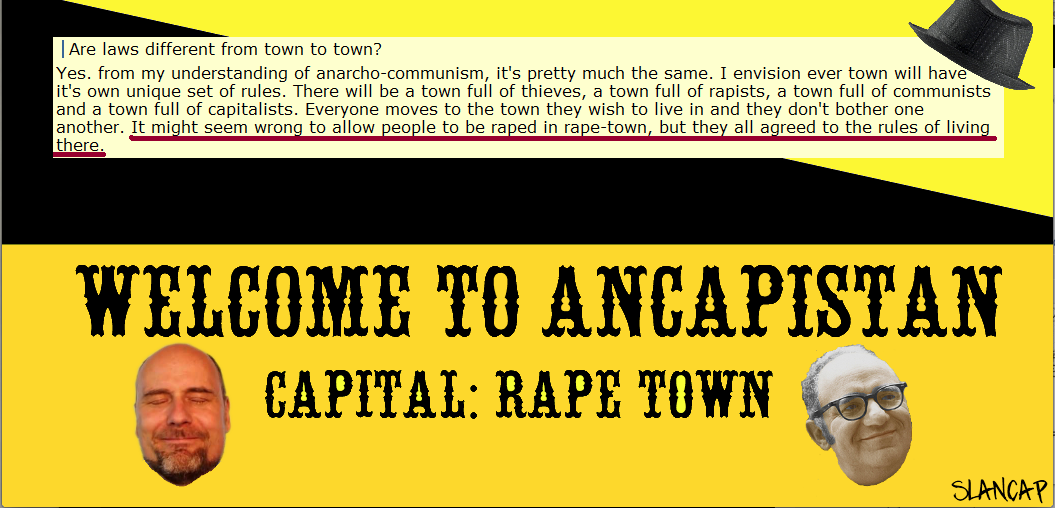
Just to give you an idea of how scary some ‘anarcho’-capitalists envision a stateless capitalist society, remarks were made on a page called ‘AnCap 101’ on Reddit.com: on the comments page answering the questions of ‘Left Anarchist here, can somebody give me some answers?’.  Scroll down to where it says “Are laws different from town to town?”  Thanks to SLANCAP for bringing this to my attention:
Unsaved Preview Document

Here we see how the free market is a dream that eventually turns into a nightmare.

When free market advocates promote deregulation, they aren’t talking about ending government oppression (quite the opposite, as we’ll see): they just want to hog as much money to their avaricious selves as they can.  They wish to annihilate only those aspects of government that they find inconvenient, i.e., socialism.

II–The Tyranny of Work

The next thing my free marketeer friend took issue with was the notion of “the tyranny of work”, as described by Jesse Myerson in the YouTube video.  The quintessential trolling tactic for stifling dissent and ‘winning’ an argument cheaply–through rudeness and emotion instead of through a carefully constructed counter-argument–is epitomized in this cocky retort: “What an ass…what a stupid, stupid man, such a dreamer…”

What can I say, but that I love the smell of ad hominem attacks in the morning.  To the troll, I suppose it smells like victory.

When Myerson spoke of involuntary employment and involuntary unemployment, and of the need to liberate ourselves from that, he wasn’t advocating a world where people don’t have to work at all.  He spoke of coupling the idea of a guaranteed minimal income with guaranteed work, so under socialism we wouldn’t have droves of people living in total idleness, while everything is being produced for them like magic.  Myerson’s idea could be compared to what is being experimented with in Sweden, with the six-hour work-day.

Myerson was advocating a more flexible lifestyle where, of course, people work, but they don’t have to find themselves so chained to their job that they can’t even leave it alone on weekends (e.g. the boss calling you on your smartphone over and over again when you’re trying to enjoy a relaxing weekend with your family).

No socialist in his or her right mind imagines that communism will create a perfect society where we never have any problems.  The way I’ve heard some right-libertarians [i.e., Molyneux] speak, on the other hand, of how free market competition–free of government interference–will naturally cause us [via ‘the invisible hand’] to drift away from buying the products of any companies that we suspect are, for example, racist or exploitative, sounds a lot more utopian…and stupid…to me.

As Myerson says in his Salon article: “For me, communism is an aspiration, not an immediately achievable state.”  Most socialists and communists agree that our ideal is ultimately something far off in the future, when better conditions (i.e., better technology, a post-scarcity economy) will finally be available for the society we want.

The troll imagines that if one doesn’t like one’s job, one can simply quit; and since no one is “raising arms to protect the employer about that”, the bosses are presumably the ones to be pitied in such a situation.

Given the miserable state of the economy over the past six years since the 2008 economic crisis, out of which the world is still only slowly crawling, and may crawl back into if we’re unlucky, the troll’s cockiness–about workers simply quitting undesirable jobs–is bizarre in the extreme.  Is he not aware of how difficult it is to find decent work right now…in his own country, America?

One does not simply quit one’s job during a bad economy, when replacement jobs are scarce.  Even during a strong economy, if one has a limited skill set, quitting a job exposes one to the risk of not finding an adequate replacement, and therefore to the risk of homelessness and starvation.  Socialists knew this reality during the 19th century; socialists know this now; we’ve always known this.

Millions of people in such G8 countries as the US, the UK, and Russia–where the free market is in full swing–are living on subsistence wages; if they even can make ends meet (which they frequently can’t), they can only barely eke it out.  These are people, real people, not just “worker bees for the elite”.

These people do not just work eight-hour, five-day-a-week shifts; they are frequently over-worked and underpaid.  Those working for the current sorry excuse for a minimum wage, far below what they need to earn to survive, are forced to take on extra jobs just to make ends meet.  Then there are those working in sweatshops in the Third World, a world I suspect my troll friend doesn’t know even exists.

Many people in the world work ten or twelve-hour days, if not more, and often on weekends, too–without compensation.  I see engineers in Taiwan, where I’ve lived for almost two decades now, who are experiencing this ongoing problem.  Quitting at best leads to another such miserable job; at worst, quitting leads to starvation, homelessness, and death.

My free marketeer friend is probably thinking about straightforward jobs in the First World, like working in a bookstore; he probably never thinks of how the smartphone or computer he uses to type his anti-socialist rants was put together by overworked, underpaid Chinese, or southeast Asians, in sweatshops, those “worker bees” who barely make enough money to feed their families, and are terrified of being fired.

No one rushes to protect the rights of the employer who must replace workers who quit because, often enough, there are others from the reserve army of labour, eager to take the quitters’ place (an eagerness that comes only out of desperation to find a job).  My parents owned a pancake restaurant back in the 80s, and whenever an employee quit (which was not infrequent), getting a replacement was admittedly a pain.  But to compare that inconvenience to the plight of workers under capitalism is a sick joke.

That plight, as I described above, is essentially what Myerson meant by “the tyranny of work”, or what other socialists call wage slavery.  Capitalists like the troll only scoff at that tyranny, though: they care more about the tyranny of Stalinism and Maoism (more accurately, they gleefully point it out to make straw man arguments and generalizations about all socialism, in order to invalidate it).  Now I must come to my next point.

III–The Sins of State Socialism

Anyone who has done at least a cursory learning of the history of communism has read about the atrocities of the various socialist governments, especially those of Stalin, Mao Zedong, and Pol Pot.  Estimates of the total death toll range from 85 million to 100 million, as the political right portrays it.

It is beyond the scope of this article to do a detailed analysis of what happened during, for example, the collectivization of the USSR during the late 20s and early 30s, and such events as the Great Leap Forward, the Cultural Revolution, and the Killing Fields.  For Maoist and Stalinist perspectives on these events (largely not my views), you can look at Raymond Lotta Takes on Lies about Mao’s Great Leap Forward.  Also, you can read this article in the Monthly Review: Did Mao Really Kill Millions in the Great Leap Forward?  A video by Jason Unruhe (Maoist Rebel News) deals with Stalinism: On The Alleged Deaths in Stalin’s USSR.  Here’s Unruhe’s perspective on the Cultural Revolution.  Here’s more on the Cultural Revolution.  Finally, there’s Unruhe’s video, Truth about Pol Pot and Maoism.

Back to my main argument.

It is not at all my wish to whitewash, trivialize, or rationalize away the deaths that did occur during the above-mentioned regimes, which make up the bulk of the death toll attributed to communism.  For me, socialism is about human rights and justice, the opposite of totalitarianism. Still, there was a lot of ugliness that occurred during those years.

Victims were executed, overworked in labour camps (a chilling irony for a movement dedicated to ending the tyranny of work), or starved to death (though generally as a result of unintended consequences).  These sad chapters in the history of socialism will always embarrass the Left, with the added feature of right-wing propaganda and its Schadenfreude over that embarrassment.

While admitting that terrible things happened, we must nonetheless put these tragedies in perspective, not to excuse them in the least, but to give them a context for better understanding what happened and knowing the world they came from.  Such an understanding will not only show that such evil is neither exclusive nor essential to socialism, it will also, I believe, improve our chances of not repeating those horrors.

First, we must consider the perpetrators; let’s start with Stalin.  He was hardly a garden variety communist: he was a paranoid psychopath, not much different from the despots who preceded him in feudal history.  Many of his victims, by the way, were dedicated communists; Stalin had whole communist parties executed during the Great Purge.  A lack of psychopathy in him would have been a huge improvement, undoubtedly.

Stalin grew up in a Russia inured to tsarist tyranny; autocratic authoritarianism was a norm against which there was hardly an egalitarian alternative to emulate.  Knowing this, we shouldn’t be too surprised that his rule would be gripped with the same fear of losing power as the tsars of the past had.  Any suspicion of treason or counter-revolution would thus inevitably lead to many killings.  The problem is that Stalin, in killing communists as well as wealthy kulaks, took his suspicions way too far.

Furthermore, he deviated from Marxism/Leninism in such striking ways that, in the opinion of many on the Left, he wasn’t a real communist.  (In anticipation of being accused of the ‘no true Scotsman’ fallacy, I will say that yes, I do believe real socialism did exist at one time at least: among the Catalonian anarcho-syndicalists of the Spanish Revolution of 1936; incidentally, Stalin–in his paranoia of the spread of Trotskyism, as well as in his belief that Spain had first to go through a capitalist phase before embracing socialism–betrayed the Spanish communists, hence their defeat by Franco and the forces of Fascism.)

Among the non-communist elements of Stalinism were his use of American private enterprises (such as the Ford Motor Company) to industrialize Russia, under strict state supervision; once the firms had finished their stints, they left, and the USSR took over.  In the opinion of many on the Left, what Stalin and, earlier, Lenin were doing wasn’t real communism–it was a kind of state capitalism.

The most notably non-communist element of Stalinism, however, was the notion of ‘Socialism in One Country‘.  This idea–involving focusing on socialism only in the Soviet Union, while the rest of the world had first to be industrialized and subjected to a capitalist phase before embracing socialism–runs totally against the socialist idea of promoting proletarian revolutions around the world.

Small wonder that the much more genuinely communist Leon Trotsky (the lesser of the Bolshevik evils, in my opinion)–with his notion of ‘Permanent Revolution’ contrasting with Stalinism, as well as Trotskyism’s somewhat more democratic nature–was defeated and even murdered with a blow to the head from an ice ax, held in the hand of a Soviet agent.

Whether Stalinism is genuinely communist or not is a major point of contention among the various factions of the Left: what is of little doubt is that psychopaths’ jealous love of power, a Machiavellian trait, is far from being an exclusively socialist vice.

It is interesting to note that, despite Hitler’s fanatical hatred of communists, he considered the Stalinist Russia of the 1930s to be strikingly similar to the Nazi way of doing things (thanks in no small part to Stalin’s purging the Communist Party of Jews like Trotsky, of course).  Mussolini, too, spoke well of Stalin’s ‘Slavic Fascism’.  The similarity to Naziism is not hard to see: totalitarianism, state capitalism, focusing on one’s own country rather than on internationalism, and the purging of political dissidents and Jews were all hallmarks of Naziism.

Contrary to what some right-libertarians like to believe, though, Naziism and Fascism were not socialist–certainly not in practice.  (Years back, I read Jonah Goldberg’s book Liberal Fascism, and even then wasn’t convinced of his arguments, back when I was sympathetic to conservative ideas.)  The National Socialist German Workers Party may have had left-leaning members in Joseph Goebbels, Ernst Roehm, and Otto and Gregor Strasser, but all left-wing elements were purged from the Nazi Party as soon as Hitler came to power.  With the backing of big business in Germany, Hitler naturally moved the Nazis to the far right; indeed, the first people to be put in the concentration camps were communists, social democrats, anarchists, and other leftists.  National Socialism was capitalist in practice, and that’s what really matters.  Indeed, capitalists on many occasions in history have used Fascism to further their agenda.

And who played a crucial role in defeating Nazi Germany at the end of World War II, thus ending the rising death toll in the concentration camps (which included the deaths of 3.3 million Soviet POWs)?  Stalin’s Red Army, strengthened by the rapid industrialization of his three Five Year Plans!

This leads us to another indispensable point: the good that Stalin did.  His modernization of Russia helped bring the country from a backward, agrarian one to a superpower in a matter of decades (so much for the stereotype of communists who never work).  America, in contrast, took much longer to grow as strong as it did.  Naziism similarly strengthened Germany economically, industrially, and even environmentally, but Hitler’s reckless pursuit of lebensraum, which caused WWII, made this strengthening so short-lived as to be negligible in the face of Nazi atrocities.  Stalin’s successes offset his evils far better, if imperfectly.

As for Chairman Mao, much of the failures and deaths that resulted from his rule can be explained by bad harvests in the late 1950s and early 60s, and by power struggles between his leftist faction and the rightist faction led by Liu Shaoqi and Deng Xiaoping, who made the implementation of Mao’s plans very difficult to say the least.  The death toll, though probably exaggerated by right-wing propaganda, was surely in the tens of millions at least.  That said, we must ask: were the catastrophes of the Great Leap Forward and the Cultural Revolution the fault of communism per se, or of the particular rule of one idealistic but failed leader?

Regardless of whether one chooses to judge these failures as harshly as the Right does, or to mitigate them as many on the Left do, one thing cannot, and must not, be denied (though conservatives always deny it): capitalism’s death toll, by the most conservative of estimates, is at least ten times higher than the highest estimates of the communist death toll.

Now for some real perspective.

IV–Capitalist Crimes

If socialist governments have caused famines, so has capitalism–ultimately, on a much larger scale, in spite of what Steven Rosefielde, author of Red Holocaust, thinks.  An important aspect of capitalism is imperialism; Lenin pointed this out in his essay, “Imperialism: the Final Stage of Capitalism”, as well as in his efforts to get socialists to oppose WWI.  In order to find fresh, new markets, the capitalist must go out to other countries, plunder their resources, and exploit local labour.  America has always done this, as did the British and other European empires in the last few centuries.

In Late Victorian Holocausts, Mike Davis shows how laissez faire and Malthusianism exacerbated food shortages caused by El Nino in the Third World, resulting in famines that killed 30 million to 60 million locals in such countries as India, China, Brazil, Ethiopia, Korea, Vietnam, and the Philippines, back in the late 19th century.  Capitalists gave food only to those with money.  Here’s the free market: a dream for the rich, which turned into a nightmare for the poor.

Also, there was the Bengal Famine of 1943, in which 1.5 to 4 million people died of starvation, malnutrition, or disease.  This happened during the last years of the British Raj, when British authorities refused to help, assuming hoarding was the cause.  Churchill had food diverted from the locals to British troops and Greek civilians.

On top of these and other famines caused by imperialism, millions die of starvation every year, when enough food can be produced to feed the whole world.  This starvation is preventable, and has been preventable, for decades at least; yet food producers don’t want to reduce profits, so the food goes only to people with money.  Ergo, capitalism causes starvation.

(It has been noted in several online sources that there’s enough food produced to feed the whole world, but instead it just gets wasted in the First World.  Here is a Wikipedia source: scroll down to where it says ‘Starvation Statistics’; here’s another source; as I said, there are many other online sources confirming this fact.  This should answer my troll’s question of how it is possible to provide for everybody.  He thinks socialism will result in scarcity, through people living in idleness; but it’s actually capitalism, with its private property, that creates an artificial scarcity.  He says, “You don’t work you don’t eat”, but many work, or try to work, and still don’t eat…or don’t eat enough, anyway.  He may think only a government controlled socialist police state can provide for everybody, and that, apparently, only socialist governments are police states; but many of us on the Left realize that many laissez faire governments have been authoritarian police states: the Pinochet government, the Franco regime, and the US under Bush [with his tax cuts for the rich], and Obama, who may have talked the socialist talk, but is anything but a socialist.  Anyone who thinks Obama is a communist or socialist is clearly, visibly stupid.)

If one calculated the preventable deaths of starvation of the past twenty or thirty years alone, one would already have a death toll much higher than the highest estimates of those who died under communist rule, be they of famine or of execution.  According to this site, over 7.5 million people died of hunger in 2013.  The total number of hungry people gets lower year by year, so in other words, the total number of deaths would have only been higher before 2013.  Check this link (scroll to the bottom) to see how many children have died of hunger over the 1990s.

These are not, however, the only deaths directly or indirectly attributable to capitalism.

We have to consider the many imperialist wars fought over the years, wars exploited by capitalists through various forms of war profiteering.  These profiteers include international arms dealers, scientific researchers (corporations and the state profit from the demand for military technology modernization), commodity dealers (who take advantage of shortages, thereby setting higher prices and getting higher revenues), politicians (who take bribes from corporations involved with war production), civilian contractors (think of Bechtel, KBR, Blackwater, and Haliburton, who’ve supplied coalition forces in the Iraq War and were accused of overcharging for their services), and black marketeers, among others.

Indeed, in his book War Is a Racket (1935), Major General Smedley D. Butler drew on his experiences as a career military officer to explain how business interests commercially benefit from war through war profiteering.  This problem is an old one that’s lasted for decades and decades, thus indicting capitalism further.

With that knowledge, let’s look at some more statistics.  In World War Two, 50 million to 85 million people died.  The number of Iraqi deaths due to the 2003 US invasion are over 1.4 million.  Add to these all the other capitalist imperialist wars after the Russian Revolution, as well as all the deaths from starvation mentioned above, and you already have a much higher total than the 100 million estimate for the victims of communism.

Let’s add to this all the deaths from tobacco; according to the WHO, 100 million people died of tobacco over the course of the 20th century, and 5.4 million deaths in 2004.  Also, according to the Surgeon General’s report of 2014, 20 million people died of smoking over the past 50 years.  This is after a clear link was made between smoking and cancer in 1950 in the UK.  Unfortunately, the tobacco industry seems to think too much about its own profits to care about those addicted to their products.

In other health-related news, since the creation of anti-retroviral drugs for AIDS, the drugs have been denied to millions of AIDS sufferers in Africa, because Big Pharma cares more about profits than people.  10 million Africans died between 1997 and 2003 because they did not get the needed drugs.

We must also consider the cost of capitalism on the environment, something for which there are sources all over the internet and in volumes of books to back up this dire fact (and remember the consensus in the scientific community on global warming); but alas, capitalists experience nothing but cognitive dissonance and denial about these facts.  Despicable.

If executions disturb my troll friend’s sense of morality, he might want to consider how the CIA-backed Suharto regime killed 500,000 to 1 million communists in the mid 1960s.

Now these are only a selection of the many millions of deaths attributable either directly or indirectly to capitalism.  There are also millions more, prior to the 20th century.  I’ve already mentioned the ‘Late Victorian Holocausts’.  There was also the Atlantic slave trade, in which about 10 million blacks died over the course of four centuries; they died of disease on the boat ride across the ocean.  This was all so the plantation owners of the South could profit off of blacks’ totally unpaid, backbreaking labour.

Then there was the killing off (through disease or massacres) of as many as 100 million aboriginals due to European settlement of North and South America between 1492 and 1900.  Capitalism has to expand in order to develop new markets.  Anyone who gets in the way, dies.

Finally, there have been all the strikers and unionists who have suffered violence and deaths over the years (remember how strong unions strengthen productivity, a fact the free marketeers ignore).  One example was the Banana Massacre of 1928 in Colombia, in which 2,000 to 3,000 workers were killed.  Anti-union violence in general can be read about here.   Here we see capitalism growing out of the barrel of a gun.  If socialism uses force, capitalism does so even more.

(Now, any capitalist reading this may doubt whether these deaths I’ve described can justifiably be all attributed solely to capitalism, as opposed to other factors.  Such critics may want to remember that while they can make excuses for these deaths, and in attributing non-capitalist factors to many of the deaths, they can thus reduce the total, Leftists can play the exact same reduction game with the 85 million to 100 million death count blamed on communism.)

V–Ignorance Is Strength

Of course, no anti-socialist diatribe can be complete without quoting George Orwell out of context.  (It is indeed nauseating how the Right misuses Orwell to advance their agenda.)  Since the anti-socialist troll wasn’t letter perfect in his quote, I’ll correct it here: “If you want a picture of the future, imagine a boot stamping on a human face, forever.”

Yes, I’ve read Nineteen Eighty-four, too (twice, actually; I’ve even lectured on the novel).  I’ve read (and lectured on) Animal Farm more than once, too.  I’ve also read another of Orwell’s works: Homage to Catalonia.  In that non-fiction book, Orwell recounts his experiences fighting against the Fascists during the Spanish Civil War.  When he got to Spain, he was quite impressed by what he saw–a town where socialism was being practiced:

“It was the first time that I had ever been in a town where the working class was in the saddle.  Practically every building of any size had been seized by the workers and was draped with red flags or with the red and black flag of the Anarchists…Every shop and cafe had an inscription saying that it had been collectivized…There was much in it that I did not understand, in some ways I did not even like it, but I recognized it immediately as a state of affairs worth fighting for.”

When Orwell wrote Animal Farm and Nineteen Eighty-four, he wasn’t attacking socialism per se, which he ardently supported.  He was attacking Stalinism, Fascism, and totalitarianism in general, which he had just experienced in a big way not only during the Spanish Civil War (see above for Stalin’s betrayal of the Spanish leftists), but also saw during World War Two, with the onslaught of Nazi Germany.  Orwell was a believer in democratic socialism, which has always existed alongside communism.  Yes, my free marketeer friends, there actually is something called democratic socialism.  Now I’m no supporter of social democracy any more than I am of state communism; but the very existence of social democracy should ultimately show how wrong-headed my right-wing friend’s understanding of socialist ‘totalitarianism’ is.

Furthermore, if it’s government that is the real evil, and if that troll insists that socialism always equals government, then I have one word to say to him: anarchism.  This form of socialism is the one I espouse, and like Orwell, I too am impressed with the anarcho-syndicalist socialism I’ve read about during the Spanish Revolution.

As an anarchist, I’m opposed to all forms of authoritarianism.  I oppose the authoritarianism of government (the tyrannical sort, or the pampering sort social democrats offer, often at the expense of the Third World).  I oppose the authority of vanguardism (hence, even if the Right is correct to damn Stalinist and Maoist communism as harshly as they do, it makes little difference to me).  I oppose the illegitimate authority of one sex or racial group over another, and that of any privileged group over another, especially that of bosses!

I believe that the means of production should be held firmly in the hands of the workers, neither in those of private owners, nor in those of the state.  And that brings me back to my definition of socialism: it isn’t totalitarian tyranny, it isn’t about extensive government intrusion in our lives, and it isn’t any more about forcing one’s agenda on the populace than capitalism is.  It’s about social justice.  It’s about sharing.  It isn’t the right-wing definition of socialism, but it is, by any reasonable standard of objectivity, the right definition of socialism.

(If you liked what you just read, please sign up for my free newsletter.  A link to it is at the side of this page.) 

Where Does the Power of Money Come From According to Marxism?

I’m no Maoist, but this is a good explanation of the concepts of ‘commodity fetishism’ and ‘reification’.

Jason Unruhe's avatarJASON UNRUHE

We can all see that money has power in society, but where exactly does it come from? More specifically, how do we Marxists see where the power of money comes from? There are many differing opinions on this, the most famous one being the religious idea that money is the root of all evil. But of course this doesn’t tell us very much.

Money has power in society, but where does this power come from? The desire to obtain money is an end in itself. It takes on all things in society, class status, symbol of prestige and social power. It appears as though money has a power onto itself. Money seems to have a will and consciousness of its own. This phenomenon where objects have social power or will of their own is called “the fetishism of commodities” by Marx.

In this context Marx uses the term “fetishism” in…

View original post 369 more words

1.6 Billion Killed by Capitalism

Jason Unruhe's avatarJASON UNRUHE

The true mass murdering evil of capitalism exposed: 1.6 billion Killed

United States Imperialism:
Hurricane Katrina (deliberate faulty construction) 1,836
NATO Intervention in Libya 2011 15,000
Tamils killed by US backed Sri Lankan Gov. 30,000
US Revolutionary War 35,700 (If Russa removes a Monarch its bad right?)
Spanish-American War 100,000
US Made Famine in Bangladesh 1974 100,000
NATO Intervention in Libya 100,000
Guatemala 300,000
US Bombing of Yugoslavia 300,000
Iraq (US Selling Poison Gas to Saddam) 400,000
Iraq (Desert Storm) 500,000
US Bombing Iraq Water Supply in 1991 500,000
Invasion of the Philippines 650,000
US Civil War 700,000
US Concentration Camps of Germans 1,000,000
US imposed sanctions on Iraq 1,000,000
Afghanistan (War on Terrorism) 1,200,000
US Backed Dictator General Suharto 1,200,000 (Anti-commmunist dictator)
Iraq (War on Terrorism) 1,300,000
1898 American War vs Philippine 3,000,000
US Intervention in the Congo 5,000,000
US Aggression on Latin America 6,000,000
Vietnam War* (including Cambodia…

View original post 307 more words

Detailed Synopsis of ‘The Merchant of Venice’

Act One: Antonio, the merchant of Venice, tells Salerio and Solanio that he feels sad and wearied for reasons he can’t understand.  His friends suggest that he’s worried about the ships carrying his money and goods: what if they’re lost at sea?  He says he isn’t worried about that.

Solanio imagines Antonio could be in love: he rejects the idea as absurd.

Bassanio and Gratiano enter.  Gratiano, a well-meaning, though rather rude and tactless fellow, prates about nonsense with Antonio until Bassanio stops him and apologizes for him.

Then Bassanio tells Antonio of his wish to marry a beautiful, wealthy heiress named Portia; he says she, having all the virtues of Brutus’ wife (see my synopsis and analysis of Julius Caesar), is aptly named.  Bassanio, however, has spent all his money, and ever in debt, hopes Antonio will lend him some for the trip to Belmont, which is about ten miles from Venice, in Villa Foscari, in Mira.

Antonio would gladly lend his friend all he needs (and without interest), but he himself has none, for he’s waiting for his ships to arrive.  He will, however, be a guarantor to any money-lender Bassanio can find in Venice; so they’ll look for a usurer to lend Bassanio 3,000 ducats.

In Belmont, Portia complains to Nerissa, her lady-in-waiting, about the predicament her late father has put her in.  Suitors from all over the Mediterranean and Europe hope to marry her, but she likes none of them (except for a handsome young man named Bassanio!).  She must marry the suitor who chooses the correct one of three caskets, each made of gold, silver, or lead.

What if one of the undesirables chooses the correct one?  She cannot, by oath, refuse him.  What if a desirable man chooses incorrectly?  She cannot, by oath, marry him.  Nor can she aid or deceive any suitor in his choice.

Nerissa comforts her by reminding her of her father’s wisdom; surely his system of three caskets will yield Portia a worthy husband.  Nerissa then asks what Portia thinks of the various suitors: Portia contemptuously dismisses all of them…except Bassanio.

The ladies must go meet a suitor–the prince of Morocco.

Back in Venice, in a public place, Bassanio finds Shylock, a Jewish usurer, to lend him the money.  Knowing Antonio will be Bassanio’s guarantor, Shylock considers the merchant a man of good credit (though not of good character); so Shylock agrees to lend Bassanio 3,000 ducats.  Bassanio invites Shylock to dine with him and Antonio; the Jew says he will do business with them, but neither eat nor pray with them.

When Antonio arrives to cement the deal, Shylock speaks to himself of how much he hates Antonio, not only because he is a Christian, but also because he scorns Shylock’s Jewish faith and lends out money gratis, thus hurting Shylock’s profits.  He hopes he can get an opportunity to trip Antonio up.

Shylock and Antonio begin discussing the deal with polite smiles to mask their mutual hate.  Shylock refers to the story in Genesis of how Jacob cleverly tricked Laban into letting him have the best sheep and goats, and that this was shrewd commerce.  Antonio considers such an interpretation of the Bible story to be a devilish advocacy of taking interest (see Quote #1 of my ‘Analysis of The Merchant of Venice‘), and says instead that God had intended this transaction for divine purposes.

Shylock mentions how Antonio spat on him the previous week, and how he’s often spoken disparagingly of Shylock’s Judaism; now Antonio needs money from a Jew!  Antonio proudly says he’d gladly spite the usurer again, and if Shylock won’t lend the money as a friend, he may do so as an enemy, taking as much interest from Antonio as he pleases if the debt isn’t paid on time.

Shylock pretends that he wishes he and Antonio could be friends; he offers not to require any interest from Antonio if he defaults, and instead–supposedly in jest–would have a pound of Antonio’s flesh, cut from whatever part of his body Shylock chooses.

Antonio happily agrees to this arrangement; he will follow after Shylock to the notary public and sign the bond.  Shylock leaves.  Antonio imagines the Jew is growing kind, and that he may even convert to Christianity one day.

Bassanio, fearing danger to his friend, urges Antonio not to sign the bond.  Antonio reassures him that his boats will arrive well before the due date, with more than enough money to pay the debt.

Act Two: In Portia’s house in Belmont, she and Nerissa meet the prince of Morocco and his followers.  He tells her not to dislike him for his darker skin, since many of the best-regarded virgins of his land have liked his hue.

Still, his aggressive manner frightens Portia, who hopes he’ll choose from the wrong caskets.  He is led to them.

In Venice, Launcelot Gobbo, a comical Christian, doesn’t enjoy working for Shylock.  Gobbo imagines a devil tempting him to end his services to Shylock and work for Christians instead, while his conscience tells him to stay in the Jew’s employ.  He sees his blind father, Old Gobbo, approaching, and for fun, briefly tricks him into thinking he isn’t his son.

Old Gobbo wishes to find and give a present to Shylock, and after Gobbo has had his fun, he takes his father to Bassanio instead of the Jew.  Then Gobbo tells Bassanio he wishes to work for him instead.  Bassanio agrees to hire him.

Gratiano wishes to join Bassanio on his trip to Belmont.  Bassanio tells Gratiano to be tactful in Belmont, so as not to endanger Bassanio’s hopes of winning Portia.  Gratiano promises he’ll watch his words.

In Shylock’s home, Gobbo knows of how Jessica, Shylock’s daughter, secretly wishes to elope with and marry the Christian Lorenzo.  Arrangements have been made to get her out of Shylock’s house that night, while he’s at dinner with Antonio and Bassanio, to give the latter the 3,000 ducats.

Jessica knows it’s shameful to scorn her own father, but she yearns to convert to Christianity and be Lorenzo’s wife.  Shylock commands her to keep the windows of his house closed while he’s out, since he doesn’t want her “to gaze on Christian fools.”  He doesn’t want to go out, for he knows the Christians aren’t his true friends; still, he leaves anyway.

That night, Lorenzo, Salerio, and Solanio come to Shylock’s house to get Jessica, who is disguised as a boy and embarrassed about it (see Quote #2 from my ‘Analysis’).  She steals small caskets of Shylock’s ducats and leaves with the men.

Back in Belmont, the prince of Morocco looks over the three caskets.  On the gold casket an inscription says, “Who chooseth me shall gain what many men desire.”  The inscription on the silver casket says, “Who chooseth me shall get as much as he deserves.”  That of the lead casket says, “Who chooseth me must give and hazard all he hath.”  Portia tells the prince that the correct casket has her picture in it.

The prince refuses to risk everything for mere lead.  He looks over all three inscriptions again after asking for divine guidance in his choice.  He looks at the gold casket’s inscription again, and, noting how many men desire Portia, he assumes her picture must be in such a beautiful casket; so he chooses gold.

He gets the key to the casket and opens it.  To his chagrin, he sees a skull and a scroll.  He reads it (Quote #3): many men desire gold, some getting killed in their quest for it.  Since this is a foolish thing to desire, the prince’s “suit is cold”.

He sadly leaves with his followers.

In Venice, Salerio and Solanio discuss the eloping of Lorenzo and Jessica, and Shylock’s rage over it.  They speak gloatingly about Shylock’s misfortunes: the Jew has been going all about Venice complaining about his disloyal daughter and stolen ducats.  They mock his ranting and raving, as have all the boys in Venice following him about.

They also mention a rumour that a ship, possibly Antonio’s, may have been lost at sea.  They fear for their friend.

In Belmont, the prince of Aragon, a pompous, foppish sort, arrives to try his fortune with the caskets.  He reads the inscriptions on each, scoffing at the “base lead” casket; and insisting he’s better than the lowly multitude, he assumes the gold casket is wrong too, for what he values is better than what “many men desire”.

He feels that the inscription on the silver casket is “well said”, for we can have things only with “the stamp of merit”.  Assuming he deserves Portia, he imagines her picture will be in the silver casket.  He asks for its key, and opens it.

Instead of seeing Portia’s picture, however, he sees that of “a blinking idiot”.  The accompanying scroll has a poem that says the picture is a representation of arrogant fools like him.  As disappointed as the prince of Morocco was, he leaves in annoyance.  Portia, of course, is relieved.

Act Three: On a street in Venice, Salerio and Solanio have confirmation that Antonio has lost a ship at sea; they both worry about their friend.  They give antisemitic scowls to Shylock, who is approaching and still ranting about Jessica.

When he speaks of how shocking it is for his own flesh and blood to have betrayed him by marrying a Christian, Salerio speaks of how she is more dissimilar to her father than red wine is to Rhenish, or than jet and ivory.

Shylock says Antonio should “look to his bond”.  Salerio asks Shylock what he could possibly want with a pound of Antonio’s flesh: Shylock gives all his reasons for wanting revenge on his Christian persecutor (Quote #4).

Shylock says Jews share all the same human qualities as Christians do, including vulnerability to pain, disease, and death; Jews can also be as villainous and vengeful as Christians.  Shylock will soon prove this last point.

Tubal, Shylock’s Jewish friend, appears; not willing to tolerate the presence of any more Jews, Salerio and Solanio leave.  Tubal has good and bad news for Shylock: Antonio’s ships are indeed lost, so Shylock can get his pound of flesh; but Jessica was seen having sold a turquoise ring (Shylock’s wife’s, therefore having sentimental value for him) in exchange for a monkey.  She also spent 80 ducats in one night, Tubal says.  This breaks Shylock’s heart.  He has Tubal find an officer to arrest Antonio.

Bassanio and Gratiano have arrived in Belmont, and Portia and Nerissa are with them.  (Gratiano and Nerissa quickly take a liking to each other.)  Since Portia likes Bassanio, she wishes he would wait and talk with her for a day or two before choosing from the caskets; for if he chooses incorrectly, he’ll have to leave immediately, and they’ll never see each other again.  Still, he cannot bear the suspense of waiting, and must make his choice and get it over with.

As he looks over the caskets and their inscriptions, a love song is sung during the comments he makes.  Knowing that outer appearances are often deceptive of inner reality, Bassanio wisely imagines the dull-looking lead casket, whose inscription threatens rather than promises, has Portia’s picture in it.

He gets the key, unlocks the casket, and finds her picture.  He and Portia are overjoyed.  When he reads the congratulating poem in the casket, he says, “A gentle scroll.”

Along with their imminent marriage, Gratiano and Nerissa tell of their having fallen in love and plan to be married.  The women give their men a ring, and make them swear an oath never to lose the rings or give them away.

Salerio has arrived in Belmont, and he enters with Lorenzo and Jessica with bad news from Venice: since Antonio’s boats are lost and he has no money to pay Shylock the 3,000 ducats, Shylock wants the pound of flesh.

Jessica knows of her father’s lust for revenge, and that no amount of money will deflect him from getting that pound of Antonio’s flesh.  Wealthy Portia considers any friend of Bassanio’s to be a friend of hers, so she will gladly pay twice the amount so the debt may be forgiven.

The two couples will be quickly married, then everyone, except Lorenzo and the ladies, is to make plans to hurry back to Venice and help Antonio in any way he can.

Back in Venice, Antonio tries to reason with Shylock, who has a gaoler arrest the merchant.  Shylock refuses to yield to Christian intercessors.  Antonio must accept the fact that the Jew hates him and seeks his life.

In Belmont, Lorenzo commends Portia for her patience in enduring the absence of her husband while he is in Venice trying to help his friend.  She has a servant go to Padua to see Bellario, a great lawyer, to get whatever notes and clothing he can give her.

Portia has devised a plan of her own to save Antonio: she will learn what she can of law from Bellario, then disguise herself as a man (Nerissa will be disguised as ‘his’ clerk).  The two faux lawyers will then go to Venice and help Antonio.

Gobbo jokes with Jessica about how her conversion to Christianity will raise the price of pork.  She shares the joke with Lorenzo.

Act Four: Back in Venice, the Duke of Venice enters a courtroom.  Shylock, Antonio, Bassanio, Gratiano, Salerio and Solanio are there.  The duke speaks to Shylock, hoping he’ll show mercy and forgive the debt.  Shylock refuses, insisting he has a legal right to a pound of Antonio’s flesh.

Why does he want it?  The desire for the pound of flesh is just a part of his disposition, Shylock says, as it is the disposition of others to dislike a pig or a cat.  He has “a certain loathing” of Antonio, and that is sufficient reason for him.

No one accepts this reasoning, though Shylock isn’t moved by their rejection of his attitude.  Antonio says nothing will move the Jew any more than telling the water not to reach its height on the beach.  Nothing will inspire pity in his hard “Jewish heart.”  Sentence should be quickly given, and one should just get this whole ordeal over with.

Shylock says that the slaves of many Venetians are legally the rightful property of their masters, who have paid dearly for them–we don’t ask the masters to free their slaves.  Similarly, the pound of flesh he has bought rightfully belongs to him.

Though the duke realizes that his refusal of Shylock’s legal right to the pound of flesh will render invalid the law of Venice, he will wait for Bellario to determine the case.  The duke is told of the famous lawyer’s inability to attend; he has, however, recommended a young lawyer named ‘Balthazar’ (Portia in disguise), whose wisdom with the law belies ‘his’ youth.  The duke wholeheartedly will have ‘Balthazar’ take the case.

‘He’ and ‘his clerk’ (Nerissa in disguise) enter.  ‘Balthazar’ being already thoroughly acquainted with the case, ‘he’ looks over the document allowing Shylock a pound of Antonio’s flesh if he defaults.  ‘He’ then says Shylock must show mercy; the Jew asks what compels him to.

‘Balthazar’ explains that nothing in the nature of mercy involves compulsion (see Quote #5).  Mercy blesses the giver as well as the receiver; this virtue is most becoming of kings, for it is an attribute of God’s.  We must remember that justice, strictly applied to all of us without mercy, would damn every one of us sinners.  Therefore, when we ask for God’s mercy, we are likewise well advised to show mercy to those who’ve wronged us.

None of this speech moves Shylock, who craves the law and will gladly accept all responsibility for his misdeeds.  He is offered twice the original amount; he refuses it, sharpening his knife.

When ‘Balthazar’ sees that Shylock will not be moved to mercy, ‘he’ says the law of Venice must be upheld, and Antonio must prepare his breast for Shylock’s knife.  Shylock praises ‘Balthazar’ for his learned understanding of the law.

Bassanio and Gratiano brace Antonio, and each of them says he’d gladly give up his beloved wife to save Antonio.  Little do these husbands know, of course, that the wives they’ve just proven disloyal to have heard their words, and are frowning at the sound of them.

Shylock similarly frowns, assuming this disloyalty to be typical of Christian husbands.  He’d prefer Jessica had married the worst of Jews rather than a Christian!  He says time is being wasted, and wishes the duke would pass sentence promptly.

As Shylock’s knife is being brought near Antonio’s breast, ‘Balthazar’ suddenly interrupts, saying that the law allows Shylock not one drop of blood–only Antonio’s flesh (Quote #6).  Technically, nothing in the bond says Shylock is to be awarded anything other than an exact pound of flesh–no more or less, by even the weight of a hair.

Shocked Shylock is immobilized; Gratiano mocks Shylock’s words of “learned judge”, and gloatingly thanks the Jew for teaching him such expressions as “a second Daniel”.

Shylock asks if he can at least take the 6,000 ducats, but ‘Balthazar’ reminds everyone that he rejected the money in open court; he cannot even have the principal.  The Jew, wanting only a pound of flesh, must take his legal property, at the risk of shedding Christian blood.

Demoralized, Shylock wishes to leave the courtroom, but ‘Balthazar’ says the Venetian law, so fetishized by Shylock, ironically has a further hold on him.  For a foreigner’s attempt, direct or indirect, on a Venetian’s life, the law can penalize the foreigner by seizing all of his property: half goes to the victim, the other half to the state, in the form of a fine.  Shylock’s life, on top of these punishments, is at the mercy of the duke.

Gloating Gratiano says Shylock should beg to hang himself; though he, now totally expropriated, hasn’t even the money to buy a rope.

The duke, demonstrating ‘Christian mercy’ over ‘Jewish mercilessness’, grants Shylock his life before he even asks it; nonetheless, all his money and possessions are to be claimed by Antonio and the state.  Shylock prefers death, knowing that he cannot live without any money or property.

‘Balthazar’ asks Antonio what mercy he can give Shylock.  Antonio asks the duke not to seize the state’s lawful half of Shylock’s assets; Antonio’s half will be reserved until Shylock’s death, then given to Lorenzo and Jessica.  Shylock groans at this.

Moreover, Antonio has another, more crushing condition for this ‘mercy’: Shylock must immediately convert to Christianity.  The Jew-no-longer is thus both materially and spiritually destroyed.

He tearfully accepts the terms, and will sign the requisite documentation at his home.  Not feeling well, he asks to leave.  The duke allows him to go; Gratiano continues to gloat as Shylock exits the courtroom.

The duke tells Antonio and Bassanio that they are most beholden to ‘Balthazar’ for saving Antonio’s life; they agree.  They approach the ‘lawyer’ and offer ‘him’ anything ‘he’ wishes for ‘his’ service to them.  At first ‘he’ says such gifts of gratitude are unnecessary, but they insist.  ‘He’ therefore asks Antonio for his gloves, which are promptly given him.

Not forgetting Bassanio’s willingness to give up his wife for Antonio, ‘Balthazar’ then asks for Bassanio’s ring.  Though he would gladly give the ‘lawyer’ the most valuable ring he can find, he cannot part with his wife’s gift.  ‘Balthazar’ makes him feel guilty for not giving ‘him’ the ring, and thus manipulates him into giving it to ‘him’.

Nerissa whispers in Portia’s ear that she’ll use the same tactics to get Gratiano to give her the ring she gave him.  The ‘clerk’ asks Gratiano to show ‘him’ where Shylock’s home is.

Act Five: In Belmont, Lorenzo and Jessica share a romantic moment together at night.  Launcelot Gobbo comes looking for Lorenzo.  Gobbo tells Lorenzo that Bassanio will be back soon.

Portia and Nerissa arrive, back in women’s clothes (see Quote #7); Portia would have none of the servants tell Bassanio or Gratiano, who they know will arrive soon, that she and Nerissa were absent.

Their husbands arrive and share a few words; then a quarrel begins between Nerissa and Gratiano over his having given up her ring.  He insists a clerk, about her height, insisted on having the ring as gratitude for having helped save Antonio.  She says, feigning jealousy, that Gratiano gave it to a girl he’s enjoyed.

Portia says Nerissa’s anger is justified; Portia gave Bassanio a ring, and says he’d never give it away.  Gratiano says Bassanio gave it to the lawyer who defended Antonio.  Now Portia is angry with her husband.

Bassanio tries to explain that his hand was forced in giving away the ring, but Portia will hear none of his excuses.  Antonio feels he is to blame for these quarrels, and asks how he can help resolve this fighting.

Portia gives Antonio an apparently new ring to give to Bassanio, who must now swear never to give it away; Antonio will be his guarantor again.  As Bassanio is about to swear his oath, he recognizes the ‘new’ ring as the original he gave ‘Balthazar’.  Portia claims to have slept with the lawyer, and to have gotten it from him.  She asks Bassanio’s forgiveness.

Nerissa similarly produces her ring, claiming she slept with the ‘clerk’ to get it.  She asks for Gratiano’s pardon, but he is furious about being made a cuckold.

Portia says she’ll explain everything soon enough, and that she and Nerissa were Balthazar and the clerk.  She then gives Jessica and Lorenzo a document that gives them Shylock’s property on his death.  She also gives Antonio a letter, which says all his ships have safely arrived in Venice after all.

(If you liked what you just read, please sign up for my free newsletter: a link to it is at the side of this page.)

Analysis of ‘The Merchant of Venice’

The Merchant of Venice is a tragi-comedy probably written between 1596 and 1598.  It is one of the ‘problem plays’, as it’s difficult to classify this play in either the tragedy or comedy category.  A controversial play, it deals with religious intolerance towards the Jewish faith, and thus, by extension, with antisemitism.  It is an open question whether the play openly promotes bigotry against Jews, or merely comments on such bigotry.  Both positions will be discussed below.

Here are some famous quotes:

1. “The devil can cite scripture for his purpose.” –Antonio, Act I, scene ii, line 93

2. “I am glad ’tis night, you do not look on me,/For I am much asham’d of my exchange;/But love is blind, and lovers cannot see/The pretty follies that themselves commit,/For, if they could, Cupid himself would blush/To see me thus transformed to a boy.” –Jessica, Act II, scene vi, lines 34-39

3. “All that glisters is not gold.” –Prince of Morocco, Act II, scene vii, line 65

4. “To bait fish withal.  If it will feed nothing else, it will feed my revenge.  He hath disgrac’d me and hind’red me half a million; laugh’d at my losses, mock’d at my gains, scorned my nation, thwarted my bargains, cooled my friends, heated mine enemies.  And what’s his reason?  I am a Jew.  Hath not a Jew eyes?  Hath not a Jew hands, organs, dimensions, senses, affections, passions, fed with the same food, hurt with the same weapons, subject to the same diseases, healed by the same means, warmed and cooled by the same winter and summer, as a Christian is?  If you prick us, do we not bleed?  If you tickle us, do we not laugh?  If you poison us, do we not die?  And if you wrong us, shall we not revenge?  If we are like you in the rest, we will resemble you in that.  If a Jew wrong a Christian, what is his humility?  Revenge.  If a Christian wrong a Jew, what should his sufferance be by Christian example?  Why, revenge.  The villainy you teach me I will execute; and it shall go hard but I will better the instruction.” –Shylock, Act III, scene i, lines 45-62

5. “The quality of mercy is not strain’d;/It droppeth as the gentle rain from heaven/Upon the place beneath.  It is twice blest:/It blesseth him that gives and him that takes./’Tis mightiest in the mightiest; it becomes/The throned monarch better than his crown;/His sceptre shows the force of temporal power,/The attribute to awe and majesty,/Wherein doth sit the dread and fear of kings;/But mercy is above this sceptred sway,/It is enthroned in the hearts of kings,/It is an attribute to God himself;/And earthly power doth then show likest God’s/When mercy seasons justice.  Therefore, Jew,/Though justice be thy plea, consider this–/That in the course of justice none of us/Should see salvation; we do pray for mercy,/And that same prayer doth teach us all to render/The deeds of mercy.  I have spoke thus much/To mitigate the justice of thy plea,/Which if thou follow, this strict court of Venice/Must needs give sentence ‘gainst the merchant there.” –Portia (as Balthazar), Act IV, scene 1, lines 179-200

6. “This bond doth give thee here no jot of blood;/The words expressly are ‘a pound of flesh’./Take then thy bond, take thou thy pound of flesh;/But, in the cutting it, if thou dost shed/One drop of Christian blood, thy lands and goods/Are, by the laws of Venice, confiscate/Unto the state of Venice.” –Portia (as Balthazar), Act IV, scene i, lines 301-307

7. “How far that little candle throws his beams!/So shines a good deed in a naughty world.” –Portia, Act V, scene i, lines 90-91

One important theme in The Merchant of Venice is outer appearance versus inner reality.  This is best and most easily seen in the matter of the three caskets.  The gold and silver caskets may be pleasing to the eye, but what’s inside them is utter ruin for the suitors who are superficial enough to choose them.  Bassanio, however, can see past the dull-looking lead casket, whose message threatens rather than promises; accordingly, he finds Portia’s picture in it, and may marry her.

Another example of this theme is how Lorenzo, in his love for Jessica, can see past her Jewish upbringing, so hateful to Christian bigots, to see the lovely girl she is inside.  Similarly, when she’s disguised as a boy during her eloping with Lorenzo, she feels foolish, “But love is blind,…” (See Quote 2)

Furthermore, in Shylock’s “Hath not a Jew eyes?” speech (see Quote 4), he shows us how, underneath the surface differences between Christian and Jew, members of both traditions are equally human, reacting the same way to stimuli of pleasure or pain, with the Christian just as capable of vindictiveness as the Jew.

Indeed, the ‘mercy’ shown Shylock by the Christians is hardly mercy at all: he’s allowed to live, but he’s financially and spiritually ruined, giving up his money and property to the state and to Antonio, with Antonio’s half reserved for Shylock’s hated Christian son-in-law and disloyal daughter after Shylock dies.  To top his humiliation off, he’s forced to convert to Christianity.  Gratiano cruelly gloats as Shylock leaves the courtroom in near despair.

During that same courtroom scene, the Duke of Venice is advised to see beyond the physical youth of ‘Balthazar’ and see the age of ‘his’ wisdom.  Of course, neither he nor the husbands of Portia and Nerissa can see beyond the ladies’ disguises to realize who the ‘lawyer’ and ‘his clerk’ really are.

Materialism is a constant preoccupation in this play.  Bassanio spends money as fast as he borrows it, and needs it of Antonio to marry the wealthy Portia (Is this the real reason he loves her?).  Antonio, the merchant of the play’s title, waits for his ships to return from such distant places as Mexico to get his money, and he’s delighted that they’ve safely returned at the play’s end.

Usurer Shylock hates Antonio not only because he’s a Christian bigot against Jews, but because he lends money without interest, hurting Shylock’s business by lessening his profits.  Worse, his daughter Jessica steals from him when she elopes with Lorenzo.

The princes of Morocco and Aragon show their materialism when they choose the gold and silver caskets, only then to lose all hope of having Portia on not choosing the right casket.  The Moroccan prince thus bitterly learns, “All that glisters [i.e., glistens, glitters] is not gold.”

Perhaps surprisingly, Shylock is one of the least materialistic characters in the play, going against the Jewish stereotype at a time when one would assume playwrights were free to exploit prejudicial attitudes without fear of politically correct censure.  Shylock is angry with Antonio for lending out money gratis because this generosity hurts his very livelihood, not merely his ability to get rich.  (We must remember how pre-Enlightenment Jews in Europe were hardly allowed any livelihood other than that of usurer, a hated occupation.)

Jessica’s marriage to Christian Lorenzo upsets Shylock more than her stealing of his ducats; and a turquoise ring of his wife’s, also stolen by Jessica, has more sentimental than monetary value for Shylock.

Indeed, when offered, in the courtroom, twice the amount Antonio owes him, Shylock doesn’t accept it, preferring revenge to money.  The useless, valueless pound of flesh he wants is a possession wanted from malice, not materialism.  This malice is something he returns to the Christians for persecuting him with the same spite.

This brings us to the next theme: religious bigotry.  Shylock’s dislike of Christians is as apparent as their intolerance of Jews, which is not to say that Christians have actually suffered as much from Jewish bigotry as vice versa, but just that Shakespeare has thoroughly explored this theme from both points of view.

Before the story has begun, Antonio spat on Shylock; when he confronts Antonio with this abusiveness, Antonio proudly says he’d do it again.  When Shylock says he’ll take a pound of Antonio’s flesh instead of interest if he defaults on the loan, Antonio–assuming confidently that he’ll easily pay Shylock back in time–calls him a “gentle Jew”, then imagines “This Hebrew will turn Christian: he grows kind.”  Apparently, Jews can’t be kind–only Christians can.

Jessica can tolerate neither her own Jewishness, nor her father’s; thus, she eagerly wishes to leave him, marry Lorenzo, and convert to Christianity.  Often in the play, Christians use the word Jew as if it were synonymous with devil.  In fact, the explicit comparison of Shylock, or Jews in general, to devils is frequently made (see Quote 1 above, referring to Shylock’s ‘devilish’ interpretation of the Genesis story of Jacob’s dealing with Laban over sheep).

Two more examples of such antisemitism come from the mouth of Solanio in Act III, scene i: “Let me say amen betimes, lest the devil cross my prayer, for here he comes in the likeness of a Jew.” (lines 18-19); then, shortly after Shylock’s “Hath not a Jew eyes?” speech, when Shylock’s friend Tubal (another Jew) appears, Solanio says, “Here comes another of the tribe; a third cannot be match’d, unless the devil himself turn Jew.” (lines 66-67)

Because Shylock has suffered so much from Christian hate, he understandably returns their bigotry to them.  He says, of Antonio and Bassanio, “I am not bid for love; they flatter me;/But yet I’ll go in hate, to feed upon/The prodigal Christian.” (Act II, scene v, lines 13-15)

Later in the same scene, he says to Jessica, “Lock up my doors, and when you hear the drum,/And the vile squealing of the wry-neck’d fife,/Clamber not you up to the casements then,/Nor thrust your head into the public street/To gaze on Christian fools with varnish’d faces;/But stop my house’s ears–I mean my casements;/Let not the sound of shallow fopp’ry enter/My sober house.  By Jacob’s staff, I swear/I have no mind of feasting forth to-night:/But I will go.” (lines 28-37)

In the courtroom scene, when Bassanio and Gratiano show the limits of their love for their wives, in their willingness to sacrifice them to save Antonio, Shylock bitterly notes, “These be the Christian husbands!  I have a daughter–/Would any of the stock of Barrabas/Had been her husband, rather than a Christian!” (Act IV, scene i, lines 290-292)

Another theme in The Merchant of Venice is the breaking and keeping of oaths.  Portia has sworn an oath to obey her late father’s wish to abide by the conditions he’s stipulated in her suitors’ choosing of the three caskets.  If a suitor chooses silver or gold, she cannot marry him even if she wishes to.  If a man chooses lead, she must marry him, even if she doesn’t love him.  She keeps her oath, and is lucky to get Bassanio for a husband.

Similarly, the suitors swear an oath: if they choose of the wrong caskets, they are forbidden to marry Portia or any other woman, and mustn’t reveal what’s in the casket they’ve chosen.

The document giving Shylock legal permission to a pound of Antonio’s flesh, if he defaults, is essentially a legal oath.  Shylock says, “An oath, an oath!  I have an oath in heaven./Shall I lay perjury upon my soul?/No, not for Venice.” (Act IV, scene i, lines 223-225)  Thus, Antonio is legally bound to give Shylock that pound of flesh.

When Bassanio and Gratiano marry Portia and Nerissa, the women give the men rings, making them swear never to give the gifts away to anyone, under any circumstances.  After Antonio’s trial, Bassanio and Gratiano feel indebted to ‘the lawyer Balthazar’ (Portia in disguise) and ‘his clerk’ (Nerissa in disguise); the disguised women morally bind the men to give them the rings as proof of their gratitude.  This breaking of the original oath gives the women an excuse to be cross with the men–their revenge for Bassanio’s and Gratiano’s willingness to give their wives up to save Antonio.

With the breaking of oaths comes the choice to show mercy, or strictly and stone-heartedly adhere to law.  Here we come to certain stereotypical assumptions made about the difference between Judaism and Christianity.

Christian traditionalists tend to assume, as do the Christians in The Merchant of Venice, that the Mosaic law is stern, rigid, and unforgiving to those who transgress it.  Actually, Pharisaic law shows much leniency and mercy to those who study thoroughly all its nuances; but the average Elizabethan Christian would only have known the Jewish law as it’s more bluntly given in the Torah.  Hence the misunderstanding.

In light of this, we can see how Shylock is portrayed as an unbending advocate of the law, while Antonio and all the Christians urge forgiveness of the default on the loan.  Shylock asks ‘Balthazar’, “On what compulsion must I?  Tell me that.” (Act IV, scene i, line 178)  Then the ‘lawyer’ answers with the famous speech on the “quality of mercy”, assumed to be an exclusively Christian virtue, given through the blood of Christ on the Cross.

When Shylock has sharpened his knife and is ready to cut out his pound of flesh from Antonio’s vital organs, however, ‘Bathazar’ uses the rigidity of legal wording to stop the Jew.  Shylock is not permitted one drop of blood, for this is never given in the legal document he and Antonio have signed.  Nor does the document allow Shylock any more, or any less, than an exact pound of flesh.

Now that Shylock is finally cornered, the Christians use more of the Venetian law against him; for the punishment for a foreigner’s seeking of a Venetian man’s life is to forfeit the victimizer’s property, giving half to the victim, and half to the state.  The victimizer’s life is now at the mercy of the Duke of Venice.

The Duke, in an act of seeming generosity, grants Shylock mercy before it is even begged for; but what mercy is it to be allowed to live when one has had everything taken away?  Knowing this, Shylock himself would prefer death.

Christian ‘mercy’ is extended by allowing Shylock to keep the state’s half, and when Shylock dies, Antonio’s half would be given to Lorenzo and Jessica.  This of course humiliates the father of an already disloyal, thieving daughter.  The most humiliating condition of this ‘mercy’, however, is Shylock’s forced conversion to Christianity, all to the gleeful Schadenfreude of his enemies in the courtroom.

Knowing all that we do about this Christian ‘mercy’ versus the ‘Jewish’ nature of Shylock’s cruelty, we must now address a difficult question: is the play antisemitic, or is it merely an exploration of anti-Jewish hate?  The answer perhaps depends on the attitude of the viewers of the play, as well as its producers.

In productions up to the early 19th century, Shylock was portrayed as a grotesque, even comical villain, the actor wearing a red wig and a hook nose.  One can easily visualize the Christian audience booing him whenever he entered the stage.  These obviously would have been antisemitic productions.

Sympathetic portrayals of Shylock, however, began with Edmund Kean in the early 19th century, and most famous portrayals of Shylock since then were sympathetic.  (Some of the major exceptions to this sensitivity, of course, were the productions staged in Nazi Germany.)

Next, we must examine audience opinions of the play.  Conservative Christians would have little sympathy for Shylock and all the bigotry he’s endured; they would regard his “Hath not a Jew eyes?” speech as him justifying his blood-lust.  They would also disregard his humiliation and losses and the end of the play as a just punishment for his violent attempt on Antonio’s life, and his forced conversion to Christianity would be seen as a joyous occasion, the winning of a Jew’s soul to Christ.

This conservative audience would also consider every antisemitic slur against Shylock as a statement of simple fact, whereas a sympathetic audience would consider the source of the bigoted remarks.  Sympathizers with Shylock will regard the slurs as a defect of their speakers, not as an attitude Shakespeare was necessarily trying to promote.

Shylock’s “Hath not a Jew eyes?” speech would thus be understood as a legitimate expression of his grievances against his Christian persecutors; and while his thirst for revenge is assuredly going too far, it is seen as the understandable act of a man tragically pushed over the edge, not just an example of his ‘wicked Jewishness’.

In today’s more tolerant world, that the sympathetic interpretation is preferred to the antisemitic one is so obvious as not to need elaboration; there is, however, an artistic as well as humane reason for preferring the former.

The antisemitic reading results in one-dimensional characterizations that are not borne out in Shakespeare’s text–Christians thus would be stupidly good and the Jews dully evil.  The clean-cut happy ending of such an interpretation, with Jews converted to Christ, is also blandly simplistic.

The sympathetic reading, on the other hand, allows for a more complex, nuanced characterization that is evident in the text, with a subtler mix of good and evil in both Jew and Christian; this also accords with Shakespeare’s usual colourful development of his characters. Furthermore, the resulting tragicomic ending, where Antonio is saved, but Shylock is pitifully ruined, agrees with our more morally ambiguous sense of reality, and is thus more artistically satisfying.

(If you liked what you just read, please sign up for my free newsletter: a link to it is at the side of this page.) 

Detailed Synopsis of ‘Hamlet’

Act One: Bernardo relieves Francisco as night watch on the guard platform of Elsinore Castle in Denmark.  It’s a cold night, and the threat of invasion looms in the air.  Another night watchman, Marcellus, arrives with Horatio, Prince Hamlet’s good friend, to see a ghost the guards have seen two times already.

Horatio is skeptical till the ghost appears, terrifying all the men.  The ghost is that of Old King Hamlet, who died less than a month before.  He is clad in his armour, from head to toe, with a sorrowful expression on his face.  Horatio would have the ghost speak, but it soon disappears.

Horatio tells the guards of how the ghost looks exactly as the late king did when he killed Old Fortinbras of Norway and took, for Denmark, Polish territory formerly occupied by Norway.  Horatio then explains the reason for Denmark’s preparations for war: young Prince Fortinbras wishes to avenge his father by taking back the Polish lands and invading Denmark.

The ghost reappears.  Horatio again entreats the ghost to tell them what can be done to do it ease, or what the fate of Denmark is, but it still won’t say a word.  As it disappears, Marcellus futilely tries to strike at it with his partisan.  They decide to tell Prince Hamlet about the ghost.

Hamlet’s uncle (see Quote 1 of my ‘Analysis of Hamlet‘), Claudius, has married Gertrude, Hamlet’s mother, and become the next king of Denmark, thus stepping in the prince’s way of succession to the throne, committing incest with her, and dismaying Hamlet to the point of despair.

The king sends ambassadors Cornelius and Voltemand to Norway to entreat Fortinbras’s bedridden uncle, Old Norway, to stop the Norweigan prince from making war with Denmark.  Claudius then permits Laertes, son of Lord Chamberlain Polonius, to return to the university in France, since the young man has finished in his duty to the king by attending his coronation and wedding to Gertrude.

Now the king and queen turn to Hamlet, urging him to end his mourning for his father, for the prince seems to have mourned too long.  They also don’t want him to return to the university in Wittenberg; they’d have him stay in Elsinore.  He sadly acquiesces to their wishes.

Everyone except Hamlet leaves, and the prince in a soliloquy expresses his chagrin over his mother’s hasty, incestuous marriage to his father’s brother.  The weak will Gertrude has shown in allowing Claudius to win her over especially distresses him, causing him to assume all women have this fault (see Quote 2 of my ‘Analysis of Hamlet‘).

Horatio and Marcellus enter, Hamlet’s friend also noting how inappropriate it is, so soon after the old king’s death, that Gertrude has married Claudius.  Hamlet bitterly jokes of how economical it is to have the funeral leftovers for the wedding feast before they go bad.  Horatio then tells Hamlet of seeing his father’s ghost at night with the guards.  Suspecting foul play, Hamlet will join Horatio and Marcellus that night to see the ghost again.

At the docks and ready to sail for France, Laertes says goodbye to his sister Ophelia, warning her not to take Hamlet’s love too seriously.  As the prince and, therefore, future king of Denmark, Hamlet’s choice for a bride must result in a political alliance good for the health of the nation.  She, on the other hand, must guard her virtue in not yielding it to the prince.

Polonius comes over, telling Laertes to hurry and get on the boat.  He also gives his son a prolix speech of advice on how best to conduct himself in France: Laertes should avoid fights, but if in them, he should fight so as to make his enemies fear him; he should listen more than speak; he should dress well, but not overly so; he should neither borrow nor lend money (see Quote 3 of my ‘Analysis’); and most importantly, he should be true to himself (see  Quote 4).

Laertes leaves, and the ever-nosy Polonius asks his daughter what she was talking about with Laertes.  When Ophelia says the conversation was about Hamlet, Polonius berates her for her naiveté about the prince’s intentions, which she believes to be those of honourable love, but which her father believes to be no such thing.  Accordingly, Polonius forbids her to encourage Hamlet’s suit of love.

That night, on the guard-platform of the castle, Hamlet, Horatio, and Marcellus are waiting for the ghost to reappear.  They can hear trumpets and canons go off; the king is indulging in drunken revelry, something he does habitually, which gives Denmark a bad reputation among other nations.

Hamlet then mentions how some people, however virtuous in all other ways, nonetheless may have one particular fault or another, a vice that corrupts those people utterly, their other virtues incapable of reversing the corruption.

The ghost appears, frightening all three men.  It beckons Hamlet to go with it to a removed place for private conversation, and Hamlet would eagerly follow; but Horatio and Marcellus restrain the prince, fearing that further contact with the ghost may drive him mad.

Hamlet pulls free of Horatio’s and Marcellus’ restraining arms, pulls out his rapier, and threatens to kill them if they continue to stop him from following the ghost and facing his fate.  Hamlet and the ghost leave, while Horatio and Marcellus fear for him (see Quote 5).

When Hamlet and the ghost are alone, it tells him of the horrors of Purgatory, which it must suffer by day, then at night it haunts Elsinore Castle.  All of Denmark has been deceived, the ghost tells Hamlet, with a lie that Old Hamlet was killed by the bite of a poisonous snake.  The ‘snake’ that poisoned Old Hamlet is now the new king; this confirms Hamlet’s suspicions that Claudius murdered his father.  Old Hamlet was killed before he even had a chance to go to confession: hence his suffering in Purgatory.  The prince is horrified.

When Old Hamlet, as was his habit, was sleeping in his orchard in the afternoon, Claudius snuck up to him with a vial of poison and poured it into the sleeping king’s ear.  The poison coursed through Old Hamlet’s body, killing him.  Then, most heartbreaking of all, the would-be virtuous Gertrude accepted Old Hamlet’s brother as her new husband.

Now, if Hamlet truly loves his father, he must avenge Old Hamlet’s murder.  He mustn’t allow Denmark to be ruled by an incestuous royal couple: Claudius must be killed.  The ghost urges Hamlet, however, not to be violent against his mother; her guilt will punish her during all her sleepless nights.

The dawn is approaching, and the ghost must leave.  It says, “Adieu, adieu, adieu!  Remember me.”  Wild with excitement, the prince rants and raves about how he must focus his every single thought, to the exclusion of anything else, on avenging his father and killing his uncle, that “smiling, damned villain!”

Horatio and Marcellus come to him, asking him what’s happened.  Still speaking wildly, (Quote 6), Hamlet makes them swear four times, hands on his rapier, never to reveal to anyone what they’ve seen this night.  The ghost’s voice can be heard commanding them to swear each time.  Even if Hamlet seems to be acting like a madman, Horatio and Marcellus mustn’t imply knowledge of his plans.  As the sun is rising, the three men head back inside the castle (Quote 7).

Act Two: In his house, Polonius tells Reynaldo to go to France and spy on Laertes.  Reynaldo is instructed to imply, in his conversations with any Frenchman who may know what Laertes is up to, that he perhaps is indulging in such vices as gambling, swearing, or even seeking prostitutes.  Though Reynaldo thinks this last vice would dishonour Laertes, Polonius insists it’s an acceptable sullying; and if those Frenchmen Reynaldo is speaking with confirm any of the vices mentioned, Polonius can know what naughtiness his son is really indulging in.  Reynaldo leaves.

Ophelia bursts into the room frightened and in tears.  She tells her father that Hamlet came to her room, with his clothes all in disorder, and with the wild look of a madman in his eyes.  He said nothing to her: he just approached her, held her hard by the wrist, put his hand over his brow, perused her face a long while, moved his head up and down three times, and let out a heavy sigh; then he walked away, still looking back at her, leaving the room without needing to see where he was going.

Polonius assumes Hamlet has gone mad from her rejection of his love (for she has indeed obeyed her father in not allowing the prince to continue wooing her).  Polonius now realizes that Hamlet wasn’t merely playing with Ophelia as he’d assumed; Polonius will tell the king and queen.

Claudius has sent for two old school friends of Hamlet’s, Rosencrantz and Guildenstern, to watch the prince and report to the king and queen about anything Hamlet says or does that may give insight to his erratic behaviour.  Claudius and Gertrude thank the two young men for coming.

After Rosencrantz and Guildenstern leave, Polonius comes and tells Claudius that the ambassadors, Cornelius and Voltemand, have returned from Norway; Polonius also tells the king that he believes he knows the cause of Hamlet’s lunacy.  Claudius is eager to hear this, but first he speaks to the ambassadors.

Voltemand tells Claudius the good news that Old Norway, the sick uncle of Fortinbras, has stopped the Norwegian prince from invading Denmark.  Instead, Fortinbras will pass with his army through Denmark and into Poland to reclaim the territory Norway lost.  The threat of him invading Denmark seems to be no more.

The ambassadors leave, and Polonius goes into a needlessly wordy speech about the cause of Hamlet’s madness, claiming, fantastically, that he’ll be brief about it (Quote 8).  He says that Hamlet has gone mad.  Then he reads to Claudius and Gertrude a love letter Hamlet has written to Ophelia, showing the sincerity of the prince’s love for her.  Polonius explains that he told Ophelia to reject any further wooing from Hamlet; when she did, he went mad from a broken heart.

Polonius tells the king and queen they should plan to hide and watch Hamlet as he walks through the halls of the castle, a habit of his.  Polonius can arrange for Ophelia to be there, so they can watch the prince’s interactions with her.

Just then, Gertrude sees Hamlet walking with a book in his hand.  Polonius asks her and Claudius to leave while he talks with Hamlet.  The king and queen go; Polonius approaches Hamlet.

During their conversation, Polonius notes that Hamlet speaks in the erratic manner of one mentally ill, yet there’s an odd rationality to what the prince says.  (Quotes 9 and 10)  Polonius also notes with interest Hamlet’s references to Ophelia.  Polonius leaves.

Rosencrantz and Guildenstern arrive, and after exchanging a few bawdy remarks about the ‘strumpet’ goddess of Fortune, Hamlet asks them why they have come to the ‘prison’ of Denmark.  The two school chums wonder why the prince thinks Denmark is a prison, but he insists it is, since anything can seem good or bad according necessarily to our thoughts (Quote 11).

Hamlet quickly realizes that Rosencrantz and Guildenstern have come to see him not of their own accord, but because Claudius sent for them.  Assuming they want to find out, for the king’s sake, what’s troubling Hamlet, he gives them a vague, general explanation of his melancholy (Quote 12).  Rosencrantz laughs at these musings, thinking Hamlet won’t enjoy the entertainment the arriving actors will give.

Hamlet is delighted to see them in Elsinore.  He asks the First Player to give a “passionate speech”, one of Pyrrhus, son of Achilles, avenging his father’s death by killing King Priam during the sacking of Troy.  The First Player vividly describes the weak old king’s pitiful attempts to defend his besieged, burning city, then Pyrrhus’ raising of his sword against Priam, briefly pausing, and finally bringing his sword down to kill him.

Polonius interrupts the speech for being too long.  Hamlet snaps at him, contemptuously dismissing his tastes as philistine.  The prince asks the First Player to “come to Hecuba”, the Queen of Troy.

The First Player’s powerful description of Hecuba lamenting the slaying of Priam is such that the actor has tears in his eyes.  Hamlet is profoundly moved (one imagines that the prince wishes his mother would have shown similar love for Old Hamlet, rather than marrying his brother less than a month later).

Hamlet tells Polonius to accommodate the actors, and asks the First Player to have his actors perform The Murder of Gonzago before Claudius and Gertrude the next evening, and to include a speech Hamlet will write and insert into the play.  Polonius leads the actors away, Rosencrantz and Guildenstern also leave, and Hamlet is alone at last.

In the ensuing soliloquy (Quote 13), Hamlet confronts, for the first time, his inability to act, to go ahead with his revenge and kill his uncle.  Hamlet is amazed that an actor can show so much emotion–to the point of actually weeping–for the suffering of Hecuba, a mere mythical character!

Had the actor been portraying Hamlet’s situation, he’d weep an ocean of tears and shock his audience utterly.  Hamlet himself, however, having really lost his father to murder, and his mother debauched, can do nothing.  Imagining himself a coward, he acts out the taking of his revenge, as if in a play; now he’s disgusted with himself that he can only talk about getting revenge.

Knowing that guilty people often confess their crimes when watching their wicked acts performed in a play, Hamlet decides to have the king watch, in The Murder of Gonzago, a murder and usurpation exactly like that which Claudius is accused of by the ghost.  If his uncle winces at the performed murder, Hamlet will know he’s guilty.

After all, the ghost Hamlet’s seen may be a demon in disguise, deceiving the emotionally vulnerable prince into murdering an innocent man.  This would send Hamlet straight to Hell.  Better assurances than the dubious testimony of a ghost will be needed; Claudius’ viewing of the play will determine whether or not he’s guilty.

Act Three: Rosencrantz and Guildenstern tell Claudius and Gertrude that Hamlet speaks only of a general sadness; they also tell the king and queen of the play about to be performed.  The two young men leave, as does Gertrude.

Polonius and Claudius will hide while Ophelia waits for Hamlet, ever wandering in the halls, to meet her.  As the king and Polonius listen to her conversation with the prince, they hope to gain further insights into Hamlet’s madness.  Claudius and Polonius hide nearby, and Ophelia waits.

Hamlet appears, contemplating suicide in a soliloquy (Quote 14).  If death is like eternal sleep, with no more of the pain of sentient life, doesn’t that sleep include dreaming (i.e., an after-life–heaven, or, for suicide, Hell)?  If the everlasting nightmare of Hell results from suicide, then killing oneself doesn’t end one’s pain, and therefore suicide is useless.  Too afraid to risk Hell, Hamlet chooses to continue living.

He sees Ophelia, who wishes to return gifts he’s given her during their wooing.  He flies into a rage and accuses her of being a whore (Quote 15).  He also rightly suspects that Polonius is listening to their conversation.  After continuing his abusive ranting at her for a while longer, he leaves.  She weeps copiously, devastated that the man she loves has lost his mind.

Polonius and Claudius come out of hiding, her father comforting her and the king suspecting danger in Hamlet.  Claudius decides the prince should be sent to England, ostensibly to calm him.

With the actors now, Hamlet tells them not to overact, but to play their roles naturally and realistically.  (Quote 16)  Then he tells Horatio to watch Claudius carefully as the play is performed, and to note his reaction when the murder happens.

The king and queen come, as do Ophelia, Polonius, and Rosencrantz and Guildenstern.  Hamlet sits by Ophelia and makes bawdy remarks about her ‘lap’.  Polonius still assumes Hamlet’s madness is all about her.  The prince’s erratic behaviour and outbursts continue during the play, which now begins, with a pantomime to summarize the play’s action.

The First Player (as King Gonzago) enters with another actor playing Gonzago’s queen.  (One can safely assume that this dialogue is what Hamlet wrote and had inserted into the play.)  The aged ‘king’ tells his ‘queen’ that he will die soon, and she then presumably will find a new husband.  She protests lengthily that doing so would be tantamount to treason against Gonzago; sleeping with another man would be like killing the ‘king’ a second time.

She leaves him, and he takes a nap.  The scene is over, and Claudius and Gertrude have been made very uneasy by what ‘Gonzago’s queen’ has said, implying that Gertrude is guilty of such treason with Claudius.

Hamlet asks his mother how she likes the play; she doesn’t like the, to her, prating ‘queen’ (Quote 17).  Claudius, clearly offended by the play, asks Hamlet about the story.  As the play continues, Hamlet comments on the action in his usual wild manner. When the ‘villain’ pours poison in the ‘king’s’ ear, Claudius can bear no more.  He gets up and demands to be given some light.  Polonius stops the play, and pandemonium ensues.  Claudius and Gertrude leave.

Hamlet is gloating deliriously over confirming his uncle’s guilt; Horatio attests that he, too, saw the king’s guilty reaction.  The ghost told the truth!

Rosencrantz and Guildenstern tell Hamlet of how angry the king is; the prince’s gloating is most inappropriate.  Though Rosencrantz and Guildenstern insist they are Hamlet’s friends, he knows better.

He gets a recorder and asks Guildenstern to play it; the false friend insists he can’t.  Hamlet angrily wonders how Guildenstern can imagine he can ‘play’ the prince, but not a pipe.  Is Hamlet so unworthy that he is easier to play than a mere pipe?

Polonius tells Hamlet the queen wishes to speak to him in her bedroom.  Ever erratic and wild in his behaviour, Hamlet says he’ll be with her “by and by”.  Everyone leaves him: he’s thinking bloody thoughts, but he reminds himself not to be violent to his mother in any more than words.

In his room, Claudius tells Rosencrantz and Guildenstern they must take Hamlet to England.  The two boot-lickers are prolix in saying that the safety of Denmark depends on the king’s safety.  Polonius tells Claudius he will hide in Gertrude’s room and eavesdrop on her conversation with Hamlet.  Claudius is left alone.

In a soliloquy, the king gives full vent to his guilt over killing his brother.  He knows that in this corrupt world, one can hide one’s crimes, but one can’t hide them from heaven’s all-seeing eyes.  He would be free from his sins, but he can’t repent; for to do so would mean giving up everything–his crown, his queen, and his life.  Hopelessly groping for forgiveness, he tries praying.

Hamlet sneaks over, seeing a perfect opportunity to kill Claudius.  If he kills the king while he’s praying, however, he’ll send him to heaven.  He’d rather kill Claudius when he’s enraged, swearing, committing incest with Gertrude, or doing anything contrary to piety. Hamlet would ensure his uncle goes straight to Hell.  He leaves Claudius, who finishes praying.

In his despair, the king knows that his insincere prayers will never be heard in heaven (Quote 18).

In Gertrude’s room, Polonius advises her to be firm in showing her displeasure with Hamlet, who can be heard approaching.  Polonius hides behind an arras.  Hamlet enters.

Mother and son exchange angry words, her accusing him of offending his adoptive father (Claudius), him accusing her of offending his real father by marrying Claudius.  Their anger escalates, and when he pulls out his rapier to stop her from walking out, she thinks he’s threatening to kill her.  She screams for help, as does ever-nosy Polonius.

Hamlet impulsively stabs through the arras and kills Polonius.  She is horrified at her son’s violence, but he continues ranting at her for her disloyalty to his father.  He compares pictures of his father and uncle, respectively on his and her necklaces, noting the nobility of his father and baseness of Claudius.

He can’t imagine how she could choose Claudius to replace Old Hamlet.  She can’t bear to hear his dagger-like upbraiding.  Then the ghost appears.

Only Hamlet can see it, so when he speaks to it guiltily of how he hasn’t obeyed its command to kill his uncle, she assumes he’s mad, hallucinating.  It reminds him to get on with the revenge, but also tells him to comfort his frightened mother.  When she asks him who he’s talking to, he says it’s the ghost of his father, which is now leaving.

When she says the ghost is a mere figment of his mad imagination, he insists he’s perfectly sane.  He begs her to stop sleeping with Claudius, to bring herself back into a virtuous frame of mind.  He also tells her not to tell Claudius that he’s only pretending to be mad.

As for Rosencrantz and Guildenstern, Hamlet reminds her that he must go with those false friends to England.  He knows they’re working with the king against him: he’ll allow their plan to be played out, while he figures out a way to turn their plan against them (Quote 19).

He leaves her, lugging Polonius’ dead body away and finding a place to stow it.

Act Four: When the king arrives with Rosencrantz and Guildenstern, she tells them about mad Hamlet’s killing of Polonius.  Shaken with knowing how dangerous the prince is growing, Claudius has Rosencrantz and Guildenstern find him.

They find him, and take him to Claudius, who asks where Polonius’ body is.  After making a number of cryptic remarks that try the king’s patience, Hamlet tells him.  Claudius tells Hamlet he must go with Rosencrantz and Guildenstern to England.  When everyone else leaves, Claudius expresses his exasperation with, and wish to have England kill, Hamlet.

Outside, Fortinbras tells a soldier of his to go and ask Denmark permission to pass through so his army can invade Poland.  The soldier goes.

Hamlet, with Rosencrantz and Guildenstern, are by the boat to take them to England.  The prince sees the Norwegian army, and asks Fortinbras’s soldier, who’s passing by, what they’re all doing.  The soldier tells Hamlet that Fortinbras is leading them to invade a worthless patch of Polish land.  Though Hamlet doubts the Poles will defend it, the soldier says they’ve already garrisoned it.  The soldier leaves.

Rosencrantz and Guildenstern get on the boat first, and before Hamlet follows them on, he contemplates again his delayed revenge in light of the activity of the Norwegian army.  A man who only eats and sleeps is no more than an animal; surely God didn’t give us brains so they’d sit unused in our heads.

Everywhere Hamlet sees people inspiring him to revenge, yet he’s done nothing to achieve it.  An army eagerly marches to its death for a worthless piece of land; Hamlet’s father is murdered and his mother made a whore, and he doesn’t know why he hasn’t acted.  If his next thoughts aren’t of killing Claudius, they’re worth nothing!

Back in Elsinore Castle, Horatio and a gentleman tell Gertrude that Ophelia has gone mad.  They explain the wildness of her condition to the queen, who tells them to let the girl in.

Ophelia enters, speaking incoherently and singing songs, apparently either about Hamlet or about Polonius.  The king enters, as shocked by her behaviour as the others are.  Her singing turns bawdy, implying that Hamlet has enjoyed her in bed and abandoned her.

Then she laments of her father being buried, warns everyone that Laertes will hear of their father’s murder, then leaves.  Claudius tells Horatio and the gentleman to watch her closely.  He bemoans the deplorable situation (Quote 20).

The king and queen hear a noise from outside.  A gentleman comes in to tell them that Laertes, furious, has returned from France and, backed by a mob of angry men, would overtake the castle, kill Claudius, and be the next king!

The queen is incensed by their treason.  The doors are broken open, and Laertes enters.  He wrathfully demands revenge for the murder of his father, screaming contemptuously of allegiance to the king.

Claudius and Gertrude tell him they are not responsible for Polonius’ death, but are as grieved of it as Laertes is.  He calms down.  Then Ophelia returns with flowers.  At the sight of his sister’s obviously insane manner, her handing out the flowers to everyone, his rage has turned to heartbreak.  She leaves.

Claudius will explain to Laertes who killed his father, and will help him get satisfaction.  The two men leave together.

Elsewhere in the castle, an attendant tells Horatio of sailors who have letters for him.  One of the sailors gives Horatio a letter, which he reads (it’s from Hamlet).

The prince has written that there are letters for Claudius, too.  When Hamlet, Rosencrantz and Guildenstern were sailing to England, pirates attacked their boat.  During the ensuing fight, Hamlet went on the pirates’ boat; he is now their prisoner.  Horatio must take the sailors to the king, and if Claudius does the pirates a good turn, Hamlet will be freed.  When he meets with Horatio, he’ll tell him shocking things about Rosencrantz and Guildenstern.

Horatio takes the sailors to Claudius.

In another room of the castle, Claudius explains to Laertes that Hamlet killed his father, and meant to kill Claudius.  Laertes asks why the king didn’t have Hamlet executed.

Claudius gives two reasons: first, Gertrude loves her son, and Claudius loves her so much that he can’t act against her wishes; second, Hamlet is well loved of the Danish people, so executing him would make the king unpopular.

A messenger gives Claudius letters from Hamlet, saying that he’s back in Denmark, and–begging the king’s pardon–wishes to return to the castle.

Laertes would be happy to have the prince return, so he can have his revenge.  The king will, of course, help: they plan to arrange a game of duelling with rapiers, Laertes’ having a sharp point.

Laertes adds that he’ll dip his sword in a powerful poison he bought.  Being merely scratched with the envenomed sword, Hamlet will surely die: no antidote will save him.  Claudius will offer Hamlet poisoned wine in case the plan fails.

Gertrude enters with sad news: Ophelia has drowned.  While picking flowers by a brook, she fell in; and instead of pulling herself out, she just lay floating on her back, in her madness still singing her songs.  Soon the water filled her stretched-out clothes, and weighing her down, pulled her under the water.  Too insane to save herself, she stayed under and drowned.

Laertes, though ashamed to weep, nonetheless does so for his dead sister.  He leaves.  Now the king must calm him down again.  Claudius and Gertrude follow Laertes out of the room.

Act Five:  In a churchyard, two clowns are digging a grave for Ophelia, and debating–in a parody of legal language–whether or not she, an apparent suicide, deserves a Christian burial.  Did she intend to drown, or was her fall into the brook an accident?  In any case, it seems unfair to the clowns that a woman of high birth can kill herself and still be considered Christian.

Hamlet and Horatio appear.  The second clown leaves, while the first continues digging while singing merrily.  Hamlet can’t imagine how the gravedigger can be so cheerful in such a ghoulish setting; Horatio assumes he’s simply inured to it.

As the clown is picking up skulls and tapping them with his spade, Hamlet thinks it grossly disrespectful: after all, those could have been the skulls of lawyers, politicians, or courtiers, men of much higher social standing than that of the clown.

Hamlet asks the gravedigger whose grave it is: after a stretch of comically equivocal questioning and answering, the clown says it’s a woman’s grave.  At one point in their conversation, the clown shows Hamlet the skull of Yorick, the king’s old jester.  Hamlet asks to look at it.

Now with Yorick’s skull in his hand, Hamlet tells Horatio about the jester (Quote 21).  Hamlet reminisces about how witty and beloved Yorick was, and meditates sadly on how death has reduced the jester to nothing, as it also did Alexander the Great.  Hamlet tosses down the skull.

A funeral procession is approaching: Hamlet and Horatio hide while watching.  They see, among the mourners, Claudius, Gertrude, Laertes, and a priest.  Hamlet wonders who has died.

Laertes is annoyed with the priest for making a brief ceremony of Ophelia’s funeral.  The priest insists that he cannot do any more, for her death may have been a suicide.    She is interred.

As the dirt is being poured on her body, Laertes jumps in the grave in a fit of passion.  Imagining his sister a better angel in heaven than the “churlish priest” will be one day, Laertes demands to be buried alive with his sister.

Horrified to know that it’s Ophelia who has died, and enraged by what to him seems excessive grief on the part of Laertes, Hamlet emerges and jumps into the grave.  Laertes and Hamlet briefly grapple before being separated.  They come out of the grave.  Claudius tries to calm Laertes by reminding him of Hamlet’s madness.

Hamlet rants of how he loved Ophelia more than forty brothers could.  He could far outdo Laertes in the proof of his love, including live burial with her.  The two men calm down, and Hamlet, not yet understanding why Laertes attacked him, leaves with Horatio soon following (Quote 22).

Inside the castle, Hamlet tells Horatio what happened in the boat with Rosencrantz and Guildenstern.  Unable to sleep, Hamlet groped about in the dark and found the commission Claudius had written to the authorities in England.  It demanded that they execute Hamlet!

The prince wrote a new commission, with all the pompous, flowery language conventional in such writing, to replace what Claudius wrote: it asked, instead, for the execution of the commission’s bearers, Rosencrantz and Guildenstern!

Hamlet feels no guilt over sending those false friends to their deaths.  Horatio is shocked at so evil a king, though Hamlet isn’t surprised, knowing he killed Hamlet’s father and shamed his mother.

Hamlet regrets, however, his rage against Laertes, since he knows the son of Polonius has the same cause for revenge as he has.

Osric, a foppish and loquacious courtier, enters with news of Laertes’ challenge to a sword-fighting game with Hamlet.  The prince and Horatio sigh in annoyance with Osric’s prolix praises of Laertes, but Hamlet accepts the challenge.  Osric leaves.

A lord then enters, asking if Hamlet would play with Laertes now, or later.  Hamlet is at leave to play at any time.  The lord leaves to tell everyone to get ready.

Horatio is worried that the game is a plot to kill Hamlet, who assumes the same thing.  Nonetheless, Hamlet must confront his fate, as long as he’s ready for it (Quote 23).

Everyone in the castle assembles in a large room for the sword-fighting game.  Before choosing their rapiers and daggers, Hamlet apologizes to Laertes, using his madness as an excuse.  Laertes says in as gentlemanly a way as possible that he will accept no apology.  They choose their weapons, Laertes ensuring that he has the sharp, poisoned rapier.

Claudius tells Hamlet that if he wins the first or second hits with his sword, the king will drink to Hamlet, put a pearl in the cup of wine (the pearl is poisoned), and pass it to Hamlet to drink.  The game begins.

Hamlet is clearly the better swordsman, winning every time and frustrating Laertes.  Claudius drinks to Hamlet, drops the pearl in the cup, and has it passed to Hamlet, who sets it aside, not wishing to drink yet.

Gertrude goes up to him and with a handkerchief wipes his brow.  She picks up the cup to drink; Claudius tries to stop her, but she still drinks from the poisoned cup…it’s too late for her.

As the two young men continue playing, Laertes cheats and scratches Hamlet with the poisoned sword; rightly suspecting treachery, the prince now angrily fights with Laertes, managing to switch swords with him.  Now Laertes is nervous.

Claudius tries to have them separated, but Hamlet wounds Laertes.  Gertrude, sick from the poison, collapses.  Claudius lies, saying she’s fainted from all the blood, but she in a weak voice says the wine is poisoned.  She dies.

Hamlet demands that the doors be locked to catch the villain poisoner, but dying Laertes confesses his and the king’s plot to kill Hamlet with Laertes’ unblunted, poisoned sword, now in Hamlet’s hand.  The prince hasn’t even a half hour to live, and no medicine can cure him.

Finally, Hamlet takes his revenge and stabs the king.  Everyone shouts, “Treason!  treason!”  Then Hamlet takes the cup of wine and forces Claudius to drink it, killing him.  Hamlet and Laertes exchange forgiveness before the latter dies.

Now feeling the effects of the powerful poison, Hamlet is weakening.  He says he would explain everything to all the shocked onlookers, but his imminent death won’t let him.  He asks Horatio to explain for him.

Horatio would rather drink any remaining poison in the cup and die with his friend; Hamlet begs him not to, but first to tell everyone all the events that led up to all these deaths.

The sound of an approaching army is heard from outside.  Osric tells everyone Fortinbras is coming in conquest.  English ambassadors are also coming.  Hamlet assumes Fortinbras will be the next king.  After a few final words, Hamlet dies (Quote 24).

Horatio grieves for his friend (Quote 25).

Fortinbras and the English ambassadors enter.  The Norwegian prince is shocked at the sight of so many bodies, as are the ambassadors, who assume they will not get the thanks they deserve for executing Rosencrantz and Guildenstern.

Horatio explains that, had Claudius still been alive, he wouldn’t have thanked England for their deaths, having never ordered them.  Then Horatio tells Fortinbras and the ambassadors that he will relate a shocking story “Of carnal, bloody, and unnatural acts.”  Fortinbras will eagerly hear.

Horatio would have Hamlet be given an honourable burial; Fortinbras agrees, sadly taking the throne of Denmark.  The new king has the bodies taken out and the soldiers will shoot for them.

(If you liked reading this, please sign up for my free newsletter; a link to it is at the side of this page.)

Analysis of ‘Hamlet’

Hamlet is a tragedy Shakespeare wrote between 1599 and 1602.  A revenge play, it is his longest, lasting about four hours if performed uncut.  It is also his most experimental, since its hero is a self-doubting thinker given to long-winded speeches, not a doer.  In spite of how long it takes him finally to avenge his murdered father and kill his uncle, Hamlet has always been one of Shakespeare’s best-loved plays.

The play is profoundly philosophical, touching on such issues as existentialism; and the reason for Prince Hamlet’s inability to kill his uncle, the usurping King Claudius, is one of the great mysteries of literature, for which many theories have been proposed.  Some of these, as well as one of my own, will be examined below.

Hamlet is a goldmine of famous quotes.  Here are but a few:

1.  “A little more than kin, and less than kind.” –Hamlet, Act I, Scene ii, line 65

2.  “Frailty, thy name is woman!”  –Hamlet, Act I, Scene ii, line 146

3.  “Neither a borrower nor a lender be.”  –Polonius, Act I, Scene iii, line 75

4.  “This above all–to thine own self be true.”  –Polonius, Act I, Scene iii, line 78

5.  “Something is rotten in the state of Denmark.”  –Marcellus, Act I, Scene iv, line 90

6.  “There are more things in heaven and earth, Horatio,/Than are dreamt of in your philosophy.”  –Hamlet, Act I, Scene v, lines 166-167

7.  “The time is out of joint: O cursed spite,/That ever I was born to set it right!”  –Hamlet, Act I, Scene v, lines 189-190

8.  “…brevity is the soul of wit,…”  –Polonius, Act II, Scene ii, line 90

9.  “Words, words, words.”  –Hamlet, Act II, Scene ii, line 191

10.  “Though this be madness, yet there is method in’t.”  –Polonius, Act II, Scene ii, lines 203-204

11.  “…there is nothing either good or bad, but thinking makes it so.”  –Hamlet, Act II, Scene ii, lines 249-250

12.  “I have of late–but wherefore I know not–lost all my mirth, foregone all custom of exercises, and indeed it goes so heavily with my disposition that this goodly frame, the earth, seems to me a sterile promontory.  This most excellent canopy, the air, look you, this brave o’erhanging firmament, this majestical roof fretted with golden fire, why it appears no other thing to me than a foul and pestilent congregation of vapours.  What a piece of work is a man! How noble in reason!  how infinite in faculty!  in form, how moving, how express and admirable!  in action how like an angel!  in apprehension how like a god!  the beauty of the world!  the paragon of animals!  And yet to me, what is this quintessence of dust?  Man delights not me; no, nor woman neither, though, by your smiling, you seem to say so.”  –Hamlet, Act II, Scene ii, about lines 295-309

13.  “O! what a rogue and peasant slave am I!/Is it not monstrous that this player here,/But in a fiction, in a dream of passion,/Could force his soul so to his own conceit/That from her working all his visage wann’d;/Tears in his eyes, distraction in’s aspect,/A broken voice, and his whole function suiting/With forms to his conceit?  And all for nothing!/For Hecuba!/What’s Hecuba to him or him to Hecuba,/That he should weep for her?  What would he do,/Had he the motive and the cue for passion/That I have?  He would drown the stage with tears,/And cleave the general ear with horrid speech;/Make mad the guilty, and appal the free,/Confound the ignorant, and amaze indeed/The very faculties of eyes and ears./Yet I,/A dull and muddy-mettl’d rascal, peak,/Like John-a-dreams, unpregnant of my cause,/And can say nothing; no, not for a king/Upon whose property and most dear life/A damn’d defeat was made.  Am I a coward?/Who calls me villain, breaks my pate across,/Plucks off my beard and blows it in my face,/Tweaks me by the nose, gives me the lie i’ th’ throat/As deep as to the lungs?  Who does me this?/Ha!/’Swounds, I should take it; for it cannot be/But I am pigeon-liver’d and lack gall/To make oppression bitter, or ere this/I should ‘a fatted all the region kites/With this slave’s offal.  Bloody, bawdy villain!/Remoreseless, treacherous, lecherous, kindless villain!/O, vengeance!/Why, what an ass am I!  This is most brave,/That I, the son of a dear father murder’d,/Prompted to my revenge by heaven and hell,/Must, like a whore, unpack my heart with words,/And fall a-cursing like a very drab,/A scullion!  Fie upon’t! foh!/About, my brains.  Hum–I have heard/That guilty creatures, sitting at a play,/Have by the very cunning of the scene/Been struck so to the soul that presently/They have proclaim’d their malefactions;/For murder, though it have no tongue, will speak/With most miraculous organ.  I’ll have these players/Play something like the murder of my father/Before mine uncle.  I’ll observe his looks;/I’ll tent him to the quick.  I ‘a do blench,/I know my course.  The spirit that I have seen/May be a devil; and the devil hath power/T’ assume a pleasing shape; yea, and perhaps/Out of my weakness and my melancholy,/As he is very potent with such spirits,/Abuses me to damn me.  I’ll have grounds/More relative than this.  The play’s the thing/Wherein I’ll catch the conscience of the King.” –Hamlet, Act II, Scene ii, lines 543-601

14.  “To be or not to be, that is the question:/Whether ’tis nobler in the mind to suffer/The slings and arrows of outrageous fortune,/Or to take arms against a sea of troubles,/And by opposing end them?  To die, to sleep–/No more; and by a sleep to say we end/The heartache and the thousand natural shocks/That flesh is heir to.  ‘Tis a consummation/Devoutly to be wish’d.  To die, to sleep;/To sleep, perchance to dream.  Ay, there’s the rub;/For in that sleep of death what dreams may come,/When we have shuffled off this mortal coil,/Must give us pause.  There’s the respect/That makes calamity of so long life;/For who would bear the whips and scorns of time,/Th’ oppressor’s wrong, the proud man’s contumely,/The pangs of despis’d love, the law’s delay,/The insolence of office, and the spurns/That patient merit of th’ unworthy takes,/When he himself might his quietus make/With a bare bodkin?  Who would these fardels bear,/To grunt and sweat under a weary life,/But that the dread of something after death–/The undiscover’d country, from whose bourn/No traveller returns–puzzles the will,/And makes us rather bear those ills we have/Than fly to others that we know not of?/Thus conscience does make cowards of us all;/And thus the native hue of resolution/Is sicklied o’er with the pale cast of thought,/And enterprises of great pitch and moment,/With this regard, their currents turn awry/And lose the name of action.–Soft you now!/The fair Ophelia.–Nymph, in thy orisons/Be all my sins rememb’red.”  –Hamlet, Act III, Scene i, lines 56-90

15.  “Get thee to a nunnery.”  –Hamlet, Act III, Scene i, 121

16.  “Speak the speech, I pray you, as I pronounc’d it to you, trippingly on the tongue; but if you mouth it, as many of our players do, I had as lief the town-crier spoke my lines.  Nor do not saw the air too much with your hand, thus, but use all gently; for in the very torrent, tempest, and, as I may say, whirlwind of your passion, you must acquire and beget a temperance that may give it smoothness.  O, it offends me to the soul to hear a robustious periwig-pated fellow tear a passion to tatters, to very rags, to split the ears of the groundlings, who, for the most part, are capable of nothing but inexplicable dumb shows and noise.  I would have such a fellow whipp’d for o’erdoing Termagant; it out-herods Herod.  Pray you avoid it.”  –Hamlet, Act III, Scene ii, lines 1-14

17.  “The lady doth protest too much, methinks.”  –Gertrude, Act III, Scene ii, line 225

18.  “My words fly up, my thoughts remain below./Words without thoughts never to heaven go.”  –Claudius, Act III, Scene iii, lines 97-98

19.  “Let it work./For ’tis the sport to have the engineer/Hoist with his own petard; and’t shall go hard/But I will delve one yard below their mines/And blow them at the moon.”  –Hamlet, Act III, Scene iv, lines 205-209

20.  “When sorrows come, they come not single spies,/But in battalions!”  –Claudius, Act IV, Scene v, lines 75-76

21.  “Alas, poor Yorick, I knew him, Horatio.”  –Hamlet, Act V, Scene i, about lines 179-180

22.  “Let Hercules himself do what he may./The cat will mew, and dog will have his day.”  –Hamlet, Act V, Scene i, lines 285-286

23.  “Not a whit, we defy augury: there is a special providence in the fall of a sparrow.  If it be now, ’tis not to come; if it be not to come, it will be now; if it be not now, yet it will come–the readiness is all.”  –Hamlet, Act V, Scene ii, about lines 211-216

24.  “The rest is silence.”  –Hamlet, Act V, Scene ii, line 350

25.  “Now cracks a noble heart.  Good night, sweet prince,/And flights of angels sing thee to thy rest!”  –Horatio, Act V, Scene ii, 351-352

There are so many themes in this great play as almost to overwhelm the analyst, so we will start by listing those that will be looked at here.  They are the following: sons avenging fathers; death–in the forms of murder (including regicide) and suicide; madness (real and feigned); action vs. inaction; and the uselessness of words vs. the need for action.

Hamlet isn’t the only son avenging his father’s murder.  So is Laertes, who zealously wishes to avenge the murder of his father, Polonius, at Hamlet’s rash hand.  Elsewhere, young prince Fortinbras wishes to avenge his father by taking back for Norway all the territory that Old Hamlet took from Old Fortinbras (Old Hamlet also killed Old Fortinbras).  Then there is Pyrrhus who, as recounted by the First Player in his “passionate speech”, avenged the murder of his father, Achilles, by killing King Priam during the sacking of Troy.

Death is an extensively explored theme in this play.  One poignant example is when Hamlet holds Yorick’s skull and, with Horatio in the graveyard scene (see Quote 21), meditates on the dead jester’s life.  It saddens Hamlet to contemplate how this jester, so dear and beloved to Hamlet when he was a child, is now reduced to nothing by death…and Hamlet is now actually holding Yorick’s skull in his hand!

Similarly, great men of history, like Alexander the Great, are now each reduced to a skull and bones, no better than a beggar.  Also, it astonishes Hamlet that the First Clown (the gravedigger) can so coolly, and disrespectfully, pat with a spade the skulls of men who once may have been lawyers or other respectable men of society.  Death makes us all equal.

Moving over to more particular forms of death, there is much murder, especially regicide, in Hamlet.  Old Hamlet was the king of Denmark until his murder, before the play begins.  Prince Hamlet must avenge him by killing Claudius, the prince’s uncle and usurping king.  And by killing his uncle, Hamlet will be as guilty of regicide as Claudius is.

These aren’t the only regicides, though.  Old Fortinbras was killed by Old Hamlet.  Then there’s the First Player’s recounting of Pyrrhus’ killing of King Priam.  Also, Polonius mentions portraying, when he was young, Julius Caesar in a play, killed by Brutus; now, though Caesar was a dictator rather than a king, his assassination is close enough to be at least a variation on regicide.  It’s certainly no less a murder.

Other murders, accidental or deliberate, are those of Polonius, Gertrude, Laertes, and Hamlet himself.

From murder we move on to suicide, whether successfully (if accidentally) committed or merely contemplated.  Ophelia drowns herself in a brook: at the very least, she, in her madness, fails to pull her head above water; at most, she deliberately drowns herself in her despair over losing Hamlet’s love (or so it seems to her), losing her father Polonius, and losing her sanity.  The clownish gravediggers later debate, in a parody of legal language, whether or not she’s committed suicide, and therefore deserves a Christian burial.

Contemplations of suicide are done by Hamlet (“O that this too too solid flesh would melt,/Thaw, and resolve itself into a dew!/Or that the Everlasting had not fix’d/His cannon ‘gainst self-slaughter!  O God!  God!”; see also Quote 14), and by Horatio at the end of the play, when he wishes to drink from the poisoned cup as he watches Hamlet dying.

From death we must move to the theme of madness.  We’ve already briefly looked at Ophelia’s madness, she who sings bawdy songs and acts wildly after enduring (as she sees it) Hamlet’s madness, his ill-treatment of her, and his murdering of Polonius.

Then we have Hamlet’s madness.  Presumably, he’s only faking it to distract everyone from his plotting to kill Claudius.  Certainly he insists he’s only “mad in craft,” and, interesting first word here, “essentially…not in madness.”

Could he, however, really be mad?  Hamlet himself wonders about that possibility from time to time (Raving abusively at poor Ophelia during his ‘Get thee to a nunnery’ rant in Act III, Scene i, he shouts, “Go to, I’ll no more on’t; it hath made me mad.”).  He has, after all, seen a ghost, and in the pre-modern world of this play, when people were ignorant of modern psychiatry, seeing a ghost is pretty much tantamount to being possessed by an evil spirit, and therefore to going mad.  To be sure, Horatio and Marcellus warn Hamlet not to go alone with the ghost of Old Hamlet, for fear of the prince going mad (Horatio warns Hamlet in Act I, Scene iv, “What if it [the ghost] tempt you toward the flood, my lord, […]/And there assume some…horrible form,/Which might deprive your sovereignty of reason/And draw you into madness?  Think of it…”).

Next, we must examine the theme of action versus inaction.  We all know of Hamlet’s inability to act, except at the end of the play, when he knows he’s dying from the scratch of a poisoned rapier.  (We will leave discussion of this famous mystery until the end of the analysis.)  Other examples of this theme, from one extreme to the other, and with several intermediate points along the continuum, are worth exploring first.

Fortinbras represents the extreme of action; his name literally means, ‘strong arm’.  The only thing that keeps him from achieving his goal, reached at the very end of the play, is geography: the Norwegian prince must travel a great distance with his army to reconquer the Polish lands, then conquer Denmark and become its new king.  He is, nonetheless, firmly resolute in going after what he wants.

Perhaps only slightly less resolute is Pyrrhus, who briefly hesitates before striking down King Priam with his sword.  (So recounts the First Player: “So, as a painted tyrant, Pyrrhus stood/And, like a neutral to his will and matter,/Did nothing./[…] so, after Pyrrhus’ pause,/A roused vengeance sets him new a-work;/And never did the Cyclops’ hammers fall/On Mars’s armour, forg’d for proof eterne,/With less remorse than Pyrrhus’ bleeding sword/Now falls on Priam.”)

Next, we have Laertes, who, though wildly resolute in avenging his father, even to the point of traitorously threatening Claudius, nonetheless cools off somewhat as he and Claudius plot the killing of Hamlet in a duel.  Certainly Claudius wonders about Laertes’ commitment to revenge.  (In Act IV, Scene vii, the king says, “Not that I think you did not love your father;/But that I know love is begun by time,/And that I see, in passages of proof,/Time qualifies the spark and fire of it./There lives within the very flame of love/A kind of wick or snuff that will abate it;/And nothing is at a like goodness still;/For goodness, growing to a pleurisy,/Dies in his own too much.  That we would do,/We should do when we would; for this ‘would’ changes,/And hath abatements and delays as many/As there are tongues, are hands, are accidents;/And then this ‘should’ is like a spendthrift’s sigh/That hurts by easing.”)

Perhaps the crowning theme of this play is the uselessness of words versus the need for action.  Hamlet isn’t Shakespeare’s longest play for nothing.  Indeed, it is overloaded with words and very slow-moving action (see Quote 9), not that this apparent lop-sidedness detracts from the play’s worth, of course; for the whole message of the play can be summed up in the old cliché, ‘action speaks louder than words’.

Reference is constantly made to any character’s effusive or bombastic use of language.  For example, when Polonius tells Claudius and Gertrude what he believes to be the “very cause of Hamlet’s lunacy,” all he needs to say is that Hamlet has gone mad from Ophelia’s rejection of his love; instead, Polonius speaks in the most absurdly prolix manner, even hypocritically saying that being laconic is preferable to being loquacious (see Quote 8).  Gertrude feels compelled to tell the chatterbox to use “More matter with less art.”

Earlier, he is similarly hypocritical with Laertes in advising his son to “Give everyone thy ear, but few thy voice.”  Then there’s his disparaging of the First Player’s passionate speeches about Priam and Hecuba, his own interrupting words angering Hamlet (Polonius: “This is too long.”  Hamlet snaps, “It shall to the barber’s, with your beard.”).

Another example of needlessly pompous language is towards the end of the play, when Osric tells Hamlet of Laertes’ challenge to a sword duel.  (The foppish courtier says, “Sir, here is newly come to court Laertes; believe me, an absolute gentleman, full of most excellent differences, of very soft society and great showing.  Indeed, to speak feelingly of him, he is the card or calendar of gentry, for you shall find in him the continent of what part a gentleman would see.”)  Indeed, Hamlet and Horatio comment on what a pretentious fool Osric is, right to his face.

During the same scene, Hamlet tells Horatio of when he was on the boat to England with Rosencrantz and Guildenstern.  He forged letters replacing the original order to kill him with one to kill Rosencrantz and Guildenstern; and he, for a change, made practical use of the grandiloquent writing style, overloaded with similes and metaphors, that is the convention used in such letters.  (“I sat me down/Devis’d a new commission; wrote it fair./I once did hold it, as our statists do,/a baseness to write fair, and labour’d much/How to forget that learning; but, sir, now,/It did me yeoman’s service.”  Hamlet goes on to describe the letter, quoting what he wrote thus: “An earnest conjuration from the King,/As England was his faithful tributary,/As love between them like the palm might flourish,/As peace should be her wheaten garland wear,/And stand a comma ‘tween their amities,/And many such like as-es of great charge.”)

Hamlet feels no prickings of conscience from sending Rosencrantz and Guildenstern to their deaths, for, when Claudius–fearful of his royal person–tells the prince’s two false friends to take Hamlet to England, even though they perhaps don’t know they are to be taking Hamlet to be executed there, they are clearly on the corrupt king’s side.  Indeed, they saturate Claudius with boot-licking words of how dependant all of Denmark is on the king’s safety.  (Rosencrantz says, ” The single and peculiar life is bound/With all the strength and armour of the mind/To keep itself from noyance; but much more/That spirit upon whose weal depends and rests/The lives of many.  The cease of majesty/Dies not alone, but like a gulf doth draw/What’s near it with it.  It is a massy wheel,/Fix’d on the summit of the highest mount,/To whose huge spokes ten thousand lesser things/Are mortis’d and adjoin’d; which when it falls,/Each small annexment, petty consequence,/Attends the boist’rous ruin.”)

Now we must go to an exploration of how none of this useless garrulousness can replace much-needed action.  When Hamlet is angry over his mother’s incestuous marriage to his uncle, he says, “break, my heart, for I must hold my tongue.”  Indeed, he must not speak: he must act, and we all know he can’t do that.  He can’t even act on his contemplated suicide in the ‘To be or not to be’ soliloquy.

Hamlet isn’t the only one who cannot act, though: neither can Claudius, racked with guilt over having murdered his brother, and incapable of real repentance.  For if he repents, he must give up everything–his crown, his queen, and his life.  After being executed for murder and treason, he’d have his memory stained also as an incestuous adulterer.  All he can do is insincerely pray for forgiveness: more useless words!  (See quote 18.)

And what of Ophelia?  Did she really actively commit suicide in falling into the brook, or did she merely passively allow herself to be submerged while she, in her madness, distractedly sang the words of her songs?  The gravediggers debate whether or not she acted in her drowning, as we discussed above.

And finally, we must come to Hamlet’s own inaction…till the end of the play.  He finally does act, but why wait till after so many deaths?  He’s not afraid to kill: after all, he reverses the king’s order for his own execution in England so Rosencrantz and Guildenstern will be killed instead; he also, quite impulsively and thus contrary to his normal sense of caution, kills Polonius.

Indeed, where did this wanton killing of Polonius come from?  He claims he thinks it’s the king behind the arras, but why would Claudius hide there, so soon after praying in his own room?  Surely Hamlet knew it was probably someone other than the king.  Most likely, conflicted Hamlet just lashed out and killed someone, out of a wish to have at least acted in some general sense.

Many theories have been proposed for Hamlet’s delayed revenge, and I will look at some of these, while showing their faults, before proposing my own explanation.

The first is a simple, practical explanation: delaying Hamlet’s revenge is a plot device, intended to lengthen the play to a duration sufficient for the Elizabethan equivalent of a feature film.  The prince would have had easy access to Claudius.  All he’d need to do is ask for a private moment with the king, then when the two were all alone, Hamlet would pull out his rapier and kill Claudius. Had the prince no inhibitions about getting his revenge, the play would have been over in about a half hour.

Such an explanation shows Shakespeare’s reasons for having Hamlet delay, but it doesn’t provide Hamlet’s reasons for waiting so long.  Indeed, Hamlet himself doesn’t know.  (Before getting on the boat for England, he says, “Now, whether it be/Bestial oblivion, or some craven scruple/Of thinking too precisely on th’ event–/A thought which, quarter’d, hath but one part wisdom/And ever three parts coward–I do not know/Why yet I live to say ‘This thing’s to do’,/Sith I have cause, and will, and strength, and means,/To do’t.”)

Some have suggested that Hamlet, knowing he was no better, felt sorry for Claudius: I don’t see how the prince, spewing such contempt on his uncle, would ever sympathize with him.  Consider when he rants at his mother in her bedroom: “Here is your husband, like a mildew’d ear/Blasting his wholesome brother.  Have you eyes?/Could you on this fair mountain leave to feed,/And batten on this moor?”

It is true that Hamlet, in killing Claudius, would be as usurping and regicidal as his uncle was in killing Old Hamlet, and therefore would be no better than Claudius.  Such moral hypocrisy would send Hamlet to Hell.  This proposed idea would explain Hamlet’s delay, but not his final killing of Claudius.

In The Birth of Tragedy, Nietzsche wrote that Hamlet knew that his revenge would make no difference in the larger sphere of things.  We all live, and we all die: the universe rolls merrily along, as it were, regardless of what petty decisions we make in our all too brief, all too insignificant lives.  Hamlet thus sees getting revenge as pointless.  Again, Hamlet’s delaying is explained, but his final getting of revenge is left unanswered.

In The Interpretation of Dreams, Freud gives a fascinating theory–the Oedipus Complex.  Claudius, in murdering Hamlet’s father and marrying his mother, has acted out an unconscious fantasy of the prince’s.  Though Hamlet doesn’t know it, deep down, he wishes he’d killed his father and climbed into bed with Gertrude!  (20th century productions so often show Hamlet having a thing for his mother.)

He can’t bring himself to kill Claudius, because he’s always wanted to do what his uncle has done.  Again, Hamlet fears moral hypocrisy sending him to Hell.  And again, this theory explains the delay, but not the final act of vengeance.

Now I will propose my theory.

I believe that part of what makes Hamlet, like Sophocles’ Oedipus Rex, one of the greatest tragedies ever written, is its treatment of the subject of regicide, a crime that dates back to prehistoric, pagan times, when the aging king was killed by his younger replacement in a rite of human sacrifice (see such books as Frazer’s Golden Bough for a plethora of examples).  Though a horrible thing to do, killing the sacred king was considered necessary for the survival of the community.

These killings were distorted in the ancient memory of oral tradition and transformed into myths of, for example, dying and resurrecting gods (see Robert Graves’s The Greek Myths for many examples).  Hamlet, I believe, can also be considered such an adaptation of a crime committed throughout history and lodged in our unconscious minds, ever eager to be given new expression in a myth or play.

Killing a king is considered one of the worst crimes to commit, for it combines murder with treason. Furthermore, Claudius commits fratricide as well as regicide, and Hamlet must also kill a family member, making the crime all the more hideous and unnatural.  Yet to leave his father’s murder unavenged would be utterly unfilial.  Hamlet must kill Claudius.

Hamlet must examine his true motives for revenge, already an act that’s paralyzingly paradoxical in its extremes of good and evil.  Is he killing Claudius for his father, or for himself, so he can be the next king of Denmark?

As long as Hamlet is alive and well, he cannot go through with the revenge and physically do it: he can only plot, talk about it in long-winded speeches (Quote 13), and kill other people, those far from his conscience.  It’s often said that he can’t make up his mind, but he has made it up: he just can’t act.

He is psychologically paralyzed by the extreme good of his necessary revenge (revenge for the love of his father, and the morally needed killing of an incestuous regicide) and the extreme evil of his vengeance (Hamlet’s own guilt in committing regicide).

It is only when he knows he’s dying from “the point envenom’d” that he kills Claudius, and when he finally acts, he acts quickly and decisively, totally unlike his hitherto hesitant attitude.  Presumably, when he finally acts, he can feel the poison’s beginning effect on his body, and thus knows there’s no doubt he’s really dying.

Because he’s dying, he knows his revenge can’t at all be from selfish motives: he won’t replace Claudius as king; as he hears Fortinbras approaching with his army, he predicts the Norwegian prince will be king instead.  Now Hamlet’s revenge is only for his father, so he can do it guiltlessly.  The real tragedy of the play, however, is that not only he, but so many others must die alongside Claudius.

Detailed Synopsis of ‘King Lear’

Act One:  King Lear, an octogenarian monarch of pre-Christian England, has assembled all of his nobles to discuss the future rule of his kingdom after he relieves his aged self from its burdens.  Before he arrives with his daughters and their husbands, the Earls of Kent and Gloucester discuss how they think Lear will divide the kingdom.  Will it be equally divided?  If not, which son-in-law will be favoured with a better portion?

Edmund, who is with the two earls, now becomes the subject of discussion.  Gloucester tells Kent that Edmund is his illegitimate son, describing with lustful glee how much he enjoyed the night he slept with Edmund’s mother.  All Edmund can do is quietly, patiently listen to his father speak disrespectfully of his mother to Kent (one can safely assume Edmund’s had to put up with this kind of thing his whole life).

Lear and the others arrive.  Lear tells Gloucester to get the King of France and the Duke of Burgundy, suitors to Lear’s youngest daughter, Cordelia.  Gloucester leaves to get them.  Lear announces his plan to retreat from the burdens of rule (though he’ll keep the title and dignity of king), and to give those responsibilities to his daughters and their husbands.  Whichever daughter loves him the most, and can thus express that love the best (see Quote 1 from my ‘Analysis of King Lear‘), will receive the best third of the kingdom.

Goneril, the eldest, speaks first, giving a flowery speech about how she loves her father more than words can say, more than any of the most basic human needs.  Flattered and contented, Lear gives one third of the kingdom to her and her husband, the Duke of Albany.

Nervous Cordelia doesn’t wish to flatter her father with phoney speeches of love just to gain land.  She’d rather “Love, and be silent.”

Regan, the middle-born daughter, is next to speak.  Like Goneril, Regan gives her father a honey-tongued speech of her ‘love’ for Lear, going so far as to say Goneril’s speech describes Regan’s very love of her father, though her own love surpasses Goneril’s by far.  Regan says nothing else gives her happiness but Lear’s love.

Again pleased, and not at all aware of how fake these speeches are, the vain king gives Regan and her husband, the Duke of Cornwall, their third of the kingdom. Though Cordelia doesn’t want to flatter the father she so dearly loves, she’s confident he’ll know the sincerity of her love well enough to overlook her laconic expression of it.

Unfortunately, she’s wrong, for he turns to her and, since she’s his favourite daughter, he expects an even more poetic speech from her, resulting in the best third of the kingdom.

She insists that she has “Nothing” to say; he warns her that the lack of a pretty speech will result in the lack of a third of the kingdom (see Quote 2 from my ‘Analysis’).  She says that she returns his love as is fitting a daughter, “no more nor less.”  She adds that when she marries, half of her love will go to her husband; she finds it odd that her married sisters give all their love to Lear.

Angered by Cordelia’s bluntness, the vain king suddenly disowns her.  Shocked, the Earl of Kent intervenes and passionately pleads for her, saying she loves Lear no less than Goneril or Regan, but rather doubtlessly loves him much more, given the phoniness of the elder sisters’ speeches.  Lear warns Kent not to continue, but Kent does, arguing that Lear’s actions are dangerously foolish, and Kent has always done everything he could to protect his king, faced every danger, and even now does so, risking the king’s displeasure, to protect him from his “hideous rashness.”

Lear can no longer endure Kent’s upbraidings and banishes him, giving him five days to leave England.  Kent leaves after wishing Cordelia well and hoping, though doubting, that Goneril’s and Regan’s treatment of Lear will match the words of their gushing speeches of love.

Gloucester enters with the King of France and Duke of Burgundy.  Lear offers Cordelia to them, but with no dowry, indicating only his “hate” for her as his reason.

The King of France is shocked to hear this change in Lear’s attitude, for the French king knows Cordelia was always Lear’s favourite daughter, and he wishes to know what monstrous thing she could possibly have done to deserve no dowry and such hate.  Cordelia says it is no sin not to flatter, and that, though she’s unhappy to have displeased her father, she’s glad she has no glib tongue.

Impressed with her virtue and honesty, valuing them over a lust for land and power, the French king would happily have the dowerless bride.  He asks Burgundy if he would have her, for “She is herself a dowry.”

Burgundy will have her only with the dowry, but Lear coldly says, “Nothing.”  Burgundy apologizes to Cordelia, regretting that she must lose a father and a husband in himself.  Knowing he wants only the dowry, she sees no loss in Burgundy’s ended suit.  He leaves with Lear.

The King of France accepts her as his queen, and before they leave, he’d have her say goodbye to her sisters.  She asks them to take good care of Lear, though she has every reason to believe they won’t.  When Goneril and Regan tell her not to prescribe to them their duty, we see the evil daughters’ true colours for the first time.  Cordelia and the French king leave; then Goneril and Regan discuss Lear.  They worry about how rashly he has disowned his favourite daughter, knowing it’s because his aged mind is going, and that he has little knowledge of his true self.  They plan to correspond regularly with each other, informing each other of any volatile changes in his mood that could be a danger to them.  They leave, as does everyone else.

Edmund is alone in Gloucester’s castle, expressing his resentment over custom’s unfair preference of legitimate children over those, like him, born out of wedlock.  Envying his legitimate brother Edgar, Edmund plans to cheat him out of his inheritance from their father.  Edmund holds a letter he’s forged, one imitating Edgar’s handwriting, one that purports to persuade Edmund to help Edgar kill their father and take all of his land and property.

Gloucester enters, and Edmund hides the forged letter, doing so in a way so as to attract Gloucester’s curiosity about its contents.  When Gloucester asks what the letter is, Edmund guiltily says, “Nothing,” and continues to seem reluctant to have his father read it, though of course he very much wants Gloucester to read it.

Gloucester insists on reading it, and Edmund sheepishly gives it to him, saying he hopes Edgar is merely testing Edmund’s loyalty to their father by writing it.  Gloucester is shocked when reading the contents, calling Edgar an “Abominable villain!”  He then hopes Edgar doesn’t really feel the way the letter makes him seem to feel.  Edmund pretends to hope the same thing.  They will note Edgar’s future words to see if they match his words in the letter.

Gloucester then mentions Kent’s banishment for the crime of “honesty”; he imagines an unfavourable astrological influence is to blame for everyone’s recent misfortunes.  Gloucester leaves, then Edmund speaks contemptuously of people’s foolish faith in astrology.

Edgar enters, and Edmund now speaks as though he himself believes in astrology.  Then he tells Edgar that their father is mad at him.  Edgar rightly assumes someone has done him wrong; Edmund, of course, agrees that there’s an unknown villain among them, and advises Edgar to avoid their father for his safety.  Edgar leaves, knowing he’ll stay in Edmund’s home; Edmund gleefully contemplates his imminent inheritance of Gloucester’s land.

A month later, and in Goneril’s castle, she complains to her servant Oswald about the noisy, troublesome hundred knights Lear has with him; she also tells Oswald to slacken in his service to Lear, as should the other servants.

Kent has shaved, changed into the clothes of a poor man, and will speak in a different accent to disguise himself while in Lear’s presence; thus he’ll be able to continue to serve his king.  He’ll call himself ‘Caius’.

Lear enters with his retinue of one hundred knights.  ‘Caius’ introduces himself to Lear and offers the king his services.  Lear accepts, and asks where his fool is; the Fool is so saddened over the disowning of Cordelia that he’s avoiding others’ company for the moment.  Oswald walks by, and Lear calls to him, but he ignores the king.  Furious, Lear has a knight fetch Oswald back, but the knight returns without Oswald, and sadly tells Lear that he doesn’t believe the king is any longer being given the ceremonial respect he deserves.

Oswald finally comes back, and Lear stops him angrily, asking him who Lear is; Oswald impudently says Lear is Goneril’s father, rather than the king, which angers Lear even more.  ‘Caius’ then trips Oswald and scolds him for his lack of deference.  Oswald runs off, and Lear pays ‘Caius’ for his service.

The Fool enters, offering his coxcomb to ‘Caius’ for following a foolish king.  The Fool continues to indulge in a series of witticisms, indicating how Lear is the real fool for giving all his power to Goneril and Regan, and for disowning Cordelia, the only daughter he can really trust.

Goneril enters, complaining to Lear about his noisy, riotous hundred knights.  Lear insists they’re well-behaved, but she would have half the number dismissed, leaving Lear with fifty to follow him.  Lear is enraged at this.  The Duke of Albany, having just entered the room, is at a loss as to what has angered Lear so.  Lear curses at Goneril, wishing either sterility on her, or for her to bear children as cursed with thanklessness as she is; then he leaves her for Regan’s castle.  ‘Caius’, the Fool, and Lear’s knights follow, ‘Caius’ to rush ahead with letters for Regan and Gloucester, preparing them for Lear’s arrival.

The Fool continues his witticisms with Lear, explaining that Lear shouldn’t have gotten old till he’d become wise.  Lear hopes he won’t go mad.

Act Two: In Gloucester’s castle, Edmund warns Edgar of their father’s wrath, and before Edgar runs away, he and Edmund act out a brief sword fight, Edmund yelling for help.  Alone, Edmund cuts his arm, and when Gloucester and his servants arrive, Edmund tells his father that Edgar has wounded him.  Gloucester tells his servants to chase after Edgar.

Regan and her husband, the Duke of Cornwall, arrive.  Gloucester expresses his grief at Edgar’s apparent disloyalty; Regan tells of how she doesn’t wish to receive Lear at her castle, having received letters from Goneril of Lear’s rage, something with which neither daughter sympathizes.

‘Caius’, having already arrived at Gloucester’s castle, sees Oswald come, and he speaks abusively to Oswald, knowing the knavish servant of Goneril is no friend to Lear.  ‘Caius’ then threatens physical violence against Oswald, who cries for help like the coward he is.

Gloucester, Regan and Cornwall arrive, asking what the matter is.  Oswald claims that ‘Caius’ is a ruffian whose life he’s spared out of respect for his age; ‘Caius’ says Oswald is a cowardly knave.  Having no sympathy for ‘Caius’, Cornwall asks what Oswald’s fault is, then says ‘Caius’ is the real knave, since he affects “a saucy roughness” and is proud of his bluntness.  Cornwall and Regan have him put in the stocks, his legs bound; ‘Caius’ says it’s a shocking thing to stock the king’s messenger, but Cornwall will gladly take responsibility for that.

Everyone leaves ‘Caius’ after Gloucester has apologized for Cornwall’s excessive punishment.  Alone, ‘Caius’ takes out a letter he’s received from Cordelia, one which says she’s raising the French army to invade England and restore Lear to the throne.  He falls asleep.

Having run a long time to escape his father’s pursuing servants, Edgar is in the open country, and in a soliloquy discusses his plan to remove his clothes and cover himself with mud.  He’ll pretend to be ‘poor Tom’, a mad Bedlam beggar, so no one will know his true identity.

Lear, the Fool, and the knights arrive at Gloucester’s castle, shocked to see ‘Caius’ in the stocks.  Lear can’t believe his daughter and son-in-law would dishonour him by stocking his messenger, but ‘Caius’ insists they have.

Lear has Gloucester fetch Regan and Cornwall, so they can explain themselves; Gloucester returns, saying they say they are tired from travelling long (a feeble excuse not to obey their king) and won’t come at the moment.  Enraged that he is being treated with the same lack of respect he received in Goneril’s castle, Lear demands that Gloucester go back and fetch them.  Embarrassed, Gloucester goes back to get them.

‘Caius’ is released from the stocks, and Lear is angry to know that Cornwall, having finally arrived with Regan, is indeed responsible for stocking ‘Caius’.  When Lear complains of Goneril’s attitude, Regan rationalizes her sister’s actions and asks Lear to return to her castle with only fifty knights.  When furious Lear says Goneril has his eternal curses, manipulative Regan tearfully complains that he’ll curse her when he’s again in a rash mood; but he reassures her that he never will.

Goneril arrives, to Lear’s dismay, and he is further chagrined to see Regan hold her sister’s hands, loyal to her rather than to him.  He says that Goneril is his only in the sense that a disease or a boil on the skin belongs to someone, out of unfortunate necessity, rather than out of love.

Goneril and Regan rationalize the reduction of knights to fifty, saying it would be almost impossible to provide for one hundred men, and that fifty should be more than sufficient.  Furthermore, Goneril’s and Regan’s servants should be sufficient to attend to Lear’s needs.  This upsets the king all the more.

Regan finds attending to even fifty knights to be too burdensome, and says she’ll reduce Lear’s number to twenty-five.  Since Goneril’s love seems to double Regan’s, he says he’ll return to her; but even Goneril won’t accept fifty knights now.  She and Regan wonder why he needs even twenty-five knights, or any at all!

Now without even one knight, Lear knows he has lost all power and authority, and in his feelings of having been betrayed, he’s even losing his sanity.  In a fury, he leaves the castle with ‘Caius’ and the Fool.

A rainstorm has begun outside, and Goneril, Regan, and Cornwall fear that Lear and his dismissed knights may storm the castle.  Gloucester is ordered to lock his castle doors, leaving the old king homeless in the storm at night.  Gloucester reluctantly does so.

Act Three: Out in the rainstorm, Kent tells a gentleman about the division between the Dukes of Albany and of Cornwall, and about the plan to take Lear to Dover, where the French army will be, to help settle the dispute.

In his madness, Lear rants and raves while being soaked in the rain and wind.  (See Quote 3 from my ‘Analysis’.)  He insists that he finds no fault with the inclement weather, since he gave nothing to it, as he gave Goneril and Regan, who should be grateful.  He “will be the pattern of all patience”; he will endure whatever harshness the wind and rain hits him with, for his daughters’ wickedness is far more insupportable.  (See Quote 4.)  ‘Caius’ and the Fool urge Lear to find shelter, but the mad king insists on braving the weather still.

In Gloucester’s castle, Gloucester tells Edmund of the plan to restore Lear to the throne, the French army having landed in Dover.  Though Gloucester assumes Edmund won’t tell Goneril and Regan about what they will consider treason, he of course will.

Still standing in the storm, Lear imagines the suffering of the homeless during this night; his heart aches to know that he, their king, has done too little for them.  To be in their wretched condition seems therapeutic to Lear, for he can truly pity them, and by becoming their equal, he knows justice is finally being done for them.

The Fool goes into a hovel where he and ‘Caius’ hope Lear will soon take shelter, but the Fool is frightened by a madman in there; both come out.  The madman is really Edgar, covered in mud and calling himself ‘poor Tom’.  He rants and raves wildly about all the devils he’s known and been possessed by.  Lear assumes ‘Tom’ is mad because his daughters have betrayed him, as Lear’s have him.  As ‘Tom’ continues ranting about devils (Quote 5), Lear is impressed, imagining the madman to be a “Noble philosopher.”

Gloucester has come out to them, and he leads them to an outhouse nearby his castle, where they can sleep for the night.

When Cornwall learns of Gloucester’s colluding with Lear and the French army, Gloucester is deemed a traitor.  Cornwall promises to make Edmund the next Earl of Gloucester; Edmund pretends to be sad about betraying his father.

In the outhouse, Lear gives an imaginary trial for Goneril and Regan.  Edgar, noting the real insanity of Lear, finds relative comfort in how his own sufferings aren’t as severe.

In Gloucester’s castle, when Goneril and Regan learn of Gloucester’s treason, the former suggests plucking out his eyes.  Goneril, Edmund, and Oswald leave, while Gloucester is searched for.

Gloucester, now apprehended, is brought in and pinioned to a chair by two or three servants.  He demands of Regan and Cornwall why he, the host of his castle, is being so mistreated by his guests.  Regan and Cornwall call him a traitor; Regan plucks his white beard contemptuously.  She and Cornwall ask where “the lunatic king” is being sent.

Gloucester tells of receiving a letter from “a neutral heart”, and of sending Lear to Dover.  When they angrily demand why to Dover, Gloucester says he’d not have them pluck out poor old Lear’s eyes.  Though he hopes to see the day of Lear’s revenge, Cornwall says he never will.

Cornwall puts out one of Gloucester’s eyes, leaving him with only one.  One of the servants fights with Cornwall, trying to stop him from putting out Gloucester’s other eye.  Cornwall is mortally wounded, but Regan takes a sword and kills the rebelling servant.  Cornwall goes back in pain to Gloucester and puts out his other eye.

In his agony, Gloucester calls out for Edmund, but Regan tells him that Edmund, having informed them of Gloucester’s treason, hates him.  Now Gloucester, like Lear, despairingly knows which of his offspring to trust, and which not to.  Regan has him thrown outside.  Cornwall dies of his wound, though Regan, secretly in love with Edmund, doesn’t care.

The servants, pitying Gloucester, will get flax and egg-whites to apply to his eyes.

Act Four: Outside, Edgar is horrified to see an old servant guiding blind Gloucester, who in his despair doesn’t want any help.  Gloucester has no way to go; having distrusted the wrong son, he stumbled when he saw.  If he could only have Edgar with him again, it would be as though he had eyes again.

The heaviness of Edgar’s sorrow returns to see his father in such a wretched condition.  Still all covered in mud, he’s still known to everyone as ‘poor Tom’, the mad beggar.  Gloucester imagines a similar cruelty inflicted on ‘Tom’ as on himself, a cruelty the gods inflict on all of us (Quote 6).  He tells the servant to find clothes for ‘Tom’, since he wants the madman to lead him from now on.  After all, only a madman would willingly lead Gloucester to a cliff in Dover, from which the suicidal blind man hopes to jump.

Before Albany’s palace, Oswald tells Goneril of how the Duke of Albany, her husband, is gladdened by the arrival of the French army, and saddened by her coming.  She assumes Albany acts this way out of cowardice and weakness.  Secretly in love with Edmund, as Regan is, Goneril gives him a love-token and a kiss.  Edmund leaves, and Albany enters; the latter has even more contempt for her than she has for him, knowing what she, Regan, and Cornwall have done to Lear.  He’s then horrified to learn that Gloucester’s been blinded, and though Albany must help fight against the French invaders, he hopes to avenge Gloucester for his eyes.

Kent and Lear have arrived at the French camp near Dover.  Kent speaks with a gentleman about the current situation, and about Cordelia, who is deeply distressed for her father.  They must prepare for the armies of Albany and Cornwall; Kent will take the gentleman to where Lear is.

Also in Dover, Cordelia has her men search for her mad father, whose head is crowned with weeds, hemlock, nettles, cuckoo-flowers, etc.

Regan, aware of Goneril’s love of Edmund, and therefore jealous, tells Oswald to give Edmund a note she’s written.  She says that since she is now a widow, Edmund is more appropriate as a husband for her than for Goneril, who obviously doesn’t love her husband.  She also tells Oswald that if he should find Gloucester, he should kill him–he’ll be rewarded for such service.

Now also in Dover, Edgar leads Gloucester to what he says is a cliff; to look down at such a deep fall, Edgar says, is frightening.  Gloucester gives ‘poor Tom’ a jewel in a purse and tells him to leave.  Edgar steps back, whispering that his plan is to cure his father of his despair by pretending to indulge it.  Gloucester says some loving words for Edgar, then jumps.

The ‘cliff’ that Gloucester has fallen from is nothing of the sort; he’s done little more than fallen down.  Edgar, now pretending to be a man in the country (for that’s where they actually are), comes over to Gloucester and praises the gods for preserving him after such a long fall.  Gloucester is confused as to whether he’s actually fallen or not; Edgar says that a vile-looking devil at the top of the cliff was with Gloucester when he fell.  Edgar says the gods, in preserving Gloucester’s life, surely want the blind old man to continue living.

Edgar and Gloucester find mad King Lear, dressed in weeds.  Lear rants on and on about how Goneril and Regan lied in their professing of their love for him.

Gloucester, recognizing Lear’s voice, asks if he’s the king; Lear affirms this, as if it were obvious (Quote 7).  Lear continues ranting insanely, imagining he’s forgiving men for adultery, since illegitimate Edmund seemed better to Gloucester than legitimate Goneril and Regan were to Lear.  Besides, he needs soldiers, so he would have “copulation thrive”.  Edgar can only pity Lear’s “Reason in madness!”

A gentleman and attendants come to get Lear and take him to Cordelia; but first they have to chase after the mad king, for he suddenly runs away.

Oswald then finds Edgar and Gloucester, and brandishing a sword, prepares to kill the blind old man, who welcomes the thought of being put out of his misery.  Edgar fights Oswald and mortally wounds him.  Before Oswald dies, though, he tells Edgar of a letter Goneril has written for Edmund to read.  Edgar reads it, scowling from learning of her plot to kill Albany and marry Edmund.

In Cordelia’s tent, Lear has been bathed, changed into clean clothes, and tended to by doctors, who have used medicines to treat him.  He is sleeping.  Cordelia thanks Kent for his efforts to take care of her father; he doesn’t want her to reveal that he’s Kent until he deems the time fit to do so.  She continues to worry about her father.  The doctor would have Lear wake, since he’s been sleeping for a long time.

Lear wakes up and looks at her; he’s not sure, but he thinks she’s Cordelia.  She tearfully affirms this, while he assumes she hates him for disowning her; she, of course, can easily forgive his rash treatment of her at the beginning of the play.  He now knows that, underneath all the kingly pomp, he’s just a foolish old man.

Act Five: At the British camp near Dover, Goneril and Regan continue in their jealous rivalry over Edmund, bickering with each other, with him and Albany present.  The sisters and Edmund leave.  When Edgar, still in a poor man’s rags, has a chance to speak alone with Albany, he gives him Goneril’s incriminating letter.  Albany reads the letter, and is horrified at his wife’s treachery.  Edgar says a man will challenge Edmund to a duel after the war; he leaves Albany.

Edmund has promised himself to both Goneril and Regan.  Whichever sister he chooses, he knows the power he’ll acquire mustn’t be threatened by Lear or Cordelia, whom he plans to have executed after the war.

The war happens, and the French lose.  Edgar tells Gloucester they must leave, for Lear and Cordelia have been taken prisoner.  Gloucester is still in bad thoughts, and his son must continue to try to comfort him.

Though Lear is Edmund’s prisoner, he’s content to have Cordelia’s love, and so he says that, in prison, they’ll “sing like birds i’ th’ cage.”  She asks if he wants to see Goneril and Regan; he says emphatically that he doesn’t, and guards take them away.  Edmund gives a captain a note, telling him to have the two prisoners executed.

Albany enters, demanding to have Lear and Cordelia under his protection.  Goneril and Regan continue in their bitter rivalry over Edmund, though Regan is ill.  (In an aside, Goneril admits to having poisoned Regan: see Quote 8.)  Regan, growing sicker, leaves.  Albany accuses Edmund of treason; if after a trumpet blows, and no man appears to challenge Edmund to a duel, Albany will.

The trumpet blows, and a masked man appears, accusing Edmund of disloyalty to his family and to his country.

The two men fight, and Edmund is mortally wounded.  Goneril is hysterical over dying Edmund.  Albany produces her incriminating letter, and she runs away to kill herself.

Dying, Edmund asks who the masked man is.  The mask comes off, and it’s Edgar, who then tells the story of how he took care of their blind father; then, when he finally revealed himself as Edgar, Gloucester died of a heart attack, being caught between extremes of joy and grief.

Edmund is actually moved to hear the story of his pitiful father.  A gentleman holding a bloody knife informs all that Goneril has killed herself with the knife, and Regan has died of the poisoning.  Kent appears, no longer as ‘Caius’, and asks where his king is.  Edmund tells them that Lear and Cordelia are to be executed; in spite of his nature, Edmund will do some good in reversing the order of execution.  A servant rushes off with Edmund’s sword as proof of the order’s reversal.  Edmund is borne away.

While Lear has been saved, it’s too late for Cordelia.  A wailing Lear enters carrying her lifeless body (Quote 9).  Lear would have a glass put by her mouth; if by chance the glass fogs up with her breath, she’ll still be living.  He killed the servant who hanged her.  Kent, Edgar, and Albany watch the king in horror and profound pity for his suffering.

A messenger enters, mentioning the death of Edmund.  Albany dismisses his death as a trifle in comparison to the tragedy he’s watching with Kent and Edgar.

Lear says his “fool is hanged”: is this the Fool, or his daughter (i.e., his ‘foal’)?  He asks why an animal should be allowed to live, but not Cordelia.  Then suddenly, Lear thinks he sees her lips moving; in a confusion of joy and grief similar to that of Gloucester, Lear dies of a heart attack.

Kent is amazed that Lear was able to endure for so long.  Albany imagines the rule of England will be divided between Edgar and Kent; but Kent, hearing the voice of Lear’s ghost, must kill himself to continue serving his king in the afterlife.

Edgar concludes the play by saying we must “Say what we feel, not what we ought to say.”

(If you liked what you just read, please sign up for my free newsletter; a link to it is at the side of this page.)

Analysis of ‘King Lear’

King Lear is a tragedy Shakespeare wrote between 1603 and 1606.  It is based on the legendary King Leir of Britain, an ancient pagan king who foolishly gives his power to his two evil daughters, Goneril and Regan, while banishing his good daughter Cordelia for not flattering him as her sisters have.  After Leir has lost everything due to the wickedness of her sisters, Cordelia–having married the King of France–raises the French army, invades England, and restores the throne to Leir.

Shakespeare replaced the legend’s happy ending with a heartbreakingly tragic one, shocking his audience, who were used to the original story.  Because his version was too sorrowful for most people at the time to bear, a happy ending was created by Nahum Tate later in the 17th century, after the Restoration; this version–in which Lear’s throne is restored (a fitting reference to Charles II’s own restoration), the Fool is omitted completely, and Cordelia lives and even marries Edgar–was used until the 19th century, when Shakespeare’s ending was reconsidered and restored.

Now, the tragic ending is not only preferred, but is considered, along with the rest of the play, a supreme artistic achievement, on a level with Beethoven’s 9th Symphony, or Michelangelo’s Pieta.  King Lear is a profound analysis of human suffering in all its forms, therefore justifying the tragic ending.

Here are some famous quotes:

1. “Which of you shall we say doth love us most?” –Lear, Act I, scene i, line 50

2. “Nothing will come of nothing: speak again.” –Lear, Act I, scene i, line 89

3. “Blow, winds, and crack your cheeks; rage, blow./You cataracts and hurricanoes, spout/Till you have drench’d out steeples, drown’d the cocks./You sulphurous and thought-executing fires,/Vaunt-couriers of oak-cleaving thunder-bolts,/Singe my white head.  And thou, all-shaking thunder,/Strike flat the thick rotundity o’ th’ world;/Crack nature’s moulds, all germens spill at once,/That makes ingrateful man.” –Lear, Act III, scene ii, lines 1-9

4. “I am a man/More sinn’d against than sinning!” –Lear, Act III, scene ii, lines 59-60

5. “The prince of darkness is a gentleman.” –Edgar, as ‘poor Tom’, Act III, scene iv, line 139

6. “As flies to wanton boys are we to th’ gods–/They kill us for their sport.”  –Gloucester, Act IV, scene i, lines 37-38

7. “Ay, every inch a king.” –Lear, Act IV, scene vi, line 107

8. “If not, I’ll ne’er trust medicine.” –Goneril, on having poisoned Regan, Act V, scene iii, line 97

9. “Howl, howl, howl, howl!  O, you are men of stones!/Had I your tongues and eyes, I’d use them so/That heaven’s vault should crack.  She’s gone for ever./I know when one is dead and when one lives;/She’s dead as earth.  Lend me a looking-glass;/If that her breath will mist or stain the stone,/Why, then she lives.” –Lear, Act V, scene iii, lines 257-263

As was mentioned above, this play is a profound exploration of human suffering in many forms. One form in particular is loss.  Lear loses everything in this play: by first giving up his kingdom to his two wicked daughters, foolishly thinking they love him, he loses the one hundred knights he reserved for himself.  Then he loses all his power and authority as king.  When he’s locked out of Gloucester’s castle during a stormy night, he’s lost the protection of shelter.  Reduced to the status of a homeless beggar, and realizing his foolishness in trusting evil Goneril and Regan, but not good Cordelia, Lear loses his sanity.

After he’s taken to Dover and restored to health by a doctor Cordelia’s provided, Lear temporarily regains his mental health, as well as gets her back, of course.  But after her army loses the war against that of Goneril and Regan, and she is hanged, Lear loses that so fragilely regained wellness of mind; and finally in his heartbreak over losing her forever, the old man loses his life with a heart attack.

He does gain one thing, though: self-knowledge.  Underneath the royal pomp, he’s just an old man…and a foolish one, at that.  His lack of self-understanding at the beginning of the play is noted by Goneril and Regan, who say he’s only “slenderly known himself.”  Later, Lear himself says, “Who am I, sir?” to impudent Oswald, and then to Goneril et al, “Does any here know me?  This is not Lear./Does Lear walk thus?  Speak thus?  Where are his eyes?/Either his notion weakens, or his discernings/Are lethargic.–Ha! waking? ‘Tis not so.–/Who is it that can tell me who I am?”

He isn’t the only one to suffer loss, though.  In a subplot that parallels the Lear story, the Earl of Gloucester is deceived by his evil, bastard son Edmund into believing that his good, legitimate son, Edgar, is plotting to kill him to gain his land.

Later, when Edmund betrays Gloucester for trying to help Lear against the machinations of Goneril, Regan and her husband, the Duke of Cornwall, they accuse him of treason, and Cornwall puts Gloucester’s eyes out.  Only then does he brokenheartedly realize which son is the good one, and which the bad.

Edgar, taking care of his blind father after he’s been thrown outside as Lear was, manages to dissuade Gloucester from committing suicide; but when Edgar reveals himself, Gloucester also has a heart attack, and loses his life.

With all of the loss and suffering, we come to another important theme in the play: nihilism.  As we have seen, Lear and Gloucester are reduced to nothing.  Other characters to die are, as we have seen, Cordelia, Goneril, Regan, Cornwall, Oswald, and Edmund, though we may not mourn the loss of those last five so much. The kingdom of England all but falls to pieces by the end of the play, its fragile state to be restored by Edgar and the Duke of Albany.  The Earl of Kent will kill himself, since he senses the ghost of Lear requiring his continued services in the afterlife.  Words of negation, like ‘nothing’ and ‘never’, are stated many times throughout the play.  Then there is mad Lear’s shout, “kill, kill, kill, kill, kill, kill!”

Sometimes when we compare levels of suffering, one can find comfort for oneself in pitying the greater suffering of another, as Edgar does in a soliloquy in a shelter Gloucester has provided for homeless Lear et al.  Edgar’s witnessing of Lear’s real madness in the storm, as opposed to Edgar’s feigned insanity in his role as ‘poor Tom’, makes him realize his persecution by his father isn’t so bad a situation to be in.  But the next day, when he sees his eyeless father driven to despair, the heaviness of Edgar’s sorrow returns.

One particularly striking feature of this tragedy is how it inhabits an upside-down world.  In this world, as in Macbeth, what is normally bad is good, and what is normally good is bad.  Those who speak bluntly or rudely (Cordelia, Kent, and the Fool) are good, and they are censured, punished, and even banished by the wicked Cornwall or foolish king.  Those who speak politely, who flatter, are evil, as Goneril, Regan, and Cornwall are (see also Quote 5).  To be a traitor against England, as Gloucester is against the rule of Goneril and Regan, is good; to be loyal to their rule is evil, as Oswald is.  To invade England, as Cordelia’s French army does, is good.

Good sons and daughters are confused with evil ones, as we have seen.  Sons and daughters switch roles with parents, since Goneril and Regan are supposed to give shelter to retired Lear in their castles, while Cordelia actually takes care of him in Dover, and Edgar protects his blind father.  The Fool even notes the switch of parent/daughter roles, mentioning the foolish notion to Lear: “…e’er since thou mad’st thy daughters thy mothers; for when you gav’st them the rod, and put’st down thine own breeches…” (Act I, scene iv, lines 170-173)

To disobey an edict of banishment is good, as Kent does in disguising himself as Caius and continuing to serve Lear, and Cordelia does in coming back to England with the French army.

A king is reduced to a beggar: in his homelessness in the rainstorm, he contemplates his meagre charity to other wretches in the same plight.  He says, “Poor naked wretches, wheresoe’er you are,/That bide the pelting of this pitiless storm,/How shall your houseless heads and unfed sides,/Your loop’d and window’d raggedness, defend you/From seasons such as these?  O, I have ta’en /Too little care of this!  Take physic, pomp:/Expose thyself to feel what wretches feel,/That thou mayst shake the super flux to them,/And show the heavens more just.”

The feigned madness of ‘poor Tom’ seems like philosophy to deranged Lear.  Indeed, as Edgar is maniacally ranting, Lear wishes to continue listening to “this philosopher”, “this same learned Theban”, “Noble philosopher”, and “good Athenian”.

When Lear has his sanity, he foolishly and vainly believes Goneril’s and Regan’s empty words of flattery are truth; in his madness, he finally knows the wicked daughters’ true nature.  A sane Lear banishes Kent and disowns Cordelia: fatally foolish mistakes.  In his mania, he realizes they are his true friends, as is the blunt Fool, who, no real fool, speaks only witty wisdom throughout the play, telling Lear of his folly.

When Gloucester has his eyes, he is blind to Edmund’s slanders about Edgar; in his blindness, eyeless Gloucester knows which son is truly good, and which truly evil.

When Cordelia refuses to flatter her father, she is truly loving, for she won’t speak loving words just to gain land and power; Goneril and Regan gush with speeches of love, but think only of gaining his land.  Kent is similarly rude to his king, but loves him and cares for him so much, he’ll kill himself to serve his master’s ghost.

Illegitimate Edmund will gain his father’s land, but legitimate Edgar, forced to flee his home, is hounded by his father’s servants.

All of these examples of an upside-down world indicate its chaos, symbolized by the storm that occurs appropriately right in the middle of the play, when the king is made into a beggar.  Small wonder Akira Kurosawa called his Japanese movie version of King Lear by the name of Ran, meaning ‘chaos’, ‘disorder’.

(If you liked what you just read, please sign up for my newsletter; a link can be found at the side of this page.)

Bring It On

We all want a just society, and disaffection with the increasingly fascist nature of the world is reaching epidemic–nay, pandemic–proportions.  There have been demonstrations in the streets of America, Brazil, Greece, Turkey, Bulgaria, Ukraine, Egypt, and elsewhere.  More and more people are getting fed up.  Some call our oppressors ‘The Illuminati’; others, like me, simply call them the ruling class.  Many of us want revolution, and find the usual political, ‘democratic’ solutions no longer valid.  We certainly don’t want things to get worse.

Well, maybe I shouldn’t include myself in that last sentence…at least not fully.  I’d hate to have to put up with even worse injustice, but at the same time, I’d also hate it if things got ‘comfortable’ again, and we all got used to the situation, and were no longer agitating.  The ruling class thrives on our apathy and laziness, and if we become content with a ‘tolerable’ level of oppression, they can continue getting away with their crimes against us.

Imagine a full economic recovery…until the next crisis, say, five or ten years later.  By that time, most of our present anger will have probably subsided, and we’ll have to build up the revolutionary spirit all over again.  The ruling class would love that.

Imagine we re-elected some kinder, moderately left-wing parties, and they brought back social programs for the poor, and everyone was happy again, except the conservatives, of course.  But after a decade or so of socialism, what if the leftist parties were to suffer scandals, and right-wing parties got re-elected?  And what if they were to take away those social programs, and the poor were right back to where they are now.  Again, the ruling class would win another ten years or so of no real threat to their power.

Now let’s imagine another possible scenario: the ruling class, instead of temporarily backing off, gets even more arrogant, and continues trampling on our rights, paying the cops extra well to give us the beatings even more ruthlessly when we try to protest; they ratchet up the internet surveillance to nab more dangerous agitators; wages continue to go down for workers; union activity is crushed; we’re increasingly poisoned by Monsanto ‘food’; more foreclosures increase the number of the homeless; and the mainstream media continue to lie and distract, even though most of us finally know they’re lying.  What then?

In our hopelessness, knowing we have nothing to lose, we, after careful planning, finally rise in worldwide revolution.  Part of me is scared at the thought, for indeed, it would be bloody, chaotic, and violent.  But part of me would love that courageous fight for liberation, too.  Before that can really happen, though, we anarchists have to deal with an annoying group who has bastardized the words ‘anarchist’, ‘libertarian’, and now, even, ‘exploitation’.

This problematical group, one that either fancies themselves as, or pretends to be, revolutionaries, call themselves ‘anarcho-capitalists’ (an-caps).  They euphemistically call capitalism the ‘free market’, imagining that consumer preference will magically steer businesses away from corruption by choosing not to buy products from exploitative companies, as if most consumers are motivated primarily by anything other than the desirability of the product, or are even aware of exploitation in its various forms.

Worse than that, many an-caps are trying to invalidate the Marxist idea that bosses exploit workers by keeping the surplus value (profits) instead of sharing it with workers.  An-caps, in what amounts to nothing more than a word game (and a clumsy one at that), try to turn the Marxist argument upside-down and claim that, when a business suffers a loss and workers continue to be paid the same wages, the workers must be exploiting the boss!  Since even an-caps know this to be a ridiculous assertion, the Marxist inverse, apparently, is equally absurd.

It shouldn’t be necessary to disprove this laughable an-cap idea, but what is not so laughable is how this disingenuous assertion is not only being taken seriously by many, it’s also being used to justify keeping workers’ wages low.  So I’ll debunk the argument now.

An-caps are essentially denying the hierarchical, power-based relationship between boss and worker, imagining instead that being hired to work for wages is ‘voluntary’ (an-caps love that word) and therefore fair.  Workers, apparently, are free to accept or reject any job offers they are given.

The problem with this argument is that workers, when ‘freely’ rejecting bad job offers, put themselves at risk of poverty or starvation, a problem that gets more pressing during harsh economic times.  In other words, workers have little choice, whereas bosses can freely choose from potentially many other people ‘willing’ to work for less pay, and bosses can obviously take advantage of, or exploit, this situation.  Workers’ ‘willingness’ to work for less comes from nothing other than their desperate need to survive, not from a lack of greed.  Greed is far more often the boss’s vice than it is the worker’s.

The boss, being the one with the power, has much more choice than the workers: he or she makes the decision as to how much to pay the workers–the workers have no such choice.  Accordingly, he pays them as little as he can get away with.  If the business succeeds or fails, he’s the one who makes the decisions as to the company’s direction, not his workers.  If the business suffers losses, his incompetence or bad luck is what’s at fault.  As for incompetence or laziness in his workers, he’s free to fire them.  They have no choice.

Profit or loss does not determine the direction for exploitation to go in: power does.  The closest workers have ever come to having power is when in strong unions; the strongest they ever get is when companies are collectivized, when everyone’s equal–even in such an optimal situation, individual workers still don’t have ascendancy over individual managers, because worker and manager are one and the same thing.

One cannot debunk the idea that the profit-making boss exploits workers by turning it upside-down and saying workers exploit the boss in a company that’s losing money, but not lowering wages.  Workers gain no financial advantage just because the boss isn’t making profits.  In such bad times, he isn’t the only one at risk of losing something; they are also at risk of losing something–their jobs.

When profits, especially big profits, are being made, that the boss is exploiting his workers–by continuing to pay them a paltry wage–is so obvious that the argument shouldn’t need to be spelled out to the an-cap.  It’s not that an-caps cannot see this reality (Why else would they want to preserve capitalism?  They either are bosses, or hope to be filthy-rich bosses in the future.); it’s that they are in deep denial.

All we need to see is the wealth and opulence super-successful businessmen enjoy–wearing Armani suits, buying jewelry and fur coats for their wives, driving in Porsches, etc.–and to know that this wealth comes from the sweat of their inadequately remunerated employees, to see the obvious exploitation.  Then we see the squalor so many of those workers live in, and the exploitation is even more obvious.

There is no parallel exploitation, nor is there a parallel non-exploitation, between profit-making and loss-suffering in companies.  When a company is suffering losses, it’s not like the workers are getting wages for nothing–they’re still working.  That an-caps would see paying workers, while not making profits, as ‘exploitation’ shows what worth capitalists see in their employees: we are nothing more than profit-making machines to them; we’re not even human.

Of course, an-caps will throw the rationalization at us that, since the boss puts up the money to start the business, the profits made are rightfully his.  But here’s a crucial question: where did the boss get the money to start the business?  Did he or she get a bank loan?  Did he get it from his rich Mom and Dad, the profits from their business having come from underpaying their employees?

In the case of the bank loan, the money owed can be reimbursed through the profits of the company, properly understood as money rightfully owned by the workers collectively, as a product of their labour; then the business can be seen as collectively owned, rather than privately so.  If there is to be compensation for the rich Mom’s and Dad’s money, the money should be repaid to the workers that Mom and Dad ripped off, not to Mom and Dad.

If it’s proven that the boss actually paid for the means of production from money he scrimped and saved, every cent being earned by the sweat of his own brow, and not somebody else’s, an appropriate portion of the profits can be given to him to reimburse him, then the business can be collectively owned; for any profits after that compensated amount should be considered collectively owned.  When we consider how difficult it is to scrounge up the money to start up a business without assistance from anyone, it is safe to assume that the great majority of businesses are initially financed through either bank loans or help from one’s wealthy family; this is why the poor usually stay poor, and the rich tend to stay where they are, too.

Put another way, the problem of poverty will be solved not through the poor working harder–that only helps the rich.  The problem will be solved in a meaningful way only through the abolition of private property.  Yet, if the capitalists and their friends in government still have a problem with this radical solution, then I say to them, “Bring it on!  Hit us with as much exploitation as you like.”  For one day, we workers will all get fed up with them, and losing our chains at last, we’ll gain the world.  The ruling class’s arrogance being more outrageous will only accelerate the inevitable revolution.

WORKERS OF THE WORLD, UNITE!!!