On Ideological Theory vs. Practice

There’s this irritating refrain we leftists hear from time to time, coming from those on the right side of the aisle, so to speak. Whenever critiques of capitalism are made, a response often heard from the right-wing libertarian crowd is that what is being criticized isn’t ‘real capitalism.’ Instead, the problems of the world (and of the US in particular) are being caused by ‘corporatism,’ or ‘crony capitalism.’ Only the ‘free market’ is ‘real capitalism.’

I have already debunked this nonsense in previous posts, on many occasions, so the reader can go to those if he or she is interested; I don’t wish to go through the annoyance of rehashing those arguments in detail here. The point is, as far as this post is concerned, that there is a huge difference between the ‘free market’ in theory and how it works out in practice.

Of course, the right-winger will retort by saying, ‘Well, what about communism and socialism, you hypocrite? Those ideas all sound good on paper, but when put into practice, one hundred million people were murdered by power-hungry dictators! Everybody knows that socialism has been a failure everywhere it’s been tried!’

Oh, sure. Do you know what else? Iraq really possessed WMDs, Gaddafi really oppressed his people and thus had to be removed, Assad really bombed, killed, and gassed his own people, Russia hacked the 2016 US election, and Iran‘s bellicosity must be stopped through an invasion.

Really, all of the above is true! I know because the mainstream media told me. They know the facts because the CIA, that paragon of truth-telling, has been enlightening the West ever since the days of the Cold War.

But seriously, all sarcasm aside, there are many leftists, many of them anarchists or other left-libertarians, who argue in a manner paralleling right-libertarians and their twaddle about ‘real capitalism,’ that the USSR, Maoist China, Ho Chi Minh‘s Vietnam, the DPRK, Cuba, and the Eastern Bloc did not, and still do not, practice ‘real communism,’ and for the same reason as that of the right-libertarians–that these Marxist-Leninist states were just that…states. (I used to think that way, too.)

The right-wing libertarians’ idealized abstraction, which they call “free market” capitalism, involves a belief that, without the corrupting influence of the state, capitalists will have a ‘level playing field’ allowing them to compete fairly. (As I’ve stated above, I have refuted these arguments elsewhere.) The idealized abstraction of the left-wing libertarians (or anarchists), on the other hand, involves a belief that a socialist revolution can be more or less immediately followed by full communism: no class distinctions, no centralized state authority, and money is replaced by a gift economy.

More moderately left-wing libertarians would allow for the temporary existence of a state, the dictatorship of the proletariat, which would wither away once all signs of capitalist counter-revolution have been thwarted. No classes, no state, no money.

I have tended towards this more moderate version, though I have in recent years grown even more patient than that. The reason for this need of patience is that thwarting counterrevolution is easier said than done: look at the lessons of the twentieth century to see my meaning.

Ultimately, the achievement of the goal, the idealized abstraction of communist society, should be understood as a process, a gradual flowing ever closer towards the ideal, rather than an immediately achieved utopian stasis.

The objection will still be raised: “But the socialists never achieved anything but tyranny and murder!” Now, I must give such readers a history lesson, free of bourgeois propaganda and lies. (Again, a full debunking of the whole communist death count thing is beyond the scope of this article, so click here for that. For the short explanation, here it is: blame Yezhov and famines, not Stalin or Mao. Furthermore, consider the capitalist death count.)

Remember what Russia was like before the revolution of late 1917. The tsar and capitalists were holding the industrial proletariat and peasants down under a feudalist and bourgeois boot. The provisional government following the abdication of Tsar Nicholas II improved things a bit, but the people were still stuck in an unpopular war the provisional government didn’t want to get out of. Lenin, however, got them out of it.

The USSR enshrined equal rights for women in their constitution early into its existence, allowing equal rights in education, employment, access to high-ranking positions in the government, and paid maternity leave. All of these rights had been established by the 1930s, light years ahead of such improvements in the capitalist West.

Improvements were made to aim at affordable housing for everyone. Granted, these homes weren’t exactly palatial, but so what? Even the worst quality homes were much better than the epidemic of homelessness seen today in such cities as San Francisco, Los Angeles, London, Dublin, or Toronto, often with people living in tents.

Full employment was provided, as well as free education up to the university level (sure beats student debt, doesn’t it?), and free healthcare. With such benefits as these, it’s easy to see why majorities of not only Russians, but also other east European countries look back at their socialist pasts with smiles, and generally tend to regret the switch back to capitalism.

Benefits similar to these given to citizens of the USSR were also given to people in all the other socialist states, benefits that already, and all by themselves, justify the left-wing revolutions that occurred, even without the withering away of the state that those in the libertarian camp (right and left) so fetishize. But what was so impressive about the USSR doesn’t stop there.

Returning to my point above about what Russia was like before the revolution of over a hundred years ago, the Bolsheviks inherited a largely agrarian society, with mostly peasant farmers living off the land, at the mercy of Mother Nature. If there were bad harvests (which often happened), people would starve.

The implementation of Stalin’s three Five Year Plans in the 1930s changed all that. Rapid industrialization (in large part to prepare for a Nazi invasion), collectivization of agriculture (to end the exploitive rule of the grain-hoarding, wealthy, land-owning kulaks), which included getting the mechanized farming equipment needed to end the famines (which, by the way, makes nonsense of the absurd Holodomor hoax), and the acquisition of nuclear weapons (in defence against the American nuclear threat) all brought Russia from being a backward nation to a modern nuclear superpower in a matter of not much more than two decades! Impressive.

Next, we need to remember who the real heroes of WWII were: not so much the late-arriving US and Britain, as mainstream history books would have you believe, but Stalin’s Red Army. Their commitment to justice is what saved the world from fascism, not the mere inter-imperialist conflict of Hitler and Mussolini on one side, and FDR and Churchill on the other.

Jump ahead almost two decades later, and we have even more impressive Soviet feats: the first man in space, the first woman in space, and even the first dog to orbit the Earth. Also, the Soviets did the first spacewalk. So, what is all this nonsense about socialism ‘not working‘? Actually, when you think about it, it makes a lot of sense to believe that when people cooperate, work together, and help each other, they will achieve a lot more than all those mutually alienated people competing with each other under capitalism.

This leads me to my next point: right-wing libertarians like to believe that an unregulated market–somehow, by the magical waving of an invisible hand–regulates itself and makes life good; and therefore a state-planned economy lacks the rich growth and innovation of the “free market.” Again, the USSR’s history debunks this claim.

As I said above, the Soviet Union went from being a backward agrarian society to a fully industrialized, nuclear superpower in a matter of a few decades. The Western capitalist countries went through this process much more slowly (i.e., starting from the Industrial Revolution). When the Soviet Union began industrializing around 1928, Western countries like the US and UK were already fully industrialized, so it isn’t fair to compare the USSR’s development to that of the USA. A comparison of the USSR to most of the rest of the non-Anglo-American, non-European world would be more apropos.

Over those few decades between the late 1920s and the early 1950s, the USSR shot ahead of the Third World. Though behind the West economically, the USSR was catching up. The West was feeling threatened, especially with the loss of face the US felt when the Soviets beat them into space. Indeed, the US took a few leaves from the Soviet book and started using more government-funded forms of technological innovation (e.g., NASA, DARPA) and social welfare–though in a capitalist context, of course–to save face and resist the threat of communist revolution in the West.

Economic growth was slowing down in the USSR during the Brezhnev years, but it was still happening. There were fears that, if left unchecked, the USSR would soon overtake the West economically. So by the 1980s, the Carter/Reagan administrations’ strategy was, through the arms race, the Soviet-Afghan War, etc., to drain the Soviet economy.

It worked. The USSR was forced into focusing its budget on the military when they’d have much preferred to continue building socialism. The USSR didn’t “collapse” in late 1991; it was dissolved, thanks to schemers inside and outside the Soviet Union.

Here’s the thing: if socialism ‘doesn’t work,’ why did the West (and why does it, vis-à-vis Cuba, Venezuela, and the DPRK, continue to) put so much effort into draining the socialist states of their lifeblood through economic sanctions, sabotage, etc.? Why not just be a little patient and let these ‘failed’ economic systems self-destruct of their own accord, over a presumably short time?

Despite the crippling sanctions and economic embargoes, the DPRK and Cuba are, within reason, still surviving…and that’s all the way from the wholesale destruction wrought by US imperialism during the Korean War, and from such things as the over six hundred attempts on Fidel Castro’s life, to the present. If the “free market” is so superior to state planning, how did China go from being a Third World country to the second largest economy in the world in a mere four decades?

So we see here that, even though the ideal of communist society–a classless, stateless society without money–was never attained, the progress made towards that ideal in the building of socialism is proof enough that it’s worth striving for. The practice of developing the socialist mode of production, and the benefits obtained, justify the effort even if the theoretical end wasn’t attained.

As for the failures and difficulties that inevitably were a part of this process, many, if not most, of these problems can be blamed on imperialism. The capitalist class has been ruthless in its attempts to thwart the development of socialism, right from the Paris Commune up to the present day. Such things as the Russian Civil War of 1917-1922, properly understood as an invasion by several capitalist countries to help the Russian bourgeoisie restore their rule, put pressures on Lenin’s government that forced the Bolsheviks to become authoritarian.

Similar pressures were exerted on Maoist China, the Eastern Bloc, and the other socialist states, necessitating authoritarian rule, the aggravation of class struggle under socialism. And who was–and still is–doing the pressuring? All those forces that regard the ‘freedom’ of capitalism as their ideal. If, according to right-libertarian thinking, the US isn’t–and has scarcely, if ever been–‘truly capitalist,’ then why were they so adamant about stopping the spread of communism during the Cold War?

Let’s now look at how the abstract ideal of the “free market,” though never perfectly attained, of course (because it never can be–even some right-wingers admit this!), has nonetheless been approached, step by step, in the process including tax cuts for the rich, union-busting, deregulation, and cuts to social programs and welfare.

The oil crisis of 1973 caused many at the time to believe that Keynesian economics–a form of capitalism with intensive government interventions whenever there were economic crises–had run its course. Economists like Milton Friedman argued for minimal state involvement in the economy, as had Friedrich Hayek, Ludwig von Mises, etc. Pinochet‘s government, which in 1973 forced “free market” capitalism on Chile, by the way, was portrayed in right-wing media as having brought about prosperity for the country, when in fact only the ruling class was doing well.

This kind of ‘prosperity’ encouraged the market fundamentalists to apply their dogmas to Western countries, in which the ruling classes were growing weary of paying high taxes and having regulations limit their profits. The stage was set for Reagan, Thatcher, et al, who busted unions and cut taxes for the rich. The process of gradually moving towards a “free market” had begun.

Reagan, of course, claimed ‘government is the problem,’ though even more obviously he did not shrink it. He deregulated and cut the rich’s taxes, to be sure, but his increase of defence spending only bloated the US government. This bloating, all the same, doesn’t disprove the existence of capitalism in the US, for this was the bloating of the bourgeois state. Note that in capitalism, there is deregulating and re-regulating, depending on the convenience of the capitalist. (And incidentally, in the US, there is private property; in the US, businesses produce commodities for profit; ergo, the US is a capitalist country…even if it isn’t the kind of capitalism the right-libertarians prefer.)

Right-wing libertarians have this absurd notion that the state per se is socialist, when in fact the state has been used by people of all political persuasions to further their agendas: fascists, “free market” capitalists (yes, them too!), social democrats, conservatives, liberals, and actual socialists.

Americans have been so indoctrinated by bourgeois propaganda that they think that all of the Orwellian things we’ve seen plaguing the US (the media as propaganda arm of the government, the state helping the rich get richer and leaving the poor to get poorer, the endless wars, the militarized police, surveillance, etc.) is the result of “communists” infiltrating the US. Oh, would that it were true!

What right-wing libertarians don’t understand is that capitalism is not the utopia they think it is. It’s an inherently contradictory, unstable economic system, given to financial crises about every ten years (indeed, we’re due for another one any time now, I contemplate with a due sense of exhaustion and dread).

Though the USSR’s economy stagnated during the Brezhnev years, their economy had soldiered on through the 1930s, just as the capitalist world was mired in the Great Depression. Similarly, as we in the West reeled for years after the 2008 global financial crisis, only ever so slowly crawling out of it, China–with its state-planned economy–bounced back and has continued to grow into the powerhouse it is today.

In sum: the ideological theory of socialism was meant to lead to a communist society that never materialized; still, in practice, the building of socialism in the twentieth century had successes that, outside imperialist interference, outweighed its problems, and therefore, socialism in practice was justified.

As for the ideological theory of the “free market,” that stateless capitalist utopia has never been, and will never be; while in practice, what is properly called neoliberalism has very much happened, and the appalling income inequality, imperialist wars, and all the other attendant miseries have shown how bankrupt that right-wing ideology is.

So, the left’s solution to current problems is, “More socialism!”, which, if carried far enough, might one day actually lead to the withering away of the state. Their ‘solution,’ on the other hand, is, “More free market!”, which will, if carried far enough, lead to the withering away of our Earth as we know it.

I wonder if it’s ever occurred to the free marketeers that their invisible hand isn’t seen because it isn’t there.
Analysis of ‘Office Space’

Office Space is a 1999 comedy film written and directed by Mike Judge (who also plays a small role as a restaurant manager). It stars Ron Livingston, Gary Cole, Jennifer Aniston, Stephen Root, David Herman, Ajay Naidu, and Diedrich Bader. It’s based on cartoon shorts named “Milton” that Judge created for Saturday Night Live back in the mid-1990s.

Though a box office disappointment, Office Space has since become a cult film.

Here are some quotes:

“Mother…shitter…Son of an…ass. I just…” –Samir (Naidu), stuck in traffic

“Corporate accounts payable, Nina speaking. *JUST* a moment.” –Nina (repeated line)

“Hello, Peter. What’s happenin’?” –Bill Lumbergh (Cole)

“…So, if you could do that, that would be great…” –Lumbergh

***********

Female Temp: Michael…Bolton?

Michael Bolton: Yeah, that’s me.

Female Temp: Wow! Is that your real name?

Michael Bolton: Yeah.

Female Temp: So are you related to that singer guy?

Michael Bolton: No. It’s just a coincidence.

Female Temp[visibly disappointed] Oh.

Samir Nagheenanajar: No-one in this country can ever pronounce my name right. It..it’s not that hard. Na-ghee-na-na-jar…Nagheenanajar.

Michael Bolton: Well, at least your name isn’t Michael Bolton.

Samir Nagheenanajar: You know, there is nothing wrong with that name.

Michael Bolton: No, there was nothing wrong with it, until I was about 12 years old and that no talent ass-clown became famous and started winning Grammys.

Samir Nagheenanajar: Why don’t you just go by Mike instead of Michael?

Michael Bolton: No way, why should I change? He’s the one who sucks.

***********

Peter Gibbons: What would you do if you had a million dollars?

Lawrence (in all seriousness): I’ll tell you what I’d do, man: two chicks at the same time, man.

Peter Gibbons[laughs] That’s it? If you had a million dollars, you’d do two chicks at the same time?

Lawrence: Damn straight. I always wanted to do that, man. And I think if I were a millionaire I could hook that up, too, ’cause chicks dig dudes with money.

Peter Gibbons: Well, not all chicks.

Lawrence: Well, the kind of chicks that’d double up on a dude like me do.

Peter Gibbons: Good point.

Lawrence: Well, what about you, now? What would you do?

Peter Gibbons: Besides two chicks at the same time?

Lawrence: Well, yeah.

Peter Gibbons: Nothing.

Lawrence: Nothing, huh?

Peter Gibbons: I would relax, I would sit on my ass all day, I would do nothing.

Lawrence: Well you don’t need a million dollars to do nothing, man. Take a look at my cousin, he’s broke, don’t do shit.

***********

“Hello Peter, what’s happening? Ummm, I’m gonna need you to go ahead and come in tomorrow. So if you could be here around 9 that would be great, mmmkay?…oh oh! and I almost forgot ahh, I’m also gonna need you to go ahead and come in on Sunday too, kay. We ahh lost some people this week and ah, we need to sorta play catch up. Thanks.” –Lumbergh

“So I was sitting in my cubicle today, and I realized, ever since I started working, every single day of my life has been worse than the day before it. So that means that every single day that you see me, that’s on the worst day of my life.” –Peter

***********

“What would ya say…ya do here?” –Bob Slydell

“Well-well look. I already told you: I deal with the god damn customers so the engineers don’t have to. I have people skills; I am good at dealing with people. Can’t you understand that? What the hell is wrong with you people?” –Tom Smykowski

***********

“I did absolutely nothing and it was everything I thought it could be.” –Peter

“You see, Bob, it’s not that I’m lazy, it’s that I just don’t care.” –Peter

***********

Bill Lumbergh: Milt, we’re gonna need to go ahead and move you downstairs into storage B. We have some new people coming in, and we need all the space we can get. So if you could just go ahead and pack up your stuff and move it down there, that would be terrific, OK?

Milton Waddams (Root): Excuse me, I believe you have my stapler…

***********

Peter Gibbons: It’s not just about me and my dream of doing nothing. It’s about all of us. I don’t know what happened to me at that hypnotherapist and, I don’t know, maybe it was just shock and it’s wearing off now, but when I saw that fat man keel over and die – Michael, we don’t have a lot of time on this earth! We weren’t meant to spend it this way. Human beings were not meant to sit in little cubicles staring at computer screens all day, filling out useless forms and listening to eight different bosses drone on about mission statements.

Michael Bolton: I told those fudge-packers I liked Michael Bolton’s music.

Peter Gibbons: Oh. That is not right, Michael.

************

[drunk singing] Back up in your ass with the resurrection.” –Samir

Tagline: Work sucks.

That this film is a searing indictment of capitalism is so obvious, it hardly needs mentioning. There are, however, certain nuances that deserve mention, in particular, how liberalism acts as an illusory cushion of capitalism, which we see, for example, in the ‘soft’ bossing around of the managers, among other such examples.

The agonizingly slow commute to work in the morning, with the frustration felt by Peter and Samir is symbolic on so many different levels. No progress is made getting closer to their job at Initech, except in movements so slight that an old man using a walking frame gets further ahead than the cars.

This inability to move forward symbolizes how all liberal attempts to reform capitalism do nothing substantive to help the working class. Peter tries making quick lane changes to take advantage of openings in the road, only to find himself stuck in a newly stagnant line, the one he’s left now moving. Samir just curses ungrammatically (see first quote).

The image of a bunch of people in their cars, close to but cut off from each other, is a powerful symbol of the alienation of workers from each other, of social alienation in general. Michael Bolton (Herman) attempts an escape from this misery through a narcissistic identification with the rappers he’s listening to in his car (part of a desperate attempt to forget having such an ill-starred name). The absurd phoniness of this is exposed when he, a white man, turns the music down, stops rapping along, and fearfully locks his car door…because a young black man is approaching. Liberal sympathy for blacks is so hypocritical.

The boss, Bill Lumbergh, arrives at Initech in his Porsche, then looks back at it in admiration as it sits in his designated parking space. (One is reminded of memes like this.) Peter has to park further away from the building, and so he is seen plodding toward it, just like Shakespeare‘s “schoolboy…creeping like snail/Unwillingly to school.”

The theme of worker alienation is further developed in the layout of the Initech office, with its maze of cubicles separating everyone like the walls of jail cells. Peter is nagged by Lumbergh, Dom Portwood (played by Joe Bays), and another manager on the phone for having forgotten to put a new cover sheet on their TPS reports, a new policy for which he seems not to have received the memo. What should be noted about this nagging is how ‘gentle’ it is: nobody in management openly expresses anger with Peter; a conservative boss would be more inclined to growl at him for the mistake, whereas we have a more liberal representation of capitalism here, with its ‘have a nice day’ smiley face. It’s no less irritating to have to put up with, though.

Other annoyances for him include a woman repeating “Corporate accounts payable, Nina speaking. Just a moment,” in the exact same intonation every time, like an automaton. Furthermore, Milton won’t be cooperative and turn his radio down as a favour to Peter. The proletariat is a mutually-alienated and alienating set of human machines.

This worker alienation is intensified when Peter’s exasperation is mocked by a temp saying he has “a case of the Mondays.” This unsympathetic attitude toward the first and worst day of the workweek and its drudgery is repeated by an irritatingly cheerful waiter at a restaurant that Peter, Michael, and Samir escape to. Peter’s next-door neighbour Lawrence understands that “You’d get your ass kicked” saying someone has “a case of the Mondays.”

The point is that in showing no empathy for one’s fellow workers and their frustrations starting yet another oppressive workweek, a worker talking about “a case of the Mondays” is, however indirectly, being sycophantic to his or her boss, an attitude of class collaboration, which actually is an attitude promoted by fascists.

If the workweek didn’t involve long hours (i.e., over eight hours a day on average, as is typically the case in East Asian countries like Taiwan, where I live, where people work some of the longest hours in a year, with stagnant wages) and low pay, “the Mondays” wouldn’t be so bad.

This kind of problem is but a small taste of what we socialists might call ‘the tyranny of work.’ Right-wingers scoff at such a concept, straw-manning our argument by claiming that we dream of a utopia in which we never have to work, and everything we want is handed to us on a silver platter. THIS IS NONSENSE. We socialists are so in favour of work that we aim for one hundred percent employment; we just want better working conditions, better pay, and reasonable hours.

It’s the right-wingers who want to keep a reserve army of the unemployed, “to scare the shit out of the middle class” (as George Carlin once said) and make them work harder out of fear of being fired. Hence, worker sycophancy to bosses, class collaboration, alienation between workers, the tyranny of work, and “a case of the Mondays.”

Adding to the tension at Initech is the introduction of “the Bobs,” Slydell (played by John C. McGinley) and Porter (played by Paul Willson), who are “efficiency experts” pressuring each member of the staff to justify his or her employment. Anyone whose job is suspected of being in any way redundant risks being fired.

The tendency of the rate of profit to fall (TRPF) pressures capitalists to maximize profit; so when capitalists feel the pressure to cut costs, it’s the workers who feel the cut of the knife first. All the boss needs is a reason to fire you: the Bobs provide that reason.

Of course, when Lumbergh introduces Bob Slydell to the Initech staff, he does so with his usual phoney attempts at seeming congenial, saying the workers must ask, “Is this good for the company?” (Translation: are their jobs worth saving?)

Even the most sycophantic employees can smell the danger to their jobs; so when Lumbergh reminds them that “next Friday is Hawaiian Shirt Day,” as if this would raise worker morale by even as much as a millimetre, the faces of the entire staff present keep their frozen frowns. Even Lumbergh has an awkward expression, knowing his attempt to cheer them up has failed miserably.

This attempt by management to put a happy face on such a blatantly cutthroat act is typical of the liberal approach to capitalism; at least conservatives are honest (more or less) about wanting to screw workers over.

We see something similar going on in Chotchkie’s, the restaurant that Peter, Michael, and Samir go to, where Joanna (Aniston), a waitress Peter likes, is being nagged by her manager, Stan (Judge), about not wearing enough flair. He doesn’t directly order her to wear more; he asks if she wants to express herself, and says that the management encourages such ‘self-expression’ by wearing more flair.

Again, this is liberalism concealing capitalist dominance over workers by pretending to be progressive. “I thought I remembered you saying that you wanted to express yourself,” Stan says to Joanna. (Translation: I thought I remembered you saying that you wanted to dress flashier to draw more customers in so we can make a larger profit.)

That irritatingly cheerful waiter, Brian (played by Todd Duffey), is favoured by Stan because of his “thirty seven pieces of flair” and his “terrific smile.” Again, this is the liberal way of being a capitalist: put on an outer façade of friendliness and goodwill, but inside, be a total prick.

Each working day gets worse and worse for poor Peter until Friday, when his worst fears are realized: Lumbergh wants him to work on Saturday. Worse yet, on Sunday, too! Lumbergh’s stretching of his back when he asks Peter to work on Sunday suggests it’s actually difficult for him to ask…well, almost difficult.

That night, Peter goes to a hypnotherapist. He’s at the lowest of the low, near despair. The hypnotherapist is a big, heavy fellow who looks far from physically healthy. In the middle of getting Peter into a deep state of trance, the obese man has a heart attack, falls to the floor, and dies right there.

If you’ve read my posts on how I interpret the symbolism of the ouroboros, you’ll know that I use it to represent the dialectical relationship between opposites, which meet where the serpent’s head bites its tail, and the coiled middle of its body represents all the intermediate areas between these opposite extremes on a circular continuum. Peter, having hit miserable rock bottom (the bitten tail), wakes up from his trance in a blissful state (the biting head). All of his anxieties have magically disappeared.

The next morning, he ignores his alarm clock and answering machine messages from Lumbergh, who asks why he hasn’t shown up for work on Saturday morning. With a blithe smile on his face, he couldn’t care less.

Instead of going to work, Peter goes up to Joanna at Chotchkies’s and asks her if she’d like to join him for lunch in another restaurant. They bond over their shared liking of Kung Fu and disliking of their bosses.

Meanwhile, the Bobs plan to fire Tom Smykowski (played by Richard Riehle), Samir, and Michael. This is even after the last of these three has degraded himself to pretending to like the music of his namesake, a pop singer Slydell likes so much that he “celebrate[s] the guy’s entire catalogue.” (This is brilliant character acting by McGinley, by the way: imagine the method-acting work he had to do to dumb his musical tastes down that much!).

And as for poor Milton Waddams, who keeps having his desk moved by Lumbergh, he was already laid off a while back, but neither did anyone inform him nor did he stop receiving pay-checks, due to a glitch in accounting. The Bobs have fixed the glitch, and nothing else is being done. Lumbergh will keep him on as his own personal slave.

This leads to a discussion of workplace bullying in Initech. We saw a form of this bullying with the managers on the one side, and Peter and Joanna on the other. With Lumbergh and Milton, though, workplace bullying is taken to a whole new level. Minor forms of this bullying include his being the only staff member not to get a piece of Lumbergh’s birthday cake, and Lumbergh wresting Milton’s fetishized Swingline stapler away from him.

(As for that birthday party, note how the moping staff mumbles the Happy Birthday song, except for such grinning boot-lickers as Nina; while Lumbergh looks on with a smug smirk as if to say, ‘N’yeah, if you could just go ahead and keep on kissing my ass, that would be great, m’kay? You wouldn’t want your job security to be jeopardized in any way, would you?’)

To add insult to injury, cake-deprived Milton not only hasn’t received his pay-check, he is also asked by Lumbergh to move his desk again…into the basement! In the basement, he’s asked by Lumbergh to get a can of pesticide and spray the cockroaches; though this of course isn’t part of his job description, since Milton’s become Initech’s unpaid slave, why not?

This carrying-on, to a comical extreme, of the bullying of Milton is symbolic of all that a wage slave has to suffer in any job in capitalist society, be it a job like that in Initech or in a sweatshop in the Third World. Milton and Peter have become the most class-conscious of all the employees in Initech, and while Peter’s “religious experience” is wearing off (that is, he has shifted from that blissful place at the ouroboros’s biting head down to the upper middle of its coiled body, enlightened but dissatisfied), he is still motivated to stick it to the Man, as he was in his ignoring of Lumbergh and his outrageous bluntness during his interview with the Bobs.

Peter, Michael, and Samir decide to fight back at management by stealing fractions of cents from the company’s accounts and putting the stolen money into an account of their own. A miscalculation–a wrongly-placed decimal point, it seems–means they take out much more than the unnoticeable amount they’ve intended.

This appropriating of money is a step in the right (left, rather) direction towards the road to revolution, but it isn’t enough. The exploitive structure of capitalism, here symbolized by the Initech building, must be brought down. Peter, Michael, and Samir are too chicken to go through with this (though their evisceration of a hated photocopier is a delight to watch).

Here’s where Milton comes in…sort of.

We never take seriously the milquetoast’s threats to burn the Initech building down…until it finally does burn down, we like to think, at his hands. Up to this point, Peter has been moving further clockwise along the length of the ouroboros, that is, he’s been growing less and less happy, and approaching the bitten tail of despair when he decides to take full responsibility for having stolen the money. He slips a check for the full amount of money taken, along with a written confession, in an envelope under the door of Lumbergh’s office.

We see the cyclical return of his deep sadness when he apologizes to Joanna for having judged her for sleeping with (he mistakenly thinks, Bill) Lumbergh. He asks why he can’t just be happy, though he’d be happy with her.

Luckily for him, the burning down of the Initech building means the destruction of the evidence of his theft of the money; so Peter has again shifted past the serpent’s bitten tail of despair and returned to the biting head of happiness. Milton waddles away with a…guilty?…look on his face and the check in his pocket.

Peter’s, Michael’s, Samir’s, and Milton’s problems with Initech are over, but not their problems with wage slavery and capitalism in general. Michael and Samir get jobs in Intertrode, which by its name alone sounds as bad as Initech, if not worse. Peter would rather work with Lawrence as a menial labourer, a not-so-glamourous job with lower pay, but at least Peter’s out in the sun.

One cannot end capitalism only locally, but rather internationally. The burning down of the Initech building provides only temporary relief. To end worker suffering, the hierarchical structure of Intertrode (aptly called “Penetrode” by Peter), and every other manifestation of private property must be abolished. Even the hierarchy of Peter’s new job with Lawrence must be done away with.

There’s a deleted scene of a foreman telling Peter and Lawrence, in fluent Lumberghese, “Yeah, if you guys could just go ahead and sorta pick up the pace a little bit, that’d be great.” Peter is again slipping down from the biting head of bliss, down the length of the serpent’s body, to a not-so-happy frame of mind. I’m guessing one of the reasons they cut this scene was that liberal Hollywood, apart from allowing Peter’s story to have a straightforwardly happy ending, would have us all think that there are still some decent jobs out there in Capitalistan.

In the final scene, Milton has spent his newly-acquired booty on a much-needed vacation to a resort in Mexico. Relaxing on the beach, he complains to a waiter about having been given the wrong drink, and one with salt. The waiter, exasperated with the petty gripes of the spoiled “gringo,” must apologize, but then leaves Milton without correcting his order.

Annoyed at seeing the Mexican walk away, Milton mumbles, “I won’t be leaving a tip, ’cause I could…I could shut this whole resort down. Sir? I’ll take my traveler’s checks to a competing resort. I could write a letter to your board of tourism and I could have this place condemned. I could put…I could put…strychnine in the guacamole. There was salt on the glass, BIG grains of salt.”

Sorry, Milton: you aren’t the victim this time. There’s a huge difference between the proletariat in the First World and that of the Third World. A labour aristocracy exists, thanks to capitalist imperialism, that divides the workers of the world (i.e., workers in developed countries vs. those in developing countries) and stops us all from uniting in international solidarity. Mexican workers have it much worse than you do, Milton.

Helping only workers in the First World, at the expense of those in the Third World, isn’t legitimate socialism: it’s mere liberalism, not all that much different in principle from the snarky would-be charm of Lumbergh and Stan. We can do a lot better than that; so, to you liberals out there, if you could go ahead and try to help us out with making real progressive change, that would be great, m’kay? Thanks.

Analysis of ‘Rosemary’s Baby’

Rosemary’s Baby is a 1968 psychological horror film directed by Roman Polanski (with Repulsion and The Tenant, it’s part of his ‘Apartment’ trilogy) and based on the Ira Levin novel of the same name. It stars Mia Farrow, John Cassavetes, Ruth Gordon, and Sidney Blackmer, with Maurice Evans, Ralph Bellamy, and Charles Grodin.

I haven’t read Levin’s novel, but apparently I don’t need to. For Levin himself wrote of Polanski’s movie, “The result was possibly the most faithful film adaptation ever made. It incorporates whole pages of the book’s dialogue and even uses specific colors mentioned. It was not only Polanski’s first Hollywood film but also the first one he made based on someone else’s material; I’m not sure he realized he had the right to make changes. His understated directorial style perfectly complemented the style of the book, and the casting couldn’t have been better. I’m one of several people who claim credit for first suggesting Mia Farrow for the leading role.”

Speaking of quotes, here are some from the film (except as indicated):

“Awful things happen in every apartment house.” –Rosemary (Farrow)

“Are you aware that the Bramford had rather an unpleasant reputation around the turn of the century? It’s where the Trench sisters conducted their little dietary experiments. And Keith Kennedy held his parties. Adrian Marcato lived there too…The Trench sisters were two proper Victorian ladies – they cooked and ate several young children including a niece…Adrian Marcato practiced witchcraft. He made quite a splash in the 90s by announcing that he’d conjured up the living devil. Apparently, people believed him so they attacked and nearly killed him in the lobby of the Bramford…Later, the Keith Kennedy business began and by the 20s, the house was half empty…World War II filled the house up again…They called it Black Bramford…This house has a high incidence of unpleasant happenings. In ’59, a dead infant was found wrapped in newspaper in the basement…” —Hutch (Evans)

***********

‘”Sometimes I wonder how come you’re the leader of anything,” she said. A bump on the other side of the wall woke Rosemary, and Mrs. Castevet said, “And please don’t tell me what Laura-Louise said because I’m not interested!” Rosemary turned over and burrowed into her pillow.

‘Sister Agnes was furious. Her piggy-eyes were squeezed to slits and her nostrils were bubbling the way they always did at such moments. Thanks to Rosemary it had been necessary to brick up all the windows, and now Our Lady had been taken out of the beautiful-school competition being run by the World-Herald. “If you’d listened to me, we wouldn’t have had to do it!” Sister Agnes cried in a hoarse midwestern bray. “We’d have been all set to go now instead of starting all over from scratch!” Uncle Mike tried to hush her. He was the principal of Our Lady, which was connected by passageways to his body shop in South Omaha. “I told you not to tell her anything in advance,” Sister Agnes continued lower, piggy-eyes glinting hatefully at Rosemary. “I told you she wouldn’t be open-minded. Time enough later to let her in on it.” (Rosemary had told Sister Veronica about the windows being bricked up and Sister Veronica had withdrawn the school from the competition; otherwise no one would have noticed and they would have one. It had been right to tell, though, Sister Agnes notwithstanding. A Catholic school shouldn’t win by trickery.)

‘”Anybody! Anybody!” Sister Agnes said. “All she has to be is young, healthy, and not a virgin. She doesn’t have to be a no-good drug-addict whore out of the gutter. Didn’t I say that in the beginning? Anybody. As long as she’s young and healthy and not a virgin.”‘ –Minnie Castevet (played by Ruth Gordon in the film), actually (close to the end of Chapter 4 in Levin’s novel)

*********

Roman: No Pope ever visits a city where the newspapers are on strike.

Minnie: I heard he’s gonna postpone and wait till it’s over.

Guy: Well, that’s show-biz.

Roman[chuckling with his wife] That’s exactly what it is. All the costumes or rituals, all religions.

Minnie: Uh, I think we’re offending Rosemary.

Rosemary: Oh, no.

Roman: You’re not religious are you my dear?

Rosemary: I was brought up a Catholic. Now I don’t know. He is the pope.

Roman: You don’t need to have respect for him because he pretends that he’s holy…A good picture of the hypocrisy behind organized religion was given I thought in Luther.

*********

[referring to Rosemary] “As long as she ate the mousse, she can’t see nor hear. She’s like dead now.” –Minnie

“This is no dream, this is really happening!” –Rosemary

“Tannis anyone?” –Rosemary

*********

Rosemary: I dreamed someone was raping me, I think it was someone inhuman.

Guy: Thanks a lot. Whatsa matter?

Rosemary: Nothing.

Guy: I didn’t want to miss the night.

Rosemary: We could have done it this morning or tonight. Last night wasn’t the only split-second.

Guy: I was a little bit loaded myself, you know.

*********

[about having sex with Rosemary while she was passed out] “It was kinda fun in a necrophile sort of way.” –Guy (Cassavetes)

[describing how her pregnancy feels] “It’s like a wire inside me getting tighter and tighter.” –Rosemary

“I’m having a party for our old…I mean our young friends – Minnie and Roman are not invited. Neither is Laura-Louise nor is Dr. Sapirstein. It’s gonna be a very special party. You have to be under 60 to get in.” –Rosemary

“Dr. Sapirstein is either lying or he’s, I don’t know, out of his mind. Pain like this is a warning something’s wrong…And I’m not drinking Minnie’s drink anymore. I want vitamins in pills like everyone else. I haven’t drunk it for the last three days. I’ve thrown it away…I’ve made my own drink…I’m tired of hearing how great Dr. Sapirstein is.” –Rosemary

“Pain, begone, I will have no more of thee!” –Rosemary

“Now! That’s what I call the long arm of coincidence!” –Minnie

“Witches…All of them witches!” –Rosemary

**********

Roman: Rosemary –

Rosemary: Shut up! You’re in Dubrovnik. I don’t hear you. [She slowly walks over to the cradle, sees her child in the bassinet – her eyes widen in terror] What have you done to it? What have you done to its eyes?

Roman: He has his father’s eyes.

Rosemary: What are you talking about?! Guy’s eyes are normal! What have you done to him? You maniacs!

RomanSatan is his father, not Guy. He came up from hell and begat a son of mortal woman. [Coven members cheer ‘Hail, Satan!’] Satan is his father and his name is Adrian. He shall overthrow the mighty and lay waste their temples. He shall redeem the despised and wreak vengeance in the name of the burned and the tortured. Hail, Adrian! Hail, Satan! Hail, Satan!

Minnie: He chose you out of all the world – out of all the women in the whole world, he chose you. He arranged things, because he wanted you to be the mother of his only living son.

Roman: His power is stronger than stronger! His might shall last longer than longer.

Japanese man: Hail, Satan!

Rosemary: No! It can’t be! No!

Minnie: Go look at his hands.

Laura-Louise: And his feet.

Rosemary: Oh, God! [She drops her knife]

Roman: God is dead! Satan lives! The year is One, the year is One! God is dead! Why don’t you help us out, Rosemary? Be a real mother to Adrian. You don’t have to join if you don’t want to. Just be a mother to your baby. Minnie and Laura-Louise are too old. It’s not right. Think about it, Rosemary.

Rosemary: Oh, God!

*********

[The baby starts to cry. Rosemary watches as Laura-Louise roughly rocks the bassinet, and then slowly walks over.]

Laurie-Louise[To Rosemary] Get away from here! Roman!

Rosemary: You’re rocking him too fast.

Laurie-Louise: Sit down. [To Roman] Get her out of here. Put her where she belongs.

Rosemary: You’re rocking him too fast. That’s why he’s crying.

Laura-Louise: Oh, mind your own business.

Roman: Let Rosemary rock him. Go on, sit down with the others. Let Rosemary rock him.

Laura-Louise: Well, she’s liable to –

Roman: Sit down with the others, Laura-Louise. [To Rosemary] Rock him.

Rosemary: Are you trying to get me to be his mother?

Roman: Aren’t you his mother?

Apart from the obvious theme of paranoia, a recurring one in this movie is intrusion, introjection. Rosemary and her husband, Guy, move into an apartment in New York, a place with a strange history that their friend Hutch tries to warn them about. A previous tenant, an elderly woman, has left a written message about not being able to cope: “I can no longer associate myself.”

The couple’s elderly next-door neighbours, Roman and Minnie Castevet, are unusually nosy. They have a superficial charm; we often see them wearing brightly coloured clothes (Minnie wearing bright makeup), an unusual look for older people, whom one would assume would dress more modestly, not so ostentatiously.

The Castevets have taken in a young woman (Terry Gionoffrio, played by Victoria Vetri) who has been recovering from a drug addiction, but whose mental health is still shaky. They have given her a pendant, the inside of which is filled with foul-smelling ‘tannis root.’ It represents the introjected presence of the Castevets; always there with the girl, controlling her. “Ro” will get such a necklace soon. Terry kills herself by jumping off the apartment building. Minnie Castevet, when seeing her body on the sidewalk at night, tells the onlooking police, Rosemary, and Guy that the girl was happy, denying she had any problems.

The Castevets invite Rosemary and Guy to have dinner in their apartment. Roman boasts of having been to every city in the world. One is reminded of Job 1:7, “And the LORD said unto Satan, Whence comest thou? Then Satan answered the LORD, and said, From going to and fro in the earth, and from walking up and down in it.” This connection with the devil becomes more pertinent when Roman speaks ill of all world religions, condemning their sanctimony and hypocrisy.

While a criticism of the hypocritical morality of organized religion is generally warranted (consider the largely unpunished Catholic priesthood, guilty of the sexual abuse of children, to see my point), the Castevets and their elderly inner circle are hardly any better. In fact, they have a religion of their own…Satanism! What’s worse, Rosemary’s husband is about to join their clique.

A struggling actor, Guy makes a deal with the devil to further his career: have his wife get pregnant and give the baby over to the Satanists, she of course knowing nothing of the conspiracy. First, she is given one of those smelly necklaces, which she’d rather not wear, but which Guy urges her to wear.

On the night they plan to have her conceive, Minnie gives her and Guy cups of a special chocolate mousse treat. Rosemary’s has “a chalky aftertaste,” making her reluctant to eat it all. She tricks Guy into thinking she has eaten it all, when she’s only eaten some. The funny aftertaste comes from the fact that her mousse was drugged: since she hasn’t eaten it all, she’s only partly drugged and when Satan rapes and impregnates her during the Castevets’ ritual, she screams, “This is no dream! This is really happening!”

The foppishness of the Castevets in their brightly coloured clothing, Roman’s bragging of having been everywhere, and Minnie sticking her nose in Rosemary’s business, all combined with their Satanism, represent pathological narcissism and psychopathy. Recall that Satan’s original sin was his overweening pride, regarding himself as too superior to need to bow before Adam and Eve, or to be subject to God’s Son, as in Milton’s Paradise Lost. Satan’s pride thus prompted the War in Heaven and the expulsion of the fallen angels from heaven and into hell. Similarly, the Castevets proudly believe their religion to be superior to the conventional faiths.

Part of narcissism is narcissistic abuse, which involves projecting one’s own evil or faults onto the victim. This projection includes projective identification, which extends into making the victim incorporate, embody, and manifest the projections, as Rosemary is doing by wearing the smelly necklace, eating the drugged, funny-tasting mousse, drinking the daily health drink Minnie prepares for her, and–of course–having the baby. Satan’s penetration inside her, during the rape and impregnation of her, is a graphic symbol of all this projection and introjection of evil.

The horror of her having this beast on top of her, moving in and out of her, makes her fantasize of the opposite, of seeing and receiving forgiveness from the Pope, as a way to cope. Her fantasy symbolizes the defence mechanism of splitting into absolute good and bad. Something similar has happened in her dreaming that a nun was speaking Minnie’s angry words to Roman over Terry Gionoffrio’s suicide. This splitting also represents a failed attempt to reconcile the real evil around her with her fantasized good.

It is often said of Rosemary’s victimization that it represents feminist issues about male oppression of women throughout history. After all, her husband conspires with the Satanists to control her reproductive system, standing by as Satan rapes her, to bear the Antichrist. I must to an extent disagree with this interpretation, and I’ll give my reasons.

Firstly, since the root cause of women’s oppression has been the patriarchal family–i.e., to ensure patrilineal succession, one must be sure that a woman’s husband is the father of all of her children–she must be a chaste, bashful virgin on her wedding night, sexually blinded to any interest in other men, and sacrificing her intellect so that motherhood can be her only vocation…all to assuage the paranoia her husband feels of the possibility of being cuckolded. Guy, however, wilfully participates in a Satanic ritual that leaves him a cuckold…he even sees it happen before his very eyes!

Secondly, Rosemary isn’t the only victim in the movie. In fact, two of the other major victims are men: Donald Baumgart, an actor blinded by a spell so Guy can replace him and get his big acting break; and Hutch, who is killed for having tried to help Rosemary.

Finally, many of the Satanists who victimize Rosemary are women–not only Minnie, but also Laura-Louise (played by Patsy Kelly) and Mrs. Gilmore (Hope Summers), among others. In fact, Minnie’s nagging of Roman indicates who is the dominant one of the Castevets; remember when she says she wonders how Roman could be the leader of anything, Rosemary dreaming that an angry nun is doing the wondering instead.

Now, it is far from me to imagine that a patriarchal marriage would be preferable to the one causing Rosemary such victimization here; but her being manipulated into having a baby other than her husband’s, especially when he witnesses the adulterous sex with a group of Satanists as naked as he and his wife are, is diametrically opposed to the fundamental principles of patriarchy. Guy even takes her wedding ring off her finger prior to the Satanic sex-ritual, suggesting a temporary respite from patriarchal marriage.

To understand the root of her victimization, even though it has some of the features of the usual forms of female oppression, we have to look elsewhere. I see that root in narcissistic abuse, and in the authoritarian lording of the older generation’s worldview over that of the younger generation. Recall how ‘don’t trust anyone over thirty‘ was a popular saying of the counterculture of the late 1960s.

These two elements–narcissism and aging–are interrelated in the context of this film, for research has shown that narcissism in people gets worse as one gets older. The original sources of narcissistic supply–the beauty, intelligence, and strength of youth–fade away with age, and this fading away becomes a source of narcissistic injury and rage, which can be assuaged only by gaining feelings of power over others in new, compensating ways.

Furthermore, the birth of the baby means that these elderly Satanists can vicariously experience youth anew. They’ve been projecting their evil into Rosemary via her womb. The ugliness of the newborn baby will be a symbolic projection of the Satanists’ moral ugliness.

As the fetus grows in her womb, Rosemary finds herself experiencing unbearable pain. This pain symbolizes the effects of the emotional abuse she is suffering, a suffering compounded by her tormentors’ repeated invalidation and minimizing of it. This is typical of narcissistic abuse.

Dr. Abraham Sapirstein (Bellamy), who refuses to give Rosemary pills and instead has Minnie make the ‘health drink’ (though later, he’ll change his tune almost unnoticeably and allow pills), dismisses her pain, saying it will go away soon (it won’t). Guy won’t acknowledge how ghastly and pale she looks; instead, he criticizes only her decision to cut her hair short in a Vidal Sassoon style.

Rosemary arranges to have a party with only her and Guy’s younger friends, a plan Guy looks askance at, but she defiantly insists on. Minnie tries to stick her nose in, but Ro won’t let her. At the party, she breaks down and weeps from the pain in the kitchen, in front of her girlfriends, who insist she stop seeing “that nut,” Dr. Sapirstein. She fears the baby will die.

After the party, she has a fight with Guy over her wish to see Dr. Hill (Grodin) instead of Sapirstein. This resistance to allow her to make contact with anyone outside of the circumscribed social circle is another feature of narcissistic abuse.

In the middle of this argument, her pain suddenly stops, and she can feel the baby moving inside her. To her joyous relief, it’s alive! From now on, she willingly drinks more of Minnie’s health drink, and acts as if everything’s back to normal, which of course it isn’t. These up-and-down cycles of narcissistic abuse are common; Rosemary is just experiencing the ‘honeymoon’ stage at this moment.

As anyone who has experienced emotional abuse knows, the ‘honeymoon’ doesn’t last long, and Rosemary’s experience is no exception. Hutch falls into a coma induced by a spell in which the Satanists have used a stolen glove of his; then, he dies. Before his death, though, he has made sure she receives a book called All of Them Witches. He has also rather cryptically said, “The name is an anagram.”

At first, she thinks he meant the name of the book, and with Scrabble tiles she rearranges the letters of the title to get some interesting, though incorrect, messages: “Comes with the Fall,” and “Elf shot lame witch.” Then she realizes, after having leafed through the book and seen old black-and-white photos from the nineteenth century of Adrian Marcato (who looks eerily similar to Roman) and his son, who if still alive in the 1960s would be about Roman’s age.

The son’s name is Steven, so when Rosemary rearranges the letters of Steven Marcato, she indeed gets Roman Castevet. Now, her paranoia–however justified it may be–shoots through the roof. The anagram symbolizes the rearrangement of personality traits to create Roman’s False Self out of his True Self.

She remembers not only her previous pain, but also the chanting and recorder-playing heard through the thin wall separating her bedroom and the Castevets’ apartment…how like Satanic rituals. After reading about how witches use blood–including babies’ blood!–in their rituals, she puts all the pieces together: Guy’s friendship with the Castevets, and his subsequent success as an actor, means he must have made a deal with them to give them her baby in exchange for helping him become a star!

A paradox typical of victims of emotional abuse occurs: though she isn’t at all deluded in her belief that the Castevets el al are witches, what she’s experiencing is nonetheless truly maddening. Furthermore, she’s portrayed as insane by her abusers, who know perfectly well that she sees the truth about them.

A narcissist collective of flying monkeys will do whatever they have to do to ensure that their ‘version’ of the truth is the generally accepted version, no matter how harmful their version of that ‘truth’ is. This kind of circumscribing of the truth is exactly what Guy, the Castevets, Dr. Sapirstein, et al are doing to ensure that no one takes Rosemary’s side of the story seriously.

Thus ‘Satanists’ and ‘witches’ make perfect metaphors for collective narcissists: they’re twisted and evil, and they use lies to cast spells on anyone outside their ‘coven’ to make the outsiders believe whatever they want them to believe. Rosemary, as the justifiably paranoid victim, with all of the Satanists’ evil introjected into her (the Antichrist baby, the ‘health drink,’ the ‘devil’s pepper’ necklace, the pills, and Laura-Louise’s milk-poison–“…we’ll kill ya – milk or no milk!”), is never listened to or helped, like a typical victim of narcissistic abuse.

Rosemary’s role as a victim of narcissists is also a paradoxical one. Her portrayal by her abusers as having gone mad puts her in the role of scapegoat, or of the identified patient who is always ‘acting up’ and ‘causing trouble.’ On the other hand, as the mother of Satan’s child, she is also idealized by the Satanist coven as a kind of golden child, the Non-virgin Rosemary, Mother of Gog. This latter aspect will become especially apparent at the very end of the film.

These interchangeable scapegoat/golden child roles suggest that Rosemary is a symbolic daughter to the Castevets, with Guy as their symbolic son. Since he has been welcomed into the Satanic circle, he’s the Castevets’ golden child, making her–relative to him–the scapegoat whose perspective is never listened to.

As she gains more and more Knowledge (Wilfred Bion‘s K) about witchcraft in her reading, the Satanic clique–especially Guy–reject what she’s learned (-K); Guy even throws away All of Them Witches, patronizingly claiming that doing so is for her own good, that this gaining of Knowledge is harming her.

The rejection of newly-acquired Knowledge, Bion’s -K, is motivated by the Kleinian notion of envy, in particular, the infant’s unconscious desire to destroy and spoil the goodness in the good object, its mother. This is what the unborn Antichrist is doing to its mother, by making Rosemary physically, then mentally, ill.

Envy, just like pride, was a major motive of Satan’s in John Milton‘s Paradise Lost. When the devil, having just been thrown into hell with the other rebel angels, learns of God’s plan to create Adam and Eve, he wants to go up to earth and figure out how he can spoil the goodness of God’s creation (Book II, lines 330-389). Rosemary and Guy in this regard are like Adam and Eve, and the Castevets et al are a collective devil. Their envy, like that of proud Satan, is an envy typical of the pathological narcissist, too.

Another thing narcissists are apt to do is pretend to be the pitiful victim. As Rosemary’s suspicions are growing, and she tells Sapirstein about them (not yet knowing, of course, that he’s a smelly-necklace-wearing Satanist, too), he tells her that Roman has only a short time left to live. Instead of feeling mad at him, she’ll be compelled to feel sorry for him, since one of his flying monkeys (Sapirstein) has passed on the bad news to her.

She imagines she’s protecting her unborn–and presumably human–baby, but it won’t contain her love, since she wants to thwart the plans of the Satanists. Her refusal to join their group makes the baby feel as though its life is endangered; as the Antichrist, it presumably has the supernatural ability to sense its mother’s hostility to the coven that’s been looking out for it, i.e., to sense this danger with neither the need of sensory indications nor of the mature intellect for processing the information as normal people would. Thus, it projects its fear of annihilation onto her.

Instead of container/contained enhancing the baby’s growth by learning and cultivating self-soothing, there’s minus container/contained (Bion, pages 96-99) intensifying its fear, turning it into a nameless dread. As with -K, Bion says that minus container/contained “asserts the moral superiority and superiority in potency of UN-learning.” (Bion, 98) The unborn baby rejects any insight his mother would give him.

The Satanists restrain Rosemary with a sedative after having gotten Dr. Hill to help get her back in their clutches; and after she’s given birth, they give her a diet including pills and milk, all to keep her in their control. For the whole purpose of narcissistic abuse is to have power and control over the victim.

Rosemary, however, refuses to take the pills, knowing they’re more forms of evil she’s being made to introject. Her defiant resistance, in spite of how insane it makes her look, is what keeps her good, keeps her human.

Once the collective projection of evil, the Antichrist baby, has been delivered, and therefore no longer an introjection she’s carrying inside herself, the Satanists are content with it and no longer need her. She, it seems, will be slowly poisoned to death with the pills and whatever has been mixed in with that milk. They tell her the baby died so, after mourning, she won’t have any more interest in it.

Still, she can hear a baby crying in a nearby room, so she wants to investigate, taking a knife and discovering a secret passageway through her closet to the Satanists’ apartment. This connection between apartments represents how the narcissist considers his victim to be an extension of himself; recall how the Satanists can sneak into her apartment after she’s locked the front door.

Her sense of isolation in her bedroom is a motif shared in Polanski’s other two ‘Apartment’ films, Repulsion and The Tenant. Her knife symbolizes her wish to get revenge on the Satanists by projecting her pain into them, making them negative containers that introject her hate of them.

She barges into the room where the Satanists all are, including the crying baby and a number of guests from other countries. Roman is as healthy as ever, his trip to Dubrovnik a lie.

Now, it’s Rosemary who is projecting herself into the Satanists’ personal space. Laura-Louise screams, and the others sit awkwardly as they watch her entrance…especially Guy, who’s avoiding her eyes in embarrassment. That knife in her hand is a powerful symbol of such a projection, a malign contained element threatening to be vengefully stabbed in their hearts, a collective malign container.

She looks into the cradle and sees the monster inside. This thing was in her womb for nine months! A mother naturally wishes to see herself in her beloved baby, but Rosemary cannot see her reflection in such hideous eyes.

She projects the fault onto the Satanists, assuming they have deformed her and Guy’s son; but Roman drives home the point that I made above, that her husband is not the father…Satan is.

Satanists aided in this birth, in which the patriarchal Christian faith has had no involvement whatsoever. There is no patrilineal succession from Rosemary’s husband to her son. The conceiving was outside the bonds of patriarchal wedlock. The evil that the Satanists represent is a formidable, horrifying one, but not a patriarchal one, in spite of the rape and the exploiting of a woman’s reproductive system. (The Virgin Mary may have conceived and given birth to a son of whom Joseph wasn’t the biological father, but unlike with Rosemary, there was no sex involved in that mythical conception, either.)

Guy hides his face in shame not because Satan has made him a cuckold (the male patriarch’s greatest fear), but because he knows he has sold his soul to the devil to advance his career. The traditional male role, with its pressure to make as much money as possible to provide for the family, and to repress feelings that are associated with weakness, makes many men feel as though they’ve sold their souls for money and the pretence of being ‘tough.’ This is part of why, to ensure needed equality for women, we must abolish sex roles, or at least minimize their divisive influence in our lives.

The shame that Guy feels doesn’t, however, excuse him of the vile thing he has done to his wife. He deserves a lot worse than being spat on. His job as a professional actor is symbolically fitting, as his success rests on being a pretender, a big phoney.

The trauma she feels, over having been manipulated into giving birth to such a beast, is overwhelming. The Satanists’ projection of their evil into innocent Rosemary allows them to function normally in society. She is falling apart inside, but they can keep their cool. This ability to project shame onto others is the essence of narcissistic abuse, the real evil symbolized by Satanism here.

She drops the knife, its point stabbing into the wooden floor, the symbolic fulfillment of her wish to injure the Satanists by forcing them to contain the pain they’ve made her contain; Minnie unabashedly pulls it out of the floor and rubs the mark as if removing a smudge. This action shows how well a narcissist can keep his or her cool, because the shame has been projected elsewhere.

The narcissistic façade of calm, collected superiority is a defence against psychological fragmentation; the Satanists can wear this façade, but neither Rosemary–in whom the introjected evil has only just been removed, but still remains a traumatic memory–nor the crying baby Adrian, who is the embodiment of that evil, can wear it.

Adrian’s distress cannot be contained by Laura-Louise, what with her clumsy, hurried rocking of the bassinet; only Rosemary, his mother, can contain it. So Roman, like the tempting devil himself, hoovers her into the devil-worshipping cult by goading her into rocking the baby instead.

Teary-eyed, she acquiesces.

The Satanists watch the, to them, touching scene as she looks lovingly at her baby and contains his distress in maternal reverie (i.e., as his container, she transforms that distress [the contained] into emotional peace by mentally processing his fears for him, then returns the transformed feelings back to him). In other words, she has to take terrifying feelings and make them into soothing ones.

She must also nullify her own fears and accept her lot. How can one do that among devil-worshippers?

This is the scariest moment of the whole film: by accepting her role as his mother, she is now thoroughly enmeshed in the narcissistic Satanic cult. To keep from falling apart, she must become one of them.

She must delude herself that the bad internal object, of which the unborn child was the symbol, is actually a good object; she has learned to love Antichrist-Adrian (as Winston Smith learns to love Big Brother), as terrifying as he is.

She must love the Antichrist… she has no escape.

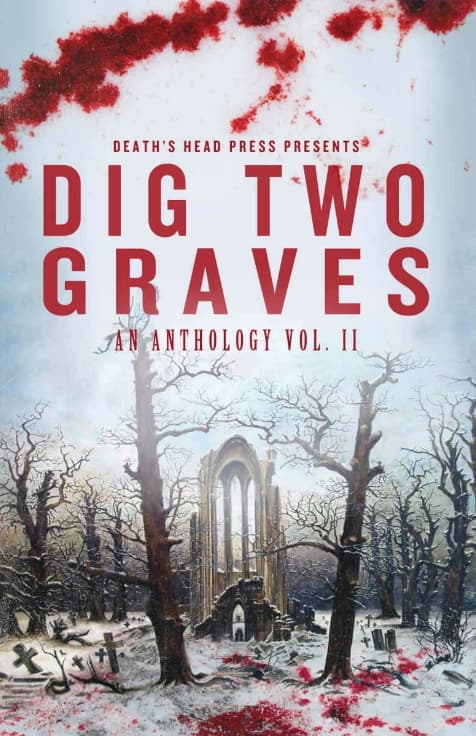
My Short Story, ‘Violation,’ in the Horror Anthology, ‘Dig Two Graves, Vol. II’

Dig Two Graves: An Anthology Vol. II–Kindle edition by Death’s Head Press is now published! I have an erotic horror short story, ‘Violation,’ included in it. It’s about a group of young men who gang rape and murder a woman in the woods (or so they think), then realize they’ve gotten themselves into something supernatural and surreal, and a revenge ensues to make I Spit On Your Grave seem mild in comparison. That’s all I’m telling for now; you’ll have to read for yourself to find out how they get what’s coming to them.

Other great stories included in the anthology were written by Wesley Southard, Cameron Trost, Gerri R. Gray, Gary Power, Delphine Quinn, M. Ennenbach, Jack Bantry, Charlotte Platt, Cameron Kirk, Susan E. Abramski, Mark Lumby, Lucas Milliron, David L. Tamarin, Lori Tiron-Pandit, Pete Mesling, G. Allen Wilbanks, Thomas Vaughn, Sergio “ente per ente” Palumbo, Duane Bradley, David Owain Hughes, and Betty Rocksteady.

I want to show my appreciation to Death’s Head Press for including my story in their new anthology! If you love horror fiction, Dear Reader, I hope you’ll go out and get your hands on this collection of scary stories!

Analysis of ‘The Tempest’

The Tempest is a play Shakespeare is believed to have written around 1610 or 1611; it is therefore probably the last play he ever wrote alone. It isn’t easily categorized: it’s part comedy, part fantasy/romance, part semi-autobiographical (in a metaphorical sense), and part allegory on the European colonization that was current at the time.

A number of interesting film adaptations have been made of The Tempest, including the BBC TV adaptation with Michael Hordern as Prospero, the homoerotic 1979 Derek Jarman adaptation with Toyah Willcox as Miranda, and Julie Taymor‘s 2010 adaptation with Helen Mirren as a female Prospero…’Prospera.’ Other adaptations include the 1991 film Prospero’s Books, with John Gielgud in the title role, and Aimé Césaire‘s Une Tempête, a stage adaptation set in Haiti.

Here are some famous quotes:

“Ferdinand, 
With hair up-staring, — then like reeds, not hair, — 
was the first man that leapt; cried Hell is empty, 
And all the devils are here.
” –Ariel, I, ii, lines 212-215

“This island’s mine, by Sycorax my mother, 
Which thou tak’st from me. When thou cam’st first, 
Thou strok’st me and made much of me, wouldst give me 
Water with berries in’t, and teach me how 
To name the bigger light, and how the less, 
That burn by day and night; and then I lov’d thee, 
And show’d thee all the qualities o’ the isle, 
The fresh springs, brine-pits, barren place and fertile. 
Curs’d be I that did so! All the charms 
Of Sycorax, toads, beetles, bats, light on you! 
For I am all the subjects that you have, 
Which first was mine own king.” –Caliban, I, ii, lines 331-342

“Come unto these yellow sands, 
And then take hands; 
Curt’sied when you have and kiss’d, 
The wild waves whist, 
Foot it featly here and there, 
And, sweet sprites, the burden bear.” –Ariel, I, ii, lines 375-380

“Full fathom five thy father lies; 
Of his bones are coral made; 
Those are pearls that were his eyes; 
Nothing of him that doth fade, 
But doth suffer a sea-change 
Into something rich and strange.
Sea-nymphs hourly ring his knell: 
Ding-dong. 
Hark! now I hear them — Ding-dong, bell.” –Ariel, I, ii, lines 396-404

“Be not afeard. The isle is full of noises, 
Sounds, and sweet airs, that give delight, and hurt not. 
Sometimes a thousand twangling instruments 
Will hum about mine ears; and sometimes voices, 
That, if I then had wak’d after long sleep, 
Will make me sleep again; and then, in dreaming, 
The clouds methought would open and show riches 
Ready to drop upon me, that, when I wak’d, 
I cried to dream again.” –Caliban, III, ii, lines 130-138

“Our revels now are ended. These our actors, 
As I foretold you, were all spirits, and 
Are melted into air, into thin air; 
And, like the baseless fabric of this vision, 
The cloud-capp’d towers, the gorgeous palaces, 
The solemn temples, the great globe itself, 
Yea, all which it inherit, shall dissolve, 
And, like this insubstantial pageant faded, 
Leave not a rack behind. We are such stuff 
As dreams are made on; and our little life 
Is rounded with a sleep.” –Prospero, IV, i, lines 148-158

“But this rough magic 
I here abjure; and, when I have requir’d 
Some heavenly music — which even now I do, — 
To work mine end upon their senses that 
This airy charm is for, I’ll break my staff, 
Bury it certain fathoms in the earth, 
And, deeper than did ever plummet sound, 
I’ll drown my book.” –Prospero, V, i, lines 50-57

“Where the bee sucks, there suck I; 
In a cowslip’s bell I lie; 
There I couch when owls do cry. 
On the bat’s back I do fly 
After summer merrily. 
Merrily, merrily, shall I live now, 
Under the blossom that hangs on the bough.” –Ariel, V, i, lines 88-94

“O, wonder! 
How many goodly creatures are there here! 
How beauteous mankind is! O brave new world
That has such people in’t!” –Miranda, V, i, lines 181-184

“Now my charms are all o’erthrown, 
And what strength I have’s mine own, 
Which is most faint: now, ’tis true, 
I must be here confin’d by you, 
Or sent to Naples. Let me not, 
Since I have my dukedom got 
And pardon’d the deceiver, dwell 
In this bare island by your spell; 
But release me from my bands 
With the help of your good hands. 
Gentle breath of yours my sails 
Must fill, or else my project fails, 
Which was to please. Now I want 
Spirits to enforce, art to enchant; 
And my ending is despair, 
Unless I be reliev’d by prayer, 
Which pierces so that it assaults 
Mercy itself, and frees all faults. 
As you from crimes would pardon’d be, 
Let your indulgence set me free.” –Prospero, Epilogue

Prospero, the rightful Duke of Milan, was stripped of his dukedom and banished with his daughter Miranda twelve years before the play’s beginning. Gonzalo, a kind and optimistic giver of counsel, gave them provisions so they’d survive on the seas, ultimately arriving on the island where the two have been living since.

His usurping brother Antonio, along with King Alonso, Gonzalo, Sebastian, Stephano the drunken butler, Trinculo the jester, and the king’s son, Ferdinand, have been sailing on a ship at the beginning of the play. They find themselves in the middle of a tempest that Prospero, a sorcerer, has created to cause their ship to crash-land on his island, for he wants to right the wrongs done to him.

In this wrong done to Prospero, we see the main theme of the play: disenfranchisement. Now, his disenfranchisement doesn’t give him the right to do the same to others, which indeed he does. He uses his magic to control a number of spirits, Ariel in particular, who expresses his displeasure at it and demands his freedom (I, ii, lines 242-250). Prospero offers a weak justification for making Ariel his servant by reminding him of how he freed him from a spell the witch Sycorax put on him, having caged him in a tree.

Sycorax, banished from Algiers and subsequently the first colonizer of what’s now Prospero’s island, was undoubtedly cruel in her treatment of Ariel; Prospero’s freeing of the spirit, however, in no way absolves him of similar colonizing and enslaving. Such an absolving would be like saying that the Spanish Empire’s brutal treatment of the natives (of what is now Latin America) makes US imperialism’s subsequent treatment of ‘America’s backyard’ negligibly oppressive–a truly absurd argument.

Mention of Sycorax brings us to a discussion of her son, the deformed Caliban, another native of the island forced by Prospero into servitude. Caliban is a near anagram of cannibal, and a pun on Caribbean; such associations give us a vivid sense of how he is a victim of colonialism, a native denigrated by his oppressor as ‘uncivilized’ and ‘savage.’

Indeed, Prospero rationalizes his enslaving of Caliban by claiming originally to have been kind to the grotesquerie, that is, until his attempted rape of Miranda, which he gleefully admits to. Not to excuse Caliban for his scurrilous behaviour, but the degradation of slavery, often with torturous punishments for being slack or slow in service, nevertheless seems a bit much. After all, Prospero’s denigration of Caliban’s bestial nature reminds us of the racism colonialists have used to justify their dehumanizing of the natives they subjugate.

Indeed, for all his faults, Caliban has his virtues, too. He speaks poetically sometimes, as in the above quote from Act III, scene ii, lines 130-138. This quote shows how he is sensitive to the poetic, reminding us of the creativity of indigenous people; colonialists like Prospero make little of natives’ artistic gifts, but kinder souls like Gonzalo show their appreciation of what’s good in people like Caliban. Recall his words in Act III:

“If in Naples
I should report this now, would they believe me?  
If I should say, I saw such islanders—
For, certes, these are people of the island—
Who, though they are of monstrous shape, yet note
Their manners are more gentle, kind, than of
Our human generation you shall find  
Many, nay, almost any.” –Gonzalo, III, iii, lines 26-34

Prospero, hearing Gonzalo’s words, agrees with them, but only insofar as they describe the Neapolitans present, whom he describes as “worse than devils.” (III, iii, line 36) He makes no mention of agreement that the natives have virtues. He should also consider including himself among the Neapolitan devils; recall Ferdinand saying that Prospero is “compos’d of harshness.” (III, i, line 9) What must be kept in mind is how Prospero prospers by using others. Wealth causes poverty, and this is especially true of imperialists and neocolonialists in relation to the aboriginals they exploit.

Prospero’s magic exploits nature, e.g. the tempest, to bring Alonso’s ship ashore; this symbolically can remind us of how big business today degrades nature for their gain. Prospero openly admits that he exploits Caliban: he says of his slave, “he does make our fire,/Fetch in our wood, and serves in offices/That profit us.” (I,ii, lines 311-313)

Prospero uses his magic on Miranda, putting her asleep (I, ii, lines 184-186); in this way, he controls her sleeping and waking moments to limit her acquisition of knowledge. She and Ferdinand don’t merely fall in love; her father manipulates their meeting, for in their future marriage he hopes to consolidate his power as the restored Duke of Milan. Prospero may be giving up his magical powers, but in return he wants political power.

It can be argued, in fact, that he has never been truly worthy of being a duke; since during the time that he ruled the dukedom, prior to Antonio’s usurpation, he was so absorbed in his books (I, ii, lines 68-77, 89-93) that he cared little for his people. He admits this when he speaks in gratitude of Gonzalo’s help: “Knowing I lov’d my books, he furnished me/From mine own library with volumes that/I prize above my dukedom.” (I, ii, lines 166-168) Note here that “prize” is in the present tense: Prospero admits he still loves his books more than the people of Milan; remember this Freudian slip when we consider his later promises to “break [his] staff” and “drown [his] book.”

Yes, he promises to renounce his magic (which we never see him physically do!), and so as the reinstated Duke of Milan, he’ll presumably focus on the needs of his people; but he says that in Milan, his “every third thought shall be [his] grave,” (V, i, line 311) suggesting he’ll still be too self-absorbed and retiring to think about his people.

So, Prospero enslaves and exploits the natives of the island, always promising to free them in the end (though we never see him use his magic to unbind them, so for all we know, these promises could be empty); he manipulates his way back into power, assuming he deserves this reinstatement (though the above two paragraphs put this worthiness in doubt); and he uses his daughter to make a political alliance with the king, manipulating her emotions to make her fall in love with whom he wants her to love.

Thus, in Prospero we see not only an exploitative colonialist, but also a man taking advantage of the authoritarianism of the patriarchal family. His cunning is contrasted with the naïveté of his daughter, Caliban, Stephano, and Trinculo. Where Prospero is artful, these latter four are artless. Indeed, where there’s a dialectical relationship between wealth and poverty, as noted above (i.e, the one causes the other), there is also such a relationship between ability and inability, between cunning and innocence.

Consider the sweetness and innocence of Miranda. She sees the good in everyone indiscriminately. She has compassion for all the sailing sufferers of the storm; she’s oblivious to how her wicked uncle Antonio is one of the men on the boat. In her naïveté is kindness, in Prospero’s worldly-wisdom…not so much kindness.

Having seen so few people in her life, and assuming goodness in all humanity, she is delighted to see all those men before her at the end of the play (V, i, lines 181-184), rather than mindful of the possibility that a few of them (Antonio and Sebastian) aren’t so “goodly.”

Her artlessness is outdone by the outright stupidity of Stephano, Trinculo, and Caliban. In his drunken stupor, Stephano can’t recognize supine Trinculo’s legs sticking out from underneath Caliban’s gaberdine (being the court jester, Trinculo is presumably wearing distinctive motley colours); instead, he imagines the supine monster Caliban has four legs. Trinculo, having originally assumed that Stephano died in the tempest, later looks the drunken butler in the eyes and has to ask him twice if he’s “not drown’d” (II, ii, lines 100-105). Finally, Caliban, after drinking Stephano’s supposedly divine wine, thinks the drunkard is a god!

In their foolish simple-mindedness, the trio think they can kill Prospero and rule the island. They can’t even avoid falling into a smelly pond, though, Trinculo later complaining of smelling “all horse-piss.” (IV, i, line 199)

Later, once they reach Prospero’s abode, Stephano and Trinculo can’t help but be distracted by the sorcerer’s “frippery.” (IV, i, line 226) The two fools try on Prospero’s clothes while Caliban warns them to focus instead on the plan to kill his hated master. They don’t listen, and Prospero has Ariel chase the fools away with hellhounds.

The way alcohol and fashionable clothes can make fools of people is paralleled today in how such distractions prevent revolutionary action. We today have every bit as much as, if not more than, an imperialist ruling class that mesmerizes the common people with foolish trifles. We’d all usurp the rule of our hypnotizing politicians and rich overlords…except we keep letting ourselves get hypnotized.

Along with the class conflict between rich land-owners and the poor, between the First and Third Worlds as symbolized in the Neapolitans on the one hand, and the island natives and spirits respectively, there’s also conflict between different factions of the ruling class. This latter conflict is evident when Alonso and Gonzalo are put to sleep by Ariel, then Antonio convinces Sebastian to make an attempt on the king’s life.

Later, this group experiences a sensual distraction that is comparable with the wine and finery that dazes the three drunken fools. An illusion of a table covered with a delicious feast is put before the nobles’ eyes. Sweet music is heard. The men prepare to eat, but Ariel appears in the form of a harpy and makes the feast disappear; the scene reminds us of the one in the myth of Jason and the Argonauts, when King Phineus of Thrace was tormented with a feast that got ruined by attacking harpies.

This depriving the nobles of a meal reminds one of a modern equivalent in Luis Buñuel‘s Discreet Charm of the Bourgeoisie. Tantalizing Alonso et al with a meal is punishment for what the king and Antonio deprived Prospero and Miranda of. The illusory meal, as a distraction from important political matters, is also–like wine and “frippery” for Stephano, Trinculo, and Caliban–an example of bread and circuses.

The ‘bread’ aspect of Prospero’s distractions was noted in the mirage feast table; the ‘circuses’ aspect, if you will, can be seen in the masque with the singing goddesses (Iris, Ceres, and Juno; IV, i, lines 60-138) presented to Ferdinand and Miranda. Recall how their falling in love has been engineered by her father, who is using their marriage to solidify his power as the reinstated Duke of Milan.

He takes advantage of her scant knowledge of men to make her fall for handsome Ferdinand, “the third man that e’er [she] saw; the first/That e’er [she] sigh’d for.” (I, ii, lines 445-446) Prospero’s test of the boy’s virtue, by enslaving him and making him do essentially Caliban’s work (fetching wood), is a weak test–as if mere diligence were enough to prove Ferdinand’s worthiness of her. It’s ironic how making Ferdinand play the role of Miranda’s would-be rapist should prove him a good husband. Prospero even says to her, “Foolish wench!/To th’ most of men this is a Caliban” (I, ii, lines 479-480).

At the beginning of Act V, Prospero has his disenfranchisers brought near his abode (that is, his “cell”), and he immobilizes them so he can upbraid Antonio and Alonso for their collusion in the usurpation of the dukedom, as well as the former and Sebastian for having conspired to kill Alonso. Prospero speaks kindly of his “true preserver,” Gonzalo, of course; and he recognizes that forgiveness is “rarer” than taking vengeance, so he says he forgives his “unnatural” brother, though we can’t be sure if his heart is in his words.

This making of the nobles to “stand charm’d,” just like Prospero’s making Miranda fall asleep and his ‘bread and circuses’ distractions of everyone again shows the dialectical relationship between his power and the powerlessness of all the others. Prospero promises to “break [his] staff” and “drown [his] book” (V, lines 54 and 57), but should we believe he’ll keep his promises? As a duke, he is a kind of politician, and politicians who keep their promises are the exception rather than the rule.

If, Dear Reader, I seem to have too judgemental an attitude towards Prospero, consider the alternative: surely he is aware of the danger of giving up all his powers; one shouldn’t assume he’ll never again be the victim of a conspiracy once “what strength [he has is his] own” (Epilogue, line 2). Antonio and Sebastian are probably still plotting.

Of course, the fact that Shakespeare identified himself, the magic-making playwright, “such stuff/As dreams are made on,” with Prospero suggests that the promise to “abjure” his magic will be kept; after all, the Bard was about to retire from “the great globe itself” shortly after the first performances of The Tempest.

So my next question is: since Prospero represents, on the one hand, the colonialist/imperialist and exploitative/manipulative politician, and on the other hand, the magic-making playwright, what relationship can we see between these two otherwise contrasting representations?

Marx wrote of a base and superstructure that keep the class structure of society intact. The superstructure is composed of such things as the media, religion, and the arts. Now, Marx was describing modern capitalist society, as opposed to the feudalist one Shakespeare lived and wrote his plays in; but the seeds of modern capitalism had already been sown in his day, and feudalism was as much a form of class conflict as capitalism is.

Shakespeare’s plays tended to justify class hierarchies by glorifying kings (the deposition scene in Richard II, so offensive to Elizabeth I, being one of the noteworthy exceptions) and the imperialistic plunder of other countries (Henry V). Contrast this with his tendency to portray poor workers as not much more than buffoons (consider Falstaff, Bardolph, et al in the Henry IV plays, or the “rude mechanicals” in A Midsummer Night’s Dream, as two sets of examples, to see my point). The tragic flaws of Hamlet, Macbeth, King Lear, etc., ennoble them by inspiring Aristotle’s pity and terror; the faults of the poor in these plays generally inspire our contemptuous mirth.

What I’m saying here, of course, is not true in an absolute sense: there is a considerable grey area between the white of the nobility and the black of the peasantry in the Bard’s plays. Osric, who “hath much land,” is foppish in the extreme. Falstaff has much depth of character, and his passing is grieved most touchingly by his friends at the Boar’s Head Inn; still, he’s also mercilessly ridiculed in The Merry Wives of Windsor. Christopher Sly‘s transformation from drunken tinker into a lord is a mere prank. Malvolio, with his cross-gartered yellow stockings and ridiculous grinning, is the lady Olivia‘s subordinate, her steward. In The Comedy of Errors, the twin Dromio servants are constantly being abused and picked on by their twin Antipholus masters, a form of slapstick humour. The two gravediggers in Hamlet are referred to as clowns in the script.

My point here is that the grey area of relative equal worth between upper and lower classes doesn’t disprove the black and white of the hierarchy that Shakespeare affirmed as a truth in the world. His plays never fundamentally challenged class antagonisms. For all the many faults of the nobles in Shakespeare’s plays, even when they are outright wicked, they have a dignity far elevated above that of even the best of the poor.

In these ways, Shakespeare as Prospero could be seen as part of the superstructure of Elizabethan times, reinforcing notions of the ‘superiority’ of the landowning ruling classes as against the ‘inferiority’ of the poor labourers and peasants of his time. His portrayals of Caliban and Sycorax as monsters and fiends were probably inspired at least in part by the biases of the time, namely, the notion of Christian superiority over the ‘devil-worshipping’ heathens of the rest of the world (i.e., the worship of Setebos by Caliban and Sycorax).

Still, as much as I have issue with the politics of Shakespeare at times, I’ll continue to love and admire his art, as we all should. Many talented artists in remote and more recent history (Shakespeare, Dali, Frank Zappa, etc.) are people with whom we may have issues as regards their political stances. In this way, my judgement of Prospero can be seen, in a symbolic sense, as ambivalent rather than unilaterally condemning.

My leftist worldview must be more forgiving of what I see as politically lacking in the Bard. His aim as a playwright wasn’t mainly to promote a certain political agenda; it “was to please.” Therefore, let my indulgence set him free.

‘Claws,’ an Erotic Horror Novel, Chapter Eighteen

Thurston fixed his tie and looked at himself in the mirror. Aren’t we handsome in that suit? he thought.

He left his apartment and got in his car.

As he drove to the 22 Division police station, he reflected on all that had recently happened.

It’s so good to be connected with Agnes, he thought. Close to her, in body and soul. I really love her; and better yet, there’s no more conflict with the beast. That bullet I put in its head sure did the trick. No more resistance.

He parked in the police station parking lot and got out of his car. He sucked in a deep inhalation of fresh air and smiled.

It’s so good to be fully in control again, he thought.

He walked into the police station, passed a number of desks in the direction of his own. He saw Hicks standing near his desk.

Hicks turned around and saw him approaching.

“Good morning, handsome,” Hicks said with a smile.

“Good morning,” Thurston said.

“Still no sign of Surian?”

“Oh, she’s around.”

“Really? Where? I still need to talk to her about her shooting the beast. If you could tell her to come out of hiding, I’d really appreciate it.”

“Oh, don’t worry about that,” Thurston said. “You’ll be in contact with her soon enough.”

“Very well, whatever,” Hicks said with a sneer, which then turned into a lewd smirk. “And as for us, when are you going to come over to my place?”

“How about tonight?” Thurston asked with a grin.

THE END

Analysis of ‘Barton Fink’

Barton Fink is a 1991 period film produced by Ethan Cohen, directed by Joel Cohen, and written by both of them. It stars John Turturro (in the title role) and John Goodman; it costars John Mahoney, Judy Davis, Steve Buscemi, Michael Lerner, and Tony Shalhoub.

The film is about, essentially, writer’s block, since the Cohen brothers themselves had been going through some writing difficulties when working on Miller’s Crossing. Barton Fink is a New York playwright who fancies himself a writer championing “the common man,” but when he has an opportunity to write a Hollywood screenplay for a movie about a wrestler (the kind of the story “the common man” would have found entertaining at the time), he can barely type a word.

Here are some quotes:

Garland Stanford: The common man will still be here when you get back. Who knows, there may even be one or two of them in Hollywood.

Barton Fink: That’s a rationalization, Garland.

Garland Stanford: Barton, it was a joke.

**********

“I run this dump, and I don’t know the technical mumbo-jumbo. Why do I run it? ‘Cause I got horse sense goddamit, SHOWMANSHIP! And also I hope Lou told you this, I am bigger and meaner and louder than any other kike in this town. Did you tell him that Lou? And I don’t mean my dick is bigger than yours, it’s not a sexual thing. You’re a writer, you know more about that. Coffee?” –Jack Lipnick (Lerner)

**********

Charlie Meadows (Goodman): And I could tell you some stories…

Barton Fink: Sure you could and yet many writers do everything in their power to insulate themselves from the common man, from where they live, from where they trade, from where they fight and love and converse and…and…So naturally their work suffers and regresses into empty formalism and…well, I’m spouting off again, but to put it in your language, the theatre becomes as phoney as a three-dollar bill.

Charlie Meadows: Well, I guess that’s a tragedy right there.

**********

“Honey! Where’s my honey?” –Mayhew

“I’ve always found that writing comes from a great inner pain.” –Fink

“Me, well, I just like makin’ things up.” –Mayhew (Mahoney)

“I’m buildin’ a levy. Gulp by gulp, brick by brick…” Mayhew

“That son of a bitch! Don’t get me wrong, he’s a fine writer.” –Fink, of Mayhew

“Never make Lipnick like you!” –Ben Geisler (Shalhoub)

“I gotta tell you, the life of the mind…There’s no roadmap for that territory…And exploring it can be painful.” –Fink

**********

Detective Mastrionotti: Fink. That’s a Jewish name, isn’t it?

Barton Fink: Yeah.

Detective Mastrionotti: Yeah, I didn’t think this dump was restricted.

**********

[at the USO club] “I’m a writer, you monsters! I create! I create for a living! I’m a creator! I am a creator! [points to his head] This is my uniform! This is how I serve the common man!” –Fink

**********

Detective Deutsch: You two have some sick sex thing?

Barton Fink: Sex?! He’s a man! We wrestled!

Detective Mastrionotti: You’re a sick fuck, Fink.

**********

“Look upon me! I’ll show you the life of the mind!” –Meadows

**********

Barton Fink: But Charlie–why me? Why–?

Charlie Meadows: Because YOU DON’T LISTEN!

**********

[last lines]

Beauty: It’s a beautiful day.

Barton Fink: Huh?

Beauty: I said it’s a beautiful day.

Barton Fink: Yes. It is.

Beauty: What’s in the box?

Barton Fink: I don’t know.

Beauty: Isn’t it yours?

Barton Fink: I don’t know. You’re very beautiful. Are you in pictures?

Beauty: Don’t be silly.

Fink has just written Bare Ruined Choirs, a play whose title is inspired by a line from Shakespeare’s Sonnet #73: “Bare ruin’d choirs, where late the sweet birds sang.” Choirs aren’t the singers, but rather the places where choirs sing in churches (or in the case of the sonnet, where the birds sang, on leafless tree branches). The point is that the lack of singers, in the context of the movie, represents the lack of inspiration, no poetic singing coming from blocked Fink.

Fink is loosely based on Clifford Odets, a socialist playwright who had been a member of the Communist Party back in the mid-1930s, and who had to testify before the House Committee on Un-American Activities in the 1950s. The physical and superficial similarities between Fink and Odets are obvious; but beyond their ‘championing of the common man,’ they haven’t much more in common. Odets was a leftist; Fink is a liberal.

Odets was actively involved in socialism; Fink merely talks of wanting to write about “the average working stiff.” It quickly becomes apparent that he’s not all that interested in the working man. His play is the toast of Broadway, enjoyed by a largely bourgeois audience as pretentious as he is.

Phoniness is a recurring theme in the movie. Fink affects modesty at the success of his play, claiming it’s “merely adequate.” Hollywood producer Lipnick (Lerner) claims “the writer is king” in Capitol Pictures, when it turns out the writer’s contract makes him into a virtual slave. Charlie Meadows seems a friendly, unassuming insurance salesman selling “peace of mind”; we later learn he’s “Madman Mundt,” a serial killer (or is he even that?…see below). W. P. Mayhew, loosely based on William Faulkner, supposedly “the finest novelist of our time,” is really a “souse” whose “secretary,” Audrey Taylor (Davis) has written much, if not most, of his great work, scripts and novels alike.

Fink is offered a job to write scripts for Hollywood, an opportunity he snobbishly balks at. When his agent, Garland Stanford, says he might see some of “the common man” in Hollywood, Fink dismisses this as a rationalization, when Garland really meant it as a joke, showing how little he and Fink really care about working people.

Having arrived in Hollywood, Fink is surrounded by examples of the common man. In his seedy, rundown hotel, there’s the bellboy Chet (Buscemi) and his neighbour Charlie. There are the sailors at the USO hall (where buffoonish Fink does the nerd-dance of the century). Fink has no interest in these people’s lives whatsoever. He should be up to his armpits in inspiration; but he can’t get anything, outside of literary inspiration, for this wrestling movie script he has to write. So much for championing the common man.

The movie is more interested in the small and insignificant than Fink is: the hotel bell rings out in a decrescendo until Chet puts his finger on it, just before the fade to absolute silence. We see closeups of a sinkhole, a drain, typewriters, and the bell of a jazzman’s horn. When Charlie frees Fink from the metal foot rails of the bed-frame a cop has handcuffed him to, a small steel ball rolls from one of the broken rails and along the floor, up close to the camera, a small thing growing into a big thing before our eyes.

Fink represents liberalism, but Jack Lipnick represents the cutthroat, dog-eat-dog capitalist. Now, bear in mind how congenial he appears to Fink at first. This represents the superficial charm of the narcissistic capitalist, who pretends to be friendly and generous while secretly scheming and planning to lure the employee into wage slavery, here represented by Fink’s ball-and-chain contract with Capitol Pictures.

Lipnick is a fast-talking loudmouth, a red flag already warning us of his predatory capitalist nature: “I am bigger and meaner and louder than any other kike in this town. Did you tell him that, Lou? And I don’t mean my dick is bigger than yours, it’s not a sexual thing, although you’re the writer, you’d know more about that. Coffee?”

Still, Lipnick pretends to idolize the writer who gives him “that Barton Fink feeling,” even kissing his feet after Lou Breeze (Jon Polito)–who represents Lipnick’s True Self–tells Fink in all frankness that “the contents of [his] head are the property of Capitol Pictures.” Lipnick, in his narcissistic False Self, fires Lou…though in the next scene with Fink in Lipnick’s office (in which the producer rants about how much he hates Fink’s script), Lou is in the room with them, proving how much of an act the firing was, and how phoney Lipnick’s high regard of Fink has always been.

Charlie Meadows is largely friendly, a true representative of the common man whose work in insurance is meant to help people. We later learn from Detectives Mastrionotti and Deutsch (who, as their surnames imply, respectively represent Fascist Italy and Nazi Germany) that Charlie is really Karl Mundt, a pun on Karl Marx.

So this means that Charlie represents communism. His violence (both real and imagined) represents that of revolution and the aggravation of class struggle under socialism. The cops’ labelling of him as a serial killer is something one shouldn’t be too credulous of, given that they represent fascism, and it is by no means proven (but rather assumed to be true) that “Madman Mundt” actually killed all those people, so the cops’ characterization of him can be seen to represent right-wing demonizing of socialism.

Furthermore, the film is set in 1941, the same year the Axis Powers invaded the Soviet Union, an attack paralleled in the movie by the cops’ entering the Hotel Earle to arrest Charlie. Charlie’s shooting of the cops thus represents the Soviet victory over fascism: his saying, “Heil Hitler” before shooting Detective Deutsch is mockingly ironic.

Since Charlie, or Karl, represents communism, and Fink represents liberalism, consider the nature of their ‘buddy-buddy‘ relationship. Sure, they’re friends, but when Charlie “can tell [Fink] some stories,” Fink interrupts him, speaks condescendingly to him, and prates on and on about the contemporary state of American theatre, something from which Charlie “can feel [his] butt gettin’ sore already.” Fink, a typical liberal, rejects all opportunities to learn about the real common man, treating their stories like Wilfred R. Bion‘s rejected beta elements, raw sense impressions that are not allowed into the mind, processed, and made into thought. Fink does no learning from experience.

Instead, he hopes his literary hero, W.P. Mayhew, will help him figure out how to write the wrestling picture, but he only grows increasingly disillusioned with the “souse.” Ironically, it’s only Mayhew’s status as a major man of letters that interests Fink, while his alcoholism, a common symptom of the alienation of the working man, disgusts Fink.

At a picnic with Fink and Audrey, Mayhew drinks, speaks obnoxiously, and even slaps her after finishing a piss by a tree. As indefensible as his behaviour is, this crudity is but a symptom of the sufferings of the oppressed proletariat, for which snobbish Fink has no sympathy.

In his inebriated state, Mayhew wanders off among the trees singing “Old Black Joe,” an old Stephen Foster song about a black American slave. Though a white man, Mayhew has been made a slave of sorts by the contract he has with Capitol Pictures. His wandering off, singing, and drinking represent his attempt to escape his miserable existence, a manic defence against his sadness and inability to write.

Fink pretentiously speaks of writing “from a great inner pain”; he’s posturing as the ‘suffering artistic genius.’ Mayhew’s more honest about what makes him write, and about his pain. He likes “making things up…escape.” And when he can’t write, he finds that, apparently, the bottle “will sometimes help.”

Fink will find himself increasingly wanting to escape, but in a different way: through fantasy. Whenever he’s stuck at his typewriter in his hotel room, not knowing how to begin the story for the wrestling movie, he looks up at a picture on the wall of a beautiful young woman sitting on the beach, watching the water with her hand over her eyes to block the sunshine.

He often stares at the picture, admiring the beauty of the woman and the scene. This is his conception of heaven: those waves washing on the shore are his relief from the fiery hell of Hollywood, with its capitalistic degrading of creativity for profit. The beach picture reminds us of the relief and joy of the Greek soldiers in Anabasis when they behold “the sea! The sea!

There is a dialectical relationship between the hell of Hollywood and the heaven of the City of Angels, the former being within the latter, as is the case of the paradise picture of the girl on the beach in Fink’s room in the hellish Hotel Earle–yin and yang. The aspiring writer who has sold his soul to Hollywood tries to escape to the heaven of fantasy. For Fink, the flames of hell are quenched by the water on the shore; for Mayhew, they’re quenched–so it would seem–by firewater.

Some have claimed that where Fink is water, Charlie is fire; and so, if the burning Hotel Earle–Charlie’s home–is hell, then Charlie must be the Devil. I find this to be a simplistic interpretation of a much more complex character. Charlie has a raging fire of pain in him, but he has a lot of good, too.

It is assumed that he is a serial killer, that he kills Audrey out of a rage of sexual jealousy because Fink has chosen beautiful her over fat Charlie as his Muse and his lover. I’m sure Charlie has heard them making love, as earlier and elsewhere in the hotel, he’s been able to hear “those [other] two love-birds next door drivin’ [him] nuts,” and thus he feels hurt that his obesity makes him unattractive to anyone.

None of this, however, conclusively proves that he killed her: his jealousy isn’t necessarily strong enough for a motive for murder. If so, why not kill Fink instead? Their homoerotic wrestling suggests Charlie has wanted Fink, so his betrayal with Audrey should make Charlie want to kill him instead. If killing her was meant to get revenge on Fink by hurting him–traumatizing him–why help him dispose of the body afterwards, in an attempt to protect him from the cops? For all we know, Mayhew–in an uncharacteristic moment of sobriety–could have sneaked in the hotel and killed her.

The detectives call “Madman Mundt” a serial killer, which he could very well be: but why should we trust the claims of those two obnoxious, bigoted personifications of fascism? I find it ironically fitting that Charlie, whom I equate with communism, would–in the eyes of the Hollywood liberal that distributes films like this–symbolize Satan.

The one time we see Charlie actually kill people is in the scene in the burning hallway in the hotel. The inexplicability of the fire, especially when combined with the non-urgent reaction of everyone to it, forces one to conclude that it’s a fantasy in Fink’s head. Where the fantasy begins and ends, however, is hard to determine for sure: is only the fire a fantasy, or is Charlie’s shooting of the cops also one? After all, he casually enters his room, one surrounded by flames, instead of fleeing the scene of the crime.

The final scene of Fink with the beauty at the beach can only be fantasy. It is absurdly improbable that a woman in real life, identical to the girl in the picture, would assume the exact same pose, too. So there is much fantasy in this film, fantasy that’s blatantly obvious towards the end, but not necessarily fantasy only at the end. A legitimate question is, how much of the whole film is Fink’s fantasy, and how much of it is real?

Lipnick’s original sucking up to Fink is symbolic of a kind of capitalist con game, as I outlined above; but is it also a hallucinatory projection of Fink’s mammoth ego? There’s Lipnick’s phoney geniality and there’s Fink’s false modesty; but since phoniness is one of the main themes of the movie (symbolized by the peeling wallpaper to reveal the seediness of the hotel behind its thin mask of a decor), phoniness applies not only to the characters, but also to the visuals in general.

Are there real mosquitoes in Fink’s hotel room, or are they figments of his imagination? Are the cuts on his face from mosquito bites, or are they from him having too harshly scratched itches from imagined bites? Recall Geisler telling him that “there are no mosquitoes in Los Angeles. Mosquitoes breed in swamps–this is a desert.”

Fink’s ‘inspiration’ to write the wrestling screenplay most definitely comes from a hallucination; he certainly doesn’t get his idea from having observed the common man, whom he’s been constantly ignoring. His hallucination comes from reading the first chapter of Genesis. God’s Creation becomes Fink’s creation: his inflated ego equates him with Yahweh.

This is the essence of Fink’s phoniness, his egotism: he fancies himself a moral guardian of the little man, yet he really imagines himself as, so to speak, homoousios with the Big Man Himself. In the beginning was the Word, and the Word was with Fink, and the Word was Fink.

His inspiration consistently comes from the written word, from literature, not from the blood and sweat of the working man, as he’d have us believe. Bare Ruined Choirs, as noted above, gets its title from a Shakespeare quote. When he opens the Gideon Bible in his hotel room, he fortuitously opens it to the Book of Daniel, chapter two, in which there is mention of Nebuchadnezzar‘s dream of four kingdoms.

The title of one of Mayhew’s novels, incidentally, is Nebuchadnezzar. The king as portrayed in the Bible says, “if ye will not make known unto me my dream, and its interpretation, ye shall be cut in pieces,…” (Daniel 2:5); the connection between these two facts lends credence to my theory as to who the real…author…of Audrey’s murder could be. Recall in this connection how, earlier, Mayhew is repeatedly screaming, “WHERE’S M’HONEY!!” when she is merely chatting with Fink for the first time; imagine the bloodiness of his rage to think she’s with Fink in his hotel room.

Fink’s script, it is safe to assume, is essentially a rewriting of Bare Ruined Choirs, in which it seems that fishmongers are largely replaced with wrestlers: “We’ll be hearing from that crazy wrestler. And I don’t mean a postcard,” is an ending much too imitative of that of the original, “We’ll hear from that kid. And I don’t mean a postcard.” Lipnick hates his script for being too “fruity” and artsy-fartsy; we should dismiss Fink as a one-hit-wonder.

Finally, we should consider Fink’s mental health, and the cause of his hallucinations. I find the insights of Wilfred R. Bion useful for this purpose.

Above, I mentioned Fink’s rejection of any of the stories of the common man, new ideas that could help him in his writing of the script for the wrestling movie. I referred to those rejected ideas as beta elements, Bion’s term for sensory data from the external world that aren’t taken into the mind and converted (by alpha function) into thoughts (alpha elements) that can then be used in dreams and unconscious waking thoughts.

Bion explains: “The attempt to evade the experience of contact with live objects by destroying alpha-function leaves the personality unable to have a relationship with any aspect of itself that does not resemble an automaton. Only beta-elements are available for whatever activity takes the place of thinking and beta elements are suitable for evacuation–perhaps through the agency of projective identification.” (Bion, page 13)

When large amounts of beta elements aren’t being processed and turned into thoughts that one can learn from (as is obviously what’s happening with Fink), a beta screen is formed from this unprocessed accumulation, a mental wall blocking out learning; and over time, these beta elements–which, though expelled and projected, never really go away–can become bizarre objects, which are hallucinatory projections from oneself.

Hence, the walls of Fink’s hotel room symbolize his beta screen of rejected outside influence (the resulting isolation of which reminds us of two films that influenced Barton Fink, namely, Roman Polanski‘s Repulsion and The Tenant, from his Apartment Trilogy); so instead of feeling genuine concern about what Charlie is laughing–or weeping–about in the neighbouring room, Fink complains to Chet about the noise.

The burning hotel and the picture Fink has a conversation with are two of his bizarre objects, hallucinations that indicate his growing psychotic break with reality. Bion dealt with many psychotics in his clinical practice; he noted that they didn’t dream or have unconscious waking thoughts (recall sleepless Fink in this connection, or his projected Nebuchadnezzar, who didn’t know his dreams or their meaning), because they wouldn’t convert beta elements into alpha elements. Raw sensory data were never invested with meaning, to become thought. Unprocessed beta elements thus become bizarre objects.

Fink, in his narcissistic sense of superiority to the world, not only won’t link with other people through Knowledge (what Bion called K), but he actually rejects and pushes away Knowledge (-K). Bion explained it thus: “…any tendency to search for the truth, to establish contact with reality…is met by destructive attacks on the tendency and the reassertion of the ‘moral’ superiority.” Fink thus can be seen, to paraphrase Bion slightly, to be “asserting [his] superiority by finding fault with everything. The most important characteristic is [his] hatred of any new development in the personality as if the new development were a rival to be destroyed.” (Bion, page 98)

Instead of learning anything, Fink takes the elements around him and “these elements are stripped of their meaning and only the worthless residue is retained.” Recall how Fink complains to Charlie (after interrupting him and not letting him get a word in edgewise) about how theatre that is cut off from the common man “regresses into empty formalism”; Fink is projecting his own writing vices onto other writers.

Fink is surrounded “by bizarre objects that are real only in that they are the residue of thoughts and conceptions that have been stripped of their meaning and ejected.” (Bion, pages 98-99) Fink’s disturbed alpha function won’t convert those beta elements, so his rejection of learning (-K) leads to an accretion of bizarre objects that drive him mad.

His accelerating psychosis is propelled by the traumatic incidents that disappoint or shock him. First, he feels that writing for a ‘lowly’ wrestling movie is beneath such a talent as he is; he can’t write the screenplay because he simply doesn’t want to. Second, his literary hero, his idealized Mayhew, traumatically disappoints him by revealing himself as a “souse” and, worse yet, a fraud who hasn’t written anything of his own in years…maybe he has never written anything. Finally, there’s the traumatic shock of seeing Audrey’s bloody body next to him in bed…which leads to my next speculation…

It’s assumed that Charlie killed her, of course (and that package may give today’s viewers of Barton Fink eerie recollections of the box at the end of Se7en). I’ve speculated above that Mayhew could have killed her. But here’s an idea: what if Fink killed her, and then in his psychotic state, erased the crime in his mind (as Norman Bates did his mother’s murder)? I’m sure Fink sincerely believes he’s innocent, but the memory of that murder could easily be more evacuated beta elements, projected onto Charlie.

Other rejected beta elements for Fink would be the realization of the rise of fascism in Europe and the hell his fellow Jews would be suffering there. (Jewish Lipnick doesn’t seem to care about them, either, assuming his attitude isn’t another Finkian projection; the profit-driven producer, in his colonel costume, is only concerned with “the Japs.”) Also, are those two detectives, whose symbolic fascism is manifested in their antisemitic and homophobic remarks, more projections of liberal Fink’s disregard for others?

The point is that all that is hateful to narcissistic Fink, hateful things inside himself, all those things are projected onto the world. He unconsciously considers himself too perfect to have any faults of his own, so he projects them onto other people, real or imagined. Also, he considers himself too perfect to introject anything from the outside world, to learn anything, so he rejects the beta elements.

One crucial symptom of narcissism is envy, envy of others’ virtues as well as the perception that others envy the narcissist. Of particular interest is Bion’s use of the Kleinian conception of envy, which originates in the baby’s unconscious wish to spoil the contents of the good breast. In Fink’s case, he wishes to spoil the contents of those whom he unconsciously envies, while projecting that very envy onto them, too.

…and who does Fink envy, and project his envy onto? The common man. As a bourgeois liberal, an educated, literate, middle-class man, he unconsciously wishes he had the simple virtues of the working man. He wishes he had their pain so he could be sympathized with, instead of being the privileged man he really is.

So when he “finds nobility in the most squalid corners and poetry in the most calloused speech,” he’s really bastardizing workers, spoiling their simple purity by making it baroque and literary. This is what Lipnick means when he complains about how “fruity” Fink’s script is; it’s not supposed to be fancy, it’s supposed to be real and down to Earth.

Fink knows this…everybody knows this. He just doesn’t want to comply because he’s too snobbish to. He makes the writing all poetic to show how much ‘better’ he is than the common man. In this way, Fink’s envy spoils all that is good in the worker, ironically, by ‘ennobling’ him. He ‘ennobles’ the working class because he imagines their “brute struggle for existence [, which] cannot quite quell their longing for something better,” is laden with envy of his higher status as one of the intellectual middle class.

Still, Fink’s envy of the working class’s simple purity is why he rejects all opportunities to learn from their experience. His refusal to obtain knowledge, -K, is based on Kleinian envy. As Bion wrote, “one wonders…why such a phenomenon as that represented by -K should exist…I shall consider one factor only–Envy. By this term I mean the phenomenon described by Melanie Klein in Envy and Gratitude.” (Bion, page 96)

Envy is also why Fink could have been Audrey’s murderer: knowing she was the one with the writing talent, rather than Mayhew, could have made him want to spoil her goodness…and her physical beauty, too. (On the other hand, the murder could be more phantasy on his part, the mutilating of her chest representing his unconscious wish to spoil the contents of the good breast.) Though Se7en was made four years later than Barton Fink, I still find it serendipitous that maybe both films involve a package hiding a severed head, and that John Doe’s murder of Tracy Mills was also motivated by envy.

Fink’s phoney extolling of working people masks his unconscious contempt for them, a typical liberal trait. Added to all the traumas he’s already suffered, the narcissistic injury he feels from Lipnick telling him his “story stinks” pushes him over the edge. His narcissism has already been but a fragile defence against psychological fragmentation; but after all that’s happened, he has no other choice but to fall apart. He’s in Mayhew’s shoes now, trapped under contract with people who have no appreciation for his “fruity” creativity. Where else can he go but onto a beach of fantasy, and hear a talking picture?

Wilfred R. Bion, Learning From Experience, Maresfield Library, London, 1962

Joel Cohen and Ethan Cohen, Barton Fink and Miller’s Crossing, Faber and Faber, London, 1991

Forgiveness vs. Understanding

[NOTE: please read the second and third paragraphs from this post before continuing. Important–don’t skip reading them!]

To all those abuse victims out there who can, whether it be for religious reasons or otherwise, forgive their victimizers, I must say that that’s commendable of you. I must respectfully disagree with this attitude, however, as I find the unrepentant abuser to be unworthy of forgiveness.

The forgivers do have a good point, though. Simmering in perpetual resentment, ruminating over the abuse, and constantly reminding oneself–as a reaction to second-guessing–of why one is angry and hurt: these things punish only us, while our abusers go to bed every night and not miss a wink of sleep.

Is there another way, a solution that allows us to have peace without giving our abusers something they haven’t earned? I think so–it’s understanding.

Instead of just regarding them as evil, or as assholes, we should try to understand the course of events that lead them to become who they are. This is why reading about the causes of narcissism, ASPD, and other Cluster B personality disorders is so important.

I personally focus on narcissism since I believe my late mother had NPD, maybe even malignant narcissism (though I can never know for sure, since she was never diagnosed). While psychoanalysis obviously doesn’t have the final say on the causes and treatment of narcissism, it does provide a number of insights worthy of at least some consideration. I recommend reading Heinz Kohut, though his writing is wordy, academic, technical, and therefore very difficult to read through.

Kohut focuses on the narcissist having been deprived of empathy (mirroring) from, and of a solid role model (idealized parental imago) in, his or her parents, resulting in the hated parts of the narcissist’s personality being repressed or disavowed, split off from the self (I interpret this latter defence mechanism as projection, or projective identification, a passing of their own faults onto other people, their abuse victims).

Beyond problems like these, though, it’s often said that narcissists and psychopaths are the way they are, at least in part, because of severe childhood trauma from various forms of abuse and neglect (i.e., disrupted parental bonding). So we can understand what made them that way, though it never gave them any special right to do what they did to us; hence I favour understanding over forgiveness.

I’ve explained in previous posts why I believe my late mother developed pathological levels of narcissism, traits she denied in herself by putting on a False Self of the altruistic, ‘loving mother’ (even though she constantly bad-mouthed her nephews–and me, in all probability–behind their backs and mine), and by projecting her faults onto me, the family scapegoat, or identified patient.

I’ll review those reasons here below, as well as give what I think are the reasons her flying monkeys, my older brothers R. and F., and my older sister J., the golden child, were such bullies to me when I was a child, teen, and young adult.

Born in London, England in 1938, and therefore subjected on at least some level to the Blitz starting two years later, my mother must have had a traumatizing infancy. Added to this, her father–whom she deeply loved–died when she was a little girl…more trauma. Then she emigrated with her mother to Canada, leaving behind the whole world of her childhood to enter a totally unfamiliar one…even more childhood trauma.

The thing to be amazed at is not how screwed up my mother was, but how well she kept herself together. I believe she used a grandiose self as a defence against psychological fragmentation, the emotional falling-apart or disintegration of the personality.

Now, that grandiose self of hers wouldn’t have lasted long in a world that doesn’t tolerate braggarts. I’ll bet her mother–already with enough on her plate, and struggling to raise Mom on her own until meeting the man who would be my step-grandfather–was particularly annoyed with my then-teenage Mom’s egotism. I’m guessing Grandma shamed Mom for it, instead of empathically mirroring it, as Kohut would do in treating narcissists, and letting her grandiosity down in levels tolerable for her to endure, so she could cultivate the moderate, restrained, healthy, and mature amounts of narcissistic tendencies of normal people.

My then-adolescent mother (assuming my speculations are correct) would have had to bury her shame and adapt, transforming her overt narcissism into the covert kind. Part of this would have involved replacing boasting about herself with smearing other people behind their backs. Over the years, she would have honed her skills at observing people, gossiping, and spreading rumours, to the point of rarely, if ever, getting caught having told a lie.

Getting married and having children would have given my mother the perfect setting to play her manipulative games. Children are blank slates, ideal for moulding into whatever kind of people the narcissistic parent wants them to be. A spouse who can be dominated, and whose contempt for all things psychological and psychiatric would preclude his benefitting from gaining any insight into human nature (a perfect description of the disposition of my late father), would be a perfect match for a narcissist, too.

The thrill of dominating a whole family in this way would be an irresistible pleasure for a narcissistic mother. The master of puppets could then indulge her fantasies of superiority and power-wielding by taking advantage of naïve children who desperately need parental love and approval, tricking them into confusing parental bullying with discipline and correction of misbehaviour.

She could play Pygmalion, sculpting her sons’ and daughters’ personalities and self-perceptions into whatever she wanted them to be. All that shame my Mom had from her original egotism and self-absorption could be projected onto an innocent, unsuspecting child (me). The idealized version of herself that she wished she could equate with what she saw in the mirror would instead be projected onto another of her children (my sister, J.), whom she could look at as if looking at her own reflection. The pain of emotional neglect, or a lack of empathic mirroring, which she got as a child could be expelled from her and projected onto her remaining sons (my brothers, R. and F.).

The stage was set: we, her sons and daughter, would contain all her pain, dejection, and self-hate (J.’s pain being the pressure, as the golden child, to be everything Mom demanded she be, and to embody every virtue Mom failed to embody herself). By containing all these hurts for Mom (as, under normal circumstances, a mother in reverie would contain the pain and anxieties of her baby), we unwittingly freed her to function normally in society…or at least to seem to be functioning so.

Now, that was the dysfunctional way my mother dealt with her pain. With my brothers, the source of much of their nastiness to me was in their strained relationship with our father: this is especially true of R.

In all the blog posts I’ve written about my family, I’ve said comparatively little about the faults of my father, in large part because–in spite of how egregious his faults were–I don’t consider him to have had pathological levels of narcissistic traits (I don’t consider F. to have them either, however much of a bully he was to me). We need now to consider the role Dad played in all of our family’s problems.

Dad had a reactionary attitude towards child rearing. If we kids did wrong, he imagined shaming us into doing right would work. He was a staunch conservative, and an ardent advocate of spanking. If you got poor grades at school, or showed a lack of interest in improving them (he was a high school teacher back in the 1960s), you were going to have a hard time with him. Enter my academically disappointing brothers.

J and I got good grades in school (especially her…and Dad growled at me from time to time if I ever got disappointing grades), so he was generally nicer to us. Dad actually took me under his wing, mentoring me, even. Now, bear in mind that his influence wasn’t always a good thing, given his bigotry against blacks, Jews, gays, the left, etc., and teaching kids bigoted beliefs is considered a form of emotional abuse. Nonetheless, this closeness between Dad and me incurred jealousy in R. and F., giving those two pricks a motive to bully me.

Now, as understandable as my elder brothers’ jealousy and rage were, it doesn’t come even close to justifying R.’s and F’s viciousness towards me. Why should I have been punished for having one family member reasonably (far from absolutely!) on my side? Consider the heartbreak I felt to learn how my mother, with her eight WTF moments (<<see here, scrolling down to Part VII: Conclusion), had never really been on my side, with J. as her mini-me, helping her. Would Mom’s cruelties to me justify my being vindictive to R. and F., given Mom’s general favouring of them over me (e.g., looking the other way when they bullied me)?

Am I not allowed one family friend (which Dad wasn’t in the strict sense, for he verbally abused me on many occasions, as did the others, typically for minor things I’d done to annoy him)? Dad looked well on J. usually; and she and Mom were pals, she being the golden child. Though R. was often nasty to J. for the same reason he was to me (i.e., our better school grades), he was nasty to her only a fraction of the time he was to me; and F. generally wasn’t mean to her–only to me.

Something else had to be going on to explain the family’s aggravated abuse on me; even my personal faults (which, I admit, are far from few) cannot account for the volume of viciousness they all showed me. This is where my poison-tongued mother came in.

I believe that her childhood traumas, as outlined above, caused her to imagine that isolation and conflict are standard elements in human relationships, that a large dose of resentment and hostility mixed in with otherwise ‘loving’ family relationships was her normal. Hence, all the rancour she inspired among us.

I was scapegoated by her, and so, I believe, was our henpecked father, to a great extent. So my ‘friendship’ with him made us into the ‘bad team’ of the family during my youth in Canada; and Mom, R., F., and J. were the ‘good team,’ since they gave Mom substantial amounts of narcissistic supply. All three of my siblings felt varying levels of bitterness towards Dad, and I believe Mom stoked the flames of their animus towards him, just as she had towards my three cousins. Conflict was her normal, as long as it didn’t get pushed too far.

It did get pushed too far once, back in the mid-70s, when then-teenage R. went through some emotional problems leading to his swallowing over a dozen pills, then later leaving home, that is, not moving with us from Toronto to Hamilton. I’ve gone over what happened back then in more detail here (<<<scroll one third to halfway down), with my speculation that Mom was at least partially, significantly responsible for the escalating conflict between him and Dad.

I believe part of her motive–in lying to me that mythical shrinks judged that I was too mentally incompetent (from her having lied to me about having infantile autism) to “make even a good garbageman” (!)–was so I’d be too scared to run away from home, as R. had. Her autism lie, designed to make me seem inferior and irritating instead of worthy of compassion, would also make me seem totally unworthy of the favour I’d been getting from Dad, thus making my siblings loathe me all the more.

Mom’s final lie to me, told on R.’s cellphone while she lay on her deathbed, that she “gave [me] the most love” during my preteen/early adolescent years (scroll down to Part 6 here for the whole story) was, I believe, calculated to stir up more jealousy in R., who was sitting by her bed when she said it to me. (For the record, Mother dear, lying about me having autism, lying that psychiatrists had thought I should be locked away in an asylum due to mental retardation, and allowing my siblings to bully me, are not examples of how to give a son any love, let alone “the most love”!) She wanted my siblings to believe that I, as ‘undeserving’ as I was, was the parental favourite!

The absurdity of such a belief (and, therefore, the cruelty of her making them believe that) is obvious, and should be obvious to them, given not only J.’s golden child status against mine as the scapegoat, and not only because of how R., F., and J. grew up largely thinking their bullying of me was morally defensible (thanks not only to Mom’s winking at the vast majority of it, but also to her rationalizing and minimizing of their cruelty, and her invalidating of my side of the story), but also how Mom had said, years before on at least two occasions (one of them with J. present), that F. was her favourite. I believed Mom at the time, but now that I know what a pathological liar she was, I believe she said it to stir up jealousy in J. (her real favourite) and me.

The point of stirring up all this conflict was to make the three of us compete for Mom’s love. J.’s self-righteous moralizing, as with R.’s and F.’s, was to tell me, “See, Mawr? We’re more deserving of Mom’s love than you are!” One time, in a fight with F., I claimed his ‘caring’ for other people (as opposed to his accusation that ‘I don’t care about anyone but myself’), was just to get attention. Furious, he yelled four-letter abuse at me and threatened to hit me: was his anger because I’d said something unfair…or because what I’d said was true?

Just as Mom used projective identification to expel what she hated in herself onto me, so did R., F., and J. project what Mom and Dad had made them hate in themselves onto me. They needed to get rid of that poisonous pain…by using me as the receptacle of it?

Anyway, my point is that I can understand why everyone in the family was the way they were. Mom was manipulating them as much as she was manipulating me, though in different ways. I won’t forgive them, though, because their willful ignorance of what really happened in that family makes them unworthy of being forgiven for their wrongs against me. They wouldn’t be able to bear learning that Mom never really loved any of us, but only pretended to, while using us instead to give her narcissistic supply.

I say, leave my siblings in the security of their illusions that Mom was loving, that they were all good, and only I was the one with the problems. It’s the most loving thing I can do for them.

‘Claws,’ an Erotic Horror Novel, Chapter Seventeen

[Sexual content]

Ten minutes later, Thurston finally found himself free to move. He swung his arms further than he thought they’d go, and whacked them against the steering wheel and door.

“Oww! Fuck!” he shouted, then: “Hey, I can move. It’s about time.”

Claustrophobic in his car, he swung the car door open and got out.

Fuck driving, he thought. I’ll just run over to Callie’s apartment building. He slammed the car door shut, locked it, and left the area.

Running down the sidewalk, he was approaching her apartment building when he saw a car being driven away from where it had been parked, in front of the building’s entrance. It looked like Surian’s car.

That couldn’t have been her car, he thought. If those visions were anywhere near true, I can’t imagine Agnes walking away from demoness-Callie in one piece.

He ran into the building and raced for the elevator. He pounded his fist on the elevator button over and over again, impatiently with that irrational feeling that doing so would bring the elevator down to the ground floor faster.

“C’mon!” he growled as it floated down floor by floor.

Finally, the elevator arrived. The doors opened far too slowly for his patience, so he pried them open as best he could and squeezed inside. He pressed the seventh floor button.

As the elevator rose with–to him–the same laziness as it had gone down, he shook with rage.

“Come on, for fuck’s sake!” he shouted, then thought, Oh, God, please, let Agnes be OK…at least let her be alive!

The elevator reached the seventh floor. Again, as the doors took their time opening, his impatient hands pried them open faster and he squeezed through.

As he began running down the hall to her apartment, he realized he forgot to hold his breath.

Wait, he thought, stopping halfway there. I don’t smell any pheromone.

Indeed…there was no pheromone smell at all.

He did a light jog the rest of the way to Callie’s apartment, found the door wide open, and took out his pistol. He poked his head in the doorway and looked around. He saw nobody there.

He crept in with wide open, alert eyes. He cocked his pistol as he made his way through her living room area, his eyes darting around everywhere to see if the hairy, clawed beast was hiding somewhere behind the furniture, waiting to pounce on him. He was approaching the bedroom.

Hit the beast dead centre in the heart or in the brain, he reminded himself as he reached the bedroom doorway, the door being halfway open.

Still no pheromone smell at all.

Absolute silence.

He looked past the opened half of the doorway. He saw nobody. He heard nothing.

He turned his head back to get another look around the living room area. No beast sneaking up behind him.

No Surian, either.

Is the beast hiding behind that bedroom door? he wondered, then looked through the crack between the door and the corner wall of the bedroom.

No beast.

He tapped the door open with his foot while pointing the gun straight in front of him, anticipating any possible danger.

The door now all the way open, he saw, on the floor, between the bed and the closet, the hairy body of the clawed beast lying sprawled in a pool of its own blood. That phallic spike was pointing up in a crescent arc from its groin to the ceiling.

Not even a drop of blood was on its sharp tip.

He heaved a huge sigh. I guess those visions deceived me, he thought.

He looked around the rest of the bedroom. Surian was nowhere to be seen, though a fired pistol was lying on the floor next to the beast.

“Where the hell is she?” he said, putting his gun in its holster and taking out his phone. She’s the one who killed the beast, isn’t she? he wondered as he looked for her number in his list of contacts. That’s her gun, isn’t it? It looks like hers. Surely there was at least some truth to those visions, wasn’t there?

He clicked her cellphone number and waited as the ringing repeated eight times before setting him up to leave a message. Beep.

“Agnes, this is Andy,” he said. “Where are you? I’m in Callie’s bedroom with the beast lying here dead. Did you do this? If so, great, but why did you leave the scene? Are you OK? Did the beast hurt you in any way before you killed it? Please call me back ASAP. Bye.” Was that her driving away in her car a few minutes ago? he wondered. If so, why would she just disappear like that, without calling me or Hicks about the beast? I guess I’ll have to get the police over here, instead of her.

Twenty minutes later, the room was filled with police. The beast’s body was taken away on a stretcher, to be driven to a group of doctors and biologists who, having followed the story in the news, were eager to do a necropsy on it to learn whatever they could about it.

Hicks was with Thurston, both of them baffled as to where Surian could possibly be.

“I can’t believe it,” Thurston said. “She found the beast, presumably, shot it, and just left? No calls, no messages as to where she is or what she’s doing? What the fuck?”

“I guess this ‘Callie’ was somehow involved with the beast after all, though she’s as missing as your girlfriend,” Hicks said.

“Where the fuck is she?” Thurston said.

“I guess she ran off with somebody else,” Hicks said. “Try someone else. Try a new experience.” He smiled suggestively at Thurston.

“No offence, but even if I was gay, I doubt you’d ever be my type,” Thurston said. “When we’re done here, I’ll drive over to her place and see if she’s there.”

“And I’ll be at my place tonight if you change your mind, Andy.” Hicks winked at him.

Thurston rolled his eyes.

***************

That night, the doctors and biologists were sighing and puffing in frustration as they looked down on the hairy body on the table.

“We’ve been examining every inch of this thing for hours,” a woman among them said. “It cannot be classified as any known species that has ever existed.”

“It doesn’t even qualify as Bigfoot,” a man standing next to her said.

“Is it a hermaphrodite?” a man standing on the woman’s other side asked. “It seems female, but is this spike in its crotch supposed to be a penis?”

“It’s totally baffling, anyway,” the woman said. “I give up. What do you guys think?”

“I agree,” some of them said together.

“It’s late. Let’s go to bed,” the first man said.

“I doubt we’ll gain any more insights from it through further examination,” the second man said. “I say we bury it and forget about it.”

“Yeah, OK,” she said. “If any new insights come in the future, we can always dig it up then and look at the skeleton.”

*****************

One night later that week, Thurston sat slumped on a chair in his apartment with a frown.

Still no response to my message on her phone, he thought. Every time I go to her apartment, she’s never there. She didn’t die, did she? Ballistics confirmed that the bullet shot to kill the beast was from her pistol. But God, where is she?

Suddenly, his cellphone rang; he checked it–it was her.

“Agnes!” he said into the phone. “Where are you? Are you OK?”

“Yes, I’m fine,” she sighed, as if irritated by the question. “I’m in my apartment.”

“So, you shot the beast?” he asked.

“Yes,” she said. “Are you proud of me?”

“Of course, but…why’d you leave Callie’s apartment?”

Because…the sheer terror of seeing that thing, with its…spike-dick…almost stabbing into my pussy, made me want to get as far away from the scene as I could. I needed to lie low for several days, with nobody to bother me…just to calm down.”

“I see,” he said. “Just needed to recover from the trauma, eh?”

Exactly…but I’m OK now. You, Hicks, and the others took care of the rest of the problem all right?”

“Yeah, of course. Everything’s sorted out, though I’m sure Hicks would like to talk to you. So, you’re at home?”

“Yeah. Wanna come over?”

“I’ll be there in ten minutes.” He hung up.

***********

Ten minutes later, he was standing in front of the front door of her apartment. He rang the doorbell.

She opened the door out wide. His jaw dropped.

Her face was brightly made up, she was in a pink see-through babydoll nightie revealing black lace underwear. She wore white high heels.

He reminded himself to be a gentleman and look back up in her eyes. “Sorry,” he said. “I j-just never realized how…curvy you are under your…normal clothes.”

“Why, thank you,” she said with a grin. “You can look if you want. I don’t mind.” She turned around for him. “You’ve always liked me, and now that the hairy beast is gone, I can confess that I’ve always liked you.”

“Why couldn’t you confess it before?”

“Because I was afraid of falling for you when the beast might kill you. That clawed, hairy animal reminded me of a bear that attacked and killed my old teenage boyfriend in the BC woods–speaking of trauma. If the beast had killed you, I wouldn’t have been able to handle it. It’s gone now, so I don’t have to worry about it. And you and I can celebrate our success.”

“OK.” He was grinning like a high school kid.

“Well? You gonna stand out in the hallway forever? Come on in.”

“Oh, yeah, all right,” he said, then entered her apartment.

“That’s a nice perfume you’re wearing,” he said.

“Thank you.” She took him by the hand and led him into her bedroom.

“Are you sure you want to do this now, Agnes? I mean, I’d love to, but we seem to be going really fast here.”

“You may be old-fashioned, but I’m a modern woman.” She removed the nightie and tossed it on a chair near her bed. He removed his gun and holster and put in on her bedside table, between the chair and the bed. “I’ve been through hell recently; I need some heaven to heal me.”

She kicked off the high heels. She then looked down at his crotch and giggled at the bulge in his pants. He blushed.

She removed her bra and wiggled her perfectly formed breasts with pride.

“Holy shit, Agnes. You’re better endowed than I thought.”

She giggled as she pulled down her black panties to reveal a hairless crotch. She now stood proudly nude before him.

“You’re shaved?” he asked with wide open eyes.

“I did it for you earlier today.”

“Wow.”

“OK, big boy. Now it’s your turn. Don’t be shy.”

“OK.” He stripped down to reveal a hairy body and a full erection. She giggled at it, then licked her lips.

“You’re hairier than the beast…and spikier, if you know what I mean.”

“Yeah, I guess so.”

“OK, Andy. Let’s fuck.”

They got on the bed in the missionary position. Up close, her perfume was a powerful scent.

When he pushed inside her, she let out a shrill wail.

Oh!” she squealed each time with his first thrusts. “That’s…more…like it! Ah!

“What…do you mean, ‘more…like it’?” he panted.

“The beast…with its…spike-dick…almost did…what you’re doing…now. Oh!

“Yeah,…you said…before. It tried to…rape you?”

“Yeah, but…I shot it.”

“That’s good. Oh!

“But it tore…a hole in a…good pair of pants.”

“At least…it didn’t hurt you.”

“No. Ah!” She came, splashing all over his cock. He pulled out. “OK,” she panted, then turned around to be on the bed on all fours. She looked back at him, and with a lewd twinkle in her eyes, she said, “Fuck me in the ass.”

“You’re into that?” he asked with a slight sneer.

“You aren’t?

“Oh, I’m game, it’s just…I never imagined you to be that kind of girl, Agnes.”

“Are you disappointed in me?”

“N-no, it’s just…well, you’re one surprise after another.”

“Andy, how much of my sex life have you ever known about? Like, none of it?

“Yeah, you’re right.”

“Look, the trauma over killing–and almost being killed by–the beast kind of fucked with my head, OK? Wild and wicked sex helps me process trauma, as weird as that must sound to you. I dunno, I’m just funny that way. Can you try to understand that?”

“Yeah, I guess that explains it.” He looked down at her ass. “You’re lubed?

“Yeah,” she sighed. “That’s how horny I am. Terror and trauma tend to get me hot. Now, c’mon, do me before I change my mind.”

“OK,” he said, then slid in. “Ooh! That…feels…good.”

As he moved in and out, he looked over at her face to see if she was showing any signs of feeling pain. She had only a lascivious smirk on her mouth.

I can’t believe it, he thought. I always thought she was the nice, girl-next-door type, like my teenage crush, the one Agnes physically reminds me of. Well, I guess what I imagined of the crush was just an idealized fantasy who has nothing to do with the real Agnes. I’ll have to accept that, and let Agnes just be herself.

Her moans grew louder as he moved in and out, faster and more forcefully with each thrust. Those loud moans began to sound a little bit like grunts.

“Am I…hurting you?” he panted, looking over at her face.

“No, I’m fine,” she said in an unusually husky voice.

“OK.” He kept on screwing.

His legs were as spread out as hers, and his ass was pushed out like hers, too, as if he were willing to get what he was giving her. This would seem appropriate…

…for suddenly, he felt a sharp, bone-like sensation stabbing into his asshole, ripping the anal walls and burrowing deep inside. “Aaaah!” he screamed hoarsely. Blood was dripping all over the bed between their legs. Shaking all over, he looked over at her face.

Agnes turned her head around, revealing the wild, hairy face of the beast, a face combining the features of Callie, Visner, and Agnes. Hair had grown all over the now hermaphroditic body. With painful effort, Thurston straightened up and looked down to see that the curled spike in his ass was coming from her groin…that phallic claw he’d seen on the beast.

He reached for his gun on the bedside table. To his surprise, the demoness helped him get closer to it…by using the phallic spike to pull his body onto her back, merging their torsos together.

Umph!” he groaned when their bodies collided.

He managed to get the gun out of its holster, but Kluh used her power to draw his two arms back to merge with hers, causing him to drop the gun on the bed to the right of the pillow. Their arms slapped hard together.

Ungh!” he groaned at the pain.

He felt his hands and fingers sticking to hers; when he tried to pull his apart from hers, it only hurt, so he gave up on that quickly. His palms felt as if glued to the backs of her hands. His chest was sticking to her back in the same way.

Soon, he could no longer voice his pain from merging with her body, for his face was buried in her hair. His nose disappeared into the back of her head; his lips kissed her neck so hard as to disappear inside it, too.

A bullet, dead centre in her brain, will kill Kluh, as the Yamas told Agnes and me, he thought as he reached with the greatest effort for the gun, fighting against Kluh’s pulling back of their now fully merged right hand. If I kill her, maybe my body will be freed and not killed with her…maybe Agnes will be freed, too. I have to try. If I die, too, at least I won’t live with Kluh possessing me.

His chest and belly had dissolved into her back; their hearts were merging. He felt his still-erect penis elongated and burrowed deep inside her body, plugged into her, as it were. His balls and her vulva were merged; that spike up his ass no longer felt like a stab wound, for it was as ‘plugged into him’ as his cock was plugged into her. Contained and containing flesh was intermingling. Their eight limbs were now four, fully merged.

We’re sharing one heart now–I can feel only one beating, he thought, grasping the gun. If I shoot myself through the chest dead centre, I’ll die with Kluh, presumably. Our brains aren’t yet one, though. If I can point the gun above her ear–which hasn’t merged with mine yet, and if I can put a bullet in the middle of her brain, I have a hope the demon will release me before leaving the physical world.

Despite Kluh’s resistance, he managed to wrap his fingers around the gun, his index finger touching but not squeezing the trigger. His whole face had disappeared into the back of her head. Their torsos were fully merged into one. Only their ears and brains were still doubled, the ears coming closer together, and their brains about to touch.

I don’t have much time, he thought.

It took all his strength to raise the arm with the pistol up to their merging head. No longer on all fours, the body was straightened up by Kluh to be on its knees on the bed. Its fingernails were lengthening into strong, sharp claws.

When the claws were fully formed, the left hand moved over to try to stop the right hand from firing the gun into the brain Kluh was controlling. The back of her brain was now starting to touch the front of Thurston’s. The left claws tried to stab into or slice off the right hand. Because he still had some control of both arms, she was so far only able to slice deep cuts into the right forearm.

She screamed their shared pain.

***************

At about the same time that night, the beast’s buried body–the one examined by the doctors and biologists, and thanks to Kluh’s power, not decomposed in the slightest–lay there underground, with its hair slithering back into its follicles. The phallic claw had already shrunk and disappeared into its groin. Its shape was bloating out in the middle.

***************

Thurston summoned all his strength to wrest control of both arms from Kluh. Not only was she no longer able to use the left arm to reach over to the right one to slice at it, but he managed–by tapping the tip of his gun on her ear as a reference point to feel his way around–to aim it at the head, the barrel of the pistol pointing more or less at the middle of her brain…which was beginning to merge with his.

Still, it was hard for him to stop the hand holding the pistol from shaking.

I don’t have much time, he thought. Gotta keep my hand steady.

Kluh no longer tried to cut off the right hand with the left. She chose instead to give him a false sense of confidence in his aim. Let him shoot, she thought. But keep his hand shaking…and have it shoot at the right time, putting the bullet either in his brain, or if it hits mine, let it be off-centre. Either way, he’ll be assimilated into me with Sandra/Callie, Visner, and Agnes. All options are working in my favour.

Still, he pushed himself to keep his hand steady. The pistol was barely wavering.

He cocked it.

Keep a rhythm, he thought. When my hand sways forward, it’s pointed at the centre of her brain; when it sways back, it’s off-centre or aiming at my brain. Back, forth, back, forth, back, f…

He pulled the trigger.

***********

The buried body was now completely transformed into the fresh corpse of Sandra Brahms.