Lines

You snort up all the snowy powder,
feeling more than Superman
for half an hour,
just to come
down.

Relish the initial thrill,
& the brief escape
from all of life’s
depressing
dumps.

You want to bring the pleasure back.
You chop another line
and snort it up
again, again,
again…

This wish for manic happiness:
a smiling mask to hide
the lines of tears
that run down
cheeks.

‘Furies,’ a Horror Novel, Part Five, Chapter 2

“Come on, Faye!” the midwife said as she was waiting for the baby’s head to appear. “You can do it.”

Please, Faye, Brad thought, sitting beside her. Don’t have a heart attack now. We all know how weak your heart is.

I’m amazed at how well my heart is holding out, she thought as she was pushing and groaning in pain. I’ve felt it tighten in much less stressful situations than this.

Don’t worry about your heart, Faye Elephant, Tiffany’s ghost thought while watching the parents-to-be with a malicious smirk. I’ll keep it safe for you. I want you to live…for the moment, anyway.

“Hey, the head is coming out,” the midwife said. “It’s almost over. You’re doing great, Faye. Just hang in there.”

Faye gave out a loud grunt and pushed hard. The whole head was out now, along with the shoulders.

The midwife looked askance at the emerging baby.

“Is anything wrong, Janet?” Brad asked her.

“Oh, no, uh…I just h-had an itch,” the midwife said. “It’s gone now. C’mon, Faye, we’re almost there.”

Faye pushed again with another grunt. Her daughter was half-way out now.

The shape of the baby’s head looks strange, Janet thought. Is it hydrocephalus?

She had the swaddling ready, not wanting Faye or Brad to see the head yet. This was to be a happy occasion. She would break the bad news to them later, after Faye had rested properly.

The baby had come all the way out.

“OK,” Janet said. “She’s out!”

“Wow!” Brad shouted for joy. “I’m a Daddy!”

“You sure are, Brad,” Janet said. “And you’re a Mommy, Faye.”

Both parents had tears of joy in their eyes.

“Lemme see her, please!” he said, getting up.

“Well, just a minute, Brad,” Janet said in a wobbly voice. “I still have a few things to do first.” She tried her best to cover the baby’s deformed head from his vision. “Have a seat, relax, and be patient. You’ll see her soon enough. Faye has to deliver the placenta, and I want to wait a bit before clamping and cutting the umbilical cord.”

“Why?” he asked, sitting back down and wondering why Janet wouldn’t let him just see his daughter’s face.

“Because delaying the clamping and cutting of the umbilical cord will increase the flow of nutrient-rich blood,” she said. “It’ll be better for your baby. It’ll also increase her iron stores, reduce the risk of anemia, and promote healthy growth.”

“OK,” he said. “I guess that makes sense. But can’t I just see her face?”

“Don’t worry,” she said. “You’ll see her soon enough. I just need a minute or two to do these things.”

She cleared the baby’s airway, making sure to block Brad’s and Faye’s view with her body. The umbilical cord was cut, the placenta delivered. Janet wrapped the baby in the swaddling clothes and picked her up.

“Well, can I see her now?” Brad asked impatiently.

“Come with me, Brad,” Janet said, taking the baby out of the room. “Let’s have a chat out here.”

“What’s wrong?” he asked, getting up and following her.

“Nothing,” Janet said. “Everything’s fine.”

“What about me?” Faye asked, now as worried as Brad.

“You just get some rest, Faye,” she said. “We’ll show you your daughter after you’ve had a nap.”

************

After an hour of napping, Faye woke up with Brad and Janet standing next to her, him holding the baby.

“Faye?” he said. “Are you ready to see our daughter?”

“Oh, yes,” she said with a yawn. “Let me see her.”

“Well, before you do, we need to tell you something about her, so you’ll be ready,” he said.

“What is it?” she asked. “What’s the problem?”

“She has…,” Janet began, “…a deformed head.”

“A deformed head?” Faye blurted out. “What the…?”

“It’s OK, it’s OK,” Brad reassured her. “It’s not too bad. We’ll work it out. It may be hydrocephalus. She’s still our daughter, and we’ll give her all our love. You just need to get used to her appearance, that’s all. We’ll consult a doctor, and see what we can do from there, OK?”

“Well…OK,” Faye said with a frown. “Lemme see her.”

“Are you ready?” he asked.

“Yes,” she said. “I’ve braced myself.”

“OK,” he said, handing the baby over almost reluctantly, knowing how his wife got when she was disappointed or shocked by something. “Here she is.”

Faye took the baby in her arms and looked at its face…yes, its face, for Tiffany altered it even more.

Faye saw a baby’s head, but with the ears, trunk, and tusks of a peach-skinned baby elephant.

Faye shrieked, her eyes and mouth agape in horror.

“Faye!” Brad said. “It’s not that bad!”

“Not that bad?!” she said. “Look at it!”

The baby’s trunk reached for Faye’s face and boxed her hard on the nose.

Faye screamed and threw the baby.

“Faye, what the hell?!” he yelled, trying and failing to catch the baby. She hit the hard, wooden floor, head first, breaking it and killing her instantly. “Jesus Christ, Faye! What did you do that for?!”

It lay there motionless in a growing pool of blood.

“Oh, my God!” Janet sobbed. “Why, Faye?”

“The deformity wasn’t that bad!” he bawled. “Why?”

“It looked like an elephant!” Faye screamed.

“An elephant?!” he shouted. “No, it didn’t! What are you talking about? Are you crazy?!”

“Yes, it did!” Faye insisted. “An elephant!”

An elephant, Tiffany’s ghost hissed, audible only to Faye, who looked the other way to find the voice. An elephant, just like her mother.

Faye’s skin whitened when she recognized Tiffany, an apparition neither Brad nor Janet could see. “Tiffany!”

“Faye, what are you looking at?” Brad asked.

“Who is ‘Tiffany’?” Janet asked.

Brad picked up the baby’s body. Faye looked at it again, but now saw a human face with only an enlarged head. She looked back at Tiffany’s ghost. “You bitch! You just couldn’t let it go, could you? A little high school bullying, and you just had to get your revenge, didn’t you?”

“Faye, who do you see over there?” he asked.

“Who are you talking to?” Janet asked.

Tiffany looked at Faye and began laughing.

“Don’t you see her?” Faye asked Brad and Janet, clutching her chest. “Unh!”

“Are you hallucinating?” Janet asked. “No one’s there, Faye!”

Tiffany’s laughing rang louder and louder in Faye’s ears to the point that they hurt.

The pain in her chest was much worse, though–the pressure, the tightness, the squeezing. It spread to her arms, jaw, neck, back, and stomach. She squeezed her eyes shut and groaned.

“What’s wrong now, Faye?” Janet asked.

“Oh, no!” Brad said. “It’s her heart!”

The last thing Faye heard, indeed, the very last thing she experienced in her physical life, was the sound of Tiffany’s crescendo of laughter.

Analysis of ‘One Flew Over the Cuckoo’s Nest’

I: Introduction

One Flew Over the Cuckoo’s Nest is a 1962 novel by Ken Kesey. Set in an Oregon psychiatric hospital, the story is a critique of psychiatry and, in a larger context, of all tendencies to impose social control.

It was adapted into a Broadway and off-Broadway play by Dale Wasserman in 1963, starring Kirk Douglas as Randle Patrick McMurphy, with Gene Wilder playing Billy Bibbit. Danny DeVito, who played Martini in the 1971 off-Broadway play, would reprise his role for the 1975 film, which starred Jack Nicholson as McMurphy.

I’ll be focusing on the novel and the film, which–though following the novel fairly closely–was actually based on the play. The supporting cast of the film, which was co-produced by Douglas’s son Michael and directed by Miloš Forman, includes Louise Fletcher as the manipulative and subtly domineering Nurse Mildred Ratched (Fletcher won a Best Actress Oscar for the role, named the fifth greatest villain in movie history according to the AFI), Will Sampson, William Redfield, DeVito as mentioned above, Sydney Lassick, and Christopher Lloyd and Brad Dourif in their film debuts.

The film won all five major Academy Awards (Best Picture, Actor, Actress, Director, and Screenplay), the second film to achieve this (after It Happened One Night in 1934), and the third to do so not until 1991 with The Silence of the Lambs. It also won numerous Golden Globe and BAFTA Awards, and in 1993, the film was deemed “culturally, historically, or aesthetically significant” by the United States Library of Congress. AFI lists it #20 on its list of the greatest films of all time in 1998, demoted to #33 in 2007.

Here is a link to quotes from the film, here are some quotes from the novel, and here is a link to a performance of the play.

II: Background to the Novel

To get back to the novel, it’s useful to know some of the historical context and background to its creation. It was published in the midst of the Civil Rights Movement, so there was already a growing sense of antiestablishment thinking in the collective consciousness of the US at the time. There was also a controversial move towards deinstitutionalization in the 1960s, something that would have affected the characters in Kesey’s novel.

Kesey worked the graveyard shift as an orderly at a mental health facility in Menlo Park, California, an experience that, through his interactions with the patients and the staff there, obviously inspired his novel. He also experimented with such psychoactive drugs as LSD and mescaline there, as part of Project MKUltra. These mind-expanding experiences led not only to his advocacy of using the drugs recreationally, but also freed his mind in a way that influenced the antiestablishment attitude championed in his novel.

III: A ‘Mute’ Narrator

The arrangement of the main characters in One Flew Over the Cuckoo’s Nest is strikingly contrary to what one would assume them to be normally, in terms of who wields authority and who cows under it, and who is central versus who is marginalized. Almost all of the patients–except for “Chief” Bromden (Sampson in the film), a half-Native American–are white men who are dominated, bullied, and controlled by, most of the time, women and blacks: Ratched and Nurse Pilbow, and the “black boys,” aides Washington (played by Nathan George), Williams (Miller in the film), and Warren. Though McMurphy’s the protagonist, Bromden narrates.

Bromden fakes being deaf and dumb in the hospital, which allows him to be privy to many of the machinations of the staff, who chat around him while assuming he can’t hear what they’re saying. His muteness is also symbolic of how the aboriginals of North America have been silenced by the establishment, the white settler colonial state that is embodied in, for example, the US and Canada.

…and yet, ironically, this ‘mute’ is the narrator of the novel.

His narrative style is noteworthy in itself, often switching back and forth between present and past tenses, as well as expressing himself ungrammatically in such ways as saying, “They should of knew better’n to…” (Kesey, page 4). This informal, non-standard English gives us a vivid sense of how Bromden is, in spite of having been a college student, just an ordinary, common man, as opposed to being a higher-ranking member of society. This proletarian-like commonness will be important in how he will eventually rise up and free himself, in a quasi-revolutionary way, from the societal prison that the mental hospital represents.

IV: An Upside-down World

That the white men are bullied by “the Big Nurse” (Ratched, of course) and the other nurses reflects another issue Kesey was concerned with: the emasculation of modern men in society. I see something broader than that in this, if you will, ‘matriarchal’ hospital with its “black boys” also pushing around the white male patients: as a reversal of the normal social hierarchy, life in the mental hospital, the ‘loony bin,’ “the Cuckoo’s Nest,” is a fittingly upside-down world, comparable in a sense to that of King Lear, in which a king is reduced to a mad beggar. Such an inversion of the normal…and equally deplorable…state of affairs in our society can be seen as a way to let our white male rulers know how it feels to be ruled by others. Both the normal and inverted worlds are mad worlds.

The nature of the hospital’s ‘matriarchal’ rule is aptly given in the maternal form of nurses telling the male patients what to do (Dale Harding–played by Redfield in the film–literally calls it a matriarchy–page 63). These men, in their afflicted mental states that are even further afflicted by the nurses’ manipulations, are thus reduced to the role of children. This is best seen in the whining and temper tantrums of Charlie Cheswick (Lassick), in his noisy demands for his precious cigarettes.

V: When ‘Helping’ is Harming

Psychiatry and psychotherapy are supposed to serve in healing patients so they can return to society in a healthy state and become happy, productive contributors to that society. The critique of this novel, however, is that far too often, the psychiatric profession is used rather to control the patients. Far too often, confronting the mentally ill is about treating them with contempt and condescension instead of with empathy and compassion.

I know from personal experience in my life how people in the role of ‘nurse’ can speak of one as ‘ill,’ pretending to be concerned about that person’s well-being, but really using the label of ‘ill’ to justify treating the person as an inferior to be controlled. Instead of giving the person the help he or she needs, as is the stated intention of the ‘nurse,’ this ‘nurse’ causes the patient’s sense of worth and autonomy to be gradually eroded.

Now, the bogus treatment of illness as a guise for social control can be of mental illness, as dealt with in this story, or it can be of physical illness, as many have suspected of the covid pandemic. Furthermore, there’s social control, disguised as ‘treatment,’ on the individual or local level, as seen in One Flew Over the Cuckoo’s Nest, and there’s such social control on the national and even international, imperialist level, of which the novel and film can be seen to be an allegory.

Having Bromden as the novel’s narrator is thus useful for the purpose of such an allegory. In some ways, such an allegory works in the film, too, even without Bromden as a voiceover narrator (an omission Kesey was most unhappy about in the film adaptation), as I’ll try to show.

VI: Beginning of the Film

The film begins with a shot of a scene in nature, with mountains, grass, and a car going down the road (presumably McMurphy being taken to the mental hospital) during a sunrise. The film will end with Bromden having escaped the hospital and going off into a similar natural background–with trees, mountains, and the sunset.

Throughout the middle, of course, has been life in the prison of the hospital, a metaphor for our sick civilization. We start out in the beauty of nature, whose life is interrupted by our oppressive, man-made civilization, and we’ll ultimately liberate ourselves and return to the beauty of nature.

That Bromden, our half-Native American, half-white narrator, is doing the liberating from that civilization is significant; for that very civilization is the white settler colonial state that robbed the North American aboriginals of their natural home, and it must be returned to them if full liberation for all–white, black, Latino, Asian, and aboriginal–is to be achieved.

VII: McMurphy, the Bad-but-good Guy

To achieve that liberation, though, a revolutionary agent needs to be introduced…and this is where McMurphy comes in. He may be a criminal, someone who “fights too much and fucks too much” (page 14), but it’s his gregarious, free-spirited, and rebellious nature that is just what the intimidated other men need to inspire them to fight for their own freedom.

The fact that our hero is deemed a psychopath and a statutory rapist, one who’s faking insanity to escape the prison work farm and, as he hopes, coast his way through his sentence in the mental hospital, is yet another example of the upside-down world of this story. A violent bad guy is actually the good guy.

One manifestation of this bad-but-good guy is when he meets Bromden. In the film, McMurphy mocks Bromden with an aping of the stereotypical greeting of “How,” then with the hand-over-mouth war cry stereotype. On the surface, McMurphy is indulging in childish, tasteless racist ‘humour,’ but he and Bromden will soon develop a close friendship.

Similarly, there’s ambivalence in calling Bromden “Chief.” On the one hand, it’s a racial slur; on the other, his father was the leader of his tribe, so handing down the title of “Chief” is perfectly legitimate (page 24), as explained by Harding. Yet another upside-down ambivalence is in how Bromden, weeping over McMurphy’s lobotomy at the end, lovingly smothers him to death with a pillow to free him from his wretched fate.

Now, in the novel, it’s towards the “black boys” that McMurphy at one moment shows a racist attitude, calling one of them a “goddamned coon” and a “motherfucking nigger.” He’s mad at them for forcibly delousing George Sorensen, one of the “acute” patients who has mysophobia and is visibly upset over the forced delousing (page 273). Even in this scene, McMurphy’s surface nastiness is obscuring a deeper compassion for the disadvantaged.

So, with every bad thing about McMurphy, there’s also something good; and the good things about him are far more noteworthy. As I said above, he is the one who will inspire the others, waking them all up from their psychological torpor–even Bromden–with his defiant, oppositional example.

VIII: The Combine

To repeat another point I made above, the mental hospital is a metaphor for the whole sick society we all have to live in. In the novel, Bromden has a special name for this repressive world exemplified by the hospital: he calls it the Combine. “McMurphy doesn’t know it, but he’s onto what I realized a long time back, that it’s not just the Big Nurse by herself, but it’s the whole Combine, the nationwide Combine that’s the really big force, and the nurse is just a high-ranking official for them.” (page 192)

Yet another example of the upside-down world of the novel is how Bromden is in full realization of the evil of “the Combine”–which combines capitalism, white-settler colonialism, imperialism, and social repression–yet he has been diagnosed with clinical depression and schizophrenia, this latter involving psychotic breaks from reality. As with King Lear‘s “poor Tom” o’Bedlam, a homeless madman (as Edgar pretends to be) whom Lear, in the depths of his own madness, regards as a “Noble philosopher.” It’s the mad who are truly wise in this kind of world.

IX: McMurphy vs the Nurse

McMurphy takes an immediate disliking to “the Big Nurse” and her subtly domineering ways. He bets with the other patients that in a week, he “can get the best of that woman…without her getting the best of [him]” (page 73).

Getting the best of her won’t be easy, for part of how she maintains control over the ward is by exercising her authority through a near-perfect control of her own emotions, which we see fully in Fletcher’s brilliantly understated performance in the film. She rarely loses her temper, and in her self-control we see her confidence, a narcissistic False Self which in turn commands respect. With this command of respect for her as “the Big Nurse,” Ratched is able to effect a mother transference on all the male patients (on Bibbit in particular), which infantilizes them, ensuring her control over them.

Her power over them is so complete that McMurphy can’t even get the obnoxiously ‘peaceful’ music on the record player turned down a little bit, so he and the others can hear each other talking as they play cards. When he tries to get a majority vote so they can watch the World Series on the ward TV, she manipulates matters to include all the ward patients who know nothing of the vote; and by the time he gets Bromden to raise his hand and secure a ten-to-eighteen majority, Ratched has already adjourned the meeting and invalidated the majority. Ratched thus personifies the fake democracy of the dictatorship of the bourgeoisie.

One of McMurphy’s more successful ways of getting to her is by taking note of her figure and large breasts. He is thus defying that maternal transference that she uses to subordinate the other men, defying the Non! du père that reconciles most boys with society’s rules.

Now, this defiance of le Non! du père is also understood, through Lacan‘s pun, as les non-dupes errent. That is, those people who are non-dupes err because, paradoxically, by not being duped by society’s phoney rules (represented by Ratched’s rules of the ward), the non-dupes go astray and mess things up (as McMurphy will for everyone during the drunken party at the story’s climax).

X: The Tub Room Scene

McMurphy’s determination to watch the baseball game is seen in the tub room scene, with the control panel that he foolishly imagines he’ll lift up and throw crashing through the window, then he’ll leave the hospital with Cheswick and watch the game on a TV in “any bar downtown.”

Significantly, during the tub room scene, we see Harding playing, of all games, Monopoly with some of the others (in the novel, the game is mentioned on page 114). Monopoly was derived from The Landlord’s Game, and both games essentially teach the players, if they’re paying attention, about the evils of private property, of capitalism, and of the suffering involved in paying up every time you land on someone else’s property. So symbolically, we see the connection of the hospital and capitalism with Bromden’s idea of the Combine.

…and if the hospital, capitalism, and the Combine are the prisons from which these men (and, by extension, all of us) need to be freed, then McMurphy’s attempt, however doomed to failure, to lift the control panel and bash it through the window, to liberate everyone, is representative of socialist revolution. This brief and failed attempt is thus like that of, say, the Paris Commune. Well, McMurphy tried, didn’t he? As with the Communards, at least he did that. Of course, at the end of the story, Bromden tries and succeeds, as the Soviets would succeed…for at least several decades, anyway, before the post-Stalin revisionists began the USSR’s decline.

XI: McMurphy, Therapist

Now, I’ve described McMurphy as liberator on the socialist revolutionary level of symbolic interpretation. There’s also him as liberator in terms of, if you will, psychotherapy. He inspires the others to defy Nurse Ratched’s authority, and he helps them to be more social, through card games, basketball, the push to watch the World Series on TV, the fishing trip, and getting timid Billy Bibbit (Dourif) laid with the help of Candy (played by Marya Small), one of McMurphy’s prostitute friends.

Getting Bromden to speak, to ditch his deaf-and-mute act, is perhaps McMurphy’s greatest therapeutic achievement, one that makes his racist mocking of Bromden, near the beginning of the film, fade into insignificance. As I said above, Bromden’s deaf/mute act symbolizes the silencing of the aboriginals by the white settler colonial state, which for him would be the most significant aspect of “the Combine.” McMurphy’s goading him to speak is thus a revolutionary helping of Bromden to regain his voice and his sense of self, a therapeutic cure as well as a remedy for anti-aboriginal racism. McMurphy is, in effect, achieving the ‘talking cure.’

XII: Bromden’s Silencing

From pages 210 to 215 of the novel, Bromden explains how he came into his habit of acting like a deaf mute: “It wasn’t me that started acting deaf; it was people that first started acting like I was too dumb to hear or see or say anything at all.” (page 210)

His act, this silencing of him, began long before the hospital. It was already happening when he was in the Army. It happened in grade school. It happened when he, ten years old, saw a car with white people arrive at his home, then inform his family of the government’s plan to put up a hydroelectric dam there, putting an end to their fishing. The white people would force it on the aboriginals one way or another. The Combine would force it.

My connection of the Combine with capitalism may seen tenuous or even made up to some readers, but what must be understood is that there’s a lot more to capitalism than just markets, as right-wing libertarians ingenuously (or rather disingenuously) try to reduce it to. As Marx explained, the social relations between the owners of the means of production, of capital, or private property, and the workers, who have only their labour as a commodity to sell, these relations are but the base. On top of this base is the superstructure: the capitalist state, the arts, the media, science (of which psychiatry can be seen as a part), religion, culture, the law, and education. The mental hospital can be seen as a part of, or as symbolic of, that superstructure. The Combine combines both the base and the superstructure.

An essential part of maintaining this Combine, the ideology of the base and superstructure, is racism, which keeps the proletariat divided and hating each other instead of working together in solidarity to overthrow the ruling class. Presenting “the black boys” and the nurses as bullying the mostly white male patients (granted, there are also the male psychiatrists, like Dr. Spivey [played by Dean Brooks], and the white male attendants, but these men intervene more occasionally in the story; in fact, Spivey seems to be ruled over by Ratched, too) is an ironic twist that nonetheless maintains the divide-and-rule aspect of the Combine.

Capitalism also expresses itself in the form of white settler-colonialism, an internal form of imperialism (i.e., within the territorial limits of the United States) that has affected Bromden his whole life, as mentioned above. Colonialism and imperialism, like religion, media manipulation, the law, the state, and education, are all forms of social control. The worst aspects of psychiatry, such as its use of drugs, are also forms of social control rather than of therapy. Anyone who tries to defy authoritarian psychiatry is looked down on as “ill” in order to deny him a voice, to deny him power.

XIII: Ratched’s Gaslighting

Hence, when Taber (Lloyd) doubts the validity of the medication he’s given by the nurses, Ratched says he’s chosen “to act like a child” (page 34) rather than listen to him, show him empathy, or validate his legitimate concerns (the film’s approximate equivalent of this scene substitutes McMurphy for Taber). Accordingly, Miss Ratched is “just like a mother,” according to a Public Relations man (page 37). Small wonder, as Bromden observes, “The ward is a factory for the Combine.” (page 40)

Part of Nurse Ratched’s way of dealing with rebellious McMurphy is to call him “McMurry,” something she does a number of times early on in the novel, and as I suspect, this isn’t a mistake. Her changing of his name sounds like a manipulative form of control, a gaslighting comparable to Petruchio‘s renaming of Katherina as “Kate” in The Taming of the Shrew. Ratched would tame McMurphy in a similar way.

XIV: Alienation

Since capitalism breeds alienation, we shouldn’t be surprised to see the ward, as symbolic of the superstructure, the Combine, also breeding alienation. We can see it in Taber’s taunting and antagonizing of Harding. Indeed, the discussion of Harding’s sexual problems with his beautiful wife, implying his repressed homosexuality, is more of a ganging-up on him and a bullying of him than any kind of therapy (page 56). Taber’s bullying of Harding, significantly, is resumed in the tub room scene, during the Monopoly game.

There’s alienation between people, and there’s also alienation within, the psychological fragmentation of people with psychotic mental states, people like Martini and Bromden, with their many hallucinations. During the basketball game, for example, when Martini has the ball, he tosses it to nobody, thinking he sees a teammate receiving it. Then there’s Bromden with his notion of the fog machine.

XV: Fog

He imagines that the fog machine, “bought from Army Surplus and hid in the vents” (page 131), is controlled by the hospital staff. Sometimes Bromden finds the fog to be frightening: “I’d wander for days in the fog, scared I’d never see another thing” (page 131). Such a fear sounds like an extension of his faked deaf/muteness, since this fog-induced blindness is something he’s mentally imposed on himself.

Actually, this fog is just a symbol of the bullying authority of the nurses and “black boys.” Just as his deaf/mute act is a result of the Combine silencing him, so is the fog machine a result of the Combine blinding him to his own worth, size, and strength.

The fog, like the deaf/mute act, isn’t a completely bad thing, though. Just as the deaf/mute act allows him to hide and listen to the staff’s secret schemes, so does the fog give him a safe place to hide from painful reality. And just as one might dismiss his fog machine and the Combine as loony conspiracy theories, they actually represent how perceptive he is of the power structures all around him.

XVI: Unity of Opposites

Remember that in the upside-down world of the mental hospital, opposites are united, so loony conspiracy theories are actually perceptive assessments of reality. Bromden is muted, weakened, and shrunken to insignificance, yet he’s also the narrator, a towering giant, and strong enough to lift that control panel in the tub room.

Similar paradoxes, as noted above, include bad boy McMurphy, who is ultimately the story’s hero, even Christ-like (more on that below). White male patients are dominated primarily by nurses and “the black boys,” when we know how things really are outside the mental hospital. And of course the hospital itself, though ostensibly a place to be cured of one’s mental demons, is actually a kind of prison–a worse one, in fact, than the work farm McMurphy came here to escape, for as he’ll find out, far from being released at the end of his original sentence, he’ll be kept here for as long as Ratched deems fit.

He is truly trapped in the mental hospital…potentially for the rest of his life, while he’s mentally the freest of everyone here. Most of the other patients–except for Bromden, Taber, and some of the Chronics–are voluntary, free to leave the hospital whenever they wish…yet mentally, they’re all too afraid to leave and face the real world outside, since Ratched is manipulating that fear.

XVII: Jesus McMurphy!

McMurphy therefore is, in many ways, a Christ figure in spite of his sinfulness. Just as Christ was crucified when he, as Pilate observed (Luke 23), had done nothing wrong, so is McMurphy trapped in this hell of a mental hospital when he’s the only healthy, if badly-behaved, one here.

In keeping with the theme of the unity of opposites in this story, we’ll explore other ways in which McMurphy is a bad-boy Christ. One obvious way is in his blatant, open sexuality, as contrasted with Christ’s saying, “You have heard that it was said, ‘Do not commit adultery.’ But I tell you that anyone who looks at a woman to lust after her has already committed adultery with her in his heart.” (Matthew 27-28)

Now, McMurphy looks on women lustfully all the time…including at Ratched, whose breasts he appraises by wondering, “did she wear a B cup…or a C cup, or any ol’ cup at all?” (page 208) In fact, his very effective therapy for Bibbit, in curing the boy–if only temporarily–of his mother-induced gynophobia, is to have him lose his virginity with Candy.

And just as Jesus suffered, so does McMurphy, first with the electroshock therapy, which he endures (lying on a “table shaped like a cross”–pages 131-132) as bravely as Christ endures the flagellation and the crown of thorns. And though McMurphy, in attacking Ratched in revenge for her having driven Bibbet to suicide, is doing the opposite of Christ’s loving His enemies and turning the other cheek, his ‘death,’ as it were, by lobotomy ends up being a sacrificial death that drives Bromden to pick up the control panel, smash it through the window, and show the way to freedom for all the patients.

McMurphy has the patients go fishing with him, an event that happens far later in the novel than in the film (Part 3, pages 208-256). This event, too, has far greater therapeutic value for the patients than all of Ratched’s manipulative efforts. In keeping with the Christ analogy, recall Matthew 4:18-20. ‘As Jesus was walking beside the Sea of Galilee, He saw two brothers, Simon called Peter and his brother Andrew. They were casting a net into the sea, for they were fishermen. “Come, follow Me,” Jesus said, “and I will make you fishers of men.” And at once they left their nets and followed Him.’ Remember also the ichthys, the fish symbol of Christ.

Just as the historical Jesus, as a number of modern scholars have argued, was a political revolutionary trying to free the Jews of Roman imperialism (not the watered-down peace-lover meant to appease the Romans), so is McMurphy a revolutionary trying to free Bromden et al of the Combine. Furthermore, some Christian leftists believe “Jesus was a socialist”: I wouldn’t go that far, but certainly there are passages in the New Testament that are anti-rich. Consider Mark 10:25, Matthew 25:41-46, and 1 Timothy 6:10. So if McMurphy is like Jesus, his anti-establishment antics can be, in these ways, likened to socialist agitation.

XVIII: White Whale Underpants

McMurphy’s Moby-Dick shorts (page 84), a literary friend’s gift that he displays after undressing, are full of symbolism related to all I’ve said above about him as a sexual, bad-boy Christ. As I (and others) have pointed out, the white whale is a huge phallic symbol, a fact emphasized by its appearance on McMurphy’s underwear.

McMurphy’s link with Moby-Dick manifests itself in other ways. The whale represents wild, untamed nature, as McMurphy does. Indeed, as one uncorrupted by the mind-numbing social conformity that Ratched is imposing on the other patients, white McMurphy is more of a noble savage than Bromden could ever be stereotyped as–another example of the subverting of expectations of the novel’s upside-down world.

As a result of McMurphy’s unwillingness to be tamed, Ratched’s Ahab-like attempts to catch him ultimately bring violence on herself, as Ahab’s quest brings on his own self-destruction. In my Moby-Dick analysis (link above), I wrote of Ahab’s narcissism, his overweening pride and its mad refusal to accept how unconquerable the whale is; Ratched’s wish to control the patients and turn them against each other is similarly narcissistic in nature…malignantly so.

McMurphy is also like the whale in that he represents, as I argued in my analysis of Melville‘s book, the beyond-good-and-evil nature of ultimate reality, an ever-elusive, deep knowledge one can never decisively grasp. As such a personification of this ultimate reality, McMurphy is, like the white whale, God-like, and therefore Christ-like. Now, this God-like whale embodies evil as well as divinity, just like McMurphy as a bad-boy Christ. In these ways, we see again the unity of opposites in One Flew Over the Cuckoo’s Nest.

XIX: McMurphy–Socialist or Capitalist?

Now, when I associate McMurphy with socialist revolution, I’m sure I’ll get objections from readers who will cite the passage when Harding defends McMurphy’s “capitalistic talent” (page 266) at “making a little profit” from his gambling and the fishing trip. Nurse Ratched brings up McMurphy’s profiting as one of her many schemes to divide the patients and thus control them better.

It’s best to understand Harding’s defence of McMurphy’s ‘capitalism’ by emphasizing that it’s only the former’s interpretation of the latter’s intentions. In that passage, Harding’s defence of McMurphy’s “good old red, white, and blue hundred-percent American” capitalism is based on his not yet having been fully liberated psychologically from the prison of the hospital; he is still experiencing a kind of Stockholm syndrome as a result of the ongoing influence of, as he (ironically?) describes her, their “Miss Angel of Mercy Ratched”, who “is absolutely correct in every assumption she made…about McMurphy.” (page 266)

Furthermore, to use McMurphy’s ‘capitalism’ to debunk his socialism fails to think dialectically about the two opposing economic systems, as such assumptions mean forgetting about the upside-down nature of this story. McMurphy, recall, does bad things to promote good. He’s a bad-boy Christ figure, so it should be predictable that he’d promote socialist liberation through capitalism. As Harding notes, “We’ve all certainly got our money’s worth every time he fleeced us, haven’t we?” (page 266) Recall that McMurphy’s efforts have all been far more therapeutic than anything Ratched has done for the patients, regardless of the money he’s made off of it.

The promotion of socialism through capitalism is far from unheard of: the USSR did it through the NEP in the 1920s, and China and Vietnam brought back the market in the 1980s; indeed, China’s state-regulated use of capitalism, intended to boost the productive forces of the country, has lifted millions of Chinese out of extreme poverty, a feat achieved far quicker than the economic development of the “free market” has done for the global poor elsewhere. And the only meaningful liberation is the kind that ensures people are all fed, sheltered, employed, educated, and given healthcare.

XX: Menial Work

Remember that the mental hospital, with its staff’s subtle manipulations, bullying, and enforced conformity, is a metaphor for society in general. A part of this prison of a society is the menial jobs given to the patients, a proletarianizing of them, such as Bromden with his mopping of the floors (page 3), and McMurphy’s cleaning of the toilets (pages 159-160). He’s escaped the work farm only to end up doing latrine duty.

As a punishment for McMurphy’s gambling and ‘profiteering’ as discussed above, Ratched rations the patients’ cigarettes, which can be seen to symbolize low wages. So Cheswick’s protests about his cigarettes, escalating to McMurphy breaking the glass to the nurses’ station, taking a box of them, and giving it to Cheswick, is like a workers’ strike. The “black boys” taking the two men and Bromden to get electroshock therapy is thus like the police rounding up the strikers.

XXI: A Fog of Words

When Bromden hears, during a therapeutic meeting, talk “about Bibbit’s stutter and how it came about” (page 133), the words come out like a fog as thick as water. Normally, therapy is supposed to heal a psychiatric patient through the talking cure, as noted above; and Bibbit’s stutter is a symptom of his psychiatric problems, his inability to talk, with its origins in his relationship with his mother. As Bibbit tells Ratched, “The first word I said I st-stut-tered: m-m-m-m-mamma.”

Ratched’s therapy, of course, is the opposite of a talking cure; instead, it’s a talking infection. Small wonder Bromden experiences the discussion as a fog. It’s just another manipulation of the Combine.

XXII: The Oedipal Basis of Ratched’s Matriarchal Rule

Within all patriarchy, including the patriarchal family, there’s a small nucleus of matriarchy. I don’t mean to promote MRA thinking here; I’m just discussing the dialectical nature of sex roles and the power systems revolving around them. The father bosses around the family, while the mother more directly bosses around the kids. A transference of such a relationship has occurred between the nurses and the patients.

Such a transference has been most potently achieved in Billy Bibbit, a thirty-something with the psychological development of a little boy. As part of McMurphy’s therapy for the young man, it’s been arranged for him, during their naughty party at the story’s climax, to lose his virginity with Candy and thus ‘make a man of him.’

When he’s been discovered in bed with Candy and he has to explain himself to Ratched, he briefly loses his stutter: a temporary cure of his gynophobia–brought on by his domineering mother, who’s presumably as narcissistic as Ratched–has become his talking cure.

…but that fog of words comes back as soon as Ratched brings up how much the boy’s mother will disapprove of his little sexual indiscretion, which the Big Nurse, his mother’s close friend, will assuredly tell her about.

The power Bibbit’s mother has over him–extended by transference over to Ratched–is based on his Oedipal need for her to love him back. Normally, a mother’s authority over her children is expressed in a benign, loving way…not so if she has pathologically narcissistic traits.

The boy, already prone to suicide and hence his being in the hospital, is so fearful of losing his mother’s love that, knowing Ratched will never refrain from telling her of what he’s done with Candy, he slits his throat in Dr. Spivey’s office.

XXIII: Conclusion–Big vs Small

In the upside-down world of this story, physically big people are often psychologically small, and vice versa. Bromden is, of course, the primary example of this paradox. As he explains to McMurphy, whom he regards as psychologically huge despite his smaller physical size, Bromden speaks of his physically big father who was shrunken down to size by Bromden’s white mother and the Combine. They worked on his father, they’ve worked on him…and now they’re working on McMurphy (page 220).

Why do some people have confidence (i.e., are big), and others lack it (are small)? Not so much because of innate abilities, or lack of them, but because as I argued here, there are people (emotional abusers, white supremacists, the bourgeoisie, colonialists, imperialists, etc.) who work on the small. Such working on is what One Flew Over the Cuckoo’s Nest is all about.

Sometimes we fight back, as when McMurphy chokes Ratched for driving small Bibbit to suicide. McMurphy’s violent act is a revolutionary one, since revolution is of necessity a violent act. When revolutions fail, though, the insurrectionists are sternly punished, as is McMurphy.

Ratched isn’t left unscathed: her injury from the choking leaves her unable to speak; instead, she communicates by writing on a pad, which of course is far less effective for manipulating the patients (page 321). Most of the voluntary patients have left the hospital; of those who went on the fishing trip, only Martini, Scanlon (played by Delos V Smith Jr in the film), and Bromden remain. The others left because Ratched no longer has power over them. She has been silenced, as Bromden was; she has shrunken from big to small.

As I said above, though, her reduction to smallness hasn’t been left unpunished. For his scurrilous behaviour, McMurphy has been lobotomized, a punishment compared by Harding to castration: “Frontal lobe castration.” (page 191)

Since the Lacanian phallus is a signifier, McMurphy’s symbolic castration is a silencing of him, too. As a new ‘vegetable,’ he no longer speaks. He’s forever in the fog.

He’s been made small, but Bromden, touched by his Christ-like sacrificial act, is inspired to “feel big as a damn mountain.” Bromden can’t bear to see his friend in a state of living death, so he smothers McMurphy to death with his pillow. McMurphy must come with him out to freedom, if not in body, then in spirit.

Bromden’s picking up of the control panel and smashing it through the window is his revolutionary act of liberation. He’s breaking free not just of the hospital, this metaphor for conformist society, but also of the Combine. At the end of the film, we see him going off into a background of nature. He’s freed himself of the white settler colonial state, and so the world around him looks as it did when the aboriginals were the only ones living there.

Now, this symbolic liberation is not just for the Native Americans, but for all of us together. Recall that McMurphy is coming with Bromden in spirit; also, Bromden is white on his mother’s side. The true liberation of the US, Canada, Australia, New Zealand, Israel, etc., is a liberation from capitalism, imperialism, and white settler colonialism…the Combine, the combination of all of these. To fly over the cuckoo’s nest, we must replace the Combine with federations of post-colonial states that, while allowing equal civil rights for people of all colours, are also acknowledged as belonging to the indigenous peoples of those places.

To be big, we must sometimes let others be big, and let ourselves be smaller.

Ken Kesey, One Flew Over the Cuckoo’s Nest, New York, Berkley, 1962

Clouds

Sometimestheskiesaresogreyandthe
cloudsaresothickthattheyseemlikethe
fogmachineBromdencomplainedofYou
can’tseeathingyouarefrightenedandblind
Willyoueveragainseethelightandtheblue?

Then, one day, you’re
surprised by some hope, for
instead of one infinite blanket of
grey, you see broken-up clouds,
with blue holes and white rays.

The grey breaks
up some more,
the blue widens, and
the sun smiles
her light.

Now,
the clouds
are just small spots
of ever-so-slight
imperfection.

The
blue
gleefully
rules,
and

the
sun
enkindles
our
joy.

No

more

grey

’til

the

next

rain

is

on

us.

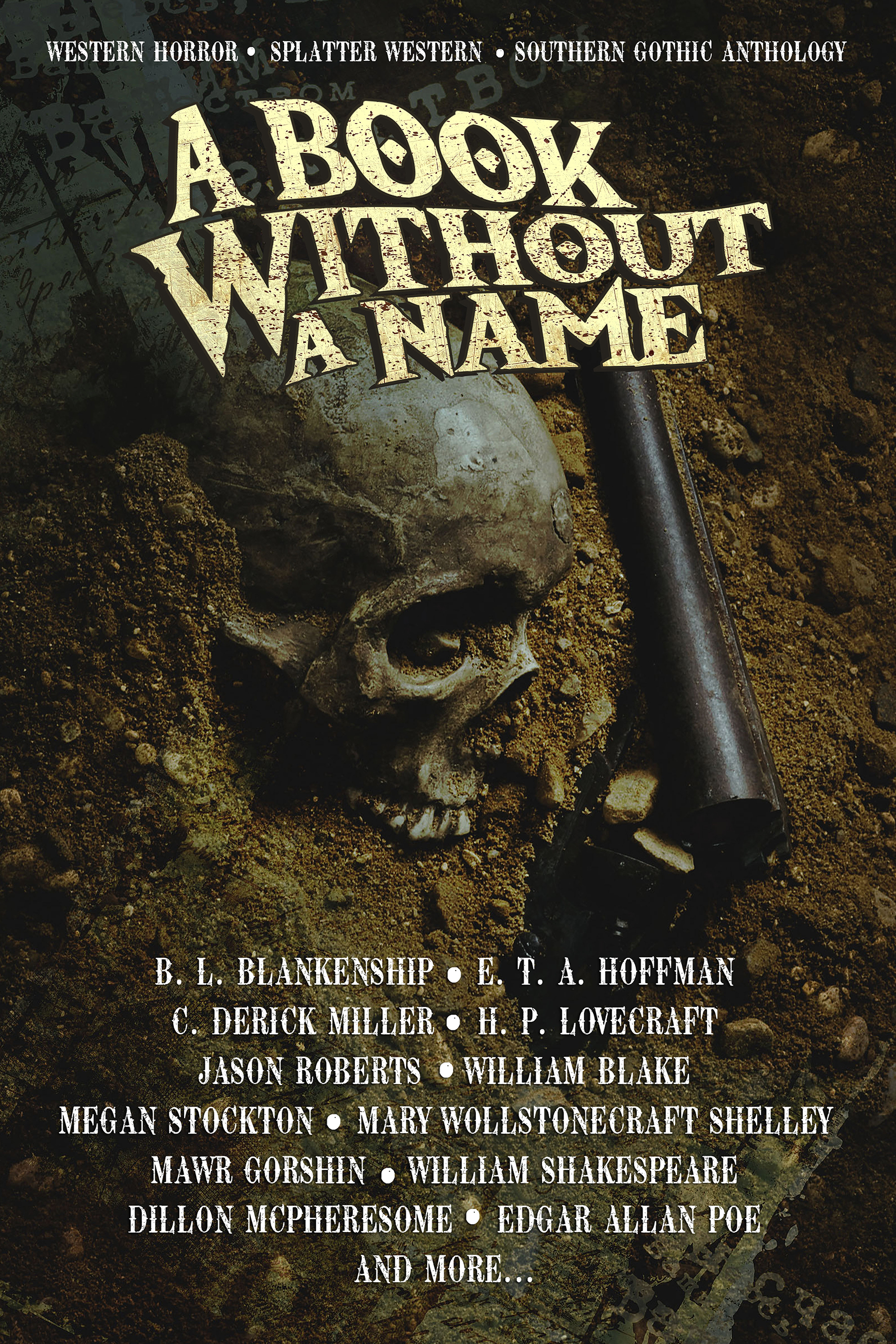
Two Horror Short Stories of Mine Published in ‘A Book Without A Name’

I have two horror short stories published in a new horror anthology, compiled by B.L. Blankenship, called A Book Without A Name. These stories are of specific sub-genres of horror: western horror, splatter western, and southern gothic.

My two short stories are called “Ghost Town” and “The Lake.” Other writers in the anthology include Blankenship, Dillon McPheresome, C. Derick Miller, Megan Stockton, and such classic writers as Shakespeare, Edgar Allan Poe, H.P. Lovecraft, William Blake, E.T.A. Hoffmann, Mary Wollstonecraft-Shelley, and Jason Roberts.

So, if you like horror stories with a bit of a 19th century, cowboy feel, please check out this anthology. You can find it on Amazon here. Thanks again to B.L. Blankenship for the chance to be published! 🙂

Beds

I
fear
the end of the world.
We are on our death
beds, gasping for air.

A
dying
world is lying ill in her bed,
her nurses her murderers,
hastening her end with war.

A
ball
that is burning: her fever’s been
ignored by all of those who are
responsible, who made her bed.

I
will
die, as you will die, as will
everyone else, in our beds
beside our ailing Mother.

O,
break
in, you red revolutionaries!
Save us from these doctors
of death! Make the ill well.

O,
make
us rise up from our beds!
We’d swap the hospitals
for hope and happiness.

‘Furies,’ a Horror Novel, Part Five, Chapter 1

Faye Oliphant and Brad Rolie, her husband of nine years, had been trying for the whole length of their marriage to have a baby.

It wasn’t an infertility or sterility problem. Actually, Brad had difficulty getting it up for her.

There were two main reasons for this problem. One was Brad’s secret addiction to internet porn, and its bevy of flawless, photoshopped beauties causing him to be used to that lofty standard of physical perfection in women, which the vast majority of women outside the fantasy world, of course, haven’t a hope of even approaching.

The second reason was Faye’s size, as of her thirties.

She was rather chubby in high school, recall; hence Tiffany’s changing of Faye’s surname to “Elephant,” and earning Faye’s hatred, as well as giving her a motive to bully Tiffany. By the time Faye had reached her thirties, though, her size had ballooned to that of a woman weighing almost five hundred pounds.

When Brad was dating her, in her late twenties and weighing around three hundred pounds at the time, he was deeply conflicted between his sincere love for her as a person and his distaste for her looks. He imagined that, over time, he’d outgrow his shallow preference for women with the bodies of models, and would be able to have a normal sexual relationship with her, getting aroused in bed with her based on his love for her.

No such luck.

She was so deeply hurt, on their wedding night, by his lack of enthusiasm for her in the bedroom that she found herself eating the pain away.

Hence, three hundred pounds became five hundred.

…and he’d sneak off to his computer for a good wank every night after she’d gone to sleep.

Still, she wanted to have a baby, her own baby, not an adoption. And so did he.

So they attempted lovemaking in the missionary position, at least once or twice a week, every year from their wedding night until now, with Faye at the age of 38. It had been so frustrating for them.

Faye’s self-esteem was so low that she didn’t even consider exercising or dieting. Brad was so ashamed of himself for not being “man enough” to get the job done that porn was his only escape from his depressing reality.

But one night, after seeing his dear wife in tears after having caught him masturbating to a PornHub video, Brad was determined not to fail in bed with her this time. He had to make it up to her, after having disappointed her for so long; after all, in spite of his porn problem, he did sincerely love her.

So, as absurd and pathetic as this must sound, he got on top of her that night, closed his eyes, and imagined as vividly as he could that he was about to screw the porn star he’d been watching on that video.

…and a miracle happened.

He actually got enough of a boner to stick it in her and pump away until he came inside her.

But would she get pregnant?

Actually, she did!

Both husband and wife were so thrilled to find out that they were dancing together in the doctor’s office.

When she had an ultrasound, it indicated she’d have a girl. Both parents were perfectly happy about this: a daughter was exactly what they’d been hoping for.

Family and friends congratulated her, celebrating with a huge party. These were the happiest moments of their whole marriage.

As the months went by, full of delightful anticipation for both of them, she was for the first time in her life happy to see herself getting bigger in the middle, and her weight going up. She crossed off the days on the calendar, impatient for the time when she was expected to go into labour.

And finally, the big day came. It would have been difficult getting her huge body into a car and over to the local hospital, so they managed to deliver the baby with a midwife right in their home.

As she was struggling, groaning, and screaming to get their daughter through the birth canal, she had her eyes squeezed shut almost the whole time.

…and with her eyes closed like that, neither she nor Brad or the midwife, so focused on the birth, noticed the malevolently grinning apparition of Tiffany’s ghost looking down on the mother-to-be.

Analysis of ‘Threnody for the Victims of Hiroshima’

I: Introduction

Threnody for the Victims of Hiroshima (or to the Victims…whichever–in Polish, it’s Tren Ofiarom Hiroszimy) is an avant-garde composition for 52 string instruments by Krzysztof Penderecki (pronounced  [ˈkʂɨʂtɔf pɛndɛˈrɛt͡skʲi], the Polish c in his surname, like that of hanyu pinyin, being pronounced ‘ts’).

Composed and premiered in 1961, the piece was originally to be called 8’37”, after its length of performance, since the durations of the sound events of the piece are given in seconds, rather than through the use of, for example, the quarter and eighth notes of conventional notation. Indeed, Penderecki’s score is as experimental as is the music, using a variety of unorthodox ways to indicate how the music is to be played.

The piece was originally meant to be just an experiment with new musical ideas, as Penderecki said, to “develop a new musical language,” hence the original absolute music title. It was meant as an example of sonorism, focusing on timbre, texture, articulation, dynamics, counterpoint, and motion to create a form free of traditional ideas of “expressivity” in the playing of instruments. “It existed only in my imagination, in a somewhat abstract way,” he later said.

When he heard it performed, though, he was struck by the emotive power of what he had written. It was no longer just an abstract experiment with sounds. With what could he associate the feelings of terror evoked in the music?…the victims of Hiroshima, when the atomic bomb was dropped on them at the end of WWII. Hence, the piece’s new name, a threnody, or wailing ode of mourning for the victims’ suffering and deaths.

So though the piece was composed throughout with just the intention of experimenting with new ways to organize musical sound, its new name and dedication have given the piece a whole new dimension of meaning, a meaning that not only inspires compassion for the victims to whom it’s dedicated, but one that also makes the piece especially relevant for our troubled times today, with all the reckless nuclear brinksmanship of the US and NATO against Russia and China.

The 52 string instruments used in the piece are grouped into 24 violins, ten violas, ten cellos, and eight double basses. The unconventional sounds they are manipulated to make include tone clusters, faster and slower vibratos, slapping, and playing on the tailpiece and behind the bridge. While the sound durations are, as noted above, given precisely in seconds, other aspects of the music are aleatoric, allowing the players a choice of techniques. Nonetheless, specific note clusters are used, as well as quarter tones.

Such unorthodox techniques give the music its terrifying character, which is why the Threnody, as well as other avant-garde works by Penderecki–such as his Utrenja, The Awakening of Jacob, De Natura Sonoris, Kanon, and Polymorphia–have been used in such horror films and thrillers as The Shining, The Exorcist, and Children of Men. Purists in the world of avant-garde music may not like the, to them, excessive associations of experimental soundscapes with the horror genre, but Penderecki’s association of 8’37” with the suffering of the Japanese at the end of WWII was more than justified, as I will argue below.

II: The Historical Background of the Nuking

It is still believed by many that the nuking of Hiroshima and Nagasaki, killing about 200,000 people, was regrettable but necessary, so that a long, protracted ground assault, risking the lives of many American soldiers, could be avoided. A closer look, however, at the actual, historical circumstances surrounding the bombings will indicate how wrong this rationalization is.

At the time, Japan’s leaders were ready to surrender, though hoping for at least a conditional surrender, to save their emperor, Hirohito, from being harmed or removed, as a handful of high-ranking Nazis would be tried for war crimes. The US, however, still seething with virulent racial hatred for the Japanese over the bombing of Pearl Harbor, wanted nothing less than an unconditional surrender.

Pretty much the whole of the Japanese islands were being pummelled with conventional American bombs. The Japanese knew they’d lost. In fact, when the atomic bombs were dropped on Hiroshima and Nagasaki, the Japanese at first couldn’t tell the difference between the effect of the older and new kinds of bombs. The use of these two new bombs did not end the war, as many assume; therefore, where was the justification to use them?

A number of American generals dissented over the use of those awful bombs. So what was the real reason they were dropped on those two unfortunate cities? They were a demonstration of a new, deadly toy of the American military…not to intimidate Japan, but to frighten that nation that was already understood to be the new enemy of the US: the Soviet Union!

…and what really made Japan surrender, if it wasn’t the bomb? A convincing explanation comes from what the USSR did, not the US. Up until their surrender, the Japanese were holding out on the small hope that the USSR would mediate negotiations with the US and influence a conditional surrender, one that wouldn’t favour the US too much, to give Japan better terms for their surrender. The USSR, however, invaded Manchuria, clearly indicating no interest in siding with Japan in any way, meaning Japan would be forced to surrender unconditionally. In short, it was the Soviet Union, not the American nuking, that decisively stopped Japan.

Therefore, the dropping of the nuclear bombs on Hiroshima and Nagasaki had no redeeming moral justification of any kind. They were acts of mass murder on a mostly civilian population (the military portion of which was admittedly significant, but still a minority); in spite of the heinous war crimes of the Japanese military on Korea, China, the Philippines, etc., these victims had done no direct harm to Americans.

Granted, all Japanese were part of the war effort in some sense, as is the case with the people of other countries involved in WWII. Civilian Japanese helped in industry, making weapons, giving material support to the military, etc.; but to a great extent, this civilian support was for defence as well as offence–these particular people weren’t themselves raping and beheading their Asian neighbours, so the way they were killed was way out of proportion to their crime of equipping their soldiers to commit their ugly deeds. Japan’s loss of the war, with the conventional bombings that more accurately targeted military areas, should have been punishment enough for them.

As much as I abhor Nazi Germany, and I would never consider defensible the average “Aryan” civilian supporting Nazi ideology and helping out in their war effort, I would also never consider nuking any German city to be an acceptable way of forcing the fascists and fascist sympathizers to surrender. Similarly, though I detest the US military-industrial complex and wish wholeheartedly for its imminent defeat, I would never dream of such a defeat coming from nukes.

III: The Composition

Here is a link to a video of the Threnody, with footage of the aftermath of the bombing, with images of the destruction and the suffering of the surviving victims of radiation poisoning, and the doctors trying to help them.

And here is a link to a video of the piece with an animated score, so you can follow what is happening in the music, and you can see it broken down into its many parts.

The piece opens with fortissimo tone clusters played first on the first five of the ten violas, next on the first six of the twenty-four violins, then on the first four of the eight double basses, etc., until all of the subdivided groups of strings are playing their own set of clusters. This piling on of tone clusters lasts for fifteen seconds.

The cacophony of all of these clusters suggests the screaming of the residents of Hiroshima as they look up into the sky and see the Enola Gay flying over their city, knowing they’d be bombed, but not knowing the brand new nature of the horror they were about to experience.

After the first fifteen seconds, the music immediately comes down from fortissimo to forte (sub. f), and a slow vibrato is heard on the first six violins, and soon after on the third six, the second six, and the fourth six. This all goes on for the next eleven seconds.

The following four seconds has the first five of the celli doing the slow vibrato; and the last six of the violins switch from a slow vibrato to a fast one, as the two groups of violas have been doing from the previous eleven seconds until now. These vibratos, slow and fast, add an eeriness to the dark, terrifying atmosphere so unmistakably established.

Those violas will, during the next six seconds, immediately come down to pianissimissimo (sub. ppp), as will all the other strings at the beginning of the next thirty seconds. During the six-second section, the last five of the celli will play the slow vibratos as the strings hitherto playing slow vibratos are, group by group, replacing slow vibratos with fast ones.

The switch to ppp sounds especially scary, like a suspenseful scene in a horror movie right after an initial shock of terror. Small wonder Penderecki’s music is, rightly or wrongly, so associated with horror films. One senses, at this moment in the music, the trembling people of Hiroshima looking up at the bomber plane in all helplessness, waiting for “Little Boy” to be dropped.

Next come the experimental sound effects to be made on the strings. In the score, an arrow pointing up indicates the playing of a note of the highest, though indefinite, pitch (recall the aleatoric aspects of this music). An icon of four vertical lines with a horizontal arc crossing them represents, respectively, the instrument’s four strings and its bridge; the straight line under the arc indicates a four-note arpeggio to be played under the bridge.

Some notes are to be plucked (pizzicatopizz.), others bowed (arco). Again, if the straight line is below an arc, one is to play between the bridge and the tailpiece. Vertical lines intersected with short, upwardly diagonal lines indicate a percussion effect: striking the upper sounding board of the instrument with the nut or fingertips.

The symbol of a short, vertical line with a cone shape pointing to the right tells the last five cellists to bow the tailpiece. An umbrella-like symbol tells the first five cellists to play on the bridge.

These string effects are not required to be played at exact speeds. Only the order in which they are to be played matters. As Angus Lee explains in his video analysis of the Threnody, different performers will have varying levels of difficulty or ease in executing each different technique; so there will be considerable freedom in playing these parts, another example of the aleatoric aspects of Penderecki’s piece.

The result, when one hears the differing timing of each player, bowing, plucking, or tapping his or her instrument, is a rather chaotic flurry of sounds. Controlled chaos, yet chaos all the same. When we hear this chaotic texture of sounds, it suggests to us the frenzied panic of the people of Hiroshima, them all frenetically scrambling to run for cover and escape their doom.

Next, a pianissimo note in F is heard on the ten celli, which is briefly sustained, but soon after, some celli slide down to lower notes, others to higher ones (indeterminate pitches here, graphically presented in the score with a thick black line), while the remaining celli stay on the F. This results in another tone cluster; then those upwardly and downwardly straying notes return to the F. This goes on for fifteen seconds. It’s a moment of relative calm, as if some of the people of Hiroshima have found a place to protect themselves from the bomb, and are trying to reassure themselves that they are safe…at least for the moment.

Other strings do the same effect, with the first twelve violins sustaining a note on E and branching out upwards and downwards into a larger tone cluster, this time ppp. Then, the eight double basses, also ppp, do this on an E-flat, then bloat out into a huge dissonant chord before returning to that E-flat.

The ten violas, playing mezzo-forte, give out a huge cluster chord that decrescendos and slides into an A. The last twelve violins then play a sustained high B-flat in ppp, which fans out into a large tone cluster, which is accompanied by another mf cluster chord on the ten violas, which in turn decrescendos and slides into an A.

This shifting back and forth, from single notes to tone clusters and back again, on different groups of strings and at softer and louder dynamics, continues for some time. One senses during this moment that those people are trembling in suspense, waiting for the bombing to be over with.

There’s a brief silence, then groups of ppp tone clusters from all the strings are heard, the notation indicating all the pitches to be played. We’re almost halfway into the piece by now. The feeling one gets from all of these creepy dissonances is a sense of nausea from all those terrified Japanese, nausea from their despair.

Next, a fortissimo cluster chord is heard on the ten violas, notes ranging from about an F (above middle C) to about a c′′. This is soon followed by a similar tone cluster, also ff, on the last twelve of the violins, playing a range of notes from about c′′ to about f′′-sharp. Other groups of strings come in with their own loud cluster chords. It’s as though the bomb has now been released, and the people of Hiroshima are all screaming together as they watch it fall from the bomber and come closer and closer to the ground.

Eventually, all these cluster chords played on all the groups of strings decrescendo and do upward or downward glissandi. It’s as though terror among the people has been replaced with resignation to their fate, just as the bomb is about to hit the ground.

Next, we hear individual notes of distinct pitches played by each cello, notes that are sustained and that fan out upwards and downwards. These are played softly, and are followed by the same fanning out of individual notes played piano on the last twelve of the violins, then on the ten violas, and ultimately on all the strings, ending with each group playing loud tone clusters.

This fanning out of notes suggests the impact of the bomb on the ground, each individual note representing each piece of rock, concrete, brick, etc., that has been shattered from the blast. Again, the clusters represent the screams of those people not yet killed.

We then hear creepy glissandi in the cluster chords of the celli and double basses, suggesting the moaning and groaning of the traumatized survivors, many of whom won’t be survivors for very long. These clusters thin out into single tones and go from fff to f, then decrescendo from f to silence in the double basses, and to p in the celli, and to pp with slow vibrato, ending off with a ten-second decrescendo to pppp.

This slow fading to another brief silence suggests the dying-off of many hitherto survivors, leaving those still living to be doubly traumatized, from their own suffering and from the deaths of loved ones they’ve witnessed dying.

The string effects come back, including the one with the upward arrow symbol mentioned above, as well as certain pizzicato and arco notes of definite pitch. These are played by individual strings from all the groups. The tension in this section suggests the traumatic reaction of the survivors to the horrors just experienced.

The percussive effects remind us of those heard earlier, as if they are PTSD-like flashbacks of the panic felt before the bomb dropped. Sometimes we have individual players making the bowed, plucked, or percussive effects, as if we’re hearing the pain of lonely survivors with no living family or friends to mourn with. Sometimes we have players in groups, suggesting the mourning of living family and friends who are weeping and wailing together, trying to comfort each other in all futility.

A little later on, we get the string effects notated with the umbrella-like symbols mentioned earlier, as well as those with the vertical line going through a cone pointing to the right. These are played on the celli and the double basses. Other string effects are heard on groups of three or four violins, violas, and celli, accompanied by a sustained cluster chord on the violins. The ten violas will join in with a cluster chord of their own as those violins, having done a crescendo from mf to fortissimo, play another slow vibrato.

As the above continues, other strings come in with their own tone clusters. The dissonances pile up, with slow vibratos played on some groups. The dynamics go down to piano and pianissimo, but soon crescendo and abruptly stop, leaving a brief silence.

Next, a climactic cluster chord is played on all the groups of strings, a huge dissonance with notes ranging all the way from about a c to a c′′. The totality of it is like a culmination of all the preceding horrors, as well as of the suffering they caused. The slow decrescendo, fading to silence, suggests again the slow, painful dying-off of many more victims.

IV: Conclusion–What Can the Threnody Mean for Us Today?

Needless to say, this music is disturbing to listen to, especially on the YouTube video (link above) that combines the music with the footage of the aftermath of the bombing. It’s disturbing because it should be. Nuclear war is nothing other than disturbing, though some nut-jobs think it can be used to defeat Russia today.

Another one of the reasons that those two bombs should never have been dropped on Hiroshima and Nagasaki is that it ushered in the nuclear age. Faced with the threat of such bombs being dropped on the USSR and, later, China and the DPRK, these socialist states were compelled to make their own nuclear arsenals.

…and look at where we are today.

Threatened with the loss of their unipolar global hegemony, the US and the extension of its imperialism, NATO, have been provoking Russia ever since the counterrevolutionary dissolution of the USSR, with the aid of Ukrainian neo-Nazis (and no, you don’t stop them from being fascists by a mere change of logo), culminating in the current conflict between Russia and Ukraine. Even cold-blooded war criminal Henry Kissinger has enough sense to know that the only way out of this war is to give Putin what he wants: Ukrainian neutrality, no NATO membership for the country, and a reasonable amount of autonomy for the Donetsk and Luhansk Peoples’ Republics…perfectly acceptable requests for the sake of Russian security, except that the US and NATO refuse to grant them.

That this war, if not ended, could escalate into a very nuclear WWIII (as could also happen when the US–via Taiwanprovokes China into a similar war), should be obvious to anyone with half a brain. Still, the US and NATO keep pressing their–and everyone else’s–luck…all because they don’t want to accept the emerging multipolar world with rising Russia and China, a world which, if handled well, could lead to a balance of power that could facilitate world peace.

(I go into more detail about these issues in these posts, if you’re interested, Dear Reader.)

The current-day threat of nuclear annihilation is what makes Penderecki’s Threnody not only relevant, but outright urgent to listen to. Let this terrifying music stir up your survival instinct and inspire you to do whatever we can do to stop the psychopaths in power from killing everyone and everything on our fragile planet.

‘Furies,’ a Horror Novel, Part Four, Chapter 4

Furioso looked first at the ghosts of Alexa and Megan, then at that of Tiffany.

The first two of the three female spectres were in a kind of agony that made Tiffany’s pain seem almost like relief.

You shouldn’t be too surprised at the heightened pain you are feeling, Furioso said to Alexa and Megan. The vengeance you wreaked on your victims far outweighs their past cruelties to you when you were in physical form.

I wanted them…to know…what real pain is, Alexa said.

Her apparition was melting into a lava-like blob, as was Megan’s. The skin of theirs that wasn’t melting was flaking off into thousands of tiny pieces of ash that were blown all about in the steaming hot air of Hell.

They already knew what real pain is, he said. Everyone on Earth knows what real pain is.

I wanted them…to know…what my pain felt like, Megan’s ghost said. To be raped…by the one…you love…while another watches…and laughs at you. She and Alexa were groaning in pain, twice as loud as Tiffany’s groans.

They didn’t kill you, he said. Nor did they kill the ones you cared about.

Since when are you,…a demon,…lecturing us…about right and wrong? Alexa growled at him. It was your idea…to have us…get our revenge…on them…in the first place!

They made us want to kill ourselves, Tiffany said. Our own parents didn’t care about us. They all taught us that the whole world is uncaring; with no one to care about us, we found ourselves with no one to care about.

You killed innocent children, he said. People who had done you no harm. I never recommended that you do that.

We were innocent, too, Alexa said. We’d never done…any of them…any harm…before they hurt us, including our parents.

Still, he said, you are now so far in blood that sin will pluck on sin. When I offered you a chance for revenge, I’d never imagined you would go to such extreme lengths of cruelty. Instead of you enduring the suffering of Hell while gaining satisfaction from contemplating your tormentors’ own suffering, your new sins have added to your own suffering in a way that makes your revenge seem to have not been worth it.

As awful as I feel, Alexa snarled, it was worth it.

I agree, Megan said.

That is because your hate has grown to such a size that you imagine it will shield you from your pain, Furioso said. That shield will be only temporary; you will feel much worse later, for it will be your hate that makes you hurt.

I feel nothing but hate, Tiffany hissed. Hate for a world that hated me so unjustly.

I feel…the same hate, Megan said.

As do I, Alexa said. There is…no other feeling.

The world gave us nothing other than pain and hate, Tiffany said. It will make no difference to me to feel Alexa’s and Megan’s greater suffering; but vengeance will give me the satisfaction that at least Faye Oliphant and George Kelly will suffer, too.

Are you sure you want to do this? Furioso asked Tiffany. I advise you not to carry your revenge too far.

I’ll do what I have to to get my satisfaction, Tiffany grunted. Take me to where Faye and George are! I want them!

Very well, Furioso said.

The demon disappeared with Tiffany’s ghost, while those of Alexa and Megan continued their grotesque degeneration into disfigured, molten piles of unimaginable pain.

“Staring at a cloud,” a New Poem by Jason Ryan Morton

My poet friend, Jason Ryan Morton, has written a new poem with the first line, “Staring at a cloud,” which I’m using as a tentative title, for practical purposes as far as distinguishing this one from my many posts on his other poems is concerned.

This one is a pleasant departure from so many of his other poems in that it is more positive and hopeful; not that there’s anything wrong with the others, of course, but I’m always in favour of variety. As usual, I’ll put his poem in italics to distinguish his writing from mine.

Staring at a cloud
I watched the sun fold
Into tiny pockets of light
Like the third eye
Of a blind man
Came the wisdom of the age
Focus on today
Relax and play
Let all the darkness slip away

Ware though my friend
Where goes the end
Peeking round the corner
Will only make you bend
But seek thyself
Find the truth
The only person who deserves your loyalty
Is you
Tis true in a way the day is born for you

Just staring at a cloud
As the sun sang a sonnet
Awaiting the moon for a kiss of purity
Today and tonight belong only to me.
The moon embraced me
Wiped the tears from my face
Tears of joy not tears of sorrow
Kissed Luna goodnight in my prayers
Awaiting another tomorrow

And now, for my analysis.

“Staring at a cloud” can be seen to represent a ruminating over past sorrows, or a grieving over trauma. Such contemplation of pain is a common theme throughout Morton’s poetry, as I’ve observed in my previous posts about it; but here, something surprising happens, and pleasantly so. He continues: “I watched the sun fold/Into tiny pockets of light.” Light has come to replace the darkness of the cloud. When grieving over trauma is completed, happiness can return.

The theme of the contrast of dark and light continues, though in a different form, when he says, “Like the third eye/Of a blind man.” The third eye, like that of Shiva, a mystical eye that gives a kind of illumination beyond that of physical sight, replaces the pitch-black, physical darkness a blind man can only see. Sometimes in our darkness and sorrow, a special kind of light and happiness arises.

The “wisdom of the age” is that of our age today, not the ages of times past; for he advises himself to “Focus on today/Relax and play”. Only in the here and now, the eternal NOW, or the Unity of Time as I described it here, can we experience true joy and happiness, then we can “Let all the darkness slip away”.

We get a few archaic expressions in the second verse, a link to the past that contrasts the first verse’s “Focus on today”. These include the use of “Ware” (an archaic form of aware), “thy,” and “Tis.” To focus on the present, one must also reconcile oneself with one’s painful past.

“Ware” makes a pun on “Where” in the following line; one is aware of what’s going on, yet unaware of such things as “the end.” There is a dialectical relationship between knowing and not knowing; to know the truth, one must accept one’s lack of knowing. Therefore, one shouldn’t go “Peeking round the corner”, which “Will only make you bend” (i.e., twist your mind and make you believe falsehoods, untruths).

Instead of trying to find knowledge from out there, one should “seek thyself” and “Find the truth”. We find the truth within, not through trying to gain the validation and approval of others. Don’t seek the light outside, which will often lead to darkness; find the light within.

The contrast of light and darkness continues with a refrain of “Just staring at a cloud/As the sun sang a sonnet,” this being my favourite line in the poem. One is reminded of Shakespeare’s Sonnet 18 (lines 5 and 6 especially). The paradox of dark and light is given again in the switch from the sun to the moon, which he awaits “for a kiss of purity.” Again, the juxtaposition of light and dark is achieved with “Today and tonight belong only to me.”

We begin to see Morton’s leanings towards pagan mysticism and spirituality when he says, “The moon embraced me/Wiped the tears from my face.” Here, the personified moon is his goddess, even a lover, whose love causes him “Tears of joy not of sorrow,” for She has helped him heal from so much of his past pain. Therefore, in gratitude, he “Kissed Luna tonight in [his] prayers/Awaiting another tomorrow.”

I await another poem of this spiritually uplifting sort from my literary friend.