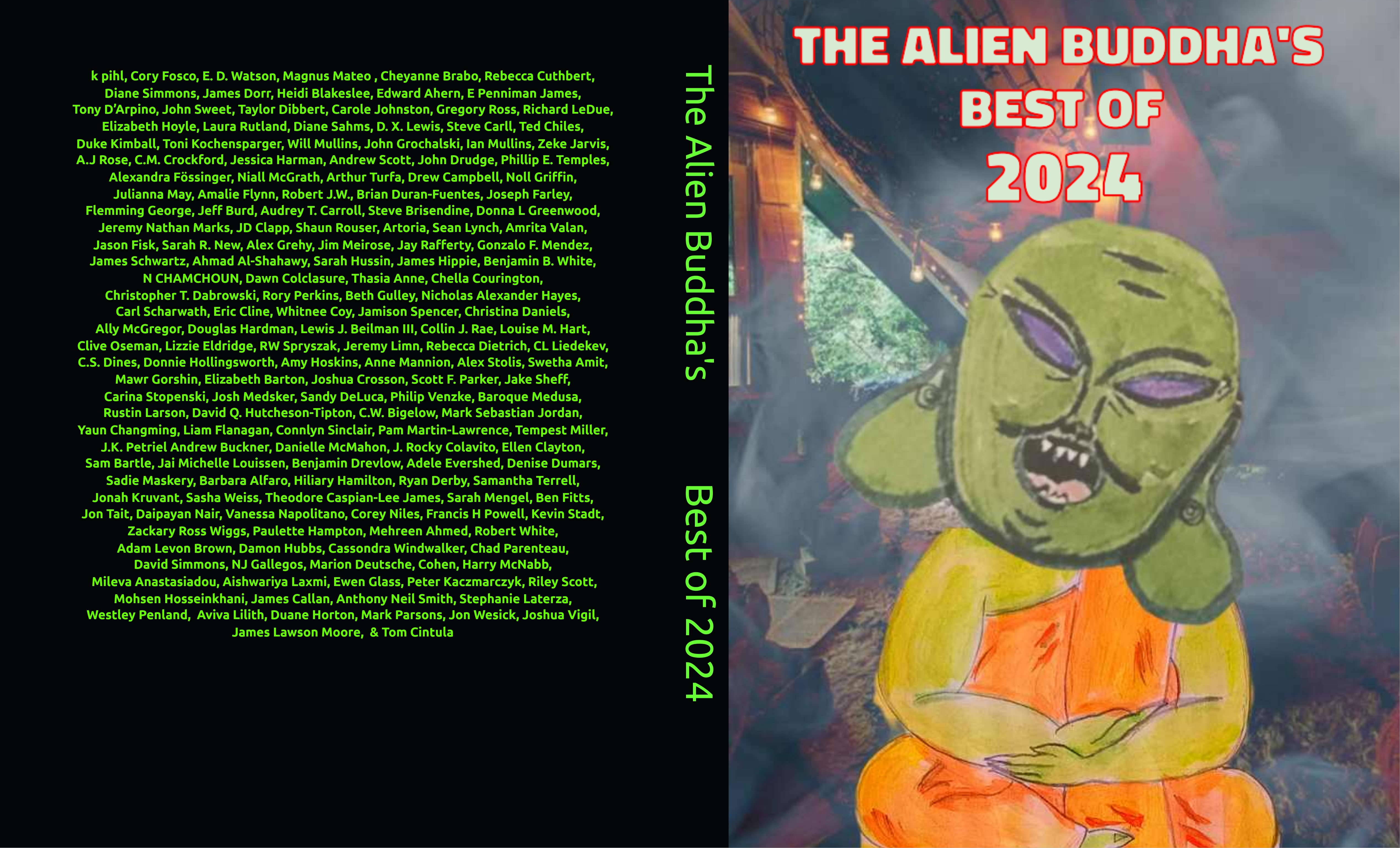
A Chapter from ‘The Targeter,’ Featured in ‘Alien Buddha Zine #68

Chapter Eight from my novella, The Targeter, is being featured in Alien Buddha Zine #68, from Alien Buddha Press. It begins on page 34, with a copy of the cover of the novella:

Then it goes into Chapter 8 of my novella, the chapter being a reverie of the titular character, named Sid Arthur Gordimer, who is drunk and high on a combination of marijuana, ecstasy, and ketamine. His thoughts drift back and forth in his reverie of being a prince in a mansion watching half-naked strippers dancing to electronic music in a party, then of being in a royal palace with Indian music.

His parents, the king and queen, are pressuring him into taking on the responsibilities of the crown…but of course, this is all just the reverie of a drunk, stoned man. Outside of Sid’s apartment, in the real world that he’s trying to escape with booze and drugs, a war is going on. Bombs and gunfire can be heard outside.

He knows he’s no saint, and no prince. He’s a goner.

Please check out the Alien Buddha Zine, which drops on October 29th and has lots of other talented writers in it…and please check out my novella!

‘The Ancestors,’ a Horror Story, Chapter Eight

After thoroughly checking all of the rooms on the second and third floors, Mr. Dan and Doug approached the bathroom, where Mr. Sandy had been before he was killed.

“Oh, no–now I have to use the can,” Doug said, then went in.

After he closed the door, Mr. Dan thought, And I have to find something just right for you, young man.

But first, he pulled down the attic stairs, then went up them. He peeked his head in, hearing Emily still cleaning up the blood.

“You just about finished up here?” he asked in Chinese.

“Almost,” she said in Chinese. “Just a little more to wipe up.”

“Well, hurry up,” he said. “I’m taking Hannah’s brother up here. He’s in the bathroom. He’s taking his time in there; I guess it’s a number two, but who knows? Maybe not. I’ll send something up to you. Wait to get it, but hurry with the cleaning!”

He went back down, heard Doug fart and grunt, and he surmised that, indeed, it had to be a number two. He’d have a little more time to find…something just right for Doug.

He went into a room next to the one with the boxes, looked around impatiently, and found a baseball bat. He heard some shuffling steps out in the hallway. Oh, no, he thought, Hannah’s brother. Then after a worried pause, he opened the door and looked out.

Nobody out in the hall.

The bathroom door was still closed.

Was Doug still crapping in there?

Mr. Dan went up to the bathroom door to listen. He heard another fart, the slipping out of shit, and a horrible stink.

He squished up his face in disgust, but was relieved that Doug was still in there and suspected nothing. Mr. Dan went up the attic steps with the baseball bat.

“Emily,” he called.

“What?” she said with surprise, looking back at him from the corner where she’d just finished cleaning. “I thought you were already up here. I heard–“

“No, not yet,” he said, then presented the bat. “Put this over there, then get out of here.”

She took the bat, put it in the corner opposite where she’d been cleaning, and rushed over to the attic stairs.

“I’ve got to clean all this blood off my–” she began as she went down the stairs.

“Shh!” he said. “Hurry up and get out of here before he comes out of the bathroom!”

She went down the hall and took the stairs to the second floor. As soon as she’d disappeared, Doug came out of the bathroom.

Mr. Dan let out a sigh of relief.

“What are you so relieved about, Mr. Dan?” Doug asked, looking askance at him.

“Oh, nothing,” Mr. Dan said with a smile and a slightly nervous chuckle. “I was just getting a little impatient waiting for you to finish, that’s all. Sorry about that.” He gestured to the pulled down attic stairs. “Shall we look in the attic now? It’s the only place we haven’t looked.”

“OK.”

They went up into the attic, Doug first.

He heard moaning in one corner of the attic and rushed over to see. “Dad? Mom?” he called out.

Meanwhile, Mr. Dan sneaked over to the other corner, picked up the bat where he’d seen Emily leave it, and hid it behind his legs by the time Doug looked back.

“There’s nobody here,” Doug said. “I heard moaning right from here, but there’s no source for the moans.”

“Really?” Mr. Dan said. “There’s a lot of shadow behind all those boxes. Look again.”

“I’m looking at the shadow behind the boxes, but there’s nothing–wait, under that blanket over there.”

As Doug was approaching it, Mr. Dan raised the bat over his head. “Goodbye, Doug,” he said in a female voice.

“Emily, are you up here?” Doug asked as he pulled back the blanket, revealing his parents’ bloody bodies. He gasped, his eyes widening.

“No, not Emily,” Mr. Dan said in that woman’s voice.

“Mei’s voice,” a young man said from behind Mr. Dan, who turned around to see who it was.

Now he gasped, his eyes widening.

Al swung the axe right at his father’s chest. Blood sprayed out when it dug deep into him.

Mr. Dan fell to the floor, the bat dropping and hitting him on the head. His blood grew into a large puddle all over the floor.

“Al, Jesus fuck!” Doug said. “How could you do that?”

“It wasn’t easy,” Al panted. “That’s for sure. I’m so sorry, Papa.” He bent down and closed his father’s eyes. “Goodbye. Forgive me. I had no choice.” He rose to his feet.

“Why would you kill your own dad, Al?”

“To stop him from bashing your brains in with that bat, of course.”

“What? Al, this is so fucked up! What’s going on? Why would your family…wanna kill my family? Oh, God…Mom, Dad…” He looked back at his parents’ corpses with tears forming in his eyes.

“Because the spirits of my ancestors are taking possession of my family’s bodies to take you all as sacrifices, so my ancestors won’t bother Hannah and me anymore,” Al said in a cold, monotone voice.

“What? What horseshit are you talking about?”

“My family stopped praying to the spirits of our ancestors years ago,” Al explained. “The spirits got angry because of this disrespect, and they’ve been plaguing our family ever since.” He put the axe down on the floor beside him, next to the bat.

“Spirits, Al?” Doug asked, looking at him with a sneer. “Seriously? Let’s face it: You’re a family of homicidal nutjobs. No offence intended to Chinese people in general, but I don’t want you anywhere near my sister!”

“I love Hannah more than anything, and I’m truly sorry for what happened to your parents,” Al said in sobs. “The spirits forced me to agree with this, so I could marry her one day and we could live in peace. If they know I’ve broken the agreement, they–“

“Fuck you, Al, you and your fucked-up family!” Doug bawled.

Al was silent as Doug looked down at his parents’ bodies and wept for them.

“Oh, no…NO!” Al suddenly said.

“What?” Doug said.

But before Doug could turn his head back and see what was going on, he felt a crack of the baseball bat on his head, knocking him out.

Analysis of ‘Commando’

I: Introduction

Commando is a 1985 action film directed by Mark L. Lester and written by Steven E. de Souza, after a story by Joseph Loeb III, Matthew Weisman, and de Souza. It stars Arnold Schwarzenegger and Rae Dawn Chong, with Alyssa Milano, Vernon Wells, Bill Duke, Dan Hedaya, James Olson, and David Patrick Kelly.

The music score, noted for its use of steel drums, was by James Horner, and the film ends with a song by The Power Station called “We Fight for Love,” when Michael Des Barres replaced Robert Palmer as lead singer.

Here‘s a link to quotes from the film.

Giving the film a rating of 67% based on reviews from 36 critics, Rotten Tomatoes aptly describes Commando in its consensus as having a “threadbare plot, outsized action, and endless one-liners.” In other words, it’s a crowd-pleaser with all the gratuitous violence, swearing, and cheesy puns that a movie-going philistine could ever want.

So, Dear Reader, you’re probably wondering why I’m wasting my energy with this Hollywood schlock. Well, apart from the fact that the philistine in me finds this mindless entertainment amusing (the nostalgic memories of watching it as a teen in the 1980s being a big part of that amusement), the flash and excitement that Commando delivers is a distraction from the political undertones that I feel should be discussed.

II: A Brief Digression, If You’ll Indulge Me, Please

As should be obvious to anyone watching the film with his or her brain turned on, Commando contributes to the mythology of the US as the great saviour of other countries from tyranny and despotism. I’m not saying this as if it were a great revelation to you, Dear Reader: I bring this up because I want to discuss the social effects of movies like this, and how they brainwash Westerners, Americans especially, into cheering for US/NATO imperialism.

I was trying to do such commentary on another film aptly starring right-leaning Schwarzenegger, Conan the Barbarian. The reader response to that analysis was mixed: while one positive responder understood my intentions, to alert people to the hypnotizing danger of passively accepting Hollywood action films as US imperialist and right-wing libertarian propaganda (an example of the kind of thing Michael Parenti analyzed in his book, Inventing Reality), two others blasted my Conan analysis for seemingly opposing reasons.

The first negative responder was a woman who went out of her way to be as insulting as possible, saying my analysis was ‘so superficial as to be silly,’ and that during the Reagan era, pretty much all movies reflected a right-wing ideology, so apparently there’s no insight to be gained from describing Conan the way I did. First of all, many 1980s movies did obviously reflect a right-wing stance, but many others didn’t–take They Live, for instance, as an anti-Reagan film. Secondly, only someone with a right-wing bias (as I suspect she has) would see no value in critiquing Conan‘s right-wing agenda, since a left-wing sympathy would see that value. I’d say it was her reading of what I wrote that was “superficial” and “silly”: I suspect she read only the first few paragraphs, snorted and called it ‘stupid!’, then jumped to conclusions and made her snarky comments without bothering to read any further.

The second commenter took the opposite view, seeing my discussion of a right-wing libertarian, anti-communist allegory in Conan as “the most half-baked review” of a movie that he’d ever read. Then he ‘corrected’ me by pointing out something I myself stated, however briefly, in my analysis: that the film is about determination in rising up against one’s obstacles (speaking of pointing out the obvious, hence my brevity in stating it). Never mind that I flooded the analysis with links to prove my point about the allegory (i.e., the director’s right-wing leanings as well as those of Schwarzenegger’s, a link stating that Nazi salutes were done on the set, etc.). And what I wrote wasn’t a review (my saying whether or not I liked the film), but an analysis, stated plainly in the title (a discussion of themes, symbolism, allegory, etc.). So, was I stating the absurdly obvious, or was I going off on some “half-baked” tangent? I’m not sure.

My point in bringing up the Conan analysis and its negative responses is to say that this one of Commando is one of many articles in which I’m not just saying what I like or dislike about a film. The film analyses are about relating the content of the films with either political issues (typically from a Marxist-Leninist viewpoint) or with psychoanalytic ones (usually Freudian and post-Freudian, but recently, more and more Jungian).

That kind of analysis is what I do here on this blog; so if that’s not your thing, please read no further (I gave just such a warning at the beginning of my Conan analysis, which as I explained above, went unheeded at least twice). If, however, you do like how I relate film, literature, and music to leftist politics and psychoanalysis, then by all means, read on, Dear Reader.

III: Some Rather Needless Killing

The film begins with three men assassinated, all former members of the unit of US Army Special Forces Colonel John Matrix (Schwarzenegger). The first victim is shot by two men posing as garbagemen; the second of these two killers, Cooke (Duke), then kills a car salesman by running him over right in the dealership with the car he’s supposedly interested in buying; and the third victim, Bennett (Wells), is supposedly blown up in a boat, though we later learn that his death has been faked.

Matrix, it seems, is next to be assassinated.

As it turns out, though, he isn’t to be killed, but rather to be forced to assassinate the president of a fictional Latin American country, Val Verde, this man being someone Matrix originally helped put in power there, having ousted Arius (Hedaya), a brutal dictator who wants to be reinstated. If Matrix doesn’t cooperate, Arius will have his men kill Matrix’s pre-teen daughter, Jenny (Milano), whom they’ve kidnapped.

Here’s my point: why were those two men killed at the beginning of the film, with Bennett’s death faked? Apparently, Arius’ men (including Bennett) mean to agitate General Franklin Kirby (Olson) and get him to go to Matrix’s home to warn him personally that he’s probably next to die, and in the process Kirby will unwittingly help the bad guys know where Matrix lives.

This is an absurd way to get to Matrix, whose address (somewhere in upstate California, in the mountains) is presumably private for his and Jenny’s protection. Would Kirby be stupid enough to go there personally, risking leading the assassins right to Matrix? Couldn’t the killers just find another way to find him (e.g., paying someone in the army a handsome sum to disclose the address, etc.)? Wouldn’t it be better to catch Matrix off guard in a surprise attack?

It’s obvious that the killings at the beginning were just an excuse to have excitement for its own sake, to lull the audience in, to make them passive recipients of more pro-US propaganda.

IV: Matrix and Jenny

Of course, Schwarzenegger as tough guy Matrix is supposed to personify how ‘indestructible’ the American empire is (an empire that, incidentally, failed to defeat North Korea, lost against Vietnam, and similarly left Afghanistan with its tail between its legs). The liberals, however, can’t have their big hero be just a cold-hearted killer; we have to see his sensitive side, so during the opening credits and before Jenny’s kidnapping, we see some father/daughter quality time between Matrix and her.

While they’re eating sandwiches at home, he makes a cliché joke about gender-bending Boy George. Then he refers to his life as a boy in East Germany, and how the communists said that rock ‘n’ roll is “subversive.” While communists back in the 1950s and 1960s were probably much more socially conservative (as were, obviously, at least half of Americans back then) than in recent years (a lessening of conservatism that can’t be reasonably be said of those half of all Americans!), we’re meant to deem this old judgement of the communists as an example of how ‘repressive‘ they were and are. Matrix’s later quip that “Maybe they were right” is meant to be flippant, yet it tells us which people still have the repressive attitude…still by the 1980s and since then. Putin may not be sympathetic to LGBT people, but he hasn’t been a communist in decades.

Now, we’ve acknowledged that Matrix is of German background (presumably to rationalize Austrian Schwarzenegger’s undeniable accent), yet his name sounds utterly English, since we don’t want our American hero to seem inordinately Teutonic (shouldn’t his name be more like ‘Johann Meetrichs’?).

Given the film’s obvious agenda to glorify Anglo/American/NATO imperialism as comprising the ‘good guys,’ as against anyone who would dare defy said imperialism (Arius et al), the idea of having a German-American hero fighting those defiant of that imperialism (who, in real life, tend to be left-wing) strongly suggests the enlisting of fascists, at least symbolically. Matrix would have defected from East Germany early on, and the real purpose of the Berlin Wall, or Anti-fascist Protection Wall, as the East Germans called it, was just that: to keep the West German fascists out (i.e., those ex-Nazis who, rather than be punished for their war crimes, were given cushy jobs to fight the ‘commies’), as well as to keep East Germany from losing needed skilled workers.

Matrix’s leaving of the socialist state would have stemmed from an ideological hatred of socialism. Germans who hate socialism have historically leaned towards fascism as a protection against Marxism. The capitalist class has always used fascism to protect themselves against left-wing revolution, as have the petite bourgeoisie. The film’s negative portrayal of Latin Americans reinforces the idea that there’s a Nazi racist undertone here, as there was in Conan, as I argued in my analysis of it (see link above).

So what we see in German-American Matrix is a personification of the continuum between liberalism and fascism. He’s the sensitive father, as I discussed above in his relationship with Jenny at the beginning of the film, but she can be seen as personifying his threatened class interests when she’s kidnapped, making him ruthless in his lawless, bloody, and murderous quest to get her back. The fact that she’s a sweet, helpless, and sympathetic girl shouldn’t deflect us from seeing that cynical reality. Her sweetness, taken from an allegorical perspective, is being used as propaganda to justify all of his killing. More on that later.

My point is that liberals, seeming progressive in their goals on the surface, will betray that progressive agenda in a heartbeat if their class interests are at stake, and that’s what’s represented in Matrix’s quick switch from sensitive father to unflinching killer, thief, destroyer of property, kidnapper (however briefly, of Cindy [Chong]), etc.

Stalin once said that “Social-Democracy is objectively the moderate wing of fascism.” (Note that social democracy is the furthest left of liberalism.) His words may, on the surface, seem extreme, but put in their proper historical perspective, they are clearly understood. He said them in 1924, just five years after the social-democratic Weimar Republic had used the right-wing Freikorps to crush the Spartacist Uprising‘s attempt at a communist revolution in Germany, murdering Rosa Luxemburg and Karl Liebknecht. The Weimar Republic’s soft and ineffective rule would lead to great dissatisfaction on both the far left and far right, one thing would lead to another, and by the early 1930s, you-know-who would rise to power in Germany.

If the ‘far left’ of liberalism can lead to fascism, so can more ‘moderately left’ versions of it. We easily backslid from the welfare capitalism of the era of post-WWII economic prosperity to the ‘free market’ capitalism of the Reagan/Thatcher years, and thence to the far-right nightmare of recent decades, all thanks to the dissolution of the Soviet Union, which meant that a large welfare state was no longer needed to ward off the danger of proletarian revolution in the West. We’d reached ‘the end of history,’ and the ruling class no longer felt threatened by the working class.

That liberals today are supporting literal fascists in Ukraine and Israel should help you see the truth in Stalin’s words, Dear Reader.

V: Making Matrix Aid Arius’ Revolution

We never learn of Arius’ political ideology; we only know that he’s a brutal dictator, who’s “tortured and killed” those who have resisted him. But is he on the left, or the right?

He’s a Latin American, a former ruler of Val Verde, as I mentioned above. We know that Matrix helped overthrow Arius and put a new president, Velasquez, in power. Here’s the funny thing, though: the US army, CIA, etc. like putting brutal right-wing dictators in power in Latin America.

Indeed, the American government has a history of intervening in other countries’ political affairs, typically replacing democratically-elected heads of state with ones that further the capitalist/imperialist interests of the US/NATO countries. Examples include Iran in 1953, Guatemala in 1954, Chile in 1973…and more recently, Ukraine in 2014, and Bolivia in 2019, as well as attempted coups in places like Venezuela. One should look into US support for Operation Condor, too.

Of course, the Western corporate media likes to portray these interventions as ‘triumphs of freedom and democracy,’ when actually they were anything but. So we shouldn’t be surprised to see the ousting of Arius and replacement of him by US-backed Velasquez in Commando as portrayed as a good thing. It’s all just part of the propaganda used to make the US look like the good guys, while men like Arius are vilified.

So the very idea of the American military, as represented by Matrix, as not wanting to help spearhead a coup and install a dictator is ludicrous. Pinochet was the Arius of Chile in the 1970s, responsible for the deaths and disappearances of thousands of dissident Chileans, including dropping some of them from helicopters. The CIA helped put Pinochet in power, a “scumbag” who “tortured and killed” many, yet I doubt that any in the US military would have applied Matrix’s words to Pinochet the way Matrix applied them to Arius.

So Matrix not wanting to overthrow a Latin American government and replacing it with that of a brutal right-wing dictator is sheer denial on the part of the propagandists making this film. Moviegoers who see this film, knowing little if anything about the true political state of affairs in the world, will just eat up this propaganda uncritically, absorbing it and imagining that what the film portrays more or less corresponds with what the US government’s role in world affairs really is: the ‘policemen’ of the world, fighting tyranny and oppression everywhere, rather than the cause of so much of it.

This is a dangerous message to send to Western audiences, reinforcing a myth of our supposed superiority, which in turn is used to justify more and more imperial conquests, killing more and more innocent people. This urge to impose ‘freedom and democracy’ has led to possibly a million Iraqi deaths, and the destruction of Libya, changing it from a prosperous nation that took care of its people to a failed state with a slave trade. The current wish to bring ‘freedom and democracy’ to Russia and China could lead to a very nuclear WWIII, killing everyone on the globe.

Since Commando was made in the mid-1980s, I wonder why the film didn’t portray Arius as a left-wing dictator, but just as a generic one. Surely portraying him as a ‘commie’ would have made for effective Cold War propaganda, wouldn’t it have? Perhaps they didn’t specify his ideology because they knew enough left-wing critics still existed in the 1980s to trash the film for being even more obvious right-wing propaganda than it was and is. Still, for the reasons I’ve given above, it makes more sense for Arius to have a left-wing, rather than right-wing, ideology, so we’ll just go with that, remembering that his vilification, as well as the dehumanizing of his troops, is all part of Commando‘s obvious right-wing agenda.

VI: The Female Factor

Getting Cindy, an off-duty flight attendant, to help Matrix without there being any sexual chemistry between these attractive male and female leads seems as if this film is an example of the emerging kind that is trying to show more respect to female characters (her firing a rocket launcher correctly…on the second try; her flying a seaplane, etc.), especially since she’s a POC. Still, there’s plenty of sexism against women to keep Commando far behind more recent action films, which are sure to include women kicking lots of ass.

Poor Cindy is frequently treated like a whore, even explicitly called one by predatory Sully (Kelly, whom you’ll recall clinking those bottles together at the climax of The Warriors), leaving her in a huff for not letting him have his way with her. Later, without asking for her consent, in Sully’s motel room and waiting for Cooke, Matrix opens her top to make her look easy, that is, having indeed let Sully have his way with her. Even a cop, who’s later helped apprehend Matrix for trying to rob an army surplus store, sees her in a car next the cops’ truck and assumes she’s a “hooker.”

Earlier, Sully–asshole that he is–jokes in the airport about having “a little more time with” kidnapped Jenny. At the end of the film, Matrix carries her on his shoulder as if this damsel-in-distress were a prize he’s won after killing everyone else.

But the crowning piece of sexism in the film is the gratuitous display of a woman’s large, shaking breasts in a motel room next to Sully’s during Matrix’s fight with Cooke. It’s a completely unnecessary moment of titillation mixed with humour, meant as one of many examples of Commando‘s use of visuals to dazzle and distract the viewer as he or she absorbs the pro-US propaganda without thinking.

(By the way, Ava Cadell, who played the woman in the motel scene, has since become a therapist with a doctorate from Newport University, California. She has written a number of books on sexuality, has done lectures, and given counseling to couples on personal issues. Here’s her website. As we can see, she’s risen far above doing mere cheesecake roles in schlocky Hollywood movies.)

VII: Rescuing Jenny

Rescuing a damsel in distress is more acceptable in the modern world, of course, if she’s a child. Our sympathy for her is what makes the wiping out of everyone else on the island where she’s being held hostage seem perfectly justified.

Commando, however, is just a movie. It isn’t reality. As a piece of American propaganda, it causes us to transfer our desensitizing of the brutal killing of all the dehumanized Latin American soldiers to the killing of any other people in the world, be they soldiers or civilians, who in any way stand between the US/NATO empire and the achievement of its goals.

Part of ensuring the audience’s desensitizing to the deaths of the soldiers is a showering of contempt on them and their worth. Bennett tells Arius that his “little pissant soldiers…are nothing.” This sort of devaluing of them makes it all the easier for the audience to watch them all die.

On the other side of the coin, Matrix’s killing of them all comes with nary a scratch on his body, for he personifies the invincibility of the American empire. Indeed, one of the particularly ludicrous aspects of Commando is how Matrix can single-handedly wipe out so many dozens of soldiers, and not even one of them can get a lucky shot and give him a significant wound, let alone kill him.

The tool shed scene, apart from showcasing gratuitous violence for the sheer fun of it, demonstrates that shaving off the top of a man’s head with a small buzzsaw blade thrown like a Frisbee (in the director’s cut, a second buzzsaw blade hits a guy in the neck), the stabbing of an axe into a soldier’s balls, and the hacking off of a man’s arm with a machete are not horrifying sights to see, but exciting ones.

The message given throughout the film is that, since Matrix can break one law after another with impunity to save Jenny, and since he personifies American military might, then the US government, military, and intelligence are free to disregard international law, UN Security Council Resolutions, etc., to achieve their objectives and maintain their global hegemony.

Let’s see how these issues translate into the politics of the real world. Israel, properly seen as an extension of Western imperialism into the Middle East, has been given carte blanche by the US government to kill and maim as many Gazans as they like. The rationalization?…to rescue a number of Israeli hostages taken by Hamas on October 7th of 2023, rather like the kidnapping of Jenny. Where all those killed in Commando are soldiers, most, if not almost all, of the Gazans being killed are innocent civilians, including women and children.

Israel has made incursions into the West Bank, and the detonating of pagers in Lebanon–as well as airstrikes on several buildings in Beirut–has killed and injured many there, too, though there’s a similar rationale…the need to wipe out Hezbollah. The UN has, by the way, acknowledged that the armed resistance of fighters like Hamas is legitimate against an occupying force like Israel, but to the Zionist apologist, Hamas and Hezbollah are ‘terrorists’ whom he or she would surely sneer at as “little pissant soldiers” who “are nothing.”

Elsewhere, the Nord Stream pipelines were blown up by the US, with the help of Norway–an act of ecoterrorism practically confessed to by the American government. Seymour Hersh, the acclaimed investigative journalist who exposed the My Lai Massacre back in 1968, found conclusive, detailed evidence of how this crime was committed, yet the mainstream, corporate, imperialist media absurdly blamed the attack on Russia. How predictable. The motive behind this terrorist act, apart from the usual Russophobia/anti-Putin agenda (their ‘unprovoked’ invasion of Ukraine), was to stop Germany from buying cheap Russian oil and forcing the country to buy American oil.

Needless to say, the US government hasn’t been punished, nor will be, for this crime any more than Israel will be for her crimes against humanity. We, the general public, shrug these crimes off, or at least are expected to, just as we do the excesses of Matrix’s violence, all to rescue one little girl, who personifies his threatened class interests as I said above, and who is carried on his shoulder at the film’s end as a kind of trophy.

When Kirby, who has arrived with his army at that time, asks Matrix what he’s left for them, he callously says, “Just bodies.” Matrix then refuses to resume working for Kirby as a soldier, wanting instead to be the nice, sensitive father to Jenny; but as with any liberal, being the nice guy comes only when one’s class interests (symbolic ones in Matrix’s case) aren’t being threatened.

VIII: Confession, Projection, and Denial

In a conversation with Cindy in Sully’s car on the way to the motel to confront Cooke, Matrix explains why he has to rescue Jenny. In the process, he goes into a kind of confession of guilt, not only about how he, constantly on assignment as a Special Forces man somewhere on the other side of the world (Laos, Angola, Lebanon, Pakistan, etc.), has never had time to be with Jenny, but also about how he did “things you don’t want to know about,” and which he wishes he didn’t know he’d done.

Bennett, we learn, was kicked out of Matrix’s unit for being excessively violent (and this is why he, wanting to get revenge on Matrix for his expulsion, is willing to help Arius “for nothing,” to get a chance to get at Matrix). Yet given what we know Matrix has implied in his confession to Cindy, and what we know of his brutal killing of so many in this film…including his killing of Bennett, to get him to “let off some steam,” it’s hard to imagine Bennett being all that much more violent.

It should be obvious that, Matrix representing American militarism and seeing Bennett and Arius as far worse than he, the film’s pro-US propaganda tries to excuse American violence by projecting it out to other countries. Bennett, significantly, is Australian–just listen to his accent. Arius is Latin American. These latter two are so awful, apparently, that Matrix, and therefore the US, can’t be all that bad.

So in giving his brief confession, implying the awful things he’s done, while projecting far worse guilt onto people from other countries, Matrix–in spite of his constant violence and lawlessness, like that of the US, as I’ve explained above–can still be regarded as the liberal ‘good guy,’ as politicians like the Clintons, Obama, Biden, and Harris can be seen. One can safely deny being as bad as the antagonists are, and the protagonists’ guilt will be ignored and forgotten about by moviegoing lovers of action films.

Another thing that will be ignored and forgotten in Commando is the political ideology that Arius must have, as is typical of any Latin American head of state that opposes American imperial hegemony and ends up being ousted in a coup d’état. Such an ideology is glossed over and disregarded: all we know is that Arius believes the people of Val Verde need “an understanding of discipline,” which sounds unsettling coming from a generic ‘dictator,’ whom many in the audience would imagine to be a left-wing one, as I’m assuming Arius is.

Now, Marxism-Leninism does have an understanding of party discipline, but it isn’t anything brutal, as Arius is implying in Commando‘s propagandistic script. It’s about organizing the working class to rise up in revolution and defeat the ruling class, thus liberating the people from oppression, not subjecting them to oppression, the latter of which is what US puppets like Pinochet did to their people. As for how “extremist” a left-wing political ideology is, just read the <<<link. You won’t know the truth of the matter by watching Arius’ caricature of it.

IX: Conclusion

I hope, Dear Reader, that if you’ve read this far, that you understand my intentions in writing this analysis of Commando. I know it’s no Earth-shattering revelation that the film has a right-wing agenda: my purpose is to explore the political ramifications and social effects of said agenda, to warn of its dangers on a public not aware of how consent is manufactured for war and its atrocities.

The ‘tangents’ I went off on in elucidating these political and social implications, far from being “half-baked,” are the whole point of the article. People need to be conscious of the political wool being pulled over their eyes, not to be told, “Oh, come on, it’s just a movie. Lighten up!”

‘The Ancestors,’ a Horror Story, Chapter Seven

“What is taking them so long?” Hannah asked with an audible tone of anger.

“Agreed,” Doug said. “I don’t like this. Sorry to be so blunt, but our mom and dad should have been back here sitting in the living room by now. Not even…what’s her name?…Emily, not even she’s back.”

“I wanna go find them,” Hannah said urgently, rising from her chair.

“No,” Al said with even more urgency. “Stay here.”

“Why?” she asked, glaring at him, suspecting he knew something she didn’t.

“Because,” he said, squirming in his chair and searching for a plausible excuse. “I-I just want you here with me.”

“I agree,” Doug said, getting up from the sofa. “I’ll go find them. I don’t like you going up there, Hannah.” He was looking at Al’s family with suspicious eyes as he said that last sentence.

“I’ll take you upstairs and help you look for them,” Mr. Dan said, getting up from his chair.

“Yeah, sure,” Doug said. “I can take you in a fight, if necessary.”

Hannah scowled at her brother for his rudeness while Mr. Dan laughed. “I assure you, young man, that won’t be necessary. I’m sure there’s a simple explanation for all of this. Come with me.”

Al continued to squirm in his chair as his father led Doug out of the living room and towards the stairs. Hannah was watching her boyfriend’s nervousness with some worry of her own.

The sprits have killed Hannah’s parents, Al thought. I’m sure of it. Po, Meng, and the other spirits are possessing my family members’ bodies and killing off Hannah’s family. Her brother is next to die, and Dad’s going to be his murderer this time. Emily is probably still cleaning up the mess after killing Hannah’s mother. In any case, if Emily came down now without Mrs. Sandy, she’d have a hard time explaining why neither Hannah’s mom nor her dad are back. I’m gonna have to intervene, as nasty as Po and the other spirits are gonna be to me. I should never have agreed to giving Hannah’s family to the ancestors. I won’t be able to live with myself if I just sit idly by while her whole family is murdered.

Al jumped up from his chair all of a sudden.

“What’s your problem, loser?” Freddie asked, sneering.

“I gotta use the bathroom,” Al said, glaring back at his smart-ass brother.

“Ooh, dirty look,” Freddie said, smirking.

“My boyfriend is not a ‘loser,’ Freddie,” Hannah said, looking coolly into his eyes.

“Are you sure about that?” Freddie said with a smug grin.

“Yes, I am,” she said, still looking straight in his eyes. Her voice would rise in a crescendo as she stood up. “And I’m also sure that you have a really offensive attitude. It’s bad enough that my parents are mysteriously missing, and you’re only making things harder with your abusive remarks. Why can’t you just love your brother? Now I understand why Al was so uncomfortable about me meeting his family!”

Freddie was laughing now. “Whoa!”

Mrs. Dan wasn’t so impressed, though.

You will pay for making my family lose face, girl, she thought as she frowned at Hannah.

Hannah saw the angry look on Mrs. Dan’s face and realized she’d crossed over the line.

“Oh, uh…” she stammered. “I…w-wasn’t directing that at…all of your family, Ms. Dan, just…”

“At Freddie,” Mrs. Dan said with a grin as Hannah sheepishly sat back down. “I will admit that he does need to mind his manners.” Now she was glaring at him. His smart-ass smile faded.

“Anyway,” Al said in a wobbly voice. “I gotta use the bathroom.” He was walking toward the exit that led to the stairs.

“Why are you going that way, Al?” his mother asked. “The way to the first-floor bathroom is out the other way.” She pointed to the exit at the opposite side of the living room. “You’re not thinking of using one of the upstairs bathrooms, are you?”

“Of course I am,” Al said. “You yourself told Mr. Sandy that the ground floor toilet is broken. We all know that. How could you forget, Ma?”

“Oh, old age must be making me scatterbrained,” she said, giggling and tapping her head. “I just find it odd that you have to go upstairs so soon after your father took her brother up there.” She was now glaring at him, as if something supernatural inside her body could read his mind. “You don’t by chance have some other reason for going up there, do you, Al?” She took a sip of her tea.

“I just need to pee, Mama,” Al said, then went out for the stairs. I hope that was just her being suspicious, and not Po, he thought.

“Don’t piss your life away,” Freddie said in a deep voice. “Loser.”

He looked right at frowning Hannah and grinned.

She saw a devil in his eyes.

Al thought he had heard Meng in his brother’s voice.

Two Five-Star Reviews for ‘Nature Triumphs’!

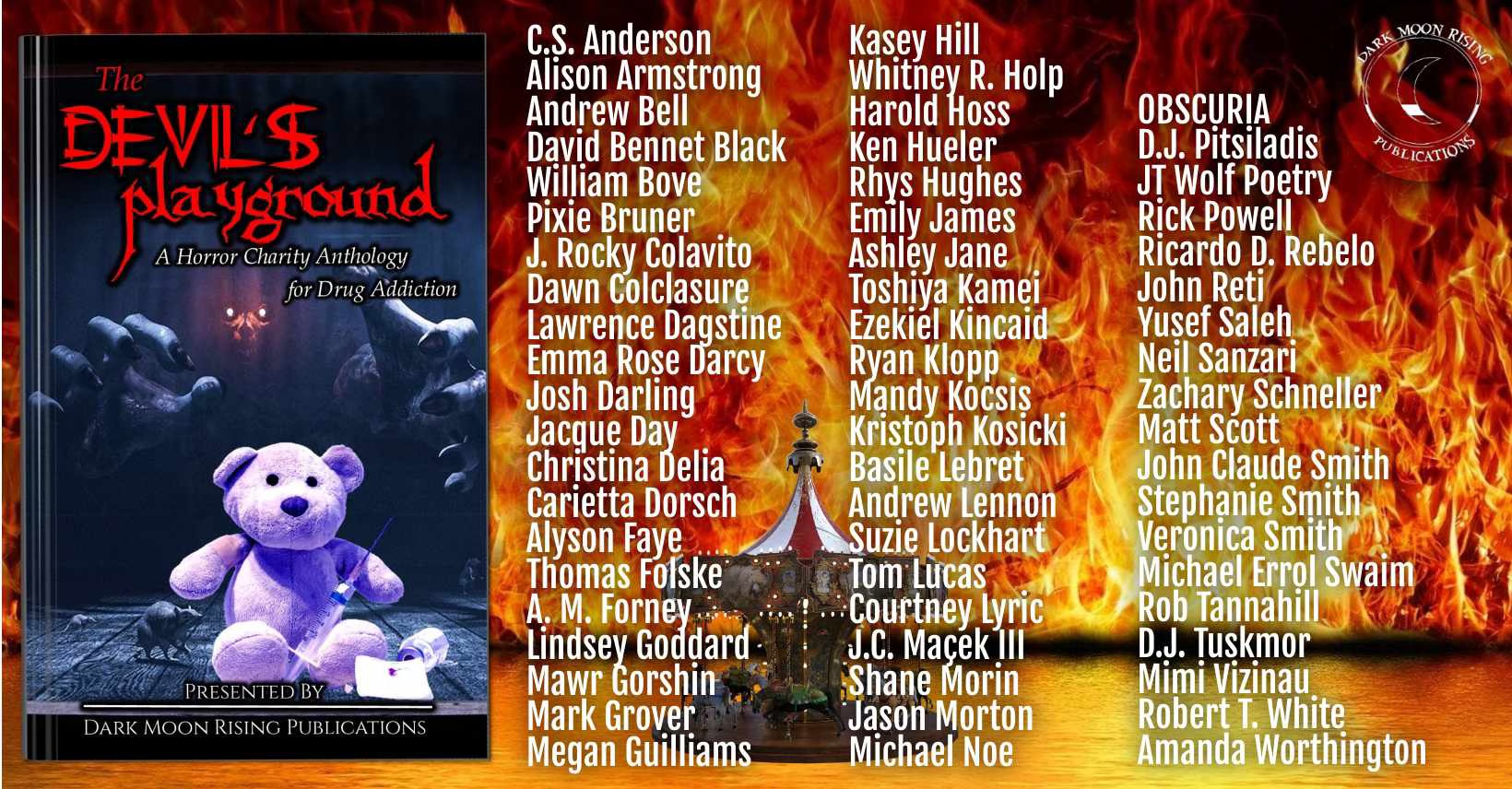
Nature Triumphs: a Charity Anthology of Dark Speculative Literature has recently received two five-star reviews. Scroll down the Amazon page to read them yourself, or read them here:

Avid reader called the anthology “Fun, Appealing, Scary, Thought-Provoking Eco-Horror Fiction–And Just in Time for Halloween)

“I loved this wonderful, big, entertaining, appealing, fun book –scary AND heartfelt eco-horror anthology. Exceptionally well-edited containing many varietal, well-written, vivid, horrifying stories and poems by diverse, established authors. Innovative concept/environmental/ecological/nature theme masterfully executed. I especially like stories “Yard Work” by Michael Errol Swaim, “Blood Rose” by Alison Armstrong, “One Side of a Conservation with Mother Nature” by Kyle Heger, “A Reversal of Fortune” by JG Faherty, and “last Call at the Garden of Eden” by Lamont A. Turner. I like that the money goes to The Nature Conservancy. Great book/gift for Halloween and for lovers/readers of horror, sci fi, dark speculative, ecological/ nature fiction and poetry.”

Jordan Francis called it “A beautiful and haunting Anthology for a great cause“.

“A beautiful and haunting Anthology. This collection of short stories and poems is amazing. It is at turns haunting, funny, and beautiful. This has introduced me to a multitude of great writers that i need to go back and check out their other works. Definitely worth the price of admission.”

Recall that my story, “The Bees,” is about a geneticist/beekeeper who, fed up with the world’s indifference to the dying off of the bees, does genetic alterations of the many bees he takes care of. He weaponizes them, making them bigger, stronger, smarter, and more lethal, capable of stinging their victims many times until they die. Can he be stopped, or will his enhanced bees multiply and tyrannize the world?

I really hope you’ll all go out and get yourselves a copy of this collection. It’s all for a good cause, and you’ll love the stories and poetry! 🙂

‘Symptom of the Universe’ is Published!

Symptom of the Universe: A Horror Tribute to Black Sabbath is finally published on Amazon Kindle. The paperback is $19.99. It will also be released on Godless on September 22nd.

Here is a link to the Amazon e-book. Here is a link to the paperback. Here is a link to its wide distribution as an e-book.

Here is a blurb from Dark Moon Rising Publications, the anthology’s publisher:

“From the publisher who brought you Nature Triumphs: A Charity Anthology of Dark Speculative Literature, Dark Moon Rising presents Symptom of the Universe: A Horror Tribute to Black Sabbath A worldwide gathering of award winning horror authors have come together to craft a collection of dark fiction stories covering every album and every era of Black Sabbath. Each story is inspired by one of Black Sabbath’s greatest songs from the biggest hits to the most obscure album tracks. SYMPTOM OF THE UNIVERSE: A HORROR TRIBUTE TO BLACK SABBATH is an immediate classic for rock fans and horror fans alike. Featuring the talents of Stewart Giles, J. Rocky Colavito, Sidney Williams, Tom Lucas, Thomas R. Clark, Ezekiel Kincaid, Neil Kelly, Tony Millington and many more, curated and edited by J.C. Maçek III with a foreword by Martin Popoff, Symptom of the Universe will whet your appetite for horror and rock at the same time.

“All proceeds are being donated to the Dio Cancer Fund.

“Trigger warnings: Themes of addiction, mental health, and self-harm

“Are you ready for a rocking read??”

Recall that my short story, ‘NIB,’ based on the song, of course, is in this collection. It’s about a drug user, Terry, whose drug dealer has given him some powerful dope combined with witchcraft. While he’s tripping, she seduces him, unwittingly triggering childhood trauma in him and putting him through a nightmarish experience that could kill him.

Please check it out. The ebook is only $3.14. You’ll love it!

I’ve already read a number of the stories, and I can tell you that this is a quality collection. One story runs the gamut of the mundane life of a homeless junkie all the way to a nuclear apocalypse. Another story involves wrestlers in an antiwar allegory. Yet another story is an erotic horror story with two femmes fatales. And yet another story turns a suicide into a revengeful homicide.

You won’t regret buying this anthology. Go get it!

Analysis of Anton Webern’s ‘Zwei Lieder,’ Op. 19

I: Introduction

“Zwei Lieder,” or “Two Songs,” op. 19, is a short piece for mixed choir and five instruments by Anton Webern, set to two poems by Johann Wolfgang von Goethe. It was composed in 1925-1926; the five instruments are celesta, guitar, violin, clarinet, and bass clarinet, with a choir of sopranos, altos, tenors, and basses.

Webern, along with Alban Berg (who composed the opera Wozzeck), was one of the most famous pupils of Arnold Schoenberg (who composed Pierrot Lunaire), these three composers being the most famous members of the Second Viennese School, who used Schoenberg’s twelve-note compositional technique. This technique involves taking the twelve semitones and rearranging them in any order to produce a tone row, or basic set. This tone row becomes the thematic, melodic, and harmonic basis of a composition.

Because the twelve-note system eschews the major-minor system, the resulting music is atonal, and therefore it is an acquired taste, to put it mildly. One must get used to the ’emancipation of the dissonance,’ which is no longer required to be resolved quickly back to consonance, and so the music sounds ‘harsh’ to the uninitiated listener.

When it comes to Webern’s music, I usually prefer to listen to his instrumental works, such as the Symphony, op. 21 (1927-1928), the Five Movements for String Quartet, op. 5 (1909), the Piano Quintet (1907), the Concerto for Nine Instruments, op. 24 (1931-1934), and the Quartet, op. 22 (1928-1930), for clarinet, tenor saxophone, violin, and piano. However, since when it comes to my doing analyses of music here on my blog, I prefer to have programmatic content along with the music, I’ve chosen a Webern composition with a text, among his music that I don’t listen to all that often.

Therefore, I’ve chosen to analyze his “Zwei Lieder,” among his least-performed, and therefore least-known, compositions. The reason that this otherwise superb piece of music is so rarely performed is that Webern’s choice of instrumentation is, sadly, impractical from the point of view of setting up performances of it. A choir, combined with the odd assembly of five instruments I mentioned above, all to perform a piece that lasts about two minutes, will be too much trouble for most organizers of concerts to put together.

Such a piece is best performed as a recording, and here is a link to a recording of the piece. Here is a link to the first poem in the original German and in English translation (which I will not be quoting here!); and here is a link to the second poem in the original German and in French translation (which I wouldn’t be quoting here even if I had permission to!).

The text of the two poems, in the original German as well as in English and French translations, can be found also in the booklet (pages 142-143) for the Complete Works of Webern, Opp. 1-31, conducted by Pierre Boulez for Sony Classical. I’ll be using these texts as the basis of my interpretation of the poetry; the websites linked in the previous paragraph are just there for your information, Dear Reader.

II: The Music

The tone row that Webern uses for the setting of both poems is G, B-flat, F-sharp, F-natural, E-flat, A, G-sharp, C-sharp, D, B-natural, E-natural, and C-natural. The “Zwei Lieder,” op. 19, is Webern’s first work to use the same tone row all the way through the entire composition.

A tone row can be played out in four ways: the original order, inversion (upside-down), retrograde (backwards), and retrograde-inversion (both backwards and upside-down). Furthermore, the tone row can be transposed to any key other than the original set of pitches. In the case of the “Zwei Lieder,” Webern transposes the tone row by a tritone, the diabolus in musica.

Now, as Samuel Andreyev demonstrates in his musical analysis of Webern’s piece (and my analysis owes a great debt to Andreyev’s analysis of the piece), one would find it impossible to hear the tone row played out in a clear, linear fashion because Webern breaks up the tone row among the instruments and choir in a way that the ear could never follow, certainly not without reading the score as one is listening.

For a precise demonstration of how the tone row is manifested in the piece, I’ll leave that to Andreyev to explain, since I lack his technical expertise. Instead, I’ll just make some more general remarks about the music.

Instead of the traditional kind of melody, which flows and is linear, having a singing quality, Webern’s concise musical style tends toward punctualism–an isolating of the successive notes through wide leaps, unorthodox uses of duration, dynamics, and attacks that are divorced from conventional ‘expressivity’–and Klangfarbenmelodie, or an assigning of the successive notes of a melody to different instruments. Therefore, melody isn’t perceived as musical lines, but rather as musical ‘dots,’ if you will.

Because of these kinds of innovations in Webern’s music, he has been associated, in retrospect, with the postwar total serialism of composers like Boulez (i.e., his Le Marteau Sans Maître) and Karlheinz Stockhausen (i.e., his Gesang der Jünglinge). Webern’s puncualism and Klangfarbenmelodie have been seen as anticipating the 1950s serializing of not only pitch, but also all the musical parameters as listed in the previous paragraph.

III: The Text

Goethe’s poems are both sets of two four-line verses in trochaic tetrameter (a line has four feet, each of which has a stressed, then unstressed, syllable), with a rhyme scheme of ABAB CDCD. They are vignettes of the beauty of nature, of flowers in bloom or soon to be in bloom. Images or scenes of natural beauty were something Webern always loved, and I understand that even among his instrumental works, there was the inspiration of nature.

His choice of having a mixed choir sing these verses–as opposed to, say, having just one singer–what must have been the main factor in causing the logistical difficulties in having op. 19 performed, must have been of such insistent importance to him, overruling the practical problems that would have forbidden frequent performances of the piece. I’m guessing that the choral singing was meant to give the verses a sense of holiness. For Webern, nature is sacred.

These poems are inspired by Chinese literature; in fact, these two poems are part of a cycle Goethe composed, called Chinesisch-deutsche Jahres- und Tageszeiten (“Chinese-German Seasons and Times of Day”). Chinese literature, all things Chinese, actually, had been quite popular in Europe at the time of his writing, ever since Voltaire‘s time.

The first poem describes narcissus flowers blooming in a garden in rows. The first verse gives us a vivid sense not just of the flowers’ beauty, but also of their ‘innocence,’ ‘purity,’ and ‘modesty.’ Since when is a narcissus modest, I wonder?

Indeed, one thing to keep in mind when interpreting poetry, or literature in general, is that things often aren’t as they seem. We may be reading a beautiful description of nature, but what the imagery is meant to represent may not be all that beautiful…once we have looked beneath the surface.

The narcissus flowers are as white as lilies; they have the purity of candles. Candles may give light, which is inherently a good thing, but the light comes from fire, the fire of the passions, which are anything but pure. Goethe’s word for pure is reine, the same word Heinrich Heine used in “Du bist wie eine Blume” (“You are like a flower”), “So hold und schön und rein” (“So lovely, fair, and pure”), a poem about a woman whose ‘purity’ broke Heine’s heart. ‘Purity’ isn’t necessarily a good thing.

Goethe would have been perfectly aware of the Echo and Narcissus myth, in which the latter broke the former’s heart, and the latter was punished for his vanity by being made to fall in love with the image of his own reflection in a pond, meaning that the handsome youth, in a sense, broke his own heart. In his grief over never being able to have what he saw, Narcissus died and turned into the flower of Goethe’s poem.

Now, obviously neither Webern nor especially Goethe would have known anything about narcissism in the modern psychiatric sense that people today would know of it. The seeds of the personality type, however–the vanity, haughtiness, and pitiless rejection of others–would have been intuited in the mythic character of Narcissus, intuited especially by a poet of Goethe’s stature. So on at least an unconscious level, Goethe must have used the flower as a symbol of sinful pride; Webern must have picked up on this idea–again, at least unconsciously, and reflected it somehow in his music.

Similarly, while Webern would never have consciously thought of the music he’d arranged for the poems as ‘harsh,’ he certainly knew, from the conservative public’s reaction to his atonal works (and those of his modernist contemporaries, like Schoenberg and Berg), that they were perceived that way. And even though his “Zwei Lieder” use softer sonorities, their atonality, dissonance, and wide melodic leaps are all clear signs of musical tension, deliberately used. Therefore this tension, set to these poems, suggests a sensitivity in his mind to Goethe’s expression of an undercurrent of tension in otherwise surface idyllic verses.

Now, I’m about to do a kind of ‘retrospective’ interpretation of these verses, applying a modern meaning to writing that’s showed no knowledge of contemporary ideas. Some of my readers, such as one who commented on my analysis of the Echo and Narcissus myth (link above), would balk at my ‘projecting of modern ways of seeing’ onto old texts, insisting instead that whatever the original meaning there was of the old text is the only ‘correct’ way of thinking about it.

I beg to differ. Just because the writing is old doesn’t mean the interpretation has to be old. The arts are not STEM fields: they don’t have only one correct answer, like 2 + 2 = 4, and an infinitude of incorrect answers. Artists often are reticent about what they’ve created because they want to allow us to find our own meaning in their works. Insisting that the work means only what the artist had originally intended takes all the fun and joy out of experiencing the work.

Another justification I have for interpreting the meaning of a work of literature, film, or piece of music, drawing on elements that came into being long after the work was created, is to give the work a new meaning and relevance for us now, so we can relate to it in our own way and therefore enjoy it far more. Insisting that the work’s ‘ancient meaning’ is its only meaning makes the work dead to us now.

Besides, some themes and ideas are so universal that they apply to all times of history, including those times when people knew nothing of the modern concepts. Just because narcissism wasn’t known as a personality disorder in, for example, ancient Greece, doesn’t mean that narcissists didn’t exist back then, let alone cause pain and suffering to the Echoes of their day.

With this understanding in mind, I can begin to do my interpretation of these verses. We should also keep in mind when Webern set the poems to music: in the mid-1920s, when certain…politically tempestuous…things were going on in Europe, in Germany and Austria in particular. As of the piece’s composition, Hitler would have been released from prison after having served just over eight months of his sentence for the crime of high treason after the failed Beer Hall Putsch. The Nazi Party may not have achieved their immediate goal of taking over the German government, but they did gain national attention and their first propaganda victory, which surely would have gotten Webern’s attention.

As an Austrian patriot, Webern did, for a while at least, have some sympathy for Nazism. By the time the Nazis had come to power in the early 1930s, though, he was growing in opposition to them. He even gave a public speech in 1933, publicly denouncing the Nazis for calling his music, as well as that of Schoenberg and Berg, “cultural Bolshevism” and “degenerate music.” (He was lucky the Nazis didn’t arrest him for this.)

He was certainly never an antisemite. His musical mentor, Schoenberg, was a Jew. He resigned from a position as chorus master for the Mödling Men’s Choral Society in 1926 (the year he finished his “Zwei Lieder”) over his controversial hiring of a Jewish singer, Greta Wilheim, to replace a sick one. So his attitude towards Nazism was complicated.

I’ll now relate these political issues to how I imagine Webern could have read Goethe’s poems. To think that Goethe would have intended the interpretation I’m about to make would be absurd, and I admit I’m stretching things when I make speculations about Webern interpreting them in the way I’m about to describe. But in making this interpretation, I’m hoping not only to make the poems relevant for our time, but also to show that there’s more to them than just a pretty painting of nature in words–there’s a deeper meaning.

These narcissus flowers, white and pure, like stars, are as pretty as lilies. They bow with a modest demeanour. Since, as I noted above, the associations one makes of this flower with vain Narcissus are so obvious, then the flowers appearing so modest must be mere affectation on their part.

The white flowers have a yellow centre with a red rim circling it, glowing love, as the first verse points out. This red around the yellow middle is thus the loving heart of the flowers. This love, affection, and affinity of the flowers is thus a personifying of them…and an idealizing of them.

This idealizing of the narcissus flowers is significant, for as is associated with such flowers, narcissism is all about an idealizing of the self. As is indicated in the second verse, these early narcissus flowers have bloomed in the garden in rows. They are a group symbolizing beautiful and idealized, but also vain, self-important people. They are thus representative of group narcissism.

Now Freud, who discussed how groups of people living in the same community may look down on those outside their circle with contempt, was writing about this issue as an example of group psychology in 1922, which was just a few years before Webern composed his “Zwei Lieder.” I’m not suggesting that Webern read Freud’s work and was influenced by it in setting the poems to music. What I am saying is that we’ve all–at any point in history, even back to Goethe and earlier–sensed the arrogance of the in-group toward outsiders. Parochial, chauvinistic attitudes have existed since time immemorial.

So, is Webern’s choral setting of the poems meant to suggest a holy beauty in these flowers, or a ‘holier-than-thou’ attitude? Webern surely would have been aware of the hyperinflation of Germany in the early 1920s and its effect on the German psyche. This pain is the kind of thing that can drive people to have nationalistic feelings, to looking for a leader who will ‘save the nation’ from its ruin. As we know, some Germans looked to Hitler in the hopes of such a saviour.

I suspect that Webern could have read such a meaning in the poem’s hope that the narcissus flowers know for whom they’re waiting. As they stand in their rows waiting for their idealized leader, they are described in the original German as “so spaliert erwarten,” or “so trellised in expectation.” They’re being held up, as if by a trellis, which implies that they’re “stand[ing] at attention,” as the translation in my CD booklet (page 143) has it.

Narcissism involves an idealizing of another–an idealized parental imago who may mirror back one’s grandiosity, as Heinz Hohut described the relationship, or an idealized political figure–who reflects back one’s own narcissism. This is the true meaning of Narcissus falling in love with his reflection in the pond: the ideal is oneself, yet it’s also out there, another, as Lacan spoke of the ideal-I in the mirror stage. One sees oneself in the idealized other, and hopes to attain that ideal oneself.

So the narcissus flowers, standing at attention in their neatly-arrayed rows in the garden…a kind of Garden of Eden in its idealization?…are like the SA standing at attention before Hitler, whom they wait for, in hopeful expectation, ‘to save’ their nation, while looking down with scorn and contempt for foreign nations and other ethnic groups.

Webern could have made these associations in his mind–consciously or unconsciously–as he read Goethe’s poem, and written the music the way he did in accordance with such a meaning–with the dissonance, atonality, and wide melodic leaps to express his own inner conflicts (should he, in his Austrian patriotism, support fascism, or oppose its antisemitism and rejection of his art?) about the political direction he saw Europe going in at the time.

As for Goethe’s intention, he could have imagined the narcissus flowers standing in an orderly group awaiting a leader of a more general sort, but one who has the same demagogic qualities. This ‘follow the leader’ mentality has always existed, of course, so his poem has a universal relatability in this regard.

Now, the second poem describes sheep leaving a meadow, revealing a pure green of grass. There’s that word, “reines,” or “pure” again: recall what I said above about both the positive and negative feelings that can come from the use of this word.

So, who are the sheep? Are they those who are timid and easily led, as the word is commonly used today to describe people who blindly believe all the nonsense in the mainstream media and follow mainstream politics uncritically? Such a meaning could be too contemporary and too English to be fitting in a reading of such an old, German poem.

Or are the sheep the followers of the Church? Certainly Goethe, as a freethinker, wasn’t fond of the more dogmatic aspects of the Church, and so he probably wouldn’t have thought much of the simple-minded, unthinking flock. The sheep’s leaving the meadow, to reveal the purity of the green, could be indicating an improved world once we’ve been rid of the uncritical believers.

Or are the sheep those who truly abide by the spirit of what it means to be a Christian, as opposed to the mere conformist churchgoers? Not those who say “Lord, Lord,” but those who do good works without regard of reward (Matthew 7:21)? Their leaving the meadow could reveal a grass whose purity is of a more ironic sort.

In any case, the sheep’s absence will result in the glorious blooming of the flowers. This blooming is described as a “paradise” (recall my reference to the Garden of Eden in its idealization). Again, is Webern’s use of a choir to sing these verses in earnest, or is it ironic? And whichever answer may be correct, for which is it in earnest, and for which is it ironic…for the sheep, or for the paradise?

Note that there are parallel themes going on in both poems. There’s an idealizing of the beauty of the flowers, with an ironic undercurrent. By the end of each second verse, there’s a hope or expectation of good which may end up being its opposite.

Hope, in the second verse, spreads a light mist in front of us, implying that what we see is no longer clear because of that hope. What will be true and what we want to be true are often very different from each other.

Similarly, a parting of the clouds should give us clear, sunny skies (‘the fire of the sun’), and therefore clear vision. Just as one hopes that the leader the narcissus flowers are waiting for will be a good one, so does one hope that one’s unobstructed vision will reveal happiness and the fulfillment of one’s wishes.

IV: Conclusion

Among all of the German and Austrian nationalists, like Webern, there was a growing feeling that fascism might fulfill their wishes and give them happiness by restoring glory to their countries. While he felt that national pride and hoped that leaders like Hitler would fulfill those wishes, his continued friendship with Jews, going all the way to the Anschluss and beyond, would have been a source of great conflict for him, not to mention a potential danger.

He surely would have felt that conflict as early as the mid-1920s, when he composed the “Zwei Lieder,” for Hitler had made no secret of his antisemitism, of course, just as he was putting his nationalism on broad display. I believe the second poem’s expression of hope as a mist obscuring one’s vision put Webern’s conflict into words.

Similarly, as I said above, the atonality, dissonance, and wide melodic leaps at least unconsciously expressed his psychological conflict about the growth of European fascism in the 1920s. This musical expression of that conflict extends to the transposition of the tone row by the tritone interval…known significantly as the ‘devil in music.’

So Goethe’s poems teach us that we need to be careful as we look through the mists of hope, as well as to know who we are waiting for. Will we get that happiness, or will we get horror? Are we waiting for a hero, or a villain? In Webern’s case, he got shot and killed by an American soldier in the end, after having been disillusioned by fascism’s bloody failure. Be careful what you hope for…and for whom you are waiting.

‘The Ancestors,’ a Horror Story, Chapter Six

Between ten and twenty minutes later, Freddie came down the stairs and into the living room, where everyone was having after-dinner tea. He had changed his clothes.

Margaret looked up with hope to see Brad finally returning. She frowned to see only Freddie.

“Where is my husband?” she asked. “He’s been way too long up there.”

“It must be his gout slowing him down,” Hannah said.

“It shouldn’t be slowing him down this much,” Margaret said. “Even if he had to do a Number Two.”

“Did you see my dad up there, Freddie?” Hannah asked him. “And why are you dressed differently?”

“Oh, uh,” he began, “I found a mess up there that urgently needed cleaning, and I got some of the mess on my clothes, so I changed them. I never saw your dad, probably because I was so busy in a room up there cleaning the mess.”

“Well, I’m beginning to worry,” Margaret said.

“I can take you upstairs and help you look for him, Mrs. Sandy,” Emily said. “Let’s go.”

“OK,” Margaret said. “Thank you, Emily.”

They both got up and started walking out of the living room towards the stairs. As Emily was following Margaret, Freddie put something in his sister’s hand while no one else was looking.

As they were going up the stairs to the second floor, Emily caught up with Margaret.

“I’d like to check every floor,” Margaret said. “Just in case.” They reached the second floor. “Brad? Are you there?”

No answer.

“I hate to snoop around your house,” she said, “so I’ll let you show me the areas you feel more comfortable with me seeing, Emily.”

“That’s fine, Mrs. Sandy.”

They went through the hall, room by room.

“Brad?” Margaret called again.

“Mr. Sandy?” Emily called out.

No answer.

Emily opened the doors of the rooms so Margaret could look in. No sight of her husband anywhere, of course.

“OK,” Margaret said with a sigh. “Shall we go up to the third floor?”

“If you wish, Mrs. Sandy,” Emily said.

They returned to the stairs, and started going up to the next floor. “Brad?” Margaret called. “Where are you?”

Still no answer, of course.

Margaret’s heart was pounding. She shook all over. A drop of sweat or two ran down her face.

“Brad!” she shouted as they were reaching the third floor. “Brad!”

Silence.

“I’m sorry for the shouting, Emily,” she said with a wobbly voice. “But this is starting to scare me.”

“I understand,” Emily said as they were now leaving the stairs and walking down the third floor hallway. “And don’t worry. I’m sure we’ll find your husband soon, and there will be a perfectly reasonable explanation for–“

“Aaah!” Margaret screamed.

She saw a few drops of blood on the floor just by the door to the room where Brad had found the cat. In fact, that cat was walking by right at that moment, with a few spots of Brad’s blood on its ginger fur.

“Oh, Mrs. Sandy,” Emily said, picking up the cat and showing it to her. “The blood isn’t your husband’s. It’s our cat’s–see? Don’t worry. I’m sure he’s fine. Let’s just keep looking for him, OK?”

“I’d really like to believe you,” Margaret said, not seeing any actual signs of injury on the cat, just the spots of blood as if they’d come from somewhere else. “But frankly, I’m afraid I don’t.”

“Very well. Let’s keep looking.”

“What’s in that room?”

“Oh, nothing interesting. Just a lot of boxes.”

“Is it OK if I take a look in there?”

“Well…uh…sure, but I see no reason why your husband would be in there.” Emily frowned, Margaret noting some tension in her eyes.

“I’d like to see what’s in there,” Margaret said firmly.

Emily hesitated. “Well, alright.” She opened the door.

Nothing could be seen in the dark.

“You must have a light switch,” Margaret said.

“Of course,” Emily said, then turned on the light.

Just stacks of books. No blood.

Emily breathed a sigh of relief, as if she had clairvoyance to know what had happened in there.

Margaret got a good look around the room and was satisfied about it, but was wondering about Emily.

“OK, Emily,” she said. “Let’s keep looking.”

They went out of the room, Emily turned off the light and closed the door, and they continued down the hall in the direction of the bathroom, the door of which Brad had left wide open, and so it was easy to see that no one was in it.

A moaning sound, with the deep voice of a man, was heard from above.

“Brad?” Margaret said, her head pointing up.

“That sounded like it was coming from the attic,” Emily said. “Come this way.” They continued down the hall towards the bathroom. She gestured at the ceiling. “We go up there.”

“Pull down attic stairs?”

“Yes,” Emily said, getting a short step ladder from the bathroom to stand on. She got on, pulled down the attic stairs, then went up into the attic, Margaret following immediately after.

More low groaning, from a far corner opposite from where the two women were.

“Brad?” Margaret called in the darkness, her hands cutting through cobwebs as she went in the direction of the groans. “Are you in here?”

There was another groan, but this time it was from a corner in the opposite direction.

“What the–?” Margaret said, then tripped over something and almost fell down.

Standing behind Margaret, Emily was smiling.

As Margaret continued stumbling in the dark to where she’d heard this last groan, Emily took what Freddie had given her out of her pocket.

“Is there an electric light in here, Emily?”

‘Yes, of course,” Emily said, still smiling. “I’ll go get it.”

Just as Margaret had reached that corner, a moan was heard from far back behind her.

“Why do all the moans keep coming from different places?” Margaret’s pulse was racing. “You’d think someone was pulling a prank on me. If so, it’s not at all funny.”

Emily tugged a string, and a light bulb shone from the ceiling in the centre of the attic.

As in the other room, boxes were stacked everywhere, all clad in cobwebs.

“At least I can see now,” Margaret said, her eyes racing around the area to find the source of the groaning. As she walked toward where she’d heard the last groan, another came from the opposite direction. “Oh, for God’s sake, not again! What’s going on here? Are you part of this mind game, Emily?” She looked behind her and saw Emily standing immediately in back of her, grinning eerily. “What are you doing, Emily?”

“I am not Emily, Mrs. Sandy,” a deep, male voice said out of her mouth. “I am Meng, one of the Dan family’s ancestors.”

Margaret didn’t have time to react to that monstrosity of a voice, for she saw, just over Emily’s shoulder and among the boxes in a corner, her husband’s legs lying on the floor.

“Brad?” she called out, then shoved Emily to the side and ran over to his body.

A white sheet, stained with blood, was wrapped around Brad’s head. Blood stains were all over his clothes.

She gasped, then unwrapped the sheet as unwillingly as could be, but needing to know the ugly truth. The deep axe wound in his face gave her that needed truth.

“Aaaaahhh!!!”

Her screams were cut short by a deep slice in her throat by the blade of the straight razor Freddie had given Emily. Her blood was gushing out as she fell. Emily lay Margaret’s body next to Brad’s.

“And now, you can be together forever, Mr. and Mrs. Sandy,” Meng said.