Analysis of ‘Shadow of a Doubt’

Shadow of a Doubt is a 1943 film directed by Alfred Hitchcock, his favourite of all of his films, and the one he enjoyed making the most. Written by Thornton Wilder, Sally Benson, and Alma Reville, Shadow of a Doubt was based on a story treatment by Gordon McDonell called “Uncle Charlie,” which in turn was based on the true crime story of Earle Nelson, a serial killer, rapist, and necrophile from the late 1920s known as “The Gorilla Man.”

Most of Nelson’s victims were middle-aged landladies, killed by strangulation, and many were raped after death. The writers of Hitchcock’s film changed the victims into wealthy, elderly widows, and Nelson’s charm–as a mild-mannered Christian drifter–was retained in Uncle Charlie. I find the connection between landladies and wealthy widows as victims to be interesting, as I’ll get into later.

The film stars Joseph Cotten (as Uncle Charlie) and Teresa Wright, with Macdonald Carey, Patricia Collinge, Henry Travers, Wallace Ford, and Hume Cronyn. McDonell was nominated for an Oscar for Best Story. The film received universally positive reviews upon release, and in 1991, it was selected for preservation in the United States National Film Registry by the Library of Congress, being deemed “culturally, historically, or aesthetically significant.”

Here are some quotes from Shadow of a Doubt.

A crucial theme in this film is the sharp contrast between a man’s charming outer persona and his dark, evil inside. Note what Hitchcock himself once said as an overarching theme: “Love and good order is no defense against evil.” Uncle Charlie has such a good reputation among his own family, the Newtons, whom he’ll visit in Santa Rosa, California (in McDonell’s treatment, the small town the villain will visit is Hanford in the San Joaquin Valley), that the last thing they’d ever suspect is that he’s a serial killer.

Uncle Charlie’s sister, Emma Newton (Collinge), and her husband, Joseph (Travers), named their eldest daughter, Charlotte “Charlie” Newton (Wright) after him because he’s idealized so much, an idealization that spreads out to the entire city of Santa Rosa, a location chosen for the film as a paragon of a peaceful, small, pre-WWII American city. Such a nice place for Uncle Charlie to hide out in reinforces this idea of a good, wholesome exterior hiding a shady secret.

On top of all of this is Young Charlie, a sweet, pretty young woman sharing the name of the villain. On two occasions in the film when she and her uncle chat, they speak of themselves as being twins, rather than uncle and niece.

Her wish to have him come over to Santa Rosa, to relieve the boredom and meaninglessness of their lives, coincides with him sending a telegram to her family, saying he wishes to pay them a visit. She imagines that her wish has been mental telepathy, sent to him to make him send the telegram; a Jungian would say this meaningful coincidence, a linking of her inner mental state with the outside world, is a case of synchronicity. In any case, this coincidence is yet another linking of the two Charlies, with her nice-girl Persona and his serial-killer Shadow.

Her adoration of her handsome, charming uncle borders on incestuous desire, a kind of transference of her Electra complex from her father to her uncle. Indeed, she beams at her Uncle Charlie, with a grin from ear to ear, thinking he’s “wonderful.”

So she’s transferring her idealization from the parental imago to her uncle. The idealized parental imago is one of two poles of the self, as Heinz Kohut conceived it, a self rooted in narcissism. Since the Oedipus complex is a narcissistic trauma, and she’s transferring hers to her uncle, then her love of him is really a narcissistic projection from herself to him. When she realizes his murderous nature, her heart is broken, and now she must split off and project what’s really her Shadow self onto him, hence, “Shadow of a doubt.”

So, on a symbolic level, both Charlies can be seen as two halves of one person, the good and bad sides of Two-Face‘s coin, if you will. Uncle Charlie’s being pursued by the two detectives at the beginning of the film causes us to sympathize with him for the moment, since we don’t yet know of his crimes, and so we believe, as his niece does, in how “wonderful” he is, until that shadow of a doubt comes with her growing suspicions of him.

A paralleling of the good outer Persona vs the dark, inner Shadow can also be seen in her father, Joseph, having ongoing discussions with a neighbour, Herbie Hawkins (Cronyn), of how one might commit the perfect murder. This little bit of black comedy between them is a light subplot for the dark main one, yet it also reminds us of how the dark sides in us, however seemingly slight, are on a continuum with those who commit actual crimes. The real difference is in how the hell of the real world has a way of pushing people over the edge to commit criminal acts…an issue I’ll deal with in more detail later.

Young Charlie’s suspicions of her uncle begin upon having received the gift of a valuable emerald ring from him…one that has the initials of another owner on it. He also gets upset to find a newspaper article about the pursuit of him as a suspect in the murder of the wealthy widows, and even Young Charlie’s naming of Lehár‘s Merry Widow Waltz must be interrupted by him at dinner. Indeed, the theme of this waltz is given numerous, often dark and eerie, variations by the composer of the film-score, Dimitri Tiomkin.

I’ll now give a political interpretation of the film as an allegory, one that some readers will no doubt find controversial, but please, hear me out. While Hitchcock was no friend to fascism, as can be seen in films like The Lady Vanishes and Notorious, and while he promoted progressive ideas in a subtle fashion in his stretching of the limits of movie censorship over the years, as well as in the gay subtext in Rope, he was also a reactionary in other ways, as I’ll go into soon in Shadow of a Doubt.

Indeed, Hitchcock can in some ways be compared to George Orwell, who on the one hand, as he said in Homage to Catalonia, went to Spain in the mid-1930s to fight fascism and was impressed with the revolutionary achievements, however short-lived, of the anarchists there, yet on the other hand, he was so bitterly opposed to the ‘totalitarian’ communists (whom he caricatured in his two famous fictional allegories) that he had a snitch list of ‘crypto-communists’ that he used to thwart the careers of those on the list. Hitchcock, as a bourgeois who was making quite a name for himself (and a lot of money, no doubt) in Hollywood as of the early-1940s, when this film was made, would have had his own class interests to protect.

At the beginning of 1943, when the film was released, the Tehran Conference–with the origins of the Cold War associated with it–was far away from happening, as was the Second Red Scare of 1947. The tide turning against the Nazis in the Battle of Stalingrad was still a month away from happening, too. There seems to have been little fear of communist revolution in January 1943.

The hardships that the working class had suffered during the Great Depression, however, caused them to rise up in an unprecedented way, forcing FDR’s hand in the legislation of the National Labor Relations Act and the New Deal. Many on the political right see little if any difference between the moderate and hard left, and between propagandistic nonsense, like the ‘Holodomor,’ and the truth of the killing of the Tsar’s family, there would already have been much bourgeois fear of leftists idealizing communism.

To get back to the film, and to tie all of these historical digressions to it, there is a crucial scene in which Uncle Charlie discusses what is actually his motive for strangling the rich widows. He refers, with a scowl, to how their husbands worked hard to make all that wealth and then died, leaving all their money to their “silly wives…these useless women”, whom he doubts are even human. In a later discussion with Young Charlie, her uncle describes the world as “a hell.” Given the neoliberal reality we’ve been in for the past forty years, I’d say it’s even more of a hell now.

In these hard-working husbands, I see an allegory of the working class; in their wives, I see the ruling class who take the fruits of their workers’ labour and live in luxury after the men have died from overwork and hazardous accidents. Killing the widows, therefore, allegorizes socialist revolution, but an allegory from the point of view of the frightened bourgeoisie, who want to propagandize against such revolution and call it cruel and violent, hence the representation of the capitalist class as vulnerable, helpless women, to inspire the audience’s sympathy for them.

Young Charlie, too, is concerned–towards the beginning of the film–with the struggles of her family (there is a similar sense of her family’s struggles in McDonell’s treatment), including how her mother works like a dog. Life seems meaningless to her, just a lot of going along with everything, eating and sleeping and nothing else. There’s talking, but little real communication. She seems to sense modern-day alienation. These grey days immediately turn sunny on the arrival of her uncle (who in my allegory represents communist ideals), but she, being liberal-minded like Hitchcock, would never espouse the violent overthrow of capitalism that her uncle’s murders represent.

If my anti-capitalist interpretation seems far-fetched to you, Dear Reader, consider how odd Uncle Charlie’s motive for killing the widows sounds, taken at face value. Misogyny, directed at women merely for being rich and not working, building in a flame of hate strong enough to want to strangle several of them and risk being charged with murder? The world is a hell just because of the widows’ indulgence? Earle Nelson, on whom Uncle Charlie was based, recall, was a sex offender, with a motive straightforward enough to see, but one that for obvious reasons couldn’t be presented on the screen at the time.

That the screenwriters changed the murder victims from being, of all people, landladies to wealthy widows adds to my argument. Landlords, male or female, are capitalists, owning private property–the apartments they make money off of renting them to tenants. The screenwriters changed the victims from one kind of capitalist to another, one whose wealth, unmistakably associated with the exploitation of the poor, is all the more obvious.

A few other things about Uncle Charlie can be associated with communism. He’s come out west from the east. Now, by the east in the film, it’s meant to be the east coast of the US, of course–New Jersey, to be exact. But one can associate “the east” with Russia. There was a growing fear of communist ideas coming to the west–to Western Europe and North America, allegorically represented in the film as California.

One reason I find it useful to link Uncle Charlie’s murders with anti-capitalism, even though he is no communist, is how his story can be paralleled with that of Luigi Mangione, the man accused of shooting and killing Brian Thompson, the CEO of UnitedHealthcare. Mangione has right-leaning political sympathies, but they weren’t enough to stop his rage against an American health insurance system that gets rich off of denying coverage for people who desperately need it, and often die without it. Mangione is regarded as a kind of working-class hero (despite him being from a well-off family), and Thompson’s murder is dismissed by the masses as a case of someone who got what was coming to him.

As for Shadow of a Doubt, though, the bourgeois moviemakers would have us booing at anyone who dares to kill the wealthy. Uncle Charlie’s charm and good looks are meant to be seen as superficial and nothing more.

When Uncle Charlie gives gifts to all the family members, including Young Charlie’s emerald ring, we could see such largesse as representative of a socialist redistribution of wealth. Since this film is actually an anti-communist allegory (as I see it), though, we are reminded, through such things as the initials of the previous owner on the ring, that this redistribution is actually to be understood as a theft from the rightful owners, the capitalist class.

When Uncle Charlie cuts out of Joseph’s newspaper an article about the widow murders, and later gets mad at Young Charlie for inquiring too much about the missing article, we can see in this a representation of an anti-communist accusation of Soviet media censorship. Now, such censorship surely did happen, as with Orwell’s two polemical tales being banned in the USSR, but right-wing, anti-Soviet propaganda (such as I suspect this film to be, allegorically) was a real danger: the “Holodomor” myth, as mentioned above, was originally Nazi propaganda that has persisted to this day, and all such propaganda has led to the counterrevolution that Stalin not only warned against, but also correctly predicted the outcome of, the turning-back of social progress.

Another change from McDonell’s story treatment to the screenplay that I find interesting is that of Young Charlie’s love interest. McDonell had him as a “ne’er-do-well” that she is engaged to, someone who is assumed by all in her town to be guilty of any crime committed there, including a hold-up.

In the film, this love interest becomes one of the two detectives pursuing Uncle Charlie. He is Detective Jack Graham (Carey). Just as with the switch from landladies to wealthy widows as Uncle Charlie’s victims, the switch from a criminal ne’er-do-well to a cop as Uncle Charlie’s rival seems to confirm my anti-communist allegory. Let me explain.

Fascists are fanatical anti-communists known for using violence to achieve their ends. Now, neither Detective Graham nor his colleague, Detective Fred Saunders (Ford) show any violence in the film, but other detectives out east, when pursuing another suspect in the widow stranglings, cause the suspect, whom we’ll know to be innocent, to run into and be sliced to pieces by the propellor of an airplane. Fascists have also demonstrated a peculiar charm to inspire the sympathies of the masses, as Hitler did with his speeches about ‘saving Germany’ from the Jews and communists.

Detective Graham, smitten with Young Charlie as soon as he and Saunders arrive at her house to pretend to survey a typical American family (actually to get photos of her Uncle Charlie as a suspect in the stranglings), puts on the charm to win her heart. His actions to this end allegorically represent fascism trying to charm liberals (whom she represents) into joining the far-right.

What we actually have in this film is a kind of perverse love triangle of him, her, and Uncle Charlie (recall the incestuous, Oedipal transference I discussed above between the latter two). Ideologically, it represents how the left and right vie for the liberal centre (the petite bourgeoisie that we see in Young Charlie’s family) to join them. We’re meant to believe that she should go for the detective who represents the right.

That her initial attraction to her uncle is incestuous is meant to make us abominate the adoption of leftist ideas, however charming they may be about sympathizing with the poor. That the violence of the far right is more or less completely excised from the detectives (that propellor death mentioned merely in passing) is meant to make us believe that the right is harmless.

Graham and Saunders are very interested in getting a photo of Young Charlie’s bedroom (Since her uncle, as a guest, is sleeping there, the detectives hope to get closer to him.). Apart from the detectives’ continued pursuit of her uncle, this getting into her bedroom has obvious sexual overtones.

When Young Charlie learns that the two men are detectives and not surveyors of a typical American family, she’s furious with Graham for lying to her, and she’s even more upset with him when he claimed her “wonderful” uncle could be a murderer. Graham has to put on some extra charm to win her over to him.

My associating of the detectives with fascism, again, as far-fetched as it sounds on the surface, might begin to make sense to you, Dear Reader, when we consider this film as an anti-communist allegory. While liberals, of whom Hitchcock can be counted as one, may publicly abominate fascism, secretly they will feel drawn to it if their class interests feel in danger from crisis or an organized working class.

If there’s one thing fascists are useful for, it’s fighting communism: one need only look into Operation Paperclip, Gladio, and the underground activities of Ukrainian Nazi sympathizers during the Cold War years, among many other examples, to see my point. Their violence and subterfuge are typically hidden or downplayed by the liberal media, as has been the case with the years since the US/NATO-backed coup in 2014 that replaced democratically-elected Yanukovych with a Ukrainian government and military that includes neonazis.

Such a hiding of violence and conspiracy can be seen allegorically in the activities of Graham and Saunders. One must wonder how detectives chasing a suspect in the eastern US, as it turns out, an innocent suspect, escalates to him running into an airplane propellor and getting sliced up. How is this just an unfortunate accident? There must have been considerable aggression on the part of the detectives to have led to that bloody end.

Fearing that Young Charlie will inform on him sooner or later, her uncle makes several attempts on her life. First, he sabotages the porch steps so she’ll fall down them. Then, he leaves the family car idling in the garage–whose door is stuck, making it almost impossible to get out–so when she goes in to use the car that night, she almost dies from inhaling the exhaust fumes. Finally, on the train to leave Santa Rosa with her there, he tries to throw her off as it’s going; but in the struggle, he falls off and dies under the tracks of an oncoming train.

A funeral is given to honour Uncle Charlie, whose crimes will never be known for fear of the crushing disgrace it would do to her family, surely causing her mother Emma to die of a broken heart. Only Young Charlie and Graham, still wooing her, know the truth.

According to my allegory, the film seems to be saying that the ‘truth’ about socialism would be too hurtful for the working class to know if bluntly stated, hence the telling of that ‘truth’ in this indirect manner, to soften the pain of its revelation.

Graham and Young Charlie doubt her uncle’s characterization of the world as a hell. When one is a member of the petite bourgeoisie (as she is) or higher up, it is fairly easy to suppose that the world has more than enough good in it to offset the bad. The global proletariat–especially those in the global south, as well as so many of us experiencing the neoliberalism of the past forty years (even well-off Luigi)–tend to have a less rosy image of the world.

The Tanah–Beginnings, Chapter One

[The following is the second of many posts–here is the first–about a fictitious discovery of ancient manuscripts of a religious text of narratives and magic spells. Its purpose for my readers and me is to provide a cosmology and mythography on which I am basing much, if not most, of my fiction–short stories and novels. If anyone is interested in reading this fiction, he or she can use these blog posts as references to explain the nature of the magic and universe in my fiction.]

  1. Waves everywhere, that from the lowest, rise to the highest, then fall to the lowest, rise high, and fall low, everywhere, always, these are Cao–a never-ending ocean.
  2. Cao is one; the Pluries are many. The one breaks up into the many, all of which then drop into the ocean.
  3. How does the one become the many, and how do the many become one?
  4. The Crims make Cao the Pluries, and they make the Pluries Cao.
  5. One Crim, Nevil, is fire, heating another Crim, Priff, water, into a third Crim, Weleb, air. Nevil leaves, thickening Weleb back into Priff, then freezing Priff into the last Crim, Drofurb, which is earth, or stone, or ice.
  6. The fire of Nevil also brings the light of day, Dis, and the heat of desire, Hador. When Nevil leaves, what remains is the cool or cold of calm, Calt, and the darkness of night, Noct.
  7. These eternal flows that move everywhere–up high and down low and back up, from one to many and back, from cool to hot and back to cold, from water to hot air and back to cold and ice and stone, from the dark of night to the light of day and back to black, from calm to desire and back to calm–all of these are Cao, all are the Pluries.
  8. The waves of Cao flow from Drofurb to Priff, and from Priff to Weleb by the brightness and heat of Nevil’s fire of desire, then Nevil fades away, bringing Weleb back to Priff, then Priff to Drofurb, darkening, cooling, and calming. The waves move Noct to Dis, and back to Noct. The waves flow from Calt to Hador and back to Calt.
  9. These ups and downs, highs and lows, heating and cooling, desire and calm, light and dark, night and day, ice to water to vapour to water to ice,…these are what is all of the world.

[The text breaks off here.]

Commentary

The above verses express not so much a beginning of the universe as the beginning of an understanding of its basic building blocks. The poetry in the original language has a rhythm that evokes the rushing waves of the universal ocean in a way that English cannot effectively render, unfortunately. We can get only a basic sense of the pendulum swings of the primordial opposites: up and down, light and dark, night and day, solid to liquid to gas, passion and calm.

As explained in the translator’s introduction, the imagery of the verses give off that sense of the dialectical thesis, negation, and sublation as given in the undulating movements of t, s, n, s, t…etc. The purpose of this emphasis on the wavelike movements of all opposites is to give the reader a sense that these undulations are the foundation of everything–the secrets of the universe.

Analysis of ‘The Old Man and the Sea’

The Old Man and the Sea is a 1952 novella by Ernest Hemingway. He wrote it between December 1950 and February 1951, but published it in September 1952. It was the last major fictional work he published in his lifetime.

The novella was highly anticipated and released to record sales. Initial critical reception was highly positive, though its reputation has been more varied and somewhat less enthusiastic since, with a number of critics deeming it inferior to Hemingway’s earlier works.

Nonetheless, TOMATS has continued to be popular, as a book in English lessons around the world, according to Jeffrey Meyers‘s Hemingway: A Biography–1985). The Big Read, a 2003 BBC survey of the UK’s 200 “best-loved novels,” ranked TOMATS at #173.

Hemingway was directly involved in the 1958 film adaptation of the novella, with Spencer Tracy as Santiago, but Hemingway ended up disliking the film. He won the Pulitzer Prize for Fiction in 1953 for TOMATS, the first time he’d ever received the award. Even Fulgencio Batista, the new dictator of Cuba (the setting for the novella), gave Hemingway a Medal of Honor for the novella; though Hemingway disapproved of the new regime, he did accept the medal.

TOMATS got its highest recognition in 1954, when it won Hemingway the Nobel Prize in Literature. The Swedish Academy praised the novella for its “powerful, style-making mastery of the art of modern narration.”

Here are some quotes from the novella.

John Killinger in the 1960s connected TOMATS with Albert Camus, Jean-Paul Sartre, and Friedrich Nietzsche, that is, with philosophical existentialism and absurdism. I find such connections to be apt, given these philosophies’ focus on the meaninglessness of life in a world without God, and the absurdity of trying so hard to achieve something, only to fail, then to realize that one must nonetheless keep trying, in spite of one’s efforts’ futility.

We see this absurdism in Santiago’s painstaking efforts to catch the huge marlin, only to have it eaten down to the bone by sharks. Still, after this great disappointment, which in turn has come after an 84-day losing streak of never catching any fish, he as a fisherman must keep trying to catch fish in the future. Santiago thus is like Sisyphus, doomed to roll a boulder up a hill, only to have it roll back down and have to roll it up again, over and over, throughout eternity.

Another way to look at TOMATS is to do a comparison and contrast of the novella with such literary works as Moby-Dick and Life of Pi (which I will get into later on). Santiago thus corresponds with Captain Ahab, though their personalities are practically diametrical opposites: the former, a humble Cuban fisherman, is linked to St. James the Apostle, whose Spanish name is Santiago; mad, monomaniacal Ahab the whaler, on the other hand, is linked by name to the wicked King of Israel who introduced the worship of Baal to the ancient Hebrews and caused his kingdom to lapse into decadence.

In this analogy, the giant marlin corresponds, of course, to the white whale, though again the two are opposites in crucial ways. Santiago kills the marlin, as opposed to Captain Ahab being killed by Moby Dick. Santiago lashes the killed marlin to his skiff, whereas Captain Ahab is tangled in the line of the harpoon he’s thrown at the whale, tying him to the whale and being taken out to sea with it, dying as it swims away.

So in these ways, TOMATS is Moby-Dick in miniature and the anti-Moby-Dick, if you will, the two books being a kind of Hegelian dialectic of each other.

TOMATS is a miniature Moby-Dick not just in terms of literal size, that of the books and that of the marine animals…or of the boats and bodies of water in which the two stories are set, for that matter. Moby-Dick has a grand theme about seeking out the truth, symbolized by the white whale, while putting oneself in danger of self-destruction if one carries this quest too far, as Ahab does (see my blog post, link above, for details). TOMATS has a theme of searching for meaning and purpose, as symbolized by the marlin, yet failing to get that meaning (all Santiago has to show for his catch is the marlin’s skeleton, lashed to his skiff).

Santiago’s wounded pride is also a miniature of Ahab’s. The whale’s having bitten off Ahab’s leg, a symbolic castration, is a narcissistic injury infuriating the captain so much that he’s obsessed with finding the whale, sailing all over the world with his crew in the Pequod to find it and get his…revenge…on an animal?

Santiago, on the other hand, is merely saddened by his bad luck streak of eighty-four days of not catching any fish, gaining the bad reputation in his Cuban fisherman’s community as salao (very unlucky). He doesn’t sail out to the ends of the earth, as Ahab does, in the hopes of catching something to restore his sinking reputation. He merely sails further out into the Gulf Stream. In fact, after encountering the many difficulties he’s had in catching the marlin and having sharks bite off chunks of it, he regrets his having gone out so far; Ahab, even in dying, never regrets his lust for revenge.

As for the “anti-Moby-Dick” aspects of TOMATS, recall Ahab’s undying hate of the whale, as contrasted with Santiago’s love of the marlin, calling it his “brother” and feeling appreciation, respect, and compassion for it. Since Santiago (Spanish for St. James, recall, who was originally a fisherman himself, incidentally) can also be linked with Jesus, with the cuts and injuries Santiago gets in his struggles to reel in the marlin being compared by some critics to Christ’s wounds during His Passion and crucifixion, then his love of the marlin can also be linked with Christ’s words on the Cross about those who put Him up there: “Father, forgive them, for they know not what they do.” (Luke 23:34)

Another example of how TOMATS is Moby-Dick in miniature is in how the latter uses grandiose diction, whereas the former uses simple diction and shorter sentences. Instead of there being complex symbolism coupled with a deep analysis of that symbolism, as happens in Moby-Dick with its “Etymology,” “Cetology,” and “The Whiteness of the Whale,” in TOMATS we have a simpler symbolism with no breaks from the narrative that go off into tangents. Whereas Moby-Dick is a deluge of allusions and references to all kinds of literature, there’s very little of that in TOMATS.

Manolin, the boy who helps Santiago and would do anything for him, sympathizing with him to the point of weeping for him at the end when he sees the old man’s disappointment with the skeletal remains of the marlin lashed to the skiff, is again in stark contrast to Starbuck, who says all he can to discourage Ahab from going through with his self-destructive lust for…revenge?…against the white whale. In these characters’ opposing natures, we again can see how TOMATS is the anti-Moby-Dick, or rather that Moby-Dick could be renamed The Madman and the Sea.

To go into other aspects of TOMATS, Manolin and Santiago have a conversation, during which the old man says that eighty-five is a lucky number (superstitious nonsense, of course), and he fancies that he’ll bring in a fish “over a thousand pounds”, to which the boy, unlike Starbuck, gives no objections. Then they discuss what the newspaper will say about American baseball.

For a poor fishing community in Cuba, the only interesting baseball teams would be the American ones, like the Yankees, the Detroit Tigers, the Cincinnati Reds, the Chicago White Sox, or the Cleveland Indians. Santiago’s hero is Joe DiMaggio (whose father was a fisherman, as Santiago later notes–page 105). This looking to the US for role models instead of those inside one’s own country is symbolic and reflective of the influence of US imperialism, including its cultural forms.

Though Batista’s US-backed government wasn’t yet in power as of Hemingway’s writing of the novella, the resentment among many Cubans against US imperialism was already keenly felt, and it would have led to the nationalist and anti-imperialist Orthodox Party and Authentic Party leading in the polls in 1952, with Batista’s United Action coalition running a distant third. He had to take power in a coup that year in order to preserve an American political and economic hegemony that many Cubans had already been tiring of.

Hemingway, as a leftist who recognized the huge debt the world owed the Soviet Union for defeating the Nazis, would consciously or unconsciously have added this detail of Cubans worshipping American baseball players as an example of American cultural hegemony over Cuba, the cultural superstructure over the base of social relations that manifests internationally through imperialism. I’ve already mentioned Hemingway’s disapproval of Batista’s regime. Santiago’s painstaking efforts to catch the giant marlin, ultimately ending in failure, also reflects the reality of the doomed attempts of the poor to improve their lot in society, a reality underscored by how living in a Third World country under the boot of US imperialism will ensure that such attempts at improvement are, at best, no more than mere millimetres away from being absolutely impossible.

On pages 29-30, Santiago contemplates whether to think of the sea as feminine (la mar) or masculine (el mar). When the sea is understood to be feminine, she is loved by the fishermen, even when they are mad at her for withholding her bounty. If the sea is seen as masculine, though, then the fishermen regard him as a contestant or as an enemy. These fishermen tend to use buoys as floats for their lines, and they have motorboats–that is, they have the conveniences of modern technology that Santiago lacks. Still, in his humble simplicity and disadvantage, he still has more love for her than they have for him.

Just as I observed in my analysis of Moby-Dick (link above), the sea or ocean is symbolic of the unifying oneness of Brahman, a dialectical monism in which the water’s crests and troughs represent duality within the unity of the ocean as a totality. Sometimes the sea gives, and sometimes it takes away. Like Job, Santiago can accept this reality.

The marine life in TOMATS, like the white whale as I discussed it in that analysis, represent all of the things–as fixed entities that don’t seem to go through the endless flux and change of the sea–that are either desired, objects of attachment like the marlin, or are hated and dreaded, like the sharks that eat up the marlin.

As the Buddhists understand, these things have a way of tricking us into thinking that they have a permanence, when they are no more permanent than the constantly moving sea. The absurdism of Santiago’s trying to catch and keep the marlin is in his futile hope that it will be there with him, intact, all the way back on his trip to the shore.

Remember that while there are opposing tendencies between TOMATS and Moby-Dick, there are also parallels. One example is when Santiago, on having realized that the marlin has taken the bait, expresses his determination to keep struggling, even to the death, until he catches it. ‘”Fish,” he said softly, aloud, “I’ll stay with you until I am dead.”‘ (page 52) This is just like Ahab’s words on having harpooned the whale: “to the last I grapple with thee.” Santiago will harpoon the marlin, too.

Still, with this parallel, there is also the dialectical negation, as I mentioned above, of Santiago’s professed love of the marlin: ‘”Fish,” he said, “I love you and respect you very much.”‘ This is to be contrasted with Ahab’s words: “from hell’s heart I stab at thee; for hate’s sake I spit my last breath at thee.” But in the end there’s a sublation of both Santiago’s and Ahab’s attitude in these words of the former: “But I will kill you dead before this day ends.” (page 54) One harpooner loves his prey, the other hates his prey–both are determined to kill their prey.

The comparisons between the suffering of Santiago and that of Jesus are exemplified with the injuries to the hands of the former, a fisher of the marlin, and the hands of the latter, a fisher of men (Matthew 4:19). Santiago “felt the line carefully with his right hand and noticed his hand was bleeding.” (pages 55-56) The cut on his hand is like one of the stigmata. The absurdism of his suffering is that it’s all in vain, as if Christ hadn’t risen, making Church teaching and faith also in vain (1 Corinthians 15:14).

Moby-Dick isn’t the only book with a narrative of someone at sea and having deep religious, mystical, and philosophical themes that can be compared to those of TOMATS: another such novel is Life of Pi (The Young Man and the Sea, if you will), a book I plan to do an analysis of in about a month or so after this writing is published. One such a comparison is in how alone Santiago feels, so far away from the shore in his skiff (pages 60-61). The sight of ducks flying reminds him, however, that one is never alone at sea.

Pi is in a lifeboat with Richard Parker, a Bengal tiger, and though he insists that his tense relationship with the animal has saved his life by giving it purpose, he’s still starving for human company. Santiago may imagine that the flying ducks are giving him company, and that the marlin is his “brother,” but he’s still alone enough to wish he had Manolin with him. Ahab has a whole crew of harpooners to help him, but in his madness, he’s alienating all of his colleagues and thus making himself all alone at sea.

The point is that in all three stories’ cases, the ocean represents that formless void from which everything comes–Brahman, primordial Chaos, tohu-wa-bohu, Bion‘s O, Lacan‘s Real, or the Jungian collective unconscious and its Shadow, call it what you will. The marine animals swimming about in it–whales, marlins, flying fish, etc.–represent all those things we are attached to, and which cause us pain and suffering when we cannot get them. The quest for them must be undertaken alone, regardless of whether we choose to go on the quest, as Ahab and Santiago do, or if we’re thrown into the quest against our will, as happens to Pi.

The lone man’s confrontation with the briny Absolute is symbolic of Jung’s notion of Individuation. It’s a necessary spiritual quest fraught with danger, including the possibility of losing one’s mind, as almost happened to Jung himself. Santiago suffers terribly, with his stigmata-like cuts and overexertions, and ultimately in vain, like the absurdist Sisyphus rolling up the rock again and again; but he keeps his sanity, thanks to his abiding humility.

On the other hand, Ahab, in his narcissism and bloated self-concept, is doomed not only to death but also to an unquenchable madness in his attempt at this Individuation. Pi’s experience seems similar to Jung’s: he has a humility similar to Santiago’s, but the intense trauma that Pi goes through (the loss of his entire family, the ongoing fear of being killed and eaten by the tiger, no human contact or sight of land for what seems months, near starvation, etc.) brings him dangerously close to madness.

To take my point further, a confrontation with the Absolute, with Brahman, with ‘God’–whichever–is an attempt to reach heaven by unavoidably going through hell first, as I discussed in my analysis of Allen Ginsberg‘s “Howl,” and as Christ‘s Passion and harrowing of hell, properly interpreted, are an allegory of. Attaining divine blessedness isn’t a walk in the park; it shouldn’t and mustn’t be sentimentalized. To overcome suffering and enter nirvana, one must accept and embrace suffering.

Another point of comparison with all three books is how the animal objects of desire, hate, or dread are all male, at least symbolically so, as opposed to the essentially feminine sea–la mer est la mère, or la mar, as Santiago calls her. Moby Dick, a sperm whale, spouts masculinity like an ejaculation. Santiago’s marlin (a pun on man, with the added rli?) has a phallic “sword…as long as a baseball bat and tapered like a rapier” (page 62). Pi’s unlikely marine companion, Richard Parker, has a name to reinforce his masculinity in our minds. These animals, in their…phallic?…solidity, make for a decidedly male contrast to the feminine sea, whose waves flow like a dancing woman’s curves, and whose liquidity is like a mother’s milk, or like a pregnant woman’s amniotic fluid, released when her “water breaks.”

Parallel to this masculine/feminine opposition is that of the fire of desire, hate, or dread versus the calmly moving waves of nirvana’s water. The hard, unbending solidity of desire, hate, or dread is the samsara that the flowing ease of nirvana is antithetical to. There are things we desire, and want to keep; there are things we hate and dread, and thus wish to keep away. Neither the wanted nor the unwanted, however, can be kept or kept away; both must be allowed to flow in and flow out, as the oceanic waves of Brahman do. Still, there are storms at sea, which Santiago dreads in the hurricane months (page 61), the hell one must go through, as Pi does, before reaching heaven.

On page 63, Santiago has discovered that the marlin “is two feet longer than the skiff,” hence his need to lash the fish to the side of the boat after he’s reeled it in and killed it. This will be a tiring task.

When Santiago decides to pray “ten Our Fathers and ten Hail Marys” (pages 64-65), though he admits that he isn’t religious, we come to another point of comparison among TOMATS, Moby-Dick, and Life of Pi: to believe, or not to believe. Santiago is essentially the agnostic–he will “say his prayers mechanically” (page 65), not able to remember all the words and thus saying them fast so they’ll come out automatically. He makes an attempt at faith without making a commitment to it.

In his unswerving wickedness and vanity, Captain Ahab is a kind of anti-theist: his irreligiousness is horrifying to pious Starbuck. As for Pi, though in his maritime ordeal his faith is tested and he thus experiences temporary doubt, he manages to go to hell and back and, finally back on land in North America, he finds his faith restored and even stronger. Ahab’s impiousness, on the other hand, leads to his destruction.

Santiago’s use of prayer as a crutch, in contrast to both Pi and Ahab, results in his raised and ultimately frustrated hopes. Pi is willing to accept atheists for at least being committed to believing that there’s no God (Martel, pages 37-38), and while Pi would assuredly abominate the impiety of Ahab, it is especially the doubters, those committed neither to belief nor unbelief, like Santiago, with whom Pi is irritated. Santiago’s catching and losing of the marlin would seem to be his just desserts for his all-too-half-hearted prayers.

On page 66, Santiago wishes a flying fish will come on board that night, since they are “excellent to eat raw” and he wouldn’t have to cut one up. Within the same thought, he concludes with “Christ, I did not know [the marlin] was so big.” I find it significant that Santiago would speak of a fish and Christ (even if just swearing) in the same breath.

Recall that the fish is a Christian symbol, Ichthys, a Greek acronym for Iēsous Chrīstos Theoû Yἱός Sōtér, or “Jesus Christ, God’s Son, Saviour.” That the fish in question is a flying fish reinforces such symbolic associations as Christ ascending to heaven or walking on water.

The multi-religious Pi is plagued with guilt over his killing of a flying fish (Martel, page 245). He feels “as guilty as Cain.” One might also think of Judas Iscariot’s guilt over betraying another fish, Christ, then killing himself (Acts 11:18).

In Moby-Dick, though Ishmael acknowledges that whales are, of course, mammals, he stubbornly insists on calling them “fish” in the “Cetology” chapter, using Jonah (who was swallowed by “a great fish”, which Ishmael identifies with a whale) as his trustworthy source. For the sake of the symbolic association, I’ll go along with Ishmael’s mischievous scholarship here, and thus relate this killing of fish with Ahab’s bloody lust for revenge.

In these three men’s respective attitudes toward the…fish?…we can see a parallel symbolic attitude toward religion, God, and Christ. In Ahab’s hatred of Moby Dick, we see anti-theist impiety. In Pi’s repentant feelings for the flying fish he’s killed, we see his earnest religiosity. In Santiago’s wish to kill and eat a flying fish, we see not Ahab’s malice, but just a sense of how religion has its uses.

Santiago is so tired from his efforts to reel in the giant, powerful marlin that he wishes he could sleep (page 66). He must save all his strength; this is why he wants to eat a flying fish. He wants to kill the marlin “in all his greatness and his glory”–how like the greatness and glory of God on the Cross, the Christ-like fish.

He wishes both he and the fish could sleep…like being asleep in Christ (1 Corinthians 15, 1 Thessalonians 4:13-14). He would dream of the lions, as he’s done before and will do again, at the end of the story, after his disappointment with the marlin. “Why are the lions the main thing that is left?” he wonders.

Well, as with the fish, the lion is also a symbol of Christ, the lion of Judah (Revelation 5:5). You might also recall Aslan in C.S. Lewis‘s Lion, the Witch, and the Wardrobe, published just two years before TOMATS. Santiago, being of little faith, can only dream of Christian ideas, and can pray only mechanically, not remembering all the words. His determination to catch the marlin is only physical and faithless, hence his absurdist failure.

Examples of injuries that Santiago suffers, those which can be symbolically associated with Christ’s Passion, include a cut the old man gets below his eye (page 52). Such a cut may remind us of the crown of thorns. When he rests against the wood of the bow just after he gets that cut, we’re reminded of Christ resting against the wood of the rood.

Later, on page 66, he advises himself once again to “Rest gently now against the wood and think of nothing.” Just as with dreaming of the Christ-like lions, resting against the Cross-like wood is symbolically a leaning on the crutch of the Church, but, being without thought, it’s a mentally lazy, passive reliance on faith without putting the kind of commitment to that faith that Pi would put into it. Hence, Santiago fails in the end. The mini-tragedy here is in how Santiago suffers like Christ, but that suffering is all in absurdist vain.

A little later on, Santiago switches from one hero (Christ) to another (DiMaggio). On pages 67-68, he thinks of the Big Leagues (Gran Ligas), the New York Yankees and “the Tigres of Detroit.” Just as religion is the opium of the people, so is the hero worship of American pop culture, so fully appropriated by the Cubans that Santiago even mixes a bit of Spanish into the baseball league and its teams. These idols of his have a way of distracting people like him from what they should be focusing on: overcoming imperialist hegemony. Pressing on the wood and not thinking is just a distraction, just as wanting to be “worthy of the great DiMaggio who does all things perfectly” is (page 68).

DiMaggio “does all things perfectly” just as Christ does, for our “Heavenly Father is perfect.” (Matthew 5:48) Would “the great DiMaggio…stay with a fish as long as [Santiago] will stay with this one?” (page 68) Just as people often ask, ‘What would Jesus do?’ in any difficult situation, so does Santiago ask, ‘What would DiMaggio do?’ in this difficulty of catching the marlin. DiMaggio is like Christ, because for Santiago, it’s all about worshipping an idealization rather than fully using one’s own agency.

During his sleep the night before he went out in his skiff on his eighty-fifth ‘lucky’ day, he dreamed of “lions on the beach.” (page 25) He dreams of them again (page 81). In his dream, “he rested his chin on the wood of the bows…” As we can see, the lions and wood are reinforcing the Christian symbolism, and in his passive, dreaming state, this Christianity truly is the opium of the people, a drug to take one’s mind off of one’s suffering.

As he continues struggling with the marlin later on, Santiago says, “God, help me endure. I’ll say a hundred Our Fathers and a hundred Hail Marys. But I cannot say them now.” (page 87) He speaks as though he’d make a deal with God in order to catch the marlin, but faith doesn’t work that way. One doesn’t believe as thanks for getting what one wants, and one’s faith isn’t supposed to be dependent on whether or not one has good fortune. He won’t even pray now. Small wonder he fails in the end.

When, on page 92, Santiago says, “Do you have to kill me too?” in response to the marlin’s making the catch so difficult, and he thinks, “You are killing me, fish…But you have a right to. Never have I seen a greater, or more beautiful, or a calmer or more noble thing than you, brother. Come on and kill me. I do not care who kills who”, we see yet more comparison and contrast with Ahab, who would be killed by the whale, and even willingly, yet Santiago sees the marlin as his brother and doesn’t hate it, as Ahab hates Moby Dick.

Once Santiago has finally caught the marlin, he imagines “the great DiMaggio would be proud of [him] today” (page 97), since the culturally imperialist object of his worship is on a level with that other opium of the people, Christ…though Santiago never gets around to praying those ten Our Fathers and ten Hail Marys.

With the marlin lashed to the side of the skiff, Santiago wonders if he’s bringing it in, or vice versa (page 99). It’s rather like Ahab caught in his harpoon and stuck to the side of the whale as it swims away. Still, Santiago and the marlin are brothers, not mortal enemies, as are Ahab and the white whale.

After killing the first shark to bite at the marlin, Santiago implicitly imagines his use of his harpoon with which to brain the shark to death as being like DiMaggio hitting a ball with a baseball bat (pages 103-104). It makes him feel as if he were identified with his hero, an imitator of him, almost like an imitator of Christ (1 Corinthians 11:1).

Santiago believes it’s a sin not to hope (pages 104-105), just as he who doubts is damned (Romans 14:23). Of course, killing the marlin may have been a sin (page 105); but since everything is a sin in Santiago’s mind, in a Godless world, he feels he shouldn’t think of sin. He can assuage his guilt, however, by reminding himself that DiMaggio’s father was a fisherman. He feels guilt that he killed the marlin out of pride, though, not just because it’s his work, so he can’t stop thinking about sin.

So when two sharks come after the marlin, he must feel as though the eating away of it is his punishment (page 107). Indeed, he is “feeling the nail go through his hands and into the wood”, like Christ on the Cross.

Back on shore and with Manolin, who has been weeping over the disappointing sight of the marlin’s mere skeleton lashed to the side of the skiff, Santiago can at least enjoy the pleasure of having another human being to talk to (page 124), as opposed to his loneliness at sea. The boy wants to fish with the old man again, regardless of how unlucky he is. After all, companionship is more important than success at fishing.

Santiago’s inability to bring the marlin onshore intact is related to his shaky faith in God, but his weak faith is not his fault. In the mundane banality of an absurdist universe–as opposed to the grandiose, pantheist divinity of Pi’s universe on the one extreme, or the melodrama of Ahab’s Satanic drive to self-destruction on the other–there is no God and there is thus no meaning in the world. The absurdity of life, as seen in Sisyphus happily rolling the boulder up the hill again and again, is in making attempts to find meaning where there is none, just like Santiago’s half-assed attempts, if any, to pray to God. We try and fail, then try and fail again, just like praying over and over, with no answer from a God that’s dead.

Yet we keep trying all the same, as Santiago will keep on trying to catch a fish.

Ernest Hemingway, The Old Man and the Sea, New York, Scribner, 1952

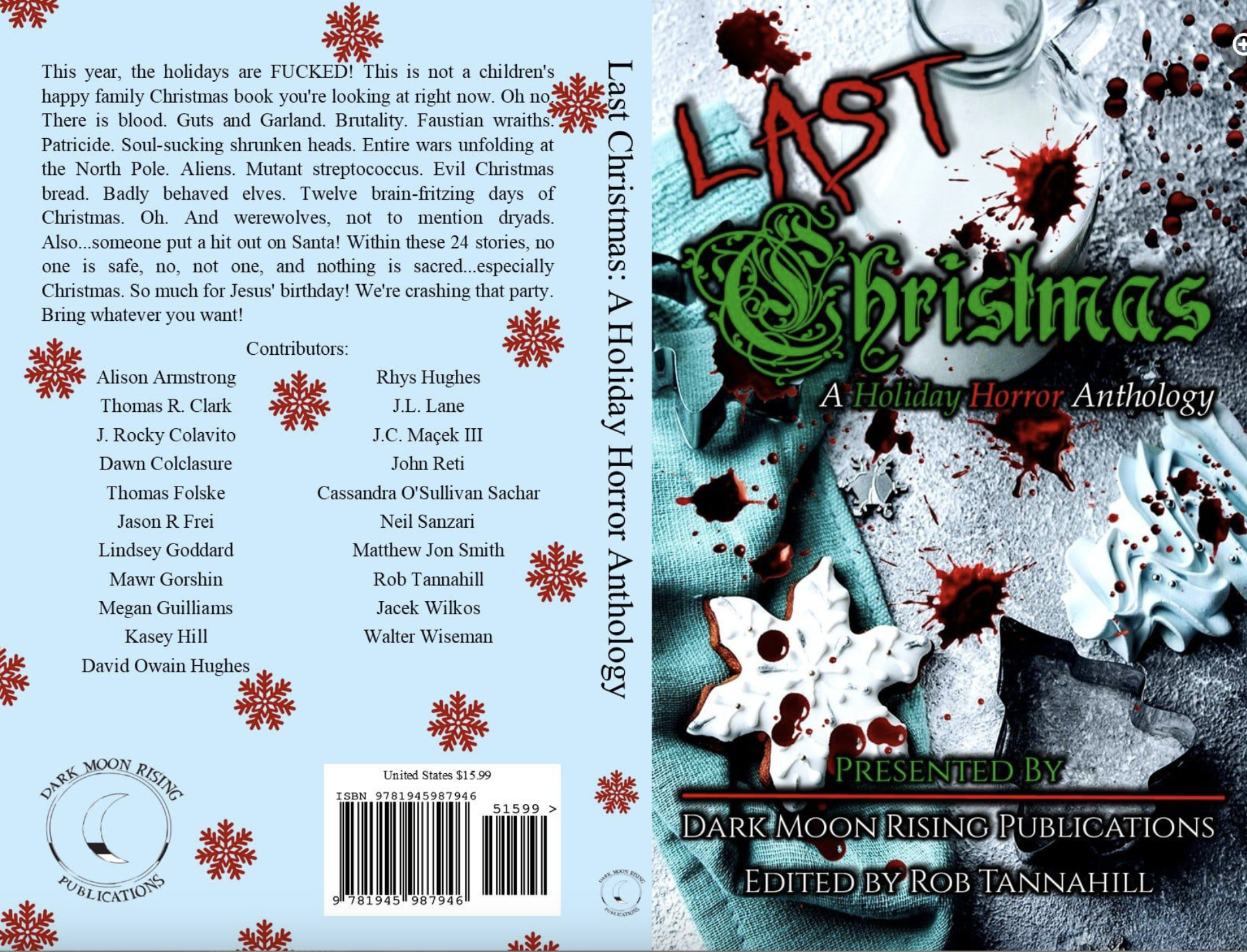
My Short Story, ‘Santa’s Elves,’ is Published in the ‘Last Christmas’ Horror Anthology

I have a horror short story, ‘Santa’s Elves,’ published in Last Christmas: A Holiday Horror Anthology, from Dark Moon Rising Publications, and edited by Rob Tannahill. The book is currently published in paperback on Amazon. It’s just $15.99. ($3.14 on Kindle.) It’s also available on Godless for $2.99.

My story is about Chinese toy factory labourers who have to work extra hard in December to make toys for the children of rich families in the West. They already work long hours almost every day for barely enough pay to live and/or to send to their families, who live far away from them and so they rarely ever see them. A divine presence from the heavens senses their inner cries for help, and when they make their toys this year, something…lethal…will be added to them, to give those Western families quite a surprise.

There are lots of other great authors whose work is featured on these pages. Please check the back cover in the photo given above to see their names (I hope you can get the image big enough to read them all). Here’s a cool promotional video you can watch.

Please go and buy yourself a copy of this collection of cool Christmas horror stories. You’ll love it! Happy holidays! 🙂

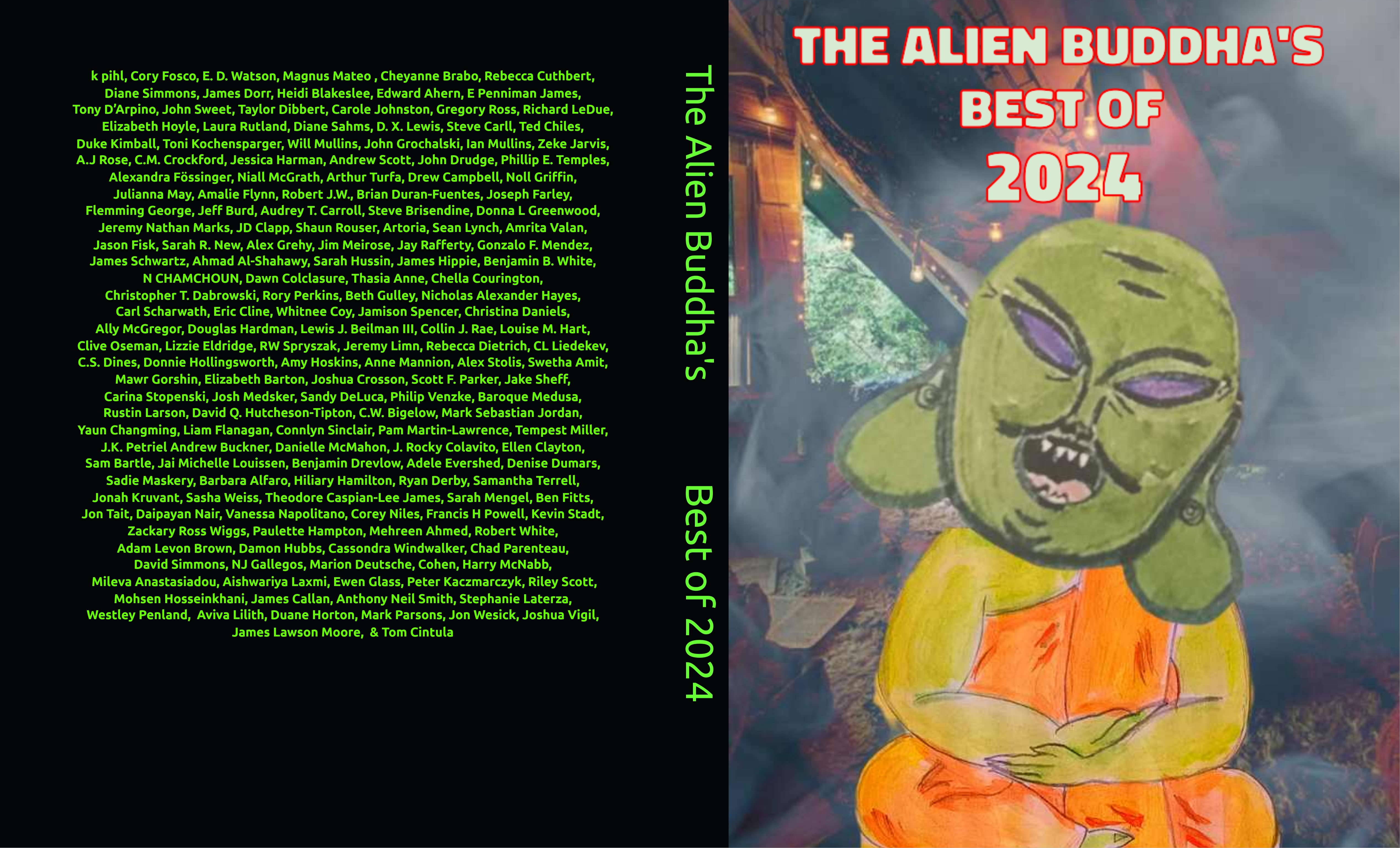
The Alien Buddha’s Best of 2024 is Published!

The Alien Buddha’s Best of 2024, which includes Chapter Eight of my novella, The Targeter, is now published on Amazon.

Chapter Eight of my novella is a reverie of the titular character, ‘The Targeter,’ actually named Sid Arthur Gordimer, who is drunk and high on a combination of marijuana, ecstasy, and ketamine. His thoughts drift back and forth in his reverie of being a prince in a mansion watching half-naked strippers dancing to electronic music in a party, then of being in a royal palace with Indian music. 

His parents, the king and queen, are pressuring him into taking on the responsibilities of the crown…but of course, this is all just the reverie of a drunk, stoned man. Outside of Sid’s apartment, in the real world that he’s trying to escape with booze and drugs, a war is going on. Bombs and gunfire can be heard outside. The war has the potential of going nuclear, and he in his despair cannot face it sober.

He knows he’s no saint, and no prince. He’s a goner.

Please check out this collection of the work of so many talented writers (check the list of names on the back cover, if you can enlarge it sufficiently). And please check out my novella. If you like Chapter Eight, you’ll love the rest of it! 🙂

The Tanah–Translator’s Introduction

[The following is the first of many posts about a fictitious discovery of ancient manuscripts of a religious text of narratives and magic spells. Its purpose for my readers and me is to provide a cosmology and mythography on which I am basing much, if not most, of my fiction–short stories and novels. If anyone is interested in reading this fiction, he or she can use these blog posts as references to explain the nature of the magic and universe in my fiction.]

The manuscripts translated here were discovered in archaeological digs in northeastern Europe ten years before this writing. My colleagues and I have since been at work deciphering and translating this ancient text, a laborious, painstaking task that is still far from finished. These manuscripts, fragments full of lacunae, constitute only a portion of what has been unearthed; the translation of more texts is still underway, and ongoing digs just southwest of the Baltic region are expected to yield still more texts. This current publication is meant only as a taste of what is to come.

The manuscripts were found among the ruins, relics, and skeletons of an ancient Slavonic tribe; the writings are dated at about the first century CE. We say the tribe was Slavonic, but the language is far removed from that. In fact, the written script is unlike any known anywhere on Earth; one of our translating team even joked that The Tanah, as these writings are collectively known, is the product of extraterrestrials!

Now, the language seems outlandish, but the cultural attitudes expressed in that language reveal The Tanah‘s undoubtedly terrestrial origins. As one reads through its chapters and verses, one discovers the usual ancient, pre-scientific assumptions and prejudices, which skew and limit the expression of The Tanah‘s otherwise formidable wisdom.

The writers of The Tanah assume, for instance, that women’s main use of its spells should be to augment their physical beauty, help them find a husband, and acquire power and influence through ‘feminine wiles.’ Since its spells are of a paradoxical, dialectical nature, women are advised to use them to gain power through taking on a ‘submissive role.’ Curious.

Still, a surprising thing about The Tanah is that, in spite of these ancient presumptions about the world (a flat Earth in a geocentric universe, the chauvinistic belief in the superiority and centrality of the tribe owning The Tanah), there are also ideas about the world that, interpreted metaphorically, seem uncannily to anticipate certain insights in modern physics.

Examples of such scientific anticipations include what the texts call “Cao,” the undulating, unifying oneness of the entire universe, and the “Pluries,” the same atomic unifying reality that Cao is, but expressed in the form of an endless shower of particles, coming down like rain, hail, snow–some kind of precipitation. Since The Tanah is all to be read as allegory and metaphor, rather than as literal history, Cao and the Pluries could be understood to symbolize particle/wave duality.

Now, despite all of this apparent predicting of scientific ideas millennia ahead of their time, the texts are still essentially poetry, using the most vivid and striking imagery. Our translation does the best it can here, but as with any, much is inevitably lost in translation. There are nuances and multiple meanings in so many of the words of the original language that their ‘equivalents’ in English–or in any language, for that matter–can never bring out. Indeed, to cover all of those extra meanings of each word would require commentaries several times the size of the original texts and their translations.

The word “Cao” alone means so many things at once. “Oneness,” “infinity,” “universe,” “sea,” “ocean,” “waves,” “fundamental,” “void,” “chasm,” “nothing,” “everything,” and “all,” among many others. Similarly, “Pluries” can mean “particles,” “atoms,” “rain,” “precipitation,” “tears,” “snow,” “hail,” “sand,” “dust,” “ants,” “germs,” “plurality,” etc. The language these texts is written in is a most eccentric, idiosyncratic one. In reading any image used in the poetry and narratives, one must pause a moment and consider every possible association to be made with said image, just to begin to grasp the meaning of it in its fullness and totality.

If the reader finds it jarring to know that “Cao” can mean “nothing” and “everything” at the same time, he or she should bear in mind that this mystical concept has dialectical, yin-and-yang-like qualities. The imagery of the waves of the ocean that are associated with Cao suggest a dialectical shifting up and down, back and forth, between all the pairs of opposites, including every level between those crests and troughs, thus to embrace all things in the universe. This is an everything so comprehensive that it even includes nothing.

Cao represents that everything as understood as a oneness, whereas the Pluries represent everything as a plurality. Attempts at etymologies of these two mystical words suggest that “Cao” may be cognate with a composite of Greek Chaos and the Chinese Tao, though this latter derivation seems a bit of a stretch, given how far removed geographically Chinese culture and language were from where these texts were found, as well as the fact that “Tao” is modern Mandarin, not ancient Chinese. Still, Cao has both the mystical properties of Chaos and the Tao, so while the associations are probably just coincidental, they’re also fortuitous and appropriate.

Similarly, a speculative etymology of “Pluries” implies that the word is cognate with a combination of the Latin pluere, from which we also get the French word pleuvoir (“rain”), and the Latin pluralis, plures, and pluria (“plural”). Again, though, as with our speculative derivations of “Cao,” the surety of these etymologies is rather shaky and limited, given the geographic region from which we’ve found these texts. One would expect a Slavonic tribe to use a language more directly connected with actual Slavic roots. Then again, what is so fascinating about these texts is how mysterious they are: is this language an alien one after all? The written script is unlike any found on this Earth, as mentioned above.

So anyway, Cao and the Pluries are the source of all creation in the universe, as a unity and as a plurality. Not only does the natural world come from these two sources, but the supernatural, and all of magic, derive from them, too, hence the inclusion of many spells, which invoke Cao and the Pluries, and their creative power.

Cao and the Pluries aren’t the only ‘deities’ (if that’s what they are to be called) that are invoked in the many magic spells of The Tanah. Four particularly important ‘deities,’ or rather ‘basic forces,’ which is a better translation of dvami, are what the manuscripts call the “Crims” (krimso). These are the four elements: Priff (water, the first and most natural element to emerge from the watery Cao and Pluries), Nevil (fire, the first spark of passion and desire [Hador], causing the light of day [Dis] to emerge from the darkness of night [Noct]), Weleb (air, a thinning and diluting of all matter to near nothingness), and Drofurb (earth/stone, a return to the condensing of matter, yet going beyond liquid to a freezing [Calt] and solidifying of it).

Note how the Crims can be paired into dialectical opposites, with Priff and Weleb, then Nevil and Drofurb. The first two are everything (i.e., near Cao) and nothing (or near nothing). The latter two are the heat of desire vs. the cool of calmness. These two pairs of opposites move from the one to the other, then back again, like the crests and troughs of the universal ocean that is Cao itself, dialectical shifts from one extreme to the other.

The ensuing narratives also demonstrate a cyclical, dialectical shift from one extreme to its opposite, then back again, with every intermediate point expressed, too, in a shifting back and forth between opposites of many, varying manifestations. A journey out of slavery and into freedom, a mass exodus of a people out of an oppressive nation in which the masters pursue the slaves, reminds one of the Moses story.

A discussion of how to use the spells ethically versus unethically comes next. One must exercise discipline and responsibility in using the magic, for good, knowledge, and enlightenment; warnings are given against using the spells for selfish ends.

Again, in The Preaching and Proverbs, it is advised to use restraint and to be responsible in applying the magic. There is an urgent sense that warnings must be given repeatedly in The Tanah against using the magic for evil, since the writers correctly anticipate their warnings to go unheeded most of the time.

I find it fortuitous that the name of this collection of manuscripts sounds, however unintentionally and unwittingly, like a double pun, first on the Tanakh, or Hebrew Bible, with its laws and injunctions as to its moral use, and second on the Buddhist concept, given in the Pali tongue, as taņhā (“thirst,” “desire”). There’s no reason to see an etymology of tanah coming from such divergent languages, of course; but imagining such wordplay in the two words seems apt, in spite of such an improbable intention, given The Tanah‘s dialectical shifts back and forth between ethical and unethical uses.

The Lyrics are a series of verses that are magical incantations for the purpose of achieving a vast array of fulfillments of personal desires and wishes. Many of them involve causing harm to people in various ways, such as capturing souls and imprisoning them in jars, or when releasing them, they become ravenous beasts. Others involve various ways of taking control of people’s bodies, or taking a soul out of one body and putting it into another. Since such spells can be, and typically are, used in abusive ways, it is easy to see why so much is said elsewhere in The Tanah about refraining from the temptation to use these spells.

The Amores are a series of spells meant to aid the user who is in love, or who lusts after another…or many others. These spells aid in such things as maintaining youthful beauty, shaping one’s body into a more pleasing form, ensuring pleasant body odours in all the crevices of the body, preventing pregnancy or the transmission of venereal diseases, and using mind control to manipulate a love object into loving one back.

Again, warnings are repeatedly made in The Tanah to be at least extremely careful in the use of these spells, if not to refrain from ever using them, since in the use of any of them, not only is there the risk of harming the object of the spell, there’s the risk of harming the user of the spells, too, in the form of bad karma.

One way the spells work is through achieving one goal by way of its opposite. The spells thus exploit the dialectical unity of opposites. So, for example, if a woman wishes to have absolute control over a man she loves, she can do so by, ironically, being excessively submissive to him. This tactic has been used many times throughout history according to The Tanah, usually by women, and the beauty of this use of the spells is that they won’t work karmically against the user, since he or she has already exploited that opposite that would otherwise come eventually to plague the user.

The key to understanding not just the magic spells, but the entire philosophy, mythology, and cosmology of The Tanah as a whole, is to grasp that the whole universe must maintain a sense of balance. If things shift one way, they must shift the other way sooner or later. Those who fail to understand this sense of balance are typically those who misuse the spells for selfish ends. The shifting out of, and then back into, balance by means of opposing directions is the basis of understanding the Troughs and Crests of history, dealt with in the section of The Tanah called “The Future.”

Troughs, when the waves of Cao are at their lowest, represent the bad times of history. Crests, Cao’s waves when at their highest, are history’s good times. The next two books, having these titles, deal with these prophecies of good and bad.

Since the good prophecies are grouped together, as are the bad prophecies, rather than arranging them as alternating with each other, it is difficult to know which prophecy–good or bad–represents the end of the world. And since, as has been noted above, these prophecies exist in the form of allegorical tales rather than straightforward narrative prose, it is even more difficult to tell if the tale representing the apocalypse is a happy or unhappy one.

There is also a group of apocryphal texts, ones of uncertain authority, but which have been considered wise and instructive for the responsible practitioner of magic. These are also allegorical tales.

Now, as a closing note, a discussion of the verse styles should be given, if only in passing, since only a thorough study of the ancient language, beyond the scope of this translation and commentary, can do justice to the goldmine of literary, poetic beauty of the writing, as well as the multiple and nuanced meanings that are sadly lost in translation, as noted above.

Indeed, our English translation inevitably obscures, for example, the muscular metric rhythms, which can only ever so occasionally be approximated in the English, though we’ve tried our best. As for the imagery, we’ve managed, more often than not, to be able to bring out its structured use, with regular patterns of thesis/negation/sublation, usually given in a wavelike pattern of t-s-n-s-t…and so on in the same way.

As for whether or not the user of the magic spells needs to worry about their potentially adverse effects, well, we translators haven’t seen such effects…not yet, anyway.

Garrison Mauer, PhD, Professor of Religious Studies, McMaster University, Hamilton, Ontario, December 2024

Analysis of ‘Howl’

I: Introduction

“Howl” is a poem by Allen Ginsberg, written in 1954-1955 and dedicated to Carl Solomon, hence it’s also known as “Howl for Carl Solomon.” It was published in Ginsberg’s 1956 collection, Howl and Other Poems.

“Howl” is considered one of the great works of American literature. Ginsberg being one of the writers of the Beat Generation, “Howl” reflects the lifestyle and preoccupations of those writers–Jack Kerouac, William S. Burroughs, Neal Cassady (“N.C., secret hero of these poems”; also, “holy Kerouac […] holy Burroughs holy Cassady”), etc.

The preoccupations of the Beat Generation writers included such subculture practices (as of the conservative 1950s, mind you) as drug use, homosexuality, free love, interest in non-Western religions, etc. Such practices are described with brutal, uncensored frankness in “Howl,” hence the poem was the focus of an obscenity trial in 1957.

Here is a link to the entire poem, and here is an annotated version of it (without the ‘footnote’).

The very title of the poem, one that gives vivid description to so much suffering, must be–on at least an unconscious level–an allusion to the final scene in King Lear, when the grieving king enters, carrying his freshly executed daughter, Cordelia. He calls out “Howl, howl, howl, howl! O, you are men of stones!” As in “Howl,” King Lear demonstrates, as I argued in my analysis of the play, that in the midst of so much suffering and loss, one can also gain something: Lear loses everything, but he also gains self-knowledge. Similarly, “the best minds of [Ginsberg’s] generation” suffered much and engaged in much self-destruction, but they also searched for forms of spiritual enlightenment, as I’ll demonstrate below. By the ‘footnote‘ section of the poem, we’ll find Ginsberg gaining that “Holy!” enlightenment.

II: Part I of the Poem

Now, “the best minds of [Ginsberg’s] generation” were those Beat Generation writers and their socially non-conforming ilk, engaging in all the wild behaviour we associate with them–doing drugs, having promiscuous sex, etc. As a result, they have been “destroyed by madness,” and have been “starving hysterical naked.”

“Naked” could be a reference to illicit sex, but it more likely refers to a lack of possessions in general, as the word is used in Hamlet, Act IV, Scene vii (in which Hamlet writes, in a letter to Claudius, “I am set naked on your kingdom.”). After all, these “best minds” are “starving hysterical naked.” Their wildness comes in large part because of their poverty, the cause of which, in turn, is an issue I’ll delve into in more detail later.

These drug addicts are going “through the negro streets at dawn looking for an angry fix”, yet in spite of their Dionysian sinfulness, they’re also “angelheaded hipsters burning for the ancient heavenly connection”. They seem to be offering their own idiosyncratic interpretation of Luther’s injunction to “sin boldly.”

Indeed, there is a duality permeating these pages, cataloguing on the one hand sin, obscenity, and excess, and on the other, a search for spirituality and salvation. They are in “poverty and tatters […] high […] smoking” and “contemplating jazz,” for this music was an important soundtrack to the lives of the Beats, as one can note many times reading Kerouac’s On the Road. Yet they also “bared their brains to Heaven under the El and saw Mohammedan angels…”

The El is the elevated train in New York, but it’s also a Hebrew name for God. Note also that the words “Mohammedan” and “negro” were being used here before they were considered unacceptable. Ginsberg’s reference to the Muslim faith is one of many examples of the Beats taking spiritual inspiration from non-Western sources. Some Beats having hung out in Tangiers (in the International Zone in particular) can, in part, be seen as an example of this influence.

The use of “who” beginning many of the long lines of this first part of “Howl” is paralleled with the refrains of “Moloch” in Part Two, “I’m with you in Rockland” in Part Three, and “Holy” in the ‘footnote.’ “Who” reminds us that the subject of Part One, an almost interminable sentence, is Ginsberg’s beatnik friends. The refrains of the other three parts also, of course, remind us of their respective subjects, an explanation of which will come when I get to those parts below.

Special attention should be given to Ginsberg’s use of long lines, something he derived from Walt Whitman, whose non-conforming behaviour (including homosexuality) could make him a kind of Beat Generation poet of the 19th century. One could compare these long lines to the sometimes lengthy verses of the Bible, giving Whitman’s and Ginsberg’s poetry a near-sacred feel, in spite of (or perhaps because of) its sensuality (recall in this connection the sensuality of the Song of Solomon… could the dedication to Carl Solomon be linked to this Biblical association?).

Long lines are oceanic, inclusive, requiring deep breaths to take in everything before expressing everything. They are universal because the poetry of Whitman and Ginsberg is universal: these two men are bards of Brahman, seeing holiness in everything (read Ginsberg’s “footnote” to see what I mean). The two poets embrace all religious traditions, like Pi, but they also reject the limitations of any one religious tradition or dogma. These long lines, in including everything but eschewing the rigidity of traditional short and exact metres, exemplify the same paradox in poetry.

In “Blake-like tragedy”, we find another example of a spiritual non-conformist in whom Ginsberg found inspiration. I discussed William Blake‘s unconventional approach to Christianity in the “Jerusalem” section of this analysis of an ELP album.

Ginsberg was once “expelled from the academies for crazy […] obscene odes…”, that is, he was kicked out of Columbia University for writing obscenities on his dorm room window. His friends “got busted in their pubic beards returning through Laredo with a belt of marijuana for New York,” that is, they were caught in Laredo with weed stashed in their underwear.

They “ate fire” and “drank turpentine in Paradise Alley…”, referring to the ingesting of toxic substances (drugs and alcohol) in a slum in New York City, full of run-down hotels, brothels, and dope dealers. Nonetheless, in a poem, Paradise Alley also has heavenly associations, and thus in this line we have another juxtaposition of the sinful with the spiritual.

Those readers who may have difficulty reconciling my close associating of sin with mysticism should take into account the idea of the dialectical unity of opposites, an idea I’ve symbolized with the image of the ouroboros in a number of blog articles. Two extreme opposites meet, or phase into each other, where the serpent’s head bites its tail, and all intermediate points are found in their respective places along the middle of the ouroboros’ body, coiled into a circular continuum.

Applied to “Howl,” this means that the harshest Hell phases into the highest Heaven and vice versa. One cannot understand this idea while adhering to traditional Christian dogma and its literal reading of an eternity in either Heaven or Hell. My interpretation of the ‘afterlife’ is metaphorical. In our moments of darkest despair, we often see the light and come out the other side (“It’s always darkest before the dawn.”); this is what Christ‘s Passion, harrowing of Hell, and Resurrection symbolize. Note also that those who rise to the highest points of pride tend to fall, as Satan and the rebel angels did. Finally, keep in mind the BeatitudesMatthew 5:4 and 5:11-12 in particular.

This Heaven/Hell dialectic can be seen in the four parts of “Howl.” This first part is the Hell thesis, with the second, “Moloch” part representing the Satanic cause of that Hell; the “Rockland” third part is the Purgatory sublation (though therapy in an insane asylum must be judged to be a remarkably ill-conceived purging of sin), and the “footnote” is the antithesis Heaven that stands in opposition to this present first part.

In this way, we can see “Howl” as Ginsberg’s modern Beat rendition of Dante‘s Divine Comedy. And just as Dante’s Inferno is the most famous first part of his epic poem, so is the infernal first part of “Howl” the most famous part, with its emphasis on human suffering. Similarly, Pasolini‘s Salò, with its sections divided up into Circles of Manias, Shit, and Blood–like Dante’s nine circles of Hell–is also focused on suffering, sin, and sexual perversity.

To come back to the last line discussed before my dialectical digression, and to link both discussions, this inferno part makes fitting reference, in this line, to the paradiso of Paradise Alley and the purgatorio of the “purgatoried […] torsos”. These torsos may be purged of sin through the ingesting of alcohol and drugs, or through sex (“pubic beards”, “torsos”, and “cock and endless balls”).

Just as there’s a dialectical unity of Heaven and Hell (i.e., one must go through Hell to reach Heaven, as Jesus did, the passing through the ouroboros’ bitten tail to get to its biting head), so is there also a dialectical unity of sin and sainthood (i.e., one uses drugs or sexual ecstasy to have mystical visions or spiritual ecstasy). The fires of Hell are those of desire, in samsāra; blowing out the flame leads to nirvana. The Mahayana Buddhist tradition, however, sees a unity between samsara and nirvana–the fire is the absence of fire…Heaven is Hell. The Beats, in their excesses, understand these paradoxes.

Part of those Dionysian excesses are, as mentioned above, the alcohol and drug abuse (“peyote” and “wine drunkenness over the rooftops”). Similarly, the Beats were “chained […] to subways for the endless ride from Battery to holy Bronx on benzedrine“, that is, they were so high on the benzedrine that they were frozen from doing anything while on their endless joyride on the subway, “chained” to it, all the way from Battery to the Bronx. Note how the Bronx is “holy”: in their sinful indulgence on drugs, the beatniks attain sainthood in the Bronx.

At Fugazzi’s…Bar and Grill, at 305, 6th Ave. in New York City?…they are “listening to the crack of doom on the hydrogen jukebox”. In Macbeth, “the crack of doom” is the end of the world, and a “hydrogen jukebox” suggests the hydrogen bombs that had been created, recently as of the writing of “Howl,” a bomb whose destructive power, greater than the original atomic bomb, can bring us even closer to “the crack of doom.”

Ginsberg and company, however, are getting wasted listening to music–jazz, presumably, on the jukebox. They are creating their own armageddon of drunken self-destruction. That end of the world, though, is followed by the Kingdom of God: the beatniks, in their rejection of the conservative values of the nuclear family, are getting nuclear bombed drunk; and the hellish fires of “the crack of doom,” the ouroboros’ bitten tail, will be passed through to attain the heavenly Kingdom of God, the serpent’s biting head.

The dialectic is manifested once again in how this “lost battalion of platonic conversationalists” are “jumping down the stoops off fire escapes off windowsills off Empire State…” Since sorrows “come not single spies but in battalions,” it’s easy to see them leading to despair and suicide. Yet the beatniks would express platonic ideals in philosophical discussion, an Apollonian trait; of course, in true Dionysian fashion, they would also jump off of buildings to their deaths to escape the egoistic experience for that of the oneness of Brahman.

Thus, the juxtaposition of jumping suicides with platonic conversation is a case of “whole intellects disgorged […] for seven days and nights”…the seven days and nights of Biblical creation, ending in a day and night of rest–that Heaven of intellectual bliss? It’s fitting to include the Sabbath–“meat for the Synagogue”, since Ginsberg was Jewish.

Indeed, the Beats return from debauchery to spirituality in not only the Synagogue, but also “Zen New Jersey”, “suffering Eastern sweats and Tangerian bone-grindings and migraines of China under drunk withdrawal”. We’re reminded of the Opium Wars, the victimizing of China under Western imperialism, and maybe the jumping “off Empire State” is Ginsberg’s rejection of that very imperialism.

These hipsters “studied Plotinus Poe St. John of the Cross telepathy and bop kabbalah because the cosmos instinctively vibrated at their feet in Kansas”. Plotinus was a neoplatonist who believed that all of reality is based on “the One,” a basic, ineffable state beyond being and non-being, the creative source of the universe and the teleological end of all things. St. John of the Cross was a Spanish mystic and poet who wrote The Dark Night of the Soul, both a poem and a commentary on it that describe a phase of passive purification in the mystical development of one’s spirit.

What’s interesting here is how Ginsberg sandwiches, between these two writers of spiritual, philosophical matters, Edgar Allan Poe, also a great writer, but one whose death at the relatively young age forty was the self-destructive result of alcoholism, drug abuse, and/or suicide, his last moments having been in a delirious, agitated state with hallucinations.

Though St. John of the Cross hadn’t intended this meaning, “the dark night of the soul” has the modern meaning of ‘a crisis in faith,’ or ‘an extremely difficult or painful period in one’s life.’ The combining of these three writers in the above-quoted line in “Howl” suggests a dialectical thesis, negation, and sublation of them respectively: the wisdom of philosophy (Plotinus), the destructiveness of the Dionysian way (Poe), and a combination of passive mystical purification with a spiritual crisis and a painful time in life (St. John of the Cross).

Such an interpretation dovetails well with the Heaven and Hell, saintly sinner theme I’ve been discussing as running all the way through Ginsberg’s poem. The juxtaposition “bop kabbalah” continues that theme, with “bop” representing the contemporary jazz that he and his beatnik pals were grooving to while drunk or stoned, and “kabbalah” representing Jewish mysticism, a fitting form of it for Ginsberg.

This “bop kabbalah” dialectic is further developed in how “the cosmos instinctively vibrated at their feet in Kansas,” since Kansas was the Mecca of jazz and bebop for hipsters at the time; and a ‘vibrating cosmos’ suggests the oceanic waves of Brahman, or Plotinus’ One. The hipsters were also going “through the streets of Idaho seeking visionary Indian angels…”, even more of a juxtaposition of the common and the cosmic.

They’d be “seeking jazz or sex or soup”, and they would “converse about America and Eternity”. These hipsters led bohemian lives, but also wanted to know the rest of the world, so by “America” it is not meant to be only the US but also Latin America–the Mayan ruins of Mexico. To escape the evil of American capitalism, Ginsberg “took ship to Africa”. These are examples of the Beats immersing themselves in the wisdom of other cultures. The protesting of capitalism is part of the basis of the Beats’ destructive Dionysian non-conformity; hence, they “burned cigarette holes in their arms”.

Note how the Beats’ protesting of “the narcotic tobacco haze of capitalism”, having “distributed Supercommunist pamphlets” would have been done in 1950s America, at a time of welfare capitalism, higher taxes for the rich, and strong unions. Imagine the passion the Beats would have had distributing “Supercommunist pamphlets” in today’s neoliberal nightmare of a world!

They “bit detectives in the neck”, those protectors of private property and the capitalist system. Recall how Marx compared capitalists to vampires, as Malcolm X called them bloodsuckers; Ginsberg’s vampire-like Beats biting cops’ necks is indulging in amusing irony here. After all, he insists that the Beats’ non-conforming sexuality and intoxication are “committing no crime”. They “howled on their knees in the subway […] waving genitals…”

More obscenity and saintliness are merged when Ginsberg says they “let themselves be fucked in the ass by saintly motorcyclists and screamed with joy.” This line in particular got him in trouble with the law, though in the end, “Howl” was ruled to have “redeeming social importance.” Similarly, the Beats “blew and were blown by those human seraphim”, and “balled in the morning in the evening […] scattering their semen freely…”

When a “blond and naked angel came to pierce them with a sword”, we see an allusion to The Ecstasy of St. Teresa, a fusion of sexual ecstasy with spiritual ecstasy.

Now, “the three old shrews of fate” who have taken away the Beats’ boy lovers are the Moirai. These can be seen to personify the kind of conformist, nuclear family that the Beats are rebelling against. Each shrew is one-eyed, for in her conformity, she cannot see fully. One is “of the heterosexual dollar”, a slave to the capitalist, patriarchal family, and in her complaining of her lot in life, she seems shrewish. One shrew “winks out of the womb”, since by limiting her life to that of a career mother, she also sees little. The last shrew “does nothing but sit on her ass and snip the […] threads of the craftsman’s loom”; she is Atropos, who in cutting the thread ends people’s lives, yet in limiting herself to doing traditional women’s work, she’s ending her own life, too.

The Beats “copulated ecstatic and insatiate […] and ended […] with a vision of ultimate cunt and come eluding the last gyzym of consciousness”. Here again, we see Ginsberg uniting the sexual with the “ecstatic” spiritual: in “ultimate cunt”, we have a fusion of the final with the beginning of life; similarly, “come” and “gyzym” would begin life, yet here we have “the last” of it. The end is dialectically the beginning–the Alpha and the Omega, the eternal, cyclical ouroboros.

Such heterosexual Beats as “N.C.”, or Neal Cassady, “sweetened the snatches of a million girls”. He “went out whoring through Colorado in myriad stolen night-cars”. Indeed, a reading of On the Road will reveal how Cassady (i.e., Dean Moriarty) did exactly this.

When it says that the Beats “ate the lamb stew of the imagination”, since there’s so much juxtaposition of sensuality with spirituality in “Howl,” I suspect that “lamb” here refers at least in part to the Lamb of God. Ginsberg may have been Jewish, but as a Beat poet, he would have been interested in religious and spiritual traditions outside of his own. The ‘eating of the lamb stew of the imagination’ would thus be yet another example of “Howl” fusing the sensual and the spiritual.

The Beats were “under the tubercular sky surrounded by orange crates of theology,” yet another example of such fusions, as is “rocking and rolling over lofty incantations”. They “threw their watches off the roof to cast their ballot for Eternity outside of Time,” indicating a preference of the transcendent over the mundane; yet they’ve also engaged in suicidal acts, indicating the despair that bars one from entry to Heaven. Such suicidal acts include “cut[ting] their wrists three times successfully unsuccessfully,” as well as having “jumped off the Brooklyn Bridge this actually happened”.

Some Beats were “burned alive in their innocent flannel suits”, an apparent allusion to The Man in the Gray Flannel Suit, by Sloan Wilson, another Beat book. One Beat, Bill Cannastra, was with those “who sang out of their windows in despair, fell out of the subway window”: Cannastra died drunkenly trying to exit a moving subway car.

Some “danced on broken wineglasses barefoot”. Some went “journeying to each other’s hotrod Golgotha jail-solitude watch or Birmingham jazz incantation”. Again, we see a merging of the sensual (“wineglasses,” “jazz,” “hotrod”) and the spiritual (i.e., the Christian imagery of “Golgotha”), as well as a fusion of salvation (Christ’s crucifixion at Golgotha, the place of the skull) and condemnation (“jail”).

The Beats hoped, in their travels, “to find out if I had a vision or you had a vision or he had a vision to find out Eternity”. They were often in Denver, as Kerouac and Cassady were (represented by Sal Paradise and Dean Moriarty, respectively) in On the Road. All of the drinking and partying therein is Dionysian mysticism, if properly understood.

For in spite of how antithetical this drunken partying may seem to the spiritual life, the Beats also “fell on their knees in hopeless cathedrals praying for each other’s salvation”. The cathedrals were “hopeless” because there’s no salvation in conventional, orthodox religion.

So instead, they “retired to Mexico to cultivate a habit, or Rocky Mount to tender Buddha or Tangiers to boys […] or Harvard to Narcissus…” Alternative forms of spirituality may have been Buddhism (consider Kerouac and The Dharma Bums), or the dialectical opposite of spirituality, indulgence in drugs or pederasty, or a generally narcissistic attitude. In any case, the “hopeless cathedrals” would never have sufficed for the Beats.

Just as there’s a fine line between Heaven and Hell as described in “Howl,” so is there a fine line between genius and madness here. Ginsberg has celebrated the inspired creative genius of Kerouac, Cassady, Burroughs…himself in this very poem…and others. Ginsberg has demonstrated many of the acts of madness of the Beats. Now we must examine the attempts ‘to cure’ madness.

Now, what must be emphasized here is that it’s not so much about curing mental illness as it is about taking non-conforming individuals and making them conform. Recall that at this time, the mid-20th century, homosexuality was considered a form of mental illness. The proposed cures for these ‘pathologies’ were such things as lobotomy, “Metrazol electricity hydrotherapy psychotherapy occupational therapy pingpong…”

Recall that “Howl” is dedicated to Carl Solomon, who voluntarily institutionalized himself, “presented [himself] on the granite steps of the madhouse…” Solomon, mental institutions (what Ginsberg calls “Rockland”), and pingpong will return in Part Three of this poem.

The psychotherapy in these mental institutions will include such fashionably Freudian ideas as the Oedipus complex, as we can see in Ginsberg’s line about “mother finally ******”. The ultimate narcissistic fantasy, about sexual union with the mother, Lacan‘s objet petit a, has to have a four-letter word censored, for a change in this poem, since it’s a gratification too great for even Ginsberg to discuss directly: “ah, Carl, while you are not safe I am not safe…”

Still, while mired not only in madness but, worse, also in the prisons of psychiatry–those cuckoo nests–these incarcerated Beats can still experience the divine. They have “dreamt and made incarnate gaps in Time and Space […] trapped the archangel of the soul […] jumping with sensation of Pater Omnipotens Aeterna Deus…”

This connection with the divine is achieved through the use of language, a kind of talking cure, entry into the cultural/linguistic world of Lacan‘s Symbolic, as expressed in Ginsberg’s poetry and the prose of Beats like Kerouac and Burroughs. They’ll use “elemental verbs and set the noun and dash of consciousness […] to recreate the syntax and measure of poor human prose…”

The Beats are thus a combination of “the madman bum and angel beat in Time,” a marriage of Heaven and Hell (recall the “Blake-like tragedy” above), the best and the worst, “speechless and intelligent and shaking with shame,…” They “blew the suffering of America’s naked mind for love into an eli eli lamma lamma sabachthani saxophone cry…” In this, we see how the Beats combine jazz sax partying with suffering, despair, Lamb-of-God salvation and love.

“Howl” describes the individual experiences of men like Cannastra, Cassady, Kerouac, Solomon, and Ginsberg as if all the Beats had experienced them collectively, since in their solidarity of non-conformity, they felt the Dionysian unity, Plotinus’ One, Brahman’s nirvana. Ginsberg will feel that solidarity with Solomon in Part Three, but first,…

III: Part II of the Poem

Note how Moloch is described as a “sphinx of cement and aluminum” who “bashed open [the Beats’] skulls and ate up their brains and imagination”. Moloch, an ancient Canaanite god depicted in the Bible and understood to have been one requiring child sacrifice, is a Satanic figure in “Howl,” the Devil responsible for the Inferno of Ginsberg’s Divine Comedy here. But what does this Satanic figure in turn represent?

The “sphinx of cement and aluminum” that is also “Filth! Ugliness! Ashcans and unobtainable dollars” is modern-day industrial capitalism. Children are sacrificed to this Moloch, this Mammon of money, by having their skulls bashed open and their brains and imagination eaten. In our education systems, children’s energy, individuality, and creativity are all stifled and replaced with obedience and conformity, that energy redirected towards making money for the Man, never for the people, for whom it’s “unobtainable.”

The “Solitude” of Moloch is alienation, the lack of togetherness among people, which has been replaced by cold-blooded competition. This had led to “Children screaming under the stairways!”

In this second part–instead of the preceding part’s long lines ending in commas, which suggested an ongoing problem seemingly without end, the hopelessness of eternal infernal punishment–we have lines ending in exclamation points, to express the rage Ginsberg feels against an economic system to which we all feel we’ve had to sell our souls. Small wonder the non-conforming Beat writers were going mad in a drunken, Dionysian frenzy.

Moloch is an “incomprehensible prison!” It’s a “soulless jailhouse and Congress of sorrows! Moloch whose buildings are judgment! Moloch the vast stone of war! Moloch the stunned governments!” Ginsberg recognizes, as so many right-wing libertarians fail to do (or are dishonest about not recognizing), that capitalism very much requires a state and a Congress to make laws that protect private property. Government only does socialist stuff when it’s a workers’ state, not the dictatorship of the bourgeoisie, as the US has always been.

These “buildings [of] judgment” that are “the vast stone of war” are symbols of the modern, industrial world. The capitalist government has far too little funding for the poor, for education, for healthcare or for affordable housing, but it has plenty of money for the military. The Moloch government is “stunned” because it’s confused over who should have access to this tax revenue.

The evil industry of capitalism “is pure machinery!” It’s “blood is running money!” Since capitalism in our modern world spills into imperialism, as Lenin pointed out, then it’s easy to see how money can be linked with blood, death, and human suffering in war. Moloch’s “fingers are ten armies!” These are the armies of the Americans who, already in the 1950s, were occupying South Korea, making their women into prostitutes for the enjoyment of the GIs, and making their men fight their brothers and sisters in the north. Moloch’s “ear is a smoking bomb”, like those dropped all over North Korea.

The specifically modern, industrial nature of the capitalism that Ginsberg is excoriating here is found in such lines as this: “Moloch whose skyscrapers stand in the longs streets like endless Jehovahs! Moloch whose factories dream and croak in the fog! Moloch whose smoke-stacks and antennae crown the cities!”

These skyscrapers will be office buildings, places of business, the nerve centres of capitalism. Just as Moloch and Mammon are false gods, so are the “endless Jehovahs” a heathenizing of the Biblical God by pluralizing Him. The irony mustn’t have been lost on Jewish Ginsberg to know that Elohim can be the one God of the Bible as well as the many gods of paganism. Indeed, Judeo-Christianity has often been used to justify capitalism, imperialism, and settler-colonialism.

Moloch’s “love is endless oil and stone!” Note the endless coveting of oil in the Middle East. This would have been evident to Ginsberg as early as 1953, when the coup d’état in Iran happened to protect British oil interests in the region. The indictment against capitalism continues in these words: “Moloch whose soul is electricity and banks!”

Note also that Moloch’s “poverty is the specter of genius!” By “genius,” we can easily read Communism, since European poverty in the mid-19th century inspired the spectre that was haunting the continent.

“Moloch in whom I sit lonely! Moloch in whom I dream Angels! Crazy in Moloch! Cocksucker in Moloch! Lacklove and manless in Moloch!” Again, Ginsberg addresses the problem of alienation caused by capitalism. He also explains in this long line how one resolves the contradiction between sinning and the pursuit of salvation. One “dream[s of] Angels” in a desperate attempt to escape Moloch’s inferno. Still, that very desperation, in finding the escape so impossible, causes one to go “Crazy in Moloch!”

Conservative society’s moralistic condemnation of homosexuality, something gay Ginsberg would have been more than usually sensitive to, reduced his form of sexual expression to mere pornographic language, hence “Cocksucker in Moloch!” Recall Senator Joseph McCarthy‘s vulgar homophobia when he said, back at a time when such language would have been far more shocking, “If you want to be against McCarthy, boys, you’ve got to be either a Communist or a cocksucker.” Of course, the taboo against homosexuality was so aggravated at the time that it would have been so much more difficult for LGBT people like Ginsberg to find love, hence “Lacklove and manless in Moloch!”

“Moloch…entered [his] soul early!” It brainwashed him as a child into thinking he needed to conform to the ways of a capitalist, heterosexual society. He’d later have to work to unlearn all of that poisonous conditioning. “Moloch…frightened [him] out of [his] natural ecstasy!” He had to “abandon” Moloch.

Moloch is an industrial capitalist world of “Robot apartments!” (Imagine how much more robotic they’re becoming now, in our world of smart cities, with AI surveillance.) The “blind capitals! demonic industries!…invincible madhouses!” [to be dealt with in the next part] “granite cocks! monstrous bombs!” are those of a capitalist state, far more totalitarian than a socialist one could ever be.

“They broke their backs lifting Moloch to heaven!” Those phallic skyscrapers are “granite cocks!” Moloch is “lifting the city to Heaven”, with these skyscrapers as Towers of Babel: this tireless, slavelike construction has confused our language, making us incapable of communicating with or understanding each other, more capitalist alienation.

The pain and Hell of Moloch’s Inferno, though, is also in close proximity, as I described above, with the Heaven, the Paradiso, to which the Beats were trying to escape. Hence, “Visions! omens! hallucinations! miracles! ecstasies!” One has mystical experiences of bliss and psychotic breaks from reality at the same time. One thus also has “Dreams! adorations! illuminations! religions! the whole boatload of sensitive bullshit!” One has “Breakthroughs!…flips and crucifixions!…Highs! Epiphanies! Despairs!…suicides!…Mad generation!”

Though this is the Hell of Moloch, there is also “Real holy laughter…!…the holy yells!” The “Howl! Howl! Howl!” of Hell leads to holiness, that passing from the bitten tail of the ouroboros to its biting head. To reach the very best, one must pass through the absolute worst.

Still, some tried to purge the Beats through the dubious mental institutions, and this is where we must go next…

IV: Part III of the Poem

This part of “Howl” is most directly addressed to Carl Solomon, to whom, recall, the entire poem is dedicated–this ‘Song of Solomon,’ if you will. Ginsberg met Solomon in a mental hospital in 1949; he calls it “Rockland” in the poem, though it was actually Columbia Presbyterian Psychological Institute. In fact, among Solomon’s many complaints about Ginsberg and “Howl” was his vehement insistence that he was “never in Rockland” and that this third part of the poem “garbles history completely.”

As much of a fabrication as “Rockland” is, though, we can indulge Ginsberg in a little poetic license. After all, “Rockland” has a much better literary ring to it than “Columbia Presbyterian Psychological Institute,” or “New York State Psychiatric Institute,” or even “Pilgrim Psychiatric Center,” this latter being another psychiatric hospital to which Solomon was admitted.

In any case, maybe the point isn’t so much about Ginsberg being literally, physically with Solomon in the correctly-named mental institution, but rather that the poet was with Solomon in spirit, in solidarity with him, in a metaphorically therapeutic state of being, a true purging of Solomon’s sin and pain, which Ginsberg called “Rockland.” As such, this ‘mental hospital,’ as it were, is the Purgatorio that the actual hospital could never have been. The actual hospital would have just pushed conformity onto Solomon. The solidarity of Ginsberg and the other Beats, being with Solomon “in Rockland,” is the real cure.

So as I see it, the refrain “I’m with you in Rockland” means that Ginsberg was in solidarity with Solomon in his process of mental convalescence, a far better healer than the best shrinks in his actual loony bin. Ginsberg’s love and friendship, as that of all the other Beats, is a therapy to make that of his doctors and nurses seem like wretched Ratcheds in comparison. This part of “Howl” is the Purgatorio because of the Beats, not because of the therapists.

Solomon is “madder than” Ginsberg is, in both senses: more insane, and so voluntarily in a mental institution that the poet is only visiting; and angrier, because of the conformist society he was so at odds with that he chose to be put in the institution.

Solomon “imitate[s] the shade of [Ginsberg’s] mother”, who also had mental health issues, and so Ginsberg’s love for her inspired his empathy for Solomon. Similar empathy can be seen between Ginsberg, Solomon, and all the other Beats, since they were all “great writers on the same dreadful typewriter”–the Beats tended to type, rather than write, their literary works. Recall the caustic words of Truman Capote about the Beats: It “isn’t writing at all–it’s typing.”

Recall how the first part of “Howl” had its lines ending in commas, making it one interminable sentence with only breaths to break it up. The second part had its thoughts ending in a plethora of exclamation marks…endless screaming about the agonies that Satanic Moloch was inflicting on all the Beats. In this third part, however, there are neither commas nor exclamation marks. No periods, parentheses, or dashes, either. There’s no punctuation at all, unless you count the apostrophe in “I’m”. This lack of an indication of pauses suggests a kind of rapid-fire speaking, a frantic dumping-out of words, a therapeutic release of feelings that have been pent up for far too long. Such expression is a true purging of pain.

Now, in direct contrast to this verbal purging, this Symbolic expression of the undifferentiated, ineffable Real, Solomon suffered from the staff of the mental hospitals and their bogus therapy. The “nurses [are] the harpies of the Bronx”. He would “scream in a straitjacket that [he was] losing the game of the actual pingpong of the abyss.” I assume that a pingpong table was provided in Solomon’s hospital, in an abortive attempt to allow the patients to enjoy themselves.

He would “bang on the catatonic piano”, trying and failing to express himself artistically on instruments presumably also provided by the hospital. The immobility of catatonia, a perfect metaphor for the lifelessness of the patients, results in discords ‘banged on the piano’ instead of flowing, expressive music.

One’s innocent soul “should never die ungodly in an armed madhouse […] where fifty more shocks will never return your soul to its body”. This, of course, is a reference to the particularly egregious practice of electroshock treatments for the mentally ill. Ginsberg felt that shock therapy robbed Solomon of his soul. This practice is critiqued in Ken Kesey‘s One Flew Over the Cuckoo’s Nest.

Solomon would “accuse [his] doctors of insanity”, given such truly psychopathic practices as described in the previous paragraph. Indeed, this Purgatorio of Ginsberg’s poem, set in a mental institution, is ironic in how the opposite of purgatory occurs here, where a restoration to mental health is expected, while the friendship and solidarity Ginsberg has with Solomon is the real cure.

Ginsberg and Solomon, both Jews, would “plot the Hebrew socialist revolution against the fascist national Golgotha”, the American political establishment of the 1950s that was right-wing and, ironically, Christian. American imperialism crushes revolutionaries just as Roman imperialism crucified Christ. The Rockland “comrades [will be] all together singing the final stanzas of the Internationale.”

The American government, whose FBI and CIA were monitoring men like Ginsberg in the 1950s for their subversive activities, “coughs all night and won’t let [them] sleep”.

Their “souls’ airplanes” will “drop angelic bombs”, and the “imaginary walls” of the hospital will “collapse”. The “skinny legions” thus can “run outside […] O victory forget your underwear we’re free”. As I said above, the true healing from mental illness will come outside of the mental institutions, not inside them. Without underwear, the freed inmates will be naked, allowed to be their true selves, with no need to cover up who they really are.

Solomon thus will go “on the highway across America in tears to the door of [Ginsberg’s] cottage”. This cottage will be the locale of restoration to mental health that the loony bins could never be. His cottage will be the real purgatory, cleansing all the Beats of their sins and readying them for Heaven, for Ginsberg’s Paradiso, which is…

V: Footnote to Howl

Allegedly, Ginsberg stated in the Dedication that he took the title for the poem from Kerouac. I still believe, however, that the title for “Howl” was inspired, whether in the conscious or unconscious of Ginsberg or Kerouac, by Lear’s repeated cry of “Howl!” over Cordelia’s death.

I insist on this allusion in part because of how the “footnote” begins, with its uttering of “Holy!” fifteen times. On the one hand, “Holy!” can be heard as a pun on “Howl!” On the other hand, “Holy!” is the dialectical opposite of “Howl!” It is yet another instance of the Heaven/Hell dialectic that permeates the entire poem.

This repetition of “Holy!” implies the repetition of the title, just as Lear repeated the word four times.

Like the second part, the ‘footnote’ ends each statement with an exclamation point. The second part, with its Satanic Moloch, is like the Centre of Hell in its Ninth Circle, as depicted by Dante in his Inferno. This area is the worst part of Hell, where Satan is trapped waist-deep in ice, his three faces’ mouths feasting on Brutus, Cassius, and Judas Iscariot.

My point is that the same punctuation is used in the very worst and best places in “Howl.” Here is where the bitten tail of the ouroboros, where Satan’s mouths are feasting, leads immediately to the serpent’s biting head of Heaven, Ginsberg’s Paradiso. The exclamation points represent screams of horror in the “Moloch” part, and screams of joy in this “Holy!” footnote.

“Everything is holy!” to Ginsberg. “The world is holy! The soul is holy!” As a convert to Buddhism, following such Mahayana forms as Tibetan Buddhism, Ginsberg would have understood the unity of samsara and nirvana. So while all life is suffering, or the duhkha of samsara, it’s all manifestations of Buddha-consciousness, too, or “Holy!” Once again, Heaven and Hell are unified.

Even the ‘sinful’ or dirty parts of the body are holy: “The tongue and cock and hand and asshole holy!” Furthermore, “everybody’s holy! everywhere is holy!”

“The bum’s as holy as the seraphim! the madman is holy as you my soul are holy!” People from the lowest ranks of society to the highest orders of angels are of equal worth, the greatest worth…holy!

The typewriter may have been “dreadful” back in the third part of “Howl,” but here it’s holy, as “the poem is holy”. Of course, the Beats are holy, including Ginsberg himself, Solomon, Kerouac, Burroughs, and Cassady, “the unknown buggered and suffering beggars holy the hideous human angels!”

Ginsberg must also acknowledge the sanctity of his “mother in the insane asylum!” He similarly praises the sanctity of “the groaning saxophone!…the bop apocalypse! Holy the jazzbands marijuana hipsters peace peyote pipes and drums!”

While he condemned the skyscrapers of Moloch in the second part, here he sees them as holy, as well as the solitude of alienation he called evil earlier. The “mysterious rivers of tears under the streets!” are also holy. What is painful is also divine. Heaven and Hell are one. So the “lone juggernaut,” a Hindu god whose worship was once believed in the West to involve religious fanatics throwing themselves before its idol’s chariot, to be crushed under its wheels, is actually holy and good.

“Holy the vast lamb of the middleclass!” The petite bourgeoisie of 1950s American would still have been predominantly Christian, of the Lamb of God, and thus disapproving of Ginsberg’s homosexuality, but he deems them holy nonetheless, as he does “the crazy shepherds of rebellion!” And since Jesus was “the good Shepherd,” we can see in these “shepherds of rebellion” another paradox of conformist Christian with rebellious Beats.

He praises as holy many cities of the world, including New York, San Francisco, Paris, Tangiers, Moscow, and Istanbul, reinforcing the sense of a pantheistic universe.

Ginsberg, as a gay activist and socialist, was somewhat disenchanted with, for example, the social conservatism he saw in Cuba and its persecution of homosexuals in the mid-1960s, as well as with China, who turned against him as a “troublemaker,” and with Czechoslovakia’s arresting him for drug use. Because of these kinds of disappointments (these above examples having happened long after the writing and publication of “Howl,” of course, but still illustrative of the general kind of disillusion he must have already felt toward the, for him, insufficiently progressive Third International), he spoke of a “fifth International” as holy.

Note also “holy the Angel in Moloch!” Once again, we see the dialectic of Heaven and Hell, of angels and devils, and of nirvana and samsara. Similarly, the sea and the desert are holy, visions and hallucinations are holy, miracles and the abyss are holy, and “forgiveness! mercy! charity! faith!…suffering! magnanimity!” are holy.

Finally, the “intelligent kindness of the soul!” is holy.

VI: Conclusion

What makes “Howl” a great work of literature, like any great literature, is its embrace of the All. The dialectical unity of opposites is a kind of shorthand for expressing the universal in its infinite complexity. Such merisms as “the heavens and the earth” or “good and evil” are unions of opposites as a quick way of including everything between them, like the eternity of the cyclical ouroboros. The unified Heaven and Hell of “Howl” thus include everything between them, too.

Howling is holy, and vice versa.