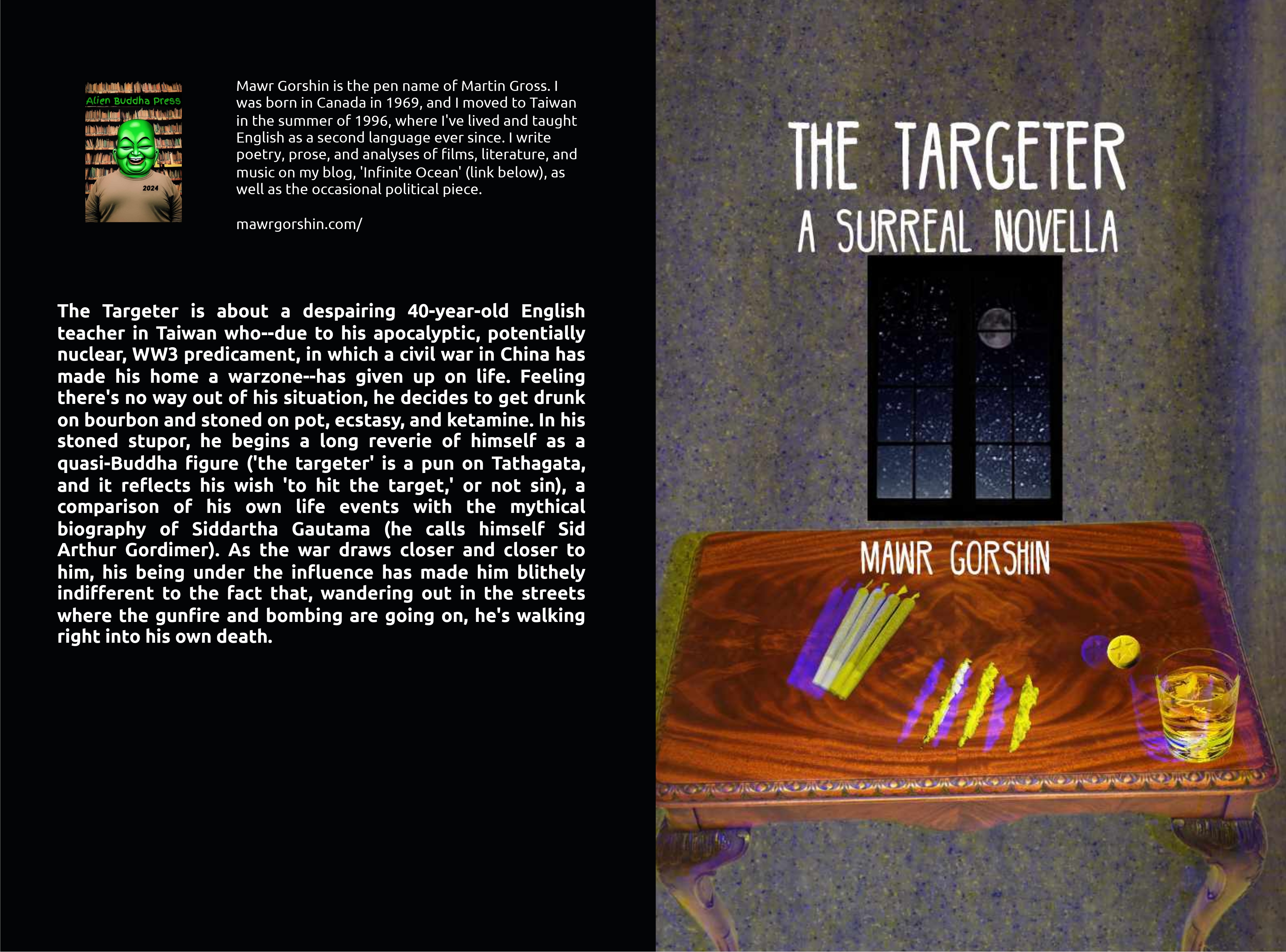
My friend, Dennis Riches, whose writing I have rebloggedanumberoftimeshere, has written up a wonderful review on Amazon of my novella, The Targeter, and rated it five stars! It’s the only review as of the publication of this post, but hey, it’s a start! Baby steps, right?
‘It is difficult to know how to describe and categorize this work. Is it a long poem or a short story? Is it fantasy or realistic fiction? Is the narrator a fictional character, or is this just a slightly fictionalized auto-biography—one rendered as a surrealistic reflection on a life and a family, and on all life at this point in history where nuclear catastrophe looms over us? Is it a Christian-Buddhist prayer or a political treatise? Perhaps it’s the author’s way of telling us, “Just say no to drugs”? Read it and contemplate all these questions to light your own path.’
I can’t say enough times how grateful I am for Dennis’s endorsement of my book! Thank you so much, Dennis, and I’ll be waiting for your next blog article! 🙂
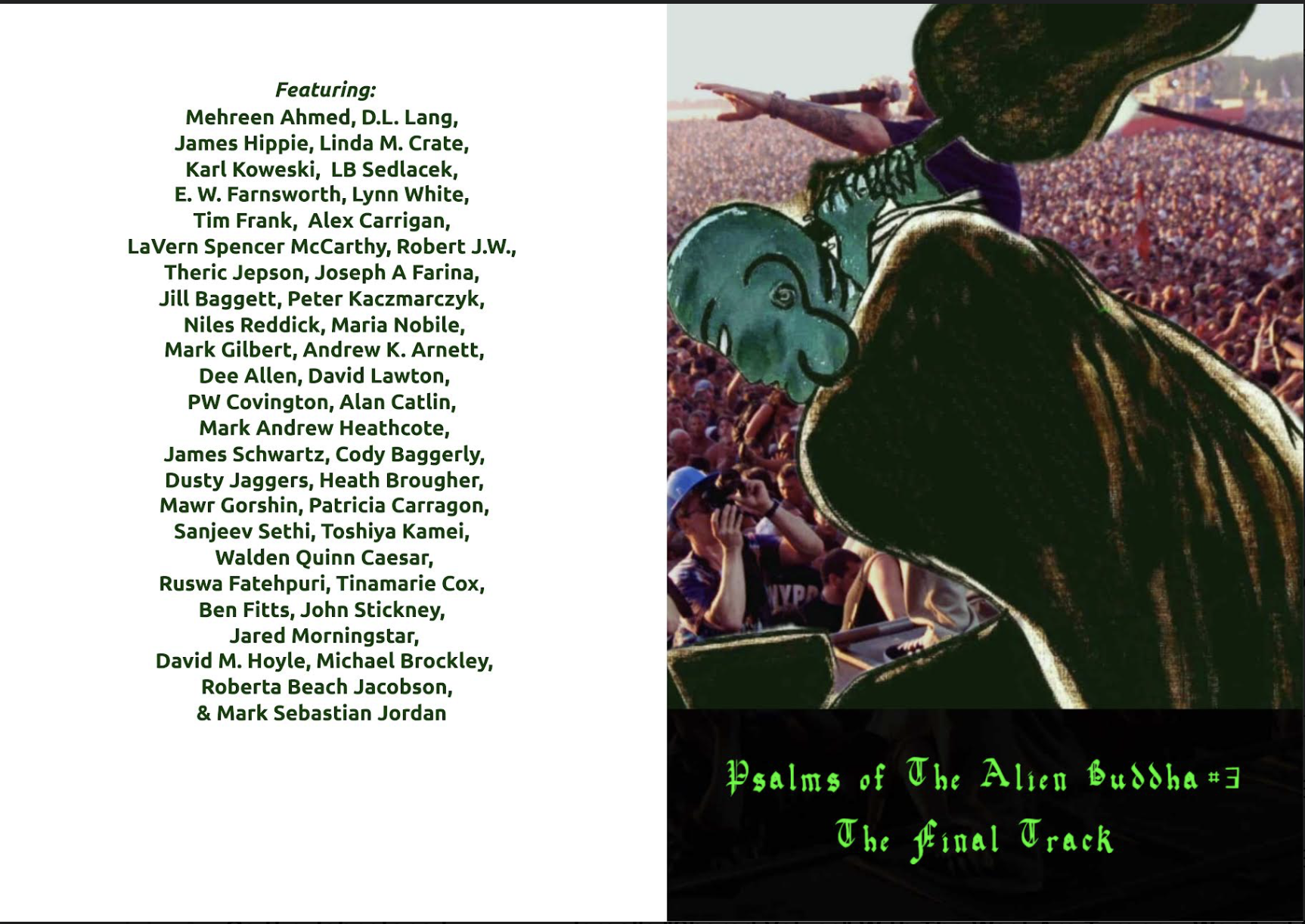
Psalms of the Alien Buddha #3, the Final Track is a new anthology of poetry and prose published by Alien Buddha Press. I have a horror short story in it, called “Sing, Sing, Sing.”
The story is about two eighteen-year-old girls in a high school jazz band who love a jazz clarinetist, Woody, who is almost ten years older than them, and who is creepy enough to want to fool around with them. The first of these two girls, Claire, is jealous of Hedda, the second girl, for stealing Woody, and Claire wants to get revenge on Hedda. Claire also knows how to use magic, so that will be how she achieves her revenge. Now, when she achieves her revenge, will all be well with her, or will she have to deal with some bad karma because of it?
Of course, there are many other talented writers of prose and poetry in this anthology. I’m hoping you can read all their names on the back cover presented above. The paperback is now available on Amazon for $14.99. Go check it out: I’m sure you’ll love it!
“I gotta use the washroom,” Freddie said, then got up and left the dining room.
Good, Hannah though, frowning as she watched him walk away. Fall in the toilet and drown in there, why don’t you? As long as you stop belittling the man I love.
“Oh, nuts,” Brad said, squirming in his chair. “I gotta go, too. Do you have another bathroom, please?”
“On the third floor,” Emily said.
Brad frowned a bit. “You don’t have one here on the ground floor?”
“We do, but the toilet in it is broken,” Mrs. Dan said. “If you can’t wait for Freddie to get back, I’m afraid you’ll have to use the one on the third floor. Sorry.”
“And Freddie takes forever in the bathroom,” Al said.
“And you don’t?” Emily snapped at him.
He raised his middle finger at her, his other hand covering it so the others wouldn’t see.
“Ooh, the finger,” she said.
Brad let out a big sigh and got up. “I guess I’ll have to go up there,” he said. “My gout’s gonna kill me, but I don’t wanna hold this in much longer.” He went out of the room.
Hannah leaned over to her mother and whispered in her ear, “I hate for Dad to suffer with his gout going up those stairs, but if Freddie takes forever in the second-floor bathroom, I’ll be OK with his prolonged absence.”
“Agreed,” Margaret whispered back in Hannah’s ear.
Mr. and Mrs. Dan gave the two whisperers a cool glare, not approving of the privacy of their brief exchange. The two looked back at them with a shudder.
Just a few more steps, Brad thought as he struggled to reach the third floor. God, my foot is killing me!
When his two feet were finally on the third floor, he let out a grunt of relief. He saw, at the end of the hall, a wide-open door revealing the bathroom. Now he just had to limp his way over there.
He got in, closed the door and locked it, then lifted the toilet seat. He unzipped his pants, took it out, and let out a long, loud sigh of relief as he began emptying himself in the toilet bowl.
That was worth the pain in my foot, he was thinking as his bladder got emptier and emptier. Maybe.
Now, completely voided, he gave it a shake, put it away, and zipped himself up. He let out another sigh of relief and washed his hands after flushing.
He groaned in pain as he shuffled his feet and left the bathroom. Going down the stairs wouldn’t be quite as bad for him as going up, but the damage had already been done by the three-floor ascent. He was not looking forward to returning.
If only they had a stair lift here, as we have at home, he thought as he, wincing in pain, limped back to the stairs.
“Hello,” he heard someone say in an exaggerated, sing-song voice, as if mocking him, from behind.
“What?” he said looking back and seeing no one.
“Hello,” the male voice said again, in the same mocking way. “How do you do?”
“That isn’t funny,” Brad said, grateful only that the voice was giving him an excuse not to keep moving on that painful foot. “Maybe you think it’s amusing, but it isn’t.”
He took another step, then one with his bad foot. He moaned in pain.
“I love you,” his watcher called in that sing-song voice again.
“What kind of an idiot are you?” Brad said.
“Fuck you,” the boyish voice said.
“Is that you, Freddie? You aren’t just an asshole to your brother; you’re an asshole to everybody, aren’t you?”
“Come in here, and find out if I’m Freddie or not.”
“I don’t think I want to waste my time with someone so disrespectful to guests. Besides, my foot can’t handle moving around any more than I have to.”
The door to a room right next to him in the hallway suddenly opened. Brad looked in and saw nobody, though the light was off and little could be seen. He heard a slight grunting sound.
“What’s that?” he said softly. An animal, or just that jerk making animal noises?
He heard the grunt again. If that was Freddie, or whoever, making the grunts, he was good at doing animal impressions. The pain in his foot was subsiding.
I like animals, and I’m not looking forward to going down all those stairs, he thought as he turned to face the opened door. What the hell–I’ll take a look.
In he went, wincing from his aching foot. He felt around the wall in the darkness for the light switch as he tried to find, in the dimness, the source of the grunts.
Just before he found the switch, he heard another sing-song “Hello.”
The light went on.
No animal.
No speaker.
Just boxes of things, stacked up all over the room.
He shuffled further into the room slowly, grunting with every movement of that sore foot. He looked around to see if the grunts were from an animal or from Freddie.
He heard another grunt, from behind some of the boxes. The space behind them was too small for Freddie, or anyone else, to be hiding there.
He shuffled closer to the boxes.
He heard another grunt.
He bent down by the back of the boxes.
The door creaked.
With his bad legs and his awkward position, he wasn’t able to look around in time to see if Freddie, or whoever that was, made the door creak.
He saw no one in the room, but the door was now swung all the way open, instead of half-open, as it had been when he went in. Freddie, if it was him, had to be hiding behind the door, in the corner of the room opposite from where Brad was.
He heard another grunt.
He looked behind the boxes. It was a cat with ginger fur. Now it began meowing.
“Aww,” he said, reaching out. “C’m’ere, my little sweetheart.” He picked it up, then straightened up slowly with a groan from his stiff back. “What were you doing back there?” he asked while stroking its back and enjoying the sound of its purring. “You little silly–“
“Hello.”
He turned around and looked over at the door with a glare. Alright, asshole, he thought as he began limping toward the door, always stroking the cat. What nonsense do you have planned for me behind there?
Though he was impatient to get over there and find whoever was behind the door and get this nonsense over with, his sore foot was still slowing him down.
He inched closer and closer.
There was total silence.
Now, he would have preferred to hear another hello.
Finally, he reached the door.
He grabbed it, ready to swing it the other way.
As he did, he said, “Alright, asshole, what’s your–?”
No one was there.
“Mmm?” he said.
The cat was fidgeting in his other arm.
“Oh, I guess you wanna be let go.”
He let the cat drop from his arm, its feet tapping the floor.
“Good evening, Mr. Sandy,” the hoarse voice of an old woman said from behind him.
“Oh?” he said, startled, then turned around.
His eyes and mouth widened.
Before he could scream or process what he saw, an axe came chopping into his face, cutting his head almost into halves and spraying his blood everywhere. In the split second that he had to take in who had killed him, he saw Freddie.
The rest of his body shook for a few seconds, then it fell to the floor with a thump.
The cat meowed again.
“Come, kitty,” Po said through Freddie’s mouth in Chinese. “Run along back downstairs. I have a mess to clean up. At least his foot won’t be troubling him anymore.”
Nature Triumphs: a Charity Anthology of Dark Speculative Literature, is an upcoming collection of horror short stories and poetry edited by Alison Armstrong and Pixie Bruner, and presented by Dark Moon Rising Publications. The charity is dedicated to helping save the environment.
My short story is called ‘The Bees.’ It’s about a geneticist/beekeeper who, fed up with the world’s indifference to the dying off of the bees, does genetic alterations of the many bees he takes care of. He weaponizes them, making them bigger, stronger, smarter, and more lethal, capable of stinging their victims many times until they die. Can he be stopped, or will his enhanced bees multiply and tyrannize the world?
All the talented writers in this anthology include Angela Acosta, M.G. Allen, Alison Armstrong, Lilse Asalt, Andrew Bell, Katie Brunecz, Pixie Bruner, Ramsey Campbell, J. Rocky Colavito, Rebecca Cuthbert, Julie Dron, Stephanie Ellis, Timons Esaias, J.G. Faherty, Thomas Folske, Brian U. Garrison, Elana Gomel, Alejandro Gonzales, Norbert Góra, [myself], Sebastian Gray, Megan Guilliams, Linda Kay Hardie, Kyle Heger, Kristi Hendricks, Kasey Hill, Larry Hodges, Akua Lezli Hope, Sandra Lindow, Gordon Linzner, J.C. Maçek III, Victor Malone, John C. Mannone, David C. Kopaska-Merkel, Makena Metz, Edward Morris, Irena Barbara Nagler, Kris Nelson, Kevin Sandefur, Em Starr, Michael Errol Swaim, Rob Tannahill, Lamont A. Turner, and Mary A. Turzillo.
The anthology drops on September 3rd, and they’re doing preorders now on Amazon and everywhere. Please come check it out, and help us to help the environment in a fun, scary way. I’m sure you’ll love the stories and poems in this collection!
Some people take Facebook memes far too seriously. They also seem to think that the sharing of one meme, often done on a mere whim, encapsulates the essence of the sharer’s political thinking, rather than understanding that the meme is just one thought that passes through time, while a consistency of themes in memes would be a far better indicator of one’s political stance.
Of course, a lot of the snarky comments one gets from having shared controversial Facebook memes these days comes from the heated political climate leading up to the US presidential elections in November. One the one hand, the liberals are trying to scare us into voting for Harris/Walz because if Trump gets four more years, that will be ‘the end of democracy,’ as if democracy is even a meaningful concept in our global capitalist, imperialist system, exacerbated by over forty years of neoliberalism.
On the other hand, some people on the left seem to be trivializing the problem of Trump if he becomes the next president. 2025 will be an…interesting year, it seems…
II: A Trump Meme
A Trump meme that I recently shared showed a colour photo of him in absurd-looking blue shorts, and beside it was a black-and-white photo of Hitler, also in shorts. Both of them were posed similarly, leaning. Regrettably, I no longer have access to the meme, and I can’t find it anywhere.
The meme includes a quote attributed to Mark Twain: “History does not repeat itself, but it often rhymes.” Now, most people’s gut reaction to this meme will be to assume it’s equating Trump to Hitler, which is a little much, to put it mildly.
I didn’t interpret the meaning of the meme that way. Note that rhyme means the middle to the end of the words in question sound the same, while the beginning of those words sounds different. Rhyming words can even have completely different spellings: day and weigh, do and threw, etc.
My point is that when history ‘rhymes,’ one isn’t experiencing the same things, but rather some things that are comparable. To be sure, Trump is no repeat of Hitler, but should a mere paralleling of some of their politics be thought so controversial, particularly thought so among leftists?
[A second point to consider: the meme was a joke (i.e., the ridiculous shorts the two were wearing). As I said at the top of this article, some people take memes far too seriously.]
In order to highlight both differences between Trump and Hitler and the jocular nature of the meme, I added this quote by Marx at the top of my post: “Hegel remarks somewhere that all great world-historic facts and personages appear, so to speak, twice. He forgot to add: the first time as tragedy, the second time as farce.” I was obviously implying that Hitler corresponded to tragedy, and Trump corresponded to farce.
Anyway, a few leftist Facebook friends of mine objected quite vehemently to my sharing of the meme. One woman in particular insisted quite stridently that Trump is not a fascist, but a clown. I agree with the second part of her objection; allow me to explain why I disagree with the first part.
Before I go into the reasons for why I see Trump as, if not a full-blown fascist, at least someone with fascist tendencies, I should remind you, Dear Reader, of the contemporary political context in which Trump has emerged. Fascism arises whenever capitalism is in crisis, and when the ruling class is worried that the restive working class is showing threatening signs of wanting to revolt. Fascism is used to beat the workers into submission.
Bourgeois liberal democracy is a sham. It’s a theatrical show meant to present the illusion that ordinary people have a say in how their government is run. Go to the voting booth, check the box next to the name of the candidate you want in office, and you’ve exercised your democratic freedom of choice. Then your country will be ruled by someone you think represents your interests for, depending on the country, four or however many years until the next election. Wow, what power to the people!
Anyone who has been properly paying attention to what has been going on, especially for the past forty years, almost everywhere in the world, knows that the governments (especially in the US) have been increasingly representing the interests of the 1%, while ignoring the needs of the 99%, with more and more brazen blatancy.
This. Is. Not. Even. Remotely. Democratic.
There have been plenty of protests and demonstrations over the past ten to fifteen years or so, from the Occupy movement to Black Lives Matter. This is the sort of thing, due to neoliberalism‘s causing the rich to get richer and the poor to get poorer, that makes the ruling class nervous. We’ve also seen an increasing militarization of the American police, and Trump has expressed a desire to ramp up even more police power on at least two occasions.
A huge aspect of fascism is the settler-colonialist mentality, and the US–as well as my country, Canada, and Australia, New Zealand, Israel, etc.–is founded on the stealing of land from the indigenous peoples originally living there and killing all of those who resisted. Hitler’s ambition to go east and invade and colonize the Slavic countries, for the sake of lebensraum, was inspired by white Americans moving out west and taking more and more of the land away from the Native Americans, resulting in their genocide.
Fascists, thus, are more than just your garden-variety imperialists…they’re hyper-imperialists. Consider not only what I said above about Nazi lebensraum, but also fascist Italy’s invasions of African countries like Ethiopia in the 1930s. Just as Hitler wanted to make Germany great again, so did Mussolini want to make Italy great again. Sound familiar?
While most recent American presidents have timidly concealed their imperialist ambitions under the obvious lie that they want to bring ‘freedom and democracy’ to ‘tyrannical regimes’ that often just so happened also to be sitting on lots of oil, Trump, with respect to Venezuela and Syria, has made no attempt to cover up his coveting of their oil. One of the main purposes of territorial expansion, be it of an overtly fascist nature or not, is to take the natural resources of the land one conquers and to enrich one’s own nation with them. In this, we can see a connection between Trump and fascism, but more connections are to follow, if you’ll bear with me, Dear Reader, in another digression.
III: Liberalism and Fascism
Another part of the context in which fascism should be seen is its place on the continuum of all political ideologies. In my article, The Ouroboros of Dialectical Materialism, I imagined a circular continuum symbolized by the ouroboros, on which two opposite extremes meet and phase into each other–the serpent’s head biting its tail, and all other points on its coiled body corresponding to the intermediate points on the continuum. Fascism would be the biting head, and communism would be the bitten tail…not because the two ideologies are similar or identical (Of course not! They’re diametrical opposites! I’m not doing some idiotic horseshoe theory here!), but because the one is a reaction against the other (e.g., part of Nazi Germany became East Germany).
In that article, I also said that one could superimpose the four-way political compass on the ouroboros, so that–as I pointed out above–fascism and other far-right forms of government would be in the top-right corner, towards and including the serpent’s biting head, and communism and other far-left ideologies would be in the top-left corner, towards and including the serpent’s bitten tail. Anarchism and social democracy would be in the bottom-left, and right-wing libertarianism and other moderate right-wingers would be in the bottom-right. It would seem that social democrats and other liberals would be far from fascism.
Political matters aren’t that simple, though. Another thing I pointed out in that article is that there is a tendency to slide counter-clockwise from the tail all the way along the coiled body of the ouroboros to the biting head. Over the past forty to fifty years, we’ve seen just such a slide from, for example, the centrist Johnson years of ‘The Great Society‘ and ‘The War on Poverty‘ (all while dishonestly escalating the Vietnam War and brutally fighting the Cold War in its other aspects, don’t forget), to the neoliberal revolution of Reagan and Thatcher, which began the unravelling of such things as welfare capitalism in favour of the ‘free market,’ and thence to the current immiseration of the poor and the ruling class flirting with fascism (Ukraine, Trump, the Gaza genocide, etc.).
Stalin once said, “Social-Democracy is objectively the moderate wing of fascism.” This may seem, on the surface, to be a rather extreme point of view, but consider the liberal slide to the right that I described in the previous paragraph. Liberals are ‘progressive’ during good times, but they’ll sway to the right either during bad times, or if progressive policies go against their class interests. With the dissolution of the socialist states by the early 1990s, no one in the capitalist West, including liberals, had a fear of left-wing revolution, so there was no more incentive to keep alive such things as the welfare state or a diversified media.
And since imperialism is a crucial part of late stage capitalism, the Western ruling class is concerned about the rise of Russia and China. These countries threaten the class interests of the Western ruling class, which again includes the liberals. This is the real reason behind the banging of the war drums against countries like Russia and China.
Accordingly, to counter Russia’s rise, the CIA helped orchestrate a coup d’état in Ukraine in 2014, ousting the democratically-elected, pro-Russian and anti-IMF Viktor Yanukovych and replacing his government with one including Nazi sympathizers. Recall what I said before about the capitalist class using fascism during capitalist crises in order to hold on to power. This is exactly what the Western NATO imperialists have been doing, having used these Ukrainian Nazis to provoke Russia for eight years with violence against ethnic Russians in the Donbas, forcing Putin–who between 2014 and late February 2022, did all he could to secure a peace deal with uncooperative people on the other side–to intervene in Ukraine.
Of course, the Western media have either downplayed if not outright denied or ignored the influence of Nazis in the Ukrainian government and military, but that country has had a history of Nazi sympathizers, nurtured by the capitalist West, ever since WWII. And since much of our current Russophobia is being kindled by liberals, including many in Hollywood, then we can see how liberalism–the farthest left of which is social democracy–can cozy up with fascism.
Now, if liberals can embrace fascism, why wouldn’t conservatives like Trump (a former Democrat, by the way)? The point is that liberals can, and often do, shift to the right, even to the point of fascism if it will further their own interests. Mussolini was a socialist in his youth, then he shifted to the right (with Britain’s influence, to keep Italy in WWI) and established fascism as an ideology.
Charleton Heston was a civil rights supporting liberal, then he shifted to the right and supported the NRA. Trump, as I said above, was a Democrat for a while before running as a Republican. One grows more conservative as one gets older, right? Well, if one has lots of capital to protect.
Conservatives are already closer on the political spectrum to fascism than liberals are, so if the latter can come to sympathize with the far right, then it’s all the easier for conservatives to come that way. Left and right politics aren’t a dichotomy of ‘them’ vs ‘us,’ but a continuum where anyone can slide the one way to the other, given the right material conditions.
IV: Trump and Fascism
Now that we’ve established the political, historical, and material contexts behind which someone like Trump can be seen as at least fascist-leaning, let’s see some actual things he’s done that indicate contributions to the general fascist agenda.
I’ve already explained the fascist nature of much of the current Ukrainian government. Trump sold millions of dollars worth of Javelin missiles to Ukraine. He may have hesitated at first, only agreeing when he was convinced it would be good for US business, but still, he did have them sold. Hitler also had big business backers because they knew supporting Nazi Germany would be good for business. Fascism is hyper-capitalism and hyper-imperialism. At the end of the day, it’s all about good business.
Of course, Trump was not unique in giving aid to Ukraine: Obama may have never sent the Javelins, but his administration sent other forms of aid to Ukraine–millions of dollars in security assistance. And the Biden administration has sent in billions in aid. My saying that Trump was not unique in sending aid to Ukraine is for the same reason that I’m saying Trump is not unique among US politicians in having fascist tendencies. I’m just establishing that Trump is very much a part of the general fascist trajectory that world politics are moving unswervingly towards.
The point is that if Trump were truly not a fascist, but just ‘a clown,’ he wouldn’t have sold those Javelins to Ukraine at all. He and his supporters like to portray him as anti-war; he’s boasted that as soon as he becomes president again, he’ll immediately end the war in Ukraine. I call bullshit on that. His boast is just the typical empty promise of a politician to get votes. The US and NATO are in too deep in Ukraine to get out; they’ve invested so many billions of dollars in it. Trump couldn’t pull out even if he wanted to, and I’d say it’s a safe bet he doesn’t want to. After all, with the sale of the Javelins, war with Ukraine is good for US business, isn’t it? Trump has owned stock in defence contractors like Raytheon. He knows that war is where the money is.
War is a business, and Trump is a businessman; he isn’t anti-war.
Where his fascist tendencies are at their most obvious are in his ‘America first’ rhetoric and his discriminatory wish to keep out the Latin Americans with his wall. What should also be obvious is the fact that Obama was the ‘Deporter-in-Chief,‘ Hillary spoke of the need to have a ‘barrier’ to keep out ‘illegals,’ Biden has been pretty much as harsh in his dealing with ‘illegals’ (who might not have been pouring through the southern US border if not for the US government’s immiseration of Latin Americans in their home countries via such tactics as economic sanctions and replacing democratically-elected leftist governments with authoritarian right-wing ones, thus forcing the desperate poor to try their luck in the US), and that Kamala Harris promises to be even stricter with border security than Trump (and as a prosecutor who fought to keep non-violent offenders, and even innocent men, in jail, she can be trusted to keep her promise).
Again, I’m not saying Trump is unique in his anti-immigrant positions. He’s part of a general trend toward the far right. The point is that he isn’t outside of the fascist problem, and it’s absurd to say he is outside of it. The real difference between him and the other members of the fascist-leaning establishment is that when they discuss the problem of ‘illegals’ going into the US, they use polite language, whereas when Trump discusses it, he uses the bluntest, rudest language he can muster.
Next, we have to deal with an issue that would make Trump undoubtedly a dictator…if it really comes to be. Has all of this talk about Project 2025 been a real, legitimate worry, or is it just scaremongering in the media?
First of all, nothing in the manifesto of Project 2025 should be of any surprise. We’ve all known that the conservative agenda has always been about returning the US to the reactionary politics of the 1950s and earlier. We all know how reactionary Trump is, that his name is brought up many times in that manifesto, and many of the people involved in devising Project 2025 are associated with Trump (like the Heritage Foundation), which all implies that if he’s elected, he surely would enact much, if not all, of the backward policies of the manifesto (despite his attempts to distance himself from it, assuredly to prevent a loss of votes). His adding of conservative Supreme Court justices led to the overturning of Roe vs Wade [which the Dems have never shown any serious interest in codifying], so his enacting of Project 2025 is no idle threat. (Recall that the underestimating of Hitler was a factor in his rise to power.)
On the other hand, it should be obvious to everyone that the Democratic Party is just using Project 2025 to scare liberals into voting for Kamala Harris, even if they don’t like her (they shouldn’t, for the reasons I’ve given above and will give later). Since there’s no real choice for progressives to vote for in the corrupt two-party system (and as promising as the likes of Jill Stein are, even if she miraculously wins the election, the ruling class won’t allow her to make the needed reforms to the system), then the Democrats have to resort to slimy lesser-evil voting again.
Liberals be libbing again. Oh, dear…
Other things that suggest that Trump could be reaching for dictatorial powers, it seems, include his saying, about one hour into a speech he did for his Christian followers, that if he’s voted into office, they’ll never need to vote again. Now, did he mean this, or is it just another of the many examples of verbal flatulence we’re so used to hearing from him (e.g, his claiming that ‘extreme left, Marxist Democrats‘ want to allow abortions as late as when the baby is actually born)? Surely, the Democrats are also using these words of his to scare people into voting blue, regardless of what he actually meant in saying them.
Then there was the tweet he sent, with Grieg’s “In the Hall of the Mountain King” as an eerie, dramatic soundtrack, showing Trump as president not just for 2024, but also 2028, 2032, 2036,…etc., going well into and beyond the 22nd century. Is this to imply a dynasty of Trumps, with his sons, grandsons, etc., to succeed him? That tweet, if anything, comes across as trolling, provocation for the mere fun of it, and suggests, to me, a collusion with the Democrats to scare people into voting blue. Trump has always been used as controlled opposition by the ruling class.
Finally, there was that botched assassination attempt…or (deliberately?) botched security…of Trump, attempted by a kid who makes a Star Wars stormtrooper seem a marksman by comparison. Lots of conspiracy theories are floating around online in response to that debacle, almost as spastic as the January 6th farce. Is Trump, if elected, nonetheless going to use that ‘attempt on his life‘ to give himself emergency powers?
The main factor that would allow Trump to assume dictatorial powers is if he has enough followers, enough muscle, to help him do it. He didn’t have enough of it, as was obviously demonstrated in that pathetic, unarmed January 6th attempt (the Nazi Beer Hall putsch was more of something to take seriously). Since the excesses and incompetence of the Biden administration, I can imagine a lot more Americans siding with Trump. The fascist-leaning types tend to work out in the gym and get military training far more than us on the left, sadly, so there’s more of a possibility of a putsch this time.
If Trump tries to take over, the CIA–in their wish to maintain the veneer of democracy that the masses need to have some sense of hope and thus stave off revolution–could try to have him killed and make it look as if he died of old age; the conspiracy theorists would have a field day, of course, but the ‘official’ explanation sent out in the mainstream media would probably drown out all of the Trumpers’ cries of foul play. Many attempts on Hitler’s life were made, and any more attempts on Trump’s life would reinforce our sense that he’ll have assumed dictatorial powers. But again, any success or failure in such attempts would depend in large part on how many followers Trump will have to make his fascism a reality.
V: Kamala is NO Alternative to Trump
Another meme I shared on Facebook that gave me some static was one of Kamala Harris wearing a necklace resembling one costing $62,000. It’s assumed that she’s wearing the exact same necklace, having paid that much for it. The meme has her say, “Hello, fellow working class people…Today is the day I hope you will donate.”
Shit-lib supporters of her naturally got upset and not only said the usual nonsense of not voting for her equalling voting for Trump, as well as doubting that the necklaces were the same. I personally couldn’t care less if the necklaces are the same or not. I don’t generally take memes literally, as I didn’t in the case of the Trump/Hitler meme discussed above. As far as I’m concerned, it’s what the expensive necklace represents: she, as vice president and thus in with the ruling class, is in no way connected with the working class. It isn’t really about how much money she makes (though, incidentally, she has a net worth of $8 million as of 2024); it’s about which class she’s affiliated with.
As with Trump/Vance, Harris/Walz support Israel, the racist, apartheid regime that’s been murdering Gazans by the tens of thousands–at least between 35,000 and 40,000 since October 7th, which was NOT the beginning of this nightmare. This ongoing genocide is a red line, and that’s all the reason anyone needs not to vote either red or blue. It doesn’t matter how much more of a ‘Hitler’ Trump either seems or actually is: the Biden/Harris administration is already more than fascist enough, and Ms. “I’m speaking!” has made it clear that she plans to keep things the way they are in Gaza.
By a sad irony, members of the same ethnic group that were victimized by fascism back in WWII are now, and have been since a few years after that war ended, the fascist victimizers in their settler-colonialist ethnocracy. Now, this is not to give credence to the idea that Israel somehow rules the US and therefore the world, an idea whose antisemitic overtones should be obvious. As I explained in more detail in this post, it’s the Western imperialist powers that use Israel as a crucial ally in the Middle East, an extremely important region for globally strategic reasons (as well as for all that oil!), to protect their interests. Back when he still had all his marbles (and was just as evil back then as he is today), Biden said the quiet part out loud here about the true relationship between Israel and the US…and by extension, the rest of the Anglo-American/NATO empire.
So, Kamala Harris, by continuing what Biden was doing, is thoroughly entrenched in the system, supporting not only Zionism (as many non-Jews–especially evangelical Christians–do, and many Jews oppose) but also the entire neoliberal agenda as well as the system of incarceration as discussed above. This entrenchment is the real reason for her rise to prominence in politics, not competence, of which people with discerning eyes and ears can find no evidence. The fact that she’s a woman of colour is also helpful to the ruling class, for while she’ll dutifully do all their bidding, her appearance as a non-white male creates the illusion–as it did with Obama–that her election will further racial equality.
As I said almost eight years ago in this article, it isn’t the women at the top (or the people of colour up there, for that matter) who count, but those at the bottom who do, for there are so many more down there than those at the top. Who do we want to raise up to a level of dignity, a small minority of people, or the great majority of them?
Because of Kamala’s willingness to prostitute herself to the system (I need use the word ‘prostitute’ only in a metaphorical sense), she’s never needed actual ability to get as far as she has in her career, in spite of the words of those who insist that, because of that career, she must be competent. For these reasons, I feel I can speak most bluntly about her in a way that should not at all be controversial.
All one needs to do to see the truth of this is to watch the many video clips of her doing that ditzy cackle and engaging in her many word salads. One cannot reduce the word salads to the occasional gaffe, of which even the best speakers have the bad luck of doing once in a while. She’s done way too many of these–it’s a habit with her.
Biden was showing clear signs of dementia back in 2020, and surely those working with him, and helping him with his election campaign then, knew of this problem better than anyone else. His ability when younger was no longer relevant; he was put against Trump because he was associated with Obama, whose charm had been missed after four years of Trump. Biden is a Zionist and a whore for the system, too; his current incompetence had been irrelevant, as far as the ruling class was concerned, until it was exposed in his debate with Trump. Kamala’s incompetence is similarly irrelevant: as long as she furthers the interests of the ruling class, that’s good enough for them.
VI: Conclusion
So, in answer to that one woman’s objection that Trump is a clown: yes, he is a clown, of course (look at his hair and at his orange face, and listen to his ridiculous bragging about all the amazing things he promises he’ll do; listen, also, to his bizarre statements about the ‘extreme left, Marxist Democrats’–something, incidentally, that only a far-right extremist would think about the largely centre-right Dems). He isn’t the only clown, though.
Joe Biden is a clown–at least, his dementia has turned him into one. Kamala Harris is a clown (cackling, word salads). In fact, Hitler was a clown (the toothbrush mustache and the more-or-less bowl haircut, to say nothing of his weird conceptions of the state of world politics of his time). Mussolini was a clown. We need to remember, though, that clowns, just like Pennywise, can be scary as well as funny.
A female troll who gave me a hard time about the memes I’d shared that criticized Kamala asked me, in all snarkiness, if I was even American (I’m Canadian), as if anyone outside of her sacred country has any right to say anything about the election in November. We’re talking here about a country with hundreds of military bases around the world. This is a country that orchestrates, or at least helps to orchestrate, coup after coup in other countries to ensure the latter have governments friendly to the interests of the former. This country sells weapons and gives aid to countries that commit genocides (Israel on Gaza, Saudi Arabia on Yemen–granted, my country’s government has been guilty of giving the offending countries aid, too, and I don’t have any more love of the Canadian government than I do of that of the US). The US has been engaging in nuclear brinksmanship with Russia and China, bringing us all dangerously close to WWIII. To suggest that as a non-American, I have no business criticizing her government is extremely arrogant of her.
What goes on in the US does not happen in isolation from the rest of the world. The American government’s foreign policy is a poison to the entire world, so yes, we citizens of the rest of the planet, no matter how far away we live from the US, have not only every right to voice our opinions about this upcoming election…we have the duty to do so!
Ultimately, it doesn’t matter whether Trump, if elected, goes balls-out fascist on us, or if all that talk about Project 2025, ‘[Christians] will never have to vote again,’ and ‘Trump 4eva’ is just trolling and scaremongering to manipulate Americans into voting Democrat. The US has already been lapsing into fascism whether red or blue (the surveillance state, the wish for mass deportations, class collaboration in the form of simping for billionaires, the enabling of genocide, etc.), and the trajectory towards even more fascism, regardless of a Trump win or a Harris win, will assuredly continue, be it a faster or slower move farther to the right.
The US, founded on settler-colonialism (as, to be fair, is my country, Canada, and many others, no less so), the enslavement of blacks, and the genocide of the aboriginals, in which a small minority of people hoard most of the wealth, cannot reasonably be called a democracy. There’s no threat of losing a democracy that never even existed in the first place.
The problem won’t be solved by voting in the ‘better’ candidate. The problem will be solved by smashing the system the injustice is based on and replacing it with a new one, to serve the people. Doing so will be extremely difficult, if not bordering on impossible–I have no illusions about that–but it’s the only way.
In an accelerationist sense, a Trump win, with him assuming dictatorial powers, could cause just the outrage needed to motivate the people into rising up in revolution. I’m not hoping for such an outcome in the election, of course. For just as his move for those powers depends on him having enough people to back him, our success in revolution, in response to him doing that or otherwise, will depend on us having enough people to back us. Are there enough of us?
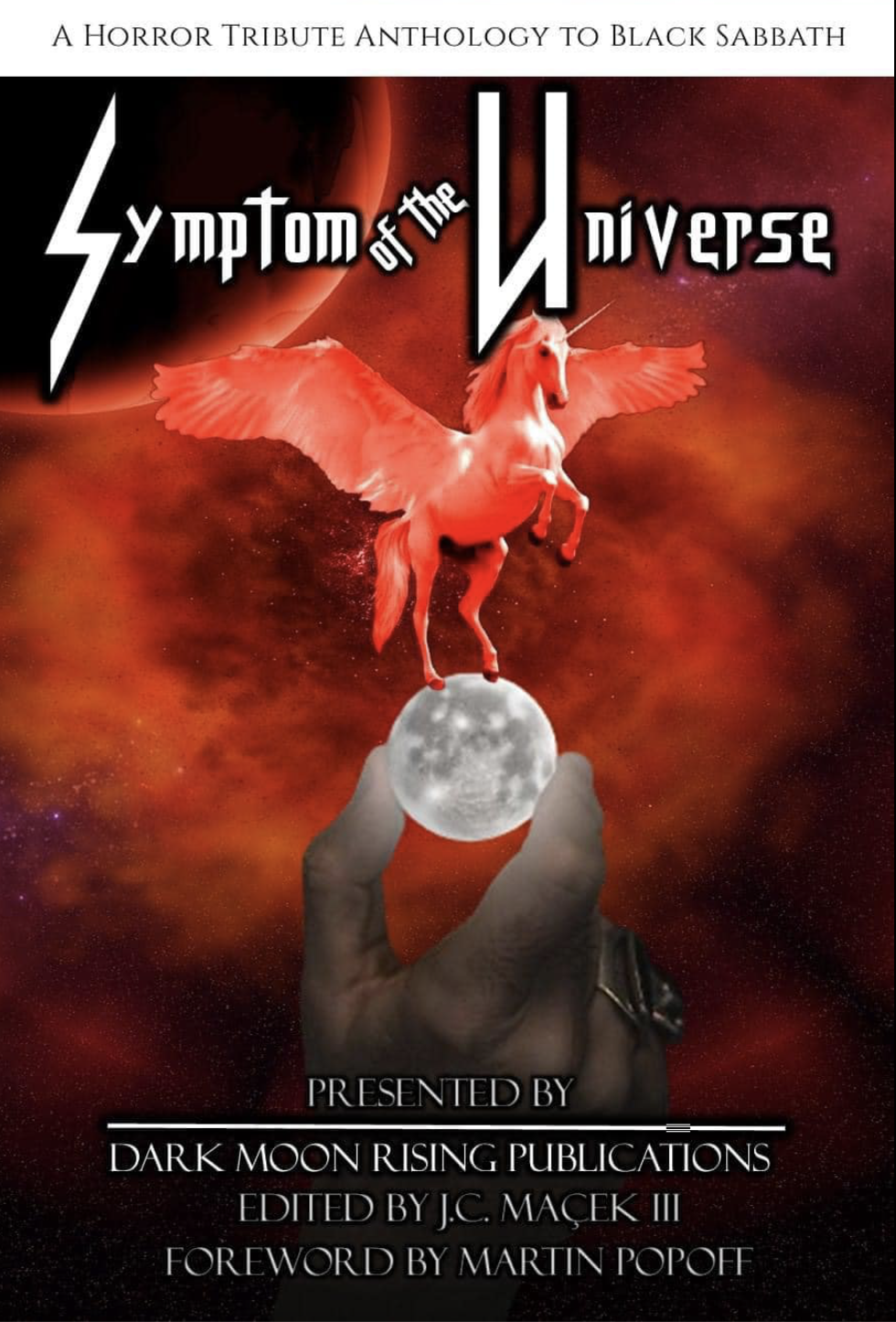
Symptom of the Universe: A Horror Tribute to Black Sabbath is the name of a new anthology of horror short stories, presented by Dark Moon Rising Publications, edited by J.C. Macek III, and with a foreword by Martin Popoff, the Canadian music journalist and critic. As the title implies, the stories are all inspired by Black Sabbath songs.
My story is named “NIB,” so you shouldn’t have a problem figuring out which song my story is inspired by (though it makes references to a whole lot of other Sabbath songs, albums, covers, etc). It begins with this line: “My drug dealer’s in love with me.” I hope that will pique your curiosity about where the story will be heading…a wild, surreal, and disturbing ride through the mind of a traumatized drug addict whose latest trip is more than just that–a paranoid nightmare that might involve witchcraft, and just might kill him.
The book will be published on September 18th. It’s available for preorder on Amazon.
Here, apart from me, are the names of all the talented authors to be included in the anthology: Rob Tannahill, David L. Tamarin, J. Rocky Colavito, Neil Sanzari, Sidney Williams, Don Webb, John Claude Smith, Rhys Hughes, Edward Morris, Tom Folske, Duane Pesice, Tom Lucas, J.C. Macek III, Gail Ice, Rhys Hughes again, J.C. Macek III again, Daniel E. Lambert, Bert Edens, Shayne Keen, Scott Couturier, Thom Erb, Stewart Giles, Jayaprakash Satyamurthy, J.C. Macek III yet again, Emmy Viane, Tom Folske again, Jason R. Frei, Thomas R. Clark, Keith Keesler and J.C. Macek III, Melissa Howard Corrigan, John Reti, J.C. Macek III, Ezekiel Kincaid, Kasey Hill, J.C. Macek III again, John Sowder, Tony Millington, and Neil Kelly. Note that several authors contributed more than one story, and a few stories are collaborations.
I really hope you’ll go out and buy yourself a copy of this new anthology. It’s a charity anthology, with all the proceeds going to the Dio Cancer Fund. It’s also going to be a really great set of stories. I’m sure it’ll knock your socks off!
Hannah, her parents, and her brother arrived at the Dans’ house at 8:00 PM sharp for the dinner. She rang the doorbell, and Al’s mother came to answer it with a big, warm smile.
“Oh, good evening,” Mrs. Dan said as she reached out a hand to shake Hannah’s. “You must be Hannah. Al has told us so much about you. Come on in, all of you.”
The other Dans were still in the living room, not smiling at Al.
As the Sandys were coming in, Mrs. Dan greeted the others. “You must be Hannah’s mother, Mrs. Sandy,” she said.
“Yes,” Mrs. Sandy said, mirroring Mrs. Dan’s grin. “You can call me Margaret.”
“And you are Hannah’s father and brother, yes?”
“Yes,” Mr. Sandy said. “You can call me Brad.” He shook Mrs. Dan’s hand.
“I’m Doug,” Hannah’s brother said, then he shook her hand.
Mrs. Dan led the Sandys into the living room, where Mr. Dan rose from his chair with a grin. He reached out to shake Brad’s hand.
“Good evening, Mr. Dan,” Brad said as they shook hands. “Hannah’s told us so many nice things about Al. I’m Brad Sandy, her father, and this is her mother, Margaret.” Margaret shook Mr. Dan’s hand. “This is Hannah’s brother, Doug, and this is Hannah.” They all shook hands.
“It’s so nice to meet you all finally,” Mr. Dan said, then he gestured to Al’s sister and to Freddie. “Meet my daughter, Emily, my son, Freddie, and their brother–the one moping and twitching in the corner over there, the one Hannah is dating–is Al.”
Everyone shook hands.
“Emily,” Mrs. Dan said, “come help me in the kitchen.”
Emily left the living room.
“Let’s all go into the dining room,” Mr. Dan said. “My wife and daughter should be getting all the dishes for us to eat now.”
As they were heading for the dining room, both Margaret and Hannah were thinking, Interesting how only the females have to do all the work in the kitchen.
Of course, Al had concerns of his own, him still moping as they all sat down. His mother and sister were putting the bowls and plates of rice, vegetables, chicken, and seafood on the round table, which could be rotated to allow anyone to get access to any dish.
Oh, please, spirits, Al begged in his thoughts, with his eyes closed and his lips moving. Don’t do anything too horrible tonight.
Freddie noticed Al’s moving lips.
“Who are you talking to, Al?” Freddie asked. “Besides yourself?”
Al glared at him, his eyes telling him to shut up.
“Ooh,” Freddie said. “Dirty look.”
Now Hannah was glaring at Freddie.
I’m starting to see why Al didn’t want us to come tonight, she thought. His brother can’t even refrain from bullying him when guests are here.
“So, what do you do, Mr. Sandy?” Mr. Dan asked as he helped himself to some rice.
“Well, I’m the owner of a furniture store on the other side of town,” Brad said, then rotated the table so he could get at the rice.
“Oh, Brad’s Furniture?” Mr. Dan said.
“Yes, that’s the one,” Brad said with a smile.
“We have a chair or two in the living room that need replacing,” Mrs. Dan said.
“Because Al broke them,” Emily said.
There was a pause as the Sandys looked at her and the other Dans awkwardly. Al blushed.
Po broke both of them when I sat on them, he thought. But how do you talk about that without sounding crazy?
“We should go to your store and see if there are any we can get to replace them,” Mr. Dan said.
“I’d love to have you come in and look around my store,” Brad said with another smile. “After dinner, I can go back into the living room and look at your damaged chairs so I can get a head start in finding suitable replacements in my store.”
“That sounds like a great idea,” Mrs. Dan said.
“Just make sure they’re extra sturdy chairs,” Emily said. “We don’t want Al breaking them again.”
Al, sitting next to her, whispered “Shut up!” in Chinese.
“Why?” she whispered in Chinese. “What’ll you do if I don’t?”
He cursed at her in Chinese, more audibly this time.
Mr. and Mrs. Dan frowned at him…but not at Emily.
“Al, don’t be like that,” his mother said softly but firmly in Chinese.
Trying to defuse things, Margaret then said, “Mr. Dan, what do you do?”
“Oh, I’m a businessman, too,” he said. “I own a microchip manufacturing company located downtown.”
“I wish Dad would make a microchip we could have implanted in Al’s brain,” Freddie said. “If it can be called a brain.”
He and Emily giggled.
The Sandys all looked at Al’s siblings in shock. Mr. and Mrs. Dan acted as though nothing wrong was said. Al just sank into his chair.
There was an awkward silence of five seconds.
“A-and you, Mrs. Dan?” Margaret asked. “What do you do?”
“I’m a housewife,” she answered coolly.
“I’m a high school history teacher,” Margaret said.
“Oh,” Mrs. Dan said, almost with an air of disapproval, as if it would have been better for Margaret to be a stay-at-home mom. Margaret keenly felt that.
Al reached for the plate of chicken. As soon as he touched it, though, it twirled in the air several times, throwing the chicken pieces all over the place, one hitting Margaret in the face, another hitting Hannah in the chest, fortunately leaving no stain on her blouse.
“I was waiting for Al to fumble something,” Emily said. “You clumsy idiot!”
“Loser!” Freddie said.
Po, Al thought, looking down at his shoes.
Poor Al, Hannah thought after checking her blouse for any marks of chicken on it. He didn’t fumble that plate, though. It did a cartwheel all of its own accord…but how do you talk about that without sounding crazy?
Here are links to Parts I, II, III, IV, V, and VI, if you haven’t read them yet.
XXIX: Out
This chapter begins with another description of the rainstorm outside, and how things have developed as of 9:00 to 10:00 AM (pages 1411-1415). As with the last such description, it’s all one continuous paragraph (this time, for about four and a half pages) except for the last sentence, in which Andrew Keene, grandson of Norbert, isn’t sure if he can believe what he’s seen: the destruction of the Standpipe, something that up until then “had stood for his whole life.” (page 1415)
As I said last time, this uninterrupted flow of words, in its mass of formlessness, represents the undifferentiated trauma of Lacan’s Real. We may be reading words here, but their presentation, without any breaks except for the last sentence, suggests a lack of order, a kind of word salad, symbolizing the inability to verbalize.
Wind-speeds are at an average of fifty-five miles an hour, with gusts of up to seventy (page 1411). Though the water department initially ruled out a flooding of downtown Derry, it’s now not only possible but imminent, and for the first time since the summer of 1958, when the kid Losers went into the sewers.
Howard Gardener has a brief image of Hitler and Judas Iscariot, two of the great villains of history, handing out ice-skates; the water is now almost at the top of the Canal’s cement walls. Adding to the apocalyptic theme, Harold will tell his wife later that he thinks the end of the world is coming (page 1412).
By page 1413, the Standpipe already has a pronounced lean, like the tower of Pisa. As I said above, Andrew Keene has watched its whole destruction in disbelief (pages 1412-1415), though he’s been smoking so much Colombia Red that at first he thinks he’s been hallucinating.
Meanwhile, down in the tunnels, adult Bill and Richie are still going after It (page 1416). It wants them to let It go, but they’re very close now.
The Spider offers Bill and Richie long lives of two, three, five hundred years if they’ll let It go (page 1417). It will make the two men gods of the Earth–one is reminded of Satan tempting Jesus in the wilderness (Matthew 4:8-9).
Bill and Richie start hitting the Spider with their right fists and with not only all their might, but also with “the force of the Other,” this being Gan, as I’ve mentioned in earlier parts of this analysis, but that force is also that Lacanian Other of social togetherness as against the dyadic, one-on-one narcissism that uses only one other as an extension of oneself. This is the Other of solidarity: it’s “the force of memory and desire” [recall their lovemaking with Bev when they were kids, and how I said it symbolized their solidarity]… “the force of love and unforgotten childhood.” (page 1417)
The section is titled The Kill, for this is where Bill finally kills It by plunging his hand into the Spider and crushing Its heart (page 1418). To do Shadow work properly, you have to go down deep into the darkness, and get to the heart of the matter.
After the Spider dies, Bill hears the Voice of the Other, telling him he “did real good.”, even though the Turtle, it would seem, is dead (page 1419). Gan, the real God of Stephen King’s cosmology, is very much alive.
In the next section, Derry 10:00-10:15 AM, we confront the destruction of downtown Derry. The statue of Paul Bunyan has exploded (page 1420). Recall how it was associated with Pennywise when adult Richie was terrorized by It; fittingly, it’s destroyed around the time that Bill has killed the Spider.
And at 10:02 AM, again, when Bill has killed It, downtown Derry collapses (page 1421). When Bill regroups with Bev, Ben, and Richie, they get Audra, and they’re trying to find their way out (in the section fittingly titled Out, pages 1429-1435); they are aware of a growing light that shouldn’t be there in the Canal under the city (page 1431).
This is what happens when one does Shadow work: one goes deep into the darkness, into the heart of the matter, and one makes the darkness light. One integrates dark and light. What is unconscious is made conscious. This is what the collapsing of downtown Derry symbolizes.
The Losers realize that the street has caved in, for they recognize pieces of the Aladdin movie theatre down there with them (page 1432). This mixing of parts of upper, surface Derry with the underground symbolizes that integration of the conscious with the unconscious, a uniting of the dark with the light. Indeed, it seems to Bill that most of downtown Derry is in the Canal and being carried down the Kenduskeag River (page 1433).
The Losers climb up to the surface of the city, carrying catatonic Audra (page 1434). A small crowd applauds them when they’ve emerged (page 1435). The applause is fitting, even if the crowd doesn’t know what the Losers have just done, for they deserve it nonetheless–they’re the heroes of Derry. The Losers have become the Winners. The mark of that small door, they’ve noticed, is gone (page 1428). The cuts on their hands–from their childhood pledge to return to Derry if It returned (dealt with in the section titled Out/Dusk, August 10th 1958, pages 1440-1444)–are gone. The ordeal is finally over.
Bill, Ben, Bev, and Richie reach the corner of Upper Main and Point Street; there they see a kid in a red rainslicker sailing a paper boat along water running in the gutter (pages 1438-1439). Bill thinks it’s the boy with the skateboard he met before. He tells the boy that everything is all right now, and to be careful on his skateboard. Since the kid’s rainslicker is red instead of yellow, and since Pennywise is gone, perhaps all he needs to worry about now is the Big Bad Wolf.
Of course, not everything is all right. Bill still has to deal with what’s happened to Audra. I’ve discussed in Part II [see the chapter, “Bill Denbrough Beats the Devil (I)”] how he does this. The point is that it will involve once again the novel’s theme of facing one’s fears.
XXX: Derry: The Last Interlude
Just as there is duality in so many other forms as I’ve described them in It–namely, the dialectical unity of opposites–there is also duality in the ending of the novel in the form of two epilogues, this last interlude and the actual epilogue after it.
Things are disappearing, as Mike notes in his journaling, starting June 4th, 1985. Bill’s stutter is disappearing (page 1447). The fading away of his speech impediment symbolizes how his resuming of the regular spoken use of language marks his leaving the trauma of the Real and his re-entry into the Symbolic, into society, a healing union with other people. He just has to achieve the same thing for catatonic Audra, who won’t say a thing.
Richie has disappeared: he’s flown back to California. Their memories of what happened are also slowly disappearing (page 1448). Just little details are being forgotten for now. Bill thinks the forgetting is going to spread, but Mike thinks that that may be for the best.
It’s a bad thing to repress trauma, so it’s there, bothering you without you being able to figure out what it is so you can do something about it. It’s also a bad thing, though, to ruminate endlessly over past pain. Since they have killed It once and for all, it’s probably best for them to let it go. In bad remembering and bad forgetting, we have another duality in It.
At the same time, though, there’s also good remembering and forgetting–in this case, their friends. Bill thinks that maybe he’ll stay in touch with Mike, for a while, but the forgetting will put that to an end. Ben later hugs Mike and asks if he’ll write to Ben and Bev…again, Mike will write for a while, for as with Bill, Mike knows he’s forgetting things, too (page 1451).
After a month or a year, his notebook will be all he has to remember what happened in Derry. Forgetting is filling Mike with panic, but it also offers him relief. This, again, is an example of the good/bad duality in the novel. Because It is finally and truly dead, no one needs to stand guard for Its reappearance twenty-seven years later.
Fifty percent of Derry is still underwater, the apocalyptic consequence of having destroyed It (page 1452). How does one rebuiild a city whose downtown has collapsed in a kind of Great Flood?
The forgetting is continuing. Mike has forgotten Stan’s last name (page 1454). Richie has forgotten it, too–was it Underwood? No, that isn’t a Jewish name…no, it was Uris, they finally remember.
Mike has almost forgotten Stan and Eddie. Did the latter have asthma, or a chronic migraine (page 1455)? He phones Bill and asks: Bill remembers the asthma and the aspirator, which Mike recalls only when Bill has mentioned it (page 1456). Mike has also forgotten Eddie’s surname; Bill thinks it was something like Kerkorian, but of course that’s wrong.
Yet another thing is disappearing: the names and addresses of Mike’s friends in his book (page 1457). He could rewrite and rewrite everything, but he suspects that the rewrites will all fade away, so why bother?
He has a nightmare that makes him wake up in a panic, and he can’t breathe. He also can’t remember the dream (page 1458). Such is the nature of repressed trauma. All this stuff is forgotten, but it’s still in one’s head. Still in his hospital bed, Mike has a vision of that male nurse with the needle…or of Henry and his switchblade.
Bill is the only one Mike remembers clearly now. Bill has an “idea” of what he can do about Audra, but it’s so crazy that he doesn’t want to tell Mike what it is (page 1457).
XXXI: Epilogue: Bill Denbrough Beats the Devil (II)
His crazy idea, of course, is to take catatonic Audra on Silver, his old bike, and ride with her out into the danger of the traffic, to snap her out of it. This racing on his bike, risking a crash and serious injury, if not death, is him trying to beat the Devil, as he did as a kid when racing to the drugstore to get Eddie’s medicine.
It’s an insane, desperate act, but as with his friend, Eddie, it’s an act of selflessness, for if Audra dies with Bill in a crash, it probably won’t matter, for in her catatonia, she’s already in a state of living death…Lacan’s Real, with no differentiation between life and death, and no ability to verbalize her trauma, to leave the Real and enter the Symbolic.
To leave the Real, one must have a sense of differentiation. Bill is getting a sense of that for himself before he imposes differentiation on Audra. He goes from naked in Mike’s bedroom (Bill and Audra have been staying in Mike’s house until he is released from the hospital) to fully dressed (pages 1461-1462). He goes from inside to outside, taking Silver out of the garage and onto the driveway (page 1463); he’s been thinking about leaving Derry, too, from inside the city to outside (pages 1463-1464).
In his imagination, Bill sees Derry as it was when he was a kid, a differentiation between the past and the present, between his childhood and his adulthood, for those memories–including the intact Paul Bunyan statue–are in stark contrast with the destroyed Derry of the present (page 1464).
He needs Audra to experience differentiation, too, between life and death, specifically, and by putting both of them right on the brink between the two, he hopes she’ll sense that differentiation and snap out of it. The danger of this, of course, is augmented by the fact that he’s way too old to be doing stunts on his old bike.
Naturally, he’s also full of conflict over whether he should be doing this–surely, he can’t!–and yet if he doesn’t at least try it, she’ll stay in her catatonia for the rest of her life. It, as I’ve observed in the previous parts, is all about facing one’s fears, for doing so is how the beat the Devil.
As he’s riding, in imitation of the Lone Ranger, Bill shouts out “Hi-yo Silver, AWAYYYYYYY!” (page 1468), as he used to do as a kid. Like the Lone Ranger, he is being a hero for Audra as he was for Eddie, yet paradoxically, he could also be about to kill her. We see the good/bad duality once again.
There’s also been his contemplation of leaving Derry, and whether or not he should look back (page 1469). It’s best not to look back: after all, Lot’s wife turned into a pillar of salt for looking back at burning Sodom and Gomorrah. This must be why the Losers are forgetting everything–we mustn’t look back. Audra has to be snapped out of her catatonia, even to the point of risking death, because that catatonia is her, in a psychological sense, ceaselessly looking back on what traumatized her in the Spider’s lair. That trauma is turning her into a pillar of salt, so to speak.
As Bill is racing on his bike, people are shouting at him to be careful (page 1470). He comes extremely close to some crash barriers by a slipstream. Then he hears Audra’s voice: “Bill?” (page 1471). She’s asking him where they are, and what they’re doing. She’s using language; she’s re-entered the Symbolic and left the Real. She’s snapped out of it!
Now Bill can do his Lone Ranger routine with perfect confidence. His idea worked! He is a true hero! He’s beat the Devil!
In fact, he too has fully re-entered the Symbolic, for he realizes that his stutter is all gone (page 1472), and it seems that it’s gone for good.
As for his childhood memories, their beliefs and desires, and his dreams, Bill will write about them all one day (page 1473), for as I’ve said in the other parts of this analysis, writing is good therapy.
XXXII: Conclusion
So, the whole point of It is to face one’s fears, to confront the Shadow, and to make the dark light–that is, to integrate, reconcile, and unify such opposites as the dark and the light, good and evil (i.e., by confronting the evil, one finds the good), the self with the other, etc. In a fragmented world where we find ourselves not only cut off from each other, but also cut off from other parts of ourselves, integration and unification are necessary for us to be reacquainted with the intuitive idea that all is one, where inner peace is finally found, where one discovers one’s true self.
Discovering our true selves isn’t a simple matter of discarding our false selves, though; the Persona and the Self must be integrated, too, for the Persona is a part of the totality of the Self. This is why Bill had to speak in a voice other than his own to recite the couplet without stuttering and thus weaken It. Eddie had to let himself be duped by the ‘efficacy’ of his aspirator to help defeat It, too, since les non-dupes errent.
Integrating all of the opposites to reach that all-is-one unity in the Self is no form of sentimentality. It’s difficult, dangerous, and scary work, as the Losers learned inside those sewers. To reach heaven, the ouroboros‘ biting head (see Part VI, in XXVII: Under the City, for an elaboration of my interpretation of the symbolism of the ouroboros), one must first pass through the serpent’s bitten tail…hell. Such a crossing over of extremes, reconciling them, is what It is all about.



 Infinite Ocean

You must be logged in to post a comment.